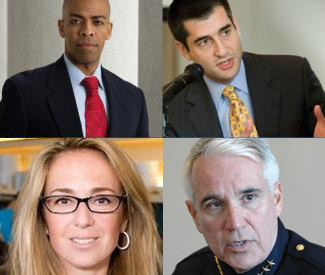
District Attorney

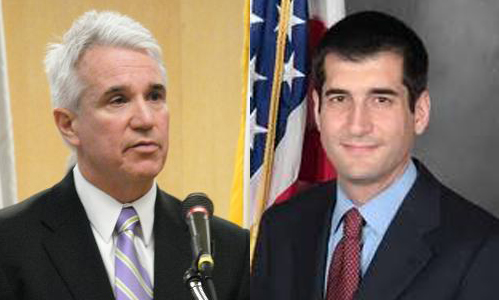
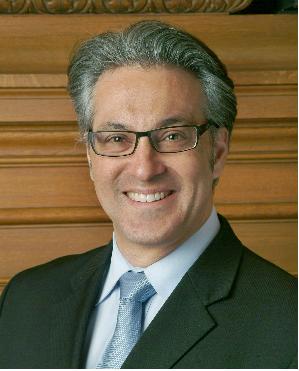
Editorial: Gascón’s conflict

1

There’s a good reason that not too many police chiefs become district attorneys. Obviously, not a lot of cops have law degrees, but it goes beyond that. The district attorney is supposed to monitor the police, to investigate criminal behavior by cops, to make sure the people out on the streets aren’t doing anything that will screw up cases in court.

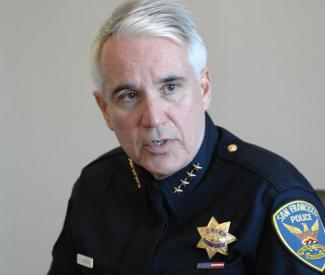
But that didn’t bother former Mayor Gavin Newsom (who apparently doesn’t think that conflict-of-interest statutes apply to him). Newsom appointed Gascón to the D.A.’s job despite some serious concerns about the operations of the Police Department — and problems at the SFPD have blown up yet again. Four times in the past two weeks, Public Defender Jeff Adachi has released videotapes showing undercover cops entering residential hotel rooms without a warrant. The videos appear to contradict the information that the officers presented in their written reports, and the pattern of conduct has caused interim Chief Jeff Godown to suspend the entire undercover narcotics unit at Southern Station.

It’s also caused the District Attorney’s Office to undertake an investigation. And no matter what comes out of that inquiry, it will be fatally tainted by the fact that Gascón is, in effect, investigating his own operation.

Gascón hired Godown, who came from Los Angeles. He was, until just three months ago, in charge of the department that’s apparently running amok. The problems that have surfaced didn’t just emerge the day Gascón left; for all practical purposes, they are his problems, coming from his department, growing and festering under his watch.

A serious investigation would not only look at the actions of this one handful of officers, but at the command structure and climate that allowed this sort of behavior to become routine. It would look at the chain of command all the way to the top — that is, to the chief. To Gascón.

The D.A.’s office can’t possibly get this right. If Gascón finds wrongdoing on the part of these particular officers, the officers will no doubt seek to have the investigation and any prosecution set aside on the grounds that the former chief was a conflict. If he finds no wrongdoing, it will look like a cover-up.

This is only the first of what could be a long series of conflict problems with Gascón’s office. Put simply: the former chief can’t effectively monitor the police department, particularly if there are allegations of misconduct that come from the era when he was in charge.

There’s no easy way around this. Gascón could (and probably should) recuse himself and his office, and ask the attorney general to conduct the investigation. But the A.G.’s office doesn’t have a great track record on taking over local cases like these. His only real alternative is to hire an independent outsider — the equivalent of a special prosecutor — to handle all cases involving the police department. That would be expensive, but it’s the result of the unfortunate, highly unusual situation that Newsom and Gascón created.<0x00A0><cs:5>2<cs

Gascon’s conflict

2

EDITORIAL There’s a good reason that not too many police chiefs become district attorneys. Obviously, not a lot of cops have law degrees, but it goes beyond that. The district attorney is supposed to monitor the police, to investigate criminal behavior by cops, to make sure the people out on the streets aren’t doing anything that will screw up cases in court.

But that didn’t bother former Mayor Gavin Newsom (who apparently doesn’t think that conflict-of-interest statutes apply to him). Newsom appointed Gascón to the D.A.’s job despite some serious concerns about the operations of the Police Department — and problems at the SFPD have blown up yet again. Four times in the past two weeks, Public Defender Jeff Adachi has released videotapes showing undercover cops entering residential hotel rooms without a warrant. The videos appear to contradict the information that the officers presented in their written reports, and the pattern of conduct has caused interim Chief Jeff Godown to suspend the entire undercover narcotics unit at Southern Station.

It’s also caused the District Attorney’s Office to undertake an investigation. And no matter what comes out of that inquiry, it will be fatally tainted by the fact that Gascón is, in effect, investigating his own operation.

Gascón hired Godown, who came from Los Angeles. He was, until just three months ago, in charge of the department that’s apparently running amok. The problems that have surfaced didn’t just emerge the day Gascón left; for all practical purposes, they are his problems, coming from his department, growing and festering under his watch.

A serious investigation would not only look at the actions of this one handful of officers, but at the command structure and climate that allowed this sort of behavior to become routine. It would look at the chain of command all the way to the top — that is, to the chief. To Gascón.

The D.A.’s office can’t possibly get this right. If Gascón finds wrongdoing on the part of these particular officers, the officers will no doubt seek to have the investigation and any prosecution set aside on the grounds that the former chief was a conflict. If he finds no wrongdoing, it will look like a cover-up.

This is only the first of what could be a long series of conflict problems with Gascón’s office. Put simply: the former chief can’t effectively monitor the police department, particularly if there are allegations of misconduct that come from the era when he was in charge.

There’s no easy way around this. Gascón could (and probably should) recuse himself and his office, and ask the attorney general to conduct the investigation. But the A.G.’s office doesn’t have a great track record on taking over local cases like these. His only real alternative is to hire an independent outsider — the equivalent of a special prosecutor — to handle all cases involving the police department. That would be expensive, but it’s the result of the unfortunate, highly unusual situation that Newsom and Gascón created.

Accusations against SFPD officers impact D.A.’s race

2

The decision by San Francisco prosecutors to drop a drug case that involved four of six plainclothes officers currently under investigation for illegally raiding residential hotel rooms and then lying about the busts in police reports, came one day after the Public Defender’s Office released videos that contradicted police reports in two separate cases. And it’s thrown another curve ball into the D.A.’s race, which veered into weird and uncharted territory the minute former Mayor Gavin Newsom appointed the city’s top cop George Gascón as SF’s next D.A.

The D.A.’s Office and the San Francisco Police Department have both announced that they have launched internal investigations into the SFPD officers after video footage from busts at the Henry Hotel in December and January was released. And D.A. spokesperson Erica Derryck sought to clarify that the D.A.’s office dropped the case because of ongoing investigations into the alleged misconduct, and that the D.A.’s investigation is independent of SFPD.

“As the District Attorney’s Office of this County, we are conducting our own, independent investigation into this matter,” Derryck said. “If there is criminal wrong-doing found it will be handled accordingly. Our Justice Integrity Unit will conduct an independent investigation to determine if any criminal conduct has occurred. This is separate from any SFPD investigation. Our Trial Integrity Unit will examine on a case-by-case basis, what, if any, cases may be affected by this investigation and the alleged conduct of these officers.”
 
But former Police Commissioner David Onek, who is running against Gascon in the D.A.’s race this fall, called for a completely independent investigation, citing the conflict of interest created by Gascón’s investigation of alleged officer misconduct that occurred during his tenure as San Francisco’s top cop,
“There is a clear conflict of interest when our current District Attorney investigates potential criminal activity that took place at the SFPD under his watch,” Onek said. “The foundation of a safe city is earning and keeping the public’s trust. And that requires calling in outside agencies when this trust will be undermined by a conflict of interest, such as the one presented by these facts.”

“Whatever decision Gascón now makes, he will highlight to the public his conflict of interest as the former police chief,” added Onek, who is the founding executive director of the Berkeley Center for Criminal Justice. “If he decides not to charge the officers, the public will question if he did so to protect his former officers or his former administration. If he decides to press charges, the officers themselves will ask if he is doing so because he is a candidate for office and feels the need to show a tough attitude towards his former department. In the interest of justice, former chief Gascón should recuse himself and his agency from investigating the SFPD  in cases that occurred when he was chief. If you are conducting a fair investigation, you not only review the conduct of individual officers, you also explore if this alleged conduct was the result of issues with training and supervision. No fair investigation of these facts can be conducted by the individual responsible at the time for that training and supervision.”

Tasers vs. talk

1

rebeccab@sfbg.com

At a Feb. 23 Police Commission hearing, San Francisco interim Police Chief Jeff Godown told the civilian oversight board he wanted to investigate Tasers as a less-lethal weapon for San Francisco Police Department (SFPD) officers. Speaking to a room crammed full of community advocates who had turned out to rail against the idea, Godown seemed to try to preemptively address a concern that opponents were sure to raise during public comment.

“This is not about mental illness,” the chief said. Along with police commissioners who favored the Taser proposal, Godown drove that point home several more times throughout the evening, stressing that Tasers were not being sought as a law enforcement tool for dealing with violent, mentally ill individuals. Nevertheless, he said situations could potentially arise in which the stun guns would be used against the mentally ill, if officers were authorized to carry the devices.

At the end of a marathon meeting, SFPD won approval to spend 90 days investigating Tasers and other less-lethal weapons as possible additions to the police arsenal, which now includes pepper spray and batons as well as firearms. Advocates raised concerns ranging from misuse of the devices to accidental deaths caused by Tasers to documented overuse of the weapons in communities of color. The SFPD, meanwhile, emphasized that it saw Tasers as a way to improve officer safety while limiting the use of lethal force.


SHOOTING THE MENTALLY ILL

Throughout the discussion, concern about the use of Tasers as a tool against the mentally ill persisted despite the chief’s assurances. “Like it or not, these issues are intertwined,” said American Civil Liberties Union (ACLU) Police Practices Director Allen Hopper. He referenced comments made by former Police Chief George Gascón, who now serves as district attorney.

On Jan. 4, SFPD officers fired twice at Randal Dunklin, a wheelchair-bound, mentally ill man who was brandishing a knife outside the city’s Department of Public Health building. Dunklin allegedly stabbed an officer and suffered a nonfatal gunshot wound to the groin after he had tossed the knife. In press comments delivered in the aftermath, Gascón said the situation illustrated why the SFPD ought to carry Tasers.

“Not only was that not an appropriate circumstance for the use of a Taser, there were so many things wrong with the way police handled that situation,” Hopper said, referencing a YouTube video of the shooting that served to highlight key differences between the official police account and the events caught on tape.

Dunklin was the third person in recent months to be shot in an altercation with officers. Vinh Bui, who was 46, was fatally shot in Visitacion Valley in late December 2010. Michael Lee, who was 43, was fatally shot in a residential hotel in the Tenderloin a few months earlier. Both had a history of mental illness.

Police Commissioner Angela Chan told the Guardian that in light of these tragedies, she became concerned that the first commission meeting of the year initially featured a discussion about Tasers.

“I thought, this does not make any sense,” Chan said, because commissioners hadn’t yet looked at creating a specialized police unit for dealing with psychiatric crisis calls, a move she’d urged the department to consider. The commission schedule was rearranged to reflect her concern, and Chan rushed to book experts for a detailed presentation about crisis intervention training (CIT). In a unanimous vote at the Feb. 9 meeting, the police commission approved implementation of CIT.

The specialized policing technique is patterned after the so-called Memphis model, which originated in Tennessee in 1988 in the wake of a public outcry that arose when white officers gunned down an African American man with a history of mental illness.

Memphis model policing emphasizes de-escalation, which is quite different from the everyday command-and-control method cops are trained to use against suspects. Under this model, officers are taught to consider things such as the tone of voice they are using to communicate with the mentally ill person, the distance they are standing from them, and how the individual might respond to their behavior. Whenever it’s safe to do so, officers are encouraged to allow the mentally ill person the time they need to calm down.

Samara Marion, an attorney and policy analyst with the Office of Citizen Complaints, traveled to Memphis to witness CIT officers on duty. “I was absolutely impressed,” Marion said. “It is community policing at its best.”

CIT has been credited with a dramatic reduction in officer-involved shootings against the mentally ill in Memphis. Randolph Dupont, a clinical psychologist and professor at the Memphis-based School of Urban Affairs and Public Policy, told the Guardian that studies had shown mentally ill people who dealt with CIT officers were more likely to be in treatment three months later than those arrested by non-CIT officers. “Mental health is a community issue,” he said. “You don’t want it to be a police issue to resolve.”

In San Francisco, the program envisions training about 20 percent of the police force to create an elite unit of CIT officers, selecting those who are more experienced and have better track records in dealing with the public. Once in place, 911 dispatchers would alert CIT when SFPD receives calls involving psychiatric crises. On arriving to the scene, a CIT officer would be responsible for taking charge of the situation and directing other officers.

This is the second time an attempt was made to move forward with crisis intervention in San Francisco. In 2001, the department implemented generalized crisis training to all officers instead of intensive training for a specialized unit. However, that low-level effort was canceled last year due to budget cuts.

While CIT won resounding support from the community, the Feb. 23 discussion about Tasers drew tremendous opposition, with around 50 advocates speaking out against the plan. Hopper’s criticism, echoed by several mental-health providers, was that SFPD’s campaign for Tasers sent a mixed message and threatened to overshadow the CIT effort by seeking a quick fix based on a tool instead of a tactic. And rather than moving toward the goal of de-escalation set by CIT, Hopper said, the use of Tasers could exacerbate a situation instead, making it more dangerous for everyone involved.

“The Police Department — we think to its credit — has recognized that [addressing] mental health issues is a departmental priority,” Hopper said. “We think it’s putting the cart before the horse to give police Tasers before they put that plan into effect.”

A mental-health advocate who said she is “living the Kafkaesque world of a family dealing with mental illness” urged the commission to hold off on talking about Tasers until after CIT had been implemented, saying the two were closely connected.

“If you vote to purchase Tasers, you’re undercutting the message that they need to learn de-escalation,” another mental-health advocate noted.

Yet Marion said she thought adequate time was being allotted to study less-lethal weapons, and did not think this would undercut the CIT effort. “As long as the department continues to be motivated and engaged, I don’t see it being a problem,” she said.

Chan told the Guardian that the day after the Feb. 23 commission hearing, Godown phoned her to say he remained committed to CIT. Although she voted to allow police to move forward with investigating Tasers, Chan said her final support would depend on the success of CIT.

“If CIT is not doing well … I am going to be strongly opposed to any adoption of any pilot program,” Chan said. “I do prioritize one above the other.”


DEATH BY TASER?

A Taser is an electroshock weapon that can administer 50,000 volts through two small probes, disrupting the central nervous system and bringing on neuromuscular incapacitation.

While Taser proponent Chuck Wexler, a researcher who spoke at the hearing, emphasized that Tasers “are for saving lives,” studies have shown that the risk of death or serious injury increases under certain circumstances. Someone who is Tasered while fleeing police can suffer serious injuries if they can’t break their fall. There are dangerous implications for people whose heart rate is accelerated due to cocaine or methamphetamine, and as the Memphis Police Department learned many years ago, Tasers don’t mix with flammable substances, like an alcohol-based pepper spray that has since been discontinued.

“Lots of times it’s not about the product itself, it’s about … risk factors,” said Maj. Sam Cochran, who worked with Dupont in Memphis to create CIT. “Under some circumstances, things can happen very fast.”

Safety concerns are heightened when it comes to the mentally ill. It’s common for people experiencing psychiatric episodes to behave violently, speak incoherently, and ignore commands, creating the kind of scenario where law enforcement would likely opt to deploy a Taser. According to an extensive research inquiry on Tasers published by the Braidwood Commission on Conducted Energy Weapon Use, Tasers can be especially dangerous when used against people who are delirious.

“First responders should be aware of the medical risks associated with physically restraining a delirious subject or deploying a conducted energy weapon against them,” according to Dr. Shaohua Lu, who is quoted in the study. “They likely have profound exhaustion and electrolyte changes before delirium kicks in. At that stage, any additional insult (e.g., struggling or fighting) can lead to the body just giving out, resulting in cardiac arrest and death.”

Since 2004, when the city of San Jose first equipped officers with Tasers, seven people have died following police Taser deployments. At least one was mentally ill.

MaryKate Connor, a mental-health provider who founded the now-defunct Caduceus Outreach Services, told the Guardian she didn’t think the police officers could separate the issues of less-lethal weapons and tactics for handling the mentally ill. “The promise of the CIT program, whether the police want to acknowledge it or not, is that this is a huge cultural shift,” she said. “It’s not about finding a new weapon. It’s about finding a less lethal way to respond, period.”

Joyce Hicks, director of the Office of Citizen Complaints, sounded a similar note during the hearing. “No weapon can substitute for sound tactics,” Hicks said.

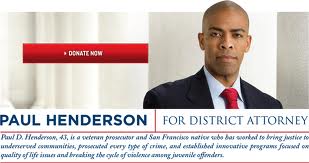
Paul Henderson denies D.A. deal with Willie Brown

6

Paul Henderson doesn’t mince words when it comes to debunking the notion that Willie Brown helped him get his new job as Mayor Ed Lee’s public policy czar. Or that his decision to drop out of the D.A.’s race was in exchange for his new job.

“There was no deal with Willie Brown. I called and said, so do I get a check in the mail, a basket of fruit?” Henderson said, recalling his furious reaction to Brown’s claim, made in the Chronicle in January, that Brown and then mayor Gavin Newsom conspired to make sure Henderson was “taken care of,” in the wake of Newsom’s shocking announcement that he had appointed San Francisco Police Chief George Gascón as D.A.

“If there was a set up for me somewhere, I still have not got it. I didn’t get shit,” Henderson, who joined the D.A.’s office in 1995 and was said to be former D.A. Kamala Harris’ preferred pick to fill the D.A. post, after she won the state Attorney General’s race, last fall.

Instead, Henderson, who filed papers to run in the D.A.’s race in November, saw his plans blown out of the water when Newsom, in his last act as mayor, appointed Gascón as Henderson’s new boss. And when Gascón filed papers in the D.A.’s race the very next day, Henderson found himself in the unenviable situation of holding an at-will position in the D.A.’s office, while running against his boss in the 2011 D.A. election.

“ If there was any deal, it was for me not to lose my job,” Henderson added.  “And it’s the best decision for me. I really do care about public service.”

During his 16 years in the D.A.’s office, Henderson established juvenile drug and community justice courts, set up domestic violence and hate crime programs, and focused on rehabilitative, reformative, treatment-oriented alternatives to imprisonment.

He said his decision to join the Mayor’s Office is based on a long relationship with Lee. “I want to have a voice in the criminal justice system, and I’ve known Ed Lee independent of all this political business,” Henderson said, recalling that he worked with Lee to develop language programs in the D.A.’s office, so employees could take lessons and better interact with community members, victims and witnesses in court.

“I’m a third generation San Francisco resident, and the first generation not to grow up in the projects, though we lived opposite them,” Henderson continued, recalling how his mother is a Public Defender, his grandmother was a community advocate, and he went to preschool in Sunnydale. Those experiences gave him a strong sense of being connected to and serving his community from an early age, Henderson said.

And he soon found himself holding the highest position, as a gay and black, in the D.A.’s office in the 1990s.‘I was the first African American the D.A.’s office had hired in five years,” Henderson said, recalling how the department looked in 1995. “And look at it now,” he added, noting that since he took over hiring at the D.A.’s office, more gays, lesbians, Asians, Latinos and other minorities have been employed.

“I’m very aware of who I am and what I represent in this office,” Henderson said. “For me, it’s about creating an open door and having a voice at the table. Ed Lee has asked if I would be the liaison between national, state and local agencies collectively in his office. And this expands my voice and creates opportunities for all in San Francisco in ways that are exciting to me.”

Henderson said his new post will have a very different focus from the role former US Attorney Kevin Ryan played, during his brief tenure in the Mayor’s Office, under Gavin Newsom.“This will be about policy development, advice and implementation, and it will be more reflective of marginalized communities,” Henderson said. “So, I don’t want these communities being misled into thinking, ‘oh, he got a hand out.’ This was not a hook-up. I earned my place here.”

“The truth is that you have access to me because I am in this position,” Henderson continued. “And I hope it’s transformative for the city and the community. Because I did not get shit. There is no Paul Henderson pay-off. I’d be happy to tell you if I’d sold out. But no. I knew Ed independently. He knows my heart, trusts my judgment and reputation. This has nothing to do with Willie, Gavin and Kamala. Unless it did, and they are all tricking me. In which case, they should at least tell me, so I can credit them. But the truth is, I’ve worked so hard, and if I’ve become ‘the Man,’ then I’m at the table for the community. I’m not the person who took a pay out, got a hook up, a cushy deal, so I will go away, to silence my voice.”

Henderson notes that he has not given up his political aspirations, despite all that went down recently. “If it’s not my time right now, I still have political credibility and a profile in the city that isn’t going away “ he said, noting that he raised $65,000 in 28 days, just before Christmas, with no staff, immediately after a statewide election. “That speaks to how much support I have. Obviously I was disappointed that I wasn’t appointed D.A. But I’m not dead, and I’m trying to move in a direction that expands my voice.”

Henderson says his new role won’t change him and he’ll remain accessible to gay, black, Chinese, Samoan, immigrant, low-income, Latino and other marginalized communities.“I have a lens that most city leaders don’t have,” he said, noting that he was homeless and slept in his car when he was going to law school. “Ad now I can affect policy. Many folks feel the criminal justice system happens to you, and over 80 percent of victims are people of color and poor people. But who speaks for and represents them?”

Henderson drops out of D.A’s office and race, SFPD Chief turned D.A. Gascón appoints DeBerry as new chief of staff

4

I wondered what Willie Brown was talking about when he wrote that making sure that D.A. office insider Paul Henderson was “taken care of” was one of only two details to be worked out, following former Mayor Gavin Newsom’s shocking last-minute appointment of former police chief George Gascón as the next District Attorney  And now I think I found out: Henderson, who was former D.A. Kamala Harris’ chief of administration and her preferred pick, announced yesterday that he is dropping out of the D.A.’s race and will serve as Lee’s public safety czar.

Henderson starts his new job March 8, meaning 15 months has passed since former U.S. Attorney Kevin Ryan resigned from the Mayor’s Office of criminal justice—leaving everyone unsure what Henderson’s new post entails, and whether it comes with a staff and/or a budget.

Henderson says his new job includes involvement in the Taser debate, the next police chief selection, and assessing how budget cuts impact public safety. And he certainly didn’t publicly let on that he was anything but delighted about this latest twist in the ever evolving race to be the next elected district attorney.

“I’m excited about helping our Mayor shape this new position and about what we can accomplish under his leadership to enhance public safety in the City,” Henderson, who is  reportedly backing Gascón in the D.A.’s race, told the Guardian.

But Henderson’s move brings us back to the other detail Brown referred to in January, namely, “assessing the odds of Gascón winning the D.A.’s race in November.”

Currently, David Onek, a senior fellow at the UC Berkeley Center for Criminal Justice and served in the Mayor’s Office of Criminal Justice under Newsom and Alameda County Deputy District Attorney Sharmin Bock, are the only remaining contenders. And while little has been heard from Bock since she filed in January, Onek has been doing all he can to stay relevant, including holding house parties, raising money, calling for transparency in the D.A.’s Office around officer-involved shootings, and interviewing criminal justice experts as part of his Criminal Justice conversations podcast project in Berkeley.

Onek’s latest interview is with Michael Romano, co-founder of the Stanford Three Strikes Project, which represents folks serving life sentences under the Three Strikes law for minor, non-violent offenses – such as stealing a pair of socks. “Addressing the flaws in the Three Strikes law will protect Californians while also having a positive impact on our state budget.” Onek observed in a campaign email. “According to the California state auditor, non-violent third strikers will cost our state at least $4.8 billion over the next 25 years – almost $200 million per year.”
 
Onek also noted that the next few months are crucial for his D.A. campaign, “to build strong partnerships between law enforcement and the community.”
And the challenge for anyone who is not part of the Brown- Newsom machine to remain viable in the D.A.’s race were illustrated afresh yesterday when Gascón convened a 30-minute press conference at the Hall of Justice to announce he is reorganizing his staff to focus on cutting the backlog of homicides and other felony cases–and was replacing Henderson with Cristine DeBerry, who was deputy chief of staff under Mayor Gavin Newsom and Mayor Ed Lee.

Gascón said the reshuffle was a product of six weeks talking to prosecutors, court officials, defense lawyers and others in the criminal justice system. And so far it has led to David Pfeiffer being named as heads of special operations, Sharon Woo as head of operations, Eugene Clendinen as chief of administration, Braden Woods as chief of the criminal division, Lenore Anderson as chief of collaborative courts, Maria Bee as chief of victim services, June Cravett as head of the white collar division, Jim Crisolo as chief of investigations and Jerry Coleman as chief of the Brady, appellate and training division.

Gascón said he doesn’t foresee immediate layoffs in the department, which has a $39 million annual budget. But he warned that if he is required to cut his budget by 10 percent, as Mayor Lee has requested of all departments, he’ll have to lay off the equivalent of 18 prosecutors.
“Hopefully, we’ll be spared that,” he said. “As it is, we have so much unattended business.”

Gascón blamed the crushing deficit in the D.A.’s Office on budget constrictions over many years, as he used a Power Point slide show to illustrate how the department had less funding in 2008 than in 1986 (if numbers are adjusted for inflation).
“It’s why we had problems in the past and why we are doing this reorganization,” he said, claiming that a significant lack of training in the department has caused “a poor performance in court,” and that there is only one paralegal for every 9 attorneys, on average.

Gascón said it took 3-4 months to process most felony cases, and up to 3 1/2 years to bring a murder case to trial, under the office’s previous configuration.  “By that time, memories have faded, and people are not showing up,” he said.
(D.A. press spokesperson Seth Steward clarified today that Gascón’s claim that “only one out of every 26 misdemeanor cases” was in fact a misstatement, and that the D.A. is working to provide a more accurate analysis.)

Gascón also announced that he is rolling out a makeshift community court system in the next few months, in which alleged perpetrators, victims and three mediating members of the public would work to find a solution, which could be community service.
‘So you can roll the dice and be prosecuted or go to the community court,” he said. “We believe we can take 20 percent of our work load, which is about 1,000 cases, and run it through this system.”

He also claimed that instead of spending $1,200 to $1,300 in the court system, these cases would only cost $300, and that the Tenderloin Community Justice Center will stay in place, under the reshuffle.
 “My goal as Chief was the make San Francisco the safest and largest city in the United States, and that continues to be the goal,” Gascón concluded.


Mirkarimi runs for sheriff

2

tredmond@sfbg.com

Sup. Ross Mirkarimi filed preliminary papers to run for sheriff Feb. 22, altering the shape of the mayor’s race and giving progressives another shot at electing a candidate to citywide office.

His move also guarantees that law enforcement will be part of the discussion on the left this fall and it opens the door for a progressive sheriff to succeed retiring Mike Hennessey and continue the sorts of policies that have made him a national example of alternative ways to approach crime and punishment.

Mikarimi, a graduate of the San Francisco Police Academy and a former District Attorney’s Office investigator, has law enforcement experience and has made violent crime a key issue as a district supervisor. But he’s not part of the city’s public safety establishment.

“One of the greatest successes of Mike Hennessey was that he was an independent sheriff,” Mirkarimi told us. “That allowed him to take a progressive approach to his job.”

Mirkarimi had been talking about the job of sheriff for some time now, but he had been waiting to hear whether Hennessey would seek another term after 31 years on the job. When the sheriff announced last week that he was planning to retire, Mirkarimi moved quickly, contacting potential supporters and setting up a campaign plan.

The supervisor becomes the immediate front-runner in a race where there’s no other high-profile candidate. But that doesn’t mean he’s going to walk into the job — the last thing downtown wants is a progressive of Mirkarimi’s stature holding a high-profile citywide office that could be a springboard to a future run for mayor.

“This is going to be a top-of-the-ticket race,” Mirkarimi said. “We don’t want it to be a setback by losing the Hennessey legacy.”

Mirkarimi pushed hard for community policing as a supervisor, demanding more foot patrols in areas like the Western Addition, where the homicide rate was high. As sheriff, he told us, he would work to expand on Hennessey’s efforts at curbing recidivism.

“Eventually, almost everyone who’s incarcerated comes back to the community,” he said. “Our recidivism rate for the county jails is above 60 percent, and we have to work on reentry programs to lower that. It’s really about keeping communities safe.”

If a strong progressive gets into the mayor’s race — and somebody whom the left can support runs for district attorney — there’s the prospect of a slate of candidates who can work together, share resources, and mount a concerted campaign.

It’s likely Mirkarimi will get the support of at least five or six supervisors and other high-profile political figures. Hennessey hasn’t said anything about his successor, but if he supports Mirkarimi — which is entirely possible — the supervisor will be in strong position for November.

But the likelihood of at least one downtown-backed candidate, and possibly several law-enforcement types, in the race will make it challenging. With ranked-choice voting, Mirkarimi will not only have to win most of the first-place votes, but reach out beyond the progressive community to get enough seconds and thirds to hold on to victory.

But if he can pull it off, he’ll have done something no other solid progressive has done in years: win an open race for a citywide office.

Mirkarimi running for sheriff

17

Sup. Ross Mirkarimi is going to file papers today (Feb 22) to begin his campaign for sheriff.

Mirkarimi told us he wants to continue the progressive legacy of Mike Hennessey and to work to reduce recidivism. “Eventually, almost everyone who’s incarcerated comes back to the community,” he said, noting that more than 60 percent of people released from the county jail are re-arrested at some point. “We have to work on re-entry programs to lower that number,” he said. “It’s about keeping communities safe.”

Hennessey, long regarded as one of the city’s most progressive elected officials, has served as sheriff for 31 years. He’s been a national leader in progressive law-enforcement programs, and last year made headlines by fighting the federal mandate that local authorities turn over to immigration offices anyone arrested in the city without proper documentation. He announced recently that he won’t seek another term in November.

Since nobody else has announced an interest in the job — and nobody with Mirkarimi’s record and name recognition is even being mentioned — he becomes the instant front-runner. But it won’t be an easy campaign — the last thing downtown wants is another progressive in citywide office — particularly someone who, like Mirkarimi, could one day use the sheriff’s office as a platform to run for mayor.

Mirkarimi is a graduate of the San Francisco Police Academy and former investigator in the district attorney’s office. He’s been a champion of community policing and antiviolence programs — but as someone who has never been part of the local law-enforcement community, he comes to the race with political independence.

“One of the greatest successes of Mike Hennessey was that he was an independent sheriff,” Mirkarimi noted.

We’ll have more details in the Feb. 23 issue.

Onek to SFPD Chief turned D.A. Gascon: release records of officers cleared in shootings

3

Calitics has a revealing letter from David Onek, a senior fellow at the Berkeley Center for Criminal Justice, a former member of the San Francisco Police Commission and a candidate in the 2011 District Attorney’s race, demanding greater transparency from the D.A.’s office when it comes to explaining why officers have been cleared in officer-related shootings.

“After spending my career working to identify and implement the most effective public safety strategies, I have seen one constant – the community is safest when the police and prosecutors earn and keep the public’s trust,” Onek writes in a letter that is guaranteed to turn up the ante in an already intriguing race. “That’s why I read with real concern that the San Francisco District Attorney’s office would not produce reports related to officer-involved shootings pursuant to a recent public records request from NPR-affiliate KALW.”

(The KALW report shows that the person in the D.A.’s office who penned the letter denying its request for records was Paul Henderson, D.A. Kamala Harris’ chief of staff and her preferred pick as replacement D.A. before Gavin Newsom appointed former SFPD Chief George Gascón as his last act as mayor, shocking just about everyone except Willie Brown, especially when it came out that Gascón used to be a Republican and is not philosophically opposed to the death penalty. And while Gascón, who was registered in recent years as decline-to-state, promptly turned around and registered as a Democrat, he also filed papers in the D.A.’s race that cite the phone number of notorious campaign attorney Jim Sutton.)

In his post on Calitics, Onek notes that as a former Police Commissioner, he was briefed in closed session on the details of officer-involved shootings, and he often heard complaints from community members about how little public information was released about officer-involved shootings.
“This lack of transparency breeds distrust,” Onek observes.

Onek acknowledges that in all officer-involved shootings, the DA’s office conducts an independent review to determine if there is criminal liability, and that if such liability is found, the DA presses charges, which are public. “But when the DA determines that there is no liability, it is equally important that the DA publicly explain the reasons for its decision,” Onek states.

In short, he believes the D.A.’ office should issue a very detailed report on every officer-involved shooting in which it does not file charges and should make the report publicly available on its website. “The report should detail the facts, the law and the reasons for the decision not to file charges,” Onek says, arguing that complete transparency would make the job of police and prosecutors much easier by building trust between law enforcement and the community, making it more likely that community members will work in partnership with police and prosecutors, and that victims and witnesses will come forward to testify.

“Publishing detailed reports that clear officers when they acted within the law can dispel public misconceptions about what actually happened,” Onek concludes. “Of course, officers’ privacy rights need to be respected and investigations cannot be compromised. But once an investigation is complete, and an officer has been cleared, it is imperative that the District Attorney’s office share its findings with the public. “

And as Onek points out, this standard is already in place in communities in California. “The District Attorney’s office in San Diego, hardly a bastion of liberalism, actually lists these cases on its website,” Onek states. “Many other counties – including Los Angeles, Orange and Fresno – also make them matters of public record and available on request. Building trust with the community is the key to enhancing public safety. Let’s not violate that trust by refusing to release documents that the public has the right to see.”

I’ve got a call into D.A. Gascón’s office to learn more about the rationale for denying KALW’s request, and I’ll be sure to post his reply here, so stay tuned.

Playing chicken

27

news@sfbg.com

The Heart of the City farmers market in U.N. Plaza may not exude the bourgeois foodie reputation of the Ferry Plaza farmers market. It doesn’t sell micro-roasted coffee or artisan cheeses, and its fountain may sometimes double as a public shower, but it does offer one product that no other San Francisco farmers market does: fresh, live poultry.

Raymond Young has sold live chickens here for two decades, showing up at dawn to set up shop and peddle his poultry to an eager throng of customers, mostly Chinese, who happily take home upwards of 600 birds per day.

But a group of animal rights activists is saying that the poultry stand is inhumane, violates health codes, and that Young’s employees have infringed on their civil rights as protestors. Since April 2010, members of LGBT Compassion have been showing up in the wee hours of the morning next to Young’s stand with banners, brochures, and signs promulgating the alleged cruelty of his business and seeking to block the sale of live birds. In January, protesters upped the ante when they slapped Young and the HOC market with a lawsuit alleging continuous abuse and negligence by those who supervise the market.

“For me, it was as simple as seeing the animal cruelty,” said Andrew Zollman, 43, the founder and organizer of LGBT Compassion. “The cages are dilapidated and cramped, there are feces everywhere, and the chickens are shoved in plastic bags, two at a time, while they scream in fear or pain. It was like walking down the street and seeing a dog beaten — and it’s really frustrating to see it happen here in San Francisco.”

Zollman and fellow protester Alex Felsinger, 25, filed the lawsuit with San Francisco attorney Matt Gonzalez after months of attempts to get city officials to intervene.

The allegations have Young and market management squawking, saying that the activists are opposing a practice that is both legal and routine. They claim the protesters are overly sensitive to the treatment of the chickens simply because they can see it, and decry their tactics as an attack on a small business and cultural traditions since almost all of his customers are Asian.

“These people just don’t seem to like other people’s culture of selling live chicken,” Young said. “”I think that what I do is right. I abide by all the health codes and animal care codes. I try to do everything I can to satisfy everyone. These protesters think they can override the law because they don’t like what they see.”


THE PATH TO COURT

Zollman and Felsinger have been encouraging the city to investigate Young’s stall, regularly sending videos and photos taken at Young’s stall to the Department of Public Health and Animal Care and Control. But their quest to protect the chickens has been complicated by the lack of city oversight and an inability to enforce animal cruelty laws due to provisions exempting poultry.

The clash between the vociferous vegans and the poultry purveyors reached its pinnacle in late December 2010, when Felsinger claimed he was punched in the side of the head, wrapped up in a tarp, and had the memory card from his camera stolen by one of Young’s employees. As painful as the altercation was, Felsinger’s scuffle has helped him garner support.

Felsinger doesn’t have footage of the December attack, but he and Zollman have documented several instances of alleged verbal and physical abuse by Young’s employees, including anti gay statements from Young’s daughter, which was the subject of a complaint to the Human Rights Commission.

“There is a long list of things being done to us over the past year,” Felsinger said. “I never expected them to take such a violent act against me. It’s not how I wanted to go about it. But it might have the end result we’re looking for.”

Christine Adams, manager of the HOC market since it first opened in 1981, has consistently defended Young and called the lawsuit “completely outrageous.”

“This is a market, and if they (Young’s crew) were illegal, they would have been booted,” she said. “I have done nothing wrong; Raymond has done nothing wrong. I’m not worried at all about the lawsuit.”

Adams said that while she had not been personally affected by the protesting in the past, she did not approve of Zollman and Felsinger’s actions and attributed a decline in live poultry sales to their presence.

“Their sales have gone down considerably,” Adams said. “They used to sell more than 1,000 birds a day and now it’s more like 600 or 700. I think it’s definitely because of the protesters. People don’t like to be followed through a market and have a camera shoved in their face just because they bought a live chicken.”


GATHERING EVIDENCE

Almost every market day, Zollman and Felsinger would show up to protest and take video and still photography of Young’s stall. They have posted numerous videos and photos to their group’s website (lgbtcompassion.org) — the same ones they say they send to DPH and ACC — documenting the conditions at Young’s stall.

The DPH makes routine inspections twice per year to the market. In November, Zollman, Young, and Adams held a meeting with principal environmental health inspector Lisa O’Malley to address issues of sanitation, handling, and guidelines for bringing live animals near food. The department says the vendor is operating within guidelines.

“There were some problems in the past, but they’ve been fixed,” O’Malley told us, naming a few instances of inadequate removal of chicken feces from the area and improper hand-washing as past problems. She said the challenge was maintaining the guidelines, the most difficult of which is making sure people do not walk through the market after purchasing their birds. Health codes prohibit animals from being within 20 feet of food. The primary concern is contamination from fecal matter, which could cause illnesses such as Salmonella poisoning.

O’Malley walks by the market regularly because of its proximity to her office and says all operations seem compliant. At the same time, official enforcement and inspection is limited to the Public Health Department’s semi-annual visits. This means the only people watching over the operations of the stall and customers are the security guards, who don’t start working until two and half hours after the market opens, long after prime time for buying live chickens.


CULTURE CLASH

Young stands by his actions and said he is not guilty of any wrongdoing. The activists criticize him for practices such as cutting off the tips of the chickens’ beaks, but Young said he only does this to prevent fighting injuries sustained when they are caged for transport and sale, a common practice for any chicken farmer.

In their pamphlets and the lawsuit, the activists claim that the poultry is a “collection of ‘spent’ live chickens (those who are no longer productive egg layers) from large Central Valley farms,” according to the suit. But Young contests that characterization and the activists can’t produce credible evidence of the birds’ age or origins.

“They don’t know how old my birds are. They don’t know how I care for them,” Young said, refusing to tell us how old the chickens are. “They just assume. What’s the difference between Safeway chicken and my chicken? They were all alive at one time, but you see mine.”

Young has three farms listed on his permit — in Modesto, Sacramento, and Manteca — that he runs with the help of his children and a few employees. Adams has visited his Modesto facility and reported that the chickens are free-range, seem to be in good health, and are treated no differently than they would be at any other farm. She also supported the accusation that the protests undermine cultural norms.

“How can it not be cultural? All their customers are Asian!” she said. “And why is it only the chicken man they harass? There is a guy who sells quail and pheasants and they aren’t bothering him.”

Zollman, Felsinger, and Gonzalez call that cultural criticism a diversionary tactic. “I don’t even want to dignify culture and race as an issue in this,” Zollman said. “I understand that people want to buy live chickens. Animal cruelty issues aside, this isn’t a live animal market like they have in most of Asia.”

Young and Adams stressed that Zollman could not possibly know about operations on the farm, and that his suggestion that the operation is extremely profitable is absurd. “Do you know how hard it is to work on a farm?” asked Young, a single father of three. “You don’t make any money except to put food on the table or send your kids to school. And now I have to pay for a lawyer.”


ARE CHICKENS ANIMALS?

Although the activists oppose factory farms and live animals for sale for human consumption in general, they have focused their attention on the HOC market because it is permitted by the city.

Gonzalez said the lawsuit aims to address three different issues. The first is violating his client’s free speech rights by Young and HOC market. The second seeks to compel the city to better identify and enforce alleged health code violations. The third and trickiest aspect deals with animal cruelty laws, which the activists hope will force more humane treatment of the birds.

Penal Code 597 outlines animal cruelty provisions, defining the word “animal” as “frogs, turtles, and birds sold for human consumption, with the exception of poultry.” That law was adopted in the early 1900s. Elsewhere the code defines animals as “every dumb creature.” But in 2000, the Fourth District California Court of Appeals analyzed the section and deemed that the definition should include birds.

But Gonzalez and ACC say city officials have allowed the poultry exemption to stick. “[The law] refers to live animals and makes a specific exemption for poultry,” Rebecca Katz, director of the Department of Animal Care and Control, told us. “I would venture to guess that poultry lobby was very strong at that time.”

The ACC, prompted by the protests, inspected Young’s facilities and cited him for 700 different violations, according to the lawsuit. Katz mentioned a few instances in which they observed chickens suffering to the point where they had to be euthanized. But most of the citations were for inadequate water supply or holding birds improperly.

“A lot of people eat animals for food, and that’s what it is,” Katz said. “I’m not a vegetarian, but the way they are being kept is not the way we would recommend they be cared for. Do we think there is some cruelty? Probably. But there is nothing we can do at this time until the law changes.”

Like his predecessors, newly appointed District Attorney George Gascón seems to believe that chickens are not protected by state law, regardless of perceived cruel treatment.

“To date, our position has been that there is a clear exception under the law for live poultry being sold for human consumption,” said Gascón spokesperson Erica Derryck. “As much as it appears that the treatment of these animals is inhumane, there is nothing we can do to prosecute these allegations under the current laws in California.”

Gonzalez disagrees, and his office referenced similar cases in the state in which poultry was protected from cruelty. “Frankly, it’s kind of embarrassing that they are taking the position they are taking,” Gonzalez told us. “They are trying to avoid a topic that would compel them to do what they need to do. Many in the Asian community and Mexican community see this as an attack on their cultural traditions, and that’s not the issue. We see it as a straight matter of misinterpretation.”


DAILY OPERATIONS

On a recent visit to the market, the stall appeared clean and the chickens were out of view. The stall features prominent signage in English and in Chinese languages of the ban on bringing live animals into the market, with additional signs throughout the plaza, but customers routinely step directly into the market after buying their chickens.

“This is not easy,” security guard Diana Ybarra said while trying to point a man carrying a bag with two chickens in the right direction. “Nobody wants to listen — most of them don’t speak English. Everyone wants to take a shortcut right back through the market.”

Ybarra and her coworker, Washington (who chose to be identified only by his last name), said that their entire day is consumed trying to get customers to abide by this rule. Prior to the November meeting, no signage was posted and customers just “walked all over the place as if it didn’t matter at all,” Ybarra said.

“Chinese New Year was bad,” Washington added.

The guards see enforcing the rule as an unnecessary waste of time that takes their focus off tasks such as preventing theft. Both said shoving birds in sacks was “messed up,” but they were also quick to criticize the protestors.

“Why are they bothering this man? This is a family business and people have to make money,” Washington said. “Those protestors came in and fucked everything up, if you ask me.”

Young said he resents getting caught up in this controversy. “We are so loyal to this city and to this market,” he said. “We have put up with drug dealers and crime just so we can serve the people. Maybe these protesters think differently.”

For now the activists are more focused on the lawsuit than remaining vigilant in their protests, hoping it will accomplish their goal.

“I wasn’t always so adamant about getting rid of them, it was having people notice something that is animal cruelty,” Felsinger said. “It had been good in some ways to have people exposed to this cruelty in San Francisco because it gave us a platform to speak on animal rights. These are egregious offenses and it’s hard to ignore when it is right in your back yard.”

Political activists still oppose Chiu’s handbill regulation

12

Progressive political activists and First Amendment advocates continue to have concerns about how Sup. David Chiu’s legislation to regulate handbill distribution will affect low-budget political campaigns, despite Chiu’s efforts to address the criticism.

Two weeks ago, he delayed deliberation on the measure, saying it wasn’t his intention to curtail political speech. The measure returns to the Board of Supervisors tomorrow (Tues/15), but the activists are asking that it be sent back to committee for more work.

Chiu and the Department of Public Works Menu and Flyer Littering Task Force introduced the legislation in an effort to clean up littering and to effectively penalize handbill distribution that doesn’t meet the new regulations of securing literature and ensuring it does not become litter. The new law would require handbills to be securely fastened on doorways or placed under doormats preventing them from becoming litter on the sidewalks and streets.

“You can’t just throw something on a stoop that can be blown away,” Catherine Rauschuber, one of Chiu’s legislative aides who worked on the measure, told us. Handbills can be anything from a menu for a local restaurant to a flyer promoting a community event to campaign advertising and political information. Newspapers are exempt.

But critics of the measure, including California First Amendment Coalition Director Peter Scheer, say it needs a lot more work to pass constitutional muster and safeguard free speech rights.

“The proposed amendment to the San Francisco ordinance is not a ‘reasonable’ regulation of handbills and leaflets because it leaves the distributor of such constitutionally protected materials in doubt as to how to comply,” he told the Guardian. “Specifically, the materials are required to be ‘secured.’ However, the most efficient means of doing so—using tape or other adhesive—is itself prohibited.”

Littering a neighborhood with unsecured handbills is already a criminal infraction, one that is rarely enforced, and Chiu’s legislation would make it an administrative penalty managed at the discretion of DPW. Rauschuber said the penalty would usually be a fine of around $100.

The DPW requested the authority to administer the penalties because it wasn’t a priority of the District Attorney’s Office to prosecute violators, and DPW officials said it would be more effective in lowering the instances of littering, Rauschuber told us.

Political activists such as Karen Babbitt worry about the effect the new legislation will have on grassroots campaigns. She believes that the language of the ordinance creates a disadvantage to political candidates with low-budget campaigns.

“If you place a piece of literature under a doormat and it still somehow ends up on the sidewalk, the campaign can be fined,” she told the Guardian. “I can’t think of a way that I, as a volunteer, could prove that I’d initially placed the piece of lit securely. I try to place them securely, but the wind sometimes still blows them away—especially in windy neighborhoods like Diamond Heights.”

The board’s Land Use and Economic Development Committee approved the measure on Jan. 24, and while political activists say it needs more work, those concerned about litter welcome the change.

Dawn Trennart, a member of the Middle Polk Neighborhood Association and the Menu and Flyer Littering Task Force, saw the handbills become a litter problem in her neighborhood last spring and brought it to Chiu’s attention.

“It is a litter and security problem,” said Trennart said. “The handbills get stuck in doors and cannot lock properly.”

The law would also allow buildings to post a smaller “no handbills” sign with 30-point font, instead of the current requirement of eight square inches, to prohibit distribution. Babbitt believes the ordinance is superfluous to the efforts political volunteers already make.

“Most folks I’ve volunteered with over the years already try to place pieces of literature in ways that keep them from blowing away. It makes your candidate look bad, after all, to have her or his literature blowing all over the neighborhood,” she said.

But she and other activists complain that the new law would presume the campaigns are guilty without offering proof. Scheer also pointed to a 1943 U.S. Supreme Court ruling in the case of Martin v. City of Struthers, which found that litter is not a compelling enough argument to regulate handbill distribution.

Scheer believes that, in order to satisfy the First Amendment, the ordinance should not only state what handbill distributors cannot do, but also state what they can do to avoid penalties, which is commonly called a “safe harbor” provision.

Still, political activists complain that they were not involved in the drafting of the ordinance. While the Sierra Club, ACLU, SF Labor Council, and other groups that distribute political handbills were not consulted, the activists note that Golden Gate Restaurant Association and other business groups were brought in to help shape the legislation.

By asking for the measure to be sent back to committee, where public testimony is taken, the political activists hope their concerns will finally be addressed.

Alerts

0

alert@sfbg.com

WEDNESDAY, JAN. 26

Free clinics aren’t free

Nothing like eating and drinking for a cause. To help raise needed funds for the Berkeley Free Clinic, Saturn Cafe will donate 10 percent of your bill to this worthy endeavor.

10 a.m.–midnight, cost of food and drink purchase

Saturn Cafe

2175 Allston, Berk.

pccbfc@gmail.com

FRIDAY, JAN. 28


UNIFEM fundraiser

The United Nations Development Fund for Women is holding a fundraiser for Ninel Babcinschi, a lawyer and advocate for trafficked women in Moldova whose life has been threatened because of her work defending these women. The fundraiser includes an informative lecture and a film screening.

6:30–9:30 p.m., $15 Artists Television Access

992 Valencia, SF www.atasite.org


Rally for Guy Jarreau

Attend a rally demanding a full investigation into the shooting by Vallejo police that resulted in the death of Guy Jarreau, a student and active community member. The Dec. 11 shooting of Jarreau, an unarmed black man, is said to be having a “Mehserle effect” on the community because of its parallels to the Oscar Grant shooting.

1–3 p.m., free Solano County District Attorney’s Office

321 Tuolumne, Vallejo www.northbayuprising.blogspot.com


SATURDAY, JAN. 29

Seattle Solidarity Network discussion

SeaSol, a support group for rights for workers and tenants, holds a discussion about the importance of building solidarity networks and small-scale collective action. Add your two cents to the debate and learn how you may not be getting all that you are entitled to as a worker or tenant.

7–9:00 p.m., free

Station 40

3030B 16th St., SF

www.seattlesolidarity.net


Go, Caltrain

Join the discussion on how to increase Caltrain ridership, improve service, and create sustainable funding. The event offers speakers, panels and workshops. Featured speakers include Sierra Club Executive Director Michael Brune, SF Sup. Sean Elsbernd, and others.

9:00 a.m.–2:30 p.m.

Registration begins at 8:30 a.m., free (RSVP required)

SamTrans Auditorium

1250 San Carlos, San Carlos

www.greencaltrain.com/summit


SUNDAY, JAN. 30

Fred Korematzu Day celebration

In December 2010, California signed a bill into law declaring Jan. 30 the first day in U.S. history named after an Asian American. Honor national civil rights hero and Oakland native Fred Korematzu in at the country’s first Korematzu Day celebration. There will be a reception and film screening, as well as spoken word performance by artist Beau Shea and a keynote speech by the Rev. Jesse Jackson.

1- 5 p.m., $15-100

Wheeler Hall

101 Zellerbach Hall #4800

UC Berkeley, Berk.

(415)882-4673


MONDAY, FEB. 1

Book Club: Trotsky discussion

Read and discuss Leon Trotsky’s History of the Russian Revolution Vol. 1, the Bolshevik revolutionary’s classic book that tells the story of how poor and working class people combined efforts to start the first socialist revolution in history. An optional light supper will be provided.

1–5 p.m., $2/6 donation

625 Larkin, SF

www.socialism.com/sanfrancisco

(415) 864-1278


Mail items for Alerts to the Guardian Building, 135 Mississippi St., SF, CA 94107; fax to (415) 437-3658; or e-mail alert@sfbg.com. Please include a contact telephone number. Items must be received at least one week prior to the publication date.

They have issues: Members of the new Board speak

20

Board President David Chiu touched off a broad political discussion in recent weeks with his statement that officials were elected “not to take positions, but to get things done.” Delivered just before his reelection as Board President with the solid backing of the board’s moderate faction, Chiu’s comment has been viewed in light of City Hall’s shifting political dynamic, a subject the Guardian explores in a Jan. 19 cover story. Politics aside, Chiu’s statement also begs the question: Just what do members of the board hope to get done, and how do they propose to accomplish the items on their agenda?
Last week, Guardian reporters tracked down every member of the board to find out. We asked, what are your top priorities? And how do you plan to achieve them? Some spoke with us for 25 minutes, and others spoke for just 5 minutes, but the result offers some insight into what’s on their radar. Not surprisingly, getting the budget right was mentioned by virtually everyone as a top priority, but there are sharp differences in opinion in terms of how to do that. Several supervisors, particularly those in the moderate wing, mentioned ballooning pension and healthcare costs. Aiding small business also emerged as a priority shared by multiple board members.

Sup. Eric Mar
District 1

Issues:
*Budget
*Assisting small businesses
*Programs and services for seniors
*Food Security
*Issues surrounding Golden Gate Park

Elected in 2008 to represent D1, Sup. Eric Mar has been named chair of the powerful Land Use & Economic Development Committee and vice chair of the City Operations and Neighborhood Services Committee.

Asked to name his top priorities, Mar said, “A humane budget that protects the safety net and services to the must vulnerable people in San Francisco is kind of the critical, top priority.”

It’s bound to be difficult, he added. “That’s why I wish it could have been a progressive that was chairing the budget process. Now, we have to work with Carmen Chu to ensure that it’s a fair, transparent process.”

A second issue hovering near the top of Mar’s agenda is lending a helping hand to the small businesses of the Richmond District. “There’s a lot of anxiety about the economic climate for small business. We’re trying to work closely with some of the merchant associations and come up with ideas on how the city government can be more supportive,” he said. Mar also spoke about the need to respond to the threat of big box stores, such as PetCo, that could move in and harm neighborhood merchants. “I’m worried about too many of the big box stores trying to come in with an urban strategy and saying that they’re different — but they sure have an unfair advantage,” he noted.

Programs and services for the senior population ranked high on his list. Mar noted that he’d been working with senior groups on how to respond to a budget analyst’s report showing a ballooning need for housing – especially affordable housing – for seniors. “It’s moving from the Baby Boom generation to the Senior Boomers, and I think the population, if I’m not mistaken, by 2020 it’s going up 50 percent,” he said. “It’s a huge booming population that I don’t think we’re ready to address.”

Addressing food security issues through the Food Security Task Force also ranked high on Mar’s list, and he noted that he’s been working with a coalition that includes UCSF and the Department of Public Health to study the problem. “We’ve had a number of strategy meetings already, but we’re trying to launch different efforts to create healthier food access in many of our lowest income neighborhoods,” Mar said.

Finally, Mar talked about issues relating to the park. “I do represent the district that has Golden Gate Park, so I’m often busy with efforts to preserve the park, prevent privatization, and ensure enjoyment for the many residents not just in the Richmond but throughout the city that enjoy the park.” Although it’s not technically in his district, Mar noted that he is very supportive of HANC Recycling Center – and plans to advocate on their behalf to Mayor Lee.

Sup. Mark Farrell
District 2
Issues:
*Pension reform
*Long-term economic plan for city
*Job creation
*Quality-of-life issues

Elected to replace termed-out D2 Sup. Michela Alioto-Pier, Farrell has been named vice-chair of the Government Audits & Oversight Committee and a member of the Rules Committee. A native of D2, Farrell told the Guardian he believes his roots in the city and background as a venture capitalist would be an asset to the city’s legislative body. “I know at the last board, Carmen [Chu] was the only one who had any finance background,” he said. “To have someone come from the private sector with a business / finance background, I really do believe … adds to the dialogue and the discussion here at City Hall.”

Along those lines, Farrell said one of his top priorities is the budget. “I’m not on the budget and finance committee this time around, but given my background, I am going to play a role in that,” he said.

So what’s his plan for closing the budget deficit? In response, he alluded to slashing services. “In the past, there have been views that we as a city don’t provide enough services and we need to raise revenues to provide more, or the perspective that we first need to live within our means and then provide more services. Everyone’s going to disagree, but I’m in the latter camp,” he said. “I do believe we need to make some tough choices right now – whether it be head count, or whether it be looking at …pension reform. I do believe pension reform needs to be part of the dialogue. Unfortunately, it’s unsustainable.”

He also said he wanted to be part of “trying to create and focus on a framework for a long-term financial plan here in San Francisco.”

Secondly, Farrell discussed wanting to put together a “jobs bill.”

“Jobs is a big deal,” he said. “It’s something I want to focus on. There are only so many levers we can pull as a city. I think the biotech tax credits have spurred a lot of business down in Mission Bay.”

Next on Farrell’s agenda was quality-of-life issues, but rather than talk about enforcing San Francisco’s sit/lie ordinance – supported by political forces who organized under the banner of maintaining ‘quality-of-life’ – Farrell revealed that he is incensed about parking meter fines. “It is so strikingly unjust when you are 1 minute late to your parking meter and you have a $65 parking fine,” he said.

Farrell also mentioned development projects that would surely require time and attention. “CPMC is going to be a major dominant issue,” he said. He also mentioned Doyle Drive, and transitional age youth housing projects proposed in D2 – but as far as the housing project planned for the King Edward II Inn, which has generated some controversy among neighborhood groups, he didn’t take a strong position either way, saying he wanted to listen to all the stakeholders first.

Board President David Chiu
District 3
Issues:
*Budget
*Preserving neighborhood character
*Immigrant rights
*Preserving economic diversity
*Transit

Elected for a second two-year term as President of the Board, D3 Sup. David Chiu is rumored to be running in the mayor’s race, after he turned down former Mayor Gavin Newsom’s offer to appoint him as District Attorney. That offer was made after Kamala Harris won the state Attorney General’s race this fall. And when Chiu turned it down, former Mayor Gavin Newsom shocked just about everybody by appointing San Francisco Police Chief George Gascon, who is not opposed to the death penalty and was a longtime Republican before he recently registered as a Democrat, instead.

A temporary member of the Board’s Budget acommittee, Chiu is also a permanent member of the Board’s Government Audits & Oversight Committee.

Asked about his top priorities, Chiu spoke first and foremost about  “ensuring that we have a budget that works for all San Franciscans, particularly the most vulnerable.” He also said he wanted to see a different kind of budget process: “It is my hope that we do not engage in the typical, Kabuki-style budget process of years past under the last couple of mayors, where the mayor keeps under wraps for many months exactly what the thinking is on the budget, gives us something on June 1 for which we have only a couple of weeks to analyze, and then engage in the tired back-and-forth of debates in the past.” Chiu also spoke about tackling “looming pension and health care costs.”

Another priority, he said, was “Ensuring that our neighborhoods continue to remain the distinctive urban villages that they are, and protecting neighborhood character,” a goal that relates to “development, … historic preservation, [and] what we do around vacant commercial corridors.”

*Immigrant rights also made his top-five list. “I was very sad that last November we didn’t prevail in allowing all parents to have a right and a voice in school board elections,” he said, referencing ballot measure Proposition D which appeared on the November 2010 ballot. “I think we are going to reengage in discussion around Sanctuary City, another topic I have discussed twice already with Mayor Lee.”

Another issue for Chiu was  “ensuring again that hopefully San Francisco continues to remain an economically diverse city, and not just a city for the very wealthy.” He spoke about reforming city contracts: “In particular, dealing with the fact that in many areas, 70 to 80 percent of city contracts are awarded to non-San Francisco businesses. … I think there is more significant reform that needs to happen in our city contracting process.” Another economic-diversity measure, he said, was tax policy, “particularly around ensuring that our business tax is incenting the type of economic growth that we want.”

Finally, Chiu spoke about “Creating a transit-first city. This is not just about making sure MUNI is more reliable and has stable funding, but ensuring that we’re taking steps to reach a 2020 goal of 20 percent cycling in the city. Earlier this week I called for our transit agencies to look at pedestrian safety, because we are spending close to $300 million a year to deal with pedestrian deaths and injuries.”

Sup. Carmen Chu
District 4
*Budget
*Core Services
*Jobs
*Economy

Chiu has just named Sup. Carmen Chu as chair of the powerful Board and Finance Committee. And Chu, who worked as a budget analyst for Newsom’s administration, says the budget, core services, employment and the economy are her top priorities.

“My hope is that this year the budget is going to be a very collaborative and open process,” Chu said.

Chu believes workers benefits will be a central part of the budget-balancing debate.
“Any conversation about the long-term future of San Francisco’s budget has to look at the reality of where the bulk of our spending is,” she said.

Chu noted that the budget debate will have to take the state budget into account.
“At the end of the day, we need to take into account the context of the state budget, in terms of new cuts and taxes, because anything we do will be on top of the state level.

“We need to ask who do these measures really impact,” she added, noting that there were attempts to put revenue measures on the ballot last year.

Sup. Ross Mirkarimi
District 5
* Local Hire / First Source / Reentry programs
* Budget / generating revenue
* Infrastructure improvements
*Reversing MTA service cuts

With only two years left to serve on the Board, D5 Sup. Ross Mirkarimi has been named chair of the Board’s Public Safety Committee and vice-chair of the Budget and Finance Committee.

“One of my top priorities is building on and strengthening the work that I’ve already done and that Avalos is doing on mandatory local hire and First Source programs,” Mirkarimi said. He also spoke about “strengthening reentry programs for those coming out of the criminal justice system, because we still have an enormously high recidivism rate.”

The budget also ranked high on Mirkarimi’s list, and he stressed the need for “doing surgical operations on our budget to make sure that services for the vulnerable are retained, and looking for other ways to generate revenue beyond the debate of what’s going on the ballot.

“For instance, I helped lead the charge for the America’s Cup, and while the pay-off from that won’t be realized for years, the deal still needs to be massaged. What we have now is an embryonic deal that still needs to be watched.”

Mirkarimi mentioned safeguarding the city against privatization, saying one of his priorities was “retooling our budget priorities to stop the escalating practice of privatizing city services.”

 He spoke about “ongoing work citywide to make mixed-use commercial and residential infrastructure improvements, which coincide with bicycle and pedestrian improvements.”

Finally, Mirkarimi said he wanted to focus on transportation issues. “As Chair of the Transportation Authority, if I even continue to be chair, to take the lead on signature transit projects and work with the M.T.A. to reverse service cuts.”

Sup. Jane Kim
District 6
Issues:
*Jobs
*Economic Development
*Small Business
*Pedestrian Safety
*Legislation to control bedbug infestations

Elected to replace termed-out D6 Sup. Chris Daly, Kim has been named chair of the Rules Committee and a member of the Budget & Finance committee.

Kim believes that she will prove her progressive values through her work and she’s trying to take the current debate about her allegiances on the Board in her stride.

“The one thing I learned from serving on the School Board was to be really patient,” Kim told me, when our conversation turned to the issue of “progressive values.”

“I didn’t want to be President of the School Board for the first few years, because I loved pushing the envelope,” Kim added, noting that as Board President David Chiu is in the often-unenviable position of chief negotiator between the Board and the Mayor.

But with Ed Lee’s appointment as interim mayor, Kim is excited about the coming year.
“There are a lot of new opportunities, a different set of players, and it’s going to be very interesting to learn how to traverse this particular scene.”

Kim is kicking off her first term on the Board with two pieces of legislation. The first seeks to address bedbug infestations. “Particularly around enforcement, including private landlords,” Kim said, noting that there have also been bedbug problems in Housing Authority properties.

Her second immediate goal is to look at pedestrian safety, a big deal in D6, which is traversed by freeways with off-ramps leading into residential zones.
“Pedestrian safety is a unifying issue for my district, particularly for all the seniors,” Kim said, citing traffic calming, speed limit enforcement and increased pedestrian traffic, as possible approaches.

Beyond those immediate goals, Kim plans to focus on jobs, economic development and small businesses in the coming year. “What can we do to create jobs and help small businesses? That is my focus, not from a tax reduction point of view, but how can we consolidate the permitting and fees process, because small businesses are a source of local jobs.”

Kim plans to help the Mayor’s Office implement Sup. John Avalos’ local hire legislation, which interim Mayor Ed Lee supports, unlike his predecessor Mayor Gavin Newsom.

“Everyone has always liked the idea of local hire, but without any teeth, it can’t be enforced,” Kim observed. “It’s heartbreaking that young people graduate out of San Francisco Unified School District and there’s been not much more than retail jobs available.”

She noted that jobs, land use and the budget are the three overarching items on this year’s agenda. “I’m a big believer in revenue generation, but government has to come half-way by being able to articulate how it will benefit people and being able to show that it’s more than just altruistic. I think we have to figure out that balance in promoting new measures. That’s why it’s important to be strong on neighborhood and community issues, so that folks feel like government is listening and helping them. I don’t think it’s a huge ask to be responsive to that.”

Kim said she hoped the new mayor would put out a new revenue measure, enforce local hire, and implement Sup. David Campos’ legislation to ensure due process for immigrant youth.

“I think Ed can take a lot of the goodwill and unanimous support,” Kim said. “We’ve never had a mayor without an election, campaigns, and a track record. Usually mayors come in with a group of dissenters. But he is in a very unique position to do three things that are very challenging to do. I hope raising revenues is one of those three. As a big supporter of local hire, I think it helps having a mayor that is committed to implement it. And I’m hoping that Ed will implement due process for youth. For me, it’s a no brainer and Ed’s background as a former attorney  for Asian Law Caucus is a good match. Many members of my family came to the U.S. as undocumented youth, so this is very personal. Kids get picked up for no reason and misidentified. People confuse Campos and Avalos, so imagine what happens to immigrant youth.”

Sup. Sean Elsbernd
District 7
Issues:
*Parkmerced
*Enforcing Prop G
*Pension & healthcare costs
*CalTrain

With two years left to serve on the Board, D7 Sup. Sean Elsbernd has been named vice-chair of the Rules Committee and a member of the City Operations & Neighborhood Services Committee. He was congratulated by Chinatown powerbroker Rose Pak immediately after the Board voted 11-0 to nominated former City Administrator Ed Lee as interim mayor, and during Lee’s swearing-in, former Mayor Willie Brown praised Elsbernd for nominating Lee for the job.

And at the Board’s Jan. 11 meeting before the supervisors voted for Lee, Elsbernd signaled that city workers’ retirement and health benefits will be at the center of the fight to balance the budget in the coming year.

Elsbernd noted that in past years, he was accused of exaggerating the negative impacts that city employees’ benefits have on the city’s budget. “But rather than being inflated, they were deflated,” Elsbernd said, noting that benefits will soon consume 18.14 percent of payroll and will account for 26 percent in three years. “Does the budget deficit include this amount?” he asked.

And at the afterparty that followed Lee’s swearing in, Public Defender Jeff Adachi, who caused a furor last fall when he launched Measure B, which sought to reform workers’ benefits packages, told the Guardian he is not one to give up lightly. “We learned a lot from that,” Adachi said. “This is still the huge elephant in City Hall. The city’s pension liability just went up another 1 percent, which is another $30 million.”

As for priorities, Elsbernd broke it down into district, city, and regional issues. In D7, “Hands-down, without question the biggest issue … is Parkmerced,” he said, starting with understanding and managing the environmental approval process. If it gets approved, he said his top concerns was that “the tenant issue. And the overriding concern of if they sell, which I think we all think is going to happen in the near-term – do those guarantees go along with the land?”

Also related to Parkmerced was planning for the traffic conditions that the development could potentially create, which Elsbernd dubbed a “huge 19th Avenue issue.”

Citywide, Elsbernd’s top priorities included enforcing Proposition G – the voter-approved measure that requires MUNI drivers to engage in collective bargaining – and tackling pension and healthcare costs. He spoke about “making sure that MTA budget that comes to us this summer is responsive” to Prop G.

As for pension and healthcare, Elsbernd said, “I’ve already spent a good deal of time with labor talking about it, and will continue to do that.” But he declined to give further details. Asked if a revenue-generating measure could be part of the solution to that problem, Elsbernd said, “I’m not saying no to anything right now.”

On a regional level, Elsbernd’s priority was to help CalTrain deal with its crippling financial problem. He’s served on that board for the last four years. “The financial situation at CalTrain – it is without question the forgotten stepchild of Bay Area transit, and the budget is going to be hugely challenging,” he said. “I think they’ll survive, but I think they’re going to see massive reductions in services.”

Sup. Scott Wiener
District 8
Issues:
*Transportation
*Reasonable regulation of nightlife & entertainment industry
*Pension reform

Elected in November 2010 to replace termed-out D8 Sup. Bevan, Wiener has been named a temporary member of the Board’s Budget and Finance Committee and a permanent member of the Land Use and Economic Development Committee.

“Transportation is a top priority,” Wiener said. ‘That includes working with the M.T.A. to get more cabs on the street, and making sure that the M.T.A. collectively bargains effectively with its new powers, under Prop. G.”

“I’m also going to be focusing on public safety, including work around graffiti enforcement, though I’m not prepared to go public yet about what I’ll be thinking,” he said.

“Regulating nightlife and entertainment is another top priority,” Wiener continued. “I want to make sure that what we do is very thoughtful in terms of understanding the economic impacts, in terms of jobs and tax  revenues, that this segment has. With some of the unfortunate incidents that have happened, it’s really important before we jump to conclusions that we figure out what happened and why. Was it something the club did inappropriately, or was it just a fluke? That way, we can avoid making drastic changes across the board. I think we have been very reactive to some nightclub issues. I want us to be more thoughtful in taking all the factors into consideration.”

“Even if we put a revenue measure on the June or November ballot, we’d need a two-thirds majority, so realistically, it’s hard to envision successfully securing significant revenue measure before November 2012,” Wiener added. “And once you adopt a revenue measure, it takes time to implement it and revenue to come in, so it’s hard to see where we’ll get revenue that will impact the 2012 fiscal year. In the short term, for fiscal year 2011/2012, the horse is out of the barn”

“As for pension stuff, I’m going to be very engaged in that process and hopefully we will move to further rein in pension and retirement healthcare costs.”

Sup. David Campos
District 9
Issues:
*Good government
*Community policing
*Protecting immigrant youth
*Workers’ rights and healthcare

Elected in 2008, D9 Sup. David Campos has been named chair of the Board’s Government Audit & Oversight Committee and a member of the Public Safety Committee. And, ever since he declared that the progressive majority on the Board no longer exists, in the wake of the Board’s 11-0 vote for Mayor Ed Lee, Campos has found his words being used by the mainstream media as alleged evidence that the entire progressive movement is dead in San Francisco.

“They are trying to twist my words and make me into the bogey man,” Campos said, noting that his words were not a statement of defeat but a wake-up call.

“The progressive movement is very much alive,” Campos said. “The key here is that if you speak your truth, they’ll go after you, even if you do it in a respectful way. I didn’t lose my temper or go after anybody, but they are trying to make me into the next Chris Daly.”

Campos said his overarching goal this year is to keep advancing a good government agenda.

“This means not just making sure that good public policy is being pursued, but also that we do so with as much openness and transparency as possible,” he said.

As a member of the Board’s Public Safety Committee, Campos says he will focus on making sure that we have “as much community policing as possible.

He plans to focus on improving public transportation, noting that a lot of folks in his district use public transit.

And he’d like to see interim mayor Ed Lee implement the due process legislation that Campos sponsored and the former Board passed with a veto-proof majority in 2009, but Mayor Gavin Newsom refused to implement. Campos’ legislation sought to ensure that immigrant youth get their day in court before being referred to the federal immigration authorities for possible deportation, and Newsom’s refusal to implement it, left hundreds of youth at risk of being deported, without first having the opportunity to establish their innocence in a juvenile court.
‘We met with Mayor Lee today,” Campos told the Guardian Jan. 18. “And we asked him to move this forward as quickly as possible. He committed to do that and said he wants to get more informed, but I’m confident he will move this forward.”

Campos also said he’ll be focusing on issues around workers’ rights and health care.
“I want to make sure we keep making progress on those fronts,” Campos said.

“It’s been a rough couple of days,” Campos continued, circling back to the beating the press gave him for his “progressive” remarks.“But I got to keep moving, doing my work, calling it as a I see it, doing what’s right, and doing it in a respectful way. The truth is that if you talk about the progressive movement and what we have achieved, which includes universal healthcare and local hire in the last few years, you are likely to become a target.”

Sup. Malia Cohen
District 10
Issues:
*Public safety
*Jobs
*Preserving open space
*Creating Community Benefit Districts
*Ending illegal dumping
Elected to replace termed-out D10 Sup. Sophie Maxwell, Cohen has been named chair of the City & School District committee, vice chair of the Land Use and Economic Development Committee and vice chair of the Public Safety Committee.

Cohen says her top priorities are public safety, jobs, open space, which she campaigned on, as well as creating community benefits districts and putting an end to illegal dumping.

“I feel good about the votes I cast for Ed Lee as interim mayor and David Chiu as Board President. We need to partner on the implementation of local hire, and those alliances can help folks in my district, including Visitation Valley.”

“I was touched by Sup. David Campos words about the progressive majority on the Board,” she added. “I thought they were thoughtful.”

Much like Kim, Cohen believes her legislative actions will show where her values lie.
“I’d like to see a community benefits district on San Bruno and Third Street because those are two separate corridors that could use help,” Cohen said. 

She pointed to legislation that former D10 Sup. Sophie Maxwell introduced in November 2010, authorizing the Department of Public Works to expend a $350,000 grant from the Solid Waste Disposal Clean-Up Site trust fund to clean up 25 chronic illegal dumping sites.
“All the sites are on public property and are located in the southeast part of the city, in my district,” Cohen said, noting that the city receives over 16,000 reports of illegal dumping a year and spends over $2 million in cleaning them up.

Sup. John Avalos
District 11
*Implementing Local Hire
*Improving MUNI / Balboa Park BART
*Affordable housing
*Improving city and neighborhood services

Sup. John Avalos, who chaired the Budget committee last year and has just been named Chair of the Board’s City Operations and Neighborhood Services Committee, said his top priorities were implementing local hire, improving Muni and Balboa Park BART station, building affordable housing at Balboa, and improving city and neighborhood services.

“And despite not being budget chair, I’ll make sure we have the best budget we can,” Avalos added, noting that he plans to talk to labor and community based organizations about ways to increase city revenues. “But it’s hard, given that we need a two-thirds majority to pass stuff on the ballot,” he said.

Last year, Avalos helped put two measures on the ballot to increase revenues. Prop. J sought to close loopholes in the city’s current hotel tax, and asked visitors to pay a slightly higher hotel tax (about $3 a night) for three years. Prop. N, the real property transfer tax, h slightly increased the tax charged by the city on the sale of property worth more than $5 million.

Prop. J secured only 45.5 percent of the vote, thereby failing to win the necessary two-thirds majority. But it fared better than Prop. K, the competing hotel tax that Newsom put on the ballot at the behest of large hotel corporations and that only won 38.5 percent of the vote. Prop. K also sought to close loopholes in the hotel tax, but didn’t include a tax increase, meaning it would have contributed millions less than Prop. J.

But Prop. N did pass. “And that should raise $45 million,” Avalos said. “So, I’ve always had my sights set on raising revenue, but making cuts is inevitable.”

George Gascon, longtime Republican

51

One thing I didn’t know when I wrote about former police chief George Gascón’s shocking Jan. 9 appointment as San Francisco’s next district attorney is that he has Republican roots. But then I came across a January 10 Los Angeles Times article that revealed that in 2008, Gascón described himself to the L.A. Times “as a longtime Republican.”

Gascón is now registered as “decline-to-state” but his Republican leanings could become an issue in the D.A.’s race this November, depending on what happens between now and then, in terms of decisions Gascón makes, especially around cases the San Francisco Police Department refer to his new office.

Paul Henderson, who was D.A. Kamala Harris’ chief of staff before she won the Attorney General’s race, was rumored to be Harris’ preferred choice as her replacement. But he now finds himself in the awkward position of reporting to the man he will be running against this fall.

“I respect Gascón as a law enforcement officer and I appreciate that he called me personally to inform me of the mayor’s decision,” Henderson told me. “D.A. Gascón and I will be discussing next steps and I stand ready to help him address the pressing issues facing the office.”

Henderson said the atmosphere over at the D.A.’s office is “a little crazy these days.”

“Everyone is trying to figure out what is going to happen,” Henderson said.  “All of this happened out of the blue, out of left field.”

Or right field, if you consider Gascón’s former voter registration.

“I think a lot of people were expecting something and someone different,” Henderson observed. “That’s the reality and the truth. I know I have a lot of support, but I need a little time to weigh and evaluate things.”

Political consultant Jim Stearns told the Guardian that he believes Gascón and Newsom when they say Newsom’s offer of the post to Gascón was a spur-of-the-moment decision

“I know for a fact that [Board President] David Chiu was offered the D.A. position and that Chiu and Newsom were genuinely confused about whether Chiu was going to take it or not,” Stearns said. “Chiu had discussed it at length a long time ago and rejected the notion. But then, when the offer was actually made, he said ‘I don’t know’ for a few days. Then, when he turned it down, the Mayor’s Office was in a quandary. So, I think Newsom was trying to pull a rabbit out of the hat, but this is one of those appointments that you might not make, if you really thought about it.”

As Stearns notes, Gascón had only been SFPD Chief for 18 months, and before that he was chief in Mesa, Arizona, which as Stearns puts it, “is not what you’d call a big city.”

And while Gascón, who was former high-ranking official in the Los Angeles Police Department, has since scored high marks for reducing violent crime, there were a lot of issues between SFPD and the D.A.’s office during his tenure, leaving him at risk of being accused of conflict of interest in his new role.

Perhaps the biggest of these conflicts is the question of police misconduct, which became a political hot potato during the Attorney General’s race, when attention was brought to a law that’s been on the books since 1963, when the Supreme Court ruled in Brady vs. Maryland that the government has a duty to disclose material evidence to the defense which could tend to change the outcome of the trial.

In 1972, “Brady” was expanded to require District Attorneys to turn over any information that could impeach the credibility or veracity of a police officer’s testimony, or if an officer has a past record of falsifying reports or other conduct that could impact their truthfulness. But it turned out that San Francisco had never formalized a “Brady” policy. It’s true that Gascón as SFPD Chief requested that searches be done as far back as 1980 for any sustained discipline actions that could be interpreted as possible “Brady” issues, but his move to D.A. raises the issue afresh.

“What better way to keep a lid on it,” Stearns opined.

So far, the D.A.’s office has not released a statement on how Gascón intends to handle potential conflicts of interests, but I’ll update this post, if it does.

Stearns speculates that part of the decision to appoint Gascón was a result of the foot-dragging that went on as a result of Chiu’s indecision, allowing lots of competing camps to canvass for their preferred picks.

“The Gettys were pushing Bock,” Stearns said, referring to Alameda County Deputy District Attorney Sharmin Bock, an expert in human trafficking. “Others were pushing for [Assistant D.A.] Andy Clark, Paul Henderson, and [Deputy City Attorney] Sean Connelly [who represented the city in police excessive force cases].”

Other names floated were Chief Assistant District Attorney David Pfeifer, David Onek, senior fellow at the Berkeley Center for Criminal Justice; and San Francisco attorney John Keker.

“Newsom may have concluded that if he pushed for any of these folks, he’d be taking sides, and that if he went for Gascón, he wouldn’t be pissing anyone off,” Stearns said.

But now it seems the whole law enforcement world in San Francisco is in an uproar, as folks start to try and figure out how the appointment impacts the D.A.’s race in November.

‘The politics of a D.A.’s office is unique,” Stearns observed. “You can be thrown a curve ball at any moment. You never know what crime is going to be committed, and all of a sudden you have to make a decision that can impact the race.”

Stearns notes that Gascón has some positives going for him.
“He has fairly well-known name recognition, he had good grades, mostly, from the mainstream press for the work he has done as police chief, and it sounds like he is a pretty good manager and administrator.”

On the downside, there’s his statement that he’s “not philosophically opposed to the death penalty,” and the latest shocker that he’s been a longtime Republican.

And then there are the vagaries of running for elected office under San Francisco’s instant run-off voting (IRV) system.
“He could end up like Don Perata,” Stearns said, referring to Perata’s recent loss to Jean Quan in the race for Oakland mayor. “He could have the most money, the most endorsements and even the most votes, but no second and third place votes, and therefore he loses. But that depends on who else is going to run against him.”

Calls to David Onek, who filed in the D.A.’s race last summer and has already raised over $130,000 and collected a ton of endorsements, went unreturned, but if he gets back, I’ll be sure to post his comments here.

And as Henderson previously stated, he doesn’t plan to make any decisions until he has a substantive conversation with Gascón.

“Paul is pretty anti-death penalty, but like Gascón he came out in favor of sit-lie,” Stearns said, noting that Gascón may not feel he has to actively campaign to win in November.

“It’s a shock to the system what you have to go through to campaign in this city, especially if you believe in authority and hierarchy, and all of a sudden you have to go to every Democratic Club in town and listen to everyone’s questions and comments. But he sounds pretty serious about running, and I certainly believe that every election is competitive, so it remains to be seen what kind of candidate Gascón is and the deals he makes”.

How Jerry can save $125 million a year

0

Here’s an excellent point from Julia Rosen at Calitics: While Jerry Brown is scrambling around saving a few million here and a few million there (not that I’m against cutting back on state cell phones), the state could save far, far more just by abolishing the death penalty. That’s a lot of money. The Illinois legislature just voted to end the death penalty, in large part because the strapped state can’t afford the inordinate expense of killing people. I personally think the death penalty is ghastly, and I’m horrified that our new district attorney is willing even to consider it, but even if you don’t have moral or societal qualms about executions, you have to admit it’s a horrible waste of money. The number one cause of death on California’s Death Row is old age. Life without parole works just as well. 

Gascon shocker

0

Gavin Newsom’s appointment of his police chief, George Gascón, as district attorney wasn’t just a slap in the face to the D.A.’s office, it reversed a long tradition in which the city’s top prosecutors have pledged their opposition to the death penalty. It broke an unwritten rule that the district attorney should have some independence from the Police Department. And it suggests that Newsom’s decision was about his own future and not about San Francisco’s.

Gascón, who has a law degree from Western State University in Fullerton, has been a member of the state bar since 1996 and has handled labor and bankruptcy cases for a year and a half. But he’s never prosecuted a criminal case.

He still believes he has the necessary organizational skills. “Running a D.A.’s office is not the same as prosecuting cases on the floor,” he said at his Jan.9 swearing-in.

He sees the D.A. post as a way to build closer relationships between various law enforcement agencies, including the police department and the public defender’s office. “We have to find a way to bring law enforcement together,” Gascón said.

But so far the response to his appointment in those circles has been less than favorable, even though City Attorney Dennis Herrera issued a press release praising Gascón’s help in moving ahead with gang injunctions in Visitacion Valley.

Attorney Elliot Beckelman, who worked in the D.A.’s office until a few months ago, said people in the office were stunned because no one thought Gascón was a good candidate. “It’s like taking a lawyer who has been working for 20 years, and has done a stint as the D.A., and graduated from the police academy, and appointing them as police chief when they never worked as a police officer, arrested anyone, or saw a dead body,” he said.

Beckelman said he wonders if Gascón’s Jan. 9 comment that he is not “philosophically opposed to the death penalty” indicates that Newsom picked him to boost his own popularity with law enforcement groups and improve his chances at getting elected to higher office.

“It’s very cynical to make your final political move one that disassociates you from San Francisco, but it’s a big move nationally in terms of where Newsom hopes to land five moves from now,” Beckelman said. “It’s a politician appointing another politician.”

Former District Attorney Terence Hallinan said Gascón’s appointment was stupid. “Maybe it’s Gavin’s comeback after gay marriage to appoint someone who will say, ‘Okay, let’s kill people.’ But this is not a well-thought-out move,” he said. “OK, Gascón’s a lawyer, but he has never practiced law. The D.A. and the police work together, yes, but you have to try a lot of cases before you work out which are worth prosecuting and which deputies to assign.

‘It’s the responsibility of the D.A.’s office to supervise the police,” he added.

Public Defender Jeff Adachi notes that the choice of Gascon’ has energized this fall’s D.A.’s race , when Gascón will have to stand for election to keep his new job. “What was a sleepy race looks like it will take center stage” Adachi said. “Other candidates are now outsiders and will have to distinguish themselves.”

One such opportunity could arise if Gascón seeks the death penalty in the coming year. Matt Gonzalez, who was the first candidate to oppose the death penalty when he ran against then-D.A. Terence Hallinan, said he thinks Gascón’s views on the death penalty should have eliminated him. “That alone should have made him ineligible. This is a step backward.”

Gonzalez thinks Gascón’s appointment trivializes what the D.A.’s office does. “This was a real opportunity to pick a professional prosecutor who was familiar with the office and knew San Francisco,” he said. “Instead, this is like me thinking I should be police chief because I’ve seen a lot of fingerprints.”

Adachi worries that little is known about Gascón’s legal abilities. “He does not have a track record in terms of felony and homicide experience,” he said. “That’s not to say he wouldn’t run the office well, but it leaves us without an important knowledge base. He does bring many years of experience as a police officer, but the responsibilities are very different.”

Adachi observes that while police bring cases to the D.A. based on probable cause, the D.A. reviews those cases and only brings cases that are deemed justified. “But will Gascón file more cases for the sake of wanting to justify arrests by the police?” Adachi mused.

Power and pragmatism

5

steve@sfbg.com

After an epic week at City Hall, the political dynamics in San Francisco have undergone a seismic shift, with pragmatism replacing progressivism, longtime adversarial relationships morphing into close collaborations, and Chinese Americans as mayor and board president.

It was a week of surprises, starting Jan. 4 when City Administrator Ed Lee came out of nowhere to become the consensus choice for interim mayor, and ending Jan. 9 when Mayor Gavin Newsom appointed Police Chief George Gascón to be the new district attorney, Newsom’s last official act as mayor before belatedly taking his oath of office as lieutenant governor on Jan. 10.

In between, the outgoing Board of Supervisors held a special final meeting Jan. 7, at which progressive supervisors fell into line behind Lee, some of them reluctantly, and accepted the new political reality. The next day, the new Board of Supervisors took office and overwhelmingly reelected David Chiu as board president, with only the three most progressive supervisors in dissent.

After Chiu played kingmaker as the swing vote for making Lee the new mayor, the board and Mayor’s Office are likely to enjoy far closer and more cooperative relations than they’ve had in many years. And the sometimes prickly, blame-game relations between the Police Department and D.A.’s Office should also get better now that the top cop has switched sides. But what it all means for the average San Franciscan, particularly the progressive voters who created what they thought was a majority on the Board of Supervisors, is still an open question.

One thing that is clear is the ideological battles that have defined City Hall politics — what Chiu called the “oppositional politics of personality” during his closing remarks on Jan. 8 — have been moved to the back burner while the new leaders try a fresh approach.

Newsom — with his rigid fiscal conservatism and open disdain for the Board of Supervisors, particularly its progressive wing — is gone. Also leaving City Hall is Sup. Chris Daly, a passionate and calculating progressive leader whose over-the-top antics caused a popular backlash against the movement.

In a way, Newsom and Daly were perfect foils for one another, caustic adversaries who often reduced one another to two-dimensional caricatures of themselves. But they were each strongly driven by rival ideologies and political priorities, despite Newsom’s rhetorical efforts to turn “ideology” into a dirty word applied only to his opponents.

“This year represents a changing of the guard, a transition,” Chiu said, pledging to continue pushing for progressive reforms, only with a more conciliatory approach, a theme also sounded by Sups. Eric Mar and Jane Kim, who each broke with their progressive colleagues to support Chiu over rival presidential nominee Sup. John Avalos.

“I will always support policies that will make our city more equitable and just,” Kim said after being sworn in to replace Daly, although she also made a claim about the new board with which her predecessor probably wouldn’t agree: “I think we have a lot more in common than we don’t.”

With a focus on diversity and compromise, “respect and camaraderie,” Mar said, “I think this new board represents the evolution of the progressive movement in San Francisco.”

If indeed City Hall is enjoying a “Kumbaya” moment, the path to this point was marred by backroom deal-making and old-school power politics, much of it engineered by a pair of figures from the previous era who are by no means progressives: former Mayor Willie Brown and Rose Pak, head of the Chinatown Chamber of Commerce.

Pak was seated front and center — literally and figuratively — during the board’s Jan. 7 vote for Lee and its Jan. 8 vote for Chiu, following media reports that it was she and Brown who persuaded Lee to take the job and city leaders (particularly Newsom, Chiu, and outgoing Sups. Bevan Dufty and Sophie Maxwell) to give it to him.

It all seemed sneaky and unsettling to board progressives, who questioned what kind of secret deal had been cut, even as they voiced their respect for Lee’s progressive roots and long history of service to the city. The sense that something unseemly was happening was exacerbated on Jan. 4 when Dufty abandoned a pledge of support for Sheriff Michael Hennessey — who five progressive supervisors supported for interim mayor — and left the meeting to confer with the Mayor’s Office before returning to announce his support for Lee.

Sups. David Campos, Ross Mirkarimi, and Avalos pleaded with their colleagues for time to at least talk with Lee, who was traveling in China since he reportedly changed his mind about wanting the interim mayor job. Maxwell was the only Lee supporter in the 6-5 vote for delaying the interim mayor item by a few days so the supervisors could speak with Lee by phone.

Pak and other Chinatown leaders put together a strong show of force by the Chinese American community at that Jan. 7 meeting, where the board voted 10-1 for Lee, with only Daly in dissent. Afterward, some of Lee’s strongest supporters — including the Rev. Norman Fong and Gordon Chin with the Chinatown Community Development Center — admitted that the process of picking Lee was flawed.

“Part of the problem was Ed’s because he couldn’t make up his mind. The process was bad,” Fong told the Guardian after the vote. Although Fong said he knows Lee to be a strong and trustworthy progressive, he admitted that the way it went down raised questions: “Some people were concerned about who he’ll listen to.”

Specifically, the concern is that Lee will be unduly influenced Brown and Pak, who each represent corporate clients whose interests are often at odds with those of the general public. And both operate behind the scenes and play a kind of political hardball that runs contrary to progressive values on openness, inclusion, and accountability.

“If there is a phone call from Willie Brown to Rose Pak, Ed Lee is going to go along with it,” predicted a knowledgeable source who has worked closely with all three, recalling the way they did business during Brown’s mayoral administration. “There was no real discussion of issues. The fix was always in.”

But Pak insisted that there was nothing wrong with the process of selecting Lee, and that all concerns about the nomination were driven by anti-Asian racism. “You have a plantation mentality,” Pak told the Guardian as she held court in front of a crowded press box before the Jan. 8 meeting. “The Bay Guardian has never given people of color a fair shot.”

While Newsom, Chiu, and Pak-allied political consultant David Ho all insisted “there was no deal” to win support for Lee, Pak seemed to revel in the high-profile role she played, with Bay Citizen reporter Gerry Shih labeling her “boastful” in his Jan. 6 article “Behind-The-Scenes Power Politics: The Making of Ed Lee,” which ran the next day in The New York Times.

“This was finally our moment to make the first Chinese mayor of a major city,” Pak reportedly told Shih. “How could you let that slip by?”

Chiu downplayed Pak’s influence, telling the Guardian that Lee was his top choice since November, and telling his colleagues before the Jan. 7 vote, “Ed is someone who does represent our shared progressive values.” But he also made it clear that helping the city’s progressive movement wasn’t what drove his decision.

“This is a decision beyond who were are as progressives and who we are as moderates. It’s about who we are as San Franciscans,” Chiu said. “This is a historic moment for the Chinese-American community,” calling it “a community that has struggled, a community that has seen discrimination.”

The next day, shortly after being elected to a second term as board president, Chiu acknowledged the “very real differences” in ideology among the supervisors, “but leadership is about working through those differences.” Ultimately, he said, “none of us were voted into office to take positions. We were voted into office to get things done.”

Judge Kopp to run for D.A.?

11

Yep: Quentin Kopp, the 82-year-old former supervisor, former state Senator, retired Superior Court judge and political fixture in this city for four decades, is being talked about as a potential challenger to the new district attorney, George Gascon.


I just talked to Kopp, and he confirmed that a lot of people have approached him about running in November, and while he’s not a candidate at this point, he hasn’t ruled it out. “If I do run — and I have to think about the rigors of a campaign — I would run on a platform of using the district attorney’s office to root out political corruption,” he said.


Kopp has always been fairly conservative on law-and-order issues and is a supporter of the death penalty. His political base has always been on the West side of town. But in a typically untraditional fashion, Kopp has become a bit more liberal in his later years — and has always been a strong supporter of open government and a foe of political sleaze.


And he seems to be in good health and certainly hasn’t lost his political vigor. (And, he reminds me, the legendary DA of New York, Robert Morgenthau, served past his 90th birthday.) So Kopp would be a formidable candidate in what’s shaping up to be a fairly large field.


Never a dull moment in this town.

Highlights of Ed Lee’s nomination

25

An awful lot went down at City Hall today: four Board members were termed out, new Board members were moving into their offices, the old Board nominated Ed Lee as interim mayor, and Gavin Newsom revealed he’ll be gone as mayor by Monday afternoon. Here in no particular order are some of the highlights:


When termed-out D6 Sup. Chris Daly suggested that Rose Pak be nominated mayor, since she apparently managed to broker the Lee deal in three short days, Pak shot back, “I would do it, only if Chris Daly would be my Chief of Staff.”


Pak told me that she persuaded Lee to take the job, over the cell phone, while he was at the airport in Hong Kong.


Pak outlined her reasons for supporting Ed Lee as mayor. “Ed Lee has devoted 35 years to San Francisco. He’s earned his stripes. He’s the most qualified, the most unifying agent, and the most talented.”


 The crowd of seniors from the Self Help for the Elderly non-profit who crammed City Hall today are a likely preview of things to come during the mayor’s race.


 Board President David Chiu’s insistence that there were no back room deals. “Shortly after Gavin Newsom was elected Lt. Governor, I said Ed Lee should be considered as a candidate,” Chiu told me. “There was never a deal.”


The strong sense that Chiu is running for mayor in November, though he hasn’t filed. Asked if he was running, Chiu said. “I’m here at the Board focused on the work.” Asked if he wasn’t running, Chiu said, “I’m here at the Board focused on the work.” (That’s not a very convincing denial, David!)


On being reminded that the Year of the Rabbit kicks off in February, Chiu added,  “Hopefully, this will be a very fortunate year for San Francisco.”


Oakland and San Francisco will both have Asian American mayors—160 years after Chinese immigrants first settled in San Francisco and 129 years after the Chinese Exclusion Act sought to prevent these immigrants from rising to the top.


The rejoicing that reportedly is going in the Asian community, right now.“Chinatown is excited,” a reporter for Sing Tao Daily told me. “Ed Lee is a low-key kinda guy. No one really knows him, but as former DPW director, he was always filling up pot holes.”


The stated hope that Lee will support Sup. Avalos local hire ordinance, which kicks in Feb. 23, implement Sup. David Campos’ due process for immigrant youth ordinance, and enforce the recommendations of the Mayor’s African American Out Migration Task Force.


The growing sense that Sup. John Avalos is a strong contender as new Board President.


Sharen Hewitt’s observation that burgeoning racial tensions between African Americans, Asian Americans and Latinos need to be addressed. Now.


Julian Davis’ observation that while the way Lee was appointed is not something San Francisco should be proud of, the fact that we now have an Asian American mayor with the almost unanimous support of the old Board is (Daly was the lone dissenter).


Newsom’s reminder that the old Board’s vote was symbolic.“Today was an extraordinary historic vote,” Newsom said. “But remember, it’s symbolic. The new Board will make the appointment.”


 Newsom’s description of Lee as a ‘recruitment” as he, too, insisted there were no backroom deals. “There were no deals, no backroom deals,” Newsom insisted. “He’s the right person at the right time.”


Newsom’s claim that this isn’t about Lee (or anyone else who’d been nominated.) “It’s not about you,” Newsom said, recreating a conversation he allegedly recently had to convince Lee, who’d just been guaranteed five more years employment as City Administrator, to become interim mayor for the rest of 2011. “You are that something more, that something better. You’re the one guy who can pull it altogether, including if disaster strikes, which is my biggest fear.”


Newsom’s relief that he only needs to prepare a 3-page budget brief. “Someone who understands so much of the process doesn’t need 20 pages,” he said.


Newsom’s claim that ideologues make terrible mayors.”If this city gets off track, plays some ideological game, it impacts the entire region,” he said. “I love that Lee is not even in the country. If he had been here, he’d probably have been convinced not to do it. Ideologues make terrible mayors, and mayors make terrible ideologues.”


Newsom’s explanation of how Lee will be able to get back his job, though the charter prohibits people who served in elected office from working for the city for at least a year.
”Hopefully, the Board will make it easy for him. Four members of the Board can put a charter amendment on the ballot. Or Lee can do it himself.”


Newsom’s revelation that he will be sworn in as Lt. Governor at 1:30 p.m, Jan. 10, and San Francisco will find out who the next District Attorney is by then.


Newsom’s claim that 2010 was an “incredible” year. “The Shipyard, Treasure Island, the America’s Cup, Doyle Drive, the Transbay Terminal. All these things are groundbreaking,” he said.


Chiu rejects DA job and defends his support for Lee

22

Amid speculation that he was angling to be appointed district attorney – and questions about whether that goal influenced his support for Ed Lee to be named interim mayor – Board of Supervisors President David Chiu has issued a press release announcing that he’s withdrawing from consideration for the DA’s job.

“Right now my strong belief is that I can best serve San Francisco from City Hall. The challenges ahead of us will require a new level of collaboration between our elected leaders—many of them new to office—and all San Franciscans who care about the future of our incredibly diverse and inclusive City,” Chiu said in the prepared statement, thanking Mayor Gavin Newsom and Attorney General Kamala Harris for their consideration and for recent meetings with Chiu on the appointment.

When I spoke with Chiu yesterday afternoon, he said that he was leaning against taking the job, partly out of concern that Newsom would replace him with a fiscal conservative like Joe Alioto Jr. “I would not want to leave my seat to someone whose perspective on issues is drastically different than mine,” Chiu told me.

He also strongly emphasized that there was no connection at all between his discussion with Newsom over the DA appointment and with Chiu’s pivotal support for Lee, and Chiu said Newsom did not raise the issue during their conversations. On Tuesday, Chiu broke with his progressive colleagues to be the sixth vote in favor of Lee.

Chiu said that he has long been supportive of Lee and Chiu disagrees with the assertion that Lee is a less progressive pick than Sheriff Michael Hennessey, who had the support of five progressive supervisors. “He’s someone who has tremendous progressive roots,” Chiu said of Lee, noting that Chinese-American progressives have long considered him one of their own. “We have been working with Ed Lee for years and we know where his heart is.”

Chiu argued that Lee is experienced in a broad range of city functions and issues while Hennessey’s knowledge of city government issues is limited mainly to law enforcement. While the strong and sudden support for Lee among fiscal conservatives has been worrisome to many progressives, Chiu noted that “unfortunately, the moderates are far more disciplined than we are on the progressive side.”

“We have many competing and diverse constituencies that led us to be unable to get to consensus around one candidate,” Chiu said.

The current Board of Supervisors will convene for a final time at 3 p.m. tomorrow to vote on Lee after progressive supervisors successfully pushed for a delay in the vote on Tuesday. In addition to Chiu and the five supervisors to his ideological right, Sup. Eric Mar has announced that he will also support Lee, and Sups. John Avalos and David Campos said they are open to backing Lee after they get the chance to speak with him.

Backroom Ed Lee mayoral deal raises suspicions

11

Last night’s dramatic eight-hour Board of Supervisors meeting, at which six supervisors suddenly came together around naming City Administrator Ed Lee to succeed Gavin Newsom as mayor, was a classic case of backroom dealing making, the full results of which the public still doesn’t know. And it is those unknowns that have progressives rightfully pissed off and distrustful of the choice.
On the surface, both Lee and the progressives’ preferred pick, Sheriff Michael Hennessey, are similar figures who fit Newsom’s demand for a nonpolitical caretaker mayor. He has publicly said both would be acceptable, and both have some impressive progressive credentials as well.
Lee was a civil rights attorney who help run the Asian Law Caucus before being hired by then-Mayor Art Agnos as an investigator for whistleblower complaints, and he’s worked for the city ever since, serving as executive director of the Human Rights Commission and director of the Department of Public Works. Newsom moved him in the powerful post of city administrator in 2005 and he was recently approved for a second five-term for that job, unanimously approved by the Board of Supervisors.
Sup. Bevan Dufty and other supervisors had even talked to Lee about being interim mayor, and he has consistently said that he didn’t want it – until a couple days ago. That’s when Newsom and the fiscal conservatives on the board suddenly coalesced around Lee, who apparently changed his mind while on a trip to China, from which he is scheduled to return on Sunday, although that might be moved up now that the board has delayed the vote choosing him until Friday afternoon.
That delay was won on a 6-5 vote, with moderate Sup. Sophie Maxwell heeding progressive requests for an opportunity to at least be able to speak with Lee before naming him the city’s 43rd mayor. “I don’t think we should make such a decision blindly,” Sup. John Avalos said.
It was a reasonable request that neither the fiscal conservatives nor Board President David Chiu, the swing vote for Lee in what his progressive supporters angrily call a betrayal, would heed. And the question is why. What exactly is going on here? Because it’s not just progressive paranoia to think that a deal has been cut to maintain the status quo in the Mayor’s Office, as Newsom’s downtown allies have desperately been seeking.
Just consider how all of this went down. Sources have confirmed for the Guardian that Chiu met with Newsom at least twice in recent days, and that Newsom offered Chiu the district attorney’s job, hoping to be able to put a fiscal conservative into the D3 seat and topple a bare progressive majority on the board. Chiu reportedly resisted the offer and tried to influence who Newsom would name to succeed him, and we’ll find out as soon as today who the new district attorney will be.
Closed door meetings also apparently yielded Lee as Newsom’s choice for successor mayor, with both Chiu and Sup. Eric Mar initially inclined to back Lee, who would be the city’s first Chinese-American mayor. After pushing his colleagues for weeks to name a new mayor, Daly tried to thwart the Lee pick by initially seeking a delay, then finally persuading Mar to go with Hennessey as his first choice.
“Politically, he will work for the other side, my progressive colleagues,” Daly said at the hearing, calling it “the biggest fumble in the history of progressive politics in San Francisco.”
As the deliberations began, Mar called Lee his mentor at the Asian Law Caucus and someone whom he respects, but that he preferred to keep Lee in his current post and to support Hennessey, who got five votes on the first round, while Lee got four, including Chiu.
Dufty – who said that he would be supportive of Hennessey for mayor – and Sup. Sophie Maxwell abstained from voting for anyone during the first round. On the second round, Maxwell went with Lee, leaving Dufty as the kingmaker. But rather than decide, he asked for a recess at 8:45 pm, and he and Maxwell went straight to Room 200 to confer with Newsom.
When the board reconvened, Dufty announced his support for Lee. Dufty denies that Newsom offered him anything, but he did confirm that Newsom indicated a preference for Lee and a willingly to help Lee return to his current post next year, which requires some tricky maneuvering around city ethics laws. Similarly, Chiu denies that his support for Lee was anything less than his unconditional preference.
But it’s hard to know. After weeks of Newsom playing games with leaving the Mayor’s Office to assume his duties at lieutenant governor (a stand egged on by his downtown allies and Chronicle editorial writers), it seems likely that Lee has given them some kind of assurance that he won’t rock the boat or side with board progressives on key issues.
Some progressives aren’t ready to accept that Lee will be our next mayor, believing that Chiu, Dufty, or Maxwell can still be shamed into changing their minds, but that seems unlikely. Instead, progressive Sups. John Avalos, David Campos, and Ross Mirkarimi just want to talk to Lee and they hope to be convinced that he’ll work cooperatively with the board and not simply be a Newsom puppet.
“I have been open and I remain open to supporting Ed Lee,” Campos said in support of the motion to continue the meeting to Friday at 3 pm, the day before the new Board of Supervisors is sworn in.
But he and the other progressives are openly questioning the Lee power play. After all, Campos said, his nomination of Hennessey was already an olive branch to Newsom’s side, saying he wasn’t the progressives’ first choice but simply the most acceptable from Newsom’s list. “It was in the spirit of one side of the political spectrum saying to the other side, ‘We want to come together,’” Campos said.
Instead, it was a backroom political deal with carried the day, a deal that Chiu went along with.
“I feel amazingly betrayed right now,” Jon Golinger, Chiu’s campaign manager, told us after the meeting. “It’s a shock…Process-wise, Ed Lee came out of nowhere.”
And that’s antithetical to the progressive values on transparency and public process. So now, it’s up to Lee, Chiu, and the other involved in this deal to fill in a few of the many blanks, and to assure the public that this choice is in the best interests of the whole city.