Displacement

Shit happened (Oct. 23-29)

6

Tenant proposals and Guardian forum address eviction crisis

Tenant advocates have proposed a sweeping set of legislative proposals to address what they’re calling the “eviction epidemic” that has hit San Francisco, seeking to slow the rapid displacement of tenants by real estate speculators with changes to land use, building, rent control, and other city codes.

“In essence, it’s a comprehensive agenda to restrict the speculation on rental units,” Chinatown Community Development Center Policy Director Gen Fujioka told the Guardian. “We can’t directly regulate the Ellis Act [the state law allowing property owners to evict tenants and take their apartments off the rental market], but we’re asking the city to do everything but that.”

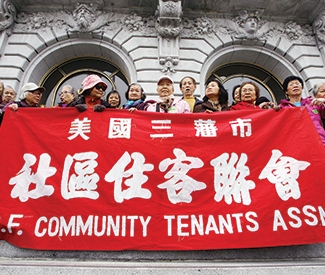
The package was announced Oct. 24 on the steps of City Hall by representatives of CCDC, San Francisco Tenants Union, Housing Rights Committee of SF, Causa Justa-Just Cause, Tenderloin Housing Clinic, UNITE HERE Local 2, Community Tenants Association, and Asian Americans Advancing Justice.

“San Francisco is falling into one of the deepest and most severe eviction crises in 40 years,” SFTU Director Ted Gullicksen said. “It is bad now and is going to get worse unless the city acts.”

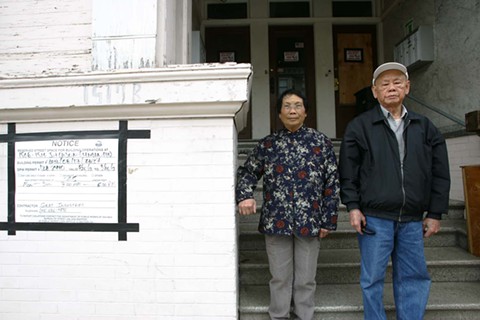
The announcement came a day after the Lee family — an elderly couple on Social Security who care for their disabled daughter — was finally Ellis Act evicted from its longtime Chinatown home after headline-grabbing activism by CCDC and other groups had twice turned away deputies and persuaded the Mayor’s Office to intervene with the landlord.

But Mayor Ed Lee has been mum — his office ignored our repeated requests for comment — on the worsening eviction crisis, the tenant groups’ proposals, and the still-unresolved fate of the Lees, who are temporarily holed up in a hotel and still hoping to find permanent housing they can afford.

The package proposed by tenant advocates includes: require those converting rental units into tenancies-in-common to get a conditional use permit and bring the building into compliance with current codes (to discourage speculation and flipping buildings); regulate TIC agreements to discourage Ellis Act abuse; increase required payments to evicted tenants and improve city assistance to those displaced by eviction; require more reporting on the status of units cleared with the Ellis Act by their owners; investigate and prosecute Ellis Act fraud (units are often secretly re-rented at market rates after supposedly being removed from the market); increase inspections of construction on buildings with tenants (to prevent landlords from pressuring them to move); prohibit the demolition, mergers, or conversions of rental units that have been cleared of tenants using no-fault evictions in the last 10 years (Sup. John Avalos has already introduced this legislation).

“The evidence is clear. We are facing not only an eviction crisis but also a crisis associated with the loss of affordable rental housing across the city. Speculative investments in housing has resulted in the loss of thousands affordable apartments through conversions and demolitions. And the trend points to the situation becoming much worse,” the coalition wrote in a public statement proposing the reforms.

Evictions have reached their highest level since the height of the last dot-com boom in 1999-2000, with 1,934 evictions filed in San Francisco in fiscal year 2012-13, and the rate has picked up since then. The Sheriff’s Department sometimes does three evictions per day, last year carrying out 998 court-ordered evictions, Sheriff Ross Mirkarimi told us, arguing for an expansion of city services to the displaced.

At “Housing for Whom?” a community forum the Guardian hosted Oct. 23 in the LGBT Center, panelists and audience members talked about the urgent need to protect and expand affordable housing in the city. They say the current eviction epidemic is being compounded by buyouts, demolitions, and the failure of developers to build below-market-rate units.

“We’re bleeding affordable housing units now,” Fred Sherburn-Zimmer of Housing Right Committee said last night, noting the steadily declining percentage of housing in the city that is affordable to current city residents since rent control was approved by voters in 1979. “We took out more housing than we’ve built since then.”

Peter Cohen of the Council of Community Housing Organizations actually quantified the problem, citing studies showing that only 15 percent of San Franciscans can afford the rents and home prices of new housing units coming online. He said the housing isn’t being built for current city residents: “It’s a demand derived from a market calculation.”

Cohen said the city’s inclusionary housing laws that he helped write more than a decade ago were intended to encourage developers to actually build below-market-rate units in their projects, but almost all of them choose to pay the in-lieu fee instead, letting the city find ways to build the affordable housing and thereby delaying construction by years.

“It was not about writing checks,” Cohen said. “It was about building affordable units.”

Discussion at the forum began with a debate about the waterfront luxury condo project proposed for 8 Washington St., which either Props. B or C would allow the developer to build. Project opponent Jon Golinger squared off against proponent Tim Colen, who argued that the $11 million that the developer is contributing to the city’s affordable housing fund is an acceptable tradeoff.

But Sherburn-Zimmer said the developer should be held to a far higher standard given the obscene profits that he’ll be making from waterfront property that includes a city-owned seawall lot. “Public land needs to be used for the public good.”

Longtime progressive activist Ernestine Weiss sat in the front row during the forum, blasting Colen and his Prop. B as a deceptive land grab and arguing that San Francisco’s much ballyhooed rent control law was a loophole-ridden compromise that should be strengthened to prevent rents from jumping to market rate when a master tenant moves out, and to limit rent increases that exceed wage increases (rent can now rise 1.9 percent annually on rent controlled apartment).

“That’s baloney that it’s rent control!” she told the crowd. (Steven T. Jones)

Students fight suspensions targeting young people of color

Sagging pants, hats worn indoors, or having a really bad day — the list of infractions that can get a student suspended from a San Francisco Unified School District school sounds like the daily life of a teenager. The technical term for it is “willful defiance,” and there are so many suspensions made in its name that a student movement has risen up against it.

The punishment is the first step to derailing a child’s education, opponents said.

Student activists recognize the familiar path from suspensions to the streets to prisons, and they took to the streets Oct. 22 to push the SFUSD to change its ways. Around 20 or so students and their mentors marched up to City Hall and into the Board of Education to demand a stop of suspensions over willful defiance.

A quarter of all suspensions in SFUSD for the 2011-12 school year were made for “disruption or defiance,” according to the California Department of Education. Half of all suspensions in the state were for defiance.

When a student is willfully defiant and suspended, it’s seen as a downward spiral as students are pushed out of school and onto the streets, edging that much closer to a life of crime.

“What do we want? COLLEGE! What are we gonna do? WORK HARD!” the students shouted as they marched to the Board of Education’s meeting room, on Franklin Street.

They were dressed in graduation gowns of many colors, signs raised high. They smiled and danced and the mood was infectious. One driver drove by, honked and said “Yes, alright!” Assorted passersby of all ethnicities cheered on the group. The students were from 100% College Prep Institute, a Bayview tutoring and mentoring group founded in 1999 aiming to educate students of color in San Francisco. Their battle is a tough one. Though African American students make up only 10 percent of SFUSD students, they accounted for 46 percent of suspensions in 2012, according to SFUSD data. Latinos made up the next largest group, at 30 percent. (Joe Fitzgerald Rodriguez)

Techies to NSA: Stop spying on us!

Thousands of privacy and civil liberties activists, including many from the Bay Area, headed to Washington DC for an Oct. 26 rally calling for surveillance legislation reform, in response to National Security Agency spying programs. It was organized by more than 100 groups that have joined together as part of the Stop Watching Us coalition. The group has launched an online petition opposing NSA spying, and planned to deliver about 500,000 signatures to Congress. Many of the key drivers behind Stop Watching Us, from the Electronic Frontier Foundation to Mozilla, are based in San Francisco. (Rebecca Bowe)

Tenant groups propose sweeping package to ease the “eviction epidemic”

317

Tenant advocates today proposed a sweeping set of legislative proposals to address what they’re calling the “eviction epidemic” that has hit San Francisco, seeking to slow the rapid displacement of tenants by real estate speculators with changes to land use, building, rent control, and other city codes.

“In essence, it’s a comprehensive agenda to restrict the speculation on rental units,” Chinatown Community Development Center Policy Director Gen Fujioka told the Guardian. “We can’t directly regulate the Ellis Act [the state law allowing property owners to evict tenants and take their apartments off the rental market], but we’re asking the city to do everything but that.”

The package was announced this morning on the steps of City Hall by representatives of CCDC, San Francisco Tenants Union, Housing Rights Committee of SF, Causa Justa-Just Cause, Tenderloin Housing Clinic, UNITE HERE Local 2, Community Tenants Association, and Asian Americans Advancing Justice.

“San Francisco is falling into one of the deepest and most severe eviction crises in 40 years,” SFTU Director Ted Gullicksen said. “It is bad now and is going to get worse unless the city acts.”

The package includes: require those converting rental units into tenancies-in-common to get a conditional use permit and bring the building into compliance with current codes (to discourage speculation and flipping buildings); regulate TIC agreements to discourage Ellis Act abuse; increase required payments to evicted tenants and improve city assistance to those displaced by eviction; require more reporting on the status of units cleared with the Ellis Act by their owners; investigate and prosecute Ellis Act fraud (units are often secretly re-rented at market rates after supposedly being removed from the market); increase inspections of construction on buildings with tenants (to prevent landlords from pressuring them to move); prohibit the demolition, mergers, or conversions of rental units that have been cleared of tenants using no-fault evictions in the last 10 years (Sup. John Avalos has already introduced this legislation).

“The evidence is clear. We are facing not only an eviction crisis but also a crisis associated with the loss of affordable rental housing across the city. Speculative investments in housing has resulted in the loss of thousands affordable apartments through conversions and demolitions. And the trend points to the situation becoming much worse,” the coalition wrote in a public statement proposing the reforms.

Evictions have reached their high level since the height of the last dot-com boom in 1999-2000, with 1,934 evictions filed in San Francisco in fiscal year 2012-13, and the rate has picked up since then. The Sheriff’s Department sometimes does three evictions per day, last year carrying out 998 court-ordered evictions, Sheriff Ross Mirkarimi told us, arguing for an expansion of city services to the displaced.

At “Housing for Whom?” a community forum the Guardian hosted last night in the LGBT Center, panelists and audience member talked about the urgent need to protect and expand affordable housing in the city. They say the current eviction epidemic is being compounded by buyouts, demolitions, and the failure of developers to build below-market-rate units.  

“We’re bleeding affordable housing units now,” Fred Sherburn-Zimmer of Housing Right Committee said last night, noting the steadily declining percentage of housing in the city that is affordable to current city residents since rent control was approved by voters in 1979. “We took out more housing than we’ve built since then.”

Peter Cohen of the Council of Community Housing Organizations actually quantified the problem, citing studies showing that only 15 percent of San Franciscans can afford the rents and home prices of new housing units coming online. He said the housing isn’t being built for current city residents: “It’s a demand derived from a market calculation.”

Cohen said the city’s inclusionary housing laws that he helped write more than a decade ago were intended to encourage developers to actually build below-market-rate units in their projects, but almost all of them choose to pay the in-lieu fee instead, letting the city find ways to build the housing and thereby delaying construction by years.

“It was not about writing checks,” Cohen said. “It was about building affordable units.”

Last night’s discussion began with a debate about the waterfront luxury condo project proposed for 8 Washington Street, which either Props. B or C would allow the developer to build. Project opponent Jon Golinger squared off against proponent Tim Colen, who argued that the $11 million that the developer is contributing to the city’s afforable housing fund is an acceptable tradeoff.

But Sherburn-Zimmer said the developer should be held to a far higher standard given the obscence profits that he’ll be making from waterfront property that includes a city-owned seawall lot. “Public land needs to be used for the public good.”

Longtime progressive activist Ernestine Weiss sat in the front row during the forum, blasting Colen and his Prop. B as a deceptive land grab and arguing that San Francisco’s much ballyhooed rent control law was a loophole-ridden compromise that should be strengthened to prevent rents from jumping to market rate when a master tenant moves out, and to limit rent increases that exceed wage increases (rent can now rise 1.9 percent annually on rent controlled apartment.

“That’s baloney that it’s rent control!” she told the crowd.


Lee family quietly leaves home as activists pledge to push reforms

210

Members of Lee family quietly moved out of their longtime home in Chinatown last night, a day before their latest scheduled Ellis Act eviction, which had been postponed twice before thanks to headline-grabbing progressive activism that turned away deputies and persuaded the Mayor’s Office to intervene with the landlord.

But this time, the Mayor’s Office has been mum about the case (officials haven’t responded to our requests for comment) after failing to find a solution to the Lees – an elderly couple using Social Security to care their disabled 48-year-old daughter – still unresolved situation. With help from the Asian Law Caucus and Chinatown Community Development Center, the Lees moved their belongings into storage while they are staying in a hotel.

“The family is staying at a hotel in the city for the next few days as they try to finalize on a couple of potential rental units here. They’ll be paying over twice the amount that they had been paying for their rent-controlled unit. Their SSI won’t be enough to make ends meet, and so they will be spending down their relocation compensation, which may be depleted in the next several months,” Asian Law Caucus attorney Omar Calimbas told us. “Hopefully, the family will be able to find subsidized housing by then, or they will be in a precarious state of affairs again.”

Sheriff Ross Mirkarimi told us yesterday that he’s been waiting for word from the Mayor’s Office and hoping to avoid this evicting the family. “We’re duty bound. It’s a court order,” Mirkarimi said of his eviction obligation. “The eviction is on the books, but we’ve been expecting an alternative plan by the Mayor’s Office after he intervened in this case.”

The San Francisco Examiner, which had earlier given splashy credit to Mayor Ed Lee for stalling the Lee family’s eviction – to the irritation of some activists that probably deserve more credit than anyone in the Mayor’s Office – had the only journalist on the scene with the Lees last night, but the paper didn’t have any comments or updates from the Mayor’s Office.

Weeks before Mayor’s Lee’s headline-grabbing Sept. 25 intervention in the Lee case, Mirkarimi had his Eviction Assistance Unit contact the Lees and try to help them avoid being turned out with no place to go. But in a city where his office performs around 1,000 evictions per year – it executed 998 court-ordered evictions last year — the single full-time staffer in that office is overwhelmed.

“We need more staff to assist when it gets to this point,” Mirkarimi told us. But his budget request last year to add another position to the unit was denied by the Mayor’s Office and Board of Supervisors, a request that Mirkarimi renewed in a Sept. 30 letter to Mayor Lee.

“When there is a determination, our EAU attempts to support individuals and families facing eviction, not just Ellis Act evictions, but all evictions. This unit is comprised of one full time deputy sheriff and the partial time of another deputy.  Based on [the current eviction] trend, our EAU staffing is insufficient and ill-equipped to assist qualified individuals and families who may be at risk of becoming homeless,” Mirkarimi wrote. “With renewed focus on the consequences of evictions in San Francisco, I return to our FY 2013-2014 budget request to enhance our EAU with one full time clinical outreach worker.”

Meanwhile, the activists say they won’t wait for the next budget cycle or rely on the Sheriff’s Department for help with imminent evictions. They say that they plan to propose a package of reforms for dealing with the eviction crisis as soon as this week.

“Overall, the several weeks of reprieve from the eviction that were won after an incredible display of community solidarity with the Lees were very important in giving them time to find a temporary fix,” Calimbas told us. “Stay tuned in the next day or so for the next move by a growing coalition of community organizations, housing advocates and labor in pushing for a comprehensive package of legislative reform to curb the outbreak of displacement-based speculation.”

Guardian Staff Writer Joe Fitzgerald Rodriguez contributed to this report.


Best of the Bay 2013: BEST EXCUSE TO ORGANIZE

0

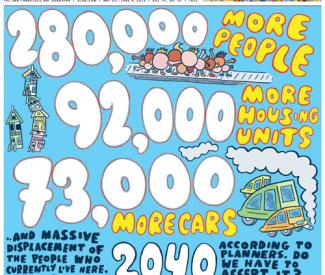
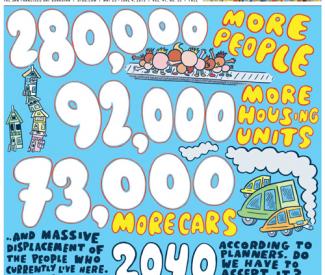
Earlier this year, the Metropolitan Transportation Commission adopted Plan Bay Area, a regional recipe for funneling an influx of new residents into San Francisco and the Bay’s other urban cores. It calls for San Francisco to somehow absorb 280,000 new souls, who will live in 92,000 new housing units and drive 73,000 more cars, by the year 2040 (see “Planning for displacement,” 5/28/2013), while doing little to preserve the homes of current residents, expand public transit, or discourage driving. In other words, it’s a free pass for developers, masquerading as environmentalism. Though the plan been challenged in court, activism is our best hope at mitigating the worst parts of it. To get involved, visit sfbay.sierraclub.org, www.cbecal.org, www.earthjustice.org, and the websites of other good activist organizations — and keep reading the Guardian.

Watch this depressing time-lapse visualization of Ellis Act evictions

A series of red circles explodes on the screen, each representing another rental unit where tenants were driven out by an eviction through no fault of their own.

With a new time-lapse visualization of San Francisco Rent Board data spanning from 1997 to August of 2013, viewers can instantly grasp the cumulative impact of Ellis Act evictions in San Francisco.

It was created by the Anti-Eviction Mapping Project, a newly hatched volunteer effort started to raise awareness about the rising trend of displacement in the San Francisco Bay Area.

Watch it here.

A landlord doesn’t need just cause to oust a tenant under the Ellis Act; the law permits a property owner to stop renting units, evict all tenants, and sell the building for another purpose. The recent wave of tech startups and resulting influx of highly paid employees has fueled a spike in Ellis Act evictions as demand for housing has increased.

Working in collaboration with the San Francisco Tenant’s Union, Anti-Eviction Mapping Project volunteer Erin McElroy teamed up with core volunteers Olivia Jackson, Jennifer Fieber and a team of several others to analyze and map data from the San Francisco Rent Board.

The Ellis Act visualization is the first of several planned by the Anti-Eviction Mapping Project. The size of the circles that pop concurrently with each date corresponds with the number of units displaced.

“We started it with the idea of making a comprehensive map that would show things that weren’t being documented by the Rent Board,” McElroy explained. To that end, the project team has spearheaded a survey to gather data on tenant buyouts, harassment by landlords, rent increases, and bogus attempts to use the Ellis Act to carry out an eviction. The survey is available in Spanish and English, with a Chinese version coming soon. 

“We also want to map where people relocate to, in order to display the current and pending gentrification of other areas – particularly the East Bay,” she added.

In the next few weeks, the team will release maps based on data showing owner move-in evictions and foreclosures.

“We don’t have funding or anything like that,” McElroy explained, but the Tenants Union has allowed them use of its office space for meetings. The effort took several months of research and programming, and the result is a story of the displacement of 3,705 housing units over the course of 16 years – all of which can be absorbed a matter of minutes.

Activists score big victory as Jack Spade gives up on the Mission

275

Score one for people power. Anti-gentrification activists in the Mission scored a major victory last night in their months-long battle to keep Jack Spade, an upscale men’s clothing chain, from opening a store on 16th Street — first by winning over the Board of Appeals, then by convincing the company to just give up.

So Jack Spade won’t be opening in the site of the old Adobe Book Store location near Valencia Street, an outcome engineered by the grassroots activism of the Stop Jack Spade Coalition, Valencia Corridor Merchants Association, and progressive politicians who supported the cause.

At issue at last night’s packed hearing was an appeal of the Planning Department’s ruling that Jack Spade didn’t fall under formula retail rules because it had one short of the 11 stores needed to meet the definition, even though it’s an expanding part of 5th and Pacific Co. and a brother brand to Kate Spade, which has dozens of stores around the country.

Activists considered it a long shot given the supermajority needed to overrule the decision and force a conditional use permit hearing before the store could open, particularly after falling short with the board in August. But this time, the activists won, with the board voting 4-1 to set a full rehearing for Dec. 11.

As representatives of the corporation left the hearing, they told a few activists and business owners that they “were done.” And when the Guardian reached 5th and Pacific CEO Bill McComb by email today, he confirmed that the company is giving up on this controversial location, where activists were concerned its deep-pocketed presence would accelerate gentrification of the neighborhood.

“[We’re] not going to war with the neighbors. We like those people and their neighborhood and we are not fighting the issue. There are many a fine location for Jack Spade. Peace to the city!” McComb wrote to us.

It was a thrilling surprise for the activists that have been organizing against the project for months, and it was reminiscent of the successful 2009 effort to stop American Apparel from opening up shop on Valencia, involving some of the same activists and organizing tactics.

“We’re very pleased about last night,” said Andy Blue, an activist working with local merchants. “We saw a significant shift in momentum and a tremendous community showing. It was clearly a victory for the neighborhood.”

It was a big turnaround from just a few weeks ago, when it looked like Jack Spade had won, and a sign of the rising importance of gentrification issues to San Franciscans who face rising residential and commercial rents fueled by the latest dot-com boom and Mayor Ed Lee’s corporate welfare policies.

“Six months ago, a lot of people in San Francisco felt powerless with the rapid displacement of residents,” said Blue. “It was like, ‘What can we do, you know?'”
But then, as Blue said, “the resistance started boiling up.”

The local merchants decided to appeal the Planning Department decision that would have allowed Jack Spade to simply open its doors with no public hearing. “So many people who were being affected by it started sharing their stories, and things started happening. People had had enough,” said Blue. “The San Francisco that we love is this diverse, unique place and we were watching  it transform into something totally different.”

Simply getting to yesterday’s hearing was a huge step for the activist population standing up against the retailer, Blue said. But after the rehearing request was granted, the local merchants still needed to prove that “manifest injustice” had taken place during Jack Spade’s permit acquisition process if the merchants wanted the actual rehearing. 

This presented a problem to the VCMA and others. To prove “manifest injustice” had taken place during the permit application process, the merchants needed to prove that Jack Spade not only applied for their permits under a dubious guise, but that they were well aware of just how dubious it was. To be manifestly unjust, the unfairness must be “direct, obvious and observable,” a list that isn’t always easy to satisfy. 

While the two sides can’t seem to come to a consensus on how much the rent will actually increase in the surrounding area due to Jack Spade’s arrival, this controversy arose at a time when neighborhoods throughout the city have been rising up against gentrification.

And this may not be the last time that this company is in the crosshairs of that concern. Asked whether its decision applies to the whole city or just this one location, McComb told us, “Just that spot. We have many brand fans in SF.” 

Friends in the shadows

36

rebecca@sfbg.com, joe@sfbg.com

It’s a simple fact of life: Money buys influence. But in San Francisco, despite strict sunshine laws to illuminate donations to city agencies and gifts to the regulators from the regulated, money still circulates in the shadows when it flows through the coffers of “Friends” in high places.

Major real estate developers, city contractors, and large corporations often lend financial support to San Francisco city departments, to the tune of millions of dollars every year. But the money doesn’t just flow directly to city agencies, where it’s easily tracked by disclosure laws. Instead, it goes through private nonprofits that sometimes label themselves as “Friends Of…” these departments.

They include Friends of City Planning, Friends of the Library, a foundation formerly known as Friends of the San Francisco Department of Public Health, Friends of SF Environment, and Friends of San Francisco Animal Care and Control.

The Friends pay for programs the departments supposedly cannot cover on their own. Bond money can build a skyscraper, but sometimes not fill it with furniture. Agencies are barred by law from funding an employee mixer or a conference trip, so departments turn to their Friends to fill in the gaps. Adding bells and whistles to city websites, holding lunchtime lectures, hiring a grant writer — or, in the case of the Department of Public Health, bolstering health services for vulnerable populations — these are all examples of what gets funded.

The extra help can clearly be a good thing, but the lack of transparency around who’s giving money raises questions — especially if it’s a business gunning for a major contract or a permit to build a high-rise.

City agencies receive outside funding from a wide variety of sources. Sometimes grants are made by the federal government, or a well-established philanthropic foundation — and according to city law, gifts of $10,000 or higher must be approved by the Board of Supervisors. But in the case of organizations like Friends, which are created specifically to assist city government agencies, the original funders aren’t always identifiable. And the collaboration is frequently much closer, with city staff members serving on Friends boards in a few cases.

the circle of donations to "friends of" foundations

Friends board members told the Guardian that their partnership with government helps bolster city agencies in a time of increasing austerity, in service of the public good. But do the special relationships these influential insiders hold with high-ranking city officials come into play when awarding a contract, issuing a permit, making a hiring decision, or determining whether a developer’s request for a rule exemption should be honored? Without more transparency, it’s tough to tell.

City disclosure rules state that any gift to a department must be prominently displayed on that department’s website, along with any financial interest the donor has involving the city. But Friends and other outside funders are under no obligation to share their supporters’ names, much less financial ties, when they distribute grants. Meanwhile, the disclosure rules that are on the books seem to be frequently ignored, misunderstood, or unenforced, our investigation discovered.

How are donors repaid for their support? Consider the controversy earlier this year around Pet Food Express, which won approval in June for another store in the Marina District despite opposition from four locally owned pet stores in the area that fear competing with a large national chain. Pet Food Express won the unlikely support of the city’s Small Business Commissioners, some of whom reversed their 2009 positions opposing the chain’s previous application.

SF Animal Care and Control Director Rebecca Katz personally lobbied the commission to support Pet Food Express, at least partially because the company has donated pet supplies valued at $50,000 to $70,000 per year to the department. That’s a lot of money for a cash-strapped city department, but a pittance compared to the profits of an expanding national chain.

It’s moments of clarity like those, when the public can easily trace the line from donations to political influence, that show why disclosure is so crucial. But those moments are few and far between when trying to trace the funders of private foundations and Friends organizations, where deals often happen in the dark.


WHEN DEVELOPERS ARE FRIENDS

At the Merchant Exchange Building in May, a crowd of high-profile real-estate developers mixed and mingled with city planners, commissioners, and even Mayor Ed Lee, wine glasses in hand. Sources told the Guardian that most of the planning staff was present, and not all were happy about having ribbons and name tags affixed to their shirts, as if they were being auctioned off.

With around 500 in attendance, the event was an annual fundraiser hosted by the Friends of San Francisco City Planning, a nonprofit organization that accepts contributions of up to $2,500 per individual to lend a helping hand to the Planning Department. This year’s event was titled “Incubator Startups, New Jobs for the Future,” hinting that the development community shares the mayor’s affinity for new tech startups and the droves of high-salaried IT professionals they’ve attracted to the city.

Some Friends of City Planning board members are major real-estate developers who routinely seek approval for major construction projects. Others are former planning commissioners, or have a background in community advocacy.

Amid widespread concern about displacement, gentrification, and the overall character of San Francisco’s built environment, no city department has greater influence than Planning. An individual’s interpretation of the Planning Code can carry tremendous weight; it’s a series of small decisions that shape a project’s profits and the look and feel of San Francisco’s future. And with cranes dotting the city’s skyline and market-rate construction catering to the wealthy while middle income residents get priced out, the amount of capital flowing through the development sector these days is astonishing.

In this dizzy climate, there might seem to be something askew about affluent developers and land-use attorneys rubbing elbows with city regulators, all eager to pass the hat for the Planning Department. Whiff of impropriety or no, the fundraiser appears to be totally legal.

“We aren’t violating the law — that I know,” Friends of City Planning Chair Dennis Antenore told the Guardian. “We’ve had legal advice on that for years.”

There is close collaboration between Friends of San Francisco City Planning and the Planning Department — a partnership so entrenched that it’s almost as if the nonprofit is an unofficial, private-sector branch of the agency.

“We are certainly thankful and appreciative,” Planning spokesperson Joanna Linsangan told the Guardian. “They’ve helped us for many, many years.” The additional funding is needed, she said, because “there isn’t a lot of wiggle room” in the departmental budget.

Each year, Planning Director John Rahaim submits a wish list to the Friends, outlining projects he wants funding for. This year, he requested $122,000 for a variety of initiatives, including training support to help planners assess proposals for formula retail (read: chain stores). That’s a hot-button issue lately, and one that shows how seemingly small decisions by planners can have big impacts.

When the department’s zoning administrator ruled that Jack Spade, a high-end clothing chain that opened up in the old Adobe Books location on 16th Street, wasn’t considered formula retail and therefore didn’t need a conditional use permit, neither widespread community outrage nor a majority vote by the Board of Appeals could reverse that flawed decision. It was a similar story with the Planning Commission’s Oct. 3 approval of the 555 Fulton mixed use project, where Planning Department support for exempting the grocery store for the area’s formula retail ban made it happen, to the delight of that developer.

Even though the planning director makes specific funding requests each year to the Friends and pitches the projects in person at their meetings — and the Friends publishes a list of the grants it awards to the department online — the Planning Department is not reporting those gifts to the Board of Supervisors.

“I confirm that the Planning Department did not receive any gifts,” Finance and IT Manager Keith DeMartini wrote in official gift reports submitted to the Board of Supervisors for the years 2011-12 and 2012-13. Those reports were sent to the board on Oct. 7 and Oct. 4, respectively, well after the July filing deadline and after the Guardian requested the missing reports.

The Friends typically funds two-thirds of the requests, said board member Alec Bash, totaling around $80,000 a year. In 2012, the Friends awarded a $25,000 grant to make the department’s new online permit-tracking system more user-friendly, making life a lot easier for developers.

When asked what safeguards are in place to prevent undue influence when the director is soliciting funding from a nonprofit partially controlled by developers, Linsangan responded, “those are two very separate things. One does not influence the other.”

She stated repeatedly that planners are not privy to information about individual contributors — but the fundraisers are organized by a board that includes identifiable developers, and anyone who attends can plainly see the donors in attendance. Nevertheless, Linsangan insisted that planners would not be swayed by this special relationship, saying, “That’s simply not the way we do things around here. We do things according to the Planning Code.”

But as the ruling on Jack Spade shows, as well as countless rulings by planners on whether a project is categorically exempt from the California Environmental Quality Act, interpreting the codes can involve considerable discretion.

The public can’t review a list of who wrote checks to the Friends of San Francisco City Planning for the May fundraiser. Since the organization waits a year between collecting the money and disbursing grants, donors stay shielded from required annual disclosures in tax filings.

But Antenore says the system was established with the public interest in mind. “We don’t reveal the contributors, because we don’t want anybody to have increased influence by a donation,” he insisted. Bash echoed this idea, saying the delay was to “allow for some breathing room.”

Unlike some of his fellow board members from the high-end development sector, Antenore has a history of being aligned with neighborhood interests on planning issues, helping author a 1986 ballot measure limiting downtown high-rise development. He emphasized that the developers on the Friends board are balanced out by more civic-minded individuals.

Still, developers who regularly submit permit applications for major construction projects sit on the Friends board. Among them are Larry Nibbi, a partial owner of Nibbi Bros.; Clark Manus, CEO of Heller Manus Architects; and Oz Erikson, CEO of the Emerald Fund development firm.

“We’re not making use of [the funding] in a way that benefits these people,” Antenore said. “I wouldn’t do this if I thought otherwise. I have been careful to maintain the integrity of this organization.” The money is meant to facilitate better planning, he added. “I don’t think there’s any conspiracy,” he said. “We’re not financing anything evil.”

Both the Planning Department and its Friends dismissed the idea that the donations could open the door to favoritism or undue influence. So why isn’t the department reporting gifts it receives from the Friends to the Board of Supervisors, or disclosing them on its website, as required by city law?

According to a 2008 City Attorney memo on reporting gifts to city departments, when an agency receives a gift of $100 or more, it “must report the gift in a public record and on the department’s website. The public disclosure must include the name of the donor(s) and the amount of the gift [and] a statement as to any financial interest the contributor has involving the city.”

John St. Croix, director of the San Francisco Ethics Commission, confirmed that’s the current standard, telling us, “The actual disclosure should be on the website of the department that received the gift.”

Linsangan said records of the gifts are indeed available — listed as “grants” in the department’s Annual Report. But while the 2011-12 report lists grants from sources such as the Metropolitan Transportation Commission and the Environmental Protection Agency, there was no mention of Friends of City Planning.

The memo also says any gift of $10,000 and above must first be approved by a resolution of the Board of Supervisors. But last year, when the Friends provided $25,000 to upgrade the permit-tracking system, it wasn’t sanctioned by a board resolution. Asked why, Linsangan made it clear that she was not aware of any such requirement.

As is common, when it comes to adhering to disclosure laws, confusion abounds. And sometimes, only sometimes, politicos get caught.


READING UP ON DISCLOSURE LAWS

When the head of a city agency fails to report gifts totaling $130,000, how much do you think he is fined?

City Librarian Luis Herrera failed to report receiving that amount in gifts and he was fined exactly $600 by the California Fair Political Practices Commission on Sept. 19. Specifically, Herrera had to file a form 700 with the FPPC to state the gifts he received. From 2008-2010, the forms he turned in had the “no reportable interests” box checked.

The money was used in what he calls the City Librarian’s Fund, which is the money he keeps on hand to pay for office parties and giving honorariums to poets and speakers who perform at the library’s branches, money that wasn’t disclosed on the very forms designed for reporting it.

There are two stories of how the fine came about. Longtime library advocate James Chaffee said that it was the result of a complaint he filed with the FPPC in April, and indeed, he sought and obtained many public documents revealing the money trail. San Francisco Public Library spokesperson Michelle Jeffers disagreed, saying that the fine was the result of an ongoing conversation with the FPPC to figure how exactly to file the gifts appropriately.

“The law wasn’t clear around these forms and it wasn’t clear if he had to report them,” she told the Guardian. “For amending the reports you have to pay a $200 fine for every year it was proposed. We keep scrupulous records on every pizza party we have.”

When government officials receive “gift of cash or goods,” they must report them annually in statements of economic interest, known as a Form 700, to the city Controller’s Office. The form is kind of a running tally of who is receiving gifts from whom, a way for the public to track money’s influence in government.

The gifts came from the Friends of the San Francisco Public Library, another nonprofit that bolsters city agency funding. Now Herrera has to list the $130,000 gifts from fiscal years 2008-09 and 2009-10 on his website.

What exactly does that accomplish? As it turns out, not a whole lot.

City Administrative Code 67.29-6 defines the reporting of gifts to city departments, and one of those requirements is to make a statement of “any financial interest the contributor has involving the city.” Now that Herrera lists the Friends of the San Francisco Public Library as donors on the department website, the statement of financial interest by the friends group is this: “none.”

There are myriad donors to the Friends of the SFPL, and the group doesn’t have to state the economic interests of its donors, or even mention who its donors are. The code requires gifts be reported to the controller, and the deputy city controller told us this doesn’t apply to the “friends of” organizations, or any nonprofit foundation arms of city departments.

“If gifts are made to a department, yes, they have to disclose, so people don’t get preferential interest in getting city contracts,” Deputy Controller Monique Zmuda told us. “I know it’s a fine line. The foundations don’t provide us with anything.”

Friends of the SFPL doesn’t provide money just for pizza parties. A breakdown of a funding request from the library to its Friends shows requests up to $750,000 to advertise the library on Muni and in newspapers, funding for permanent exhibits, and the City Librarian’s personal fund. That’s just the money it gives to the library. Other monies are spent directly on activities supporting the library.

As Jeffers pointed out to the Guardian, the money isn’t spent on “trips to Tahiti.” Friends of the SPL do good city works, from a neighborhood photo project in the Bayview branch library to providing books for children. But the question is: Who’s buying that goodwill and why?

The millions of dollars in donations made to the Friends of the SFPL don’t need to be approved by the Board of Supervisors, like gifts to departments do. They’re not checked for conflicts of interest or financial interest by any governmental body. Donors give and the Friends of SFPL spend freely, financial interest or not.

When our research for this story began, no financial statements were available of the Friends of the SFPL website. After a few days of inquiries, the most recent year’s financial statements from 2011-12 were posted to the website.

Ultimately, the San Francisco Public Library is one of the smaller city departments, with an annual budget that hovers around $86 million. The Department of Public Health is a much bigger beast, with a 2011-12 budget of around $1.5 billion.

One of its main foundations, the San Francisco General Hospital Foundation, is also one of the largest nonprofits that supplements city spending. In many ways, it could be described as the model of disclosure for city foundations, although its disclosures are not by law, but by choice.


FOUNDATION OF FRIENDS

The Department of Public Health relies on a few entities that fundraise on its behalf: the San Francisco Public Health Foundation, the Friends of Laguna Honda Hospital, and the San Francisco General Hospital Foundation.

“They’re private nonprofit entities that are separate from the department,” CFO Greg Wagner told us. “But their roles are to support the department in its efforts.” He cited examples such as sending its staff to conferences or hosting meetings, “things that we don’t have the budget for or don’t have the staff or resources.”

The lion’s share of the DPH’s gifts are funneled through the SFGHF. Unlike many of the assorted Friends groups or foundations that support city services, the SFGHF extensively reports the sources of its $5 million in donations. The donors include a veritable who’s who of San Francisco: the Giants, Sutter Health, Xerox, Pacific Union, and Kohl’s all donated between $1,000 and $10,000 in the past two years.

But the largest gifts to the SFGHF came from Kaiser Permanente, and its financial interests in the city run deep. Kaiser came into the city’s crosshairs in July, when the Board of Supervisors passed a resolution calling on Kaiser to disclose its pricing model after a sudden, unexplained increase in health care costs for city employees. Kaiser holds a $323 million city contract to provide health coverage, and supervisors took the healthcare giant to task for failing to produce data to back up its rate hikes.

In the meantime, Kaiser has also been a generous donor. It contributed $364,950 toward SFGHF and another $25,000 to SFPHF in fiscal year 2011-12.

The funding from Kaiser and a host of other contributors — which include Chevron, Intel, Genentech, Macy’s, Wells Fargo (another city contractor), and a pharmaceutical company called Vertex — does support needed programs. They include research into the health of marginalized communities, services through Project Homeless Connect, screening for HIV, and immunization shots for travelers.

But because DPH doesn’t count much of this support as “gifts” formally received by the city, it isn’t subject to prior approval by the Board of Supervisors, or posted on the department’s website along with the contributors’ financial interests. Major contributions are disclosed in a report to the Health Commission, something Wagner described as a voluntary gesture in response to commissioners’ requests.

“Most gifts to foundations are donations to a nonprofit and do not come through the city or DPH at all,” he noted.

This distance is maintained on paper despite close collaboration with the department. In the case of Project Homeless Connect, a program that holds a bimonthly event to aid the homeless, it supports programs headquartered in city facilities. Penny Eardley, executive director of SFPHF— which used to be called Friends of San Francisco Public Health — noted that her organization occasionally makes grants or seeks funding in response to department requests. And Deputy Director of Health Colleen Chawla is a foundation board member. It’s almost like these foundations are extensions of the department, except they’re not.

SFPHF also earns revenue as a city contractor. When DPH received a grant from the Centers for Disease Control, it contracted with SFPHF to manage subcontracts with about a dozen community-based organizations.

The web gets even more tangled. The president of SFPHF is Randy Wittorp — who’s also Director of Public Affairs for Kaiser Permanente’s San Francisco Service Area. It’s a similar story with SFGHF, whose board includes several General Hospital administrators, including CEO Susan Currin.

Former Health Commissioner James Illig said people shouldn’t worry, that hospital the staff would never direct foundation funds to pet projects or mishandle funds. They maintain a separation and a firewall,” he said, for example noting, “Sue Currin is not directing funds to her own hospital.”

But he did admit that since SFGHF’s minutes are not public documents, that “raises a few concerns,” arguing the public should be able to inspect financial documents to decide if the foundations are directing funds lawfully to city departments.

Even when the public by law has a right to access financial records of a city department, rooting out corruption can be like pushing a boulder up a San Francisco hill.


FROM PATIENTS TO PARTIES

In 2010 and 2011, Laguna Honda Hospital administrators and staff used money from the hospital’s patient gift fund to throw a party. And then they spent it on airfare. And then they gave laser-engraved pedometers to the staff. All told, they spent nearly $350,000 meant for the dying and the infirm, nearly half of the total funds.

The incident was big, messy, and out in the public eye. It was an all-too-rare glimpse into the shady use of public funds by public officials. But when hospital staff members Dr. Derek Kerr and Dr. Maria Rivero blew the whistle on Laguna Honda’s misuse of patient funds in 2010, they were drummed out of their jobs.

Eventually litigation on behalf of the whistleblowers and their complaints of corruption were found to have merit.

Kerr’s vindication came at a meeting of the Health Commission in April 2013. In the packed City Hall meeting room, the public watched as Laguna Honda Executive Director Mivic Hirose read her apology to Kerr and Rivero aloud, even announcing a plaque in Kerr’s honor.

“The hospital will install the plaque in the South 3 Hospice,” she read, stiltedly, from a written statement, surrounded by microphones at the podium. “The plaque will say: In recognition of Derek Kerr MD of his contributions to the Laguna Honda’s hospice and palliative care program 1989-2010.”

Kerr received a settlement of $750,000 and something more important: His good name cleared.

But that conflict of interest was rooted out only after years of litigation that revealed the financial abuse through legal discovery of the department’s documents — documents that should’ve been public in the first place. ABC 7’s I-Team broke the story and did much of the reporting at the time, otherwise the entire affair may have been swept under the rug.

The misuse of funds was only brought to light with the revelation of public documents — revelations not possible with most Friends groups. The Laguna Honda Hospital Foundation has also had financial dealings with potential conflicts and a lack of transparency.

The now-defunct LHHF’s board chair, former City Attorney Louise Renne, made an interesting choice for her vice chair after she formed the nonprofit in 2003. Derek Parker was vice chair of the LHHF while simultaneously heading architecture firm Anshen-Allen, with a $585 million city contract to rebuild the hospital.

So he was not only rebuilding Laguna Honda under city contract, but soliciting and spending donations meant to supplement his project. Renne wrote to the Health Commission in December 2011 that LHHF’s purpose was to manage over $15 million in donations meant to furnish the hospital with beds, chairs, and other necessities. Eventually, then-Mayor Willie Brown found funding for the hospital, reducing the foundation’s role.

In a phone interview with the Guardian, Renne said the goals of the LHHF were only ever to furnish the newly christened hospital. “Our purpose was to fill the void, if you will, for what the city and its services could not do,” she said.

But in her letter, Renne advocated for LHHF to take an active role in fundraising for the hospital for years to come. “Today, the members of the Board of Directors of the Foundation continue to assist the hospital in various phases of its new projects and operations with projects approved by the City and/or the hospital administration,” she wrote to the Health Commission.

And Parker would have potentially managed millions of dollars flowing through donations for countless other hospital projects, while heading an architectural firm with contracts to build in San Francisco. We were unable to reach Parker for comment.

“I never saw Derek use his position as an architect or position for any political gain, I never saw it,” Renne told us. But no one else would see it either, because organizations like the now closed Laguna Honda Hospital Foundation operate without public oversight.

The Health Commission itself even noted this in its March 2012 meeting, the minutes describing then-commissioner James Illig as critiquing the foundation for not being open about its source of funding.

“Commissioner Illig thanks Ms. Renne and Mr. Parker for coming to the Commission,” the minutes read. “Because (LHHF) is a project of Community Initiatives, a fiscal sponsor for nonprofits, it is not possible to find basic financial information about the Foundation or its activities.”

Divided interests on hospital board

Due to a quirk of her foundation being under the “umbrella” of a separate entity, Community Initiatives, Illig was never able to even get the LHHF’s IRS forms, he told us. “We tried to get information and reports, and the Community Initiatives [Form] 990 was giant,” Illig said. “It didn’t separate anything out.”

Illig told us that it made sense to have Parker on the board because he is monied and well connected, making it easier to solicit donations. But insiders close to the board told us that Parker’s position may have made it easier to swing getting other contracts for his firm.

Parker got another city contract building the UCSF Benioff Children’s Hospital at Mission Bay, slated to open in 2015. No doubt his firm got the job partly due to his reputation as pioneering architecture that leads to healthy patient outcomes — but then again, the board he served on also approved donations to research at UCSF.

Laguna Honda Hospital Foundation may now be defunct, but it serves to illustrate the lack of controls and oversight of the foundations beyond even gift disclosure.


OFF THE BOOKS

It might be characterized as a web of influence, cronyism, or just the way business is done. But is there something improper about all of this?

Private funding often represents a needed boost that allows for important work to take place beyond what could happen under ordinary budgeting. At the same time, it smacks of privatization. While departments and funders point to lean times in the public sector to justify the need for this help, the funding continues to flow whether it’s a good year or a bad year for city government. And at the end of the day, the most glaring issue of all seems to be the lack of transparency.

Are city departments ever tempted to bend the rules to lend a little help to their Friends? As long as the funding is in the dark, the public has no way of knowing.

Ethics chief St. Croix told us his office lacks the resources to visit every city website and check up on whether departments are following the disclosure rules. “If someone brought it to my attention that a department received a gift and didn’t post it [on the website],” he said, “we would look into it.”

But if the watchdogs need watchdogs, citizens who can’t even review documents that should be publicly available, then these quasi-governmental functions and the people who fund them will remain in the shadows.  

Danielle Parenteau contributed to this report.  

ADDENDUM  

When city funders operate in the dark, one of the best ways to learn about corrupt influence, misuse of funds, and other transgressions is from whistleblowers. If you have a tip for us, send us snail mail at SAN FRANCISCO BAY GUARDIAN, 225 Bush, 17th Floor, San Francisco, CA 94104. Or email us at news@sfbg.com. Just make sure not to use an email address provided by your workplace, which is less secure.


Chess-in defies SFPD crackdown

By Christina Aanestad

More than 50 people crowded Market Street with tables, chairs, chess and other board games Sunday for a “Chess-in,” a response to the San Francisco Police Department’s closure of a decades-long San Francisco tradition of sidewalk chess.

“We had no say in the decision,” said Marvin Boykins, a 35 year veteran chess player.

Last month, police ended the open and public chess games at Fifth and Market Streets, citing crime as the reason. A nearby shopkeeper, who declined to provide their name, told the Guardian that drug dealers sometimes use the chess tables to conceal their business dealings. There’s no doubt crime occurs around the neighborhood, which marks the intersection of the Tenderloin and SoMa. Just three doors down from the chess games, a woman stood in the doorway of a closed business holding a crack pipe. Nevertheless, chess players like Boykins say crime happens in all neighborhoods—and it’s no reason for the police to stop a decades-old tradition.

“SFPD made a very grave mistake in their administrative capacity not acknowledging the true problem—that we have nothing to do with nor do we condone [crime],” he said.

Other shopkeepers, like Phil Gatdula, manager of sustainable soul food restaurant Farmer Brown on Market Street, said he enjoyed the chess players, who encompass people from all walks of life including business owners, youth, and elders.

Many attendees of the Chess-in voiced concerns about gentrification in the city, pointing to sidewalk chess as its latest casualty. Activists with the Coalition on Homelessness said blaming the removal on crime is merely a cover for an underlying agenda.

“To suggest that a long-time community of elder chess players engaging in a fun, public event is creating a public safety issue is a thinly veiled move to push poor people from public space,” said Jennifer Friedenbach, Executive Director of the Coalition On Homelessness.

Just days after the police kicked the chess players off Market Street, a new rent-a-bike station with gleaming identical bikes took their place. Bay Area Bike Share is a newly launched program that rents out bicycles, with nearly three dozen locations in San Francisco. Having opened in August, it’s a partnership with San Francisco, San Mateo, and Santa Clara Valley transportation authorities, offering “access to shared bicycles 24 hours a day, 7 days a week, for use in the cities of San Francisco, Redwood City, Palo Alto, Mountain View and San Jose,” according to the company’s website.

Lisa Alatorre, another staff member with the Coalition on Homelessness, sees the chess crackdown as part of a larger plan to appeal to techies and tourists in the area. It’s also no coincidence that a new shopping mall and condo development are going in right across the street from where chess players gathered for decades before the recent displacement, she said.

Josh Shadlen, 28, moved to San Francisco a few years ago as part of the second dot-com wave. Despite working within the tech industry that critics like Alatorre say is the cause of high rents in San Francisco, Shadlen spent his day sitting on the sidewalk, playing chess in the sun to support reclaiming public space. He said that while 90 percent of his colleagues don’t care about impacts they are having on the local community, he does.

Josh Shadlen, a tech dude who’s siding with the chess players.

“It seemed basically like an attack on the residents of this neighborhood and part of a plan to turn this neighborhood into fancy office buildings where maybe I might work at some point, but I don’t want that to happen here or anywhere,” he said.

Shadlen said the police should do a better job at policing rather than throwing out chess players.

Organizers like Alatorre say it’s unlikely chess will return to Fifth and Market Streets. For now, the players have moved to Yerba Buena Park. Alatorre and others are still hopeful that things could change—but they believe the political will doesn’t exist among current members of the Board of Supervisors. Asked whether she thought people would continue to gather at Fifth and Market streets to play chess next Sunday, she said, “I hope so.”

Mayor Lee responds to political furor with more funding to fight evictions

136

We’re not sure whether it was the high-profile recent protests against the eviction of the Lee family, our well-read “City Hall must address rising rents” editorial or eviction and gentrification coverage last week, our earlier focus on record eviction rates, or just the growing view that City Hall is too friendly to landlords and neglectful of tenants, but the Mayor’s Office has finally awoken to the biggest issue facing this city.

With skyrocketing rents — and with increasingly common efforts by the landlords of rent-controlled apartments to take advantage of that market by forcing out their tenants — Mayor Lee this afternoon announced that he’s tripling funding to fight illegal Ellis Act evictions, making populist statements along the way.

Now, spending an additional $700,000 to fight greedy, deep-pocketed landlords is not exactly going to change the playing field, but it’s a nice gesture and an indicator that Mayor Lee is starting to notice the problem. Hopefully, with pressure by progressive politicians and activists, this will be just the first of many such actions.

His press releases follows in it entirety:

*** PRESS RELEASE ***

MAYOR LEE ANNOUNCES ADDITIONAL RESOURCES FOR EVICTION PREVENTION IN SAN FRANCISCO

San Francisco to increase resources to support residents and families affected by illegal Ellis Act evictions and releases Eviction Prevention Funding from Housing Trust Fund

San Francisco, CA—Mayor Edwin M. Lee announced San Francisco will triple the amount of funding to prevent illegal Ellis Act evictions and that the City will release $700,000 in funding for other eviction prevention services from the Housing Trust Fund.

“San Francisco must remain a viable place to live and work for people at all levels of the economic spectrum,” said Mayor Lee. “That’s why I am providing additional resources to stop unlawful evictions and provide tenant counseling for our residents, so that San Francisco remains a City for the 100 percent.”

The Human Services Agency (HSA) currently provides nearly $8 million in homeless prevention and eviction defense services, an increase of $1.3 million from last year’s budget. In this year’s budget, the City was providing nearly $125,000 to fund free legal advice and represent 55 San Francisco families who have been affected by illegal Ellis Act eviction threats. Today, Mayor Lee tripled the amount of funding with an additional $250,000, which will immediately be available to eligible organizations that provide Ellis Act prevention legal work and will help more families and people at all levels of the economic spectrum remain in San Francisco.

“Providing resources to stop unlawful evictions has proven to be one of the most effective strategies to prevent displacement and homelessness in our City,” said Trent Rhorer, Director of the San Francisco Human Services Agency. “This additional $250,000 will help keep San Francisco families in their homes.”

The Mayor’s Office of Housing will also provide $700,000, from the Affordable Housing Trust Fund, to fund tenant counseling services. This is a 63 percent increase in funding and brings the total amount to more than $2.3 million in eviction prevention services from the Mayor’s Office of Housing. These additional resources will be distributed to community based organizations specifically expanding legal representation for individuals facing eviction; rental assistance to individuals and families who are currently homeless or are struggling to keep their current rental housing; and to provide outreach to San Franciscans to better inform them about their legal rights.

The Mayor’s Office of Housing has prioritized eviction prevention services and funds activities including legal services, tenant counseling, rental assistance, move-in assistance, know your rights trainings, and other types of tenant support.  Services are offered through a diverse group of community based organizations that reach San Francisco’s many communities including seniors, people with disabilities, immigrants, the homeless and families.

The HSA will issue an ‘Invitation to Bid’ this week so eligible organizations can apply and use the HSA funding to expand their legal services in order for them to be available to vulnerable tenants within 30 days. It is anticipated that the additional HSA funds will help at least 150 households receive legal advice and representation.


Evictions and gentrification fuel widespread concern in the Mission

202

A mix of neighborhood merchants, community activists and a couple City Hall staffers met for a community forum Sept. 23 on Mission gentrification, voicing anger and frustration about rising displacement in the face of soaring rents.

Arranged by organizer Andy Blue, the forum was hosted by Rose Aguilar of Your Call Radio and held at the Eric Quezada Center for Culture and Politics on Valencia Street.

The recent controversy stemming from a bid by high-end retailer Jack Spade to move into a 16th Street storefront catalyzed the discussion, but many addressed the overarching transformation of a neighborhood that has been flooded with high-salaried residents who can afford to pay top dollar.

Gabriel Medina, policy manager of the Mission Economic Development Agency, said he’s troubled by the displacement of Latino-owned businesses. About 80 percent of Latino-owned businesses are passed onto proprietors’ children, he said, representing critical assets in a pricey city like San Francisco. “It’s getting cheaper to be able to start a business than to buy a house,” he pointed out.

Erick Arguello of Calle 24 (formerly the Lower 24th Street Merchants and Neighbors Association) said he’d seen a similar trend along his strip of the Mission, where some Latino-owned businesses have managed to hold strong since they bought their properties years ago.

Nevertheless, Arguello said, the pressure is on. “There’s been an onslaught of realtors and prospectors on 24th Street,” he said. “They ask about the neighbor next door: Do you know when their lease goes to?”

Nor are businesses the only ones impacted. “We’re seeing a lot of evictions of residents along the corridor,” he noted. “The majority of them are Latino families.”

Laura Guzman, executive director of the Mission Neighborhood Resource Center, decried a lack of funding for affordable housing and dedicated units for the homeless and impoverished.

She said many individuals living on the streets in the Mission lack options, leading them to pass the time in the BART plaza. “Support the people in the plaza. They’re human beings,” Guzman said.

Nick Pagoulatos, a legislative aid to Sup. Eric Mar who was previously involved with mid-90s anti-gentrification campaigns in the Mission, said he himself wasn’t sure if he would be able to remain in the city.

“I’m a partner to a woman who was born in the Mission,” he said, acknowledging the deep ties her family has to the neighborhood. “We know that when we lose our housing” – it is likely a question of when, not if, Pagoulatos said – “we’re not going to be able to stay in the Mission. And we’re probably not going to be able to stay in San Francisco.”

Some activist efforts have emerged. A direct action group called Eviction Free San Francisco has staged protests outside the doors of real-estate speculators. At the upcoming Dia de los Muertos 2013 celebration, curator Martina Ayala said at the meeting, “We are building altars to remember the life that we once enjoyed.” La Llorona, a Dia de los Muertos exhibit that will be held at the Mission Cultural Center for Latino Arts, is subtitled “weeping for the life and death of the Mission District.”

A similar transformation happened 10 years ago when the first dot-com boom flooded the Mission with deep-pocketed residents, Pagoulatos noted. Back then, “there was an organized reaction,” he said. “To be honest with you, we fought the good fight, we were at it for a long time and we didn’t win.”

This time around, “Our level of disgust for what’s been going on has been numbed,” he said. But he called for reaching out to engage unlikely allies, and for tapping into collective anger about displacement to bring about change.

“Get pissed, folks,” Pagoulatos said. “Anger is a good thing, especially in the face of injustice.”

Spotlight shone on gentrification in West Oakland and SF

0

Two stories on the theme of gentrification and displacement — a topic we at the Bay Guardian have expended plenty of ink on — ran in major news outlets recently, showing how intense the Bay Area housing market pressure has become as it continues to be fueled by a rapid growth in high-salaried jobs in big tech.

Zeroing in on San Francisco, the Los Angeles Times turned an eye toward Mission District gentrification (“San Francisco split by Silicon Valley’s wealth,” Aug. 14) illustrating the growing divide with a succinct comment overheard on a Muni bus: “I don’t know why old people ride Muni. If I were old, I’d just take Uber.”

And a Wall Street Journal article (“Companies spruce up neighborhoods, putting gentrification in overdrive,” Aug. 13) provides an eye-opening account of how REO Homes LLC is seeking to accelerate the gentrification process by “beautifying” West Oakland, an historically African American neighborhood that is home to predominantly low-income and working-class residents.

Minutes from downtown San Francisco via BART, West Oakland is dotted with Victorians and was hit with a wave of foreclosure during the economic crash, destabilizing the lives of many families who lost their homes.

REO is an investment firm helped along by San Francisco billionaire Tom Steyer, a well-connected venture capitalist (he even hosted a Democratic Party fundraiser with President Barack Obama at his Pacific Heights mansion earlier this year).

As the Journal’s Robbie Whelan reports, REO has been shelling out top dollar to spruce up not just its holdings, but residences nearby its West Oakland properties. In a rarely seen form of hyper-gentrification, the company has been planting trees, sprucing up homes (for free) of neighbors who aren’t in the market to sell or rent, mending fences, and making other improvements — all in an effort to lure higher-income residents to the neighborhood.

Since 2008, the height of the real-estate market crash, REO has acquired more than 200 homes in Oakland, Whelan reports, mostly in West Oakland. “Most houses cost around $200,000,” he writes, “and [founder Neill Sullivan] said he invests as much $100,000 to fix each one up.”

Real-estate agents have been marketing the sometimes-rough neighborhood to house-hunters as an affordable, nearby alternative to astronomically expensive San Francisco. Now that many people who weren’t able to keep up with mortgage payments have been forced out by foreclosure, things are changing swiftly, as if by magic. Armed with cash, bankers are chasing away the blight and rolling out the welcome mat for up-and-comers who can’t swing that $3,000 one-bedroom in The City. All of which will likely result in further displacement of Oakland residents who are barely holding on as it is. As Oakland City Council member Desley Brooks told the Journal: “I’m not interested in finding housing for San Franciscans who can no longer afford San Francisco. I’m interested in helping people here in Oakland.”

Plan Bay Area takes legal punches from the left and right

45

Plan Bay Area, the regional strategy to funnel future population growth into San Francisco and other big cities in order to combat climate change, is now being slammed with legal challenges from both sides of the ideological spetrum.

Those left-right punches could knock out a plan that critics called a schizophrenic attempt to accomplish competing goals with inadequate resources and resolve. For example, it created incentives to increase housing density along transit lines, but it did little to limit private automobile use, make that housing affordable by people who do use transit, or address the displacement of existing urban populations.

Earthjustice, Communities for a Better Environment, and the Sierra Club today filed a lawsuit in Alameda Couty Superior Court challenging Plan Bay Area’s recent approval by the Metropolitan Transportation Commission and the Association of Bay Area Governments.

That lawsuit follows one filed Friday with the same court by the Building Industry Association of the Bay Area. And those two suits follow another one filed Aug. 6 by the conservative Sacramento law firm Pacific Legal Foundation on behalf of a group calling itself Bay Area Citizens.

While that first lawsuit from the Tea Party crowd criticizes the very idea of regional planning and the validity of addressing global warming, these latest two lawsuits basically call out Plan Bay Area and its supporters for not going far enough to address the goals laid out in the plan.

Earthjustice and the community groups it works with criticize Plan Bay Area for disrupting Bay Area communities with an accelerated growth plan that doesn’t address environmental justice issues like those faced by West Oakland residents, whose air quality would be worsened by an influx of automobile traffic.   

 “The people of the Bay Area take pride in living in one of the most diverse, culturally and economically vibrant metropolitan areas in the world. We demand smart planning for growth—the kind that improves our quality of life, makes life easier and less expensive for residents all over the Bay Area, and allows our communities to thrive and grow,” Irene Gutierrez, Earthjustice associate attorney, said in a press release. “This requires responsible planning that reduces climate change pollution, plans for smart public transit growth, avoids toxic zones, and dirty and harmful air quality. Plan Bay Area does not achieve those goals. The people of the Bay Area deserve a much better plan.”

And Bay Area developers are focused on how the plan calls for more transit-oriented development without investing in the public infrastructure needed to serve it, criticizing the state legislation behind Plan Bay Area that relaxes the environmental studies of projects in transportation corridors.

“SB 375 calls on the Bay Area and other regions of California to integrate residential and transportation planning in ways that fully accommodate their housing need and in ways that allow for reduced reliance on and emissions from passenger vehicles,” said Bob Glover, executive officer of BIA | Bay Area. “Plan Bay Area is a cop out.  It neither plans for enough housing nor provides a reasonable path for developing it and therefore looks a lot more like a pulling up of the draw bridge than a sustainable communities strategy.”

To learn more about Plan Bay Area, you can read our May cover story, “Planning for Displacement,” or the coverage of a public forum that we and other groups sponsorerd.

West Oakland hyper gentrification in the WSJ

Two stories on the theme of gentrification and displacement – a topic we at the Guardian have expended plenty of ink on – ran in major news outlets recently, showing how intense the Bay Area housing market pressure has become as it continues to be fueled by a rapid growth in high-salaried jobs in big tech.

Zeroing in on San Francisco, the LA Times turned an eye toward Mission District gentrification, illustrating the growing divide with a succinct comment overheard on a Muni bus: “I don’t know why old people ride Muni. If I were old, I’d just take Uber.”

And a Wall Street Journal article provides an eye-opening account of how REO Homes LLC is literally seeking to accelerate the gentrification process by “beautifying” West Oakland, an historic Black neighborhood that is home to predominantly low-income and working-class residents. (Note: The article may be behind a paywall.)

Minutes from downtown San Francisco via BART, West Oakland is dotted with Victorians and was hit with a wave of foreclosure during the economic crash, destabilizing the lives of many families who lost their homes.

REO is an investment firm helped along by San Francisco billionaire Tom Steyer, a well-connected venture capitalist (he even hosted a Democratic Party fundraiser with President Barack Obama at his Pacific Heights mansion earlier this year).

As the Journal’s Robbie Whelan reports, REO has been shelling out top dollar to spruce up not just its holdings, but residences nearby its West Oakland properties. In a rarely seen form of hyper-gentrification, the company has been planting trees, sprucing up homes (for free) of neighbors who aren’t in the market to sell or rent, mending fences, and making other improvements – all in an effort to lure higher-income residents to the neighborhood.

Since 2008, the height of the real-estate market crash, REO has acquired more than 200 homes in Oakland, Whelan reports, mostly in West Oakland. “Most houses cost around $200,000,” he writes, “and [founder Neill Sullivan] said he invests as much $100,000 to fix each one up.”

Real-estate agents have been marketing the neighborhood – which is no stranger to violent crime – to house-hunters as an affordable, nearby alternative to astronomically expensive San Francisco. Now that many people who weren’t able to keep up with mortgage payments have been forced out by foreclosure (see: robocalls, bungled loan modifications, foreclosure abuses), things are changing swiftly, as if by magic. Armed with cash, bankers are chasing away the blight and rolling out the welcome mat for up-and-comers who can’t swing it for that $3,000 one-bedroom in the city.

All of which will likely result in further displacement of Oakland residents who are barely holding on as it is. As Oakland councilwoman Desley Brooks told the Journal: “I’m not interested in finding housing for San Franciscans who can no longer afford San Francisco. I’m interested in helping people here in Oakland.”

Shareable, smearable

25

After writing critically about problems in the business models of so-called “shareable economy” companies in last week’s issue — including our cover story on Airbnb and other companies that facilitate short-term home rentals (“Into thin air“) and a story on the rideshare company Lyft (“Driven to take risks“) — the topic continued to dominate the sfbg.com Politics blog, with fresh posts and lots of reader comments:

AIRBNB PILE-ON

The excellent bilingual newspaper El Tecolote covered some of the same ground we did in its Aug. 1 cover story, “Unregulated Rental Business Takes Over Housing,” focused on how Airbnb is contributing to gentrification and displacement in the Mission District.

Reporter Jackson Ly found a couple that turned a rent-controlled apartment on 24th St. into a $249 per month de facto hotel room, booking it for 24 nights in August and making $5,976 in just one month, on top of the $3,069 they’re making in August renting out the guest room in the apartment where they actually live for $99 per night.

“It’s cheating the people that pay taxes,” Maria, who lives in the unit below this couple’s investment apartment and is tired of the rotating stream of tourists in her building, told the newspaper.

I got ahold of El Tecolote Managing Editor Iñaki Fdez. de Retana, who said that housing issues like this one are extremely important to the Latino community that lives in the Mission, and he’s been surprised that Mayor Ed Lee has been unwilling to address the impacts of Airbnb and other tech community contributors to the problem.

“It is very important,” he told us, noting that visiting European tourists are changing the character of the neighborhood. “In particular on 24th Street, which was once seen as the heart of the Mission, it’s changing overnight and [Airbnb and other housing rental websites] is a big part of that.” (Steven T. Jones)


UBER UGLY CRASH

Uber’s policy on insuring its drivers will soon be taken for a test drive, as the company that runs the mobile app-based ride requesting service and a driver were served with a court summons last week from a woman severely injured after a crash near a San Francisco intersection.

Those insurance policies were said to meet brand new regulatory requirements on rideshare services introduced by the California Public Utilities Commission on July 30, which was meant to solve the longtime regulatory battle between rideshare services and local governments.

The plaintiff in the suit, Claire Farhbach, was a bystander, not a customer, and that unique twist in the injury suit has experts from the taxi industry waiting to see if Uber will step up to the plate to pay for Farhbach’s injuries, or if Uber will leave driver Djamol Gafurov on the hook for the bill.

Fahrbach was walking up Divisadero street near Hayes at quarter of midnight March 12 when Gafurov’s black town car, operating as a private taxi, collided with another car on Divisadero while turning left. One of the cars then collided with a fire hydrant, and in the words of the civil suit, “this impact caused the fire hydrant to be violently sheared from its base and propelled through the air a number of feet northbound…when the fire hydrant struck (Farhbach) with a tremendous amount of force.”

Gafurov’s private taxi was operating as a “partner” of Uber, which is how the company defines its relationship to the network of drivers on its website. No private taxis or drivers are considered to be employees of Uber, as the company has repeatedly maintained, claiming that the drivers, and their actions, are not its responsibility.

Uber spokesperson Andrew Noyes told us repeatedly that drivers are not employees of the rideshare company: “Our legal team took a look at the files you sent. This is not an ‘Uber’ driver, they’re not employed by us. They’re employed by their licensed and insured limousine company.” (Joe Fitzgerald)


MAKING CABS BETTER

For all the (justified) grumbling about the business models of ridesharing services like Lyft and Uber, the so-called ridesharing revolution may prove to be a catalyst for a taxi industry overhaul.

“We’re adding hundreds more taxis, and our board has approved regulations for each vehicle to provide real-time locational information,” San Francisco Municipal Transportation Agency spokesperson Paul Rose told us.

“One of our goals is to move forward with making the data available to our customers to hail a cab with an app,” Rose added, referencing a plan unveiled by the transit agency several weeks ago. Faced with stiff competition from random vehicles adorned with garish pink mustaches, the taxi industry is taking a stab at evolution, or at least imitation.

To be a cab driver right now, paying off the pricey medallion they must purchase in order to operate while oblivious new transplants rake in the cash without following the same set of rules, must be infuriating.

At the same time, let’s be honest here: There’s a reason people are ditching conventional cabs and climbing into cars with random strangers who may be beckoned with the tap of a smartphone. And it has nothing to do with passengers’ sentiments about government regulation or newly minted tech millionaires.

The taxi industry lags far behind the lightning-speed reality many Bay Area residents have come to inhabit, but if it weren’t for the competition, they might not have any incentive to change.

Rideshare services might be your quintessential rogue tech companies backed by nauseating sums of venture capital, but at the end of the day, people also want taxi service that does not suck. (Rebecca Bowe)

Community-based journalists also raising Airbnb’s issues in SF

111

Mainstream media outlets in San Francisco may be slow to pick up on how Airbnb and other online home rental companies are violating local laws and dodging local taxes — the subject of our cover story this week — but both international and community-based journalists are paying attention to this growing problem.

The excellent bilingual newspaper El Tecolote covered some of the same ground we did in its cover story this week, “Unregulated Rental Business Takes Over Housing,” focused on how Airbnb is contributing to gentrification and displacement in the Mission District.

Reporter Jackson Ly found a couple that turned a rent-controlled apartment on 24th St. into a $249 per month de facto hotel room, booking it for 24 nights in August and making $5,976 in just one month, on top of the $3,069 they’re making in August renting out the guest room in the apartment where they actually live for $99 per night.

“It’s cheating the people that pay taxes,” Maria, who lives in the unit below this couple’s investment apartment and is tired of the rotating stream of tourists in her building, told the newspaper.

I got ahold of El Tecolote Managing Editor Iñaki Fdez. de Retana, who told me, “it seems like we’re on the same page,” noting the Guardian has also recently written about the prison hunger strike and some other issues that his paper has covered.

He said that housing issues like this one are extremely important to the Latino community that lives in the Mission, and he’s been surprised that Mayor Ed Lee has been unwilling to address the impacts of Airbnb and other tech community contributors to the problem.

“It is very important,” he told us, noting that visiting European tourists are changing the character of the neighborhood. “In particular on 24th Street, which was once seen as the heart of the Mission, it’s changing overnight and [Airbnb and other housing rental websites] is a big part of that.

Meanwhile, we’re still waiting for a substantive response from Airbnb to the issues that we and a handful of other journalists are raising. CEO Brian Chesky, who was an amateur competitive bodybuilder before founding Airbnb in 2008, would apparently rather flex his muscles than deal directly with the community where his company is based.

Plan Bay Area: better, but it still gentrifies

0

By Peter Cohen and Fernando Martí

Council of Community Housing Organizations

OPINION On July 18, the Metropolitan Transportation Commission (MTC) and the Association of Bay Area Governments (ABAG) adopted the region’s first so-called “sustainable communities strategy,” as required under new state environmental laws. Plan Bay Area will direct the largest share of the region’s growth to the region’s urban cores — two-thirds of the region’s overall housing production is directed to 15 specific cities.

The vision is what environmentalists refer to as “smart growth” — shrinking the footprint of the region’s future development as a more environmentally friendly and geographically efficient pattern to absorb ever-increasing population. San Francisco alone has a very tall order: Our city will absorb 25 percent of new urban development, which equates to 92,000 new housing units and a pace of housing construction averaging around 3,100 units annually (a rate that has been reached only twice over the last 50 years since the era of 1960s urban renewal development).

The question that framed debates through the three-year process in drafting and finally adopting the plan is how that amount of new growth can be “done right;” that is, without gentrifying working class and poor communities and ensuring that infrastructure, including affordable housing and transit service, will keep up with that pace of growth. Tim Redmond’s feature article in the June 4 issue of the Guardian (“Planning for displacement”) and a June 12 forum sponsored by the Guardian, CCHO, and UrbanIDEA very thoroughly laid out the issues and critiques of the Plan Bay Area draft that was released by MTC/ABAG earlier this spring.

With such fundamental flaws when the draft plan was released in April, how did the July 18 adopted final Plan Bay Area fare? First, there is no question this regional “smart growth” plan will make combating gentrification at ground-level harder. But second, the plan could have been worse if not for a tremendous final pushback by progressive advocates from San Francisco and throughout the region loosely united in a “Six Wins for Social Equity” coalition and the committed leadership of a small core of progressive regional leaders — including two of San Francisco’s representatives, David Campos (MTC) and Eric Mar (ABAG) — who championed some final amendments.

Those “wins” (in reality, concessions by MTC/ABAG) achieved in this final push include: adding a public process to develop priorities for the Bay Area’s $3.1 billion share of state cap and trade funding, such as to affordable housing and local transit operations; strengthening the $14 billion transportation block-grant funds program (“OBAG”) to link it directly to local cities’ affordable housing production and displacement-prevention policies; and adding a requirement for MTC to develop a comprehensive strategy to prioritize funding of local transit service and transit maintenance.

Though the details of those amendments are fairly squishy and do not alter the development trajectory of the plan, they are potentially valuable handholds to work with going forward as Plan Bay Area gets implemented (and updated in four years).

That said, San Francisco’s front line working class neighborhoods and communities of color still stand to take the brunt of potential negative impacts from this regional “smart growth” plan. Theoretically they could receive the potential benefits of public infrastructure investments and stimulated economic activity. But while the risks are real, the potential benefits are still illusory.

We must become more engaged if we are to move Plan Bay Area beyond policy statements and promises of future “best-practices” to make sure vulnerable people are not displaced from their neighborhoods in the tide of infill real estate development and are guaranteed a real share of the fruits from “equitable” smart growth.

Street Fight: Plan Bay Area falls short of a worthy goal

20

Last week’s adoption of Plan Bay Area by the Metropolitan Transportation Commission was a watershed moment in regional planning. The plan links regional planning to state policies mandating reductions in greenhouse gas emissions, and aims to limit future sprawl by accommodating 2.1 million people, 1 million jobs, and 660,000 housing units largely within the existing built-up areas of the nine-county region.

Newly designated priority development areas (PDAs) will enable modest-density, walkable development in city and suburb alike, while preserving both existing single-family neighborhoods and open space. In a time of urgent need to address global warming, the Bay Area has once again proved a leader by enabling compact housing around transit, and its supporting studies expect the per capita greenhouse gas emissions from driving to decline by 15 percent in 2040.

This will not save the world and it’s not without some challenging byproducts — such as preventing displacement of low-income residents from San Francisco and other urban centers — but it is a start. And in a nation hell-bent on denying the urgency of global warming, it is refreshing and inspiring that someone, somewhere, is trying to do something.   

Yet the transportation component – the lynchpin and impetus of Plan Bay Area, according to many local leaders –is mediocre, uninspiring, and inadequate.  Despite land use policies enabling compact development, 80 percent of all travel in the Bay Area will still be in cars in 2040, not much different from today, and far short of the real change that is needed in this time of urgency. With 2 million more people, this is a recipe for gridlock, inequity, and ecological disaster – not sound public policy. 

 It should be no surprise that a big part of the problem is funding. The MTC, charged with assessing future regional transit potential, identifies just $289 billion between now and 2040 for roads, bridges, and transit — far short of what’s needed.  At $10.3 billion a year that may seem like a lot, but upwards of 87 percent of this is already committed to maintenance of existing roads and transit– not transit capacity expansion.  New homes and jobs might be focused around BART and Caltrain stations, but because there’s no real capacity expansion, the current iteration of Plan Bay Area can’t even reach its own modest goal of 74 percent of trips by car in 2040. 

With 2 million more people, cumulative emissions from driving will actually increase by 18 percent because so few new residents will be able to squeeze onto our already crowded transit systems.  Today BART is breaking ridership records but it is crowded. Extensions to far flung suburbs might be worthwhile but they don’t expand capacity in the system’s core. What we need is a second BART line and/or Amtrak service between San Francisco and Oakland, but this is absent from the plan. Meanwhile, most mainline Muni buses and railcars are currently jam-packed, yet San Francisco is somehow expected to absorb 92,000 housing units in Plan Bay Area.

Supervisors David Campos and Scott Weiner, representing San Francisco in the Plan Bay Area process, are to be commended for drawing attention to the transit problem and for asking MTC staff to show how to meet future funding gaps. By broaching the subject, they show that San Francisco might be poised to lead on this critical issue. But Campos and Weiner, working within the “fiscally constrained envelope” as framed by MTC planners, were only seeking to cover deficits for existing service – not visionary expanded service.  In the end, there was no real vision for adequate transit capacity expansion.

This foretells a troubling transit future – and one that will likely be more and more private. While many San Franciscans decry the proliferation of Google buses and other private corporate shuttles hogging Muni stops, these buses do lay bare the transit conundrum in the Bay Area. Without well-funded, visionary capacity expansion of public transit, those with the means (and high wage jobs) will shift to private buses while everyone else is left to duke it out on crowded highways, buses, and trains.

This conundrum demands that progressives in the Bay Area ramp up their transit politics to lead locally and nationally. The debate about transit finance needs to be redirected – away from regressive local sales tax measures (which often include more roads) back towards more progressive measures, such as transit assessment districts – which could require developers who profit from Plan Bay Area’s growth incentives to adequately finance transit expansion.

The debate needs to move away from demonizing public transit employees to a discussion of the role and responsibility of corporate health care, banks, and the real estate industry in causing economic instability (which has harmed public transit finance more in the last decade than a bus driver expecting a living wage and healthcare). The debate needs to move away from creating new roadway capacity, such as exclusive toll lanes, and focus on how to convert existing highway lanes into transit-only lanes with fast, frequent, reliable regional bus service open to all.

Plan Bay Area is a living document, a work in progress. Within the next four-five years it will need to be revised and can be improved.  The current version of the plan, weak on transit funding, has been dominated by a loud, irrational mob of Tea Party cranks bent on sabotaging anything that hints of progressive ideas. They were successful in diluting Plan Bay Area. While a smattering of progressive transit activists showed up and attempted to shape the plan, next time the plan needs a broader progressive movement — including housing, social justice, and environmental activists — to demand a truly visionary transportation plan.


Jason Henderson is a geography professor at San Francisco State University and the author of Street Fight: The Politics of Mobility in San Francisco. We’ll be sharing his perspective regularly in the Bay Guardian.

Jazzie Collins: forever fighting the good fight

24

Dedicated trans rights and economic equality activist Jazzie Collins passed away this week. She was honored in June in the State Assembly for LGBT History Month, and was on the board of the annual Trans March, among many other honors and activities. There will be a legacy party and fundraiser for Jazzie’s end-of-life expenses at El Rio tomorrow, Sat/13, 3pm-8pm. Below is a remembrance from her good friend Tommi Avicolli Mecca.

Some people die, but they remain with you for the rest of your life. Death just can’t keep them away.

Such a person is Jazzie Collins, African American transgender woman and tireless fighter for social and economic justice for tenants, seniors, people with disabilities, the homeless, those without healthcare, LGBT folks, and so many others. An organizer of the annual Trans March and co-chair of the city’s LGBT Aging Policy Task Force, she recently received an award from the LGBT caucus of the state assembly for her many years of activism.


Born in Memphis, Jazzie, 54, died in the early morning hours of July 11 at Kaiser Hospital, leaving a huge hole in the heart of San Francisco.

I don’t remember when I first met Jazzie. I’m pretty certain it was at one of the countless demos in the late 90s we attended to protest the displacement of working-class and poor people during the dot-com boom. She was involved in so much of the incredible activism happening in the Mission at that time, whether it involved feeding people from Mission Agenda’s food pantry, planning direct action with the Mission AntiDisplacement Coalition, or helping elect fellow activist Chris Daly as the neighborhood’s district supervisor.

Our paths crossed often, sometimes at the monthly meetings of Senior Action Network (now Senior Disability Action) where she worked, or a tenants rights demo on the steps of City Hall just before we went inside to take advantage of our two minutes at the mic during public comment. Jazzie was never at a loss for words.

One of the original members of QUEEN (Queers for Economic Equality  Now), she helped organize several protests, including one outside the store run by the Human Rights Campaign in the Castro. We were furious that the national gay rights group pushed to exclude transgender people from ENDA (Employment Non-Discrimination Act), the federal gay employment rights bill.

When a call went out from the Board of Supervisors for its newly formed LGBT Aging Policy Task Force, Jazzie called me and told me in no uncertain terms that I had to apply. She had already sent in her application and wanted to make sure another strong housing advocate was on the task force.

We sat together at the hearing, waiting for our chance to sell ourselves to the supervisors. After we were both appointed, and as we left the room, Jazzie started talking about what she wanted the task force to do, especially on housing issues. She was always a woman with a vision. Or a cause.

Jazzie called me whenever there was something to be done. She’d say, “We gotta do something about this.” It didn’t matter how busy I was. I knew I could never say no to her.

Jazzie, my sister, wherever you are now, I know you’ll always be beside me when I’m out there fighting the good fight.

Wedding bells and Pride protests

0

rebecca@sfbg.com ; steve@sfbg.com

The city of San Francisco was a complete whirlwind from June 26 to June 30. First came the historic Supreme Court ruling that ended the ban on same-sex marriage in California and struck down the discriminatory Defense of Marriage Act. The historic decision, handed down just before the city’s Pride festivities got underway and as a rare heat wave gripped the city, unleashed widespread celebration June 26, culminating with a rally and dance party in the streets of the Castro.

The Supreme Court ruled that the Defense of Marriage Act, which denies federal recognition of same-sex marriage, “is unconstitutional as a deprivation of the equal liberty of persons that is protected by the Fifth Amendment.” According to the majority opinion, “DOMA’s principal effect is to identify a subset of state sanctioned marriages and make them unequal.”

Hollingsworth v. Perry, the Prop 8 case, was dismissed on standing due to the fact that the State of California refused to defend it in court. That meant the previous ruling invalidating Prop 8, by Judge Vaughan Walker and upheld by the Ninth Circuit Court, was upheld.

City Hall was totally packed at 7am when the Court convened, with hordes of journalists, gay and lesbian couples, and sign-wielding activists in the crowd. Cheers erupted when the decision was announced striking down DOMA. When the Prop 8 statement came down, the room went nuts.

“It feels good to have love triumph over ignorance,” said Mayor Ed Lee, who joined Lt. Gov. Gavin Newsom in escorting a fragile Phyllis Lyon down the stairway. When Lyon married the late Del Martin, they became the first same-sex couple to get legally married in California in 2004.

“San Francisco is not a city of dreamers, but a city of doers,” Newsom said. “Here we don’t just tolerate diversity, we celebrate our diversity.” He thanked City Attorney Dennis Herrera and others who’d contributed to the fight to for marriage equality. “It’s people with a true commitment to equality that brought us here.”

When Herrera took the podium, he turned to Newsom, and said, “Now you can say, ‘Whether you like it or not!'” — a joking reference to Newsom’s same-sex marriage rallying cry, which some blamed for boosting the anti-same-sex marriage cause. “We wouldn’t be here today if it wasn’t for Gavin Newsom’s leadership,” Herrera continued. “I remember in 2004 when people were saying it was too fast, too soon, too much.” Herrera also pledged to continue the fight that began here in City Hall more than nine years ago: “We will not rest until we have marriage equality throughout this country.”

Later that afternoon, clergy from a variety of faiths including Christianity, Judaism, Islam, Buddhism and the Church of Latter Day Saints gathered on the steps of Grace Cathedral on Nob Hill for a buoyant press conference to celebrate the court’s rulings.

“For 20 years I’ve been marrying gay and lesbian couples, because in the eyes of God, that love and commitment was real, even when it wasn’t in the eyes of the state,” said Rabbi Michael Lerner of the Beyt Tikkun Synagogue. “We as religious people have to apologize to the gay community,” he added, for religious texts that gave opponents of gay marriage ammunition to advance an agenda of discrimination.

He added that the take-home message of the long fight for marriage equality is, “don’t be ‘realistic.’ Thank God the gay community vigorously fought for the right to be married — because they were not ‘realistic,’ the reality changed. Do not limit your vision to what the politicians and the media tell you is possible.”

Mitch Mayne introduced himself as “an openly gay, active Mormon,” which is significant since the Mormon Church was a major funder of Prop 8. He called it “one of the most un-Christlike things we have ever done as a religion,” but noted that the sordid affair had brought on “a mighty change in heart from inside the Mormon community, with greater tolerance than ever before,” with many Mormons going out and marching in solidary with gay and lesbian couples, he said.

Then on June 28, earlier than expected, the County Clerk started issuing same-sex marriage licenses. Kris Perry and Sandy Stier, plaintiffs in the case against Prop. 8, became the first of dozens of happy couples to be married at City Hall that evening, and the marriages continued in the days that followed.

And as if that weren’t enough excitement, it all happened before the weekend, when Pride festivities got underway. This year featured not only the official Pride parade and myriad performances, but also an “Alternative to Pride Parade,” signifying that a radical Pride-questioning movement has been reawakened in San Francisco.

“Have you had enough with the poor political choices of some community leaders that claim to represent you? Are you over the over-corporatizing of SF Pride? Or just tired of the same old events that don’t reflect who you are, and how you want to celebrate your queer pride?” organizers wrote in a statement announcing the event.

The parade itself, meanwhile, also featured some dissenters. The third annual Bradley Manning Support Network contingent swelled in ranks this year, due to the political maelstrom touched off when the Pride Board rescinded Manning’s appointment as Grand Marshal.

The Bradley Manning Support Network contingent attracted more than 2,000 supporters who marched to show solidarity with the openly gay whistleblower, comprising the largest non-corporate contingent in the Parade. Former military strategist Daniel Ellsberg, who leaked secret government documents known as the Pentagon Papers to the press in 1971, donned a pink boa and rode alongside his wife, Patricia, in a pick-up truck labeled “Bradley Manning Grand Marshal.” Patricia told the Bay Guardian, “There is something about the energy and triumph of this beautiful event … Just as the gays have made a tremendous difference with marriage, we have to do the same with wars and aggression” in U.S. foreign policy.

Pride’s legal counsel, Brooke Oliver — who resigned over the Pride Board’s handling of the Manning debacle — marched along with the Bradley Manning contingent. Bevan Dufty, former SF Supervisor and now the mayor’s point person on homelessness, stepped down as a Grand Marshal, also because of the Pride Board’s actions, but didn’t march with the contingent.

Nor were the Bradley Manning supporters the only protest contingent to take part in the parade. A group seized the opportunity to make a political statement by marching with a faux Google bus, an action meant to call attention to gentrification and evictions in San Francisco. They rented a white coach and covered it with signs printed up in a similar font to Google’s corporate logo, proclaiming: “Gentrification & Eviction Technologies (GET) OUT: Integrated Displacement and Cultural Erasure.”

Some trailed the faux Google bus with an 8-foot banner depicting a blown-up version of an Ellis Act evictions map. Others donned red droplets stamped with “evicted” to signify Google map markers, while a few toted suitcases to represent tenants who’d been sent packing. However, their ranks were thin in comparison with the parade contingents surrounding them, which included crowds of workers representing eBay, DropBox, and, of course, Google — the largest corporate contingent in the parade.

“The organizers of this anti-gentrification and displacement contingent are not ‘proud’ that folks are being kicked out of this city that was once their refuge,” organizers of the faux Google bus contingent wrote in a press statement. “The 2013 SF Homeless Count and Survey shows that 29 percent of the city’s homeless population is ‘LGB and other.’ The Castro is experiencing the highest number of evictions in the city. Meanwhile, the SF Pride Parade is becoming as gentrified as SF. This group is calling on Pride to remember its roots.”


Our Weekly Picks

0

WEDNESDAY 3

PANTyRAiD

Seven years after meeting in Costa Rica, Martin Folb and Josh Mayer are still doing their thing as seductive bass collaboration PANTyRAiD, even while each has achieved solo success as the Glitch Mob’s Ooah and MartyParty respectively. New album PillowTalk has the right touch of move and groove while keeping an arm’s length from booming, bro-centric dubstep or ear-shattering electro. PANTyRAids like to jump from genre to genre, dropping some trap here and some glitch there, keeping listeners on their toes. Standout track “Just For You” showcases the duo’s slick handling of hip-hop drums, brooding basslines, and melodic synths. Call it mood music for the bass-minded. (Kevin Lee)

10pm, $20-25

1015 Folsom

(415) 431-1200

www.1015.com

Fruition

Upright bass, acoustic guitars, and mandolin (quickly strummed and finger-picked) fill out Fruition’s sound, but don’t clutter its performance. And this show will feature Bridget Law of Elephant Revival, an addition that only upgrades the night. Bluegrass itself requires a lot of emotion and passion to sound right, but Fruition harbors a certain old-back-road, last drop of sunlight through the trees kind of passion. “Make me an angel that flies from Montgomery,” sings the group in gorgeous country harmonies, in its cover of John Prine’s “Angel from Montgomery.” (Hillary Smith)

7pm, free

Brick and Mortar Music Hall

1710 Mission, SF

(415) 371-1631

www.brickandmortarmusic.com


THURSDAY 4

Oil and Water

It just wouldn’t be summer in the Bay Area without the San Francisco Mime Troupe — so thank goodness the veteran company was able to raise enough funds (in part through crowdsourcing, a testament to its loyal supporters) for its 54th season. Though the 2013 musical will still be performed mostly for free, and comes complete with a political theme (corporations vs. environmental activists), the format is different this year. The show is broken into two musical one-acts: Crude Intentions and Deal With the Devil, both written by Pat Moran And Adolfo Mejia. Per tradition, the show opens July 4 in Dolores Park before spreading its jolly satire ’round NorCal parks through Labor Day; check website for additional shows this week in Golden Gate Park and beyond. (Cheryl Eddy)

Through Sept. 2

Thu/4, 2pm, free

Dolores Park

18th St. and Dolores, SF

www.sfmt.org


Giraffage

San Francisco-based futuristic dream R&B producer Charlie Yin has made some big leaps in 2013, with a performance at SXSW along with upcoming gigs at Southern California’s Lightning in a Bottle festival and SF’s Treasure Island Music Festival. His new album Needs on Los Angeles label Alpha Pup Records is a thesis in music manipulation, a comprehensive counterargument to straightforward 4/4. Vocal samples are up-shifted in tempo to lend a playful mood. Tracks are sometimes dipped in sonic mud halfway through, decelerating to a crawl before jumping back to normal time. But Needs never feels jerky, which owes to Yin’s tight transitions and harmonious melodies throughout. The sensual, infectious, shifty third track “Money” sounds like it will be played in lounges in 2050. (Lee)

With Mister Lies, Bobby Browser

9:30pm, $13–$15

Rickshaw Stop

155 Fell

(415) 861-2011

www.rickshawstop.com


FRIDAY 5

“Fiestas Fridas”

There’s a reason this three-day event is subtitled “celebrating the 103rd and 106th birthday of Frida Kahlo:” the iconic Mexican painter was actually born in 1907, but she liked to say she was born in 1910 — the year the Mexican revolution began. The fest kicks off with a gala dinner featuring Kahlo’s own recipes (cooked by Puerto Alegre, Gracias Madre, Mijita, and other restaurants), with proceeds going to Cine + Mas; Saturday brings film screenings and Kahlo-inspired performances. The fest wraps up Sunday with an afternoon and evening of live art, dance, DJs, and more family-friendly fun, like a costume contest with a variety of categories: Best Frida and Diego, Best “Little Frida,” and Best “FriDRAG.” (Eddy)

Opening dinner tonight, 6-11pm, $50

Mission Cultural Center

2868 Mission, SF

Film screening and performance, Sat/6, 5-11pm, $35

Victoria Theater

2961 16th St, SF

Community event, Sun/7, 2-9pm, $10 suggested donation

Women’s Building

3543 18th St, SF

www.fiestasfridassf.com


Johnny Mathis with San Francisco Symphony

Legendary crooner Johnny Mathis’ family moved to San Francisco when he was very young, and it was here in the city that he developed his love for music; while studying at San Francisco State University, he began performing at the Black Hawk nightclub and eventually garnered the attention of some high-profile promoters. In early 1956, Mathis recorded his first album, and he continues to this day. Singing hit songs such as “Chances Are,” “Wonderful! Wonderful!,” “A Certain Smile,” and many more, Mathis has been going strong for nearly 70 years now — don’t miss you chance to see a true icon this weekend, performing with the San Francisco Symphony (Sean McCourt)

Also Sat/6, 8pm, $20–$125

Davies Symphony Hall

201 Van Ness, SF

(415) 864-6000

www.sfsymphony.org


Accidental Bear Queer Summer Tour

What, you thought just because DOMA got overturned and same-sex couples might be getting married again this summer that our work was over? And also that we’re too hungover from Pride to start partying again? Queer mental health issues and suicide risk are still a huge concern in the community, and hyperenergetic SF gay blogger Mike Enders, a.k.a Accidental Bear, is trying to break the stigma and bring awareness — by throwing a big, fun, charitable concert and party, of course. Colorful gay novelty rappers Rica Shay and Big Dipper (let the double entendre zingers fly!), dazzlingly alien outfit Conquistador, local electro heartthrobs Darling Gunsel, and soulful tunesmith Logan Lynn fill the bill, with proceeds going to the Stonewall Project, the Ali Forney Center, and more. (Marke B.)

8pm, $15

Beatbox

314 11th St., SF.

www.accidentalbear.com


SATURDAY 6

Beast Crawl

Now in its second year, Beast Crawl is a free literary festival featuring more than 140 writers in one night. It’s probably pretty hard to go wrong with that many options. Spread out over 26 local galleries, restaurants, bars, and cafes, the annual event offers a place and performance for everyone. Beast Crawl has four legs — the first one beginning at 5pm, and the last one (the after-party) starts at 9pm. Visit the Uptown, have a drink at Telegraph Beer Garden, open your eyes at Awaken Café, all while taking in some of the best Bay Area authors, poets, and even stand-ups. You know how you always hear people say “I went to this rad little poetry reading the other night,” and then wonder where the hell they always are? Well, here’s your chance to finally check out one, or 20. (Smith)

5pm, free

Uptown, Oakland

(415) 706-9128

beastcrawl.weebly.com


Audiobus Mission Creek

Properly executed, music should take you on a mental voyage, a mini musical vacation, if you will. It’s not to remove all thought, but to direct your attention elsewhere momentarily, in the direction the sound dictates. The AudioBus, a mobile venue, will delete the figurative from that jaunt, and take you on a literal trip down a specific San Francisco route. For AudioBus Mission Creek — a Soundwave SonicLAB event — sound artists Jeffy Ray and Jorge Bachmann will sonically guide passengers through the old and new Mission District, narrated by Adobe Books’ Andrew Mckinley. Together, they’ll explore “profound themes of the past, from nostalgia to displacement, and the future ideas of technology and possibility.” The sound-tour will leave the temporary station twice tonight, once for a sunset tour and then again on a starry night ride. A reminder: the bus waits for no one, so don’t miss your stop. (Emily Savage)

8 and 9pm, $16

Bus station: Adobe Books

3130 24th St., SF

www.projectsoundwave.com


Fillmore Jazz Festival

Live jazz music, crafts, and gourmet food, all in one place (and most of it is free to check out). The Fillmore Jazz Festival is the largest of its kind on the West Coast, reportedly luring in a mind-blowing 100,000 visitors over the two-day event. Considering the history and popularity of the neighborhood — and the sheer amount of bands and musicians playing the fest — that number starts to make sense. Sultry local vocalist Kim Nalley will bring her jazzy blues blend to the stage, as will instrumentalist-composer Peter Apfelbaum, Mara Hruby, John Santos Sextet, Beth Custer Ensemble, Crystal Money Hall, Bayonics, and Afrolicious, among many others. Stroll through the 12 blocks, and you’re bound to find some acts that give you a reason to pause. (Smith)

Also Sun/7, 10am-6pm, free

Fillmore Street between Jackson and Eddy, SF (800) 310-6563

www.fillmorejazzfestival.com


Woolfy

I miss Kevin Meenan’s show listings at epicsauce.com. At one time it was a go-to for highlights of small shows going on in the city, filler free, and super reliable for finding a new act to see live. Meenan has since dropped the showlist (perhaps made redundant with the availability of social apps), but is still active with his regular event Push The Feeling. This edition features a DJ set by English born, LA musician, Simon “Woolfy” James, whose eclectic and spacey post-punk dance sensibility first got my attention with the caressingly Balearic “Looking Glass” and the recent James Murphy-esque snappy cut on Permanent Release, “Junior’s Throwin’ Craze.” (Ryan Prendiville)

With Bruse (Live), YR SKULL, and epicsauce DJs

9pm-2am, $6, free before 10 w/ RSVP

Underground SF

424 Haight, SF

www.undergroundsf.com


SUNDAY 7

Cleopatra

The backstory that looms over 1963’s Cleopatra is very nearly as glorious as the film itself, which ain’t no small feat; Joseph L. Mankiewicz’s epic take on the legendary Queen of Egypt ran famously over-budget, but damn if all those dollars aren’t one hundred percent visible, with lavish sets, costumes, and blingy whatnots filling every frame. But really, who cares about overapplied eye make-up and historical inaccuracies when you have the Elizabeth Taylor-Richard Burton romance playing out before your very eyes? There’s no better way to relive the drama — oh, the drama — than in this 50th anniversary restored DCP screening, a one-day-only affair at the Castro. (Eddy)

2 and 7pm, $8.50–$11

Castro Theatre

429 Castro, SF

www.castrotheatre.com


TUESDAY 9

Chef Hubert Keller

Hubert Keller is a culinary celebrity as a multiple James Beard Award winner and the owner and executive chef of trendy restaurants across the country, including the highly-praised San Francisco-based Fleur de Lys. But the classically trained French chef is not all expensive, showy cuisine — during the first season of Top Chef Masters, he earned the respect of broke college kids and amateur foodies everywhere when he resourcefully used a dorm room shower to cool a pot of pasta. Last year, he collaborated with co-author Penolope Wisner to publish Hubert Keller’s Souvenirs: Stories and Recipes from My Life, a memoir-cookbook featuring instructions on 120 dishes. (Lee)

In conversation with Narsai David

6pm, $25 (students, $7)

Commonwealth Club

595 Market, SF

(415) 597-6700 www.commonwealthclub.org

City budget boosts homelessness spending, but not enough to meet demand

6

The city budget that is now awaiting approval by the Board of Supervisors includes new funding for individuals and families facing homelessness, but community advocates say it doesn’t devote enough of the city’s rebounding revenues to addressing this growing problem.

Last Thursday, the Board of Supervisor’s Budget and Finance Committee approved $2.4 million in “add-backs” to homeless services, on top of the $2.3 million that Mayor Ed Lee pledged to supplement the city’s initiatives to curb the burgeoning number of San Francisco’s individuals and families becoming homeless.

The committee’s proposed budget will go before the full Board of Supervisors’ for a vote this month, devoting at least $2 million for this fiscal year and $1 million the next in to continue the successful Homelessness Prevention and Rapid Re-housing (HPRP) program that provides eviction defense and rent and utility vouchers to residents at-risk of homelessness.

Other homelessness initiatives in the proposed budget include extending the Lower Haight First Friendship shelter for homeless families to a year-round schedule, permanent housing units at 5th and Harrison streets for transitional age youth, 33 Local Operating Subsidy Program (or LOSP) subsidies for low-income homeless individuals and families, and funding to construct 24 shelter beds for the City’s first LGBTQ-focused homeless shelter at Dolores Street Community Center.

But for many residents and families, these initiatives may not be enough to stay in their homes, or re-house themselves after becoming homeless. And as the rent prices continue to drastically rise in San Francisco as the city’s economy heats up, the search for affordable housing or shelter beds has become more and more desperate.

January’s point-in-time homeless count identified 6,436 homeless persons on the streets and in the shelters in the city, a majority of which became homeless as San Franciscans. The current number on the city’s wait list is 220 families with an expected wait of seven to eight months, according to the Human Services Agency, which runs the city’s homeless shelter system. This is slightly down from 268 families earlier this year, then the largest in city history.

As the Guardian reported recently, the number of eviction notices in San Francisco hit a 12-year high this year, indicating an increase in displacement that may compound the number of families on the emergency shelter waiting list.

Bevan Dufty, the mayor’s point person on homelessness, told the Guardian that “the city definitely is not seeking to expand the shelter system,” despite the near-record waiting list.

 “Yes, we have lost shelter beds in recent years, and the 24 we are adding at Dolores Street Community Services is a minimal number,” Dufty added. “But you have to have a toolbox to respond in different ways.” And Dufty claims that re-housing families through programs like HPRP services in the budget has been shown to be the best way to prevent homelessness.

In response, Jennifer Friedenbach of the Coalition on Homelessness told the Guardian that, although the $1 million of HPRP services did prevent 1,300 San Francisco households from becoming homeless last year, it only covered 15 percent of the city’s overall need based on the number of people seeking services through San Francisco’s Eviction Defense Collaborative.

When asked to respond to the Coalition’s estimate, Dufty replied that he could not comment on its accuracy, but he conceded that the HPRP funding is “certainly not going to satisfy all the need.”

Dufty stressed that the city has been able to reduce the number of homeless veterans and has responded to a noticeable outcry in the need for more transitional housing, especially from LGBTQ community activists. Although the version of the budget making it to the Board of Supervisor’s vote this month would not expand the homeless shelter system beyond the Dolores Street Community Services project, it would improve the city’s oft-criticized shelter reservation system for single adults.

Along with Dufty and the Mayor Lee’s support, Friedenbach advocated in the homeless community to change the current line-based system to a lotterized system run through the city’s 311 system.

“The current shelter waitlist system is really archaic,” Friedenbach told the Guardian. “People spend 17 hours a day trying to get a bed at night.” Mayor Lee proposed this change in his budget, especially so the indigent and elderly no longer have to stand for hours waiting in line for a bed.

Though Friedenbach acknowledges the positive in the budget initiatives, she pointed out that there is still only one shelter spot for every six homeless persons in San Francisco, and that she “doesn’t know what standard you can go by to say that is too much.”

The new revenue from November’s business tax reform measure, won through a ballot initiative pushed by on-the-ground community groups like the Coalition on Homelessness, should “go back to low-end communities who are hurt from years of reduced services in mental and public health,” Friedenbach said.

Last month, the Coalition on Homelessness and other advocates pushed the Budget and Finance Committee to double Mayor Lee’s proposed $1 million for HPRP for 2013-2014 and an additional 75 LOSP rental subsidies on top of the 25 the Mayor had already pledged. At its last meeting before the new fiscal year, the Budget and Finance Committee pledged an addition $1 million for HPRP, but only added eight new LOSP subsidies.

Friedenbach attributed the lower number to the city’s logistical problems of trying to find additional service providers for subsidies. The “add-backs” marked “a lot of progress for poor folks,” Friedenbach said, although the city will still have “a situation where a lot of money is coming in, but not trickling down.”

“San Francisco is at a critical juncture,” Friedenbach prefaced her public comment at a Budget and Finance hearing last month. “The influx of wealth is pushing the heart of the city—the working class and poor—out.”

The budget approved by the Budget and Finance Committee last Thursday will likely go to the full Board of Supervisors starting next week, July 9.