Development

Docs! More Another Hole in the Head reviews

0

More bloodthirsty coverage of the San Francisco IndieFest’s horror-fest offshoot, Another Hole in the Head, in this week’s Guardian.

Another Hole in the Head’s two documentary offerings concern themselves with the distinctly American roots of two related strains of genre filmmaking. Elijah Drenner’s American Grindhouse traces the history of exploitation film, with a particular focus on the grindhouse theater as a cultural institution. Narrator Robert Forster recounts the tendency of even the earliest films to cater to prurient interests, and how the establishment and eventual dissolution of the Motion Picture Production Code stimulated the development of exploitation subgenres. The featured film clips are impeccably selected, mixing titillation and shock with a healthy sense of humor about the over-the-top absurdity of films like Ilsa: She Wolf of the SS (1975). Surprisingly candid interviews with gore luminary Herschell Gordon Lewis and blaxploitation director Larry Cohen prevent the film from taking on a too-self-important tone — these folks knew they were making b-pictures, and were damn proud of it. One of the most charming aspects of the documentary is the juxtaposition of different attitudes, wherein one interviewee will sing the praises of a classic, followed in quick succession by another talking head declaring it to be trash. It feels like John Landis gets the most screen time of any subject, but his charisma as well as the breadth of his oeuvre make it seem appropriate.

Nightmares in Red, White, and Blue, on the other hand, focuses specifically on horror, and director Andrew Monument in turn delivers a harsher, more self-serious take on shocking cinema. Some interviewees cross over, but standouts here include John Carpenter and modern torture porn auteur Darren Lynn Bousman. The editing here is less edifying and more irritating, though since we’re dealing with horror films, sometimes the heavy-handedness works — case in point, a lengthy montage of nudity and sex from slasher films effectively communicates both the puerile interests and blunt moralizing of much of the genre. Nightmares is also more explicitly concerned with how horror films relate to America, with many interview subjects noting how each decade’s horror trends mirrored its political issues, hence the title’s direct allusion to the perversion of the American dream.

Both films provide a historical framework for films that, as Grindhouse insists, have become part of our modern mythology and mindset. Grindhouse is more watchable, but both are worth seeing for anyone who didn’t live through the long history of genre madness and brilliance.

ANOTHER HOLE IN THE HEAD FILM FESTIVAL
July 8–29, $11
Roxie, 3117 16th St, SF
Viz Cinema, New People, 1746 Post, SF
www.sfindie.com

RENE CAZENAVE, 1941-2010

5

Rene M. Cazenave died at home June 27 in the company of his wife, Sylvie, and sister, Denise. He is also survived by his son, Lucien, and two-week-old granddaughter, Drew. He was 69.

A native San Franciscan, Rene was instrumental in the creation of the community empowerment movement in the city from its modern inception in the 1970s. He was at the center of community politics for nearly 40 years. He was a key member of Citizens for Representative Government, the community-based coalition that devised and successfully campaigned for district election of supervisors in 1977, a move that led to the election of the first directly elected African American, Chinese American, and gay supervisors. He helped organize and found the Council of Community Housing Organizations, a coalition of faith- and community-based nonprofits that produce permanently affordable housing. Over the past 30 years, members of the group have developed or acquired and rehabilitated some 25,000 affordable homes and apartments in one of the most expensive housing markets in the U.S. He helped create and then save KPOO community radio. He loved his family, jazz, old San Franciscans (indeed, he became one himself), dogs and cats, and reading and debating history.

His dad, also Rene and also a native, spent his working life in newspapers, retiring as a Hearst Examiner editor. Rene learned from his dad — and mom, who was also a native — every parish, every street, every neighborhood, and every bar in San Francisco. He was invaluable to a movement centered on community organizing, but made up of folks who hailed from everywhere but San Francisco. He shared his knowledge of the city — and his love for the people of the city as well.

Rene’s special genius was in raising funds for the creation of a community controlled infrastructure, empowering residents of low-income neighborhoods in San Francisco. He was the master in the use of the federal Community Development Block Grants program (CDBG), and was an important part of a community effort to restructure the Redevelopment Agency, leading to the use of the agency’s tax-increment financing mechanism. At a conservative estimate, these two public sources — CDBG and tax increment financing — have poured more than $1 billion into low-income San Francisco communities since 1975. Thousands of lower- and fixed-income San Franciscans who didn’t even know Rene’s name found a home, got critical job training, played in a gym, ate a hot meal at a senior center, got treatment for an illness at a community clinic, and had an opportunity to vote for a supervisor who represented their interests as a result of his skillful and tireless advocacy.

Rene was a fully integrated political being. To an astounding degree, his moods were set by the politics of his city. He held a deep and unshakable belief in socialism and humanism. He was heartsick at the decline of working class San Francisco. But his depression and disappointment over political events never caused him to give up or give in. He loved the fight, he loved the action, and he worked harder than most to the very end.

We all know that we stand on the shoulders of giants. But every now and then we are lucky enough to actually stand shoulder-to-shoulder with them. Those of us who knew Rene Cazenave were that lucky. Services are pending.

Calvin Welch worked with Rene Cazenave for 39 years doing community organizing, advocacy, and politics together. He, along with hundreds of others, misses the hell out of him already.

Appetite: Rogue wines and hearty burgers

0

B3 — or B-cubed, as in “Bottles, Burgers and Bites” — should finally see the light of day on July 20 (call to confirm as this is the hoped-for grand opening). I had the privilege a couple months ago of being part of a test dinner for B3, which set up shop in the former Senses space on Valencia, redone in warm, neutral tones. I’m delighted to give you the preview scoop (see original details in The Perfect Spot), as I have been following this concept since inception.

Basically, B3 is part wine tasting spot, part full-service restaurant with a burger and sausage emphasis as well as a retail wine source. You taste wines as if you were at a tasting room (don’t call it a wine bar!) and can purchase what you’re tasting by the bottle or case at retail prices rather than at restaurant mark-up.

Rogue wines for days. Photo by Virginia Miller

Wine guys Johnny Gato and Ron Elder invested personal passion into a hand-selected list of affordable local bottles difficult to procure from small-production winemakers — most don’t even have a wine tasting facility. Many are influenced by Old World technique with modern interpretations. Just start talking to Gato and Elder and you’ll begin to discover all kinds of Wine Country gems you had no idea were there… not your typical California wines. Initially the focus will be Napa and Sonoma producers, but they eventually plan to showcase wines (roughly 50 on hand at any given time) from regions like Dundee Hills, Willamette Valley, or Santa Barbara, with a goal to rotate wines monthly.

The wine aspect of B3 is called the Winemakers’ Speakeasy, an idea in development since 2008, referring to the underground status of the type of wines they want to share with the consumer… truly “small batch”, without wine tasting facilities, “by appointment” tours, or major distributors. In many cases, you wouldn’t be able to try the kind of wines served here unless you bought a bottle at one of the few restaurants or shops that carry them. They’re what Gato calls “rogue” or “punk rock” wines.

Through Gato, who has worked at Moussy’s and Bouchon in Napa, I’ve discovered incredible wineries such as Napa’s Forlorn Hope, bittersweetly named after the term used to describe the front line of soldiers in a high-risk military operation. I’m smitten with their floral, bright ‘08 La Gitana Torrontes, fabulously layered ‘07 Nacre Semillion, and ‘05 Gascony Cadets Petit Verdot. Then there’s Poem Cellars in Yountville, who’s wines are often sold out completely, particularly their light and spicy 2006 Tastevin Napa Valley Red (only 140 cases produced). Or Beaucanon’s ‘07 Cabernet Franc, Y. Rousseau’s ‘08 Russian River Valley Colombard and ‘08 ‘Milady’ Mount Veeder Chardonnay, Peripolli’s ‘06 Sauvignon Blanc. Just ask Gato, who has followed these wineries closely in his Napa years with a dream to bring them “on the road” to the general public, and he’ll tell you about the wine itself but also stories behind winemakers and wineries. Each glass becomes something personal, fascinating.

Chef Kevin Ahajanian, who worked with Gato at Bouchon, is keeping it solid with a burger and sausage menu. If the test dinner and initial menu is any indication, you won’t suffer on the food front. You can top your burger with everything from a fried Petaluma egg to Humboldt Fog cheese. There’s lush salads, like a B-Cubed cobb with chicken breast confit, bourbon brown sugar Hobbs bacon and Point Reyes blue cheese.

Yep, there’s some luscious salad in there, too. Photo by Virginia Miller

Or maybe you want a Boudin Noir (aka blood) sausage with choice of pineapple salsa, roasted apples, roasted red peppers or house slaw on top? Ahajanian doesn’t leave vegans and vegetarians out — there will be burgers for them. He has fun with the details, like making his own ketchup, blanching fresh-cut potatoes in rice bran oil, or serving sausages in buns layered with mashed potatoes. In a nod to all things local, dessert is Humphry Slocombe ice cream (including those addictive foie gras ice cream sandwiches), Mission Mini cupcakes or Recchiuti chocolates.

The B3 crew eventually plans to launch lunch and weekend brunch, becoming a go-to for wine lovers and a pre and post-shift source for industry types to stop in for a bite or drink. Though wine is clearly the focus, they’ll also offer six beers on tap, another 8-10 by the bottle. And with a twice nightly happy hour, it’s going to be an unusual wine and burger spot where you can meet lovingly-made, truly small batch wines… and even take them home with you.

Tue-Sun, 3pm-2am (wine happy hours: 3-6pm, 10pm-12am)
1152 Valencia, SF.
415-401-7258
Reservations: should have Open Table reservations by opening date

Our Weekly Picks: July 7-13, 2010

0

WEDNESDAY 7

EVENT

The Butterfly Mosque reading

Journalist and author G. Willow Wilson is familiar to comics fans for her Vertigo-published modern fantasy series Air and graphic novel Cairo, both with artist M.K. Perker, as well as her work on various superhero properties. A woman in mainstream comics is unusual enough, but Wilson is also a Muslim. Her new prose memoir, The Butterfly Mosque: A Young American Woman’s Journey to Love and Islam, treats the experiences that led her from her home in Denver through Boston University to time spent teaching in Cairo. Much of her comics work deals with the collision of the West with the Middle East, often in fictionalized political contexts, and this reading and Q & A should include plenty of her uniquely positioned insights on this cultural dynamic. (Sam Stander)

7:30 p.m., free

Booksmith

1644 Haight, SF

(415) 863-8688

www.booksmith.com


DANCE

The Foundry

When words fail, a turn of a cheek or small shift in stance can signify a world of meaning. Choreographer, dancer, and director of the Foundry Alex Ketley is hyperconscious of the subtle secrets our bodies both hide and reveal. This consciousness allows him to deconstruct and reconstruct movement in such a way as to capture the emotional unknown that lies beyond words. Enlisting a cast of captivating dancers and former Ballet Frankfurt media artist Les Stuck, Ketley’s newest project, Please Love Me, explores how we relate to others and investigates the contradictory nature of love and relationships. (Katie Gaydos)

8 p.m., $20

Z Space at Theater Artaud

450 Florida, SF

www.conservatoryofdance.org


THURSDAY 8

FILM

Mulholland Dr.

Lucid dreams, fever dreams, wet dreams — what’s the difference in Mulholland Dr., David Lynch’s 2001 apocalyptic vision of Hollywood? Above all else, the film is a love story doomed from the very start as Rita (Laura Herring) stumbles out of a car wreck and into the arms of Betty (Naomi Watts, in a performance somewhere between Pollyanna and Patty Hearst). What follows is a Pandora’s box — and Rita’s got the key to a blue one of those you definitely shouldn’t open — of Bergmanesque female trouble, and some surrealist hell to boot: the jitterbug, Roy Orbison, and bite-size geriatrics, to name a few. In every dread-drenched scene, Lynch has our undivided attention even when we have no idea what the hell is going on. (Ryan Lattanzio)

2 and 7 p.m., $7.50–$10

Castro Theatre

429 Castro, SF

(415) 621-6120

www.castrotheatre.com


COMEDY

David Alan Grier

Although he got his start in acting by tackling serious roles and earning a master’s at the Yale School of Drama, David Alan Grier got his first taste of mainstream exposure and success as a cast member on the classic 1990s TV show In Living Color, where he brought to life hilarious characters such as Antoine from “Men on Film” and the crazy blues singer Calhoun Tubbs. In the years since, Grier has lent his considerable talents to several other projects, more recently Comedy Central’s show Chocolate News and his 2009 book Barack Like Me: The Chocolate Covered Truth. Here’s your chance to check out Grier live, uncensored, raw, and on stage. (Sean McCourt)

Through Sun/11

8 p.m. (also Fri/9-Sat/10, 10:15 p.m.)

$22.50–$23.50

Cobb’s Comedy Club

915 Columbus, SF

(415) 928-4320

www.cobbscomedyclub.com


EVENT

Cybernet Expo

It would seem like a no-brainer, filling a webmaster job at an adult Internet company. Geeks love porn, right? True as that may be, they still need a conference to link them up to the pervy, techie job of their dreams. Never fear, Cybernet Expo is here! The trade show has been linking sticky palms since 1997, and offers seminars, panel discussions, networking opportunities — and a convention-closing get down among the chains and whips of the SF Armory. “Oh yeah, it’s gonna be a fun party,” says Terry Mundell, business development manager of Kink.com, who will be organizing Saturday night’s after hours good times. Even better than a night on his website? (Caitlin Donohue)

Through Sat/10, $199

Golden Gateway Hotel (most events)

1500 Van Ness, SF

www.cybernetexpo.com


FRIDAY 9

DANCE

“Symbiosis: A Celebration of Dance and Music”

Kara Davis seems to be able to do it all. A trained ballet dancer, she has danced for the last 14 years with who’s who of modern dance in San Francisco. No matter the style and the challenge, she eats it up. Now she is also developing a strong, independent voice as a choreographer for her project agora company. This program, presented as part of Dance Mission Theater’s “Down and Dirty Series,” is half dance and half music. It reprises Davis’ two substantial ensemble pieces, A Softened Law and one Tuesday afternoon, first seen at ODC in December, and the gorgeous 2006 duet, Exit Wound, choreographed for herself and Nol Simonse. Exit‘s music was written by Sarah Jo Zaharako, whose Gojogo quartet, in the evening’s second half, will play more of Zaharako’s compositions. The lineup culminates in a premiere, Symbiosis, which features — no surprise here — Davis as a solo dancer. (Rita Felciano)

Through Sun/11

8 p.m., $20

Dance Mission Theater

3316 24th St., SF

www.dancemission.com


EVENT

Pantheon

The Temple is Burning Man’s sacred space. And this year, the Temple of Flux is really something special, among other reasons for its massive collaboration of various Bay Area tribes to build the biggest and most unusual and ambitious temple in the event’s long history (something I know from embedding myself with the project for an upcoming Guardian cover story). But to pull this off, the Temple crew has embarked on an equally aggressive and unprecedented fundraising campaign, the centerpiece of which is Pantheon, featuring Elite Force, Soul of Man, 21 of SF’s best DJs, transformative décor, and a slew of sexy gods and goddesses roaming the temple grounds. So don a toga or other Greek or Roman attire and join this bacchanalian celebration. (Steven T. Jones)

9 p.m.–5 a.m., $20–$25

103 Harriett, SF

www.pantheonsf.eventbrite.com

www.temple2010.org


SATURDAY 10

VISUAL ART

“Alien/ation”

A showcase of illustrators whose work has appeared in Hyphen magazine, “Alien/ation: An Illustration Show” will open at SPACE Gallery in SF with DJ sets by B-Haul and Gordon Gartrell and live painting from participating artists, in what is billed as “an art riot extravaganza.” Currently on its 20th issue, Hyphen is a San Francisco-based publication focusing on Asian American culture, and the crossover of its featured art into a gallery setting is a welcome development. Magazine illustration is generally frequented by talented cartoonists and fine artists, and the artists featured here are excellent and stylistically diverse enough to keep things interesting. Particularly exciting is the inclusion of oddball cartoonist Rob Sato, lush illustrator Kim Herbst, and distinctive portraitist Jon Stich. (Stander)

7 p.m. (artists’ reception, 5:30 p.m.), $5

SPACE Gallery

1141 Polk, SF

(415) 377-3325

www.spacegallerysf.com


SUNDAY 11

MUSIC

“Simcha! The Jewish Music Festival’s 25th Anniversary Party”

Rabbi Nachman, a 14th century Chassidic scholar, counted in his teachings the importance of displaying simcha (Hebrew for joy), like, all day every day so that you could effectively carry out God’s commandments. The translation for all you pagan sinners remains salient: you gotta be loose to enjoy the flow. Take simcha as your mantra when you head to the Jewish Music Festival’s 25th anniversary party, where tunes from Glenn Hartman and the Klezmer Playboys, the Red Hot Chacklas, Eprhyme, and oh so much more will trip happily through the Yerba Buena Gardens. Duck next door to the Yerba Buena Center for the Arts Sculpture Court (Third Street at Mission) to check out Jewlia Eisenberg and Charming Hostess’ “The Bowls Project: Secrets of the Apocalyptic Intimate,” an odd blending of sustainable architecture, the domestic sacred, and haunting evocations of secrets held and shared. (Donohue)

Noon–5 p.m., free

Yerba Buena Gardens

Mission at Fourth St., SF

(510) 848-0237, ext. 119

www.jewishmusicfestival.org


MUSIC

Gipsy Kings

It might seem ridiculous to argue that the Gipsy Kings are underrated, but bear with me. Sure, they’ve sold millions and millions of albums worldwide, and sure, they contributed a key cut to the iconic Big Lebowski (1998) soundtrack (their music is also featured in Toy Story 3). Despite this, or perhaps because of it, they still don’t seem to get much respect. The Gipsy Kings aren’t anyone’s favorite band. People rarely argue about the extent of their cultural influence or whether they’re “important.” This is a shame, really, because their covers reveal an unexpectedly sly, parodic impulse, while their standard flamenco tracks are actually relatively innovative in their merging of traditional Spanish dance with more modern pop influences. (Zach Ritter)

8 p.m., $85

Fillmore

1805 Geary, SF

(415) 346-3000

www.thefillmore.com


MUSIC

Weed Diamond

Though Weed Diamond hails from Denver, its conspicuous name alone suggests a sentiment we San Franciscans can relate to. Despite an insistently lo-fi, reverb-soaked gamut — like putting a beautiful indie rock seashell to the ears — these guys aren’t afraid of an infectious chorus. They also aren’t afraid of paying due respect to their influences, especially in the trippy shoegaze and heavy-on-the-feedback noise pop elements. Now on tour with Dash Jacket and Tan Dollar, Weed Diamond evolved from the solo project of Tim Perry to a full five-piece band and has since played SXSW and up and down the West. It’s like a psychoactive bonbon: delicious yet intoxicating. (Lattanzio)

With Tan Dollar and Dash Jacket

4 p.m., free

Milk Bar

1840 Haight, SF

www.milksf.com


MONDAY 12


PERFORMANCE

“What’s Cookin’ With Josh Kornbluth”

Monday special at the Contemporary Jewish Museum café: Josh Kornbluth on wry. Popular monologist Kornbluth, fresh from his latest solo flight, Andy Warhol: Good For the Jews?, is once again hanging out on the border of fine art and cultural critique, only this time there’s matzo ball soup and a Cobb salad option. It’s also more interactive. From noon to 2 p.m. (each Monday over the next five weeks) Kornbluth will be offering conversation to museum patrons bold or clueless enough to enter his well-appointed lair. It’s as simple as that. But then, if you know Kornbluth, nothing is ever that simple. (Robert Avila)

Through Aug. 9

Mondays, noon-2 p.m., free (museum admission not included)

Contemporary Jewish Museum

736 Mission, SF

(415) 655-7800

www.thecjm.org 

The Guardian listings deadline is two weeks prior to our Wednesday publication date. To submit an item for consideration, please include the title of the event, a brief description of the event, date and time, venue name, street address (listing cross streets only isn’t sufficient), city, telephone number readers can call for more information, telephone number for media, and admission costs. Send information to Listings, the Guardian Building, 135 Mississippi St., SF, CA 94107; fax to (415) 487-2506; or e-mail (paste press release into e-mail body — no text attachments, please) to listings@sfbg.com. We cannot guarantee the return of photos, but enclosing an SASE helps. Digital photos may be submitted in jpeg format; the image must be at least 240 dpi and four inches by six inches in size. We regret we cannot accept listings over the phone.

Transit troubles

0

rebeccab@sfbg.com

Peggy da Silva is an avid cyclist, public transit advocate, and member of the San Francisco Transit Riders Union — a new organization made up of several hundred San Franciscans who want to see improvements to Muni.

Yet even she admits that when it comes to getting to work, it takes just 15 minutes by car or an hour if she opts to go by bus. “I am committed to transit and cycling” for environmental reasons, she said, but “it gets really frustrating” to wait for the bus or light rail cars to arrive.

Da Silva could be considered lucky in that she can opt to drive if she feels it’s necessary, while many lower-income San Franciscans cannot afford a car and have no choice but to rely on Muni to get to work, buy groceries, or make doctor appointments. It’s even worse late at night when the buses run less frequently and the streets are dark and empty.

Speaking at a June 29 transit rally, the Rev. Norman Fong of the Chinatown Community Development Center joked that Chinatown is one of the city’s greenest neighborhoods — but “not by choice.” Most Chinatown residents just can’t afford to own a car, underscoring the point that Muni service cuts affect lower-income communities more significantly than those with more transportation options.

The perception that Muni is broken isn’t unique to transit advocates. Around City Hall, a number of proposals have been put forth to fix the ailing system, which has been mired in delays and overcrowding as fares have gone up and service was slashed. But determining what the root problems are, how they should be addressed, and what the best path forward may be has proved arduous.

Rather than a simple calculation or a study in efficiency, the debate surrounding Muni is spinning into an emotionally charged affair. For those aiming to protect low-income riders from service cuts or fare increases, it’s a discussion about social justice, calling into question why the city is asking more of bus riders than motorists in a city with a “transit-first” mandate in its charter.

The strong opposition to the cuts by supervisors and the public has led to a rollback. On June 30, the San Francisco Municipal Transportation Agency (SFMTA) announced that on Sept. 4, it would be able to restore half of the 10 percent systemwide service reduction that went into effect in May.

“Due to stronger than expected revenue streams, operational efficiencies, and new grant opportunities, staff is recommending the restoration of service on some routes and lines this fall,” according to an SFMTA press release. Buses that run all night would come more often, and the partial service restoration would help ease over-crowding.

While this was welcome news for anyone who takes transit, the expected improvement still leaves untouched many key issues plaguing the city’s public transit system. Two separate initiatives most likely destined for the November ballot seek to deal with systemic problems — but both have met with resistance.

On July 1, Sup. Sean Elsbernd announced that he had submitted some 75,000 signatures for a proposed charter amendment for the November ballot to change the way transit operator salaries are determined. Since they only needed 46,000 signatures, “presumably, we’ll qualify,” Elsbernd told us.

“It presses the reset button on all the [memorandums of understanding] and then puts the riders at the table,” he explained. “It also eliminates the side letters that allow the six leaders of the union to get full-time salaries and benefits without needing to drive.”

Elsbernd’s proposal would require operator wages and benefits to be set through collective bargaining, instead of the current guarantee that their wages be at least as high as the average wage rate for transit operators in the two highest paying comparable transit systems.

Yet his proposal is opposed by the city’s transit operators union, TWU Local 250-A, whose members feel they’ve been unfairly blamed for the MTA’s fiscal problems. Speaking at the June 29 rally, Ron Heintzman, the new international president of the Amalgamated Transit Union, summed up the attitude of drivers who feel they are being asked to give up hard-fought gains in the face of an economic downturn.

“I’ve been told that here in San Francisco, the mayor for some reason clearly has his head up his ass,” Heintzman said. “It’s time to tell him to stop trying to balance the damn budget on the backs of the workers.”

Speakers at the rally voiced support for federal legislation that would bolster municipal transit budgets nationwide with a $2 billion emergency infusion. A second federal bill would allow local governments greater flexibility with federal transit funding that currently can only be spent on capital projects, not day-to-day operations.

“We’re asking them not to make us buy a bus when we can’t hire a bus operator to drive it,” explained Harry Lombardo, international president of the Transit Workers Union. “There’s no point in spending hundreds of thousands on a bus and letting it sit in mothballs. And believe me, it’s happening all over the country.”

Sup. David Campos, a cosponsor of a competing ballot measure that aims for more comprehensive Muni reform, joined the rally and criticized the notion that drivers should be blamed a dysfunctional, underfunded transit system.

“Those of you who live in San Francisco know that right now there is a climate at City Hall that is pointing the finger at drivers, blaming drivers and blaming the workers for the problems that this system has,” Campos said at the rally. “Muni is broken. But Muni is not broken because of labor. And we have to say no to that push to somehow create a division between riders and drivers…. We can’t ignore the fact that we have a system that is getting money that is not being used well.”

Campos has joined with Sups. Ross Mirkarimi, Eric Mar, and Board President David Chiu to propose a reform package that would remove the pay guarantee for Muni driver, but also create split appointments to the MTA Board of Directors, allocate a share of property tax revenue to the city’s Transportation Fund, and establish an Office of the MTA Inspector General to help reduce waste and ramp up efficiency. The proposal would be subject to voter approval in November.

The proposal to give the supervisors some appointments to an MTA board that is now solely accountable to the Mayor’s Office became an issue at the eleventh hour of budget negotiations between the supervisors and Newsom on June 30. The mayor strongly opposed that and two similar charter amendments that would establish split appointments for the Recreation and Park Commission and the San Francisco Rent Board, as well as a ballot measure that would require the police department to engage in foot beat patrols.

Many saw his stance as a quid pro quo that inappropriately tied mayoral support for the budget — which included funding restorations to community programs that progressive board members wanted to preserve — to these unrelated ballot proposals.

Dave Snyder, who directs the SF Transit Riders Union, viewed the move as an affront on Muni riders. “This particular mayor has managed to screw up Muni service through his complete control over the agency,” Snyder said. “And whatever it takes, Muni riders want to see that fixed.”

While he said he thought a split appointment for the MTA Board was important, “the most important thing is more money. That’s the key issue,” he added, noting the reform package would create more funding for Muni.

Members of the Budget and Finance Committee resisted the mayor’s demand and forwarded a budget to the full board that included their high-priority restorations. The proposed ballot measures will be considered by the board this month.

“If you ask me, I would say we should have commission reform across the board,” Mirkarimi told the Guardian. “The idea of having [equally balanced appointments] is a smart way for us to share the responsibility and the consequences.”

MTA’s fiscal problems aren’t unique to San Francisco. On July 1, Caltrain announced a menu of undesirable options to deal with big financial troubles facing the commuter railroad. Elimination of weekend service and certain weekday train stops, or a 25-cent increase to base fares or zone fares, will be the subject of public hearings this summer.

Noting that all the different sources that fund Caltrain have been slashed, spokesperson Christine Dunn told us, “It’s frustrating to not be able to provide the service you want to provide.”

Ungodly deeds

0

news@sfbg.com

The Catholic Church claims to value charity and justice, but recent local conflicts over cutting off child care for low-income families and refusing to pay millions of dollars in taxes to cash-strapped San Francisco city government — as well as the ongoing priest pedophilia cover-up cases — cast doubt over the church’s commitment to those in need.

The San Francisco Catholic Archdiocese has said it will close the Children’s Village Development Center in August, displacing 110 children enrolled in the program and leaving 100 families — a third of them low-income — scrambling for hard-to-find childcare providers.

The Archdiocese also sold other surrounding properties because it could not afford to retrofit its buildings for earthquakes, selling them to developers Chris Harney and Tom Murphy. Both the church and the developers rejected efforts by Children’s Village parents, who formed the nonprofit Supporting Early Experience and Development (SEED), to temporarily lease the building.

Dan Dillon, a representative for Harney and Murphy, told the Guardian that they decided to reject SEED’s leasing offer because they had already made a deal with a tenant who was willing to offer more money. Dillon wouldn’t identify the tenant, but he said the new tenant would use the building without major modifications, which might have triggered a need for city permits and a public hearing.

Catholic Charities CYO, an agency of the Archdiocese that oversees programs such as the Children’s Village program, closed the center because it wasn’t making money. The city gave about $1.5 million in grants and loans to support childcare for poor families at Children’s Village, with most of the money coming from the Low Income Investment Fund.

According to Catholic Charities’ official statement on the dispute, it tried to maintain the program by cutting slots for low income families in an effort to subsidize the program. There was still not enough money to fund the program. Catholic Charities representative Gabrielle Slanina told us that the tough economy and internal budget cuts hurt their ability to continue providing childcare at the site.

“The program hasn’t been financially sustainable over the years,” Slanina told us. “Sustainability just wasn’t turning around. But we tried to keep it going for as long as we could.”

Catholic Charities still plans to later build a new $1 million children development center three blocks away on the corner of 10th and Mission streets. But SEED members are left in the lurch for now, causing them to question the validity of Catholic Charities’ mission to “support, stabilize, and strengthen families.”

Dee Dee Workman, a consultant helping SEED, was disappointed with the Archdiocese’s bottom-line approach to helping local families. “They have not attempted to secure slots with these families,” Workman told us. “They don’t care about these kids. It’s just about the money, and it’s immoral.”

SEED member Sabrina Qutb, who has a three-year-old son enrolled in Children’s Village, said she sees the new center as a waste of money. “I do not believe the city should continue to fund Catholic Charities child care programs,” Qutb told us. “Who’s to say they won’t drop 10th and Mission in a few years and waste even more of the city’s money?”

Many child care programs have waiting lists up to two years in a city where there are more than twice as many children under 13 with working parents as there are licensed child care slots, according to a study prepared for the city by the California Child Care Resources and Referral Network. Child care slots for infants are among the fewest, making up only 6 percent of the 17,894 child care center slots in the city. Preschool children ages two to five years old occupy 63 percent of the child care slots.

SEED member Kathryn Shantz put her two-year-old daughter on a waiting list for another child care facility immediately after the announcement of Children’s Village closure. “I’m 104 on the waiting list for the Yerba Buena Child Development Center,” Shantz said. “I’ve been on the wait-list for a year, and they basically told me that there’s no way I’m getting in.”

Meanwhile, while the city supported the church’s child care program, the church is still stiffing the city on its tax bill. On April 16, the Archdiocese filed a suit in the San Francisco Superior Court against Assessor-Recorder Phil Ting. The suit challenges a Transfer Tax Review Board ruling last November which held that the Archdiocese owed the city $14.4 million after transferring 232 parcels of property among three Archdiocese corporations in 2008 without paying the required transfer taxes attached to those vacant lots, parking lots, apartments, commercial buildings, parishes, and schools. This is the second-largest transfer tax bill in San Francisco history.

Repeated calls to the Archdiocese of San Francisco were not returned. In a press release, the Archdiocese said that it “maintains that to impose transfer taxes, penalties, and interest on a religious organization in connection with an internal restructuring involving no exchange or receipt of money from which to pay any tax is inequitable and threatens to confiscate substantial church assets that are devoted to religious purposes.”

The next court date for this case is scheduled for Sept. 17. This recent lawsuit and the sale of Archdiocese properties come at a time when the church is facing the possibility of paying out big settlements in cases involving sexual abuse by priests.

Survivor Network of Those Abused by Priests (SNAP) Northern California Regional Office representative Joey Piscitelli said that if victims weren’t so afraid to report their abuse, the Archdiocese would owe its victims even more money. “Ninety-eight percent of victims never report the abuse, and the average person reports the abuse 25 years after the incident,” Piscitelli said. “The church brags that the clergy didn’t do it because they were never convicted, yet they’re paying billions of dollars in lawsuits.”

With the Catholic Church now facing scrutiny on so many fronts, it seems that a day of reckoning could be in its future. On June 29, the Supreme Court decided not to hear an appeal by the Vatican for immunity in a highly publicized pedophilia suit, clearing the way for the 2002 lawsuit to advance.

The plaintiff, under the name of John V. Doe, alleged that he was abused in 1965 by Father Andrew Ronan in Portland, Ore. Ronan died in 1992. The Vatican tried to kill the lawsuit by stating that it was protected under the Foreign Sovereign Immunities Act of 1976, a federal law that prevents foreign states from lawsuits.

The appeals court determined that there was an exception to the law, stating that Ronan was an employee of the Vatican and he was working under Oregon law. No one has ever won a lawsuit against the Vatican for sexual abuse allegations made by the clergy. This Supreme Court decision opens the door for future lawsuits against the Holy See.

Alerts

0

alert@sfbg.com

WEDNESDAY, JULY 7

Think Outside the Bomb


Learn about Think Outside the Bomb, a volunteer, youth-organized, grassroots network working for nuclear abolition. Also learn about its 2010 Disarmament Summer campaign at this presentation on nuclear weapons, the energy industry, and the human and environmental costs of nuclear weapons. Entertainment, special guests, and more.

7 p.m., free

The Long Haul

3124 Shattuck, Berk.

www.totbtour.wordpress.com

THURSDAY, JULY 8

"Sustainable Home Landscape"


Attend this panel discussion on how to harvest rainwater and reuse greywater in the urban landscape moderated by Cleo Woelfle-Erskine, one of the founders of Greywater Action. Learning how to conserve water at home is becoming increasingly important for Californians as we face drought and collapsing ecosystems.

6 p.m., free

San Francisco Public Library

Latino Hispanic Community Meeting Room

100 Larkin, SF

(415) 557-4484

SUNDAY, JULY 11

Pastors for Peace


Support the 21st Friendshipment Caravan to Cuba as it passes through San Francisco on its way to deliver humanitarian aid to Cuba and challenge the U.S. blockade. The caravan is visiting 130 U.S. and Canadian cities to educate people about the blockade while collecting construction, medical, and education supplies before traveling to Cuba without asking for a U.S. government license. Featuring a presentations and video.

2 p.m., free

Temple United Methodist Church

65 Beverly, SF

www.cuba726.org

More Drought Solutions


Learn how to save water in your house and yard with greywater systems, rainwater catchments, earthworks, and landscaping choices at this presentation and workshop with instructor Babak Tondre. The greywater system at EcoHouse was the first permitted residential greywater system in California. Return home with ideas and plans of your own.

10 a.m., $15

Ecology Center, Suite H

2530 San Pablo, Berk.

(510) 548-2220

MONDAY, JULY 12

The good tariffs

Attend this one-day conference titled "Feed-in Tariffs: A Time for Real Action on Renewable Energy in California" to discuss feed-in tariffs as way to stimulate investment in renewable energy, increase energy security, and promote economic development in California.

9 a.m.– 5 p.m., $30

City Club

11th Floor

155 Sansome, SF

www.pacificenvironment.org/FITconference

TUESDAY, JULY 13

Adoption options


Attend this informational workshop to find out about the possibilities of providing a permanent home to one of the 80,000 foster children in California. Adopt A Special Kid (AASK) is located in Oakland and provides social work services necessary for adoption as well as a monthly stipend until children reach the age of 18. All families welcome, including LGBT families, singles, partnered people, older people, disabled people, homeowners, and renters.

7 p.m., free

AASK Office, Suite 103

8201 Edgewater, Oakl.

(510) 553-1748 ext. 12

Mail items for Alerts to the Guardian Building, 135 Mississippi St., SF, CA 94107; fax to (415) 437-3658; or e-mail alert@sfbg.com. Please include a contact telephone number. Items must be received at least one week prior to the publication date.

A new New Deal for San Francisco

15

OPINION On Thursday and Friday, July 8 and 9, San Franciscans concerned about the future of their city will have a unique opportunity to devise practical, locally actionable proposals to shape and direct future policy affecting the local economy and the provision of critical human services.

On July 8, starting at 3:30 p.m. at SF Lighthouse Church (1337 Sutter at Van Ness), a New Deal for the City economic development summit will be held to address set of issues ranging from municipal reform to community-based economic development proposals. A copy of the draft positions can be found at www.sfcommunitycongress.wordpress.com.

The next day, the San Francisco Human Services Network, a 110-member organization of human and health service nonprofits, will host its New Realities summit starting at 9 a.m. at the McClaren Center at the University of San Francisco. More details about topics at the summit can be found at www.sfhsn.org/index.

The results of these two summits, along with proposals on Muni reform and affordable housing, will form the basis for a citywide meeting of “The New, New Deal for San Francisco” Congress, scheduled for Aug. 14 and 15 at USF.

The summits and congress offer a chance to discuss, adopt, and plan the implementation of a comprehensive response to the assault on the provision of critical public services and the clear failure of the local economy to respond to the current and future needs of San Franciscans. Over the past decade, San Francisco has lost, and never replaced, more than 70,000 permanent jobs as first the dot-com bust and now the implosion of the financial sector have shredded the city’s “new” economy. In a total reversal of its historic role, San Francisco is no longer the employment center of the Bay Area, but simply the high-end bedroom of a commuting workforce based outside the city.

This historic shift has meant that the primary form of development in San Francisco has gone from commercial, employment-based enterprises to high-end residential development — development that, because of Proposition 13 limits on local property taxes, simply fails to pay for the city services needed to support the existing and new residential population.

San Franciscans built a system of local governance that was unique in the state, and not often matched in the nation, in providing a level of municipal services based on the premise that we share a special place and a common future. These services were provided by a robust mixture of traditional public sector departments and innovative, community-based nonprofits. That system was itself based on an economy that mainly employed San Francisco residents in a diverse mix of economic activities with opportunities open to a wide array of people.

That economic base has been reduced to a mere shell of its former diversity, with few opportunities for even fewer people. Our current mayor has no desire to address this historic shift; instead, he is content to endlessly campaign for other offices, issue press releases on mythical achievements, and pit one portion of San Francisco against another in hopes that all forget the decline of the city under his leadership.

Progressive forces cannot again allow needed changes to be held hostage to the election of a particular candidate. We must put on the table a comprehensive, integrated set of locally actionable policies that make sense in the realities we face in the second decade of the 21st century — no matter who wins. After all, it’s our city.

Karl Bietel is a worker advocate; Fernando Marti is a community planner; and Calvin Welch is a balanced growth and affordable housing advocate.


Out of work techies, let’s get sexy!

1

The message came into City Editor Steve Jones’ voicemail box, but we all figured I should probably follow up on it. Sex conference! Well, kind of. We’re looking for webmasters for sex sites! said the excited publicist on the phone. I thought you might be interested in this exciting event! he said (please note; no quote marks. I do not take good notes on publicists’ voicemails). Well hell yes publicist, I said. Get it girl. I trusted in this so-called Cybernet Expo – which, incidentally, starts Thurs/8 – to yield visions of nerds chasing tail, gettin’ cray-zay, gettin’ jobs. You know, happy, hearty pastimes.

Tell me, oh iconoclastic publicist (tech convention publicists rarely contact us for help for promotion, go fig), who can best illustrate this fabulous phenomenon of randy code writers? Well Caitlin, he says, he says to me, let me track you down someone! A colorful interview, publicist friend of mine? Clearly, he says to me. Have you heard, Caitlin, about Saturday night’s convention-capping Armory party? My god, I had not! Well there’s that, says he the publicist. And you are invited. Well let’s get crazy! I thought contentedly, to myself.

Which is how we come to the part where I made the telephonic acquaintance of a one Terry Mundell, business development manager. Of Kink.com! Gotta be an oversexed, whip-cracking dervish of a man, right? How do you usually find webmasters, Mundell – set up a laptop in the dungeon, see who bites?

“We use Craig’s List, newspaper listings, referrals, conferences,” sayeth the man, who may or may not have been wondering about why he was talking to me about this. Are your techies… sexy techies? Sorry, sorry — sex positive techies? “Typically yes. For the people in production,” Bundell allows me. Well yeah, I’d guess that, because porn directors and cameramen tend to like watching sex. But “for web people, we do stuff in Java. We’ve always just been a dot com, because we’re a technology company,” Bundell sums up. 

Not sure how to caption this one from Cybernet Expo 2009 — hey look like they’re having a successful networking event? Fill in blank, shanks. Photo by J.Kedvessy

Wait, so – but things get wacky at Cybernet Expo, riiight? “There may be some models around, but I don’t think it will be a sexual atmosphere.” K. But the Armory party! You’re having a party at the Armory for the convention! Don’t tell me – “I’m organizing the party. Oh yeah, its going to be a fun. Drinks, appetizers, DJs, local area webmasters will be there, representatives from Hustler and Playboy.” 

So here’s the thing. Well, two things. First, I am an ignorant sensationalist. Second, Cybernet Expo is a job fair more or less like any other. There will be speed networking events, many seminars for learnin’ stuff entitled with things like “Wordpress: Not Just for Blogs” and the (probably?) deceptively titled “Adult Traffic: Where to Get It.”

No, no wait! “Representatives from Hustler and Playboy,” he said; what the hell is that? Money’s on a bunch of naked chicks who will do naughty things if you can code the html on their Myspace pages. Oh, and their keynote speaker is the semi-sleazy – I mean facilitator of the sex positivity of 18-year old women — Steve Lightspeed. Party on, computer guys and gals!


Cybernet Expo

Thurs/8-Sat/10, $149-$199

Golden Gateway Hotel

1500 Van Ness, SF

www.cybernetexpo.com 


D. 10 candidates DeWitt Lacy, Tony Kelly and progressive planners blast Lennar’s plan

8

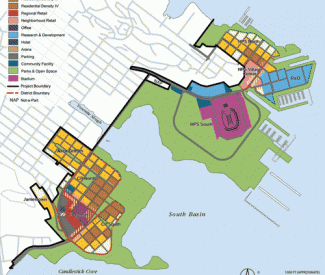
Recently, I spent some time talking with D. 10 candidates DeWitt Lacy and Tony Kelly about Lennar’s redevelopment plan for the shipyard and Candlestick Point. I also attended a Progressive Planners forum that addressed the massive development proposal. Those conversations and the issues they raised seem timely in light of the city’s crazily tight schedule for trying to ram final approvals for the project past government agencies this summer. And in light of three appeals that have been filed against the city’s recently certified final environmental impact report for the plan, raising concerns that the city will get bogged down in expensive and time-consuming litigation if it doesn’t get the plan right, while it still can.

(Lest other D. 10 candidates complain that they weren’t interviewed, too, I’d like to clarify that I’ll be covering the race between now and November, and I look forward to hearing what they all think at the Board’s July 13 meeting to hear appeals of the city’s final environmental impact report (FEIR) for the project. )

Both Lacy and Kelly are critics of Lennar’s plan, but not in a knee-jerk obstructionist way. Instead, they bring considered and informed critiques to the table at a time when the community desperately needs good advice and a workable strategy, if residents are to get needed amendments and concessions, before the developer get the green light, or before the Board puts  a moratorium on the project until the city’s FEIR flaws are ironed out.

Lacy is a bright and earnest candidate who learned lessons from the school of life, while growing up in San Jose in a working class family. Lacy says his father worked in an Adidas warehouse until he was injured on the job, and his mother worked as a secretary in Atari’s corporate office, but was laid off after two years.

Lacy recalls how his parents opened their own janitorial business, in the hope of making a better life for their six children.  He says that it was while cleaning homes alongside his mother, that he began to recognize the need for working class improvement and growth.

 In 1995, Lacy moved to San Francisco, where he has worked in the District Attorney’s office and formed his own law practice—experience that could serve District 10 well, since it’s home to many working-class residents and will be ground zero in the battle for construction-related contracts and environmental and economic justice, if Lennar’s massive redevelopment plan goes ahead,

“I know how to craft legislation for social justice,” Lacy said.

Lacy observes how Michael Cohen, Gavin Newsom’s top economic advisor in the Mayor’s Office of Economic and Workforce Development, has repeatedly told folks that land transferred to Lennar will be subject to a “right of reverter.”
This means the Redevelopment Agency may re-take ownership of the land, if the developer fails to substantially complete the infrastructure in the time frame set forth in the city’s development and disposition agreement (the DDA)

But Lacy observes that this “nuclear option” isn’t likely to happen with so much riding on the Lennar deal, and he stresses that additional controls are needed, if the city is to ensure that the deal remains in the best interest of San Francisco, not just the developer.

Lacy’s probably right about that. (Remember how hard the community had to fight to just get an extra 15 days to read and comment on the project’s six volume draft EIR over the winter holidays?)

And how much political pressure was exerted to ram the city’s EIR for this project across the certification line on June 3, five days before Santa Clara voters decided to support a stadium for the 49ers near Great America.

“What’s needed is an impartial arbiter,” Lacy said. “The city needs regulatory controls and the capacity to fine Lennar if it breaks promises to build affordable housing, create jobs and hire locals. You’re not going to be able to hold their feet to the fire without that.”

“I’m not saying that we should be obstructionists, critics who are trying to prevent stuff for the sake of a political battle,” Lacy added. “But we need new blood. The benefit of my campaign is that I’m not downtown’s candidate. I’m a civil rights attorney, who can help the district by figuring out what battles we need to be fighting and which battles are winnable. And I want to make sure there are jobs and business opportunities for working-class folks in San Francisco. You shouldn’t have to be a doctor or lawyer to afford to live here.”

Lacy believes the Navy should remove the radiologically impacted landfill on the shipyard’s Parcel E2.
“That ground has to be taken out of there,” Lacy said. “I would hope the City Attorney’s Office would get involved and advocate for the people. But leadership is about taking a stance when no one else is.”

With the city suggesting that it can still win back the 49ers, Lacy said that he too, would love it if the 49ers decided to stay.
 
“But not at the cost of our health and safety,” Lacy said, referring to the city’s repeated claim that it needed to rush certification of the final EIR for Lennar’s project, if there was to be any hope of winning back the team.

“ I don’t think the solution is the rush,” Lacy said. “I say, let’s make sure we clean up the shipyard properly—and bring back the Warriors [a professional basketball team that relocated to San Francisco in 1962, until 1971, when it moved to Oakland].”

I also hung out with D. 10 candidate Tony Kelly, at an event that POWER hosted as part of a Progressive Planners Forum, the day after Lacy and I unsuccessfully tried to access the shipyard, and the same day that POWER was also blocked from the yard.

Kelly has been tracking issues in and around District 10 for years, and, much like Lacy,  he’s not afraid to speak his mind on the issues.

For instance, Kelly is incensed by the city’s attempt to ram through approval of the final EIR for Lennar’s development, when the Navy has yet to complete an environmental impact statement related to its proposed clean up activities at the shipyard..
“Is the EIS ever a trailer to the EIR?” Kelly asked. “It’s like planning on Mars.”

Kelly has also expressed concern over the developer’s plan to build two peaker plants in the community.

And he is worried about the consequences of the city’s plan to turn the entire Bayview into a project survey area for Lennar’s Candlestick/Shipyard plan.

“How do you pay for any other improvements in the Bayview, when the shipyard redevelopment plan sucks all the air out of the room?” Kelly said

But Kelly’s biggest concern right now is that once Lennar gets its final approvals this summer, “the developer will never talk directly to the community again.”

At the Progressive Planners Forum that Kelly attended, speakers also voiced measured criticisms of Lennar’s plan.

“The plan has some important elements, especially in the job areas, but I think it adds up to gentrification, which is disruptive to the surrounding community, families and the last bastion of the black community in San Francisco,” said Chester Hartman, who has authored over 18 books on race and urban planning, including the acclaimed City For Sale: The Transformation of San Francisco.

“There is a need for a response in terms of an alternative approach,” Hartman advised.
“It doesn’t have to be a detailed, but it should include a basic philosophy and goals, and retain good parts of the original plan.”

Peter Marcuse, Professor of Urban Planning at Colombia University, said the situation at the shipyard reminded him of the ongoing oil disaster in the Gulf.

“Cap the land sounds like cap the spill,” Marcuse said, noting that in both cases the community is fighting to get folks who dumped toxins to clean them up.

Marcuse criticized the privatization of the planning process, as illustrated by the City’s claim that it has entered into a “public-private” partnership with Lennar,  and the community’s experience that the city and the developer keep ignoring or dismissing the public’s feedback and opinions.

 “There should have been a range of alternatives open for discussion,” Marcuse said. “Instead, there is a sense, of this mega project’s inevitability. And once the developer has title to the land, the city has to negotiate what should be a public matter.”

Marcuse critiqued the use of tax increment financing, which will use increased taxes on property throughout the Bayview to finance improvements in one relatively small area, the 770 acres of land that, as Marcuse put it, “got sold to Lennar for $1.”

“This is a form of government subsidy,” Marcuse warned.

“There have been some negotiations,” Marcuse continued. He pointed to the community-led Prop. F, which in the spring of 2008 sought to establish 50 percent affordable housing in the development. And the community benefits agreement (CBA) that the San Francisco Labor Council hammered out at in May 2008, in an attempt to nail down benefits for the community in exchange for the Council’s support for the Lennar-financed Prop. G in June 2008.

“But these negotiations with Lennar start on basis that Lennar’s interests have to be protected equally with those of the City and its residents,” Marcuse commented. “It ought to be a public responsibility to show the community what the alternates to Lennar’s vision are.”

Marcuse concluded by suggesting a moratorium on Lennar’s plan to allow for a community-based visioning process, in which residents could express their desire for housing, diversity, open space and protection against environmental hazards

‘The City should then come up with an alternative to Lennar’s plan—and listen to Lennar,” he said. “But this is a public responsibility, rather than a private negotiation with a corporation that has been a beneficiary of a huge subsidy and starts to make a huge profit, the minute its housing units begin to sell.”

Miriam Chion, who works for the Association of Bay Area Governments (ABAG), also expressed concerns with Lennar’s massive plan, which proposes to build thousands of mostly luxury condos at Candlestick Point, with a smaller number on the shipyard.

“We are in the 21st century, how can we continue to use same mechanisms of displacement?” Chion said. “And how can we do that to the African American community, which we have displaced over and over, and which has managed to build a community here, in spite of everything?”

According to Lennar’s plan, 68 percent of its proposed 10,000 units will be built at market rate. Of the remaining 32 percent of units, only 15 percent will be built at truly affordable rates, with an additional 15 percent geared towards the working middle-class income levels, such as those enjoyed by police, fire fighters, nurses and teachers.

But two Bayview residents who attended POWER’s progressive planners’ forum expressed frustration at what they perceived as outsiders trying to tell locals what’s best.

“If you haven’t lived here, you don’t know about the Bayview,” one resident said. “If they are going to do what they are going to do, they should do it all the way, and change things for the better. I’m tired of seeing kids under 12, playing outside at 11 p.m. So, if you are not from here, you can’t come on my ground and pass judgment. If you’d been and lived here, I don’t think you’d see this negatively.”

“$700 million has been spent on cleaning up shipyard, and producing highly technical reports on it,”  another local resident said. “Highly intellectual discussions are not helping, we need some action today.”

“No one here is against development,” countered long-term Bayview resident Espanola Jackson, while a Bayview resident named Nyese resurrected longstanding concerns that the developer fatally broke community trust when it failed to control asbestos dust at the site, when it began grading the shipyard’s Parcel A .

“Four years ago, I found out that they were sending home workers at the shipyard, without informing the surrounding community,” Nyese recalled. “My son was having excessive nosebleeds, so it was phenomenally insulting that they didn’t not notify us.”
“Lennar is just a name, a conglomeration of shareholders,” Nyese further noted. “We need development. But we don’t need it on chemically toxic land.”

These competing concerns indicate that all the candidates in the D. 10 race are going to have to be asking critical questions as they track the progress of Lennar, the city and the Navy’s plans this summer. Failure to do so will cost them credibility within the community—and possibly the supervisor’s race this fall, though downtown money will pour in to support whichever candidate is deemed most likely to rubberstamp present and future development and contracting plans. Stay tuned. It’s going to be a (politically) hot July.


Political litmus test for Hunters Point Shipyard access?

4

Even though the U.S. Navy abandoned the Hunters Point Shipyard in 1974, the military has continued to control access to the shipyard that helped launch the A-Bomb. That’s because the Navy still owns most parcels of land on the shipyard and remains on the hook for cleaning up pollutants on these sites, including a radiologically impacted dump on Parcel E2, which has been deemed to be the dirtiest land on the site.

Currently, the Navy is proposing to cap, not excavate this landfill, despite repeated requests from the local community, and a citywide vote in support of Proposition P in 2000, which urged the Navy to clean up the land to the best extent possible, which would mean excavating the Parcel E2 landfill and replacing it with clean uncontaminated soil. And oddly, the City appears to want government agencies and officials to sign off on its final EIR for Lennar’s massive 770-acre redevelopment plan for the shipyard and Candlestick Point, even though the Navy has not yet completed an environmental impact statement (EIS) related to its proposed shipyard cleanup activities.

Currently, the Navy controls access to the facility beyond a couple of trailers that the city’s Redevelopment Agency has set up just within the yard’s main gate. And to gain access to the shipyard these days, you need to call or visit Redevelopment’s trailer and get a pass. Or, alternatively, if you know any of the artists who continue to rent studios at shipyard, you can call them to try and get the city to give you a pass.

Underlying these limits to accessing the shipyard are some legitimate safety concerns related to equipment and excavations on what is now an active clean up and construction site, along with fears that untoward characters could break into the abandoned buildings or bother the artists who still have studios in operation at the shipyard. But has an additional political litmus test been put in place when it comes to critics of Lennar’s redevelopment plan, who want to access to the yard? If so, does it mirror the tap dancing that the local community has had to undergo to get its voices heard as Lennar pushes to get final approval for its shipyard/ Candlestick Point redevelopment plan.

Those questions resurfaced last week when a private security guard manning the shipyard’s front gate denied access to D. 10 supervisor candidate DeWitt Lacy, who had dropped by hoping to take this reporter around the yard as part of an ongoing conversation about Parcel E2, which Lacy believes needs to be excavated completely, and how best to hold the Navy accountable for cleaning up a mess it created decades ago. The security guard told Lacy that folks who want to visit must get a pass at the Redevelopment Agency trailer.

At the Redevelopment trailer, Micah Fobbs, administrative assistant for W.B. Kennedy and Associates, which has a contract with Redevelopment’s Citizen’s Advisory Committee. told Lacy that without a preauthorized pass, he couldn’t let us onto the site. Fobbs added that he would be happy to take us on a tour himself, but he could not leave the trailer unmanned, since he was the only staff member there at the time. Fair enough. Though the rebuff gave us the feel that the City doesn’t want pesky investigative reporters that have been critical of the development running around the site. “And if they found out I was a civil rights attorney, they probably wouldn’t want me out here, either,” Lacy joked.

But the next day, I encountered what sounded like overt hostility to other critics of Lennar’s plan, when I tried to ride along on what had been billed as a “Toxic Tour of the Navy Shipyard” by POWER (People Organizing to Win Employment Rights). POWER had advertised its tour in an email which said it would involve 23 expert urban planners, who happened to be in the Bay Area for a Progressive Planning Forum. The tour was billed as happening on the morning of June 17, before an afternoon discussion at POWER’s Third Street office in the Bayview, which was to focus “on alternative approaches to the city’s current plan for development at the Shipyard/ Candlestick Point.”

Caught in traffic, I didn’t arrive at the Boys and Girls Club on Kiska Road in Bayview Hunters Point in time to join POWER’s kick-off get together. So, I headed direct to the shipyard, a move that meant I arrived alone and ahead of the school bus that POWER had rented for the occasion. At the gate, I was told by the security guard that I couldn’t get in, that another guard lost his job for letting unauthorized individuals onto the site, that POWER didn’t have a pass and that they’d been warned to watch for POWER “because they want to stop the development.”

“If you are not authorized with badges, you are not let through,” the guard said, giving me the telephone number of the Hunters Point Duty police officer, who in turn said I needed to call the San Francisco Redevelopment Agency, which in turn told me to call the folks at the Redevelopment Agency’s shipyard trailer. And so I called Fobbs again, who confirmed that the Navy still controls all the property, except Parcel A which has already been conveyed to the City which in turn has granted developer Lennar the right to develop thousands of condos on that particular parcel.

“As far as viewing the rest of the property, you have to put in a request, and no photography or videography is allowed,” Fobbs said. This stated ban on photography came as a surprise, given recent photos of the shipyard that ran in a New York Times article about Lennar and the city’s vision for the 770-acre property.

And the sudden difficulties in gaining media access seemed odd, given that Lennar’s PR firm, Sitrick and Company, offered to take the media on a tour on the morning of June 3—the day the Redevelopment and Planning Commissions subsequently approved the final EIR for Lennar’s plan to redevelop the rest of the shipyard, plus Candlestick Point, a FEIR that has now been appealed to the Board, on the grounds that it was rushed for political reasons, leading to fatal flaws in the final document.

“Well, if folks come here through Redevelopment or the Mayor’s Office, then they have been able to take photographs,” Fobbs said. “But we have had people trying to climb fences and get through doors of some of the buildings.” (Fobbs last comment was a reference to a recent climbing of the fence that the Nation of Islam’s Leon Muhammad engaged in, in an effort to determine if air quality monitoring devices near the Nation’s school and Oakdale public housing site were operating. (After Muhammad scaled the fence and reported that he’d found an empty bin where monitoring equipment was supposed to be, a kafuffle ensued, with the US EPA saying Muhammad was looking in the wrong place for the monitors which, it claimed, were in operation.)

Ultimately, Fobbs told me to call Redevelopment’s Audrey Kay if I wanted a tour, and several shipyard artists told me they would be happy to arrange a day pass so I can visit their studios and hear concerns that they will be required to move from a couple of shipyard buildings before replacement studios have been completed–an arrangement that would amount to a breach of promise that Lennar and the city previously made to the shipyard artists.

Shortly after I was turned away for a second time, POWER’s bus arrived at the gate, only to be blocked–a denial of access that meant 23 progressive planners were forced to view the shipyard from various remote viewing spots atop the hills that surround the site.

Together these episodes left me wondering what kind of political litmus test could end up being enforced at the site, if Lennar’s mega project gets the green light this summer, and what will happen if the Board decides to kick the plan back to the drawing board until the Navy completes a environmental impact statement and all of the community’s ongoing environmental and economic justice concerns are addressed.

So stay tuned, and don’t forget to mark July 13 on your calendar when the full Board of Supervisors is tentatively to hear appeals of the project’s final EIR, which the Planning and Redevelopment Commissions rubberstamped June 3. And, as always, it will be revealing to see which candidates in the hotly contested race for D. 10 supervisor, show up and speak truth to power.


The Unaccountable G-8

0

By Jeffrey Sachs

(Jeffrey D. Sachs is Professor of Economics and Director of the Earth Institute at Columbia University. He is also Special Adviser to United Nations Secretary-General on the Millennium Development Goals.)

NEW YORK – In hosting the 2010 G-8 summit of major economies (Canada, France, Germany, Italy, Japan, Russia, the United Kingdom, and the United States), Canadian Prime Minister Stephen Harper called for an “accountability summit,” to hold the G-8 responsible for the promises that it made over the years. So let’s make our own account of how the G-8 did. The answer, alas, is a failing grade. The G-8 this year illustrates the difference between photo-ops and serious global governance.


Of all of the G-8’s promises over the years, the most important was made to the world’s poorest people at the 2005 G-8 Gleneagles Summit in Scotland. The G-8 promised that, by this year, it would increase annual development assistance to the world’s poor by $50 billion relative to 2004. Half of the increase, or $25 billion per year, would go to Africa.

The G-8 fell far short of this goal, especially with respect to Africa. Total aid went up by around $40 billion rather than $50 billion, and aid to Africa rose by $10-$15 billion per year rather than $25 billion. The properly measured shortfall is even greater, because the promises that were made in 2005 should be adjusted for inflation. Re-stating those commitments in real terms, total aid should have risen by around $60 billion, and aid to Africa should have risen by around $30 billion.

In effect, the G-8 fulfilled only half of its promise to Africa – roughly $15 billion in increased aid rather than $30 billion. Much of the overall G-8 increase in aid went to Iraq and Afghanistan, as part of the US-led war effort, rather than to Africa. Among G-8 countries, only the UK is making a bold effort to increase its overall aid budget and direct a significant portion to Africa.

Since the G-8 was off track in its aid commitments for many years, I long wondered what the G-8 would say in 2010, when the commitments actually fell due. In fact, the G-8 displayed two approaches. First, in an “accountability report” issued before the summit, the G-8 stated the 2005 commitments in current dollars rather than in inflation-adjusted dollars, in order to minimize the size of the reported shortfall.

Second, the G-8 Summit communiqué simply did not mention the unmet commitments at all. In other words, the G-8 accountability principle became: if the G-8 fails to meet an important target, stop mentioning the target – a cynical stance, especially at a summit heralded for “accountability.”

The G-8 did not fail because of the current financial crisis. Even before the crisis, the G-8 countries were not taking serious steps to meet their pledges to Africa. This year, despite a massive budget crisis, the UK government has heroically honored its aid commitments, showing that other countries could have done so if they had tried.

But isn’t this what politicians like to do – smile for the cameras, and then fail to honor their promises? I would say that the situation is far more serious than that.

First, the Gleneagles commitments might be mere words to politicians in the rich world, but they are matters of life and death for the world’s poor. If Africa had another $15-$20 billion per year in development aid in 2010, as promised, with the amounts rising over future years (also as promised), millions of children would be spared an agonizing death from preventable diseases, and tens of millions of children would be able to get an education.

Second, the emptiness of G-8 leaders’ words puts the world at risk. The G-8 leaders promised last year to fight hunger with $22 billion in new funds, but so far they are not delivering. They promised to fight climate change with $30 billion of new emergency funds, but so far they are not delivering. My own country, the US, shows the largest gap between promises and reality.

Hosting this year’s G-8 summit reportedly cost Canada a fortune, despite the absence of any significant results. The estimated cost of hosting the G-8 leaders for 1.5 days, followed by the G-20 leaders for 1.5 days, reportedly came to more than $1 billion. This is essentially the same amount that the G-8 leaders pledged to give each year to the world’s poorest countries to support maternal and child health.

It is absurd and troubling to spend $1 billion on three days of meetings under any circumstances (since there are much cheaper ways to have such meetings and much better uses for the money). But it is tragic to spend so much money and then accomplish next to nothing in terms of concrete results and honest accountability. 

There are three lessons to be drawn from this sorry episode. First, the G-8 as a group should be brought to an end. The G-20, which includes developing countries as well as rich countries, should take over.

Second, any future promises made by the G-20 should be accompanied by a clear and transparent accounting of what each country will do, and when. The world needs true accountability, not empty words about accountability. Every G-20 promise should spell out the specific actions and commitments of each country, as well as the overall promise of the group.

Third, the world’s leaders should recognize that commitments to fight poverty, hunger, disease, and climate change are life-and-death issues that require professional management for serious implementation.

The G-20 meets later this year in South Korea, a country that has emerged from poverty and hunger over the past 50 years. South Korea understands the utter seriousness of the global development agenda, and the poorest countries’ needs. Our best hope is that South Korea will succeed as the next host country, picking up where Canada has fallen far short.

Jeffrey D. Sachs is Professor of Economics and Director of the Earth Institute at Columbia University. He is also Special Adviser to United Nations Secretary-General on the Millennium Development Goals.

Copyright: Project Syndicate, 2010.
www.project-syndicate.org
For a podcast of this commentary in English, please use this link:
http://media.blubrry.com/ps/media.libsyn.com/media/ps/sachs167.mp3

An online defense of print—and a plug for the Public Press’ first print edition

2

I spent my lunch hour yesterday indulging in what media critics say could soon be a lost experience: reading the first print issue of a newspaper.

As I turned the pages of a pilot print edition of the San Francisco Public Press, which has been in existence online since March 2009, I was surrounded by folks who were tapping out messages on plastic coated cell phones or sitting scrunched at table trying to read stuff on laptops.

And I began to wonder, will there be a print renaissance in my life time as upcoming generations begin to feel the impacts of too much screen and keyboard time? And begin to realize the benefits of having a print presence in this increasingly digital world? Or is print really going to go the way of the dinosaurs?

Maybe it’s because I’m old school, but I actually believe there’s a future for print journalism, though it may be a limited one. To my mind you can’t beat the sensation that comes from leafing through a newspaper, while sipping morning coffee, or the welcome relief of reading the news in hard copy, after staring at computer screens all day. And then there’s the fact that I’m never going to get mugged, or have my car broken into, because someone wants to steal a newspaper–something that can’t be said if you leave your Kindle or Blackberry or fancy laptop around.

Yeah, I never have to worry about sand at the beach, or water in the bath, when I read a print newspaper. And I can rest assured that when I am done with my paper, and leave it in a coffee shop, someone else can read it, or recycle it in their blue bin or reuse it as the proverbial bird cage liner or fish wrap.

Now, what’s especially interesting about the San Francisco Public Press—and distinguishes it from most other print newspapers currently available—is that it’s free of advertisements. Or, as the folks at the Public Press like to say, it’s “ad-free news in the public interest.”

    “Why no ads?” the Public Press asks. “As the newspaper advertising market has drained to Internet competitors, we need to search for other sources of income to support quality journalism. Advertising has also warped the content of the newsroom, both explicitly and subtly, encouraging newspapers to shift their coverage to topics of interest to businesses and wealthy readers—the target of ads. Noncommercial news, while often less lucrative, has the luxury of independence.”

The Public Press also devotes some wordage to explaining why they have turned to ink:
    “Newspapers help bridge the digital divide,” they state, noting that San Francisco’s 2009 City Survey showed that more than 34 percent of households with income under $50,000 cannot access the Internet at home via personal computers.
    “Newspapers serve as communal touchstones,” they continue, observing how isolating digital widgets can be, compared to reading a print newspaper in public.
    “We want to pay our hardworking staff for the work they do,” they add, reminding us that folks buy 50 million newspapers everyday in the US, but are still averse to paying for news online.
    “People use paper and electronic devices differently,” they conclude. “There are times and places when even the most tech-savvy Bay Area digerati enjoy some screen relief.”

I got my hands on a copy of the San Francisco Public Press’ first print edition, because Lila Lahood, SFPP’s director of operations, and SFPP contributor Christopher D. Cook, who wrote a timely piece about Lennar using federal taxpayer funds to balance its books, stopped by the Guardian with a stack of papers.

And while they were in newspaper delivery mode, Lahood and Cook also shared their thoughts on “Lessons Learned” from their first foray into print.

“We missed our deadline,” Lahood admitted, observing how, in future, the Public Press plans to focus less on breaking news and more on timely features to avoid deadline stress. The plan going forward, Lahood said, is to publish a print edition on a quarterly basis, with the hope of becoming a monthly print publication at some point next year.

“Some of us we stayed up the whole night, filings our full package at 6 in the morning,” Lahood added, tipping her hat to the “strong and committed core” of Public Press workers that made this first print edition possible.

‘Though most of us are journalists, we worked for publications that were already in existence before we arrived,” Lahood continued, acknowledging that the team had much to learn about putting out a print edition from start to finish this first time around.

‘But we showed it could be done,” Cook added.  “There is a solid professional publication now in the public sphere, making a dent in the San Francisco community.”

Available in 35 bookstores and newsstands in the Bay Area, the Public Press’ print edition is also available on the street for $2 a pop—an exercise in sales that isn’t as easy as the guys who peddle the Street Sheet (a monthly tabloid written primarily by homeless and formerly homeless people) make it look.

“It’s hard to sell newspapers on the street,” Cook acknowledged. “We knew it was going to be challenging. When you are out there, standing on the corner in the urban crunch, no one has an interest, but the minute you connect to folks, on an individual level, it changes.”

On June 22, the Public Press’s first pilot newspaper hit the streets. At 28 pages long, it includes two sections, three investigative reports, a full-page graphic novel and 50 articles from staff members and a broad spectrum of public media and civic groups, including KALW, KQED, Commonwealth Club, World Affairs Council, California Watch and Consumers Union.

I found the Public Press’ special section on Treasure Island intriguing and informative—the kind of in-depth investigation that’s hard for one journalist to pull off, but is crucial if the city of San Francisco and all its many residents are going to make informed planning and development decisions.

I appreciated the wide-range of articles in the Public Press’ main section, including items on the ongoing battle over the future of the open-air sewage digesters that have been stinking up the Bayview for decades now.

I loved the “Sit, Lie, Get Deported” comic strip that merges photos with hand-drawn illustrations and uses the actual words of politicians, city officials, activists and gadflies to help illustrate its point.

And I’m still trying to finish the crossword. In fact,  I plan to read the SFPP’s first printedition from front to back over the July 4 holiday weekend, when I’ll have the time to really absorb and enjoy it.

“Ideally, news will appear in print first, then online, so there’s interest in seeking out the print edition,” Lahood told me, noting that the Public Press’ first edition amounts to about 70,000 words. “So, it a novel, in length,” Lahood laughed. “People are, if not starving, at least very hungry for news analysis and investigative reporting. There are a lot of online sites that aggregate other publications content, and then there’s the corporate model of the Chronicle, but while there is some good reporting in town, there are fewer reporters.”

No kidding. All the more reason for this reporter to write an online defense of print, in the hope that you rush out to secure your copy of the Public Press’s first print edition and evaluate this new model of journalism. I think you’ll be glad you did.

Hear the call for East Oakland community paparazzi

0

When Oacia5804 (her screen name) was asked on the Our Oakland website to contribute an image that told a story about her East Oakland home, she didn’t rip her shot off of the TV news. The mother of two sent in an amazing shot of her kids pointing up at a rainbow looping perfectly over a neighborhood street. “Even tho [sic] the streets of East Oakland seem dark at times, There is Always a ray of light that will shine and inspire Greatness,” writes the photographer in the shot’s caption. That’s exactly the kind of alternative narrative that Our Oakland, a non profit that is gathering stories for incorporation into a public arts project, hopes to publicize. They’re calling for submissions for a photo contest (submissions accepted until Thurs/8) that want to challenge our perceptions of what East Oakland looks like. 

 “Each contest photo reshapes the image of East Oakland,” states Rene Yung in the press release for the competition. And it does need a certain amount of retooling, that image. What do you think about when you think East Oakland? Unfortunately, we’ve been somewhat programed with a negative answer. It’s detrimental to the reasoning skills of people who have to listen to an endless reel of news about drug deals and prostitution outside of the neighborhood, but what does that negative imaging mean to the people that live on those streets that are so often pictured behind yellow caution tape, or gone “wild” with gang activity?

Yung created the website as part of a project she’s doing for the East Oakland Community Library, in which she’s integrating art with community voice. The finished product will include a digital archive of stories about the neighborhood as told by residents, and a 64-foot bank of etched glass windows that are meant to invoke the interconnectedness of the community. At the moment, the website includes user generated written narrative — but the photo contest is Our Oakland’s big deal at the moment. “Each photographer is taking charge of what the public gets to see and hear about the community, and, in the process, is changing the conversation about East Oakland,” says Yung.

To build awareness about the  photo contest (and the prizes, natch — whooo wants some schmancy electronics?), Our Oakland has been staging a series of events that focus on building story telling skills and technological expertise in taking photos. It’s spread the news about the project at Lao Family Community Development, an organization that promotes social self-sufficiency in Southeastern Asian families, Our Oakland’s booth encouraged kids and families to write down and illustrate their stories on big, fun pieces of construction paper. Our Oakland has also conducted photo workshops for the kids at the Allendale Recreational Camp and the Tassafaronga Recreation Center.

But shooting’s open to all, so tell your mamma, tell a friend, get those photos in. We can widen that running commentary we all have to hear about East Oakland — and maybe even change some minds on what a strong community looks like.

For more information on the My East Oakland photo contest, go here. Entries are due by Thurs/8.

Lennar’s litmus test

3

sarah@sfbg.com

None of the many stakeholders tracking the progress of Lennar Corp.’s massive Candlestick Point-Hunters Point Shipyard redevelopment plan registered surprise when the Board of Supervisors received three appeals to the Planning Commission’s June 3 certification of the project’s final environmental impact report (FEIR).

Instead, everybody who has been watching the political juggernaut that has been pushing for quick approval of the project over the past month said they anticipated that the FEIR would be appealed, and perhaps litigated. But the real question is whether the project will be substantially changed.

In the seven months since the project’s draft EIR was released, the Planning and Redevelopment Commissions have repeatedly rejected all arguments and recommendations made by its critics to improve or delay the plan, rushing the approval along on a tight schedule (“The Candlestick Farce,” 12/21/09).

The rush job occurred even as numerous groups and individuals warned that the DEIR comment period was too short, (“DEIR in the headlights,” 02/03/10) and complained that the city and the developer had dismissed crucial data and testimony while exploiting fears the San Francisco 49ers would leave town if the city didn’t act quickly (“Political juggernaut,” 06/02/10).

What’s less clear is whether the Board of Supervisors has the political will to heed these appeals and correct what opponents say are serious flaws in the city’s FEIR. The appeal that the Sierra Club, Golden Gate Audubon Society, California Native Plant Society, and San Francisco Tomorrow filed June 21 lists nine deficiencies.

These included the FEIR’s failure to look into an alternate Bus Rapid Transit (BRT) route around Yosemite Slough or adequately assess impacts resulting from the landfill cap on Parcel E2 and the transfer of 20 acres of public shoreline land in Candlestick Point State Recreation Area (CPSRA) to build high-end housing.

“The FEIR failed to analyze those elements of the project’s sustainability plan that could have significant environmental impacts, including two proposed heating and cooling plants (which appear to be power plants) to serve 10,500 housing units and a projectwide recycling collection system,” the coalition further charged.

The appeal also voiced concern that the FEIR failed to adequately assess impacts resulting from the construction and maintenance of the development’s underground utility matrix, impacts to the bird-nesting in the proposed 34-acre wetland restoration project at the state park, and delays to eight Muni lines.

But the Sierra Club-led coalition also indicated that by removing provisions for a bridge over Yosemite Slough, transfer of land in the state park, and compromised clean-up efforts at Parcel E2, resolution of many of these disputed issues could be expedited.

“If the Board of Supervisors acts promptly, revisions to the EIR may be made quickly and result in a minimal delay in the progress of the project,” the coalition stated.

The Sierra Club’s Arthur Feinstein told the Guardian that the coalition’s top three concerns are “very important, but the six other issues are also very real.”

“Here we have a city cutting 10 percent of its bus service while saying that eight bus routes will need to be improved because of the project, and admitting that the development will increase air pollution in a district that has the highest rates of asthma and cancer without identifying mitigations such as reducing parking spaces in the proposal,” Feinstein said.

POWER (People Organized to Win Employment Rights) also filed an FEIR appeal June 21 listing a broader range of environmental and economic justice-related concerns.

These included the FEIR’s failure to analyze and mitigate for displacement that would be triggered in the surrounding neighborhood by developing 10,500 mostly market-rate housing units in the area and “failure to provide for adequate oversight and enforcement of the terms of the early transfer” of the shipyard from the Navy.

POWER also cited the FEIR’s failure to adequately mitigate against the impact of sea level rise, the risks associated with potential liquefaction of contaminated landfill at the shipyard in the event of an earthquake, and health risks related to chemicals of concern at the shipyard. The group also faulted the city’s failure to get the Navy to prepare an environmental impact statement on its clean-up plan before the FEIR was completed.

Finally, Californians for Renewable Energy (CARE) filed a five-point appeal June 23 charging that the project contravened the intent of Proposition P (which voters approved in 2000, urging the Navy to remediate shipyard pollution to the maximum extent possible), that the project’s FEIR is incomplete because the Navy (which still retains jurisdiction over the project lands) has not yet completed its EIS, and that the FEIR approval process was tainted by 49ers-related political pressure.

“The pre-set goal of maintaining the 49ers in San Francisco has colored the environmental analysis of this decision,” CARE noted, referring to the city’s rush to get the project’s FEIR certified on June 3 — five days before Santa Clara County voters approved a new stadium for the 49ers near Great America .

The appeal filings mean the Board of Supervisors is required to hold a hearing within 30 days, a move that places a roadblock, at least temporarily, in the way of the city’s tight schedule to secure final approvals for Lennar’s megaproject before summer’s end.

Board President David Chiu told the Guardian that the Board’s Land Use Committee will move forward with a July 13 meeting to hear a list of proposed amendments related to the underlying plan along with the FEIR appeals.

“We are back at the board Land Use Committee July 12 with 10 items related to the project,” said Chiu, who is a member of the Land Use Committee. The three-member committee is chaired by Sup. Sophie Maxwell, who represents the project’s District 10; Sup. Eric Mar is vice-chair.

“The next day, July 13, has been tentatively set for a full meeting of the full board,” Chiu continued. He acknowledged that the FEIR related materials are dense and complex, telling us that “they form the largest pile on my desk, and it’s about five inches high.”

But he wasn’t about to prejudge the outcome. “We do need to clean up the area and rebuild it in such a way that it will dramatically increase affordable housing and jobs and support a livable diverse community,” Chiu said. “Obviously there are still a lot of questions and concerns about the proposed project and the board will push to make sure all these issues are adequately addressed.”

CARE president Michael Boyd said he hoped the board would take his group’s appeal seriously and fix the plan’s fundamental shortcomings. “That means going back to square one,” he said.

But others were less sure that the board would seek to overturn the entire plan. “Everyone in the community would like the best level of clean-up,” said Saul Bloom, whose nonprofit Arc Ecology has tracked the proposed shipyard clean-up for three decades. “But what’s possible and practical? And will the city be supportive of that or the most expeditious solution?”

Bloom reserved gravest concern for plans to cap, not remove, the contaminants from the shipyard’s Parcel E2. “The concern is that if you put a cap on E2 without a liner then contaminants could scootch out during a seismic event, or over time, and cause problems because of the parcel’s close proximity to surrounding groundwater and the San Francisco Bay,” he said. “But to place a liner in there is very expensive because you’d have to excavate E2, at which point you might as well replace it with clean soil.”

Bloom acknowledged that the Navy has argued that excavation would cause a nasty smell and nobody knows what is going to be released in the process.

“But long-term Bayview residents like Espanola Jackson have made the point that the community already lives within nose-shot of the southeast sewage treatment plant and would rather put up with a few years of nasty smells, given the relative benefits of cleaning the yard up,” he said. “And how do we know a cap will be protective given the Navy’s argument that we don’t know what’s down there?

“The thing that makes the most sense here is to clean up the shipyard to the best possible extent, but the city isn’t planning to do that,” Bloom added. “And the environmental community’s bottom line has always been the bridge [over Yosemite Slough, which the Sierra Club opposes]. So the sense is that if the bridge goes away, so does their problem.”

Environmental groups appeal final EIR on Lennar’s Candlestick/Shipyard plan

0

The Sierra Club, the Golden Gate Audubon Society, the California Native Plant Society’ and San Francisco Tomorrow have filed an appeal with the Board of Supervisor’s and the city’s Planning Department over the Planning Commission’s June 3 certification of the city’s controversial final environment report (FEIR) for Lennar’s Candlestick Point/ Hunters Point Shipyard redevelopment project.

The move means that the FEIR, which otherwise would not have come before the Board for review, now heads to the Board for a hearing within 30 days of the group’s June 21 appeal filing. The move also means that the City, which laid out an aggressive schedule for seeking approvals from a myriad of government agencies and departments, cannot seek further approval actions on the project until the Board holds a hearing, which will likely occur on or before July 20.

The San Francisco Bay chapter of the Sierra Club, the Golden Gate Audubon Society, the California Native Plant Society’s Yerba Buena Chapter and San Francisco Tomorrow cited nine major deficiencies in their appeal , but noted that by removing plans to a) build a bridge over Yosemite Slough, b)erect luxury condos on state parkland and b) compromise clean-up efforts at Parcel E2, which is the most polluted land at the shipyard, resolution of many of these disputed issues could be expedited.

“If the Board of Supervisors acts promptly, revisions to the EIR may be made quickly and result in a minimal delay in the progress of the project,” the appeal warns. “Alternately, resolution of many of these disputed issues may be expedited by a decision to remove from the FEIR and Project Plan the provisions for the bridge over the Yosemite Slough, the transfer of land in Candlestick Point State Recreation Area, and compromised clean-up efforts at Parcel E2.”

In their appeal, the four groups noted that they each group and its members represent “a sizeable constituency that has been actively participating in the development of the EIR” for almost a decade and that has conducted or funded studies to inform the Draft EIR and has filed comments to the DEIR and other planning documents.

“Unfortunately, the data, comments and testimony provided by the Appellants and their members have been dismissed or outright ignored by the Planning Department and the developer in this process, resulting in fatal flaws in the FEIR and necessitating this appeal,” the four groups state.

‘Because many portions of the FEIR are inaccurate and incomplete, the Planning Commission erred in adopting several findings and certifying the FEIR,” the appeal concludes. ‘Therefore, we are appealing the FEIR because:
1.    The FEIR failed to adequately analyze an alternate Bus Rapid Transit (BRT) router around Yosemite Slough;
2.    The FEIR failed to adequately assess impacts resulting form the landfill cap on Parcel E2, which is a lower standard for the clean-up than required by San Francisco voters as expressed in Proposition P;
3.    The FEIR inaccurately and incompletely assessed the impacts from transferring approximately 20 acres of public shoreline land in Candlestick Point State Recreation Area to the developer for construction of high-end housing;
4.    The FEIR failed to analyze those elements of the project’s Sustainability Plan that could have significant environmental impacts, including two proposed heating and cooling plants (which appear to be power plants) to serve at least 10,500 units in the Project and a Project-wide recycling collection system;
5.    The FEIR failed to adequately consider impacts to the bird-nesting island component of the Candlestick Point State Recreation Area’s proposed 34-acre Wetland Restoration Project, which is already permitted and planned for construction this year;
6.    The FEIR failed to adequately address impacts to eight MUNI lines, which would significantly increase transit times, increase delays during peak hours, potentially dissuade ridership, and/or require increased service, busses, or drivers;
7.    The FEIR failed to adequately assess impacts resulting from the construction and maintenance of the Project’s underground utility matrix;
8.    The FEIR failed to adequately address the fact that the Project will result in increases in air pollution that will exceed existing air quality standards—indeed even though the FEIR admits exceedences of air quality levels will occur, those statements are underestimates because the FEIR failed to consider that the development in combination with other development plans will result in significant traffic congestion on Highway 101 and Interstate 280 and fore more traffic onto surface streets; and
9.    The FEIR included conclusions based on false, inaccurate and/or biased statements as “evidence,” including (but not limited to) that one cannot have an ‘undisturbed nature experience” in an urban area as a rationale for dismissing impacts that will inevitably result from construction of the bridge over Yosemite Slough and/or the reduction of public land in the Candlestick Point State Recreation Area.

In their appeal, Mike Lynes, Conservation Director Golden Gate Audubon Society, Linda J.Shaffer, Vice President, California Native Plant Society, Yerba Buena Chapter, Jennifer Clary of San Francisco Tomorrow, and Arthur Feinstein, Sierra Club, San Francisco Bay Chapter, promised that each of the abovementioned deficiencies will be further documented by additional submissions to the record prior to a hearing on this appeal by the Board. So, stay tuned.

Danger zone

0

rebeccab@sfbg.com

Rita Connolly, a registered nurse who has worked with inmates in San Francisco jails since 1985, says she’ll never forget the time she had to act fast to save a prisoner’s life.

The man had just arrived from a different jail and was waiting to go through intake. He was slumped over and looking ill, too weak to voice a complaint. Several worried inmates beckoned Connolly over, and once she examined him, she realized he was in the midst of a heart attack. He was rushed to the emergency room. He lived — but sustained irreversible heart damage.

“He could have been someone who didn’t live,” Connolly told the Guardian, but he also could have had a better outcome. The inmate had alerted someone that he was having chest pains earlier in the day, she later learned, as he was boarding a bus from an Alameda County Jail. A medical services worker examined him just before the bus left, but allowed him to proceed. By the time he arrived in San Francisco, the warning signals had progressed to a full-blown heart attack.

The story highlights an extreme example of a trend Connolly said she observes regularly — inmates from counties that use privatized jail health services aren’t receiving the same standard of care that San Francisco provides. Sometimes, there are obvious signs that the care is inadequate, placing inmates’ health at risk.

Alameda’s jail health services contractor, Tennessee-based Prison Health Services Inc. (PHS), has made headlines before for a track record marred by inmate deaths and lawsuits alleging negligence. PHS has expressed interest in contracting with San Francisco if the city opened the door to privatization, which Mayor Gavin Newsom has once again proposed in his latest budget.

That budget also calls for cuts to community-based health and human service programs that threaten to erode the safety net for those battling mental health issues, drug addiction, and chronic health problems, all proposals now being weighed by the Board of Supervisors Budget and Finance Committee.

But it is the debate over whether to make a $11 million cut to jail health services that raises the most thorny and telling questions about what sacrifices are considered acceptable — and what populations can be the most easily targeted — in the quest to balance a budget without the tax increases that Newsom opposes.


OPEN WOUNDS

In San Francisco, the city’s Department of Public Health contracts with the Sheriff’s Department to address inmates’ medical needs. Privatized jail health care would be cheaper, though by how much is a moving target. But nobody is arguing that the care would be better.

Newsom’s budget proposes switching to a private firm as early as January 2011 to help solve a daunting budget deficit. The proposal originated with the Mayor’s Office, and Sheriff Mike Hennessey — whose department would realize the potential savings — went along by including the item in his departmental budget.

In years past, the Board of Supervisors has repeatedly resisted the proposal and is likely to do so again — but rejecting it would mean finding up to $11 million in savings elsewhere.

“The fear is that when you bring privatization into the picture, there is a financial pressure to cut corners. And even though that may end up saving some money … the price that comes with it is too high,” Sup. David Campos said at a recent budget hearing. Referencing stories about inmates who died needlessly in jail under the care of for-profit firms, Campos said he isn’t willing to risk a similar tragedy occurring in San Francisco.

The proposal has been floated repeatedly since as far back as the early 1990s, according to healthcare workers whose jobs have been jeopardized by privatization before. Newsom proposed the cut last year, and the year before.

“In absence of the budget problem, [Hennessey] probably would not have proposed this, nor would we have proposed this,” Newsom’s budget director, Greg Wagner, told members of the Budget and Finance Committee at a May 26 hearing, adding that the mayor shares concerns about prisoner safety. Newsom’s office did not return multiple calls requesting comment for this story.

The U.S. Supreme Court recently agreed to a hear an appeal by the state of California to the federal court ruling that substandard medical care in California prisons constitutes cruel and unusual punishment and necessitates the early release of about 40,000 prisoners. At the May 26 hearing, healthcare workers familiar with the interiors of county jails and state penitentiaries came forward with horror stories.

“Every week I receive at least one inmate who has an open gunshot wound. They have not seen medical care in the county jails,” Dr. Elena Tootell, chief medical officer at San Quentin state prison, told committee members. “It’s quite surprising to me that they send inmates with gunshot wounds to prison. They just walk off the bus. They often have paper towels stuck to their bodies, seeping the blood. And then we are obligated to take care of them. This does not happen from San Francisco County, I’m going to tell you that right now.”

Tootell said she’d observed a significant difference between those counties using private firms and those using public health care. “They will have a fracture — they’ve never been splinted, they’ve never seen a doctor. They’re on anticoagulation [medication], but haven’t had their blood checked in weeks and have bruises all over their body.”

Connolly echoed similar concerns. For example, she told the Guardian, she’s found herself asking questions like, “You were on AIDS medication before you got arrested and now you’re not?”

Susanne Paradis, a healthcare research contractor with SEIU Local 1021, rejects the premise that the same services could be provided at a lower price. Under a private model, she says, the priority is to keep costs low — and that means doing less.

A key issue, Paradis said, is that private firms tend to rely more heavily on licensed vocational nurses (LVNs) — lower-paid medical staffers who aren’t trained to assess patient’s medical needs and cannot administer the same care that registered nurses (RNs) can. Using PHS data, Paradis found that in Alameda, there is one RN for every 92 inmates, compared with one RN per 32 inmates in San Francisco.

“An RN has the ability to assess, observe, and determine if there’s emergency care needed,” Paradis explained. “An LVN does not have the ability to do that.”

John Poh, a nurse practitioner stationed at a jail in San Francisco’s Hall of Justice, explained the difference this way: “The more RNs you have working for you, the fewer deaths you have.”

PHS, an obvious point of comparison with San Francisco since it serves Alameda, declined to answer questions about its services. Instead, media spokesperson Pat Nolan e-mailed a brief statement. “We are excited to hear that San Francisco is considering the contracting of correctional health care,” he wrote. “Should the city choose to go through an RFP process, we would look forward to participating. We think it is the right thing to do for the city and its taxpayers.”


LINES OF DEFENSE

While those incarcerated in San Francisco jails can be thought of by some as criminals, nuisances, or miscreants, those requiring medical attention are patients in the eyes of the jail healthcare workers.

Inmates routinely enter the system with diabetes, HIV/AIDS, hepatitis C, heart problems, liver disease, and substance abuse issues, Connolly said. On occasion, a woman will arrive in jail only to learn that she is pregnant. Mental health problems are common, and some battle psychiatric issues in combination with physical ailments.

“Overall, our patient population has had little access to health care. For many people, we’re the only show in town,” Connolly noted.

Poh said some problems could spiral out of control if jail health staff didn’t nip them in the bud. If an inmate is exhibiting signs of tuberculosis, for instance, they’ll immediately get a mask and be sent to the hospital for screening. Sexually transmitted diseases are also a priority for treatment. “You don’t want that person going out infected,” Poh explained.

The city takes a proactive stance when it comes to treating inmates, Poh said, because at the end of the day, county jail is a revolving door. “Everybody leaves county jail. They’re either going home, to a program, or to prison.” If people are released back into the community with contagious, untreated health problems, the risk of exposure can spread beyond jailhouse walls.

San Francisco’s current system is considered a first line of defense, in which inmates are “seen as members of the community who happen to be in jail right now,” Paradis said.

Privatizing jail-health services would constitute a blow to a wider public health safety net in San Francisco that is already weathering painful cuts. At a June 15 Beilenson Hearing, a state-mandated opportunity for community members to explain the impacts of proposed health and human services cuts to the Board of Supervisors, people came out in droves to protest cuts to programs serving vulnerable residents.

Kristie Miller, executive assistant of the Standing Against Global Exploitation (SAGE) Project, told the Guardian that her organization serves 350 clients a year who are victims of human trafficking and commercial sexual exploitation. The organization stands to lose its mental health funding, so Miller had come out to speak against the cut. “It provides trauma-focused psychotherapy for survivors who’ve experienced a lot of abuse, violence, and exploitation,” she said.

Jeff Schindler, chief development officer for the Haight Ashbury Free Clinics, said he was there protesting a 79 percent funding cut to his organization’s 108-bed residential program on Treasure Island. “We won’t have a place for people to actually go into residential treatment for their mental health and substance abuse issues,” he said. “These are individuals who are going to get their needs met somehow, somewhere, and generally that’s going to be at San Francisco General Hospital.”

It’s in this context that the proposal to contract out for jail health services is being proposed. “It’s easy to dismiss prisoners as probably the least valued sector of our society,” Deirdre Wilson, of the California Coalition for Women Prisoners, noted at a May 26 hearing. “But the right to health care is a human right.”


FOR THE RECORD

According to an estimate prepared by the Sheriff’s Department, the city could save anywhere from $11 million to $14 million by contracting out for jail health services, and Newsom’s budget assumes a savings of “over $11 million per year.”

However, the Controller’s Office continues to revise that figure as the debate shifts and concerns are raised about the skill mix that a private firm would use. “We don’t really know what it would cost to contract out, unless there was an RFP and a response to the proposal and some discussion about what the staffing requirements would be,” Deputy City Controller Monique Zmuda explained at a June 17 hearing. She added that the potential range of savings spanned from $3 million to $11 million annually, depending on decisions that would have to be made about acceptable staffing levels.

San Francisco’s inmate population has shrunk in the wake of the crime lab scandal, and a city-owned facility in San Bruno has been temporarily shuttered. Sheriff Hennessey told the Guardian he believed medical care in the jails could be provided either by city workers or a private firm, but added that he’s “quite happy” with the status quo. Noting that 25 of the 58 counties in California already use private firms, he added, “It’s not an unusual or unique thing.” Hennessey also said the decision was linked to a broader philosophical and political question, and that he doubted there was support on the board for the proposal to go forward.

Mitch Katz, director of the city’s Department of Public Health, did not directly say whether he supported Newsom’s proposal. “I think our Jail Health Services does a great job, but I do understand that the city is facing an extremely difficult budget year and that ultimately the budget must be balanced,” Katz wrote in an e-mail.

Gabriel Haaland, who represents SEIU Local 1021 union members whose jobs would be affected by the proposal, voiced strong opposition at a June 17 Budget and Finance Committee meeting. “‘We don’t care about these people because they’re poor and they’re in jail.’ That’s the message” in the decision to contract out, Haaland charged. The item was continued and will be revisited as budget deliberations unfold.

Now voyager

0

arts@sfbg.com

MUSIC What might Jefre Cantu-Ledesma’s status be? Casual but committed, relaxed yet extremely productive sounds about right for the Alps music-maker, Root Strata label head, On Land festival organizer, and now the third leg of the recently formed Moholy-Nagy.

Not another reunion band-cum-supergroup — Cantu-Ledesma, Danny Paul Grody (the Drift), and Trevor Montgomery (Lazarus) were founding members of Tarentel — the new SF project shares a moniker with the Bauhaus movement mover-and-shaker, although the trio is much more unassuming than all that.

“I think Danny and Trevor had been playing for a couple months, and they called and asked if they could borrow one of my synthesizers,” recalls Cantu-Ledesma on the phone, taking a break from his day job in operations at the San Francisco Museum of Modern Art. “I said, ‘No, but I’ll come down and play it’ — an asshole move on my part, but that’s typical of me.” You can practically hear his tongue being firmly thrust in cheek.

Very casually, but consistently, in the spirit of a “nerding-out recording project” with the members switching instruments and utilizing a “junky analog” ’70s drum machine Montgomery found on eBay, the threesome hunkered down in its longtime Hunters Point practice space, making what Cantu-Ledesma describes as the “most synthesized thing any of us has ever done before. It’s largely improvised around bass lines or drum parts, so things weigh it down and other things can have freedom around it.”

“It’s more like hanging out with friends having some lunch and getting some coffee and making music,” he adds. “It’s not like, ‘Dude! We’re in a band!'<0x2009>”

Easy-going but quick to step back and see the folly or humor in whatever’s before him, often issuing a loud, bright laugh, Cantu-Ledesma seems less than impressed with self-important “band dudes,” even after years spent in an influential combo like Tarentel.

“Oh, gosh, are you picking up on that?” he replies, dryly ironic, when asked about it. “Well, even with the Alps, when you look at it on the surface, it looks like we’re writing songs, but we’re not writing songs. We just want to create stuff and not so much worry about the fidelity of recreating things.”

But what things Cantu-Ledesma makes, judging from the haunting watercolor tone poems of Moholy-Nagy — music that could easily slip into a cinematic mood piece like Zabriskie Point (1970) or Paris, Texas (1984) — and the alternately motorik-beatific and insinuatingly delicate experiments of the Alps’ new Le Voyage (Type). For Cantu-Ledesma’s forthcoming solo album, due this fall, he’ll dig into his more shoegaze-ish background, but for Moholy-Nagy, he gets to “exercise another side. I’m a total knob-tweaker kind of guy, but we get to move around a lot more than we get to on other projects. Things are tending to sound more quirky or funky than other things we’ve done.”

In a way this project is an extension of the San Francisco Art Institute painting and sculpture graduate’s interior, rather than audibly exterior, work. “I’m going to say this, and I’m not trying to be new age,” he confesses. “But honestly, I used to be really intense about stuff happening a certain way. But I worked on my own development and became more secure with my own personality. and that really helped in terms of — without sounding too Californian — just letting it flow.”

That goes for his collaborations with filmmaker and kindred SFMOMA staffer Paul Clipson: a DVD of their Super-8 films and sound pieces since 2007 comes out this summer and coincides with an August performance at Yerba Buena Center for the Arts. “We love what we do, but there’s no plan behind any of it,” Cantu-Ledesma ponders. “I know this probably sounds facetious, but I’m not really motivated to make things happen — though obviously with things like On Land, you’re booking and buying plane tickets and stuff.”

On Land is firmly grounded in Cantu-Ledesma’s Root Strata imprint, which materialized in 2004, inspired by SF collectives like Jeweled Antler and then-Bay Area-based performers like Yellow Swans, Axolotl, and Skaters. It’s a way to present artists that Cantu-Ledesma and co-organizer and label cohort Maxwell Croy like and have worked with in the last year, in a “nice venue,” otherwise known as Cafe Du Nord. In early September, label musicians and friends like Charalambides, Grouper, Oneohtrix Point Never, Zelienople, Dan Higgs, White Rainbow, Barn Owl, and Bill Orcutt will appear, with video collaborations by Clipson and Nate Boyce, at the second annual gathering.

“Does the Bay Area need another music festival? Probably not,” Cantu-Ledesma quips wryly. “But you’re not going to see Bonnie ‘Prince’ Billy or Vampire Weekend. We’re trying to show a different strata of stuff from California or Oregon, kind of a West Coast underground, or people who just fit into our tastes, which are idiosyncratic and weird.”

MOHOLY-NAGY

With Brother Raven and Golden Retriever

Wed/16, 9 p.m., $7

Hemlock Tavern

1131 Polk, SF

(415) 923-0923

www.hemlocktavern.com

rootstrata.com

www.onlandfestival.com

Tale of two landfills

2

Sarah@sfbg.com

Everyone should make a pilgrimage to the landfill where their city’s garbage is buried. For San Francisco residents to really understand the current trash situation — and its related issues of transportation, environmental justice, greenhouse gas reduction, corporate contracting, and pursuing a zero waste goal — that means taking two trips.

The first is a relatively short trek to Waste Management’s Altamont landfill in the arid hills near Livermore, which is where San Francisco’s trash has been taken for three decades. The next is a far longer journey to the Ostrom Road landfill near Wheatland in Yuba County, a facility owned by Recology (formerly NorCal Waste Systems, San Francisco’s longtime trash collector) on the fertile eastern edge of the Sacramento Valley, where officials want to dispose of the city’s trash starting in 2015.

Both these facilities looked well managed, despite their different geographical settings, proving that engineers can place a landfill just about anywhere. But landfills are sobering reminders of the unintended consequences of our discarded stuff. Plastic bags are carried off by the wind before anyone can catch them. Gulls and crows circle above the massive piles of trash, searching for food scraps. And the air reeks of methane, a potent greenhouse gas that is second only to carbon dioxide as a manmade cause of global warming.

It’s also a reminder of a fact most San Franciscans don’t think much about: The city exports mountains of garage into somebody else’s backyard. While residents have gone a long way to reduce the waste stream as city officials pursue an ambitious strategy of zero waste by 2020, we’re still trucking 1,800 tons of garbage out of San Francisco every day. And now we’re preparing to triple the distance that trash travels, a prospect some Yuba County residents find troubling.

“The mayor of San Francisco is encouraging us to be a green city by growing veggies, raising wonderful urban gardens, composting green waste and food and restaurant scraps,” Irene Creps, a San Franciscan who owns a ranch in Wheatland, told us. “So why is he trying to dump San Francisco’s trash in a beautiful rural area?”

Behind that question is a complicated battle with two of the country’s largest private waste management companies bidding for a lucrative contract to pile San Francisco’s trash into big mountains of landfill far from where it was created. This is big and dirty business, one San Francisco has long chosen to contract out entirely, unlike most cities that at least collect their own trash.

So the impending fight over who gets to profit from San Francisco’s waste, a conflict that is already starting to get messy, could illuminate the darker side of our throwaway culture and how it is still falling short of our most wishful rhetoric.


TALKING TRASH

The recent recommendation by a city committee to leave the Altamont landfill and turn almost all the city’s waste functions — collection, sorting, recycling, and disposal — over to Recology (see “Trash talk,” 3/30) angered Waste Management as well as some environmentalists and Yuba County residents.

WM claimed the contract selection process had been marred by fraud and favoritism, and members of YUGAG( Yuba Group Against Garbage) charged that sending our trash on a train through seven counties will affect regional air quality and greenhouse gas emissions and target a poor rural community. Observers also want details such as whether San Francisco taxpayers will have to pay for a new rail spur and a processing facility for organic matter.

Mark Westlund of the Department of Environment told the Guardian that negotiations between the city and Recology are continuing and the contract bids remain under seal. “Hopefully they’ll be concluded in the near future,” Westlund said. “I can’t pinpoint an exact date because the deal is still being fleshed out, but some time this summer.”

Under the tentative plan, Recology’s trucks would haul San Francisco’s trash across the Bay Bridge to Oakland, where the garbage would be loaded onto trains three times a week and hauled to Wheatland. Recology claims its proposal is better for the environment and the economy because it takes trucks off the road and removes organic matter from the waste before it reaches the landfill and turns into methane gas.

But WM officials reject the claim, noting that both facilities will convert methane to electricity, energy now used to fuel the trucks going to Altamont. The landfill produces 8.5 MW of electricity annually, some of which is converted into 4.7 million gallons of liquid natural gas used by 300 trucks. The Ostrom Road facility would produce far less methane, using it to create 1.5 MW of electricity annually.

Recology officials say removing organic matter to produce less methane is an environmental plus because much of the methane from Altamont escapes into the atmosphere and adds to global warming, although WM claims to capture 90 percent of it. Yet David Assman, deputy director of the San Francisco Department of the Environment, doesn’t believe WM figures, telling us that they are “not realistic or feasible.”

State and federal environmental officials say about a quarter of the methane gas produced in landfills ends up in the atmosphere. “But they acknowledge that this is an average. Some landfills can be worse, others much better if they have a good design. And there is no company that has done as much work on this as Waste Management,” company spokesperson Chuck White told us, citing WM-sponsored studies indicating a methane capture rate as high as 92 percent. “The idea of 90 percent capture of methane is very credible if you are running a good operation.”

Ken Lewis, director of WM’s landfills, said the facility’s use of methane to cleanly power its trucks has been glossed over in the debate over this contract. “We’re just tapping into the natural carbon cycle,” Lewis told us.

But Recology spokesperson Adam Alberti (who works for Singer & Associates, San Francisco’s premier crisis communications firm) counters that it’s better to avoid producing methane in the first place because some of it escapes and adds to global warming, which Recology claims it will do by sorting the waste, in the process creating green jobs in the organics recycling and reducing the danger of the gases leaking or even exploding.

“But what has Recology done to show us that the capture rate at their Ostrom landfill is on the high side?” Lewis asks. “Folks in San Francisco say it’s not possible, but we’ve got published reports.”

Assman admits that San Francisco won’t be able to ensure that other municipalities that use Ostrom Road will be focusing on organics recycling. While questions remain about how that facility will ultimately handle a massive influx of garbage, Altamont has been housing the Bay Area’s trash for decades. And even though San Francisco’s current contract will expire by 2015, this sprawling facility nestled in remote hillsides can still handle more trash for decades to come.


ZERO SUM

Perhaps the most striking aspect of the Altamont landfill is the 30-foot-tall fence that sits on a ridge on the perimeter of the facility. It’s covered with plastic bags that have escaped the landfill and rolled like demonic tumbleweeds along what looks like a desolate moonscape.

Wind keeps the blades turning on the giant Florida Power-owned windmills that line the Altamont hills, but it also puffs plastic bags up like little balloons that take off before the bulldozers can compress them into the fill. Lewis said he bought a special machine to suck up the bags, and employs a team of workers to collect them from the buffer zone surroundinge site.

Although difficult to control or destroy, plastic bags are not a huge part of the waste volume. San Francisco has already banned most stores from using them, and the California Legislature is contemplating expanding the ban statewide in a effort to limit a waste product now adding to a giant trash heap in the middle of the Pacific Ocean.

“Plastic bags are a visual shocker,” said Marc Roberts, community development director for the city of Livermore. “In that sense, they are similar to Styrofoam. It’s pretty nasty stuff, can get loose, and doesn’t break down. But they’re not a major part of the volume.”

Yet Roberts said that these emotional triggers give us a peek into the massive operations that process the neverending stream of waste that humans produce and don’t really think about that often.

“Our world is so mechanized,” Roberts observed. “Stuff disappears in middle of night, and we don’t see where it goes.”

San Francisco officials confirm that the trend of disappearing stuff in the night will continue, no matter which landfill waste disposal option the city selects.

“No matter what option, it’s going to involve some transportation to wherever,” Assman said. Currently, Recology and WM share control over San Francisco’s waste stream. But that could change if the waste disposal contract goes to Recology.

A privately-held San Francisco firm, Recology has the monopoly over San Francisco’s waste stream from curbside collection to the point when it heads to the landfill. Waste Management, a publicly-traded company that is the nation’s largest waste management operation, owns 159 of the biggest landfills in the nation, including Altamont, the seventh-largest capacity landfill in the nation.

San Francisco started sending its trash to Altamont in 1987, when it entered into a contract with Waste Management for 65 years or 15 million tons of capacity, a level expected to be hit by 2015, triggering the current debate over whether it would be better to send San Francisco’s waste on a northbound train.


TRAIN TO WHEATLAND

Creps, 76, a retired school teacher, warns folks to watch out for rattlesnakes as she shows them around this flood-prone agricultural community.

“This is an ancient sea terrace, and now it’s fertile grazing ground between creeks,” Creps said as we walked around the ranchland that Creps’ grandfather settled when he came to California in 1850. Today he lies buried here in a pioneer cemetery, along with Creps’ adopted daughter, Sophie, who was killed at age 27 after she witnessed a friend’s murder in Oakland in 2006.

Creps’ cousin, Bill Middleton, who grows walnuts on a ranch adjacent to hers, worries about the landfill’s potential impact on the groundwater. “The water table is really high here, so you’ve go a whole pond of water sitting under this thing,” Middleton said.

Wheatland’s retired postmaster, Jim Rice, recalled that when the landfill opened on Ostrom Road in the 1980s, individual cities had veto power over any expansion plans. “But Chris Chandler, who was then the Assembly member for Sutter County and is now a judge, carried a bill in legislature to do away with veto power,” Rice said.

“So we lost out and ended up with a dump,” Middleton said.

Creps believes the landfill should be for the use of local residents only. “There’s a lot of development going on around here and the population is going to grow,” she said. “But at this rate, this landfill will be used up before Yuba and the surrounding counties can use it. And that’s not fair. They think they can get a foothold in places off the beaten path.”

Yet not everyone in Yuba County hates San Francisco’s Ostrom Road plan. On June 7, the Yuba-Sutter Economic Development Corporation backed Recology’s plan to build a rail spur to cover the 100 yards from the Union Pacific line to the landfill site.

EDC’s Brynda Stranix said the garbage deal is still subject to approval by San Francisco officials, but will bring needed money to the county. “The landfill is already permitted to take up to 3,000 tons of garbage a day and it’s taking in about 800 tons a day now,” Stranix said.

If the deal goes through, it would triple the current volume at the landfill, entitling Yuba County to $22 million in host fees over 10 years.

Recology’s Phil Graham clarified that Ostrom Road is considered a regional landfill, one that has already grown to 100 feet above sea level and is permitted to rise another 165 feet into the air. “So even with the waste stream from San Francisco,” he said, “we’ll still be operating well under the tonnage limits.”

“The world has changed. Federal regulations come in, and landfill operations change,” Recology’s Alberti said as we toured the site. “And there really are no longer any local landfills. This one is already operating, accepting regional waste.”

He claimed that Livermore residents had similar concerns to those now expressed in Yuba County when San Francisco’s waste started going to Altamont. Livermore and Sierra Club brought a lawsuit around plans to expand the dump, a suit that forced WM to create an $10 million open space fund.

Alberti said he understands that people like Creps are concerned. “But we are not seeking an expansion. The only thing we are asking for is a rail track.

“From our point of view it’s simple,” he continued. “We have the facility; Ostrom Road is close to rail; and it’s not open to the public. So it’s a tightly contained working area.”

Graham, the facility’s manager, also dismissed concerns that the landfill might harm the groundwater or the health of the local environment. “A lot of people don’t know how highly regulated we are,” he said. “That’s why we are having public meetings. Our compass is out in the community. These are people we work and live with.”

Alberti said YUGAG and other opponents of the landfill aren’t numerous. “If we draw the circle wider to the two-county area, how many people even know a landfill is operating here?”

Graham takes that as a testament to how well the facility is operated. “I consider that a compliment. Obviously, we weren’t causing any problems.”


TRASH MONOPOLY

Those who run both landfills say they recognize that their industry’s heyday is over, and that the future will bring a more complicated system that sends steadily less trash to the landfills.

“Eventually we will be all out of business,” Alberti predicted. “One reason we changed our name was knowing that landfills are not sustainable. And that’s a significant difference. Waste Management is the largest landfill owner in the world. Recology is a recycling company that owns a few landfills and, for that reason, does innovative things like the food scraps program.”

But the company with the new green name has traditionally been a powerhouse in San Francisco’s trash industry, becoming a well-entrenched monopoly after buying out two local competitors — Sunset Scavenger and Golden Gate Disposal and Recycling — a triad that has long held exclusive rights over the city’s waste.

The 1932 Refuse Collection and Disposal Ordinance gave the company now calling itself Recology a rare and enviably monopoly on curbside collection, one that had no expiration date and would be difficult to change. “So legally, it’s not an option,” Assman said.

Retired Judge Quentin Kopp, a former member of the Board of Supervisors and California Legislature, got involved in an unsuccessful effort to break Recology’s curbside monopoly in the 1990s when the company then known as NorCal Waste asked for another rate increase. But he found the contractual structure to be almost impossible to break.

“The DPW director examines all the allowable elements and makes recommendations to the Rate Board,” Kopp said. “And the Rate Board consists of three people: the chief administrative officer, the controller, and the general manager of the San Francisco Public Utilities Commission.”

SFPUC General Manager Ed Harrington says Recology’s curbside monopoly is unusual compared to other places, but it also makes the company a strong contender to the landfill contract. “It comes down to economies of scale. If you don’t have a contract with a facility that does recycling or waste disposal, you can collect the garbage, but where are you going to take it?”

Harrington said the situation was better before Recology purchased Sunset Scavenger, which mostly handled residential garbage, and Golden Gate, which mostly handled commercial garbage. Today, he said, the city has little control over commercial garbage rates or Recology’s overall finances. “That made it more difficult, and we only set the rate of residential garbage collection,” Harrington observed. “They have never come before the rate appeal board over commercial rates. I have asked who subsidizes whom, the commercial or the residential, and they say they think the commercial. But we have no ability to govern or manage those rates.”

WM’s Skolnick said a positive outcome of the current contract negotiations would be to break Recology’s monopoly on curbside collection. “We have to work to keep our business. That’s the competitive process. But we have a competitor that can encroach into our area even though we can’t encroach on San Francisco. And they claim to have one of the most competitive rates in the country — but try getting those numbers,” he said.

WM’s David Tucker added: “We’d like if San Francisco jumped into the 21st century and had a competitive bid process.”


DIRTY BUSINESS

The battle between WM’s local landfill option and Recology’s plan for a longer haul but with more diversion of organic materials is complicated, so much so that the local Sierra Club chapter has yet to take a position.

Glen Kirby of the Sierra Club’s Alameda County chapter told the Guardian that the Sierra Club’s East Bay, San Francisco, and Yuba chapters are taking a “wait and see what becomes public next” stance for now. But insiders say the club’s national position is against landfill gas conversion projects like that at Altamont, possibly favoring Recology’s bid.

Recology proponents claim the Sierra Club didn’t initially oppose landfill gas conversions because its members in the East Bay benefit from an open space fund that WM pays into as mitigation for a 1980 expansion at the Altamont. And Alberti claimed that WM’s analysis of greenhouse gas emissions from the competing waste transportation plans was flawed.

“Their calculation is a shell game. And it relies on Recology using diesel when we are using green biodiesel trains. This is not your grandfather’s train any more. One train equals 200 trucks,” Alberti said.

But WM’s Lewis defends the company’s analysis, which showed Recology’s bid to be worse for greenhouse gas emissions than WM’s.

“Landfill gas is a byproduct of an existing system,” Lewis said, noting that 43 percent of the trash buried at Altamont comes from San Francisco. The implication is that a large part of the methane in the landfill comes from — and benefits — San Francisco.

“We are delivering waste products that contain organics,” he said. “We realized that we could flare methane [to burn it up] or produce electricity. California has very aggressive landfill gas requirements, and the collection rates are relatively good at most sites. But once you’ve collected it, what to do? Historically, they flared the gas. Twenty years ago, there was not a lot of technology to allow anything else.”

Lewis says WM began producing electricity from the gas in 1987. “What we do in the future is decoupled from what was giving us the methane in the past,” he said. “Today we are managing what was brought here 15-20 years ago. It’s your hamburger, cardboard, and paper that has been sitting up there since 1998. We’re doing something good with something that we used to flare.”

“If Altamont was closed today, the gas yield coming off it would be enough to produce 10,000 gallons a day for the next 25 years,” WM’s Bay Area president Barry Skolnick interjected.

And Lewis observed that if you take organics out of the waste stream, as Recology proposes, that matter has value, whether in a digester to produce energy or a composting operation. That complicates the comparison of the two bids.

“We agree that if you can get that waste out in a clean form, that’s a good thing,” Lewis said. “But composting is a very highly polluting approach. In the process of degrading, it gives off a lot of volatiles and carbon dioxide. So air districts have not traditionally been very positive on sitting aerobic composting facilities.”


WHAT’S NEXT?

The contract that San Francisco has tentatively awarded to Recology is for 5 million tons or 10 years, whichever comes sooner. As such, it’s a much smaller contract than the city’s 1987 contract with WM, mostly because the future is uncertain.

But trucks will remain a part of the equation. Recology is proposing to continue driving 92 truckloads of garbage over the Bay Bridge per day, possibly to keep the Teamsters happy, frustrating transportation advocates who believe direct rail haul or barges across the bay would be greener options.

In December 2009, Mayor Gavin Newsom and Bob Morales, director of the Teamsters Union Waste Division, cowrote an op-ed in the Sunday Sacramento Bee, in which they argued the case for increased recycling and composting as a “zero waste” strategy for California and as a way to generate green jobs and reduce global warming.

“Equally important for the future of our green economy is that recycling and composting mean jobs,” Newsom and Morales wrote. “The Institute for Local Self-Reliance reports that every additional 10,000 tons recycled translates into 10 new frontline jobs and 25 new jobs in recycling-based manufacturing.”

Newsom and Morales clarified that they do not support waste-to-energy or landfilling as part of their zero waste vision.

“It makes no sense to burn materials or put them in a hole in the ground when these same materials can be turned into the products and jobs of the future,” they stated.

Yet WM’s Skolnick sees a certain hypocrisy in San Francisco turning its back on the methane gas that its garbage helped create at Altamont over the past three decades. “Here’s a very progressive city, and we want to take their waste from the last 30 years and use gas from it to fuel their trucks,” he said. “But they want to haul waste three times as far to Wheatland. What does that say about San Francisco’s mission to become the greenest city?”

David Pilpel, a political activist who has followed the contract, agreed that San Francisco officials can’t simply walk away from Altamont and call it a green move, but he would like to see the city use rail rather than trucks. “Instead of putting stuff on long-haul trucks, put it on a rail gondola and haul it around the peninsula to Livermore,” he said. “The Altamont expansion was for San Francisco’s purposes. So to say now, ‘We’ll go elsewhere,’ is lame.”

Sally Brown, a research associate professor at the University of Washington, acknowledges that landfills have done a great job of giving us places to dump our stuff and can be skillfully engineered to release less methane and capture more productive biogases.

“However, we are entering a new era where resources are limited and carbon is king,” Brown wrote in the May 2010 edition of Biocycle magazine. “In this new era, dumping stuff may cease to be an option because that stuff has value. and that value can be efficiently extracted for costs that are comparable to or lower than the costs — both environmental and monetary — associated with dumping.”

The San Francisco Board of Supervisors will vote on the contract later this year, deciding whether to validate the Department of the Environment’s choice of Recology or go with WM. Either way, lawsuits are likely to follow.


Rubicon taps into the conspiracy TV treasure trove

0

By Ryan Lattanzio

“Story Matters Here.” AMC’s tagline should tell you something about their primetime gestalt. With two of television’s most acclaimed dramas in its lineup — Mad Men, a show I admire but can’t love, and Breaking Bad, hands down the best show on TV — AMC seems destined to be heir apparent to HBO’s kingdom of smartly written dramadies and tragicomedies (Treme, True Blood, and this fall’s Boardwalk Empire, to name a few).

Much to my chagrin, Breaking Bad just ended its third season and Mad Men isn’t returning for its fourth until August 1st. To triangulate its penchant for anti-heroes (Don Draper, Walter White) and dimly lit subterfuge, AMC has added another series, Rubicon, with a pilot slated for August 1st as well. So far, the puzzle-like plot remains veiled in mystery, but the cast is stellar: James Badge Dale (fresh out of HBO’s The Pacific), Miranda Richardson, and Dallas Roberts, among others.

After the season finale of Bad, AMC previewed the first episode of Rubicon, and it’s now available to stream online. Produced and directed by Allen Coulter, one of HBO’s brilliant episodic directors, the pilot is more enervating than enlightening in its piecemeal delivery of plot.

http://www.youtube.com/watch?v=bYZXdyJVwU8&feature=related

The pilot opens with a quote from Woodrow Wilson that sets the surreptitious stage: “Some of the biggest men in the United States…know that there is a power somewhere so organized…so pervasive, that they had better not speak above their breath when they speak in condemnation of it.” The next scene is pure bravado: the score swells and segues into a blank, white screen that soon reveals itself as an aerial shot of snow-laden ground. We then hear shots fire, and we know it has something to do with a four-leaf clover on the victim’s desk. It seems the clover is no longer the paradigm of good luck—one of the show’s many subversive elements.

“Not every conspiracy is a theory,” the show’s snarky tagline tells us—and that’s probably true considering how totally insane the protagonist often sounds to his colleagues. We soon meet Will Travers (Dale), a professional code-cracker who looks like a conspiracy theorist: disheveled hair, Oxford shirt, and the stoic gaze of a man who knows too much about something. (“He’s not mopey, he’s just introspective!,” one of Will’s coworkers says.)

In a montage of page-turning and shot-dissolving, Will spots a slippery pattern in an otherwise normal, everyday American pastime: his crossword puzzle. He brings it to his supervisor, who says, “It’s probably an inside joke.” But in a very X-Files-y way—and Will is almost like a dapper version of one of the Lone Gunmen—the boss brings the crossword to another unidentified man-in-a-suit. Something bad is going down. “What’s the big picture here?” Will asks. “You’ll know soon enough,” his associate tells him.

Series creator and writer Jason Horwitch makes Rubicon feel strangely familiar and entirely American in linking Will to September 11. The hysteria—and paranoia—of post-9/11 America is deftly portrayed in the passing of suspicious notes, mysterious phone calls, and train crashes. These tropes might feel tired elsewhere, but here they are fresh and rather chilling. Quickly we realize Will would probably dig something like that YouTube viral documentary sensation Zeitgeist.

Rubicon is a thriller steeped in a paranoid urban milieu — the city is the devil’s playground and it’s best to keep your head in the sand. Yet Will Travers, the kind of guy who shares tea and secrets with strangers after dark, is obsessed by the unexplained deaths of his code-cracking cohorts and isn’t willing to stay shut up about it.

Despite subtle, tightly-wound character development, Rubicon‘s pilot feels like watching a show for the first time in the middle of its season. There’s little to learn from the pilot, but its ambiguity is in the sly interest of bating the audience to come back. What you can see is promising, yet what exactly the series is about remains unclear. So far, it seems to focus on over-educated, conspiracy-crazed geeks who love intrigue and find espionage in the same way you might find shapes in the clouds: they’re there if you’re looking for them.

Regardless of its opacity (and that’s always a good thing in the end, right Lost fans?), Rubicon is poised to be another sparkling gem in the dark trove of AMC treasures that have made recent cable so fascinating and so…adult.

Welcome to Peter Darbee’s world

“The only thing worse than a thug is an ineffective thug,” a source, who has closely tracked Pacific Gas & Electric Co.’s activities for years, told us yesterday. “And that’s what [PG&E CEO] Peter Darbee is revealing himself to be.”

That’s pretty harsh, and isn’t just some hot air blown off by a disgruntled employee or a customer angry about a power shutoff. PG&E’s problem now is that since Darbee set out on the political adventure known as Proposition 16, this kind of characterization isn’t so far off from the sentiments publicly expressed by a number of powerful figures that the company must continue to work with.

California Public Utilities Commission President Michael Peevey wrote in an op-ed in the San Jose Mercury News that, “Pure and simple, Proposition 16 is a clever, brazen, buzzword-driven effort by one company to manipulate the California Constitution to protect its current monopoly.” Peevey isn’t exactly known as a PG&E hater –- green-power advocates have complained to the Guardian in the past that they think he’s too willing to honor the company’s requests. But Prop 16 clearly irked Peevey, who presides over the commission that decides whether PG&E will be allowed to raise rates.

Half a dozen state senators, including Senate pro tem Darrell Steinberg, rebuked PG&E over Prop 16, writing in a formal letter in December that it “calls into question your company’s integrity.”

On June 9, the day after voters shot down Prop 16, PG&E shares dropped 2.2 percent — the greatest decline of electricity utilities in the S&P 500 — possibly signaling a fluctuation in shareholder confidence. The Los Angeles Times ran a story pointing out (as the Guardian did) that the majority of counties that voted “no” on Prop 16 overlap with PG&E’s service territory, suggesting that the initiative dubbed by opponents as “PG&E’s power grab” was roundly rejected by its own customers.

Yet amid all the signs that PG&E had gone too far, despite all the indications that the utility had alienated regulators and political allies and royally pissed off its customers to boot, CEO Peter Darbee was patting himself on the back. While others were beginning to see Darbee as an unaccountable power-monger, Darbee evidently regarded himself as a fearless, courageous leader.

In a memo obtained by the Guardian that the CEO sent out to PG&E employees the day after Prop 16 was defeated, Darbee compares PG&E’s $46 million, failed quest to alter the state constitution through Prop 16 to the company’s decision to withdraw from the U.S. Chamber of Commerce. The utility won the respect of environmentalists when it dumped the national business organization last fall, denouncing its do-nothing approach to climate change.

Darbee suggests that PG&E’s willingness to take a stand in both instances is evidence of strong corporate leadership, but it’s an odd comparison to make. As Steinberg and other senators pointed out in their December letter, Prop 16 would’ve served to limit renewable energy development, not facilitate it. “It is unacceptable for a company that is falling behind in meeting state adopted goals for clean energy to impede the efforts of others who would attain those goals through innovative means,” Steinberg wrote.

Without further ado, here’s what Darbee had to say after Prop 16 went down. The essay, which was submitted as an opinion piece to the San Francisco Chronicle, is prefaced with a note to employees.

——————————————————————————————–
From: A Message From Peter Darbee
Sent: Wednesday, June 09, 2010 2:18 PM
To: All PG&E Mail Recipients; All PGE Corp Employees
Subject: After Election Day, A Reflection On Leadership

To All Employees:

As we look forward after the culmination of a hard campaign on Proposition 16, I wanted to share with you a short opinion essay that we submitted today to the San Francisco Chronicle. It addresses head on some of the questions we have all seen about PG&E’s stance on tough issues-from Proposition 16 to climate change, or any number of other examples many of us can no doubt recall. It makes clear that, in each case, our focus is on leadership, even-or maybe especially-when it requires tremendous courage.

I believe passionately that this is one of the aspects of our character that sets PG&E apart from many other companies. That’s been true throughout our history, and it’s even more true today.

As is always the case, the paper may or may not choose to print this piece. We hope they will. It’s an important and timely message for our customers. But it’s just as important and timely for all of us as employees. And, whether it appears in print or not, it’s a message we can all take heart in and carry forward proudly to others.

________________________________

The Price of Leadership

By Peter Darbee, Chairman, CEO and President, PG&E Corporation

Prime Minister Tony Blair said a few years ago, “I do not seek unpopularity as a badge of honour, but sometimes it is the price of leadership. And the cost of conviction.”

I was reminded of that observation this spring, as Pacific Gas and Electric Company came under widespread criticism for its support of Proposition 16, a statewide initiative to give people the right to vote on proposals to create risky new public agencies to provide electric power.

Many of those who criticized our support of Proposition 16 have long applauded our leadership at the state and national level on environmental issues and as a clean-energy provider. At the state level, PG&E helped champion passage of AB32, the Global Warming Solutions Act of 2006.

PG&E also supported California’s aggressive vehicle emissions standards, opposing efforts by a national business organization to overturn them.

At the national level, we were instrumental in forging an historic alliance of major utilities, other large businesses, national environmental groups and labor unions to support comprehensive and effective clean-energy and climate change legislation in Congress. The work of the U.S. Climate Action Partnership, of which PG&E has been a major contributor, is widely credited with inspiring major congressional initiatives on this vital issue.

While PG&E has been frequently honored for its environmental performance and commitment, including Newsweek magazine’s ranking as the country’s greenest utility in 2009, our environmental leadership has aroused controversy as well.

Last year, in a widely discussed move, PG&E withdrew its membership in a national business organization over fundamental differences on the need for climate change legislation. While a number of other major businesses followed our lead, others questioned why we broke ranks to support actions that could increase energy costs. We have explained, without apology, the science behind our stand and our careful choice of policies to utilize market forces to minimize costs.

Some of our longtime supporters, who decried Proposition 16, believe the PG&E they once admired lost its way somewhere along the line. I would tell them that their disagreement with us-which we respect-is the price of our leadership on important issues of the day. By staking out bold positions, we of course invite controversy. But the alternative is to be cowed by fear of criticism into ducking our leadership opportunities and responsibilities. Surely our society needs more leadership, not less.

After a lively debate, the voters have now spoken on Proposition 16 and we respect the outcome. We hope our critics will equally respect our willingness to participate in the system and engage on the important issues of the day. Through mutual engagement and mutual dialog, we can improve our company, our communities and our country.

Goodbye, 49ers — and do we really care?

4

Tony Winnicker, the mayor’s press secretary, was chatting with a group of folks at the Newsom victory party on election night, and Steven T. Jones, the Guardian city editor, asked how the stadium vote was going down in Santa Clara. “Oh, it’s winning, but it’s never going to get built,” Winnicker said. “Cities building stadiums is an economic loser.”


He’s right, of course — although it’s an odd comment coming from a press staffer for a mayor who is still dead set on building a stadium for the 49ers at Candlestick Point. I agree with Randy Shaw: The loss of the 49ers would be a good thing for San Francisco — particularly if the alternative is to pour public money into another expensive boondoggle like Candlestick Park.


Here’s the thing: You can argue that urban baseball stadiums bring economic benefits to the community. You can argue that the (mostly) privately financed Giants stadium has spruced up that neighborhood, spurred the creation of new bars and restaurants, brought in new tax dollars and created jobs. (It also displaced some blue-collar jobs and some poor people, but that’s a different argument.)


In fact, with limited parking and good transit access, the Giants ballpark encourages foot traffic, which encourages people to patronize local businesses before and after the game.


Football stadiums are traditionally very different. Football fans are tailgaters — they drive cars, bring their food and drinks to the parking lot, set up grills and picnic tables, go to the game — and then go right home. Almost nobody who attends a 49ers game at Candlestick stays around in the neighborhood afterward; the people who live nearby get virtually zero economic benefits.


Even as part of a shiny new development package, that won’t change much. The plans for a 49ers stadium in the new redevelopment area include a new roadway and bridge to make it easier to drive in and out, and a parking garage with room for tailgating; the fan base is largely from the Peninsula anyway. And in nearly every city that’s put up public money for a football stadium, the taxpayers have gotten screwed.


I love football, I love the 49ers, but I never go to the games, anyway — way too expensive. The TV feed from Santa Clara will be just fine.


Newsom’s fiscal conservatism undermines his agenda

15

Gavin Newsom’s nomination for lieutenant governor places many San Franciscans in an uncomfortable position, one that was illustrated well by the victory speech that he gave last night just as our story our on his latest budget – in which he proudly rejected taxes in favor of deep spending cuts and future budget deficits — was coming off the presses.

Even though most San Francisco progressives don’t like our fiscally conservative mayor, few of us would rather vote for his Republican challenger, Abel Maldonado, despite the fact that this moderate Latino is actually fairly close to Newsom ideologically. “We don’t want to underestimate the challenge we have. There’s never been a moderate Latino on the statewide ballot,” Newsom pollster Ben Tulchin told me last night.

SF Labor Council President Tim Paulson was at the Newsom event gritting his teeth as he talked about the opportunity progressives now have to work with “a mayor of San Francisco we have issues with,” noting that, “What I find interesting in the easy win for Newsom is how there is going to be a real campaign around this man. It could establish a narrative for what California is about.”

And he’s right, but the danger is if Newsom sticks with his inflexible and longstanding “no new taxes” stance then the narrative could be that neither major political party’s top nominees are willing to tap millionaires, oil companies, and other entities that can afford it in order to fund education, health care, and the development of a green economy, which Newsom said are his top priorities. That and “jobs,” by which he means only private sector jobs, based on his past statements and actions and current failure to support new tax measures.

But Newsom doesn’t seem to see the glaring contradiction in his political philosophy, which he illustrated as he told a story about the potential to achieve strong economic growth while aggressively pursuing solutions to global warming and other environmental challenges, which he and progressives both seem to believe are not just possible, but “the opportunity of a lifetime.”

Newsom noted that the only four wealthy countries that signed the Kyoto Protocols and met their greenhouse gas reduction goals – Sweden, Denmark, United Kingdom, and Germany – have similar economic strategies. “All four of these countries had three things in common vis-a-vis the United States: Lower unemployment, higher growth, and lower income disparities,” he said.

Yet Newsom left out another key commonality that was even more central to their success, and big reason for two of Newsom’s three items: All have far higher tax rates than the U.S. and a more vibrant, respected, and well-funded public sector that was able to guide that economic transformation and ensure a smart, equitable distribution of the country’s wealth – something Newsom has been overtly hostile to as mayor and while campaigning for statewide office.

Nonetheless, he continued, “What’s interesting about these four countries is they dramatically shifted their framework in terms of economic growth and economic development towards a cleaner and greener energy future and they were rewarded with higher growth and lower unemployment. I think that’s suggestive, in the context of this debate.”

So do I, suggestive of the need for Newsom (and Jerry Brown) to finally realize it’s going to take money and a rejuvenated public sector to meet his stated goals for education, health care, and the environment. In San Francisco, his reluctance to challenge the Chamber of Commerce fallacy that taxes kill growth has left a legacy of dangerously diminished social services and increasing budget deficits running indefinitely into the future.

But the four countries that Newsom claims to admire don’t think that way. They don’t boast of cutting social services while proposing even more business tax cuts, and they don’t say things like, “It’ll take an entrepreneurial look at solving problems in this state.” He’s sounds like Meg Whitman and the Republicans.

What we need is the other Gavin Newsom, the one who last night also said, “Now is the time for serious problem solving in California….It is a time for California to fundamentally change.”

But first, Mr. Mayor, you’re going to need to embrace a few fundamental changes of your own.