Development

Stage Listings

0

Stage listings are compiled by Guardian staff. Performance times may change; call venues to confirm. Reviewers are Robert Avila, Rita Felciano, and Nicole Gluckstern. Submit items for the listings at listings@sfbg.com. For further information on how to submit items for the listings, see Picks. For complete listings, see www.sfbg.com.

THEATER

OPENING

Comedy Ballet Exit Stage Left, 156 Eddy; (800) 838-3006, www.brownpapetickets.com. $10-20. Previews Thurs/4, 8pm. Opens Fri/5, 8pm. Runs Thurs-Sat, 8pm. Through Nov 20. Dark Porch Theatre presents a genre-bending production written and directed by Martin Schwartz.

It’s All the Rage The Marsh, 1062 Valencia; (800) 838-3006, www.brownpapertickets.com. $20-50. Opens Sat/6, 8:30pm. Runs Sat, 8:30pm; Sun, 7pm. Through Dec 5. The Marsh presents a new solo show by Marilyn Pittman.

Murder for Two: A Killer Musical Eureka Theatre, 215 jackson; 252-8207, www.42ndstmoon.org. Previews Wed/3, 7pm; Thurs/4-Fri/5, 8pm. Opens Sat/6, 6pm. Runs Wed, 7pm; Thurs-Fri, 8pm, Sat, 6pm, Sun, 3pm. Through Nov 21. 42nd Street Moon presents a mix of Agatah Christie and musical comedy, by kellen Blair and Joe Kinosian.

A Perfect Ganesh New Conservatory Theatre Center, 25 Van Ness; 861-8972, www.nctcsf.org. $22-40. Previews Fri/5-Sat/6, 8pm; Nov 10-Nov 12, 8pm. Opens Nov 13, 8pm. Runs Wed-Sat, 8pm; Sun, 2pm. Through Dec 19. New Conservatory Theatre Center presents the Terrence McNally play, directed by Arturo Catricala.

The Tempest Exit on Taylor, 277 Taylor; (800) 838-3006, www.cuttingball.com. $15-20. Previews Fri/5-Sat/6, 8pm; Sun/7, 5pm. Opens Nov 11, 8pm. Runs Thurs-Sat, 8pm; Sun, 5pm (no show Nov 25). Cutting Ball Theater opens its 11th season with a three-person chamber version of the Shakespeare classic.

BAY AREA

Burning Libraries: Stories From the New Ellis Island Laney College Theater, 900 Fallon, Oakl; (800) 838-3006, www.brownpapertickets.com. $15-25. Previews Thurs/4-Fri/5. Opens Sat/6, 8pm. Runs Wed-Sat, 8pm, Sun, 3pm (also Sun/7, 7pm). Through Nov 14. Alice presents an evening-length theatrical performance spectacle, directed and co-written by Helen Stoltzfus.

Cinderella, Enchanted Julia Morgan Center for the Arts, 2640 College, Berk;; (510) 665-5565, www.berkeleyplayhouse.org. $15-33. Previews Sat/6, 2pm. Opens Sat/6, 7pm. Call for run times. Through Dec 5. Frenchie Davis is plays the Fairy Godmother in this production of the Rogers and Hammerstein musical.

CTRL-ALT-DELETE Pear Avenue Theatre, 1220 Pear, Mountain View; (650) 254-1148, www.thepear.org. $15-30. Previews Thurs/4, 8pm. Opens Fri/5, 8pm. Runs Thurs-Sat, 8pm; Sun, 2pm. Through Nov 21. Pear Avenute Theatre presents the comedy by Anthony Clarvoe.

The Play About the Naked Guy La Val’s Subterranean, 1834 Euclid, Berk; (800) 838-3006, www.brownpapertickets.com. $10-20. Previews Thurs/4-Fri/5, 8pm. Opens Sat/6, 8pm. Runs Thurs-Sat, 8pm (no show Nov 25). Through Dec 11. Impact Theatre presents an off-Broadway hit, written by David Bell and directed by Evren Odcikin.


ONGOING

Christian Cagigal’s Obscura: A Magic Show EXIT Cafe, 156 Eddy; (800) 838-3006, www.brownpapertickets.com. $15-25. Thurs-Sat, 8pm. Through Dec 18. Magician Christian Cagigal presents a mix of magic, fairy tales, and dark fables.

Dracula’s School for Vampires Young Performers Theatre, Fort Mason Center, Bldg C, Third Floor, Room 300; 346-5550, www.ypt.org. $7-10. Sat, 1 pm; Sun, 1 and 3:30pm. Through Nov 14. Young Performers Theatre presents a Dracula comedy by Dr. Leonard Wolf.

Equus Boxcar Theatre Playhouse, 505 Natoma; 776-1747, www.boxcartheatre.org. $10-25. Wed-Sat, 8pm. Through Nov 20. Boxcar Theatre kicks off its fifth season with Peter Shaffer’s drama, directed by Erin Gilley.

Failure to Communicate The Garage, 975 Howard; (800) 838-3006, www.brownpapertickets.com. Call for prices. Fri-Sat 8pm; Sun, 2pm. Through Nov 14. One part Torey Hayden, and one part Dr. Pangloss, Veronica Gray (Jaimielee Roberts) is an artist in need of a job, and so takes the position of teaching assistant in a classroom for severely troubled children. At first it seems like a good fit for her — she’s unfazed by the student’s scare tactics and drawn to their talents, in particular the artistic streak displayed by the autistic Loomis (Geoff Bangs). But eventually the extreme stress of her responsibilities starts to effect her equilibrium, and the rest of the play becomes a sort of elegiac apology for her eventual request to be transferred, and the havoc it plays on the emotions of her students. A first foray into playwriting for Performers Under Stress company member Valerie Fachman, Failure to Communicate feels very much like a work in progress. Its strengths – compelling material, quirky characters, and an insider’s perspective on an overloaded educational system – are soon overwhelmed by its weak points: too many veiled references to various abuses without follow-up, too much random violence without consequences, too many lengthy transitions and choppy scenes which neither drive the skeletal plot nor flesh out the occasionally hilarious yet often frustratingly two-dimensional characters. As a concept, Failure is intriguing but I’m hoping there will be a version 2.0 in the future, with a tighter focus and more comprehensive character development. (Gluckstern)

Glory Days Boxcar Studios, 125 Hyde; www.jericaproductions.com. $30. Fri-Sat, 8pm; Sun, 2pm. Through Nov 7. Jerica Prodcutions and the Royal Underground Theatre company present Nick Blaemire’s and James Gardiner’s one-act musical.

Habibi Intersection for the Arts, 446 Valencia; 626-2787, www.theintersection.org. $15-25. Thurs-Sun, 8pm. Through Sun/7. Intersection for the Arts and Campo Santo present the world premiere of a play by Sharif Abu-Hamdeh.

*Hamlet Alcatraz Island; 547-0189, www.weplayers.org. By donation. Sat-Sun, times vary. Through Nov 21. Outside of an actual castle, it would hard to say what could serve as a more appropriate stand-in for Kronborg castle of Helsingør—also known as Elsinore—than the isolated fortress of Alcatraz Island, where WE Players are presenting Hamlet in all its tragic majesty. As audience members tramp along

stony paths and through prison corridors from one scene to the next, the brooding tension the site alone creates is palpable, and the very walls impart a sense of character, as opposed to window-dressing. Deftly leaping around rubble and rock, a hardy troupe of thespians and musicians execute the three-hour

production with neat precision, guiding the audience to parts of the island and prison edifice that aren’t usually part of the standard Alcatraz tour package. Incorporating movement, mime, live music, and carefully-engineered use of space, the Players turn Alcatraz into Denmark, as their physical bodies meld into Alcatraz. Casting actress Andrus Nichols as the discontent prince of Denmark is an incongruity that works, her passions’ sharp as her swordplay, the close-knit family unit of Laertes, Ophelia, and Polonius are emphatically human (Benjamin Stowe, Misti Boettiger, Jack Halton), and Scott D. Phillips plays the

appropriately militaristic and ego-driven Claudius with a cold steel edge. (Gluckstern)

Hedda Gabler Phoenix Theatre, suite 601, 414 Mason; (800) 838-3006, www.offbroadwaywest.org. $35. Thurs-Sat, 8pm. Through Nov 13. The action unfolds in the parlor of the newly married Tesmans, young mediocre academic George (Adam Simpson) and town beauty Hedda, née Gabler (a crisp, tightly wound and nicely understated Cecilia Palmtag), a woman of exceptional intelligence, ambition and pride—to call her fiery wouldn’t be bad either, especially since she’s so fond of shooting off her late father’s pistols. Frustrated by her paltry new life, Hedda seeks news of an old flame, Eilert Lovborg (Paul Baird), via the admiring and vaguely lecherous Judge Brack (Peter Abraham) and a timid acquaintance from school days, Thea (Joceyln Stringer). The semi-wild but brilliant Lovborg has published a new book that imperils George’s chances for a professorship. Less interested in securing George’s career than controlling Lovborg’s destiny, Hedda soon manipulates events around her with bold determination and tragic consequences. Passionate, violent and psychologically complex, Henrik Ibsen’s titular heroine is at turns sympathetic and disturbing, an independent soul trapped in and warped by a society that allows her too little scope—a modern predicament that has inspired many modern and postmodern adaptations. Off Broadway West’s straight-ahead production of the late-19th-century drama, helmed by artistic director Richard Harder, remains faithful to the period setting. This includes Bert van Aalsburg’s respectable scenic design and Sylvia Kratins impressive costumes, as well as the old if fine translation by William Archer, who first introduced Ibsen to the English-speaking world. Unfortunately, the quaint diction is not handled with equal grace across an uneven cast. Palmtag’s solid, at times admirable performance in the lead, however, goes a good way toward grounding an otherwise patchy production. (Avila)

Law and Order: San Francisco Unit: The Musical! EXIT Theater, 156 Eddy; (800) 838-3006, www.brownpapertickets.com. $10. Mon, 8pm. Through Nov 15. Funny But Mean comedy troupe extends its newest show at a new venue.

Mary Stuart The Ashby Stage, 1901 Ashby, Berk; (510) 841-6500, www.shotgunplayers.org. $15-30. Thurs-Sat, 8pm; Sun, 5pm. (also Wed/3; 7pm). Through Sun/7. Shotgun Players presents Friedrich Schiller’s historical drama, directed by Mark Jackson.

*Pearls Over Shanghai Thrillpeddlers’ Hypnodrome, 575 10th St; (8008) 838-3006, www.brownpapertickets.com. $30-69. Sat, 8pm. Through Dec 19. Thrillpeddlers’ acclaimed production of the Cockettes musical continues its successful run.

*The Real Americans The Marsh MainStage, 1062 Valencia; (800) 838-3006; www.themarsh.org. $20-50. Wed-Fri, 8pm; Sun, 5pm. Through Nov 6. The fifth extension of Dan Hoyle’s acclaimed show, directed by Charlie Varon.

*Reluctant Brava Theater Center, 2781 24th St; 641-7657, www.brava.org. $10-25. Thurs, 8pm; Fri-Sat, 10pm. Through Nov 13. Joel Israel joins the likes of Eric Bogosian, Joe Frank, and Jack Nicholson (in The King of Marvin Gardens) in making the radio booth one of the more intimate yet far-reaching of metaphors—a hermetic recess of lonely, fervid minds that ranges over the collective unconscious by air, with the power to infiltrate the most vulnerable, unguarded corners of an unsuspecting populace. Shrewdly directed by Meiyin Wang, the New York playwright-performer’s cool, slyly seductive piece of theatrical psychopathology, Reluctant, makes an impressive West Coast debut in Brava’s appropriately intimate upstairs studio. There, on Sophia Alberts-Willis’s choice radio-studio set, and under Simone Hamilton’s moody lighting, the audience slips effortlessly into the hushed, anxious trance of Israel’s intoxicating noir storyteller. Nattily dressed in jacket and tie, and cooing deftly crafted prose over eerie nocturnal underscoring by sound designer Mark Valadez, the storyteller unfurls a performative “audio” spectacle at the borderline between imagination and deed—and maybe personality too. This guy is not to be trusted, especially opposite the woman he interviews (Brava’s artistic director Raelle Myrick-Hodges on opening night but played, in serial fashion, by a different actress each time). No, like any devil in your ear, you don’t want to trust him, but you don’t want to tune him out either. (Avila)

Shocktoberfest!! 2010: Kiss of Blood Hypnodrome Theatre, 575 10th; (800) 838-3006, www.brownpapertickets.com. $25-35. Thurs-Fri, 8pm. Through Nov 19. Thrillpeddlers’ seasonal slice of eyeball is comprised of three playlets variously splattered with platelets, all directed by Russell Blackwood and bridged by a rousing burst of bawdy song from the full cast. Rob Keefe’s Lips of the Damned (after La Veuve by Eugene Heros and Leon Abric) takes place in a rat-infested museum of atrocities just before the fumigating starts, as an adulterous couple—comprised of a kinky married lady (a vivacious Kara Emry) and a naïve hunk from the loading dock (Daniel Bakken)—get their kicks around the guillotine display, and their comeuppance from the jilted proprietor (Flynn DeMarco). Keefe’s delightfully off-the-wall if also somewhat off-kilter Empress of Colma posits three druggy queens in grandma’s basement, where they practice and primp for their chance at drag greatness, and where newly crowned Crystal (a gloriously beaming Blackwood) lords it over resentful and suspicious first-runner-up Patty Himst (Eric Tyson Wertz) and obliviously cheerful, non-sequiturial Sunny (Birdie-Bob Watt). When fag hag Marcie (Emry) arrives with a little sodium pentothal snatched from dental school, the truth will out every tiny closeted secret, and at least one big hairy one. Kiss of Blood, the 1929 Grand Guignol classic, wraps things up with botched brain surgery and a nicely mysterious tale of a haunted and agonized man (Wertz) desperate to have Paris’s preeminent surgeon (DeMarco) cut off the seemingly normal finger driving him into paroxysms of pain and panic. Well-acted in the preposterously melodramatic style of the gory genre, the play (among one or two other things) comes off in a most satisfying fashion. (Avila)

Sunset Limited SF Playhouse, 533 Sutter; 677-9596, www.sfplayhouse.org. $40-50. Tues-Wed, 7pm; Thurs-Fri, 8pm; Sat, 3 and 8pm. Through Nov 6. This 2006 play by Cormac McCarthy exhibits some of the best and worst of the celebrated author, but significantly more of the latter. It sets an aging white academic and failed suicide (Charles Dean) in a room with his rescuer and would-be savior, a poor black social worker (Carl Lumbly), who has just snatched him from a railway platform ahead of a tête-à-tête with a train called the Sunset Limited. Both characters remain nameless, emphasizing the abstract pseudo-Socratic dimensions attendant on the dialogue-driven realism here (staged with a knowing wink in director Bill English’s scenic design, a partially walled wood-framed shack with see-through slits between the thin horizontal planking). The black man is a born-again Christian and ex-con convinced Jesus has just given him a major assignment. His dogmatic certainty is matched by the white man’s nihilism and despair. “I believe in the primacy of the intellect,” the miserable prof tells his host, who’s locked the door on his self-destructive guest in an effort to buy time to change his mind. Leaving aside the historically clichéd, problematic and baggage-heavy dynamic of a poor black American devoted to the welfare of a rich white one, neither man moves from his respective position one inch (at least until perhaps and partially at the very end), which constrains the dramatic development. Moreover, both sides argue feebly, mainly by gainsaying whatever it is the other one says, making this not a great intellectual debate either. SF Playhouse’s production sets two fine actors at this heavy-handed twofer, but little can be done to redeem so static and arid an exercise. (Avila)

Susie Butler Sings the Sarah Vaughan Songbook Exit Theater Cafe, 156 Eddy; (510) 860-0997, www.brownpapertickets.com. $15-20. Sat, 8:30pm. Through Nov 20. Local actress and singer Susie Butler takes on the Sassy songbook.

The Unexpected Man EXIT Theatre, 156 Eddy; (800) 838-3006, www.brownpapertickets.com. $18-25. Fri-Sat, 8pm; Sun, 3pm. Through Nov 14. Spare Stage revives Yasmina Reza’s ironic comedy, starring Ken Ruta.

*West Side Story Orpheum Theatre, 1192 Market; www.orpheum-theater.com. $88-378. Check for dates and times. Through Nov 28. Opening night of the touring Broadway revival coincided with game two of the World Series, and giddy Giants fans were loath to put away their smart phones until the final plea from the house managers. But then the curtain rose on perhaps the finest and most moving display of athleticism, professionalism, and grace to be found outside of AT&T Park. The 1957 musical, which updated Romeo and Juliet with a cross-cultural romance between Tony (Kyle Harris) and Maria (Ali Ewoldt) amid immigrant gangland New York, came instantly alive with all its storied potency—revved up for new millennium audiences with less reserved violence and the addition of a smattering of real Spanish throughout. David Saint’s excellent cast—including standout Michelle Aravena as Anita—and a nicely dynamic orchestra under conductor John O’Neill do satisfying justice to the jagged, jazzy modernism of Leonard Bernstein’s score, Stephen Sondheim’s soaring lyrics, Arthur Laurents’ smart book, and Jerome Robbins’ mesmerizing choreography (here re-created by Joey McKneely). At intermission, the house manager graciously announced the final winning score from the ballpark, and everyone cheered. It was a win-win situation. (Avila)

BAY AREA

Becoming Britney Center REPertory Company, Knight Stage 3 Theatre, 1601 Civic Drive, Walnut Creek; (925) 943-SHOW, www.centerREP.org. $25. Thurs-Sat, 8:15pm; Sun, 2:15pm. Through Nov 14. Center REPertory Company presents an original musical about a naïve pop star, written by Molly Bell and Daya Curley.

Dracula Center REPertory Company, 1601 Civic, Walnut Creek; (925) 943-SHOW, www.centerrep.org. $36-42. Wed, 7:30pm; Thurs-Sat, 8pm; Sun, 2:30pm (also Nov 20, 8pm). Through Nov 20. Eugene Brancoveanu stars as the Count in a production directed by Michael Butler.

*East 14th: True Tales of a Reluctant Player Marsh Berkeley, 2120 Allston, Berk; www.themarsh.org. $20-50. Dates and times vary. Through Nov 21. Don Reed’s solo play, making its Oakland debut after an acclaimed New York run, is truly a welcome homecoming twice over. (Avila)

*The Great Game: Afghanistan Roda Theatre, 201 Addison, Berk; (510) 647-2949, www.berkeleyrep.org. $17-73. Call for times. Through Nov 7. Berkeley Rep presents the West Coast premiere of a three-part show about Afghanistan.

*Loveland The Marsh Berkeley, 2120 Allston Way; (800) 838-3006, www.brownpapertickets.com. $20-50. Fri, 7pm; Sat, 5pm. Through Nov 13. Ann Randolph’s acclaimed one-woman comic show about grief returns for its sixth sold-out extension.

Palomino Aurora Theatre, 2081 Addison, Berk; (510) 843-4822, www.auroratheatre.org. $10-55. Wed-Sat, 8pm; Sun, 2 and 7pm; Tues, 7pm. Through Dec 5. David Cale brings his new solo play about a gigolo to Aurora Theatre for its Bay Area premiere.

Pirates of Penzance Novato Theatre Company Playhouse, 484 Ignacio, Novato; 883-4498, www.novatotheatercompany.org. $12-22. Thurs-Sat, 8pm; Sun, 3pm. Through Nov 21. Novato Theatre Company revives the popular Gilbert and Sullivan swashbuckling tale.

Winter’s Tale Live Oak Theatre, 1301 Shattuck, Berk; (510) 649-5999, www.aeofberkeley.org. $12-15. Fri-Sat, 8pm (also Sun/7, and Nov 14, 2pm; Nov 18, 8pm). Through Nov 20. Actor’s Ensemble of Berkeley presents the rarely-performed Shakespeare play.

GOLDIES 2010: Amy Seiwert

0

As a kid in Cincinnati, Amy Seiwert didn’t want to be a ballet dancer. She strove to become a gymnast, just like her adored older sister. But, she says, “I was a scrawny little thing.” And when she tried walking on her head because her arms couldn’t support her, her parents suggested that ballet might help her gymnastics. “I didn’t want to do it,” she explains. “Ballet was ‘girly’ stuff and I was a tomboy.” Gymnastics’ loss, however, became ballet’s gain.

At 10, Seiwert got hooked on ballet — not the polite, princess/sylph/fairytale type, but the kind that let her soar, jump, turn, and “dance, dance, dance.” For her, the big attraction was ballet’s physicality. “I have always been fascinated with the geometry inside and outside the body. What you are drawing in three-dimensional space is based on physics. Ninety-eight percent of ballet makes perfect sense of what you want to do physically.” She even took a year’s training in Pilates to understand the body’s mechanics from a different perspective.

Seiwert became a good dancer, but she has the potential to become a great choreographer. She quite possibly is the Bay Area’s most original dance thinker, taking what some consider a dead language and using it as a 21st century lingo to tell us something about who we are. Monopoly took on the corporate glass ceiling. It’s Not a Cry looked at the difficulty of letting go even though a relationship has died. Static explored our tendencies to accentuate differences instead of seeing underlying commonalities.

As a choreographer, Seiwert credits much of her development to the late Michael Smuin, in whose Smuin Ballet she performed for nine years, even though his choreography could not have been more different from her own. Current Smuin Artistic Director Celia Fushille appointed Seiwert as choreographer in residence for exactly that reason. With Smuin Ballet, she will face her biggest challenge yet: choreographing Mozart’s Requiem in D Minor, which premieres next spring at Yerba Buena Center for the Arts.

But it’s for her own pick-up company, Im’ij-jre, that Seiwert is creating her most experimental work. It’s there that she works toward overcoming her fear of creating “the same ballet over and over.” In Relying on Fragmentation, she worked with controlled improvisation. In Light Essays, her dancers collaborated with set and light designer Marc Morozumi. Her most daring sharing of responsibility occurred in last year’s White Noise, with Berlin-based software artist Frieder Weiss.

Seiwert comes from a long family line of piano teachers, so perhaps it’s not surprising that she often lets music influence the kind of ballet she chooses to make. She doesn’t eschew the classics, but favors the music of our own day. She draws on a variety of sources, from Kevin Volans to Otis Redding, Steve Reich to Leonard Cohen, Zoe Keating to Morton Feldman.

Three years ago, while working with the Margaret Jenkins Dance Company’s CHIME mentoring program, Seiwert met poet-performer (and 2003 Goldie winner) Marc Bamuthi Joseph and used some of his work within Double Consciousness, a solo for her former colleague Charlie Neshyba-Hodges. “I just so much regretted that I couldn’t have Marc on stage,” she remembers. Next May, Seiwert will get her wish. Atlanta Ballet recently commissioned a new work from her; Bamuthi Joseph will help bring it to life when it premieres. (Rita Felciano)

www.amyseiwert.com

>>MORE GOLDIES 2010

alt.sex.column: Waiting for ….

0

andrea@altsexcolumn.com

Dear Readers:

I was at the San Francisco Sex Information conference recently, where once again there wasn’t enough time to cover the intriguing (and frustratingly unavailable) new methods of male contraception lurking, not unlike unejaculated spermatozoa, in the great urethra of scientific research and development.

I’d run out of space myself with the “If we can put a man on the moon, why can’t we … ?” argument, but in brief, yes, scientific understanding of male fertility in general lags its female counterpart. The other explanation for the paucity of male contraceptives is that men’s reproductive systems are just too, I dunno, male, to tame. It sounds reasonable enough to say it’s far easier to aim at one target — an ovum — than it is at 100 million new squirmy little targets a day. But the NIH’s repro-health branch, the National Institutes of Child Health and Human Development, blames “social and economic/commercial restraints,” and I’m always up for blaming those too.

If we somehow cleared those pesky socials and economics out of our path (Big Pharma has to step up; there’s only so much university researchers can do), would we see an explosion of safe and acceptable male birth control options? Pretty soon, probably, yes. And study after study suggests that men are ready and even eager to take over some of the hassle and responsibility. Women might just be ready for that too.

Despite the many “Whither the male pill?” articles you see, the new products and procedures likely won’t come in pill form: shots, implants, and even nasal sprays are the front-runners so far. On the kind-of-freaky front, there’s a “dry orgasm” nostrum, a so-far-nonexistent combination of a well-known blood pressure med with a discontinued antipsychotic that has unexpected effects on smooth muscle tissue.

RISUG, for reversible inhibition of sperm under guidance, is far better studied and far more promising. It’s a long-lasting injection of a sludgy compound that both blocks the vasa deferentia and messes with the enzymes a sperm needs to penetrate the egg.

Other researchers are looking into chemically blocking necessary tubage. A couple new male versions currently under study, though, are at least somewhat reversible, if not as instantly (and cheaply!) so as the RESUG, with its bi-carb and tingly massage.

Possibly my favorite unorthodox method is so low-tech and un-patentable that it’s hard to see where any major research money is ever going to come from. It’s plain old heat, applied via very-tighty-whities (called suspensories, these undies mimic undescended testicles by nearly pushing your balls — painlessly! — back up the inquinal canal) or hot bath.

As for the tech-ier and more expensive methods, remember those “social and economic/commercial restraints? That means the big money isn’t getting thrown at male contraception because the big money people don’t believe there’s a huge and eager market. If you beg to differ, you can go to MaleContraceptives.org and fill out their survey, which goes out quarterly to policy makers and pharmaceutical bigwigs. Put your mouth where the money is!

Love,

Andrea


Locals for hire

2

sarah@sfbg.com

It’s no secret that San Francisco’s construction industry is going through hard times, a situation that translates into lost opportunities for working class San Franciscans. But that bad situation is being made worse by contractors on local projects hiring workers from outside the city.

Recent studies reveal that under the city’s First Source program, which requires contractors to make “good faith efforts” to reach the goal of hiring 50 percent of their workers from within the city, San Francisco has failed to meet its goals on publicly funded projects.

Sup. John Avalos has introduced legislation that seeks to address this shortfall by requiring contractors to meet the city’s hiring goals or face fines. But some union leaders whose members don’t live in San Francisco are grumbling that the proposal is not workable.

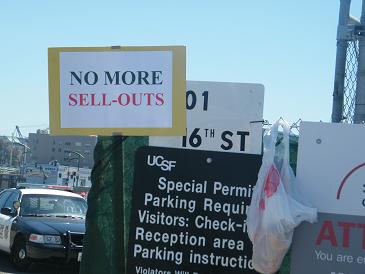
Local unemployed workers are expressing support for the Avalos legislation, as they step up efforts to get UC San Francisco to commit to local hiring plans at its $1.5 billon Mission Bay hospital construction site, which lies a Muni T-Third ride away from some of the city’s most economically distressed neighborhoods.

And now everyone is anxiously wondering where Mayor Gavin Newsom will land on the legislation and on UCSF’s hiring goals in what may be his last weeks as chief executive of San Francisco.

As of press time, Newsom was running neck-to-neck with Abel Maldonaldo in the lieutenant governor’s race, leaving voters uncertain whether Newsom will be mayor in January or second-in-command statewide — a promotion that would land him a seat on the UC Board of Regents but shift his primary allegiance from the City and County of San Francisco to the entire state of California.

When Avalos stood outside City Hall last month and announced his proposal to mandate local hiring on publicly-funded construction projects, he was joined by Sups. Sophie Maxwell and David Campos, Board President David Chiu, community advocates, construction contractors, neighborhood leaders, and union members.

“My legislation will ensure that San Franciscans have a guaranteed shot to work on the city’s public works projects and that the local dollars invested in public infrastructure will be recycled back into San Francisco’s economy and local communities,” Avalos said.

Avalos’ legislation came in the wake of two reports confirming that local construction workers were having a hard time getting work. A report that Chinese Affirmative Action and Brightline Defense released in August estimated that only 24 percent of workers on publicly funded sites are local residents.

And a report released by L. Luster and Associates in mid-October, at the behest of the Redevelopment Agency and Office of Economic and Workforce Development, found that only 20 percent of workers hired at 29 publicly funded construction projects in the past year were local residents.

Avalos’ legislation would mandate assessment of liquidated damages against contractors and subcontractors who fail to meet minimum local hiring requirements and establish monitoring, enforcement, and administrative procedures in support of this policy. It would phase in these requirements over three years, starting at 30 percent the first year.

Avalos noted that his legislation was developed through a series of meetings with city agencies, the Mayor’s Office, labor and building trade unions, the environmental community, neighborhood advocates, contractors, local hiring advocates, and unemployed workers. And he vowed to keep the roundtable approach.

Patrick Mulligan, financial secretary of Carpenters Local 22, told the Guardian that his union, whose members are specific to San Francisco, generally supports local hiring. “But there are some general concerns with the legislation,” said Mulligan, who has lived his whole life in San Francisco and got his first job through a local hiring program. “We have standing contractual agreements with contractors, so whatever legislation gets passed, it will have to be meshed with the existing situation. If these were boom times, people might see it differently. But it’s hard times at the union hall.”

Mulligan also lamented the lack of process for the community to vet whether UC has a local hiring plan at construction projects that impact their neighborhood. “But contractors want the best workforce they can get. And in lean times, they can afford to be more selective and don’t necessarily want to include training time on the job,” he said. “But we feel that it’s inappropriate for contractors to bring their entire crew from outside of town.”

Michael Theriault, secretary-treasurer of the San Francisco Building and Construction Trades Council, told the Guardian that Avalos’ legislation was unworkable because construction workers cannot afford housing in San Francisco and too few qualified workers live in the city.

“We take workers from San Francisco into our apprenticeship program constantly, but they get to a certain point in their careers and find that the city builds well on the low-end and the high-end, but doesn’t build workforce housing. So they end up in Antioch, Vallejo, Fairfield, and Modesto, and commute back in,” Theriault said. “That problem has not been addressed by the city, and it’s at the root of why local hiring programs aren’t working.”

Newsom spokesperson Tony Winnicker said the mayor “supports stronger local hire requirements” even as he expressed concerns with Avalos’ proposal. “We’ll continue to work with the supervisors, the building trade unions and the community on legislation that achieves both realistic and legally enforceable local job guarantees for city projects,” he said.

Winnicker noted that the city already supports local hiring through CityBuild and the San Francisco Public Utilities Commission. “But we believe we can do better,” he added.

Avalos, whose legislation is scheduled for a Nov. 8 hearing of the board’s Land Use and Economic Development Committee, said he sees his proposal as a starting point. “We’ll see where it ends up,” Avalos told the Guardian. “We could pass legislation that wants 50 percent local hiring next year, and it would probably get vetoed and it wouldn’t be realistic. So we have to phase it in and make sure we are creating a system that is going to push the trades to be more inclusive of local residents.”

Meanwhile, unemployed workers — some in unions, others not — continue to protest the lack of a local hire plan at UCSF’s $1.5 billion Mission Bay hospital project, which is funded through debt financing, philanthropic gifts, and university reserves.

“We want to make sure folks get trained and everything that’s necessary, so there is no dispute,” Aboriginal Blacks United member Alex Prince said at an Oct. 27 protest at the Mission Bay site. The protest came one month after Newsom wrote to UCSF Chancellor Susan Desmond-Hellmann noting that the hospital was breaking ground “just as continuing high unemployment rates were devastating the city’s most distressed communities,including neighborhoods impacted by the Mission Bay expansion.”

“There are estimates that up to 40 percent of the members of our local construction trade unions are currently out-of-work,” Newsom wrote. “It would be helpful if you could share the commitments that UCSF has made on the issue of local hiring, particularly around employing residents of San Francisco’s most distressed communities in southeast San Francisco, and the results of those efforts to date.” Winnicker said UCSF has not yet responded.

Barbara French, UCSF’s vice chancellor for university relations, told the Guardian that UCSF is working to evaluate hiring needs for phase of the project, talking to the unions, and intends to make its findings public in December.

“We have had a voluntary local hiring policy since 1993,” French said, confirming that in the past 17 years, the university has reached a 12 percent local hire rate on average. “Sometimes it was 7 percent, sometimes it was 24 percent … Our [goal] is to reach a number that is beyond what we reached before but which is realistic.”

Recently French told community-based organizations that UCSF hadn’t signed a contract with the contractor at its Mission Bay hospital project, didn’t have the permits yet, and that the recent community celebrations didn’t mark the start of active construction at the site.

French said general hiring at Mission Bay will begin in December. “We don’t get any city funds at this site, so our commitment is voluntary. But we feel very strongly that we have to reach out,” she said.

Avalos acknowledged that UC is not under San Francisco’s jurisdiction and can’t be compelled to do more local hiring. “But we know that they are doing a critical amount of building and investing taxpayer dollars, and that this land use impacts the surrounding community. So it makes sense that we have local hire legislation and access to serious end-use jobs at the hospital.”

SF needs a local hire law

2

EDITORIAL A billion-dollar hospital project, built by a public agency using taxpayer dollars, just broke ground on the edge of District 10, the corner of the San Francisco with the highest unemployment rate and some of the city’s worst economic problems. That’s something job-hungry residents ought to be celebrating — more than 1,000 construction workers will be earning steady paychecks over the next few years.

And yet, when dignitaries including Rep. Nancy Pelosi showed up for the groundbreaking ceremony, they were met with protests. Bayview residents showed up to complain that very few of those jobs are going to the people who live in the project’s neighborhood. In fact, not that many jobs are likely to go to San Francisco residents. That’s because the University of California, San Francisco, which is building the hospital at Mission Bay, has no policy whatsoever requiring its contractors to hire local residents. As Sarah Phelan reports on page 11, San Francisco residents may turn out to make up fewer than 20 percent of the people who work on the project.

That’s a problem for a significant number of local construction projects financed and managed by government agencies. A recent study released by the San Francisco Redevelopment Agency Office of Economic and Workforce Development found that only 20 percent of the workers on public works job sites in the city were San Francisco residents.

Obviously, private construction companies can hire anyone they want — but when San Francisco tax dollars and San Francisco public land are involved, local residents ought to get a fair share of the work. That’s not just a political argument; it’s solid economics. Just as money spent at a locally owned independent business stays in town and does more for the local economy than money sent at big chains, local workers are more likely to spend their paychecks here in town.

Sup. John Avalos has introduced a bill that would set a 50 percent requirement for local hiring on projects paid for by the city. It’s a great idea, and needs strong support. There’s resistance from the building trade unions, which is no surprise — the unions want to keep the seniority system in place and give jobs to the members who have been unemployed the longest, no matter where they live. And a significant percentage of the membership of the building trade unions live out of town.

May of the residents of low-income areas like Bayview lack the specific skills for unionized trade jobs. But with so many longtime members out of work, the unions don’t want to add apprenticeship programs to train new workers for jobs that don’t exist.

But there has to be room for compromise here. The building trades leaders need to understand that San Francisco taxpayers have every right to demand that when they finance public works projects, some of that money will stay in town. And Avalos isn’t pushing for 100 percent local hire — nor is he trying to undermine the time-honored tradition of the union hiring hall.

The UC project is trickier. As a state agency, UC is exempt from local laws — and has a long history of defying San Francisco’s efforts to hold it accountable. The Bayview activists aren’t asking for 50 percent local hire — but they are demanding that the university adopt some sort of enforceable rules to ensure that some percentage of the jobs at the new hospital go to city residents. That’s more than reasonable.

San Francisco’s state legislative delegation ought to be in touch with the UCSF chancellor and send a clear message: This is a problem that needs to be resolved, now — and if it’s not, legislation setting local hire goals for all UC projects ought to be on next year’s agenda.

Avalos: I have not buckled to anyone’s pressure over local hiring

1

Last week, Sup. John Avalos introduced Local SF legislation to require contractors to meet a local hiring goal of 50 percent. And as the Guardian reported at the time, Avalos’ legislation represents a major departure from the city’s First Source Program, which only requires contractors on publicly subsidized projects to show “good faith” efforts to meet 50 percent goal.  Avalos’ legislation came on the heels of a report from the city’s Office of Economic and Workforce Development that showed only a 20 percent local hire rate in 29 publicly funded projects, despite the existence of First Source.

“My legislation will ensure that San Franciscans have a guaranteed shot to work on the City’s public works projects and that the local dollars invested in public infrastructure be recycled back into San Francisco’s economy and local communities,” Avalos said last week, noting that his legislation was developed over a series of stakeholders meetings with reps from city agencies, the Mayor’s Office, labor and building trades, the environmental community, neighborhood advocates, contractors, local hiring advocates and unemployed workers. And he vowed to keep this roundtable approach going as his legislation moves forward.

So we were surprised to read a Weekly blog post today that claimed that Avalos had allegedly buckled to union pressure and watered down his local hire requirements. Especially since his legislation hasn’t even had its Nov. 8 hearing before the Board’s Land Use and Economic Development Committee…

Reached by phone Avalos clarified that he has not buckled to anyone’s pressure.
“I haven’t backed down on anything,” Avalos said. “And I have not made any amendments to my legislation. I did say when I introduced my legislation that this is a starting point and we’ll see where it ends up. We could pass legislation that wants 50 percent local hiring next year, and it would probably get vetoed and it wouldn’t be realistic. So, we have to phase it in and make sure we are creating a system that is going to push the trades to be more inclusive of local residents.”

Avalos noted that some trades and unions are already doing a good job of hiring San Francisco residents on public works projects, but reiterated that the city’s current policy only requires contractors to present paperwork to show they made a “good faith” effort—and that this approach has fallen far short of the city’s 50 percent local hire goal.

Avalos’ legislation–and his claims about First Source’s shortcomings–are  backed up by two recent studies.

The first report, released by Chinese for Affirmative Action and Brightline Defense Project this August, was titled “The Failure of Good Faith.” It showed that the city’s current policy only “yielded roughly 24 percent on employment opportunities” on public construction projects in San Francisco.

The second report, released by L. Luster & Associates on October 18, was titled “Labor Market Analysis San Francisco Construction Industry.” It confirmed that the construction workforce statewide has been in a “free-fall of job losses for the past four years.”

Noting that the Bay Area has not been as hard hit as other regions in California, the Luster report observed that the tri-county district of San Francisco, San Mateo and Marin counties, which had 45,100 construction jobs in August 2006, “lost nearly one-third of these jobs falling to 31,200 construction jobs by May 2010.”

“In San Francisco, unemployment in the construction sector has had a particularly negative impact on the city’s less educated residents,” the report stated. “For them, construction has provided access to higher paying jobs in a labor market that otherwise might provide them access mainly to positions paying lower end wages. Any local hire effort will be undertaken against the backdrop of this unprecedented construction job loss, and resulting unemployment among the existing San Francisco construction workers.”

One such group of unemployed workers—some of them in a union, others not—could be seen protesting yesterday outside the gates of the construction site on 16th Street in Mission Bay where UCSF has been celebrating the groundbreaking of its new Medical Center, a $1.5 billion project to be funded “through a combination of debt financing, philanthropic gifts and hospital reserves,” according to UC press releases.

But in an email to Joshua Arce of Brightline Defense, UCSF’s Barbara French noted that though UC is “actively working now to evaluate the workforce needs for every trade, for every phase of the project, and intend to make those public in December”, UC has not started construction on the project and won’t until December.
“ We haven’t signed the contract with the general contractor and we don’t yet have our permits,’ French wrote. “ The community may have believed that the celebrations this week truly marked the start of active construction. Not so. These were community celebrations held now in the hopes of getting good weather. “

Meanwhile, Avalos acknowledges that UC is not under the jurisdiction of San Francisco.
“But I know that they are doing a critical amount of building, and investing tax payer dollars there, so therefore the community should have some benefit from that, even though it’s complicated by this being the state’s money, so you could make the argument that all of California’s workers should have access,” Avalos told the Guardian. “But this land use impacts the surrounding community, so it makes sense that we have local hire legislation and access to serious end-use jobs at the hospital, which will include medical and support staff, building and janitorial maintenance and cafeteria related work.”

Avalos noted that the city is building infrastructure all around that project, including parks, Muni and light rail spruce-ups.
“There are huge surrounding investments,” Avalos said.

Either way, here’s hoping that by December, when folks begin to stress about providing for their families over the holiday season, all the workers in the following video clip will be able to put down their bullhorns and pick up decent-paying work, instead. And that this work will last for more than a couple of days.

Appetite: Director Jean-Luc Naret dishes on SF Michelin Guide 2011

0

Hubbub‘s the word in the food world this week surrounding the release of the 2011 Michelin Guide San Francisco, the restaurant ranking organization’s fifth Bay Area edition. The venerable food institution is entering into its 111th year, having gained a strong following in New York and San Francisco and anticipating an upcoming launch in Chicago (next time, LA).

Hot topics around the champagne cooler? Chez Panisse losing its star and The Restaurant at Meadowood achieving the rare feat of gaining three stars (making it and French Laundry the only Bay Area ‘straunts to make the grade). Read on for Michelin Jean Luc Naret’s reflections and a list of the Bay’s Michelin-honored restaurants for 2011.

I chatted with Naret — a charming Frenchman based in Paris who generally spends three weeks out of every month traveling around the globe — over espresso at the Slanted Door yesterday. On an idyllic October day, the nostalgic glow on the Bay was befitting — Naret is departing Michelin in January after seven years with the company, though he’ll stay tied to its future in a consulting role.

Naret describes San Francisco as “one of the finest culinary regions in the world… I love this place. It’s a region where I spend a lot of time”. He hints that he’s considering getting a place in Marin, maybe Tiburon, laughingly adding, “So, if anyone is listening?” 

What does the arbiter of taste see as our unique contribution in the food realm? Naret names categories where the Bay Area excels: technique (“You don’t burn anything anymore” he jokes, I think) and produce. He claims the general culinary mindset changed here in large part due to the “willingness of chefs” to grow or source every kind of produce locally, not to mention the development of talent that was necessary “to make it perfect”. 

“Fifteen years ago in France we never heard the word ‘organic'”, Naret says. “That came from here. [The Bay Area] has a big influence — similar to Japan — where seasonality is also very important”. 

Successfully launching Michelin in America was one of Naret’s key accomplishment during his years as director, so what does he see as the US’ greatest culinary strength? In one word: “Diversity”. He mentions the myriad of cuisines available. “You can get anything in New York,” he says, adding that the breadth of food culture in our great cities enriches the dining world.  

Looking back on the last seven years, Naret shared that his biggest surprise came when he joined Michelin from the outside, one of only six directors to do so since 1900. He pushed boundaries in the company by asking questions like: “Why not go to the States? To Asia?” 

He’s delighted to see that seven years later — he planned on acting in the post for no longer than five — he’s managed to leave a legacy that feels complete. “Everything we said we’d do, we’ve done. We’ve reached new territories.” He says the future of Michelin includes the ranking system’s continued expansion to other cities — along with growth in technology output like the global spread of Michelin iPhone apps already common in Europe. 

All signs show that the world is ready. Heads of state and people from Michelin-less countries — Singapore among them — have contacted Naret him to ask when their cities will be getting their own guides. In Tokyo (which now stands as the city with the most three star restaurants in the world) the area’s first Michelin guide sold 150,000 copies in a shocking 24 hours. It would appear that the massive influence Michelin has long held in Europe has a firm grasp on epicures around the world. 

Naret keeps mum about the mysterious business venture he’ll launch promptly after leaving Michelin after a mere two weeks vacation. On this October day, he’s in reflection mode: “I’m very happy to leave a beautiful legacy”. 

The 2011 SF Michelin Guide officially releases today. Michelin Guide New York 2011 debuted Oct. 6 and the very first Chicago guide will be released November 17. Subscribe to Virgina’s twice monthly newsletter, The Perfect Spot.

*****

Bay Area restaurants awarded coveted Michelin stars in its 2011 edition

(N = new to this year’s guide)


THREE STARS: Exceptional cuisine, worth a special journey

The French Laundry

The Restaurant at Meadowood (N)


TWO STARS: Excellent cuisine, worth a detour

Coi

Cyrus

Manresa


ONE STAR: A very good restaurant in its category

Acquerello

Alexander’s Steakhouse (N)

Ame

Applewood (N)

Auberge de Soleil

Aziza

Baumé (N)

Bouchon

Boulevard

Campton Place (N)

Chez TJ

Commis

The Dining Room at the Ritz Carlton

Dio Deka (N)

étoile

Farmhouse Inn & Restaurant

Fleur de Lys

Frances (N)

Gary Danko

La Folie

La Toque

Luce

Madera (N)

Madrona Manor

Masa’s

Mirepoix (N)

Murray Circle

One Market

Plumed Horse

Quince

Redd

Saison (N)

Santé

Solbar

Spruce (N)

Terra

Ubuntu

The Village Pub

Wakuriya (N)


Stage

0


Stage listings are compiled by Guardian staff. Performance times may change; call venues to confirm. Reviewers are Robert Avila, Rita Felciano, and Nicole Gluckstern. Submit items for the listings at listings@sfbg.com. For further information on how to submit items for the listings, see Picks. For complete listings, see www.sfbg.com.


OPENING

Equus Boxcar Theatre Playhouse, 505 Natoma; 776-1747, www.boxcartheatre.org. $10-25. Opens Wed/27, 8pm. Runs Wed-Sat, 8pm. Through Nov 20. Boxcar Theatre kicks off its fifth season with Peter Shaffer’s drama, directed by Erin Gilley.

Failure to Communicate The Garage, 975 Howard; (800) 838-3006, www.brownpapertickets.com. Call for prices. Opens Fri/29, 8pm. Runs Fri-Sat 8pm; Sun, 2pm. Through Nov 14. Perfomers Under Stress opens its sixth season with the world premiere of a physical theater piece by Valerie Fachman.

The Unexpected Man EXIT Theatre, 156 Eddy; (800) 838-3006, www.brownpapertickets.com. $18-25. Opens Fri/29. Runs Fri-Sat, 8pm; Sun, 3pm. Through Nov 14. Spare Stage revives Yasmina Reza’s ironic comedy, starring Ken Ruta.

BAY AREA

Becoming Britney Center REPortory Company, Knight Stage 3 Theatre, 1601 Civic Drive, Walnut Creek; (925) 943-SHOW, www.centerREP.org. $25. Previews Thurs/28-Fri/29, 8:15pm. Opens Sat/30, 8:15pm. Runs Thurs-Sat, 8:15pm; Sun, 2:15pm. Through Nov 14.Center REPortory Company presents an original musical about a naïve pop star, written by Molly Bell and Daya Curley.

Palomino Aurora Theatre, 2081 Addison, Berk; (510) 843-4822, www.auroratheatre.org. $10-55. Previews Fri/29-Sat/30 and Nov 3, 8pm; Sun/31, 2pm; Tues/2, 7pm. Opens Nov 4, 8pm. Runs Wed-Sat, 8pm; Sun, 2 and 7pm; Tues, 7pm. Through Dec 5. David Cale brings his new solo play about a gigolo to Aurora Theatre for its Bay Area premiere.

Pirates of Penzance Novato Theatre Company Playhouse, 484 Ignacio, Novato; 883-4498, www.novatotheatercompany.org. $12-22. Opens Thurs/28, 8pm. Runs Thurs-Sat, 8pm; Sun, 3pm. Through Nov 21. Novato Theatre Company revives the popular Gilbert and Sullivan swashbuckling tale.

ONGOING

Christian Cagigal’s Obscura: A Magic Show EXIT Cafe, 156 Eddy; (800) 838-3006, www.brownpapertickets.com. $15-25. Thurs-Sat, 8pm. Through Dec 18. Magician Christian Cagigal presents a mix of magic, fairy tales, and dark fables.

Dracula’s School for Vampires Young Performers Theatre, Fort Mason Center, Bldg C, Third Floor, Room 300; 346-5550, www.ypt.org. $7-10. Sat, 1 pm; Sun, 1 and 3:30pm. Through Nov 14. Young Performers Theatre presents a Dracula comedy by Dr. Leonard Wolf.

Equus Boxcar Theatre Playhouse, 505 Natoma; 776-1747, www.boxcartheatre.org. $10-25. Opens Wed/27, 8pm. Runs Wed-Sat, 8pm. Through Nov 20. Boxcar Theatre kicks off its fifth season with Peter Shaffer’s drama, directed by Erin Gilley.

Futurestyle ’79 Off-Market Theater, Studio 250, 965 Mission; (800) 838-3006, www.brownpapertickets.com. $15-20. Wed, 8pm. Through Wed/27. A fully improvised episodic comedy played against the backdrop of SF in 1979.

Glory Days Boxcar Studios, 125 Hyde; www.jericaproductions.com. $30. Fri-Sat, 8pm; Sun, 2pm (no performance Sun/31). Through Nov 7. Jerica Prodcutions and the Royal Underground Theatre company present Nick Blaemire’s and James Gardiner’s one-act musical.

Habibi Intersection for the Arts, 446 Valencia; 626-2787, www.theintersection.org. $15-25. Thurs-Sun, 8pm. Through Nov 7. Intersection for the Arts and Campo Santo present the world premiere of a play by Sharif Abu-Hamdeh.

*Hamlet Alcatraz Island; 547-0189, www.weplayers.org. By donation. Sat-Sun, times vary. Through Nov 21. Outside of an actual castle, it would hard to say what could serve as a more appropriate stand-in for Kronborg castle of Helsingør—also known as Elsinore—than the isolated fortress of Alcatraz Island, where WE Players are presenting Hamlet in all its tragic majesty. As audience members tramp along

stony paths and through prison corridors from one scene to the next, the brooding tension the site alone creates is palpable, and the very walls impart a sense of character, as opposed to window-dressing. Deftly leaping around rubble and rock, a hardy troupe of thespians and musicians execute the three-hour

production with neat precision, guiding the audience to parts of the island and prison edifice that aren’t usually part of the standard Alcatraz tour package. Incorporating movement, mime, live music, and carefully-engineered use of space, the Players turn Alcatraz into Denmark, as their physical bodies meld into Alcatraz. Casting actress Andrus Nichols as the discontent prince of Denmark is an incongruity that works, her passions’ sharp as her swordplay, the close-knit family unit of Laertes, Ophelia, and Polonius are emphatically human (Benjamin Stowe, Misti Boettiger, Jack Halton), and Scott D. Phillips plays the

appropriately militaristic and ego-driven Claudius with a cold steel edge. (Gluckstern)

Hedda Gabler Phoenix Theatre, suite 601, 414 Mason; (800) 838-3006, www.offbroadwaywest.org. $35.

The action unfolds in the parlor of the newly married Tesmans, young mediocre academic George (Adam Simpson) and town beauty Hedda, née Gabler (a crisp, tightly wound and nicely understated Cecilia Palmtag), a woman of exceptional intelligence, ambition and pride—to call her fiery wouldn’t be bad either, especially since she’s so fond of shooting off her late father’s pistols. Frustrated by her paltry new life, Hedda seeks news of an old flame, Eilert Lovborg (Paul Baird), via the admiring and vaguely lecherous Judge Brack (Peter Abraham) and a timid acquaintance from school days, Thea (Joceyln Stringer). The semi-wild but brilliant Lovborg has published a new book that imperils George’s chances for a professorship. Less interested in securing George’s career than controlling Lovborg’s destiny, Hedda soon manipulates events around her with bold determination and tragic consequences. Passionate, violent and psychologically complex, Henrik Ibsen’s titular heroine is at turns sympathetic and disturbing, an independent soul trapped in and warped by a society that allows her too little scope—a modern predicament that has inspired many modern and postmodern adaptations. Off Broadway West’s straight-ahead production of the late-19th-century drama, helmed by artistic director Richard Harder, remains faithful to the period setting. This includes Bert van Aalsburg’s respectable scenic design and Sylvia Kratins impressive costumes, as well as the old if fine translation by William Archer, who first introduced Ibsen to the English-speaking world. Unfortunately, the quaint diction is not handled with equal grace across an uneven cast. Palmtag’s solid, at times admirable performance in the lead, however, goes a good way toward grounding an otherwise patchy production. (Avila)

Last Days of Judas Iscariot Gough Street Playhouse, 1620 Gough; (510) 207-5774, www.CustomMade.org. $10-30. Thurs-Sat, 8pm. Through Sat/30. Custom Made Theatre Company presents the 2005 play by New York’s Stephen Adly Guirgis (Our Lady of 121st StreetJesus Hopped the A Train), which places purgatorial Judas (Kristoffer Alberto Barrera) on trial to determine his deserved fate for dropping a dime on Jesus and all that jazz. Flamboyant, sycophantic and horny prosecutor El-Fayoumy (Ben Ortega) and defense attorney Loretta (Amelia Avila) call between them a series of brow-raising witnesses—including Mother Teresa (Brandy Leggett), Sigmund Freud (Catz Forsman), and Satan (Richard Wenzel)—as Judas (seated on the upper tier of Sarah Phykitt’s suitably imposing split-level set) stares stoically in relative silence or appears in a series of childhood flashbacks. Characteristically funny and streetwise, as well as versed in the Catholic rigmarole as filtered through a NYC-boroughs sensibility, Guirgis’s play is also unusually tedious in its jokey, poky unfolding since—offering not much more than a cipher in the largely mute Iscariot—the proceedings lack a strong sense of dramatic stakes. It feels more like a revue than a play, or like an unnecessarily long-winded excuse for the final, well-turned concluding monologue by a heretofore marginal character (a speech delivered with admirable understatement by director Brian Katz). (Avila)

Law and Order: San Francisco Unit: The Musical! EXIT Theater, 156 Eddy; (800) 838-3006, www.brownpapertickets.com. $10. Mon, 8pm. Through Nov 15. Funny But Mean comedy troupe extends its newest show at a new venue.

Mary Stuart The Ashby Stage, 1901 Ashby, Berk; (510) 841-6500, www.shotgunplayers.org. $15-30. Thurs-Sat, 8pm; Sun, 5pm. (also Wed/27, Nov 3; 7pm). Through Nov 7. Shotgun Players presents Friedrich Schiller’s historical drama, directed by Mark Jackson.

*Pearls Over Shanghai Thrillpeddlers’ Hypnodrome, 575 10th St; (8008) 838-3006, www.brownpapertickets.com. $30-69. Sat, 8pm. Through Dec 19. Thrillpeddlers’ acclaimed production of the Cockettes musical continues its successful run.

Proof Exit Stage Left Theatre, 156 Eddy; www.belljartheatre.com. $20. Fri-Sat, 8pm. Through Sat/30. Bell Jar Theatre presents David Auburn’s award-winning play.

*The Real Americans The Marsh MainStage, 1062 Valencia; (800) 838-3006; www.themarsh.org. $20-50. Wed-Fri, 8pm; Sun, 5pm. Through Nov 6. The fifth extension of Dan Hoyle’s acclaimed show, directed by Charlie Varon.

*SHIToberfest Off-Market Theaters, 965 Mission; (800) 838-3006, www.brownpapertickets.com. $20. Fri-Sat, 8pm. Through Sat/30. This special October run of PianoFight’s bowel-loosening comedy series, the S.H.I.T. Show (for acronym fans, that’s the Stop Hating Imagination Time Show), revolves dizzyingly around the subject of beer, Germans and, perhaps less explicably, flatulent dolphins, among much else in the wide open seas of poor taste. Is it hilarious? It is. And you don’t even need to smuggle in a forty to make it so, though it certainly doesn’t hurt. Fine comic acting throughout a charismatic cast (including writer-director-producers Alex Boyd, Zach Cahn, Jed Goldstein, Ray Hobbs, Devin McNulty, Evan Winchester and Duncan Wold, with help from Nicole Hammersla, Gabrielle Patacsil, Rob Ready, Derricka Smith, Andy Strong, Jacque Vavroch and Dan Williams) combines here with generally solid to exceptional sketch work, video and song. Add in a permeating spirit of revelry, debauchery and irreverence and the evening becomes a diversion of the first order, culminating in an utterly sacrilicious sketch about a bunch of toasted beer-brewing monks treated to a papal visit—one of the best venial sins for your buck. When it comes to Octoberfesting this year, “Bavaria” is just S.H.I.T.–faced for Bay Area. (Avila)

Shocktoberfest!! 2010: Kiss of Blood Hypnodrome Theatre, 575 10th; (800) 838-3006, www.brownpapertickets.com. $25-35. Thurs-Fri, 8pm (Thurs/28-Sun/31 include performances of The Forsaken Laboratory by the Brazilian Grand Guignol group Vigor Mortis). Through Nov 19. Thrillpeddlers’ seasonal slice of eyeball is comprised of three playlets variously splattered with platelets, all directed by Russell Blackwood and bridged by a rousing burst of bawdy song from the full cast. Rob Keefe’s Lips of the Damned (after La Veuve by Eugene Heros and Leon Abric) takes place in a rat-infested museum of atrocities just before the fumigating starts, as an adulterous couple—comprised of a kinky married lady (a vivacious Kara Emry) and a naïve hunk from the loading dock (Daniel Bakken)—get their kicks around the guillotine display, and their comeuppance from the jilted proprietor (Flynn DeMarco). Keefe’s delightfully off-the-wall if also somewhat off-kilter Empress of Colma posits three druggy queens in grandma’s basement, where they practice and primp for their chance at drag greatness, and where newly crowned Crystal (a gloriously beaming Blackwood) lords it over resentful and suspicious first-runner-up Patty Himst (Eric Tyson Wertz) and obliviously cheerful, non-sequiturial Sunny (Birdie-Bob Watt). When fag hag Marcie (Emry) arrives with a little sodium pentothal snatched from dental school, the truth will out every tiny closeted secret, and at least one big hairy one. Kiss of Blood, the 1929 Grand Guignol classic, wraps things up with botched brain surgery and a nicely mysterious tale of a haunted and agonized man (Wertz) desperate to have Paris’s preeminent surgeon (DeMarco) cut off the seemingly normal finger driving him into paroxysms of pain and panic. Well-acted in the preposterously melodramatic style of the gory genre, the play (among one or two other things) comes off in a most satisfying fashion. (Avila)

Sunset Limited SF Playhouse, 533 Sutter; 677-9596, www.sfplayhouse.org. $40-50. Tues-Wed, 7pm; Thurs-Fri, 8pm; Sat, 3 and 8pm. Through Nov 6. This 2006 play by Cormac McCarthy exhibits some of the best and worst of the celebrated author, but significantly more of the latter. It sets an aging white academic and failed suicide (Charles Dean) in a room with his rescuer and would-be savior, a poor black social worker (Carl Lumbly), who has just snatched him from a railway platform ahead of a tête-à-tête with a train called the Sunset Limited. Both characters remain nameless, emphasizing the abstract pseudo-Socratic dimensions attendant on the dialogue-driven realism here (staged with a knowing wink in director Bill English’s scenic design, a partially walled wood-framed shack with see-through slits between the thin horizontal planking). The black man is a born-again Christian and ex-con convinced Jesus has just given him a major assignment. His dogmatic certainty is matched by the white man’s nihilism and despair. “I believe in the primacy of the intellect,” the miserable prof tells his host, who’s locked the door on his self-destructive guest in an effort to buy time to change his mind. Leaving aside the historically clichéd, problematic and baggage-heavy dynamic of a poor black American devoted to the welfare of a rich white one, neither man moves from his respective position one inch (at least until perhaps and partially at the very end), which constrains the dramatic development. Moreover, both sides argue feebly, mainly by gainsaying whatever it is the other one says, making this not a great intellectual debate either. SF Playhouse’s production sets two fine actors at this heavy-handed twofer, but little can be done to redeem so static and arid an exercise. (Avila)

Susie Butler Sings the Sarah Vaughan Songbook Exit Theater Cafe, 156 Eddy; (510) 860-0997, www.brownpapertickets.com. $15-20. Sat, 8:30pm. Through Nov 20. Local actress and singer Susie Butler takes on the Sassy songbook.

Zombie Town Stage Werx Theatre, 533 Sutter; www.stagewerx.org. (800) 838-3006, www.brownpapertickets.com. $24. Thurs-Sat, 8pm (also Sun/31, 5pm). Through Sun/31. Catharsis Theatre Collective presents a documentary play about zombie attacks in Texas.

BAY AREA

*Compulsion Berkeley Repertory Theatre, Thrust Stage, 2025 Addison; (510) 647-2949, www.berkeleyrep.org. $29-85. Dates and times vary. Through Sun/31. Director Oscar Eustis of New York’s Public Theater marks a Bay Area return with an imaginatively layered staging of Rinne Groff’s stimulating new play. Compulsion locates the momentous yet dauntingly complex cultural-political outcomes of the Holocaust in the career of a provocative Jewish American character, Sid Silver, driven by real horror, sometimes-specious paranoia, and unbounded ego in his battle for control over the staging of Anne Frank’s Diary. A commandingly intense and fascinatingly nuanced Mandy Patinkin plays the brash, litigious Silver, based on real-life writer Meyer Levin, a best-selling author who obsessively pursued rights to stage his own version of Anne Frank’s story. The forces competing for ownership of, and identification with, Anne Frank and her hugely influential diary extend far beyond her father Otto, Silver, or the diary’s publishers at Doubleday (represented here by a smooth Matte Osian in a variety of parts; and a vital Hannah Cabell, who doubles as Silver’s increasingly alarmed and alienated French wife). But the power of Groff’s play lies in grounding the deeply convoluted and compromised history of that text and, by extension, the memory and meanings of the Holocaust itself, in a small set of forceful characters—augmented by astute use of marionettes (designed by Matt Acheson) and the words of Anne Frank herself (partially projected in Jeff Sugg’s impressive video design). The productive dramatic tension doesn’t let up, even after the seeming grace of the last-line, which relieves Silver of worldly burdens but leaves us brooding on their shifting meanings and ends. (Avila)

Dracula Center REPertory Company, 1601 Civic, Walnut Creek; (925) 943-SHOW, www.centerrep.org. $36-42. Wed, 7:30pm; Thurs-Sat, 8pm; Sun, 2:30pm (also Nov 20, 8pm). Through Nov 20. Eugene Brancoveanu stars as the Count in a production directed by Michael Butler.

*East 14th: True Tales of a Reluctant Player Marsh Berkeley, 2120 Allston, Berk; www.themarsh.org. $20-50. Dates and times vary. Through Nov 21. Don Reed’s solo play, making its Oakland debut after an acclaimed New York run, is truly a welcome homecoming twice over. (Avila)

*The Great Game: Afghanistan Roda Theatre, 201 Addison, Berk; (510) 647-2949, www.berkeleyrep.org. $17-73. Call for times. Through Nov 7. Berkeley Rep presents the West Coast premiere of a three-part show about Afghanistan.

*Loveland The Marsh Berkeley, 2120 Allston Way; (800) 838-3006, www.brownpapertickets.com. $20-50. Fri, 7pm; Sat, 5pm. Through Nov 13. Ann Randolph’s acclaimed one-woman comic show about grief returns for its sixth sold-out extension.

Superior Donuts TheatreWorks at the Mountain View Center for the Performing Arts, 500 Castro; (650) 463-1960, www.theatreworks.org. $19-67. Tues-Wed, 7:30pm; Thurs-Fri, 8pm; Sat, 2 and 8pm; Sun, 2 and 7pm. Through Sun/31. This latest from Tracy Letts (August: Osage CountyKiller Joe) starts out as a delicious treat but a hollowness in the center of it all leaves one less than fully unsatisfied. Director Leslie Martinson’s cast shines, however, as the action unfolds in crisp, engaging scenes set in the titular run-down donut shop in Chicago’s slowly gentrifying Uptown neighborhood. Owner-operator Arthur Przybyszewski (Howard Swain) is an aging baby boomer and second-generation Polish immigrant who fled to Canada to avoid the Vietnam draft and returned years later to take over his parents shop, alienated and hesitant, though well liked by his regulars. At least most: As the play opens his shop has been vandalized. Two beat cops are on the scene, James (Michael J. Asberry) and Randy (Julia Brothers), the latter eventually displaying a visible crush on an oblivious, then discombobulated Arthur. When an impressive young African American man named Franco (Lance Gardner) comes in and charms his way into a job, Arthur gradually finds himself drawn out of his shell and faced with the challenge of valuing another human being more than his own hide—a challenge underscored by Arthur’s several monologues, in which his personal history comes to the fore. The play feels pat and a little lazy-sentimental in the end, but there’s no denying the entertainment afforded here, especially by the magnetic pairing of leads Swain and Gardner. (Avila)

Winter’s Tale Live Oak Theatre, 1301 Shattuck, Berk; (510) 649-5999, www.aeofberkeley.org. $12-15. Fri-Sat, 8pm (also Sun/31, Nov 7, and Nov 14, 2pm; Nov 18, 8pm). Through Nov 20. Actor’s Ensemble of Berkeley presents the rarely-performed Shakespeare play.

PERFORMANCE/DANCE

“Beloved: A Requiem for Our Dead” CELLspace, 2050 Bryant; (510) 207-6101. $10-20. Fri/29, 8pm. Mangos With Chili presents a night of conjuring, memory, mourning and celebration.

“The ChatRoulette Halloween Show” Makeout Room, 3225 22nd St; www.chatrouletteshow.com. $12-15. Sat/30, 7:30pm. The Illuminated Theater presents a special Halloween edition of its show.

Alicia Dattner Off-Market Theater, 965 Mission; (917) 363-9646, www.aliciadattner.com. $20. Fri/29, 8pm.

“Fright Nights at the Wharf” Castagnola’s, 286 Jefferson; (800) 838-3006, www.brownpapertickets.com. $10. Fri/29-Sat/30, 8pm. An evening of stand-up comedy by the water.

“Ghost Stories and other Horrors!” Jellyfish Gallery, 1286 Folsom; www.firesidestorytelling.com. $5. Wed/27, 8pm. Fireside Storytelling presents an evening of ghoulish tales.

“Kaleidoscope Cabaret” Brava Theater, 2781 24th St; (800) 838-3006, www.brownpapertickets.com. $20-25. Sat/30, 8pm. An evening of drag, burlesque, song, and aerial art by performers of color.

“Karaghiozis Saves the Economy” Hallidie Plaza, Market and 5th; 648-446, www.shadowlight.org. Free. Sun/31, 7pm. A Greek shadow theatre performance by Leonidas Kassapides.

“Make Drag, Not War!” Dance Mission Theater, 3316 24th St; www.dancemission.com. $15-20. Sun/31, 8pm. A drag show and dance party hosted by Artist Malcolm Drake.

“MUNI Diaries Live!” Makeout Room, 3225 22nd St; 647-2888, www.munidiaries.com. $5. Fri/29, 7:30pm. An evening of MUNI stories.

“Road trip to Pluto” 4 Star Theatre, 2200 Clement; (800) 838-3006, www.brownpapertickets.com. $9.99-12. Thurs/28, 8:30pm. Bitter Show reprises its contribution to the SF Fringe Fest.

“Romane Event Comedy Show: Super Special Election and Halloween Edition” Makeout Room, 3225 22nd St; 647-2888, www.pacoromane.com. Wed/27, 7:30pm. Paco Romane’s guests include Will Durst, Casey Ley, Grant Lyon, and Pamela Ames.

Devendra Sharma CounterPULSE, 1310 Mission; www.counterpulse.org. $14-24. Thurs/28-Sat/30, 8pm; Sun/31, 2pm. CounterPULSe’s “Performing Diaspora” program presents a contemporary take on Nautanki theater by Sharma.

“Stories From a Haunted Forest” Presidio’s Log Cabin, 1299 Story; www.bindlestiffstudio.org. Free. Sat/30, 7pm. Bindlestiff Studio presents a one-night-only phantasmic experience.

“Teatro Zinzombie!” Pier 29 at Battery; 438-2668, www.love.zinzanni.org. 117-167. Sun/31, 5:15pm. TeatroZinzanni is haunted for one night.

Trailer Park Boys Palace Fine Arts Theatre, 3601 Lyon; 567-6642, www.ticketmaster.com. $45-58. Thurs/28, 7:30pm. The fabled boys appear live in concert.

“Twilight Vixen Revue” SOMArts, 934 Brannan; (800) 838-3006, www.brownpapertickets.com. $12. A special Halloween edition.

“Upper Cut” The Dark Room, 2263 Mission; www.darkroomsf.com. $10. Thurs/28, 8pm. A weekly improve and sketch comedy open mic.

BAY AREA

Hubbard Street Dance Chicago Zellerbach Hall, UC Berkeley campus, Berk; (510) 642-9988, www.calperformances.org. $31-68. Fri/29-Sat/30, 8pm. The acclaimed dance company performs some West Coast premieres.

“Persephone’s Boots” Codornices Park, Berk; www.raggedwing.org. Free. Wed/27-Sun/31, 5:30pm. Ragged Wing Ensemble presents the world premiere of a performance created by Anna Schneiderman and the ensemble.


Our Weekly Picks: October 20-26

0

THURSDAY 21

THEATER

“The Laramie Residency”

Just when you thought it was safe to come out of the closet, a chilling spike in suicide rates among gay teenagers who have been bullied or harassed has reemerged as national news. Which makes this rare double-header of The Laramie Project and its sequel, The Laramie Project: Ten Years Later, Epilogue uncannily apropos. Written in response to the notorious murder of Matthew Shepard, a young gay man in small-town Wyoming, both plays were created from hundreds of interviews with the inhabitants of Laramie. The results offer a detailed examination of how violence affects not only the perpetrators victims, but an entire community. “The Laramie Residency” also includes a special Thursday dialogue between director and coauthor Moisés Kaufman and Tony Taccone of the Berkeley Rep. (Nicole Gluckstern)

Thurs/21, 7 p.m.; Fri/22–Sat/23, 8 p.m., $10–$55

Jewish Community Center of San Francisco

3200 California, SF

(415) 292-1233

www.jccsf.org

FILM/PERFORMANCE

All About Evil: The Peaches Christ Experience in 4-D”

Horror fans are well familiar with the tag line for Wes Craven’s 1972 Last House on the Left: “To avoid fainting, keep repeating ‘It’s only a movie … It’s only a movie…'” Well, it wouldn’t be Halloween in San Francisco without Peaches Christ, whose alter ego, the less-flashy but no less fabulous filmmaker Joshua Grannell, brings his All About Evil to life at the very Mission District theater where it was shot. The film and its accompanying pre-show performance have been out roaming the U.S. and the U.K. for the past several months; expect the hometown gig to be extra-specially spooky, with musical and multimedia numbers by Peaches and Evil cast members. And since the Victoria plays an important supporting role in the film, expect interactive surprises galore. Only a movie? Don’t be so sure! (Cheryl Eddy)

Through Sun/24

8 p.m., $20

Victoria Theater

2961 16th St, SF

www.peacheschrist.com

MUSIC

Joshua Bell with the San Francisco Symphony

An average street performer isn’t always average. In 2007, the acclaimed violinist Joshua Bell participated in an experiment in which he played for 45 minutes as an anonymous busker in the D.C. Metro. The few who bothered to pause in their morning bustle and pull out their headphones realized they were in the presence of greatness. Renowned worldwide, virtuoso Bell joins the San Francisco Symphony in Bruch’s Violin Concerto No. 1. Conducted by James Conlon, the evening also includes Wagner’s Prelude to Act I of Die Meistersinger von Nürnberg, as well as Dvorák’s In Nature’s Realm and the overtures to Carnival and Othello. (Emmaly Wiederholt)

Thurs.–Sat., 8 p.m.; Sun, 2 p.m., $15–$150

Davies Symphony Hall

201 Van Ness, SF

www.sfsymphony.org

MUSIC

Steve Lawler

You can either love or hate seminal Ibiza club Space, and there’s been plenty of room to do both in its 20-year history. But just when you throw up your hands in a bad way at all the astringent trance, tipsy Brits, and noodling minimal, boom!, a DJ comes along who can drag you back to the dance floor. Rightly respected Brit Steve Lawler, known as the “King of Space,” scored that tiara by leapfrogging styles and keeping his sets limber. There’s some fluttering bass, chunky old-school breakdowns, and searing tech in his bag as well as, gasp, snippets of wistful melody. Lawler especially rocks the hard-driving, samba-esque Spanish-Berlin sound that’s become Ibiza’s best recent export. (Marke B.)

9:30 p.m., $10–>$20

Vessel

85 Campton Place, SF

(415) 433-8585

www.vesselsf.com

DANCE

Kunst-Stoff and LEVYdance

Dancers are famous for their kinesthetic memory. Without activating the brain, their muscles recall whole dances — or at least fragments. Show them a step or two and the rest follows. But dancers also seem to be able to dig even deeper, into something akin to an ancestral memory. It may take personal affinity but also a lot of hard research to unearth the kind of treasure trove that then can be used creatively. Two temperamentally different choreographers, Yannis Adoniou, of Greek descent, and Ben Levy, from a Jewish-Persian family, have done the excavations. Adoniou’s Rebetiko, commissioned by CounterPULSE’s Performing Diaspora Program, and Levy’s Our Body Remembers should make for an intriguing evening of might be called “kinetic history.” (Rita Felciano)

Through Oct. 30

Thurs.–Sat. and Sun/24, 8 p.m., $18

ODC Theater

3153 17th St., SF

(415) 863-9834

www.odctheater.org

FRIDAY 22

MUSIC

Stone Foxes

Let’s talk foxes, shall we? The native gray one is uncommon in San Francisco. The exotic red species, however, is a regular interloper of the Presidio. The Stone Foxes, four young dudes who play mean blues, are more like the former: genuine, rare, and always a treat to see in the wild. Sometimes you don’t want indie or nu-gaze or psych-doom-metal — you simply need real rock ‘n’ roll. Their sophomore album Bears and Bulls was released this past July, and though not as raw as their killer debut, it exudes a new and natural confidence. This is their official vinyl release show, so bring extra cash. (Kat Renz)

With Soft White Sixties and Real Nasty

10 p.m., $12

Bottom of the Hill

1233 17th St., SF

(415) 621-4455

www.bottomofthehill.com DANCE

Paco Gomes and Dancers

In his choreography, Brazilian-born Paco Gomes speaks with a powerfully articulated and mature voice. His dances beautifully integrate modern and Afro-Brazilian influences; as a company director he gathers around him — and trains — multi-ethnic dancers who seem to thrive under his tutelage. Now, with guest choreographers Jorge Silva and J. Pazmino, Gomes is presenting Amor O, an evening of works old and new that circles around love: of self, of friends, and also as remembered and lived within families. In addition, the program includes an excerpt of a new work in progress planned for an upcoming international tour. It examines love within another “family,” the Orixas, from the Yoruba religion. Perhaps it’s a consolation that in the world of the gods, not everything went smoothly either. (Felciano)

Through Sat/23

8 p.m., $15

Garage

975 Howard, SF

(415) 518-1517

www.975howard.com

MUSIC

Karl Blau

Eclectic K Records artist Karl Blau throws a wrench into the indie/folk scene with a chameleon-like ability to work within multiple genres. Ignoring the usual expectations of singer-songwriter stereotypes, Blau is known to inject everything from hip-hop and electronic influences to world and reggae music into his solo albums. He’s also worked with some notable names in Phil Elvrum (The Microphones, Mount Eerie) and Laura Veirs. Blau can currently be found playing bass for droney doom-metal band, Earth. It’ll be interesting to see how he melds all these elements together in a live setting. (Landon Moblad)

With Dina Maccabee and Birds and Batteries

7 p.m., free ($5 donation suggested)

Viracocha

998 Valencia, SF

(415) 374-7048

www.viracochasf.com

MUSIC

Lyrics Born

If it was any other rapper describing his newest album as “more synth-oriented” and “dealing with a lot of issues that are more mature than the last few albums, from abandonment to betrayal to incredible joy,” I’d say watch out for a lawsuit from one Mr. West. But since half of Latryx (with Lateef the Truthspeaker) and cofounder of Quannum Records, Lyrics Born is known for bringing his own brand of substance to the scene while pushing the genre forward. His new material, which features emerging artists Trackademicks, Francis and the Lights, and Sam Sparro, will be on display at this release party. (Ryan Prendiville)

With Chali 2na and the House of Vibe and Rakaa

9 p.m., $25

Independent

628 Divisadero, SF

(415) 771-1421

www.theindependentsf.com

SATURDAY 23

MUSIC

Triptykon

After almost 30 years in the arena, Tom G. Warrior has earned his status as heavy metal royalty. The Swiss singer and guitarist formed Hellhammer in 1982 and went on to found Celtic Frost two years later. Both bands contributed immeasurably to the development of extreme metal, and their influence reverberates throughout the genre today. Having parted ways with Celtic Frost in 2008, Warrior formed Triptykon, planning to pick up where Monotheist (Celtic Frost’s 2006 LP) left off. The new band’s music combines slabs of doomy guitar, razor-wire black metal, and Warrior’s paint-peeling vocals, breaking down genre boundaries in pursuit of heaviness. Come out and play. (Ben Richardson)

With 1349 and Yakuza

9 p.m., $23

Slim’s

333 11th St, SF

(415) 255-0333

www.slims-sf.com

EVENT

“SF DocFest Roller Disco Costume Party”

Have you ever stared longingly at the roller skaters in Golden Gate Park? Always wanted to join in but too embarrassed by your lack of boogie? Still hung up over the accident you had at a fifth grade skate party? Well, get over it. The Roller Disco Costume Party offers a simple solution: anonymity. As part of DocFest, admission is free with a ticket stub or just $5 if you strap on your best costume (which could potentially double as padding in case of collision.) (Prendiville)

8 p.m., free–$10

CELLSpace

2050 Bryant, SF

www.sfindie.com

MUSIC

Taj Mahal, Toumani Diabaté, Vieux Farka Touré

Tonight the Paramount plays host to a blues exploration featuring American bluesman Taj Mahal, Malian kora player Toumani Diabaté, and Malian guitarist Vieux Farka Touré. To trace the roots of the blues immediately leads to Africa, and in particular to Mali, and each of these three frontmen represents a different facet of that exploration. Mahal has spent decades reinterpreting the blues through far-flung musical traditions from the Caribbean and Hawaii to Europe and Latin America; Diabaté brings to the fore the centuries old West African tradition of the kora; and Touré, the torch-bearing son of the late Ali Farka Touré, represents a more recent cross-pollination of traditional Malian sounds with American blues and rock. While each of the three musicians is a monster in his own right, together they represent a veritable blues trifecta. (Mirissa Neff)

8 p.m., $25–$75

Paramount Theatre

2025 Broadway, Oakl.

(510) 465-6400

EVENT

“B.Y.O.Q.: Bring Your Own Queer”

Gurla-Q, you better bring it: a cavalcade of queer artists, musicians, and performers is avalanching Golden Gate Park for a full day of heady debauchery. Vinyl soul from the Hard French party DJs, homo-futurist sounds from Honey Soundsystem, Las Bomberas de la Bahia’s Afro-Puerto Rican percussion and dance, local indie faves Excuses for Skipping, fashion shows, a candygram booth, art displays, and so much more to turn you hot pink with multitasking. Plus, special guest John Cameron Mitchell giving you Hedwig fierceness. The annual B.Y.O.Q. has been a sweet, sweet success, conjuring up the activist days of yore while introducing some amazing new talent. Don’t wrap your internal pansy up in a plain brown bag, let her shine and shine. (Marke B.)

Noon–6 p.m., free

Golden Gate Park Music Concourse, SF

www.byoq.org

SUNDAY 24

MUSIC

Reigning Sound

Reigning Sound burst out of the gates in 2002 with the garage-punk classic, Time Bomb High School. Since then, the Tennessee-based group — performing as part of the ninth Budget Rock festival — has continued to refine its brand of country, soul, and classic R&B touches by way of organ-filled, distorted guitar-driven rock ‘n’ roll, most recently on 2009s Love & Curses. The band also recently backed up original Shangri-la member Mary Weiss on her 2007 comeback album, further evidence of the range its capable of. As far as modern garage rock goes, Reigning Sound is as classy and fun a group that you’re likely to find. (Moblad)

With Flakes, Ty Segall, and Touch-Me-Nots

9 p.m., $15

Bottom of the Hill

1233 17th St, SF

(415) 621-4455

www.bottomofthehill.com 

The Guardian listings deadline is two weeks prior to our Wednesday publication date. To submit an item for consideration, please include the title of the event, a brief description of the event, date and time, venue name, street address (listing cross streets only isn’t sufficient), city, telephone number readers can call for more information, telephone number for media, and admission costs. Send information to Listings, the Guardian Building, 135 Mississippi St., SF, CA 94107; fax to (415) 487-2506; or e-mail (paste press release into e-mail body — no text attachments, please) to listings@sfbg.com. We cannot guarantee the return of photos, but enclosing an SASE helps. Digital photos may be submitted in jpeg format; the image must be at least 240 dpi and four inches by six inches in size. We regret we cannot accept listings over the phone.

War — what is it good for? Video games!

0

Medal Of Honor

Danger Close, Electronic Arts

(Xbox360, PS3, PC)

GAMER Though it arrives a few years behind its contemporaries in updating the mechanics of the original World War II series, Medal of Honor follows Call of Duty and Battlefield into the modern age of warfare. The most memorable aspect of this reboot’s PR muttering was that it was going to be authentic. Game developers working closely with members of the military is nothing new, but developer Danger Close wanted its take to be relevant to today’s war by setting the fight in Afghanistan and making the villains the Taliban. The game’s professed intent is to honor the soldiers who die every day in the conflict but, while the locations lend the game a sort of theoretical accuracy, Medal of Honor mostly just feels like War Games 101.

You won’t have any problems jumping into the action. From the first moments, Medal of Honor‘s game play, pacing, and button layout recall Modern Warfare‘s winning formula. The story is a tad more down to earth, but not without thrills and chills, and a good chunk of the game is devoted to sniper missions that do more than pay homage to the iconic Modern Warfare level “Ghillies in the Mist.” There are a few new twists (I will say, it’s been a while since a war game has made suppressive fire a mandatory game play element) but for the most part Medal of Honor emulates Modern Warfare‘s “shooting gallery” experience, which makes it fine, if not terribly inspired.

First-person shooters now ship with split personalities: single-player and multiplayer. The experiences are so divided (literally, with completely separate title screens) at this point that they might as well be two different games. Many developers have begun to send multiplayer development out-of-house, with the intention of focusing all their strength on the single-player experience. It’s probably a good idea — if one team is spread too thin, both experiences suffer.

Medal of Honor seems to have taken the stance “the enemy of my enemy is my friend,” enlisting Battlefield developers DICE in creating its multiplayer experience. As such, Medal of Honor‘s multiplayer emulates the tight feel and style of Battlefield 2 fairly well, but lacks the balance of the different classes. Limiting the choice to assault, spec-ops, or sniper doesn’t encourage teamwork in the same way that including a medic or engineer does.

I suppose Danger Close deserves some kudos for even attempting to engage with a real, contemporary war, but it’s also the sort of thing that needs to be done right. If you’re going to talk the big talk, you better walk the long walk, and Medal of Honor doesn’t really offer much that you can’t find in either of its competitors’ more refined products. Nonetheless, it remains an engaging, well-made war game that delights adequately enough and could indicate a better game to come. 

On the margins

3

Sarah@sfbg.com

Franklin is a 20-something computer programmer who shares an apartment with 10 other people around his age, an arrangement that helps him and his housemates come up with $3,500 each month for rent in the Mission, a rapidly gentrifying part of town.

“Everyone is pretty much working, but they are in and out at different times so the house isn’t ever really empty. But there’s usually only three or four of us at a time, ” Franklin told the Guardian, speaking on his cell phone as he rode his bike to work.

But how does an apartment that officially has only one bedroom sleep 10 people? Franklin said there are other rooms in the house — including a dining room and a double parlor that splits into two with sliding doors — and that each of these spaces has a couple sleeping in it. “And there is one person sleeping in a closet and another sleeping in a space atop the bathroom.”

While overcrowding has been a problem in immigrant communities in San Francisco, it’s reaching a new area: young people who have for generations flocked to the city to escape uncomfortable home lives, find a supportive community, and make a new start in life.

Ted Gullicksen, director of the San Francisco Tenants Union, said at least 1,250 housing units annually were lost to condominium and tenancy-in-common conversions in the dot.com and housing bubble years, a loss rate that has slowed only slightly since then.

“Right now, it’s about 1,000 units a year,” he said.

It’s become more common for young people to struggle to pay rent in a town where well-paying jobs are scarce and educational programs have been cut — a triple whammy that means youth with additional challenges are at risk of becoming homeless and getting trapped in vicious cycle of abuse and incarceration.

COMPOUNDING THE PROBLEM

Sherilyn Adams, executive director of Larkin Street Youth Services, which provides housing, medical, social, and educational services to at-risk homeless and runaway youth, says all young people in San Francisco face the same basic challenges.

“And if, in addition, these youth are part of a group like LGBTQ youth, or are youth of color, or immigrant youth, documented or not, then the circumstances and barriers are much more exacerbated,” she said.

Adams said San Francisco has done a lot to add resources for transitional age youth, a group that traditionally has been defined as ages 12 to 24. “But there is still a significant gap in resources, especially for the more disenfranchised groups, because the longer you’ve been on the street, the more complex your issues in terms of substance abuse and mental health.”

Civic leaders, including California Assembly member Tom Ammiano, recently held a rally and candlelight march to raise awareness of the tragic rise in homelessness and suicides among LGBTQ youth. Shortly after, Adams told us, “Youth who came here escaping homophobia in their family or city then face the harsh reality of San Francisco.”

Adams understands that some people see Proposition L, legislation on the November ballot to criminalize sitting or lying on city sidewalks, as a way to address disruptive and aggressive behavior on the streets. “But it becomes part of the larger divide, because youth who come here and are on the street are mostly there because they have no other place. So penalizing them in the absence of services, housing, and education is ineffective at best and really harmful at worst,” Adams said.

Many young people on the brink of homelessness are “somewhat invisible,” and therefore at high risk, she said. “Youth will double, triple up. They will couch surf as a way to be off the streets. And we hear the stories where youth are faced with a Sophie’s choice: Do you sleep on the street, or do you barter with what you have available so as to get shelter? And LGBTQ youth are at particular risk because the more disenfranchised and disconnected you are, the more you have to make impossible choices to survive.”

Jodi Schwartz, executive director at Lyric, an SF nonprofit that focuses on building community and inspiring change in LGBTQ youth, said the group serves 500 youth and reaches out to 800 to 1,000 more each year. “We go into classrooms and talk about hate speech, putting it in the context of racism and other forms of oppression,” she said.

“There’s a misconception that because we live in San Francisco and have a lot more dialogue and interaction with the LGBTQ community, that young people’s experience here is so much better. It may be different, but I wouldn’t say it’s better,” Schwartz said, noting that harassment levels, especially for transgendered youth in local schools, are very high.

HELPING THOSE IN NEED

Young women are another at-risk group, especially if they are pregnant, have kids, or are in the foster or juvenile justice system.

As executive director of the Center for Young Women’s Development in San Francisco’s gritty SoMa district, Marlene Sanchez tries to stabilize at-risk young women, then engage them in policy work so they can advocate for other young people they know.

“We work with young women who are involved in the underground street economies, doing prostitution, drug sales, and selling stolen goods like clothes,” Sanchez said. “We try to reach them on the streets and inside Juvenile Hall, so we take an inside-outside approach.”

Leajay Harper, who coordinates CYWD’s Young Mothers United program, works with young pregnant women inside Juvenile Hall.

“We have all experienced poverty, parents on drugs, and having to take care of younger siblings,” Harper said. “When young moms get incarcerated, they are at risk of having their children taken away at much higher rates. So we started parenting classes that are age and culturally relevant.”

City records show that while only about 12 percent of Juvenile Hall detainees are female, they are twice as likely as their male counterparts to land back in custody for probation violations.

“There are lots of young women with felonies struggling to pay their bills and feed their kids who look out the window and see they can sell drugs. And that often seems like the only option,” Sanchez explained.

City statistics also show that of the overwhelmingly male population at Juvenile Hall, almost half is African American, and that many are inside for what appear to be gang-related offenses.

Easop Winston, a 35-year-old local musician, church pastor, and member of the Visitacion Valley Peacekeepers, regularly visits young men inside Juvenile Hall, where gangs are a topic of discussion every week.

“The same guys that they have been fighting with, they are now incarcerated with,” Winston observed. “So one of the approaches I try to take is rehabilitating how they think about their neighbor. You are killing/fighting with someone who lives one block over. It’s plain genocide”

He credits the juvenile justice system for doing its best, but worries that it fails to rehabilitate youthful offenders with jobs skills, education, and counseling before sending them back into society.

He blames the churches for not doing a better job of making youth feel welcome. “Churches are part of the fabric of our community,” he said. “They need to do more outreach and not have so many rules. They need to accept youth as they are, with their tattoos, piercings, and styles of clothing.”

Winston believes politicians need to do a better job of making sure community-based organizations deliver on their promises to help working class communities of color. At the same time, as he acknowledges, “We can’t cure the world in one day.”

“Over the last five to 10 years, the African American population in SF has shrunk,” he observed. “Everybody is moving to Antioch and Fairfield because people can’t afford to live here. People are losing their jobs. And San Francisco has almost become impossible to live in unless you have a college degree. A lot of what I hear from youth is about economics. They want jobs. They want to be trained.”

PUSHING THEM OUT

Political disputes over the city’s sanctuary city policies on undocumented immigrants — which have left in limbo the question of whether arrested immigrants will get their days in court before being turned over to the federal government for possible deportation — have also been a source of instability for immigrant teens, many of whom are homeless and/or LGBTQ.

Police Commissioner Angela Chan, a staff attorney with the Asian Law Caucus, decried Mayor Gavin Newsom for refusing to implement Sup. David Campos’ due process legislation, which the board approved in November 2009.

“It’s been a little bit upsetting for the many groups that took the democratic process seriously. But these groups are still very committed to these kids,” Chan said. “We are hoping to work with the new U.S. Attorney Melinda Haag to clarify this issue and explain that the top priority of the Obama administration is not to deport undocumented youth.”

Other so-called tough-on-crime initiatives also threaten local at-risk young people. In September, City Attorney Dennis Herrera secured an injunction against 41 alleged gang members in Visitacion Valley, a strategy that progressives fear will accelerate the ongoing displacement of the African American community.

Court documents show that 66 percent of the men named in the injunction are 18 to 25 years old and that many have children in public housing, where lease holders are predominantly women of color.

San Francisco City College Trustee Chris Jackson, 27, is running for the District 10 seat on the Board of Supervisors. Noting that the southeast SF district has some of the highest numbers of poor people and children citywide, Jackson said that youth issues are similar to challenges that other voters face.

“But the context is different,” said Jackson, who previously served on the San Francisco Youth Commission. “Young people care about safe streets because it’s us or our friends who are on them. We care about schools because we are in them and want to go to college. And we are concerned about the future of employment because how do you tell folks to go to school if there are no jobs?”

Jackson notes that in the Bayview-Hunters Point, home to the city’s largest remaining African American community, kids don’t come back if they leave for college. “We see a brain drain. It’s really difficult to retain young people, so it’s important to first make sure that youth’s housing needs are met. And they also need access to careers so that when they graduate, they know there is a job in the city. But right now, youth can’t even find a summer job because of the recession.”

He called for city policies that are based on the needs of current city residents rather than developers’ profits or the desires of well-off outsiders to move here.

“San Francisco is more of an opportunity for Silicon Valley residents than for youth who were born and raised here. And part of the problem is city policies, ineffective programs, and a failure to provide job opportunities for youth,” he said. “Everything for youth has been gutted.”

And those evaporating opportunities are compounded by punitive policies like Prop. L, Jackson said, further alienating young people. “It comes down to how much money you have,” Jackson observes. “If you are rich, you can enjoy the parks, the clubs, the transit. But if you are low-income, especially low-income youth of color, it’s very hard to take advantage of everything the city has to offer.”

Noting that both City College and the San Francisco Unified School District canceled their summer school program, Jackson said, “it doesn’t look like youth are prioritized.”

Jackson was recently at Double Rock (a.k.a. the Alice Griffith Public Housing Project) and he saw four kids under 10 who were at home while their parents were at work. “Why aren’t they in school or in child care? And don’t give me the line that these are hard to serve communities. We have to serve them.”

N’tanya Lee, executive director of Coleman Advocates, agrees that while all young people are struggling in the city, African American children and youth are having one of the worst times.

“We don’t need 5,000 different strategies and initiatives when 90 percent of these kids live in extreme poverty, mostly concentrated in public housing, and you could fit the city’s entire black high school student population into one auditorium,” Lee said.

She wants the city to create a database of these youth and develop specific strategies to help this population before it’s too late.

“No one in city government feels accountable for the outcomes for black children and youth,” she said. “Instead you have one group who are about young people and another who are about economic development — and they have nothing to do with each other. Meanwhile, we’ve lost half of all black families with children in this city in the past 20 years.”

Our 44th Anniversary Issue also includes stories by Rebecca Bowe on ageing out of the foster care system, Caitlin Donohue’s account of the Haight street kids, and Tim Redmond’s editorial on the issues facing our rising generation

Stage listings

0

Stage listings are compiled by Guardian staff. Performance times may change; call venues to confirm. Reviewers are Robert Avila, Rita Felciano, and Nicole Gluckstern. Submit items for the listings at listings@sfbg.com.

THEATER

OPENING

Dracula’s School for Vampires Young Performers Theatre, Fort Mason Center, Bldg C, Third Floor, Room 300; 346-5550, www.ypt.org. $7-10. Opens Sat/23, 1pm. Runs Sat, 1 pm; Sun, 1 and 3:30pm. Through Nov 14. Young Performers Theatre presents a Dracula comedy by Dr. Leonard Wolf.

BAY AREA

Dracula Center REPertory Company, 1601 Civic, Walnut Creek; (925) 943-SHOW, www.centerrep.org. $36-42. Previews Fri/22-Sat/23, 8pm; Sun/24, 2:30pm. Opens Tues/26, 7:30 pm. Runs Wed, 7:30pm; Thurs-Sat, 8pm; Sun, 2:30pm (also Nov 20, 8pm). Through Nov 20. Eugene Brancoveanu stars as the Count in a production directed by Michael Butler.

The Great Game: Afghanistan Roda Theatre, 201 Addison, Berk; (510) 647-2949, www.berkeleyrep.org. $17-73. Call for times. Through Nov 7. Berkeley Rep presents the West Coast premiere of a three-part show about Afghanistan.

Winter’s Tale Live Oak Theatre, 1301 Shattuck, Berk; (510) 649-5999, www.aeofberkeley.org. $12-15. Opens Fri/22, 8pm. Fri-Sat, 8pm (also Oct 31, Nov, 7, and Nov 14, 2pm; Nov 18, 8pm). Through Nov 20. Actor’s Ensemble of Berkeley presents the rarely-performed Shakespeare play.

 

ONGOING

Absolutely San Francisco Phoenix Theatre, Stage 2, 414 Mason; 433-1235, www.absolutelysanfrancisco.com. $20-25. Fri-Sat, 8pm. Through Sat/23. A one-woman musical starring Karen Hirst, with book and music by Anne Doherty.

Anita Bryant Died For Your Sins New Conservatory Theatre Center, 25 Van Ness; 861-8972, www.nctcsf.org. $24-40. Wed-Sat, 8pm; Sun, 2pm. Through Sun/24. New Conservatory Theatre Center presents a show by Brian Christopher Williams.

Cat on a Hot Tin Roof Actors Theatre, 855 Bush; 345-1287, www.actorstheatresf.org. $26-38. Wed-Sat, 8pm. Through Fri/22. Actors Theatre presents Tennessee Williams’ sultry, sweltering tale of a Mississippi family, directed by Keith Phillips.

Christian Cagigal’s Obscura: A Magic Show EXIT Cafe, 156 Eddy; (800) 838-3006, www.brownpapertickets.com. $15-25. Thurs-Sat, 8pm. Through Dec 18. Magician Christian Cagigal presents a mix of magic, fairy tales, and dark fables.

A Funny Thing Happened on the Way to the Forum Eureka Theatre, 215 Jackson; 255-8207, www.42ndstmoon.org. Wed, 7pm; Thurs-Fri, 8pm; Sat, 6pm; Sun, 3pm (also Sat/16, 1pm). Through Sat/ 24. Although a little slow and awkward at the start, not long into 42nd Street Moon’s staging of Stephen Sondheim classic and classical (being inspired by the farces of Plautus) musical comedy (with book by Burt Shevelove and Larry Gelbart) you feel it’s making up in enthusiasm and grit what it lacks in Broadway-sized budgets. It helps that artistic director Greg MacKellan has assembled an able cast, especially in the principal roles. It can’t be easy to follow in the cavorting footsteps of Zero Mostel and Nathan Lane, but Megan Cavanagh has absolutely no trouble wooing the audience in the central role of Pseudolus, the clever slave bargaining and scheming for his freedom. Strong performances come too from Michael Rhone as fellow slave Hysterium (a name that speaks for itself), Bob Greene as horny paterfamilias Senex, and Rob Hatzenbeller as the self-loving captain Miles Gloriosus. Nice costuming (by Louise Jarmilowicz), a hint of Roman architecture (courtesy of set designer Jon Wai-keung Lowe), generally spiffy choreography (by Tom Segal) and jaunty musical accompaniment from musical director Dave Dobrusky and horn player Nick Di Scala all add lift to a gradual charmer of a show. (Avila)

Futurestyle ’79 Off-Market Theater, Studio 250, 965 Mission; (800) 838-3006, www.brownpapertickets.com. $15-20. Wed, 8pm. Through Oct 27. A fully improvised episodic comedy played against the backdrop of SF in 1979.

Habibi Intersection for the Arts, 446 Valencia; 626-2787, www.theintersection.org. $15-25. Thurs-Sun, 8pm. Through Nov 7. Intersection for the Arts and Campo Santo present the world premiere of a play by Sharif Abu-Hamdeh.

*Hamlet Alcatraz Island; 547-0189, www.weplayers.org. By donation. Sat-Sun, times vary. Through Nov 21. Outside of an actual castle, it would hard to say what could serve as a more appropriate stand-in for Kronborg castle of Helsingør—also known as Elsinore—than the isolated fortress of Alcatraz Island, where WE Players are presenting Hamlet in all its tragic majesty. As audience members tramp along stony paths and through prison corridors from one scene to the next, the brooding tension the site alone creates is palpable, and the very walls impart a sense of character, as opposed to window-dressing. Deftly leaping around rubble and rock, a hardy troupe of thespians and musicians execute the three-hour production with neat precision, guiding the audience to parts of the island and prison edifice that aren’t usually part of the standard Alcatraz tour package. Incorporating movement, mime, live music, and carefully-engineered use of space, the Players turn Alcatraz into Denmark, as their physical bodies meld into Alcatraz. Casting actress Andrus Nichols as the discontent prince of Denmark is an incongruity that works, her passions’ sharp as her swordplay, the close-knit family unit of Laertes, Ophelia, and Polonius are emphatically human (Benjamin Stowe, Misti Boettiger, Jack Halton), and Scott D. Phillips plays the appropriately militaristic and ego-driven Claudius with a cold steel edge. (Gluckstern)

Last Days of Judas Iscariot Gough Street Playhouse, 1620 Gough; (510) 207-5774, www.CustomMade.org. $10-30. Thurs-Sat, 8pm; Sun, 7pm. Through Oct 30. Custom Made Theatre Company presents the 2005 play by New York’s Stephen Adly Guirgis (Our Lady of 121st Street, Jesus Hopped the A Train), which places purgatorial Judas (Kristoffer Alberto Barrera) on trial to determine his deserved fate for dropping a dime on Jesus and all that jazz. Flamboyant, sycophantic and horny prosecutor El-Fayoumy (Ben Ortega) and defense attorney Loretta (Amelia Avila) call between them a series of brow-raising witnesses—including Mother Teresa (Brandy Leggett), Sigmund Freud (Catz Forsman), and Satan (Richard Wenzel)—as Judas (seated on the upper tier of Sarah Phykitt’s suitably imposing split-level set) stares stoically in relative silence or appears in a series of childhood flashbacks. Characteristically funny and streetwise, as well as versed in the Catholic rigmarole as filtered through a NYC-boroughs sensibility, Guirgis’s play is also unusually tedious in its jokey, poky unfolding since—offering not much more than a cipher in the largely mute Iscariot—the proceedings lack a strong sense of dramatic stakes. It feels more like a revue than a play, or like an unnecessarily long-winded excuse for the final, well-turned concluding monologue by a heretofore marginal character (a speech delivered with admirable understatement by director Brian Katz). (Avila)

Love Song Exit Theatre, 156 Eddy; (800) 838-3006, www.brownpapertickets.com. $20. Thurs-Fri, 8pm; Sat, 3 and 8pm. Through Sat/23. An offbeat comedy by John Kolvenbach, directed by Loretta Janca.

Mary Stuart The Ashby Stage, 1901 Ashby, Berk; (510) 841-6500, www.shotgunplayers.org. $15-30. Thurs-Sat, 8pm; Sun, 5pm. (also Wed/20, Oct 27, Nov 3; 7pm). Through Nov 7. Shotgun Players presents Friedrich Schiller’s historical drama, directed by Mark Jackson.

Nina and the Monsters Shotwell Studios, 3252A 19th; 509-8656, 509-8656. $10-15. Fri-Sat, 8pm (also Sun/24, 2pm). Ninjaz of Drama with Footloose present a modern-day fairy tale.

*Pearls Over Shanghai Thrillpeddlers’ Hypnodrome, 575 10th St; (8008) 838-3006, www.brownpapertickets.com. $30-69. Sat, 8pm. Through Dec 19. Thrillpeddlers’ acclaimed production of the Cockettes musical continues its successful run.

Proof Exit Stage Left Theatre, 156 Eddy; www.belljartheatre.com. $20. Fri-Sat, 8pm. Through Oct 30. Bell Jar Theatre presents David Auburn’s award-winning play.

*The Real Americans The Marsh MainStage, 1062 Valencia; (800) 838-3006; www.themarsh.org. $20-50. Wed-Fri, 8pm; Sun, 5pm. Through Nov 6. The fifth extension of Dan Hoyle’s acclaimed show, directed by Charlie Varon.

*Scapin American Conservatory Theatre, 415 Geary; 749-2228, www.act-sf.org. $10-90. Tues-Sun, times vary. Through Sat/23. Bill Irwin, the innovative former Pickle Family clown and neo-vaudevillian turned Broadway star, makes a San Francisco return at the helm—and in the title role—of American Conservatory Theater’s production of Moliere’s classic farce. It’s an excuse for some arch meta-theatrical high jinx as well as expert clowning, a love fest really, with many fine moments amid a general font of fun whose heady purity seems like it should fall under some FDA regulation or other—clearly, somebody has paid someone to look the other way, and for once the corruption is unreservedly welcome. Joining the fun is Irwin’s old comrade-in-arms and, here, sacks, Geoff Hoyle, as miserly and dyspeptic daddy Geronte. Other ACT regulars and veterans flesh out a winning cast, among them the ever versatile and inimitable Gregory Wallace as Octave, a flouncing Steven Anthony Jones as put-out patriarch Argante, René Augesen as boisterously unlikely “virgin” Zerbinette, and a wonderfully adept and scene-stealing Judd Williford in the role of Scapin sidekick Sylvestre. As for Irwin, his comedic sensibility shows itself scrupulously apt and timeless at once, and his sure, lithesome performance intoxicating and age-defying. As a director, moreover, he gives as generously to each of his fellow performers as he does to his adoring, lovingly tousled audience. (Avila)

The Shining: Live The Dark Room, 2263 Mission; 401-7891, www.darkroomsf.com. $7-10. Fri-Sat, 8pm. Through Sat/23. The Dark Room becomes the Overlook Hotel in this stage production of the horror classic.

*SHIToberfest Off-Market Theaters, 965 Mission; (800) 838-3006, www.brownpapertickets.com. $20. Fri-Sat, 8pm. Through Oct 30. This special October run of PianoFight’s bowel-loosening comedy series, the S.H.I.T. Show (for acronym fans, that’s the Stop Hating Imagination Time Show), revolves dizzyingly around the subject of beer, Germans and, perhaps less explicably, flatulent dolphins, among much else in the wide open seas of poor taste. Is it hilarious? It is. And you don’t even need to smuggle in a forty to make it so, though it certainly doesn’t hurt. Fine comic acting throughout a charismatic cast (including writer-director-producers Alex Boyd, Zach Cahn, Jed Goldstein, Ray Hobbs, Devin McNulty, Evan Winchester and Duncan Wold, with help from Nicole Hammersla, Gabrielle Patacsil, Rob Ready, Derricka Smith, Andy Strong, Jacque Vavroch and Dan Williams) combines here with generally solid to exceptional sketch work, video and song. Add in a permeating spirit of revelry, debauchery and irreverence and the evening becomes a diversion of the first order, culminating in an utterly sacrilicious sketch about a bunch of toasted beer-brewing monks treated to a papal visit—one of the best venial sins for your buck. When it comes to Octoberfesting this year, “Bavaria” is just S.H.I.T.–faced for Bay Area. (Avila)

Shocktoberfest!! 2010: Kiss of Blood Hypnodrome Theatre, 575 10th; (800) 838-3006, www.brownpapertickets.com. $25-35. Thurs-Fri, 8pm (Thurs/21, Fri/22, Oct 28, Oct 29, Oct 30, and Oct 31 include performances of The Forsaken Laboratory by the Brazilian Grand Guignol group Vigor Mortis). Through Nov 19. Thrillpeddlers’ seasonal slice of eyeball is comprised of three playlets variously splattered with platelets, all directed by Russell Blackwood and bridged by a rousing burst of bawdy song from the full cast. Rob Keefe’s Lips of the Damned (after La Veuve by Eugene Heros and Leon Abric) takes place in a rat-infested museum of atrocities just before the fumigating starts, as an adulterous couple—comprised of a kinky married lady (a vivacious Kara Emry) and a naïve hunk from the loading dock (Daniel Bakken)—get their kicks around the guillotine display, and their comeuppance from the jilted proprietor (Flynn DeMarco). Keefe’s delightfully off-the-wall if also somewhat off-kilter Empress of Colma posits three druggy queens in grandma’s basement, where they practice and primp for their chance at drag greatness, and where newly crowned Crystal (a gloriously beaming Blackwood) lords it over resentful and suspicious first-runner-up Patty Himst (Eric Tyson Wertz) and obliviously cheerful, non-sequiturial Sunny (Birdie-Bob Watt). When fag hag Marcie (Emry) arrives with a little sodium pentothal snatched from dental school, the truth will out every tiny closeted secret, and at least one big hairy one. Kiss of Blood, the 1929 Grand Guignol classic, wraps things up with botched brain surgery and a nicely mysterious tale of a haunted and agonized man (Wertz) desperate to have Paris’s preeminent surgeon (DeMarco) cut off the seemingly normal finger driving him into paroxysms of pain and panic. Well-acted in the preposterously melodramatic style of the gory genre, the play (among one or two other things) comes off in a most satisfying fashion. (Avila)

Sunset Limited SF Playhouse, 533 Sutter; 677-9596, www.sfplayhouse.org. $40-50. Tues-Wed, 7pm; Thurs-Fri, 8pm; Sat, 3 and 8pm. Through Nov 6. This 2006 play by Cormac McCarthy exhibits some of the best and worst of the celebrated author, but significantly more of the latter. It sets an aging white academic and failed suicide (Charles Dean) in a room with his rescuer and would-be savior, a poor black social worker (Carl Lumbly), who has just snatched him from a railway platform ahead of a tête-à-tête with a train called the Sunset Limited. Both characters remain nameless, emphasizing the abstract pseudo-Socratic dimensions attendant on the dialogue-driven realism here (staged with a knowing wink in director Bill English’s scenic design, a partially walled wood-framed shack with see-through slits between the thin horizontal planking). The black man is a born-again Christian and ex-con convinced Jesus has just given him a major assignment. His dogmatic certainty is matched by the white man’s nihilism and despair. “I believe in the primacy of the intellect,” the miserable prof tells his host, who’s locked the door on his self-destructive guest in an effort to buy time to change his mind. Leaving aside the historically clichéd, problematic and baggage-heavy dynamic of a poor black American devoted to the welfare of a rich white one, neither man moves from his respective position one inch (at least until perhaps and partially at the very end), which constrains the dramatic development. Moreover, both sides argue feebly, mainly by gainsaying whatever it is the other one says, making this not a great intellectual debate either. SF Playhouse’s production sets two fine actors at this heavy-handed twofer, but little can be done to redeem so static and arid an exercise. (Avila)

Susie Butler Sings the Sarah Vaughan Songbook Exit Theater Cafe, 156 Eddy; (510) 860-0997, www.brownpapertickets.com. $15-20. Sat, 8:30pm. Through Nov 20. Local actress and singer Susie Butler takes on the Sassy songbook.

Zombie Town Stage Werx Theatre, 533 Sutter; www.stagewerx.org. (800) 838-3006, www.brownpapertickets.com. $24. Thurs-Sat, 8pm (also Oct 31, 5pm). Through Oct 31. Catharsis Theatre Collective presents a documentary play about zombie attacks in Texas.

BAY AREA

*Compulsion Berkeley Repertory Theatre, Thrust Stage, 2025 Addison; (510) 647-2949, www.berkeleyrep.org. $29-85. Dates and times vary. Through Oct 31. Director Oscar Eustis of New York’s Public Theater marks a Bay Area return with an imaginatively layered staging of Rinne Groff’s stimulating new play. Compulsion locates the momentous yet dauntingly complex cultural-political outcomes of the Holocaust in the career of a provocative Jewish American character, Sid Silver, driven by real horror, sometimes-specious paranoia, and unbounded ego in his battle for control over the staging of Anne Frank’s Diary. A commandingly intense and fascinatingly nuanced Mandy Patinkin plays the brash, litigious Silver, based on real-life writer Meyer Levin, a best-selling author who obsessively pursued rights to stage his own version of Anne Frank’s story. The forces competing for ownership of, and identification with, Anne Frank and her hugely influential diary extend far beyond her father Otto, Silver, or the diary’s publishers at Doubleday (represented here by a smooth Matte Osian in a variety of parts; and a vital Hannah Cabell, who doubles as Silver’s increasingly alarmed and alienated French wife). But the power of Groff’s play lies in grounding the deeply convoluted and compromised history of that text and, by extension, the memory and meanings of the Holocaust itself, in a small set of forceful characters—augmented by astute use of marionettes (designed by Matt Acheson) and the words of Anne Frank herself (partially projected in Jeff Sugg’s impressive video design). The productive dramatic tension doesn’t let up, even after the seeming grace of the last-line, which relieves Silver of worldly burdens but leaves us brooding on their shifting meanings and ends. (Avila)

*East 14th: True Tales of a Reluctant Player Marsh Berkeley, 2120 Allston, Berk; www.themarsh.org. $20-50. Dates and times vary. Through Nov 21. Don Reed’s solo play, making its Oakland debut after an acclaimed New York run, is truly a welcome homecoming twice over. (Avila)

*Loveland The Marsh Berkeley, 2120 Allston Way; (800) 838-3006, www.brownpapertickets.com. $20-50. Fri, 7pm; Sat, 5pm. Through Nov 13. Ann Randolph’s acclaimed one-woman comic show about grief returns for its sixth sold-out extension.

Superior Donuts TheatreWorks at the Mountain View Center for the Performing Arts, 500 Castro; (650) 463-1960, www.theatreworks.org. $19-67. Tues-Wed, 7:30pm; Thurs-Fri, 8pm; Sat, 2 and 8pm; Sun, 2 and 7pm. Through Oct 31. This latest from Tracy Letts (August: Osage County, Killer Joe) starts out as a delicious treat but a hollowness in the center of it all leaves one less than fully satisfied. Director Leslie Martinson’s cast shines, however, as the action unfolds in crisp, engaging scenes set in the titular run-down donut shop in Chicago’s slowly gentrifying Uptown neighborhood. Owner-operator Arthur Przybyszewski (Howard Swain) is an aging baby boomer and second-generation Polish immigrant who fled to Canada to avoid the Vietnam draft and returned years later to take over his parents shop, alienated and hesitant, though well liked by his regulars. At least most: As the play opens his shop has been vandalized. Two beat cops are on the scene, James (Michael J. Asberry) and Randy (Julia Brothers), the latter eventually displaying a visible crush on an oblivious, then discombobulated Arthur. When an impressive young African American man named Franco (Lance Gardner) comes in and charms his way into a job, Arthur gradually finds himself drawn out of his shell and faced with the challenge of valuing another human being more than his own hide—a challenge underscored by Arthur’s several monologues, in which his personal history comes to the fore. The play feels pat and a little lazy-sentimental in the end, but there’s no denying the entertainment afforded here, especially by the magnetic pairing of leads Swain and Gardner. (Avila)

Avalos initiates LOCAL SF

5

Sups. John Avalos, Sophie Maxwell, David Campos and Board President David Chiu, plus community advocates, construction contractors, neighborhood leaders and union members rallied outside City Hall today to announce the launch of LOCAL SF, a campaign for local opportunities and hiring for San Francisco residents. 

And this afternoon, Avalos introduces the first measure of this campaign–legislation mandating local hiring on publicly funded construction projects.

Avalos’ local hiring legislation is a major departure from the city’s current First Source Program. In place for the past decade,First Source only requires contractors on publicly subsidized projects to show “good faith” efforts to meet a local hiring goal of 50 percent. 

By contrast, Avalos’ proposed legislation will require contractors to meet local hiring goals that will be phased in over the next few years.

“My legislation will ensure that San Franciscans have a guaranteed shot to work on the City’s public works projects and that the local dollars invested in public infrastructure be recycled back into San Francisco’s economy and local communities,” Avalos said in a press release,

Avalos’ introduction of this mandated local hiring legislation comes on the heels of a report from the the Mayor’s Office of Economic and Workforce Development that shows only a 20 percent local hire rate in 29 publicly-funded projects, despite the 50 percent local hiring goal and good faith efforts of the city’s First Source program.

Avalos says his local hiring legislation was developed over a series of stakeholders meetings with representatives from city agencies, the Mayor’s Office, labor and building trades, the environmental community, neighborhood advocates, contractors, local hiring advocates and unemployed workers, And he vows to keep this roundtable approach going, as his legislation moves forward.

“Over the next few weeks, I intend to keep a dialogue going with all of these stakeholders to strengthen the legislation as it moves through the legislative process,” Avalos said.
  
His legislation is scheduled to be heard in the Board’s Land Use and EconomicDevelopment Committee in November. And it comes not a moment too soon: with unemployment rates remaining high and major construction projects in the pipeline, it’s critical that city leaders ensure that any related work really benefits the local community.

Willie Brown and accusations of machine politics in D6

70

A political mailer promoting progressive supervisorial candidate Jane Kim was funded primarily by former Mayor Willie Brown through a campaign committee that Kim consultant Enrique Pearce helped start and which was located in his office, the latest strange development in a race that is dividing the progressive movement at a crucial moment and prompting a nasty public debate over political “machines.”

It’s illegal for campaigns to coordinate activities with independent expenditure committees such as New Day for SF, which put out the glossy mailer proclaiming “Another renter supports Jane Kim for District 6 Supervisor” and calling her “The people’s candidate.” The most recent campaign finance statements, filed Oct. 4, listed the group’s treasurer as USF student Brent Robinson and the contact number being that of Pearce’s Left Coast Communications, where Robinson worked.

Pearce told the Guardian that he was involved in starting New Day for SF, but that he severed ties with the group and Robinson “about a month ago” when it seemed they might support Kim. “When it started to go down that path, we said that we can’t do that,” Pearce said, adding that he didn’t know why the forms still listed his phone number or why the receptionist in his office took a message for Robinson from the Guardian, although Pearce said they share a receptionist with other organizations. On Oct. 5, a day after the intial filing, the group filed a form to amend Robinson’s phone number.

The campaign finance form shows the group raised $9,200, including $5,000 from Brown on Sept. 30 and $2,500 from Twenty-Two Holdings LLC, which last year applied for a liquor license for the Wunder Brewing Co. Robinson did not return our calls for comment.

The Bay Guardian and other progressive voices used to decry the corrosive influence on San Francisco politics of the Democratic Party political machine established by Brown and former California Senate President (and current state party chair) John Burton. Although that machine is dormant now, the concept of machine politics has been revived in this election cycle by Kim and her allies, adding an ironic note to her support by Brown.

“I’m not a part of anyone’s machine and I’m certainly not a part of anyone’s master plan,” Kim declared during her June 24 campaign kickoff party, where Brown and former Mayor Art Agnos made an appearance. When I highlighted the remark in my coverage of the event, and its inference that Kim’s progressive rival Debra Walker was supported by a budding progressive political machine, it triggered a raging political debate about the concept that continues this day.

The nastiest salvos in that debate have recently been fired at the Bay Guardian and the San Francisco Democratic Party Central Committee – accusing us of being part of a political machine supporting Walker and excluding Kim (who got the Guardian’s #2 endorsement) – by Randy Shaw on his Beyond Chron blog. Shaw is one of two staff writers on the blog, along with Paul Hogarth, a Democratic Party activist and Kim campaign volunteer.

Shaw founded and runs the nonprofit Tenderloin Housing Clinic, which has millions of dollars in city contracts to administer SRO leases through Mayor Gavin Newsom’s Care Not Cash and other programs. He started BeyondChron a few years ago with seed money from Joe O’Donoghue, who was then president of the Residential Builders Association, a developer group that has sometimes clashed with Walker in her capacity as a member of the city’s Building Inspection Commission.

On Oct. 5 and then again on Oct. 12, Shaw wrote and prominently posted long stories promoting Kim’s candidacy and attacking us and the DCCC for not supporting her more strongly. In the first one, “In District 6, Jane Kim takes on the machine,” Shaw defended Burton but shared the Guardian’s criticism of how Brown behaved as mayor.

“Brown’s power was strictly personal, as became clear when his chosen Supervisor candidates were defeated in the 2000 elections,” Shaw wrote, criticizing political machines and writing that the progressive political movement is not “served when those seeking to run for office feel they must choose between ‘playing ball’ with political insiders and giving up their dreams.”

But is it possible that Shaw’s strident campaigning against Walker – indeed, his protege Hogarth planned to challenge Walker before Kim decided to get into the race – was prompted by Walker’s unwillingness to “play ball” with Shaw and his RBA backers? Should we be concerned that it’s actually Shaw who’s trying to build his own little political machine?

I’ve tried to discuss these issues with Shaw and Hogarth, including sending them a detailed list of questions (as has Guardian Executive Editor Tim Redmond), but they’ve been unwilling to respond, just as they were unwilling to contact us before writing two divisive hit pieces that were riddled with inaccuracies that they’ve refused to correct.

I’ve also left messages with Kim and others in her campaign to discuss machine politics and its implications – as well as Sup. Chris Daly, asking about the sometimes close relations that some progressive supervisors have had with Shaw and RBA developers over the years [UPDATE BELOW] – and we’re waiting to hear back.

But Pearce said voters shouldn’t read too much into a relatively small political contribution from Willie Brown, or from the “colorful writing” of Randy Shaw, emphasizing Kim’s independence and saying that was always what she intended to stress when she raised the specter of machine politics tainting the race.

“Randy Shaw is not a part of this campaign, and Willie Brown is certainly not a part of this campaign,” Pearce told us. In fact, Pearce even noted that his office is not a part of the Kim campaign, that they’re merely consultants to it. And he offered his hopes and belief that in 19 days when this campaign is over, progressives would overcome their differences and find a common agenda again. Let’s hope so.

UPDATE: Daly and I just connected and he had an interesting take on all this. He noted that when Brown was mayor, the base that he brought together included the RBA, Rose Pak and the Chinatown power brokers (who also seem to be backing Kim, who used to work as an activist/organizer in that community), and, improbably, both Labor and Downtown.

“But that’s not Gavin’s alignment, his alignment is just downtown. The RBA guys hate Gavin, mostly just because of who is is, a silver spoon guy who never worked a day in his life,” Daly said. So Matt Gonzalez, the board president who ran against Newsom in 2003, formed an alliance with the RBA and O’Donoghue, who already had a long relationship with Shaw, both personal and financial.

Daly also said that he thinks it’s a personality clash more than anything else that is driving Shaw’s opposition to Walker: “He just doesn’t like Debra.” In turn, that sort of personality-based politics — more than any differences in ideology, vision, or qualifications — is souring people in the two political camps on one another as this close election enters the home stretch. But will those resentments linger after this election? Probably, Daly said, although he plans to actively try to mediate the divide once the dust clears on this race.

“Luckily, we have a lot of young people entering the progressive movement,” Daly said. “There’s always a rejuvenation going on and one day the new leaders will be like, ‘Why do that guy and that guy hate each other?’ ‘I don’t know, I think it had something to do with the 2010 election.”

Maxwell disappoints by endorsing Sweet

10

To be honest, I wasn’t surprised that termed-out Sup. Sophie Maxwell endorsed D10 candidate Lynette Sweet yesterday. Just disappointed. And it’s not just because Sweet refused to come into the Guardian this fall for an endorsement interview (a stance that suggests that Sweet would be depressingly inaccessible to reporters that haven’t drunk her Kool-Aid—a stance that, unfortunately, reminds me of Mayor Gavin Newsom’s attitude towards the media).

I’d been hearing rumors that Maxwell was going to endorse Sweet since February, when Sweet, who’d already racked up Mayor Gavin Newsom’s D10 blessing at that point, showed up alongside Maxwell at the city’s kickoff event for Black history month.

Then there was the fact that during an interview in February for the Guardian’s kickoff article about the D10 race, Sweet spouted phrases that sounded eerily similar to Maxwell’s words.
“D10 is a pretty diverse district, but there is only one common thread: the need for economic development,” Sweet told me.

But a few days earlier when I interviewed Maxwell about a third, and ultimately unsuccessful, attempt to recall her , Maxwell talked of common threads:

 “I’m waiting for people to have a better understanding of what this community is, what the common thread running through it is, and how to use rank choice voting,” Maxwell said, by way of explaining why she wasn’t willing to endorse anyone that early in the race.

Now, it’s understandable that Maxwell would be looking for a candidate to carry on her legacy. But it she was looking for a moderate black female candidate  then why not endorse Malia Cohen, who isn’t hampered by all of Sweet’s dirty laundry—and has raised the most money in the race, so far?

Could it be that Cohen wouldn’t be down for the kind of dirty deal making that was par for the course back in the days when Willie Brown was still mayor and Sweet was the swing vote that crowned Lennar as master developer at the shipyard/Candlestick Point?

Rumor has it that Maxwell is upset at all the corporate money that’s flooding into this race in support of Steve Moss—and that she asked the other candidates to hold a press conference in which they decry this practice. Rumor also has it that Sweet signaled her willingness to join Tony Kelly, Dewitt Lacy, Chris Jackson and Eric Smith–to name a few–in making such a statement. But it hasn’t happened, yet. And the corporate money keeps rolling in for Moss.

Meanwhile, with three weeks until the election, D10 forums are beginning to sound like a parody of a “Lost” episode featuring a 22-member cast that all claim to represent the city’s polluted and economically depressed southeast sector:

“One of us is a BART director, one of us worked at City Hall, one of us is a community advocate, one of us is a City College Board member, one of us is a civil rights attorney, one of us is an affordable housing development director, one of us is a bio-diesel advocate, one of us is a public safety advocate, one of us was raised in the Bayview, one of us served on the Navy’s Restoration Advisory Board,” and so on.

I’m not saying this is wrong. Hell, I love all this diversity of choices. but I am concerned that, come election night, the progressive vote will get split into a million pieces, while deep-pocketed conservative forces like the Chamber of Commerce and Golden Gate Restaurant line up behind one candidate in an attempt to crush candidates that would stand up to their powerful influence at City Hall and truly represent the D10 community

Yes, there is ranked choice voting, and it’s unlikely that one candidate will win a majority of the vote in the first round. But it’s critical at this venture that progressives develop a winning strategy. D10 candidate Ed Donaldson told me recently that if a candidate who doesn’t represent the community’s concerns gets elected, then the community would respond just as they did around Maxwell—and organize a recall.

But wouldn’t it be better if the community can come together behind three truly progressive candidates and help them win the November election?

One of the key challenges in this race will be to win votes in Visitacion Valley, as well as in the Bayview and/or Potrero Hill.

In his latest column in the Chron, former mayor and Sweet supporter Willie Brown alluded to the importance of this in a city with ranked-choice voting:”It’s not getting much attention, but someone has finally figured out how to get the Asian vote out,” Brown observed.”You do it by mail. You get ballots and ballot books into every household, then have the whole family sit down together. The kids help with the translation, everyone talks things over and everyone votes.”

Meanwhile, D10 candidate Tony Kelly told me that Marlene Tran, who is tri-lingual (English, Cantonese, Vietnamese) and has a good handle on community issues in Viz Valley, has confirmed that Kelly is her second-ranked choice (presuming that she votes for herself in first place. of course).

Not a bad strategy–and one that other progressives need to consider, given ranked choice voting–and the brutal reality that they are going to be massively outspent in the next three weeks.


East Bay endorsements 2010

31

BART BOARD DISTRICT 4

ROBERT RABURN

Incumbent Carole Ward Allen has been a disappointment, part of the moribund BART establishment that wastes money on pointless extensions, ignores urban cores, and can’t control its own police force. Robert Raburn, a bicycle activist with a PhD in transportation and urban geography, would be a great replacement. If he’s elected, and Bert Hill wins in San Francisco, BART will have two more progressive transit activists to join Tom Radulovich. Vote for Raburn.


BERKELEY CITY AUDITOR

ANN-MARIE HOGAN

Hogan’s running unopposed and we see no reason not to support her for another term.


BERKELEY CITY COUNCIL

DISTRICT 1

LINDA MAIO

Maio in the past has had a decent progressive track record, but lately she’s been something of a call-up vote for Mayor Tom Bates. We’re not thrilled with her more recent positions years (against raising condo conversion fees and for new high-rises downtown), but she has no strong credible opponents. Green Party Jasper Kingeter has never run for elective office before and needs more seasoning.

DISTRICT 4

JESSE ARREGUIN

Arreguin and Kriss Worthington hold down the progressive wing on the City Council. He’s pushed the Berkeley police to stop impounding the cars of undocumented immigrants and is a foe of the development-at-all costs mentality of the mayor.

DISTRICT 7

KRISS WORTHINGTON

It’s disappointing that Mayor Tom Bates and his allies are trying to get rid of Worthington, who by our estimation is the best, hardest-working, and most progressive member of the City Council. He’s been willing to stand up to the mayor when he’s wrong — and has managed to force developers to build more affordable housing. He’s against the mayor’s downtown plan, but sees a way forward to a compromise that includes all the positive elements without big high-rises. Vote for Worthington.

DISTRICT 8

STEWART JONES

Gordon Wozniak, the incumbent, is the most conservative member of the City Council and has been a bad vote on almost everything. He’s going to be tough to beat in this district, but we’re giving the nod to Jones, a teacher, Green Party member, and neighborhood activist. He lacks experience, but almost anyone would be better than Wozniak.


BERKELEY RENT BOARD

ASA DODWORTH

LISA STEPHENS

JESSE TOWNLEY

PAM WEBSTER

DAVE BLAKE

KATHERINE HARR

There’s a six-person tenant slate running, with endorsements from Worthington, Arreguin, and other progressive leaders. The members couldn’t find an easy mnemonic, so they’ve used the last letters of their last names, which, in the right order, add up to SHERRY. We’ve listed them in the order they’ll appear on the ballot.


OAKLAND CITY AUDITOR

COURTNEY RUBY

Ruby’s moved the office forward a bit, and we don’t see any argument to replace her.


OAKLAND MAYOR

1. REBECCA KAPLAN

2. JEAN QUAN

The danger in this race is Don Perata, the former state Senate president, longtime power broker, and friend of developers who has, at the very least, a checkered ethical record that led at one point to a five-year federal corruption investigation (the investigation ended with no charges filed). Perata wants to use the mayor’s office to continue his role as a regional kingpin, and he has the support of Pacific Gas and Electric Co. and the big developers. No thanks.

Two strong progressive challengers are taking him on. Our first choice is Rebecca Kaplan, an at-large City Council member who is full of great, innovative ideas for Oakland. She wants to enforce an Oakland-first hiring law, work on transit-oriented development, and encourage small businesses that can attract some of the $2 billion a year Oakland loses in retail sales from local residents who shop out of town.

Kaplan told us she thinks that if Proposition 19 passes and local government has the right to regulate legal marijuana, Oakland is perfectly situated to take advantage of the new law. By combining pot sales and possibly on-site consumption with new restaurants, bike lanes, and street-level amenities, the city could revitalize neighborhoods and bring in significant new tax revenue.

She’s a big bicycle advocate, would consider a progressive city income tax, and is a strong supporter of public power. She also has a practical sense of how to solve problems.

Jean Quan has been active in Oakland politics for decades. She served 12 years on the school board, eight on the City Council, and has the experience, skills, and vision to run the city. She’s also almost tied in the polls with Perata, despite being outspent dramatically (and being the subject of some nasty, inaccurate Perata hit pieces). She told us she wants to be a cheerleader for the public schools, to work with local businesses, expand the high school internship program, and add city wrap-around services to public schools. She’s had a long, impressive record on environmental issues (she worked with San Francisco on a plastic bag ban and wrote Oakland’s Styrofoam ban). She recognizes that much of the city’s budget problem comes from the police department and police pensions. But she’s a little less aggressive than Kaplan about raising new revenue, and while she fully supports Prop. 19 and the Oakland plan for allowing commercial marijuana operations, she is, in her own words, “relatively conservative” on how far Oakland should go to allow sales and use in the city.

Kaplan’s got more of the cutting-edge progressive vision. Quan’s got more experience and a longer track record. They’re the two choices to beat Perata and save Oakland’s future, and we’re happy that ranked-choice voting allows us to endorse them both.


OAKLAND CITY COUNCIL

DISTRICT 2

JENNIFER PAE

Patricia Kernighan is among the most conservative votes on the council. She’s also representing a wealthy, conservative hills district and will be hard to beat. We’re endorsing Jennifer Pae, community outreach director for the East Bay Voter Education Consortium. She has the backing of progressives like Supervisor Keith Carson and Berkeley City Council Member Kriss Worthington (as well as the Alameda County Green Party). She’s a long shot, but better than the incumbent.

DISTRICT 4

DANIEL SWAFFORD

The front-runners in this race are probably Libby Schaaf, a former aide to Ignacio de la Fuente; Melanie Shelby, a small business owner; and Daniel Swafford, a business consultant. Schaaf is too close to her old boss. We liked Shelby, but she’s awfully vague on solutions to Oakland’s problems — and she voted for Prop. 8. She now says her position on same-sex marriage is “evolving,” and she supports equal rights for all couples. But that’s an awfully big issue to have taken an awfully wrong stand on just two years ago.

This leaves Swafford, a neighborhood activist who grew up in Oakland and was City Council Member Jean Quan’s appointee to the Neighborhood Crime Prevention Council and is a strong advocate of community policing. He gets the nod.

DISTRICT 6

JOSE DORADO

Conventional wisdom says Desley Brooks is almost certain to get reelected to this seat. Her only competition comes from Nancy Sidebotham, whose platform is all cops all the time, and Jose Dorado, a bookkeeper with little political experience. Brooks is a fierce advocate for her district and has been tough on banks and good on pushing local hiring, but has too many ethical problems to merit our endorsement. She has never denied that she kept her boyfriend’s daughter on as a $5,000-a-month aide while the young woman was a full-time student at Syracuse University in New York. When San Francisco Chronicle columnist Chip Johnson challenged some of her ethical lapses, she sued him for libel (the case was dismissed).

Dorado is a neighborhood activist who is running a grassroots campaign and, while he needs more experience, he’s raising good issues (like public financing of elections). And unlike Sidebotham, he’s supporting the revenue measures on the ballot.


East Bay Ballot Measures

BERKELEY MEASURE H

SCHOOL FACILITIES TAX

YES

The East Bay cities have done a much better job than San Francisco at using parcel taxes — a poor substitute for property taxes but still a relatively progressive form of revenue — to support schools and other public services. Measure H would continue an existing tax on residential and commercial buildings — 6.3 cents per square foot on residences and 9.4 cents on businesses — to pay for maintenance on public school buildings. Vote yes.


BERKELEY MEASURE I

SCHOOL BONDS

YES

Measure I is a $210 million bond act to expand and upgrade the public schools. Vote yes.


BERKELEY MEASURE T

CANNABIS PERMITS

YES

Measure T is on the ballot as part of Berkeley’s effort to implement Prop. 19, the statewide pot-legalization measure. Berkeley and Oakland are both ahead of San Francisco in planning for legal marijuana. Prop. T would allow six medical cannabis clinics with cultivation permits, but restrict future industrial pot uses to industrial districts. Vote yes.


OAKLAND MEASURE L

SCHOOL TAX

YES

Another parcel tax for schools, this one $195 a year for 10 years, essentially to offset state cuts. There’s an exemption for low-income taxpayers. Vote yes.


OAKLAND MEASURE V

CANNABIS TAXES

YES

If Oakland goes ahead with its plans to allow large-scale cultivation and passes this tax hike on pot sales (to $50 per $1,000 of gross revenue for medical pot and $100 per $1,000 for recreational pot) the city could take in as much as $30 million a year — almost enough to offset the budget deficit. Vote yes.


OAKLAND MEASURE W

PHONE LINE TAX

YES

Another creative — if imperfect — way to raise some revenue, Measure W puts a modest $1.99 a month tax on phone lines to raise money for the general fund. Vote yes.


OAKLAND MEASURE X

POLICE PARCEL TAX

NO

We typically support any reasonable tax on property to pay for public services, but we can’t back this one. Measure X would impose a fairly high ($360 a year) parcel tax on single-family homes — entirely to pay for cops. The police union has been intractable, refusing to give back any of its generous pension benefits to help solve the budget deficit. We can’t see raising taxes for that department alone when so much of Oakland is hurting for money.


OAKLAND MEASURE BB

POLICE FUNDING

YES

Measure BB would allow Oakland to continue collecting violence-prevention money under a previous ballot measure even if the police department falls below a mandated staffing level. It would give the City Council more flexibility in addressing public safety. Vote yes.


>>VIEW OUR COMPLETE ENDORSEMENTS FOR THE 2010 ELECTION

Stage listings

0

Stage listings are compiled by Guardian staff. Performance times may change; call venues to confirm. Reviewers are Robert Avila, Rita Felciano, and Nicole Gluckstern. Submit items for the listings at listings@sfbg.com. 

THEATER

OPENING

Habibi Intersection for the Arts, 446 Valencia; 626-2787, www.theintersection.org. $15-25. Previews Thurs/14-Sun/17, 8pm. Opens Mon/18, 8pm. Runs Thurs-Sun, 8pm. Through Nov 7. Intersection for the Arts and Campo Santo present the world premiere of a play by Sharif Abu-Hamdeh.

Nina and the Monsters Shotwell Studios, 3252A 19th; 509-8656, 509-8656. $10-15. Opens Fri/15, 8pm. Runs Fri-Sat, 8pm (also Sun/17 and Oct 24, 2pm). Ninjaz of Drama with Footloose present a modern-day fairy tale.

Proof Exit Stage Left Theatre, 156 Eddy; www.belljartheatre.com. $20. Opens Fri/15, 8pm. Runs Fri-Sat, 8pm. Through Oct 30. Bell Jar Theatre presents David Auburn’s award-winning play.

Susie Butler Sings the Sarah Vaughan Songbook Exit Theater Cafe, 156 Eddy; (510) 860-0997, www.brownpapertickets.com. $15-20. Opens Sat/16, 8:30pm. Runs Sat, 8:30pm. Through Nov 20. Local actress and singer Susie Butler takes on the Sassy songbook.


ONGOING

Absolutely San Francisco Phoenix Theatre, Stage 2, 414 Mason; 433-1235, www.absolutelysanfrancisco.com. $20-25. Fri-Sat, 8pm. Through Oct 23. A one-woman musical starring Karen Hirst, with book and music by Anne Doherty.

Anita Bryant Died For Your Sins New Conservatory Theatre Center, 25 Van Ness; 861-8972, www.nctcsf.org. $24-40. Wed-Sat, 8pm; Sun, 2pm. Through Oct 24. New Conservatory Theatre Center presents a show by Brian Christopher Williams.

*The Brothers Size Magic Theatre, Bldg D, Fort Mason Center; 441-8822, www.magictheatre.org. $20-60. Dates and times vary. Through Sun/17. Magic Theatre presents the West Coast premiere of Tarell Alvin McCraney’s play, directed by Octavio Solis.

Cat on a Hot Tin Roof Actors Theatre, 855 Bush; 345-1287, www.actorstheatresf.org. $26-38. Wed-Sat, 8pm. Through Oct 22. Actors Theatre presents Tennessee Williams’ sultry, sweltering tale of a Mississippi family, directed by Keith Phillips.

Christian Cagigal’s Obscura: A Magic Show EXIT Cafe, 156 Eddy; (800) 838-3006, www.brownpapertickets.com. $15-25. Thurs-Sat, 8pm. Through Dec 18. Magician Christian Cagigal presents a mix of magic, fairy tales, and dark fables.

Disoriented Off-Market Theater, 960 Mission; (800) 838-3006, www.brownpapertickets.com. $20. Sun, 7pm. Through Oct 17. A trio of solo performances by Asian-American women.

A Funny Thing Happened on the Way to the Forum Eureka Theatre, 215 Jackson; 255-8207, www.42ndstmoon.org. Wed, 7pm; Thurs-Fri, 8pm; Sat, 6pm; Sun, 3pm (also Sat/16, 1pm). Through Oct 24. 42nd Street Moon presents the Sondheim musical farce, starring Megan Cavanagh.

Futurestyle ’79 Off-Market Theater, Studio 250, 965 Mission; (800) 838-3006, www.brownpapertickets.com. $15-20. Wed, 8pm. Through Oct 27. A fully improvised episodic comedy played against the backdrop of SF in 1979.

Hamlet Alcatraz Island; 547-0189, www.weplayers.org. By donation. Sat-Sun, times vary. Through Nov 21. Outside of an actual castle, it would hard to say what could serve as a more appropriate stand-in for Kronborg castle of Helsingør—also known as Elsinore—than the isolated fortress of Alcatraz Island, where WE Players are presenting Hamlet in all its tragic majesty. As audience members tramp along stony paths and through prison corridors from one scene to the next, the brooding tension the site alone creates is palpable, and the very walls impart a sense of character, as opposed to window-dressing. Deftly leaping around rubble and rock, a hardy troupe of thespians and musicians execute the three-hour production with neat precision, guiding the audience to parts of the island and prison edifice that aren’t usually part of the standard Alcatraz tour package. Incorporating movement, mime, live music, and carefully-engineered use of space, the Players turn Alcatraz into Denmark, as their physical bodies meld into Alcatraz. Casting actress Andrus Nichols as the discontent prince of Denmark is an incongruity that works, her passions’ sharp as her swordplay, the close-knit family unit of Laertes, Ophelia, and Polonius are emphatically human (Benjamin Stowe, Misti Boettiger, Jack Halton), and Scott D. Phillips plays the appropriately militaristic and ego-driven Claudius with a cold steel edge. (Gluckstern)

IPH… Brava Theater, 2781 24th St, 647-2822, www.brava.org. $15-35. Thurs-Sat, 8pm. Through Sat/16. Brava Theatre and African-American Shakespeare Company present the US premiere of an adaptation of Iphigenia at Aulis.

*Jerry Springer the Opera Victoria Theatre, 2961 16th; www.jerrysf.com. $20-36. Wed-Sat, 8pm. Through Sat/16. Highbrow meets low in one big, boisterous mono-brow middle as one of the baser of daytime talk-show hosts meets his audience and maker—or anyway Jesus and Satan—in a TV show purgatory that really is purgatory. The form is operatic, the subject matter the stuff of soap, and the resulting tawdry spectacle all but irresistible in Ray of Light Theatre’s production of the 2003 British musical by Richard Thomas (music, book and lyrics) and Stewart Lee (book and lyrics). If the conceit feels a bit one-note, it’s a note taken very cleverly and ably for all its worth. A smart, smarmy and dyspeptic Patrick Michael Dukeman excels in the title role, as the chorus, meanwhile, comprised of Jerry’s rabid studio audience, puts the unbridled hooligan glee in glee club, lending Wagnerian weight to such key phrases as “step-dad” or “chick with a dick.” The grand and just slightly sleazy Victoria Theatre makes the perfect venue for this fine irreverence, filling it charmingly with rafter-shaking vulgarity and mayhem.

Kiss of Blood Hypnodrome Theatre, 575 10th; (800) 838-3006, www.brownpapertickets.com. $25-35. Thurs-Fri, 8pm. Through Nov 19. Thrillpeddlers’ seasonal slice of eyeball is comprised of three playlets variously splattered with platelets, all directed by Russell Blackwood and bridged by a rousing burst of bawdy song from the full cast. Rob Keefe’s Lips of the Damned (after La Veuve by Eugene Heros and Leon Abric) takes place in a rat-infested museum of atrocities just before the fumigating starts, as an adulterous couple—comprised of a kinky married lady (a vivacious Kara Emry) and a naïve hunk from the loading dock (Daniel Bakken)—get their kicks around the guillotine display, and their comeuppance from the jilted proprietor (Flynn DeMarco). Keefe’s delightfully off-the-wall if also somewhat off-kilter Empress of Colma posits three druggy queens in grandma’s basement, where they practice and primp for their chance at drag greatness, and where newly crowned Crystal (a gloriously beaming Blackwood) lords it over resentful and suspicious first-runner-up Patty Himst (Eric Tyson Wertz) and obliviously cheerful, non-sequiturial Sunny (Birdie-Bob Watt). When fag hag Marcie (Emry) arrives with a little sodium pentothal snatched from dental school, the truth will out every tiny closeted secret, and at least one big hairy one. Kiss of Blood, the 1929 Grand Guignol classic, wraps things up with botched brain surgery and a nicely mysterious tale of a haunted and agonized man (Wertz) desperate to have Paris’s preeminent surgeon (DeMarco) cut off the seemingly normal finger driving him into paroxysms of pain and panic. Well-acted in the preposterously melodramatic style of the gory genre, the play (among one or two other things) comes off in a most satisfying fashion. (Avila)

Last Days of Judas Iscariot Gough Street Playhouse, 1620 Gough; (510) 207-5774, www.CustomMade.org. $10-30. Thurs-Sat, 8pm; Sun, 7pm. Through Oct 30. Custom Made Theatre Company presents the 2005 play by New York’s Stephen Adly Guirgis (Our Lady of 121st Street, Jesus Hopped the A Train), which places purgatorial Judas (Kristoffer Alberto Barrera) on trial to determine his deserved fate for dropping a dime on Jesus and all that jazz. Flamboyant, sycophantic and horny prosecutor El-Fayoumy (Ben Ortega) and defense attorney Loretta (Amelia Avila) call between them a series of brow-raising witnesses—including Mother Teresa (Brandy Leggett), Sigmund Freud (Catz Forsman), and Satan (Richard Wenzel)—as Judas (seated on the upper tier of Sarah Phykitt’s suitably imposing split-level set) stares stoically in relative silence or appears in a series of childhood flashbacks. Characteristically funny and streetwise, as well as versed in the Catholic rigmarole as filtered through a NYC-boroughs sensibility, Guirgis’s play is also unusually tedious in its jokey, poky unfolding since—offering not much more than a cipher in the largely mute Iscariot—the proceedings lack a strong sense of dramatic stakes. It feels more like a revue than a play, or like an unnecessarily long-winded excuse for the final, well-turned concluding monologue by a heretofore marginal character (a speech delivered with admirable understatement by director Brian Katz). (Avila)

Love Song Exit Theatre, 156 Eddy; (800) 838-3006, www.brownpapertickets.com. $20. Thurs-Fri, 8pm; Sat, 3 and 8pm. Through Oct 23. An offbeat comedy by John Kolvenbach, directed by Loretta Janca.

Mary Stuart The Ashby Stage, 1901 Ashby, Berk; (510) 841-6500, www.shotgunplayers.org. $15-30. Thurs-Sat, 8pm; Sun, 5pm. (also Oct 20, Oct 27, Nov 3; 7pm). Through Nov 7. Shotgun Players presents Friedrich Schiller’s historical drama, directed by Mark Jackson.

*The Real Americans The Marsh MainStage, 1062 Valencia; (800) 838-3006; www.themarsh.org. $20-50. Wed-Fri, 8pm; Sun, 5pm. Through Nov 6. The fifth extension of Dan Hoyle’s acclaimed show, directed by Charlie Varon.

*Scapin American Conservatory Theatre, 415 Geary; 749-2228, www.act-sf.org. $10-90. Tues-Sun, times vary. Through Oct 23. Bill Irwin, the innovative former Pickle Family clown and neo-vaudevillian turned Broadway star, makes a San Francisco return at the helm—and in the title role—of American Conservatory Theater’s production of Moliere’s classic farce. It’s an excuse for some arch meta-theatrical high jinx as well as expert clowning, a love fest really, with many fine moments amid a general font of fun whose heady purity seems like it should fall under some FDA regulation or other—clearly, somebody has paid someone to look the other way, and for once the corruption is unreservedly welcome. Joining the fun is Irwin’s old comrade-in-arms and, here, sacks, Geoff Hoyle, as miserly and dyspeptic daddy Geronte. Other ACT regulars and veterans flesh out a winning cast, among them the ever versatile and inimitable Gregory Wallace as Octave, a flouncing Steven Anthony Jones as put-out patriarch Argante, René Augesen as boisterously unlikely “virgin” Zerbinette, and a wonderfully adept and scene-stealing Judd Williford in the role of Scapin sidekick Sylvestre. As for Irwin, his comedic sensibility shows itself scrupulously apt and timeless at once, and his sure, lithesome performance intoxicating and age-defying. As a director, moreover, he gives as generously to each of his fellow performers as he does to his adoring, lovingly tousled audience. (Avila)

The Shining: Live The Dark Room, 2263 Mission; 401-77891, www.darkroomsf.com. $7-10. Fri-Sat, 8pm. Through Oct 23. The Dark Room becomes the Overlook Hotel in this stage production of the horror classic.

Sunset Limited SF Playhouse, 533 Sutter; 677-9596, www.sfplayhouse.org. $40-50. Tues-Wed, 7pm; Thurs-Fri, 8pm; Sat, 3 and 8pm. Through Nov 6. This 2006 play by Cormac McCarthy exhibits some of the best and worst of the celebrated author, but significantly more of the latter. It sets an aging white academic and failed suicide (Charles Dean) in a room with his rescuer and would-be savior, a poor black social worker (Carl Lumbly), who has just snatched him from a railway platform ahead of a tête-à-tête with a train called the Sunset Limited. Both characters remain nameless, emphasizing the abstract pseudo-Socratic dimensions attendant on the dialogue-driven realism here (staged with a knowing wink in director Bill English’s scenic design, a partially walled wood-framed shack with see-through slits between the thin horizontal planking). The black man is a born-again Christian and ex-con convinced Jesus has just given him a major assignment. His dogmatic certainty is matched by the white man’s nihilism and despair. “I believe in the primacy of the intellect,” the miserable prof tells his host, who’s locked the door on his self-destructive guest in an effort to buy time to change his mind. Leaving aside the historically clichéd, problematic and baggage-heavy dynamic of a poor black American devoted to the welfare of a rich white one, neither man moves from his respective position one inch (at least until perhaps and partially at the very end), which constrains the dramatic development. Moreover, both sides argue feebly, mainly by gainsaying whatever it is the other one says, making this not a great intellectual debate either. SF Playhouse’s production sets two fine actors at this heavy-handed twofer, but little can be done to redeem so static and arid an exercise. (Avila)

Superior Donuts TheatreWorks at the Mountain View Center for the Performing Arts, 500 Castro; (650) 463-1960, www.theatreworks.org. $19-67. Tues-Wed, 7:30pm; Thurs-Fri, 8pm; Sat, 2 and 8pm; Sun, 2 and 7pm. Through Oct 31. TheatreWorks presents Tracy Letts’ tale of friendship and redemption in a Chicago donut dispensary.

Zombie Town Stage Werx Theatre, 533 Sutter; www.stagewerx.org. (800) 838-3006, www.brownpapertickets.com. $24. Thurs-Sat, 8pm (also Oct 31, 5pm). Through Oct 31. Catharsis Theatre Collective presents a documentary play about zombie attacks in Texas.


BAY AREA

Angels in America, Part One Pear Avenue Theatre, 1220 Pear, Mtn View; (650) 254-1148, www.thepear.org. $15-30. Thurs-Fri, 8pm; Sat, 2 and 8pm; Sun, 2pm. Through Sat/16. Pear Avenue Theatre kicks off its fall “Americana” program with the Tony Kushner play.

*Compulsion Berkeley Repertory Theatre, Thrust Stage, 2025 Addison; (510) 647-2949, www.berkeleyrep.org. $29-85. Dates and times vary. Through Oct 31. Director Oscar Eustis of New York’s Public Theater marks a Bay Area return with an imaginatively layered staging of Rinne Groff’s stimulating new play. Compulsion locates the momentous yet dauntingly complex cultural-political outcomes of the Holocaust in the career of a provocative Jewish American character, Sid Silver, driven by real horror, sometimes-specious paranoia, and unbounded ego in his battle for control over the staging of Anne Frank’s Diary. A commandingly intense and fascinatingly nuanced Mandy Patinkin plays the brash, litigious Silver, based on real-life writer Meyer Levin, a best-selling author who obsessively pursued rights to stage his own version of Anne Frank’s story. The forces competing for ownership of, and identification with, Anne Frank and her hugely influential diary extend far beyond her father Otto, Silver, or the diary’s publishers at Doubleday (represented here by a smooth Matte Osian in a variety of parts; and a vital Hannah Cabell, who doubles as Silver’s increasingly alarmed and alienated French wife). But the power of Groff’s play lies in grounding the deeply convoluted and compromised history of that text and, by extension, the memory and meanings of the Holocaust itself, in a small set of forceful characters—augmented by astute use of marionettes (designed by Matt Acheson) and the words of Anne Frank herself (partially projected in Jeff Sugg’s impressive video design). The productive dramatic tension doesn’t let up, even after the seeming grace of the last-line, which relieves Silver of worldly burdens but leaves us brooding on their shifting meanings and ends. (Avila)

*East 14th: True Tales of a Reluctant Player Marsh Berkeley, 2120 Allston, Berk; www.themarsh.org. $20-50. Dates and times vary. Through Nov 21. Don Reed’s solo play, making its Oakland debut after an acclaimed New York run, is truly a welcome homecoming twice over. (Avila)

*Loveland The Marsh Berkeley, 2120 Allston Way; (800) 838-3006, www.brownpapertickets.com. $20-50. Fri, 7pm; Sat, 5pm. Through Nov 13. Ann Randolph’s acclaimed one-woman comic show about grief returns for its sixth sold-out extension.

Waiting to inhale

0

news@sfbg.com

Much of the controversy around Proposition 19, which would legalize marijuana in California for even nonmedical uses, involves speculation about what comes next. Hash bars on Market Street? Packs of joints next to the cigarettes in Mission District bodegas? Bags of green buds available with the bongs for sale on Haight Street? They are questions that have yet to get serious consideration in the city where the medical marijuana movement was launched.

The measure would give local governments almost complete control over how to regulate recreational-use cannabis sales in much the same way that cities set their own standards for medical marijuana dispensaries, a realm in which San Francisco has shown real leadership and created a well-functioning, successful, and legitimate industry (see “Marijuana goes mainstream,” Jan. 27).

But San Franciscans have been slow to prepare for the post-Prop. 19 world, with some other Bay Area cities leaving it in the dust on these issues. Oakland City Council Member Rebecca Kaplan, who is now running for mayor, not only spearheaded that city’s ballot measures on taxing recreational pot sales and permitting large scale growing operations, she’s actively talking using the Amsterdam model to revitalize the city’s downtown business district.

“[Hash bars] absolutely potentially would be part of the mix,” Kaplan told us when we asked about the issue during her mayoral endorsement interview, seeing it as part of a multipronged economic development strategy.

When asked if Oakland should have places where people could go to blaze legally, something Oakland doesn’t allow in its medical marijuana dispensaries, Kaplan said, “Yes. Oh yeah, we’re definitely gonna have those. The only question is gonna be whether the consumption facilities are separate from [those for] sales,” or if they’re under the same roof.

Kaplan thinks this will be part of the winning strategy that takes cannabis use off street corners while acknowledging its appeal to visitors and “synergy with the restaurants. When I talk about wanting to replicate the Amsterdam model in Oakland … it doesn’t just mean that you have … a regulated cannabis facility. You also have restaurants, shops, pedestrian safety, nice lighting, patio dining, musicians, artists.”

She points out that although an Oakland-regulated cannabis industry may use current alcohol regulation as a template, the two substances would not be sold alongside each other. “Frankly, ABC [California Department of Alcoholic Beverage Control) will freak out.” That means, at least in Oakland, you won’t be able to purchase cannabis at bars, liquor, or grocery stores.

On this side of the bay, Sup. Ross Mirkarimi — who wrote the regulations on the city’s medical marijuana facilities — says it is “extremely premature” to contemplate Amsterdam-esque hash bars. “That would have to occur within a strong regulatory framework,” he said, one the Board of Supervisors has yet to envision. San Francisco attorney David Owen, who has helped advise some medical marijuana purveyors, said some dispensaries currently allow on-site medication, and San Francisco might legislate to extend the practice to bars.

Meanwhile other California cities such as Berkeley and Oakland are anticipating Prop. 19’s passage much more proactively. Berkeley’s Measure S would tax cannabis businesses, applying different rates to for profit med-use cannabis businesses, nonprofit med-use businesses, and rec-use businesses (which won’t exist unless Prop 19 passes). The measure would secure medical-use cannabis for low-income patients and tighten regulations on Berkeley’s current med-use dispensaries and cultivators regardless of how Prop. 19 fares. There’s also a Measure T on the ballot that would establish a new committee that, in the event that Prop. 19 passes, would advise city officials on how to implement it.

Berkeley City Council Member Kriss Worthington said planning for the post-Prop. 19 world is smart to “synchronize a forward movement on the state and local level” and to “hit the ground running,” a sentiment that Kaplan also voiced for Oakland and one shared by other cities.

Stockton’s Measure I would tax rec-use cannabis businesses at a higher rate than med-use businesses. Sacramento’s Measure C is similar, containing a provision for a rec-use tax range if Prop. 19 passes. Richmond’s Measure V would tax 5 percent of gross sales of cannabis, and could apply to rec-use businesses too. Oakland’s Measure V would add a 5 percent tax to other taxes already on med-use cannabis, and put a 10 percent sales tax on rec-use cannabis. Measure H, on Rancho Cordova’s ballot, would tax personal cultivation at a higher tax on any square footage beyond the 25 square feet that Prop 19 specifies. Long Beach’s Measure B would establish a business license tax on the city’s potential recreational cannabis businesses. Even Albany, which has no dispensaries, would tax for-profit and nonprofit dispensaries differently through its Measure Q.

But Mirkarimi said he would like to tax marijuana cultivation, and has even voiced support for med-use cannabis dispensaries working directly with SF General Hospital to provide to patients, “thereby segregating a special use” and keeping cannabis prices low or nonexistent based on patient needs.

So if Prop. 19 passes, where will San Franciscans be able to purchase rec-use cannabis? Current med-use dispensaries may be a logical choice. “We already have the infrastructure,” said SF dispensary Medithrive co-owner Daniel Bornstein.

Whereas alcohol purveyors are accustomed to providing one barrier to purchase (when they card the buyer), dispensaries such as Medithrive offer many. “We already card and only accept patronage from those with a valid doctor recommendation. We also require he/she become a member of the dispensary and limit to one visit per day.”

When he contemplates whether Medithrive might provide rec-use cannabis in the future, Bornstein says “If [the city adopts] a responsible statute that’s fair, we would welcome the opportunity to offer a broadened service to more people.”

That avenue troubles Mirkarimi. “I don’t know how that works,” he said. Rec-use cannabis purchase would require no doctor’s notes and could occur within a for-profit business model. How would dispensaries legally reconcile making money under their nonprofit status? “I don’t want to put that burden on them,” Mirkarimi said.

Prop. 19 offers other potential implementation conundrums. For example, the measure will only give local governments the option to legalize the limited cultivation/sale of cannabis. Legalization won’t be compulsory. Therefore, it is likely that a post-Prop. 19-approved California will become a patchwork of alternating “dry” and “wet” municipalities.

So let’s say you’re on a road trip and you pass through many cities that all treat cannabis differently. Bornstein and his Medithrive partner Misha Breyburg worry about such a “patchwork of legal complexity.” But Prop. 19 provides for the legal transport of cannabis through cities that prohibit its sale, and California Assemblymember Tom Ammiano has already proposed legislation to smooth out the rough spots in Prop. 19 and answer open questions.

So for now, everyone is just waiting to see what state voters do.


City bid to bring vendors into Dolores Parks causes an uproar

12

Officials with the SF Recreation and Parks Department are attempting to quell the mounting frustrations of some Mission District merchants and residents who feel that the city shouldn’t allow private companies to operate in a public park, as the department is seeking to do. Even those who don’t necessarily have a problem with inviting more commerce into Dolores Park say the process should have been more open and transparent.

“I like pushcarts,” said Rachel Herbert, owner of Dolores Park Café. “I think they add flavor to San Francisco.” But Herbert is also allowing opponents of the department’s request for proposals (RFP) to set up shop in her store and gather signatures for a petition to “stop the commercialization of Dolores Park.” Herbert, who lives in the neighborhood, said she is helping the effort because “It’s about the process and Rec and Park not really thinking things through and doing whatever they want.”

Mike McConnell, the man behind the petition, holds a similar viewpoint. “I don’t feel that it was adequate outreach before this.” They’re not alone. McConnell currently has petitions in three stores – including his own store, Fayes Video – each with around 100 signatures, along with 700 online petition signatures.

While the controversy is recent, the RFP for the permits was issued in September last year. The proposal stated: “Before entering into permit agreement for the operation of a pushcart in any neighborhood park, the Department will conduct a community outreach process to determine the appropriateness of such a use in the park.”

It’s unclear how much outreach there was beyond a request for applicants posted in the July 31 issue of the San Francisco Chronicle. However, according to Mission Local, department spokesman Elton Pon sent them an email stating that the department mailed out “an announcement of the opportunity to more than 1,000 potential applicants.”

Regina Dick-Endrizzi, director of the SF Office of Small Business, said much of the demand for the permits has come from small time vendors. “Part of this has been an organic growing up of the vendors themselves,” Dick-Endrizzi said. “The mobile food folks have been coming and working and urging us to open up more space.”

Dick-Endrizzi helped vet the applicants in the panel that included members of department and the Mayor’s Office of Economic Development. “I can attest as being part of the committee that they were very careful in making their decision,” she said.

However one recipient of the permits, Oakland-based Blue Bottle Coffee, has received criticisms that it isn’t local enough – city policies encourage contracting with San Francisco small businesses. Blue Bottle is also backed by venture capital firm Kohlberg Ventures.

Its founder recently issued a public letter explaining his position: “I had assumed that since there were published articles in The Chronicle, the Examiner, and the SF Weekly in November of 2009, and January 2010, that the community around Dolores Park was well informed. So it pained me to hear that many of our (hopefully) future neighbors were upset that more outreach had not been done.”

This isn’t the first time a vendor has been allowed to operate in city parks. Nor are they the first merchant with questionable local status. Last August RPD commission voted 6-1 to replace long-time Stow Lake vendor with an out of state suitor. The Chronicle reported “the corporation, which has owned and operated the 1940s-era boathouse for 67 years, couldn’t compete with New Mexico-based Ortega Family Enterprises, which pledged to complete $233,000 worth of improvements to the well-worn building and buy a brand-new fleet of boats.”

Dolores has become a haven for unlicensed vendors selling items such as beer, hot dogs, ice cream, and even pot-laced brownies and truffles. What will become of them? “You pay thousands and thousands for your trailer and for permits and this guy comes around with his little cart and is selling coffee for 50 cents less, what are you going to do? You’re going to call the fucking cops and say get this scumbag out of here,” said local impresario Chicken John.

Dolores Park has traditionally been regarded with a kind of laissez faire attitude by many San Francisco residents. On a warm day it’s not uncommon to see hundreds of chic to cheap layabouts basking on its hills, beer and bowl in hand, without worry in mind. And many-a-cop has seen them too, but rarely do they intervene – and all was well. Maybe that’s another reason why there has been such uproar over the proposed introduction of pushcarts into the park.

Since the uproar, both Blue Bottle Coffee and the other potential vendor nonprofit Cocina have been put in limbo. La Cocina’s executive director, Caleb Zigas, told Mission Local that “he had expected to roll into the park this week and is disappointed by the delay. In the past four months he’s poured $28,000 in grant money into La Cocina’s food trailer, which is now sitting in storage.”

But how long will the pushcarts (they’re actually trailers powered by generators) gather dust in a garage? “For most types of appeals there is a 15-day window after the permit was issued,” said Cynthia Goldstein, executive director of the SF Board of Appeals. However it isn’t a concrete rule. “On rare instances the board will extend the window when there is evidence that the city did something wrong.” In addition, according to Goldstein, there is usually a 15-20 day window between when an appeal is filled and when it is reviewed by the Board. In short, the dilemma may not be quashed by the meeting this evening that the department is holding on the controversy.

The extension would bode well for any NIMBYs since Cocina’s and Blue Bottle’s permits were granted on April 15, 2010 and Sept 2, 2010, respectively.

RecPark was expecting a 12 percent cut on the pushcart profits and hoped to net around $70,000 annually. The pushcarts are just one of the many revenue generating ideas that are currently floating around. RecPark – under its new department head, Phil Ginsburg, who was previously chief of staff to Mayor Gavin Newsom – recently created a partnerships and revenue generating division with the purpose of capitalizing on many of the cities assets.

At the Jan 21, 2010 Recreation and Parks Commission meeting, pushcarts were discussed as a way to ostensibly keep city employees from getting laid off. Other ideas that were tossed out included hosting a production of Peter Pan, renting out parking places for car shares, and an adopt-a-park program; an adopt-a-gardener program was even suggested. The city was broke and was searching for a way to close huge General Fund deficits.

The idea of pushcarts was discussed again at the Feb 18 meeting. Nick Kinsey from the property division of RecPark, told the commission, “We received 18 responses to the RFP and we actually brought six of them in for interviews. As part of the interviews we met with the respondents, we evaluated their qualifications, evaluated their operation plans – in terms of where they wanted to be in each of the parks, in each of the proposed parks, how that would interact with residents and other park users use of the park space and if there would be any conflict there.”

Kinsey continued, “We’re also accepting application on a rolling basis right now. So if anyone is watching and interested in submitting an application for pushcarts, we are accepting pushcarts. Some of our location are maxed out we wouldn’t accept anyone else. But we have plenty of other park spaces where we think this is an appropriate use.”

The meeting of the issue is today (Thurs/7) at 4 p.m. in City Hall Room 416


Endorsements 2010: San Francisco candidates

53

SUPERVISOR, DISTRICT 2


JANET REILLY


Frankly, we were a little surprised by the Janet Reilly who came in to give us her pitch as a District 2 supervisorial candidate. The last time we met with her, she was a strong progressive running for state Assembly as an advocate of single-payer health care. She was challenging Fiona Ma from the left, and easily won our endorsement.


Now she’s become a fiscal conservative — somewhat more in synch with her district, perhaps, but not an encouraging sign. Reilly seems to realize that there’s a $500 million budget deficit looming, but she won’t support any of the tax measures on the ballot. She’s against the hotel tax. She’s against the real estate transfer tax on high-end properties. She’s against the local car tax. She opposed Sup. David Chiu’s business tax plan that would have shifted the burden from small to larger businesses (even though it was clear from our interview that she didn’t understand it).


She talked about merging some of the nonprofits that get city money, about consolidating departments, and better management — solutions that might stem a tiny fraction of the red ink. But she wouldn’t even admit that the limited tax burden on the very rich was part of San Francisco’s budget problem.


Her main proposal for creating jobs is more tax credits for biotech, life sciences, and digital media and more public-private partnerships.


It’s too bad, because Reilly’s smart, and she’s far, far better than Mark Farrell, the candidate that the current incumbent, Michela Alioto-Pier, is backing. We wish she’d be realistic about the fiscal nightmare she would inherit as a supervisor.


On the positive side, she’s a strong supporter of public power and she has good connections to the progressive community. Unlike Alioto-Pier, she’d be accessible, open-minded, and willing to work with the progressive majority on the board. That would be a dramatic change, so we’ll give her the nod.


We were also impressed with Abraham Simmons, a federal prosecutor who has spent time researching city finance on the Civil Grand Jury. But he supports sit-lie, Prop. B and Prop. S, and opposes most new tax proposals and needs more political seasoning.


DISTRICT 4


NO ENDORSEMENT


We’ve always wanted to like Carmen Chu. She’s friendly, personable, intelligent, and well-spoken. But on the issues, she’s just awful. Indeed, we can’t think of a single significant vote on which she’s been anything but a call-up loyalist for Mayor Newsom. She even opposed the public power measure, Prop. H, that had the support of just about everyone in town except hardcore PG&E allies.


She’s running unopposed, and will be reelected. But we can’t endorse her.


DISTRICT 6


1. DEBRA WALKER


2. JANE KIM


3. GLENDON “ANNA CONDA” HYDE


CORRECTION: In our original version of this endorsement, we said that Jim Meko supports the sit-lie ordinance. That was an error, and it’s corrected below.


A year ago, this race was artist and activist Debra Walker’s to lose. Most of the progressive community was united behind her candidacy; she’d been working on district issues for a couple of decades, fighting the loft developers during the dot-com boom years and serving on the Building Inspection Commission. Then School Board member Jane Kim decided to enter the race, leaving the left divided, splitting resources that might have gone to other critical district races — and potentially helping to put the most pro-business downtown candidate, Theresa Sparks, in a better position to win.


Now we’ve got something of a mess — a fragmented and sometimes needlessly divisive progressive base in a district that’s key to holding progressive control of the board. And while neither of the two top progressive candidates is actively pursuing a credible ranked-choice voting strategy (Kim has, unbelievably, endorsed James Keys instead of Walker, and Walker has declined to endorse anyone else), we’re setting aside our concern over Kim’s ill-advised move and suggesting a strategy that is most likely to keep the seat Chris Daly has held for the past 10 years from falling to downtown control.


Walker is far and away our first choice. She understands land use and housing — the clear central issues in the district — and has well thought-out positions and proposals. She says that the current system of inclusionary housing — pressing market-rate developers to include a few units of below-market-rate housing with their high-end condos — simply doesn’t work. She supports an immediate affordable housing bond act and a long-term real estate transfer tax high enough to fund a steady supply of housing for the city’s workforce. She told us the city ought to be looking at planning issues from the perspective of what San Francisco needs, not what developers want to build. She’s in favor of progressive taxes and a push for local hiring. We’re happy to give her our first-place ranking.


Jane Kim has been a great SF School Board member and has always been part of the progressive community. But she only moved into District 6 a year and a half ago — about when she started talking about running for supervisor (and she told us in her endorsement interview that “D6 is a district you can run in without having lived there a long time.”) She still hasn’t been able to explain why she parachuted in to challenge an experienced progressive leader she has no substantive policy disagreements with.


That said, on the issues, Kim is consistently good. She is in favor of indexing affordable housing to market-rate housing and halting new condo development if the mix gets out of line. She’s for an affordable housing bond. She supports all the tax measures on this ballot. She’s a little softer on congestion pricing and extending parking-meter hours, but she’s open to the ideas. She supports police foot patrols not just as a law-enforcement strategy, but to encourage small businesses. She’d be a fine vote on the board. And while we’re sympathetic to the Walker supporters who would prefer that we not give Kim the credibility and exposure of an endorsement, the reality is that she’s one of two leading progressives and would be better on the board than the remaining candidates.


Hyde, a dynamic young drag queen performer, isn’t going to win. But he’s offered some great ideas and injected some fun and energy into the race. Hyde talks about creating safe injection sites for IV drug users to reduce the risk of overdoses and the spread of disease. He points out that a lot of young people age out of the foster-care system and wind up on the streets, and he’s for continuum housing that would let these young people transition to jobs or higher education. He talks about starting a co-op grocery in the Tenderloin. He proposes bus-only lanes throughout the district and wants to charge large vehicles a fee to come into the city. He’s a big advocate of nightlife and the arts. He lacks experience and needs more political seasoning, but we’re giving him the third-place nod to encourage his future involvement.


Progressives are concerned about Theresa Sparks, a transgender activist and former business executive who now runs the city’s Human Rights Commission. She did a (mostly) good job on the Police Commission. She’s experienced in city government and has good financial sense. But she’s just too conservative for what remains a very progressive district. Sparks isn’t a big fan of seeking new revenue for the city telling us that “I disagree that we’ve made all the cuts that we can” — even after four years of brutal, bloody, all-cuts budgets. She doesn’t support the hotel tax and said she couldn’t support Sup. David Chiu’s progressive business tax because it would lead to “replacing private sector jobs with public sector jobs” — even though the city’s own economic analysis shows that’s just not true. She supports Newsom’s sit-lie law.


Sparks is the candidate of the mayor and downtown, and would substantially shift the balance of power on the board. She’s also going to have huge amounts of money behind her. It’s important she be defeated.


Jim Meko, a longtime neighborhood and community activist, has good credentials and some solid ideas. He was a key player in the western SoMa planning project and helped come up with a truly progressive land-use program for the neighborhood. But he supports Prop. B and is awfully cranky about local bars and nightlife.


James Keys, who has the support of Sup. Chris Daly and was an intern in Daly’s office, has some intriguing (if not terribly practical) ideas, like combining the Sheriff’s Department and the Police Department and making Muni free). But in his interview, he demonstrated a lack of understanding of the issues facing the district and the city.


So we’re going with a ranked-choice strategy: Walker first, Kim second, Hyde third. And we hope Kim’s supporters ignore their candidate’s endorsement of Keys, put Walker as their second choice, and ensure that they don’t help elect Sparks.


DISTRICT 8


RAFAEL MANDELMAN


This is by far the clearest and most obvious choice on the local ballot. And it’s a critical one, a chance for progressives to reclaim the seat that once belonged to Harvey Milk and Harry Britt.


Mandelman, a former president of the Milk Club, is running as more than a queer candidate. He’s a supporter of tenants rights, immigrants’ rights, and economic and social justice. He also told us he believes “local government matters” — and that there are a lot of problems San Francisco can (and has to) solve on its own, without simply ducking and blaming Sacramento and Washington.


Mandelman argues that the public sector has been starved for years and needs more money. He agrees that there’s still a fair amount of bloat in the city budget — particularly management positions — but that even after cleaning out the waste, the city will still be far short of the money it needs to continue providing pubic services. He’s calling for a top-to-bottom review of how the city gets revenue, with the idea of creating a more progressive tax structure.


He’s an opponent of sit-lie and a supporter of the sanctuary city ordinance. He supports tenants rights and eviction protection. He’s had considerable experience (as a member of the Building Inspection Commission and Board of Appeals and as a lawyer who advises local government agencies) and would make an excellent supervisor.


Neither of the other two contenders make our endorsement cut. Rebecca Prozan is a deputy city attorney who told us she would be able to bring the warring factions on the board together. She has some interesting ideas — she’d like to see the city take over foreclosed properties and turn them into housing for teachers, cops, and firefighters — and she’s opposed to sit-lie. But she’s weak on tenant issues (she told us there’s nothing anyone can do to stop the conversion of rental housing into tenancies-in-common), doesn’t seem to grasp the need for substantial new revenues to prevent service cuts, and doesn’t support splitting the appointments to key commissions between the mayor and the supervisors.


Scott Wiener, a deputy city attorney, is a personable guy who always takes our phone calls and is honest and responsive. He’s done a lot of good work in the district. But he’s on the wrong side of many issues, and on some things would be to the right of the incumbent, Sup. Bevan Dufty.


He doesn’t support public power (which Dufty does). He says that a lot of the city’s budget problems can’t be solved until the state gets its own house in order (“we can’t tax our way out of this”) and favors a budget balanced largely by further cuts. In direct contrast to Mandelman, Wiener said San Franciscans “need to lower our expectations for government.” He wants broad-based reductions in almost all city agencies except Muni, “core” public health services, and public safety. He doesn’t support any further restrictions on condo conversions or TICs. And he has the support of the Small Property Owners Association — perhaps the most virulently anti-tenant and anti-rent control group in town.


This district once gave rise to queer political leaders who saw themselves and their struggles as part of a larger progressive movement. That’s drifted away of late — and with Mandelman, there’s a chance to bring it back.


DISTRICT 10


1. TONY KELLY


2. DEWITT LACY


3. CHRIS JACKSON


District 10 is the epicenter of new development in San Francisco, the place where city planners want to site as many as 40,000 new housing units, most of them high-end condos, at a cost of thousands of blue-collar jobs. The developers are salivating at the land-rush opportunities here — and the next supervisor not only needs to be an expert in land-use and development politics, but someone with the background and experience to thwart the bad ideas and direct and encourage the good ones.


There’s no shortage of candidates — 22 people are on the ballot, and at least half a dozen are serious contenders. Two — Steve Moss and Lynette Sweet — are very bad news. And one of the key priorities for progressives is defeating the big-money effort that downtown, the police, and the forces behind the Van Ness Avenue megahospital proposal are dumping into the district to elect Moss.


Our first choice is Tony Kelly, who operates Thick Description Theater and who for more than a decade has been directly involved in all the major neighborhood issues. He has a deep understanding of what the district is facing: 4,100 of the 5,300 acres in D10 have been rezoned or put under the Redevelopment Agency in the past 10 years. Planners envision as many as 100,000 new residents in the next 10 years. And the fees paid by developers will not even begin to cover the cost of the infrastructure and services needed to handle that growth.


And Kelly has solutions: The public sector will have to play a huge role in affordable housing and infrastructure, and that money should come from higher development fees — and from places like the University of California, which has a huge operation in the district and pays no property taxes. Kelly wants to set up a trigger so that if goals for affordable housing aren’t met by a set date, the market-rate development stops. He supports the revenue measures on the ballot but thinks we should go further. He opposes the pension-reform measure, Prop. B, but notes that 75 percent of the city’s pension problems come from police, fire, and management employees. He wants the supervisors to take over the Redevelopment Agency. He’s calling for a major expansion of open space and parkland in the district. And he thinks the city should direct some of the $3 billion in short-term accounts (now all with the Bank of America) to local credit unions or new municipal bank that could invest in affordable housing and small business. He’s a perfect fit for the job.


DeWitt Lacy is a civil-rights lawyer and a relative newcomer to neighborhood politics. He speaks passionately about the need for D10 to get its fair share of the city’s services and about a commitment to working-class people.


Lacy is calling for an immediate pilot program with police foot patrols in the high-crime areas of the district. He’s for increasing the requirements for developers to build affordable housing and wants to cut the payroll tax for local businesses that hire district residents.


Lacy’s vision for the future includes development that has mixed-use commuter hubs with shopping and grocery stores as well as housing. He supports the tax measures on the ballot and would be willing to extend parking meter hours — but not parking fines, which he calls an undue burden on low-income people.


He’s an outspoken foe of sit-lie and of gang injunctions, and with his background handling police abuse lawsuits, he would have a clear understanding of how to approach better law-enforcement without intimidating the community. He lacks Kelly’s history, experience, and knowledge in neighborhood issues, but he’s eminently qualified and would make a fine supervisor.


Chris Jackson, who worked at the San Francisco Labor Council and serves on the Community College Board, is our third choice. While it’s a bit unfortunate that Jackson is running for higher office only two years after getting elected to the college board, he’s got a track record and good positions on the issues. He talks of making sure that blue-collar jobs don’t get pushed out by housing, and suggested that the shipyard be used for ship repair. He wants to see the city mandate that landlords rent to people with Section 8 housing vouchers. He supports the tax measures on the ballot, but also argues that the city has 60 percent more managers than it had in 2000 and wants to bring that number down. He thinks the supervisors should take over Redevelopment, which should become “just a financing agency for affordable housing.” He wants to relocate the stinky sewage treatment plant near Third Street and Evans Avenue onto one of the piers and use the area for a transit hub. He’s still relatively unseasoned, but he has a bright political future.


Eric Smith, a biodiesel activist, is an impressive candidate too. But while his environmental credentials are good, he lacks the breadth of knowledge that our top three choices offer. But we’re glad he’s in the race and hope he stays active in community politics.


Malia Cohen has raised a lot of money and (to our astonishment) was endorsed No. 2 by the Democratic Party, but she’s by no means a progressive, particularly on tenant issues — she told us that limiting condo conversions is an infringement of property rights. And she’s way too vague on other issues.


Moss is the candidate of the big developers and the landlords, and the Chamber of Commerce is dumping tens of thousands of dollars into getting him elected. He’s got some good environmental and energy ideas — he argues that all major new developments should have their own energy distribution systems — but on the major issues, he’s either on the wrong side or (more often) can’t seem to take a stand. He said he is “still mulling over” his stand on sit-lie. He supports Sanctuary City in theory, but not the actual measure Sup. David Campos was pushing to make the policy work. He’s not sure if he likes gang injunctions or not. He only moved back to the district when he decided to run for supervisor. He’s way too conservative for the district and would be terrible on the board.


Lynette Sweet, a BART Board member, has tax problems (and problems explaining them) and wouldn’t even come to our office for an endorsement interview. The last thing D10 needs is a supervisor who’s not accountable and unwilling to talk to constituents and the press.


So we’re going with Kelly, Lacy, and Jackson as the best hope to keep D10 from becoming a district represented by a downtown landlord candidate.


SAN FRANCISCO BOARD OF EDUCATION


MARGARET BRODKIN


KIM-SHREE MAUFAS


HYDRA MENDOZA


Three seats are up on the School Board, and three people will get elected. And it’s a contested race, and in situations like that, we always try to endorse a full slate.


This fall, it was, to put it mildly, a challenge.


It’s disturbing that we don’t have three strong progressive candidates with experience and qualifications to oversee the San Francisco Unified School District. But it seems to be increasingly difficult to find people who want to — and can afford to — devote the time to what’s really a 40-hour-a-week position that pays $500 a month. The part-time school board is an anachronism, a creature of a very different economic and social era. With the future of the next generation of San Franciscans at stake, it’s time to make the School Board a full-time job and pay the members a decent salary so that more parents and progressive education advocates can get involved in one of the most important political jobs in the city.


That said, we’ve chosen the best of the available candidates. It’s a mixed group, made up of people who don’t support each other and aren’t part of anyone’s slate. But on balance, they offer the best choices for the job.


This is not a time when the board needs radical change. Under Superintendent Carlos Garcia, the local public schools are making huge strides. Test scores are up, enrollment is increasing, and San Francisco is, by any rational measure, the best big-city public school district in California. We give considerable credit for that to the progressives on the board who got rid of the irascible, secretive, and hostile former Superintendent Arlene Ackerman and replaced her with Garcia. He’s brought stability and improvement to the district, and is implementing a long-term plan to bring all the schools up to the highest levels and go after the stubborn achievement gap.


Yet any superintendent and any public agency needs effective oversight. One of the problems with the district under Ackerman was the blind support she got from school board members who hired her; it was almost as if her allies on the board were unable to see the damage she was doing and unable to hold her accountable.


Our choices reflect the need for stability — and independence. We are under no illusions — none of our candidates are perfect. But as a group, we believe they can work to preserve what the district is doing right and improve on policies that aren’t working.


Kim-Shree Maufas has been a staunch progressive on the board. She got into a little trouble last year when the San Francisco Chronicle reported that she’d been using a school district credit card for personal expenses. That’s not a great move, but she never actually took public money since she paid back the district. Maufas said she thought she could use the card as long as she reimbursed the district for her own expenses; the rules are now clear and she’s had no problems since. We don’t consider this a significant enough failure in judgment to prevent her from continuing to do what she’s been doing: serving as an advocate on the board for low-income kids and teachers.


Maufas is a big supporter of restorative justice and is working for ways to reduce suspensions and expulsions. She wants to make sure advanced placement and honors classes are open to anyone who can handle the coursework. She supports the new school assignment process (as do all the major candidates), although she acknowledges that there are some potential problems. She told us she thinks the district should go back to the voters for a parcel tax to supplement existing funding for the schools.


Margaret Brodkin is a lightening rod. In fact, much of the discussion around this election seems to focus on Brodkin. Since she entered the race, she’s eclipsed all the other issues, and there’s been a nasty whisper campaign designed to keep her off the board.


We’ve had our issues with Brodkin. When she worked for Mayor Newsom, she was part of a project that brought private nonprofits into city recreation centers to provide services — at a time when unionized public employees of the Recreation and Parks Department were losing their jobs. It struck us as a clear privatization effort by the Newsom administration, and it raised a flag that’s going to become increasingly important in the school district: there’s a coming clash between people who think private nonprofits can provide more services to the schools and union leaders who fear that low-paid nonprofit workers will wind up doing jobs now performed by unionized district staff. And Brodkin’s role in the Newsom administration — and her background in the nonprofit world — is certainly ground for some concern.


But Brodkin is also by far the most qualified person to run for San Francisco school board in years, maybe decades. She’s a political legend in the city, the person who is most responsible for making issues of children and youth a centerpiece of the progressive agenda. In her years as director of Coleman Advocates for Children and Youth, she tirelessly worked to make sure children weren’t overlooked in the budget process and was one of the authors of the initiative that created the Children’s Fund. She’s run a nonprofit, run a city department, and is now working on education issues.


She’s a feisty person who can be brusque and isn’t always conciliatory — but those characteristics aren’t always bad. Sup. Chris Daly used his anger and passion to push for social justice on the Board of Supervisors and, despite some drawbacks, he’s been an effective public official.


And Brodkin is full of good ideas. She talks about framing what a 21st century education looks like, about creating community schools, about aligning after-school and summer programs with the academic curriculum. She wants the next school bond act to include a central kitchen, so local kids can get locally produced meals (the current lunch fare is shipped in frozen from out of state).


Brodkin needs to remember that there’s a difference between being a bare-knuckles advocate and a member of a functioning school board. But given her skills, experience, and lifetime in progressive causes, we’re willing to give her a chance.


We also struggled over endorsing Hydra Mendoza. She works for Mayor Newsom as an education advisor — and that’s an out-front conflict of interest. She’s a fan of Obama’s Education Secretary, Arne Duncan, whose policies are regressive and dangerous.


On the other hand, she cares deeply about kids and public education. She’s not a big supporter of charter schools (“I’ve yet to see a charter school that offers anything we can’t do ourselves,” she told us) and while she was on the wrong side of a lot of issues (like JROTC) early in her tenure, over the past two years she’s been a good School Board member.


There are several other candidates worth mentioning. Bill Barnes, an aide to Michela Alioto-Pier, is a good guy, a decent progressive — but has no experience in or direct connection to the public schools. Natasha Hoehn is in the education nonprofit world and speaks with all the jargon of the educrat, but her proposals and her stands on issues are vague. Emily Murase is a strong parent advocate with some good ideas, but she struck us as a bit too conservative (particularly on JROTC and charter schools.) Jamie Wolfe teaches at a private school but lacks any real constituency or experience in local politics and the education community.


So given a weak field with limited alternatives, we’re going with Maufas, Brodkin and Mendoza.


SAN FRANCISCO COMMUNITY COLLEGE BOARD


JOHN RIZZO


The San Francisco Community College District has been a mess for years, and it’s only now starting to get back on track. That’s the result of the election of a few progressive reformers — Milton Marks, Chris Jackson, and John Rizzo, who now have enough clout on the seven-member board to drag along a fourth vote when they need it.


But the litany of disasters they’ve had to clean up is almost endless. A chancellor (who other incumbent board members supported until the end) is now under indictment. Public money that was supposed to go to the district wound up in a political campaign. An out-of-control semiprivate college foundation has been hiding its finances from the public. The college shifted bond money earmarked for an arts center into a gigantic, expensive gym with a pool that the college can’t even pay to operate, so it’s leased out to a private high school across the street.


And the tragedy is that all three incumbents — two of whom should have stepped down years ago — are running unopposed.


With all the attention on the School Board and district elections, not one progressive — in fact, not one candidate of any sort — has stepped forward to challenge Anita Grier and Lawrence Wong. So they’ll get another term, and the reformers will have to continue to struggle.


We’re endorsing only Rizzo, a Sierra Club staffer who has been in the lead in the reform bloc. He needs to end up as the top vote-getter, which would put him in position to be the board president. Rizzo has worked to get the district’s finances and foundation under control and he richly deserves reelection.


BART BOARD OF DIRECTORS, DISTRICT 8


BERT HILL


It’s about time somebody mounted a serious challenge to James Fang, the only elected Republican in San Francisco and a member of one of the most dysfunctional public agencies in California. The BART Board is a mess, spending a fortune on lines that are hardly ever used and unable to work effectively with other transit agencies or control a police force that has a history of brutality and senseless killing.


Fang supports the suburban extensions and Oakland Airport connector, which make no fiscal or transportation sense. He’s ignored problems with the BART Police for 20 years. It’s time for him to leave office.


Bert Hill is a strong challenger. A professional cost-management executive, he understands that BART is operating on an old paradigm of carrying people from the suburbs into the city. “Before we go on building any more extensions,” he told us, “we should take care of San Francisco.” He wants the agency to work closely with Muni and agrees there’s a need for a BART sunshine policy to make the notoriously secretive agency more open to public scrutiny. We strongly endorse him.


ASSESSOR-RECORDER


PHIL TING


San Francisco needs an aggressive assessor who looks for every last penny that big corporations are trying to duck paying — but this is also a job that presents an opportunity for challenging the current property tax laws. Phil Ting’s doing pretty well with the first part — and unlike past assessors, is actually stepping up to the plate on the second. He’s been pushing a statewide coalition to reform Prop. 13 — and while it’s an uphill battle, it’s good to see a tax assessor taking it on. Ting has little opposition and will be reelected easily.


PUBLIC DEFENDER


JEFF ADACHI


Adachi’s done a great job of running the office that represents indigent criminal defendants. He’s been outspoken on criminal justice issues. Until this year, he was often mentioned as a potential progressive candidate for mayor.


That’s over now. Because Adachi decided (for reasons we still can’t comprehend) to join the national attack on public employees and put Prop. B on the ballot, he’s lost any hope of getting support for higher office from the left. And since the moderate and conservative forces will never be comfortable with a public defender moving up in the political world, Adachi’s not going anywhere anytime soon.


Which is fine. He’s doing well at his day job. We wish he’d stuck to it and not taken on a divisive, expensive, and ill-conceived crusade to cut health care benefits for city employees.


SAN FRANCISCO SUPERIOR COURT


SEAT 15


MICHAEL NAVA


To hear some of the brahmins of the local bench and bar tell it, the stakes in this election are immense — the independence of the judiciary hangs in the balance. If a sitting judge who is considered eminently qualified for the job and has committed no ethical or legal breaches can be challenged by an outsider who is seeking more diversity on the bench, it will open the floodgates to partisan hacks taking on good judges — and force judicial candidates to raise money from lawyers and special interests, thus undermining the credibility of the judiciary.


We are well aware of the problems of judicial elections around the country. In some states, big corporations that want to influence judges raise and spend vast sums on trial and appellate court races — and typically get their way. In Iowa, three judges who were willing to stand on principle and Constitutional law and declare same-sex marriage legal are facing what amounts to a well-funded recall effort. California is not immune — in more conservative counties, liberal judges face getting knocked off the bench by law-and-order types.


It’s a serious issue. It’s worth a series of hearings in the state Legislature, and it might be worth Constitutional change. Maybe trial-court elections should be eliminated. Maybe all judicial elections should have public campaign financing. But right now, it’s an elected office — at least in theory.


In practice, the vast majority of the judicial slots in California are filled by appointment. Judges serve for four-year terms but tend to retire or step down in midterm, allowing the governor to fill the vacancy. Unless someone files specifically to challenge an incumbent, typically appointed judge, that race never even appears on the ballot.


The electoral process is messy and political, and raising money is unseemly for a judicial officer. But the appointment process is hardly pure, either — and governors in California have, over the past 30 years, appointed the vast majority of the judges from the ranks of big corporate law firms and district attorney’s offices.


There are, of course, exceptions, and Gov. Arnold Schwarzenegger has been better than his predecessor, Democrat Gray Davis. But overall, public interest lawyers, public defenders, and people with small community practices (and, of course, people who have no political strings to pull in Sacramento) have been frustrated. And it’s no surprise that some have sought to run against incumbents.


That’s what’s happening here. Michael Nava, a gay Latino who has been working as a research attorney for California Supreme Court Justice Carlos Moreno, was going to run for a rare open seat this year, but the field quickly got crowded. So Nava challenged Richard Ulmer, a corporate lawyer appointed by Schwarzenegger who has been on the bench a little more than a year.


We will stipulate, as the lawyers say: Ulmer has done nothing wrong. From all accounts, he’s a fine judge (and before taking the bench, he did some stellar pro bono work fighting for reforms in the juvenile detention system). So there are two questions here: Should Nava have even filed to run against Ulmer? And since he did, who is the better candidate?


It’s important to understand this isn’t a case of special interests and that big money wanting to oust a judge because of his politics or rulings. Nava isn’t backed by any wealthy interest. There’s no clear parallel to the situations in other areas and other states where the judiciary is being compromised by electoral politics. Nava had every right to run — and has mounted an honest campaign that discusses the need for diversity on the bench.


Ulmer’s supporters note — correctly — that the San Francisco courts have more ethnic and gender diversity than any county in the state. And we’re not going to try to come to a conclusion here about how much diversity is enough.


But we will say that life experience matters, and judges bring to the bench what they’ve lived. Nava, who is the grandson of Mexican immigrants and the first person in his family to go to college, may have a different perspective on how low-income people of color are treated in the courts than a former Republican who spent his professional career in big law firms.


We were impressed by Nava’s background and knowledge — and by his interest in opening up the courts. He supports cameras in the courtrooms and allowing reporters to record court proceedings. He told us the meetings judges hold on court administration should be open to the public.


We’re willing to discuss whether judicial elections make sense. Meanwhile, judges who don’t like the idea of challenges should encourage their colleagues not to retire in midterm. If all the judges left at the end of a four-year term, there would be plenty of open seats and fewer challenges. But for now, there’s nothing in this particular election that makes us fear for the independence of the courts. Vote for Nava.


>>BACK TO ENDORSEMENTS 2010

Hotel plan revives old question: Can the Presidio Trust be trusted?

2

In San Francisco’s Presidio, one of the few national parks that is mandated to pay for its operations with the proceeds from development, historic preservation is often undermined by commercial concerns. And critics contend the proposal for a big new hotel at the Main Post is a prime example of that model’s shortcomings.

The Presidio Trust, a seven-member board that presides over the historically significant park, is considering a proposal by the Larkspur Hotel Group to build an 88,000-square-foot luxury hotel complex of 12 new buildings and another two current and historic buildings that would be remodeled as part of the project. Opponents say the project runs counter to the Trust’s mandate of protecting the historical and environmental character of the Presidio’s Main Post.

Originally, the Trust set out a management plan that allows for only minor construction projects at the Main Post, but the body is now seeking to amend the plan to include the massive new hotel development. When it announced its plans at a recent public meeting, it was met with overwhelming opposition from neighborhood and local preservation groups

Gary Widman, president of the Presidio Historical Association, sees the move to amend the plan as emblematic of the Trust’s refusal to work collaboratively with the community. “People are frustrated by what they see as the Trust trying to put this amendment into place in a ‘stealth’ move. The Trust is not holding hearings explicitly on its proposed amendments,” he said.

Widman was also concerned with the impact that the hotel and the changes to the Presidio would have on the environment, calling the changes “consumptive, anti-sustainable and not in line with them claiming to be a green organization.”

Another opponent of the plans for the hotel is Boyd de Larios, a representative of Descendants of the Anza and Portola Expeditions (DAPE), who expressed concerns about local heritage being lost forever if the trust went ahead with its plans.

“Presidio doesn’t need a hotel. People aren’t looking for another Coney Island,” he said. “They do some wonderful things but no one trusts the trust anymore.”

After the base closure in 1994, the Trust was set up to make the park self sustainable by 2013 through the use of real estate leasing and renovations to the post buildings to make the park more desirable for the private sector. Among the projects added to the park in recent years is the Walt Disney Family Museum.

Trust officials did not responded to repeated Guardian calls for comment on the issue and any additional future plans. Similarly, others have been unable to get the answers they are searching for from the trust. One community member, Richard Hanlin has been questioning the future of the Presidio for years but has still not found answers to his questions. Hanlon said he worries about the Presidio’s future.

“As it stands [the Trust] is in a very weak position,” Hanlin said, focusing on the ability of the trust to maintain and protect its valuable assets. Hanlin went on to predict the barracks buildings will be ensconced by fences and without any renovations by the end of 2013 when the federal subsidies of the Trust runs out. The lack of renovation and preservation of the old barracks buildings are particularly troubling to Hanlon, especially since they represent the roots of the Presidio as a strategically important military installation.

“History matters,” Hanlin said. “Lots of young men spent their last night there and never came back.”


Downtown money hits district races

42

Downtown cash is pouring into the district supervisorial races.

Ethics Department filings show that an alliance backed by the Chamber of Commerce, the SF Police Officers Association and United Health Care Workers West is dropping major money on Steve Moss in D10, Scott Wiener in D8 and Theresa Sparks in D6. 

Called the “Alliance for Jobs and Sustainable Growth,” the coalition supports the building of a mega-hospital on Cathedral Hill.

The independent expenditure alliance puts UHW, part of the Service Employees International Union, in the odd position of using membership money to attack progressive politics in San Francisco – potentially undermining years of work by another SEIU affiliate, Local 1021.

Campaign disclosure forms show that the Chamber-Police-UHW alliance has spent $20,000 on bilingual (English/Chinese) door hangers for Moss that feature photos of Chamber of Commerce President Steve Falk and United Healthcare Workers political director Leon Chow.

These same interests also spent $20,000 on robo-calls for Moss, with a heavy focus on Visitacion Valley in an effort to secure the Asian vote in the crowded D10, where there is a strong likelihood that the race will be decided by second and third place votes

Word on the street in the Bayview is that former Mayor Willie Brown is pissed off that the Chamber is backing Moss, instead of African American candidate Lynette Sweet, and that termed out D10 Sup. Sophie Maxwell is angry that big corporations are trying to buy an election in the poorest and most ethnically diverse district in town.

But unlike the rumor mill, the money trail doesn’t lie. And from that perspective this is looking like a replay of the June 2008 election, when big businesses bought support for Lennar’s Candlestick Point/shipyard development by claiming it would create thousands of jobs building condos that most workers can’t afford—jobs that have yet to materialize.

This time the battle cry is for jobs building a massive hospital, even though few workers will likely get service from this hospital, which is designed to serve as a regional center for high-end health care.

So far, the same alliance of police and corporate money has plunked down $17,000 for bilingual (English and Chinese) door hangers in support of Theresa Sparks in D6 and another $17,000 for bilingual robo-calls in support of Sparks.

And so far, Scott Wiener has gotten the relatively short end of the corporate money stick: the Alliance has only spent $15,000 on a door hanger in support of Wiener.

This means that the alliance spent $90,000 in a two-week period in September. The numbers lend credence to DCCC Chair Aaron Peskin’s belief that the alliance has a war chest of $800,000, which it intends to use to put pro-downtown candidates into power.

Asked about the support of this alliance, Sparks, Wiener and Moss gave markedly different replies that reveal as much about each candidate as the money behind them.

D6 candidate Theresa Sparks suggested that the Alliance was spending more on her and Moss’ D10 campaign, because it felt Wiener was further ahead in the D8 race than she is in D6 or Moss is in D10.

And Sparks was openly supportive of the Cathedral Hill hospital project. “I’ve been very supportive of that project,” Sparks told us.

Sparks also observed that it was logical that the Chamber would support her.

“D6 has one of the largest numbers of small businesses and one of my biggest platforms has been economic growth, and I think the Chamber has been very supportive of job creation,” Sparks said.

By comparison, Scott Wiener told the Guardian that he has not taken a position on CPMC’s proposed mega hospital on Cathedral Hill.

“Those kind of issues could come before the Board, in terms of CEQA issues, and so I could be conflicted out,” Wiener said.

When the Guardian noted that the Alliance has so far not spent any money on phone banking for Wiener in D8, Wiener said, “I have volunteers doing phone banking.”

As for Moss, he told the Guardian that said he doesn’t have a position on the mega-hospital.

“I haven’t seen the plan,” Moss said. “But I understand that there seems to be an agreement that would maintain St. Luke’s with about 300 beds, but that there is a deep suspicion among the nurses that it’s not economically viable. And there seems to be a much greater need for a hospital in the southeast.”

Moss, however, is with downtown on other key issues: He supports the sit-lie legislation on the November ballot. He also reiterated that he likes the rabidly anti-tenant Small Property Owners Association, whose endorsement he called a “mistake” during a previous interview with the Guardian.

“Landlords feel that they are responsible for maintaining costly older buildings and that they are not provided with ways to upgrade their units in ways that share costs with tenants,” Moss, who sold a condo on Potrero Hill in 2007 for the same price that he paid for the entire building in 2001, and owns a 4-floor rent-controlled apartment building in D8, near Dolores Park, that he bought for $1.6 million in 2007, and where he lived from December 2007 to February 2010.

Moss refused to provide a copy of the lease on his current rental at Vermont and 18th St—something that the Guardian requested in light of an email from his wife that indicated that the family intended to move back to Dolores Park of Moss loses the race.
‘That’s private information,” Moss said, claiming that he does not plan to move back into his apartment building in D8, if he loses in November.

Moss claimed that UHW endorsed him because his position on politicians and unions.
“I agreed that politicians should get not involved in union politics,” Moss said. “The United Healthcare Workers seem to be a worthy group,” he added. “All they said was that they wanted to make sure that they had access.”

All this campaign money drama is playing out against the backdrop of a punishing battle between United Healthcare Workers West and the rest of SEIU. And as these recent filings show, UHW is spending a huge amount of its membership dues to undermine the city’s progressive infrastructure by trying to elect candidates who are not progressive, even though its progressive sister union has endorsed Rafael Mandelman in D8.

SEIU 1021 member Ed Kinchley, who works in the Emergency Room at SF General Hospital, is furious that UHW is pouring all its money into downtown candidates like Moss, Sparks and Wiener and trying to undermine everything that its progressive sister union is trying to do.

“UHW basically isn’t participating in the Labor Council, it’s just doing its own thing,” Kinchley said.

Kinchley noted that UHW is currently in trusteeship, and is being controlled by its International, and not its local membership, thus explaining why it’s doing this dance with forces like the Chamber and the Building Owners and Managers Association, which have long been the enemy of labor.

“Sutter wants a monopoly on private healthcare, and people like Rafael Mandelman in and Debra Walker have been strong supporters of public healthcare,” Kinchley said, Kinchley also noted that he wants supervisors who are willing to state their support for public health care, rather than dodging the issue and hedging their bets, right now.

“I want someone who can straight-up say, here’s what’s important for families in San Francisco, especially something as important as healthcare,” Kinchley said. “but it sounds like UHW is teaming up with the Chamber and supporting people who are not progressive.”

“And it’s not OK for somebody in D10 to say they haven’t seen CPMC’s plans, when people from D10 use St. Luke’s all the time for healthcare, because it sounds like Sutter wants to change St. Luke’s into an out-patient clinic for paying customers,” he continued.

SEIU 1021 activist Gabriel Haaland accused the Chamber, the Building Owners and Managers Association, UHW and the Police Officers Association of putting together a massive political action committee, “to try and steal the election through corporate spending.”

All this leaves the Guardian wondering how Leon Chow, the political director of UHW, who has done good work in the past on health care issues, is feeling about seeing his photograph spreads all over town alongside that of Chamber of Commerce President Steve Falk on door hangers in support of Sparks, Wiener and Moss.
 
As of press time, Chow had not returned our calls, but if he does, we’ll update this post.