Development

Burn the Bay

0

Self-medicate and simmer? Hardly. A nice big toke deserves (another and) a trip out and about to see some of the Bay Area’s finest sites to be stoned in. Just don’t flash that bong around — we hear that shit’s still illegal (?). Here are the Guardian staff picks for places around town that your buzz will love.


GOOD MANG KOK BAKERY

Post-Mary munchies are no joking matter. Yeah, you laugh when your buddy eats sausages dipped in maple syrup, but when it’s your turn the joke’s on you. Fortunately, Good Mang Kok Bakery in Chinatown is there to get you through those funky hunger spells. It’s got it all: pork buns, shrimp dumplings, egg tarts, mochi, sesame balls, chow mein — more grease and sugar than you can shake a spliff at. The joint (ha!) smells like stoner heaven, but the best part about Good Mang Kok is that it won’t leave a dent in your wallet — three steamed pork buns cost only $1.50 and all the food a stoner can eat won’t ever cost more than a 10 spot. Peep the window sign that says “Dim Sum Nice Food” and you’ll know you’re at the right place.

1039 Stockton, SF. (415) 397-2688


KADAMPA BUDDHIST TEMPLE’S “MEDITATIONS ON WORLD PEACE”

It’s Sunday morning, you’re stoned, and your heart is full of love. Kumbaya friend, mosey down to the Mission’s Kadampa Buddhist Temple for its weekly group meditation on world peace — because we all know that war, violence, and suffering are huge mellow-harshers. Inside the small building you’ll find a meeting room lined with chairs, Buddhist art, and sculpture — take a seat and be on time. Class includes a guided prayer, a spiritual teaching (try not to space, because if you pay attention here you can learn a lot), and refreshments. Every level of experience is welcome and no stoner will be turned away for lack of funds.

Sundays, 10:30 a.m.–noon, $10 donation suggested. 3324 17th St., SF. (415) 503-1187, www.meditationinnortherncalifornia.org


REVOLUTION CAFE

We regard the Revolution Cafe as its own mythic country, one in which bearded men and dashing women from various cosmopolitan European, Latin-American, and African cities epically lounge, smoke from their spliffs still lingering in their leather jackets and hand-woven mountain sweaters. In this convivial company, there is no better vantage point to regard the Mission’s ragtag parade from behind the fog of (medicinal, surely) Humboldt fog, particularly with a glass of house red or cappuccino in hand. Languid inter-table conversation is a mandate on the Revolution porch — retreat inside to giggle at The Awl’s witticisms on your laptop or take in the piano-guitar duo occupying Rev’s tiny corner that is allotted to its live music offerings.

3248 22nd St., SF. (415) 642-0474


ZEUM

Who says you have to be a kid to get a kick out of this museum’s interactive art and technology exhibits? Twist one up and try your hand at photo manipulation, animation, and video-mixing geared toward the mini-mind. And while we’re feeding our heads here, why not go truly techno-psychedelic with the kids’ museum’s Z Dance — dance in front of a green screen and a computer will transfer your image to a trippy backdrop (see Jefferson Airplane’s Smothers Brothers Comedy Hour performance of “White Rabbit” for inspiration). For gizmo gear-heads to blasé Betties, some advice for truly groking the beauty of Zeum: nothing will awaken your childlike wonder like a little William’s Wonder.

221 Fourth St., SF. (415) 820-3320, www.zeum.org


SEWARD STREET SLIDES

In 1966, Seward Street minipark was the site of a neighborhood sit-in that saved the last remaining open space between Seward and Corwin streets from encroaching development. Honor the community protesters’ struggle in true ’60s spirit by lighting up, grabbing a cardboard box, and flying down the polished concrete flumes for freedom (you can also slide at the chutes in Children’s Playground and Bernal Heights). Getting blazed is a good way to mitigate small bruises and the burn of climbing to the top of the remarkably long chute. But if intoxication and high velocity isn’t your favorite mix, there are plenty of places to perch peacefully and watch the action.

Acme between Seward and Corwin, SF


BERKELEY BOWL

This locally-owned grocery chain is a stoner’s dream, whether you alight on the 40,000 square foot megastore or the sleek new western location complete with parking lot: an added convenience for pre-browse hot-boxing. From asparagus to zatar (a Lebanese spice related to mint), the Technicolor aisles tantalize tokers’ taste buds, and are the ideal playscape for customer antics — shopping cart drag races are not unheard of. Feeling peckish? Avoid being “that hippy” shoving patchouli-scented paws in the bulk bins. Try baking among the baked goods at the store café, where you’ll find plenty of fresh soups, sandwiches, and company to ponder universal truths with.

2020 Oregon, Berk. (510) 843-6929; 920 Heinz, Berk. (510) 898-9555, www.berkeleybowl.com


WESTFIELD MALL ESCALATORS

Try to accomplish anything at the Westfield Mall while sober and you will surely end up crying outside of Jamba Juice, then struggling for hours more just to find the first floor exit. A better way of approaching the shiny downtown consumerist behemoth is to get faded and ride the escalators for, like, a really long time. The inter-floor specimens at the Westfield are a sight to behold. Unlike boring linear escalators, these zigzag upward and downward in Escher-esque profundity, caged in the mall’s dome-like interior. Those seeking ascent or descent must navigate a loop of shiny retail spaces just to find their way to the next moving staircase. Keep your wits about you — if you know which way is up, you may just reach Century Theatres!

865 Market, SF. (415) 512-6776, www.westfield.com/sanfrancisco


AUDIUM

Seeing the sights while stoned is all well and good, but you can give your optic nerves the night off and still totally trip off of SF. The wonder that makes it all possible is the Audium, where synapse-stimulating sound sculptures are unleashed on listeners seated in a round auditorium that is darkened to blackness to further heighten the experience. This place was constructed to get you high off auditory fumes. Sayeth Stan Shaff, the composer who co-masterminded the Audium concept back in the 1950s: “As people walk into a work, they become part of its realization. From entrance to exit, Audium is a sound-space continuum.” Somehow we’ve made it through this entire paragraph without using the term “mind-blowing.” Shoulder pat.

Performances Fridays and Saturdays, 8:30 p.m. 1616 Bush, SF. (415) 771-1616, www.audium.org


NORTHERN CALIFORNIA COAST GALLERY AT THE STEINHART AQUARIUM

Look, for those riding the green hornet, buzziness doesn’t get much better done than at the California Academy of Sciences. The Morrison Planetarium sends not just cosmic gas and glistening stars whirling around your dome, but protozoan tendrils and glimmering ambient sounds as well, as part of the current “Life” show. Iridescent butterflies flit unfettered about the Buckyball-like “Rainforests of the World” structure. And of course there’s Claude the preening albino alligator and a clownish troupe of cavorting penguins. But for sheer shivery loveliness, we like to slip into the basement for the Steinhart Aquarium’s gorgeously curated exhibits of regional undersea habitats. The Philippine Coral Reef wastes our retinas with its neon delights and the generalist Water Planet Galleries include infinite otherworldly species. But it’s the Northern California Coast Gallery that keeps us rooted in a meditative pose with its hypnotically undulating anemones and sensuously intertwined towers of opalescent kelp. Think about it. That’s, like, right off Ocean Beach, dude. Your pipe is your snorkel.

55 Music Concourse Dr., Golden Gate Park, www.calacademy.org

List assembled by Emily Appelbaum, Marke B., Caitlin Donohue, and Hannah Tepper.

Alerts

0

alert@sfbg.com

WEDNESDAY, JAN. 26

Free clinics aren’t free

Nothing like eating and drinking for a cause. To help raise needed funds for the Berkeley Free Clinic, Saturn Cafe will donate 10 percent of your bill to this worthy endeavor.

10 a.m.–midnight, cost of food and drink purchase

Saturn Cafe

2175 Allston, Berk.

pccbfc@gmail.com

FRIDAY, JAN. 28


UNIFEM fundraiser

The United Nations Development Fund for Women is holding a fundraiser for Ninel Babcinschi, a lawyer and advocate for trafficked women in Moldova whose life has been threatened because of her work defending these women. The fundraiser includes an informative lecture and a film screening.

6:30–9:30 p.m., $15 Artists Television Access

992 Valencia, SF www.atasite.org


Rally for Guy Jarreau

Attend a rally demanding a full investigation into the shooting by Vallejo police that resulted in the death of Guy Jarreau, a student and active community member. The Dec. 11 shooting of Jarreau, an unarmed black man, is said to be having a “Mehserle effect” on the community because of its parallels to the Oscar Grant shooting.

1–3 p.m., free Solano County District Attorney’s Office

321 Tuolumne, Vallejo www.northbayuprising.blogspot.com


SATURDAY, JAN. 29

Seattle Solidarity Network discussion

SeaSol, a support group for rights for workers and tenants, holds a discussion about the importance of building solidarity networks and small-scale collective action. Add your two cents to the debate and learn how you may not be getting all that you are entitled to as a worker or tenant.

7–9:00 p.m., free

Station 40

3030B 16th St., SF

www.seattlesolidarity.net


Go, Caltrain

Join the discussion on how to increase Caltrain ridership, improve service, and create sustainable funding. The event offers speakers, panels and workshops. Featured speakers include Sierra Club Executive Director Michael Brune, SF Sup. Sean Elsbernd, and others.

9:00 a.m.–2:30 p.m.

Registration begins at 8:30 a.m., free (RSVP required)

SamTrans Auditorium

1250 San Carlos, San Carlos

www.greencaltrain.com/summit


SUNDAY, JAN. 30

Fred Korematzu Day celebration

In December 2010, California signed a bill into law declaring Jan. 30 the first day in U.S. history named after an Asian American. Honor national civil rights hero and Oakland native Fred Korematzu in at the country’s first Korematzu Day celebration. There will be a reception and film screening, as well as spoken word performance by artist Beau Shea and a keynote speech by the Rev. Jesse Jackson.

1- 5 p.m., $15-100

Wheeler Hall

101 Zellerbach Hall #4800

UC Berkeley, Berk.

(415)882-4673


MONDAY, FEB. 1

Book Club: Trotsky discussion

Read and discuss Leon Trotsky’s History of the Russian Revolution Vol. 1, the Bolshevik revolutionary’s classic book that tells the story of how poor and working class people combined efforts to start the first socialist revolution in history. An optional light supper will be provided.

1–5 p.m., $2/6 donation

625 Larkin, SF

www.socialism.com/sanfrancisco

(415) 864-1278


Mail items for Alerts to the Guardian Building, 135 Mississippi St., SF, CA 94107; fax to (415) 437-3658; or e-mail alert@sfbg.com. Please include a contact telephone number. Items must be received at least one week prior to the publication date.

Historic preservation fight at the board

3

The supervisors will hear a recommendation from the Rules Committee Jan. 25th to appoint Richard Johns to a seat on the Historic Preservation Commission. These things typically aren’t that controversial — but there will probably be a fight over this one. And it’s significant because of what it says about the new board committees appointed by board President David Chiu.


Background: The Historic Preservation Commission was created by the voters with the passage of Prop. J in 2008. Then-Sup. Aaron Peskin authored the ballot measure, which gave the panel real teeth, the ability to prevent the destruction of important pieces of local history — and mandated professional qualifications for six of the seven members. The goal: Prevent a mayor who cared nothing about preservation from appointing hacks and cronies to the board.


Seat number 4, for example, is set aside for a professional historian, someone with exensive academic background in California and Bay Area history.  As Mike Buhler, director of the San Francisco Architectural Heritage foundation, noted in a Jan. 3, 2010 letter to the Rules Committee:


The minimum professional qualifications in history are a graduate degree in history or closely related field; or a bachelor’s degree in history or closely related field plus one of the following:
1. At least two years of full-time experience in research, writing, teaching, interpretation, or other demonstrable professional activity with an academic institution, historic organization or agency, museum, or other professional institution; or
2. Substantial contribution through research and publication to the body of scholarly knowledge in the field of history.


Just before leaving office, Newsom nominated Richard Johns, a lawyer, to that seat. Johns has been active in the movement to restore the Old Mint and create a San Francisco History Museum, and he clearly has more than a passing interest in local history — but he doesn’t even remotely meet the qualifications for this seat.


He also happens to be married to Eleanor Johns, who was chief of staff to Mayor Willie Brown.


Johns has done some good volunteer work, but according to Peskin, he’s a perfect case study in what Prop. J was supposed to prevent. “We wrote the measure to ensure high professional standards and qualifications for each seat,” Peskin told me. “If they can get away with this, the voters got bamboozled.”


Or, as Robert Cherny, an eminent professor and historian at San Francisco state, noted in a Jan. 17 letter to the commitee:


I am concerned that this nomination will set a precedent that the professional qualifications established by the charter can be ignored if a mayor wishes to do so.


The other problem with Johns became clear in his Jan. 20 testimony to the committee, when he talked about the important of the need for change and growth in San Francisco — key words that anyone who has followed local politics knows are the mantra of developers who want to get rid of historic landmarks.


I asked Sup. David Campos, who was on the previous Rules Committee, about Johns’ qualifications, and he told me that you could make a strictly legal argument either way; the charter language could be interpreted by a court to allow Johns to slide in. But he also said he didn’t support the nomination. “I had to ask,” he told me, “is this the best we can do?”


Good point — this is a city full of professional historians. Is Richard Johns the best we can do?


The current Rules Committee — with two conservatives (Mark Farrell and Sean Elsbernd) and one progressive (the chair, Jane Kim), apparently thought so. His nomination was approved unanimously.


It’s only one seat on one commission, but the precedent is important: You can’t set professional standards for commissions then let the mayor ignore them an appoint his political allies. And historic preservation is under attack in the city: Sup. Scott Wiener just announced that he’s calling for a hearing on how the city’s “prioritization of historic preservation is impacting, and possibly undermining, other key policy objectives.” In a press statement, he complained about too many things having to go through the Historic Preservation Commission.


Most nominations that get approval at Rules slide right through the full board. That’s the problem with a Rules Committe stacked with conservative, pro-development supervisors.


In this case, though, we can expect a bit of a fuss. I know the progressives on the board won’t be unanimous in approving Richard Johns. 

CA Labor stats: Bay Area schools shed jobs, department stores hire

A new set of labor market data released Jan. 21 by California’s Employment Development Department reveals that unemployment in San Francisco was 9.2 percent in December 2010, compared with 12.3 percent for California and 9.1 percent for the nation during the same period.

Marin County had the lowest unemployment rate of all California counties in that month, and San Francisco had the fifth lowest. Worst off was Imperial County, with an unemployment rate of 28.3 percent.

In San Francisco, Marin, and San Mateo counties, there were 800 more jobs than in the previous month, according to the data. Yet while some sectors actually hired new employees, others continued to let people go.

Government in the three counties cut back by 2,200 jobs — mostly in local public schools. Around 700 jobs in construction were slashed. Some 200 jobs in arts, entertainment, and recreation were lost.

Retail, especially clothing and department stores, added 1,700 jobs — but that fell short of the average gain of 3,000 new retail jobs during the holiday season. Leisure and hospitality gained 500 jobs, restaurants and bars added another 500, and hotels added 200 jobs.

The big picture for the three-county area from December 2009 to December 2010 is sobering, with a total loss of 12,800 jobs, or 1.4 percent. The greatest losses occurred in finance, construction, transportation and utilities, government (especially schools), and health services. 

On a positive note, manufacturing recorded its first net gain — 100 jobs — since 2007.

On the whole, the Bay Area’s employment situation continues to look pretty grim. To all the job seekers out there: Good luck.

Uncertain developments

0

sarah@sfbg.com

Gov. Jerry Brown’s proposal to eliminate redevelopment agencies and enterprise zones has San Francisco officials confused about which local projects will be affected.

Currently, the state allows municipalities to redevelop specified areas by borrowing against estimated future property taxes. Brown says he doesn’t want to interfere with any redevelopment bonds or commitments that have been contractually entered into — but the plan would redirect billions from development projects to schools, public safety, and other local programs.

“Redevelopment takes money from schools, cities, and counties,” Brown said at a Jan. 10 budget proposal press conference. “We want to take that money and leave it at the local level for the purposes it was historically intended. That’s police or fire or local activities, county, or schools.”

Brown says his proposal will save the state’s general fund $2.7 billion over the next 18 months. And he wants to help cities and counties raise taxes to replace that money.

But local officials say it remains to be seen what Brown’s plan means for existing obligations, and details won’t emerge until the governor releases a draft budget in March.

“I don’t think we’ll really know until we see what the legislation says,” said Redevelopment general counsel Jim Morales. “Clearly if you have a binding contract, that’s enforceable in court. The Legislature couldn’t pass a law that interferes with that.”

Redevelopment already has contracts related to the Hunters Point Naval Shipyard and Mission Bay. “The fact that we have an agreement is helpful. But a redevelopment plan of itself is not an agreement,” Morales said. “It goes to the question of what is the obligation, who gets it, and what tools do they have to fulfill those obligations.”

Morales said he believes the passage of Proposition 22 in November — which blocked the state from taking local redevelopment funds — lies at the heart of Brown’s proposal.

“The way Prop. 22 was drafted doesn’t give the state Legislature much room to use these funds except to eliminate redevelopment agencies,” he said. “It’s a legal as well as a political strategy to amend by another ballot measure or somehow modify Prop. 22.”

Brown’s bombshell landed just as city officials announced that a settlement had been reached with the Sierra Club and Golden Gate Audubon Society over charges that the city’s environmental impact report for Lennar Corp.’s massive development proposal for Candlestick Point and the former Naval Shipyard was inadequate.

The agreement includes criteria for the design and construction of a bridge across Yosemite Slough to lessen environmental impacts and provide habitat improvements.

“A settlement that provides great benefits to people and wildlife is not one that is often achievable. We’re extraordinarily pleased to have done so in this case,” said Arthur Feinstein, chair of the Sierra Club’s San Francisco Bay Chapter in a Jan. 8 press release.

“The agreement creates benefits for the community and the open space, habitats, and wildlife throughout the project area,” said Mark Welther, executive director of the Golden Gate Audubon Society. “The lagoon and other improvements will create an area whose beauty and ecological significance will rival Crissy Field.”

Lennar’s Kofi Bonner said the settlement helps clear the way for fundraising efforts. “It means we have one less lawsuit to deal with,” Bonner told the Guardian at the Jan. 11 swearing-in for interim Mayor Ed Lee.

Still on the table is a suit that Bayview-based Green Action and Power (People Organized to Win Employment Rights) brought against the city’s EIR for Lennar’s project.

Bonner said POWER’s lawsuit is about issues that the developer does not control. “POWER’s suit is about toxins removal and how the Navy is handling the issue,” he said.

POWER counters that it’s premature for the city to certify the EIR for the Lennar project. “The problem is that we are asking the city to approve future uses at the shipyard when we don’t know the result of the Navy’s clean-up process,” said Jaron Browne, a spokesperson for POWER.

Browne said that there’s nothing in POWER’s lawsuit to prevent Lennar from moving forward at Candlestick Point or with rebuilding the Alice Griffith public housing project.

SF’s new political era

31

news@sfbg.com

You can argue about what the word “progressive” means, and you can argue about the process and the politics that put Ed Lee in the Mayor’s Office. And you can talk forever about which group or faction has how much of a majority on the San Francisco Board of Supervisors, but you have to admit: this city has just undergone a significant political realignment.

Some of that was inevitable. The last members of the class of 2000, the supervisors who were elected in a rebellion against the sleaze, corruption, and runaway development policies of the Willie Brown administration, have left office. Gavin Newsom, the mayor who was often at war with the board and who encouraged a spirit of rancor and partisanship, is finally off to Sacramento. For the first time since 1978, the supervisors will be working with a mayor they chose themselves.

For much of the past 15 years, progressive politics was as much about stopping bad things — preventing Brown and then Newsom from wrecking the city — as it was about promoting good things. But the “politics of anti,” as San Francisco State political scientist Rich DeLeon describes is, wasn’t a central theme in the November elections, and this generation of supervisors comes into office with a different agenda.

Besides, one of the clear divisions on the board the past seven years was the Newsom allies against the progressives — something that dissipated instantly when Lee took over.

But the realignment goes deeper.

Until recently, the progressives on the board had a working majority — a caucus, so to speak — and they tended to vote together much of the time. The lines on the board were drawn almost entirely by what Newsom disparagingly calls ideology but could more accurately be described as a shared set of political values, a shared urban agenda.

There are still six supervisors who call themselves progressives, but the idea that they’ll stick together was shattered in the battle over a new mayor — and the notion that there’s anything like a progressive caucus died with Board President David Chiu’s election (his majority came in part from the conservative side, with three progressives opposing him) and with Chiu’s new committee assignments, which for the first time in a decade put control of key assignments in the hands of the fiscal conservatives.


A PROGRESSIVE MAJORITY?

The progressive bloc on the board was never monolithic. There were always disagreements and fractures. And, thanks to the Brown Act, the progressives don’t actually meet outside of the formal board sessions. But it was fair and accurate to say that, most of the time, the six members of the board majority functioned almost as a political party, working together on issues and counting on each other for key votes. There was, for example, a dispute two years ago over the board presidency — but in the end, Chiu was elected with exactly six votes, all from the progressive majority that came together in the end.

That all started to fall apart the minute the board was faced with the prospect of choosing a new mayor. For one thing, the progressives couldn’t agree on a strategy — should they look for someone who would seek reelection in November, or try to find an acceptable interim mayor? The rules that barred supervisors from voting for themselves made it more tricky; six votes were not enough to elect any of the existing members. And, not surprisingly, some of the progressives had mayoral ambitions themselves.

When state Assemblymember Tom Ammiano — who would have had six votes easily — took himself out of the running, there was no other obvious progressive candidate. And with no other obvious candidate, and little opportunity for open discussion, the progressives couldn’t come to an agreement.

But by the Jan. 4 board meeting, five of the six had coalesced around Sheriff Mike Hennessey. Chiu, however, was supporting Ed Lee, someone he had known and worked with in the Asian community and whom he considered a progressive candidate. And once it became clear that Lee was headed toward victory, Sup. Eric Mar announced that he, too, would be in Lee’s camp.

A few days later, when the new board convened to choose a president, the progressive solidarity was gone. Sups. David Campos, John Avalos, and Ross Mirkarimi, now the solid left wing of the board, voted for Avalos. Chiu won with the support of Mar, Sup. Jane Kim, and the moderate-to-conservative flank.

Now the Budget Committee — long controlled by a progressive chair and a progressive majority — will be led by Carmen Chu, who is among the most fiscally conservative board members. The Land Use and Development Committee will be chaired by Mar, but two of the three members are from the moderate side. Same goes for Rules, where Sup. Sean Elsbernd, for years the most conservative board member, will work with ideological ally Sup. Mark Farrell on confirming mayoral appointments, redrawing supervisorial districts, and promoting or blocking charter amendments as Kim, the chair, does her best to contain the damage.

You can argue that having independent-minded supervisors who don’t vote as a caucus is a good thing. You can also argue that a fractured left will never win against a united downtown. And both arguments have merit.

But you can’t argue any more that the board has the same sort of progressive majority it’s had for the past 10 years. That’s over. It’s a new — and different — political era.

What happens now? Will the progressives hold enough votes to have an influence on the city budget (and ensure that the deficit solutions include new revenue and not just cuts)? What legislative priorities will the supervisors be pushing in the next year? How will the votes shake out on difficult new proposals (and ongoing issues like community choice aggregation)?

Mayor Lee has pledged to work with the board and will show up for monthly questions. How will he respond to the sorts of progressive legislation — like tenant protections, transit-first policies, immigrant rights measures, and stronger affordable housing standards — that Newsom routinely vetoed?

How will this all play out in a year when the city will also be electing a new mayor?


IDENTITY POLITICS?

When Sups. Chiu, Mar, and Kim broke with their three progressive colleagues to support Chiu for board president — just as Chiu and Mar helped clear the path for Ed Lee to become mayor days earlier — it seemed to many political observers that identity had trumped ideology on the board. There’s some truth to that observation, but it’s too simple an explanation. There’s also the fact that Chiu strongly supported Kim, who is a personal friend and former roommate, in her election, so it’s no surprise she went with him for board president.

And the phrase itself is so laden with baggage and problems that it’s hard to talk about. It has come to signify a wide range of political activity and theorizing founded in the shared experiences of injustice of members of certain social groups. “Rather than organizing solely around belief systems, programmatic manifestoes, or party affiliation, identity political formations typically aim to secure the political freedom of a specific constituency marginalized within its larger context,” says the Stanford Encyclopedia of Philosophy, an ongoing research project by the students and faculty at Stanford University.

Although the notion of identity politics took hold during the social movements of the 1960s and ’70s — when liberation and organizing movements among women and various ethic and other identity groups fed a larger liberal democratic surge that targeted war, economic inequity, social injustice, and other issues — it’s also a political approach that has divided the populace.

“One of the central charges against identity politics by liberals, among others, has been its alleged reliance on notions of sameness to justify political mobilization,” says the Stanford Encyclopedia. “Looking for people who are like you rather than who share your political values as allies runs the risk of sidelining critical political analysis of complex social locations and ghettoizing members of social groups as the only persons capable of making or understanding claims to justice.”

Mar explains that the reality of identity politics and whether it’s a factor in the current politics at City Hall is far more complex.

“With me, David Chiu, and Jane Kim as a block of three progressive Asians — and I still define David Chiu as a progressive though I think some are questioning that — we all come out of what I would call a pro-housing justice, transit-first, and environmental sustainability [mindset],” Mar told us. “But I think because of our ethnic background and experiences, we may have different perspectives at times than other progressives.”

For example, Mar said, many working class families of color need to drive a car so they’ll differ from progressives who want to limit parking spaces to discourage driving. He also has reservations about the proposed congestion pricing fee and how it might affect low-income drivers.\

“I think often when progressive people of color come into office — Jane Kim might be one of the best examples — that sometimes there’s an assumption that her issues are going to be the same as a white progressive or a Latino progressive,” he said. “But I think kind of the different identities that we all have mean that we’re more complex.”

Campos, a Latino immigrant who is openly gay, noted that “as a progressive person of color, I have at times felt that the progressive movement didn’t recognize the importance of identity politics and what it means for me to have another person of color in power.”

But, he added, “I don’t think identity politics alone should guide what happens. A progressive agenda isn’t just about race but class, sexual orientation, and other things. It’s not enough to say that identity politics justifies everything.”

University of San Francisco political science professor Corey Cook told the Guardian that identity has always been a strong factor in San Francisco politics, even if it was overshadowed by the political realignment around progressive ideology that occurred in 2000, mostly as a reaction to an economic agenda based on rapid development and political cronyism.

“I’m not sure that identity wasn’t relevant, but it was swamped by ideology,” Cook told the Guardian. Now, he said, another political realignment seems to be occurring, one that downplays ideology compared to the position it has held for the last 10 years. “I’m not sure that ideology is dead. But the dynamics have definitely changed.”

Cook sees what may be a more important change reflected in Chiu’s decision to put the political moderates in control of key board committees. But he said that shift was probably inevitable given the difficulties of unifying the diverse progressive constituencies.

“It’s hard to hold a progressive coalition together, and it’s amazing that it has lasted this long,” he said.

There’s another kind of identity politics at play as well — that of native San Franciscans, who often express resentment at progressive newcomers talking about what kind of city this is, versus those who see San Francisco as a city of immigrants and ideas, a place being shaped by a wider constituency than the old-timers like to acknowledge.

“I’m honored to join Sups. Elsbernd and Cohen in representing the neighborhoods they grew up in,” Sup. Mark Farrell said during his opening remarks after being sworn in Jan. 8., sobbing when he thanked his parents for their support.

As he continued, he fed the criticism of the notion of ideology-based politics that has been a popular trope with Gavin Newsom and other fiscal conservatives in recent years, telling the crowd he wanted “to turn City Hall into a place based on issues and ideas, not ideology.”

Cohen also placed more importance on her birthright than on her political philosophy, telling stories about entering board chambers through the back door at age 16 when she was part of a youth program created by then-Mayor Frank Jordan, and with former Mayor Dianne Feinstein coming to speak at Cohen’s third-grade class. “I am a San Francisco native, and that is a responsibility I take seriously,” said Cohen, who graduated from the Emerge Program, which grooms women for political office,

“We will have another woman as president of the Board of Supervisors, and we will have a woman as mayor of San Francisco,” she added. And as the sole African American on the board, she also pledged, “I will be working to add more members of the African American community to the elected family of San Francisco.”

But what issues she plans to focus on and what values she’ll represent were unclear in her comments — as they were throughout her campaign, despite the efforts of journalists and activists to discern her political philosophy. In her public comments, her only stated goal was to build bridges between the community and City Hall and let decisions be guided by the people “not political ideologies.”

Oftentimes in recent San Francisco history, identity and ideology have worked in concert, as they did with former Sup. Harvey Milk, who broke barriers as the first openly gay elected official, but who also championed a broad progressive agenda that included tenants rights, protecting civil liberties, and creating more parks and public spaces.

Sup. Scott Wiener, shortly after being sworn into office, acknowledged the legacy of his district, which was once represented by Milk and fellow gay progressive leader Harry Britt, telling the crowd: “I’m keenly aware of the leadership that has come through this district and I have huge shoes to fill.”

Yet Wiener, a moderate, comes from a different ideological camp than Milk and Britt and he echoed the board’s new mantra of collaboration and compromise. “I will always try to find common ground. There is always common ground,” he said.


GETTING THINGS DONE?

Chiu is making a clear effort to break with the past, and has been critical of some progressive leaders. “I think it’s important that we do not have a small group of progressive leaders who are dictating to the rest of the progressive community what is progressive,” he said.

While he didn’t single out former Sup. Chris Daly by name, he does seem to be trying to repudiate Daly’s leadership style. “I think that while the progressive left and the progressive community leaders have had very significant accomplishments over the past 10 years, I do think that there are many times when our oppositional tactics have set us back.”

When Chiu was reelected board president, he told the crowd that “none of us were voted into office to take positions. We were voted into office to get things done.”

Some progressives were not at all happy with that comment. “I thought that was a terrible thing to say,” Avalos told the Guardian, arguing the positions that elected officials take shape the legislation that follows. As an example, he cited the positions that progressive members of Congress took in favor of the public option during the health care reform debate.

Talking about getting things done is “a sanctimonious talking point that fits well with what the Chronicle and big papers want to hear,” Avalos said. He said the Chronicle and other downtown interests are more interested in preserving the status quo and blocking progressive reforms. “It’s what they want to see not get done.”

Campos even challenged the comment publicly during the Jan. 11 board meeting when he said, “It’s important to get things done, but I don’t think getting things done is enough. We have to ask ourselves: what is it that we’re getting done? How is it that we’re getting things done? And for whom is it that we’re doing what we’re doing? Is it for the people, or the downtown corporate interests? I hope it’s not getting things done behind closed doors.”

Chiu said that, for him, getting things done is about expanding the progressive movement and consolidating its recent gains. “I think we all share a political goal. As progressives, we all share a political goal of getting things done and growing mainstream support for our shared progressive principles so that they really become the values of our entire city.”

To do that, he said, progressives are going to need to be more conciliatory and cooperative than they’ve been in the past. “I think it’s easy to slip into a more oppositional way of discussing progressive values, but I’m really pushing to move beyond that.”

The biggest single issue this spring will be the budget — and it’s hard to know exactly where the board president will draw his lines. “I have spoken to Mayor Lee about the need for open, transparent, and community-based budget processes and he’s open to that,” Chiu told us — and that alone would be a huge change. But the key progressive priority for the spring will be finding ways to avoid brutal budget cuts — and that means looking for new revenue.

When asked whether new general revenue will be a part of the budget solution, instead of Newsom’s Republican-style cuts-only approaches, Chiu was cautious. “I am open to considering revenues as part of the overall set of solutions to close the budget deficit,” he said. “I am willing to be one elected here that will try to make that argument.” But with his political clout and connections right now, he can do a lot more than be one person making an argument.

Chiu has always been open to new revenue solutions and even led the way in challenging the cuts-only approach to both the city budget and MTA budget two years in a row, only to back down in the end and cut a deal with Newsom. When asked whether things will be better this year given his closer relationship to Lee, Chiu replied, “I think things are going to be different in the coming months.”

During the board’s Jan. 7 deliberation on Lee, Sup. Eric Mar also said that based on his communications with Lee, Mar believed that the Mayor’s Office is open to supporting new revenue measures. He echoed the point later to us.

In addition to supporting the open, inclusive budget process, Mar called for “a humane budget that protects the safety net and services to the most vulnerable people in San Francisco is kind of the critical, top priority.

“I think it’s going to be difficult working with the different forces in the budget process,” he added. “That’s why I wish it could have been a progressive who was chairing the budget process.”

Mar said progressive activism on the budget process is needed now more than ever. “The Budget Justice Coalition from last year I think has to be reenergized so that so many groups are not competing for their own piece of the pie, but that it’s more of a for-all, share-the-pain budget with as many people communicating from outside as possible, putting the pressure on the mayor and the board to make sure that the critical safety net’s protected.”


CUTS WILL BE CENTER STAGE

But major cuts — and the issue of city employees pay and benefits — will also be center stage.

At the board’s Jan. 11 meeting, before the supervisors voted unanimously to nominate Lee as interim mayor, Sup. Elsbernd signaled that city workers’ retirement and health benefits will once again be at the center of the fight to balance the budget.

Elsbernd noted that in past years he was accused of exaggerating the negative impacts that city employees’ benefits have on the city’s budget. “But rather than being inflated, they were deflated,” Elsbernd said, noting that benefits will soon consume 18.14 percent of payroll and will account for 26 percent in three years.

“Does the budget deficit include this amount?” he asked.

And at the after-party that followed Lee’s swearing-in, Public Defender Jeff Adachi, who caused a furor last fall when he launched the ill-considered Measure B, which sought to reform workers’ benefits packages, told us he is not one to give up lightly.

“We learned a lot from that,” Adachi said. “This is still the huge elephant in City Hall. The city’s pension liability just went up another 1 percent, which is another $30 million”

Chu agreed that worker benefits would be a central part of the budget-balancing debate. “Any conversation about the long-term future of San Francisco’s budget has to look at the reality of where the bulk of our spending is,” she said.

Avalos noted that he plans to talk to labor and community based organizations about ways to increase city revenue. “I’m going to work behind the scene on the budget to make sure the communities are well-spoken for,” Avalos said, later adding, “But it’s hard, given that we need a two-thirds majority to pass stuff on the ballot.”

Last year, Avalos helped put two measures on the ballot to increase revenue: Prop. J, which sought to close loopholes in the city’s current hotel tax and asked visitors to pay a slightly higher hotel tax (about $3 a night) for three years, and Prop. N, the real property transfer tax that slightly increased the tax charged by the city on the sale of property worth more than $5 million.

Prop. N should raise $45 million, Avalos said. “I’ve always had my sights set on raising revenue, but making cuts is inevitable.”


THE IDEOLOGY ARGUMENT

Newsom and his allies loved to use “ideology” as a term of disparagement, a way to paint progressives as crazies driven by some sort of Commie-plot secret agenda. But there’s nothing wrong with ideology; Newsom’s fiscal conservative stance and his vow not to raise taxes were ideologies, too. The moderate positions some of the more centrist board members take stem from a basic ideology. Wiener, for example, told us that he thinks that in tough economic times, local government should do less but do it better. That’s a clear, consistent ideology.

For much of the past decade, the defining characteristic of the progressives on the board has been a loosely shared urban ideology supported by tenants, immigrant-rights groups, queer and labor activists, environmentalists, preservationists, supporters of public power and sunshine and foes of big corporate consolidation and economic power. Diversity and inclusiveness was part of that ideology, but it went beyond any one political interest or identity group.

It was often about fighting — against corruption and big-business hegemony and for economic and social equality. The progressive agenda started from the position that city government under Brown and Newsom had been going in the wrong direction and that substantive change was necessary. And sometimes, up against powerful mayors and their well-heeled backers, being polite and accommodating and seeking common ground didn’t work.

As outgoing Sup. Daly put it at his final meeting: “I’ve seen go-along to get along. If you want to do more than that, if you think there’s a fundamental problem with the way things are in this world, then go-along to get along doesn’t do it.” When Chiu announced that the new progressive politics is one of pragmatism, he was making a break from that ideology. He was signaling a different kind of politics. He has urged us to be optimistic about the new year — but we still don’t know what the new agenda will look like, how it will be defined, or at what point Chiu and his allies will say they’ve compromised and reached out enough and are ready to take a strong, even oppositional, stand. We do know the outcome will affect the lives of a lot of San Franciscans. And when the budget decisions start rolling down the pike, the political lines will be drawn fairly clearly. Because reaching across the aisle and working together sounds great in theory — but in practice, there is nothing even resembling a consensus on the board about how the city’s most serious problems should be resolved. And there are some ugly battles ahead.

They have issues: Members of the new Board speak

20

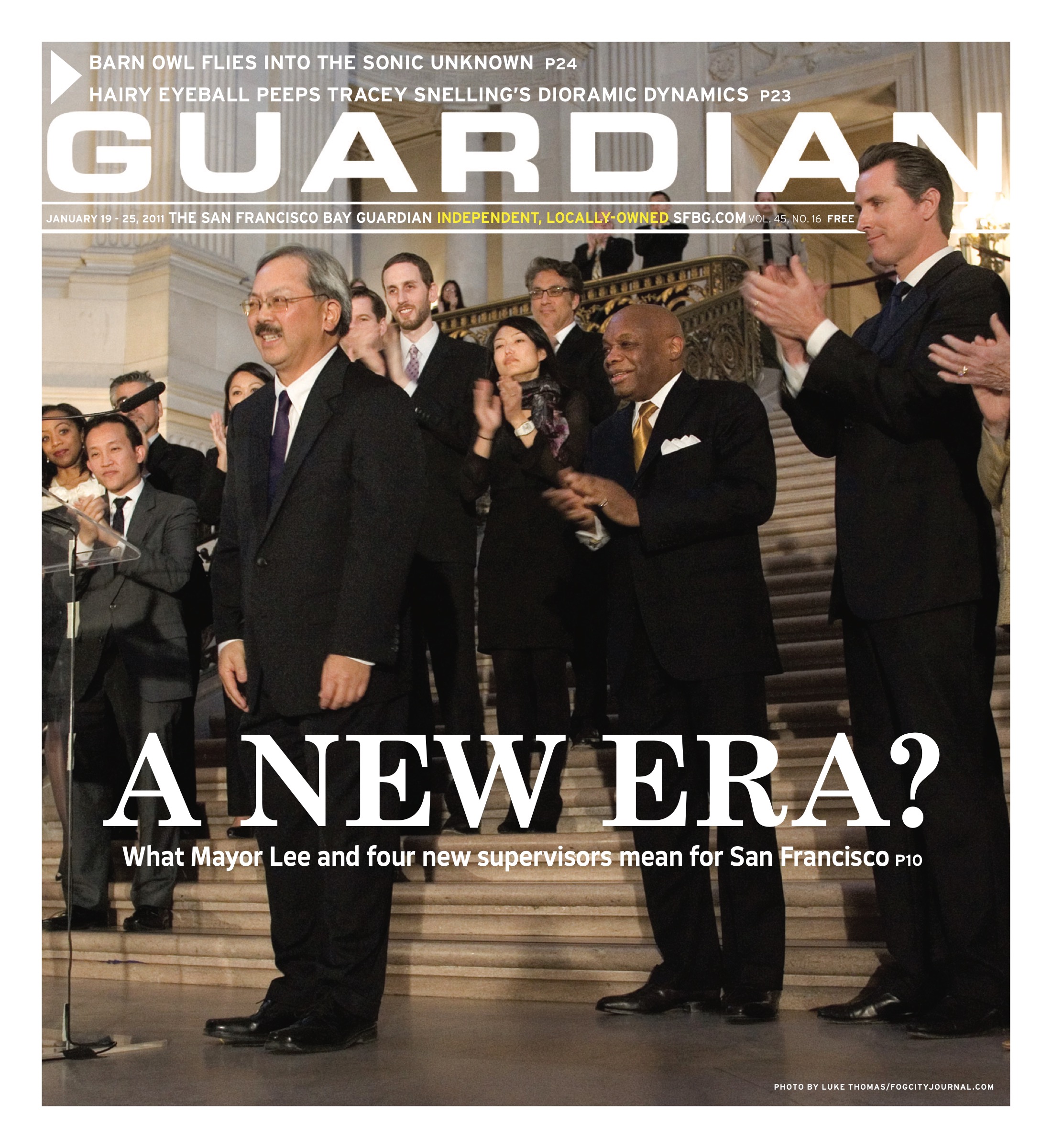
Board President David Chiu touched off a broad political discussion in recent weeks with his statement that officials were elected “not to take positions, but to get things done.” Delivered just before his reelection as Board President with the solid backing of the board’s moderate faction, Chiu’s comment has been viewed in light of City Hall’s shifting political dynamic, a subject the Guardian explores in a Jan. 19 cover story. Politics aside, Chiu’s statement also begs the question: Just what do members of the board hope to get done, and how do they propose to accomplish the items on their agenda?
Last week, Guardian reporters tracked down every member of the board to find out. We asked, what are your top priorities? And how do you plan to achieve them? Some spoke with us for 25 minutes, and others spoke for just 5 minutes, but the result offers some insight into what’s on their radar. Not surprisingly, getting the budget right was mentioned by virtually everyone as a top priority, but there are sharp differences in opinion in terms of how to do that. Several supervisors, particularly those in the moderate wing, mentioned ballooning pension and healthcare costs. Aiding small business also emerged as a priority shared by multiple board members.

Sup. Eric Mar
District 1

Issues:
*Budget
*Assisting small businesses
*Programs and services for seniors
*Food Security
*Issues surrounding Golden Gate Park

Elected in 2008 to represent D1, Sup. Eric Mar has been named chair of the powerful Land Use & Economic Development Committee and vice chair of the City Operations and Neighborhood Services Committee.

Asked to name his top priorities, Mar said, “A humane budget that protects the safety net and services to the must vulnerable people in San Francisco is kind of the critical, top priority.”

It’s bound to be difficult, he added. “That’s why I wish it could have been a progressive that was chairing the budget process. Now, we have to work with Carmen Chu to ensure that it’s a fair, transparent process.”

A second issue hovering near the top of Mar’s agenda is lending a helping hand to the small businesses of the Richmond District. “There’s a lot of anxiety about the economic climate for small business. We’re trying to work closely with some of the merchant associations and come up with ideas on how the city government can be more supportive,” he said. Mar also spoke about the need to respond to the threat of big box stores, such as PetCo, that could move in and harm neighborhood merchants. “I’m worried about too many of the big box stores trying to come in with an urban strategy and saying that they’re different — but they sure have an unfair advantage,” he noted.

Programs and services for the senior population ranked high on his list. Mar noted that he’d been working with senior groups on how to respond to a budget analyst’s report showing a ballooning need for housing – especially affordable housing – for seniors. “It’s moving from the Baby Boom generation to the Senior Boomers, and I think the population, if I’m not mistaken, by 2020 it’s going up 50 percent,” he said. “It’s a huge booming population that I don’t think we’re ready to address.”

Addressing food security issues through the Food Security Task Force also ranked high on Mar’s list, and he noted that he’s been working with a coalition that includes UCSF and the Department of Public Health to study the problem. “We’ve had a number of strategy meetings already, but we’re trying to launch different efforts to create healthier food access in many of our lowest income neighborhoods,” Mar said.

Finally, Mar talked about issues relating to the park. “I do represent the district that has Golden Gate Park, so I’m often busy with efforts to preserve the park, prevent privatization, and ensure enjoyment for the many residents not just in the Richmond but throughout the city that enjoy the park.” Although it’s not technically in his district, Mar noted that he is very supportive of HANC Recycling Center – and plans to advocate on their behalf to Mayor Lee.

Sup. Mark Farrell
District 2
Issues:
*Pension reform
*Long-term economic plan for city
*Job creation
*Quality-of-life issues

Elected to replace termed-out D2 Sup. Michela Alioto-Pier, Farrell has been named vice-chair of the Government Audits & Oversight Committee and a member of the Rules Committee. A native of D2, Farrell told the Guardian he believes his roots in the city and background as a venture capitalist would be an asset to the city’s legislative body. “I know at the last board, Carmen [Chu] was the only one who had any finance background,” he said. “To have someone come from the private sector with a business / finance background, I really do believe … adds to the dialogue and the discussion here at City Hall.”

Along those lines, Farrell said one of his top priorities is the budget. “I’m not on the budget and finance committee this time around, but given my background, I am going to play a role in that,” he said.

So what’s his plan for closing the budget deficit? In response, he alluded to slashing services. “In the past, there have been views that we as a city don’t provide enough services and we need to raise revenues to provide more, or the perspective that we first need to live within our means and then provide more services. Everyone’s going to disagree, but I’m in the latter camp,” he said. “I do believe we need to make some tough choices right now – whether it be head count, or whether it be looking at …pension reform. I do believe pension reform needs to be part of the dialogue. Unfortunately, it’s unsustainable.”

He also said he wanted to be part of “trying to create and focus on a framework for a long-term financial plan here in San Francisco.”

Secondly, Farrell discussed wanting to put together a “jobs bill.”

“Jobs is a big deal,” he said. “It’s something I want to focus on. There are only so many levers we can pull as a city. I think the biotech tax credits have spurred a lot of business down in Mission Bay.”

Next on Farrell’s agenda was quality-of-life issues, but rather than talk about enforcing San Francisco’s sit/lie ordinance – supported by political forces who organized under the banner of maintaining ‘quality-of-life’ – Farrell revealed that he is incensed about parking meter fines. “It is so strikingly unjust when you are 1 minute late to your parking meter and you have a $65 parking fine,” he said.

Farrell also mentioned development projects that would surely require time and attention. “CPMC is going to be a major dominant issue,” he said. He also mentioned Doyle Drive, and transitional age youth housing projects proposed in D2 – but as far as the housing project planned for the King Edward II Inn, which has generated some controversy among neighborhood groups, he didn’t take a strong position either way, saying he wanted to listen to all the stakeholders first.

Board President David Chiu
District 3
Issues:
*Budget
*Preserving neighborhood character
*Immigrant rights
*Preserving economic diversity
*Transit

Elected for a second two-year term as President of the Board, D3 Sup. David Chiu is rumored to be running in the mayor’s race, after he turned down former Mayor Gavin Newsom’s offer to appoint him as District Attorney. That offer was made after Kamala Harris won the state Attorney General’s race this fall. And when Chiu turned it down, former Mayor Gavin Newsom shocked just about everybody by appointing San Francisco Police Chief George Gascon, who is not opposed to the death penalty and was a longtime Republican before he recently registered as a Democrat, instead.

A temporary member of the Board’s Budget acommittee, Chiu is also a permanent member of the Board’s Government Audits & Oversight Committee.

Asked about his top priorities, Chiu spoke first and foremost about  “ensuring that we have a budget that works for all San Franciscans, particularly the most vulnerable.” He also said he wanted to see a different kind of budget process: “It is my hope that we do not engage in the typical, Kabuki-style budget process of years past under the last couple of mayors, where the mayor keeps under wraps for many months exactly what the thinking is on the budget, gives us something on June 1 for which we have only a couple of weeks to analyze, and then engage in the tired back-and-forth of debates in the past.” Chiu also spoke about tackling “looming pension and health care costs.”

Another priority, he said, was “Ensuring that our neighborhoods continue to remain the distinctive urban villages that they are, and protecting neighborhood character,” a goal that relates to “development, … historic preservation, [and] what we do around vacant commercial corridors.”

*Immigrant rights also made his top-five list. “I was very sad that last November we didn’t prevail in allowing all parents to have a right and a voice in school board elections,” he said, referencing ballot measure Proposition D which appeared on the November 2010 ballot. “I think we are going to reengage in discussion around Sanctuary City, another topic I have discussed twice already with Mayor Lee.”

Another issue for Chiu was  “ensuring again that hopefully San Francisco continues to remain an economically diverse city, and not just a city for the very wealthy.” He spoke about reforming city contracts: “In particular, dealing with the fact that in many areas, 70 to 80 percent of city contracts are awarded to non-San Francisco businesses. … I think there is more significant reform that needs to happen in our city contracting process.” Another economic-diversity measure, he said, was tax policy, “particularly around ensuring that our business tax is incenting the type of economic growth that we want.”

Finally, Chiu spoke about “Creating a transit-first city. This is not just about making sure MUNI is more reliable and has stable funding, but ensuring that we’re taking steps to reach a 2020 goal of 20 percent cycling in the city. Earlier this week I called for our transit agencies to look at pedestrian safety, because we are spending close to $300 million a year to deal with pedestrian deaths and injuries.”

Sup. Carmen Chu
District 4
*Budget
*Core Services
*Jobs
*Economy

Chiu has just named Sup. Carmen Chu as chair of the powerful Board and Finance Committee. And Chu, who worked as a budget analyst for Newsom’s administration, says the budget, core services, employment and the economy are her top priorities.

“My hope is that this year the budget is going to be a very collaborative and open process,” Chu said.

Chu believes workers benefits will be a central part of the budget-balancing debate.
“Any conversation about the long-term future of San Francisco’s budget has to look at the reality of where the bulk of our spending is,” she said.

Chu noted that the budget debate will have to take the state budget into account.
“At the end of the day, we need to take into account the context of the state budget, in terms of new cuts and taxes, because anything we do will be on top of the state level.

“We need to ask who do these measures really impact,” she added, noting that there were attempts to put revenue measures on the ballot last year.

Sup. Ross Mirkarimi
District 5
* Local Hire / First Source / Reentry programs
* Budget / generating revenue
* Infrastructure improvements
*Reversing MTA service cuts

With only two years left to serve on the Board, D5 Sup. Ross Mirkarimi has been named chair of the Board’s Public Safety Committee and vice-chair of the Budget and Finance Committee.

“One of my top priorities is building on and strengthening the work that I’ve already done and that Avalos is doing on mandatory local hire and First Source programs,” Mirkarimi said. He also spoke about “strengthening reentry programs for those coming out of the criminal justice system, because we still have an enormously high recidivism rate.”

The budget also ranked high on Mirkarimi’s list, and he stressed the need for “doing surgical operations on our budget to make sure that services for the vulnerable are retained, and looking for other ways to generate revenue beyond the debate of what’s going on the ballot.

“For instance, I helped lead the charge for the America’s Cup, and while the pay-off from that won’t be realized for years, the deal still needs to be massaged. What we have now is an embryonic deal that still needs to be watched.”

Mirkarimi mentioned safeguarding the city against privatization, saying one of his priorities was “retooling our budget priorities to stop the escalating practice of privatizing city services.”

 He spoke about “ongoing work citywide to make mixed-use commercial and residential infrastructure improvements, which coincide with bicycle and pedestrian improvements.”

Finally, Mirkarimi said he wanted to focus on transportation issues. “As Chair of the Transportation Authority, if I even continue to be chair, to take the lead on signature transit projects and work with the M.T.A. to reverse service cuts.”

Sup. Jane Kim
District 6
Issues:
*Jobs
*Economic Development
*Small Business
*Pedestrian Safety
*Legislation to control bedbug infestations

Elected to replace termed-out D6 Sup. Chris Daly, Kim has been named chair of the Rules Committee and a member of the Budget & Finance committee.

Kim believes that she will prove her progressive values through her work and she’s trying to take the current debate about her allegiances on the Board in her stride.

“The one thing I learned from serving on the School Board was to be really patient,” Kim told me, when our conversation turned to the issue of “progressive values.”

“I didn’t want to be President of the School Board for the first few years, because I loved pushing the envelope,” Kim added, noting that as Board President David Chiu is in the often-unenviable position of chief negotiator between the Board and the Mayor.

But with Ed Lee’s appointment as interim mayor, Kim is excited about the coming year.
“There are a lot of new opportunities, a different set of players, and it’s going to be very interesting to learn how to traverse this particular scene.”

Kim is kicking off her first term on the Board with two pieces of legislation. The first seeks to address bedbug infestations. “Particularly around enforcement, including private landlords,” Kim said, noting that there have also been bedbug problems in Housing Authority properties.

Her second immediate goal is to look at pedestrian safety, a big deal in D6, which is traversed by freeways with off-ramps leading into residential zones.
“Pedestrian safety is a unifying issue for my district, particularly for all the seniors,” Kim said, citing traffic calming, speed limit enforcement and increased pedestrian traffic, as possible approaches.

Beyond those immediate goals, Kim plans to focus on jobs, economic development and small businesses in the coming year. “What can we do to create jobs and help small businesses? That is my focus, not from a tax reduction point of view, but how can we consolidate the permitting and fees process, because small businesses are a source of local jobs.”

Kim plans to help the Mayor’s Office implement Sup. John Avalos’ local hire legislation, which interim Mayor Ed Lee supports, unlike his predecessor Mayor Gavin Newsom.

“Everyone has always liked the idea of local hire, but without any teeth, it can’t be enforced,” Kim observed. “It’s heartbreaking that young people graduate out of San Francisco Unified School District and there’s been not much more than retail jobs available.”

She noted that jobs, land use and the budget are the three overarching items on this year’s agenda. “I’m a big believer in revenue generation, but government has to come half-way by being able to articulate how it will benefit people and being able to show that it’s more than just altruistic. I think we have to figure out that balance in promoting new measures. That’s why it’s important to be strong on neighborhood and community issues, so that folks feel like government is listening and helping them. I don’t think it’s a huge ask to be responsive to that.”

Kim said she hoped the new mayor would put out a new revenue measure, enforce local hire, and implement Sup. David Campos’ legislation to ensure due process for immigrant youth.

“I think Ed can take a lot of the goodwill and unanimous support,” Kim said. “We’ve never had a mayor without an election, campaigns, and a track record. Usually mayors come in with a group of dissenters. But he is in a very unique position to do three things that are very challenging to do. I hope raising revenues is one of those three. As a big supporter of local hire, I think it helps having a mayor that is committed to implement it. And I’m hoping that Ed will implement due process for youth. For me, it’s a no brainer and Ed’s background as a former attorney  for Asian Law Caucus is a good match. Many members of my family came to the U.S. as undocumented youth, so this is very personal. Kids get picked up for no reason and misidentified. People confuse Campos and Avalos, so imagine what happens to immigrant youth.”

Sup. Sean Elsbernd
District 7
Issues:
*Parkmerced
*Enforcing Prop G
*Pension & healthcare costs
*CalTrain

With two years left to serve on the Board, D7 Sup. Sean Elsbernd has been named vice-chair of the Rules Committee and a member of the City Operations & Neighborhood Services Committee. He was congratulated by Chinatown powerbroker Rose Pak immediately after the Board voted 11-0 to nominated former City Administrator Ed Lee as interim mayor, and during Lee’s swearing-in, former Mayor Willie Brown praised Elsbernd for nominating Lee for the job.

And at the Board’s Jan. 11 meeting before the supervisors voted for Lee, Elsbernd signaled that city workers’ retirement and health benefits will be at the center of the fight to balance the budget in the coming year.

Elsbernd noted that in past years, he was accused of exaggerating the negative impacts that city employees’ benefits have on the city’s budget. “But rather than being inflated, they were deflated,” Elsbernd said, noting that benefits will soon consume 18.14 percent of payroll and will account for 26 percent in three years. “Does the budget deficit include this amount?” he asked.

And at the afterparty that followed Lee’s swearing in, Public Defender Jeff Adachi, who caused a furor last fall when he launched Measure B, which sought to reform workers’ benefits packages, told the Guardian he is not one to give up lightly. “We learned a lot from that,” Adachi said. “This is still the huge elephant in City Hall. The city’s pension liability just went up another 1 percent, which is another $30 million.”

As for priorities, Elsbernd broke it down into district, city, and regional issues. In D7, “Hands-down, without question the biggest issue … is Parkmerced,” he said, starting with understanding and managing the environmental approval process. If it gets approved, he said his top concerns was that “the tenant issue. And the overriding concern of if they sell, which I think we all think is going to happen in the near-term – do those guarantees go along with the land?”

Also related to Parkmerced was planning for the traffic conditions that the development could potentially create, which Elsbernd dubbed a “huge 19th Avenue issue.”

Citywide, Elsbernd’s top priorities included enforcing Proposition G – the voter-approved measure that requires MUNI drivers to engage in collective bargaining – and tackling pension and healthcare costs. He spoke about “making sure that MTA budget that comes to us this summer is responsive” to Prop G.

As for pension and healthcare, Elsbernd said, “I’ve already spent a good deal of time with labor talking about it, and will continue to do that.” But he declined to give further details. Asked if a revenue-generating measure could be part of the solution to that problem, Elsbernd said, “I’m not saying no to anything right now.”

On a regional level, Elsbernd’s priority was to help CalTrain deal with its crippling financial problem. He’s served on that board for the last four years. “The financial situation at CalTrain – it is without question the forgotten stepchild of Bay Area transit, and the budget is going to be hugely challenging,” he said. “I think they’ll survive, but I think they’re going to see massive reductions in services.”

Sup. Scott Wiener
District 8
Issues:
*Transportation
*Reasonable regulation of nightlife & entertainment industry
*Pension reform

Elected in November 2010 to replace termed-out D8 Sup. Bevan, Wiener has been named a temporary member of the Board’s Budget and Finance Committee and a permanent member of the Land Use and Economic Development Committee.

“Transportation is a top priority,” Wiener said. ‘That includes working with the M.T.A. to get more cabs on the street, and making sure that the M.T.A. collectively bargains effectively with its new powers, under Prop. G.”

“I’m also going to be focusing on public safety, including work around graffiti enforcement, though I’m not prepared to go public yet about what I’ll be thinking,” he said.

“Regulating nightlife and entertainment is another top priority,” Wiener continued. “I want to make sure that what we do is very thoughtful in terms of understanding the economic impacts, in terms of jobs and tax  revenues, that this segment has. With some of the unfortunate incidents that have happened, it’s really important before we jump to conclusions that we figure out what happened and why. Was it something the club did inappropriately, or was it just a fluke? That way, we can avoid making drastic changes across the board. I think we have been very reactive to some nightclub issues. I want us to be more thoughtful in taking all the factors into consideration.”

“Even if we put a revenue measure on the June or November ballot, we’d need a two-thirds majority, so realistically, it’s hard to envision successfully securing significant revenue measure before November 2012,” Wiener added. “And once you adopt a revenue measure, it takes time to implement it and revenue to come in, so it’s hard to see where we’ll get revenue that will impact the 2012 fiscal year. In the short term, for fiscal year 2011/2012, the horse is out of the barn”

“As for pension stuff, I’m going to be very engaged in that process and hopefully we will move to further rein in pension and retirement healthcare costs.”

Sup. David Campos
District 9
Issues:
*Good government
*Community policing
*Protecting immigrant youth
*Workers’ rights and healthcare

Elected in 2008, D9 Sup. David Campos has been named chair of the Board’s Government Audit & Oversight Committee and a member of the Public Safety Committee. And, ever since he declared that the progressive majority on the Board no longer exists, in the wake of the Board’s 11-0 vote for Mayor Ed Lee, Campos has found his words being used by the mainstream media as alleged evidence that the entire progressive movement is dead in San Francisco.

“They are trying to twist my words and make me into the bogey man,” Campos said, noting that his words were not a statement of defeat but a wake-up call.

“The progressive movement is very much alive,” Campos said. “The key here is that if you speak your truth, they’ll go after you, even if you do it in a respectful way. I didn’t lose my temper or go after anybody, but they are trying to make me into the next Chris Daly.”

Campos said his overarching goal this year is to keep advancing a good government agenda.

“This means not just making sure that good public policy is being pursued, but also that we do so with as much openness and transparency as possible,” he said.

As a member of the Board’s Public Safety Committee, Campos says he will focus on making sure that we have “as much community policing as possible.

He plans to focus on improving public transportation, noting that a lot of folks in his district use public transit.

And he’d like to see interim mayor Ed Lee implement the due process legislation that Campos sponsored and the former Board passed with a veto-proof majority in 2009, but Mayor Gavin Newsom refused to implement. Campos’ legislation sought to ensure that immigrant youth get their day in court before being referred to the federal immigration authorities for possible deportation, and Newsom’s refusal to implement it, left hundreds of youth at risk of being deported, without first having the opportunity to establish their innocence in a juvenile court.
‘We met with Mayor Lee today,” Campos told the Guardian Jan. 18. “And we asked him to move this forward as quickly as possible. He committed to do that and said he wants to get more informed, but I’m confident he will move this forward.”

Campos also said he’ll be focusing on issues around workers’ rights and health care.
“I want to make sure we keep making progress on those fronts,” Campos said.

“It’s been a rough couple of days,” Campos continued, circling back to the beating the press gave him for his “progressive” remarks.“But I got to keep moving, doing my work, calling it as a I see it, doing what’s right, and doing it in a respectful way. The truth is that if you talk about the progressive movement and what we have achieved, which includes universal healthcare and local hire in the last few years, you are likely to become a target.”

Sup. Malia Cohen
District 10
Issues:
*Public safety
*Jobs
*Preserving open space
*Creating Community Benefit Districts
*Ending illegal dumping
Elected to replace termed-out D10 Sup. Sophie Maxwell, Cohen has been named chair of the City & School District committee, vice chair of the Land Use and Economic Development Committee and vice chair of the Public Safety Committee.

Cohen says her top priorities are public safety, jobs, open space, which she campaigned on, as well as creating community benefits districts and putting an end to illegal dumping.

“I feel good about the votes I cast for Ed Lee as interim mayor and David Chiu as Board President. We need to partner on the implementation of local hire, and those alliances can help folks in my district, including Visitation Valley.”

“I was touched by Sup. David Campos words about the progressive majority on the Board,” she added. “I thought they were thoughtful.”

Much like Kim, Cohen believes her legislative actions will show where her values lie.
“I’d like to see a community benefits district on San Bruno and Third Street because those are two separate corridors that could use help,” Cohen said. 

She pointed to legislation that former D10 Sup. Sophie Maxwell introduced in November 2010, authorizing the Department of Public Works to expend a $350,000 grant from the Solid Waste Disposal Clean-Up Site trust fund to clean up 25 chronic illegal dumping sites.
“All the sites are on public property and are located in the southeast part of the city, in my district,” Cohen said, noting that the city receives over 16,000 reports of illegal dumping a year and spends over $2 million in cleaning them up.

Sup. John Avalos
District 11
*Implementing Local Hire
*Improving MUNI / Balboa Park BART
*Affordable housing
*Improving city and neighborhood services

Sup. John Avalos, who chaired the Budget committee last year and has just been named Chair of the Board’s City Operations and Neighborhood Services Committee, said his top priorities were implementing local hire, improving Muni and Balboa Park BART station, building affordable housing at Balboa, and improving city and neighborhood services.

“And despite not being budget chair, I’ll make sure we have the best budget we can,” Avalos added, noting that he plans to talk to labor and community based organizations about ways to increase city revenues. “But it’s hard, given that we need a two-thirds majority to pass stuff on the ballot,” he said.

Last year, Avalos helped put two measures on the ballot to increase revenues. Prop. J sought to close loopholes in the city’s current hotel tax, and asked visitors to pay a slightly higher hotel tax (about $3 a night) for three years. Prop. N, the real property transfer tax, h slightly increased the tax charged by the city on the sale of property worth more than $5 million.

Prop. J secured only 45.5 percent of the vote, thereby failing to win the necessary two-thirds majority. But it fared better than Prop. K, the competing hotel tax that Newsom put on the ballot at the behest of large hotel corporations and that only won 38.5 percent of the vote. Prop. K also sought to close loopholes in the hotel tax, but didn’t include a tax increase, meaning it would have contributed millions less than Prop. J.

But Prop. N did pass. “And that should raise $45 million,” Avalos said. “So, I’ve always had my sights set on raising revenue, but making cuts is inevitable.”


Chiu stiffs progressives on key committee appointments

21

Belying his repeated claims to being part of the progressive movement, Board of Supervisors President David Chiu has ousted his progressive colleagues from key leadership positions on board committees, placing fiscal conservatives into the chairs and majorities on the three most important committees and giving downtown interests more control over city legislation and projects than they’ve had in a decade.

Most notably, the chair of the Budget & Finance Committee was taken away from Sup. John Avalos – who challenged Chiu for the board presidency on Saturday – and given to Sup. Carmen Chu. While Chu did work on budget issues as a staffer in the Mayor’s Office before being appointed supervisor, which Chiu cited in support of his decision, she has consistently voted with the three-member minority of fiscal conservatives throughout her tenure as supervisor, opposing even the most widely accepted revenue proposals and progressive initiatives.

Chiu also placed himself in the swing vote role on that committee, naming Sups. Ross Mirkarimi and Jane Kim as the permanent committee members and Scott Wiener and himself as the temporary members who serve on the committee from March 1 through budget season. Asked if that was intentional, Chiu told us, “Sure was.” With the city facing a budget deficit of almost $400 million after seven years of budget deficits that were closed almost entirely through service cuts and fee increases – rather than general revenue increases targeted at the city’s richest individuals and corporations – the committee will be a key battleground between progressives and fiscal conservatives this year.

“The makeup of the committee reflects a real need for collaboration at this time of transition,” Chiu said of the Budget Committee. But Sup. David Campos was among the many progressives calling the committee assignments a major political realignment, telling us, “I don’t see how you can look at the committee assignments and not see some kind of realignment. The progressives are no longer in control of the key committees.” Avalos called it, “the price of moderates voting for Chiu.”

Also disappointing to progressives were Chiu’s choices for the Rules and Land Use committees. On the Rules Committee, which confirms mayoral appointments, approves the placement of charter amendments on the ballot, and will play a big role this year in approving the redrawing of supervisorial districts in the wake of the 2010 Census, Chiu named Kim and Sups. Sean Elsbernd and Mark Farrell, the latter two childhood buddies who represent the city’s two most conservative districts.

The committee takes the lead role in proposing the board’s three appointees to a task force that will draw the new legislative lines, as well as reviewing the other six appointees (three each from the Mayor’s Office and Elections Commission) and approving the plan that the task force produces. Downtown groups are expected to use the opportunity to negate the gains progressives have made in electing supervisors, probably in collaboration with Elsbernd and Farrell, a venture capitalist new to politics.

“Sean and Mark understand that if they push things through Rules that are outside the mainstream of who the board is, I expect that the full board will stop them,” Chiu told us. He also emphasized that Kim is chairing the committee, a role that can influence what items the committee considers: “On Rules, Sup. Kim will set the agenda there.”

Chiu sounded a similar rationale in defending a makeup on the Land Use & Economic Development Committee, to which he named new Sups. Scott Wiener and Malia Cohen – who were backed by development interests and opposed by tenant groups in last year’s election – along with Sup. Eric Mar as chair.

“With Eric at the helm, he will do a very good job at fighting for neighborhoods, tenants, and other interests,” Chiu said. But Avalos noted that Mar will have his hands full trying to manage a high-stakes, high-profile agenda with little help from his colleagues. “There’s a lot on Eric Mar’s shoulders. It’s his coming of age moment and he’ll have to step up big time to run that committee,” Avalos said.

Avalos said he was disappointed to be removed from the Budget Committee after working on it for eight of the last 10 years, first as Sup. Chris Daly’s legislative aide and then as a supervisor. “But I’m going to work behind the scene on the budget to make sure the communities are well-spoken for,” he said.

Chiu said he has gotten assurances from both Chu and Mayor Ed Lee “about the need for an open, transparent, and community-based budget process.” Carmen Chu echoed the point, telling us, “My hope is that this year the budget is going to be a very collaborative and open process.”

But on the need for need for revenue solutions, which Avalos has said are vital, David Chiu only went this far: “I am open to considering revenues as part of the overall set of solutions to close the budget deficit.” And Carmen Chu wouldn’t even go that far.

“At the end of the day, we need to take into account the context of the state budget, in terms of new cuts and taxes, because anything we do will be on top of the state level,” she told us, adding this about the revenue measures that she opposed last year, “We need to ask who do these measures really impact.”

For progressives, the only bright spots in the committee appointments were Avalos chairing the City Operations & Neighborhood Services Committees, with Mar and Elsbernd also serving; and Sup. Ross Mirkarimi chairing the Public Safety Committee, with Cohen and Campos on it as well.

“I told people I was going to be fair in committee assignments and I have been,” Chiu said.

Sarah Phelan and Tim Redmond contributed to this report.

Editor’s Notes

2

tredmond@sfbg.com

Former Mayor Willie Brown says that choosing a person of color for a leadership position should be a progressive value. Board of Supervisors President David Chiu says the new mayor, Ed Lee, is a progressive. Several supervisors and other political observers say the six-vote progressive majority on the board is gone.

And nobody really talks about what that word means.

Progressive is a term with a long political vintage, but it’s changed (as has the political context) since the 1920s. (Progressives these days aren’t into Prohibition.) So I’m going to take a few minutes to try to sort this out.

I used to tell John Burton, the former state senator, that a progressive was a liberal who didn’t like real estate developers. But that was in the 1980s, when the Democratic Party in town was funded by Walter Shorenstein and other developers who were happy to be part of the party of Dianne Feinstein, happy to be liberals on some social issues (Shorenstein insisted that the Chamber of Commerce hire and promote more women), and happy to promote liberal candidates like John and Phil Burton for state and national office — as long as they didn’t mess with the gargantuan money machine that was high-rise office development in San Francisco.

But these days it’s not all about real estate; it’s that the level of economic inequality in the United States has risen to levels unseen since the late 1920s. So I sat down on a Saturday night when the kids went to bed(yeah, this is my social life) and made a list of what I think represent the core values of a modern American progressive. It’s a short list, and I’m sure there’s stuff I’ve left off, but it seems like a place to start.

This isn’t a litmus test list (we’ve endorsed plenty of people who don’t agree with everything on it). It’s not a purity test, it’s not a dogma, it’s not the rules of entry into any political party … it’s just a definition. My personal definition.

Because words don’t mean anything if they don’t mean anything, and progressive has become so much of a part of the San Francisco political dialogue that it’s starting to mean nothing.

For the record: when I use the word "progressive," I’m talking about people who believe:
1. That civil rights and civil liberties need to be protected for everyone, even the most unpopular people in the world. We’re for same-sex marriage, of course, and for sanctuary city and protections for immigrants who may not have documentation. We’re also in favor of basic rights for prisoners, we’re against the death penalty, and we think that even suspected terrorists should have the right to due process of law.
2. That essential public services — water, electricity, health care, broadband — should be controlled by the public, not by private corporations. That means public power and single-payer government run health insurance.
3. That the most central problem facing the city, the state, and the nation today is the dramatic upward shift of wealth and income and the resulting economic inequality. We believe that government at every level — including local government right here in San Francisco — should do everything possible to reduce that inequality. That means taxing high incomes, redistributing wealth, and using that money for public services (education, for example) that tend to help people achieve a stable middle-class lifestyle. We believe that San Francisco is a rich city, with a lot of rich people, and that if the state and federal government won’t try to tax them to pay for local services, the city should.
4. That private money has no place in elections or public policy. We support a total ban on private campaign contributions, for politicians and ballot measures, and support public financing for all elections. Corruption — even the appearance of corruption — taints the entire public sector and helps the fans of privatization, and progressives especially need to understand that.
5. That the right to private property needs to be tempered by the needs of society. That means you can’t just put up a highrise building anywhere you want in San Francisco, of course, but it also means that the rights of tenants to have stable places for themselves and their families to live is more important than the rights of landlords to maximize return on their property. That’s why we support strict environmental protections, even when they hurt private interests, and why be believe in rent control, including rent control on vacant property, and eviction protections and restrictions on condo conversions. We think community matters more than wealth, and that poor people have a place in San Francisco too — and if the wealthier classes have to have less so the city can have socioeconomic diversity, that’s a small price to pay. We believe that public space belongs to the public and shouldn’t be handed over to private interests. We believe that everyone, including homeless people, has the right to use public space.
6. That there are almost no circumstances where the government should do anything in secret.
7. That progressive elected officials should use their resources and political capital to help elect other progressives — and should recognize that sometimes the movement is more important that personal ambitions.

I don’t know if Ed Lee fits my definition of a progressive. He hasn’t taken a public position on any major issues in 20 years. We won’t know until we see his budget plans and learn whether he thinks the city should follow Gavin Newsom’s approach of avoiding tax increases and simply cutting services again. We won’t know until he decides what to tell the new police chief about enforcing the sit-lie law. We won’t know until we see whether he keeps Newsom’s staff in place or brings in some senior people with progressive values.
I agree that having an Asian mayor in San Francisco is a very big deal, a historic moment — and as Lee takes over, I will be waiting, and hoping, to be surprised.

Power and pragmatism

5

steve@sfbg.com

After an epic week at City Hall, the political dynamics in San Francisco have undergone a seismic shift, with pragmatism replacing progressivism, longtime adversarial relationships morphing into close collaborations, and Chinese Americans as mayor and board president.

It was a week of surprises, starting Jan. 4 when City Administrator Ed Lee came out of nowhere to become the consensus choice for interim mayor, and ending Jan. 9 when Mayor Gavin Newsom appointed Police Chief George Gascón to be the new district attorney, Newsom’s last official act as mayor before belatedly taking his oath of office as lieutenant governor on Jan. 10.

In between, the outgoing Board of Supervisors held a special final meeting Jan. 7, at which progressive supervisors fell into line behind Lee, some of them reluctantly, and accepted the new political reality. The next day, the new Board of Supervisors took office and overwhelmingly reelected David Chiu as board president, with only the three most progressive supervisors in dissent.

After Chiu played kingmaker as the swing vote for making Lee the new mayor, the board and Mayor’s Office are likely to enjoy far closer and more cooperative relations than they’ve had in many years. And the sometimes prickly, blame-game relations between the Police Department and D.A.’s Office should also get better now that the top cop has switched sides. But what it all means for the average San Franciscan, particularly the progressive voters who created what they thought was a majority on the Board of Supervisors, is still an open question.

One thing that is clear is the ideological battles that have defined City Hall politics — what Chiu called the “oppositional politics of personality” during his closing remarks on Jan. 8 — have been moved to the back burner while the new leaders try a fresh approach.

Newsom — with his rigid fiscal conservatism and open disdain for the Board of Supervisors, particularly its progressive wing — is gone. Also leaving City Hall is Sup. Chris Daly, a passionate and calculating progressive leader whose over-the-top antics caused a popular backlash against the movement.

In a way, Newsom and Daly were perfect foils for one another, caustic adversaries who often reduced one another to two-dimensional caricatures of themselves. But they were each strongly driven by rival ideologies and political priorities, despite Newsom’s rhetorical efforts to turn “ideology” into a dirty word applied only to his opponents.

“This year represents a changing of the guard, a transition,” Chiu said, pledging to continue pushing for progressive reforms, only with a more conciliatory approach, a theme also sounded by Sups. Eric Mar and Jane Kim, who each broke with their progressive colleagues to support Chiu over rival presidential nominee Sup. John Avalos.

“I will always support policies that will make our city more equitable and just,” Kim said after being sworn in to replace Daly, although she also made a claim about the new board with which her predecessor probably wouldn’t agree: “I think we have a lot more in common than we don’t.”

With a focus on diversity and compromise, “respect and camaraderie,” Mar said, “I think this new board represents the evolution of the progressive movement in San Francisco.”

If indeed City Hall is enjoying a “Kumbaya” moment, the path to this point was marred by backroom deal-making and old-school power politics, much of it engineered by a pair of figures from the previous era who are by no means progressives: former Mayor Willie Brown and Rose Pak, head of the Chinatown Chamber of Commerce.

Pak was seated front and center — literally and figuratively — during the board’s Jan. 7 vote for Lee and its Jan. 8 vote for Chiu, following media reports that it was she and Brown who persuaded Lee to take the job and city leaders (particularly Newsom, Chiu, and outgoing Sups. Bevan Dufty and Sophie Maxwell) to give it to him.

It all seemed sneaky and unsettling to board progressives, who questioned what kind of secret deal had been cut, even as they voiced their respect for Lee’s progressive roots and long history of service to the city. The sense that something unseemly was happening was exacerbated on Jan. 4 when Dufty abandoned a pledge of support for Sheriff Michael Hennessey — who five progressive supervisors supported for interim mayor — and left the meeting to confer with the Mayor’s Office before returning to announce his support for Lee.

Sups. David Campos, Ross Mirkarimi, and Avalos pleaded with their colleagues for time to at least talk with Lee, who was traveling in China since he reportedly changed his mind about wanting the interim mayor job. Maxwell was the only Lee supporter in the 6-5 vote for delaying the interim mayor item by a few days so the supervisors could speak with Lee by phone.

Pak and other Chinatown leaders put together a strong show of force by the Chinese American community at that Jan. 7 meeting, where the board voted 10-1 for Lee, with only Daly in dissent. Afterward, some of Lee’s strongest supporters — including the Rev. Norman Fong and Gordon Chin with the Chinatown Community Development Center — admitted that the process of picking Lee was flawed.

“Part of the problem was Ed’s because he couldn’t make up his mind. The process was bad,” Fong told the Guardian after the vote. Although Fong said he knows Lee to be a strong and trustworthy progressive, he admitted that the way it went down raised questions: “Some people were concerned about who he’ll listen to.”

Specifically, the concern is that Lee will be unduly influenced Brown and Pak, who each represent corporate clients whose interests are often at odds with those of the general public. And both operate behind the scenes and play a kind of political hardball that runs contrary to progressive values on openness, inclusion, and accountability.

“If there is a phone call from Willie Brown to Rose Pak, Ed Lee is going to go along with it,” predicted a knowledgeable source who has worked closely with all three, recalling the way they did business during Brown’s mayoral administration. “There was no real discussion of issues. The fix was always in.”

But Pak insisted that there was nothing wrong with the process of selecting Lee, and that all concerns about the nomination were driven by anti-Asian racism. “You have a plantation mentality,” Pak told the Guardian as she held court in front of a crowded press box before the Jan. 8 meeting. “The Bay Guardian has never given people of color a fair shot.”

While Newsom, Chiu, and Pak-allied political consultant David Ho all insisted “there was no deal” to win support for Lee, Pak seemed to revel in the high-profile role she played, with Bay Citizen reporter Gerry Shih labeling her “boastful” in his Jan. 6 article “Behind-The-Scenes Power Politics: The Making of Ed Lee,” which ran the next day in The New York Times.

“This was finally our moment to make the first Chinese mayor of a major city,” Pak reportedly told Shih. “How could you let that slip by?”

Chiu downplayed Pak’s influence, telling the Guardian that Lee was his top choice since November, and telling his colleagues before the Jan. 7 vote, “Ed is someone who does represent our shared progressive values.” But he also made it clear that helping the city’s progressive movement wasn’t what drove his decision.

“This is a decision beyond who were are as progressives and who we are as moderates. It’s about who we are as San Franciscans,” Chiu said. “This is a historic moment for the Chinese-American community,” calling it “a community that has struggled, a community that has seen discrimination.”

The next day, shortly after being elected to a second term as board president, Chiu acknowledged the “very real differences” in ideology among the supervisors, “but leadership is about working through those differences.” Ultimately, he said, “none of us were voted into office to take positions. We were voted into office to get things done.”

What progressive means

85

Willie Brown says that choosing a person of color for a leadership position should be a “progressive” value. David Chiu says Ed Lee is a progressive. Several supervisors, and other political observers, say the six-vote progressive majority on the board is gone.

And nobody really talks about what that word means.

Progressive is a term with an excellent political vintage, but it’s changed (as has the political context) since the 1920s. (Progressives these days aren’t into prohibition.) So I’m going to take a few minutes to try to sort this out.

I used to tell John Burton that a progressive was a liberal who didn’t like real estate developers, but that was in the 1980s, when the Democratic Party in town was funded by Walter Shorenstein and other developers, who were happy to be part of the party of Dianne Feinstein, happy to be liberals on some social issues (Shorenstein insisted that the Chamber of Commerce hire and promote more women) and happy to promote liberal candidates like John and his brother Phil for national office – as long as they didn’t mess with the gargantuan money machine that was highrise office development in San Francisco.
Arguing that Shorenstein’s economic agenda was driving up housing prices, destroying low-income neighborhoods and displacing tenants was a waste of time; the liberals like Burton (who also represented real estate developers as a private attorney) weren’t interested.

But these days it’s not all about real estate; it’s about the fact that the level of economic inequality in the United States has risen to levels unseen since the late 1920s, and the impacts are all around us. And it’s about (Democratic) politicians in San Francisco blaming Sacramento, and (Democratic) politicians in Sacramento blaming Washington, and the Democratic Party in the United States abandoning economic equality as a guiding principle.

So I sat down on a Saturday night when the kids went to be (yeah, this is my social life) and made a list of what I think represent the core values of a modern American progressive. It’s a short list, and I’m sure there’s stuff I’ve left off, but it seems like a place to start.

For all the people who are going to blast me in the comments, let me say very clearly: This isn’t a litmus-test list (we’ve endorsed plenty of people who don’t agree with everything on it). It’s not a purity test, it’s not a dogma, it’s not the rules of entry into any political party … it’s just a definition. My personal definition.

Because words don’t mean anything if they don’t mean anything, and progressive has become so much of a part of the San Francisco political dialogue that it’s starting to mean nothing.
For the record: When I use the word “progressive,” I’m talking about people who believe:

1. That civil rights and civil liberties need to be protected for everyone, even the most unpopular people in the world. We’re for same-sex marriage, of course, and for Sanctuary City and protections for immigrants who may not have documentation. We’re also in favor of basic rights for prisoners, we’re against the death penalty, and we think that even suspected terrorists should have the right to due process of law.

2. That essential public services – water, electricity, health care, broadband – should be controlled by the public and not by private corporations. That means public power and single-payer government run health insurance.

3. That the most central problem facing the city, the state and the nation today is the dramatic upward shift of wealth and income and the resulting economic inequality. We believe that government at every level – including local government, right here in San Francisco – should do everything possible to reduce that inequality; that means taxing high incomes, redistributing wealth and using that money for public services (education, for example) that tend to help people achieve a stable middle-class lifestyle. We believe that San Francisco is a rich city, with a lot of rich people, and that if the state and federal government won’t try to tax them to pay for local services, the city should.

4. That private money has no place in elections or public policy. We support a total ban on private campaign contributions, for both politicians and ballot measures, and support public financing for all elections.

5. That the right to private property needs to be tempered by the needs of society. That means you can’t just put up a highrise building anywhere you want in San Francisco, of course, but it also means that the rights of tenants to have stable places for themselves and their families to live is more important than the rights of landlords to maximize return on their property. That’s why we support strict environmental protections, even when they hurt private interests, and why be believe in rent control, including rent control on vacant property, and eviction protections and restrictions on condo conversions. We think community matters more than wealth and that poor people have a place in San Francisco too — and if the wealthier classes have to have less so that the city can have socio-economic diversity, that’s a small price to pay. We believe that public space belongs to the public, and shouldn’t be handed over to private interests; we believe that everyone, including homeless people, has the right to use public space.

6. That there are almost no circumstances where the government should do anything in secret.

7. That progressive elected officials should use their resources and political capital to help elect other progressives – and should recognize that sometimes the movement is more important that their own personal ambitions.

I could add a lot more, but I think those six factors are at the heart of what I mean when I talk about progressives. We support a lot of other things; I put the right of workers to unionize under Number 3, since unions (along with public schools and subsidized higher education) are one of the major forces behind a stable middle class and a more equal society. We think racism and homophobia are never acceptable, and we support affirmative action, but that goes under Number 1.

This is not a socialist manifesto; I never mentioned worker control of the means of production. Progressives don’t oppose private enterprise; they just think that some things essential for the good of society don’t belong in the private sector, and that the private sector should be regulated for the good of all of us. We trust and support small businesses much more than big corporations – and we think their interests are not the same.

I don’t know if Ed Lee fits my definition of a progressive. We won’t know until we see his budget plans, and learn whether he thinks the city should follow Gavin Newsom’s approach of avoiding tax increases and simply cutting services again. We won’t know until he decides what the tell the new police chief about enforcing the sit-lie law. We won’t know until we see whether he keeps Newsom’s staff in place or brings in some senior people with progressive values. We know that the people who pushed him to take the job aren’t progressives by any definition, but you never know. I agree that having an Asian mayor in San Francisco is a very big deal, an historic moment — and when Lee takes office, I will be waiting, and hoping, to be surprised.

Historic mayoral vote followed a flawed process

6

Ed Lee would be San Francisco’s first Chinese-American mayor right now – if Mayor Gavin Newsom wasn’t delaying his swearing in as lieutenant governor. And Lee might also have had 10 votes on the Board of Supervisors on Tuesday, as he had today, if the process hadn’t involved backroom deals and moderate, lame-duck supervisors kowtowing to the outgoing mayor. In other words, this historic occasion just didn’t need to be sullied the way it was this week.
There was real jubilation at City Hall when I left there a few minutes ago, and for good reason, even though today’s vote will have to be repeated by the new board after Newsom officially resigns. “This is a historic moment for the Chinese-American community,” Board President David Chiu told a packed board chambers, calling it, “a community that has struggled, a community that has seen discrimination.”
Chiu braved the taunts of Sup. Chris Daly and some progressive activists for supporting Lee on Tuesday, steadfastly maintaining that Lee is progressive and the best candidate for this job, despite his five progressive colleagues voting for Sheriff Michael Hennessey. And Lee does have progressive roots and support, as the progressive supervisors have attested publicly.
Once the progressive supervisors were given the chance to talk to Lee – whose openness to accepting the nomination came out of nowhere, reportedly at the urging of Chinatown power broker Rose Pak and former Mayor Willie Brown – all but Daly voted to support Lee.
Yet all of them also publicly noted how the process was deeply flawed and contrary to progressive principles of openness and accountability. “I have questions about the process and how we got to this point,” Sup. John Avalos said before announcing his support for Lee based on a half-hour telephone conversation yesterday (Lee has been in China through his public consideration as interim mayor).  
Sup. David Campos said he nominated Hennessey as a compromise caretaker mayor based on the representation from Newsom that he was acceptable and after being told by Sup. Bevan Dufty that he would support Hennessey. Instead, Dufty refused to vote until calling for a recess and marching down to the Mayor’s Office on Tuesday, returning to be the swing vote for Lee.
“I’m very disappointed in the way this process has gone down,” Campos said, adding that Hennessey “did not deserve the kind of treatment he received.” Sups. Ross Mirkarimi and Eric Mar echoed the point, with Mirkarimi saying he still doesn’t understand why Dufty flipped or what happened when he went to visit the Mayor’s Office.
Through the whole hearing, Dufty – a candidate for mayor himself – didn’t say a word. At one point, he even started clearing out his desk in Board Chambers, throwing away recycled papers and filling a big envelope full of paper clips. He didn’t stick around the hallway for the celebration that he helped enable, instead going straight into his office, where I found him and asked for a reaction to his colleagues’ questioning of his motives and integrity.
“My actions speak for themselves,” was all Dufty would say.
Perhaps they do, but even Lee’s strongest supporters acknowledged that the process of picking him was flawed. “Part of the problem was Ed’s because he couldn’t make up his mind,” Rev. Norman Fong told the Guardian. “The process was bad.”
Without a public discussion or the ability of reporters or supervisors to talk to Lee, Fong acknowledged why some progressives worried that a deal had been cut to continue with Newsom’s policies and personnel. “Some people were concerned about who he’ll listen to,” Fong said, but he said, “I’ve fought with Ed Lee and I know his heart…He’ll do the right thing.”
Gordon Chin of Chinatown Community Development Center said he has worked closely with both Lee and Hennessey and both would have been good interim mayors, and he said this should not have been a partisan fight. “Who nominated Mike Hennessey as the nominee of all of progressive San Francisco?” Chin asked, noting that few progressive constituencies were consulted on the choice or offered their buy-in.
Yet he also acknowledged the unseemly way in which Lee came out of nowhere to get the nomination, with little public vetting, “If Ed was out there a week earlier, it would have been a lot better. It was a flawed process,” Chin said.
So flawed that Daly and many progressive activists are still smarting about what happened and wary of what kind of mayor Lee will be. “No more backroom deals,” queer activist and blogger Michael Petrelis repeatedly shouted at Rose Pak as she was being interviewed outside board chambers.
But Fong just shrugged and told me, “There’s backroom deals on the left too.”

Jerry Brown wants to eliminate Redevelopment

10

Calitics reveals today that newly sworn-in Gov. Jerry Brown told the Sacramento Bee that he’s proposing to eliminate local redevelopment agencies as part of a set of austerity measures that he is proposing in a purported effort to shock folks into approving new revenues

Brown’s shocking proposal got me calling tenants rights activist Calvin Welch and Arc Ecology executive director Saul Bloom, who both have strong and well- informed views on what’s up with local redevelopment agencies and how they could be improved. And interestingly neither Bloom nor Welch was in favor of eliminating redevelopment.

Welch, who hadn’t yet had time to read the article when I called him, actually laughed when I outlined Brown’s basic idea, which admittedly is big on shock value and thin on explanations, at least at this point.
‘That would be very interesting, but the devil’s in the details.” Welch observed, noting that voters just approved Prop. 22 in Nov. 2010 to prevent the state from taking city redevelopment money to balance the budget in Sacramento. (Unfortunately, Prop. 22’s passage still doesn’t protect San Francisco from having its budget raided by the state, since it’s defined as both a city and a county.)

“That’s an astounding idea,” Welch added, trying to wrap his mind around Brown’s out-of-the-blue proposal. “Because in San Francisco, there are redevelopment areas, including Bayview Hunters Point, Mission Bay and the Transbay Terminal, that have already been authorized for another 25-30 years.”

“Perhaps the language would be ‘no new redevelopment’ but I don’t know how you would do that,” Welch added, noting that Brown has not only been governor before, but was also mayor of Oakland. (During his term as mayor, Brown was credited with starting the revitalization of Oakland but was also accused of being more interested in downtown redevelopment and economic growth than political ideology.)

Welch noted that San Francisco was fortunate in being able to reshape its Redevelopment financing arrangements in 1990 under then mayor Art Agnos.

“It was probably the most progressive and long standing reform of Art Agnos’ administration—and no one understands it,” Welch said. As Welch tells it, when Agnos came into office, he inherited a city that had been bankrupted by a decade of mayor Dianne Feinstein’s business-friendly policies, much like how San Francisco has been milked in the past decade by Newsom’s business-friendly policies.

“Redevelopment doesn’t pay its way in the post Prop. 13 world,” Welch stated. “Under Mayor Gavin Newsom, we’ve had the most market rate housing produced and the biggest deficits in what was a real estate collapse, as part of the collapse of the economic markets. And under Mayor Feinstein’s 10-year rule, we saw massive amounts of commercial office space built that never paid its way, leaving Agnos with a $103 million deficit.”

Welch notes that Agnos also inherited a huge homeless crisis (something Welch says Feinstein was in denial over) and that Agnos sought to reform Redevelopment in large part as a way to address the city’s growing lack of affordable housing. “Art basically said, let’s take a look at tax increment financing,” Welch said, referring to a tax financing arrangement, under which a municipality can a) do an assessed value of an area before redevelopment takes place, b) estimate what that same area’s local taxes would be after redevelopment, and c) borrow money against the incremental difference between a) and b).

“Art said, ‘I want to do that and I want to use the hundreds of millions of dollars available through redevelopment for affordable housing,’” Welch recalled. He noted that Agnos succeeded in his mission by shifting the San Francisco Redevelopment Agency’s mission from ‘urban renewal’ (which had negative connotations following the displacement of African American and other low-income communities from the Fillmore in the 1960s) to ‘community development,’ making Redevelopment subject to the same budgetary process as other departments, and insisting that 20 percent of tax increment financing dollars be devoted to affordable housing.
“But we said, ‘no, 50 percent has to be devoted to affordable housing and Art agreed, and that’s been the case since 1990,” Welch recalled. “And since then our Redevelopment Agency has been the principal source of affordable housing revenue in San Francisco.”

So, in another words, the San Francisco Redevelopment Agency is pretty much alone in the state, in terms of devoting half its tax increment financing revenues to affordable housing. But by the same token, San Francisco’s Redevelopment Agency is pretty much alone in the state in terms of not being governed directly by a city council or a county Board of Supervisors. Instead, it’s governed by a Commission, whose members are appointed solely by the mayor . And therein lies the problem, Welch says.
‘It would only take six votes on the Board of Supervisors, or eight votes to override a mayoral veto, to change that,” Welch observed.

But to date there haven’t been eight votes to do that, even with a progressive Board.
Welch believes the problem is that supervisors, who currently each only have two legislative aides, fear swampage from Redevelopment responsibilities.
“To contemplate taking over a multibillion dollar agencies and taking on the likes of Catellus with only two staffers, well it’s a recipe for disaster,” Welch said, acknowledging that additional reforms, including splitting appointments on the Redevelopment Commission between the mayor and the Board, or allowing the Board to hire additional legislative staff to work on redevelopment issues, could solve the problem.

Bloom, who recently sued after the Redevelopment Commission threw his non-profit under the bus, said his non-profit’s recent experience perfectly illustrates why and how Redevelopment should be reformed, rather than completely eliminated.
“Redevelopment is a process that has been much abused, so it’s easy to say, let’s get rid of it, but I’m not there, ”Bloom said, noting that his beef has been with the way his non-profit was treated by Redevelopment Commissioners, rather than Redevelopment staff.
“But I do believe there needs to be a modification of the process, in which redevelopment is put in the hands of an entity that is answerable to the public.”

Bloom believes this modification could be achieved by making the Board of Supervisors the governing body of the Redevelopment Agency, which is already the case in almost all municipalities in California.
“Give that role to the Board of Supervisors because you can fire your supervisor,” Bloom said, noting that currently there are no limits on how long individuals, who are appointed by the mayor, can serve on the Redevelopment Commission. ‘If you give that role to the supervisors, they will be able to utilize more staff to become better Board members. So, this is an opportunity to increase people’s participation in the process.”

Meanwhile, it’s possible that Brown’s threat to eliminate Redevelopment will be like the time Warren Buffett, who’d just been announced as then newly elected Gov. Arnold Schwarzenegger’s financial adviser, caused a brou-haha when he threatened to reform that even holier of cows, Prop. 13.


Out with the old

6

On the chilly morning of Dec. 21, a crowd of prominent local and state figures huddled in an industrial parking lot overlooking the brick smokestack of the Potrero power plant, which has been in operation for more than 40 years. It was the winter solstice, the morning after a lunar eclipse, and an historic environmental moment for San Francisco.

A longstanding battle to shut down the aging, polluting power plant was finally coming to an end, and it would be effectively shuttered as the calendar flipped to the new year. Although the past decade had been marked by political infighting and a relentless push to persuade the California Independent System Operator (CAISO) to shut it down sooner, the tone that day was buoyant as people made the rounds, embracing one another and offering congratulations and thanks.

Among those who lined up before the media were Mayor Gavin Newsom, who will be sworn in as lieutenant governor in early 2011; Sup. Sophie Maxwell, whose 10 years on the Board of Supervisors is coming to a close; City Attorney Dennis Herrera, who’s thrown his hat into the mayoral race; and San Francisco Public Utilities Commission General Manager Ed Harrington, whose name has been floated as a contender for interim mayor.

Each of these local politicians played a role in the contentious battle to close the plant, and each candidly admitted that shouting matches on the subject had erupted over the years. Yet they all expressed thanks to one another and to community members in the Potrero Hill, Dogpatch, and Bayview/Hunters Point neighborhoods, where residents were most directly affected by the noxious air pollution generated by the plant.

“They say it takes a village to raise a child. Well, it takes a state and a city to close this power plant,” said Maxwell, whose District 10 includes the neighborhoods affected by the power plant. “I started working on these plants when I took office, and now the plants are leaving with me.” Maxwell was credited with displaying dogged persistence and playing an instrumental role in pushing for the shutdown the plant.

“There were a lot of phone calls, there were a lot of arguments, there were a lot of disputes. But the fact of the matter is that everybody was focused on the same goal — and that was getting this plant shut down,” said Herrera, who has also been a key player in the decade-long fight to shut down the plant.

Newsom sounded a similar note. “I want to compliment everybody for their steadfastness and their devotion to this process,” the mayor said. “We didn’t always necessarily agree.”

Joshua Arce, who worked with community members to shut down the plant as part of his work with the Brightline Defense Project, was clearly pleased by the announcement. “It’s a fantastic day. We’re at last going to see the billowing smokestack come down, and for good,” Arce said.

The shutdown finally came to pass because the CalISO, which regulates the state power grid, was willing to accept new energy system upgrades as sufficiently reliable. For years, despite the community’s insistence that the plant was having an unacceptable impact on public health and disproportionately affected low-income communities of color, CalISO refused to terminate a contract requiring the plant to stay in operation for grid-reliability purposes.

However, new pieces to the city’s energy puzzle were recently fitted into place. The Trans Bay Cable, a 53-mile submarine power line that can transmit 400 megawatts of electricity from a Pittsburg generating station to San Francisco, became fully operational Nov. 23, months behind schedule. Meanwhile, a Pacific Gas & Electric Co. re-cabling project deemed important to San Francisco’s electricity reliability was completed Dec. 5.

“This plant has been part of the reliable supply for San Francisco … for a long time. And more recently, it actually provided the security for San Francisco should anything happen outside of San Francisco,” Yakout Mansour, president and CEO of the CalISO said during the shutdown ceremony. “But the time is here to replace the plant with an alternative to make the city more secure and reliable with much less polluting options.”

The CalISO issued a letter to the plant owner, which recently merged with another company and changed its name from Mirant to GenOn, stating that the must-run agreement would be terminated effective Jan. 1. The date of the final termination is Feb. 28, pending approval from the Federal Energy Regulatory Commission (FERC).

Now the major question is what will become of the power plant site, a vast strip of industrial real estate wedged between Illinois Street and the waterfront. “Many ideas have been thrown out there. People have come to us and said everything from office and industrial and research and development, to wind turbines,” noted Sam Lauter, a local spokesperson for GenOn. Lauter noted that community meetings would be held soon to discuss the future site use.

The site was previously owned by PG&E, and the utility is responsible for cleaning up lingering toxic residue including lampblack, a byproduct of coal processing, left behind when PG&E sold the site. Because of the pollution, residential units cannot legally be constructed on the site, even after cleanup.

There is one unfortunate consequence to shuttering the plant. According to plant manager Mike Montany, five or six of the 28 employees of the plant will lose their jobs. The rest will either retire or go to work at a new facility, he said.

While San Francisco will be poised to ring in the new year with improved air quality thanks to the elimination of its last polluting energy facility, residents of the area where the city’s power will now be sourced from won’t be so lucky. They are faced with the construction of two new power plants. The undersea Trans Bay Cable will run from the PG&E’s substation in San Francisco — a humming network of cables and transformers located beside the power plant that will stay put after the shutdown — to a generating station in Pittsburg, located in the delta near the confluence of the Sacramento and San Joaquin rivers.

GenOn owns the Pittsburg power plant, and it recently held a groundbreaking ceremony for a new power plant in neighboring Antioch, called Marsh Landing. At the same time, the California Public Utilities Commission (CPUC) recently gave the green light for another new power plant in that area. The $1.5 billion PG&E facility would be located in Oakley, which borders Antioch. It won commission approval Dec. 16, despite an earlier decision rejecting the proposal.

The plans for new power plants were approved just after the conclusion of an important United Nations convention on Climate Change in Cancún, Mexico, and amid news reports highlighting scientists’ conclusion that polar bears have a shot at survival only if serious efforts are taken to reduce greenhouse gas emissions. While the cheerful ceremony to shut down the Potrero power plant was a satisfying conclusion to a long battle, there’s a long road yet ahead in the overarching struggle against climate change.

Rate irate

0

arts@sfbg.com

YEAR IN FILM “Bloody bugger to you, you … beastly bastard. Shit. Shit shit shit shit shit shit shit shit. F-fornication. Fuck. Fuck fuck fuck fuck and fuck. Fuck, fuck, and bugger. Bugger, bugger, buggety buggety buggety fuck. Fuck ass. Balls! Balls! Fuckety shit. Shit, fuck and willy. Willy, shit and fuck, and … tits.”

The above is, in toto, the reason why The King’s Speech — a movie that might very well turn out Oscar’s idea of this year’s Best Picture next February — is rated R. This childish explosion of potty-mouth is coaxed from England’s future king (Colin Firth) by his speech therapist (Geoffrey Rush) to demonstrate that the former’s crippling stammer flies away whenever he’s unself-consciousness enough to cuss a bit. It’s a comic moment (one of few, and perhaps the film’s highlight in general) that, by reducing the words to sniggering playground naughtiness — this king is, after all, in a state of arrested development — robs them of any genuine scatology or shock value. They’re just words.

But those words (give or take a few fucks and shits — only the MPAA can or would bother to count every rapid-fire cuss) were still enough to get this otherwise very chaste, polite Masterpiece Theatre exercise classified with Saw 3D and The Human Centipede as viewable by minors only with parental accompaniment. Not that many teens are likely to be lining up for The King’s Speech — certainly far fewer than saw Saw 3D with or without adult chaperoning. But really, this is what they need protecting from?

This was a year in which the usual grousing undercurrent about arbitrary ratings-board standards started to seep overground. There were small hubbubs about two excellent documentaries, The Tillman Story and A Film Unfinished, getting R’s due to cursing on one hand and nudity (among Nazi concentration camp inmates) on the other. In both cases prudishness means these searing indictments of historical wrongs probably can’t be used for classroom educational purposes.

A larger controversy surrounded Blue Valentine, the acclaimed indie feature slapped with an NC-17 for a sex scene so subversive that no one who saw the film at Sundance could recall it; the MPAA rating mystified many. Turns out the scene in question is a happy flashback in this slow-agonizing-death-of-a marriage portrait, with Michelle Williams’ thrusty body language expressing clear enjoyment of Ryan Gosling’s mouthy activities downtown. Nonetheless, there’s nothing more explicit displayed than the outside of her thighs — as one colleague put it, “I’ve seen more of Britney Spears on the Internet.” The drama’s sobriety and its awards momentum finally won a rare MPAA reversal on appeal, reducing its rating to R.

But the case still underlines the injustice of our current system. As Kirby Dick’s This Film Is Not Yet Rated pointed out in 2006, as a tool of the Hollywood mainstream the MPAA routinely judges independent films more harshly than major studio releases. It also exercises double standards when it comes to gender nudity and gender-preference sexuality, and most crucially continues to heighten the American morality gap between depictions of sex and violence.

These complaints have prompted some vague hints of change afoot, albeit more toward hitting torture-porn horror harder than lightening up on the birds ‘n’ bees. In any case, it’s difficult to be very hopeful: for every progressive cultural step forward these days, there seem to be two Tea Party dance-steps back. It was announced earlier this month that Christian pastor and cable honcho Robert H. Schuller had contracted to broadcast G-rated versions of movies like the original Alien (1979) and Predator (1987). OK, so they’ll have bad language and explicit violence removed; but even these eviscerated edits will still offer entertainment predicated on the horrific (if now nongraphically suggested) murders of humans by icky monsters. Giving kids nightmares is more godly (and provides a more “positive message,” per the Rev. Schuller) than showing them (God forbid) a nipple.

Such hypocrisies run rampant in U.S. entertainment and society in general. Media outlets generally refuse to advertise NC-17 films, giving them and their modicum of sexual explicitness the commercial kiss of death while most kids freely access porn online. Screen violence grows ever more desensitizing; explosions of cars, buildings, entire cities, or planets are viewed as harmless while anything truly unpleasant enough to act as a deterrent sparks outrage. (By now the escapist Saw and Hostel movies get shrugged at, whereas the recent Killer Inside Me remake offended many because its protracted scenes of domestic violence were realistically painful to watch.)

Penises are now OK in small doses, albeit only in the clownish contexts of Forgetting Sarah Marshall (2008), Observe and Report (2009), etc. Ironically, any time sex is taken seriously, sans juvenile humor or lurid “erotic-thriller” type judgment, it becomes unfit for allegedly innocent eyes. Blue Valentine‘s good sex, and subsequent bad breakup sex, disturbs the MPAA because it is all too real-world relatable in both its pleasure and fallibility, something you won’t often find in porn, either.

The logic gap grows ever more ridiculous even as our culture wars’ battle lines harden. Imagine a Palin White House two years hence, presiding over a land in which sex education is nonexistent, abstinence clubs are the new Honor Society, and teenage pregnancy rates skyrocket. When in doubt as to the nation’s course, say grace, then settle down to dinner with the kids as you watch a “clean” tube edit of something like 1995’s Braveheart, its medieval spears through the chest trimmed but that humorous throwing of a prince’s homosexual BFF from the castle tower left intact. Then drift off to slumberland, family values affirmed.

Curtain calls

1

arts@sfbg.com

THEATER Freud called dreams wish fulfillment; or reality, disguised, but basically as we’d like it to be. If you asked the Buddha and Heisenberg about reality, you’d get pretty much the same answer. Not that any of these guys went to the theater a lot in 2010. This year oscillated between quasi-documentary fidelity to facts and burrowing hallucinations like those induced by Gysin and Sommerville’s spinning stroboscopic Dreamachine. (A facsimile of one even graced The Burroughs and Kookie Show, Christopher Kuckenbaker’s Fringe Festival winner and definitely a peak stage encounter in 2010.) But it all amounted to an assault of some kind on the sleepwalking world outside. Dreaming in the theater can be much more lucid.

Best political theater riffs: In the Wake (Berkeley Rep) was not a perfect play, but Lisa Kron’s slightly lopsided new political dramedy had a way of upsetting some fundamental and suspect assumptions of mainstream liberals that was at times electrifying. Dan Hoyle’s The Real Americans, while not as politically provocative, also ventured outside the “liberal bubble” into red state territory, bringing back reportage in the form of deft rapid-fire characterizations, comedy, and music by the young but prodigious solo performer–playwright of Tings Dey Happen and Circumnavigator. And finally, the 51-year-old San Francisco Mime Troupe’s reaffirmed that its brand of agitprop is still a going concern. Posibilidad, or the Death of the Worker, set partly in the USA but inspired by the recent factory takeovers by workers in Argentina, was a shrewd, funny, tuneful plea for cooperatives against the grinning, co-opting tendencies of “capitalism with a human face.”

The most hyped production: Terrell Alvin McCraney’s trilogy, The Brother/Sister Plays. The only one that really worked for me was the second, The Brothers Size, which got a very strong production at the Magic under Octavio Solis. It was lean, focused, a small story with subtle, far-reaching reverberations. The other two plays reached consciously for the grandiose without finally grasping much. Nevertheless, the precedent-setting coordination between the Magic, Marin Theatre Company, and American Conservatory Theater in introducing these plays to the Bay Area was an exciting development.

Boldest venture: Berkeley Rep’s London import, Afghanistan: The Great Game, a seven-hour marathon of short scripts by 12 playwrights on the history and politics of this current critical object of U.S. imperial desire. A mixed bag theatrically, though impressively produced, but the historical perspective — boiling down to a dismal pattern of imperial design and hubris, infamy, and failure — was a point well taken. Indeed, the antiwar protest outside the White House on Dec. 16, where 131 arrests were made ahead of President Obama’s declaration of “progress” in Afghanistan, seemed its logical conclusion.

Best solo performances behind a large desk: Paul Gerrior in Krapp’s Last Tape (Cutting Ball); Joel Israel in Reluctant (Brava).

Best Pas de Donut: Howard Swain and Lance Gardner in Superior Donuts at TheatreWorks.

Best mise-en-scène as meaningful, mindful mess: This Is All I Need by Mugwumpin.

Best visiting productions: Japan’s Zenshinza Theatre Company at Zellerbach (Cal Performances); West Side Story at the Orpheum; Jane Austen Unscripted at BATS’ Bayfront Theater.

Best indefinable night in a theater: Dan Carbone at the Dark Room.

Best experiential fare: Etiquette by London’s Rotozaza (hosted by Yerba Buena Center for the Arts at the Samovar Tea Lounge).

Best extraterrestrial fare: Cynthia Hopkins’ The Success of Failure (or, The Failure of Success) at Yerba Buena Center for the Arts.

Best all-around design: The Tempest at Cutting Ball.

Best productions with death references in the title: Don’t Feel: The Death of Dahmer by writer-performer Evan Johnson; and when i die, i will be dead, a pair of dance/theater pieces by Alicia Ohs. Both Don’t Feel and when i die were nurtured and staged at the now-shuttered queer performance incubator Mama Calizo’s Voice Factory. Until some hoped-for resurrection, R.I.P. Mama Calizo’s.

Best (deconstruction of) Shakespeare: Juliet, directed by Mark Jackson at San Francisco State.

Best Bill Murray: Jody Frandle in Caddyshack Live! at the Dark Room.

Best debut by a new company: Symmetry Theatre with Show and Tell at the Thick House.

Best ensemble casts in a comedy: Learn to Be Latina (Impact Theatre); Shotgun Players’ production of The Norman Conquests (with a special nod to Richard Reinholdt in the title role); Man of Rock (Climate Theater); Scapin (ACT).

Best ensemble cast in a drama: Aurora Theatre Company’s Trouble in Mind (with a special nod to Margo Hall).

Best non-singing lead in a comic opera: Patrick Michael Dukeman in Jerry Springer, the Opera (Ray of Light Theatre).

Page street

0

Rebecca Solnit’s Infinite City: A San Francisco Atlas (University of California Press, 158 pages, $24.95) is one of the best ideas a writer has come up with in a long time. By combining private and public support, Solnit was able to give away portions of the atlas in full-color, full-spread map handouts. (My favorite tracked both famous/infamous queer public spaces and the migration of butterflies throughout the city.). In the process, she also gave lectures in public spaces, providing a public service in the name of history and inclusion before dropping this tome on the book-buying masses. Gent Sturgeon’s version of a city-fied Rorschach alone is worth the price of the ticket. From insect habitats to serial killers, Zen Buddhist centers to the culture wars of the Fillmore and South of Market that some call redevelopment; Solnit and her cadre of artists, writers, cartographers, and researchers — Chris Carlsson, Guillermo Gómez-Peña, and Mona Caron among them — give us the infinite depths and limitless potential that can be found in 49 square miles. (D. Scot Miller)

A lot of good and even great books came from the Bay Area this year, but one stands out: a book of poetry, Cedar Sigo’s Stranger in Town (City Lights, 100 pages, $13.95). He is a young writer who improves dramatically each time I hear him read, and his poetry and critical writing are among the wonders of our age. And of the age before, since through him speak the dead poets David Rattray, John Wieners, Robert Creeley, Denton Welch, Philip Whalen, Salvador Dali, Jean Cocteau, Eartha Kitt, Raymond Roussel, Lorine Niedecker, and Cole Porter. When new writers come to San Francisco, they ask me if I’ve met Cedar Sigo. If they don’t know Sigo’s work, then I hand them a copy of the new collection. Don’t have to say much, I just step back a little to avoid the stars and diamonds and apples popping out of their eyes like toast from a toaster, because this crazy work is that crazy good. (Kevin Killian)

Compared with the prosaic grind of the inner city, the Sunset can seem like a — albeit foggy — vacation. Wide streets, surf breaks, dunes fit to get lost in: the neighborhood is just right for an offbeat bohemian getaway. But maybe those are just the reverberations of the past, which western neighborhood historian Woody LaBounty has dug up in Carville-by-the-Sea (Outside Lands Media, 144 pages, $35). This coffee table book illustrates the lives of the Sunset’s first modern-day inhabitants, who constructed a seaside village of retired street cars to inhabit back in the days before the N-Judah. Colorized at times for an Oz-like effect, the photos LaBounty digs up to illustrate “Cartown” reveal a community of artists, families, and enthusiasts — even a women’s cycling club — amid an untamed, oscillating sandscape. Those converted SoMa warehouse apartments suddenly don’t seem quite so rugged, do they now? (Caitlin Donohue)

In a city that boasts literally hundreds of theatrical world premieres per year, it’s astounding how few make it to the printed page. Bravo, then, to EXIT Press, new publishing arm of the venerable EXIT Theatre, for helping to ensure that at least some of our local play-writing talents will be preserved for posterity. And who better to inaugurate the series than Mark Jackson, whose professional development has been closely tied to the EXIT, and to the San Francisco Fringe Festival, which it produces? Far from being merely a collection of “Fringe-y” experimentation, Ten Plays (EXIT Press, 492 pages, $19.95) is a testament to the tenacity of vision. From reimagined Shakespearean classics (R&J, I Am Hamlet) to Jackson’s breakout hit The Death of Meyerhold, the bleakly comedic American $uicide, and the stirring Kurosawa-esque epic The Forest War, what these plays have in common is an audacious commitment to the illimitable possibilities of live theater. Of which, giving these works an opportunity to reach a wider audience is but one. (Nicole Gluckstern)

By any good political standard, John Lescroart’s Damage (Dutton, 416 pages, $26.95) is awful. It’s all about how a criminal uses the technicalities of law to get released (damn liberal judges) and how his family — newspaper publishers with ties to the (damn liberal) political establishment — protects him even as he continues to rape young women. Reminds me of that atrocious movie Pacific Heights, which is supposed to convince you that eviction protection and tenants rights are unfair to the poor landlords. But Lescroart writes about San Francisco, and does a pretty good job describing the city, and his characters are so real and well-crafted that I’m able to set aside the politics. In this case, Ro Curtlee, the rapist, is such an evil, evil bad guy — but a plausible, privileged evil bad guy — that he comes to life in a way that makes you want to kill him yourself. And makes you understand why a cop might feel the same way. And in the world of crime fiction, making you feel pain is half the game. It’ll be out in paper this spring. (Tim Redmond)

What Carl Rakosi was to Objectivism — a significant poet who dropped out of sight only to reemerge an old master — Richard O. Moore is to the SF Renaissance. The 90-year-old Moore was active in Kenneth Rexroth’s libertarian-anarchist circle in the 1940s, but abandoned poetry publishing for the more efficacious mass media of radio and TV, cofounding both KPFA and KQED in the process (and shooting the only footage of Frank O’Hara to boot). But Moore never stopped writing, and his debut volume Writing the Silences (University of California Press, $19.95) offers a brief but tantalizing introduction to more than 60 years of poetic activity. Moore’s diction is spare but memorable; a hawk’s wings, for example, “balance on the blind/ push of air.” Yet his low-key tones are wedded to an experimental sensibility; witness 1960’s “Ten Philosophical Asides,” which might be the first poem in English riffing on Wittgenstein, more than a decade before language poetry. Writing the Silences is thus belated yet ahead of its time. (Garrett Caples)

I commissioned three of the works in Veronica De Jesus’s Here Now From Everywhere (Allone Co. Editions, 130 pages, $26). Her portraits of Michael Jackson and Jay Reatard ran in the Guardian, while I paid out of pocket for her to render a tribute to the poet John Wieners for my boyfriend. Along with just-announced SECA Award winner Colter Jacobsen, who published this book, De Jesus is my favorite creator of drawings in the Bay Area. Like Jacobsen, she delves into memory — her memorial portraits can be seen for free on the windows of Dog Eared Books, where this book is for sale. The charm and value of Here Now From Everywhere is immediate, but the book reveals more of its multfaceted personality with each return visit. De Jesus’ illustrated dictionary of inspirational icons ranges from superstars to half-forgotten pop heroes, from cultural figures to obscure female athletes. It’s a gift. (Johnny Ray Huston)

“I told Micah last night that my new book would be a haunted house.” Berkeley-based poet Julian Poirier’s El Golpe Chileño (Ugly Duckling Presse, 128 pages, $15) is filled with the ghosts of past and present. Essentially a bildungsroman, it tracks Poirier’s protagonist’s growth from youthful journeyman into adulthood though a kind of mixed-genre Theatre of the Absurd. Vaudeville, comics, memoir, film pitch, epistolary, failed novel, poetry, the carnival, and travelogue are all wielded brilliantly in the hands of Poirier, making for a phantasmagoric reading experience where the whole emerges defiantly greater than the sum of its parts. Poirier writes, “I turned my whole brain into a city and wrote down everything I saw happening there.” And indeed it certainly feels that way — the book is ripe with the names of places, of friends living and dead; with lists of dates and years; and with drawings and photographs, making up what Poirier somewhat obliquely labels “The Stolen Universe.” El Golpe Chileño is truly a success of form and content, of the high and low, of pop and elegy. (John Sakkis)

Weighing a landlord’s promise

8

rebeccab@sfbg.com

Emotions ran high at meetings held by the San Francisco Planning Commission about a massive overhaul of Parkmerced, a housing complex located next to San Francisco State University that is a neighborhood unto itself.

The plan envisions tearing down 1940s-era garden apartments and townhomes to make way for new low-rises and high-rises that would contain a mix of rental housing and for-sale units. Over the course of a construction project spanning three decades, Parkmerced would expand to 8,900 units — enough to triple the number of residents who can now be accommodated. Final approval for the project is expected in March at the earliest.

Some 150 residents turned out at a Dec. 9 special meeting held near Parkmerced to make it more accessible for seniors and people with limited mobility. Although commissioners had planned to open with a staff presentation, residents protested and demanded to speak first, and their request was granted. After listening to residents comment for hours, commissioners continued the discussion until the Dec. 16 meeting, which drew a smaller turnout.

While some residents were pleased by the plans, the majority who attended the first meeting expressed alarm and anxiety. People aired concerns about the long construction timeline, increased density, traffic congestion, and the impact the plan would have on a well-established, multigenerational community. Many of the speakers had been born at Parkmerced or raised families there. The comments portrayed an economically diverse neighborhood supporting close-knit circles of friends and family.

One question that seemed to have residents rattled most was whether they could trust the developer’s promise that their rent control would be preserved, even after their existing apartments have been torn down.

Among them was octogenarian Robert Pender, a founding member of the Parkmerced Residents’ Organization, who hobbled from his wheelchair to the podium to deliver his statement for the public record. “Parkmerced is my home, and I’m not going to be evicted because some landlord wants to make some more money,” he announced. After making his comments, Pender turned to face the audience, lifted his cane in the air, and issued a rally cry that captured the sentiment of the evening: “fight!”

Under the development plan, 1,500 apartments would be razed to make way for new residential units. The midcentury garden apartments open out to shared courtyards and patios. Many house tenants who’ve lived at Parkmerced for decades. For elderly residents or those who have disabilities, the exceptionally low rent makes it possible for them to stay in San Francisco despite limited income.

From the outset, Parkmerced Investors LLC and Stellar Management have promised existing tenants that they will be relocated to replacement units with roughly the same square footage, where they’ll continue to pay the same monthly rates and keep their rent control. The developer has even promised to keep the existing apartments intact until the new units are available so that none of the residents will have to move twice.

“Our promise to our residents is that we will preserve the rent control,” said P.J. Johnston, a spokesperson for the developer. “Our attorneys believe that the rent-control protections are absolutely ironclad.”

Johnston emphasized the big picture: “For decades, progressive San Francisco has been talking about the need for developing large chunks of affordable housing, for increasing density on the west side, and for creating more housing around transit. Here we finally have the opportunity to do all that while introducing major transit improvements and extending rent control.”

The landlord’s promise of continued rent control is written into a development agreement, a contract between the developer and the city that would be filed along with permits and entitlements for the property. Any subsequent owner would also have to adhere to the terms of the agreement.

Despite those assurances, tenant advocates speaking at the Dec. 9 meeting sounded the alarm that the guarantee could be called into question in court if the developer or a new owner ever sought to challenge it. The Costa-Hawkins Act, passed in 1995, prohibits rent control on newly constructed units, and San Francisco’s rent ordinance guarantees rent control only for units built before 1979.

“It is disingenuous for the Parkmerced landlord and for city staff to assure tenants that they will have rent-controlled replacement units after their units are demolished,” noted Polly Marshall, a tenant commissioner on the San Francisco Rent Board who spoke as an individual before the Planning Commission. “We simply don’t know if this will be the case.”

Marshall said the agreement could be susceptible to a legal challenge, given recent court rulings in Los Angeles and Santa Monica finding that the Ellis Act and the Costa-Hawkins Act preempted any contracts brokered with the municipalities. In each case, signed agreements between a developer and a city were dissolved in California courts.

“There’s nothing in state law that says that when you demolish rent-controlled housing, it has to be replaced with rent-controlled housing,” said Dean Preston, director of Tenants Together, a statewide tenant advocacy group. “I don’t think the city or the developer can make those guarantees.”

Preston added that the problem would be intensified if the property is conveyed to a new owner who didn’t make the same commitments, and acknowledged that he didn’t perceive a surefire way to guarantee enforceability. “It’s not the developer’s fault, and it’s not the city’s fault,” Preston added. “Ultimately this needs to be addressed In Sacramento.”

City staff and the developer seemed responsive to the concerns. In comments submitted to commissioners Dec. 9, Marshall said the development agreement should be amended to specify that the developer agreed to waive any rights to challenge the requirements of the agreement. The following week, at the Dec. 16 meeting, planning staff distributed revised copies of the agreement that had been changed to include that language.

During a staff presentation at the Dec. 16 meeting, mayoral development advisor Michael Yarne addressed the rent-control question in a detailed presentation. “The city wants to protect existing tenants,” Yarne told commissioners. “It is not the city’s intent to leave existing tenants vulnerable.”

Under Costa-Hawkins, Yarne said, exceptions to the rent-control prohibition apply in cases where a municipality has made a valuable contribution to a developer for a residential project in exchange for the waiver of rights under Costa-Hawkins.

Yarne ticked off a slew of contributions he believed would pass muster in a court of law as enough to qualify for the exception. Among other perks, maximum density controls for the site would be eliminated; the height and bulk for new buildings would be increased beyond what’s normally allowed; the city would not assess impact fees for the replacement units; the amount of permitted commercial mixed-use development for Parkmerced’s zoning category would be substantially increased; and the development rights would be frozen for 30 years with no required milestones.

“We believe this satisfies the public-assistance exception,” Yarne said. He noted that the document was drafted with feedback from City Attorney Dennis Herrera.

Tenant rights activist Calvin Welch, who had not yet seen the latest draft of the development agreement when the Guardian caught up with him, said “we’re agnostic” on the rent-control provision until having had a chance to carefully vet the final agreement. Yet he said the tenants were “absolutely right to be concerned,” given the recent legal precedent.

Sup. Sean Elsbernd, whose District 7 includes Parkmerced, said he tuned into the hearings though he did not attend. Elsbernd said he would feel comfortable moving forward with the plan as long as he had assurance from the City Attorney’s Office that the agreement was enforceable. “I don’t want to see that project go forward without certainty,” he said.

Christina Olague, vice president of the Planning Commission, acknowledged the strong concerns voiced by residents about the coming changes to the property. “We have to be sensitive to the emotions that we witnessed that day,” Olague said. “We have to balance out a lot of different needs.”

At the Dec. 16 meeting, more residents made comments echoing the furious opposition expressed on Dec. 9. At the same time, a small contingent of residents who favored the plan turned out to urge commissioners to approve it.

“I have witnessed consistent honesty from one source — the owner of Parkmerced, Rob Rosania,” Daniel Phillips, who identified himself as president of the Board of Directors of the Parkmerced Residents’ Organization, noted in written comments submitted to commissioners. “As long as I have known Rob Rosania and Stellar Management, they have made promises and kept them.”

Yet it was clear that many other tenants were not convinced, and on Dec. 9, several lamented the idea that their homes would be knocked down and their longstanding community impacted by the new development.

Residents who oppose the development recently formed a new residents organization called the Parkmerced Action Coalition. Members of that group are opposed to the wholesale demolition of the 1,500 garden apartments and would rather see them retrofitted and preserved.

“We are living in panic,” a woman who had lived in Parkmerced for many years told commissioners. “I am completely opposed to the tear-down of our community.”

Hiring at home

1

sarah@sfbg.com

The lame duck Board of Supervisors made history Dec. 7 when it voted 8-3 to approve mandatory local hire legislation for city-funded construction projects. The measure ends a decade-long effort to reach 50 percent local hiring goals through good-faith efforts.

“That’s a sea change in our local hiring discussion,” said Sup. John Avalos, who launched the legislation in October as part of the LOCAL-SF (Local Opportunities for Communities and Labor) campaign, which seeks to strengthen local hiring, address high unemployment rates, and boost the local economy.

The veto-proof passage of Avalos’ measure comes in the wake of a city-commissioned study indicating that San Francisco has failed to meet good-faith local hiring goals for public works projects even as unemployment levels rise in the local construction industry and several local neighborhoods face concentrated poverty.

Although Cleveland also has a local-hire law, the Avalos measure will be the strongest in the nation. Avalos’ legislative aide Raquel Redondiez told the Guardian that Cleveland’s 2003 legislation requires 20 percent local hire.

“This legislation doesn’t just have a mandated 50 percent goal,” Avalos explained, noting that San Francisco will require that each trade achieve a mandated rate and that 50 percent of apprentices be residents.

“This will ensure that our tax dollars get recycled back into the local economy, and that San Franciscans who are ready to work are provided the opportunity to do so,” Avalos said.

Avalos’ groundbreaking legislation phases in mandatory requirements that a portion of San Francisco public works jobs go to city residents and includes additional targets for hiring disadvantaged workers.


WHO GETS $25 BILLION?

The legislation replaces the city’s First Source program, under which contractors were required only to make good faith efforts to hire 50 percent local residents on publicly-funded projects. But the measure begins slowly by mandating levels some contractors are already reaching. According to a study commissioned by the city’s Office of Employment and Workforce Development and released in October, 20 percent of work hours on publicly-funded construction projects are going to San Francisco residents.

Avalos’ legislation, which is supported by a broad coalition of labor and community groups including PODER, the Filipino Community Center, Southeast Jobs Coalition, Kwan Wo Ironworks Inc., Rubecon, and Chinese for Affirmative Action, comes at a critical moment for the recession-battered construction industry.

Under the city’s capital plan, more than $25 billion will be spent on public works and other construction projects in the next decade — and two-thirds of this money will be spent over the next five years.

The measure has environmental benefits too. Transportation still accounts for more greenhouse gas emissions generated in the Bay Area than any other source, and San Francisco residents are more likely to take transit, walk, or bike to work than residents of other Bay Area counties. “When local citizens are able to work locally, there are fewer cars on the road and less air pollution,” Avalos said.

Sup. Ross Mirkarimi said that Avalos’ legislation is “just a start.”

“People have talked a good game about local hiring,” observed Mirkarimi, whose district includes the high unemployment-affected Western Addition.

“We are going to have to go beyond construction and start thinking about delving into the private sector,” Mirkarimi continued, pointing to the need to build 100,000 housing units over the next 25 years if the city is to keep up with a projected population increase. “Who is going to build that housing?” he asked.

Sup. Eric Mar noted that “the Sierra Club endorsed the measure early on because of the environmental benefits of having people work close to where they live.”

Sup. David Campos, whose district includes the Mission, said the measure was one of the most significant pieces of legislation to emerge from the board in recent years. “In the past, a lot of obstacles got in the way, including some legal challenges,” said Campos, who credited Avalos for navigating a complicated legal structure. “At the end of the day, I think this is going to benefit everyone.”

Mike Theriault, secretary-treasurer for the San Francisco Building Trades Council, told the Guardian he remains opposed to the legislation because the union presers to allocate jobs based on seniority, not residency. But he said the amendments make the measure “less harmful and more survivable in the short-term.”


THE ECONOMIC GAP

Termed-out Sup. Sophie Maxwell, who represents the city’s economically distressed southeast sector, has often noted that the construction industry provides a path to the middle class for people without advanced degrees or facing barriers to employment. She thanked Avalos for pushing legislation that promises to provides opportunities for “growing the middle class instead of importing it.”

“This industry closes the economic gap,” she said.

Board President David Chiu and termed-out Sups. Chris Daly and Bevan Dufty also supported Avalos legislation. But Dufty, who is running in the 2011 mayoral race, cast the eighth vote, which gave the measure a veto-proof majority.

The board’s Dec. 7 vote came a few hours after Bayview-based Aboriginal Blacks United founder James Richards and a score of unemployed local residents rallied at City Hall in the hopes of securing Dufty’s vote.

ABU has recently been protesting at UCSF’s Mission Bay hospital buildings site on 16th and Third streets. Its members also triggered a shut down at the Sunset Reservoir last month after a court ruled that locals promised jobs installing solar panels at the plant be replaced by higher-skilled engineers,

“It’s been too long that we have been protesting and fighting this good faith effort,” Richards told the Guardian. “We need a mandatory policy.”

Dufty is also hoping the Avalos measure could spread to other cities and benefit workers nationwide. “At a certain point I looked at labor and said, ‘Yes, I’m going for this legislation. But not just for San Francisco — you want to take this concept to other cities,’ ” Dufty said, as he made good on his promise to Richards to vote to support Avalos’ law.

Dufty seemed hopeful that Mayor Gavin Newsom would get behind the legislation. “But I respect that there may be a little bit of coming together between now and the second reading.”

Newsom spokesman Tony Winniker told the Guardian that the mayor has 10 days to review Avalos’ legislation after its Dec. 14 second reading. “He supports stronger local hire requirements but does want to review the many amendments that were added before deciding,” Winnicker said.

But will Newsom, who is scheduled to be sworn in as California’s next lieutenant governor Jan. 3, issue a veto on or before Christmas Eve on legislation that has been amended to address the stated concerns of the building trades?

That would be ironic since the amended legislation appears to match recommendations that the Mayor’s Taskforce on African American Outmigration published in 2009. The California Department of Finance projected that San Francisco’s black population would continue to decline from 6.5 percent (according to 2005 census data) to 4.6 percent of the city’s total population by 2050 — in part because of a lack of good jobs.


WILL NEWSOM VETO?

Avalos originally proposed to start at 30 percent and reach 50 percent over three years. But after the building trades complained that these levels were unworkable, Avalos amended the legislation to require an initial mandatory participation level of 20 percent of all project work-hours within each trade performed by local residents, with no less than 10 percent of all project work-hours within each trade to be performed by disadvantaged workers.

He also amended his legislation to require that this mandatory level be increased annually over seven years in 5 percent increments up to 50 percent, with no less than 25 percent within each trade to be performed by disadvantaged workers in the legislation’s sixth year.

A Dec. 1 report from city economist Ted Egan estimated that the local hire legislation would create 350 jobs and cost the city $9 million annually. But Egan clarified for the Guardian that this cost equals only 1 percent of the city’s spending on public works in any given year.

Vincent Pan of Chinese Affirmative Action, which supports Avalos’ local hiring policy, suggested that the mayor “check the temperature.”

“It would be leadership on the part of the mayor not to veto legislation that’s about San Francisco,” Pan said.

And Mindy Kener, an organizing member of the Southeast Jobs Coalition breathed a deep sigh of relief when Dufty’s vote made the law veto-proof. “It’s gonna go across the country,” Kener said. “We just made history.”

Race against the clock

1

rebeccab@sfbg.com

City officials were poised to finalize an offer to host the 34th America’s Cup after amending a sweetheart deal that had city taxpayers heavily subsidizing Oracle billionaire Larry Ellison’s yacht race. But the question now is whether Ellison will accept the new proposal.

The original deal negotiated between representatives for Ellison and Mayor Gavin Newsom called for ceding 35 acres of city-owned waterfront property to Ellison’s America’s Cup Event Authority (ACEA) rent-free, but it was criticized as too expensive for a city facing massive budget deficits (see "The biggest fish," Nov. 30).

So at the Dec. 8 meeting of the Board of Supervisors’ Budget & Finance Committee, that deal was jettisoned in favor of a cheaper alternative that shifted the race venue to the city’s Northern Waterfront and promised long-term leases on commercially reasonable terms. The new agreement appeared on track for approval at the Dec. 14 Board of Supervisors meeting, after Guardian press time.

At the same time, new doubts arose at the last minute when race organizers stated publicly that they were more likely to reject the new option than the original plan because the financial terms were not as attractive. Although expectations have been high all along that San Francisco would be selected to host the next Cup, the team cast doubt on the outcome by publicly criticizing the new plan. According to a source familiar with negotiations, that move came as a jarring surprise to city officials. Nonetheless, supervisors approved the proposal at a Dec. 13 special meeting and sent it on to the full board.

Newsom’s Office of Economic and Workforce Development (OEWD) spent about four months in negotiations with Ellison’s BMW Oracle Racing Team and the ACEA to hash out a host city agreement. The Northern Waterfront scenario emerged in late November after Budget & Legislative Analyst Harvey Rose cautioned in a fiscal impact assessment that the original deal would have cost the city an estimated $128 million, including impacts to the general fund and losses from entering into rent-free leases.

The fundamental shift in the plan at this late stage, less than three weeks before the deadline for a final decision, reflected some deft maneuvering on the part of the board even in the face of intense pressure to approve a binding long-term agreement on an unusually short timeline. Sup. Ross Mirkarimi and Board President David Chiu, who expressed reservations about the original proposal but strongly favored the idea of bringing the race to San Francisco, were able to deflect a deal that would have harmed the city in favor of a wiser alternative by reshaping the proposal at the 11th hour.

"I was a little bit surprised by some of the recent press," Mirkarimi noted at the Dec. 13 meeting, referencing reports that the team was considering rejecting the bid. He asked everyone to keep in mind that "we’re working with public dollars and purse strings."

But the Mayor’s Office supported the modified deal. Press Secretary Tony Winnicker told the Guardian: "The Northern Waterfront bid is good for the city, great for the port, and will provide a spectacular experience for the America’s Cup. Hosting the America’s Cup will bring more than $1 billion in economic activity and thousands of jobs to San Francisco and showcase the city unlike almost any other event."

Speaking at the Dec. 8 committee meeting, Chiu also voiced his support for hosting the Cup. "Obviously this will have enormous benefits," Chiu said. "If this were to come to San Francisco, this will mean $1 billion and likely $1.2 billion in economic activity during the greatest recession since the Great Depression. We cannot ignore this opportunity."

The difference in the two scenarios amounts to tens of millions of dollars in savings. According to a fiscal feasibility analysis released Dec. 13 by the Budget Analyst, the net loss to the city under the Northern Waterfront alternative would be $11.9 million, compared to $57.8 million under the prior agreement (not including costs relating to the rent-free leases proposed earlier). However, that impact doesn’t account for a $32 million contribution that the America’s Cup Organizing Committee is expected to provide to the city to defray municipal costs.

Under the Northern Waterfront plan, Piers 30-32 and Seawall Lot 330 would be leased to race organizers for 66 and 75 years, respectively, on "commercially reasonable terms" with development rights included. The race organizers would receive a rent credit in exchange for investing an estimated $55 million for infrastructure improvements.

Rose’s office also found that the city would realize a net gain by transferring development rights for Piers 30-32 and Seawall Lot 330 with commercially reasonable rents, generating a net $12.3 million in new tax and lease revenues.

"This deal has significantly improved from the prior deal that went before you," Rose noted at the Dec. 13 Budget & Finance Committee meeting. The main reason for the reduction in costs was that under the original plan, ACEA would have been granted rent-free development rights to Pier 50, a 20-acre waterfront parcel needing costly renovations, for 66 years. Removing that costly improvement and shifting dredging costs from the city to race organizers made the prospect more feasible for San Francisco.

Piers 26 and 28 were added to the equation late in the game, too. Under the new plan, ACEA has the option to spend an additional $25 million renovating those piers in exchange for leasing them for 66 years with rent credits. Ted Egan, an economic analyst with the City Controller’s office, noted that the piers were expected to last for only 15 years if they weren’t renovated.

"Without the America’s Cup stepping forward, we lose them, and we lose any potential development that could take place at those piers," he noted. Port Director Monique Moyer also praised the plan at the Dec. 8 meeting, saying piers that would have continued to deteriorate could now be revitalized.

Chiu amended the agreement to secure greater assurance that the city would receive a $32 million contribution from the America’s Cup Organizing Committee (ACOC), the fund-raising arm of the race organizing team, to defray municipal costs. Prior to Chiu’s amendment, there was no guarantee that the city and county would receive that money, Rose pointed out.

Jennifer Matz, director of OEWD, noted that ACOC was "committed to using best efforts" to raise $32 million over the course of three years. Under the agreement, if the committee hasn’t successfully raised $12 million by one week after the environmental review has been completed, the city reserves the right to call off the deal.

The new plan seemed likely to pass muster even with Sup. Chris Daly, the most vocal opponent of the original plan. "One thing that’s clear is that it’s a whole lot better than the previous proposal," Daly said.

Ellison, who captured the 33rd America’s Cup off the coast of Spain and holds exclusive power to choose which city will host the next sailing match, has set Dec. 31 as the deadline for his final decision. But a source familiar with the negotiations told the Guardian an announcement was expected even sooner.

Ironically, there was little doubt that Ellison would select San Francisco until the very end of the process, when the city finally reached an agreement that seemed to satisfy the Mayor’s Office, the Board of Supervisors, and the economic analysts. At press time, it was still an open question whether Ellison will go for it.

"With this latest bit of vetting by us, I think the city has done the utmost it possibly could do in putting forth the best plan it possibly could craft in such a short period of time," Mirkarimi said at the close of the Dec. 13 meeting. "I think that San Francisco stands to be the best contender for hosting America’s Cup, and let that message ring well toward Mr. Ellison, and around the country, and abroad."