David Chiu

Gascon rolls out program to address violence against Asians on Third Street

0

SFPD Chief George Gascon will roll out a pilot program today in an effort to address  violence against Asians seniors on public transit.

A press release notes that the SFPD in conjunction with AT&T and the Office of Civic Engagement & Immigrant Affairs, which is a division of the City Administrator’s Office, has developed the San Francisco Community Ambassadors program.

“This is a pilot program, designed to enhance community awareness and safety,” the release states. “The pilot program will consist of community safety teams assigned to public transit locations in Visitation Valley and Bayview to provide a safe, visible and supportive presence for residents. This program will consist of 12 ambassadors who are from various cultural backgrounds. Many of the ambassadors are bilingual as well.”

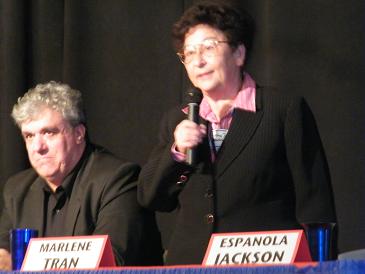
D. 10 candidate Marlene Tran, who speaks Cantonese, Mandarin, understands Vietnamese and has taught English as a Second Language for 37 years, told the Guardian she has been working on community safety issues for 20 years. Tran also said that she recently did a bilingual survey in light of a wave of violence against seniors on the Third St. corridor.

“I have daily contact with students and residents, so I have my finger on the pulse of the community as a whole,” Tran said. “It’s a battleground out there, but for a long time no one knew about it, because many of the victims are not English speaking.”

“We want to be an integrated community,” Tran continued, “and seniors should have the flexibility to move around, but many of them don’t dare go out after 4 p.m., unless they are escorted, so having this program is a step in the right direction. Some of these cases are never reported. We need to encourage residents to be more proactive.”

Details of how the program will be funded and how long it will last remain sketchy at this point. Sharen Hewitt, founder of the Community Leadership Academy and Emergency Response Project (CLEAR), told the Guardian that she pitched the concept of having monitors on the bus some months ago, during her last meeting with Board President David Chiu and Sup. Carmen Chu.

“I suggested we take money from Trent Rohrer’s Jobs Now program to pay for it,” Hewitt said. “I also suggested we go to developers in the Bayview and engage them in a constructive conversation about donating dollars to help with translation services.”

Gascon and 12 ambassador staff will be present to speak about the program at today’s press conference, which takes place at 2:45 p.m. at 2574 San Bruno Ave.


The deal is done

1

Mayor Gavin Newsom was quick to frame the Board of Supervisors’ 10-1 vote for Lennar Corp.’s massive redevelopment proposal for Candlestick Point-Hunters Point Shipyard on July 27 as a sign that plans to revitalize the Bayview are about to begin.

“Now we can truly begin the work of transforming an environmental blight into a new center of thousands of permanent and construction jobs, green technology investment, affordable housing, and parks for our city,” Newsom claimed in a prepared statement after the board (with Sup. Chris Daly as the lone dissenter) approved Lennar’s 700-acre project.

The proposal calls for 10,500 residential units; 320 acres of parks, retail and entertainment facilities, green-tech office space; and a San Francisco 49ers stadium if the team decides not to move to Santa Clara.

But Kofi Bonner, who worked for Mayor Willie Brown before becoming Lennar’s top Bay Area executive in 2006, said the vote means he can start shopping the plan around. “Now we have to find some money to move forward with the project,” Bonner told the San Francisco Chronicle.

Given the stubbornness of the recession, Bonner’s revelation that Lennar has yet to find all the necessary investors means local workers and public housing residents could be waiting a long time for jobs and housing in Bayview. If and when the project finally breaks ground, it will involve building condos in the Bayview’s only major park.

These realities undermine the claims of Lennar, which used the mantra of “jobs, housing, and parks” in 2008 to sell Proposition G but made no mention of a bridge over environmentally sensitive Yosemite Slough or selling state parkland for condos.

Also disturbing, says Sierra Club local representative Arthur Feinstein, is the lack of any economic analysis to support Lennar’s claims that the bridge is needed.

Indeed, the only thing clear to longtime observers of the plan is that the much vaunted jobs won’t happen soon, most of the housing will be unaffordable to current Bayview residents, and Candlestick Point State Recreation Area, the only major open space in the Bayview, will be carved up so Lennar can build luxury condos on waterfront land.

These concerns have led the Sierra Club to threaten a lawsuit over issues on which Board President David Chiu was the swing vote in favor of the Lennar and Redevelopment Agency plan. Yet Chiu told the Guardian that the process got him thinking that it might be time to reform the redevelopment process.

“Now might be a good time to address concerns about the potential for inconsistency between Redevelopment and the city when it comes to land use and planning visions,” Chiu said. “And I have concerns about the tax increment financing process.” Tax increment financing allows the Redevelopment Agency to keep all property tax increases from the project, up to $4 billion, to use in redevelopment projects rather than into city coffers.

Chiu says the amendment he offered July 12, which narrows Lennar’s proposed bridge over Yosemite Slough by half, was based “on the belief that having a connection between jobs and housing is important. And I had understood that it would cost the developer an additional $100 million if the bridge was removed.”

But Feinstein counters that it’s hard to imagine that building a bridge over an environmentally sensitive slough will attract investors that support green technology. He is concerned that the development is expected to attract 24,465 new residents but that the Lennar plan fails to mitigate for transit-related impacts on air quality. “The Bayview already has the highest rates of asthma and cancer in the city,” Feinstein said.

Chiu says the supervisors can introduce separate legislation to address this concern. “It’s my understanding that an air quality analysis could be implemented by the board,” he said.

Although the board’s July 27 vote was a relief for termed-out Sup. Sophie Maxwell, its failure to support the no-bridge alternative, increased affordability standards, and an air quality analysis could result in expensive and time-consuming litigation, Feinstein warns.

And although Sups. Chris Daly, Ross Mirkarimi, David Campos, John Avalos, and Eric Mar supported all three of these amendments, they were ultimately thwarted by a redevelopment law that limits the city’s control of such projects.

During the meeting, Daly acknowledged that it would be impossible for Lennar to meet his 50 percent affordability amendment. But he noted that if the project becomes too expensive “there’s going to be a pretty new neighborhood with lots of white folks living in the Bayview.”

But after Michael Cohen, Newsom’s top economic advisor, said the project would not be financially viable with 50 percent affordability, Sups. Chiu, Maxwell, Bevan Dufty, Michela Alioto-Pier, Carmen Chu, and Sean Elsbernd voted against Daly’s amendment.

These same six supervisors voted against Mirkarimi’s proposal to eliminate plans for a bridge across Yosemite Slough, even though Cohen was unable to point to any economic analysis to support Lennar’s claims that the bridge is necessary.

Arc Ecology owner Saul Bloom, whose nonprofit did studies indicating that an alternative route wrapping around the slough is feasible, says Lennar’s plan illustrates the problem that San Francisco has with development. “Elected officials couldn’t do anything,” he said, except give the nod to a plan he describes as “developed by a mayoral administration and approved by that mayor’s political appointees [on the Redevelopment Agency board],” Bloom said.

“The message that the environmental community takes away from all this is that it doesn’t pay to play well,” Bloom continued. “No matter how much you spend to try and ensure that litigation is not the only way to obtain the desired outcome, ultimately the message that comes back from the city and the developer is ‘sue us!’ That brings out the worst political conduct, not the most appropriate.”

Feinstein wouldn’t confirm that a Sierra Club lawsuit is imminent, but predicted that if the coalition — which includes Golden Gate Audubon, the California Native Plant Society, and SF Tomorrow — goes to court, it’s likely to win. “If we do litigate, we’ll probably do it on a wide range of issues,” Feinstein said. “They approved a fatally flawed document, and they could provide no documented evidence of the need for a bridge — and admitted that publicly.”

Feinstein contends that Lennar’s plan has been a runaway project from the get-go. “The idea was to march it through before the mayor is gone with little regard for process. And despite all the much vaunted public meetings, little in the plan has changed,” he said.

Feinstein added that he was disappointed in Chiu’s stance on the bridge. “There were five supervisors in the Newsom camp, but as board President, Chiu had a responsibility to be more vigilant,” he said. “We told him what’s wrong with the bridge plan, but he didn’t share our view.”

“This is a rare opportunity,” Maxwell said before the board’s final vote. “It focuses public and private investment into an area that has lacked it in the past. It’s unmatched by any development project in San Francisco. This project is large and complicated, no doubt. But let us not be fearful of this project because of its scale, because how else can we transform a neglected landscape?”

But project opponents say everyone should fear a deal that required the board to ask Lennar’s approval to amend a plan that was pitched by the Newsom administration and approved by a bunch of mayoral appointees on the Redevelopment Commission with little chance for elected officials to make changes.

Mirkarimi said the problem with a process in which redevelopment law trumps municipal law is that it creates a shadow government in those few municipalities in California where the Board of Supervisors or City Council is not the same entity as the Redevelopment Commission.

“This is not the first time Redevelopment’s plans have trumped the concerns of local residents,” Mirkarimi said, referring to the agency’s botched handling of the Fillmore District in the 1960s, which led to massive displacement of African and Japanese Americans.

“I’ve been told, ‘Don’t worry, Ross, this is not going to happen, we’re not going to use eminent domain.’ Well, jeez, that’s a consolation, because even when we’ve exercised our legislative influence and given our blessing, [Redevelopment] unilaterally changed the plan after it left the board,” Mirkarimi said, referring to Lennar’s decision to replace rental units with for-sale condos when it first began work on the shipyard in 2006. “That suggests a condescending role in which the developer is able to go to the Redevelopment Commission and make a unilateral change.”

Mirkarimi’s concerns seemed justified after Cohen, Bonner, and Redevelopment Director Fred Blackwell huddled in a corner of City Hall during the board’s July 27 meeting to decide which of the supervisors’ slew of amendments they would accept. When Cohen returned with the amendments organized into three categories (acceptable as written, to be modified, and completely unacceptable), Mirkarimi’s no-bridge amendment had been sorted into the “unacceptable” pile.

“With regard to your insistence on the economic reasons [for the bridge], please point to which document says that,” Mirkarimi said, leafing in vain through the project materials.

Cohen mentioned “a lessening of attractiveness,” “a lower-density product,” and a reduction of revenue available through tax increment financing to pay for the bridge.

“Yes, but I’m still trying to look for the information and all I’m hearing is this pitch,” Mirkarimi said. “The economic study is absent. There are no supporting documents here. This is why I feel it’s justified for us to have a review of this.”

Cohen rambled on about “rigorous public discussion over a number of years” and claimed that a “huge amount of studies had been done.”

“But there is no economic study,” Mirkarimi repeated.

The board then voted 6-5 against Mirkarimi’s amendment after deputy City Attorney Charles Sullivan said that the only way to remove the bridge — since the project’s environmental impact report had rejected that option — would be to reject the entire plan. “I wish we had been able to eliminate the bridge,” Campos told the Guardian after the vote. “Part of the challenge we have is to reexamine how Redevelopment works and explore the potential for taking it over.”

Daly believes the bridge has nothing to do with connecting the neighborhood to the city. “The idea is to allow white people to get the fuck out of the neighborhood,” he said. “And it connects a different class of people to a new job without having to go through a low-income community of color. That’s why the bridge is needed.”

Mirkarimi said he was satisfied that he had dissected the arguments against the no-bridge alternative but fears that institutional memory is lacking on the current board. “A lot of my colleagues have not been involved in the debacle,” he said, referring to decades of problems with redevelopment in San Francisco. But Maxwell was all smiles. “I did my homework a long time ago — that’s why they couldn’t touch the core of the project,” she said. “They just added to and augmented it.”

The politics of unity and division

7

steve@sfbg.com

These are strange days for the San Francisco Democratic Party, which is seeking to overcome bitter divisions on the local level and come together around candidates for statewide office that include Mayor Gavin Newsom, whose fiscal conservatism and petulant political style are the main sources of that local division.

The tension has played out recently around the Board of Supervisors deliberations on the new city budget and November ballot measures and in dramas surrounding the newly elected Democratic County Central Committee, where the battles during its July 28 inaugural meeting previewed a more significant fight over local endorsements coming up Aug. 11.

Almost every elected official in San Francisco is a Democrat. Newsom, the Democratic nominee for lieutenant governor, has been the main obstacle to new taxes that progressives and labor leaders say are desperately needed to preserve public services, deal with massive projected deficits in the next two years, and quit balancing budgets on the backs of workers.

“We balanced the budget without raising taxes. I don’t believe in raising taxes. We don’t need to raise taxes,” Newsom said proudly at his July 29 budget signing ceremony, during which he also effusively praised the labor unions whose support he needs this fall: “Labor has been under attack in this state and country. They’ve become a convenient excuse for our lack of leadership in Sacramento and around the country.”

That hypocritical brand of politics has been frustrating to his fellow Democrats, particularly progressive supervisors and DCCC members. At the July 27 board meeting, Sup. Ross Mirkarimi and Board President David Chiu reluctantly dropped their pair of revenue measures that would have raised $50 million, bowing to opposition by Newsom and the business community.

The San Francisco Chamber of Commerce has become such a vehicle for antitax and antigovernment vitriol that the DCCC on July 29 approved a resolution calling for the organization — which hosted a speech by Republican National Chair Michael Steele in June — to renounce the platform of the Republican National Committee.

“The Chamber is not a knee-jerk right-wing organization,” Chamber President Steve Falk felt compelled to clarify in a July 28 letter to DCCC Chair Aaron Peskin, closing with, “Anything you can do to avoid painting the Chamber as a pawn of the GOP would be greatly appreciated — because it just isn’t true.”

Yet Rafael Mandelman, who sponsored the resolution and is a progressive supervisorial candidate in District 8, told us the Chamber’s fiscal policies are indistinguishable from those pushed by Republicans. “They’re the leading force pushing the Republican agenda in San Francisco,” Mandelman said, calling the stance short-sighted. “It’s not in the long-term interests of the business community for our public sector to fall apart.”

Chiu’s business tax reform measure is a good example of how conservative ideology seems to be trumping progressive policy, even among Democrats. Only 10 percent of businesses in the city pay any local business tax, and the measure would increase taxes on large corporations, lower them on small businesses, create private sector jobs, bring $25 million per year into the city, and expand the tax burden to 25 percent of businesses, including the large banks, insurance companies, and financial institutions that are now exempt. But even the Small Business Commission refused to support the plan, prompting Chiu to drop the proposal and tell his colleagues, “There is still not consensus about whether this should move forward.”

Sup. Chris Daly, the lone vote against the budget compromise with Newsom and the removal of revenue measures from the November ballot, noted at the July 27 board meeting how the business community has sabotaged city finances, citing its 2002 lawsuit challenging the gross receipt taxes, which the board settled on a controversial 8-3 vote. “This is a large part of our structural budget deficit,” Daly said.

But antitax sentiment has only gotten worse with the current recession and political dysfunction, causing Democrats like Newsom to parrot Republicans’ no-new-taxes mantra, much to the chagrin of progressives.

“A lot of this is being driven by statewide politics. [Newsom] needs to not have taxes go up but he also needs the support of the labor unions, so we get weird stuff happening in San Francisco,” Mandelman said.

The situation has also fed Newsom’s animus toward progressives, who have enjoyed more local electoral success than the mayor. Newsom responded in June to the progressive slate winning a majority on the DCCC by placing a measure on the November ballot that would ban local elected officeholders from serving on that body, which includes four progressive supervisors and three supervisorial candidates.

Nonetheless, Newsom then unexpectedly sought a seat on the DCCC, arguing that his lieutenant governor nomination entitled him to an ex officio seat (those held by state and federal elected Democrats) even though the DCCC’s legal counsel disagreed. While noting the hypocrisy of the request, Party Chair Aaron Peskin took the high road and proposed to change the bylaws to seat Newsom.

Some progressives privately groused about giving a seat to someone who, as DCCC member Carole Migden said at the meeting, was “picking a fight” with progressives by pushing a measure she called “disrespectful and unconstitutional.” But in practice, the episode seems to have hurt Newsom’s relations with progressives without really strengthening his political hand.

Newsom ally Scott Wiener — a DCCC member and District 8 supervisorial candidate (who told us he opposes the mayor’s DCCC ballot measure) — proposed to amend Peskin’s motion to change the bylaws in order to seat Newsom with language that would allow Newsom to continue serving even if he loses his race in November.

That amendment was defeated on a 17-13 vote that illustrated a clear dividing line between the progressive majority and the minority faction of moderates and ex officio members. Even with Newsom and District Attorney Kamala Harris (who was seated as the Democratic nominee for attorney general) being seated — and counting the one absent vote, Sen. Leland Yee, who is expected to sometimes vote with progressives and sometimes with moderates — progressives still hold the majority going into the process of endorsing local candidates and allocating party resources for the fall campaign.

“Presuming that 17 people of that 33-member body all agree on something, then the presence of Mayor Newsom doesn’t change anything,” Peskin said. He also noted that even if Newsom’s measure passed and the progressive supervisors were removed, “the irony is that the chair of the party [Peskin] would appoint their successors.”

Also ironic is the political reality that it is Newsom who most needs his party’s support right now, while it is progressives who are adopting the most conciliatory tone.

“We should all be working to turn out the vote and help Democrats win,” Peskin told us. “I implore our mayor and lieutenant gubernatorial candidate to work with us and get that done.”

Yet after Newsom gave a budget-signing speech that included the line, “At the end of the day, it comes down to leadership, stewardship, collaboration, partnership,” he told the Guardian that he has no intention of removing or explaining his DCCC ballot measure, saying only, “If the voters support it, then it would be the right thing to do.”

Chiu responded to the news by telling us, “I hope the mayor can move beyond the politics of personality and build a party vehicle that is about unity.”

Newsom’s budget and DCCC hypocrisy

9

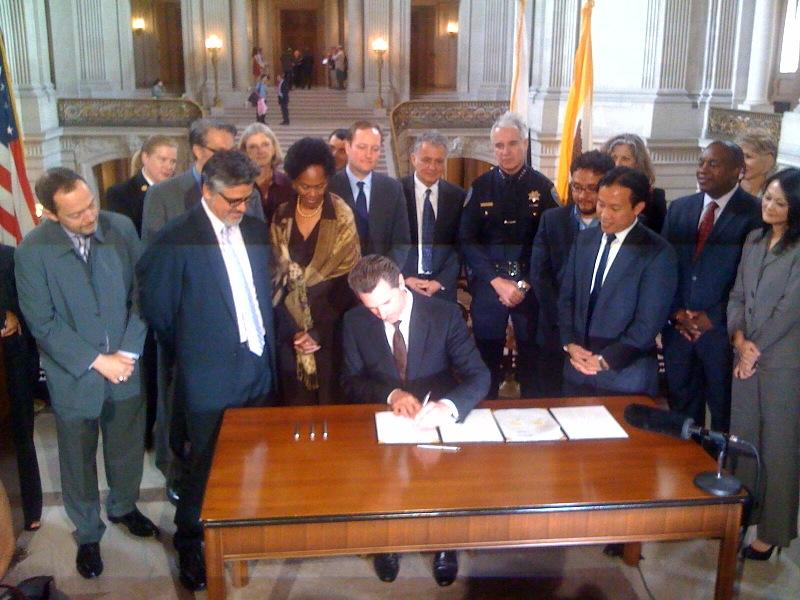
Hypocrisy hung thickly in the air at City Hall today as Mayor Gavin Newsom refused to responsively address glaring contradictions on a pair of high-profile policy stances, pursuing naked self interest while cloaking himself in deceptive but high-minded rhetoric. Newsom used the city budget-signing ceremony to effusively praise the labor unions that he publicly shamed into giving back $250 million over two years to balance the budget without tax increases, a budget that cut services and increased various fees and fines.

“Labor has been under attack in this state and country. They’ve become a convenient excuse for our lack of leadership in Sacramento and around the country,” Newsom said without blushing, defending unions against pension reform measures such as Public Defender Jeff Adachi’s SF Smart Reform, which he opposes while continuing to support the need for pension reform.

But Newsom seemed unaware that the layoffs, forced furloughs, and voluntary pay cuts accepted by the unions that he publicly demonized just a couple months ago and now praises – whose support he needs for his current run for lieutenant governor – is connected to his steadfast opposition to new taxes, which he reiterated today: “We balanced the budget without raising taxes. I don’t believe in raising taxes, we don’t need to raise taxes.”

Despite the fact that just 10 percent of San Francisco businesses pay any business taxes to the city, Newsom opposed and this week helped kill a measure by Board President David Chiu to reform the business tax system in a way that would increase taxes on large corporations, lower them on small businesses, create private sector jobs, bring $25 million per year into the city, and expand the tax burden to 25 percent of businesses, including the large banks, insurance companies, and financial institutions that are now exempt. Instead, labor took a deep hit and the city still faces projected $500 million budget deficits each of the next two fiscal years.

But Newsom’s hypocrisy isn’t confined fiscal issues. After the ceremony, he told reporters that he was sticking by his November ballot measure to ban local elected officials from serving on the Democratic County Central Committee, even after last night insisting that body give him a seat, which they had to change the bylaws to accommodate.

At last night’s DCCC meeting, members of an elected committee that includes four progressive supervisors and three current supervisorial candidates called for Newsom or his proxy John Shanley to explain why he is pushing a policy to ban locally elected officials from serving on the DCCC, a body in which elected state and federal officials automatically get seats.

“This mayor is on record as saying local officials should not serve on the committee,” Sup. David Campos said at the meeting, calling for Newsom to clarify this policy contradiction and offer his reasoning for the policy: “We don’t want to do anything that is inconsistent with what the mayor has said so far.”

Chair Aaron Peskin translated Campos’s comments as indicating “some level of irony or hypocrisy,” but Campos objected, insisting “it’s not a personal attack” but a genuine desire to know why Newsom sought to ban local elected officials after progressives won a majority of the DCCC seats in June.

Both Shanley last night and Newsom today gave the same legalistic answers, noting that he’s not serving in his capacity as the mayor, but as an ex officio member who automatically gets a seat for being the Democratic nominee for a statewide office (although the DCCC legal counsel said Newsom wasn’t entitled to a seat because the bylaws only award a seat when the current holder of the office being sought is a Democrat).

But DCCC member Carole Migden objected to Shanley’s answer, saying of Newsom’s effort to unseat duly elected members, “That’s picking a fight, if we want to be clear…That effects my vote, I have to say. It’s disrespectful and unconstitutional.”

DCCC member David Chiu noted that Newsom’s ballot measure would explicitly ban supervisors and the mayor from serving on the DCCC and said that the mayor still had a few days before the deadline for him to withdraw the measure, which he single-handedly placed on the ballot using his authority as mayor.

But today, when asked by the Guardian, Newsom said he had no intention of either withdrawing the measure or explaining it to the DCCC. When we asked about the contradiction in his positions, Newsom said only, “If the voters support it then it would be the right thing to do.”

He was similarly dismissive when other reporters continued to ask about the controversy, gesturing toward me with a dismissive wave of his hand as he said, “Certain people with certain newspapers major in the minor.”

After being told that Newsom is sticking by his DCCC ballot measure, Chiu told us, “I hope the mayor can move beyond the politics of personality and build a party vehicle that is about unity.”


Herrera’s right to appeal the Alioto-Pier decision

5

I’m not exactly sure what Ken Garcia was trying to say here — his argument is rambling and makes no sense — but Dennis Herrera really had no choice: He had to appeal the Alioto-Pier decision.


The Superior Court ruling in the case screws up the city’s term-limits law. It’s not clear now, for example, when Sup. Carmen Chu will be termed out. It’s not clear whether the mayor can appoint someone midway into a vacant term and essentially give that person an extra two years on the board. And one ruling from one Superior Court judge doesn’t clarify the law (which the judge acknowledged was at the very least ambiguous) or set a binding precedent.


When the voters approved district elections, they also approved term limits; everyone gets two four-year terms. But under Judge Peter Busch’s decision, that’s no longer true.


Suppose, for example (and this is a wild scenario, but such things happen in local politics) that Gavin Newsom gets elected lieutenant governor (entirely possible) and in January, the newly elected supervisors choose the next mayor. Here’s what happens: The board president becomes interim mayor until somebody lines up six votes.


So let’s say (and this just happened with David Chiu) that one of the newly-elected, first-time supervisors — Debra Walker, or Rafael Mandelman, or Scott Weiner, or Jane Kim, or someone else — lines up six votes and becomes board president, and thus mayor. Then he or she immediately appoints a successor as supervisor. That person gets a free four-year term that doesn’t count against term limits at all.


So the city needs clarity, and the only way to get it is to ask the Appeals Court to weigh in. And if it turns out that the current law does, indeed, set a double standard, and that appointed supervisors get special treatment, then the board needs to be a Charter amendment on the ballot fixing the problem.


If Sup. Alioto-Pier wants to claim this is just politics, let’s remember: She’s already run for Congress, for secretary of state, and was planning to run for insurance commissioner until she fell ill this spring. Now that nothing else has worked out, she wants another term on the board. She has every right to challenge Herrera’s opinion, but asking him to apologize is wrong; he’s just doing his job.

Board progressives ditch their own tax measures

5

After failing to win support from the small business community for a measure that would have helped it and fearing a well-funded attack from large corporations, Board of Supervisors President David Chiu today made the motion to reject his business tax reform ballot measure.
Labor leaders have also raised concerns about not having enough resources to fight for several revenue measures on the November ballot, mostly because they are focused on approving a hotel tax increase, supporting progressive supervisorial candidates, and defeating Jeff Adachi’s measure to increase how much city employees pay for health care and into their pensions.
“There is still not consensus about whether this should move forward,” Chiu said of his measure, which also suffered from being complicated and not easy to explain in an election campaign. It would have created a more progressive payroll tax structure – increasing taxes on large corporations and lowering them on small businesses – and a commercial rent tax that also would have exempted small businesses, raising about $25 million for the city and creating hundreds of private sector jobs, according to the city’s Office of Economic Analysis.
But the fear among some progressives is that too many revenue proposals would hurt their individual chances, given that the ballot will now include a hotel tax increase, a real estate transfer tax on properties worth more than $5 million (which the board approved today on an 8-3 vote), a $10 local surcharge on vehicle license fees, and a parcel tax from the Community College District.
So Sup. Ross Mirkarimi today also abandoned his proposal to increase the city’s parking tax from 25 percent to 35 percent, which would have raised about $25 million per year. Both Chiu and Mirkarimi said their measures were good policy and would have raised desperately needed revenue, but they were bowing to political reality.
“We’re challenged by the practicality of mounting a fall campaign around these revenue measures,” Mirkarimi said at the meeting.
The board voted 10-1 to table both measures, with a dissenting vote by Sup. Chris Daly, who said, “I just disagree with that political analysis.” He said voters would consider the measures individually and “I don’t think disappearing a progressive payroll tax and progressive parking tax are going to help the real estate transfer tax.”

City Hall standoff

0

steve@sfbg.com

Backroom politics, vote-trading, threats, and tricky legislative maneuvering marked — some would say marred — the approval of the city’s 2010-11 budget and a package of fall ballot measures.

For weeks, Mayor Gavin Newsom had been threatening to simply not spend the roughly $42 million in budgetary add-backs the supervisors had approved July 1, mostly for public health and social services, unless they agreed to withdraw unrelated November ballot measures that Newsom opposes (see "Bad faith," July 14).

The board’s July 20 meeting included a flurry of last-minute maneuvers interrupted by an hours-long recess during which Newsom, Board President David Chiu, and their representatives negotiated a deal that was bristled at by progressive supervisors and fiscal conservative Sup. Sean Elsbernd.

Ideological opposites Elsbernd and Sup. Chris Daly voted against motions to delay consideration of several measures — including splitting appointments to the Rent, Recreation and Park, and Municipal Transportation Authority boards; revenue measures; and requiring police foot patrols — until after approval of the city budget.

"What is the connection between [seismic retrofit] bonds and the budget?" Elsbernd asked as Budget Committee chair John Avalos made the motion to delay consideration of the $46 million general obligation bond Newsom proposed for the November ballot.

Avalos made an oblique reference to "other meetings" that were happening down the hall. Daly then criticized the maneuver, noting that "vote trading is illegal," later citing a 2006 City Attorney’s Office memo stating that supervisors may not condition their votes on unrelated items.

But that didn’t stop supervisors from engaging in a complex, private dance with the Mayor’s Office and other constituencies that day. In the end, the board approved the budget on a 10-1 vote, with Daly in dissent. Then Chiu provided the swing vote to kill the progressive proposal to split with the mayor appointments to the Recreation and Park Commission, with Sups. Daly, Avalos, Ross Mirkarimi, David Campos, and Eric Mar on the losing end of a 5-6 vote to place the measure on the fall ballot.

A measure to split appointments to the Rent Board was defeated on a 10-1 vote, with Daly dissenting, although that seems to be tactical concession by progressives. Campos, who sponsored the measure, said landlord groups were threatening an aggressive campaign against the measure that would also seek to tarnish progressive supervisorial candidates.

Removal of an MTA reform measure from the ballot, another mayoral demand, was also likely at the July 27 meeting (held after Guardian press time). Chiu told his colleagues July 20 that he was still negotiating with the mayor on implementing some of its provisions without going to the ballot this year.

Chiu rejected the notion that he cut an inappropriate budget deal, saying he was concerned the split appointment measures would be portrayed as a board power grab, noting that community groups need the funding that Newsom was threatening to withhold, and saying the board’s threats not to fund Newsom’s Project Homeless Connect facility and Kids2College Savings program were also factors in the deal.

"We were engaged with a number of conversations, they all took time, and we didn’t finish until very late," Chiu told us.

Even Daly acknowledged supervisors had few options to counter Newsom’s threats, but told us, "It’s just not the way we should be doing things."

The decision on three revenue measures (a parking tax increase, property transfer tax, and business tax reform) was set for July 27, with sources telling the Guardian that only one or perhaps two would make it onto the ballot. Newsom opposes all of them. Also hanging in the balance was Mirkarimi’s ballot measure requiring police to do more foot patrols, as well as another version in which Chiu added a provision that would invalidate the Newsom-backed ordinance banning sitting or lying on sidewalks, a retaliation for Newsom inserting a similar poison pill in his hotel tax loophole measure that would invalidate the hotel tax increase that labor put on the ballot if it gets more votes.

But most of the action was on July 20. The Transportation Authority (comprised of all 11 supervisors) voted 8-3 (with Chiu, Avalos, and Mar opposed) to place a $10 local vehicle license fee surcharge on the ballot, which would raise about $5 million a year for Muni. A Daly-proposed ballot measure to create an affordable housing fund and plan failed on 4-7 vote, with only Campos, Mar, and Chiu joining Daly.

There were some progressive victories as well. A charter amendment by Mirkarimi to allow voters to register on election day was approved 9-2, with Elsbernd and Alioto-Pier in dissent. A Chiu-proposed measure to allow non-citizens to vote in school board elections was approved 9-2, with Elsbernd and Carmen Chu voting no. And a Daly-proposed charter amendment to require the mayor to engage in public policy discussions with the board once a month was approved 6-5, opposed by Dufty, Alioto-Pier, Elsbernd, Maxwell, and Chu.

But the busy day left some progressives feeling unsettled. "How do you do this and not be trading votes?" Campos told us. "In the end, we’re saving programs, but what does it say about the institution of the board?"

Newsom spokesperson Tony Winnicker denied that the mayor made inappropriate threats, but confirmed that a deal was cut and told us, "Yes, the Mayor made his concerns about the budget clear. Yes, the mayor made his concerns about the charter amendments clear."

Quezada says don’t let “perfect” stand in way of immigration reform

9

The SF Bay Area Coalition for Immigration Reform is organizing a rally, Wednesday July 28 at 4 p.m., at the new federal building in San Francisco, at 90 7th Street at Mission to ask Speaker of the House Nancy Pelosi to help fix the nation’s broken immigration system.

The rally occurs hours before Arizona’s harsh new law, SB 1070, is set to go into effect. Members of the local clergy will be on hand to bless local immigrant families that are facing deportation. The protest kicks off an action-packed 24 hours, with activities planned in San Francisco, Oakland, and beyond.

“Arizona’s unworkable law threatens both our safety and our ideals. And it’s a symptom of a tragically broken immigration system at the national level,” said Eric Quezada of Dolores Street Community Services in a press release that notes that thanks to federal inaction on reform, “1,100 deportations happen every day.”

“Wednesday’s rally is not a protest of Speaker Pelosi, but we want to make sure she hears from her constituents who are suffering as a result of this broken system,” Quezada said. “And we’re calling on her to exercise leadership so we can work towards real solutions that reflect our values of fairness and community.”
 
With confirmed speakers including Board President David Chiu, I asked Quezada, who heads Dolores Street Community Services, how ICE’s new Secure Communities, or SecureComm, program is impacting deportation rates locally and what he hopes will happen on the immigration front this year.

“There has definitely been an increase,” Quezada said, referring to a recent SecureComm audit that was presented to the San Francisco Police Commission a month after the federal-state-local database hook-up got switched on, linking previously separate records.
“Part of our ask with this action is that Pelosi take a more active role,” Quezada continued, noting that Congressmember Zoe Lofgren has done much of the research.

Arizona’s SB 1070 is set to go into effect on Thursday, July 29. But it faces seven lawsuits, including a challenge from the US Department of Justice (DOJ). Several of the suits call for an injunction against the law. A federal judge in Phoenix heard arguments last week, but has not released any decision to date.

“We welcome the lawsuit that DOJ put in,” Quezada said. “At the same time, the Obama administration is rolling out SecureComm across the nation and we still have 287(g) programs in place. So, if the Arizona law gets implemented, it will be a really tragic day in U.S. history.”

To fix the current immigration system, rally organizers are advocating measures that would halt dangerous police-ICE collaboration programs, and would serve as a first step toward comprehensive reform. These include the DREAM Act, which offers a pathway to legal status for immigrant students, and a just and humane immigration reform that brings immigrant community members out of the shadows.

Quezada feels that Obama currently appears to be resisting bringing administrative relief forward, but he’s not exactly sure why the President is holding his cards back, or when he plans to lay them out on the table.
“But we know that pressure is building on a couple of fronts, prior to the November elections,” Quezada added. “Folks are going to see a lot of immigrant rights groups calling on members to register to vote. And we are going to support those who support us, oppose those who oppose us, and those sitting on the fence will get nothing. That’s a message that a lot of swing Democrats need to hear.”

With the 2012 presidential election approaching (in terms of campaigning and fund raising), Quezada observes that the Latino vote played a significant role in electing Obama in 2008.
“So, every day that there is no movement on this front in D.C., Obama loses strong support from the immigrant community. But we also know that pressure from the right sometimes holds more sway than ours.”

Quezada says the immigrant community is frustrated because it’s almost two years since Obama got elected, in part because of his promise to bring millions of undocumented immigrants out of the shadows. But to date, the Obama administration has not created a mechanism to even allow people to start getting in line to legalize their status.

‘There is no line to wait in,” Quezada said. “All these folks would be willing to wait in line, but there isn’t one for these 11 million people. We need legislative fixes.”

Quezada acknowledges that many Republicans will try to stop or amend any such fixes in unacceptable ways.

“We are worried that if the Dream Act goes ahead as a stand-alone bill, the right will try and put harsh enforcement measures into the bill,” Quezada said. “So, we have to ask, are we willing to live with that, if it helps 11 million people? How about, if it only helps 2 million? These are the questions the Hispanic Caucus is conflicted about. But what if we end up with amendments that would really hurt and the bill only helps 2 million people?”

With immigrant advocates arguing that comprehensive immigration reform would translate into $1.5 trillion in cumulative U.S. gross domestic product, the fireworks over the Arizona law and similar efforts in other states, aren’t about to stop soon.

But Quezada warns folks against insisting on an ideologically pure approach if they want to win this particular war.

‘If our position is open borders and legalization for everyone, then it won’t be obtainable, and we’d be leaving a lot of people in the lurch,” Quezada said We need 270 votes in the Senate and Congress, and we want relief for our people. We can no longer count on our sanctuary city to protect us. And the second we stop paying attention to this issue, they’ll eliminate some other piece of [existing protections and services for immigrants]. A lot of groups don’t want to engage in legislation that isn’t perfect. But only from a unified front will anything get done.”

With that aim in mind, Quezada says that immigrant advocates must work with evangelical churches and Republicans who are willing to support a reform package.
“Evangelical churches may sound like an unlikely ally, but we have to work with them, it’s the responsible thing to do. And we need to win and gain some Republican support, at least enough votes to get to the 60-vote threshold.”


                                                                              .
 

The mayor’s horrible deal

0

EDITORIAL Mayor Gavin Newsom put the supervisors in a terrible position — and showed the worst kind of political arrogance — when he held $43 million worth of critical services hostage to his desire to continue packing commissions with political hacks. The deal he presented to the board was shameful, and the supervisors should have rejected it. And now they should pass legislation to make this sort of logrolling illegal.

The mayor’s original budget plan included sharp cuts to a wide range of services. The supervisors’ Budget Committee found a way to add back more than $40 million in funding for things like psychiatric beds at SF General Hospital, violence-prevention programs, and public financing for the next mayor’s race.

But under the City Charter, the mayor can simply refuse to spend that money — and that’s what Newsom said he would do. That is, unless the board would agree to reject two proposed charter amendments to reform the Municipal Transportation Agency and the Recreation and Park Commission.

Let’s remember: the MTA and Rec-Park measures have nothing to do with the budget. The board wanted to overhaul those departments (and give the board some appointments) because they’re a mess; the Rec-Park Commission, appointed entirely by the mayor, is a rubber-stamp agency that votes with nearly 100 percent unanimity on every issue. The MTA has served as a slush fund for the police department at a time when bus lines are cut and fares keep going up.

Newsom told board members that he could, indeed, restore the funding they wanted; the money was there. But he wouldn’t. In other words, he would allow desperately ill people to be turned away from SF General for lack of a bed — if the board didn’t stand down on its reforms. And by a 6-5 margin, with Board President David Chiu providing the critical vote for the mayor’s agenda, the board went along with the deal.

Even worse: Chiu and his colleagues gave up their charter amendments. But the mayor didn’t give up his: a Newsom measure that would prevent elected officials (like Chiu) from serving on the Democratic County Central Committee is still on the ballot.

Five of the progressives on the board hung tough, and Sups. John Avalos, David Campos, Chris Daly, Eric Mar, and Ross Mirkarimi deserve credit for refusing to accept a bad, embarrassing deal.

But in the end, the board got rolled. The mayor played tough and a majority of the supervisors folded. If a supervisor proposes trading one piece of legislation for another, it would violate state law. That doesn’t apply to the mayor — but it should. The board should immediately pass legislation outlawing vote trading for all local elected officials, including the chief executive. Let’s see if Newsom wants to veto that.

The mayor’s horrible deal

0

The Supervisors should pass legislation outlawing vote trading for all local elected officials, including Newsom

EDITORIAL Mayor Gavin Newsom put the supervisors in a terrible position — and showed the worst kind of political arrogance — when he held $43 million worth of critical services hostage to his desire to continue packing commissions with political hacks. The deal he presented to the board was shameful, and the supervisors should have rejected it. And now they should pass legislation to make this sort of logrolling illegal.

The mayor’s original budget plan included sharp cuts to a wide range of services. The supervisors’ Budget Committee found a way to add back more than $40 million in funding for things like psychiatric beds at SF General Hospital, violence-prevention programs, and public financing for the next mayor’s race.

But under the City Charter, the mayor can simply refuse to spend that money — and that’s what Newsom said he would do. That is, unless the board would agree to reject two proposed charter amendments to reform the Municipal Transportation Agency and the Recreation and Park Commission.

Let’s remember: the MTA and Rec-Park measures have nothing to do with the budget. The board wanted to overhaul those departments (and give the board some appointments) because they’re a mess; the Rec-Park Commission, appointed entirely by the mayor, is a rubber-stamp agency that votes with nearly 100 percent unanimity on every issue. The MTA has served as a slush fund for the police department at a time when bus lines are cut and fares keep going up.

Newsom told board members that he could, indeed, restore the funding they wanted; the money was there. But he wouldn’t. In other words, he would allow desperately ill people to be turned away from SF General for lack of a bed — if the board didn’t stand down on its reforms. And by a 6-5 margin, with Board President David Chiu providing the critical vote for the mayor’s agenda, the board went along with the deal.

Even worse: Chiu and his colleagues gave up their charter amendments. But the mayor didn’t give up his: a Newsom measure that would prevent elected officials (like Chiu) from serving on the Democratic County Central Committee is still on the ballot.

Five of the progressives on the board hung tough, and Sups. John Avalos, David Campos, Chris Daly, Eric Mar, and Ross Mirkarimi deserve credit for refusing to accept a bad, embarrassing deal.

But in the end, the board got rolled. The mayor played tough and a majority of the supervisors folded. If a supervisor proposes trading one piece of legislation for another, it would violate state law. That doesn’t apply to the mayor — but it should. The board should immediately pass legislation outlawing vote trading for all local elected officials, including the chief executive. Let’s see if Newsom wants to veto that.

Lennar’s plan illustrates San Francisco’s redevelopment problem

9

Today, the Board of Supervisors confirmed that though they are elected officials, they have been told that they can’t do anything except second a massive redevelopment plan for the Bayview that was developed, first by Mayor Willie Brown and then by Mayor Gavin Newsom’s administrations. in cohoots with Lennar, an out-of-state private developer, and approved by a bunch of Brown and Newsom’s political appointees.


“At this point, a deal has been done and the Board has been neutralized,” Arc Ecology’s Saul Bloom said today. “It says a great deal about the process.”


Bloom spent today visiting the supervisors to explain the problems with the current Lennar plan, including a bridge that is proposed to be built across the environmentally sensitive Yosemite Slough.


“Sup. Ross Mirkarimi said the bridge plan reminds him of the exact same through way that was argued for during the Fillmore plan,” Bloom said.”That would never happen now, at least not overtly,


Bloom added that shopping the no-bridge alternative around to the Board today wasn’t exactly uplifting.
“The sense we got was that we were dragging a dead body around.”


So far, Board President David Chiu has taken major heat by deciding to suggest a narrower bridge rather than no bridge.


But at least he took a stand. That is more than can be said for those colleagues of his on the Board that sat silently through the July 13/14 proceedings, presumably making sure they can be reelected with the help of deep-pocketed developers.


Here’s hoping that this latest redevelopment charade convinces the progressives on the Board to reform the Redevelopment Agency, so that private developers and political appointees can no longer trump the legitimate concerns of the residents of San Francisco and their duly elected supervisors


And no matter what people in the Bayview have been led to believe, the sad truth if that the promised jobs and housing aren’t likely to happen any time soon.


“The developer is not going to be running hog wild out there,” Bloom observed. “Part of the sad trick is that the only rush was for them to have control over the property.”


Bloom predicts that the plan will ultimately be headed to court.
“They will have lawsuits and elections to contend with,” he said. “The message that the environmental community takes away from all this is that it doesn’t pay to play well. No matter how much you spend to try and ensure that litigation is not the only way to obtain the desired outcome, ultimately the message that comes back from the city and the developer is, ‘Sue us!’ That brings out the worst political conduct not the most appropriate.”


The good news? Lennar’s Treasure Island’s EIR is on the street, and environmental justice advocates should be fully versed in reading such hefty tomes and figuring out where the body is buried. The bad news? Redevelopment and the Mayor’s Office still control the process.

The bridge isn’t the only problem with Lennar’s plan

0

I’m glad to see the New York Times circle back to the Candlestick-Shipyard development with an article that was a tad more critical than their previous piece.

But while I enjoyed NYT’s joke about how the proposed bridge over the Yosemite Slough “has become a 950-foot-long chicken bone that keeps getting stuck in San Francisco politicians’ throats,”  I’m afraid the Board is in greater danger of choking on the bones of red herrings that they have been fed about this project,  along with last week’s bombshell that the Board won’t be able to amend Lennar’s plan, after all, when it votes July 27 on this massive proposal..

D. 10 candidate Tony Kelly says if that bombshell turns out to be true, it’ll be another example of what he calls, “The bait and switch and switch,” on the deal.

“I’m worried that the Board is getting advice that is less about a case of not being able to vote, and more a case of, if you vote, you could open up the city to liability,” Kelly said.

“Back in 2008, folks were told, just vote for Prop. G because it’s just a concept and we’ll have a robust conversation about the plan itself, but they’ve been running away from that promise ever since,” Kelly explained. “And during the EIR hearings, we were told that folks were simply approving the environmental impact report, not the plan itself.”

Kelly’s critiques of Lennar’s plan and the process by which it has been winning final approvals helped him win former Board President Matt Gonzalez’s endorsement last week in the pivotal race to replace termed-out D. 10 Sup. Sophie Maxwell.

But Kelly worries about the fallout that the next D. 10 supervisor will be left to mop up, if the Board goes ahead and approves Lennar’s plan, as is.
 
“What I’d dread to see happen is that this plan get bullied through on an up and down vote, and then a fifth, or even a tenth of people’s concerns prove to be true, and the next D. 10 supervisor spends the next 4-8 years apologizing to the people of the Bayview, because they won’t be able to do anything else for the area, and this plan keeps lumbering along and doesn’t even work,” Kelly explained.

He says he wants to know who can amend the plan, if it’s not the Board and when.

“ My concern is that after the July 27 vote, the city and Lennar will never have to come before the Board again,” Kelly said, pointing to the uncritical endorsement of the project EIR that the Planning and Redevelopment Commissions, the lead agencies on the plan, made June 3, and who would likely be tasked with any additional studies and findings.

Sup. Ross Mirkarimi confirmed today that the Board has been told that it has limited reach because of Redevelopment law, which supercedes municipal law.”
“But, nonetheless, I’m going to try to make some amendments,” Mirkarimi said.

He noted that the five amendments that Board President David Chiu introduced July 12 during a Land Use Committee hearing were “very benign.”

‘They mostly restated what was already in the project agreement or project EIR,” Mirkarimi said. “So, they don’t amend much, because they are statements of what has already been evaluated or pre-agreed to by Lennar and the city. And they are very benign because they do not require any changes to the plan.”

Mirkarimi observes that the current process by which the city is trying to push this deal through is designed to lock the Board out.

“There are larger questions in play here about our relationship with the Redevelopment Agency and redevelopment law,” Mirkarimi continued. He notes that San Francisco is one of only a few counties in California where the Board is not the same entity as the Redevelopment Agency.

“It’s long overdue that we return to the idea of having the Board have authority over the Redevelopment Agency, it’s been a problem for 40 years,” Mirkarimi said,  referring to Redevelopment’s disastrous handling of the Fillmore, which resulted in the massive and mostly permanent displacement of the Western Addition’s African American community—a negative consequence that many fear will be repeated by the plan for Candlestick-Hunters Point.

“There is a real capitalization on a starving population which is desirous of and at times desperate for positive changes and for jobs and housing, which is understandable,” Mirkarimi continued. “But absent of any alternative, it’s logical that this plan would move forward.”

In an effort to improve the plan, Mirkarimi says he will try to introduce a range of amendments at the Board’s July 27 meeting.

‘These include an attempt to make sure that whatever changes the Board makes are indeed enforceable,” he said. “And I am not satisfied with the discussion on the bridge, and how the gate has been left open on a bridge of any kind.”

Mirkarimi notes that there has been a lot of fanfare surrounding a community benefits agreement that various community-based organizations, labor and the project proponents entered into, in spring 2008.

“But I think they can do better, especially in reaching out to a community that has a high ex-offender population, and connecting to other disadvantaged communities throughout the city,” Mirkarimi said.

He also wants to ensure that if public power is not implemented, or fails, then Community Choice Aggregation program would automaticcally take over.

Mirkarimi is further concerned that there is nothing in the current plan that defines the percentages of housing units offered for rental and for home ownership.

“We are proposing to build 10,500 units but we have no idea what percentage is rental,” he said, noting that he also has concerns about air quality, air monitoring and parcels of land that have not yet been cleaned up to residential standards.

“Parcel E-2 is the most famous, but it’s not the only one,” he said. “The bridge and Parcel  E-2 have become major distractions in that they have sucked the oxygen out of other areas of these gargantuan project.”

So, is it true that elected officials on the Board can’t amend a plan sent to them by the Redevelopment Agency, whose commissioners are all political appointees of the mayor?

“It’s a yes or no vote, if you will,” a deputy City Attorney told the Guardian, on background, noting that the Board could tell Redevelopment that it doesn’t like the plan and wants the Agency to make some changes and bring it some amendments.

“Ultimately, the Board has the final say, but it has to have gone through the Redevelopment process and its PAC (project area committee) and have seen a plan that has been referred to it by the Planning Commission,” the deputy city attorney continued.“So, they could communicate their dissatisfaction and the agency would have to take their view into account. It’s not that the Board has no authority, but it can’t decide unilaterally.”

The City Attorney’s Office also confirmed that under Redevelopment Law, local jurisdictions can decide how to implement redevelopment plans.

“In a number of jurisdictions, the city council has made itself a Redevelopment entity, just as our Board is also the Transportation Authority in San Francisco,” the deputy said.“And if the same body proposes the plan, it probably will be satisfied.”

The City Attorney’s office noted that if agencies that regulate permits to fill the Bay, as is  required to build a bridge over Yosemite Slough, deny the city those permits, then the city would require amendments to its planning documents, but no further environmental impact review would be required, if the bridge was gone.

With the Board’s July 27 vote around the corner, D. 10 candidate Tony Kelly says he has a bunch of concerns that include, but are not limited to the bridge, starting with the projects financing mechanisms.

Kelly points to the fact that city staff recommended and the Board approved July 13 that “significant blight in the project area cannot be eliminated without the increase in the amount of bonded indebtedness from $221 million to $900 million and the increase in the limitation on the number of dollars to be allocated to the Agency from $881 million to $4.2 billion.”
 

Kelly wants the city to explain to the Board how much tax increment financing money will be left for the Bayview, now that the area’s debt ceiling has been tripled.

“Does this mean that all BVHP property tax revenues for the next 30 years will go towards paying down this debt and nothing else?” Kelly asked. “And what will that mean for the rest of BVHP in terms of service and programs it won’t be able to afford?

Kelly would also like to see the Board request an audit of Lennar’s record on Parcel A. As Kelly points out, the Navy conveyed Parcel to the city in 2004, and the city gave Lennar the green light to develop 1,600 mostly luxury condos on that parcel, in 2006.

“But no one has ever done an audit of Parcel A,” Kelly said. “Given the scrutiny that the Board usually brings to five figure numbers, the supervisors should be demanding this information, since we are dealing with a ten-figure number ($4,220,000,000) in future.”

It would be helpful if the City would also brief the Board as to who it believes will be investing in the project,  including the investment companies’ names,  their board of directors, and whether these companies are based in the US. Rumors are swirling that some project proponents have entered into side-deals that involve limited liability companies that are selling Lennar’s proposed condos to folks in China, and that a $1 million investment in a condo could translate into a work permit for the condo owner or occupant.

Kelly worries that the city and Lennar’s joint redevelopment plan is being allowed to squeak past the Board’s financial review simply on the basis of vague estimates.
“They rely once again on promises that won’t show up,” Kelly said, pointing to a recent report that emerged from the Controller’s Office.

Arc Ecology’s Saul Bloom notes that the Controller used averaged figures in that report, an approach that neatly obscures the fact that many of the project’s alleged and benefits– will not be created or felt for years. Bloom for his part is hoping the Board can introduce a maritime uses amendment. This would allow relatively unskilled jobs to be created at the shipyard in short order, compared to vague promises of  building a green tech office park there, some day.

Last week, Mayor Gavin Newsom’s top economic advisor Michael Cohen suggested that plan amendments would delay project construction.

But Cohen was quick to add that, “702 acres of waterfront land in San Francisco is an irreplaceable asset. It’s not a question of if—but when—it gets developed.”

Others are less sure that Cohen’s much promoted vision will ever translate into reality.

So, here’s hoping the Board will grill Cohen and city staff over the financial details, including the internal rate of return (IRR) that Lennar is demanding, and what will happen to promised community benefits, if the IRR doesn’t pencil out. D. 10 candidates DeWitt Lacy, Chris Jackson and Tony Kelly have suggested that some form of liquidated damages  are needed, but if the City believes these are unnecessary, it should explain why.

And then there are questions about the impact on air quality of the traffic related to an additional 24,500 residents and 10,000 workers into the city’s southeast.

Personally, I was fascinated by an April 2010 report from the Redevelopment Agency in which the agency discussed the challenges of driving piles through contaminated soil, which is what could happen if a bridge is built over the Yosemite Slough. In the past, the city made the argument that the NFL and the 49ers were requiring this bridge.

But last week, in the wake of Santa Clara’s vote in favor of a new stadium for the 49ers near Great America, the city began arguing that the bridge would make the project more attractive to financers, because employers want to get their employees quickly in and out.

This was the first time I ever heard city staff make that particular argument and they made it when it’s still not clear who these employers even are.

 So, let’s flesh out the list of potential employers, so the Board can determine if design decisions are being made in the interest of the local community or out-of-state businesses.

And then there’s the fact that it appears that this proposed $100 million bridge would only save commuters a few minutes, while permanently filling the San Francisco Bay.

Today, the Sierra Club, the Golden Gate Audobon Society, the California Native Plant Society and San Francisco Tomorrow released a report that asserts that the Candlestick Point-Hunters Point Shipyard EIR “misrepresents the need for a bridge.”

“A statistical review demonstrates that a route around Yosemite Slough could be as efficient as a bridge route while being better for the environment,” stated a letter that the Sierra Club-led environmental coalition released today. “It’s time for the Board of Supervisors to reject the bridge alternative and insist that the feasible upland route around Yosemite Slough be seriously considered.”

The letter argues that a regression model result found in the Transportation Study Appendix F of the Candlestick Point-Hunters Point Phase 11 EIR provides “no statistically significant evidence to support the claim that a 5 minute increase in transit travel time would lead to a 15 percent decrease in transit ridership, or, indeed, to any decrease in ridership.”

“Therefore, routing the BRT around Yosemite Slough is as consistent with a transit-first redevelopment goal as a bridge alternative, but without the environmental damage wrought by the bridge,” the Sierra Club-led report states in summary. “The results of the regression analysis used in the EIR and relied upon to support the bridge alternative have been misinterpreted in such a way that even if they were statistically significant they are off by a factor of ten: the decrease in transit ridership associated with 5 extra minutes of transit time would be predicted to be approximately 1.5 percent, not 15 percent,” it concludes.

“When the analysis [presented in the Sierra Club’s letter] is combined with previous analyses by LSA Associates (which estimate the increase in travel time would be approximately 2 minutes, rather than the 5 minutes in the final EIR) and other available information, one must reach the conclusion that the FEIR misrepresents the effect on travel time and ridership that would result from a route around Yosemite Slough. Overall, it poses further questions about the need for a bridge over San Francisco’s largest wetland restoration project.”

The Sierra Club-led report lands two weeks after Board President David Chiu introduced his July 12 package of amendments which seeks to narrow the bridge, not eliminate it, and require the Board to hold hearings before the Navy transfers Parcel E-2 to the city.

It’s a good idea for the Board to require hearings before E-2 is transferred to the city. But does this mean the Board will be able to direct the Navy, when it’s time to decide whether to cap or excavate the contamination in that parcel? The answer appears to be no. All the Board can do is to reject the Navy’s proposed solution.

But how would this work? What would happen then? And Parcel E-2 isn’t the only parcel on the shipyard where seriously nasty stuff has been found and is still be cleaned up.

The good news is that at this point, the project still doesn’t belong to the Board.

The bad news is that, as of tomorrow, it could belong to them, if the supervisors opt to approve Lennar’s plan with a simple up-down vote. And given the rush and the political pressure that the process has been subjected to since 2006, it’s almost certain that some scandal will engulf the project, some time in the future. And this Board of Supervisors’ names will be on it. Even if nothing ever gets built at the shipyard.

“How can the city say nothing will be built for years, because we have promised so much, when they say out of the other side of their mouth, that the only way that we can make these promises to the community, is if the community supports the plan?” Kelly asks. “On what planet do we think this makes sense? I think we are moving out of the solar system with every passing week.”

There’s no crime in members of the Board admitting tomorrow that they have not read the entire plan and don’t understand all the details. As the folks in Alameda humbly admitted last week, when they kicked out developer SunCal, it took them years to understand what was being proposed—including the fact that the project might leave their city in the hole, financially.

But it would be a crime for the San Francisco Board of Supervisors to vote yes on this massive proposal without first having done that homework. Yes, I’ve heard supervisors say in the past they are deferring to Sup. Maxwell, since the project lies in her district. But Maxwell is termed out, and the project will impact all of the city, especially in terms of its ethnic and economic diversity, in future. So, as we’ve said, buyer beware!


 

Rumors fly that Board can’t amend Lennar deal, after all

14

For the past month, fireworks and deals have been going on at City Hall as the Board prepares to vote on Lennar’s massive redevelopment plan for Candlestick Point-Hunters Point Shipyard. And recently, the Board vowed to make a slew of amendments to the plan, even as they approved the project’s environmental impact report.

But now it’s beginning to look like the only winners could be the developer—and perhaps those folks at city hall who are staking their political careers on jamming this deal over the finish line, come hell or high water, before the November election comes around and they go into the private sector as real estate developers.

I say this because two weeks ago, the progressives on the Board were saying that they had been told that they couldn’t amend the EIR July 14, but that they could amend the actual redevelopment plan when it comes before them on July 27. It was for this reason, they said, that they decided to vote to accept the EIR in an 8-3 vote, with only Sups. John Avalos, Chris Daly and Eric Mar, voting to reject the project’s key environmental document.

But today, with less than two working days before the Board’s July 27 meeting, I’m hearing rumors that the Board will only be able to take an up and down vote, when they consider Lennar’s actual redevelopment plan.

In other words, the only way the Board would be able to change anything would be to reject the plan in its entirety.But everyone knows that this is a pigs-may-fly scenario, given the massive pressure the Mayor’s Office, labor and Lennar have been exerting on the Board.

So, if these “up-and-down-vote only” rumors turn out to be true, folks who care about environmental and economic justice better start sounding the alarm. Because there is a plethora of unresolved issues that Sups. John Avalos, David Campos, Chris Daly, Eric Mar, and Ross Mirkarimi identified July 13 as needing shoring up, before the actual redevelopment plan would ever pass their sniff test.

These concerns included fears that the project’s financing plan amounts to daylight bank robbery, that the proposed bridge across the Yosemite Slough is unnecessary, and that the amount of projected air pollution related to the development is unacceptable.

And then there’s the fact that the Controller’s “economic benefits” report only used averaged figures, and therefore did not give any details about how many jobs and benefits the project would create in this economically depressed community in the next few years.

And did I mention the part about liquidated damages and watershed concerns? Or the fact that there are no maritime uses in the current plan, even though these uses could translate directly into relatively unskilled jobs, if old ships were broken up at the shipyard.

But despite the hours of discussion on July 13 that the Board sat through last week, I do not recall anyone from the Mayor’s or City Attorney’s Office advising the supervisors that they would not be able to amend the actual plan when it comes before them July 27.

Right now, a lot of confusion is swirling as folks point to the fact that Board President David Chiu introduced five amendments at a July 12 Land Use Committee hearing that eight supervisors subsequently voted to accept. This move led the rest of the Board to believe that they too could make amendments to the final plan.

But a review of Chiu’s amendments and the project’s EIR suggests that these changes are in fact repackaged pieces of the EIR, and that the move misled other supervisors into believing that that they would have a chance to amend the actual redevelopment plan.

So far, no one from the Mayor’s Office has returned my calls seeking clarification on this process. But if it turns out that the only way the Board can have input is to kick the plan to the curb, or ask the Planning Commission to make new findings, then democracy in San Francisco has been replaced with an empty charade.

“The Board can make changes along the line that David made in the Land Use Committee, “ Chiu’s legislative aide Judson True told me today. But he wasn’t clear on the process next week, and suggested that I call Cohen’s office, which I did (only to find myself shunted to Cohen’s voice mail.)

So, what gives? And why would the Board allow an out-of-town developer in partnership with the Mayor’s Office to sidestep its responsibility in this way?

“We were told we could not make amendments to the EIR, but could make amendments to the plan that we will be voting on this Tuesday,” Campos told me today, noting that he and Mirkarimi were prepared to make changes July 13, but were then told they could not do that.

“The biggest fear I have with this project, and any project this size in this economy, is that a lot is promised, but will anything get developed, or will we be stuck holding the bag,” Campos added.

Similar questions led the Alameda city council to kick developer SunCal to the curb last week. Ironically, the move could open the door to a developer like Lennar to try and swoop in and pick up the pieces in the island city across the Bay from San Francisco.

But folks in Alameda are pointing to San Francisco as an example of how difficult it is to nail down developers, noting that Michael Cohen, Mayor Gavin Newsom’s top financial advisor, recently admitted that investment money is scarce, even though the city’s EIR for the project has been approved.

Actually, Cohen went a step further by intimating that all the benefits that the community wants out of the plan would deter investors even more—comments that were perhaps just a precursor to this potential bombshell that the Board won’t actually be able to amend the deal, after all? Stay tuned.

Deal time

1

sarah@sfbg.com

Lennar Corp.’s massive redevelopment plan for Candlestick Point-Hunters Point cleared a critical hurdle July 14 when the Board of Supervisors voted 8-3 to affirm the Planning Commission’s certification of the project’s final environmental impact report, with Sups. John Avalos, Chris Daly, and Eric Mar opposed

Board President David Chiu called the vote "a milestone." Termed-out Sup. Sophie Maxwell, whose District 10 includes Candlestick Point and the former Hunters Point Naval Shipyard, saw the vote as evidence that city leaders support the ambitious plan. Yet many political observers saw the vote as proof that Lennar and its Labor Council allies have succeeded in lobbying supervisors not to support opponents of the project.

"I’m concentrating on pushing this over the finish line," Maxwell said at the hearing in the wake of the vote, which came in the wee hours of July 14 after a 10-hour hearing. Supervisors can still amend Lennar’s development plan during a July 27 hearing and project opponents are hoping for significant changes.

Mar said he wants to focus on guaranteeing that the city has the authority to hold Lennar responsible for its promises. "I want to make sure that we have the strongest enforcement we can," he said.

Lennar’s plan continues to face stiff opposition from the Sierra Club, the Golden Gate Audubon Society, the California Native Plant Society, San Francisco Tomorrow, POWER (People Organized To Win Employment Rights) and CARE (Californians for Renewable Energy).

Representatives for these groups, whose appeals of the EIR certification were denied by the board, say they are now weighing their options. Those include taking legal action within 30 days of the board’s second reading of and final action on the developer’s final redevelopment plan, which will be Aug. 3 at the earliest.

Supervisors are expected to introduce a slew of amendments July 27, when they consider the details of the proposal and its impacts on the economically depressed and environmentally polluted.

Michael Cohen, Mayor Gavin Newsom’s top economic advisor, admitted July 19 that all these various demands will likely delay project construction. "But 702 acres of waterfront land in San Francisco is an irreplaceable asset," Cohen reportedly told the San Francisco Chronicle. "It’s not a question of if — but when — it gets developed."

Chiu already has introduced five amendments to the plan in an effort to alleviate concerns about shipyard toxins, Lennar’s limited financial liability, a proposed bridge over Yosemite Slough, and the possibility that local residents will need more access to healthcare and training if they are to truly benefit from the development plan.

Sup. Ross Mirkarimi told the Guardian that he expects the board will require liquidated damages to ensure the city has some redress if the developer fails to deliver on a historic community benefits agreement that labor groups signed when Lennar was trying to shore up community support for Proposition G, the conceptual project plan voters approved in June 2008.

Mirkarimi said the board would also seek to increase workforce development benefits. "Thirty percent of the target workforce population are ex offenders. So while they might get training, currently they won’t get jobs other than construction," Mirkarimi observed.

He supports the health care access amendment and the public power amendment Chiu introduced July 21, pointing to Mirkarimi’s previous ordinance laying the groundwork for public power in the area. "This ordinance established that where feasible, the City shall be the electricity provider for new City developments, including military bases and development projects," Mirkarimi said. "PG&E was ripped when we pushed that through."

But Sierra Club activist Arthur Feinstein isn’t sure if additional amendments will help, given intense lobbying by city officials and a developer intent on winning project approvals this summer before a new board and mayor are elected this fall.

"Chiu’s amendments gave us what we asked for over Parcel E-2" Feinstein said, referring to a severely contaminated section of the shipyard for which Chiu wants an amendment calling for a board hearing on whether it’s clean enough to be accepted by the city and developed on.

But Feinstein is less than happy with Chiu’s Yosemite Slough amendment, which would limit a proposed bridge over it to a width of 41 feet and only allow bike, pedestrian, and transit use unless the 49ers elect to build a new stadium on the shipyard. In that case, the project would include a wider bridge to accommodate game-day traffic.

"The average lane size is 14 feet, so that’s a three-lane bridge. So it’s still pretty big. And it would end up filling almost an acre of the bay," Feinstein said.

Feinstein thanked Mirkarimi and Campos for asking questions that showed that the argument for the bridge has not been made. "But it’s disappointing that a progressive Board would be willing to fill the Bay for no reason," Feinstein said.

He concurred with the testimony of Louisiana-based environmental scientist Wilma Subra and environmental and human rights activist Monique Harden, who challenged the wisdom of the Navy digging out toxins while the developer installs infrastructure at the same site.

Subra said contamination is often found at Superfund sites after they have been declared clean when contractors to later dig into capped sites and expose workers and the community to contamination. Harden said the plan to begin construction on some shipyard parcels while the Navy removes radiological-contamination from shipyard sewers is "like a person jumping up and down on a bed that another person is trying to make."

But Cohen, who has aggressively pushed the project on Newsom’s behalf, countered that there is no scientific evidence to support such concerns. "It’s a very common situation," Cohen said. "It’s the basis for shipyard artists and the police being on the site for many years … It’s safe based on an extraordinary amount of data."

But Feinstein pointed to his experience working for the Golden Gate Audubon Society at the former Alameda Naval Station. He recalls how a remediation study was completed, but then an oil spill occurred at the site, which had been designated as a wildlife refuge.

"The military didn’t know about everything that happened and was stored on site, and it’s easy to miss a hot spot," he said. "And who’ll be monitoring when all these homes are built with deeds that restrict the renters and owners from digging in their backyards?"

Feinstein said he’s concerned that only Campos seemed to be asking questions and making specific requests for information around the proposed project’s financing

"Lennar is paying city staff and consultants and promising labor huge numbers of jobs. When you are throwing that much money around, it’s hard for people to resist — and the city has been co-opted," Feinstein said. "And how much analysis and resistance can you expect from city commissions when the Mayor’s Office is the driving force behind the project? So we don’t have a stringent review. The weakness of the strategy of ignoring our bridge concerns is that when we sue, we may raise a whole bunch of issues."

Arc Ecology director Saul Bloom says Chiu’s bridge proposal "screwed up the dialogue. We were close to a deal," Bloom claims. "But while that amendment allowed one board member to showboat, it prevented the problem from being solved."

Bloom is concerned that under the financing deal, the project won’t make any money for at least 15 years and will be vulnerable to penalties and bumps in the market — an equation that could lead the developer to build only market rate housing at the site.

"It’s a problematic analysis at best," he said.

"The bigger the development, the more it benefits people who have the capacity to address it — and that’s not the community," Bloom said. "So there’ll be more discussion of the bridge, and that’s where the horse-trading is going to be."

He also said the bridge has now taken on a symbolic value. "The thing about the bridge is that it’s not actually about the bridge any more," Bloom added. "It’s about Lennar telling people, ‘You will support us.’ If they get the bridge, it will give them free rein, an unencumbered capacity to do as they see fit. They are willing to make deals, but they have to have the bridge because it defeats the people who have been the most credible and visible — and then they have no opposition."

Small biz should support Chiu tax plan

0

EDITORIAL It’s rare to see a fairly conservative city agency, created in part to make it harder for progressives to push measures that might affect business, come down in favor of a new business tax. But the San Francisco Office of Economic Analysis has concluded that the proposal by Board of Supervisors President David Chiu to change the local payroll tax and impose a new tax on commercial rents would actually help local businesses, particularly small businesses. The proposal presents a crucial opportunity for progressives to make the case that the Chamber of Commerce and big downtown corporations are not advancing the interests of small businesses — and local merchant groups need to pay attention.

Chiu has taken on a problem that has lingered in San Francisco for decades. The city’s business tax is terribly regressive: Only 10 percent of the companies in town even pay the payroll tax, in part because banks, insurance companies, and financial services firms are exempt under state law. That means the burden falls the heaviest on small and medium-sized companies — the ones that provide most of the net job growth in the city.

The new proposal would make the flat payroll tax more progressive and would exempt more small businesses. It would also raise $28 million more a year for the cash-strapped municipal coffers by taxing commercial rents of more than $60,000 a year.

The commercial rent levy would force the big outfits that now pay no city taxes whatsoever to take on at least some of the burden of financing San Francisco government. Smaller companies with modest leases, and small commercial landlords, wouldn’t pay the new tax at all.

Chiu originally had proposed an even broader tax, which would have raised more than $35 million. But after the Small Business Commission expressed concerns, he changed the measure, reducing the burden on small business even further. And at this point, Ted Egan, the city’s chief economist at the Office of Economic Analysis, reports that the tax would lead to greater job creation in the private sector (because of the reduction in the payroll tax) as well as greater job creation in the public sector (because of the additional revenue to the city).

It’s the kind of idea that ought to have broad-based support — progressives looking to fund crucial services see it as a way to bring in money, and small businesses ought to see it as a way to cut taxes and create jobs in the sector of the city that most needs economic stimulus.

Unfortunately, the response from small business leaders hasn’t been encouraging. The commission hasn’t taken a stand on the measure; on July 12th, the panel deadlocked 2-2, with one member absent and two slots still vacant (the mayor hasn’t filled them). That lets the big downtown players — the Chamber, the Building Owners and Managers Association, the Committee on JOBS, etc. — in a position to claim that the Chiu proposal is anti-business.

We’ve seen this pattern far to often. Small business groups allow big corporations, which have no interest in the real issues that impact local merchants, stick the little folks out front on political issues. We’ve seen it over the years with public power, commercial rent control, downtown development, and taxes — and it needs to stop.

The Small Business Commission, the Council of District Merchants, all the local community merchant groups, and anyone else who really cares about the interests of small business in San Francisco should support the Chiu measure. It’s a tax plan that’s good for small business. And if the advocates don’t realize that, they’re hurting themselves, the customers, and the city.

The tax poll is seriously messed up

19

Chuck Nevius, who doesn’t seem to like any taxes, weighed in this morning on a poll paid for by the city’s Transportation Authority that, the way Nevius puts it, “[cast] doubt on whether it would be wise to put some tax issues on the ballot in November.” His analysis of the numbers:


[W]hen it comes to the hotel, parking, business and real estate transfer tax, the voters had four responses: no, no, no and hell no.


His ideological soulmate over at the Ex, Ken Garcia, had a similar report. “San Francisco,” he wrote, “is not in a tax-supporting mood.”


But that’s not how I read the poll at all.


You can see the actual document here. The first thing I’ll note is that 67 percent of the people who responded were over 40. That’s not a surprise; telephone polls skew older these days. (How many young people have land lines, which are the numbers primarily called by pollsters?) The second is that some of the questions are pretty close to incomprehensible. Imagine someone reading this to you over the phone and asking for a quick answer:


To provide loans to pay for seismic retrofits of certain multi-story wood structures at significant
risk of substantial damage and collapse during a major earthquake and funded by a qualified
governmental housing finance agency for permanent or long-term affordability, or single room
occupancy buildings owned by private parties, and pay related costs, shall the City and County
of San Francisco issue up to thirty nine million one hundred forty thousand dollars of general
obligation bonded indebtedness, subject to citizen oversight and regular audits?


But the most important thing is that the tax questions were more than misleading; they’re phrased in a way that almost begs for a No. Here’s the real-estate transfer tax question:


Shall the City and County of San Francisco increase the real property transfer tax on certain
properties by between $3.75 and $10.00 per $500.00 of value, depending on the overall
property value and exempting rent-restricted affordable housing units from the increased tax rate?


That sounds like the average person trying to buy or sell a house is going to get hit with more taxes. Actually, nobody’s proposing a tax on low-end sales. If you asked the real question — should people or businesses that sell property worth more than $5 million pay a slightly higher transfer tax — you’d get a very different answer.


Here’s another one:


Shall the City and County of San Francisco establish a progressive payroll expense tax rate
structure and impose a gross receipts tax on the rental of commercial real property?


My immediate response: What the hell does that mean? It sounds like higher taxes on payrolls and a new tax on rents. Sounds like it’s bad for small business. Actually, that’s an utterly inaccurate representation of the tax the Sup. David Chiu is proposing. How avbout an honest question: Should the city cut taxes on small businesses and make banks and insurance companies pay their fair share? I suspect that would poll a little higher.


You want a real snapshot of how a conservative, older groups of voters, the ones represented in this poll, feel about taxes? Check out question 13, which asks people if they agree or disagree with this statement:


It is crucial to have high quality streets, roads and public transit, even if it means raising taxes.


A full 71 percent said they agree.

I’m not arguing that it’s going to be easy to pass any tax proposals on the fall ballot. But if you put the question the right way, and explain that these revenue measures impact primarily the wealthier residents and businesses and that they money is needed for essential public services, I think most voters are going to say Yes.


Small biz should support Chiu tax plan

2

A new proposal to make the flat payroll tax more progressive and exempt more small businesses

EDITORIAL It’s rare to see a fairly conservative city agency, created in part to make it harder for progressives to push measures that might affect business, come down in favor of a new business tax. But the San Francisco Office of Economic Analysis has concluded that the proposal by Board of Supervisors President David Chiu to change the local payroll tax and impose a new tax on commercial rents would actually help local businesses, particularly small businesses. The proposal presents a crucial opportunity for progressives to make the case that the Chamber of Commerce and big downtown corporations are not advancing the interests of small businesses — and local merchant groups need to pay attention.

Chiu has taken on a problem that has lingered in San Francisco for decades. The city’s business tax is terribly regressive: Only 10 percent of the companies in town even pay the payroll tax, in part because banks, insurance companies, and financial services firms are exempt under state law. That means the burden falls the heaviest on small and medium-sized companies — the ones that provide most of the net job growth in the city.

The new proposal would make the flat payroll tax more progressive and would exempt more small businesses. It would also raise $28 million more a year for the cash-strapped municipal coffers by taxing commercial rents of more than $60,000 a year.

The commercial rent levy would force the big outfits that now pay no city taxes whatsoever to take on at least some of the burden of financing San Francisco government. Smaller companies with modest leases, and small commercial landlords, wouldn’t pay the new tax at all.

Chiu originally had proposed an even broader tax, which would have raised more than $35 million. But after the Small Business Commission expressed concerns, he changed the measure, reducing the burden on small business even further. And at this point, Ted Egan, the city’s chief economist at the Office of Economic Analysis, reports that the tax would lead to greater job creation in the private sector (because of the reduction in the payroll tax) as well as greater job creation in the public sector (because of the additional revenue to the city).

It’s the kind of idea that ought to have broad-based support — progressives looking to fund crucial services see it as a way to bring in money, and small businesses ought to see it as a way to cut taxes and create jobs in the sector of the city that most needs economic stimulus.

Unfortunately, the response from small business leaders hasn’t been encouraging. The commission hasn’t taken a stand on the measure; on July 12th, the panel deadlocked 2-2, with one member absent and two slots still vacant (the mayor hasn’t filled them). That lets the big downtown players — the Chamber, the Building Owners and Managers Association, the Committee on JOBS, etc. — in a position to claim that the Chiu proposal is anti-business.

We’ve seen this pattern far too often. Small business groups allow big corporations, which have no interest in the real issues that impact local merchants, stick the little folks out front on political issues. We’ve seen it over the years with public power, commercial rent control, downtown development, and taxes — and it needs to stop.

The Small Business Commission, the Council of District Merchants, all the local community merchant groups, and anyone else who really cares about the interests of small business in San Francisco should support the Chiu measure. It’s a tax plan that’s good for small business. And if the advocates don’t realize that, they’re hurting themselves, the customers, and the city.

Board accepts EIR, but vows to amend Candlestick-Shipyard plan

14

Text by Sarah Phelan, images by Luke Thomas


At the end of a ten-hour hearing to appeal the final environmental impact report  for the city and Lennar’s massive Candlestick-Shipyard redevelopment project, the Board voted 8-3 to accept the FEIR, with only Sups. John Avalos, Chris Daly and Eric Mar voting to reverse certification of what they said was a flawed document.


But the vote does not mean the Board has voted to accept the city and the developer’s final redevelopment plan. That plan will come before the Board on July 27, and the supervisors are expected to introduce a slew of amendments, in addition to  five amendments that Board President David Chiu introduced earlier this week.


These amendments are intended to address longstanding concerns about toxins at the shipyard, limited liability on the part of the developer, the questionable need for a bridge over Yosemite Slough, the reality that Bayview residents may be cut out of any upcoming jobs, and the desire to nail down efforts to use public power at the site


“We can’t do the amendments here, we are frozen out, all we can do is an up and down vote on the EIR for now,” Sup. Ross Mirkarimi told the Guardian last night. 
Mirkarimi anticipates that the Board will seek additional mitigations, such as requiring liquidated damages to shore up a community benefits agreement that Labor entered into with Lennar in May 2008.


Mirkarimi said the Board would also seek to increase workforce development benefits.
“Thirty percent of the target workforce population are ex-offenders, so while they might get training, currently they won’t get jobs other than construction,” Mirkarimi observed.


Mirkarimi was proud of the Public Power amendment that Chiu has already lintroduced, pointing to an ordinance that he and then Sup. Gerardo Sandoval introduced and Mayor Gavin Newsom signed into law, in March 2006. This public power ordinance established that “where feasible, the City shall be the electricity provider for new City developments, including military bases and development projects.”


“PG& E was ripped when we pushed that through,” Mirkarimi said.


During yesterday’s marathon hearing, the supervisors grilled city staff on issues that have proved to be key sticking points, as the city seeks to win final project approvals, even though they cannot address these issues with amendments until the July 27 meeting.


The Board questioned the wisdom of moving forward with development on the Shipyard, as the Navy continues to clean up radiological contamination and other toxins at the site, including Parcel E-2, which contains some of the nastiest pollution at the yard.


“Why not just wait until the CERCLA process is completed?” Sup. Campos asked, referring to the fact that the Navy is responsible for shipyard clean up, under CERCLA, which is also known as the Superfund Act.


Campos question came after acclaimed environmental scientist Wilma Subra and national environmental human rights lawyer Monique Harden, challenged the sanity of having the Navy digging out toxins while a developer simultaneously installs infrastructure at the same site.


Subra, who works in Superfund sites throughout the U.S, warned the Board that it’s very common to find contamination at these sites after they have been declared clean.


“So, the number of samples isn’t the magic answer,” Subra said, referring to the city’s constant refrain that the Navy has taken thousands of samples at the site. Subra also warned that it is not uncommon for a contractor to dig into an area that has been capped, thereby potentially exposing workers and the community to contamination and resulting in legal stand-offs, as various parties argue as to who has responsibility to fix the resulting mess.


Harden, who is based in New Orleans but also has an office in D.C., expressed concern over the plan to begin construction on some shipyard parcels, even as the Navy continues to remove radiologically contaminated sewers and other deep infrastructure at the site.
“That’s like a person jumping up and down on a bed that another person is trying to make up,” Harden said


But Michael Cohen, Mayor Gavin Newsom’s chief economic advisor countered that there was no scientific evidence to support Subra or Harden’s concerns.


“It’s a very common situation, especially on brownfields,” Cohen said, (though the Shipyard is a Superfund site that’s been contaminated with radiological waste that was sandblasted off ships returning from a Bikini Atoll atomic testing experiment gone awry.)


“It’s the basis for shipyard artists and the police being on the site for many years,” Cohen continued. “It’s safe based on an extraordinary amount of data.”


But Cohen did agree that language in Chiu’s Parcel E-2 amendment should be changed from “should” to “shall” to indicate that city oversight is a requirement, not a request, when it comes to final decisions over the transfer of this particular parcel.


Mark Ripperda of U.S. EPA assured the Board that his agency is not going to permit transfer of parcels for development until cleanup is completed.
“We are not going to allow any transfer until we are convinced it’s safe,” Ripperda said.


Sup. Eric Mar chastised the EIR for its apparent failure to adequately discuss the impacts of the proposed development on schools in the surrounding area.


“There is less discussion of the impacts on schools than there is of the A-Bomb, which was held at the Shipyard for 1 to 2 days,” Mar said. “The analysis seems very weak.”


And Daly expressed frustration that the Board was being asked to take a decision when it lacked sufficient information about and understanding of the project.


“How do we know it’s safe? ” Daly asked, noting that, “Money talks, bullshit walks.”
(His point resonated as City staff scrambled to find key information within the 7,000 pages of comments and responses in the massive FEIR documents, and Amy Brownell of the city’s Public Health Department rattled off a series of measurements and schedules that few on the Board seemed to understand.)


“The risks are acceptable,” Brownell said. “And the only people allowed on the property [during the development] will be the ones doing the work.”


The Board also challenged the need for a bridge over the environmentally sensitive Yosemite Slough, especially in the wake of the June 2010 election in which Santa Clara voters approved building a new stadium for the 49ers near Great America.


“One reason I’ve been given for [the need for the bridge] is the financial viability of this project,” Campos said.


Cohen replied that if the city does not to build the bridge, “it elevates the financial risk.”


“Parcel C [on the shipyard] has been zoned for green tech, and for major employers, having that direct connectedness to BART and the T-Third is very important.”


Cohen also indicated that, thanks to the project’s huge reliance on tax increment financing, the loss of the bridge would translate into lost property tax revenues.


“Some of the repayment comes from generation of tax increment financing, so the failure to have a bridge here, degrades the potential of property tax revenues, and so you get much less tax increment,” Cohen stated.


The Board also expressed concerned that under the current terms of the deal they are now set to consider July 27, the developer has limited liability—an arrangement that has got supervisors worried that the city, and Bayview residents whose increased property taxes will help pay for the development, could end up on the wrong end of the financial hook.


Campos pointed to the disposition and development agreement (DDA) that the city drew up with Lennar.
“I’m specifically worried about a provision that on the face of it limits the developer’s liability,” Campos said, pointing to language that seems to say that “monetary damages are inappropriate”—conditions that Campos deemed, “Very unusual.


Cohen responded that the deal reflects the reality that, “the Navy, not Lennar is responsible for the cleanup.”
He added that the city retains the legal ability to sue, various remedies and, ultimately, “the right of reverter” (which folks call the “nuclear option” since it involves kicking out the developer, but losing everything in the process.)


“This is an incredibly frontloaded project,  in which we have the ability to terminate the developer at the cost of millions of dollars,” Cohen said.


But while the city and the developer ultimately affirm EIR certification, the decision left the Bayview community deeply divided, with many concerned that the FEIR failed to address their concerns, while others rejoiced, believing that they will benefit from jobs that will be created during the development’s 10-15 year build out and beyond. Only time will tell how it all plays out, but stay tuned as the Board prepares to try and make the plan the best it can in face of all these competing concerns.


Bad faith

3

steve@sfbg.com

Mayor Gavin Newsom and his business allies are actively trying to sabotage the various revenue measures that have been put forth by the labor movement and progressive members of the Board of Supervisors, employing deceptive rhetoric, sneaky tactics, and a refusal to bargain in good faith.

In fact, Newsom — the Democratic nominee for lieutenant governor — is so averse to supporting anything that could be called a “tax” that he rejected a hard-won compromise measure created by powerful developers, affordable housing advocates, a pro-business think tank, the building trades, and his own directors of housing and economic development.

Just as that story was breaking in the New York Times (produced by Bay Citizen) on July 9, members of the Board of Supervisors Budget and Finance Committee discovered that Newsom’s proposed ballot measure to close loopholes in the city’s hotel tax that favored airline employees and online travel companies — a widely supported change, but one worth just $6 million per year — contains language that would nullify any increases in the hotel tax. Earlier in the week, labor unions turned in signatures on an initiative to increase the hotel tax by 2 percent, which would bring in more than $30 million per year.

“This poison pill is an intentionally deceptive, underhanded move,” Gabriel Haaland, an organizer with Service Employees International Union Local 1021, which sponsored the hotel tax, told us. “It’s so frustrating. It’s not even a good faith fight. He’s trying to create confusion and fool the voters. If our measure passes fair and square, it should be implemented.”

Meanwhile, Newsom and business groups have been attacking a reform measure by Board President David Chiu that would make the currently flat payroll tax more progressive, exempt more small businesses from paying it, and create a commercial rent tax to spread the tax burden more widely than the 10 percent of businesses who now pay tax to the city.

Critics complained that the measure would hurt local businesses — but that’s just not true. The city’s Office of Economic Analysis concluded that Chiu’s original proposal would have no effect on private sector jobs and would generate $34 million annually for the city, preserving some government jobs and spending.

Then Chiu amended the measure to spare even more small businesses. Now the OEA says that the measure would actually create private sector jobs — and still bring $28 million in to the city. Yet Newsom and the business community are still withholding their support.

This trio of Machiavellian moves comes just a week after Newsom pulled out of budget negotiations with board progressives concerning about $40 million in board add-backs to programs that Newsom proposed to cut after they wouldn’t agree to his precondition that they withdraw unrelated measures proposed for the November ballot, such as splitting appointments to the Rent, Recreation and Park, and Municipal Transportation Agency boards and requiring police officers to do foot patrols.

The series of events has led many progressives to say that conservative ideological blinders — a knee-jerk opposition to anything that saves government jobs and services or that Republicans might criticize — is the only logical explanation for the intransigent stance adopted downtown and by Newsom.

“It’s ideological. It’s not economic, and it’s not even political,” said Calvin Welch, the affordable housing activist who helped negotiate the transfer tax compromise with developer Oz Erickson, San Francisco Planning Urban Research Association director Gabriel Metcalf, Mayor’s Office of Housing Director Doug Shoemaker, and others.

That measure would have created a transfer tax on sales of properties over $875,000 and generated approximately $50 million annually for affordable housing (funds that were drastically reduced in Newsom’s proposed 2010-11 budget) while cutting in half the current requirements and fees on market-rate developers to create below-market-rate units. The plan would have stimulated both types of housing and created desperately needed construction work — an approach those involved called an elegant solution to several problems.

“To me, this was a win-win, solving two problems that are each a big deal,” Metcalf told us. “I don’t know what his reasons were for not supporting it. I was surprised.”

But Welch said, “It collapsed straight up because the mayor didn’t want to support a tax.” Although Newsom told the Times it was because there wasn’t broad enough consensus yet, “the mayor’s reason is whole-cloth bullshit,” Welch said, noting the role of the Mayor’s Office in brokering the deal. “The mayor walks away from it because everyone wasn’t in the room? Well, it’s your room, motherfucker. Show some leadership.”

Newsom Press Secretary Tony Winnicker refused to discuss these issues by phone, responding to our written inquires by noting that Newsom opposes taxes and thinks the best way to address budget deficits are privatizing city services and pension reform (although he opposes Public Defender Jeff Adachi’s initiative, the only pension reform measure on the fall ballot).

“The mayor is opposed to the Board of Supervisors’ proposals to increase taxes because they’re not needed to balance the budget and they will strangle our still young economic recovery,” Winnicker wrote, refusing to answer follow-up questions or support a statement about Chiu’s measure that the OEA concludes is not accurate.

Like many political observers of all stripes, those from downtown and progressive circles, Welch criticized Newsom for his lack of engagement with city business and its long-term fiscal outlook, contrasting him with former Mayor Willie Brown, who met regularly with former Board of Supervisors President Tom Ammiano even as the two ran a bitter campaign for mayor against one another in 1999. “They dealt with the city’s business like two adults who cared about the city,” he said.

Welch acknowledged that there was still work to be done building political support for the transfer tax measure. He and other progressives would have had to win over city employee unions who wouldn’t like the budget set-aside aspect, and Erickson and Metcalf would need to placate some of their downtown allies who oppose taxes on ideological grounds. But given how downtown groups are behaving right now, that might not have been an easy sell.

“There are members of the small business community that are averse to any taxes,” said Regina Dick-Endrizzi, director of the city’s Office of Small Business and staffer to the Small Business Commission, which was withholding a recommendation on the Chiu measure but planned to meet again to consider it July 12 (look for an update on the sfbg.com Politics blog). She said the small business community is having tough times and “they are just not sensitive to keeping city workers employed.”

Larger commercial interests are being even more forceful in opposing the revenue measures. While a parade of workers, social service providers, and progressive activists testifying at the July 9 Budget Committee hearing implored supervisors to place all the proposed revenue measures on the ballot, representatives from the Building Owners and Managers Association (BOMA) and San Francisco Chamber of Commerce were the only two speakers urging supervisors to drop the measures and focus instead on creating private sector jobs.

“You’re trying to create a little revenue here and it’s not going to work,” said Ken Cleaveland, director of BOMA SF, arguing that big banks and financial services companies — entities exempt from the payroll tax that Chiu is hoping to target with the commercial rent tax — will buy their buildings to avoid paying the tax. “They aren’t going to create more jobs and they really aren’t going to create more revenue.”

Yet Chiu noted that it was the business community and fiscal conservatives who pushed to create the Office of Economic Analysis, whose work they have regularly used to attack progressive legislation. Now that the office has concluded that a piece of progressive legislation is good for the local economy, Chiu told Cleaveland and the Chamber spokesperson Rob Black at the hearing, “I ask you to respect the work this office has done.”

Black said the Chamber board will consider Chiu’s amended legislation, but said businesses are in no mood to help the city. “How many times have you gone to your neighborhood merchant and had them say, ‘Gee, my rent’s too cheap’?<0x2009>” he said during his testimony.

Yet Chiu said landlords of small tenants (those paying less than $65,000 in rent per year) are exempt from the rent tax and only 26 percent of SF businesses would pay any city business tax under his plan. “I hope the mayor will support this proposal and the business community will give it a good look,” Chiu said as the hearing ended.

At the beginning of the hearing, Chiu framed the dire situation facing San Francisco, citing Controller’s Office figures showing this year’s $500 million budget deficit (out of a $6 billion total budget) will be followed by a $700 million deficit next year and a $800 million gap the following budget cycle as a result of a deep structural budget imbalance.

“We have budget deficits as far as the eye can see,” Chiu said at the hearing. “We have to consider measures that will provide more stable sources of revenue.”

He also noted that city employee unions have agreed to give back about $250 million in salary and had their ranks reduced by about 2,000 workers in the last two years. So he and the other progressive supervisors say it’s time for the rest of San Francisco to help address the problem.

“We, as a city, should not be trying to balance this budget simply through cutting,” Sup. David Campos said.

Sup. John Avalos, the committee chair, amended his transfer tax measure in the wake of Newsom’s rejection of the deal by making it a simple 2 percent tax on properties that sell for more than $5 million, and 2.5 percent tax on properties over $10 million. He estimates it will bring in about $25 million per year from the city’s wealthiest corporations and landlords.

“That’s who we’re socking it to,” Avalos told us, saying he was disappointed the compromise fell through. “The amendment is going to be more progressive than what was originally planned.”

Even Sup. Sean Elsbernd, a strong fiscal conservative who announced early in the hearing, “You want to do that [balance future budgets] by adding taxes, but I want to do it through ongoing service cuts,” later told the Guardian that he was intrigued by the amendments Avalos and Chiu made to their measures and has not yet taken a position on them.

Sup. Ross Mirkarimi is also sponsoring a measure to increase the city’s tax on parking lot operators from 25 percent to 35 percent, the first change to that tax in 30 years, and will include valet parking for the first time. The measure would bring in up to $24 million per year, and OEA analysis shows it would decrease the number of cars trips by 1.3 percent, another benefit.

SFMTA supports the measure, with board member Cameron Beach testifying that the money will be used to subsidize Muni and “it links the use of private automobiles and is consistent with the city’s transit-first policy.” Mirkarimi, who chairs the Transportation Authority, also has proposed a $10 local vehicle license fee surcharge that would bring in another $5 million per year for Muni.

All the revenue measures require six votes by the full Board of Supervisors, which is scheduled to consider them July 20, after which they would need a simple majority approval by voters in November to take effect.

The mayor has the authority to directly place measures on the ballot, so the committee hearing on his hotel tax loophole measure and a $39 million general obligation bond that he’s proposing to create a revolving loan fund for private sector seismic improvements were mere formalities, so supervisors criticized aspects of each but were unable to make changes.

Avalos even grudgingly acknowledged the hotel tax poison pill was an effective way to kill that revenue source, saying at the hearing, “This is very smart. I don’t agree with it, but it’s very smart.”

Haaland was less charitable, criticizing a provision designed to confuse voters. “This kind of move means both measures won’t pass because now we have to oppose [Newsom’s measure],” he said, criticizing the mayor for running away from the hard decisions facing the city. “He won’t be around next year, when we have an even bigger structural budget deficit, to clean up this mess. Absent new revenue sources, this city starts to fall apart.”

Board votes on Candlestick-Shipyard project EIR appeal today

3

All images by Luke Thomas

The Chronicle’s suggestion that the city’s massive Candlestick-shipyard project may be facing smoother sailing seems like wishful thinking to those who attended a July 12 noontime rally that was organized by POWER (People Organized to Win Employment Rights) and featured two Louisiana-based advocates who protested the project’s EIR and shared many of the longstanding concerns about project cleanup, infrastructure and financing.

The Chronicle was of course referring to five amendments to the city’s massive redevelopment proposal that Board President David Chiu introduced during yesterday’s July 12 meeting of the Board’s Land Use committee. The Chron interpreted these amendments as a sign that Chiu plans to approve the project’s environmental impact report, which comes before the Board today, after several groups appealed the final EIR that the Planning Commission approved last month.

But while city officials fear the developer will walk, if the Board does not approve the final EIR, some environmental advocates hope a better plan could be reached.

At POWER’s July 12 rally, nationally acclaimed environmental scientist Wilma Subra called on the District Attorney’s environmental justice department to “step up.” Subra claimed that the project’s final EIR “failed to evaluate and assess the cumulative impacts of exposure to children, adults and the environment as a result of exposure to all of the chemicals at the site.”

Monique Harden, co-director and attorney for Advocates for Environmental Health Rights (AEHR) of New Orleans, Louisiana, pointed to “deep flaws in the environmental regulation system,” as a reason why low-income communities of color should be concerned about the proposed plan.
“Why in the middle of an environmental crisis caused by BP in the Gulf am I coming to San Francisco?” Harden asked. “Because San Francisco is providing unequal environmental protection to its residents. As a resident of New Orleans, I’m concerned that San Francisco is careening towards making a decision that can crush the future of Bayview Hunters Point,”

But as local Bayview resident Jose Luis Pavon began talking about seeing gentrification occur in his lifetime within San Francisco, he and others got shouted down by a group of yellow and green-shirted project supporters, who were led by a guy calling himself Bradley Bradley and Alice Griffith public housing resident Stormy Henry.
“This is the devil’s trick in the last hour,” Henry said of the POWER rally.

Henry shared her heartfelt belief that if the Board approves the project’s final EIR, she and other Alice Griffith residents will get desperately needed new housing units. even if it takes some years to build them. Others in her group were unable to answer media questions: they had difficulty speaking in English, but were clutching neatly written statements in support of the project that they later read aloud at the Board’s Land Use Committee hearing.

As these project supporters prepared to move inside to attend the Land Use Committee meeting and lobby supervisors for their suppor, D. 10 candidate Tony Kelly shared his concerns that the Navy has a demonstrated history of finding nasty things at the shipyard years after they say everything’s clean, and that this pattern could jeopardize the plan.

“This happened at Parcel A,” Kelly said, referring to the first and only parcel of land that the Navy transferred to the city for development in 2004. “Since then, Parcel A has gotten smaller and as they found stuff on sites they then renamed as new parcels, like UC-3, which has radiological contamination in a sewer line that goes into the Bayview. So, that means the contamination is now in the Bayview.”

Kelly is concerned that the city is trying push through EIR certification before the Navy completes an environmental impact statement (EIS) related to shipyard cleanup activities. “The EIS is supposed to go before the EIR, as far as I know,” Kelly said

At the Land Use Committee meeting, Sup. Sophie Maxwell, whose district includes Candlestick and the Shipyard,said, the project was about “revitalization and opportunity.”

She noted that the certification of the project’s final EIR has been appealed to full Board’s July 13 meeting. She further noted that she intends to introduce legislation next week to address concerns that Ohlone groups have expressed.

The next two hours were full of testimony from a bevy of city officials, beginning with Michael Cohen, Mayor Gavin Newsom’s top economic advisor in the Office of Workforce and Economic Development.

“Every single element [of this project] has been discussed and debated at countless meetings,” Cohen claimed, as he sought to quell fears that the community had not been properly consulted with over the plan. “As we get closer to a vote, all of a sudden pieces of paper start circulating, criticizing project and suggesting that community involvement just began,” he continued. ” That’s factually untrue.”

He also sought to reassure the supervisors that the Board will have a say-so as to whether the city accepts early transfer of shipyard parcels from the Navy.
“Neither the city nor the developer have any specific authority over the cleanup,” Cohen said, noting that the cleanup is governed by specific rules set out in CERCLA [Comprehensice Environmental Response, Compensation and Liability Act, aka Superfund].

“Regardless of what we do, CERCLA will continue to be the regulatory tool,” Cohen said. ” I urge you not to be confused by CEQA and CERCLA.”

So, how can the city implement Prop. P, which voters overwhelmingly supported in 2000, urging the Navy to clean up the shipyard to highest attainable standards.
“Prior to any transfer, US EPA and DTSR have to concur in writing that the shipyard is safe,” Cohen explained, noting that, thanks to Speaker of the House Nancy Pelosi, the Navy has already spent over $700 million on shipyard cleanup efforts.

“We have 250 artists at the shipyard….but not a shred of scientific evidence to say that the shipyard is not safe,” Cohen claimed. “It’s safe to develop the shipyard in precisely the manner we are proposing.”

When Sup. Eric Mar raised the question of radiological contamination on Parcel UC-3, Cohen downplayed Mar’s concerns.
“The exposure levels are lower than watching TV,” Cohen claimed. “The primary source is very low level radiation from glow-in-the-dark dials.”
Indicating a map that showed a network of old sewers (in blue) and old fuel lines (in red) under the entire development area, Cohen said, “The radiological contamination that has and will be addressed at the shipyard is quite low level. You have radiation, you get nervous. We asked EPA to come out and do a scan to deal with the issue.”

IBI Group’s David Thom, the lead architect and planner for the project said the plan is designed “to connect new development back into the Bayview.”
“And this plan connects the Bayview through to the water.”

Tiffany Bohee, Cohen’s deputy in the Mayor’s Office of Economic and Workforce Development, insisted that project’s proposed bridge is better than Arc Ecology’s proposed alternative route, which would not involve constructing a bridge over an environmentally sensitive slough.
“The non-bridge route increases the number of intersections,” Bohee said, seeking to turn an environmental question (the impact of bridge on wildlife and nature experience) into a public safety issue.”
She claimed the BRT route over bridge was 5-10 minutes faster than Arc’s proposed alternative, “because there are fewer turns, it can go at higher speeds.” But Arc’s studies suggest the BRT route over the bridge is only a minute faster, and would cost over $100 million.

Bohee noted that $50 million from the sale of 23 acres of parkland for condos at the Candlestick Point State Recreation Area (CPSRA) will be “set aside for the state, and won’t be able to be raided by the city,” with $40 million going to improvements, and $10 million to ongoing operation and maintenance costs.

She also cited additional benefits that the project would bring to the community, including thousands of construction job opportunities.

“We are working with City Build to make sure they are for local residents,” Bohee said.“And there is absolutely no displacement for the rebuild,” Bohee continued referring to proposal to place current Alice Griffith public housing iresidents n new units, on a 1-1 basis

Eric Mar said he was impressed by many elements of the plan, but continued to express reservations.
“I’m still concerned that is seems to serve newcomers as proposed to existing residents,” he said. “And I’m still not convinced that the bridge is the best for existing residents.”

Rhonda Simmons, who works in Cohen’s Office of Economic and Workforce Development,  tried to flesh out details of the project’s job creation promises.
“The most immediate workforce is related to the construction site, and as you know, this project goes over a 15-20 year span,” Simmons said, pointing to green tech and retail as job opportunities that will exist once the project is built.

Mar expressed concern that the jobs may not be at the level of D.10 residents
“How is this gonna bring their skill level up?” he asked.
“The idea is that training gives first level entry at a variety of building trades,” Simmons said, pointing to the project’s large solar component.

“What about women?” Sup. Maxwell asked
Simmons pointed to retail opportunities,
“The idea of the training is to give folks job readiness skills, like getting there and showing up on time,” she said

Mar wanted to know who would have oversight of monitoring and compliance.
“In the city we have a tapestry of folks who do contract compliance,” she said. “The oversight will come from a variety of places.”

After Kurt Fuchs of the Controller’s Office listed the estimated economic benefits of the project, Board President David Chiu observed that the city is “at a crossroads.”

“I do not plan to prejudge,” Chiu continued, as he introduced his five amendments to regulate the Parcel E-2 cleanup, the size of a proposed bridge over the Yosemite Slough, expand healthcare access in the Bayview, create a workforce development fund and lay the groundwork for bringing public power to the project.

During public comment, Bayview resident Fred Naranjo pleaded for project support.  

“Please don’t let the train leave the station,” Naranjo said. “If Lennar leaves, the Bayview will never be developed.”

And Tim Paulson, executive director of the San Francisco Labor Council expressed hope that an agreement was getting closer.
“There really is a path to getting this done,” Paulson said. “This really is a model project in many ways for the rest of the United States.”
But D. 10 resident Linda Shaffer with the Yerba Buena chapter of the California Native Plant society indicated the huge pressure exerted on folks to support the project
“I do not want to be classified as an opponent, but we have concerns,” Shaffer said, noting that her group has filed an appeal of the project’s final EIR.

And while the Sierra Club’s Arthur Feinstein thanked Chiu for proposing to reduce the size of the bridge, he pointed out that Chiu’s amendment wasn’t really a compromise.
“That’s because it’s still a bridge,” Feinstein said, as he explained how noisy the area surrounding the slough will become as traffic whizzes by.

Connie Ford of the Labor Council accused some project critics of being “disrespectful.”
Ford took particular issue with claims that the project will gentrify the area
“The neighborhood is changing,” she said. “Since 1990, African American families have been leaving the Bayview in huge numbers. I encourage you to see this project as a good plan.”

Gabe Metcalfe of SPUR expressed his unconditional support for the plan,
“This plan is being asked to fix a huge number of problems,” he said.
Noting that the bridge continues to be a sticking point, Metcalfe said he sees opposition to every transportation project these days.
“We seem to be in a moment when you can’t build anything without it being opposed.”

But other speakers from the Sierra Club reiterated their stance that there are better and viable options to the bridge, noting that it is too costly, and that the surrounding community and wildlife would be better off without it.”

All these competing viewpoints suggest that whatever decision the Board makes today, it will take some time and create plenty of uproar. So, here’s hoping the Board votes in a way that will truly benefit the D. 10 community, not career politicians, city officials and out-of-state developers. It’s about time.

Buyer beware of Candlestick-Shipyard project

0

Board President David Chiu has introduced five amendments to the city’s Candlestick Point-Hunters Point Shipyard redevelopment proposal. All five are a good start, but longtime observers question if they are too little, too late, in the face of intense lobbying by a city and a developer intent on getting project approvals before a new Board and possibly a new mayor occupy City Hall in January 2011.

Chiu’s amendments address key concerns with the city’s proposed redevelopment plan, and they come as the Board prepares for its July 13 hearing into three separate appeals of the project’s final EIR certification, as well as amendments to the Bayview Hunters Point and Shipyard redevelopment plans.

Two of Chiu’s amendments seek to address concerns about the clean-up of radiologically impacted waste at Parcel E-2 on the shipyard, and environmental impacts of a proposed bridge over Yosemite Slough.

Chiu’s other three amendments seek to finance the expansion of the Southeast Health Center, create a workforce development fund and analyze the feasibility of providing public power, including natural gas at the site.

But while all five amendments are welcome, some observers worry they do not fully address concerns about the project’s sustainability, financing and infrastructure.  But before we get to those concerns, let’s review Chiu’s five amendments in greater detail:

1. The Parcel E-2 amendment.
This amendment declares that the Board’s adoption of CEQA findings for the project “shall not in any way imply support of a cap for Parcel E-2.” 

As such, this amendment is a critical step towards insisting that the parcel get completely cleaned up, not just capped, as the Navy is currently proposing. On the other hand, it’s not a watertight demand to excavate and haul away all contamination from this parcel, which is the cleanup alternative that many in the community would prefer..

Instead, Chiu’s Parcel E-2 amendment declares that the U.S. EPA, California EPA and the Navy, “should pursue the highest practicable level of cleanup for Parcel E-2.”
And that the San Francisco Redevelopment Agency “should not accept the property unless and until that cleanup is satisfied.”

It also establishes that the Board shall conduct a hearing regarding final cleanup strategies for Parcel E-2 before a final remedy is selected, urges the U.S. EPA, California EPA and the Navy to participate in such a hearing, and further establishes that the Board shall conduct a separate hearing prior to any transfer of Parcel E-2 to Redevelopment.”

(There was some question as to why the Board was saying “should” in some parts of this amendment, and “shall” in others. The reason I heard was, you can’t force the Navy to do anything, but you can urge them, and you certainly can refuse to accept the property, if it is not cleaned up a city’s requirements.But this needs to be clarified.)

2. The Yosemite Slough Bridge amendment
Chiu notes that the city’s EIR for the project analyzed a non-49ers-stadium alternative that “includes an approximately 41 ft. wide bridge spanning the Yosemite Slough which is limited to bike, pedestrian and transit use.”
“However, in the event the San Francisco 49ers elect to build a new stadium on the shipyard site, the project will include a bridge spanning Yosemite Slough that is wider than 41 ft. across to accommodate game-day traffic,” Chiu’s amendment states.
(So, Chiu’s amendment doesn’t throw the bridge entirely out with the 49ers’ stadium, and that leaves environmental groups uneasy, afraid that the anticipated 25,000 new residents in the proposed development will subsequently push for legislation to allow for a wider, car-accessible bridge.)

3. The Southeast Health Center amendment
Chiu’s Southeast Health Center amendment demands that the developer contribute $250,000 to the Redevelopment Agency for a needs assessment study regarding the need to expand the center and the ongoing health needs of local residents, and, to the extent such expansion is needed, to help pay for predevelopment expenses associated with this expansion.
The capital costs for expanding the center would be funded through a combination of  tax increment dollars, a $2 million Wellness Contribution paid by the developer, and the City’s ability to finance savings that would accrue to the Department of Public Health by moving from leased space into owned space at the expanded center.

4. The Workforce Development Fund amendment
Chiu’s amendment would modify language in the current community benefits agreement to require the developer to contribute $8,925,000 to a workforce development fund to be used for programs “designed to create a gateway to career development, fiirst for residents of District 10 and secondly for “at-risk job applicants.”
(A member of the public suggested that veterans be specified as “at-risk job applicants,” an idea D. 10 Sup. Sophie Maxwell seemed to support during yesterday’s July 12 Land Use Committee hearing, which was where Chiu introduced his five proposed amendments.)

 5. The Public Power amendment 
Chiu’s public power amendment notes that the SFPUC confirmed the feasibility of providing electric service to the shipyard sire, but requires the agency to update this study and include the Candlestick site and include “an analysis of the feasibility of providing natural gas to the project site.”

But will these steps be enough to ensure that the development actually delivers on its promises of thousands of jobs, and hundreds of affordable housing units,? And is a bridge really necessary across Yosemite Slough, if the 49ers go to Santa Clara as planned?

Long-term observers of the project point to the first phase of the project, which began on the shipyard’s Parcel A, as a warning of where things might end up.

“We approved the fast-tracking of Parcel A based on a bevy of assurances and enthusiastic endorsements from the best and brightest this administration has to offer,” said a source who wishes to remain anonymous. “But what has happened since then, and what are we to learn from this experimental test case?”

This source noted that recent maps of the shipyard show that Parcel A, which the Navy conveyed to the city in 2004, has since been carved up into several new pieces.

“How did Parcel A get divided into two areas that don’t even border one another?” my source asked.

The answer appears to be that sections of the shipyard, including Parcel A,  have since been renamed as new and separate parcels, after it was discovered that shipyard sewers on those parcels contained radiologically contaminated material.

One of these sewer lines, as indicated on recent project maps, leads from a site now known as Parcel UC-3, into the Bayview. In other words, it appears to lead off the shipyard site and into the surrounding community. If so, this raises concerns that shipyard contamination is no longer limited to the shipyard in the Bayview, and could be impacting residents and businesses that are not covered by the Navy’s clean-up commitments.

Either way, it seems that the Board could use an update on what happened on Parcel A, since it was conveyed, what’s the deal with UC-3, and other recently renamed parcels, before they consider an early transfer of the rest of the shipyard.

“How can we start Phase 2 of the project, when we haven’t completed Phase 1?” my source asked.

And since the Navy is still tasked with cleaning up the rest of the shipyard parcels, it would be helpful if the Navy updated the Board on what the Navy is proposing in its Records of Decisions for each of these parcels, including UC-3, before the Board votes on Phase 2 of the project.

My source also noted that since the project plans to use 100 percent recycled water at the site, it would be helpful to have an update as to how issues with sewer contamination and groundwater concerns might impact the project’s sustainability plans.

“These issues touch on half of the documents that make up the EIR, but are now obsolete, because of the issue of radioactive contamination on UC-3,” my source claimed.

And then there’s the question of fproject financing and who the developer for the project actually is, these days.

“The city’s exclusive negotiating agreement (ENA) was with Lennar, so who is CP Development and why do we have an ENA with them?” my source asked.”What happened to Lennar? And why would we be obligated to negotiate solely with this CP Development group?”

Now, hopefully the Board has greatly reassuring answers to all these questions, so that the community can rest assured that the supervisors really do understand the ramifications of a project that they are being asked to approve in what appears to be an awful hurry.

Yes, there are plenty of project supporters who keep on urging “no delays.” I understand their concerns. They want jobs, housing, parks and other promised community benefits. And I don’t blame them.

But it’s up to the Board to ensure that it doesn’t get rushed into approving a project that perhaps doesn’t guarantee any or all of these things. So, let’s keep asking questions so the Board of Supervisors doesn’t end up with buyer’s remorse, but instead can truly claim to having secured a deal that really helps all the folks who currently live and work in the city’s southeast sector. Stay tuned.


T


SF business community just opposes government

21

Mayor Gavin Newsom and his business community allies often accuse progressive members of the Board of Supervisors of being too “ideological” in their proposals, particularly when they involve revenue or regulations. But a looming battle over reforming the city’s business tax – one of three new revenues set for a special Budget & Finance Committee meeting tomorrow (7/9) at 11:30 am – shows that an ideological aversion to taxes of any kind drive Newsom and the business community more than their stated concern for “jobs” and the “economy.”

Board of Supervisors President David Chiu crafted his measure – which creates a progressive structure for the currently flat payroll taxes and uses small commercial rent tax to spread the tax burden among more businesses (only 10 percent of which now pay the payroll tax) — specifically to decrease the business tax burden on small businesses and protect private sector jobs while also bringing in about $35 million more into the city, which will save some city jobs and thus help the local economy.

City Economist Ted Egan and the Office of Economic Analysis confirmed that Chiu’s carefully crafted measure does just that, noting that it was based on recommendations made last month in a report by his office and two private accounting firms that was jointly commissioned by both Chiu and Newsom.

“The proposed legislation modifies the Progressive Payroll option in the Controller’s report, to achieve greater revenue growth while minimizing private sector job growth,” concludes Egan’s analysis. And that’s the idea of this legislation, to save some city jobs and services without hurting the private sector. Egan found this tax reform would on balance have no impact on private sector jobs.

But the Small Business Commission, driven by anti-government zealots in their community, wants even greater concessions and to minimize government revenues, demands that Chiu is now considering giving in to, with sources close to the negotiations saying they will amend the plan to exempt more small businesses and lower the revenue projection to more like $28 million.

“There are members of the small business community that are averse to any taxes,” Regina Dick-Endrizzi, director of the city’s Office of Small Business (which staffs the commission), told us.

She said the commission isn’t opposing or supporting the measure, and while she said the business community isn’t ideologically opposed to government, she did admit that “they are just not sensitive to keeping city workers employed.”

And that’s a terribly selfish and self-defeating attitude that hurts the local economy and the services we all depend on. The problem is the small business community — which is supported by the Bay Guardian and beloved by all as a key job creator — is being used by conservative ideologues and large corporations and lured into joining their anti-government crusade. This has to change, and this legislation is a good opportunity to talk about the real ideological barriers that are hindering common sense solutions to this city’s problems.

Transit troubles

0

rebeccab@sfbg.com

Peggy da Silva is an avid cyclist, public transit advocate, and member of the San Francisco Transit Riders Union — a new organization made up of several hundred San Franciscans who want to see improvements to Muni.

Yet even she admits that when it comes to getting to work, it takes just 15 minutes by car or an hour if she opts to go by bus. “I am committed to transit and cycling” for environmental reasons, she said, but “it gets really frustrating” to wait for the bus or light rail cars to arrive.

Da Silva could be considered lucky in that she can opt to drive if she feels it’s necessary, while many lower-income San Franciscans cannot afford a car and have no choice but to rely on Muni to get to work, buy groceries, or make doctor appointments. It’s even worse late at night when the buses run less frequently and the streets are dark and empty.

Speaking at a June 29 transit rally, the Rev. Norman Fong of the Chinatown Community Development Center joked that Chinatown is one of the city’s greenest neighborhoods — but “not by choice.” Most Chinatown residents just can’t afford to own a car, underscoring the point that Muni service cuts affect lower-income communities more significantly than those with more transportation options.

The perception that Muni is broken isn’t unique to transit advocates. Around City Hall, a number of proposals have been put forth to fix the ailing system, which has been mired in delays and overcrowding as fares have gone up and service was slashed. But determining what the root problems are, how they should be addressed, and what the best path forward may be has proved arduous.

Rather than a simple calculation or a study in efficiency, the debate surrounding Muni is spinning into an emotionally charged affair. For those aiming to protect low-income riders from service cuts or fare increases, it’s a discussion about social justice, calling into question why the city is asking more of bus riders than motorists in a city with a “transit-first” mandate in its charter.

The strong opposition to the cuts by supervisors and the public has led to a rollback. On June 30, the San Francisco Municipal Transportation Agency (SFMTA) announced that on Sept. 4, it would be able to restore half of the 10 percent systemwide service reduction that went into effect in May.

“Due to stronger than expected revenue streams, operational efficiencies, and new grant opportunities, staff is recommending the restoration of service on some routes and lines this fall,” according to an SFMTA press release. Buses that run all night would come more often, and the partial service restoration would help ease over-crowding.

While this was welcome news for anyone who takes transit, the expected improvement still leaves untouched many key issues plaguing the city’s public transit system. Two separate initiatives most likely destined for the November ballot seek to deal with systemic problems — but both have met with resistance.

On July 1, Sup. Sean Elsbernd announced that he had submitted some 75,000 signatures for a proposed charter amendment for the November ballot to change the way transit operator salaries are determined. Since they only needed 46,000 signatures, “presumably, we’ll qualify,” Elsbernd told us.

“It presses the reset button on all the [memorandums of understanding] and then puts the riders at the table,” he explained. “It also eliminates the side letters that allow the six leaders of the union to get full-time salaries and benefits without needing to drive.”

Elsbernd’s proposal would require operator wages and benefits to be set through collective bargaining, instead of the current guarantee that their wages be at least as high as the average wage rate for transit operators in the two highest paying comparable transit systems.

Yet his proposal is opposed by the city’s transit operators union, TWU Local 250-A, whose members feel they’ve been unfairly blamed for the MTA’s fiscal problems. Speaking at the June 29 rally, Ron Heintzman, the new international president of the Amalgamated Transit Union, summed up the attitude of drivers who feel they are being asked to give up hard-fought gains in the face of an economic downturn.

“I’ve been told that here in San Francisco, the mayor for some reason clearly has his head up his ass,” Heintzman said. “It’s time to tell him to stop trying to balance the damn budget on the backs of the workers.”

Speakers at the rally voiced support for federal legislation that would bolster municipal transit budgets nationwide with a $2 billion emergency infusion. A second federal bill would allow local governments greater flexibility with federal transit funding that currently can only be spent on capital projects, not day-to-day operations.

“We’re asking them not to make us buy a bus when we can’t hire a bus operator to drive it,” explained Harry Lombardo, international president of the Transit Workers Union. “There’s no point in spending hundreds of thousands on a bus and letting it sit in mothballs. And believe me, it’s happening all over the country.”

Sup. David Campos, a cosponsor of a competing ballot measure that aims for more comprehensive Muni reform, joined the rally and criticized the notion that drivers should be blamed a dysfunctional, underfunded transit system.

“Those of you who live in San Francisco know that right now there is a climate at City Hall that is pointing the finger at drivers, blaming drivers and blaming the workers for the problems that this system has,” Campos said at the rally. “Muni is broken. But Muni is not broken because of labor. And we have to say no to that push to somehow create a division between riders and drivers…. We can’t ignore the fact that we have a system that is getting money that is not being used well.”

Campos has joined with Sups. Ross Mirkarimi, Eric Mar, and Board President David Chiu to propose a reform package that would remove the pay guarantee for Muni driver, but also create split appointments to the MTA Board of Directors, allocate a share of property tax revenue to the city’s Transportation Fund, and establish an Office of the MTA Inspector General to help reduce waste and ramp up efficiency. The proposal would be subject to voter approval in November.

The proposal to give the supervisors some appointments to an MTA board that is now solely accountable to the Mayor’s Office became an issue at the eleventh hour of budget negotiations between the supervisors and Newsom on June 30. The mayor strongly opposed that and two similar charter amendments that would establish split appointments for the Recreation and Park Commission and the San Francisco Rent Board, as well as a ballot measure that would require the police department to engage in foot beat patrols.

Many saw his stance as a quid pro quo that inappropriately tied mayoral support for the budget — which included funding restorations to community programs that progressive board members wanted to preserve — to these unrelated ballot proposals.

Dave Snyder, who directs the SF Transit Riders Union, viewed the move as an affront on Muni riders. “This particular mayor has managed to screw up Muni service through his complete control over the agency,” Snyder said. “And whatever it takes, Muni riders want to see that fixed.”

While he said he thought a split appointment for the MTA Board was important, “the most important thing is more money. That’s the key issue,” he added, noting the reform package would create more funding for Muni.

Members of the Budget and Finance Committee resisted the mayor’s demand and forwarded a budget to the full board that included their high-priority restorations. The proposed ballot measures will be considered by the board this month.

“If you ask me, I would say we should have commission reform across the board,” Mirkarimi told the Guardian. “The idea of having [equally balanced appointments] is a smart way for us to share the responsibility and the consequences.”

MTA’s fiscal problems aren’t unique to San Francisco. On July 1, Caltrain announced a menu of undesirable options to deal with big financial troubles facing the commuter railroad. Elimination of weekend service and certain weekday train stops, or a 25-cent increase to base fares or zone fares, will be the subject of public hearings this summer.

Noting that all the different sources that fund Caltrain have been slashed, spokesperson Christine Dunn told us, “It’s frustrating to not be able to provide the service you want to provide.”

Truce talks

5

news@sfbg.com

All parties are hopeful for peace in the Guardian-labeled War on Fun after oppressive raids on SoMa clubs have stopped and the feuding sides — mainly the San Francisco Police Department and nightclub owners — are sitting down to truce talks brokered in part by the fledgling California Music and Culture Association (CMAC).

“I’m here to work with you,” Kitt Crenshaw, commander of SFPD’s new Entertainment Task Force, told the crowd at a Nightlife Safety Summit on June 30. “I’m not the enemy. I’m not the ‘War on Fun,’ as they call it. I’m not the Antichrist.” The summit was sponsored by the Mayor’s Office, Entertainment Commission, SFPD, Small Business Commission, and CMAC.

Club owners and the SFPD are attempting to find balance between stifling the entertainment industry with heavy-handed enforcement and doing something about the deadly gun violence plaguing neighborhoods around some San Francisco nightclubs. Owners and party promoters don’t want entertainment permitting power to go back to the SFPD, as Mayor Gavin Newsom has suggested. But recent shootings and the Entertainment Commission’s inability to immediately close problem clubs have city officials demanding change.

Board of Supervisors President David Chiu introduced legislation in early June that would give the Entertainment Commission the authority to revoke the entertainment permits of noncompliant clubs that are consistently scenes of violence. Chiu’s legislation would further extend temporary suspension powers the board granted to the commission in 2009.

“There is strong consensus that the Entertainment Commission needs to do its job. And if this is what it takes to give it more tools, then so be it,” Chiu told the Guardian after the June 25 CMAC Insider Luncheon, where he participated in a forum with entertainment industry representatives. Chiu said he was feeling pressure from his constituents in North Beach to “come down like a hammer on the industry” following several shootings around the neighborhood’s nightclubs this year.

Terrance Alan, a longtime industry advocate and entertainment commissioner, told the Guardian he recently requested that the City Attorney’s Office help define when nightclub owners should be blamed for violence occurring near their business. “If we’re going to hold venues and security teams responsible, we have to tell them and make sure it’s legal,” he said. “The line of reasoning that blames the nearest business will force San Francisco to shut down. The first thing we have to do is stop blaming each other.”

Chiu, speaking to a crowd at the Nightlife Safety Summit, recounted a handful of incidents that pushed him to craft the new legislation. Since the last legislation was passed to strengthen the Entertainment Commission’s power to regulate nightclubs, eight people were shot outside the Regency night club Nov. 15, 2009; 44 rounds were fired outside club Suede, resulting in one death and four injuries Feb. 7; a shooting occurred on Broadway outside a strip club in mid-February; and a police officer was shot outside the Mission District’s El Rincon club on June 19. “And so on, and so on,” Chiu said.

Following the shooting at Club Suede, which had long been a site of violence prior to the gang-related carnage in February, officials were stunned to learn the commission did not have the power to revoke entertainment permits. The most it could do was suspend Suede’s permit to play music for 30 days.

“To hold the commission responsible for something it was never envisioned to do and never given the power to do is where the narrative has gone wrong recently,” Alan said of widespread criticism that the commission just didn’t simply “shut down” Club Suede.

Suede remains voluntarily closed as it bargains with the City Attorney’s Office, which filed a complaint against the club after the shootings. Alex Tse, the lead attorney for the city in the case, told the Guardian there was nothing he could legally do to prevent Suede from reopening before Aug. 10, when the court is scheduled to rule on a preliminary injunction (court mandated closing) the City Attorney’s Office filed. But he doesn’t expect them to reopen because Suede and the city are currently working toward settling the case.

If the incidents Chiu described represent a black eye for San Francisco’s entertainment industry, the California Department of Alcoholic Beverage Control and SFPD aren’t necessarily squeaky clean either. “I sat down with [ABC director] Steve Hardy and told him that where the state was focusing efforts in San Francisco was completely misguided,” Chiu said at the CMAC luncheon. “And I’ve spoken to [California Senator] Mark Leno to try to move them in the right direction.”

The break in the crackdowns of 2009, mostly attributed to severe tactics employed by SFPD Officer Larry Bertrand and ABC agent Michelle Ott, followed a widespread backlash to the sometimes brutal treatment legitimate business owners were receiving in the name of public safety. Back-to-back over stories in the Guardian (see “The new War on Fun,” March 23, 2010) and the SF Weekly, calls to the ABC from city officials, the formation of CMAC, and a Racketeer Influenced and Corrupt Organizations (RICO) suit filed against San Francisco and the rogue officers spurred officials to rein in Ott and Bertrand.

Hardy told the Guardian that Ott is no longer assigned to alcohol enforcement in San Francisco. Bertrand has traded in his plain-clothes for a uniform and hasn’t been seen busting into clubs, beating up the help, or confiscating DJ equipment for several months.

Mark Webb, plaintiff’s attorney in the RICO case, which was moved to the federal court by the City Attorney’s Office, said Bertrand is scheduled to give a deposition for the case July 26. Webb told the Guardian he plans to ask Bertrand questions relating to “a pattern of ongoing and repeated abuses” claimed in the complaint, which includes Newsom and ABC as defendants.

“We’re at a crossroads,” Chiu told the crowd at the Nightlife Safety Summit, adding that if the new power for the Entertainment Commission does not reduce club violence, stronger measures would be taken, whether it’s Newsom’s suggestion to scrap the commission entirely and give permitting power back to the police department or Chiu’s idea to create another “less politicized” body to issue entertainment permits made up of representatives from city department that are affected when nightlife entertainment goes wrong.

“There has been significant dissatisfaction with the Entertainment Commission due to many actual and apparent conflicts of interests,” Chiu said. “Frankly, this is why we may need to move to a different model of who actually makes decisions on permits, because often the people who want to make those decisions are the ones who stand to get the most benefit out of them.”

But club owners and party promoters argue that the police issuing entertainment permits, as they did prior to the Entertainment Commission’s creation in 2002, has a chilling effect on an important part of San Francisco’s economy.

Alan said a civil grand jury found the police department had a conflict of interest in being both the granter and enforcer of nightclub permits, a finding that spurred the creation of the Entertainment Commission.

“I’ve been in the industry long enough to remember when it was in the Police Department’s hands,” said Guy Carson, owner of Café Du Nord and director of CMAC. “Since the advent of the Entertainment Commission, more permits have been issued, which has vitalized the industry.”

Club owners and party promoters don’t want to be blamed for street violence over which they have no control, and they have some political support for that stance. “Clubs don’t create youth gun violence, society creates youth gun violence,” Sup. Bevan Dufty proclaimed to the crowd at the Nightlife Safety Summit, drawing thunderous applause from the room.

“There is a street scene and a club scene, and they do intersect. But a lot of the violence occurs in the street scene,” Carson said. “A lot of shootings that happen relate to people never inside the clubs. That’s a conversation CMAC looks forward to having — to have a little more accurate discussion.”

While he asserts that some nightclubs attract violence to the city from out of town, Crenshaw said he was pleased and surprised at the level of collaboration emerging between entertainment representatives and SFPD. “I got so much positive feedback from it [the Nightlife Safety Summit]. It was a bit overwhelming,” he told us. “I think the industry itself is tired of being labeled as a pariah. They want to change their image.”

Brit Hahn, owner of City Nights and SFClubs, agreed that working with district captains was in the best interest of any club looking to remain profitable. “When something bad happens at a nightclub anywhere in San Francisco, he said at the Nightlife Safety Summit, “it’s bad for all of our businesses.”