Conservative

Mayoral dynamics

5

steve@sfbg.com

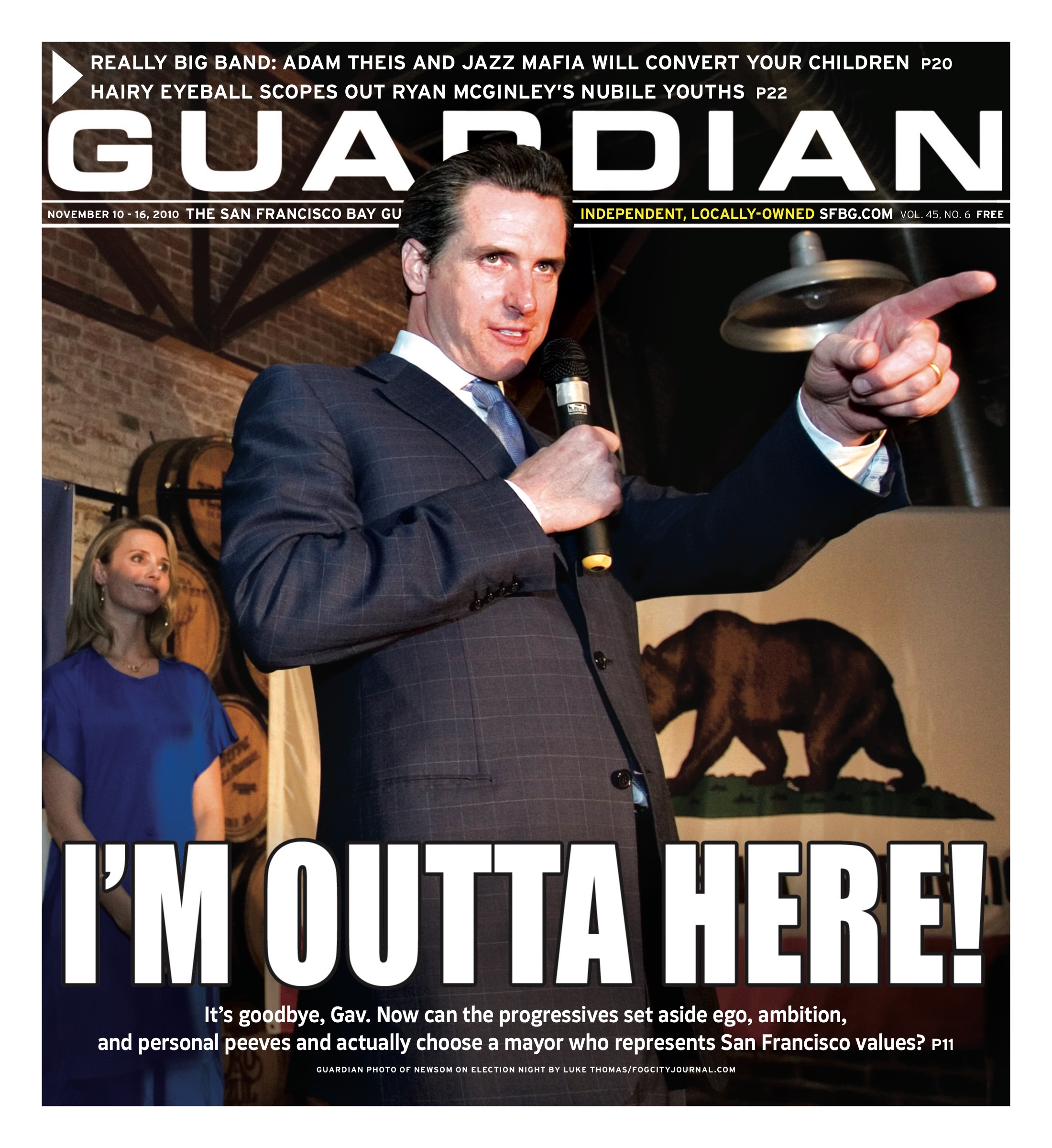
Despite the best efforts of Sup. Chris Daly and some of his progressive colleagues to create an orderly transfer of authority in the city’s most powerful office, the selection of a successor to Mayor Gavin Newsom will come down to a frantic, unpredictable, last-minute drama starting a few days into the new year.

The board has convened to hear public testimony and consider choosing a new mayor three times, each time delaying the decision with little discussion by any supervisor except Daly, who pleaded with his colleagues on Dec. 14 to “Say something, the people deserve it,” and asking, “Are we going to take our charge?”

The current board will get one more crack at making the decision Jan. 4, a day after the California Constitution calls for Newsom to assume his duties as lieutenant governor — although Newsom has threatened to delay his swearing-in so Daly and company don’t get to the make the decision.

“I can’t just walk away and see everything blow up. And there are a few politicians in this town that want to serve an ideological agenda,” Newsom told KCBS radio reporter Barbara Taylor on Dec. 16, two days after praising the board for its “leadership and stewardship” in revising and unanimously approving the city’s bid to host the America’s Cup.

Newsom and his fiscally conservative political base fear that the board’s progressive majority will nominate one of its own as mayor, whereas Newsom told Taylor, “The board should pick a caretaker and not a politician — that’s my criteria.”

Some board members strongly disagree. “It’s not his to decide. Besides, what’s not ideological? That doesn’t make sense. Everyone’s ideological,” Sup. John Avalos told the Guardian, a point echoed by other progressives on the board and even many political moderates in town, who privately complain that Newsom’s stand is hypocritical, petty, and not in the city’s best interests.

The Guardian has interviewed a majority of members of the Board of Supervisors about the mayoral succession question, and all expect the board to finally start discussing mayoral succession and making nominations on Jan. 4.

But whether the current board, or the newly elected board that is sworn in on Jan. 8, ultimately chooses the new mayor is anyone’s guess. And at Guardian press time, who that new mayor will be (and what conditions that person will agree to) was still a matter of wild speculation, elaborate conspiracy theories, and backroom deal making.


GETTING TO SIX

A majority of supervisors say there’s a simple reason why the board hasn’t seriously discussed mayoral succession since it unanimously approved the procedures for doing so Nov. 23 (see “The process begins,” Nov. 30). Everyone seems to know that nobody has the required six votes.

Avalos said he thinks the current board is better situated to choose the new mayor because of its experience, even though he voted for the delay on Dec. 14 (in an 8-3 vote, with Daly and Sups. Ross Mirkarimi and David Campos in dissent). “I supported the delay because we were not closer to having a real discussion about it than we were the week before,” Avalos told us, noting that those who were pushing for Campos “didn’t do enough to broaden the coalition to support David Campos.”

For his part, Campos agreed that “the progressive majority has not figured out what it wants to do yet,” a point echoed by Mirkarimi: “I don’t think there’s a plan.” Sup. Sophie Maxwell, who made both the successful motions to delay the vote, told us, “There’s a lot more thinking that people need to do.”

“We do not yet have consensus,” Chiu said of his reasons for supporting the delay, noting that state conflict-of-interest and open government laws also make it difficult for the board to have a frank discussion about who the new mayor should be.

For example, Chiu is barred from even declaring publicly that he wants the job and describing how he might lead, although he is widely known to be in the running.

The board can’t officially name a new mayor until the office is vacant. Sup. Bevan Dufty, who is already running for mayor, told us the board should wait for Newsom to act. “I felt the resignation should be in effect before the board makes a move,” Dufty said.

Sups. Sean Elsbernd, Carmen Chu, Michela Alioto-Pier, and Eric Mar did not return the Guardian’s calls for comment.


PIECES OF THE PUZZLE

Adding to the drama of the mayoral succession decision will be the new Board of Supervisors’ inaugural meeting on Jan. 8, when the first order of business will be the vote for a new board president, who will also immediately become acting mayor if the office has been vacated by then and the previous board hasn’t chosen a new mayor.

While Newsom and his downtown allies are clearly banking on the hope that the new board will select a politically moderate caretaker mayor, something that three of the four new supervisors say they want (see “Class of 2010,” Dec. 8), the reality is that the new board will have the same basic ideological breakdown as the current board and some personal relationships that could benefit progressives Chiu and Avalos.

Daly said downtown is probably correct that the current board is more likely than the new one to directly elect a progressive mayor who might run for the office in the fall, such as Campos or former board President Aaron Peskin. But he thinks the new board is likely to elect a progressive as president, probably Campos, Chiu, or Avalos, and that person could end up lingering as acting mayor indefinitely.

“They really haven’t thought through Jan. 8. Downtown doesn’t like to gamble, and I think it’s a gamble,” Daly said. “There’s a decent chance that we’ll get a more progressive mayor out of the leadership vote for board president.”

Avalos said it “would be a disaster” for the board president to linger as acting mayor for a long time, complicating the balance of power at City Hall. But he wouldn’t mind holding the board gavel. “I think I would do a good job as board president, but I’m not going to scratch and claw my way to be board president,” Avalos said. “I’d be just as happy to be chair of the Budget Committee again.”

Avalos said he thinks it’s important to have a mayor who is willing to work closely with board progressives and to support new revenues as part of the budget solution, which is why he would be willing to support Chiu, Campos, or Mirkarimi for mayor, saying “All of them could do a good job.”

Given the progressive majority on the board, it’s also possible that there will be a lingering standoff between supporters for Chiu, a swing vote in budget and other battles who has yet to win the full confidence of all the progressive supervisors, and former Mayor Art Agnos, who has offered to serve as a caretaker. Some see Agnos as more progressive than the other alternatives pushed by moderates, including Sheriff Michael Hennessey and San Francisco Public Utilities Commission head Ed Harrington.

Moderates like Dufty are hopeful that a couple of progressives might break off to support Hennessey (“From the first minute, he knows everything you’d need to know in an emergency situation,” Dufty said) or Harrington (“I could see him stepping in and closing the budget deficit and finding a good compromise on pension reform,” Dufty said) after a few rounds of voting.

Mirkarimi is openly backing Agnos. “He has evolved, as I’ve known him, in the days since being mayor,” Mirkarimi said. “I think we’ve spent too much time on finding the progressive guy to be mayor than on setting up what a progressive caretaker administration would look like.” And then there are the wild cards, like state Sen. Mark Leno and City Attorney Dennis Herrera. Herrera’s a declared candidate and Leno has made it clear that he’d take the job if it were offered to him.

Given the fact that supervisors can’t vote for themselves, it’s difficult for any of them to win. “I don’t think it’s likely that a member of the Board of Supervisors will get enough votes to be mayor,” Avalos told us, although he said that Chiu is the one possible exception.

But to get to six votes, Chiu would have to have most of the progressive supervisors supporting him and some moderates, such as D10 Supervisor-elect Malia Cohen (whom Chiu endorsed), D8’s Scott Wiener, and/or Chu (who might be persuaded to help elect the city’s first Chinese American mayor).

That would be a delicate dance, although it’s as likely as any of the other foreseeable scenarios.

The politics of the last great depression

4

The American economy’s worse now than at any time since the Great Depression — and whatever the Republicans say in Congress (and the president signs on to) the private sector alone can’t possible pull us out. The only reason we’re not at 1930s levels of unemployment is that we’ve had some modest federal stimulus money over the past two years.


But we’ve got this dilemma: Although every smart economist agrees that it will take more massive federal spending to turn things around, all we’re getting out of Washington is the worst kind of spending — tax cuts for the rich, which will cost $900 billion and do very little to help the economy.


Part of what’s going on — and Jerry Brown talked about it at his education summit — is that the public doesn’t trust government to spend their money wisely. Brown cited a poll saying that nearly half of Californians still think we can solve most of the budget problems in the state by getting rid of government waste.


The Pew Research Center has put together a couple of fascinating papers on attitudes toward the public sector, and they’re worth a rad. (Thanks, Gabriel Metcalf at SPUR for tipping me off about this.) The first one is called “How a different America responded to the Great Depression.” Researcher Jodie Allen’s conclusion:


Quite unlike today’s public, what Depression-era Americans wanted from their government was, on many counts, more not less. And despite their far more dire economic straits, they remained more optimistic than today’s public. Nor did average Americans then turn their ire upon their Groton-Harvard-educated president — this despite his failure, over his first term in office, to bring a swift end to their hardship. FDR had his detractors but these tended to be fellow members of the social and economic elite.


More:


The most striking difference between the 1930s and the present day is that, by the standards of today’s political parlance, average Americans of the mid-1930s revealed downright “socialistic” tendencies in many of their views about the proper role of government.


True, when asked to describe their political position, fewer than 2% of those surveyed were ready to describe themselves as “socialist” rather than as Republican, Democratic or independent. But by a lopsided margin of 54% to 34%, they expressed the opinion that if there were another depression (and fears of one were mounting), the government should follow the same spending pattern as FDR’s administration had followed before.


And, those surveyed said they supported Roosevelt, the architect of the New Deal’s expansive programs, over his 1936 Republican opponent, Alfred Landon by more than two-to-one (62%-30%).


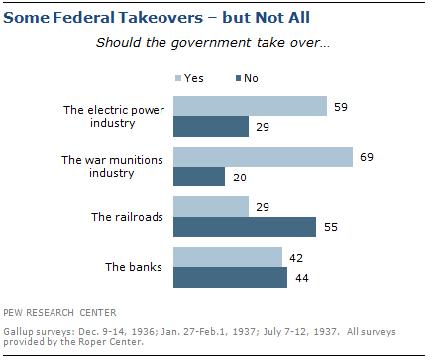
The charts are fascinating. A full 73 percent of Americans polled in 1936 thought government should provide free medical care to the poor. Sixty-four percent thought government should regulate and control war-time profits. In fact, 59 percent thought the government should take over the electric power industry and 69 percent favored nationalizing the wartime munitions industry.


And the people who were polled in these early surveys were overwhelmingly white, male and relatively well off. They were also socially conservative — 60 percent favored the death penalty and 67 percent wanted to deport all immigrants who were on public relief. Allen:


Is there a message in this for today’s America? Two possible lessons: First, it’s worth remembering that the social programs and banking controls that the New Deal era produced stood the nation in good stead over many decades of unprecedented prosperity. Second, Depression-era Americans’ faith in the country and its guiding institutions steeled them against the challenges of a double-dip recession and, years later, World War II. They had it worse, but they also expected it to get better, faster.


Compare that to a 1983 poll taken in the depth of the Reagan Recession, when 65 percent said that government had gone too far in regulating business, 62 percent rarely trusted the government in Washington and 78 percent opposed raising income taxes.


Fifty years, two generations, and the entire attitude of the American public toward government was turned on its head. It’s one of the fundamental dilemmas of American life, and one of the central reasons we’re in this mess.

SF Camerawork and YBCA do the right thing (Updated)

0

Stop me if you think that you’ve heard this one before: a Washington DC art institution caves in to right wing politicians and conservative Christians calling for the removal of “controversial” work made by an openly gay artist.

No, I’m not talking about what happened with Robert Mapplethorpe more than two decades ago. In case you haven’t been following what’s turning into the biggest art news story of 2010, David Wojnarowicz’s video A Fire in My Belly was removed from the National Portrait Gallery’s exhibit “Hide/Seek: Difference and Desire in American Portraiture” on November 30th, after Smithsonian Secretary G. Wayne Clough bowed to pressure from Bill Donohue, President of the Catholic League, incoming House Speaker John Boehner, and Majority Leader Eric Cantor, who denounced the video as a form of, “hate speech.”

In response, the artist’s estate and the P.P.O.W. Gallery in New York have made Fire In My Belly available for exhibiton, and several museums and galleries across the country have started installing the video, along with other Wojnarowicz pieces. Two San Francisco institutions (that, incidentally, happen to be just down the street from each other) join the protest tomorrow.

The Queer Cultural Center and San Francisco Camerawork will screen the entire 13-minute version of Wojnarowicz’s piece at SF Camerawork’s gallery space at 7pm. The screening will be followed by a presentation on censorship and the arts by art historian Robert Atkins as well as a roundtable discussion with Ian Carter, Kim Anno and (via-Skype) “Hide/Seek” curator Jonathan Katz. Yerba Buena Center for the Arts will also show A Fire in My Belly from 11pm to 2am on a continuous loop as part of its Noel Noir party.

I’m still waiting to hear back from SFMOMA’s press office as to whether or not the museum has any plans to install and/or screen the video. In the meantime, Tyler Green’s ongoing coverage of the fiasco at Modern Art Notes continues to be indispensable.

UPDATED: SFMOMA is going to do the right thing too, in January. A publicist for the museum has just confirmed that it will hold a free screening of the full-length (30-min) version of A Fire In My Belly on Tuesday, Jan. 4 at 5:30 pm with a discussion afterward. Way to go!

DAVID WOJNAROWICZ: A FIRE IN MY BELLY

Friday, Dec 10

7pm, free

San Francisco Camerawork

657 Mission St, Second Floor

(415) 512-2020

http://www.sfcamerawork.org/events/index.php?view=monthly

11pm-2am, $20 general admission

YBCA

701 Mission St

(415) 978-2700

http://www.ybca.org/tickets/production/view.aspx?id=12312


Class of 2010: Jane Kim

7

steve@sfbg.com

Despite fears that a candidate backed by downtown could replace firebrand progressive leader Sup. Chris Daly in District 6, in the end it was the two progressive candidates — Jane Kim and Debra Walker — who finished far in front of the large pack of candidates, with Kim winning the race. And she thinks that says something about how the progressive movement has matured.

“To have the two leading candidates be progressives says a lot about the progressive political community,” Kim said. “The race was really between Debra and me in end.”

Kim, a 33-year-old attorney and the outgoing president of the San Francisco Board of Education, has been active in progressive politics in San Francisco for many years, from doing community organizing with the Chinatown Community Development Center to running the short-lived San Francisco People’s Organization, which Daly helped create.

Yet part of her campaign strategy, and the message that she’s sending in the wake of an election that divided the progressive community, focuses on issues and themes that are more common to political moderates: job creation, clean streets, public safety, and neighborhood services.

“I think it’s important for progressives to cross over, and I don’t think it should be viewed as selling out,” Kim told us. “Progressives need to do a good job at maintaining voters’ faith in the progressives’ ability to lead.”

In addition to courting progressive groups and voters, Kim’s campaign aggressively targeted residents of the residential condo towers in Rincon Hill and Eastern SoMa, voters who are generally more affluent and newer to San Francisco than the typical progressive constituencies.

“It’s a lot of new residents who don’t feel like they’re a part of any political faction and they’re really open,” Kim said. “People just want to see that things are better. They want the streets to be clean and safe.”

With a new mayor and new blood on the Board of Supervisors, Kim said this is an important political moment for San Francisco, “a huge opportunity” to redefine San Francisco politics in the wake of Mayor Gavin Newsom and progressive supervisors such as Aaron Peskin, Matt Gonzalez, Tom Ammiano, and Daly.

“The Class of 2000 was able to show how progressive we can be with policy. They really pushed the envelope,” Kim said, citing new worker and tenant protections and programs such as Healthy San Francisco. Now, she said, the challenge for progressives in the Classes of 2010 and 2008 is to show that they can provide effective leadership in realms like public safety and economic development. “If we’re able to lead on those two issues, it would really firm up our leadership of the city,” Kim said, noting that it would also affect the dynamics of next year’s mayor’s race.

While Kim didn’t go into detail about how she intends to deal with what she says is the biggest challenge facing the new board — a budget deficit of $700 million over two years, coming at a time when all the easy cuts have already been made in recent years — she said the city needs to be aggressive in boosting the local economy and ensuring San Franciscans get most city contracts.

“We need to figure out how we can partner with small business to create a diversity of jobs in San Francisco,” she said, noting that the average San Franciscan has more faith in the moderates’ ability to create jobs, something that progressives need to address. But how can she help break the grip that the conservative San Francisco Chamber of Commerce has on small businesses?

“Part of the problem is that small businesses aren’t organized,” Kim said, noting how that hurt Sup. David Chiu’s ability to win support this year for his business tax reform measure that would have helped most small businesses and made some large corporations pay more taxes. “They’re busy running their businesses and they don’t have the time to look at the details, so they just read the briefing of the Chamber of Commerce.”

Kim said she respects the leadership role Daly has played in progressive politics and that she’d “like to be part of the moral compass of the Board of Supervisors.” But she also said that Daly’s sometimes abrasive style unnecessarily hardened the opposition of moderates to important progressive issues.

“He made it harder to talk about affordable housing,” Kim said, noting that the city’s dearth of affordable housing should be an issue that’s important to middle class voters, noting that it includes housing for people who earn up to 120 percent of the median income for the region. But after Daly hammered on the issue, “It was like a bad word coming out, and people would turn off to the issue.”

But she thinks it’s a fixable problem if she and her allies do the hard work, an ability they demonstrated this year by defeating Walker, who had been running for the seat for years and lining up all the key endorsements. “Voters do respond to campaigns that work really hard, and that bodes well for progressives,” Kim said, noting that she intends to reach out to Walker’s supporters. “I don’t think I can be successful as a supervisor if I don’t work with all the camps in the progressive community.”

Class of 2010: Scott Wiener

3

rebeccab@sfbg.com

Scott Wiener, who is 40, gay, soft-spoken, and remarkably tall, seems to have made an impression on voters with his successful campaign for District 8 (the Castro, Noe Valley) supervisor. On a recent Wednesday afternoon, several patrons of a Market Street café stopped to say hello and congratulate him. “I saw millions of signs about you!” one exclaimed.

A deputy city attorney, Wiener claimed one of the most decisive victories among contenders vying for seats on the San Francisco Board of Supervisors. He’s more fiscally conservative than Rafael Mandelman, who was his progressive opponent in the race, and is more in step politically with Mayor Gavin Newsom than San Francisco progressives. Yet Wiener stressed to the Guardian that he should ultimately be viewed as an independent thinker. “For me, it’s about having mutual respect for everyone,” he said. “Even if you disagree on some issues, and even if you disagree on a lot of issues, you can always find areas of agreement.”

Asked about his priorities in office, Wiener put public transit at the top of the list. Over the next few decades, the population of San Francisco and the Bay Area will dramatically increase, he said. “And at the same time, we’ve been underfunding public transportation, and particularly our roads. It could potentially be a catastrophe if we’re not able to not just keep the system as it is, but actually expand it. That is a really big priority.” To raise money for Muni, he doesn’t support extending parking meter hours, but does support a local vehicle license fee. There’s some question surrounding that prospect since California voters approved Proposition 26, which requires a two-thirds majority vote for fees. But Wiener said he wanted to be involved in efforts to implement a VLF in San Francisco.

Another priority is finding ways to stimulate job growth. He approves of the city’s move to use a tax credit for biotech industry businesses as a means of encouraging job creation, but said that mechanism should be used sparingly since it creates a revenue hole. Instead, Wiener said he was more in favor of looking at payroll-tax reform — but only if it doesn’t result in a tax increase.

Wiener also places importance on supporting the city’s Entertainment Commission and preserving San Francisco’s vibrant nightlife. “That’s an issue that I’ve always worked on and I’ll be speaking at [the California Music and Culture Association] next Friday, which I’m hoping will become a really effective voice for that community,” Wiener noted. “It needs a really unified and strong voice. and I want to make sure that we are really prioritizing having a vibrant nightlife and outdoor festival scene, and that we’re not blaming the entertainment community for societal ills like gun violence.” He also mentioned bolstering the Entertainment Commission’s budget.

But might that pro nightlife stance place him at odds with the San Francisco Police Department? “In some ways, I’m from a public-safety background,” he said in response. “I’ve been involved in a lot of safety issues on a neighborhood level. I’ve worked closely with SFPD and I am supportive of Chief [George] Gascon. In a way, I think that gives me some credibility.”

Speaking of working closely with people, whom does Wiener see himself forming alliances with on the new board? “I definitely have a great relationship with Sean Elsbernd and Carmen Chu, and I will be working closely with them. But I don’t agree with them on everything,” he said. Board President David Chiu and Sup. David Campos were both his classmates at Harvard, he noted, so he feels confident in his ability to work with them even if they don’t always see eye to eye. “One thing I see about this board that I’m optimistic about is that I think it’s going to be a more collegial board,” he added.

On the question on everyone’s mind — who will succeed Mayor Gavin Newsom to serve as the interim mayor? — Wiener said he thinks the best idea is to appoint a caretaker mayor. “Next year’s going to be really hard year,” he said and a caretaker mayor could “help make some really hard choices that need to be made. I may not like all of those choices, but they can do something that someone who’s a brand new mayor seeking reelection may be timid about doing.”

Who might he support if the new board selects the successor mayor? “There are some really solid names that have been bandied about, like [San Francisco Public Utilities Director] Ed Harrington or [Sherriff] Mike Hennessey,” he replied.

Wiener’s going to be mostly a fiscal conservative when it comes to the budget. Any new revenue, he said, “should be very policy-based,” for example transit-oriented instead of raising business taxes.

And he has plenty of cuts in mind, including “the way we contract for nonprofits,” looking at shared overhead, and consolidation. He also said that “we need to continue moving forward with pension and benefit reform [and] aggressively address overtime in all departments.” And what can voters expect from Sup. Scott Wiener that’s different from Sup. Bevan Dufty, a mayoral hopeful who currently represents D8? Wiener didn’t go too far out on a limb on that one. “There have been some tenant issues that Bevan voted against and I supported,” he said. “We’ve had times where he’s been to my left, or I’ve been to his left, but I can’t speculate as to the future. It’s going to be case by case.” *

Class of 2010: Malia Cohen

4

sarah@sfbg.com

It took two weeks and 19 updates of San Francisco’s ranked-choice voting system before Malia Cohen, a former Mayor Gavin Newsom staffer and partner in a firm that helps businesses and nonprofits create public policy, was declared the winner of the hotly contested race to represent District 10, which includes Bayview, Hunters Point and Ingleside. The nail-biting time lag was a byproduct of complex calculations that involved 22 candidates, no clear front-runners, and a slew of absentee and provisional ballots.

But when the RCV dust settled, the results proved that the D10 vote continues to break down along class, race, and gender lines. These RCV patterns personally benefited Cohen’s success in picking up second- and third-place votes.

But they also helped D10’s African American community, now smaller than its growing Asian community but still larger that the black community in any other distinct in the city, send an African American supervisor back to City Hall. And it avoided a run-off between Lynette Sweet and Tony Kelly, who won most first-place votes.

Some chalk up Cohen’s victory to her polished appearance, the middle-of-the road positions she took on the campaign trail, and an impressive list of endorsements that include the San Francisco Democratic Party, the Labor Council, the Building and Construction Trades Council, state Sen. Leland Yee (D-SF), Assembly Speaker Pro Tempore Fiona Ma (D-SF), Board of Supervisors President David Chiu, SF Democratic Party Chair Aaron Peskin, and BART Board President James Fang.

But Cohen told us she thinks coalition building was the key. “Endorsements only account for a quarter of the reasons why you win,” she said. “It’s all about building an organization, a net that goes deep and wide.”

Some progressives were alarmed by a Dec. 1 fundraiser to help settle Cohen’s campaign debt whose guest list included Newsom, former Mayor Willie Brown, Sup. Sean Elsbernd, Ma, Building Owners and Managers Association director Ken Cleaveland, Kevin Westlye of the Golden Gate Restaurant Association, and Janan New of San Francisco Apartment Association.

Cohen dismissed concerns over this conservative showing of après-campaign support. “Fear not,” she said. “It is a fundraiser event. And now that I’m a newly elected supervisor, I look forward to meeting everyone. And I will do a great job representing everyone.

So what should we expect from Cohen, who ran as a fourth-generation “daughter of the district from a labor family” on a platform of health, safety, and employment — and will soon represent the diverse southeast sector, which has the highest unemployment, crime, recidivism, foreclosure and African American out-migration rates citywide and is ground zero for Lennar Corp.’s plan to build thousands of condos at Candlestick and the shipyard?

“I’m a bridge-builder,” said Cohen, who attributes her surprisingly tough but open-minded edge to being the oldest of five sisters.

So far, she’s not going out on a progressive limb. She told us she favors a caretaker mayor: “I’d like someone to maintain the business of the city, someone who has zero political ambition,” she said. “That way it creates an even playing field for the mayoral race.”

Cohen says she is determined to address quality of life concerns, including filling potholes, re-striping crosswalks and introducing traffic calming measures, and taking on critical criminal justice issues, including City Attorney Dennis Herrera’s gang injunction in the Sunnydale public housing project in Visitacion Valley. She opposes Herrera’s strategy but notes: “If not gang injunctions, then what? I can’t dispute that they get short-term results, but what about the long-term impacts? We need long-term solutions.”

Cohen supports Sup. John Avalos’ efforts to pass mandatory local hire legislation but is open to “creative solutions” to help get it over the finishing line. “People who live here should be working here,” Cohen said. “But is 50 percent the magic mandatory hire number? I don’t know.”

Cohen, who just survived a foreclosure attempt, has promised to be a “fierce advocate” for constituents facing similar challenges, including those who met predatory loan brokers at church.

But asked how she would cut spending or raise revenue to address the city’s massive budget deficit, she had no specific answer.

Yet Cohen disagrees with detractors who say she lacks experience. “I may look cute, but don’t be misled. I have a public policy background and fire in my belly. I’m a union candidate, I’m smart, I’m talented, and above all, I love the people in D10 and the rest of San Francisco. I want everyone to prosper and receive benefits. So give me a shot.”

Class of 2010: Mark Farrell

0

steve@sfbg.com

Mark Farrell is a 36-year-old venture capitalist and political newcomer who will represent the wealthy neighborhoods of District 2 (Pacific Heights, Sea Cliff, and the Marina) after narrowly beating Janet Reilly, whose extensive political endorsements ranged from the Guardian and local Democratic Party Chair Aaron Peskin to U.S. Sen. Dianne Feinsein and Mayor Gavin Newsom.

Challenging the city’s political power structure is why Farrell said he ran for office, playing up his outsider status and investment banking experience. He told visitors to his campaign website, “I am running for the Board of Supervisors to bring common sense back to City Hall” and railed against “career politicians who run for office again and again.”

In an interview with the Guardian, Farrell said he was motivated to make his first foray into politics by the dysfunction he has heard about at City Hall. “I’ve been frustrated with City Hall over the last few years, from the personal antics to the policies that have come out,” Farrell told us. “I humbly believe I have something different to bring to the table.”

Farrell calls himself a fiscal conservative who believes “our city government has gotten too large and we need to look at that,” a task he thinks he’s well-suited for given his background in finance. Yet when asked what government functions he would eliminate or cut deeply to help close a projected $700 million budget deficit over the next two years, Farrell said he can’t offer any specifics yet, saying only, “We need to make tough decisions.”

Would Farrell be open to new taxes or other revenue-side budget solutions? He told us that he won’t completely reject the idea of new taxes, but that he generally opposes them. “I don’t believe in raising taxes. We can’t raise enough revenue to get out of this problem,” Farrell said. “We need to learn to live within our means.”

Although he opposed Prop. B in this election, Farrell said public employee pension reform needs to be a part of the city’s budget solution, as well as scaling back how much the city gives to nonprofit groups, which provide many of the social services the city supports.

Farrell was born and raised in San Francisco — except for his college years, he’s spent his whole life in D2, where his parents still live — and has been friends with Sup. Sean Elsbernd since high school. Politically, Farrell also identifies with Elsbernd and fellow fiscally conservative Sups. Carmen Chu and Michela Alioto-Pier (who endorsed Farrell to replace her in D2), but he says that he doesn’t want to be politically pigeon-holed.

“I’m very much my own person and I look forward to working with everyone,” Farrell said. Indeed, part of Farrell’s frustration with City Hall politics has been the divisive relationship between the progressives and moderates, which he sees as a hindrance to finding “common sense solutions.”

“The progressive and moderate labels have been relatively destructive to San Francisco,” Farrell said. “We need to get beyond that to focus on issues.”

Yet people’s political values and worldview determine what issues they care about and the solutions they favor. For example, progressives decry the dearth of affordable being built for San Franciscans and cite city studies showing that deficit will get worse as developers build ever-more market rate housing (see “Dollars or sense?” Sept. 28), particularly in a city that is two-thirds renters.

Farrell said he supports rent control (saying he was unfairly attacked during the campaign as anti renter) and sees the dwindling rental stock and lack of new affordable units being constructed as problems, but he doesn’t have a solution to those problems. In fact, Farrell supports allowing more condo conversions, which would make the problem worse, telling us, “I believe home ownership is something we should promote.”

He was also vague about how he will approach land use issues and how tough he’ll be with developers in having them meet city design guidelines and provide affordable housing and other community benefits, saying only, “We need to have sustainable development in the city.”

Yet the issues that do animate Farrell are those typically focused on by conservative D2 voters. Farrell lists his top priorities as seeing to his district’s needs, promoting private sector job creation (“I think a lot of lip service has been paid to it, but not a lot of action by City Hall,” he said), public safety, and quality-of-life issues (he supported Prop. L, the sit-lie ordinance, calling it “very reasonable”). Generally Farrell sees San Francisco as a city in he midst of a serious fiscal crisis, “and I want to create a San Francisco that is secure for the future over the long haul.”

Chronicle employees told to accept “substandard” contract

1

After some tough talk about resisting a “substandard offer” from San Francisco Chronicle management, the California Media Workers Guild has decided to urge Chronicle workers to approve a new contract offer that is “essentially the same company proposal” that workers resoundingly rejected just last month. The vote is set for Dec. 13.

Guild representative and longtime Chronicle writer Carl Hall told the Guardian last week that “they basically stiff-armed us” and “refused to negotiate any compromise since October” in contract talks. “We see it as insulting, irresponsible corporate behavior given everything staff has done,” Hall told the Guardian last week.

He told us workers planned to rally against the Chronicle and enlist the help of the community, readers, and local labor leaders. “The company is just not listening, so we’re going to have to get a louder voice to achieve that.” The Guild’s campaign included online testimonials from various Chronicle employees, including conservative columnist Debra Saunders, who began her missive by writing, “I am probably the last person Chronicle readers would expect to see standing up for a union.”

But since then, the Guild has essentially capitulated to management’s demand for a status quo contract, arguing that it’s the best they can get for now despite the 106-29 vote against that contract. “Since then, however, the economy has deteriorated even further, and other media companies in the Bay Area have announced fresh concession demands. At the Chronicle, many Guild members said they were ready to fight, but most recognized it would take some months to build up a potent campaign and public support,” the Guild wrote in a statement on its website. “Given those circumstances, the commitee decided it would be better to accept the current proposed changes — and continue mobilizing in advance of the next round of talks.”

Guardian calls to the Chronicle’s Publisher’s Office were not returned.

Let’s play the “local hire” numbers game

0

There’s been a lot of discussion at City Hall about the pressing need for mandatory local hire legislation, as opposed to San Francisco’s current “good faith” efforts. And it seems that everyone agrees upon is that something needs to be done, as the Board prepares to vote December 7 on Sup. John Avalos’ local hire proposal, which seeks to ensure that 50 percent of workers hired on city-funded construction projects will be local residents.
The move comes at a time of high unemployment in the recession-hit construction industry, but would kick in as San Francisco stands poised to spend $27 billion on public works projects over the next decade.
‘The city needs to leverage its funding position to ensure that our residents benefit from these investments,” Avalos said at a Dec. 1 committee hearing on his legislation, which would require 25 percent of hours on city-funded construction projects, to be worked by local residents in the first year. This rate would rise 5 percent each year to 50 percent.
It would also require 50 percent of apprentice hours to be worked by local residents in the first year (with out-of-state workers exempt from these requirements).

These requirements currently apply to each individual construction trade (carpenters, painters, laborers, operators, brick masons, plasterers) and not to overall project hours.

The city would pay incentive bonuses to contractors that exceed the requirements.
Contractors who failed to meet the requirements would have the option of paying liquidated damages to the city, or sponsoring apprentices during the project.

But a December 1 report from Ted Egan, the city’s chief economist, estimates the legislation would raise the city’s contracting costs by $9.3 million per year, while creating 350 jobs.
 
Egan breaks down the city’s estimated $9.3 million in contracting and administrative costs into three distinct piles: $2 million in higher bid costs from hiring the unemployed, $4.5 million in higher bid costs from hiring the already unemployed, and $2.8 million in higher costs associated with penalties.

‘This cost represents approximately 1 percent of the city’s $934 million estimated annual spending on covered projects,” Egan noted, adding that the cost to the city will be lower in early years, because unemployment is high now and labor is widely available.

“This is a conservative estimate,” Egan added, “as it assumes no contractor exceeds the target and receives incentive bonuses from the city, and also excludes any contractor productivity losses caused by breaking up core crews.”

Egan acknowledges that most city expenses are associated with inflated contractor bids.
“These will occur because the local supply of skilled trades workers is insufficient to meet the local hiring requirements of the legislation,” he observed. “Contractors will be forced to pay above-the-market wages to workers that already have jobs, and pay the city penalties because resident labor is unavailable in many trades. These costs will be passed on to the city. This excess cost to the city could largely be mitigated by choosing local hiring targets that better reflect local supply.”

“The legislation will increase local employment and associated spending at local businesses, at the cost of higher City contracting costs,” Egan warned. “The legislation creates a net spending and jobs benefit, as written; with recommended mitigations, the positive economic impact can increase, and the cost to the city can decline.”

Egan calculated that estimated costs to the city could be reduced to $2.4 million, if Avalos’ proposed legislation is amended in the following ways:

1.    Replace across-the-board 50 percent mandatory requirements with trade-specific mandates to reflect “supply and demand in each trade.”
Egan argues that across-the-board requirement would lead to higher contracting costs “for several trades where required demand exceeds current supply.”
These impacted occupations include operators, brick masons and plasterers, and represent 50 percent of projected demand for city projects, over the next ten years, Egan said.
“Other occupations, such as carpenters, painters, laborers, and drivers are less impacted and can sustain the scheduled mandate, provided goals are set on an industry-wide and not a project-by-project basis,” Egan stated.

2.    Require a study every two years “to modify requirements and assess progress to a 50 percent mandatory requirement.”
Egan’s report suggests that the city conduct a review for two years, and then set mandatory participation levels for two years for brick masons, block masons, stone masons, cement masons, carpet, floor and tile installers and finishers, concrete finishers and terrazzo workers, construction equipment operators (except paving, surfacing and tamping equipment operators), drywall installers, ceiling tile installers and tapers, electricians, pipe layers, plumbers, pipe fitters and steam fitters, plasterers, stucco masons, roofers and sheet metal workers.
Egan’s proposal is that the city assess the length of time required for each of these trades to develop a pool of qualified resident workers to support a 50 percent local hire mandate, and then, if necessary, propose amendments to the mandatory levels for these trades.

3.    Allow contractors to transfer credit hours
Egan suggests that contractors and sub-contractors could accumulate credit for hiring local residents on non-City funded projects, transfer those accumulated credit hours to other contractors, and apply those credit hours to contracts for covered projects to meet the applicable minimum mandatory hiring requirements, or work off assessed liquidated damages. “Transferred credit hours may only be applied against mandatory hiring requirements for the trade in which they were accumulated,” Egan’s report states.

4.    Eliminate incentive payments
Egan recommends eliminating incentive payments, “since the ability to transfer accumulated credit hours provides a similar, and more efficient, incentive for contractors to exceed targets.”

Egan notes that his analysis assumes that annual public works spending is equal to the 10-year average in the city’s capital plan, which is $3.1 billion.
“60 percent of that will be spent on projects not covered by the legislation, because they are state- or federal-funded,” Egan stated.

He predicts that unemployment in the trades will average 10 percent in the next decade.
“Current unemployment in construction is 20 percent in San Francisco,” Egan said.

Egan argued that allowing contractors that exceed local hire requirements to transfer the additional hours, within a trade, to other contractors “would allow the same local hiring targets to be met on an industry-wide basis, not a project-by-project basis.”

He also recommended eliminating proposed incentive payments.
‘Giving contractors the ability to sell their excess hours creates a private incentive to exceed hiring targets. Contractors which do not meet the local hire requirements will compensate those that do,’ Egan wrote.

But at a Dec. 1 hearing by the Board’s Budget and Finance committee, not everyone agreed with Egan’s findings.

Missing from his “economic costs” equation, some speakers observed, were estimated savings from reduced law enforcement costs and poverty rates, if residents got jobs.
Egan acknowledged that his report does not factor in socio-economic benefits of the plan.
‘It’s a very fair point, but it’s hard to quantify,” Egan told the Guardian.

And while Avalos’ legislation proposes to phase in the local hiring mandate over the course of six years, Egan’s report simply focuses on costs when the city hits 50 percent.

Egan said he could have broken down his report into a phased-in, year by year, basis.
“But it gives the impression of greater certainty,” Egan said, noting that it’s not clear how much the city is going to spend on construction next year. “So, given what we’re planning to spend over the next 10 years, here’s an average estimate,” he explained.

I asked Egan about his report’s claim that there is a 20 percent unemployment rate in the construction industry in San Francisco, given that other city officials, including Mayor Gavin Newsom and Sup. John Avalos, have cited a 40 percent rate.

“The 2009 census figures came out in November and it said that 20 percent of San Francisco residents who are in construction say they are unemployed,” Egan said.

He acknowledged that the 40 percent unemployment rate that Newsom and Avalos cited likely refers to unemployment among folks who work in San Francisco’s construction industry, but live outside the city, where housing prices are cheaper.

Asked if his office was recommending that the local hire percentage start at 20 percent, as some building trades requested during the Budget Committee hearing on Avalos’ proposal Egan indicated this was not the case.
“We don’t see a problem in year one,” Egan explained. “There are a lot of unemployed people in year one that are available, so that target is not hard to meet.

The main problem, to Egan’s mind, was not the mandatory 50 percent local hiring goal, per se, but the requirement that it be achieved by every individual trade.
“That’s why we recommend doing a process every two years to take a look at how good a job individual trades are doing, and then set targets based on the rates of producing a supply of qualified workers,” he said.

“Some won’t take seven years to achieve a 50 percent rate, but others could take much longer,” Egan explained. ‘Otherwise, contractors, will have to raise bids so they can afford to pull qualified workers off other contracts. That would lead to shuffling people around, and the city paying for it, without new people being trained.”

So, that’s where the conversation seems to be headed going into Tuesday’s Board meeting, with the building trades still pushing for amendments, and Avalos, the chief sponsor of the legislation, reportedly trying to win support from Sup. Bevan Dufty, so that he can pass veto-proof legislation before the end of the month. Stay tuned.

Editor’s notes

2

Tredmond@sfbg.com

The New York Times, the old established voice of the liberal media elite, ran a piece on Sunday looking for answers to the nation’s persistent economic crisis. Reporter David Segal interviewed prominent economists on the left and right — the likes of John H. Cochrane at the University of Chicago, James K. Galbraith at the University of Texas, even Gar Alperowitz at the University of Maryland, who’s kind of (God help us) a socialist.

The right-wingers talked about the need to cut government, the left-wingers talked about community co-ops and green technology, and all sides agreed that the situation was dire and would probably get worse. But nobody even mentioned wealth inequality.

It’s kind of mind-boggling. It’s as if the entire subject is off the table, taboo, something that doesn’t get discussed in the company of polite economists. And that’s just crazy.

Look: the 400 richest Americans today have combined assets of about $1.5 trillion. Raise that number to 5,000 and you can about double the total wealth. This is a very rich country; our prospects aren’t bleak at all. With a bit of enlightened public policy, we could profoundly improve the economic situation in just a few months.

I have no PhD. I barely escaped Wesleyan University with an economics degree in 1980, squeaking out a D in my last class by promising the (very conservative) professor that if he failed me, I’d be back next year. But it doesn’t take econometric wizardry to add up the figures. They go like this: A one-time 20 percent wealth tax on the 5,000 richest Americans — including many people who have pledged to give away half their wealth anyway — would generate about $600 billion. Nobody would miss any meals; no families would lose their homes, or even their second or third homes, or their personal jets. Expand the pool a little and you could easily reach $1 trillion.

With that money, you could immediately create 7 million jobs (at an average of $50,000 a year) and fund them for three years. That would cut the unemployment rate in half. What would those people do? Plenty. They could rebuild the country’s roads and highways and bridges, and build high-speed rail systems, and work in health care clinics, and teach art and music and writing, and clean up environmental messes … there’s loads of work in this country. And even with a modest estimate of the economic multiplier, those 7 million public sector jobs would create another 3 million private sector jobs, and all of a sudden, the country’s booming again. And a lot of those people who were hired by the government could now transition to private business. (And those very rich people would do well in the boom, as they always do, and might even make most of their money back.)

Raise taxes on the top 5 percent of the nation’s wage earners and corporations and you would generate enough money to keep the program going until the private economy could pick up the slack. Then eliminate the Social Security tax on the first $25,000 of income and expand it to cover all income up to $250,000 and suddenly — a huge incentive for small businesses to hire new workers and a stable retirement system for the next two generations.

It’s not that hard. It’s not a socialist revolution. Nobody really gets hurt, and a lot of people benefit. I mean, it seems to me that it ought to be part of the discussion. Maybe that’s why I was such a lousy economics student.


The biggest fish

6

rebeccab@sfbg.com

Shortly after Larry Ellison, the billionaire CEO of Oracle Corp. and owner of the BMW Oracle Racing Team, won the 33rd America’s Cup off the coast of Valencia, Spain, in February 2010, a reception was held in his honor in the rotunda at San Francisco City Hall.

The event drew members of Ellison’s sailing crew, business and political heavyweights such as former Secretary of State George Schultz, and other VIPs. Attendees posed for photographs with the tall, glittering silver trophy at the base of the grand staircase.

As part of the celebration, Ellison helped Mayor Gavin Newsom into an official BMW Oracle Racing Team jacket, and Newsom granted Ellison a key to the city, a symbolic honor usually reserved for heads of state and the San Francisco Giants after they won the World Series. Shortly after, the mayor and the guest of honor, whom Forbes magazine ranked as the sixth-richest person in the world, sat down for a face-to-face.

That meeting marked the beginning of the city’s bid to host the 34th America’s Cup in San Francisco in 2013. Since securing the Cup, Ellison has made no secret of his desire to stage the 159-year-old sailing match against the iconic backdrop of the San Francisco Bay, a natural amphitheater that could be ringed with spectators gathered ashore while media images of the stunningly expensive yachts are broadcast internationally.

Newsom and other elected officials have feverishly championed the idea, touting it as an opportunity for a boost to the region’s anemic economy. The city’s Budget & Legislative Analyst projects roughly $1.2 billion in economic activity associated with the event — the real prize, as far as business interests are concerned. It would also create the equivalent of 8,840 jobs, mostly in the form of overtime for city workers and short-term gigs for the private sector.

While the idea has won preliminary support from most members of the Board of Supervisors, serious questions are beginning to arise as the finer details of the agreement emerge and the date for a final decision draws near.

Ellison and the race organizers would be granted control of 35 acres of prime waterfront property in exchange for selecting San Francisco as the venue for the Cup and investing $150 million into Port of San Francisco infrastructure. But the event would result in a negative net impact to city coffers.

Hosting the event and meeting Ellison’s demands for property would cost the city about $128 million, according the Budget & Legislative Analyst, just as city leaders grapple with closing a projected $712 million deficit in the budget cycle spanning 2011 and 2012.

Part of the impact is an estimated $86 million in lost revenue associated with rent-free leases the city would enter into with Ellison’s LLC, the America’s Cup Event Authority (ACEA). In exchange for selecting San Francisco as a venue and investing in port infrastructure, ACEA would win long-term control of Piers 30-32, Pier 50, and Seawall Lot 330 — waterfront real estate owned by the Port of San Francisco, with development rights included. Seawall Lot 330, a 2.5-acre triangular parcel bordered by the Embarcadero at the base of Bryant Street, would either be leased long-term or transferred outright to ACEA.

The most vociferous opponent of the America’s Cup plan is Sup. Chris Daly, who has voiced scathing criticism of the notion that the city would subsidize a billionaire’s yacht race at a time of fiscal instability. “The question is whether or not the package that San Francisco’s putting together is good or bad for the city,” Daly told the Guardian, “and whether or not it’s the best deal the city can get.”


THE CREW

According to a Forbes calculation from September 2010, Ellison’s net worth is $27 billion, making him several times wealthier than the City and County of San Francisco, which has a total annual budget of about $6 billion. Ellison reportedly spent $100 million and a decade pursuing the Cup.

As soon as Ellison expressed interest in bringing the Cup to San Francisco, Newsom began charting a course. Park Merced architect and Newsom campaign contributor Craig Hartman of the firm Skidmore, Owings & Merrill was tapped to reimagine the piers south of the Bay Bridge as the central hub for the event, and soon Hartman’s vision for a viewing area beneath a whimsical sail-like canopy was forwarded to the media.

The mayor also issued letters of invitation to form the America’s Cup Organizing Committee (ACOC), a group that would be tasked with soliciting corporate funding for the event. ACOC was convened as a nonprofit corporation, and it’s a powerhouse of wealthy, politically connected, and influential members.

Hollywood mogul Steve Bing, who’s donated millions to the Democratic Party and funded former President Bill Clinton’s 2009 trip to North Korea to rescue two imprisoned American journalists, is on the committee. So is Tom Perkins, a Silicon Valley venture capitalist, billionaire, and former mega-yacht owner who was once dubbed “the Captain of Capitalism” by 60 Minutes. George Schultz and his wife, Charlotte, are members. Thomas J. Coates, a powerful San Francisco real estate investor who dumped $1 million into a 2008 California ballot initiative to eliminate rent control, also has a seat. Coates resurfaced in the November 2010 election when he poured $200,000 into local anti-progressive ballot measures and the campaigns of economically conservative supervisorial candidates.

Billionaire Warren Hellman, San Francisco socialite Dede Wilsey, and former Newsom press secretary Peter Ragone are also on ACOC. There are representatives from Wells Fargo, AT&T, and United Airlines. One ACOC member directs a real estate firm that generated $2.5 billion in revenue in 2009. Another is Martin Koffel, CEO of URS Corp., an energy industry heavyweight that made $9.2 billion in revenue in 2009. There’s Richard Kramlich, a cofounder of a Menlo Park venture capital firm that controls $11 billion in “committed capital.” And then there’s Mike Latham, CEO of iShares, which traffics in pooled investment funds worth about $509 billion, according to a BusinessWeek article.

There’s also an honorary branch of ACOC composed of elected officials including House Minority Leader Nancy Pelosi, Gov. Arnold Schwarzenegger, Sen. Dianne Feinstein, and others. Their role is to help the Cup interface with various governmental agencies to control air space, secure areas of the bay exclusively for the event, set up international broadcasts, and bring foreign crew members and fancy sailboats into the United States without a hassle from immigration authorities.

ACOC is expected to raise $270 million in corporate sponsorships for the America’s Cup. That money will be funneled into the budget for ACEA. It’s unclear whether the $150 million ACEA is required to invest in city piers will be derived from ACOC’s fund drive.

The city also anticipates that ACOC would raise $32 million to help defray municipal costs. “However,” the Budget & Legislative Analyst report cautions, “there is no guarantee that any of the anticipated $32 million in private contributions will be raised.”

A seven-member board, chaired by sports management executive Richard Worth, will direct the ACEA, according to Newsom’s economic advisors, but the other six seats have yet to be filled. ACEA’s newly minted CEO is Craig Thompson, a native Californian who previously worked with a governing body for the Olympics and has helped coordinate major sporting events internationally. In an interview with sports blog Valencia Sailing, Thompson provided some insight on why major corporations might be inspired to donate to the cause. Basically, the Cup is the holy grail of networking events.

“It’s a very difficult economic situation we are going through, and it’s not the best time to be looking for sponsors for a major event,” Thompson acknowledged. “On the other hand, the America’s Cup is one of the very few activities … that offer access to really top-level individuals in terms of education or economic situation. The America’s Cup is a unique platform for a lot of companies that want access to those individuals that are very difficult to reach under normal circumstances. I can tell you for example that Oracle is very pleased with the marketing opportunity the America’s Cup has presented to them. They invite their best customers and are very successful in turning the America’s Cup into a platform for generating business. The same thing can be true for a lot of different companies that need access to wealthy individuals.”

But should San Francisco taxpayers really be subsidizing a networking event for the some of the business world’s richest and most powerful players?


TRANSFORMING THE WATERFRONT

Over the past four months, Newsom’s Office of Economic and Workforce Development (OEWD) has been negotiating with race organizers to hash out a Host City Agreement outlining the terms of bringing the America’s Cup to San Francisco.

The proposal will go before the Board of Supervisor’s Budget & Finance Committee on Dec. 8, and to the full board Dec. 14. A final decision on whether San Francisco will host the race is expected by Dec. 31. ACEA and ACOC will each sign onto the agreement with the City and County of San Francisco.

From the beginning, the event was envisioned as “the twin transformation,” according to OEWD — the America’s Cup would be transformed by attracting greater crowds and heightened commercial interest while San Francisco’s crumbling piers would be revitalized through ACEA’s $150 million investment in port infrastructure.

The plan paints downtown San Francisco as the “America’s Cup Village” during the sailing events, and a study produced by Beacon Economics estimates that the financial boost would come primarily from hordes of visitors flocking to the event — more than 500,000 are expected to attend. The city expects a minimum of 45 race days, including one pre regatta in 2011 and one in 2012 (or two in 2012 if the one in 2011 doesn’t happen), a challenger series in 2013, and a final match in 2013.

The transformation of the city’s waterfront would be dramatic. In addition to the rent-free leases for Piers 30-32, 50, and Seawall Lot 330, ACEA would be granted exclusive use of much of the central waterfront, water, and piers around Mission Bay, and water and land near Islais Creek during the course of the event. Under the Host City Agreement, race organizers would have use of water space spanning Piers 14 to 22 ½; Piers 28, 38, 40, 48, and 54, a portion of Seawall Lot 337, and Pier 80, where a temporary heliport would be sited.

Seawall Lot 330, a 2.5-acre parcel valued by the Port at $33 million, lies at the base of Bryant Street along the Embarcadero and has a nice unimpeded view of the bay. Piers 30-32 span 12.5 acres, and Pier 50 is 20 acres.

The Budget & Legislative Analyst’s study predicts that the ACEA could opt to build a 250-unit condo high-rise on Seawall Lot 330, deemed the most lucrative use. Under the Host City Agreement, the city would be obligated to remove Tidelands Trust provisions from Seawall Lot 330, which guarantee under state law that waterfront property is used for maritime functions or public benefit. Tweaking the law for a single deal would require approval from the State Lands Commission, but Newsom, in his new capacity as lieutenant governor, would cast one of the three votes on that body.

The combination of construction, demolition, lost rent revenue, police and transit, environmental analysis, and other event costs would hit the city with a bill totaling around $64 million, according to the Budget & Legislative Analyst study. Since city government would recoup around $22 million in revenue from hosting the Cup, the net impact would be around $42 million. That doesn’t include the potential $32 million assistance from ACOC.

At the same time, the city would stand to lose another $86.2 million by granting long-term development rights to 35 acres of Port property for 66 to 75 years without charging rent, bringing the total cost to $128 million. OEWD representatives played down that loss in potential revenue, saying past attempts to redevelop piers hadn’t been successful because none could handle the upfront investment to revitalize the crumbling piers.

The Host City Agreement has raised skepticism among Port staff and the Budget Analyst that tempered initial enthusiasm for the event. “The terms of the Host City Agreement will require significant city capital investment and will result in substantial lost revenue to the Port,” a Port study determined. Faith in that plan seems to be eroding and it may be scrapped for an alternative plan that’s cheaper for the city.

The Northern Waterfront alternative substitutes Piers 19-29 as the primary location for the event and eliminates the Mission Bay piers from the equation. Under this scenario, ACEA would invest an estimated $55 million, instead of $150 million. In exchange, it would receive long-term development rights to Piers 30-32 and Seawall 330 on “commercially reasonable terms,” according to a Port staff report.

Board of Supervisors President David Chiu requested that the Port explore that second option more fully, and the Port report notes that it would reduce the strain on Port revenue. The Northern Waterfront plan would cost the Port a total of $15.8 million, instead of $43 million, the report notes. Port staff recommended in its report that both the original agreement and the alternative be forwarded to the full board for consideration.


PHANTOM BIDS?

Under the competition’s official protocol, Ellison, as defender of the Cup, has unilateral power to decide where the next regatta will be held. Race organizers have said it’s a toss-up between San Francisco and an unnamed port in Italy — though it’s anyone’s guess how seriously a European site is being considered by a team headquartered at the Golden Gate Yacht Club, a stone’s throw from the Golden Gate Bridge.

According to a San Francisco Chronicle article published in early September, Newsom issued a memo stating that San Francisco was competing against Spain and Italy to become the chosen venue. Valencia was said to be offering a “generous financial bid,” and a group in Rome was rumored to have offered some $645 million to bring the Cup to Italian shores, the memo noted. It was a call for the city to present Ellison with the most attractive deal possible to compel him to pick San Francisco.

Speaking at an Oct. 4 Land Use Committee hearing, OEWD director Jennifer Matz told supervisors: “San Francisco was designated the only city under consideration back in July. Now we are competing against the prime minister of Italy and the king of Spain.”

However, the veracity of those claims came into question in mid-November. Daly, incensed that the Mayor’s Office never communicated with him about the Cup despite wanting to hold it in his sixth supervisorial district, launched his own personal investigation. He fired off an e-mail to Team Alinghi, a prior America’s Cup winner, and began communicating with other European contacts until he got in touch with someone in Valencia’s municipal government.

“I got a call back from a representative who basically said I should know something,” Daly recounted. Valencia, his source said, never submitted a bid to host the Cup. At a Nov. 13 press conference, Valencia’s mayor Rita Barbera confirmed this claim, according to a Spanish press report, expressing disappointment that the city had been eliminated from consideration as a host venue. “There was no formal bidding process,” she charged. She also denied reports that any money had been offered.

Meanwhile, the Budget Analyst was unable to find any concrete evidence that other host city bids had been submitted. “We have nothing to confirm that other offers have been made,” Fred Brousseau of the Budget Analyst’s office told the Guardian.

In response to Guardian queries about whether the Mayor’s Office had evidence that Italy had indeed submitted a bid, Project Manager Kyri McClellan of the OEWD forwarded a one-page resolution from the Italian prime minister assuring race organizers that there would be tax breaks, accelerated approvals, and other perks guaranteed if the Cup came to Italy. However, an Italian journalist who looked over the resolution told the Guardian that the document didn’t appear to be a formal bid, merely a response to a query from race organizers.

Daly has his doubts that either Valencia or the Italian port were ever seriously considered. “I think they were phantom bids,” he said, “created by either Larry Ellison or the Newsom administration … to place pressure on the Board of Supervisors.”

A representative from OEWD told the Guardian that officials have no reason to doubt that the European bids, and accompanying offers of money, were real. However, the city wasn’t privy to race organizer’s discussions about possible European venues. A final decision is expected before the end of the year.

Daly hasn’t held back in voicing opposition to the America’s Cup and blasted it at an Oct. 5 Board meeting. “This tacking around Sup. Daly will not get you in calmer waters,” Daly said. “I told myself I was not going to make a yachting reference. But I will bring a white squall onto this race and onto this Cup, and I will do everything in my power starting on Jan. 8 to make sure these boats never see that water.”


WIND IN WHOSE SAILS?

The America’s Cup would undoubtedly bring economic benefit to the area and create work at a time when jobs are scarce. Police officers would get overtime. Restaurant servers would be scrambling to keep up with demand. Construction workers seeking temporary employment would get gigs. Hotels would rake it in. Pier 39 would be booming. However, the Budget Analyst report cautioned: “It is unlikely that any labor benefits would remain in the years after the America’s Cup event is completed.”

Certain small businesses would catch a windfall. John Caine, owner the Hi Dive bar at Pier 28, didn’t hesitate when asked about his opinion on the city hosting the Cup. “Please come fix our piers. It’s a shout-out to Larry Ellison,” he said. Caine said he supports the America’s Cup bid 100 percent, and is excited about the boost it could give his business. The Hi Dive would not be required to relocate under the proposal, he added.

At the same time, other small business would be negatively affected, particularly those among the 87 Port tenants who would be forced to relocate to make way for the America’s Cup. The Budget Analyst’s report also notes that retail businesses in the area whose services had no appeal to race-goers might suffer from reduced access to their stores, since crowding and street closures would shut out their customers.

The sailing community has rallied in support of the Cup, and Newsom has received hundreds of e-mails from yachting enthusiasts from as far away as Hawaii and Florida promising to travel to San Francisco with all their sailing friends to watch the world-famous vessels compete.

Ariane Paul, commodore of a classic wooden boat club called the Master Mariners Benevolent Association, told the Guardian that she was excited about the opportunity for the America’s Cup to showcase sailing on the bay. “In the long term, it’s a win-win,” Paul said. “It would be great to have that boost.” As for the financial terms of the deal, she remained confident, saying, “I don’t think that the city is going to let Larry Ellison walk all over them.”

Sup. Ross Mirkarimi is often politically aligned with Daly, but not when it comes to the issue of the America’s Cup. As a kid growing up on the island of Jamestown, a tiny blue-collar community located off the coast of Rhode Island, Mirkarimi learned to sail and occasionally spent summers working as a deckhand. Every few years, the America’s Cup would come to nearby Newport, transforming the area into a bustling hub and bringing the locals into contact with famous sailors. It left an everlasting impression. When the BMW Oracle Racing Team secured the 33rd Cup off the coast of Valencia, Mirkarimi did a double-take when he saw a photograph of the winning team — his childhood friend from Rhode Island was on the crew.

Mirkarimi told the Guardian he supports bringing the Cup to San Francisco because of the economic boost the area will receive — if the Cup continues to return to San Francisco as it did for 53 years in Newport, he said, the city could look forward to a free gift in improved revenue associated with the event, and that could help quiet the tired annual debates over painful budget cuts.

At the same time, he acknowledged that the Budget Analyst report had prompted what he called healthy skepticism. “I think the onus is on the city and Cup organizers to make sure the benefits far, far outweigh the investment,” Mirkarimi said. “This effort is not just about making one of the wealthiest men in the United States that much more wealthy … That can’t be the case,” he said. “It has to be about what will the Cup do in order to be a win-win for the people of San Francisco.” Mirkarimi said he expected scrutiny of the details of the agreement at the Dec. 8 Budget and Finance Committee hearing: “Naturally, in this time of economic downturn … people want to know, what’s the outlay of cost, and what are we going to get in return?” 

Mädchen gone wild

1

Every nation had its distinct cinematic response to the sexual revolution of the 1960s and ’70s. Germany’s was characteristic in offering the pretense of order, “scientific” educational value, and encouraging a healthy collective morality — even if all this was usually mere gloss over the usual, more marketable qualities of copious T&A.

Encouraged by Scandinavian films already tearing down censorship barriers worldwide, Deutschland screens (the free-Western ones only, needless to say) began addressing the matter directly in 1968. Then, Oswalt Kolle, a psychiatrist’s son and tabloid journalist turned celebrity sex educator, commenced making features like Sexual Partnership (1968), The Sensual Male (1970), and Your Child, That Unknown Creature (1970). These fairly sober mixtures of documentary and dramatized “case histories” were as widely translated as his writings. (Nonetheless, Kolle and his family relocated to Amsterdam, citing constant harassment by conservative German politicians and media as the cause.)

Such success inevitably attracted imitation. Dr. Gunther Hunold’s Schulmädchen-Report had made best-seller waves with its collection of interviews with 14- to 20-year-old women about their sexual experiences and opinions. Enter Wolf C. Hartwig of Rapid Film, producer-distributor of such savory titles as Satan Tempts With Love (1960) and Your Body Belongs to Me (1959). He bought the book’s film rights, retaining Hunold as co-scenarist and consultant for 1970’s Schoolgirl Report: What Parents Don’t Think Is Possible, which proved so enormously popular that an entire national subgenre was born.

The resulting series of Schoolgirl Report features stretched through the entire Me Decade. All 13 are being issued on DVD by the Impulse Pictures label of South San Francisco’s CAV Distributing Corporation, a project that reaches its precise midpoint next month with 1974’s Schoolgirl Report Volume 7: What the Heart Must Thereby …. Watching too many of these interchangeable vintage sexploitation “documentaries” in close succession can be hazardous to your mental health, but in moderation — as with most things – — they prove instructive.

Volume 1 set the mold, sometimes in stone: factors like the groovy Farfisa-acid guitar-flute rock instrumental theme by Gert Wilden and His Orchestra (whose original soundtracks would continue to run a delightfully dated gamut from go-go discotheque to cocktail jazz to Mantovani-like schmuzak), cheap production values, Ernst Hofbauer’s on-the-nose direction, the wooden acting (despite allegedly “starring many anonymous youths and parents”), and an entire opening credits sequence would scarcely budge in film after film. More flexible within a limited range were the bodies bared by 20-something actors playing teens (seldom convincingly) and the framing devices for each installation of variably comic, dramatic, and tragic vignettes.

The first movie started with a flower-decal-covered VW full of hippie chicks and dudes driving by as a female voice says “That’s us: today’s youth. We want a new morality without hypocrisy.” Then an actor playing a reporter announces this “effective and spontaneous documentary shows our youth as they really are. [It] will open many parents’ eyes.”

More likely the Schoolgirl films opened a lot of men’s pants. For all the earnest jabber about “sexual prejudice and why German families hang on to it,” Hartwig, Hofbauer, scenarist Gunther Heller (Hunold split after the series’ launch) and company weren’t interested in liberating minds — let alone promoting feminism — so much as wrapping age-old male fantasies in a cloak of socioanthropological inquiry.

Women are occasionally victimized in the Schoolgirl universe: a lone black girl is set up for gang rape by racist classmates, a country lass is forced into prostitution by loutish dad, etc. But such instances usually end up with the protagonist rescued by a convenient Prince Charming, often as our narrator urges us to question whether they brought the abuse on themselves.

The overwhelming majority of tales present a brave new world of brazenly aggressive females demanding satisfaction whenever, wherever, with whomever. Particularly with older men, including priests, teachers, bus drivers, family friends, guest workers (Rinaldo Talamonti often appears as a comedy-relief Italian stereotype addressed in terms like “Hey, spaghetti! Show us your macaroni!”), even sexy older brothers.

Their behavior sometimes edges from fantasy fodder into the fanatical, as when a married fencing instructor tells his obsessed student, “You must be reasonable!” and she replies “I’ll be reasonable when I’m 75!” Or when another underage lassie brags that beyond regular partner sex, “I also do myself four or five times a day.” Most disturbing is a frequent refrain of blackmail, almost invariably used by nymphets on a reluctant authority figures to maintain a sexual relationship (and/or good grades). In the ickiest instance, Volume 5‘s 15-year-old Margit seduces Grandpa, saying if he refuses she’ll say he raped her; three months of action later he confesses to parents and police rather than endure more shame.

Ostensibly celebrating women’s newfound sexual freedom, the Schoolgirl Reports often seem to regard that as a menace to society as well. (At one curious point we’re informed “They’re all reading Valerie Solanas’ SCUM Manifesto, which turns men into slaves and a necessary evil for sex.”) Needless to say, the series’ major off-camera collaborators were an entirely penis-bearing roll call.

These films made tens of millions, not just in Western Europe but in overseas locations where their copious full-frontal nudity (nearly all female, of course) required cutting or fogging to meet local standards. Entries appeared around the globe under titles like Campus Pussycats, Smartie Pants, Further Confessions of a Sixth Form Girl, and Super Sexy Show. The 1980 final chapter didn’t hit American screens until three years later as Making Out — quite the reduction from an original German title translating as Don’t Forget the Love in Sex. Meanwhile Germany had been flooded with copycat “reports” (housewife, schoolboy, nurse, etc.), and in 1975 saw the legalization of hardcore porn. So a once ubiquitous, now quaint and bizarre example of mainstream softcore slowly petered (ahem) out.

The Impulse-CAV discs are notably stingy with extras — there aren’t any, not even trailers or a horrible-English-dubbing option — but in a way that suits their blunt appeal. After all, one shouldn’t expect many frills from movies wherein a dessert-spooning virgin (sex aside, ice cream appears this generation’s predominant onscreen indulgence) muses that a passing motorist “could help me get rid of that bothersome hymen,” or the “pathological dream world” of a girl troubled by incestuous thoughts features psychedelic imagery of Daddy menacing her nubile naked self with a shish kabob.

Critical care

5

Sarah@sfbg.com

A complex and controversial project that would involve five San Francisco hospitals — including building a huge showcase facility for the wealthy atop Cathedral Hill — has prompted a debate about what average city residents need from the health care system.

California Pacific Medical Center, an affiliate of Sutter Health, proposes to downsize St. Luke’s Hospital, which primarily serves a low-income population in the Mission District, as part of a $2.5 billion proposal to renovate and retrofit three existing medical campuses, close another one, and build housing and a megahospital on Cathedral Hill that would draw patients from around the country.

CPMC’s grandiose plan was being considered strictly as a land use decision, despite its far-reaching impact on the city’s health care system. So Sup. David Campos created legislation calling for the city to create a citywide health services master plan and to use that as another tool for gauging future medical projects.

Debate over that legislation left some activists on both sides unhappy, with progressives disappointed that it won’t be able to stop a CPMC project they see as neglectful of the poor, and moderates wary of creating a new way to challenge development projects in the face of widespread unemployment in the construction industry.

But it struck a fine enough balance to win 8-3 approval by the board Nov. 16, enough to override a threatened mayoral veto. “I’m really happy and excited about the passage of this legislation,” Campos told the Guardian after the vote.

The legislation has a two-part mandate, with the first part kicking in as soon as it has final approval. It requires the Planning Department, with input from the Department of Public Health, to prepare a health care services master plan to identify current and projected needs for health care services and where they should be provided.

The second part, which begins in 2013, requires Planning to determine whether medical projects are consistent with the findings of this plan. That delay is credited to a last-minute amendment Campos granted during a Nov. 15 committee hearing after the hospital industry complained that the process could jeopardize its ability to meet state-mandated seismic retrofitting deadlines for projects already in the planning pipeline.

The passage of Campos’ legislation comes eight months after President Barack Obama signed the Patient Protection and Affordable Care Act. Hailed by its supporters as the most significant change to the U.S. health care delivery systems in 40 years, the reform package has also been greeted with criticism on both ends of the political spectrum. Progressives complain that it relies too heavily on private insurance companies and medical providers, while Tea Party supporters says that it’s government run amok and they have vowed to “kill the bill.” Senate Minority Leader Mitch McConnell (R-Ky) recently compared so-called Obamacare to “tyranny” in a speech to conservative legal scholars.

But here in San Francisco, the debate over Campos’ legislation — as heated and divisive as it was at times — yielded a surprising amount of consensus around the long-neglected idea that government should play a role in health care planning.


PULLING THE PLUG

The passage of Campos’ legislation marks the first time in 30 years that a government entity has mandated health care services planning in California. That approach West Bay Health Systems Agency, whose creation he opposed as governor of California.

Lucy Johns, a San Francisco-based health care planning consultant who wrote the only health care services master plan California has ever had, recalls what happened in the mid-1970s after President Gerald Ford signed legislation that established health system agencies nationwide.

“California established 14 health systems agencies, including the West Bay Health System Agency, which governed the nine Bay Area counties,” Johns told the Guardian. “The legislation mandated that they be established by every state, with the federal government providing the funding. So every state had to decide how many, how big, and how structured the health system agencies would be.”

Johns notes that state legislators were constrained when it came to the decisions these health service agencies made. “The governing bodies of the health systems agencies had to have a membership that was 51 percent consumer and 49 percent healthcare provider, which included doctors, nurses, and hospital administrators,” she said.

That history served as a backdrop for discussion of the Campos legislation, with the Planning Department staff report noting, “With the elimination of the West Bay Health Systems Agency in 1981, there is no longer a routine or comprehensive analysis of health service resources, needs, trends, and local impacts conducted for changes to or within medical uses.”

“It’s truly a historic moment for San Francisco,” Campos said after his legislation passed its Nov. 16 first reading (the second and final reading is set for Nov. 23, after Guardian press time). “We are the first city in the country to make sure land use decisions are aligned to our health care needs. That’s an unprecedented step that will shape the future of healthcare planning for years to come.”

Campos acknowledged that the passage of Obama’s heath reform package — which includes a mandate to purchase private health insurance beginning in 2014 — was also a catalyst for his legislation, along with the CPMC project.

“But it had more to do with seeing that the city didn’t have the tools it needed to evaluate projects in terms of whether they met the city’s healthcare needs and how they might impact people’s access to healthcare,” Campos said. “The main catalyst came from the community, which felt it was being asked to make decisions that will have long-lasting health care implications, but didn’t have any way to understand those needs. Those concerns were compounded by changes at the national level — and the recognition that these changes offer us an opportunity to engage in planning.”

Campos’ legislative victory came two months after members of the Cathedral Hill Neighbors Association joined nurses, medical workers, patients, and community groups in voicing concerns at a Sept. 23 public hearing about the draft environmental impact report for CPMC’s Cathedral Hill hospital and the other facilities that are part of its proposal.

These groups collectively expressed fear that downsizing St. Luke’s, closing the CPMC California campus, and transforming CPMC Pacific campus to an outpatient-only hospital will force low-income people to travel farther to access health care services while offering better service to the wealthy at Cathedral Hill. And neighbors worried that the proposed complex would increase traffic and require the demolition of rent-controlled apartments.

Formed in 1991 through the merger of Pacific-Presbyterian Medical Center and Children’s Hospital of San Francisco, CPMC has been affiliated with Sutter Health since 1996 and currently has four medical campuses in San Francisco: Pacific in Pacific Heights, California in Presidio Heights, Davies in the Duboce Triangle, and St. Luke’s in the Mission.

But CPMC’s longtime goal was to build a facility intended to be like the Mayo Clinic of the West Coast, a 15-story, 555-bed full-service hospital and specialty care facility at the corner of Van Ness Avenue and Geary Boulevard. Company officials have made approval for that project conditional on keeping St. Luke’s open in the face of the state’s deadline on seismic safety standards that the hospital doesn’t now meet.

“St. Luke’s Hospital was the big issue that got our attention,” Le Tim Ly, lead organizer for the Chinese Progressive Association, told the Guardian. His group has worked with residents in the city’s southeast sector around environmental justice, air quality, and pollution issues when they became aware of the threat to St. Luke’s. “All this, coupled with efforts to downsize Luke’s, left us alarmed by the disproportionate impact on an already impacted area.”

But alarm over CPMC’s plans has now revived the idea of healthcare planning.


MAKING A PLAN

As recently as the beginning of November, representatives for the Hospital Council of Northern and Central California — whose members include CPMC, Chinese Hospital, Jewish Home, Kaiser Permanente, Laguna Honda, St Luke’s, St. Mary’s, San Francisco General Hospital, and Veterans Affairs Medical Center — seemed opposed to any change in the way healthcare planning is done in San Francisco.

At a Nov. 1 hearing on the Campos legislation at the board’s Land Use and Economic Development Committee, Ron Smith, the Hospital Council’s senior vice president for advocacy, said his organization favored maintaining the city’s current procedures. “We would like to propose that the Health Commission does the planning, the Planning Commission does the land use, and that there is a required determination process which is in the current legislation,” Smith said. “We’re proposing that that continue.”

But two weeks later, after Campos amended his legislation so projects now in the planning pipeline are exempt from having to comply with the city’s health care services master plan, some members of the Hospital Council seemed to have a change of heart.

CPMC’s Chief Executive Officer Warren Browner surprised just about everybody when he publicly stated in mid-November that CPMC supports health care planning. “We strongly support the efforts of the city — we are in favor of health planning,” Browner said at a Nov. 15 hearing on the legislation.

“That statement was extraordinary,” said Lucy Johns, recalling CPMC’s history of resisting government control. “The conversation about this legislation has already changed the discourse, at least in public.”

Linda Schumacher, chief executive officer of Chinese Hospital, a community-owned, not-for-profit facility, explained at the same hearing that her organization had been concerned that Campos’ legislation would affect her hospital’s ability to move ahead with a $150 million project that has been in the pipeline since 2003.

“We thank you for that amendment that allows the effective date to be changed,” she said.

“It shows how much progress had been made, even before this legislation goes into effect,” Campos said of the hospital industry’s apparent shift in attitude. “It’s a monumental step, something that was not expected as recently as a few months ago.”

But Ly of the Chinese Progressive Association said he believes the Hospital Council still doesn’t want to see the city getting involved. “As recently as a month ago, their folks were speaking out against any kind of legislation. But I think they started seeing the writing on the wall.”

Ly fretted about the potential negative impact of Campos’ last-minute amendments. Sup. Campos’ plan represents a victory. But we could use that information as soon as possible. The 2013 deadline means the city will be handicapped: it will have information it can’t use yet.”

Ly ventures that the hospital industry’s approach will be to try to lessen the impact of the legislation. “As written, it still provides the Planning Commission and the board with the discretion to approve projects,” Ly said. “Ultimately, the struggle is about values. Just because there are plans and guidance doesn’t mean the healthcare needs of the community will become a top priority — it just provides us with tools to make an assessment.”

Campos counters that his bill will allow the city to create incentives for, and apply pressure on, the hospital industry. “If they truly want their projects to be expedited and approved before state-mandated seismic retrofitting deadlines kick in, they’ll propose plans that work for the community,” Campos explained.

But even as it publicly vows to be supportive, the Hospital Council continues to express concerns about the Campos legislation. “It’s the council’s job is to be supportive now that the board has approved Campos’ plan,” Smith said. “And Sup. Campos was very generous. He started talking to us in June. But we really didn’t get a handle on his proposal until much later. We think the idea of healthcare planning is very good. We still have concerns about the process, but now the board has voted on the legislation, our goal is to do our best to work with the law.”

Concerns that the legislation would be used to mire projects in repeated appeals and give too much weight to critics’ concerns was raised at the Nov. 16 hearing by Sup. Sean Elsbernd.

“Right now, if anyone has concerns, there’s a conditional use process and a CEQA [California Environmental Quality Act] process,” Elsbernd told the Guardian. “But this turns up a brand new appeal. It means the appeals are heard at the same time, but you’ve now created a third route.”

Campos responded to these concerns by amending the legislation to clarify that the board must act on consistency determination appeals at the same time it acts on other related appeals, so projects won’t be delayed.

Evidently this wasn’t enough to appease the San Francisco Chamber of Commerce. “We cannot be supportive of that piece of legislation,” Rob Black, the Chamber’s vice president of public policy, told the Guardian after the legislation was approved. “We believe appeals should be done at the Department of Public Health in conjunction with service providers, since San Francisco provides 20 percent of service, and private organizations provide the remaining 80 percent.”

Black says the Chamber was pleased Campos amended his legislation so as not to slow down projects that are currently in the planning pipeline. But he claimed Campos’ legislation could actually limit access to healthcare services. “The Chamber is concerned that Campos’ legislation will make it harder for doctors to pool together in pods, and if we don’t do that, it won’t make healthcare more available because services will be more expensive,” Black said. “But we absolutely think” the city should analyze gaps in providing health care to San Franciscans.

Campos’ aide Hillary Ronen confirmed that Black is correct in saying that anyone can appeal a hospital project’s consistency determination. “But the final analysis will revolve around asking if the proposed project meets the health care needs of San Francisco,” she said. “If it doesn’t, and the board doesn’t believe there’s a compelling public policy reason to approve the project, [the board] can override the approval.”


PATIENTS VS. PROFITS

Mary Michelucci, a registered nurse for 40 years and a member of the California Nurses Association, is hopeful that Campos’ legislation will rein in the hospital industry.

“I hope that any plan that would favor patient care over profit would be the way to go,” Michelucci said. “Running a hospital is expensive. But with the profits that Sutter and CPMC are making, they can afford this.”

Michelucci says the dispute over St. Luke’s came to a head three years ago, when nurses began to suspect that CPMC was planning to let the facility fail, suspicions that intensified when CPMC closed St. Luke’s neonatal intensive care unit 18 months ago.

“Now the babies who need neonatal special care are transported to CPMC’s California campus, which is in the Richmond,” Michelucci said. “But the moms may be discharged and most of them live in the Mission or Bayview-Hunters Point.”

Michelucchi still fears that CPMC will wage “a horrific campaign” against the California’s Nurses Association as it continues to push the plan for its megahospital. “CPMC wants to be in complete control of the registered nurses,” she said. “We, unfortunately, are their conscience, while they are a business model in the business of healthcare. The decisions they make about healthcare are not in the interests of patients or nurses, and we are the thorn in their side.”

All this is happening against the backdrop of the worst economic recession since the Great Depression, and for construction workers facing high unemployment rates in San Francisco, CPMC’s megaproject clearly represents light at the end of a very dark tunnel.

“CPMC is my future,” William Hestor, a 28-year-old father of two and member of SEIU-United Healthcare Workers, said at the Nov. 15 hearing. “We worked hard on a contract and we just want to make sure our hospital is built on time.”

CPMC media spokesperson Kevin McCormack told the Guardian that the real issue between CPMC and the CNA is union membership at CPMC’s Cathedral Hill facility. “CPMC is reducing beds at St. Luke’s because the beds aren’t in use, but the facility will be able to take care of 90 percent of patients’ needs and if you need specialist care, a shuttle will take you to Cathedral Hill,” McCormack said. “This centralized arrangement is the best way to attract the best staff and equipment.”

McCormack noted that there are union members and 1,200 nonunion nurses working at CPMC facilities in San Francisco. “We are bringing together nonunion and union nurses together at this facility, and we don’t feel we have the right to force our nonunion nurses to join,” he said, adding that since the Teamsters, the Carpenters, and SEIU-United Healthcare Workers (UHW) are already unionized at the Pacific and California campuses, they’ll be allowed to unionize at Cathedral Hill.

CNA member Eileen Prendiville, who has worked in San Francisco as a registered nurse for decades, recalls the negative changes she has already seen at CPMC’s facilities, including eliminating registered nurses and specialty services.

“If you pull services, as they have, of course you’ll have fewer patients. And the physicians start leaving, so it’s a vicious cycle,” she said. “St. Luke’s was a small community hospital but now it’s all about corporate medicine.”

Sup. Eric Mar sided with those seeking to exempt current projects from the city’s health care services master plan. But Sup. Sophie Maxwell noted that the Planning Commission will take a facility’s historical role into account in determining whether projects are consistent with the city’s health care services plan.

“We believe that addressed community concerns,” Maxwell said. “St. Luke’s would never have been targeted for closure had this legislation been on the books in the past.”

Campos insists his legislation is not simply about CPMC. “Ultimately this legislation stems from a number of pleas we have heard in the last couple of years from people throughout the city,” he said. “It takes the institutional master planning process to the next level. We have tried to consolidate the appeal process under existing law. Important as the legislation is, it’s key to make sure we have the right master plan because that’s where the heavy lifting will take place.”

Meanwhile, the final EIR is being completed for the CPMC project, which should go before the Board of Supervisors for approval early next year.

The mayoral selection last time

3

The last time the Board of Supervisors had to pick a mayor, things were very different. Former Sup. Dan White had just murdered Mayor George Moscone and Sup. Harvey Milk. The city was in shock. Board President Dianne Feinstein became acting mayor, and one week later, on Dec. 4, six of her colleagues — the narrowest possible margin — elected her to fill out Moscone’s term.

It’s worth looking back at what happened that week, not only because it’s a fascinating bit of political history, but because it gives some insights into how the current process should and shouldn’t go.
We’ve gone back and pulled not only the minutes of that meeting, but all of the relevant articles and editorials from the San Francisco Chronicle, the old San Francisco Examiner and the Bay Guardian, and while newspaper accounts are only the first, and often imperfect draft of history, the Chron had a good City Hall reporter, Jerry Burns, and you can get a lot from the day-by-day accounts.

For starters, everyone (even the Guardian) agreed that Feinstein did a good, almost uncanny job of keeping it together and managing the city in the week after the horrendous murders. But she was by no means the only, or consensus candidate for the job — Sup. Robert Gonzales announced his candidacy Dec. 1, and others were in the running until the end. The Guardian wrote at the time that Feinstein was fine as acting mayor – but shouldn’t be in office for the final 13 months of Moscone’s term.

Among the interesting elements of the drama:

— The process was riddled with Brown Act violations, and the selection of Feinstein was, in retrospect, almost certainly based on illegal meetings.  “Feinstein spent yesterday at her Pacific Heights home,where she talked with most of the supervisors,” a Dec. 4, 1978 Chronicle article by Burns noted. That would amount to an illegal meeting; under state law, then and now, meeting individually and serially in private with all or most of the members of a public board is a clear violation of the Brown Act.

At the time, however, nobody challenged Feinstein’s actions.

— Then, as now, there was a move to name a “caretaker” mayor who would fill out the remaining 13 months of Moscone’s term — and vow not to run again. But the conservative Examiner said that was a bad idea: In a Dec. 3 editorial, the paper, then owned by Hearst Corp., noted: “The City should not have to accept a “caretaker” mayor invested with only a thin veneer of authority.” The notion went nowhere.

— At least one name that was bandied around back then is in play again today: Then-Assembly Member Willie Brown.

— Feinstein got exactly six votes. Although in most casual historical accounts, she’s described as a clear, almost unanimous choice, that was far from true. In fact, Sup. Ron Gonzalez, who described himself as the board member most in synch with Moscone’s agenda, announced his candidacy Dec. 1, and as of Dec. 3, the day before the final vote, Russ Cone of the Examiner reported that “earnest and secretive negotiations among San Francisco’s nine supervisors to agree upon a mayor to replace the slain George Moscone today entered the final, feverish hours with no candidate ready to claim victory.”

At the Dec. 4th board meeting, Sup. Quentin Kopp moved to continue the decision for a week. Kopp – unlike most of his colleagues – had been avoiding the political furor in the days after the assassinations, saying it was unseemly to be making deals when city leaders ought to be in mourning. Feinstein and the six others who would ultimately elect her voted against the motion.

That would be a clear violation of law today; as a candidate, Feinstein would be unable to vote on anything that could promote her ascension to mayor. But no matter: The motion needed six votes, and only Kopp and Sup. Lee Dolson said Aye.

When the motion was made to name Feinstein as interim mayor, Kopp tried to ask her a few questions – particularly about her plans for various department heads. The city attorney quickly shut him down, saying Feinstein couldn’t legally answer or get involved in any debate.

Then six supervisors voted for Feinstein. Kopp and Dolson dissented. Feinstein by law had to abstain. And there were, of course, two empty seats; Dan White had just resigned and was in jail, and Harvey Milk was dead.

Why did Kopp vote no? There’s a back story, a key part of San Francisco political lore.

Feinstein had run for mayor twice before, in 1971 and 1975, both times finishing well out of the money. After her second defeat, she vowed she’d never do it again. In fact, the day before the assassinations, she had just returned from a trip to Nepal with her then-boyfriend (now husband) Richard Blum, and reporters asked her if she was going to run in 1979. “Not this time,” she said.

She and Kopp, longtime rivals, had cut a deal the year before. Feinstein wanted to be board president; Kopp wanted to be mayor. And Feinstein vowed that if Kopp would support her for board president, she’d stay out of the mayor’s race in 1979 and leave the field open for him.

And of course, immediately after the killings, she changed her mind. Kopp thought what was a bit slimly, and refused to vote for her for mayor. He challenged her in 1979, and narrowly lost, and her political career, so recently in the doldrums, was off and running again.

About that “far left beating…”

61

Our old pal Chuck Nevius is gloating about how the “far left” (I guess that means the people who would have been called mainstream Democrats a generation ago, the ones who believe in the public sector and think economic equality matters) got beaten badly in the supervisors races. And he uses Aaron Peskin as the personification of the far left (amusing, because if you actually talk to Peskin, and look at his record, he’s hardly a crazy leftist. And I say that as someone who is. A crazy leftist, I mean.)

Anyway, here’s what Nevius missed:

Malia Cohen is on the Board of Supervisors because of Aaron Peskin.

Look at what happened in the ranked choice voting. Cohen came from back in the pack because of second-place votes — and a lot of that was because the Democratic County Central Commitee put her as its #2 choice, after DeWitt Lacy, who didn’t run much of an effective campaign.

How did she get the #2? How did a candidate who is bad on tenant issues beat out Tony Kelly, who was by far the most progressive contender, at the supposedly “far left” DCCC? That was the work of Peskin — who, to the chagrin of a lot of progressives (including me) decided to vote for and promote Cohen as the second choice on the slate.

First of all, that was hardly the move of a “far leftist,” since Cohen certainly ran as a more moderate candidate. Second, it showed that the “far left” isn’t some giant organized hippie commie bloc led by Commisar Peskin; it’s a sometimes-united, often-fractious coalition that shares some interests and agendas but doesn’t always have its shit together.

Then there’s this notion the moderates swept into power. Actually, by chance of the way lines are drawn, the even-numbered seats have always been more conservative than the odd-numbered ones. In this case, in many of the races, the progressives were (to quote Calvin Welch) “playing with the house’s money.” Check it out:

D2: Janet Reilly would have been much more reasonable than Michela Alioto-Pier, but Mark Farrell won’t be any worse. Almost by definition, he can’t be any worse than Alioto-Pier. That was a conservative seat, and still is.

D4: No change at all, still Carmen Chu, still a moderate-to-conservative seat.

D6: I supported Debra Walker, but by no stretch of the imagination is Jane Kim anything but a progressive. She’ll be more conciliatory than Chris Daly, but that’s not difficult; Walker would have been more conciliatory, too. Different people, different personalities. But in the end, Kim will be a progressive vote; I mean, she started out as a Green Party leader. The “far left” held that district.

 D8: Definitely the house’s money. Scott Wiener won’t be a whole lot different on the issues than Bevan Dufty. If Rafael Mandelman had won, it would have been a net pickup for the left, but as it is, I’d call it a wash. Sure, the DCCC endorsed Mandelman and he lost, but we all know that was an uphill battle; Wiener has been working that district for years, had plenty of money, was better-known, had the support of Mark Leno, who once held that seat and is immensely popular in the district.   

D10: Sophie Maxwell was never part of the progressive bloc on the board. Sometimes she voted with them; sometimes she didn’t. Tony Kelly would have increased the size of the progressive majority; Malia Cohen doesn’t change it.

In two years, five key progressive seats will be on the ballot — Eric Mar seeking re-election in D1, David Chiu in D3, Ross Mirkarimi termed out and an open race in D5, and David Campos and John Avalos running again in D9 and D11. That’s where the battle to hold the progressive majority will be fought — and those are districts where the DCCC has more influence anyway.

In other words, since the return of district election, the progressives — the “far left” if that’s what you want to call us — have only held one of the five even-numbered seats, and still do. That’s not spin, Chuck; that’s reality.

 PS: Just for fun, I went back four years and checked out our endorsements for supervisor the last time the even-numbered seats were up. W endorsed Sophie Maxwell for re-election in D10 (with reservations, and lacking a credible progressive alternative) and Daly was re-elected with our support in D6. But our candidates lost in D2, D4 and D8.  Nobody talked about the left getting destroyed.

From second to first

5

steve@sfbg.com

In Oakland and San Francisco, the big story of this election was ranked-choice voting, a system that allowed Jean Quan to overcome a nearly 10-point election-night deficit to become Oakland’s next mayor and enabled come-from-behind victories in two races for the San Francisco Board of Supervisors.

Those who never liked this system of letting voters rank their top three candidates — a group primarily affiliated with downtown and the moderates who did well under the old system of low-turnout, big-money runoff elections — felt validated by the outcomes. “Ranked-choice voting an undemocratic nightmare” was the headline on Examiner columnist Ken Garcia’s Nov. 11 column.

But for those who understand this system — a product of the progressive movement — and have supported it, this was a watershed election that showcased RCV’s populist possibilities. In Quan’s smart use of an RCV strategy and the huge gap she overcame to topple Don Perata, they see an opportunity for political coalition-building that could influence next year’s San Francisco mayor’s race and beyond.

Besides Perata, if there’s anyone who could justifiably be unhappy with how RCV worked in this election, it would be Tony Kelly. He finished in first place in the D10 supervisorial race on election night only to be defeated by Malia Cohen, who climbed out of fourth place on the strength of those who ranked her second or third. But Kelly is perfectly happy with how RCV worked.

“I supported it before and there’s no reason not to support it now, even though I’m on the edge of this,” Kelly told the Guardian. In fact, he said the only reason he ran for public office in San Francisco was because of progressive electoral reforms such as RCV, district elections and public financing of campaigns. “These are all things that help grassroots candidates.”

Kelly had a ranked-choice strategy; he and Marlene Tran each encouraged their supporters to rank the other second. The alliance might have been a way to overcome the strength of the district’s strong African American voting bloc, which favored Cohen (she got her biggest and most lopsided bumps when Dewitt Lacy and Lynette Sweet were eliminated). But most of Tran’s votes were exhausted when she was eliminated, meaning that many of her voters didn’t list any second and third choices.

“Without RCV, that black vote would have never come together. It would have splintered,” said Steven Hill, a progressive activist who helped design the system.

In Oakland, progressives and other blocs of voters wanted anybody but Perata, a Democratic Party power broker. So Quan reached out to all voters and was particularly helped by a progressive base that she shared with fellow Oakland City Council Member Rebecca Kaplan.

“One thing Jean Quan does consistently at events is say, ‘I would like your first place votes, and if I don’t get that, I would like your second place votes,” Kaplan told the Guardian. “It was striking to me that she consistently asked for No. 2 votes.”

That strategy, along with Quan and Kaplan running mutually supportive races and encouraging their supporters to list the other second, clearly paid off.

“It rewrites the textbook for how to win with ranked-choice voting,” Hill said.

Hill and Kaplan said Oakland voters proved themselves adept at using the ranked-choice system on its debut there. Hill noted how few exhausted ballots there were, showing that voters understood and used their full options — more so than have voters in San Francisco, which has had the system in place since 2004.

“I think what this says is that RCV worked. Voters overwhelmingly filled out their ballots correctly,” Kaplan said. She also noted how the election demonstrated the possibilities of political coalition-building: “It isn’t so much the coattails of the candidates as the coalition of the supporters.”

But many observers also say the situation in Oakland was a perfect storm of opposition to a single candidate, Perata, who professed ignorance about how RCV worked.

“I don’t think we’ll see something like this again, but it adds to what’s possible,” said David Latterman, a political consultant who works primarily with downtown-backed candidates.

Jim Stearns, a consultant who represents more progressive candidates, said moderate candidates with money usually prevail in runoff elections, and that probably would have been the case in Oakland if voters hadn’t switched to RCV: “I think you would have had a very different result if you’d had a runoff.”

Yet most political consultants still don’t like RCV, particularly those who work with downtown candidates. “RCV just probably won two races for me, coming from behind, and I still don’t like it,” said Latterman, who worked with Cohen and D2 winner Mark Farrell. “I like runoffs. I like candidates having to reach out and prove themselves.”

Of course, that system favored candidates who have the resources to reach out and target a voter base that is generally smaller and more conservative than in regular elections. But all the consultants are now trying to figure out how to make RCV work.

“The priority of any candidate in ranked-choice is to build your base,” Stearns, who is now working on Leland Yee’s mayoral campaign, told us. After that, the strategy is about identifying other candidates whose bases would also support your candidate and figuring out how to reach them. “Ranked-choice voting is a labor-intensive thing because you have to talk to everyone within that short window.”

But even Latterman said RCV will be a factor in next year’s San Francisco mayor’s race given what happened in Oakland this year. “For the first time a second place strategy worked and it can’t be ignored anymore,” Latterman said.

Hill said the progressive candidates and political consultants in San Francisco still need to learn how to work together to increase the turnout of their voters, sell swing voters on the progressive message and policies, and seek to win the race without undercutting those first two goals.

“How do you broaden your coalition and can you do that by having other progressives in the race?” Hill said. “These are the sorts of questions that progressives have to ask.”

Unfortunately, Hill hasn’t seen evidence that progressive campaigns in San Francisco have figured this out, noting how progressive supervisorial campaigns have instead criticized each other in the last few election cycles, such as this year’s D6 race between Jane Kim and Debra Walker.

“That’s the kind of behavior we still see from progressives in San Francisco, but that progressives in Oakland have already overcome,” Hill said. “Unfortunately, conservatives may figure this out first.”

Ultimately, Hill said that for progressive candidates to run strong ranked-choice voting campaigns against better-financed moderate candidates in a high-stakes election like the mayor’s race, they need to be a little bit selfless: “The progressive candidates need to care less about whether they win individually than that a progressive wins.”

Will reapportionment change California?

21

Probably not. The voters confirmed that the job of drawing new district lines next spring will be done by an independent (and unaccountable) commission whose makeup will not reflect California’s. (Five Republicans and five Democrats in a state where Democrats far outnumber Republicans?) But Brian at Calitics makes the case that it won’t matter much — and he’s hit on a really important point about California politics.


The voters have already gerrymandered themselves, in a sense. The liberals tend to live with liberals, the conservatives with conservatives. And any reasonably compact, fair district lines will reflect that.


In fact, the Fall Line Analytics map that Calitics cites makes an excellent case for splitting California into two or three states — one along the coast from Sonoma to Los Angeles, one in the Central Valley (including San Diego) and perhaps a third including the far-northern counties, which have wanted to secede for a while anyway. Then the coastal residents could have a progressive state with taxes on the wealthy to fund services, and the conservatives can try to survive in a low-tax heaven of their own. (And if you really think wealthy people will leave San Francisco and Silicon Valley and L.A. to move to Fresno for lower taxes, you’re as crazy as some of our blog trolls.)


The interesting twist on this all, though, is that there’s pretty good evidence that the population in California has shifted somewhat away from the coasts in the last decade and moved somewhat inland. Which means that Los Angeles and the Bay Area may wind up losing Congressional and state Legislative seats to the traditionally more conservative areas.


The data also suggests, though, that a lot of the new residents of the inland areas are Latino — and the way that Latino vote breaks may play a far more significant role than the redistricting commission.


Dodging bullets

14

steve@sfbg.com

Progressives in San Francisco dodged a few bullets on election night, which was the highest hope that many held in a campaign season dominated by conservative money and messaging. The Board of Supervisors retained a progressive majority, Prop B’s attack on public employees went down, the wealthy will pay more property transfer taxes, and — perhaps the best news of all — Gavin Newsom is leaving for Sacramento a year before his mayoral term ends.

But economically conservative and downtown-backed campaigns and candidates scored the most election-night victories in San Francisco, killing a temporary hotel tax hike pushed hard by labor and several progressive-sponsored ballot measures, and winning approval for the divisive sit-lie ordinance and Prop. G, removing Muni driver pay guarantees, which had the widest margin of the night: 65-35 percent.

“Ultimately, downtown did well,” progressive political consultant Jim Stearns told us on election night, noting how aggressive spending by downtown business and real estate interests ended a string of progressive victories in the last several election cycles. He cited the likely election of Scott Wiener in District 8 and the strong challenge in District 2 by Mark Farrell to perceived frontrunner Janet Reilly, who had progressive and mainstream endorsements.

A preliminary Guardian analysis of reported spending by independent expenditure committees shows that groups affiliated with downtown or supporting more conservative candidates spent about $922,435, the biggest contributions coming from conservative businessman Thomas Coates and the San Francisco Board of Realtors, compared to $635,203 by more progressive organizations, mostly the San Francisco Democratic Party and San Francisco Labor Council.

That spending piggy-backed on national campaigns that were also skewed heavily to conservative and corporate-funded groups and messaging that demonized government and public employee unions, playing on people’s economic insecurities during a stubborn recession and jobless recovery.

Stearns said voters are having a hard time in this economy “and they don’t like to see the government spending.” He said national polls consistently show that people are more scared of “big government” than they are “big corporations,” even if San Francisco progressives tend to hold the opposite view.

And even that narrow defeat came after an almost unprecedented opposition campaign that included every elected official in San Francisco except the measure’s sponsor, Public Defender Jeff Adachi, and both the labor movement and many moderate groups.

“The campaign on this was extraordinary and caught fire at the end,” Alex Clemens, founder of Barbary Coast Consulting, said at SPUR’s Nov. 4 election wrap-up event. In particular, the message about how much Prop B would increase the health care costs on median-income city employees seemed to resonate with voters.

“We are really happy that Prop. B is going down because it was such a misguided measure. It was not well thought through,” Labor Council President Tim Paulson told the Guardian at the election night party labor threw with the San Francisco Democratic Party at Great American Music Hall. “San Francisco voters are the smartest in America.”

Paulson was also happy to see those voters approve taxing the transfer of properties worth more than $5 million, “because San Franciscans know that everyone has to pay their fair share.”

In the Board of Supervisors races, it was basically a status quo election that shouldn’t alter the body’s current politics dynamics much. Sup. Bevan Dufty will be replaced with fellow moderate Scott Wiener in D8 and Sup. Chris Daly by progressive Jane Kim in D6. The outcome of races to replace ideological wobbler Sup. Sophie Maxwell in D10 and conservative Michela Alioto-Pier in D2 may not be conclusively known for at least a few more days (maybe longer if the close races devolve into lawsuits), but neither is a seat that would diminish the board’s progressive majority.

Progressives could have made a gain if Rafael Mandelman had won in D8, but he was seven points behind Wiener on election night and even more after the initial ranked choice tally was run on Nov. 5. And in D6, fears that downtown-backed candidate Theresa Sparks might sneak past dueling progressive candidates Jane Kim and Debra Walker never materialized as Sparks finished far behind the lefty pair.

Consultant David Latterman, who worked for Sparks, told us on election night that he was surprised to see that Kim was the choice of 32 percent of early absentee voters “because we targeted those voters.” By comparison, Walker was at 20 percent and Sparks was at 21 percent in the initial returns, which tend to be more conservative. By the end of the night, Kim had 31.3 percent, Walker 27.7 percent, and Sparks just 16.5 percent.

“If she did that well with absentees, it seems like it was Jane’s race to win. If they choose Jane, they wanted Jane. It’s just that simple,” Latterman told us on election night.

At her election night party, Kim credited her apparent victory to a strong campaign that she said fielded 400 volunteers on Election Day, most wearing the bright red T-shirts that read “See Jane Run” on the back. “I feel good,” Kim told the Guardian. “What I’m really happy about is we ran a really good campaign.”

In the end, Kim’s campaign was put over the top by the second-place votes of Sparks’ supporters, with 769 votes going to Kim and 572 to Walker in the first preliminary run of ranked-choice voter tabulations. But despite the bad blood that developed between progressives in the Kim and Walker campaigns, Board President David Chiu, an early Kim supporter, sounded a conciliatory note, telling the Guardian on election night, “Given where Debra and Jane are, I’m glad that we’re going to keep this a progressive seat.”

The next mayor

108

tredmond@sfbg.com

By the time a beaming Mayor Gavin Newsom took the stage at Tres Agaves, the chic SoMa restaurant, on election night, enough results were in to leave no doubt: the top two places on the California ballot would go to the Democrats. Jerry Brown would defeat Meg Whitman in the most expensive gubernatorial race in American history — and Newsom, who once challenged Brown in the primary and dismissed the office of lieutenant governor, would be Brown’s No. 2.

It might not be a powerful job, but Newsom wasn’t taking it lightly anymore. “We can’t afford to continue to play in the margins,” he proclaimed proudly, advancing a vague but ambitious agenda. “There is absolutely nothing wrong with California that can’t be fixed with what’s right with California.”

But around the city, as results trickled in for the local races, the talk wasn’t about Newsom’s role in the Brown administration, or the change the Democrats might bring to Sacramento. It was about the profound change that could take place in his hometown as he vacates the office of mayor a year early — and opens the door for the progressives who control the Board of Supervisors to appoint a chief executive who agrees with, and is willing to work with, the majority of the district-elected board.

At a time when the Republican takeover of Congress threatens to create gridlock in Washington, there’s a real chance that San Francisco’s government — often paralyzed by friction between Newsom and the board — could take on an entirely new direction. It’s possible that the progressives, long denied the top spot at City Hall, could put a mayor in office who shares their agenda.

This could be a turning point in San Francisco, a chance to put the interests of the neighborhoods, the working class, small businesses, the environmental movement, and economic justice ahead of the demands of downtown and the rich. All the pieces are in place — except one.

To make a progressive vision happen, the fractious (and in some cases, overly ambitious) elected leaders of the progressive movement will have to recognize, just for a little while, that it’s not about any individual. It’s not about David Chiu, or Ross Mirkarimi, or Chris Daly, or John Avalos, or Eric Mar, or David Campos, or Jane Kim, or Aaron Peskin. It’s not about any one person’s career or personal power.

It’s about a progressive movement and the issues and causes that movement represents. And if the folks with the egos and personal gripes and career designs can’t set them aside and do what’s best for the movement as a whole, then the opportunity of a generation will be wasted.

Folks: this is a hard thing for politicians to recognize. But right now it’s not about you. It’s about all of us.

It’s an odd time in San Francisco, fraught with political hazards. And it’s so confusing that no one — not the elected officials, not the pundits, not the lobbyists, not the insiders — has any clear idea who will occupy Room 200 in January.

Here’s the basic scenario, as described by past opinions of the city attorney’s office:

Under the state Constitution, Newsom will take office as lieutenant governor Jan. 3, 2011. The City Charter provides that a vacancy in the Mayor’s Office is filled by the president of the Board of Supervisors until the board can choose someone to fill the job until the end of the term — in this case, for 11 more months.

So if all goes according to the rules (and Newsom doesn’t try to play some legal game and delay his swearing-in), David Chiu will become acting mayor on Jan.3. He’ll also retain his job as board president.

On Jan. 4, the current members of the Board of Supervisors will hold a regularly scheduled Tuesday meeting — and the election of a new mayor will be on the agenda. If six of the current supervisors can agree on a name (and sitting supervisors can’t vote for themselves) then that person will immediately take office and finish Newsom’s term.

If nobody gets six votes — that is, if the board is gridlocked — Chiu remains in both offices until the next regular meeting of the board — a week later, when the newly elected supervisors are sworn in.

The new board will then elect a board president — who will also instantly become acting mayor — and then go about trying to find someone who can get six votes to take the top job. If that doesn’t work — that is, if the new board is also gridlocked — then the new board president remains acting mayor until January 2012.

There are at least three basic approaches being bandied about. Some people, including Newsom and some of the more conservative members of the board, want to see a “caretaker” mayor, someone with no personal ambition for the job, fill out Newsom’s term, allowing the voters to choose the next mayor in November, 2011. That has problems. As Campos told us, “The city has serious budget and policy issues and it’s unlikely a caretaker could handle them effectively.” In other words, a short-termer will have no real power and will just punt hard decisions for another year.

Then there’s the concept of putting in a sacrificial progressive — someone who will push through the tax increases and service cuts necessary to close a $400 million budget gap, approve a series of bills that stalled under Newsom, take the hits from the San Francisco Chronicle, and step out of the way to let someone else run in November.

The downside of that approach? It’s almost impossible for a true progressive to raise the money needed to beat a downtown candidate in a citywide mayor’s race. And it seems foolish to give up the opportunity to someone in the mayor’s office who can run for reelection as an incumbent.

Which is, of course, the third — and most intriguing — scenario.

The press, the pundits, and the mayor have for the past few months been pushing former Sup. Peskin as the foil, trying to spin the situation to suggest that the current chair of the local Democratic Party is angling for a job he wouldn’t win in a normal election. But right now, Peskin is no more a front-runner than anyone else. And although he’s made no secret in the past of wanting the job, he’s been talking of late more about the need for a progressive than about his own ambitions.

“If the board chose [state Assemblymember] Tom Ammiano, I would be thrilled to play a role, however small, in that administration,” Peskin told us.

In fact, Peskin said, the supervisors need to stop thinking about personalities and start looking at the larger picture. “If we as a movement can’t pull this off, then shame on us.”

Or as Sup. Campos put it: “We have to come together here and do what’s right for the progressive movement.”

Two years ago, the San Francisco left was — to the extent that it’s possible — a united electoral movement. In June, an undisputed left slate won a majority on the Democratic County Central Committee. In November 2008, Districts 1, 3, 5, and 11 saw consensus left candidates running against downtown-backed opponents — and won. In D9, three progressives ran a remarkably civil campaign with little or no intramural attacks.

The results were impressive. As labor activist Gabriel Haaland put it, “we ran the table.”

But that unity fell apart quickly, as a faction led by Daly sought to ensure that Sup. Ross Mirkarimi couldn’t get elected board president. Instead that job went to Chiu — the least experienced of the supervisors elected in that class, and a politician who is, by his own account, the most centrist member of the liberal majority.

This fall, the campaign to replace Daly in D6 turned nasty as both Debra Walker and Jane Kim openly attacked each other. Walker sent out anti-Kim mailers, and Kim’s supporters charged that Walker was part of a political machine — a damaging (if silly) allegation that created a completely unnecessary rift on the left.

And let’s face it: those fights were all about personality and ego, not issues or progressive strategy. Mirkarimi and Daly have never had any substantive policy disagreements, and neither did Walker and Kim.

In the wake of that, progressives need to come together if they want to take advantage of the opportunity to change the direction of the city. It’s not going to be easy.

“We’re good at losing,” Daly said. “I’m afraid we’re doing everything we can to blow it.”

The cold political calculus is that none of the current board members can count on six votes, and neither can Peskin or any of the other commonly mentioned candidates. The only person who would almost certainly get six votes today is Ammiano — and so far, he’s not interested.

“I know you never say never in politics, but I’m happy here in Sacramento. Eighty-six percent of the voters sent me back for another term, and I think that says something,” he told us.

It’s hardly surprising that someone like Ammiano, who has a secure job he likes and soaring approval ratings, would demur on taking on what by any account will be a short-term nightmare. The city is still effectively broke, and next year’s budget shortfall is projected at roughly $400 million. There’s no easy way to raise revenue, and after four years of brutal cuts, there’s not much left to pare. The next mayor will be delivering bad news to the voters, making unpleasant and unpopular decisions, infuriating powerful interest groups of one sort or another — and then, should he or she want the job any longer, asking for a vote of confidence in November.

Yet he power of incumbency in San Francisco is significant. The past two mayors, Newsom and Willie Brown, were reelected easily, despite some serious problems. And an incumbent has the ability to raise money that most progressives won’t have on their own.

Chiu thus far is being cautious. He told us his main concern right now is ensuring that the process for choosing the next mayor is open, honest, and legally sound. He won’t even say if he’s officially interested in the job (although board observers say he’s already making the rounds and counting potential votes).

And no matter what happens, he will be acting mayor for at least a day, which gives him an advantage over anyone else in the contest.

But some of the board progressives are unhappy about how Chiu negotiated the last two budget deals with Newsom and don’t see him as a strong leader on the left.

Ross Mirkarimi is the longest-serving progressive (other than Daly, who isn’t remotely a candidate), and he’s made no secret of his political ambitions. Then there’s Campos, an effective and even-tempered supervisor who has friendly relationships with the board’s left flank and with centrists like Bevan Dufty. But even if Dufty (who I suspect would love to be part of electing the first openly gay mayor of San Francisco) does support Campos, he’d still need every other progressive supervisor. Campos also would need Chiu’s vote to go over the top. Which means Chiu — who needs progressive support for whatever his political future holds — would have to set aside his own designs on the job to put a progressive in office.

In other words, some people who want to be mayor are going to have to give that up and support the strongest progressive. “If there’s someone other than me who can get six votes, then I’m going to support that person,” Campos noted.

Then there are the outsiders. City Attorney Dennis Herrera has already announced he plans to run in the fall. If the board’s looking for a respected candidate who can appeal to moderates as well as progressives, his name will come up. So will state Sen. Mark Leno, who has the political gravitas and experience and would be formidable in a re-election campaign in November. Leno doesn’t always side with the left on local races; he supported Supervisor-elect Scott Wiener, and losing D6 candidate Theresa Sparks. But he has always sought to remain on good terms with progressives.

All that assumes that the current board will make the choice — and even that is a matter of strategic and political dispute. If the lame duck supervisors choose a mayor — particularly a strong progressive — you can count on the San Francisco Chronicle, Newsom, and the downtown establishment to call it a “power grab” and cast doubt on the legitimacy of the winner.

“But choosing a mayor is the legal responsibility of this board and they ought to do their jobs,” Peskin said.

The exact makeup of the next board was still unclear at press time. Jane Kim is the likely winner in D6 and has always been a progressive on the School Board. She’s also close to Chiu, who strongly supported her. If Malia Cohen or Lynette Sweet wins D10, it’s unlikely either of them will vote for a progressive mayor.

Newsom also might try to screw things up with a last-minute power play. He could, for example, simply refuse to take the oath of office as lieutenant governor until after the new board is seated.

Chiu’s allies say it makes sense for the progressives to choose a mayor who’s not identified so closely with the left wing of the board, who can appeal to the more moderate voters. That’s a powerful argument, and Herrera and Leno can also make the case. The progressive agenda — and the city — would be far better off with a more moderate mayor who is willing to work with the board than it has been with the arrogant, recalcitrant, and distant Newsom. And if the progressives got 75 percent of what they wanted from the mayor (as opposed to about 10 percent under Newsom), that would be cause to celebrate.

But to accept that as a political approach requires a gigantic assumption. It requires San Franciscans to give up on the idea that this is still, at heart, a progressive city, that the majority of the people who live here still believe in economic and social justice. It means giving up the dream that San Francisco can be a very different place, a city that’s not afraid to defy national trends and conventional wisdom, a place where socioeconomic diversity is a primary goal and the residents are more important than the big companies that try to make money off them. It means accepting that even here, in San Francisco, politics have to be driven by an ever-more conservative “center.”

It may be that a progressive can’t line up six votes, that a more moderate candidate winds up in the Mayor’s Office. But a lot of us aren’t ready yet to give up hope.

Additional reporting by Noah Arroyo.