Conservative

Editor’s Notes

0

tredmond@sfbg.com

Way back in 1986, Tom Hsieh Sr., an architect and one of the most conservative members of the Board of Supervisors, called his colleague Harry Britt — by all accounts the most liberal supervisor — and asked for a meeting. The way both men described it to me at the time, Britt was a little mystified; why would someone who was on the opposite end of the political spectrum want to be pals?

Well, it turned out that Hsieh had a message for his colleague. "Someday," Hsieh told Britt, "the gays and the Asians will be running this town, and we might as well get along."

It’s taken a while, but Hsieh (whose son is a moderate-to-conservative political consultant and activist) was prophetic. One of the little-noticed facts about this supervisorial election is that the majority of the members of the next Board of Supervisors will be either Asian or gay. And the odds are pretty good that the person in the Mayor’s Office in 2012 will be Asian (David Chiu, Leland Yee, Phil Ting) or gay (Tom Ammiano, David Campos, Mark Leno).

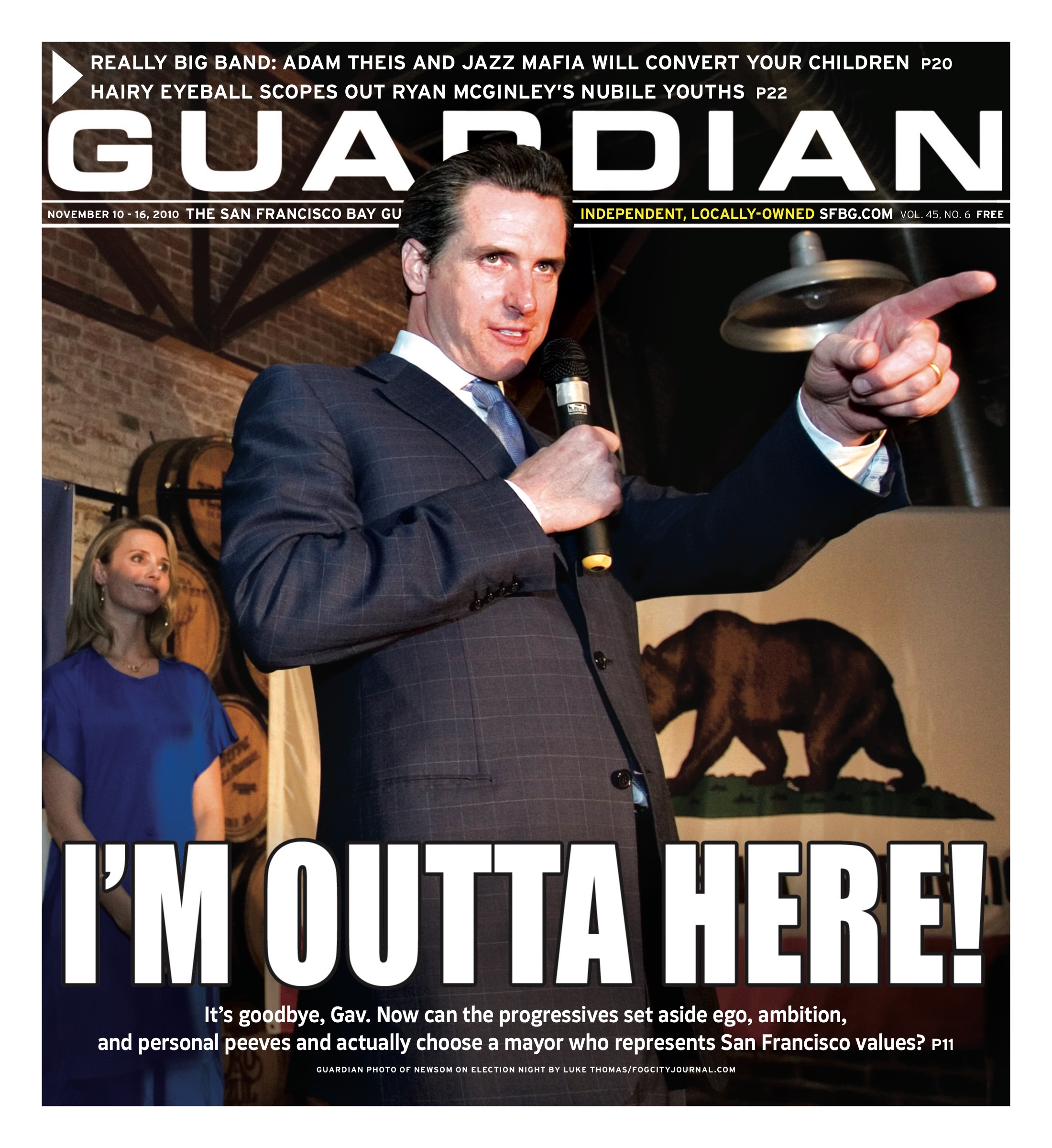
I mention that bit of interesting history as a sort of a prelude to the fascinating historic challenge facing progressives in San Francisco today. At a time when the rest of the country seems to be drifting (at least for the moment) to the right, San Francisco has a chance to go to the left. There hasn’t been a mayor the progressives supported in this town in at least 20 years (and that’s if you count Art Agnos, which is a bit of a stretch). With Gavin Newsom (will he be San Francisco’s last straight white mayor?) leaving early in his term, the supervisors could profoundly change the direction of the city.

And they could also duck, punt, or make a terrible mistake.

If the board wants to appoint someone who’s going to promote a progressive agenda, that person not only needs to be able to get six votes in January, but hold on to the seat until November — when the competition will be intense. And any progressive mayor will be vilified by the local daily papers, mocked by the national media, and held to an almost impossible standard by his or her constituents.

You wonder why anyone would want the job.

But taking on that insane challenge is also about history, and about proving that this city is (still) different. And the person in the job is going to need a whole lot of help and support. I have to believe that we’re up to it.

The “Democratic Machine” myth

34

Okay, I read the gloating from Randy Shaw about Jane Kim defeating the “Democratic Party Machine,” which, as far as I can tell, seems to consist of the Democratic County Central Committee and the Bay Guardian. (As I’ve said before, if I were that powerful, things would change around this city ….)


It annoys me because machine politics were once a harsh reality in this town. But not these days.


Let’s look seriously at the supposed immense clout of the DCCC. Everyone from Shaw to The Chron’s C.W. Nevius has been freaking out over the ability of the local Democratic Party to control who gets elected to the Board of Supervisors. And while I think it’s a good idea to have prgoressives control the local party (this is, after all, San Francisco), even a cursory look at election results suggests that this vaunted machine isn’t really running much of anything.


In every contested race for supervisor — every single one — the candidate endorsed first by the DCCC appears headed for defeat. It’s not just D6; The DCCC endorsed DeWitt Lacy in D10, and he finished well out of the picture. The person leading that race today, Tony Kelly, wasn’t even in the DCCC’s top three. The panel backed Rafael Mandelman in D8; Scott Wiener won. The party gave its nod to Janet Reilly in D2, and if early RCV results hold, she’s in serious trouble.


Here’s the facts: With district elections, and a weak mayor, power is far too diffuse in San Francisco today for anyone to operate a political machine. District races this time around weren’t about the DCCC; they were about local campaigns organizing around local issues.


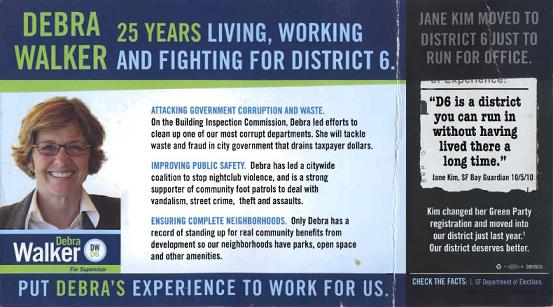
The DCCC helped Debra Walker somewhat in D6 , but it also hurt: In the end, Kim won with a campaign that painted Walker as an old-school machine party politician — and, interestingly enough, according to Paul Hogarth, she won by reaching out to the more conservative voters:


We focused on pitching her biography as a Stanford and Berkeley graduate, who is a civil rights attorney. And Jane Kim was the kind of young professional these voters could relate to. 


If Randy Shaw was right, and a powerful Democratic party machine ran city politics, we wouldn’t all be scratching our heads and wondering who the hell the next mayor will be. I can tell you right now: Aaron Peskin, the titular head of this mighty machine, is pretty far out of the running. Sup. David Chiu, who has pretty much cut ties with Peskin and worked to elect Kim, is one of the top mayoral contenders. It’s also entirely possible that Mark Leno — who is by no means part of any Peskin operation — will wind up in Room 200.


Labor — supposedly part of this machine, too — can’t even agree half the time on its own endorsements — witness the United Healthcare Workers local splitting dramatically with its Local 1021 brothers and sisters in SEIU. UHW backed Wiener, Theresa Sparks and Steve Moss — all candidates opposed by Local 1021.


It’s an unsettled time in local politics, and I hope that the progressives who care about issues, not personalities and silly labels, can come together and choose a mayor who will support a progressive agenda. But that will be a close call, and no doubt will involve a temporary coalition that will fall apart as soon as the deal is done.


Because right now, nobody’s calling the shots in local politics. Just look at the facts on the ground. 

Election over, what next?

0

Dick Meister is a San Francisco-based columnist who has covered political and labor issues for a half-century as a reporter, editor , author and commentator. Visit him at his website, www.dickmeister.com.

OK, the election is over and labor, Democrats and the other good guys came up a bit short. But what now? What next for the good guys?

 Well, for starters, organized labor and its Democratic Party allies must be ready to block Republican plans to try to enact legislation that would cut taxes for the very wealthy, slash Medicare funding, and possibly even privatize Social Security. I know that may sound alarmist and far-fetched. But that’s what Republican leaders are actually talking about.

After all, the GOP’s anti-labor corporate allies spent nearly a billion dollars on the election and they damn well want their money’s worth.  Larry Cohen, president of the communications workers union, thinks it’s getting like the way elections were 100 years ago when the big trusts and robber barons made sure their voices were the only ones heard during election campaigns.

Not yet, Larry. Not quite. Unions were able to make a lot of highly effective noise that helped elect some important pro-labor Democrats and defeat several Tea Party candidates and other anti-labor wackos who argued, as the AFL-CIO’s Mike Hall notes, “that government should do nothing to improve the economy or protect working families during the worst economic crisis since the Great Depression.”

Let’s me take a little closer look at how the election went for organized labor and its political friends in two of the country’s most important states politically, numbers one and two in population, California and Texas.

In California, as the AFL-CIO says, unions were a key factor propelling notably pro-labor Democrat Jerry Brown to the governorship and pro-labor Democrat Barbara Boxer to a third term in the Senate. Those victories were especially sweet, since the opponents of Governor-elect Brown and Senator Boxer were former business executives with tons of money, including their own, to spend on their campaigns.

Former eBay CEO Meg Whitman spent more than $141 million of her own money on her losing campaign against Jerry Brown for governor. And though Carly Fiorina, former Hewlett-Packard CEO, spent several million of her own money on her campaign, the total was nowhere near the obscene amount that Whitman pulled from her own pocket for her campaign.

Anyway, Meg Whitman lost, and good for Californians for making that happen.  Labor couldn’t imagine a worse anti-labor governor than Meg Whitman, or more labor-friendly governor than Jerry Brown, a worse anti-labor senator than Carly Fiorini, or more labor-friendly senator than Barbara Boxer.

It was a bit different in most other states. As Executive Director Rose Ann DeMoro of the California Nurses Association notes, the election of Democratic, pro-labor candidates in California “provided a national alternative to the conservative, corporate-oriented economic program that won so many other races nationwide.”

DeMoro praised California’s voters “for seeing through the fool’s gold promises that the path to economic recovery and job creation is through corporate tax breaks and shifting more wealth and resources to those who need it the least.”

The news isn’t so good out of Texas, where, as Jim Lane of the People’s World  says, “the second largest delegation to the U.S. House of  Representatives, already heavily leaning to the right, tilted drastically further on November 2 – plus, many of the most popular Texas Democratic leaders were defeated.

The re-election of Gov. Rick Perry was more bad news for labor and its allies, given what the People’s World’s Lane notes as Perry’s “far-right, anti-worker vision.” Reporter Lane says “progressive Texans are not looking forward to extending the years of being shamed about their home state, as we have been since GW Bush took the national stage.”

But at least the Texas labor movement was able to run what Lane calls “a strong and largely independent political campaign.”  Unions even dared to run “one of their own,” former national AFL-CIO official Linda Chavez-Thompson, for lieutenant governor. But, as Lane notes, “Like all other statewide Democratic candidates, Chavez-Thompson’s campaign was buried by big money.”

So, what next for Texas, California – the whole country?

What’s next should be in large part to carry out what AFL-CIO and Democratic Party leaders have been advocating for many years – rebuilding of our long crumbling infrastructure

 President Obama has a plan that calls for rebuilding 150,000 miles of roads, laying and maintaining 4,000 miles of railway tracks, restoring 150 miles of airport runways and , in doing so, providing badly needed jobs for many of the country’s millions of unemployed workers.
 
That’s how labor and political leaders can – and must – begin to deliver on their election campaign promises to, above all, do what it takes to create “jobs, jobs, jobs.”

Dick Meister is a San Francisco-based columnist who has covered political and labor issues for a half-century as a reporter, editor , author and commentator. Visit him at his website, www.dickmeister.com.

Pelosi seeks to remain her party’s leader

3

Nancy Pelosi has announced that she is running for House minority leader, citing the need to defend health care and Wall Street reforms and Social Security and Medicare. And my friend Donnie Fowler, a top national Democratic Party consultant, thinks that’s a very good thing, even if I have a few doubts.

“She is a fighter and can bring the majority back in 2012 and no one more progressive would beat her,” Fowler said as he shared the news of Pelosi’s announcement, responding to my skeptical initial reaction. He said that having Pelosi remain in a leadership position was the best hope for pushing San Francisco values in a tumultuous country that has moved the House far to the right.

The Bay Guardian and other leading San Francisco progressive voices have criticized Pelosi for allowing the wars in Iraq and Afghanistan to drag on, for not taking stronger stands on gay rights (from same-sex marriage to the military’s “don’t ask, don’t tell” policy), and for pushing flawed reforms of Wall Street and the health care system that left big corporations with too much power.

Fowler said Pelosi is “better in term of ideology and she’s a strong fighter,” but he conceded that she’s also a pragmatist, so she’ll often fight for outcomes that are not nearly as progressive as she would prefer, as she’s done recently. “She fights hard for what she can get today,” said Fowler, who has played leading roles in Democratic presidential and other campaigns and came in second in the race to chair the national party a few years ago. “Over the last two years, she has felt throttled by other parts of the Democratic Party and other leaders in Washington.”

But many of the moderate to conservative Democrats who have made Pelosi’s life so difficult were voted out of office on Tuesday, leaving a far more liberal caucus. “The biggest hit was to moderates and Blue Dogs, just because of where they live,” Fowler said, citing people such as Rep. Chet Edwards, who represented George W. Bush’s Crawford, Texas district, which now went Republican. “The caucus is going to be more liberal.”

Does that mean that Pelosi could sound a more full-throated defense of progressive values as minority leader? Yes, Fowler said, she could and should, but he’s still not sure whether she will. “The Democrats have got to say what they believe, they have to stand up for progressive values, and they have to be unashamed about it,” he said, noting that the centrist waffling was a factor in the party’s defeat this week, moreso than a genuine desire of the electorate to bring back the Republicans. “If you won’t stand up for yourself, people won’t believe that you’ll stand up for them.”

Right now, moderate Democrats are already starting to make the case that the party needs to be more economically conservative. Rep. Heath Shuler, a Blue Dog Democrat from North Carolina, has announced his intention to run for minority leader on a pro-business platform. It’s also possible progressives could mount a challenge from Pelosi’s left, such as Reps. Barbara Lee (who was the only vote against invading Afghanistan in 2001), Dennis Kucinich, or Raul Grijalva (the Arizona Democrat who co-chairs the Progressive Caucus with Rep. Lynn Woolsey).

Yet Fowler continues to believe that Pelosi is the best person to lead the party back through what’s expected to be a difficult couple years. But does it play into Republican hands to stick with their greatest foil, someone whose liberal politics and connection to a famously liberal city made her the focus in GOP attack ads?

Fowler dismissed that notion, saying that Republicans are going to demonize whoever leads the party. He said the Democrats could elect the most conservative good ole boy with a thick Southern accent “and they’ll still call him a liberal socialist.”

So then why not nominate an actual liberal socialist, someone who can bring a stronger critique of this country’s economic and political systems and set the country up for a more fundamental shift in 2012, someone like Lee, Kucinich, Grijalva, or Woolsey? To Fowler, that’s a bridge too far. Even with a more progressive caucus, he doesn’t think they could win, and he doesn’t think the party ought to move that far to the left anyway.

But what do you think, Guardian readers? Is this a time for Democrats to stay the course, or is this perhaps a moment for progressives to step up – unafraid of the Tea Party rhetoric – and start pushing everyone from President Obama on down to finally address inherent flaws in this country’s unsustainable economic and political systems?

Mayoral question perplexes the pundits

14

Today’s post-election analysis session at the San Francisco Planning and Urban Research Association featured the usual room full of smart political minds from across the ideological spectrum – including those of hosts Alex Clemens and David Latterman – but nobody had any real insights into the big question on everyone’s minds: who will be the next mayor?

Everyone agrees that Gavin Newsom is headed to Sacramento in January, and state law calls for him to become lieutenant governor (and resign as mayor) on Jan. 3. At that point, Board President David Chiu becomes acting mayor, and the current Board of Supervisors is scheduled to meet Jan. 4 and could vote for a new interim mayor. The newly elected board takes office a week later and as its first order of business it will elect a new president, who becomes the new acting mayor, and if the old board can’t elect an interim, then the new one could elect an interim mayor, who would serve until after the mayoral election in November.

It’s tough enough for anyone to get to six votes, particularly considering supervisors can’t vote for themselves, but the deal-making could also involve the district attorney’s job. If Kamala Harris holds her slim current lead for attorney general, the new mayor would get to appoint her replacement. And if Rep. Nancy Pelosi decides to resign, that plum job would mix things up further. So everything is revolving around the vote for mayor right now.

“Everything comes back to this,” Latterman said, as he and Clemens basically had to shrug off questions about who has the inside track to be mayor. There are just too many variables involved, too many possible deals that could be cut, too many ambitious politicians in the mix, not to mention innumerable outsiders who could be tapped (hmmm…Mayor Jones, it does have a ring to it).

Latterman, a downtown consultant who helps update the Progressive Voter Index (created by SF State Professor Rich DeLeon), noted that the citywide results in the election once again showed that the overall city electorate is more moderate than progressive, particularly because the districts that have the strongest voter turnout (Districts 2, 4, and 8) are also some of the city’s most conservative.

As a result, he said, “The city is not voting for a far left mayor come November, so [progressives] will do whatever they can to get a mayor now.” Progressives are indeed hoping to get one of their own into Room 200 in January, and they hope that would allow whoever is chosen to win over enough voters to remain after November.

As a result, conservatives and most moderates will dig in, with many pushing the idea of a “caretaker mayor” so the playing field between left and right is still fairly even this fall.

“This is a World Series for political junkies,” Clemens said, who had the funniest way of casting the question: Normally, about 11 people run for mayor and the whole city picks one, he said, “but this is the opposite.” These 11 supervisors have the whole city to pick a mayor from, and at this point, it’s anyone’s guess who that will be.

Election 2010: How the late absentees are breaking

11

Lots of votes still to count in San Francisco — as of this morning, the Department of Elections said there were about 80,000 absentee and provisional ballots in the hopper. But some have been counted yesterday and today, and we can draw some conclusions.

Typically election-day absentees break fairly close to the way election-day votes break, and Kamala Harris is citing that — and her campaign’s own analysis — to claim victory;

“Uncounted ballots will only bolster Kamala Harris’s lead, as they will reflect Harris’s strong Election Day advantage.”

In San Francisco, though, I’ve seen progressive measures that won on election day go down to defeat when the late votes, which were not as conservative as the early absentees but more conservative than election-day votes — were counted.

We now have the newest results from the DOE, and a little quick math gives us some interesting trends. In D2, Janet Reilly has (marginally) increased her lead over Mark Farrell. She’s gone from 6253 yesterday to 6512 today, a pickup of 259 votes. Farrell picked up only 223. So Reilly will probably still lead this race when all the votes are counted, but the RCV calculation will depend entirely on whether supporters of the third and fourth candidates, Abraham Simmons and Kat  Anderson, were voting for Anyone But Reilly or were willing to put Reilly as a second choice.

In D6, Jane Kim picked up about 100 votes over Debra Walker, enough to make her the clear front-runner. Again, though: Do the more conservative Theresa Sparks votes go to Kim,  whose supporters tried to portray Walker as part of a liberal machine and who touted her support for Prop. G, or do a sizable number go to Walker, another LGBT candidate?

D10? Not much has changed.  Tony Kelly picked up 65 votes. Lynette Sweet picked up 80. Malia Cohen picked up 72. Steve Moss picked up 64. The rankings aren’t going to change much. But this will be the mother of all RCV elections — and we’ll know more tomorrow, when DOE does its first RCV pass.


Election 2010: Labor and progressives dodge a bullet

22

Bucking a national conservative, anti-government political trend, San Franciscans stayed with some fairly progressive politics on election night, rejecting a measure to demonize public employees (Prop. B), giving progressive John Rizzo far more votes than his City College of San Francisco board rivals, and taking far more liberal positions in state ballot measures and candidates than California voters, who were already far to the left of national voters.
“We are really happy that Prop. B is going down because it was such a misguided measure. It was not well thought through,” San Francisco Labor Council President Tim Paulson told the Guardian at the party labor threw with the San Francisco Democratic Party at Great American Music Hall. “San Francisco voters are the smartest in America.”
Paulson was also happy to see those voters approve Prop. N, taxing the transfer of properties worth more than $5 million, “because San Franciscans know that everyone has to pay their fair share.”
Another labor priority, Prop. J, the temporary hotel tax increase, lost by a narrow margin after Mayor Gavin Newsom and his downtown allies opposed it, and the online travel company spent millions of dollars to bury Prop. K – a Newsom-created rival measure that would have closed a loophole that lets the company avoid paying the hotel tax.
Rizzo said he was happy to far outpoll Lawrence Wong and Anita Grier as the three incumbents ran uncontested for their City College board seats, which should put him in a leadership position in the troubled district. “There is a tradition at City College that the highest vote getter gets the presidency, so I’m pretty happy,” Rizzo told us on election night.
There were some conservative victories in San Francisco, including approval of Prop. L, which criminalizes sitting or lying on sidewalks, and Prop. G, which will reduce Muni operator wages and change work rules after getting the approval of about 63 percent of voters.
“Ultimately, downtown did well,” progressive political consultant Jim Stearns said, noting how aggressive spending by downtown business and real estate interests ended a string of progressive victories in the last several election cycles, including the likely election of Scott Wiener in D8 and the strong challenge in D2 by Mark Farrell to perceived frontrunner Janet Reilly, who had progressive endorsements.
Stearns said national polls have shown that people are more afraid of big government than big corporations, whereas progressives tend to hold the opposite view. “That national atmosphere definitely had an impact on even races locally,” Stearns said.
But in San Francisco, the progressives retain a strong position in the political debates to come.

Election 2010: Early SF results

1

The absentee votes are in, and it’s a very mixed bag. If trends hold, and the absentees represent the most conservative votes, Prop. B is going down — the result of a very successful labor campaign. Prop. L, the sit-lie law, is solidly ahead. The two hotel tax measures are both losing by about the same percentage, suggesting that the anti-tax group’s focus on just Prop. K, which liberals also opposed, was effective. But it’s still to early to call those.

In D2, Janet Reilly is well ahead. In D8, Scott Wiener is ahead of Rafael mandelman 54-22; that’s going to be hard to make up, even though Mandelman had a strong GOTV drive today.

D6 and D10 are still way up in the air. Jane Kim is ahead in D6, and Marlene Tran — the only Asian in the race, is winning in D10, a testament to the fact that 10 is becoming an increasingly Asian district. But neither of those two will be over tonight, and will come down to ranked-choice voting. 

Election 2010: Newsom in, Harris trailing

0

That’s based on very early results. But with Boxer’s numbers creeping up, and Newsom comfortably ahead, it looks as if San Francisco will be getting a new mayor in January. The very early results have Harris pretty far behind, but those numbers will change. Since the early returns are always conservative, thought, the news for Gav is very good.

Election 2010: Boxer should be okay

0

The earliest results — which would be absentees from conservative areas — have Fiorina slightly ahead, but if typical trends hold, Boxer will be fine. So the question is: If voters support the two Dems at the top of the ticket, what happens to the downticket races? Are there coattails?

Hey, D2 voters: BOO!!!!

19

Why are the rich people in District 2 so scared of Chris Daly, Aaron Peskin, and other progressives? Just the hint that a supervisorial candidate like Janet Reilly might have some vague, tangential connection to a (gasp!) progressive is enough send trembles of fear through their delicate nervous systems, and to fill mailboxes with alarmist warnings of dark progressive plots.

“I eat small children,” Daly deadpanned when I asked him about the campaign by candidate Mark Farrell and some of his wealthy venture capitalist buddies – along with moneyed socialite Dede Wilsey, the yacht-loving, renter-hating Thomas Coates, and their Common Sense Voters SF front group – to hurt frontrunner Reilly’s chances by inaccurately claiming she’s somehow Daly’s puppet.

Nevermind the fact that Daly doesn’t support Reilly, and that he wouldn’t even endorse Reilly a few year ago during her Assembly campaign against Fiona Ma when the Guardian and many progressives were supporting Reilly. “Fiona was a better supervisor than Reilly is going to be,” Daly told us, a prediction that I don’t agree with, but one that shows how ridiculous the website, mailers, and doorhangers that claim Daly is “behind Janet Reilly’s agenda” are.

Nonetheless, Mayor Gavin Newsom, who supports Reilly, has sent out two press releases in the last two days claiming that “Janet Reilly opposes Chris Daly’s agenda as much as I do. She has the full support of our city’s greatest moderate leaders and she will be a strong moderate voice on the board.”

Daly, who is amused by this fearful battle of the rich people, couldn’t agree more. “There is no bigger opponent of Daly’s agenda to build more affordable housing in San Francisco than Gavin Newsom and Janet Reilly. Because that’s my biggest issue,” Daly told us. “Apparently they are afraid of affordable housing in D2.”

But Daly isn’t the only boogeyman who strikes terror into the hearts of the residents of Sea Cliff, Pacific Heights, and other wealthy D2 enclaves. Farrell and his ilk also made such a big deal of Reilly’s association with Peskin, who actually is supporting Reilly, that she announced that if Newsom leaves for Sacramento in January, her vote for interim mayor would only go to a moderate who had never served on the Board of Supervisors with any current members, thus eliminating the chance of supporting Peskin.

Although we at the Guardian held our noses and endorsed Reilly as the best of a bunch of bad choices in San Francisco’s most conservative district, we were appalled during her endorsement interview at just how myopically conservative she had become since her Assembly run, when universal health care was her big issue. Listen for yourself here and decide whether she’s planning to be Daly’s minion.

Geez, what exactly are these people so scared of? Perhaps it’s as simple as Lewis Lapham put it a couple weeks ago, when we discussed the political dynamics of big cities: “The rich are afraid of the poor.”

Oddball billionaire wants to wreck California

6

Okay, this is really scary. An oddball billionaire who used to have homes in New York and Florida but now lives just in hotels — and who has no apparent connection to California — is going to spend $20 million promoting a plan to restructure the state.


And who’s going to be drawing up the blueprints? A bunch of right-wingers from the Reagan and Bush days, a failed way-too-conservative former governor — and Willie Brown.


Calitics has the right line:


The entire progressive movement, which represents at least a third of California, is totally absent from this conversation, whereas the right-wing is there in the form of Condi Rice and Arnold Schwarzenegger.


The problem is, unlike the doomed effort by the Bay Area Council to create a constitutional convention, (the biggest companies in the region couldn’t manage to put together the funding to put it on the ballot) this nightmare has real resouces. I mean, $20 million is enough to run a statewide campaign. And people are so frustrated now that almost any lunacy (spending limits, more tax cuts, eliminating major social programs etc.) could get traction.


Be very afraid.
 

Cash not care

5

sarah@sfbg.com

With the general election just days away, campaign disclosure reports show that downtown interests are spending huge amounts of money to create a more conservative San Francisco Board of Supervisors and to pass Proposition B, Public Defender Jeff Adachi’s effort to make city workers pay more for their pensions and health insurance.

Much of the spending is coming from sources hostile to programs designed to protect tenants in the city, including rent control and limits on the conversion on rental housing units to condominiums. An ideological flip of the board, which currently has a progressive majority, could also have big implications on who becomes the next mayor if Gavin Newsom wins his race for lieutenant governor.

At press time, downtown groups were far outspending their progressive counterparts through a series of independent expenditure committees, most of which are controlled by notorious local campaign attorney Jim Sutton (see “The political puppeteer,” 2/4/04) in support of supervisorial candidates Mark Farrell in District 2, Theresa Sparks in District 6, Scott Wiener in District 8, and Steve Moss in District 10.

Prop. B has also been a big recipient of downtown’s cash, although labor groups have pushed back strongly with their own spending to try to kill the measure, which is their main target in this election.

But the biggest spender in this election appears to be Thomas J. Coates, 56, a major investor in apartments and mobile homes and a demonstrated enemy of rent control. He alarmed progressive groups by giving at least $250,000 to groups that support Farrell, Sparks, Wiener, Moss, and Prop. G, legislation that Sup. Sean Elsbernd placed on the ballot to cut transit operator wages and change Muni work rules.

Although Coates declines to identify with a political party on his voter registration, he donated $2,000 to President George W. Bush in 2004. More significantly, he was the biggest individual donor in California’s November 2008 election, when he contributed $1 million to Prop. 98, which sought to repeal rent control in California and limit the government’s right to acquire private property by eminent domain.

Coates, who is also a yachting enthusiast and sits on San Francisco’s America’s Cup Organizing Committee (ACOC), donated $100,000 on Oct. 20 for Farrell, $45,000 for Sparks, $45,000 for Moss, and $10,000 for Wiener through third-party independent expenditure committees such as the Alliance for Jobs and Sustainable Growth.

The group has already received thousands of dollars in soft money from the San Francisco Police Officer’s Association, the Building Operators and Managers Association, the Golden Gate Restaurant Association, and SEIU-United Healthcare Workers, which supports a high-end hospital and housing complex on Cathedral Hill.

Those downtown groups have spent close to $200,000 on English and Chinese language mailers and robo calls in support of Sparks, Wiener, and Moss in hopes of securing a right-wing shift on the board.

Progressive groups including California Nurses Association, the San Francisco Tenants Union, and the SF Labor Council have tried to fight back in the supervisorial races. While downtown groups spent more than $100,000 promoting Sparks in D6, labor and progressive groups spent $13,000 opposing Sparks and $72,000 supporting progressive D6 candidate Debra Walker.

In D8, progressive groups that include teachers, nurses, and transit riders have outspent the downtown crowd, plunking down $40,000 to oppose Wiener and $90,000 to support progressive candidate Rafael Mandelman. So far, downtown groups have spent about $100,000 to support Wiener.

But in D10, the district with the biggest concentration of low-income families and communities of color, downtown interests spent $52,000 supporting Moss and $5,000 on Lynette Sweet while the Tenants Union was only able to summon $4,000 against Moss. The SF Building and Construction Trades Council spent $4,000 on Malia Cohen.

But that’s small potatoes compared to what downtown’s heavy-hitters are spending. The so-called Coalition for Sensible Government, which got a $100,000 donation from the San Francisco Association of Realtors, has already collectively spent $96,000 in support of Sparks, Wiener, Moss, Sweet, Rebecca Prozan in D8, Prop. G and Prop. L (sit-lie) and to oppose Prop. M (the progressive plan for police foot patrols) and Prop. N (a transfer tax on properties worth more than $5 million).

The Coalition for Responsible Growth, founded by Anthony Guilfoyle, the father of Mayor Gavin Newsom’s ex-wife, Kimberly Guilfoyle (who now works as a Fox News personality), has received $85,000 from the Committee on Jobs, $60,000 from the Realtors, and $35,000 from SF Forward. It has focused on spending in support of Prop. G and producing a voter guide for Plan C, the conservative group that supports Sparks, Wiener, Sweet, and Moss

Coates’ donations raise questions about his preferred slate’s views on tenant and landlord rights. A principal in Jackson Square Properties, which specializes in apartments and mobile homes, Coates is the founding partner of Arroya & Coates, a commercial real estate firm whose clients include Walgreens, Circuit City, and J.P. Morgan Investment Management. In 2008, when he backed Prop. 98, Coates told the San Francisco Chronicle that rent control “doesn’t work.”

Ted Gullicksen, director of the SF Tenants Union (SFTU), which has collectively spent $30,000 opposing Sparks, Wiener, and Moss, is disturbed that Coates spent so much in support of this trio.

“Coates was the main funder of Prop. 98,” Gullicksen explained. “His property is in Southern California. He’s pumping a lot of money into supervisors. And he clearly has an agenda that we fear Moss, Sparks, and Wiener share — which is to make the existence of rent control an issue they will take up in the future if elected to the board.”

That threat got progressive and labor groups to organize an Oct. 26 protest outside Coates’ San Francisco law office, with invitations to the event warning, “Be there or be evicted!”

Sparks, Moss, and Wiener all claim to support rent control, despite their support by someone who seeks to abolish it. “I answered such on my questionnaire to the SFTU, which chose to ignore it,” Sparks told the Guardian via text message. “In addition, I’ve been put out of apartments twice in SF, once due to the Ellis Act. They ignore that fact as well.”

Records show that in May 2009, Moss — who bought a rent-controlled apartment building near Dolores Park in D8 for $1.6 million and he lived there from the end of 2007 to the 2010, when he decided to run for office in D10 — served a “notice to quit or cure” on a tenant who complained about the noise from Moss’ apartment. Ultimately, Moss settled without actually evicting his tenant.

“I read about Coats’ [sic] contribution in Bay Citizen,” Moss wrote in an e-mail to the Guardian. “This donation was made to an independent expenditure committee over which I have no control and almost no knowledge. I have stated throughout the campaign, and directly to the Tenants Union, that I believe current rent control policy should remain unmolested.”

But Moss is with downtown on other key issues. He supports Newsom’s sit-lie legislation and the rabidly anti-tenant Small Property Owners Association, whose endorsement he previously called a “mistake.”

Yet Moss, who sold a condo on Potrero Hill in 2007 for the same price he paid for the entire building in 2001, seems to voice more sympathy for property owners than renters, who make up about two-thirds of city residents. He told us, “Landlords feel that they are responsible for maintaining costly older buildings and that they are not provided with ways to upgrade their units in ways that share costs with tenants.”

Another realm where downtown seems to be trying to flip the Board of Supervisors on a significant agenda item is on health care, particularly the California Pacific Medical Center proposal to build a high-end hospital and housing project on Cathedral Hill in exchange for rebuilding St. Luke’s Hospital in the Mission.

The project has divided local labor unions. UHW supports the project and a slate of candidates that its parent union, Service Employees International Union, is opposing through SEIU Local 1021, which is supporting more progressive candidates. The California Nurses Association also opposes the project and candidates such as Wiener who back it.

“A recent mailer by CNA falsely says that CPMC is closing St. Luke’s and Davies,” CPMC CEO Warren Browner recently complained in a letter to the Board of Supervisors. “We are not. We are committed to building a state-of-the-art, high-quality replacement hospital at St. Luke’s and continuing to upgrade Davies.”

But the CPMC rebuild is contingent on the board approving the Cathedral Hill project. So the CNA mailer focused on what could happen if the city rejects the CPMC project: “We could lose two San Francisco hospitals if Scott Wiener is elected supervisor.”

SEIU-UHW’s alliance with downtown groups and its use of member dues to attack progressive candidates places it at odds with SEIU Local 1021 and the SF Labor Council, which has endorsed Janet Reilly in D2, Walker in D6, Mandelman in D8, and Cohen (first choice) and Chris Jackson (second choice) in D10.

“We’re really disappointed that there are labor organizations that feel they have to team up with Golden Gate Restaurant Association, which is against health care [it challenged the city’s Healthy San Francisco program all the way to the U.S. Supreme Court], and with CPMC, which is working to keep nurses from joining a union,” Labor Council Director Tim Paulson said. “This alliance does not reflect what the San Francisco labor movement is about.”

Paulson said that the Labor Council values “sharing the wealth … So we don’t want Measure B [Jeff Adachi’s pension reform] or K [Newsom’s hotel tax loophole closure, which has a poison pill that would kill Prop. J, the hotel tax increase pushed by labor] or L [Newsom’s sit-lie legislation],” Paulson said.

CPMC’s plan is headed to the board in the next couple months, although Sup. David Campos is proposing that the city create a health services master plan that would determine what city residents actually need. Hospital projects would then be considered based on that health needs assessment, rather than making it simply a land use decision as it is now.

Moss told the Guardian that UHW endorsed him because of his positions on politicians and unions. “I agreed that politicians should get not involved in union politics,” Moss said. “The United Healthcare Workers seem to be a worthy group,” he added. “All they said was that they wanted to make sure that they had access.”

But CNA member Eileen Prendiville, who has been a registered nurse for 33 years, says she was horrified to see UHW members recently oppose Campos’ healthcare legislation. “I was shocked that they were siding with management,” she said.

Prendiville believes UHW is obliged to support CPMC’s Cathedral Hill plan, which is why it is meddling in local politics. In his letter to the board, Browner noted that his company and its parent company, Sutter Health, can’t legally do so directly. “The fact is that CPMC and Sutter Health are 501(c)(3) not-for-profit, nonpartisan organizations, and we neither endorse nor contribute to candidates,” Browner wrote.

“When UHW settled its contract with its members [as part of its fight with the rival National Union of Healthcare Workers], they had to publicly lobby for Cathedral Hill,” Prendiville claimed.

SEIU 1021 member Ed Kinchley, who works in the emergency room at SF General Hospital, is also furious that UHW is pouring money into downtown’s candidates and measures. “UHW isn’t participating in the Labor Council, it’s doing its own thing,” he said.

Kinchley said UHW, which is currently in trusteeship after a power struggle with its former elected leaders, is being controlled by SEIU’s national leaders, not its local membership, which explains why it’s aligned with downtown groups that have long been the enemy of labor.

“Sutter wants a monopoly on private healthcare and people like Rafael Mandelman and Debra Walker have been strong supporters of public healthcare,” Kinchley said. “I want someone who can straight-up say, here’s what’s important for families in San Francisco, especially something as important as healthcare. But it sounds like UHW is teaming up with the Chamber and supporting people who are not progressive.”




Editor’s notes

0

Tredmond@sfbg.com

At a certain point, you have to stop trying to project what’s going to happen and just wait for the election results. Because what matters now isn’t the $140 million Meg Whitman has spent or Carly Fiorina’s record at Hewlett-Packard or which aide to Jerry Brown called Whitman a whore. It’s who shows up to vote.

If I were Meg Whitman’s campaign manager, I’d stop spending money. Go into hiding. Pretend there’s nothing going on here, no big deal next Tuesday morning — and then pray for rain. Because the way Whitman wins — possibly the only way she wins — is if huge numbers of Californians don’t bother to vote.

If the turnout is reasonable — that is, if enough Democrats realize the danger posed by of the GOP candidate and go to the polls — then Jerry Brown is in. And if that happens, chances are good that the rest of the Democratic ticket — including Gavin Newsom and Kamala Harris — squeaks in, too. And then we can all start to have fun figuring out the future of San Francisco politics.

That, of course, depends on the same factor: Who’s going to show up to vote? Will all the tenants in District 8 — many of them unexcited about Jerry Brown — take the time to vote for Rafael Mandelman for supervisor? Will the progressive voters who have lived in District 6 for a while get to the polls in greater numbers than the conservative newcomers in the pricey condos? Will the next Board of Supervisors — which could be choosing the next mayor — be as progressive as the current board (which also might wind up choosing the next mayor?)

And who’s even on the mayoral short list?

At the Haight Ashbury Neighborhood Council forum Oct. 14, former Supervisor (and potential mayoral contender) Aaron Peskin noted that the person in Room 200 year “is going to have to take out the garbage.” The city’s going to face another awful budget deficit and a progressive interim mayor will have to make a lot of enemies. Who wants to face the voters in November 2011 after making more cuts and raising taxes?

Well, somebody needs to — because the “caretaker” mayor some people are pushing for won’t have the clout to make tough decisions. And frankly, a progressive with the power of incumbency might actually be able to win a full term, even up against a huge downtown war chest.

Fun stuff. Go out and vote.


Controlling big money campaigns

0

Big money moved into the district supervisorial races this fall. Downtown forces, working with landlords and a labor union that wants a giant new hospital on Van Ness Avenue, are pouring hundreds of thousands of dollars into races in Districts 6, 8, and 10, trying to alter the direction of the board by electing more conservative candidates. And while district races allow grassroots candidates without huge war chests a decent shot at winning, all this cash is going to have an impact — and might prove to be decisive in some races.

A lot of the money hasn’t been raised directly by candidates, either — it’s in the form of so-called independent expenditure committees, outside operations that, in theory, have no direct connection to any candidate. These committees can raise money without limits, spend it however they like, and ignore the limits that candidates face. And thanks to the U. S. Supreme Court, it’s almost impossible to regulate the committees. So the IEs, as they’re known, can put out attack ads, make scurrilous accusations, even lie outright — and have no accountability.

But San Francisco, which led the nation in using ranked-choice voting and has an impressive system for public financing of elections and disclosure, ought to be working to control this flood of sleaze. There are two major steps the supervisors should be looking at.

1. Respond to the money. San Francisco currently gives matching public funds to candidates who raise enough on their own to meet a threshold. That gives underfunded candidates at least a fighting chance to stay competitive. But it doesn’t address what happens when an outside group comes in and drops, say, $50,000 to promote or attack a candidate.

Unfortunately, federal law and court decisions limit the city’s ability to cap or restrict that spending. But the current system of matching public funds offers a potential alternative.

Suppose, for example, the city offered matching funds not just on the basis of what a candidate has raised — but also on the basis of what his or her opponents (including IEs) are spending. For example, if an IE spends $50,000 attacking a candidate, the city could give that candidate $50,000 (or, better, $100,000) to fight back.

That sounds like a lot of taxpayer dollars — but if the system is designed right, much of it will never be spent. Because the independent expenditure committees are only effective if the money is one-sided. Once these operators realize that all they’ve be doing by spending money against a candidate is increasing that candidate’s own resources, they’re far less likely to mount these campaigns.

The disclosure laws can be tightened too. Campaign ads and mailers have to say where the money’s coming from — but only in tiny type or in rushed voiceovers that few people notice. The federal government’s mandate that cigarette packages and ads have big, prominent statements about the health risks of smoking has been very effective. Requiring campaigns, particularly independent expenditure groups, to identify their major donors in large, visible type in prominent places on printed material and in clear language on radio or TV ads would help the voters understand the players — and the motivations — behind the campaign material.

2. Deal with the legal violations — promptly. A lot of these big-money campaigns have a tendency to skirt — or sometimes flagrantly violate — the city’s campaign law. And by the time the ethics Commission gets around to investigating (if that even happens) the election is over and it’s too late.

The supervisors ought to mandate that all credible allegations of election-law violations be investigated — and resolved if at all possible before Election Day. And if that means Ethics needs more staff, that’s a small price to pay for honest elections. 


Controlling big money campaigns

0

Thanks to the U. S. Supreme Court, it’s almost impossible to regulate the so-called independent expenditure committees.

EDITORIAL Big money moved into the district supervisorial races this fall. Downtown forces, working with landlords and a labor union that wants a giant new hospital on Van Ness Avenue, are pouring hundreds of thousands of dollars into races in Districts 6, 8, and 10, trying to alter the direction of the board by electing more conservative candidates. And while district races allow grassroots candidates without huge war chests a decent shot at winning, all this cash is going to have an impact — and might prove to be decisive in some races.


A lot of the money hasn’t been raised directly by candidates, either — it’s in the form of so-called independent expenditure committees, outside operations that, in theory, have no direct connection to any candidate. These committees can raise money without limits, spend it however they like, and ignore the limits that candidates face. And thanks to the U. S. Supreme Court, it’s almost impossible to regulate the committees. So the IEs, as they’re known, can put out attack ads, make scurrilous accusations, even lie outright — and have no accountability.

But San Francisco, which led the nation in using ranked-choice voting and has an impressive system for public financing of elections and disclosure, ought to be working to control this flood of sleaze. There are two major steps the supervisors should be looking at.

1. Respond to the money. San Francisco currently gives matching public funds to candidates who raise enough on their own to meet a threshold. That gives underfunded candidates at least a fighting chance to stay competitive. But it doesn’t address what happens when an outside group comes in and drops, say, $50,000 to promote or attack a candidate.
Unfortunately, federal law and court decisions limit the city’s ability to cap or restrict that spending. But the current system of matching public funds offers a potential alternative.

Suppose, for example, the city offered matching funds not just on the basis of what a candidate has raised — but also on the basis of what his or her opponents (including IEs) are spending. For example, if an IE spends $50,000 attacking a candidate, the city could give that candidate $50,000 (or, better, $100,000) to fight back.

That sounds like a lot of taxpayer dollars — but if the system is designed right, much of it will never be spent. Because the independent expenditure committees are only effective if the money is one-sided. Once these operators realize that all they’ve be doing by spending money against a candidate is increasing that candidate’s own resources, they’re far less likely to mount these campaigns.

The disclosure laws can be tightened too. Campaign ads and mailers have to say where the money’s coming from — but only in tiny type or in rushed voiceovers that few people notice. The federal government’s mandate that cigarette packages and ads have big, prominent statements about the health risks of smoking has been very effective. Requiring campaigns, particularly independent expenditure groups, to identify their major donors in large, visible type in prominent places on printed material and in clear language on radio or TV ads would help the voters understand the players — and the motivations — behind the campaign material.

2. Deal with the legal violations — promptly. A lot of these big-money campaigns have a tendency to skirt — or sometimes flagrantly violate — the city’s campaign law. And by the time the ethics Commission gets around to investigating (if that even happens) the election is over and it’s too late.

The supervisors ought to mandate that all credible allegations of election-law violations be investigated — and resolved if at all possible before Election Day. And if that means Ethics needs more staff, that’s a small price to pay for honest elections

SFBG Radio: Old ladies love prop 19

2

In today’s episode, Johnny talks about the conservative old ladies at the gym who hate the drug war and love Prop 19. Listen after the jump.

SFBG Radio 10.25.10 by endorsements2010

Republican who wants to overturn rent control pumps $200,000 into district elections

25

Thomas J, Coates, a big time investor in apartments and mobile homes, has dropped a total of $225,000 into five independent expenditure committees that are trying to push conservative-friendly candidates and measures over the victory line this fall.

Coates, a 56-year-old Republican (he donated $2,000 to George Bush in the 2004 presidential election) and yacht racing enthusiast, was the biggest single spender in the November 2008 election, when he contributed nearly $1 million to Prop. 98, a statewide measure that sought to repeal rent control in California and limit government’s right to seize private property by eminent domain.

And with only 11 days until the election, Coates has given local Republican war chests an enormous last-minute boost: He plunked $100,000 into Common Sense Voters, a committee in support of Mark Farrell in D2. He plunked $10,000 into the Alliance for Jobs and Sustainable Growth’s committee in support of Scott Wiener in D8. He plunked $45,000 into the Alliance’s committee in support of Theresa Sparks in D6. He dropped $45,000 into the Alliance’s committee in support of Steve Moss in D10. And he dropped another $25,000 into San Franciscans for a Better Muni, a committee in support of Measure G, which attempts to reform Muni by focusing on transit operator wages.

As the Guardian previously reported, this Alliance has received thousands from the SF Police Officer’s Association, the Building Operators and Managers Association, the Golden Gate Restaurant Association, and SEIU-United Healthcare Workers, which supports a mega-hospital on Cathedral Hill.

But Coates’ donation raises questions about his choices’ commitment to rent control. As Coates told the Chronicle in an interview in 2008, “There is a reason why 35 of 50 states expressly prohibit rent control by law – and the reason is it doesn’t work.”

Coates, who is a principal in Jackson Square Properties, which specializes in apartments and mobile homes, is also the founding partner of Arroya & Coates, a commercial real estate brokerage and investment firm whose clients include Walgreens, Circuit City, and J.P. Morgan Investment Management. And as campaign disclosures show, he’s dumped a large part of his money into the same conservative alliance that has already collectively spent almost $170,000 on Moss, Sparks and Wiener.

So far, labor has countered the Republican money by spending $70,000 in support of Debra Walker in D6 and $90,000 on Mandelman in D8, and the SF Tenants Union has spent a total of $20,000 on mailers opposing Moss, Sparks and Wiener. But collectively the downtown money, which is also being funnelled into several other independent expenditure committees, continues to massively outweigh the progressive bucks.

Coates’ phone line continues to register a “busy” signal, making it impossible to leave him a message, but I’d be happy to include his comments here, if and when I talk to him.

But Gullicksen said he was disturbed by Coates’ heavy spending on the supervisors’ races.

“Coates is the main funder of Prop. 98, his property is in Southern California, he’s pumping a lot of money into supervisors and he clearly has an agenda that we fear Moss, Sparks and Wiener share, which is to make the existence of rent control an issue the Board will take up, if those supervisors are elected.”

It will be interesting to see if Moss, Sparks and Wiener are prepared to pledge that they have no intention to attack rent control….so, stay tuned.

Meanwhile, labor is organizing a protest outside Coates office at 500 Washington Street at 5 p.m on Tuesday, Oct. 26.

“Be there or be evicted!” labor warned.


Ignoring Cheney’s real victims

0

Dick Meister. former labor editor of the SF Chronicle and KQED-TV Newsroom, has covered labor and politics for a half century. Contact him through his website, www.dickmeistersf.com, which includes more than 250 of his columns.


So, as the Washington Post ‘s Paul Farhi reported recently, hunter Harry Whittington is still suffering from the effects of  being shot accidentally by hunting partner Dick Cheney in Texas four years ago.

I’m sure we’re all sorry about that, about how Whittington still has the lead pellet that pierced his larynx when the then-vice president swung around abruptly and fired away at a flight of quail. We’re of course sorry, too, about the 30 or so other pieces of shot still inside Whittington out of some 200 that slammed him, and the scars he bears.

 “I was lucky,” Whittington told Farhi, “I just feel every day ‘s a gift. Sometimes I wonder why I got those extra years.”

But what of the real victims? What of the defenseless quail that Cheney, Washington and two friends were stalking with a clear and undisguised intent to kill?

At least one quail was saved when Dead Eye Dick hit Whittington while aiming for a bird, and there was a bit of poetic justice since Whittington was struck as he was returning from retrieving a quail he had killed.

But no one bothered reporting how many other birds had been killed. After all, they were inferior beings raised for the amusement of Cheney and others who get their kicks stalking and killing fellow creatures.

Cheney’s been at it a long time, targeting ducks, pheasants and other birds as well as quail, in company with such other conservative favorites as Supreme Court Justice Antonin Scalia and former President George W. Bush.

Although apparently not as skilled and frequent a hunter as Cheney, Bush has managed to bring down a few winged creatures himself, most notably during his New Year’s holiday in Texas a few years back., Bush, who modestly declared that “I’m not that good a shot,” managed to down five quail. He said that “was a lot of fun.”
 
Bush praised the owner of the area in which the hunt took place for maintaining the land as a good habitat, not because it benefited the birds, of course, but because  – like the Texas farm where Cheney was hunting – it provided easy targets for hunters who wished to kill birds.

There are more than 20 million “sportsmen” like Bush and Cheney who find it fun to prey on innocent birds and animals.

The number of “sportsmen” has declined in recent years, thanks to anti-gun sentiment, urbanization, the animal rights movement, availability of a broad range of other leisure activities, heightened environmental awareness and the increasing cost of hunting equipment,

But there are still far too many people searching the countryside for winged and four-legged victims. What’s more, manufacturers of guns and other hunting gear have greatly intensified efforts to increase their number. So have state fish and game departments, which rely on hunters’ license fees to cover much of their operational costs.

Hunters and their defenders argue that, although the hunters’ targets are too dumb to realize it, hunting actually benefits them by “thinning the herds” and thus keeping them from starvation. But though there’s no doubt that reducing or at least relocating some animal populations may be necessary for their survival, there are civilized ways to do it.

Once, long ago, we had to hunt and kill in order to survive. But this is the 21st century. It’s outrageous that leaders and citizens of the world’s most powerful and influential nation, one that presumes to be the role model for all others, find it amusing to engage in the barbarity of killing for sport.

Invariably, when I address this subject, people come back at me complaining that I just don’t understand that some people need to hunt animals to help feed their families.

I understand. But that’s another matter entirely. I’m writing about the vast majority of hunters who hunt and kill their fellow animals, not for food, but for the fun of it. To me, that seems a sick thing to do.

 Let me repeat: It’s killing for the sport of it that should disturb us all. It’s not just the bird and animal targets that need protecting. Think of the message that’s being delivered to the rest of us. It’s a message, as animal rights activist Jamie Kemsey noted, “that it is acceptable to commit an act of violence and take innocent life simply for the fun of it. In these violent times we cannot afford, under any circumstances, to condone such morally bankrupt actions.”

Dick Meister. former labor editor of the SF Chronicle and KQED-TV Newsroom, has covered labor and politics for a half century. Contact him through his website, www.dickmeistersf.com, which includes more than 250 of his columns.

Newsom could be headed for victory

11

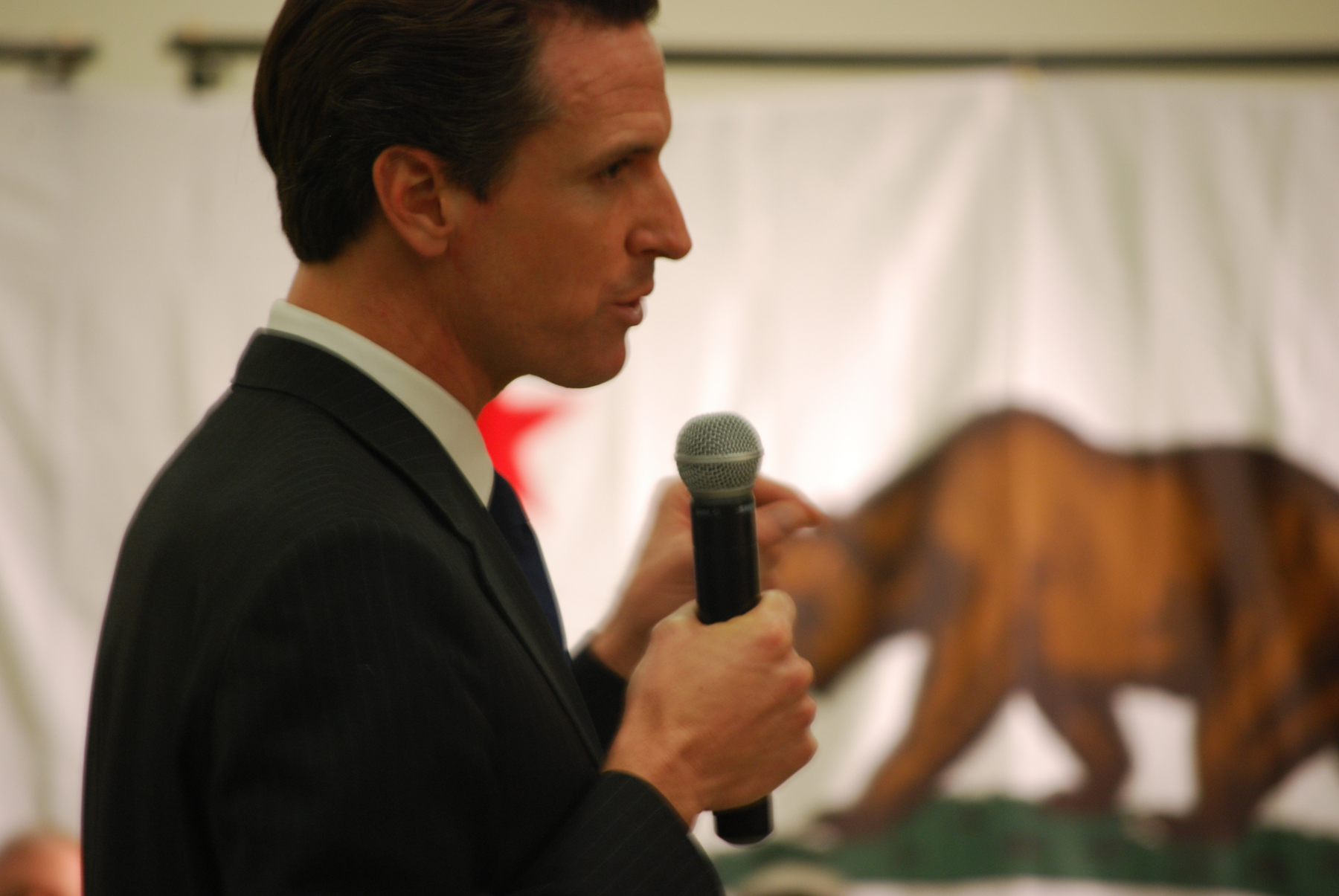
Gavin Newsom seems poised to win his race for lieutenant governor, at least as indicated by his opponent Abel Maldonado’s increasingly desperate campaign tactics and Newsom’s string of newspaper endorsements, including the Spanish language La Opinion, which chose to pass over a moderate Latino that it has endorsed in the past. The only question now is voter turnout, and whether Newsom’s negatives would be enough to drag him down if the Democratic base stays home in this lackluster election.

In its endorsement in Sunday’s paper, La Opinion wrote, “We are deeply disappointed that in this election [Maldonado] has opted for an opportunistic strategy of using images of undocumented criminals to earn political points. This is unacceptable and his charges against Newsom on this issue are inaccurate.” The reference was to Maldonado’s wild charges in an Oct. 15 debate that Newsom created San Francisco’s sanctuary city policies and was responsible for the fatal shootings of Bologna family members, allegedly by an undocumented immigrant who had once been in city custody. The reality was that Newsom inherited the sanctuary city policy and unilaterally weakened it after the Bologna shooting, even refusing to implement legislation approved by the Board of Supervisors (which Newsom vetoed but the board overrode) to require due process before those arrested are turned over to the feds for possible deportation.

While the paper didn’t seem to understand that Newsom has snubbed his nose at San Francisco progressives and petulantly fed a particularly divisive style of politics here, they do rightfully give him credit for running a complicated city, unlike the conservative city of Santa Maria where Maldonado was mayor and always did the bidding of the Chamber of Commerce, something I observed while working at the Santa Maria Times at the time. “The Democratic candidate has implemented solid, progressive management while leading a diverse city during a deep budget crisis. Newsom has proven to be creative, resourceful, and sensitive while forging alliances that improve the quality of life for his city’s residents,” La Opinion wrote. 

Then yesterday, as the Los Angeles Times reports on its blog, when Newsom held a campaign event trumpeting his support by Latino leaders such as Los Angeles Mayor Antonio Villaraigosa and labor leader Dolores Huerta, Maldonado showed up and sat in the back with his advisers during the event. Now that’s just strange.

A California Democratic Party e-mail blast this afternoon used a series of rhetorical questions to describe the campaign’s episodes: “So was Maldonado’s bizarre behavior an egotistical attempt to intimidate other Latinos who came to the event to support Newsom? Does he feel entitled to the appointed position now that he actually has to compete for voters in a real election? Is he desperate for media attention? Or does he just enjoy being a spectator, watching his opponent secure key Latino endorsements while his own campaign falls apart?”

But the real question is whether Democrats can mobilize enough voters to overcome Newsom’s negatives, from his arrogance to his personal foibles. When I did a search for Gavin Newsom’s name on Yahoo, which automatically guesses what you’re asking for based on past queries, the first three that listed were “Gavin Newsom girlfriend,” “Gavin Newsom divorce,” and “Gavin Newsom affair,” an apparent reference to his admitted affair with Ruby Rippey Tourk, who worked for him and was married to his reelection campaign manager.

So, if you support Newsom for this office — or even if you’re just anxious for him to leave San Francisco a year before his mayoral term expires — don’t forget to get out there and vote.

Get angry and make ’em do it!

9

After crashing the country’s economy and turning the world against us, Republicans are clawing their way back into power by stoking voter anger at political and economic systems that are stacked against the common citizen, a tactic that progressives need to adopt if we ever hope to move our agenda forward.

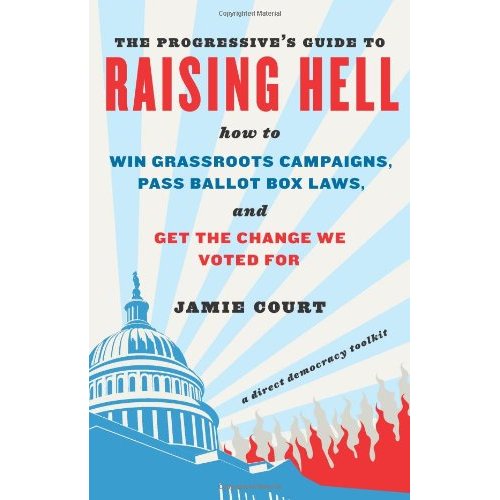
“Anger, not hope, is the fuel of political and economic change,” Jamie Court, head of Consumer Watchdog, writes in his new book, The Progressive’s Guide to Raising Hell: How to win grassroots campaigns, pass ballot box laws, and get the change we voted for (Chelsea Green Publishing, 2010).

Court writes that progressives are rightfully disappointed and disillusioned that after helping to elect President Barack Obama, he and Congressional Democrats turned around and gave Wall Street, the military-industrial complex, and the health insurance companies everything they wanted, with Obama even caving in on requiring all Americans to purchase health insurance, something he opposed as a candidate.


Yet Court said politicians never do the right thing and push progressive political change unless they’re forced to do so. He opened the book with a scene in which President Franklin Delano Roosevelt met with progressive political leaders, listened to their proposals, and then told them, “I agree. I am all for your plan. Now make me do it.”

It’s a concept that the conservative Tea Party movement understands well, and even though they may be crazy and wrongheaded in their utterly unsustainable and destabilizing policy agenda, they have effectively used anger as a political tool, and as a result, the NY Times reports they are poised to wield a disproportionate amount of political power after this election.

It’s the same story on the local level, where the only real anger in this election cycle is coming from those mad at public employee unions and their pension deals, and vagrants who sit uncivilly on sidewalks. These people will keep pushing for what they expect, but many progressives act as if it’s enough to prevent truly heinous Republicans like Meg Whitman from taking power, rather than trying to push Jerry Brown or Board of Supervisors’ progressives from day one to start empowering people over corporations.

“After the vote, power vacuums fill with familiar values, if not faces. Promises give way to fiscal realities, hope succumbs to pragmatism, and ambition concedes to inertia. The old tricks of interest group – confuse, diffuse, scare – prevail over the better angels of American nature,” Court writes, relaying a familiar electoral pattern.

Yet in this election, when the best outcome seems to be simply dodging a bullet, is there any hope for progressive political change? Isn’t the system just too broken? I asked Court these questions when he stopped by the Guardian office for a chat recently, and he retains a belief that with the right kind of tactics and agenda, progressives can still seize the political initiative and power.

http://www.youtube.com/watch?v=J3RD0YObHok

“I wrote it to reengage progressives because they are so despondent,” Court told me. “It’s about how to use anger and focus anger…Politicians don’t answer polite mobs, they only answer angry mobs and the Tea Party is the only angry mob in the room.”

Progressive have understandable doubts about the responsiveness of the current political system, but Court said, “I know if we don’t try to make it work, we’re never going to get there.”

And his book lays out the path to get there, step by step, based on some of the legislative and political successes that Consumer Watchdog and other progressives have had in recent years, such as rejecting the well-funded corporate con jobs in Propositions 16 and 17 earlier this year. Yet it involves an approach based on principle and not parties, and with being relentless in pursuing the kind of world we need.

“If you want to fight corporate power, you have to fight Democrats and Republicans,” Court said.

Specifically, Court is calling for progressives to push a California ballot measure that would establish a public health care option here, the very thing that Obama and the Democrats failed to include in their health reform package, and which will dash any hopes of it working if the people are forced to rely on unregulated insurance company products.

“The biggest thing is mandatory health insurance, which is a ticking time bomb,” Court said, one set to go off in 2014 when that aspect of Obama’s health care reform kicks in.

Corporate and political power working together seem to be a force too strong to overcome, but as Court writes, “Public opinion is the most powerful force in the world. While it can be muted, distracted, and co-opted, it cannot be controlled, except by the public.”

More on the “whore” gaffe

By now, you’ve probably heard about the campaign gaffe in which an unidentified female associate of Jerry Brown (possibly Brown’s wife) called his opponent Meg Whitman a “whore” during a conversation that neither realized was being recorded over voice mail.

The comment was made in reference to Whitman’s offer to cut a deal over the pensions of a police officer’s union in exchange for an endorsement. Soon after the tape went public, Whitman’s campaign seized the opportunity to issue a press release slamming the remark as “an appalling and unforgivable smear,” and a slur. Sparks flew over the comment at Tuesday’s gubernatorial debate.

Yet a number of reactions from feminist organizations and bloggers suggest that despite Whitman’s ire, women haven’t started hating on Brown as a result of the dumb mistake. And in the meantime, the controversy has generated some pretty interesting discussions out there in the blogosphere.

Shortly after the remark went live, Brown secured the endorsement of the California chapter of the National Organization of Women (NOW), which in turn prompted conservative bloggers everywhere to start foaming at the mouth, madly accusing NOW of being partisan and anti-woman.

“We definitely felt that putting the announcement out today was important to refocus on the real issue in the campaign,” such as “what are the two candidates going to do for women and their families,” the chapter’s president, Patty Bellasalma, told the Sacramento Bee. “The use of the word ‘whore’ is offensive,” she added. “There’s no mincing words about that.”

Chloe, a blogger at Feministing.com, had this to say:

“When candidates and their aides use highly gendered derogatory terms to refer to the opponent, and when that opponent responds by appealing to women’s personal-is-political feminism, we are having a national discussion about gender. … But it doesn’t feel like a particularly productive one — it’s more a case of one camp screwing up by revealing underlying sexism and the other capitalizing on that mistake to score a few points. It’s not an honest discussion of structural and cultural sexism in America and how it affects people of all genders. I want to make it clear that I think what Jerry Brown’s aide said was unacceptable, as was Brown’s seemingly tacit endorsement of the word. It’s not acceptable, obviously, to call anyone a whore. But I’m trying hard to remember what Jay Smooth taught us: condemn the action, not the person, or the campaign.”

Hanna Rosin, a blogger writing for Slate.com and the DoubleX factor, had this take on it:

“Now it’s unclear exactly what the aide meant, but it’s perfectly clear he or she did not mean that Whitman was a hussy who had slept with half the legislators west of the Mississippi. Since this was an endorsement call, he or she meant that Whitman was whoring herself for the endorsement. In one way, we could see this as progress, that the word ‘whore’ is so far removed from its original sex-shaming role that it gets thrown around in the context of political power trading.”

But if the phrase weren’t so wrapped up in sexism, would we even find ourselves in the midst of this controversy? Technically, “whore” can be used to refer to a man or a woman, and it can also mean “a venal or unscrupulous person” or some one who is “considered as having compromised principles for personal gain.” But do alternate definitions remove the sting of an offensive word?

A few questions. Should the gender of the person using the word (in this case, a woman) change our analysis of how it was used? When the remark has everything to do with politics and nothing to do with sex, should it be taken as a sign that we’re making progress on gender equality? Or would real progress be when the term “whore” goes the way of an archaic insult you’d find in a Shakespearean play?

There are signs, meanwhile, that the word “whore” isn’t universally regarded as a gendered insult. Just check out the roughly 200 definitions offered on Urban Dictionary. Like this one, posted by some one named Megan:

“Minor annoyance. You’re not really mad at them, but still kinda pissed.
‘Hey, who ate the last doughnut?’
‘I did.’
‘Whore.’”

Maxwell disappoints by endorsing Sweet

10

To be honest, I wasn’t surprised that termed-out Sup. Sophie Maxwell endorsed D10 candidate Lynette Sweet yesterday. Just disappointed. And it’s not just because Sweet refused to come into the Guardian this fall for an endorsement interview (a stance that suggests that Sweet would be depressingly inaccessible to reporters that haven’t drunk her Kool-Aid—a stance that, unfortunately, reminds me of Mayor Gavin Newsom’s attitude towards the media).

I’d been hearing rumors that Maxwell was going to endorse Sweet since February, when Sweet, who’d already racked up Mayor Gavin Newsom’s D10 blessing at that point, showed up alongside Maxwell at the city’s kickoff event for Black history month.

Then there was the fact that during an interview in February for the Guardian’s kickoff article about the D10 race, Sweet spouted phrases that sounded eerily similar to Maxwell’s words.
“D10 is a pretty diverse district, but there is only one common thread: the need for economic development,” Sweet told me.

But a few days earlier when I interviewed Maxwell about a third, and ultimately unsuccessful, attempt to recall her , Maxwell talked of common threads:

 “I’m waiting for people to have a better understanding of what this community is, what the common thread running through it is, and how to use rank choice voting,” Maxwell said, by way of explaining why she wasn’t willing to endorse anyone that early in the race.

Now, it’s understandable that Maxwell would be looking for a candidate to carry on her legacy. But it she was looking for a moderate black female candidate  then why not endorse Malia Cohen, who isn’t hampered by all of Sweet’s dirty laundry—and has raised the most money in the race, so far?

Could it be that Cohen wouldn’t be down for the kind of dirty deal making that was par for the course back in the days when Willie Brown was still mayor and Sweet was the swing vote that crowned Lennar as master developer at the shipyard/Candlestick Point?

Rumor has it that Maxwell is upset at all the corporate money that’s flooding into this race in support of Steve Moss—and that she asked the other candidates to hold a press conference in which they decry this practice. Rumor also has it that Sweet signaled her willingness to join Tony Kelly, Dewitt Lacy, Chris Jackson and Eric Smith–to name a few–in making such a statement. But it hasn’t happened, yet. And the corporate money keeps rolling in for Moss.

Meanwhile, with three weeks until the election, D10 forums are beginning to sound like a parody of a “Lost” episode featuring a 22-member cast that all claim to represent the city’s polluted and economically depressed southeast sector:

“One of us is a BART director, one of us worked at City Hall, one of us is a community advocate, one of us is a City College Board member, one of us is a civil rights attorney, one of us is an affordable housing development director, one of us is a bio-diesel advocate, one of us is a public safety advocate, one of us was raised in the Bayview, one of us served on the Navy’s Restoration Advisory Board,” and so on.

I’m not saying this is wrong. Hell, I love all this diversity of choices. but I am concerned that, come election night, the progressive vote will get split into a million pieces, while deep-pocketed conservative forces like the Chamber of Commerce and Golden Gate Restaurant line up behind one candidate in an attempt to crush candidates that would stand up to their powerful influence at City Hall and truly represent the D10 community

Yes, there is ranked choice voting, and it’s unlikely that one candidate will win a majority of the vote in the first round. But it’s critical at this venture that progressives develop a winning strategy. D10 candidate Ed Donaldson told me recently that if a candidate who doesn’t represent the community’s concerns gets elected, then the community would respond just as they did around Maxwell—and organize a recall.

But wouldn’t it be better if the community can come together behind three truly progressive candidates and help them win the November election?

One of the key challenges in this race will be to win votes in Visitacion Valley, as well as in the Bayview and/or Potrero Hill.

In his latest column in the Chron, former mayor and Sweet supporter Willie Brown alluded to the importance of this in a city with ranked-choice voting:”It’s not getting much attention, but someone has finally figured out how to get the Asian vote out,” Brown observed.”You do it by mail. You get ballots and ballot books into every household, then have the whole family sit down together. The kids help with the translation, everyone talks things over and everyone votes.”

Meanwhile, D10 candidate Tony Kelly told me that Marlene Tran, who is tri-lingual (English, Cantonese, Vietnamese) and has a good handle on community issues in Viz Valley, has confirmed that Kelly is her second-ranked choice (presuming that she votes for herself in first place. of course).

Not a bad strategy–and one that other progressives need to consider, given ranked choice voting–and the brutal reality that they are going to be massively outspent in the next three weeks.