Comics

What to watch

0

THURS/21

Beginners (Mike Mills, U.S., 2010) There is nothing conventional about Beginners, a film that starts off with the funeral arrangements for one of its central characters. That man is Hal (Christopher Plummer), who came out to his son Oliver (Ewan McGregor) at the ripe age of 75. Through flashbacks, we see the relationship play out — Oliver’s inability to commit tempered by his father’s tremendous late-stage passion for life. Hal himself is a rare character: an elderly gay man, secure in his sexuality and, by his own admission, horny. He even has a much younger boyfriend, played by the handsome Goran Visnjic. While the father-son bond is the heart of Beginners, we also see the charming development of a relationship between Oliver and French actor Anna (Melanie Laurent). It all comes together beautifully in a film that is bittersweet but ultimately satisfying. Beginners deserves praise not only for telling a story too often left untold, but for doing so with grace and a refreshing sense of whimsy. Thurs/21, 7 p.m., Castro. (Louis Peitzman)


FRI/22

The Good Life (Eva Mulvad, Denmark, 2010) Portraits of the formerly wealthy are often guilty of peddling secondhand nostalgia for some ancien regime while simultaneously stoking schadenfreude toward the now-deposed (just ask Vanity Fair). Eva Mulvad’s melancholy character study of 50-something Annemette Beckmann and her aged mother, Mette, avoids both traps even as her subjects — formerly wealthy Danish expats living on the dole in a cramped apartment in a coastal Portuguese town — offer few inroads for sympathy. Narcissistic and petulant, Annemette blames the loss of her family’s wealth on the 1974 nationalization of Portugal’s then-Communist government, and claims that her cosseted upbringing has made it hard to find a job (“Work doesn’t become me,” she gratingly protests at one point). Mette, who is more likeable, is a resigned realist whose sole comfort, aside from the pet dog, seems to be her knowledge that she is not long for this world. Comparisons to Grey Gardens (1975) are inevitable here, but the Beckmanns simply aren’t as interesting or possessed by as idiosyncratic a joie de vivre as the Beales, making The Good Life a tough slog. Fri/22, 3:45 p.m.; April 28, 6:45 p.m.; and May 1, 9:30 p.m., Kabuki. (Matt Sussman)

Hahaha (Hong Sang-soo, South Korea, 2010) Do you remember a time you behaved badly (not horribly, but bad enough that you felt ashamed) but you didn’t really think about it until long after the fact, say, when getting drinks with an old friend? If you can’t, than the latest from South Korean director Hong Sang-soo will probably jog your memory. As with many of Hong’s films, Hahaha’s premise is similar to the above scenario: two 30-something buds get together and reminisce about their recent trips to the same seaside town. Shown in episodic flashbacks, we start to realize that the incidents and players in their separate accounts overlap into one story filled with terrible poetry, domineering mothers, stalker-ish behavior, and poorly made choices. Hong’s films are primers in how not to treat your fellow human beings (straight dudes are usually the culprits), so take notes. Fri/22, 9:15 p.m.; Mon/25, 9 p.m.; and Tues/26, 3:30 p.m., Kabuki. (Sussman)

I’m Glad My Mother is Alive (Claude Miller and Nathan Miller, France, 2009) Codirected with his son Nathan, this latest by veteran French director Claude Miller is an about-face from his acclaimed 2007 period epic A Secret. Viscerally up-to-the-moment in content and handheld-camera style, it’s a small story that builds toward an enormous punch. Thomas (played by Maxime Renard as a child, then Vincent Rottiers) is a lifelong malcontent whose troubles are rooted in his abandonment at age five by an irresponsible mother (Sophie Cattani). Neither the attentions of well-meaning adoptive parents or the influence of his better-adjusted younger brother can quell Thomas’ mix of furious resentment and curiosity toward his mere, whom he finally develops a relationship with as a young adult. As usual, Miller doesn’t “explain” his characters or let them explain themselves, yet everything feels emotionally true — right up to a narrative destination both that feels both shocking and inevitable. Fri/22, 6:45 p.m., and Mon/25, 9:30 p.m., Kabuki. (Dennis Harvey)

Meek’s Cutoff (Kelly Reichardt, U.S., 2010) After three broke down road movies (1994’s River of Grass, 2006’s Old Joy, 2008’s Wendy and Lucy), Kelly Reichardt’s new frontier story tilts decisively toward socially-minded existentialism. It’s 1845 on the choked plains of Oregon, miles from the fertile valley where a wagon train of three families is headed. They’ve hired the rogue guide Meek to show them the way, but he’s got them lost and low on water. When the group captures a Cayeuse Indian, Solomon proposes they keep him on as a compass; Meek thinks it better to hang him and be done with it. The periodic shots of the men deliberating are filmed from a distance — the earshot range of the three women (Michelle Williams, Zoe Kazan, and Shirley Henderson) who set up camp each night. It’s through subtle moves like these that Meek’s Cutoff gives a vivid taste of being subject to fate and, worse still, the likes of Meek. Reichardt winnows away the close-ups, small talk, and music that provided the simple gifts of her earlier work, and the overall effect is suitably austere. Fri/22, 9 p.m., and Mon/25, 4:30 p.m., Kabuki. (Max Goldberg)

Stake Land (Jim Mickle, U.S., 2010) Not gonna lie — the reason I wanted to review this one was because of the film still in the SFIFF catalog. Rotten-faced vampire with a stake through its neck? Yes, please! But while Jim Mickle’s apocalyptic road movie does offer plenty of gore, it’s more introspective than one might expect, following an orphaned teenage boy, Martin (Connor Paolo, Serena’s little bro on Gossip Girl), and his gruff mentor, Mister (Snake Plissken-ish Nick Damici), on their travels through a ravaged America. As books, films, and comics have taught us, whenever a big chunk of the human race is wiped out (thanks to zombies, vampires, an unknown cataclysm, etc.), the remaining population will either be good (heroic, like Mister and Martin, or helpless, like the stragglers they rescue, including a nun played by Kelly McGillis), or evil — cannibals, rapists, religious nuts, militant survivalists, etc. Stake Land doesn’t throw many curveballs into its end-times narrative, but it’s beautifully shot and doesn’t hold back on the brutality. Larry Fessenden (director of 2006’s The Last Winter) produced and has a brief cameo as a helpful bartender. Fri/22, 11:30 p.m., and Mon/25, 9:45 p.m., Kabuki. (Cheryl Eddy)


SAT/23

The Autobiography of Nicolae Ceausescu (Andrei Ujica, Romania, 2010) Andrei Ujica’s three-hour documentary uses decades of propagandic footage to let the late Romanian dictator — who was overthrown by popular revolt and executed in 1989 — hang himself with his own grandiose image-making. While the populace suffered (off-screen, you might want to bone up on the facts before seeing this ironical, commentary-free portrait), the “great leader” and his wife Elena were constantly seen holding state dances, playing volleyball, hunting bear, and vacationing hither and yon. (We even see them on the Universal Studios tour.) There’s no surprise in seeing them greeted with enormous pageantry in China; but it’s a little shocking to see this tyrant welcome Nixon (in the first-ever U.S. presidential visit to a Communist nation), lauded by Jimmy Cartner, and hobnobbing with Queen Elizabeth. This grotesque parade of self-glorifying public moments has a happy ending, however. Sat/23, 12:45 p.m., Kabuki; Sun/24, 5:15 p.m., New People; May 1, 1:30 p.m., PFA. (Harvey)

Life, Above All (Oliver Schmitz, South Africa/Germany, 2010) It’s tough enough to simply grow up, let alone care for a parent with AIDS and deal with the suspicions and fears of the no-nothing adults all around you. Rising above easy preaching and hand-wringing didacticism, Life, Above All takes as its blueprint the 2004 best-seller by Allan Stratton, Chandra’s Secrets, and makes compelling work of the story of 12-year-old Chandra (Khomotso Manyaka) and her unfortunate family, unable to get effective help amid the thicket of ignorance regarding AIDS in Africa. After her newborn sister dies, Chandra finds her loyalty torn between her bright-eyed best friend Esther (Keaobaka Makanyane), who’s rumored to hooking among the truck drivers in their dusty, sun-scorched rural South African hometown, and her mother (Lerato Mvelase), who listens far too closely to her bourgie friend Mrs. Tafa (an OTT Harriet Manamela), for her own good. Cape Town native director Oliver Schmitz sticks close to the action playing across his actors’ faces, and he’s rewarded, particularly by the graceful Manyaka, in this life-affirmer about little girls forced to shoulder heart-breaking responsibility far too soon. Sat/23, 4 p.m., and April 28, 6 p.m., Kabuki. (Kimberly Chun)

The Mill and the Cross (Lech Majewski, Poland/Sweden, 2010) One of the clichés often told about art is that it is supposed to speak to us. Polish director Lech Majewski’s gorgeous experiment in bringing Flemish Renaissance painter Peter Bruegel’s sprawling 1564 canvas The Procession to Calvary to life attempts to do just that. Majeswki both re-stages Bruegel’s painting — which draws parallels between its depiction of Christ en route to his crucifixion and the persecution of Flemish citizens by the Spanish inquisition’s militia — in stunning tableaux vivant that combine bluescreen technology and stage backdrops, and gives back stories to a dozen or so of its 500 figures. Periodically, Bruegel himself (Rutger Hauer) addresses the camera mid-sketch to dolefully explain the allegorical nature of his work, but these pedantic asides speak less forcefully than Majeswki’s beautifully lighted vignettes of the small joys and many hardships that comprised everyday life in the 16th century. Beguiling yet wholly absorbing, this portrait of a portrait is like nothing else at the festival. Sat/23, 12:30 p.m., SFMOMA, and April 27, 9 p.m., Kabuki. (Sussman)

Mind the Gap Experimental film fans: come for the big names, but don’t miss out on the newcomers. Locals Jay Rosenblatt (melancholy found-footage bio The D Train), Kerry Laitala (psychedelic 3-D brain-dazzler Chromatastic), and Skye Thorstenson (mannequin-horror music video freak out Tourist Trap, featuring the acting and singing stylings of the Guardian’s Johnny Ray Huston) offer strong entries in an overall excellent program. International bigwigs Peter Tscherkassky (the 25-minute Coming Attractions, a layered study of airplanes, Hollywood, and Hollywood airplanes — not for the crash-phobic) and Jonathan Caouette (“Lynchian” has been used to describe the Chloë Sevigny-starring All Flowers In Time, though it contains a scary-faces contest that’d spook even Frank Booth) are also notable. New names for me were Zachary Drucker, whose Lost Lake introduces a transsexual, pervert-huntin’ vigilante for the ages, and my top pick: Kelly Sears’ Once it started it could not end otherwise, a deliciously sinister hidden-history lesson imagined via 1970s high-school yearbooks. Sat/23, 4:45 p.m., and May 1, 9:45 p.m., Kabuki. (Eddy)

The Troll Hunter (André Ovredal, Norway, 2010) Yes, The Troll Hunter riffs off The Blair Witch Project (1999) with both whimsy and, um, rabidity. Yes, you may gawk at its humongoid, anatomically correct, three-headed trolls, never to be mistaken for grotesquely cute rubber dolls, Orcs, or garden gnomes again. Yes, you may not believe, but you will find this lampoon of reality TV-style journalism, and an affectionate jab at Norway’s favorite mythical creature, very entertaining. Told that a series of strange attacks could be chalked up to marauding bears, three college students (Glenn Erland Tosterud, Tomas Alf Larsen, and Johanna Morck) strap on their gumshoes and choose instead to pursue a mysterious poacher Hans (Otto Jespersen) who repeatedly rebuffs their interview attempts. Little did the young folk realize that their late-night excursions following the hunter into the woods would lead at least one of them to rue his or her christening day. Ornamenting his yarn with beauty shots of majestic mountains, fjords, and waterfalls, Norwegian director-writer André Ovredal takes the viewer beyond horror-fantasy — handheld camera at the ready — and into a semi-goofy wilderness of dark comedy, populated by rock-eating, fart-blowing trolls and overshadowed by a Scandinavian government cover-up sorta-worthy of The Girl with the Dragon Tattoo (2009). Sat/23, 11:30 p.m., Kabuki; Mon/25, 6:15 p.m., New People. (Chun)

World on a Wire (Rainer Werner Fassbinder, Germany, 1973) The words “Rainer Werner Fassbinder” and “science fiction film” are enough to get certain film buffs salivating, but the Euro-trashy interior décor is almost reason enough to see this restored print of the New German Cinema master’s cyber thriller. Originally a two-part TV miniseries, World on a Wire is set in an alternate present (then 1973) in which everything seems to be made of concrete, mirror, Lucite, or orange plastic. When the inventor of a supercomputer responsible for generating an artificial world mysteriously disappears, his handsome predecessor must fight against his corporate bosses to find out what really happened, and in the process, stumbles upon a far more shattering secret about the nature of reality itself. Riffing off the understated cool of Godard’s Alphaville (1965) while beating 1999’s The Matrix to the punch by some 25 years, World on a Wire is a stylistically singular entry in Fassbinder’s prolific filmography. Sat/23, 8:45 p.m., Kabuki, and April 30, 2 p.m., PFA. (Sussman) SUN/24

A Cat in Paris (Alain Gagnol and Jean-Loup Felicioli, France/Belgium/Netherlands/Switzerland, 2010) Save your pocket poodles, please: Paris, as cities go, is most decidedly feline. From 1917’s silent serial Les Vampires to its uber-cool 1990s update Irma Vep, cat burglars and the Parisian skyline have gone together like café and au lait. Add actual cats and jazz to the mix for good measure (even Disney saw fit to set its jazzy 1970 Aristocats in the City of Light). At just over an hour long, the animated A Cat in Paris is an enjoyable little amuse-bouche that employs all the standards of the cats-in-Paris meme: Billie Holiday warbling on the soundtrack, a dashingly heroic antihero who scales the rooftops as if he studied parkour under Spider-Man, and the titular untamable black cat who serves as his partner in crime. Complete with a climatic Hitchcockian set piece on the rooftops of Notre Dame Cathedral, A Cat in Paris has a refreshingly angular and graphic, almost cubist, feel. Directors Alain Gagnol and Jean-Loup Felicioli’s work certainly doesn’t rank among that of countryman Sylvain Chomet (2010’s The Illusionist), but this family film is worth checking out if kitties up to no good in Purr-ree simply make you want to le squee. Sun/24, 12:30 p.m., Kabuki, and May 1, 12:30 p.m., New People. (Michelle Devereaux)


MON/25

Cave of Forgotten Dreams (Werner Herzog, U.S., 2010) The latest documentary from Werner Herzog once again goes where no filmmaker — or many human beings, for that matter — has gone before: the Chauvet-Pont-d’Arc Cave, a heavily-guarded cavern in Southern France containing the oldest prehistoric artwork on record. Access is highly restricted, but Herzog’s 3D study is surely the next best thing to an in-person visit. The eerie beauty of the works leads to a typically Herzog-ian quest to learn more about the primitive culture that produced the paintings; as usual, Herzog’s experts have their own quirks (like a circus performer-turned-scientist), and the director’s own wry narration is peppered with random pop culture references and existential ponderings. It’s all interwoven with footage of crude yet beautiful renderings of horses and rhinos, calcified cave-bear skulls, and other time-capsule peeks at life tens of thousands of years ago. The end result is awe-inspiring. Mon/25, 7 p.m., and Tues/26, 9:30 p.m., Kabuki. (Eddy)


TUES/26

Nostalgia for the Light (Patricio Guzmán, France/Chile/Germany, 2010) Chile’s Atacama Desert, the setting for Patricio Guzmán’s lyrically haunting and meditative documentary, is supposedly the driest place on earth. As a result, it’s also the most ideal place to study the stars. Here, in this most Mars-like of earthly landscapes, astronomers look to the heavens in an attempt to decode the origins of the universe. Guzmán superimposes images from the world’s most powerful telescopes — effluent, gaseous nebulas, clusters of constellations rendered in 3-D brilliance — over the night sky of Atacama for an even more otherworldly effect, but it’s the film’s terrestrial preoccupations that resonate most. For decades, a small, ever dwindling group of women have scoured the cracked clay of Atacama searching for loved ones who disappeared early in Augusto Pinochet’s regime. They take their tiny, toy-like spades and sift through the dirt, finding a partial jawbone here, an entire mummified corpse there. Guzmán’s attempt through voice-over to make these “architects of memory,” both astronomers and excavators alike, a metaphor for Chile’s reluctance to deal with its past atrocities is only marginally successful. Here, it’s the images that do all the talking — if “memory has a gravitational force,” their emotional weight is as inescapable as a black hole. Tues/26, 6:30 p.m., Kabuki, and April 28, 6:15 p.m., PFA. (Devereaux)

The Sleeping Beauty (Catherine Breillat, France, 2010) Fairytales are endemically Freudian; perhaps it has something to with their use of subconscious fantasy to mourn — and breathlessly anticipate — the looming loss of childhood. French provocateuse Catherine Breillat’s feminist re-imagining of The Sleeping Beauty carries her hyper-sexualized signature, but now she also has free reign to throw in bizarre and beastly metaphors for feminine and masculine desire in the form of boil-covered, dungeon-dwelling ogres, albino teenage princes, and icy-beautiful snow queens. The story follows Anastasia, a poor little aristocrat, who longs to be a boy (she calls herself “Sir Vladimir”). When her hand is pricked with a yew spindle (more of a phallic impalement, really), Anastasia falls into a 100-year adventurous slumber, eventually awakening as a sexually ripe 16-year-old. It all plays like an anchorless, Brothers Grimm version of Sally Potter’s 1992 Orlando. And while it’s definitely not for the kiddies, it’s hard to believe that many adults would find its overt symbolism and plodding narrative any more than a sporadically entertaining exercise in preciousness. Your own dreams will undoubtedly be more interesting — perhaps you can catch a few zzz’s in a theater screening this movie. Tues/26, 6:15 p.m., and April 27, 6:30 p.m., Kabuki. (Devereaux)

THE 54TH ANNUAL SAN FRANCISCO INTERNATIONAL FILM FESTIVAL runs April 21–May 5. Venues are the Sundance Kabuki, 1881 Post, SF; Castro, 429 Castro, SF; New People, 1746 Post, SF; San Francisco Museum of Modern Art, 151 Third, SF; and Pacific Film Archive, 2575 Bancroft, SF. For tickets (most shows $13) and complete schedule visit www.sffs.org>.

4/20 fantasy: Ziggy’s new comic book

0

Attention, WonderCon, Ziggy is missing. Repeat, we are missing Ziggy Marley. But only for a second – turns out the “Love is My Religion” star had only wandered away from the Image Comics booth into the dizzying panorama of the comics convention for a moment to snag his son some of the new Green Lantern toys. “He’s into it,” he tells me, smiling as his fixers and Image staff scramble to set up the seats for our interview.

But to be clear about what exactly we’re doing here: Ziggy Marley is releasing a comic book on 4/20. It’s called Marijuana Man, obviously. 

It’s about a hero (a white guy!) named Sedona, a being from the planet Yelram – like, read it backwards — on Exodus, where the for-real (a.k.a., the weed smoking, freedom-fighting, down) Earthlings are trying their best to defeat the evil, environment-ruining, pill-pushing Pharma-Con. Sample Pharma-Con line: “I want to get this over with so we can get back to the business of selling people chemicals they don’t need.” Hiss.

The book really is gorgeous, illustrated by Jim Mahfood of 40 Oz. Comics, who pretty much has the sexy street art graphic novel on lock. I mean, the guy illustrated Colt 45’s label, for chrissakes.

“There’s quality in the textures,” Marley tells me (still smiling, he’s always smiling because love is his religion). “It’s a collector’s edition.” Some characters’ speak with a smoker’s patois, a lushly-proportioned-yet-badass guerilla named MJ – like, think about it – bonds with Sedona in a ecstatic, abstract sex session also patronized by the Lion of Judah and the crashing wave from Katsushika Hokusai’s 36 Views of Mt. Fuji series. And there’s whizzing, crashing battles between Sedona and a Pharma-Con mercenary on a motorcycle that leaps and murders. 

The Marijuana Man gang

But. Ziggy Marley, you have never once made a comic book before. I had doubts, doubts as to whether this book, with its “Ziggy Marley’s” inscribed over its title, was indeed the work of the genial reggae star in front of me. I put it to him: Ziggy, was Marijuana Man really your idea?

He says: yes. Ziggy uses the royal “we,” which is fine because Bob Marley is his dad.

“We had the idea to create a superhero who gets his powers from a plant.” It seems that royal Ziggy, or team Ziggy (this last probably includes Snoopy, his genial bodyguard who takes photos of Ziggy bonding with childrens in Brazil and later bemoaned to me the fact that Shakira got a helicopter to airlift her to a concert in Argentina that the two headlined, while team Love = My Religion had to proceed on a congested road, which I agree isn’t right) were ready for a superhero that got righteous not through the ingestion of toxic chemicals, or prosthetics, or capitalism, but rather natural medicine. 

So Marley had the original idea for the comic, but then chose a crack team of comic professionals to make it come to fruition. “Jim and Joe [Casey, another big deal-guy who wrote the book] would do their thing, and every once in awhile I’d say ‘what about this.’” 

Basically, there’s a cause involved here, and not least because Marley plans to make Marijuana Man‘s 4/20 release an annual occurrence. “Sedona’s a metaphor for the plant itself. We believe the plant is special, if used properly,” he says, admitting that Marijuana Man carries an additional message. To wit: “to get rid of the stigma and the demonization of the plant.”

“I have a vivid imagination,” he smiiiiles. There is nothing more that I want to do with my day past hang out with this happy, sun-shiney man and his comic book dreams, so I start asking him what comic books he likes.

He likes Jonah Hex, “the weirdest Western hero” who was born to a prostitute mother and a father who sells him to the Apaches, whose respect he earns and then loses at the hands of a jealous chief’s son, who messes up his face with a hot tomahawk. Hex becomes a bounty hunter anti-hero. At some point, Hex is catapulted into 2050. When he dies (card game) his body is stolen, stuffed, and unfairly displayed by a touring circus. I think he is later resurrected, and takes to fighting for and against crime again with the Black Lantern Corps. 

“Jonah Hex, he’s a bad good guy, he’s a good bad guy,” Ziggy says. I wish I could walk around WonderCon all weekend with Ziggy Marley and talk about this, but his next interview is already waiting for him and then he has a big stack of Marijuana Man posters to sign for fans. 

“The thing about comic books, it’s a deep thing. They’re not frivolous, they have meaning,” he tells me. “Music fans who love our philosophies and ideas, I think they can relate to that. They’re art. They’re not just about drawing people, hands, and feet.” 

That man, I swear, love him. To celebrate your holiday with Marijuana Man, here’s a website that’ll point you to the nearest comic book store. 

Behind the panel

2

caitlin@sfbg.com

CAREERS AND ED Graphic novelist Gene Yang has a theory about how the comic industry came to be home to more Asian American artists than probably any other North American media form. “American comics have always been an outsider’s medium,” he wrote in a recent e-mail correspondence with the Guardian. “Most of the American comic book icons — Superman, Batman, the Hulk, Captain America — were created by poor Jewish boys living in the ghettos of New York. All you needed was a pencil, some paper, and a tiny bit of talent. Asian Americans took advantage of the same dynamic.”

Suppositions aside, Yang’s point is this: these days, Asian Americans are at the top of the comic book game. Yang has published many comic titles that creatively explore what it was like for him and his siblings growing up in the Bay Area (he was born in Alameda). American Born Chinese pits a high schooler against a monkey king from Chinese folklore who compels him to face his discomfort with his family’s heritage. Level Up looks at a video game fanatic’s transition to med school, a journey undertaken by Yang’s brother in real life.

Yang is by no means the only Asian American excelling in the comic industry. Jim Lee, a Korean American who was named copublisher of DC Comics last year, is often regarded as the modern era’s quintessential comic artist. And many of the genre’s biggest names — including the man behind DC’s Supergirl series; Bernard Chang, creator of the syndicated strip Liberty Meadows Frank Cho; and Human Target illustrator Cliff Chiang (all interviewed via e-mail for this article) — are first- or second-generation Asian Americans.

“If you were to ask any comic book fan who their favorite artists are, odds are there will be an Asian American creator — or two, or three, if not four — on that list,” Chang says.

This wasn’t always the case. When most of today’s comic book artists were growing up, there were few stories being told about Asian Americans in popular entertainment. Chang moved to Miami from Taiwan as a child, and apart from comic books sent to him by relatives overseas, saw very little in the mass media that could relate to his own experience. “For the most part, you had the Bruce Lee kung fu movies that played on the secondary television stations on the weekends,” he says.

“Everything seemed to be about people in Asia or recent immigrants,” remembers American-born Chiang. “I didn’t go out of my way to seek out those stories. What I did respond to was art and animation created by Asians in the form of cartoons like Speed Racer or Battle of the Planets.”

He wasn’t the only one who turned to cartoons as a child. Yang fondly remembers the commonalities he found in superhero comics, even going as far as attributing his and other Asian American boys’ attraction to Superman to a subconscious recognition of a kindred soul. It was a connection he copped from Jeff Yang, editor of Secret Identities: The Asian American Superhero Anthology, a collection that assembled some of today’s top comic art talent in creating an illustrated shadow history of the United States.

To wit: “Here’s a guy with two identities, one American and the other foreign — Kryptonian. He has two names, one American — Clark — and the other foreign with a hyphen in the middle, Kal-El. He came to America at a young age. He’s black haired, mild-mannered, and wears glasses. All of his superpowers derive from the fact that he’s a foreigner.”

And there’s the art form itself, Yang continues: words and pictures side by side, typically avoided in Western art save in children’s books and advertising but embraced in Asian tradition. “You could have the best brush-painted image in the world,” Yang says, “but if the poem paired with it sucked, the whole piece sucked.”


THE SAGA OF RYAN CHOI

But if so many of the genre’s artists are Asian American, why are so few of its protagonists? Despite the prevalence of minority fans at comic conventions and the ever-diversifying profile of the people who create comics, their characters — with the important exception of those in manga — are mainly Caucasian.

And the big publishing houses in comics appear to sticking with this monotone. For a time, Marvel and DC experimented with retiring their big name heroes, replacing them — in the words of Yang — with “younger, hipper, often ethnic versions.” As an example, he offers the saga of the Atom, originally a white guy named Ray Palmer. Palmer was made to disappear mysteriously, and in the logic of the comic universe, was replaced by his
Chinese protégé, Ryan Choi.

But “the young ones just weren’t selling,” says Yang. Ryan Choi got a blade to the chest and Ray Palmer got his job back.

Most of the widely-known artists we spoke to think diversifying the superhero world wasn’t something that could happen overnight. Most fans, they said, are attracted to comics out of a sense of nostalgia that doesn’t hold up well with change, especially one as drastic as switching up a character’s race.

“Supergirl is an established character with years of history and story lines,” Chang says. “I can’t simply come in and change her to be an Asian girl, that wouldn’t make sense. But I make an effort to draw new supporting characters with different ethnicities, not just Asians but blacks, Latinos, and others.”

Cho thinks the reason Asians have thrived in the comics industry is the genre’s relative anonymity. “You have to understand there’s a strong and subtle undercurrent of racism in America. But comics are color-blind. It’s the ideas, art, and stories that matter — not how you look or who you are.” And he wants to keep it that way. “I don’t want to read any Asian-centric stories, or any black stories. I just want to read a good story.”


“I DEMAND SOME REPRESENTATION!”

Of course, not everyone shares his views. Hellen Jo is a SF comic artist who draws because she considers comics “a beautiful narrative medium with boundless potential.”

“Despite the ‘enlightened’ age we live in, I still can’t find many Asian American narratives that resonate with me personally,” Jo says. So she makes her own gorgeous comic strips and books that tell stories that fall far outside the standard comic canon, distinct even from the genre’s occasional tries at depicting Asian women.

“We don’t often see Asian American women shown as brash, plain, ugly, dirty, and without ambition — and it certainly isn’t because those types of API [Asian Pacific Islander] women don’t exist,” Jo says. “I identify as a gross, stupid, ugly Asian American girl and I demand some representation!”

But she’s not waiting for Marvel to release Gross, Stupid, Ugly API No. 1. Jo is taking the bull by the horns — just like Yang, who draws his own works, and the many mainstream artists we spoke with who contribute to books like Secret Identities and have side projects that speak more directly to the API experience. Sure, these books don’t sell as much as the blockbuster Batman and Avengers titles — but at least they exist now.

As do more and more Asian Americans and other minorities among the genre’s most talented creators. It’s hard not to believe that Ryan Choi will rise again, in his own series this time, with a decidedly unambitious API girl at his side.


WonderCon: Local legends

1

All photos by Luis Allen

Sure, the glitz and glamour of the big labels, with their video game consoles and upcoming movie tie-ins, were enticing at WonderCon (check out yesterday’s post for more costume awesomeness and our sociology nerd analysis of the convention). But of course, this being San Francisco and this being the Guardian, we found the “small press” aisles of the convention a little more enticing. Below, three of our favorite independent comic projects from around California.

Age Scott

When he was but a young thing in the East Bay, Age Scott’s teacher assigned him his final in comic book form, trying his best to get Scott interested in schoolwork. “I asked him what it had to be about, and he said ‘whatever you want.’” He wound up making a seven page book about a hip-hop mouse, his classmates started asking him for copies, and Scott realized that this whole comic book thing could work for him. 

Fast forward twenty years, Scott is still making it work. A self-dubbed “raptoonist,” at WonderCon he was hawking a series of titles about his characters Won and Phil, “hip-hop heroes.” I checked out Won and Phil: Dedicated to the Rap Generation, which turned out to be a choose your own adventure story, wherein the reader gets to decide the duo’s journey throughout the game. Sign with Death Row, Wu Tang, or Rocafella? Follow Old Dirty Bastard when the cops bust into the studio or hang back? Have beef with other emcees, wind up in the mental hospital, side with Jay-Z or Damon Dash? It’s all in there. 

Emily C. Martin

She had me at “fish people,” the hoodie-wearing gang of squat fish-men that show up halfway through Emily C. Martin’s SF-based graphic novel adventure, Otherkinds. “They’re in an antagonist role in this story,” Martin tells us. “But eventually I want them to be protagonists.” The fish men steal a nautilus from Steinhart Aquarium, and “imply a connection with a huge under-Atlantis beast,” says the Sonoma County comic artist, who includes an illustrated guide at the back of the book that talks about each of the fishmen’s real-life aquatic counterparts. I love the fishmen so much that their good-evil status doesn’t concern me, and briefly consider buying one of the buttons with the characters that Martin was displaying on her table. 

Chula Vista High Tech High Graphic Novel Project

Tucked away in the Moscone Center’s labyrinth network of halls and conference rooms, we stumbled across a panel of young men and women who were using comics to connect with their community. Students from a charter school in the San Diego area had started making comics and holding classes in the art for younger kids. The group produces full-length graphic novels with names like La Sombra de America and Wings of Freedom that benefit youth programs and organizations that help build community across the border. The Chula Vista kids were all wearing black buttondowns, they had the funniest PowerPoint presentation of the conference (as far as I’m concerned) and most importantly, these wonderkids are using their powers for good.


WonderCon: Saturday’s sociology

0

All photos by Luis Allen

“You gotta get down here,” my roommate texted me bright and early (11 a.m.) on WonderCon Saturday. “Oh my goodness, the costumes!” The costumes indeed! As you can see from photographer Luis Allen’s snaps from the day, Saturday was all about the clothes — the comic convention’s annual WonderCon Masquerade was slated as the day’s grand finale, so all the superfans were out in their homemade Wolverine-Boba Fett concotions and the like. Groups of manga characters lounged in the Moscone Center’s hallways, and Alien swung his crowd-defying tail about the artist alley as though he (she? It?) owned the place. Wide load, folks.

There are various trails one can follow through an event of the size, complexity, and passion of WonderCon. To choose your own adventure, you must introspect to find out in what field one’s nerdery lies. Are you a sci-fi series nerd? A DIY ambitious nerd looking to sharpen your animation/armor construction/intellectual property rights knowledge, perhaps network your way into the world of indie sci-fi? You may be a superhero nerd, or a comic gossip nerd. For each brand of enthusiasm there was a corresponding weekend’s worth of expert panels, celebrity sightings, movies, and artist booths to plan out.

Quickly, I pegged myself a sociology nerd, which meant that after getting my foodie fix from Chris Cosentino’s entry into the Marvel universe, I dove into the convention’s thick programming booklet, circling away on events entitled “Comics for Social Justice,” “Alt Weekly Political Cartooning” (note to organizers of this panel: although we enjoy Bad Reporter, the Chronicle does not qualify as an alt weekly. Clearly, the heyday of alt weekly cartoon budgets is long past, but please, rename or reconsider your premise), “Writing Queer,”  and “Geek Slant: Pop Culture from an Asian American Perspective.”

Dammit if they weren’t all fantastic – minus aforementioned reference to the Chronicle as an alt weekly – but they did set me to thinking outside of the DC/Marvel brand of bicep-bulgers. Because as utterly exciting and vein-poppingly entertaining as the headlining comics at WonderCon are, there are few forms of media today that are more stuck in the Stone Age than the missives we receive from the superhero universe. Pertinent exceptions notwithstanding, superheroes are hard-bodied, white, heterosexual men, and (how could we forget) women who surely must number among their superpowers the ability to stay agile despite extraordinarily uneven bust-to-waist ratios. 

I found this somewhat limited state of affairs incongruous particularly considering the diversity of the WonderCon attendees, who represented all ends and middles of the age, race, gender, and body type spectrums. Underneath the posters proclaiming frat boy-extraordinaire Ryan Reynolds’ upcoming cinematic turn as the Green Lantern, thousands of these enthusiastic, knowlegable souls strode mindfully (or wandered aimlessly) down their particular superfan track, unconcerned with what others thought of their baby’s Batman mask, or whether three straight hours spent in the anime movie room was overdoing it. 

Haykel S. Aria, an Indonesian eight year old wearing an island print shirt and becoming pony tail, quietly sketched away at his booth in the small press section of the convention floor. Even when a crowd gathers to check out his drawings, priced at a reasonable $5 for a color sketch of a comic god, he barely looked up from his pencil and paper even when being grilled by a local alternative journalist.

“Since pre-school,” he’s been drawing comic art. “Yes,” he wants to do this for a living when he grows up. When asked what it is about comics he finds inspiring, no visible response is forthcoming. That’s right kid, make ’em work for it!

That night, a darkened Esplanade Ballroom screened previews to upcoming summer blockbusters. A blonde Thor battled monsters to save a town (the townspeople featuring a becoming young lady who gazes appreciatively at the he-man’s juiced musculature), all the various tropes of who-will-save-us flashing across the double big screens on either side of the stage.

But then the costume show began, and I totally forget about gender stereotyping, monocultures, and hegemony (told you, sociology nerd). Men and women strut and kick and quip across the stage in their own creations – and though there are some storyboard-ready bodies present, by no means are all the contestants reflections of their surrealistically bulging print counterparts. Towards the end, a curvy woman in a tutu and heart-shaped sunglasses burst on stage, the announcer proclaiming that her super power is “to spread love.” She pauses her blissful jumping about and pulls her hands into a prayer position, still for a moment before bursting back into movement, to uproarious applause and only a smattering of heckler Haterade from the back of the room. 

I guess comics are like all other forms of mass media art: there’s a big difference between what goes on in the bright lights and the power that fans can take from it. WonderConventioneers, I salute you. 

Tomorrow: more of Luis Allen’s WonderCon photos and a run-down of dope local comics


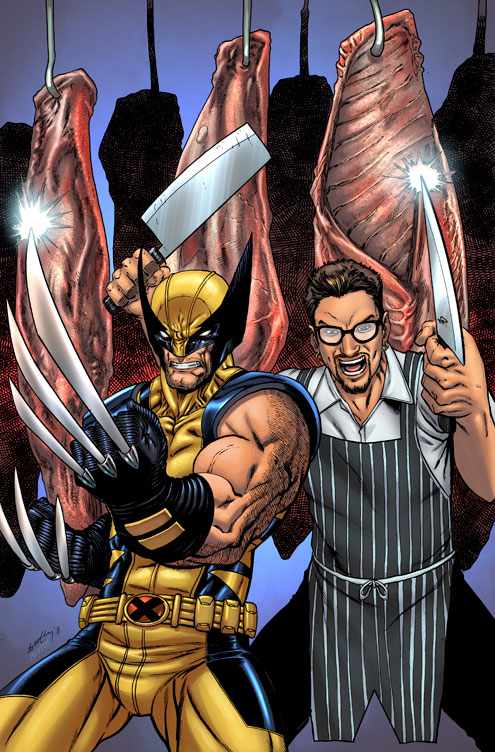
WonderCon diaries: Chris Cosentino is… Wolverine’s new buddy!

0

I had seen chef Chris Cosentino (of Bay Area offal ground zero Incanto, also a The Next Iron Chef contestant and host of the Food Network’s Chef Vs. City) in person for the first time a few weeks ago – he’d just made an incredible multi-course meal for a bunch of beer journalists at Anchor Brewery and was racing around, saying hi to people and describing his thought process on the various beer-food pairings. My tablemates, friends of Cosentino, told me he had a comic coming out at WonderCon, or something. So I gave him a shout – hey, dope local angle on the convention, since I knew I was going anyway.

Maybe I should have known when I saw the massive poster of Cosentino in the Ferry Building at the stand of his other business, Boccolone Tasty Salted Pig Parts (signed by the man himself, “pork is the new vegetable,”), a few days later that this was going to be no mere small press comic release.  

Perhaps a nice interview about his project for some pre-event coverage? — I inquired of the king of offal. “You have to speak with Marvel first before anything can be written sorry it’s their protocol,” he replied. Marvel! At which point I embarked on the epic voyage that is reporting on Marvel Comics, much of which involves intriguing email exchanges with C.B. Cebulski, senior V.P. of “creator and content development.” Marvel, like most of the major comic labels, luxuriates in a cycle of suspense and sneak peeks. So are Cebulski’s emails: vague, then bombshell! Damn, they’re good at what they do. 

Which is to say, the convention approached and I still had no idea what the hell Chris Cosentino had to do with WonderCon, or Marvel at all for that matter. I dug out of C.B. that he was indeed, going to be the special guest at Marvel’s “Welcome to the X-Men” panel, so that at least I would be present for when the bomb was detonated. Still, Chris — are you going to be an X-Man? “No I’m not an X-Man,” is all his email in return said. So what the hell — ? Suspense!

On Friday Cebulski sent me the artwork of the upcoming Cosentino Marvel appearance, which was probably a big deal that I should have tweeted about immediately: Wolverine and the chef in a meat locker poised for battle, Wolverine with his metal alloy adamantium claws, Cosentino brandishing a pair of shiny butcher knives. Best friends! 

I was hooked. Thusly, I ferreted out said Marvel presentation on Saturday, the first WonderCon event I attended and the only time I would attend a major label event this weekend, I think. I saw Cebulski and Cosentino enter, was briefly and glancingly greeted by the two, watched Cebulski assume a spot at the panel table, Cosentino grab a seat towards the back of the conference room with a friend, and then the panel began discussing upcoming X-Men releases to a rapt audience, who cheered when individual series (there are many within the X-Men universe, of course): suspense, sneak peek!

“I can’t say a lot about what’s involved — but there are lots of giant robots involved,” said a much-loved Marvel artist on the panel. And on: “something drastic will be happening in the X-Men universe — I don’t think I can say much more about it.” Suspense, sneak peek! 

And then, the artwork I’d been sent earlier flashed on screen, with Cosentino’s figure replaced with a black shape with a question mark in the middle. And then, Cosentino! I think it’ll be bigger news on Chowhound, judging from the lukewarm  WonderCon entusiasm levels expressed upon his introduction. He arose from his seat towards the back of the room and assumed a spot at the panel table.  

“It’ll be very food centric, very San Francisco-located,” Cosentino announces of his impending dance with the X-Men universe. “We’re gonna have fun with this one.”

“I grew up being infatuated with Wolverine. As a little kid, I used to sit there and stare at my hands,” he says, the best line of the panel: the audience chuckles, remembering their own metal alloy adamantium dreams. Cebulski, panel moderating, asks what Wolverine’s favorite restaurant is. 

“He has so many food loves,” Cosentino replies, unwilling to pigeonhole his childhood hero. “Japan, Germany.” Which is to say: read the comic book! You can, it comes out in June exclusively in digital form. I for one, will be stoked to see where Cosentino takes Wolverine on whatever shredding and stabbing mayhem ensues – North Beach for cioppino? Nobu’s late night meaty buffet? 

Anyway, the audience members that surfaced for the post-panel Q&A was less intrigued with these culinary concerns. The closest ask came from a young man from the South Bay. When, he wondered, will the X-Men be spending some time on the peninsula? He sees them in San Francisco, Oakland, and Marin all the time, so he’d like to know. “I want to see X-Men on my street!”

“You want to see X-Men destroy your house and your street,” a panelist says, by way of very inconclusive response, albeit one that incites much enthusiasm from the questioner and the rest of the audience. Seeing one’s house destroyed by ones heroes being the ultimate honorific here in this crowd of Marvel enthusiasts, save becoming a character oneself. 

Anyways, now our chefs are cartoon characters. What’s next, the anime version of the Tamale Lady? Alice Waters vs. Godzilla? 

More WonderCon tidings are on their way, later this week. Ziggy Marley will be involved. How’s that for a tease, Marvel?

On the Cheap Listings

0

WEDNESDAY 16

Castro farmers’ market seasonal opening Noe between Market and Beaver, SF; 1-800-949-FARM, www.pcfma.com. 4-8pm, free. The Castro farmers’ market is back in business today and every Wednesday hereafter until December 21 with bountiful local produce at bargain prices, live performances, and other events in the works. Today’s market kick-off includes a Sisters of Perpetual Indulgence ribbon cutting ceremony and more St. Patrick’s Day-themed activities to keep you entertained while you peruse the dinosaur kale and heirloom radishes.


THURSDAY 17

Tara Jane O’Neil El Rio, 3158 Mission, SF; (415) 282-3325, www.elriosf.com. 9pm, $5. Remember when you were a kid and you thought paying five bucks for a show was a rip? Well now it’s a bargain – especially for a PDX-Olympia-SF trifecta of awesomeness – so tonight, come see TJo and the Root Buds with Lesbians, and local queer psych rockers Night Call. Also slinging vinyl will be DJ Theo Kwo and DJ Permanent Wave.

Ladies of Letterpress exhibition San Francisco Center for the Book, 300 De Haro, SF; (415) 565-0545, www.sfcb.org. 6-8pm, free. Tonight the SFBC is hosting a talk and a one night only exhibition of letterpress printing featuring works by local members of Ladies of Letterpress, with an “impromptu” letterpress business card mash-up exhibition planned (so bring those letterpress business cards you have lying around) and chocolates in the shape of La Forêt fonts for tasting – cute!


SATURDAY 19

An evening with Stephan Pastis Cartoon Art Museum, 655 Mission, SF; (415) CAR-TOON, www.cartoonart.org. 6-8pm, $5, free for members. Enjoy a behind-the-scenes look at Pearls Before Swine with the creator of this award-winning comic strip, Stephen Pastis — who is somewhat controversial for his relentless badgering of stale and boring comics (cough*Family Circle*cough) and use of certain subjects that tend to piss people off, like George Bush, Israel, religion – you know, the usual. This ballsy lawyer-turned-cartoonist will be signing books after the presentation and celebration of his new collection, Pearls Blow Up.


SUNDAY 20

Sunday Streets kick-off Embarcadero between Fisherman’s Wharf and Terry Francois Drive, SF; www.sundaystreetssf.com. 11am-4pm, free. Another year of Sunday Streets is upon us, marking the onset of beautiful San Francisco weather – knock on wood – with this free health and community oriented event. The first “Streets” of the season will begin at Fisherman’s Wharf and follow the Embarcadero down to Mission Bay, ending at Terry Francois Drive. Bring your roller skates, unicycle, skateboard, or just a plain pair of walking shoes and enjoy the activities and vendors that line this route, closed off from automobile traffic for the day.

Sixth Annual Meat Out Unitarian Center, 11887 Franklin, SF; (415) 273-5481, uufetasf@gmail.com, www.sfvs.org. Noon-2pm, $8 suggested donation. Get on board with the Board of Supervisor-approved Veg Day Mondays resolution a day early at this meatless and cruelty free luncheon with guest speakers – including Bob Linden of Go Vegan Radio on Green 960 AM and clinician-turned-health book author, Dr. Michael Klaper. Free recipes will be available for you to take home and veg out any day of the week. Don’t forget to register in advance by email or phone, as space is limited.


MONDAY 21

Pecha Kucha 330 Ritch, 330 Ritch, SF; www.pecha-kucha.org. 7pm, $5 suggested donation. Pecha Kucha, now a popular event in cities around the world, began as a way for young designers in varying fields to show off their work and share ideas in a specific presentation format. A dozen or so designers present 20 images for 20 seconds per piece and have six minutes and 40 seconds to explain their work before the next presenter takes the stage. Today’s presenters include Marilyn Yu, Davis Albertson, and Mila Zelkha, and as a special treat: local soul food eatery Little Skillet will be serving up their famous chicken and waffles.


TUESDAY 22

Water Matters book launch party Project One, 251 Rhode Island, SF; www.watermatters.eventbrite.com. 6-9pm, free. Celebrate World Water Day with the release of the new book, Water Matters: Why We Need to Act Now to Save Our Most Critical Resource. There will be a panel discussion with leading environmental thinkers, like Wenonah Hauter of Food & Water Watch and Michael Brune of the Sierra Club, as well as a party to follow.


On the Cheap listings are compiled by Jackie Andrews. Submit items for the listings at listings@sfbg.com. For further information on how to submit items for the listings, see Picks.

Film Listings

0

SAN FRANCISCO INTERNATIONAL ASIAN AMERICAN FILM FESTIVAL

The 29th SFIAAFF runs March 10-20 at the Asian Art Museum, 200 Larkin, SF; Castro, 429 Castro, SF; Clay, 2261 Fillmore, SF; Pacific Film Archive, 2776 Bancroft, Berk.; Sundance Kabuki, 1881 Post; and Viz Cinema, New People, 1746 Post, SF. For tickets (most shows $12) and additional program information, visit www.caamedia.org. All times pm.

THURS/10

Castro West Is West 7.

FRI/11

Clay The Learning 6. When Love Comes 9. Histeria 11:30.

Kabuki Dooman River 4:30. One Kine Day 6:30. The House of Suh 9:15. “Life, Interrupted” 9:30.

PFA Abrazas 7. Break Up Club 9:20.

Viz Summer Pasture 6:30. “Chicken Proof” (shorts program) 9:30.

SAT/12

Clay It’s a Wonderful Afterlife 12:15. The Fourth Portrait 3. The Taqwacores 5:30. I Wish I Knew 8.

Kabuki Gold and Copper 12:15. Anna May Wong: In Her Own Words with “Slaying the Dragon Reloaded” 12:45. Stepping Forward 2. Saigon Electric 3:15. Open Season 5:30. Dog Sweat 6. Resident Aliens with “Fumiko Hayashida: The Woman Behind the Symbol” 7:30. “Living Life Large” (shorts program) 8:30. Nang Nak 9:30.

PFA Summer Pasture 4. Piano in a Factory 6:30. Living in Seduced Circumstances 9.

Viz M/F Remix 4. “Tainted Love” (shorts program) 8:45.

SUN/13

Castro The Man From Nowhere noon. Emir 3. Clash 6:30. Raavanan 9:30.

Clay Almost Perfect 1. Bend It Like Beckham 4. One Voice 6:45. Break Up Club 9.

Kabuki Peace noon. “3rd I South Asian International Shorts” (shorts program) 1:15. The House of Suh 2. Passion 4. “Play/House” (shorts program) 4:30. Made in India 6. Piano in a Factory 8:30. Sampaguita, National Flower 9:15.

PFA Anna May Wong: In Her Own Words with “Slaying the Dragon Reloaded” 2:30. Charlie Chan at the Olympics 6. Bi, Don’t Be Afraid! 8.

Viz “Silent Rituals and Hovering Proxies” (shorts program) 2:15. Tales of the Waria 5. Gold and Copper 7. Living in Seduced Circumstances 9:30.

MON/14

Kabuki “Chicken Proof” (shorts program) 4. Summer Pasture 4:30. Sampaguita, National Flower 6:30. Abraxas 6:45. Saigon Electric 8:30. Dooman River 9:30.

Viz One Kine Day 4. “Suite Suite Chinatown” (shorts program) 7. Affliction 9.

TUES/15

Kabuki “3rd I South Asian International Shorts” (shorts program) 4:15. Tales of the Waria 4:45. Almost Perfect 6:45. Open Season 7. M/F Remix 9. “Play/House” (shorts program) 9:30.

PFA I Wish I Knew 7.

Viz Resident Aliens with “Fumiko Hayashida: The Woman Behind the Symbol” 4:15. The Imperialists Are Still Alive! 6:30. Amin 9.

OPENING

Battle: Los Angeles Aliens invade L.A. and Will Smith isn’t involved? SoCal is doomed. (1:57) California.

Carbon Nation This polished, surprisingly optimistic doc from director Peter Byck (1996’s Garbage) takes on the world’s current over-reliance on carbon-based energy — with a focus on the greediest “Carbon Nation” around, the U.S. — and lays out several logical and seemingly do-able scenarios and solutions that just might help slow the rapidly changing climate. Though Carbon Nation reality-checks itself on more than one occasion (noting the reluctance of politicians and corporations to help mainstream the green movement), this doc is unerringly hopeful, and it entertains with an array of real-life characters: a good ol’ boy Texas wind farmer, a quirky Alaskan geothermal expert, a former rock n’ roller who turned to recycling refrigerators after a near-death experience, and charismatic Bay Area activist Van Jones. Carbon Nation‘s droll narration and snappy graphics at times suggest the film is aimed at lowest-common-denominator types who don’t even recycle their soda cans — but really, isn’t that the type of person who most deserves a clean-energy wake-up call? (1:22) Opera Plaza. (Eddy)

Happythankyoumoreplease Director, writer, and star Josh Radnor gets the prize for most unwieldy, hard-to-remember title in a while — and a tiny gold star for revealing the most heart within one so-called hipster. In this indie feel-gooder, writer Sam (Radnor) is lost at sea, completely adrift at the close of his twenties and unable to sell his novel. The aimlessness is beginning to seem less than cute to the random ladies that pass in the night and chums like Annie (Malin Akerman), who happens to have Alopecia and whose merry outlook is battling with her lack of self-confidence, and Mary Catherine (Zoe Kazan), who is puzzling whether to follow her boyfriend Charlie (Pablo Schreiber) to LA or to retain her life as a an artist in NYC. It takes a lost little boy, Rasheen (Michael Algieri), to bring out the selfless nurturer in Sam’s self-conscious man-child, giving him the courage to approach the local hottie-slash-waitress-slash-cabaret-singer Mississippi (Kate Mara). Radnor — who resembles a likable, every-guy Ben Affleck, though he’s hindered with an expressiveness that ranges from bemused to bemused — himself points to the similarities between Woody Allen’s hymns to Manhattan intelligentsia-bohemia and his own aria to NYC singles on the brink of hooking up with adulthood. Waxing cute rather than critical, Happythankyoumoreplease lacks Allen’s early bite, but its guileless sweetness just might do the trick and satisfy some. (1:40) Embarcadero. (Chun)

I Saw the Devil This latest by South Korean wunderkind Kim Ji-woon (2008’s The Good, The Bad, The Weird; 2003’s A Tale of Two Sisters) aims to push serial-killer thriller conventions to new extremes in intensity, violent set-piece bravado, and sheer length. Intelligence agent Joo-yeong (Lee Byung-hun) is inconsolably horrified when his fiancée — a police chief’s daughter — is abducted, tortured and murdered by giddily remorseless Kyung-chul (Choi Min-sik). The latter is a rural schoolbus driver who stalks his prey on and off the job, hauling them to a rigged-up shack where he enjoys their protracted final writhings. Once our hero tracks down this grotesque villain, he demonstrates a perverse, obsessive side by letting the “devil” loose again — each time after serious physical punishment — so that he can live in terror of his avenger. The trouble with that concept is that our upright, fanatical hero thus allows remorseless Kyung-chul to abuse new victims every time he’s let loose, which simply doesn’t make psychological sense. I Saw the Devil has some dazzling action set-pieces and outre content. But the dependency on slasher genre-style harm toward pretty young women sounds a sour, conventional note. And while it reserves a delicious irony or two for the end, this glorified horror flick simply goes on way too long. (2:21) Lumiere, Shattuck. (Harvey)

Mars Needs Moms A young boy must fight to save his kidnapped-by-aliens mother in this 3D animated Disney comedy. (1:28)

Red Riding Hood Amanda Seyfried stars in Catherine Hardwicke’s edgy (i.e., the Big Bad Wolf is now a werewolf) fairy-tale update. (1:38) Shattuck.

*William S. Burroughs: A Man Within William S. Burroughs, as director John Waters puts it in this long-overdue documentary, became famous before any of his peers, “for all the things you were supposed to hide: he was gay; he was a junkie; he shot his wife.” Of course, that isn’t the entire story. Examining the cultural forces and tragic biographical events that shaped The Naked Lunch author, director Yony Lesler attempts with varying degrees of success to separate the intensely private man from the countercultural raconteur in the gray flannel suit Burroughs would become later in his life. Combining interviews with a who’s who of famous associates, friends, and admirers, rare and never-before seen archival footage, and clips from Burroughs’ own experimental films and later home movies, Lesler makes a convincing case for Burroughs as a perennial outsider, even to himself. His Harvard education and wealthy pedigree set him apart from his crunchier Beat compatriots and he openly disdained the label of “gay revolutionary” even as his writing boldly envisioned same-sex desire as something truly queer. And although his dour mien and conservative dress would later become personal trademarks, he in fact privately mourned the death of his wife, Joan Vollmer, who he shot in Mexico playing a drunken round of William Tell (he was never tried), and his estranged son, Bill Burroughs Jr., who died attempting to approximate his father’s former junkie lifestyle. The film’s talking heads variously credit Burroughs with everything from punk rock to performance art, but the sad, all-too-human story behind the hagiography is what’s most compelling here. (1:38) Roxie. (Sussman)

ONGOING

The Adjustment Bureau As far as sci-fi romantic thrillers go, The Adjustment Bureau is pretty standard. But since that’s not an altogether common genre mash-up, I guess the film deserves some points for creativity. Based on a short story by Philip K. Dick, The Adjustment Bureau takes place in a world where all of our fates are predetermined. Political hotshot David Norris (Matt Damon) is destined for greatness — but not if he lets a romantic dalliance with dancer Elise (Emily Blunt) take precedence. And in order to make sure he stays on track, the titular Adjustment Bureau (including Anthony Mackie and Mad Men‘s John Slattery) are there to push him in the right direction. While the film’s concept is intriguing, the execution is sloppy. The Adjustment Bureau suffers from flaws in internal logic, allowing the story to skip over crucial plot points with heavy exposition and a deus ex machina you’ve got to see to believe. Couldn’t the screenwriter have planned ahead? (1:39) 1000 Van Ness, Piedmont, SF Center, Shattuck, Sundance Kabuki. (Peitzman)

*Another Year Mike Leigh’s latest represents a particularly affecting entry among his many improv-based, lives-of-everyday-Brits films. More loosely structured than 2008’s Happy-Go-Lucky, which featured a clear lead character with a well-defined storyline, the aptly-titled Another Year follows a year in the life of a group of friends and acquaintances, anchored by married couple Tom (Jim Broadbent) and Gerri (Ruth Sheen). Tom and Gerri are happily settled into middle-class middle age, with a grown son (Oliver Maltman) who adores them. So far, doesn’t really sound like there’ll be much Leigh-style heightened emotion spewing off the screen, traumatizing all in attendance, right? Well, you haven’t met the rest of the ensemble: there’s a sad-sack small-town widower, a sad-sack overweight drunk, a near-suicidal wife and mother (embodied in one perfect, bitter scene by Imelda Staunton), and Gerri’s work colleague Mary, played with a breathtaking lack of vanity by Lesley Manville. At first Mary seems to be a particularly shrill take on the clichéd unlucky-in-love fiftysomething woman — think an unglamorous Sex in the City gal, except with a few more years and far less disposable income. But Manville adds layers of depth to the pitiful, fragile, blundering Mary; she seems real, which makes her hard to watch at times. That said, anyone would be hard-pressed to look away from Manville’s wrenching performance. (2:09) Shattuck. (Eddy)

Barney’s Version The charm of this shambling take on Mordecai Richler’s 1997 novel lies almost completely in the hang-dog peepers of star Paul Giamatti. Where would Barney’s Version be without him and his warts-and-all portrayal of lovable, fallible striver Barney Panofsky — son of a cop (Dustin Hoffman), cheesy TV man, romantic prone to falling in love on his wedding day, curmudgeon given to tying on a few at a bar appropriately named Grumpy’s, and friend and benefactor to the hard-partying and pseudo-talented Boogie (Scott Speedman). So much depends on the many nuances of feeling flickering across Giamatti’s pale, moon-like visage. Otherwise Barney’s Version sprawls, carries on, and stumbles over the many cute characters we don’t give a damn about — from Minnie Driver’s borderline-offensive JAP of a Panofsky second wife to Bruce Greenwood’s romantic rival for Barney’s third wife Miriam (Rosamund Pike). A mini-who’s who of Canadian directors surface in cameos — including Denys Arcand, David Cronenberg, and Atom Egoyan — as a testament to the respect Richler commands. Too bad director Richard J. Lewis didn’t get a few tips on dramatic rigor from Cronenberg or intelligent editing from Egoyan — as hard as it tries, Barney’s Version never rises from a mawkish middle ground. (2:12) Opera Plaza. (Chun)

Beastly The problem with a title like Beastly is that it’s difficult to avoid the obvious line: the movie lives up to its name. But indeed, this modernized take on the Beauty and the Beast tale is wretched on all fronts — a laughable script, endless plot holes, and the kind of wooden acting that makes you long for the glory days of Twilight (2008). New “It Boy” Alex Pettyfer stars as Kyle, a vapid popular kid who is cursed to look like a slightly less attractive version of himself by a vengeful witch (Mary-Kate Olsen). Only the love of kind-hearted Lindy (Vanessa Hudgens) can cure him of his fate. There is so much wrong with Beastly, it’s hard to zone in on its individual faults: this is a film in which the opening scene has Kyle telling his ugly classmates to “embrace the suck”—and then getting elected to student government anyway. Embrace Beastly‘s suck if you can’t live without Pettyfer’s washboard abs, but you’re far better off rewatching the Disney or Cocteau versions. (1:35) 1000 Van Ness. (Peitzman)

Biutiful Uxbal (Javier Bardem) has problems. To name but a few: he is raising two young children alone in a poor, crime-beset Barcelona hood. He is making occasional attempts to rope back in their bipolar, substance-abusive mother (Maricel Álvarez), a mission without much hope. He is trying to stay afloat by various not-quite legal means while hopefully doing the right thing by the illegals — African street drug dealers and Chinese sweatshop workers — he acts as middleman to, standing between them and much less sympathetically-inclined bossmen. He’s got a ne’er-do-well brother (Eduard Fernandez) to cope with. Needless to say, with all this going on (and more), he isn’t getting much rest. But when he wearily checks in with a doc, the proverbial last straw is stacked on his camelback: surprise, you have terminal cancer. With umpteen odds already stacked against him in everyday life, Uxbal must now put all affairs in order before he is no longer part of the equation. This is Alejandro González Iñárritu’s first feature since an acrimonious creative split with scenarist Guillermo Arriaga. Their films together (2006’s Babel, 2003’s 21 Grams, 2000’s Amores Perros) have been criticized for arbitrarily slamming together separate baleful storylines in an attempt at universal profundity. But they worked better than Biutiful, which takes the opposite tact of trying to fit several stand-alone stories’ worth of hardship into one continuous narrative — worse, onto the bowed shoulders of one character. Bardem is excellent as usual, but for all their assured craftsmanship and intense moments, these two and a half hours collapse from the weight of so much contrived suffering. Rather than making a universal statement about humanity in crisis, Iñárritu has made a high-end soap opera teetering on the verge of empathy porn. (2:18) SF Center, Sundance Kabuki. (Harvey)

*Black Swan “Lose yourself,” ballet company head Thomas (Vincent Cassel) whispers to his leading lady, Nina (Natalie Portman), moments before she takes the stage. But Nina is already consumed with trying to find herself, and rarely has a journey of self-discovery been so unsettling. Set in New York City’s catty, competitive ballet world, Black Swan samples from earlier dance films (notably 1948’s The Red Shoes, but also 1977’s Suspiria, with a smidgen of 1995’s Showgirls), though director Darren Aronofsky is nothing if not his own visionary. Black Swan resembles his 2008 The Wrestler somewhat thematically, with its focus on the anguish of an athlete under ten tons of pressure, but it’s a stylistic 180. Gone is the gritty, stripped-down aesthetic used to depict a sad-sack strongman. Like Dario Argento’s 1977 horror fantasy, the gory, elegantly choreographed Black Swan is set in a hyper-constructed world, with stabbingly obvious color palettes (literally, white = good; black = evil) and dozens of mirrors emphasizing (over and over again) the film’s doppelgänger obsession. As Nina, Portman gives her most dynamic performance to date. In addition to the thespian fireworks required while playing a goin’-batshit character, she also nails the role’s considerable athletic demands. (1:50) Shattuck, Sundance Kabuki. (Eddy)

Carmen in 3D (2:55) SF Center.

*Cedar Rapids What if The 40 Year Old Virgin (2005) got so Parks and Rec‘d at The Office party that he ended up with a killer Hangover (2009)? Just maybe the morning-after baby would be Cedar Rapids. Director Miguel Arteta (2009’s Youth in Revolt) wrings sweet-natured chuckles from his banal, intensely beige wall-to-wall convention center biosphere, spurring such ponderings as, should John C. Reilly snatch comedy’s real-guy MVP tiara away from Seth Rogen? Consider Tim Lippe (Ed Helms of The Hangover), the polar opposite of George Clooney’s ultracompetent, complacent ax-wielder in Up in the Air (2009). He’s the naive manchild-cum-corporate wannabe who never quite graduated from Timmyville into adulthood. But it’s up to Lippe to hold onto his firm’s coveted two-star rating at an annual convention in Cedar Rapids. Life conspires against him, however, and despite his heartfelt belief in insurance as a heroic profession, Lippe immediately gets sucked into the oh-so-distracting drama, stirred up by the dangerously subversive “Deanzie” Ziegler (John C. Reilly), whom our naif is warned against as a no-good poacher. Temptations lie around every PowerPoint and potato skin; as Deanzie warns Lippe’s Candide, “I’ve got tiger scratches all over my back. If you want to survive in this business, you gotta daaance with the tiger.” How do you do that? Cue lewd, boozy undulations — a potbelly lightly bouncing in the air-conditioned breeze. “You’ve got to show him a little teat.” Fortunately Arteta shows us plenty of that, equipped with a script by Wisconsin native Phil Johnston, written for Helms — and the latter does not disappoint. (1:26) California, Empire, Piedmont, Sundance Kabuki. (Chun)

Drive Angry 3D It says something about the sad state of Nicolas Cage’s cinematic choices when the killer-B, grindhouse-ready Drive Angry 3D is the finest proud-piece-o-trash he’s carried since The Bad Lieutenant: Port of Call New Orleans (2009), which doesn’t say much — the guy works a lot. Here, in his quest to become the paycheck-happy late-Brando of comic book, sci-fi, and fantasy flicks, Cage gets to work that anguished hound-dog mien, while meting out the punishment against grotty Satanists, in this cross between Constantine (2005), bible comics, and Shoot ‘Em Up (2007). Out for blood and sprung from the deepest, darkest hole a bad boy can find himself in, vengeful grandpa Milton (Cage) — a sop for Paradise Lost readers — is determined to rescue his infant granddaughter. She’s in the hands of Jonah King (Billy Burke), a devil-worshipping cult leader with a detestable soul patch who killed Milton’s daughter and carries her femur around as a souvenir. Along for the ride is the hot-pants-clad hottie Piper (Amber Heard), who’s as handy with her fists as she is randy with the busboys (she drives home from work, singing along to Peaches’ “Fuck the Pain Away” — ‘nuf said), and trailing Milton is the mysterious Accountant (William Fichtner). Gore, boobs, fast cars, undead gunfighters, and cheese galore — it’s a fanboy’s fantasy land, as handed down via the tenets of our fathers Tarantino and Rodriguez — and though the 3D seems somewhat extraneous, it does come in, ahem, handy during the opening salvo. (1:44) 1000 Van Ness. (Chun)

Even the Rain It feels wrong to criticize an “issues movie” — particularly when the issues addressed are long overdue for discussion. Even the Rain takes on the privatization of water in Bolivia, but it does so in such an obvious, artless way that the ultimate message is muddled. The film follows a crew shooting an on-location movie about Christopher Columbus. The film-within-a-film is a less-than-flattering portrait of the explorer: if you’ve guessed that the exploitation of the native people will play a role in both narratives, you’d be right. The problem here is that Even the Rain rests on our collective outrage, doing little to explain the situation or even develop the characters. Case in point: Sebastian (Gael García Bernal), who shifts allegiances at will throughout the film. There’s an interesting link to be made between the time of Columbus and current injustice, but it’s not properly drawn here, and in the end, the few poignant moments get lost in the shuffle. (1:44) Lumiere, Shattuck, Smith Rafael. (Peitzman)

The Fighter Once enough of a contenda to have fought Sugar Ray Leonard — and won, though there are lingering questions about that verdict’s justice — Dicky (Christian Bale) is now a washed-up, crack-addicted mess whose hopes for a comeback seem just another expression of empty braggadocio. Ergo it has fallen to the younger brother he’s supposedly “training,” Micky (Mark Wahlberg), to endure the “managerial” expertise of their smothering-bullying ma (Melissa Leo) and float their large girl gang family of trigger-tempered sisters. That’s made even worse by the fact that they’ve gotten him nothing but chump fights in which he’s matched someone above his weight and skill class in order to boost the other boxer’s ranking. When Micky meets Charlene (Amy Adams), an ambitious type despite her current job as a bartender, this hardboiled new girlfriend insists the only way he can really get ahead is by ditching bad influences — meaning mom and Dicky, who take this shutout as a declaration of war. The fact-based script and David O. Russell’s direction do a good job lending grit and humor to what’s essentially a 1930s Warner Brothers melodrama — the kind that might have had Pat O’Brien as the “good” brother and James Cagney as the ne’er-do-well one who redeems himself by fadeout. Even if things do get increasingly formulaic (less 1980’s Raging Bull and more 1976’s Rocky), the memorable performances by Bale (going skeletal once again), Wahlberg (a limited actor ideally cast) and Leo (excellent as usual in an atypically brassy role) make this more than worthwhile. As for Adams, she’s just fine — but by now it’s hard to forget the too many cutesy parts she’s been typecast in since 2005’s Junebug. (1:54) 1000 Van Ness, SF Center, Sundance Kabuki. (Harvey)

Gnomeo and Juliet If you willingly see a movie titled Gnomeo and Juliet, you probably have a keen sense of what you’re in for. And as long as that’s the case, it’s hard not to get sucked into the film’s 3D gnome-infested world. Believe it or not, this is actually a serviceable adaptation of Shakespeare’s classic — minus the whole double-suicide downer ending. But at least the movie is conscious of its source material, throwing in several references to other Shakespeare plays and even having the Bard himself (or, OK, a bronze statue) comment on the proceedings. It helps that the cast is populated by actors who could hold their own in a more traditional Shakespearean context: James McAvoy, Emily Blunt, Maggie Smith, and Michael Caine. But Gnomeo and Juliet isn’t perfect — not because of its outlandish concept, but due to a serious overabundance of Elton John. The film’s songwriter and producer couldn’t resist inserting himself into every other scene. Aside from the final “Crocodile Rock” dance number, it’s actually pretty distracting. (1:24) 1000 Van Ness, SF Center. (Peitzman)

Hall Pass There are some constants when it comes to a Farrelly Brothers movie: lewd humor, full-frontal male nudity, and at least one shot of explosive diarrhea. Hall Pass does not disappoint on the gross-out front, but it’s a letdown in almost every other way. Rick (Owen Wilson) and Fred (Jason Sudeikis) are married men obsessed with the idea of reliving their glory days. Lucky for them, wives Maggie (Jenna Fischer) and Grace (Christina Applegate) decide to give them a week-long “hall pass” from marriage. Of course, once Rick and Fred are able to go out and snag any women they want, they realize most women aren’t interested in being snagged by dopey fortysomethings. On paper, Hall Pass has the potential to be a sharp, anti-bro comedy. Instead, it wallows in recycled toilet humor that’s no longer edgy enough to make us squirm. At least there are still moments of misogyny to provide that familiar feeling of discomfort. (1:38) 1000 Van Ness. (Peitzman)

I Am File in the dusty back drawer of An Inconvenient Truth (2006) wannabes. The cringe-inducing, pretentious title is a giveaway — though the good intentions are in full effect — in this documentary by and about director Tom Shadyac’s search for answers to life’s big questions. After a catastrophic bike accident, the filmmaker finds his lavish lifestyle as a successful Hollywood director of such opuses as Bruce Almighty (2003) somewhat wanting. Thinkers and spiritual leaders such as Desmond Tutu, Howard Zinn, UC Berkeley psychology professor Dacher Keltner, and scientist David Suzuki provide some thought-provoking answers, although Shadyac’s thinking behind seeking out this specific collection of academics, writers, and activists remains somewhat unclear. I Am‘s shambling structure and perpetual return to its true subject — Shadyac, who resembles a wide-eyed Weird Al Yankovic — doesn’t help matters, leaving a viewer with mixed feelings, less about whether one man can work out his quest for meaning on film, than whether Shadyac complements his subjects and their ideas by framing them in such a random, if well-meaning, manner. And sorry, this film doesn’t make up for Ace Ventura: Pet Detective (1994). (1:16) Lumiere, Shattuck, Smith Rafael. (Chun)

I Am Number Four Do you like Twilight? Do you think aliens are just as sexy — if not sexier! — than vampires? I Am Number Four isn’t a rip-off of Stephenie Meyer’s supernatural saga, but the YA novel turned film is similar enough to draw in that coveted tween audience. John (Alex Pettyfer) is a teenage alien with extraordinary powers who falls in love with a human girl Sarah (Dianna Agron). But they’re from two different worlds! To be fair, star-crossed romance isn’t the issue here: the real problem is I Am Number Four‘s “first in a series” status. Rather than working to establish itself as a film in its own right, the movie sets the stage for what’s to come next, a bold presumption for something this mediocre. It lazily drops some exposition, then launches into big, loud battles without pausing to catch its breath. I Am Number Four only really works if it gets a sequel, and we all know how well that turned out for The Golden Compass (2007). (1:44) 1000 Van Ness. (Peitzman)

*The Illusionist Now you see Jacques Tati and now you don’t. With The Illusionist, aficionados yearning for another gem from Tati will get a sweet, satisfying taste of the maestro’s sensibility, inextricably blended with the distinctively hand-drawn animation of Sylvain Chomet (2004’s The Triplets of Belleville). Tati wrote the script between 1956 and 1959 — a loving sendoff from a father to a daughter heading toward selfhood — and after reading it in 2003 Chomet decided to adapt it, bringing the essentially silent film to life with 2D animation that’s as old school as Tati’s ambivalent longing for bygone days. The title character should be familiar to fans of Monsieur Hulot: the illusionist is a bemused artifact of another age, soon to be phased out with the rise of rock ‘n’ rollers. He drags his ornery rabbit and worn bag of tricks from one ragged hall to another, each more far-flung than the last, until he meets a little cleaning girl on a remote Scottish island. Enthralled by his tricks and grateful for his kindness, she follows him to Edinburgh and keeps house while the magician works the local theater and takes on odd jobs in an attempt to keep her in pretty clothes, until she discovers life beyond their small circle of fading vaudevillians. Chomet hews closely to bittersweet tone of Tati’s films — and though some controversy has dogged the production (Tati’s illegitimate, estranged daughter Helga Marie-Jeanne Schiel claimed to be the true inspiration for The Illusionist, rather than daughter and cinematic collaborator Sophie Tatischeff) and Chomet neglects to fully detail a few plot turns, the dialogue-free script does add an intriguing ambiguity to the illusionist and his charge’s relationship — are they playing at being father and daughter or husband and wife? — and an otherwise straightforward, albeit poignant tale. (1:20) Embarcadero, Smith Rafael. (Chun)

Inside Job Inside Job is director Charles Ferguson’s second investigative documentary after his 2007 analysis of the Iraq War, No End in Sight, but it feels more like the follow-up to Alex Gibney’s Enron: The Smartest Guys in the Room (2005). Keeping with the law of sequels, more shit blows up the second time around. As with No End in Sight, Ferguson adeptly packages a broad overview of complex events in two hours, respecting the audience’s intelligence while making sure to explain securities exchanges, derivatives, and leveraging laws in clear English (doubly important when so many Wall Street executives hide behind the intricacy of markets). The revolving door between banks, government, and academia is the key to Inside Job‘s account of financial deregulation. At times borrowing heist-film conventions (it is called Inside Job, after all), Ferguson keeps the primary players in view throughout his history so that the eventual meltdown seems anything but an accident. The filmmaker’s relentless focus on the insiders isn’t foolproof; tarring Ben Bernanke, Henry Paulson, and Timothy Geithner as “made” guys, for example, isn’t a substitute for evaluating their varied performances over the last two years. Inside Job makes it seem that the entire crisis was caused by the financial sector’s bad behavior, and this too is reductive. Furthermore, Ferguson does not come to terms with the politicized nature of the economic fallout. In Inside Job, there are only two kinds of people: those who get it and those who refuse to. The political reality is considerably more contentious. (2:00) Bridge. (Goldberg)

The King’s Speech Films like The King’s Speech have filled a certain notion of “prestige” cinema since the 1910s: historical themes, fully-clothed romance, high dramatics, star turns, a little political intrigue, sumptuous dress, and a vicarious taste of how the fabulously rich, famous, and powerful once lived. At its best, this so-called Masterpiece Theatre moviemaking can transcend formula — at its less-than-best, however, these movies sell complacency, in both style and content. In The King’s Speech, Colin Firth plays King George VI, forced onto the throne his favored older brother Edward abandoned. This was especially traumatic because George’s severe stammer made public address tortuous. Enter matey Australian émigré Lionel Logue (Geoffrey Rush, mercifully controlled), a speech therapist whose unconventional methods include insisting his royal client treat him as an equal. This ultimately frees not only the king’s tongue, but his heart — you see, he’s never had anyone before to confide in that daddy (Michael Gambon as George V) didn’t love him enough. Aww. David Seidler’s conventionally inspirational script and BBC miniseries veteran Tom Hooper’s direction deliver the expected goods — dignity on wry, wee orgasms of aesthetic tastefulness, much stiff-upper-lippage — at a stately promenade pace. Firth, so good in the uneven A Single Man last year, is perfect in this rock-steadier vehicle. Yet he never surprises us; role, actor, and movie are on a leash tight enough to limit airflow. (1:58) Albany, Embarcadero, Empire, 1000 Van Ness, Piedmont, Sundance Kabuki. (Harvey)

*Last Lions It’s hard being a single mom. Particularly when you are a lioness in the Botswana wetlands, your territory invaded and mate killed by an invading pride forced out of their own by encroaching humanity. Add buffalo herds (tasty yes, but with sharp horns they’re not afraid to use) and crocodiles (no upside there), and our heroine is hard-pressed to keep herself alive, let alone her three small cubs. Derek Joubert’s spectacular nature documentary, narrated by Jeremy Irons (in plummiest Lion King vocal form) manages a mind-boggling intimacy observing all these predators. Shot over several years, while seeming to depict just a few weeks or months’ events, it no doubt fudges facts a bit to achieve a stronger narrative, but you’ll be too gripped to care. Warning: those kitties sure are cute, but this sometimes harsh depiction of life (and death) in the wild is not suitable for younger children. (1:28) Embarcadero, Shattuck. (Harvey)

*Machotaildrop Every once in a while you see the Best Film Ever Made. Meaning, the movie that is indisputably the best film ever made at least for the length of time you’re watching it. Illustrative examples include Dr. Seuss musical The 5,000 Fingers of Dr. T (1953), Superstar (Todd Haynes’ 1987 Barbie biopic about Karen Carpenter), Nina Paley’s 2008 animation Sita Sings the Blues, several Buster Keaton vehicles, and Paul Robeson sightings — anything that delights unceasingly. Now there is Machotaildrop, which the Roxie had the excellent sense to book for an extended run after its local debut at SF IndieFest, a year and a half after its premiere at Toronto mystifyingly failed to set the entire world on fire. Corey Adams and Alex Craig’s debut takes place in a gently alternative universe where pro skateboarders play pro skateboarders who aspire to belonging in the media kingdom and island fiefdom of ex-tightrope-walking corporate titan the Baron (James Faulkner). Such is the lucky fate of gormless small-town lad Walter (Anthony Amedori), though naturally there proves to be something sinister going on here to kinda drive the kinda-plot along. When that disruption of skating paradise takes central focus after about an hour, what was hitherto something of pure joy — a genial, laid-back surrealist joke without identifiable cinematic precedent — becomes just a wee more conventional. But Machotaildrop still offers fun on a level so high it’s seldom legal. (1:31) Roxie. (Harvey)

Nora’s Will There’s certainly something to be said for the uniqueness of Nora’s Will: I can’t think of any other Mexican-Jewish movies that cover suicide, Passover, and cooking with equal attention. But while it sounds like the film is overloaded, Nora’s Will is actually too subtle for its own good. It meanders along, telling the story of the depressed Nora, her conflicted ex-husband, and the family she left behind. When the movie focuses on the clash between Judaism and Mexican culture, the results are dynamic, but more often that not, it simply crawls along. It’s not that Nora’s Will is boring: it’s just easily forgettable, which is surprising given its subject matter. Meanwhile, it walks that fine line between comedy and drama, never bringing the laughs or the emotional catharsis it wants to offer. The only real reaction it inspires is hunger, particularly if the idea of a Mexican-Jewish feast sounds appealing. Turns out “gefilte fish” is the same in every language. (1:32) Opera Plaza, Shattuck, Smith Rafael. (Peitzman)

*Of Gods and Men It’s the mid-1990s, and we’re in Tibhirine, a small Algerian village based around a Trappist monastery. There, eight French-born monks pray and work alongside their Muslim neighbors, tending to the sick and tilling the land. An emboldened Islamist rebel movement threatens this delicate peace, and the monks must decide whether to risk the danger of becoming pawns in the Algerian Civil War. On paper, Of Gods and Men sounds like the sort of high-minded exploitation picture the Academy swoons over: based on a true story, with high marks for timeliness and authenticity. What a pleasant surprise then that Xavier Beauvois’s Cannes Grand Prix winner turns out to be such a tightly focused moral drama. Significantly, the film is more concerned with the power vacuum left by colonialism than a “clash of civilizations.” When Brother Christian (Lambert Wilson) turns away an Islamist commander by appealing to their overlapping scriptures, it’s at the cost of the Algerian army’s suspicion. Etienne Comar’s perceptive script does not rush to assign meaning to the monks’ decision to stay in Tibhirine, but rather works to imagine the foundation and struggle for their eventual consensus. Beauvois occasionally lapses into telegraphing the monks’ grave dilemma — there are far too many shots of Christian looking up to the heavens — but at other points he’s brilliant in staging the living complexity of Tibrihine’s collective structure of responsibility. The actors do a fine job too: it’s primarily thanks to them that by the end of the film each of the monks seems a sharply defined conscience. (2:00) Albany, Embarcadero. (Goldberg)

127 Hours After the large-scale, Oscar-draped triumph of 2008’s Slumdog Millionaire, 127 Hours might seem starkly minimalist — if director Danny Boyle weren’t allergic to such terms. Based on Aron Ralston’s memoir Between a Rock and a Hard Place, it’s a tale defined by tight quarters, minimal “action,” and maximum peril: man gets pinned by rock in the middle of nowhere, must somehow free himself or die. More precisely, in 2003 experienced trekker Ralston biked and hiked into Utah’s Blue John Canyon, falling into a crevasse when a boulder gave way under his feet. He landed unharmed … save a right arm pinioned by a rock too securely wedged, solid, and heavy to budge. He’d told no one where he’d gone for the weekend; dehydration death was far more likely than being found. For those few who haven’t heard how he escaped this predicament, suffice it to say the solution was uniquely unpleasant enough to make the national news (and launch a motivational-speaking career). Opinions vary about the book. It’s well written, an undeniably amazing story, but some folks just don’t like him. Still, subject and interpreter match up better than one might expect, mostly because there are lengthy periods when the film simply has to let James Franco, as Ralston, command our full attention. This actor, who has reached the verge of major stardom as a chameleon rather than a personality, has no trouble making Ralston’s plight sympathetic, alarming, poignant, and funny by turns. His protagonist is good-natured, self-deprecating, not tangibly deep but incredibly resourceful. Probably just like the real-life Ralston, only a tad more appealing, less legend-in-his-own-mind — a typical movie cheat to be grateful for here. (1:30) Opera Plaza. (Harvey)

Rango (1:47) Empire, 1000 Van Ness, Sundance Kabuki.

Take Me Home Tonight Just because lame teen comedies existed in the ’80s doesn’t mean that they need to be updated for the ’10s. Nary an Eddie Money song disgraces the soundtrack of this unselfconscious puerile, pining sex farce — the type one assumes moviemakers have grown out of with the advent of smarty-pants a la Apatow and Farrell. Take Me Home Tonight would rather find its feeble kicks in major hair, big bags of coke, polo shirts with upturned collars, and “greed is good” affluenza. Matt (Topher Grace) is an MIT grad who’s refused to embrace the engineer within and is instead biding his time as a clerk at the local Suncoast video store when he stumbles on his old high school crush Tori (Teresa Palmer), a budding banker. In an effort to impress, he tells her he works for Goldman Sachs and trails after her to the rip-roaring last-hooray-before adulthood bash. Pal Barry (Dan Fogler) gets to play the Belushi-like buffoon when he swipes a Mercedes from the dealership he just got fired from, and ends up with a face full of powder in the arms of a kinky ex-supermodel (Angie Everhart). Despite cameos by comedians like Demetri Martin and a trailer and poster that make it all seem a bit cooler than it really is, Take Me Home Tonight doesn’t really touch the coattails of Jonathan Demme or even Cameron Crowe — in the hands of director Michael Dowse, it feels nowhere near as heartfelt, rock ‘n’ roll, or at the very least, cinematically competent. (1:37) 1000 Van Ness, Shattuck. (Chun)

*True Grit Jeff Bridges fans, resist the urge to see your Dude in computer-trippy 3D and make True Grit your holiday movie of choice. Directors Ethan and Joel Coen revisit (with characteristic oddball touches) the 1968 Charles Portis novel that already spawned a now-classic 1969 film, which earned John Wayne an Oscar for his turn as gruff U.S. Marshall Rooster Cogburn. (The all-star cast also included Dennis Hopper, Glen Campbell, Robert Duvall, and Strother Martin.) Into Wayne’s ten-gallon shoes steps an exceptionally crusty Bridges, whose banter with rival bounty hunter La Boeuf (a spot-on Matt Damon) and relationship with young Mattie Ross (poised newcomer Hailee Steinfeld) — who hires him to find the man who killed her father — likely won’t win the recently Oscar’d actor another statuette, but that doesn’t mean True Grit isn’t thoroughly entertaining. Josh Brolin and a barely-recognizable Barry Pepper round out a cast that’s fully committed to honoring two timeless American genres: Western and Coen. (1:50) 1000 Van Ness, SF Center, Sundance Kabuki. (Eddy)

“2011 Academy Award-Nominated Short Films, Live-Action and Animated” (Live-action, 1:50; animated, 1:25) Opera Plaza.

*Uncle Boonmee Who Can Recall His Past Lives There are very few contemporary filmmakers who grasp narrative as an expressive instrument in itself, and even among them Apichatpong Weerasethakul (2000’s Mysterious Object at Noon, 2004’s Tropical Malady) seems special. For those yet convinced, it’s important to note that while Apichatpong is sometimes pegged as a critic’s darling, he’s also highly esteemed by other filmmakers. I think this is because he entrusts the immersive qualities of sound and image and the intuitive processes of narrative. Like animals, his films change form as they move. Their regenerative story structures and sensuous beauty betray a motivating curiosity about the nature of perception as filtered through memory, desire, landscape, spirituality and social ties. All of Apichatpong’s films have a science-fiction flavor — the imaginative leap made to invent parallel worlds which resemble our reality but don’t quite behave — but Uncle Boonmee is the first to dress the part. That the film won the Palme d’Or at the 2010 Cannes Film Festival was instantly claimed as a triumph for film culture (which it was), but Uncle Boonmee has something to say to those interested in Buddhism, installation art, Jung, astrophysics, experimental music, animism … I could go on. If that list makes it sound a very San Francisco-appropriate movie, that’s not wrong either. (1:53) Sundance Kabuki. (Goldberg)

Unknown Everything is blue skies as Dr. Martin Harris (Liam Neeson) flies to Germany for a biotech conference, accompanied by lovely wife Elizabeth (January Jones in full Betty Draper mode). Landing in Berlin things quickly become grey, as he’s separated from his wife and ends up in a coma. Waking in a hospital room, Harris experiences memory loss, but like Harrison Ford he’s getting frantic with an urgent need to find his wife. Luckily she’s at the hotel. Unluckily, so is another man, who she and everyone else claims is the real Dr. Harris. What follows is a by-the-numbers thriller, with car chases and fist fights, that manages to entertain as long as the existential question is unanswered. Once it’s revealed to be a knock-off of a successful franchise, the details of Unknown‘s dated Cold War plot don’t quite make sense. On the heels of 2008’s Taken, Neeson again proves capable in action-star mode. Bruno Ganz amuses briefly as an ex-Stasi detective, but the vacant parsing by bad actress Jones, appropriate for her role on Mad Men, only frustrates here. (1:49) 1000 Van Ness, SF Center. (Ryan Prendiville)

*We Were Here Reagan isn’t mentioned in David Weissman’s important and moving new documentary about San Francisco’s early response to the AIDS epidemic, We Were Here — although his communications director Pat Buchanan and Moral Majority leader Jerry Falwell get split-second references. We Were Here isn’t a political polemic about the lack of governmental support that greeted the onset of the disease. Nor is it a kind of cinematic And the Band Played On that exhaustively lays out all the historical and medical minutiae of HIV’s dawn. (See PBS Frontline’s engrossing 2006 The Age of AIDS for that.) And you’ll find virtually nothing about the infected world outside the United States. A satisfying 90-minute documentary couldn’t possibly cover all the aspects of AIDS, of course, even the local ones. Instead, Weissman’s film, codirected with Bill Weber, concentrates mostly on AIDS in the 1980s and tells a more personal and, in its way, more controversial story. What happened in San Francisco when gay people started mysteriously wasting away? And how did the epidemic change the people who lived through it? The tales are well told and expertly woven together, as in Weissman’s earlier doc The Cockettes. But where We Were Here really hits home is in its foregrounding of many unspoken or buried truths about AIDS. The film will affect viewers on a deep level, perhaps allowing many to weep openly about what happened for the first time. But it’s a testimony as well to the absolute craziness of life, and the strange places it can take you — if you survive it. (1:30) Castro. (Marke B.)

*The Woman Chaser First widely noted as Elaine’s emotionally deaf boyfriend on Seinfield, in recent years Patrick Warburton has starred in successful network sitcoms Rules of Engagement and Less than Perfect. They followed The Tick, a shortlived Fox superhero parody series everyone loved but the viewing public. He’s voiced various characters on Family Guy (a man’s gotta work), as well as endearing villain Kronk in The Emperor’s New Groove (2000). That latter reunited him with Eartha Kitt, also a co-star in his screen debut: 1987’s campsterpiece Mandingo (1975) rip-off Dragonard, which he played a race traitor Scottish hunk on an 18th century Caribbean slaving isle also populated by such punishing extroverts as boozy Oliver Reed, chesty Claudia Uddy, and creaky Pink Panther boss Herbert Lom. These days, Warburton is promoting a past project he’d rather remember: 1999’s The Woman Chaser, billed as his leading-role debut. It was definitely the first feature for Robinson Devor (2005’s Police Beat, 2007’s Zoo), one of the most stubbornly idiosyncratic and independent American directors to emerge in recent years. Derived from nihilist pulp master’s Charles Willeford 1960 novel, this perfect B&W retro-noir miniature sets Warburton’s antihero to swaggering across vintage L.A. cityscapes. Sloughing off an incestuously available mother and other bullet-bra’d she cats, his eye on one bizarre personal ambition, he’s a vintage man’s man bobbing obliviously in a sea of delicious, droll irony. (1:30) Roxie. (Harvey)


Film listings are edited by Cheryl Eddy. Reviewers are Kimberly Chun, Michelle Devereaux, Peter Galvin, Max Goldberg, Dennis Harvey, Johnny Ray Huston, Louis Peitzman, Lynn Rapoport, Ben Richardson, and Matt Sussman. For rep house showtimes, see Rep Clock. For first-run showtimes, see Movie Guide.


Film Listings

0

OPENING

The Adjustment Bureau In this drama adapted from a Philip K. Dick story, a congressman (Matt Damon) and a dancer (Emily Blunt) fall in love, much to the annoyance of the mysterious suits (portrayed by Mad Men‘s John Slattery, among others) tasked with controlling the politician’s destiny. (1:39) Marina, Piedmont, Shattuck.

Beastly Beauty (Vanessa Hudgens) meets beast (Alex Pettyfer) in this teen-oriented drama. Neil Patrick Harris is also involved, hopefully playing a singing tea kettle. (1:35)

Carmen in 3D Bizet’s popular opera hits the big screen, thanks to RealD and London’s Royal Opera House. (2:55)

I Am File in the dusty back drawer of An Inconvenient Truth (2006) wannabes. The cringe-inducing, pretentious title is a giveaway — though the good intentions are in full effect — in this documentary by and about director Tom Shadyac’s search for answers to life’s big questions. After a catastrophic bike accident, the filmmaker finds his lavish lifestyle as a successful Hollywood director of such opuses as Bruce Almighty (2003) somewhat wanting. Thinkers and spiritual leaders such as Desmond Tutu, Howard Zinn, UC Berkeley psychology professor Dacher Keltner, and scientist David Suzuki provide some thought-provoking answers, although Shadyac’s thinking behind seeking out this specific collection of academics, writers, and activists remains somewhat unclear. I Am‘s shambling structure and perpetual return to its true subject — Shadyac, who resembles a wide-eyed Weird Al Yankovic — doesn’t help matters, leaving a viewer with mixed feelings, less about whether one man can work out his quest for meaning on film, than whether Shadyac complements his subjects and their ideas by framing them in such a random, if well-meaning, manner. And sorry, this film doesn’t make up for Ace Ventura: Pet Detective (1994). (1:16) Lumiere, Shattuck, Smith Rafael. (Chun)

*Last Lions It’s hard being a single mom. Particularly when you are a lioness in the Botswana wetlands, your territory invaded and mate killed by an invading pride forced out of their own by encroaching humanity. Add buffalo herds (tasty yes, but with sharp horns they’re not afraid to use) and crocodiles (no upside there), and our heroine is hard-pressed to keep herself alive, let alone her three small cubs. Derek Joubert’s spectacular nature documentary, narrated by Jeremy Irons (in plummiest Lion King vocal form) manages a mind-boggling intimacy observing all these predators. Shot over several years, while seeming to depict just a few weeks or months’ events, it no doubt fudges facts a bit to achieve a stronger narrative, but you’ll be too gripped to care. Warning: those kitties sure are cute, but this sometimes harsh depiction of life (and death) in the wild is not suitable for younger children. (1:28) Embarcadero. (Harvey)

*Machotaildrop Every once in a while you see the Best Film Ever Made. Meaning, the movie that is indisputably the best film ever made at least for the length of time you’re watching it. Illustrative examples include Dr. Seuss musical The 5,000 Fingers of Dr. T (1953), Superstar (Todd Haynes’ 1987 Barbie biopic about Karen Carpenter), Nina Paley’s 2008 animation Sita Sings the Blues, several Buster Keaton vehicles, and Paul Robeson sightings — anything that delights unceasingly. Now there is Machotaildrop, which the Roxie had the excellent sense to book for an extended run after its local debut at SF IndieFest, a year and a half after its premiere at Toronto mystifyingly failed to set the entire world on fire. Corey Adams and Alex Craig’s debut takes place in a gently alternative universe where pro skateboarders play pro skateboarders who aspire to belonging in the media kingdom and island fiefdom of ex-tightrope-walking corporate titan the Baron (James Faulkner). Such is the lucky fate of gormless small-town lad Walter (Anthony Amedori), though naturally there proves to be something sinister going on here to kinda drive the kinda-plot along. When that disruption of skating paradise takes central focus after about an hour, what was hitherto something of pure joy — a genial, laid-back surrealist joke without identifiable cinematic precedent — becomes just a wee more conventional. But Machotaildrop still offers fun on a level so high it’s seldom legal. (1:31) Roxie. (Harvey)

Nora’s Will There’s certainly something to be said for the uniqueness of Nora’s Will: I can’t think of any other Mexican-Jewish movies that cover suicide, Passover, and cooking with equal attention. But while it sounds like the film is overloaded, Nora’s Will is actually too subtle for its own good. It meanders along, telling the story of the depressed Nora, her conflicted ex-husband, and the family she left behind. When the movie focuses on the clash between Judaism and Mexican culture, the results are dynamic, but more often that not, it simply crawls along. It’s not that Nora’s Will is boring: it’s just easily forgettable, which is surprising given its subject matter. Meanwhile, it walks that fine line between comedy and drama, never bringing the laughs or the emotional catharsis it wants to offer. The only real reaction it inspires is hunger, particularly if the idea of a Mexican-Jewish feast sounds appealing. Turns out “gefilte fish” is the same in every language. (1:32) Albany, Bridge, Smith Rafael. (Peitzman)

*Of Gods and Men It’s the mid-1990s, and we’re in Tibhirine, a small Algerian village based around a Trappist monastery. There, eight French-born monks pray and work alongside their Muslim neighbors, tending to the sick and tilling the land. An emboldened Islamist rebel movement threatens this delicate peace, and the monks must decide whether to risk the danger of becoming pawns in the Algerian Civil War. On paper, Of Gods and Men sounds like the sort of high-minded exploitation picture the Academy swoons over: based on a true story, with high marks for timeliness and authenticity. What a pleasant surprise then that Xavier Beauvois’s Cannes Grand Prix winner turns out to be such a tightly focused moral drama. Significantly, the film is more concerned with the power vacuum left by colonialism than a “clash of civilizations.” When Brother Christian (Lambert Wilson) turns away an Islamist commander by appealing to their overlapping scriptures, it’s at the cost of the Algerian army’s suspicion. Etienne Comar’s perceptive script does not rush to assign meaning to the monks’ decision to stay in Tibhirine, but rather works to imagine the foundation and struggle for their eventual consensus. Beauvois occasionally lapses into telegraphing the monks’ grave dilemma — there are far too many shots of Christian looking up to the heavens — but at other points he’s brilliant in staging the living complexity of Tibrihine’s collective structure of responsibility. The actors do a fine job too: it’s primarily thanks to them that by the end of the film each of the monks seems a sharply defined conscience. (2:00) Embarcadero. (Goldberg)

Rango Pirates of the Caribbean series director-star duo Gore Verbinski and Johnny Depp re-team for this animated comedy about a chameleon’s Wild West adventures. (1:47) Presidio.

Take Me Home Tonight Just because lame teen comedies existed in the ’80s doesn’t mean that they need to be updated for the ’10s. Nary an Eddie Money song disgraces the soundtrack of this unselfconscious puerile, pining sex farce — the type one assumes moviemakers have grown out of with the advent of smarty-pants a la Apatow and Farrell. Take Me Home Tonight would rather find its feeble kicks in major hair, big bags of coke, polo shirts with upturned collars, and “greed is good” affluenza. Matt (Topher Grace) is an MIT grad who’s refused to embrace the engineer within and is instead biding his time as a clerk at the local Suncoast video store when he stumbles on his old high school crush Tori (Teresa Palmer), a budding banker. In an effort to impress, he tells her he works for Goldman Sachs and trails after her to the rip-roaring last-hooray-before adulthood bash. Pal Barry (Dan Fogler) gets to play the Belushi-like buffoon when he swipes a Mercedes from the dealership he just got fired from, and ends up with a face full of powder in the arms of a kinky ex-supermodel (Angie Everhart). Despite cameos by comedians like Demetri Martin and a trailer and poster that make it all seem a bit cooler than it really is, Take Me Home Tonight doesn’t really touch the coattails of Jonathan Demme or even Cameron Crowe — in the hands of director Michael Dowse, it feels nowhere near as heartfelt, rock ‘n’ roll, or at the very least, cinematically competent. (1:37) California. (Chun)

*Uncle Boonmee Who Can Recall His Past Lives See “Something Wild.” (1:53) Sundance Kabuki.

When We Leave See “Choose or Lose.” (1:59) Opera Plaza, Shattuck.

ONGOING

*Another Year Mike Leigh’s latest represents a particularly affecting entry among his many improv-based, lives-of-everyday-Brits films. More loosely structured than 2008’s Happy-Go-Lucky, which featured a clear lead character with a well-defined storyline, the aptly-titled Another Year follows a year in the life of a group of friends and acquaintances, anchored by married couple Tom (Jim Broadbent) and Gerri (Ruth Sheen). Tom and Gerri are happily settled into middle-class middle age, with a grown son (Oliver Maltman) who adores them. So far, doesn’t really sound like there’ll be much Leigh-style heightened emotion spewing off the screen, traumatizing all in attendance, right? Well, you haven’t met the rest of the ensemble: there’s a sad-sack small-town widower, a sad-sack overweight drunk, a near-suicidal wife and mother (embodied in one perfect, bitter scene by Imelda Staunton), and Gerri’s work colleague Mary, played with a breathtaking lack of vanity by Lesley Manville. At first Mary seems to be a particularly shrill take on the clichéd unlucky-in-love fiftysomething woman — think an unglamorous Sex in the City gal, except with a few more years and far less disposable income. But Manville adds layers of depth to the pitiful, fragile, blundering Mary; she seems real, which makes her hard to watch at times. That said, anyone would be hard-pressed to look away from Manville’s wrenching performance. (2:09) Shattuck. (Eddy)

Barney’s Version The charm of this shambling take on Mordecai Richler’s 1997 novel lies almost completely in the hang-dog peepers of star Paul Giamatti. Where would Barney’s Version be without him and his warts-and-all portrayal of lovable, fallible striver Barney Panofsky — son of a cop (Dustin Hoffman), cheesy TV man, romantic prone to falling in love on his wedding day, curmudgeon given to tying on a few at a bar appropriately named Grumpy’s, and friend and benefactor to the hard-partying and pseudo-talented Boogie (Scott Speedman). So much depends on the many nuances of feeling flickering across Giamatti’s pale, moon-like visage. Otherwise Barney’s Version sprawls, carries on, and stumbles over the many cute characters we don’t give a damn about — from Minnie Driver’s borderline-offensive JAP of a Panofsky second wife to Bruce Greenwood’s romantic rival for Barney’s third wife Miriam (Rosamund Pike). A mini-who’s who of Canadian directors surface in cameos — including Denys Arcand, David Cronenberg, and Atom Egoyan — as a testament to the respect Richler commands. Too bad director Richard J. Lewis didn’t get a few tips on dramatic rigor from Cronenberg or intelligent editing from Egoyan — as hard as it tries, Barney’s Version never rises from a mawkish middle ground. (2:12) Opera Plaza. (Chun)

Big Mommas: Like Father, Like Son (1:47) 1000 Van Ness.

Biutiful Uxbal (Javier Bardem) has problems. To name but a few: he is raising two young children alone in a poor, crime-beset Barcelona hood. He is making occasional attempts to rope back in their bipolar, substance-abusive mother (Maricel Álvarez), a mission without much hope. He is trying to stay afloat by various not-quite legal means while hopefully doing the right thing by the illegals — African street drug dealers and Chinese sweatshop workers — he acts as middleman to, standing between them and much less sympathetically-inclined bossmen. He’s got a ne’er-do-well brother (Eduard Fernandez) to cope with. Needless to say, with all this going on (and more), he isn’t getting much rest. But when he wearily checks in with a doc, the proverbial last straw is stacked on his camelback: surprise, you have terminal cancer. With umpteen odds already stacked against him in everyday life, Uxbal must now put all affairs in order before he is no longer part of the equation. This is Alejandro González Iñárritu’s first feature since an acrimonious creative split with scenarist Guillermo Arriaga. Their films together (2006’s Babel, 2003’s 21 Grams, 2000’s Amores Perros) have been criticized for arbitrarily slamming together separate baleful storylines in an attempt at universal profundity. But they worked better than Biutiful, which takes the opposite tact of trying to fit several stand-alone stories’ worth of hardship into one continuous narrative — worse, onto the bowed shoulders of one character. Bardem is excellent as usual, but for all their assured craftsmanship and intense moments, these two and a half hours collapse from the weight of so much contrived suffering. Rather than making a universal statement about humanity in crisis, Iñárritu has made a high-end soap opera teetering on the verge of empathy porn. (2:18) California, SF Center, Sundance Kabuki. (Harvey)

*Black Swan “Lose yourself,” ballet company head Thomas (Vincent Cassel) whispers to his leading lady, Nina (Natalie Portman), moments before she takes the stage. But Nina is already consumed with trying to find herself, and rarely has a journey of self-discovery been so unsettling. Set in New York City’s catty, competitive ballet world, Black Swan samples from earlier dance films (notably 1948’s The Red Shoes, but also 1977’s Suspiria, with a smidgen of 1995’s Showgirls), though director Darren Aronofsky is nothing if not his own visionary. Black Swan resembles his 2008 The Wrestler somewhat thematically, with its focus on the anguish of an athlete under ten tons of pressure, but it’s a stylistic 180. Gone is the gritty, stripped-down aesthetic used to depict a sad-sack strongman. Like Dario Argento’s 1977 horror fantasy, the gory, elegantly choreographed Black Swan is set in a hyper-constructed world, with stabbingly obvious color palettes (literally, white = good; black = evil) and dozens of mirrors emphasizing (over and over again) the film’s doppelgänger obsession. As Nina, Portman gives her most dynamic performance to date. In addition to the thespian fireworks required while playing a goin’-batshit character, she also nails the role’s considerable athletic demands. (1:50) Shattuck, Sundance Kabuki. (Eddy)

*Blue Valentine Sometimes a performance stands out and grabs attention for embodying a particular personality type or emotional state that’s instantly familiar yet infrequently explored in much depth at the movies. What’s most striking about Derek Cianfrance’s Blue Valentine is the primary focus it lends Michelle Williams’ role as the more disgruntled half of a marriage that’s on its last legs whether the other half knows that or not. Ryan Gosling has the showier part — his Dean is mercurial, childish, more prone to both anger and delight, a babbler who tries to control situations by motor-mouthing or goofing through them. But Williams’ Cindy has reached the point where all his sound and fury can no longer pass as anything but static that must be tuned out as much as possible so that things get done. Things like parenting, going to work, getting the bills paid, and so forth. It’s taken a few years for Cindy to realize that she’s losing ground in her lifelong battle for self-improvement with every exasperating minute she continues to tolerate him. Williams’ bile-swallowing silences and the involuntary recoil that greets Dean’s attempts to touch Cindy are the film’s central emotional color: that state in which the loyalty, obligation, fear, pity, or whatever has kept you tied to a failing relationship is being whittled away by growing revulsion. Gosling’s excellent stab at an underwritten part is at a disadvantage compared to Williams, who just about burns a hole through the screen. (1:53) Four Star, SF Center, Shattuck, Sundance Kabuki. (Harvey)

*Cedar Rapids What if The 40 Year Old Virgin (2005) got so Parks and Rec‘d at The Office party that he ended up with a killer Hangover (2009)? Just maybe the morning-after baby would be Cedar Rapids. Director Miguel Arteta (2009’s Youth in Revolt) wrings sweet-natured chuckles from his banal, intensely beige wall-to-wall convention center biosphere, spurring such ponderings as, should John C. Reilly snatch comedy’s real-guy MVP tiara away from Seth Rogen? Consider Tim Lippe (Ed Helms of The Hangover), the polar opposite of George Clooney’s ultracompetent, complacent ax-wielder in Up in the Air (2009). He’s the naive manchild-cum-corporate wannabe who never quite graduated from Timmyville into adulthood. But it’s up to Lippe to hold onto his firm’s coveted two-star rating at an annual convention in Cedar Rapids. Life conspires against him, however, and despite his heartfelt belief in insurance as a heroic profession, Lippe immediately gets sucked into the oh-so-distracting drama, stirred up by the dangerously subversive “Deanzie” Ziegler (John C. Reilly), whom our naif is warned against as a no-good poacher. Temptations lie around every PowerPoint and potato skin; as Deanzie warns Lippe’s Candide, “I’ve got tiger scratches all over my back. If you want to survive in this business, you gotta daaance with the tiger.” How do you do that? Cue lewd, boozy undulations — a potbelly lightly bouncing in the air-conditioned breeze. “You’ve got to show him a little teat.” Fortunately Arteta shows us plenty of that, equipped with a script by Wisconsin native Phil Johnston, written for Helms — and the latter does not disappoint. (1:26) California, Empire, Piedmont, Sundance Kabuki. (Chun)

Drive Angry 3D It says something about the sad state of Nicolas Cage’s cinematic choices when the killer-B, grindhouse-ready Drive Angry 3D is the finest proud-piece-o-trash he’s carried since The Bad Lieutenant: Port of Call New Orleans (2009), which doesn’t say much — the guy works a lot. Here, in his quest to become the paycheck-happy late-Brando of comic book, sci-fi, and fantasy flicks, Cage gets to work that anguished hound-dog mien, while meting out the punishment against grotty Satanists, in this cross between Constantine (2005), bible comics, and Shoot ‘Em Up (2007). Out for blood and sprung from the deepest, darkest hole a bad boy can find himself in, vengeful grandpa Milton (Cage) — a sop for Paradise Lost readers — is determined to rescue his infant granddaughter. She’s in the hands of Jonah King (Billy Burke), a devil-worshipping cult leader with a detestable soul patch who killed Milton’s daughter and carries her femur around as a souvenir. Along for the ride is the hot-pants-clad hottie Piper (Amber Heard), who’s as handy with her fists as she is randy with the busboys (she drives home from work, singing along to Peaches’ “Fuck the Pain Away” — ‘nuf said), and trailing Milton is the mysterious Accountant (William Fichtner). Gore, boobs, fast cars, undead gunfighters, and cheese galore — it’s a fanboy’s fantasy land, as handed down via the tenets of our fathers Tarantino and Rodriguez — and though the 3D seems somewhat extraneous, it does come in, ahem, handy during the opening salvo. (1:44) 1000 Van Ness. (Chun)

The Eagle The mysterious fate of Rome’s Ninth Legion is all the rage lately — well, so sayeth the wee handful of people who caught Neil Marshall’s Centurion last year. For all who missed that flawed if worthy release, The Eagle arrives with a bigger budget and a bigger-name cast to puzzle out exactly what happened when thousands of Roman soldiers marched into what’s now Scotland, circa 120 AD, and never returned. The Eagle‘s Kevin Macdonald (2006’s The Last King of Scotland) bases his film on Rosemary Sutcliff’s popular children’s book, The Eagle of the Ninth, but the theory advanced here resembles Centurion‘s: the army was wiped out by hostile (and occasionally body-painted) natives. Much of The Eagle takes place decades after the disappearance, with the son of a Roman commander (Channing Tatum) scuttling past Hadrian’s Wall to seek truth, clear his family name, and reclaim a highly symbolic bronze eagle. Providing muscle and street smarts (or whatever the equivalent — backwoods smarts?) is slave Jamie Bell. The Eagle is handsomely shot, with some semi-thrilling PG-13 battle scenes, and any spin on Unsolved Mysteries: The Ninth Legion can’t really suck outright. But while Tatum has clearly clocked in the gym time to embody a Roman soldier, he doesn’t possess nearly enough depth (or any interesting qualities whatsoever) to play a character who supposedly has a lot of big emotions to work through. Bell does what he can with his sidekick role, short of performing CPR on his pulse-free costar, but it ain’t enough. Was Vin Diesel unavailable, or what? (1:54) 1000 Van Ness. (Eddy)

Even the Rain It feels wrong to criticize an “issues movie” — particularly when the issues addressed are long overdue for discussion. Even the Rain takes on the privatization of water in Bolivia, but it does so in such an obvious, artless way that the ultimate message is muddled. The film follows a crew shooting an on-location movie about Christopher Columbus. The film-within-a-film is a less-than-flattering portrait of the explorer: if you’ve guessed that the exploitation of the native people will play a role in both narratives, you’d be right. The problem here is that Even the Rain rests on our collective outrage, doing little to explain the situation or even develop the characters. Case in point: Sebastian (Gael García Bernal), who shifts allegiances at will throughout the film. There’s an interesting link to be made between the time of Columbus and current injustice, but it’s not properly drawn here, and in the end, the few poignant moments get lost in the shuffle. (1:44) Lumiere, Shattuck, Smith Rafael. (Peitzman)

The Fighter Once enough of a contenda to have fought Sugar Ray Leonard — and won, though there are lingering questions about that verdict’s justice — Dicky (Christian Bale) is now a washed-up, crack-addicted mess whose hopes for a comeback seem just another expression of empty braggadocio. Ergo it has fallen to the younger brother he’s supposedly “training,” Micky (Mark Wahlberg), to endure the “managerial” expertise of their smothering-bullying ma (Melissa Leo) and float their large girl gang family of trigger-tempered sisters. That’s made even worse by the fact that they’ve gotten him nothing but chump fights in which he’s matched someone above his weight and skill class in order to boost the other boxer’s ranking. When Micky meets Charlene (Amy Adams), an ambitious type despite her current job as a bartender, this hardboiled new girlfriend insists the only way he can really get ahead is by ditching bad influences — meaning mom and Dicky, who take this shutout as a declaration of war. The fact-based script and David O. Russell’s direction do a good job lending grit and humor to what’s essentially a 1930s Warner Brothers melodrama — the kind that might have had Pat O’Brien as the “good” brother and James Cagney as the ne’er-do-well one who redeems himself by fadeout. Even if things do get increasingly formulaic (less 1980’s Raging Bull and more 1976’s Rocky), the memorable performances by Bale (going skeletal once again), Wahlberg (a limited actor ideally cast) and Leo (excellent as usual in an atypically brassy role) make this more than worthwhile. As for Adams, she’s just fine — but by now it’s hard to forget the too many cutesy parts she’s been typecast in since 2005’s Junebug. (1:54) Four Star, 1000 Van Ness, SF Center, Sundance Kabuki. (Harvey)

Gnomeo and Juliet If you willingly see a movie titled Gnomeo and Juliet, you probably have a keen sense of what you’re in for. And as long as that’s the case, it’s hard not to get sucked into the film’s 3D gnome-infested world. Believe it or not, this is actually a serviceable adaptation of Shakespeare’s classic — minus the whole double-suicide downer ending. But at least the movie is conscious of its source material, throwing in several references to other Shakespeare plays and even having the Bard himself (or, OK, a bronze statue) comment on the proceedings. It helps that the cast is populated by actors who could hold their own in a more traditional Shakespearean context: James McAvoy, Emily Blunt, Maggie Smith, and Michael Caine. But Gnomeo and Juliet isn’t perfect — not because of its outlandish concept, but due to a serious overabundance of Elton John. The film’s songwriter and producer couldn’t resist inserting himself into every other scene. Aside from the final “Crocodile Rock” dance number, it’s actually pretty distracting. (1:24) 1000 Van Ness, Presidio, SF Center. (Peitzman)

*The Green Hornet I still don’t understand why this movie had to be in 3D, or what Cameron Diaz’s character has to do with anything, but I liked The Green Hornet in spite of myself. Only in Hollywood could artsy director Michel Gondry hook up with self-satisfied comedian Seth Rogen, who stars in and co-wrote this surprisingly amusing (if knowingly lightweight) superhero entry. After the death of his father (a megarich newspaper owner — how retro!), Rogen’s party boy Britt Reid decides, either out of boredom or misdirected rebellion, to become an anti-crime vigilante only pretending to be a criminal. (And that’s about as complicated as this movie gets.) Helping him, which is to say creating all of the cool cars and gadgets and single-handedly winning all of the fist fights, is Kato (Taiwanese actor Jay Chou, taking over the role Bruce Lee made famous). As himself, Reid is so obnoxious he pisses off newspaper editor Axford (Edward James Olmos); as the Hornet, he’s so obnoxious he pisses off actual crime boss Chudnofsky, played by movie highlight Christoph Waltz — more or less doing a Eurotrash twist on his Oscar-winning Inglourious Basterds (2009) Nazi. (1:29) SF Center. (Eddy)

Hall Pass There are some constants when it comes to a Farrelly Brothers movie: lewd humor, full-frontal male nudity, and at least one shot of explosive diarrhea. Hall Pass does not disappoint on the gross-out front, but it’s a letdown in almost every other way. Rick (Owen Wilson) and Fred (Jason Sudeikis) are married men obsessed with the idea of reliving their glory days. Lucky for them, wives Maggie (Jenna Fischer) and Grace (Christina Applegate) decide to give them a week-long “hall pass” from marriage. Of course, once Rick and Fred are able to go out and snag any women they want, they realize most women aren’t interested in being snagged by dopey fortysomethings. On paper, Hall Pass has the potential to be a sharp, anti-bro comedy. Instead, it wallows in recycled toilet humor that’s no longer edgy enough to make us squirm. At least there are still moments of misogyny to provide that familiar feeling of discomfort. (1:38) 1000 Van Ness, Presidio. (Peitzman)

How I Ended This Summer (2:04) Sundance Kabuki.

I Am Number Four Do you like Twilight? Do you think aliens are just as sexy — if not sexier! — than vampires? I Am Number Four isn’t a rip-off of Stephenie Meyer’s supernatural saga, but the YA novel turned film is similar enough to draw in that coveted tween audience. John (Alex Pettyfer) is a teenage alien with extraordinary powers who falls in love with a human girl Sarah (Dianna Agron). But they’re from two different worlds! To be fair, star-crossed romance isn’t the issue here: the real problem is I Am Number Four‘s “first in a series” status. Rather than working to establish itself as a film in its own right, the movie sets the stage for what’s to come next, a bold presumption for something this mediocre. It lazily drops some exposition, then launches into big, loud battles without pausing to catch its breath. I Am Number Four only really works if it gets a sequel, and we all know how well that turned out for The Golden Compass (2007). (1:44) 1000 Van Ness, Shattuck. (Peitzman)

*The Illusionist Now you see Jacques Tati and now you don’t. With The Illusionist, aficionados yearning for another gem from Tati will get a sweet, satisfying taste of the maestro’s sensibility, inextricably blended with the distinctively hand-drawn animation of Sylvain Chomet (2004’s The Triplets of Belleville). Tati wrote the script between 1956 and 1959 — a loving sendoff from a father to a daughter heading toward selfhood — and after reading it in 2003 Chomet decided to adapt it, bringing the essentially silent film to life with 2D animation that’s as old school as Tati’s ambivalent longing for bygone days. The title character should be familiar to fans of Monsieur Hulot: the illusionist is a bemused artifact of another age, soon to be phased out with the rise of rock ‘n’ rollers. He drags his ornery rabbit and worn bag of tricks from one ragged hall to another, each more far-flung than the last, until he meets a little cleaning girl on a remote Scottish island. Enthralled by his tricks and grateful for his kindness, she follows him to Edinburgh and keeps house while the magician works the local theater and takes on odd jobs in an attempt to keep her in pretty clothes, until she discovers life beyond their small circle of fading vaudevillians. Chomet hews closely to bittersweet tone of Tati’s films — and though some controversy has dogged the production (Tati’s illegitimate, estranged daughter Helga Marie-Jeanne Schiel claimed to be the true inspiration for The Illusionist, rather than daughter and cinematic collaborator Sophie Tatischeff) and Chomet neglects to fully detail a few plot turns, the dialogue-free script does add an intriguing ambiguity to the illusionist and his charge’s relationship — are they playing at being father and daughter or husband and wife? — and an otherwise straightforward, albeit poignant tale. (1:20) Clay, Shattuck, Smith Rafael. (Chun)

Inside Job Inside Job is director Charles Ferguson’s second investigative documentary after his 2007 analysis of the Iraq War, No End in Sight, but it feels more like the follow-up to Alex Gibney’s Enron: The Smartest Guys in the Room (2005). Keeping with the law of sequels, more shit blows up the second time around. As with No End in Sight, Ferguson adeptly packages a broad overview of complex events in two hours, respecting the audience’s intelligence while making sure to explain securities exchanges, derivatives, and leveraging laws in clear English (doubly important when so many Wall Street executives hide behind the intricacy of markets). The revolving door between banks, government, and academia is the key to Inside Job‘s account of financial deregulation. At times borrowing heist-film conventions (it is called Inside Job, after all), Ferguson keeps the primary players in view throughout his history so that the eventual meltdown seems anything but an accident. The filmmaker’s relentless focus on the insiders isn’t foolproof; tarring Ben Bernanke, Henry Paulson, and Timothy Geithner as “made” guys, for example, isn’t a substitute for evaluating their varied performances over the last two years. Inside Job makes it seem that the entire crisis was caused by the financial sector’s bad behavior, and this too is reductive. Furthermore, Ferguson does not come to terms with the politicized nature of the economic fallout. In Inside Job, there are only two kinds of people: those who get it and those who refuse to. The political reality is considerably more contentious. (2:00) Lumiere. (Goldberg)

Just Go With It Only within the hermetically sealed landscape of the Hollywood romantic comedy can a man’s sociopathic impulse (to lie about being unhappily married to every gullible young woman he sleeps with over the course of two action-filled decades) be smoothed over into a laughable character defect that the right woman will see through or look past and then cure him of. But here we are in Hollywood, or rather, in Beverly Hills, where, as depicted by Just Go With It, the moral continuum seems to range from plastic surgeons who perform good boob jobs to plastic surgeons who perform bad ones. Adam Sandler is one of the good-fake-boob kinds but also the liar liar, and Jennifer Aniston is the long-suffering office assistant and single mom who joins forces with him in the cause of smoothing out a wrinkle in his ersatz romantic life. This involves the construction of an improvisatory tissue of lies so vast that it envelops an entire fake blended family (including not one but two creepily precocious children) and necessitates a trip to Hawaii and nearly two hours of penile-implant, mammary-gland, and alimentary-canal humor to be untangled sufficiently for a happy ending. Sandler and Aniston have a decent comic rapport going, at least until the sappy, sick-making moment of truth, and this reviewer may have snickered at one or two moments, or even periodically throughout the film, but is deeply ashamed of it now. (1:56) 1000 Van Ness. (Rapoport)

Justin Bieber: Never Say Never 3D (1:45) 1000 Van Ness.

The King’s Speech Films like The King’s Speech have filled a certain notion of “prestige” cinema since the 1910s: historical themes, fully-clothed romance, high dramatics, star turns, a little political intrigue, sumptuous dress, and a vicarious taste of how the fabulously rich, famous, and powerful once lived. At its best, this so-called Masterpiece Theatre moviemaking can transcend formula — at its less-than-best, however, these movies sell complacency, in both style and content. In The King’s Speech, Colin Firth plays King George VI, forced onto the throne his favored older brother Edward abandoned. This was especially traumatic because George’s severe stammer made public address tortuous. Enter matey Australian émigré Lionel Logue (Geoffrey Rush, mercifully controlled), a speech therapist whose unconventional methods include insisting his royal client treat him as an equal. This ultimately frees not only the king’s tongue, but his heart — you see, he’s never had anyone before to confide in that daddy (Michael Gambon as George V) didn’t love him enough. Aww. David Seidler’s conventionally inspirational script and BBC miniseries veteran Tom Hooper’s direction deliver the expected goods — dignity on wry, wee orgasms of aesthetic tastefulness, much stiff-upper-lippage — at a stately promenade pace. Firth, so good in the uneven A Single Man last year, is perfect in this rock-steadier vehicle. Yet he never surprises us; role, actor, and movie are on a leash tight enough to limit airflow. (1:58) Albany, Embarcadero, Marina, 1000 Van Ness, Piedmont, Sundance Kabuki. (Harvey)

No Strings Attached The worst thing about No Strings Attached is its advertising campaign. An eyeroll-worthy tagline — “Can sex friends stay best friends?” distracts from the fact that this is a sharp and satisfying romantic comedy. Perhaps it’s not the most likely follow-up to Black Swan (2010), but Natalie Portman is predictably charming, and Ashton Kutcher proves he’s leading man material after all. They’re aided by an exceptional supporting cast, including indie darlings Greta Gerwig and Olivia Thirlby, and underrated comic actors Lake Bell and Mindy Kaling. No Strings Attached is a welcome return to form from director Ivan Reitman, who gave us classics like Ghostbusters (1984) before tainting his image with Six Days Seven Nights (1998) and My Super Ex-Girlfriend (2006). There are likely going to be many who will dismiss Reitman’s latest out of hand — and with those misleading trailers and posters, it’s hard to blame them. But I advise you to give No Strings Attached a chance: at the very least, it’ll counter the image of Portman tearing at a stubborn hangnail. (1:50) 1000 Van Ness. (Peitzman)

127 Hours After the large-scale, Oscar-draped triumph of 2008’s Slumdog Millionaire, 127 Hours might seem starkly minimalist — if director Danny Boyle weren’t allergic to such terms. Based on Aron Ralston’s memoir Between a Rock and a Hard Place, it’s a tale defined by tight quarters, minimal “action,” and maximum peril: man gets pinned by rock in the middle of nowhere, must somehow free himself or die. More precisely, in 2003 experienced trekker Ralston biked and hiked into Utah’s Blue John Canyon, falling into a crevasse when a boulder gave way under his feet. He landed unharmed … save a right arm pinioned by a rock too securely wedged, solid, and heavy to budge. He’d told no one where he’d gone for the weekend; dehydration death was far more likely than being found. For those few who haven’t heard how he escaped this predicament, suffice it to say the solution was uniquely unpleasant enough to make the national news (and launch a motivational-speaking career). Opinions vary about the book. It’s well written, an undeniably amazing story, but some folks just don’t like him. Still, subject and interpreter match up better than one might expect, mostly because there are lengthy periods when the film simply has to let James Franco, as Ralston, command our full attention. This actor, who has reached the verge of major stardom as a chameleon rather than a personality, has no trouble making Ralston’s plight sympathetic, alarming, poignant, and funny by turns. His protagonist is good-natured, self-deprecating, not tangibly deep but incredibly resourceful. Probably just like the real-life Ralston, only a tad more appealing, less legend-in-his-own-mind — a typical movie cheat to be grateful for here. (1:30) Opera Plaza. (Harvey)

*True Grit Jeff Bridges fans, resist the urge to see your Dude in computer-trippy 3D and make True Grit your holiday movie of choice. Directors Ethan and Joel Coen revisit (with characteristic oddball touches) the 1968 Charles Portis novel that already spawned a now-classic 1969 film, which earned John Wayne an Oscar for his turn as gruff U.S. Marshall Rooster Cogburn. (The all-star cast also included Dennis Hopper, Glen Campbell, Robert Duvall, and Strother Martin.) Into Wayne’s ten-gallon shoes steps an exceptionally crusty Bridges, whose banter with rival bounty hunter La Boeuf (a spot-on Matt Damon) and relationship with young Mattie Ross (poised newcomer Hailee Steinfeld) — who hires him to find the man who killed her father — likely won’t win the recently Oscar’d actor another statuette, but that doesn’t mean True Grit isn’t thoroughly entertaining. Josh Brolin and a barely-recognizable Barry Pepper round out a cast that’s fully committed to honoring two timeless American genres: Western and Coen. (1:50) Empire, SF Center, Shattuck, Sundance Kabuki. (Eddy)

“2011 Academy Award-Nominated Short Films, Live-Action and Animated” (Live-action, 1:50; animated, 1:25) Opera Plaza, Shattuck.

Unknown Everything is blue skies as Dr. Martin Harris (Liam Neeson) flies to Germany for a biotech conference, accompanied by lovely wife Elizabeth (January Jones in full Betty Draper mode). Landing in Berlin things quickly become grey, as he’s separated from his wife and ends up in a coma. Waking in a hospital room, Harris experiences memory loss, but like Harrison Ford he’s getting frantic with an urgent need to find his wife. Luckily she’s at the hotel. Unluckily, so is another man, who she and everyone else claims is the real Dr. Harris. What follows is a by-the-numbers thriller, with car chases and fist fights, that manages to entertain as long as the existential question is unanswered. Once it’s revealed to be a knock-off of a successful franchise, the details of Unknown‘s dated Cold War plot don’t quite make sense. On the heels of 2008’s Taken, Neeson again proves capable in action-star mode. Bruno Ganz amuses briefly as an ex-Stasi detective, but the vacant parsing by bad actress Jones, appropriate for her role on Mad Men, only frustrates here. (1:49) 1000 Van Ness, Presidio, SF Center. (Ryan Prendiville)

*We Were Here Reagan isn’t mentioned in David Weissman’s important and moving new documentary about San Francisco’s early response to the AIDS epidemic, We Were Here — although his communications director Pat Buchanan and Moral Majority leader Jerry Falwell get split-second references. We Were Here isn’t a political polemic about the lack of governmental support that greeted the onset of the disease. Nor is it a kind of cinematic And the Band Played On that exhaustively lays out all the historical and medical minutiae of HIV’s dawn. (See PBS Frontline’s engrossing 2006 The Age of AIDS for that.) And you’ll find virtually nothing about the infected world outside the United States. A satisfying 90-minute documentary couldn’t possibly cover all the aspects of AIDS, of course, even the local ones. Instead, Weissman’s film, codirected with Bill Weber, concentrates mostly on AIDS in the 1980s and tells a more personal and, in its way, more controversial story. What happened in San Francisco when gay people started mysteriously wasting away? And how did the epidemic change the people who lived through it? The tales are well told and expertly woven together, as in Weissman’s earlier doc The Cockettes. But where We Were Here really hits home is in its foregrounding of many unspoken or buried truths about AIDS. The film will affect viewers on a deep level, perhaps allowing many to weep openly about what happened for the first time. But it’s a testimony as well to the absolute craziness of life, and the strange places it can take you — if you survive it. (1:30) Castro. (Marke B.)

*The Woman Chaser First widely noted as Elaine’s emotionally deaf boyfriend on Seinfield, in recent years Patrick Warburton has starred in successful network sitcoms Rules of Engagement and Less than Perfect. They followed The Tick, a shortlived Fox superhero parody series everyone loved but the viewing public. He’s voiced various characters on Family Guy (a man’s gotta work), as well as endearing villain Kronk in The Emperor’s New Groove (2000). That latter reunited him with Eartha Kitt, also a co-star in his screen debut: 1987’s campsterpiece Mandingo (1975) rip-off Dragonard, which he played a race traitor Scottish hunk on an 18th century Caribbean slaving isle also populated by such punishing extroverts as boozy Oliver Reed, chesty Claudia Uddy, and creaky Pink Panther boss Herbert Lom. These days, Warburton is promoting a past project he’d rather remember: 1999’s The Woman Chaser, billed as his leading-role debut. It was definitely the first feature for Robinson Devor (2005’s Police Beat, 2007’s Zoo), one of the most stubbornly idiosyncratic and independent American directors to emerge in recent years. Derived from nihilist pulp master’s Charles Willeford 1960 novel, this perfect B&W retro-noir miniature sets Warburton’s antihero to swaggering across vintage L.A. cityscapes. Sloughing off an incestuously available mother and other bullet-bra’d she cats, his eye on one bizarre personal ambition, he’s a vintage man’s man bobbing obliviously in a sea of delicious, droll irony. (1:30) Roxie. (Harvey)


Film listings are edited by Cheryl Eddy. Reviewers are Kimberly Chun, Michelle Devereaux, Peter Galvin, Max Goldberg, Dennis Harvey, Johnny Ray Huston, Louis Peitzman, Lynn Rapoport, Ben Richardson, and Matt Sussman. For rep house showtimes, see Rep Clock. For first-run showtimes, see Movie Guide.
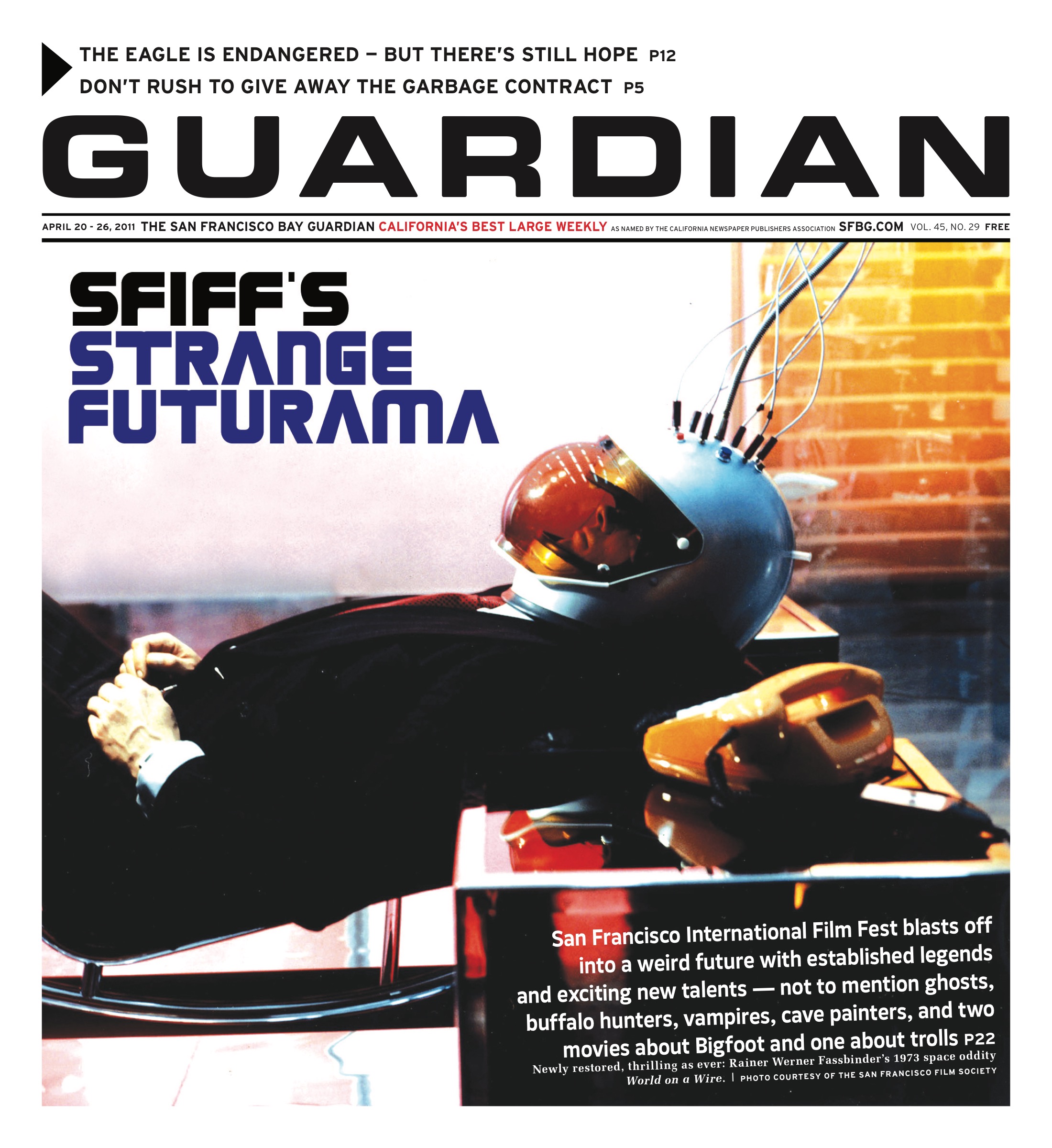
 

Comedian Amy Dresner talks sober comedy

3

Twelve-steppers say in order for an addict to get on the road to recovery, it’s essential that they accept their addiction. But for comics Amy Dresner, Ian Harvie, and Felon O’Reilly, successful recovery is not just about acceptance: it’s about turning addiction into one big, serious joke. It might sound like funny business, but standing onstage with the mic and some yuks has been the only way all three have been able to maintain their sobriety. Now, they’re bringing the laughs throughout the country on their “Laughs Without Liquor” comedy tour, donating proceeds to local “sober living” causes along the way. Lucky for us, March 5th brings the tour to SF.

The three comics kicked off their tour in January, performing at the New York Gay and Lesbian Center in a benefit for a drug and alcohol program. But although the comics now travel and tour together, they didn’t always have a lot in common. Ian Harvie is a trans guy who has toured with Margaret Cho, while Felon O’Reilly has been to rehab 17 times and to jail 50 times more than that.

The two met eight years ago while performing stand-up and working out their respective sobrieties in Maine. O’Reilly proposed the “Laughs without Liquor” concept to Harvie, and soon the two were doing sober stand-up together.  Last year the two found comedian Amy Dresner at the Downtown Comedy Club in Los Angeles. 

“I was onstage ranting about rehab and my drug-induced epilepsy or whatever,” says Dresner. She was quickly added to the tour roster. 

Dresner, originally from LA, grew up in a showbiz environment. Her father was a television comedy writer, with friends and connections to household name comics who Dresner met and knew as a child. But comedy was something she left unexplored until her addiction was kicked. “It’s always been my secret dream to be a comic but I didn’t have the balls to do it until a few years ago. It takes real commitment and prior to that, my commitment was to getting high and being depressed.”

Now that Dresner is both sober and leading the life of a full-time comedian, she is able to reflect on how her career and her sobriety inform each other. “I’ve found that for a lot of people struggling with addiction, there is a lot of shame involved. That is another big trigger for self-destructive behavior. So if I can make people laugh at things they feel ashamed of – well, it can be very healing.”

She can also attest to the ways in which sobriety has improved her stage presence. “When you’re a sober comic you are really present and connected to the audience.  You can see what jokes are working and which ones aren’t. There’s no deluding yourself that you killed when you really bombed.”

Dresner appreciates the positive reactions, understanding and support that she has received from her sober audience members. But she wants to be clear that she doesn’t condemn alcohol or the people that drink it. “I think there’s a big misconception that if you are making jokes about sobriety, you are somehow undermining it. Being sober is not the same as being Mormon. We aren’t trying to bring back Prohibition. I loved getting drunk and if I could do it and not crash my car, ruin all my relationships, lose my job and carry my liver around on a dolly, I would.”

But it’s probably best to leave your booze at home if you want to see Dresner in this tour specifically. While you don’t need to take a breathalyzer test to attend, all of the shows on the tour will take place at churches, sober clubhouses, amphitheaters, and other places that are not bars. Instead of spending too much on drinks, your entrance fee will go to support a local sober living facility or treatment center.

The Laughs Without Liquor SF show will take place at a local church with poet and author Bucky Sinister hosting. All proceeds will go to the Castro Club, a sober gathering place and home for queer folks in recovery. 

For Dresner, the upcoming show in SF will hold a particularly special meaning. “I got strung out on speed for the first time in SF, so it will be very ironic to come back and do a sober gig here.”


Laughs Without Liquor

Sat/5, 8 p.m., $20

Most Holy Redeemer Church

100 Diamond, SF

(818) 588-7390

www.laughswithoutliquor.com


5 Things: February 25, 2011

0

Each day, SFBG staff pick five (or so) things that might interest you

>>1. OHLONE, NOT BANKSY Jet Martinez and other Bay street artists are raising funds to resurrect SF’s oldest mural, an Ohlone wall painting tucked away behind a wall in Mission Dolores that artists rediscovered in 2004. The Ohlones did the art, apparently, under “supervision” of the Spanish missionaries at the time.


Hopefully Jet and co. won’t be threatened with indentured servitude and torture while they recreate the stunning shape-based work on the Mission Market building at 22nd and Bartlett, where it will watch over the kick-ass Mission Community Market on Thursday afternoons when the stands kick back into gear on April 14th.

>>2. HIGHBALLS ‘N LEGWARMERS Slow Comfortable Screws, Kamikazes, Birthday Cake Shots, Pink Squirrels, Frozen Strawberry Margharitas — yep, the retro ’80s cocktail movement is upon us (help?). You can journey back to the days of an only slightly less creepy Tom Cruise at the Heaven’s Dog “Drinks of the Eighties” event on Sat/26

>>3. TWO TO TIMBUKTU So you’ve been struck down global weirding’s unfortunate by-product: the “how’d it get so chilly again, it was 80 degrees two weeks ago!” cold. Never fear, just grab an easy-on-the-eyes graphic novel and glory in your bedriddeness. Casey Scieszka and Steven Weinberg, indie media couple par excellance – the duo’s Shitty Kitty write-draw-drink meetups are the epitome of intelligent cute-snark — have got just what the doctor ordered. Their new book To Timbuktu looks like a novel on the outside, but inside Scieszka’s tale of their post-collegiate world wanderings accompanied on each page by Weinberg’s effortless sketches make for multimedia fun time. (There’s a guide to beijing street food!) If you like what you see very much, get your copy signed by the two at their upcoming Mission: Comics and Art reading on Saturday, March 5.

>>4. LEFT BEHIND This picture by Ed Ou reminded us of the cost (and the gain, for some, especially in the US) of globalization and doing business with psycho dictators.

“Migrant laborers from Bangladesh working for a Chinese company watched as Chinese nationals fleed the unrest in Libya on a ship bound for Greece. Sixty-two Bangladeshis have been left behind by their employers who have not returned their passports.”

>>5. BART ON FLIP Local SF songstress Emily McLean proves that for a lovely little video, all you need is a BART pass, a Flip, and some fly kicks. You can catch her playing at Hotel Utah on March 10th, and trust us, her act even better when you can see her face and stuff.

http://www.youtube.com/watch?v=357Thd-ThxI

Contibutors: Caitlin Donohue and Marke B.

Back to the streets

2

Coronel knew an old man in Granada who said

(who often said):

“I wish I were a foreigner, so that I

Could go home

— Zero Hour, Ernesto Cardenal

I first came into contact with the work of poet Roberto Vargas a couple of years ago, when I saw his face, projected several stories tall, on a wall just off Valencia Street.

I was riding my bike to the Day of the Dead procession when I came across filmmaker Veronica Majano screening historical footage of the old Mission District on the wall of Dog Eared Books. The footage of Vargas was from a movie called Back to the Streets, and it showed a Latino hippie fest in Precita Park circa-1970. Long-haired Chicanos smoked weed and danced and played bongos on the grass while Vargas read from a stage. On today’s Valencia Street, Vargas was a ghost returned from a long-lost Mission, now standing twenty feet tall on the bookstore’s wall, reading a powerful poem that angrily denounced the SFPD for the mysterious death of a Mission Latino youth in police custody.

The film of Vargas was a beautiful snapshot of Latino youth culture in the neighborhood before gang violence and gentrification, like a Mission High School yearbook scene from an exhilarating era of Latino self-determination. In 1970, the Free Los Siete movement was feeding the community at a free breakfast program out of St. Peter’s Church on Alabama Street and had started free clinics and legal aid programs in the Mission. In the years to follow, the neighborhood would see the founding of the Mission Cultural Center and Galeria de la Raza and the inception of many of the neighborhood’s now world-famous mural projects.

Looking at the groovy scene in the park, it was hard to imagine that just a few short years later, Vargas and other kids from the Mission would be fighting alongside the Sandinistas in the jungles and mountains of Nicaragua. Yet the utopian promise of the era’s poetry, art, and youth culture in many ways culminated in the guerrilla war in which Vargas and other poets from San Francisco would fight and ultimately — in 1979 — help defeat the forces of Nicaraguan dictator Anastasio Somoza.

On Feb. 24, the day of his 70th birthday, Roberto Vargas makes a rare return to San Francisco to perform in a poetry event at the Mission Cultural Center in honor of that Nicaraguan solidarity movement of the 1970s. A video will be shown of footage from that struggle — classic scenes of Vargas and others taking over the Nicaraguan consulate in San Francisco; of the famed nightly candlelight vigils at 24th and Mission BART Plaza in support of the Sandinistas — and Vargas will be reunited on stage to read with old poet friends like Lawrence Ferlinghetti, Diane di Prima, Alejandro Murguía, and Vargas’ old compañero from San Francisco State University’s Third World Liberation Front, actor Danny Glover. The event is not open to the public. Invitations have been given out and the small MCC theater’s 150 seats have already been filled. Yet the event provides an opportunity to publicly honor Roberto Vargas’ contributions to the Mission, and to reflect on the hopes and dreams of Mission past.


POETRY AND REVOLUTIONARY VISION

Poetry was a part of Vargas’ world from the beginning. Vargas was born in Nicaragua, but came to the United States when he was a small child. In his 1980 collection of poems Nicaragua Te Canto Besos, Balas, y Sueños, he writes of “living in an offbeat alley called Natoma Street (where I always imagined a lost Mayan city existed beneath the factories).” By the late 1950s, Vargas may have been the first Mission District Latino Beat poet. “I graduated from Mission High School in 1958 and used to hang out in North Beach, going around to see all the poets,” he says. “I met Allen Ginsberg when I was just a 19-year-old kid running around in North Beach. Diane di Prima, Bob Kaufman, Ted Berrigan — all the major poets knew me when I was in my teens.”

After a stint in the U.S. Marine Corps and an attempt at a boxing career that ended with a detached retina (an injury that also helped him avoid the Vietnam-era draft), Vargas went to SF State, where he was heavily active in the student strike of 1968-69. Students walked out of campus and battled riot police while standing on picket lines for five months to demand an ethnic studies program at the university.

In the spirit of the times, Vargas and other poets — including a young Mission Chicano named Alejandro Murguía — joined the Pocho-Che Collective to publish poetry by local Latino poets. The poets went to cut sugar cane in the Venceremos Brigade in Cuba. They put out small poetry chapbooks in the Mission, full of poems that linked Che Guevara’s call for Third World revolution with the experience of the Chicano barrios of the United States in a new vision tropical. In the era after the SF State strike, the city started funding community arts projects in the ghettos. Like all classic zines, the first copies of Pocho-Che were scammed, in this case late at night at Vargas’ new job in the Mission’s Neighborhood Arts Program. In the years to come, the group would eventually publish hardbound books by Vargas, Nina Serrano, and others.

Today, Murguía is a professor in the ethnic studies program at SF State that the strikers fought to originate. He is the author of the American Book Award-winning short story collection This War Called Love (2002) and the memoir The Medicine of Memory (2002). He remembers, “The poetry scene was incipient, very young, and the readings weren’t always very formal. Sometimes they were at community events or protest rallies. But we had contact with Latin America. We knew people who had been in Chile, like Dr. Fernando Alegría.”

Alegría was a poet who had been the cultural attaché to the U.S. under Allende in Washington. Vargas recalls, “Alegría had myself and some other young poets come to Chile and spend a month or two studying with [Pablo] Neruda. But, of course, our plans were canceled by the coup in Chile.”

Murguia remembers the September 1973 coup in Chile that overthrew the popularly elected Socialist democracy of Salvador Allende caused the young poets to organize rare formal readings at Glide Memorial Church in protest. “We had several big ones there,” he says. “There was a broad range of poets — Michael McClure, Fernando Alegría, Jack Hirschman, Bob Kaufman, Janice Mirikitami all read. There was a line going down the block to get in.”

In addition to their mentor, Alegría, Vargas, and Murguía also knew one of their heroes, the Nicaraguan Marxist poet and priest, Ernesto Cardenal. Cardenal lived under the Somoza dictatorship in a sort-of internal exile in a religious artist commune called Solentiname. Vargas wanted to bring Cardenal to read in the United States, but Somoza would not allow the poet, who was critical of the Nicaraguan dictator, to travel outside the country. Vargas went to his old pal Ginsberg for help.

“Because Allen knew me when I was a kid, he helped me with my organizing for Nicaragua,” says Vargas. “Allen was part of PEN, and in 1973 or ’74 he went to the State Department with other writers to put pressure on [Anastasio] Somoza. Eventually Somoza relented and we brought Cardenal to New York for a reading.”

The poetry of Cardenal was a north star to the young Mission poets. Cardenal’s epic 1957-60 masterwork Zero Hour is perhaps the literary foundation of revolution in Nicaragua. Influenced formally by Ezra Pound, Zero Hour weaves a sprawling history of Somozan oppression and U.S. intervention in Nicaragua together with lyrical imagery of Nicaragua’s natural beauty and wildlife. The poem creates a poignant sense that Nicaraguans, unable to enjoy and own these natural riches, had under Somoza become exiles within their own country.

Of particular interest to the young Mission poets, though, was Cardenal’s Homage to the American Indians (1969), a book-length meditation on the glory of Mayan and North American native civilizations. “For us, the work of Cardenal was very important,” says Murguía. “Homage to the American Indians is a continental vision of Native Americans — everything from the San Blas Indians of Panama to the Indians of Omaha to the Indians of Mexico City and Peru.”

In Homage, Cardenal evokes a lost Indian Utopia “so democratic that archaeologists know nothing about their rulers,” where “their pyramids were built with no forced labor, the peak of their civilization did not lead to an empire, and the word wall does not exist in their language.” He writes:

But how to write anew the hieroglyph,

How to paint the jaguar anew,

How to overthrow the tyrants?

How to build our tropical acropolis anew

Cardenal’s poems of this lost glorious past were to Vargas more pointedly a vision of a Latin American utopia that can also be regained in the future. In Cardenal’s work, says Vargas, “There is a longing for the simplicity of that civilization — the creativity, the innocence, the tribalism. Can we get it back after all the dictatorships, after all that capitalism has done? Cardenal showed us what we were, what we had, what we lost.”

Under Cardenal’s influence, the Mission poets turned seeing lost Mayan cities beneath the city’s factories into a literary movement. By 1975, members of Pocho-Che had started a magazine called El Tin Tan with Murguia as editor and Vargas as contributor. El Tin Tan presented a sweeping utopian vision of a borderless invisible Latino republic united culturally and politically under the sign of the palm tree. The poets situated the capital of this world right here in the Mission District.

“To tropicalize the Mission — to see it as a tropical pueblo — was a political act of defiance and self-determination,” says Murguía. “We were saying that we put this particular neighborhood — our pueblo, in a way — not in a context of North American history but in the context of Latin American history. The history of the eastern U.S. doesn’t affect California until 1848 when the first illegal immigrants came to California — not from the South, but from the East.

El Tin Tan,” Murguía continues, “was probably the first magazine that was intercontinental in scope, a combination of politics and literature and art and different trends from the Mission to Mexico City to Argentina and everywhere in between.” He proudly recalls that it ran the first North American essays on Salvadoran poetry, and translated and printed a short story by Nelson Marra, a writer imprisoned by the Uruguayan dictatorship.

Yet for all its international perspective, El Tin Tan remained firmly rooted in the Mission. Columns by Nuyorican poet Victor Hernández Cruz and news of the assassination of Salvadoran guerrilla poet Roque Dalton ran side by side with the first comics by future Galeria de la Raza founder Rene Yáñez, all folded between wildly colorful cover art by neighborhood favorites like the famed Chicano artist Rupert Garcia and the muralist Mike Rios.

“The magazines were colorful — tropical — on the outside, but very political on the inside,” says Murguía. “That was a metaphor for our own work.”

By this time, Vargas had become an Associate Director at the SF Arts Commission. From within City Hall, he started to pump city arts money into the Mission, helping to fund projects like Mike Rios’ mural of the people holding BART on their backs at 24th and Mission BART Plaza and the Balmy Alley Mural Project — art that can still be seen in public today.

Once, Vargas commissioned a Chuy Campesano mural for the Bank of America building at 22nd and Mission. “I read a poem called “Boa” and had the crowd dancing and chanting, Es la Boa, Es la Boa,” says Vargas. “We were trying to say, ‘You made your millions off our farmers, but now you are on our turf in the Mission here in occupied Mexico. So we’ll put hieroglyphics on the walls of your bank like we used to do!’ Someone from the bank tried to take the mic from me and cops came and escorted us out.”

Vargas’s story of the mural’s dedication ceremony captures the bravado of the era. “It was a beautiful time, all of us young and thinking we were going to change the world. We wanted to change the world through culture.”

The poets organized the community to demand a neighborhood’s arts center, too. In 1977, the dream was realized when the City, with pressure from Vargas from within City Hall in the Arts Commission, purchased an old, five-floor furniture store at 24th and Mission to be made into the Mission Cultural Center. Murguia became the center’s first director.

The Mission utopia was becoming a reality for Vargas. In Nicaragua Te Canto, he wrote:

We used to drive

Our lowered down Plymouths and Chevys

On top of the breast of a mountain to

Make love and drink wine… Never

Knowing what was going to happen after

Mission High School

The Mission is now an expression of real culture, a many-faceted being … both plus and minus with the soul of a human rainbow…My people watching slides of Sandino and Nica history … White children wearing guarachas and afros trippin’ down the streets to party. Young Salvadoran poets discussing the assassination of Roque Dalton … The Mission is now an implosion/explosion of human color, of walls being painted by muralistas. There is a collective feeling of compassion for each other Nicas Blacks Chicanos Chilenos Oppressed Indios. The sense of collective survival, histories full of Somozas, Wounded Knees written on the walls.

In Zero Hour, Cardenal wrote of Nicaragua’s trees and birds and lakes, and their call to revolution, as seen from its mountains:

What’s that light way off there? Is it a star?

Its Sandino’s light shining in the black mountain


Vargas, the excited Mission kid, echoed in his work:


Tonight I am sitting on a mountain called Bernal Hill

Tonight I see the flames of America Latina spreading from here …


STRUGGLE AND VICTORY — AND STRUGGLE

Perhaps inevitably, the Latin American Utopia Vargas and company created in poetry would seem so tantalizingly close to actualization that they would be forced to pick up the gun and fight for its existence.

When the enormous earthquake of 1972 left Nicaragua’s capital, Managua, in ruins, Nicaraguan refugees flocked to SF’s Mission District. Soon, San Francisco was home to more Nicaraguans than any place on Earth outside of Nicaragua. The family of Anastasio Somoza had controlled Nicaragua with brutal repression for generations. Somoza’s embezzling of relief funds for earthquake victims led to increased revolutionary activity against his rule. Taking their name from Augusto Sandino, a Nicaraguan revolutionary who led resistance against U.S. occupation of Nicaragua in the 1930s, La Frente Sandinista de Liberacion Nacional (FSLN) — or the Sandinistas, as they were popularly known — began guerrilla activities in late 1974 by taking government officials and Somoza relatives hostage in a raid on the house of the minister of agriculture. They received a $2 million ransom and had their communiqué printed in the national newspaper. Thus was born the Sandinista revolution.

In the Mission, Vargas, Murguía, and others were in touch with La Frente, and began organizing Sandinista solidarity rallies to coordinate with La Frente’s actions in Nicaragua. Out of offices in the Mission Cultural Center, along with El Tin Tan, the poets published a newspaper called La Gaceta about the situation in Nicaragua. The paper had a circulation of 5000 copies and was available for free all over the district. The sight of pro-Sandinista rallies at 24th and BART Plaza became so common that the plaza was popularly nicknamed Plaza Sandino.

Vargas organized takeovers of the Nicaraguan consulate in San Francisco and traveled the US, speaking about Nicaragua. Yet, soon, this kind of support didn’t seem like enough. In Cardenal’s poetry, victory was inevitable. Cardenal had written that Indian time was circular, that “history became prophecy,” and that therefore the “empire will always fall.” He had also written, “The hero is reborn when he dies. And the green grass is reborn from the ashes.” In poetry, Vargas and Murguia found inspiration to go to war.

In 1976 and 1977, Mission District residents, in solidarity with the FSLN, began quietly leaving San Francisco to join up with La Frente and pick up the gun in the Sandinista Revolution. Among them were Roberto Vargas and Alejandro Murguía.

“It was very romantic,” says Murguía. “If you grew up in the time after Che’s death, when you had Che’s figure calling for “1,2,3, many Vietnams” and a lot of different armed struggles going on all over Latin America, then it would seem logical, I think, if you were kind of young and crazy, that you would want to participate in some of these situations besides just doing solidarity work or organizing rallies. Also, the coup in Chile crushed our generation’s hope for electoral change in Latin America.”

Today, Murguía tries to situate the poets’ embrace of armed struggle within the spirit of those long ago times, but one senses that Vargas would not hesitate to join a guerrilla war tomorrow morning. When I ask him how the young poets made the leap from verse to bullets, he is incredulous at the question.

“We had to fight! There was no other way!” Vargas says. “We had the historical perspective and as a people we were worthless if we let that situation stand. We had our own books out. But are we really revolutionary poets if we just sit back and collect our laurels?”

Murguía compares the Sandinista war with the Spanish Civil War, when there were many international brigades in which writers had been involved. He suggests the poets went to war because they were poets. “If you knew the situation intimately in Nicaragua and you were reading Cardenal’s poems,” he says, “it was easy to see the connection between poets and political necessity.”

Vargas began organizing small, tight-knit cadres for battle in Nicaragua, recruiting his Sandinista guerrillas right off of the streets of the Mission. “I was secretive and I found them one by one,” he explains. “We were very clandestine and very compartmentalized. We never had more than a dozen people in our committee at once.”

Men who were menial laborers in San Francisco would one day be among the most respected heroes of the Nicaraguan Revolution. “When I recruited Chombo [Walter Ferretti], he was a cook at the Hyatt Regency,” says Vargas. “Later, Chombo would become a head of national security in Nicaragua. Another recruit was a former pilot, so I went to talk to him where he pumped gas at 21st and South Van Ness. That was Commandante Raúl Venerio. After the triumph of 1979, he would become the Chief of the Nicaraguan Air Force.”

When in San Francisco, Venerio later served as the editor of La Gaceta. In Nicaragua, the former gas station attendant became a real hero. “They got an airplane and attacked the National Palace,” says Vargas, laughing. “They hit it and split, and got away — real Mission boys!”

Before heading off to join La Frente, Vargas’ recruits would undergo a regimen of training and political education, an informal boot camp largely hidden in plain sight in the Bay Area.

“It was primitive,” remembers Murguía. “We didn’t really have someone with a military background to train us. We got just guns at pawn shops on Mission Street and practiced shooting at the firing range in Sharp Park down in Pacifica. We worked out with a friend who was a black belt in karate.”

Murguía says the most difficult part of training was the daily pre-dawn run of five laps around Bernal Hill. “We would run up the hill counter-clockwise — because that way is more difficult,” he says, “and we would wear these combat boots we bought at Leed’s Shoes on Mission.”

Besides being a part of physical conditioning, the run was a litmus test of the recruits’ commitment. “Doing activity like that is almost impossible if you’re not really psychologically into it,” says Murguía. “Try running five times around Bernal Hill! You start wondering after your third lap, ‘Goddamn! Why am I doing this?‘ Especially when no one is forcing you to do it!”

When I ask if the daily jog of 10 or 12 Latino men in combat boots on the hill at sunrise did not attract any, uh, attention, Murguía shrugs. “There were less people on the hill in those days,” he says. He recalls that the Mission cadres trained in complete anonymity: “We got money to rent planes and we took turns learning to fly the planes around the Bay Area. Nobody suspected anything because nobody knew anything about Nicaragua then.”

When I try to imagine a phalanx of Sandinistas at dawn on today’s Bernal Hill, surrounded by a crowd of early morning dog walkers, I can’t help but laugh. But the cadre’s training was deadly serious, and Murguía says its value was far more than psychological. “What I discovered when I went to the Southern Front was that our San Francisco cadres were some of the most advanced in the war,” he explains. “We understood the political situation and the tactic of insurrection and we had a minimum of physical conditioning. But some of these other cats, man! They literally just walked in off the street!”

For a time, Murguía remained the director of the Mission Cultural Center, while making regular trips to fight in Nicaragua. In 1977, Vargas resigned from the Arts Commission and went to battle for six or seven months. He and Murguía would spend the next couple of years rotating back and forth from the war front in Nicaragua to their solidarity work in the Mission. Murguía describes his entry into Nicaragua, his stay in various guerrilla safe houses in Costa Rica, and his experiences in the war in his 1991 American Book Award-winning fictionalized memoir, Southern Front.

Though Murguía says the actual military war on the ground was largely a stalemate between the Sandinistas and the Somozas’ National Guard, the Sandinistas were at last able to triumph through international pressure, strategic military victories, and a general strike. Somoza fled in July of 1979, and the Sandinistas entered Managua victorious on July 19 of the same year. Cardenal’s poem “Lights” describes the city as seen from a plane that brought the elder poet into a Managua free from the Somoza family’s rule for the first time in 43 years. In Managua, street graffiti declared, El triunfo de la revolución el triunfo de la poesía.

Vargas and Murguía, however, did not enter Managua with the victorious army. The Southern Front did not go to Managua, and Vargas had recently been sent back to the U.S., to coordinate a simultaneous take over of the Nicaraguan consulates in major U.S. cities from coast to coast to coincide with the victory in Managua.

Vargas’ work for Nicaragua did not end with victory. The Mission High kid now found himself serving in the new revolutionary government as cultural attaché to the United States. “I was jailed in the takeover of the DC consulate,” Vargas says, laughing, “but then I came back several months later to serve there!”

The voluble poet grows uncharacteristically silent when I ask him what it felt like to actually win the war.

“To win?,” he asks, pronouncing the word as if he was hearing it for the very first time. “Well … it’s like taking off a huge load, man. Like taking mountains off your back.” He is silent for a bit and then adds, “But what do you win? You win the right to continue the struggle.”

“To win was to reach the objective of getting rid of the Somoza family once and for all,” Vargas says. “But it was not really a win/lose situation.” Indeed, the Sandinistas inherited a country in ruins and in debt, with an estimated 50,000 war dead, and 600,000 homeless. Nicaragua’s left-wing powers would become an obsession for the Reagan Administration, who for the next ten years offered heavy financial assistance and training to the Contras, a coalition of pro-Somoza and anti-Sandinista guerrillas who fought to overthrow the revolutionary government. The U.S. strangled Nicaragua’s economy with a trade embargo like it employed against Cuba. In reality, for the Sandinistas, the war literally never ended.

“Somoza bombed everything in Nicaragua before he left the country. Reagan was spending — what? — $100 million a year annually against us at that time?” says Vargas. “They spent so much for a decade to destroy our little country.”

Nonetheless, poetry remained in the forefront of the Nicaraguan revolution. Cardenal was named Ministry of Culture, and he instituted poetry workshops across Nicaragua as part of a highly successful literacy campaign that raised literacy from just 12 percent to over 50 percent in the first 6 months of the revolutionary government. Soon, poetry was being written and taught in the tiniest villages and in the fields.

“We tried,” Vargas says bluntly. “We were doing very important land reform, incredible stuff for the economy. But it was dangerous to be a good example. We had the potential, but we had to hold off this enormous power [of the U.S.] for decades. Ultimately, we had to step back so they would not destroy Nicaragua.”

In 1990, Nicaraguan voters, weary of war and economic misery, chose to elect FSLN President Daniel Ortega’s U.S.-backed opponent, Violetta Chamorro, in the presidential election. “We lost the elections,” says Vargas. “But we had to allow them to demonstrate that we were not like Cuba or other revolutions. We lost beautiful young men and women to get that liberty.”

I ask Vargas to consider the successes and failures of the Nicaraguan revolution. He pauses and then seemingly changes the subject, excitedly telling me of the time he brought Ginsberg to meet the Sandinista soldiers. “Ginsberg was fascinated by the Sandinistas,” says Vargas. “And he wanted to see what he had been supporting on my behalf all these years. So I took him to the fighting along the Honduras border in 1984, during the Contra war.”

When Ginsberg went to the war zone, he brought not a rifle but a concertina. “I took him to meet these young soldiers in a trench. They see Allen with the concertina and they were like, ‘Who the hell is this guy?’ I told them he was a very famous poet. At once, they all started taking bits of paper out of their pockets that they had written poems on and started reading them to Allen. So there we are, with these soldiers in the trench with their rifles reading poetry, and Allen just wailing away on this concertina!”

I think of the strange road from Cardenal’s vision of lost Mayan cities to Vargas’ dreams of a Bernal Hill utopia to Ginsberg listening to soldiers’ poetry in a Nicaraguan trench, and I see that Vargas has answered my question with his own, the question asked by revolutionary poetry.


LOST CITIES, AND NEW ONES

The lost moment with Ginsberg in the trenches is like a missing chapter out of Roberto Bolaño’s Savage Detectives. Indeed Vargas’ story in many ways embodies that of Bolaño’s exile poet generation, of which he wrote, “They dreamed of a Latin American paradise and died in a Latin American hell.” Except for one crucial difference: Vargas is very much alive and still fighting.

Today, Vargas still puts in a tireless 50-hour work week as a labor organizer for the American Federation of Teachers in San Antonio, TX. During our conversation, he excitedly tells me of an action he is organizing for next month, a march of teachers on the Texas capital to protest budget cuts to education. “I camp out in the teacher’s lounge and talk to them when they are on break,” he says. “I signed up 50 new members last week!”

As he nears 70, the poet shows no signs of slowing down. “I can’t afford to!” he says. “My youngest son is only 17. When I get finished putting him through college, then maybe I can take a break.”

But work seems like more than necessity to Vargas; political struggle is the central theme of his life’s work. “Work, work, work, Erick,” he tells me. “That is what we have to do. I could go back and forth about what went wrong in Nicaragua, but there is more work to do and I have to stay positive. It is all part of the process.”

When Vargas comes back to the Mission Cultural Center this week, he will literally return, full circle, to a building he helped build. “We had no money to hire laborers, so we’d be there with our kids every weekend, building the place,” he remembers.

One of those kids was Vargas’ son, Mission poet Ariel Vargas, who will read in public with his father for the first time this week. “Cardenal baptized him when Ernesto came to bless the new Mission Cultural Center in 1977,” Vargas says. “He had offered to baptize any children who also might be there. In the end, there was a line of families around the block on 24th Street who had brought their children for Ernesto Cardenal to baptize. Ariel had already been there every weekend on his hands and knees sanding those huge gymnasium-like floors with us. The Mission Cultural Center is still there and that is our monument.” As he discusses the Mission, Vargas forgets the problems of the Nicaraguan revolution and begins talking nonstop again at last. He comes back to the stories that started our conversation. “You know, I lived at 110 Mullen on Bernal Hill,” he says, his excitement gathering. “Mike Rios was my neighbor. Rene Yáñez lived on the block. So it was all happening right there! Carlos Santana lived down the block at around 180 Mullen or something. We used to hear him and his band jamming all the time. The Arts Commission had a stage truck and I’d take it out to Precita Park and put the stage down for Carlos to play on.” I think of Cardenal’s vision of the repeating cycle of time, the promise that the empire will always fall and the hero will always be reborn. Much in the Mission has changed. But Vargas, the old poet, still looks out from Bernal Hill today and sees lost cities beneath the surface.


Speed Reading: Edie Fake’s Gaylord Phoenix

0

The moment I saw Edie Fake‘s book Gaylord Phoenix (Secret Acres, 256 pages, $17.95) on a table at a local shop was a lifesaver. Not much contemporary art or stuff actually reaches me — and jolts me — at the mysterious and elusive spot(s) where my imagination and spirit reside, and the drawings and stories of Fake do exactly that. I have some issues of Gaylord Phoenix from when it was in serial form, and Fake’s comic Rico McTaco, but I had no idea a lavish color book of Gaylord Phoenix existed, and the discovery was about as close to finding a treasure as I’ve had in recent daily life.

Over the last few weeks I’ve looked at Gaylord Phoenix a lot in bed, on the verge of sleep and dreams, and occasionally while in transit from one place to another. Both experiences, if not ideal, seem right for entering the book’s universe. It is the kind of epic journey in which a reader — not to mention the characters — can get lost. Gaylord Phoenix is a love and lust story. It’s a quest through terrain that is strange yet also familiar, especially if you have access to your queerness or inner experience. It is funny, it is disturbing, it is gorgeous, it is mesmerizing.

Gaylord Phoenix the character has a projector for a nose; webbed hands which can morph into other shapes; a hairy chest, arms, and legs; and (most of the time) tubular genitals that can penetrate and be penetrated, fill or envelop. There is a slightly woeful or stricken quality to Gaylord’s personality, as rendered via facial features and half-capsule head. Yet hexes, spells, “crystal bloodlust,” orgiastic oceans of tears, experimental examination rites, and periods of bereft solitude are not enough to stop Gaylord Phoenix from searching for pleasure and communion with the surrounding world.

That world — a world of many worlds — is one of the things that makes Gaylord Phoenix special. Fake’s hand-rendered cubes, pyramids, hexagons, Bridget Riley-like black-and-white vortexes (referred to in the ultra-spare, brilliant dialogue), wizard cone hats, mazes, temples, wood grains and vines, crocodile skins, fish scales, clouds and cave formations, and plumage accumulate detail and color over the course of the book. What might have been interpreted as technical improvement within Gaylord Phoenix‘s serial manifestations as a comic is revealed in the book to be material for a dramatic and visionary climax and denoument.

In the realm of comics and graphic novels, Gaylord Phoenix could be seen as a fantastic inverse of the sexual horror in Dash Shaw‘s BodyWorld. It arrives at a time when various musicians and visual artists are also tapping into mystic and occult energy, though its singularity of vision reminds me of Jack Smith and Kenneth Anger channeled from archival celluloid strip to contemporary line drawings on the printed page. Ultimately, there is nothing like it.

A few years ago, Fake lived in SF, and attended one of the Guardian’s Goldies celebrations with Amanda Kirkhuff, whose pencil drawings and oil paintings of female pop icons and news figures transmit an equally pure power. They aren’t here now, they’re each moving onward in their own ways, but this city was lucky to play host to them for a while, and it would be great to see them again. 

Speed Reading: Matt Furie’s Hot Topik and boy’s club 4

0

I got an orange Pepe T-shirt at Needles and Pens’ release party for Matt Furie‘s new comic Hot Topik. What better way to also celebrate the fourth and latest issue of Furie’s boy’s club, in which Pepe and pals Andy, Brett, and Landwolf are joined by two new characters, Whitey (a zit), and Bird-Dog? Somewhat reminisicent of a stoned Big Bird, Bird-Dog lectures Pepe on the history of weed in one of the comic’s highlights, though I’m also fond of the episode in which a Vaporizer turns Landwolf into a viper with a craving for pepperoni pizza. Here are some of the characters in Hot Topik, as well as a few pieces by Furie on the walls of Needles and Pens.

The Performant: A dance named desire

0

Exploring personal myth with EmSpace Dance and Porchlight

Descending the wooden staircase into the basement performance space at Viracocha, one leaves the surface world behind and enters a parallel underworld of theatricality and allusion. Warm hardwood panels and golden lights, a distinct contrast to the concrete and glass-filled streets above, soothe the spirit — and unintentionally convey the crux of one Blanche DuBois’ obsession with creating a more beautiful reality from the one she’s been sentenced to. Prone to artifice and artfulness, Ms. DuBois is the central catalyst of the action in Tennessee William’s A Streetcar Named Desire and its ultimate sacrifice. In EmSpace Dance’s adaptation (A Hand in Desire) however, the focus is spread more evenly among the five-person cast, both their stage personae and their “real” selves.


The likable cast, which includes a very present manifestation of Blanche’s (Rowena Richie) deceased husband Allan (Kegan Marling), jump from scene to scene guided by the chance provided in a custom deck of cards and an ongoing game of hearts. Some jumps make better sense than others and some scenes, especially the dance sequences, flow more smoothly, but the sheer gutsiness of the production makes it a compelling ride. Scenes in which the cast inhabited their everyday selves included a pair of interviews between Peter Griggs and Kegan Marling on the topic of repressed homosexuality, both Allan Grey’s and Williams’ own, and a pair of scenes in which one actor stood on a chair surrounded by the others and attempted to tell a great lie. Scenes straight out of the original play, set to dance, include Mitch’s (Christopher White) awkward courtship of Blanche, and Stella and Stanley’s (Natalie Greene and Peter Griggs) blowout fight and passionate reconciliation.

Any work, no matter how experimental, usually has at least one thread to bind the piece together, and the moody improvisational soundscape provided by musicians Josh Pollock and Chris Broderick did just that. With a few subtle effects, Pollock made his ukelele throb like a serious double bass and other instruments, while Broderick provided the flute, woodwinds, and the eerie tingle of a jaw harp.

Meanwhile at the special SF Sketchfest edition of the Porchlight story-telling series, local comics and writers also explored the themes of artifice vs. reality, and desire vs., well, reality, to a full house at the Purple Onion. Ali Liebegott told the story of a sequence of on-the-job lies she has told to keep sane (at a crappy waitressing gig: “Why aren’t you smiling?” “Because my mother has cancer”.) Matt Besser waxed un-nostalgic for his college obsession with losing his virginity. W. Kamau Bell dissected the myth/reality of “the big black dick”. Suzanne Kleid told a Snopes-worthy anecdote about her grandfather, a torn lottery ticket, and a tragically misapplied do-gooder’s instinct. Bucky Sinister examined his youthful naïveté and ambition to move to LA to be a screenwriter. At the heart of each story lay the wistfully human desire to believe in (or create) an artful truth, no matter how far removed from actual reality it might prove. Blanche DuBois, you are not alone.

Page street

0

Rebecca Solnit’s Infinite City: A San Francisco Atlas (University of California Press, 158 pages, $24.95) is one of the best ideas a writer has come up with in a long time. By combining private and public support, Solnit was able to give away portions of the atlas in full-color, full-spread map handouts. (My favorite tracked both famous/infamous queer public spaces and the migration of butterflies throughout the city.). In the process, she also gave lectures in public spaces, providing a public service in the name of history and inclusion before dropping this tome on the book-buying masses. Gent Sturgeon’s version of a city-fied Rorschach alone is worth the price of the ticket. From insect habitats to serial killers, Zen Buddhist centers to the culture wars of the Fillmore and South of Market that some call redevelopment; Solnit and her cadre of artists, writers, cartographers, and researchers — Chris Carlsson, Guillermo Gómez-Peña, and Mona Caron among them — give us the infinite depths and limitless potential that can be found in 49 square miles. (D. Scot Miller)

A lot of good and even great books came from the Bay Area this year, but one stands out: a book of poetry, Cedar Sigo’s Stranger in Town (City Lights, 100 pages, $13.95). He is a young writer who improves dramatically each time I hear him read, and his poetry and critical writing are among the wonders of our age. And of the age before, since through him speak the dead poets David Rattray, John Wieners, Robert Creeley, Denton Welch, Philip Whalen, Salvador Dali, Jean Cocteau, Eartha Kitt, Raymond Roussel, Lorine Niedecker, and Cole Porter. When new writers come to San Francisco, they ask me if I’ve met Cedar Sigo. If they don’t know Sigo’s work, then I hand them a copy of the new collection. Don’t have to say much, I just step back a little to avoid the stars and diamonds and apples popping out of their eyes like toast from a toaster, because this crazy work is that crazy good. (Kevin Killian)

Compared with the prosaic grind of the inner city, the Sunset can seem like a — albeit foggy — vacation. Wide streets, surf breaks, dunes fit to get lost in: the neighborhood is just right for an offbeat bohemian getaway. But maybe those are just the reverberations of the past, which western neighborhood historian Woody LaBounty has dug up in Carville-by-the-Sea (Outside Lands Media, 144 pages, $35). This coffee table book illustrates the lives of the Sunset’s first modern-day inhabitants, who constructed a seaside village of retired street cars to inhabit back in the days before the N-Judah. Colorized at times for an Oz-like effect, the photos LaBounty digs up to illustrate “Cartown” reveal a community of artists, families, and enthusiasts — even a women’s cycling club — amid an untamed, oscillating sandscape. Those converted SoMa warehouse apartments suddenly don’t seem quite so rugged, do they now? (Caitlin Donohue)

In a city that boasts literally hundreds of theatrical world premieres per year, it’s astounding how few make it to the printed page. Bravo, then, to EXIT Press, new publishing arm of the venerable EXIT Theatre, for helping to ensure that at least some of our local play-writing talents will be preserved for posterity. And who better to inaugurate the series than Mark Jackson, whose professional development has been closely tied to the EXIT, and to the San Francisco Fringe Festival, which it produces? Far from being merely a collection of “Fringe-y” experimentation, Ten Plays (EXIT Press, 492 pages, $19.95) is a testament to the tenacity of vision. From reimagined Shakespearean classics (R&J, I Am Hamlet) to Jackson’s breakout hit The Death of Meyerhold, the bleakly comedic American $uicide, and the stirring Kurosawa-esque epic The Forest War, what these plays have in common is an audacious commitment to the illimitable possibilities of live theater. Of which, giving these works an opportunity to reach a wider audience is but one. (Nicole Gluckstern)

By any good political standard, John Lescroart’s Damage (Dutton, 416 pages, $26.95) is awful. It’s all about how a criminal uses the technicalities of law to get released (damn liberal judges) and how his family — newspaper publishers with ties to the (damn liberal) political establishment — protects him even as he continues to rape young women. Reminds me of that atrocious movie Pacific Heights, which is supposed to convince you that eviction protection and tenants rights are unfair to the poor landlords. But Lescroart writes about San Francisco, and does a pretty good job describing the city, and his characters are so real and well-crafted that I’m able to set aside the politics. In this case, Ro Curtlee, the rapist, is such an evil, evil bad guy — but a plausible, privileged evil bad guy — that he comes to life in a way that makes you want to kill him yourself. And makes you understand why a cop might feel the same way. And in the world of crime fiction, making you feel pain is half the game. It’ll be out in paper this spring. (Tim Redmond)

What Carl Rakosi was to Objectivism — a significant poet who dropped out of sight only to reemerge an old master — Richard O. Moore is to the SF Renaissance. The 90-year-old Moore was active in Kenneth Rexroth’s libertarian-anarchist circle in the 1940s, but abandoned poetry publishing for the more efficacious mass media of radio and TV, cofounding both KPFA and KQED in the process (and shooting the only footage of Frank O’Hara to boot). But Moore never stopped writing, and his debut volume Writing the Silences (University of California Press, $19.95) offers a brief but tantalizing introduction to more than 60 years of poetic activity. Moore’s diction is spare but memorable; a hawk’s wings, for example, “balance on the blind/ push of air.” Yet his low-key tones are wedded to an experimental sensibility; witness 1960’s “Ten Philosophical Asides,” which might be the first poem in English riffing on Wittgenstein, more than a decade before language poetry. Writing the Silences is thus belated yet ahead of its time. (Garrett Caples)

I commissioned three of the works in Veronica De Jesus’s Here Now From Everywhere (Allone Co. Editions, 130 pages, $26). Her portraits of Michael Jackson and Jay Reatard ran in the Guardian, while I paid out of pocket for her to render a tribute to the poet John Wieners for my boyfriend. Along with just-announced SECA Award winner Colter Jacobsen, who published this book, De Jesus is my favorite creator of drawings in the Bay Area. Like Jacobsen, she delves into memory — her memorial portraits can be seen for free on the windows of Dog Eared Books, where this book is for sale. The charm and value of Here Now From Everywhere is immediate, but the book reveals more of its multfaceted personality with each return visit. De Jesus’ illustrated dictionary of inspirational icons ranges from superstars to half-forgotten pop heroes, from cultural figures to obscure female athletes. It’s a gift. (Johnny Ray Huston)

“I told Micah last night that my new book would be a haunted house.” Berkeley-based poet Julian Poirier’s El Golpe Chileño (Ugly Duckling Presse, 128 pages, $15) is filled with the ghosts of past and present. Essentially a bildungsroman, it tracks Poirier’s protagonist’s growth from youthful journeyman into adulthood though a kind of mixed-genre Theatre of the Absurd. Vaudeville, comics, memoir, film pitch, epistolary, failed novel, poetry, the carnival, and travelogue are all wielded brilliantly in the hands of Poirier, making for a phantasmagoric reading experience where the whole emerges defiantly greater than the sum of its parts. Poirier writes, “I turned my whole brain into a city and wrote down everything I saw happening there.” And indeed it certainly feels that way — the book is ripe with the names of places, of friends living and dead; with lists of dates and years; and with drawings and photographs, making up what Poirier somewhat obliquely labels “The Stolen Universe.” El Golpe Chileño is truly a success of form and content, of the high and low, of pop and elegy. (John Sakkis)

On the Cheap Listings

0

On the Cheap listings are compiled by Caitlin Donohue. Submit items for the listings at listings@sfbg.com. For further information on how to submit items for the listings, see Picks.

WEDNESDAY 8

k11 Craft Sale 2260 Adeline, Berk.; www.knitoneone.blogspot.com 10am-4pm, free. Awash in holiday shopping events? Us too. Let’s retire to this year-round knit and craft sale. This month gathers 12 creative souls who’d like to stuff your stockings – from cheery note cards, vintage-looking totes, bright dish towels, and more.

“This is Art! Live!” live cable access broadcast Steven Wolf Fine Arts, 2747A 19th St., SF; www.stevenwolffinearts.com. 5:30pm, free. A special viewing party for BAVC show “This is Art! Live!” will give participants a chance to get up all in the quirky program, which consists of home-made commercials, dramatic interludes, and thought-provoking queries like “why are women artists hot?” Weigh in, then stick around for a runway fashion show and libations.

THURSDAY 9

Golden Gate Park holiday tree lighting McLaren Lodge, Golden Gate Park, SF; www.sfrecpark.org. 5pm, free. Bundle up and head to the picturesque McLaren Lodge, the (Golden) gate-keeping chalet off of Stanyan, for the 81st annual lighting of the massive pine in front. The kids will be all rosy-cheeked and distracted by train rides, caroling, and a visit from the portly Claus himself.

FRIDAY 10

Lights on Market Street celebration Procession starts at 1119 Market; reception at The Luggage Store, 1007 Market, SF; www.sfartscommission.org. 5-7pm, free. The three light installations funded by Mid-Market’s recent $250,000 NEA grant ignite one by one tonight in a procession headed by members of Sixth Street’s Bayanihan Community Center, and their traditional Filipino parol lanterns. Come bedecked in your own culture’s style of illuminations and enjoy a reception after at community gallery The Luggage Store.

SATURDAY 11

Bazaar Bizarre Fort Mason Center, SF; www.bazaarbizarre.org. Noon-5pm (Also Sun/12 noon-6pm), free. The Boston-spawned crafteria makes its way across the country to bring Bay Area-ites its hearty dose of DIY communitarianism. Come for 150 booths worth of the city’s best hand-crafties and sate your browsing-induced hunger with a crème brûlée or taco from Off the Grid’s fabulous ambulatory food carts.

Creative Arts Craft & Book Fair Creative Arts Charter School, 1601 Turk, SF; (415) 749-3509, www.creativeartscharter.org. 10am-4pm, free. Throw some ducats towards your local student-centered K-8 school at their annual bazaar, home to handmade crafts and a little sustenance for your holiday season – hot soup, cider, and book readings by the Winter Fairy on the hour.

Glamazonia: The Uncanny Super Tranny Mission Comics and Art, 3520 20th St., SF; (415) 695-1545, www.missioncomicsandart.com. 7-10pm, free. Justin Hall reads from the solo comic book debut of his blonde beehived, body rockin’ super tranny. She’s got Superman in a trance! Bruce Lee’s down on his knees! He’s joined by a swath of other pulp fiction luminaries and oh yes, they’ll have copies for signing.

Hawaiian Holiday Craft and Bake Sale St. Patrick’s Parish Center, 409 Magnolia, Larkspur; 10am-4pm, free. Perhaps you are not destined for a beach-side lounge chair and awkward lei tan lines this winter. Undoubtedly, sweets, you’re not the only one. Also, you can get your plate lunch and island treats all the same at this 11th annual fundraiser for Hula On Productions — the snacks and crafts have been cooked up by members of the Halau Hula Na Pua O Ka La’akea, Hula On’s dance contingent.

Spark! Circus benefit show Vagabond Ballroom, 830 Isabella, Oakl.; (415) 816-4620, www.sparkcircus.org. 8pm-midnight, $10-20 sliding scale. It takes a village to blow a kid’s mind – spend an evening with this one to help fund Spark!’s mission to send 15 members of their fire spinnin’, jugglin’, rappin’, and joke crackin’ troupe to perform for kids in refugee camps, migrant schools, hospitals, and orphanages along the Thai-Burmese border.

MONDAY 13

Lemony Snicket Berkeley Repertory Theatre, 2015 Addison, Berk.; (510) 647-2949, www.berkeleyrep.org. 7pm, free. The dreadful, beleaguered children’s book hero sends his “stand-in,” author Daniel Handler to speak for him as part of Berkeley Rep’s always-free “Page to Stage” series.

The Monthly Rumpus The Make-Out Room, 3225 22nd St., SF; www.brownpapertickets.com. 7-9:30pm, $10. The month’s theme, “Ladies Night,” draws some XX luminaries to the literary reading series stage, including Lusty Lady union organizer Antonia Crane, Michelle Tea, and indie folksters The Yellow Dress.

50 cute-as-heck gifts for $10 and under

3

Our official metaphor for holiday shopping this season is just going to have to be Tron. Not just because Tron: Legacy opens Dec. 17 or because some of us are forever stuck in totally awesome adolescent ’80s video game world. We also must zip across the alien landscape of holiday commercialism, snatching up neon-fantasy presents (and possibly exploding). Go! Go! Go!

Or, you know, use this guide and pick up some killer giftos all in one easy trip. We scoured the city for cool items ringing in at 10 ducats and under. Yes, you can still wear an electric blue bodysuit. (Marke B.)


JESUS FLASHLIGHT, $4.99

Tutti Frutti

With the exception of millions of Jews, Buddhists, Muslims, Hindis, and Zoroastrians, Jesus is lighting up the world these days. And what better way for your Xian friends to keep His light flowing than this Jesus flashlight. Pair it with a Jesus pen; we’re pretty sure this is the pen Jesus would have used.

718 Irving, Inner Sunset, SF. (415) 661-8504


DYNA GRO PLANT FOOD, $5.95

Plant’It Earth

Since Prop. 19 flopped at the polls, it’s back to dealer-only cell phones and GIY smokes. Give your dealer or favorite organic grower this perfect 7-9-5 blend of plant food and help nourish the next crop (you’ll be paying for it anyway). Plant’It Earth also has grow lights, soil, and other no-Prop. 19 essentials.

661 Divisadero, Panhandle, SF. (415) 626-5082, wwwplantitearth.com


SQUEAKY TOY SQUIRREL, $3.99

The Animal House Pet Mercantile

As the movie “Up” taught us, if dogs could talk, their conversation would go something like this: “Squirrel!” Give Bowser this plush toy Squirrel!, which will last way longer than a real Squirrel! and not stink up your house. Animal House also has cat toys, but your cat won’t give a shit.

157 Fillmore, Lower Haight, SF. (415) 552-0233, www.theanimalhouse.com


“MEDITATING” SIGN, $7

San Francisco Zen Center Bookstore

Tired of hearing your beloved shriek “Shut the #$%@* up, I’m meditating!” when you inadvertently stumble onto your deck at 6:30 a.m.? End it with this calligraphy sign, which can be hung from a doorknob or from the back of your beloved’s neck. Back it up with a book on Zen.

300 Page, Hayes Valley, SF. (415) 863-3136, www.sfzc.org


HOT DOG TOTE, $4.99

Arch Art Supplies

The sandwich rectangle, the pizza triangle, the hamburger round — all are inadequate for toting le hot dog. End the long-standing and justifiable frustration of your frankfurtin’ friends with this washable, reusable, hot dog-specific tote. Pick up the chips bag to go with it, or maybe some drafting or graphics supplies.

99 Missouri, Potrero Hill, SF. (415) 433-2724, www.archsupplies.com


BRANCH 3-WAY SPLITTER, $10

Zinc Details

‘Tis the season for sharing — but only if you want to and only if you have the technology. To make others share with you, give your BFF (or No. 1 frenemy) this 3-way music splitter and put an end to the nasty talk about how 3-ways don’t work. Zinc Details has plenty of other nifty stuff that can be done as a two-way or one-way.

1905 Fillmore, Pacific Heights, SF. (415) 776-2100, www.zincdetails.com


FROMAGE BLANC, $4.50

Cowgirl Creamery

So “some of your best friends are Jews” and you feel bad because you know Santa won’t go there. Make amends for years of no Santa with this fromage blanc, which is way better than regular cream cheese and not from Philly. Add a tub of hand-clabbered cottage cheese for their blintzes, kugels, and whatever else it is Jews eat.

1 Ferry Building, #17, Embarcadero, SF. (415) 362-9354, www.cowgirlcreamery.com


“STUBBY” HAMMER, $4.99

Cole Hardware

We believe that, like hemlines in other realms, a mini or micro version of the Utilikilt is due out any day now. And when that happens, utilidudes will need scaled-down, “stubby” versions of their tools to make it all work (and boy do these tools work). Cole Hardware also has stubby pliers and wrenches.

956 Cole, Cole Valley, SF. (415) 753-2653, wwwcolehardware.com


FELT FLOWERS, $7

Samsara

Why buy blooms destined for the dustbin for your loved ones when you can score them these long-lasting buds? Samsara’s small sales floor is packed with small treasures imported from the Far East. Pick up a colorful woven headband or Indian lotus wooden stamp for the yogi on your list.

2035 Union, Marina, SF. (415) 563-5485


BOBINO CABLE BUDDY, $3.99

Under One Roof

Many a hook-up mood has been ruined waiting for the hookee to disentangle three feet of earphone wire from a fly or brassiere. Stop the madness with the Cable Buddy, which keeps cords neatly wrapped and out of the way. And get few extra for those cords you know you’ll get ensnared in at the hook’s house.

518 Castro, Castro District, SF. (415) 503-2300, www.underoneroof.org


ECO-BAG, $1.75

Ichiban Kan

It’s not a competition, but your my-eco-bag-is-more-eco-than-your-ego-bag pals will love this Japanese-made eco bag. The bag comes in six different patterns, all groovy enough to go with all their hemp outfits. Ichiban Kan also has bento boxes, lunch bags, and knit panda hats.

22 Peace Plaza #540, Japantown, SF. (415) 409-0472, www.ichibankanusa.com


SPORK, $4

Flight 001

Your peripatetic pals can’t help it if they find themselves casting off plastic utensils everywhere they go. Detox them with the Spork, a durable, washable spoon-fork-knife in one. The brightly-colored utensil is guaranteed to make fellow travelers say “go Spork yourself” to disposables. Flight 001 also has clocks, bags, and bagatelle for the traveler.

525 Hayes, Hayes Valley, SF. (415) 487-1001, www.flight101.com


NOE VALLEY APIARIES, $7.95

The Green Arcade

Give your honey bun some fresh-baked honey buns made with honey from Noe Valley Apiaries. Better yet, give your honey bun the whole jar and she can drink it herself. The limited-edition honey is unfiltered and antibiotic-free. Or get a book on beekeeping while you’re at this perfectly curated, eco-centric store so you can give your honey bun her own hive someday.

1680 Market, Hayes Valley, SF. (415) 431-6800, www.thegreenarcade.com


CERAMIC ROSE, $5

Xapno

Put an end to the chronic “Yes, I loved the roses you gave me last week but now they’re DEAD” statements with this ceramic rose. Baked by a local ceramics artist and available with or without a stem, the roses come in lovely shades of pink, ivory, peach, and lavender. Xapno can also set you up with a vase or ribbon to set it off.

678 Haight, Lower Haight, SF. (415) 863-8199, www.xapno.com


GLASS STRAW, $9

GlassDharma

The glamour girls and boys who won’t drink coffee or red wine with you anymore because it stains their teeth need to get back to reality with one of these glass straws. (Buh-bye, BriteSmile.) Ensure that they bring it with them to your next drinking game by getting them bamboo carrying case as well.

Online only. (707) 964-9350, www.glassdharma.com/straws


CLASSIC SOUL AND R&B MIX CDS, $10

Rooky Ricardo’s Records

Diehard record collectors love to dig through crates of dust-covered vinyl searching for elusive, long-out-of-print song 45s. Rooky Ricardo’s is perfect for them (cool old singles for around $3!) — and for those of us who just want to hear some awesome music without the stiff back and neck (or record player). A sweet selection of classic soul, pop, and R&B mix CDs culled from Rooky’s collection will get your sweet ones humming.

448 Haight St., Lower Haight, SF. (415) 864-7526, www.rookyricardos.com


TOPOGRAPHIC TRAIL MAPS, $8–$9.50

Sports Basement

This holiday season, tell your loved ones to take a hike. A handy trail map of southern Marin ($9.50) combined with the 76 Marin Headlands bus can easily help them rediscover the glorious nature beckoning just outside the Golden Gate. Also at Sports Basement: Nalgene PBA-free water bottles start at $8.50.

1590 Bryant St., SoMa, SF. (415) 575-3000;

610 Old Mason St., Presidio, SF. (800) 869-6670, www.sportsbasement.com


SWEETIE PIE PRESS BUTTONS PACK, $6 FOR 3

Rare Device

Who doesn’t love buttons? No one. They’re a quick, easy way to customize your backpack, hat, coat, scarf, whatever. And even when they’re designed by artists, they’re still cheap. Sweetie Pie buttons are produced as series by designers using security envelopes, reclaimed silk-screened posters, and other recycled materials. There’s a ton of individuality in each pack, so grab more than one.

1845 Market St., Hayes Valley, SF. (415) 863-3969, www.raredevice.net


ICE CREAM GIFT CERTIFICATE, $5

Three Twins Organic Ice Cream

Give a special gift of sweet, sweet empty(ish) calories. Using only organic ingredients, Three Twins scoops up incredible flavors like milk and honey, lemon cookie, chocolate peanutbutter cookie, or the exotic Dad’s Cardamom. With a $5 certificate, your giftee can choose between two teensy ice cream cones or a pint to munch on at home while watching 30 Rock on Hulu.

254 Fillmore St. Lower Haight, SF. (415) 487-8946, www.threetwinsicecream.com


THE WALKING DEAD COMIC, $2.99

Al’s Comics

Do you have a friend literally salivating and moaning for next week’s The Walking Dead episode on AMC? Satisfy their zombie craving with an issue of the original comic book series (now at issue #78). And since comic books are Hollywood’s favorite source material for summer blockbusters these days, Al’s Comics is probably going to have 2013’s summer action blockbuster of the year… right now!

1803 Market St., Hayes Valley, SF. (415) 861-1220, www.alscomicssf.com


FAKE MUSTACHE, $9.95

Costumes on Haight

If there’s one thing everyone should own, it’s a mustache. It might just be the most useful gift you could ever give. Who knows when your recipients may need to change identities quickly, appear as an authority figure, or even just get really really handsome instantly. Costumes on Haight provides ‘staches for any need or hair color. Spirit gum’s an extra $2, but you’ll earn that back quickly at 10 cents per ride.

735 Haight St, Lower Haight, SF. (415) 621-1356. www.costumesonhaight.com


LONELY PLANET PHRASEBOOK $8.99

Get Lost Books

Your perennially-traveling friend always seems to have the most fabulous stories to recount. But the on-the-ground truth is probably a lot less romantic, with miscommunications, bad directions, and an unintentional slur or two. Swing by Get Lost Books for a handy Lonely Planet phrasebook they can take with them when they do. No more ignorant American oopsies for them (and possibly a lot more sex).

1825 Market St., Hayes Valley, SF. (415) 437-0529. www.getlostbooks.com


ZING! LAUNCHING SPOON, $5 and SOUPER! SPOON ACTION FIGURE, $10

New People

Naughty uncle gifts alert: New People’s got the goods for meal avoidance — a spoon that doubles as a superhero and another that spring-launches broccoli. Hand off to the nearest tyke, then duck (the wrath of the li’l ones’ parents). Tokyo pop culture mall New People is an amazing one-stop source for quirky, beautiful lifestyle accessories like dope headphones and separated toe socks.

1746 Post, Japantown, SF. (415) 525-8600, www.newpeopleworld.com


MINI BURRO PIÑATA, $7.99

SF Party

This party donkey’s cool to get behind — the recipient will be stoked by his party-pumping bustability. (Hint: stuff with mini bottles.) SF Party’s got what you need for instacheer — peep the local store’s decorations and holiday flair for ways to trick everyone into thinking you’re festive.

939 Post, Tenderloin, SF. (415) 931-9393, www.sfparty.com


IGNITE ME MASSAGE CANDLE, $10

Good Vibrations

You already know that Good Vibes is the top spot for fun, sexy, and horizon-expanding gifts for your sweetie (or prospective sweetie). These two ounces of scented soy wax set the mood for a little post-mistletoe vida loca. Just light the candle and it melts into massage oil.

Various locations, SF. www.goodvibes.com


HOT CHOCOLATE SET, $10

Sweetdish

Looking for a wintertime wonder amid Sweetdish’s happy racks of rare and delicious candies? Try their hot chocolate sets, packaged here in San Francisco: Taza drinkable chocolate disks and a Japanese ceramic mug and spoon are included in this power punch for the holiday sweet tooth. While you’re there, pick up some locally made Poco Dolce chocolate — the burnt toffee ($6.50 per pack) is to die for.

2144 Chesnut, Marina, SF. (415) 563-2144, www.thesweetdish.com


TRAVEL-SIZE BUTCH BODY SPRAY, $8

This one’s fun for sending a pleasant mixed message: “They want me to butch it up when I’m on the go, but with a body spray?” Forunately, one sniff of this enticingly spicy scent will ax all doubts, and the travel-spritzing will begin in earnest. (Also available: floral Femme and tangy Original scents.) Local-centric beauty product makers Nancy Boy provides line after line of scrumptious freshness.

347 Hayes, Hayes Valley, SF. (415) 552-3802, www.nancyboy.com


LASER MONEY DEVICE, $7

Misdirections Magic Shop

When your teenager wants to expand his trick repertoire beyond lighting farts, it’s time for a magic laser money device. With practice, your teenager can create money out of nothing, just like the Fed! It’s also the perfect comeback to “You can stop washing the dishes when you start making money.” Misdirections has other magic galore.

1236 Ninth Ave., Inner Sunset, SF. (415) 566-2190, www.misdirections.com


PERSONALIZED INITIAL STICKERS, $5

Toss

Toss designs its own classy prep looks, which will hit the spot for any beachy babes within striking distance of your gift list. But if the pretty handbags and frothy dresses are too spendy, cop the store’s style with embroidered stickers that’ll customize any existing satchels your bronzed beauty swings over their shoulder.

2185 Chestnut, Marina, SF. (415) 440-8677, www.tossdesigns.com


ORIGAMI FAST FOOD SET, $3.95

Paper Tree

Fold-your-own hamburger, shake, and fries for … what, your vegetarian sister? Meat-loving Uncle Mark? Paper Tree’s aisles of origami kits — paper and laughably cryptic Japanese instructions included — range from make-your-own meals to puppy dogs and finger puppets, and make a fantastic offering for any of your friends who dream of creating their own world.

1743 Buchanan, Japantown, SF. (415) 921-1700, www.paper-tree.com


HAMBURGER KITCHEN TIMER, $8

Park Life

Too bad hamburgers don’t go in the oven, ’cause that would be the funniest thing ever with this plump, juicy-looking thing! (The joke might work with Hanukkah sufanganiyot, too.) Park Life’s a neato outpost of cleverly designed artifacts and nom-nom art, with something for everyone, but mostly really cool everyones.

220 Clement, Richmond, SF. (415) 386-7275, www.parklifestore.com


SOURCE ZINE, $3

Needles & Pens

Locally published advice on fermenting, planting, and all kinds of other stuff makes a swell gift for your favorite urbanite interested in sustainably downsizing for 2011. Needles & Pens stocks indie clothes and jewelery designs, as well as racks of zines from fresh local artists and doodlers.

3253 16th St., Mission, SF. (415) 255-1534, www.needles-pens.com


EYE-MELTING WALL CALENDAR, $3

Little Otsu

Calendars can be so … quantifying. Leave it to craft wonderland Little Otsu to make date-finding creative again. Pick up this cheaply had bit of creativity designed by Ron Regé Jr., for the nonlinear thinker on your list, or browse the racks of Otsu’s recycled material stationary and precious T-shirt designs.

849 Valencia, Mission, SF. (415) 255-7900, www.littleotsu.com


CANTAINER BICYCLE CUP HOLDER, $10

Gravel and Gold

Because nothing goes better than bikes and bevvies — they’ll cruise into golden, road soda (we mean coffee, of course!) glory with an American-made bike cup holder masterpiece from this beautiful, sunny Mission store, whose shelves of hip handmade treasures take the crass consumerism straight out of your holiday shopping.

3266 19th St., Mission, SF. (415) 552-0112, www.gravelandgold.com


PISTACHIO BAKLAVA, $7.95

Sumiramis Middle Eastern Imports

Score flaky, made-in-the-Bay filo dough holiday meal or gathering treats at this fantastical, low-key grocery store, which stocks all things Mediterranean from hookahs to halvah. Your lucky guests will wonder where you got it. (Make like you had to go further than 26th Street and Mission.)

2990 Mission, Mission, SF. (415) 824-6555


DE LA ROSA CANDY, $3.69

Casa Guadalupe

These crumbly peanut marzipan gems are a recognizable staple of Latino bodegas, but the red rose on their 30-pack carton wouldn’t look out of place alongside brightly wrapped presents under a Hanukkah bush.

2999 Mission, Mission, SF. (415) 824-2043


RHINESTONE INITIAL EARRINGS, $10

Good Fellows

Reward those who’ve been nice through 2010 with this customizable bling — they can wear their sparkly identities on their lobes! Because you know you have a friend who will be more impressed if you tell them you got their present from a head shop. And Good Fellows has a dispensary in the back if your giftee’s on the very, very good list.

473 Haight, Lower Haight, SF. (415) 255-1323


YUMMYPOCKETS PB&J ITEM HOLDER, $9.50

Therapy

Stuff the mouth of their wallet — money tastes good again with this disturbingly realistic peanut butter and jelly sandwich billfold. Therapy’s got the goods when it comes to gifts for the young fashionista on your list — another great choice is their faux-Guate coin purses ($10), decorated with colorful embroidered patterns that call up your trip last year to Lake Antigua.

Various location, SF. www.shopattherapy.com


THE SNOWY DAY, $6.99

Lola of North Beach

Lit love for the soon-to-be-bundled little one. The illustrations in this new board edition are as stunning as they were when Caldecott winner Ezra Jack Keats published the original book in 1962. Lola’s is a great gift stop for chic families — Mom and Dad included — on your list.

1415 Grant, North Beach, SF. (415) 781-1817, www.lolaofnorthbeach.com


HOMEMADE SPINACH PASTA, $2.95 PER POUND

Molinari Deli

Step around the display arrays of Italian fruitcakes and brightly-wrapped candies up to this old school neighborhood joint’s deli case. You can buy the hostess with the mostest a peck of that finest green — a skein of house-made spinach noodles. Maybe she’ll even invite you back for a holiday-themed pasta feed.

373 Columbus, North Beach, SF. (415) 421-2337


TRAVELS WITH GINSBERG: A POSTCARD BOOK, $9.95

City Lights Books

Ginsberg in Benares, Ginsberg in Venice, Ferlinghetti in SF — this book of postcards is the perfect bon voyage present for your favorite wanderlustful loved one. Include a card urging that one of the notes makes it back to you when the L.O. has a spare moment. City Lights, as well all know, has the best and brightest in O.G. Beat lit as well as today’s hottest book titles.

261 Columbus, North Beach, SF. (415) 362-8193, www.citylights.com


CHOPSTICK KIDS CHOPSTICK HELPER, $10

Aldea Niños

Get ’em going on noodle bowls young with these playful pinchers. Soon enough, your tyke will be ready to slurp udon with the best of them. Aldea’s newly opened children store stocks all the finest in sustainably made baby products. For another cheap, fun gift, try the wooden fish castanets, whose clacking teeth with make a flamenco fiend of any toddler.

1017 Valencia, Mission, SF. (415) 874-9520, www.aldeababy.com


SUCCULENT CANDLES, $6

Current

Oof — they couldn’t even keep last year’s astrophytum kicking? Lower the ante and reignite the light with this cacti candle. Current also stocks natural beauty products and small vases made to be tied up in a beautifully wrapped, color coordinating gift box. Indeed, many of its offerings already are, perfect for the gift-and-go.

911 Valencia, Mission, SF. (415) 648-2015


MR. LACY SHOELACES, $2.50

Shoe Biz

Sure, your buddy’s got style — but are their Technicolor kicks looking technically mussed and scuffed? You can brighten the load for any sneaker kid with these ties, which sit alongside Shoe Biz’s fantastic selection of boots and slippers and are available in a lacy rainbow of shades.

Various location, SF. www.shoebizsf.com


CHARDONNAY ANCHOVY STUFFED OLIVES, $6.95

We Olive

Does it get more posh than Chardonnay anchovy-stuffed Californian olives? No. And they taste good too! We Olive’s racks of California olive products, from tapenade to lip balm, will tickle the palate of any gourmand on your list. Plus, the store has samples that will sate you for hours. Squirt a dab of their transcendent olive oils on a bread cube and get shopping.

2379 Chestnut, Marina, SF. (415) 673-3669, www.weolive.com


ALBUM COVER NOTEBOOKS, $9.95

Green Apple Books

Giving new meaning to the words “liner notes,” these repurposed record sleeves have been transformed into the keepers of your giftee’s nascent raps and lovelorn lyrics. Green Apple has three floors of books and an annex of every stripe and flavor, so plan on getting lost for a few days — and emerging with an armful of amazing finds for everyone on your gift list.

506 Clement, Richmond, SF. (415) 387-2272, www.greenapplebooks.com


FOUR-INCH SUCCULENTS, $7

Succulence

Haworthia, aeonium, echeveria, oh my! Snag one of these flower-producing enduring plants from this cacti shop — it even stocks two-inchers for the true budget gifty. Succulence also sells unique pots and frames, so your loved one’s new plant buddy will be looking dapper indeed.

402 Cortland, Bernal Heights, SF. (415) 282-2212


MAGIC WAND $6

Fiddlesticks

Yes, this is really just a smallish wooden star at the end of a thinnish wooden rod. We will not argue! But the star comes in such pretty colors, and the simple wooden-toyness of it conjures up childhood loveliness. Plus, hello — instantly anyone becomes a fairy princess or Harry Potter! Cool tyke hotspot Fiddlesticks has an array of neat matching outfits and other magical doo-dads.

508 Hayes, Hayes Valley, SF. (415) 565-0508, www.shopfiddlesticks.com


CHOCOLATE BAR WITH POPPING ROCKS

Oh, Christopher Elbow, chocolatier to the stars! Your gem-colored, bite-sized, often Bucky Dome-shaped chocolates tend toward adventurous flavors like Venezuelan spice, rosemary caramel, and spiced pear. But you keep it real with our favorite quick trip back to childhood: the Christopher Elbow chocolate bar No. 6. A thick slab of dark chocolate bursting with popping candy rocks? Chocolate plus fun equals win.

401 Hayes, Hayes Valley, SF. (415) 355-1105, www.elbowchocolates.com


OWL-SHAPED MUG, $8.99

Kamei Housewares and Restaurant Supply

Who-who can’t resist a cup of joe from a lovable owl? Kamei’s got what you need in terms of high class, unique kitchenware on the cheap. It also has out-of-the-kitchen objects — check by the front door for a stack of beautiful paper parasols for the promenading perambulator on your list.

525-547 Clement, Richmond, SF. (415) 666-3699


FELT MUSHROOM, $6 AND $8

Lotus Bleu

Let’s spend the holidays shrooming! For your most cherished permagrinner (or possibly Smurf) come these beauties, small and large, in orange, gray, brown, and blue combinations. Made of sustainable wool by a couple in Nepal, these squishy caps fit perfectly in your hand — and also fit right in with Lotus Bleu’s dazzlingly patterned, natural fabric goods aesthetic.

325 Hayes, Hayes Valley, SF. (415) 861-2700, www.lotusbleudesign.com


TAKENOTSUYU YUKI HONOKA “SILENT SNOW” SAKE, $8

True Sake

True Sake was recently anointed by The New York Times as a true original, a gem of a space specializing in nothing but sakes. Seriously, dozens of gorgeous bottles and wildly diverse flavors await you here. Our pick is this super-cute, super-fresh, super-smooth sake. Wine is so passé — put a little bow on one of these beauties and come off sophisticated.

560 Hayes, Hayes Valley, SF. (415) 355-9555, www.truesake.com

An Iggy Pop Woody Allen

0

COMEDY Marc Maron is old school. He’s the kind of comic who will talk your ear off about the pitfalls of modern technology and the lost art of conversation while actually making a point. He doesn’t do characters or hide behind awkward self-consciousness. He criticizes YouTube and the oversaturation of stand-up comedy, hankering for a return to the “emotional thought” of comics he grew up admiring. And in what seems to be a symbolic “fuck you” to the modern world, the guy is still rocking his America Online e-mail account. “No numbers or any of that shit — nice and clean,” he says. “I’m trying to make it sound really cool and retro.”

Maron specializes in a type of stand-up comedy that seems to reject any kind of self-censoring, perhaps best comparable to the like-minded Louis C.K. He is brutally honest when discussing his own thoughts and opinions, and vehemently flustered while ranting about personal relationships, the state of the country’s mental health, or why the hell he felt the need to buy a Blackberry (he compares his text messaging ability to pounding out letters on a stone tablet). His success has led to the creation of “WTF with Marc Maron” (www.wtfpod.com), a podcast full of comedy bits, interviews with comics like David Cross, Sarah Silverman, Bob Saget, and Maria Bamford, and most recently, even a bit of Maron’s newfound love for performing music live.

SFBG I was at a comedy show last week and on the way out I heard this woman ranting to her friend about how offended she was by some of the comic’s material. I was kind of baffled that someone could take it so seriously. Do you deal with this very often at your shows?

MARC MARON Part of the tradition of stand-up comedy, and of the comics who I’ve enjoyed personally throughout my life, is challenging people and making them a bit uncomfortable. You want to make people think rather than just sit there passively. If you’re doing your job well, you should have two or three of those people a show.

SFBG You talk a lot about technology’s impact on communication and your struggles to constantly try to adapt to it. If you could go back in time and freeze technological advancement at a certain point, when would that be?

MM (Laughing) Shortly after the invention of the automobile.

SFBG Do you mean that personally or in the grand scheme of things?

MM I guess in the grand scheme of things.

SFBG It’s interesting listening to your comedy about technology, because you walk a line between hating having to constantly keep up and knowing you have to in order to survive and benefit from it. Like the podcast, for example — has that turned a lot of people onto your comedy who hadn’t heard you previously?

MM It’s a whole other world, man. I can be doing a show and get an e-mail from a guy in Chile who’s listening to the podcast while climbing a mountain, and that’s really cool. But too often, I think technology encourages cowardice. You can hide behind a computer, you can hide behind a screen name. Or if you have to talk to someone, you just think, “I’ll just text this guy.” It can be draining to deal with certain things, and that can make it easier. But at some point you need to just man up.

SFBG The podcast is a nice compliment to your stand-up in that you don’t always have to play things strictly for laughs and can often just pick the brains of your guests in a really open, honest way.

MM Yeah. The podcast is unique in that it’s often just two people sitting down, having a conversation. And it seems like sitting down with another person for an hour-and-a-half of interpersonal conversation is too rare or hard for some people these days.

SFBG You’ve talked before about your love for music and playing guitar, and you’ve recently started to perform live a bit. What do you find different about performing music on stage compared to comedy?

MM In terms of baring your soul, I think music is the ultimate form for that. It’s amazing how much you can lose yourself playing music. As for stand-up, I would say it’s definitely a more vulnerable and high-risk art form in that people might not laugh and it’s just you up there. You don’t have your bandmates to fall back on.

SFBG Do you find that it becomes more difficult to stay angry the older you get?

MM Sure. I’ve recently started to come to a place where I’ve learned to accept a lot of things for how they are. I haven’t been doing very much topical or political comedy over the past few years, which is something I used to do a lot of. To do that type of comedy, you really need to be up to date. I used to read everything and get pissed off, and at some point I think I got a little disillusioned with it all. So I don’t do that very often these days. But don’t worry, ’cause I’m just waiting for the shit to hit the fan. And it definitely will.

MARC MARON

With Ryan Singer and Janine Brito

Thu/11, Fri/12 and Sat/13

Punch Line Comedy Club

444 Battery, SF

(415) 397-PLSF

www.marcmaron.com

www.wtfpod.com

The Performant: The accidental tourist

0

Intrepid travelers always get a bit of a bee in their bonnet when you mistake them for tourists, but tourism doesn’t have to be a dirty word. All it really means is the act of traveling for recreational purposes and as such, can be applied to even the smallest of pleasurable jaunts. Saturday morning, I went on a tour—replete with guides, maps, wristbands, a short jaunt by MUNI train, and a chaos (as opposed to a gaggle or a horde) of dancers. Yes, it was the 7th annual San Francisco Trolley Dances, and this year’s chosen line was the N-Judah.

There’s nothing affected about the workaday N, the busiest line of the Metro system, and you wouldn’t normally find a whole embarrassment (as opposed to a herd or a murder) of art-loving tourists hanging out on it, but there we were. Chatty, consolidated, in motion: heading chummily from Duboce Park to Golden Gate.

At the Harvey Milk Recreational Arts Center, the pink and blue garments of the celestially-clad Sunset Recreation Center Chinese Folk Dance Group, the cotton-candyesque pouffs of pink afro wigs worn by the Joe Goode Performance Group, and the shiny red bullseye of a large round suitcase passed around by the performers of Christine Bonansea’s 2 x 3 project, all caught the eye, while the dexterity of the dancers further held the attention.

After hopping the N-Judah and trundling en masse to 9’th and Irving, our tour guide, Mike, promised us some wildlife—and there she was, behind the display window of Osso and Co, a lady (Phaedra Ana Jones) dressed like a leopard, dancing fluidly with an acrylic “crystal” ball.

Arriving at the Botanical Garden, we trooped through the gate to watch pieces choreographed by Sara Shelton Mann, and Japanese folk dance troupe, Ensohza Minyoshu. But the pièce de résistance was Epiphany Production’s contribution “Sonic Dance Theatre”, whose grand yet playful vision took over an entire meadow with Hank Williams songs and gospel lullabies, taffeta skirts, masked wildlife, a didgeridoo, a bride, a ballerina, and an make-believe picnic.

If you’re traveling for work but your work is a pleasure, does that make you a tourist? I wish I’d thought to ask Lynda Barry that when I chatted her up at APE after her spirited presentation of her brand-new Drawn and Quarterly book: Picture This, The Near-sighted Monkey Book. Comics scribes are often fairly introverted individuals (go figure) and their presentations can be rather stilted affairs, but Barry is a natural bon vivant, and her anecdote about trying to pick up cute guys at the Uffizi Gallery in Florence by weeping in front of Botticelli’s Birth of Venus had us in stitches.

The Near-Sighted Monkey Book (sub-subtitle: Learn How to Art) is a guide to creating visual art—a sequel of sorts to What It Is (Drawn and Quarterly, 2008) which was about writing. If all goes well, maybe in the future we can expect a third book on public speaking, because on that particular subject, Barry has plenty to teach.


On the cheap listings

0

Events listings are compiled by Caitlin Donohue. Submit items for the listings at listings@sfbg.com.

WEDNESDAY 20

hell strung and crooked Release Party The Beat Museum, 540 Broadway, SF; www.thebeatmuseum.com. 6pm, free. The Beat Museum helps to present a night of intensely creative bards from the world over in anticipation of the release of their new poetry tome.

Smack Dab Open Mic Magnet, 4122 18th St., SF; wwwmagnetsf.org. 8pm, free. All ages and genders are welcome to this open mic, which sets a medley of musicians and poets onstage to the tune of five minutes a piece. No open mic traumas here, people.

THURSDAY 21

Art Attack One Year Anniversary supperclub, 657 Harrison, SF; www.visualsby3.com. 9:30 pm, $8. The flopsy, floozy art performance group celebrates its first 365 days on this earth with a burlesque-off featuring Alotta Boutté, Scotty the Blue Bunny, and more local A-listers from the world of tassels and tease.

"Graphic Details: Confessional Comics by Jewish Women" Cartoon Art Museum, 655 Mission, SF; (415) CAR-TOON, www.cartoonart.org. 7pm, $5. Beyond the kvetch and kibitz, female Jewish cartoonists have proven themselves adept at a stark, honest rendering of life in the 21st century. Hear them discuss their art at this panel discussion.

Jo Scott-Coe Books Inc., 2275 Market, SF; (415) 864-6777, www.booksinc.net. 7:30 pm, free. An ex-public school teacher exposes the subtle and overt forms of violence in the education system in her latest book, which she’ll discuss at this bookstore klatch.

BAY AREA

Homeless Connect Health Fair Multi Service Center, 2362 Bancroft, Berk; (510) 809-8516, www.sites.google.com/site/bfhphealth. Noon, free. Vision screenings, STD tests, flu shots, therapist and addiction referrals, haircuts, and more at this gathering of service providers for the homeless.

FRIDAY 22

UN-65 Muir Woods Walking Tour Cathedral UN Grove, Muir Woods, Sausalito; (415) 267-1866; www.una-sf.org. 11am, free. Advance registration requested. Mark 65 years of the United Nations’ brand of global collaboration with this trek through the redwoods, a cup of tea, and some Qi Gong — a path braved by UN founders in 1945.

Fog City Necropolis 354 5th St., SF; (415) 606-2503. 7pm, 10pm. Take a tour through SF’s interactive haunted house, whose theme this year is a truly scary trope: eviction! Evade the undead grasp of Jack Kerouac, Frida Kahlo, the crazy cat man of the Presidio, and more so that you can live to pay rent again.

BAY AREA

"Analysis of the Tea Party Movement" UC Berkeley Alumni House, Bancroft and Telegraph, Berk; www.ccsrwm.berkeley.edu/conferences. 8:30am-5:30am, free. Political scientists and sociologists take a look at America’s most grating political movement: are the Tea Partiers part of a grass roots campaign, a media-driven construction, or something in between?

SATURDAY 23

Actors Theatre Season Kick-Off Actors Theatre, 855 Bush, SF; (415) 345-1287; www.actorstheatresf.org. 7 pm, $10. A cabaret to celebrate the new stage season, featuring the psychedelic tropes of comedian Wil Franken, and the world premiere of William Blake Sings the Blues, penned by the theater’s own company member.

Bernal Yoga Literacy Series Bernal Yoga, 461 Cortland, SF; (4125) 643-9007, www.bernalyoga.com. 8pm, $5 suggested donation. Tsering Wangmo Dhopma and Stephen O’Connor, writers both, will fill the chakras of this neighborhood ayurvedic space with readings from their recent publications.

Bring Your Own Queer Festival Music Concourse, Golden Gate Park, SF; www.byoq.org. Noon-6pm, free. Pack a gay in your rucksack for this community collaboration of art, performance, and music, featuring DJ collectives Honey Soundsystem and Hard French, the Bay Area Derby Girls, and a rescue dog fashion show.

Drag Racing Day Velma’s, 2246 Jerrold, SF; (415) 824-4606. Noon, by donation. A Bayview family needs help raising funds for their drag racing team. They make their own motors and transmissions! Grab a bite at this neighborhood restaurant while you watch racing footage and dad Mike Henery’s presentation to interested young people.

Potrero Hill History Night International Studies Academy, 655 De Haro, SF; (415) 863-0784. 5:30 pm barbeque, $6; 7 pm historical program, free. A movie on Potrero Hill public housing, urban gardening in the neighborhood, and hood tales from 50-year residents like "Goat Hill Phil."

Seismic Safety Fair San Francisco General Hospital, 1001 Potrero, SF; www.sfdph.org/dph/rebuildsfgh. 9am, free. Feeling a little shaky? SF General’s setting aside a day to explain the base-isolated design of its new earthquake retrofitting. It’s meant to be the most seismically-resistant plan available today, so go on and get grounded.

BAY AREA

Cal Science and Engineering Festival Haas Pavilion, Bancroft, Berk; (510) 642-0352, www.scienceatcal.berkeley.edu/festival. 10am, free. Kids been clamoring to touch a real human brain? Bring ’em to this hands-on extravaganza of natural science — for free.

Fantastic Fountain Thistle Recovery Work Party Highway 92-W and I-280-N, San Mateo. 9am, free with RSVP. Remove invasive pampas grass and Australian tea tree so that our small bristly friend the fountain thistle can continue to live long and prosper in the Bay Area.

SUNDAY 24

Sunday Streets: Civic Center and Tenderloin Civic Center Plaza, SF; www.sundaystreetssf.com. 10 am- 3pm, free. The last Sunday Streets car-free community event takes the action to the heart of downtown, with clear biking and walking from a roller disco outside the Asian Art Museum to the Tenderloin National Forest.

Tricycle Music Fest West Various libraries and times, SF; www.sfpl.org/tricycle. Free. Three wheel from library to library or plunk the kiddies in front of a show of their choosing for this day of kids’ music, that effervescent establisher of early literary skills.

Beating chest for APE

0

I used to live in a town where the alternative-alternative (holler!) weekly had a comics page. Paging to the back of said volume each seven days I’d look for Tony Millionaire’s joint, Maakies. Millionaire’s rounding out a phalanx of guest speakers at this weekend’s APE (Sat/16 and Sun/17), so I’m thinking back to the days when his preciously drawn little derelicts marked my Wednesdays.

The motivation behind my penchant remains slightly cloudy – for why did I seek out these troublemakers? The Maakies are a band of animals and multilated pirate-types (maybe they’re all animals, come to think of it, just horribly alcoholic, crass animals who enjoy tweezing their own belly button hair). A perennial reader favorite, Drinky Crow does little more than you’d think he would – a standard DC portrayal captures a moment in time when some unidentified bottle of hooch hangs suspended in the air, supported only by the gullet into which it is pouring. His eyes are mainly x’s. He does not wear a hat, but his monkey (?) friend Gabby does. They do foul things involving body functions and emotional pathology.

The Maakies occupy a world known by most faves of alternative comics — a dark world, yes, one that is stacked against the protagonists, but none the less a world in which fun can be had. Not the least of which is that fun that is perpetuated by the comic characters against those around them. Can’t deal? Drink yourself into a stupor! End frame. See you next week.

APE artists self-portraiture (clockwise from top left): Lynda Barry, Daniel Clowes, Megan Kelso, Tony Millionaire, Tommy Kovac, and Rich Koslowski 

This is the sort of comic made possible by the alterna-crowd, the alterna-paper, the alterna-comic – all of which will be celebrated and feted as is their due at this year’s Alternative Press Expo. It is part of the juggernaut that is Wonder Con-Comic Con, although attendees at APE assume much less widely known personas in their Lycra and face paint.

This year features the usual reams of special guests. Lynda Barry lends her star power, a maker of ‘zine style comics about horribly awkward, dastardly endearing adolescent girls. Also present will be Ghost World penner Daniel Clowes, Megan Kelso, and Renée French. Most of these writer-illustrators have a solid decade or more under their belt of paneling for society’s disenfranchised.

And new to the APE stage is an innovative new style of meet and greet, always an informal function at these mega-events. Writers and artists will get a chance to speed date at the Comics Collaboration Connection, shopping for creative partners in a dance of I-like-you-do-you-like-me furtiveness. Drop your card in the designated envelope if you want to make a graphic novel! Of course, there will be aisles upon aisles of purveyors of already-collaborated-on comics to inspire you, as well.

Anyways, Tony Millionaire will be there, which is exciting. Sources tell me he’ll be the gentleman wearing a tux in the artist spotlight from 5-6 p.m. on Saturday. Get ready for some inquiries into zero gravity bottle support, Mr. Millionaire – I’ll have what Drinky’s having. 

Alternative Press Expo (APE) 2010

Sat/16 and Sun/17 11 a.m.-6 p.m., $10-$20

Concourse Exhibition Center

635 Eighth St., SF

www.comic-con.org