Board of Supervisors

Spies in blue

19

sarah@sfbg.com

San Francisco cops assigned to the FBI’s terrorism task force can ignore local police orders and California privacy laws to spy on people without any evidence of a crime.

That’s what a recently released memo appears to say — and it has sent shockwaves through the civil liberties community.

It also has members of the S.F. Police Commission asking why a carefully crafted set of rules on intelligence gathering, approved in the wake of police spy scandals in the 1990s, were bypassed without the knowledge or consent of the commission.

“It’s a bombshell,” said John Crew, a long-time police practices expert with the American Civil Liberties Union of Northern California.

The ACLU obtained the document April 4 under the California Public Records Act after a long battle. It’s a 2007 memorandum of understanding outlining the terms of an agreement between the city and the FBI for San Francisco’s participation in the Joint Terrorism Task Force.

And, according to Crew, it effectively puts local officers under the control of the FBI. “That means Police Commission policies do not apply,” Crew said. “It allows San Francisco police to circumvent local intelligence-gathering policies and follow more permissive federal rules.”

Veena Dubal, a staff attorney at the Asian Law Caucus, agreed: “This MOU confirms our worst fears,” she said.

Dubal noted that in the waning months of the Bush administration, the FBI changed its policies to allow federal authorities to collect intelligence on a person even if the subject is not suspected of a crime. The FBI is now allowed to spy on Americans who have done nothing wrong — and who may be engaged in activities protected by the First Amendment.

FBI activity under this new “assessment” category has since come under fire, and a recent report in The New York Times showed that the FBI has conducted thousands of assessments each month, and that these guidelines continue under Obama.

And if the feds do control San Francisco police policy, then the San Francisco cops could be spying on innocent people — a dramatic change from longstanding city policy. “The MOU is disturbing,” Police Commission member Petra DeJesus told the Guardian. “The department is assuring us that local policies are not being violated — but it looks as if it’s subject to interpretation.”

It’s the latest sign of a dangerous trend: San Francisco cops are working closely with the feds, often in ways that run counter to city policy.

And it raises a far-reaching question: With a district attorney who used to be police chief, a civilian commission that isn’t getting a straight story from the cops, and a climate of secrecy over San Francisco’s intimate relations with outside agencies, who is watching the cops?


SPIES LIKE US

San Francisco has a long — and ugly — history of police surveillance on political groups. SFPD officers spied on law-abiding organizations during the 1984 Democratic National Convention; kept files in the 1980s on 100 Bay Area civil, labor, and special interest groups; and carried out undercover surveillance of political groups focused on El Salvador and Central America.

Those abuses led the Police Commission to develop a departmental general order in 1990 known as DGO 8.10. The local intelligence guidelines require “articulable and reasonable suspicion” before SFPD officers are allowed to collect information on anyone.

Even those rules weren’t enough to halt the spies in blue. In 1993, police inspector Tom Gerard was caught spying on political groups — particularly Arab American and anti-apartheid organizations and groups Gerard described as “pinko” — and selling that information to agents for the Anti-Defamation League.

As the ACLU and Asian Law Caucus noted in a December 2010 letter to Cdr. Daniel Mahoney: “That scandal was not just about the fact that peaceful organizations and individuals were being unlawfully spied upon and their private information sold to foreign governments, but that the guidelines adopted in 1990 had never been fully implemented by SFPD. No officers had been trained on the new guidelines and no meaningful audit had ever been implemented.”

Over the years, the commission has tried to keep tabs on police intelligence and prevent more spy scandals. The general order mandates that local police officials have to request general authority from a commanding officer and the chief to investigate any activity that comes under First Amendment protections — and must specify in the request what the facts are that give rise to this suspicion of criminal activity. The order also states that the chief can’t approve any request that doesn’t include evidence of possible criminal activity.

Those requests are reviewed monthly by the Police Commission and there are annual audits of the SFPD files to monitor compliance — so the notion that the local cops are joining the FBI spy squad without commission oversight is more than a little disturbing.

Officials with the FBI and SFPD are doing their best to reassure the local community that there’s nothing to worry about. But so far their replies seem to duck questions about whether FBI guidelines trump local policies. For example, the MOU states that “when there is a conflict, [task force members] are held to the standard that provides the greatest organizational benefit.”

We asked Mahoney to clarify: does that mean the local cops could be held to the FBI’s standards?

“The San Francisco Police Officer(s) who are assigned to the Joint Terrorism Task Force always have and continue to be required to follow all SFPD’s policies and procedures,” Mahoney replied in a statement.

That’s confusing; do they follow SFPD policies, or obey the MOU?

We asked FBI special agent-in-charge Stephanie Douglas whether SFPD officers are involved in surveillance and “assessments” (that FBI code word for creating spy files on individuals and groups) and whether they are identifying as SFPD or FBI officers.

“The FBI only initiates investigations on allegations of criminal wrongdoing or threats to our national security,” Douglas replied April 21. “Our investigations are conducted in compliance with the Constitution, the laws of the United States, the Attorney General Guidelines, the Domestic Investigation and Operations Guide, and all other FBI policies.”

Okay, that’s typical FBI-speak. Here’s more: “The JTTF is a task force comprised of FBI special agents, agents from other federal agencies, and local police officers who have been officially deputized as federal task force officers (TFOs) who have the power and authority of a federal agent. Because all JTTF TFOs are actually de facto federal agents, they are required to operate under federal laws and policies when involved in a JTTF case.”

So the cops are actually feds. But wait: “Our standard JTTF MOU recognizes, however, that the JTTF TFOs do wear two hats, as it were, and directs JTTF TFOs to follow his or her own agency’s policy when it is stricter than the FBI policy under certain circumstances,” Douglas concluded.

Again: not exactly clear, and not exactly reassuring.

“At some point they need to say whether SFPD officers are engaged in assessments,” Crew said.

These questions have spurred the Police Commission and Human Rights Commission to schedule a joint hearing in May to discuss what the document means, why SFPD never alerted the civilian oversight authorities, and whether a clarifying addendum can be tacked onto the agreement.


SPY FOR US OR LEAVE

The concerns are likely to be intensified by recent developments in Portland, Ore.

Portland dropped out of the Joint Terrorism Task Force in 2005 over concerns that local cops would be violating privacy laws. But in November 2010, the FBI thwarted a bomb plot allegedly linked to terrorists, and city officials came under pressure to rejoin the JTTF.

But Mayor Sam Adams has insisted on language that would bar local cops from doing surveillance and assessments, which, apparently, won’t fly with the feds.

On April 20, Willamette Week, the Portland alternative paper, wrote that Adams “effectively scuttled” Portland’s reentry into its local JTTF because of his anti-spying language.

In an April 19 letter to Adams, U.S. Attorney for Oregon Dwight Holton stated that Adams’ proposal of only allowing officers with the Portland Police Bureau to be involved in investigations and not in FBI assessments was a deal-breaker.

“Unfortunately, as currently drafted, the proposed resolution does not provide a way in which the PPB can rejoin the team,” Holton wrote. “There is a single provision that stands as a roadblock to participation — specifically the provision that seeks to have the City Council delineate only certain investigative steps a task force officer can take part in. Specifically, the resolution seeks to dictate for the JTTF which stages of an investigation task force officers from the [Portland police] can work on.”

“Investigation and prevention of complex crimes and terrorism are typically fluid and fast-moving,” he added. “It makes no sense to ask [Portland police] officers to be in for one part of a conversation, but out for another part of the same conversation as investigators discuss findings from assessments, investigations, etc. in evaluating and addressing terrorist threats in Portland and beyond.”

The message isn’t lost on San Francisco civil liberties activists. If you don’t let your cops join the spy squad, they can’t be a part of the task force.

“It was one thing to join the JTTF 10 years ago when they were operating under guidelines that, while not to the ALCU’s taste, were at least tied to some level of suspicion,” Adams said. “But they have taken their procedures and guidelines and moved them to the far right. It’s one thing to say that it’s necessary for the FBI to do that, and quite another to say that local agencies have to forfeit their own policies — and with no public debate or decision-making.”


ASK THE FEDS FIRST

Further complicating the question of police oversight is the fact that George Gascón, who was police chief when civil liberties groups started asking for a copy of the MOU last fall, refused to turn over the document without asking the feds first.

In a Jan. 4 letter to the ACLU and ALC, Gascón and Mahoney stated that the SFPD could not speak to information about the duties, functions, and numbers of officers assigned to the Joint Terrorism Task Force “without conferring with our partners in the Federal Bureau of Investigation.”

“I am sure you can appreciate the delicate balance we hold in crafting policy that not only supports our mission in the ultimate protection of life, but also in advancing democratic values through collaboration with the communities we serve,” Gascón and Mahoney wrote.

And Gascón is now district attorney.

“It raises the question of accountability,” said Public Defender Jeff Adachi “We want to make sure that police officers working in the city, regardless of whether it be for the feds or the SFPD, are complying with general orders and policies established by the department. But when officers go on an assignment with the feds, we don’t know if they are operating under parameters set by local law.”

Unearthing the FBI’s hitherto clandestine MOU with the SFPD appears to be yet another sign that local police are increasingly being subjected to federal policies not in keeping with local procedures.

As the Guardian previously reported, the 2008 decimation of San Francisco’s sanctuary city legislation and the 2010 activation of the federal government’s controversial Secure Communities program, which both happened during former Mayor Gavin Newsom’s tenure, means that the city of St. Francis now ranks among the top 38 counties nationwide that are deporting “noncriminal aliens.”

Dubal also noted that the FBI came to the SFPD in 1996 asking for help with the task force, but also sought a waiver from the Police Commission so officers could participate without having to follow local rules. “And within two weeks, then Mayor Willie Brown said, not in our town,” Dubal said. “So in 1997, the SFPD said we are not going to join unless we can follow our own rules. And in 2001, when the SFPD joined, it was under an MOU that required them to comply with SFPD rules and was signed in 2002 by then-SFPD Chief [Earl] Saunders.”

Dubal said that after local law enforcement agencies sign an MOU with the FBI, they designate and assign officers to work from FBI headquarters. “In the past, two SFPD officers, paid with San Francisco tax dollars, physically worked in the FBI’s office in a secure room where you can only go if you have security clearance. But they still can’t spy without reasonable suspicion, and they also need audits.”

Crew and Dubal said that in a recent meeting, SFPD officials assured them that local police were following General Order 8.10, but that they are open to creating an MOU addendum to clarify this.

Crew and Dubal remain unsure if the FBI would be agreeable to signing off on that. They note that the FBI has previously stated that its JTTF has sensitive investigations going on so it can’t give the public all the information. “Fine, but the issue is, Are these investigations based on suspicion, or are they based on religious background, associations, ethnicity, and travel patterns?” Dubal said.

They also doubt that the MOU would even have surfaced if not for comments that then SFPD Chief Gascón made, first in October 2009, then in March 2010, that triggered an uproar in the local Muslim, Arab, and Pakistani and Afghani communities.

At the time, Gascón, who has a law degree and graduated from the FBI Academy, had just landed in San Francisco fresh from a stint as police chief for Meza, Ariz., where he drew praise for speaking out against Maricopa County Sheriff Joe Arpaio’s inhumane treatment of undocumented immigrants Given this seemingly progressive stance, Gascón shocked civil libertarians in San Francisco when he said he wanted to unearth SFPD’s intelligence unit, which was disbanded amid scandal in the early 1990s.

“We have to realize that in the post-9/11 world, San Francisco is an iconic city, like New York, Washington. and Los Angeles,” Gascón said. “If somebody wanted to make a big statement about something they disliked about America, doing it here would definitely get attention. We need to know what is going on under the surface of the city.”

But Gascón did not say how a revived police spy unit, which had been shut down in large part due to Crew’s work, would operate. And six months later, he upset Bay Area Muslims during a March 2010 breakfast by reportedly saying that the Hall of Justice building was not just susceptible to earthquakes, but also to an attack by members of the city’s Middle Eastern community who could park a van in front of it and blow it up.

Gascón subsequently claimed that he “never referred to Middle Easterners or Arab Americans,” but that he had instead singled out the Afghanistan and Yemen communities because they pose “potential terrorism risks”

“In light of Gascón’s comments and his desire to resurrect the intelligence unit, people were asking, ‘Is it possible that the SFPD is also doing the same thing?'” Dubal asked, noting that she started getting complaints in 2009 and throughout 2010 about the FBI.

“Folks were saying that the FBI was asking about their religious identity, their family situation, and their political activities,” she recalled. “I certainly saw an upswing in innocent people being contacted. People were saying, ‘What the hell? — the FBI knocked on my door at 5 a.m.'”


COMMUNITIES UNDER SIEGE

A 2011 Human Rights Commission report documents frequent complaints from Arab, Muslim, and South Asian communities facing racial and religious profiling while traveling and unwaraanted interrogation, surveillance, and infiltration by local and federal law enforcement personnel at their homes, places of worship, and workplaces.

The report recommended asking the supervisors and the Police Commission to “ensure that all SFPD officers, including those deputized to the Joint Terrorism Task Force, follow and comply with local and state privacy laws, including DGO 8.10.”

On April 5, the Board of Supervisors voted 10-0 to approve a resolution, sponsored by Sup. Ross Mirkarimi and cosponsored by Sups David Chiu, Eric Mar, David Campos, and John Avalos, to endorse the HRC report.

All this is happening against the backdrop of FBI guidelines that have been loosened twice since September 2011, first by U.S. Attorney General John Ashcroft in the wake of the 9/11 terrorist attacks, then by Attorney General Michael Mukasey in the dying days of the Bush administration, and now by the Obama administration.

And as The New York Times reported in March, records obtained through a Freedom of Information Act request show that between Dec. 2008 and March 2009, the FBI began 11,667 assessments of people and groups for criminal/terror links, completed 8,605 assessments, and launched more than 400 intensive investigations based on the assessments. The FBI also told the Times that agents continue to open assessments at about the same pace

Crew noted that Mukasey’s guidelines marked the first time since 1976 that the FBI has been allowed to do assessments and collect files without a suspicion that a crime has occurred.

Dubal observed that the most relevant documents to emerge from a recent FOIA request to determine if the FBI has engaged in disturbing intelligence gathering activities are those related to “geomapping.”

“The materials are not particular to Northern California, but they show how FBI maps communities based in ethnic concentrations,” Dubal said.

Dubal also pointed to the case of Yasir Afifi, an Egyptian American student from Santa Clara, who found an FBI tracking device on his car when he took it in for an oil change. In March 2011, CAIR filed suit in Washington, D.C., alleging that the FBI violated Afifi’s First, Fourth, and Fifth Amendment rights by failing to obtain a warrant.

DeJesus recently told the Guardian that the Police Commission was never made aware of the MOU’s existence. “The chief should have checked in with the commission president, at the very least,” she said. “The idea that they were not reporting this to anyone is disconcerting.”

“The SFPD does not have the authority to enter into a secret agreement with the FBI whereby some of its officers are allowed to conduct intelligence operations in violation of the Police Commission’s General Order 8.10,” Crew added.

In a Jan. 25 letter to Mahoney, representatives from the ACLU and the ALC noted that “in the past, the SFPD had not previously deferred to the FBI on whether or how to openly address how San Francisco police officers will be supervised and held to well-established and painstakingly and collaboratively crafted San Francisco general orders.”

“These are low-level investigations that require no criminal predicate, meaning that when initiating an assessment, FBI agents can conduct intrusive forms of investigation without any criminal suspicion,” Dubal said. “These include interviewing innocent Americans, infiltrating organizations, using open source data to spy and surveil, going into religious centers such as mosques to spy and surveil, and recruiting and using informants.”



Editorial: Reject the Treasure Island plan

1

After a long, long hearing April 21, as the San Francisco Planning Commission prepared to vote on an ambitious development plan for Treasure Island, Commissioner Gwyneth Borden acknowledged that the plan wasn’t perfect. But, she said, on balance it ought to be approved: “Twenty five percent affordable housing is better than zero percent.”

That’s not necessarily true.

Treasure Island is an usual piece of real estate, 403 acres of artificial land created in 1937 by dumping sand and dirt on a shallow part of the bay. It’s less than two miles from downtown San Francisco — but there’s no rail service, no BART station. The only way off the island is by boat — or by driving onto a Bay Bridge that’s already jammed way beyond capacity every morning and afternoon.

The soil is unstable, prone to liquefying in an earthquake — and if sea levels rise as high as some predictions suggest, the whole place could be underwater in a few decades.

A strange hybrid agency called the Treasure Island Development Authority, created by former Mayor Willie Brown, cut a deal with Lennar Urban (the same outfit that has the redevelopment deal for Bayview Hunters Point) and several partners to construct a neighborhood of some 19,000 people on the island. Among the features: a 450-foot condominium tower and 6,000 units of high-end housing. The developers brag that a fleet of new ferries will offer a 13-minute ride to the city and that some streets will be designed for pedestrians and bicycles.

But the fact remains that the developers want to add 19,000 new residents — almost all of whom will work off the island somewhere — to a place that has no credible transportation system. City studies show that even with an extensive (and costly) ferry service, at least half the new residents would drive cars to work (and, presumably, to shop, and go to movies, and eat and drink), joining the mob of vehicles heading east or west on the bridge. That’s almost 10,000 new cars each day trying to jam onto a roadway that can’t handle the existing traffic. The backups would stretch well onto San Francisco surface streets and as far back as Berkeley.

A rail line on the Bay Bridge would solve part of the problem. So would bike lanes. Neither option is even remotely possible in the foreseeable future. Free, or heavily subsidized ferries could, indeed, be a positive alternative — but who is going to pay for that service? Nonsubsidized ferries would be far more expensive than current Muni or BART service, a particular burden on the residents of the below-market housing.) And does anybody really think there’s going to be enough ferry capacity to carry 10,000 people a day to downtown SF, the East Bay, and the Peninsula?

The bottom line: this isn’t a good deal for San Francisco. The affordable housing level is too low. The transportation problems are nightmarish. The last thing Treasure Island needs is a 450-foot tower.

There’s no rush to approve this — and no immediate downside to waiting for a better deal. The supervisors should tell Lennar to come back with a project that has fewer residents, better transit options, and more affordable housing. Because zero is looking a lot better than what’s on the table.

PS: The 4-3 Planning Commission vote demonstrated exactly why it’s important to have key commission appointments split between the mayor and the Board of Supervisors. The mayoral appointees all rolled over — but at least the board-appointed members made strong points, forced real debate, and gave the supervisors plenty of ammunition to demand a better deal. *


PG&E, AT&T, Recology and Malia Cohen

7

I got a flyer the other day announcing a District 10 merchants meeting featuring Sup. Malia Cohen — no big deal, district supervisors do this stuff all the time, and they should. The invite (PDF) reads:


The Office of Supervisor Malia Cohen, the San Francisco Chamber of Commerce and local business and merchant associations are pleased to present the District 10 Neighborhood Business Summit. The event will bring merchants together with their Supervisor and other city officials to discuss local business concerns.


Okay, fine. But down at the bottom are the logos of the sponsors: AT&T, Recology and PG&E.


AT&T is trying to get city permission to build hundreds of cable boxes on city sidewalks and is contesting a ban on the delivery of phones books. Recology is in the middle of a huge, high-stakes fight over its $275 million no-bid garbage contract. PG&E is fighting the city over community choice aggregation.


In other words, all three companies have major deals, involving millions of dollars, coming up at the Board of Supervisors. Cohen will be voting in the next few weeks — that is, pretty much right now — on the garbage and cable boxes and phone books. Isn’t it a little unseemly to have these three corporations sponsoring her event?


I called to ask her and she agreed the timing was “unfortunate.” But since it’s a Chamber of Commerce event, she said, it’s not clear what she could do about it.


Um, supervisor: You’re the boss here. Meeting doesn’t happen without you. The Chamber folks should have told you that three companies that need your vote would be sponsoring the event, and if they didn’t, you ought to have a word with them. Either way, those sponsors have to go.


Stopping the garbage monopoly

2

A few years back, when Aaron Peskin was president of the Board of Supervisors, he decided that the contract to perform budget and policy analysis ought to go out to bid. Supporters of longtime budget analyst Harvey Rose were aghast — Rose, by all accounts, does a great job watching the city’s dollars and helping the supervisors evaluate proposals. He has more than 30 years of institutional knowledge and memory; the very thought of replacing him seemed insane.

But Rose works as a private contractor, and for decades, he had the equivalent of a no-bid contract — the same sort of deal he and his staff have warned against. So the supervisors took bids — and, to nobody’s surprise, Rose won the contract. That was the right outcome. Except that faced with a competitive bid, he lowered his prices, and the city saved about $500,000.

That’s an important lesson, one the supervisors ought to keep in mind on April 20 when they consider the latest version of a proposal to award the contract for taking the city’s trash to a landfill. Two competing outfits, Recology and Waste Management, are fighting for the lucrative deal. It’s a complex environmental and policy issue: Recology is proposing to haul the trash all the way to Yuba County, and Waste Management would truck it to the existing Altamont landfill. But there’s a critical policy issue hanging in the background.

Since 1932, the company now known as Recology (formerly Sunset Scavenger then Norcal Solid Waste Systems) has had an exclusive, no-bid contract to collect garbage within the San Francisco city limits. The contract to haul the stuff over the bridge and out of town gets put out to bid, but only Recology can pick up residential and commercial garbage. The rates are set by the director of public works. And Recology pays the city nothing — zero — in franchise fees. (The only money the city gets from the garbage company is some $7.5 million a year that goes to the Department of Environment.) Oakland, with about half the number of customers, gets $29 million a year for its general fund from its garbage contractors; by that standard, San Francisco could pull in at least another $14 million a year, maybe more. And it’s not as if Recology is hurting — the company’s San Francisco revenue last year was $275 million.

Both the budget analyst and a private report commissioned by the city’s Local Agency Formation Commission have recommended that San Francisco put its garbage contract out to bid. In fact, the LAFCO report, done by R3 Consulting, notes that San Francisco is the only one of 95 cities surveyed in the Bay Area that had no competitive bidding process for local garbage hauling — and is the only city that has neither a bidding process nor a formal franchise agreement. According to the consultant, “it does not appear that Recology is contractually obligated to 1) negotiate with San Francisco or 2) continue providing service.”

This is utterly unacceptable. Sup. David Campos is absolutely right to be proposing a ballot measure that would mandate competitive bidding. And if he can’t find three more supervisors to sign on (and wouldn’t that be a sad statement), citizen activists are prepared to gather signatures.

We recognize that Recology is a local, worker-owned company with fully unionized employees and good benefits. That should — and will — be a factor in any bidding process. But no $275 million deal should be awarded to anyone in perpetuity, without the city having any leverage to negotiate.

The bid to haul waste to the landfill is directly related: If the board awards Recology that contract too, then the company will have such a monopoly that competitive bidding would be difficult. The committee should continue that item until the board figures out how to handle Recology’s overall contract. Rushing it through now would be a bad mistake.


Endangered Eagle may still have hope

4

news@sfbg.com

An important community institution never truly dies. It remains in the hearts and minds of everyone it has touched — a fact that that patrons who have lived and loved (sometimes literally) in the Eagle Tavern understand. But that doesn’t mean they’re ready to loosen their talons and let go.

With the help of San Francisco’s supervisors, some seriously committed community energy — and maybe even a Dallas cowboy who likes his leather — they may not have to.

For the past week, patrons of one of San Francisco’s oldest and boldest gay leather bars have been rallying to save their stomping ground from uncertain fate. It started when they found that rumors swirling since early in the year were true: the Eagle was slated to close at the end of April and faced a May 1 eviction.

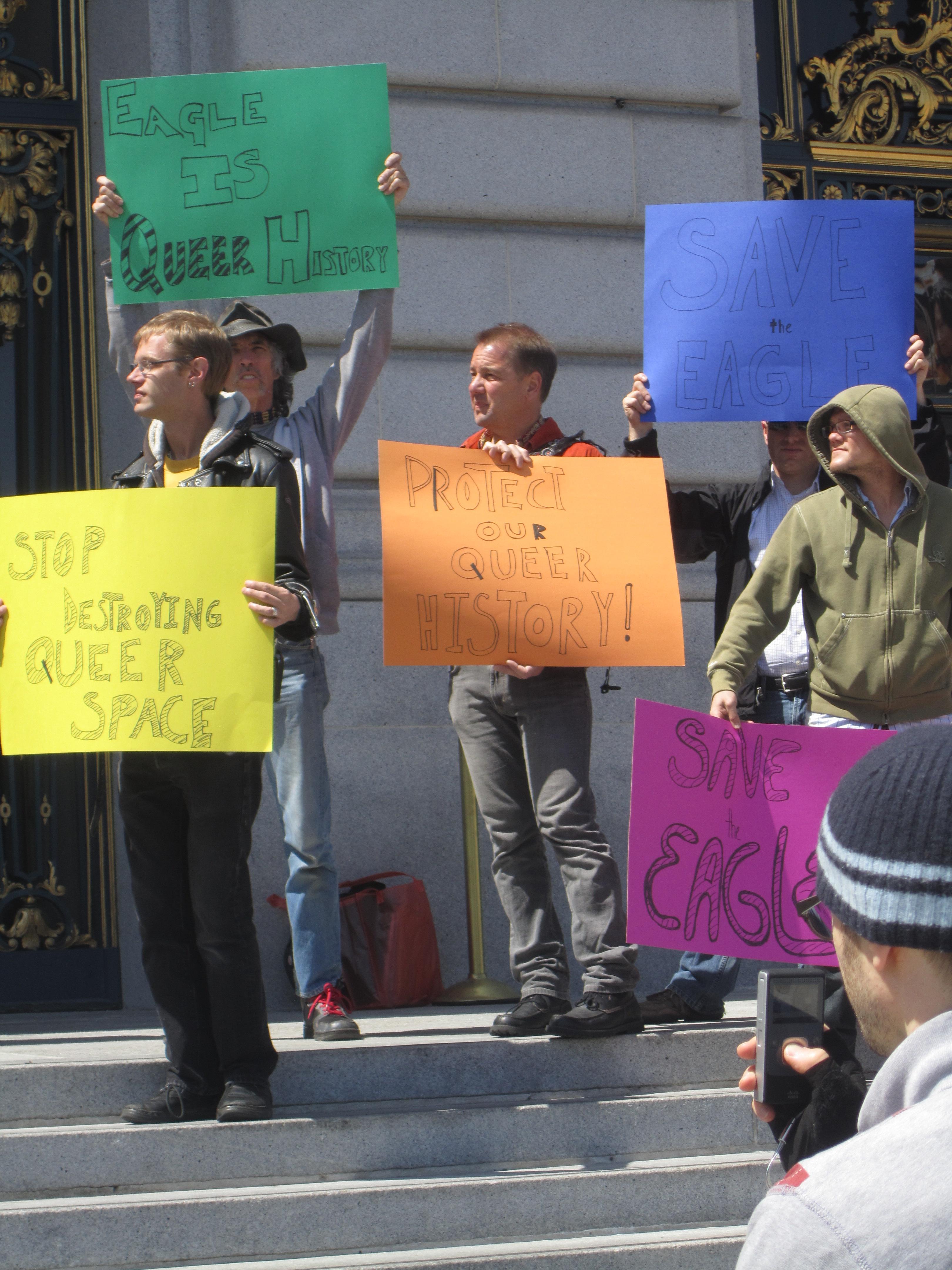
Since then, defenders of the 12th Street space have scraped together emergency meetings and impromptu marches, a surprise leather night at the Skylark Bar (owned by a believed-to-be buyer), and a demonstration on the steps of City Hall. Letters were sent to the Board of Supervisors, petitions signed, and pink tent campouts planned as vigils.

Through it all, the message carrying most clearly was that the Eagle Tavern is far more than a swingin’ hot spot. “It’s our history and it’s our culture,” said organizer Kyle DeVries at a rally on the steps of City Hall last Tuesday. “And we’re proud of what we’ve given to this city.”

That “what” includes more than $1 million raised through the years at popular Sunday beer busts supporting everything from breast cancer research to AIDS awareness. But it also includes providing a safe haven and sense of belonging for San Francisco’s queer community for more than three decades.

And now, patrons have learned they will eek out another month. Thanks to the huge outpouring of support from Eagle denizens, and political pressure from three San Francisco supervisors, the end-of-April plan to fly the coop has been delayed at least until the end of May, Eagle manager Ron Hennis said.

But since the issue first exploded April 11, efforts to save the sacred space haven’t slowed down. At press time, supporters were planning an April 19 “Tuesday roost” at the Eagle in hopes of pumping energy and cash back into the tavern on a night known to be quiet.

Sup. Scott Wiener, along with Sups. David Campos and Jane Kim, sent a letter to the San Francisco Police Department that reviews liquor license sales in connection with the California Department of Alcohol Beverage Control. The letter reviewed the Eagle’s importance in SF’s queer community and stated that its authors are “adamantly opposed to any sale that would result in the Eagle’s destruction.”

The supervisors urged the SFPD to “closely scrutinize, consistent with applicable legal standards, any requested liquor license transfer relating to the Eagle to ensure that any such transfer will not harm the LGBT community by putting an end to the Eagle.”

So far, these efforts have been promising for Eagle patrons. In a phone interview, Wiener told us that Skylark owner Steve Englebrecht has pulled out of negotiations to buy the place. But the situation remains complex.

Eagle manager Ron Hennis explained that current owners John Gardiner and Joe Banks decided to sell the Eagle a year ago to focus on their other SoMa leather bar, Hole in the Wall Saloon, which has been plagued with high-cost property battles of its own.

Gardiner and Banks didn’t respond to our e-mails. But Hennis said they intended to sell the business — which includes the Eagle name, equipment, and liquor license — to people they felt would maintain the existing spirit of the bar: Hennis, Eagle entertainment coordinator Doug Hilsinger, and Lila Thirkield, owner of the Lexington Club.

Hennis and Hilsinger told us a contract was signed and the deal had progressed through an initial set of inspections and into escrow when the property’s owner, John Nikitopoulos, refused to negotiate a new lease with the prospective owners.

Despite successful conversations up to that point, Gardiner and Banks “turned off and didn’t say why,” Hennis said.

Further complicating the matter, Gardiner and Banks’ lease ran out and Nikitopoulos hasn’t renewed it. He’s been renting the property month-to-month and is reportedly raising the monthly price tag, which has remained the same for the past 10 years.

Hennis said the owners were still paying rent when they were threatened with eviction — which would mean a death sentence for the Eagle unless they could sell the business to a party Nikitopoulos would be willing to negotiate a lease with.

In the midst of the stalemate, Nikitopoulos offered to buy the business (and most important, the liquor license) from Gardiner and Banks, who refused saying they’d already agreed to sell to Hennis and his partners. Nikitopoulos then approached Hennis, suggesting Hennis purchase the business as planned and then sell him the liquor license. When Hennis also turned down the landlord’s offer — without the liquor license, Hennis wouldn’t actually own the bar — he disappeared from the conversations.

At the April 12 demonstration, mayoral candidate Bevan Dufty called for the stakeholders involved to recognize that in a city that “values history — indeed, is defined by history,” the lease on the Eagle is “more than just a business transaction.

“The owner of this building needs to come to the table and talk about this,” he urged.

But Nikitopoulos, a resident of Santa Rosa who inherited the property from his father, hasn’t responded to Hennis, reporters, or even to calls from Sup. Wiener. He was, however, reportedly in communication with Englebrecht when the Skylark owner swept in to purchase the space and liquor license — but not the name or the leather culture.

Though Englebrecht withdrew, supporters worry Nikitopoulos could potentially negotiate a lease with a different tenant — leaving the bar a casualty of SoMa’s continued gentrification.

Longtime Eagle patron Mike Talley, who has lived in SoMa for more than two decades, fears the Eagle would fit perfectly into a familiar story of luxury lofts, astronomical rent increases, and — inevitably — mass evictions. He explained that what the Chronicle’s late columnist Herb Caen called the Miracle Mile — a strip of SoMa gay and leather bars that once numbered in the dozens — now consists of just a few properties “hanging in there.”

Mark Kliem, a.k.a Sister Zsa Zsa Glamour of the Sisters of Perpetual Indulgence, echoed Talley’s concern, saying, “The rest of the entire world is family-friendly. Why can’t we have this one little half-mile area to call queer space?”

It’s worth noting that the Eagle is by no means exclusively gay. It is famous for its Thursday-night rock shows where, according to an Eagle DJ, “a melting pot of hipsters, stoners, and rockers mixed with the leather crowd.”

“Everyone was cool,” he said. “Everyone was welcome.”

Still, the bar has become an icon of San Francisco’s queer community.

Kim, who represents the district, presented the Eagle with a letter of commendation recognizing its 30 outstanding years as a “venue, cultural institution, safe haven, and home for the LGBT community” at the April 12 meeting.

“You can’t threaten something as important as this institution,” Campos added.

Wiener, Kim, and California Sen. Mark Leno also praised the Eagle at Sunday’s regularly scheduled beer bust. Leno lauded the efforts of local drag queen/community organizer Anna Conda, and referred to the week’s events as “Stonewall West.”

If anything, the week of demonstrations has drawn San Francisco’s queer community closer. And there is hope that the crowd can stay together in the spot they claimed for themselves. One white-horse possibility is Mark Frazier, owner of a Dallas bar also named the Eagle — and also home to a leather crowd.

Seth Munter of Herth Realty in San Francisco said Frazier has been eyeing the SF Eagle for more than a year, and that he is “interested and able to participate in continuing the Eagle as it has been, either with partners or on his own.”

Reached by phone in Dallas, Frazier told us he’s dreamt of the business since before his own Eagle took flight in 1995. “I think the San Francisco Eagle has a lot of history and a core base of support,” he said. “Any time you go into a business with so much support, it’s going to be successful.”

Frazier stressed that like the SF original, his Eagle has raised substantial sums for charity. Though he acknowledged that the bottom line of all businesses is to make money, “the successful ones continue to give back to the community — and not only monetarily.”

So far, Frazier said he has “exchanged e-mails with the powers that be” and that he is confident the Eagle’s troubles stem from a “communication gap” he could help fix.

Hennis expressed hope about the possibility of working with Frazier in addition to pursuing other options like historical preservation.

Demonstrators have penned more than 100 hand-written letters to the Historic Preservation Commission urging it to assign the Eagle landmark status. Commissioner Alan Martinez said such a process could cost thousands of dollars and would not “grant the right to dictate businesses or tenants.”

Still, he announced publicly that giving the building historic status is not “about turning the city into a museum — it’s about our history.”

Though landmark status protects the physical property, it would also provide legitimacy, an instantaneous way to tell the building’s story and bind the community together. And no matter what happens with the sale of the Eagle, that’s one possibility that flies.


New development planned for site of demolished historic cottage

About two years ago, the Guardian reported on the demolition of one of San Francisco’s oldest buildings — the Little House, a cottage on Russian Hill that stood for 148 years at 1268 Lombard Street.

The demolition drew the ire of the Russian Hill Neighbors Association and local historic preservationists, because the historic property came down in the blink of an eye after the owners were granted an emergency demolition permit from the Department of Building Inspection. At the time, surrounding neighbors raised concerns that the Little House had been purposefully neglected in order to get it to a demolish-able condition, so that the lot could be cleared for development without undergoing the standard environmental review process.


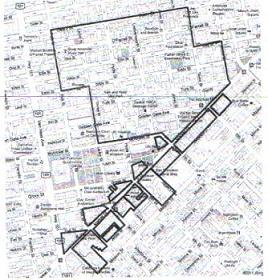
Co-owners of the lot (pictured in the box) where the Little House once stood now want to construct a 4-unit building.

The agenda for today’s Board of Supervisors meeting includes a public hearing on a conditional use permit for a new building at 1268 Lombard, deemed to be an infill project because it’ll be constructed on what’s now an empty lot. Co-owners James Nunenbacher and Michael Cassidy are requesting city approval to construct a four-unit, 40-foot high residential project there.

Expect fireworks, as residents such as F. Joseph Butler, an architect with the Little House Committee, haven’t forgotten the loss of the cottage, which was one of the only structures on Russian Hill that emerged unscathed after the 1906 earthquake and ensuing fires.

“I think that the project sponsors … should not be rewarded for tearing down one of our most historic properties,” a woman from the preservation community noted at a Feb. 17 Planning Commission meeting about the conditional use permit.

At today’s meeting, supervisors could vote either to approve or disapprove the conditional-use permit.

***UPDATE*** No fireworks after all, the item was continued.

Mayor derails hearing on nightclub crackdown

3

Will entering a large nightclub in San Francisco be akin to a TSA pat down? We won’t know for a while, as the proposal for heightened security measures by San Francisco Police has caught the interest of Mayor Ed Lee and further discussion has been stalled pending his analysis.

A hearing last night (Tues/12) at the Entertainment Commission proved to be a disappointment for the dozens of people who attended in hopes of getting closure on the hotly contested proposal, which has drawn criticism for its infringement on freedom and privacy and burdensome cost to club owners, as well as being the latest battle in San Francisco’s War on Fun.

“We need to protect our events,” said Liam Shy of the organization Save the Rave, a coalition of people dedicated to keeping electronic dance parties alive. “They are in a state of crisis right now, and this would make it much worse.”

Shy and fellow Save the Rave member Matt Kaftor saw the mayor’s interest in the issue was a good indication that community dissent has been heard.

“I would be truly shocked if this passed,” said Kaftor. “If it does, we will be protesting constantly.”

The proposal would require all venues with an occupancy of 100 or more people to record the faces of all patrons and employees and scan their IDs for storage in a database, which would be available to law enforcement on request for at least two weeks. Metal detectors, security cameras and brighter lights in the venues would also be required. The proposal was created in response to recent violence in and around nightclubs, most notably the shooting outside Suede in Fisherman’s Wharf last year that resulted in the closing of the club.

However, critics say this is an overreaction that unfairly targets events as sources of violence.

“What I keep getting from measures like this is that police work is hard,” said SF resident Jonathan Duggan. “But instead of doing their hard work, they are just creating another avenue for privacy invasion that shifts the responsibility to everyone else.”

Although the main target is nightclubs, many events in San Francisco would be affected. Events with strong cultural, ideological, and political components are frequently held at venues that would be affected by these rules.

Eva Galperin of the Electronic Frontier Foundation showed up last night prepared to give the commission a piece of her mind. She shared a letter with us outlining her concerns, which listed the support of many other civil liberty and privacy protection groups such as the Bill of Rights Defense Committee.

“The city of San Francisco has a long history of political activism and cultural diversity which would be profoundly threatened by this proposed rule,” Galperin wrote. “Scanning the IDs of all attendees at an anti-war rally, a gay night club, or a fundraiser for a civil liberties organization would result in a deeply chilling effect on speech…This would transform the politically and culturally tolerant environment for which San Francisco is famous into a police state.”

District 8 Supervisor Scott Weiner, who has been instrumental in the effort to keep events in San Francisco alive, told us that he does not support the proposal. His resolution to protect events passed the Board of Supervisors on March 29 and focuses on collaboration between city agencies and nightclub owners to combat violence rather than simply cracking down on entertainment venues.

 “It’s one thing for a large club with a history of problems to receive those kinds of exceptional security measures, but for the majority of clubs, it strikes me as overkill as well as invasion of privacy,” Weiner told us.

Jocelyn Kane, executive director of the Entertainment Commission, could not give any indication as to when another hearing would be or what prompted the mayor’s decision.  Neither she nor the mayor’s office could elaborate on whether the mayor has problems with the proposal or is simply responding to the public outrage.

Supes vote on Botanical Garden fees

The Board of Supervisors voted on April 12 to keep in place nonresident fees at the San Francisco Botanical Garden for at least another two years, rejecting a proposal by Sup. John Avalos to do away with the fees and make up for the shortfall with a portion of revenues brought in by a real-estate transfer tax that was approved by voters last year.

Advocating for his position, Avalos stood to tell a story about his last visit to the Botanical Garden. “A couple months ago, I was able to go there with my kids,” he began. “I went in, I was asked for my ID, I showed my ID. I noticed the next person who came in after me looked very agitated when she got to the gate. She said the F-word very loud, and she started to walk away. I approached her, and I said, ‘hey what’s going on?’ And she said, ‘I come here everyday, and I’m being asked for my ID, and I have to go back to my house to get it because I don’t have it with me today.'”

She wasn’t the only person who seemed disgruntled by the gatekeeper that day. “On my way out, I noticed a few tourists coming up,” Avalos continued. “It looked like they were from Germany. They walked up to the gate and then they walked back away from the gate. They clearly did not go in because they did not want to pay the fee.” A couple in their 60s tried to enter, but they did not go in because they didn’t have their IDs proving that they lived in San Francisco, he added.

Bottom line: “The gate and the fee has really diminished what people’s enjoyment of the park has been like for decades,” he said. “Can’t there just be one fee that we don’t raise? Can this be that one fee? I don’t think that’s asking too much.” He also noted that budget analyst’s report showed that the fees did not bring in the revenue that had been anticipated, a point echoed by Sups. Ross Mirkarimi and David Campos.

Yet Avalos’ pitch wasn’t enough to persuade his colleagues. On the question of whether money from the real-estate transfer tax revenues should be used to make up for the nonresident fees so that the Botanical Garden could be free for everyone, supervisors said no on a 7-4 vote, with Sups. Eric Mar, Mirkarimi, Campos, and Avalos voting yes.

The board also voted on whether the nonresident admission fees should be extended beyond June 30, 2011 (a date set when the fee was initially imposed), as proposed by Mayor Ed Lee. Board President David Chiu offered an amendment that the fees would only remain in place for two years, after which point the debate could be rehashed. The amendment was adopted, and the mayor’s proposal passed on a 6-5 vote, with Sups. Jane Kim, Mar, Mirkarimi, Avalos, and Campos voting no.

So, that’s how it went down at the board. If you’re a nonresident, the Botanical Garden still isn’t free.

Since Kim and Avalos both shared their accounts of visiting the Botanical Garden, I thought I’d share my own photos and impressions from a visit on a recent afternoon, when I had several hours to myself to explore Golden Gate Park’s haven of greenery. Admission was free, since I’d planned ahead to bring my ID.

The day was sunny and warm, and I spent a long time photographing the light streaming through a cluster of bamboo and sitting by a pond watching some water bugs skip around on the surface. It was a welcome escape from city life with an element of educational value, since all the plants are labeled with plaques identifying their Latin names, common names, and places of origin.

I noticed two people sitting wordlessly together in the sun. The woman, who seemed to be a caregiver, was seated on a bench, and beside her was an elderly man in a wheelchair with a blanket over his lap. The man seemed to be very frail. Yet he wore a serene expression, and was clearly enjoying the calm and quiet afternoon.

I don’t know if they paid to get in or not. As Board President David Chiu noted at the meeting before voting in favor of keeping the fee in place, “We don’t live in a perfect world.” You can argue about the privatization of parks, or about the need to find all possible sources of revenue in order to fend off cuts to city-funded services. Nevertheless, it’s sad to think of the folks who would be barred from the simple pleasure of sitting in the sun surrounded by natural beauty, because they can’t afford to pay.

Seeking a watchdog’s watchdog

1

rebeccab@sfbg.com

When cash pumps through the guts of city politics, the Ethics Commission is charged with keeping track of it all to help members of the public follow the money. But what happens when the public loses faith in the ethics of the Ethics Commission?

In the run-up to a hotly contested mayoral race, in a city marked by rough-and-tumble politics influenced by moneyed power brokers, the function of this local-government watchdog agency is especially critical — and to hear some critics tell it, the Ethics Commission needs reform if it is to perform as an effective safeguard against corruption.

So it was hardly surprising that an April 5 discussion at the San Francisco Board of Supervisors meeting about whom to appoint to the Ethics Commission featured a low-level tug-of-war with some potentially high-level implications.

Sup. Eric Mar proposed that the board consider Allen Grossman for the seat. An octogenarian government watchdog unaffiliated with any political party, Grossman has gone so far as to file a successful lawsuit against the Ethics Commission for not following its own public-disclosure rules. As a potential appointee, he was widely viewed as reform-minded, following in the footsteps of others who have been purged from the body in recent years.

“Open government and good government work together, hand in hand,” Grossman told members of the board’s Rules Committee several weeks prior, interlacing his fingers for emphasis.

Grossman won the backing of Sups. John Avalos and Ross Mirkarimi. But Board President David Chiu spoke against the idea, throwing his support instead behind Dorothy Liu, an attorney and professional colleague of his through the Asian American Bar Association. The Rules Committee, chaired by Sup. Jane Kim and filled out by Sups. Sean Elsbernd and Mark Farrell, also turned down Grossman in favor of Liu.

“She’s extremely hard-working and does her homework,” Chiu later told the Guardian. He also saw it as a plus that Liu was not a political insider: “I think we need an individual on the Ethics Commission who will be impartial,” he said, adding that he’d prefer “someone who has not been involved in the rough-and-tumble of San Francisco politics.” Sup. Carmen Chu echoed Chiu’s comments during the meeting, saying she thought Liu would be an ideal candidate because she did not seem to have an agenda.

Mirkarimi and Avalos, on the other hand, said they were looking for a candidate who did possess a vision for strengthening the role of the agency as a watchdog. “I think our Ethics Commission and the department, as it stands, needs all the help it can get,” Mirkarimi said during the meeting. “I think having people who are well-seasoned with an understanding in the law of ethics and sunshine is something we should be looking for. Mr. Grossman has exhibited that well over the years in trying to do everything he possibly can to advance the cause in a nonpartisan way of making sure that we have a very strong Ethics Commission.”

Mar’s motion to consider Grossman was shot down on an 8-3 vote with Mirkarimi, Mar, and Avalos dissenting; Liu then won the commission appointment on a 10-1 vote, with Avalos dissenting.

Until recently, the Board of Supervisors seat on the Ethics Commission was held by Eileen Hansen, a progressive who had called for political reform under Mayor Willie Brown’s administration prior to being named to the post. When she was being considered for the commission, Hansen recalled, then-Sup. Michela Alioto-Pier raised an objection. “[She] thought the perfect person would be somebody who … would come essentially as a clean slate,” Hansen remembered. “Because I had been involved in organizing campaigns and had run for office, that was deemed too political.”

Yet Hansen viewed her familiarity with the system as an asset that helped her serve as an effective watchdog against corruption. During her six-year tenure, Hansen often cast lone dissenting votes against decisions she believed were weakening ethical standards. She told the Guardian she’d tried floating remedies for situations she viewed as inappropriate, only to have them summarily ignored, a role similar to that of former Ethics Commission member and staffer Joe Lynn.

In one case, Hansen recalled, she became concerned about a planning commissioner who also directed a nonprofit. To raise money, her organization held fundraisers that were ostensibly attended and funded by the very same developers and lobbyists who appeared before her at the Planning Commission. Yet Hansen said she was unable to persuade the other commissioners or staff to call for an investigation.

A more recent Ethics Commission vote underscores the same tension. On March 14, the commission voted unanimously to waive a pair of ethics regulations to allow a mayoral staff member to become executive director of the America’s Cup Organizing Committee (ACOC). Composed of highly influential business figures including at least two billionaire investors, ACOC is tasked with securing corporate donations for the America’s Cup to offset city costs of hosting the race.

Kyri McClellan, project manager with the Mayor’s Office of Economic and Workforce Development, helped craft a memorandum of understanding with ACOC regarding its fundraising obligations to the city. In her new job, without skipping a beat, she’ll interface with the city on behalf of ACOC. The rules that were waived for her benefit are meant to prevent city officials from holding undue influence over their former coworkers after leaving public service, and to prevent city staffers from accepting money from city contractors right after departing from city employment.

“If I had been there, there would have been at least one vote against that waiver,” said Hansen, whose term on the commission ended before this vote. “We have this law in place for a reason. By continuing to provide waivers … we create a situation where the public will not trust the Ethics Commission as a watchdog.”

Hansen said she was scouting for a new commissioner who would carry on with her work. “I was looking for and trying to recruit a visionary — someone who could really be a reformer,” she said. “We’re almost in a position now where we need a watchdog over the watchdog.” She said she saw Grossman as the right fit.

Other observers, such as CitiReport blogger Larry Bush — an investigative reporter who called for the creation of the Ethics Commission in San Francisco in the early 1990s — questioned whether Liu was the best choice after hearing her statements at the March 17 Rules Committee hearing. Liu did not come out strongly in favor of televising Ethics Commission meetings, which has long been a sticking point for open-government advocates.

“I absolutely support televising the Ethics Commission, I think it’s really important,” Kim noted when we asked her about this. She added that she would have supported Oliver Luby — a former Ethics Commission staff member and whistleblower who was ultimately ousted from the job — if he’d applied.

Kim noted that an initial concern she’d had in seeking an ethics commissioner was whether the person would vote to allow Mayor Lee to resume his job as city administrator after serving out his term as interim mayor, a key decision that the commission was scheduled to consider April 11.

Once she was advised that it would be inappropriate to ask which way they would vote when conducting candidate interviews, Kim said she withheld her question — and still didn’t know Liu’s or Grossman’s position at the time she spoke with the Guardian. “I think it’s very appropriate for him to get his job back,” Kim noted. “That vote is very important to me.”

That vote drew closer scrutiny, however, after Ethics Commission staff recommended that the exemption that would be built into the law for Lee’s benefit should be expanded to include appointed members of the Board of Supervisors. “This new proposal would convert a targeted, narrow exemption to deal with a special case into the ‘Politician Job Protection Act’ and could open the door to all kinds of unintended consequences,” charged Jon Golinger of San Franciscans for Clean Government.

Meanwhile, Luby seemed disheartened by the board’s selection of Liu for the Ethics Commission. He was looking to Grossman to fill Hansen’s shoes as the commission’s reformer — a role previously held by Lynn, Luby’s good friend and mentor who died last year.

He lamented, “This will mark the first time in over 10 years to have an Ethics Commission without someone who has past experience advocating for good government.” 


Ethics Commissioner: No surprises, please

The San Francisco Ethics Commission voted unanimously on April 11 to amend a post-employment ban under the city’s Campaign and Governmental Conduct Code, creating a provision that’s designed to allow Mayor Ed Lee to resume his post as City Administrator following the completion of his term as interim mayor.

The change allows an appointed mayor to obtain city employment immediately after serving out a term, provided that he or she doesn’t pull papers to run for office, was previously employed by the city, and doesn’t receive a salary that’s higher than the last year of city employment prior to taking office. The amendment builds in an exception to a rule banning the mayor and members of the Board of Supervisors from obtaining city employment for one year after leaving office.

Ethics Commission staff had recommended that this provision be expanded to apply to appointed members of the Board of Supervisors. While Mayor Lee’s circumstance is a rare occurrence, supervisors are appointed far more often. “The underlying ordinance applies only to the mayor and the board, so we thought, why just do one, why not do both?” Ethics Commission director John St. Croix explained.

But a couple commissioners took issue with that idea, saying it was too far outside the scope of the law that voters enacted, and it ultimately did not win approval. “I don’t see the compelling reason to include the supervisors,” noted commissioner Charles Ward, “and I expect that members of the public are going to be awfully surprised. As a member of the public, I’d be surprised myself.”

Rule change for Mayor Ed Lee could expand beyond special case

Last week, the Guardian reported on the Ethics Commission’s decision to waive two post-employment bans for city officials in order to allow mayoral staffer Kyri McClellan to take a job as executive director of the America’s Cup Organizing Committee, a role that will put her into direct contact with the same office she’s departing from as a representative of private-sector interests.

The April 11 Ethics Commission meeting will feature another discussion on whether to bend the rules on post-employment for city officials.

Shortly after former City Administrator Ed Lee was appointed as interim Mayor, Board President David Chiu introduced legislation that would modify post-employment restrictions to allow Lee to go back to his former job directly after serving out his mayoral term. Under the Campaign and Governmental Conduct Code, the mayor and members of the Board of Supervisors must wait a full year after serving office to obtain employment with the city. Unlike in McClellan’s case, this rule cannot be waived for an interim mayor, so the law must to be changed to include an exception to accommodate Lee in this special case.

As it stands, “This rule is designed to restrict these elected officials from using their influence to create golden parachutes as they leave office,” according to a memo issued by Ethics Commission Deputy Executive Director Mabel Ng.

Yet Ng’s memo proposes expanding the reach of the rule change, advocating for it to apply not only to an interim mayor but any appointed member of the Board of Supervisors who does not plan to seek office after filling out a term.

“If the commission approves this legislation, staff recommends that the Commission also extend the exception to a member of the Board of Supervisors in the same circumstances,” Ng’s memo notes. “Staff makes this recommendation because the same arguments supporting an exception for appointed mayors like Mayor Lee apply equally to appointed members of the board.”

Not so fast, says Jon Golinger of San Franciscans for Clean Government, who issued a press release warning of the possible rule change on April 11. While Lee’s case is rare indeed, supervisors are appointed to fill vacant seats far more frequently, Golinger pointed out. “It introduces a whole new level of uncertainty and political abuse,” he charged. “We don’t want our top officials playing games with public funds so that they can have a job with the city” after leaving office.

Golinger said his group thought the provision that would allow for Lee to resume his old post should include a sunset clause to make it a temporary change, since in his view, “there’s no reason that should be a permanent change.”

As for going a step further to include appointed members of the board, “It’s a major change,” Golinger said, “and it does raise the broader issue of whether Ethics Commission reform is needed.”

In order to be approved, the rule change would have to win at least four votes at the Ethics Commission and at least eight votes at the Board of Supervisors.

Ng’s memo noted that a representative of Chiu’s office would attend the April 11 meeting and respond to questions from staff about the proposed legislation to create an exemption from the post-employment ban for Lee. Reached by phone, Chiu’s legislative aide Judson True said his office had not yet formed an opinion on whether the rule change ought to be extended to the Board of Supervisors.

Ammiano says support is growing for TRUST Act

5

Assemblymember Tom Ammiano says that statewide support is building for AB 1081 (the TRUST Act), which would give local governments the right to opt-out of the controversial Secure Communities program.

As the Guardian previously reported, ten months after ICE’s controversial S-Comm program was activated in San Francisco, our “sanctuary city” ranks among the top 38 counties nationwide deporting “non-criminal aliens.”

“Unlikely allies are lining up behind this bill because ICE misled the public about S-Comm, whose real focus is more spin than safety,” Ammiano said in a press release today. “In fact, seven in ten Californians deported under S-Comm had committed no crime or were picked up for minor offenses like traffic violations. The program is ruining trust between immigrant communities and the police. But here in California, we can do better. This bill is a practical solution that lets local governments have a say and restores some balance to this dysfunctional system.”

Joining Ammiano as co-sponsors of the TRUST (Transparency and Responsibility Using State Tools) Act are Assemblymembers Gil Cedillo and Bill Monning and Sen. Leland Yee. And the act, which is billed as a pro-safety and pro-transparency proposal, already has the support of over 50 organizations and a slew of elected local officials.

These officials include San Francisco Sheriff Mike Hennessey who blew the whistle on the program last May, when federal authorities privately told local law enforcement agencies that S-Comm was going live in San Francisco in June 2010. At the time, there had been no public hearings on the proposed program, which links fingerprints taken when folks are booked at county jails with federal and international databases—in other words, before folks charged with crimes have had their day in court.

A press release from Ammiano’ s office states that S-Comm’s “misleading focus, over-broad reach and lack of transparency” has eroded trust between police and immigrant communities and sparked considerable open government concerns —problems the TRUST Act aims to fix.

In addition to allowing municipalities to opt-out, the TRUST Act would also sets basic safeguards for local governments that participate in the program to guard against racial profiling, protect the rights of children and domestic violence survivors. And it would uphold the right to a day in court by only reporting for deportation individuals convicted, not merely accused, of crimes. 

“Under S-Comm, a desperate call for help can quickly turn into a nightmare situation for victims of domestic violence,” said Tara Shabazz, Executive Director of the California Partnership to End Domestic Violence. “We’ve seen victims of abuse reported for deportation from San Francisco to Lodi, California. This bill will protect abuse victims and remove an important barrier to reaching out for help, and we are proud to support it.”

Ammiano’s office says that these serious public safety and civil liberties concerns have pushed local governments to seek a way out of the program, imposed on communities with no transparency or opportunity for local oversight. They note that the Santa Clara Board of Supervisors unanimously requested to opt out of S-Comm program in September 2010, but after months of confusion, ICE refused to honor the county’s request.

“The Federal Government forced this program on my jail without my consent,” SF Sheriff Michael Hennessey said. “By allowing local governments to opt out of this flawed program, AB 1081 will help law enforcement win back some trust with immigrant communities. That, in turn, will help improve public safety for everyone.” 

 “The TRUST Act raises this unregulated and inaccurate program to California’s standards and ensures transparency and accountability through clear data reporting requirements for local jurisdictions opting to participate in S-Comm,” said Chris Newman, National Day Laborer Organizing Network’s legal director.
 AB 1081 will be heard in the Assembly Committee on Public Safety on Tuesday, April 26 at 9 a.m. in State Capitol Room 126.

Green days

0

news@sfbg.com

1892: The Sierra Club is established by John Muir and a group of professors from UC Berkeley and Stanford in San Francisco. In its first conservation campaign, the club leads efforts to defeat a proposed reduction in the boundaries of Yosemite National Park.

1902: After two years of intense lobbying and fundraising, the Sempervirens Club, the first land conservation organization on the west coast, is successful in establishing Big Basin Redwoods State Park — the first park established in California under the new state park system.

1910: The first municipally owned and operated street car service commences in San Francisco.

1918: Save the Redwoods League is established in San Francisco. A leader in proactive land conservation, SRL would go on to assist in the purchase of nearly 190,000 acres to protect redwoods and help develop more than 60 redwood parks and reserves that old these ancient trees in California.

1934: The East Bay Regional Park is established as the first regional park district in the nation. This radical Depression-era idea would much set the tone as the Bay Area land conservation vision expanded.

1934: The Marin Conservation League is founded by wealthy Republican women. Three years later, at the league’s behest, the Marin County Board of Supervisors adopts the first county zoning ordinance in the state in 1937. Over the next 10 years, the league helps create State Parks at Stinson Beach, Tomales Bay, Samuel P. Taylor, Angel Island, and expand Mt Tamalpais State Park.

1956: San Francisco activists, led in party by Sue Bierman, launch a campaign to stop a freeway that would have run through Golden Gate Park. It marks the first time city residents successfully block a freeway project and launches the urban environmental movement in America.

1958: Citizens for Regional Recreation and Parks is founded. It becomes People for Open Space in 1969 and morphs in 1987 into the Greenbelt Alliance. Their efforts lead to the creation of the Mid-Peninsula Open Space District in 1972 and Suisun Marsh in 1974.

1960: Sierra Club Executive Director David Brower launches a brand new organizing and educational concept, the exhibit format “coffee table” book series, with This Is the American Earth, featuring photos by Ansel Adams and Nancy Newhalland. These elegant coffee-table books introduced the Sierra Club to a wide audience. Fifty thousand copies are sold in the first four years, and by 1960 sales exceed $10 million. The environmental coffee table book emerged as part of a campaign to persuade Congress to enact the Wilderness Bill, legislation that would guarantee the permanence of the nation’s wild places.

1961: Save San Francisco Bay Association is founded by Sylvia McLaughlin, Kay Kerr and Ester Gulick to end unregulated filling of San Francisco Bay and to open up the Bay shoreline to public access.

1961: Pacific Gas and Electric Co. announces plans to build a nuclear power plant at Bodega Bay. Rancher Rose Gaffney, UC Berkeley professor Joe Neilands and others mount what will become the first citizen movement in the country to stop a nuclear plant. The Bodega Bay campaign marks the birth of the antinuclear movement.

1965: Responding to Bay Area citizens’ demands for protection of the bay’s natural environment, the California state legislature passes the McAteer-Petris Act, which establishes the San Francisco Bay Conservation and Development Commission (BCDC) and charges it with preparing a plan for the long-term use and protection of the Bay and with regulating development in and around it.

1965: Fred Rohe opens New Age Natural Foods on Stanyan Street in San Francisco. He goes on to open the first natural foods restaurant in 1967, Good Karma Cafe on Valencia Street. Rohe would go on to open the first natural foods distribution company in Northern California, New Age Distributing in San Jose in 1970 and found Organic Merchants (OM), the first natural foods retailer trade group.

1967: The Human Be-in is held Jan. 14 in Golden Gate Park (as a prelude to the Summer of Love) with as a major theme higher consciousness, ecological awareness, personal empowerment, cultural and political decentralization.

1967: Alan Chadwick comes to UC Santa Cruz and establishes the Student Garden Project and training program, which would train hundreds of today’s organic farmers.

1968: The Whole Earth Catalogue, published by the Point Foundation and edited by Stewart Brand out of Gate 5 Road in Sausalito is introduced, providing tools, philosophy, and reviews to the growing back-to-the-land movement, helping promote ecological living and culture alternative sustainable culture decades before those words became mainstream.

1969: Brower, after losing his job at the Sierra Club in part because of his opposition to the Diablo Canyon nuclear power plant, founds Friends of the Earth, the cutting edge activist group that would eventually have affiliates in 77 nations around the globe and become the world’s largest grassroots environmental network.

1970: Peninsula resident Neil Young writes and sings the lyrics “Look at Mother Nature on the Run in the 1970s.”

1970: Berkeley Ecology Center opens.

1971: Sierra Club Legal Defense Fund is established, marking the beginning of an explosion in environmental law.

1971: Alice Waters opens Chez Panisse, serving up California Cuisine and altering the Bay Area diet helping to create a market for local fresh organic fruits and vegetables. 1971: Berkeley resident Francis Moore Lappé publishes her best-selling book Diet for a Small Planet. Two million copies are sold and as the first book to expose the enormous waste built into U.S. grain-fed meat production, for her a symbol of a global food system creating hunger out of plenty; her effort alters millions of diets.

1971: San Francisco dressmaker Alvin Duskin launches a campaign to limit high-rise office development in San Francisco, creating new allies and a new coalition for urban environmentalism.

1972: The Trust for Public Land, a national, nonprofit land conservation organization that conserves land for people to enjoy as parks, gardens, historic sites, and rural lands, is founded by Huey Johnson, Doug Ferguson and Marty Rosen in San Francisco. TPL would go on to protect 2.8 million acres of land and is key in getting land trusts started in Napa, Sonoma, Marin, Big Sur, and around the state.

1972: The Don Edwards San Francisco Bay National Wildlife Refuge, first urban wildlife refuge in the United States, is established, encompassing 30,000 acres of open bay, salt pond, salt marsh, mudflat, upland and vernal pool habitats located in South Bay.

1972: The Save Our Shores campaign, developed in part by Bay Area residents, results in a state initiative, the Coastal Act of 1972, which is passed by the voters and establishes the first comprehensive coastal watershed policy in the nation.

1974: Berkeley Ecology Center starts the first curbside recycling approach in California, one of first such programs in the nation.

1974: The Farallones Institute in Berkeley begins building the first urban demonstration of an ecological living center with the Integral Urban House, a converted Victorian using solar and wind technologies, a composting toilet, extensive gardens, and energy and resource conservation features. It serves as an early model for the emerging Appropriate Technology Movement.

1975: Berkeley resident Ernest Callenbach self publishes Ecotopia after a round of rejections from New York publishers; it ultimately sells more than a million copies and becomes an environmental classic.

1975: San Francisco’s first community gardens are established at Fort Mason and elsewhere.

1975: The Marine Mammal Center, a nonprofit veterinary research hospital and educational center dedicated to the rescue and rehabilitation of ill and injured marine mammals, primarily elephant seals, harbor seals, and California sea lions, is established in the Marin Headlands.

1978: Raymond Dasmann and Peter Berg coin the term Bioregionalism in the publication of Reinhabiting a Separate Country, published by Berg’s Planet Drum Foundation in San Francisco. It represents a fresh, comprehensive way of defining and understanding the places where we live, and of living there sustainably and respectfully through ecological design.

1979 Greens Restaurant opens at Fort Mason in San Francisco and quickly establishes itself as a pioneer in promoting vegetarian cuisine in the United States.

1980: The Marin Agricultural Land Trust is established by Wetland Biologist Phyllis Faber and diary farmer Ellen Straus.

1980: Berkeley resident Richard Register coins the term “depave” — to undo the act of paving, to remove pavement so as to restore land to a more natural state. Depaving begins to spread to create many inner city urban gardening projects.

1981-82: Register and other activists, bring about the first urban day lighting of a creek in Berkeley’s Strawberry Creek Park where a 200-foot section of the creek is removed from a culvert beneath an empty lot and transformed into the centerpiece of a park.

1982: Earth First, a radical environmental group founded by Dave Foreman and Mike Roselle, sponsors the first demonstration against Burger King in San Francisco for using beef grown on land hacked out of rain forests. The demonstrations spread, turn in to a boycott, and after sales drop 12 percent, Burger King cancels $35 million worth of beef contracts in Central America and announces it will stop importing rainforest beef.

1983: Local residents Randy Hayes and Toby Mcleod release the documentary film The Four Corners, A National Sacrifice Area? , which conveys the cultural and ecological impacts of coal strip-mining, uranium mining, and oil shale development in Utah, Colorado, New Mexico, and Arizona — homeland of the Hopi and Navajo. The film wins an Academy Award and illustrates serious environmental justice issues 10 years before that term is coined.

1985: The Rainforest Action Network, established in San Francisco, emerges from the Burger King action.

1986: Fifteen years after Duskin’s first anti-high-rise initiative efforts, San Francisco finally passes Prop. M, the nation’s most important sustainable growth law.

1988: Register invents a stencil to be used next to street storm drains that says “don’t dump — drains to bay.” The wastewater pollution mitigation education concept spreads around the region and nation and then becomes an international volunteer effort to lessen pollution in urban runoff, which generally flows untreated into creeks and saltwater.

1989: Carl Anthony, Karl Linn, and Brower establish the Urban Habitat Program in San Francisco, one of the first environmental justice organizations in the country.

1989: Laurie Mott of the National Resource Defense Council’s SF office rattles the apple industry by engineering a suspension of the use of the pesticide Alar by the Environmental Protection Agency. A national debate ensues.

1992: Berkeley writer Theodore Roszak coins both the term and field of ecopsychology in his book The Voice of the Earth. The movement he helps found asks if the planetary and the personal are pointing the way forward to some new basis for a sustainable economic and emotional life.

1992: The first Critical Mass bike ride (initially called a “Commute Clot”) is held in San Francisco. Similar rides, typically held on the last Friday of every month, began to take place in more than in over 300 cities around the world.

1993: The U.S. Green Building Council is founded by David Gottfriend in Oakland. The council becomes the most important environmental trade organization in the world. In 1998, the council develops the LEED (Leadership in Energy and Environmental Design) Green Building Rating System, which provides a suite of standards for environmentally sustainable construction and design.

1995: The Edible Schoolyard is established by Chez Panisse Foundation at Martin Luther King Jr. Middle School in Berkeley. It serves as a model for similar programs in New Orleans and Brooklyn, and inspires garden programs at other schools across the country.

1999: The Green Resource Center starts as a joint project of the City of Berkeley, the Northern California Chapter of Architects, Designers and Planners for Social Responsibility (ADPSR), and the Sustainable Business Alliance.

2000: Wendy Kallins, working with the Marin Bicycle Coalition, begins a Safe Route to Schools program in Marin to encourage students to walk or bicycle to school. The program is so successful that Congress allocates more than $600 million for similar efforts across the country.

2001: The first Green Festival is held in San Francisco.

2001: Berkeley becomes first city in nation with curbside recycling trucks powered by recycled vegetable oil, thanks to a campaign by the Berkeley Ecology Center.

2002: San Francisco adopts a greenhouse gas reduction initiative that aims to reduce the city’s greenhouse gas emissions to 20 percent below 1990 levels by 2012.

2003: Bay Area Build It Green is formed by a number of local and regionally focused public agencies, building industry professionals, manufactures, and suppliers. Its activities are focused on increasing the supply of green homes, raising consumer awareness about the benefits of building green, and providing Bay Area consumers and residential building industry professionals a trusted source of information.

2005: San Francisco passes the Precautionary Principle Purchasing Ordinance, which requires the city to weigh the environmental and health costs of its $600 million in annual purchases — for everything from cleaning

supplies to computers.

2006: Bay Localize is launched in the East Bay with the aim to work to build a cooperative, inclusive movement toward regional self-reliance and increase community livability and local resilience for all while decreasing fossil fuel use.

2007: In an effort to meet the challenges of global warming, carbon pollution and job creation, East Bay activist Van Jones declares that the nation is going to have to weatherize millions of homes and install millions of solar panels. His best-selling book, The Green Collar Economy, stimulates a national movement and a new organization, Green For All.

2007: San Francisco begins collecting fats, oils and grease from residential and commercial kitchens, for free, to recycle into biofuel for the city’s municipal vehicles, the largest biofuel-powered municipal fleet in the United States.

2008: San Francisco becomes the first U.S. city to establish green building standards.

2010: The Green Building Opportunity Index names San Francisco and Oakland the top two cities in the nation for green buildings.

2010: San Francisco becomes home to the Sunset Reservoir Solar Project, the largest solar-powered municipal installation in California.


Board delays Yellow Pages vote

3

In an attempt to assuage big business interests, the Board of Supervisors decided yesterday (Tues/29) to delay the vote on an ordinance regulating the Yellow Pages, a piece of legislation that would create a three-year pilot program to rid the city of unsolicited phone books. A vote on the legislation is set for May 10.

The ordinance by Board President David Chiu passed the Land Use Committee on March 22. In attendance was a large opposition including the Yellow Pages Association, representatives of International Brotherhood of Electrical Workers and AT&T Advertising Solutions to stress the importance of the directory to small businesses and local jobs.

Although it appears the votes are there to pass it, supervisors including progressive David Campos and business-friendly Sean Elsbernd pushed for the delay so the city’s chief economist could undertake an analysis to understand how the “ban” would affect city businesses and to allow the public to continue to voice its opinions on the issue.

According to a previous Guardian article on the ordinance, many local businesses have chosen to advertise elsewhere, and many residents, including populations generally seen to use the Yellow Pages such as the elderly and non-English speakers, will still be able to easily obtain phone books if need be.

Alexia Marcous, Vice President of the Green Chamber of Commerce and a strong advocate in favor of the ordinance, said she was disappointed that the board chose to delay the vote.

“It’s politically motivated,” she told the Guardian. “Instead of doing what’s best for the city, they are stalling.”

While Marcous noted that it’s always prudent to obtain more information, it was unnecessary for the public to “provide further rebuttal” on the ordinance that she believes already has overwhelming support. Marcous states that some of the consequences of delaying the vote include the costs the city incurs for “dealing with the blight and litter and diverting the vital funds from more important issues.”

If the board decides to authorize the ordinance, Marcous sees San Francisco as a success story for other cities to emulate.

“It shows we are willing to do something about the egregious distribution practices that are only helping the Yellow Pages,” she said.

YPA Vice President of Public Policy and Sustainability Amy Healy posted on the Yellow Pages blog last week, before the vote was made, that the Yellow Pages Coalition “will be working diligently over the next week to influence the other members of the Board of Supervisors.”

Rent control is sticking point in Parkmerced debate

After a marathon debate at the March 29 Board of Supervisors meeting lasting several hours, a vote to certify the environmental impact report (EIR) for the masssive Parkmerced overhaul was pushed back until May 24.

Sup. David Campos raised concerns about the plan, saying the outstanding issue for him was questions surrounding whether a provision of the development agreement guaranteeing preservation of rent control could be enforced. He said he did not feel supervisors could rule on the EIR without having that issue settled. Campos made the motion to continue, which was seconded by Sup. Sean Elsbernd and agreed upon unanimously.

“I have to say that for me, there is still a question that remains that has to do with the potential loss of rent control housing,” Campos said. “I understand that there are differences of opinion with respect to that issue, but I am still puzzled as to whether or not we have all the information that needs to be had to make an informed decision here. I think that something as important as this project requires that we have as much information as we can.”

Elsbernd, whose District 7 includes Parkmerced, raised concerns about the impact to residents of living in a long-term construction zone, but he said he was convinced that the project could help improve public transit and serve to limit congrestion on the western side of the city. “It’s one step backward to get two steps forward,” he said of the increase in roughly 6,000 parking spaces that would go along with the project. “The west side is dramatically underserved when it comes to public transit, and it’s only going to improve with a project like this.”

But Campos, who sparred with Elsbernd at many turns throughout the lengthy discussion, said it was hard to see how traffic along 19th Avenue would improve with the addition of so many more cars. “You’re talking about 9,450 parking spaces, plus 1,681 street parking spaces, so the total number is 11,131. … So I’m trying to understand how such a significant increase will actually help congestion, which is what was said earlier. How’s that something that will actually make things better, not worse?”

The Parkmerced investors

8

rebeccab@sfbg.com

Parkmerced is one of the largest rental properties west of the Mississippi, and with more than 1,500 rent-controlled units, it’s an important piece of the city’s affordable-housing stock. Among the residents who live in the neighborhood-scale apartment complex are seniors, young families, and working-class San Franciscans, some of whom have called it home for decades.

A plan for an extraordinary overhaul of the property envisions tearing down the existing low-rise apartments and nearly tripling the number of units with a construction project that could take up to 30 years. On March 29, after Guardian press time, the Board of Supervisors was scheduled to vote on whether to uphold the plan’s environmental impact report (EIR), a key milestone of the approval process.

The Planning Commission voted 4-3 to certify the EIR, and if the board followed suit by rejecting four different appeals filed against it, Parkmerced would be on track to clear final approval sometime in May.

San Francisco Tomorrow was among the groups that filed appeals against the Parkmerced plan. “They want to destroy a neighborhood without sufficient justification or mitigation,” said Jennifer Clary, the group’s president, citing concerns about traffic congestion, loss of an historic landscape, and the destruction of rent-controlled housing.

Julian Lagos, a resident of 18 years, filed an appeal on behalf of the Coalition to Save Parkmerced. “It’s a very blue-collar community, and they want to replace it with wall-to-wall luxury high-rise condos,” said Lagos, who lives in a unit that would be targeted for demolition under the development plan. “I call it ground zero,” he said. “And I tell my neighbors, ‘You’re living at ground zero.’ “

Mayoral development advisor Michael Yarne noted that most points highlighted in the EIR appeals had already been addressed, except one charging that there hadn’t been adequate consideration over whether a Pacific Gas & Electric Co. gas pipeline running underground near Parkmerced could be jeopardized by construction activity. “The answer to that is, that’s a really good question for PG&E,” Yarne said. But he asserted that it wasn’t a project EIR issue.

Elected officials’ reactions to the overall plan were mixed. Lagos noted that campaign filings showed that Sups. Carmen Chu and Sean Elsbernd had accepted donations from people related to the project, and he predicted that Board of Supervisors President David Chiu would be a swing vote on the issue. Chiu spent several hours touring Parkmerced the Friday before the vote. He did not return Guardian calls seeking comment.

A development agreement between the city and the developer, Parkmerced Investors LLC, promises that existing tenants will keep their rent control at the same monthly rates — even after the apartments they now reside in are razed to make way for new residential towers.

Such a plan typically wouldn’t fly under state law because the Costa-Hawkins Act prohibits a city from imposing rent control on newly constructed housing. Yet city officials, with input from the City Attorney’s Office, say they’ve constructed this deal so that it falls within one of the exceptions written into the state law, offering a legal defense in the event of a court challenge and a guarantee against affordable housing loss.

“The development agreement is like a constitution for land use,” said Yarne. “You can’t get rid of it.” If the project changed hands or the developer went bankrupt, the new owner would be bound by the same terms, Yarne said.

However, Mitchell Omerberg of the Affordable Housing Alliance cautioned that he didn’t believe there was any guarantee that rent-control housing qualified as an exception under Costa-Hawkins. “Like parking a semitruck in a motorcycle space, it’s a poor fit and a risky bet — even before you consider the antipathy to rent control of the California courts,” Omerberg wrote in an argument against the plan.

Tenants advocacy groups have pointed to recent court decisions negating affordable-housing agreements in development projects, saying the legal precedent makes the Parkmerced pact vulnerable to a court challenge. In response, Yarne said those cases had strengthened the city’s legal strategy for formulating the agreement to guard against such a challenge. “This agreement is actually greatly improved because of those cases,” he said.

Nevertheless, there’s a clear financial incentive for the developer to strip away the rent-control unit replacement and other valuable community benefits it is required to deliver under the terms of its agreement with the city. An independent analysis of the project’s financial plan found that if Parkmerced Investors LLC adheres to all the terms of the agreement as planned, its financial rate of return would be less than ideal.

Drafted by consultant CB Richard Ellis (CBRE) to provide an objective financial picture for the city, the report found that the developer’s estimated 17.8 percent rate of return was “slightly below the threshold required to attract the necessary private investment” because investors aim for at least 20 percent in this market. “This means that, based on current and reasonably foreseeable short-term market conditions, the project may not be economically feasible,” the report noted. It added a disclaimer saying that cash flow from rent payments could offset that risk.

That lower rate of return isn’t a cause for concern, Yarne said, but rather a sign of the city’s negotiating prowess, since “we’ve gotten as much as we can in terms of public benefits. That 17.8 percent rate of return shows that we’re probably at the max.”

At the same time, the financial analysis showed that the developer’s prospects improved under hypothetical “tested scenarios” where the expensive community benefits promised in the development agreement weren’t a factor. As part of the analysis, CBRE looked at how the numbers would change if the developer decided to build new market-rate units instead of replacing all the existing rent-controlled units, and found it would fetch a 19 percent rate of return. In a scenario where it stripped out additional costs such as a community garden and new transit line, the rate of return would jump to an eye-catching 23 percent.

But those scenarios are just a hypothetical way to arrive at conclusions about a project’s value, said consultant Mary Smitheran, who drafted the report. “The development agreement specifies that those items need to be provided,” she said.

City officials have given the impression that they’re nailing down a set of requirements that the developer, or any future property owner, cannot get out of. But the people behind this project are some savvy Wall Street investors who are no strangers to controversy.

Fortress Investment Group, a New York City-based hedge fund and private equity firm with directors hailing from Lehman Brothers and Goldman Sachs, gained a controlling interest in Parkmerced last year after Stellar Management couldn’t make the payment on its $550 million debt.

Stellar jointly purchased the property in 2005 with financial partner Rockpoint Group, setting up Parkmerced Investors LLC as the official ownership company. Stellar still manages the property, but Fortress has seized financial control. A recent report on the Commercial Real Estate Direct website noted that its $550 million debt had been modified recently with a five-year extension to 2016.

Fortress made headlines in 2009 after it stopped providing funds to Millennium Development Corp. for the Olympic Village project in Vancouver, British Columbia leaving the city on the hook for hundreds of millions to finish the job in time for the winter games. Meanwhile, Fortress CEO Daniel Mudd recently got formal notification from the U.S. Securities & Exchange Commission (SEC) that he could potentially face civil action relating to his former job as CEO of Fannie Mae, the government-backed mortgage giant, for allegedly providing misleading information about subprime loans.

Stellar, a New York City company run by real-estate tycoon Larry Gluck, was profiled in a 2009 Mother Jones article about Riverton Homes, a 1,230-unit Manhattan rental housing project built in a similar style to Parkmerced, which Stellar purchased in 2005. Although Stellar assured residents that their affordable rental payments would remain unaffected, hidden from view was its business plan estimating that half the tenants would be paying almost triple the rental rates by 2011. Since rents couldn’t ultimately be raised high enough to cover the debt payments, the complex went into foreclosure — but Stellar was shielded against loss because, on paper, Riverton was owned by a separate LLC.

Linh Le, a 36-year resident of Parkmerced and former Chevron employee, wrote to the Board of Supervisors in advance of the March 29 hearing to warn of the financial troubles the investors had experienced before.

“This project reflects a pipe dream that was hatched during an era of reckless spending, fake prosperity, and seemingly limitless money that has since crashed and nearly destroyed America,” he wrote. “The business model that Parkmerced based this plan on has failed and nearly ruined their enterprise. That era is over and the world has changed.”