Board of Supervisors

Lee’s charges against Mirkarimi leave questions unaddressed

159

UPDATED BELOW WITH “RESPONSE” FROM LEE’S OFFICE: Sheriff Ross Mirkarimi was formally suspended today and served with “Written Charges of Official Misconduct” that for the first time outline why Mayor Ed Lee believes Mirkarimi should be removed from office, although they leave unaddressed many questions that Lee has been so far been avoiding answering.

The eight-page legal document prepared for Lee by the City Attorney’s Office briefly lays out the process (a hearing before the Ethics Commission, its recommendation, then action by the Board of Supervisors within 30 days thereafter) and the definition of official misconduct, focusing on this phrase: “conduct that falls below the standard of decency, good faith and right action impliedly required of all public officers.”

That vague language is fairly new and has never been considered or interpreted by any court, and the city acknowledges there are at least “two reasonable interpretations” of its meaning: “This phrase could be either (a) an example of misconduct that, by definition, relates to the duties of all public officers, or (b) an independent, alternative category of official misconduct that does not require a connection to an officer’s official.”

Lee’s attorneys argue that they don’t think a direct connection to an official’s duties is required, but they acknowledge that’s how it could be interpreted, so they try to make that connection as well, often by relying on evidence and testimony that hasn’t been vetted by the courts or by making connections likely to be challenged by Mirkarimi’s new attorney, David Waggoner.

The document recounts the “Wrongful Conduct by Sheriff Mirkarimi,” starting with his “acts of verbal and physical abuse against his wife, Eliana Lopez” on New Year’s Eve, continuing through the criminal charges filed against him on Jan. 13 with a focus on allegations that he dissuaded witnesses and “encouraged them to destroy evidence” and with his March 19 sentencing for false imprisonment, concluding the section with a reference to the newspaper quote from Don Wilson, president of the San Francisco Deputy Sheriff’s Association, that the plea had hurt morale in the department.

The DSA actively opposed Mirkarimi’s election, just as it did his predecessor and mentor, Michael Hennessey, in every contested election in the legendary progressive sheriff’s 32-year career, so it seems a little strange to rely on such a self-serving assessment. But that isn’t the only point that raises questions and potential challenges, particularly as they try to argue that Mirkarimi’s actions related to his official duties.

Part of Mirkarimi’s sentence included one day in jail, for which the judge said his booking qualified, meaning that he never actually was inside a cell. But Lee’s attorneys argue without explanation that, “Sheriff Mirkarimi’s one-day sentence to county jail undermines his ability to receive inmates and to supervise the County jails.” It certainly didn’t seem to for former Sheriff Dick Hongisto, who was jailed for several days after being held in contempt of court for refusing to carry out the International Hotel evictions, but who never faced sanctions from the mayor.

The first and seemingly strongest connection it makes between his actions and official duties listed was, “Sheriff Mirkarimi misused his office, and the status and authority it carries, for personal advantage when he stated to Ms. Lopez that he could win custody of their child because he was very powerful,” a charge taken from the videotaped testimony that Lopez gave to his neighbor Ivory Madison.

Lopez’s attorneys have noted that she made the video to paint Mirkarimi as abusive in case there was a custody battle, as she says on tape, and that she was seeking confidential legal help from Madison and never intended for it to be released. But her and Mirkarimi’s attempts to retrieve it are labeled in the charges as efforts to “encourage the destruction of evidence regarding criminal activity,” which they argue also relates to his duties as a law enforcement officer. This issue is likely to be a matter of serious debate during the Ethics Commission hearing.

Finally, the document argues that because the Sheriff’s Department can enforce protective orders in domestic violence cases and funds programs for domestic violence perpetrators – and because it sometimes interacts with the Adult Probation Department, given Mirkarimi’s three-year probation – that the charges directly relate to his official duties.

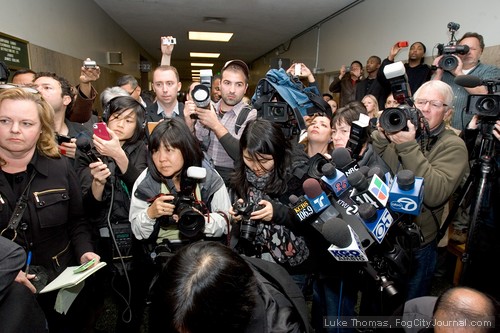
Clearly, these are complicated issues that raise a variety of questions, which is why it was disconcerting yesterday when Lee announced the charges to a room packed with journalists and refused to take any of our questions. City Attorney Dennis Herrera didn’t speak at all, simply standing behind Lee looking stone-faced and perhaps a bit uncomfortable.

Earlier today, I sent Lee and his Office of Communications a list of questions that I think he has a public obligation to address given the drastic action that he’s just taken against an elected official. I haven’t received a reply yet, but I’m including my comments here for you to consider as well:


I was disappointed that Mayor Lee took no questions during yesterday’s press conference, because I had several that I’m hoping you can address for a long story we’re writing on the Mirkarimi affair for our next issue. I’m hoping to get answers by the end of the workday on Friday.
– Will Mayor Lee release the memo he received from the City Attorney’s Office on Ross Mirkarimi and whether his crime rises to the level of official misconduct? [Note to reader: That advice memo is different than the charges I discuss above.] It is solely under Lee’s authority to waive attorney-client privilege and release the memo, as even Willie Brown urged him to do in his Chronicle column on Sunday. And if he won’t release it, can he explain why?
– Lee told reporters last week that he would explain why Mirkarimi’s action rise to the level of official misconduct if concluded they did, but Lee didn’t offer that explanation yesterday. Why does Lee believe actions that Mirkarimi took before assuming office, which were unconnected to his official duties, warrant his removal from office? Is Lee basing his decision primarily on the crime Mirkarimi committed on New Year’s Eve or his actions and statements since then? What specific actions or statements by Mirkarimi does the mayor believe rise to official misconduct?
– Why didn’t Lee consult with Eliana Lopez or her attorney before making this decision? None of the purported evidence in this case has been scrutinized by the courts as to its veracity or completeness (that would have happened at the trial). The only two people who know for sure what happened that night are Ross and Eliana, so why hasn’t Lee asked either of them what happened?
– Why did Lee set a 24-hour deadline for Mirkarimi to resign or be removed? Did Lee offer Mirkarimi anything in exchange for his resignation, such as another city job?
– Who did the mayor consult with about whether Mirkarimi should be removed before making this decision? Were any members of the DSA or SFPOA consulted? How about Rose Pak or other members of the business community? How about Michael Hennessey? Did he seek input and advice from John St. Croix or anyone from the Ethics Commission?
– It’s my understanding that the mayor wasn’t required to remove Mirkarimi from office without pay pending his official misconduct hearings, that Mirkarimi could have either remained in the job or been suspended with pay. Why did Lee feel a need to place this additional financial pressure on Mirkarimi to abandon the office that voters elected him to? Is he concerned about the impact of his decision on Eliana Lopez and Theo?
– Mayor Lee has prided himself on being someone focused on “getting things done” without creating unnecessary political distractions. So why does he want to drag out this distracting political drama for another few months? Why does he believe that it’s a good use of the city’s time and resources to be a forum for airing details of a sordid conflict that has proven to be a divisive issue? Is he worried about exposing the city to liability in a civil lawsuit if his charges against Mirkarimi are later found to be without merit?
– Does Lee intend for Vicki Hennessy to be the permanent replacement for Mirkarimi if the official misconduct charges are upheld? Will he take into account the will of the voters in electing Mirkarimi, someone who had pledged to uphold and continue the legacy of progressive leadership of the Sheriff’s Department as embodied by the long career of Michael Hennessey? Given that the DSA consistently opposed Hennessey at election time, and that in this election voters rejected the DSA’s choices, why is Lee substituting his own judgment and political preferences for those of San Francisco’s voters? Why did Lee feel a need to take preemptive action against Mirkarimi rather than simply allowing voters to launch a recall campaign, which is the typical remedy for removing politicians who have gone through some kind of public scandal?

UPDATE 3/26: Mayoral Press Secretary Christine Falvey told the Guardian that we would have answers to these questions by Friday, but then sent the following message as a response late Friday afternoon: “Steve, After looking at your questions, it seems Mayor Lee addressed much of this in his comments on Tuesday. After Sheriff Mirkarimi pleaded guilty to a crime of false imprisonment, Mayor Lee made a thorough review of the facts, reviewed his duties under the Charter and gave the Sheriff an opportunity to resign. When that did not happen, he moved to suspend the Sheriff. For any information regarding what is in the charges, I will refer you to the City Attorney’s office and their website that has all of the public documents posted.”

For the record, Lee has not addressed these questions nor made any public statements on whether he will release the advice memo (as even Willie Brown publicly urged him to do) or explained why he’s keeping that document secret. And we haven’t even had the opportunity to ask the mayor these questions directly because he hasn’t held any public events since announcing his decision to remove Mirkarimi.
Supervisors hope to halt foreclosures with new resolution

70

John Avalos introduced a resolution today urging support for homeowners facing foreclosure in San Francisco. The resolution calls for several actions, including suspending all foreclosures until state and federal measures to protect homeowners are in place.

Sponsors of the resolution Avalos, David Chiu, Jane Kim, Eric Mar, and Christina Olague joined a coalition of community organizations to explain the resolution at a press conference.

The resolution would call for support of a statewide Homeowners Bill of Rights, a series of bills that would address predatory loans and robosigning, as well as California Attorney General Kamala Harris’s campaign for a statewide suspension on foreclosures in properties controled by Fannie Mae and Freddie Mac. It also “urges all city and county officials and departments to work proactively to ensure that San Francisco residents do not fall victim to unlawful foreclosure practices,” as Avalos explained.

Supervisors cited a report released in February by Assessor Phil Ting as one of the reasons for the resolution. The report found “irregularities” in 99 percent of foreclosure documents in San Francisco between 2009 and 2011, and “what appear to be one or more clear violations of the law” in 84 percent of cases. 

The resolution’s language also names “predatory banking practices that disproportionately targeted racial and ethnic minority communities, especially working class African Americans and Latinos” as an impetus for the resolution, noting that “from 2007 to 2008, Wells Fargo, and mortgage lenders it has since acquired, was 188 percent more likely to put African American borrowers and 117 percent more likely to put Latino borrowers into higher-cost, subprime loans.”

“What we see around foreclosures is that we have a systemic problem,” said Campos. Over 1,000 homes in San Francisco are currently in the process of foreclosure, 

Supervisor Kim connected the issue to another systemic problem affecting San Francisco, that has been a recent topic of discussion at City Hall: family flight. 

“We do have many low-income families that are actually homeowners in the city, primarily in the southeast sector. But how they afford to buy homes is by squeezing often two to three families in these homes in the southeast. So we’re talking about not just one household when we foreclose on a home, we’re often talking about two, three families with multiple youth and seniors,” said Kim.

“This is something that has been an important issue for many of our supervisors across the political spectrum, is how to retain families in San Francisco. Stopping foreclosure has to be a key part of that.” 

A few supervisors congratulated community organizers for focusing on the foreclosure crisis.

“I want to thank Occupy Bernal for not only shedding light on what’s happening in Bernal Heights, but realizing that the foreclosure crisis that we’re facing is something that involves all of us. Every single neighborhood,” said Campos.

The resolution was introduced to the Board of Supervisors March 20. It will be discussed further at the Land Use and Economic Development committee meeting April 2. 

If it eventually passes the Board of Supervisors, the resolution will be non-binding; a citywide foreclosure moratorium is likely not imminent. Yet many supporters expressed urgency and commitment for city action to address foreclosures. 

“When speaking with the sheriff about how we can stop evictions, what struck me most was he said that sometimes when we walk into these homes, we’ve found that people have committed suicide before the sheriffs even come in,” said Supervisor Kim. “This is a life and death issue for many of our residents.”


Mayor Lee ousts Sheriff Mirkarimi

96

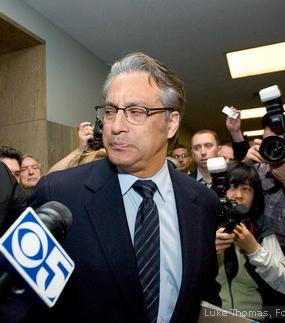
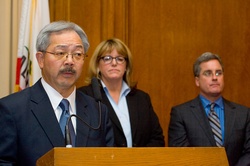
San Francisco Mayor Ed Lee temporarily removed Sheriff Ross Mirkarimi from office today over a domestic violence case, dragging this long and sordid saga into the summer as city officials prepare a rare official misconduct hearing.

The brief announcement came just minutes after a 24-hour deadline Lee had set for Mirkarimi to resign or be removed. Lee took no questions from the huge crowd of journalists that had packed into his office and offered scant explanations about why he believes the process is warranted and how it will affect the city.

Standing behind Lee were City Attorney Dennis Herrera, with whom Lee had consulted on the decision, and Vicki Hennessy, a retired chief deputy from the Sheriff’s Department who Lee named interim sheriff. Shortly before the announcement, Mirkarimi told reporters he had no intention of resigning.

“He has chosen not to resign and now I must act,” Lee told reporters, emphasizing that “I do so with an understanding of the seriousness and gravity of the situation.”

Lee made no statements about how Mirkarimi’s guilty plea to a misdemeanor false imprisonment charge – reduced down from the three more serious charges he originally faced – rose to the level of official misconduct or why it warrants his removal, other than making general statements about ethics.

“We must always be held to the highest ethical and legal standards,” Lee said, adding that Mirkarimi had failed to do so. “I’m doing what’s in the best interests of the people of San Francisco.”

Time may tell whether that last statement is true, and whether the Ethics Commission and nine members of the Board of Supervisors agree and are willing remove a public official from office in San Francisco for just the third time in the last century.

Threats from mayor and neighbor in evolving Mirkarimi saga

43

In Old West and pulp fiction stories, it’s usually the sheriff who tells a criminal that he has 24 hours to get out of town or else. But in the latest twist in an increasingly ugly San Francisco drama, that’s what Mayor Ed Lee reportedly told Sheriff Ross Mirkarimi yesterday afternoon, setting up a 5 pm showdown by which Lee told Mirkarimi to resign or face removal from office.

That’s just one of a few rapidly unfolding developments surrounding domestic violence allegations against Mirkarimi, who pleaded guilty to a reduced charge of false imprisonment and is now facing Lee’s threat of bringing official misconduct charges against him.

With the criminal case ending yesterday, Mirkarimi’s wife, Eliana Lopez, and her attorney Paula Canny called a press conference for noon today to finally tell the story of what happened on New Year’s Eve, when the couple fought and Lopez was left with a bruise on her arm, the next day telling neighbor Ivory Madison that Mirkarimi had inflicted it.

But Canny arrived without Lopez, telling the large pack of journalists that they were no longer free to talk because of a cease-and-desist letter and civil lawsuit threatened by Madison and her lawyer husband, Abraham Mertens, who wrote an op-ed in today’s Chronicle calling for Mirkarimi’s removal and accusing Mirkarimi, Lopez, and their lawyers of trying to “discredit, dissuade and harm my wife.”

“Events have risen so that Eliana Lopez is no longer willing to come speak,” Canny said, noting that she has had to get her own lawyer to defend against the accusations and legal threats from Mertens and Madison. 

[added from here at 3:30 pm] Canny repeated a previous claim that Lopez knew Madison had attended law school and was seeking legal help from her, making the videotape confidential under attorney-client privilege, a claim Mirkarimi’s judge rejected. “My client sought legal advice from someone she thought reasonably to be an attorney,” Canny said today, noting that only Lopez can lift the veil of confidentiality in such cases.  

Although Lopez didn’t cooperate with the prosecution of her husband, maintaining that she was not a victim of domestic violence, Canny reiterated that Lopez was willing to testify in court as to what really happened that night but that she wanted immunity from prosecution first. “She has always said she would testify under immunity, but the District Attorney’s Office refused to offer it,” Canny said today. 

Given that Mirkarimi faced a child endangerment charge because their two-year-old son, Theo, was present during the altercation, it’s conceivable that Lopez could also be charged with a crime. Sources close to Mirkarimi and Lopez told the Guardian that Lopez was prepared to say today that Mirkarimi was restraining rather than attacking her, something she was willing to discuss with reporters before these latest legal threats.

Canny noted that the media circus and threats made on the couple’s livelihood have been the most damaging part of a saga that she called “an amazing, horrible experience” and  “oppressive and unfair,” noting the irony of a prosecution that purported to be about helping victims of domestic violence.

“Has any of this helped Eliana Lopez? Has any of this helped Theo?” Canny said. “This is not about helping her.”

She said that neither Lee nor anyone from the Mayor’s Office have tried to contact Lopez. “If the mayor wants to call me, I’d say he’s not trying to make the world a better place,” Canny said.

Canny also had this message for Lee: “To the mayor, please respect the electoral process,” adding that Lopez also strongly wants Mirkarimi to remain in office and that “Eliana Lopez is not afraid of Ross. Eliana Lopez loves Ross…If people care about them at all, let Ross do his job.”

Canny also took issue with La Casa de las Madres and other domestic violence advocates that have pressured Lee to oust Mirkarimi and sought to capitalize on the case, even circulating Lopez’s name and image. “That’s not how crime victims are to be taken care of,” Canny said. 

Many political and legal observers say they’re surprised by Lee’s apparent decision to suspend Mirkarimi and bring official misconduct charges, saying it will be a complicated, distracting, and divisive process that is unlikely to result in Mirkarimi’s removal. They say the charges so clearly don’t rise to the level of official misconduct that even the Ethics Commission, where the hearing is held, may reject them. If Ethics recommends Mirkarimi’s removal, it was take nine of the 11 members of the Board of Supervisors to remove him.

Then again, these observers speculate that Lee may simply want to use the hearings to air the evidence and discredit Mirkarimi so that he’d be easy pickings for a recall campaign that could be launched this summer — in the process, potentially gaining a campaign issue to use against progressive supervisors facing reelection this fall. The Chronicle reported yesterday that the case has generated a bonanza of donations to La Casa de las Madres, which is planning to do Spanish-language billboards in the Mission District, where Sup. David Campos is now running for reelection.

Lee has not offered many substantial comments on why he may believe official misconduct charges are warranted, but he’s expected to do so as soon as this afternoon when he announces his decision on the Mirkarimi matter.


Editorial: Mayor Lee: Ease off Mirkarimi and help stop the foreclosure crisis

16

And so the downtown gang (Willie Brown/Rose Pak, PG&E, the Chamber, the big developers et al) used Ed Lee to outmaneuver the progressives and roll Lee into the job of “interim mayor” on condition Lee not run for mayor.  Then Lee kept lying for months about his intentions and saying over and over that he would not run for mayor–until the downtown gang convinced him to run as a way to further damage the progressives. And now, according to news reports, Mayor Lee is poised to file misconduct charges against Mirkarimi for his gulty plea of false imprisonment in the Mirkarimi domestic violence case.

This could lead to an explosive and polarizing scenario where the Board of Supervvisors, in an election year, would be asked to remove Mirkarimi, a former fellow supervisor and political ally, as sheriff or side with him on what has turned out to become a toxic political issue. This would affect at minimum Mar, Avalos, Campos, and Olague in the supervisors’ races and Mar, Avalos, and Campos in the upcoming Democratic County Central Committee race. It would also affect any candidate in any race that said a nice word about Mirkarimi.  If anybody thinks the mayor and the downtown gang would be unhappy with this prospect, think again. I recommend that Lee hold off on Mirkarimi, and work to uphold his position as a “unifier,” and not become a polarizer and promoter of media and City Hall circuses. Instead of taking on Mirkarimi and the progressives, he should concentrate on such important and timely issues as helping stop the foreclosure process on the thousands of homes facing foreclosure in San Francisco. More: he should go after the big foreclosure banks, starting with the Bank of America and its multi-million dollar short term cash account with the city, and  Wells Fargo, with its national headquarters here in town.b3

More than 1,000 homes in San Francisco are either in foreclosure or at the start of the process. Some 16,000 homeowners are underwater, and as many as 12,000 may face foreclosure in the next 12 months. A report by the Alliance of Californians for Community Empowerment shows that the city could lose $115 million from the reduced property taxes and the costs of carrying out evictions.

That’s a crisis — and while the mayor has no direct control over home foreclosures, he ought to be speaking out and joining the protesters who are fighting this cascade of often-fraudulent bank actions.

The problems are legion: An audit released in February by Assessor Phil Ting shows that more than 80 percent of the foreclosure notices filed in San Francisco contain at least one legal irregularity, and many contain multiple. Banks back-date documents, use faulty information, and in some cases clearly and directly break the law when they move to seize property — often because of bad-faith loans that were more the fault of the banks than the homeowners.

A group from Occupy Bernal, the well-organized, sophisticated operation that’s been intervening in foreclosures and evictions in the Southeast neighborhoods, visited us recently, and the stories we heard were alarming. Some told of bankers who promised to make loan modifications — then went ahead with foreclosure anyway. Some people spend weeks just trying to figure out who actually owns the mortgage — and while the financial institutions are ducking calls and hiding from responsibility, they’re moving forward to toss people out of their homes.

ACCE and Occupy Bernal have had some successes — they slowed down foreclosure actions, forced banks to come to the table and in some cases saved homes. But the activists are up against big corporations and big numbers — too many homes on the block, too many financial institutions, and not enough people and money.

The Ting report showed enough violations of law that we’ve already urged the city attorney and the district attorney to start taking action.

But we’ve heard little beyond silence from the office of Mayor Ed Lee.

Lee’s the city’s chief executive, the person who has to handle the financial fallout of the foreclosure crisis as well as the human impacts — families evicted from their homes have a high chance of winding up on the streets, putting additional pressure on already-stressed social services.

Besides, this is a tragedy — and a lot of the problem is simply unaccountable, unreachable financial institutions. If Occupy Bernal and ACCE, through volunteer organizing and community pressure, can prevent a fair number of evictions, think of what the mayor of San Francisco could do — just by speaking out.

Lee ought to show up at some of the Occupy Bernal actions, but that may be too much to ask. But it’s not too much to suggest that he publicly support the foreclosure fighters and call on the banks to work with local homeowners.

The city keeps its multibillion-dollar short-term cash accounts in institutions like Bank of America, which is responsible for more than 10 percent of all foreclosures in the city. Wells Fargo, with its headquarters right here in town, is responsible for 22 percent of the local foreclosures. Lee ought to let the banks know the city won’t keep doing business with bad actors.

With a little visibility, the mayor could help save hundreds, maybe thousands of families from facing homelessness. This crisis calls for leadership; where’s the mayor?

Club bouncers and FBI spies keep us safe from the terrorists

5

The post-9/11 hysteria over terrorist threats continues to the day, taking many forms. The San Francisco Board of Supervisors is poised to give final approval tomorrow (Tues/20) to limitations on the SFPD’s participation in the FBI’s Joint Terrorism Task Force, legislation that ever-vigilant Mayor Ed Lee may veto.

But it turns out there are already thousands of eyes on San Francisco’s streets looking out for terrorists and their dreaded (and fabled) Weapons of Mass Destruction, something I learned today when the California Music and Culture Association announced a training it is sponsoring for nightclub security guards.

The training includes four hours of “power to arrest,” which makes sense. But it also includes another four hours of “WMDs & Terrorism Awareness,” which strikes me as paranoid to the point of lunacy. Are we seriously worried about a terrorist plot to destroy the godless heathens at the Makeout Room?

I didn’t realize CMAC was so paranoid, so I contacted the organization and learned that this is actually a requirement under state law governing private security officers, passed in 2005 as legislation sponsored by Abel Maldonado, then a Republican Assembly member from Santa Maria. Yeah, that made a bit more sense. Right-wingers see terrorist plots everywhere.

So while the FBI (with or without SFPD’s help) taps our phones and reads our mail, the bouncer at the club on the corner is keeping a watch out for suicide bombers disguised as ravers and dirty nukes hidden in DJ’s record boxes. Gee, I feel so much safer now.

Mirkarimi sentenced, absent drama

59

The drama that hordes of reporters were waiting for didn’t happen. District Attorney George Gascon’s threat to “bring up” at Sheriff Ross Mirkarimi’s sentencing the notion that Mirkarimi didn’t really think he was guilty vanished. Mirkarimi sat in front of Judge James Collins, who years ago helped a sitting judge duck a domestic violence charge, and agreed to the terms of his sentence (three years probation, mandatory attendance at a 52-week DV counseling program and some modest fines). Deputy District Attorney Elizabeth Aguilar-Tarchi said she had nothing to add; neither did Mirkarimi’s lawyer, Lidia Stiglich. And that was that — as far as the courtroom went.

Outside, Mirkarimi faced the expected scrum of cameras and microphones, and read a prepared statement that sounded as if the district attorney had insisted on it. “I deeply and humbly apologize for my behavior,” he said. “There are no excuses and I accept full responsibility.” He said he had started counseling “to remedy my arrogance and anger issues” and apologized for saying earlier that the incident was “a private family matter.”

And he gave no signs of being ready to step down, saying he would “work so much harder to regain your trust … to be a better public servant.”

An hour or so later, Gascon faced the same press crew and announced that he had treated this case “just like any other domestic violence incident.” He denied that there was any political motivation; in fact, he denied it twice. He never made exactly clear why he had decided not to intervene after all at the sentencing hearing, except to say that Mirkarimi’s statements after receiving his sentence were satisfactory (see above).

He said he’s a “strong believer in redemption and restorative justice” and said this deal would “offer [Mirkarimi] an opportunity to redeem himself.”

Which, of course, led to the question of the day: Did Gascon think Mirkarimi could, or should, hold onto his job? Phil Matier from the Chron asked it directly, and Gascon refused to answer, saying “it’s not my place” to say. I tried again a few minutes later, asking if, given Gascon’s belief in redemption, there was any possibility that the sheriff could sufficiently redeem himself to remain in his elected position. Again: “It’s not my place to say.”

It was, however, what everyone was talking about. Matier and Ross reported that Mayor Ed Lee was huddling with lawyers to try to figure out whether he has legal grounds to begin the process of removing Mirkarimi from office. It’s tricky, and has only happened twice in the last 100 years, once in the 1930s, when a public defender was involved in a murder-for-hire case, and again in the 1970s, when an airport commissioner who was also a union official was charged with favoring union workers.

One obstacle, according to Matier and Ross: The D.A.’s Office won’t give Lee the video that was at the heart of this case. Gascon confirmed that, saying the video was considered internal work product and wouldn’t be released to anyone.

The law on removing a sitting elected official in San Francisco is murky and confusing, with little precedent. Does a guilty plea to false imprisonment of his wife equal “official misconduct?” Can an incident that took place before Mirkarimi became sheriff count as misconduct in the office he assumed later?Would the supervisors hold a public trial? What rules of evidence would apply?

The politics are murky, too: If Lee files charges, he’ll be tossing the matter to the Board of Supervisors in an election year, which the supes will hate and it will be a blow to the concept of civility that the mayor tries so hard to promote. If he doesn’t, then in the unilkely event that Mirkarimi does anything else bad, critics will blame the mayor for not acting.

So this isn’t over yet.

Meanwhile, the award for the most inappropropriate question at the Gascon news conference goes to the San Jose Mercury news reporter who, after much discussion about whether Mirkarimi could carry a weapon again and when the stay-away order would be lifted, asked (I kid you not):

“Which should he get back first — his gun or his wife?”


Mayor Lee discusses removing Mirkarimi from office

24

Mayor Ed Lee today seemed to take a step back from his quote in today’s San Francisco Chronicle that his “gut feeling” was that Sheriff Ross Mirkarimi’s guilty plea to a misdemeanor false imprisonment charge represents a conflict with Mirkarimi’s official duties that could warrant his removal from office.

Speaking to reporters after an appearance before the Board of Supervisors, Lee said he hasn’t made up his mind whether to charge Mirkarimi with official misconduct – which would ultimately require at least nine of 11 supervisors to vote for removal over what was alleged to be an incident of domestic violence – but that Lee said he would probably make that decision next week.

“My gut reaction wasn’t that,” Lee said when asked about his newspaper quote, explaining that he was simply surprised when the new charge replaced the three that Mirkarimi had initially been charged with: domestic violence, dissuading a witness, and child endangerment, all misdemeanors. 

“In the surprise of the legal settlement of the case, I’m required to take a look at this charge that wasn’t talked about before and determine whether those charges and the factual allegations behind those charges are measured up to the standard I have to deal with, which is official misconduct. And I have to allow myself enough time to do that with our City Attorney’s advice to make sure I’m on good legal footing. I was just surprised because it wasn’t one of the original charges,” Lee said, noting he had been doing research on the previous charges.

“Because it’s a new charge and one that was accepted by the courts as well, I have to make a thorough study of that, which is something I wasn’t prepared to do,” he said.

When asked whether the term “false imprisonment” (a broad legal charge that can mean different things depending on the context) affects his approach, Lee responded, “The word false imprisonment is obviously connected to a sheriff who does make a determination about imprisonment in general. But we’re going through the elements of what false imprisonment are and what the factual basis is and then, again, reapplying that to the standards of official misconduct.”

As for the timeline of his decision, Lee said, “I think it’s appropriate to wait until after the sentencing,” which is set for Monday, “so probably sometime next week.” Later, he said, “I am cognizant of the public distraction this case has made to the office, so I’m doing the best I can to comply with at least my own time frame.”

We asked Lee why he thought the charges – which resulted from an incident on New Year’s Eve in which Mirkarimi’s wife allegedly told a neighbor that he grabbed her and left a bruise on her arm – might rise to the level of official misconduct, particularly considering he hadn’t been sworn into office yet.

Lee replied, “That’ll be part of the assessment because I don’t think there’s an automatic thing here. He was elected and this was post election, so it doesn’t matter when he was sworn in and I think he was expected to be sworn in, so we have to take into consideration all of those elements.”

Supervisors ban illegal SFPD spying, but veto threat looms

15

The Board of Supervisors today gave initial approval to legislation that would prevent the San Francisco Police Department from working with the FBI to spy on law-abiding citizens, but the 6-5 vote wouldn’t be enough to overcome a possible veto by Mayor Ed Lee, which would take eight votes.

SFPD officials have said the measure is unnecessary because Police Chief Greg Suhr and the Police Commission last year approved a Department General Order requiring officers to obey state and local privacy laws, which they say supercedes the MOU that the SFPD secretly signed with the FBI in 2007 placing local officers under federal control. That secret document was unearthed last year by the ACLU, causing a local furor.

But supervisors who support the measure and the broad coalition that is supporting it, ranging from the Asian Law Caucus to groups representing Muslims who have been targeted with federal surveillance since 9/11, say it is important to enshrine these protections in city law and they don’t understand the SFPD resistance to doing so.

“If this is that important to us, if we believe in these values, then it deserves to be codified in our laws,” said Sup. Jane Kim, the measure’s main sponsor. “I was shocked to discover our city entered into a secret agreement with the FBI,” said President David Chiu, adding that while he trusts Suhr to oppose illegal spying, this legislation was about ensuring successive chiefs and members of the Police Commission uphold that standard.

Sups. Scott Wiener, Malia Cohen, Sean Elsbernd, Mark Farrell, and Carmen Chu voted against the measure, but Wiener was the only one who tried to explain his vote, much to the disappointment of the large coalition that showed up to support the legislation.

“This has been a tough issue for me and I’ve struggled with it,” Wiener said, sharing Chiu’s outrage over the secret memo and his position on the government spying on citizens who aren’t suspected of a crime. “We have our own local policies that SFPD officers are required to comply with,” Wiener said. “The question for me is whether this needs to be legislated.”

The legislation is set to receive final approval at next week’s board meeting, after which Mayor Lee will have 10 days to sign it or issue the second veto of his run as mayor (the first, also controversial, was over legislation to close a loophole in the Health Care Security Ordinance that allows businesses to at the end of the year raid employee health savings accounts they set up to comply with city law requiring employee health coverage).

Before the vote, as he was leaving his monthly Question Time session with the board, I asked Lee about his position on the SFPD spying measure and he said, “I’ll be getting an update. The chief who I appointed has been working directly with the supervisor on this and he’ll be reporting to me all his efforts soon so I can make a determination. I’d like to have input for our Police Commission as well before announcing what we’re going to do about it.”

After the vote, I asked Kim about the threat of a veto and she said, “It’s definitely a concern and we as a community need to think about what our next steps are.” Activists said they plan to lobby supervisors who opposed the measure and the Mayor’s Office. “Talk to your communities, let them know the supervisors who supported it and the supervisors who didn’t support it,” Fairuz Abdullah, former president of the Bay Area Association of Muslim Lawyers, told the group of about two dozen. “This is a great showing, but it needs to continue.”

Domestic violence is not a private matter

3

EDITORIAL The legal case against Sheriff Ross Mirkarmi has been essentially settled, with the sheriff pleading guilty to false imprisonment and avoiding a trial on domestic violence charges, but the political case is just beginning.

Already, there are calls for Mirkarimi to step down. And Mayor Ed Lee announced March 12 that he’s Mirkarimi’s plea to “a very serious charge that had introduce a new set of legal issues” merits a thorough review.

That could lead to an explosive scenario where the Board of Supervisors, in an election year, would have to vote on whether to remove a sheriff who many of the supervisors have worked with and supported over allegations that are in effect political poison. Anyone who wasn’t ready to throw the sheriff out of office could be accused of coddling a wife-beater.

Mirkarimi’s friends and allies say the sheriff didn’t want to plead guilty to anything. But the questionnaires that potential jurors had filled out showed that virtually everyone who might sit in judgment had read the sensational media coverage of the case, and Judge Garrett Wong had refused to move the trial elsewhere. The judge also rejected every significant motion Mirkarimi’s attorney, Lidia Stiglich, made, and allowed into evidence material that the sheriff’s team didn’t think should be admissible. So the situation looked bleak, and Mirkarimi took a deal.

Mirkarimi maintains his innocence, and says he has no intention of stepping down. He agreed to plead guilty to a crime that had very little to do with what happened New Year’s Eve, when the District Attorney’s Office said he got into a physical altercation with his wife that left her with a bruise on her arm. False imprisonment was never one of the original charges; as is often the case in criminal cases, both sides accepted a less-serious charge in the name of getting the deal done.

Why Mayor Lee sees that as “a new set of legal issues” is baffling; the issues are exactly the same as they were before the plea bargain. None of this is to say that the original charges, backed up by well-publicized (although never fully examined in court) evidence, aren’t serious. Domestic violence, as we’ve said repeatedly, is not a private matter, is not a minor crime, and has far too often been ignored by the courts, police, and prosecutors, sometimes with deadly consequences.

But the way this could play out will open Lee to charges of political opportunism. The mayor would need to charge Mirkarimi with “official misconduct,” which is defined in the City Charter:

“Official misconduct means any wrongful behavior by a public officer in relation to the duties of his or her office, willful in its character, including any failure, refusal or neglect of an officer to perform any duty enjoined on him or her by law, or conduct that falls below the standard of decency, good faith and right action impliedly required of all public officers and including any violation of a specific conflict of interest or governmental ethics law.”

Other than the “standard of decency” statute, which is pretty vague, there’s not much in there for Lee to go on. Unless you say that because Mirkarimi pleaded guilty to a crime with “imprisonment” in the name he’s somehow a threat to the inmates at the county jail, which is a huge stretch, it’s hard to call this “official misconduct.” (There is, on the other hand, the argument that Mirkarimi will be on probation, and thus part of the criminal justice system he oversees, and that it’s an inherent conflict of interest. That, however, would mean any sheriff who was on probation for anything would be ineligible to serve, which again is a stretch.)

If the mayor files official misconduct charges, and the Ethics Commission, by a supermajority, agrees, then the Board of Supervisors would serve in effect as a trial body, much as the U.S. Senate does in an impeachment case. Nine of the 11 supervisors would have to vote to permanently remove the sheriff from office.

If Lee takes that path, he’ll be setting in motion a political process that was designed in the Charter for highly unusual situations and has only been used once in the past 40 years. (And in that case, involving Airport Commission member Joe Mazzola, a court later ruled that the charges, involving his role in plumbers’ strike, didn’t rise to the standard of official misconduct.) You have to ask: Is this case, and this misdemeanor charge, worthy of the exercise of what is, by any standard, an extraordinary power vested in the city’s chief executive? Is it worth the political circus that would result from a trial by the supervisors (some of whom might well be asked to recuse themselves because of their prior relationships with Mirkarimi, making it almost impossible to reach the magic number of nine anyway)?

If the voters of San Francisco think the sheriff needs to go, there’s the right of recall — and it will be available the first week in July, when Mirkarimi will have served six months. If there’s not enough organized opposition to make that happen, he’ll be facing the electorate again in three years (and trust us, he will be opposed and every details of these charges will be part of the campaign). He’s going to pay for this far beyond his court-ordered probation and fine.

Whatever the plea deal, Mirkarimi was clearly involved in a bad conflict with his wife that turned physical. Unless the evidence we’ve seen so far is completely misleading, it’s clear that he left her with a bruise — and that he was at the very least nasty and more likely emotionally abusive to her. Now that the legal case is over, he needs to come clean and tell the public exactly what happened that day, at which point we can all decide if we believe him, if he’s shown that he’s changed, and if the public is willing to give him a chance at redemption.

But Lee should think very seriously before he escalates this by filing misconduct charges. Since the ones who have the most to lose from that are the progressives on the board who are often Lee’s foes, it will have the stench of political maneuvering — and at this point, nobody needs that. The mayor says he’s a unifier; this would be the most divisive thing he could do.

Olague explains her support for RCV repeal measure

52

  Sup. Christina Olague has drawn ire from progressive circles over her pivotal co-sponsorship of a proposed charter amendment that aims to eliminate Ranked Choice Voting in all citywide races. It takes six members of the Board of Supervisors to place the repeal measure on the November ballot and she is the sixth co-sponsor.

Olague has long ties to the progressive community and was appointed by Mayor Ed Lee to the District 5 seat, one of the city’s most progressive, in January after Ross Mirkarimi was elected Sheriff. This week, she joined Sean Elsbernd, Carmen Chu, Scott Wiener, and Malia Cohen – all considered moderate/conservative supervisors – in supporting Sup. Mark Farrell’s proposal to replace RCV with runoff elections for the mayor’s race and other citywide offices.

“To me, this isn’t a progressive or moderate issue. This is a democratic one here in San Francisco,” Farrell said during Tuesday’s Board of Supervisors meeting, where he introduced the measure, which will have a hearing next month. “Ranked Choice Voting has continued to confuse and disenfranchise voters here for over a decade and, in my opinion, it’s time to restore our voting system to the one person, one vote rule.”

Farrell’s sentiments mirror a similar line trumpeted by the San Francisco Chamber of Commerce, a supporter of runoff elections and longtime opponent of RCV. A recent poll commissioned by the Chamber, which claims 58 percent of respondents prefer runoff elections, has been discounted as biased and based on misleading statements. Farrell, who was elected to the District 2 seat in November using RCV, said he would have prefers to eliminate RCV altogether in San Francisco but said, “This is a significant step in the right direction.” A proposed ballot measure by Farrell and Elsbernd to eliminate RCV was rejected by the Board of Supervisors last month.

Steven Hill, who helped crafted the city’s voter-approved RCV system, criticized the move to repeal it: “Critics of RCV have long maintained that voters are confused and even disenfranchised and yet they have offered no credible evidence to support these claims. In fact, the evidence shows just the opposite, that voters understand what they have to do with RCV, which is to rank their ballots, 1, 2, 3, and they are using their ranked ballots effectively.”

In an interview conducted as she was departing the Westbay Community Center on Thursday, Olague initially rebuffed our request to discuss her support for Farrell’s amendment (just as she had an earlier request by the Guardian), but she ultimately relented.

Here’s what she had to say:

Olague: “What it is is that it begins a conversation.  There was talk of eliminating RCV altogether, which I certainly don’t support.  There was talk from a lot of different corners, not just moderate circles, but progressive circles as well, that maybe we need to examine it and see how has it or has it not really been – has it really helped us reach our goals in the way that we had originally intended that it would.”

SFBG: What were those goals?

Olague: “I think it was to try to make sure that more progressives were elected… and make it easier for people who had lesser means to prevail… So I think maybe it is time to reflect on that a little bit.”

SFBG: What parts of RCV don’t you like or don’t support?

Olague: “Well, I think it’s just time to have a conversation about it.  I’m not even sure that I’m against it, per se. When I signed on to it, I believed it was looking at keeping some of the citywide races, where there are fewer numbers of candidates engaged, to reverting back to a runoff, and keeping the races where we have a diversity of candidates and numerous candidates, which are the district races, as they are – which is ranked choice voting.”

“Now there’s some people who say what we need to do is, well, maybe revisit that and maybe just, rather than have it apply to all citywide races, maybe it should just apply to the mayor’s race.”

“So I think there needs to be a conversation and there needs to be a reflection on its effectiveness.  I think that’s what [Sup. John] Avalos and even [Sup. David] Campos were thinking that there needs to be more education – and I do think there needs to be more education as it relates to RCV.”

SFBG: Voters don’t seem to be confused about filling out an RCV ballot, but maybe there’s confusion about how votes are tallied and candidates are eliminated.  It would appear that there’s a myth being spread that voters are confused about filling in a RCV ballot, but that doesn’t appear to be the case…

Olague: “Do you know that?  I think when you talk to people out there on either side of spectrum, politically, I think there’s still a lot of – I don’t think that people have necessarily concluded that this is the most effective way of achieving certain goals.  But, you know, I think it starts a conversation and it may end up that the voters decide, you know, let’s just leave it the way it is, we’re happy with it.”

SFBG: And how would you feel if RCV is completely eliminated?

Olague: “Well it’s not going to be eliminated because there’s nothing in the charter amendment asking that RCV be eliminated.  What I was concerned about was that there was a push to eliminate it altogether, which I don’t support.  What this does, I figured I’ll meet them halfway because I can’t support a complete repeal of RCV and currently the way this charter amendment is drafted, what is does is it keeps RCV in the District elections.  That stays the same, and the citywide elections would be reverting back to a runoff, so it goes to a more citywide for a runoff, ranked choice voting for District [elections]. There is an argument to be made for why that should be the case.”

SFBG: Wouldn’t this eliminate a diversity of candidates if there were a repeal of RCV in citywide races?

Olague: “So let’s have the debate and people may decide, you know, if it’s not a good idea. People may decide they want to push to amend the charter amendment as it is before us.  Some people are thinking it should just apply to the mayor’s race and not other citywide races like public defender and others. So maybe there’ll be amendments to the charter amendment before it even hits the ballot.”

SFBG: Why do you think some people are up in arms over your support on this?

Olague: “I guess, you know, I mean – I just think that everyone is going to sit around and wait for something, right?  They’re, sort of, laying in wait, right? So it’s just what it is, you know – it’s like people are going to agree with me sometimes, they’re not going to agree with me other times.  There are some things that I am doing that is progressive, there are some things people will perceive as not being progressive.”

SFBG: Did you come to this decision by yourself, or was there any influence or pressure from others to vote the way you did on this?

Olague: “No.  I just think it’s funny because it’s like I don’t really succumb to pressure.  I’m willing to start the conversation at some kind of a compromise.  To me, this is as close to a compromise as we’re going to get and then it can start the conversation. So I think the conversation will start and people can assume all kinds of things, and they will.”

SFBG: So you voted in good conscience?  You didn’t have any doubts about your vote?

Olague: “I vote in good conscience, but sometimes you have to go with a compromise.  It’s not completely what you want and it might not be completely what you don’t want, but the alternative might be something that is completely unacceptable, which could be the complete elimination of RCV.”


A version of this story also appears on Fog City Journal, which is run by Luke Thomas.

SFPD-FBI spying restrictions could face mayoral veto

8

If the San Francisco Police Department isn’t working with the FBI to secretly spy on law-abiding local residents – as a secret document released last year indicated they had the authority to do – then why are Police Chief Greg Suhr, Mayor Ed Lee, and others opposing legislation that would ban such surveillance?

That’s the question that longtime police policy expert John Crew of the American Civil Liberties Union of Northern California is asking as he tries to get two more members of the Board of Supervisors to join the six current co-sponsors of the legislation, which the board will consider on Tuesday, in anticipation of having to override a mayoral veto.

“What’s the harm?” Crew told us. “There’s something that doesn’t add up here.”

As we reported at the time, the ACLU last year obtained a 2007 memorandum-of-understanding between the SFPD and the FBI establishing procedures for the Joint Terrorism Task Force, in which SFPD personnel would be under the command of the FBI, circumventing local and state restrictions on domestic surveillance of people who haven’t committed any crimes.

After the ensuring controversy and under pressure from members of the Police Commission, Police Chief Greg Suhr issued Bureau Order #2011-07 to clarify that SFPD personnel are bound by local and state privacy protections. “With this Bureau Order, the language of the 2007 Memorandum of Understanding no longer applies and SFPD personnel are bound by the provisions of the 2011 Order,” SFPD Public Information Officer Albie Esparza told us last month.

Suhr and Lee have each made public statements indicating that the new legislation – developed by the ACLU and carried by Sup. Jane Kim with five progressive supervisors as co-sponsors – is redundant and unnecessary. But Crew and the ACLU made a Sunshine Ordinance request for any modifications to the MOU or communications with the FBI indicating that SFPD’s contractual obligations no longer apply, and there were no such documents.

“When you talk about civil rights, you put it in writing,” Crew said. “This really doesn’t add up. We’re getting conflicting explanations. And the bottom line is this problem has been solved in Portland.”

When a similar issue arose in Portland, Oregon, civil libertarians pressured the city to withdraw from its MOU with the FBI and create a new one that includes restrictions on the surveillance of people who were not suspected of any crimes, but who may have been subjected to FBI attention because they were Muslims or because of their political beliefs. And Crew said it didn’t harm the relationship of the two policing agencies.

At an emotional hearing last week before the Public Safety Committee, a long string of representatives from groups that have been singled out for FBI surveillance that violated protections under the California Constitution – Muslims, anarchists, anti-war activists, Occupy demonstrators, immigrant groups, environmentalists, animal rights activists, etc. – urged supervisors to stand up for them. The legislation has a long and diverse list of organizational supporters.

Sup. Scott Wiener – one of two supervisors that Crew is hoping to win over – told us, “I agree that local surveillance rules should govern. But I’m not convinced that we need this legislation.”

Wiener said he still hasn’t made up his mind, and he plans to speak with Portland’s mayor before Tuesday’s hearing.

So why wouldn’t he support legislation that simply made his position official city policy? Wiener said he’s wary of telling SFPD how to do law enforcement and with “reducing the ability of the department to be flexible in the future.”

Crew said representatives of the Mayor’s Office, which did not respond to our calls for comment, have told him that Lee would defer to the SFPD’s determination of whether to sign the legislation. “That’s a pretty stunning claim,” Crew said, “which does not bode well in terms of reasonable civilian control of the SFPD for the next few years. I sure hope they back off that.”

Kim, who has a good relationship with the Mayor’s Office, also did not return calls for comment. But Crew was incredulous about why anyone who believes in civil liberties would oppose this legislation, telling us, “This is not a radical stand here.”

The case for a study of the economic impact of market rate housing

88

“SF’s rush toward the ultimate highrise” read the headline on the Guardian front page of Sept. 27, 1971. The headline and the graphics by Art Director Louis Dunn illustrated the central point of our bombshell study: that despite the rhapsodies of  the Chamber of Commerce and the big developers, highrise commercial buildings don’t produce gushing revenues and they don’t pay for themselves.In fact, our exclusive study of the downtown highrise district  found that “for every $10 the district yields to the city treasury, the city has to provide $11 in services.

“Put another way: the highrise district contributes $62.9 million, or 25.2% of all locally generated municipal revenue.  But it costs $67.7 million, or 25.2% of all locally financed expenditures (figures from fiscal 1970.

“This means taxpayers subsidize–35 cents or so on the tax rate in fiscal 1970–the construction and maintenance of our civic monuments–the Bank of America building, the Transamerica building, the Hilton Hotel–and soon, another 23 skyscrapers that will be taller and bulkier and more  expensive than ever for residents and taxpayers.”

Project Director Tom Lehner, a San Francisco resident and expert on urban policy from UC-Berkeley’s School of Public Policy, made the crucial point: :”This report overturns once and ffor  all, emphatically and conclusively, the conventional wisdom that downtown skyscrapers somehow provide the municipal treasury with its lifeblood.

“Anyone who thinks for a moment about what’s happening in New York,” Lehner added, “will come to the same conclusion as our study did.  But the air’s been so full of propaganda from the Chamber of Commerce and other downtown interests like the Examiner and Chronicle that it’s difficult to have a clear thought about the subject.”  The economic  fact that taxpayers subsidize highrise development has become gospel and helped provide the ammunition for the slow growth movement on commercial highrises that ultimately won on the Proposition M  initiative in 1986.

Below is the  PDF that shows our study with the Louis Dunn drawings: scroll  through.

http://test.sfbg.com/PDFs/highrise.pdf

Today, the burning issue is the luxury building at 8 Washington and the host of market rate developments already built or in the works and their impact on neighborhoods. And today the city needs a study that can provide the facts on the economic impact of market rate development and how neighborhoods can cope with the impacts in an era of “now new taxes.”

Tony Kelly is the president of the Potrero Hill Boosters and one of the most knowledgeable neighborhood activists on the market rate housing front.  He and the Boosters are dealing with the Mission Bay Landrush and the city’s plan to flood the Eastern Neighborhoods with market rate housing. His take is most instructive on why a study is needed:

‘”During the Eastern Neighborhoods re-zoning in 2008, I saw neighbors who supported development turn into NIMBYs overnight as soon as they realized that building market-rate housing in San Francisco doesn’tpay for itself, or much of anything else.  On Potrero Hill, we spent an entire decade working on neighborhood planning that was supposed to  
give us new parks, new transit lines, and better schools in a part of town that desperately needs all of that.  And then, when the new zoning was finally approved … … we found out that none of those improvements made it over the finish line. 


“The impact fees for the new development won’t even come close to providing the transit, parks, schools or infrastructure that the new residents need, let alone those of us who are already here in a very underserved part of town.  I shouldn’t really have to remind you that the new housing isn’t affordable for City residents.  And the Planning  
Department’s own study from 2008 confirms that when you build market-rate housing, you create a bigger need for affordable housing – more than you are getting in affordable housing fees or inclusionary units.

” So, with every new market rate housing unit, we are falling further behind on everything the City needs to do to support neighborhoods.  And the increased property taxes are all going to the General Fund, to support services elsewhere in the City.  Who in their right minds, in any neighborhood, would sign up for such a deal?

“Now, on this side of town, we are stuck with development plans that are designed to double the populations of district 10 and district 6 in the next 20 years.  In my neighborhood, Potrero Hill, the population will triple. And now we have to figure out how to support this booming population without much help from City Hall.

“The new condominium projects that the Potrero Boosters Neighborhood Association has already seen in the past few months reveal the consequences of the Eastern Neighborhoods rezoning—thousands of condos and apartments (and thousands more residents) coming to the neighborhood, with very few opportunities for children or families, and not much planning from the City for alternatives to automobiles.  

“We cannot have urban density in our part of this City with suburban ways of living and getting around, and yet, that is what we have, now and in the future.  So in the neighborhoods, we have to plan (and takeaction) to create our own infrastructure, and not simply rely on what the City manages to give us.”

Kelly’s arguments against pellmell market rate housing is particularly strong for the city’s new frontier of Mission Bay and the Eastern Neighborhoods, but it applies to every neighborhood and the entire city.  This is why for starters the supervisors need to direct the budget analyst or the city’s economist to do a detailed study to help Tony Kelly and the rest of the neighborhoods deal properly with the onslaught of market rate housing.  b3

Editorial on the case against 8 Washington:
>
http://www.sfbg.com/bruce/2012/03/06/editorial-case-ag

The struggle for housing money at City Hall

24

It’s barely March, and the next election isn’t until June and that’s just primaries and the Democratic County Central Committee, but we just started getting political mail anyway. It’s a piece from the Board of Realtors, denouncing plans for an increase in the real-estate transfer tax “to provide subsidized housing to people who want to live in San Francisco but don’t have the means to do so.” Mayor Ed Lee, the flier says, is backing this “outrageous” plan.

What, exactly, is going on here?

Well, for starters, the mayor is distinctly NOT pushing for an increase in the transfer tax, not right now, anyway. What he is doing is meeting with housing advocates and legislators and trying to come up with a stable source of funding for affordable housing — yes, for families and low-income people, many of them longtime residents who are being forced out by Ellis Act evictions, others of them people who work in the city and would rather live here than commute from Pinole, which everyone with any sense agrees is a good idea.

The problem: For years, San Francisco used Redevelopment Agency tax-increment money for affordable housing. Now that money’s gone, since the governor abolished redevelopment agencies. Actually, the money’s not gone, technically — the increased tax revenue from redevelopment project areas still exists. It’s just that the state is now taking a bunch of it, and other taxing entities like BART and the school district get some of it, and now it’s impossible to send bonds and borrow money against it. So what was once tens of millions for affordable housing is now a few million.

“We might have $20 million a year in the general fund,” said housing activist Peter Cohen. “But that’s compared to the $40 million or $50 million we had in the past, and it still leaves housing short.”

Lee has promised repeatedly to fix that problem, to find a way to make sure that there’s enough money that the nonprofits who build housing can plan and develop for the long term. Right now, it’s being called a Housing Trust Fund, but nobody knows exactly how it will actually work.

Remember: The city’s own General Plan states that 60 percent of all new housing should be available at below market rate. All of the regional growth projections say that San Francisco needs to build more housing — for its own workforce, not just for the rich. (And the local workforce, for all the tech jobs the mayor keeps hyping, is still mostly public-sector workers and service employees, most of whom can’t possibly afford the soaring rents and housing prices in this city.)

A lot of the existing affordable housing money comes from the city’s inclusionary housing law, which mandates that market-rate developers set aside a percentage of their new units (usually 20 percent) for lower-income people. Most developers eschew allowing poor people into their condo enclaves, so they pay a fee into a city fund instead.
But if we’re aiming for 60 percent, and we’re getting (at most) 20 percent, we’re a long ways off. Oh, and the developers are starting to argue that the 20 percent rule is too onerous and they can’t build enough condos for the rich if they have to throw scraps to the poor and middle-class, too.

And some supervisors are squawking about building more housing for the middle class, and right now in a zero-sum game, that means less for low-income people.
This all adds up to a mess for the mayor, and it’s no wonder some advocates are talking about raising the transfer tax — which, after all, is paid by the seller of a residential or commercial building, and while there are absolutely some houses underwater in San Francisco (and there should probably be an exemption in the tax for that situation), overall home prices are rising again, and many, probably most home sales these days involve substantial profit. It’s not a perfect tax, but it’s a tax on a class that is (generally) better off to support a class that is typically not so well off.

Here’s the problem: If the mayor supports a transfer tax, and that’s part of the final package, the realtors and the commericial building owners will no doubt put huge amounts of money into defeating it. That would mean Lee would have to raise a bucket of money and campaign really hard to pass it. But Lee’s demonstrated that he’s not the fighting type; he wants something that nobody serious will oppose. Which is why my sources at City Hall say that he wants the transfer tax off the table.

That could mean that the Housing Trust Fund will be a basic set-aside, a budgetary mandate that a certain amount of money go into a reliable fund for housing. That’s one of the city’s most pressing needs (really, if this becomes a city of just the rich, even those of us who own houses or have rent-controlled apartments won’t want to live here any more. Mayor Larry Ellison? Eeew.) So I’m okay with that. I’m not a big fan of set-asides, but this is the whole future of San Francisco we’re talking about.

So the realtors can take a chill pill — the mayor doesn’t want to get in a fight with you. Sigh.

SF allows bikes indoors, but its cycling goal is elusive

63

When the Board of Supervisors this week voted 9-2 to require commercial building owners to allow employees to bring their bicycles indoors while they work, ordinance sponsor Sup. John Avalos hailed the legislation as an important step toward meeting the city goal of having 20 percent of all vehicle trips in the city be by bike by the year 2020.

“We are removing a barrier to people getting around the city by bicycle,” Avalos said at the March 6 hearing, noting that the measure addresses cyclists’ concern about bike theft and helps keep sidewalks uncluttered and racks and poles free for other cyclists to use.

While it’s true this may help make cycling a bit more attractive, San Francisco would have to take far bolder actions to get anywhere near meeting its 20 percent by 2020 goal, a target it set in 2010 with legislation sponsored by Board President David Chiu and one regularly touted in speeches by Mayor Ed Lee.

Just last month, the San Francisco Municipal Transportation Agency released its latest bike count survey, which showed that about 3.5 percent of vehicle trips in the city are taken by bike, a 71 percent increase in the last five years, gains the San Francisco Bicycle Coalition lauded as “impressive.” Yet to reach the city’s goal would require a 571 percent increase in the next seven years – one that would seem unattainable at this pace.

“It’s a very ambitious but realistic goal,” SFBC director Leah Shahum told us, although she acknowledged it would require a drastic change in the city’s approach. “I’ve been impressed by how much Mayor Lee has touted the 20 percent by 2020 goal, but our city agencies need to step up their sense of urgency and commitment to meet that goal.”

The SFMTA is now finalizing a report on how to hit that 2020 target, which is scheduled for release next month. But agency spokesperson Paul Rose acknowledged the difficulty in meeting that goal: “It would take funding resources which at this point we don’t have.” He can’t yet say would it would take to meet the goal, which the report will outline, but he said, “We’re exploring what can be achieved with our available funding.”

Shahum said all studies by SFBC and other groups show concerns about safety is the biggest barrier to substantially increasing cycling in the city, and that most people need bike lanes – particularly paths physically separated from cars, known as cycle tracks – to feel safe. She praised the SFMTA for installing 20 miles of new bike lanes in the last two years, its fastest pace ever, “but that pace needs to double or triple to meet that goal.”

Instead, Mayor Lee has backed off a pledge he made last year to fast-track a short segment of bike lanes on dangerous sections of Oak and Fell streets that would connect two popular east-west bikeways: the Panhandle and the Wiggle. That project was delayed by a year for more meetings and work after motorists objected to the loss of street parking spots.

“We’re talking about three blocks. It’s relatively small in scope but huge in impacts,” Shahum said of the project. “If the pace of change on these three blocks is replicated through the city, it’ll take hundreds of years to meet the goal.”

In his run for mayor last year, Chiu regularly touted the 20 percent goal he set in 2010 after returning from a fact-finding trip to the Netherlands – where about 38 percent of vehicle trips are by bike – that he took with SFMTA Director Ed Reiskin, SFBC members, and officials from other cities. Chiu says that San Francisco might be further along than the SFMTA figures show, citing an SFBC poll showing that 5 percent of San Franciscans say they ride a bike daily and another 12 percent ride more than once a week.

“Whatever the current percentage is, we have a long way to go. We have to be bolder about specific projects and strategies,” Chiu told us. He said there is a growing recognition that promoting cycling is an important way to address traffic congestion and greenhouse gas reduction and that “segregated bikes lanes are the most efficient way to move the most people through areas of urban density.”

Chiu also said that San Francisco could be poised for rapid progress on the creation of new bikes lanes, citing early opposition to replacing parking spaces with parklets and the car-free Sunday Streets (which kicks off its new season this Sunday along the Embarcadero) events, with the business community and many neighborhood groups fearing that restrictions on motorists would hurt businesses.

“The experience has turned out to be exactly the opposite,” Chiu said, noting the explosion in demand for parklets and new Sunday Streets events in the last couple years, saying that a widening embrace of more cycle tracks and other biking infrastructure could be next.

Mayoral Press Secretary Christine Falvey told us, “The mayor is very much committed to the aggressive goals set to get to 20 percent by 2020 and the city is moving in the right direction. He has also always supported the Oak Fell project and we’re seeing progress. It will be complete in 2013 and he has been talking to the SFMTA about the project to keep up to date. San Francisco is on its way to becoming the most bicycle friendly city in the U.S. and in this era of limited public funding, the mayor is working with the SFMTA to explore what ways we can increase trips taken by bicycle with available funding and increased public awareness.”

She cited the Avalos legislation and the current installation of cycle tracks on JFK Drive in Golden Gate Park as examples of the city’s commitment to “move us toward the goal of 20 percent,” but many in the cycling community consider these efforts to be low-hanging fruit – easy, cheap, and non-controversial improvements – that won’t get the city anywhere near its stated goal.

Bike activist Marc Salomon is critical of the incremental approaches taken by SFBC and the city, saying that to make significant progress the city needs to address enforcement and the culture on the roadways, protecting cyclists from aggressive or impatient motorists and recognizing that many traffic laws don’t make sense for cyclists.

“We need to change the culture of the cops to make sure every street is a safe street,” he said. Shahum said that’s an issue SFBC is trying to address: “We are talking to them about how police could better enforce dangerous behaviors.”

Yet any efforts to promote cycling will likely be met with a backlash by motorists who resent losing space to cyclists and the fact that many cyclists routinely run stop signs and lights. Sups. Sean Elsbernd and Carmen Chu voted against the Avalos legislation, with Chu objecting to city staff evaluating businesses that seek waivers based on limited space or other factors, calling it a waste of precious resources.

But Avalos noted that his ordinance – which will be up for final approval on its second reading this Tuesday – has no enforcement mechanisms and “overall, this is a cost effective way to promote bicycling in the city. The costs are minimal.”

He also thanked the conservative Building Owners and Managers Association for supporting the legislation. Shahum said BOMA strongly opposed similar legislation almost 10 years ago and its embrace of it now shows how attitudes toward cyclists have changed. “There are so many more people biking now and the business community recognizes the benefits of having more of their employees biking,” she said.

Even politically moderate supervisors have been supportive of promoting cycling, with Sup. Scott Wiener saying at this week’s hearing, “It’s very important to make it as easy as possible to bike, and bike theft is a big issue in this city as well.”

The case against 8 Washington

35

tredmond@sfbg.com

In city planning terms, it’s a fairly modest project: 134 condos, no buildings more than 12 stories tall, on a 27,000-square-foot site. It’s projected to meet the highest environmental building standards and offers new open space and pedestrian walkways. It’s near Muni, BART, and ferry lines. And the city will collect millions of dollars in new taxes from it.

But the 8 Washington project, which will come before the Planning Commission March 8, has become a flashpoint in city politics, one of the defining battles of Mayor Ed Lee’s administration — and a symbol of how the city’s housing policy has failed to keep pace with the needs of the local workforce.

Put simply, it will create the most expensive condos in city history, housing for the richest of the 1 percent on the edge of the waterfront — and will further push San Francisco toward becoming a city that caters almost entirely to the very wealthy.

So in a city where the growing divide between the 1 percent and the rest of us has become a central issue and where the lack of affordable housing is one of the top civic concerns, 8 Washington is an important test. By any rational standard, this sort of development is the last thing San Francisco needs.

But some of the best-connected lobbyists in the city are pushing it. One of the mayor’s closest allies, Chinatown powerbroker Rose Pak, is a leading advocate — and the final outcome will say a lot about city politics in the Lee administration.

There are all sorts of half-truths and misleading statements by supporters of 8 Washington. Here are the five main reasons the project shouldn’t be approved.

1. It fills no housing need. San Francisco has no shortage of housing for the very rich; the dramatic need, outlined in both regional planning documents and the city’s own General Plan, is for low- and moderate-income housing for the people who actually work in this city (see “Dollars or sense?” 9/28/10). While San Francisco is getting richer by the day, the core workforce — public employees, workers in the hotel and restaurant industry, service workers, construction and trade workers, and a majority of the people in the lower levels of the finance and tech sector — are being priced out of the city. That means more people working here and living far out of town, often commuting by car, in what everyone agrees is an unsustainable situation. Meanwhile, more and more high-paid workers from Silicon Valley are living in San Francisco — again, commuting to distant jobs, either by car or by corporate bus.

The city’s General Plan states that some 60 percent of all new housing built in the city should be below market rate. San Francisco desperately needs housing for its workforce. This type of project simply puts the city deeper in the hole and further from its housing goals.

2. It’s a reward for bad actors. The main developer of this project is Simon Snellgrove, but one of his partners is, by necessity, Golden Gateway, which owns a significant part of the land — and which has been flouting at least the spirit if not the letter of city and state law and costing San Francisco tens of millions of dollars.

As project opponent Brad Paul has noted in written testimony, when Timothy Foo, the current owner, bought the complex from Perini Corp. about 20 years ago, he used a loophole in state law that allowed him to avoid a formal transfer of ownership. That means the property wasn’t re-assessed, costing the city about $1.5 million a year. According to the Assessor’s Office, the deal wasn’t illegal (and these tricks to avoid reassessment are relatively common) but still: He’s costing the city millions by using a loophole not available to most people.

Golden Gateway, which was built in a redevelopment area as middle-class housing, is now renting out apartments as short-term tourist or corporate rentals. There are dozens of examples right now on Craigslist. City law bars the owners of rental housing from converting it to hotel rooms, but a loophole in that law makes what Foo’s outfit is doing technically legal. But he’s clearly violating the spirit of the city ordinance that seeks to protect rental housing from hotel conversions.

One of the main aesthetic complaints about the area — something Snellgrove’s lobbyists have tried to use to support the project — is the ugly fence that now surrounds the Golden Gateway Tennis and Swim Club. But who do you suppose put that fence there?

Do we as a city want to be giving special zoning benefits to companies that try to circumvent tax and housing laws?

3. It’s an environmental disaster. Snellgrove and his architects, Skidmore Owning and Merrill, are seeking LEED platinum certification for the project, saying that its energy-efficiency, water use, and green building materials will make it one of the most sustainable structures in San Francisco. It is, the project website notes, close to all types of public transit.

But LEED doesn’t take into account what the building is used for (see “Is LEED really green,” 7/5/11) — and in this case, the use makes a huge amount of difference.

People who buy multi-million-dollar condos don’t tend to take Muni or BART when they go places. That’s not conjecture, it’s a proven fact. A 2008 study by the American Public Transportation Association notes, bluntly, that wealthier people are more likely to drive cars. When you move into the stratospheric regions of the ultra-rich, that’s even more true. A 2011 report on the Charting Transport website notes: “The very rich tend to shun public transport.”

The current zoning in the area allows for one parking space for every four residential units. Snellgrove is asking for one space per unit — in other words, he figures every single buyer will have a car.

Many of the people who buy these condos won’t be working or even living most of the time in San Francisco. These are condos for world travelers, second and third homes for people who want to spend a few weeks a year in San Francisco. “They aren’t going to be living here all year,” Christina Olague, a former Planning Commission member who is now the District 5 supervisor, told us last July.

If five of the 165 residents of 8 Washington fly in a private or corporate jet from, say, New York to their SF pad once a month, the project will cause the use of jet fuel equivalent to what a normal family would use driving a car for 330 years, Paul noted.

“How many solar panels are needed compensate for burning 396,000 gallons of jet fuel a year?” he asked.

Then there’s the construction issue. If the developer’s projections are correct, as many as 20,000 dump truck runs will be trundling along the Embarcadero for several months, one every two minutes — and it could be happening right as the traffic nightmare called the America’s Cup is hitting the waterfront.

It also goes against some 40 years of waterfront planning policy, all of which as focused on downzoning and creating open space. This would be the first upzoning of San Francisco waterfront property in decades.

4. It will wipe out what is mostly a middle-class recreation facility. The Golden Gateway Tennis and Swim Club will be closed for three years, then (possibly) reopened later as a smaller facility. The club — with two outdoor pools and six tennis courts — sounds like something for the elite, and it’s managed by the upscale Bay Club, but a lot of the users are longtime Golden Gateway residents and seniors. “I would say 30 or 35 percent of the users are seniors,” Lee Radner, chair of Friends of Golden Gateway, told me. Most, he said, are middle-class people, and the expense isn’t that high. “My wife and I pay $3 a day to use the pool,” he said. “I swim every day, and it would cost more than that to use the public pools in the city.” He added: “There are some wealthier people, of course, but many of us are retired and on fixed incomes.”

We’re talking about 90,000 total square feet of outdoor recreation space — which dwarfs the 20,000 square feet of open space the developer promised to provide.

5. The city doesn’t get much out of the deal. In exchange for upzoning the waterfront, creating a big all of buildings and screwing up the city’s housing balance, what does the San Francisco general fund get? Not a lot. The estimates for new tax revenue run about $1.5 million a year of the next 60 years — and when you translate that to what economist call “net present value,” the cash equivalent today of that revenue stream, it’s about $30 million. The Port of San Francisco is talking about creating a special infrastructure financing district — sort of the equivalent of a redevelopment area — to pull that money out in advance, which may not even be legal (since part of the land is a former redevelopment area, the state law that allows these special finance districts may not apply). But even so, a Jan. 14 Port memo suggests that the agency has plans to spend all that money on its own infrastructure — setting up a potential battle between the supervisors and the Port Commission over where the money, if it actually can be collected up front, will go.

Like any developer, Snellgrove will pay into the city’s affordable housing fund — in this case, about $9 million to pay for the equivalent of 27 units. No affordable units will be on site, of course; that would detract from the uber-wealthy ambience of the place. And it’s not clear when those units would be built. “Nobody builds 27-unit buildings any more,” Paul, a former deputy mayor for housing, said. “We’ll have to wait until there’s enough money for a bigger project, somewhere, sometime down the road. That’s what we’re getting here.”

Either way, it’s not a huge benefit for allowing this disaster of a project — and it’s a terrible statement for San Francisco to make. At a time when the mayor has cleared the Occupy protesters — who are talking about how little the rich pay in taxes — off the waterfront, the city is preparing to move in the exceptionally rich, who aren’t paying anywhere near their fair share in tax revenue to local government.

(Nobody knows for sure whether the costs of servicing high-end residential exceed the revenue the city gets from property taxes. In 1971, the Guardian put together the first-ever cost-benefit study for highrise office development, which showed that commercial buildings cost the city more than they paid; that’s been confirmed and demonstrated over the years to the point where it’s hardly even an argument any more. The supervisors ought to ask the city economist or the budget analyst to do the same sort of analysis for luxury condos.)

There’s another element here: Mayor Lee made a point during his campaign to say over and over again that he was an independent thinker, that powerful and influential allies like Rose Pak would not be calling the shots at City Hall. This will be his first major test: Pak and lobbyist Marcia Smolens are working hard to promote 8 Washington. And we’re already getting some disturbing signals out of the mayor’s office.

Lee told us that he has “no thoughts” about the project and hasn’t been paying any attention to it. That’s an odd stance, considering that his own Port Commission is pushing it and staffers in his office are working with the developer. This is a big priority for Pak, and the notion that she has never mentioned it to the mayor defies reason. Board President David Chiu, who talks to the mayor regularly, opposes the project, which is in Chiu’s district.

It’s hard to imagine that anyone who pays attention to local politics could be missing what will be one of the landmark votes this spring on the Planning Commission — which will take up the project March 8 — and the Board of Supervisors.

The mayor, may, indeed, be ignoring everything that supporters and opponents of 8 Washington have said and may be waiting until the Planning Commission vote to take a position. But if he’s just ducking questions because he’s planning to support it, he’s making a big mistake.

This is a chance for San Francisco to go beyond the platitudes about building housing, go beyond the hype about “green” buildings, see through the fraud about community benefits and consider what this really is: A special favor for a developer who wants to cater to the top 1 percent of the 1 percent and move San Francisco even closer to being a city of, by, and for the elite. The only reasonable vote on 8 Washington is No.

Editorial: The case against the 8 Washington tower

27

Editorial note: In 1971, at the height of the Alvin Duskin anti-highrise battle, the Guardian did a special first ever cost benefit study for high rise office development.

We found that highrises cost the city  more in services than they produce in revenue.  This meant that the commercial high rise boom could be fought on economic grounds, not just aesthietic and environmental grrounds, and the Chamber of Commerce/Big development gang could never adequately refute our findings.  In fact, they are now taken for  granted. So, as the 8 Washington battle is poised to open the floodgates even further for a forest of market rate residential  buildings, it’s time for the city to do its own study to determine the economics of high end  residential buildings.  Does the cost of servicing luxury residential buildings exceed the taxes they pay? We and many others in the neighborhoods are certain that market rate housing doesn’t pay for itself. But the facts are needed and so we urge the supervisors to direct the budget analyst or the city economist to do a similar analysis  for luxury condos.  Below is Executive Editor Tim Redmond’s powerful argument against 8 Washington.

By Tim Redmond

tredmond@sfbg.com

In city planning terms, it’s a fairly modest project: 134 condos, no buildings more than 12 stories tall, on a 27,000-square-foot site. It’s projected to meet the highest environmental building standards and offers new open space and pedestrian walkways. It’s near Muni, BART, and ferry lines. And the city will collect millions of dollars in new taxes from it.

But the 8 Washington project, which will come before the Planning Commission March 8, has become a flashpoint in city politics, one of the defining battles of Mayor Ed Lee’s administration — and a symbol of how the city’s housing policy has failed to keep pace with the needs of the local workforce.

Put simply, it will create the most expensive condos in city history, housing for the richest of the 1 percent on the edge of the waterfront — and will further push San Francisco toward becoming a city that caters almost entirely to the very wealthy.

So in a city where the growing divide between the 1 percent and the rest of us has become a central issue and where the lack of affordable housing is one of the top civic concerns, 8 Washington is an important test. By any rational standard, this sort of development is the last thing San Francisco needs.

But some of the best-connected lobbyists in the city are pushing it. One of the mayor’s closest allies, Chinatown powerbroker Rose Pak, is a leading advocate — and the final outcome will say a lot about city politics in the Lee administration.

There are all sorts of half-truths and misleading statements by supporters of 8 Washington. Here are the five main reasons the project shouldn’t be approved.

1. It fills no housing need. San Francisco has no shortage of housing for the very rich; the dramatic need, outlined in both regional planning documents and the city’s own General Plan, is for low- and moderate-income housing for the people who actually work in this city (see “Dollars or sense?” 9/28/10). While San Francisco is getting richer by the day, the core workforce — public employees, workers in the hotel and restaurant industry, service workers, construction and trade workers, and a majority of the people in the lower levels of the finance and tech sector — are being priced out of the city. That means more people working here and living far out of town, often commuting by car, in what everyone agrees is an unsustainable situation. Meanwhile, more and more high-paid workers from Silicon Valley are living in San Francisco — again, commuting to distant jobs, either by car or by corporate bus.

The city’s General Plan states that some 60 percent of all new housing built in the city should be below market rate. San Francisco desperately needs housing for its workforce. This type of project simply puts the city deeper in the hole and further from its housing goals.

2. It’s a reward for bad actors. The main developer of this project is Simon Snellgrove, but one of his partners is, by necessity, Golden Gateway, which owns a significant part of the land — and which has been flouting at least the spirit if not the letter of city and state law and costing San Francisco tens of millions of dollars.

As project opponent Brad Paul has noted in written testimony, when Timothy Foo, the current owner, bought the complex from Perini Corp. about 20 years ago, he used a loophole in state law that allowed him to avoid a formal transfer of ownership. That means the property wasn’t re-assessed, costing the city about $1.5 million a year. According to the Assessor’s Office, the deal wasn’t illegal (and these tricks to avoid reassessment are relatively common) but still: He’s costing the city millions by using a loophole not available to most people.

Golden Gateway, which was built in a redevelopment area as middle-class housing, is now renting out apartments as short-term tourist or corporate rentals. There are dozens of examples right now on Craigslist. City law bars the owners of rental housing from converting it to hotel rooms, but a loophole in that law makes what Foo’s outfit is doing technically legal. But he’s clearly violating the spirit of the city ordinance that seeks to protect rental housing from hotel conversions.

One of the main aesthetic complaints about the area — something Snellgrove’s lobbyists have tried to use to support the project — is the ugly fence that now surrounds the Golden Gateway Tennis and Swim Club. But who do you suppose put that fence there?

Do we as a city want to be giving special zoning benefits to companies that try to circumvent tax and housing laws?

3. It’s an environmental disaster. Snellgrove and his architects, Skidmore Owning and Merrill, are seeking LEED platinum certification for the project, saying that its energy-efficiency, water use, and green building materials will make it one of the most sustainable structures in San Francisco. It is, the project website notes, close to all types of public transit.

But LEED doesn’t take into account what the building is used for (see “Is LEED really green,” 7/5/11) — and in this case, the use makes a huge amount of difference.

People who buy multi-million-dollar condos don’t tend to take Muni or BART when they go places. That’s not conjecture, it’s a proven fact. A 2008 study by the American Public Transportation Association notes, bluntly, that wealthier people are more likely to drive cars. When you move into the stratospheric regions of the ultra-rich, that’s even more true. A 2011 report on the Charting Transport website notes: “The very rich tend to shun public transport.”

The current zoning in the area allows for one parking space for every four residential units. Snellgrove is asking for one space per unit — in other words, he figures every single buyer will have a car.

Many of the people who buy these condos won’t be working or even living most of the time in San Francisco. These are condos for world travelers, second and third homes for people who want to spend a few weeks a year in San Francisco. “They aren’t going to be living here all year,” Christina Olague, a former Planning Commission member who is now the District 5 supervisor, told us last July.

If five of the 165 residents of 8 Washington fly in a private or corporate jet from, say, New York to their SF pad once a month, the project will cause the use of jet fuel equivalent to what a normal family would use driving a car for 330 years, Paul noted.

“How many solar panels are needed compensate for burning 396,000 gallons of jet fuel a year?” he asked.

Then there’s the construction issue. If the developer’s projections are correct, as many as 20,000 dump truck runs will be trundling along the Embarcadero for several months, one every two minutes — and it could be happening right as the traffic nightmare called the America’s Cup is hitting the waterfront.

It also goes against some 40 years of waterfront planning policy, all of which as focused on downzoning and creating open space. This would be the first upzoning of San Francisco waterfront property in decades.

4. It will wipe out what is mostly a middle-class recreation facility. The Golden Gateway Tennis and Swim Club will be closed for three years, then (possibly) reopened later as a smaller facility. The club — with two outdoor pools and six tennis courts — sounds like something for the elite, and it’s managed by the upscale Bay Club, but a lot of the users are longtime Golden Gateway residents and seniors. “I would say 30 or 35 percent of the users are seniors,” Lee Radner, chair of Friends of Golden Gateway, told me. Most, he said, are middle-class people, and the expense isn’t that high. “My wife and I pay $3 a day to use the pool,” he said. “I swim every day, and it would cost more than that to use the public pools in the city.” He added: “There are some wealthier people, of course, but many of us are retired and on fixed incomes.”

We’re talking about 90,000 total square feet of outdoor recreation space — which dwarfs the 20,000 square feet of open space the developer promised to provide.

5. The city doesn’t get much out of the deal. In exchange for upzoning the waterfront, creating a big all of buildings and screwing up the city’s housing balance, what does the San Francisco general fund get? Not a lot. The estimates for new tax revenue run about $1.5 million a year of the next 60 years — and when you translate that to what economist call “net present value,” the cash equivalent today of that revenue stream, it’s about $30 million. The Port of San Francisco is talking about creating a special infrastructure financing district — sort of the equivalent of a redevelopment area — to pull that money out in advance, which may not even be legal (since part of the land is a former redevelopment area, the state law that allows these special finance districts may not apply). But even so, a Jan. 14 Port memo suggests that the agency has plans to spend all that money on its own infrastructure — setting up a potential battle between the supervisors and the Port Commission over where the money, if it actually can be collected up front, will go.

Like any developer, Snellgrove will pay into the city’s affordable housing fund — in this case, about $9 million to pay for the equivalent of 27 units. No affordable units will be on site, of course; that would detract from the uber-wealthy ambience of the place. And it’s not clear when those units would be built. “Nobody builds 27-unit buildings any more,” Paul, a former deputy mayor for housing, said. “We’ll have to wait until there’s enough money for a bigger project, somewhere, sometime down the road. That’s what we’re getting here.”

Either way, it’s not a huge benefit for allowing this disaster of a project — and it’s a terrible statement for San Francisco to make. At a time when the mayor has cleared the Occupy protesters — who are talking about how little the rich pay in taxes — off the waterfront, the city is preparing to move in the exceptionally rich, who aren’t paying anywhere near their fair share in tax revenue to local government.

(Nobody knows for sure whether the costs of servicing high-end residential exceed the revenue the city gets from property taxes. In 1971, the Guardian put together the first-ever cost-benefit study for highrise office development, which showed that commercial buildings cost the city more than they paid; that’s been confirmed and demonstrated over the years to the point where it’s hardly even an argument any more. The supervisors ought to ask the city economist or the budget analyst to do the same sort of analysis for luxury condos.)

There’s another element here: Mayor Lee made a point during his campaign to say over and over again that he was an independent thinker, that powerful and influential allies like Rose Pak would not be calling the shots at City Hall. This will be his first major test: Pak and lobbyist Marcia Smolens are working hard to promote 8 Washington. And we’re already getting some disturbing signals out of the mayor’s office.

Lee told us that he has “no thoughts” about the project and hasn’t been paying any attention to it. That’s an odd stance, considering that his own Port Commission is pushing it and staffers in his office are working with the developer. This is a big priority for Pak, and the notion that she has never mentioned it to the mayor defies reason. Board President David Chiu, who talks to the mayor regularly, opposes the project, which is in Chiu’s district.

It’s hard to imagine that anyone who pays attention to local politics could be missing what will be one of the landmark votes this spring on the Planning Commission — which will take up the project March 8 — and the Board of Supervisors.

The mayor, may, indeed, be ignoring everything that supporters and opponents of 8 Washington have said and may be waiting until the Planning Commission vote to take a position. But if he’s just ducking questions because he’s planning to support it, he’s making a big mistake.

This is a chance for San Francisco to go beyond the platitudes about building housing, go beyond the hype about “green” buildings, see through the fraud about community benefits and consider what this really is: A special favor for a developer who wants to cater to the top 1 percent of the 1 percent and move San Francisco even closer to being a city of, by, and for the elite. The only reasonable vote on 8 Washington is No.

Food-truck battle at the board of supes

14

The supervisors are weighing in on a state bill that would ban food truck from parking within 1500 feet of schools — and it’s really tricky.

Let’s start with a bit of reality: My kids go to public schools, my son’s in middle school, he rides Muni home — and there’s ample opportunity for him to buy some really nasty stuff. There’s a 7-Eleven a couple of blocks from his school, and kids walk over there all the time and buy those disgusting 32-ounce sugar bombs. If a truck selling chips and soda and greasy tacos showed up at 3:30 p.m., the kids would be lined up to spend the money their parents though was going for a nice healthy lunch.

And the trucks would go there, if they could, the same way the ice cream trucks used to cruise through my suburban neighborhood in the 1960s (yeah, I’m old, old, old) in the late afternoon, when they could guarantee America’s children would be hungry and ready to spoil their supper.

But they can’t, see, because San Francisco already bans food trucks from within 1,500 feet of a public middle school or high school — which is a pretty broad zone.

Now Assemblymember Bill Monning has introduced a bill that would make that ban statewide — and would include middle schools and private schools. Sounds good, and some healthy-food advocates love it. But San Francisco’s a little different than, say, Hayward or Fresno — this is such a dense city that there are schools almost everywhere. If you ban food trucks from within 1,500 feet of all schools, then you ban them from about 80 percent of the city. Burrito Justice has a great set of maps that give you the picture (burritohibition!)

The maps also suggest the problems with banning anything from within 1,500 feet of a school in San Francisco. Pot clubs, liquor stores, sex clubs … there are all sorts of places where you really don’t want your kids hanging out, but if you make those broad exclusions, you force them all into a very few small areas (including northern Soma, the waterfront and Bayview) and that’s not exactly fair, either. Should all the food trucks in the city be congregated in those crowded places that fit the 1,500 foot rule?

My 10-year-old daughter walks through the heart of the Castro, which is probably within 1,500 feet of her school, and there’s some stuff in the storefronts that isn’t exactly age appropriate, and we deal. She asked me once why people were walking around naked, and I said “because they like to,” and she shrugged and that was that.My 12-year-old son knows that people smoke pot and that it’s legal for adults to use as medicine; I don’t think the notion of him walking past a well-regulated dispensary is going to make him any more (or less, god help me) likely to try some for himself some day.

So I’m kind of with Sup. Scott Wiener, who wants the city to oppose the Monning bill — not because I want trucks selling Doritos out in front of Aptos in the afternoon, but because I think San Francisco already prevents that, and 1,500 feet is way too much for a city this size. Maybe amend the bill to allow cities to make their own rules, but have the state rules apply if they don’t. Maybe allow cities beyond a certain density to change the distance to 500 feet.

Maybe think a little more about what it really means to ban things because they’re close to schools. It doesn’t always make sense.

PS: Actually, I’m thinking maybe we should ban all multimillion-dollar condos from anywhere within 5,000 feet of a school. Exposing the impressionable minds of small children to such graphic, disgusting, ostentatious displays of wealth has to be bad for them. Worse than seeing a sex club, anyway.


The failure of Lee’s business tax plan

16

The Mayor’s Office and city finance officials are circulating drafts of a new business tax plan that would largely abolish the payroll tax and replace it with a levy on gross receipts.

Ben Rosenfield, the city controller, and Ted Egan, the chief economist, have been meeting with business groups and presenting what’s described in the documents they’re circulating as “one possible idea.” And there’s some very positive news about the proposal: It would greatly broaden the tax base (only about 10 percent of the city’s businesses are hit by the payroll tax) and it’s designed to be somewhat progressive: Businesses with higher gross receipts would pay a higher percentage tax.

The plan is complicated — since some types of industries (retailers, for example) have high gross receipts compared to payroll, and some (financial services) have high payrolls compared to gross receipts, the levies are broken down into four schedules. At the lowest end, companies with comparatively large gross reciepts would pay between 0.05 percent and 0.125 percent. At the highest end, the tax would go from 0.220 to 0.535.
But there’s one central — and simple — element of the proposal: At this point, it’s entirely revenue neutral. In fact, finance officials say, over time the total tax burden paid by local businesses would go down, since payroll tends to rise slightly faster than gross receipts.

That, sources say, is something the mayor has made clear he doesn’t want to budge on. He’s not willing to accept a plan that raises the total amount of money the city gets from business taxes.

Which puts him in synch with what some business groups want: “The business community thinks this should be revenue-neutral,” Scott Hauge, who runs Small Business California, told me.

But in a city that faces a large structural budget deficit, some supervisors have other ideas. “I want to look at new revenue possibilities,” Sup. John Avalos said.

And even the current proposals would let banks, which are exempt from local business taxes, escape without paying anything.
In reality, the proposals are less then revenue-neutral. Rosenfield and Egan project that the new tax system would lead to the creation of 2,500 jobs a year — mostly because businesses over time would be paying lower taxes.

Hague told me that he’s not sure exactly how business leaders feel about this. “We don’t know yet how it will affect people,” he noted. But some political leaders have been clamoring for years for the elimination of the payroll tax, which, by taxing employment, appears to be a damper on job growth.

That’s actually a myth. The payroll tax is so minor that it can’t possibly influence any individual hiring decision. It’s true that if city business taxes in general are reduced, companies will have more money — and some might spend that on new hiring. But San Francisco, like most major cities, has to have some kind of business tax — and I can already hear some downtown types complaining that a gross receipts tax “punishes growth and success.”

This proposal is a long way from what Sup. David Chiu suggested a year ago. His plan would have included a commercial rent tax — ensuring that financial institutions that get away with paying nothing would have to contribute like other businesses. Like most local taxes, it wasn’t perfect — state law bars cities from imposing corporate income taxes and limits what else municipalities can do — but together with a reworked gross receipts tax, it was projected to bring $28 million more dollars into the city treasury — without any job loss.

But the Chamber of Commerce and crew fought bitterly against that idea, and Chiu withdrew it.

At this point, Chiu said, he’s working with the mayor and trying to get the business community to accept the idea of a change in the tax structure. But this is a rare opportunity to do two things — to make the local tax system more fair, and to raise taxes on the biggest companies to bring additional revenue into the city.

The plan will probably have to go to the ballot anyway, so why not do it right?

Herbwise: Shambhala Healing Center next on the federal chopping block

1

When Al Shawa, founder of Shambhala Healing Center, was asked about what he was going to do now that the federal government is trying to shut down his business, he was (understandably) irresolute. 

“I have no idea. Who comes first, the chicken or the egg? Do I blame the federal government or the city? Somebody did me wrong.”

Shawa opened his medical cannabis dispensary one short year ago on Mission Street. He knew he was close to Jose Coronado Playground, but that’s why he underwent an 18-month permitting process with the city, which assured him that the playground’s clubhouse was not being used. In late February, his landlord received a letter from US attorney Melinda Haag that asserted illegal trafficking of drugs were taking place near a children’s playground. His landlord, Haag informed, risked criminal prosecution, imprisonment, fines, and civil forfeiture if Shawa’s business wasn’t out of the space in 40 days. Similar letters were sent out to roughly 12 dispensaries last autumn. Those dispensaries are now closed.

But on Saturday morning, Shawa seemed confused, and not entirely hopeless that his small business could be saved. He sat in his back office, a man trimming weed one room over. “I would hope the city would stand firm and protect these entities,” he said from behind his desk, next to a bank of security cameras. “I don’t understand where it stands on this – it should be taking a leading role.”

Posted: these signs now greet patients at the Shambhala Healing Center. Guardian photos by Caitlin Donohue

Though the SF Board of Supervisors passed a resolution in support of cannabis dispensaries’ right to operate without federal persecution last October, Mayor Ed Lee has yet to speak out on the federally-compelled closures, besides to comment that he’ll kow-tow to the authorities on the matter of marijuana’s medicinal efficacy. We asked Lee’s office for comment when the Department of Justice requested Department of Public Health records for 12 Bay Area dispensaries in February (a move that preceded the previous round of letters from Haag), to no avail. 

Shawa had previously operated a clothing store named Privilege at the address, but opened up Shambala when a fire damaged his inventory. Since opening, he said he’s become attached to many of the regular patients. “You feel like your responsible for their wellbeing,” he said, before talking about how his dispensary passed out 200 turkeys to the community on Thanksgiving, and gave the nearby Folsom Street firehouse $5,000 worth of toys to distribute during the holiday season. 

Throughout the recent travails of the medical cannabis industry, one of the more frustrating issues has been the seemingly random way businesses have been targeted by federal agencies. Shawa’s is a case in point. While he grapples with the notion of shutting his doors, the owner of a restaurant across the street, Gus Murad of Medjool Restaurant and Lounge, is applying for a permit to open a new dispensary on the same block (as reported by Mission Local). 

Lupe Ruiz, who has been floor manager at Shambala since the dispensary opened, seemed likewise shaken and frustrated with the city’s lack of response in the matter. 

“I’m kind of devastated,” she told me in between helping patients. “How do you allow someone to open and then when things get hot you don’t say anything about it?” She recalled a picnic in Dolores Park Shambala recently organized for its patients at which people played ball games and got to meet each other.

The dispensary does seem to be a gathering place of sorts – on the morning I interviewed Ruiz and Shawa, patients consulted budtenders about the right strain of cannabis for them, joking and friendly-like. Shawa says that more than one patient has teared up when he told them that the dispensary’s future was uncertain. 

“Who listens to these stories?” Ruiz concludes sadly, with a sentiment that the rest of the medical marijuana community can surely sympathize with. “People are not being heard.”

SF Chamber poll distorts the facts…again

61

The San Francisco Chamber of Commerce this week released its annual City Beat poll – promoting its results at the top of its website and feeding it to media outlets such as the San Francisco Examiner, which faithfully reported its finding, apparently without seeking underlying data – and once again the poll was marred by distortions and hidden agendas.

For example, the Chamber claims that 58 percent of the poll’s 500 respondents prefer runoff elections (up from 52 percent in 2011) and 31 percent prefer ranked-choice voting (down from 42 percent last year), with the balance refusing to answer or saying they don’t know. But what the Chamber doesn’t say is that voters were read a series of arguments for each system first, and the anti-RCV statement contained a flat-out inaccuracy.

“Critics of ranked choice voting say that it is a confusing system that results in lower voter turnout – as the last Mayoral election had the lowest overall voter turnout in more than 35 years. They say candidates are getting elected with extremely low number of votes which doesn’t represent the true will of the voters. Instead of ranked choice voting, they propose having run-off elections so that voters have a clear choice on something as important as Mayor,” the statement read.

Yet it’s simply not true that November’s 42.47 percent turnout was the lowest in 35 years (as you can see here). Off-year elections have far lower turnouts, as did the last mayoral election in 2007, which had a turnout of 35.6 percent. Even the hotly contested, pre-RCV November mayoral election of 2003 had a turnout of 45.67 percent, just a few percentage points higher that the low turnout that the question implies that RCV causes.

But Jim Lazarus, the Chamber’s vice president of public policy, won’t concede the error, telling the Guardian that respondents understand the statement to apply to only closely contested mayoral elections. “We believe the average voter realizes a competitive race is what we’re talking about,” Lazarus said, dismissing the 2007 mayor’s race as uncompetitive.

Yet Rob Richie, executive director of FairVote, which supports RCV, said the poll was deceptive and seems designed to achieve results that are consistent with public policy stands that the Chamber has taken. “I think they do a better job of making their arguments than the RCV arguments,” he said.

“Supporters of ranked choice voting say it gives voters more choices and does not force voters to vote twice in just five weeks on the same contest. They say it has resulted in more diverse representatives for the city. They also say that it encourages campaigns to find common ground and ways to work together because they must win supporters of other candidates,” reads the polling statement.

Richie concedes that supporters of RCV have made these statements, but he said they aren’t the strongest arguments or the ones they generally tend to lead with, such as how big spending by well-funded independent expenditure groups tend to dominate the low-turnout runoff elections, which more conservative candidates win every time in San Francisco.

But Lazarus claims the Chamber was trying to honestly gauge public opinion, not influence it in favor of Chamber positions. “We didn’t skew it, we’re trying to get honest answers,” he told us. “It doesn’t do us any good to fake the outcomes. We aren’t doing this for PR reasons or press releases.”

Yet many of the issues the poll dealt with are active campaigns in which the Chamber is trying to influence the decisions made at City Hall, such as its longstanding crusade to repeal the city’s payroll tax. In the poll results, 57 percent of respondents said the supported a “payroll tax decrease from 1.5 percent to 1 percent, making up the difference with other revenues.” In the Examiner story, the paper even deleted that last crucial clause.

Yet what neither the Chamber nor the Examiner told readers was that the question was set up with this statement: “It has also been suggested that reforming the city’s payroll tax system could spur job growth. I would like to read you some potential tax reforms that have been suggested to help spur job growth.”

But even with that repetition of “spur job growth” as a prompt, only 25 percent of respondents agree with the crusade of the Chamber and its allies in City Hall to “Eliminate the payroll tax all together, replacing lost revenue with higher license fees and taxes on businesses.”

On the half-dozen tax measures the poll asked about, none of which received majority support, the questions were set up with this statement, “Some members of the Board of Supervisors have suggested a vote on new taxes may be necessary to help solve this budget deficit,” referring to the oft-demonized legislative body that enjoyed 45 percent in this poll, rather than Mayor Ed Lee, who has made similar suggestions and enjoys 68 percent support.

The poll was conducted by David Binder Research, and Binder was out-of-town and unavailable to answer questions. Lazarus said the language in the questions was jointly developed by Binder and the Chamber.

Key redistricting meeting March 7

6

The Redistricting Task Force, which is drawing new lines for the Board of Supervisors, meets March 7 at City Hall, and supporters of the Community Unity Plan map will be presenting the proposal and making the case for a set of lines that dozens of community-based organizations have spent months putting together. The idea is to look not just at any one district but a the city as a whole — and to ensure that the downtown types, who would like to corral all the progressive voters into a handful of districts, don’t get their way.

The meeting’s at 6 pm in Room 406. If you want to check out the latest version of the Community Unity Map, it’s here. If you click on it, you can expand it and see where all the street boundaries are. The current districts are oulined in dark black lines; the proposed districts are in color.

The 8 Washington disaster goes to Planning

100

The urban planning disaster that is 8 Washington goes before the San Francisco City Planning Commission March 8 amid a long list of questions — including Mayor Lee’s position on the project and how it could screw up the America’s Cup.

Developer Simon Snellgrove wants to build the most expensive condos in San Francisco history on the waterfront, 145 units that will be far out of reach to anyone who makes less than half a million dollars a year. And many of the units will require income far higher than that. It’s not just housing for the 1 percent; it’s housing for the top half of the 1 percent.

There’s no need for this kind of housing in SF; the very rich have no problem finding places to live. And the spot zoning violates every standard of good waterfront planning practice.

The project will benefit the Port of San Francisco, which stands to take a cut of the money since some of the project is on Port land. But more than half of the land is owned by Golden Gateway and is a former redevelopment area, so the supervisors and the Port are going to have to fight over who gets the property tax increments and how that’s all financed.

More interesting, 8 Washington will be a boon to Golden Gateway, which as the landowner is a partner in the deal. And Golden Gateway is one of those big properties that are paying far too little in city taxes. When the complex changed hands several years ago, the owners used a stock-swap deal to transfer it, avoiding the Prop. 13 reassessment that could have substantially raised its taxes. So the city’s losing millions of dollars — and now Timothy Foo, who is the principal owner of Golden Gateway, will be getting a nice favor from the city he’s been screwing.

Oh, and by the way — a lot of Golden Gateway units are being advertised as short-term (that is, hotel) rentals — something that violates at least the spirit of city law. This is an outfit that deserves special zoning treatement from San Francisco?

Then there’s the fact that this could be a serious problem for the big America’s Cup party. Project critic Brad Paul has been analyzing the impacts of the development, and noticed some new language in the comments and responses to the Environmental Impact Report suggesting that excavation could lead to something like 200 dump-truck trips a day along the Embarcadero — roughly one trip every two minutes. In an email to Paul, Paul Matltzer in the Planning Department confirmed that the likely construction process could, indeed, involve that many dump trucks, rumbling along the Embarcadero during the peak construction period, which will also be the peak period for America’s Cup tourism.

Dump trucks, Paul (who used to drive one) notes, start slowly and brake slowly. The Embarcadero is already crowded — and will be far more crowded during the Cup races, so much so that city officials are thinking of closing traffic lanes to all but bicyles and transit. How, exactly, will that work out with 200 trucks a day fighting for room?

I’ve called and emailed the America’s Cup people, but they haven’t gotten back to me. I’ll keep you posted.

Lee’s office hasn’t gotten back to me, either, but I’m hearing that the mayor is telling people he hasn’t made up his mind — on a project that’s a week away from the Planning Commission and that one of his close allies, Rose Pak, is strongly promoting.