Berkeley

Stage Listings

0

Stage listings are compiled by Guardian staff. Performance times may change; call venues to confirm. Reviewers are Robert Avila, Rita Felciano, and Nicole Gluckstern. Submit items for the listings at listings@sfbg.com. For further information on how to submit items for the listings, see Picks. 

THEATER

OPENING

All Atheists Are Muslim Stage Werx, 533 Sutter, SF; www.brownpapertickets.com. $20. Opens Sun/5, 7pm. Runs Sun, 7. Through July 10. Zahra Noorbakhsh returns with her timely comedy.

Assassins Eureka Theatre, 215 Jackson, SF; www.roltheatre.com. $20-36. Opens Thurs/2, 8pm. Runs Thurs-Sat, 8pm (also Sat, 2pm); Sun, 2pm. Through June 25. Ray of Light Theatre performs the Sondheim musical.

Fighting Mac! Thick House Theatre, 1695 18th St, SF; 1-800-838-3006, www.therhino.org. $15-30. Previews Thurs/2-Sat/4 and Thurs/9, 8pm; Sun/5, 3pm. Opens Fri/10, 8pm. Runs Wed-Sat, 8pm; Sun, 3pm. Through June 19. Theatre Rhinoceros performs John Fisher’s play about real-life queer British general Hector MacDonald.

“Fury Factory 2011” Various venues and prices; www.brownpapertickets.com. June 9-July 12. Over 30 Bay Area and national companies participate in this bi-annual theater festival.

Much Ado About Lebowski Cellspace, 2050 Bryant, SF; www.sfindie.com. $25. Opens Fri/3, 8pm. Runs Fri-Sun, 8pm. through June 28. SF IndieFest and the Primitive Screwheads perform a Shakespeare-inflected take on the Coen Brothers’ classic film.

BAY AREA

Edward Albee’s Tiny Alice Marin Theatre Company, 397 Miller, Mill Valley; (415) 388-5208, www.marintheatre.org. $32-53. Previews Thurs/2-Sat/4, 8pm; Sun/5, 7:30pm. Runs Tues, Thurs-Sat, 8pm (also June 16, 1pm; June 11 and 25, 2pm); Wed and Sun, 7:30pm (also Sun, 2pm). Through June 26. Marin Theatre Company performs Albee’s most divisive play, an erotic thriller-cum-comic allegory.

[title of show] TheatreWorks at the Mountain View Center for the Performing Arts, 500 Castro, Mtn View; (650) 463-1960, www.theatreworks.org. $24-42. Previews Wed/1-Fri/3, 8pm. Opens Sat/4, 2 and 8pm. Runs Tues-Wed, 7:30pm; Thurs-Sat, 8pm (also Sat, 2pm); Sun, 2 and 7pm. Through June 26. TheatreWorks performs a new musical about musicals by Hunter Bell and Jeff Bowen.

ONGOING

Little Shop of Horrors Boxcar Theatre Playhouse. 505 Natoma; www.boxcartheatre.org. $20-50. Tues-Sat, 8pm; Sun, 2pm. Through June 26. Boxcar Theatre presents a new version of the musical.

Nobody Move Intersection for the Arts, 925 Mission, Golden Gate; 626-2787, www.brownpapertickets.com. $20-35. Thurs-Sat, 8pm; Sun, 3pm. Through June 12. Intersection for the Arts and Campo Santo present a play based on the novel by Denis Johnson.

The Pride New Conservatory Theatre Center, 25 Van Ness, SF; (415) 861-8972, www.nctcsf.org. $24-40. Wed-Sat, 8pm; Sun, 2pm. Through July 10. New Conservatory Theatre Center performs the West Coast premiere of Alexi Kaye Campbell’s love-triangle time warp drama.

Reborning SF Playhouse, 533 Sutter; 677-9596. www.sfplayhouse.org. Tues-Wed, 7pm; Thurs-Sat, 8pm (also Sat, 3pm). Through June 11. Though emphatically fictional, Zayd Dohrn’s play Reborning, currently receiving its world premiere at the SF Playhouse, provides an intriguing introduction to a decidedly fringe occupation. That of reborning: the art of crafting photo-realistic doll children commissioned by collectors, and sometimes by grieving parents. The play opens with an act of creation, as Kelly (Lauren English) tidies up a closed eye with a sculptor’s blade while a joint burns in the ashtray beside her. Enter Lorri Holt as Emily, a crisp, efficient businesswoman, and a client, come to check on the progress of her “baby” Eva. Things start to go South when Emily suggests some modifications and Kelly’s own obsession with the project eventually spirals out of control. Amiable foil, Alexander Alioto as Kelly’s boyfriend Daizy, exudes eager, golden retriever-like loyalty, but as Emily coolly observes, has “nothing to offer someone who is drowning.” All three actors are top-notch and do a fine job processing thoroughly uncomfortable moments, and the crack design team set the stage and mood precisely. Unfortunately the script itself skews towards melodrama and certain themes (dildo-design, drug abuse, “the dumpster darling”) imbue Reborning with an almost seedy, Jerry Springer vibe that seems inconsistent with director Josh Costello’s strictly straightforward approach to the charged material. (Gluckstern)

Risk is This…The Cutting Ball New Experimental Plays Festival EXIT on Taylor, 227 Taylor; (800) 838-3006, www.cuttingball.com. $20-50. Fri-Sat, 8pm. Through June 25. Cutting Ball Theater closes its 11th season with a festival of experimental plays, including works by Eugenie Chan, Rob Melrose, and Annie Elias.

The Stops New Conservatory Theatre Center, 25 Van Ness; 861-8972, www.nctcsf.org. $24-40. Wed-Sat, 8pm; Sun, 2pm. Through June 25. New Conservatory Theater Center presents a musical comedy set in San Francisco.

A Streetcar Named Desire Actors Theatre, 855 Bush; 345-1287, www.actorstheatresf.org. $26-38. Wed-Sat, 8pm. Through June 25. Actors Theatre of San Francisco presents the Tennessee Williams tale.

*Vice Palace: The Last Cockettes Musical Thrillpeddlers’ Hypnodrome, 575 10th St; (800) 838-3006, www.brownpapertickets.com. $30-35. Fri-Sat, 8pm; Sun, 7pm. Through July 31. Hot on the high heels of a 22-month run of Pearls Over Shanghai, the Thrillpeddlers are continuing their Theatre of the Ridiculous revival with a tits-up, balls-out production of the Cockettes’ last musical, Vice Palace. Loosely based on the terrifyingly grim “Masque of the Red Death” by Edgar Allan Poe, part of the thrill of Palace is the way that it weds the campy drag-glamour of Pearls Over Shanghai with the Thrillpeddlers’ signature Grand Guignol aesthetic. From an opening number set on a plague-stricken street (“There’s Blood on Your Face”) to a charming little cabaret about Caligula, staged with live assassinations, an undercurrent of darkness runs like blood beneath the shameless slapstick of the thinly-plotted revue. As plague-obsessed hostess Divina (Leigh Crow) and her right-hand “gal” Bella (Eric Tyson Wertz) try to distract a group of stir-crazy socialites from the dangers outside the villa walls, the entertainments range from silly to salacious: a suggestively-sung song about camel’s humps, the wistful ballad “Just a Lonely Little Turd,” a truly unexpected Rite of Spring-style dance number entitled “Flesh Ballet.” Sumptuously costumed by Kara Emry, cleverly lit by Nicholas Torre, accompanied by songwriter/lyricist (and original Cockette) Scrumbly Koldewyn, and anchored by a core of Thrillpeddler regulars, Palace is one nice vice. (Gluckstern)

BAY AREA

Care of Trees Ashby Stage, 1901 Ashby, Berk; (510) 841-6500, www.shotgunplayers.org. $17-26. Thurs-Sat, 8pm; Sun, 5pm. Through June 26. Shotgun Players presents a play about love and belief by E. Hunter Spreen, directed by Susannah Martin.

Distracted 529 South Second St, San Jose; (408) 295-4200, www.cltc.org. $15-35. Thurs-Sat, 8pm; Sun, 2pm. Through June 19. City Lights Theater Company of San Jose presents a drama written by Lisa Loomer and directed by Lisa Mallette.

Let Me Down Easy Berkeley Repertory Theatre, Roda Theatre, 2015 Addison, Berk; (510) 647-2949, www.berkeleyrep.org. $17-73. Tues and Thurs-Sat, 8pm (also Sat, 2pm); Wed, 7pm; Sun, 2pm. Through June 26. Anna Deavere Smith performs her latest solo show.

Welcome Home, Julie Sutter Marion E. Greene Black Box Theater, 531 19th St, Oakl; www.theatrefirst.com. $10-30. Thurs-Sat, 8pm; Sun, 2pm. Through June 19. A combat veteran returns home to figure out her post-Iraq life in Julie Marie Myatt’s drama.

PERFORMANCE/DANCE

Dance Elixir Fort Mason Center, Southside Theatre, Marina at Laguna, SF; www.sfiaf.org. Sun, 4. $15. The company performs Thieves, a work about mortality.

Iraqi Bodies, Nina Haft and Company Fort Mason Center, Southside Theatre, Marina at Laguna, SF; www.sfiaf.org. Fri-Sat, 8pm; Sun, 7pm (Iraqi Bodies only). $25. Iraqi Bodies debuts in the U.S. with Crying of My Mother, a work that addresses religious conflicts in Iraq, while Nina Haft and Company perform T:here, a collaboration with Bay Area Palestinian dance artists and musicians. Sunday, Dance Elixir joins the shared program with The Quieting Heart


Rep Clock

0

Schedules are for Wed/1–Tues/7 except where noted. Director and year are given when available. Double and triple features are marked with a •. All times are p.m. unless otherwise specified.

ARTISTS’ TELEVISION ACCESS 992 Valencia, SF; www.atasite.org. $8-10. “Mission Eye and Ear,” new film/video and music collaborations by Paul Clipson and Darren Johnston, Kerry Laitala and Aaron Novik, and Konrad Steiner and Matt Ingalls, Fri, 8.

BALBOA 3620 Balboa, SF; www.balboamovies.com. $20. “Opera, Ballet, and Shakespeare in Cinema:” Aida, performed by Maggio Musicale Fiorentino, Wed, 7:30; Romeo and Juliet, performed at the Globe Theater, Sat-Sun, 10am.

BRIDGE 3010 Geary, SF: www.peacheschrist.com. $17. “Midnight Mass:” Sleepaway Camp (Hiltzik, 1982), Sat, midnight.

CASTRO 429 Castro, SF; (415) 621-6120, www.castrotheatre.com. Regular programming $7.50-10. “The Castro Remembers Elizabeth Taylor (1932-2011):” •Who’s Afraid of Virginia Woolf? (Nichols, 1966), Wed, 2:15, 7, and Boom! (Losey, 1968), Wed, 4:40, 9:25. “Sidney Lumet (1924-2011):” •Network (1976), Thurs, 2:45, 7, and 12 Angry Men (1957), Thurs, 5, 9:15. “Midnites for Maniacs: Debutantes Triple Feature:” •Cruel Intentions (Kumble, 1999), Fri, 7:20; The Virgin Suicides (Coppola, 1999), Fri, 9:30; Buffalo 66 (Gallo, 1998), Fri, 11:45. All three films, $12. “70mm Festival:” It’s a Mad Mad Mad Mad World (Kramer, 1963), Sat-Sun, call for times; Play Time (Tati, 1967), Mon-Tues, call for times.

CHRISTOPHER B. SMITH RAFAEL FILM CENTER 1118 Fourth St, San Rafael; (415) 454-1222, www.cafilm.org. $10.25. The Double Hour (Capotondi, 2010), call for dates and times. The First Grader (Chadwick, 2010), call for dates and times. Queen to Play (Bottaro, 2009), call for dates and times. La Traviata, performed by the Royal Opera House London, Thurs, 7; Sun, 1. This event, $18.

FOUR STAR 2200 Clement, SF; www.lntsf.com. $10. “Asian Movie Madness: Jet Li Now and Then” •The Warlords (Chan and Wai, 2007), and The Shaolin Temple (Zhang, 1982), Thurs, call for times.

LUMIERE 1572 California, SF; www.contractorsroutine.com. $8-10.50. Contractor’s Routine (Tsapayev, 2010), June 3-9, 7.

PACIFIC FILM ARCHIVE 2575 Bancroft, Berk; (510) 642-5249, www.bampfa.berkeley.edu. $5.50-9.50. Programming resumes June 10.

RED VIC 1727 Haight, SF; (415) 668-3994; www.redvicmoviehouse.com. $6-10. Kill the Irishman (Hensleigh, 2011), Wed, 2, 7:15, 9:30. Paperback Dreams (Beckstead, 2008), Thurs, 7:30. Repo Man (Cox, 1984), Fri-Sat, 7:15, 9:15 (also Sat, 2, 4). The Great Muppet Caper (Henson, 1981), Sun-Mon, 7:15, 9:20 (also Sun, 2, 4). Wayne’s World (Spheeris, 1992), June 7-8, 7:15, 9:20 (also June 8, 2).

ROXIE 3117 and 3125 16th St, SF; (415) 863-1087, www.roxie.com. $5-9.75. “Another Hole in the Head Film Festival,” June 2-16. Horror, sci-fi, and fantasy films; visit www.sfindie.com for complete schedule. YERBA BUENA CENTER FOR THE ARTS 701 Mission, SF; (415) 978-2787, www.ybca.org. $6-8. Mamma Roma (Pasolini, 1962), Thurs and Sat, 7:30; Sun, 2.

Sushi Hunter

0

paulr@sfbg.com

If there are farms in Berkeley, there’s no reason there shouldn’t be sushi in North Beach, and there is, at Sushi Hunter. And it’s not only pretty wonderful, but right near the heart of things, on the corner of the block that used to host the Washington Square Bar and Grill, or the Washbag, for any Herbalists who might still linger out there nursing their vodka gimlets and memories of the good old days.

Some years ago, while wandering around Rome, I noticed signage announcing “ristorante Giapponese” — near Trajan’s Market, no less — and wondered what that might portend. Flaps of raw carp pulled from the Tiber? Hamachi in marinara sauce? A Trajan’s Roll? Thank you, but no. When in Rome, eat as the Romans eat — and when in North Beach, do the same.

But the comparison isn’t apt. We’re much closer to Japan than the Romans are. Also, we have a cold, fresh sea practically right out the front door, and we live in a city that mixes food cultures with abandon and whose populace expects a wide variety of choices and combinations. Sushi Hunter regularly packs them in, and if you run a restaurant, that’s all the proof you need that your neighborhood likes what you’re doing.

The interior design isn’t at all what you might expect. It certainly isn’t traditional Japanese; the influences seem to be more from the 1930s and the 1960s — a kind of mod Art Deco. If you’ve ever seen period footage of the Queen Elizabeth 2 — the Cunard liner made from aluminum, launched in the late 1960s and, at least in her early years, fitted out as if for a shoot for an Austin Powers movie — you’ll have a sense of Sushi Hunter. The deep blue walls make the space seem slightly like a drained swimming pool, except for the cream-colored, padded banquettes along the bottom edges (as if certain enthusiasts, undeterred by the lack of water — and maybe tanked up a bit on vodka gimlets — might dive in anyway). A small complaint: I caught chemical whiff in the dining room one cool evening — Lysol? I love a clean swimming pool, but there are some smells, no matter how reassuring in certain contexts, that don’t belong in others, such as dining rooms.

At the heart of the menu we find a variety of wonderful rolls, as inventively named as the fanciest cocktails and richly adulterated with such deli-style delights as avocado and cream cheese. Indeed, if you swapped in a couple of slices of rye bread for the sushi rice, you would wind up with some impressive sandwiches. Double KO roll ($11), for instance, found hamachi and cucumber in a passionate embrace under a double-deck roof of salmon and strings of fried onion. At last, a deployment of fried onion (and a witty one) that didn’t result in indigestion.

Another faux-sandwich would be the 360-degree roll ($12), with hamachi reprising its role as paramour, this time to avocado, and under another double-deck roof, this one of salmon and tuna slices. That’s a lot of protein punch.

I was pleased to find albacore, or tombo tuna, turning up in the sashimi passion platter ($9), with ponzu sauce and wasabi aioli — albacore being somewhat underrated, in my view, because of its putative dearth of fattiness. It’s often taken locally, which improves the quality of any fish, and I’ve never found it to lack a sublime creaminess.

More tuna turned up in the hunter salad ($8.50), basically a seaweed salad fortified with tuna cubes and enhanced with a sweet chili dressing; and still more in the half and half ($9), a spicy tuna roll fried to a delicate crunch, topped with tuna sashimi and finished with some well-balanced ponzu.

One of the most distinctive rolls was the white tuxedo ($12), a lavish assembly — worthy of a White Party somewhere — of albacore, cream cheese, and avocado, topped by flaps of butterfish and dabs of imitation crab (i.e. surimi, an industrial purée of Alaskan pollock). Mostly I noticed the cream cheese, as a flavor and sticky texture; it engulfed and smothered everything else the way a blizzard might.

Caterpillar roll ($11) joined barbecued eel and imitation crab meat under avocado slices scattered with flying-fish eggs, but the nice touch, the distinctive touch, was laying out the roll with a gentle squiggle. In my experience, they’ve always been laid out flat, as if for an autopsy. The Alaska king roll ($11), of salmon and avocado under a tasty hail of flying-fish and salmon roe, was unsquiggled. I pictured a scepter instead, something a pope might hold. 

SUSHI HUNTER

Mon.–Thurs., 5–10 p.m.; Fri., 5–11 p.m.

Sat. 1:30–11 p.m.; Sun. 1:30–9 p.m.

1701 Powell, SF

(415) 291-9268

www.sushi-hunter.com

Beer and wine

AE/DC/DS/MC/V

Noisy when busy

Wheelchair accessible


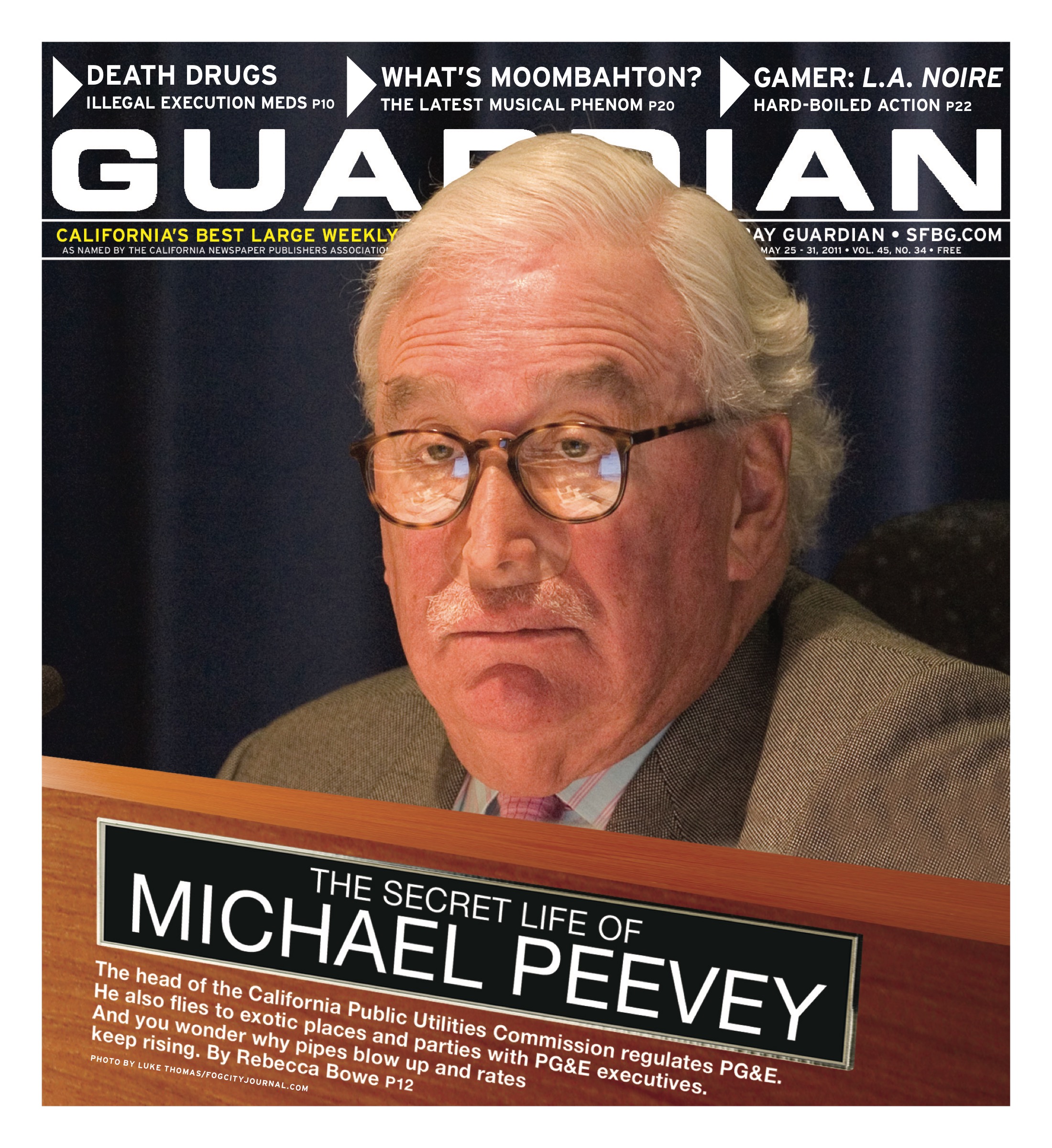
The secret life of Michael Peevey

11

rebeccab@sfbg.com

Inside a legislative hearing room at the state capitol, things were beginning to get uncomfortable. Roughly five weeks had passed since a Pacific Gas & Electric Co. pipeline explosion killed eight and leveled an entire San Bruno neighborhood, and this California Senate committee hearing was an early attempt to get answers.

San Bruno residents who lost loved ones in the deadly explosion huddled in the front row, their eyes fixed on company representatives and agency bureaucrats as they spoke. At the back of the room, a band of immaculately dressed PG&E executives and utility lawyers sat clustered together.

Richard Clark, director of the consumer protection and safety division of the California Public Utilities Commission (CPUC), fielded questions from visibly frustrated state legislators. Sen. Dean Florez (D-Shafter) wanted know why the CPUC hadn’t done anything when PG&E ignored an impaired section of the ruptured pipeline even after it was granted $5 million to fix it.

“Did the PUC do any accounting when you gave them $5 million?” Florez demanded. “Do we just give them money and cross our fingers and hope they fix it? Is that what we do? Until some terrible tragedy occurs?”

Sen. Mark Leno (D-San Francisco) said the CPUC needed to step it up and start practicing serious hands-on oversight. He recalled a tragedy that occurred in 2008 when a gas leak in Rancho Cordova triggered a pipeline explosion, killing one person and injuring several others. Although an investigation determined that PG&E was at fault, the CPUC hadn’t yet gotten around to fining the company.

“We’ve got a pattern here,” Leno said. “And we’re not doing anything differently.”

Less than three weeks after CPUC staff members were grilled in Sacramento, Michael Peevey — president of the CPUC and the top energy official in the state — boarded an airplane for Madrid. He was embarking on a 12-day travel-study excursion, with stops in Sevilla and Barcelona, sponsored by the California Foundation on the Environment and the Economy (CFEE).

Peevey’s wife, California Sen. Carol Liu (D-Glendale), was along for the trip. So were two other state senators, several members of the state Assembly, CPUC commissioner Nancy Ryan, and a host of representatives from the energy industry. The group included executives from Chevron, Mirant (now GenOn, the owner of the Potrero power plant), Covanta Energy Corporation, Shell Energy North America, and engineering giant AECOM. High-ranking executives of the state’s investor-owned utilities also participated, including Fong Wan, the senior vice president of energy procurement for PG&E.

Although strict rules normally govern commissioners’ interactions with parties that have a financial stake in the outcomes of commission rulings, there wasn’t anything especially unusual about Peevey traveling internationally with a group that included representatives from the same companies his regulatory commission oversees. CFEE trips happen every year. The nonprofit has footed the bill to fly groups of regulators, legislators, and utility executives to prime vacation destinations like Italy, Brazil, and South Africa in recent years, excursions organizers say are critical for educating top-level stakeholders about worldwide best practices for sustainable systems. However, groups such as The Utility Reform Network (TURN) have decried CFEE trips as “lobbying junkets.”

As PG&E and the CPUC both work to win back the public’s confidence after their latest deadly failure, it’s worth analyzing whether their relationship — shaped by vacations together at exotic locales — has grown too cozy.


THE BUDDY SYSTEM

CFEE isn’t the only nonprofit that regularly flies Peevey overseas for green travel tours with high-ranking utility executives, and the 12 days he spent in Spain wasn’t the only time he spent away from official duties and in the company of the corporations his commission regulates.

These controversial getaways are just a small part of Peevey’s involvement with private-sector interests. He also chairs the board of a nonprofit investment fund created as part of a $30 million settlement agreement with PG&E. Called the California Clean Energy Fund, it funnels money into private venture-capital funds that invest in green start-ups, plus a few companies in the fossil-fuel sector.

While legislators have voiced frustration that lax CPUC oversight of PG&E on pipeline-safety issues opened the door to disaster in San Bruno, inside observers are critical of the outright favors Peevey has granted utilities, such as guaranteeing an unprecedented, higher-than-ever profit margin for PG&E as part of the company’s 2004 bankruptcy settlement.

The CPUC is set up to perform as a watchdog agency, yet social and professional ties running deep within California’s insular energy community mean regulators sometimes run in the same circles as the executives who answer to them, making for cozier relationships than the general public might anticipate. It’s an old-fashioned insider game that one longtime observer wryly characterizes as “the buddy system.” But the buddy system can bring consequences.

As the public face of the CPUC, Peevey repeatedly has been thrust into the spotlight. He has absorbed advocates’ concerns about pipeline safety, rising electricity rates, SmartMeters, missed targets for energy efficiency, and municipalities’ David-vs.-Goliath battles with PG&E to implement community choice aggregation (CCA), to name a few. He’s a magnet for public scrutiny while occupying the center seat at commission meetings, but Peevey’s behind-the-scenes engagements with private-sector organizations bent on shaping statewide energy policy demonstrate how power is wielded in California’s energy world, a system in which regulators seem to be partnering with utilities rather than policing them.

Based at Pier 35 in San Francisco, CFEE’s board of directors is composed of a small group of officers, plus a long list of members who hail from some of the most prominent businesses nationwide. Shell, Chevron, J.P. Morgan, Goldman Sachs, AT&T, and PG&E all hold positions on CFEE’s membership board, and each entity chips in to fund the foundation’s activities and travel excursions.

The group also includes representatives from labor organizations like the International Brotherhood of Electrical Workers and mainstream environmental groups such as the Natural Resources Defense Council. Among the emeritus members of CFEE’s governing board are some high-ranking figures, such as CIA director-turned-Pentagon boss Leon Panetta. CFEE received $45,000 in donations from PG&E in 2009 (the most recent year available) and was granted similar amounts in prior years.

CFEE spokesperson P.J. Johnston, the son of former state senator and CFEE officer Patrick Johnston and the press secretary under former Mayor Willie Brown, described the trips as valuable opportunities for top-level stakeholders to gain insight on best practices and engage in noncombative dialogue on key issues.

“The idea for us was that it made sense to have someplace where it was nonconfrontational to engage in policy, work-type discussions,” Johnston explained. He added that the trips are “all about policy, on the 30,000-foot level,” and emphasized that discussions aren’t about specific decisions pending before the CPUC.

Loretta Lynch, a former president of the CPUC who brought a reformist spirit to the agency and was never shy about rebuking utilities, is skeptical of CFEE’s stated program goals. When she was first appointed to the commission, Lynch said, CFEE contacted her to ask where she wanted to travel. If the trips are arranged to fly regulators to destinations they’ve been itching to visit, she reasoned, must-see green innovations probably aren’t dictating the itineraries. “To me,” Lynch said, “they don’t have anything to study in mind.”


“PARTYING WITH THE JUDGE”

The CFEE trip to Spain included a briefing on developing wind energy from AES, a company working on wind and solar development in California that also operates polluting, gas-fired power plants in Huntington Beach, Long Beach, and Redondo Beach. There was a round table on solar energy featuring a presentation from the Independent Energy Producers Association, a trade group that regularly files petitions and comments on CPUC proceedings. The trip included a tour of a desalination plant, a talk from the president of the Madrid Chamber of Commerce, and discussions about California’s energy market. Scheduled activities ended by midafternoon on some days, and the itinerary left a Friday afternoon, Saturday, and Sunday in Sevilla wide open.

Asked to comment on concerns about inappropriate lobbying, Johnston said: “We’re not guarding against anyone’s potential behavior any more than we would be on the streets of Sacramento. We’re not setting ourselves up as the guardians. We’re not facilitating that, per se, either.” He added, “I realize there are critics of any kind of travel and any kind of commingling. But it is wise for us not to close our eyes to the rest of the world, and there’s not a great appetite for spending taxpayer money on these trips.”

Yet Lynch countered that there is an important distinction between the roles of Sacramento legislators and that of utility commissioners. “Regulators are not legislators,” Lynch said. “They’re more like judges. Their decisions have the power of a judge’s decision.” By inviting commissioners along on these lavish getaways, she said, “it’s as if you’re partying with the judge.”

Mindy Spatt, a spokesperson for TURN, echoed Lynch’s concerns. “These ostensibly educational trips are essentially lobbying junkets, where utilities … wine and dine legislators,” Spatt said. TURN raised the issue several years ago, she said, when Peevey joined a CFEE trip attended by a representative of Southern California Edison “just coincidentally at the exact same time that he was penning an alternate decision in Edison’s rate case.” She added: “In TURN’s perspective, the commissioners need to be more in touch with what actual utility customers are experiencing, rather than in touch with the top restaurants in Brazil.”

While Peevey is only one of a host of officials who attend CFEE trips, he has more than just a casual tie to the nonprofit. From 1973 to 1983, he served as president of the California Coalition for Environment and Economic Balance (CCEEB), an organization CFEE grew out of and whose membership shares some overlap with CFEE.

Based in San Francisco, CCEEB was founded by Edmund G. “Pat” Brown (Gov. Jerry Brown’s father) in 1973. CCEEB backed a late-1970s proposal to construct a series of nuclear power plants along the California coastline. More recently, the group honored BP with a 2009 award for environmental education — shortly before the company and lax federal regulators were responsible for the worst oil spill in U.S. history.


A YEAR IN THE LIFE

Spain wasn’t the only country Peevey jetted off to with complimentary airfare in 2010. According to a Form 700 filing with the Fair Political Practices Commission, he also traveled to Germany from Aug. 1–5 for a sustainable energy study tour organized by the Energy Coalition. Joining that trip were representatives from investor-owned utilities PG&E, Southern California Edison, and Sempra, plus various city officials and energy experts from the Swedish Energy Agency.

The group stayed at the Radisson Blu Berlin Hotel, which is famous for its AquaDom. “Standing at 25 meters high, it is the world’s largest cylindrical aquarium containing 1 million liters of saltwater,” according to the hotel website. All Radisson Blu Berlin guests have free access to “the hotel’s well-being area,” called Splash, which features a pool, sauna, steam bath, and fitness room.

Based in Irvine, the Energy Coalition’s Board of Directors is chaired by Warren Mitchell, a retired chair of the Southern California Gas Co. and San Diego Gas & Electric Co.. Another director is a utility lawyer who also sits on the board of directors of the Northeast Gas Association, a consortium of natural gas companies in the northeastern U.S.

Founded in the late 1970s by John Phillips to get large businesses to reduce energy consumption in partnership with utilities, the Energy Coalition has arranged excursions for years to bring energy regulators, city officials, and utility executives to Sweden (where Phillips’ wife was born) to exchange ideas on energy issues. The nonprofit organizes an annual summit called the Aspen Accord, “an energy policy forum where cities, utilities, regulators, and end-users collaborate to identify problems and propose solutions to our most pressing energy issues,” according to a 2009 tax filing. While it used to be held in Aspen, Colo., the most recent Aspen Accord was held at San Francisco’s Westin St. Francis. Peevey gave introductory remarks, and the conference featured talks from PG&E, among others.

Craig Perkins, executive director, told the Guardian that the Aspen Accord and study trips are designed to create a venue for major stakeholders to arrive at outside-the-box solutions. “What we try to do is get everybody out of their comfort zone, if you will — that’s the best way to support more creative thinking,” he said. Official regulatory proceedings are “so rigidly legalistic and bureaucratic that it almost prevents any creative thought from happening,” he added. “We’re not in San Francisco, we’re not in Sacramento, we’re not in corporate offices — let’s just talk about these really big issues, and really big challenges.”

The Germany tour included meetings with the Berlin Energy Agency, talks about climate policy, and a tour of an eco-community in Freiburg. Perkins said utility companies must to pay their own way on the trips, but costs are covered for governmental officials.

An Energy Coalition tax filing reveals that board members receive a monthly retainer of $1,000, quarterly meeting fees of $1,000, plus $500 for each board committee meeting. Teleconferences also result in $500 meeting fees.

Several years ago, the Energy Coalition partnered with PG&E to create the Business Energy Coalition, which paid businesses including Bank of America and the Westin St. Francis $50 per KW of energy savings for banding together to reduce energy during peak load hours. According to a tax filing, total annual Energy Coalition revenue dropped from $10.7 million in 2008 to $3.75 million in 2009 “due to large revenue receipts for participant incentives” for the Business Energy Coalition program, as “revenues were used for direct pass-through payments to program participants and contractors.” In 2006, according to a CPUC filing, PG&E paid the Energy Coalition $227,373 for unspecified consulting services.

In addition to the $8,880 trip to Spain (comped), and the $6,583 trip to Germany last year (comped), Peevey’s 2010 disclosure form shows that he also went to Australia May 14-19 to participate in a conference hosted by the Sydney-based Total Environment Center called “Smart Metering to Empower the Smart Grid” ($12,577, comped). And while it doesn’t show up on his FPPC filing, an agenda for CFEE’s Energy Roundtable Summit from Dec. 9-10 at the Carneros Inn in Napa lists Peevey as a participant. A glance through past filings suggests that 2010 was no anomaly; it’s a typical year in the life of a jet-setting utilities regulator.


GREEN CAPITALISM

Peevey once served as president of the Southern California Edison, an investor-owned utility, and was president of NewEnergy, Inc., an electricity company that later was sold to Williams Energy. Yet his professional image is that of a forward-thinker on climate change. According to a bio on the CPUC website, he’s received awards for achievements on green and sustainable energy from various organizations throughout California.

In 2005, speaking in Berkeley at an annual conference for the California Climate Action Registry, Peevey touted a list of his accomplishments on sustainable energy. My final example of PUC actions on climate change is related to PG&Es bankruptcy, he said. When they emerged from bankruptcy last year, one of many conditions of our support for their reorganization plan was that they create a $30 million Clean Energy Fund, devoted to investing in California businesses developing and producing clean technologies.

What Peevey didnt mention is that he chairs the board of directors of that fund. As a nonprofit venture capital fund, the obscure, San Francisco-based CalCEF sounds like an oxymoron. Based on the terms of the PG&E bankruptcy settlement, its governed by a nine-member board consisting of three CPUC appointees, three PG&E appointees, and the rest selected jointly by the CPUC and PG&E appointees. Other board members include past PG&E executives, a former member of the California Energy Commission, and a former chair of the board of governors of the California Independent System Operator (Cal-ISO), the body that ensures statewide grid reliability and blocked the closure of the Mirant Potrero Power Plant for years.

The nonprofit’s stated mission is to catalyze clean energy investment to aid in the state’s transition away from fossil fuels. CalCEF president Dan Adler described it as a sort of seasoned guide for fledgling green companies that might otherwise fail to navigate the murky, complicated clean-energy sector. CalCEF is in a position to usher start-ups toward success with a combination of funding, networking, and insider wisdom on state energy policy.

Among the challenges that the clean-energy sector faces, Adler said, are the utilities themselves. “They are effectively monopoly, or oligopoly, controllers of the energy industry,” he said. “And they don’t like outside innovation coming and disrupting their work process or their relationship with their customers.”

CalCEF aims to guide the finance community “to be partners with what public policy is doing around clean tech and clean energy,” Adler went on. “There’s a tremendous amount of money to be made, but there’s also a lot of opportunity for money to be wasted. If you don’t have a private-sector investment community that understands these rules and can put their money alongside these rules in a collaborative framework, we’re very unlikely to achieve the really aggressive energy targets that California has set.”

Yet as one skeptical energy insider noted, “there are 15 to 20 other funds, with 10 times as much money, an hour south in the same field,” referring to the burgeoning clean-tech hub in Silicon Valley. It’s questionable whether the CPUC is actually fulfilling some dire need with CalCEF, this person said.

Lynch, not surprisingly, takes a dim view of CalCEF. The former CPUC president questions what business the CPUC has creating a private foundation to guide venture capital investment. “It is a fundamental distortion of the PUC’s authority,” she charged, “all in service of Peevey’s ambitions.”

Peevey’s economic disclosure showed that he holds more than $1 million in a private family trust, without disclosing whether private investments contributed to that fund.

Adler stressed that there is arms-length relationship between CalCEF board members and the companies that benefit from the fund’s investments. “Because we are a nonprofit, and because we have on our board members of the regulatory community, we recognized quickly that we can’t be making direct investments into companies,” said Adler, a former CPUC staff member who was highly regarded even by the critics of CalCEF. “So … we’ve picked the venture-capital funds that we wanted to partner with.”

CalCEF funnels its capital into three different for-profit investment firms, which in turn select the companies that will be included in CalCEF’s investment portfolio. Several directors of the partnering investment firms also sit on the boards of directors of the companies they invest in. The startups run the gamut, from carbon-offset outfits, to energy-efficient lighting manufacturers to solar and wind companies, to biofuels startups to various kinds of technology firms related to the smart grid.

But CalCEF has also poured money into companies that bolster the fossil-fuel industry. One of its first investments was CoalTek, a company developing technology for so-called “clean coal.” Asked to explain why, Adler told the Guardian, “We don’t have veto power on every deal that goes down.”

Adler said he personally believes that “there’s no such thing as clean coal,” but tempered this by adding, “there are some very smart people in our community who will tell you that there’s no future … without coal.”

Another CalCEF investment, DynaPump, is developing technology to make it more energy efficient to pump oil and gas. Asked about this decision, Adler responded: “I will say that when we were approached with this investment by the venture partner that ultimately undertook it, we had our misgivings. If you can save energy in the production of oil and gas, then you’re definitely making a contribution to overall energy efficiency.”


TAX-EXEMPT TESLA

There appear to be some closer-than-arms-length links between CalCEF board members and the investment fund’s beneficiaries. A bio for CalCEF director Nancy Pfund, for example, notes that in her capacity as manager of an outside investment fund, she had “worked closely” with Tesla Motors, a CalCEF investment. Tesla provided CalCEF’s first investment return earlier this year after Tesla went public. A principal of one of the investment firms that works with CalCEF, Stephen Jurvetson of Draper Fisher Jurvetson, holds Tesla shares in a personal trust, according to a filing with the U.S. Securities and Exchange Commission.

Tesla manufactures sleek, electric, zero-emission sports cars with prices in the six-figures, and it’s gearing up to roll out a model that will cost somewhere closer to $50,000. The company’s success was helped by a sales-and-use-tax exclusion granted by the state of California last year. Peevey had a hand in that, too. Few Californians may have heard of the California Alternative Energy and Advanced Transportation Financing Authority (CAEATFA), a state body within the Office of the Treasurer, which has the power to authorize sales-tax exclusions for companies that are developing alternative energy technologies. Peevey has a seat on it.

In October 2009, according to a CAEATFA document, Tesla was granted a sales tax exclusion from that financing authority. The sports car manufacturer had received a tax break of $3.3 million as of December 2010, and stands to gain a tax break as large as $29.1 million, depending on its property purchases. As a CAEATFA member, Peevey approved the deal by proxy.

A central question is whether the CalCEF dollars that benefited Tesla and other CalCEF portfolio investments were originally derived from PG&E shareholder profits or ratepayer funds. Adler was careful to note that the initial $30 million came from company shareholders, not PG&E customers. But Lynch pointed out that every dime in PG&E coffers originates with the millions of customers who pay utility bills.

Lynch noted another provision of the bankruptcy settlement agreement, which guarantees PG&E a minimum annual profit of 11.2 percent, catapulting it forever into a higher rate of return than the 8 percent to 11 percent profit traditionally granted by the CPUC in prior decades. “They’re manipulating how big this bucket is to siphon off funds into programs like CalCEF,” Lynch said. “It’s all to give Peevey and his friends access — and to greenwash what was a very stinky deal for the ratepayer.”


ELUSIVE CLEAN ENERGY FUTURE

In California, a national leader in addressing climate change, the stakes are high in the energy sector. The CPUC is tasked not only with shoring up transmission-pipeline safety to prevent another San Bruno disaster, but helping to chart a course away from reliance on fossil fuel-powered energy sources.

CFEE, the Energy Coalition, and CalCEF share a common thread — their missions relate to advancing the cause of a clean energy future in California. And while utility funding and partnership is evident in all three operations, the overarching goal is understood to be green.

But as Adler observed, the utilities themselves present one of the greatest obstacles to progress on a clean-energy transition. While California has increased renewable energy sources, it’s done a poor job at supplanting fossil fuel generation with green alternatives, in part because the CPUC has allowed for increasing fossil fuel power generation even as renewable energy expands. According to a listing on the California Energy Commission website, nine natural gas power plants have won approval statewide and are moving toward construction, while six new ones are under review.

The CalCEF approach to addressing climate change, rather than aggressively targeting polluting industries, is to encourage the fledgling green industry in hopes of facilitating success in partnership with the financial sector. In many cases, the backers of the clean-tech companies are the same players behind the big energy giants.

Environmental advocates are critical. “If anyone thinks the CPUC is set up to serve public interests, forget that,” says Al Weinrub, executive director of the Local Clean Energy Alliance, a group that organized against PG&E’s ill-fated Proposition 16 last year. “They never have and they never will.”

Weinrub said he viewed proponents of green energy as falling into two camps: Moneyed interests motivated by a growing new market sector, and activists motivated by environmental and social justice causes. Major green investment firms “want to de-carbonize capitalism,” he observed. “But everything else stays the same.”

Peevey is considered a major driver behind the state’s climate change legislation, and he’s highly regarded for his dedication to green energy. Yet as long as the interlocking dynamic between energy regulators and California’s largest utilities goes unchallenged, change will only come in a way that’s as comfortable, profitable, and manageable for the state’s top polluters as they wish. And in a state with an aging energy infrastructure that’s vulnerable to the impacts of climate change, that pace isn’t nearly quick enough. 



Fatal stance

7

sarah@sfbg.com

Ever since Mayor Gavin Newsom appointed Police Chief George Gascón district attorney in January — when Gascón said he was “not categorically opposed to the death penalty and would consider it in appropriate cases” — capital punishment has become a big issue in a town where the last death penalty case was in 1989.

Gascón is running against former San Francisco Police Commissioner David Onek, who is the founding director of the Berkeley Center for Criminal Justice and has consistently promised since entering the race last summer that he will not seek the death penalty.

Both men also face a serious challenge from Alameda County Deputy D.A. Sharmin Bock, who opposes capital punishment but won’t categorically state that she would never seek it, as former DAs Kamala Harris and Terence Hallinan both did while running for office.

Bock said that Harris eventually formed a committee to review each capital case but never filed for the death penalty, including in the 2004 murder of San Francisco police officer Isaac Espinoza, the same approach Bock would take. But she doesn’t think it’s legally wise to make a categorical statement opposing the death penalty, saying it could be challenged in court, as some attorneys tried to do with Harris.

“But capital punishment is unjust, and can say that categorically,” she said.

In the week since Bock’s May 17 campaign launch, Gascón challenged her credibility on the issue by noting that Bock used the threat of the death penalty to secure a guilty plea from a sexual predator who tortured and killed women in Alameda County last year.

But Bock used that case to draw a distinction in their positions on the issue, telling us, “George Gascón says he’d use it for the most heinous cases, and I’ve seen the most heinous cases and I haven’t use it,” Bock said, emphasizing that she’s the only prosecutor in the race.

In a May 1 Chronicle op-ed, Gascón tried to neutralize Onek and those opposed to the death penalty by noting that he also has “serious misgivings” about capital punishment, including the potential for wrongful convictions, the disproportionate application on racial minorities, the roller-coaster the victims’ families endure as they wait decades for closure, and the financial impact on an already overburdened justice system.

But Gascón also tried to hide behind the “death penalty is state law” defense, even though prosecutors have extensive discretion in such matters. “Rather than refuse to enforce our laws, I believe the more appropriate approach is to accept the law and work to change it,” Gascón wrote. “I don’t believe district attorneys should be allowed to supplant the views of the state with those of their own.”

Bock criticized Gascón’s deferential stance, which was in sharp contrast to Sheriff Mike Hennessey, who recently announced that he will stop cooperating with federal immigration officials and start releasing undocumented immigrants jailed for minor offenses before they can be picked up for deportation, to comply with San Francisco’s sanctuary ordinance.

Gascón appeared to be trying to cast his position as a courageous stand. “Some have given me the political advice to simply say I will not seek the death penalty in San Francisco,” he wrote. “While I am not prepared to say that at this time, I can say that I do intend to be a district attorney committed to San Francisco values.”

And he promised that if he believes a case merits the death penalty, he would seek the advice and counsel of a panel of local prosecutors. “Ultimately, the decision will always rest on my shoulders, and it is a decision that I will not take lightly,” Gascón wrote.

But Onek accused Gascón of giving a politician’s answer. “Gascón is trying to have it both ways,” Onek told the Guardian. “The voters have the right to hear a clear answer to a fundamental question. And my answer is clear — I will not seek the death penalty in San Francisco and I will continue to work to change the law statewide. To me, it’s a yes or no question, and I won’t seek it. Period.”

Onek says his stance is informed by his belief that the death penalty solves nothing. “It doesn’t make us safer; it’s not fair and equitable; and it wastes enormous resources,” he said. “We are much better off spending our precious resources on things that actually make us safer, like more cops on the streets, more programs in our communities, and better services for victims.”

Gov. Jerry Brown made a similar comparison last month when he canceled a $356 million project for a new death row at San Quentin. “At a time when children, the disabled, and seniors face painful cuts to essential programs, the state of California cannot justify a massive expenditure of public dollars for the worst criminals in our state,” Brown said.

A recent David Binder research poll found 63 percent support statewide for commuting all of the 700 sentences of California’s death row inmates to life in prison without parole and requiring them to pay restitution to the victims’ families, while 70 percent of Bay Area voters support the plan, which would save the state $1 billion over five years.

At a May 18 panel discussion on the death penalty, Public Defender Jeff Adachi’s criminal justice summit offered panel moderator Matt Gonzalez, a chief attorney in Adachi’s office, a timely opportunity to grill Gascón about his death penalty stance.

“Folks felt it might be a step backward,” Gonzalez said, noting that former D.A. Terence Hallinan pledged not to seek the death penalty when he ran for reelection in 2000, and Harris followed suit when she first ran for district attorney in 2003. “So — are you pro death?” Gonzalez asked.

“No, but I am a public official,” Gascón replied, even as he repeated his misgivings about the death penalty, including the fact that 62 percent of those on death row are minority populations, especially from African American and Latino communities.

The panel also provided a chance to see Gascón debate exonerated death row inmate JT Thompson, watch American Civil Liberties Union of Northern California attorney Natasha Minsker explain why the death penalty system is dysfunctional, and witness former San Quentin prison warden Jeanne Woodford describe how the impacts of the four executions that she reluctantly oversaw motivated her to sign on as director of Death Penalty Focus, a nonprofit dedicated to abolishing capital punishment.

“Who is responsible for the prosecutors that go bad?” asked Thompson, an African American man who spent 14 years on death row in Louisiana, and another four facing life without parole, because a prosecutor suppressed exculpatory evidence.

“When I was sentenced to death in 1985, for a crime I didn’t commit, I thought this would be rectified right away. But it took 18 years, and I watched 12 inmates being executed while I was there,” Thompson said, noting that he was holed up 23 hours a day.

Gascón said he would terminate prosecutors who withheld exculpatory evidence, but said he didn’t know if he could charge them with murder.

Thompson, founder of the New Orleans-based nonprofit Resurrection after Exoneration, argued that the debate needs to be recast from its current public safety frame.

“People need to be asked, ‘Under what conditions do you support giving the state the right to kill you?’ ” Thompson said.

Woodford recalled how she got sick after the last execution she presided over. “I focused on what my responsibility was. But in hindsight, I realize it had had much more of an impact,” she said. “These executions happen in California at least 20 years after the crime. And they don’t bring victims back.”

Minsker noted that 16 states do not have the death penalty, and that every day brings people closer to ending the practice in California. “People once thought opposing the death penalty would end political careers, but Kamala Harris showed that it is no longer a liability,” she said.

Reached by phone after the debate, Onek said ending capital punishment makes sense morally and financially. “We would have $1 billion to invest in things that actually make us safer,” Onek said. “The D.A. is given discretion around requesting the death penalty, and I will use my discretion to reflect San Francisco values. That’s why people in the trenches working on these issues, including Jeanne Woodford, support me in this race.” 


Our Weekly Picks: May 25-31, 2011

0

WEDNESDAY 25


MUSIC

Stiff Little Fingers

Led by founding member and singer Jake Burns for 34 years now, Belfast’s punk legends Stiff Little Fingers remain a stalwart musical force to be reckoned with. Fueled by the same energy and edgy political criticism that drove classic tracks like “Alternative Ulster” and “Suspect Device,” the band may have changed lineups over the years, but still delivers the goods live, and will likely showcase some songs from its forthcoming album, due out later this year. Be sure to catch SLF tonight in all its glory in a small club — later this weekend they co-headline the Punk Rock Bowling festival in Las Vegas. (Sean McCourt)

With Sharks

8 p.m., $20

Slim’s

333 11th St., SF

(415) 255-0333

www.slims-sf.com


MUSIC

Yeasayer

After listening to its self-described “Middle Eastern-psych-snap-gospel” music on its second studio album Odd Blood, you’ll only be yelling “yay!” to the stylings of Brooklyn-based trio (Chris Keating, Ira Wolf Tuton, and Anand Wilder), Yeasayer. Truth be told, the threesome admitted that Odd Blood was conceived because of a “massive” acid trip in New Zealand. Psychedelics or not, Yeasayer managed a more poppy feel to its much-acclaimed sophomore releases as opposed to its previous recordings. What’s more of a trip is that Peter Gabriel’s drummer, Jerry Marotta, assisted Yeasayer with its recording in an upstate New York studio. Trust me — you won’t be saying “nay” to Yeasayer.(Jen Verzosa)

 With Smith Westerns and Hush Hush

Wed/25-Thurs/26, $20

Fillmore

1805 Geary, SF

(415) 346-6000

www.livenation.com


THURSDAY 26


EVENT

“Muybridge in Three Movements”

It’s Eadweard Muybridge madness with performance, film, and conversation about the artist wrapped into one evening at SFMOMA. A pioneering spirit whose work led to early motion pictures, Muybridge began his artistic career in the 1860s in California. In conjunction with the retrospective exhibition “Helios: Eadweard Muybridge in a Time of Change,” SFMOMA presents excerpts from Catherine Galasso’s Bring On The Lumière!, a performance meditation on early cinema and the basic components of light and movement, key to Muybridge’s work. Also on the program: related short films selected by San Francisco Cinematheque’s Steve Polta and a conversation on cinematic space and time led by Infinite City: A San Francisco Atlas author Rebecca Solnit. (Julie Potter)

7 p.m., $10

Phyllis Wattis Theater

San Francisco Museum of Modern Art

151 Third St., SF

(415) 357-4000

www.sfmoma.org


MUSIC

Atomic Bomb Audition

The first time I heard the Atomic Bomb Audition, I wondered what film the band was scoring: desolate yet pretty, surreal but cohesive, complete with natural scene changes and visible textures. The Oakland band thus succeeds in its explicit compositional goal — to make music for films that don’t exist. Self-described “cinematic sci-fi metal” (Oh Lucifer, please not another heavy metal sub-sub-subgenre … ), ABA channels psychedelic black doom tainted with Mr. Bungle’s carnie creed and heartened by the fearlessness reminiscent of Pink Floyd’s Animals. The resulting soundtrack rings equally holy and dissonant; get your cinematic self to the show because this is the band’s last live one of the year. (Kat Renz)

With Listo, and Moe! Staiano

9 p.m., $8

Bottom of the Hill

1233 17th St., SF

(415) 621-4455

www.bottomofthehill.com


DANCE

“Post:Ballet Sneak Peek”

Rooted in ballet with an eye toward the future, Robert Dekkers’ Post:Ballet thrives on fresh, edgy collaborations with artists in other disciplines. “Sneak Peek” offers an interactive preview of Interference Pattern, a work in progress with film excerpts by Amir Jaffer, performances by the company, audience experiments, and discussion. In discovering how observations influence the subconscious, the exchange during the evening aims to draw a variety of responses from the dance-artists and the audience. Before starting Post: Ballet in 2009, Dekkers performed in the Bay Area with ODC/Dance and Company C Ballet. These days his gorgeous troupe breathes new movement and ideas into ballet. Go ahead, sneak a peek! (Potter)

7–9 p.m., $10

Public Works

161 Erie, SF

(415) 932-0955

www.postballet.org


FRIDAY 27


MUSIC

“Carnaval Fever”

Just can’t get enough SF Carnaval? Sparkly revelers: stray ye not far from the Mission this Memorial Day weekend. Go beyond the free parade and festival (more info on those events at www.sfcarnaval.com) and shake your feathers at the multi-venue after-party, “Carnaval Fever.” Brick and Mortar, newly opened in the old Coda space at Mission near Division, hosts a trio of live bands, starting with Latin American-Caribbean funksters B-Side Players (Fri/27) and followed by retro funksters Monophonics (Sat/28) and the not-purportedly-funky-but-no-doubt-will-make-you-dance-anyway Brazilian accordion slingers Forró Brazuca (Sun/29). For those who’d rather party in a club pounding with Latin beats, there’ll be DJ sets at Public Works (with headliner Marques Wyatt, Sat/28) and Som. (with Sabo, Sun/29). (Cheryl Eddy)

Fri/27–Sun/29, 9 p.m., $12–$15

Brick and Mortar

1710 Mission, SF

Sat/28, 9 p.m., $10

Public Works

161 Erie, SF

Sun/29, 9 p.m., $10

Som.

2925 16th St., SF

www.carnavalfever.com


SATURDAY 28


DANCE

“RAWdance Concept Series: 8”

I’m here to tell you: RAWdance’s Concept Series can become addictive. Few mixed programs of excerpted or in-progress works are as much fun as these occasional showings hidden in the Duboce Triangle (with parking as difficult as North Beach). Presided over — if such it can be called — by RAWdance’s Wendy Rein and Ryan Smith in a venue where, quite unceremoniously, you have to move your butt if the choreographer needs your space, the evenings offer glimpses of what these choreographers are up to. Rarely does it lack for something intriguing, even if it’s just a question the choreographer hasn’t found the answer to yet. This time AXIS’ Margaret Crowell, Amy Seiwert, and wild-woman Christine Bonansea join the hosts, along with the South Bay’s Nhan Ho. As always, coffee and popcorn are included. (Rita Felciano)

Sat/28–Sun/29, 8 p.m.;

Sun/29, 3 p.m., pay what you can

James Howell Studio

66 Sanchez, SF

(415) 686-0728

www.rawdance.org


SUNDAY 29


FILM

Saicomanía

If you haven’t heard of Los Saicos, you’re not alone — though Héctor M. Chávez’s new rockumentary, Saicomanía, aims to shed some long-deserved light on “the best-kept secret from the ’60s.” Formed in 1964 Peru, at the height of worldwide Beatlemania, the members of Los Saicos were anything but fresh-scrubbed mop tops (see: the band’s name, which recalls a certain 1960 Hitchcock movie). Amid (unfounded) rumors that its members were cannibals and played their instruments with hand tools, a raw, frenzied, jangly sound emerged, surging forth to influence countless other bands (including present-day darlings the Black Lips, who appear in the doc), but earning few props from music historians beyond connoisseurs of early garage rock. Saicomanía traces the band’s origins and catches up with its surviving members, still giving off mischievous punk-rock vibes after all these years. The film’s U.S. premiere is hosted by Colectivo Cinema Errante; the screening also features music videos by contemporary South American bands influenced by los abuelos of garage-punk. (Eddy)

7:30 p.m., $6

Artists’ Television Access

992 Valencia, SF

(415) 824-3890

www.atasite.org


TUESDAY 31


DANCE

Royal Danish Ballet

The 19th century Bournonville repertoire is what the Royal Danes — a.k.a. the Royal Danish Ballet, founded in 1748 — is best known for. With this company, forget about errant princes and lost princesses, sky-high extensions, and tornado like whirligigs. Instead, watch for ordinary folks in feathery footwork, rounded arms, suppleness, and ease. That’s what you’ll get with La Sylphide — the oldest extant Romantic ballet. But the Danes, no longer exclusively Danish, also are resolutely 21st-century dancers. That’s why the company is also bringing Nordic Modern, four hot-out-of-the-studio choreographies. Why won’t we see some of Bournonville’s fabled full-evening story ballets? Everyone else on this U.S. tour is getting them, but we don’t have an available theater that can accommodate the designs. What a pity. (Felciano)

Tues/31, June 1, and June 3–4,

8 p.m., $38–$100

Zellerbach Hall

Bancroft at Telegraph,

UC Berkeley, Berk.

(510) 642-9988

www.calperfs.berkeley.edu


MUSIC

Antlers

There are depressing albums, and then there is Antlers’ 2009 LP Hospice. Based on musician Peter Silberman’s intimate solo recordings, Hospice paints nightmares of hospitals, terminally ill children, death, and depression, all with such solemnity that it made this listener egregiously bummed. The band’s follow-up, Burst Apart, drops hospital drama for what might as well be a psychologist’s office — this time wrestling with universal themes of love, scary dreams, and putting the dog to sleep. It’s a far easier pill to swallow, and the newfound keyboard melodies provide a strong backbone for Silberman’s sing-along “ooh and ah” falsetto. It’s also the year’s first firmly melodramatic release to play equally well whether it’s late at night or a sunlit day. (Peter Galvin)

With Little Scream

8 p.m., $18

Great American Music Hall

859 O’Farrell, SF

(315) 885 0750

www.gamh.com 


The Guardian listings deadline is two weeks prior to our Wednesday publication date. To submit an item for consideration, please include the title of the event, a brief description of the event, date and time, venue name, street address (listing cross streets only isn’t sufficient), city, telephone number readers can call for more information, telephone number for media, and admission costs. Send information to Listings, the Guardian Building, 135 Mississippi St., SF, CA 94107; fax to (415) 487-2506; or e-mail (paste press release into e-mail body — no text attachments, please) to listings@sfbg.com. Digital photos may be submitted in jpeg format; the image must be at least 240 dpi and four inches by six inches in size. We regret we cannot accept listings over the phone.

Stage Listings

0

Stage listings are compiled by Guardian staff. Performance times may change; call venues to confirm. Reviewers are Robert Avila, Rita Felciano, and Nicole Gluckstern. Submit items for the listings at listings@sfbg.com. For further information on how to submit items for the listings, see Picks. 

THEATER

OPENING

The Pride New Conservatory Theatre Center, 25 Van Ness, SF; (415) 861-8972, www.nctcsf.org. $24-40. Opens Fri/27, 8pm. Runs Wed-Sat, 8pm; Sun, 2pm. Through July 10. New Conservatory Theatre Center performs the West Coast premiere of Alexi Kaye Campbell’s love-triangle time warp drama.

BAY AREA

Let Me Down Easy Berkeley Repertory Theatre, Roda Theatre, 2015 Addison, Berk; (510) 647-2949, www.berkeleyrep.org. $17-73. Opens Sat/28, 8pm. Runs Tues and Thurs-Sat, 8pm (also Sat, 2pm); Wed, 7pm; Sun, 2pm. Through June 26. Anna Deavere Smith performs her latest solo show.

Welcome Home, Julie Sutter Marion E. Greene Black Box Theater, 531 19th St, Oakl; www.theatrefirst.com. $10-30. Opens Thurs/26, 8pm. Runs Thurs-Sat, 8pm; Sun, 2pm. Through June 19. A combat veteran returns home to figure out her post-Iraq life in Julie Marie Myatt’s drama.

ONGOING

Little Shop of Horrors Boxcar Theatre Playhouse. 505 Natoma; www.boxcartheatre.org. $20-50. Opens Wed/25, 8pm. Runs Tues-Sat, 8pm; Sun, 2pm. Through June 26. Boxcar Theatre presents a new version of the musical.

*Lucky Girl EXIT Studio, 156 Eddy; (800) 838-3006, www.brownpapertickets.com. $10-25. Thurs/26-Sat/28, 8pm. Honey (Cheryl Smith) talks about “the shoes” first, the shoes repeatedly, against even her analyst’s power to retain a common interest in the footwear of her attacker. Why should she so concern herself with this detail of the man who assaulted her, wounding her in ways too subtle and deep to measure—unless through the wayward precision of the poetical imagination some measure might actually be taken. That is the force and beauty of Lucky Girl, a notable new stage adaptation by Tom Juarez of poet Frances Driscoll’s 1997 collection, The Rape Poems, which premieres as part of Exit Theatre’s DIVAfest 2011. Juarez crafts an engagingly dynamic and delicate narrative arc from Driscoll’s thematically joined but otherwise disparate poems, gorgeously formulated verses that delve into a devastating subject with an unexpected range of humor, insight, and compassion. This supple range is acutely grasped and exquisitely interpreted by Smith, whose gripping performance (keenly directed by Kathryn Wood) eschews anything remotely sentimental for a complex and moving portrait of the enduring aftermath of terror. (Avila)

Nobody Move Intersection for the Arts, 925 Mission, Golden Gate; 626-2787, www.brownpapertickets.com. $20-35. Thurs-Sat, 8pm; Sun, 3pm. Through June 12. Intersection for the Arts and Campo Santo present a play based on the novel by Denis Johnson.

*Queer Southside Theater, Bldg D, Third Floor, Fort Mason Center, Marina at Laguna, SF; (415) 399-9554, www.sfiaf.org. $12-25. Fri/27-Sat/28, 8 pm; Sun/29, 7pm. Composer Erling Wold’s 2001 chamber opera, based on the early novel by William S. Burroughs, returns as part of this year’s San Francisco International Arts Festival. It’s a moody, evocative, dreamy, and witty piece, beautiful to listen to and totally worth seeing, first of all for the soulful, salacious showmanship and prowess of Joe Wicht as Burroughs’s narrative stand-in Lee, a punchy junk-addicted American (decked in perfect period-setting attire by Laura Hazlett) on the prowl for boys and other highs in 1950s Mexico City. Wicht is magnetic in the part, embodying Lee with complete assurance and proving as potently dynamic in his singing as in the wry, textured delivery and well-wrought physicality of his characterization. Ken Berry as the other principal singer adds further energy and buoyancy in several supporting roles. James Graham, subdued and sly, plays well against Wicht as Lee’s obsession, the young Allerton, lured on a trip to South America to seek out the mysterious indigenous psychotropic drug called yage (aka ayahuasca). Graceful dancers Diana Consuelo Hopping Rais and Jorge Rodolfo De Hoyos Jr. meanwhile add an appealingly languid human landscape in a variety of non-speaking parts (in intelligent, sensual choreography by Cid Pearlman). The episodic plot is well-suited to Wold’s atmospheric score, which is here played by a five piece ensemble and blends elongated, jagged, whirling lines and harmonies with convincing splashes of Latin color. Minor distractions in some unfortunate technical glitches, uneven sound levels on the actors, and the rustle of body mics aside, this is a small but admirable production directed by Jim Cave and conducted by Bryan Nies. (Avila)

Reborning SF Playhouse, 533 Sutter; 677-9596. www.sfplayhouse.org. Tues-Wed, 7pm; Thurs-Sat, 8pm (also Sat, 3pm). Through June 11. Though emphatically fictional, Zayd Dohrn’s play Reborning, currently receiving its world premiere at the SF Playhouse, provides an intriguing introduction to a decidedly fringe occupation. That of reborning: the art of crafting photo-realistic doll children commissioned by collectors, and sometimes by grieving parents. The play opens with an act of creation, as Kelly (Lauren English) tidies up a closed eye with a sculptor’s blade while a joint burns in the ashtray beside her. Enter Lorri Holt as Emily, a crisp, efficient businesswoman, and a client, come to check on the progress of her “baby” Eva. Things start to go South when Emily suggests some modifications and Kelly’s own obsession with the project eventually spirals out of control. Amiable foil, Alexander Alioto as Kelly’s boyfriend Daizy, exudes eager, golden retriever-like loyalty, but as Emily coolly observes, has “nothing to offer someone who is drowning.” All three actors are top-notch and do a fine job processing thoroughly uncomfortable moments, and the crack design team set the stage and mood precisely. Unfortunately the script itself skews towards melodrama and certain themes (dildo-design, drug abuse, “the dumpster darling”) imbue Reborning with an almost seedy, Jerry Springer vibe that seems inconsistent with director Josh Costello’s strictly straightforward approach to the charged material. (Gluckstern)

Risk is This…The Cutting Ball New Experimental Plays Festival EXIT on Taylor, 227 Taylor; (800) 838-3006, www.cuttingball.com. $20-50. Fri-Sat, 8pm. Through June 25. Cutting Ball Theater closes its 11th season with a festival of experimental plays, including works by Eugenie Chan, Rob Melrose, and Annie Elias.

The Stops New Conservatory Theatre Center, 25 Van Ness; 861-8972, www.nctcsf.org. $24-40. Previews Wed/25-Thurs/26, 8pm. Opens Fri/27, 8pm. Runs Wed-Sat, 8pm; Sun, 2pm. Through June 25. New Conservatory Theater Center presents a musical comedy set in San Francisco.

A Streetcar Named Desire Actors Theatre, 855 Bush; 345-1287, www.actorstheatresf.org. $26-38. Wed-Sat, 8pm. Through June 25. Actors Theatre of San Francisco presents the Tennessee Williams tale.

*Vice Palace: The Last Cockettes Musical Thrillpeddlers’ Hypnodrome, 575 10th St; (800) 838-3006, www.brownpapertickets.com. $30-35. Fri-Sat, 8pm; Sun, 7pm. Through July 31. Hot on the high heels of a 22-month run of Pearls Over Shanghai, the Thrillpeddlers are continuing their Theatre of the Ridiculous revival with a tits-up, balls-out production of the Cockettes’ last musical, Vice Palace. Loosely based on the terrifyingly grim “Masque of the Red Death” by Edgar Allan Poe, part of the thrill of Palace is the way that it weds the campy drag-glamour of Pearls Over Shanghai with the Thrillpeddlers’ signature Grand Guignol aesthetic. From an opening number set on a plague-stricken street (“There’s Blood on Your Face”) to a charming little cabaret about Caligula, staged with live assassinations, an undercurrent of darkness runs like blood beneath the shameless slapstick of the thinly-plotted revue. As plague-obsessed hostess Divina (Leigh Crow) and her right-hand “gal” Bella (Eric Tyson Wertz) try to distract a group of stir-crazy socialites from the dangers outside the villa walls, the entertainments range from silly to salacious: a suggestively-sung song about camel’s humps, the wistful ballad “Just a Lonely Little Turd,” a truly unexpected Rite of Spring-style dance number entitled “Flesh Ballet.” Sumptuously costumed by Kara Emry, cleverly lit by Nicholas Torre, accompanied by songwriter/lyricist (and original Cockette) Scrumbly Koldewyn, and anchored by a core of Thrillpeddler regulars, Palace is one nice vice. (Gluckstern)

BAY AREA

Care of Trees Ashby Stage, 1901 Ashby, Berk; (510) 841-6500, www.shotgunplayers.org. $17-26. Thurs-Sat, 8pm; Sun, 5pm. Through June 26. Shotgun Players presents a play about love and belief by E. Hunter Spreen, directed by Susannah Martin.

Distracted 529 South Second St, San Jose; (408) 295-4200, www.cltc.org. $15-35. Thurs-Sat, 8pm (also Sun/29, 7pm; June 5, 12, and 19, 2pm). Through June 19. City Lights Theater Company of San Jose presents a drama written by Lisa Loomer and directed by Lisa Mallette. 


Rep Clock

0

Schedules are for Wed/25–Tues/31 except where noted. Director and year are given when available. Double features are marked with a •. All times are p.m. unless otherwise specified.

ARTISTS’ TELEVISION ACCESS 992 Valencia, SF; www.atasite.org. $3-6. “Retelling Stories,” films by Matt Wolf, Mike Kuchar, and Chris Vargas, Thurs, 7. New work by film students at the City College of San Francisco, Fri, 7. “Other Cinema:” “New Experimental Works,” Sat, 8:30. Saicomania (Chávez, 2011), Sun, 7:30.

BALBOA 3620 Balboa, SF; www.balboamovies.com. $20. “Opera, Ballet, and Shakespeare in Cinema:” Aida, Sat-Sun, 10am; June 1, 7:30. Performed by Maggio Musicale Fiorentino.

CASTRO 429 Castro, SF; (415) 621-6120, www.castrotheatre.com. Regular programming $7.50-10. Pirates of the Caribbean: On Stranger Tides (Marshall, 2011), Wed-Thurs, call for times. This film, $10-12. “The Castro Remembers Elizabeth Taylor (1932-2011):” •Cat on a Hot Tin Roof (Brooks, 1958), Fri, 2, 7, and Suddenly, Last Summer (Mankiewicz, 1959), Fri, 4, 9:30; •A Place in the Sun (Stevens, 1951), Sat, 2:30, 8, and Raintree County (Dmytryk, 1957), Sat, 4:50; Giant (Stevens, 1956), Sun, 2, 7; •Father of the Bride (Minnelli, 1950), Mon, 1, 5:05, 9:20, and National Velvet (Brown, 1944), Mon, 2:50, 7; •Secret Ceremony (Losey, 1968), Tues, 7, and X Y & Zee (Hutton, 1971), Tues, 9:05. Fri/27 evening-show double feature ($25) benefits Project Inform.

CHRISTOPHER B. SMITH RAFAEL FILM CENTER 1118 Fourth St, San Rafael; (415) 454-1222, www.cafilm.org. $10.25. The Double Hour (Capotondi, 2010), call for dates and times. The Princess of Montpensier (Tavernier, 2010), call for dates and times. Queen to Play (Bottaro, 2009), call for dates and times. 13 Assassins (Miike, 2010), call for dates and times. Nostalgia for the Light (Guzmán, 2010), Wed, 7. With Isabel Allende in person; this event, $12. As You Like It, Thurs, 7; Sun, 1. Performed at the Globe Theater, London. The First Grader (Chadwick, 2010), May 27-June 2, call for times.

PACIFIC FILM ARCHIVE 2575 Bancroft, Berk; (510) 642-5249, www.bampfa.berkeley.edu. $5.50-9.50. Programming resumes June 10.

RED VIC 1727 Haight, SF; (415) 668-3994; www.redvicmoviehouse.com. $6-10. Rubber (Dupieux, 2011), Wed-Thurs, 7:15, 9:15 (also Wed, 2). The Room (Wiseau, 2003), Fri-Sat, 7:15, 9:15 (also Sat, 2, 4, midnight). The Fall (Singh, 2006), Sun-Mon, 7, 9:25 (also Sun, 2, 4:25). Kill the Irishman (Hensleigh, 2011), May 31-June 1, 7:15, 9:30 (also June 1, 2).

ROXIE 3117 and 3125 16th St, SF; (415) 863-1087, www.roxie.com. $5-9.75. “I Wake Up Dreaming 2011: Legendary and Lost Film Noir:” •The 49th Man (Sears, 1953), Wed, 6:30, 9:40, and World for Ransom (Aldrich, 1954), Wed, 8; •Witness to Murder (Rowland, 1954), Thurs, 6:15, 10, and Kiss Me Deadly (Aldrich, 1955), Thurs, 8. Meek’s Cutoff (Reichardt, 2010), Wed-Thurs, 7:15, 9:30. “San Francisco Sex Worker Film and Arts Festival: Sex Worker Movies at the Roxie,” Sat, 2. For schedule, visit www.sexworkerfest.com. VORTEX ROOM 1082 Howard, SF; www.myspace.com/thevortexroom. $5 donation. •Dorian Gray (Dallamano, 1970), Thurs, 9, and De Sade (Endfield, 1969), Thurs, 11.

Environmentalists rappel off Richmond Bridge to protest Chevron

This morning, May 23, activists from Amazon Watch and the Rainforest Action Network rappelled off the Richmond Bridge and unfurled a 50 foot banner which read: “Chevron Guilty: Clean Up Amazon.”

Anchored to the bridge deck, three brave souls dangled airborne above the bay alongside the banner, within view of an oil tanker. The banner drop was carried out to draw attention to Chevron’s environmental contamination in the Amazon Rainforest in Ecuador.

http://www.youtube.com/watch?v=HfCtDl1Jf2A

In an historic court victory in Ecuador on Feb. 14, Chevron was found guilty of causing $18 billion worth of environmental damage to a Rhode Island-sized swath of the Amazon. The widespread soil and water contamination, caused by decades of toxic dumping by Texaco and Chevron, has been linked to high rates of cancer and birth defects. Amazon Watch has been campaigning to get Chevron to clean up the oil pollution for 18 years.

“Chevron has said they are going to appeal the decision,” noted Paul Paz y Miño, managing director of Amazon Watch. “They’ve said they’ll fight it till hell freezes over.” So activists are keeping the pressure on.

Chevron will hold its annual shareholder meeting on May 25 in San Ramon, and a coalition of environmental organizations are using the occasion to draw attention to environmental problems the company has caused worldwide.

Three community leaders from the impacted Ecuadorian region traveled to California to share their stories and join in protests outside the shareholders meeting.

Their personal stories are moving. Humberto Piaguaje is a leader of the indigenous Secoya people of Ecuador’s northern Amazon rainforest, whose numbers in that region have dwindled from thousands to just several hundred since Texaco arrived in the area nearly 50 years ago.

Carmen Zambrano moved to the Amazonian region affected by Chevron in 1984, and according to her bio, tells stories “of how the company told people that the crude was good for their health, and that the contaminated water was safe to bathe and wash in, to drink from. … Her own children are terminally ill and developmentally disabled. Her sister-in-law suffers from cancer; her brother-in-law has serious heart problems. Her neighbors have died and almost everyone she knows has skin ailments.”

Serbio Curipoma, a cacao farmer from the Orellana province of Ecuador, lost his parents and sister to cancer. According to his bio, “He realized six years ago that the house his family has lived in for 20 years had been built directly atop an unremediated covered oil pit; digging just a few meters into the earth reveals thick crude.”

The trio from Ecuador will be joined by leaders from Chevron-affected communities in Nigeria, Indonesia, Canada, Angola, and Alaska at a teach-in at Berkeley’s David Brower Center May 23 from 7 to 9 p.m. on “The True Cost of Chevron.”

Paz y Miño noted that Amazon Watch is hoping to amass 30,000 signatures for the 30,000 plaintiffs in the Chevron case in a petition the group plans to deliver to company shareholders and executives during the meeting. They are also hoping to raise funds to cover the cost of the delegation.

Summer fairs and festivals

0

ONGOING

Young At Art Festival de Young Museum, Golden Gate Park, SF. (415) 695-2441, www.youngatartsf.com. Through May 22, free. The creative achievements of our city’s youth are celebrated in this eight day event curated and hosted by the de Young Museum.

* Oakland Asian Cultural Center Asian Pacific Heritage Festival Oakland Asian Cultural Center, 388 Ninth St., Oakl. (510) 637-0462, www.oacc.cc. Through May 26. Times and prices vary. Music, lectures, performances, family-friendly events in honor of Asian and Pacific American culture and traditions.

DIVAfest Exit Theatre, 156 Eddy, SF. (415) 931-2699, www.theexit.org. Through May 28. Times and prices vary. Bastion of the alternative, EXIT Theatre showcases its 10th annual buffet of fierce women writers, performers, and directors. This year features two plays, beat poetry, musical exploration, and more.

* Yerba Buena Gardens Festival Yerba Buena Gardens, Mission and Third St., SF. (415) 543-1718, www.ybgf.org. Through Oct. 31. Times vary, free. A series of cultural events, performances, activities, music, and children and family programs to highlight the green goodness of SoMa’s landscaped oasis.


May 18-June 5

San Francisco International Arts Festival Various venues. (415) 399-9554, www.sfiaf.org. Times and prices vary. Celebrate the arts through with this mish-mash of artistic collaborations dedicated to increasing human awareness. Artists included hail from around the world and right here in the Bay Area.


May 21

* A La Carte & Art Castro St. between Church and Evelyn, Mountain View. (650) 964-3395, www.miramarevents.com. 10am-6pm, free. With vendors selling handmade crafts, microbrewed beers, fresh foods, a farmers market, and even a fun zone for kids, there’s little you won’t find at this all-in-one fun fair. Asian Heritage Street Celebration Larkin and McAllister, SF. www.asianfairsf.com. 11am-6pm, free. This year’s at the country’s largest gathering of APA’s promises a Muay Thai kickboxing ring, DJs, and the latest in Asian pop culture fanfare — as well as tasty bites to keep your strength up.

Freestone Fermentation Festival Salmon Creek School, 1935 Bohemian Hwy, Sonoma. (707) 479-3557, www.freestonefermentationfestival.com. Noon-5pm, $12. Learn about the magical wonders of fermentation with hands-on and mouth-on demonstrations, exhibits, and tasty live food nibbles.

Uncorked! San Francisco Wine Festival Ghirardelli Square, SF. (415) 775-5500, www.ghirardellisq.com. 1-6pm, $45-50 for tasting tickets, free for other activities. Uncorked! brings you the real California wine experience with tastings, cooking demonstrations, and even a wine 101 class for those who are feeling not quite wine-refined.


May 20-29

SF Sex Worker Film and Art Festival Various venues, SF. (415) 751-1659, www.sexworkerfest.com. Times and prices vary. Webcam workshops, empowering film screenings, shared dialogues on plant healing to sex work in the age of HIV: this fest has everything to offer sex workers and the people who love ’em.


May 22

Lagunitas Beer Circus Lagunitas Brewing Co., 1280 N McDowell, Petaluma. (303) 447-0816, www.craftbeer.com. Noon-6pm, $40. All the wonders of a live circus — snake charmers, plate spinners, and sword swallowers — doing their thing inside of a brewery!


May 21-22

* Maker Faire San Mateo County Event Center, 2495 South Delaware, San Mateo. www.makerfaire.com. Sat, 10am- 8pm; Sun, 10am-6pm, $5-25. Make Magazine’s annual showcase of all things DIY is a tribute to human craftiness. This is where the making minds meet. Castroville Artichoke Festival Castroville, Calif. (831) 633-0485, www.artichokefestival.org. Sat., 10am- 6pm; Sun., 11 am- 4:30 p.m., free. Pay homage to the only vegetable with a heart: the artichoke. This fest does just that, with music, parades, and camping.


May 28-29 

San Francisco Carnaval Harrison between 16th and 22nd St., SF. 10am-6pm, free. The theme of this year’s showcase of Latin and Caribbean culture is “Live Your Fantasy” — bound to bring dreams alive on the streets of the Mission.


June 3-12

Healdsburg Jazz Festival Various venues, Healdsburg. (707) 433-463, www.healdsburgjazzfestival.org. Times and prices vary. Bask in the lounge-lit glow of all things jazz-related at this celebration in Sonoma’s wine county.


June 3-July 3 

SF Ethnic Dance Festival Zellerbach Hall, Berk. and Yerba Buena Center for the Arts, SF. www.worldartswest.org. Times and prices vary. A powerful display of world dance and music taking to the stage over the course of five weekends.


June 4

* Berkeley World Music Festival Telegraph, Berk. www.berkeleyworldmusicfestival.org. Noon-9pm, free. Fourteen world music artists serenade the streets and stores of Telegraph Avenue and al fresco admirers in People’s Park.

Huicha Music Festival Gundlach Bundschu Winery, 2000 Denmark St., Sonoma. (707) 938-5277, www.gunbun.com/hmfevent. 2-11pm, $55. Indie music in the fields of a wine country: Fruit Bats, J Mascis of Dinosaur Jr, Sonny and the Sunsets, and more.


June 4-5

Union Street Eco-Urban Festival Union from Gough to Steiner and parts of Octavia, SF. (800) 310-6563, www.unionstreetfestival.com. 10am-6pm, free. Festival goers will have traffic-free access to Cow Hollow merchants and restaurant booths. The eco-urban theme highlights progressive, green-minded advocates and products.

The Great San Francisco Crystal Fair Fort Mason Center, Building A., SF. (415) 383-7837, home.earthlink.net/~sfxtl/index.html. Sat., 10am-6pm; Sun., 10am-4pm, $6. Gems and all they have to offer: beauty, fashion, and mysterious healing powers.


June 5

* Israel in the Gardens Yerba Buena Gardens, SF. (415) 512-6420, www.sfjcf.org. 11am-5pm, free. One full day of food, music, film, family activities, and ceremonies celebrating the Bay Area’s Jewish community and Israel’s 63rd birthday.


June 10-12

Harmony Festival Sonoma County Fairgrounds, 1350 Bennett Valley, Santa Rosa. www.harmonyfestival.com. 10am-10pm, $45 one day, $120 for three day passes. This is where your love for tea, The Flaming Lips, goddess culture, techno, eco-living, spirituality, and getting drunk with your fellow hippies come together in one wild weekend.

Queer Women of Color Film Festival Brava Theater. 2789 24th St., SF. (415) 752-0868, www.qwocmap.org. Times vary, free. A panel discussion called “Thinkers and Trouble Makers,” bisects three days of screenings from up-and-coming filmmakers with stories all their own.


June 11-12

* Live Oak Park Fair 1301 Shattuck, Berk. (510) 227-7110, www.liveoakparkfair.com. 10am-6pm, free. This festival’s 41st year brings the latest handmade treasures from Berkeley’s vibrant arts and crafts community. With food, face-paint, and entertainment, this fair is perfect for a weekend activity with the family.


June 11-19 

San Mateo County Fair San Mateo County Fairgrounds. 2495 S. Delaware, San Mateo. www.sanmateocountyfair.com. June 11, 14, 18, and 19, 11am-10pm; all other days, noon-10pm, $10 for adults. It features competitive exhibits from farmers, foodies, and even technological developers — but let’s face it, we’re going to see the pig races.


June 12

Haight Ashbury Street Fair Haight between Stanyan and Ashbury, SF. www.haightashburystreetfair.org. 11am-5:30pm, free. Make your way down to the grooviest corner in history and celebrate the long-standing diversity and color of the Haight Ashbury neighborhood, featuring the annual battle of the bands.


June 16-26

Frameline Film Festival Various venues, SF. www.frameline.org. Times and prices vary. This unique LGBT film festival comes back for its 35th year showcasing queer documentaries, shorts, and features.


June 17-19 Sierra Nevada World Music Festival Mendocino County Fairgrounds. 14400 CA-128, Boonville. (916) 777-5550, www.snwmf.com. Fri, 6pm-midnight; Sat, 11am-midnight; Sun, 11am-10pm, $60 for Friday and Sunday day pass; $70 for Saturday day pass, $150 three day pass. Featuring Rebulution, Toots and the Maytals, and Jah Love Sound System, this fest comes with a message of peace, unity, and love through music.


June 18 

Summer SAILstice Encinal Yacht Club, 1251 Pacific Marina, Alameda. (415) 412-6961, www.summersailstice.com. 8am-8pm, free. Boat building, sailboat rides, sailing seminars, informational booths, music, a kid zone, and of course, wind, sun, and water.

Pinot Days Festival Pavilion, Fort Mason Center, SF. (415) 382-8663, www.pinotdays.com. 1-5pm, $50. Break out your corkscrews and head over to this unique event. With 220 artisan winemakers pouring up tastes of their one-of-a-kind vino, you better make sure you’ve got a DD for the ride home.


June 18-19

North Beach Festival Washington Square Park, SF. (800) 310-6563, www.northbeachchamber.com. Sat, 10am-6pm; Sun, 10am-6pm, free. Make your way down to the spaghetti capital of SF and enjoy food, music, arts and crafts booths, and the traditional blessing of the animals.

Marin Art Festival Marin Civic Center, San Rafael. (415) 388-0151, www.marinartfestival.com. 10am-6pm, $10. A city center designed by Frank Lloyd Wright plays host to this idyllic art festival. Strolling through pavilions, sampling wines, eating grilled oysters, and viewing the work of hundreds of creative types.


June 20-Aug 21

Stern Grove Music Festival Stern Grove. Sloat and 19th Ave., SF. (415) 252-6252, www.sterngrove.org. Sundays 2pm, free. This free outdoor concert series is a must-do for San Francisco summers. This year’s lineup includes Neko Case, the SF Symphony, Sharon Jones, and much more.


June 25-26

San Francisco Pride Celebration Civic Center Plaza, SF; Parade starts at Market and Beale. (415) 864-FREE, www.sfpride.org. Parade starts at 10:30am, free. Gays, trannies, queers, and the rest of the rainbow waits all year for this grand-scale celebration of diversity, love, and being fabulous. San Francisco Free Folk Festival Presidio Middle School. 450 30th Ave., SF. (415) 661-2217, www.sffolkfest.org. Noon-10pm, free. Folk-y times for the whole family — not just music but crafts, dance workshops, crafts, and food vendors too.


June 29-July 3

International Queer Tango Festival La Pista. 768 Brannan, SF. www.queertango.freehosting.net. Times vary, $10-35. Spice up your Pride (and Frameline film fest) week with some queer positive tango lessons in culturally diverse, welcoming groups of same sex couples.


June 30-July 3

High Sierra Music Festival Plumas-Sierra Fairgrounds, Quincy. www.highsierramusic.com. Gates open at 8am Thursday. $205 weekend pass, $90 parking fee. Yonder Mountain String Band, My Morning Jacket, and most importantly, Ween. Bring out your sleeping bags for this four day mountaintop grassroots festival.


July 2

Vans Warped Tour Shoreline Amphitheatre, Mountain View. www.vanswarpedtour.com. 11am, $46-72. Skating, pop punk, hardcore, screamo, and a whole lot of emo fun.


July 2-3

Fillmore Jazz Festival Fillmore between Jackson and Eddy, SF, 1-800-310-6563, www.fillmorejazzfestival.com. 10am-6pm, free. Thousands of people get jazzed-up every year for this musical feast in a historically soulful neighborhood.


July 4

City of San Francisco Fourth of July waterfront celebration Pier 39, Embarcadero and Beach, SF. (415) 709-5500, www.pier39.com. Noon-9:30pm, free. Ring in the USA’s birthday on the water, with a day full of music and end up at in the city’s front row when the fireworks take to the sky.


July 9-10

Renegade Craft Fair Fort Mason Festival Pavilion. Buchanan and Marina, SF. (312) 496-3215, www.renegadecraft.com. 11am-7pm, free. Put a bird on it at this craft fair for the particularly indie at heart.


July 14-24

Midsummer Mozart Festival Various Bay Area venues. (415) 627-9141, www.midsummermozart.org. Prices vary. You won’t be hearing any Beethoven or Schubert at this midsummer series — the name of the day is Mr. Mozart alone.


July 16-17

Connoisseur’s Marketplace Santa Cruz between Camino and Johnson, Menlo Park. (650) 325-2818, www.miramarevents.com. 10am-6pm, free. Let the artisans do what they do best — you’ll polish off the fruits of their labor at this outdoor expo of artisan food, wine, and craft.


July 21-Aug 8

SF Jewish Film Festival Various Bay Area venues. www.sfjff.org. Times and prices vary. A three week smorgasbord of world premiere Jewish films at theaters in SF, Berkeley, the Peninsula, and Marin County.


July 22-Aug 13

Music@Menlo Chamber Music Festival Menlo School, 50 Valparaiso, Atherton. (650) 330-2030, www.musicatmenlo.org. Classical chamber music at its best: this year’s theme “Through Brahms,” will take you on a journey through Johannes’ most notable works.


July 23-Sept 25

 SF Shakespeare Festival Various Bay Area venues. www.sfshakes.org. Various times, free. Picnic with Princess Innogen and her crew with dropping a dime at this year’s production of Cymbeline. It’s by that playwriter guy… what’s his name again?


July 30

Oakland A’s Beer Festival Eastside Club at the Oakland-Alameda Coliseum, 7000 Coliseum Way, Oakl. www.oakland.athletics.mlb.com. 4:05-6:05pm, free with game ticket. Booze your way through the Oakland A’s vs. Minnesota Twins game while the coliseum is filled with brewskies from over 30 microbreweries, there for the chugging in your souvenir A’s beer mug.


July 30-31

 Berkeley Kite Festival Cesar Chavez Park, 11 Spinnaker, Berk. www.highlinekites.com. 10am-5pm, free. A joyous selection of Berkeley’s coolest kites, all in one easy location.


July 31

Up Your Alley Dore between Folsom and Howard, SF. www.folsomstreetfair.com. 11am-6pm, $7-10 suggested donation. Whether you are into BDSM, leather, paddles, nipple clamps, hardcore — or don’t know what any of the above means, this Dore Alley stroll is surprisingly friendly and cute once you get past all the whips!


Aug 1-7

SF Chefs Various venues, SF. www.sfchefs2011.com. Times and prices vary. Those that love to taste test will rejoice during this foodie’s paradise of culinary stars sharing their latest bites. Best of all, the goal for 2011’s event is tons of taste with zero waste.


Aug 7

SF Theater Festival Fort Mason Center. Buchanan and Marina, SF. www.sftheaterfestival.org. 11am-5pm, free. Think you can face about 100 live theater acts in one day? Set a personal record at this indoor and outdoor celebration of thespians.


Aug 13

San Rafael Food and Wine Festival Falkirk Cultural Center, 1408 Mission, San Rafael. 1-800-310-6563, www.sresproductions.com. Noon-6pm, $25 food and wine tasting, $15 food tasting only. A sampler’s paradise, this festival features an array of tastes from the Bay’s best wineries and restaurants.


Aug 13-14

Nihonmachi Street Fair Post and Webster, SF. www.nihonmachistreetfair.org. 11am-6pm, free. Founded by Asian Pacific American youths, this Japantown tradition is a yearly tribute to the difficult history and prevailing spirit of Asian American culture in this SF neighborhood.


Aug 20-21

Oakland Art and Soul Festival Entrances at 14th St. and Broadway, 16th St. and San Pablo, Oakl. (510) 444-CITY, www.artandsouloakland.com. $15. A musical entertainment tribute to downtown Oakland’s art and soul, this festival features nationally-known R&B, jazz, gospel, and rock artists.


Aug 20-22

* SF Street Food Festival Folsom St from Twenty Sixth to Twenty Second, SF. www.sfstreetfoodfest.com. 11am-7pm, free. All of the city’s best food, available without having to go indoors — or sit down. 2011 brings a bigger and better Street Food Fest, perfect for SF’s burgeoning addiction to pavement meals.


Aug 29-Sept 5

Burning Man Black Rock City, Nev. (415) TO-FLAME, www.burningman.com. $320. This year’s theme, “Rites of Passage,” is set to explore transitional spaces and feelings. Gather with the best of the burned-out at one of the world’s weirdest, most renowned parties.


Sep 10-11

* Autumn Moon Festival Street Fair Grant between California and Broadway, SF. (415) 982-6306, www.moonfestival.org. 11am-6pm, free. A time to celebrate the summer harvest and the end of summer full-moon, rejoice in bounty with the moon goddess.


Sept 17-18

SF International Dragon Boat Festival California and Avenue D, Treasure Island. www.sfdragonboat.com. 10am-5pm, free. The country’s largest dragon boat festival sees beautiful man-powered boats take to the water in 300 and 500 meter competitive races.


Sept 23-25

SF Greek Food Festival Annunciation Cathedral. 245 Valencia, SF. www.sfgreekfoodfestival.org. Fri.-Sat., 11am-10pm; Sun., noon-9pm, free with advance ticket. Get your baba ghanoush on during this late summer festival, complete with traditional Greek dancing, music, and wine.


Sept 25

Folsom Street Fair Folsom between 7th and 12th St., SF. www.folsomstreetfair.org. 11am-6pm, free. The urban Burning Man equivalent for leather enthusiasts, going to this expansive SoMa celebration of kink and fetish culture is the surest way to see a penis in public (you dirty dog!).


Sept 30-Oct 2

Hardly Strictly Bluegrass Speedway Meadows, Golden Gate Park, SF. www.strictlybluegrass.com. 11am-7pm, free. Pack some whiskey and shoulder your banjo: this free three day festival draws record-breaking crowds — and top names in a variety of twangy genres — each year.


Items with asterisks note family-fun activities.


Into the Vortex, part two

0

The second half of the Vortex Room’s May retrospective of movies about crazy (or just beleaguered) artists is heavy on 1970s Eurosleaze — a status surely we all aspire to.

First up is a Thurs/19 double bill of a famous classic and, until recently, a extremely hard-to-find cult obscurity. The classic is none other than Michelangelo Antonioni’s 1966 English-language debut Blow-Up, which as we recently learned from best-tribute-honoree-ever Terence Stamp at the San Francisco International Film Festival, was originally cast with himself and Joanna Shimkus (who gave up a brief acting career for a still-extant marriage to Sidney Poitier) in the leads. The inscrutable Italian fired them without warning or explanation, casting David Hemmings and Vanessa Redgrave instead.

Blow-Up is one of the most austere, enigmatic films ever to have enjoyed great popular success — somehow it hit the “Swinging London” nerve internationally despite being utterly (if fascinatingly) obtuse. Hemmings plays a decadent mod fashion photographer who accidentally captures images that might be related to a murder in a public park. Or might not. This led to Antonioni’s crash ‘n’ burn second English language feature Zabriskie Point, a 1970 disaster with some unforgettable sequences. But that’s another story.

The photographer as spy on illicit matters was taken further in 1973’s Baba Yaga, a late entry in the annals of European features based on adult targeted comic books. This second and last feature by Corrado Farina — the first was even harder-to-find 1971 occult capitalism = cannibalism story They Have Changed Their Face — is a baroque fantasia in which bob-haired photog Valentina (Isabelle De Funès) is lured into the orbit of seemingly lesbian “witch” Baba Yaga (expatriate American star Carroll Baker), who casts a spell on her camera to the distress of various friends and collaborators.

They include Valentina’s boyfriend, played by George Eastman (a.k.a. Luigi Montefiori) — an underappreciated one-man treasure hunk of Italian cinema lore. He sparked deliciously onscreen and as occasional scenarist for directors ranging from Fellini, Bava, and Pupi Avati to prolific, bottom dweller Joe D’Amato (who journeyed from respected 1973 Klaus Kinski giallo Death Smiles on a Murderer to such telltale titles as 1981’s Porno Holocaust, 1995’s 120 Days of Anal, and 1999’s Prague Exposed).

Often encouraged toward one extreme or another (robber-kidnapper-rapist in 1974’s Rabid Dogs, homicidal monster in 1980’s gory Antropophagus, “Big Ape” in 1983’s dystopian sci-fi knockoff After the Fall of New York), he gets a rare romantic lead role here. Briefly shirtless in Baba Yaga, he merits deployment of that timeless phrase: woof.

The Vortex’s final May program features two commercially failed turn-of-the decade (several decades ago) takes on fashionable kink. Massimo Dallmano’s 1970 The Secret of Dorian Gray stars Helmut Berger — presumably taking an angry vacation from lover Luciano Visconti, who refused to cast him in 1971’s Death in Venice as a much-younger love object — plays Oscar Wilde’s antihero in a “modern allegory” wherein he despoils a whole roster of 1960s Eurobabes. This being Berger, however, his heterosexual passion is about as persuasive as his three-piece salmon-hued suede suit is natural, in retrospect. Stabs at swinging relevance include our protagonist visiting discotheque “The Black Cock Club.” The film gets correspondingly gayer as it goes along.

Finally there’s its cofeature De Sade (1969), a rare big-budget effort from American International Pictures — and a huge flop, though that didn’t stop them from investing further in invariably doomed “A” pictures beyond their usual drive-in range through the mid-1970s. (Trivia note: De Sade was the last film to play Berkeley’s late, beloved UC Theatre in 2001, when its ebbing repertory-theater fortunes finally ran out.)

De Sade is a P.O.S., but an ambitious such. It copies opening-credit graphics from Saul Bass; a theatrical framework and wannabe visuals from the Fellini of 8 1/2 (1963); presumes that lots of slo-mo toplessness will convey limitless intellectual perversity, accompanied by the kind of now-corny audio and visual FX that made Roger Corman’s The Trip (1967) so datedly trippy.

In the title role, Keir Dullea does his best to act seriously — as he had in 1962’s David and Lisa, let alone 1968’s 2001: A Space Odyssey — but this ludicrous stab at Fellini-esque decadent carnivalia is dreadfully betrayed by cheesebag director Cy Endfield and writer Richard Matheson — though their work was apparently much interfered with. The results reduce a famous literary and philosophical anarchist-tyrant to a misunderstood victim of unfair political and familial circumstance. Whaaah. It’s lavish and trivial — ask anyone who’s actually waded through The 120 Days of Sodom, which remains the toughest literary slog this side of the collected works of Bret Easton Ellis. 


ART, OBSESSION, AND FILM CULT

Thurs/19 and May 26, 9 and 11 p.m., $5

Vortex Room

1082 Howard, SF

www.myspace.com/thevortexroom


Summer movie madness!

0

cheryl@sfbg.com

‘Tis the season for big, loud, making-zillions-opening-weekend-then-dropping-off-into-oblivion fare. Summer 2010 was one of the shittiest in years (Iron Man 2, we hardly knew ye). Summer 2011 has the usual array of superhero sequels and remakes, but there are a few seemingly bright spots on the blockbuster schedule. And if giant robots aren’t your thing, there’s plenty more in store beyond the multiplex. All release dates are subject to change.

Superheroes! As always, there are plenty of superdudes (and ancillary dudettes) to choose from. Thor is already out, but anticipation is high for X-Men: First Class (June 3) — a prequel potentially poised to breathe new life into the series after 2006’s meh X-Men: The Last Stand; and The Green Lantern (June 17), which stars Ryan Reynolds and will probably confuse people who thought it came out in January (that was The Green Hornet). There’s also Transformers: Megan Fox Has Been Replaced — er, Dark of the Moon (July 1), and endgame Harry Potter and the Deathly Hallows, Part 2 (July 15). (Harry’s a superhero by now, even with the glasses.) Though the wizard king will prob make the most dough, look for Captain America: The First Avenger (July 22) to bring the most noise. Red Skull in the house!

Manmeat! Ah, but the boy’s club doesn’t end there! The Hangover Part II (May 26) reunites the stars of the 2009 comedy hit for a sure-to-be-memorable trip to Thailand (the cast list includes a “drug-dealing monkey”). J.J. Abrams’ Super 8 (June 10) looks like a more menacing version of producer Steven Spielberg’s E.T.: The Extra-Terrestrial (1982). Pirates of the Caribbean: On Stranger Tides (May 20) tests my theory that every movie should, in some way, feature Blackbeard as a character. But the most intriguing title in this pile is obviously Cowboys & Aliens (July 29): Han Solo and James Bond gunslinging amid interplanetary rabble-rousers in the Wild West? Could this be something resembling an original idea? Hooray for Hollywood?

Indie intrigue! So you’d rather eat a wadded-up copy of Us Weekly than go to the Metreon. Fear not — summer 2011 also means the release of dozens of movies with budgets smaller than what it cost to make one pant leg of the Green Lantern suit. Just a few: from fake trailer to real cinema is the cult-hit-in-the-making Hobo With a Shotgun (May 27); master filmmaker Terrence Malick releases his latest, the Brad Pitt-starring The Tree of Life (June 3); and quirky Norwegian import The Troll Hunter (June 17) and documentarian Errol Morris’ Tabloid (July 15) open after local debuts at the San Francisco International Film Festival.

Keepin’ it repertory! Rep houses are also ideal summer hangouts for movie fans who don’t need everything that passes through their retinas to be in RealD. The Castro kicks off the season with an Elizabeth Taylor series (May 27-June 1). Berkeley’s Pacific Film Archives offers up tributes to director Arthur Penn (June 10-29) and local heroes George and Mike Kuchar (June 10-25), plus an extensive “Japanese Divas” program (June 17-Aug. 20). Closure rumors be damned (let’s hope!) — the Red Vic has an online calendar posted through early July, featuring everything from Wim Wenders to Woody Allen to the Muppets. The Roxie’s summer slate includes Rainer Werner Fassbinder’s newly restored 1973 World on a Wire (July 29), also a recent SFIFF selection.

Summer fests! Speaking of festivals — if you want ’em, the Bay Area’s got ’em. The big two are Frameline (June 16-26), now in its 35th year of showcasing LGBT films, and the 31st San Francisco Jewish Film Festival (July 21-Aug. 8), but stay tuned to the Guardian for updates on mini-fests, super-specialized niche fests, outdoor film series, and more. Example: the Four Star is currently traveling through 36 chambers of Asian Movie Madness, encompassing everything from Jet Li’s fists to magic swords, monsters, and erotica (series runs every Thursday through July 28). Happy movie-going, and yes, that is me carrying a boat-sized bucket of popcorn into Shark Night 3D (Sept. 2). 


Held underwater

1

sarah@sfbg.com

Since the recession began four years ago, 2,000 homes have been lost to foreclosure in San Francisco. These numbers sound insignificant compared to other counties in the Bay Area, but they primarily have hit communities of color already struggling to remain in this expensive city.

As panelists at a recent seminar on foreclosures noted, the first wave hit the Bayview and the Excelsior, while the second hit the Richmond and the Sunset. And as the recession drags on and more borrowers go underwater, another 2,000 foreclosures are on the local horizon.

Although foreclosures continue to destabilize communities and drain resources from local governments, the banking lobby continues to oppose legislative reforms that would allow more people to remain in their homes. And this deep-pocketed resistance has labor, religious, and educational organizations forming the New Bottom Line coalition in an effort to find grassroots solutions to the crisis.

“Foreclosures are the new f-word,” said Regina Davis, CEO of Bayview’s San Francisco Housing Development Corporation, at SFHDC’s April 29 foreclosure seminar.

Sups. John Avalos and Malia Cohen illustrated that there is no shortage of horror stories about predatory lending and dual tracking, in which borrowers apply for loan modifications while the bank continues to pursue foreclosure. Representatives for Sup. Ross Mirkarimi and Assessor-Recorder Phil Ting noted that the banking lobby has blocked even the most modest reforms, even as uncertainty continues to devastate the housing market.

Avalos said his family underwent a housing crisis in 2009, when his wife left her job to home school their special-needs daughter. “We tried to get a loan modification and were told we could only get it by going into default,” he said, recalling how Mission Economic Development Agency (MEDA) helped them navigate the process. “If this could happen to an elected official, it could happen to anyone.”

Cohen, who lost her condo in the Bayview to foreclosure earlier this year, described foreclosure as “an incredible beast that has ravaged and wrecked the finances of many Latino, African American, and Asian communities who were sold the American dream of homeownership but then had the rug pulled away.”

Mirkarimi aide Robert Selna, a former San Francisco Chronicle reporter, said the banking industry spent $70 million last year to kill legislation by state Sen. Mark Leno (D-SF) and Senate President Darrell Steinberg (D-Sacramento) to end dual tracking. This year, the industry has been opposing SB729, Leno and Steinberg’s latest attempt to require banks to give people a definitive answer on loan modification, identify who owns the loan, and give borrowers legal recourse if banks don’t take these steps.

“SB729 gets to the heart of helping to keep people in their homes, but it’s difficult to combat the spending power of the banking industry,” Selna said.

Ben Weber, an analyst in the Assessor-Recorder’s Office, said approximately 277,000 homes in California are going through the foreclosure process; an estimated 1.8 million California residents are underwater on their mortgage; and California is sixth in “negative equity” nationwide. “Negative equity is one of the best indicators of foreclosures — so can we expect another 1.5 million to 1.6 million foreclosures statewide?” he asked.

Weber noted that Ting is supporting AB 1321 by Assemblymember Bob Wieckowski (D-Fremont), which would require that all mortgage assignments be recorded within 30 days of their execution; prevent notices of default from being recorded until 45 days after any deed of trust has been recorded; and provide consumers with better transparency about who owns their debt. Yet Ting’s office reports that the banking industry has lobbied against this and other foreclosure-related legislation

Weber said the legislation is a response to problems with the industry’s Mortgage Electronic Registration System (MERS), which was introduced 15 years ago. “The mortgage industry wanted to expedite the transfer of mortgages between entities so that they could be sold and resold on Wall Street,” Weber said, noting that the system also allowed the industry to avoid paying recording fees to counties.

MERS records an average of 6,700 deeds of trust annually in San Francisco, and MERS deeds of trust are usually transferred two to four times, Weber observed. “So MERS members avoided — conservatively — $134,000 per year in fees.”

Grace Martinez of Alliance of Californians for Community Empowerment noted that the banking lobby already killed AB935 by Assemblymember Bob Blumenfield (D-Northridge), which sought to charge a $20,000 fee to compensate for the estimated cost of a foreclosure to local government. “That money would have gone back to the city,” she said.

In an April 14 letter, the banking lobby claimed Blumenfield’s bill was a tax that increases the costs of homeownership for new borrowers. “It also serves to discourage the importation of capital into California at a time when the federal government is winding down their involvement in mortgage finance and protracts and complicates California’s economic recovery,” stated the letter, which the California Bankers Association, the California Chamber of Commerce, and other business groups signed.

But Dan Byrd, research director at Berkeley’s Greenlining Institute, reminded the mostly black and brown crowd at SFHDC’s foreclosure seminar that declining property values due to foreclosures have drained $193 billion from African American and $180 billion from Latino communities nationwide. “Folks from these communities who had credit good enough to qualify for a prime loan were given subprime loans with adjustable mortgage rates,” he said

Byrd stressed that homeowners facing foreclosures need to be more financially literate. “A lot of loan documents are written in language that people can’t understand, and they don’t have the money to hire a lawyer,” Byrd said, as he urged politicians to fund organizations that provide financial counseling and education. “Our elected federal officials just cut the budget that supports SFHDC and similar groups.”

SFHDC housing counselor Ed Donaldson said appraisal values make it hard to sell the below-market-rate units that are coming online. “So if we don’t do something about the foreclosure problem, the housing market will continue to unwind,” he said, urging people to protests banks and show up at City Hall and in Sacramento to support reform.

The Rev. Arnold Townsend, vice president of the local branch of the National Association for the Advancement of Colored People, said San Francisco likes to pretend that the foreclosure crisis didn’t really affect the city. “But it did,” he said. “It badly hit people of color that the city, by its policies, doesn’t seem to care if they leave.”

Attorney Henri Norris noted that bankruptcy can be an alternative to foreclosure. “A bankruptcy can stop a foreclosure, at least temporarily,” Norris said. He recommends that people make their loans current and try to get a loan modification approved. “But it’s going to take running a marathon.”

Avalos, who is running for mayor, noted that the city does not fund enough affordable housing and he proposed an affordable housing bond that would include assistance for mortgage assistance, ownership downpayment, seismic retrofitting, and energy efficiency. “I understand that voters see no personal benefit, but it would raise wealth in property values,” he said.

Cohen observed that the federal Homeowners Affordable Modification Program (HAMP), which President Obama unveiled in March 2009, “hasn’t worked” and that most of the important reform proposals are “happening at the state level.” She encouraged people to show support for SB729, but wasn’t ready to declare support for Avalos’ housing bond.

“I want to make sure the climate is ripe, that Sups. Carmen Chu and Eric Mar are included, because their districts will be impacted by foreclosures, and that the support is broad-based,” she said. “But folks can divest from banks that have not treated us right.”

Noting that divestment was the most effective way to end apartheid in South Africa, SFHDC’s Davis invited seminar participants to a free screening of Charles Ferguson’s documentary Inside Job, which shows how subprime loans, dual tracking, and mortgage bundling triggered the 2008 financial meltdown — and how many of the main players are still calling the shots.

But despite SFHDC’s informative seminar and the New Bottom Line campaign’s May 3 protest at Wells Fargo’s annual shareholder meetings in San Francisco, SB729 failed to make it out of committee May 4, when Sen. Alex Padilla (D-Van Nuys) announced he would introduce an alternative dual tracking bill. In addition, Wieckowski turned his MERS reform into a two-year bill, suggesting the votes weren’t there to approve it.

Paul Leonard, California director of the Center for Responsible Lending, observed that SB729 supporters include a broad array of consumer, civil rights, labor, faith-based groups, and homeowners, but the only groups in opposition were the California Bankers Association, the Mortgage Bankers Association, and the Chamber of Commerce.

“I find it remarkable that after the exposure of deep-seeded scandals about robo-signing and the systematic shortcomings of mortgage loan service operators, none of the bills intended to address these issues got out of their first committee hearing,” Leonard said.

In an April 20 letter, the banking lobby claimed that SB729 was “unnecessarily complex,” could overlap and contradict actions by federal regulators and state attorneys general, and promote strategic defaults that would negatively affect communities and cloud title for a year following a foreclosure, leaving properties vacant.

Dustin Hobbs of the California Mortgage Bankers Association claims the average time for a foreclosure is more than 300 days. “This would have dragged it out further, and the last thing we need is more vacant homes and more homes in foreclosure,” he said.

Ting noted that Wieckowski made the call to turn AB1321 into a two-year bill. “But you would have thought we were offering the end of home ownership,” Ting said, noting that the banking industry was shocked when advocates produced a MERS memo that encourages banks to record documents and pay fees. “It basically recommended our legislation,” Ting observed.

“Assignments out of MERS name should be recorded in the county land records, even if the state law does not require such a recording,” a Feb. 16 MERS memo said.

Ting describes MERS as “a Wall Street set-up, the ultimate in smoke and mirrors.”

“We did a little poking around in MERS and found that it would help if the name of the loan owner was recorded,” Ting said, noting that the confusion MERS created is bad for consumers, the real estate industry, and homeowners.

“Part of the problem is computer systems doing what banks used to do,” Ting said. “It ended up with robo-signing and foreclosures being sent to the wrong people. I thought AB1321 was a no-brainer, but we had to take it to five or six legislators before anyone would pick it up. This is a prime example of how a particular industry has made a huge amount of money and is unwilling to bend any rules to give consumers any recourse.”

But CMBA’s Hobbs described AB1321 as “part of a broader attack on MERS.” And an April 21 opposition letter from the banking industry describes it as “creating impediments for attracting capital to California’s mortgage marketplace and imposing significant new workloads on county recorders and clerks.”

Ting says he has heard lobbyists make that argument. “But my assessor recorders organization supported it — and they are mostly not elected officials,” he said, noting the group usually doesn’t get involved in promoting legislation.

Ting admits that it’s hard to get the national reforms that are needed. “San Francisco still has a big part to play. And our legislators are still very powerful, so we have no excuse not to be fighting in Sacramento where the Democrats have a supermajority. I mean, how could these bills not get out of committee? It’s not like we didn’t take amendments, but no level of amendments would have made anything happen.”

“Foreclosures typify this financial and political era,” he continued. “They are about all the things we should have seen coming — and some of us did. But even then, and now, there is political amnesia. For all the families that lost their homes, shouldn’t we do something to make sure this doesn’t happen again? Wall Street was bailed out two years ago, but Main Street is still waiting.”

Igniting a union

5

news@sfbg.com

The most contentious and pivotal election ever for the union of academic student employees at the University of California concluded May 8 in a landslide victory for reformers who will now have the chance to deliver on their promise of a more militant and democratic union. In many ways, it was a microcosm for the larger struggle over how to respond to proposals for deep cuts and tuition hikes in the public university systems.

Local 2865 of the International Union, United Automobile, Aerospace and Agricultural Implement Workers of America (UAW), represents 12,000 teaching assistants, tutors, readers, and researchers, making it the largest UAW union on the West Coast. Higher education workers make up 40,000 of the 390,000 active UAW members, just over 10 percent.

The caucus of reformers, organized under the banner Academic Workers for a Democratic Union (AWDU), won all 10 executive board positions and 45 out 80 seats at the Joint Council, taking control from incumbent leaders from United for Economic and Social Justice (USEJ), which has presided over the union for most of its 11-year history.

Voter turnout spiked tenfold over the last triennial election with 3,400 ballots cast this election cycle. Union organizers said the hike reflects intensive campaigning by both sides and a political atmosphere that is threatening both higher education in California and public employees across the country.

“This was the first real contested election our union ever had,” said Mandy Cohen, a comparative literature graduate student at UC Berkeley and the AWDU recording secretary-elect. “There was a huge increase in participation, and it was very contentious. Our leadership never had to fight for their position.”

The intensive campaigning translated into an unusually bitter battle for votes with ensuing accusations of foul play. The allegations include intimidation, personal attacks on the character of candidates, and ballot tampering. But the height of controversy and drama came once all the ballots were cast, when the USEJ-dominated elections committee suspended the vote count midway and AWDU members responded with an office sit-in of the union’s headquarters.

Each side tells a different tale for these 1,500 disputed ballots from UC Berkeley and UCLA, the two largest campuses.

From USEJ’s perspective, the sheer number of challenged ballots and the heated environment in the counting room overwhelmed elections officials, who decided to refer the matter to the Joint Council, the governing body of the local.

“AWDU had 20-plus people in the [vote-counting] room. They were continuing the intimidation and aggression. The elections committee decided that it was too much to handle,” said Daraka Larimore-Hall, outgoing president of the local. He said that USEJ elections committee members have been so harangued since the incident that they are not granting requests for media interviews.

AWDU members, who consider UC Berkeley their stronghold, think the vote-counting freeze was the first step on the road to invalidating ballots from a campus with many AWDU supporters.

“Even though we knew they were really threatened by us, the very idea that we would try to disenfranchise 800 voters from the biggest campus — and that’s how they would try to win the election — was really shocking,” Cohen said.

She defended the AWDU decision to videotape the remaining ballots via webcam and take over union offices in protest. “We weren’t taking a partisan position; we just said we wanted the votes counted. I felt like we were clearly in the right. We just wanted to defend the election — and that position was so strong.”

Counting resumed when both sides finally settled on a third-party mediator, delivering 55 percent of the vote to AWDU.

However, on May 16, USEJ released a statement documenting a slew of alleged misconduct throughout the election and calling for a rerun. “It is critical that our members have confidence that the election process is fair and democratic,” reads the statement. “It seems that several categories of problems, with many more individual examples, occurred that are serious enough to justify setting this election aside.”

Whatever happens, reformers at least will have some opportunity to translate their political platform into action. They say they will focus on two areas: increasing the participation and power of the rank and file, and a more aggressive stance toward the university administration and the budget cuts.

“There is real institutional power in this union that should be better mobilized in those fights [for public education],” said president-elect Cheryl Deutsch. “We are hoping to bring into that debate a more mobilized membership … so that we can be a stronger coalition [with others in California].”

She added that the election was already a huge victory in the long-term plan to increase involvement. A history of member indifference and vacancies in the governing board hopefully will give way to a revival in the higher education labor movement, she said.

But Larimore-Hall expressed strong disagreement with the sentiment that the election was a victory for the labor movement. He said he heard AWDU people tell workers that USEJ represents “centrist sell-outs” and “out of touch union bureaucrats,” tactics he criticized. “Going around and telling people their union leaders are corrupt union bosses … in a culture that is steeped in anti-union rhetoric is an easy thing to sell people on,” he said.

Deutsch said she couldn’t take responsibility for the actions of a few amid hundreds of supporters and activists, but that AWDU as a whole did not engage in personal attacks. She said she is proud that her winning slate came from rank-and-file workers, not from traditional union leadership and staff.

It wasn’t the first time the two factions confronted each other. The origin of the tensions can be traced to the recent wave of budgets cuts at the university, and to the ensuing protests. In the summer of 2009, the UC Board of Regents announced a 33 percent tuition hike; the resulting discontent sparked a student movement with its own fair share of ups and downs. Among the protestors were many graduate students who would go on to become AWDU leaders.

Cohen recalls that in fall 2009, there was a “huge explosion of organizing and activism on our campus trying to organize resistance to the cuts — but not within our union.”

Cohen said that she and other graduate students approached the union to encourage action, but that union bureaucracy stifled their efforts. “It was too top-down and difficult to participate. We realized the local wasn’t structured in a way that could be powerful.”

Larimore-Hall said UAW already was “one of the unions that [the university administration] fears most.” He said that AWDU’s position overlooks the union’s accomplishments on the public education front, citing a petition to Sacramento legislators that USEJ organizers got thousands of members to sign.

Early this spring, the issue of labor properly and sufficiently flexing its muscles came center stage as the UAW and the university negotiated a contract. With no concessions to management and gains such as a 2 percent wage increase and more childcare subsidies, Larimore-Hall said the contract is a resounding success.

But Deutsch says that the contract is a perfect example of her disillusionment with traditional union organizing and the previous leadership. Union members ultimately voted to ratify it despite AWDU criticism that the union didn’t seek enough input from members or push for a better deal. AWDU gained traction and established a significant public presence for the first time with this opposition.

“It’s not that I think it’s the worst contract we could have gotten,” she said, explaining that her problem is with the process, not necessarily with the results. If more members had been consulted and included, she would have been content. She mentioned the dire need for affordable housing at the Irvine campus as an example of member concerns that were not prioritized.

Peter Chester, chief contract negotiator for the university, said that in the “current budgetary circumstances,” UAW did “very well” and expressed concern that the slate, which opposed the contract, did so well among academic workers.

But the victory by reformers probably signals a new militancy in the union, which is expected to resist proposals to privatize campus services and push for a stronger voice in the tough decisions facing the university system. Cohen said that making the case for taxing the rich to pay for public education is the wider goal and the reason she ran for a position at the union.

“It’s eye-opening to be a student and benefit from education here at the UC, but also to identify as a public employee,” she said. “When I got to the UC, I was so proud. And then this struggle came to my doorstep, and I didn’t have a choice in this moment.” 


Fear the beard

12

rebeccab@sfbg.com

Christopher Hanson, a 38-year-old single father who lives in Albany, doesn’t have one of those scraggly, runaway beards that one might associate with jam bands or train hopping. He keeps his goatee neat and trimmed, sometimes using scissors to clip back the mustache. Yet Hanson says he got fired last month because his facial hair was deemed a violation of his company’s employee appearance policy. Now, he’s fighting back.

Hanson worked as an audio-video technician for Swank Audio Visuals, a company that does conferences and events at major hotels throughout the Bay Area, including the Westin St. Francis, the Claremont, and the Four Seasons. On the day he was fired, he was on his hands and knees taping down a power cord for an event that was about to start at the Claremont when his supervisor asked to have a word with him. Having spoken with his boss about the beard situation before, he got a funny feeling.

“I just knew what he was going to say,” Hanson recalled. “I thought: are these guys really going to push this, this far?”

For Hanson, having a beard is not a matter of personal expression; nor is it related to religious reasons. He has psoriasis, which prevents him from being able to shave. About a week before he was let go, his dermatologist sent a note to Swank’s human resources department explaining that although he was undergoing treatment, she had counseled him never to shave his beard. It could exacerbate the disease, she explained. Shaving the affected area could cause pain, redness, and irritation on a daily basis, as well as unsightly rash. The doctor urged Swank to grant a medical exception for Hanson.

Hanson says he reminded his boss, Ken Reinaas, and Reinaas’ boss, Todd Liedahl, about that letter when he was approached for their final conversation about the beard. “I said, ‘I have a medical condition,” Hanson recalled. But he says the response he got was, “I’m sorry, but that’s the way it is.” Hanson says he didn’t yell or let himself become agitated. “I just kind of stood there and tried to keep a calm and humble mannerism,” he said.

About a week later, Swank’s human resources department issued a letter at Hanson’s request explaining why he’d been fired. It stated: “The reason for [sic] end of your employment is due to the fact that we are unable to accommodate your medical request not to shave because this is a standard of our company appearance policy.” Swank did not return multiple Guardian requests for comment.

The job, which had a strict dress code requiring AV techs to wear ties and shirts with collars, paid around $15 an hour. With a teenage daughter to support, Hanson needed every cent to make ends meet. He also had taken on substantial debt to finance an education at Ex’pression College for Digital Arts — a for-profit school in Emeryville with a tuition rate of $11,200 per semester for full-time students — and he needed to be able to pay back the student loans.

Hanson began to suspect that his former employer might have broken the law, so he sought legal representation. According to a complaint filed May 12 on Hanson’s behalf by attorney Albert G. Stoll Jr., the Claremont Hotel — which houses the Swank office where Hanson was based — has no employee restrictions against facial hair. “The manager of hotel banquets had a goatee; one of the hotel banquet employees had a goatee; another hotel banquet employee had a mustache; and at least two other employees had facial hair,” the lawsuit points out.

However, Swank employees were barred from having facial hair because company policy was pegged to the most conservative hotel employee appearance policy in the region, Hanson said.

In the case of the Bay Area, that hotel is the Four Seasons. Before being hired as a full-time AV tech based in Berkeley, Hanson took on part-time gigs for Swank to set up for hotel events as far north as Sausalito and as far south as San Jose. He says that when he was first hired, nobody informed him of the no-beard policy — and he had sported the goatee at the time he was offered the job.

The first time he learned there was a problem was when he was called on to do a job at the Four Seasons in San Francisco. He completed the first job without incident, yet when he was asked to go back a second time, Reinaas told him he would have to shave. He said it was impossible to do that, so the job went to someone else.

When the Guardian phoned the San Francisco Four Seasons to find out just what its employee appearance policy was — and to ask whether exceptions are granted for individuals who cannot shave due to medical or religious reasons — assistant director of human resources Jason Brown said he could not comment.

Months later, after Hanson had been hired as a full-time staff member based at the Claremont, Hanson says he was informed that Swank was ramping up enforcement of its no facial hair policy. He was told he’d have to comply even though he was willing to opt out of work at the Four Seasons. He asked his dermatologist to send the letter urging the company to grant an exception, and shortly after, he was fired.

The lawsuit charges that it was illegal for Swank to fire Hanson because the Fair Employment and Housing Act forbids employers from discharging an employee for designated reasons, including disability. Since Hanson’s psoriasis is a disability, the argument goes, his termination constitutes a form of illegal discrimination.

However, not all medical conditions are considered disabilities in the court of law. Under state law, a disability is considered a serious medical condition that limits a major life activity. If Hanson is successful in proving that psoriasis constitutes a disability, Swank could be ordered to make a reasonable accommodation — such as retaining him as an AV tech while allowing him to opt out of work at the Four Seasons. Hanson’s lawyer Tim Phillips describes this case as being “on the cutting edge of discrimination law.”

There have been similar face-offs over appearance policies in the past, but none that fit Hanson’s circumstance exactly — and, ironically, it seems that he might have an easier time arguing his case in court if he is unable to shave for religious reasons, or if he belongs to a racial minority that is disproportionately affected by a particular medical condition.

Not all cases brought against employers with similar policies in the past have been successful. In 1984, a Sikh machinist working for Chevron refused to shave his beard, in violation of a company policy, and wound up getting demoted to a lower-paid job as a janitor. Chevron’s no-beard rule was created to ensure that employees had a gas-tight seal on respirators worn to protect against exposure to toxic gases, but the machinist could not shave for religious reasons. The Sikh man sued Chevron and lost.

In 1999, Sunni Muslim police officers in Newark sued when they were required to shave their beards to comply with an officer appearance policy, and the court ordered the police department to create an exception for those who couldn’t shave for religious reasons.

Meanwhile, a spate of cases have been brought against no-beard policies at fire departments around the country by African American men suffering from a common skin condition called pseudofolliculitis barbae. The condition, which disproportionately affects African Americans, leaves pimply bumps on the beard area after shaving and can cause scarring over time — and the 100 percent effective cure is to refrain from shaving. No-beard policies in fire departments are borne out of the need for firefighters to wear respirators when battling infernos. While the results of those cases varied from city to city, some plaintiffs were able to show that the policies were a form of racial discrimination because they had a disparate impact on African Americans.

Meanwhile, staff attorney Linda Lye of the American Civil Liberties Union (ACLU) of Northern California was willing to weigh in. There are no laws banning no-beard policies on the state or federal level, Lye said, yet courts have ordered employers to make exceptions for religious reasons and to prevent racial discrimination in the case of the black firefighters. She added that certain municipalities such as Santa Cruz have enacted employment laws that prevent discrimination in appearance policies. In general, Lye noted, the ACLU is “troubled whenever employees are penalized because of medical conditions, race, sexual orientation, or other similar factors.” 

Rep Clock

0

Schedules are for Wed/18–Tues/24 except where noted. Director and year are given when available. Double features are marked with a •. All times are p.m. unless otherwise specified.

ARTISTS’ TELEVISION ACCESS 992 Valencia, SF; www.atasite.org. $6-7. “Other Cinema:” “Graham Connah Combo’s Travelogue Tone Poems,” Sat, 8:30.

BALBOA 3620 Balboa, SF; www.balboamovies.com. $20. “Opera, Ballet, and Shakespeare in Cinema:” Don Quixote, Wed, 7:30. Performed by the Bolshoi Ballet.

CASTRO 429 Castro, SF; (415) 621-6120, www.castrotheatre.com. Regular programming $7.50-10. The Women (Cukor, 1939), Wed, 2:30, 5:15, 8. •Raising Arizona (Coen, 1987), Thurs, 7, and The Big Lebowski (Coen, 1998), Thurs, 8:50. Pirates of the Caribbean: On Stranger Tides (Marshall, 2011), May 20-26. This film, $10-12.

CHRISTOPHER B. SMITH RAFAEL FILM CENTER 1118 Fourth St, San Rafael; (415) 454-1222, www.cafilm.org. $6.50-15. Potiche (Ozon, 2010), call for dates and times. The Princess of Montpensier (Tavernier, 2010), call for dates and times. Queen to Play (Bottaro, 2009), call for dates and times. The Double Hour (Capotondi, 2010), call for dates and times. 13 Assassins (Miike, 2010), May 20-26, call for times. My Brother Mike (Sheridan), Thurs, 7:15. This event, $15; benefit for Bukelew Programs. “Shorts in Brief: A Family Film Festival,” Sun, 2. The Power of the Powerless (Taylor, 2009), Sun, 7.

CITY COLLEGE OF SAN FRANCISCO Diego Rivera Theater, 50 Phelan, SF; www.cityshorts.tumblr.com. Free. “City College of San Francisco’s Cinema Department Presents: City Shorts Film Festival,” Thurs, 7.

FOUR STAR 2200 Clement, SF; www.lntsf.com. $10. “Asian Movie Madness:” •Tempation Summary (Ho, 1990), and Dirty Doll, Thurs, call for times.

MECHANICS’ INSTITUTE 57 Post, SF; (415) 393-0100, rsvp@milibrary.org. $10. “CinemaLit Film Series: Elizabeth Taylor, Tribute to a Star:” Who’s Afraid of Virginia Woolf? (Nichols, 1966), Fri, 6.

111 MINNA 111 Minna, SF; www.sfcinema.org. $25-45. “SF Cinematheque: Cinematheque at 50,” screening and benefit party, Thurs, 8.

PACIFIC FILM ARCHIVE 2575 Bancroft, Berk; (510) 642-5249, www.bampfa.berkeley.edu. $5.50-9.50. Programming resumes June 10.

PARAMOUNT 2025 Broadway, Oakl; 1-800-745-3000, www.ticketmaster.com. $5. A Streetcar Named Desire (Kazan, 1951), Fri, 8.

RED VIC 1727 Haight, SF; (415) 668-3994; www.redvicmoviehouse.com. $6-10. Dead Man (Jarmusch, 1996), Wed, 2, 7, 9:25. Big in Bollywood (Meehan and Bowles, 2011), Thurs, 7:15, 9:15. Paul (Mottola, 2011), Fri-Sat, 7:15, 9:30 (also Sat, 2, 4:15). Corner Store (Bruens, 2010), Sun-Tues, 9:15 (also Sun, 2, 4:15; Mon, 7:15). The Annual (Gillane, 2011), Tues, 7:15. Tuesday screenings benefit the Red Vic.

ROXIE 3117 and 3125 16th St, SF; (415) 863-1087, www.roxie.com. $5-9.75. “I Wake Up Dreaming 2011: The Legendary and the Lost!:” •Whispering City (Otsep, 1947), Wed, 6:10, 9:55, and Ruthless (Ulmer, 1948), Wed, 8; •Smooth as Silk (Barton, 1947), Thurs, 6:40, 9:30, and Customs Agent (Friedman, 1950), Thurs, 8; •Café Hostess (Salkow, 1940), Fri, 6:40, 9:40, and Dangerous Blondes (Jason, 1943), Fri, 8; •I Love Trouble (Simon, 1948), Sat, 2, 5:45, 9:30, and Ride the Pink Horse (Montgomery, 1947), Sat, 3:45, 7:30; •The Web (Gordon, 1947), Sun, 2, 5:45, 9:30, and 711 Ocean Drive (Newman, 1950), Sun, 3:45, 7:30; •Dance Hall Racket (Tucker, 1953), Mon, 6:40, 9:20, and The Violent Years (Morgan, 1956), Mon, 8; •Chain Gang (Friedman, 1950), Tues, 6:30, 9:30, and Cell 2455, Death Row (Sears, 1955), Tues, 8. “Sex Worker Movies,” Sat, 2-midnight. This event, $8-10; for programming info, visit www.sexworkerfest.com.

VICTORIA 2961 16th St, SF; www.countercorp.org. Visit website for ticket info. “Tipping Man 6: Anti-Corporate Film Festival,” Thurs-Sat.

VIZ CINEMA New People, 1746 Post, SF; www.newpeopleworld.com. $10-25. Eatrip (Nomura, 2009), Sat, 3, 5, 7.

VORTEX ROOM 1082 Howard, SF; www.myspace.com/thevortexroom. $5 donation. •Blow-Up (Antonioni, 1966), Thurs, 9, and Baba Yaga (Farina, 1973), Thurs, 11. YERBA BUENA CENTER FOR THE ARTS 701 Mission, SF; (415) 978-2787, www.ybca.org. $6-8. “Three-Way: A Trilogy of Vintage Erotica:” Camille 2000 (Metzger, 1969), Thurs and Sat, 7:30; A Labor of Love (Flaxman and Goldman, 1976), Fri, 7:30 and Sun, 2; The Wild Pussycat (Dadiras, 1969), May 26, 7:30.

On the Cheap Listings

0

On the Cheap listings are compiled by Jackie Andrews. Submit items for the listings at listings@sfbg.com. For further information on how to submit items for the listings, see Picks.

WEDNESDAY 18

Nerd alert! Rickshaw Stop, 155 Fell, SF; www.sf.nerdnite.com. 8pm, $8. Dust off your pocket protectors and Casio watches and get ready to nerd it up for the first anniversary of Nerd Nite — which just so happens to be the coolest lecture series around — with DJs, booze, and brainy babes. For this installment, Michael Epstein argues the new-found hipness of museum audio tours, Indre Viscontas gets meta with his discussion of how memory obscures truth, and Luigi Anzivino talks about the science of magic. Speaking of magic, where are all the Juggalos when you need them?

“May Fairs” opening reception Project One, 251 Rhode Island, SF; www.p1sf.com. 8pm, free. Beauty, confidence, and empowerment are a few of the themes present in the new works on display by Charmaine Olivia, Angela Simone, Megan Wolfe, and Chelsea Brown. Often dreamy and sometimes surreal, these ladies make magic happen with a variety of media. Plus, Project One has been known to throw a good party or two, with DJs and a full service bar.

THURSDAY 19

Badbadbad is goodgoodgood Fivepoints Arthouse, 72 Tehama, SF; www.fivepointsarthouse.com. 7-10pm, free. Badbadbad creator Jesús Ángel García presents his transmedia novel about sex, God, rock ‘n’ roll and the social web, while combining traditional print with a soundtrack of original songs and film clips for a unique literary-audio-visual experience. Special Guests include Tony Dushane, Lauren Becker, Odessa Chen, Burlesque goddesses, and others.

Homegrown Potluck and skillshare Hayes Valley Farm, 250 Laguna, SF; www.homegrown.org. 6-8pm, free. Shepherdess Cornelia is in town for Make Magazine’s annual D.I.Y.-fest known as the Maker Faire (Sat/21 & Sun/22, San Mateo County Event Center, 1346 Saratoga Drive, San Mateo) and will be joining Homegrown for a potluck and skillshare. Meet fellow food enthusiasts, trade tips, learn new skills, share a potluck meal, and together make self watering planters, seed bombs, and more.

FRIDAY 20

El Tecolote benefit art auction Minna Street Gallery, 111 Minna, SF; www.eltocolote.org, 5-9pm, free. What started out as a La Raza studies course at San Francisco State as a means to usher young Latin Americans into the field of journalism is now in its 40th year, and is also the longest running Spanish-English bilingual newspaper in California. Attend this art auction and benefit to ensure that this pillar of advocacy journalism remains a voice for the Mission District and Latino communities throughout California for at least another 40 years. Artists include Yolanda Lopez, Calixto Robles, Kate Connell, and dozens more.

Documentary double dose Recology, 900 Seventh St., SF; www.insearchofgoodfood.org, www.thegreenhorns.net. 6-10pm, free. Check out these two great documentaries about food – In Search of Good Food chronicles Antonio Roman-Acala’s quest for sustainable food systems in California (does he find any?) and The Greenhorns is a film tour of the non-profit of the same name that seeks to recruit, promote, and support young farmers around the country. A double feature about food is sure to make your mouth water, so Bi-Rite Market is thoughtfully providing popcorn and other munchies to satiate all of the revolutionary foodies and urban homesteaders in attendance.

SATURDAY 21

American fashion history de Young Museum, Koret Auditorium, 50 Hagiwara Tea Garden Drive, Golden Gate Park, SF; www.deyoung.famsf.org. 10am, $5/$10. Kaye Spilker, resident fashion historian at the Los Angeles County Museum of Art, will share her wealth of knowledge about the evolving careers of American fashion designers from the 1930s to the 1960s, the same time period that the Balenciaga fashion house – on display right now at the de Young, by the way – was actively producing couture looks in France. France gets all the glory when it comes to fashion, but a distinctive American style emerged out of both the seductive power and glamour of Hollywood and the active lives of the everyday woman who often worked outside of the home. Learn about the designers that paved the way for this new American style.

SUNDAY 22

DooF-a-Palooza Jack London Square, 70 Washington, Oakl.; www.foodbackwards.com. 10am-5pm, free. To clarify, “doof” is “food” spelled backwards and the infamous DooF-balls from this Berkeley non-profit are determined to get you and your family to explore food from every possible perspective — backwards, forwards, sideways, upside-down and inside-out — at this play-with-your-food festival. Kind of like an Exploratorium with food, this all day event features everything from meatball catapulting, to stop-motion vegetable movie-making, and pizza dough tossing, as well as pony rides, a Ferris wheel, and so much more!

Ghosts of sit-lie past

5

Is sit-lie a case of not learning from our mistakes?

An interesting bit of history that for the most part failed to enter the debate over the ordinance is that San Francisco enacted a similar ban on sitting and lying  in public spaces in the late 1960’s (PDF).

Inspired 40 years later by the same neighborhood, the current sit-lie law is a legislative throwback. Back then, Haight Street was a center of controversy as hippies began to arrive in droves – hanging out, singing, dancing and generally occupying the sidewalks. Some business and property owners were apprehensive over the rapid changes to the neighborhood.

The Board of Supervisor enacted the ordinance, which made it a crime to “willfully sit, lie or sleep in or upon any street, sidewalk or other public place,” with a unanimous vote in 1968. Violation carried a fine of up to $500 and a maximum jail sentence of six months.

Then-Mayor Joseph L. Alioto, who signed the ban into law, told the San Francisco Chronicle the ordinance “will not be used to discriminate against any group or person.” His promise echoes the claims of contemporary proponents of sit-lie.

But police used the law to target not only hippies but also gay men in the Castro. The predictable reality of selective enforcement galvanized popular resistance.

Over the next decade, the ACLU sued and managed to overturn parts of the law. “[The original laws] were being used unjustly by the police against people who were considered undesirable,” said Alan Schlosser, legal director of the ACLU, who has been working for the organization since 1976. They were used against Hippies in the Haight, they were used in the Castro and the Tenderloin against the prostitutes.”

Political pressure from a wide coalition, which included Harvey Milk, convinced the board to rescind the ordinance in 1979. In fact, one of Milk’s signature campaign issues was stopping police harassment of gay people.

The current law does avoid some of the pitfalls of the old one. The ban only applies to sitting and lying down; the sixties-era law referred to the obstruction of public space. Police are now required to issue a warning, and the punishment for violation is significantly lower. Neither distinction, however, alters the fundamental problem of sit-lie.

The ordinance criminalizes an extremely common behavior, which is in itself harmless. The most vulnerable members of our society depend on public space and are inevitably the most susceptible to getting in trouble into the crosshairs sit-lie enforcement.

Queer activists are once again leading the effort against unfair and unwise regulation of public space. We reported April 11th that self-proclaimed “angry queers” installed handmade benches on city streets as a form of protest art. Likewise, this upcoming May 22nd, which is Milk’s birthday, Queers for Economic Equality Now (QUEEN) will be coordinating sidewalk events against sit-lie in San Francisco and Berkeley.

Tommi Avicolli Mecca who organizes with QUEEN, said “for me it is so thrilling to see two cities doing something against sit-lie and invoking Harvey’s name.”


The underground

0

arts@sfbg.com

Compilations often serve two purposes, sometimes at the same time: they can be brief introductions or exhaustive overviews. The San Francisco label Dark Entries just released BART: Bay Area Retrograde, a collection of local, underground music from the early ’80s, which feels like a bit of both. Representing local bands — from Danville to Palo Alto, Berkeley, and SF — that gravitated toward an alienated, synth-driven sound, it’s a meticulously curated snapshot that feels complete in itself, but is also a primer for the minimal synth revival. With many songs verging on 30 years old, label owner and DJ Josh Cheon and co-curator Phil Maier have compiled tracks that were un- or little- known in their own time but now sound very much of the moment.

There are many names for the variety of styles represented across BART‘s 11 songs — synthpop, post-punk, and cold, minimal, or new wave are only the most common. But nearly half of the songs are complete obscurities — four are previously unreleased and two appeared only in small, self-released editions — and the compilation as a whole is difficult to pin down. These are artifacts from a lost era, our local contribution to an international group of artists who created music that was bound to be marginal, faced with intense rock chauvinism and Reagan-era optimism.

BART kicks off with three songs (Nominal State’s “Middle Class,” Batang Frisco’s “Power,” and Necropolis of Love’s “Talk”) that sound like a blueprint for the current renaissance of icy analog futurism by groups like Xeno and Oaklander, Staccato du Mal, and The Soft Moon. But curveballs like Wasp Women’s No-Wave-y “Kill Me” and The Units’ peppy ode “Mission” alleviate the future-shock claustrophobia and put the compilation in a category of its own — it’s as much a love letter to the Bay Area’s taste for the goofy and willfully weird as an archival release.

There’s a sense of playfulness that’s immediately apparent in the presentation. Eloise Leigh’s eye-popping jacket design is satisfyingly heavy on pink, blue, and yellow, and comes as a six-panel fold-out poster rather than a standard cardboard pocket, suggesting it would prefer wall space rather than a slot on the shelf. Comprising liner notes from the Guardian’s Johnny Ray Huston and band data on one side and Dr. Art Nuko’s painting Getting Bombed in San Francisco on the other, BART the consumer object feels like something that belongs nowhere so much as Valencia Street’s overflowing vintage zine store, Goteblüd. And while the music contained on the vinyl within can be dark and brooding like “Talk,” or abrasive and fractured like Standard of Living’s “N.F.A.,” the most memorable songs, to me, are the frothy ones: Danny Boy and the Serious Party Gods’ parody-of-a-parody “Castro Boy,” and the above-mentioned “Mission.” The former riffs on Zappa’s “Valley Girl,” but ups the raunch with ad-libs about fisting, while “Mission” builds up to its irrepressible chorus with verses celebrating the unassailable pleasures of being high and eating burritos. Even if you aren’t already a minimal synth nerd, BART is a fun album.

With its variety of styles and lyrical themes, BART holds together not only because there’s a high baseline of quality, but also because of the built-in context. In addition to the design, a lot of work clearly went into finding and collaborating with these long-defunct bands, from securing unheard demos to listing the synth models used for each track. It’s a meticulously assembled record, a guided experience that points out what is so unsatisfying about downloading some lost classic from a sharity blog and deleting it, unlistened to, months later. Its local focus also sets it apart from the compilations that helped define minimal wave, although it contributes to that canon as well.

As the underbelly of an underground dominated in the retelling by figures like Chrome, Flipper, and The Residents, BART‘s new audience lives in a skewed world, where technology provides us with nearly endless opportunities to connect, where analog synths are revered for their warmth and character, and where the Mission is gentrified. Yet faced with an excess of information every time we make a decision, the rough edges of this serious, cynical music offer opportunities to disconnect from the endless demands of the present. The past will always have the advantage of seeming coherent, but BART‘s biggest success is in the way it captures the innovative, corrosive energy of its time. * *


The fun side of bikes

3

steve@sfbg.com

Paul Freedman, a.k.a. the Fossil Fool, is a singer-songwriter and builder of elaborate art bikes who lives in San Francisco’s Mission District. Since 2001, when he decided to apply his Harvard University education to building custom bikes, accessories, pedal-powered products, and mobile sound systems, Freedman created Fossil Fool and Rock the Bike to sell his creations and provide a platform for his performances and alternative transportation advocacy work.

But anyone who’s watched Freedman build and ride his creations — such as his latest, El Arbol, a 14-foot fiberglass tree built around a double-decker tall bike with elaborate generator, sound, and lighting systems and innovative landing gears — knows this is a serious labor of love by an individual at the forefront of Bay Area bike culture. We caught up with him recently to discuss his work and vision.

SFBG How did Rock the Bike start?

FOSSIL FUEL I was working at a shop in Berkeley and I decided to make my first bike music system, which I called Soul Cycles. So I had that other job at a bicycle nonprofit, which is cool, and that was the first impetus. I did two innovative things with my first bike music system: I put the controls on the handlebars, which I’d never seen anyone do, and I put speaker back-lighting to make the speakers look nice at night. I used a really nice CFL fluorescent lamp, and I started playing around with those and it looked great, so that was our first product for those first three or four years.

SFBG What was going on in the larger culture at the time that led you to believe your interest in bikes and technology was going to be fruitful or make an interesting statement?

FF I care deeply about biking and a lot of the people I was with did too, but I felt like the bicycle advocacy scene was not very effective when it came to actual outreach. I felt like the thing that had been really formative for me was this person-to-person interaction, in my case by hanging out with the guys who started Xtracycle, and going on quests to get ingredients for dinner and riding late at night with the music systems on the tour. I felt like those experiences were what made bicycling appealing, but the bike advocacy scene was using guilt trips and telling people you should ride a bike because you’re too fat and you should ride a bike because there’s too much traffic. And I felt like we needed to shift that mindset and really start focusing on the fun aspects of biking and the social aspects to grow the scene.

SFBG Do you feel like it has, and what effect do you think it had on those who weren’t already riding bikes?

FF I think it’s moving that direction. Even within traditional bike advocacy groups, those people are starting to really focus on their events and creating community, in a good way, and challenging themselves with doing so. And I think that’s really positive.

SFBG Your timing also dovetailed with heightened green awareness — with a push for renewable energy, concerns over peak oil, and things like that.

FF Yeah, I feel that transportation choices are the main thing people need to examine about their lives with respect to their impact on global warming. And that’s not just a feeling, that’s the consensus of the Union of Concerned Scientists. They say that if you want to have an impact on the planet, positive or negative, the first thing you should consider is your transportation habits. So that means flying, it means driving, and everything else. I don’t think it’s really beneficial to focus on what people need to do with a car, like they need to drop their kids off. It’s more important how people do the optional things with cars like the trips to Tahoe, and the flights to Mexico. It’s those optional things I want to focus on, which is why I’m so interested in Sunday Streets, which is like the antidote. It’s this thing you can do here, that you can walk and bike to, that’s as fun as driving to Tahoe.

SFBG Through your technology and design work, it also seems like you’re showing a broad range of what people can do on a bike, with lots of cargo or a whole performance stage setup. Do you think design is convincing people that bikes are more versatile that they thought they were?

FF Oh yeah, I think that would be a really beneficial outcome of this work. By riding through town with our music gear, of course people are going to look at that and think, oh yeah, I could probably go to Rainbow Grocery and buy a bunch of food for my household on a bike. So it would be a great outcome if people would make that connection.

SFBG Is there anything about San Francisco that makes people here more receptive to your message?

FF San Francisco is a very tight city geographically. It’s not like Phoenix. The blocks are pretty short here and the distances are pretty short here, and you can ride year-round here, which is not true in Boston where I grew up.

SFBG The focus on technology and design here also probably helps, right?

FF Oh, for sure. This is an awesome place to be prototyping and doing funky mechanical, electrical art. There’s a lot of support for it. There are places like Tap Plastics for learning about fiberglass. There are lots of electronics stores that serve the Silicon Valley tech developer communities. You can buy stuff there that’s helpful. You can learn about Arduino [an open source microprocessor] at Noisebridge. There are a lot of resources for doing interactive art here or for doing bicycle-related projects. There are a lot of welders here.

SFBG Where do you think we are on the arch with this stuff — the beginning, the middle? — in terms of gaining wider acceptance of biking as an imperative and an option for anyone?

FF I think there’s an important generational shift underway, and I don’t know whether it’s my focus on bikes that leads me to meet all these kinds of people, but it feels like I’m meeting more people these days that are going to pick their next city or their next neighborhood based on how it is to bike there. They’re bringing it up in conversation, it’s not me. So it seems like people are really considering what their daily life is going to be like and how the community feels, and biking is one of the symbols of a whole swath of other beneficial things. They know that if they see a bunch of bikes when they visit a place, then there’s probably a lot of other cool stuff like music, arts, farmers markets. Those kinds of things are sort of linked together, and the bike is the key indicator. So there’s been this generational change of thought. The idea that having a bigger, faster car is better, I just don’t think that’s popular with these people. They no longer believe it.

SFBG It’s having cooler bike.

FF It’s having cooler bike and being able to use it and not have to step into the stress of car culture if you can avoid it.

SFBG What’s your next step?

FF One of the really positive things for me has been the Rock the Bike community, with its roadies, performers, musicians — all types of people who are on our e-mail list. So I can just say, I need three roadies for a three-hour performance slot and there’s going to be a jam at the end, so bring your instruments. That’s an awesome thing and it’s just going to improve, so I think the community will grow as we continue do gigs where we have fun and the people have fun.

In terms of my own art, this tree [gesturing to his El Arbol bike] has been my focus for the last year or two, and it’s not done yet. It has to look undeniably like a tree. It looks like a tree, but with a light green bark that you really don’t see in nature, so that has to change. I want it to have brown bark, but I still want it to do beautiful things at night with translucency. And I want it to have a true canopy of leaves, so that when you’re far away from it at Sunday Streets and you’re wondering whether to go over there, you’ll see a tree. Not just a representation of a tree, but I want them to be like, how the hell did he ride a tree over here?

SFBG Why a tree?

FF I don’t know. You get these ideas, and you start drawing them and can’t shake them. There are all sorts of reasons why trees are interesting. They are gathering points.

SFBG And you’re doing some very innovative design work on this bike, such as the landing gear.  

FF The roots. Yeah, that’s never been done before. Through the course of doing the project, people would send me tips and interesting things, and one guy sent me a link to a photo of tall bikes being used in Chicago in the early 1900s as gas lamp lighting tools, and they were very tall. I’d say 10 to 12 feet tall, and they were tandems, so there was a guy on top and a stoker on the bottom providing extra power, and they didn’t have landing gears. So they would ride from one lamp to another and hold the lamp as they refilled it. And I just love that story because if you were growing up in Chicago, and you saw these gas lamp people coming by in the early evening to turn the lights on, and if you were a little kid trying to fall asleep or whatever, that would have an indelible mark on your childhood, and that whimsical quality is what I’m going for. That should be part of what it’s like to grow up in the Mission District in 2011.

SFBG How does that fit into the other cultural stuff that you’re also bringing to the bike movement, the music you’re writing, design work, the style, and the events that you’re creating?

FF Sometimes I wish it wasn’t so multipronged. I would clearly be a better performer and musician if it was the only thing I did, so I apologize to all my fans for not putting 100 percent into the music. But I put 100 percent into the whole thing, including creating bikes and running Rock the Bike, which is a business.

SFBG But are you doing all these things because you find a synergy among them?

FF It’s the fullest expression of who I am.

SFBG Where do you see this headed? What will Rock the Bike be like five years from now?

FF I would like to see the quality of our entertainment offerings steadily improve to the point where people genuinely look forward to it, and not just to the gee-whiz aspect of look what they’re doing, but just for the feeling of being there. So I’d like to challenge ourselves with the quality of the music, how it is to be engaged in the setup process — because I think the setup is cool, with biking to the event and engaging in the transition to a spectacle, where every step along the way is part of the show. I like that idea. I’d like to challenge ourselves to be a carbon-free Cirque du Soleil, a show that is slamming entertainment and they bike there and pedal-power everything: the lighting, the sound, the transportation. And I want the performers to be just as good.

SFBG Are there people in other cities doing similar things?

FF The Bicycle Music Festival is spreading to other cities, which is cool. I think there are going to be over a dozen bicycle music festivals this summer. In terms of people doing really inspiring work with bike culture or this kind of mobile art, you definitely see some amazing things at Burning Man. That’s probably one of the best venues for this type of art. But I can’t think of another city where people are doing all of this. I’m part of a group on Flickr called Bicycle and Skater Sound Systems, and there’s nothing on that whole group that I see as being on this level. I don’t know why.

SFBG When you ride a cool custom bike down the street, the reactions it elicits from passersby is just so strong and happy. What is that about?

FF It’s a reaction to an expression of personal freedom. People light up when they see you expressing yourself, and a part of them thinks, oh yeah, that would be fun, I’d like to express myself. And there are just so many ways to express yourself and be human — and that’s something that we need to remind ourselves because, in many ways, our personal freedoms are declining and there’s more surveillance.

SFBG And people might take that spark and do any number of things with it.

FF One of the very cool things about bicycle art is that it’s mobile. So you ride your bike and you might turn heads a couple dozen times a day. I ride this tree, and if it’s in the full mode where it’s 14-feet tall and there’s music on, and I’m going from here to Golden Gate Park, I’d estimate that 500 people see it. There’s probably no other art form you can do that with. I can’t think of any other that’s like that. So it’s a really cool art form. Those people aren’t paying you, but you shared art with them, and it’s a good way to get exposure. It’s a great way for a lot of people to see your art.

SFBG With your mobile, pedal-powered stages, you’re also demonstrating green ways of powering even stationary art.

FF It is an interesting time for pedal power. I feel like there’s a turning point that’s maybe beginning in the field of events with how they’re powered. I think there are going to be a lot more people who are going to festivals in the coming years who are looking at the diesel generators and saying, ‘My summertime festival experience is being powered by diesel.’ And I think there are going to be a lot of people seeing that and wanting to do something else.

SFBG Have the technologies for how much juice you’re able to get out of pedal power been advancing since you’ve been working on it?

FF Yes, it’s truly impressive right now, particularly if you’re putting that juice into music because we have very efficient generators where there’s no friction interface anymore, nothing rolling on the tire, it’s all just ball bearings rolling on the hub. Then we put that power into these new modified amps, and they have a DC power supply now, as opposed to an AC power supply, so we don’t have to put the power into an inverter. So the net sum of that is one person can pedal-power dance music for 200 people, which is pretty amazing and inspiring.

SFBG And the battery technology is also improving, right?

FF Yeah, the batteries are what you use for the mobile rides, and that’s getting better. If you’ve been to a bike party, it’s just incredible how many good, loud sound systems there are right now. It’s a very kinetic art form, although I wish people would focus more on the visual aspects of their system, because I feel like there’s a trend to get big and loud fast. But I wish there were more people doing the work that Jay Brummel is doing, where he doesn’t just want to ride on a bicycle, so he turned his bike into a deer and he steers by holding the antlers.

SFBG But there has been some push-back from the police. Have you gotten many tickets?

FF Well, I got tickets for riding up high on this quadracycle. There is a law against riding tall bikes in California. It says you shouldn’t ride a bicycle in such as manner as to not be able to stop safely and put your foot down. Obviously you can’t put your foot down on a tall bike.

SFBG The fact that you have landing gears on your bike didn’t make a difference?

FF Well the officer didn’t take it seriously, but the court sided in my favor. The judge was flipping through photos of the landing gear the entire trial — he couldn’t stop flipping through them. And he asked, ‘How do you get on? Where do you step?’ So I was like, ‘Well, you step here, you step there, and you swing.’ It was pretty fun. 

BICYCLE MUSIC FESTIVAL

Saturday, June 18

11 a.m.–10 p.m., free

Various locations, SF

www.rockthebike.com

www.fossilfool.com


Outta be in pictures

1

arts@sfbg.com

THEATER Taking ownership of their own image as Irish folk is not a thought that occurs to any character in Martin McDonagh’s The Cripple of Inishmaan. The cranky rural inhabitants of the titular island — one of three hardscrabble Aran Islands off Ireland’s west coast — are more likely to assure themselves that Ireland “can’t be that bad” if others seem to think so. Nevertheless, image-making and self-image, both individual and collective, are important themes bandied about in the London-reared Irish playwright’s dark comedy, which is set in the early 1930s, just as American filmmaker Robert J. Flaherty and his Hollywood crew are shooting the 1934 pseudo-documentary feature, Man of Aran, on neighboring Inishmore.

The thematic shading as well as the humor, reluctant compassion, and musicality in McDonagh’s 1996 play are all shown off to fine effect in the current touring production by Ireland’s renowned Druid Theater Company, coproduced by New York’s Atlantic Theater and running through this weekend at UC Berkeley’s Zellerbach Playhouse. If neither the play or production achieve the surpassing power and beauty of Druid’s last offering in 2009, Enda Walsh’s The Walworth Farce, this is still a worthwhile show, especially for people intrigued by relatively recent and fairly strong productions at the Berkeley Rep of McDonagh’s The Lieutenant of Inishmore (another in the playwright’s Aran Islands trilogy) and The Pillowman.

Druid’s cofounder Garry Hynes, an early and enthusiastic champion of the playwright-turned-filmmaker (writer-director of 2008’s Academy Award–nominated In Bruges) who took home a Tony for Druid’s staging of McDonagh’s The Beauty Queen of Leenane, directs her fine cast with admirable assurance. Indeed, her Cripple of Inishmaan takes ownership of the material without sentimentality, but rather in perfect sync with the brutally honest humor that signals as it sidesteps an underlying sweetness and sorrow.

The story centers on titular hero “Cripple Billy” Claven (the supple, slyly charismatic Tadhg Murphy), a kind-hearted bookworm with a misshapen right foot and hand who desires to secure himself a part in the Hollywood production and escape his treeless island burg. It’s a plan that inspires much ribald laughter from his fellow villagers who can only see Billy — an orphan raised by the two spinsters (Ingrid Craigie and Dearbhla Molloy) who run a half-stocked general store, in which cans of peas are over-represented and eggs and sweets at a premium — as a hopeless, ugly simpleton. Included in this consensus is Slippy Helen (a vivacious Clare Dunne), a disheveled, foul-mouthed yet majestic beauty with a pronounced violent streak who is Billy’s secret love interest.

Billy is plagued by a sense of guilt over the deaths of his parents, who died on the sea in an apparent suicide (a story that has more than one permutation as the play progresses), leaving him as an infant on the shore to be scooped up by local gossip-monger Johnnypateenmike (Dermot Crowley). Billy nevertheless exudes a confidence that belies his background, his handicap, or the general self-deprecating opinion of Irish life by those living it around him.

In the mouths of Hynes’ actors, the coarseness and banality of that life becomes more than an occasion for much humor. In subtle contrast to the self-effacing language of insult and pettiness, it becomes a kind of brilliant naïve music. The opening dialogue between Billy’s aunties, for instance, recalls Beckett as the two women, waiting anxiously for Billy’s return, pass the time side-by-side behind a long freestanding counter, facing blankly out to the audience as they trade a volley of simple lines about a “bad arm” as if the subject were a ping-pong ball, setting up a rhythm that is its own message and meaning, an idle sport marking time in the cadence of a children’s nursery poem.

If looks and words are deceiving here, so too are the initial impressions we have of Billy in others’ eyes: there are layers of unacknowledged perception at work between these characters. We, of course, see right away that Billy, despite an inflated reputation for cow-staring, is anything but vacuous. Indeed, he is easily the island’s most decent, intelligent, and charming inhabitant. And Murphy plays him with a long-suffering cool in which a sweetness and determination will not be silenced, as well as an offbeat physical grace. His Billy shuffles across the floor with a habitual ease that has something like a joy in it, something between a sashay and a swagger, as if he were a jazz musician stroking a set of brushes over a snare top.

The Cripple of Inishmaan makes good sport of the notion of superiority, moral or otherwise, in rural life. Taking his cue from the historical moment flagged and deceptively packaged by Man of Aran (whose depictions of traditional Aran life were in many cases already antiquated by the 1930s), McDonagh wrests his subjects from the premodern caricatures in Flaherty’s stagy documentary. (A late scene has the characters, sans Billy, gathered to watch the completed Flaherty film, marveling with some frustration at a slow-to-unfold shark-hunting sequence as if it were from another world altogether.) McDonagh, however, a boyhood visitor to the region but otherwise a life-long Londoner, does so not exactly in the name of realism, since his comedy is hardly an effort at documentary and trades in caricatures of its own. At the same time, while taking a contagious delight in mocking certain ethnographic and nationalist pretenses, he lets us glimpse in his characters a compassion — heavily guarded beneath an otherwise hearty brutality — that does not lie. 

THE CRIPPLE OF INISHMAAN

Wed/11–Fri/14, 8 p.m.; Sat, 2 and 8 p.m.; $68

Zellerbach Playhouse

UC Berkeley, Bancroft and Telegraph

(510) 642-9988

www.calperformances.org


Stage Listings

0

Stage listings are compiled by Guardian staff. Performance times may change; call venues to confirm. Reviewers are Robert Avila, Rita Felciano, and Nicole Gluckstern. Submit items for the listings at listings@sfbg.com. For further information on how to submit items for the listings, see Picks. 

THEATER

OPENING

Candide of California 1620 Gough; www.custommade.org. $10-28. Previews Fri/13-Sat/14, 8pm. Opens Tues/17, 8pm. Runs Thurs-Sat, 8pm. Through June 4. Custom Made Theatre presents this modernized version of the Voltaire tale, which was a hit at the SF Fringe Festival.

Risk is This…The Cutting Ball New Experimental Plays Festival EXIT on Taylor, 227 Taylor; (800) 838-3006, www.cuttingball.com. $20-50. Opens Fri/13, 8pm. Runs Fri-Sat, 8pm. Through June 25. Cutting Ball Theater closes its 11th season with a festival of experimental plays, including works by Eugenie Chan, Rob Melrose, and Annie Elias.

BAY AREA

A Connecticut Yankee in King Arthur’s Court Pear Avenue Theatre, 1220 Pear Avenue, Mtn View; (650) 254-1148, www.thepear.org. $15-30. Previews Fri/13, 8pm. Opens Sat/14, 8pm. Runs Thurs-Sat, 8pm; Sun, 2pm. Through May 20. Pear Avenue Theatre presents an adaptation of Mark Twain’s novella.

OPEN. Central Stage, 5221 Central, Richmond; (800) 838-3006, www.raggedwing.org. $15-35. Previews Thurs/12, 8pm. Opens Fri/13, 8pm. Runs Thurs-Sat, 8pm. Through June 11. Ragged Wing Ensemble presents a new Bluebeard-inspired play written and directed by Amy Sass.

ONGOING

Absolutely San Francisco Alcove Theater, 414 Mason; 992-8168, www.absolutelysanfrancisco.com. $32-50. Check for dates and times. Open-ended. Not Quite Opera Productions presents a musical.

*Caliente Pier 29, The Embarcadero; 438-2668, www.love.zinzanni.org. $117-145. Wed-Sat, 6pm; Sun, 5pm. Open-ended. Ricardo Salinas, cofounder of famed Mission-born radical Latino comedy trio Culture Clash, penetrates the velvet enclave of Teatro ZinZanni, taking the helm for its latest Euro-style dinner-cirque cabaret show. Under Salinas’ inspired direction, the evening plays as a revolt by brown-hued kitchen and wait staff against a ruthless takeover by, what else, a Chinese conglomerate. Multiculti clashes ensue, with the underdogs led by a brother-sister team played charmingly by ZinZanni regulars Christine Deaver and Robert Lopez, and with much expert repartee and physical humor neatly enveloping characteristically stunning feats of acrobatics and circus arts that leave forkfuls of grub hovering before slack-jawed mouths. I don’t know how many actual kitchen staffers out there can afford the ticket price (though it does come with a tasty five-course meal in addition to a first-class show), but the blend of Salinas and company’s shrewd if subdued social commentary and big-heated Latin-fueled humor—not to mention the exquisite musical numbers featuring guest star Rebekah Del Rio—lead to something altogether harmonious. (Avila)

Cancer Cells The Garage, 975 Howard; 518-1517, www.975howard.com. $15. Fri-Sat, 8pm; Sun, 2pm. Through May 22. Performers Under Stress and directors Geoff Bangs and Scott Baker offer this well-conceived program of late Pinter works, a total of nine plays and poems intelligently arranged and unevenly but in some cases vibrantly performed (especially in the case of One for the Road) in a fleet 90-minute evening. With the titular poem, written as the esteemed playwright was undergoing chemo (and recited here with somewhat unnecessary emotion by Valerie Fachman), a telling definition of cancer cells arises: “They have forgotten how to die/ And so extend their killing life.” Given the unbridled political nature of the work that follows—including the devastatingly stark (yet ever articulate to the point of being unexpected) dramatic vocabulary of Mountain Language, a compact depiction and rumination on state-sponsored genocide—those cancer cells grow out of their literal referent into a literary metaphor for the warping, perverting, and devastating consequences of supreme, unchecked power and its Olympian delusions. Pinter’s late works, written with a pronounced urgency in the face of ever-widening war and genocide, advance his shrewd and potent ability for exposing the obscenity beneath the shell games of language as deployed by power in pursuit of its imperial and totalitarian aims. (Avila)

Devil/Fish 2781 24th St; www.cirquenoveau.com. $26. Fri-Sat, 7pm; Sun, 6pm. Through May 22. Cirque Noveau presents a story involving aerial performance, acrobatics, and more.

Eleanor EXIT Theatre, 156 Eddy; (800) 838-3006, www.brownpapertickets.com. $10-25. Thurs-Sat, 8pm; Sun, 3pm. Through May 28. Though it seems fitting that a two-and-a-half-hour long epic about historical diva and queen Eleanor of Aquitane should debut at EXIT Theatre’s DIVAfest, Dark Porch Theatre’s production of Eleanor lacks the charisma of its muse. A confused tangle of unnecessary subplots and under-developed characters, Eleanor tries to fit in an 800-year-old grudge match, a thwarted celestial ascension, political chicanery, assassination, adultery, an existential chess game, a crusade, medieval grrrl power, and the quest for the holy grail into a single show, with decidedly mixed results. On the one hand, Alice Moore as the titular queen is a delicious blend of regal and calculating, and Nathan Tucker as her equally conniving consort, Henry II, makes a surprisingly vital and robust king. The design elements are strong, and Dark Porch Theatre’s trademark live music and physical-movement interludes are cleverly arranged. But on the downside, Eleanor also displays what is gradually becoming another one of DPT’s trademarks, an overly convoluted script in need of major tightening in focus. Playwright/director Margery Fairchild needs to sacrifice a good chunk of bit-player intrigue, and rely more on the strength of her iconic queen, to move the action to an endgame more rewarding than this version’s anti-climactic exile to eternal oblivion. (Gluckstern)

*Geezer Marsh, 1062 Valencia; (800) 838-3006, www.themarsh.org. $20-50. Thurs, 8pm; Sat, 5pm; Sun, 3pm. Through July 10. The Marsh presents a new solo show about aging and mortality by Geoff Hoyle.

Hugh Jackman, in Performance at the Curran Theatre Curran Theatre, 445 Geary; (888) 746-1799, www.shnsf.com. $40-150. Tues-Fri, 8pm; Sat, 2 and 8pm; Sun, 2pm. Through May 15.The shout that went up the moment he came onstage was enough to let you know this entertainer could do no wrong with this audience. But perhaps just to be on the safe side, Hugh Jackman immediately began courting the 1700 people packed into the Curran from the front rows to the balcony, speaking to many individually, embracing one or two, bringing some onstage, or just flashing them his leading-man smile. Jackman’s limited and exclusive San Francisco engagement, courtesy of producer Carole Shorenstein Hays, wasn’t my cup of tea, or whatever they drink Down Under, but devotees of the Aussie star from Hollywood (X-Men) and Broadway (The Boy from Oz) got the love-fest they wanted. And the multifaceted actor is all pro, likeable and impressive even amid the cheesier aspects of a throwback form: a song-and-dance varietal in an old-school showbiz vein, featuring much personal and professional reminiscing, joking around (including tussles with his personal trainer [Steve Lord] over a dancing prohibition in the buff-up period before his next Wolverine pic), musical routines, and somewhat incongruous medleys backed by an 18-piece band (under direction of Patrick Vaccariello) and flanked by Broadway talents Merle Dandridge (Rent, Spamalot, Aida) and Angel Reda (Wicked). (Avila)

Loveland The Marsh, Studio Theater, 1062 Valencia; (800) 838-3006, www.themarsh.org. $20-50. Fri, 8pm; Sat, 8:30pm. Through June 4. Ann Randolph’s popular one-woman show about a misfit returning to Ohio from L.A. extends its run.

*Lucky Girl EXIT Studio, 156 Eddy; (800) 838-3006, www.brownpapertickets.com. $10-25. Thurs-Sat, 8pm; Sun, 3pm. Through May 28. Honey (Cheryl Smith) talks about “the shoes” first, the shoes repeatedly, against even her analyst’s power to retain a common interest in the footwear of her attacker. Why should she so concern herself with this detail of the man who assaulted her, wounding her in ways too subtle and deep to measure—unless through the wayward precision of the poetical imagination some measure might actually be taken. That is the force and beauty of Lucky Girl, a notable new stage adaptation by Tom Juarez of poet Frances Driscoll’s 1997 collection, The Rape Poems, which premieres as part of Exit Theatre’s DIVAfest 2011. Juarez crafts an engagingly dynamic and delicate narrative arc from Driscoll’s thematically joined but otherwise disparate poems, gorgeously formulated verses that delve into a devastating subject with an unexpected range of humor, insight, and compassion. This supple range is acutely grasped and exquisitely interpreted by Smith, whose gripping performance (keenly directed by Kathryn Wood) eschews anything remotely sentimental for a complex and moving portrait of the enduring aftermath of terror. (Avila)

A Most Notorious Woman EXIT Stage Left, 156 Eddy; (800) 838-3006, www.brownpapertickets.com. $10-25. Thurs-Sat, 8pm. Through May 28. The axiom “well-behaved women seldom make history” comes to mind when watching a reenactment of the strange but true tale of the meeting between renegade pirate “queen” Grace O’Malley and Queen Elizabeth I. Both exceptionally powerful women in their day, they must surely have found some novel comfort in the presence of the other. Christina Augello plays both divas for DIVAfest with swashbuckling verve in Maggie Cronin’s historical drama, A Most Notorious Woman. Also inhabiting several bit characters along the way, Augello infuses Grace with a matter-of-fact, workaday groundedness, while her Elizabeth is all fuss and neuroses, chattering away to “Leicester” on a thoroughly modern cell-phone while plotting political intrigues. Watching Augello shift between the two strong-willed characters is the production’s greatest pleasure, along with some clever set and costuming flourishes courtesy of John Mayne and Laura Hazlett. There are some awkwardly-paced attempts at shadowplay which interrupt the overall flow, and the presence of an omniscient narrator, a sea-queen wrapped in kelp, is a puzzling distraction, but as staged history lessons of ill-behaved women go, Notorious is both informative and entertaining. (Gluckstern)

Party of 2 — The New Mating Musical Shelton Theater, 533 Sutter; (800) 838-3006, www.partyof2themusical.com. $27-29. Fri, 9pm. Open-ended. A musical about relationships by Shopping! The Musical author Morris Bobrow.

The Real Americans The Marsh MainStage, 1062 Valencia; 282-3055, www.themarsh.org. $25-50. Fri, 8pm; Sat, 8:30pm (also July 10, 17, and 24, 2pm). Through July 24. Dan Hoyle’s popular show about city and small-town life, directed by Charlie Varon, continues its run.

Secret Identity Crisis SF Playhouse, Stage 2, 533 Sutter; 869-5384, www.un-scripted.com. $10-20. Thurs-Sat, 8pm. Through Sat/14. Un-Scripted Theater Company presents a story about unmasked heroes.

Shopping! The Musical Shelton Theater, 533 Sutter; (800) 838-3006, www.shoppingthemusical.com. $27-29. Sat, 8pm. Open-ended. A musical comedy revue about shopping by Morris Bobrow.

Silk Stockings Eureka Theatre, 215 Jackson; 255-8207, www.42ndstmoon.org. $24-44. Wed, 7pm; Thurs-Fri, 8pm; Sat, 6pm; Sun, 3pm. Through May 22. 42nd Street Moon presents a Cole Porter production.

A Streetcar Named Desire Actors Theatre, 855 Bush; 345-1287, www.actorstheatresf.org. $26-38. Wed-Sat, 8pm. Through June 4. Actors Theatre of San Francisco presents the Tennessee Williams tale.

Talking With Angels Royce Gallery, 2901 Mariposa; (800) 838-3006, www.brownpapertickets.com. $21-35. Thurs-Sat, 8pm. Through May 21. A play by Shelley Mitchell set in Nazi-occupied Hungary.

*Vice Palace: The Last Cockettes Musical Thrillpeddlers’ Hypnodrome, 575 10th St; (800) 838-3006, www.brownpapertickets.com. $30-35. Fri-Sat, 8pm; Sun, 7pm. Through July 31. Hot on the high heels of a 22-month run of Pearls Over Shanghai, the Thrillpeddlers are continuing their Theatre of the Ridiculous revival with a tits-up, balls-out production of The Cockettes’ last musical, Vice Palace. Loosely based on the terrifyingly grim “Masque of the Red Death” by Edgar Allan Poe, part of the thrill of Palace is the way that it weds the campy drag-glamour of Pearls Over Shanghai with the Thrillpeddlers’ signature Grand Guignol aesthetic. From an opening number set on a plague-stricken street (“There’s Blood on Your Face”) to a charming little cabaret about Caligula, staged with live assassinations, an undercurrent of darkness runs like blood beneath the shameless slapstick of the thinly-plotted revue. As plague-obsessed hostess Divina (Leigh Crow) and her right-hand “gal” Bella (Eric Tyson Wertz) try to distract a group of stir-crazy socialites from the dangers outside the villa walls, the entertainments range from silly to salacious: a suggestively-sung song about camel’s humps, the wistful ballad “Just a Lonely Little Turd,” a truly unexpected Rite of Spring-style dance number entitled “Flesh Ballet.” Sumptuously costumed by Kara Emry, cleverly lit by Nicholas Torre, accompanied by songwriter/lyricist (and original Cockette) Scrumbly Koldewyn, and anchored by a core of Thrillpeddler regulars, Palace is one nice vice. (Gluckstern)

BAY AREA

Cripple of Inishmaan Zellerbach Playhouse, UC Berkeley Campus, Berk; (510) 642-9988, www.calperformances.org. $68. Wed/11-Fri/13, 8pm; Sat/14, 2 and 8pm. The Irish theater company Druid presents a send-up of rural Irish life, written by Martin McDonagh.

Disassembly La Val’s Subterranean, 1834 Euclid, Berk; www.impacttheatre.com. $10-20. Thurs-Sat, 8pm (through June 11). Impact Theatre presents the world premiere of a dark comedy by Steve Yockey.

East 14th – True Tales of a Reluctant Player The Marsh Berkeley, 2120 Allston, Berk; (800) 838-3006, www.themarsh.org. Sat, 8:30pm; Sun, 7pm (except Sat/14, 8pm). Through June 18. Don Reed’s one-man solo show extends its run.

Lady With All the Answers Center REPertory Company, Lesher Center for the Arts, Knight Stage 3 Theatre, 1601 Civic Center, Walnut Creek; (925) 943-SHOW, www.centerrep.org. $45. Thurs-Sat, 8:15pm; Sun, 2:15pm. Through Sun/15. Center REPpresents Kerri Shawn’s one-woman play about Ann Landers.

Not a Genuine Black Man The Marsh Berkeley, TheaterStage, 2120 Allston, Berk; (800) 838-3006, www.themarsh.org. $20-50. Thurs, 7:30pm. Through June 16. Brian Copeland’s solo show about Bay Area history continues its successful run.

Passion Play Live Oak Theatre, 1301 Shattuck, Berk; (510) 649-5999, www.aeofberkeley.org. $10-15. Fri-Sat, 7pm (also Sun/15, 2pm). Through May 21. Actors Ensemble of Berkeley presents the West Coast premiere of a time-travel play by Sarah Ruhl.

Three Sisters Berkeley Repertory Theatre, Thrust Stage, 2025 Addison, Berk; (510) 647-2949, www.berkeleyrep.org. $29-73. Check for dates and times. Through May 22. Berkeley Rep presents a new version of Chekhov’s 1901 play by Sarah Ruhl (In the Next Room, Eurydice), directed by Les Waters. The language sounds generally and pleasingly modern in the mouths of the titular Prozorov sisters—Olga (Wendy Rich Stetson), Masha (Natalia Payne), and Irina (Heather Wood)—although the production is rather traditional in staging (period set by Annie Smart, and corresponding costumes by Ilona Somogyi). We follow the restless siblings and their flock of soldier-admirers through a handful of years in their provincial town, where their late father was an elite military officer. In this period, the dashing officer Vershinin (Bruce McKenzie) brings a spark of new life—especially to the unhappily married Masha—and stokes the sisters’ ultimately unanswered desire to return to their beloved Moscow. The production breathes a good deal of life into the play, whose half-foolish and heartbreakingly funny characters so palpably exude a complex set of longings and misplaced desires, but it labors under an initial stiffness and a somewhat jagged set of performances. (Payne’s twitchy Masha, for instance, whose features maintain throughout a look of unwelcome surprise, feels incongruent at times). Some of the more moving turns concentrate here in the supporting characters, including James Carpenter as Chebutykin, the fawning old doctor who has forgotten all he used to know; Thomas Jay Ryan as Tuzenbach, the self-conscious Russian of German descent desperately smitten with Irina; and Alex Moggridge as the sisters’ much put-upon, feckless, alternately gentle and petulant brother, Andrei. (Avila)

The World’s Funniest Bubble Show The Marsh Berkeley, Cabaret, 2120 Allston Way, Berk; (800) 838-3006, www.themarsh.org. $8-50. Through July 10. The Amazing Bubble Man performs.

PERFORMANCE

Bay Area Black Comedy Competition Paramount Theatre, 2025 Broadway, Oakl; www.blackcomedycompetition.com. Sat/14, 8pm. $25-45. Don “D.C.” Curry hosts the finals of the competition

Boars Head Cafe Royale, 800 Post; 641-6033. Mon/16, 7:30pm. Free. SF Theater Pub revisits Shakespeare’s Henry IV plays.

Cabaret Lunatique Pier 29 on the Embarcadero; 438-2668, www.love.zinzanni.org. Sat/14, 11:15pm. $25-25. Teatro ZinZanni’s cabaret presents “Celebrate the Mission,” the third of nine performances focusing on specific neighborhoods.

The Devil-Ettes Present…Go Go Mania! Rickshaw Stop, 155 Fell; 861-2011, www.devilettes.com. Fri/13, 9pm. $10. A night of burlesque and rock.

DIVAfest EXIT Theatre, 156 Eddy; 673-3847, www.theexit.org. Through May 28. Check for times and prices. Plays and performances by women artists, including Maggie Cronin, Christina Augello, Margery Fairchild, and Diane DiPrima.

Gods of San Francisco Shotwell Studios, 3252 19th St; Fri-Sat, 8pm (through May 21). $15-20. Ko Labs presents a one-act musical about a mother and daughter in the aftermath of the 1906 earthquake.

Gustafer Yellowgold’s Infinity Sock Show Park Library,1950 Page; 355-5656, www.sfpl.org. Thurs/12, 11am. (Also Bernal Heights Library, 500 Cortland; 355-5663, www.sfpl.org. Thurs/12, 3:30pm.) Free. A free performance that is part of a two-week residency.

Katya Takes You Home Jewish Theatre, 470 Florida; www.russianoperadiva.com. Thurs-Sat, 8pm (also Tues/17, 8pm; Sun/22, 4pm). Through May 22. $20-30. Katya Smirnoff-Skyy presents an original cabaret.

SF Merionettes Synchronized Swimming Show Balboa Pool, 51 Havelock; (206) 240-0488, www.sf-merionettes.org. Sun/15, 5pm. $10 (suggested donation). The team of swimmers from eight to 17 holds an exhibition of 2011 routines.

Theatresports and Improvised Noir Bayfront Theater, Fort Mason Center; 474-6776, www.improv.org. Fri-Sat, 8pm (through May 28). $17-20. BATS Improv Theatre presents competition and noir performances.

Lilias White Fairmont Hotel, Venetian Room, 950 Mason; 392-4400, www.bayareacabaret.org. $45. The singer pays tribute to Cy Coleman with “My Guy Cy.”

Words and Voices: Litquake Tribute to Gertrude Stein Yerba Buena Gardens, Mission and 3rd; 543-1718, www.ybca.org. Tues/17, 12:30pm. Free. One of 90 events at this year’s Yerba Buena Gardens Festival.

Yale Glee Club Marines’ Memorial Theatre, 609 Sutter; 771-6900, www.marinesmemorialtheatre.com. Sat/14, 8pm. $75-125. The club is joined by Darren Criss and the SFGC Alumnae Chorus for a performance benefiting No Bully and YouthAware.

BAY AREA

Alameda Children’s Musical Theatre Altarena Playhouse, 1409 High, Alameda; (510) 521-6965, www.acmtkids.org. Fri/13, 7:30pm; Sat/14, 2 and 7:30pm. $7-13. A production of Shakespeare’s A Midsummer Night’s Dream, directed by Sara Kraft.

DANCE

CubaCaribe Festival Dance Mission, 3316 24th; 273-4633, www.brownpapertickets.com. Fri/13-Sat/14, 8pm; Sun/15, 7pm. $10-24. A program including performances by Colette Eloi’s El Wah Movement and Danys Pérez’s Oyu Oro.

Copious Dance Theater Z Space, 450 Florida; www.copiousdance.org. Fri/13-Sat/14, 8pm; Sun/15, 5pm. $18. The company brings four works to the stage, including Portals of Grace, Little Voices, and Secret’s Lament.

Luminous Connections Palace of Fine Arts, 3301 Lyon; 695-5720, www.sfsota.org. Fri/13-Sat/14, 8pm. $14-24. San Francisco School of the Arts Pre-Professional Dance Program presents a dance concert, under the direction of Elvia Marta.

Moveable Feast The Garage SF, 975 Howard; (800) 838-3006, www.brownpapertickets.com. Wed/11, 8pm. $10-20. Tanya Bello’s Project. B. presents a full-evening show.

Smuin Ballet Yerba Buena Center for the Arts, 701 Mission; 978-2787, www.ybca.org. Wed/11-Fri/13, 8pm; Sat/14, 2 and 8pm; Sun/15, 2pm. $20-62. Smuin Ballet presents a spring program, including choreography by Choo-San Goh, Amy Seiwert, and Michael Smuin.

BAY AREA

Company C Contemporary Ballet Lesher Center for the Arts, 1601 Civic Drive, Walnut Creek; (925) 943-SHOW, www.lesherartscenter.org. Fri/13, 8pm; Sat/14, 2 and 8pm. $15-40. The company presents three world premieres.

Savage Jazz Dance and Napoles Malonga Casquelourd Center for the Arts Theatre, 1428 Alice, Oakl; (800) 838-3006, www.brownpapertickets.com. Thurs/12-Sat/14, 8pm. $5-25. The companies present “Gonzo,” which includes three world premieres by Savage Jazz Dance Company. 

Rep Clock

0

Schedules are for Wed/11–Tues/17 except where noted. Director and year are given when available. Double and triple features are marked with a •. All times are p.m. unless otherwise specified.

ALAMEDA THEATRE 2317 Central, Alameda; www.projectyouthview.org. $5-99. “Project YouthView 2011: The Power of Youth in Film,” youth film festival, Thurs, 6:30.

ARTISTS’ TELEVISION ACCESS 992 Valencia, SF; www.atasite.org. $5-6. Blaze Foley: Duct Tape Messiah (Triplett, 2011), Wed, 8. “Other Cinema:” Works by Melinda Stone, Greg Gaar, Enid Baxter Blader, Michael Rudner, and more, Sat, 8:30. “OpenScreening,” Thurs, 8. For participation info, contact ataopenscreening@atasite.org.

BALBOA 3620 Balboa, SF; www.balboamovies.com. $20. “Opera, Ballet, and Shakespeare in Cinema:” Don Quixote, Sat-Sun, 10am; May 18, 7:30. Performed by the Bolshoi Ballet.

CASTRO 429 Castro, SF; (415) 621-6120, www.castrotheatre.com. Regular programming $7.50-10. “Faye Dunaway Double Feature:” •Puzzle of a Downfall Child (Schatzberg, 1970), Wed, 2:55, 7, and Eyes of Laura Mars (Kershner, 1978), Wed, 4:55, 9. 8 1/2 (Fellini, 1963), Thurs, 2:30, 5:15, 8. “Midnites for Maniacs: Whitey Can Rock Too:” •Rock N’ Roll High School (Arkush, 1979), Fri, 7:20; The Blues Brothers (Landis, 1980), Fri, 9:30; and Out of the Blue (Hopper, 1980), Fri, 11:59. All three films, $12. •The Good, the Bad, and the Ugly (Leone, 1966), Sat, 1, 6:15, and Aguirre, The Wrath of God (Herzog, 1972), Sat, 4:20, 9:30. •20,000 Leagues Under the Sea (Fleischer, 1954), Sun, 2, 6:40, and Clash of the Titans (Davis, 1981), Sun, 4:25, 9:05.

CHRISTOPHER B. SMITH RAFAEL FILM CENTER 1118 Fourth St, San Rafael; (415) 454-1222, www.cafilm.org. $6.50-15. Potiche (Ozon, 2010), call for dates and times. The Princess of Montpensier (Tavernier, 2010), call for dates and times. Queen to Play (Bottaro, 2009), call for dates and times. The Double Hour (Capotondi, 2010), May 13-19, call for times. Project Happiness (Sorenson, 2011), Sun, 6:30.

FOUR STAR 2200 Clement, SF; www.lntsf.com. $10. “Asian Movie Madness:” •Deaf Mute Heroine (Wu, 1971), Thurs, noon, 3:50, 7:40, and Pursuit (Wong, 1980), Thurs, 1:55, 5:45, 9:35.

MECHANICS’ INSTITUTE 57 Post, SF; (415) 393-0100, rsvp@milibrary.org. $10. “CinemaLit Film Series: Elizabeth Taylor, Tribute to a Star:” Suddenly, Last Summer (Manckiewicz, 1959), Fri, 6.

NINTH STREET INDEPENDENT FILM CENTER 145 Ninth St, SF; www.superastig.com. $20. Rakenrol (Henares, 2011), Fri, 7.

PACIFIC FILM ARCHIVE 2575 Bancroft, Berk; (510) 642-5249, www.bampfa.berkeley.edu. $5.50-9.50. Programming resumes June 10.

PHOENIX HOTEL 601 Eddy, SF; www.disposablefilmfest.com. Free. “Disposable Film Festival Bike-In Summer Tour,” Wed, 7:30.

RED VIC 1727 Haight, SF; (415) 668-3994; www.redvicmoviehouse.com. $6-10. Bukowski: Born Into This (Dullaghan, 2003), Wed, 2, 7, 9:20. Cointelpro 101 (Marks, 2010), Thurs, 7:15, 9:15. The Upsetter: The Life and Music of Lee “Scratch” Perry (Higbee and Lough, 2011), Fri-Sun, 7:15, 9:20 (also Sat-Sun, 2, 4). Dead Man (Jarmusch, 1996), May 17-18, 7, 9:25 (also May 18, 2).

ROXIE 3117 and 3125 16th St, SF; (415) 863-1087, www.roxie.com. $5-9.75. Brian Eno 1971-1977: The Man Who Fell to Earth, Wed, 7. “SF 24 Hour Film Race 2011,” Thurs, 7. Stake Land (Mickle, 2010), Thurs, 7, 9:30. “I Wake Up Dreaming 2011: The Legendary and the Lost!:” •Dementia (Parker, 1955), Fri, 6:40, 9:45, and Phantom Lady (Siodmak, 1944), Fri, 8; •Street of Chance (Hively, 1942), Sat, 2:15, 6, 9:30, and Ministry of Fear (Lang, 1944), Sat, 3:45, 7:45; •The Spiritualist (Vorhaus, 1948), Sun, 2:30, 5:45, 9:15, and The Night Has a Thousand Eyes (Farrow, 1948), Sun, 4, 7:30; •C-Man (Lerner, 1949), Mon, 6:30, 9:45, and Guilty Bystander (Lerner, 1950), Mon, 8; •Once a Thief (Wilder, 1950), Tues, 6:15, 9:45, and The Great Flamarion (Mann, 1945), Tues, 8.

SAN FRANCISCO MUSEUM OF MODERN ART 151 Third St, SF; www.sfcinema.org. $10 (festival pass, $50). “Crossroads, Program 1: Radical Light: Cinematheque at 50,” Thurs, 7.

SAN FRANCISCO STATE UNIVERSITY McKenna Theatre, Creative Arts Bldg, 1600 Holloway, SF; www.creativearts.sfsu.edu. $5-10. “51st Film Finals,” Fri, 7.

VICTORIA 2961 16th St, SF; www.sfcinema.org. $10 (festival pass, $50). “Crossroads, Program 2: Featured Artist: Jeanne Liotta,” Fri, 7; “Program 3: The Chilling Montage of Crimson Repression!”, Fri, 9; “Program 4: Observers Observed,” Sat, noon; “Program 5: Two Roads Developed,” Sat, 2:30; “Program 6: Crossroads Honoree: Robert Nelson,” Sat, 4:30; “Program 7: Apparent Motion: Celebrating the Art of Projection,” Sat, 8; “Program 8: Playback,” Sun, 2:30; “Program 9: The Realms of Transience…,” Sun, 2:30; “Program 10: The Observers (Goss, 2011), Sun, 7:30.

VIZ CINEMA New People, 1746 Post, SF; www.legacyfilmfestivalonaging.org. $11. “Legacy Film Festival on Aging,” Fri-Sun.

VORTEX ROOM 1082 Howard, SF; www.myspace.com/thevortexroom. $5 donation. •Scarlet Street (Lang, 1945), Thurs, 9, and Scream Baby Scream (Adler, 1969), Thurs, 11. YERBA BUENA CENTER FOR THE ARTS 701 Mission, SF; (415) 978-2787, www.ybca.org. $6-8. In a Glass Cage (Villaronga, 1987), Thurs and Sat, 7:30; Sun, 2.