Berkeley

Rep Clock

0

Schedules are for Wed/29–Tues/5 except where noted. Director and year are given when available. Double and triple features are marked with a •. All times are p.m. unless otherwise specified.

BALBOA 3620 Balboa, SF; www.balboamovies.com. $20. “Opera, Ballet, and Shakespeare in Cinema:” Rigoletto, performed by Placido Domingo, Wed, 7:30.

CASTRO 429 Castro, SF; (415) 621-6120, www.castrotheatre.com. $7.50-10. •The Blue Angel (von Sternberg, 1930), Wed, 3, 7, and The Devil is a Woman (von Sternberg, 1935), Wed, 5:15, 9. Beautiful Darling: The Life and Times of Candy Darling, Andy Warhol Superstar (Rasin, 2010), Thurs, 7, 9:15. “Peaches Christ presents:” Purple Rain (Magnoli, 1984), Fri, 8. With star Apollonia in person; for tickets ($23) and more info, visit www.peacheschrist.com. “Scary Cow’s 14th Indie Film Festival,” Sat, 3. For more info, visit www.scarycow.com. Call for Sun-Tues program info.

CHRISTOPHER B. SMITH RAFAEL FILM CENTER 1118 Fourth St, San Rafael; (415) 454-1222, www.cafilm.org. $10.25. Buck (Meehl, 2011), call for dates and times. The Tree of Life (Malick, 2011), call for dates and times. The Trip (Winterbottom, 2010), call for dates and times. Page One (Rossi, 2011), July 1-7, call for times.

“FILM NIGHT IN THE PARK” This week: Creek Park, 451 Sir Francis Drake, San Anselmo; (415) 272-2756, www.filmnight.org. Donations accepted. Breaking Away (Yates, 1979), Fri, 8; The Princess Bride (Reiner, 1987), Sat, 8.

FOUR STAR 2200 Clement, SF; www.lntsf.com. $10. “Asian Movie Madness” •Ip Man 2 (Yip, 2010), and Tiger Cage 2 (Yuen, 1990), Thurs, call for times.

PACIFIC FILM ARCHIVE 2575 Bancroft, Berk; (510) 642-5249, www.bampfa.berkeley.edu. $5.50-9.50. “Arthur Penn: A Liberal Helping:” The Missouri Breaks (1976), Wed, 7. “Japanese Divas:” The Life of Oharu (Mizoguchi, 1952), Thurs, 7; Rashomon (Kurosawa, 1950), Sat, 6:30; Sansho the Bailiff (Mizoguchi, 1954), Sat, 8:20. “Going South: American Noir in Mexico:” Ride the Pink Horse (Montgomery, 1947), Fri, 7; Where Danger Lives (Farrow, 1950), Fri, 9:10.

RED VIC 1727 Haight, SF; (415) 668-3994; www.redvicmoviehouse.com. $6-10. Orgasm Inc. (Canning, 2011), Wed-Thurs, 7:15, 9:15. Rango (Verbinski, 2011), Fri-Sun, 7:15, 9:20 (also Sat-Sun, 2, 4:15). Vertigo (Hitchcock, 1958), July 5-6, 7, 9:25 (also July 6, 2).

ROXIE 3117 and 3125 16th St, SF; (415) 863-1087, www.roxie.com. $5-9.75. Making the Boys (Robey, 2009), Wed, 9; Thurs, 9:15. Meek’s Cutoff (Reichardt, 2010), Wed, 7. “San Francisco United Film Festival,” Wed-Thurs, 6. Yoga Is (Bryant, 2011), Thurs, 7. Happy (Belic, 2011), Fri-Sun, 7, 8:30 (also Sat-Sun, 3:30, 5:15); July 4-7, 7 and 9.

SAN FRANCISCO PUBLIC LIBRARY Koret Auditorium, 100 Larkin, SF; www.greenplanetfilms.org. Free. Green (Rouxel, 2009), Wed, 6:15.

“TEMESCAL STREET CINEMA 2011” 49th St at Telegraph, Oakl; www.temescalstreetcinema.com. Free. “Animation + Experimentation,” short films, Thurs, 8:45. With music by Amber Gougis at 8pm.

TOP OF THE MARK InterContinental Mark Hopkins, One Nob Hill, SF; www.topofthemark.com. Free. Dirty Harry (Siegel, 1971), Tues, 7:30. YERBA BUENA CENTER FOR THE ARTS 701 Mission, SF; (415) 978-2787, www.ybca.org. $6-8. Centre Forward (Pak, 1978/2010), Thurs, 7:30.

Appetite: Dining with two European winemakers

0

There’s nothing quite like dining with the person who made the wine you’re drinking — intimate and focused, it gives one a special insight into what’s in one’s glass. Earlier this month, I met with three Napa-Sonoma winemakers. Recently, I had the chance to spend time with two Europeans from the unparalleled regions of Bordeaux and Kamptal. Look for these wines in local wine shops — or ask that your shopkeeper stock them, they’re that good.

LAURENZ V., Austria – The Gruner Veltliners and Rieslings of Laurenz V.’s — whose name is pronounced “Laurenz Five” — hail from one of my favorite wine-making countries. I adore these two varietals when they come from skilled hands, and those of Laurenz Maria Moser V certainly qualify. He comes from five generations of winemaking, and his grandfather was the legendary Professor Dr. Lorenz Moser III, inventor of the Lenz Moser Hocherziehung trellising system that caught on across European vineyards.

Lunch with Moser entailed colorful stories and many a laugh — the man is hilarious. It also meant a line-up of gorgeous Gruners from a terraced landscape in the Kamptal region, north of Vienna. His wines are stainless steel-fermented, a technique which yields a crisp, bright Gruner profile.

We tasted through seven Gruners, from a juicy 2009 Laurenz und Sophie Singing to his Charming line (years 2005-2009). I was partial to the 2005, full and balanced with acidity and apple spice, as well as the 2006 with its clean nose and creamy yet mineral taste. We even sampled a honeyed 1980 (!) Gruner to witness the possibilities of a Gruner aging — contrary to popular opinion, they can mature quite prettily. 

We ended with a lively citrus-apple 2009 Prinz Von Hessen ‘H’ riesling and a lush, grapefruit-touched Johannisberger Klaus Riesling Kabinett Trocken. The two reflected the range of beautiful wines that come out of Austria. 


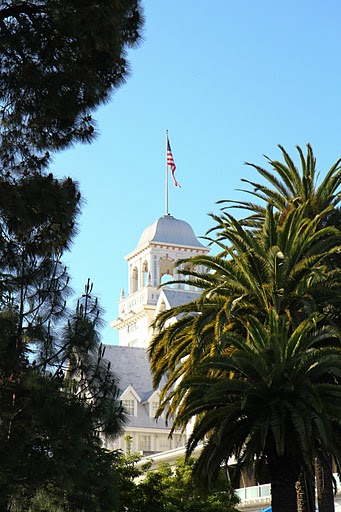
Chateau Palmer, Bordeaux, France – When one is invited to a personal dinner with a winemaker from Bordeaux, France, it’s a requirement to jump at the opportunity. During three plus hours with Bernard de Laage at Berkeley’s Claremont Hotel we tasted twelve Chateau Palmer, de Laage’s blends of equal parts merlot and cabernet sauvignon with just a touch of petit verdot. Comparing vintages side by side, we were able to gain a deeper appreciation of the inflections and strengths brought by each harvest. 

For me, the stand outs were the lush 2000 Palmer, the less aged but still bright 2005 Alter Ego — a robust, young expression of Chateau Palmer — an opulent and exuberant 1999 Palmer, and the musty, full, smoky but acidic 2002 Palmer. I actually couldn’t find a single low point in the 1998-2006 line-up.

The evening, part of Berkeley Wine Festival (check out its site for future dinners), was over the top — spectacular views of the San Francisco Bay from the back room of Claremont Hotel’s Meritage restaurant. Twinkling lights on a warm night made a brilliant partner to rising star chef Josh Thomsen‘s menu. I was duly impressed with all his dishes, and wouldn’t be surprised if we see a lot more from him in coming years. My top dish of the five course dinner was the Maine sea scallops topped with Hudson Valley foie gras. Served over rhubarb-balsamic compote and endive, it was the dining pinnacle of the night. But for sheer satisfaction, I’m giving my points to Thomsen’s succulent Creek Stone beef short rib.

All in all, a happy marriage of wine, food, people, and setting.


— Subscribe to Virgina’s twice monthly newsletter, The Perfect Spot


Busted!

0

le.chicken.farmer@gmail.com

CHEAP EATS I have already written a restaurant review, a poem, and a cheerful pop song about my anal abscess. I don’t know how else to celebrate the cursed motherfucker. I could curse … But I guess I’ve done that too.

I’ve already had it lanced twice. Those were the good times. Except that on the first occasion I missed a day of work, and on the second I missed a baby shower. I felt so badfully about the missed baby shower that I invited the moms-to-be, Pod and the Attack, to breakfast the following Saturday. Technically I guess maybe I invited myself to breakfast. At their house.

Bless them, they made my favorite: waffles! With fresh strawberries! They made bacon! They made eggs! They made roasted tomatoes! It was the perfect meal! It was a masterpiece! It was culinary genius! It was the time of our lives!

Problem: I forgot to go. I don’t know, I was looking forward to it all week and then I woke up on Saturday morning, went, “Dum-de-doe,” and decided — oh, I don’t know — maybe do a little recording, or something.

I record in my kitchen because it’s the quietest room in my apartment, if I turn off the refrigerator. My cell phone was in the closet. At the designated hour, Pod went to West Oakland BART and waited for me.

When she called to say what-the-where-the-fuck-are-you? I was in the kitchen. I had my headphones on, refrigerator off, and was laying some blistering electric ukulele tracks onto Garage Band, singing: “It’s a new day/ It’s a driving rain/ I’m gonna have anal surgery/ It’s gonna be OK/ Gonna feel no pain / Or if I do it will be good for me.” La la la la la la.

And so forth.

Then.

I saw my cell phone while I was getting ready for work. It was lit up like a Christmas tree: texts, voicemails, e-mails. What-the-where-the-fuck-was-I? Oh my sweet baby Jesus, you can imagine my horror, and self-hatred — nay, loathing — as it all sunk in. How did I do that? How could I? Was my head so far up my ass that … ?

Well, technically it was, damn me. Clobber me in the kidneys with a golf club. I felt as low as a horse’s hoof cheese. And that was before the Attack sent me a picture of their spread, Pod in all her pregnancy sitting down to eat those wonderful things I said, plus cantaloupe.

Minus me.

I’ve done some dumb-ass things in my day, but don’t know if I’ve ever hated myself more. I couldn’t imagine how I was ever going to forgive myself. I still kinda can’t. I mean, the bacon alone looked so good in that picture.

They were of course very gracious and forgiving, and I was of course determined to make it up somehow. I invited them over to Berkeley that evening for some of the chicken pot pie that me and the kids were making. They declined.

I invited them to breakfast the following morning. Out somewhere, on me, and they accepted. We went to the Sunny Side Café in Albany, which was alleged to be kind of fancy-pants, and great.

Never in my life, before this, have I wanted a meal to cost more than it did. But, alas, it didn’t. It was like normal weekend brunch prices, roughly $10 apiece. Less tragically, but more to the point, I didn’t think the food was that good. Let alone great. I may have malordered. Maybe I was still traumatized by my brain fart from the morning before, but my spinach-and-sausage scramble was bland city, even with salt-pepper-Tapatío. The roasted tomatoes … meh.

Pod’s pigs in blankets … that was better. And the Attack, she got it right. She hit the jackpot with the Alameda, a stack-up of good stuff — ham, cheese, french toast, eggs — and some other things I personally don’t go for, which is to say mushrooms and Hollandaise. Oh, and a balsamic reduction.

It’s her new favorite restaurant.

SUNNY SIDE CAFÉ

Mon.–Fri. 8 a.m.–3 p.m.;

Sat.–Sun. 8:30 a.m.–3 p.m.

1499 Solano, Albany

(510) 527-5383

Full bar

AE/D/MC/V


Cleaning up UC’s mess

5

news@sfbg.com

By 7 a.m., when engineering students begin to trickle into Cory Hall at UC Berkeley, Arnold Meza has already scrubbed the floors, wiped clean the chalkboards, and emptied the trash of 30 offices and many of the classrooms and hallways of the six-floor building.

His early shift as a custodian is a gift, he says, because it is steady compared to his former swing-shift schedule, but Meza is still barely making rent. And he is a single father of four. Like many service workers in the University of California system, Meza wonders how the university can refuse to give him a 3 percent wage increase while top UC executives receive six-figure bonuses every year.

“It falls on broken promises,” Meza said while tying up a bag of trash, one of hundreds he would take out that week. Meza was referring to an agreement in 2009 between the university and its service workers unions, including Meza’s union, AFSCME (American Federation of State, County and Municipal Employees). At that time, the administration established a minimum wage (currently $13 per hour) for the more than 7,000 service workers and agreed, if funding was available, to increase wages annually to bring their low-wage workers out of poverty.

But the university is going back on its promise, refusing to increase wages with the funding dedicated for that very purpose, the East Bay Alliance for a Sustainable Economy and the Partnership for Working Families (EBASE) notes in its recent report titled “Bad Budgeting, Broken Promises.”

As the UC Office of the President sees it, the 2009 discussion was not an agreement at all, but a “conditional memorandum of understanding” that would only be effective if state funding was available, said UCOP spokeswoman Dianne Klein.

“We’ve already taken $500 million in cuts. We’ll have to take another $500 million in cuts. Because there is no new money, the memorandum of understanding is moot,” Klein told us.

The state budget vetoed by Governor Jerry Brown last week would have set the UC system back $150 million in cuts on top of the $500 million in cuts approved by Brown in January. How much more will actually be cut from UC funding remains to be seen, but the forecast is not promising.

Despite the cuts, the proposed budget bill states that $3 million in distributed state funds should go toward the salaries and benefit of service workers in the UC system. In a March 24 letter to the governor, UC President Mark Yudof requested that the governor veto that restriction so the university could use the dedicated $3 million “to preserve our flexibility in dealing with the $500 million reduction.”

Compared to the total UC budget of $21.8 billion, that $3 million makes up only 0.014 percent — nickels and dimes to give employees a living wage.

Meanwhile, Meza and his fellow coworkers struggle to put food on the table, making ends meet by working two jobs. After his 4 a.m. to noon Monday through Friday shift, Meza works eight-hour shifts as a car mechanic on weekends. Similarly, many UC service workers collect cans to get a few dollars from the recycling center.

“When I started here 20 years ago, I was making close to $9 an hour. That wasn’t enough,” recalled Meza, who put his four children through public high school on that salary. Today, Meza brings home about $2,400 a month, barely enough to cover rent and a few bills at his El Cerrito home.

“I want my kids to go to college. But financially, I can’t afford it,” he said. “For me, it’s a sad reality.”

Meza’s union, AFSCME, is working with UC to lower the workers’ contribution to retirement pensions to 1.5 percent. The university proposes a 3.5 percent pension plan to go into effect this July and 5 percent in July 2012—the same amount requested from top UC executives. At their low wage, that would cost the service workers the equivalent of one biweekly paycheck a year.

Some UC executives, such as UC Berkeley Chancellor Robert Birgeneau, receive additional retirement perks. Roughly 200 highly paid UC executives receive a supplemental retirement benefit of 5 percent of their annual pay, said Nikki Fortunato Bas, the executive director of EBASE. That’s a total annual cost to UC of $4 million.

“If UC gets its way in 2011, instead of getting to climb that next rung on the ladder out of poverty, [the low wage workers] will take a step backward through a combination of increased contributions to retirement and healthcare and UC withholding a 3 percent raise,” Bas said. “All the while, UC is showering already highly-paid executives with six-figure bonuses.”

In an infamous budget battle that has required the UC system to restructure its quickly diminishing funding from the state, more than 100,000 employees’ paychecks have been reduced while top execs like UCLA Ronald Reagan Medical Center CEO David Feinberg receive thousands of dollars in bonuses. In September 2010, Feinberg’s base pay was increased by 22 percent and he received a $250,000 “retention bonus,” for a total compensation of $1.33 million.

These astounding numbers, as part of a $3.1 million package in bonuses for 37 UC executives last September, were quoted in the EBASE report, using data from the UC Regents website (www.universityofcalifornia.edu/regents).

UCOP says the retention bonuses are necessary “because we pay below market as it is [for top executives’ salaries],” said Klein, and the UC needs to offer huge bonuses to keep the executives from moving to higher paying universities. “You have two options: sayonara or we’ll match it,” Klein said. “You can’t recruit in the classifieds for these people … and you’ll have to replace them for the same money, anyway.”

The bonuses are not state-funded, said Klein, but are taken from research grants, patient care, and even federal funding. But Bas said the problem is with UC’s priorities: “Time and again, they have shown that they can find money to give bonuses or backfill sports programs,” she said. “UC may look at this as a matter of technicalities, but we cannot ignore the stories of employees and their families who are struggling to get by.”

As it stands, UC is short-staffed when it comes to service workers. “We’ve been short-staffed for the last 10 years,” said Meza, who estimates that UC Berkeley employs about 140 custodians, less than one-third of the 460 or so custodians the university employed in the 1980s. The result is that the students suffer, said Meza. “The students are getting the short end of the stick because we can only clean once a week in some classrooms because we’re short staff. We see the students pay a lot with tuition, and they’re getting less.”

Already, student fees have increased by more than 32 percent, and another 8 percent fee increase is pending, reported EBASE. As the state continues to make cuts, students and low wage service workers suffer the consequences.

According to the California Budget Project, a single-parent family needs to make $68,375 a year just to make ends meet in Alameda County. “UC workers have reduced-cost healthcare, so this number could be adjusted downward to $58,544,” said Bas. “For a custodian at UC Berkeley or UC San Francisco making $30,000 or even $40,000 a year, this means working two jobs and collecting cans just to scrape by.”

When his oldest was nine years old, Meza remembers, he used to drive his family to the recycling center to get cash for cans he had taken out of the garbage. “The kids were happy in the car because I was going to get money for food when I recycled cans,” which meant there would be dinner on the table that night, Meza said, apologizing for getting teary-eyed at the memory.

“I just don’t want people who work here to go through what I went through to raise a family,” he said.

No matter how many cars Meza fixes on the weekend, he never seems to have a break from the stress of trying to cover fuel, rent, heating bills, doctors’ bills, and other necessities. He’s only 43, but he feels much older after 20 years of working two jobs, seven days a week, providing for four children on his own.

UC workers, unions like AFSCME and other stakeholders have proposed $600 million in budget alternatives such as reducing the excessive 7-to-1 employee-to-management ratio (at UC Berkeley, the average is four employees to one manager). Yet UC does not appear to be seriously considering these alternatives; its current goal is to take back the $3 million dedicated to its low-wage service workers.

“We think this is a matter of finding the will within the UC administration to do what’s right by honoring their word to protect working families’ a path out of poverty,” Bas said.

Two months ago, Meza and his fellow union members marched into UC Berkeley’s Chancellor Robert Birgeneau’s office and asked him to spend one day in the life of a service worker on campus. He still hasn’t answered their request.

“People are really struggling here. We are committed to working and we give 110 percent — that should be accounted for,” said Meza. “Give us our 3 percent. We earned it.”

On the hook

4

rebeccab@sfbg.com

Unique Roberts squared back her shoulders and recalled what it was like when she first moved to San Francisco from East Oakland more than a decade ago. A tall, 33-year-old African American transgender woman with piercing eyes and a charming smile despite gaps of missing teeth, Roberts said she performed as a showgirl at clubs like Harvey’s and the Pendulum in the Castro. In those exciting days, “I fell in love with this boy, and he was an addict,” she explained. “I thought that if I did it, it would keep our relationship together.”

She recalled how awful her boyfriend felt when he found out she was using, telling her, “You don’t know what you’re doing to yourself.” He departed for Texas several years later, but addiction stuck with her as a way of life.

She says she’s tried to kick the habit, but it’s wrapped up in a battle against depression stemming from the loss of loved ones. Roberts was wearing one of the bright orange sweatshirts issued to inmates at San Francisco County Jail. She landed there after being arrested in April for allegedly selling a tiny rock of crack, weighing just 9/100s of a gram, to an undercover narcotics officer. According to the police report, the cop offered her $20 for it — but based on National Drug Intelligence Center street-value estimates, that amount is only worth about $2.50.

Roberts may go by the first name Unique, but her lawyer Tal Klement, who works for the San Francisco Public Defender’s Office, is fond of saying her case is hardly unique at all. She was one of several people arrested in the Tenderloin that day after interacting with the same plainclothes officer.

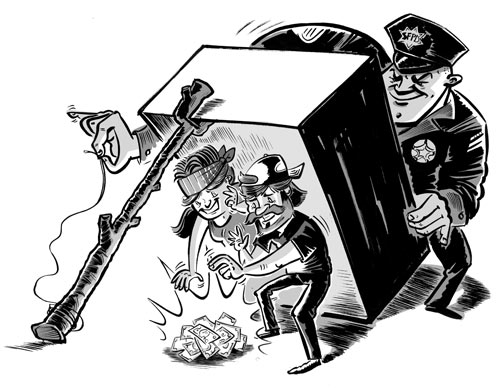
It was part of a coordinated sweep known as a buy-bust, a common practice under which an officer may pose as a homeless person, a clueless outsider, or a dope-sick fiend to lure people into selling crack, pills, meth, heroin, or marijuana. Once a transaction is made, a team of officers awaiting the signal immediately closes in and arrests the seller.

As of June 20, there were at least 109 open buy-bust cases in San Francisco. Based on defendants’ rap sheets, 92 percent had prior drug-use histories, according to a tally conducted by the Public Defender’s Office.

The officers posing as buyers — who often earn overtime — use street lingo, know which drugs can be obtained at which intersections, and sometimes offer higher prices than the accepted street value. Attorney Anne Irwin, also a public defender, is critical of the practice, saying it’s an expensive tactic that’s makes for easy arrests — because the money is irresistible to addicts who think they’re getting an opportunity to convert a personal stash into more drugs.

In a lean budget year, “they’re cutting social services left and right, and these are the very services that could help the addicts get off the street,” Irwin noted. She’s skeptical that the strategy stems the flow of substantial quantities of drugs.

Police Chief Greg Suhr, who said he participated in buy-busts for years as a narcotics officer, credits the tactic for helping to eradicate a rampant open-air drug market on Third Street in the Bayview, and says it can help prevent drug-related violence.

Klement, however, condemns it as a “war on crumbs,” saying it ensnares far more addicts than serious dealers and often ends up unnecessarily pinning felony convictions onto low-level offenders.


NUMBERS GAME

Buy-busts usually involve around eight officers, according to an average calculated by the Public Defender’s Office based on open cases, but have involved as many as 14 and as few as three. There’s the decoy buyer, who sometimes dresses in grimy sweatpants, goes without shaving, or dirties his face to look like a street addict in desperate need of a fix. There’s a “close cover” officer who follows the decoy, plus an arrest team that is also sometimes in plainclothes. Beforehand, officers will photocopy cash — usually $20 bills — to document the serial numbers so that the same marked city funds can be used as evidence once recovered from arrestees. Busts can happen within minutes of one another, and a single shift may net five or six arrests.

Irwin says the people snared aren’t typical drug dealers — certainly not big-time players. But they’re charged as dealers — and in many cases wind up branded as felons, with severe legal penalties such as multiyear prison sentences.

While the police department is able to show on paper that it’s brought hundreds of drug dealers into custody — and the district attorney can point to a boost in the conviction rate thanks to the program’s efficiency — Irwin says the amounts being peddled are tiny.

“In traditional narcotics operations, they cultivated snitches, used surveillance, and obtained search warrants” to go after major dealers, Irwin said. With buy-busts, “It’s like shooting fish in a barrel. Everyone agrees that we need cops on the streets to help keep us safe … But do we want to be paying hundreds of thousands of dollars for this?”

Sharon Woo, chief assistant of operations for the San Francisco District Attorney, told the Guardian that “we charge based on the conduct of the individual.” Woo went on to say that the DA tried to “exercise appropriate discretion” on a case-by-case basis when individuals are selling to support an addiction or due to being in dire financial straits.

Sometimes individuals are ushered into alternative programs such as drug court or a Back on Track program for first-time offenders, Woo said. And while the DA typically includes charges that make defendants ineligible for probation under state law if they have prior convictions for selling crack-cocaine — a discretionary practice that has drawn criticism from public defenders — Woo observed that “it doesn’t mean that’s how cases resolve.”

Police forces in nearly every major metropolitan area practice buy-busts, said Frank Zimring, a law professor at UC Berkeley’s Boalt Hall School of Law specializing in criminal justice issues. Yet he described the practice as costly and noted that paying overtime for it “makes what would ordinarily be a very expensive operation into a more expensive operation.”

Cost estimates for the entire program are tough to pin down. It costs $130 per day to house each prisoner in the county jail, amounting to more than $14,000 per day if all of the defendants with pending cases are in custody. If an average of eight officers per bust were paid $60 an hour each to spend six hours conducting a buy-bust, the current caseload represents more than $300,000 in officer pay — a conservative estimate — and that’s before lawyers in the offices of the public defender and district attorney are paid to prosecute and defend the suspects in court.

But no matter how you add it up, it’s a lot of money.

Suhr told the Guardian that apprehending street-level offenders occasionally leads officers to bigger fish. “Sometimes you get a low-level person, or a buyer if you will … if that same person would say, ‘But I know this guy and he has guns and he’s a big dealer and whatever.’ That is a good way to get to those bigger people.”

“We’ve never seen that happen in practice,” Klement countered.

One of Irwin’s clients, a homeless man, was charged with selling narcotics after he scraped out the contents of his pipe to sell 1/1,000th of a gram of crack to an undercover officer for $20. In a rare twist, the case was ultimately settled on a misdemeanor possession of narcotics.

Inspector Robert Doss, who served as the decoy in that case, has earned substantial amounts of overtime while going undercover to buy drugs, according to a court transcript. In 2009 Doss earned $35,488 in combined overtime and “other pay,” which includes time spent testifying in court, according to a San Francisco Chronicle database of municipal salaries.


ON THE STREET, OFF THE STREET

The Tenderloin is frequently targeted for buy-busts, with 65 percent of open cases as of June 13 having taken place in that neighborhood. The Haight ranked second, with nearly 12 percent of cases, and the Mission followed with 10 percent. Shortly after District Attorney George Gascón was sworn into his prior post as police chief in 2009, he announced a concerted effort to clean up the Tenderloin, and Klement maintains he’s seen a surge in cases stemming from buy-busts there ever since.

Drug dealing in the Tenderloin often makes the news as a source of frustration to merchants and residents. “You try and explain to the people of San Francisco that it’s okay for people to have open-air drug markets right in front of their stores,” Suhr said.

Yet Klement maintains that what is essentially a quality-of-life crime should not be treated as a felony. “There’s a lot of pressure from people who are invested in businesses [in the Tenderloin] who would love to see that neighborhood become the next Hayes Valley,” he said. “But what they don’t realize is that people are paying with prison for that agenda.”

Once someone has been labeled a drug dealer in the eyes of the law, he said, it becomes more difficult for them to access drug treatment — not to mention get a job, qualify for a student loan, or find housing.

Roberts’ case nearly went to trial. If convicted, she could have been sent to prison for a minimum of three and a maximum of 17 years due to extra penalties from prior convictions. On the eve of the trial, however, the case was settled on a possession charge for a year in jail, a rare outcome. Klement was hoping to have her placed in a treatment program.

Asked if she knew of others swept up in undercover operations, Roberts gave a wry chuckle and gestured to the jail corridor behind her, indicating that nearly everyone there had been taken down in similar fashion. Klement noted that the targets of the buy-busts are almost exclusively people of color, saying, “You walk into the holding cell and you think you’re in Alabama or Mississippi, not San Francisco.”

In an editorial on the subject that he wrote a couple years ago, Klement noted that by contrast, predominantly white middle class people with a fondness for illegal drugs are rarely targeted because they aren’t the ones selling drugs on the street. “The hard truth is that the police ignore most of the middle class drug use and dealing occurring out of private homes in every neighborhood or other public venues in the city — bars, nightclubs, concert halls. More drugs are being transported to Burning Man as we speak than will probably be seized during Gascón’s entire crackdown.”

For Klement, it’s just another symptom of a broken system. “A lot of these people are repeat players because we don’t have the right interventions at the right time,” he said. “We don’t understand addiction.”


Stage Listings

0

Stage listings are compiled by Guardian staff. Performance times may change; call venues to confirm. Reviewers are Robert Avila, Rita Felciano, and Nicole Gluckstern. Submit items for the listings at listings@sfbg.com. For further information on how to submit items for the listings, see Picks. 


OPENING

The Book of Liz Custom Made Theatre, 1620 Gough, SF; www.custommade.org. $10-29. Previews Fri/24-Sat/25, 8pm; Sun/26, 7pm. Opens Tues/28, 8pm. Runs Thurs-Sat, 8pm; Sun, 7pm. Through July 31. Custom Made Theatre performs David and Amy Sedaris’ comedy about an unconventional nun.

BAY AREA

A Raisin in the Sun Pear Avenue Theatre, 1220 Pear, Mtn. View; (650) 254-1148, www.thepear.org. $15-30. Previews Thurs/23, 8pm. Opens Fri/24, 8pm. Runs Thurs-Sat, 8pm; Sun, 2pm. Through July 10. Lorraine Hansberry’s classic play comes to life on the Pear Avenue Theatre stage.

Working for the Mouse La Val’s Subterranean, 1834 Euclid, Berk; www.impacttheatre.com. $10-20. Opens Thurs/23, 8pm. Runs Thurs-Sun, 8pm. Through July 8. Trevor Allen revives his hit solo comedy about working at Disneyland in this Impact Theatre and Black Box Theatre co-production.


ONGOING

All Atheists Are Muslim Stage Werx, 533 Sutter, SF; www.brownpapertickets.com. $20. Runs Sun, 7pm. Through July 10. Zahra Noorbakhsh returns with her timely comedy.

Assassins Eureka Theatre, 215 Jackson, SF; www.roltheatre.com. $20-36. Thurs/23-Sat/25, 8pm (also Sat/25, 2pm). Whether the world truly needed a Sondheim musical about the joys of political assassination or not is debatable, but as long as there is one it might as well go for the gusto. Brought to you by Ray of Light Theatre, the folks behind last year’s production of Jerry Springer the Opera, Assassins imbues society’s greatest misfits with quirky relatability. From Joel Roster’s hangdog portrayal of Leon Czolgosz (McKinley’s assassin) to Lisa-Marie Newton’s frazzled Sara Jane Moore (attempted to off Ford), Danny Cozart’s foul-mouthed, Santa Claus-suited, Samuel Byck (out for Nixon) to Gregory Sottolano’s loopy Charles Guiteau (bagged Garfield), the solid cast examines the assassination impulse in a breezy, borderline goofy manner. The production takes a more somber tone when Lee Harvey Oswald (Michael Scott Wells) takes the stage, encouraged by John Wilkes Booth (Derrick Silva) to turn a presumptive suicide attempt into one of assassination, while the other assassins beg him to legitimize their dark impulse through his action. The pacing works best when at its most frenetic, though Silva’s Booth, a pokerfaced elder statesman, lends an air of balancing gravitas. But the true stars of the show might well be the ultra-tight, eight-person house band playing a wide variety of American musical styles from the last 150 years, confidently directed by David Möschler.(Nicole Gluckstern)

Assisted Living: The Musical Imperial Palace, 818 Washington, SF; 1-888-88-LAUGH, www.assistedlivingthemusical.com. $79.59-99.50 (includes dim sum). Sat-Sun, noon (also Sun, 5pm). Through July 31. Rick Compton and Betsy Bennett’s comedy takes on “the pleasures and perils of later life.”

Fighting Mac! Thick House Theatre, 1695 18th St, SF; 1-800-838-3006, www.therhino.org. $15-30. Opens Fri/10, 8pm. Runs Wed-Sat, 8pm; Sun, 3pm. Through July 3. Theatre Rhinoceros performs John Fisher’s play about real-life queer British general Hector MacDonald. “Fury Factory 2011” Various venues and prices; www.brownpapertickets.com. Through July 12. Over 30 Bay Area and national companies participate in this bi-annual theater festival.

Indulgences in the Louisville Harem Phoenix Theatre, 414 Mason, SF; 1-800-838-3006, www.offbroadwaywest.org. $20-40. Thurs-Sat, 8pm. Through July 30. Two spinster sisters find unlikely beaux in Off Broadway West Theatre’s production of John Orlock’s play.

Much Ado About Lebowski Cellspace, 2050 Bryant, SF; www.sfindie.com. $25. Fri/24-Sun/26, 8pm. SF IndieFest and the Primitive Screwheads perform a Shakespeare-inflected take on the Coen Brothers’ classic film.

The Pride New Conservatory Theatre Center, 25 Van Ness, SF; (415) 861-8972, www.nctcsf.org. $24-40. Wed-Sat, 8pm; Sun, 2pm. Through July 10. New Conservatory Theatre Center performs the West Coast premiere of Alexi Kaye Campbell’s love-triangle time warp drama.

Risk is This…The Cutting Ball New Experimental Plays Festival EXIT on Taylor, 227 Taylor; (800) 838-3006, www.cuttingball.com. Free. Fri/24-Sat/25, 8pm. Cutting Ball Theater closes its 11th season with a festival of experimental plays, including works by Eugenie Chan, Rob Melrose, and Annie Elias.

The Stops New Conservatory Theatre Center, 25 Van Ness; 861-8972, www.nctcsf.org. $24-40. Wed/22-Sat/25, 8pm; Sun/26, 2pm. New Conservatory Theater Center presents a musical comedy set in San Francisco.

A Streetcar Named Desire Actors Theatre, 855 Bush; 345-1287, www.actorstheatresf.org. $26-38. Wed/22-Sat/25, 8pm. Actors Theatre of San Francisco presents the Tennessee Williams tale.

*Vice Palace: The Last Cockettes Musical Thrillpeddlers’ Hypnodrome, 575 10th St; (800) 838-3006, www.brownpapertickets.com. $30-35. Fri-Sat, 8pm; Sun, 7pm. Through July 31. Hot on the high heels of a 22-month run of Pearls Over Shanghai, the Thrillpeddlers are continuing their Theatre of the Ridiculous revival with a tits-up, balls-out production of the Cockettes’ last musical, Vice Palace. Loosely based on the terrifyingly grim “Masque of the Red Death” by Edgar Allan Poe, part of the thrill of Palace is the way that it weds the campy drag-glamour of Pearls Over Shanghai with the Thrillpeddlers’ signature Grand Guignol aesthetic. From an opening number set on a plague-stricken street (“There’s Blood on Your Face”) to a charming little cabaret about Caligula, staged with live assassinations, an undercurrent of darkness runs like blood beneath the shameless slapstick of the thinly-plotted revue. As plague-obsessed hostess Divina (Leigh Crow) and her right-hand “gal” Bella (Eric Tyson Wertz) try to distract a group of stir-crazy socialites from the dangers outside the villa walls, the entertainments range from silly to salacious: a suggestively-sung song about camel’s humps, the wistful ballad “Just a Lonely Little Turd,” a truly unexpected Rite of Spring-style dance number entitled “Flesh Ballet.” Sumptuously costumed by Kara Emry, cleverly lit by Nicholas Torre, accompanied by songwriter/lyricist (and original Cockette) Scrumbly Koldewyn, and anchored by a core of Thrillpeddler regulars, Palace is one nice vice. (Gluckstern)

What Mamma Said About Down There SF Downtown Comedy Theater, 287 Ellis, SF; www.sfdowntowncomedytheater.com. $15. Thurs-Sat, 8pm. Through August 20. Sia Amma returns with her solo comedy.

Wish We Were Here New Conservatory Theatre Center, 25 Van Ness, SF; (415) 861-8972, www.nctcsf.org. $20-32. Thurs/23-Sat/25, 8pm. Slacker meets genie in this Michael Phillis comedy.

BAY AREA

Care of Trees Ashby Stage, 1901 Ashby, Berk; (510) 841-6500, www.shotgunplayers.org. $17-26. Thurs/23-Sat/25, 8pm; Sun/26, 5pm. E. Hunter Spreen’s Care of Trees, which is receiving an inventively bold world premiere production in Shotgun’s capable hands is at once ambitious yet unsatisfying. The basic plot — “girl meets boy then turns into a tree &ldots; sort of” — is a quirky premise full of untapped potential. With so many possible interpretations of Georgia’s (Liz Sklar) unique predicament, the one that seems most predominant is an unwitting critique of the banality of the self-realization movement. “If I don’t do &ldots; what I see as right, then I’ll be lost to myself,” she tells her understandably frustrated husband Travis (Patrick Russell), as she abruptly shuts off her empathy-meter and bids him to do the same. During isolated pockets of dramatic tension, Georgia is stabbed in an altercation with a tree-hugger, suffers a series of violent seizures, is shuttled off to a battery of clueless doctors, and granted an audience with a Peruvian shaman, yet the underlying significance of actually turning into a tree, is barely explored, certainly never understood. Sklar and Russell turn in standout performances as the forest-crossed lovers, and the canopy of Nina Ball’s inventive set soars, but overall this Tree could stand to develop some stronger roots. (Gluckstern)

Down a Little Dirt Road Berkeley City Club, 2315 Durant, Berk; www.justtheater.org. $15-30. Thurs-Sat, 8pm; Sun, 5pm. Through July 3. A naturalistic family portrait twists itself into a supernatural love knot in Erin Marie Bregman’s first full-length play Down a Little Dirt Road, directed by Molly Aaronson-Gelb. Dad (Anthony Nemirovsky), an earthquake researcher, has moved his family to Parkfield, Calif. for work, but Mom (Lisa Morse) is not with them. Did she die in a plane crash on September 11? Did she vanish into another dimension? Daughter Alice (Alona Bach) has plenty of theories to share, each more earnestly improbable than the last. She is also plagued with recurring nightmares, an unsettling trait she shares with her father. Together they dream of wandering, lost, in a shadow realm, gradually revealed to hold the shade of the missing mother, trying desperately to get back to her daughter while a menacing authority figure (Ryan Tasker) tries to literally pry her memories away. Alona Bach delivers a guileless, pitch-perfect performance as Alice, and her relationship with her stage parents is comfortable and genuine. Berman is clearly playing with the convention of the family-oriented horror story, much like the referenced Roald Dahl classic The Witches, but the ghostly elements prove somewhat problematic in terms of staging and clarity, and while there are a few moments with some serious spine-tingling potential, the overall effect is somewhat flat. (Gluckstern)

East 14th: True Tales of a Reluctant Player Marsh Berkeley, 2120 Allston, Berk; www.themarsh.org. $20-50. Sat, 8:30pm; Sun, 7pm. Through Aug. 7. Don Reed’s hit solo comedy receives one last extension before Reed debuts his new show (a sequel to East 14th) in the fall.

*Edward Albee’s Tiny Alice Marin Theatre Company, 397 Miller, Mill Valley; (415) 388-5208, www.marintheatre.org. $32-53. Thurs/23-Sat/25, 8pm (also Sat/25, 2pm); Wed/22 and Sun/26, 7:30pm (also Sun/26, 2pm). Marin Theatre Company performs Albee’s most divisive play, an erotic thriller-cum-comic allegory.

Let Me Down Easy Berkeley Repertory Theatre, Roda Theatre, 2015 Addison, Berk; (510) 647-2949, www.berkeleyrep.org. $17-73. Thurs/23-Sat/25, 8pm (also Sat/25, 2pm); Wed/22, 7pm; Sun/26, 2pm. Anna Deavere Smith performs her latest solo show.

Metamorphosis Aurora Theatre, 2081 Addison, Berk; (510) 843-4822, www.auroratheatre.org. $10-55. Tues, 7pm; Wed-Sat, 8pm; Sun, 2 and 7pm. Through July 17. Aurora Theatre Company performs a terrifying yet comic adaptation of Kafka’s classic by David Farr and Gísli Örn Gardarsson.

[title of show] TheatreWorks at the Mountain View Center for the Performing Arts, 500 Castro, Mtn View; (650) 463-1960, www.theatreworks.org. $24-42. Wed/22, 7:30pm; Thurs/23-Sat/25, 8pm (also Sat/25, 2pm); Sun/26, 2 and 7pm. TheatreWorks performs a new musical about musicals by Hunter Bell and Jeff Bowen. 


Rep Clock

0

Schedules are for Wed/22–Tues/28 except where noted. Director and year are given when available. Double and triple features are marked with a •. All times are p.m. unless otherwise specified.

BALBOA 3620 Balboa, SF; www.balboamovies.com. $20. “Opera, Ballet, and Shakespeare in Cinema:” Rigoletto, performed by Placido Domingo, Sat-Sun, 10am.

CASTRO 429 Castro, SF; (415) 621-6120, www.castrotheatre.com. $7.50-10. “Frameline 35: San Francisco International LGBT Film Festival,” Wed-Sun. Visit www.frameline.org for complete schedule and ticket information. Stonewall Uprising (Davis and Heilbroner, 2010), Tues, 7. Free screening.

CHRISTOPHER B. SMITH RAFAEL FILM CENTER 1118 Fourth St, San Rafael; (415) 454-1222, www.cafilm.org. $10.25. The Tree of Life (Malick, 2011), call for dates and times. The Trip (Winterbottom, 2010), call for dates and times. Coppelia, performed by the Bolshoi Ballet, Thurs, 7 and Sun, 1. This event, $18. Buck (Meehl, 2011), June 24-30, call for times.

“FILM NIGHT IN THE PARK” This week: Creek Park, 451 Sir Francis Drake, San Anselmo; (415) 272-2756, www.filmnight.org. Donations accepted. Breakfast Club (Hughes, 1985), Fri, 8; National Velvet (Brown, 1944), Sat, 8.

FOUR STAR 2200 Clement, SF; www.lntsf.com. $10. “Asian Movie Madness” •The Host (Bong, 2006), and Yang Zean (1979), Thurs, call for times.

MECHANICS’ INSTITUTE 57 Post, SF; (415) 393-0100, rsvp@milibrary.org. $10. “CinemaLit Film Series: Music and Nostalgia:” The Blues Brothers (Landis, 1980), Fri, 6.

PACIFIC FILM ARCHIVE 2575 Bancroft, Berk; (510) 642-5249, www.bampfa.berkeley.edu. $5.50-9.50. “Japanese Divas:” Tokyo Story (Ozu, 1953), Wed, 7; Dragnet Girl (Ozu, 1933), Fri, 7; Sisters of the Gion (Mizoguchi, 1936), Fri, 9; Street of Shame (Mizoguchi, 1956), Sat, 8:45. “The Cult of the Kuchars:” “8mm Films by George and Mike Kuchar,” Thurs, 7; Weather Diary 1 (George Kuchar, 1986), Sat, 6. “Secession from the Broadcast: The Internet and the Crisis of Social Control,” lecture by Gene Youngblood, Sat, 3:30. “Arthur Penn: A Liberal Helping:” Little Big Man (1970), Sun, 5:30; Night Moves (1975), Sun, 8:10.

RED VIC 1727 Haight, SF; (415) 668-3994; www.redvicmoviehouse.com. $6-10. “Midnites for Maniacs:” •The Purple Rose of Cairo (Allen, 1985), Wed, 2, 9:15, and Broadway Danny Rose (Allen, 1984), Wed, 7:15. Single film, $7; double feature, $10. Forgetting Dad (Minnich, 2009), Thurs, 7:15, 9:25. The Warriors (Hill, 1979), Fri-Sat, 7:15, 9:20 (also Sat, 2, 4:15). Phil Ochs: There But For Fortune (Bowser, 2011), Sun-Tues, 7:15, 9:20 (also Sun, 2, 4:15).

ROXIE 3117 and 3125 16th St, SF; (415) 863-1087, www.roxie.com. $5-9.75. “Frameline 35: San Francisco International LGBT Film Festival,” Wed-Thurs. Visit www.frameline.org for complete schedule and ticket information. Making the Boys (Robey, 2009), Wed-Thurs, 7:30, 9:30.

SUBTERRANEAN ARTHOUSE 2179 Bancroft, Berk; (510) 540-7185, www.brownpapertickets.com. $10. “Innovative California Dance Films,” Fri, 8:30.

“TEMESCAL STREET CINEMA 2011” 49th St at Telegraph, Oakl; www.temescalstreetcinema.com. Free. Trust (Kelly and Yamamoto, 2010), Thurs, 8:45. With music by Ash Reiter at 8pm.

TOP OF THE MARK InterContinental Mark Hopkins, One Nob Hill, SF; www.topofthemark.com. Free. Bullitt (Yates, 1968), Tues, 7:30. YERBA BUENA CENTER FOR THE ARTS 701 Mission, SF; (415) 978-2787, www.ybca.org. $6-8. Oki’s Movie (Hong, 2010), Thurs, 7:30; Sun, 2.

Summertime Fernet-drinking just got its video anthem

5

There was a time when ordering a shot of Fernet Branca was weird, when your friends would screw up their faces (if they actually knew what the stuff is) and waft a glass of Cuervo under your nose: “now this is a shot!”

Oh hold up, that’s actually still how it is – but at least now you have a dope song featuring a legit San Francisco soul legend to bawl back at the haters when they’re questioning your libation election.

I’m (half) joking – Fernet has long been the officially official “we’re in San Francisco!” weirdo drink for weirdos — who run this town, of course. We’ve been drinking it since Italian immigrants lugged it through Angel Island in their suitcases – straight on through Prohibition in fact. Branca ducked the judging gaze of teetotalers by being sold in pharmacies as medicinal elixir. 

But the modern day craze, well that’s something else. I was recently down in Buenos Aires, where they drink even more than we do (mixed with Coca Cola, in their case) – but even the porteños knew that San Francisco drinks hella Fernet Branca – we take down a quarter of the entire country’s total consumption, by some counts. 

If you’re going to point fingers anywhere for the current renaissance, you may as well jab them at DJs Doc Fu and Pause of the Red Wine crew.

Aaron “Pause” Vaughn says he was first introduced to Fernet back in 1995 by Hobson’s Choice bartender Chris Dickerson. Back then, it was the after hours drink of choice for the service industry set. Red Wine started drinking it paired with pints of Guinness at all its gigs, and members haven’t looked back. 

“I know the Red Wine crew and affiliated converts like it because it settles your stomach after a Mission burrito or a harrowing bike ride through the City,” Pause tells me in an interview over the Internets. “The Red Wine DJs have been notorious for drinking and pilfering bottles of the stuff at gigs for years.”

“We’ve been drinking it since we were kids in the club,” says Bruce O’Leary, who spins hip hop, soul, and eclectic booty-shakers throughout the city under the moniker of Doc Fu. “It wasn’t a thing. The bartenders we worked with were like ‘we’ve got this stuff in.’ And I was like ‘I’ll drink it.’ It was like a secret handshake.” 

But what started as an after hours drink for the cool kids started become the all hours drink for the cool kids – at least for Doc Fu, who started to “go to the bar and be like ‘yo, I need a shot of Fernet and Guinness like, right now.’”

And just like that, it wasn’t just the industry set anymore. “The other night I saw a guy on a ten speed with a sipper [of Fernet] in his back pocket,” says Doc Fu. 

High time the brew (comprised of a million ingredients culled from sources on multiple continents, reputably suitable for defeating hangovers, assuaging menstrual pains, or bonding with your Argentinian buddies) had an anthem.

And one night, gathering together drinking supplies from Safeway for a gig opening for Mistah F.A.B., the Red Wine boys hit upon it: “I Drink Fernet.” 

“You know how in Safeway they play random shit?” remembers Doc Fu. A mellow ’80s jam came over the tinny loudspeakers as the Red Wine crew was dealing with a store clerk who kept trying to sell them champagne instead of their desired bottle of Italian bitters. They started subbing out the lyrics to ones that were more appropriate for the situation at hand.

The result was too good to leave in the grocery aisle. Pause recorded the song with Equipto a few years ago, and even got Michael Marshall to do the hook. Marshall was part of the ’80s Berkeley group Timex Social Club and will forever go down in history for singing the hook for the Luniz’ “I Got Five On It.” Recently he’s been popping up all over, including in Equipto’s must-bump for SF summer 2011.  “Pause got Mike Marshall on the phone. I was like, the San Francisco soul legend? Why don’t you just call up Deangelo,” Doc Fu remembers. 

The crew recently released a video for “I Drink Fernet”, which they filmed at Haight Street bar Nickie’s with a little help from the amiable publicity reps at Fernet Branca. “Fernet showed up to the video shoot with four or five magnums. They’re incredibly nice folks by the way. It was a pretty fun night,” says Doc Fu. Pause phrases the night a little differently: “during the video shoot everyone got sloppy on Fernet.”

The videos making the rounds through SF drinkers now, which has Doc Fu joking about what the next round’s gonna be. “We should do a whole EP about liquor song, a song about Jameson, a song about pony kegs. Everyone loves liquor songs. Somebody today is having their first drink.”

And that’s what makes this city great. Perfect, now I’m thirsty. Pass that weird shit they only drink in San Francisco, and turn up my song. 


Treasure Island: 11 ayes, no sight

6

On June 7, the San Francisco Board of Supervisors voted 11-0 to reject an appeal of the Treasure Island environmental impact report. The appeal was brought by Arc Ecology and our colleagues the Sierra Club, Golden Gate Audubon Society, Wild Equity, former Sup. Aaron Peskin, and Yerba Buena Island resident Ken Masters.

The board will tell you that the Department of City Planning and the Mayor’s Office of Economic and Workforce Development found the appeal lacking in merit.

In the appeal, we claimed the EIR lacked the specificity to qualify as a project EIR, which means that after it passes, the city will have substantially limited the ability of any future Board of Supervisors to address the project’s actual environmental impacts. But these impacts cannot and will not be known until actual development proposals, none of which presently exist, are made.

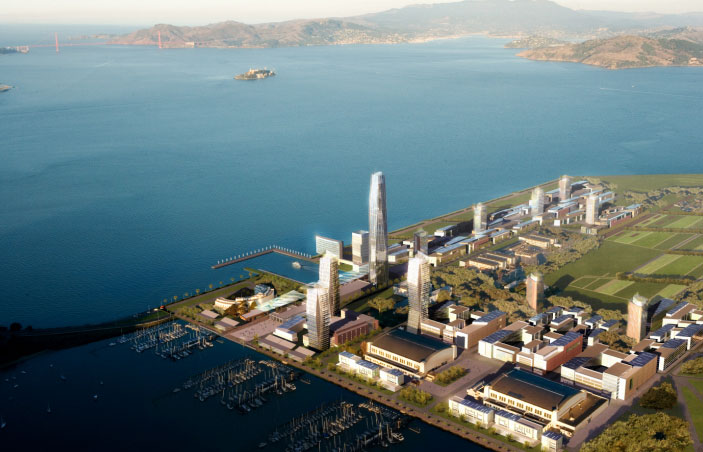
Sup. Jane Kim and city planning staffers argued that the EIR had almost too much specificity. For example, without showing a single confirming diagram, project sponsors claimed they could cut as many as 100 stories off the proposed skyscrapers — yet keep the same number of condos without increasing the bulk, height, or number of buildings in the overall project. How? Through the Harry Potter-like magic of “flex buildings and zones.”

The board will tell you that this project presents a vision of a new community unrivaled in the Bay Area and nation — a new Athens. But the supervisors don’t seem to realize that it’s a development with a population larger than Emeryville, about the size of Albany. Indeed, the separate dedicated buildings of affordable homes truly make Treasure Island like Athens of old, with poorer people segregated from the rich.

They don’t see that this is a self-reflecting vision blithely unconcerned about the impacts it will have on the greater Bay Area region, and that it’s a bloated project that will vastly exceed the region’s capacity to support it. It’s a project whose impacts will enslave legions of people to longer commutes as more cars flood the bridge, pushing traffic like rising sea levels into the upper reaches of East Bay freeways. Nor are project proponents particularly concerned about the impacts of air pollution blowing from the bridge and the region’s freeways into Berkeley, Emeryville, and Oakland.

Finally, neither the supervisors, nor the city planners, nor the Office of Economic and Workforce Development seem to be aware that San Francisco currently has 30,000 vacant housing units. It will cost a projected $577,000 to build each Treasure Island unit. But more units could be built on San Francisco’s mainland with almost no impact, simply by allowing rental units in the basements of some of our stock of 130,000 single-family homes.

That kind of housing isn’t as luxurious as a 45-story view of the bay from Treasure Island perhaps — but at a cost of $100,000 to $200,000 per unit, more than half of those in-law apartments could be rented at or below market rate. Infill housing of that sort would also mean greater stability for established home owners, more jobs and business opportunities, and more riders for Muni.

Still, the appellants weren’t trying to halt any project at Treasure Island. The appeal was about was fixing the deficiencies in the EIR and right-sizing the project so it can move forward with its benefits intact.

In the Tarot, the Five of Cups depicts an individual so besotted by that possibilities floating before his eyes that he stands mesmerized, believing they are at hand — of course, in reality he’s fooling himself. In the case of Treasure Island, the supervisors and city officials are intoxicated by the visions floating in the bay — and are thus blinded to the better options of making this city and region more sustainable and affordable.

Heroes and hoedowns

0

arts@sfbg.com

FRAMELINE This year’s Bay Area-centric Frameline features run a thematic and identification gamut appropriate to the festival’s ever-inclusive programming. Several are celebrations of local LGBT heroines and heroines, some recently deceased and some still-with-us.

Scott Gracheff’s With You commemorates the life and legacy of late local resident Mark Bingham, who famously died on United Airlines Flight 93 and is strongly suspected of being among the passengers who stormed the cockpit and prevented that hijacked Newark-to-SFO flight from reaching its presumed governmental target in Washington, D.C., on 9/11.

As his activist mother Alice Hoagland and everyone else here says, it’s the sort of thing he would do — Bingham was, among other things, an avid rugby player, metalhead, daredevil, UC Berkeley frat president, world-class partier, several-time arrestee (for reckless hijinks rather than criminal menace), bear chaser, global traveler, dot-com-wave surfer, and “human labrador retriever” (as a long-term boyfriend calls him). He lived a very full life and doubtlessly would have continued living it to the limit if this encounter with terrorism hadn’t cut his time short at 31.

A life that remained eventful for nearly three times that length was that of Del Martin, who along with surviving partner Phyllis Lyon founded SF’s Daughters of Bilitis — the nation’s first lesbian political and social organization — in the highly conservative climate of 1955. They remained highly active in feminist, gay, senior, and other progressive causes over the decades. Martin’s death in 2008 at age 87 occasioned a tribute in the City Hall rotunda that is captured by veteran local filmmaker Debra Chasnoff’s Celebrating the Life of Del Martin. This hour-long document demonstrates the breadth of Martin’s influence as prominent politicians, musicians, authors, progressive and religious leaders, et al. pay homage.

How exactly to honor our dead is the question at the heart of Andy Abrahams Wilson’s very polished The Grove, which charts the creation of the National AIDS Memorial Grove — an idea brought to fruition by the surviving partner of local landscape gardener Stephen Marcus — as well as some struggles over its visibility (even most visitors to Golden Gate Park don’t seem to know it’s there) and purpose.

When a recent contest was held for an installation to be added to the site, two women designers won with a striking sculptural concept intended to make a potent statement à la D.C.’s Vietnam Veterans Memorial about the disease’s devastation. But the grove’s current board shot it down, preferring to maintain the space’s leafy, meditative feel — even if that might also maintain its relative public invisibility. Should the memorial comfort those who directly suffered loss, or metaphorically convey that loss in vivid terms for future generations?

Very much living with HIV — emphasis on the living part — is the subject of Dain Percifield’s Running in Heels: The Glendon “Anna Conda” Hyde Story. Glendon Hyde a.k.a. Anna Conda fled a horrific Bible Belt background to become one of SF’s premier drag personalities, running the Cinch’s popular Friday night Charlie Horse revue for five years until a new condo’s complaining tenants shut that down. Enraged by the city’s “war on fun,” hostility toward the homeless, and other issues to boot, he joined 13 other candidates running for District 6 (Tenderloin) supervisor last year. He didn’t win, but this doc will make you hope he tries again.

Last but far from least is this year’s sole Bay Area narrative feature, shot largely in Fruitvale even if it is set in Texas. A big leap from writer director David Lewis’ prior features, Longhorns is a delightful romantic comedy about several 1982 Lone Star state frat boys dealing with sexual impulses and related emotions that might — oh lawd no — mean they’s quar, not just “messing around.” With some soundtracked songs by H.P. Mendoza (2006’s Colma: The Musical), this total charmer is (as one character puts it) “hotter’n a billy goat in a pepper patch.”

FRAMELINE 35: SAN FRANCISCO INTERNATIONAL LGBT FILM FESTIVAL

June 16–26, most films $9–$15

Various venues

www.frameline.org

Wild is the wind

0

marke@sfbg.com

SUPER EGO “I remember the last time I saw Nina Simone, it was just after the Bush-Gore election fiasco. She was maaad,” graciously loquacious jazz chanteuse Kim Nalley told me over the phone when I asked her about the High Priestess of Soul’s relevance today. “Here was this woman who had been there through so many stages of the civil rights struggle, fought for voting rights in Mississippi, been there through all of that — and then to hear about black communities, Jewish communities, where the votes just disappeared …

“Well, she wasn’t having any of that. She told us we had to always keep up the fight, keep the fire going, and never let go. What was gained in one generation could be completely wiped out in the next. And all the while she was playing the most spellbinding music. I think that’s her angle on now”

Golden-voiced and full of fierceness, Ms. Nalley, a longtime (but not too long) Bay Area phenom and former owner of Jazz at Pearl’s in North Beach, intends to keep that message alive for five straight weeks at the Rrazz Room — and sing the sugar out of a Nina Simone set list that runs to 44 songs, augmented with tales of the activist diva’s life and accomplishments. If just thinking about doing all that makes you draw a breath, add in that Nalley is finishing up her Ph.D. in history at UC Berkeley, teaching jazz to grade school kids, and preparing to embark on a string of international tours and recording projects. Plus she’s catching up on all four seasons of Mad Men. Did I mention she’s gorgeous and actually exists?

She’s also well aware of the hold almighty Nina still exerts on the dancefloor imagination — from the famous, or infamous, Verve Remixed series of the early ’00s, to more recent sample-based efforts like those of Massive Attack, Gui Boratto, Ark, and this spring’s rather unfortunate minimal-tech hit “Sinnerman 2011” by Sean Miller and Daniel Dubb, which apparently took two people to make. (Civilization has so far escaped an Auto-Tuned strip-rap version of “See-Line Woman” or Deadmau5’s “Young Gifted and Black” but I could easily see Nicki Minaj as all “Four Women” at once.)

“You hear these newer versions of her, but some can sound so dated so quickly,” Kim said. “The originals never stop being fresh, alive. There’s nothing wrong with introducing her to new audiences in different ways. But Nina has always been with us, right there, so go out and hear her actual music, already.” *

SHE PUT A SPELL ON ME: THE MUSIC OF NINA SIMONE

Through July 17, Wed.–Sat., 8 p.m.,

Sundays, 7 p.m., $30–$37.50

Rrazz Room at Hotel Nikko

222 Mason, SF

www.therrazzroom.com


TRANNYSHACK: HEKLINA’S BIRTHDAY

The highest hog in dragland turns 103, and this night of greatest hits command performances will be an over-the-top trashtacular. Plus: Justin V. Bond from New York City, and probably some light rimming.

Fri/17, 9:30 p.m.–-3 a.m., $12–>$15. DNA Lounge, 375 11th St., SF. www.trannyshack.com


PRECOMPRESSION

It’s that time, again — time for the Burning Man gear-up and things that sound like this: “We invite you to live out this year’s theme in ways that manifest your personal journey.” I’m gonna be a pizza! Put it on the pizza! Put it on the pizza! It’s all good. With a holy helluva lot of DJs, theme installations, and fun-fur coughs.

Sat/18, 8 p.m.–4 a.m., $15 in “Playa finery,” $20 without. Public Works, 161 Erie, SF. www.publicsf.com


FLYING SAUCER BEACH PARTY

What do you get when you mix big-headed invaders, a slew of hot bodies, a ton of zombie-Martian makeup, and the “Hand Jive”? No, not Weinergate II: Night of the Living Tweets. Culturally invaluable burlesque crew Hubba Hubba Revue and a slew of groovy ghoulies play beach blanket bingo — but with laser guns! — at this ginchy all-day dress-up-and-rock-out bash.

Sun/16, 2 p.m.-8 p.m., $10 before 3 p.m., $12 after. DNA Lounge, 375 11th St., SF. www.hubbahubbarevue.com

Our Weekly Picks: June 15-21, 2011

0

WEDNESDAY 15

EVENT

“Snakes and Lizards: The Summer of Slither”

“It is I; be not afraid.” Such were the comforting words, according to the Gospel of John, spoketh by Jesus C. unto his disciples after he reportedly walked across the sea. Now imagine another creature — right here, right now — capable of sprinting across the water: the neon-emerald mini-pterodactyl “green basilisk lizard,” expressing the same sentiment through its namesake stare. Need you be afraid of the 60 snakes and lizards — collectively known as “squamates” — visiting the California Academy of Sciences till September? Maybe. But these scaly species, along with their academy interpreters, have an important role this summer as live ambassadors from the reptilian realm. You just might find God, the devil, Darwin, or all three. (Kat Renz) Through Sept. 5

Mon.–Sat., 9:30 a.m.–5 p.m.;

Sun., 11 a.m.–-5 p.m., $19.95–$29.95

California Academy of Sciences

55 Music Concourse, Golden Gate Park, SF

(415) 379-8000

www.calacademy.org


THURSDAY 16

PERFORMANCE

Fresh Meat Festival

Fresh Meat, the transgender and queer performance festival, is 10 years fresh this year. And to celebrate, the festival offers its most ambitious program to date, four full nights’ worth of work, including Vogue Evolution, the New York City LGBT street dance group featured on the reality competition America’s Best Dance Crew. Also fleshing out this year’s roster: Los Angeles–based Robbie Tristan and Willem DeVries (same-sex ballroom world champions), New Mexico’s Cohdi Harrell (world-class trapeze artist), Sean Dorsey Dance, Na Lei Hulu I Ka Wekiu (an all-male hula company), the Gay Asian Pacific Alliance Men’s Chorus, glamourpuss singer-songwriter Shawna Virago, and comedian Natasha Muse. (Robert Avila)

Thurs/16–Sat/18, 8 p.m.;

Sun/19, 7 p.m., $15–$20

Z Space at Theater Artaud

450 Florida, SF

www.freshmeatproductions.org


FRIDAY 17

DANCE

Epiphany Productions Sonic Dance Theater

Recently returned from Mexicali, Mexico, the globetrotting choreographer Kim Epifano brings her art and travels back to SF with a home season work at the ODC Theater. Solo Lo Que Fue, a dance film shot at Cantina El Norteño, a historic bar in Mexicali, features a site-specific dance with performers from the region. The program also includes Heelomali, a multimedia piece created with composer and didgeridoo master Stephen Kent and Burmese harp player Su Wai, as well as Alonesome/Twosome, a duet inspired by an airmail drawing sent to Epifano by acclaimed artist Remy Charlip with live music by Epifano and Kent. Enjoy this armchair travel from the theater. (Julie Potter)

Fri/17–Sun/19, 8 p.m.; Sun/19, 7 p.m., $16–$20

ODC Theater

3153 17th St., SF

(415) 863-9834

www.odcdance.org


MUSIC

Horrid Red

Imagine an almost ludicrously compact car of obscure design speeding through the Teutonic countryside. It’s the early to mid-1980s. Driver and passenger, both with shaved heads and dressed entirely in black, are leaving their usual neon-soaked haunts in Berlin for a weekend in the mountains. They are very much in love, and Horrid Red is the soundtrack to their affections. Featuring three-fourths of shitgaze pioneers Teenage Panzerkorps, Horrid Red eschews the aggression of this other incarnation and opts instead for a near-perfect and haunting blend of krautrock, new wave, and early minimalist punk. Split between two continents (vocalist Bunker Wolf lives in Germany while the rest of the band resides right here in San Francisco), Horrid Red is a collaborative effort that only rarely allows for live performance. In other words, don’t miss them. (Cooper Berkmoyer)

With Burial Hex and Brute Heart

9:30 p.m., $8

Hemlock

1131 Polk, SF

(415) 923-0923

www.hemlocktavern.com


SATURDAY 18

DANCE

Patricia Bulitt

Patricia Bulitt is for the birds. Literally. She has been making dances about them for more than 30 years, first in Alaska, most recently in New Zealand and Japan. To her they are harbingers of peace and beauty, qualities she finds woefully absent in our humdrum existence, and her dances honor them. One piece was dedicated to the native birds of Lake Merritt in an Oakland refuge, another to a blackbird residing in grove on the UC Berkeley campus. But her biggest love is the majestic egret. Her Egretfully, performed on the lawn below the nesting couples at the Audubon Canyon Ranch, has become an annual event. (Rita Felciano)

2–4 p.m., free (contributions requested)

Audubon Canyon Ranch

4900 Shoreline Hwy., Stinson Beach

415-868-9244

www.egret.org


MUSIC

Pete Rock

Pete Rock recently tweeted about “dat Montel Williams blender, the fucking truth. Watch ur fingers, dat shit will blend ur joints up nicely lol.” A mainstay of classic 1990s hip-hop, Pete Rock isn’t new to blending, plucking from the depths of R&B, funk, and jazz records for his signature fusion of music styles. With his kitchen blender, Rock concocted an “apple, celery, parsley drink” and declared that “man dis shit is good.” Tonight is the chance to see what he’ll cook up outside the kitchen, as the legendary producer performs a two-hour set. In the spirit of remixes, Yoshi’s offers Japanese delicacies to sample alongside the music. (David Getman)

10:30 p.m., $25

Yoshi’s San Francisco

1330 Fillmore, SF

(415) 655-5600

www.yoshis.com


EVENT

Northern California Pirate Festival

Arrr! Forget about all other expeditions ye may have plotted for this here comin’ weekend, ya lousy bilge rats! Ye best be settin’ sail for swashbuckling adventures of all manner at the fifth annual Northern California Pirate Festival, a true buccaneer’s dream come true. Costumed revelry, sword-fighting, sailing ships, canon firings, music, food, grog, wenches, treasure, and more be in store, whether ye be a seasoned deck hand or a curious landlubber. What better way to spend Father’s Day weekend than to take Dad to see the new Pirates of the Caribbean flick — be warned, ye may want to bring along a healthy ration of rum — and then make way for a festival where you may actually walk away with $5,000 in gold coins and treasure? (Sean McCourt)

10 a.m.–6 p.m., free

Vallejo Waterfront Park

Adjacent to Vallejo Ferry Terminal

298 Mare Island Way, Vallejo

1-800-921-YARR

www.norcalpiratefestival.com


MUSIC

Bill Callahan

Apocalypse, Bill Callahan’s follow-up to 2009’s beautiful Sometimes I Wish We Were an Eagle, is a striking left turn from the lush production and personal reflection that populated much of that album. Instead, with his deeply rich baritone always front and center in the mix, Callahan has created a song cycle more in line with the fractured folk and wry humor of Smog, the alias he worked under for nearly 20 years. Apocalypse stretches eight songs over the course of 40 minutes, each full of stark takes on American roots music and wrapped in simple, haunting arrangements. It’s another example of Callahan’s slow, steady climb to the upper echelon of modern American songwriters. (Landon Moblad)

With Michael Chapman

9 p.m., $20

Independent

628 Divisadero, SF

(415) 771-1421

www.theindependentsf.com


SUNDAY 19

MUSIC

Sharon Jones and the Dap Kings

To ring in its 74th season of free summer performances, organizers of the Stern Grove Festival enlist Motown-revivalist masters Sharon Jones and the Dap Kings. With a massive voice in the lead and instruments authentic to the period, the band is tailor-made for the festival circuit and outdoor arenas. Today’s concert is the first of many to come this summer, including performances by Neko Case, Aaron Neville, and the trifecta that is the SF Symphony, Ballet, and Opera. Nothing beats listening to Sharon Jones and Co. jam — other than listening to Sharon Jones while picnicking on rolling hills.Beer and wine welcome. (Getman)

With Ben L’Oncle Soul

2 p.m., free

Sigmund Stern Grove

19th Ave. at Sloat, SF

(415) 252-6252

www.sterngrove.org


FILM

Wings of Desire

Before there was City of Angels (1998), and before there was “Stillness Is the Move,” there was 1987’s Wings of Desire. Three years after Paris, Texas, German New Wave director Wim Wenders made this art film that went on to inspire that insipid remake, as well as the Dirty Projectors’ pop song. An angel falls for a mortal trapeze artist amid the graffitied wasteland of West Berlin and sheds his wings in exchange for love, mortality, and coffee. With music from Nick Cave and Crime and the City Solution, it’s essential viewing for all the hopeless romantics hopelessly trapped in the ’80s, before being so was hip or ironic. Wenders just knows. (Ryan Lattanzio)

Sun/19–Mon/20, 7:30 p.m.

Also Sun/19, 2 and 4:45 p.m., $6–$9

Red Vic Movie House

1727 Haight, SF

(415) 668-3994

www.redvicmoviehouse.com


PERFORMANCE

“Hubba Hubba Revue: Flying Saucer Beach Party”

In the vein of classic B-movies from the 1950s and ’60s like Horror of Party Beach (1964), Hubba Hubba Revue’s Flying Saucer Beach Party promises to be a sci-fi summer kick off that will deliver a ghoulishly good time. In addition to a bevy of burlesque beauties from the Bay Area and the greater known universe, the afternoon will feature live surf rock from the Deadlies and Pollo Del Mar, special guests Balrok and the Cave Girls from Creepy KOFY Movie Time, a “Martians, Maidens, and Monsters” swimsuit and costume contest, and much more monstrous fun! (Sean McCourt)

2–8 p.m., $10–$12

DNA Lounge

375 11th St., SF

(415) 626-1409

www.dnalounge.com


TUESDAY 21

MUSIC

Martyrdod

When you describe a band as blackened crustcore from Sweden, you’re bound to raise a few eyebrows. Blackened crustcore? Why not just crustcore? Wait … what the hell is crustcore? Martyrdod has been around since 2001 and has consistently carried the banner high for heaviness in punk. What sets it apart from contemporaries, besides how utterly crushing it is, is the subtle way a black metal influence has worked itself into Martyrdod’s records; it’s punk and it’s heavy, but its also gloomy and terse. It’s filled with despair and anger and totally without hope. Think Motorhead if Lemmy was really into Crass and Darkthrone. The atmospheric considerations don’t diminish the intensity of the assault, and Martyrdod emerges on this, its West Coast tour, as a punishing force in punk. (Berkmoyer)

With No Statik and Yadokai

9:30 p.m., $7

Knockout

3223 Mission, SF

(415) 550-6994

www.theknockoutsf.com 


The Guardian listings deadline is two weeks prior to our Wednesday publication date. To submit an item for consideration, please include the title of the event, a brief description of the event, date and time, venue name, street address (listing cross streets only isn’t sufficient), city, telephone number readers can call for more information, telephone number for media, and admission costs. Send information to Listings, the Guardian Building, 135 Mississippi St., SF, CA 94107; fax to (415) 487-2506; or e-mail (paste press release into e-mail body — no text attachments, please) to listings@sfbg.com. Digital photos may be submitted in jpeg format; the image must be at least 240 dpi and four inches by six inches in size. We regret we cannot accept listings over the phone.


Stage Listings

0

Stage listings are compiled by Guardian staff. Performance times may change; call venues to confirm. Reviewers are Robert Avila, Rita Felciano, and Nicole Gluckstern. Submit items for the listings at listings@sfbg.com. For further information on how to submit items for the listings, see Picks. 

THEATER

OPENING

Assisted Living: The Musical Imperial Palace, 818 Washington, SF; 1-888-88-LAUGH, www.assistedlivingthemusical.com. $79.59-99.50 (includes dim sum). Opens Sat/18. Runs Sat-Sun, noon (also Sun, 5pm). Through July 31. Rick Compton and Betsy Bennett’s comedy takes on “the pleasures and perils of later life.”

Indulgences in the Louisville Harem Phoenix Theatre, 414 Mason, SF; 1-800-838-3006, www.offbroadwaywest.org. $20-40. Opens Thurs/17, 8pm. Runs Thurs-Sat, 8pm. Through July 30. Two spinster sisters find unlikely beaux in Off Broadway West Theatre’s production of John Orlock’s play.

ONGOING

All Atheists Are Muslim Stage Werx, 533 Sutter, SF; www.brownpapertickets.com. $20. Runs Sun, 7pm. Through July 10. Zahra Noorbakhsh returns with her timely comedy.

Assassins Eureka Theatre, 215 Jackson, SF; www.roltheatre.com. $20-36. Thurs-Sat, 8pm (also Sat, 2pm); Sun, 2pm. Through June 25. Whether the world truly needed a Sondheim musical about the joys of political assassination or not is debatable, but as long as there is one it might as well go for the gusto. Brought to you by Ray of Light Theatre, the folks behind last year’s production of Jerry Springer the Opera, Assassins imbues society’s greatest misfits with quirky relatability. From Joel Roster’s hangdog portrayal of Leon Czolgosz (McKinley’s assassin) to Lisa-Marie Newton’s frazzled Sara Jane Moore (attempted to off Ford), Danny Cozart’s foul-mouthed, Santa Claus-suited, Samuel Byck (out for Nixon) to Gregory Sottolano’s loopy Charles Guiteau (bagged Garfield), the solid cast examines the assassination impulse in a breezy, borderline goofy manner. The production takes a more somber tone when Lee Harvey Oswald (Michael Scott Wells) takes the stage, encouraged by John Wilkes Booth (Derrick Silva) to turn a presumptive suicide attempt into one of assassination, while the other assassins beg him to legitimize their dark impulse through his action. The pacing works best when at its most frenetic, though Silva’s Booth, a pokerfaced elder statesman, lends an air of balancing gravitas. But the true stars of the show might well be the ultra-tight, eight-person house band playing a wide variety of American musical styles from the last 150 years, confidently directed by David Möschler.(Nicole Gluckstern) *Blue Man Group Golden Gate Theatre, 1 Taylor, SF; www.tickets.shnsf.com. $50-200. Wed/15-Sat/18, 8pm (also Sat/18, 2pm); Sun/19, 2pm. Jaw-slackening feats of circus skill combine with elaborate otherworldly percussion, subtle fresh-off-the-spaceship clowning, and of course lots of blue body paint in the updated version of the long-running now internationally strewn multi-group Blue Man Group. Mutatis mutandis, it’s a two decades–old formula. But its driving, eyeball-popping musical spectacle and wry, deft way with mass culture send-ups and (albeit rather pushy) audience participation can’t help but entertain. (Avila)

Fighting Mac! Thick House Theatre, 1695 18th St, SF; 1-800-838-3006, www.therhino.org. $15-30. Wed/15-Sat/18, 8pm; Sun/19, 3pm. Theatre Rhinoceros performs John Fisher’s play about real-life queer British general Hector MacDonald.

“Fury Factory 2011” Various venues and prices; www.brownpapertickets.com. Through July 12. Over 30 Bay Area and national companies participate in this bi-annual theater festival.

*Little Shop of Horrors Boxcar Theatre Playhouse. 505 Natoma; www.boxcartheatre.org. $20-50. Tues-Sat, 8pm; Sun, 2pm. Through June 26. From the moment the irritable Mr. Mushnik (Alex Shafer) chases his temp clerk (Amy Lizardo) out the lobby door and onto the street for the opening number, it’s clear that Boxcar Theatre’s production of Little Shop of Horrors is going to be unique. Boasting an energetic cast, an ingenious set, a few updated lyrics, and a marvelously menacing man-eating plant, Little Shop is engaging enough to distract from the somewhat awkwardly-mixed wireless mikes, and the fact that the doo-wop trio (Nikki Arias, Lauren Spencer, and Kelly Sanchez), though each individually blessed with awesome pipes, don’t always vocally blend well together. But they play their streetwise characters to a tough and tender T, while the awkwardly schlubby Seymour Kleborn (John R. Lewis) and his battered muse Audrey (Bryn Laux) tend Seymour’s mysterious botanical discovery and their burgeoning love affair with real sweetness. Everyone’s favorite badass dentist is played to sadistic perfection by Kevin Clarke, who rolls up Natoma Street on an actual motorcycle, while the able chorus morphs from skid row bums to cynical ad execs without missing a musical beat. As usual, Boxcar Theatre’s design team is a strong one, particularly in the case of puppet designers Greg Frisbee and Thomas John, whose trio of Audrey Jrs. are superbly executed. (Gluckstern)

Much Ado About Lebowski Cellspace, 2050 Bryant, SF; www.sfindie.com. $25. Fri-Sun, 8pm. Through June 28. SF IndieFest and the Primitive Screwheads perform a Shakespeare-inflected take on the Coen Brothers’ classic film.

The Pride New Conservatory Theatre Center, 25 Van Ness, SF; (415) 861-8972, www.nctcsf.org. $24-40. Wed-Sat, 8pm; Sun, 2pm. Through July 10. New Conservatory Theatre Center performs the West Coast premiere of Alexi Kaye Campbell’s love-triangle time warp drama.

Risk is This…The Cutting Ball New Experimental Plays Festival EXIT on Taylor, 227 Taylor; (800) 838-3006, www.cuttingball.com. Free. Fri-Sat, 8pm. Through June 25. Cutting Ball Theater closes its 11th season with a festival of experimental plays, including works by Eugenie Chan, Rob Melrose, and Annie Elias.

The Stops New Conservatory Theatre Center, 25 Van Ness; 861-8972, www.nctcsf.org. $24-40. Wed-Sat, 8pm; Sun, 2pm. Through June 25. New Conservatory Theater Center presents a musical comedy set in San Francisco.

A Streetcar Named Desire Actors Theatre, 855 Bush; 345-1287, www.actorstheatresf.org. $26-38. Wed-Sat, 8pm. Through June 25. Actors Theatre of San Francisco presents the Tennessee Williams tale.

*Vice Palace: The Last Cockettes Musical Thrillpeddlers’ Hypnodrome, 575 10th St; (800) 838-3006, www.brownpapertickets.com. $30-35. Fri-Sat, 8pm; Sun, 7pm. Through July 31. Hot on the high heels of a 22-month run of Pearls Over Shanghai, the Thrillpeddlers are continuing their Theatre of the Ridiculous revival with a tits-up, balls-out production of the Cockettes’ last musical, Vice Palace. Loosely based on the terrifyingly grim “Masque of the Red Death” by Edgar Allan Poe, part of the thrill of Palace is the way that it weds the campy drag-glamour of Pearls Over Shanghai with the Thrillpeddlers’ signature Grand Guignol aesthetic. From an opening number set on a plague-stricken street (“There’s Blood on Your Face”) to a charming little cabaret about Caligula, staged with live assassinations, an undercurrent of darkness runs like blood beneath the shameless slapstick of the thinly-plotted revue. As plague-obsessed hostess Divina (Leigh Crow) and her right-hand “gal” Bella (Eric Tyson Wertz) try to distract a group of stir-crazy socialites from the dangers outside the villa walls, the entertainments range from silly to salacious: a suggestively-sung song about camel’s humps, the wistful ballad “Just a Lonely Little Turd,” a truly unexpected Rite of Spring-style dance number entitled “Flesh Ballet.” Sumptuously costumed by Kara Emry, cleverly lit by Nicholas Torre, accompanied by songwriter/lyricist (and original Cockette) Scrumbly Koldewyn, and anchored by a core of Thrillpeddler regulars, Palace is one nice vice. (Gluckstern)

Wish We Were Here New Conservatory Theatre Center, 25 Van Ness, SF; (415) 861-8972, www.nctcsf.org. $20-32. Thurs-Sat, 8pm; Sun, 2pm. Through June 25. Slacker meets genie in this Michael Phillis comedy.

BAY AREA

Care of Trees Ashby Stage, 1901 Ashby, Berk; (510) 841-6500, www.shotgunplayers.org. $17-26. Thurs-Sat, 8pm; Sun, 5pm. Through June 26. E. Hunter Spreen’s Care of Trees, which is receiving an inventively bold world premiere production in Shotgun’s capable hands is at once ambitious yet unsatisfying. The basic plot — “girl meets boy then turns into a tree &ldots; sort of” — is a quirky premise full of untapped potential. With so many possible interpretations of Georgia’s (Liz Sklar) unique predicament, the one that seems most predominant is an unwitting critique of the banality of the self-realization movement. “If I don’t do &ldots; what I see as right, then I’ll be lost to myself,” she tells her understandably frustrated husband Travis (Patrick Russell), as she abruptly shuts off her empathy-meter and bids him to do the same. During isolated pockets of dramatic tension, Georgia is stabbed in an altercation with a tree-hugger, suffers a series of violent seizures, is shuttled off to a battery of clueless doctors, and granted an audience with a Peruvian shaman, yet the underlying significance of actually turning into a tree, is barely explored, certainly never understood. Sklar and Russell turn in standout performances as the forest-crossed lovers, and the canopy of Nina Ball’s inventive set soars, but overall this Tree could stand to develop some stronger roots. (Gluckstern)

Distracted 529 South Second St, San Jose; (408) 295-4200, www.cltc.org. $15-35. Thurs/16-Sat/18, 8pm; Sun/19, 2pm. City Lights Theater Company of San Jose presents a drama written by Lisa Loomer and directed by Lisa Mallette.

East 14th: True Tales of a Reluctant Player Marsh Berkeley, 2120 Allston, Berk; www.themarsh.org. $20-50. Sat, 8:30pm; Sun, 7pm. Through Aug. 7. Don Reed’s hit solo comedy receives one last extension before Reed debuts his new show (a sequel to East 14th) in the fall.

Edward Albee’s Tiny Alice Marin Theatre Company, 397 Miller, Mill Valley; (415) 388-5208, www.marintheatre.org. $32-53. Tues, Thurs-Sat, 8pm (also Thurs/16, 1pm; June 25, 2pm); Wed and Sun, 7:30pm (also Sun, 2pm). Through June 26. Marin Theatre Company performs Albee’s most divisive play, an erotic thriller-cum-comic allegory.

Let Me Down Easy Berkeley Repertory Theatre, Roda Theatre, 2015 Addison, Berk; (510) 647-2949, www.berkeleyrep.org. $17-73. Tues and Thurs-Sat, 8pm (also Sat, 2pm); Wed, 7pm; Sun, 2pm. Through June 26. Anna Deavere Smith performs her latest solo show.

Metamorphosis Aurora Theatre, 2081 Addison, Berk; (510) 843-4822, www.auroratheatre.org. $10-55. Previews Wed/15, 8pm. Opens Thurs/16, 8pm. Runs Tues, 7pm; Wed-Sat, 8pm; Sun, 2 and 7pm. Through July 17. Aurora Theatre Company performs a terrifying yet comic adaptation of Kafka’s classic by David Farr and Gísli Örn Gardarsson.

[title of show] TheatreWorks at the Mountain View Center for the Performing Arts, 500 Castro, Mtn View; (650) 463-1960, www.theatreworks.org. $24-42. Tues-Wed, 7:30pm; Thurs-Sat, 8pm (also Sat, 2pm); Sun, 2 and 7pm. Through June 26. TheatreWorks performs a new musical about musicals by Hunter Bell and Jeff Bowen.

*Welcome Home, Julie Sutter Marion E. Greene Black Box Theater, 531 19th St, Oakl; www.theatrefirst.com. $10-30. Thurs/16-Sat/18, 8pm; Sun/19, 2pm. On her first day back from Iraq, African American Marine, mother, and amputee Jenny Sutter (a pensive, quietly affecting Omoze Idehenre) sits in Beckett-like stasis at a bus depot operated by a wound-up cockroach-crazed attendant (Joe Estlack), until a chatty middle-aged woman named Louise (Nancy Carlin), recovering from addiction to everything, convinces her to come to Slab City. The off-the-grid settlement of semi-permanent campers and kooks on the desert edge of Los Angeles turns out to have once been a Marine base, much to the dismay of traumatized and anguished Jenny, who can’t work up the courage to answer the cell phone calls from her mother and children, let alone return to them. A physically handicapped internet-certified preacher (Brett David Williams) meanwhile takes it upon himself to help Jenny, with assistance from sometime girlfriend and recidivist Louise and a local soi-disant shrink (Karol Strempke). They throw a public coming-home ceremony for the cast-off vet. It’s Slab City’s socially awkward and pugnacious jewelry maker Donald (a sharp Jon Tracy) who challenges the militarism and religious pabulum in this enterprise, even as he finds himself irresistibly drawn to the deeply wounded Jenny. Nevertheless, playwright Julie Marie Myatt’s involving story (smoothly and engagingly directed for TheatreFIRST by Domenique Lozano) carries a real if not quite heavy-handed spiritual dimension, peppered with traditional gospel tunes (heard in Johnny cash recordings during scene transitions but echoed by cast members at other times) and undergirded by doubting Jenny’s unconscious quest for signs of a seemingly absent Christian god. What she finds is a community of equally messed up but compassionate souls, and that’s enough. (Avila)

PERFORMANCE/DANCE

Epiphany Productions Sonic Dance Theater ODC Theater, 3153 17th St, SF; (415) 863-9834, www.odctheatre.org. Fri-Sat, 8pm; Sun, 7pm. $15-20. The company performs its 2011 home season, with Heelomali, Alonesome/Twosome, and Solo Lo Que Fue.

“Fauxgirls!” Kimo’s, 1351 Polk, SF; (415) 885-4535. Sat, 10pm. Free. The drag revue celebrates its 10th anniversary with Victoria Secret, Chanel, Davida Ashton, and more.

“Fresh Meat Festival” Z Space at Theater Artaud, 450 Florida, SF; www.freshmeatproductions.org. Thurs-Sat, 8pm; Sun, 7pm. $15-20. Transgender and queer performers take the stage at this 10th annual festival.

“Garage All-Stars II” Garage, 975 Howard, SF; www.975howard.com. Sat-Sun, 8pm, $10-20. Part of the National Queer Arts Festival, this performance includes new choreography by Sara Yassky and Tim Rubel Human Shakes.

“Here: An Evening of Work by Katherine Kawthorne” Shotwell Studios, 3252-A 19th St, SF; (415) 298-2000, www.ftloose.org. Fri-Sat, 8pm, $10-15. Multimedia dance works including Living Line, Sferic, and Lumen.

kDub Dance CounterPULSE, 1310 Mission, SF; 1-800-838-3006, www.counterpulse.org. Fri-Sat, 8pm. $16-20. The Los Angeles company makes its SF debut with the evening-length dance work Fruit.

“Radar Spectacle” Verdi Club, 2424 Mariposa, SF; www.brownpapertickets.com. Fri, 7pm. $10-100. Support the 2011 Radar LAB Writers’ Retreat by checking out this event, with performances by Cintra Wilson, Fauxnique, Keith Hennessy, Lovewarz, Lil Miss Hot Mess, and more.

San Francisco Ethnic Dance Festival Yerba Buena Center for the Arts, 701 Mission, SF; (415) 978-2787, www.ybca.org. Sat, noon; Sun, 1pm. Free-$24. The third weekend of the 33rd annual festival includes events celebrating the Rumson Ohlone tribe plus dance set to the words of transcendent poets.

“Trouble In Mind” Zeum Theatre, 221 Fourth St., SF; (415) 474-8800. Mon, 8pm, $30. The Lorraine Hansberry Theatre benefits from this staged reading of Alice Childress’ play, with Peter Coyote, Geoff Hoyle, Margo Hall, and others. 

Rep Clock

0

Schedules are for Wed/15–Tues/21 except where noted. Director and year are given when available. Double and triple features are marked with a •. All times are p.m. unless otherwise specified.

BALBOA 3620 Balboa, SF; www.balboamovies.com. $20. “Opera, Ballet, and Shakespeare in Cinema:” Coppelia, performed by Bolshoi Ballet, Wed, 7:30.

CASTRO 429 Castro, SF; (415) 621-6120, www.castrotheatre.com. $7.50-10. •Repulsion (Polanski, 1965), Wed, 2:50, 7, and Bunny Lake Is Missing (Preminger, 1965), Wed, 4:50, 9. “Frameline 35: San Francisco International LGBT Film Festival,” June 16-26. Visit www.frameline.org for complete schedule and ticket information.

CHRISTOPHER B. SMITH RAFAEL FILM CENTER 1118 Fourth St, San Rafael; (415) 454-1222, www.cafilm.org. $10.25. These Amazing Shadows (Mariano and Norton, 2011), Sun, 7. With filmmakers and special guest Peter Coyote in person. The Tree of Life (Malick, 2011), June 17-23, call for times. The Trip (Winterbottom, 2010), June 17-23, call for times. The Cove (Psihoyos, 2010), Tues, 7. This event, featuring a live performance by Bob Weir, $40; proceeds benefit Earth Island Institute and SaveJapanDolphins.org.

“FILM NIGHT IN THE PARK” This week: Old Mill Park, 300 block of Throckmorton, Mill Valley; (415) 272-2756, www.filmnight.org. Donations accepted. How to Train Your Dragon (DeBlois and Sanders, 2010), Fri, 8. Dolores Park, Dolores and 19th St, SF. Caddyshack (Ramis, 1980), Sat, 8.

FOUR STAR 2200 Clement, SF; www.lntsf.com. $10. “Asian Movie Madness” •Lovers in Turbulent Days (1980), and Rorita Couple, Thurs, call for times. For mature audiences only.

MARSH ARTS CENTER 2120 Allston, Berk; www.culturedisabilitytalent.org. $5-20. “Superfest 2011 International Disability Film Festival,” Fri, 11am-4pm; Sat, 10:30am-2:30pm; Sun, 11am-4pm. Films that portray the disability experience.

OPERA PLAZA 601 Van Ness, SF; www.anightmaretoremember.com. $12. “A Nightmare to Remember Film Festival,” horror films, Sat, 7-10.

PACIFIC FILM ARCHIVE 2575 Bancroft, Berk; (510) 642-5249, www.bampfa.berkeley.edu. $5.50-9.50. “The Cult of the Kuchars:” “Beyond Melodrama: Short Films By George and Mike Kuchar,” Wed, 7; “Artist Friends: Videos by George and Mike Kuchar,” Sun, 4:30; “Mike Kuchar Selects:” Empty Canvas (Damiani, 1963), Sun, 6:50. “Arthur Penn: A Liberal Helping:” The Chase (1966), Thurs, 7; Alice’s Restaurant (Penn, 1969), Sat, 6; Bonnie and Clyde (1967), Sat, 8:40. “Japanese Divas:” Ugetsu (Mizoguchi, 1953), Fri, 7; Odd Obsession (Ichikawa, 1959), Fri, 9.

RED VIC 1727 Haight, SF; (415) 668-3994; www.redvicmoviehouse.com. $6-10. The Cockettes (Weber and Weissman, 2002), Wed, 2, 7:15, 9:30. Insidious (Wan, 2011), Thurs-Sat, 7:15, 9:25. Wings of Desire (Wenders, 1988), Sun-Mon, 7:30 (also Sun, 2, 4:45). “Midnites for Maniacs:” •Broadway Danny Rose (Allen, 1984), June 21-22, 7:15; The Purple Rose of Cairo (Allen, 1985), June 21-22, 9:15 (also June 22, 2). Single film, $7; double feature, $10.

ROXIE 3117 and 3125 16th St, SF; (415) 863-1087, www.roxie.com. $5-9.75. “Another Hole in the Head Film Festival,” Wed-Thurs. Horror, sci-fi, and fantasy films; visit www.sfindie.com for complete schedule. Meek’s Cutoff (Reichardt, 2010), Wed-Thurs, 7. The Topp Twins: Untouchable Girls (Pooley, 2009), Wed-Thurs, 9. Making the Boys (Robey, 2010), June 17-23, call for times. “Frameline 35: San Francisco International LGBT Film Festival,” June 17-23. Visit www.frameline.org for complete schedule and ticket information. YERBA BUENA CENTER FOR THE ARTS 701 Mission, SF; (415) 978-2787, www.ybca.org. $6-8. Klaus Kinski: Jesus Christ the Savior (Geyer, 1971/2008), Thurs, 7:30; Sun, 2.

Florence and the Machine at the Greek Theatre, 6/12/11

0

Ace Guardian shutterbug Charles Russo reveled in the otherworldly Miss Florence Welch at Berkeley’s al fresco amphitheatre last night. Sheathed in a drape-y chartreuse toga, the lead singer of Florence and the Machine filled the classic venue with her goddess light. For proof, check this slideshow.  

Ladies first

0

arts@sfbg.com

FILM The phenomenon of scene-stealing Japanese divas is all too familiar to this wannabe, having grown up in the clutches of unrepentantly demanding, real-life J-power matrons — the kind who will ply you with unsolicited advice, gifts, and edibles while smilingly applying the thumbscrews of sweet guile, pile-driving guilt, and sheer gambatte.

Where to begin when it comes to the overwhelming careers of the five femme forces of nature rhapsodized in “Japanese Divas” at the Pacific Film Archive? Inspired by, though not identical to, this spring’s series at the Film Forum in New York City, “Japanese Divas” flips the focus, with an elegantly loaded bow and a smile, away from the Toshiros, Chishus, and the other male stars of Japan’s cinematic classics and toward idealized Yasujiro Ozu beauty Setsuko Hara; the crossover face of midcentury Japanese film, Michiko Kyo; Kenji Mizoguchi favorite Kinuyo Tanaka; and Naruse muse Hideko Takamine. And though this incarnation of “Japanese Divas” can often seem like the Setsuko Hara show with its attention to Ozu’s works, other formidable females show themselves fully capable of grabbing viewers’ attention.

One compelling player is Tanaka, Mizoguchi’s once-go-to-gal for her open-faced humanity, unforgettable in the revered The Life of Oharu (1952) and the wrenching Sansho the Bailiff (1954) depicting noble women on their way down to the lower depths. At 24, but looking barely legal with her tremulous baby face and minuscule chin, Tanaka’s remarkable at the center of the 1933 Ozu silent Dragnet Girl as the titular shady lady straddling the straight world of good office wenches and fiery dance-hall molls.

In this slice of hard-boiled gangster tropes speckled with eloquent imagery, Tanaka’s fearsome, politically savvy Tokiko rules the school, be it boxing circles or the academy of 20th-century hard knocks, and plays all the angles. A prickly intelligence and overpowering will are clearly ping-ponging behind that dolly plate-face, as Tokiko fights for her heavily guylinered boy-toy Jyoji (Joji Oka) against challengers, both femme and fuzz, then undertakes the ultimate surrender. This dragnet girl is the whip-smart, indomitable harbinger of modern Japanese womanhood, come the hell of battle, the humility of occupation, and the struggles of survival while tugged by the tide of change.

In Mizoguchi’s biggest crowd-pleaser, and arguable masterpiece, 1953 ghost story Ugetsu, Tanaka crumbles, now the angelic, self-sacrificing wife and mother Miyagi, seemingly lacerated by stark branches in one of the filmmaker’s most strikingly composed images. The moment somehow foreshadows Tanaka’s professional break with Mizoguchi after he tried to stop Nikkatsu studio from hiring her as a director (her first film, Love Letter, was released the same year as Ugetsu).

Rivalry apparently knows few earthly bounds, and in Ugetsu, Tanaka found her worthy seductive, spectral counterpart in Machiko Kyo’s ethereal Lady Wakasa. Kyo — who stars in that other J-cinematic monument Akira Kurosawa’s Rashomon (1950) as well as Kon Ichikawa’s now-tough-to-see Odd Obsession (1959) — strides a quivering line between untouchable delicacy and teasing desire, her half-moon eyes flaring through an immaculate alien-aristocratic visage. Kyo’s almost unrecognizable as ’60s-cute, jewel-polishing, distrusted wife-in-a-box in The Face of Another (1966), Hiroshi Teshigahara’s mad, mod, fantastic-looking postwar treatise on disfiguring trauma and Japan’s obsession with the mask and identity.

My current favorite diva of the bunch: the bravely smiling, long-suffering Hideko Takamine, epicenter of Mikio Naruse’s wonderful drama, When a Woman Ascends the Stairs (1960). Also the star of Keisuke Kinoshita’s Technicolor Carmen Comes Home (1951) and his well-loved Twenty-Four Eyes (1954), Takamine’s put-upon, stubbornly independent hostess Mama is beautifully filled out with almost imperceptible shading — from the slightly arch, whiny tone she assumes when drunk and forced to consort with a heartless customer to the guarded polonaise of politeness she undergoes while sitting down with a rival hostess. Here, as Naruse matter-of-factly breaks down the economics of the biz, Takamine is less Douglas Sirk’s Jane Wyman than Rainer Werner Fassbinder’s Hanna Schygulla, colored in less lurid hues: a post-World War II heartbreaker all too familiar with the disaster attendant with hitching one’s hopes and fortunes to men. 

JAPANESE DIVAS

June 17–Aug. 20, $5.50–$9.50

Pacific Film Archive

2575 Bancroft, SF

(510) 642-5249

www.bampfa.berkeley.edu


A fountain of Penn

0

When Arthur Penn died at 88 last September, obituaries listing career highlights reinforced the notion that he was one of those directors — others include Mike Nichols and George Roy Hill — who were BFDs in the 1960s and ’70s yet rapidly faded from prominence thereafter. In Penn’s case the decline was especially steep, particularly given that during arguably the single most roiling period of change in mainstream American filmmaking, he was at the top of the heap in terms of prestige and thematic adventure.

Did he simply lose interest? Did some significant flops dishearten him? Whatever the cause, post-1976 his occasional films — he was never very prolific — became those of any competent journeyman whose projects seemingly picked him rather than vice versa. (Particularly dismaying was 1981 “turbulent ’60s” drama Four Friends, in which he reduced that era of his own greatest impact to stereotype-ridden soap opera.) After the respectable 1996 TV movie Inside, about apartheid, he never directed another feature.

The Pacific Film Archive’s June retrospective is titled “Arthur Penn: A Liberal Helping.” That moniker pays tribute to his lefty conscience, yet in another sense this assortment isn’t so liberal: there’s nothing here dating from after the 1976 Bicentennial Year, when both he made his last identifiably personal film and saw it widely trashed. (That would be The Missouri Breaks, a Jack Nicholson-Marlon Brando revisionist western that deserved better than it got but was doomed to ridicule by one of Brando’s deliberately bizarre later performances. Now, of course, that’s its major attraction.)

What we’ve got here is an extraordinary run: encompassing 1967’s Bonnie and Clyde, one of those movies that changed the movies in general; 1969’s counterculture pulse-taking Alice’s Restaurant; Little Big Man, the big-noise historical black-comedy literary adaptation (along with Nichols’ Catch-22) of 1970; and 1962’s The Miracle Worker, a joltingly good translation of the play he directed on Broadway. Even his commercial failures were exceptionally interesting, from 1958 film debut The Left Handed Gun (Paul Newman as Gore Vidal’s neurotic Billy the Kid) to 1965’s Mickey One (a dazzling, pretentious expressionist nightmare with Warren Beatty at its bewildered center) and 1975’s Night Moves (private eye Gene Hackman wading into a morass of Florida Keys corruption).

But there was a blot even during those glory days. In the mid-1960s the country was in thrall to civil rights struggles, and them “Hollywood liberals” duly responded. Penn’s 1966 The Chase was arguably the worst, most artificial “prestige” effort to deal with the issue this side of Otto Preminger’s 1967 Hurry Sundown, which humiliated Jane Fonda even more. (It has a scene in which she tries to arouse probably-gay Southern tycoon husband Michael Caine by fellating his saxophone.)

Hopes were high for a while, though. Adapting The Chase, Horton Foote’s 1952 Broadway failure about an escaped con settling a score with a Texas sheriff was no less than literary lioness Lillian Hellman, penning her first (and as it turned out, last) screenplay since being blacklisted as an alleged commie threat.

Everybody was excited about their involvement in the prestigious project, packed as it was with high-profile talent on and off-screen. (Besides Brando’s sheriff, Robert Redford’s fugitive, and Fonda as his pining ex-wife, the cast included E.G. Marshall, Angie Dickinson, Janice Rule, Miriam Hopkins, Robert Duvall, and James Fox.) Penn wanted to prove he could direct a large-scale commercial picture; Fonda to break away from sex-kitten roles; Redford to establish himself as a movie star; etc. All were thrilled about working with the exalted Brando, who badly needed a hit. He also strongly identified with the (initial) script’s potent commentary on civil rights struggles.

Like Foote before her, Hellman envisioned a taut, intimate drama about small-town tensions boiling over during one long night of drunkenness, bigotry, and violence. But this was, above all, a “Sam Spiegel Production.” And the notoriously egomaniacal, controlling, duplicitous producer (one colleague called him “a corkscrew … very effective … but twisted and bent”), hungry for more Oscar gold after a major roll encompassing The African Queen (1951), On the Waterfront (1954), The Bridge on the River Kwai (1957), Suddenly, Last Summer (1959), and Lawrence of Arabia (1962), kept pressing her to make it “larger.” He eventually brought other writers in to further tart things up.

As detailed in James Robert Parish’s book Fiasco: A History of Hollywood’s Iconic Flops, the steadily cheapening rewrites continued daily even after shooting commenced. Morale sank, with Brando the most conspicuous malcontent. (One scene he remained enthused about was his sheriff being badly beaten by local bigots — onscreen it’s as if the sleepwalking actor suddenly wakes up for a couple vivid minutes.) Penn clashed with the old-school cinematographer he hadn’t chosen. Adding insult to injury, Spiegel managed to exclude the director from the editorial process, insisting that the film be cut in London or Los Angeles while fully aware that Penn was stuck in New York City on a Broadway assignment.

The result was crude, inauthentic (it was shot in SoCal), stagey-looking, with variably laughable Texas accents and barn-door-broad sexual innuendos. Aiming for importance in the worst way imaginable, it instead recalls the lurid finger-waggling Southsploitation of such later non-triumphs as Shanty Tramp (1967), The Klansman (1974), Scum of the Earth (1963), Mandingo (1975), and (more recently) Hounddog (2007), albeit on a more grandiose scale. Embarrassingly, this movie about Southern prejudice and injustice kept any people of color waaaay in the background: its lone “noble Negro” was played by Joel Fluellen, billed 21st.

Reviews were scathing (“witless and preposterous drivel,” “a phony, tasteless movie”) and the expensive project tanked commercially as well. It also turned Spiegel’s luck for keeps: all his subsequent films were ambitious disappointments. Penn recovered, and then some — next stop, Bonnie and Clyde — but one suspects that he (or Foote, or Hellman, or Brando) never quite got over being so callously undermined and pushed around. For the next decade, at least, he made sure he’d never be in that kind of compromised position again.

ARTHUR PENN: A LIBERAL HELPING

June 10–29, $5.50–$9.50

Pacific Film Archive

2575 Bancroft, Berk.

(510) 642-5249

www.bampfa.berkeley.edu


Around the bay, around the world

0

arts@sfbg.com

DANCE “When one door closes, another opens” is the kind of cliché that drives you batty when you’ve been fired, or your lover has literally showed you the door. But once in a while even clichés prove their right to exist. Take the San Francisco Ethnic Dance Festival, which last year faced homelessness when Caltrans requisitioned the Palace of Fine Arts’ parking lot for the duration of the Doyle Drive reconstruction. With poor access to MUNI and no parking lot, EDF had no choice but to start a frantic search for another venue. The crisis challenged them to rethink a format that has worked for them since 1989 — potentially very risky, because, to quote another cliché: “Don’t mess with success.”

With a need to move from one temporary shelter to another, EDF took the opportunity to reshape its offerings in a way that might yet prove beneficial to both audiences and performers.

For one group of dancers, however, this year’s EDF is a homecoming. For the first time in more than 200 years, dancers and musicians from the Rumsen Ohlone Tribe will perform on their own land. Decimated by disease and dispersed because of persecution and discrimination, most live in a diaspora in their own country. But they did not, as popular history and the federal government would have it, die out; the tribe is 2,000 members strong. Many, including tribal chief Tony Cerda have settled in the Pomona area. But their ancestors are buried below what is now Yerba Buena Center for the Arts.

On Friday, June 3, in the presence of tribal dancers and musicians, San Francisco Mayor Ed Lee presented Cerda with the EDF’s annual Malonga Casquelourd Lifetime Achievement Award. The homecoming festivities continue on June 18, when a half-dozen other California tribes join the Ohlones for an all-day “California Indian Big Time Gathering” at Yerba Buena Gardens.

Two other aspects of this year’s program deserve special attention. June 11 and 12, eight companies will perform at Zellerbach Hall in Berkeley for the first time. For dancers used to showing their work in community halls, stepping onto a generous professional stage (and in front of a potential audience of 2,000) will be both a challenge and a delight. In January, EDF held its auditions at Zellerbach to an enthusiastic response from the primarily East Bay crowd. The word clearly had gotten out about how much fun these auditions are. In previous years at the Palace, the events regularly sold out.

The Zellerbach lineup aims to offer a similarly broad perspective of world dance. The eight companies will present taiko and Bharatanatyam contextualizing each other; African music and dance as practiced in Benin and Ghana; ancient belly dancing with a modern twist; and theatrically appropriate rituals from the Philippines and Bali. It also includes a barefoot version of flamenco, dances from a multicultural Veracruz, and, to top off the evening, a premiere for 100 celebrating Tahitian culture.

This year’s other innovation relates to performances June 19, 25, and 26 at YBCA’s Forum, where audience members will have the opportunity to enter the world of these dances. It makes sense. Culturally-rooted dance is integral to a community’s sense of well-being. It enhances milestones — courting, funerals, the changing of seasons, coming-of-age ceremonies, and thanksgiving practices.

These dances are not primarily meant to entertain — although of course they do — and many are participatory. When divorced from their contexts and put on a proscenium stage, something is inevitably lost. The Forum performances will restore some of the communal aspect of world dance. Each program offers a different quartet of companies that will perform a short piece, then invite the audience to join them in one aspect of their practice. You can choose among Balinese, Polish, square, Filipino, capoeira or African dance.

Or how about a piece of poppy seed cake served on a sword?

SAN FRANCISCO ETHNIC DANCE FESTIVAL

Through July 3, $18–$58

Various venues

www.sfethnicdancefestival.org


Stage Listings

0

Stage listings are compiled by Guardian staff. Performance times may change; call venues to confirm. Reviewers are Robert Avila, Rita Felciano, and Nicole Gluckstern. Submit items for the listings at listings@sfbg.com. For further information on how to submit items for the listings, see Picks. 

THEATER

OPENING

Wish We Were Here New Conservatory Theatre Center, 25 Van Ness, SF; (415) 861-8972, www.nctcsf.org. $20-32. Previews Thurs/9, 8pm. Opens Fri/10, 8pm. Runs Thurs-Sat, 8pm; Sun, 2pm. Through June 25. Slacker meets genie in this Michael Phillis comedy.

BAY AREA

Metamorphosis Aurora Theatre, 2081 Addison, Berk; (510) 843-4822, www.auroratheatre.org. $10-55. Previews Fri/10-Sat/11 and June 15, 8pm; Sun/12, 2pm; Tues/14, 7pm. Opens June 16, 8pm. Runs Tues, 7pm; Wed-Sat, 8pm; Sun, 2 and 7pm. Through July 17. Aurora Theatre Company performs a terrifying yet comic adaptation of Kafka’s classic by David Farr and Gísli Örn Gardarsson.


ONGOING

All Atheists Are Muslim Stage Werx, 533 Sutter, SF; www.brownpapertickets.com. $20. Runs Sun, 7pm. Through July 10. Zahra Noorbakhsh returns with her timely comedy.

Assassins Eureka Theatre, 215 Jackson, SF; www.roltheatre.com. $20-36. Thurs-Sat, 8pm (also Sat, 2pm); Sun, 2pm. Through June 25. Ray of Light Theatre performs the Sondheim musical.

*Blue Man Group Golden Gate Theatre, 1 Taylor, SF; www.tickets.shnsf.com. $50-200. Tues-Sat, 8pm (also Sat, 2pm); Sun, 2pm. Through June 19. Jaw-slackening feats of circus skill combine with elaborate otherworldly percussion, subtle fresh-off-the-spaceship clowning, and of course lots of blue body paint in the updated version of the long-running now internationally strewn multi-group Blue Man Group. Mutatis mutandis, it’s a two decades–old formula. But its driving, eyeball-popping musical spectacle and wry, deft way with mass culture send-ups and (albeit rather pushy) audience participation can’t help but entertain. (Avila)

Fighting Mac! Thick House Theatre, 1695 18th St, SF; 1-800-838-3006, www.therhino.org. $15-30. Opens Fri/10, 8pm. Runs Wed-Sat, 8pm; Sun, 3pm. Through June 19. Theatre Rhinoceros performs John Fisher’s play about real-life queer British general Hector MacDonald.

“Fury Factory 2011” Various venues and prices; www.brownpapertickets.com. Through July 12. Over 30 Bay Area and national companies participate in this bi-annual theater festival.

*Little Shop of Horrors Boxcar Theatre Playhouse. 505 Natoma; www.boxcartheatre.org. $20-50. Tues-Sat, 8pm; Sun, 2pm. Through June 26. From the moment the irritable Mr. Mushnik (Alex Shafer) chases his temp clerk (Amy Lizardo) out the lobby door and onto the street for the opening number, it’s clear that Boxcar Theatre’s production of Little Shop of Horrors is going to be unique. Boasting an energetic cast, an ingenious set, a few updated lyrics, and a marvelously menacing man-eating plant, Little Shop is engaging enough to distract from the somewhat awkwardly-mixed wireless mikes, and the fact that the doo-wop trio (Nikki Arias, Lauren Spencer, and Kelly Sanchez), though each individually blessed with awesome pipes, don’t always vocally blend well together. But they play their streetwise characters to a tough and tender T, while the awkwardly schlubby Seymour Kleborn (John R. Lewis) and his battered muse Audrey (Bryn Laux) tend Seymour’s mysterious botanical discovery and their burgeoning love affair with real sweetness. Everyone’s favorite badass dentist is played to sadistic perfection by Kevin Clarke, who rolls up Natoma Street on an actual motorcycle, while the able chorus morphs from skid row bums to cynical ad execs without missing a musical beat. As usual, Boxcar Theatre’s design team is a strong one, particularly in the case of puppet designers Greg Frisbee and Thomas John, whose trio of Audrey Jrs. are superbly executed. (Gluckstern)

Much Ado About Lebowski Cellspace, 2050 Bryant, SF; www.sfindie.com. $25. Fri-Sun, 8pm. Through June 28. SF IndieFest and the Primitive Screwheads perform a Shakespeare-inflected take on the Coen Brothers’ classic film.

Nobody Move Intersection for the Arts, 925 Mission, Golden Gate; 626-2787, www.brownpapertickets.com. $20-35. Thurs/9-Sat/11, 8pm; Sun/12, 3pm. Intersection for the Arts and Campo Santo present a play based on the novel by Denis Johnson.

The Pride New Conservatory Theatre Center, 25 Van Ness, SF; (415) 861-8972, www.nctcsf.org. $24-40. Wed-Sat, 8pm; Sun, 2pm. Through July 10. New Conservatory Theatre Center performs the West Coast premiere of Alexi Kaye Campbell’s love-triangle time warp drama.

Reborning SF Playhouse, 533 Sutter; 677-9596. www.sfplayhouse.org. Wed/8, 7pm; Thurs/9-Sat/11, 8pm (also Sat/11, 3pm). Though emphatically fictional, Zayd Dohrn’s play Reborning, currently receiving its world premiere at the SF Playhouse, provides an intriguing introduction to a decidedly fringe occupation. That of reborning: the art of crafting photo-realistic doll children commissioned by collectors, and sometimes by grieving parents. The play opens with an act of creation, as Kelly (Lauren English) tidies up a closed eye with a sculptor’s blade while a joint burns in the ashtray beside her. Enter Lorri Holt as Emily, a crisp, efficient businesswoman, and a client, come to check on the progress of her “baby” Eva. Things start to go South when Emily suggests some modifications and Kelly’s own obsession with the project eventually spirals out of control. Amiable foil, Alexander Alioto as Kelly’s boyfriend Daizy, exudes eager, golden retriever-like loyalty, but as Emily coolly observes, has “nothing to offer someone who is drowning.” All three actors are top-notch and do a fine job processing thoroughly uncomfortable moments, and the crack design team set the stage and mood precisely. Unfortunately the script itself skews towards melodrama and certain themes (dildo-design, drug abuse, “the dumpster darling”) imbue Reborning with an almost seedy, Jerry Springer vibe that seems inconsistent with director Josh Costello’s strictly straightforward approach to the charged material. (Gluckstern)

Risk is This…The Cutting Ball New Experimental Plays Festival EXIT on Taylor, 227 Taylor; (800) 838-3006, www.cuttingball.com. Free. Fri-Sat, 8pm. Through June 25. Cutting Ball Theater closes its 11th season with a festival of experimental plays, including works by Eugenie Chan, Rob Melrose, and Annie Elias.

The Stops New Conservatory Theatre Center, 25 Van Ness; 861-8972, www.nctcsf.org. $24-40. Wed-Sat, 8pm; Sun, 2pm. Through June 25. New Conservatory Theater Center presents a musical comedy set in San Francisco.

A Streetcar Named Desire Actors Theatre, 855 Bush; 345-1287, www.actorstheatresf.org. $26-38. Wed-Sat, 8pm. Through June 25. Actors Theatre of San Francisco presents the Tennessee Williams tale.

*Vice Palace: The Last Cockettes Musical Thrillpeddlers’ Hypnodrome, 575 10th St; (800) 838-3006, www.brownpapertickets.com. $30-35. Fri-Sat, 8pm; Sun, 7pm. Through July 31. Hot on the high heels of a 22-month run of Pearls Over Shanghai, the Thrillpeddlers are continuing their Theatre of the Ridiculous revival with a tits-up, balls-out production of the Cockettes’ last musical, Vice Palace. Loosely based on the terrifyingly grim “Masque of the Red Death” by Edgar Allan Poe, part of the thrill of Palace is the way that it weds the campy drag-glamour of Pearls Over Shanghai with the Thrillpeddlers’ signature Grand Guignol aesthetic. From an opening number set on a plague-stricken street (“There’s Blood on Your Face”) to a charming little cabaret about Caligula, staged with live assassinations, an undercurrent of darkness runs like blood beneath the shameless slapstick of the thinly-plotted revue. As plague-obsessed hostess Divina (Leigh Crow) and her right-hand “gal” Bella (Eric Tyson Wertz) try to distract a group of stir-crazy socialites from the dangers outside the villa walls, the entertainments range from silly to salacious: a suggestively-sung song about camel’s humps, the wistful ballad “Just a Lonely Little Turd,” a truly unexpected Rite of Spring-style dance number entitled “Flesh Ballet.” Sumptuously costumed by Kara Emry, cleverly lit by Nicholas Torre, accompanied by songwriter/lyricist (and original Cockette) Scrumbly Koldewyn, and anchored by a core of Thrillpeddler regulars, Palace is one nice vice. (Gluckstern)

BAY AREA

Care of Trees Ashby Stage, 1901 Ashby, Berk; (510) 841-6500, www.shotgunplayers.org. $17-26. Thurs-Sat, 8pm; Sun, 5pm. Through June 26. E. Hunter Spreen’s Care of Trees, which is receiving an inventively bold world premiere production in Shotgun’s capable hands is at once ambitious yet unsatisfying. The basic plot — “girl meets boy then turns into a tree &ldots; sort of” — is a quirky premise full of untapped potential. With so many possible interpretations of Georgia’s (Liz Sklar) unique predicament, the one that seems most predominant is an unwitting critique of the banality of the self-realization movement. “If I don’t do &ldots; what I see as right, then I’ll be lost to myself,” she tells her understandably frustrated husband Travis (Patrick Russell), as she abruptly shuts off her empathy-meter and bids him to do the same. During isolated pockets of dramatic tension, Georgia is stabbed in an altercation with a tree-hugger, suffers a series of violent seizures, is shuttled off to a battery of clueless doctors, and granted an audience with a Peruvian shaman, yet the underlying significance of actually turning into a tree, is barely explored, certainly never understood. Sklar and Russell turn in standout performances as the forest-crossed lovers, and the canopy of Nina Ball’s inventive set soars, but overall this Tree could stand to develop some stronger roots. (Gluckstern)

Distracted 529 South Second St, San Jose; (408) 295-4200, www.cltc.org. $15-35. Thurs-Sat, 8pm; Sun, 2pm. Through June 19. City Lights Theater Company of San Jose presents a drama written by Lisa Loomer and directed by Lisa Mallette.

Edward Albee’s Tiny Alice Marin Theatre Company, 397 Miller, Mill Valley; (415) 388-5208, www.marintheatre.org. $32-53. Tues, Thurs-Sat, 8pm (also June 16, 1pm; Sat/11 and June 25, 2pm); Wed and Sun, 7:30pm (also Sun, 2pm). Through June 26. Marin Theatre Company performs Albee’s most divisive play, an erotic thriller-cum-comic allegory.

Let Me Down Easy Berkeley Repertory Theatre, Roda Theatre, 2015 Addison, Berk; (510) 647-2949, www.berkeleyrep.org. $17-73. Tues and Thurs-Sat, 8pm (also Sat, 2pm); Wed, 7pm; Sun, 2pm. Through June 26. Anna Deavere Smith performs her latest solo show.

Open Central Stage, 5221 Central, Richmond; 1-800-838-3006, www.raggedwing.org. $20-35. Thurs/9-Sat/11, 8pm. Ragged Wing Ensemble performs Amy Sass’s world-premiere play, inspired by the story of Bluebeard.

[title of show] TheatreWorks at the Mountain View Center for the Performing Arts, 500 Castro, Mtn View; (650) 463-1960, www.theatreworks.org. $24-42. Tues-Wed, 7:30pm; Thurs-Sat, 8pm (also Sat, 2pm); Sun, 2 and 7pm. Through June 26. TheatreWorks performs a new musical about musicals by Hunter Bell and Jeff Bowen.

*Welcome Home, Julie Sutter Marion E. Greene Black Box Theater, 531 19th St, Oakl; www.theatrefirst.com. $10-30. Thurs-Sat, 8pm; Sun, 2pm. Through June 19. On her first day back from Iraq, African American Marine, mother, and amputee Jenny Sutter (a pensive, quietly affecting Omoze Idehenre) sits in Beckett-like stasis at a bus depot operated by a wound-up cockroach-crazed attendant (Joe Estlack), until a chatty middle-aged woman named Louise (Nancy Carlin), recovering from addiction to everything, convinces her to come to Slab City. The off-the-grid settlement of semi-permanent campers and kooks on the desert edge of Los Angeles turns out to have once been a Marine base, much to the dismay of traumatized and anguished Jenny, who can’t work up the courage to answer the cell phone calls from her mother and children, let alone return to them. A physically handicapped internet-certified preacher (Brett David Williams) meanwhile takes it upon himself to help Jenny, with assistance from sometime girlfriend and recidivist Louise and a local soi-disant shrink (Karol Strempke). They throw a public coming-home ceremony for the cast-off vet. It’s Slab City’s socially awkward and pugnacious jewelry maker Donald (a sharp Jon Tracy) who challenges the militarism and religious pabulum in this enterprise, even as he finds himself irresistibly drawn to the deeply wounded Jenny. Nevertheless, playwright Julie Marie Myatt’s involving story (smoothly and engagingly directed for TheatreFIRST by Domenique Lozano) carries a real if not quite heavy-handed spiritual dimension, peppered with traditional gospel tunes (heard in Johnny cash recordings during scene transitions but echoed by cast members at other times) and undergirded by doubting Jenny’s unconscious quest for signs of a seemingly absent Christian god. What she finds is a community of equally messed up but compassionate souls, and that’s enough. (Avila)

PERFORMANCE/DANCE

Dance Continuum SF Dance Mission Theater, 3316 24th St, SF; www.brownpapertickets.com. Fri-Sun, 8pm. $20. The dance-theater company performs their fifth annual concert, Darkness Before Light, featuring three premieres and two repertory works.

Garrett + Moulton Productions ODC Theater, 3153 17th St, SF; (415) 863-9834, www.odctheater.org. Thurs-Fri, 8pm; Sat-Sun, 2pm (also Sun, 7pm). $24-30. Janice Garrett and Charles Moulton join forces to co-choreograph the new dance theater work The Experience of Flight in Dreams.

Joe Goode Performance Group Yerba Buena Center for the Arts, Novellus Theater, 701 Mission, SF; (415) 978-2787, www.joegoode.org. Fri/10-Sat/11 and June 16-18, 8pm; Sun/12, 7pm. $19-49. The acclaimed choreographer presents a world premiere work about a restless soul.

“The Legend of Hedgehog Boy” San Francisco LGBT Center, 1800 Market, SF; www.renecapone.com. Sat, 7:30pm. $12. Author René Capone reads from his graphic novel in a staged, multi-media performance.

Mary Carbonara Dances Kunst-Stoff Arts, 1 Grove, SF; www.brownpapertickets.com. Wed-Sat, 8pm. $20. The world premiere What Does It Feel Like to Kill Someone? addresses acts of violence in the contemporary world.

BAY AREA

San Francisco Ethnic Dance Festival Zellerbach Hall, UC Berkeley, Bancroft at Telegraph, Berk; (415) 474-3914, www.worldartswest.org. Sat, 8pm; Sun, 3pm. $18-58. The 33rd annual festival continues with its second of five weekends of performances. Performers include Gadung Katsuri Balinese Dance and Music, Shabnam Dance Company, African Heritage Ensemble, and more. 


Rep Clock

0

Schedules are for Wed/8–Tues/14 except where noted. Director and year are given when available. Double and triple features are marked with a •. All times are p.m. unless otherwise specified.

BALBOA 3620 Balboa, SF; www.balboamovies.com. $20. “Opera, Ballet, and Shakespeare in Cinema:” Coppelia, performed by Bolshoi Ballet, Sat-Sun, 10am; June 15, 7:30.

BRAVA 2989 24th St, SF; www.qwocmap.org. Free. “Queer Women of Color Film Festival,” featuring five different screening programs, panel discussions, parties, and more, Fri, 7:30; Sat, 1; Sun, 2.

CASTRO 429 Castro, SF; (415) 621-6120, www.castrotheatre.com. Regular programming $7.50-10. “70mm Festival:” Vertigo (Hitchcock, 1958), Wed-Fri, 2, 5, 8; Lawrence of Arabia (Lean, 1962), Sat-Sun, 2, 7.

CHRISTOPHER B. SMITH RAFAEL FILM CENTER 1118 Fourth St, San Rafael; (415) 454-1222, www.cafilm.org. $10.25. The Double Hour (Capotondi, 2010), call for dates and times. The First Grader (Chadwick, 2010), call for dates and times. Queen to Play (Bottaro, 2009), call for dates and times. 13 Assassins (Miike, 2010), call for dates and times.

FOUR STAR 2200 Clement, SF; www.lntsf.com. $10. “Asian Movie Madness: Jet Li Now and Then” •Clash (Le, 2009), and Iron Fan and Magic Sword (Chan, 1971), Thurs, call for times.

LUMIERE 1572 California, SF; www.contractorsroutine.com. $8-10.50. Contractor’s Routine (Tsapayev, 2010), Wed-Thurs, 7.

MECHANICS’ INSTITUTE 57 Post, SF; (415) 393-0100, rsvp@milibrary.org. $10. “CinemaLit Film Series: Music and Nostalgia:” Roxie Hart (Wellman, 1942), Fri, 6.

MISSION CULTURAL CENTER FOR LATINO ARTS 2969 Mission, SF; www.answercoalition.org. $5-10. South of the Border (Stone, 2009), Thurs, 7. With a report back on Cuba by Gloria La Riva.

PACIFIC FILM ARCHIVE 2575 Bancroft, Berk; (510) 642-5249, www.bampfa.berkeley.edu. $5.50-9.50. “The Cult of the Kuchars:” Sins of the Fleshapoids (Mike Kuchar, 1965), Fri, 7; The Devil’s Cleavage (George Kuchar, 1973), Sat, 6; Burlesk King (Chiongio, 1999), Sat, 8:35. “Arthur Penn: A Liberal Helping:” The Left Handed Gun (1958), Fri, 9; The Miracle Worker (1962), Sun, 5:30; Mickey One (1965), Sun, 7:30.

RED VIC 1727 Haight, SF; (415) 668-3994; www.redvicmoviehouse.com. $6-10. Wayne’s World (Spheeris, 1992), Wed, 2, 7:15, 9:20. House (Obayashi, 1977), Thurs, 7:15, 9:15. Kuroneko (Shindo, 1968), Fri-Sat, 7:15, 9:25 (also Sat, 2, 4:15). Mars Attacks! (Burton, 1996), Sun-Mon, 7:15, 9:30. Live music with the California Jug Band Association, Sun, noon-5. This event, $5. The Cockettes (Weber and Weissman, 2002), June 14-15, 7:15, 9:30 (also June 15, 2).

ROXIE 3117 and 3125 16th St, SF; (415) 863-1087, www.roxie.com. $5-9.75. “Another Hole in the Head Film Festival,” through June 16. Horror, sci-fi, and fantasy films; visit www.sfindie.com for complete schedule.

VICTORIA 2961 16th St, SF; www.patagoniarising.com. $10. Patagonia Rising (Lilla, 2011), Wed, 8. YERBA BUENA CENTER FOR THE ARTS 701 Mission, SF; (415) 978-2787, www.ybca.org. $6-8. “Dirty Diaries,” 12 short erotic films by Swedish women directors, Thurs and Sat, 7:30.

Treasure Island goes to the Board

37

There’s three reasons I’ll always remember the Chronicle’s Phil Bronstein: he used to be married to Sharon Stone, he got bitten by a Komodo Dragon at the L.A. zoo, and he had the audacity to write a column in the Chronicle that was titled “Treasure Island eco-dream is bad choice for funds.”
Now it’s true that Bronstein was a 1986 Pulitzer Prize finalist for his work in the Philippines. But that was 25 years ago, and I didn’t read what he wrote, so I can’t comment on the quality of his work  then. But now I live in the East Bay and drive past Treasure Island most days of the week—and I have been waiting for someone at the Chronicle to finally voice something other than their usual preppy praise for this increasingly large development in the middle of the Bay.
 
And Bronstein certainly did have plenty to say about Treasure Island. And it wasn’t the usual upbeat pap about “bold and robust visions” that the Chron usually serves up when it concerns anything that involves Lennar and public-private development. Instead,  Bronstein began by describing T.I.  as a “onetime secretive Navy base filled with deer, political patronage and who knows what buried in the ground.”

Now, part of Bronstein’s fire may have been a result of him writing his column in April, a few weeks after a massive earthquake and tsunami hit Japan, triggering a nuclear meltdown. Or two or three.

Bronstein’s infamous rant even mentioned some of the radiologically impacted things at Treasure Island that, as he put it, “leached into the soil from weaponry or other deadly items: radium and PCBs 100,000 times the acceptable levels.”
And then he compared Lennar and billionaire Ron Burkle to “contemporary development pirates.” Believe me, that was a surprise to read in the Chronicle.

“This year, they’re scheduled to break ground on a huge multibillion-dollar public-private ecotopia mini-city built upon toxic waste and landfill,” Bronstein wrote. “This glorious contradiction might become a triumph of super-green living and high-end dreams. But it also represents something else: bad choices about how to spend public money in ever tighter times.”

Bronstein noted that the Board has a brief panic in April when they considered whether a Japan-style disaster could wipe out the T.I. plan, but that Rich Hills of the Mayor’s Office said the “disaster potential has already been addressed.”
“Unless we have what Hills called ‘a freak disaster,’” Bronstein added with a cutting bite that his Komodo dragon would have been proud of, including Bronstein’s inclusion of the fact that Treasure Island is on the California Emergency Management Agency’s tsunami inundation map, and that while we are coughing up $105 million to developers who want to profit from high-density living on T. I, all of us are neglecting aging infrastructure that we already have.

“While T.I. developers are busy putting some kind of shower cap-like cover over the land so trees and foundations don’t touch toxic ground that can’t and won’t be cleaned up, our children stand a pretty good chance of being flattened like pancakes in existing structures while they’re learning math and history during the next, inevitable big quake,” Bronstein concluded.
Meanwhile, those of us who drive the seismically-compromised Bay Bridge each day can’t help wondering how folks who decide to move to the development that’s being planned for Treasure Island will ever get off the island—unless they have a pirate ship.

That’s because every morning, we get to see a long line of drivers waiting—without much success—for drivers on the Bay Bridge to slow down and let them into the traffic.

Those of us who sometimes commute by ferry also know how tricky it is try and catch the last ferry, which leaves the San Francisco Ferry Building at 8:25 p.m. That’s way earlier than most commission meetings end. And earlier than most nightlife begins.

And then there’s the question of what happens when you get back to Treasure Island–and realize you forgot to buy milk, collect the dog, or pick up the kids from day care.

Now, maybe the city and the developers believe they have thoroughly considered and answered all these questions. But have they done any outreach to East Bay commuters, whose journey will likely be further impacted by the T.I. plan? If so, I certainly haven’t heard about it. And what about the folks in Berkeley who likely won’t be able to see San Francisco once a bunch of high-rises pop up in the Bay? Have they been consulted?

This Tuesday (June 7) at 5 p.m., the Board will hear an appeal of the city’s Treasure Island environmental impact report and consider a huge batch of related documents. (And I’m willing to bet that most current supervisors don’t know too much about this plan, and probably have only flipped through the thousands of pages of documentation related to it)

The appeal was filed by the Sierra Club, Golden Gate Audubon Society, and Arc Ecology, who last year filed an appeal around the city’s EIR for Lennar’s massive Hunters Point Shipyard/Candlestick Project. Only this time, this trio is being joined by a group of Treasure Island residents—and former Board President Aaron Peskin.

Which reminds me: Three weeks after Bronstein wrote his amazing Treasure Island hit, piece, his fellow columnists at the Chronicle, Phillip Matier and Andy Ross, were back, sounding much more like the Chronicle’s attack dogs usually do, when it comes to anyone who dares to find the city and Lennar’s massive plans less than perfect: “Peskin, who as a supervisor was notorious for his middle-of-night phone rants to department heads, called the proposed high-rise plan that just squeaked by the Planning Commission a ‘laughingstock mistake,’” M& R crowed.

But in the end, they quoted the very thought that Peskin wants M&R to print and Chronicle readers to consider about the city’s current Treasure Island plan:

“It will horrify San Francisco and the Bay Area for decades to come,” Peskin said.

Now, as the folks joining Peskin in opposing the city’s current plan note, they aren’t trying to stop the development of Treasure Island. They are simply fighting the latest plan.

“The developer and the city already have an approved EIR and project plan for a 6,000 unit smaller scale, more transit friendly project that was passed in 2006,” Arc Ecology states in a flier that it plans to distribute at the June 7 hearing. “Environmentalists and many of the appellants supported that plan. Don’t be fooled by the rhetoric. It was the earlier plan that won all the awards for sustainability.”

And as Arc points out, the city’s latest EIR and the plan currently before the Board is an entirely different animal from the city’s 2006 plan.

“It’s 25 percent bigger than the 2006 plan, tipping the scales on its impacts,” Arc states. “It increases the housing by 25 percent to 8,000 units, decreases transit service and affordable housing and competes with hotels and businesses that already exist downtown.”

“What can you do? Tell the Board to go back to the 2006 plan,” Arc advises.

The flier also lists a bunch of bullet points that outline some of the coalition’s objections.

“It’s unsustainable,” the flier states, claiming that under the new plan, there will be, “too many cars, too much traffic, too much air pollution.”

Under the new plan, there is also a seven percent reduction on the affordable housing set aside and a 17 percent reduction in overall affordable housing units, Arc notes. That’s another way of saying, “There is not enough affordable housing.”

And Arc claims the island will remain contaminated (see Bronstein’s rant about radionuclides and PCBs at the beginning of this post) even after the Navy completes its toxic and radiological cleanup. That the 40-story high-rise towers will obstruct views of San Francisco from the East Bay, and vice versa. And that the project financing plan will drive the city further into debt for at least another 15 years.

Arc’s flier concludes by asserting that the whole plan is undemocratic.
“Once approved, there will be no further environmental review of project plans—ever!” Arc claims. “Once approved the project will be implemented by an unelected nonprofit corporation. There has been no outreach or involvement of East Bay residents despite traffic and view impacts. The plan repays $55 million in additional developer costs to purchase this island with hundreds of millions of dollars of impacts on Bay Area residents.”

Now, I’m sure officials for the City and the developer will have plenty of counter arguments–and possibly busloads of low-income T.I. residents/unemployed SF workers, who will be shipped into the Board’s Chambers to argue that they need the Board to approve this plan so they can have new homes and jobs. Because that’s what happened last year, when Arc and the Sierra Club and Golden Gate Audubon expressed their concerns about plans to carve up the Candlestick State Park Recreation Area and build a bridge over the Yosemite Slough. And suddenly found themselves cast as the big bad villains, when it came to the city and Lennar’s wish to ram through the Candlestick/Shipyard plan.

But regardless of whether you believe in the project, oppose it, or don’t know much about it, make sure you show up at 5pm in Room 250 at City Hall on June 7, if you want to hear what actually goes down. Especially if you work in San Francisco, and live in the East Bay, because much of the Treasure Island traffic will directly impact the East Bay. 

Or as Arc puts it, “This new project is 25 percent larger than the prior one and like the difference between a 75 degree day and a 100 degree day – this increase in size makes all the difference. The new project will overdrive bridge capacity, create too much traffic, not enough transit, reduced levels of affordable housing, and vests enormous public power in an unaccountable, unelected development authority.  Please tell the Board they don’t have to go back to the drawing board – just to the 2006 plan and recirculate the EIR.”
 

Finding the funk

0

arts@sfbg.com

SOUND TO SPARE Every time I’d call Bootzilla Productions, the same sexy-voiced female would intercept the answering machine and say, “You’ve reached the office of Bootsy Collins.” This was after Collins — in his unmistakable, almost cartoon-character voice — doing a weird little recorded skit at the beginning. My last-ditch effort to phone chat was a simple request to talk about “The Funk” with the Ohio-based funkateer, who’s now pushing 60 and coming to the Fillmore Saturday, June 4 for his first Bay Area performance in seven years. I’d have to go elsewhere for answers.

I needed a funk expert, if you will. But my question was: Is there a department for such a thing? It turned out I needed to look no further than Berkeley writer and legitimate funk historian Rickey Vincent. Vincent was able to explain how Collins and his genre-defining space bass is the glue that holds the funk together. It’s easy to get lost in the who’s who of P-Funk All Stars, which saw many incarnations from its roots in the late 1960s — when George Clinton and his doo-wop group the Parliaments found their way to Detroit but ended up as Motown rejects — to the infancy of the 1980s. By then, Parliament-Funkadelic was a full-blown recording and touring enterprise. What I didn’t know was that before he had donned the star shades and outlandish costumes, Collins honed his chops with a man known for running a tight ship when it came to stage performance: it was James Brown himself who would have Collins hold the rhythm down “on the one.”

For your own funkology, the easiest way for me to explain “on the one” is via the chorus to “Give Up the Funk (Tear the Roof off the Sucker).” We’ve all heard it, and its samples in hip-hop have been well-documented. When the Parliaments sing, “We want the funk,” the emphasis is on the we. This is the same technique Brown already had employed in the mid- to late 1960s when he started crafting infectious beats on songs like “Say it Loud — I’m Black and I’m Proud.” By 1970, after Brown’s back-up band had walked out on him over pay, Collina stepped in for a short time, lending licks to some of Brown’s most notable funk tracks.

“The James Brown Revue had to be replaced,” Vincent says. “[Brown] had a highly disciplined approach that had an impact. But Bootsy was a free spirit.” In a short time, according to Vincent, Collins learned the business, including booking, costumes, and organization. “Later on [Collins] became known for outrageousness, but it was always a polished set,” he says. Collins came from the same Ohio funk tradition that produced the likes of Zapp, Lakeside, Slave, and the Ohio Players — who all demonstrated unity in their sounds and color-coordinated looks.

But for all that Collins learned under Brown as his temporary, bass-playing protégé, he flourished even more under the free-form tutelage of George Clinton, who allowed for creativity and experimentation. On Parliament’s 1975 Chocolate City (Casablanca), the writers updated Brown’s anthem of black pride, expanding the notion into a full-fledged theme of black power in places you wouldn’t normally expect. They ask us to envision a black president, complete with a cabinet consisting of secretaries Aretha Franklin and Stevie Wonder. Fortunately this premonition for Washington hasn’t been completely off-base, but I suspect the cabinet is still a bit vanilla for the Mothership’s tastes. (Side note: Washington’s Smithsonian acquired a replica of the Mothership stage prop, which will be a part of its National Museum of African American History and Culture, opening in 2015.)

Vincent was one of those fortunate enough to have been in attendance at the Oakland Coliseum when the Mothership landed during Parliament-Funkadelic’s 1977 tour. He admires Collins’ longevity, calling him one of the only musicians from the original funk era who is not starving. He attributes Bootzilla’s viability as an artist to having such great teachers and for having kept track of publishing rights and royalties. Now, almost 35 years later, he doesn’t exactly expect to see a return of the iconic space prop on the Fillmore’s relatively small stage, but he did say this: “Bootsy is a spectacle in himself. He doesn’t have to rip the thumpasaurus riffs for four hours. Just one slap will have you hooked.”

Bootsy Collins

Sat/4, 9 p.m., $46

Fillmore

1805 Geary, SF

www.livenation.com<