Art

Sounds of summer

1

arts@sfbg.com 

 Live music in the Bay Area this summer is bracketed by festivals, from the lowercase indoor venue indie pop of the San Francisco Pop Fest on Memorial Day weekend to the outdoor mid-August convergence of Outside Lands. The guide below aims to name some highlights from a wide variety of genres, with an emphasis on rare and first-time appearances in the Bay Area. 


MAY 25-29 

San Francisco Pop Fest The lineup includes groups and songwriters from the post-punk (The Undertones) and C86 (14 Iced Bears, Phil Wilson) eras, the Sarah Records’ band Aberdeen, some indie pop faves of the present (Allo Darlin’, The Beets), and more than a few local groups (The Mantles, Brilliant Colors, Dominant Legs, Terry Malts, The Art Museums). Various venues, www.sfpopfest.com


MAY 29 

Mobb Deep The East Coast rap duo hits the stage in SF for the first time in years. Mezzanine, www.mezzaninesf.com


JUNE 2-3 

Architecture in Helsinki The band of five Australian multi-instrumentalists tours in support of its fourth album (and first on Modular). Great American Music Hall and Slim’s; www.gamh.com , www.slims-sf.com


JUNE 3-4 

Bluegrass for the Greenbelt Presented by Slim’s, an overnight concert — with more music on the second day — benefiting the Greenback Alliance, with camping for up to 200 people who bring tents. Dunsmuir-Helman Estate, Oakl.; www.slims-sf.com


JUNE 7 

Omar Souleyman After releases on Sublime Frequencies, the Dabke idol brings the sounds of Syria to SF, with a Björk collaboration set for release. Mezzanine, www.mezzaninesf.com

Orange Goblin The veteran UK stoner metal act headlines, with support from beefy Indiana doom band Gates of Slumber, who just released a crushing new eight-song album entitled The Wretch and a DJ set by Rob Metal. Bottom of the Hill, www.bottomofthehill.com


JUNE 8 

Matmos Now based in Baltimore, Drew Daniel and M.C. Schmidt come back to the Bay Area. Bottom of the Hill, www.bottomofthehill.com


JUNE 10 

Timber Timbre, Marissa Nadler The trio tour in support of a follow-up album, while Nadler moves past black metal back to solo ventures with a self-titled album. Swedish American Hall, www.cafedunord.com


JUNE 22 

Kid Congo Powers and The Pink Monkey Birds He’s been a major force within a handful of all-time great punk and post-punk bands, and Kid Congo Powers has a new album out on In the Red that taps into sounds ranging from glam to ’60s Chicano rock. Rickshaw Stop, www.rickshawstop.com


JUNE 23-25 

Jackie Greene In conjunction with the release of his sixth album, the singer-songwriter plays a trio of concerts. Swedish American Hall, www.cafedunord.com

Bill Orcutt The guitarist has just released a tour 7-inch single, and the bill includes fellow locals Date Palms. Hemlock Tavern, www.hemlocktavern.com


JUNE 24-25 

2011 US Air Guitar Championships San Francisco Regionals Two nights of air shredding, with special performances by past champions Hot Lixx Hulahan and C-Diddy and at least 20 local competitors. The Independent, www.independentsf.com


JUNE 25 

Blackalicious From Solesides to Epitaph, Gift of Gab and Chief Xcel have spanned decades and still throw down live. Mezzanine, www.mezzaninesf.com


JULY 5 

Quintron and Miss Pussycat Shannon and the Clams and the Younger Lovers open for the New Orleans’ husband-and-wife duo. Bottom of the Hill, www.bottomofthehill.com


JULY 6 

Darwin Deez New Yorker Darwin Smith’s pop songs have found a large audience in the UK, but for now, he’s still playing smaller venues here. Bottom of the Hill, www.bottomofthehill.com

Maus Haus The group moves past krautrock into other electronic territory on Lark Marvels, and co-headlines with Swahili Blonde on a California tour. Rickshaw Stop, www.rickshawstop.com

Seefeel The vanguard postrock group recently reunited and put out an album on Warp. Great American Music Hall, www.gamh.com


JULY 7-9 

The Reverend Horton Heat The Reverend goes back to country music’s past on Laughin’ and Cryin’, and is joined by locals the Swingin’ Utters. The Independent, www.independentsf.com


JULY 9 

Washed Out Since he first visited the Rickshaw Stop, Ernest Greene’s music has been used in Portlandia, and his first full album is coming out on Sub Pop. Great American Music Hall, www.gamh.com


JULY 14-15 

Three Day Stubble’s Nerd Fest The group is celebrating three decades of nerd rock, with four additional acts on each night. 

Tinariwen Live desert blues from the current touring version of the Tuareg band. Bimbo’s 365 Club, www.bimbos365club.com


JULY 26 

Thurston Moore, Kurt Vile An East Coast rock twofer. Great American Music Hall, www.gamh.com


JULY 30-31 

Woodsist Festival 2011 The festival returns to Big Sur, with Nodzzz, Thee Oh Sees, and Woods (also playing songs from the new Sun and Shade) joining the Fresh & Onlys to form a bigger band. Fernwood and Henry Miller Library, Big Sur; www.folkyeah.com


August 12-14 

Outside Lands This year’s lineup includes Erykah Badu, and Big Boi, with local contributions from Tamaryn, The Fresh & Onlys, Ty Segall, and Diego’s Umbrella. Golden Gate Park, www.sfoutsidelands.com .


Our Weekly Picks: May 18-24, 2011

0

WEDNESDAY 18

EVENT

Larry Flynt

To some, Larry Flynt is crass smut peddler. For many others, he is a champion for the First Amendment who has engaged in a variety of legal battles defending the freedom of speech since the 1970s, perhaps most infamously against the late Rev. Jerry Falwell. The legendary Hustler publisher comes to the city to discuss his new book, One Nation Under Sex, in which the now 68-year-old media mogul examines the world of politicians and sex scandals — and their impacts on American history. In addition to a book signing, Flynt’s coauthor, Columbia University professor David Eisenbach, will join him in conversation with the San Francisco Chronicle’s Phil Bronstein. (Sean McCourt)

6:30 p.m., $7–$45

Commonwealth Club

595 Market, SF

(415) 597-6700

www.commonwealthclub.org


THEATER

Tales of the City

Armistead Maupin’s San Francisco spirit gets a musical makeover courtesy of American Conservatory Theater in the new production Tales of the City, directed by Jason Moore, with libretto by Tony Award-winning writer Jeff Whitty, music and lyrics by John Garden and Jake Shears of the Scissor Sisters, and choreography by Larry Keigwin. Based on Maupin’s two novels set in 1970s San Francisco, Tales of the City and More Tales of the City, the author’s memorable characters navigate the foggy skies, disco clubs, and legendary 28 Barbary Lane. As A.C.T.’s biggest undertaking ever, the grand musical boasts a large cast and celebrates the glorious oddities of San Francisco. Previews start this week! (Julie Potter)

Through July 10

Check website for dates and times, $35–$98

American Conservatory Theater

405 Geary, SF

(415) 749-2228

www.act-sf.org


MUSIC

Light Asylum

Last year, James Murphy explained that by disbanding LCD Soundsystem, he would free more time to make coffee and produce for bands like Arcade Fire, the Flaming Lips and, er … Light Asylum? With a single EP recalling the goth side of New Wave, Light Asylum has made a strong impression. Bruno Coviello’s synths tend to come in first, playing tight loops that speed up the heart rate, priming it for the emotional impact of Shannon Funchess’ deep, brooding voice. (Drawing Grace Jones comparisons, if you imagine her covering Depeche Mode or Ian Curtis.) It’s ultimately captivating, accompanied by a fog machine and a dark dance floor. (Ryan Prendiville)

With Water Borders, Boyz IV Men, WhITCH, Nako, and Richie Panic

9 p.m., $10

Public Works

161 Erie, SF

(415) 932-0955

www.publicsf.com


THURSDAY 19

PERFORMANCE

Kunst-Stoff arts/fest

Join local dance artists Mary Carbonara, Jesse Hewit, Christy Funsch, Stephen Pelton, Julia Stiefel, Marina Fukushima, and Daiane Lopes da Silva for a robust installment of Kunst Stoff arts/fest, a multi-weekend festival of cross-disciplinary performances selected by Kunst-Stoff artistic director Yannis Adoniou. Recently relocated to Civic Center, the new Kunst-Stoff space offers an intimate venue for performance and continues to champion experimental voices in the field. Come back next week for additional programs by Kunst-Stoff, Rob Bailis, Laura Arrington, Abby Crain, and Margit Galante. Performances range from works in process and improvisations to full completed works, demonstrating a broad range of contemporary expressions. (Potter)

Thurs/19–Sat/21 and May 26–28, 8:30 p.m., $15

Kunst-Stoff Arts

1 Grove, SF

(415) 777-0172

www.kunst-stoff.org


EVENT

“Great Expectations: The Opulence of Alone”

Loneliness is a lot of things, but most folks wouldn’t say that it’s opulent. That’s why Bay Area artists Hannah “Daddy” Cairns, Kari “iamMom” Koller, Angela “MYSDIX” Dix, and Najva Sol are not like most folks. These boundary-bending queers and friends present an interactive gallery spectacle aimed at embracing Alone. Presented in conjunction with SF and New York City collective the Lowbrow Society for Arts (and part of the 100 Days of Spring series at local community space the Schoolhouse) this event promises encounters with life-size Victorian doll-people and wandering portrayals of Mrs. Havisham (that spinster chick from Great Expectations). Plus: video projections of bloody cow-heart romance, an uncanny photo booth, provocative poetics, a try-on costume chest, and overall enchantingly dark vibes that will make you want to go home and listen to Kate Bush alone in your bathrobe. (Hannah Tepper)

Thurs/19–Fri/20, 7 p.m., $3 suggested donation

Schoolhouse

1592 Market, SF

(240) 505-8665

www.lowbrowsociety.org


DANCE

“8x8x8”

Dancers are peripatetic, and not just on stage. Like the wandering minstrels of old, they travel to take their art to the people rather than sitting at home lamenting the absence of audiences. One of the more adventurous along those lines is Rande Paufve’s six-year-old “8x8x8,” which brings dancers, eight at time, to unusual performance venues (clubs, bars) with stages about eight-feet square. This year Paufve and her troupers are offering downtown dance — witty, urban, smart, small-scale — to patrons of Oakland’s Uptown, who will see choreography by Paufve as well as other locals Janet Das, Melecio Estrella and Andrew Ward, Abigail Hosein, Dandelion Dancetheater, Navarette x Kajiyama, Lisa Townsend, and (from Oregon) Gregg Bielemeier. And in the end they’ll be invited to join the dance — drink in hand. (Rita Felciano)

8:30 p.m., $8

Uptown

1928 Telegraph, Oakl.

www.paufvedance.org


EVENT

“San Francisco Cinematheque at 50”

Five decades and thousands of screenings later, San Francisco Cinematheque is having a party. The long itinerant experimental film series dates its anniversary back to the summer afternoon in 1961 when Bruce Baillie rigged a projection space in the East Bay redwoods. Canyon Cinema eventually came down from the hills and split into a distribution co-op and the Cinematheque. Neither is profitable; both are essential. Help pitch in at this festive benefit featuring films by Larry Jordan, Paul Clipson, and Kerry Laitala; live performances by garage rockers Primary Structures and longtime Beastie Boys collaborator Money Mark; and a silent art auction featuring artwork by several first-rate experimental filmmakers. (Max Goldberg)

8 p.m., $25–$45

111 Minna Gallery

111 Minna, SF

(415) 552-1990

www.sfcinematheque.org


DANCE

Oakland Ballet

The renewal of ballet in Oakland seems well on its way. In December the new Artistic Director Graham Lustig’s Nutcracker was a charmer of wit and sentiment. Now he is presenting his first season with choreography by two smart, talented dance-makers. Sonja Delwaide choreographed Mozart’s enchanting glass harmonica music; Amy Seiwert adapted and enlarged her splendid 2009 “Response to Change.” In addition to a new duet, Lustig presents the entirety of his reconstituted Oakland Ballet Company through his “VISTA” with music from the Lounge Lizards. The Laney Foyer is given over to four local artists’ visual responses to watching the dancers at work. Sounds good, all of it. (Felciano)

Thurs/19–Sat/21, 8 p.m. (also Sat/21, 3 p.m.), $15–$38

Laney College

900 Fallon, Oakl.

1-866-711-6037

www.oaklandballet.org


FRIDAY 20

EVENT

Endangered Species Day

Aside from cockroaches, humans are one of the least imperiled species, by sheer numbers at least, on the planet. Which — combined with our big brains, opposable thumbs, and raging self-consciousness — means we have the power and the intelligence to help those less fortunate, right? The Golden Gate National Recreation Area, stretching from Point Reyes to Pacifica, has more plants and animals in federally-listed dire straits than Yosemite, Yellowstone, Sequoia, and King’s Canyon National Parks combined. Join volunteer habitat restoration projects in the Presidio, Muir Beach, and San Mateo’s Milagra Ridge to honor the Senate-designated Endangered Species Day. Save the world? Save yourself? Is there a difference? You are the environment, sweet pea! (Kat Renz)

 Fri/20, 1–4 p.m.; Sat/21, 9 a.m.–1 p.m., free

Various locations

(415) 561-3077

www.parksconservancy.org


SATURDAY  21

EVENT

“World War II: Fighting the War With Ink and Paint”

When the United States was drawn into World War II in December, 1941, the Walt Disney studio began contributing to the war effort in a variety of ways — making training videos for soldiers, designing insignias and logos for different branches of the military, and of course, making cartoons, albeit this time to bolster public morale. Beloved characters such as Mickey, Donald, and Pluto all did their part to comfort and encourage Americans during that difficult time. Disney historian Paul F. Anderson will be on hand for “Fighting the War With Ink and Paint,” a multimedia presentation about that fascinating and important era in the Disney legacy. (McCourt)

3 p.m., $9–$12

Walt Disney Family Museum Theater

104 Montgomery, Presidio, SF

(415) 345-6800

www.waltdisney.org


SUNDAY 22

MUSIC

“Twang Sunday”

Want the most twang for your buck? Pedal or lap steel guitar, an electric or acoustic, or p’haps a banjo or piano? Git ’em all — the strings’ll be vibrating aplenty at Thee Parkside’s weekly dose of variations on the country music theme. The Careless Hearts are up from San Jose, weaving stories through harmonized drawls while blending rock ‘n’ roll, indie, folk, and of course, country, with dusty grace. Locals the GoldDiggers offer alt-country expertise, and Rick McCulley, with a throat of rocks reminiscent of a male Lucinda Williams, is power pop with an Americana edge. The music is free — and for just $5, you can get your tummy in sync with the tunes by chowing down on some pulled-pork barbecue. Yeehaw! (Renz)

4 p.m., free

Thee Parkside

1600 17th St., SF

(415) 252-1330

www.theeparkside.com


MONDAY 23

MUSIC

Bomba Estereo

A specific type of ignorant American, I can’t understand Spanish. But if I did, I probably still wouldn’t know what Liliana Saumet is saying on the mic. Hailing from Bogotá, Colombia, Bomba Estereo combines electro and cumbia to create a sublimely tropical psychedelia. But when singer Saumet really starts to rip, and the staccato drum beats seem to stand still behind her pace, a serious hip-hop element unavoidably shines through. One of the band’s last stops on their North American tour is at the extremely intimate New Parish. (Please: if the lyrics are the Colombian equivalent of the Black Eyed Peas’, don’t tell me.) (Prendiville)

8:30 p.m., $18

New Parish

579 18th St., Oakl.

www.thenewparish.com 


The Guardian listings deadline is two weeks prior to our Wednesday publication date. To submit an item for consideration, please include the title of the event, a brief description of the event, date and time, venue name, street address (listing cross streets only isn’t sufficient), city, telephone number readers can call for more information, telephone number for media, and admission costs. Send information to Listings, the Guardian Building, 135 Mississippi St., SF, CA 94107; fax to (415) 487-2506; or e-mail (paste press release into e-mail body — no text attachments, please) to listings@sfbg.com. Digital photos may be submitted in jpeg format; the image must be at least 240 dpi and four inches by six inches in size. We regret we cannot accept listings over the phone.


Stage Listings

0

Stage listings are compiled by Guardian staff. Performance times may change; call venues to confirm. Reviewers are Robert Avila, Rita Felciano, and Nicole Gluckstern. Submit items for the listings at listings@sfbg.com. For further information on how to submit items for the listings, see Picks.

THEATER

OPENING

Nobody Move Intersection for the Arts, 925 Mission, Golden Gate; 626-2787, www.brownpapertickets.com. $20-35. Opens Thurs/19, 8pm. Runs Thurs-Sat, 8pm; Sun, 3pm. Through June 12. Intersection for the Arts and Campo Santo present a play based on the novel by Denis Johnson.

Little Shop of Horrors Boxcar Theatre Playhouse. 505 Natoma; www.boxcartheatre.org. $20-50. Previews Fri/20-Sat/21, Sun/22, 7pm; Tues/24, 8pm. Opens Wed/25, 8pm. Runs Tues-Sat, 8pm; Sun, 2pm. Through June 26. Boxcar Theatre presents a new version of the musical.

The Stops New Conservatory Theatre Center, 25 Van Ness; 861-8972, www.nctcsf.org. $24-40. Previews Fri/20-Sat/21, 8pm; Sun/22, 2pm; May 25-26, 8pm. Opens Fri/27, 8pm. Runs Wed-Sat, 8pm; Sun, 2pm. Through June 25. New Conservatory Theater Center presents a musical comedy set in San Francisco.

BAY AREA

Care of Trees Ashby Stage, 1901 Ashby, Berk; (510) 841-6500, www.shotgunplayers.org. $17-26. Previews Wed/18, 7pm; Thurs/19-Fri/20, 8pm. Opens Sat/21, 8pm. Runs Thurs-Sat, 8pm; Sun, 5pm. Through June 26. Shotgun Players presents a play about love and belief by E. Hunter Spreen, directed by Susannah Martin.

Distracted 529 South Second St, San Jose; (408) 295-4200, www.cltc.org. $15-35. Opens Thurs/19, 8pm. Runs Thurs-Sat, 8pm (also May 29, 7pm; June 5, 12, and 19, 2pm). Through June 19. City Lights Theater Company of San Jose presents a drama written by Lisa Loomer and directed by Lisa Mallette.

ONGOING

*Lucky Girl EXIT Studio, 156 Eddy; (800) 838-3006, www.brownpapertickets.com. $10-25. Thurs-Sat, 8pm; Sun, 3pm. Through May 28. Honey (Cheryl Smith) talks about “the shoes” first, the shoes repeatedly, against even her analyst’s power to retain a common interest in the footwear of her attacker. Why should she so concern herself with this detail of the man who assaulted her, wounding her in ways too subtle and deep to measure—unless through the wayward precision of the poetical imagination some measure might actually be taken. That is the force and beauty of Lucky Girl, a notable new stage adaptation by Tom Juarez of poet Frances Driscoll’s 1997 collection, The Rape Poems, which premieres as part of Exit Theatre’s DIVAfest 2011. Juarez crafts an engagingly dynamic and delicate narrative arc from Driscoll’s thematically joined but otherwise disparate poems, gorgeously formulated verses that delve into a devastating subject with an unexpected range of humor, insight, and compassion. This supple range is acutely grasped and exquisitely interpreted by Smith, whose gripping performance (keenly directed by Kathryn Wood) eschews anything remotely sentimental for a complex and moving portrait of the enduring aftermath of terror. (Avila)

Reborning SF Playhouse, 533 Sutter; 677-9596. www.sfplayhouse.org. Tues-Wed, 7pm; Thurs-Fri, 8pm; Sat, 3 and 8pm. Through Jun 11. Though emphatically fictional, Zayd Dohrn’s play Reborning, currently receiving its world premiere at the SF Playhouse, provides an intriguing introduction to a decidedly fringe occupation. That of reborning: the art of crafting photo-realistic doll children commissioned by collectors, and sometimes by grieving parents. The play opens with an act of creation, as Kelly (Lauren English) tidies up a closed eye with a sculptor’s blade while a joint burns in the ashtray beside her. Enter Lorri Holt as Emily, a crisp, efficient businesswoman, and a client, come to check on the progress of her “baby” Eva. Things start to go South when Emily suggests some modifications and Kelly’s own obsession with the project eventually spirals out of control. Amiable foil, Alexander Alioto as Kelly’s boyfriend Daizy, exudes eager, golden retriever-like loyalty, but as Emily coolly observes, has “nothing to offer someone who is drowning.” All three actors are top-notch and do a fine job processing thoroughly uncomfortable moments, and the crack design team set the stage and mood precisely. Unfortunately the script itself skews towards melodrama and certain themes (dildo-design, drug abuse, “the dumpster darling”) imbue Reborning with an almost seedy, Jerry Springer vibe that seems inconsistent with director Josh Costello’s strictly straightforward approach to the charged material. (Gluckstern)

Risk is This…The Cutting Ball New Experimental Plays Festival EXIT on Taylor, 227 Taylor; (800) 838-3006, www.cuttingball.com. $20-50. Fri-Sat, 8pm. Through June 25. Cutting Ball Theater closes its 11th season with a festival of experimental plays, including works by Eugenie Chan, Rob Melrose, and Annie Elias.

*Vice Palace: The Last Cockettes Musical Thrillpeddlers’ Hypnodrome, 575 10th St; (800) 838-3006, www.brownpapertickets.com. $30-35. Fri-Sat, 8pm; Sun, 7pm. Through July 31. Hot on the high heels of a 22-month run of Pearls Over Shanghai, the Thrillpeddlers are continuing their Theatre of the Ridiculous revival with a tits-up, balls-out production of The Cockettes’ last musical, Vice Palace. Loosely based on the terrifyingly grim “Masque of the Red Death” by Edgar Allan Poe, part of the thrill of Palace is the way that it weds the campy drag-glamour of Pearls Over Shanghai with the Thrillpeddlers’ signature Grand Guignol aesthetic. From an opening number set on a plague-stricken street (“There’s Blood on Your Face”) to a charming little cabaret about Caligula, staged with live assassinations, an undercurrent of darkness runs like blood beneath the shameless slapstick of the thinly-plotted revue. As plague-obsessed hostess Divina (Leigh Crow) and her right-hand “gal” Bella (Eric Tyson Wertz) try to distract a group of stir-crazy socialites from the dangers outside the villa walls, the entertainments range from silly to salacious: a suggestively-sung song about camel’s humps, the wistful ballad “Just a Lonely Little Turd,” a truly unexpected Rite of Spring-style dance number entitled “Flesh Ballet.” Sumptuously costumed by Kara Emry, cleverly lit by Nicholas Torre, accompanied by songwriter/lyricist (and original Cockette) Scrumbly Koldewyn, and anchored by a core of Thrillpeddler regulars, Palace is one nice vice. (Gluckstern)


DANCE

Dancing Earth Marines Memorial Theatre, 609 Sutter; (800) 838-3006, www.sfiaf.org. Fri/20, 8pm. $16-25. The Native American dance ensemble presents Of Bodies of Elements, in conjunction with the SF International Arts Festival.

Here Now Dance Collective The Garage, 975 Howard; 518-1517, www.975howard.com. Wed/18-Thurs/19, 8pm. $10. The company produces The Apology Project, an installation with live performance that will move from room to room.

Hope Mohr Dance and FACT/SF Southside Theatre, Fort Mason Center, Bldg D, third floor; (800) 838-3006, www.sfiaf.org. Fri/20-Sat/21, 7pm; Sun/22, 2pm. $16-25. Hope Mohr Dance presents Plainsong and FACT/SF presents The Consumption Series.

Jo Kreiter/Flyaway Productions Sunnyside Elementary School Yard Wall, 250 Foerster; 333-8302, www.flyawayproductions.com. Sat/21, 11am and 2pm; Sun/22, 2 and 4pm; Mon/23, 6pm; Tues/24, 11am and 6pm (through May 26). Free. The dance company presents Wall Ball / throw yourself in, a free, site-specific work.

Push Dance Company Museum of the African Diaspora, 685 Mission; www.moadsf.org. Sat/21, 2 and 4pm; Sun/22, 1 and 3pm (through May 29). $5-12. The company and the Museum of the African Diaspora present the world premiere of choreographer/director Raissa Simpson’s Mixed Messages.

Doug Varone and Dancers Novellus Theater, Yerba Buena Center for the Arts, 700 Howard; 392-2545, www.sfperformances.org. $30-50. San Francisco Performances presents Chapters From a Broken Novel, by the resident company at New York’s 92nd Street Y Harkness Dance Center.

Scott Wells and Dancers counterPULSE, 1310 Mission; (800) 838-3006, www.sfiaf.org. Fri-Sun, 8pm; also May 29, 2pm (through May 29). $16-25. The world premiere of A Walk in the Parkour.

BAY AREA

Berkeley Ballet Theater Julia Morgan Center for the Arts, 2640 College, Berk; (510) 830-9524. Fri/20, 7pm; Sat/21, 2pm and 7pm; Sun/22, 2 and 6pm. $6-25. The company presents a spring showcase with new work by KT Nelson and Damara Ganley.

Cuba Caribe Festival of Dance and Music Malonga Casquelourd Center for the Performing Arts, 1428 Alice, Oakl; 273-4633, www.cubacaribeorg. Fri/20-Sat/21, 8pm; Sun/22, 3pm. $10-24. “El Agua: Transatlantic Tongues,” with Marc Bamuthi Joseph, Aguas Da Bahia, Grupo Experimental Nagó, Muriel Johnson, and Liberation Dance Theater. Oakland Ballet Company Laney College Theater, 900 Fallon, Oakl; www.OaklandBallet.org. Thurs/19-Fri/20, 8pm; Sat/21, 3 and 8pm. $15-60. The company presents a world premiere by Graham Lustig and work by Amy Seiwert and Sonya Delwaide. 

Film Listings

0

Film listings are edited by Cheryl Eddy. Reviewers are Kimberly Chun, Michelle Devereaux, Peter Galvin, Max Goldberg, Dennis Harvey, Johnny Ray Huston, Louis Peitzman, Lynn Rapoport, Ben Richardson, and Matt Sussman. For rep house showtimes, see Rep Clock. For first-run showtimes, see Movie Guide.

OPENING

American: The Bill Hicks Story The late comedian gets his due in this documentary about his life and career. (1:41) Sundance Kabuki.

*L’Amour Fou See “The Long Goodbye.” (1:43) Embarcadero.

The First Grader After a government announcement offering free elementary school educations to all Kenyans, an elderly man, Maruge (Oliver Litondo), shuffles to the nearest rural classroom in search of reading lessons. Though school officials (and parents, miffed that the man would take a child’s place in the already overcrowded system) protest, open-minded head teacher Jane (Naomie Harris) allows him to stay and study. Maruge’s freedom-fighter past, which cost him his family at the brutal hands of the British, is an important part of this true story, which otherwise would’ve felt a bit too heavy on the heartwarming tip. (His classmates, actual students at the school used for filming, are pretty unavoidably adorable.) As directed by Justin Chadwick (2008’s The Other Boleyn Girl ), Harris and Litondo turn in passionate performances, but the film unfolds like a heavy-handed TV movie. The facts of this story are inspiring enough — the film shouldn’t have to try so hard. (1:43) Embarcadero. (Eddy)

Pirates of the Caribbean: On Stranger Tides Jack’s back. (2:05) Balboa, Presidio.

*13 Assassins See “Bastard Samurai.” (2:06) Embarcadero.

The Topp Twins: Untouchable Girls It’s hard to name an American equivalent of New Zealand’s Topp Twins — a folk-singing, comedy-slinging, cross-dressing duo who’re the biggest Kiwi stars you’ve never heard of (but may be just as beloved as, say, Peter Jackson in their homeland). Recent inductees in the New Zealand Music Hall of Fame, the fiftysomething Jools and Lynda, both lesbians, sing country-tinged tunes that slide easily from broad and goofy (with an array of costumed personas) to extremely political, sounding off on LGBT and Maori rights, among other topics. Even if you’re not a fan of their musical style, it’s undeniable that their identical voices make for some stirring harmonies, and their optimism, even when a serious illness strikes, is inspiring. This doc — which combines interviews, home movies, and performance footage — will surely earn them scores of new stateside fans. (1:24) Lumiere. (Eddy)

ONGOING

The Beaver It’s been more than 15 years since Jodie Foster sat in the director’s chair; she’s back with The Beaver, which tells the unique story of Walter Black (Mel Gibson), a clinically depressed man who struggles through his suicidal desires with the help of a beaver puppet. Walter uses the puppet — which he also voices — as a way of connecting with his family and the outside world. The film examines both the comedic aspects and the devastating reality of mental illness, and the script walks the line between dark and light — it’s the first feature from Kyle Killen, who created the critically adored but short-lived TV series Lone Star. The Beaver gets points for ambition, but it’s ultimately too all over the place to come together in the end. The moments of humanity are undercut by scenes of Walter and his wife Meredith (Foster) having sex with the puppet in the bed — intentionally funny, but jarring nonetheless. Still, Foster’s direction is solid and, for all its faults, The Beaver is a great reminder of Gibson’s legitimate talent. (1:31) SF Center, Sundance Kabuki. (Peitzman)

*Bill Cunningham New York To say that Bill Cunningham, the 82-year old New York Times photographer, has made documenting how New Yorkers dress his life’s work would be an understatement. To be sure, Cunningham’s two decades-old Sunday Times columns — “On the Street,” which tracks street-fashion, and “Evening Hours,” which covers the charity gala circuit — are about the clothes. And, my, what clothes they are. But Cunningham is a sartorial anthropologist, and his pictures always tell the bigger story behind the changing hemlines, which socialite wore what designer, or the latest trend in footwear. Whether tracking the near-infinite variations of a particular hue, a sudden bumper-crop of cropped blazers, or the fanciful leaps of well-heeled pedestrians dodging February slush puddles, Cunningham’s talent lies in his ability to recognize fleeting moments of beauty, creativity, humor, and joy. That last quality courses through Bill Cunningham New York, Richard Press’ captivating and moving portrait of a man whose reticence and personal asceticism are proportional to his total devotion to documenting what Harold Koda, chief curator at the Costume Institute at the Metropolitan Museum of Art, describes in the film as “ordinary people going about their lives, dressed in fascinating ways.” (1:24) Embarcadero. (Sussman)

*Bridesmaids For anyone burned out on bad romantic comedies, Bridesmaids can teach you how to love again. This film is an answer to those who have lamented the lack of strong female roles in comedy, of good vehicles for Saturday Night Live cast members, of an appropriate showcase for Melissa McCarthy. The hilarious but grounded Kristen Wiig stars as Annie, whose best friend Lillian (Maya Rudolph) is getting hitched. Financially and romantically unstable, Annie tries to throw herself into her maid of honor duties — all while competing with the far more refined Helen (Rose Byrne). Bridesmaids is one of the best comedies in recent memory, treating its relatable female characters with sympathy. It’s also damn funny from start to finish, which is more than can be said for most of the comedies Hollywood continues to churn out. Here’s your choice: let Bridesmaids work its charm on you, or never allow yourself to complain about an Adam Sandler flick again. (2:04) Balboa, Empire, Four Star, 1000 Van Ness, Sundance Kabuki. (Peitzman)

*Cave of Forgotten Dreams The latest documentary from Werner Herzog once again goes where no filmmaker — or many human beings, for that matter — has gone before: the Chauvet-Pont-d’Arc Cave, a heavily-guarded cavern in Southern France containing the oldest prehistoric artwork on record. Access is highly restricted, but Herzog’s 3D study is surely the next best thing to an in-person visit. The eerie beauty of the works leads to a typically Herzog-ian quest to learn more about the primitive culture that produced the paintings; as usual, Herzog’s experts have their own quirks (like a circus performer-turned-scientist), and the director’s own wry narration is peppered with random pop culture references and existential ponderings. It’s all interwoven with footage of crude yet beautiful renderings of horses and rhinos, calcified cave-bear skulls, and other time-capsule peeks at life tens of thousands of years ago. The end result is awe-inspiring. (1:35) SF Center, Sundance Kabuki. (Eddy)

The Conspirator It may not be your standard legal drama, but The Conspirator is a lot more enjoyable when you think of it as an extended episode of Law & Order. The film chronicles the trial of Mary Surratt (Robin Wright), the lone woman charged in the conspiracy to assassinate Abraham Lincoln. It’s a fascinating story, especially for those who don’t know much of the history past John Wilkes Booth. But while the subject matter is compelling, the execution is hit-or-miss. Wright is sympathetic as Surratt, but the usually great James McAvoy is somewhat forgettable in the pivotal role of Frederick Aiken, Surratt’s conflicted lawyer. It’s hard to say what it is that’s missing from The Conspirator: the cast — which also includes Evan Rachel Wood and Tom Wilkinson — is great, and this is a story that’s long overdue to be told. Still, something is lacking. Could it be the presence of everyone’s favorite detective, the late Lennie Briscoe? (2:02) Four Star, Opera Plaza. (Peitzman)

*The Double Hour Slovenian hotel maid Sonia (Ksenia Rappoport) and security guard Guido (Filippo Timi) are two lonely people in the Italian city of Turin. They find one another (via a speed-dating service) and things are seriously looking up for the fledgling couple when calamity strikes. This first feature by music video director Giuseppe Capotondi takes a spare, somber approach to a screenplay (by Alessandro Fabbri, Ludovica Rampoldi, and Stefano Sardo) that strikingly keeps raising, then resisting genre categorization. Suffice it to say their story goes from lonely-hearts romance to violent thriller, ghost story, criminal intrigue, and yet more. It doesn’t all work seamlessly, but such narrative unpredictability is so rare at the movies these days that The Double Hour is worth seeing simply for the satisfying feeling of never being sure where it’s headed. (1:35) Clay, Smith Rafael. (Harvey)

*Everything Must Go Just skirting the edge of sentimentality and banality, Everything Must Go aims to do justice by its source material: Raymond Carver’s rueful, characteristically spare short story, “Why Don’t You Dance?,” from the 1988 collection Where I’m Calling From. And it mostly succeeds with some restraint from its director-writer Dan Rush, who mainly helmed commercials in the past. Everything Must Go gropes toward a cinematic search for meaning for the Willy Lomans on both sides of the camera — it’s been a while since Will Ferrell attempted to stretch beyond selling a joke, albeit often extended ones about masculinity, and go further as an actor than 2006’s Stranger Than Fiction. The focus here turns to the despairing, voyeuristic whiskey drinker of Carver’s highly-charged short story, fills in the blanks that the writer always carefully threaded into his work, and essentially pushes him down a crevasse into the worst day of his life: Ferrell’s Nick has been fired and his wife has left him, changing the locks, putting a hold on all his bank accounts, and depositing his worldly possessions on the lawn of their house. Nick’s car has been reclaimed, his neighbors are miffed that he’s sleeping on his lawn, the cops are doing drive-bys, and he’s fallen off the wagon. His only reprieve, says his sponsor Frank (Michael Pena), is to pretend to hold a yard sale; his only help, a neighborhood boy Kenny who’s searching for a father figure (Christopher Jordan Wallace, who played his dad Notorious B.I.G. as a child in 2009’s Notorious) and the new neighbor across the street (Rebecca Hall). Though Rush expands the characters way beyond the narrow, brilliant scope of Carver’s original narrative, the urge to stay with those fallible people — as well as the details of their life and the way suburban detritus defines them, even as those possessions are forcibly stripped away — remains. It makes for an interesting animal of a dramedy, though in Everything Must Go‘s search for bright spots and moments of hope, it’s nowhere near as raw, uncompromising, and tautly loaded as Carver’s work can be. (1:36) Sundance Kabuki. (Chun)

Fast Five There are plenty of laugh-out-loud moments in Fast Five, in addition to a much demolition derby-style crunch — instances that stretch credulity and simultaneously trigger a chuckle at the OTT fantasy of the entire enterprise. Two unarmed men chained to the ceiling kick their way out of a torture cell, jump favela rooftops to freedom with nary a bullet wound in sight, and, in the movie’s smash-’em-up tour de force, use a bank vault as a hulking pair of not-so-fuzzy dice to pulverize an unsuspecting Rio de Janeiro. Not for nothing is rapper Ludacris attached to this franchise — his name says it all (why not go further than his simple closing track, director Justin Lin, now designated the keeper of Fast flame, and have him providing the rap-eratic score/running commentary throughout?) In this installment, shady hero Dominic (Vin Diesel) needs busting out of jail — check, thanks to undercover-cop-turned-pal Brian (Paul Walker) and Dominic’s sis Mia (Jordana Brewster). Time to go on the lam in Brazil and to bring bossa nova culture down to level of thieving L.A. gearheads, as the gearhead threesome assemble their dream team of thieves to undertake a last big heist that will set ’em up for life. Still, despite the predictable pseudo-twists — can’t we all see the bromance-bonding between testosteroni boys Diesel and Dwayne Johnson coming from miles of blacktop away? — there’s enough genre fun, stunt driving marvels, and action choreography here (Lin, who made his name in ambitious indies like 2002’s Better Luck Tomorrow, has developed a knack for harnessing/shooting the seeming chaos) — to please fans looking for a bigger, louder kick. (1:41) 1000 Van Ness. (Chun)

Forks Over Knives Lee Fulkerson steps up as the latest filmmaker-turned-guinea-pig to appear in his own documentary about nutrition. As he makes progress on his 12-week plan to adopt a “whole foods, plant-based diet” (and curb his Red Bull addiction), he meets with other former junk food junkies, as well as health professionals who’ve made it their mission to prevent or even reverse diseases strictly through dietary changes. Along the way, Forks Over Knives dishes out scientific factoids both enlightening and alarming about the way people (mostly us fatty Americans, though the film investigates a groundbreaking cancer study in China) have steadily gotten unhealthier as a direct result of what they are (or in some cases, are not) eating. Fulkerson isn’t as entertaining as Morgan Spurlock (and it’s unlikely his movie will have the mainstream appeal of 2004’s Super Size Me), but the staunchly pro-vegan Forks Over Knives certainly offers some interesting, ahem, food for thought. (1:36) Bridge. (Eddy)

*Hanna The title character of Hanna falls perfectly into the lately very popular Hit-Girl mold. Add a dash of The Boys from Brazil-style genetic engineering — Hanna has the unfair advantage, you see, when it comes to squashing other kids on the soccer field or maiming thugs with her bare hands — and you have an ethereal killing/survival machine, played with impassive confidence by Atonement (2007) shit-starter Saoirse Ronan. She’s been fine-tuned by her father, Erik (Eric Bana), a spy who went out into the cold and off the grid, disappearing into the wilds of Scandinavia where he home-schooled his charge with an encyclopedia and brutal self-defense and hunting tests. Atonement director Joe Wright plays with a snowy palette associated with innocence, purity, and death — this could be any time or place, though far from the touch of modern childhood stresses: that other Hannah (Montana), consumerism, suburban blight, and academic competition. The 16-year-old Hanna, however, isn’t immune from that desire to succeed. Her game mission: go from a feral, lonely existence into the modern world, run for her life, and avenge the death of her mother by killing Erik’s CIA handler, Marissa (Cate Blanchett). The nagging doubt: was she born free, or Bourne to be a killer? Much like the illustrated Brothers Grimm storybook that she studies, Hanna is caught in an evil death trap of fairytale allegories. One wonders if the super-soldier apple didn’t fall far from the tree, since evil stepmonster Marissa oversaw the program that produced Hanna — the older woman and the young girl have the same cold-blooded talent for destruction and the same steely determination. Yet there’s hope for the young ‘un. After learning that even her beloved father hid some basic truths from her, this natural-born killer seems less likely to go along with the predetermined ending, happy or no, further along in her storybook life. (1:51) 1000 Van Ness, SF Center. (Chun)

*Hesher Young teen TJ (Devin Brochu) has lost his mom, and her shockingly sudden passing has sent his entire family into a tailspin. His father (Rainn Wilson) can barely rouse himself from his heavily medicated stupor, while his lonely grandmother (Piper Laurie) is left to care for the wrecked men folk as best she can. All TJ can do is to try to desperately hang onto the smashed car that has been sold to the used car salesman and then the junkyard. So it almost seems like a dream when he catches the attention of an aloof, threatening metalhead named Hesher (a typecast-squashing, perfectly on-point Joseph Gordon-Levitt), squatting in an empty suburban model home. Hesher threatens to kill him, then moves in, becoming his so-called “friend” and brand-new, unwanted shadow. What’s a grieving family lost in its own tragic inertia supposed to do with a home invasion staged by an angry, malevolent spirit? Coming to terms with Hesher’s presence becomes a lot like going through Kubler-Ross’s five stages of grief: there’s the denial that he’s taken over the living-room TV and rejiggered the cable to get a free porn channel, the anger that he’s set fire to your enemy’s hot rod and left you at the scene of the crime, and lastly the acceptance that there’s no good, right, or unmessy way to say goodbye. Director Spencer Susser (with co-writer David Michod of 2010’s Animal Kingdom) modeled the character of Hesher after late Metallica bassist Cliff Burton, and that fact, along with the film’s independent-minded spirit, is probably one of the reasons why Metallica allowed more than one of their songs to be used in the film. Hesher itself also likely had something to do with it: if the intrigue with heavy-metal-parking-lot culture doesn’t do donuts in your cul-de-sac, then the sobering story might. (1:45) Embarcadero. (Chun)

*Incendies When tightly wound émigré Nawal (Luba Azabal) dies, she leaves behind adult twins Jeanne (Mélissa Désormeaux-Poulin) and Simon (Maxim Gaudette) — and leaves them documents that only compound their feelings of grief and anger, suggesting that what little they thought they knew about their background might have been a lie. While resentful Simon at first stays home in Montreal, Jeanne travels to fictive “Fuad” (a stand-in for source-material playwright Wajdi Mouawad’s native Lebanon), playing detective to piece together decades later the truth of why their mother fled her homeland at the height of its long, brutal civil war. Alternating between present-day and flashback sequences, this latest by Canadian director Denis Villeneuve (2000’s Maelstrom) achieves an urgent sweep punctuated by moments of shocking violence. Resembling The Kite Runner in some respects as a portrait of the civilian victimization excused by war, it also resembles that work in arguably piling on more traumatic incidences and revelations than one story can bear — though so much here has great impact that a sense of over-contrivance toward the very end only slightly mars the whole. (2:10) Lumiere. (Harvey)

Jumping the Broom (1:48) 1000 Van Ness.

Last Night Married for three years and together “since college,” New York City yuppies Michael (Sam Worthington) and Joanna (Keira Knightley) have a comfortable, loving relationship, though it’s unclear how much passion remains. Still, it doesn’t take much for Joanna to bristle jealously when she meets Michael’s co-worker and frequent business-trip companion, Laura (Eva Mendes). As Michael and Laura flirt their way to an overnight meeting in Philly, Joanna runs into an old flame (Guillaume Canet); before long, it becomes a cross-cutting race to see who’ll cheat first. Writer-director Massy Tadjedin isn’t spinning a new story here — and though the film offers a sleek look at contemporary marriage, Last Night takes itself a tad too seriously, purporting to showcase realistic problems and emotions amid a cast beamed directly from Planet Gorgeous Movie Star. Beautiful people: they’re just like us? (1:30) Sundance Kabuki. (Eddy)

*Limitless An open letter to the makers of Limitless: please fire your marketing team because they are making your movie look terrible. The story of a deadbeat writer (Bradley Cooper) who acquires an unregulated drug that allows him to take advantage of 100 percent of his previously under-utilized brain, Limitless is silly, improbable and features a number of distracting comic-book-esque stylistic tics. But consumed with the comic book in mind, Limitless is also unpredictable, thrilling, and darkly funny. The aforementioned style, which includes many instances of the infinite regression effect that you get when you point two mirrors at each other, and a heavy blur to distort depth-of-field, only solidifies the film’s cartoonish intentions. Cooper learns foreign languages in hours, impresses women with his keen attention to detail, and sets his sights on Wall Street, a move that gets him noticed by businessman Carl Van Loon (Robert DeNiro in a glorified cameo) as well as some rather nasty drug dealers and hired guns looking to cash in on the drug. Limitless is regrettably titled and masquerades in TV spots as a Wall Street series spin-off, but in truth it sports the speedy pacing and tongue-in-cheek humor required of a good popcorn flick. (1:37) 1000 Van Ness. (Galvin)

*My Perestroika Robin Hessman’s very engaging documentary takes one very relatable look at how changes since glasnost have affected some average Russians. The subjects here are five thirtysomethings who, growing up in Moscow in the 70s and 80s, were the last generation to experience full-on Communist Party indoctrination. But just as they reached adulthood, the whole system dissolved, confusing long-held beliefs and variably impacting their futures. Andrei has ridden the capitalist choo-choo to considerable enrichment as the proprietor of luxury Western menswear shops. But single mother Olga, unlucky in love, just scrapes by, while married schoolteachers Lyuba and Boris are lucky to have inherited an apartment (cramped as it is) they could otherwise ill afford. Meanwhile Ruslan, once member of a famous punk band (which he abandoned on principal because it was getting “too commercial”), both disdains and resents the new order just as he did the old one. Home movies and old footage of pageantry celebrating Soviet socialist glory make a whole ‘nother era come to life in this intimate, unexpectedly charming portrait of its long-term aftermath. (1:27) Balboa. (Harvey)

*Nostalgia for the Light Chile’s Atacama Desert, the setting for Patricio Guzmán’s lyrically haunting and meditative documentary, is supposedly the driest place on earth. As a result, it’s also the most ideal place to study the stars. Here, in this most Mars-like of earthly landscapes, astronomers look to the heavens in an attempt to decode the origins of the universe. Guzmán superimposes images from the world’s most powerful telescopes — effluent, gaseous nebulas, clusters of constellations rendered in 3-D brilliance — over the night sky of Atacama for an even more otherworldly effect, but it’s the film’s terrestrial preoccupations that resonate most. For decades, a small, ever dwindling group of women have scoured the cracked clay of Atacama searching for loved ones who disappeared early in Augusto Pinochet’s regime. They take their tiny, toy-like spades and sift through the dirt, finding a partial jawbone here, an entire mummified corpse there. Guzmán’s attempt through voice-over to make these “architects of memory,” both astronomers and excavators alike, a metaphor for Chile’s reluctance to deal with its past atrocities is only marginally successful. Here, it’s the images that do all the talking — if “memory has a gravitational force,” their emotional weight is as inescapable as a black hole. (1:30) Lumiere. (Devereaux)

Priest (1:27) 1000 Van Ness, SF Center.

*The Princess of Montpensier Marie (Mélanie Thierry), the titular figure in French director Bertrand Tavernier’s latest, is a young 16th century noblewoman married off to a Prince (Grégoire Leprince-Ringuet) of great wealth and property. But they’ve barely met when he’s called off to war — leaving her alone on his enormous estate, vulnerable to myriad suitors who seem to be forever throwing themselves at her nubile, neglected body. Lambert Wilson (2010’s Of Gods and Men) is touching as the older soldier appointed her protector; he comes to love her, yet is the one man upstanding enough to resist compromising her. If you’ve been jonesing for the kind of lush arthouse period epic that feels like a big fat classic novel, this engrossing saga from a 70-year-old Gallic cinema veteran in top form will scratch that itch for nearly two and a half satisfyingly tragic-romantic hours. (2:19) Smith Rafael. (Harvey)

Potiche When we first meet Catherine Deneuve’s Suzanne — the titular trophy wife (or potiche) of Francois Ozon’s new airspun comedy — she is on her morning jog, barely breaking a sweat as she huffs and puffs in her maroon Adidas tracksuit, her hair still in curlers. It’s 1977 and Suzanne’s life as a bourgeois homemaker in a small provincial French town has played out as smoothly as one of her many poly-blend skirt suits: a devoted mother to two grown children and loving wife who turns a blind eye to the philandering of husband Robert (Fabrice Luchini), Suzanne is on the fast track to comfortable irrelevance. All that changes when the workers at Robert’s umbrella factory strike and take him hostage. Suzanne, with the help of union leader and old flame Babin (Gerard Depardieu, as big as a house), negotiates a peace, and soon turns around the company’s fortunes with her new-found confidence and business savvy. But when Robert wrests back control with the help of a duped Babin, Suzanne does an Elle Woods and takes them both on in a surprise run for political office. True to the film’s light théâtre de boulevard source material, Ozon keeps things brisk and cheeky (Suzanne sings with as much ease as she spouts off Women’s Lib boilerplate) to the point where his cast’s hammy performances start blending into the cheery production design. Satire needs an edge that Potiche, for all its charm, never provides. (1:43) Opera Plaza, Smith Rafael. (Sussman)

Queen to Play From first-time feature director Caroline Bottaro comes this drama about … chess. Wait! Before your eyes glaze over, here are a few more fast facts: it’s set in idyllic Corsica and features, as an American expat, Kevin Kline in his first French-speaking role. (Side note: is there a Kline comeback afoot? First No Strings Attached, then The Conspirator, and now Queen to Play. All within a few short months.) Lovely French superstar Sandrine Bonnaire plays Héléne, a hotel maid who has more or less accepted her unremarkable life — until she happens to catch a couple (one half of which is played by Jennifer Beals, cast because Bottaro is a longtime fan of 1983’s Flashdance!) playing chess. An unlikely obsession soon follows, and she asks Kline’s character, a reclusive doctor who’s on her freelance house-cleaning route, to help her up her game. None too pleased with this new friendship are Héléne’s husband and nosy neighbors, who are both suspicious of the doctor and unsure of how to treat the formerly complacent Héléne’s newfound, chess-inspired confidence. Queen to Play can get a little corny (we’re reminded over and over that the queen is “the most powerful piece”), and chess is by nature not very cinematic (slightly more fascinating than watching someone type, say). But Bonnaire’s quietly powerful performance is worth sticking around for, even when the novelty of whiskery, cardigan-wearing, French-spouting Kline wears off. (1:36) Smith Rafael. (Eddy)

Rio (1:32) 1000 Van Ness, SF Center.

Something Borrowed (1:53) 1000 Van Ness, Presidio.

*Source Code A post-9/11 Groundhog Day (1993) with explosions, Inception (2010) with a heart, or Avatar (2009) taken down a notch or dozen in Chicago —whatever you choose to call it, Source Code manages to stand up on its own wobbly Philip K. Dick-inspired legs, damn the science, and take off on the wings of wish fulfillment. ‘Cause who hasn’t yearned for a do-over — and then a do-over of that do-over, etc. We could all be as lucky — or as cursed — as soldier Colter Stevens (Jake Gyllenhaal), who gets to tumble down that time-space rabbit hole again and again, his consciousness hitching a ride in another man’s body, while in search of the bomber of a Chicago commuter train. On the upside, he gets to meet the girl of his dreams (Michelle Monaghan) — and see her getting blown to smithereens again and again, all in the service of his country, his commander-cum-link to the outside world (Vera Farmiga), and the scientist masterminding this secret military project (Jeffrey Wright). On the downside, well, he gets to do it over and over again, like a good little test bunny in pinball purgatory. Fortunately, director Duncan Jones (2009’s Moon) makes compelling work out of the potentially ludicrous material, while his cast lends the tale a glossed yet likable humanity, the kind that was all too absent in 2010’s Inception. (1:33) 1000 Van Ness. (Chun)

There Be Dragons (2:00) SF Center.

These Amazing Shadows If you love movies, it’ll be hard to resist These Amazing Shadows (subtitled “A story about the National Film Registry and the power of the movies”) — it’s chock full o’ clips from films that’ve been deemed worthy of inclusion in the National Film Registry’s elite ranks. This includes, of course, the likes of 1942’s Casablanca and 1939’s Gone With the Wind, but also more recent cultural touchstones like 1985’s Back to the Future and a number of experimental, short, and silent works, and even a few cult films too. Along the way film scholars and makers (including locals Barry Jenkins, Rick Prelinger, and Mick LaSalle) chime in on their favorite films and stress why preserving film is important. There’s a healthy dose of film history, as well, with mentions of groundbreaking director Lois Weber (one of early cinema’s most prolific artists, despite her gender) and a discussion of why racially questionable films like 1915’s The Birth of a Nation — a film that Boyz n the Hood (1991) director John Singleton recommended for Registry inclusion — are historically important despite their content. Dedicated film buffs won’t discover any surprises, and there’s not much discussion of queer film (unless John Waters talking about 1939’s The Wizard of Oz counts?), nor any mention of the current shift from film to digital formats (of course preserving old films is important, but will the Registry also start considering digital-only films for inclusion?) But perhaps these are topics for another film, not this nostalgia-heavy warm fuzzy that’ll affect anyone who remembers the magic of seeing a personally significant film — join the mob if it’s 1977’s Star Wars — for the first time. (1:28) Sundance Kabuki. (Eddy)

*Thor When it comes to superhero movies, I’m not easily impressed. Couple that with my complete disinterest in the character of Thor, and I didn’t go into his big-screen debut with any level of excitement. Turns out Kenneth Branagh’s Thor is a genre standout — the best I’ve seen since 2008’s Iron Man. For those who don’t know the mythology, the film follows Thor (Chris Hemsworth) as he’s exiled from the realm of Asgard to Earth. Once there, he must reclaim his mighty hammer — along with his powers — in order to save the world and win the heart of astrophysicist Jane Foster (Natalie Portman). Hemsworth is perfectly cast as the titular hero: he’s adept at bringing charm to a larger-than-life god. The script is a huge help, striking the ideal balance between action, drama, and humor. That’s right, Thor is seriously funny. On top of that, the effects are sensational. Sure, the 3D is once again unnecessary, but it’s admittedly kind of fun when you’re zooming through space. (2:03) Empire, Four Star, 1000 Van Ness, Presidio, Sundance Kabuki. (Peitzman)

True Legend Just because True Legend is as canned and derivative as a Five Venom Fist sucker punch or a lousy Kung Fu episode, doesn’t mean there are moments of enjoyment to be culled from the spectacle in this, the first Chinese martial arts flick on 3-D. In fact, it’s easy to read True Legend as Matrix series action choreographer Yuen Woo Ping ripping himself off by returning to the tipsy territory of one of his early films (the influential 1978 Jackie Chan comedy Drunken Master), calling in favors, and updating it with the international crowd-pleasing elements pulled from the many movies he’s worked on, from Iron Monkey (1993) to Crouching Tiger, Hidden Dragon (2000) to the Kill Bill flicks (2003 and 2004). Our hero, Su Can (Vincent Zhao/Man Cheuk Chiu), is the good-hearted Qing dynasty general who just wants to settle down humbly and peacefully with wife Ying (Xuan Zhou of 2000’s Suzhou River) and open his own wushu school. He hands off a power position to his foster brother (and his wife’s blood sibling), Yuan (Andy On), and retreats to the country. Alas, bro comes calling with vengeance on his mind and destroys Su Can’s happy family, sending Ying into the winemaking biz and transforming the injured Su Can into a long-haired madman (picture a more innocuous Chinese Charles Manson intent on bashing the gods of wushu). This sets us up for some majestic Crouching Tiger-like nature scenes, a climactic bout with foreign fighters in line with nationalistic sentiments of recent Chinese martial arts offerings a la 2010’s Ip Man 2, and and some rather poorly explicated yet humorous scenes of a dreadlocked, now alcoholic and homeless Su Can discovering a new martial art — Zui Quan (the Drunken Fist) — while resembling a shaggy, ragged, breakdancing B-boy. The latter just might inspire the sooty-faced crust punk in each of us to take up MMA. While kicking considerable old-school cred — along with brief guest turns by Michelle Yeoh, Jay Chou, Gordon Liu, and David Carradine — True Legend is about as messy, shambolic, and up for entertaining action as a urine-soaked panhandler with a soiled yet solid iron fist. (1:56) Opera Plaza. (Chun)

Water for Elephants A young man named Jacob Jankowski (Robert Pattinson) turns his back on catastrophe and runs off to join the circus. It sounds like a fantasy, but this was never Jacob’s dream, and the circus world of Water for Elephants isn’t all death-defying feats and pretty women on horses. Or rather, the pretty woman also rides an elephant named Rosie and the casualties tend to occur outside the big top, after the rubes have gone home. Stumbling onto a train and into this world by chance, Jacob manages to charm the sadistic sociopath who runs the show, August (Christophe Waltz), and is charmed in turn by August’s wife, Marlena (Reese Witherspoon), a star performer and the object of August’s abusive, obsessive affections. Director Francis Lawrence’s film, an adaptation of Sarah Gruen’s 2006 novel, depicts a harsh Depression-era landscape in which troupes founder in small towns across America, waiting to be scavenged for parts — performers and animals — by other circuses passing through. Waltz’s August is a frightening man who defines a layoff as throwing workers off a moving train, and the anxiety of anticipating his moods and moves supplies most of the movie’s dramatic tension; Jacob and Marlena’s pallid love story feeds off it rather than adding its own. The film also suffers from a frame tale that feels awkward and forced, though Hal Holbrook makes heroic efforts as the elderly Jacob, surfacing on the grounds of — what else? — a modern-day circus to recount his tale of tragedy and romance. (2:00) Empire, Marina, 1000 Van Ness, SF Center, Sundance Kabuki. (Rapoport)

*Win Win Is Tom McCarthy the most versatile guy in Hollywood? He’s a successful character actor (in big-budget movies like 2009’s 2012; smaller-scale pictures like 2005’s Good Night, and Good Luck; and the final season of The Wire). He’s an Oscar-nominated screenwriter (2009’s Up). And he’s the writer-director of two highly acclaimed indie dramas, The Station Agent (2003) and The Visitor (2007). Clearly, McCarthy must not sleep much. His latest, Win Win, is a comedy set in his hometown of New Providence, N.J. Paul Giamatti stars as Mike Flaherty, a lawyer who’s feeling the economic pinch. Betraying his own basic good-guy-ness, he takes advantage of a senile client, Leo (Burt Young), when he spots the opportunity to pull in some badly-needed extra cash. Matters complicate with the appearance of Leo’s grandson, Kyle (newcomer Alex Shaffer), a runaway from Ohio. Though Mike’s wife, Jackie (Amy Ryan), is suspicious of the taciturn teen, she allows Kyle to crash with the Flaherty family. As luck would have it, Kyle is a superstar wrestler — and Mike happens to coach the local high school team. Things are going well until Kyle’s greedy mother (Melanie Lynskey) turns up and starts sniffing around her father’s finances. Lessons are learned, sure, and there are no big plot twists beyond typical indie-comedy turf. But the script delivers more genuine laughs than you’d expect from a movie that’s essentially about the recession. (1:46) Four Star, Opera Plaza, Presidio. (Eddy)


On the Cheap Listings

0

On the Cheap listings are compiled by Jackie Andrews. Submit items for the listings at listings@sfbg.com. For further information on how to submit items for the listings, see Picks.

WEDNESDAY 18

Nerd alert! Rickshaw Stop, 155 Fell, SF; www.sf.nerdnite.com. 8pm, $8. Dust off your pocket protectors and Casio watches and get ready to nerd it up for the first anniversary of Nerd Nite — which just so happens to be the coolest lecture series around — with DJs, booze, and brainy babes. For this installment, Michael Epstein argues the new-found hipness of museum audio tours, Indre Viscontas gets meta with his discussion of how memory obscures truth, and Luigi Anzivino talks about the science of magic. Speaking of magic, where are all the Juggalos when you need them?

“May Fairs” opening reception Project One, 251 Rhode Island, SF; www.p1sf.com. 8pm, free. Beauty, confidence, and empowerment are a few of the themes present in the new works on display by Charmaine Olivia, Angela Simone, Megan Wolfe, and Chelsea Brown. Often dreamy and sometimes surreal, these ladies make magic happen with a variety of media. Plus, Project One has been known to throw a good party or two, with DJs and a full service bar.

THURSDAY 19

Badbadbad is goodgoodgood Fivepoints Arthouse, 72 Tehama, SF; www.fivepointsarthouse.com. 7-10pm, free. Badbadbad creator Jesús Ángel García presents his transmedia novel about sex, God, rock ‘n’ roll and the social web, while combining traditional print with a soundtrack of original songs and film clips for a unique literary-audio-visual experience. Special Guests include Tony Dushane, Lauren Becker, Odessa Chen, Burlesque goddesses, and others.

Homegrown Potluck and skillshare Hayes Valley Farm, 250 Laguna, SF; www.homegrown.org. 6-8pm, free. Shepherdess Cornelia is in town for Make Magazine’s annual D.I.Y.-fest known as the Maker Faire (Sat/21 & Sun/22, San Mateo County Event Center, 1346 Saratoga Drive, San Mateo) and will be joining Homegrown for a potluck and skillshare. Meet fellow food enthusiasts, trade tips, learn new skills, share a potluck meal, and together make self watering planters, seed bombs, and more.

FRIDAY 20

El Tecolote benefit art auction Minna Street Gallery, 111 Minna, SF; www.eltocolote.org, 5-9pm, free. What started out as a La Raza studies course at San Francisco State as a means to usher young Latin Americans into the field of journalism is now in its 40th year, and is also the longest running Spanish-English bilingual newspaper in California. Attend this art auction and benefit to ensure that this pillar of advocacy journalism remains a voice for the Mission District and Latino communities throughout California for at least another 40 years. Artists include Yolanda Lopez, Calixto Robles, Kate Connell, and dozens more.

Documentary double dose Recology, 900 Seventh St., SF; www.insearchofgoodfood.org, www.thegreenhorns.net. 6-10pm, free. Check out these two great documentaries about food – In Search of Good Food chronicles Antonio Roman-Acala’s quest for sustainable food systems in California (does he find any?) and The Greenhorns is a film tour of the non-profit of the same name that seeks to recruit, promote, and support young farmers around the country. A double feature about food is sure to make your mouth water, so Bi-Rite Market is thoughtfully providing popcorn and other munchies to satiate all of the revolutionary foodies and urban homesteaders in attendance.

SATURDAY 21

American fashion history de Young Museum, Koret Auditorium, 50 Hagiwara Tea Garden Drive, Golden Gate Park, SF; www.deyoung.famsf.org. 10am, $5/$10. Kaye Spilker, resident fashion historian at the Los Angeles County Museum of Art, will share her wealth of knowledge about the evolving careers of American fashion designers from the 1930s to the 1960s, the same time period that the Balenciaga fashion house – on display right now at the de Young, by the way – was actively producing couture looks in France. France gets all the glory when it comes to fashion, but a distinctive American style emerged out of both the seductive power and glamour of Hollywood and the active lives of the everyday woman who often worked outside of the home. Learn about the designers that paved the way for this new American style.

SUNDAY 22

DooF-a-Palooza Jack London Square, 70 Washington, Oakl.; www.foodbackwards.com. 10am-5pm, free. To clarify, “doof” is “food” spelled backwards and the infamous DooF-balls from this Berkeley non-profit are determined to get you and your family to explore food from every possible perspective — backwards, forwards, sideways, upside-down and inside-out — at this play-with-your-food festival. Kind of like an Exploratorium with food, this all day event features everything from meatball catapulting, to stop-motion vegetable movie-making, and pizza dough tossing, as well as pony rides, a Ferris wheel, and so much more!

5 Things: May 12, 2011

0

>>SCOBY SNACKS Lest you think that only barbarians and Bear Grylls eat their food alive, consider the case of fermentation. Sauerkraut, kombucha, bleu cheese, and kim chee are all living foods whose microbial make-ups diversify the tiny critters that live inside you (and we all know diversity is a good thing!) If we didn’t just freak you out, this week is an optimal time to learn more about making and snarfing fermented foods. House Kombucha, Omnivore Books, Cafe Gratitude, and Happy Girl Kitchen are all hosting workshops to teach you the power of a biodiverse kitchen. But the kicker is the Ferment Change festival (May 14-22), a full week of East Bay bike tours to homebrewing abodes, cocktail parties, culture swaps, and appearances by the anointed god of Planet Fermenation, Sandor “Sandorkraut” Katz himself.

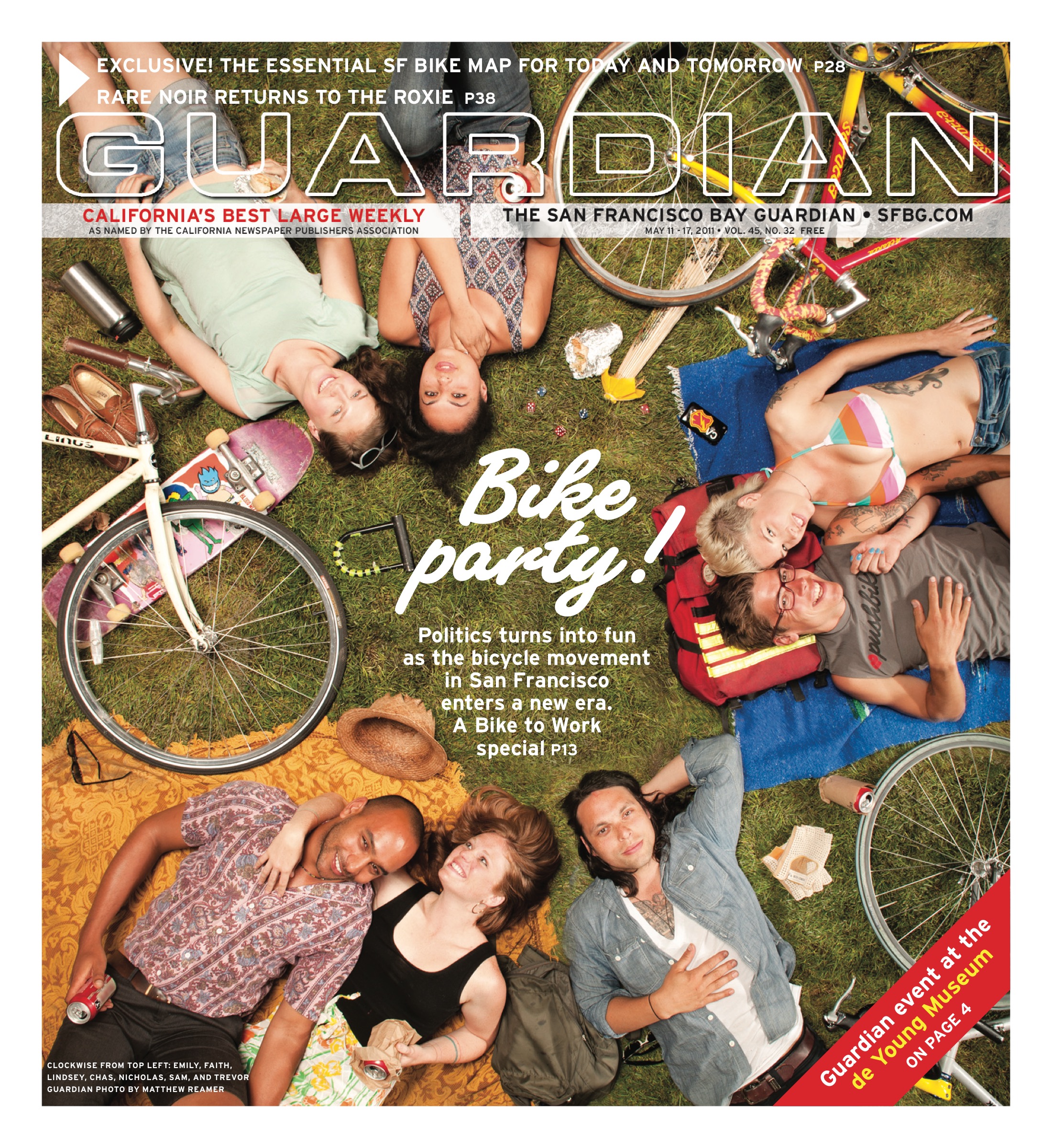
>>WHO’S IN CHARGE? We’re big-time boosters of Ride Your Bike to Work Day, so once again we rode, we schmoozed, we accumulated swag — most of it aimed at luring more of us onto the streets with the promise of bigger, better, safer, kinder, gentler bike lanes. Which is why we had to wonder at the cover of the Connecting the City pamphlet, a happy-talk scenario showing a smiling woman and two darling kiddies riding along a reimagined bike lane on Market Street. Sweet — until you notice that the woman (the mother?) isn’t wearing a helmet. And neither is the woman staring off into stage-left space behind her. And that group of huddled people in black hoodies — are they supposed to be chess players? With big plastic bags of garbage at their feet? And what about that guy who appears to be rifling through the garbage? Why do we feel like the sell just got harder.

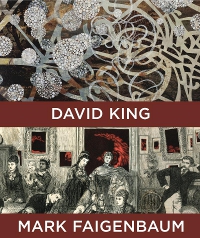
>>ASSEMBLAGE Collage artist David King was awarded a grant from the Pollock-Krasner Foundation last year, and he’ll be showing new work later this month at the Visual Aid booth at the San Francisco Fine Art Fair, one of three different art showcases taking place in SF during the third weekend of May. He’s also showing work, along with Mark Faigenbaum, at Inclusions Gallery from Saturday, May 14 through June 19. The opening reception is this Saturday from 6 to 8 p.m.

>>CHUCK IT We are all well aware that our days are numbered, and that they are going to be pretty well filled up doing more loads of laundry, cleaning the cat box, working, etc. What we really don’t have time for are any more bucket lists taunting us with 100 more things we have to do, see, eat, and ponder before the old dust to dust thing takes place. That’s why we were disheartened to see that there’s a new bucket list just for Giants fans: Bill Chastain’s 100 Things … . We have nothing against Chastain, but we do wish his publisher had come up with a better marketing scheme than this tired, gimmicky genre. Besides, with post World Series prices what they are, we can barely even afford to cross off item 39, “Attend a Game at AT&T Park,” let alone item 40, “Attend a Spring Training Game in Scottsdale.”

>>THE OUT-OF-TOWNERS If there’s one thing that separates the rubes from the natives, it’s pronunciation. Only a rube-and-proud-of-it would risk the derisive sniggering of Manhattanites by asking directions to Houston Street, pronounced like that city in Texas, or the rolled eyeballs of Show-Me Staters by rhyming the last syllable of their great state with “misery.” That’s why we are mystified that Muni hired such a collection of rubes (who may even be robotic rubes) to announce pending stops on its bus lines. Who approved “Di-VEYE-sa-dero”? And who signed off on “Valen-CHA”? Yo, Muni, you never heard the phrase “hire local”?

Ghosts of sit-lie past

5

Is sit-lie a case of not learning from our mistakes?

An interesting bit of history that for the most part failed to enter the debate over the ordinance is that San Francisco enacted a similar ban on sitting and lying  in public spaces in the late 1960’s (PDF).

Inspired 40 years later by the same neighborhood, the current sit-lie law is a legislative throwback. Back then, Haight Street was a center of controversy as hippies began to arrive in droves – hanging out, singing, dancing and generally occupying the sidewalks. Some business and property owners were apprehensive over the rapid changes to the neighborhood.

The Board of Supervisor enacted the ordinance, which made it a crime to “willfully sit, lie or sleep in or upon any street, sidewalk or other public place,” with a unanimous vote in 1968. Violation carried a fine of up to $500 and a maximum jail sentence of six months.

Then-Mayor Joseph L. Alioto, who signed the ban into law, told the San Francisco Chronicle the ordinance “will not be used to discriminate against any group or person.” His promise echoes the claims of contemporary proponents of sit-lie.

But police used the law to target not only hippies but also gay men in the Castro. The predictable reality of selective enforcement galvanized popular resistance.

Over the next decade, the ACLU sued and managed to overturn parts of the law. “[The original laws] were being used unjustly by the police against people who were considered undesirable,” said Alan Schlosser, legal director of the ACLU, who has been working for the organization since 1976. They were used against Hippies in the Haight, they were used in the Castro and the Tenderloin against the prostitutes.”

Political pressure from a wide coalition, which included Harvey Milk, convinced the board to rescind the ordinance in 1979. In fact, one of Milk’s signature campaign issues was stopping police harassment of gay people.

The current law does avoid some of the pitfalls of the old one. The ban only applies to sitting and lying down; the sixties-era law referred to the obstruction of public space. Police are now required to issue a warning, and the punishment for violation is significantly lower. Neither distinction, however, alters the fundamental problem of sit-lie.

The ordinance criminalizes an extremely common behavior, which is in itself harmless. The most vulnerable members of our society depend on public space and are inevitably the most susceptible to getting in trouble into the crosshairs sit-lie enforcement.

Queer activists are once again leading the effort against unfair and unwise regulation of public space. We reported April 11th that self-proclaimed “angry queers” installed handmade benches on city streets as a form of protest art. Likewise, this upcoming May 22nd, which is Milk’s birthday, Queers for Economic Equality Now (QUEEN) will be coordinating sidewalk events against sit-lie in San Francisco and Berkeley.

Tommi Avicolli Mecca who organizes with QUEEN, said “for me it is so thrilling to see two cities doing something against sit-lie and invoking Harvey’s name.”


Hot sexy events: May 11-17

2

On the website for Kink Studios – Kink.com‘s foray into the world of arthouse porn cinema – one scrolls down a quote from, of all people, that strapping hunk of man meat Roger Ebert. It’s about The Last Tango in Paris

The movie frightened off imitators, and instead of being the first of many X-rated films dealing honestly with sexuality, it became almost the last. Hollywood made a quick U-turn into movies about teenagers, technology, action heroes and special effects. And with the exception of a few isolated films like The Unbearable Lightness of Being (1988) and In the Realm of the Senses (1976), the serious use of graphic sexuality all but disappeared from the screen.

But being the innovators, perverts, and getting-things-done Type A’s that they are, the minds behind Kink.com decided to do something about this dearth of sexy, smart art. To wit, they made a film, Indietro, that combines all the flogging and excited screams that you’ve come to expect from the website’s more conventional BDSM flicks, with haunting piano trills and – gasp! – character development. They stocked the film with acting turns by Madison Young, Aurora Snow, and William Van Toland, and is written and directed by Vivian Darkbloom. 

It’s playing at Mission Control (via Femina Potens‘ programming) on Thurs/12, along with a Q&A with cast and crew. See it to believe it – and bring Mr. Ebert, won’t you?


Virgie Tovar presents “Burlesque Basics for the Shy and Awkward”

Amazing alert: the fantabulously fat burlesque star Dulce de Lecherous (Miss Tovar if you’re nasty) is doing this course on Burly Q gratis for the wonky and discombobulated set. I bet you never thought you’d be able to shimmy in stilettos, or twirl tassels with tact – but this here Virgie is ready to ease all comers – boys, girls, bois, “girls” – into stageside sexiness. Or, at least get you on the right path. We’re only talking about an hour-long class here, people. 

Thurs/12 6:30-7:30 p.m., free

Good Vibrations

1620 Polk, SF

(415) 345-0500

www.goodvibes.com


First Full of Kink: Indietro

Watch Kink Studios’ first foray into art porn, ask all your perverted wonderings of its cast and crew, then enjoy black and white porn and live burlesque performances. Afterwards, you can stay for the play party – if you’re a member of Femina Potens. Keep it classy, art freaks. 

Thurs/12 8 p.m.-1 a.m., $15

Mission Control

www.feminapotens.org


“Saburau: The Warrior’s Path of Service”

A educational run-down of positive power exchange practices in the Japanese samauri tradition. Sure, it’s not your run-of-the-mill Exiles class (they tend to focus on more explicitly S&M teachings), but that’s why this course sounds so cool. Ground your play time in a background of service-oriented community. 

Fri/13 8-10 p.m., $4 members/$10 non-members

The Women’s Building

3543 18th St., SF

www.theexiles.org


Dungeon monitor training

This training is not about loving control – or maybe it is, but don’t walk into it whip in hand. Being a dungeon monitor is a big deal, a crucial role in the pursuit of a healthy S&M scene. This orientation is open to everyone, and features interactive scenes showing problematic dungeon happenings in which you’re asked to practice your better judgement to mediate. Not into becoming a monitor, per se? You’re still welcome to learn and hone your skills as a member of a smart and safe community. 

Sat/14 4:30-7:30 p.m., $5-10 suggested donation

SF Citadel

1277 Mission, SF

(415) 626-2746

www.sfcitadel.org 


Naked Girls Reading: Burlesque legends

SF’s regularily-occurring lit night is famous for letting it all hang out. Really — the women on stage are naked as jaybirds. And though once again local luminaries like Lili St. Cyr, Lady Monster, and Cherry Galette will be orating from honored texts, this time around at least part of the show will be occuring offstage. Burlesque legends from Holiday O’Hara to Satan’s Angel will be in attendance – and you can sit next to one of the lovelies, if you’re down to shell out another five bucks. Deal! 

Sun/15 8:30-10 p.m., $15-20

Center for Sex and Culture

1349 Mission, SF

(415) 552-7399

www.sexandculture.org


Into the Vortex, part one

0

arts@sfbg.com

For some the ’60s and ’70s never stopped swinging — even (or especially) if they were barely out of womb when all that decadence crashed into the anti-counterculture, pro-coke Reagan era.

For many years, one of SF’s greatest connoisseurs of retro sexual revolution kitsch and coolness has been Scott Moffett. For all we know, even as you read this he’s reclining on a fun fur rug, drinking Martini & Rossi on the rocks, reeking of Hai Karate, sandwiched by Barbarella and Pussy Galore.

In 1994 he and Jacques Boyreau cofounded the Werepad, a waaaaaay-south o’ Market psychedelic lounge that hosted parties and screened rare, frequently scratchy 16mm prints of movies with titles like Maryjane (1968), Island of the Bloody Plantation (1983), and William Shatner’s Mysteries of the Gods (1977). He also created the Cosmic Hex Archive (whose website lets you can download everything from 1966’s Dr. Goldfoot and the Girl Bombs and 1976’s Shriek of the Mutilated to 1972’s Santa and the Ice Cream Bunny for a modest fee) to protect and show just such “forgotten works.” He’s collaborated on movies, books, and traveling exhibits, all reflecting the same groovy aesthetic.

The Werepad is now gone (as is Boyreau, to Portland, Ore.), but Moffett now runs its more compact successor not-so-far south of Market, the Vortex Room, and with Joe Niem programs its Thursday Film Cult nights.

The theme to the Vortex’s May schedule — sorry if you missed last week’s bill of Roger Corman’s 1959 beatnik parody Bucket of Blood and the astonishing 1969 Japanese portrait-of-a-crazed-artist erotic horror Blind Beast — is “Art, Obsession, and Film Cult.” The series unites a widely disparate slate dealing with art-making in one form or another, as inspired, manipulated, or rendered homicidal by sexuality and violence.

Thursday, May 12 there’s a double bill whose first half unusually (for the Vortex) reaches back to mainstream Hollywood’s “golden” era. German Expressionist master Fritz Lang (Metropolis, 1927; M., 1931), followed up 1944’s The Woman in the Window by regathering its stars on a new suspense melodrama: 1945’s Scarlet Street. The latter is crasser, pulpier, and driven by demure 1930s ingénue (and future Dark Shadows matron) Joan Bennett’s inspired vulgarity as Kitty “Lazy Legs” March, whose yea lazier boyfriend (Dan Duryea) proposes that she seduce an accountant and amateur painter (Edward G. Robinson) whom they both mistake for a wealthy artist. This lurid saga ends on an unusually bitter, ironic, haunted note for its time.

A greater discovery is Scarlet Street‘s Vortex cofeature. Scream Baby Scream (1969) is vintage psychedelic horror at its trippiest. This low-budget but pretty dang groovy artifact goes out of its way to be with-it: the cast wears ultra-mod fashions, the interiors are crammed with objets d’Op Art, the score is cool jazz-rock (dig those flute solos), and the dialogue is chock-full of Now Generation philosophizing (some rather grammatically-challenged, such as “I feel so strange — like a nightmare that I don’t want to think about”).

All of which doubles the fun in watching an otherwise (slightly better made) imitation of movies like Herschell Gordon Lewis’ 1965 Color Me Blood Red. Written by future genre hero Larry Cohen, its young protagonists are four art-school students; hero Jason is practically cohabiting with girlfriend Janet, but she’s acting like maybe she Needs Some Space. (Of course, he’s also acting like a jealous jerk — it’s unclear whether the film is aware how clearly it reflects the none-too-feminist gender dynamics of mainstream hippiedom.)

Janet takes her art very seriously, attracting attention from a creepy established artist (Larry Swanson) famous for oil portraits of hideously distorted faces. Meanwhile, models, art students, and miscellaneous youth-on-the-beach keep “disappearing.”

You can guess what happens. But among Scream Baby Scream‘s many surprises are a long LSD trip sequence (protagonists go motorcycling on the highway! Feed baby elephants at the zoo! Imagine themselves as monkeys in a cage! Interpretive dance!), scenes at a psychedelic coffeehouse, a party setpiece with groovy band the Odyssey (plus go-go dancers and liquid light projections), and zombie ghouls on the loose.

There’s also nudity, pot smoking, and a lot of relationship arguments. The last half hour takes a weird left turn into Vincent Price terrain, complete with a gloomy old mansion, a mad-doctor flashback, and so forth. The movie was clearly intended for drive-ins at best, but it’s colorful, fast-paced, and ever so delightfully wrong. Directed by little remembered B-pic toiler Joseph Adler, it was an early big-screen writing credit for Cohen, showing signs of the perversity that would later result in 1973’s Black Caesar, 1974’s It’s Alive, 1976’s God Told Me To, and 1988’s Maniac Cop, to name a few.

Trash will spotlight the rest of the Vortex’s May schedule next week. A $5 donation gets you into these Thursday screenings. For that dough, you could buy half a ticket to Bridesmaids. Please don’t tell me that’s a tough decision. (Dennis Harvey)

ART, OBSESSION, AND FILM CULT

Scarlet Street, Thurs/12, 9 p.m.;

Scream Baby Scream, Thurs/12, 11 p.m., $5

Vortex Room

1082 Howard, SF

www.myspace.com/thevortexroom


The underground

0

arts@sfbg.com

Compilations often serve two purposes, sometimes at the same time: they can be brief introductions or exhaustive overviews. The San Francisco label Dark Entries just released BART: Bay Area Retrograde, a collection of local, underground music from the early ’80s, which feels like a bit of both. Representing local bands — from Danville to Palo Alto, Berkeley, and SF — that gravitated toward an alienated, synth-driven sound, it’s a meticulously curated snapshot that feels complete in itself, but is also a primer for the minimal synth revival. With many songs verging on 30 years old, label owner and DJ Josh Cheon and co-curator Phil Maier have compiled tracks that were un- or little- known in their own time but now sound very much of the moment.

There are many names for the variety of styles represented across BART‘s 11 songs — synthpop, post-punk, and cold, minimal, or new wave are only the most common. But nearly half of the songs are complete obscurities — four are previously unreleased and two appeared only in small, self-released editions — and the compilation as a whole is difficult to pin down. These are artifacts from a lost era, our local contribution to an international group of artists who created music that was bound to be marginal, faced with intense rock chauvinism and Reagan-era optimism.

BART kicks off with three songs (Nominal State’s “Middle Class,” Batang Frisco’s “Power,” and Necropolis of Love’s “Talk”) that sound like a blueprint for the current renaissance of icy analog futurism by groups like Xeno and Oaklander, Staccato du Mal, and The Soft Moon. But curveballs like Wasp Women’s No-Wave-y “Kill Me” and The Units’ peppy ode “Mission” alleviate the future-shock claustrophobia and put the compilation in a category of its own — it’s as much a love letter to the Bay Area’s taste for the goofy and willfully weird as an archival release.

There’s a sense of playfulness that’s immediately apparent in the presentation. Eloise Leigh’s eye-popping jacket design is satisfyingly heavy on pink, blue, and yellow, and comes as a six-panel fold-out poster rather than a standard cardboard pocket, suggesting it would prefer wall space rather than a slot on the shelf. Comprising liner notes from the Guardian’s Johnny Ray Huston and band data on one side and Dr. Art Nuko’s painting Getting Bombed in San Francisco on the other, BART the consumer object feels like something that belongs nowhere so much as Valencia Street’s overflowing vintage zine store, Goteblüd. And while the music contained on the vinyl within can be dark and brooding like “Talk,” or abrasive and fractured like Standard of Living’s “N.F.A.,” the most memorable songs, to me, are the frothy ones: Danny Boy and the Serious Party Gods’ parody-of-a-parody “Castro Boy,” and the above-mentioned “Mission.” The former riffs on Zappa’s “Valley Girl,” but ups the raunch with ad-libs about fisting, while “Mission” builds up to its irrepressible chorus with verses celebrating the unassailable pleasures of being high and eating burritos. Even if you aren’t already a minimal synth nerd, BART is a fun album.

With its variety of styles and lyrical themes, BART holds together not only because there’s a high baseline of quality, but also because of the built-in context. In addition to the design, a lot of work clearly went into finding and collaborating with these long-defunct bands, from securing unheard demos to listing the synth models used for each track. It’s a meticulously assembled record, a guided experience that points out what is so unsatisfying about downloading some lost classic from a sharity blog and deleting it, unlistened to, months later. Its local focus also sets it apart from the compilations that helped define minimal wave, although it contributes to that canon as well.

As the underbelly of an underground dominated in the retelling by figures like Chrome, Flipper, and The Residents, BART‘s new audience lives in a skewed world, where technology provides us with nearly endless opportunities to connect, where analog synths are revered for their warmth and character, and where the Mission is gentrified. Yet faced with an excess of information every time we make a decision, the rough edges of this serious, cynical music offer opportunities to disconnect from the endless demands of the present. The past will always have the advantage of seeming coherent, but BART‘s biggest success is in the way it captures the innovative, corrosive energy of its time. * *


The fun side of bikes

3

steve@sfbg.com

Paul Freedman, a.k.a. the Fossil Fool, is a singer-songwriter and builder of elaborate art bikes who lives in San Francisco’s Mission District. Since 2001, when he decided to apply his Harvard University education to building custom bikes, accessories, pedal-powered products, and mobile sound systems, Freedman created Fossil Fool and Rock the Bike to sell his creations and provide a platform for his performances and alternative transportation advocacy work.

But anyone who’s watched Freedman build and ride his creations — such as his latest, El Arbol, a 14-foot fiberglass tree built around a double-decker tall bike with elaborate generator, sound, and lighting systems and innovative landing gears — knows this is a serious labor of love by an individual at the forefront of Bay Area bike culture. We caught up with him recently to discuss his work and vision.

SFBG How did Rock the Bike start?

FOSSIL FUEL I was working at a shop in Berkeley and I decided to make my first bike music system, which I called Soul Cycles. So I had that other job at a bicycle nonprofit, which is cool, and that was the first impetus. I did two innovative things with my first bike music system: I put the controls on the handlebars, which I’d never seen anyone do, and I put speaker back-lighting to make the speakers look nice at night. I used a really nice CFL fluorescent lamp, and I started playing around with those and it looked great, so that was our first product for those first three or four years.

SFBG What was going on in the larger culture at the time that led you to believe your interest in bikes and technology was going to be fruitful or make an interesting statement?

FF I care deeply about biking and a lot of the people I was with did too, but I felt like the bicycle advocacy scene was not very effective when it came to actual outreach. I felt like the thing that had been really formative for me was this person-to-person interaction, in my case by hanging out with the guys who started Xtracycle, and going on quests to get ingredients for dinner and riding late at night with the music systems on the tour. I felt like those experiences were what made bicycling appealing, but the bike advocacy scene was using guilt trips and telling people you should ride a bike because you’re too fat and you should ride a bike because there’s too much traffic. And I felt like we needed to shift that mindset and really start focusing on the fun aspects of biking and the social aspects to grow the scene.

SFBG Do you feel like it has, and what effect do you think it had on those who weren’t already riding bikes?

FF I think it’s moving that direction. Even within traditional bike advocacy groups, those people are starting to really focus on their events and creating community, in a good way, and challenging themselves with doing so. And I think that’s really positive.

SFBG Your timing also dovetailed with heightened green awareness — with a push for renewable energy, concerns over peak oil, and things like that.

FF Yeah, I feel that transportation choices are the main thing people need to examine about their lives with respect to their impact on global warming. And that’s not just a feeling, that’s the consensus of the Union of Concerned Scientists. They say that if you want to have an impact on the planet, positive or negative, the first thing you should consider is your transportation habits. So that means flying, it means driving, and everything else. I don’t think it’s really beneficial to focus on what people need to do with a car, like they need to drop their kids off. It’s more important how people do the optional things with cars like the trips to Tahoe, and the flights to Mexico. It’s those optional things I want to focus on, which is why I’m so interested in Sunday Streets, which is like the antidote. It’s this thing you can do here, that you can walk and bike to, that’s as fun as driving to Tahoe.

SFBG Through your technology and design work, it also seems like you’re showing a broad range of what people can do on a bike, with lots of cargo or a whole performance stage setup. Do you think design is convincing people that bikes are more versatile that they thought they were?

FF Oh yeah, I think that would be a really beneficial outcome of this work. By riding through town with our music gear, of course people are going to look at that and think, oh yeah, I could probably go to Rainbow Grocery and buy a bunch of food for my household on a bike. So it would be a great outcome if people would make that connection.

SFBG Is there anything about San Francisco that makes people here more receptive to your message?

FF San Francisco is a very tight city geographically. It’s not like Phoenix. The blocks are pretty short here and the distances are pretty short here, and you can ride year-round here, which is not true in Boston where I grew up.

SFBG The focus on technology and design here also probably helps, right?

FF Oh, for sure. This is an awesome place to be prototyping and doing funky mechanical, electrical art. There’s a lot of support for it. There are places like Tap Plastics for learning about fiberglass. There are lots of electronics stores that serve the Silicon Valley tech developer communities. You can buy stuff there that’s helpful. You can learn about Arduino [an open source microprocessor] at Noisebridge. There are a lot of resources for doing interactive art here or for doing bicycle-related projects. There are a lot of welders here.

SFBG Where do you think we are on the arch with this stuff — the beginning, the middle? — in terms of gaining wider acceptance of biking as an imperative and an option for anyone?

FF I think there’s an important generational shift underway, and I don’t know whether it’s my focus on bikes that leads me to meet all these kinds of people, but it feels like I’m meeting more people these days that are going to pick their next city or their next neighborhood based on how it is to bike there. They’re bringing it up in conversation, it’s not me. So it seems like people are really considering what their daily life is going to be like and how the community feels, and biking is one of the symbols of a whole swath of other beneficial things. They know that if they see a bunch of bikes when they visit a place, then there’s probably a lot of other cool stuff like music, arts, farmers markets. Those kinds of things are sort of linked together, and the bike is the key indicator. So there’s been this generational change of thought. The idea that having a bigger, faster car is better, I just don’t think that’s popular with these people. They no longer believe it.

SFBG It’s having cooler bike.

FF It’s having cooler bike and being able to use it and not have to step into the stress of car culture if you can avoid it.

SFBG What’s your next step?

FF One of the really positive things for me has been the Rock the Bike community, with its roadies, performers, musicians — all types of people who are on our e-mail list. So I can just say, I need three roadies for a three-hour performance slot and there’s going to be a jam at the end, so bring your instruments. That’s an awesome thing and it’s just going to improve, so I think the community will grow as we continue do gigs where we have fun and the people have fun.

In terms of my own art, this tree [gesturing to his El Arbol bike] has been my focus for the last year or two, and it’s not done yet. It has to look undeniably like a tree. It looks like a tree, but with a light green bark that you really don’t see in nature, so that has to change. I want it to have brown bark, but I still want it to do beautiful things at night with translucency. And I want it to have a true canopy of leaves, so that when you’re far away from it at Sunday Streets and you’re wondering whether to go over there, you’ll see a tree. Not just a representation of a tree, but I want them to be like, how the hell did he ride a tree over here?

SFBG Why a tree?

FF I don’t know. You get these ideas, and you start drawing them and can’t shake them. There are all sorts of reasons why trees are interesting. They are gathering points.

SFBG And you’re doing some very innovative design work on this bike, such as the landing gear.  

FF The roots. Yeah, that’s never been done before. Through the course of doing the project, people would send me tips and interesting things, and one guy sent me a link to a photo of tall bikes being used in Chicago in the early 1900s as gas lamp lighting tools, and they were very tall. I’d say 10 to 12 feet tall, and they were tandems, so there was a guy on top and a stoker on the bottom providing extra power, and they didn’t have landing gears. So they would ride from one lamp to another and hold the lamp as they refilled it. And I just love that story because if you were growing up in Chicago, and you saw these gas lamp people coming by in the early evening to turn the lights on, and if you were a little kid trying to fall asleep or whatever, that would have an indelible mark on your childhood, and that whimsical quality is what I’m going for. That should be part of what it’s like to grow up in the Mission District in 2011.

SFBG How does that fit into the other cultural stuff that you’re also bringing to the bike movement, the music you’re writing, design work, the style, and the events that you’re creating?

FF Sometimes I wish it wasn’t so multipronged. I would clearly be a better performer and musician if it was the only thing I did, so I apologize to all my fans for not putting 100 percent into the music. But I put 100 percent into the whole thing, including creating bikes and running Rock the Bike, which is a business.

SFBG But are you doing all these things because you find a synergy among them?

FF It’s the fullest expression of who I am.

SFBG Where do you see this headed? What will Rock the Bike be like five years from now?

FF I would like to see the quality of our entertainment offerings steadily improve to the point where people genuinely look forward to it, and not just to the gee-whiz aspect of look what they’re doing, but just for the feeling of being there. So I’d like to challenge ourselves with the quality of the music, how it is to be engaged in the setup process — because I think the setup is cool, with biking to the event and engaging in the transition to a spectacle, where every step along the way is part of the show. I like that idea. I’d like to challenge ourselves to be a carbon-free Cirque du Soleil, a show that is slamming entertainment and they bike there and pedal-power everything: the lighting, the sound, the transportation. And I want the performers to be just as good.

SFBG Are there people in other cities doing similar things?

FF The Bicycle Music Festival is spreading to other cities, which is cool. I think there are going to be over a dozen bicycle music festivals this summer. In terms of people doing really inspiring work with bike culture or this kind of mobile art, you definitely see some amazing things at Burning Man. That’s probably one of the best venues for this type of art. But I can’t think of another city where people are doing all of this. I’m part of a group on Flickr called Bicycle and Skater Sound Systems, and there’s nothing on that whole group that I see as being on this level. I don’t know why.

SFBG When you ride a cool custom bike down the street, the reactions it elicits from passersby is just so strong and happy. What is that about?

FF It’s a reaction to an expression of personal freedom. People light up when they see you expressing yourself, and a part of them thinks, oh yeah, that would be fun, I’d like to express myself. And there are just so many ways to express yourself and be human — and that’s something that we need to remind ourselves because, in many ways, our personal freedoms are declining and there’s more surveillance.

SFBG And people might take that spark and do any number of things with it.

FF One of the very cool things about bicycle art is that it’s mobile. So you ride your bike and you might turn heads a couple dozen times a day. I ride this tree, and if it’s in the full mode where it’s 14-feet tall and there’s music on, and I’m going from here to Golden Gate Park, I’d estimate that 500 people see it. There’s probably no other art form you can do that with. I can’t think of any other that’s like that. So it’s a really cool art form. Those people aren’t paying you, but you shared art with them, and it’s a good way to get exposure. It’s a great way for a lot of people to see your art.

SFBG With your mobile, pedal-powered stages, you’re also demonstrating green ways of powering even stationary art.

FF It is an interesting time for pedal power. I feel like there’s a turning point that’s maybe beginning in the field of events with how they’re powered. I think there are going to be a lot more people who are going to festivals in the coming years who are looking at the diesel generators and saying, ‘My summertime festival experience is being powered by diesel.’ And I think there are going to be a lot of people seeing that and wanting to do something else.

SFBG Have the technologies for how much juice you’re able to get out of pedal power been advancing since you’ve been working on it?

FF Yes, it’s truly impressive right now, particularly if you’re putting that juice into music because we have very efficient generators where there’s no friction interface anymore, nothing rolling on the tire, it’s all just ball bearings rolling on the hub. Then we put that power into these new modified amps, and they have a DC power supply now, as opposed to an AC power supply, so we don’t have to put the power into an inverter. So the net sum of that is one person can pedal-power dance music for 200 people, which is pretty amazing and inspiring.

SFBG And the battery technology is also improving, right?

FF Yeah, the batteries are what you use for the mobile rides, and that’s getting better. If you’ve been to a bike party, it’s just incredible how many good, loud sound systems there are right now. It’s a very kinetic art form, although I wish people would focus more on the visual aspects of their system, because I feel like there’s a trend to get big and loud fast. But I wish there were more people doing the work that Jay Brummel is doing, where he doesn’t just want to ride on a bicycle, so he turned his bike into a deer and he steers by holding the antlers.

SFBG But there has been some push-back from the police. Have you gotten many tickets?

FF Well, I got tickets for riding up high on this quadracycle. There is a law against riding tall bikes in California. It says you shouldn’t ride a bicycle in such as manner as to not be able to stop safely and put your foot down. Obviously you can’t put your foot down on a tall bike.

SFBG The fact that you have landing gears on your bike didn’t make a difference?

FF Well the officer didn’t take it seriously, but the court sided in my favor. The judge was flipping through photos of the landing gear the entire trial — he couldn’t stop flipping through them. And he asked, ‘How do you get on? Where do you step?’ So I was like, ‘Well, you step here, you step there, and you swing.’ It was pretty fun. 

BICYCLE MUSIC FESTIVAL

Saturday, June 18

11 a.m.–10 p.m., free

Various locations, SF

www.rockthebike.com

www.fossilfool.com


The night has a thousand eyes

0

arts@sfbg.com

Cheap genre films targeted for the drive-in or grindhouse aside, very few truly independent features were made in the U.S. before the 1960s, and those that were made seldom found an audience. As a result, most were soon forgotten — in rare instances rediscovered decades later, like the recently restored docudramas On the Bowery (1957) and The Exiles (1961), about Skid Row denizens in New York City and Los Angeles. Foreign films had a tiny theatrical circuit (albeit usually playing in cut and dubbed form), experimental ones none at all.

It was predictable, then, that a movie straddling pretty much all the above categories should have found no welcoming niche in the complacent 1950s. Elliot Lavine’s latest retrospective of noir and noir-ish oldies at the Roxie Theater, “I Wake Up Dreaming 2011,” is subtitled “The Legendary and the Lost,” terms that both apply to the film that kicks off the two-week series.

To paraphrase recent San Francisco International Film Festival guest Christine Vachon, behind every independent feature there’s a war story. Dementia (1955) is a good example of one little film that fought and lost — on every front save artistically, and perhaps in posterity.

Even by today’s standards, with our greater tolerance for “dark” and arty material, it’s an unclassifiable, commercially doomed proposition: an hour-long B&W nightmare in which an unstable young woman wanders empty urban streets, bounces from pimp to john to jazz club, commits acts of violence (or maybe just hallucinates them), and at the end simply disappears into the cosmos. (The opening and closing shots actually are of starry infinite space.)

Oh, and there is no dialogue, just a score by noted American composer George Antheil that uses wordless vocals by Marni Nixon (who later secretly provided the vocals for the famous leading ladies of 1956’s The King and I, 1961’s West Side Story, and 1964’s My Fair Lady) as a sort of human theremin. This very curious amalgam of noir, avant-garde, lurid potboiler and silent expressionism at various times brings to mind everyone from Roger Corman to Roman Polanski and Maya Deren. It was the first and last film for John Parker, about whom very little is known — save that he must have been gravely disappointed by the long road Dementia took to nowhere. (He would have been even more disappointed had he known years later his associate producer and cast member Bruno VeSota claimed Parker didn’t know what he was doing, and that he himself did most of the writing and half the directing.)

Shot in 1953 Los Angeles, Dementia was asking for it on many levels, with content not only bizarre and uncommercial but often downright offensive by the standards of the era. Its paranoid, unpredictably mood-swinging heroine (Adrienne Barrett, billed only as “The Gamine” — not exactly the ideal description for this character) wanders alone through the city’s squalid underbelly. A flashback to her childhood — staged in a cemetery, with living-room furniture amid gravestones — reveals mom was a sluttish harpy killed by a boozed and abusive dad, who was then stabbed by guess who.

Handed over to a fat “Rich Man” (VeSota) by a slick sleazeball (Richard Barron as “The Evil One”) who picks her up on the street, she stabs him too, pushes him out a penthouse window, and saws off his hand when it won’t let go of a telltale necklace. Pursued by cops, she ducks into a club where the jivey sounds of Shorty Rogers and His Giants suddenly turn her into a sleek chanteuse (albeit one we don’t hear) alongside bongos and hopheads. All this is shot with considerable noirish panache by William C. Thompson, who as Ed Wood’s regular cinematographer made some completely ridiculous films (notably 1959’s Plan 9 From Outer Space, with its own atmospheric cemetery scenes) look much better than warranted.

Barely releasable at 61 minutes, the completed film then found that threadbare length was the least of its problems. Shown to a succession of censorial boards, it was repeatedly deemed too unhealthy for public viewing, prompting critiques like “indecent, inhuman, lacking in moral and spiritual values, could incite to crime” and “grist for the Communist mill.”

Finally after over two years and 11 screenings of different edits for New York State’s board, it was cleared with an “adults only” stamp. Double-billed with a documentary about Picasso in A Unique Program of Psychology and Art, advertised as “the first American Freudian film,” it opened on one 1955 Manhattan screen to little notice. (However Parker’s friend, the great, soon-to-be late director Preston Sturges did call it “a work of art,” strangely noting “it stirred my blood, purged my libido.”)

Two years later Parker’s producer sold the movie — now cut to 56 minutes, with pasted-on purple narration spoken in spookhouse tones by then-unknown Ed McMahon — for rerelease as Daughter of Horror. Again it flopped, although in 1958 it would gain pop culture footnote status when a clip was used as what the onscreen audience is watching when they’re attacked by amorphous sci-fi monster The Blob.

It was as Daughter that the movie started gaining a little admiration in recent years, getting a boost from Re/Search’s first Incredibly Strange Films volume and finally a DVD release (with both versions) from Kino. Taken as good, bad, or just daft, it remains unique.

Other highlights in the Roxie’s “Dreaming” program include Dementia‘s co-feature, Robert Siodmak’s terrific 1944 noir mystery Phantom Lady; actor director Robert Montgomery’s 1947 Mexican anti-holiday Ride the Pink Horse, a sort of hard-boiled cinematic Under the Volcano; and a number of exceedingly rare lesser-known titles. Certainly the campiest of them are contained on May 23’s bill: 1956’s The Violent Years, a girl-gang movie featuring the inimitable dialogue stylings of the aforementioned Mssr. Ed D. Wood, and Dance Hall Racket, an unbelievably amateurish 1953 cheapie whose stars are none other than pre-fame Lenny Bruce and his stripper wife Honey. Inspirational line: “Big deal! I kill a guy and that makes me a criminal?!” 

I WAKE UP DREAMING 2011: THE LEGENDARY AND THE LOST!

May 13–26

Roxie Theater

3117 16th St., SF

(415) 863-1087

www.roxie.com


Fully loaded

0

arts@sfbg.com

There is such a thing as festival fatigue, but you’d do well to forget it with the ambitious programs ruling the 16th Street corridor this weekend. The Roxie launches Elliot Lavine’s latest dive into film noir’s deep end, while down at the Victoria San Francisco Cinematheque caps its spring season with the second annual Crossroads festival, a veritable bonanza of experimental cinema. I haven’t seen many of the 50-odd works being shown, but the quality of the ones I have makes me think that I wouldn’t trade Crossroads for Cannes.

The fest opens Thursday, May 12 at the San Francisco Museum of Modern Art with the culminating presentation of “Radical Light,” the epic panorama of local alternative cinemas that has lined Cinematheque and the Pacific Film Archive calendars since September 2010. This evening showcases rarely screened works by “Radical Light” mainstays (the Bruces Baillie and Conner, Gunvor Nelson, Scott Stark) as well as the premiere of a new film by Will Hindle, whose topsy-turvy Chinese Firedrill (1968) was one of the gems of a recent program at the museum.

Opening night includes at least one city symphony (Timoleon Wilkins’ Chinatown Sketch), a form expanded upon in several subsequent Crossroads shows. Jeanne Liotta’s aptly titled Crosswalk transcribes an Easter street processional in Loisaida, a Latino enclave of New York City. Liotta, an ambitious filmmaker who ranges over the history of science and the nature of belief, will be at the Victoria Friday, May 13 for the film’s West Coast premiere. Also showing is her beautiful condensation of stargazing, Observando el Cielo (2007).

The scientific method also informs closing night feature, The Observers, a recording of the recorders who gauge the famously extreme weather atop Mount Washington, as well as Saturday, May 14’s “Observers Observed” program. The latter spotlights Get Out of the Car, Thom Andersen’s termite tour of multilingual Los Angeles. In only 33 minutes, Andersen gives us a resonant culture container, looking back at what’s been lost and imagining how it might yet change form.

When Andersen holds out a photograph of what was in front of the landscape that is, he seems to refer to the nested frames of Gary Beydler’s elegant time lapse film, Hand Held Day (1975). You can judge for yourself as that earlier film is included on the same program. Other highlights across the weekend include an evening dedicated to Bay Area maverick Robert Nelson, Ben Russell’s latest consciousness-raising Trypp, a hand-cranked projection performance by Alex MacKenzie, and short films by master collagist Lewis Klahr and some guy named Apichatpong Weerasethakul. I could go on, but you should get going. 

CROSSROADS

Thurs/12–Sun/15, $10 (festival pass, $50)

SFMOMA, 151 Third St., SF

Victoria Theater, 2961 16th St., SF

www.sfcinema.org


The rise of bike culture

6

steve@sfbg.com

San Francisco has quickly peddled back into the front of the pack among bicycle-friendly U.S. cities, regaining the ground it lost during a four-year court injunction against new bike projects that was partially lifted in November 2009 and completely ended last June.

Since then, the streets of San Francisco have been transformed as the city completed 19 long overdue bike projects, including 11 miles of new bike lanes, 40 miles of “sharrow” shared lane markings, and hundreds of new bike racks. The city’s first physically separated green bike lanes on Market Street are now being extended, and new ones are being added on Alemany and Laguna Honda boulevards.

“The crews are out on Market Street right now filling in the new green bikeway,” San Francisco Bicycle Coalition Director Leah Shahum told us on May 6. “Far and away the No. 1 encouragement to getting people to bike is to make sure they feel safe.”

But it isn’t just bike lanes and other infrastructure that are causing bicycling to blossom in San Francisco. Bike culture is also exploding in myriad ways, including events such as the San Francisco Bike Party and Rock the Bike shows we profile in this issue, as well as the popularity of the monthly neighborhood street closures of Sunday Streets.

At the most recent Sunday Streets in the Mission District on May 8, Valencia and 24th streets were packed with thousands of people riding bikes, skating, and walking, or engaged with activities — in streets usually dominated by cars — such as yoga, art projects, shopping, and dancing.

“It’s a celebration. It’s not about confrontation anymore, it’s about bringing people along with a more expanded idea of how we can use public space,” Sunday Streets Coordinator Susan King told us at the event.

She said Sunday Streets has helped bridge the gap between families and the bicycling and skating communities, as well as cutting across classes, cultures, and communities. The response to the event has been phenomenal, she noted, and she hopes to see a similar momentum leading up to the next Sunday Streets event on June 12 in the Bayview.

“The Bayview event is really important to us because we have extraordinary support from the Bayview merchants and they want to get more involved with the bicycling community,” King said.

The earnest work of SFBC, SFMTA, and other entities that have helped expand the bicycling infrastructure in San Francisco, bringing safe cycling opportunities into every neighborhood, has in turn allowed organic expressions of bike culture to flourish.

From hipsters on their colorful fixies to anarchists riding tall bikes, from old-school Schwinns to cargo-laden Xtracycles, from elaborate art bikes to simple bike trailers with amazing sounds systems, from old white guys in Spandex to the young black kids on custom scraper bikes, from the hardcore bike messengers to the tourists on rental bikes, from Critical Mass defiance to Bike Party celebration, the streets of San Francisco are brimming with bike culture diversity. And the only commonality, the only one that’s really needed, is a simple appreciation for pedal power.

“We need to get the message out that biking is fun — and that’s happening,” Smith said. “We need a paradigm shift, and I think we’re really on the cusp of that.”

BIKE TO WORK DAY

Energizer commute stations open:

Thurs/12 7:30–9:30 a.m. and 5–7 p.m., free

Check map on page 28 for locations

Bike From Work party and fashion show

Thurs/12 6–10 p.m., $5 SFBC members/$10 nonmembers (or join at the door and get in free)

DNA Lounge, 375 11th St., SF

www.sfbike.org

TED taps Flux to talk about building community through art

0

In the wake of its artistic and community-building success building the Temple of Flux at Burning Man last year, which I profiled in “Burners in Flux” following a five-month immersion journalism project, the nonprofit Flux Foundation has been selected as finalists to address TED2012: Full Spectrum. TED, which stands for Technology, Entertainment and Design, has become the country’s premier cutting edge speakers forum.

Principal artists Rebecca Anders, Jessica Hobbs, Catie Magee, and Peter Kimelman will travel to New York City to do a live presentation with three other Flux crew members to the TED selection panel on May 24. The opportunity was opened up by a great video the team produced, which accentuated the transcendent nature of this collaborative art project, closing with the line, “We built community through art and we’d like to show you how.”

That idea – big art as a catalyst to creating community – was a major theme in my article, as well as the conclusion of my book, The Tribes of Burning Man: How an Experimental City in the Desert is Shaping the New American Counterculture, which focused the Temple of Flux. And it’s something the Flux crew is continuing to do out in its American Steel workspace in West Oakland, where they are working on another ambitious new installation art piece.

Brollyflock, “a renegade flock of umbrellas,” was commissioned by event producer Insomniac for the Electric Daisy Carnival in Las Vegas and Noctural in San Bernardino, and which the crew hopes to display at TED2012. But to realize its ambitious goals, Flux Foundation has started a Kickstarter campaign with a $2,000 goal, so kick in if you want to see this homegrown success story continue to ascend.

Rep Clock

0

Schedules are for Wed/11–Tues/17 except where noted. Director and year are given when available. Double and triple features are marked with a •. All times are p.m. unless otherwise specified.

ALAMEDA THEATRE 2317 Central, Alameda; www.projectyouthview.org. $5-99. “Project YouthView 2011: The Power of Youth in Film,” youth film festival, Thurs, 6:30.

ARTISTS’ TELEVISION ACCESS 992 Valencia, SF; www.atasite.org. $5-6. Blaze Foley: Duct Tape Messiah (Triplett, 2011), Wed, 8. “Other Cinema:” Works by Melinda Stone, Greg Gaar, Enid Baxter Blader, Michael Rudner, and more, Sat, 8:30. “OpenScreening,” Thurs, 8. For participation info, contact ataopenscreening@atasite.org.

BALBOA 3620 Balboa, SF; www.balboamovies.com. $20. “Opera, Ballet, and Shakespeare in Cinema:” Don Quixote, Sat-Sun, 10am; May 18, 7:30. Performed by the Bolshoi Ballet.

CASTRO 429 Castro, SF; (415) 621-6120, www.castrotheatre.com. Regular programming $7.50-10. “Faye Dunaway Double Feature:” •Puzzle of a Downfall Child (Schatzberg, 1970), Wed, 2:55, 7, and Eyes of Laura Mars (Kershner, 1978), Wed, 4:55, 9. 8 1/2 (Fellini, 1963), Thurs, 2:30, 5:15, 8. “Midnites for Maniacs: Whitey Can Rock Too:” •Rock N’ Roll High School (Arkush, 1979), Fri, 7:20; The Blues Brothers (Landis, 1980), Fri, 9:30; and Out of the Blue (Hopper, 1980), Fri, 11:59. All three films, $12. •The Good, the Bad, and the Ugly (Leone, 1966), Sat, 1, 6:15, and Aguirre, The Wrath of God (Herzog, 1972), Sat, 4:20, 9:30. •20,000 Leagues Under the Sea (Fleischer, 1954), Sun, 2, 6:40, and Clash of the Titans (Davis, 1981), Sun, 4:25, 9:05.

CHRISTOPHER B. SMITH RAFAEL FILM CENTER 1118 Fourth St, San Rafael; (415) 454-1222, www.cafilm.org. $6.50-15. Potiche (Ozon, 2010), call for dates and times. The Princess of Montpensier (Tavernier, 2010), call for dates and times. Queen to Play (Bottaro, 2009), call for dates and times. The Double Hour (Capotondi, 2010), May 13-19, call for times. Project Happiness (Sorenson, 2011), Sun, 6:30.

FOUR STAR 2200 Clement, SF; www.lntsf.com. $10. “Asian Movie Madness:” •Deaf Mute Heroine (Wu, 1971), Thurs, noon, 3:50, 7:40, and Pursuit (Wong, 1980), Thurs, 1:55, 5:45, 9:35.

MECHANICS’ INSTITUTE 57 Post, SF; (415) 393-0100, rsvp@milibrary.org. $10. “CinemaLit Film Series: Elizabeth Taylor, Tribute to a Star:” Suddenly, Last Summer (Manckiewicz, 1959), Fri, 6.

NINTH STREET INDEPENDENT FILM CENTER 145 Ninth St, SF; www.superastig.com. $20. Rakenrol (Henares, 2011), Fri, 7.

PACIFIC FILM ARCHIVE 2575 Bancroft, Berk; (510) 642-5249, www.bampfa.berkeley.edu. $5.50-9.50. Programming resumes June 10.

PHOENIX HOTEL 601 Eddy, SF; www.disposablefilmfest.com. Free. “Disposable Film Festival Bike-In Summer Tour,” Wed, 7:30.

RED VIC 1727 Haight, SF; (415) 668-3994; www.redvicmoviehouse.com. $6-10. Bukowski: Born Into This (Dullaghan, 2003), Wed, 2, 7, 9:20. Cointelpro 101 (Marks, 2010), Thurs, 7:15, 9:15. The Upsetter: The Life and Music of Lee “Scratch” Perry (Higbee and Lough, 2011), Fri-Sun, 7:15, 9:20 (also Sat-Sun, 2, 4). Dead Man (Jarmusch, 1996), May 17-18, 7, 9:25 (also May 18, 2).

ROXIE 3117 and 3125 16th St, SF; (415) 863-1087, www.roxie.com. $5-9.75. Brian Eno 1971-1977: The Man Who Fell to Earth, Wed, 7. “SF 24 Hour Film Race 2011,” Thurs, 7. Stake Land (Mickle, 2010), Thurs, 7, 9:30. “I Wake Up Dreaming 2011: The Legendary and the Lost!:” •Dementia (Parker, 1955), Fri, 6:40, 9:45, and Phantom Lady (Siodmak, 1944), Fri, 8; •Street of Chance (Hively, 1942), Sat, 2:15, 6, 9:30, and Ministry of Fear (Lang, 1944), Sat, 3:45, 7:45; •The Spiritualist (Vorhaus, 1948), Sun, 2:30, 5:45, 9:15, and The Night Has a Thousand Eyes (Farrow, 1948), Sun, 4, 7:30; •C-Man (Lerner, 1949), Mon, 6:30, 9:45, and Guilty Bystander (Lerner, 1950), Mon, 8; •Once a Thief (Wilder, 1950), Tues, 6:15, 9:45, and The Great Flamarion (Mann, 1945), Tues, 8.

SAN FRANCISCO MUSEUM OF MODERN ART 151 Third St, SF; www.sfcinema.org. $10 (festival pass, $50). “Crossroads, Program 1: Radical Light: Cinematheque at 50,” Thurs, 7.

SAN FRANCISCO STATE UNIVERSITY McKenna Theatre, Creative Arts Bldg, 1600 Holloway, SF; www.creativearts.sfsu.edu. $5-10. “51st Film Finals,” Fri, 7.

VICTORIA 2961 16th St, SF; www.sfcinema.org. $10 (festival pass, $50). “Crossroads, Program 2: Featured Artist: Jeanne Liotta,” Fri, 7; “Program 3: The Chilling Montage of Crimson Repression!”, Fri, 9; “Program 4: Observers Observed,” Sat, noon; “Program 5: Two Roads Developed,” Sat, 2:30; “Program 6: Crossroads Honoree: Robert Nelson,” Sat, 4:30; “Program 7: Apparent Motion: Celebrating the Art of Projection,” Sat, 8; “Program 8: Playback,” Sun, 2:30; “Program 9: The Realms of Transience…,” Sun, 2:30; “Program 10: The Observers (Goss, 2011), Sun, 7:30.

VIZ CINEMA New People, 1746 Post, SF; www.legacyfilmfestivalonaging.org. $11. “Legacy Film Festival on Aging,” Fri-Sun.

VORTEX ROOM 1082 Howard, SF; www.myspace.com/thevortexroom. $5 donation. •Scarlet Street (Lang, 1945), Thurs, 9, and Scream Baby Scream (Adler, 1969), Thurs, 11. YERBA BUENA CENTER FOR THE ARTS 701 Mission, SF; (415) 978-2787, www.ybca.org. $6-8. In a Glass Cage (Villaronga, 1987), Thurs and Sat, 7:30; Sun, 2.

Film Listings

0

Film listings are edited by Cheryl Eddy. Reviewers are Kimberly Chun, Michelle Devereaux, Peter Galvin, Max Goldberg, Dennis Harvey, Johnny Ray Huston, Louis Peitzman, Lynn Rapoport, Ben Richardson, and Matt Sussman. For rep house showtimes, see Rep Clock. For first-run showtimes, see Movie Guide.

OPENING

*Bridesmaids For anyone burned out on bad romantic comedies, Bridesmaids can teach you how to love again. This film is an answer to those who have lamented the lack of strong female roles in comedy, of good vehicles for Saturday Night Live cast members, of an appropriate showcase for Melissa McCarthy. The hilarious but grounded Kristen Wiig stars as Annie, whose best friend Lillian (Maya Rudolph) is getting hitched. Financially and romantically unstable, Annie tries to throw herself into her maid of honor duties — all while competing with the far more refined Helen (Rose Byrne). Bridesmaids is one of the best comedies in recent memory, treating its relatable female characters with sympathy. It’s also damn funny from start to finish, which is more than can be said for most of the comedies Hollywood continues to churn out. Here’s your choice: let Bridesmaids work its charm on you, or never allow yourself to complain about an Adam Sandler flick again. (2:04) Balboa. (Peitzman)

*The Double Hour Slovenian hotel maid Sonia (Ksenia Rappoport) and security guard Guido (Filippo Timi) are two lonely people in the Italian city of Turin. They find one another (via a speed-dating service) and things are seriously looking up for the fledgling couple when calamity strikes. This first feature by music video director Giuseppe Capotondi takes a spare, somber approach to a screenplay (by Alessandro Fabbri, Ludovica Rampoldi, and Stefano Sardo) that strikingly keeps raising, then resisting genre categorization. Suffice it to say their story goes from lonely-hearts romance to violent thriller, ghost story, criminal intrigue, and yet more. It doesn’t all work seamlessly, but such narrative unpredictability is so rare at the movies these days that The Double Hour is worth seeing simply for the satisfying feeling of never being sure where it’s headed. (1:35) Clay, Smith Rafael. (Harvey)

*Everything Must Go Just skirting the edge of sentimentality and banality, Everything Must Go aims to do justice by its source material: Raymond Carver’s rueful, characteristically spare short story, “Why Don’t You Dance?,” from the 1988 collection Where I’m Calling From. And it mostly succeeds with some restraint from its director-writer Dan Rush, who mainly helmed commercials in the past. Everything Must Go gropes toward a cinematic search for meaning for the Willy Lomans on both sides of the camera — it’s been a while since Will Ferrell attempted to stretch beyond selling a joke, albeit often extended ones about masculinity, and go further as an actor than 2006’s Stranger Than Fiction. The focus here turns to the despairing, voyeuristic whiskey drinker of Carver’s highly-charged short story, fills in the blanks that the writer always carefully threaded into his work, and essentially pushes him down a crevasse into the worst day of his life: Ferrell’s Nick has been fired and his wife has left him, changing the locks, putting a hold on all his bank accounts, and depositing his worldly possessions on the lawn of their house. Nick’s car has been reclaimed, his neighbors are miffed that he’s sleeping on his lawn, the cops are doing drive-bys, and he’s fallen off the wagon. His only reprieve, says his sponsor Frank (Michael Pena), is to pretend to hold a yard sale; his only help, a neighborhood boy Kenny who’s searching for a father figure (Christopher Jordan Wallace, who played his dad Notorious B.I.G. as a child in 2009’s Notorious) and the new neighbor across the street (Rebecca Hall). Though Rush expands the characters way beyond the narrow, brilliant scope of Carver’s original narrative, the urge to stay with those fallible people — as well as the details of their life and the way suburban detritus defines them, even as those possessions are forcibly stripped away — remains. It makes for an interesting animal of a dramedy, though in Everything Must Go‘s search for bright spots and moments of hope, it’s nowhere near as raw, uncompromising, and tautly loaded as Carver’s work can be. (1:36) (Chun)

Forks Over Knives Lee Fulkerson steps up as the latest filmmaker-turned-guinea-pig to appear in his own documentary about nutrition. As he makes progress on his 12-week plan to adopt a “whole foods, plant-based diet” (and curb his Red Bull addiction), he meets with other former junk food junkies, as well as health professionals who’ve made it their mission to prevent or even reverse diseases strictly through dietary changes. Along the way, Forks Over Knives dishes out scientific factoids both enlightening and alarming about the way people (mostly us fatty Americans, though the film investigates a groundbreaking cancer study in China) have steadily gotten unhealthier as a direct result of what they are (or in some cases, are not) eating. Fulkerson isn’t as entertaining as Morgan Spurlock (and it’s unlikely his movie will have the mainstream appeal of 2004’s Super Size Me), but the staunchly pro-vegan Forks Over Knives certainly offers some interesting, ahem, food for thought. (1:36) Bridge. (Eddy)

*Hesher See “Ride the Lightning.” (1:45) Embarcadero.

*Nostalgia for the Light Chile’s Atacama Desert, the setting for Patricio Guzmán’s lyrically haunting and meditative documentary, is supposedly the driest place on earth. As a result, it’s also the most ideal place to study the stars. Here, in this most Mars-like of earthly landscapes, astronomers look to the heavens in an attempt to decode the origins of the universe. Guzmán superimposes images from the world’s most powerful telescopes — effluent, gaseous nebulas, clusters of constellations rendered in 3-D brilliance — over the night sky of Atacama for an even more otherworldly effect, but it’s the film’s terrestrial preoccupations that resonate most. For decades, a small, ever dwindling group of women have scoured the cracked clay of Atacama searching for loved ones who disappeared early in Augusto Pinochet’s regime. They take their tiny, toy-like spades and sift through the dirt, finding a partial jawbone here, an entire mummified corpse there. Guzmán’s attempt through voice-over to make these “architects of memory,” both astronomers and excavators alike, a metaphor for Chile’s reluctance to deal with its past atrocities is only marginally successful. Here, it’s the images that do all the talking — if “memory has a gravitational force,” their emotional weight is as inescapable as a black hole. (1:30) Lumiere. (Devereaux)

Priest Paul Bettany stars as the titular vampire-fighter in this graphic novel adaptation. (1:27)

True Legend “Directed by Yuen Woo Ping” = high-flying martial arts galore. (1:56) Lumiere.

ONGOING

The Beaver It’s been more than 15 years since Jodie Foster sat in the director’s chair; she’s back with The Beaver, which tells the unique story of Walter Black (Mel Gibson), a clinically depressed man who struggles through his suicidal desires with the help of a beaver puppet. Walter uses the puppet — which he also voices — as a way of connecting with his family and the outside world. The film examines both the comedic aspects and the devastating reality of mental illness, and the script walks the line between dark and light — it’s the first feature from Kyle Killen, who created the critically adored but short-lived TV series Lone Star. The Beaver gets points for ambition, but it’s ultimately too all over the place to come together in the end. The moments of humanity are undercut by scenes of Walter and his wife Meredith (Foster) having sex with the puppet in the bed — intentionally funny, but jarring nonetheless. Still, Foster’s direction is solid and, for all its faults, The Beaver is a great reminder of Gibson’s legitimate talent. (1:31) SF Center, Sundance Kabuki. (Peitzman)

*Bill Cunningham New York To say that Bill Cunningham, the 82-year old New York Times photographer, has made documenting how New Yorkers dress his life’s work would be an understatement. To be sure, Cunningham’s two decades-old Sunday Times columns — “On the Street,” which tracks street-fashion, and “Evening Hours,” which covers the charity gala circuit — are about the clothes. And, my, what clothes they are. But Cunningham is a sartorial anthropologist, and his pictures always tell the bigger story behind the changing hemlines, which socialite wore what designer, or the latest trend in footwear. Whether tracking the near-infinite variations of a particular hue, a sudden bumper-crop of cropped blazers, or the fanciful leaps of well-heeled pedestrians dodging February slush puddles, Cunningham’s talent lies in his ability to recognize fleeting moments of beauty, creativity, humor, and joy. That last quality courses through Bill Cunningham New York, Richard Press’ captivating and moving portrait of a man whose reticence and personal asceticism are proportional to his total devotion to documenting what Harold Koda, chief curator at the Costume Institute at the Metropolitan Museum of Art, describes in the film as “ordinary people going about their lives, dressed in fascinating ways.” (1:24) Embarcadero. (Sussman)

*Cave of Forgotten Dreams The latest documentary from Werner Herzog once again goes where no filmmaker — or many human beings, for that matter — has gone before: the Chauvet-Pont-d’Arc Cave, a heavily-guarded cavern in Southern France containing the oldest prehistoric artwork on record. Access is highly restricted, but Herzog’s 3D study is surely the next best thing to an in-person visit. The eerie beauty of the works leads to a typically Herzog-ian quest to learn more about the primitive culture that produced the paintings; as usual, Herzog’s experts have their own quirks (like a circus performer-turned-scientist), and the director’s own wry narration is peppered with random pop culture references and existential ponderings. It’s all interwoven with footage of crude yet beautiful renderings of horses and rhinos, calcified cave-bear skulls, and other time-capsule peeks at life tens of thousands of years ago. The end result is awe-inspiring. (1:35) SF Center, Sundance Kabuki. (Eddy)

The Conspirator It may not be your standard legal drama, but The Conspirator is a lot more enjoyable when you think of it as an extended episode of Law & Order. The film chronicles the trial of Mary Surratt (Robin Wright), the lone woman charged in the conspiracy to assassinate Abraham Lincoln. It’s a fascinating story, especially for those who don’t know much of the history past John Wilkes Booth. But while the subject matter is compelling, the execution is hit-or-miss. Wright is sympathetic as Surratt, but the usually great James McAvoy is somewhat forgettable in the pivotal role of Frederick Aiken, Surratt’s conflicted lawyer. It’s hard to say what it is that’s missing from The Conspirator: the cast — which also includes Evan Rachel Wood and Tom Wilkinson — is great, and this is a story that’s long overdue to be told. Still, something is lacking. Could it be the presence of everyone’s favorite detective, the late Lennie Briscoe? (2:02) Embarcadero. (Peitzman)

Fast Five There are plenty of laugh-out-loud moments in Fast Five, in addition to a much demolition derby-style crunch — instances that stretch credulity and simultaneously trigger a chuckle at the OTT fantasy of the entire enterprise. Two unarmed men chained to the ceiling kick their way out of a torture cell, jump favela rooftops to freedom with nary a bullet wound in sight, and, in the movie’s smash-’em-up tour de force, use a bank vault as a hulking pair of not-so-fuzzy dice to pulverize an unsuspecting Rio de Janeiro. Not for nothing is rapper Ludacris attached to this franchise — his name says it all (why not go further than his simple closing track, director Justin Lin, now designated the keeper of Fast flame, and have him providing the rap-eratic score/running commentary throughout?) In this installment, shady hero Dominic (Vin Diesel) needs busting out of jail — check, thanks to undercover-cop-turned-pal Brian (Paul Walker) and Dominic’s sis Mia (Jordana Brewster). Time to go on the lam in Brazil and to bring bossa nova culture down to level of thieving L.A. gearheads, as the gearhead threesome assemble their dream team of thieves to undertake a last big heist that will set ’em up for life. Still, despite the predictable pseudo-twists — can’t we all see the bromance-bonding between testosteroni boys Diesel and Dwayne Johnson coming from miles of blacktop away? — there’s enough genre fun, stunt driving marvels, and action choreography here (Lin, who made his name in ambitious indies like 2002’s Better Luck Tomorrow, has developed a knack for harnessing/shooting the seeming chaos) — to please fans looking for a bigger, louder kick. (1:41) Empire, 1000 Van Ness. (Chun)

*Hanna The title character of Hanna falls perfectly into the lately very popular Hit-Girl mold. Add a dash of The Boys from Brazil-style genetic engineering — Hanna has the unfair advantage, you see, when it comes to squashing other kids on the soccer field or maiming thugs with her bare hands — and you have an ethereal killing/survival machine, played with impassive confidence by Atonement (2007) shit-starter Saoirse Ronan. She’s been fine-tuned by her father, Erik (Eric Bana), a spy who went out into the cold and off the grid, disappearing into the wilds of Scandinavia where he home-schooled his charge with an encyclopedia and brutal self-defense and hunting tests. Atonement director Joe Wright plays with a snowy palette associated with innocence, purity, and death — this could be any time or place, though far from the touch of modern childhood stresses: that other Hannah (Montana), consumerism, suburban blight, and academic competition. The 16-year-old Hanna, however, isn’t immune from that desire to succeed. Her game mission: go from a feral, lonely existence into the modern world, run for her life, and avenge the death of her mother by killing Erik’s CIA handler, Marissa (Cate Blanchett). The nagging doubt: was she born free, or Bourne to be a killer? Much like the illustrated Brothers Grimm storybook that she studies, Hanna is caught in an evil death trap of fairytale allegories. One wonders if the super-soldier apple didn’t fall far from the tree, since evil stepmonster Marissa oversaw the program that produced Hanna — the older woman and the young girl have the same cold-blooded talent for destruction and the same steely determination. Yet there’s hope for the young ‘un. After learning that even her beloved father hid some basic truths from her, this natural-born killer seems less likely to go along with the predetermined ending, happy or no, further along in her storybook life. (1:51) 1000 Van Ness, SF Center. (Chun)

Hoodwinked Too! Hood vs. Evil (1:25) 1000 Van Ness.

*Incendies When tightly wound émigré Nawal (Luba Azabal) dies, she leaves behind adult twins Jeanne (Mélissa Désormeaux-Poulin) and Simon (Maxim Gaudette) — and leaves them documents that only compound their feelings of grief and anger, suggesting that what little they thought they knew about their background might have been a lie. While resentful Simon at first stays home in Montreal, Jeanne travels to fictive “Fuad” (a stand-in for source-material playwright Wajdi Mouawad’s native Lebanon), playing detective to piece together decades later the truth of why their mother fled her homeland at the height of its long, brutal civil war. Alternating between present-day and flashback sequences, this latest by Canadian director Denis Villeneuve (2000’s Maelstrom) achieves an urgent sweep punctuated by moments of shocking violence. Resembling The Kite Runner in some respects as a portrait of the civilian victimization excused by war, it also resembles that work in arguably piling on more traumatic incidences and revelations than one story can bear — though so much here has great impact that a sense of over-contrivance toward the very end only slightly mars the whole. (2:10) Embarcadero. (Harvey)

*Jane Eyre Do we really need another adaptation of Jane Eyre? As long as they’re all as good as Cary Fukunaga’s stirring take on the gothic romance, keep ’em coming. Mia Wasikowska stars in the titular role, with the dreamy Michael Fassbender stepping into the high pants of Edward Rochester. The cast is rounded out by familiar faces like Judi Dench, Jamie Bell, and Sally Hawkins — all of whom breathe new life into the material. It helps that Fukunaga’s sensibilities are perfectly suited to the story: he stays true to the novel while maintaining an aesthetic certain to appeal to a modern audience. Even if you know Jane Eyre’s story — Mr. Rochester’s dark secret, the fate of their romance, etc. — there are still surprises to be had. Everyone tells the classics differently, and this adaptation is a thoroughly unique experience. And here’s hoping it pushes the engaging Wasikowska further in her ascent to stardom. (2:00) Opera Plaza. (Peitzman)

Jumping the Broom (1:48) 1000 Van Ness, Shattuck.

Last Night Married for three years and together “since college,” New York City yuppies Michael (Sam Worthington) and Joanna (Keira Knightley) have a comfortable, loving relationship, though it’s unclear how much passion remains. Still, it doesn’t take much for Joanna to bristle jealously when she meets Michael’s co-worker and frequent business-trip companion, Laura (Eva Mendes). As Michael and Laura flirt their way to an overnight meeting in Philly, Joanna runs into an old flame (Guillaume Canet); before long, it becomes a cross-cutting race to see who’ll cheat first. Writer-director Massy Tadjedin isn’t spinning a new story here — and though the film offers a sleek look at contemporary marriage, Last Night takes itself a tad too seriously, purporting to showcase realistic problems and emotions amid a cast beamed directly from Planet Gorgeous Movie Star. Beautiful people: they’re just like us? (1:30) Sundance Kabuki. (Eddy)

*Limitless An open letter to the makers of Limitless: please fire your marketing team because they are making your movie look terrible. The story of a deadbeat writer (Bradley Cooper) who acquires an unregulated drug that allows him to take advantage of 100 percent of his previously under-utilized brain, Limitless is silly, improbable and features a number of distracting comic-book-esque stylistic tics. But consumed with the comic book in mind, Limitless is also unpredictable, thrilling, and darkly funny. The aforementioned style, which includes many instances of the infinite regression effect that you get when you point two mirrors at each other, and a heavy blur to distort depth-of-field, only solidifies the film’s cartoonish intentions. Cooper learns foreign languages in hours, impresses women with his keen attention to detail, and sets his sights on Wall Street, a move that gets him noticed by businessman Carl Van Loon (Robert DeNiro in a glorified cameo) as well as some rather nasty drug dealers and hired guns looking to cash in on the drug. Limitless is regrettably titled and masquerades in TV spots as a Wall Street series spin-off, but in truth it sports the speedy pacing and tongue-in-cheek humor required of a good popcorn flick. (1:37) 1000 Van Ness. (Galvin)

*Meek’s Cutoff After three broke down road movies (1994’s River of Grass, 2006’s Old Joy, 2008’s Wendy and Lucy), Kelly Reichardt’s new frontier story tilts decisively towards socially-minded existentialism. It’s 1845 on the choked plains of Oregon, miles from the fertile valley where a wagon train of three families is headed. They’ve hired the rogue guide Meek to show them the way, but he’s got them lost and low on water. When the group captures a Cayeuse Indian, Solomon proposes they keep him on as a compass; Meek thinks it better to hang him and be done with it. The periodic shots of the men deliberating are filmed from a distance — the earshot range of the three women (Michelle Williams, Zoe Kazan, and Shirley Henderson) who set up camp each night. It’s through subtle moves like these that Meek’s Cutoff gives a vivid taste of being subject to fate and, worse still, the likes of Meek. Reichardt winnows away the close-ups, small talk, and music that provided the simple gifts of her earlier work, and the overall effect is suitably austere. (1:44) Opera Plaza. (Goldberg)

*My Perestroika Robin Hessman’s very engaging documentary takes one very relatable look at how changes since glasnost have affected some average Russians. The subjects here are five thirtysomethings who, growing up in Moscow in the 70s and 80s, were the last generation to experience full-on Communist Party indoctrination. But just as they reached adulthood, the whole system dissolved, confusing long-held beliefs and variably impacting their futures. Andrei has ridden the capitalist choo-choo to considerable enrichment as the proprietor of luxury Western menswear shops. But single mother Olga, unlucky in love, just scrapes by, while married schoolteachers Lyuba and Boris are lucky to have inherited an apartment (cramped as it is) they could otherwise ill afford. Meanwhile Ruslan, once member of a famous punk band (which he abandoned on principal because it was getting “too commercial”), both disdains and resents the new order just as he did the old one. Home movies and old footage of pageantry celebrating Soviet socialist glory make a whole ‘nother era come to life in this intimate, unexpectedly charming portrait of its long-term aftermath. (1:27) Balboa. (Harvey)

*The Princess of Montpensier Marie (Mélanie Thierry), the titular figure in French director Bertrand Tavernier’s latest, is a young 16th century noblewoman married off to a Prince (Grégoire Leprince-Ringuet) of great wealth and property. But they’ve barely met when he’s called off to war — leaving her alone on his enormous estate, vulnerable to myriad suitors who seem to be forever throwing themselves at her nubile, neglected body. Lambert Wilson (2010’s Of Gods and Men) is touching as the older soldier appointed her protector; he comes to love her, yet is the one man upstanding enough to resist compromising her. If you’ve been jonesing for the kind of lush arthouse period epic that feels like a big fat classic novel, this engrossing saga from a 70-year-old Gallic cinema veteran in top form will scratch that itch for nearly two and a half satisfyingly tragic-romantic hours. (2:19) Opera Plaza, Smith Rafael. (Harvey)

Potiche When we first meet Catherine Deneuve’s Suzanne — the titular trophy wife (or potiche) of Francois Ozon’s new airspun comedy — she is on her morning jog, barely breaking a sweat as she huffs and puffs in her maroon Adidas tracksuit, her hair still in curlers. It’s 1977 and Suzanne’s life as a bourgeois homemaker in a small provincial French town has played out as smoothly as one of her many poly-blend skirt suits: a devoted mother to two grown children and loving wife who turns a blind eye to the philandering of husband Robert (Fabrice Luchini), Suzanne is on the fast track to comfortable irrelevance. All that changes when the workers at Robert’s umbrella factory strike and take him hostage. Suzanne, with the help of union leader and old flame Babin (Gerard Depardieu, as big as a house), negotiates a peace, and soon turns around the company’s fortunes with her new-found confidence and business savvy. But when Robert wrests back control with the help of a duped Babin, Suzanne does an Elle Woods and takes them both on in a surprise run for political office. True to the film’s light théâtre de boulevard source material, Ozon keeps things brisk and cheeky (Suzanne sings with as much ease as she spouts off Women’s Lib boilerplate) to the point where his cast’s hammy performances start blending into the cheery production design. Satire needs an edge that Potiche, for all its charm, never provides. (1:43) Embarcadero, Smith Rafael. (Sussman)

Prom (1:44) 1000 Van Ness.

Queen to Play From first-time feature director Caroline Bottaro comes this drama about … chess. Wait! Before your eyes glaze over, here are a few more fast facts: it’s set in idyllic Corsica and features, as an American expat, Kevin Kline in his first French-speaking role. (Side note: is there a Kline comeback afoot? First No Strings Attached, then The Conspirator, and now Queen to Play. All within a few short months.) Lovely French superstar Sandrine Bonnaire plays Héléne, a hotel maid who has more or less accepted her unremarkable life — until she happens to catch a couple (one half of which is played by Jennifer Beals, cast because Bottaro is a longtime fan of 1983’s Flashdance!) playing chess. An unlikely obsession soon follows, and she asks Kline’s character, a reclusive doctor who’s on her freelance house-cleaning route, to help her up her game. None too pleased with this new friendship are Héléne’s husband and nosy neighbors, who are both suspicious of the doctor and unsure of how to treat the formerly complacent Héléne’s newfound, chess-inspired confidence. Queen to Play can get a little corny (we’re reminded over and over that the queen is “the most powerful piece”), and chess is by nature not very cinematic (slightly more fascinating than watching someone type, say). But Bonnaire’s quietly powerful performance is worth sticking around for, even when the novelty of whiskery, cardigan-wearing, French-spouting Kline wears off. (1:36) Opera Plaza, Smith Rafael. (Eddy)

Rio (1:32) 1000 Van Ness, SF Center.

Scre4m Back in 1996, Wes Craven’s Scream revitalized the slasher genre with a script (by Kevin Williamson) that poked fun at horror clichés while still delivering genuine scares. The sequels offered diminishing returns on this once-clever formula; Scream 4 arrives 11 years past Scream 3, presumably hoping to work that old self-referential yet gory magic on a new crop of filmgoers. But Craven and Williamson’s hall-of-mirrors creation (more self-satisfied than self-referential, scrambling to anticipate a cynical audience member’s every second-guess) is barely more than than a continuation of something that was already tired in 2000, albeit with iPhone and web cam gags pasted in for currency’s sake. Eternal Ghostface target Sidney Prescott (Neve Campbell) returns to her hometown to promote what’s apparently a woo-woo self-help book (Mad Men‘s Alison Brie, as Sidney’s bitchy-perky publicist, steals every scene she’s in); still haunting Woodsboro are Dewey (David Arquette), now the sheriff, and Gale (Courteney Cox), a crime author with writer’s block. When the Munch-faced one starts offing high school kids, local movie nerds (Rory Culkin, Hayden Panettiere) and nubile types (Emma Roberts, Hayden Panettiere) react by screening all seven Stab films, inspired by the “real-life” Woodsboro murders, and spouting off about the rules, or lack thereof in the 21st century, of horror sequels. If that sounds mega-meta exhausting, it is. And, truth be told, not very scary. (1:51) 1000 Van Ness. (Eddy)

Something Borrowed (1:53) 1000 Van Ness.

*Source Code A post-9/11 Groundhog Day (1993) with explosions, Inception (2010) with a heart, or Avatar (2009) taken down a notch or dozen in Chicago —whatever you choose to call it, Source Code manages to stand up on its own wobbly Philip K. Dick-inspired legs, damn the science, and take off on the wings of wish fulfillment. ‘Cause who hasn’t yearned for a do-over — and then a do-over of that do-over, etc. We could all be as lucky — or as cursed — as soldier Colter Stevens (Jake Gyllenhaal), who gets to tumble down that time-space rabbit hole again and again, his consciousness hitching a ride in another man’s body, while in search of the bomber of a Chicago commuter train. On the upside, he gets to meet the girl of his dreams (Michelle Monaghan) — and see her getting blown to smithereens again and again, all in the service of his country, his commander-cum-link to the outside world (Vera Farmiga), and the scientist masterminding this secret military project (Jeffrey Wright). On the downside, well, he gets to do it over and over again, like a good little test bunny in pinball purgatory. Fortunately, director Duncan Jones (2009’s Moon) makes compelling work out of the potentially ludicrous material, while his cast lends the tale a glossed yet likable humanity, the kind that was all too absent in 2010’s Inception. (1:33) 1000 Van Ness, Sundance Kabuki. (Chun)

Stake Land Not gonna lie — the reason I wanted to review this one was because of the film still in the San Francisco International Film Festival catalogue. Rotten-faced vampire with a stake through its neck? Yes, please! But while Jim Mickle’s apocalyptic road movie does offer plenty of gore, it’s more introspective than one might expect, following an orphaned teenage boy, Martin (Connor Paolo, Serena’s little bro on Gossip Girl), and his gruff mentor, Mister (Snake Plissken-ish Nick Damici), on their travels through a ravaged America. As books, films, and comics have taught us, whenever a big chunk of the human race is wiped out (thanks to zombies, vampires, an unknown cataclysm, etc.), the remaining population will either be good (heroic, like Mister and Martin, or helpless, like the stragglers they rescue, including a nun played by Kelly McGillis), or evil — cannibals, rapists, religious nuts, militant survivalists, etc. Stake Land doesn’t throw many curveballs into its end-times narrative, but it’s beautifully shot and doesn’t hold back on the brutality. Larry Fessenden (director of 2006’s The Last Winter) produced and has a brief cameo as a helpful bartender. (1:38) Roxie. (Eddy)

There Be Dragons (2:00) SF Center, Sundance Kabuki.

These Amazing Shadows If you love movies, it’ll be hard to resist These Amazing Shadows (subtitled “A story about the National Film Registry and the power of the movies”) — it’s chock full o’ clips from films that’ve been deemed worthy of inclusion in the National Film Registry’s elite ranks. This includes, of course, the likes of 1942’s Casablanca and 1939’s Gone With the Wind, but also more recent cultural touchstones like 1985’s Back to the Future and a number of experimental, short, and silent works, and even a few cult films too. Along the way film scholars and makers (including locals Barry Jenkins, Rick Prelinger, and Mick LaSalle) chime in on their favorite films and stress why preserving film is important. There’s a healthy dose of film history, as well, with mentions of groundbreaking director Lois Weber (one of early cinema’s most prolific artists, despite her gender) and a discussion of why racially questionable films like 1915’s The Birth of a Nation — a film that Boyz n the Hood (1991) director John Singleton recommended for Registry inclusion — are historically important despite their content. Dedicated film buffs won’t discover any surprises, and there’s not much discussion of queer film (unless John Waters talking about 1939’s The Wizard of Oz counts?), nor any mention of the current shift from film to digital formats (of course preserving old films is important, but will the Registry also start considering digital-only films for inclusion?) But perhaps these are topics for another film, not this nostalgia-heavy warm fuzzy that’ll affect anyone who remembers the magic of seeing a personally significant film — join the mob if it’s 1977’s Star Wars — for the first time. (1:28) Sundance Kabuki. (Eddy)

*Thor When it comes to superhero movies, I’m not easily impressed. Couple that with my complete disinterest in the character of Thor, and I didn’t go into his big-screen debut with any level of excitement. Turns out Kenneth Branagh’s Thor is a genre standout — the best I’ve seen since 2008’s Iron Man. For those who don’t know the mythology, the film follows Thor (Chris Hemsworth) as he’s exiled from the realm of Asgard to Earth. Once there, he must reclaim his mighty hammer — along with his powers — in order to save the world and win the heart of astrophysicist Jane Foster (Natalie Portman). Hemsworth is perfectly cast as the titular hero: he’s adept at bringing charm to a larger-than-life god. The script is a huge help, striking the ideal balance between action, drama, and humor. That’s right, Thor is seriously funny. On top of that, the effects are sensational. Sure, the 3D is once again unnecessary, but it’s admittedly kind of fun when you’re zooming through space. (2:03) Empire, 1000 Van Ness, Sundance Kabuki. (Peitzman)

Tyler Perry’s Madea’s Big Happy Family (2:00) 1000 Van Ness.

Water for Elephants A young man named Jacob Jankowski (Robert Pattinson) turns his back on catastrophe and runs off to join the circus. It sounds like a fantasy, but this was never Jacob’s dream, and the circus world of Water for Elephants isn’t all death-defying feats and pretty women on horses. Or rather, the pretty woman also rides an elephant named Rosie and the casualties tend to occur outside the big top, after the rubes have gone home. Stumbling onto a train and into this world by chance, Jacob manages to charm the sadistic sociopath who runs the show, August (Christophe Waltz), and is charmed in turn by August’s wife, Marlena (Reese Witherspoon), a star performer and the object of August’s abusive, obsessive affections. Director Francis Lawrence’s film, an adaptation of Sarah Gruen’s 2006 novel, depicts a harsh Depression-era landscape in which troupes founder in small towns across America, waiting to be scavenged for parts — performers and animals — by other circuses passing through. Waltz’s August is a frightening man who defines a layoff as throwing workers off a moving train, and the anxiety of anticipating his moods and moves supplies most of the movie’s dramatic tension; Jacob and Marlena’s pallid love story feeds off it rather than adding its own. The film also suffers from a frame tale that feels awkward and forced, though Hal Holbrook makes heroic efforts as the elderly Jacob, surfacing on the grounds of — what else? — a modern-day circus to recount his tale of tragedy and romance. (2:00) Empire, 1000 Van Ness, SF Center. (Rapoport)

*Win Win Is Tom McCarthy the most versatile guy in Hollywood? He’s a successful character actor (in big-budget movies like 2009’s 2012; smaller-scale pictures like 2005’s Good Night, and Good Luck; and the final season of The Wire). He’s an Oscar-nominated screenwriter (2009’s Up). And he’s the writer-director of two highly acclaimed indie dramas, The Station Agent (2003) and The Visitor (2007). Clearly, McCarthy must not sleep much. His latest, Win Win, is a comedy set in his hometown of New Providence, N.J. Paul Giamatti stars as Mike Flaherty, a lawyer who’s feeling the economic pinch. Betraying his own basic good-guy-ness, he takes advantage of a senile client, Leo (Burt Young), when he spots the opportunity to pull in some badly-needed extra cash. Matters complicate with the appearance of Leo’s grandson, Kyle (newcomer Alex Shaffer), a runaway from Ohio. Though Mike’s wife, Jackie (Amy Ryan), is suspicious of the taciturn teen, she allows Kyle to crash with the Flaherty family. As luck would have it, Kyle is a superstar wrestler — and Mike happens to coach the local high school team. Things are going well until Kyle’s greedy mother (Melanie Lynskey) turns up and starts sniffing around her father’s finances. Lessons are learned, sure, and there are no big plot twists beyond typical indie-comedy turf. But the script delivers more genuine laughs than you’d expect from a movie that’s essentially about the recession. (1:46) Lumiere. (Eddy)


On the Cheap Listings

0

WEDNESDAY 11

Fear free zone Red Poppy Art House, 2698 Folsom, SF; www.fearnotproject.com. 6-9pm, free. The phrase “do not be afraid” appears in the Bible 366 times and happens to be subject of Jennifer Maria Harris’s “Fear Not Project” in which the artist uses unlikely methods to spread her anti-fearmongering message. On display for the opening reception includes the Fear Not Library — in which the text from best-sellers like the Koran and, yup, even Harry Potter, have been whited-out to leave only messages of fearlessness – tons of images of her street art, and a broadcast of hundreds of voices urging listeners to be not afraid (dial 1-888-363-2332 and leave a message at the beep to be a part of that broadcast).

THURSDAY 12

Crossroads Film Festival SFMOMA, 151 Third St., SF; www.sfmoma.org. 7pm, $7-10. Attend this year’s installment of SF Cinematheque’s avant-garde film festival featuring works from emerging and established filmmakers. The program will kick off its it’s 50th year with the culminating screening of Cinematheque’s Radical Light series – with rediscovered and restored celluloid rarities and gems – to celebrate the 2010 publication of Radical Light: Alternative Film and Video in the San Francisco Bay Area, 1945-2000.

FRIDAY 13

Art in Storefronts’ Central Market launch The ARTery Project, U.N. Plaza, Market and Sixth St., SF; www.sfartcommission.org, www.blackrockarts.org. 5-7pm, free. Art in Storefronts, the city-wide project to brighten up blighted and under-used storefronts and outer walls with site-specific art installations and murals, now in its second year, returns to the area of central Market with a neighborhood celebration. Six storefront installations and five murals will be unveiled, and local galleries will hold receptions, as live music and Off the Grid food trucks and other vendors line Market for a lively cultural experience.

“Oxy Moron” opening reception Welcome Stranger, 460 Gough, SF; www.welcomestranger.com, www.misterperson.com. 6-9pm, free. Check out the “drawerings” and “painterings” of Justin Hager at the opening reception for his solo show “Oxy Moron” in which the artist cleverly pairs two contradictory pop-cultural references to create a crazy hybridized paradoxical meme-monster like the E.T.-T-Boz combo “E.T. Boz,” or the “Urkel Jerks” version of the Circle Jerk’s famous dancing dude (can you guess what the outcome is?) The show has some pretty cool sponsorships to keep you fed and flying, most notably corndogs by Straw and brewskies by Pabst.

SATURDAY 14

Go Oakland Asian Cultural Center, 388 Ninth St. No. 290, Oakl.; www.bayareago.org. 1-4pm, free. There’s a Bay Area association for everything it seems, and the game of Go is no exception. Good thing, because members of the Bay Area Go Players Association will be on hand to teach you how to play the world’s oldest board game. Popular in East Asia and still played in its original form, Milton Bradley has nothing on this 4,000 year-old game, combining complex strategy with a seemingly simplistic set of rules. Once you learn the ropes, the experts will send you along with a free game set complete with a booklet of strategies.

“Apocalypse Meow” opening reception Space Gallery, 1141 Polk, SF; www.spacegallerysf.com. 7pm-midnight, free. For the crazy cat lady in all of us, this group show celebrates all things feline — with or without laser beams shooting out of their adorable little eyes, à la Kittenzilla of Western Addition street-art fame. Sixteen artists, including Ryan Jones, Helen Bayley, and two of three of the aforementioned laser kitty creators examine everything from LOLcats to Kit-Kats. Also be sure to check out Space’s sister gallery – more like a Siamese twin, actually – Lopo Gallery for the show “Of Course”, featuring artwork by Chad Hasegawa, Justin Lovato, and Jason Vivona. It’s right upstairs, so you have no excuse not to.

MONDAY 16

Swinging in the Shadows E6 Gallery, 1632 Market, SF; www.beatera.org. 7pm, free. We all know about the San Francisco Beats, thanks to local landmarks like City Lights and its neighboring Vesuvio Bar, but what do you know about the L.A. and Venice West Beat scenes? Tonight, check out a free screening of Swinging in the Shadows: The Untold Story of the California Beat Era and a Q&A session, after which you can wow your vacationing friends with historical accuracy while nursing whiskey-sodas at North Beach’s famous watering holes.

On the Cheap listings are compiled by Jackie Andrews. Submit items for the listings at listings@sfbg.com. For further information on how to submit items for the listings, see Picks.

5 Things: May 10, 2011

0

>>IF YOU WATCH ONE MOVIE THIS YEAR, DON’T LET IT BE THIS ONE Looking to revisit the magic that was 2009’s cinematic syrup of ipecac – and looking for a fix for idle hands? Princess Animal, SF’s sassiest eponymous yarn store owner, has lain down the gauntlet: whosoever shall craft the best human centipede shall receive a skein of locally-made Pigeonroof Studios “at only the cost of materials and your dignity.” 

>>FLOWER POWER Katie Bush makes digital and analog art, and this month she’s showing work at two sites, Spunk Salon and The Lexington Club. The advance writeup for her show at the Lexington, “Mesmerizing Lady Parts,” promises “a month-long detonation of flowering lady parts” and “militarized bouquets of church-resistant ovariangasms.” The show runs through mid-June, and the opening is from 7 to 9 p.m. tonight, May 10.

Live from the Cadillac… 

>>GROWN FOLKS TUNES Kids these days with their hippity-hoppity and their Lady Gaga – take a break from the Tweets of the week and hone in on three shows that pay homage to the days when people were smarter than their cell phones (that didn’t exist yet). Jazz Mafia will be playing their annual Stevie Wonder birthday tribute show not once, but twice, and over at the historic Cadillac Hotel, SF Recovery Theatre will be performing “A Night at the Black Hawk,” an original play that tells the story of artists at the Tenderloin’s famous jazz club. The historical beat drops at 12:30 p.m. on Friday, and the public is free to attend.

>>WE OLOVE BLACKBERRIES It takes very little (cold snaps aside) to get us to fire up the grill. That being said, We Olive (a local gourmet shop that’s one of our favorite stops when we make it over the Pac Heights hill to the Marina) has just given us the best reason of the season: a new, locally-produced balsamic blackberry vinegar fit to beat the band. Made from blackberry puree, the vinegar is light and tart and gets us in the mood for those purple-stained fingertips that are still a few months out. We Olive recommends it as a marinade for skate – we can see it dressing our arugula, or adding a sweet tang to some well-peppered grilled veggies. 

>>HERE’S HOPING THEY’RE KIND BUDS Spotted near AT&T Park. Apparently Budweiser has tapped into the Bay’s Giants game refreshment of choice and wants to add its products to the pairing menu:


Dugan O’Neal talks about directing TV On The Radio’s “Will Do” video

0

A few years back Dugan O’Neal was featured in the Guardian’s SCENE magazine to highlight Two Renegade Cops, the retro 70s pulp TV series he’d created with fellow Bay Area artist Leighton Kelly. O’Neal has since moved to LA to immerse himself in directing music videos and short films. 

It caught my eye that he’d recently directed the TV On The Radio video “Will Do.” The song is off their latest recording Nine Types of Light, an album that has a video attached to each song. The amalgam of those videos has been pieced together as a Nine Types of Light film that you can watch here

With the band poised to play two dates at the Independent next week it seemed high time to touch base with former SF local O’Neal to hear about his experience working with TVOTR and other projects he has on the burner. We caught up with him at his studio in Silverlake. 

San Francisco Bay Guardian: When did you leave SF for LA?

Dugan O’Neal: Two years ago, though it feels like more. I was coming down here a lot after Two Renegade Cops. Leighton and I had a lot of meetings with our management company and every time I came down it made more and more sense for me to be here. And then he went traveling for a year…

SFBG: Are you still doing anything related to Two Renegade Cops?

DO: No, that was just a limited thing. Fuel TV owns it. But Leighton and I have a whole book of ideas that we want to do. He’s still traveling and has this amazing blog where he creates a piece of art every day. So it just made sense for me and Brandon [Hirzel] to move to LA. We were working a lot with David Myrick who was already down here… he shot that SCENE cover for the Guardian a few years ago and he also shot the TV On The Radio “Will Do” video. 

SFBG: Tell me more about working on TVOTR’s video. I hear my NYC friend Ivan Bess was on the project…

DO: Yeah, working with Ivan was great. We shot a bunch of stuff in New York and fortunately he was able to help out with that. 

SFBG: Which parts were filmed in New York?

DO: Everything with the band. The shots that were narrative based with just lead singer Tunde [Adebimpe] and Joy [Bryant] were filmed here in Silverlake. Even the outdoors stuff was done in the neighborhood. 

SFBG: Who designed the goggles?

DO: These twin brothers named Nikolai and Simon Haas. It was crazy because I turned in the treatment to the band on Friday, got the job on Saturday, and was on a plane to New York on Tuesday. Tunde had seen my “Eskmo” video and it resonated with him. And I’d wanted to use the virtual reality idea to create a narrative. But when I got the job we basically had a day and a half to figure out and make the virtual goggles. My rep Danielle had to fly with these crazy contraptions…

SFBG: Wow, with the wires everywhere they must have looked like a bomb…

DO: Yeah they totally looked like a bomb! I couldn’t believe that they didn’t get checked… she just carried them on to the plane! That was kind of disturbing. I mean I got patted down like 40 times…

SFBG: Because of your beard…

DO: Yeah. But TVOTR killed. Most of the people who directed the other videos were friends of theirs. I was the only one who wasn’t already in their circle. But once I started working with them we realized that there were a lot of connections, especially through Kyp [Malone], to my Bay Area family… the Yard Dogs and the folks at Five and Diamond. 

SFBG: How does the “Will Do” video fit into the larger picture of the film?

DO: It’s not like there’s one consistent story or plotline, but all the videos are saying a similar thing in different ways. There’s a cohesive vibe. There are interview parts that tie it all together. The second half feels more like a story because there are about 3-4 videos that lead into one another. 

SFBG: Tell me about the other stuff you’re working on. 

DO: I directed a video for a new artist on Rhymesayer named “Grieves”.. it’s kind of atmosphere and underground hip-hop ish. It’s an awesome song and I got to work with Kyle Mooney of Good Neighbor Stuff. So I’ve been doing that and writing treatments. But any time there’s a lull I’ll make my own stuff. 

SFBG: I saw one of your videos… the one where you’re at the window…

DO: Oh the “Happy Birthday” one… that was fun. But that’s the worst part of this kind of work. You’re always pitching things but then you’re stuck waiting. You have to make sure you’re still producing because that’s how you attract more work. I was really inspired by Leighton’s blog… so I started to created a video every week, just forced myself to hit that deadline. For me it was cool to see the progression, and to see how many times I hit a wall in the middle of producing a video… but finally I just learned to trust the process. 

SFBG: And the move to LA has been good for you?

DO: Yeah. I love it down here. Living in San Francisco was super instrumental to finding out what I wanted to say as an artist and a filmmaker. There was such freedom there and less of a focus on commercial work. A lot of people there just want to create art and everyone’s down to participate. But I always knew I would come back to LA.


Say si to the Latino Comics Expo

0

Last month we got all amped up about the growing voice of Asian Americans in the comics industry, and this weekend the diversification of the comics nation continues with the Cartoon Art Museum’s Latino Comics Expo (Sat/7 and Sun/8) — purported to be the first all-Latino comic convention, ever. So enough with your sad, gringo-fied alcoholic binge of a Cinco de Mayo — read on for looks at the expo artists with whom you can spend the weekend celebrating the Hispanic contribution to that paneled place in our hearts.

Anthony Oporeza created Amigoman to combat the dearth of Latino superheroes on American shelves. Amigoman is the crime-fighting alter ego of schoolteacher Antonio Alverado, out to avenge the death of his good-natured Gramps. Will he defeat the sexpot overtures of Señorita Sin and the murderous musicality of DJ Kill to make the city of Del Oro safe for all? Oporeza’s titles have been available in bilingual editions since 2005, so it’ll be easy for Spanish and English monolinguists to keep up. 

Rafael Navarro will be at the expo touting Sonambulo, his lucha libre-masked noir hero who has been battling werewolves and Dia de los Muertos zombies since 1996. The name is no coincidence — Navarro’s Hammet-esque stories take on the cast of dreams. Is this really, really real?

Hector Cantú‘s Baldo is supposed to be the first daily comic about a Latino family ever marketed to the general public, which makes me think of the George Lopez Show, but the strip (going strong since 2000) is actually pretty good. The title character, a 15 year old boy, has to navigate all the pitfalls of classic daily comic adolescence (lame parental expectations, driving lessons, being broke), but also run-ins with peer pressure, racist website comments, and lowrider envy. 

And your special guest! Mario Hernandez helped to start the genre of alternative comics, let alone create one of the most well-known Latino series of all time. He and brothers Jaime and Gilbert started Love and Rockets in 1982, the soap operatic tales of punk culture, lesbian love, violence, divorce, and other dramatic turns that saw their main characters progress into middle age. Hernandez will be signing and reading from the series — which is due for a special exhibition at the Cartoon Art Museum in honor of its 30th anniversary in 2012. 


Latino Comics Expo

Sat/7-Sun/8 11 a.m.-5 p.m., free with $7 museum admission

Cartoon Art Museum

655 Mission, SF

(415) CAR-TOON

www.cartoonart.org


5 Things: May 5, 2011

0

>>FINELY BREWED PROSE Though his boozy empire is no longer based in the Bay Area of his youth, we still have a soft spot in our hardened alcoholic hearts (or is that livers) for Jeremy Cowan. The founder of Shmaltz Brewing, Cowan has brought corny Jewish wit into the world of craft beers — see the label for his nut brown Messiah Bold: “the beer you’ve been waiting for” — and done so at a time when we all still considered Sam Adams a microbrew. He’s written a memoir about his rise to beer lord, which he’ll be back in the Bay promoting this week. Check out his signing at Omnivore Books on Sat/7, and tell him l’chaim for us.

>>A WEDNESDAY KNIGHT Sharon Funchess contributed vocals to a standout track on Teengirl Fantasy’s album 7AM, but her main musical project is Light Asylum, with Bruno Coviello. “Knights and Week Ends,” one of four songs on the recent tour EP In Tension, exemplifies the duo’s melding of powerfully dramatic ’80s diva vocalization and cold metallic beats. The Brooklyn-based Funchess and Coviello have an album due next year on Mexican Summer, and they return to SF for a show this month.

Light Asylum, “Dark Allies”:

>>PREPARE TO STOP The clusterfuck of a new-bike-lane-meets-intersection that is Fell and Scott streets is being revamped in an effort to un-fuck and un-cluster the mess. The center of-the-street bike lane—a recent addition to assist cyclists turning left from Route 47 on Scott to Route 30 on Fell—has proved perilous to pedestrians crossing east and west due to hordes of cyclists who don’t stop for them, and to drivers turning left from Fell onto Scott who have had to swerve to avoid oncoming cyclists in their lane. This week the city installed two more signals, which have yet to be turned on but will likely be dedicated left-turn lights for bikes and cars. Now, if the city can only do something about doofuses turning right onto Fell -– right into three lanes of oncoming traffic…like maybe a “No right turn” sign?

Signs of a messy pedestrian, cyclist, and driver intersection.

Signs of a pedestrian, cyclist, and driver intersection.

>>CINCO DE DRINKO? On the hunt for the best deal on a bucket of Pacifico bottles, we ran across Colorlines’ timely reflection on the de-politification of Cinco de Mayo. Kinda crazy how all immigrant commmunity celebrations become occasions for the country to get shit-faced (see: St. Patrick’s Day).

 >>REINSTALLATION Bliss Dance, a 40-foot sculpture of a dancing nude woman, was one of the best art projects at Burning Man last year. And this week, artist Marco Cochrane and his talented and hard-working crew have been installing the piece on Treasure Island, where she’ll be dancing for city residents until at least October. The build, sponsored in part by the Black Rock Arts Foundation, should be finished by the weekend. An opening reception is set for May 26.

Bliss Dance giving the hand on the playa in 2010. Photo by DJ Guacamole/Guacarazzi Photography