Art

Hot sexy events: May 4-10

3

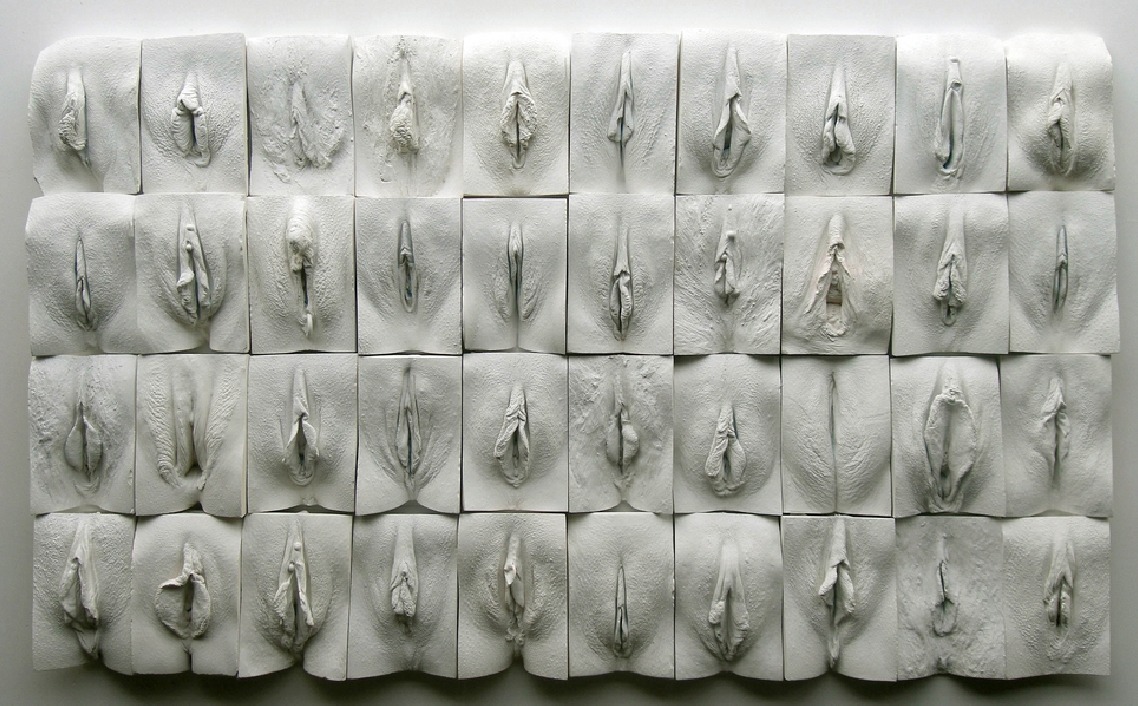
I’ve been informed that there is an art installation being installed at the English bohemian seaside town of Brighton that will change my life – “the lives of all women, forever”! It’s a wall of 400 plaster cast lady’s genitals, entitled “The Great Wall of Vagina.”

Included in the nine meter wall installation (which will debut at the Brighton Fringe Festival, according to Juxtapoz) are the pussies of transgendered folks, recent mothers, family members, before and after shots of a woman who underwent labiaplasty. It seeks to represent the genitalia gamut, defy the cult of normalcy that’s been drummed into us by the perfect pussies of mainstream pornography. 

It is a phenomenal work — it took five years to cast the participants and then cast their body parts – and I applaud anything that brings feminine sexuality into the public mindframe. I want to like this project, I do! And yet, and yet… 

A one Jamie McCartney was the brave soul to undertake the project, which explains but does not excuse his lack of anatomical knowledge (the casts rarely show their subjects’ vaginas, but rather their labias, “vaginal vestibule,” and clitoris).

Anatomy lesson, for those inclined.

And change the lives of women? That’s what his website says about the piece, and though I think the “Wall” is a neat idea, if we’re digressing with the over-Barbification of women’s sexuality, we need to think about who exactly that message needs to be addressed to. If nothing else, every woman has her own vagina to look at – the same cannot be said of men. 

And before I escort you onto the weekly sex events, let me beat my fist once more against the Wall. 400 vaginas, all makes and models, all bald as a cueball. In the interest of education, can Mr. McCartney please post a plaque next to his pussies that says “not pictured: pubic hair”?


“100 Ways to Play: A Catalog of Kink”

“A plethora of perversity.” “It still seems scary, but now in a good way.” “Like drinking from a fire hose. I attended, twice.” God bless participant surveys at sex events. The Citadel hosts this buffet of BDSM every once in awhile so that newbies can sample a taste of all sorts of sex play (fetish, impact, medical, and psychological are all represented) and old hands can get out of that metal-studded rut they may have found their dungeon-time stuck in. 

Thurs/5 7-10:30 p.m., $15-25

SF Citadel

1277 Mission, SF

(415) 626-2746

www.sfcitadel.org


Lube Wrestling Party

We’re taking “bump and grind” to the next level here. Because not only will the lovelies from Red Hots Burlesque be shimmy-shaking all over El Rio’s stage – getting down on the floor will be some sweaty, shiny girls hammerlocking and elbow dropping (maybe?) all over the damn place. Well, hopefully in the designated lube wrestling area, unless you like a little slick in your seven and seven. 

Thurs/5 9 p.m., $10-15 sliding scale

El Rio 

3158 Mission, SF

(415) 282-3325

www.elrio.com


Essence: On Fire

Calling all Sagittari, Leos, and Aries(es?): Mission Control’s sacred sexuality party turns the dial to fire for this month’s celebration of the life force-giving powers of Eros. New Age? In fact, Essence features a temple of innocence, temple of deep Eros, and chamber of dark arts. So leave your cynical friend at home – this is not their sex party. 

Sat/7 10 p.m.-3 a.m., $25-35 members only

Mission Control 

www.missioncontrolsf.org


Get your master’s in the filthy arts

Do you faun behind your drink at our city’s dirty storytelling nights, yearning to be among the foul-mouthed floozies onstage? Bawdy Storytelling’s grande dame Dixie De La Tour recognizes your needs, and to help out her less filthily verbose community members, is offering this three week course in staged dirty storytelling. Participants receive a diploma, a coursebook, and a video of themselves regailing classmates to study and share (perhaps with some special someones?)

Sun/8, May 15, and May 22 2-6 p.m., $250 for three class series

The Jellyfish Gallery

1286 Folsom, SF

www.dirtystorytellingworkshop.eventbrite.com


The San Francisco Men’s Spanking Party

Now don’t get this party wrong, this isn’t a play party for the hardcore leathermen. No no, this is more for the frisky fella interested in a little “fraternity hazing” or a scene where daddy spanks his bad boy into submission (um, leathermen: don a polo and flip-flops or maybe a tie?). Traipse on down to this safe environment to explore your yen for a little punishment (given or received) in your life. 

Sun/8 1-6 p.m., $20

Power Exchange

220 Jones, SF

www.voy.com/201188


“Give Spanks: Spanking for Sexual Pleasure”

So our story on Mistress Minax’s toy box piqued your pleasure points – but now you’re not quite sure how to make that first step down the BDSM dungeon stairs? Your wish is Good Vibes’ command – Minax will be lending a strong, swift hand to the sex toy company’s spanking workshop. A clothed demo will accompany this class, as well as tips on how to coax an unsure partner into the pleasure of pain. 

Tues/10 6-8 p.m., $20-25

1620 Polk, SF

(415) 345-0500

www.goodvibes.com

Clare Rojas’ safe space

3

As far as books go, Everything Flowers (Chronicle Books, $22.95) may just be my favorite to come out of the Bay Area this year. And not for its revelatory prose or whip-smart characters (it has neither). The small volume is filled with Clare Rojas’ quietly woman-centric, garden-toned designs that – can a book do this? – make me feel supported. I found myself breathing deeply while reading it, as if I’d just shook an asymmetrically packed satchel from my shoulders.

Resolved: I’d either get the heliotropic flower design tattooed on my skin, or I would meet the illustrator. Life being what it is, the latter proved to be the most accessible mission — and I’m glad that it was. Being in a room with Mission School vanguard Rojas is an experience akin to sitting quietly with Everything Flowers – or for that matter, listening to the breathy guitar folk of her alter ego, singer Peggy Honeywell. She creates calming, deep, feminine moments. 

“I feel so much pain being a woman in this world that I just wanted to create a safe place for them.”

Rojas barely seems to take up space in the interview room we’ve somewhat incongruously occupied at Chronicle Books, the company that published her most recent bound project. But behind her quiet presence, there’s a solidity. You have to lean in close to hear what she’s saying – in making you come to her, it’s like she’s subverting the model of self-promotional artist.

Everything Flowers, like the rest of Rojas’ canon, draws on the “super Americana, super Ohio” quilt art she saw her mother create when she was young. Rojas is fond of telling a story about visiting the place her mother used to attend quilting circles. All the cars in the parking lot, she says, were of the radical bumper sticker variety.

“There’s a certain energy and power with the way women express themselves,” she reflects when I ask her why she draws on these historical forms for her own very modern work. “When you make somebody lasagna it’s like love – and not sexy-time love either.”

When Chronicle Books approached her to do a book from which they could also cull art for pretty notecards and a gardening journal, it seemed a perfect fit for Rojas. After many years of what she felt to be acutely political work – the feminist mythology obliquely present behind her past gallery shows – she was ready to “let go of politics and just focus on beauty.” She was ready to draw some flowers, to heal for a moment.

She says. But as she takes me through the gorgeous pages of the book, it’s clear that some of the images (which were created between 2004 and 2010), hold significance for her past the simple desire to represent beauty. But good luck finding out the dirt on them – Rojas is an extraordinarily private person for our world of status updates and “about the author” pages. She tells me she’s “shy” about the paintings in the book, their hidden meanings so deeply personal that she feels weird seeing them on the page for others to examine. The most I get are small chinks in the armor I can peek through if I feel so inclined:

“Becoming an adult, figuring out what you stand for – the garden couldn’t be a better metaphor for growth.” 

Turning to a page with a fuschia design: “That one, I just enjoy painting flowers.” 

A radiating eye: “This one’s political for me.”

What are these politics Rojas keeps talking about? Again, personal. “I always feel like politics start in the home. If we can’t get it straight there…” she shrugs her shoulders, and holds my gaze.

It could have made for a real boring interview. But there’s something about Rojas that put me at ease, even if I didn’t understand quite what she was talking about, or even if we were talking about anything at all besides the literal words coming out of our mouths. After so many years of creating art in San Francisco, she is comfortable in her work. I’d entered the safe space.

“Blue Deer,” whose original now hangs in gate room G of SFO’s international terminal

Now, I’ll look at Everything Flowers and read my own stories on its pages, my frustrations and quiet victories as a female. This too, it seems, is part of Rojas’ plan. “You can only tend your own garden. If you’re happy and taking care of yourself, that resonates too.” 


Everything Flowers book release

Fri/6 6-8 p.m., free

Park Life

220 Clement, SF

(415) 386-7275

www.parklifestore.com


Some shit-talking

0

arts@sfbg.com

MUSIC Psychedelic Horseshit slinger Matt Horseshit has the gift of gab. He’s been credited with coining the genre label shitgaze, though he’s quick to dismiss it. “Genre names are pretty ridiculous at this point — a few kids in their room make up something and call it shoelace-gaze. A few people do something in their house and it’s now, ‘Which house?'”

Yet that talent, and flair for provocation, has also gotten the vocalist-guitarist-keyboardist into a world of pony dookie. Like when he spewed equine poo-poo all over Wavves, Vivian Girls, No Age, and TV on the Radio to the Washington Post in ’09, creating an indie-rock perfect shitstorm of heavily blogged proportions. Lo-fi, Horseshit opined in the article, has “exploded into this thing where Wavves is getting $30,000 to [expletive] crank out this [expletive] generic [expletive].” Call it the Horseshit side of the delightfully whacked, very wrong, and thoroughly shattered Psychedelic Horseshit equation talking.

Still, in a world of so much prepackaged pop/rock/hip-hop bowel movements and independents who’d rather play innocuous than call out crap as they hear it, you gotta love a guy who’s willing to say how he really feels, however impolitic, sensational, and naive it might be to do so. “There are too many positive vibes out there!” a friendly Horseshit (né Whitehurst), 27, protested last week by phone from his hometown of Columbus, Ohio. “Sometimes you gotta cut the tree down to make it bigger.”

The problem was that people, like the Vivian Girls, whom Horseshit considers pals and “sweet people,” got hurt. “I was railing against stuff in a moment of confused passion,” he explains now. “Then I was getting e-mails from people that I partied with, ‘What the fuck, I thought we were friends … ?’ No one wants to listen to the guy from Psychedelic Horseshit talk about how they’re influenced by Pavement — we’re here to entertain people and sell records — some people got that out of that …”

The flurry also caused Horseshit to step back and think about what he was doing — and whether he wanted to continue doing it at all. After putting out a mini-avalanche of CD-Rs, EPs, and albums on Siltbreeze and Wavves’ label Woodsist, among others (and running through 17 bass players), Horseshit decided to jump the “lo-fi gutter,” as he puts it, and embrace clarity, texture, even lyrics that don’t harsh on rock’s absurdities (see “New Wave Hippies” on Magic Flowers Droned [Siltbreeze, 2007]), rendered all the more naggingly accusatory when delivered in his nasal, nyah-nyah-ish tones.

“I honestly wanted to make a leap to a bigger label,” he says. “But after all my shit-talking, nobody would touch us at all … I don’t want to be linked to shitgaze for the rest of my life and be a rock history footnote.”

So after “weeding out” some band members, Horseshit and percussionist-keyboardist Ryan Jewell decided to make an album, Laced, to please themselves. “This record was the first thing where we took all our influences and thought about the way it was being taped,” says Horseshit, who confesses that he’s now thoroughly sick of mixing his own band’s music. “It’s more textured and more about sonics than it is about being bratty punks, and the lyrics are more dreamlike. There’s not a lot of pointed ‘fuck this’ and ‘fuck that.’ I got sick of that stuff … I was a little too honest there for a while.”

FatCat has since signed them on and Laced — a hazy, hallucinatory miasma of beats and moods that evokes both the loudly buzzing atmospherics of Black Dice and the experimental art damage of a less poppy Ariel Pink — is set to come out May 10. Leading up to the blessed date: the “Shitty Sundays” series of larky yet intriguing free MP3s (some freshly recorded only a few days previous), which have been released weekly on the FatCat site. The MP3s hint at Laced‘s trippier, less aggro mood, clad in samples and sprinkled with sequencers and drum machines (“I started going to festivals and taking ecstasy and getting into blissed-out dance music,” explains Horseshit), although the fuck-it feeling that anything can happen remains, the same freewheeling, horse-caca churn of the first Psychedelic Horseshit show I ever saw, back in 2007. “It’s a stepping stone kind of record,” Horseshit offers. “It has one foot in our path and goes in a lot of different places and frees us up from what a lot of people think we are.”

A tempered, more mature Horseshit? Could be — he’s even willing to bide his time while Jewell is away on a meditation retreat. “He wouldn’t even tell me where it was!” he marvels, adding that keyboardist Nicole Bland is playing with the band in the U.K., “covering his ass when he’s figured this shit out.”

“I said, ‘The record’s coming out,’ and he said, ‘I can’t be in the band right now. I just need to be away and find out what’s going on.’ It’s bad timing, but I respect it. It’s like, you know, ‘Thanks.'”


Bleak frames and guilt

0

arts@sfbg.com

LIT From the first page, an anonymous manifesto denouncing the pharmaceutical industry, to a bronze sculpture of a suppressed anti-Nazi headline from the Lippische Tages-Zeitung weighted down by a giant hammer and nails on the last, David Lester’s graphic novel The Listener (Arbeiter Ring Publishing, 304 pages, $19.95) explores how words often fail their intended purpose, precipitating actions with unforeseen consequences.

The unintended consequence of the manifesto: an amateur activist falls to his death while hanging a banner from a radio tower. The unintended consequence of the unpublished article: the rise of the Third Reich and the fall of a nation’s conscience. In Lester’s book, both events become entangled within the scope of Louise Shearing, a Canadian sculptor wracked with guilt over the death of the activist, who took the phrase “action speaks louder than words” to heart.

Although The Listener eventually makes reference to the fallen activist, Vann, being influenced by Louise’s sculpture of French anarchist Louis Michel, it’s not immediately clear to the reader why Louise, as opposed to the scribes behind the manifesto, must bear the brunt of the guilt over his death. Like many young people in a state of flux, Louise winds up backpacking across Europe, hanging out in art museums and hooking up with cute but pedantic European men. In one of those almost-magical chance encounters so common to the open road, she has a conversation with an elderly couple in a café, which culminates in an unexpected history lesson.

Rudolph and Marie are from the former German state of Lippe (now part of North Rhine-Westphalia), site of the last free election in Germany before Hitler took the chancellorship. As journalists and members of a smaller right-wing party (the DVNP), which balks at towing the Nazi Party line, they nonetheless go along with the suppression of an article exposing corrupt Nazi campaign tactics. The headline pulled at the last minute is preserved for posterity on a secret plate that Rudolph smuggles home. “Our failure to defeat the Nazis in Lippe is a regret we live with every day,” Marie says.

It’s tempting to draw a parallel between Lester’s The Listener and Jason Lutes’ Berlin, but to compare the two does The Listener a disservice. Where Berlin is a meticulously-rendered serial drama characterized by painstakingly clear lines and weighted text, The Listener is a shadowy morality play cloaked in the mantle of German Expressionism. The black guilt that weighs heavily within Louise and the German couple seeps across each page like a Rorschach blot. Each bleak frame is a single painting, rendered in messily urgent layers of gray, interspersed with replications of newspaper headlines trumpeting the rise of the Third Reich. Also unlike Berlin, most of the book’s action actually takes place in the present day, where the reverberations of the dead can be, and are, remarked on by the living.

The Listener flags during Louise’s unstructured attempts to ascertain what art means to her by discussing it at length. She swoons over Cézanne and deconstructs Picasso, but is so rarely shown in the act of creation that it’s easy to forget that her art has served as a catalyst for action. It’s possible to imagine Lester — painter, musician, activist — having these very conversations with himself, but they don’t have the same impact as the sculpture Louise finally creates in the last frame, a picture truly worth a thousand words. 


TV eye

0

arts@sfbg.com

HAIRY EYEBALL In 1976 artist Clive Robertson reflected on a performance he gave that same year, in which he dressed up as and restaged pieces by the famous postwar German performance artist Joseph Beuys. “We have to adapt legends so that they become portable and can fit into our pockets,” he wrote. “Unfortunately for the artist, that is the fight we label history.”

Robertson was addressing his own anxiety of influence in the face of Beuys’ then-ascendant status within the art world, but his comments also provide a gloss on the struggle that curators and art historians face in their own practice. In the case of “God Only Knows Who the Audience Is,” a parting gift from the graduating students of California College of the Arts’ Graduate Program in Curatorial Practice, currently on view in the galleries of the school’s Wattis Institute, it is a struggle undertaken with great intelligence and economy.

Smartly conceived and staged, “God Only Knows” is a dialogic tale of two histories. One is a survey of the nonprofit artist-run organization and gallery space La Mamelle (which became ART COM in the 1980s) that existed in various incarnations from 1975 through 1995 and forms an important, if under-recognized, chapter of Bay Area art history. The other traces a concurrent shift in performance art, largely made possible by the advent of video technology, away from the artist’s body and toward the disembodied artist.

La Mamelle was, appropriate to its name, a nurturing organ for the local art scene. In addition to hosting events and organizing exhibits, the organization released videos, audio-zines, and microfiches, and published anthologies as well as the regular magazine in which pieces such as Robertson’s “The Sculptured Politics of Joseph Beuys,” quoted above, first appeared.

The constant proliferation of publications and media put local artists such as Chip Lord, the video collective Ant Farm, Lynn Hershman, and Bonnie Sherk — who all have pieces or documentation of early performances on display here — in touch with other artists around the world and vice versa. The aforementioned artists had wandered to the end of the conceptual inroads that had been laid down by the likes of Andy Warhol and Beuys, and were now operating in a new media wilderness, with only their VHS cameras to guide them.

“God Only Knows” successfully locates these artists and their work within a continuum of practices that stretches into the present. Others have followed Robertson in treating Beuys and his practice as source material (“identity transfer” in his words), as evinced by nearby pieces in the first floor’s survey of performance art that de-centers the artist’s body as both a performance’s agent and its living trace, such as Whitney Lynn’s 2010 re-do of another Beuys performance, or Luis Felipe Ortega and Daniel Guzmán’s 1994 video Remake, in which the duo stages “improved upon” versions of canonical performance art pieces.

The exhibit’s second floor takes us into the ’80s and ’90s, where the message is clear: television opened up the potential for art to reach new audiences. Greeted by the ponderous, mustachioed visage of Douglas Davis in his The Last Nine Minutes, a live-to-video performance realized in 1977 for Documenta 6, we immediately see how video dissolved the time lag between action and its documentation. Bill Viola’s 44 portraits of television viewers (1983-84) staring silently into their TV sets, made for WGBH in Boston, screens on the other side of the entrance.

In the middle of the gallery, playing across what the accompanying brochure calls an “archipelago” of viewing stations, are various video pieces by La Mamelle and ART COM artists, as well as those by artists such as the Borat-like Olaf Breuning, whose work plays off of the spectacle of TV shows. Meanwhile, at the back of the room, Mario Garcia Torres’ jarring 2008 nine-channel compilation of artists’ TV cameos from the past four decades (Dali doing a car commercial; Warhol appearing as himself on The Love Boat) tabulates the increasing banality of art’s intersection with television.

Yet despite the histories laid out in “God Only Knows Who the Audience Is,” Bravo’s Work of Art, YouTube, and the continual meddling presence of James Franco, video has yet to kill the performance art star — or at least the demand for the star’s body, as demonstrated by Marina Abramovic’s recent MOMA retrospective, in which the real attraction was not the controversial restagings of her greatest hits, but her daily physical presence.

The irony, of course, is that exhibit’s online half-life, which continues today. The Flickr and Tumblr are still there. The artist is still present to those who navigate to those pages, even though Abramovic left the building long ago. God only knows who’s still watching.


DISAPPEARING ACTS

The title of German painter Christoph Roßner’s current solo show at Romer Young, “The Hat, That Never Existed,” is a tip-off. Roßner’s smudged, over-painted, and half-erased depictions of things and people — trees, candles, top hats, houses, old men — scan as disappearing acts rather than fixed portraits (the way the canvases have been hung even suggests that a few have gone missing from the gallery). “Ghoulish” is the operative word here. Not much separates the faceless specter of Ghost from the skeletal visage in Grinser; and Roßner can make even a rock look like an Expressionist coffin. That’s not lazy journalistic shorthand, either: Roßner’s rough-hewn bleakness is of a piece with the Old World aesthetics of, say, George Grosz. The séance lasts only one more week, though, so act fast.

GOD ONLY KNOWS WHO THE AUDIENCE IS

Through July 2

CCA Wattis Institute for Contemporary Art

1111 Eighth St.

(415) 551-9210

www.wattis.org

THE HAT, THAT NEVER EXISTED

Through May 14

Romer Young Gallery

1240 22nd St., SF

(415) 550-7483

www.romeryounggallery.com


Ross for boss (of the sheriff’s department)

3

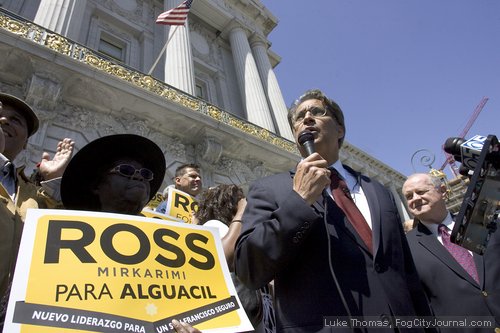
City Hall’s steps were awash in multi-lingual black and yellow “Ross Mirkarimi for Sherrif” signs at noon today, as Mirkarimi supporters watched Sheriff Mike Hennessey, who is stepping down after 31 years of service and eight elections, endorse Sup. Mirkarimi as the next sheriff.  “New Leadership for a Safe San Francisco” was printed on the English version of the signs that Mirkarimi’s supporters carried. They included former Mayor Art Agnos, Sups. David Campos and Eric Mar, Tim Paulson of the Labor Council, Debra Walker, Linda Richardson, Sharen Hewitt, Terry Anders, and Mirkarimi’s partner Eliana Lopez and their almost two-year old son Theo. And everyone had plenty of great things to say about outgoing sheriff Hennessey and sheriff candidate Mirkarimi. And Hennessey even pinned a shiny toy sheriff’s badge onto the T-shirt of Mirkarimi’s son Theo, making him the happiest kid in town. At least for the day.

Campos kicked off the event by honoring Hennessey as the “most progressive and most effective sheriff in the country.”
“Mike Hennessey is also my neighbor in District 9. I see him taking out the trash so I know he’s a good neighbor,” Campos joked, as he listed the many achievements in Hennessey’s long career as an elected official in San Francisco. These achievements included Hennessey’s pioneering innovations in criminal justice and culminated in his decision to blow the whistle in 2010 on the federal government’s plan to activate its controversial Secure Communities program in San Francisco—without telling the public.
“He’s not afraid to stand up for what’s right,” Campos said.

‘This is the time for me to move on,” Hennessey announced, as he laid out his reasons for endorsing Mirkarimi as Sheriff, over other candidates in the field.
Hennessey described the Sheriff’s Department as a “large enterprise” that has over 1,000 employees, a $150 million budget and whose jail houses an average population of 2,000 folks in custody, on a daily basis.
“It’s not something that can be handled lightly,” Hennessey said. “That’s why I’m here to endorse Ross Mirkarimi as the next sheriff.”

Hennessey listed the many endeavors that he and Mirkarimi have worked closely on, including a number of criminal justice issues, and he cited Mirkarimi’s extensive law enforcement background, his significant legislative accomplishments in the areas of criminal justice and public safety, and his ability to find innovative solutions and overcome obstacles to progress, as reasons to support Mirkarimi.

Hennessey observed that criminal justice is “one of the thornier issues” that members of the Board of Supervisors are often asked to get involved in, but often duck.”But Ross has not shied away from working on them,” Hennessey said, citing Mirkarimi’s involvement in shaping the “No Violence Alliance Project” and his leadership in creating the Safe Communities Re-entry Council.

Hennessey also noted that in face of AB 109, the Governor’s plan to transfer state inmates to county jails, “it’s vitally important to have person in charge of sheriff’s office that understands these alliances and can make them work more effectively.”

Hennessey concluded by observing that the Sherrif’s Department has to deal with a lot of bureaucracy, so it’s important to understand how the Board, the budget process and other city departments, including the District Attorney’s office and the police, work.
‘And that’s why I’m endorsing Ross as Sheriff,” Hennessey said

Then it was the turn of Mirkarimi, who graduated from the San Francisco Police Academy, did Naval Reserve training and worked for more than 8 years as an investigator for the District Attorney’s office, to speak.

“I have never been at a loss for words,” Mirkarimi acknowledged, as he launched into a speech that began by thanking everyone for showing up at short notice “for one of the most important occasions of my political career.”

Mirkarimi did a great job of giving Hennessey the praise he deserves.
“He is a living legend,” Mirkarimi said. “It’s completely impossible to fill his shoes.”
Citing Hennessey’s integrity and his ability to innovate, Mirkarimi warned that, “Maybe it’s come to the point where we have taken him for granted. He’s the longest serving elected official in the history of San Francisco, and he’s probably the most understated.”

“And the most important endorsement in this race is that of Mike Hennessey,” Mirkarimi added, as he gave Hennessey his commitment “to build upon your legacy as effectively as possible.”

Mirkarimi cited some of the most immediate and serious challenges that face the next sheriff. These include AB 109, which Gov. Jerry Brown just signed, which. Mirkarimi said, threatens to increase the reentry prisoner level by 30 percent in California. “It will take creative ingenuity and resources to make sure we are effective in taking care of this population,” he said.

Mirkarimi also touched on the rising number of veterans that are ending up in the prison system, talked more about the No Violence Alliance Project, and suggested that certified deputy sheriffs could help serve warrants, transfer prisoners, and patrol Muni, “when the police department finds itself understaffed” so as to ensure that San Francisco is safe.

“For every four people arrested and jailed in San Francisco, three out of four are repeat offenders in a three-year period,” Mirkarimi warned, by way of explaining why he wants to advance a more collaborative spirit between SPPD and the Sheriff’s department.

Mirkarimi also noted that one out of every 15 African American males are in jail, at any time in the year, compared to I out of 300 males who are not black or brown. “So, we must step up our game in dealing with poverty,” he said, as he recommended increased access to job training and good jobs, “so work doesn’t become a seasonal hope but a permanent job.” He also made the connections between a lack of good housing, childcare, and schools and a rise in poverty, crime and recidivism.

Mirkarimi concluded by crediting Hennessey for “walking that fine pirouette” between upholding the principles of public safety and understanding the power of redemption at the same time.

I asked Sheriff Mike Hennessey what he considers to be the biggest challenges of running for sheriff/
“Letting people know what you are going to do, and what your issues are,” Hennessey said, noting that San Francisco has an intelligent, issues-driven electorate.

And Mirkarimi’s supporters weren’t shy about letting folks know the issues that the current D5 Supervisor has helped them with, over the years.

“Ross, as a supervisor and me, as someone who comes from a community of color, we know the habits that ex-offenders can bring with them, if there are no safety nets,” said Terry Anders who sits with Mirkarimi on the Safe Communities Reentry Council. “And I believe in what Ross stands for and the integrity of his person. He’s one of the first people to show up when there are crimes and victims, and he attends basketball games and boxing matches.”

Paulette Brown, whose son Aubrey Abraska Jr, was murdered in August 2006, but whose killers have still not been brought to justice.
“We shouldn’t have to run and leave our families, we should be protected,” Brown said. “Ross is my district supervisor and if he can get in, and do something about crime and solve unsolved homicides, then I’m for him. Maybe if he gets in, he’ll have more pull to do something about these unresolved cases.”

And then it was back to work, which for Mirkarimi now includes the somewhat daunting task of trying to raise money in an election year that also includes a mayor’s race, but does not include the help of public financing, at least not for the sherrif’s race….

Northwest passage: Kelly Reichardt on “Meek’s Cutoff”

0

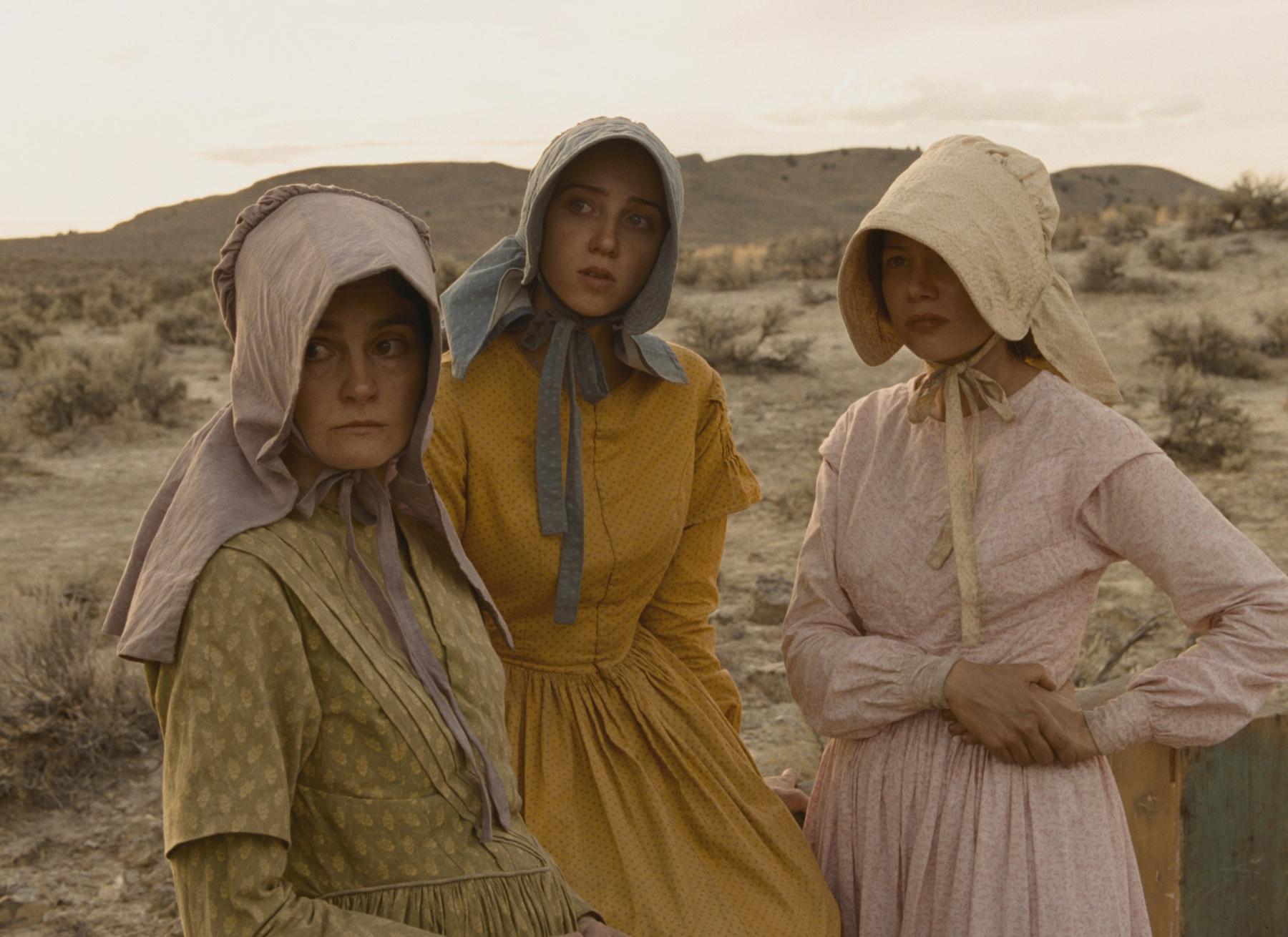
Over the past decade, Kelly Reichardt has consistently created an alternative cinema that is in opposition to modern Hollywood blockbusters. Her films, which emphasize minimalist and highly visual storytelling, transcend even the industry’s edgiest darlings (think Darren Aronofsky and Quentin Tarantino). Her films Ode (1999), Old Joy (2006), Wendy and Lucy (2008), and now Meek’s Cutoff (2010) cannot be categorized in the decade’s overhated mumblecore movement of Andrew Bujalski or the Duplass Brothers. Neither are they part of the world of extreme experimental artists, a la James Benning or Sharon Lockhart.

Somehow Reichardt has found a cinematic middle ground, balancing quiet and poetic allegories with accessible and emotional journeys — an achievement that present and future audiences will be hypnotized by for generations to come. After interviewing her for Wendy and Lucy, I spoke with her after Meek’s Cutoff played the 2011 Sundance Film Festival; it recently had its local debut at the San Francisco International Festival, and opens theatrically Fri/6.

San Francisco Bay Guardian: I recently saw your earliest films at the Pacific Film Archive retrospective and your adaptation of the Robby Benson-starring Ode to Billy Joe (1976), Ode (1999), was amazing! You shot the whole thing on Super 8, right? Do you like your earlier films?

Kelly Reichardt: Ode is very near and dear to my heart. It set me on my own way of making films. I don’t think I’m naturally a non-narrative person. And definitely not as much as I revere those kind of filmmakers like my colleagues: Peggy Ahwesh, Peter Hutton. I love seeing how their films unfold and really make the viewer be interactive in deciding what they’re about and what they mean to them. That’s what I’d like to do as a filmmaker. But I can see myself learning in all of my films, which is painful. A couple of students walked out of that screening of my earliest short films and I wanted to run out after them and say, “I totally understand!”

SFBG: You and [screenwriter] Jon Raymond seem to be consciously aware of just that! I know I have told you this before but I find your films so inspired. Your films are like the kind of classes I always wanted to have in college. You’re never telling me what to think, yet you are very precisely leading me towards something extremely imminent. And along the way, I get to experience my own journey with these characters and situations. Do you run into problems getting your films made and released because of this structure?

KR: That part of it, the endings, is [an element] coming from the world of non-narrative filmmaking. It doesn’t hand things over to the audience. It’s like a series of questions unfolding which is like a dream, which is something I want to bring into a more narrative form. It opens up the traditional genre a little which you already know how its’ suppose to go. Meek’s Cutoff and Wendy and Lucy were both released through Oscilloscope, while Old Joy was distributed by Kino. These are all small independent distributors and the things that they are looking for are not for everyone.

The hard part with filmmaking is getting the money to make the film. Everybody has a camera now. You can shoot a video. But if you’re not into naturalism and you’re trying to make things that are more extravagant, that vision is going to be much harder to just do on your own. If I were a student right now, my biggest fear would be how to rise up out of such a huge sea of voices. When I submitted my first feature, River of Grass, to Sundance in 1994, they had 600 entries that year which seemed overwhelming and huge. Six hundred and they were only gonna pick 16. And what was it this year? Didn’t they have something like 6,000 entries?

Getting your film out … worry about that later. Get your film made first. Plus there’s always the fear of even having something to say at the age of 20! Before you’ve lived on your own and been connected to the big black hole of employment, and public transportation and all those things. That could be good “big” fear to have as a young filmmaker.

SFBG: In your Q&A after the screening of Meek’s Cutoff at the Egyptian Theatre [in Park City, Utah], I was very excited about your bringing up forgotten and unavailable older films like Nicholas Ray’s The Lusty Men (1952).

KR: Me too! I was trying to make that point and I became so distracted by the woman sitting behind you filming. It’s just such a weird thing to look out and see 15 people videotaping you and you realize that no experience can ever just be with the people in the room again. Everything has to be some bigger purpose and I completely quit thinking about the film and the interaction. I think it’s a bizarre that people feel completely free about videotaping you and posting it on the Internet without asking me.

SFBG: Not only is it exciting that your films feel influenced by older cinema but you do it in a way that’s very much like Peter Bogdanovich, where it feels as if you truly understand the film’s themes and goals and you’re not just making a mixtape of your favorite scenes. Wendy and Lucy feels like a Vittorio De Sica neo-realist film, while Meek’s Cutoff feels like an existential William Wellman Western by way of Robert Flaherty’s Nanook of the North (1922). I mean, you even used the old Hollywood aspect ratio of 1.33:1 on Meek’s Cutoff! And it doesn’t come off kitschy; in fact, it feels even futuristic.

KR: It’s funny that you mention the aspect ratio. If anything is kitschy, and when you read back about the period, widescreen was what was kitschy. It was a gimmick! It’s what 3D or IMAX is to us today. What did Fritz Lang say, “Widescreens are for funerals and snakes.”

It’s funny now that this memory of widescreen is so embraced but it’s such a diminished landscape in a way. That question is always being asked to me in some tone of like, “When you accidentally picked the wrong aspect ratio did you have to just keep going with it?” (laughs) Though I knew going into it that it would limit the amount of theatres we can play Meek’s at. Sadly, very few theaters have the capabilities. 

SFBG: I’ve been watching a lot of Westerns this year and your horizons in every single shot of Meek’s Cutoff are truly spectacular. Your multi-layered colors! Your floating cowboys! The lined-up pioneers! I could just go on. All of it is so particular. How did you design this film? Did you do it on the landscape or storyboard it first?

KR: I storyboard but I can’t draw. (laughs) I have many different notebooks. Color is an early thing. But everything comes first from relentless scouting.  Scouting, scouting, scouting, scouting. I get familiar with the light and the colors of the day. The places you’re gonna be shooting in at certain times of the day. These locations were really remote and very hard to get to. And we ended up spending such a huge amount of time in that desert.

SFBG: Did you have to sleep out on the plains?

KR: We stayed in this town, Burns, Oregon. It’s a good two-street town and we’d drive off-road for two hours into the desert each day. This is where the actual wagon train got lost. There was nothing out there. We were actually finding pieces of wagon from the 1840s! So it would eat up a huge amount of our shooting day, which is already short because when you’re shooting in the mountains, the sun is gonna go behind them. So that’s four hours already out of your day.

My shooting schedule was so restricted that other producers would have said “You are sinking your ship by shooting out on these locations.” Fortunately my producers backed me and off we went, for better or worse. So you have to be on top of it when you’re there, knowing that there will be unexpected things to occur especially when you are dealing with oxen and mules and donkeys. All of that is to be embraced.

I also have to have a plan because we move so quickly. My DP [Chris Blauvelt] and I are talking, talking, talking. I have some books that are references, that I’ll steal frames from. Some that are location photos, people standing in the locations, some from old films. And some are just really crappy drawings I’ve done because I cannot draw, which I consider a huge handicap as a filmmaker. People always ask “Are you improvising?” We don’t have time for improv! Of course because of the weather, and the terrain, and rattlesnakes and the animals there’s certainly a certain amount of adjustment because when I storyboarded this, it wasn’t snowing. But you can’t go out there without a plan. The camera for me is the storyteller.

SFBG: Now you edit your own movies. Is that because you are a tyrant and you have to have it your own way or have you tried working with others? And by “tyrant,” I mean it in the nicest way possible.

KR: (laughs) You go through different stages: I have my writing partner [Jon Raymond] and that’s one stage and then it becomes very public and you’re working with a bunch of people when filming. Then editing is where you get your film back and it’s when I get to find my film. It’s a great moment when I’m in the editing room an I can say, “Oh yeah, that’s what Jon was originally talking about!” or “I felt that in Jon’s short story!”

But when you’re in production, there’s just so much going on! And editing is where you learn where you fucked up and should have put the camera. It’s the big payoff for me and I don’t want to hand it over to anyone else. It’s the interesting part of filmmaking. It’s where you can manipulate space and completely change the dynamic of a conversation or situation just by adding or taking away time. It’s not fun to edit with me, so I stopped using editors (laughs).

http://www.youtube.com/watch?v=AEmL9at6JT0

Meek’s Cutoff opens Fri/6 in Bay Area theaters.

Jesse Hawthorne Ficks is the Film History Coordinator at the Academy of Art University and programs the film series Midnites for Maniacs.

Our Weekly Picks: May 4-11, 2011

0

WEDNESDAY

MAY 4


MUSIC

Wanda Jackson

Over her 50-plus years in show business, she’s been called “the Queen of Rockabilly” and “the Sweet Lady with the Nasty Voice” — and now fans can rightly call Wanda Jackson a true musical icon, with her recent induction into the Rock and Roll Hall of Fame. Don’t let that enshrinement fool you into thinking she’s retired, though. She can still belt out tunes like nobody’s business, and proved that yet again with the release of The Party Ain’t Over, her Jack White-produced album that came out earlier this year. Forget about the recent big fuss over in England; come to tonight’s show if you want to see some real royalty. (Sean McCourt)

With Red Meat and DJ Britt Govea

8 p.m., $21

Great American Music Hall

859 O’Farrell, SF

(415) 885-0750

www.gamh.com


MUSIC

J Mascis

It has been a good couple of years to be a Dinosaur Jr. fan. In 2005, lead singer J Mascis and bandmate Lou Barlow put aside their grievances enough to play shows as the original lineup, along with drummer Murph. In an era of live record performances from bands well past their prime, that would have been enough, but the band released new albums that were as good as ever. (In the case of 2009’s Farm, maybe better.) So now, almost just to show that he can, between Dinosaur Jr. tours and recording sessions, Mascis releases the solo album, Several Shades of Why. Exchanging shredded electric guitars for (still a little fuzzy) acoustics, it’s another surprise, but in the best way. (Ryan Prendiville)

With Black Heart Procession

8 p.m., $20

Independent

628 Divisadero, SF

(415) 771-1421

www.theindependentsf.com


THURSDAY

MAY 5


MUSIC

Frank Fairfield

Frank Fairfield’s adaptations of blistering American ballads are proudly faithful, but his ability to coax the rightness from battered banjos and fiddles (and to squeeze his voice as if onto fresh shellac) goes way beyond technique. “I don’t even know if [this music] has that much to do with tradition,” Fairfield told one interviewer. “I think it’s just people doing whatever they feel like doing. A lot of this stuff just gets mished and mashed, and that’s the beautiful thing about America.” The fact that he’s a young Angeleno who dresses the old-timey part may raise eyebrows — but trust your ears. He makes an intriguing opener for Cass McCombs, a troubadour cut from a different cloth. (Max Goldberg)

With Cass McCombs

8 p.m., $15

Swedish American Music Hall

2170 Market, SF

(415) 861-5016

www.cafedunord.com


FRIDAY

MAY 6


DANCE

Ahdanco/Abigail Hosein Dance Company

While dance can be described as poetry in motion, Ahdanco’s 2011 home season offers both poetry and motion in a dynamic dialogue. For one of the two new works on the program, the dancers share the stage with spoken word artists from the Bay Area Poetry Slam Circuit, weaving Abigail Hosein’s choreography with powerful narrative stories. The other dance is a trio set to an original score composed of four loop stations, trumpet, cello, upright bass, guitar, and female vocals performed live by ambient band, Entamoeba. Hosein’s strong female dancers (many of whom are Mills College alumni) skillfully balance the physical and theatrical. (Julie Potter)

Thurs/6–Fri/7, 8 p.m.; Sun/8, 6 p.m., $20

Ashby Stage

1901 Ashby, Berk.

(510) 837-0776

www.ahdanco.org


EVENT

“Bikes and Beats”

In response to SF’s burgeoning biking scene — and that empty moment on the first Fridays of the month when you realize that the SF Bike Party is over and the rest of your evening is TBA — comes this night club-bike club. Organizers’ goal for this fundraiser for Sunday Streets and the Wigg Party is to make bike culture as un-scary and fun as possible — even to those without handlebar calluses. Bike crafts and fashion will be on display, as well as a dope, divergent musical lineup featuring the Polish Ambassador, Non-Stop Bhangra, Madrone’s Motown on Mondays crew, and that party on two wheels well known to SF cruisers, DJ Deep. (Caitlin Donohue)

10 p.m.–3 a.m., $6–$10

Public Works

161 Erie, SF

(415) 932-0955

Facebook: Bikes & Beats


DANCE

“SCUBA 2011”

A terrific idea, SCUBA, a small presenters consortium, has been pooling resources for close to a decade to offer gigs to hot young choreographers, whether homegrown or invited from participating venues. So far, ODC Theater director Rob Bailis’ choices have always been worthwhile. The mix has been rich and varied. On this program, SF’s own Katie Faulkner, who will premiere Sawtooth, will be joined by Amelia Reeber from Seattle and Chris Yon from Minneapolis. Reeber is bringing this is a forgery, a multimedia work that examines choices and transformation. Yon draws on husband-wife vaudeville acts for his duet, The Very Unlikeliness (I’m Going to Kill You), with partner with Taryn Griggs. (Rita Felciano)

Fri/6–Sat/7, 8 p.m.; Sun/8, 7 p.m., $15–$18

ODC Theater

3153 17th St. SF

(415) 863-9834

www.odctheater.org


SATURDAY

MAY 7


MUSIC

“Walk Like An Egyptian”

What’s Zambaleta, you say? In Egypt, Zambaleta is a spontaneous chaotic street party that happens when everyone is participating, through music or dance. In the Mission, Zambaleta is a world music and dance school with an inclusive environment and celebratory spirit. This weekend’s “Walk Like An Egyptian” festival captures that spirit, featuring Bay Area music from blues and folk to jug bands and indie. The lineup of 18 bands includes an appearance by Annie Bacon’s Folk Opera — plus, proceeds from the festival support community programs at the world music and dance center. Come walk — and party — like an Egyptian. (Potter)

Sat/7, 1 p.m.–midnight;

Also Sun/8, noon–8 p.m., $5–$20

Restoration Workshop

630 Treat, SF

(415) 341-1333

www.zambaleta.org


EVENT

CELLspace Birthday Benefit Funkathon

Celebrate the 15th birthday of CELLspace, San Francisco’s original hub for artistic work and gatherings, by partying down at a Funkathon featuring Action Jackson and other funky music and dance acts. And this is just one event among many, including an art auction May 5, a swap meet and dance party May 6, and a party May 8 that coincides with the Sunday Streets closure of Mission District streets to automobile traffic. CELLspace, a venerable institution that offers classes on everything from welding to breakdancing, is going through ambitious fundraising efforts as it seeks the permits and resources to expand its nightlife offerings, so come have a funky time while supporting a great cause. (Steven T. Jones) 9 p.m., $10–$20

CELLspace

2050 Bryant, SF

(415) 410-7597

www.cellspace.org


FILM/PERFORMANCE

“Ultimate Mommie Dearest

Oh, I know you’ve already seen 1981’s Mommie Dearest. And I know you can quote all the famous lines (personal favorite: “Tina! Bring me the ax!”) But you’ve never experienced the ultimate Mommie Dearest — because it’s never been attempted until this once-in-a-lifetime event. Marking the cult classic’s 30th anniversary is a dame who surely has never touched a wire hanger in her life, Peaches Christ, and celebrated Peaches cohorts Heklina, Martiny, and (in honor of Mother’s Day), Mrs. Christ herself! A restored print of the film caps a night that also includes the musical stage spectacular Trannie Dearest, a drag tribute to Joan Crawford’s unfailingly dramatic life. Do I even have to add that costumes are encouraged? (Cheryl Eddy)

8 p.m., $25–$40

Castro Theatre

429 Castro, SF

www.peacheschrist.com


EVENT

Urban Cycling Workshop

If I had a nickel for every car devotee or exasperated Muni rider who’s lamented, “Oh, I would totally ride a bike if there weren’t so many scary cars!” I’d be, well, not rich but could certainly buy some fresh handlebar tape ($16 per roll). How awesome, then, that the hardworking bike advocates at the San Francisco Bicycle Coalition are offering a four-hour, in-classroom, free introductory course geared toward newbies and cyclists who want to feel more comfortable riding our tiny but intense peninsula. The class covers all the basics, from choosing the best bike to pulling emergency maneuvers, to knowing your legal rights. Ding, ding! (Kat Renz)

2 p.m., free (preregistration required; ages 14 and up)

Fort Mason Center, Bldg. C, Rm. 362

Laguna at Marina, SF

(415) 431-2453 x312

www.sfbike.org/edu


MONDAY

MAY 9


MUSIC

Mogwai

Much like the mythical creatures from Gremlins (1984) that they are named after, Mogwai’s sound can be soft and serene at one moment, then morph into an entirely different dynamic, with blistering guitars and noisy effects multiplying around you. The Glasgow-bred rockers returned in February with its seventh record, and its first Sub Pop release, Hardcore Will Never Die, But You Will, which continues the band’s mostly instrumental and highly successful approach to making music. Creating lush sonic soundscapes richly textured with a wide array of different riffs and tones, the five-piece group is definitely one to catch live if you can. (McCourt)

With Errors

8 p.m., $23.50–$26

Regency Ballroom

1290 Sutter, SF

1-800-745-3000

www.theregencyballroom.com


TUESDAY

MAY 10


DANCE

Project.B.

If you have seen Tanya Bello dance — Shift Physical Theater, Robert Moses’ Kin, and Janice Garrett + Dancers come to mind — you won’t have forgotten her. She probably was the shortest (but also the fastest and fiercest) tearing across the stage. Bello is small but she dances big. Lately she has taken advantage of the Garage’s RAW (Resident Artist Workshop) program to hone her choreographic skills. Moveable Feast, her first full-evening work, is plugging into her experience working with choreographers both here and on the East Coast. The idea is to show three versions of one piece in which components — lights, dancers, sets, music — get shuffled around. In the end the audience decides which one worked best. (Felciano)

May 10-11, 8 p.m., $15

Garage

975 Howard, SF

(415) 518 1517 www.brownpapertickets.com 


The Guardian listings deadline is two weeks prior to our Wednesday publication date. To submit an item for consideration, please include the title of the event, a brief description of the event, date and time, venue name, street address (listing cross streets only isn’t sufficient), city, telephone number readers can call for more information, telephone number for media, and admission costs. Send information to Listings, the Guardian Building, 135 Mississippi St., SF, CA 94107; fax to (415) 487-2506; or e-mail (paste press release into e-mail body — no text attachments, please) to listings@sfbg.com. Digital photos may be submitted in jpeg format; the image must be at least 240 dpi and four inches by six inches in size. We regret we cannot accept listings over the phone.

Stage Listings

0

Stage listings are compiled by Guardian staff. Performance times may change; call venues to confirm. Reviewers are Robert Avila, Rita Felciano, and Nicole Gluckstern. Submit items for the listings at listings@sfbg.com. For further information on how to submit items for the listings, see Picks. For complete listings, see www.sfbg.com.

THEATER

OPENING

Silk Stockings Eureka Theatre, 215 Jackson; 255-8207, www.42ndstmoon.org. $24-44. Previews Wed/4, 7pm; Thurs/5-Fri/6, 8pm. Opens Sat/7, 6pm. Runs Wed, 7pm; Thurs-Fri, 8pm; Sat, 6pm; Sun, 3pm. Through May 22. 42nd Street Moon presents a Cole Porter production.

ONGOING

Absolutely San Francisco Alcove Theater, 414 Mason; 992-8168, www.absolutelysanfrancisco.com. $32-50. Check for dates and times. Open-ended. Not Quite Opera Productions presents a musical.

*Caliente Pier 29, The Embarcadero; 438-2668, www.love.zinzanni.org. $117-145. Wed-Sat, 6pm; Sun, 5pm. Open-ended. Ricardo Salinas, cofounder of famed Mission-born radical Latino comedy trio Culture Clash, penetrates the velvet enclave of Teatro ZinZanni, taking the helm for its latest Euro-style dinner-cirque cabaret show. Under Salinas’ inspired direction, the evening plays as a revolt by brown-hued kitchen and wait staff against a ruthless takeover by, what else, a Chinese conglomerate. Multiculti clashes ensue, with the underdogs led by a brother-sister team played charmingly by ZinZanni regulars Christine Deaver and Robert Lopez, and with much expert repartee and physical humor neatly enveloping characteristically stunning feats of acrobatics and circus arts that leave forkfuls of grub hovering before slack-jawed mouths. I don’t know how many actual kitchen staffers out there can afford the ticket price (though it does come with a tasty five-course meal in addition to a first-class show), but the blend of Salinas and company’s shrewd if subdued social commentary and big-heated Latin-fueled humor—not to mention the exquisite musical numbers featuring guest star Rebekah Del Rio—lead to something altogether harmonious. (Avila)

Cancer Cells The Garage, 975 Howard; 518-1517, www.975howard.com. $15. Fri-Sat, 8pm; Sun, 2pm. Through May 22. Performers Under Stress and directors Geoff Bangs and Scott Baker offer this well-conceived program of late Pinter works, a total of nine plays and poems intelligently arranged and unevenly but in some cases vibrantly performed (especially in the case of One for the Road) in a fleet 90-minute evening. With the titular poem, written as the esteemed playwright was undergoing chemo (and recited here with somewhat unnecessary emotion by Valerie Fachman), a telling definition of cancer cells arises: “They have forgotten how to die/ And so extend their killing life.” Given the unbridled political nature of the work that follows—including the devastatingly stark (yet ever articulate to the point of being unexpected) dramatic vocabulary of Mountain Language, a compact depiction and rumination on state-sponsored genocide—those cancer cells grow out of their literal referent into a literary metaphor for the warping, perverting, and devastating consequences of supreme, unchecked power and its Olympian delusions. Pinter’s late works, written with a pronounced urgency in the face of ever-widening war and genocide, advance his shrewd and potent ability for exposing the obscenity beneath the shell games of language as deployed by power in pursuit of its imperial and totalitarian aims. (Avila)

Collected Stories Stage Werx, 533 Sutter; Z(800) 838-3006, www.brownpapertickets.com. $20-25. Fri-Sat, 8pm. Through Sat/ 7. Stage Werx presents David Margulies’ drama about art, ethics, and betrayal.

Cordelia NOHspace, 2840 Mariposa; (800) 838-3006, www.brownpapertickets.com. $18-20. Wed-Thurs, 7pm; Fri-Sat, 8pm. Through Sat/7. Theatre of Yugen presents world premiere of an abstraction of Shakespeare’s King Lear.

Devil/Fish 2781 24th St; www.cirquenoveau.com. $26. Fri-Sat, 7pm; Sun, 6pm. Through May 22. Cirque Noveau presents a story involving aerial performance, acrobatics, and more.

*Geezer Marsh, 1062 Valencia; (800) 838-3006, www.themarsh.org. $20-50. Thurs, 8pm; Sat, 5pm; Sun, 3pm. Through July 10. The Marsh presents a new solo show about aging and mortality by Geoff Hoyle.

*Killer Queen: The Story of Paco the Pink Pounder Michael the Boxer Gym and Barbershop, 96 Lafayette; (800) 838-3006, www.brownpapertickets.com. $20. Thurs-Sat, 8pm; Sun, 7pm. Through Sun/8. The boxing ring is no metaphor in Killer Queen, a vital and walloping new solo play by Peter Griggs set in a small, real-life boxing gym in SoMa (before moving to another in Los Angeles later in the run). And yet the ring—around which a privileged audience is excitingly pressed—encompasses so much of the queer American experience since the 1970s and ’80s that every punch, literary or otherwise, reverberates with wider significance and poetical precision. Griggs, as a gay youth of color who grows up to be the first openly gay title holder in his class, occupies that ring and that life with a rare and utterly persuasive intensity as he alternately cajoles, flirts with, dismisses, and even menaces his audience between a captivating narrative and highly credible boxing choreography (including a tense training scene with the gym’s Michael Onello). An effeminate boy growing up in a violently homophobic society, “Paco” (as he’s nicknamed despite not being Latino) discovers boxing—and Queen—in time to save his life, thanks to two crucial surrogate fathers. Set to the music of the seminal rock band (sometimes using original recordings, sometimes interpretations by nearby piano accompanist Stephen Mello), the music is, like the ring, anything but arbitrary, and beautifully deployed overall. There are some rough or abrupt transitions and some muddiness in the underscoring of dialogue, but these are minor and passing and hardly take away from a unique, enthralling work directed with incisive attention to emotional as well as social truths by Wolfgang Wachalovsky (cofounder of queer performance incubator THEOFFCENTER, which co-produced with Burning Monk Collective). Indeed, it’s the very rawness around the edges of this studiously developed piece—including a passionate digression concerning the current “It Gets Better” campaign pitched at queer youth—that gives it an immediate and politically-charged quality above and beyond the electricity of the setting and the pulsating athletic movement it foregrounds. Beyond the stage-ring, moreover, the play remains as serious as its site-specific setting: its development has led to the founding in LA of an Empowerment Center for disadvantaged queer youth as well as the first Gay Boxing League. (Avila)

Loveland The Marsh, 1062 Valencia; (800) 838-3006, www.themarsh.org. $20-35. Fri, 8pm; Sat, 8:30pm (also Sun/8, 7pm). Through Sun/8. Ann Rudolph’s one-woman show continues its successful run.

Party of 2 — The New Mating Musical Shelton Theater, 533 Sutter; 1-800-838-3006, www.partyof2themusical.com. $27-29. Fri, 9pm. Open-ended. A musical about relationships by Shopping! The Musical author Morris Bobrow.

Secret Identity Crisis SF Playhouse, Stage 2, 533 Sutter; 869-5384, www.un-scripted.com. $10-20. Thurs-Sat, 8pm (no show Sat/7). Through May 14. Un-Scripted Theater Company presents a story about unmasked heroes.

Shopping! The Musical Shelton Theater, 533 Sutter; (800) 838-3006, www.shoppingthemusical.com. $27-29. Sat, 8pm. Open-ended. A musical comedy revue about shopping by Morris Bobrow.

A Streetcar Named Desire Actors Theatre, 855 Bush; 345-1287, www.actorstheatresf.org. $26-38. Wed-Sat, 8pm. Through June 4. Actors Theatre of San Francisco presents the Tennessee Williams tale.

Talking With Angels Royce Gallery, 2901 Mariposa; (800) 838-3006, www.brownpapertickets.com. $21-35. Thurs-Sat, 8pm. Through May 21. A play by Shelley Mitchell set in Nazi-occupied Hungary.

Vice Palace: The Last Cockettes Musical Thrillpeddlers’ Hypnodrome, 575 10th St; (800) 838-3006, www.brownpapertickets.com. $30-35. Fri-Sat, 8pm; Sun, 7pm. Through July 31. Thrillpeddlers presents composer Scrumbly Koldewyn’s revival of the 1972 musical revue.

BAY AREA

East 14th – True Tale of a Reluctant Player The Marsh Berkeley, 2120 Allston Way, Berk; (800) 838-3006, www.themarsh.org. $20-50. Sat, 8pm; Sun, 7pm. Through Sun/8. Don Reed’s one-man show continues.

*Eccentricities of a Nightingale Aurora Theatre, 2081 Addison; (510) 843-4822, www.auroratheatre.org. $10-55. Tues, 7pm; Wed-Sat, 8pm; Sun, 2 and 7pm. Through Sun/8. Bracketed literally from beginning to end by fireworks, Aurora Theatre’s production of Tennessee Williams’ The Eccentricities of a Nightingale offers some serious bang. On the surface, a tragic-comic tale of unrequited love in small-town Mississippi, Eccentricities plunges into deeper waters, exploring the ever-waged war between societal norms and its misfits — and the struggle to remain true to oneself — with a subtly layered approach. Protagonist Alma (Beth Wilmurt), the titular Nightingale, isolated by her complicated family circumstances and her own mild eccentricities, carries a long-burning torch for the boy-next-door, a rather callow young doctor (Thomas Gorrebeeck) with a terrifyingly overprotective mother (Marcia Pizzo). But Alma’s yearning, as much habit as attraction, has less to do with a dream of settling down with a nice doctor husband, but rather of freeing herself from the conventions that threaten to crush her spirit. Alma’s nervous artistic temperament hides a solidly pragmatic core, and when she has her young doctor alone in a hotel room at last, her plea for him to “give me an hour and I’ll make a lifetime of it,” rings not of desperation but of the adventure she craves. Director Tom Ross deftly brings out the gentle humor and bittersweet victory in the text via a strong cast and stellar design team. (Gluckstern)

Lady With All the Answers Center REPertory Company, Lesher Center for the Arts, Knight Stage 3 Theatre, 1601 Civic Center, Walnut Creek; (925) 943-SHOW, www.centerrep.org. $45. Thurs-Sat, 8:15pm; Sun, 2:15pm. Through May 15. Center REPpresents Kerri Shawn’s one-woman play about Ann Landers.

Not a Genuine Black Man The Marsh Berkeley, TheaterStage, 2120 Allston Way, Berk; (800) 838-3006, www.themarsh.org. $20-50. Thurs, 7:30pm. Through Thurs/5. Brian Copeland’s one-man show continues.

Out of Sight The Marsh Berkeley, Theaterstage, 2120 Allston Way, Berk; (800) 838-3006, www.themarsh.org. $20-50. Sat, 5pm (no show Sat/9); Sun, 3pm. Through May 8. Sara Felder’s one-woman show returns.

Passion Play Live Oak Theatre, 1301 Shattuck, Berk; (510) 649-5999, www.aeofberkeley.org. $10-15. Fri-Sat, 7pm (also Sun/8, and may 15, 2pm). Through May 21. Actors Ensemble of Berkeley presents the West Coast premiere of a time-travel play by Sarah Ruhl.

Three Sisters Berkeley Repertory Theatre, Thrust Stage, 2025 Addison, Berk; (510) 647-2949, www.berkeleyrep.org. $29-73. Dates and times vary. Through May 22. Berkeley Rep presents a new version of Chekhov’s 1901 play by Sarah Ruhl (In the Next Room, Eurydice), directed by Les Waters. The language sounds generally and pleasingly modern in the mouths of the titular Prozorov sisters—Olga (Wendy Rich Stetson), Masha (Natalia Payne), and Irina (Heather Wood)—although the production is rather traditional in staging (period set by Annie Smart, and corresponding costumes by Ilona Somogyi). We follow the restless siblings and their flock of soldier-admirers through a handful of years in their provincial town, where their late father was an elite military officer. In this period, the dashing officer Vershinin (Bruce McKenzie) brings a spark of new life—especially to the unhappily married Masha—and stokes the sisters’ ultimately unanswered desire to return to their beloved Moscow. The production breathes a good deal of life into the play, whose half-foolish and heartbreakingly funny characters so palpably exude a complex set of longings and misplaced desires, but it labors under an initial stiffness and a somewhat jagged set of performances. (Payne’s twitchy Masha, for instance, whose features maintain throughout a look of unwelcome surprise, feels incongruent at times). Some of the more moving turns concentrate here in the supporting characters, including James Carpenter as Chebutykin, the fawning old doctor who has forgotten all he used to know; Thomas Jay Ryan as Tuzenbach, the self-conscious Russian of German descent desperately smitten with Irina; and Alex Moggridge as the sisters’ much put-upon, feckless, alternately gentle and petulant brother, Andrei. (Avila)

The World’s Funniest Bubble Show The Marsh Berkeley, Cabaret, 2120 Allston Way, Berk; (800) 838-3006, www.themarsh.org. $8-50. Through July 10. The Amazing Bubble Man performs.

PERFORMANCE

DIVAfest EXIT Theatre, 156 Eddy; 673-3847, www.theexit.org. Check for times and prices. Through May 28. Plays and performances by women artists, including Maggie Cronin, Christina Augello, Margery Fairchild, Cheryl Smith, and Diane di Prima. 

Music Listings

0

Music listings are compiled by Cheryl Eddy. Since club life is unpredictable, it’s a good idea to call ahead to confirm bookings and hours. Prices are listed when provided to us. Submit items for the listings at listings@sfbg.com. For further information on how to submit items for the listings, see Picks.

WEDNESDAY 4

ROCK/BLUES/HIP-HOP

Pryor Baird and the Deacons Biscuits and Blues. 8 and 10pm, $15.

Between the Buried and Me, Job for a Cowboy, Ocean, Cephalic Carnage Slim’s. 8pm, $19.

Gas Mask Colony, Fist Fam, DJ Okeefe Elbo Room. 10pm, $10. With comedians Chris Storin, Kaseem Bentley, and Joseph Anolin.

Janks, Shivers Café Du Nord. 9:30pm, $10.

J Mascis, Black Heart Procession Independent. 8pm, $20.

Shelley Short, Darren Hanlon Hemlock Tavern. 9pm, $7.

Frank Turner, City Bottom of the Hill. 9pm, $12.

Vivian Girls, No Joy, Lilac Rickshaw Stop. 8pm, $14.

JAZZ/NEW MUSIC

Cosmo Alleycats Le Colonial, 20 Cosmo, SF; www.lecolonialsf.com. 7pm.

Dink Dink Dink, Gaucho, Michael Abraham Amnesia. 7pm, free.

Ben Marcato and the Mondo Combo Top of the Mark. 7:30pm, $10.

Tom Jonesing Café Royale, 800 Post, SF; (415) 641-6033. 8pm, free.

FOLK/WORLD/COUNTRY

Jesse Cook Yoshi’s San Francisco. 8 and 10pm, $16-22.

Wanda Jackson, Red Meat, DJ Britt Govea Great American Music Hall. 8pm, $21.

DANCE CLUBS

Booty Call Q-Bar, 456 Castro, SF; www.bootycallwednesdays.com. 9pm. Juanita Moore hosts this dance party, featuring DJ Robot Hustle.

Cannonball Beauty Bar. 10pm, free. Rock, indie, and nu-disco with DJ White Mike.

Jam Fresh Wednesdays Vessel, 85 Campton, SF; (415) 433-8585. 9:30pm, free. With DJs Slick D, Chris Clouse, Rich Era, Don Lynch, and more spinning top 40, mash-ups, hip-hop, and remixes.

Mary-Go-Round Lookout, 3600 16th St, SF; (415) 431-0306. 10pm, $5. A weekly drag show with hosts Cookie Dough, Pollo Del Mar, and Suppositori Spelling.

No Room For Squares Som., 2925 16th St, SF; (415) 558-8521. 6-10pm, free. DJ Afrodite Shake spins jazz for happy hour.

Respect Wednesdays End Up. 10pm, $5. Rotating DJs Daddy Rolo, Young Fyah, Irie Dole, I-Vier, Sake One, Serg, and more spinning reggae, dancehall, roots, lovers rock, and mash-ups.

THURSDAY 5

ROCK/BLUES/HIP-HOP

Beach Fossils, Craft Spells, Melted Toys Slim’s. 9pm, $15.

James Blunt, Christina Perri Warfield. 8pm, $40-50.

Dessa, Sims and DJ Lazerbeak, Sister Crayon Bottom of the Hill. 9pm, $10.

Dredg, Dear Hunter, Balance and Composure, Trophy Fire Great American Music Hall. 8pm, $20.

Glass Trains, Ugly Winner, Books on Tape Knockout. 9:30pm, $6.

Hundred in the Hands, Silver Swans, DJs Aaron Axelsen and Nako Rickshaw Stop. 9pm, $10.

Inferno of Joy, Jesse Morris and the Man Cougars Thee Parkside. 9pm, $6.

Cass Mccombs, Frank Fairfield Swedish American Hall (upstairs from Café Du Nord). 8pm, $15.

Pigeon John, Chicharones, Rocky Rivera Rock-it Room. 9pm, $12.

Ron Pope, Ari Herstand Café Du Nord. 8pm, $15.

Stop Motion Poetry Sub-Mission Art Space, 2183 Mission, SF; www.sf-submission.com. 8:30pm, $6.

Ty Curtis Band Biscuits and Blues. 8 and 10pm, $15.

JAZZ/NEW MUSIC

“From New Orleans to Now” Jewish Community Center of San Francisco, 3200 California, SF; www.sfjazz.org. 7:30pm, $5-15. With the SF Jazz High School All-Stars Jazz Orchestra.

Manhattan Transfer Yoshi’s San Francisco. 8 and 10pm, $35-45.

Organsm featuring Jim Gunderson and “Tender” Tim Shea Bollyhood Café. 6:30-9pm, free.

Stompy Jones Top of the Mark. 7:30pm, $10.

FOLK/WORLD/COUNTRY

Country Casanovas Atlas Café. 8-10pm, free.

“Twang! Honky Tonk” Fiddler’s Green, 1330 Columbus, SF; www.twanghonkytonk.com. 5pm.

DANCE CLUBS

Afrolicious Elbo Room. 9:30pm, $5. Cinco de Mayo celebration with DJs Pleasuremaker and Señor Oz, plus guests El Kool Kyle and Roger Mas, spinning Afrobeat, Tropicália, electro, samba, and funk.

CakeMIX SF Wish, 1539 Folsom, SF; www.wishsf.com. 10pm, free. DJ Carey Kopp spinning funk, soul, and hip-hop.

Caribbean Connection Little Baobab, 3388 19th St, SF; (415) 643-3558. 10pm, $3. DJ Stevie B and guests spin reggae, soca, zouk, reggaetón, and more.

Club Jammies Edinburgh Castle. 10pm, free. DJs EBERrad and White Mice spinning reggae, punk, dub, and post punk.

Drop the Pressure Underground SF. 6-10pm, free. Electro, house, and datafunk highlight this weekly happy hour.

80s Night Cat Club. 9pm, $6 (free before 9:30pm). Two dance floors bumpin’ with the best of 80s mainstream and underground with Dangerous Dan, Skip, Low Life, and guests.

Guilty Pleasures Gestalt, 3159 16th St, SF; (415) 560-0137. 9:30pm, free. DJ TophZilla, Rob Metal, DJ Stef, and Disco-D spin punk, metal, electro-funk, and 80s.

Jivin’ Dirty Disco Butter, 354 11th St., SF; (415) 863-5964. 8pm, free. With DJs spinning disco, funk, and classics.

Lacquer Beauty Bar. 10pm-2am, free. DJs Mario Muse and Miss Margo bring the electro.

Mestiza Bollywood Café, 3376 19th St, SF; (415) 970-0362. 10pm, free. Showcasing progressive Latin and global beats with DJ Juan Data.

1984 Mighty. 9pm, $2. The long-running New Wave and 80s party has a new venue, featuring video DJs Mark Andrus, Don Lynch, and celebrity guests.

Peaches Skylark, 10pm, free. With an all female DJ line up featuring Deeandroid, Lady Fingaz, That Girl, and Umami spinning hip hop.

Thursday Special Tralala Revolution Café, 3248 22nd St, SF; (415) 642-0474. 5pm, free. Downtempo, hip-hop, and freestyle beats by Dr. Musco and Unbroken Circle MCs.

FRIDAY 6

ROCK/BLUES/HIP-HOP

Avant Yoshi’s San Francisco. 8 and 10pm, $32.

Curren$y, Trademark, Young Roddy, Fiend, Corner Boy P Regency Ballroom. 9pm, $20.

Diddy Dirty Money featuring P. Diddy, Lloyd, Tyga Warfield. 9pm, $38-58.

Donkeys, Social Studies, Rademacher Bottom of the Hill. 10pm, $10.

Dredg, Dear Hunter, Balance and Composure, Trophy Fire Great American Music Hall. 8pm, $20.

Eddie and the Hot Rods, Prima Donna, Midnite Snaxx Thee Parkside. 9pm, $12.

Glitter Wizard, Hot Lunch, Gypsyhawk, El Topo Café Du Nord. 9:30pm, $8.

Groggs, True Foes, Shrouds Hemlock Tavern. 9:30pm, $6.

Mission Players Brick and Mortar, 1710 Mission, SF; (415) 371-1631. 9:30pm, $5.

RU36, Saint Vernon, Almost Dead, Kick Rocks Slim’s. 9pm, $14.

Telekinesis, Unknown Mortal Orchestra Fillmore. 9pm, $20.

Zola Jesus, Naked on the Vague, DJ Omar Rickshaw Stop. 9pm, $14.

JAZZ/NEW MUSIC

Black Market Jazz Orchestra Top of the Mark. 9pm, $10.

CéU Herbst Theatre, 401 Van Ness, SF; www.sfjazz.org. 8pm, $30-75.

Lavay Smith and Her Red Hot Skillet Lickers Biscuits and Blues. 8 and 10pm, $20.

FOLK/WORLD/COUNTRY

Sierra Leone’s Refugee All Stars, Youssoupha Sidibe with the Mystic Rhythms Band Independent. 9pm, $15.

DANCE CLUBS

Afro Bao Little Baobab, 3388 19th St, SF; (415) 643-3558. 10pm, $5. Afro and world music with rotating DJs including Stepwise, Steve, Claude, Santero, and Elembe.

Bikes and Beats Public Works, 161 Erie, SF; www.brownpapertickets.com. 10pm, $10. With Polish Ambassador, Party Ben, Non Stop Bhangra, M.O.M., and more, plus DIY bike crafts, street food vendors, a bike fashion show, and other attractions.

Deeper 222 Hyde, 222 Hyde, SF; (415) 345-8222. 9pm, $10. With rotating DJs spinning dubstep and techno.

Dirty Rotten Dance Party Madrone Art Bar. 9pm, $5. With DJs Morale, Kap10 Harris, and Shane King spinning electro, bootybass, crunk, swampy breaks, hyphy, rap, and party classics.

Exhale, Fridays Project One Gallery, 251 Rhode Island, SF; (415) 465-2129. 5pm, $5. Happy hour with art, fine food, and music with Vin Sol, King Most, DJ Centipede, and Shane King.

Fubar Fridays Butter, 354 11th St., SF; (415) 863-5964. 6pm, $5. With DJs spinning retro mashup remixes.

Good Life Fridays Apartment 24, 440 Broadway, SF; (415) 989-3434. 10pm, $10. With DJ Brian spinning hip hop, mashups, and top 40.

Hot Chocolate Milk. 9pm, $5. With DJs Big Fat Frog, Chardmo, DuseRock, and more spinning old and new school funk.

Hot Pink Feathers: Ten Year Anniversary DNA Lounge. 9pm, $10-75. Burlesque performances and live music by Blue Bone Express and the Hot Pink Feathers All-Star Marching Band.

120 Minutes Elbo Room. 10pm, $5-10. Goth and witchhouse with Whitch, oOoOO, and Nako.

Rockabilly Fridays Jay N Bee Club, 2736 20th St, SF; (415) 824-4190. 9pm, free. With DJs Rockin’ Raul, Oakie Oran, Sergio Iglesias, and Tanoa “Samoa Boy” spinning 50s and 60s doo-wop, rockabilly, jive, and more.

Some Thing Stud. 10pm, $7. VivvyAnne Forevermore, Glamamore, and DJ Down-E give you fierce drag shows and after-hours dancing.

Strangelove: Sacrilege Cat Club. 9:30pm, $6 (free before 10pm). Goth and industrial with DJs Tomas Diablo, Decay, Xander, and Ms. Samantha.

Vintage Orson, 508 Fourth St, SF; (415) 777-1508. 5:30-11pm, free. DJ TophOne and guest spin jazzy beats for cocktalians.

SATURDAY 7

ROCK/BLUES/HIP-HOP

Crystal Stilts, Mantles Rickshaw Stop. 9pm, $12.

English Beat Bimbo’s 365 Club. 9pm, $25.

Rick Estrin and the Nightcats Biscuits and Blues. 8 and 10pm, $20.

It Thing, Verms, Okie Rosette Café Du Nord. 9:30pm, $10.

Manic Hispanic, Old Man Markely, Hounds and Harlots Slim’s. 9pm, $18.

Rhett Miller, Robert Francis Swedish American Hall (upstairs from Café Du Nord). 8pm, $25.

Jonas Reinhardt, Cloudland Canyon, White Cloud Hemlock Tavern. 9:30pm, $8.

Corin Tucker, Billy and Dolly, Bruises Bottom of the Hill. 9:30pm, $14.

Wolfshirt, Paranoid Freakout Thee Parkside. 3pm, free.

Y&T, Kip Winger Fillmore. 9pm, $36.50.

JAZZ/NEW MUSIC

Manhattan Transfer Yoshi’s San Francisco. 8 and 10pm, $35-45.

Yanni Warfield. 8pm, $39-89.

DANCE CLUBS

Afro Bao Little Baobab, 3388 19th St, SF; (415) 643-3558. 10pm, $5. Afro and world music with rotating DJs including Stepwise, Steve, Claude, Santero, and Elembe.

Bootie SF DNA Lounge. 9pm, $6-12. Mash-ups.

Everlasting Bass 330 Ritch. 10pm, $5-10. Bay Area Sistah Sound presents this party, with DJs Zita and Pam the Funkstress spinning hip-hop, soul, funk, reggae, dancehall, and club classics.

Gemini Disco Underground SF. 10pm, $5. Disco with DJ Derrick Love and Nicky B. spinning deep disco. HYP Club Eight, 1151 Folsom, SF; www.eightsf.com. 10pm, free. Gay and lesbian hip-hop party, featuring DJs spinning the newest in the top 40s hip hop and hyphy.

Kontrol Endup. 10pm, $20. With resident DJs Alland Byallo, Craig Kuna, Sammy D, and Nikola Baytala spinning minimal techno and avant house.

Leisure Paradise Lounge. 10pm, $7. DJs Omar, Aaron, and Jet Set James spinning classic britpop, mod, 60s soul, and 90s indie.

Rock City Butter, 354 11th St., SF; (415) 863-5964. 6pm, $5 after 10pm. With DJs spinning party rock. Same Sex Salsa and Swing Magnet, 4122 18th St, SF; (415) 305-8242. 7pm, free.

Saturday Night Soul Party Elbo Room. 10pm, $10. DJs Lucky, Paul Paul, and Phengren Oswald spin butt-shakin’ ’60s soul on 45.

Souf Club Six. 9pm, $7. With DJs Jeanine Da Feen, Motive, and Bozak spinning southern crunk, bounce, hip hop, and reggaeton.

Soundscape Vortex Room, 1082 Howard, SF; www.myspace.com/thevortexroom. With DJs C3PLOS, Brighton Russ, and Nick Waterhouse spinning Soul jazz, boogaloo, hammond grooves, and more.

Spirit Fingers Sessions 330 Ritch. 9pm, free. With DJ Morse Code and live guest performances.

SUNDAY 8

ROCK/BLUES/HIP-HOP

Cowboy and Indian, Gentleman Coup Hemlock Tavern. 9pm, $6.

Dirty Heads, New Politics, Pacific Dub Fillmore. 8pm, $18.50.

William Fitzsimmons, Slow Runner Independent. 8pm, $18.

Symphony X, Powerglove, Blackguard Regency Ballroom. 8pm, $30.

KT Tunstall, Charlie Mars, Miggs Great American Music Hall. 8pm, $24.

JAZZ/NEW MUSIC

New York Voices, Alan Paul Trio Yoshi’s San Francisco. 6 and 8:30pm, $25.

Swing-out Sundays Milk Bar. 9pm, $7-15. With beginner swing lessons.

Tom Lander Duo Medjool, 2522 Mission, SF; www.medjoolsf.com. 6-9pm, free.

FOLK/WORLD/COUNTRY

Joe and the Sons of Emperor Norton Thee Parkside. 4pm, free.

DANCE CLUBS

Afterglow Nickies, 466 Haight, SF; (415) 255-0300. An evening of mellow electronics with resident DJs Matt Wilder, Mike Perry, Greg Bird, and guests.

Batcave Cat Club. 10pm, $5. Death rock, goth, and post-punk with Steeplerot Necromos and c_death. Call In Sick Skylark. 9pm, free. DJs Animal and I Will spin danceable hip-hop.

Dub Mission Elbo Room. 9pm, $6. Dub, roots, and classic dancehall.

Gloss Sundays Trigger, 2344 Market, SF; (415) 551-CLUB. 7pm. With DJ Hawthorne spinning house, funk, soul, retro, and disco.

Honey Soundsystem Paradise Lounge. 8pm-2am. “Dance floor for dancers – sound system for lovers.” Got that?

La Pachanga Blue Macaw, 2565 Mission, SF; www.thebluemacawsf.com. 6pm, $10. Salsa dance party with live Afro-Cuban salsa bands.

MONDAY 9

JAZZ/NEW MUSIC

Fred Frith, Beth Custer Yoshi’s San Francisco. 8pm, $12.

Mogwai, Errors Regency Ballroom. 8pm, $26.

DANCE CLUBS

Death Guild DNA Lounge. 9:30pm, $3-5. Gothic, industrial, and synthpop with Joe Radio, Decay, and Melting Girl.

Krazy Mondays Beauty Bar. 10pm, free. With DJs Ant-1, $ir-Tipp, Ruby Red I, Lo, and Gelo spinning hip hop.

M.O.M. Madrone Art Bar. 6pm, free. With DJ Gordo Cabeza and guests playing all Motown every Monday.

Network Mondays Azul Lounge, One Tillman Pl, SF; www.inhousetalent.com. 9pm, $5. Hip-hop, R&B, and spoken word open mic, plus featured performers.

Sausage Party Rosamunde Sausage Grill, 2832 Mission, SF; (415) 970-9015. 6:30-9:30pm, free. DJ Dandy Dixon spins vintage rock, R&B, global beats, funk, and disco at this happy hour sausage-shack gig.

Skylarking Skylark. 10pm, free. With resident DJs I & I Vibration, Beatnok, and Mr. Lucky and weekly guest DJs.

TUESDAY 10

ROCK/BLUES/HIP-HOP

Fat Tuesday Band Biscuits and Blues. 8 and 10pm, $15.

Ghostland Observatory Regency Ballroom. 8pm, $30.

Kina Grannis featuring Misa and Emi Grannis, Imaginary Friend Swedish American Hall (upstairs from Café Du Nord). 8pm, $15.

David Liebe Hart, Cool Ghouls Hemlock Tavern. 9pm, $7.

My Jerusalem, Michael Kingcaid, Dead Ships Bottom of the Hill. 9pm, $10.

Raveonettes, Tamaryn Bimbo’s 365 Club. 9pm, $25.

DANCE CLUBS

Eclectic Company Skylark, 9pm, free. DJs Tones and Jaybee spin old school hip hop, bass, dub, glitch, and electro.

Share the Love Trigger, 2344 Market, SF; (415) 551-CLUB. 5pm, free. With DJ Pam Hubbuck spinning house.


 

Film Listings

0

Film listings are edited by Cheryl Eddy. Reviewers are Kimberly Chun, Michelle Devereaux, Peter Galvin, Max Goldberg, Dennis Harvey, Johnny Ray Huston, Louis Peitzman, Lynn Rapoport, Ben Richardson, and Matt Sussman. For rep house showtimes, see Rep Clock. For first-run showtimes, see Movie Guide.

SAN FRANCISCO INTERNATIONAL FILM FESTIVAL

The 54th annual San Francisco International Film Festival runs through Thurs/5. Venues are the Sundance Kabuki, 1881 Post, SF; Castro, 429 Castro, SF; New People, 1746 Post, SF; San Francisco Museum of Modern Art, 151 Third, SF; and Pacific Film Archive, 2575 Bancroft, SF. For tickets (most shows $13) and complete schedule visit www.sffs.org.

OPENING

The Beaver See “The Darkness Underneath.” (1:31)

*Cave of Forgotten Dreams The latest documentary from Werner Herzog once again goes where no filmmaker — or many human beings, for that matter — has gone before: the Chauvet-Pont-d’Arc Cave, a heavily-guarded cavern in Southern France containing the oldest prehistoric artwork on record. Access is highly restricted, but Herzog’s 3D study is surely the next best thing to an in-person visit. The eerie beauty of the works leads to a typically Herzog-ian quest to learn more about the primitive culture that produced the paintings; as usual, Herzog’s experts have their own quirks (like a circus performer-turned-scientist), and the director’s own wry narration is peppered with random pop culture references and existential ponderings. It’s all interwoven with footage of crude yet beautiful renderings of horses and rhinos, calcified cave-bear skulls, and other time-capsule peeks at life tens of thousands of years ago. The end result is awe-inspiring. (1:35) (Eddy)

*Incendies When tightly wound émigré Nawal (Luba Azabal) dies, she leaves behind adult twins Jeanne (Mélissa Désormeaux-Poulin) and Simon (Maxim Gaudette) — and leaves them documents that only compound their feelings of grief and anger, suggesting that what little they thought they knew about their background might have been a lie. While resentful Simon at first stays home in Montreal, Jeanne travels to fictive “Fuad” (a stand-in for source-material playwright Wajdi Mouawad’s native Lebanon), playing detective to piece together decades later the truth of why their mother fled her homeland at the height of its long, brutal civil war. Alternating between present-day and flashback sequences, this latest by Canadian director Denis Villeneuve (2000’s Maelstrom) achieves an urgent sweep punctuated by moments of shocking violence. Resembling The Kite Runner in some respects as a portrait of the civilian victimization excused by war, it also resembles that work in arguably piling on more traumatic incidences and revelations than one story can bear — though so much here has great impact that a sense of over-contrivance toward the very end only slightly mars the whole. (2:10) Embarcadero. (Harvey)

Jumping the Broom It’s wedding (movie) season! Angela Bassett and Paula Patton star in this one. (1:48) Shattuck.

Last Night Married for three years and together “since college,” New York City yuppies Michael (Sam Worthington) and Joanna (Keira Knightley) have a comfortable, loving relationship, though it’s unclear how much passion remains. Still, it doesn’t take much for Joanna to bristle jealously when she meets Michael’s co-worker and frequent business-trip companion, Laura (Eva Mendes). As Michael and Laura flirt their way to an overnight meeting in Philly, Joanna runs into an old flame (Guillaume Canet); before long, it becomes a cross-cutting race to see who’ll cheat first. Writer-director Massy Tadjedin isn’t spinning a new story here — and though the film offers a sleek look at contemporary marriage, Last Night takes itself a tad too seriously, purporting to showcase realistic problems and emotions amid a cast beamed directly from Planet Gorgeous Movie Star. Beautiful people: they’re just like us? (1:30) (Eddy)

*Meek’s Cutoff See “Nothing Was Delivered.” (1:44) Albany, Embarcadero.

Queen to Play From first-time feature director Caroline Bottaro comes this drama about … chess. Wait! Before your eyes glaze over, here are a few more fast facts: it’s set in idyllic Corsica and features, as an American expat, Kevin Kline in his first French-speaking role. (Side note: is there a Kline comeback afoot? First No Strings Attached, then The Conspirator, and now Queen to Play. All within a few short months.) Lovely French superstar Sandrine Bonnaire plays Héléne, a hotel maid who has more or less accepted her unremarkable life — until she happens to catch a couple (one half of which is played by Jennifer Beals, cast because Bottaro is a longtime fan of 1983’s Flashdance!) playing chess. An unlikely obsession soon follows, and she asks Kline’s character, a reclusive doctor who’s on her freelance house-cleaning route, to help her up her game. None too pleased with this new friendship are Héléne’s husband and nosy neighbors, who are both suspicious of the doctor and unsure of how to treat the formerly complacent Héléne’s newfound, chess-inspired confidence. Queen to Play can get a little corny (we’re reminded over and over that the queen is “the most powerful piece”), and chess is by nature not very cinematic (slightly more fascinating than watching someone type, say). But Bonnaire’s quietly powerful performance is worth sticking around for, even when the novelty of whiskery, cardigan-wearing, French-spouting Kline wears off. (1:36) Embarcadero, Shattuck, Smith Rafael. (Eddy)

Something Borrowed Kate Hudson and Ginnifer Goodwin play frenemies of the highest order in this rom-com adapted from the best-selling novel. (1:53) Shattuck.

There Be Dragons Dougray Scott and Wes Bentley star in this drama set against the backdrop of the Spanish Civil War. (2:00)

*These Amazing Shadows If you love movies, it’ll be hard to resist These Amazing Shadows (subtitled “A story about the National Film Registry and the power of the movies”) — it’s chock full o’ clips from films that’ve been deemed worthy of inclusion in the National Film Registry’s elite ranks. This includes, of course, the likes of 1942’s Casablanca and 1939’s Gone With the Wind, but also more recent cultural touchstones like 1985’s Back to the Future and a number of experimental, short, and silent works, and even a few cult films too. Along the way film scholars and makers (including locals Barry Jenkins, Rick Prelinger, and Mick LaSalle) chime in on their favorite films and stress why preserving film is important. There’s a healthy dose of film history, as well, with mentions of groundbreaking director Lois Weber (one of early cinema’s most prolific artists, despite her gender) and a discussion of why racially questionable films like 1915’s The Birth of a Nation — a film that Boyz n the Hood (1991) director John Singleton recommended for Registry inclusion — are historically important despite their content. Dedicated film buffs won’t discover any surprises, and there’s not much discussion of queer film (unless John Waters talking about 1939’s The Wizard of Oz counts?), nor any mention of the current shift from film to digital formats (of course preserving old films is important, but will the Registry also start considering digital-only films for inclusion?) But perhaps these are topics for another film, not this nostalgia-heavy warm fuzzy that’ll affect anyone who remembers the magic of seeing a personally significant film — join the mob if it’s 1977’s Star Wars — for the first time. (1:28) Sundance Kabuki. (Eddy)

*Thor When it comes to superhero movies, I’m not easily impressed. Couple that with my complete disinterest in the character of Thor, and I didn’t go into his big-screen debut with any level of excitement. Turns out Kenneth Branagh’s Thor is a genre standout — the best I’ve seen since 2008’s Iron Man. For those who don’t know the mythology, the film follows Thor (Chris Hemsworth) as he’s exiled from the realm of Asgard to Earth. Once there, he must reclaim his mighty hammer — along with his powers — in order to save the world and win the heart of astrophysicist Jane Foster (Natalie Portman). Hemsworth is perfectly cast as the titular hero: he’s adept at bringing charm to a larger-than-life god. The script is a huge help, striking the ideal balance between action, drama, and humor. That’s right, Thor is seriously funny. On top of that, the effects are sensational. Sure, the 3D is once again unnecessary, but it’s admittedly kind of fun when you’re zooming through space. (2:03) (Peitzman)

ONGOING

The Adjustment Bureau As far as sci-fi romantic thrillers go, The Adjustment Bureau is pretty standard. But since that’s not an altogether common genre mash-up, I guess the film deserves some points for creativity. Based on a short story by Philip K. Dick, The Adjustment Bureau takes place in a world where all of our fates are predetermined. Political hotshot David Norris (Matt Damon) is destined for greatness — but not if he lets a romantic dalliance with dancer Elise (Emily Blunt) take precedence. And in order to make sure he stays on track, the titular Adjustment Bureau (including Anthony Mackie and Mad Men‘s John Slattery) are there to push him in the right direction. While the film’s concept is intriguing, the execution is sloppy. The Adjustment Bureau suffers from flaws in internal logic, allowing the story to skip over crucial plot points with heavy exposition and a deus ex machina you’ve got to see to believe. Couldn’t the screenwriter have planned ahead? (1:39) Shattuck. (Peitzman)

African Cats (1:40) 1000 Van Ness, Shattuck.

*Bill Cunningham New York To say that Bill Cunningham, the 82-year old New York Times photographer, has made documenting how New Yorkers dress his life’s work would be an understatement. To be sure, Cunningham’s two decades-old Sunday Times columns — “On the Street,” which tracks street-fashion, and “Evening Hours,” which covers the charity gala circuit — are about the clothes. And, my, what clothes they are. But Cunningham is a sartorial anthropologist, and his pictures always tell the bigger story behind the changing hemlines, which socialite wore what designer, or the latest trend in footwear. Whether tracking the near-infinite variations of a particular hue, a sudden bumper-crop of cropped blazers, or the fanciful leaps of well-heeled pedestrians dodging February slush puddles, Cunningham’s talent lies in his ability to recognize fleeting moments of beauty, creativity, humor, and joy. That last quality courses through Bill Cunningham New York, Richard Press’ captivating and moving portrait of a man whose reticence and personal asceticism are proportional to his total devotion to documenting what Harold Koda, chief curator at the Costume Institute at the Metropolitan Museum of Art, describes in the film as “ordinary people going about their lives, dressed in fascinating ways.” (1:24) Embarcadero, Shattuck. (Sussman)

Certified Copy Abbas Kiarostami’s beguiling new feature signals “relationship movie” with every cobblestone step, but it’s manifestly a film of ideas — one in which disillusionment is as much a formal concern as a dramatic one. Typical of Kiarostami’s dialogic narratives, Certified Copy is both the name of the film and an entity within the film: a book written against the ideal of originality in art by James Miller (William Shimell), an English pedant fond of dissembling. After a lecture in Tuscany, he meets an apparent admirer (Juliette Binoche) in her antique shop. We watch them talk for several minutes in an unbroken two-shot. They gauge each other’s values using her sister as a test case — a woman who, according to the Binoche character, is the living embodiment of James’ book. Do their relative opinions of this off-screen cipher constitute characterization? Or are they themselves ciphers of the film’s recursive structure? Kiarostami makes us wonder. They begin to act as if they were married midway through the film, though the switch is not so out of the blue: Kiarostami’s narrative has already turned a few figure-eights. Several critics have already deemed Certified Copy derivative of many other elliptical romances; the strongest case for an “original” comes of Roberto Rossellini’s Voyage to Italy (1954). The real difference is that while Rossellini’s masterpiece realizes first-person feelings in a third-person approach, Kiarostami stays in the shadow of doubt to the end. (1:46) Opera Plaza, Smith Rafael. (Goldberg)

The Conspirator It may not be your standard legal drama, but The Conspirator is a lot more enjoyable when you think of it as an extended episode of Law & Order. The film chronicles the trial of Mary Surratt (Robin Wright), the lone woman charged in the conspiracy to assassinate Abraham Lincoln. It’s a fascinating story, especially for those who don’t know much of the history past John Wilkes Booth. But while the subject matter is compelling, the execution is hit-or-miss. Wright is sympathetic as Surratt, but the usually great James McAvoy is somewhat forgettable in the pivotal role of Frederick Aiken, Surratt’s conflicted lawyer. It’s hard to say what it is that’s missing from The Conspirator: the cast — which also includes Evan Rachel Wood and Tom Wilkinson — is great, and this is a story that’s long overdue to be told. Still, something is lacking. Could it be the presence of everyone’s favorite detective, the late Lennie Briscoe? (2:02) Embarcadero, Empire, 1000 Van Ness, Piedmont. (Peitzman)

Dylan Dog: Dead of Night (1:47) SF Center.

Fast Five There are plenty of laugh-out-loud moments in Fast Five, in addition to a much demolition derby-style crunch — instances that stretch credulity and simultaneously trigger a chuckle at the OTT fantasy of the entire enterprise. Two unarmed men chained to the ceiling kick their way out of a torture cell, jump favela rooftops to freedom with nary a bullet wound in sight, and, in the movie’s smash-’em-up tour de force, use a bank vault as a hulking pair of not-so-fuzzy dice to pulverize an unsuspecting Rio de Janeiro. Not for nothing is rapper Ludacris attached to this franchise — his name says it all (why not go further than his simple closing track, director Justin Lin, now designated the keeper of Fast flame, and have him providing the rap-eratic score/running commentary throughout?) In this installment, shady hero Dominic (Vin Diesel) needs busting out of jail — check, thanks to undercover-cop-turned-pal Brian (Paul Walker) and Dominic’s sis Mia (Jordana Brewster). Time to go on the lam in Brazil and to bring bossa nova culture down to level of thieving L.A. gearheads, as the gearhead threesome assemble their dream team of thieves to undertake a last big heist that will set ’em up for life. Still, despite the predictable pseudo-twists — can’t we all see the bromance-bonding between testosteroni boys Diesel and Dwayne Johnson coming from miles of blacktop away? — there’s enough genre fun, stunt driving marvels, and action choreography here (Lin, who made his name in ambitious indies like 2002’s Better Luck Tomorrow, has developed a knack for harnessing/shooting the seeming chaos) — to please fans looking for a bigger, louder kick. (1:41) Empire, 1000 Van Ness. (Chun)

*Hanna The title character of Hanna falls perfectly into the lately very popular Hit-Girl mold. Add a dash of The Boys from Brazil-style genetic engineering — Hanna has the unfair advantage, you see, when it comes to squashing other kids on the soccer field or maiming thugs with her bare hands — and you have an ethereal killing/survival machine, played with impassive confidence by Atonement (2007) shit-starter Saoirse Ronan. She’s been fine-tuned by her father, Erik (Eric Bana), a spy who went out into the cold and off the grid, disappearing into the wilds of Scandinavia where he home-schooled his charge with an encyclopedia and brutal self-defense and hunting tests. Atonement director Joe Wright plays with a snowy palette associated with innocence, purity, and death — this could be any time or place, though far from the touch of modern childhood stresses: that other Hannah (Montana), consumerism, suburban blight, and academic competition. The 16-year-old Hanna, however, isn’t immune from that desire to succeed. Her game mission: go from a feral, lonely existence into the modern world, run for her life, and avenge the death of her mother by killing Erik’s CIA handler, Marissa (Cate Blanchett). The nagging doubt: was she born free, or Bourne to be a killer? Much like the illustrated Brothers Grimm storybook that she studies, Hanna is caught in an evil death trap of fairytale allegories. One wonders if the super-soldier apple didn’t fall far from the tree, since evil stepmonster Marissa oversaw the program that produced Hanna — the older woman and the young girl have the same cold-blooded talent for destruction and the same steely determination. Yet there’s hope for the young ‘un. After learning that even her beloved father hid some basic truths from her, this natural-born killer seems less likely to go along with the predetermined ending, happy or no, further along in her storybook life. (1:51) 1000 Van Ness, SF Center. (Chun)

Hoodwinked Too! Hood vs. Evil (1:25) 1000 Van Ness.

*In a Better World Winner of this year’s Best Foreign Language Film Oscar, this latest from Danish director Susanne Bier (2004’s Brothers, 2006’s After the Wedding) and her usual co-scenarist Anders Thomas Jensen (2005’s Adam’s Apples, 2003’s The Green Butchers) is a typically engrossing, complex drama that deals with the kind of rage for “personal justice” that can lead to school and workplace shootings, among other things (like terrorism). Shy, nervous ten-year-old Elias (Markus Rygaard) needs a confidence boost, but things are worrying both at home and elsewhere. His parents are estranged, and his doting father (Mikael Persbrandt) is mostly away as a field hospital in Kenya tending victims of local militias. At school, he’s an easy mark for bullies, a fact which gets the attention of charismatic, self-assured new kid Christian (William Jøhnk Nielsen), who appoints himself Elias’ new (and only) friend — then when his slightly awed pal is picked on again, intervenes with such alarming intensity that the police are called. Christian appears a little too prone to violence and harsh judgment in teaching “lessons” to those he considers in the wrong; his own domestic situation is another source of anger, as he simplistically blames his earnest, distracted executive father (Ulrich Thomsen) for his mother’s recent cancer death. Is Christian a budding little psychopath, or just a kid haplessly channeling his profound loss? Regardless, when an adult bully (Kim Bodnia as a loutish mechanic) humiliates Elias’ father in front of the two boys, Christian pulls his reluctant friend into a pursuit of vengeance that surely isn’t going to end well. With their nuanced yet head-on treatment of hot button social and ethical issues, Bier and Jensen’s work can sometimes border on overly-schematic melodrama, meting out its own secular-humanist justice a bit too handily, like 21st-century cinematic Dickenses. But like Dickens, they also have a true mastery of the creating striking characters and intricately propulsive plotlines that illustrate the points at hand in riveting, hugely satisfying fashion. This isn’t their best. But it’s still pretty excellent, and one of those universally accessible movies you can safely recommend even to people who think they don’t like foreign or art house films. (1:53) Lumiere. (Harvey)

Insidious (1:42) California.

*Jane Eyre Do we really need another adaptation of Jane Eyre? As long as they’re all as good as Cary Fukunaga’s stirring take on the gothic romance, keep ’em coming. Mia Wasikowska stars in the titular role, with the dreamy Michael Fassbender stepping into the high pants of Edward Rochester. The cast is rounded out by familiar faces like Judi Dench, Jamie Bell, and Sally Hawkins — all of whom breathe new life into the material. It helps that Fukunaga’s sensibilities are perfectly suited to the story: he stays true to the novel while maintaining an aesthetic certain to appeal to a modern audience. Even if you know Jane Eyre’s story — Mr. Rochester’s dark secret, the fate of their romance, etc. — there are still surprises to be had. Everyone tells the classics differently, and this adaptation is a thoroughly unique experience. And here’s hoping it pushes the engaging Wasikowska further in her ascent to stardom. (2:00) Albany, Lumiere, Piedmont. (Peitzman)

Kill the Irishman If you enjoy 1970s-set Mafia movies featuring characters with luxurious facial hair zooming around in Cadillacs, flossing leather blazers, and outwitting cops and each other — you could do a lot worse than Kill the Irishman, which busts no genre boundaries but delivers enjoyable retro-gangsta cool nonetheless. Adapted from the acclaimed true crime book by a former Cleveland police lieutenant, the film details the rise and fall of Danny Greene, a colorful and notorious Irish-American mobster who both served and ran afoul of the big bosses in his Ohio hometown. During one particularly conflict-ridden period, the city weathered nearly 40 bombings — buildings, mailboxes, and mostly cars, to the point where the number of automobiles going sky-high is almost comical (you’d think these guys would’ve considered taking the bus). The director of the 2004 Punisher, Jonathan Hensleigh, teams up with the star of 2008’s Punisher: War Zone, Ray Stevenson, who turns in a magnetic performance as Greene; it’s easy to see how his combination of book- and street smarts (with a healthy dash of ruthlessness) buoyed him nearly to the top of the underworld. The rest of the cast is equally impressive, with Vincent D’Onofrio, Val Kilmer, Christopher Walken, and Linda Cardellini turning in supporting roles, plus a host of dudes who look freshly defrosted from post-Sopranos storage. (1:46) Opera Plaza. (Eddy)

Legend of the Fist: The Return of Chen Zhen (1:46) Four Star.

*Limitless An open letter to the makers of Limitless: please fire your marketing team because they are making your movie look terrible. The story of a deadbeat writer (Bradley Cooper) who acquires an unregulated drug that allows him to take advantage of 100 percent of his previously under-utilized brain, Limitless is silly, improbable and features a number of distracting comic-book-esque stylistic tics. But consumed with the comic book in mind, Limitless is also unpredictable, thrilling, and darkly funny. The aforementioned style, which includes many instances of the infinite regression effect that you get when you point two mirrors at each other, and a heavy blur to distort depth-of-field, only solidifies the film’s cartoonish intentions. Cooper learns foreign languages in hours, impresses women with his keen attention to detail, and sets his sights on Wall Street, a move that gets him noticed by businessman Carl Van Loon (Robert DeNiro in a glorified cameo) as well as some rather nasty drug dealers and hired guns looking to cash in on the drug. Limitless is regrettably titled and masquerades in TV spots as a Wall Street series spin-off, but in truth it sports the speedy pacing and tongue-in-cheek humor required of a good popcorn flick. (1:37) 1000 Van Ness, SF Center. (Galvin)

*The Lincoln Lawyer Outfitted with gym’d-tanned-and-laundered manly blonde bombshells like Matthew McConaughey, Josh Lucas, and Ryan Phillippe, this adaptation of Michael Connelly’s LA crime novel almost cries out for an appearance by the Limitless Bradley Cooper — only then will our cabal of flaxen-haired bros-from-other-‘hos be complete. That said, Lincoln Lawyer‘s blast of morally challenged golden boys nearly detracts from the pleasingly gritty mise-en-scène and the snappy, almost-screwball dialogue that makes this movie a genre pleasure akin to a solid Elmore Leonard read. McConaughey’s criminal defense attorney Mickey Haller is accustomed to working all the angles — hence the title, a reference to a client who’s working off his debt by chauffeuring Haller around in his de-facto office: a Lincoln Town Car. Haller’s playa gets truly played when he becomes entangled with Louis Roulet (Phillippe), a pretty-boy old-money realtor accused of brutally attacking a call girl. Loved ones such as Haller’s ex Maggie (Marisa Tomei) and his investigator Frank (William H. Macy) are in jeopardy — and in danger of turning in some delightfully textured cameos — in this enjoyable walk on the sleazy side of the law, the contemporary courtroom counterpart to quick-witted potboilers like Sweet Smell of Success (1957). (1:59) 1000 Van Ness. (Chun)

*My Perestroika Robin Hessman’s very engaging documentary takes one very relatable look at how changes since glasnost have affected some average Russians. The subjects here are five thirtysomethings who, growing up in Moscow in the 70s and 80s, were the last generation to experience full-on Communist Party indoctrination. But just as they reached adulthood, the whole system dissolved, confusing long-held beliefs and variably impacting their futures. Andrei has ridden the capitalist choo-choo to considerable enrichment as the proprietor of luxury Western menswear shops. But single mother Olga, unlucky in love, just scrapes by, while married schoolteachers Lyuba and Boris are lucky to have inherited an apartment (cramped as it is) they could otherwise ill afford. Meanwhile Ruslan, once member of a famous punk band (which he abandoned on principal because it was getting “too commercial”), both disdains and resents the new order just as he did the old one. Home movies and old footage of pageantry celebrating Soviet socialist glory make a whole ‘nother era come to life in this intimate, unexpectedly charming portrait of its long-term aftermath. (1:27) Balboa. (Harvey)

*The Princess of Montpensier Marie (Mélanie Thierry), the titular figure in French director Bertrand Tavernier’s latest, is a young 16th century noblewoman married off to a Prince (Grégoire Leprince-Ringuet) of great wealth and property. But they’ve barely met when he’s called off to war — leaving her alone on his enormous estate, vulnerable to myriad suitors who seem to be forever throwing themselves at her nubile, neglected body. Lambert Wilson (2010’s Of Gods and Men) is touching as the older soldier appointed her protector; he comes to love her, yet is the one man upstanding enough to resist compromising her. If you’ve been jonesing for the kind of lush arthouse period epic that feels like a big fat classic novel, this engrossing saga from a 70-year-old Gallic cinema veteran in top form will scratch that itch for nearly two and a half satisfyingly tragic-romantic hours. (2:19) Opera Plaza, Smith Rafael. (Harvey)

*Of Gods and Men It’s the mid-1990s, and we’re in Tibhirine, a small Algerian village based around a Trappist monastery. There, eight French-born monks pray and work alongside their Muslim neighbors, tending to the sick and tilling the land. An emboldened Islamist rebel movement threatens this delicate peace, and the monks must decide whether to risk the danger of becoming pawns in the Algerian Civil War. On paper, Of Gods and Men sounds like the sort of high-minded exploitation picture the Academy swoons over: based on a true story, with high marks for timeliness and authenticity. What a pleasant surprise then that Xavier Beauvois’s Cannes Grand Prix winner turns out to be such a tightly focused moral drama. Significantly, the film is more concerned with the power vacuum left by colonialism than a “clash of civilizations.” When Brother Christian (Lambert Wilson) turns away an Islamist commander by appealing to their overlapping scriptures, it’s at the cost of the Algerian army’s suspicion. Etienne Comar’s perceptive script does not rush to assign meaning to the monks’ decision to stay in Tibhirine, but rather works to imagine the foundation and struggle for their eventual consensus. Beauvois occasionally lapses into telegraphing the monks’ grave dilemma — there are far too many shots of Christian looking up to the heavens — but at other points he’s brilliant in staging the living complexity of Tibrihine’s collective structure of responsibility. The actors do a fine job too: it’s primarily thanks to them that by the end of the film each of the monks seems a sharply defined conscience. (2:00) California, Opera Plaza. (Goldberg)

*Poetry Sixtysomething Mija (legendary South Korean actor Yun Jung-hee) impulsively crashes a poetry class, a welcome shake-up in a life shaped by unfulfilling routines. In order to write compelling verse, her instructor says, it is important to open up and really see the world. But Mija’s world holds little beauty beyond her cheerful outfits and beloved flowers; most pressingly, her teenage grandson, a mouth-breathing lump who lives with her, is completely remorseless about his participation in a hideous crime. In addition, she’s just been disgnosed with the early stages of Alzheimer’s, and the elderly stroke victim she housekeeps for has started making inappropriate advances. Somehow writer-director Lee Chang-dong (2007’s Secret Sunshine) manages not to deliver a totally depressing film with all this loaded material; it’s worth noting Poetry won the Best Screenplay Award at the 2010 Cannes Film Festival. Yun is unforgettable as a woman trying to find herself after a lifetime of obeying the wishes of everyone around her. Though Poetry is completely different in tone than 2009’s Mother, it shares certain elements — including the impression that South Korean filmmakers have recognized the considerable rewards of showcasing aging (yet still formidable) female performers. (2:19) Smith Rafael. (Eddy)

Pom Wonderful Presents: The Greatest Movie Ever Sold Don’t even think about shortening the title: Morgan Spurlock’s new documentary POM Wonderful Presents: The Greatest Story Ever Sold is ingenious, bitingly funny, and made possible by corporate sponsorship. POM paid good money to earn a spot about the title, so damned if I’m going to leave them out. Instead of keeping product placement subliminal — or at least trying — Spurlock shows exactly what goes into the popular marketing practice. His film isn’t so much critical as it is honest: he doesn’t fight product placement, but rather embraces it to his own advantage. It’s win-win. Spurlock gets to make his movie without losing any cash, and the audience gets a hilarious insider look into a mostly hidden facet of advertising. As he says, it’s about transparency, and no one can claim Spurlock is trying to go behind our backs. And what of the advertising that pops up throughout the film? I can only speak to my own experience, but yes, I’m drinking POM as I write this. (1:26) SF Center, Shattuck. (Peitzman)

Potiche When we first meet Catherine Deneuve’s Suzanne — the titular trophy wife (or potiche) of Francois Ozon’s new airspun comedy — she is on her morning jog, barely breaking a sweat as she huffs and puffs in her maroon Adidas tracksuit, her hair still in curlers. It’s 1977 and Suzanne’s life as a bourgeois homemaker in a small provincial French town has played out as smoothly as one of her many poly-blend skirt suits: a devoted mother to two grown children and loving wife who turns a blind eye to the philandering of husband Robert (Fabrice Luchini), Suzanne is on the fast track to comfortable irrelevance. All that changes when the workers at Robert’s umbrella factory strike and take him hostage. Suzanne, with the help of union leader and old flame Babin (Gerard Depardieu, as big as a house), negotiates a peace, and soon turns around the company’s fortunes with her new-found confidence and business savvy. But when Robert wrests back control with the help of a duped Babin, Suzanne does an Elle Woods and takes them both on in a surprise run for political office. True to the film’s light théâtre de boulevard source material, Ozon keeps things brisk and cheeky (Suzanne sings with as much ease as she spouts off Women’s Lib boilerplate) to the point where his cast’s hammy performances start blending into the cheery production design. Satire needs an edge that Potiche, for all its charm, never provides. (1:43) Clay, Shattuck, Smith Rafael. (Sussman)

Prom (1:44) 1000 Van Ness.

Rio (1:32) 1000 Van Ness, SF Center.

The Robber (1:37) Lumiere, Shattuck.

Scre4m Back in 1996, Wes Craven’s Scream revitalized the slasher genre with a script (by Kevin Williamson) that poked fun at horror clichés while still delivering genuine scares. The sequels offered diminishing returns on this once-clever formula; Scream 4 arrives 11 years past Scream 3, presumably hoping to work that old self-referential yet gory magic on a new crop of filmgoers. But Craven and Williamson’s hall-of-mirrors creation (more self-satisfied than self-referential, scrambling to anticipate a cynical audience member’s every second-guess) is barely more than than a continuation of something that was already tired in 2000, albeit with iPhone and web cam gags pasted in for currency’s sake. Eternal Ghostface target Sidney Prescott (Neve Campbell) returns to her hometown to promote what’s apparently a woo-woo self-help book (Mad Men‘s Alison Brie, as Sidney’s bitchy-perky publicist, steals every scene she’s in); still haunting Woodsboro are Dewey (David Arquette), now the sheriff, and Gale (Courteney Cox), a crime author with writer’s block. When the Munch-faced one starts offing high school kids, local movie nerds (Rory Culkin, Hayden Panettiere) and nubile types (Emma Roberts, Hayden Panettiere) react by screening all seven Stab films, inspired by the “real-life” Woodsboro murders, and spouting off about the rules, or lack thereof in the 21st century, of horror sequels. If that sounds mega-meta exhausting, it is. And, truth be told, not very scary. (1:51) 1000 Van Ness. (Eddy)

I Am File in the dusty back drawer of An Inconvenient Truth (2006) wannabes. The cringe-inducing, pretentious title is a giveaway — though the good intentions are in full effect — in this documentary by and about director Tom Shadyac’s search for answers to life’s big questions. After a catastrophic bike accident, the filmmaker finds his lavish lifestyle as a successful Hollywood director of such opuses as Bruce Almighty (2003) somewhat wanting. Thinkers and spiritual leaders such as Desmond Tutu, Howard Zinn, UC Berkeley psychology professor Dacher Keltner, and scientist David Suzuki provide some thought-provoking answers, although Shadyac’s thinking behind seeking out this specific collection of academics, writers, and activists remains somewhat unclear. I Am‘s shambling structure and perpetual return to its true subject — Shadyac, who resembles a wide-eyed Weird Al Yankovic — doesn’t help matters, leaving a viewer with mixed feelings, less about whether one man can work out his quest for meaning on film, than whether Shadyac complements his subjects and their ideas by framing them in such a random, if well-meaning, manner. And sorry, this film doesn’t make up for Ace Ventura: Pet Detective (1994). (1:16) Shattuck. (Chun)

*Source Code A post-9/11 Groundhog Day (1993) with explosions, Inception (2010) with a heart, or Avatar (2009) taken down a notch or dozen in Chicago —whatever you choose to call it, Source Code manages to stand up on its own wobbly Philip K. Dick-inspired legs, damn the science, and take off on the wings of wish fulfillment. ‘Cause who hasn’t yearned for a do-over — and then a do-over of that do-over, etc. We could all be as lucky — or as cursed — as soldier Colter Stevens (Jake Gyllenhaal), who gets to tumble down that time-space rabbit hole again and again, his consciousness hitching a ride in another man’s body, while in search of the bomber of a Chicago commuter train. On the upside, he gets to meet the girl of his dreams (Michelle Monaghan) — and see her getting blown to smithereens again and again, all in the service of his country, his commander-cum-link to the outside world (Vera Farmiga), and the scientist masterminding this secret military project (Jeffrey Wright). On the downside, well, he gets to do it over and over again, like a good little test bunny in pinball purgatory. Fortunately, director Duncan Jones (2009’s Moon) makes compelling work out of the potentially ludicrous material, while his cast lends the tale a glossed yet likable humanity, the kind that was all too absent in Inception. (1:33) 1000 Van Ness. (Chun)

Stake Land Not gonna lie — the reason I wanted to review this one was because of the film still in the San Francisco International Film Festival catalogue. Rotten-faced vampire with a stake through its neck? Yes, please! But while Jim Mickle’s apocalyptic road movie does offer plenty of gore, it’s more introspective than one might expect, following an orphaned teenage boy, Martin (Connor Paolo, Serena’s little bro on Gossip Girl), and his gruff mentor, Mister (Snake Plissken-ish Nick Damici), on their travels through a ravaged America. As books, films, and comics have taught us, whenever a big chunk of the human race is wiped out (thanks to zombies, vampires, an unknown cataclysm, etc.), the remaining population will either be good (heroic, like Mister and Martin, or helpless, like the stragglers they rescue, including a nun played by Kelly McGillis), or evil — cannibals, rapists, religious nuts, militant survivalists, etc. Stake Land doesn’t throw many curveballs into its end-times narrative, but it’s beautifully shot and doesn’t hold back on the brutality. Larry Fessenden (director of 2006’s The Last Winter) produced and has a brief cameo as a helpful bartender. (1:38) Roxie. (Eddy)

Tyler Perry’s Madea’s Big Happy Family (2:00) 1000 Van Ness, Shattuck.

Water for Elephants A young man named Jacob Jankowski (Robert Pattinson) turns his back on catastrophe and runs off to join the circus. It sounds like a fantasy, but this was never Jacob’s dream, and the circus world of Water for Elephants isn’t all death-defying feats and pretty women on horses. Or rather, the pretty woman also rides an elephant named Rosie and the casualties tend to occur outside the big top, after the rubes have gone home. Stumbling onto a train and into this world by chance, Jacob manages to charm the sadistic sociopath who runs the show, August (Christophe Waltz), and is charmed in turn by August’s wife, Marlena (Reese Witherspoon), a star performer and the object of August’s abusive, obsessive affections. Director Francis Lawrence’s film, an adaptation of Sarah Gruen’s 2006 novel, depicts a harsh Depression-era landscape in which troupes founder in small towns across America, waiting to be scavenged for parts — performers and animals — by other circuses passing through. Waltz’s August is a frightening man who defines a layoff as throwing workers off a moving train, and the anxiety of anticipating his moods and moves supplies most of the movie’s dramatic tension; Jacob and Marlena’s pallid love story feeds off it rather than adding its own. The film also suffers from a frame tale that feels awkward and forced, though Hal Holbrook makes heroic efforts as the elderly Jacob, surfacing on the grounds of — what else? — a modern-day circus to recount his tale of tragedy and romance. (2:00) Empire, 1000 Van Ness, SF Center. (Rapoport)

*Win Win Is Tom McCarthy the most versatile guy in Hollywood? He’s a successful character actor (in big-budget movies like 2009’s 2012; smaller-scale pictures like 2005’s Good Night, and Good Luck; and the final season of The Wire). He’s an Oscar-nominated screenwriter (2009’s Up). And he’s the writer-director of two highly acclaimed indie dramas, The Station Agent (2003) and The Visitor (2007). Clearly, McCarthy must not sleep much. His latest, Win Win, is a comedy set in his hometown of New Providence, N.J. Paul Giamatti stars as Mike Flaherty, a lawyer who’s feeling the economic pinch. Betraying his own basic good-guy-ness, he takes advantage of a senile client, Leo (Burt Young), when he spots the opportunity to pull in some badly-needed extra cash. Matters complicate with the appearance of Leo’s grandson, Kyle (newcomer Alex Shaffer), a runaway from Ohio. Though Mike’s wife, Jackie (Amy Ryan), is suspicious of the taciturn teen, she allows Kyle to crash with the Flaherty family. As luck would have it, Kyle is a superstar wrestler — and Mike happens to coach the local high school team. Things are going well until Kyle’s greedy mother (Melanie Lynskey) turns up and starts sniffing around her father’s finances. Lessons are learned, sure, and there are no big plot twists beyond typical indie-comedy turf. But the script delivers more genuine laughs than you’d expect from a movie that’s essentially about the recession. (1:46) Bridge, California, Piedmont. (Eddy)

REP PICKS

*A Place in the Sun A poor relation to wealthy manufacturers, George Eastman (31-year-old Montgomery Clift) accepts his uncle’s offer of a job, starting at the bottom but proving a quick study. As he rises up the ladder, he acquires an altatross — an atypically demure Shelley Winters as factory girl Alice — that becomes a serious liability as his stature rises enough to attract socialite goddess Angela (17 year-old Elizabeth Taylor). This kickoff to the Mechanics Institute’s month-long Taylor tribute was a sensation in 1951. Taylor had been a juvenile star (1944’s National Velvet), then a teenage ingenue, but this film established her as the most beautiful movie star of her generation — matched with dreamily vague Clift, a newcomer who’d created a sensation himself in 1948’s Red River and 1949s The Heiress. George Stevens — smack amidst his journey from being a lively iconoclast (Astaire and Rogers, Tracy and Hepburn, 1939’s Gunga Din) to the decreasingly prolific maker of solemn Oscar-bait epics — filmed the two of them in swooning, gigantic close ups that were the most star-makingly heated since Garbo met John Gilbert. In 1951, nobody read Clift’s aching sensitivity as gay; women wanted to clutch his bony, Brylcreemed body to their bosoms. Despite the actor’s tragic history — guarantee of his continued mythologizing — he’s a remote screen presence, as opposed to Taylor’s superficial ease. (She became an interesting actress later, when permitted to play harpies and hysterics.) But he’s very poignant in a monologue where George confesses all — well, nearly all — his vulnerable points to a potential future father-in-law. This adaptation of Theodore Dreiser’s 1925 An American Tragedy — an actual Great American Novel, published the same year as yea greater The Great Gatsby — is fairly frank for its era about unwedded pregnancies, the inaccessibility of abortion, and unbridgeable class divides. But it’s also aged unevenly, with awkward use of back-projection and a crucial softening of the novel’s most intense narrative turning point. The climatic courtroom drama is graceless; later progress more Christian-inspirational than Dreiser envisioned; nor does the fabled romance chemistry register as it once did. Still, this is a moment in film history: not one of Elizabeth Taylor’s best performances, but the one that secured her status as upmarket bombshell for a generation. Plus it won six Oscars, including Best Director. (2:02) Mechanics’ Institute. (Harvey)


On the Cheap Listings

0

On the Cheap listings are compiled by Jackie Andrews. Submit items for the listings at listings@sfbg.com. For further information on how to submit items for the listings, see Picks.

WEDNESDAY 4

Asterisk zine party Public Works, 161 Erie, SF; www.publicsf.com. 8pm, free. Celebrate one year of Asterisk, the fabulous print and online magazine highlighting all things San Francisco, with a party catered by Charanga and drinks specials courtesy of Blue Angel Vodka. Plus, the amazing soul group Nick Waterhouse and the Tarots will be performing and Erik Otto art displayed for you to enjoy while DJs get you dancing. There’s so much going on tonight, it’s hard to believe the party is free, but be sure to donate a few bills to benefit Renaissance Entrepreneurship Center, the non-profit that does a lot of good things for small business here in the city.

Zyzzyva spring celebration The Booksmith, 1644 Haight, SF; www.booksmith.com. 7:30pm, free. This art and lit journal (named after the last word in the dictionary, a genus of weevil, but you already know that, right?) has gone through some changes recently. When founder Howard Junker announced he would be stepping down as editor after 25 years, Laura Cogan jumped at the opportunity and has been busy cleaning house in the form of sprucing up the website and adding a blog, among other things. Joining her at tonight’s celebration. Reading selections from their work, will be Robin Ekiss, Tom Barbash, and Vanessa Hua.

THURSDAY 5

Craft bar Museum of Craft and Folk Art, 51 Yerba Buena Lane, SF; www.mocfa.org. 6-8pm, $5, t-shirts and totes are an extra $5. Make Sister Corita-style posters, t-shirts, and tote bags in honor of her messages of love and peace during the social upheavals of the 1960s and ’70s. The museum will have silk screens set up with inks prepared in advance to match her period colors – think day-glo – as well as all of the supplies needed. Also, enjoy a special live performance from Coconuts and free-flowing Trumer Pils courtesy of the Berkeley brewery.

FRIDAY 6

Bikes and Beats Public Works, 161 Erie, SF; www.publicsf.com. 10pm-3am, $6-10. Check out this new collaborative that merges Bay Area bike and music scenes at a party that benefits Sunday Streets and the urban sustainability guerrillas known as the Wigg Party. They’ve got bike-themed crafts and screenprinting planned, as well as food vendors, art, fashion, raffle prizes, and more. And it wouldn’t be a party without music, so they went ahead and wisely reserved, not one, but two rooms for DJs, live performances, and video installations.

SATURDAY 7

Mother’s Day book Sale Adobe Books, 3166 16th St, SF; www.adobebooksbackroomgallery.blogspot.com. 11am-5pm, free. Get lost in the organized-by-color bookshelves today at Adobe. This little gem of a bookstore will be selling all of their stock at a discount in honor of mothers everywhere. Books outside are all one dollar while everything inside the store is marked 25 percent off. Plus, check out the current exhibition in the backroom gallery for artwork related to the publication of Berkeley-based Allone Co. Editions’ From the Golden West Notebook, a work inspired by the ACE Double books of the fifties.

El Cerrito city-wide garage sale Various locations, El Cerrito; www.el-cerrito.org. 9am-3pm, free. Holy moly, this event is every collector and spendthrift’s dream come true – 67 garage sales all happening at once, carrying everything from furniture to household items to records and vintage clothing. Plot your route in advance – download the map complete with listings and take it with you on your meticulously planned hunt for one-of-a-kind bargain treasures. Rent a Zip Car – no, rent a U-Haul if you have to – because you’re not gonna want to miss this.

SUNDAY 8

Mother’s Day rose show Hall of Flowers, Golden Gate Park, SF; www.sfrosesociety.com. Noon-12:30-4pm, free. Score some serious bonus points with Mom this year and treat her to a lovely afternoon among the roses. The San Francisco Rose Society continues its annual Mother’s Day tradition of filling Golden Gate Park’s Hall of Flowers with spectacular rose exhibits of all varieties. Stroll along the fragrant and breathtaking paths between noon and 4pm, after which the public is invited to take home free roses!

TUESDAY 10

Emperor Norton history lesson Cafe Royal, 800 Post, SF; (415) 641-6033. 8pm, free. Attend this informal history lesson from historian Peter Molan, and learn all about the once celebrated San Francisco character – the self-proclaimed “Emperor of these United States” and later, the “Protector of Mexico”. Though considered insane by his fellow San Franciscans, he was well-loved and his regal decrees often humored. The day after he collapsed and died on a street corner in 1880, 30,000 people packed the streets to mourn his death.


Puke and privatization in Dolores Park

44

Editors note: the vow by Chicken John Rinaldi to vomit in Dolores Park has gotten a lot of media attention — but there’s a real story behind it that the press has missed. Chicken sent us this opinion piece presenting his side of the story.

By Chicken John Rinaldi

It happened pretty quickly, when privatization came to Doritos Park. Sorry; Dolores Park. I keep forgetting they haven’t sold the name yet.

It didn’t come like a wraith with icy fingers or an immense monster with an army of lawyers. Privatization came to Dolores Park in the form of a nonprofit incubator for immigrant women entrepreneurs called La Coucina. For a progressive city like San Francisco, you can’t get much more cuddly than that.

I hear the Trojan horse was adorable, too. It had a cute mane and soft eyes and was made of really high quality lumber. You’d be a fool to criticize that kind of craftsmanship. But it was privatization of a park, even so. Selling space on public land without the public’s consent.

And there was resistance, of course. But the resistance was met with the oddest enemy. The resistance didn’t find itself fighting against people who believed that the park should be privatized. The resistance debated with people who did not know what privatization was. The resistance debated with people who did not know it was coming. The resistance debated with people who knew what it was, but refused to recognize it.

“Yummy tacos!” they chirped, as though that actually was an answer. Enron served tacos, too. Every Tuesday. The problem wasn’t the tacos: it was Enron.

“It’s just a food truck!” they said. “For immigrant ladies! No one who gives work to immigrant ladies could ever be involved in something bad!” This kind of thinking, that anything is okay as long as it also raises money for a good cause, is what will sink our own City of Art and Innovation: San Francisco.

The people who resisted asked questions: Why can’t they park the taco truck on the curb, where cars belong? Why drive a truck on the grass? Why not rent a parking space for the truck? Ummmmmm….. “Yummy tacos!!!” They said, looking around the room for approval.

The people who resisted pointed out that the public outreach that was supposed to be done before this kind of thing is authorized was never done. They told us at the first meeting that it was too late to stop. They did that thing where they create the illusion of inevitability.

Some things are almost impossible to undo once they’ve happened. Sacking the city of Troy, for instance. Or detonating a neutron bomb. Or kissing your best friend. Or doing all the cocaine in the cab before you get back to the party. Privatization is like that. Once a government starts getting easy revenue from a public trust, it doesn’t want to go back. Then it starts taking everything else with it: once one park has a food concession, every park that doesn’t have a food concession starts to look like a drain on the budget. Once one park gets a gift shop, every park needs a gift shop. Pretty soon you end up with a city full of park-themed malls. Well, in the rich neighborhoods anyway. The poor neighborhoods will have fences around the parks. Because they can’t carry their weight.

This is what a class war looks like. Straight up. RPD (mainly the general manager, Philip Ginsburg) has declared class war on San Francisco.

We’ve seen where this leads before: like in the news industry. Back in 1967, network news was almost … almost … a public trust. There was tight regulation. There was no consolidated corporate ownership. The people who owned the stations had zero influence on what was broadcast. Most importantly, no one expected network news to turn a profit. It was something the networks did, for the public good, as a condition of getting access to the public airwaves. It wasn’t perfect, but it tended to be solid news about factual issues that were relevant to the times.

That began to change in 1968, when CBS started a show called “60 Minutes,” and for the first time in network history a news show made a profit. Suddenly all news had to make a profit. And then it had to make a bigger profit, and then a bigger profit. It was a slippery slope. By the 2000 election we had FOX news.

As part of this trend, facts got replaced with opinions – because opinions are cheap and profitable. You want to make more money? Cut your foreign reporters, replace them with a pundit who once visited France. Need to make more money? Cut your congressional reporters and replace them with a couple of hacks arguing about congress.

As a result of the rush to make a profit, news coverage has become completely tabloidized … which is why some idiot with a cause needs to throw a “Puke-In” to get attention to a relevant issue like the privatization of parks. And it worked.

A cleverly worded publicity stunt that claimed I was going to “Fill Dolores park with vomit and watch the trailer of privatization float away on a river of puke” got attention. News organizations that never would have run a headline like “parks department fails to consult with residents” were tripping over themselves to be the first to run headlines like “Incensed man vows to puke on immigrants” and “park activist to puke on vendors.” All told, 57 stories appeared online and in the papers.

 Eventually, most of them mentioned that the park was going to get privatized. It was ugly, but it was a win – and with the media the way it is, everything’s ugly.

After it had been going on for two weeks, I had to explain to people that my cheap and obvious publicity stunt was a cheap and obvious publicity stunt. This lead to more headlines. But come on – “puke in?” That’s funny! But for the record, no, I’m not going to throw up on immigrants. I do have $750 worth of novelty vomit, but all I’m really doing is collecting signatures for my petition: Did anyone really think I could puke on another human being … someone who I didn’t know … just because we had different opinions on the location of a taco truck? After I ran for mayor for second place? After Porneokie? After a career in San Francisco spent producing benefits and rallies and meetings and art incubators and pot luck dinners and bus trips to amazing places?

Well, actually… yes. People thought I was going to go assault someone. Welcome to San Fransandiego. Whatever. The point is: the Recreation and Parks department is trying to rent out public parks to make money, and they’re not consulting the neighborhoods. And while they’ve found the nicest, sweetest, bestest cause they could find to rent the first plot of your land too, the next time it might be FOX news. It might be Exxon. It might be Goldman Sachs. They don’t care: they’re just in it for the money.

Privatization came to Doritos Park. Shit, I did it again. Sorry. Privatization came to Dolores Park. And the progressive left of the Mission showed up. We showed up and we showed that we have a gag reflex. We let Mr. Ginsburg know that privatization makes us nauseous. If they’ve got budget problems, close a few golf courses, they’re horrible for our ecology anyway. Endangered species; frogs and what have you. Lowering kids services 30% and then raising your payroll 670% is not gonna work. Duh. You can’t fire all the kids’ teachers that were making $35K a year, close the clubhouses and then hire thirteen $120K a year bureaucrats and not start a class war. There should be 50 neighborhood groups at your door with torches and pitchforks!

If the Recreation and Parks Department needs more money, they should show good faith and manage what they have better first, before selling our future with privatization. And if they need more money from the General Fund, then lets find it! Lets partner with them to seek solutions or restructure how the financial system works so they get the money they need without ruining our city.

As for us eating each other alive over this issue? I think it’s worth our time to talk this out, argue it out. Work it out. It’s definitely worth poking taco truck sized holes in this moral justification for selfishness. Which is what I think we have here. I think fighting that is worth signing a petition, and worth protesting. And it’s worth a cheap publicity stunt. I bet I can think of another one, too.

Chicken John is a San Francisco showman. Here is the petition:

Thirty years of radical sex, as seen by Michael Rosen

15

It’s been more than three decades since Michael Rosen began photographing radical sex, giving insight into sexual explorations that ridicule the notion of “mainstream” sexuality. People of all shapes, genders, and lifestyles have come out of their bedrooms to play in front of Rosen’s lens, but today it’s the man behind the camera who is giving it away, free of charge. 

Flesh grinds and bodies mount. Rope-entwined nipples seem ready to burst. A whip cracks on a slave’s bare cheeks. They may be still images, but the scenes Rosen captures aren’t static — they’re merely paused for outside reflection. Eyes dart across the images, consuming every engorged cock and clit while the brain attempts to control the influx of its own desires, inhibitions, and assumptions. Rosen’s work is refreshingly bold; a clear look at real, honest sex.

Rosen has published five books of beautifully lustful photographs throughout his career, but in 2007 he posted the entire collection on his website for free. In the three and a half years since, there have been 25,000 downloads. Rosen, a recently retired software developer, is weeks away from celebrating his 69th birthday and has no plans to start charging for his work. I tell him he’s crazy. 

“Didn’t I already mention that this is what I’m meant to do? Did I mention that I’m changing the world?” Rosen reminds me that we’ve already touched on this subject today, but I’m still in awe at his generosity. 

mrosen

Current work and his “timid” nude landscapes from the 70s

I’ve been hanging out in his studio in the basement of his San Francisco home for nearly two hours, flipping through photographs old and new, and listening to the wild stories behind some of his most favorite shoots. There’s a before and after photo of two transmen, first playing together as women and then years later, reconnecting for another romp with male bodies. There’s a striking photo of a man sucking himself off. Rosen points out the easily overlooked lesions on his body — he was dying from AIDS. Then there’s the story about the badass dominatrix best summarized with a series of nouns: slave, duct tape, funnel, piss, cum. 

mrosen

“Are you sure you can put this image on your site?” 

He stares at me with serious intent and tells me he considers himself a “concerned photographer”, dedicated to making important, original work. This is not pornography, but sexual art that offers insight into the curiosities of passion. Between the sheets, on the kitchen counter, or bound in a dungeon, there’s no such thing as right and wrong, only consensual. He presents me with a carefully planned quote, set to some dramatic classical piano pounding from the radio. 

“Whatever your plumbing and whatever the plumbing of your partner, it’s all good so long as you’re having safe, sane, and consensual fun together.”

mrosen2

A model named Becky photographed in 1975

In the early years Rosen’s subjects were exhibitionists who wanted professional prints. Word of mouth brought all kinds of couples, lovers, and individuals to Rosen’s studio and what they did on camera was their choice. He has never arranged stranger encounters — whether the lovers had already slept together or fantasized about the possibility, the desire has always been real.

Today he pays most of his nudes but the same guidelines apply: “They’re all just doing what they do.” He offers little direction besides offering technical suggestions, asking them “whip at a steady pace” so he can time the shot or reminding people to “come to rest at the base of his dick so you don’t hide it.” 

Rosen’s latest project is a series of contact sheets; his version of a Cubist-style sexual portrait. He’s shot over 50 women from head to toe, zooming in on hands, labias, tattoos, and nipples. The multiple simultaneous views of each lady expresses her individual personality, both clothed and naked. A collection of these photographs will be featured at the Seattle Erotic Art Festival next month and tentatively, this fall they’ll be showing at the SF Center for Sex and Culture. Although the layout veers away from his previous work, that real, tangible intimacy remains. 

“This is real and these are real people,” he looks around the room, scanning over the years of faces and bodies. “For some of these people, it was the first time they had sex and for others it was their last. That’s real life.”

mrosen4

Sexual art and cats dominate Rosen’s home

I ask him what it’s like to be so closely involved with all this steamy sex. The moaning, the orgasms– does he ever get distracted? Excited?  He quotes photographer Jim Duvall. “I’m not a very good photographer with a hard on,” he cracks a small smirk and twiddles his thumbs. “It’s hard sometimes. But it’s ok.” 


Hot sexy events: April 27-May 3

0

Hey there sexy, how’s life on the other side of the Intertubes? I wanna get real with some real questions in this week’s sexy events column. Don’t worry, it’s about you. Namely, we here at the SF of BG would like to know just what you feel is missing from sex coverage in this age of Aquarius (ha!) in which we live. Are you feeling like you have pressing sex ed questions that need answering? Are you wishing that there was more event coverage of the parties and perv-a-thons in our fair Sodom By the Bay?

See, we’re going through an evolution with our sex coverage, and though we’ve got some pretty hot and wild ideas up in our noggins, youse the readers are just that, and maybe you’re thinking something we missed. So how bout it – new voices, dildo reviews, heavy breathing monolouges? The Guardian’s mission is to be a voice for the community of San Francisco, so have at us. Um, our safe word is spelt. 


Erotic Reading Circle

Share your thoughts, air out those tired old insecurities – get real pervy with, whatever. The monthly Erotic Reading Circle at the Center for Sex and Culture provides a safe space for writers to share their bedroom-related materials. Carol Queen and Jen Cross of Writing Ourselves Whole facilitate the gathering, pretty much a must-do for any aspiring sex scribe. 

Weds/27 7:30 p.m., $5 suggested donation

Center for Sex and Culture 

1349 Mission, SF

www.sexandculture.org


Hot Draw

Unleash your wild, artistic side at these live drawing sessions – one need only peep the galleries on Mark I. Chester’s website to see that he doesn’t play when it comes to drawing dirty players. Kinky leathermen strut about for a crowd of strictly sketchy, strictly gay male artist scribblers.

Thurs/28 6:30-9:30 p.m., free

Mark I. Chester Studio

1229 Folsom, SF

(415) 621-6294

www.markichester.com


Art of Restraint

How would you like to be situated right in the center of a high-art, surround sound bondage performance? It’s all within your grasp, baby – this week’s Femina Potens event at Mission Control will string up local lovelies Fivestar and Madison Young, while adult film performers and submissives offering up chocolate-covered strawberries romp about. Does it sound too good to be true? Believe, child, believe. 

Sat/30 8 p.m.-3 a.m., $50-75

Mission Control 

www.missioncontrolsf.org


How Weird Street Faire

While not sexy per se, this fair sure is freaky: How Weird takes over a good portion of SoMa for stage upon stage of electronic ass-shaking, and community bonding. What community, you say? Bonding how, you ask? Well maybe just maybe that’s up to you, sailor. Head over in whatever state of disarray you like and get funky. 

Sun/1 noon- 8 p.m., $10 suggested donation

Howard and Second St., SF

www.howweird.org 


Kentucky Fried Woman’s Guilty Pleasures

You need this bucket of crispy, greasy, lip-smackin’ queers stripping down to their burlesque bundles like you need to watch your cholesterol intake. For reals, put down the trans fat. Instead, pop on over to Oakland’s Bench and Bar bar, and feast your eyes on the talents of Alotta Boutté, Scotty the Blue Bunny, and oh! So much more. Heart-stopping, in a good way. 

Sun/1 7:30-10:30 p.m., $10

Bench and Bar

510 17th St., Oakl.

(415) 374-1924

Facebook: Kentucky Fried Woman’s Guilty Pleasures 


“Finding and Maintaining a Happily Ever After: A Relationship Workshop for Lesbian Couples”

How do you make relationships last past the original courting period? Davina and Molly have married each other countless times in protest of unequal civil rights, and so they’re uniquely qualified (maybe) to talk about how to make matrimony mutually awesome (in and out of the bedroom).

Tues/3 6:30-8:30 p.m. $20-25 for singles $35-45 for pairs

Center for Sex and Culture 

1349 Mission, SF

www.sexandculture.org


FEAST: 7 brunch cocktails

0

culture@sfbg.com

It’s noon on a Saturday — for you, we envision two possible scenarios. One: you’re covered in glitter, you smell like a wet poodle, and you’re on your way to brunch. Two: you’re well-rested after last night’s sobering yoga, feeling fly, and on your way to brunch. Hey booze breath, forget the three Advil, coffee, and a Xanax — you know there’s no better way to kick a hangover (or forge the path toward one) than to cocktail your way through the early afternoon. And Miss Fresh-As-A-Daisy? Have a drink already. Always helpful, never hurtful, here is our list of the tastiest brunch libations of the moment.


GINGER LEMON DROP AT CAFÉ FLORE

There is a stretch of Market Street that catches us unawares: one minute you’re surrounded by city, the next you’re in front of a magical garden filled with people downing bloody marys and eating eggs benedict. Ah, Café Flore, your lush patio makes us feel guilty for not drinking at breakfast. But we resolve not to live our life in shame. The ginger lemon drop, a Café Flore original, is the perfect way to kick off a day of leisure. Ginger liqueur and fresh lemon juice will have you feeling like you’re drinking pure, unadulterated sunshine, while the Ketel One vodka buzz reminds you that you’re actually just drunk.

2298 Market, SF. (415) 621-8579, www.cafeflore.com


MOJITO AT THE RAMP

You’re already on a mission to brunch, why not indulge in a meal amid the ocean breezes? Salty winds plus brunch treats and cocktails equals living large at The Ramp, which sits all the way at the end of Dogpatch’s Mariposa Street, perched on the pier of a boatyard. Grab a table inside the funky dining room or outside on the water and make sure to order one of the fresh mint mojitos. Two sips in, and you’ll be feeling like a brunch pirate. Day drunk ahoy!

855 Terry Francois, SF. (415) 621-2378, www.ramprestaurant.com


SPICED ALEXANDER AT AXIS CAFÉ AND GALLERY

The standard Alexander cocktail is made with gin, chocolate liqueur, and cream, a mature take on chocolate milk. The spiced Alexander at Axis Café, a lowkey but upscale café and art gallery at the base of Potrero Hill, is served hot and spiked with soju — great by itself or with one of the cafe’s whole wheat pancake and poached cranberry plates. A lesser-known brunch beverage, yes, but it pairs way better with waffles than a tequila shot. Like an old-fashioned hot cocoa, Axis’ is sweet, creamy, and warm — perfect for the seats by the joint’s roaring fireplace.

1201 Eighth St., SF. (415) 437-2947, www.axis-cafe.com


FOG CUTTER AT BAR AGRICOLE

This sleek SoMa restaurant is known in some circles as the Chez Panisse of cocktails, so it’s no wonder that its brunch offerings include libations worth writing home about, once you’ve sobered up. One standout is the fog cutter, a complex citrus drink made with pisco, rum, gin, sherry, citrus juice, and orgeat (almond syrup) served on the rocks and with a taste that’s similar to a mai tai. Planning on catching up with your correspondence later that day? We suggest you stick to one, for clarity’s sake.

355 11th St., SF. (415) 355-9400, www.baragricole.com


BLOODY MARY AT HOME

While it’s true that you can build your own bloody mary in the comfort of your own home, doing it at Market and Church Street’s comfiest brunch spot is much more exciting. Home puts the world at your fingertips: pickled veggies, olives, and over 15 kinds of hot sauce. This, friends, is the art of taking bloody mary by the horns.

2100 Market, SF. (415) 503-0333, www.home-sf.com


MICHELADA AT COCK-A-DOODLE CAFÉ

This downtown Oakland breakfast spot has the brunch drink for when you’re looking to kick off your free day with some heat. As all those who have ventured south of the border will recall, the michelada is a bloody mary gone Mexican, the dreaded red beers (lager and tomato juice) of your college days gone festive. Crisp Corona, lime, and Cock-A-Doodle’s house bloody mary mix await you, served in a huge salt-and-chile-rimmed glass that’s ready to baila contigo.

719 Washington, Oakl. (510) 465-5400 www.cockadoodlecafe.com


IRISH COFFEE AT THE BUENA VISTA

The Buena Vista’s Irish coffee story is frequently repeated by a certain faction of Bay Area folks. It is said, usually after the storyteller has downed a few, that this Fisherman’s Wharf bar was the first to perfect the drink on this side of the Atlantic. The Buena Vista’s Irish coffee is a proprietary mix of Irish whiskey, hot joe, and frothy cream — and although a friend of ours once wisely told us never to mix our uppers with our downers, to her we say: welcome to brunch drinks.

2765 Hyde, SF. (415) 474-5044 www.thebuenavista.com


Age against the Machine

1

arts@sfbg.com

THEATER Death-defying acts of autobiography enliven the main stage at the Marsh this week in Geoff Hoyle’s unadorned yet dazzling new solo show. Developed with director David Ford — and one of the very best things to come from the Marsh’s fertile performance breeding grounds all year if not longer — Geezer takes a serpentine course through the accomplished career of the longtime Bay Area actor and physical comedian to confront the challenges, epiphanies, and qualified, but nonetheless quality, opportunities of aging and mortality.

There’s something undeniably stirring already in an actor as protean as Hoyle talking about metamorphoses beyond his control or ken, but to watch the English-born 64-year-old master showman, without props or costumes, convert aging into a frenetic, heart-pounding, hilarious virtual-reality game of 3-D megaplex proportions lets you know his game, at least, is a long way from over.

But this is a clear-eyed confrontation with the inevitable, as well as a backward glance, half-bemused and half-knowing, at the accumulations of a life. As enthralling as the sure comedy on display are the memories and questions, political awakenings and philosophical musings, that buttress a beautifully crafted script, a fascinating and poignant memoir animated by flights of whimsy and physical poetry that few performers of any age can muster.

Dwelling with a mix of palpable emotions on his working-class roots in postwar Yorkshire, childhood Hoyle was the hyperactive class clown bursting with an unbridled but unguided desire to perform. He’d probably have been medicated anywhere else, but Yorkshire in those days could still provide class clowns with a fighting chance. Crucial assists come from a handful of role models and supporters (all deftly brought back to life before our eyes), one English university’s spanking-new drama department (a fine opportunity for Hoyle to relive for us his hysterically clueless audition), and the French government, which financed the young university graduate’s study with master of corporeal mime Étienne Decroux in Paris (where the uprising of May 1968 called the young, instinctively socialist artist to the barricades in his off-hours).

The journey of this journeyman artist ultimately lands in the Bay Area, where Hoyle becomes a Pickle Family Circus performer with a budding family of his own (including Marsh star Dan Hoyle, quite a chip off the old block). But the germ of his peripatetic career can be found in the pivotal half-intended gestures of his humble parents, especially those of his father, an otherwise reserved typesetter with a fondness for the jocular tunes of the English music hall — one of which winds its way cleverly through the narrative — who also bequeathed his son a volume of Shakespeare’s collected works. His father had little grasp of the Bard himself but a sure sense of the bulky tome’s importance as a cultural step up. Indeed, some key lines from Shakespeare — ruing life as “a walking shadow, a poor player that struts and frets his hour upon the stage” — form another of the play’s supple leitmotifs.

Macbeth’s soliloquy, committed to memory by the young Hoyle long before its full import could possibly accrue, is no gratuitous Bartleby citation either but lines deeply connected to his narrative — immortal lines, no less, and testament to the potential in art to simultaneously look without illusion at oblivion and still defy it anyway by the sheer projection, across many lifetimes, of such exquisite perfection and courage.

What a dissection this is — of a life, of an artist, of the purpose of art, and of the conundrum of memory and loss that gathers darkly over the heads of those blessed and cursed with longevity. The fusing of mesmeric physical performance, searching autobiography, subtle humor, raucous hilarity, and tender regard all come together to form a thematic whole of pronounced charm and beauty.

GEEZER

Wed.–Thurs., 8 p.m.;

Sat.–Sun., 5 p.m.; through July 10

The Marsh

1062 Valencia, SF

(415) 826-5750

www.themarsh.org


This place

0

arts@sfbg.com

LIT Begun in part as a series of maps accompanying public lectures, Rebecca Solnit’s Infinite City: A San Francisco Atlas (University of California Press, 167 pages, $24.95) is a remarkable act of gathering, one that presents myriad versions and visions of San Francisco and its surrounding areas that can inform a reader’s experience.

Infinite City was recently selected by the Northern California Independent Booksellers as one of its 2011 winners. Duality is a fundamental aspect of the book’s breadth and depth and sense of sharply critical appreciation — structurally, Solnit pairs distinct maps with corresponding chapter-length essays. In keeping with that characteristic, and also with the book’s group spirit (though admittedly on a much smaller and less intensive scale), I asked different Guardian contributors to share appraisals of one, or in most cases two, of the 22 sections. The result provides just a hint of what can be found within Infinite City. (Johnny Ray Huston)

MAP 3. “Cinema City: Muybridge Inventing Movies, Hitchcock Making Vertigo

The map for this chapter tracks the San Francisco life of Eadweard (sic) Muybridge, alongside landmarks from Alfred Hitchcock’s Bay Area masterpiece Vertigo. In “The Eyes of the Gods,” Solnit, who won the National Book Critics Circle award for her 2003 Muybridge bio River of Shadows, writes of the 19th century artist’s breakthrough high-speed photography, “It was as though the ice of frozen photographic time had broken free into a river of images.”

Many such rivers flowed all over this fair city when Vertigo premiered at the Stage Door Theatre at 420 Mason St. on May 9, 1958. Alas, only 10 of the more than 60 single-screen venues extant that year, all demarcated on Shizue Seigel’s fine map, are still functioning. Solnit rightly describes the shift to watching films on various digital delivery mechanisms as leaving contemporary culture with a “curious imagistic poverty.” As she concisely describes watching Milk and Once Upon a Time in the West on the Castro Theatre’s giant screen, we’re reminded that there is no comparison between enjoying cinema in such a grand setting and staring at a laptop. The great 20th century memoirist and observer Quentin Crisp wrote, “We ought to visit a cinema as we would go to a church. Those of us who wait for films to be made available for television are as deeply suspicious as lost souls who claim to be religious but who boast that they never go to church.”

That applies to you too, Netflix subscribers! The Roxie, Castro, Red Vic, Clay, and a small number of other houses of worship are still in business, so what are you waiting for? (Ben Terrall)

MAP 4. “Right Wing of the Dove: The Bay Area as Conservative/Military Brain Trust”

In “The Sinews of War are Boundless Money and the Brains of War Are in the Bay Area,” Solnit argues that antiwar, green, and left Bay Area hotspots are well known and don’t need to be charted again — unlike military contractors and assorted other forces of reaction in the region.

Solnit notes that many military bases that used to operate in the Bay Area are closed, “but the research, development, and profiteering continue as a dense tangle of civilian and military work, technological innovation, economic muscle, and political maneuvering for both economic and ideological purposes.”

Among the hard-right compounds providing counterevidence for that demonstration chestnut “the people united will never be defeated”: Lawrence Livermore National Labs (birthplace of Star Wars — the Reagan era money pit, not the George Lucas movie); Lockheed Martin, world’s largest “defense” contractor; the Hoover Institution, Stanford’s reactionary think tank; and Northrop Grumman, missile component designer. It’s useful to have so many of them in one place, if queasy-making.

On the lower left of the map sits Sandow Birk’s beautifully warped code of arms, which features the Cicero quote (Nervi belli pecunia infinita) that Solnit cites in her chapter title, under a half eagle/half dove, a rifle-toting soldier, and a scythe-clutching skeleton. It should be on the door of every U.S. military recruiting center. (Terrall)

MAP 6. “Monarchs and Queens: Butterfly Habits and Queer Public Spaces”

“How thoroughly the lexical landscape of gay history is invested with [a] paradigm of emergence,” notes poet Aaron Shurin in “Full Spectrum,” the chapter accompanying Infinite City‘s sixth map. Like one of the dazzlingly-named butterfly species rendered by Mona Caron on the map, Shurin flits gracefully between memoir and historiography as he tracks San Francisco’s ongoing evolution as a locus for queer emergence.

From North Beach to Polk Gulch, from Folsom to Castro, LGBT folk — be they American painted ladies, Satyr angel wings, or Mission blues — have continually migrated to and within the city to shed their cocoons and show their true colors. Local faux-queen Fauxnique traced this metamorphosis at the 2003 Miss Trannyshack Pageant when she climatically emerged as a regal butterfly to Elton John’s “Someone Saved My Life Tonight” (apropos to Shurin’s royalty motif, she won the crown). So too did the late Age of Aquarius painter Chuck Arnett, who often nestled butterfly imagery into his portraits of SoMa’s leather demimonde, and whose murals once adorned some of the many now-extinct bars also denoted by Ben Pease’s cartography. Only more than half a dozen of these “wildlife sanctuaries,” in Shurin’s parlance, have survived, with the Eagle Tavern’s announced closure marking another loss of habitat. Queers, though, are if anything adaptive, and my hope is that the future fluttering tribes of San Francisco will keep alighting on new ground to unfurl their wings. (Matt Sussman)

MAP 7. “Poison/Palate: The Bay Area in Your Body”

“Food is part of the Bay Area you hear about nowadays, exquisite upscale food at famous restaurants and gourmet markets. But it’s so boring we couldn’t stay focused on it in this map.” These refreshing, if rarely uttered words come two-thirds of the way through the chapter that accompanies the “Poison/Palate” map, Rebecca Solnit’s “What Doesn’t Kill You Makes You Gourmet.”

The phony Tuscany of Napa and the once-orchard-filled, now-EPA-Superfund-site-speckled Silicon Valley are wisely singled out for derision, a convenient duality in both geography and culture and the perfect framework on which to hang a critique of the local culinary community’s smug, myopic self-indulgence, by raising the not-so-elite-specters in Bay Area food history (the It’s It, the Popsicle, the Hangtown Fry, the Rice-a-Roni), and reintroducing the politics of food into the conversation, in the form of the chemical tonnage used to produce wine grapes, food giveaways at community gardens, Diet for a Small Planet, and Black Panther breakfast programs for school-kids. The sprawling topic is almost given too short a shrift, threatening to leap its mutant-mermaid-bedecked map.

Better is the 18th chapter, “How to Get From Ethiopia to Ocean Beach.” Solnit begins by loosely charting the ingredients that go into your cuppa joe: the water from Hetch Hetchy, the milk from West Marin, the coffee that courses through the port of Oakland, and, impishly, the leavings that flow toward the Southeast Water Pollution Control Plant. All that’s missing from the equation is the sugar that I need to make the darkest, brandy-and-cherry-tinged brew palatable. SF’s cafe culture is also deservedly lionized — though some might want to hurl china due to the exclusions on the accompanying map: why, for instance, call out Blue Danube Coffee House and not the grungier, more Chinese-populated Java Source? (Kimberly Chun)

MAP 8. “Shipyards and Sounds: The Black Bay Area since World War II”

Though author Joshua Jelly-Schapiro opens this chapter, subtitled “High Tide, Low Ebb,” with an eloquent invocation of Otis Redding’s “(Sittin’ on) The Dock of the Bay” — penned in Sausalito, by the way — it was the slight mention of Lowell Fulson’s “San Francisco Blues” that most resonated with me. “Ohh, San Francisco,” the lyric goes, “Please make room for me.” The facts presented in “Shipyards and Sounds” record The City’s answer as a genteel and progressive “No nigger.”

Beginning at the start of WWII, when Southern blacks migrated to the Bay Area to build ships in Hunters Point, Jelly-Schapiro points out that the main areas of wartime shipbuilding (Richmond, Hunters Point, Marin City) are “places that today remain centers of black population and of black poverty.” Indicating, to me, that little has changed since the 1940s in some significant ways. Don’t get mad at me, I didn’t say it. Jelly-Schapiro did.

Jelly-Schapiro also shows how terms like “redevelopment” displaced black Fillmore District residents to housing projects they’d been banned from during the war and land-grab euphemisms like “urban renewal” decimated black neighborhoods such as West Oakland. Electoral laws mandating that the SF Board of Supervisors be elected by citywide contests and not by district allowed a city that desegregated its schools and transit system in the 1860s to remain progressive and very, very white.

Jelly-Schapiro’s conclusion contains a critique of Bay Area celebrations when “Negro president” Barack Obama was elected in 2008. What he won’t say is covered in Shizue Seigel’s map. A sidebar shows the dwindling soul of a city, while the headers cover the founding of the Black Panthers and Sylvester’s solo debut at Bimbo’s. (D. Scot Miller)

MAP 9. “Fillmore: Promenading the Boulevard of Gone”

After the damned disheartening facts presented in the previous chapter, it’s both merciful and hopeful that “Little Pieces of Many Wars” — though just as rage-inducing — establishes some kind of equilibrium.

Gent Sturgeon’s incredible Rorschach-inspired artwork opens a thoroughly-researched piece on Fillmore Street and its many incarnations. Mary Ellen Pleasant’s abolitionist work and her eucalyptus trees — which still stand on the corners of Bush and Octavia streets — are a starting point for a leisurely stroll with Solnit, who runs the voodoo down, “The war between the states left its traces here,” she says, “as did the Second World War, and the war on poverty, the war on drugs, the stale and ancient war of racism, and the various forms of freelance violence.”

She remembers San Francisco as an abolitionist headquarters, and Fillmore Street as the first place Allen Ginsberg read “Howl.” Recalling the Fillmore’s rich heritage of jazz, poetry, and art, Solnit takes it even further, adding, “The wealthy sometimes claim to bring civilization to rough neighborhoods, but the Upper Fillmore neighborhood that was so culturally rich when it was the property of poor people in the 1950s is smoothed over in significance now.”

The tragedy of Japanese internment, and the cross-cultural exchange that was demolished by it and redevelopment loom like white sheets over the city to this day. But Solnit closes with an optimistic sense of resurgence, even though Nickie’s has gone Irish.

Ben Pease’s cartography shows the cross-currents of culture of yesterday’s Fillmore Street, but not much else. That’s not a complaint, really. (Miller)

 MAP 13. “The Mission: North of Home, South of Safe”

Two 2009 shootings on 24th Street pop out, in blood red, on the map accompanying Adriana Camarena’s “The Geography of the Unseen,” in much the same way that the spate of shooting deaths the previous year marked my brief time spent living in the Mission. In ’08, I lived in a Victorian flat at Treat and 23rd, distinguished by the fact that it was a favorite hang for the teenaged homies — its steps were slightly tucked back off the street, ideal when it came to hiding out, smoking dope, and snacking out — until my landlords installed a fence, ostensibly to keep the steps free of spit.

We were on the same block as an appliance-loaded junkyard; the last stop of an ancient Mission industrial railroad; and the Parque Niños Unidos, with its swampy, grassy corner, so often cordoned off to keep the tots from wading in the mud, its circling ice cream carts and its de facto refreshment stand, El Gallo Giro taco truck; and the community garden, where the feral kittens tumbled and hid and fresh produce was given away free every Sunday afternoon.

The Parque likely was the last thing 18-year-old poet Jorge Hurtado saw when he was shot and killed on our corner at 1 a.m. that year. I remember waking up that night to what sounded like a cannon boom, only the first of a slew that sweltering, ominous summer — Mark Guardado, president of the SF chapter of the Hells Angels, was killed a little over a week later, down Treat, in front of Dirty Thieves. The tension was thick and gooey in the air — who was next? The beauty of Shizue Seigel’s Mission map lies in how intimate it is, how it’s threaded around the shaggy-dog snatches of yarns Camarena catches among the day laborers waiting at Cesar Chavez and Bayshore, from the long litany of splintered families, time spent in the refuge of gangs at 24th and Shotwell, and then, in Frank Pena’s case, lives cut sadly short farther up 24th at Potrero. The included stories, rarely straying beyond the tellers’ voices and the facts they choose to reveal, stay with you — even if her sources’ internal lives remain, as the chapter’s subtitle goes, “the Geography of the Unseen.” (Chun)


NORTHERN CALIFORNIA INDEPENDENT BOOKSELLERS 2011 BOOK OF THE YEAR AWARDS


FICTION


Gold Boy, Emerald Girl, stories, Yiyun Li (Random House, 240 pages, $25)

Nonfiction

Packing for Mars: The Curious Science of Life in the Void, Mary Roach (W.W. Norton and Company, 336 pages, $15.95)

Honorable Mention: Autobiography of Mark Twain, Vol. 1, (University of California, 760 pages, $34.95)


POETRY

Come On All You Ghosts, Matthew Zapruder (Copper Canyon, 96 pages, $16)

Food Writing

My Calabria: Rustic Family Cooking from Italy’s Undiscovered South, Rosetta Costantino, Janet Fletcher, and Shelley Lindgren (W.W. Norton and Company, 416 pages, $35)

Children’s Picture Book

The Quiet Book, Deborah Underwood and Renata Liwska (Houghton Mifflin Books for Children, 32 pages, $12.95)

Honorable mention: Zero, Kathryn Otoshi (KO Kids, 32 pages, $17.95)


TEEN LIT

The Sky is Everywhere, Jandy Nelson (Dial, 288 pages, $17.99)

Honorable mention: The Mockingbirds, Daisy Whitney (Little, Brown Books for Young Readers, 352 pages, $16.99)


REGIONAL TITLE

Infinite City: A San Francisco Atlas, Rebecca Solnit (University of California, 167 pages, $24.95)

Honorable mention: A State of Change: Forgotten Landscapes of California, Laura Cunningham (Heyday, 352 pages, $50)


Dark slice of life

0

arts@sfbg.com

SAN FRANCISCO INTERNATIONAL FILM FESTIVAL Despite the incredible current spread of festivals and formats by which art films can be exposed internationally, it’s still possible for masterful directors with considerable resumes to remain largely ignored outside their own country. Certainly that’s been the case with Agustí Villaronga, a fascinating Spanish director whose new film, Black Bread, is the latest in a career of superbly crafted films almost-commercial enough to gain U.S. release. Yet seldom quite enough.

Villaronga’s cinema is gorgeously cinematic, often historical, high in strikingly managed melodramatic content, sexually (often homoerotically) charged, frequently tinged by the fantastical, very interested in children’s perceptions of adult corruption. He’s a middleman between Luis Buñuel and Guillermo del Toro — less abstract than Buñuel, but evidently less accessible than del Toro, even if the ambitious Black Bread possibly got green-lit because in many respects it resembles del Toro’s international success Pan’s Labyrinth (2006).

Black Bread isn’t its director’s best work, though as usual it sports his aesthetic assurance, flair for alarming set pieces, and potency in juggling disparate tonal-thematic elements. It’s another very dark story — he’s never made a frivolous one — addressing sex, politics, and violent suppression toward both that manages to be expansive rather than claustrophobic, or simply depressing. It is, like many of his films, a great movie … nearly.

He started out, however, with a feature that was absolutely great, and could hardly have been more upsetting: 1987’s In a Glass Cage, about Klaus (Günter Meisner), a Nazi doctor who conducted World War II “experiments” on children. Years later, he is discovered hiding out by one of his surviving victims. Angelo (David Sust) is now an Angel of Death himself, committed to punishing his erstwhile tormentor by perversely reenacting his worst crimes — with the sickly doc, now helpless prisoner of a primitive “iron lung,” as captive witness.

Angelo invades Klaus’ home with alacrity, appointing himself sole attendant “nurse,” dispatching anyone who gets between him and his goal. This goal is a sadistic tables-turning that the pale, handsome-yet-ghoulish teenager wreaks upon his host family, to the extreme peril of its members and any unwilling “guests.”

Hitchcockian in their perfect storyboarded discipline, yet without his gloating chortle, the unforgettable set piece highlights of In a Glass Cage are excruciatingly tense, prolonged death-knells for characters Angelo chooses to eliminate. Yet there’s a terrible poignancy to the cruel proceedings.

After horrifying San Francisco International Lesbian and Gay Film Festival audiences 25 years ago — there is a certain thread of malevolently closeted homoeroticism — this cult object remained long absent from North American access until a 2003 DVD release. It remains an astonishing peak in sick but brilliantly accomplished cinema.

Villaronga should have shot to the fore of international auteurs with that extraordinary debut. But instead he’s enjoyed just sporadic exposure and (I’d assume) a lot of frustration, given just four features realized in the near quarter-century since. Most are barely known here, if at all — 1989’s atmospheric if slightly overcooked fantasy Moonchild, 1997’s quasi-horror 99.9, or 2000’s The Sea, a sometimes shattering drama about three children who share a traumatic secret, then meet again as young adult patients at a sanitarium. All of them were arresting, however, and none were seen in the U.S. beyond a handful of festivals and (at best) extremely limited VHS or DVD exposure. (In a Glass Cage is showing at the Yerba Buena Center for the Arts Screening Room in May.)

Black Bread is, incredibly, Villaronga’s first theatrical feature in a decade. (He’s made the rare short, documentary, and TV project in the meantime, and is currently planning a miniseries about Eva Peron’s visit to Spain.) Based on a novel by Emili Teixidor, Black Bread is a complex narrative and stylistic hybrid blending history, homophilia-phobia, humanism, and horror, even more accessibly than before. It’s a festival crowd-pleaser that pretty much swept Spain’s Goya Awards in February, albeit sadly still no shoo-in for theatrical release hereabouts.

Largely about how childish emotions betray adult hypocrisies — a la To Kill a Mockingbird — the 1944-set Black Bread operates on several levels, all thorny but vivid. Their core is the bewildered perspective of almond-eyed Andreu (Francesc Colomer), an 11-year-old peasant child who witnesses a gruesome crime at the beginning, only to find his father (Roger Casamajor) accused by a corrupt Fascist mayor eager to scapegoat a former Republican rebel. Dad must flee, and Andreu is sent by mom (Nora Navas) to live with his grandmother and aunts until the heat dies down.

Cramming an epic agenda into 108 minutes, Black Bread encompasses roiling coming-of-age emotions, folkloric streaks, a few shocking revelations (including pederasty), and hints of fabulism in a nearby asylum-slash-death camp whose inmates include an angelic young man without (or possibly with) wings. It’s a terrifically orchestrated film, even if it feels somewhat overstuffed with ripe elements, almost over-accomplished in terms of slick showcase sequences — including a grotesque fever-dream of fag-bashing sadism — whose variably florid, stirring parts are less effective as a whole.

Still, those parts are often very stirring indeed, with excellent performances by the juvenile and adult actors. It’s a movie most viewers will find unusually rich in complication and artistry. Why Villaronga hasn’t had a half-dozen more opportunities to impress us over his skinny quarter-century output is anyone’s guess. But it’s surely everyone’s loss.


BLACK BREAD

Fri/29, 3 p.m.; Mon/2, 6 p.m.;

May 4, 9:15 p.m., $13

Sundance Kabuki

1881 Post, SF

www.sffs.org

What to watch, part two

0

WEDS/27

The Ballad of Genesis and Lady Jaye (Marie Losier, U.S., 2011) Once dubbed “the wickedest man in the world”, shock artist and cofounder of seminal industrial music pioneers Throbbing Gristle Genesis Breyer P-Orridge has softened somewhat with time. Her plunge into pandrogyny, an ongoing artistic and personal process embarked upon with the late Jacqueline “Lady Jaye” Breyer P-Orridge, is an attempt to create a perfectly balanced body, incorporating the characteristics of both. As artists, the two were committed to documenting their process, but as marriage partners, much of their footage is sweetly innocuous home video footage: Genesis cooking in the kitchen decked out in a little black dress, Lady Jaye setting out napkins at a backyard bar-b-que or helping to dig through Genesis’ archives of COUM Transmissions and Throbbing Gristle “ephemera,” the two wrapped in bandages after getting matching nose jobs. “I just want to be remembered as one of the great love affairs of all time,” Jaye tells Genesis. This whimsical documentary by Marie Losier will go a long way toward making that wish a reality. Wed/27, 9:15 p.m., and May 5, 6:30 p.m., Kabuki. (Nicole Gluckstern)


THURS/28

Love in a Puff (Pang Ho-cheung, Hong Kong, 2010) In 2007 the global crackdown on smoking made its way to Hong Kong, where the smoking ordinance effectively banned the practice in all indoor areas. This has lead to the explosion of “hot pot packs,” where smokers from varying walks of life come together in solidarity to grab their drags in the streets. That’s the milieu of Love in a Puff, an utterly charming, endearingly funny rom-com from Hong Kong filmmaker Pang Ho-cheung. When Cherie, a pretty Sephora sales clerk and asthmatic with a magenta-hued bob, meets Jimmy, a blandly handsome 20-something advertising exec, over Capri Slims and Lucky Strikes, what follows is a thoroughly modern and tentative courtship waged through dozens of text messages, a dash of karaoke, and a chaste encounter in a Hong Kong “love hotel.” Throw in some haunted car trunks, rogue foreign pubes in bracelets, all night-smoke runs to beat brutal tax increases, and a dry-ice-in-the toilet fetish (“It’s like taking a dump in heaven!” exclaims Jimmy) and you get a thoroughly quirky but never overly cute take on modern romance, one that never blows smoke when it comes to navigating the messy realities of love. Thurs/28, 8:45 p.m., and Sat/30, 1:15 p.m., Kabuki. (Michelle Devereaux)


SAT/30

The Black Power Mixtape 1967-1975 (Göran Hugo Olsson, Sweden/U.S.) Cinematic crate-diggers have plenty to celebrate, checking the results of The Black Power Mixtape 1967-1975. Swedish documentarian Göran Hugo Olsson had heard whispers for years that Swedish television archives possessed more archival footage of the Black Panthers than anyone in the states — while poring through film for a doc on Philly soul, he discovered the rumors were dead-on. With this lyrical film, coproduced by the Bay Area’s Danny Glover, Olsson has assembled an elegant snapshot of black activists and urban life in America, relying on the vivid, startlingly crisp images of figures such as Stokely Carmichael and Huey P. Newton at their peak, while staying true to the wide-open, refreshingly nonjudgmental lens of the Swedish camera crews. Questlove of the Roots and Om’Mas Keith provide the haunting score for the film, beautifully historicized with shots of Oakland in the 1960s and Harlem in the ’70s. It’s made indelible thanks to footage of proto-Panther school kids singing songs about grabbing their guns, and an unforgettable interview with a fiery Angela Davis talking about the uses of violence, from behind bars and from the place of personally knowing the girls who died in the infamous Birmingham, Ala., church bombing of 1963. Sat/30, 9 p.m., Kabuki, and Tues/3, 6 p.m., New People. (Kimberly Chun)


SUN/1

Circumstance (Maryam Keshavarz, France/U.S./Iran/Lebanon) Thirteen (2003) goes to Tehran? The world of sex, drugs, and underground nightclubs in Iran provides the backdrop for writer-director Maryam Keshavarz’s lusty, dreamy take on the passionate teenagers behind the hijabs. Risking jail and worse are the sassy, privileged Atafeh (Nikohl Boosheri) and the beautiful, orphaned Shireen (Sarah Kazemy), who, much like young women anywhere, just want to be free — to swim, sing, dance, test boundaries, lose, and then find themselves. The difference here is that they’re under constant, unnerving surveillance, in a country where more than 70 percent of the population is younger than 30. Nevertheless, within their mansion walls and without, beneath graffitied walls and undulating at intoxicating house parties, the two girls begin to fall in love with each other, as Atafeh’s handsome, albeit creepy older brother Mehran (Palo Alto-bred Reza Sixo Safai) gazes on. The onetime musical talent’s back from rehab, has returned to the mosque with all the zeal of the prodigal, and has hooked up with the Morality Police that enforces the nation’s cultural laws. Filmed underground in Beirut, with layers that permit both pleasure and protest (wait for the hilarious moment when 2008’s Milk is dubbed in Farsi), Circumstance viscerally transmits the realities and fantasies of Iranian young women on the verge. Sun/1, 6 p.m., and Tues/3, 6:15 p.m., Kabuki. (Chun)

The Salesman (Sébastien Pilote, Canada) Indefatigably optimistic on the outside, small-town Quebec car salesman Marcel (Gilbert Sicotte) refuses to slow down, let alone retire — perhaps from fear that grief over his wife’s death would fill any hours left empty, though he’s far too composed to let that show. He has his daughter (Nathalie Cavezzali) and grandson (Jeremy Tessier) to dote on, and his customers to endlessly fuss over and reassure. But there are few customers these days because the local factory workers are on strike, their plant in danger of being shuttered. Sébastien Pilote’s quiet drama carefully accumulates everyday details toward a full understanding of Marcel and his milieu, the stability of both eventually threatened by factors that not even his formidable powers of denial can overcome. It’s the kind of movie so small and unassuming you’re caught completely unaware when it delivers a gut-punch. Sun/1, 6:15 p.m., Kabuki; Tues/3, 8:50 p.m., PFA; and May 5, 2 p.m., Kabuki. (Dennis Harvey)

13 Assassins Before you accuse Japan’s bad boy director Takashi Miike of going all prestige-y by making a Kurasawa-esque samurai pic, consider that his 13 Assassins is actually a remake of what was originally dismissed by many as a Seven Samurai knockoff, the late Eiichi Kudo’s 1963 film of the same name. Koji Yakusho stars as Shinzaemon Shimada, an aging ronin convinced to come out of the proverbial retirement to assassinate a psychotically brutal lord (Goro Inagaki) with a penchant for raping, killing, and wreaking general havoc. Shinzaemon assembles a ragtag team of warriors with varying levels of experience, and the requisite carnage ensues. Featuring solid performances and an impressively choreographed climax, this well-told tale nevertheless feels disappointing stale. The idea of the iconoclastic Miike reinventing the samurai genre is an intriguing one. But while the film at times gnashes the provocative pulp that most Miike devotees have come to crave, it admittedly elicits a measure of old-fashioned respectability that the genre, by default, seems to command like a master ordering his knightly charge. It certainly beheads all its targets, but with something of a shrug of its shoulders. Sun/1, 8:30 p.m., Castro. (Devereaux)


MON/2

Incendies (Denis Villeneuve, Canada/France, 2010) When tightly wound émigré Nawal (Luba Azabal) dies, she leaves behind adult twins Jeanne (Mélissa Désormeaux-Poulin) and Simon (Maxim Gaudette) — and leaves them documents that only compound their feelings of grief and anger, suggesting that what little they thought they knew about their background might have been a lie. While resentful Simon at first stays home in Montreal, Jeanne travels to fictive “Fuad” (a stand-in for source-material playwright Wajdi Mouawad’s native Lebanon), playing detective to piece together decades later the truth of why their mother fled her homeland at the height of its long, brutal civil war. Alternating between present-day and flashback sequences, this latest by Canadian director Denis Villeneuve (2000’s Maelstrom) achieves an urgent sweep punctuated by moments of shocking violence. Resembling The Kite Runner in some respects as a portrait of the civilian victimization excused by war, it also resembles that work in arguably piling on more traumatic incidences and revelations than one story can bear — though so much here has great impact that a sense of over-contrivance toward the very end only slightly mars the whole. Mon/2, 6:30 p.m., and May 5, 8 p.m., Kabuki. (Harvey)


TUES/3

Tabloid (Errol Morris, U.S., 2010) Taking a break from loftier subjects, Errol Morris’ latest documentary simply finds a whopper of a story and lets the principal participant tell her side of it — one we gradually realize may be very far from the real truth. In 1978 former Miss Wyoming Joyce McKinney flew to England, where the Mormon boy she’d grown infatuated with had been posted for missionary work by his church. What ensued became a U.K. tabloid sensation, as the glamorous, not at all publicity-shy Yankee attracted accusations of kidnapping, imprisonment, attempted rape, and more. Her victim of love, one Kirk Anderson, is not heard from here — presumably he’s been trying to live down an embarrassing life chapter ever since. But we do hear from others who shed considerable light on the now middle-aged McKinney’s continued protestations that it was all just one big misunderstanding. Most important, we hear from the lady herself — and she is colorful, unflappable, unapologetic, and quite possibly stone-cold nuts. Tues/3, 9:30 p.m., Kabuki, and May 5, 2:45 p.m., New People. (Harvey)

THE 54TH ANNUAL SAN FRANCISCO INTERNATIONAL FILM FESTIVAL runs through May 5. Venues are the Sundance Kabuki, 1881 Post, SF; Castro, 429 Castro, SF; New People, 1746 Post, SF; San Francisco Museum of Modern Art, 151 Third, SF; and Pacific Film Archive, 2575 Bancroft, SF. For tickets (most shows $13) and complete schedule visit www.sffs.org>.

Our Weekly Picks: April 4-10, 2011

0

WEDNESDAY

APRIL 27


EVENT

The Right to Be Lazy

You know you want to fight zombies. But how? Perhaps answers are still alive in the reissued book, The Right to Be Lazy, by Paul LaFargue, the Cuban-born son-in-law of Karl Marx. Featuring its editor, Bernard Marszalek, and others, this Shaping San Francisco panel will discuss this book that, according to Marszalek, has been reproduced and distributed more widely than any other Marxist text save LaFargue’s papa-in-law’s commie manifesto. The author is sarcastic, sardonic, and satirical, a necessary combo when considering post-capitalistic visions of abundance and cooperation trumping standard issue toil and sacrifice. Because as anyone who’s walked through the Financial District will tell you, zombies are freakin’ hard to kill. (Kat Renz)

7:30 p.m., free

CounterPULSE

1310 Mission, SF

(415) 626-2060

www.counterpulse.org


MUSIC

“Steve Ignorant presents CRASS songs 1977-82, Last Supper”

Is this really Crass? Well, Penny Rimbaud isn’t involved, and originally opposed cofounder Steve Ignorant performing the band’s music. But when you’re talking about anarcho-punks, everyone is their own leader and does what they want. So this is the final Crass run for Ignorant, backed by Gizz Butt, Bob Butler, Spike T. Smith, and reportedly a female vocalist (to handle feminist material from classic album Penis Envy.) Despite being influential, politically-minded figures in 1970s English punk rock, Crass never really toured in the U.S., which means this may be the best opportunity that fans have had to hear the material live, as well as the last. (Ryan Prendiville) With Goldblade

9 p.m., $21

Slim’s

333 11th St., SF

(415) 255-0333

www.slims-sf.com


THURSDAY

APRIL 28


MUSIC

Accept

For those of us who learned to throw horns in the early 1990s with the help of Headbangers Ball, we got a healthy dose of contemporary clips along with the classics of the metal genre. This was how I first came across Accept’s “Fast As A Shark” and “Balls To The Wall,” two awesomely shredding tunes — indeed, “Balls” was the German band’s signature song, and its accompanying video was also a favorite on Beavis and Butthead. Get ready for some serious head-banging and sing-along anthems tonight as the band returns to the states supporting its new release, Blood Of The Nations. (Sean McCourt)

With Sabaton

8 p.m., $30

Regency Ballroom

1300 Van Ness, SF

(415) 673-5716

www.theregencyballroom.com


EVENT

“Beatles and Beetles”

Would you bet more people can name the fab four members of the Beatles — or four kinds of beetles, those six-legged insects making up a quarter of the earth’s animal species? But really, why the burden of mutual exclusivity when both are celebrated at this week’s NightLife at California Academy of Sciences? It’s a fortunate homonymity, pairing the museum’s beetle expert David Kavanaugh with live music from Beatles experts in the form of tribute band the Sun Kings. Plus, it’s the U.S. debut of “The Beatles Hidden Gallery,” photos documenting the boys mere months before Beatlemania invaded the land like a blight of beetles. (Renz)

With DJs Aaron Axelsen and Omar

6 p.m., $12

California Academy of Sciences

55 Music Concourse, Golden Gate Park, SF

(415) 379-8000

www.calacademy.org


MUSIC

Sean Smith

Since 2005, virtuoso Sean Smith has recorded numerous albums of solo guitar and collaborations. Taking after the iconic John Fahey, the finger-style guitarist wows audiences with immense technical skill and songwriting — crafting a new American Primitive. Having toured the U.S. extensively, Smith has shared the bill with Will Oldham (Bonnie “Prince” Billy), Six Organs of Admittance, and Bob Lind, among others. In March 2008, he joined the ranks of Citay as one of the two lead guitarists. Smith leads his electric power trio featuring Spencer Owen and Marc Dantona in selections from his upcoming full length, Huge Fluid Freedom(Jen Verzosa)

With the Singleman Affair and Mitchell and Manley

9 p.m., $6

Hemlock Tavern

1131 Polk, SF

(415) 923-0923

www.hemlocktavern.com


FRIDAY

APRIL 29


MUSIC

Mudhoney

Although it never quite attained the levels of fame and fortune of some of their hometown contemporaries, Mudhoney was one of the first (and best) bands to come out of Seattle during the late 1980s and early 1990s alternative rock explosion. With fuzzed-out guitars, heavy riffs, and songs like “Touch Me I’m Sick,” “Sweet Young Thing Ain’t Sweet No More,” and “Suck You Dry,” the band was the embodiment of what became the “grunge” movement — and it’s one of the only original groups around today, still kicking out the jams to loyal fans on new album The Lucky Ones. (Sean McCourt)

9:30 p.m., $20

New Parish

579 18th St., Oakl.

www.thenewparish.com


DANCE

Sean Dorsey Dance

Sean Dorsey Dance has been working on The Secret History of Love (Part 1) for the last two years, and the project itself looks back much further, exploring the ways in which transgender and queer people have forged bonds through the decades. Drawing from extensive research at the GLBT Historical Society and interviews with community members, Dorsey continues to place direct elements of storytelling at the forefront of modern dance. With this show, he focuses on courageous acts of love and protest dating back to Stonewall. (Johnny Ray Huston)

Fri/29–Sun/1, 8 p.m.; $15-$20

Z Space at Theater Artaud

450 Florida, SF

(800) 838-3006

www.freshmeatproductions.org


DANCE

Kate Weare Company

Ukuleles, banjos, and fiddles, oh my. Performed to live, onstage music by bluegrass band the Crooked Jades, the Kate Weare Company’s Bright Land addresses American ideals, weaving threads of music, stories, and history represented by transatlantic folk music. With the Crooked Jades’ musical arrangements of traditional Celtic, English, and American songs, Weare’s ferocious artists and passionate choreography reinvent old-world music for the modern age in a layered collaborative form. Performer and composer Jeff Kazor blurs genres with haunting ballads and upbeat dance tunes and Weare’s dancers reveal powerful relationships enacting capsules of history and narrative. The Bay Area is a second home for the dance company — catch them while they visit this coast. (Julie Potter)

Fri/29–Sat/30, 8 p.m.;

Sun/1, 7 p.m., $15–$18

ODC Theater

3153 17th St., SF

(415) 863-9834

www.odctheater.org


SATURDAY

APRIL 30


MUSIC

Debbie Neigher

Art program counselor, member of the San Francisco indie-rock outfit Phantom Kicks, singer-songwriter, and pianist: Debbie Neigher can do it all. While she was DIY-ing her upcoming self-titled full length album, pop-folk icon and owner of Tiny Telephone recording studio John Vanderslice came out of retirement from producing records “in the luckiest freak accident” to work with her. In Neigher’s upcoming album, her silky soprano showcases her versatility in the effervescent “Frames” and the painfully courageous “Pink Chalk.” Neigher was the winner of West Coast Songwriters Best Song competition for the track “What Say You Now”; she was also nominated for SF Deli Magazine’s Emerging Artist Award of 2010. (Verzosa)

With tidelands

7:30 p.m., $7

Make-Out Room

3225 22nd St., SF

(415) 647-2888

www.makeoutroom.com


FILM

Jaws

When I was a little kid, just thinking of the two-note intro to John Williams’ theme from Jaws was enough to make me want to jump out of the bathtub, let alone the murky waves of the Pacific I frolicked in down at the beach in Santa Cruz. Modern teenage movie-goers may flock to the latest Saw rip-off in search of some cinematic terror, but as the rest of us know, it’s what you don’t see that really scares the shit out of you — and Steven Spielberg made the most of that with his 1975 masterpiece. Just in time for when you would wish all those damn spring breakers would be eaten alive, tonight’s screening (presented as a double-feature with Spielberg’s 1977 Close Encounters of the Third Kind) will undoubtedly make someone new afraid to go into the water. (McCourt)

2 and 7 p.m., $7.50–$10

Castro Theatre

429 Castro, SF

(415) 621-6120

www.castrotheatre.com


EVENT

Red Vic fundraiser

Listen up, San Francisco, cause this shit’s serious. The rep house movie theater is on the verge of extinction, and perhaps none are as precariously situated as the Red Vic (also the only collectively-owned movie theater in California). We owe it to our artistic sprits to not let these beloved institutions die out, but that takes more than just a fond thought. It takes patronage. Lucky for us, the Red Vic is making it easy to go and spend a whole day and drop a reasonable wad on “donations” — from a movie poster auction from 1-6 p.m., followed by a triple-header curated by Mr. “Midnites for Maniacs” Jesse Hawthorne Ficks from 7 p.m. on, and concluding with a midnight screening of San Francisco’s favorite cult film The Room (2003), all for way less than you’d spend on some crap IMAX travesty at the Metreon. (Nicole Gluckstern)

1 p.m., $10–$20 suggested donation

Red Vic Movie House

1727 Haight, SF

(415) 668-3994

www.redvicmoviehouse.com


MUSIC

Blondes

One video has Blondes playing in a laser-filled garage that could be anywhere. Another account has it DJing at the top of the Standard in New York. One listener describes the music as ecstatic, but it’s also been branded “snoozetronica.” Blondes is not another emerging duo in full electro-attack mode. Not “the next” Daft Punk or even the Twelves. It’s two Oberlin-educated guys who see themselves entering a musical landscape where everything may have been done. If the beats they build piece-by-piece seem inclusive — heavy but melodic, driving but not to the point of driving your body down — it’s because they’re looking for leftover limits. (Prendiville)

With Wav Dwgs and DJ Pickpocket

9:30 p.m., $5–$10

Public Works

161 Erie, SF

(415) 932-0955

www.publicsf.com


DANCE

“Dancing in the Park”

The Bay Area celebrates National Dance Week (through Sunday, May 1) in myriad ways, but few are as inviting and comprehensive as the Mark Foehringer Dance Project/SF’s “Dancing in the Park.” The extravaganza takes over the venerable Bandshell in Golden Gate Park for the fifth year in a row. The fun starts with a one-hour young choreographers’ showcase. Sample classes in modern, salsa, improv, and hip-hop will then share the space with more than two dozen professional (including Axis Dance Company, Robert Moses’ Kin, and Amy Seiwert/im’i-jre) and community groups (like Zoha, Sambamora, and SoulForce). At 2:30 p.m., Foehringer’s own dancers offer excerpts from their repertoire celebrating having survived and thrived for 15 years. (Rita Felciano)

11 a.m.–4:30 p.m., free

Music Concourse Bandshell

55 Hagiwara Tea Garden, Golden Gate Park, SF

www.mfdpsf.org 


The Guardian listings deadline is two weeks prior to our Wednesday publication date. To submit an item for consideration, please include the title of the event, a brief description of the event, date and time, venue name, street address (listing cross streets only isn’t sufficient), city, telephone number readers can call for more information, telephone number for media, and admission costs. Send information to Listings, the Guardian Building, 135 Mississippi St., SF, CA 94107; fax to (415) 487-2506; or e-mail (paste press release into e-mail body — no text attachments, please) to listings@sfbg.com. Digital photos may be submitted in jpeg format; the image must be at least 240 dpi and four inches by six inches in size. We regret we cannot accept listings over the phone.

Stage Listings

0

Stage listings are compiled by Guardian staff. Performance times may change; call venues to confirm. Reviewers are Robert Avila, Rita Felciano, and Nicole Gluckstern. Submit items for the listings at listings@sfbg.com. For further information on how to submit items for the listings, see Picks. For complete listings, see www.sfbg.com.

THEATER

OPENING

Vice Palace: The Last Cockettes Musical Thrillpeddlers’ Hypnodrome, 575 10th St; (800) 838-3006, www.brownpapertickets.com. $30-35. Opens Fri/29, 8pm. Runs Fri-Sat, 8pm; Sun, 7pm. Through July 31. Thrillpeddlers presents composer Scrumbly Koldewyn’s revival of the 1972 musical revue.


ONGOING

The Busy World is Hushed New Conservatory Theatre Center, 25 Van Ness; 861-8972, www.nctcsf,org. $24-40. Wed-Sat, 8pm; Sun, 2pm. Through May 1. New Conservatory Theatre Center presents the world premiere of a play by Keith Bunin.

*Caliente Pier 29, The Embarcadero; 438-2668, www.love.zinzanni.org. $117-145. Wed-Sat, 6pm; Sun, 5pm. Open-ended. Ricardo Salinas, cofounder of famed Mission-born radical Latino comedy trio Culture Clash, penetrates the velvet enclave of Teatro ZinZanni, taking the helm for its latest Euro-style dinner-cirque cabaret show. Under Salinas’ inspired direction, the evening plays as a revolt by brown-hued kitchen and wait staff against a ruthless takeover by, what else, a Chinese conglomerate. Multiculti clashes ensue, with the underdogs led by a brother-sister team played charmingly by ZinZanni regulars Christine Deaver and Robert Lopez, and with much expert repartee and physical humor neatly enveloping characteristically stunning feats of acrobatics and circus arts that leave forkfuls of grub hovering before slack-jawed mouths. I don’t know how many actual kitchen staffers out there can afford the ticket price (though it does come with a tasty five-course meal in addition to a first-class show), but the blend of Salinas and company’s shrewd if subdued social commentary and big-heated Latin-fueled humor—not to mention the exquisite musical numbers featuring guest star Rebekah Del Rio—lead to something altogether harmonious. (Avila)

Collected Stories Stage Werx, 533 Sutter; Z(800) 838-3006, www.brownpapertickets.com. $20-25. Fri-Sat, 8pm (alos April 24 2pm). Through May 7. Stage Werx presents David Margulies’ drama about art, ethics, and betrayal.

Cordelia NOHspace, 2840 Mariposa; (800) 838-3006, www.brownpapertickets.com. $18-20. Wed-Thurs, 7pm; Fri-Sat, 8pm. Through May 7. Theatre of Yugen presents world premiere of an abstraction of Shakespeare’s King Lear.

*40 Pounds in 12 Weeks The Marsh, Studio Theater, 1074 Valencia; (800) 838-3006, www.themarsh.org. $15-35. Call for dates and times. Through Sat/30. Pidge Meade’s one-woman show extends its successful run.

*Geezer Marsh, 1062 Valencia; (800) 838-3006, www.themarsh.org. $20-50. Thurs, 8pm; Sat, 5pm; Sun, 3pm. Through July 10. The Marsh presents a new solo show about aging and mortality by Geoff Hoyle.

*Into the Clear Blue Sky Phoenix Theater, 414 Mason; 913-7272, www.sleepwalkerstheatre.com. $15-17. Thurs-Sat, 8pm. Through Sat/30. In our post-apocalyptic future as imagined by J.C. Lee, New Jersey is a pitched battleground of mythic proportions, and the moon is open for business. Against a spare backdrop of torn, crumpled fragments of letters and skillfully understated lighting (designed respectively by Ben Randle, Christian Mejia, and Alexander C. Senchak), a nuclear family of four experiences a severe meltdown. We meet a deadbeat dad who disappears into space (Christopher Nelson), a runaway daughter whose hands are disfigured by chemical burns (Dina Percia), a slightly unhinged, Neruda-quoting mother (Pamela Smith), and a banished son, Kale (Eric Kerr), who sets out on a hero’s quest to bring his sister home. The second part of the “This World and After” trilogy, being staged this season in its entirety by Sleepwalkers Theatre, Into the Clear Blue Sky may be set in a futuristic world beset by cannibals and sea monsters, but its primary concerns are those close to the heart. In fact, the most sympathetic character by far is the lovelorn neighbor boy, Cody (Adrian Anchondo), who would wear his heart on his sleeve if he had sleeves to wear it on; a bare-chested, face-painted, poetry-spouting Sancho Panza to Kale’s Quixote. Under Ben Randle’s direction, the actors morph easily from their characters into parts of the set and even the lighting team, making the most of a small budget with their large collaborative effort. (Gluckstern)

Loveland The Marsh, 1062 Valencia; (800) 838-3006, www.themarsh.org. $20-35. Fri, 8pm; Sat, 8:30pm (also Sun/1 and 8, 7pm). Through May 8. Ann Rudolph’s one-woman show continues its successful run.

M. Butterfly Gough Street Playhouse, 1620 Gough; (510) 207-5774, www.custommade.org. $20-28. Thurs-Sat, 8pm. Through Sat/30. Custom Made Theatre presents David Henry Hwang’s award-winning play.

No Exit A.C.T., 415 Geary; (415) 749-2228, www.act-sf.org. $10-85. Wed-Sat, 8pm; Sun, 2pm. Through Sun/1. Canada’s Virtual Stage and Electric Company Theatre’s production of Jean-Paul Sartre’s 1944 hell-in-a-three–hander conceives it, rather, as a four-hander in something less than three dimensions. After director Kim Collier’s concept, the production (originally staged in a warehouse but presented here on ACT’s massive Geary stage) expands the duties and significance of the Valet (Jonathan Young) into a wandering, whistling comic lackey whose winking acquaintance with the audience reveals a desperation to escape his own portion of hell’s (and humanity’s) eternal psychological dungeon. Meanwhile, and further distractingly, Collier casts the traditional principals—three unwitting mutual torturers made up of a craven journalist (Andy Thompson), a butch home-wrecker (Laara Sadiq), and a spoiled trophy bride (Lucia Frangione)—off the stage entirely, projecting their images to us in three flat video panels. This two-dimensional realm is perhaps as claustrophobic a set-up as imaginable in so large a space as the Geary, which is part of the point, although the effect as staged rarely rises above gimmickry, especially with the monkey business concerning the Valet. Moreover, the acting as projected, with mugs in the camera lens and voices relayed over speakers, feels overly broad. All it brings anew out of the play (or Paul Bowles’ crystalline adaptation) is a suspicion that Sartre’s brainy but artificial and familiar composition is too dated for us without some cat toys to grab our attention. If that’s the case, then the nip should have been stronger. (Avila)

Party of 2 — The New Mating Musical Shelton Theater, 533 Sutter; 1-800-838-3006, www.partyof2themusical.com. $27-29. Fri, 9pm. Open-ended. A musical about relationships by Shopping! The Musical author Morris Bobrow.

The Real Americans The Marsh MainStage, 1062 Valencia; 282-3055, www.themarsh.org. $25-35. Fri, 8pm; Sat, 8:30pm. Through Sat/30. Dan Hoyle’s hit show returns for another engagement.

Sea Turtles Exit Theater, 156 Eddy; www.generationtheatre.com. $15-25. Fri-Sat, 8pm; Sun, 3pm (also April 28, 8pm). Through Sat/30. GenerationTheatre presents an original play by David Valayre.

Secret Identity Crisis SF Playhouse, Stage 2, 533 Sutter; 869-5384, www.un-scripted.com. $10-20. Thurs-Sat, 8pm (no show May 7). Through May 14. Un-Scripted Theater Company presents a story about unmasked heroes.

Shopping! The Musical Shelton Theater, 533 Sutter; (800) 838-3006, www.shoppingthemusical.com. $27-29. Sat, 8pm. Open-ended. A musical comedy revue about shopping by Morris Bobrow.

A Streetcar Named Desire Actors Theatre, 855 Bush; 345-1287, www.actorstheatresf.org. $26-38. Wed-Sat, 8pm. Through June 4. Actors Theatre of San Francisco presents the Tennessee Williams tale.

Talking With Angels Royce Gallery, 2901 Mariposa; (800) 838-3006, www.brownpapertickets.com. $21-35. Thurs-Sat, 8pm. Through May 21. A play by Shelley Mitchell set in Nazi-occupied Hungary.

Twelfth Night African American Art & Culture Complex, 762 Fulton; (800) 838-3006, www.African-AmericanShakes.org. $15-35. Sat, 8pm; Sun, 3pm. Through Sun/1. African-American Shakespeare Company presents a jazzy interpretation of the Bard.

BAY AREA

East 14th – True Tale of a Reluctant Player The Marsh Berkeley, 2120 Allston Way, Berk; (800) 838-3006, www.themarsh.org. $20-50. Sat, 8pm; Sun, 7pm. Through May 8. Don Reed’s one-man show continues.

*Eccentricities of a Nightingale Aurora Theatre, 2081 Addison; (510) 843-4822, www.auroratheatre.org. $10-55. Tues, 7pm; Wed-Sat, 8pm; Sun, 2 and 7pm. Through May 8. Bracketed literally from beginning to end by fireworks, Aurora Theatre’s production of Tennesee Williams’ The Eccentricities of a Nightingale offers some serious bang. On the surface, a tragic-comic tale of unrequited love in small-town Mississippi, Eccentricities plunges into deeper waters, exploring the ever-waged war between societal norms and its misfits — and the struggle to remain true to oneself — with a subtly layered approach. Protagonist Alma (Beth Wilmurt), the titular Nightingale, isolated by her complicated family circumstances and her own mild eccentricities, carries a long-burning torch for the boy-next-door, a rather callow young doctor (Thomas Gorrebeeck) with a terrifyingly overprotective mother (Marcia Pizzo). But Alma’s yearning, as much habit as attraction, has less to do with a dream of settling down with a nice doctor husband, but rather of freeing herself from the conventions that threaten to crush her spirit. Alma’s nervous artistic temperament hides a solidly pragmatic core, and when she has her young doctor alone in a hotel room at last, her plea for him to “give me an hour and I’ll make a lifetime of it,” rings not of desperation but of the adventure she craves. Director Tom Ross deftly brings out the gentle humor and bittersweet victory in the text via a strong cast and stellar design team. (Gluckstern)

Lolita Roadtrip San Jose Stage, 490 S. 1st St, San Jose; (408) 283-7142, www.thestage.org. $20-40. Wed-Thurs, 7:30pm; Fri-Sat, 8pm; Sun, 2pm. Through Sun/1. An emotionally scarred graduate student (Chloë Bronzan) writing her thesis on Vladimir Nabokov’s Lolita heads from New York back to Stanford to confront her own personal Humbert Humbert of a thesis adviser (Julian López-Morillas). Accompanying her is a handsome underage hustler (Patrick Alparone) who finagles a ride as far as Santa Monica with hopes of making her his first female conquest. Meanwhile, the Stanford literature prof attends to his dying wife (Stacy Ross) between final touches on the last chapter of a secretly predacious book and dull lectures on “sex and death” to his undergraduate class. As co-presented by San Jose Stage and PlayGround, Bay Area playwright Trevor Allen’s latest has a high-powered director, cast, and crew behind it but nevertheless limps along as a flatfooted cross-country trek into a traumatic past, its narrative meagerly fueled by reference to a real-life road trip undertaken by Nabokov and family in 1941 (during which the writer and butterfly enthusiast discovered a new subspecies of Lepidoptera) and thin fumes drawn from a still great if long since controversial novel. It feels like an empty exercise and unfortunately abounds in corny humor as “corny humor,” joyless crosscutting of multiple monologues, a thematically leaden butterfly lecture by Nabokov (López-Morillas), forced repartee (delivered at a tediously breathless pace), and far-fetched situations. There was the pupa of an idea here at one point, but it was neither new (even as a subspecies) nor sensibly developed before being asked to fly. (Avila)

Not a Genuine Black Man The Marsh Berkeley, TheaterStage, 2120 Allston Way, Berk; (800) 838-3006, www.themarsh.org. $20-50. Thurs, 7:30pm. Through May 5. Brian Copeland’s one-man show continues.

Out of Sight The Marsh Berkeley, Theaterstage, 2120 Allston Way, Berk; (800) 838-3006, www.themarsh.org. $20-50. Sat, 5pm (no show Sat/9); Sun, 3pm. Through May 8. Sara Felder’s one-woman show returns.

Passion Play Live Oak Theatre, 1301 Shattuck, Berk; (510) 649-5999, www.aeofberkeley.org. $10-15. Fri-Sat, 7pm (also May 1, 18, and 15, 2pm). Through May 21. Actors Ensemble of Berkeley presents the West Coast premiere of a time-travel play by Sarah Ruhl.

Three Sisters Berkeley Repertory Theatre, Thrust Stage, 2025 Addison, Berk; (510) 647-2949, www.berkeleyrep.org. $29-73. Dates and times vary. Through May 22. The creators of In the Next Room present a new take on Chekhov. The World’s Funniest Bubble Show The Marsh Berkeley, Cabaret, 2120 Allston Way, Berk; (800) 838-3006, www.themarsh.org. $8-50. Through July 10. The Amazing Bubble Man returns. *

Music Listings

0

Music listings are compiled by Cheryl Eddy. Since club life is unpredictable, it’s a good idea to call ahead to confirm bookings and hours. Prices are listed when provided to us. Submit items for the listings at listings@sfbg.com. For further information on how to submit items for the listings, see Picks.

WEDNESDAY 27

ROCK/BLUES/HIP-HOP

Chen Santa Maria, This Invitation, Pink Canoes Hemlock Tavern. 9pm, $6.

Dominant Legs, Superhumanoids, Dirty Ghosts Rickshaw Stop. 8pm, $12.

Head and the Heart, Devil Whale, Laura Jansen Bottom of the Hill. 9pm, $14.

Brandon Lee Revolution Café, 3248 22nd St, SF; (415) 642-0474. 8:30pm, free.

Brian McPherson, Jason White, James Leste Hotel Utah. 8pm, $7.

Paul Simon Fillmore. 8pm, $52.50.

Mindy Smith, Sunny War Independent. 8pm, $18.

“Steve Ignorant presents Crass songs 1977-82, Last Supper” Slim’s. 9pm, $21. With Goldblade.

Undertaker and His Pals, Orgres, Angel and Robot Knockout. 10pm, $6.

Whiskerman, Dum Spiro Spero, American Nomad El Rio. 8pm, $5-10.

JAZZ/NEW MUSIC

Cosmo Alleycats Le Colonial, 20 Cosmo, SF; www.lecolonialsf.com. 7pm.

Dink Dink Dink, Gaucho, Michael Abraham Amnesia. 7pm, free.

Ben Marcato and the Mondo Combo Top of the Mark. 7:30pm, $10.

Tom Shaw Trio Martuni’s, 4 Valencia, SF; www.dragatmartunis.com. 7pm, $5.

FOLK/WORLD/COUNTRY

Beauty Operators 50 Mason Social House, 50 Mason, SF; www.50masonsocialhouse.com. 9pm, free.

DANCE CLUBS

Booty Call Q-Bar, 456 Castro, SF; www.bootycallwednesdays.com. 9pm. Juanita Moore hosts this dance party, featuring DJ Robot Hustle.

Cannonball Beauty Bar. 10pm, free. Rock, indie, and nu-disco with DJ White Mike.

Club Shutter Elbo Room. 10pm, $5. Goth with DJs Nako, Omar, and Justin.

Full-Step! Tunnel Top. 10pm, free. Hip-hop, reggae, soul, and funk with DJs Kung Fu Chris and Bizzi Wonda.

Jam Fresh Wednesdays Vessel, 85 Campton, SF; (415) 433-8585. 9:30pm, free. With DJs Slick D, Chris Clouse, Rich Era, Don Lynch, and more spinning top40, mashups, hip hop, and remixes.

Mary-Go-Round Lookout, 3600 16th St, SF; (415) 431-0306. 10pm, $5. A weekly drag show with hosts Cookie Dough, Pollo Del Mar, and Suppositori Spelling.

No Room For Squares Som., 2925 16th St, SF; (415) 558-8521. 6-10pm, free. DJ Afrodite Shake spins jazz for happy hour.

Respect Wednesdays End Up. 10pm, $5. Rotating DJs Daddy Rolo, Young Fyah, Irie Dole, I-Vier, Sake One, Serg, and more spinning reggae, dancehall, roots, lovers rock, and mash ups.

Synchronize Il Pirata, 2007 16th St, SF; (415) 626-2626. 10pm, free. Psychedelic dance music with DJs Helios, Gatto Matto, Psy Lotus, Intergalactoid, and guests.

THURSDAY 28

ROCK/BLUES/HIP-HOP

Accept, Sabaton Regency Ballroom. 8pm, $32-65.

City Tribe, Maheetah, Subtle Trace, Reggie Ginn Kimo’s. 8pm, $6.

Devil Makes Three, Brown Bird Slim’s. 9pm, $18.

Felice Brothers, You Are Plural Great American Music Hall. 9pm, $21.

Fox and Women, Sioux City Kid and the Revolutionary Ramblers Amnesia. 9pm, $7.

Donald Glover + Childish Gambino Fillmore. 9pm, $20.

Lunarchy, Animal Prufrock, DJ Durt El Rio. 8pm, $5-10.

Oxbow, Hellenes, Liar Script Eagle Tavern. 9pm.

Phosphorescent, Little Wings, Family Band, DJ Britt Govea Independent. 8pm, $15.

Red Light Mind 50 Mason Social House, 50 Mason, SF; www.50masonsocialhouse.com. 9pm, free.

Sekta Core, La Plebe, DJ Chaos Bottom of the Hill. 9pm, $15.

Sean Smith, Singleman Affair Hemlock Tavern. 9pm, $5.

Thee Oh Sees, Charlie Tweddle, George Cloud, Miles Rizotti Café Du Nord. 9pm, $12.

JAZZ/NEW MUSIC

Organsm featuring Jim Gunderson and “Tender” Tim Shea Bollyhood Café. 6:30-9pm, free.

Swing With Stan Rite Spot, 2099 Folsom, SF; www.ritespotcafe.net. 9pm, free.

Stompy Jones Top of the Mark. 7:30pm, $10.

FOLK/WORLD/COUNTRY

Pato Banton and the Now Generation Band Rock-it Room. 9:30pm, $20.

Bluegrass and old-time jam Atlas Café. 8-10pm, free.

Creatures Revolution Café, 3248 22nd St, SF; (415) 642-0474. 8:30pm, free.

Mischka Hard Rock Café, Pier 39, SF; www.hardrock.com. 9:30pm.

“Twang! Honky Tonk” Fiddler’s Green, 1330 Columbus, SF; www.twanghonkytonk.com. 5pm.

DANCE CLUBS

Afrolicious Four-Year Anniversary Elbo Room. 9:30pm, $10. DJs Pleasuremaker and Señor Oz spin Afrobeat, tropicália, electro, samba, and funk with guests DJ Smash, Nappy G, and more.

Caribbean Connection Little Baobab, 3388 19th St, SF; (415) 643-3558. 10pm, $3. DJ Stevie B and guests spin reggae, soca, zouk, reggaetón, and more.

Culture Corner Koko Cocktails, 1060 Geary, SF; www.kokococktails.com. 10pm, free. Roots reggae, dub, rocksteady, and classic dancehall with DJ Tomas, Yusuke, Vinnie Esparza, and Basshaka and ILWF.

Drop the Pressure Underground SF. 6-10pm, free. Electro, house, and datafunk highlight this weekly happy hour.

80s Night Cat Club. 9pm, $6 (free before 9:30pm). Two dance floors bumpin’ with the best of 80s mainstream and underground with Dangerous Dan, Skip, Low Life, and guests. This week is “Monsters of Rock Nite.”

Gigantic Beauty Bar. 9pm, free. With DJs Eli Glad, Greg J, and White Mike spinning indie, rock, disco, and soul.

Guilty Pleasures Gestalt, 3159 16th St, SF; (415) 560-0137. 9:30pm, free. DJ TophZilla, Rob Metal, DJ Stef, and Disco-D spin punk, metal, electro-funk, and 80s.

Jivin’ Dirty Disco Butter, 354 11th St., SF; (415) 863-5964. 8pm, free. With DJs spinning disco, funk, and classics.

Lacquer Beauty Bar. 10pm-2am, free. DJs Mario Muse and Miss Margo bring the electro.

Mestiza Bollywood Café, 3376 19th St, SF; (415) 970-0362. 10pm, free. Showcasing progressive Latin and global beats with DJ Juan Data.

1984 Mighty. 9pm, $2. The long-running New Wave and 80s party has a new venue, featuring video DJs Mark Andrus, Don Lynch, and celebrity guests.

Peaches Skylark, 10pm, free. With an all female DJ line up featuring Deeandroid, Lady Fingaz, That Girl, and Umami spinning hip hop.

Thursday Special Tralala Revolution Café, 3248 22nd St, SF; (415) 642-0474. 5pm, free. Downtempo, hip-hop, and freestyle beats by Dr. Musco and Unbroken Circle MCs.

FRIDAY 29

ROCK/BLUES/HIP-HOP

A B and the Sea, Soft White Sixties, She’s Rickshaw Stop. 8:30pm, $10.

Beehavers, FpodBpod Amnesia. 9pm, $7.

Blame Sally, Ellis Great American Music Hall. 8:30pm, $36.

Boxer Rebellion, We Are Augustines, Polaris at Noon Slim’s. 9pm, $16.

Jenny Hoyston, Lovers, Kaia Wilson El Rio. 9pm, $6.

Kowloon Walled City, Fight Amp, Tigon Thee Parkside. 9pm, $7.

“M.O.M.’s Two-Year Anniversary: A Motown Revue” Café Du Nord. 9pm, $15. With Martin Luther, Sarah Jane, Bleached Palms, M.O.M. DJs, and more.

Pikachu-Makoto, Mugu Guymen, Tone Volt Hemlock Tavern. 9:30pm, $10.

Mike Watt, Electric Chair Repair Co., Liquid Indian Bottom of the Hill. 10pm, $12.

JAZZ/NEW MUSIC

Black Market Jazz Orchestra Top of the Mark. 9pm, $10.

“Cartoon Jazz Swing Dance” Wellness Center Performance Space, City College of San Francisco, Ocean Campus, 50 Phelan, SF; (415) 239-3580. 7pm, free.

Patrick Cress, Tbird Tallflame Luv Kaleidoscope, 3109 24th St, SF; www.kaleidoscopefreespeechzone.com. 9pm, $7.

Doug Martin Avatar Ensemble Red Poppy Art House. 8pm, $12-15.

John Scofield Grace Cathedral, 1100 California, SF; www.sfjazz.org. 8pm, $30-50.

Soraya Trio Rite Spot, 2099 Folsom, SF; www.ritespotcafe.net. 9pm, free.

Swing Goth 50 Mason Social House, 50 Mason, SF; www.50masonsocialhouse.com. 9pm, free.

FOLK/WORLD/COUNTRY

Radio Istanbul Revolution Café, 3248 22nd St, SF; (415) 642-0474. 9pm, free.

DANCE CLUBS

Afro Bao Little Baobab, 3388 19th St, SF; (415) 643-3558. 10pm, $5. Afro and world music with rotating DJs including Stepwise, Steve, Claude, Santero, and Elembe.

Afrolicious Four-Year Anniversary Elbo Room. 9:30pm, $10. DJs Pleasuremaker and Señor Oz spin Afrobeat, tropicália, electro, samba, and funk with guests DJ Smash, Nappy G, Jeremy Sole, and more.

DJ Chaos, DJ Dion Riptide Tavern. 9pm, free. Punk rock on vinyl.

DJ Duserock Medjool, 2522 Mission, SF; www.medjoolsf.com. 10:30pm, free.

Exhale, Fridays Project One Gallery, 251 Rhode Island, SF; (415) 465-2129. 5pm, $5. Happy hour with art, fine food, and music with Vin Sol, King Most, DJ Centipede, and Shane King.

Fubar Fridays Butter, 354 11th St., SF; (415) 863-5964. 6pm, $5. With DJs spinning retro mashup remixes.

Good Life Fridays Apartment 24, 440 Broadway, SF; (415) 989-3434. 10pm, $10. With DJ Brian spinning hip hop, mashups, and top 40.

Hot Chocolate Milk. 9pm, $5. With DJs Big Fat Frog, Chardmo, DuseRock, and more spinning old and new school funk.

It’s Not Easy Being Green Mighty. 8:30pm, $15. Dubstep, hio-hop, house, and more with DJ Swamp, Shotgun Radio, Forest Green, and Syd Gris.

Rockabilly Fridays Jay N Bee Club, 2736 20th St, SF; (415) 824-4190. 9pm, free. With DJs Rockin’ Raul, Oakie Oran, Sergio Iglesias, and Tanoa “Samoa Boy” spinning 50s and 60s Doo Wop, Rockabilly, Bop, Jive, and more.

Some Thing Stud. 10pm, $7. VivvyAnne Forevermore, Glamamore, and DJ Down-E give you fierce drag shows and afterhours dancing.

Trannyshack: Ladies of the 80s DNA Lounge. 9:30pm, $20. With Heklina, Rusty Hips, Syphillis Diller, and more.

Vintage Orson, 508 Fourth St, SF; (415) 777-1508. 5:30-11pm, free. DJ TophOne and guest spin jazzy beats for cocktalians.

SATURDAY 30

ROCK/BLUES/HIP-HOP

Blame Sally Great American Music Hall. 8:30pm, $36.

Cavalera Conspiracy Fillmore. 9pm, $25.

Discontinued Models, Lighter Thieves Thee Parkside. 3pm, free.

Jean Marie, Magic Leaves, Kapowski Amnesia. 9pm, $7.

Jessica Lea Mayfield, Nathaniel Rateliff, Echo Twin Bottom of the Hill. 9:30pm, $12.

Meat Sluts, Thee Headliners, Bugs Hemlock Tavern. 9:30pm, $7.

Midnight Bombers, Dirty Power, Texas Thieves, Sassy Thee Parkside. 9:30pm, $7.

Andre Nickatina, Ali AKA Smoove-E, Roach Gigz, Mumbls Slim’s. 9pm, $29.

Solwave, Resurrection Men, Goodness Gracious Me El Rio. 9pm, $5.

Weapons of the Future, MedievalKnieval, Johnny Manal and the Depressives Café Du Nord. 9:30pm, $12.

Viddy V and the Aquababes 50 Mason Social House, 50 Mason, SF; www.50masonsocialhouse.com. 9pm, free.

JAZZ/NEW MUSIC

Philip Glass Yerba Buena Center for the Arts, 701 Mission, SF; www.sfperformances.org. 3pm, $30-50.

Nick McFarling Revolution Café, 3248 22nd St, SF; (415) 642-0474. 8:30pm, free.

Mills Brothers Rrazz Room. 3pm, $40.

FOLK/WORLD/COUNTRY

Fito Reinoso Quartet Red Poppy Art House. 8pm, $10-15.

Robbie Fitzsimmons, Annie Lynch, Katherine Day Hotel Utah. 8pm, $8.

Toshio Hirano Rite Spot, 2099 Folsom, SF; www.ritespotcafe.net. 9pm, free.

“Lavay Smith’s Patsy Cline Tribute” Yerba Buena Center for the Arts, 701 Mission, SF; www.sfjazz.org. 8pm, $20-35.

Chico Mann, Toy Selectah, DJ Shawn Reynaldo Rickshaw Stop. 9pm, $12.

Craig Ventresco and Meredith Axelrod Atlas Café. 4pm, free.

DANCE CLUBS

Afro Bao Little Baobab, 3388 19th St, SF; (415) 643-3558. 10pm, $5. Afro and world music with rotating DJs including Stepwise, Steve, Claude, Santero, and Elembe.

Blondes, Wav Dwgs, Ghosts on Tape Public Works, 161 Erie, SF; www.publicsf.com. 9:30pm, $5-10.

DJ Chris Nguyen Medjool, 2522 Mission, SF; www.medjoolsf.com. 10:30pm, free.

Family Vibes Elbo Room. 10pm, $10. DJs from Non Stop Bhangra, J Boogie’s Dubtronic Science, and DJ Wisdom.

Full House Gravity, 3505 Scott, SF; (415) 776-1928. 9pm, $10. With DJs Roost Uno and Pony P spinning dirty hip hop.

HYP Club Eight, 1151 Folsom, SF; www.eightsf.com. 10pm, free. Gay and lesbian hip-hop party, featuring DJs spinning the newest in the top 40s hip hop and hyphy.

LoveTech Il Pirata, 2007 16th St, SF; www.lovetechsf.com. 9pm, $8. With Evolution Control Committee, Janaka Selekta, Edison, and more.

Pearson Sound, Maddslinky Public Works, 161 Erie, SF; www.publicsf.com. 10pm, $12.

Rock City Butter, 354 11th St., SF; (415) 863-5964. 6pm, $5 after 10pm. With DJs spinning party rock.

Spirit Fingers Sessions 330 Ritch. 9pm, free. With DJ Morse Code and live guest performances.

SUNDAY 1

ROCK/BLUES/HIP-HOP

Builders and the Butchers, Damion Suomi and the Minor Prophets, T.V. Mike and the Scarecrowes Bottom of the Hill. 9pm, $10.

Lloyd Gregory Biscuits and Blues. 8 and 10pm, $15.

Hollywood Undead, 10 Years, Drive A, New Medicine Fillmore. 7pm, $25.

Jugtown Pirates, Sioux City Kid, Mark Matos Café Du Nord. 8:30pm, $10.

Necrite, Aseethe, Sutekh Hexen Hemlock Tavern. 9pm, $6.

JAZZ/NEW MUSIC

Kally Price Old Blues and Jazz Band, Emperor Norton’s Jazz Band Amnesia. 9pm, $5.

Mills Brothers Rrazz Room. 3 and 7pm, $40.

Gabriela Montero Florence Gould Theatre, Legion of Honor, 100 Legion of Honor Dr., SF; www.sfjazz.org. 2pm, $25-40.

Tom Lander Duo Medjool, 2522 Mission, SF; www.medjoolsf.com. 6-9pm, free.

FOLK/WORLD/COUNTRY

Coburns, Judea Eden Band Thee Parkside. 4pm, free.

DANCE CLUBS

Batcave Cat Club. 10pm, $5. Death rock, goth, and post-punk with Steeplerot Necromos and c_death.

Dub Mission Elbo Room. 9pm, $6. Dub, roots, and classic dancehall with DJ Sep, Vinnie Esparza, and guest Maneesh the Twister.

Gloss Sundays Trigger, 2344 Market, SF; (415) 551-CLUB. 7pm. With DJ Hawthorne spinning house, funk, soul, retro, and disco.

Honey Soundsystem Paradise Lounge. 8pm-2am. “Dance floor for dancers – sound system for lovers.” Got that?

La Pachanga Blue Macaw, 2565 Mission, SF; www.thebluemacawsf.com. 6pm, $10. Salsa dance party with live Afro-Cuban salsa bands.

MONDAY 2

ROCK/BLUES/HIP-HOP

Here We Go Magic, AroarA Rickshaw Stop. 8pm, $12-14.

DANCE CLUBS

Death Guild DNA Lounge. 9:30pm, $3-5. Gothic, industrial, and synthpop with Joe Radio, Decay, and Melting Girl.

Krazy Mondays Beauty Bar. 10pm, free. With DJs Ant-1, $ir-Tipp, Ruby Red I, Lo, and Gelo spinning hip hop.

M.O.M. Madrone Art Bar. 6pm, free. With DJ Gordo Cabeza and guests playing all Motown every Monday.

Network Mondays Azul Lounge, One Tillman Pl, SF; www.inhousetalent.com. 9pm, $5. Hip-hop, R&B, and spoken word open mic, plus featured performers.

Sausage Party Rosamunde Sausage Grill, 2832 Mission, SF; (415) 970-9015. 6:30-9:30pm, free. DJ Dandy Dixon spins vintage rock, R&B, global beats, funk, and disco at this happy hour sausage-shack gig.

Skylarking Skylark. 10pm, free. With resident DJs I & I Vibration, Beatnok, and Mr. Lucky and weekly guest DJs.

TUESDAY 3

ROCK/BLUES/HIP-HOP

Battles Bottom of the Hill. 9pm, $15.

Chris Brokaw, Mark McGuire, Allen Karpinski, Matthew Mullane, Joshua Blatchely Hemlock Tavern. 8pm, $7.

Cannons and Clouds, Silian Rail, Lambs Café Du Nord. 9pm, $10.

Chris Cornell, William Elliott Whitmore Fillmore. 8pm, $39.50.

Johnny Clegg Band Great American Music Hall. 8pm, $25.

Pipettes, Agent Ribbons, Bitter Honeys Rickshaw Stop. 8pm, $12.

Joe Purdy, Milk Carton Kids Independent. 8pm, $15.

Psychedelic Furs Slim’s. 8pm, $31.

Xavier Rudd, Honey Honey Regency Ballroom. 8pm, $25.

FOLK/WORLD/COUNTRY

Mucho Axe, Palavra Elbo Room. 9pm, $7.

DANCE CLUBS

Eclectic Company Skylark, 9pm, free. DJs Tones and Jaybee spin old school hip hop, bass, dub, glitch, and electro.

Share the Love Trigger, 2344 Market, SF; (415) 551-CLUB. 5pm, free. With DJ Pam Hubbuck spinning house.