Activism

Occupy 4 Prisoners hits San Quentin

5

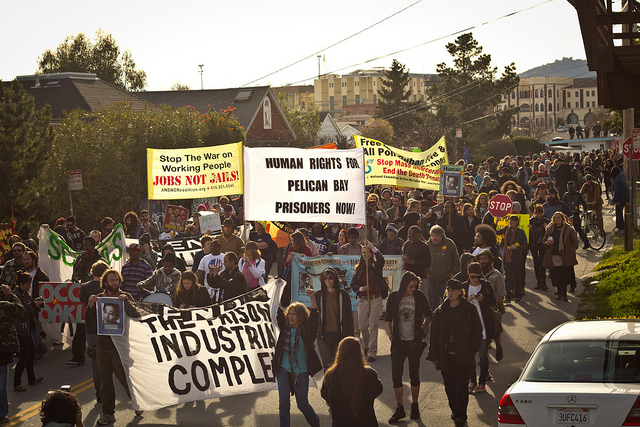
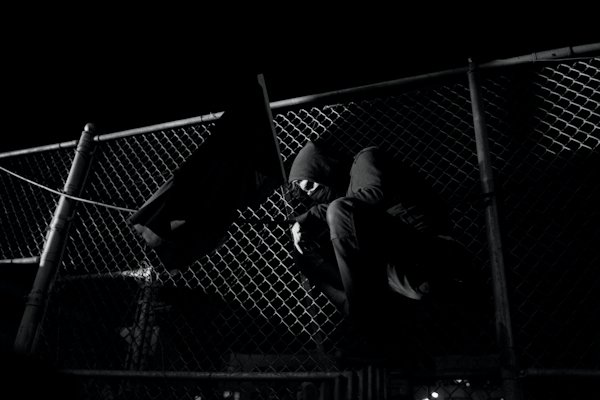
About 800 protesters marched to San Quentin’s East Gate in a day to protest what they called inhumane conditions in prison Feb. 20

Protesters called for an end to the practice of trying children as adults, three strikes laws, life sentences, life without the possibility of parole, and the death penalty.They did not call for the dismantling of the prison system or an end to the practice of incarceration, as Chip Johnson implies here.

In San Quentin– and in prisons across the country—inmates are subjected to solitary confinement, sometimes for decades. Kids as young as 13 are tried as adults and sometimes sentenced to life without the possibility of parole. In three-strikes states, people are sentenced to decades in prison for non-violent crimes that sometimes amount to less than a couple hundred dollars in damages. And in death penalty states, state-sponsored execution means that lives, sometimes innocent, are thrown away.

Twenty-four US states do not have three strikes laws, many countries cap prison sentences at 15 years regardless of the severity of the crime, and only one European country- Belarus- continues to impose the death penalty. The United States incarcerates its citizens at a rate that far surpasses any other country in the world; second on the list in Rwanda.

Conditions and laws like these have spurred decades of prison reform and prison abolition activism, both from inmates and supporters on the outside. Feb. 20, this movement joined with Occupy Oakland to protest outside San Quentin prison and demand that these issues be addressed.

As protesters arrived, organizers blasted music, hoping to reach the ears of prisoners. Dozens of prison guards and representatives from the Marin County sheriff’s department were stationed in front of the prison gate, and well as on hills looking down on the protest group.

The loud music continued with a performance from the Brass Liberation Orchestra, and subsequently a drumming ritual.

“As First Nations people, we’re no strangers to occupation. We’re also no strangers to prison. The first prisons were the reservation and the slave plantation,” said George Galvis, Executive Director of Communities United for Restorative Youth Justice.

“We have post-colonial stress disorder in our communities,” added Galvis.

Author, film producer (Redemption: The Stan Tookie Williams Story) and 2006 California gubernatorial candidate Barbara Becnel helped facilitate the event.

In her opening statements, Becnel praised the crowd, packed with Occupy activists, family members of incarcerated people, formerly incarcerated people, and others.

“We should really be proud of ourselves today. Because today, we are history makers. We have merged the prison rights movement with the Occupy movement,” said Becnel to an eruption of applause.

Throughout the program, speakers read solidarity statements addressed to Occupy Oakland from prisoners across the country, including Mumia Abu Jamal, Leanard Peltier, Kevin Cooper, and group statements from Pelican Bay human rights organizers, and those involved in state-wide prison strikes in Georgia.

A movement has coalesced around the claim that Cooper, a death row inmate at San Quentin since 1985, is innocent. Cooper was denied an appeal in 2009 in a ninth-circuit court case in which five judges dissented, declaring that, “the state of California may be about to execute an innocent man.” Their 103-page dissent statement includes descriptions of evidence tampering leading to Cooper’s conviction.

Cooper helped call for the Occupy 4 Prisoners day of action.

Speakers at the rally called for Cooper’s freedom, and for the end of death row entirely.

Becnel related a story about some prisoners, charged with life without the possibility of parole, that she had met while campaigning against the death sentence for Stan “Tookie” Williams.

The men, Becnel said, told her: “We only leave here in a casket also. We are also dead men walking.”

Speakers also decried the use of solitary confinement as a punishment in prisons.

Sarah Shourd, known for her imprisonment in Iran after accidentally crossing the border during a hike, spoke along with fellow imprisoned hikers Josh Fattal and Shane Bauer.

Shourd, who was held in solitary confinement for 14 months, related her experiences.

“After just two months my mind began to slip. I would spend large portions of my day crouched down by a small slot in my door, listening for any sounds from the outside that might distract me from the sheer terror of my isolation.”

A statement from a Texas prisoner, read by an Occupy Wall Street organizer, also addressed solitary confinement.

“We tend to think of man as a collection of individuals, each complete in himself, who just happen to come together to satisfy certain needs. Actually, however, there is nothing distinctly human that can be exhibited by an individual in isolation,” said the philosophical letter.

The Pelican Bay Hunger Strike last year highlighted solitary confinement, and prisoners demanded an end to the practice, in which inmates are held in isolated rooms with no sunlight for 23 hours a day, often for years on end. Some inmates at Pelican Bay have been held in these conditions for over 30 years.

Organizers of the hunger strike called it off when the California Department of Corrections promised to investigate the issue, but started to strike again several months later when no changes had been made to any of the conditions that they were protesting.

Kelly Turner, 42, who was sentenced to 25 years to life for writing a bad check for $146.16 in 1997, was also placed in solitary confinement for one year. However, she focused her speech at the rally on California’s three strikes law, the legislation that turned what would have been a three-year sentence for forgery into a possible life sentence for Turner. Turner said she was lucky that good pro bono lawyers defended her, and would likely still be in prison had they not; she now owns her own business.

Turner, who advocates for Families to Amend California Three Strikes (FACTS), urged the crowd to vote for an initiative to amend the law that is slated to appear on the California ballot this November. 

In her speech, Turner described meeting women in the Central California Women’s Facility is Chowchilla that were also serving decades-long sentences after having been charged with a third strike.

“I am here today for the woman that was on my dorm that had 27 years to life for drinking a 99 cent lemon line soda out of a store. Or the woman who stole a jar of Vaseline, a bottle of vitamins, two pairs of boxers,” said Turner.

Tatiana, a young prisoners rights advocate who spent time in juvenile hall, read a statement from incarcerated youth Veronica Hernandez.

Hernandez, 20, has been imprisoned since age 16.

She was tried as an adult, an outcome that she attributes to a public defender who did not do his best to fight for her.

“There are no law libraries or legal services at juvenile hall, so a juvenile, for better or for worse, is entirely dependent on his or her court-appointed attorney, and must trust that he or she will lead them in the right direction. Unfortunately for me, that direction was to adult court. I now face a life sentence should I be convicted,” said Hernandez in her statement.

No speaker argued for the dismantling of the prison system, instead focusing on what they saw as unjust sentencing and inhumane treatment in prisons.

In a statement calling for Occupy 4 Prisoners, Kevin Cooper connected a call to end the death penalty with struggle for correct racial and economic justice and an end police brutality:

“America has a deep-seeded philosophy in which it only allows for the execution of its poorest people. These seeds have taken root and have grown in such a way that no person who this system sees as a ‘have-not’ is safe from the death machine. Whether they are within (San Quentin) or on a BART platform.”

Bauer also expressed the importance of tying prison rights to the Occupy movement, saying, “This Occupy movement needs to permeate the prisons. God forbid one day some people here will be on the other side of this fence. But when movements get strong, people start getting locked up. We should know this. This happens in every country. Prisons are places where movements are killed. But at the same time, when movements successfully permeate prisons, a space built to break people down, the movement is at its strongest. This is true all over the world.”

Occupy Oakland organizers have already been hit with bizarre and seemingly invalid charges, such as “lyching,” “bike,” “boat,” and umbrella. In one of the most extreme cases, Khali, an Occupy Oakland protester, may face life in prison after being arrested for a allegedly taking a blanket out of a garbage can. Advocates for Khali say that he was denied prescription medications in jail for ten days before allegedly assaulting a police officer; his third strike.

Well-known prison rights advocate and former Black Panther Elaine Brown ended the program. After remarking that “there aren’t enough songs in this movement,” she sang Oh, Freedom as the crowd peacefully exited the site, as several volunteers picked up any trash that was left behind.

“Before I’ll be a slave, I’ll be buried in my grave, and go home to my comrades and be free,” sang Brown.

Alerts

0

WEDNESDAY, FEB. 22


Police graft

This event, part of the Shaping SF Public Talk series, will focus on the 1937 Atherton Report that blew the lid off San Francisco police corruption in that era. Speakers Hank Chapot and Chris Agee will address their research, on the report and on SF policing and crime in the 1950s, respectively.

7:30pm, free

CounterPULSE

1310 Mission, SF

www.counterpulse.org/?tribe_events=shaping-sf-public-talk-police-graft-in-san-francisco/

THURSDAY, FEB. 23

Eviction community forum

A panel discussion and chance to access resources for those affected by and interested in the epidemic of foreclosures and evictions in our neighborhoods. Hear from community organizers, foreclosure lawyers, and affected homeowners and tenants. This is organized by Occupy Bernal and will feature Spanish translation and childcare.

7pm, free

Bernal Heights Community Center

515 Cortland, SF

415-821-7617


Garden for the environment

Enjoy live music, food from Haight Street Market, a raffle, and a celebration of urban permaculture at the fundraiser. The Haight Ashbury Neighborhood Center celebrates the achievements of Garden for the Environment, a group that maintains a one-acre garden in the Sunset demonstrating the educational, environmental and food-security possibilities of permaculture.

6pm, $5

111 Minna, SF

www.hanc-sf.org/urban-farming-fundraiser-and-party.html

FRIDAY, FEB. 24


History of porn

Join author Sam Benjamin and golden age porn star Richard Pacheco for a lively presentation chronicling how porn emerged in its present form by looking back over past decades. The presentation will use non-explicit clips but promises to be funny and informative. Benjamin is the author of American Gangbang: A Love Story.

8pm, $10-30 suggested donation

Center for Sex and Culture

1349 Mission, SF

www.sexandculture.org/

SATURDAY, FEB. 25

Foreclose on Wells Fargo CEO

A demonstration, complete with street theater and education, as activists attempt to foreclose on and evict Wells Fargo CEO John Stumpf. According to Occupy Bernal, this fun community event will feature “street theater to foreclose, auction home, and evict the CEO, music, Pride at Work dance mob, and special surprise bidders.”

1pm, free

1090 Chestnut, SF

www.occupybernal.org/wordpress


Deep Green Resistance

Have you ever felt that to continue to live on the planet, people must actively dismantle industrial systems which are destroying the earth, perhaps by any means necessary? If so, you should hear author Aric McBay speak about his book Deep Green Resistance: Strategy to Save the Planet. In the book, also by Derrick Jensen and Lierre Keith, the authors discuss the philosophies, tactics and implications of this brand of radical environmental activism.

7:30pm, free

Unite HERE Local 2

209 Golden Gate, SF

www.occupysf.org/calendar-2/

Alerts

0

yael@sfbg.com

WEDNESDAY 15

Which way forward?

Four panelists will speak on their approach to creating progressive change in the United States. Speakers include Rocky Anderson, former mayor of Salt Lake City and presidential candidate with the Justice Party; Margaret Flowers of Physicians for National Health Program and organizer with Occupy DC; Tom Gallagher, former state legislator in Massachusetts; and Dave Welsh of the San Francisco Labor Council. With moderator Rose Aguilar of KALW’s Your Call radio. A forum organized by the 99% Coalition, a group focused on anti-war and non-violence activism working alongside Occupy San Francisco.

7 p.m., $10 suggested donation

Unitarian Universalist Church

1187 Franklin, SF

(415) 710-7464

www.sf99percent.org


Black history film and discussion

A screening of Freedom Riders, the film detailing the story of 400 groundbreaking Civil Rights Movement activists that rode on integrated buses throughout the South despite violent resistance everywhere they turned.

7pm, $5 suggested donation

2969 Mission, SF

415-821-6545

answer@answersf.org


FRIDAY 17

Join the Un-Conference

Reverend Billy Talen, the performance artist pastor of the anti-consumerist Church of Life After Shopping, will give a sermon Friday evening. That part is $10, and all proceeds go to whistleblower Bradley Manning’s defense. But that’s just the first night of a free, three-day “un-conference.” Participants will set their own agenda, and range from experts and stars like Daniel Ellsberg, Annie Sprinkle, and Colonel Ann Wright to your run-of-the-mill folks interested in justice for whistleblowers.

6 p.m., $10

UC Berkeley International House

2299 Piedmont, Berk

www.freshjuiceparty.com


MONDAY 20

Stand with prisoners

A demonstration to protest racism and economic injustice perpetuated by mass incarceration and the prison-industrial complex and to stand in solidarity with prisoners and their families. This event is called by prisoners and sponsored by Occupy Oakland, reminding us that “there are more African Americans under correctional control today — in prison or jail, on probation or parole — than there were enslaved in 1850.” It will feature speakers and musical performances.

10 a.m., free

1540 Market, SF for bus and carpool

www.occupuy4prisoners.org


Occupying elders

The Gray Panthers present a discussion with participants in Occupy Bernal and the Wild Old Women, Occupy Oakland, and Occupy San Francisco. How can elders contribute to Occupy? Come find out from the people on the ground, including Ginny Jordan of the Wild Old Women, who have shut down more banks than any other Bay Area Occupy group, and Tova Fry of Occupy Oakland.

1 p.m., free

Unitarian Universalist Center

1187 Franklin, SF

graypanther-sf@sbcglobal.net

Upset pornographers and the definition of scissoring: “Queer and Boning” controversy

8

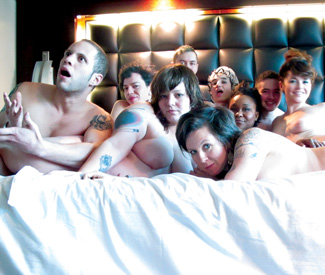
Brouhaha! That would be the word I’d use to describe the reaction to today’s cover story, “Queer and Boning in Las Vegas,” about Courtney Trouble and her posse’s adventures at the AVN Awards in Vegas. The crux of the matter revolves around my interview with lesbian pornographer Jincey Lumpkin, whose oeuvre falls into a more conventional mode of pornmaking than Trouble and the other queer pornsters profiled. Jincey commented extensively in the article’s comment section and on her own website:

(This is in regards to a quote we printed that, compared to Bay Area queer porn, Jincey’s work “has more of an emphasis on aesthetics.”)

Throughout our interview what I discussed was my point of view in making porn. That I wanted to create something that was in the middle ground. Real lesbian porn, but created with an emphasis on glamour and aesthetics. Since the quote is taken out of context, it appears as though I am dismissive of the work of my peers, which I am not. I admire my queer porn peers, and I could not be where I am today without the trail-blazing efforts of Shine and Crash Pad Series. I have worked with a lot of the same stars, and have taken influence from their work. However, I don’t see anything wrong with creating work that comes from a different point of view.

When I say that I emphasize aesthetics, what I mean is that we spend a tremendous amount of time researching the look and feel of each series, and we collaborate with people in the fashion industry to achieve a certain look. I’m certainly not saying that the work of my peers is inferior or has no aesthetic appeal. In fact, I find Courtney’s work quite inspiring, even though we have a different point of view in the way we create things.

I’m not printing a correction on that. My reportage on the quote was accurate, however it was intended by the person who said it. But it’s nice to have it clarified here because it did seem like a weird thing to say.

She also clarified that she has shot fisting scenes, but that Girlfriends Films won’t allow them in her releases through them (I updated “Queer and Boning” to reflect that fact). She pointed me to this column she wrote in support of the Trouble-founded International Fisting Day. Also, that she doesn’t do scissoring scenes, but she does do tribbing. At the time that I’m writing this, the porn professionals, and non-professional lesbians I’ve spoken with are unable to tell me the difference between the two. Here’s the Urban Dictionary entries on the two, which are completley unhelpful. 

So there’s that. I have to quibble with one of Lumpkin’s points though. Saying “I control all of the business of Juicy Pink Box, including the content of what we shoot” and then going on to write in a different part of the same letter “However, because Girlfriends is concerned about obscenity prosecution, my contract with them requires that I cut those [fisting] portions out for DVD release,” (I assume she’s referring to the Cambria List, a rundown of no-nos that also include transsexuals, squirting, bisexual sex, and incest, the last of which Girlfriends seems to have no problems with) is a direct contradiction. She’s filtering the sex she shows, or being filtered. Either way, there’s a big difference between her work and the work of people that include sex acts deemed subversive not only because they’re hot, but because it’s part of their activism.

Lumpkin’s work is significant, which is why she’s in the article. A ton of people get off on the style of porn she makes. If you want my opinion, there’s more than enough room for QueerPorn.TV, Girlfriends Films, and all the rest of the porno continuum in this big, pervy world of ours. 

But there’s no denying that differences between them. And that we heart Bay Area-style queer porn. And that’s why we published the piece. So let’s get back on the awesome train, shall we?

Making history: Joanne Griffith’s ‘Redefining Black Power’ project comes to the Bay

0

“Joanne [Griffith]’s work is centered on one theme: not to offer information as a point of journalistic fact, but to act as a conduit for debate and conversation, especially around issues relating to the African diaspora experience.” So writes Brian Shazor, director of the Pacifica Radio Archives, in the foreward to Griffith’s new book Redefining Black Power: Reflections on the State of Black America (City Lights Books, 206pp, $16.95). Griffith will be presenting her work, part of an interactive project to archive the state of African Americans in the United States in the Bay Area this week — starting tonight (Wed/8) at the Museum of the African Diaspora.

This shouldn’t have to be said, but in these times of reductive news media it does: Obama isn’t the only black voice that needs to be heard, during this Black History Month or any other month. Inspired by the archives of progressive African American voice kept by LA’s Pacifica Radio Archives, Griffith — a leading progressive voice herself, having reported on issues from around the African diaspora for the BBC and NPR — transcribes her interviews with leading thoughtmakers for the book, set up as a series of dialogues. Hear from political prisoner Ramona Africa why Obama is “the new crack,” journalist Linn Washington, Jr. on media matters, green jobs leader Van Jones on hybrid activism. The president is used as a theme of the book, but the interviews use him as a lens to look at issues that range far beyond the White House.

Griffith and the other minds behind Redefining Black Power want these interviews to serve as a jumping off point for other unheard voices. Head over to the book’s website and you’ll find directions on how to add your point of view to those of the better-known activists and professionals already immortalized in the Pacifica archives. You can go to one of Griffith’s upcoming readings (details below) for inspiration. Or better yet, read our recent email interview with her and then do that. 

SFBG: Explain where the interviews in the book came from. How did you become acquainted with the Pacifica Radio Archives. Why are they important for people to hear?

JG: The idea for the Redefining Black Power Project, of which the book is part, was born out of the historic audio held in the Pacifica Radio Archives; a national treasure trove of material charting America’s history from a progressive perspective dating back to 1949. Within the collection are key recordings from the civil rights, black power and black freedom movement, including Rosa Parks, Shirley Chisholm, Jesse Jackson, Malcolm X, James Baldwin, Lorraine Hansberry, Dr. Martin Luther King Jr., Bobby Seale, Elaine Brown, and so many others. But it was one recording of Fannie Lou Hamer addressing the 1964 Democratic National Convention that sparked the idea for Redefining Black Power. The director of the Pacifica Radio Archives, Brian DeShazor, heard the tape and wanted to find a permanent way to preserve and share the voices held in the archives with a wider audience, and what better way than through the written word. Brian approached City Lights Books with the idea, and this book is the result, drawing on the voices of history to link us to the election of Barack Obama, one of the most significant moments in the social and political history of the United States. Through this project, we hope to preserve the voices, opinions and perspectives of African-Americans in this so called ‘Age of Obama’ for historians to digest and explore in years to come. 

How did I get involved? As a complete audio nut, I always make a point of visiting local radio stations wherever I travel in the world. Back in 2007, I was in Los Angeles, called KPFK to arrange a visit and was introduced to the Pacifica Radio Archives. Speaking with Brian DeShazor, we came up with an idea to share the historic collection with a UK audience and I’ve been doing this every Sunday evening on BBC Radio 5 Live in the UK for over four years. Because of this work and the extensive list of people I have interviewed over the years, Brian invited me to do the interviews for the Redefining Black Power project. Through this book, we delve into the role of the activist from different perspectives; the legal system, the media, religion, the economy, green politics and emotional justice. All were recorded between September 2009 and August 2011. To be clear though, this book is not an anthology of black leaders speaking on the Obama presidency. This is simply a taster of opinions on the subject, but everyone is encouraged to participate with their thoughts and opinions at www.redefiningblackpower.com and come out to the many events we’re hosting throughout February, including here in the Bay Area at the Museum of African Diaspora from 7 p.m. on Wednesday Feb 8 and at Marcus Books in Oakland with guest panelists Hodari Davis from Youth Speaks and social justice activist Dereca Blackmon on Thursday Feb 9 from 6.30 p.m.

SFBG: Has there been an interview you’ve conducted in which your subject’s answers have deeply surprised you? 

JG: Every interview had its own surprise; from Ramona Africa describing President Obama as ‘the new crack’ and why she refused to vote, to economist Dr. Julianne Malveaux revealing the financially precarious situations many African Americans find themselves in; from high foreclosure rates and high unemployment to the low levels of accumulated wealth for black women. Very sobering statistics. Michelle Alexander, too, the author of The New Jim Crow: Mass Incarceration in the Age of Colorblindness really shocked me when she said that more African American men are currently incarcerated than were enslaved in 1850. 

However, it was Dr Vincent Harding, the man behind Dr. Martin Luther King Jr’s “Beyond Vietnam” speech that surprised me the most. A true veteran of the civil rights movement, he made the point that the election of President Obama was never the goal of the movement; instead he prefers to call the work “the movement for the expansion and deepening of democracy in America.” Put this way, it made me realize more than ever, that the work we do today is not in isolation, but part of a wider movement, stretching back all the way to slavery. And the work isn’t over. 

SFBG: Your introduction ends with a quote from Kanye and Jay-Z’s Watch the Throne album. What role, if any, does hip-hop play in the book?

JG: Hip-hop doesn’t play a role in this book, other than this quote, but it will feature heavily in the next volume of Redefining Black Power which will focus on the reflections of black entertainers, writers, poets and performers on this moment in US history.  

SFBG: What would be the best way the United States could spend Black History Month?

JG: Black history — regardless of whether it is the United States or the UK where I moved from or anywhere else — should be acknowledged daily; this is the only way for us to keep memories alive and never forget where transformative change, like the election of President Obama, comes from. 

Listening to recordings like those held in the Pacifica Radio Archives with our youth would be a great place to start. I spent a couple of days with a group of students in Detroit, sharing the archive material and getting them to discuss their thoughts on the recordings; Audre Laude, James Baldwin, Muhammad Ali, Nelson Mandela, and others. Every one of them said they wished they had heard these voices before. It gave them a context to their own lives that didn’t exist previously, while encouraging them to never give up; too many people have suffered for them to let less than favorable circumstances stop them now. 

SFBG: Who should read this book? How should it be used?

JG: Use it as a conversation starter to discuss issues in your own community. Parents, use it as a way to engage your children in history. Students, use it as a resource for papers on race and the Obama presidency. Most importantly, everyone, share your thoughts at www.redefiningblackpower.com. This book is not the end of the project; we’re only getting started. 

Joanne Griffith’s Redefining Black Power author readings:

Wed/8 7 p.m., free with $10 museum admission

Museum of the African Diaspora

685 Mission, SF

(415) 358-7252

www.moadsf.org


Thu/9 6:30-8 p.m., free

Marcus Books

3900 Martin Luther King Jr. Way, Oakl.

(510) 652-3244

www.marcusbookstores.com


Making black herstory, every day

8

news@sfbg.com

Deconstructing the roots of

The black n gray suits

with hands in the Loot

That has buried the truth

About our black, brown and disabled youth

— excerpt from KKKourt by Tiny

OPINION On the first day of Black Herstory Minute (I mean, Month), I practiced black herstory, and walked through activism and breathed organizing and lived resistance by putting my body in the benches belonging to the criminal injustice system (a.k.a. the plantation) at 850 Bryant. I was there to support a struggle against injustice in the case of a young African warrior for truth, Fly Benzo, a.k.a. Debray Carpenter — student, son, media producer, organizer, and hip-hop artist who is facing a felony charge, jail sentence and $95,000 fine for nothing more than exercising his First Amendment right to free speech.

How many among you, overwhelmed with multiple Face-crack postings and a cacophony of tweets, might have missed the story of Fly, who spoke the truth about racism, police brutality and the unjust death of Kenneth Harding Jr. to a cop in a poor-people-of-color neighborhood, Bayview, which is under seize from the occupying army known as the police (or po’lice as we call them at POOR Magazine)?

As a woman criminalized and incarcerated for the sole act of being poor and houseless, the melanin-challenged daughter of a poor black single mother who spent all of her life in poverty and in struggle, I have witnessed first hand unequal justice against people of color and poor people. It’s a fact that remains, in 2012, still a very dire reality.

“They arrested me for exercising my Constitutional right to free speech,” said Benzo, 22.

Benzo’s revolution began when he was born to conscious African-descendant parents who, like many African descendant people in San Francisco, have been under the constant threat of removal, displacement, redlining, and ongoing police harassment for decades. He has been speaking out about injustices since he was a teen, starting with the fact that hardly any Bayview residents were hired to construct the multi-million-dollar T-Train that runs from downtown to Third Street — and the dramatic rise in the violent policing of the T-Train and the Muni bus lines that run through the poor communities of color in S.F.

But the beginning of Benzo’s current battle with the criminal injustice system began when he began to speak up about Harding, murdered by San Francisco police officers for not having a $2 dollar bus transfer. The judge might not admit the video that was taken at the scene of Benzo’s arrest, making his case all the more difficult to fight, and the truth all the more difficult to hear and see, which is where community support comes in.

A lot of people and organizers and politricksters talk about stopping the violence and how to “deal” with the inequities of racism and classism and violence on our youth of color. And yet when this brother spoke out, used his voice for nothing but truth and resistance about injustices he personally experiences everyday, who comes out to support him?

Practicing revolutionaries at POOR Magazine, the Idriss Stelly Foundation, The BayView Newspaper, Education not Incarceration, and United Playaz have been there, as well as his hard-working attorney, Severa Keith, and a few more. But we all need to be there, fighting for a very alive, very revolutionary, young truth-teller who is making black history, every day.

Tiny, a.k.a. Lisa Gray-Garcia, is an editor at POOR Magazine. Opening statements in the trial of Debray Carpenter are expected to begin Feb. 8 in Dept. 27.

This is our country, too: Fred Korematsu’s daughter on her father’s civil rights legacy

1

“One never knows after someone dies what happens to their legacy. Sometimes it becomes a part of history and sometimes it grows,” Karen Korematsu -remarked in a phone interview with the Guardian this week. Her father, civil rights activist Fred Korematsu, will be honored statewide with his own official day on Mon/30. You can celebrate his legacy locally at the Oakland Museum of California’s Lunar New Year event on Sun/29, where Karen will be speaking about her dad’s contribution to our cultural heritage.

“In the case of my father, his legacy seems to be growing,” Karen continued. “His story resonates and remains important to people.” Last year was the first time California celebrated the Fred Korematsu Day of Civil Liberties and the Constitution. This year, events from a photo exhibition in the Smithsonian National Portrait Gallery, panel discussions, and teacher workshops in Humboldt, San Diego, Davis, San Francisco, and San Jose will commemorate his work.

The Oakland Museum of California’s celebration will be especially meaningful — Korematsu was born and raised in Oakland.  The event will include remarks from Oakland Mayor Jean Quan, a talk by Karen, performances by students from the Korematsu Discovery Academy in Oakland, vocalist Shirley Kazuyo Muramoto, and koto player Brian Mitsuhiro, and a screening of the Emmy Award-winning Of Civil Wrongs and Rights: the Fred Korematsu Story.

The elder Korematsu was a civil rights hero who refused to be incarcerated in the Japanese internment camps during World War II. When President Roosevelt signed Executive Order 9066 on February 19, 1942 requiring Japanese Americans to be placed in internment camps, the 23-year-old Korematsu refused to report. He attempted to continue his life as a normal American citizen, but was spotted and arrested in San Leandro three months later. Convicted for violating military orders, he lived for several months at the Tanforan assembly center in San Bruno and subsequently was transferred to Topaz, Utah — one of the 10 incarceration camps that were set up for Japanese Americans during WWII — where his family was also being held. 

Korematsu refused to let go of the belief that his civil liberties as guaranteed by the constitution were being directly violated. He appealed his case to the U.S. Supreme Court to no avail. 

That is, until 1983, when researcher Aiko Herzig-Yoshinaga and professor Peter Irons brought to light previously-suppressed documents detailing the FBI and military intelligence agencies’ conclusion that Japanese Americans were not threats to national security. 

Korematsu’s case was re-opened by a legal team of pro bono attorneys and at long last, his conviction was overturned in a federal court in San Francisco. In 2011, the U.S. Department of Justice released an admission of error in the case of the Japanese American internment camp. 

Karen is disappointed that her father didn’t live to see the apology. But she sees the confession as an important step towards bringing “accountability to people in government who need to take responsibility in making sure that decisions are always in the best interests of all Americans.”

She holds that actions like those of her father are especially relevant today, in these times of anti-immigrant sentiment. “He took a stance against racial profiling in issues such as national security and immigration,” she said. 

Following 9/11, Fred, along with the Japanese American Citizen League, spoke out against the national security measures the U.S. government was taking towards Muslim inmates being held at Guantanamo Bay. He became an active member of the National Coalition for Redress and Reparations. He assisted in the passage of a bill that prompted an official apology from the U.S. government, granting $20,000 for each surviving Japanese American who was incarcerated.

Today, Fred’s legacy lives on through the work of the Korematsu Institute. Founded in 2009 through the Asian Law Caucus, the institute’s mission is to advance pan-ethnic civil and human rights through education. 

Karen said that one of the many ventures of the institute is creating supplemental curriculum for K-12 schools to provide historical information that is missing in textbooks. She believes that her father’s story is an important lesson for children. “It tells the truth about American history, the Constitution, and their own backgrounds,” she said. 

Sensitive to the current financial troubles of California’s school system, the Korematsu Institute raises funds independently to create educational kits that it distributes to schools free-of-cost. 

Upon her father’s death, Karen believed that she had been passed on the torch in terms of challenging prejudice through education — so that nothing similar to the Japanese internment camps will ever happen again. “It’s heartwarming to tell my father’s story and see his legacy grow,” she concluded.


Lunar New Year celebration

Sun/29 noon-4:30 p.m., free with museum admission

Oakland Museum of California

1000 Oak, Oakl.

(510) 318-8400

www.museumca.org


“Occupy Wall Street West” hopes to see massive protest

14

A coalition from across San Francisco is hoping to make tomorrow – Friday, Jan. 20 – a monumental day in the history of Bay Area activism, the Occupy movement, and the fight against home foreclosures and other manifestations of corporate greed.Organizers call the day of protests, marches, street theater, pickets, and more “Occupy Wall Street West.”

Those that urged Occupy protesters to focus in on a list of demands should be pleased, as the day includes a list of demands on banks, including a moratorium on foreclosures and an end to predatory and speculative loans.


Organizers note that Occupy SF Housing, the coalition that planned the day, is separate from OccupySF. In fact, a subset of the group known best for its months-long tent city at Justin Herman Plaza was only one part of a substantial coalition that planned this day of action. Among others, the coalition includes the SF Housing Rights Committee, Homes Not Jails, Alliance of Californians for Community Empowerment (ACCE), and Occupy Bernal, a neighborhood-focused Occupy group specifically aimed at preventing evictions and foreclosures.

Justin Herman Plaza – or Bradley Manning Plaza, as many in OccupySF like to refer to the park just across from the Ferry Building – will be a crucial meeting point. A press spokesperson said that “down at Bradley Manning Plaza at 6 a.m.,12 p.m., and 5 p.m., we’re going to be launching various segments of the protests, and there will be information desks and education all for those who are interested.”

Organizers hope to culminate the day with a mass march at 5 p.m. A map of the planned actions can also be found here.

Many of the groups in the coalition have focused on specific cases of homeowners and tenants facing eviction and foreclosure; tomorrow, they bring their power to the Financial District.

Vivian Richardson, a member of the coalition who has also worked with ACCE and the newer Foreclosure Fighters group in Bayview, says that she remains in her home after being threatened with foreclosure due to community support.

“On my own, I tried everything to get out of this bad loan… I fought for two years on my own, only to have my home foreclosed on and taken away,” Richardson said at a press conference held yesterday.

“With the help of my community, unions, and ACCE members throughout the state, we generated over 1,400 emails and a few hundred calls to the CEO of [lender] Aurora Bank, and within one hour they called me to reopen my case,” she said. “As of today, the bank has voided the sale of my home and rescinded the foreclosure.”

Groups hoping to prevent foreclosures have had many success stories like Richardson’s. But tomorrow, they will put pressure on large corporate banks.

As SF Housing Rights Committee Executive Director Sarah Shortt said at the rally, “What we’re trying to do here is draw connections between some of those issues and the banking industry… I think that’s one of the most important pieces of the Occupy movement: starting to educate ourselves and each other about how ubiquitous the toll that’s been taken on cities, neighborhoods, communities by banking industry and the one percent.”

The focus is on housing, but in typical Occupy fashion, protesters will draw connections between all kinds of concerns that they see as abuses by banks and corporations.

According to OccupySF member Lisa Guide, the day is about “war profiteering, unjust foreclosures and evictions for profits by the big banks, exploitation of labor and union workers, and liberation of the commons for public good, among many other [issues].”

Guide also mentioned that Jan. 20 is “the eve of the Citizens United Supreme Court case, the court case that gave corporations the power to buy our government.” Simultaneous actions are planned to protest Citizens United, including an Occupy the Courts action at the Ninth District Court of Appeals at noon, to coincide with a national call to “Occupy the Courts

More than 55 organizations are involved in the day of action, and their focuses go beyond housing rights. These include students from Occupy SF State, Occupy Modesto Junior College, and other campus Occupy groups; anti-war organizations such as Iraq Veterans Against the War; environmental organizations such as the Rainforest Action Network; several unions, including UNITE HERE Local 2 and the California Nurses Association; the Chinese Progressive Alliance; and the Interfaith Allies of Occupy, which will be hosting an all-day “respite area” at Saint Patrick’s Roman Catholic Church at 756 Mission.

The array of events planned for Friday is overwhelming. There are demonstrations, pickets, and occupations planned at dozens of banks and corporations throughout the Financial District. Street theater is planned in several places, including an adaptation of A Christmas Carol by the San Francisco Mime Troupe at Justin Herman Plaza at noon and a show from Iraq Veterans Against the War that, according to IVAW member Jason Matherne, a Navy veteran who served in Qatar, “is called Operation First Casualty, because the first casualty of war is the truth.”

Matherne said, “corporations are profiting off the war at the expense of the 99 percent. Specifically, the Bechtel Corporation is using–misusing–billions of dollars to rebuild the infrastructure in Iraq.”

Tomorrow should be big. In a press release, organizers claim that “this is predicted to be the largest street protest of the Financial District since anti-war protests in 2003.”

Whatever the turnout, the Saint Patrick’s “respite” should be a boon, as weather reports indicate rain for tomorrow. Luckily, as Vicki Gray, a Deacon in the Episcopal Diocese of California, Occupy supporter and Interfaith Organizer, said of the sanctuary: “All are welcome. It will be warm, it will be quiet, and you will be loved.”

On the Cheap Listings

0

On the Cheap listings are compiled by Lucy Schiller and Caitlin Donohue. Submit items for the listings at listings@sfbg.com. For further information on how to submit items for the listings, see Picks.

WEDNESDAY 18

Pinball tournament Vitus, 201 Broadway, Oakl. www.vitusoakland.com. 6:50 p.m., $5. Those adept at flipping the bird may discover an easy crossover into the dexterous world of pinball. Vitus hosts a tournament chock-full of raffle prizes.

A Negotiated Landscape discussion University Press Books, 2430 Bancroft, Berk. www.universitypressbooks.com. 6-7:30 p.m., free. Urban studies professor Jasper Rubin follows and examines the political wranglings over the San Francisco waterfront in his latest book, detailing grassroots activism against major development projects.

Stand-up comedy showcase Bazaar Cafe, 5927 California, SF. (415) 831-5620, www.dannydechi.com. 7 p.m., free. Bizarro winter germs got you feeling a little under-the-fog-cover? Head out to this yuckfest, featuring Danny Dechi and a passel of his funny buddies: Jill Bourque, Dhaya Lakshminarayanan, Mike Capozzola, and Rebecca Arthur, to name a few.

THURSDAY 19

Inside Story Time Café Royale, 800 Post, SF. www.caferoyale-sf.com. 6:30-8:30 p.m., $3-5. Local authors doing readings that match tonight’s theme, “aspirations.” Hopeful readings, at that.

Eric Shanower’s Road to Oz Cartoon Art Museum, 655 Mission, SF. www.cartoonart.org. 7-9 p.m., $5 suggested donation. Accomplished cartoonist Eric Shanower has made it his life’s work to convert L. Frank Baum’s Oz books into Marvel Comics graphic novels. He details his journey down his own yellow brick road as a struggling artist.

FRIDAY 20

Fullmetal Alchemist: the Sacred Star of Milos screening Film Society Cinema, 1746 Post, SF. www.sffs.org. 2, 4:30, 7, 9:15 p.m. $9-11. The latest installment in an anime series which explores Europe’s industrial revolution, alchemy, and popular resistance comes to the SF Film Society.

SF Dump artist-in-residency art opening Environmental Learning Center Gallery, 503 Tunnel, SF. www.recologysf.com. 5-9 p.m., free; Also Sat/21 1-5 p.m., free. There can be no cooler artist-in-residency program than that of Recology, which sets up its creative types to craft art from the detritus found in the dump itself. Great works have sprung from this collaboration, and this weekend Ethan Estess, Donna Anderson, and Terry Berlier will surely add to that canon.

SATURDAY 21

Gina Osterloh lecture Yerba Buena Center for the Arts, 701 Mission, SF. www.ybca.org. 2-4 p.m., $7. Osterloh’s latest work Anonymous Front, created in conjunction with a massage therapy school for the blind in the Philippines, explores blindness and identity with eye-deceiving photographs.

Ikebana demonstration Ortega Branch Library, 3223 Ortega, SF. www.sfpl.org. 2 p.m., free. Chizuko Nakamura gently coaxes flowers into sophisticated submission in a demonstration of the traditional Japanese arranging art.

Kulinarya: A Filipino culinary showdown Carnelian by the Bay, 1 Ferry Plaza, SF. www.kulinarya2.eventbrite.com. 4 p.m., free. Featuring a cornucopia of Filipino edibles and goods, this second annual event showcases the pili nut, which according to one expert is pretty much the next macadamia.

SUNDAY 22

Seasonal plant sale Hayes Valley Farm, 450 Laguna, SF. www.hayesvalleyfarm.com. Noon-5 p.m., free. Windowbox chard beats out the six-dollar variety any day. Hayes Valley Farm provides sturdy seedlings, hardy fruit trees (including pluots!), and those ever-prolific seedbombs, perfect for those whose personal green space is constrained to a crack in the sidewalk.

MONDAY 23

Ben Ehrenreich and Robert Arellano reading The Booksmith, 1644 Haight, SF. www.booksmith.com. 7:30 p.m., free. Ehrenreich’s dystopian novel Ether has been likened to “Bambi directed by Quentin Tarantino,” while Arellano’s Curse the Names is the story of an apocalypse-to-be deep in the Sangre de Cristo Mountains.

TUESDAY 24

“The Language of Flowers” lecture San Francisco Library, 100 Larkin, SF. www.sfpl.org. 6 p.m., free. Never send an ill-timed chrysanthemum again! Author Vanessa Diffenbaugh is doing a reading from her new book about the Victorian art of figuring out what severed dead blooms can say about you and the object of your affection.

Looks good off paper

0

culture@sfbg.com

CAREERS AND EDUCATION According to the Princeton Review, that bicep-straining tome of college rankings responsible for many a young adult’s breakdown, most of the perennially popular majors (psychology, economics, communications, political science) are still alive and kicking. But plenty of alternative, even radical fields of study are blossoming that meld academic inquiry with tangible work towards change. From crafting tables for an Oakland school library to restoring native California plants, many students around the Bay are getting academic credit for innovative contributions towards a sustainable future. 

CHILD AND ADOLESCENT DEVELOPMENT WITH A CONCENTRATION IN YOUTH WORK AND OUT OF SCHOOL TIME

Ah, to be young… kind of. The adolescent years are rarely anyone’s favorites, which makes SFSU’s Youth Work and Out of School Time concentration in its child and adolescent development bachelor’s degree all the more important. Its students learn to directly address the needs of young people in trouble. Internship-heavy and based on first-hand experience, the program trains students to work with youth in after school programs, the justice system, social services, and beyond.

San Francisco State University, 1600 Holloway, SF. (415) 338-1111, www.sfsu.edu

NUTRITIONAL SCIENCE AND TOXICOLOGY

The Bay Area is not only a gourmand’s nirvana, it’s also at the forefront of food-based activism. Cal’s nutrition-oriented bachelor’s program offers three degrees (physiology and metabolism, dietetics, and molecular toxicology) in addition to courses in “pesticide chemistry and toxicology,” “nutrition in the community,” and “human food practices.” We hope the studies will enable the next generation of food scholars to make a tangibly tasty difference.

UC Berkeley, 103 Sproul Hall, Berk. (510) 624-3175, www.berkeley.edu

AMERICAN SIGN LANGUAGE

A degree in ASL is perfect for those gunning for a career as an interpreter for the hearing-impaired, and this associate’s degree or certificate from Berkeley City College is a great place to get started. Classes provide both practical and theory-based knowledge opportunities for intrepid future signers. Courses in the history and culture of deaf people in the United States augment the study of the language itself.

Berkeley City College, 2050 Center St., Berk. (510) 981-2800, www.berkeleycitycollege.edu

WOMEN’S STUDIES

One of the first such programs in the county, City College’s Women’s Studies department has been feminist-ing since 1971. It schools students in sexual violence prevention, HIV and STI outreach, and the complexities and politics of domestic relationships. Students can study for an associate’s degree, but the sexual health educator certificate programs also a notable thing to walk away with.

San Francisco City College, Ocean Campus, 50 Phelan, SF. (415) 239-3000, www.ccsf.edu

COMMUNITY ARTS

Calling all activist-artists, California College of the Arts’ community arts program is comprised of classes that study and build upon the relationships that creative types forge with their community. Students work aggressively for social change through community interaction. Past projects have revolved around designing furniture for an Oakland school and crafting nesting modules for roosting coastal birds.

California College of the Arts, 1111 Eighth St., SF. (415) 703-9523, www.cca.edu

POLITICAL, LEGAL, AND ECONOMIC ANALYSIS

Fittingly, considering that Mills College is home to less than 1,000 undergrads (all female), students in this popular bachelor’s program can rely on lots of individual attention. Students can choose to concentrate on a political, international, or economic focus, prepping themselves, for instance, for future work in public policy or crusading against the death penalty.

Mills College, 5000 MacArthur Blvd., Oakl. (510) 430-2255, www.mills.edu

ENVIRONMENTAL STEWARDSHIP

Crikey. De Anza’s restoration-geared associate’s degree program trains future stewards in wildlife tracking, ecological management, and conservation work. Less alligator wrestling as much as bird-tagging (in Bay Area, anyway), this major arms eco-warriors with courses with names like “Blueprint for Sustainability” and “Community-Based Coalitions and Stakeholders,” and pushes students to spend quality time out in the field.

De Anza College, 21250 Stevens Creek Blvd., Cupertino. (408) 864-5400, www.deanza.edu

By the roots

0

caitlin@sfbg.com

HERBWISE Where (besides this column, of course) do you get the latest on marijuana? When it comes to distributing accurate information about buds, Steph Sherer, executive director of medical cannabis advocacy group Americans for Safe Access (ASA), makes no bones about her organization’s role. “Most of our members depend on us for news,” she told the Guardian in a recent phone interview.

Even when clashes between marijuana proponents and the government are brought to light — not always a given in this political climate — Sherer finds the one note handling of cannabis issues by the mainstream media troubling. “[Cannabis] gets thrown on [journalists covering] judicial beats instead of getting picked up by the human interest, or the health and science side of things,” she said.

ASA’s response to this dearth of useful reporting on cannabis was to develop a free iPhone application that serves as a media catch-all for medical marijuana advocates. At no cost, anyone concerned with losing their right to access their medicine safely — or who wants to learn the latest about the sticky green — can now download an interface that pulls together news updates, alerts for upcoming political actions, and materials that can add to one’s activism repertoire; things like phone numbers for legal counsel and advocacy training videos.

For Sherer, the app has the potential to empower the people in the crossfire of the ongoing clashes between the federal government and state-legal growing and retail facilities: patients. “We are creating a platform that empowers people to be their own advocate. The people who can advocate for this the best are the people who are affected.” 

ASA EXECUTIVE DIRECTOR STEPH SHERER’S TOP 6 CANNABIS STORIES YOU MIGHT HAVE MISSED IN 2011

1. In March, the National Cancer Institute recognized marijuana’s medical benefit, classifying it as a “complementary alternative medicine.” Days later, the reference was diluted on its website, per the recommendation of the National Institutes on Drug Abuse.

2. After Obama’s Justice Department fought their appeal, Californian breast cancer survivor Dr. Mollie Frye and her husband were sent to prison in April for five years because of their state-legal growing operation.

3. In October, California patient advocates sued the Obama Administration for violating the 10th Amendment by coercing and obstructing local and state officials, preventing them from implementing medical marijuana laws.

4. The governors of Washington State and Rhode Island petitioned the federal government to reschedule cannabis to allow for medical use.

5. In Connecticut and New Jersey, governors continue to move forward with cannabis access legislation despite threats from US Attorneys.

6. 63-year old Norman Smith uses cannabis to mitigate the symptoms of his inoperable liver cancer. Smith is being denied a transplant from Los Angeles’ Cedar Sinai Medical Center until he agrees to stop using cannabis.


High whore holy day: A San Francisco tradition turns nine

4

It was Saturday, December 17. A jazz funeral was being held for victims of violence against sex workers at the Center for Sex and Culture. Post-event, its message was still resonating in its attendees. “The holiday was beautiful,” sex activist and post-porn star Annie Sprinkle told the Guardian about the ninth year of the International Day to End Violence Against Sex Workers that she helped to found. 

The tradition goes back to 2003, when hundreds of sex workers and their allies came together on the steps of San Francisco’s City Hall. Gary Ridgeway, Seattle’s “Green River Killer,” had just been convicted, having confessed to murdering 90 women over 20 years before he was caught. Prostitutes, he said, “were easy to pick up without being noticed…I thought I could kill as many of them as I wanted without getting caught.”

Bay Area performance artist and long-time sex worker Sprinkle was incensed. She teamed up with Robyn Few of the Sex Workers Outreach Project (SWOP) to create an event that would raise awareness about the abuse experienced by workers in the sex industry. 

The event has now spread to the far corners of the earth. Last Saturday, vigils, marches, and educational events to commemorate the day took place from Chicago to Cape Town. 

Kitty Stryker, a local sex worker and performer who worked as stage manager for San Francisco’s event, said that the mood in 2011 was more celebratory this year. There were spoken word, humor and musical performances that “were celebratory and fierce and fighting back, and performances that were more introspective and hurt, understanding that these things come in balance,” she said.

“It wasn’t all angry activism or all sad crying,” continued Stryker. “We wanted the event to be a celebration of people who are still here with us, and support so we can continue to do this work.”

Sex workers rights groups decry coerced or forced prostitution, insisiting that many prostitutes have chosen their profession and deserve the same rights as other workers. This message conflicts with that of many anti-sex trafficking groups, who often conflate prostitution and sex trafficking, and depict all prostitutes as victims.

Sprinkle told the Guardian that the day is especially important because it is planned by and for sex workers and their allies. “It’s become a high holy day of whores. The one day that we all remember the real victims, not these made up situations. A lot of them are not victims, but people like to think we are.”

Sprinkle remembered the story of a friend who was raped and robbed while working as an escort in New York City. The friend reported the crime to the police, and the culprit was apprehended — along with the victim, who was arrested for being a prostitute. Many sex workers rights activists campaign for the decriminalization of sex work, arguing that if sex workers could report crimes against them to the police, it could help curb high rates of rape, robbery, assault and murder of sex workers. 

Sprinkle pointed out that sex work is not the only risky business out there. “Working in a convenience store or as a taxi driver is also very dangerous. Your risk being killed working at a 7/11.” 

The modern sex workers’ rights movement demanded the decrimalization of sex work, working to end the stigma against sex workers in the 1970s. San Francisco was the movement’s teeming center. Prostitutes marched on City Hall singing, “Everybody Needs a Hooker Once in Awhile.” Even Willie Brown attended the fabulous annual Hookers’ Ball.

And this year’s news stories provided a poignant reminder of the day’s importance. During last summer a serial killer targeting prostitutes in Long Island murdered eight women. He was the third Long Island-based serial killer in twenty years to target sex workers.

Sex workers may still be considered criminals. But if the now-decades-old sex workers rights movement has anything to say about it, that view will evolve in years to come. Hopefully someday we will all be able to walk the streets a little more safely.

Michael Goldstein, 1953-2011

7

news@sfbg.com

San Francisco lost a valued champion of progressive causes on Dec. 2 when Michael Goldstein lost his battle with stage 4 lymphoma after surviving nearly 20 years living with HIV, a disease that helped awaken his political activism.

Michael was born in 1953 in New Mexico, where he was raised. His grandparents had come to New Mexico after surviving the Holocaust, and Michael came to the San Francisco in the early 1980s. Like many gay men of his generation, Michael came here to find community, to create family, and to be welcomed when much of the country was still hostile to the LGBT community.

He worked at Neiman Marcus, dressing “the San Francisco A list,” as he used to say. He studied at City College towards a paralegal certificate and was heavily involved in student politics. He landed a job at AIDS Legal Research Panel, where he worked when he was diagnosed HIV-positive in the mid-’80s.

The news hit hard, and the treatment he began took its toll. The HIV drugs were harsh then and there were many horrible side-effects with these early drugs. At that time, there was very little information or education about HIV/AIDS and there was even less support, from families and from the public.

Our San Francisco political community became Michael’s family. He was also blessed with an amazing friend in Lorae Lauritch. They worked together at NM, became roommates, and lived together with some incredible cats that were dear to him, including Paloma, Huey, Cadeau, and Missy.

Michael was a proud feminist who valued the women in his life and community, leading him to endorse a pair of successive female candidates for the Castro’s District 8 seat on the Board of Supervisors: Eileen Hansen in 2002 and Alix Rosenthal in 2006.

Over the years, Michael served as an elected member of the Democratic County Central Committee (serving as vice president), served as President of the Harvey Milk LGBT Democratic Club, and was appointed to a San Francisco City College citizen oversight board, where his questioning helped bring attention to mishandling of funds at that institution.

Michael was determined, opinionated, persistent, intolerant of bullshit, prickly, always questioning. He challenged us all to move a common agenda, come together beyond our own personal ambitions, but to also never back down out of convenience or feigned civility. “Civility doesn’t make change,” he often said.

I came to know Michael as many came to know him. Michael always showed up in support of every one of our causes. He not only showed up, he advised, opined, debated, argued, protested, got arrested, drafted policy, and so much more. Campaign after campaign, issue after issue — our friendships grew around our passion for politics, our deep concerns about everything, and a strong and unwavering belief that anyone can help make change.

Michael believed that and Michael lived that.

In the past few years, many of us noticed that Michael wasn’t feeling well. We pushed him to go to the doctor. This is a man who spent hours fighting to push through HIV/AIDS policy and funding, healthcare reform, Healthy SF — and he did not have healthcare, had not seen a doctor in nearly 10 years, and was not treating his HIV.

As many know, Michael and I were like brother and sister…often bickering back and forth on whatever was going on. We “debated” like the dear friends we had become. His lack of healthcare was one of the more important issues I would bring up often. As a long term survivor of this condition, Michael knew the score.

As the symptoms of this disease ravaged his body, he retreated from us and attempted to make sense of the unimaginable alone.

Finally at the end of September, Michael was admitted to General Hospital. With the amazing care of Ward 5A, Diane Jones, and all the amazing General Hospital workers, as well as Laguna Honda Staff and at his final resting place UCSF — his care, though coming too late, was the best in the world and gave Michael a fighting chance. He was clearly comforted and supported by his community in his final days, support that mattered so much to him.

If you knew Michael, you know there is a “what comes out of this” part. We all got to really see the results of the hard work we all participated in to rebuild General Hospital, to rebuild Laguna Honda, and to provide healthcare access to everyone, even the poorest among us. Michael, personally, was able to experience the fruits of our collective labor over these years.

He also experienced some areas where there really is a need for some work. We need to remember that AIDS/HIV is still killing people every day. We must improve people’s access to healthcare. We need to protect patients’ access to medical cannabis, even in General Hospital. We need services and we need housing, particularly affordable housing for those who need it, people struggling through this bad economy.

These are our issues and this is our agenda on the left that we have been fighting for.

I will never forget Michael. One of the last real discussions we had about politics was around election time, with Michael remembering the 2010 elections. Michael was probably more upset about what has come out of that election — the beginning of a political shift to the right in San Francisco — than many.

He has been such an integral part of the work that brought our progressive community together and he was devastated by the events tearing it apart. More than anything, he wanted to bring us together, but he ran out of time.

Michael had an agenda. His agenda was to move forward our agenda. It is time to come together and do that.

Debra Walker is an artist, activist, DCCC member, and city commissioner who ran for the District 6 seat on the Board of Supervisors last year.

A new name in District 5

73

There’s a new name popping up in the cattle call that is the District Five supervisorial appointment. He’s not terribly well known in city political circles (his chief claim to local fame is serving on the Library Commission), but he’s got a powerful patron: U.S. Senator Dianne Feinstein.

His name is Michael Breyer. Yes, from that Breyer family.

In a Nov 30 letter to Mayor Ed Lee, Feinstein lauds Breyer and says he has her endorsement for the job. You can read the letter here (pdf).

Feinstein notes that Breyer’s grandfather, Irving, was chief counsel for the San Francisco Unified School District and that his aunt was a president of SEIU. She doesn’t mention his closer, and better-known, political connections. Nor does she mention that his uncle was a partner in a law firm that was once among the most politically connected in the city, run by William Coblentz, who when Feinstein was mayor was routinely considered one of the two or three most powerful people in San Francisco.

Among the great qualities the senator sees in Michael Breyer? He can raise money. “He can count on financial support from the high tech community and others,” Feinstein notes.

Would Ed Lee seriously consider someone who has this little local political experience and no real history of activism in the district — but really, really strong family political ties? I can’t imagine it. But Senator Feinstein isn’t doing this just for fun.

Occupy the Mission?

Photo taken by Geoff King outside 1950 Mission Street on May 1, 2010.

As the Guardian reported yesterday, protesters camped out at Occupy SF rejected the city’s offer to grant use of 1950 Mission Street, the fenced-in site of a shuttered school near 16th and Mission streets, in exchange for clearing out of Justin Herman Plaza.

Occupiers ultimately opted not to sign a facility license agreement prepared by the city that would have granted them use of the empty lot and some structures — with about 17 strings attached, including rules banning minors or pets from the site. However, some occupiers noted at a meeting yesterday that they saw potential in the space and liked the idea of relocating to the Mission.

It’s worth noting that this offer isn’t the first time the site, which formerly housed the Phoenix Continuation School, has been linked with economic justice activism. On the evening of May 1, 2010, around 100 activists — many of them clad in black with bandanas covering their faces — participated in a May Day march that culminated with a takeover of this very same abandoned lot.

While it was more common to hear rallying cries of “reclaim” than “occupy” at that point in time, the action was meant to draw attention to the fact that the abandoned school could be put to better use. After people broke into the property and mingled around within the fenced-in area, announcing they wished to hold the space and ultimately turn it into a free school, police wound up cutting off access to the street and making arrests.

UPDATE: Meanwhile, a raid at Occupy SF seems imminent. According to a text update from the Guardian’s Yael Chanoff, who has been closely following Occupy SF since its inception, about 80 officers were on the scene as of 6 p.m. Dec. 1, and police barricades were already beginning to surround the camp.


Her way

4

arts@sfbg.com

DANCE Early in the 20th century, Ezra Pound declared “the artist is the antenna of the race.” True or false? Do artists have the ability to predict the future, or are they stuck in the present?

Krissy Keefer, artistic director of Dance Brigade and Dance Mission Theater, tends to side with Pound. While she wouldn’t go as far as writer-performer Guillermo Gómez-Peña, who considers the artist a shaman, she does think that “there is something about the artistic process that opens your brain to see into the future, to see things happening before they actually happen.”

This weekend Keefer and her troupe are celebrating the 35th anniversary of Dance Brigade and its antecedents the Wallflower Order. The performances, all with free admission, include a retrospective of works spanning the last three decades, plus the 2009 Great Liberation Upon Hearing, based on the Tibetan Book of the Dead; Keefer created the work after losing two close friends within the same year.

Women taking charge of their own fate may not be news today, but in 1975, Wallflower’s five female warriors were pioneers. The turmoil of the post-Vietnam era and the rise of feminism had created a climate in which audiences hungered for dance that spoke to their lives. Many of them were women. The company was made up of contentious women, strong dancers, committed activists. They were not about to be stopped, much like their “grandmothers” Isadora Duncan and Martha Graham or, in terms of politics, the characters in 1964 Chinese ballet The Red Detachment of Women.

Most remarkably, Keefer’s commitment to make art addressing issues that matter has not waned — she’s as ready as ever to mount the barricades and make her voice heard through art. In retrospect, it is surprising how much of her past work was highly prescient.

She recently called my attention to my reservations about her having drenched one section of the 2002 Cave Women in images of extreme destruction and war. (At the time, the bloodiness seemed over the top). Almost immediately, all hell broke loose in Afghanistan and the Middle East. Revolutionary Nutcracker Sweetie, a huge success from 1987-1997, features one-percenters the McGreed family, an abused undocumented servant in Clara, and a homeless Sugar Plum Fairy. Issues that were under the radar at the time have become headlines.

Appearing in Nutcracker — with an excellent, Tchaikovsky-based score by jazz composer Mary Watson — were then-little-known artists like Axis Dance Company and aerial dance pioneer Terry Sendgraff; Keith Hennessy played the McGreed’s renegade son.

For all her predilection for “making art that includes themes of social responsibility and dealing with real situations with real people,” Keefer is also very much a creature of the theater. The work has to stand on its artistic feet, perhaps not surprising for a woman who trained as dancer at age six — long before she knew what she wanted to dance about.

The 2005 Dry/Ice, a look at the effects of global warming, for instance, was a commission from the San Francisco International Arts Festival. Now who else, except someone who besotted by the stage, would lug a cast-iron bathtub, weighing over 300 pounds, into Theater Artaud for two performances? “I just wanted to do something about the environment,” she recalls. (Al Gore’s An Inconvenient Truth came out the next year.)

In the 2004 Spell, a collaboration with Hennessy, Keefer became a raging goddess-witch figure doing an exorcism for peace and economic justice. It was a power performance that, given the lives many people have today, probably would play well in the suburbs.

Keefer also takes her social activism outside the theater. In 2000, when she felt that the criteria for acceptance to the San Francisco Ballet School were unjustifiable — based on the experiences of her daughter, eight years old at the time — she complained loud and clear. It started discussions about the female dancer’s body at the time when academics had barely touched the subject. In 2006, she was so furious about the country’s priorities that she ran for Congress. Of course, she knew that she wouldn’t win — but she wanted to take a stand. Even her parents encouraged her to do so. “I can’t believe that I ran against Nancy Pelosi when she was poised to become Speaker of the House,” she laughs today.

Meditation has helped Keefer step away from anger, what she called her “habitual response” to injustice. The resolve was shaken, however, this past summer, when — coming back from a successful East Coast and Caribbean tour with Liberation — all the costumes (transported via Greyhound, the only shipping the company could afford) were stolen. “What can you do?” she shrugs. This Mother Courage of dance will just put her shoulder to the wheel a little harder. 


“FROM WALLFLOWER ORDER TO DANCE BRIGADE: A 35-YEAR RETROSPECTIVE CELEBRATION”

Fri/18-Sat/19, 8 p.m.; Sun/20, 2 p.m., free

Novellus Theater

Yerba Buena Center for the Arts

700 Howard, SF www.dancebrigade.org


“MORE THAN THE SUM OF ITS PARTS:” LOCAL ARTS LUMINARIES TOAST DANCE BRIGADE


DANCE From Brady Street to Dance Mission and beyond, Krissy [Keefer] has been one of the true champions of our dance community, in no small part due to her own artistry. The spirit of her work is visually and musically rich, fundamentally diverse, and deeply committed to social relevance — attributes she’s manifested on so many levels in a long and vital career. Rob Bailis, Former Artistic Director, ODC Theater

In the dance ecology of the Bay Area, Dance Brigade, and especially Krissy Keefer, play such vital role. I can’t think of anyone else as fierce about what she believes in, what she cares about, and how she creates work to reflect those beliefs. In many ways she is our conscience when we might waver in the face of budget cuts and the endless struggle to get money to do work. Because she is so strong about this herself, I really count on her to keep us honest around our vision and our integrity of purpose. Kenneth J. Foster, Executive Director, Yerba Buena Center for the Arts

Krissy Keefer’s life energy is totally invested in professional, community-based, inclusive, and affordable feminist art. She has consistently supported women artists for over 30 years. It is no easy task to maintain an artistic vision and a financially secure organization, and to be able to deal with the high volume of traffic that is required to run a studio anywhere, much less in the most expensive city in the U.S. That piece of real estate at 24th and Mission has always been a port in the storm for the dance community. Mary Alice Fry, Artistic Director, Footloose Dance Company and Shotwell Studios

What makes Dance Brigade’s work special and important is how they take on the big issues facing the world and then find a way to make us laugh. Krissy Keefer is the Jon Stewart of the dance world! Krissy’s perspective, passion and tenacity are testament to the company’s longevity; that a Dance Brigade show dealing with war, greed, or even addressing violence towards women, can be entertaining is powerful. Krissy, in her wonderfully brash and focused manner, has the ability to remind us that we are citizen-dancers, that we need to participate, and that big messages, abstract dance and the hope for social change can happily co-exist on stage. Wayne Hazzard, Executive Director, Dancers’ Group

Dance Brigade’s legacy in the Bay Area is huge. By not allowing their company to become mainstream, they paved the way for alternate companies to see that there is a place at the table for work that is not shiny, slick and influenced by institutional homogenization. Dance Brigade has demonstrated by example that contemporary dance can be messy, political, and uncomfortable. By blurring the lines between politics and art, a whole new generation of politicized artists have been given permission to emerge and that has infused Bay Area dance with a lot of new ideas and energy. Joe Landini, Director, The Garage

Krissy and the Dance Brigade have been at the forefront of bringing political concerns into the theater. They have paved the way, both artistically and practically, for dozens of politically engaged artists who may or may not identify with their work. To me, Dance Mission is a physical embodiment of the importance of the Dance Brigade’s values of democracy. It’s not easy to separate the artistic and the community legacy of Dance Brigade’s work; it’s the combination that makes them so powerful. Jessica Robinson Love, Executive and Artistic Director, CounterPULSE

When Dance Brigade emerged in San Francisco in the mid-’80s as an outgrowth of the nearly-mythical Wallflower Order, they brought together a number of tendencies that were already percolating in the dance community: using dancers of widely varying body types, introducing world music (sometimes performed by the dancers), spoken word, and text narrative, circus and vaudeville tricks and, always, no-holds-barred political content. Dance Brigade inspired other companies to be braver through their example of what might be called gonzo feminist dance. Krissy and her dancers and collaborators took these disparate influences and turned them into powerhouse performances where the whole was more than the sum of its parts. Kary Schulman, Director, Grants for the Arts. (Compiled by Rita Felciano)

San Francisco’s political spectrum: a primer

120

During yesterday’s post-election wrap-up at the San Francisco Planning and Urban Research Association, political consultant and analyst David Latterman cited the ideological breakdown of San Francisco voters: 19 percent are progressive, 36 percent are liberal, 39 percent are “moderate,” and 6 percent are conservative. I cited those figures in a post I wrote yesterday on the latest election results, and some people responded by asking me to explain those terms, so let me take a crack at that because I think it’s important to understanding the city’s political dynamics.

I even discussed the matter with Latterman – who self-identifies as moderate, whereas I and the Guardian have a progressive worldview. “That’s a fantastic question and I don’t think any of us can give suitable answers,” Latterman said. “These aren’t hard lines. It’s like: I don’t know how to define pornography, but I know it when I see it.” Nonetheless, we agreed on the basic outlines and borders between the labels, even though we might frame them and value them a little differently.

In San Francisco, there is general agreement on most social issues among the moderates, liberals, and progressives, although we may disagree on political tactics. We all basically support gay rights, reproductive freedom, the value of diversity, environmentalism, and freedom of expression. That’s why most people consider San Francisco to be a famously liberal city, because of our tolerance on social issues, which only that 6 percent who are conservatives don’t share.

Yet San Francisco is still a deeply divided city on economic issues, including land use and the role of government. This is where most of the political conflicts and divisions occur, and it is here where our political spectrum is as wide as anywhere – perhaps even wider given the extreme wealth and poverty here, as well as the long history of political activism and the setting of national political trends. And it is in this realm that our labels come from.

A “moderate” in San Francisco – which is a real misnomer despite its widespread usage – is a fiscal conservative: anti-tax, anti-regulation, an almost religious faith in the free market, and a resentment of the poor (particularly the homeless and the jobless) and those who advocate for them. They want bare minimal government and see the role of government as primarily to facilitate economic activity in the private sector and to provide the basic infrastructure that the private sector needs to operate efficiently. They even believe social services should be provided by the private sector, such as nonprofits, rather than by government. On economic issues, they’re almost indistinguishable from conservatives, with whom they disagree on social issues.

On the other end of the spectrum are the progressives, who don’t trust capitalists and large corporations and believe they need to be heavily regulated and taxed to provide for the common good. We believe in progressive taxation and a redistribution of wealth, particularly from the richest 1 percent, and that government has an important role to play in leveling the economic playing field and playing referee. Progressives generally believe this country has been drifting to the right for at least the last 31 years and that this is a dangerous trend that needs to be addressed with fundamental, systemic reforms. And at this point, we’re willing to adopt radical strategies for triggering that change, such as Occupy Wall Street or other forms of civil disobedience.

The liberals of San Francisco are somewhere in the middle. They’re Democrats (or DTS) who don’t believe in radical change or anything that might disrupt the existing order, preferring incremental reforms over long period of time. They accept the legitimacy of the two-party political system and an economic system governed by Wall Street and powerful corporations, and they believe we need to do what we can within that framework. They use neoliberal economic policies like business tax cuts and incentives to encourage private sector job creation and housing development, and they accept a shrinking public sector, which they expect to operate more like the private sector, and a waning labor movement.

The reactions to the OccupySF movement is an interesting illustration of the dividing lines. Moderates have voiced tepid support for the movement’s critique of the growing gap between rich and poor, but they’re appalled at the tactic of occupation, believing curfew and anti-camping laws are more important. Progressives have been the most enthusiastic supporters of a movement that echoes their core values and physically challenges the status quo. Liberals basically support the movement, but they’ve been very uneasy with the tactic of occupation and have been vacillating on how to deal with it.

Latterman and the moderates – as well as many liberals – see ideology as a dirty word, and he was happy that in this election “it was the least ideological race we’ve seen in a long time.” Mayor Ed Lee and Board President David Chiu – both of whom hover in the liberal to moderate range, depending on the issue – also treat the notion of ideology with disdain, claiming to support practical, pragmatic, or common sense solutions to problems.

But progressives see ideology as the essence of politics. They understand the world in terms of class struggle, and believe that the very rich have been aggressively exploiting the people and the planet for too long, and that the only real way to make progress is to fight them and win. They believe in the Occupy paradigm that the 1 percent – the greedy rich who have corrupted our political and economic systems – are actively hostile to the interests of the 99 percent. We know that’s an unsustainable system and we’re hopeful that this is the moment when progress – the core of our belief system, that it’s possible to devise better economic and political systems than the ones we’ve inherited – could finally be attainable if we continue to organize and challenge the system.

That’s my general analysis of San Francisco’s political dynamics. What’s yours?

Editorial: Mayor Lee is tough as hell on Occupy SF protestors, but keeps City Hall safe for PG@E and the downtown gang

70

And so Mayor Ed Lee once again shows his true colors:  he is tough as hell on Occupy SF protestors and, unlike every other mayor in every other U.S. city,  sends in the cops to roust them out in  two midnight raids and trumpets the word  by bullhorn from the mayor’s office that he will harass them until the end of time. Meanwhile, he is is quietly sending  sending out the message that under his stewardship that City Hall will be safe for PG@E, the downtown gang, the big developers, the bailed banks, and the feds who are going after the dispensers of medical marijuana and the newspapers who run their ads.  (Full disclosure: that’s us at the Guardian.)  B3

EDITORIAL This is what civility and compromise looks like:

At a little after 10 P.m. Oct 16, a squadron of San Francisco police equipped with riot gear raided and attempted to shut down the OccupySF protest. It was the second time San Francisco has embarrassed itself, becoming the only major U.S. city to attempt to evict members of the growing Occupation movement — and this time, the cops used a lot more force.

The first crackdown, on Oct. 5, was supposedly driven by concerns that the activists were using an open flame for their communal kitchen without the proper permits. This time around, the alleged lawbreaking was confined to a Park Code section that bans sleeping in city parkland after 10 p.m. And since Justin Herman Plaza, where OccupySF is camped, is technically under the jurisdiction of the Recreation and Park Department, that ordinance could be enforced.

But let’s be serious: The encampment endangered nobody, and if any Rec-Park officials had actually complained, the police couldn’t provide their names. This was all about rousting a protest against corporate greed and economic injustice. It came with police batons, several beatings and five arrests.

And the mayor of what many call the most liberal city in America hasn’t said a word. Mayor Ed Lee was clearly consulted on the raid, clearly approved it — and now becomes unique among the chief executives of big cities across the country, most of whom have worked to find ways to avoid police confrontations.

David Chiu, the president of the Board of Supervisors, issued a ridiculous statement saying that “Both the Occupy SF protesters and the San Francisco Police Department need to redouble their efforts to avoid confrontations like the ones we saw last night.” No: The protesters didn’t start it, didn’t provoke it, didn’t want it — and frankly, did their best to avoid it. The crackdown is all about the folks at City Hall trying to get rid of one of the most important political actions in at least a decade — and doing it with riot police.

This is what the civility and compromise so touted by Mayor Lee and Board President Chiu looks like. And it’s a disgrace.

In Oakland, where the encampment at Frank Ogawa Plaza, renamed Oscar Grant Plaza for the event, has far more people than Occupy SF, city officials approached the activists and offered to issue whatever permits were needed. Mayor Jean Quan visited the general assembly, waited her turn to speak, and then politely asked the group not to damage the somewhat fragile old oak tree on the site. In deference to her wishes, the group surrounded the tree with a fence.

In New York, the private owner of the park where Occupy Wall Street is camped agreed not to evict the demonstrators — or even move some of them to all for a regular park cleaning.

Why is San Francisco acting so hostile? Is this not a city with a reputation for political activism and tolerance? Is it really that big a problem to allow activists to peacefully occupy public space to denounce the greatest corporate thievery in a generation?

San Francisco ought to be supporting the OccupySF movement, not harassing it. Lee should immediately call off the police raids. The Board of Supervisors should have a hearing on this, bring Police Chief Greg Suhr, Mayor Lee and representatives of Rec-Park and the Department of Public Health and work out a solution that doesn’t involve repeatedly rousting the protesters in the middle of the night. And if this continues, perhaps OccupySF should move to the plaza in front of City Hall.

Sup. John Avalos is the only person at City Hall who is making an outspoken effort to protect the protest; he needs some support.


Stage Listings

0

Stage listings are compiled by Guardian staff. Performance times may change; call venues to confirm. Reviewers are Robert Avila, Rita Felciano, and Nicole Gluckstern. Submit items for the listings at listings@sfbg.com. For further information on how to submit items for the listings, see Picks.

THEATER

OPENING

Fear SF Playhouse, Stage Two, 533 Sutter, SF; www.un-scripted.com. $12-25. Opens Tues/25, 8pm. Runs nightly through Oct 31, 8pm. Un-Scripted Theater Company performs improvised horror stories.

Pellas and Melisande Cutting Ball Theater, Exit on Taylor, 277 Taylor, SF; 1-800-838-3006, www.cuttingball.com. $10-50. Previews Fri/21-Sat/22, 8pm; Sun/23, 5pm. Opens Oct 27, 8pm. Runs Thurs, 7:30; Fri-Sat, 8pm (also Sat, 2pm); Sun, 5pm. Through Nov 27. Cutting Ball Theater performs Rob Melrose’s new translation of Maurice Maeterlinck’s avant-garde classic.

Race American Conservatory Theater, 415 Geary, SF; (415) 749-2228, www.act-sf.org. $10-85. Previews Fri/28-Sat/22 and Tues/25, 8pm (also Sat/22, 2pm); Sun/23, 7pm. Opens Oct 26, 8pm. Runs Tues-Sat, 8pm (Nov 1, performance at 7pm; also Wed and Sat, 2pm); Sun, 2pm (no matinee Oct 26; additional show Nov 6 at 7pm). Through Nov 13. ACT performs David Mamet’s wicked courtroom comedy.

Richard III Curran Theatre, 445 Geary, SF; 1-888-746-1799, www.shnsf.com. $35-150. Opens Wed/19, 7:30pm. Runs Tues-Fri, 7:30pm; Sat, 2 and 8pm; Sun, 3pm. Through Oct 29. Kevin Spacey plays the lead in this Sam Mendes-directed production of the Shakespeare classic.

The Rover, or the Banish’d Cavaliers, The American Clock Hastings Studio Theater, 77 Geary, SF; (415) 749-2228, www.act-sf.org. $10 ($15 for both productions). Oct 19-Nov 5, performance times vary. American Conservatory Theater’s Masters of Fine Arts program presents plays in repertory by Aphra Behn and Arthur Miller.

Savage in Limbo Actors Theatre of San Francisco, 855 Bush, SF; (415) 345-1287, www.actorstheatresf.org. $26-38. Opens Wed/21, 8pm. Runs Wed-Sat, 8pm. Through Dec 3. Actors Theatre of San Francisco performs John Patrick Shanley’s edgy comedy.

You Will Gonna Go Crazy Bayanihan Community Center, 1010 Mission, SF; 1-800-838-3006, www.brownpapertickets.com. $7-17. Opens Fri/21, 8pm. Runs Fri-Sat, 8pm; Sun, 3pm. Through Oct 30. Kularts presents a multimedia dance-theater play.

BAY AREA

Doubt: A Parable Live Oak Theatre, 1301 Shattuck, Berk; www.aeofberkeley.org. $12-15. Opens Fri/21, 8pm. Runs Fri-Sat, 8pm; Nov 13, 2pm. Through Nov 19. Actors Ensemble of Berkeley performs John Patrick Shanley’s Pulitzer-winning drama.

Rambo: The Missing Years Cabaret at Marsh Berkeley, 2120 Allston, Berk; (415) 282-3055, www.themarsh.org. $15-50. Opens Thurs/20, 7pm. Runs Thurs-Fri, 7pm; Sat, 8:30pm. Through Dec 10. Howard “Hanoi Howie” Petrick presents his solo show about being an anti-war demostrator — while also serving in the Army.

Sam’s Enchanted Evening TheaterStage at Marsh Berkeley, 2120 Allston, Berk; (415) 282-3055, www.themarsh.org. $15-50. Opens Thurs/20, 8pm. Runs Thurs-Fri, 8pm; Sat, 8:30pm. Through Nov 26. The Residents wrote the script and did the musical arrangements for this musical, featuring singer Randy Rose and pianist Joshua Raoul Brody.

ONGOING

“AfroSolo Arts Festival” Various venues, SF; www.afrosolo.org. Free-$100. Through Thurs/20. The AfroSolo Theatre Company presents its 18th annual festival celebrating African American artists, musicians, and performers.

Almost Nothing, Day of Absence Lorraine Hansberry Theatre, 450 Post, SF; (415) 474-8800, www.lhtsf.org. $43-53. Wed-Sat, 8pm (also Sat, 2pm); Sun, 2pm. Through Nov 20. Lorraine Hansberry Theatre performs one-act plays by Marcos Barbosa and Douglas Turner Ward.

Desdemona: A Play About a Handkerchief Boxcar Theatre Playhouse, 505 Natoma, SF; www.boxcartheatre.org. $15-35. Wed-Sat, 8pm; Sun, 3pm. Through Nov 5. Written in 1979 by a 28-year-old Paula Vogel, Desdemona retells a familiar Shakespearean tragedy, Othello, through the eyes of its more marginalized characters, much as Tom Stoppard’s Rosencrantz and Guildenstern are Dead did with Hamlet in 1966. In Vogel’s play, it is the women of Othello — Desdemona the wife, Emilia her attendant (demoted down to washer-woman in Vogel’s piece), and Bianca, Cassio’s lover, and the bawdy town pump — who are the focus, and are the play’s only onstage characters. Whiling away an endless afternoon cooped up in the back room of the governor’s mansion, the flighty, spoiled, and frankly promiscuous Desdemona (Karina Wolfe) frets over the loss of her “crappy little snot-rag,” while her subservient, pious, but quietly calculating washer-woman Emilia (Adrienne Krug) scrubs the sheets and mends the gubernatorial underpants with an attitude perfectly balanced between aggrieved, disapproving, and cautiously optimistic. Though the relationship between the two women often veers into uncomfortable condescension from both sides, their repartee generally feels natural and uncontrived. Less successfully portrayed is Theresa Miller’s Bianca, whose Cockney accent is wont to slip, and whose character’s boisterous nature feels all too frequently subdued. Jenn Scheller’s billowing, laundry-line set softens the harsh edges of the stage, just as Emilia’s final act of service for her doomed mistress softens, though not mitigates, her unwitting role in their mutual downfall. (Gluckstern)

Honey Brown Eyes SF Playhouse, 533 Sutter, SF; (415) 677-9596, www.sfplayhouse.org. $20-50. Tues-Thurs, 7pm; Fri-Sat, 8pm (also Sat, 3pm). Through Nov 5. Bosnia in 1992 is divided in a horrifying civil war, some characteristics of which play out in parallel circumstances for two members of a single rock band in SF Playhouse’s west coast premiere of Stefanie Zadravec’s new play. In the first act, set in Visegrad, a young Bosnian Muslim woman (Jennifer Stuckert) is held at gunpoint in her kitchen by a jumpy soldier (Nic Grelli) engaged in a mission of murder and dispossession known as ethnic cleansing. The second act moves to Sarajevo and the apartment of an elderly woman (Wanda McCaddon) who gives shelter and a rare meal to an army fugitive (Chad Deverman). He in turn keeps the bereaved if indomitable woman company. Director Susi Damilano and cast are clearly committed to Zadravec’s ambitious if hobbled play, but the action can be too contrived and unrealistic (especially in act one) to be credible while the tone — zigzagging between the horror of atrocity and the offbeat gestures of romantic comedy — comes over as confused indecision rather than a deliberate concoction. (Avila)

The Kipling Hotel: True Misadventures of the Electric Pink ’80s Marsh San Francisco, 1062 Valencia, SF; (415) 282-3055, www.themarsh.org. $15-50. Sat, 8:30pm; Sun, 7pm. Through Nov 13. Acclaimed solo performer Don Reed (East 14th) premieres his new show, based on his post-Oakland years living in Los Angeles.

Making Porn Box Car Theatre Studios, 125A Hyde, SF; www.brownpapertickets.com. $25-50. Thurs, 8pm; Fri-Sun, 7pm (also Fri-Sat, 10pm). Through Oct 29. Ronnie Larsen brings back his crowd-pleasing comedy about the gay porn industry.

“Master Harold” … and the Boys Phoenix Theater, 414 Mason, Ste 601, SF; 1-800-838-3006, www.offbroadwaywest.org. $18-40. Thurs-Sat, 8pm. Through Nov 19. Off Broadway West Theatre Company performs Athol Fugard’s South African-set drama.

Not Getting Any Younger Marsh San Francisco, Studio Theater, 1062 Valencia, SF; (415) 826-5750, www.themarsh.org. $15-50. Thurs/19-Fri/21, 8pm; Sat/22, 8:30pm; Sun/23, 3pm. Marga Gomez is back at the Marsh, a couple of too-brief decades after inaugurating the theater’s new stage with her first solo show — an apt setting, in other words, for the writer-performer’s latest monologue, a reflection on the inevitable process of aging for a Latina lesbian comedian and artist who still hangs at Starbucks and can’t be trusted with the details of her own Wikipedia entry. If the thought of someone as perennially irreverent, insouciant, and appealingly immature as Gomez makes you depressed, the show is, strangely enough, the best antidote. (Avila)

Nymph Errant Eureka Theater, 215 Jackson, SF; (415) 255-8207, www.42ndstmoon.org. $20-50. Wed, 7pm; Thurs/19-Fri/21, 8pm; Sat/22, 6pm; Sun/23, 3pm. 42nd Street Moon performs Cole Porter’s madcap 1933 musical.

*The Odyssey Aboard Alma, Hyde Street Pier, San Francisco Maritime National Historic Park, SF; www.weplayers.org. $160. Oct 28-29, Nov 4-6, 11-12, and 18, 12:30pm. Heralding their hugely ambitious Spring 2012 production of The Odyssey, which will take place all over Angel Island, the WE Players are tackling the work on a slightly smaller scale by staging it on the historic scow schooner Alma, which is part of the Maritime National Historical Park fleet docked at the end of Hyde Street Pier. Using both boat and Bay as setting, the essential chapters of the ten-year voyage — encounters with the Cyclops, Circe, the Underworld, the Sirens, Aeolus, the Laestrygonians, and Calypso — are enacted through an intriguing mash-up of narration, choreography, sea chanteys, salty dog stories (like shaggy dog stories, but more water-logged), breathtaking views, and a few death-defying stunts the likes of which you won’t see on many conventional stages. High points include the casual swapping of roles (every actor gets to play Odysseus, however briefly), Ross Travis’ masked and flatulent Prometheus and sure-footed Hermes, Ava Roy’s hot pants-clad Circe, Charlie Gurke’s steady musical direction and multi-instrumental abilities, and the sail itself, an experiential bonus. Landlubbers beware, so much time facing the back of the boat where much of the action takes place can result in mild quease, even on a calm day. Take advantage of the downtime between scenes to walk around and face forward now and again. You’ll want to anyway. (Gluckstern)

On the Air Pier 29 on the Embarcadero (at Battery), SF; (415) 438-2668, love.zinzanni.org. $117 and up (includes dinner). Wed-Sat, 6pm; Sun, 5pm. Through Dec 31. Teatro ZinZanni’s final performance at Pier 39 riffs on the company’s own struggles to stay in San Francisco. Geoff Hoyle and Duffy Bishop are the headlining guest stars.

*red, black & GREEN: a blues (rbGb) Yerba Buena Center for the Arts, 701 Mission, SF; (415) 978-2787, www.ybca.org. $5-25. Thurs/19-Sat/22, 7:30pm. This remarkably protean new piece from Marc Bamuthi Joseph/The Living Word Project searches for common ground between the environmental movement at large and movements for social justice rooted in poor communities of color (where ecological crisis is only one among multiple life-threatening issues). Structured as a vibrant multimedia installation and performance work at once, red, black & green transforms co-commissioner YBCA’s Forum stage into an evolving environment audiences can walk through and linger in, as performers Bamuthi Joseph, Theaster Gates, Tommy Shepherd, and Traci Tolmaire deliver a multifaceted narrative road-trip through Chicago, Huston, New York, and West Oakland, following the “Life Is Living” festivals bringing arts, education, and activism to urban parks. The highly attuned ensemble conveys and accentuates this narrative with a commanding mix of firsthand accounts, poetry, dance, song, and percussion (tapped out on surfaces with fingers, palms, or carving knives). Theaster Gates’ gorgeous set design, meanwhile, blends repurposed materials into mobile environments — floating island habitats beautifully lit by James Clotfelter, decorated with sculpture and video designs (evocative media collages composed by David Szlasa), and continually reconfigured as neighborhoods, shotgun houses, storefronts, and other environs. Intended to provoke discussion about social justice struggles in the age of environmental crisis, the production’s ambitious balancing of history, contemporary politics, center and periphery, personal idealism and doubt, and individual voices feels perhaps inevitably uneven and incomplete, but the attempt is frequently bracing and the delivery as sure as it is urgent. (Avila)

“San Francisco Olympians Festival” Exit Theater, 156 Eddy, SF; www.sfolympians.com. Thurs-Sat, 8pm. Through Oct 28. No Nude Men Productions presents a festival of 12 new full-length plays written by 14 local writers. Each play focuses on one of the Olympian characters from ancient Greece.

ShEvil Dead Cellspace, 2050 Bryant, SF; www.brownpapertickets.com. $25. Fri/21 and Oct 28-29, 8pm. Primitive Screwheads return with a horror play (in which the audience is literally sprayed with blood, so leave the fancy suit at home!) based on the Evil Dead movies.

“Shocktoberfest 12: Fear Over Frisco” Hypnodrome Theatre, 575 10th St, SF; (415) 377-4202, www.thrillpeddlers.com. $25-35. Thurs-Sat, 8pm. Through Nov 19. In its annual season-scented horror bid, Thrillpeddlers joins forces with SF’s Czar of Noir, writer-director Eddie Muller, for a sharply penned triplet of plays that resurrect lurid San Francisco lore as flesh-and-blood action. In the slightly sluggish but intriguing Grand Inquisitor, a solitary young woman modeling herself on Louise Brooks in Lulu (an alluringly Lulu-like Bonni Suval) believes she has located the Zodiac killer’s widow (a sweet but cagey Mary Gibboney) — a scenario that just can’t end well for somebody, yet manages to defy expectations. An Obvious Explanation turns on an amnesiac (Daniel Bakken) whose brother (Flynn de Marco) explains the female corpse in the rollaway (Zelda Koznofski) before asking bro where he hid a certain pile of money. Enter a brash doctor (Suval) with a new drug and ambitions of her own vis-à-vis the hapless head case. Russell Blackwood directs The Drug, which adapts a Grand Guignol classic to the hoity-toity milieu of the Van Nesses and seedy Chinatown opium dens, where a rough-playing attorney (an ever persuasive Eric Tyson Wertz) determines to turn a gruesome case involving the duplicitous Mrs. Van Ness (an equally sure, sultry Kära Emry) to his own advantage. The evening also offers a blackout spook show and some smoothly atmospheric musical numbers, including Muller’s rousing “Fear Over Frisco” (music composed by Scrumbly Koldewyn; accompaniment by Steve Bolinger and Birdie-Bob Watt) and an aptly low-down Irving Berlin number — both winningly performed by the entire company. (Avila)

Sorya! A Minor Miracle (Part One) NOHSpace, Project Artaud, 2840 Mariposa, SF; www.brownpapertickets.com. $12-18. Sun/23-Mon/24, 7pm. Each year, NOHspace residents Theatre of Yugen present a program of short Kyogen and Noh pieces, demonstrating the building blocks that define their unique approach. Blending classical Japanese theatrical styles with original and contemporary works, the company’s multi-cultural ensemble has been performing their specialized brand of East-West fusion since 1978. This year’s Sorya! program includes two modern-day works written by Greg Giovanni, a Philadelphia-based playwright and Noh artist, directed by Theatre of Yugen artistic director Jubilith Moore, and one traditional comedy, Boshibari (Tied to a Pole), directed by company founder Yuriko Doi. This piece is by far the strongest of the three, a tale of two servants pulling one over their master, who has tied them up in order to prevent them from breaking into the sake cellar. Lluis Valls and Sheila Berotti as Taro and Jiro execute the highly-ritualized aspects of the Kyogen farce with deft mobility and expressiveness, working together to overcome their captivity just enough to enjoy a few drinks before being discovered by their irate master (Sheila Devitt). The other two pieces, one set in Narnia and the other based on an Irish folk ballad, are less compelling, though no less ambitious, and Stephen Siegel and Karen Marek’s joint performance as a pair of squabbling dwarves is worthy of praise. (Gluckstern)

*Tutor: Enter the Enclave Exit Studio, 156 Eddy, SF; (415) 673-3847, www.darkporchtheatre.com. $15-25. Thurs/19-Sat/22, 8pm. Dark Porch Theatre performs Martin Schwartz’s play, inspired by an 18th century German drama, about a tutor who realizes the creepy family he works for is not quite what they seem.

*Wallflower Little Theatre, San Francisco State University, 1600 Holloway, SF; creativearts.sfsu.edu. $8-12. Thurs/20-Sat/22, 8pm; Sun/23, 2pm. One by one a baker’s dozen appears in the otherwise abandoned gymnasium: high schoolers in their awkward finery all fleeing prom night, which rages away on the other side of the wall like a blast furnace and shrieks like a jet engine every time the double doors are thrown open in escape. Here, in relative silence and stillness, begins a dream-dance of its own, largely wordless but speaking volumes through a brilliantly devised choreography of hesitation, alienation, attraction, and repulsion — the push-and-pull of fear and desire epitomized by adolescence in all its desperate and beautiful vulnerability (but of course from this school no one ever really graduates). At turns hilarious, raucous, wrenching, and sweetly, smolderingly sensual, Wallflower is another must-see collaboration between Bay Area director Mark Jackson and a remarkably adept cast and crew from San Francisco State’s theater department — collaborations that have blazed a regular path out to Lakeside for discriminating theatergoers. Like last year’s stunning Juliet, Wallflower draws equal inspiration from Shakespeare (here A Midsummer Night’s Dream) and the personal insecurities and compulsions offered up by the performers themselves. Impressively designed throughout — including a choice and supple sound design by Teddy Hulsker — this dance-theater performance is an elating mixture of flooring choreography and the mesmerizing personalities and relationships registered in the subtlest of words and gestures. It’s all as enchanting and revelatory as the intoxicating dream it describes. (Avila)

BAY AREA

Bellwether Marin Theatre Company, 397 Miller, Mill Valley; (415) 388-5208, www.marintheatre.org. $34-55. Tues, Thurs-Sat, 8pm (also Thurs/20, 1pm; Oct 29, 2pm); Wed, 7:30pm; Sun, 2 and 7pm. Through Oct 30. Marin Theatre Company performs Steve Yockey’s spooky fairy tale for adults.

Clementine in the Lower 9 TheatreWorks at the Mountain View Center for the Performing Arts, 500 Castro, Mtn View; (650) 463-1960, www.theatreworks.org. $19-69. Tues-Wed, 7:30pm; Thurs-Sat, 8pm (also Sat, 2pm); Sun, 2 and 7pm. Through Oct 30. TheatreWorks presents the world premiere of Dan Dietz’s post-Katrina New Orleans drama.

*A Delicate Balance Aurora Theatre, 2081 Addison, Berk; (510) 843-4822, www.auroratheatre.org. $10-48. Wed/19-Sat/22, 8pm; Sun/23, 2 and 7pm. Aurora Theatre performs Edward Albee’s comedy of manners.

How to Write a New Book for the Bible Thrust Stage, 2025 Addison, Berk; (510) 647-2949, www.berkeleyrep.org. $14.50-73. Tues, Thurs-Sat, 8pm (also Sat, 2pm; no matinee Sat/22; no show Nov 18); Wed and Sun, 7pm (also Sun, 7pm). Through Nov 20. Berkeley Rep performs a world premiere by Bill Cain.

Inanna’s Descent Codornices Park, 1201 Euclid, Berk; www.raggedwing.org. Free. Sat-Sun, 1pm. Through Oct 30. Special Halloween show Oct 31, 5-8pm. After last year’s memorable presentation of the Persephone myth as a site-specific, Halloween-heralding, multi-disciplinary performance in the wooded glades of Codornices Park, it seemed inevitable that Ragged Wing Ensemble would want to build on that success by following it up with an equally memorable exploration of another mythological underworld. This year’s chosen subject, the descent of the Sumerian Goddess Inanna, Queen of the Heavens into the Underworld where her jealous sister Ereshkigal reigns, is enacted as a half-hour play as well as a self-guided, seven-station circuit around the park, from the tunnel to the fire pit, where the central performance is held. Each station is hosted by a different character from the play, who engages each passing audience member in a series of activities: from wishing on the future to coloring in a self-portrait of “meat.” The play itself stars Kelly Rinehart as Inanna, “the bombshell of the story,” who appears onstage clad in a dress of shredded reflective insulate and a giant leonine headdress. The other ensemble-created costumes are cleverly constructed of equally non-biodegradable materials: a faux-fur cloak decorated with remote controls, robes of state made entirely from rustling plastic shopping bags, a bandolier of empty water bottles. More genial and thought-provoking than a typical trip to a haunted house, Inanna’s Descent is an inventive Halloween expedition for children of most ages, and adults with young hearts. (Gluckstern)

*Phaedra Ashby Stage, 1901 Ashby, Berk; (510) 841-6500, www.shotgunplayers.org. $17-26. Wed/19-Thurs/20, 7pm; Fri/21-Sat/22, 8pm; Sun/23, 5pm. Catherine (Catherine Castellanos) is the loveless matron in the impeccably tidy, upper-class home of middle-aged right-wing judge Antonio (Keith Burkland), secretly infatuated with her stepson (Patrick Alparone), the prodigal returning home from jail and rehab for a new start. Catherine’s cold, obsessively ordered run of the household — with heavy-lifting by her cheerful, steadfast housekeeper (a wonderfully genuine Trish Mulholland) — masks a desolation and chaos inside her, a churning emptiness evoked in the deliberately listless pace of act one and the skudding clouds we can see reflected in the walls of designer Nina Ball’s impressively stolid, icily tasteful living room. Portland Center Stage’s Rose Riordan directs a strong cast (which includes Cindy Im, as the stepson’s rehab partner and sexual interest) in a modern-day adaptation of the Greek myth by Adam Bock (The Shaker Chair, Swimming in the Shallows), in a worthy premiere for Shotgun Players. The drama comes leavened by Bock’s well-developed humor and the dialogue, while inconsistent, can be eloquent. The storm that breaks in the second act, however, feels a bit compressed and, especially after the languid first act, contributes to a somewhat pinched narrative. But whatever its limitations, Catherine’s predicament is palpably dramatic, especially in Castellanos’s deeply moving performance — among her best work to date and alone worth giving Phaedra a chance. (Avila)

*Rita Moreno: Life Without Makeup Berkeley Repertory Theatre, Roda Theatre, 2015 Addison, Berk; (510) 647-2949, www.berkeleyrep.org. $14.50-73. Tues-Sun, showtimes vary. Through Oct 30. The life of stage and screen legend Rita Moreno is a subject that has no trouble filling two swift and varied acts, especially as related in anecdote, song, comedy, and dance by the serene multiple–award-winning performer and Berkeley resident herself. Indeed, that so much material gets covered so succinctly but rarely abruptly is a real achievement of this attractively adorned autobiographical solo show crafted with playwright and Berkeley Rep artistic director Tony Taccone. (Avila)

The World’s Funniest Bubble Show Marsh Berkeley, TheaterStage, 2120 Allston, Berk; (415) 826-5750, www.themarsh.org. $8-50. Sun, 11am. Through Nov 20. Louis “The Amazing Bubble Man” Pearl returns with this kid-friendly, bubble-tastic comedy.

DANCE/PERFORMANCE

*”PanderFest 2011″ Stage Werx 446, 446 Valencia, SF; www.panderexpress.com. Thurs-Sat, 8pm. Through Oct 29. $20. San Francisco’s Crisis Hopkins and (PianoFight’s S.H.I.T. Show makers) Mission Control join forces for a tag-team evening of sketch and “improv” (quotes kind of necessary this time). Claiming dubiously to fill a need for yet another festival in this city (though at the same time striving for above-average fawning of the public), the show delivers two acts of mostly spot-on comedy by two agreeable ensembles and is thus a fine night out anyway. The program (based rather loosely on online-video–generated audience suggestions, interspersed with the sneezing Panda baby and other YouTube perennials) also inaugurates Stage Werx’s cozy new Mission District venue — the former digs of Intersection for the Arts and a huge improvement over Stage Werx’s old subterranean lair on Sutter Street. Highlights of a ridiculous evening include a two-part Crisis Hopkins sketch detailing a site visit by a ball-wrecking contractor (Christy Daly) to her chary foreman (Sam Shaw) and his withering cherries; and Mission Control’s pointed ’70s TV show homage with a twist, Good Cop, Stab Cop. (Avila)


SF values and OccupySF

5

EDITORIAL This is what civility and compromise looks like:

At a little after 10 P.m. Oct 16, a squadron of San Francisco police equipped with riot gear raided and attempted to shut down the OccupySF protest. It was the second time San Francisco has embarrassed itself, becoming the only major U.S. city to attempt to evict members of the growing Occupation movement — and this time, the cops used a lot more force.

The first crackdown, on Oct. 5, was supposedly driven by concerns that the activists were using an open flame for their communal kitchen without the proper permits. This time around, the alleged lawbreaking was confined to a Park Code section that bans sleeping in city parkland after 10 p.m. And since Justin Herman Plaza, where OccupySF is camped, is technically under the jurisdiction of the Recreation and Park Department, that ordinance could be enforced.

But let’s be serious: The encampment endangered nobody, and if any Rec-Park officials had actually complained, the police couldn’t provide their names. This was all about rousting a protest against corporate greed and economic injustice. It came with police batons, several beatings and five arrests.

And the mayor of what many call the most liberal city in America hasn’t said a word. Mayor Ed Lee was clearly consulted on the raid, clearly approved it — and now becomes unique among the chief executives of big cities across the country, most of whom have worked to find ways to avoid police confrontations.

David Chiu, the president of the Board of Supervisors, issued a ridiculous statement saying that “Both the Occupy SF protesters and the San Francisco Police Department need to redouble their efforts to avoid confrontations like the ones we saw last night.” No: The protesters didn’t start it, didn’t provoke it, didn’t want it — and frankly, did their best to avoid it. The crackdown is all about the folks at City Hall trying to get rid of one of the most important political actions in at least a decade — and doing it with riot police.

This is what the civility and compromise so touted by Mayor Lee and Board President Chiu looks like. And it’s a disgrace.

In Oakland, where the encampment at Frank Ogawa Plaza, renamed Oscar Grant Plaza for the event, has far more people than Occupy SF, city officials approached the activists and offered to issue whatever permits were needed. Mayor Jean Quan visited the general assembly, waited her turn to speak, and then politely asked the group not to damage the somewhat fragile old oak tree on the site. In deference to her wishes, the group surrounded the tree with a fence.

In New York, the private owner of the park where Occupy Wall Street is camped agreed not to evict the demonstrators — or even move some of them to all for a regular park cleaning.

Why is San Francisco acting so hostile? Is this not a city with a reputation for political activism and tolerance? Is it really that big a problem to allow activists to peacefully occupy public space to denounce the greatest corporate thievery in a generation?

San Francisco ought to be supporting the OccupySF movement, not harassing it. Lee should immediately call off the police raids. The Board of Supervisors should have a hearing on this, bring Police Chief Greg Suhr, Mayor Lee and representatives of Rec-Park and the Department of Public Health and work out a solution that doesn’t involve repeatedly rousting the protesters in the middle of the night. And if this continues, perhaps OccupySF should move to the plaza in front of City Hall.

Sup. John Avalos is the only person at City Hall who is making an outspoken effort to protect the protest; he needs some support.

Alerts

0

steve@sfbg.com

WEDNESDAY 5

Occupy San Francisco

Inspired by the activism and events of the Occupy Wall Street movement that began Sept. 17 in New York, protesters with Occupy San Francisco have camped outside the Federal Reserve building in SF for weeks (see our Politics blog for coverage of the movement and its Sept. 29 march through the Financial District). Supporters from labor and other progressive organizations will join the occupiers for another march in support of what protesters call “the 99 percent,” those of us suffering from the greed and corruption of the wealthiest 1 percent, including the financial institutions that got taxpayer bailouts after crashing the economy.

Noon, free

Federal Reserve

101 Market, SF

occupysanfrancisco@gmail.com

occupysf.com


THURSDAY 6

Solidarity action

As the burgeoning Occupy Wall Street movement spreads to Washingon D.C. — for a “Stop the machine! Create a new world!” action that organizers intend to be a month-long occupation of Freedom Plaza — Bay Area activists will be holding a solidarity event at the Federal Building in San Francisco. Speakers include Global Exchange co-founder Kevin Danaher and Michael Eisenscher, national coordinator of US Labor Against the War. After the event, activists interested in planning further actions can join a general assembly nearby in the main library’s Koret Auditorium from 6-7 p.m.

3-6 p.m., free

Federal Building

Mission and Seventh St., SF

october2011.org

sfoctober2011solidarity@gmail.com

650-228-4188


FRIDAY 7

Protest the long war

Mark the 10th anniversary of the U.S. military campaign against Afghanistan — a still-deadly conflict that was escalated by President Barack Obama — by taking part in this rally, die-in, and march starting at the Federal Building. The event was organized by the ANSWER Coalition’s San Francisco chapter — which says “It’s time to connect the crimes of Wall Street to the crimes of the Pentagon” — and is supported by groups ranging from Code Pink to a variety of labor unions to World Can’t Wait. The march will culminate at the Grand Hyatt on Sutter and Stockton to show solidarity with hotel workers from Unite-Here Local 2, which has called for a boycott of the hotel chain.

4:30 p.m., free

Federal Building

Mission and Seventh St., SF

415-821-6545

www.answersf.org

answer@answersf.org