2012

Burning mouse

0

arts@sfbg.com

THEATER Mike Daisey is a talker. He can talk about a lot of things. Hell, he can talk for 24 hours straight (and did in All the Hours in the Day at Portland’s TBA Festival in 2011). This gift of gab has brought him acclaim as an artist in the theater, where he’s known as an eminent monologist of the desk-bound Spalding Gray school. In one case, it’s even brought him public scandal, to wit, NPR’s 2012 call-out regarding fabricated bits in The Agony and the Ecstasy of Steve Jobs — an experience Daisey says has made him not only “wiser” but “a better storyteller.”

But Daisey doesn’t tell stories for the sake of talking alone. He chases after questions that intrigue him, and these, more than his comically barbed but affable stage persona, make his stories worth listening to. Occupying a fertile middle ground between high concept and low humor, his self-referential yarns confront issues he sees as central to how we live and — in a related, no less passionate way — to how the theater lives and dies in American culture. He directly essayed this latter theme in his 2008 show, How Theater Failed America, but it remains a lively concern, as he suggests below.

His latest, American Utopias, makes its Bay Area debut at Yerba Buena Center for the Arts this weekend. Following the format he has been honing since the late 1990s, Daisey uses a few notes written on loose sheets of paper to re-create afresh each night a set of three intertwining stories about Disney World, Burning Man, and Occupy Wall Street, following all three down their respective rabbit holes to glean what, individually and cumulatively, they might teach us about ourselves.

SF Bay Guardian You grew up in a really remote corner of the country. When you consider what brought you to where you’re at now, how much of that do you attribute to this background?

Mike Daisey I grew up in a place called Fort Kent, Maine, which is on the Canadian border. It’s actually the end of US Route 1, which begins in Key West. To me, psychically, it always feels like this must be the most remote place possible because every piece of mythology about roads is that sort of Tolkien idea, “The road goes ever on!” Whereas I was like, “No, it doesn’t actually. It ends. Right here. This must be the furthest place from everything.” It’s a very interesting area, the St. John Valley, around the St. John River. The people are predominately French Canadian. It’s a very different place from what I’ve come to recognize as the rest of America.

I do think that there’s a storytelling tradition that grows up in Maine, that exists there, that informs the work I do now. I think partly it’s informed by years of speech and debate at a very tender age. I think it’s informed by a couple of years of playing Dungeons & Dragons at a formative time. And, layered on top of all of that, was a very earnest desire to discover a form that would allow me to create theatrical experiences that were new in the moment that they were spoken. I was really dedicated to that proposition, that there could be a form of theater that lives in the moment that it’s spoken, both for the performer and the audience. I was looking for a form that would allow both there to be rigor and precision in the structure, but at the same time allow true spontaneity, and allow discoveries to happen in the moment that could not be anticipated.

That’s what I love about the monologues, about all storytelling. I often think of jazz when I’m trying to explain it to people. In the Western tradition, it is hard for people to understand how it is that something is composed without being written. We’ve all become so mired in the tyranny of the written word that we actually come to believe that the act of writing is the act of thinking. The spoken work is actually closer to the thought; it’s a more primal form than the form that writing takes. We forget that. So it’s hard to explain to people sometimes how something [spontaneous] can have form and precision and texture and depth. People often want to know, “How long did you work on this monologue?” And there really is no right answer to give, except the one that the jazz legends often give, which is to say, my whole life.

SFBG Do you think that that fascination with the research and work that goes into a piece is part of the way art gets commercialized, packaged as discrete products?

MD Yeah, I think that’s true. You know, I just went to Cuba. I was in Havana for about two weeks. I’m working on what’s going to be a separate piece, from the show that I’m bringing to Yerba Buena, about the commodification of art. When art transforms into a good. As soon as it does, as soon as it enters that market place, we really want to know its provenance; we want to know that this piece was not just tossed off by the artist. We want to know that the artist was thinking about something, or dreaming about something. We want to know that the piece we’re holding is a piece of the artist’s greatness and is an important piece at that. A lot of what it’s about is really acquisitive in nature.

That’s one of the reasons my going to Cuba was so fascinating. Being in a culture where a ballet dancer is paid the same amount that a surgeon is paid is really fascinating for what it does to cultural priorities. I’m not even saying that we all should pay surgeons the same amount as ballet dancers. But coming from my own culture, which I think is anti-art — I think it’s heavily tilted against art because of a real grain of Puritanism that runs through the center of the American character — it’s really fascinating to think about different ways that lives could be lived. Watch me: I’m slowly dovetailing! That connects to American Utopias in a really direct way. A lot of that monologue is about the effort to imagine a different way of life.

SFBG Where does theater figure in that imagining?

MD Theater really needs to make more radical shifts if it wants to take back some ground in the cultural conversation. Not necessarily in a traditional way, opening large movies that everyone’s talking about, but in a quieter way. I feel like theater sometimes suffers from being neither fish nor fowl. I’m often struck by the difference between a play [that’s considered a success] with 400, 500 performances. But those numbers don’t compare to millions of page views on YouTube.

At the same time, there’s another unique number, which is one, like when I create a show that’s for one night only and only happens once. There’s uniqueness to that, which the American theater also has a hard time [working] with because the form involves playwrights and rehearsals — we have a hard time doing the unique event. So instead we have this weird compromise, where we create this unique event but we then do this unique event 23 times. There’s this very odd middle ground. I often feel a correspondence between those numbers: like a run of 23 or 31 performances and page views of seldom-visited pages on the Internet. It’s really hard to thrive when you’re not doing something that’s singular each time and, at the same time, you’re not doing something that’s digital and ubiquitous and anyone can watch anywhere.

I just wish theater would grapple with one world or the other. I feel sometimes like the theater is a little bit its own version of The Glass Menagerie. It’s ignoring the war, everything that’s going on outside, like Tom talks about in his opening monologue of that beautiful play. But then the whole play is in this apartment, in this world where everyone’s dreams become sort of curdled and small. I sometimes feel like we really need to break out of the apartment. We all need to be like Tom and we need to hit the road.

SFBG Given it has three very different strands to it, what is American Utopias ultimately about?

MD American Utopias is about how we create spaces. But not just in the traditional architectural terms, but how we create them socially. So it’s an examination of three very different types of spaces. In each case, the members of the community that have made that space think of it as a kind of utopia. They see it as a reflection of a more perfect world. In many cases they wish they could live there more of the time but they know it’s not possible. I have preferences among the three to some extent but, on the other hand, none of the three are really my utopia. As a consequence, my role, I feel, is to talk about the connections between them. What really interests me are the anthropological systems, how humans organize themselves and how we share dreams. That interests me a lot. *

AMERICAN UTOPIAS

Fri/16-Sat/17, 7:30pm, $30-$35

Yerba Buena Center for the Arts Theater

700 Howard, SF

www.ybca.org


This Week’s Picks: May 14 – 20, 2014

0

WEDNESDAY 13


KQED Presents an Evening With Ken Burns

Remember slowly drifting off while watching documentaries during history class on a warm afternoon? Well, if there’s anyone who can make a historical documentary interesting, it’s the great Ken Burns. If you’ve ever used iPhoto, iMovie, or Final Cut Pro, you’re familiar with “The Ken Burns Effect.” Known for bringing life to still photographs, the Ken Burns Effect is back with The Roosevelts: An Intimate History. Burns will present a sneak preview of his seven-part, 14-hour documentary after an onstage conversation about the film, which will premiere on PBS in September. The film takes the unique perspective of weaving together the lives of Theodore, Franklin, and Eleanor Roosevelt, illuminating the influential stories of how two presidents and a first lady played integral roles in shaping American history — from human and civil rights battles to the creation of National Parks to the defeat of Hitler. (Laura B. Childs)

7:30pm, $25

Castro Theatre

429 Castro, SF

(415) 621-6350

www.castrotheatre.om


Rocking the robots

If you’ve never seen Sleepbomb do its thing at the band members’ main stomping ground, you’re in for a rare treat. This postindustrial improvisational band, made up mostly of Zeitgeist employees and regulars, will play a live soundtrack to Metropolis, the cult-classic silent film by German Expressionist filmmaker Fritz Lang. Sleepbomb has done live soundtracks to Metropolis and Nosferatu before in the Zeitgeist beer garden, and it’s always an eerie, artsy, urban, robotic, drunken good time. (Steven T. Jones)

8pm, donation-based

Zeitgeist

199 Valencia, SF

www.zeitgeistsf.com


THURSDAY 15


Anti-Nowhere League

British hardcore punk stalwarts the Anti-Nowhere League have made a name for themselves over the past three decades with an unabashedly aggressive and in-your-face approach, as evidenced by their signature songs “I Hate People” and the profanity-laced “So What” — the latter was even notoriously covered by Metallica. In a perfect pairing, Southern California punk icons T.S.O.L (True Sounds of Liberty), who became infamous for the police riots that would break out at their shows, and the tune “Code Blue,” an ode to the joys of necrophilia, join the bill for what promises to be one hell of show. (Sean McCourt)

With The Riverboat Gamblers and Dime Runner

9pm, $18-$20

DNA Lounge

375 11th St, SF

(415) 626-1409

www.dnalounge.com


FRIDAY 16


Fou Fou fabulous

Fou Fou Ha, our favorite cartoon performance troupe, makes a big leap forward as it returns to its roots for its latest original show, In Living Colors. This psychedelic dance journey through an exotic world is described as “Alice in Wonderland meets the Forbidden Zone,” combining elaborate 3D pop-up sets and projections by Obscura Digital. It’s a new twist on the lively choreographed comedy that is classic Fou, but on an occasion that’s a little bittersweet for Mama Fou (aka Maya Lane) and the rest of Family Fou. The troupe got its start in this location back when it was CELLspace, the players kept it as their home during its evolution into Inner Mission, and now this looks like it will be Fou Fou Ha’s final performance in a space that is being shut down this fall and converted into condos. So come laugh, cry, dance, and laugh some more. (Jones)

9pm, DJ dancing until 1:30am

$25 advance, $30 door

Inner Mission

2035 Bryant, SF

www.foufouha.eventbrite.com


Zion I

Last time Zion I was at the Independent was for a guest appearance during the venue’s 10th anniversary celebration. Tonight, the Bay Area indie hip-hop duo is back. Baba Zumbi and AmpLive of Zion I have been making music together for over 15 years. AmpLive brings the electronic dance beats that vacillate between reggae and drum ‘n’ bass, Zumbi carries the vocals with socially conscious lyrics. Originally formed in Atlanta, the Berkeley-based duo creates a relatable sound that’s difficult to define. Neither West Coast hip-hop, nor East Coast rap, the band’s musical influences remains deeply engrained in songs that deliver messages of unity and hope. (Childs)

9pm, $25

The Independent

628 Divisadero, SF

(415) 771-1421

www.theindependentsf.com


SATURDAY 17


Black Market SF Presents ‘Rendezvous’

Secrets, truths and lies…Black Market SF is hosting one of its legendary events tonight for the curious: Rendezvous. They say, curiosity killed the cat, but in this case, let your curiosity run wild. This clandestine discovery market will carry an assortment of local craft and food vendors as well as many secret activities to be discovered on the night of. Explore one of SF’s best-kept secrets in the intimate setting of the Folsom Street Foundry. If the city’s best craft artisans and food purveyors don’t pique your interest, an exclusive live set of up-and-coming acts will spearhead the dance party. This mysterious night will be one for the books. (Childs)

6pm-11pm, $8

Folsom Street Foundry

1425 Folsom Street

(415) 795-3644

www.folsomstreetfoundry.com


‘Nomad: The Blue Road’

Many tribal people living on parched lands engage in ritualistic dances to encourage the falling of precious rain. Since water is the world’s most important and most endangered natural resource, we might as well try dancing. It just could help. For this weekend the bi-national Dance Monks, an interdisciplinary ensemble that works both in the Bay Area and Mexico, has enlisted local artists — Dohee Lee, NAKA Dance among them — to help out drought-stricken California. NOMAD: The Blue Road, takes audiences along the path of Strawberry Creek, Berkeley’s beloved small stream that still burbles and runs under the urban asphalt of downtown Berkley. The piece starts on the UC campus and winds its way along the creek’s trajectory with performances along the path. (Rita Felciano)

May 17-18, 11am, free

UC Berkeley Campus

Oxford and Center St, Berk.

www.dancemonks.com


SUNDAY 18


Bay to Breakers people-watching

If you have friends participating in the race but, like so many of us, you also feel a local’s urge to get the hell out of town during Bay to Breakers weekend — or at least as far away from the costumed, beer-soaked debauchery as possible — get the best of both worlds by hitting one of the rival Hayes Street house parties along the course, with DJs, more than you could ever want to drink, and probably very little pressure to be athletic in any way. Alternatively, hit Alamo Square for an amazing view of some 30,000 people all making their way up the Hayes Street Hill. Just remember: The cops have pledged a zero-tolerance policy for public drunkenness this year. We’ll see how that all shakes out. (Emma Silvers)

All day, free

Throughout SF

Check www.baytobreakers.com for the official route and other events


Iggy Azalea

First things first, she’s the realest. The Australian beauty and hip-hop performer, Iggy Azalea, has been making waves in this hemisphere since her Clueless-inspired music video for her hit single “Fancy.” With sassy raps and catchy hooks about the glam life, Azalea’s sound is reminiscent of the “it” girls of the early 2000’s. Think Gwen Stefani’s vocals and Lil’ Kim’s beats, but this former model adds personal flair with her zero-fucks-given charisma and unabashed obsession with America. She’s opened for household names such as Beyoncé and Rita Ora, but since the release of her debut album, The New Classic, Azalea is on the prowl with her Monster Energy Outbreak Tour. (Childs)

8pm, $35

The Fillmore

1805 Geary, SF

(415) 346-6000

www.thefillmore.com


MONDAY 19


Ben Folds with the San Francisco Symphony

In the 17 years since his old band, Ben Folds Five, burst onto the national scene with “Brick” — likely the catchiest, most radio-friendly song ever penned about an abortion at Christmastime — pianist-singer-songwriter-storyteller Ben Folds has proven to be so much more than a flash in the pan. On this tour, he’s been performing solo with orchestras and symphonies around the world; if you’re not quite sure how his songwriting would stand up to such elaborate instrumentation, search for videos online of his performances with the Western Australian Symphony Orchestra. This one-off show should be a treat for devotees of the singer’s nearly three-decade career as well as symphony fans — nothing like a little pop-rock-classical synergy on a Monday night. (Silvers)

7:30pm, prices vary, see website for details

Davies Symphony Hall

Grove between Van Ness and Franklin, SF

www.sfsymphony.org


TUESDAY 20


Write Club SF

Who says writing isn’t a contact sport? The monthly Write Club, which bills itself with the motto “literature as bloodsport,” pits local lit figures against each other in a competitive readings series, with writers arguing such topics as “snow vs. fire,” “ham vs. turkey,” and “Santa vs. Jesus.” This month’s will see six writers, including Caitlin Gill, Rachel Bublitz, and founders Steven Westdahl and Casey Childers arguing over topics such as “beginning” vs. “end.” The audience picks the winner, and proceeds go to a charity of the winner’s choice. Reading, arguing, a full bar — what’s not to like? (Silvers)

8pm, $10

Make-Out Room

322522nd St, SF

www.writeclubsf.com


Damien Jurado

Serious Damien Jurado fans — and the folksy indie-rocker does seem to inspire a certain (well-deserved) fervor amongst a certain set — know the songwriter’s gift for storytelling owes as much to a willingness to get weird as it does to playing with narrative. Jurado’s latest release, January’s Brothers and Sisters of the Eternal Son, is the third piece in a three-part collaboration with producer Richard Swift, and it shies away from neither the religious overtones nor the heady, spaced-out hero’s journey type of tale 2012’s Maraqopa laid out; it’s more stripped-down, if anything, so those themes are laid bare. Live, he’s known for making even large rooms feel intimate; this show shouldn’t disappoint. (Silvers)

8pm, $15

The Independent

628 Divisadero, SF

www.theindependentsf.com


The Guardian listings deadline is two weeks prior to our Wednesday publication date. To submit an item for consideration, please include the title of the event, a brief description of the event, date and time, venue name, street address (listing cross streets only isn’t sufficient), city, telephone number readers can call for more information, telephone number for media, and admission costs. Send information to Listings, the Guardian, 225 Bush, 17th Flr., SF, CA 94105; or e-mail (paste press release into e-mail body — no attachments, please) to listings@sfbg.com. Digital photos may be submitted in jpeg format; the image must be at least 240 dpi and four inches by six inches in size. We regret we cannot accept listings over the phone.

Getting the Kink out

2

joe@sfbg.com

The spotlights shone down, the athletes tussled, and the crowd screamed.

The toned and tattooed female wrestler tackled the topless, tanned, blond wrestler from behind, pulling her down like a tumbling tower. The mat thumped. Cheers erupted. In a sudden reversal, the tanned wrestler gained leverage with her right arm and slammed the tattooed fighter’s shoulders onto the mat, giving the blond the win.

What happened next was definitely not standard wrestling fare.

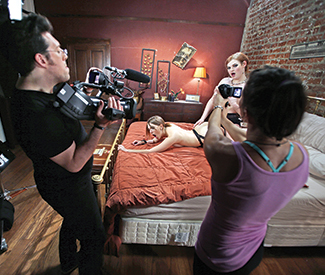
The tanned wrestler, triumphant, digitally penetrated the tattooed fighter. Her moans silenced the crowd, who listened, rapt. The fight wasn’t sport, but porn, America’s real favorite pasttime. Ultimate Surrender is just one of San Francisco-based studio Kink.com’s 30 or so paid subscription porn websites, including Fucking Machines, Everything Butt, and Hogtied.

But a new series of proposed state laws threatens the state’s porn industry, and the freakiest city on the West Coast may soon say goodbye to its highest profile porn purveyor, Kink.com, which for years has operated out of the historic Armory building on 14th and Mission streets.

The situation raises a question: Is Kink.com breaking up with San Francisco? If legislation requiring condoms on-set in porn and stricter state safety requirements become law, Kink.com CEO Peter Acworth tells the Guardian he has no choice but to leave California entirely.

“We can’t do business under those circumstances,” Acworth told us. “We can’t make a product that can compete.”

The tussle between pornographers, porn actors, and state lawmakers is a crucible where worker safety — and the right to choose how that safety is implemented — may soon be decided. Caught in the crossfire, freaky and sex-positive San Francisco stands to get a whole lot less kinky.


ECHOES OF LOS ANGELES

California Assembly Bill 1576 would legally require condom use while shooting porn, mandatory STD testing, and pornographic studios required to hold health records of their talent. The bill cleared the Assembly’s Committee on Labor and Employment just last month, the first step on a short road to gaining the governor’s signature.

Assemblymember Isadore Hall (D-Los Angeles), sponsored the bill, and the day it cleared committee he was triumphant.

“For too long, the adult film industry has thrived on a business model that exploits its workers and puts profit over workplace safety,” Hall said in a press statement. “The fact is, adult film actors are employees, like any other employee for any other business in the state. A minimum level of safety in the workplace should not have to be negotiated.”

The concern is largely over HIV infection on the sets of porn studios, and two parallel statewide efforts are working towards safety on porn sets. The state bill is the first, and the second is the renewed vigor in enforcing longstanding California Division of Occupational Safety and Health regulations.

In the early 1990’s, the federal Occupational Safety and Health Administration adopted a bloodborne pathogens regulation, and DOSH adopted a similar regulation soon after. DOSH’s standard requires employers to take measures to prevent employees’ eyes, skin, and mucous membranes from coming in contact with blood and “other potentially infectious materials,” including semen and vaginal secretions.

To some industries, the standard mandates rubber gloves and goggles. For the porn industry, the DOSH regulations are a moratorium on porn stars ejaculating on each others’ faces, deeming facials a workplace hazard. That standard porn finale can have life-changing ramifications.

“In 2004, there was a big (HIV) outbreak in the industry,” Eugene Murphy, senior safety engineer at DOSH, told the Guardian. “It was demonstrated HIV was clearly contracted on set.”

These infections mostly occurred in Los Angeles, once the center of the porn universe until Measure B arguably changed that. Los Angeles voters mandated porn studio condom use in 2012, and two years later, LA newspapers reported many pornographers have relocated to Las Vegas to escape the regulatory requirements.

The statewide pushback on porn is largely driven by the AIDS Healthcare Foundation, whose President Michael Weinstein has smiled for the cameras alongside Hall and other lawmakers every step of the way.

DOSH began its part in the porn crackdown in Los Angeles, but Murphy was charged with looking into San Francisco’s Kink.com, where Acworth is chafing against the idea of mandatory condoms.


RUBBERS REBUFFED

Acworth said he used to believe condoms should be mandatory for performers. After the porn set HIV infections in 2004, Kink.com buckled down.

“I attempted to run the business as condom mandatory for about a year,” Acworth told us. He even pronounced their necessity in an interview on CNN. But there were complications.

“There was pressure from the models themselves because of the chaffing issues,” he said. Porn performers have echoed those sentiments as well.

In an interview with entertainment site Nerve, popular porn star James Deen (see “Dick and smile,” 7/31/12) said he had no problem with personal condom use, but women he’s worked with often complained of chafing.

“I was talking to a girl about it and she was like, ‘Dude, I’m in pain everyday and constantly swollen,'” he told Nerve. “Condoms are intended to be used on an average-sized penis for average sex, and we have entertainment sex, for anywhere from 20 minutes to four hours.”

The condom effort tanked at Kink. Acworth said he withdrew the policy after listening to his performers’ wishes. The studio does adhere to 14-day HIV tests, and condoms are available in a “double-blind” agreement, by which actors can purportedly safely ask for condoms and not fear retaliation.

Despite those efforts, Kink was later awash in condom controversy. Earlier this year, DOSH fined Kink $78,000 in violations connected with the alleged on-stage HIV infections of two actors in 2013, one of whom alleged that a shoot continued despite one actor having a bleeding cut on his penis.

Acworth adamantly asserts the HIV transmission happened in these actors’ personal lives, and says the issue is used as a wedge by the AIDS Healthcare Foundation to push a political agenda. The Guardian attempted to contact the foundation but did not hear back by press time.

Regardless, Murphy said, DOSH is pursuing regulatory requirements around bloodborne pathogens at Kink, and the enforcement of those regulations is not tied to the whether the initial HIV infection case was verified or not.

“My concern,” Murphy said, “is whether there is a healthy and safe workplace.”


COMMUNITY TIES

Acworth came to San Francisco for the reasons many do: he wanted a place to be weird, or in his case, kinky.

He wanted a new home from which to shoot his leather porn site, Hogtied.com. New York City was big, but at the time (the ’90s), he felt San Francisco had a more established leather scene in the Folsom Street Fair and leather shops like Mr. S.

“San Francisco,” Acworth said, sitting across from us in a leather bondage chair, “appeared to be more geared up.”

Although not universally loved within the BDSM community, the studio is popular in San Francisco. Part of the credit may go to Kink’s recent revitalization of one of the largest spaces in its 200,000-square-foot historic brick fortress: the Drill Court.

The vast, arch-roofed space was outfitted with modern sound proofing for the benefits of performers and neighbors, but its life as a performance space is not new. In the 1920s, boxers traded blows under its lights, and history may repeat itself, Armor Community Center Sales Manager Quincy Krashna told us.

He’s in talks with Golden Boy Promotions (boxer Oscar De La Hoya’s company) to bring prize fighting back to this historic space. In recent months, the Drill Court played host to a massive New Year’s Eve party, a Game of Thrones-themed dance night and cancer fundraiser, and even an evangelical medical conference, where missionaries offered free dental and doctor checkups to the public.

“The Holy Spirit was truly present at this event,” a doctor from the program, Building Bridges, wrote on the program’s website.

Even bigger changes could be in store. Last month, Acworth filed an application with the city to convert most of the historic Armory into office space, what he called a “last ditch” plan in case the state condom ban passes and Kink decamps for Nevada.

“This move represents an insurance policy,” he told us.

In a public May 11 letter to Weinstein of the AIDS Healthcare Foundation, Acworth asked the foundation for a truce: “I am reaching out to you and AHF, in the hopes of a day where we may sit across the table from one another and agree on common goals and strategy on protecting performers as opposed to continuing this battle.”

As he notes in his letter, if pornographers lose this battle, the companies may relocate. If Acworth finds himself uncomfortably bound and gagged by new regulations, his safe word may be: Nevada.

Income gap

4

news@sfbg.com

It seems like San Francisco may surpass itself as the city with the highest minimum wage in the country, as labor activists and business groups are each pitching their own fall ballot measures to raise wages for the lowest paid workers.

The city’s current minimum wage of $10.74 is the highest in the country, but that still isn’t enough, according the labor activists, not in the city with the most expensive rent in the US and one of the largest income gaps.

“We have the highest growing gap between the rich and the poor, and the economic disparity is so high right now,” said José Argüelles of Young Workers United. He said the raising the minimum wage “isn’t the whole solution, but it’s part of it. Folks working full time in San Francisco should be able to afford to live in San Francisco.”

But sometimes even working full time in San Francisco isn’t enough to live here. A 2012 study by the San Francisco Department of Health found that even in the most inexpensive neighborhoods of the city, one would have to work 3.4 full-time minimum wage jobs to afford rent in a two-bedroom market rate apartment. In the priciest neighborhoods, one would have to work up to eight full-time jobs to afford rent.

All of this is occurring at a time when minimum wage debates are taking place across the country. President Obama has suggested raising the federal minimum wage from the current $7.25/hour to $10.10/hour, although Congress has been less receptive. Here in California, the state minimum wage of $8/hour will rise to $9/hour this July, and $10/hour by 2016.

The San Francisco ballot measure favored by labor activists is an initiative to raise the hourly minimum wage to $15 by 2017, with a sliding time frame depending on the size of the business. Proponents of the measure, dubbed the Minimum Wage Act of 2014, are just beginning to collect the necessary 9,702 signatures to qualify for the November ballot, and a recent poll found that 59 percent of likely voters supported the increase, while only 36 percent were opposed.

Business groups are usually the first ones to object to higher wages, but the San Francisco Chamber of Commerce and other small business-leaders are working with Mayor Ed Lee to craft their own, albeit more watered-down, ballot measure to increase pay. Despite their efforts, the $15/hour initiative took them by surprise and they are “outraged,” according to a statement released by the Chamber.

“This initiative is nothing more than a thinly veiled attempt to influence the outcome of the consensus-building process that will begin this week under the leadership of Mayor Ed Lee,” Chamber President Bob Linscheid said in the statement.

But many small businesses actually want to see the minimum wage increased, said John Eller of Alliance of Californians for Community Empowerment, one of the labor groups sponsoring the $15/hour initiative.

“What we heard when we talked to small businesses was that big money is coming in to buy up properties, that prices are getting jacked up, and that they are getting displaced, just like the residents of San Francisco,” Eller said. “But genuine interest in San Francisco, supporting young people, getting people out of poverty, and dealing with displacement were the themes that kept coming up.”

The business community wants to see the higher minimum wage phased in over a longer period of time and supports a more “moderate” wage, although an exact rate has not been decided, according to an email sent by Henry Karnilowicz, president of the San Francisco Council of District Merchants Associations. Other concessions that business leaders ask for include a separate, lower minimum wage for tipped servers and new hires in-training.

Raising the minimum wage “is about being fair and being reasonable,” said Karnilowicz. “It’s not true that small businesses are making a fortune, and I’d hate to see a big Walmart or Target coming into town to take their place.”

But Argüelles says that including special exceptions and a piecemeal law is a step in the wrong direction.

“In the past, San Francisco has led the way [with fair labor laws],” he said. “I think we can set a higher standard than that.”

Opponents to raising the minimum wage often claim that doing so hurts jobs and the economy, but a study from economists at UC Berkeley says otherwise. Unemployment in San Francisco has dropped since the last major minimum wage increase, and businesses absorb the extra labor costs through reduced employee turnover and improved efficiency.

The study also found that affected workers are largely adults and disproportionately women and people of color, two groups for whom the income gap is especially vast.

A measure qualifies for the ballot in one of two ways: either by garnering enough signatures through the initiative process, or being placed on the ballot directly by the mayor or a group of four or more supervisors. As of now, it seems plausible that San Franciscans will have two minimum wage measures to choose from this year, one from signatures and another from Mayor Lee.

On May 7, the Chamber released a press release stating that it’s seeking a single, consensus measure rather than two competing ordinances. Labor activists also hope to see one measure, Argüelles said.

There are no details yet on what Lee’s minimum wage ordinance would look like, if he sponsors one. There’s potential for a compromise between labor activists and business leaders, meaning one ballot measure with wide support. Otherwise, it will likely be one measure pitted against the other.

The deadline for Lee to submit his ordinance to the Department of Elections is June 17.

Toyota work methods applied at General Hospital

San Francisco’s Department of Public Health has a $1.3 million contract with Seattle-based Rona Consulting Group to implement the Toyota Management System, a workflow methodology based on the auto-manufacturing model, at San Francisco General Hospital.

This new model, which aims for greater workflow efficiency, is being implemented just as healthcare staffers raise concerns that staffing levels at SFGH are dangerously low.

“Nurses often work through their breaks, and they stay after their shifts to get charting done,” said David Fleming, a registered nurse who has been at SFGH for 25 years. “I think nurses are getting the job done – but they’re at the edge.”

A group of healthcare workers spoke out at the May 7 Budget & Finance Committee meeting, during which supervisors discussed the DPH budget. Public employee union SEIU 1021, which represents healthcare workers, is in the midst of contract negotiations but Fleming said they had been grappling with reduced staffing for awhile.

According to a contract request to the Health Commission sent anonymously to the Bay Guardian, DPH entered into a 24-month contract with Rona totaling just over $1.3 million, for the purpose of implementing the Toyota Management System methodology as part of the transition to the new SFGH acute care facility, scheduled to open in December 2015.

The Bay Guardian received a copy of the contract request via BayLeaks, which uses encryption software known as SecureDrop to enable sources to anonymously submit documents.

The $1.3 million came from “General Funds (Rebuild Funds)”, according to the contract request. In 2008, voters approved Prop. A, funding the $887.4 million General Hospital rebuild through general obligation bonds. Use of the voter-approved, taxpayer-supported funds is restricted to hospital construction under a state law that limits the use of bond money to specified purposes.

However, Iman Nazeeri-Simmons, chief operating officer at DPH, said funding for the Rona contract came from a “hospital rebuild transition budget,” which she said provides for needs beyond construction costs.

Specialized consulting to educate hospital staff in the ways of the Toyota Management System doesn’t come cheap. A single meeting between the consultant and “key leaders” to “discuss needs and develop operational project plans” cost $25,225, the document showed. A one-day “visioning session” facilitated by the contractor was priced at $16,814. Five-day workshops fetch Rona $42,032 each. Based on estimates included in the contract request, the consulting firm would earn the equivalent of $4,707 per day.

The $1.3 million consulting contract was awarded even as unions remind city officials of staffing cuts during the economic downturn in 2008 that still have not been restored.

Here’s some video testimony from hospital staffer Heather Bollinger regarding how tough things can get at the General Hospital’s trauma center. “We do have staffing issues, and they do affect patient safety,” she said in public comment to the Health Commission on April 15.

Nato Green, who is representing nurses as a negotiator on behalf of public employee union SEIU 1021, described the staffing levels at SFGH as “unsafe and unsustainable.” There are currently 90 vacancies for nurses that haven’t been filled, he said. That’s a 14 percent vacancy rate, Green noted — typically substituted with traveling nurses, temps, and overtime labor.

Nazeeri-Simmons said the consulting was necessary for the transition to the new SFGH facility, for “doing it in the best way, and understanding there’s a completely different physical environment over there.” Rona is a pioneer in healthcare performance improvement, she said, and they are “leading us in very interactive workflow designs that are simulation-based,” geared toward “maximizing value and driving out waste.”

But does “driving out waste” translate to staffing cuts? “It certainly hasn’t happened here,” Nazeeri-Simmons responded when asked about that. Instead, the consultants have helped management to “right-size services to meet the demand,” she said, noting that wait times in urgent care had been significantly reduced as a result. Decisions such as using a portable X-Ray machine that eliminated the need for patients to walk ten minutes across the hospital grounds had dramatically reduced wait times, she added.

“We need to make sure the staff are working to the highest of their capability,” she added.

Heidi Gehris-Butenschoen, a spokesperson for Rona, said the goal of transforming work practices under the Toyota Management System is to improve patient care. Asked whether the consulting tends to affect staffing levels, Gehris-Butenschoen said, “That’s really up to the hospital. It’s definitely in our workshop not something we focus on. The Toyota system is not about cutting heads at all.”

SFGH has been working with Rona since July 2012. One of the company partners was formerly the CEO of Productivity, Inc., which advised “large-scale transformations for Fortune 100 companies,” according to the contract request. The workflow methodology is rooted in Lean principles, integrating a “just in time” staffing concept that’s been applied in corporate settings such as Walmart.

The Health Commission approved the $1.3 million contract at its Dec. 17, 2013 meeting as part of the consent calendar, which is summarily approved by a single vote.

Fleming, the RN, was skeptical of how much the Lean system had actually accomplished. They had literally “rearranged the furniture” since the program was implemented, he said, and observers had silently monitored staffers’ activities.

“When we work with anyone, we go out to the gemba, and we observe,” Rona’s Gehris-Butenschoen explained, noting that gemba refers to “the place where work happens.” The observations help hospitals identify where waste can be reduced, she added, such as moving a supply cabinet if time is being taken up by crossing the room to get to it.

But Fleming said he wasn’t convinced that applying a corporate efficiency method, borrowed from manufacturing, would provide the greatest benefit in a healthcare setting.

“We are not taking care of cars on an assembly line,” he said. “When it comes to another human being’s body, I don’t know that faster is necessarily better.”

Injured protester Scott Olsen demands Oakland Police reform weapon use

17

Injured veteran Scott Olsen is calling on Mayor Jean Quan to ban the Oakland Police Department from using less-than-lethal weapons during protests and other crowd events.

The announcement came through his attorneys at the National Lawyers Guild Tuesday night, on the heels of Oakland City Council’s vote to approve a $4.5 million payout to Olsen for brain injuries he sustained at the hands of the OPD at an Occupy Oakland protest in 2011. 

An OPD officer shot a beanbag into the crowd, striking Olsen in the head. His skull was shattered and part of his brain was destroyed. Olsen had to learn how to talk all over again. The beanbag may have been “less lethal,” he contends, but the injury cost him dearly.

“Other major Bay Area cities don’t use SIM [Specialty Impact Munitions], chemical agents, or explosives on crowds, and we don’t need them in Oakland,” Olsen said, in a press statement. “OPD can’t be trusted to abide by its policies. These dangerous weapons must be completely banned at demonstrations and other crowd events. “

The “beanbag” that struck Olsen is more accurately described as a flexible baton round, a press release from the Oakland City Attorney’s office wrote. A flexible baton is a cloth-enclosed, lead-filled round known an SIM that is fired from a shotgun. 

Olsen and his attorneys, the National Lawyers Guild, launched a petition calling for OPD to cease use of less lethal weapons on crowds, which had 45 supporters as of press time.

So-called less lethal weapons like tear gas canisters, rubber bullets, and flexible baton rounds have injured over a dozen Oakland protesters, costing the city over $6.5 million in legal fees, according to the NLG.

As we’ve previously reported, OPD is currently under federal oversight over its mishandling of the Occupy protests and questionable actions in the infamous Riders case. OPD’s own Incident Statistics document the extensive use of force the night Scott Olsen was injured.

As the Guardian reported in 2012, “The document describes several types of UOF. On Oct. 25, these included baton (26 uses), chemical agent (21 total uses), non-striking use of baton (19 times), control hold (five), four uses of ‘weaponless defense technique’ and five uses of ‘weaponless defense technique to vulnerable area.’ In four reported instances, police ‘attempted impact weapon strike but missed.’”

Ultimately, Oakland will pay only $1.5 million of the $4.5 million settlement, city spokesperson Alex Katz wrote in a press release. The city’s insurance will pay the rest.

But the danger is far greater than fiscal.

Jim Chanin, one of Olsen‘s attorneys, noted that people have been inadvertently killed by less lethal weapons before, including a bystander in a 2003 incident in Boston. 

“If OPD is allowed to continue to shoot SIM and toss explosives into crowds,” Chanin said, “it is only a matter of time before someone is killed.”


Rep Clock: May 7 – 13, 2014

0

Schedules are for Wed/7-Tue/13 except where noted. Director and year are given when available. Double and triple features marked with a •. All times pm unless otherwise specified.

ARTISTS’ TELEVISION ACCESS 992 Valencia, SF; www.atasite.org. $6-10. “Other Cinema:” The Uprising (Snowdon, 2013), Sat, 8:30.

BALBOA THEATRE 3630 Balboa, SF; cinemasf.com/balboa. $7.50-10. “Popcorn Palace:” Pee-Wee’s Big Adventure (Burton, 1985), Sat, 10am. Matinee for kids.

CASTRO 429 Castro, SF; (415) 621-6120, www.castrotheatre.com. $8.50-11. Frozen (Buck and Lee, 2013), Sun, 1. Presented sing-along style; advance tickets ($10-16) at www.ticketweb.com.

CENTER SF 548 Fillmore, SF; www.brownpapertickets.com. $10-15. Radical Faerie Film Festival, short films “that embody radical queer sensibilities,” Sat, 7:30.

CHRISTOPHER B. SMITH RAFAEL FILM CENTER 1118 Fourth St, San Rafael; (415) 454-1222, www.cafilm.org. $6.50-$10.75. times. Super Duper Alice Cooper (Dunn, Harkema, and McFadyen, 2014), Thu, 7. For No Good Reason (Paul, 2013), call for dates and times. Locke (Knight, 2014), call for dates and times. Private Lives (Kent), Sun, 1 and May 15, 7. Theatrical performance filmed live in London’s West End. Love and Demons (Allen, 2014), Sun, 7. With director JP Allen and cast members in person.

CLAY 2261 Fillmore, SF; www.landmarktheatres.com. $10. “Midnight Movies:” The Room (Wiseau, 2003), Sat, midnight.

GREAT WALL OF OAKLAND West Grand between Telegraph and Broadway, Oakl; www.oaklandcatvidfest.com. $5-10. “OakCatVidFest,” cat-themed performances, bands, and more, plus kitty adoption opportunities and a film festival, Sat, 3-10.

MECHANICS’ INSTITUTE 57 Post, SF; milibrary.org/events. $10. “CinemaLit Film Series: Comedy Tonight:” Road to Morocco (Butler, 1942), Fri, 6.

PACIFIC FILM ARCHIVE 2575 Bancroft, Berk; (510) 642-5249, bampfa.berkeley.edu. $5.50-9.50. “Film 50: History of Cinema:” The Five Obstructions (Von Trier and Leth, 2003), Wed, 3:10. San Francisco International Film Festival, Wed-Thu. See complete schedule and ticket info at festival.sffs.org. “Film and Video Makers at Cal: Works from the Eisner Prize Competition,” Fri, 7.

PARAMOUNT THEATRE 2025 Broadway, Oakl; www.ticketmaster.com. $5. Saturday Night Fever (Badham, 1977), Fri, 8.

ROXIE 3117 and 3125 16th St, SF; (415) 863-1087, www.roxie.com. $6.50-11. Quake (Malley, 2014), plus other dance films, Wed, 7, 9. The M Word (Jaglom, 2013), Wed-Thu, 6:45, 9:15. Under the Skin (Glazer, 2014), Thu, 9:15. “Bay Area Docs:” Impossible Light (Ambers, 2014), Thu, 7. With director Jeremy Ambers in person. NOW: In the Wings on the World Stage (Whelehan, 2014), May 9-16, check website for times. First Annual San Francisco Intergalactic Feline Film and Video Festival for Humans, celebrating “the cinematic feline in all forms,” Sat, noon, 4, 8. Beyond Right and Wrong: Stories of Justice and Forgiveness (Singh, 2012), Mon, 7. Breeders: A Subclass of Women? (Lahl and Eppinette, 2014), Tue, 7.

SUNDANCE KABUKI 1881 Post, SF; www.sundancecinemas.com. $8.75-14. Godzilla (Honda, 1954), May 9-15. New restoration of Japanese original.

UNITY IN MARIN 600 Palm, Novato; www.unityinmarin.org. $10. Waste Land (Walker, Harley, and Jardim, 2010), Fri, 7.

YERBA BUENA CENTER FOR THE ARTS 701 Mission, SF; www.ybca.org. $8-10. “Astonishing Animation: The Films of Hayao Miyazaki and Studio Ghibli:” Princess Mononoke (Miyazaki, 1997), Thu, 7:30 and Sat, 4:30; The Cat Returns (Morita, 2002), Sat, 7:30 and Sun, 3:30; Ponyo (Miyazaki, 2008), Sun, 1. *


A musician grows on Market Street

0

esilvers@sfbg.com

If you’ve spent time in downtown San Francisco, chances are you’ve seen him: thin as a rail but dressed to kill, light on his feet in squeaky-clean dress shoes amidst the grey monotone of Market Street, he takes a deep breath in — and when he breathes out, into the mouthpiece of his trumpet, the sound is pure confidence, come to sonic life.

Then he starts tap-dancing while he plays, using the staccato clack of his feet as a rhythm section, swinging his trumpet like a baton every now and then just for show. Depending on the day, he might stop after a few songs and take out a microphone and, armed with the backing tracks of some current Top 40 favorites, belt out a tune or two, all while dancing, grooving, jumping; it’s a rarity to catch him being still. Busy businessmen stop and stare and listen despite themselves. He winks at women and they get the giggles.

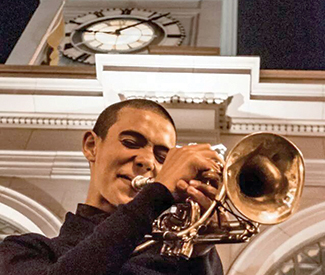
Gabriel Angelo is the ultimate entertainer, and he is 14 years old. Known as “the Trumpet Kid,” Angelo, an Oakland native, been playing trumpet and dancing since he was six, at a level that earned him an appearance on the Ellen Degeneres show in 2012, among other publicity, as well as the adoration of one of the toughest audiences in the city: harried FiDi pedestrians.

In honor of our “streets” issue, on a recent Thursday afternoon, I caught up with Angelo when he was playing on the traffic island outside the Ferry Building, serenading appreciative tourists and farmer’s market-goers. His voice has changed. There’s a whiff of cologne about him. Look out, San Francisco, the Trumpet Kid is growin’ up.

https://www.youtube.com/watch?v=C3trqITIf

San Francisco Bay Guardian How did you get your start in music?

Gabriel Angelo My mom sent me to take piano lessons when I was six years old, but when I set foot in the music room, a few feet away from me there was this shiny brass trumpet. And I reached out and grabbed it and it was love at first sight.

Since I was really young, I always wanted to be an entertainer — my family watched a lot of old movies, like with Fred Astaire, and they inspired me a lot. My two older sisters were also very musical — they sang, danced, played the cello, piano, and violin. Our church was very heavy on the arts.

SFBG How often are you out here? Are you in school? 

GA I’m out here most Thursdays, Fridays, Saturdays and Sundays, more if my schedule allows it. I try to get at least four hours of practice a day, usually more like six or eight. I’ve been home-schooled my whole life, and I actually already completed high school. Now I’m working on degrees in music and business through a program called CollegePlus.

SFBG What do you think you’ve gained from performing on the street from such a young age opposed to going the academic route with studying music?

GA This is my stage. There are so many people here, and I get to practice my stage and speaking skills, make connections, meet awesome people. I’ve learned a lot by talking to the homeless people in San Francisco, especially — they tell me their stories and experiences and that’s given me a whole new understanding. And I like feeling like I can help people with music. I’ve had people come up to me and say ‘Oh, I just had a person close to me die, and you put a smile on my face.’ With singing, my goal is just to inspire people. And also to make women feel beautiful.

SFBG To make women feel beautiful?

GA Yeah, because a lot of people don’t have fathers to tell them that, parents who make them feel good, and that one little thing affects their whole life. I know I wouldn’t have achieved anything without my mother’s support, without mentors in my life. And life comes from women.

SFBG Amen. Are you tight with other street musicians downtown? Are there turf wars?

GA No, we all have a lot of respect for each other. It’s whoever gets there first. But if someone ever really wanted me to move, that wouldn’t be [a big deal].

SFBG How much do you make on a given day?

GA It really depends. Anywhere from a penny to $100. It’s all going to help fund my career: paying for costumes, music videos, etc.

SFBG Any big projects coming up?

GA Well, I’m excited that I just signed with Journey’s manager. And I’m going to be playing the 2015 Super Bowl halftime show in Arizona. And I met someone who wants to make a movie about me, called “Swaggy.” (I’m Swaggy.) So yeah, it should be a fun year.

Watching the police

2

rebecca@sfbg.com

Nearly two years ago, on July 18, 2012, on-duty San Francisco police officer Mary Godfrey fired her weapon twice, killing 32-year-old Oakland resident Pralith Pralourng in an encounter at Washington and Davis streets.

Following the incident, police said Pralourng was mentally ill and had lunged at Godfrey with a box cutter, prompting her to fire in defense of her own life. Just before it happened, Pralourng had slashed his coworker at Tcho chocolate factory and fled.

Last September, the San Francisco Police Department honored Godfrey with a silver medal of valor for her conduct in that incident. The second-highest possible honor, silver medals are awarded in cases where an officer exhibits “outstanding bravery in the performance of duty,” according to a definition on the SFPD website, and “risks his or her life with full and unquestionable knowledge of the danger involved.”

However, an internal affairs investigation into the officer-involved shooting remained open at the time that the medal was awarded. In fact, in a May 5 voicemail, police spokesperson Albie Esparza confirmed to the Bay Guardian: “That case is still open, so there is no more information that we are going to release at this time.”

More than eight months have passed since Godfrey was honored — and yet the shooting is still under investigation.

The San Francisco Police Commission voted to approve Godfrey’s silver medal, along with a list of other medal of valor recipients, at its June 26, 2013 meeting. But it was Commissioner Angela Chan, who was recently denied reappointment to her post in a 7-4 vote by the Board of Supervisors, who cast the lone dissenting vote (See “SFBG Wrap” in this issue).

Chan was later quoted in press reports as saying she believed that awarding Godfrey with a medal of valor before the formal investigative process had concluded seemed to undermine that process. Internal affairs investigations are part of the city’s formal process to ensure police accountability. San Francisco also has an independent city department, the Office of Citizen Complaints, which provides civilian oversight by making determinations about citizen complaints alleging officer misconduct.

Chan’s dissenting vote prompted a backlash from the San Francisco Police Officers Association. In a blistering letter dated September 11, 2013, President Martin Halloran informed police commissioners of the POA’s “extreme disappointment” in the dissenting vote, also sending a copy of the letter to Mayor Ed Lee.

“Officer Godfrey was extremely upset when I met with her and immediately voiced her regret at having to take the life of another human being,” Halloran wrote. “It is every officer’s worst nightmare. The emotional and psychological trauma following an officer involved shooting can be severe, and it is absolutely essential that officers involved in these types of incidents receive positive reinforcement, as well as counseling, to reassure them that they did nothing wrong.”

Counseling seems appropriate, but Halloran’s blanket statement that officers involved in deadly use of force incidents should be reassured that “they did nothing wrong” seems to discount the city’s process for determining whether or not an officer’s action was justified.

The SFPOA president went on to note that his organization has long complained that “officers are left hanging for months, and in some cases years, before being recognized for their heroic acts, sometimes making them feel more insecure and raising more self-doubts about their actions.”

The SFPOA’s overt condemnation of Chan for her dissent suggests that the police commissioner faced strong opposition from a politically powerful entity when she came up for reappointment.

More importantly, it suggests that the SFPOA won’t hesitate to exert pressure on police commissioners who question the department’s actions — and raises questions about why top brass would ignore an open investigation that had yet to establish whether Godfrey “did nothing wrong.”

Internal affairs investigators weren’t the only ones looking into this fatal shooting of Pralourng. The OCC, the civilian police oversight board, was also investigating the incident when Godfrey was honored. Almost two years after the fact, the OCC investigation also remains open.

The OCC’s annual report, released March 12, was slated for presentation at the Police Commission on May 7. The 179-page report shines a light on the allegations filed against police officers, the process by which these complaints are investigated and addressed, and the rate at which complaints are sustained and followed up with disciplinary action.

Being a police officer isn’t easy, and can be very dangerous — even costing officers their lives in extreme circumstances. The OCC report notes that 75 percent of San Francisco police officers did not have any complaints filed against them in 2013. But of the remaining 25 percent, the report noted that 131 officers had been named in two or more complaints, while another 405 officers had each been flagged in a single complaint.

If the OCC determines that a complaint about officer misconduct is valid, then it is counted as “sustained.”

In 2013, according to the report, the OCC received 727 complaints, and closed 722 complaints. Of the 722 that were closed, 43 — or about 6 percent — were sustained. Of those sustained cases, 91 percent resulted in corrective or disciplinary action by the SFPD, the report noted, ranging from a verbal admonishment to a suspension.

Of the 43 cases that were sustained, 56 percent were for “neglect of duty,” the majority of which was issued for failure to collect traffic stop data. That was followed by “unwarranted action” at 24 percent, “conduct reflecting discredit represented” at 10 percent, “unnecessary force” at 7 percent, and “discourtesy” at 3 percent.

A synopsis of the “unnecessary force” findings provides examples, such as an incident in which “a sergeant and officers used unnecessary force when without cause, they entered a residence, grabbed, detained, arrested and removed an occupant from the residence, and took him to the ground.”

But according to the report, “By far the most frequent finding in all allegations was ‘not sustained,'” reflecting the outcome of 61 percent of allegations in OCC complaints.

The determination “not sustained” isn’t the same as finding that an officer acted appropriately, nor does it mean a complainant made false allegations. Instead, the finding is issued when “there is not a preponderance of evidence to prove or disprove,” the allegation, OCC Executive Director Joyce Hicks told us.

Put more simply: An officer responds to a complainant with a contradictory account, and since there isn’t enough evidence to prove otherwise, the case is closed.

“Officers were found to have engaged in proper conduct in 25 percent of the allegations,” the breakdown continued. “Complainants’ allegations were ‘unfounded,’ or not true, in 2 percent of the allegations.”

A chart of “findings closed” in 2013 (a separate measure from complaints) showed that out of 2,183 findings, just 72 — or 3 percent — were sustained. The vast majority, 1,337 were “not sustained.”

A breakdown showing the nature of complaints filed reveals that five allegations of unnecessary use of force were sustained in 2013, while 167 were not sustained, out of a total of 208 complaints alleging unnecessary use of force.

At the end of 2013, according to the OCC report, the civilian oversight board “continued to investigate three officer-involved shootings. Two of these shootings resulted in the death of the suspect. In 2013, the OCC closed two 2011 officer involved shooting cases with no sustained findings.”

Hicks noted that she faces budgetary constraints that have prevented her from hiring more investigators, an ongoing problem at the OCC. “We still don’t have the best practices number of cases,” she said, noting that the City Controller had issued a 2007 audit stating that investigators should be handling no more than 16 cases at once, while “my investigators’ caseloads have never fallen below 21.”

Aside from its investigations into citizen complaints, the OCC also makes policy recommendations. Following a number of officer-involved shootings in 2012 involving mentally ill individuals, the OCC issued a set of recommendations on handling responses to individuals experiencing mental crisis — the exact sort of situation that led to Pralourng’s death in 2012.

Samara Marion, an attorney with the OCC, noted that one recommendation pertains to how the Firearm Discharge Review Board, which evaluates whether a shooting was justified, performs its analysis. Rather than merely relying on the internal affairs and homicide reports, Marion said, the OCC recommendation is to “have the training division do an analysis that’s point by point,” so that the determination is made taking into account “all of the decision-making and tactical steps leading up to the officer-involved shooting.”

That work is expected to continue, but as far as the Police Commission is concerned, it will have to go forward without input from Chan, who had planned to take a close look at officer-involved shootings in her next term.

“It was shameful and outrageous what happened, because I was targeted for doing what I believe in,” Chan said later. But she said political pressures has thwarted that goal.

“What happened was not really about me,” she continued. “It was about whether something as important as a civilian police oversight body should be politicized.”

SFIFF 57: Strange love, Varda, Swedish grrrls, and more!

2

The 57th San Francisco International Film Festival runs through May 8; all the details are here. Guardian correspondent and confirmed film fest addict Jesse Hawthorne Ficks checks in with his mid-SFIFF picks and reactions.

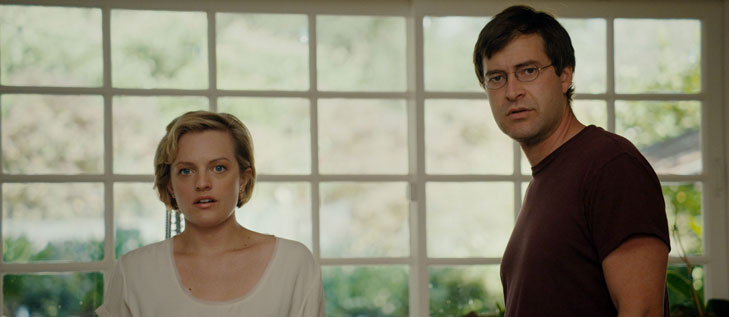
Charlie McDowell’s The One I Love (screens tomorrow; ticket info here) showcases exceptional performances by Mark Duplass and Elisabeth Moss and should be a multiple Independent Spirit Award nominee come next statuette season. This unique genre fluster-cluck digs much deeper into marital problems than you would ever expect (audiences seemed quite flipped upside down after the film’s world premiere at Sundance). Similar to films like Darren Araonfsky’s Pi (1998), Christopher Nolan’s Memento (2000), and Shane Caruth’s Primer (2004), this will be a film that’ll spark conversations and inspire repeat viewings.

Mexican auteur Fernando Eimbcke, who directed Duck Season (2004) and Lake Tahoe (2008) is back with another coming-of-age stunner: Club Sandwich. The director’s slow-burning method of sticking two people in a room and allowing life’s natural moments to unfold is as precise as the tiny moustache on the protagonist’s upper lip. Rewarding to those who are patient, Club Sandwich is the perfect reminder of that pre-adolescent summer that changed just about everything.  

Agnes Varda’s latest opus, From Here to There, is a 225 minute, five-part miniseries originally made for French television. It casually chronicles her guest appearances at film festivals and cinematheques around the world with numerous asides and melancholic moments that have made Varda one of the most likable icons of cinema. In fact, the episodes work similarly to her earliest films Cleo From 5-7 (1962) and La Pointe Courte (1955), gracefully moving the viewer through moments that seem minor at first, but are in fact profound. (Listening to an 85-year-old Varda get distracted and start talking about the history of chairs brought me to tears.) Like her 2008 film The Beaches of Agnes (2008), this is a must see.

Swedish auteur Lukas Moodysson is back and he may have just created one of the most riotous punk rock extravaganzas ever. We Are the Best! (Sweden/Denmark), which takes place in the early 1980s and is based on wife Coco Moodysson’s graphic novel, allows the all-grrrl band to blossom into real-life punk rockers. Evoking passionate punk portrayals like 1980’s Times Square and 1981’s Ladies & Gentleman, The Fabulous Stains (fun fact: Moodysson was unaware of the latter film until I interviewed him!), this drama seems to capture Stockholm circa 1982 in perfect detail. The soundtrack was a major part of discussion during the Q&A, becoming the perfect entry point for those of us desiring an history lesson on the Swedish punk scene. But what I found most exciting about We Are the Best! is its approach to gender roles, as its young female characters attempt to cast aside pressures to look pretty. Either way, Moodysson has created a film just as enjoyable as his debut feature, 1998’s Show Me Love. It has the potential to become a worldwide hit in the same vein as Trainspotting (1996) and Run Lola Run (1999). (Info on screenings today and May 7 here!)

https://www.youtube.com/watch?v=nL-0RLaFcSg

In the 1990s, Tsai Ming-liang’s films were often mentioned alongside works by Hirokazu Kore-eda and Hou Hsiao-hsien. But two decades later, only Tsai has stayed the determined course of creating endurance-driven, contemplative cinema. Presenting his tenth feature (and showcasing yet again his alter ego, actor Lee Kang-sheng), Stray Dogs (Taiwan) is a breathtaking meditation on a homeless Taiwanese family, who are quietly doing what they can to get by. With this film, Tsai has almost abandoned story completely, instead favoring long, drawn-out, surreal, one-shot sequences — next-level abstractness that will either send you running for the hills or leave you unblinkingly glued to the screen.

The film is made to be watched more than once and upon multiple viewings you gain not only patience for Tsai’s masterful aesthetic but an appreciation for how futuristically meditative it is. Someone should program Stray Dogs with his 2012 short Sleepwalk, which follows a monk as he walks, and his follow-up film Journey to the West (2014) which stars Lee and Denis Lavant(!) Whether that would equal absolute transcendence or absolute boredom depends on the viewer, of course. I can’t think of a more emotionally implosive filmmaker working today. 

https://www.youtube.com/watch?v=vnvSUGgF2R0

Rewatching Hong Sang-soo’s Our Sunhi (South Korea) is in fact as monumentally enjoyable as viewing his previous film, In Another Country (2012). This new film represents another solid entry for the director. The succinct ways in which his male characters are emotionally self-destructive with one another can and should be compared to best of Eric Rohmer and Woody Allen’s films. And this time out, he has created a female protagonist (played by hilariously by Jung Yoo-mi) that adds a complexity to his alcoholic-ridden world. If you were a fan of Hong’s films and stopped watching them, it’s time to come back and enjoy one of the funniest films of the festival circuit.

The surprise documentary hit at this year’s SFIFF most definitely has to be Julie Bertuccelli’s School of Babel (France). Simple catalogue description: “The film details a year in the life of a Parisian class of immigrant youth from countries around the globe — boys and girls ages 11 to 15 — who have come to France to seek asylum, escape hardship or simply better their lives.” What is so overwhelming about this personal journey is how the film not only showcases the student-teacher relationships, but the parent-student dynamics. It culminates in a devastating filmmaker-audience relationship.

Exploring pedagogy as a whole caught me off guard so intensely that I, like many in the theater, felt we were back in school trying to figure out all of life’s problems in between breaks for recess. The film ties in perfectly to the San Francisco Film Society’s Education program, which serves more than 11,000 students and teachers every year, from kindergarten through college, to develop media literacy, cultural awareness, global understanding, as well as a lifelong appreciation of cinema. Do whatever it takes to see this film yourself, and if you’re a teacher, share it with your own students.

Dick Meister: The real May Day

2


By Dick Meister

May Day. A day to herald the coming of Spring with song and dance, a day for
children with flowers in their hair to skip around beribboned maypoles, a
time to crown May Day queens.

But it also is a day for demonstrations heralding the causes of working
people and their unions such as are being held on Sunday that were crucial
in winning important rights for working people. The first May Day
demonstrations, in 1886,  won the  most important of the rights ever won by
working people ­ the right demanded above all others by the labor activists
of a century ago:

“Eight hours for work, eight hours for rest, eight hours for what we will!”

Winning the eight-hour workday took years of hard struggle, beginning in the
mid-1800s. By 1867, the federal government, six states and several cities
had passed laws limiting their employees’ hours to eight per day. The laws
were not effectively enforced and in some cases were overturned by courts,
but they set an important precedent that finally led to a powerful popular
movement.

The movement was launched in 1886 by the Federation of Organized Trades and
Labor Unions, then one of the country’s major labor organizations. The
federation called for workers to negotiate with their employers for an
eight-hour workday and, if that failed, to strike on May 1 in support of the
demand.

Some negotiated, some marched and otherwise demonstrated.  More than 300,000
struck. And all won strong support, in dozens of cities ­ Chicago, New York,
Baltimore, Boston, Milwaukee, St. Louis, San Francisco, Pittsburgh, Denver,
Indianapolis, Cincinnati, Detroit, Washington, Newark, Brooklyn, St. Paul
and others.

More than 30,000 workers had won the eight-hour day by April. On May Day,
another 350,000 workers walked off their jobs at nearly 12,000
establishments, more than 185,000 of them eventually winning their demand.
Most of the others won at least some reduction in working hours that had
ranged up to 16 a day.

Additionally, many employers cut Saturday operations to a half-day, and the
practice of working on Sundays, also relatively common, was all but
abandoned by major industries.

“Hurray for Shorter Time,” declared a headline in the New York Sun over a
story describing a torchlight procession of 25,000 workers that highlighted
the eight-hour-day activities in New York. Never before had the city
experienced so large a demonstration.

Not all newspapers were as supportive, however. The strikes and
demonstrations, one paper complained, amounted to “communism, lurid and
rampant.” The eight-hour day, another said, would encourage “loafing and
gambling, rioting, debauchery, and drunkenness.”

The greatest opposition came in response to the demonstrations led by
anarchist and socialist groups in Chicago, the heart of the eight-hour day
movement. Four demonstrators were killed and more than 200 wounded by police
who waded into their ranks, but what the demonstrators¹ opponents seized on
were the events two days later at a protest rally in Haymarket Square. A
bomb was thrown into the ranks of the police who had surrounded the square,
killing seven and wounding 59.

The bomb thrower was never discovered, but eight labor, socialist and
anarchist leaders ­ branded as violent, dangerous radicals by press and
police alike ­ were arrested on the clearly trumped up charge that they had
conspired to commit murder.  Four of them were hanged, one committed suicide
while in jail, and three were pardoned six years later by Illinois Gov. John
Peter Altgeld.

Employers responded to the so-called Haymarket Riot by mounting a
counter-offensive that seriously eroded the eight-hour day movement’s gains.
But the movement was an extremely effective organizing tool for the
country’s unions, and in 1890 President Samuel Gompers of the American
Federation of Labor was able to call for “an International Labor Day” in
favor of the eight-hour workday. Similar proclamations were made by
socialist and union leaders in other nations where, to this day, May Day is
celebrated as Labor Day.

Workers in the United States and 13 other countries demonstrated on that May
Day of 1890 ­ including 30,000 of them in Chicago. The New York World hailed
it as “Labor’s Emancipation Day.” It was. For it marked the start of an
irreversible drive that finally established the eight-hour day as the
standard for millions of working people.

Bay Guardian columnist Dick Meister, formerly labor editor of the SF
Chronicle and KQED-TV, has covered labor and politics for a half-century as
a reporter, editor, author and commentator. Contact him through his website,
dickmeister.com, which includes several hundred of his columns.

(The Bruce blog is written and edited by Bruoe B. Brugmann, editor at large of the Guardian. He is the former editor of the Guardian and with his wife Jean Dibble the co-founder and co-publisher of the Guardian,1966-2012.)

Lawsuit filed to halt “Google bus” shuttle pilot program

17

The road to regulating Google Buses has a new pothole: a lawsuit. 

A lawsuit filed in San Francisco Superior Court today demands the San Francisco Municipal Transportation Agency’s commuter shuttle pilot program be set aside while a full environmental review is conducted under the California Environmental Quality Act.

“We know that these buses are having devastating impacts on our neighborhoods, driving up rents and evictions of long-time San Francisco residents,” Sara Shortt, executive director of the Housing Rights Committee of San Francisco and one of the lawsuit petitioners, said in a press statement. “We’ve protested in the streets and taken our plea to City Hall to no avail. We hope to finally receive justice in a court of law.”

The suit was filed against the City and County of San Francisco, Mayor Ed Lee, the Board of Supervisors, the SFMTA, Google, Genentech, Apple, and a handful of private transportation providers. It alleges the tech shuttle pilot project is in violation of the California Vehicle Code which prohibits any vehicle, except common carriers (public buses), to pull into red zones that are designated as bus stops. It also alleges the city abused its discretion and violated the CEQA by exempting the Shuttle Project from environmental review.

The Coalition for Fair, Legal and Environmental Transit, Service Employees International Union Local 1021, the union’s Alysabeth Alexander, and Shortt are the petitioners of the suit. In early April, they also petitioned the Board of Supervisors to vote for an environmental review of the tech shuttles.

The contentious meeting lasted over 7 hours, with housing advocates and tech workers firing shots from both sides into the night. Ultimately the supervisors voted 8-2 against the environmental review, a move seen as driven by a deferential attitude towards the technology industry in San Francisco. 

Paul Rose, a spokesperson for the SFMTA, responded to the lawsuit in an email to the Guardian.

“The agency developed this pilot proposal to help ensure the most efficient transportation network possible by reducing Muni delays and congestion on our roadways,” Rose wrote.  “We have not yet had a chance to review the lawsuit and it would not be appropriate to comment on any pending litigation.”

The early April vote was only the latest in the city’s alleged deferential treatment towards the commuter shuttles. 

The SFMTA allowed the shuttles to use Muni bus stops for years without enforcing illegal use of red zones, the suit alleges. A study by the city’s Budget and Legislative analyst revealed that out of 13,000 citations written to vehicles in red zones in the last three years only 45 were issued to tech shuttles — despite the SFMTA’s knowledge of 200 “conflicting” bus stops between Muni and the tech shuttles. 

Much has been made of those startling numbers, with petitioners alleging a “handshake deal” on the part of the SFMTA to tech company shuttles, allowing them to park at red zones at will.

But emails the Guardian obtained by public records request show Carli Paine, head of the tech shuttle pilot program, followed up complaints on illegal stops made by tech shuttles since 2010, but to no avail. 

“Know that I have made clear to the shuttle providers that the law says that it is not legal to stop in the Muni Zones,” Paine wrote in a July 2012 email to a colleague who was in contact with tech companies. “Participating in this process does not mean that they are guaranteed not to get tickets–especially if they are doing things that create safety concerns or delay Muni.”

Paine also attempted to clarify enforcement policies around the shuttles with enforcement officers from the SFPD and SFMTA, also to no avail, the emails show.

The deferential treatment to shuttles may not have originated from the SFMTA then, but from higher up the political ladder. 

“There are a number of our supervisors who do not want to buck the tech industry,” Shortt told the Guardian. “They feel there may be more to gain from allowing illegal activity to continue by these corporations than support.”

But does the suit call for the tech shuttles to stop running? We asked Richard Drury, the attorney filing the suit, to explain the specific asks of the suit.

“Not technically no,” Drury said. “They’ve operated illegally for years and the city turned a blind eye. They could continute to do that while the city runs an environmental review, but if the SFMTA or Police Department decided to start ticketing them for $271, they could.” 

So the lawsuit wouldn’t stop the shuttles. It just asks for them to be reviewed. 

Among issues regarding air quality the shuttles’ heavy weight damages city streets at much higher rates than cars, studies by the city’s Budget Legislative Analyst showed. Studies conducted by students and other interested individuals revealed increased rents near shuttle stops, which the filers of the lawsuit say leads to a displacement of residents.

Displacement is a consideration in CEQA reviews, a recent addition to state law.  

“We’re just asking for the city to study the impacts,” Drury said. “Maybe that means the shuttles get clean fuel, or corporations pay to offset displacement of residents.”

Below is a downloadable PDF of the lawsuit.

Google Bus Commuter Shuttle Lawsuit by FitztheReporter

Rep Clock: April 30 – May 6, 2014

0

Schedules are for Wed/30-Tue/6 except where noted. Director and year are given when available. Double and triple features marked with a •. All times pm unless otherwise specified.

ARTISTS’ TELEVISION ACCESS 992 Valencia, SF; www.atasite.org. $6-10. “Other Cinema:” “In and Out of Afghanistan,” Sat, 8:30.

BALBOA THEATRE 3630 Balboa, SF; cinemasf.com/balboa. $7.50-10. Super Duper Alice Cooper (Dunn, Harkema, and McFadyen, 2014), Thu, 7, 9:30. “Popcorn Palace:” School of Rock (Linklater, 2003), Sat, 10am. Matinee for kids.

CASTRO 429 Castro, SF; (415) 621-6120, www.castrotheatre.com. $8.50-11. •The Bride Wore Black (Truffaut, 1968), Wed, 7, and Obsession (De Palma, 1975), Wed, 9. •Daisies (Chytilová, 1966), Thu, 7:30, and Times Square (Moyle, 1980), Thu, 9. San Francisco International Film Festival, Fri. See complete schedule and ticket info at festival.sffs.org. •Pee-Wee’s Big Adventure (Burton, 1985), Sat, 3:45, 8:30, and It’s a Mad, Mad, Mad, Mad World (Kramer, 1963), Sat, 5:30. Frozen (Buck and Lee, 2013), Sun, 1. Presented sing-along style; advance tickets ($10-16) at www.ticketweb.com.

CHRISTOPHER B. SMITH RAFAEL FILM CENTER 1118 Fourth St, San Rafael; (415) 454-1222, www.cafilm.org. $6.50-$10.75. times. Super Duper Alice Cooper (Dunn, Harkema, and McFadyen, 2014), Thu and May 8, 7. For No Good Reason (Paul, 2013), May 2-6, call for times. Locke (Knight, 2014), May 2-6, call for times. Decoding Annie Parker (Bernstein, 2013), Sun, 7. This event, $12.

CLAY 2261 Fillmore, SF; www.landmarktheatres.com. $10. “Midnight Movies:” The Neverending Story (Petersen, 1984), Fri-Sat, midnight.

GOETHE INSTITUT SAN FRANCISCO 530 Bush, Second Flr, SF; goethe.de/ins/us/saf/enindex.htm. $5. •Jonas in the Jungle (Sempel, 2013), Wed, 6:30, and Animals of Art (Sempel, 2011), Wed, 8:40. With director Peter Sempel in person.

JEWISH COMMUNITY CENTER OF SF 3200 California, SF; www.jccsf.org. $25. “Mark Cantor’s Giants of Jazz on Film: Broadway to Hollywood and All That Jazz,” films featuring jazz performances, Sat, 8.

MECHANICS’ INSTITUTE 57 Post, SF; milibrary.org/events. $10. “CinemaLit Film Series: Comedy Tonight:” Groundhog Day (Ramis, 1993), Fri, 6.

MISSION CULTURAL CENTER FOR LATINO ARTS 2868 Mission, SF; www.missionculturalcenter.org. $15. Tamale Road: A Memoir from El Salvador (Villatoro, 2012), Fri, 7.

PACIFIC FILM ARCHIVE 2575 Bancroft, Berk; (510) 642-5249, bampfa.berkeley.edu. $5.50-9.50. “Film 50: History of Cinema:” After Life (Kore-eda, 1999), Wed, 3:10. San Francisco International Film Festival, through May 8. See complete schedule and ticket info at festival.sffs.org.

PARAMOUNT THEATRE 2025 Broadway, Oakl; www.ticketmaster.com. $18-29.75. “Project YouthView 2014: The Power of Youth in Film,” youth-created short films and more, Fri, 7.

ROXIE 3117 and 3125 16th St, SF; (415) 863-1087, www.roxie.com. $6.50-11. “Iran Via Documentaries:” Bassidji (Tamadon, 2009), Wed, 7. Next Goal Wins (Jamison and Brett, 2014), Wed, 7, 9; Thu, 9:30. The Unknown Known (Morris, 2013), Wed, 9:30. “PlayGround Film Festival,” short films adapted from plays by Bay Area writers, Thu, 6:45, 8:15. This event, $10-20. “Synesthesia Film Festival: Screening #2,” short films, Thu, 7. The M Word (Jaglom, 2013), May 2-8, 6:45, 9:15.

YERBA BUENA CENTER FOR THE ARTS 701 Mission, SF; www.ybca.org. $8-10. “Astonishing Animation: The Films of Hayao Miyazaki and Studio Ghibli:” Nausicaä of the Valley of the Wind (Miyazaki, 1984), Thu, 7:30; Sun, 5; Whisper of the Heart (Kondo, 1995), Sat, 7:30; Sun, 3:30; Kiki’s Delivery Service (Miyazaki, 1989), Sun, 1. *


Bill would tax companies with wide CEO-worker pay disparities

60

California companies pouring big cash on their CEOs may be forced to tighten the spigot under a new bill that seeks to limit CEOs paid excessively at the expense of their workers.

Senate Bill 1372, authored by state Sens. Mark DeSaulnier (D-Concord) and Loni Hancock (D-Oakland), would increase taxes on companies with wide disparities between CEO and worker pay, and give a tax break to companies with a low ratio between CEO and worker pay.

“History has taught us that the gross disparity between CEO and worker pay is a direct threat to American democracy,” DeSaulnier said in a press statement. “It is unsustainable and a danger to our society. We must focus on restoring the middle class and stop fueling excessive income inequality.”

The pay-disparity bill cleared the Senate and Governance Finance Committee last Friday, and is headed to the Senate Appropriations Committee.

Local tech companies have much reason to fear the bill. Larry Ellison, CEO of the Redwood City-based Oracle, was paid 1,287 times the median salary of an Oracle employee in 2012, according to a Bloomberg study. Ellison pulled in $96.2 million in 2012, and the median employee working for his company brought in $74,693.

That’s less pay gap, more pay canyon. Former Secretary of Labor Robert Reich, a professor at UC Berkeley and a supporter of the pay-disparity bill, connected CEO pay with our troubled economy.

“This growing divergence between CEO pay and that of the typical American worker isn’t just wildly unfair. It’s also bad for the economy,” Reich wrote on his website last week. “It means most workers these days lack the purchasing power to buy what the economy is capable of producing — contributing to the slowest recovery on record. Meanwhile, CEOs and other top executives use their fortunes to fuel speculative booms followed by busts.”

The pay-disparity bill would lower taxes on companies with CEOs making less than 100 times more than its median employee. The tax rate for the company would be metered on a scale of CEO-to-worker pay ratio, with the highest penalties for companies paying their CEOs more than 400 times their median employee pay.

The bill also targets non-salaried independent contractors, a significant portion of the state’s workers.

Many local companies have wide pay gaps between CEOs and workers. In 2012, Apple had a CEO:worker pay ratio of 192:1, Wells Fargo had a ratio of 186:1, and Intel squeaked by with a ratio of 99:1, according to PayScale.com.

The PayScale.com study only looked at non-stock compensation. CEOs are often paid in stock and other bonuses, a significant part of their earnings. In lieu of this, recently many CEOs jumped on the $1 salary bandwagon, including Google CEO Larry Page. Ellison took home a single dollar for his salary in 2013, according to CNN Money.

This seemingly forward-thinking gesture is a good PR move, but in reality CEOs still take home millions of dollars in stocks, options, and bonuses. Page owned more than 24 million shares in Google as of 2013, for instance. Ellison took in $92.2 million in stocks, options, and other pay in 2013.

Luckily, that’s a loophole that DeSaulnier and Hancock considered when crafting the bill.

The bill would calculate executive compensation based on the Summary Compensation Table the company in question reports to the Securities and Exchange Commission. That includes salary, bonus, grants of stock options and stock appreciation rights, long-term incentive plan awards, pension plans, and employment contracts and related arrangements.

In 2012, the average CEO pay in California was $5,054,959, according to a statement from DeSaulnier, while the median worker pay in California was $48,029.

Below is a series of graphs detailing local Bay Area CEO and worker pay disparities, as of 2012.

SF may go through Marin County to bypass CleanPowerSF subversion

106

Just in time for Earth Day, a renewed effort to reduce the city’s carbon emissions was introduced at the Board of Supervisors yesterday [Tues/22]. Sup. John Avalos introduced a resolution calling for a study of San Francisco joining Marin Clean Energy, which provides renewable energy to that county’s residents.

The move is seen largely as an effort to circumvent Mayor Ed Lee’s opposition to implementing a controversial renewable energy plan called CleanPowerSF.

“Mayor Lee and the Public Utilities Commission objected to CleanPowerSF, but they have offered no other solution to provide San Franciscans with 100 percent renewable electricity,” Avalos said in a public statement. “With this ordinance, we can either join Marin or we can implement our own program, but we can no longer afford to do nothing.”

The resolution is the latest effort in the long saga to implement CleanPowerSF, San Francisco’s proposed renewable energy alternative to PG&E, whose current energy mix is only 19 percent renewable. Much of PG&E’s current mix is dirty and directly contributes to half of San Francisco’s carbon footprint, according to the city’s own recent Climate Action Strategy.

Joining Marin under a Joint Powers Authority would provide a vehicle for San Francisco to enact CleanPowerSF’s goals, long blocked by the mayor. San Francisco’s renewable energy effort may have lingered in legal limbo for years, but Marin made the switch to renewables in 2010.

“It’s something people want, and it also reduces greenhouse gas emissions,” Marin Clean Energy Executive Officer Dawn Weisz told the Guardian. Much of Northern California, she noted, has little choice but to use PG&E for their electricity.

“The people never chose to have a monopoly in place,” she said. “People like having choices.”

Marin chose to switch to renewable energy in 2010, and MCE offers two energy mix options: A 100 percent renewable energy option, and a less expensive 50 percent renewable option. MCE officials told the Guardian they have a 75 percent customer adoption rate, meaning most of Marin County is running on clean, renewable energy.

Using an energy bill calculator on MCE’s website, the average homeowner pays about $80 a month for their renewable energy in the summer, just $2 more than their dirty PG&E power. The program has been so successful for MCE’s approximately 125,000 customers that other cities have joined with Marin under what is called a Joint Powers Authority, allowing those cities to access MCE’s grid.

The City of Richmond joined into a Joint Powers Authority with Marin County in 2012, and Napa County also expressed interest in providing renewable energy through MCE.  That large adoption rate may be what has PG&E running scared.

“We faced very strong opposition from the incumbent utility during our launch,” Weisz told the Guardian, referring to PG&E. “Fortunately, we have a much better relationship with them now, and they serve as a good partner.”

The renewable energy is distributed along PG&E’s existing infrastructure, so the utility still has a role to play in providing electricity to Marin. But the utility certainly has worries when it comes to generating electricity, as Marin is building new sources of renewable energy up and down California.

“We have 24 different power supply contracts,” Weisz told us. This includes new solar facilities in San Rafael and the Central Valley, and renewable energy sources in Roseville and and Placer County.

Though other cities have signed on to receive energy through Marin County’s MCE program, San Francisco joining would be another ballgame entirely, Weisz said.

MCE has a policy of incremental expansion, she told us, and defines potential affiliate cities and counties as having fewer than 30,000 customers who are less than 30 miles away. Though San Francisco is a stone’s throw from Marin County, the potential customer base is huge: San Francisco has a population of over 800,000 people.

“It would require some analysis,” Wisz said dryly.

MCE’s analysis to include Napa County in its energy mix took 60 days, she said. Notably, San Francisco may produce its own power and use its own mix, and simply use MCE’s billing setup. Basically, San Francisco would provide energy through CleanPowerSF, but MCE would be a contractor that administers San Francisco’s program.

But joining into Marin’s renewable energy program has more hurdles than just figuring out the mix. Clean Power SF is a Community Choice Aggregation program, defined by state law as exactly that — part of the community. Jumping over to Marin may create a legal mess for San Francisco, but there is hope.

Assembly Bill 2159, introduced by Assemblyman Tom Ammiano, would allow a county’s Board of Supervisors to approve joining a Joint Powers Authority with another municipality, in this case, allowing San Francisco to join up with Marin, while still creating its own CCA program.

The bill just cleared the Assembly Utilities and Commerce Committee yesterday, and has a ways to go.

If that sounds like a legal headache, it is. But advocates say its necessary because Mayor Ed Lee has “stacked the deck” at the San Francisco Public Utilities Commission, hiring people friendly to blocking CleanPowerSF on his behalf.

“The main purpose of passing it is to get through the mayor’s log jam,” clean power advocate Eric Brooks told the Guardian. “We want San Francisco to go faster and make more green jobs.”

And, of course, to reduce greenhouse gas emissions. Avalos’ office estimates that in the time the mayor has stalled Clean Power SF, San Francisco has generated 80 million pounds of CO2.

Projections

27

The 57th San Francisco International Film Festival runs April 24-May 8. Screening venues include the Castro Theatre, 429 Castro, SF; New People Cinema, 1746 Post, SF; Pacific Film Archive, 2575 Bancroft, Berk; and Sundance Kabuki Cinemas, 1881 Post, SF. For tickets (most shows $15) and complete schedule, visit festival.sffs.org.

Harmony Lessons (Emir Baigazin, Kazakhstan/Germany/France, 2013) Darwinian natural selection seems to be the guiding principle at the rural Kazakh school where bright farm boy Aslan (Timur Aidarbekov) is sent to further his education. What he learns there is mostly about survival, as he soon discovers the institution is dominated by an elaborate system of bullying and extortion in which a few older students terrorize the younger and weaker. Emir Baigazin’s striking debut feature applies a rigor both aesthetic and intellectual to a familiar theme here, his script as methodical as his minimalist compositions in dissecting the havoc wreaked by (and eventual unraveling of) a corrupt system that’s a microcosm of a societal whole. Fri/25, 3:30pm, Kabuki; May 4, 12:45pm, Kabuki; May 5, 6:15pm, Kabuki. (Dennis Harvey)

When Evening Falls on Bucharest or Metabolism (Corneliu Porumboiu, Romania/France, 2013) Romanian moviemaker Corneliu Porumboiu (2009’s Police, Adjective) turns his lens around, toward the casting couch and the oh-so-delicate damage done, in his third feature film. An everyday kind of corruption, sex, lies, and video — zipless, tapeless, and forging way beyond the limits of film — is the name of the game when a director (Bogdan Dumitrache) nonchalantly drops a nude scene on his actress (Diana Avramut) and the two try out a few ideas, on-camera for the screen and off-camera in the bedroom. The hardly working relationship plays both ways, as the moviemaker bends in turn to his producer, in this minimalist albeit layered glimpse into the unlovely guts of the last sacred cow: the so-called creative process. Fri/25, 3:45pm, New People; Sat/26, 6:30pm, Kabuki; Mon/28, 8:30pm, PFA. (Kimberly Chun)

Hellion (Kat Candler, US) Beer drinking and metal tees, shit-talking and shit-kicking, boys and their toys and their broken dreams — the signatures of director-writer Kat Candler are familiar even to those unversed in her 2006 Jumping Off Bridges and the short that this extended-play feature is based on. Yet somehow the motocross-fixated Jacob (Josh Wiggins) is finding his own fresh hell amid this testosterone-scape: with the death of his mother, his faded baseball star of a father (Aaron Paul) is struggling to hold the family together and kick his tendency to take refuge at the bottom of a beer can. Meanwhile younger brother Wes (Deke Garner) has been taken away and placed with the boys’ Aunt Pam (Juliette Lewis). Candler makes this hell of hurts fresh with her close attention to detail, relishing the whipped cream sandwiches and sofa bounce-offs of home-alone kids as well as the throttled rage of the Metallica and Slayer soundtrack, and charged performances from all, in particular Paul, also an executive producer here, and Lewis, two small-town castaways just a hair less lost than the kids. Fri/25, 6:30pm, Kabuki; Tue/29, 4pm, Kabuki. (Chun)

Blind Dates (Levan Koguashvili, Georgia, 2013) This rather wonderful deadpan comedy from Georgia (the former Soviet territory, not Jimmy Carter’s home) revolves around two best friends, male schoolteachers looking for love on the mutual brink of 40. Doleful-looking history prof Sandro (Andro Sakhvarelidze) and robust soccer coach Iva (Archil Kikodze) seem hapless and thwarted at every turn, yet simultaneously oblivious to scads of available women around them. The gentle, rueful tenor sneaks up on you, delivering some big laughs and narrative surprises as well as a very soulful sum impact. One of this year’s SFIFF sleepers (with no US distribution in sight), this droll yet bighearted gem is not to be missed. Fri/25, 9pm, Kabuki; Sun/27, 8:15pm, PFA; Tue/29, 6:30pm, New People. (Harvey)

Child of God (James Franco, US, 2013) You may not know that SFIFF It Guy James Franco has directed nearly two dozen shorts, documentaries, and features since 2005, in addition to his acting and miscellaneous multimedia dabblings. Don’t worry: You haven’t missed much. But this adaptation of a 1973 Cormac McCarthy novel is a great leap forward from his prior efforts, most of which felt like pretentious grad school thesis films. Scott Haze is startlingly good as Lester Ballard, a Tennessee hillbilly whose lack of conventional home, family, social instincts, or behavioral restraint gets him perpetually in trouble with the law — trouble that takes a macabre turn when he finds a dead woman’s body. The story’s shock value might easily have played as exploitative or ludicrous, but Franco hits the right tenor of mad intensity to reflect Lester’s near-feral state, in which acts that might appall any “civilized” mindset make perfect sense to him. Fri/25, 9:30pm, Kabuki; Mon/28, 3:45pm, New People. (Harvey)

The Double (Richard Ayoade, UK, 2013) Simon (Jesse Eisenberg) is a lowly clerk who gets nothing but indifference and scorn both at work and in his pitiful private life. Things slip even more insidiously beyond his control with the arrival of James (Eisenberg again), his exact doppelgänger — though no one else seems to notice that — and a climber as ruthlessly efficient as Simon is hapless. Not only does he steal his look-alike’s ideas in a rapid rise to the top, he seems to take great pleasure in kicking Simon further downward. Applying a Kafkaesque gloss to Dostoyevsky’s novella, with stylistic hat-tips to the Coens and Terry Gilliam, Richard Ayoade’s second feature is very different from his prior Submarine (2010) in all ways but one: It, too, is both overwhelmed and rendered fascinating by an excess of high directorial “style” whose self-consciousness infuses every frame and puts quote marks around every emotion. As a result, The Double is a striking objet d’art you’ll either love or hate — or enjoy aesthetically while being annoyed by its sacrifice of depth for a showoff surface. Sat/26, 1pm, Kabuki; Tue/29, 9:15pm, Kabuki. (Harvey)

Tangerines (Zaza Urushadze, Estonia/Georgia, 2013) It’s 1992, and carpenter Ivo (Lemit Ulfsak) and farmer Marcus (Elmo Nuganen) are old neighbors who are practically the only residents left in their rural Abkhazia village — everyone else has fled the approaching war between Georgian and Russia-backed North Caucasian forces that erupted over this disputed land after the USSR’s dissolution. The 60-something men have stayed behind out of habit, and to harvest Marcus’ latest (perhaps last) tangerine crop. When a shootout on Ivo’s doorstep leaves him stuck with one wounded soldier from each side, these uninvited guests must be kept from outside discovery — and from one another’s throats — as they recover. Wry and poignant, Georgian writer-director Zaza Urushadze’s antiwar microcosm is beautifully crafted, particularly in Rein Kotov’s gorgeous photography of the verdant countryside. Sat/26, 9pm, Kabuki; Sun/27, 6:15pm, Kabuki; May 6, 8:30pm, PFA. (Harvey)

The Sacrament (Ti West, US, 2013) This very disappointing latest by Ti West, of flavorful indie horrors The House of the Devil (2009) and The Innkeepers (2011), basically puts a piece of tracing paper over the climactic events at Jonestown, changing the names but otherwise refusing to do anything different — or really anything at all — with that historical model of mass religious cult freak out. Joe Swanberg, A.J. Bowen, and Kentucker Audley play filmmakers who visit a secretive jungle compound in order to figure out if somebody’s sister (Amy Seimetz) is staying there of her own free will or not. She seems to be doing OK, and in fact appears to be the favored apostle of enigmatic leader “Father” (Gene Jones). But once the strangers get a glimpse behind the facade of their carefully stage-managed visit, they glean that not everyone is happy here — indeed, some may be desperate to escape. Despite some good performance moments, there’s little psychological insight or real suspense to this fictionalized take on the 1978 catastrophe at Rev. Jim Jones’ Guyana settlement, and its quasi-“found footage” aesthetic feels very tired. Sat/26, 11:45pm, Kabuki; Mon/28, 9pm, Kabuki. (Harvey)

https://www.youtube.com/watch?v=UD8TrqVrFyU

All That Jazz (Bob Fosse, US, 1979) Stage and screen choreographer and director Bob Fosse’s autobiographical phantasmagoria modeled itself on Fellini’s very Italian 1963 8 1/2 (which also inspired the stage/film musical Nine), but its heart is pure, cold American show-biz brass. Roy Scheider is terrific as Fosse alter ego Joe Gideon, a driven workaholic whose decades of numerous excesses (pills, smoking, women, etc.) have put him at serious risk of a fatal heart attack just as he’s simultaneously starting rehearsals for a Broadway musical and finishing up editing on a Hollywood feature. The external pressure is exceeded only by his own compulsive perfectionism. He reviews his life of professional triumphs and failed relationships as it very possibly sputters toward an end. Like Joe’s character (and creator), Jazz is egomaniacal, charming, over-the-top, sexy, sexist, indulgent, and overbearing — a glitzy portrait of a brilliant heel, with dazzling musical numbers. Seldom revived in recent years, it’s being shown in a newly restored print. Sun/27, 12:30pm, Kabuki; May 2, 8:30pm, PFA. (Harvey)

Belle (Amma Asante, UK, 2013) The child of a British naval officer and a Caribbean slave, Belle (Gugu Mbatha-Raw) is deposited on the doorstep — well, the estate grounds — of her father’s relatives in 1769 England after her mother dies. Soon she’s entirely orphaned, which makes her a wealthy heiress and aristocratic title holder at the same time that she is something less than human in the eyes of her adopted society. For Belle is black (or more properly, mixed-race), and thus a useless curiosity at best as a well-bred noblewoman of the “wrong” racial makeup. Based on a murky actual historical chapter, Amma Asante’s film is that rare sumptuous costume drama which actually has something on its mind beyond romance and royalty. Not least among its pleasures is a fine supporting cast including Tom Wilkinson, Miranda Richardson, Penelope Wilton, and Emily Watson. Sun/27, 6:30pm, Kabuki; Tue/29, 3:30pm, Kabuki. (Harvey)

https://www.youtube.com/watch?v=nL-0RLaFcSg

Stray Dogs (Tsai Ming-liang, Taiwan/France, 2013) The fate of those left behind — the homeless, the stray dogs — amid the go-go aggression of tiger markets is ostensibly Tsai Ming-liang’s first concern in what he’s said is his last film. But the “Second Wave” Taiwanese director can’t help but leave a mark — those amazing performances, those achingly long, meditative shots — that makes you hungry for more. Ever so loosely knitting together a series of lengthy, gorgeously composed images that resemble still lifes of a metamorphosing Taipei that’s rapidly leaving its cultural core, the family, in the dust, Stray Dogs wanders, hangs, then drifts once more, much like the homeless father (Tsai regular Lee Kang-sheng) and two children at its rootless center. Dad holds an advertising sign at an intersection — necessitating what might be the longest urination shot in cinema and a singular burst into poetry and song — while the kids feed themselves with supermarket samples and wash up in public restrooms. Will they be brought together by the missing matriarch, in the form of a grocery store manager, or just a random instance of art or beauty in a crumbling building? Beauty, it seems, is everywhere, Tsai seems to signal, and time — here, spent and bent to new ends — might or might not tell, while this mesmerizing, testing, and ultimately rewarding digital farewell to the movies keeps you hanging on. Mon/28, 6pm, Kabuki; Tue/29, 3:15pm, New People; April 30, 6:30pm, PFA. (Chun)

The Overnighters (Jesse Moss, US) If you’re looking for a movie to affirm the resilient generosity of the American spirit (or economy), this isn’t it. But Bay Area filmmaker Jesse Moss’ new documentary is as engrossing as it is dismaying. When a fracking-related job boom hits low-population North Dakota, close-knit Williston — which had a population of just 12,000 at the millennium’s turn — suddenly becomes a magnet for the unemployed and desperate. That includes a diverse racial mix of men, including some transients, a few felons and ex-cons, plus others whom many locals are willing to skittishly term “trash.” There’s scant housing available to accommodate them; Pastor Jay Reinke of Concordia Lutheran tries to help out by letting some new arrivals sleep on the church (and even his family home’s) floor. But his congregation is increasingly unhappy about that, as is the community in general. The Overnighters grows more complicated, however, than a simple portrait of small-town closed-mindedness and a clergyman acting like Jesus would. Not every charity case is grateful, or honest, or manageable. Meanwhile, Rev. Reinke’s own psychological baggage starts looking pretty dang heavy well before a game changing late revelation that is painful on about 20 different levels. Mon/28, 6:30pm, Kabuki; May 3, 1pm, New People. (Harvey)

The Other One: The Long Strange Trip of Bob Weir (Mike Fleiss, US) Bob Weir gets a little of his share of the critical limelight in this doc by Mike Fleiss, which focuses on Weir’s personal life and gives Grateful Dead chronology a light scramble. It kicks off with a cruise across the Golden Gate Bridge with the SF-born musician, who was taught to drive by Neal Cassady and gleans admiration from both expected quarters (Sammy Hagar) and less so (The National, which tries a brief jam with Weir) and drops tidbits about his dyslexia, early hangouts with Palo Alto banjo player Jerry Garcia, his chronic shoulder pain, and songwriting approaches (“There’s no logic to it. It comes through the window when it wants to come though the window”), along with a visit to the famed Dead house at 710 Ashbury with his wife and daughters. Couched amid a bevy of performance snippets, none very long, the road-weathered rhythm guitarist comes off as a bit of tough nut to crack and almost too humdrum in his current downplayed presentation to ever really lead us on a truly “long, strange trip.” Still, this document serves as a decent primer for the rock generalist on the man (though not of his bands apart from the Dead) and goes a little way toward generating gratitude for the man oft dubbed an unsung hero. Tue/29, 8:50pm, PFA; May 2, 9:30pm, Kabuki. (Chun)

Eastern Boys (Robin Campillo, France, 2013) We first meet well-off, middle-aged single gay man Daniel (Olivier Rabourdin) as he’s cruising a Paris train station for rough trade in writer-director Robin Campillo’s bravura opening sequence. He settles on impish Marek (Kirill Emelyanov), negotiates an assignation, and goes home. But later on it’s not Marek who turns up on Daniel’s doorstep, but a couple dozen young former-Soviet-bloc illegal émigrés who take over his luxury apartment for an epic party as they cart his possessions out the door. (This unpleasant passage is the most difficult to swallow, as there’s no explanation why our protagonist is so passive about being robbed.) Yet Marek does eventually turn up, and despite all, a relationship develops — always at risk of incurring anger from “Boss” (Danill Vorobyev), the thuggish leader of the immigrant community Marek has aligned himself with. Like the Laurent Cantet films (1999’s Human Resources, 2001’s Time Out, 2008’s The Class) Campillo has edited, Eastern Boys doesn’t fill in all its narrative blanks, but is grounded in recognizable characters we can empathize with as the scenario takes unexpected turns. It’s a provoking movie that’s ultimately well worthwhile. April 30, 9:10pm, PFA; May 2, 6pm, Kabuki; May 4, 8:45pm, New People. (Harvey)

Kumiko, the Treasure Hunter (David Zellner, US) Fargo (1996), now also an FX series, is having a moment — and as bracingly sweet, tragicomic, and strange as its inspiration, Kumiko, the Treasure Hunter sets course from where the Coen Brothers left off. Essential ingredients include another moviemaking team of brothers, David and Nathan Zeller, and a waterlogged VHS tape of the North Dakota micro-epic, the latter leading one woman into white-out lunacy beyond the grinding conformity of Tokyo office work or small-town Minnesota mundanities. Shy, odd, and obsessive Kumiko (Rinko Kikuchi) is the nail that must be pounded down, as the Japanese saying goes; as she trudges through her job at a large, alienating company, her fantasy world is fueled by a video of Fargo she finds buried in a sea cave. Those grainy images set her on a quest among the determinedly kawaii in Japan and the hilariously humane in the States, which she compares to that of the conquistadors’. Even when accompanied by the Octopus Project’s vivid electronic score, which spells out the horror of this journey, Kumiko’s no Aguirre — though, like Fargo, her adventure’s end is based on a true case. A wonderfully weird — and ultimately compassionate — vamp on the power of fantasy and obsession that crosses international datelines. May 1, 8:45pm, Kabuki; May 3, 2:30pm, Kabuki; May 4, 12:30pm, Kabuki. (Chun)

Difret (Zeresenay Berhane Mehari, Ethiopia) Zeresenay Berhane Mehari’s film dramatizes a shocking human rights issue in Ethiopia: the continuing acceptance in rural areas of forcibly abducting young women for marriage. Fourteen-year-old Hirut (Tizita Hagere) is walking home from school one day when she’s surrounded by seven armed men, dragged off to a hut, then raped by the suitor whose marriage proposal she’d already rejected. When later she kills him in an escape attempt, tribal law decrees she be executed (and buried alongside him as “wife”). But a city lawyer for a women’s rights organization (Meron Getnet) takes up her cause. This is powerful material, but Difret would be a better film, and even better advocacy, if it didn’t handle its fictive events in such heavy-handed, pedestrian, everything spelled-out-for-you fashion. May 1, 6:30pm, Pacific Film Archive; May 3, 3:15pm, Kabuki; May 7, 3:30pm, Kabuki. (Harvey)

Abuse of Weakness (Catherine Breillat, France/Belgium/Germany, 2013) Those who last saw Isabelle Huppert as a dutiful daughter in 2012’s Amour will be both thrilled and piqued to see the tables turned so remarkably in Catherine Breillat’s Abuse of Weakness. Huppert gives an unapologetic, stunning tour de force performance in what appears to be a story torn from the filmmaker’s own life, when Breillat suffered a series of strokes in the ’00s and ended up entangled in a loving and predatory friendship with con man Christophe Rocancourt. Here, moviemaker and writer Maud (Huppert) is particularly vulnerable when she meets celebrity criminal and best-selling writer Vilko (Kool Shen). She is determined to have him star in her next film, despite the protestations of friends and family, and he helps her in return — by simply helping her get around and giving her focus when half her body seems beyond her control, while his constant machinations continue to compel her. Crafting a layered, resonant response to what seems like an otherwise clear-cut case of abuse, Breillat seems to have gotten something close to one of her best films out of the sorry situation, while Huppert reminds us — with the painful precision of this intensely physical role — why she’s one of France’s finest. May 1, 9pm, Kabuki. (Chun)

Of Horses and Men (Benedikt Erlingsson, Iceland/Germany, 2013) Benedikt Erlingsson’s astonishing directorial debut weaves together a half dozen disparate stories involving beautiful horses and mostly unlucky humans in and near a modern Icelandic small town. It’s a horsey movie like no other, each surprising tale marked to various degrees by black comedy, cruel fate, very earthy humor, and hints of the fantastical. Nature being a harsh mistress, some events here are rather shocking or tragic — those who automatically despise any film in which animals come to harm (only in dramatic terms, of course) had best stay clear. But less delicate souls may well find this unique equine-themed mix of folk art and fable exhilaratingly original. May 2, 4:30pm, Kabuki; May 3, 8:45pm, Kabuki; May 5, 6pm, Kabuki. (Harvey)

Salvation Army (Abdellah Taïa, Morocco, 2013) Paris-based Moroccan writer Abdellah Taïa adapts his presumably autobiographical 2006 novel in this accomplished feature. Teenaged Abdellah (Said Mrini) is stuck in the middle of a large, rambunctious family where his parents continually fight, sometimes violently, and he has to keep his feelings hidden — not least because they largely revolve around an infatuation with older brother Slimane (Amine Ennaji). While that attraction remains forbidden, Abdellah does find ways to access love or at least sex with other older men, though these sometimes exploitative interludes leave him dissatisfied. Salvation Army would be an effective if unmemorable portrait-of-the-artist-as-a-young-queer if it didn’t take an abrupt, unexpected jump forward 10 years, to chart the rough early days of a now-adult protagonist (Karim Ait M’Hand) in supposedly more gay-friendly (but not necessarily immigrant-friendly) France. It’s these later scenes that lend this directorial debut by (so far) the only out gay Arab Moroccan scribe its lingering gravity. May 2, 9pm, Kabuki; May 4, 8:30pm, PFA; May 6, 6:30pm, Kabuki. (Harvey)

Intruders (Noh Young-seok, South Korea, 2013) Noh Young-seok’s insidiously clever black comedy-thriller takes its time getting to the nasty stuff — although things start getting weird for our protagonist right away, when his bus ride to a remote resort region is interrupted by an overly-friendly local who will figure in his troubles later on. Sang-jin (Jun Kuk-ho) is here to spend some alone time finishing a screenplay. But he’s unlikely to get much work done, given various pesterings from the hitherto mentioned ex-con New Best Friend (Oh Tae-kyung), an obnoxious quartet of skiers, some hostile poachers, and … well, you’ll have to wait until the very end to get the complete list of unwanted guests. As misunderstandings and bodies pile up, Intruders cleverly finds ways to make the worst possible scenario even worse. May 2, 9:45pm, Kabuki; May 7, 9:30pm, Kabuki; May 8, 5:30pm, Kabuki. (Harvey)

Palo Alto (Gia Coppola, US) Adapted from the 2010 short story collection by James Franco, first-time director Gia Coppola’s depressive, aimless tale of disaffected youth tracks the ennuis and misadventures of a handful of Palo Alto teenagers: shy, inexperienced April (Emma Roberts), teetering on the edge of an affair with her soccer coach (Franco); naively promiscuous Emily (Zoe Levin); budding head case Fred (Nat Wolff); and his friend Teddy (Jack Kilmer, son of Val, who plays April’s out-to-lunch stepfather), who ambivalently participates in Fred’s mayhem while pining after April. Adult supervision is nearly Peanuts-level sparse — in other Peninsula households, helicopter parents may be fine-tuning the lives of their children down to the last extracurricular; here, the stoned, distracted elders who occasionally wander in front of the camera are more like flaky, absentee roommates. Meanwhile, their young charges fill the empty hours with copious amounts of alcohol consumption, random property destruction, and a round or two of social crucifixion. May 3, 7:30pm, Kabuki. (Lynn Rapoport)

The Lady Eve (Preston Sturges, US, 1941) Superficially the most conventional of Preston Sturges’ classics — being a romantic comedy vehicle for two major stars — this 1941 gem is no less great for it. Barbara Stanwyck plays Jean, the feminine lure in a team of wily con artists who spy easy prey in Henry Fonda, a fabulously wealthy “bumble-puppy” more interested in studying Amazonian snakes than inheriting the family brewery fortune. They relieve him of considerable cash at the card table, but when Jean decides she really does love the big dope and comes clean, he thinks she’s still lying. Now a woman scorned — and whatta woman! — Jean hatches a spectacular revenge scheme to teach him the lesson he deserves. As is Sturges’ wont, the film goes over the top a bit toward the end. But who cares, when Eve is so brilliantly written and performed, not to mention consistently hilarious. Film critic David Thomson and journalist-novelist Geoff Dyer will be present for this screening in conjunction with Thomson’s acceptance of the Mel Novikoff Award. May 4, 3pm, Kabuki. (Harvey)

https://www.youtube.com/watch?v=z5rVCYqW8U4

Ping Pong Summer (Michael Tully, US) Eighties teen flicks of the My Bodyguard (1980), smart-dweebs-beat-the-bullies ilk are paid homage in Michael Tully’s deadpan satire, which is closer in spirit to the Comedy of Lameness school whose patron saint is Napoleon Dynamite. Radley (Marcello Conte) is an average teen so excited to be spending the summer of 1985 in Ocean City, Md., with his family that he renames himself “Rad Miracle.” He acquires a New Best Friend in Teddy (Myles Massey), who as the whitest black kid imaginable might make even Rad look cool by comparison. However, they are both dismayed to discover the local center for video gaming and everything else they like is ruled by bigger, older, cuter, and snottier douchebag Lyle Ace (Joseph McCaughtry) and his sidekick. Only kicking Lyle’s ass at ping pong — with some help from a local weirdo (a miscast Susan Sarandon, apparently here because she’s an offscreen ping pong enthusiast) — can save Rad’s wounded dignity, and the summer in general. A big step up from Tully’s odd but pointless prior Septien (2011), this has all the right stuff (including a soundtrack packed with the likes of Mr. Mister, the Fat Boys, Mary Jane Girls, New Edition, Whodini, and Night Ranger) to hilariously parody the era’s inanities. But it’s just mildly amusing — a droll attitude with lots of period detail but not much bite. May 4, 6:30pm, Kabuki; May 7, 8:45pm, New People. (Harvey)

The One I Love (Charlie McDowell, US) Sophie (Elisabeth Moss) and Ethan (Mark Duplass) have hit a speed bump in their relationship — they don’t have fun together like they used to, and even direct attempts to replicate that past magic fall completely flat. Ergo they take the advice of a couples counselor (Ted Danson) and book a weekend at a country getaway he swears has done “wonders” for all his previous clients in relationship trouble. Things get off to a pleasant enough start, but the duo’s delight at recapturing their old mojo becomes complicated when they realize … well, it’s best to know as little as possible going into The One I Love, a first feature for director Charlie McDowell and scenarist Justin Lader that approaches a fantastical narrative idea with a poker face and considerable ingenuity. Duplass and (especially) Moss are terrific in roles that eventually require some very complicated (and subtle) nuances. May 6, 9:15pm, Kabuki. (Harvey)

Night Moves (Kelly Reichardt, US, 2013) Not to be confused with Arthur Penn’s same-named 1975 Gene Hackman thriller, Kelly Reichardt’s latest film nonetheless is also a memorably quiet, unsettling tale of conspiracy and paranoia. It takes us some time to understand what makes temporary allies of jittery Josh (Jesse Eisenberg), Portland, Ore.-style alterna-chick Dena (Dakota Fanning) and genial rural recluse Harmon (Peter Sarsgaard), beyond it being a mission of considerable danger and secrecy. When things don’t go exactly as planned, however, the three react very differently to the resulting fallout, becoming possibly greater threats to one another than the police or FBI personnel pursuing them. While still spare by mainstream standard, this is easily Reichardt’s most accessible work, carrying the observational strengths of 2010’s Meek’s Cutoff, 2008’s Wendy and Lucy, and 2006’s Old Joy over to a genuinely tense story that actually goes somewhere. May 7, 9pm, Kabuki; May 8, 7:30pm, Kabuki. (Harvey)