SFBG Blogs

Bombers kick off derby days with home opener

6

Perhaps the snarling theatrics of Whip It have rubbed off on yours truly, but I think it’s no stretch to say that the upcoming bout between the Bay Bombers and the Brooklyn Red Devils (Sat/6, Kezar Stadium) will not only be a showdown between east and west, but also a fight between good and evil. This is co-ed roller derby at its most epic. Why? Your ignorance is regrettable, but forgiven. Let me brief you on the history that has lead up to this momentous event.

Jim Fitzpatrick, an ex firefighter, current general manager of our American Roller Skating Derby home team and a Bomber himself from 1977 to 1987, was injured on his day job years ago. After a long struggle with physical therapy and attempts to regain his athleticism, he was offered his old team’s GM position in 2007. He’s never looked back, winning the league championship and GM of the year award every season since. “Roller derby might seem like a strange outlet,” Fitzpatrick humbly says, “but if I can inspire someone go forward and not give up- no matter how difficult life can be at times- then I’ll feel I’ve accomplished something special.” Fitzpatrick’s daughter’s Alta Loma middle school band will be playing the national anthem before the Bombers’ bout on Saturday. Let’s say it all together; awwwwww.


Bay Bombers bust out their league champion blocking skills

And who is his team defending these hard-won accolades against? In the other corner! The Red Devils are managed by the “Demonic Dame of Derby,” Georgia Hase, who started skating professionally in 1964 but rose to fame as a supervillan on the ‘90s TV show Rollergames, where she screamed at her own players when they fell, broke up sister-sister teams and made families everywhere screw up their faces at the boob tube and say “I don’t like her at all!” And she’s started taunting our Bombers already, people! The Red Devils’ website says “our skaters are taught to skate hard and dirty the way we want them to- not the way the pansy San Francisco Bay Bombers or those San Diego Firebirds are taught to skate.” Oooooo! Talk bad about California, will you?! It’s on!

This year marks the return of Bombers stars Roman Lacson and Brian Perry, plus the newly signed speed skating champ/derby legend Patsy Delgado. The SF team, who have been in the bay since 1954,  longer even than the Giants, will also feature seven rookies who made it on the team fresh off of this winter’s banked track boot camp. The team is offering wannabe bruisers like yourself the chance to skate their track before this weekend’s game- the perfect chance to see for yourself what it feels like to bomb. 


San Francisco Bay Bombers vs. Brooklyn Red Devils

Sat/6 8 p.m., $10-20

Kezar Stadium

755 Stanyan, SF

www.arsdbombers.com


The Chronicle’s dishonest hit on district elections

8

The move to get rid of district elections – which is based entirely on the fact that big business and more conservative voices (including the Chron) don’t like the progressive policy positions of the current board – is now well under way. The Chron devoted its Insight section to the issue Feb. 28, leading with a long editorial that wandered back and forth between points and never really made the case.


An example of the Chron’s logic:


But sitting atop the decision-making tree [in San Francisco] are small-time politicos, some elected with fewer than 10,000 votes in a city with a population of 808,976.


Horrifying! It’s as if the United States Congress – which has to decide issues like war and peace — was made up of local politicos who were elected with as few as 100,000 votes in a nation of 350 million.


Or as if the California Assembly – which has to deal with a $28 billion budget deficit – was made up of local politicos who were elected with as few as 50,000 votes in a state of more than 35 million.


A district supes votes could represent about 1.2 percent of the entire city. A state Assembly member could represent only 0.1 percent of the population of the state. And yet, I don’t hear the Chron calling for the state Assembly to be replaced with an at-large body.


More:


A town with sweeping plans to develop two empty Navy bases at Hunters Point and Treasure Island, fill vacant offices with new jobs, and cut its budget by more than a half billion dollars isn’t getting the thought, expertise – and citywide vision – it needs for these challenges.
This lack of broad leadership obstructs the city’s future. A major cause is the district election system that magnifies neighborhood and tight-knit interest groups to produce officeholders with little stake in citywide questions. If all politics is local, as former House Speaker Tip O’Neill famously declared, then San Francisco has pushed this dictum to the max. It’s all about me and my neighborhood.


That’s absolutely, factually untrue – the district elected board has done more to advance citywide issues – from minimum wage to health care to the rainy day fund to infrastructure planning – than any at-large board in the previous 20 years.


And the Chron’s own editorial contradicts that argument:


Supervisor David Campos (a winner with 9,440 votes) led a move to keep illegal immigrants who are juveniles accused of felonies from being turned over to federal authorities, despite a city legal opinion that the idea wouldn’t fly. Supervisor John Avalos (6,918 votes) dreamed up the “must spend” order directing the mayor to maintain expenditures in a record deficit year. Thankfully, he dropped the idea at the 11th hour


Okay, I get that the Chronicle editorial board doesn’t like the Campos sanctuary bill or the Avalos must-spend legislation – but that are both citywide issues. They have nothing to do with “me and my neighborhood.”


Which is really the entire point here. The Chron doesn’t like the outcome of district elections – because over the past ten years, the progressives have shown they can win district races. There’s a good reason for that; in district races, you don’t need to raise huge amounts of money.


As Assemblymember Tom Ammiano and Supervisor David Chiu point out in an opposing editorial:


Part of that increased accessibility to government is the result of the decrease in the cost of running a district versus a citywide election. In the 1994 citywide elections, the average winning candidate spent $456,000 in today’s dollars. That’s 225 percent greater than the amount spent today: In 2008, the winning candidates spent an average of $204,000. Candidates needing to raise money for a citywide race will inevitably turn to special interests for contributions. If you believe elected representatives should speak up for people, not just the special interests that donated to their campaigns, today’s district system serves you better.


They also note:


Before district elections were passed, under a citywide election system, many neighborhoods – the Excelsior, the Sunset, the Mission and Bayview-Hunters Point – had no supervisor of their own. Today, all residents can pick up the phone and reach an office responsible for their neighborhood and responsive to their concerns – a broken streetlight, a dangerous pothole or a consistently tardy Muni line.


A lot of people don’t like Chris Daly’s personality, and some don’t like his politics, but if you’re a person living on SSI in a grubby little hotel room in the Tenderloin and you need help, you can walk into his office and get a welcome reception and assistance with your needs. You won’t get that from the mayor.


On the other hand, do you think, Don Fisher ever needed to stand in line and try to make a 15-minute appointment to talk to Gavin Newsom? Seriously?


And while we’re on the personality stuff: Yeah, some of Daly’s antics have been over the top. But he’s no worse than some of the others who have served on citywide boards. Former Sup. Bill Maher once accused one of his opponents of having a small penis, and waved around two fingers spread about an inch apart to the press and public.


More important, we had supervisors who did nothing. We had supervisors who did exactly what the mayor said without any question. We had supervisors who were wholly-owned subsidiaries of major local corporations. I’ll take Chris Daly over those folks any day.


By any rational standard, the district board over the past ten years has been more productive, more accountable, more representative and more accessible than any at-large board I’ve seen in my almost 30 years of covering this city.


So the Chron needs to shut up about “citywide perspective”’ and personalities. If the paper wants to oppose district elections, it needs to drop the poll-tested downtown talking points and tell the truth:


The current board is too liberal for the Chron. The moderate candidates the paper prefers can’t win in districts. So they want to change the rules.


That’s the story, beginning, middle and end.



Marching on Sacramento

15

Angry parents, hundreds of them, met in Marina Middle School to demand an end to cuts in education.

Angry Muni riders, hundreds of them, jammed City Hall to oppose Muni fare hikes and service cuts.

Angry students from the University of California — thousands of them — will hold a huge event March 4th to push for better education funding and lower fees.

There’s something going on here — because in every case, grassroots activists in huge numbers (numbers that dwarf the so-called Tea Party events) want to force the state of California to change its budget priorities. And they are starting to talk seriously about taxes.

The Republicans are pretty intransigent up in Sacramento. But if these groups — the public school parents, the UC students, the transit users and the wide range of other middle-class folks who are sick to death of California’s budget mess and how it’s screwing them — could start working together, we could see a powerful coalition emerging.

And what that coalition needs to do, among other things, is push for Assemblyman Tom Ammiano’s legislation to change Prop. 13 and Sen. Mark Leno’s efforts to allow a local vehicle license fee, and a Constitutional amendment to get rid of the two-thirds majority for budget approval and tax hikes.

The Republicans have all signed this no-new-taxes pledge and it’s going to be hard to move them. Any attempt to change Prop. 13 will be met with huge opposition from big business. I used to think that it was hopeless even to talk about that … but maybe it’s not. Maybe if everyone who’s angry about government cuts understood that the only way to solve the problem in the end is to allow local government to raise money for the schools through property taxes, and allow state government to raise income taxes on the rich and impose taxes on big businesses, we’d be able to build a movement that could make some progress.

It’s worth thinking about.


PG&E’s laughable Prop 16: Who needs friends when you’ve got $35 million?

Last month, when the Guardian sent an intern to cover a debate between Pacific Gas & Electric Co. spokesperson David Townsend and California Sen. Mark Leno, the reporter was ejected from the event at Townsend’s request.

I figured I’d be immune from such nonsense when I ventured to the state capitol yesterday for a joint informational hearing about Proposition 16, the ballot initiative that PG&E has bankrolled for the June ballot for the purpose of extinguishing competition in its service territory. The initiative would establish a two-thirds majority vote before any municipal electricity program could get up and running, and its sole sponsor is PG&E.

But just after I snapped a photo of Sen. Mark Leno and Assemblyman Tom Ammiano chuckling sardonically at a PG&E executive who had mistakenly referred to the ballot initiative as “Prop 13,” a guard swooped in and ordered me to stop photographing and turn off my voice recorder.

I shot him a dirty look at first, but then realized that I could wind up meeting the same fate as our unfortunate intern if I didn’t cooperate. He informed me that it’s protocol to provide advance notification before photographing or recording a public meeting at the capitol (despite the fact that the hearing is televised and open to the public). Then he asked for my name and affiliation, and said he would have to ask committee members for permission before he could allow me to do any more recording or photographing. Presumably, the decision would be based on who was asking. He vanished and, a few minutes later, returned to say that the answer was “no.”

Thus, I was reduced to frantically scribbling down notes, which means the exchanges transcribed below aren’t as complete as they could be. (Anyone know of an acupuncturist who can soothe muscle stiffness in the forearm?)

Yesterday’s hearing made it clear that PG&E has little support for the ballot initiative other than its own war chest of funding, and it’s royally pissed off the Legislature besides. PG&E Senior Director Ed Bedwell blushed a bright red hue more than once when he was assailed with statements such as, “Alienating those who are usually in your camp is not a good sign,” an admonishment delivered by Assembly Member Tom Ammiano when pointing out that not even California’s other investor-owned utilities are behind the initiative.

Apparently, not even the Republican members of the Senate Energy, Utilities and Communications Committee and the Assembly Utilities and Commerce Committee could stand the smell of the PG&E’s bullshit, as every one of them had walked out of the room by the end. Not a single member of either legislative committee had a positive word for the proposition, but Assembly Member Jared Huffman plainly stated his opinion: “I think this is a terrible initiative.”

Nor was there any evidence of the “coalition” supporting Prop 16 that the PG&E-funded public relations firm that orchestrated this campaign claims exists. Every single member of the public who commented voiced strong opposition, and most had traveled there on their own dime.

Even the conservative-leaning Agricultural Energy Consumers Association, which represents 40,000 growers, is against it. “It would have a chilling effect on the farming community,” Michael Boccadoro of the Agricultural Energy Consumers testified. A representative from the California Chamber of Commerce spoke in favor, but local Chambers of Commerce are not unified in their support.

Paul Hauser, of Redding Electric Utility, testified that if customers in his territory —  which has been slammed with high unemployment — were paying PG&E prices instead of the municipal electricity rates, every single man, woman, and child would have to fork over an extra $440 per year.

The Pacific Gas & Electric Corporation, which is the parent company of the regulated Pacific Gas & Electric Company, has vowed to spend $35 million on Prop 16. Since the corporation derives all of its funding from the company, which is regulated by the California Public Utilities Commission and earns its money through customer billing, this means that every PG&E ratepayer is pitching in. Speaking of bills, PG&E rates will increase 30 percent by 2013 if PG&E is granted its requested hikes, according to The Utility Reform Network.

“Maybe it’s time the Legislature took a very hard look at whether that parent corporation needs to exist,” Boccadoro, of the agricultural group, commented. “Maybe it’s time for a vote on rate increases as well.”

One point that came up over and over again during questioning was the fact that instead of proposing changes to legislation, PG&E sought to use the initiative process to get its way, a move that Leno argues is flouting the democratic process. A second point was that its move is inconsistent with a statute that requires utilities to “cooperate fully” with community-choice aggregation programs. Below are some exchanges between members of the Legislature and Bedwell, the PG&E executive.

Leno: Can you describe to us how Prop 16 exemplifies your abiding by the statute of AB 117 in “cooperating fully?”
Bedwell: Can you repeat that?
Leno: (repeats language of statute)
Bedwell: … “I don’t see how that’s necessarily inconsistent. The cooperation aspect is in the implementation…”
(Leno takes issue with this, saying that they could have proposed that such language be included in the bill at the time it was being drafted. He points out that Prop 16 would present a “hurdle” to municipal power programs, and asks Bedwell if he agrees.)
Bedwell: Says he thinks it would create “a high bar.”
Leno: “A high bar. How is a high bar in any way consistent with ‘cooperate fully?’”
Bedwell: … “I don’t see it’s a matter of cooperation or lack of cooperation. …”

Bedwell: “We value our customers. I think you know through the last six or seven years in San Francisco, you know that we’re very committed to retaining our customers.”
Leno: (Explains that he is a PG&E customer in San Francisco, and a Sacramento Municipal Utility District [SMUD] customer in Sacramento.) “I pay PG&E 25 percent more, and I get more green power here in Sacramento. [In PG&E’s San Francisco territory] my business suffers regularly from blackouts. I’ve never had a blackout here in Sacramento.”

Concerns raised about City College-Foundation pact

0

By Jobert Poblete

At its meeting yesterday, the City College of San Francisco Board of Trustees discussed a new draft agreement with its fundraising arm, the Foundation of City College of San Francisco. As reported in this week’s Guardian, the foundation is seeking greater autonomy from the college. The CCSF trustees limited their discussion to proposed changes to the draft agreement, but a final decision may be reached as early as next month in advance of the foundation board’s March 16 meeting.

City College trustee John Rizzo, who was part of the task force that drafted the agreement, explained that the new deal would give the foundation control of all funds except for $3 million raised by CCSF departments and faculty. Rizzo also said that the CCSF task force pushed the foundation to shift its focus from scholarships to saving classes and to operate with a level of transparency beyond the minimum required from nonprofit organizations.

Budget deficits have led to the cancellation or elimination of 1500 sections, including all 2010 summer classes, at CCSF. The draft agreement would require the foundation to consider sources and new fundraising that could be used to fund classes and programs, but trustee Steve Ngo called for a stronger commitment from the foundation to tap existing resources, including investment gains and restricted funds.

Hal Huntsman, president of the CCSF Academic Senate, presented the trustees with a resolution from the Senate’s executive council recommending that the new agreement not be approved without shared governance review and approval. Huntsman also raised concerns about changes to the foundation’s bylaws that would give representatives from CCSF’s academic and classified senates seats on the foundation board, but with one-year terms instead of the customary three years.

Trustee Lawrence Wong raised the possibility of asking the foundation for more time to discuss the issues raised at the meeting and to allow the shared governance bodies to weigh in. Chancellor Don Griffin reiterated the need to solicit buy-in from the college’s constituent bodies but called on the board to stay on schedule. “The board has spent a lot of time on these negotiations,” Griffin said. “And I think we’re 99 percent of the way there.”

A committee made up of representatives from the college and the foundation will meet again this month or early March. The CCSF board may then call a special meeting to vote on the agreement in advance of the foundation board’s quarterly meeting on March 16.

Who cares about SF’s (black and brown) prisoners? Part 2

2

Eileen Hirst of the San Francisco County Sheriff’s Office just sent me statistics that prove that the majority of folks sitting in our county jails are black men awaiting trial — statistics that underscore the extent to which the “let’s not rebuild the prison” debate really is racially tinged:

“On any given day, we have about 2000 to 2100 people in custody,” Hirst said, noting that the two jails at the center of the debate only house male prisoners.

The biggest group in custody, Hirst said, are African American (58 percent). Next come Caucasians (18 percent), Latinos/Hispanics (15 percent), Asians (4 percent) and others (4 percent).

The overwhelming majority are male (87 percent).

And the vast majority (80 percent) are simply awaiting trial.
”Only 20 percent of the jail population is sentenced,” Hirst said.

So, does this mean that the nine supervisors who voted this week for a $412 million seismic safety bond that won’t upgrade these jails are racist?

No, but it does suggest that they believe that voters won’t support a bond that uses money to help build safe facilities to house black men in custody. Instead, the $412 million bond they voted to place on the June ballot will be used to build a new police command center, and retrofit firehouses and secure their water supply.

“No one is saying that we’re not going to rebuild the jails, but they are going to do the project in phases, and this bond represents the first phase,” Hirst said.

She noted that two previous attempts to pass bonds to rebuild prisons failed to get the required two-thirds of voter approval.

(In 1992, 57 percent of voters approved a $158  million general obligation bond, ten percent short of the needed 67 percent. Two years later, in 1994, only 54 percent of voters approved a similar bond, only know the same project’s costs had expanded to $195 million.)

‘And at that point we were under a federal court order to rebuild the jails,” Hirst said. She recalled how hot water had to be pumped in from a flatbed truck parked on the front lawn in front of those facilities that lay just two football fields away from the San Andreas fault, and that they have since been rebuilt.

Hirst said community groups went out with huge photos of those poor conditions, but the public still didn’t vote to support the bond, and the jails eventually got  rebuilt through a “certificate of participation” financing mechanism that Monique Moyer (who was then mayor Willie Brown’s director of public finance) came up with.

“So. I don’t think we are not going to rebuild,” Hirst said. “But we do operate in a landscape of competing priorities.”

Lucky 7: Listening in on the Strange Boys

0

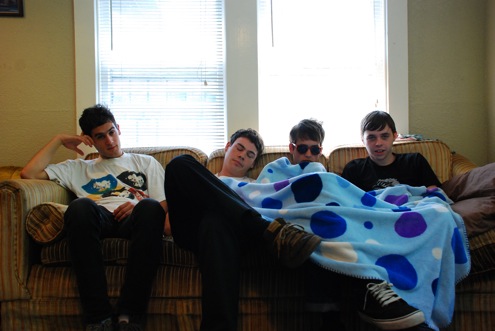
The Strange Boys (playing at the Elbo Room on Sat/27) are as brave and cocky as their music would suggest, an obvious product of the southern state they call home. Hailing from Austin, Texas, their “don’t mess” attitude harmonizes perfectly with wailing garage rock and humid twang. Ryan Sambol’s nasally vocals remind me of a young Bob Dylan and complement the band’s ’60s sound. 

The four Texans started making music together in high school and have since developed a sound easily categorized alongside The Monks, The Seeds, The Black Lips, and San Francisco’s Girls. The tracks off their debut full length, The Strange Boys and Girls Club (In the Red), were recorded at their friend Orville’s house in Denton. They scratch and squeak, transmitted through an AM radio style filter, instructing listeners to throw back a few brews on the porch and let cigarettes burn down to their lips.

The Strange Boys don’t want to be the next hipster trend. They strive to be an outlet for escaping all the horrible shit that surrounds our daily lives: war, a rotting economy, and a twisted government. Standing atop their rusty soap box, the boys demand you stop your bitching and moaning long enough to hear what their guitars have to say.

I was curious about their sources of inspiration. Bassist Philip Sambol was kind enough to scribble down some items from of the member’s current playlists:

1. Abner Jay, various songs on some tapes

2. A mix tape a fan gave Ryan

3. Townes Van Zandt, Live at the Old Quarter, Houston, Texas (Tomato, 1977/ Fat Possum, 2009)

4. John ‘Bloodcut’ Joseph, The Evolution of a Cro Magnon (PUNKHOuse) audiobook

5. It’s Always Sunny in Philadelphia, season four

6. The Savage Love podcast

7. CCR
http://www.youtube.com/watch?v=4R6nmKjcSeU

The Strange Boys
Sat/27, 9 p.m., $10
Elbo Room
647 Valencia, SF.
www.elbo.com

Let’s all read Sand Paper

0

Charmingly disheveled Adobe Books, strung as it is on the alcoholic’s crucifix known as the cross-section of 16th and Valencia, has become a beloved sanctuary for readers, drunkards, and occasionally homeless individuals alike. I always look forward to Adobe Books’ events because you can never predict who among the circus just outside will enter and join the fun. Not many bookstores on this dry earth permit customers to imbibe openly from brown bags of Colt 45 during poetry readings. Adobe Books’ Dickensian squalor places it fondly in my heart even as its floorboards sink beneath the weight of dusty overladen bookshelves — and when the smell of stale beer and, somehow, cats, forces me to breathe through my mouth while I peruse.

On Monday, March 1, Adobe Books will host the San Francisco launch party of three new books from Sand Paper Press. It’ll be worth holding my nose to dive in.

Known for featuring and promoting the works of writers associated with Key West Florida, Sand Paper is not as provincial as it may seem. Key West is like Iowa City in that both localities are marked by a disproportionately high writers-to-population ratio. Elizabeth Bishop, Wallace Stevens, Tennessee Williams, and Earnest Hemingway have all served as pro tem Floridians. This upcoming Monday, books by Stuart Krimko, Shawn Vendor, and Arlo Haskell will be presented and read at Adobe.

Stuart Krimko, currently based in Los Angeles, is the author of The Sweetness of Herbert, a collection of poems loosely inspired by the works of Welsh poet George Herbert (1593-1633). Herbert was remembered for his fancifully monastic poems about the existence of God, and his influence is most evident in lines by Krimko like “(As God in the form of a nauseous wave cast Jonah out.)/ That’s what aggressive living is about.” Readers should note that the collection’s title is intentionally misleading; Herbert’s allusion is tangentially related to a work that is richly imbued with Krimko’s own personality.

Key West poet Arlo Haskell’s collection Joker is lovely. John Ashbery once commented that Haskell’s poems “conjure an ambiance as temperate and welcoming as ocean air.” Ashbery was correct in the sense that Haskell’s poems have a flowing and pellucid quality to them, best seen in phrases like “Imagination is our hard respite/ and the birds in the trees are one of a kind: loneliness./ Our law, like love and lust, is liquid”. However, Haskell’s work is not always temperate nor welcoming; they are frequently political and incisive. Despite Haskell’s aptitude for a pretty turn of phrase, he is not afraid to stir the water. Nor is he apprehensive in revealing what lies beneath.

Along with Haskell and Krimko, young writer Shawn Vandor will also be at Adobe, reading from his collection of stories Fire at the End of the Rainbow.

Sand Paper Press launch party
Mon/1, 7pm, free
Adobe Books
3166 16th Street, SF.
www.myspace.com/adobebooks

Transit activists swarm City Hall

0

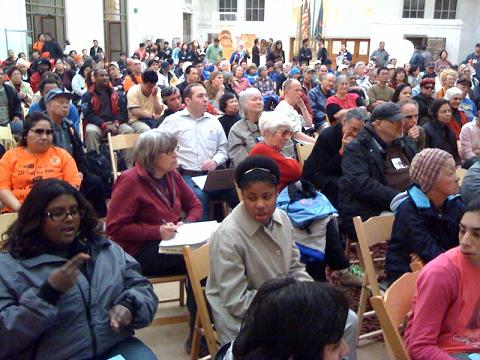
Hundreds of transit supporters, angrily opposed to the package of Muni fare hikes and service cuts proposed to close a $16.9 million mid-year budget deficit, are now packed into City Hall demanding equity and justice.

“I’ve never seen anything like this,” Judson True, spokesperson for the SF Municipal Transportation Agency, told me as he surveyed the huge overflow crowd packed into South Light Court, watching the upstairs budget meeting on closed circuit television. “We should all get on buses and go to Sacramento. It’s clear that grassroots organizing is alive and well in San Francisco.”

It may be true that budget cuts and lack of political will to raise taxes in Sacramento helped cause this problem, but this crowd was angry and they directed most of that ire at the MTA board and the man who appointed them, Mayor Gavin Newsom.

Even True wasn’t spared, as college student Glo Pereira laid into him as we spoke: “I’m a person who doesn’t appreciate this,” she glowered.
That was the dominant mood among the wide coalition of groups represented here today, including a strong presence by communities of color, those with disabilities, and social justice groups.

MTA spokesperson Judson True is confronted by activist Glo Pereira

“You folks should resign! You aren’t doing your job and you haven’t done your job,” activist Bob Planthold told the board. “This is an agency run by one man, Gavin Newsom, in the interests of one man, Gavin Newsom.”

That’s a common theme, one of complete exasperperation, with regular calls to tax the rich and lay off the poor, and for more engaged leadership from the Mayor’s Office.

As I write, there’s still lots of public testimony to go before the board deliberates and votes, so check back to this blog post, which I’ll update periodically.

Update: The MTA board seems to have heeded much the public input, voting 6-1 (with Trustee Cameron Beach in dissent) to remove the increases in Fast Pass fares for youth, senior, and the disabled and to approve the rest of the fare increases, which will increase prices for express buses and cable cars. That package was then approved on a 4-3 (with McCray, Lee, and Beach in dissent, although they didn’t make clear the reason for their votes).

Similarly, another 4-3 vote by the same trustees approved a package of service reductions that total about a 10 percent overall cut, although there was a consensus direction for the board to try to spare cuts on the busiest lines, including 14, 49, 30, 38, M, and the Owl, as well as ensuring nightime cuts are minimized. Overall, the results of the vote weren’t entirely clear and the meeting wasn’t formally adjourned, but instead will be recessed until Tuesday when the board will discuss the larger budget picture going into the next fiscal year.

At that time, the board will consider placing a parcel tax or other new revenues measures on the November ballot, something that seemed to have the support of most board members. In addition, Director Malcom Heinicke today outlined his support for a extended parking meter hours, which he would like to see done as a pilot program along five or six selected commercial corridors on Sundays and on a single commercial corridor on weeknights until 10 p.m. Several board members voiced support for the idea.

While today’s vote didn’t close the $16.9 million deficit that was the purpose of this meeting and the public testimony that went for nearly five hours, MTA executive director Nat Ford noted that “there is some softness” in the revenue picture, including the possibility of getting a $7 million from the Board of Supervisors and using a greater portion of the $17 million windfall that the MTA received after the feds decided to discontinue the Oakland airport connector service on operations rather than maintenance, as staff had proposed. In addition, the MTA board is currently discussing a privatization plan for taxi medallions, which could affect the revenue picture.

I’ll try to help sort this out with another post before day’s end, including more testimony from the occassionally raucous meeting, but it appears that this meeting essentially ended with a “To Be Continued,” and the board will pick up where it left off on Tuesday, when the big new revenue proposals (which Mayor Gavin Newsom has resisted supporting) could be at the very center of the debate.


High on Fire’s latest is divine

0

Wielding his custom-made nine-string axe, churning out tone so thick it could flaunt hot pants in a rap video, and crafting an ever-expanding arsenal of neck-snapping riffage, High on Fire guitarist Matt Pike has done it again.

His playing on the Oakland trio’s new album, Snakes for the Divine (Koch Records), surmounts a new, fiery height. That the things he already did well (effortless, legato hammer-ons, heavy-handed, scything chords) are done better is hardly surprising – it’s the expanding versatility of the snaggle-toothed shredder’s songwriting and technique that impresses, along with his ever-improving vocals. Though Pike’s work in Sleep will inevitably serve as a preamble, it is likely that the virtuosity and creativity of his High on Fire output will reverberate longer, and heavier, in posterity.

The album’s production, courtesy of Slayer knobsman Greg Fidelman, strikes an agreeable balance between Steve Albini’s uncompromising, abrasive work on 2005’s Blessed Black Wings (Relapse Records) and the enveloping warmth of Jack Endino’s Death Is This Communion (Relapse, 2007). Fidelman’s task is made easier by the fact that High on Fire are a power trio that sounds like a power octet. Nevertheless, he replicates the commendable work he did on Slayer’s World Painted Blood (American/Sony, 2009), wringing vast, organic-sounding potency out of the drums and amplifiers without sacrificing instrument separation.

Bassist Jeff Matz deserves plaudits for his reverberant, foundation-shaking appearance in a supporting role, anchoring crucial chord progressions and driving thunderous grooves as Pike ascends into the sativa stratosphere. One-guitar bands often lose momentum during leads and solos, and the fact that High on Fire never does is a testament to Matz’s quality, along with that of drummer Des Kensel. One of the hardest hitters in the business, Kensel’s truncheon-like approach is complimented by the exorbitant circumferences of his cymbals and toms. He and Pike have long enjoyed a striking musical understanding, exemplified by the lockstep concordance of the former’s riffs and the latter’s barbells-in-the-dryer tom runs, and the connection has rarely born riper fruit than the meter-bending wallops of album’s title track, along with the drummer’s effortless shifts into double-bass driven double-time later in the song.

Following immediately after the eponymous opening salvo, lead single “Frost Hammer” kicks off with cascading drums before settling into a propulsive, downbeat-heavy groove, delivering an arena-ready shout of “frost ham-mer!” at a number of key junctures. “Bastard Samurai” starts as a doomy, meditative plod before erupting into strident, lost-face anguish during the choruses, and is soon followed by reckless, frantic thrash of “Ghost Neck.”

Closing track “Holy Flames of the Firespitter” begins with a riff that hearkens back to the band’s previous albums, reminding old-school fans that even as High on Fire evolves, they remain relentlessly true to their hard-scrabble roots. Don’t expect them to be changed by a new label, a big-name producer, or last year’s arena tour — they’re a band that eats Motorhead, drinks Sabbath, and bleeds Slayer, and Snakes for the Divine proves that they are at the absolute pinnacle of their game.

So long, Bryant Park: SF students show at Fashion Week’s last season in the tents

0

As the New York fashion world flicked a sassy over-the-shoulder wave and bid its Bryant Park home goodbye — Fashion Week will move to Lincoln Center starting next season — six students from San Francisco’s Academy of Art University fretted and beamed as their projects took the stage before the eyes of famed industry professionals.

For the past five years, AAU has been showing select student’s work during New York Fashion week, to give promising graduates exposure and to lure new students out to the Bay Area. Bethany Meuleners’ story is a case in point: three and a half years ago, she secured a seat as a prospective featured student, sat in the audience, and dreamed of seeing her own designs on the runway. Serendipitously, she graduated just in time to have her goal realized. “I can’t believe I’m here! In Bryant Park!” Meuleners told me before the show. “It’s such an iconic thing.”

It’s difficult to piece together a coherent narrative from the collections of six individual designers, but this season seemed to play a gothic darkness (three of the students’ offerings were almost entirely black) off a theme best summed up as “monochrome time traveler.”


The most captivating and curious of the black camp was the work of Sabah Husain, which seamlessly distilled the glitz and glitter of India into wearable yet sophisticate outerwear. Husain brought the cut glass of a chandelier that had dazzled her back to her native India to be replicated into gemstones that she sewed into her designs — long felted jackets dripping with jewels, coats fit for a king. “This was my journey of moving from one aesthetic to another,” explained Husain. “In India, garments are largely draped, while in Western culture, they are all constructed.” Hopefully her cultural fusion will continue on in future garment construction.

Meuleners’ designs went for disassembled gothic, characterized by dark metallic bodysuits, lace dresses, and worn combat boots. Haphazard additions in flowing black silk chiffon created a perfect wardrobe for a sparkly vampire. It is a strange reality from a vision of an innocent child’s game. “I like having a story in mind when I design,” she said. “This was about a little girl playing dress up in her mom’s closet, throwing on clothes.” Meuleners mentioned that she used to shop her own mother’s closet for formals… the mother of this collections’ closet may need to have her fangs filed.

A departure from the shimmer and shine were the sculpted knits of Steven Oo. Creaturesque sweaters gave girls stegosaurus spines, and coned details on shoulders scratched towards wearer’s necks. Oo’s commanding demeanor (crucial for survival in the fashion world) may serve him better than his diligence or technical experimentation. Calm and collected backstage, he stood with a tie purposefully undone over a printed t-shirt, waving a lint roller over garments as he talked. “I was most worried about fitting with the new models,” Oo admitted. “But the knits treated me well.” Each piece took 40 to 60 hours of hand- and machine-knitting to create.

The work of the other students was a spray of light colors — whites, grays, and tans — on a trip: up to space, out on safari, and into the past.

The standout collection among the students consited of the six sculptural, cosmically conceptual looks that sweet and quiet Hyo Sun An sent out. Ornately fringed jumpsuits constructed from one continuous piece of fabric brilliantly transposed form over figure. An was searching through a science magazine for inspiration. Intrigued by the concepts of the Mobius strip and Klein bottle, An chose wool and jersey in gorgeous and complex gray tones to explore fluidity in fashion.

Lady Grace met desert expedition with Marina Solomatnikova’s sand suede suits. “I wanted to play between masculine and feminine,” she said after the show, still shaking with exhilaration. Masculine elements were present in heavy tailoring and femininity shown through in organza ruffles and deeply cut backs, resulting in six outfits that would be perfect for a duchess on an African safari.

Naomi Sutton, with an easy laugh that kept her blond hair shifting over her delicate shoulders, recounted her numerous trips to Bay Area vintage stores and fabric remnant warehouses to find the white and cream velvets and laces she printed with delightful images of chubby children playing, based on of her childhood memories. Traipsing down the runway, models became enchanted sleepwalkers dressed in ghosty gauzes. Aprons and silky ribbons gave a sense of nostalgia. Stepping into Sutton’s dresses is stepping into a whimsical past.

The six students are all back in San Francisco, frequenting their favorite inspiration spots — city beaches, Union Square — while the current class has its eyes locked on Lincoln Center and next season.

Come flash the friendly skies

0

I was bopping my way out to the East Coast yesterday when I had to pass through a telephone booth that could see through my clothing. It wasn’t as fun as it sounds.

Apparently the scare over the Christmas Day plane bombing attempt has wrought some interesting technological developments in SFO. Namely, the implementation of the millimeter wave scan machine, which allows Homeland Security employees to see through your clothes in order to make sure you’re not carrying any shoe bombs, rifles, letter openers, etc. We’ve made the decision that we Americans must be perved on for our own safety. Even the Pope will tell you that’s a bad idea!

What’s up with these things? The machines, which are now being used in 19 US airports, rely on “millimeter wave radio frequency energy in the advanced imaging spectrum [beamed] over the body’s surface at high speed from two antennas simultaneously as they rotate around the body,” according to the TSA website. They create a detailed, three dimensional image of you in your birthday suit.

Here’s a sample scan, posted on the TSA blog by a genial chap named Bob, who cheerfully ventures “Mikhail Baryshnikov may have exposed more in his ballet costume than these robotic images portray.”


My, what lovely testicles that Mikhail has. First of all, I find it strange that X ray machines can differentiate between outer clothing (penetrate!) and undergarments (stay outside of panties!). But leaving that aside, Bob- what of us that free ball, what of us that wear no such sensible bra tops as those shown in above scans? What of the hippies, Bob, what of them?


Here’s what- nips away! This is not the shot that greets you on the explicatory placard in the SFO security line, by the way. And though TSA is quick to shove USA Today polls that prove it’s all okay in your face and remind you that the officers who view the scans do so from a remote location with people’s faces blanked out, those assurances are not winning over Islamic leaders (who have forbidden Muslims to violate their privacy with the machines) or good old Benedict XVI, who, although cognizant of the fact airport security is a fuckin’ head scratcher, insists “it is essential never to lose sight of respect for the primacy of the person.” I feel ya Benny- if we lose our right to go commando, doesn’t that mean the terrorists have won?

Going Rogue

0

By Robyn Johnson

The second decade of the millennium has ushered in some upheavals, and whether they’re for the better or worse it’s hard to say. Tea Partiers are the new Republicans. Doughnuts are the new cupcakes. And now, beer is the new wine.

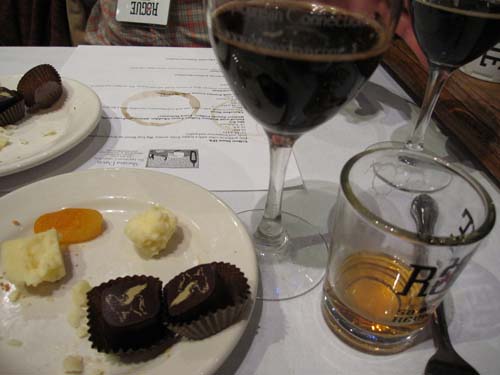
I recently attended the increasingly popular SF Beer Week, specifically the “A Taste of the Rogue Nation” event at the Rogue Ale Pub House, featuring a delightful cornucopia of their popular brews. Beer sommelier Sheana Davis of the Epicurean Connection elevated the status of the tasting from a mere beer bust to a frou-frou gourmet gathering with her artfully chosen pairings of artisan cheeses and chocolates. Although a little under a dozen samples were served, the following are the highlights — and what I could mostly remember to take notes on after several drinks. (Like true beer badasses, we did not expectorate.)
The tasting started off with Dirtoir Black Lager. Obsidian in color, it looked like coffee, it smelled like coffee, and it tasted like… coffee-ish beer: dark, roasted, and bitter. It was tasty in itself, but the lager became quite a treat when paired with the sampling of Rouge de Noir Le Petit Dejeuner—a sweet, creamy cheese with a white rind covered in penicillium fungi. Our lovely hostess Sheana told us it was mostly eaten as a morning cheese, which partially explained how well it complemented a coffee-like lager.

The Morimoto Soba Ale was also interesting, at least conceptually. A collaboration between Rogue and Chef Masaharu Morimoto (of Iron Chef fame), the specialty grain ale makes use of buckwheat—the same grain used for the flour of soba noodles. The taste was reminiscent of my favorite cheap beer, Asahi (Don’t kill me, beer aficionados, or Chef Morimoto.) In other words, it was refreshing, crisp, light, and on the dry side. I had a hard time placing the buckwheat nuttiness, though.

Not originally included in our tasting menu, John John Dead Guy Ale snuck in as an additional round. Another collaborative product, it’s comprised of Dead Guy Ale (creative contribution of Rogue Brewmaster John Maier) that has been aged in the leftover barrels of Dead Guy Whiskey (Rogue Spirits Master Distiller John Couchot’s input in the unholy scheme). It was delicate and sweet with the oaky notes of whiskey. To give us a basis of comparison, Double Dead Guy Ale was served immediately afterwards; with twice the normal amount of ingredients, it’s also twice as alcoholic. More bitter and less carbonated, it had a ghost of a caramel flavor.

 
While I did not care for the next round of Yellow Snow IPA, the immediate and bold hop flavor really assaulted my palate (for you hopheads, though, this beer’s for you), it’s worth mentioning because the cheese pairing was manna from heaven. Aged for 8 years, Widmer Cellar’s special cheddar actually develops crystals of condensed cheese, which adds a fun consistency to the concentrated, tangy flavor. It’s really the Übermensch of cheddar.

Finishing as the appropriate crescendo to the evening with rich, deep flavors, the Russian Imperial Stout, paired with Sheana’s espresso cookies, conjured up leather and smoke and the flashing eyes of Ivan the Great as he took to the battlefield against the advancing Mongol horde: earthy and full. I have to point out that at this point my intoxication level was at its peak, perhaps affecting my judgment. But the beer and its pairing were good in the way that dark, strong, and chocolatey foods are good.

All in all, my first foray into the complexities of beer and its relationship to food was edifying, especially in the case of the delicious synergism between the Dirtoir Black Lager and Rouge de Noir Le Petit Dejeuner. The conclusion? A pint glass can replace my wine glass any time.

Rogue Ales Public House

673 Union, SF

(415) 362-7880

www.rogue.com

How the UC regents avoided a PR mess with Bill Clinton

0

Things were calm and peaceful outside San Francisco’s Fairmont Hotel, perched high atop a windy hill on Mason Street, as dark shiny vehicles rolled up to the stately entrance and well-dressed patrons filed in on the evening of Feb. 24. They were there to hear former President Bill Clinton deliver a speech titled “Don’t Stop Thinking About Tomorrow: Building a Better World,” as a benefit for the American Himalayan Foundation. The AHF is chaired by Richard Blum, a member of the University of California Board of Regents who is married to Sen. Diane Feinstein.

As guests arrived, a small group of workers tried to thrust neon green fliers into their hands. The fliers were headlined, “Tell Richard Blum to Stop Poverty at UC!” and charged that the UC Regents had approved a package of raises for UC executives on Jan. 21 even as front-line UC workers faced layoffs and cuts. The stack of Xeroxed fliers was a mere blip compared with what AFSCME Local 3299, the union that represents workers throughout the University of California system, had originally planned.

The union had organized a picket against Blum’s AHF event, which would have forced Clinton to cross a picket line in order to go in. Not only would this have created an unwanted spectacle, it could have marred the entire event. As AFSCME Local 3299 member Tim Thrush put it, “Bill Clinton is a friend of labor. AFSCME has worked with him a lot in the past … And Clinton will not cross the picket line.”

UC workers have been reeling in the face of massive layoffs and budget cuts. While the university administration contends that there is little it can do in the face of a decimated state budget, union workers point to examples of privatization on the UC campus as an alarming trend that is supplanting public-sector jobs and eroding California’s renowned public-education system.

AFSCME Local 3299 laid out three demands, according to organizer Danielle DiSilverio. While two — involving benefits for custodians at the Irvine campus and concerns about “reductions in time” at the Santa Cruz and San Diego campuses — have not been met, they did secure an agreement to abandon a plan to contract out jobs for shuttle drivers at UC Berkeley. Since the UC Berkeley shuttle drivers would be able to keep their jobs, Local 3299 called off the picket.

“We would prefer to not have to do this kind of stuff,” Thrush told the Guardian. “But unfortunately, in the world that Dick Blum operates in, we can’t get his attention unless we do stuff like this. As he works hard on poverty issues and gives money and time to poverty issues, he also makes decisions at UC that further the poverty problem of our lowest-paid workers. We want to keep reminding him that it’s not OK to do that.”

Who cares about San Francisco’s (black and brown) prisoners?

0

I knew Sup. Chris Daly was going to get slammed for his Feb. 23 vote against placing a $412 million earthquake-safety bond measure on the June ballot. I knew it when I heard him say the following: ”I care more about the people at the jail, the people who are there involuntarily, if we have a seismic incident, then I do about the rest of the people at 850 Bryant.”

Daly noted that he would have supported the bond package if it included money for new lockups, as was originally proposed.

‘What about the people in the jails?” Daly asked. “These are San Franciscans, my constituents, folks who are disproportionately people of color, folks who are disproportionately low-income and have been caught up in the criminal justice system.”

What I later discovered  was that several key figures in the local prison reform movement, including Dorsey Nunn of Legal Services for Prisoners with Children and Rhodessa Jones of the Medea Project, a visionary theater model for incarcerated women, were sitting in the Chambers, awaiting commendations as part of the city’s ongoing Black History Month celebrations.

Later that same afternoon, Sup Ross Mirkarimi honored Jones (left) and Idris Ackamoor (right) for their work with Cultural Oddysey. And afterwards, I caught up with Jones by phone to see what she thought of the plan not to rebuild the jails on Bryant Street , a decision apparently made to reduce the price of the city’s proposed seismic safety charter amendment by $250 million.

Jones, who conducted a residency at San Francisco county jail that resulted in the Medea Project, told me that these kind of inequitable decisions illustrate why she got motivated to do work inside jail, in the first place.

“When we walk into the jail, we try to educated the prisoners that they have no rights and no safety,” Jones said. “We are trying to find ways to infuse their lives with the political reality and end recidivism.”

She also noted that she has not been able to take the Medea Project inside the local jail because it’s gotten so crowded.

But last time she was there, the women were primarily black and brown and, according to Jones, “they are the fastest growing number inside.”

Jones, who is currently working on the issue of reparations and “how the prison-industrial complex looks so much like slavery,”  told me that in the 20 years since she began the Medea project, she’s learned that figuring out the questions around any issue is central to understanding it.

“So, are these folks not human beings as well? How do we transform the humanity? And what would Christ do? A lot of people don’t have any connection with an issue until it’s sitting at their dinner table,” Jones said.

Meanwhile, the Board also honored a dozen other local African American leaders,

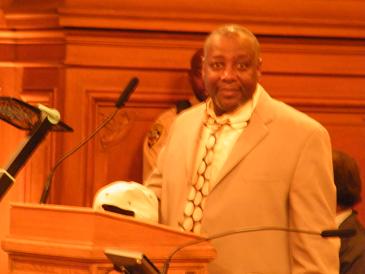
These honorees included Brian Gadsden (at the podium) and Herve Ernes

Sup. Carmen Chu recognized Kenyatta Scott of Abraham Lincoln High School (in red at the podium.


Sup. Ross Mirkarimi recognized Don Lacey (KPOO FM) and Marcus Books.

Sup. Daly recognized Bobby Bogan (at the podium below) of Seniors Organizing Seniors.

Sup. Sean Elsbernd recognized Courtney Johnson Clenendin, and Sup. Bevan Dufty recognized John Weber (see below); emperor of the Imperial Court

Sup. David Campos recognized Karen Huggins (at the podium) for her work with residents of San Francisco Housing Authority properties, describing her as a “force of nature.”

Sup. Sophie Maxwell, whose district is the subject of our cover story recognized Emily Wade-Thompson (at podium below), George Wahington Elementary School principal.

Supervisor Avalos recognized Joseph Lambert and Elba Clemente-Lambert, (both at podium below) who run the Creative Music Emporium.

“We are the last remaining African American owned store in San Francisco, and the only independent music store south of Cesar Chavez,” the Lamberts said.

On the way out of the press box, I couldn’t help photographing  this cutting in a file compiled by local African American videographer and blogger Ace Washington, who is passionately concerned about the ongoing exodus of San Francisco’s already dwindling black population. 

Anyone want to hazard a guess what the 2010 census is going to reveal? (Here’s a clue: it’s doubtless less than it was ten years ago).

Meanwhile, I’ll leave you with this video clip of Bobby Bogan talking about how he used to be in a gang and recruit for the gang, but is now working for and with seniors, one of other most vulnerable populations in town besides blacks, children, folks with disabilities and, you guessed it, prisoners of color. 


No pixels, please — we’re plastic

0

Film and prints, like dinosaur bones and fossilized treasures, seem like ancient artifacts blown to the wayside in our digital age. We lost the mystery in photography when we introduced the point and shoot, erasing not only the physical labor but the ugly smiles, blinky eyes, and embarrassing angles. Where are the mistakes? The light leaks and fuzz on the lens? They’re making a comeback.

Obscure, eerie, and beautifully whimsical images galore will be on display starting Fri/26  at the RayKo Photo Center, as part of the third annual Plastic Camera Show.

More than 100 images from Bay Area artists, national and international photographers will have you yearning to get out there, grind that advance gear, and capture a local critter with some old fashion film.

A fascination with old school cameras is growing, with updated versions of the Diana and Holga plastic models showing up at Urban Outfitters and antique versions trading online faster than they can click. A backlash to our digital photo machines, it’s invigorating to see a picture lacking today’s high standards of “perfection”, allowing the camera to steer and our imagination to follow.

Cloudy, out of focus bridges and water towers clash and mingle with oddly colored figures and landscapes. Advanced photographer and amateurs alike can find success with the plastic gadgets, yielding photos with a quality unlike any produced by the futuristic models.

The work of Czech artist, Michael Borek, will be highlighted in the exhibit, shots of hot air balloons (see above) and lazy summer days harnessing the Holga’s unpredictability with gorgeous light leaks and inspiring angles.

RayKo’s 3rd Annual Plastic Camera Show
Fri/26-April 17 (Opening reception 6-9pm)
RayKo Photo Center
428 Third St., SF
www.raykophoto.com

“Gonna Find Boyfriends Today” — Myles Cooper USA

0

What’s as inspiring as Myles Cooper‘s 2010 anthem “Gonna Find Boyfriends Today”? The video for “Gonna Find Boyfriends Today,” directed by another San Francisco talent, Skye Thorstenson. It’s true. SF is home to singing strawberries, dancing cupcakes, Mr. Peanuts, cherubic choirs, floating hearts and flaming hearts. Find yourself a cutie and watch it.

Brother Theodore hallucinates on tap water

0

In honor of the Brother Theodore documentary screening tonite (Thu/25) at Yerba Buena Center for the Arts, the time is ripe — as ripe as rancid pork — to dig into a YouTube treasure trove. The trove contains clips of Theodore on Late Night With David Letterman. Here’s my fave. Remember: One shouldn’t try to sell roses at a fish market.

http://www.youtube.com/watch?v=jzX84SXvFt4

http://www.youtube.com/watch?v=t01hnYVOrrw

Ethics for political consultants?

1

I got an email from Garry South today. He’s the guy who used to run Gavin Newsom’s campaign for governor. Now he’s turned on his previous client. And he’s sent out a message to political reporters explaining why Newsom — the guy he was pushing for governor of California — is actually a worthless hack.


Here’s the mail:


STATEMENT BY GARRY SOUTH


CHIEF STRATEGIST, JANICE HAHN FOR LT. GOVERNOR


FORMER SENIOR ADVISOR, GAVIN NEWSOM FOR GOVERNOR


I am surprised and perplexed that my friend and former client Mayor Gavin Newsom apparently has decided to jump into the lieutenant governor’s race at the last minute – especially against an already-announced candidate who would be the first woman lieutenant governor in California history.


In every one of several conversations we had about the job while he was running for governor, the Mayor expressed nothing but disinterest in and disdain for the office of lieutenant governor. In fact, he was derisively dismissive of Gray Davis’s decision to run for and serve as lieutenant governor prior to running for governor (“I’m not a Gray Davis,” he said). On a couple of occasions, he directed me to repudiate publicly in the strongest terms that he had any interest in ever running for lieutenant governor.


The Mayor himself told the Chronicle in October that rumors he may run for lieutenant governor were “absurd” and “a complete lie,” and angrily accused Jerry Brown of personally spreading false information to that effect. As recently as December, he himself said flatly “no” when asked directly on a San Francisco radio show whether he intended to run for lieutenant governor.


In addition, when he precipitously pulled out of the governor’s race in late October – against my advice – he said he couldn’t continue as a statewide candidate because he was a husband, a new father and the mayor of San Francisco. So far as I know, he’s still a husband, a new father and the mayor of San Francisco. So it’s pretty hard to see what’s changed over the last four months that would now allow him to run for another statewide office.


If the Mayor does run, it is his responsibility to explain why he now claims to want an elected office he summarily dismissed publicly numerous times over the last several months, and which just earlier this year he called “a largely ceremonial post” … “with no real authority and no real portfolio.”


Now, if Garry South were an attorney, I think he could be disbarred for that statement. Lawyers can’t discuss anything that transpired between them and their ckients.And it sounds to me like he’s taking confidential conversations between himself and his client — talks that occured during campaign strategy sessions — and passing them along to the world.


But since political consultants have no regulations, nothing will happen to him.


Now, there is a code of ethics of the American Association of Political Consultants, which you can read here. It says, in part:


  • I will treat my colleagues and clients with respect and never intentionally injure their professional or personal reputations.

  • I will respect the confidence of my clients and not reveal confidential or privileged information obtained during our professional relationship.

  • Of course, the AAPC is just a trade group, with no enforcement. (Just as journalism codes of ethics are not enforceable by anyone.) But if you ask me, it’s a little slimy.


    Muni cuts spark popular backlash

    2

    Tomorrow’s big showdown over the latest round of Muni service cuts and fare hikes seems to be galvanizing transit supporters and giving birth to a rejuvenated progressive advocacy effort, including a new transit riders union led by noted alternative transportation advocate Dave Snyder. And that hearing is just a prelude to a taxi medallion privatization plan that will be heard in the afternoon and another big Muni budget blowout on Tuesday.

    “We are asking everyone to show up and complain about the mayor and the MTA board’s failure to prepare for this and find alternatives to the drastic cuts they’re proposing,” Snyder told us, referring to the San Francisco Municipal Transportation Agency’s plans to close a $16.9 million mid-year budget deficit (which is what’s left after the $11 million from the taxi permit selloff, which the MTA has already figured into the budget) almost entirely on the backs of Muni riders, who have already seen their fares double since Gavin Newsom became mayor in 2004.

    The hearing is Friday at 9 a.m. in City Hall Room 400. That afternoon, Snyder will meet with a broad-based advisory board that he’s assembled to lead (and to name) the new transit riders union that he’s been working on for months, and his tentative plan is to formally launch it on Monday.

    For now, those interested in being part of this fledgling organization can sign up here. The new organization is being launched as the MTA board moves from tomorrow’s controversial meeting into another one on Tuesday, that one to start grappling with the huge budget deficit the agency will still face in the next fiscal year that begins in June, even if it’s successful in closing this year’s.  

    Snyder is probably just the right person to lead this effort, having directed the San Francisco Bicycle Coalition in its formative years before founding Transportation for a Livable City (now known as Livable City) and then becoming the transportation policy director for the San Francisco Planning and Urban Research Association (SPUR), a post he left last year during a controversy surrounding Snyder’s appointment to the Golden Gate Bridge, Highway, and Transportation District Board of Directors. 

    Snyder said Newsom and the MTA board have failed to plan for this foreseeable funding shortfall, saying they should have accelerated plans for extended parking meter hours (particularly ending the free parking on Sundays), a congestion pricing program, a local vehicle license fee, or measures like a gas tax, transit assessment fee, or a parcel tax – all of which the MTA board and mayor could have placed on the ballot for voter approval. Instead, they did nothing and are now pursuing a 10 percent reduction in Muni service, which could start a disastrous downward spiral.

    “They need a stable, long-term funding source,” Snyder told us. “The charter actually says they’re supposed to aggressively seek new sources of funding.”

    MTA spokesperson Judson True said that neither tax increases nor extended parking meter hours among the proposed solutions for Friday’s discussion, but they’re likely to be raised as part of a longer term strategy during the meeting on Tuesday: “It’s likely that the various tax measures will be part of that discussion.”

    That could include reviving the extended parking meter hours proposal, which the MTA board heard last year during a rancorous public meeting, directing staff to do more community outreach on it. As True said, “We did a fair amount of outreach on it so we’ll see where the discussion goes on the two-year budget.”

    Snyder is hardly alone in his local advocacy for budget solutions that spare Muni from deep cuts. In fact, the Transit Not Traffic coalition that successfully pushed the 2007 MTA reform measure Prop. A – which includes the Bike Coalition, Livable City, Walk SF, and other progressive groups – has revived itself in advance of tomorrow’s meeting and will be flying outside City Hall starting at 8:30 a.m.

    There is broad support on the left for seeking more funding from drivers and the general public, but it’s not unanimous. The anti-war ANSWER Coalition frustrated many of its usual progressive allies last year by organizing against extended meter hours, claiming it was a hidden tax of low-income motorists. And Newsom has stubbornly resisted supporting new revenue measures, even in the face of unprecedented budget shortfalls, which makes the quest to win the support of two-thirds of voters difficult.

    But the popular outrage that’s been expressed in recent weeks about how much Muni has been cut, year after year since Newsom became mayor, will likely put pressure on him and the MTA board (all of whom Newsom appointed) to pursue new revenue options.

    True sounded weary as we spoke, noting how much anger has been expressed at the recent series of town hall meetings. “We know where people stand on these proposals,” True said. “The board is going to have some tough decisions to make, clearly.”

    Kevin Killian’s sex is unpretty

    4

    IMPOSSIBLE PRINCESS

    By Kevin Killian

    (City Lights)

    Author Kevin Killian’s relationship to sex is too complicated to be pinpointed as merely “homoerotic,” but homoerotic encounters are a frequent occurrence throughout the stories in Impossible Princess, Killian’s latest collection of gay short fiction.

    Killian’s stories are full of nervous energy. The pace of his writing is jerky and striated, and events change and adjust so suddenly that Killian’s words read as if short of breath. The panting quality of the work is, in terms of form, utilized most effectively in the writer’s vivid and ominously perceptive descriptions of sex. These sexual encounters are often baffling.

    In this sense, the sex described Impossible Princess feels accurate. Sexuality and sexual preferences continually evade our attempts at designation, both in fiction and in life. Killian toys with this idea of fundamental strangeness. In “Spurt,” lighthearted S&M suddenly turns into gore. In “Zoo Story,” an ailurophile finds himself mauled by panthers. When they are realized, Killian’s stories seem to argue, sexual fantasies can be experienced in ways both nightmarish and sublime.

    While some of these stories seem fantastical, others are rooted in worldly experience. The sex Killian is so adept at describing also seems, for all its exuberance of libido, deeply and humanly sad. “Hot Lights,” which I first heard Killian read at an “autobiography-themed” Small Press Traffic event at Canessa Gallery last fall, is the tale of a young student (purportedly Killian during his Lower Manhattan days) turned porn performer who develops an infatuation with another porn performer, only to be outright rejected later on in the story. “Making Waves,” told from the perspective of an aging and washed-up former pop star, recounts the successful seduction of a young virgin that, unfortunately for the male ingenue, revealed a broken condom.

    As we surely recognize, this sense of alienation is accurate to human experience. In its most honest portrayal, even sex that is shared between two (or more) people can feel unfathomably lonely. Just as sex can bring people together, it has the power to isolate us even further. Sex frequently severs us from our tenuous hold on an other as well as our all too malleable perception of ourselves, a point which Killian’s stories drive home. Sex is fluid. It is a current whose pace and destination cannot be mapped or predicted. When it comes to unpretty and unsentimental sex shed of the layers of accumulated euphemism, Killian doles it out in spades whether readers are prepared for it or not.

    Snap Sounds: ApSci

    0

    APSCI

    Best Crisis Ever

    (Quannum Projects)

    Kudos go out for the NYC-Australian ApSci for not so much keeping it real but plenty surreal. The hip-hop-electro duo takes it further out on their second Quannum full-length — and into a motor-mouthed, frantic future.

    Collaborators Dana Diaz-Tutaan amd Raphael LaMotta dive into spastic wavo bop (“Under Control,” “Cubic Zirconia”), Lady Gaga-esque pop (“Crazy Crazy Insane,” “Let’s RIP the Town Up”), and broody raps (“Afford Me This Poetry”), with a brief sidetrip(-hop) to old-school REM (“Swan Swan H”). The overall effect equals banging fun, while retaining a palpable sense of the personal. And long may the drama continue at Camp ApSci.

    SF officials tap corporate cash

    2

    San Francisco’s $500 campaign contribution limit makes it tough for rich individuals and corporations to curry favor with local politicians, right? Well, not really. Actually, politicians can still tap wealthy interests for tens of thousands of dollars for their special events and pet projects, as long as they fill out a form called “Payments Made at the Behest of an Elected Officer” within 30 days.

    Traditionally, those forms have been buried in the files of the Ethics Commission, but the agency recently put them online, a rare bit of user-friendly sunshine from this often-toothless watchdog body. A Guardian review of the forms shows it is almost exclusively the city’s most fiscally conservative elected officials who use this tactic, tapping a relatively small pool of downtown power brokers.

    When Sup. Michela Alioto-Pier wanted to support a Bizworld Foundation event in December, she had Pacific Gas & Electric donate $5,000 on her behalf. Sup. Sean Elsbernd throws a big annual crab-feed fundraiser in February, with proceeds going to the Laguna Honda Foundation. The form for this year’s event isn’t in yet, but last year he got $5,000 each from all the top anti-progressive funders: Don Fisher, Dede Wilsey, Charles Schwab, Warren Hellman, Platinum Advisors, and the San Francisco Association of Realtors.

    But far and away the biggest beneficiary of these kinds of corporate donations is Mayor Gavin Newsom, who submitted more than half the forms on file. For last year’s Sunday Streets events, he tapped the Hellman family for $30,000, Blue Shield for $10,000, his favorite developer Lennar for $10,000, and Lennar subcontractor CH2M Hill for $5,000. The year before, the top Sunday Streets donors (at $20,000 each) were California Pacific Medical Center (which is seeking city approval to build two new hospitals) and Catholic Healthcare West.

    For his swearing-in events in 2008, Newsom tapped old family friends Gordon and Ann Getty for $30,000, the Fisher family for $20,000, and Charles Schwab, Dede Wilsey, and Marc Benioff for $15,000 each. And, of course, PG&E gave him $10,000.

    When Treasurer Jose Cisneros was starting his Bank on San Francisco program in 2008, he had Wells Fargo donate $20,000. When Sup. Bevan Dufty wanted to create Mission High School scholarships in his name, he called his friends Denise and John York, owners of the 49ers, to cut a check for $19,000.

    Only one official from the progressive side of the local political spectrum turned to these big donations for help, and that was then-Sup. Aaron Peskin in 2007, when he wanted to raise $84,000 to buy a Telegraph Hill property to turn into open space. His top donors were the Gerson Bakar Foundation for $34,000 and 1301 Sansome LLC for $15,000.

    So if you want to find out how downtown corporations are supporting the politicians they favor, keep your eye on this valuable new online resource.