SFBG Blogs

ICE postpones deporting SF MUNI worker’s family

2

I just got a call from US Immigration and Customs Enforcement advising me that ICE has decided to postpone deporting the wife and son of MUNI bus driver Charles Washington for 60 days.

“We’re hoping that postponing their removal will afford them the opportunity to get their affairs in order and address outstanding legal issues,” ICE spokesperson VIrginia Kice told me. Kice said this extension should give the family time to deal with their “pending adjustment application,” and determine “whether they have the opportunity to gain legal status.”

That’s great news for the Washingtons and another sign that may be hope, after all. (Angela Chan, staff attorney for the Asian Law Caucus, is now trying to get ICE to give the family 6 months, since this is how long US Citizenship and Immigration Service (US CIS) has told her it would take for them to process the Washingtons’ green card applications, and hopefully all the federal agencies involved are going to coordinate their efforts on this case.)

Meanwhile, Sup. David Campos is still trying to get the Juvenile Probation Department to implement his amendment to the sanctuary ordinance to stop nightmares like this from happening. Campos has scheduled a hearing at 10 a.m., Thursday March 4. So, stay tuned.

DC’s Newseum is a real headliner

0

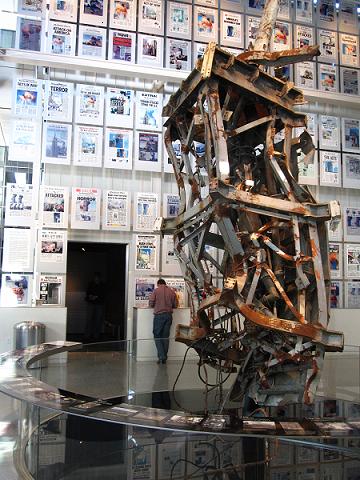
It’s a lot to take in for a cub reporter. Seven stories of news. 250,000 square feet of news. Just down the street from our country’s Capitol Building, the Newseum is probably the most comprehensive, evocative look at the power and responsibility of the journalist under one roof that our country has yet produced.

What’s so impressive about the museum? Put simply, breadth and depth. Today’s front pages from around the US and world greet you to the museum. Inside, you journey through a carefully sculpted continuum of information and artifacts.

First up, media coverage of events that changed the course of our country- beginning with the manhunt for Lincoln’s killer and continuing through instances of incisive reporting (the role that news played in broadcasting the civil rights movement) to dark moments (a memorial to reporters who’ve died in the line of duty, threats to our Bill of Rights over the years).

There were even shades of grey- best embodied in the interactive “What Would You Do?” ethics game, which lets you weigh in on real world moral dilemmas that professional journalists face. I’m totally one of those, so I thought it would be a snap. But there were no easy answers. When it came to the iconic photo of an emaciated Sudanese baby crawling away from a vulture, a heartbreaking image that nonetheless has raised awareness of the plight of refugees the world over, I had to admit I would have swooped in to help, scattered the scavenger, before setting up the shot. So would 72 percent of the general public- but only 28 percent of the professional journalists surveyed agreed with me. The photographer who snapped the shot, Kevin Carter, won a Pulitzer Prize for his efforts- but committed suicide soon after.

Again, the responsibility of the press, a lot to take in for the young pup. But a great museum, and one that, regardless of your profession, will make you feel something.

Graffiti covered pieces of the Berlin Wall are another of the Newseum’s highlights. This was the easiest museum ever to take photos in- freedom of the press, baby!

Sections of the lunch counter that figured in the Greensboro, North Carolina civil rights sit-ins are accompanied by a news reel on the movement

Daniel Pearl’s passport and laptop, testament to the risk journalists run to inform the world of it’s most dangerous conflicts

Not the place where you want to be right before closing, when the Newseum has all but emptied out… Ted Kaczynski’s Unabomber cabin is part of the “G-Men and Spies” temporary exhibit


555 Pennsylvania, Washington D.C.

Open: 9 a.m.- 5 p.m., $19.95

(888) 639-7386

www.newseum.org

MTA board ponders bad options

2

By Adam Lesser

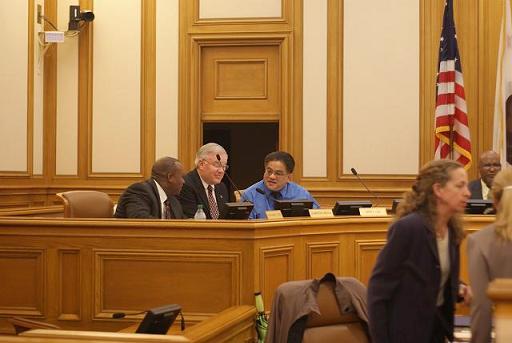
If Friday’s San Francisco Municipal Transportation Agency decision to cut Muni service by 10 percent was met with a backlash, it didn’t get much better this afternoon as MTA Chief Financial Officer Sonali Bose laid out further options for closing next fiscal year’s $56.4 million projected budget deficit.

One option that was very unpopular but potentially lucrative is the possibility of eliminating transfers. That’s right. Going from the Sunset to North Beach, and need to transfer from the N to the 8X? You’ll be paying twice if the MTA Board of directors goes with this option. It would generate $20.4 million to help close the budget gap.

Other proposed changes included a consolidation of transit stops in the system, charging for metered street parking on Sundays, extending meter hours into the evenings, a reduction in work orders requiring payments to other city departments, window wrapping advertising on MTA buses, and dedicated tax measures that would raise additional funding for Muni.

A further 5 percent service reduction was also not ruled out, though CEO Nathaniel Ford suggested that Bose remove it as part of the list of solutions to the budget crunch. For every 5 percent reduction in service, the MTA saves $7.2 million.

Ford tried to strike a conciliatory tone. “Last Friday was a very difficult day. People were understandably upset,” he said. “We must recognize we can only deliver the services we can afford. Going forward our choices are going to get that much more difficult.”

The criticism of the MTA Board was diverse. Tom Radulovich, Executive Director of Livable City, questioned the future of the board. “I think there’s a very good chance the MTA in it current form won’t see its 11th anniversary because it isn’t doing what voters want it to do.” Radulovich said the MTA had failed to live up to its charter mandate by not seeking new funding for the agency.

Many pro-transit groups argued that the Board should extend meter hours and eliminate free parking on Sunday. They felt the best way to promote public transportation and deal with the budget is to increase costs on drivers in San Francisco.

“There is some easily implementable low hanging fruit,” said Marc Caswell, program manager for the San Francisco Bicycle Coalition. “By increasing parking meters, you will help make transit affordable. You must extend meter hours.” Caswell suggested the board was receiving “political pressure” from the mayor’s office not to extend meter hours or eliminate free Sunday parking.

Two issues from Friday’s meeting were continued this afternoon. One was the proposal to exclude the 8X bus lines from the premium pass. Eric Williams from Transport Workers Union Local 250-A was vocal. “You’re putting these raises on the less fortunate. The 8X are coming from the Sunnydale neighborhood. They’re going to get on the local 9 and pack buses. These people are coming off housing projects to get to work.”

The second continued item surrounded the proposed elimination of free parking for employees who work at city garages, effectively charging them to park in the garage where they work. The irony of the proposal was not lost on Mission and Fifth Garage Supervisor Jorge Carrillo who showed up at the hearing to explain to the MTA board that one of his security guards will have to work 30 hours just to pay the monthly 300 dollar parking fee. “It’s outrageous. I live 50 miles away from the garage. That’s two to three hours to get home on public transportation.”

In line with projected budge deficits was a request to extend the current state of fiscal emergency through 2012. Declaring a fiscal emergency allows the MTA to avoid the California Environment Quality Act (CEQA) requirements should it decide to cut service or increase fares over the next two years.

Bose concluded her presentation with a reminder that there will be a town hall meeting on the proposals next Wednesday, March 10th at 6:00pm at 1 South Van Ness on the second floor. The SFMTA Board meets again March 30th.

Family’s deportation illustrates why Campos’ amendment is needed

7

The case of MUNI bus driver Charles Washington, whose wife Tracey and her 13-year old son face deportation on Friday after the boy tried to take 46 cents from another kid, helps illustrate why Sup. David Campos spent over a year working with local immigration experts to figure out a way to amend the city’s sanctuary policy. Under the Campos amendment, which Mayor Gavin Newsom has refused to implement, kids like Charles Washington’s 13-year-old stepson would only be referred to US immigration and Customs Enforcement after a juvenile justice determined that they were actually guilty of a felony.

Unfortunately, the city’s juvenile probation department, under Mayor Gavin Newsom’s orders, and running scared of rightwing nuts who have unsuccesfully tried to sue the city, has refused to implement Campos amendment. Campos, who spent over a year working with immigration experts to develop a measured and legally defensible amendment, has called a hearing to determine why juvenile probation is refusing to implement his amendment, which a super majority of the Board supported last year,thereby overriding Newsom’s mayoral veto.

And now, with the face of the Washingtons all over the local media, city officials are either rushing to clarify their positions, or avoiding reporters altogether, as the Washingtons fight to keep their family intact–and in San Francisco.

Sgt Tomioka of the San Francisco police Department left me a message this morning to clarify that the SFPD doesn’t refer immigrant youth to US Immigration and Customs Enforcement (ICE).

“That is not a function of the SFPD,” Tomioka said in a voice message.
And she’s right. That job is left to the city’s probation officers. But the city’s probation officers are required, under Newsom’s policy, to refer kids to ICE if the arresting SFPD officer charges them with a felony. So, in that sense the SFPD is involved in the ICE referral process, albeit indirectly.

As the SFPD’s Sgt. Wilfred Williams explained, SFPD officers make the arrests, write up the charges and transport suspected juvenile felons to the Juvenile Justice Center.

And it’s at the Juvenile Justice Center that members of the city’s Juvenile Probation Department are required, under Newsom’s orders, to pick up the phone and refer kids to US Immigration and Customs Enforcement (ICE) when kids they suspect of being undocumented are booked with felony charges.

In the case of Charles Washington’s skinny 13-year-old stepson, the kid was arrested by the SFPD on Jan. 25 and charged with felony assault, extortion and robbery. I haven’t seen a police report of the incident, yet. But Washington said it was based on what the other kid’s family told the police, and that there were no witnesses to the incident. And felony charges are all that’s needed, under Newsom’s current policy to require a probation officer to refer a kid to ICE.

And once juveniles are in the hands of ICE, a nightmarish Catch 22 kicks in, in which local protections no longer apply, and ICE’s deportation orders can trump any legal immigration application, including green card applications.

In the case of the Washingtons, the family was applying for green cards–applications that cost thousands of dollars. And US Citizenship and Immigration Services had agreed to review their case. But then came their son’s arrest by the SFPD who charged him with three felonies and transported him to Juvenile Probation, whose officers were required to refer him to ICE. And ICE, according to Washington, then used his son “as bait” to get his wife to show up at their office, where they slapped an electronic monitoring device on her ankle and gave her and her son their deportation marching orders.

Angela Chan, staff attorney at the Asian Law Caucus, and the lawyer helping the Washingtons’ negogiate their way through this immigration nightmare, clarified that USCIS isn’t refusing to consider their case, because of the stepson’s referral.
Instead, the problem is that USCIS  won’t be able to finish that process before Friday, when the Washingtons are due to be deported.

“Unfortunately, the mother and her child will be deported by ICE well before their greencard application can be processed by USCIS, which can take months,” Chan said.

Further compounding the Washingtons’ legal problems is the fact that their 13-year-old is supposed to appear before a juvenile justice on Monday (March 8) to review the charges against him.Chan said it’s likely that a juvenile justice would review the boy’s case and reduce the charges, probably requiring him to do six months informal probation. In other words, the felony charges that led to his referral to ICE likely wouldn’t be upheld in court.

Now, under the amendment that Sup. Campos authored and the Board approved last fall, but Newsom is refusing to implement, the boy’s probation oficer would not be required to refer him to ICE if the felony charges aren’t upheld. In which case, the boy would go free, his parents could continue applying for green cards, and the family could remain intact

But since ICE want to deport Washington’s stepson before his March 8 hearing, the boy won’t have his day in court. Even worse, he will likely be slapped with a bench warrant by the juvenile justice department–the kind of Catch 22 detail that will play havoc with future attempts to apply for green cards from outside the US.

I asked Lori Haley of US ICE what’s the big hurry to deport the Washingtons by Friday.
“They overstayed their visas,” was all Haley would say, along with the comment that “We don’t confirm when someone is going to be deported.”

Asked who was responsible for telling the Washingtons that they needn’t rush to apply for green cards, which is what Charles Washington said happened, Haley referred me to UC CIS, whose spokesperson Sharon Rummery said it was impossible to ascertain if a contractor with the US government misinformed the family.

‘I can’t say that it’s true or not, because it was a private conversation between one of the operators who works on our customer service line,” Rummery said. “Our operators are highly trained and are backed up by our trained officers,” Rummery continued, confirming that the operators are contractors, not US CIS staff.

Rummery offered that folks who are deported to their native country can file for a waiver of deportation and also a waiver of a ban on reentering the country.

“They have to demonstrate that an immediate relative, who has legal status, in this case the husband, will suffer severe hardship,” Rummery said. “When they are sent away, then they can apply for a waiver and return with a green card.”

But Rummery said she could not provide a reliable time estimate as to how long all this would take, nor did she know how the stepson’s felony charges and possible bench warrant would impact the family’s chances of getting a green card through this process.

So, I called Sens. Barbara Boxer, Dianne Feinstein, Speaker of the House Nancy Pelosi, and President Barack Obama’s press office to see if any of them are aware of this case and whether they would consider a private bill. As the Asian Law Caucus’ Chan explained to me, earlier today, “A private bill is when a bill is passed to grant immigration relief for an individual.  It doesn’t change SF’s policy or the way the feds are bullying us, but it may help this family.
  
No one in Boxer, Feinstein, Pelosi or Obama’s press offices was aware of this case when I called, but they all said they’d look into it,and the folks in Feinstein’s office sounded horrified that a kid could be deported thanks to a schoolyard fight over 46 cents. So, maybe there is hope after all.

To date, Mayor Gavin Newsom’s new media spokesperson Tony Winnicker hasn’t returned my calls.

But I did read that Winnicker had told the Chronicle that it was “‘an unfortunate situation for the family, and we’re sympathetic to it.”

“But [Winnicker] said the mayor is actually protecting ‘hard-working, law-abiding residents of this city, including undocumented residents’ by reporting youths after felony arrests,” the Chronicle continued.

Somehow, I don’t think that Charles Washington, a hard-working law-abiding resident of San Francisco, would agree that anybody is protecting him by deporting his wife and her two kids. Especially since the 13-year old hasn’t even had his day in court to determine if he is even guilty as charged.

And while the Chron wrote that Washington “hopes to visit them in Australia,” the Chron’s reporter must have left the press conference by the time Washington explained  how often he is likely to get to visit Australia. As Washington noted,  if you are deported, you typically have to wait 3-10 years to visit the US again.
“So, if it’s a 10-year ban, I’ll get to visit them 3 times, and if it’s a 3-year ban, I’ll get to visit them once,” Washington, who drives a MUNI bus, said.

“I refer to them as my sons, because I’m still going to be their dad,” continued Washington, who is praying for a miracle.

In the meantime, Sup. David Campos is holding a March 4 hearing before the Board’s rules committee to explore why the City’s Juvenile Probation Department has refused to implement Campos’ amendment to Newsom’s sanctuary policy. Up unitl now, Newsom’s office has claimed that taking this extra precaution would violate the US Constitution. I wonder how many families like the Washingtons are going to have to be destroyed before someone in the Mayor’s Office decides that it’s time to revaluate their position and prevent local families from get ripped apart, simply because their kids, green cards or not, insist on acting like kids.


“Belong” — Washed Out

0

As a friend wrote the other day, if you can’t exorcise your demons, exercise them. To motivate my sullen self to run and swim, I’m skipping right past Nagi Noda‘s justifiably famous poodle freeweight extravaganza Ex-Fat Girl and heading straight to the Fonda-riffic video for “Belong” by Washed Out. 1-2-3-4, star wipe!

SF leaders condemn SEIU tactics

104

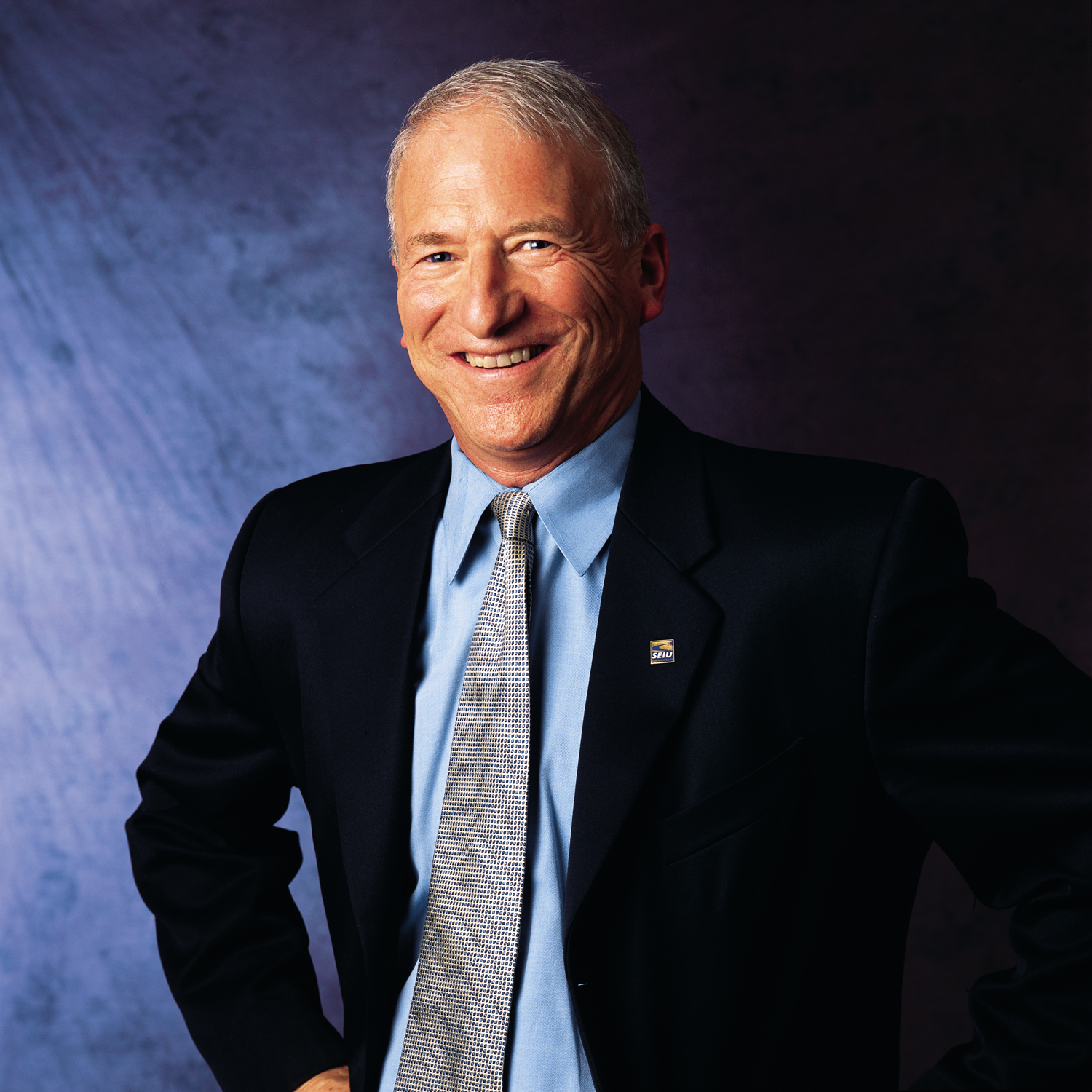
San Franciscans seem to be turning against Service Employee International Union and its national President Andy Stern this week, first with the vote by SEIU Local 1021 members to oust Stern’s leadership team, and now with a letter signed by a broad array of top political officials condemning SEIU tactics against the National Union of Healthcare Workers.

As the Guardian reported last year, NUHW President Sal Rosselli and his management team broke away from SEIU’s United Healthcare Workers after a protracted conflict that culminated in a hostile SEIU takeover of the local, placing it under a Stern-controlled trusteeship. NUHW had criticized Stern’s autocratic leadership style and undemocratic methods while SEIU accused Rosselli of using union funds to undermine Stern’s decisions.

Since then, a majority of SEIU-UHW workers statewide has filed petitions asking to decertify with SEIU-UHW and affiliate with NUHW, which has won seven of the nine elections that have been held so far. So SEIU filed various complaints with the National Labor Relations Board to try to block those elections, while NUHW has complained of worker harassment and ballot meddling by SEIU.

Earlier today, SEIU-UHW sent out a press release touting an NLRB ruling that clears the way for elections at 51 facilities around the state covering 6,845 voters, blaming NUHW for “violating members’ democratic rights” in opposing those elections.

But NUHW leaders say SEIU-UHW has been “cherry-picking” selected sites where they think their chances of winning are good and keeping their NLRB complaints in place to block other sites, often dividing up bargaining units in the process to raise fears in workers that they might lose bargaining clout if they switch unions. NUHW is a relatively small organization compared to the massive SEIU.

NUHW leaders say they want a fair, up-or-down vote among all of the SEIU-UHW members statewide who have asked for elections, and they’ve asked SEIU to sign a Fair Election Agreement to prevent harassment and intimidation, something that SEIU often asks employers to sign.

Supporting that request is an open letter signed by 116 San Francisco political leaders from across the spectrum, including every member of the Board of Supervisors except Sup. Carmen Chu, Assembly members Tom Ammiano and Fiona Ma, Sen. Mark Leno, Democrat Party chair Aaron Peskin and nine other members of the DCCC, all four major candidates for the Dist. 8 Board of Supervisors seat, United Educators of San Francisco President Dennis Kelly, and representatives from a board array of unions and grassroots organizations, including UNITE-HERE, POWER, Young Workers United, Chinese Progressive Association, Coleman Advocates, and many others.

Interestingly, in addition to his critics on the left within the labor movement, Stern is also being criticized by conservatives right now after President Barack Obama appointed him to his National Commission on Fiscal Responsibility and Reform.

The Guardian has forwarded the letter and allegations to SEIU-UHW officials and is awaiting a response, which I’ll post in the comments section when I hear back.


The letter reads:

WE, THE UNDERSIGNED community leaders of San Francisco, are deeply troubled by allegations that the Service Employees International Union (SEIU) committed multiple, serious violations of state labor law during the union representation election between SEIU United Healthcare Workers – West (SEIU-UHW) and the National Union of Healthcare Workers (NUHW) for 10,000 Fresno County homecare workers this June.

These allegations, made in sworn testimony before the California Public Employment Relations Board, include that SEIU officials directed staff to open, mark, and alter workers’ ballots; threaten the deportation of immigrants; and tell workers they would suffer the loss of wages, benefits and hours to scare them into voting for SEIU. The complaint alleges further that SEIU organizers physically removed ballots from workers’ mailboxes and homes.

Caregivers in San Francisco have complained of similar intimidation and harassment at the hands of SEIU officials trying to block union representation elections requested by them and tens of thousands of other California healthcare workers who have petitioned to join NUHW.

Over the next year, as thousands of San Francisco homecare workers, private sector nursing home workers, and private sector hospital workers make their choice for union representation between SEIUUHW and NUHW, we are committed to see that these workers can make their decision democratically, without intimidation, harassment, threats or coercion of any kind, from any party.

NUHW officials have communicated to us their willingness to enter into Fair Election Agreements, which are common in California’s healthcare industry, and which SEIU officials have long championed throughout the nation, to govern their campaign conduct and protect caregivers’ freedom of choice in their upcoming union representation elections.

Therefore, we are asking that you and San Francisco’s healthcare employers join NUHW in negotiating Fair Election Agreements to establish ground rules for these elections and guarantee that workers can choose their representatives for themselves. Please know that regardless of your decision, we will stand united to ensure that San Francisco’s healthcare workers have the fair elections they deserve.

alt.sex: Big oops

0

andrea@mail.altsexcolumn.com

Dear Andrea:

The question of pre-cum and sperm content seems to be in a debate. One article says there is no sperm in pre-cum, another says that the previous research’s fluid collection methods were faulty. So is there sperm in pre-cum, or is that just another sex-negative scare tactic?

Love,

Which Is It?

Dear It:

The question of whether, or rather the assertion that pre-cum does contain sperm, certainly has been used as a sex-negative scare tactic, specifically as a weapon in the chastity wars. I wouldn’t go so far as to write off the question itself as pure propaganda tool, though — it’s a legitimate subject for scientific inquiry, and we are all about those.

While the interwebs present a boundless sea of sex information, sex “information,” and purest balderdash, we have to watch where we’re going. I’ve taken on this one at intervals for years, but needing a fresh fact-infusion I headed to PubMed, as one should. There I found that an andrology lab at Ben Gurion University in Israel seems to be doing all the interesting work. The lab collected pre-ejaculatory fluid from its premature ejaculation patients, another group referred to the lab for “excessive fluid secretion during foreplay” (this paper was nicely titled “Copious pre-ejaculation: small glands-major headaches”), and a control group of regular guys. All were sampled several times during foreplay, whatever that is, and after masturbation, and none had any sperm at all in the pre-ejaculatory samples. None. And no matter how many times those scare-tacticters warn credulous teens about it only taking one (true, but that One’s chances of making it through the vaginal gauntlet and the Chamber Of Cervical Horrors to emerge victorious are almost as small as the sperm itself), even they can’t make a claim that “it only takes none.” None is none. None is good.

So … we do have some science. We do have samples studied and found utterly devoid of sperm. We also have, of course, innumerable pregnancies blamed on those sneaky gland-lurking sperm. What are we to make of those? Some claimants are lying. Some failed to flush out the urethra with a nice healthy pee after the first ejaculation, which could certainly result in some loiterers being carried along by the next stream of pre-cum that happens by. And some are the result of “oopsies!” of various sorts, including undetected or unstoppable mini-ejaculations before the main event. None of this has ever succeeded in convincing me that withdrawal is unsafe or stupid or worse than nothing, as some of that scare-based literature would have it. It is, in fact, the precise opposite of “worse than nothing”: it is in every way better than nothing. Kids who are taught that condoms leak and pills fail and withdrawal is worse than nothing end up using … nothing. And that, my friend, is worse than anything.

Love,

Andrea


Hollis Update: Coma be gone!

0

It’s been awhile since we’ve posted news about Hollis Hawthorne, the Bay Area dancer, artist, and activist who was suffered brain injury in a motorcycle accident last year and was stranded in India until the generosity of friends, family, and strangers brought her home. Though her condition has been steadily improving since she landed at Stanford, then at St. Luke’s, and finally, at a rehab center near her family in Tennessee, progress has been painfully slow and difficult to quantify. The word from her family’s blog was all about incremental progress: slight movement in her right leg, for example, or the progression from ingesting only liquids to taking several bites of applesauce. For those close to her, and others who don’t know her but have been following her story, it’s been hard to tell exactly what this incremental progress means – and especially, now that she’s halfway across the country, what this looks like.

But the Interwebs shuddered with happy news this week as friends shared reports from Harrison, the beau who saved her life in India, who visited Hollis and her family on the anniversary of the accident:

“I am sitting here in a chair in Nashville in complete shock and amazement. Today is the one year anniversary of Diane’s arrival in India. Wednesday was the one year anniversary of the accident. I just returned from Hollis’ rehabilitation center where upon leaving I shed tears of joy.

HOLLIS IS NOT AT ALL IN A COMA ANYMORE!!!

Yes! You read that correctly! Scream, shout, jump up and down! Have a shot! Dance! Kiss somebody! It’s the real deal, seen it with mine own two eyes! She is awake and talking and present and brilliant and amazing!”

[Read more here.]

Not only is Harrison’s account particularly touching, considering the trauma he and Hollis shared, but hearing his perspective on the contrast between the Hollis of today and the Hollis he saw more than five months ago has been helpful and encouraging.

What’s next? As Harrison points out, Hollis still has a long road ahead of her. Her family hopes to get her accepted into an excellent (and expensive) rehabilitation center in Atlanta. And there’s no telling how long full recovery will take, or what that’ll look like. But those surrounding Hollis are talking hope and miracles and the strength of community, and the fact that if anyone can pull out of this, smart, sassy, stubborn Hollis can.

Jerry Brown and the Rose Bird factor

16

Jerry Brown hadn’t even formally announced that he was running for governor when the San Francisco Chronicle brought up the name of Rose Bird.


It’s fine to talk about where Brown is vulnerable, and there’s no shortage of material. The guy has a long public record; anyone who served two terms as governor in the 1970s and early 1980s, and two terms as mayor of Oakland, and one term as chair of the state Democratic Party, and did a couple of years as a KPFA talk show host, is going to have baggage. He’s also got a wealth of experience.


But the Rose Bird stuff is a cheap shot.


Here’s how the Chron describes it:


Rose Bird: As governor, Brown appointed Bird to be chief justice of the state Supreme Court. After she invalidated the death sentence of every case she reviewed, voters in 1986 made her and two others the first judges unseated from the court. To voters older than 45, Bird’s name is shorthand for “liberal judges.”


Actually, voters ousted her after a savage campaign funded by big business interests who were mad at her pro-labor and pro-free speech rulings. The death penalty was their weapon, and even then it was pretty bogus: The Bird Court consistently upheld the constitutionality of the death penalty.


But in the early 1980s, death-penalty law was unsettled in the United States; the U.S. Supreme Court had in 1977 ruled that executions were legal in America, but set strict standards for states to follow. Most states were struggling to sort out what the ruling meant and to figure out how to comply. By 1986, when Bird was under assault, 38 states had adopted death-penalty laws, but only 13 had actually executed anyone. In conservative states like Arkansas, Kentucky, Mississippi and Tennessee, judges were trying to determine if the laws fit the Supreme Court’s standards — essentially what the Bird Court was doing in California.


And in California, the death-penalty statute had been written by John Briggs, the guy who wanted to keep gay people from teaching in the schools. The Briggs law was, by all accounts, poorly drafted, unclear and convoluted, and applying it under the federal standard was a challenge.


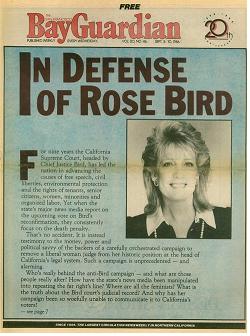
In other words, as we wrote at the time (In Defense of Rose Bird, Sept. 3, 1986):


The charge that the Bird court has refused to enforce the death penalty is simply inaccurate … the California Supreme Court has simply been doing what most state and federal courts have done over the past ten years: carefully scrutinizing death sentences to ensure that they are valid under the federal and state constitutions and complex and ever-changing standards of the U.S. Supreme Court.


The real issue didn’t make the press. Again, from our cover story at the time:


For nine years, the California Supreme Court, headed by Chief Justice Bird, has led the nation in advancing the causes of free speech, civil liberties, environmental protection and the rights of tenants, senior citizens, women, minorities and organized labor.


 Big-business interests organized and funded a massive campaign to get rid of Bird — not because of the death penalty but for purely economic reasons.


The Chronicle got it wrong back then, and is getting it wrong again today.

e.e.’s coming

0

When I was a young reader first discovering poetry — and still very much under the thumb of my strict Asian parents — I blushed (for obvious reasons) whenever I encountered e. e. cummings’ name. In those prudish days, were I to know that cummings penned some of the most deliciously sensual poems of the last century, I might have been frightened off literature for good. This hypothetical is redundant, as I wasn’t scared off poetry and eventually outgrew those jejune ideas of virtue. This hypothetical is further redundant because his erotic poems were never published together in the same volume until now, in Erotic Poems, a new collection of cummings’ amatory verses and sketches.

Readers will delight in these works, which are as naughty as they are tender, bemused as they are earnest. Consider the below, from “16”:

(may i touch said he
how much said she
a lot said he)
why not said she

The poem winks at its author’s salaciousness while joyously proclaiming it. Other poems in the book replace cheekiness with bodice-ripping romance:

you said Is
there anything which
is dead or alive more beautiful
than my body,tohave in your fingers
(trembling every so little)?

Reading through these lovely pieces, I was reminded by how beautifully Michael Cain recites cummings’ “somewhere i have never traveled,gladly beyond” in the film Hannah and Her Sisters (by Woody Allen). I hadn’t seen that movie in years, yet as I read along I could hear Cain’s clement voice reading in my ear.

nothing we are to perceive in this world equals
the power of your intense fragility; whose texture
compels me with the colour of its countries,
rendering death and forever with each breathing

(i do not know what it is about you that closes
and opens; only something in me understands
the voice of your eyes is deeper than all roses)
nobody, not even the rain has such small hands

In the movie, as Cain recites the above excerpt to the sister (played by Barbara Hershey) of his wife (played by Mia Farrow), Hershey is seduced by the poem’s slow cadences and the sensuality of cummings’ beautiful words. The viewer, watching, can’t help but sympathize with her, even as she steals her sister’s husband. You can’t blame someone for engaging in a torrid affair with a man who read e. e. cummings from memory: it’s not the man she wants, but the poetry. The works in this newest collection, which was released earlier last month in time for Valentine’s Day, remind us again and again how thrilling it feels to be seduced by language.

Jerry Brown releases forceful announcement speech

6

Jerry Brown announced his candidacy for governor by posting a three-minute speech on You Tube that was forceful and direct, making the case that California is in crisis and needs experienced, knowledgeable leadership, not an anti-government outsider who’s new to politics.

“We tried that and it doesn’t work. We found out that not knowing is not good,” Brown said in a veiled swipe at both Gov. Arnold Schwarzenegger and likely Republican nominee Meg Whitman, a former CEO with no political experience who has rarely even voted.

This speech was right on the money, and a sharp contrast to his recent Sierra Club speech, which I criticized here – demonstrating that when Brown gets his game face on, he’s still a formidable political pro.

“It’s no secret that Sacramento isn’t working today. Partisanship has become poisonous, political posturing has replaced leadership, and the budget: it’s always late, it’s always in the red, and it’s always wrong,” he said.

It was short on specifics, but that’s probably understandable at this stage. He talked about created a “leaner” state government, but also decried the cuts in education spending, and ended up staking out an interesting position on the critical issue of taxes, pledging, “No new taxes unless you the people vote for them.”

Perhaps Brown is just the guy to begin to persuade Californians that we can’t have it all, and that we’ll have to raise taxes on rich individuals and corporations if we want to do something about our underfunded infrastructure and declining public services. After all, he described our current situation as “a crisis” and said, “You deserve the truth and that’s what you’ll get from me.”

If he wins, this will likely be this septuagenarian’s last job in politics, one in which he’ll hopefully be willing to push for what needs to be done, even if that hurts his popularity. “At this stage in my life, I’m prepared to focus on nothing else but fixing the state I love.”   


Behind every good neighborhood…

0

“Like a wild garden full of it’s own offerings” says Mission Muralismo editor Annice Jacoby of the neighborhood that gave birth to Balmy Alley, Carlos Santana and countless rolls in Dolores Park’s grassy knolls. The Mission’s street art really does bear fruit, and this Friday will be an excellent chance to check out the women behind all the flowering at the de Young’s “Muralistas: the Mission and the World,” a continuation of the museum’s tribute to the neighborhood’s art that began last year.

In a recent KQED interview, Jacoby told the story of a mural of a motorcycle riding “chiquita” mural that was painted off of 16th Street and Mission. With her “derriere” in the air, the skimply clad painting had offended some of the neighbors that lived by the display. The artist’s solution? Merely to plump up those panties “with a few strokes of the brush.” Chiquita covered, community’s calm restored.

The neighborhood’s community-art feedback loop will be the subject of Jacoby’s talk on Friday, as well as other artists’, like Juana Alicia, painter of the much loved La Llorona on the corner of 24th and York. The beloved, building sized piece used to evoke the dangers of pesticide use for the farming women and families of Latin America, but when water damage threatened the mural, Alicia chose to paint a new scene in the area. Instead of “redefining my own existence,” as the artist called the process of doing spot touch-ups on La Llorona, Alicia painted over the old piece with one that was more relevant to her today- La Lechugeras: Sacred Waters, which focuses on water security issues on a global scale.

Just in time for International Woman’s Day, Friday’s event at the de Young will highlight just these kinds of human ties to art. Also featured will be a talk by Mona Caron (of the stunning Duboce Bikeway Mural), live Pakistani music by Riffat Sultana, an all female live-painting mural collaboration, and a projection show on Wilsey Court of work by various female artists featured in Mission Muralismo. All this, coupled with the regular Friday nights at the de Young lineup of cash bars and free admission to the show, a masterpiece if we do say so. 

And the street art/high art love doesn’t stop here! Check out the de Young’s continuing tribute to Mission art. Next up: What’s So Funny: Mission Comix Style (April 2).


Friday Nights at the de Young presents “Muralistas: the Mission and the world”

Fri/5 5- 8:45 p.m., free

de Young museum

Golden Gate Park

50 Hagiwara Tea Garden, SF

www.famsf.org

Newsom’s sanctuary policy destroys MUNI worker’s family

12

“They used our son as bait, just to get the mother to come in,” Washington said.

When San Francisco native and MUNI bus driver Charles Washington married Tracey, his Australian girlfriend in Reno last April, he never imagined that she and her sons would be deported after her 13-year-old bullied another kid at school for 46 cents.

But that’s what will happen Friday, March 5, almost a year after their wedding, unless a miracle happens. And this travesty is happening thanks to Mayor Gavin Newsom’s overreaching juvenile sanctuary policy, a broken federal immigration system, and a couple who tried to do the right thing, but were told they didn’t need to apply for a green card in a hurry, when they called an immigration number for information last year.

‘What more could we have done other than call the number?” Washington asked, noting that once they were told it wasn’t urgent, they began saving up, so they could afford the several thousand dollars a green card for his wife and two kids was going to cost.


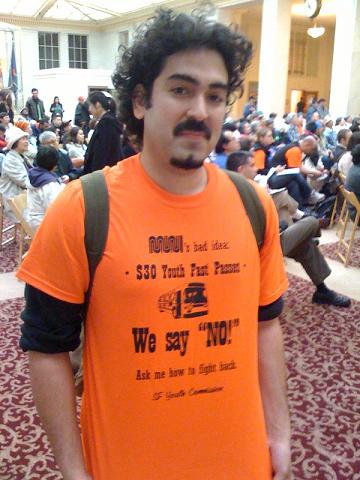
But now, thanks to a bullying incident at school, and the city’s overly draconian policy towards immigrant youth, Washington’s wife and her 13-year-old son will be deported to Australia on Friday, and her 5-year-old boy will accompany them, while Washington  stays in San Francisco to look after his 12-year old daughter (pictured in a photograph taken at the March 1 press conference at Asian Law Caucus).

“There are no laws that prevent me from going to Australia, but I have joint custody of my daughter from a previous marriage and her mother is not going to authorize the child to move, so I’m hoping for a miracle,” Washington explained.

His wife Tracey, who has been forced to wear a federal electronic monitoring bracelet since February, looked on in silence, flanked by her sons and step-daughter.

Washington, who grew up on Mt. Davidson Terrace, and was formerly in the military, had been driving a MUNI bus for a year and a half, when he woke one morning after he got home from his late-night MUNI shift, to hear the phone ringing with a call from his stepson’s school to say there where problems between him and a sixth grader.

“The school told me it was their policy to call the parents any time the police are going to talk to a child,” Washington said. Twenty minutes later, he and his wife were at the school, talking to an SFPD officer, who said a report had been filed by another parent about the incident and the police now wanted to talk to their kid.

After the interview with the police, Washington thought the worst thing that could happen was that the officer would write a citation to say his son needed to appear at juvenile court. Instead, the police arrested his stepson, putting him in handcuffs and saying that they were going to take him to the Juvenile Justice center.

“I think my son was in shock, as I was, “ Washington said. “What he actually did, and what the actual charges are, they are universes apart. Back when I was in school, at worst, a bully was sent home for the day, creating problems for them at home, when they explain to their parents why they’ve been sent home.”

Instead, Washington’s stepson was charged with felony robbery, extortion and assault after the parents of a sixth-grader at his school called the police, but his case has yet to be adjudicated by a juvenile justice, –and a bench warrant will be issued if he fails to attend a March 8 hearing in San Francisco—3 days after he and his mother are deported.

According to Washington, (pictured here (left) with Angela Chan, (right) staff attorney for the Asian Law Caucus) no weapons, no injuries and no witnesses were involved in his stepson’s incident. “And it was strictly one kids’ words against the other,” Washington said.

So, why did the police decide to refer his stepson to the federal immigration authorities?

“I think the officer picked up on the fact that he had an accent,” Washington said. “And when asked where he was born, my stepson said, ‘Australia.’ He is 13 years old. He doesn’t know if he is undocumented or not. As far as he is concerned, he was born in Australia, moved to San Francisco, and this is his family, his new family.”

Washington said his stepson was held for a week at Juvenile Hall for a week, during which the atmosphere at home became tense and stressful.

“We did not understand why this was happening,” Washington said. “Kids on my bus get on and do way worse things than he actually did, and the police usually make their presence known, but there is no worry about going to Juvenile Hall.”

But the worst was yet to come.
After his stepson had been at Juvenile Hall for about a week, Washington got a call from his stepson’s probation officer, saying that he was going to have to contact federal Immigration and Customs Enforcement (ICE).

“He said he had to contact ICE, that he was just doing his job, that it’s what’s required under his job title,” Washington said.

Under a new policy that Mayor Gavin Newsom ordered in the summer of 2008, the city’s juvenile probation officers are required to contact the feds when a juvenile is booked on suspected felony charges. This means, the probation officers are required to contact ICE before immigrant kids have even had a hearing before a juvenile judge to determine if they are in fact, guilty, as charged.

‘They didn’t say, ‘he might be deported,’” Washington said.” I was just told that there might be a ‘ICE hold put on him,’ but at this point I was still not understanding the importance of ICE.”

Once ICE picked up his stepson and transferred him to ICE’s facility on Sansome Street, Washington got a call from his stepson, who said he was OK.

“At this point, we were aware of the immigration issue, so I told my wife to stay at home and I went down there with a lawyer, and I was able to meet with my son,” Washington recalled.

But when he got back home, he received a call from his lawyer who notified him that if his wife was willing to go in and put on an electronic monitoring ankle bracelet, the feds would release their son.

“So, I drove my wife to Sansome Street, and that’s when we were informed that she was being handed her deportation orders, along with our 13-year-old son,” he said

His wife has been wearing the electronic monitoring ankle bracelet ever since.

“She wore pants today because it makes her feel ashamed, and she cries nightly over the fact that she feels like she’s being treated like an animal,” Washington said. “She says, ‘I feel like they think I’m a murderer, but I’m not, I haven’t done anything wrong.’”

According to Washington, his wife arrived in the country along with her kids on a 90-day visa-waiver, and the couple got married about 45 days into that visa.

“We had known each other for seven years, and we looked into getting a green card, two days after we were married, and we were told, not once, but twice, that if you enter on a visa-waiver, there is no deadline to apply for your green card. We were misinformed.”

But while Washington notes that the office that he spoke to was a contractor for the federal government and had its information wrong, he still can’t get over the fact that the federal government would treat him and his wife this way, using their son as bait.

‘This is all shocking to me,” Washington said. “I never dreamed America would treat not only someone from America, but someone not from America, this way. All we want is for our application to be reviewed based upon the facts. We are being told it’s too late.”

Equally upsetting for Washington was the experience of seeing his stepson used as bait.

‘They used our son as bait, just to get the mother to come in,” he said. “ Our son wasn’t there for more than 4 or 5 hours ,and we had no clue that the deportation papers would be served until we walked in. They hadn’t even put the monitoring bracelet on her. She could easily have run, but we still don’t want to break the law, regardless of the outcome. Even though we did something wrong according to ICE, it wasn’t intentionally. If we had been given the correct information, we wouldn’t be here. Yes, we couldn’t afford the money at that time, but we’d have made sacrifices.”

Washington said he is reaching out to the media in a last ditch effort to save his family.

“I don’t know any other way but to network, maybe someone might know someone else who can save my family,” he said. ‘My stepson, he’s just a nerd, he’s not a violent person, he’s not aggressive at all, he’s just being a boy, and he really hasn’t had a father figure in his life, until he moved here.”

Angela Chan, staff attorney for the Asian Law Caucus, which has been helping the Washington family try to get their green cards, said that if the son had never been reported to ICE, then the family likely would have received green cards.

“But now they are refusing to consider it, because of the ICE referral,” Chan said.

Chan also explained that if the boy was able to appear before a juvenile justice, he’d likely get informal probation for a first-time minor offense.

“He only had a hearing, but the juvenile proceedings were halted, when he got handed off to ICE,” Chan said. “The District Attorney had filed charges, but they had not yet been adjudicated, and a judge had not yet reduced the charges.”

Jane Kim, President of the San Francisco United School District said the School Board unanimously supported the amendment to Newsom’s policy that Sup. David Campos introduced last year and which a supermajority of the Board of Supervisors supports.

“We have seen how changes in the Juvenile Probation Department as of August 2008 have been used as a blunt tool to separate family members, regardless of whether the juvenile is convicted of the charges, and regardless of the family’s circumstances. And we don’t believe that the Campos amendment violates the US Constitution.”

“Newsom’s policy has put a lot of burden on our staff,’ Kim said, explaining how schools are now worried about calling the police, lest students end up being deported because the police referred them to ICE, based merely on accusations, 

“For those worried about public safety, I think this type of situation encourages under reporting,” Kim said.

Washington for his worries that his wife and her kids will be homeless in Australia.

‘My wife sold her furniture and gave up her apartment in Melbourne to come here, and her mother and father have a one-bedroom apartment, so there is no space for her and two kids,” he said

He also worries that if they ever manage to come back, his stepson will have a warrant out for his arrests:
 ‘Today we were notified that if my stepson doesn’t show up for his March 8 pre-hearing (in the juvenile justice system where the DA’s office is pressing charges), we’ll have to worry about a warrant for his arrest, which will make it even more difficult for him to move back” Washington said.

If a person is deported, they are barred from reentering the country for 3-10 years.

The Washingtons’ federal deportation will occur the day after the Board of Supervisors holds a hearing into why the city’s Juvenile Probation Department has failed to implement the city’s new policy towards immigrant youth: under the new policy, which the Board passed in 2009, a teenager like Tracey Washington’s son would get his day in court before being referred to federal immigration.

Since July 2008, when Newsom first began requiring probation officers to report all suspected undocumented youth for deportation right after arrest – before the youth  receives an attorney or a hearing on the alleged charges, over 160 children have been reported to ICE without regard to their innocence or how minor the offense.

In November 2009, a community-based based campaign resulted in the passage of a new policy that restores due process to immigrant youth. The new policy gives youth an opportunity to have a hearing and requires a finding that the youth committed a felony before any referral to ICE. If implemented, the new policy would boost public safety for all residents because it would put an end to the Mayor’s policy, which has caused immigrant residents to be afraid to have contact with city employees.

 “Until Mayor Newsom restores due process to all youth in San Francisco, many more hard-working families like the Washingtons will be torn apart,” said Chan.
On Thursday, March 4, the Board’s’ Rules Committee will hold a 10.30 am hearing at City Hall regarding Juvenile Probation Department’s refusal to implement the Campos amendment which would restore due process to youth.


Foam, creams, Commis, and me

0

Oh, Commis, why couldn’t you have been holding down your current patch of Piedmont Avenue when I was spending much of my time in a teensy one-bedroom nearby? Then I could have swung by and experienced your wonderful food on a regular basis, that much sooner.

Here in this spare, elegant, moderne space, you get a three-course prix fixe, period — but what an often fabulous fix to be in. On a recent evening, I got to sample the dishes that earned Oakland native chef James Syhabout — a veteran of renowned molecular gastro epicenters El Bulli, the Fat Duck, and Mugaritz, as well as Coi and Manresa — a Michelin star. It’s the only one in the East Bay apart from Chez Panisse’s — and you can see, and taste, why the inspector was seduced.
The meal unfolded with a housemade soda and amuse-bouche: this time it was a light and lovely hibiscus and lime soda. The amuse-bouche: a much-commented-on regular that wittily mimicked a poached egg but subbed the white for an onion puree with a sprinkling of granola — it was a kind of unveiling, a brief tribute to breakfast, and you immediately yearned for more.

I coveted my neighbor’s incredibly complex, flavorful cabbage soup, poured over with a green garlic custard. It was much more interesting than my own appetizer: sweetbreads that were rich and meaty but not intriguing enough to surpass the soup. My entree, however, was all mine, thankfully: the duck, rare slices and shredded sections from the leg, was utterly delicious and perched on a bitter counterpoint of pureed parsnip. Black cherries and arugula offered small explosions of sweet and peppery flavor. I could take a pass on my savory dessert of warm Carmody cheese on a kind of pastry, accompanied by still more arugula — instead I would have gladly tucked away my dining companions’ delightful, refreshing panna cotta and chocolate tile with vanilla ice cream and yet more signature crunchy bits. The absinthe gelee made the perfect little finish. All said, Commis is challenging — as befitting Syhabout’s time with chefs like Ferdinand Adria (read: foam alert) — intense in its flavors and whimsical in its textures, at moments incredibly delicious, and an actual bargain at $59, judging from the epicurean ride you’re taken on.

COMMIS
3859 Piedmont Ave., Oakl.
(510) 653-3902
www.commisrestaurant.com

Pressure builds to save Muni

5

Widespread frustration with Muni service cuts and fare hikes – passionately expressed by the public on Friday at a San Francisco Municipal Transportation Agency meeting that continues tomorrow (Tuesday, March 2, starting at noon in City Hall Room 400) – has prompted a surprisingly diverse backlash.

From angry, street-level progressive activists to the downtown-friendly San Francisco Planning and Urban Research Association (SPUR), San Franciscans are criticizing the SFMTA’s budget plan (including the 10 percent service cuts approved on Friday, which could be revisited tomorrow) as short-sighted and unnecessarily divisive, prompting the biggest and most diffuse progressive organizing effort in years.

“I’ve never seen anything like this,” SFMTA spokesperson Judson True told me as he surveyed the huge, passionate crowd assembled for Friday’s meeting, adding, “It’s clear grassroots organizing is alive and well in San Francisco.”

It’s true that grassroots organizing helped with Friday’s massive turnout, with hundreds of people lined up to give almost five hours worth of public testimony, much of it expressing frustration with poor city leadership (particularly by Mayor Gavin Newsom and his appointed SFMTA board and director) and declining public services.

But these weren’t the talking points of a centrally organized effort, which is what’s so remarkable about this movement. While many progressive groups joined forces under the Transit Not Traffic banner (coordinated by MTA Citizens Advisory Board member Sue Vaughn and others), and there’s a new San Francisco transit riders union (coordinated by transportation activist Dave Synder), the huge turnout on Friday came also from disability rights groups, ethnically identified groups from the Mission and Chinatown, the Senior Action Network, San Francisco Tomorrow, the social justice group POWER, the antiwar ANSWER Coalition, and several other groups, with very little coordination among them.

“We are really seeing a diverse group of people arguing for transit justice,” said Marc Caswell of the San Francisco Bicycle Coalition, which was part of the Transit Not Traffic coalition.

In fact, with Muni fares increasing and services declining since Newsom became mayor, a wide variety of groups seems to have figured out independently that there’s something seriously wrong with Newsom’s no-new-taxes approach to running the city, particularly given declining transit funding from the state and feds.

“These aren’t solutions. They’re just pitting one group against another,” said Frank Lara of the ANSWER Coalition, which opposes a proposal for extended parking meter hours, much to the chagrin of progressive groups who want motorists to help close the budget gap by giving up their free parking on Sundays.

One SPUR proposal also seeks to eliminate this pitting of groups against each other, listing as its biggest dollar proposal the elimination of work orders from the San Francisco Police Department, which would save $12.2 million per year, which the SFPD charges SFMTA for unspecified services that it has yet to document, despite agreeing to as part of last year’s budget deal.

When asked about the work order proposal, Newsom press secretary Tony Winnicker said doing so would make Muni less safe by discouraging officers from riding buses, saying such work orders were a “good accounting practice” rather than the budgetary shell game that progressive supervisors and SPUR director Gabriel Metcalf have called it.

“The gamesmanship with work orders has got to stop,” Metcalf told the Guardian, criticizing the SFMTA for cutting service across the board and raising fares for express bus service and cable cars. “They don’t have to do that and they shouldn’t do that. They just need some political courage right now.”

The next largest SPUR proposals are to charge $300 per year for disabled placards that allow drivers to park for free (which would raise $10 million per year) and to enforce existing city codes that require garages to charge by the hour rather than all day (which would raise $6.85 million), followed by Muni work rule changes that would need union approval.

Winnicker said Newsom was aware of the big turnout on Friday and the anger voiced by the crowd, telling us, “He understands people are concerned and he shares those concerns.” But rather than accepting that many people blame Newsom, Winnicker blamed Muni’s Transportation Workers Union for voting down about $5 million worth of wage concessions and work rule changes. Yet many speakers criticized Newsom’s finger-pointing on Friday, saying he and the SFMTA were too focused on targeting workers rather than the downtown corporations that Newsom has refused to adequately tax.

“There was already a fare increase last year, so for the low-income popular, this is major,” Wing Hoo Leung, vice president of the Community Tenants Association, told me in Mandarin, translated by Tan Chow, an organizer with Chinatown Community Development Center. “In a bad economy, the low-income people can’t get hit again and again. We need to cut from the top.”

Tax measures will be a big part of tomorrow’s SFMTA discussion of the $100 million budget deficit looming for the next two years – such as a parcel tax, downtown transit assessment district, parking tax increase, or local vehicle license fee — and several SFMTA board members agreed with the statement made Friday by Trustee Malcolm Heinicke that, “We need to look for other sources of revenue.”

Even Winnicker said Newsom acknowledges the need to discuss tax measures, even though he philosophically opposes them: “He understands that many things have to be on the table to close next year’s budget gap.”

But he’s far from advocating for any revenue-side solutions.

“The mayor doesn’t think the tax measures will have much public support,” Winnicker said. Yet progressive groups say that’s because Newsom has undermined people’s faith in local government and actively opposed tax increases rather than trying to make the case to the public that they’re needed to present public transit and other vital services.

“Newsom has to be out there fighting, one at the state level, and he needs to show some leadership here,” said Bob Allen of the group Urban Habitat. “I don’t want to hear Gavin Newsom say again that this is a transit-first city if he’s not going to do anything to support it.”

But Allen said that if Newsom and other city leaders made the case for new taxes to support transit and ran a strong campaign, “This city will support a ballot measure to protect Muni and expand it.”

Yet right now, he said one of the things frustrating low-income San Franciscans is there is a basic inequity between motorists and Muni riders: “If parking is going to be free on Sunday, transit should be free on Sunday. If parking is going to be free in the evenings, transit should be free in the evenings.”  

Newsom has long voiced opposition to extended meter hours, only recently softening that position slightly to possibly allow for a small pilot program for Sundays. But his appointed trustees might be willing to go even further, with Bruce Oka saying on Friday, “I know the mayor doesn’t like it, but it has to be tried.”

Live Shots: Four Tet, The Independent, 2/26/10

0

That beat. It was all about that beat. And everyone had filled up the Independent theater on February 26 to hear Four Tet’s hypnotic beats all night long. His new album, There Is Love in You, was released last month and Four Tet joined several other electronic groups last Friday on one of the closing nights of the SF Noise Pop festival. Looking like a mad scientist, tangled amongst endless cables and blinking techno-gizmo’s, Four Tet honed in on some marvelous beats that made everyone on the dance floor shake their money-makers. The evening started with a three other electrifying numbers, that included Nathan Fake, New Villager, and Rainbow Arabia, who also contributed some breathtaking beats to an evening of electronically charged music.

Noise Pop 2010: Magnetic Fields at the Fox

0

Spare but touching, playful yet perched oh-so-formally on chairs with music and notes on hand, accomplished and unafraid of the occasional sour or dissonant note. Yep, that’s the Magnetic Fields.

The ensemble had the sold-out mob in their precious paws on Feb. 27 at Fox Theater — from opener “Lindy-Lou,” off the 6th’s Hyacinths and Thistles to “Falling in Love with the Wolfboy” to a haunting version of “Acoustic Guitar.” “Yes,” yowled one fan when the group announced “I Don’t Want to Get Over You.” Even the group’s “B” set (the “A” set list will be performed at the March 1 Herbst show) was, as Claudia Gonson put it, teeming with “awesomeness.”

The combo could do no wrong — magnetism worked in its favor, though you got the impression that the band was still working out the kinks, still psychically at the start of their tour. They were a bit casual, a bit messy — Stephin Merritt sticking to ukulele and Gonson pointing up helpfully when she’d try and miss that exact right high note.
Overall it was lesser-known player Shirley Simms on autoharp and sweet, sweet vocals that particularly plucked at audience heartstrings. Meanwhile guitarist John Woo and cellist Sam Davol kept it the melodies in line admirably, and Lemony Snicket author Daniel Handler lurked in the deep background, on squeezing out small, subtle textures on the accordion.

And why pick any nits when the songs’ sheer wit were capable of withered all reservations away. Off-key instances, off-kilter jokes about child prostitution, and such wonderfully right-on songs — in the end, the pleasure was ours, warts and all.

Noise Pop 2010: Scout Niblett, Sonny and the Sunsets at Cafe du Nord

0

More impressions of Noise Pop, comin’ right up.

Blame it on a lingering head cold but I was bummed that I had to skulk off before Citay took the stage on Feb. 25 at Cafe du Nord. I got there just in time for Niblett, however: the Portland, Ore., performer was a solo powerhouse, conjuring estrogen-fueled might with a plaintive wail and some blissfully crunchy riffs for a packed house. At the risk of waxing rockist, I only wished it were even louder and harder.

The next day Sonny and the Sunsets hit the sweet spot at Cafe du Nord with some great garage rock. Why aren’t we all listening to “Death Cream” and “Stranded” on some fantastic, nonexistent radio station? And how much more fun can this Sonny Smith project — part Kelley Stoltz band, part Citay, part Fresh and Onlys — get? Smith’s songs hark to some of my favorite veins of ‘50s sentimental pop and ‘70s dirty rock, and with this lineup the stars appear to be aligned. Need more proof? The back of the room was riddled with girls dancing among themselves, swaying to the music.

The Growlers — sprawling and shaggy, with plentiful volume — had the misfortune of following S&S, but don’t feel to sorry for them. A good portion of the crowd — supporters and family, no doubt? — bellied up to the front to document the proceedings.

Noise Pop 2010: Yoko Ono and Deerhoof at the Fox

0

Noise Pop — the quality sounds and sonic surprises always amaze, no matter how few or many shows you catch.

I didn’t get to gawk at as much as I’d like, considering I was suffering from a bad case of the sniffles. Still, Yoko Ono, live with the Plastic Ono Band on Feb. 23 at Fox Theater, was nothing to sniff at.

Deerhoof opened with a softer, more subdued set than usual. The Bay Area faves seemed a mite overwhelmed by the big room and opulent surroundings: drummer-founder Greg Saunier said as much as he pondered how “pretty” the venue is. Nevertheless the combo quickly gained steam and confidence, as Satomi Matsuzaki twirled, danced, and gestured on the side of the stage and the entire group switched instruments and uncharacteristically tackled a few covers (the Ramones’ “Pinhead” and Canned Heat’s “Going Up the Country,” the latter dovetailing perfectly with Saunier’s ethereal falsetto). I like my Deerhoof louder, in a more intimate venue, but the band was the perfect choice to prep the audience for Ono.
The lady herself contextualized her place in pop and conceptual art: a video montage unfurled a lengthy, select overview of her career. When she finally arrived onstage, yes, she screeched, yowled, chattered, and generated more noise than melody. Those vocables are some of her major contributions to the rock canon — and her ooh’s, aaach’s, and howls sounded just as challenging today, if more familiar to ears trained to the ‘00s underground.

There were quiet elegiac moments, in the form of, for instance, the beautiful new “Higa Noboru,” as Ono slipped easily into chanteuse mode and son Sean Lennon accompanying her on piano. The ace Plastic Ono Band tackled a good share of Ono’s latest album, **Between My Head and the Sky** — tracks like “Healing, “Waiting for the D Train,” and “The Sun Is Down” — throwing in a fabulously playful cartoon video and a turn by virtual reality pioneer, writer, and composer Jaron Lanier on Laotian flute, sitar, and shakuhachi.

Lennon said he met Lanier as a 10-year-old and marveled then at how many instruments Lanier knew how to play. “Jaron said the key to learning so many instruments is to believe time doesn’t exist,” quipped Lennon.

And Plastic Ono Band’s rendition of “Death of Samantha” and “Mind Train” made time stand still in the best way possible. The former, a bittersweet rocker that ended with Ono standing stock-still at center stage, was played for the second time live (the first was at the Plastic Ono Band performance in NYC earlier in February), and the latter was likely the highlight of the evening, mesmerizing with its free-floating, unfurling **Bitches Brew**-style funk.

The finale or second encore began with an Onochord flash-along: tiny disposable flashlights marked with the date and venue were left on at our seats at the start of the show, ready to flicker “I love you” in code toward the stage. But the “Give Peace a Chance” sing-along with Petra Haden and Deerhoof soon eclipsed even that. Sloppy, ragged, moving — it was the icing on the cake. We piled onto the BART, storm or no storm, feeling struck by lightning and energized by what we had just witnessed.

Live Shots: Zee Avi, Rickshaw Stop, 2/25/10

0

For the 3rd night of the SF Noise Pop festival, three bands shared the stage with Zee Avi at Rickshaw Stop. Noise Pop is such a marathon of music, with each band rushing on stage, setting up their equipment, rocking out for about eight songs and moving aside to make room for the subsequent performers. Luckily through all this movement and music, each group really held their own and the audience kept begging for encores that were never possible.

The night started with Tiny Television, who was accompanied by singer Jen Korte. The band had a folksy sound and their songs were rich and warm. Their slide guitar player was pure genius and with the whole band wearing cowboy boots this group was totally country cool.

Then came the Leslie and The Badgers, hailing from LA. Leslie and her gaggle of boys also hit some great country notes and Leslie’s voice had magical pieces of Dolly Parton and Patsy Cline sprinkled though out it. The highlight of their set was a sing-a-long piece about how it’s ok to hurt somebody, just remember to say you’re sorry.

The four cute girls in the Hot Toddies belted out surf songs and got the audience so energized that they all started to jump and bounce around just like bubble gum! The Hot Toddies were totally crowd-pleasers with their hilarious lyrics about everything from dating old guys on the internet, to the seriousness of a wet dream and how Seattle makes them totally horny. Sweet!

And finally, just a bit before midnight, Zee Avi made her way on stage, to sing us sad songs about drugged out boyfriends and happy songs about true romance found outside a bee hive. She’s so cool and her voice is so lovely, making for the perfect ending after an extreme evening of awesome, almost never-ending, music.

Bill Bennett, the only public official in California to take on PG&E

0

William Morgan Bennett, 1918-2010

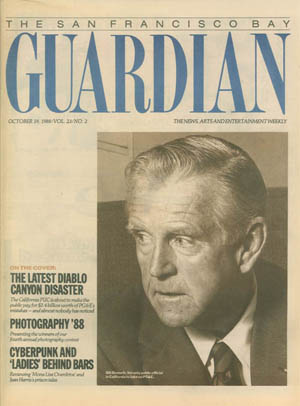
On the front page of the Guardian of Oct. 19, 1988, we ran a big picture of Bill Bennett with a caption that read: “Bill Bennett, the only public official in California to take on PG&E.”

The reason we featured Bennett was because the California Public Utilities Commission was poised to make yet another multi-billion giveaway to the Pacific Gas & Electric Company.

This time the CPUC would force the public to pay $3.4 billion worth of PG&E’s mistakes  at its Diable Canyon nuclear power plant and not one public official in San Francisco, home of the PG&E/Raker Act scandal, and not one from any other public agency or public institution was on hand to monitor the CPUC hearings and testify about the horrible impacts the Diablo rate hike will have on the public.

The lone, honorable exception was Bill Bennett. Our editorial noted, “The only public official in California who has taken on the case is Bill Bennett, a member of the State Board of Equalization and a former member of the CPUC, a determined old warrior who fought Diablo from the start and continues to do so today, on his own, against the odds and at considerable personal cost.”

To drive the point home about Bennett’s couirageous stand, we continued, “Those who ignored the case–for example, the supervisors, mayor and city attorney of San Francisco, the board of directors of BART, the regents of the University of California and their counterparts in every other public agency and institution that pays or represents people who pay PG&E bills–ought to be ashamed. The citizens of every city, county and district ought to look at their representatives and ask: Where were you when PG&E walked away with all the marbles.”

 The press in Northern California was ignoring the story, despite the colorful,  forceful and newsworthy campaign that Bennett was waging. He said he had called the  Chronicle and Examiner reporters to try to interest them in the story, but “it was useless so I gave up.”  Guardian Reporter Jim Balderston did the story and quoted Bennett  as saying, among other things, “This commission (the CPUC) must think long and hard of the welfare of the ratepayers and the shareholders of PG&E.” With no Bill Bennett on the CPUC, PG&E once again quietly walked away with billions in ratepayer money.

William Morgan Bennett, the public attorney  who for more than five decades fought the corporate goliaths from taking all the marbles, died Feb.9th at his home in Kentfield after a short illness. He was 91. An overflow crowd paid tribute  to his extraordinary life and career at services held on Feb. 12th at St. Patrick’s Church in Larkspur

When his daughter Joan phoned me about Bennett’s death, I realized once again how much the Guardian and the consumer and the rate-payer would miss Bennett. We are in the middle of PG&E’s biggest monopoly scam ever –Prop l6 and PG&E’s initiative to kill public power and community choice aggregation (CCA)– and Bennett is alas missing in action, for one of the first times in his life. Today, there are other public officials out there fighting PG&E, but there is nobody who can  take on PG&E and its allies as effectively as Bennett.

Our 1988 story had a sidebar with the head, “Bennett vs. PG&E: The 30 years war.” The sidebar recounted an incident characteristic of Bennett and the way he gave new meaning to the term public service.  In 1959 the El Paso/Pacific Northwest natural gas pipeline merger was all but approved by the CPUC, except for an appeal from Bennett as CPUC general counsel.  Before Bennett could file the appeal, he got a phone call from Gregory Harrison, a partner in the politically powerful law firm of Brobeck, Phleger and Harrison. Harrison asked Bennett if he was going to file. Bennett said yes and Harrison responded, “I told them you would say that.”

Harrison told Bennett he would be removed from the case if he filed the appeal. Bennett told Harrison he was going to call a press conference. Harrison responded. “I told them you would say that,” and hung up. Shortly thereafter, Bennett got a call from Gov. Brown, who asked him if he was going to file the appeal. Bennett said yes and Brown refused to discuss the matter further.

Twenty minutes later, Bennett got a telegram from Brown that stated, “You no longer represent me or the State of California in USA v El Paso.” This infuriated Bennett and fueled his relentless 14-year crusade to compel El Paso to divest itself of Pacific Northwest. because of its price-fixing and monopolistic implications for California. In 1969, appearing as a private citizen, he successfully argued the final U.S. Supreme Court appeal in the case, the last oral argument heard by the Earl Warren court.

The Washington Monthly caught the drama and precedent of Bennett’s appearance in its November 1971 issue. “His last appearance before the court in 1969
needs to have been witnessed. Standing alone against an array of the best legal talent that could be provided by El Paso, the states of California and Utah, lawyers for other gas companies and the U.S. government, represented personally by Solicitor General Erwin Griswold, Bennett attacked as the lone surviving avenging angel of the original antitrust action. Finger in the air, voice crying out in toners of retribution, he spoke brilliantly and forcefully without notes for an hour…In the process, Bennett impressed at least one justice privately, and many more observers, as one of the most brilliant and effective lawyers to have gotten to his feet to present oral arguments to the court during the last 14 years.”

 As the final footnote in this legal saga, Bennett  stopped El Paso’s efforts in Congress to pass legislation to void the breakup of El Paso. The result: the largest refund for California ratepayers in the history of regulation to date.  The decision set a  national precedent in antitrust law.

Bennett was born Feb. 20, 1918 in San Francisco to Lt. William M. Bennett of the San Francisco Police Department and Eva Curran of Amador. He attended Most Holy Redeemer Elementary School, St. Ignatius High School, the University of San Francisco and the Hastings College of Law. At the outbreak of World War II, he suspended his law studies and joined the U.S. Army Air Corps.

He was a B-17 pilot in the North African, Mediterranean and European theater of operations, l5th Air Force, 483rd Bombardment Group, 815th Squadron, stationed in North Africa and then in Foggia, Italy. The 483rd flew a total of 215 combat missions during 14 months of combat duty and Bennett was in the middle of it all. “Wherever there were major oil refineries, aircraft and parts factories, tank works, railroad terminals and marshaling yards, supply dumps, bridges and communication networks, he saw action,” Jane Bennett said.  He flew 35 missions and encountered severe flak and fighter attacks at some of the most heavily defended targets in Europe:  Linz’ Herman Goering Tank Works; Berlin’s Daimler-Benz Tank Works; Innsbruck; Vienna; Regensburg; Blechhhammer; Schweinfurt; Salzburg; Landshut; Moosbierbaum, and Ruhland where ME 262 German jets attacked his squadron.

The Tuskegee Airmen, the famous black squadron, escorted Bennett’s missions. “Their base was right next to my father’s,” Joan Bennett said. “They were separated on the ground but equal in the air. That is, they were  equal targets for the Germans.” Bennett often visited some of the fighters across the runway that segregated the blacks.   George McGovern,  the bomber pilot who later became a presidential candidate in l972, was stationed at a nearby base.  He flew B-24s.

Bennett flew some of the first shuttle missions into Russia.  As the bomber squadrons flew deeper into Germany, the planes did not have fuel or were too shot up  to return to their base in Italy. So the squadrons continued on to Poltova,  Russia, to get refueled  and repaired, and  then either flew back  immediately back to their base or stayed over night and flew back the next day.  The missions were kept secret during the war  but later became known as the “Poltova missions.”

 Of the original 646 crew members sent to Italy in March 1944, 38 per cent were killed or missing in action. His bomb group received numerous battle awards, including two outstanding unit presidential citations. Bennett was highly decorated and won three Oak Leaf Clusters, four Bronze Stars and the Distinguished Flying Cross. He was awarded the DFC  for his courage and skill in miraculously bringing his plane back from a mission over Worgi, Austria, in February, 1945.  Bennett’s plane was hit by heavy enemy fire and the two right engines were shot out. He told his crew to bail out but they refused because they counted on Bennett to pull  them through.  Bennett did, safely piloting his crippled plane over the Alps. When the plane limped back to its base in Italy, there was nothing left inside, because the crew had ditched everything to lighten the load.


Col. Paul L. Barton, Bennett’s commanding officer, pins the Distinguished Flying Cross on Bennett in a ceremony on May 12, l945, at the air base on the Sterparone farm in Foggia, Italy.  Gen. Twining, head of the l5th Air Force who ended up as Chief of Staff of the USAF after the war,  attended the ceremony.  “There was no Tom Hanks, Brad Pitt, Tom Cruise WWII move glamor,”  Bennett’s daughter Jane told me.  “The base itself was primitive: steel mats for runways.  Ankle deep mud in the winter along with snow, ice and rain. Open latrines, no toilet paper, tent-living with one crew per tent. No mess halls. One canteen of water per day, etc.”  She said the Bennetts visited the farm in l982.  “The runways were vineyards,” she recalled. “The briefing hall for the men still stands. The interior of white plaster is still lined with drawings of pinup girls. The young girl who lived on the farm during the war is now the owner of the family land. She was very gracious.  She invited us in for coffee.”

 After the war, Bennett finished  law school at the University of San Francisco and then embarked upon a remarkable career of public service. Until I started working on his obituary,  I knew nothing about Bennett’s distinguished war record as a bomber pilot.   But it is clear to me that, having followed Bennett through the years, that  his combat experience under artillery fire and with flak coming at him from all directions served him well in public life.  He spent most of his public career  as a tough, smart and  aggressive attorney who relished  taking on the big cases and the big corporate behemoths who were screwing the public on illegal mergers or monopoly rate increases. To him, this was just combat in a different theater of operations. Sometimes as a public attorney, sometimes acting as an individual citizen, he handled precedent-setting cases  in antitrust, regulatory and criminal law and argued six times before the U.S. Supreme Court. He earned the nickname “the legal Houdini” but I always thought of him as “Fighting Bill” Bennett.

 As a deputy attorney general, he successfully prosecuted public corruption trials in 1954-55 against the State Board of Equalization in San Diego and put l3 public officials in jail. From 1957-59, he handled the celebrated case of Caryl Chessman, known as “the redlight bandit.” After his argument before the U.S. Supreme Court, the court clerk quietly handed him a note from Associate Justice Felix Frankfurter. He wrote, “There is no reason why I should not tell you how admirably you represented the state in this important case.” The clerk told Bennett he should save the note because it was only the second such note that Frankfurter had ever written.

From 1957-58, Bennett represented the state before the CPUC and won many cases against utilities that resulted in hundreds of millions of dollars in ratepayer rebates. Gov. Brown appointed him chief counsel of the PUC in 1958.

In 1960 Bennett was invited to join Sen. John F. Kennedy’s campaign as an advance man canvassing a territory from Chicago to New York.  He became friends with JFK and was considered part of Kennedy’s “Irish mafia.” Kennedy asked him to head the Federal Power Commission but he rejected it to remain with his family.

Bill Bennett and then presidential candidate John F. Kennedy  are pictured in 1960 as they got off the campaign plane at O’Hare field in Chicago.  Bennett was an advance man for JFK and helped stage several rallies in Chicago. Then JFK and Bennett headed east to Hamtramck, Michigan, and finished up at the garment center in New York.  JFK asked Bennett to be head of the Federal Power Commission but Bennett turned the appointment down to remain in California with his family.

In 1962, after Brown appointed Bennett to the CPUC, he promptly took on PG&E with gusto.  With the support of the Sierra Club, Bennett filed the lone dissenting opinion against the CPUC’s approval of a nuclear power plant upwind of San Francisco at Bodega Bay. The  Bodega fight was started in the living room of Prof. Joe Neilands, a UC-Berkeley biochemistry professor and stoked along by the Neilands/CharlieSmith/David Pesonen gang, with help from the Chronicle and its executive editor Scott Newhall and environmental writer Harold Gilliam.  The battle caught on and became a national story and focal point for the emerging anti-nuclear movement. PG&E was forced by public opinion to withdrew its application and skedall down  to Diablo Canyon. And so did Bennett.
Bennett was later visited by the chairman of PG&E, Robert Gerdes. told Bennett, “We don’t mind you dissenting, but do you realize the Russians are trying to stop us from building atomic plants.”

During his CPUC tenure, Bennett led the commission to regularly reduce electricity and gas rates in response to rate cases before the commission. In 1968, then Gov. Ronald Reagan refused to reappoint Bennett to the commission and sent Bennett a letter apologizing for not being able to reappoint him. Reagan did not explain the reason. Before Reagan could kick him off the CPUC,  Bennett  had saved the consumers hundreds of millions of dollars. Ever after Bennett, the CPUC has operated on a supine  basis with PG&E and other utilities and has handed down rate increases and goodies to them on a virtual assembly line basis.  

I first met Bennett in 1967 in his CPUC office overlooking the Civic Center  in the  state building. Lee Fremstad, then the San Francisco correndent for the Sacramento Bee, took me in and introduced me. I had rarely seen a public official like Bennett. He knew about the Guardian and me, had some juicy story ideas for me, and a batch more for Fremstad. Fremstad bantered back and forth with Bennett, noting a couple of ideas but rejecting others as too much even for the Bee and its longtime public power posture.  Bennett was open, expansive,  full of Irish humor,  a populist Democrat full of opinions I liked, jutting the Bennett jaw to make a point, and the kind of guy  who might be good for a lively  three martini lunch.

I thought he would have made a wonderful newspaper columnist or editorial writer, if he could find a newspaper that would publish his  tough consumer-oriented opinions that so  agitated the PG&Es and Hearsts  of the region.  We always enjoyed  Bennett at the Guardian, endorsed and supported him and used him as a friendly source and inspiration.all through the years. 

When Bennett left the CPUC, Neilands and Smith held an appeciation dinner for him in Berkeley that brought together the Bodega Bay/public power warriors of the era.   This was a watershed moment for the Guardian and me.  My wife Jean and I went, met Bennett and Neilands et al and got initiated. We also met Peter Petrakis, a fan of Bennett’s, and a graduate student of Neilands. Neilands did our pioneering expose of the PG&E/Raker Act  scandal in l969.   Petrakis joined the Guardian and  followed up Neilands’ work with a series of investigative storiies that revived the scandal and  the public power movement in San Francisco.  Bennett, as I realized, was a catalyst.  

Bennett’s next move to stay in public service was to run for the State Board of Equalization and Franchise Tax Board. He won his first campaign in l970 even though his opponent outspent him $450,000 to $4,000, all his own money. He was relected to five more terms, despite refusing to accept campaign contributions, and continued to fight the good fight against the special interests in Sacramento and beyond. He was also a professor of law at Hastings while on the board.

Bill Bennett with his wife Jane in 1943 at the primary cadet school in King City, Calif. They were married 67 years.

Bennett is survived by his wife of 67 years, Jane, and sons William (wife Gwendolyn) of Lafayette, James (Paula) of Kentfield, Michael (Roxanne) of Manhattan, Kansas, and daughter Joan of Kentfield and grandsons Jimmy, Will, Jack, and Brendan of Kentfield.

The Bennett family obituary  sums up their patriarch: “Despite his friendships with president and esteemed jurists, his out-going nature was such that he was a friend to all. He was a populist democrat, consumer rights advocate, and a veritable David against the corporate world’s Goliaths, in the vein of his mentor and ultimately friend, Earl Warren. Even with such achievements, his most important and cherished career was as a father and family man. Upon retirement, he embarked upon his most rewarding and enjoyable career: a devoted, loving, entertaining husband, father, and grandfather. For them and through them, he will live forever ‘in his way.'” 

For me, I will stick with our cutline under Bennett’s picture on our l988 front page: “Bill Bennett, the only public official in California to take on PG&E.”


The Bennett family photo was taken in May,  2009, at the Napa airport. A B-l7 was touring the country and Bennett wanted to see it. Jane Bennett said he actually went through the plane. “It was not easy. The access was a skinny, steep, metal ladder to the cockpit. I don’t know how he got up it. He refused a ride in the plane. As he said, ‘If I cannot fly it, what’s the point.'”

Chatting with “The Yellow Handkerchief” star Eddie Redmayne

0

English actor and model Eddie Redmayne isn’t yet a household name, but he’s achieved rising star status with a string of much lauded roles in indie and mainstream films. After playing Edward Wilson, Jr. in The Good Shepherd (2006) and murderous son Tony in Savage Grace (2007), he returns to American film as colorful outcast Gordy in The Yellow Handkerchief. I spoke to Redmayne about getting a handle on his strange character, which meant doing road trip research and adopting a Southern drawl.

San Francisco Bay Guardian: The character of Gordy is a rather unusual one. How would you describe him to someone who hadn’t seen The Yellow Handkerchief?

Eddie Redmayne: Good question. I would say he is an open-hearted eccentric. He has spent his entire life as an outcast. He’s trying to find his own way, so he’s never fit in really. But he has an open heart, which is often misunderstood.

SFBG: So what drew you to the character?

ER: What drew me to the character was how utterly ridiculous it was that they would consider the idea of an English actor to play the part. When I read it, I thought that’s the most absurd thing in the world, I will never get it. So I went into the audition without a sort of care in the world, assuming that it was madness that they would consider me. I suppose what drew me to the part was how far from me he was.

SFBG: Is that a challenge for you, playing American parts? You’ve kind of shifted back and forth — do you see yourself doing more of that in the future?

ER: For me, what I love about my job is, I love storytelling. And if the story’s a good one to tell, then I’m incredibly proud to be a part of it, whether it’s English, American. It’s neither here nor there, really. I found this one a specific challenge and working on the accent was challenging. I had a great dialect coach. And also you feel a responsibility when it’s someone so far from where you are. But you have to actually go under the skin of it. So I did go down to Louisiana and do a road trip from Oklahoma through the Osage nation reservation and then down into New Orleans, so at least I could get a sense of the geography and the kind of places this guy was growing up in.

SFBG: How much of that were you able to use in creating Gordy’s backstory?

ER: Well, I don’t know if you remember the [sketchbook]. That was something that, when I did my road trip, I collected myself. I went and used all these disposable cameras and took photos and did drawings and messed around. Which was a lot of fun, and a way of building up a backstory for who he was and who his dad was and what his life story had been. For the audience, it’s kind of extraneous, I suppose, but for me it’s important that I knew where he was from.

SFBG: I wanted to commend you for your performance in The Yellow Handkerchief, but I also thought you were great in Savage Grace. You seem to play these characters who aren’t always relatable or even very likable to an audience. They’re interesting, but they’re not necessarily people you’d want to spend a lot of time with. So how do you find that balance in making them sympathetic but also difficult?

ER: [laughs] I know what you mean, and certainly with Tony in Savage Grace, that film wasn’t written as a psychological discussion as to how this person had ended up there. It was a cold detachment on what this life was, and what happens when relatively talented people have so much money that it catalyzes inertia almost. There’s nothing to do with your life because you don’t have to do anything. I suppose what I try to do is not to judge the characters that I play, and just present them honestly and hope that, certainly more so in Yellow Handkerchief, that the audience does eventually, despite feeling alienated and isolated from this guy to begin with because of his quirks and his eccentricities, that eventually they do see that there is an openness they can relate to.

SFBG: Going back to The Yellow Handkerchief, I wanted to ask for your opinion on why this unlikely trio forms. Obviously there’s some attraction on Gordy’s part when it comes to [Kristen Stewart’s character] Martine, but what else is there that links them together?

ER: For me, the film is about chance, really. It’s about chance and circumstance. And what I love is, it hopefully feels like this is a story going on in the world that the camera stumbles across, travels with, and then lets go. It’s really about the truth of those moments in life that it is through moments of luck or passing or who you bump into on the street or whether, specifically in Yellow Handkerchief, a rain storm causes these people to end up in a car together for three days. It’s as simple a conceit as that. But I think it plays truthfully in its idiosyncrasies almost.

SFBG: Can you talk about developing chemistry with your co-stars, William Hurt and Kristen Stewart? How did you form that bond, both on-screen and off?

ER: Well, what was wonderful is, Kristen is magnetic and an incredibly wonderful person, very open and lovely, and we got on very well form the outset. William is someone I’ve admired for a long time and have worked with on The Good Shepherd, although I’d never acted with him. What was great is, firstly, we had two weeks rehearsal, which is rare on film and something that William insists on. So we got to know each other. But also, three of us sat in a car in the incredible heat in Louisiana, passing through these extraordinary landscapes. It’s a way to bond quite promptly, and so the chemistry built really through spending an intense, really quite intimate time together.

SFBG: I wanted to close by asking what’s next for you. You’ve done your fair share of theater, so I was wondering if you might be returning to the stage anytime soon?

ER: Actually, I open a play on Broadway [on March 11] with Alfred Molina. It’s a new play about Mark Rothko, which we just finished a run of at the Donmar Warehouse Theatre in London. It’s called Red, and it’s about Rothko and his assistant. So I’m lucky enough to act on Broadway in two weeks time.

The Yellow Handkerchief opens Fri/5 in Bay Area theaters.

It’s so easy to go after public employees

4

The always-insightful Robert Cruickshank has a fascinating piece on Calitics today talking about the investigative reports showing that some state employees save up all their vacation time and get big payouts when they retire. It’s true that some state workers walk away with upwards of $100,000, and it’s true that it pisses people off, and it’s true that there probably ought to be some reforms that limit the amount of vacation time you can save and cash in.


But as Cruickshank notes, the payouts have cost the state $486 million since 2006, and:


$486 million sounds like a lot of money. But that is just 2.43% of the current $20 billion deficit. In other words, if we had eliminated that practice in 2006, or capped it, the budget deficit would not be meaningfully impacted. In fact, given that we’ve had about $60 billion in budget shortfalls since 2007, these vacation payouts are 0.81% of the overall deficit.


He explains:


Of course, these kinds of articles help build a larger narrative that the budget problem is in large part caused by greedy public sector workers who are paid too much. The actual numbers here indicate that the vacation payouts are not a meaningful part of the budget problem at all. Similarly, Meg Whitman’s desire to layoff 40,000 state workers would probably save about $2.5 billion (assuming those workers make the state average). That’s a bigger chunk of the projected $20 billion deficit, but it’s still only 12.5%. Whitman and other critics of public employees need to come up with solutions for the other 87.5% of the deficit.


Maybe one place to start is by looking at how the rich evade their tax obligations. Last week the LA Times’s Michael Hiltzik showed that Frank and Jamie McCourt paid no federal or state income tax between 2004 and 2009. Many wealthy Californians and large corporations have similarly evaded taxes.


So why do the relatively minor excesses by state employees get much more press attention that the vast cheating and looting of the public treasury by the rich and by big businness? Well, after 30 years in journalism, I can tell you one reason:


It’s easy.


State employee payrolls are public record. It’s easy to find out how much overtime Muni drivers make, or how many city workers earn more than $100,000 a year, or what the firefighters contract allows. Editors love these kinds of stories, because they always stir up populist indignation and outrage.


I’ve done it myself. We all do.


On the other hand, try to figure out how a big commercial property owner is using complicated stock transfers to hide a change in ownership and avoid tens of millions of dollars in property-tax liability. It’s a bitch. That kind of work takes weeks, months of investigation and requires some sophisticated legal and financial knowledge. See, the private sector — particularly the folks who are hiding behind tax shelters and scams — is big on secrecy, and the laws don’t help reporters.


Investigative reporting on the private sector is expensive. And in these days of diminished news budgets, not that much of it happens any more.


So the message you get in the press is that public employees are busting the budgets, and if we could just quit paying them so much money all would be fine. And the real budget busters, the real scam artists, the real crooks who are sucking the public treasury dry … they just keep right one going. And nobody’s paying attention.

SEIU members oust the old guard

0

In a stunning repudiation of the union leadership installed by Service Employees International Union President Andy Stern – whose autocratic style, aggressive expansion, and friendly relationships with big employers has caused a rift in the national labor movement – members of SEIU Local 1021 have voted overwhelmingly for a reform slate of new leaders.

As we wrote recently, the stakes were high here in San Francisco, where the old guard leaders threatened to undermine the union’s progressive tendencies just as Mayor Gavin Newsom is threatening mass layoffs and pay cuts for city employees, and the San Francisco Labor Council’s ideological balance was being tipped by the pro-development push of the building trades.

But the results couldn’t have been more clear in the first local election since Stern installed the Local 1021 after merging 10 union locals together, including the former Local 790, which represents most city employees. Stern’s whole slate was voted out by a substantial margin, including current President Damita Davis-Howard, who had 1445 votes to the 2141 votes garnered by Sin Yee Poon, who now takes over the top spot after having led SF Human Services Agency workers.

Also pushed out was James Bryant, a political ally of Newsom and enabler of Pacific Gas & Electric and other downtown power brokers, who was defeated in his run for Political Action Committee Chair. Alysabeth Alexander, who is in her 20s, beat him by a vote of 2552-1506.

The vote will certainly strengthen the hand of progressives in San Francisco going into what’s expected to be a tough budget fight with Newsom, as well as helping progressive supervisorial candidates in the November election against what is expected to be a strong push by downtown to break the progressive majority on the Board of Supervisors.

In addition, it could roil SEIU’s internal politics after a turbulent year, in which Stern created divisive clashes with his own local health care workers (causing Sal Rosselli to create the rival National Union of Healthcare Workers), UNITE-HERE, and the California Nurses Association.


The press release from the winning reform slate follows: 

Reformers Sweep in SEIU 1021 Election; Members Vote for Transparency and Democracy for Northern California’s Largest Public Sector Union 

On Friday, thousands of public sector votes were counted to determine the future leadership of one of the largest unions in Northern California.  This is the first election for SEIU 1021, formed only three years ago after the merging of 10 locals.

The reform slate, Change 1021, swept the elections taking a clear majority of the executive leadership seats. This all-member slate easily defeated the former administration-appointees by the International SEIU.  Some candidates won by a 3 to 1 margin while others enjoyed a comfortable 2 to 1 lead on their opponents. See attached list of election results.

“We are excited about the opportunity to give the leadership of this Union back to the membership,” stated Karen Bishop, the San Francisco County Area Representative Elect.  Former San Francisco Board of Supervisors President and current Chair of the San Francisco Democratic Party  Aaron Peskin agreed, affirming, “It is very heartening to see that real democracy has prevailed.”

Change 1021 campaigned on a platform for reform, seeking a stronger union that would prioritize member representation at work sites; fiscal transparency; and an internal democratic structure. “Members spoke with their votes, sending a clear message about priorities,” said Roxanne Sanchez, President Elect.

The challenges for the new board are daunting-they must reunite and reinvigorate a membership hit hard by the economic downturn, with thousands to receive lay-off notices this week.  The Board Elect is ready to make the budget fight a priority to fight layoffs and preserve important public and non-profit services for our communities.

 “Our members have spoken, loudly and clearly, that business as usual is absolutely no longer tolerable and that a fundamental change in the focus of our union towards the needs and priorities of our members are in prompt order,” says Sin Yee Poon, Chief Elected Officer Elect. For now, there is cause for celebration as the congratulatory calls have been flooding across California from members, elected officials, labor leaders, and community partners.

Newly  elected members will assume office at the next Executive Board meeting, March 9th.   International Union leaders are expected to be in attendance.           

Change 1021 Candidates who were elected are: Chief Elected Officer, Sin Yee Poon; President, Roxanne Sanchez; First Vice President, Gary Jimenez; Second Vice President, Crawford Johnson; Third Vice President, Larry Bradshaw; Secretary, Pamela Morton; Treasurer, Kathy O’Neil; Political Action Comm. Chair, Alysabeth Alexander; Social & Economic Justice Comm. Chair, Gladys Gray; Capital Stewardship Comm. Chair, Harry Baker; Cities Industry Chair, Renita Terry; Counties Industry Chair, Ken Tam; Special Districts Industry Chair, Saul Almanza; Schools Industry Chair, Mynette Theard; Sacramento County Rep, Ken Bloomberg; Registered Nurses Industry Chair, David Fleming; City & County of SF Industry Chair, Kathy Basconcillo; San Francisco Area Reps- Karen Bishop, David Turner, Jacqueline Sowers; Alameda County Area Reps,- Amy Dooha, Eric Stern, Gregory Correa; Sonoma County Area Rep, Nancy Atwell; Budget & Finance Comm Region 3, Michael Tong; and Budget & Finance Comm. Region 4, Mary Jane Logan.