SFBG Blogs

alt.sex.column: Oh, grow up!

1

Dear Andrea:

My really sweet, nice new boyfriend is into S–M and I’m not sure I even understand the attraction. I can get behind the sensation aspect but I have some moral and feminist objections. He insists it’s just a way to play, but it doesn’t sound like play to me. From what I read, people seem to take it pretty seriously. Plus calling it play (“pain play” “play-dates,” “play partners”) doesn’t really convince me that it’s all in good fun. You’re going to think this is ridiculous, but honestly all the talk about “play” sounds immature to me. We are 30 and 33 years old! Do we really need to spend our free time “playing”? Convince me.

Love,

All Play And No Work …


Dear All:

Wow, I feel faintly reprimanded for ever calling anything “play” that wasn’t an organized sport or a dramatic presentation. Then again, I am kind of immature — it keeps us young, don’t you know — so what do I care?

In response to what I expect are your political and feminist objections, I think many nice, progressive, egalitarian types such as (I presume) yourself (and also myself) initially have this reaction when presented with S–M iconography and terminology. Isn’t it time to move beyond rigid hierarchies? Doesn’t all this black leather look a little SS-ish? Would we even have such a concept as “top” and “bottom,” let alone “master” and “slave,” if we didn’t have this wretched history of the strong subjugating the weak, century after century, culture after culture? Would people born on Planet Liberty and Justice for All ever come up with S–M? And if they wouldn’t, should we? And isn’t it unhealthy for both genders to have women kneeling at men’s feet, or recapitulating scenes that in real life would be examples of brute patriarchy at work (all those abused school girls, corrected parlor maids, and so on)? And I say unto you, what makes you think it’s always or even usually women doing the kneeling, or that all those parlor maids are female? In the absence of a Planet Liberty and Justice to use as a control, we have no idea if people would play power games or not.

As for your (implied) definition of maturity — taking responsibility for your actions, not whining, not blaming others for your own mistakes — there are many qualities I would ascribe to the mature human. But “doesn’t play” isn’t one of them. Humans are neotenic — hanging on to aspects of infancy long past physical maturity — and it’s entirely possible that our flexibility, creativity, and ability to learn and grow as adults is due to that built-in childishness. Mature adults play all the time — in sports, outdoor adventuring, Burning Man, and so on. None of these activities are necessary to our survival as grownups. We just do them for fun. And some of us do similarly with adults-only indoor sports.

If you don’t want to play, don’t. But if you do want to play, don’t sweat the semantics.

Love,

Andrea

Got a question? Email Andrea at andrea@mail.altsexcolumn.com

What is the plural of cyclops, anyway? “God of War III,” reviewed

0

By Peter Galvin

God of War III

(Santa Monica Studio, Sony Computer Entertainment)

PS3

A melting pot of ancient Greek myths and characters, the God of War series embodies the term “Big Game.” When the first title made its debut on the PS2 in 2005, people were blown away by the scope of the environments and the brutality of its anti-hero Kratos. A pawn in one of those tragic mind-games that Greek gods were so well-known for, Kratos was a Spartan warrior who set out to exact vengeance against the gods that betrayed him, battling his way through hell itself more than once. In this, the third and supposedly final game in the franchise, action and spectacle are amplified to their limits as Kratos ascends Mount Olympus to murder Zeus himself.

The first title to debut on a next-gen console, God of War III’s graphics are doubly incredible and the mechanics continue to be top notch, but it’s here that the story begins to falter. For the first half of the game, God of War III is a re-tread of its prequels, but that’s kind of okay when it’s also such ridiculous fun. You continue to destroy innumerable centaurs and cyclopses (cyclopsi?) and developers Santa Monica Studio have created a mechanism they coin “Zipper Technology” that aims to realistically resemble guts and organs popping out of a body. The bosses are likely the main draw, often filling the screen with their immense size, and God of War III has some of the best bosses yet in the series, including a Titan that you must scale á la Shadow of the Colossus.

Unfortunately the game climaxes early, just a little more than halfway through, and the ultimate battle with Zeus is a mostly disappointing section considering the wonderful spectacle that preceded it. Vengeance is a reliable plot-device for a reason, but eventually you’re going to have to supply answers and they better be good. As an ending to the series, perhaps Santa Monica Studio were shooting for something a little more arty but instead they nailed pretentious and repetitive. Depth was never really God of War’s strong suit anyway; for all its flash and dazzle, the series was enjoyed best as a top-notch exercise in murdering mythical creatures.

Director Atom Egoyan talks remakes, marriage, and “Chloe”

0

Canadian director Atom Egoyan (1994’s Exotica, 1997’s The Sweet Hereafter) was recently in town to discuss Chloe, his latest film, which producer Ivan Reitman commissioned him to direct. Based on, but markedly different from, the 2003 French film Nathalie, Chloe follows the unexpected course of events triggered when the middle-aged Catherine (Julianne Moore), suspecting her husband David (Liam Neeson) of having an affair, hires luxe call-girl Chloe (Amanda Seyfried) to tempt him.

San Francisco Bay Guardian: Do you know what attracted Ivan Reitman to this project?

Atom Egoyan: My only clue, really, is that in looking at his filmography, he made a film [in 1993] called Dave, which I enjoyed because it really is also a study of a marriage, a marriage that had gone completely cold. Sigourney Weaver plays the wife of a president, played by Kevin Kline, and they can’t stand each other. He dies, and a ringer is brought in, also played by Kevin Kline. All they have to do is make public appearances, because this couple doesn’t talk to each other in private at all. And she finds herself strangely falling in back love with her husband, and of course it isn’t her husband, it’s a surrogate. I think I understand why the person who made that film would be attracted to Chloe, because it’s dealing with similar themes.

SFBG: This is the first time you’ve directed a feature film script you haven’t written. Have you been approached before?

AE: Oh yes, all the time [gestures to two stacks at the end of the table, two and four inches thick, respectively]. I’ve had an agent since Exotica, sending me scripts. I was actually about to do a script after Exotica, a thriller, with Warner Brothers, and I spent a year in LA. And like anyone else, you can spend time there and have meetings and sort of not make movies. And I had an opportunity in Canada to make a certain type of  movie, so I went back and made The Sweet Hereafter, and I didn’t really ever regret that decision. I’m still sent scripts all the time. And some of them are tempting, some of them are films that you’d be interested in watching, but my question is, would I be able to spend a year, year-and-a-half, two years making the film, and remaining interested, and then talking about it?

SFBG: The script contains some of the recurrent themes in your work — identity, secrets, history; were there any other aspects that drew you to it?

AE: It was the study of a marriage. I thought it was a challenge to deal with this issue and this script that was written by a women, dealing with this very specific issue of a woman who feels she’s disappearing, and the crisis that it brings on in her, but also the very extreme action that she takes as a result. She wants to prove her husband is having an affair, and there are other ways of doing that than hiring a prostitute [laughs]. What she wants to do is not just prove he’s having an affair, but re-eroticize an image of him. because she can’t do that herself. There is something that Chloe’s stories are eliciting in her that she’s finding very compelling, and it’s a reconnection with her husband, a connection she once had. Unbeknownst to her, I think Chloe is finding it very powerful telling these stories to her of these encounters which she actually is having, though not necessarily [exactly as she is describing them]. It’s basically the story of these two women’s fantasies colliding in ways that they aren’t necessarily aware of.

SFBG: Did Reitman have something in mind that he wanted to change or add to the original film, a specific reason for wanting a remake? Had you seen Nathalie, and did you think about doing a remake?

AE: That’s the strange thing, I’ll tell you. I did see Nathalie, at the Toronto Film Festival in 2003. I enjoyed the film, and I know [director] Anne Fontaine, she’s a friend, someone I’ve known in Paris. It never would have occurred to me to do a remake. I wouldn’t have thought it was a particularly interesting premise to explore, but Ivan did. And then Ivan hired Erin Cressida Wilson to write the script, and by the time I got the script, it was intriguing. There were problems with it for me — it really pushed the thriller aspect way too far, so I felt it had to be pulled back, because the ending in the script I got was wildly different.

SFBG: Did you change anything else? The names are so tailored to the characters — “Catherine” means “pure,” “Chloe” means “blooming,” and “David” means “beloved” — that I wondered whether you or Erin had chosen them.

AE: Erin did. I think Erin’s incredibly attendant to all those things. She’s a really great writer and it was really a pleasure working with her, but I think there were things she felt she was being pushed to bring forward, certain more formulaic expectations of where the film should go. [Egoyan describes the specifics of making the ending less melodramatic. Redacted to avoid spoilers.] That alteration tonally just changes the whole film. I never wanted to demonize Chloe — I mean, the instigator in all this is Catherine, in a way, and I felt for Chloe and I wanted that to form our sense of who she was.

SFBG: You normally have great compassion for and involvement with your characters — and yet we never really find out anything about Chloe, not even if that’s really her name. Was there originally more story or backstory for her?

AE: Yeah, there was. But I think we must understand through the nature of her interaction with Catherine that there’s something she hasn’t received in her life, and I think we can figure that out, there are clues to that. I just didn’t want to make it too explicit because that felt reductive.

SFBG: She’s not really getting all that much from Catherine, is she?

AE: But she is. And it’s only my interpretation, I never want to assert orthodoxy over these movies, because I want them to be open, but I see that [how she comes to feel about] Catherine, all that she has from Catherine really is that someone is listening to her so attentively, listening to her tell stories about her day-to-day life. She’s paid to be forgotten. When they meet, Chloe’s crying in a bathroom cubicle, there’s some crisis that she’s experiencing, and from the moment that she meets Catherine, although you could say she sees her as a prospective client, I think there’s something in the first gesture, something that Catherine does, in that first touch — Chloe over-responds to it, maybe, but she needs to at that point.

SFBG: I wondered if this difference, that we never find out more about Chloe, was rooted in the fact that you hadn’t written the script.

AE: I have to admit, there is something, in retrospect, talking about it now, almost a year later, to do with Adoration [Egoyan’s 2009 film, starring his wife and longtime collaborator Arsinee Khanjian]. The deployment of exposition in the last part of that movie just doesn’t work for me somehow, when they begin to actually explain who they are. I really love the beginning of that film, the way it’s structured, and the way these [metaphoric] balls are being juggled — I don’t need to know exactly where and why, exactly what Arsinee is doing. Both these films involve  women are trying to get into the house of someone they either are in love with or were in love with. But if you make the comparison with Arsinee’s character in Adoration, the audience cannot have access to why that woman in that strange outfit wants to get into this house. There’s no way that that invites identification, and yet there’s tension and mystery….

SFBG: There was originally also more story and backstory on the son?

AE: Yes, Max Thieriot’s a really wonderful actor and he has a great story, which we had to cut. This will be on the  “deleted scenes” on the DVD. There’s a conversation with Catherine and Chloe about Catherine’s background….

SFBG: How long would the film have been if —

AE: The problem really wasn’t about the length, it just became unwieldy, it didn’t play right.

SFBG: The original script was set here. Was San Francisco’s iconic status as a locus for hedonism and sexual freedom a significant factor in Wilson’s original script?

AE: Yes, but there were things about it that made me recoil, because first, I was trying to wrap my head around the issue, how do you photograph this city in a way that hasn’t been shown before, when it’s been so detailed through films. My attraction to filming in Toronto is that it’s a place with a very distinct iconography — except most people don’t know what it is, so it creates this interesting tension. We’ve shown this film to a lot of people outside of Toronto, especially outside of Canada, and they’re going, “Where. Is. This. Place?” They feel they should know but they don’t.

SFBG: Because we’ve all seen Toronto masquerading as New York.

AE: Exactly. Toronto is like Chloe, paid to be something else. It becomes a controlling metaphor throughout the film.

SFBG: Was it relevant at all to the making of this movie that you and Arsinee had separated?

AE: We’re trying again. But I’ll be honest, it was a tough time for us when I was shooting, so . . . a lot of reflection on marriage. So this ended up being a strange and personal movie, and I was very thankful for Erin to have written it, because there is no way I could have gone to these [emotional] places as I was experiencing that. But we’re in a better place now.

Chloe opens Fri/26 in Bay Area theaters. Go here for Lynn Rapoport’s review of the film in this week’s Guardian.


March me, baby

4

March Fourth Marching Band is coming to town (Fri/26, Cellspace). Throw up your batons! Toss about that pocket-stored confetti! Let the high steppin’, flair totin’ cyclone of happiness begin!

Perhaps I should explain.

These guys are big in my hometown of Portland, Oregon- and believe when I tell you I understand that there’s nothing that a San Franciscan is less interested in than what is big in Portland, Oregon. One need only look to the enscription above the front door of Beat mecca Café Vesuvio, which reads “we are itching to get away from Portland, Oregon,” to know that our distant neighbor to the north is seen as a bit provincial.

But nonetheless, good things are conceived of up in those green, piney dales- and March Fourth’s appeal translates more than, say, Gore Tex and constant deluge. First formed in 2003 to perform covers of Fela Kuti, Rebirth Brass Band and Fleetwood Mac at a Mardi Gras party, they have since won Best Local Band honors and will probably go on the Portland penny when the West Coast finally secedes from the rest of the country. They are a marching band made crazy, given wings and learned to fly high above in the starry skies.

Once I went to a March Fourth show (shoutout to the Doug Fir Lounge on East Burnside!), and was movin’ and groovin’ my way in the front row when I suddenly looked up out of my hip shaking reverie to find the band, brass instruments and all, had disembarked from the stage and completely surrounded our portion of audience. It was like a hippie drum circle crossed with that Drumline movie, crossed with one of those pre game football huddles where everyone winds up jumping and roaring.

Yes, it was like that. And given that on Friday, they’ll be sharing the stage (ring?) with the acrobats, contortionists, lasso twirlers, pyrotechnicians, and assorted hooligans of the Wanderlust Circus, it would appear that the show will be even more life endowing and wonderful.

Ah, consider the homesickness temporarily assuaged. Now all we’re missing in SF is Portland’s superlative beer and pizza movie theaters – can we work on that one next?

March Fourth Marching Band

w/ Wanderlust Circus, Saqi, Smoove & The Conscious Carnival Midway

Fri/27 10 p.m., $10-15

Cellspace

2050 Bryant, SF

(415) 648-7562

www.vaudeviresociety.com

Hank Plante’s exit interview

2

Hank Plante ends a three-decade run as a political journalist with tonight’s (March 24) broadcast of the CBS 5 Eyewitness News, where he has worked since 1986 after starting his career with newspapers in Washington DC. So we took the occasion to talk politics with him, learning that his loyalties lie downtown.

Plante agreed that politics has become ugly these days. “It’s just so much more acrimonious, that’s one thing that’s changed. The other is just the money that’s involved,” Plante told us, marveling at Meg Whitman’s plans to spend $40 million of her own money to run for governor and the $1 million per day that corporations spent lobbying against the health reform bill signed by President Obama.

But the changes haven’t gotten Plante down, as they have many political junkies, who decry the crippling of government’s ability to combat corporate power and address real social and economic problems. “I’ve never become a cynic, and I think that’s one thing that sets me apart from many political journalists,” he said, adding, “I still think politicians can make a difference.”

Yet like many political journalists, when I ask who his favorite politicians have been, he rates them based on whether they’ve made good stories, not whether they good for the people. For journalists, bad is often good, whether it be natural disasters or disgraceful politicians.

“Arnold is a great story. Willie Brown was a great story. Gray Davis was a dull story until he got recalled, then he was a good story,” Plante said.

What about Mayor Gavin Newsom, who has often given Plante exclusive access (including Newsom’s first extended interview after his 2007 sex scandal), but who has also angrily walked out in the middle of an interview with Plante. 

“Personally, I like the mayor. But I have to ask him tough questions, so he can be mercurial. Right now, he’s running for office again, so he’s charming,” Plante said.

In fact, for a journalist, Plante makes clear his preference for Newsom over the progressive majority on the Board of Supervisors, joking, “If I had a month to live, I’d spend it with the Board of Supervisors because it would seem like five years.”

Plante also said that he opposes district elections — which he said have prevented the emergence of big-stature political figures like Dianne Feinstein and Quintin Kopp — and Plante said he doesn’t see the value of district elections in counteracting the political power of downtown corporations. “I’m a capitalist and I have no problem with people making money,” he said.

Yet Plante acknowledges the divide between downtown and progressives is San Francisco’s dominant political dynamic, noting, “You see how afraid downtown is of the Board of Supervisors appointing the new mayor.”

While Plante said he believes in the importance of politics, he does decry how political science and public relations have been manipulated in recent years.

“They’re taken a page out of the Karl Rove playbook to talk over the journalists right at the public,” Plante said, noting how many politicians no longer feel the need to be accessible to journalists or honestly and directly answer their questions. “They really want to control the message, so the accessibility is diminished.”

Nonetheless, Plante said he regularly emphasizes the importance of political engagement: “In a place like the Bay Area, where people are inundated with lots of information sources, you have to keep saying it over and over again.” 

Plante, 63, is retiring and moving to his home in Palm Springs with his partner, Roger. Among the many awards and accolades he earned during his career are several Emmys and a prestigious Peabody Award. His station sent out a press release praising Plante, including this comment by anchor Dana King: “There is an entire population of politicians breathing a sigh of relief at the news of Hank’s retirement. Hank was the consummate professional, never combative but he did his homework and asked tough, pointed questions. Politicians, love him or hate him, respected and answered them, every single time. Our newsroom will suffer a huge intellectual void when he leaves.”

John Ross: The damaged spine of America

2


I am on a low-rent book tour with my new cult classic El Monstruo – Dread & Redemption In Mexico City.  For the next three months, I will stumble across this land from sea to stinking sea probing the underbelly of Obama’s America.  The findings will be posted on these pages.


LAS CRUCES N.M. — The snow was already dusting the Organ Mountains fringing this high desert town, promising a hard winter further up the spine of Obama’s America. I ride the Mexican bus (officially doing business as the El Paso-L.A, Limousine Express) when I ply the back roads of the southwest. Greyhound, with its stern rules and regulations and surly drivers who threaten their cargos with summary expulsion for minor infractions, doesn’t much inspire me these days.  


With notable exceptions, Greyhound passengers are a harried and haunted bunch, riding the Big Dog from trouble to trouble, often with all their possessions stuffed into plastic garbage bags. In the cruelest of gestures, the Greyhound management has recently banned garbage bags as an instrument of luggage.  Zombie passengers on the Big Dog stare out at the distant horizon submerged in their worries or stab music into their ears to sever all human communication. No one talks to their fellow travelers anymore.

By way of contrast, the Mexican bus bubbles with chatter.  “Platicame!” (“Talk to me!”) my seatmates insist. The chitchat often gravitates towards work — where they have recently toiled, the job towards which they are headed. Wistful nostalgia for their families and pueblos down in Mexico are common ground. Rancheros belch from the speakers and the taste of tamales flavors the ride. It feels like going home.

Bus rides are an opportunity to reinvent oneself. I am usually the only gabacho on these long hauls through the rugged mountains and barren deserts of the southwest, but I speak colloquial, unaccented Mexican and who I really am excites curiosities. These days, my kuffiyah wrapped around my scrawny neck, I pass myself as an Arab from Mexico City hawking books from tank town to tank town, a plausible story — back home, Arabs are often stereotyped as itinerant peddlers.

North of Las Cruces, the Mexican bus is pulled into a Migra shed and the conversation modulates real quick. A blonde woman agent jumps on board and demands to see everyone’s documents. She studies the passports and green cards under the glare of her flashlight and then shines it into the eyes of the passengers to see who will blink first. One young man — he looks like a university student – is pulled off the bus and is never seen again. When the Mexican bus slides out of the shed, the chatter resumes — but with one less voice in the mix.

Clayton, a young Wobbly who used to run a bookshop down by the rail yards in Albuquerque that was mostly frequented by hobos looking for a little warmth in a cold winter world, is now teaching at a troubled middle school. Patrol cars are often parked out front and half the kids – 99.99% of who are “Hispanics” (read Mexicans) – have juvenile police records. Clayton asks me in to talk to the students, who have never seen a real author in the flesh.  

We hunker down in the library and I step into my Grandpa persona and tell tales of the Mexican revolution while Clayton projects portraits of the Great Zapata and Pancho Villa on the audio-visual screen. I recount how the two men met in a rural schoolhouse in Xochimilco, now a borough of Mexico City, in December 1914. For an hour the two sat in frozen silence until Zapata, unable to contain his bitterness, declares that Carranza, their rival, is “un hijo de puta!” The kids fall off their little library chairs in gales of Mexican mirth. Clayton frets for his job but the librarian apparently doesn’t understand Spanish.  

I show the kids my books. Helen, a boisterous tweener, grabs “Iraqigirl” from Clayton’s hand and announces she is taking it home. The next day, she returns it with a review: “this is the best book I have ever read.” Two boys sit at the round reading table with copies of “El Monstruo — Dread & Redemption In Mexico City” and “Murdered by Capitalism — 150 Years of Life & Death on the American Left” spread before them. They pour over the subversive pages all through the lunch hour. When we prompt them that we have to leave, they hide the books under their hoodies.

 “I don’t have it — check me out!” Salvador (not his real name) challenges. The librarian rushes over and promises the boys that she has just ordered the books on line for them. They will be here Monday morning.  “But this is only Thursday,” protests Manuel (not his real name.)  

Garfield middle school is the best stop so far on this monstrous book tour.

Attendance at public events in Albuquerque is sparse. A vegan spread at the Catholic Worker House drums up a dozen hungry souls, a presentation of “Iraqigirl” at the Peace & Justice Center eight, including an Iraqi woman who leaves early. I show “Corazon del Tiempo” (“Heart of Time”), the new Zapatista movie (it was previewed at Sundance) in a small room at the university – Weather veterano Mark Rudd and the remarkable investigator Nelson Valdez and a handful of starry-eyed students (“Corazon” is a love story) show up.  


I sorely miss my old pal Tilda Sosaya who fought doggedly for prisoners’ rights in the nearly wholly privatized New Mexico prison system for decades after her son was imprisoned for ten years for some dumb teenage caper. Last March, I wrote Tilda that I had been diagnosed with liver cancer and she wrote back that she had it too. The cancer took her quickly and now she is gone and her son is back in prison. We fight for justice but life in this lane is not very just.

I catch the day train up to Santa Fe to visit with the writer Chellis Glendinning. Chellis has lived for the past 18 years on a tiny plot in Chimayo, the land of miraculous dirt and a key distribution point for black tar heroin from Sinaloa and Nayarit — see her “Chiva – How One New Mexican Town Took On The Global Heroin Trade.” Now she is pulling up stakes and throwing in with Evo Morales. Her jeep flies a Bolivian flag and she is rushing to be in Cochabamba for the tenth anniversary of the landmark struggle against the privatization of that city’s water supply by the Bechtel Corporation. Adios companera — la lucha sigue y sigue y sigue!

I am back on the Mexican bus heading towards Denver. The riders get off at whistlestops like Las Vegas and Durango and Colorado Springs where they will do the dirty work of this country — walloping pots, washing cars, cleaning motel rooms, milking cows, shoveling their manure, keeping Obama’s America spic and span for the next paying customer at minimum wages if indeed they are not cheated out of them by unscrupulous contractors.  

When the guy across the aisle gets curious, I revive my new identity as an Arab peddler. “Donde esta tu mujer?” he asks (“Where is your wife?”) and I lie that she is in Iraq taking care of her people. “The Yanquis invaded her country and bombed her neighborhood…”  “Pobre gente,” he sympathizes.  Santiago (is that his real name?) is from Hidalgo de Parral, Chihuahua and says he is on his way to work the Colorado ski resorts where so many Mexicans slave for Senor Charlie these days. He knows all about exile.  

I am invited to deliver a pair of lectures at Denver University, Condoleezza Rice’s alma mater (her father was provost.)  Doug Vaughn, also a DU grad who went left at an early age, notices that I will be speaking at the same time as Cindy Courville, Condi’s roommate who followed her to the National Security Council and then became U.S. emissary to the African Union.

My talks are programmed for the Josef Korbel Center for International Studies. Josef Korbel was Madeline Albright’s father, to give you some assessment of my chances of winning converts here. Indeed, the students are polite and well-groomed, models of future CIA assets — in tracking down the announcement of Courville’s talk on a Korbel Center bulletin board, Doug encounters a CIA recruitment leaflet. The grad students have been forewarned they will be visited by a representative of the lunatic fringe and busy themselves with their e-mail under the pretext of taking notes.  

Academic acrimony flourishes in the Denver- Boulder axis.  Everywhere else in this land where my father croaked, the trials and tribulations of Ward Churchill and his ill-timed assault on the “little Eichmans” deconstructed in the Twin Towers conflagration went out with the fish wrap the next morning — but here in mile-high city, mention of Ward and Colorado AIM can still start a prairie fire. Although such Churchill accusers as the governor and the Colorado U president have long since resigned due, in fact, to other scandals after successfully silencing Ward, his detractors’ thirst for blood remains unsatiated.

Infused with the venom of the dearly departed Bellencourts (who Churchill once dissed as “Nebraska wigmakers”), Ernesto B. Vigil, author of an action-packed bio of Corky Gonzalez, the Denver-based Xicano founder of the Nation of Aztlan, is still brandishing the long knives. Ward Churchill is a fake Indian, Ernesto obsesses, a white guy whose claim to indigenousness is backed up by white people because white people only listen to white people.  White people think they know everything, he scoffs in a heated e-mail in which he disparages my whiteness a dozen times in as many lines.

Actually, I don’t give a rat’s ass if Ward Churchill is one/sixteenth Cherokee or not (the tribal government recently expelled all its black members) — Churchill remains the most lucid writer on American genocide in this benighted country.

Boulder is said to be the most over-regulated city in North America although white liberal enclaves like Madison Wisconsin and Arcata California could give Boulder a run for its money.  I accompany Joe Richey, a local alternative radio sleuth, to the Boulder dog pound to bail out his black lab “Yanqui” (as in “Yanqui! Go home!) “Yanqui” has been adjudged guilty of illicit dog-like behavior i.e. nuzzling a neighborhood garbage can.  

After Joe pays off the authorities and the mutt is released to his custody and properly admonished, we drive past a local dog park.  In a paroxysm of charitable intent, the Boulder City Council permits the homeless to encamp at night amidst the dog turds but they must be gone by daybreak when the pooches of the city’s housed residents take possession or risk a $100 fine. How the homeless, forced to bed down in dog shit nightly, can afford this astronomical sum is unclear. Such is what passes for compassion on the underbelly of Obama’s Amerikkka.


On my final day in Denver, Hank Lamport, a local schoolteacher who favorably reviewed “El Monstruo” for the Post, today the only daily in this formerly two-newspaper town, drives me out to the Rocky Mountain Arsenal National Wildlife Rehabilitation Area. Until a few years ago, the Rocky Mountain Arsenal manufactured and stored deadly nerve gas, chiefly Serin — an occasional lost canister still spooks the wildlife.  The displays at the Visitors’ Center feature photos of workers filling “Honest John” missiles with the stuff. Napalm was also cooked up here. I study the glazed eyes of taxidermied foxes and coyotes and bald eagles and hastily bid adieu.

On the way out of town, we stop to worship the victuals in an Aurora, Colorado taco shop. Hank laments that when he first became a devotee of “Tacos y Salsas,” the clientele, uniformly Mexicanos, would greet him with a “buen provecho” (“good appetite” — a universal courtesy in the Spanish-speaking world) but now the customers have become so gringo-ized that the salutation is a lost art. Nonetheless, when we polish off our orders and head for the door, two working stiffs at the next table wish us each “buen provecho.”
  
It warms the cockles of my contused heart to know that such cultural resistance still percolates out here on the damaged spine of Obamalandia.

Next stop: the frozen, melancholy flatlands of the Great Midwest.  

John Ross and “El Monstruo – Dread & Redemption in Mexico City” (“gritty and pulsating” – NY Post) will be visiting Traverse City and Grand Rapids Michigan in the final week of March. You can catch them at the Headland Café in Chicago’s Rogers Park March 31st, Toronto’s Hoggtown April 1st-4th, and St. Louis Mo. April 7th.  


It lives again — Creature Features rises from the grave

0

Seemingly rising from the grave like so many of the monsters and ghouls that it showcased over a 14-year run on local television, the beloved Bay Area show Creature Features is being resurrected once again to satiate fans’ undying thirst for the creepy, kooky and campy.

On Thursday night, John Stanley (who took over hosting the program from the late Bob Wilkins in 1979) will be on hand at the Balboa Theater for a recreation of what an original “Creature Features” episode would have been like circa the early 1980s, including a full feature film, interview segments, mini-movie, and even the vintage commercials that ran during the breaks. This particular show is a rare treat, as many of the original tapings were simply recorded over once they aired, as was the common practice by television stations in those days to save money.

Several of the interviews and segments have survived over the years, however, thanks to Stanley asking for certain tapes to be saved, and also in part to now-official Creature Features archivist Tom Wyrsch collecting tapes and reels during the show’s initial run from 1971 to 1984.

“You have to remember, the show started when there was no VCR, so no one was really thinking in terms of ‘we can get these on tape some day,’” says Stanley. “I was just thinking ‘maybe someday I’ll want to replay that interview,’ if it was with an important actor like Christopher Lee or something.”

One such interview that Stanley is particularly fond of, and will be shown at the event, is an entertaining multi-part chat with Frank Gorshin, perhaps best known for his work playing “The Riddler” in the 1960s “Batman” TV show. “He seemed to just be totally relaxed,” says Stanley. “I think he was quite surprised when he saw I had all these photographs of him, and the amount of preparation that we had put into the interview.”

The main feature will be Horror Express, a 1972 flick starring Christopher Lee, Peter Cushing and Telly Savalas, featuring a monster terrorizing a continent-crossing train, and the evening will also feature one of Stanley’s mini-movies, The Demon Strikes Back, a short not seen since 1980. Fans attending the event can also pick up a new series of DVDs that Stanley and Wyrsch have put together, to take home and relive the experience in their own living rooms on a late Saturday night.

Though it’s been more than 25 years since the show left the air, the people behind it still find a faithful following at event after event throughout the Bay Area.

“It’s amazing to me that Creature Features lives as never before,” says Stanley. “But when those who used to watch the show see it now, they are suddenly transported back through time—it’s like looking through an old photo album or reliving happy moments of one’s adolescence.”

CREATURE FEATURES
Thu/25, 7 p.m., $6.50-$9
Balboa Theater
3630 Balboa, SF
(415) 221-8184
www.balboamovies.com
www.stanleybooks.net

The pool next door

0

“Oh yeah, the best part of the job is the swim lessons,” says Al Hardy, senior swim instructor at the newly reopened Hamilton Recreation Center. We were standing at the corner of his new pool, where the San Francisco native worked for 20 years before renovations closed down the lanes two years ago. The center opened back up for business on March 6th. During my visit within weeks of its rebirth it was filled with community members using every aspect of its varied fitness facilities. Clearly, I’m not the only one that’s stoked my neighborhood has a swimming pool once again.

San Francisco has approximately 808,976 people living within its city limits. SF Parks and Recreation operates nine public swimming pools, each a major boon to their communities, which if you average them out amount to 89,886 people per pool. That’s a lot of floaty toys. 

Hardy is happy that once again, the Western Addition neighborhood can take a dip. We watched local high school swim teams race up and down the lanes- the swim teacher himself swam competitively through his youth and his years at Lincoln High School- and Hardy tells me “the kids love it here. But a lot of people that come through say that it’s long overdue.” Admission to the pool is only a dollar for kids under 18, five for adults- manageable even for the families of Western Addition, where a lot of the city’s low income housing is situated.

Four out of five babies agree: Hamilton Rec Center beats bathtime

The changes wrought through two years of renovations constitute a definite upgrade in the center’s services. “The pool is the major draw,” says Cherease Coates, one of the center’s fitness directors. Maybe that’s the centerpiece, but the facilities were all pretty impressive, starting with sprawling outside playground areas, each cluster appropriate for a different age group and foam floored- free of the sand that can cause health concerns.

There were major changes inside, too. “This is a total 180 from what we had before,” Coates comments as we survey the sweeping, floor length windows that illuminate the swimming pool where before stood a blank wall. 

In the gym, a new ecosystem of pickup hoop games was already in full flourish, along with a schedule that can accommodate casual games whenever the center is open. An adult league is in the works for this summer.

“We’ve been talking to the community to see what they want from this place,” Coates tells me. “It’s important to them to have this time to play.” The teams on-court were framed nicely by the new facelift; adjustable backboards, perfect for when the little ones want to ball out, and new paint everywhere, with much of the bleacher space removed for reasons Coates doesn’t quite understand.

And then I saw it. Sparkling, pristine- the fitness room. Free weights, cardio machines- an elliptical? Compared to the “makeshift” setup Coates recalls from before the renovations, this is major. The equipment is available for free public use everyday — Hamilton holds special, women-only hours on Wednesdays from 5-7 p.m. and Saturdays 10 a.m.- noon. 

I left high on the new center’s possibilities. Rooms for my next birthday party? A full schedule of fitness and art classes? A reason to ditch my high priced gym membership and get fit with my community? Welcome back to the neighborhood, Hamilton.

Hamilton Rec Center

1900 Geary, SF

(415) 292-2008

www.sfgov.org


Five stars for the doom metal miracles of Pentagram

0

Given Pentagram singer Bobby Liebling’s gargantuan drug intake over the last forty years, the fact that the diminutive, goggle-eyed rocker continues to croon cult doom metal hits onstage — Pentagram will be at DNA Lounge on Wed/24 — is nothing short of a miracle.

Finally clean at 56, Liebling is back on the road with a talented new incarnation of the band he founded in Arlington, VA in 1971, brandishing a surprisingly intact larynx.

The muscular, down-tuned hard rock hasn’t changed either, not that anyone would want it to. Last fall’s Pentagram show at DNA sold out – don’t sleep on this one!

PENTAGRAM
With Ludicra, Slough Feg, Orchid
Wed/24, 8:30pm, $22
DNA Lounge
375 11 th St., SF
(415) 626-1409
www.dnalounge.com

Street Threads: Look of the Day

0

Today’s Look: Andy, Clay and Polk

Tell us about your look: “I like clothes to fit.”

Following a Metric conversion — into metal?

1

By Peter Galvin

The rise of Emily Haines, vocalist for Metric (who’ll be performing Wed/24 at the Fox), as an indie-rock diva is one of the more deserved success stories in recent years.

The Canadian band has toured relentlessly since the release of 2003’s Old World Underground, Where Are You Now,  and Haines never fails to steal the spotlight with her superhuman vitality and anxious dance moves, daring the crowd to keep up. Despite their new wave beginnings, Metric in 2010 embraces a guitar-driven sound that inspires a head bob more than all-out dancing. But at this point Haines’ fans are willing to follow whatever direction the band chooses. Though you can probably still expect a lot of double takes if Metric follows through on rumors that their next album is going metal.

METRIC

With Codeine Velvet Club and Nico Vega

Wed/24, 8:00 p.m., $25

Fox Theatre

1807 Telegraph, Oakland

(510) 548-3010

www.thefoxoakland.com/

Snap Sounds: YACHT

0

YACHT

The Afterlife

(DFA)

YACHT is to the river as an Oreo cookie is to a tall glass of milk– fully dunked and soggy. The newly released video for “The Afterlife” is alllll about the Portland electro-pop duo gettin’ baptized and cleansed. River baptisms, bathtub renditions, slow-mo and even reverse baptisms. Were they naughty?

I always thought this religious endeavor was all about regaining purity, but they look so innocent in their draping white robes, complete with fancy gold accents, water dripping down their thin noses. According to my trusty ol’ friend, Wikipedia, “Lutherans confess that baptism “works forgiveness of sins, delivers from death and the devil, and gives eternal salvation.” Regardless of what you think remains to be discovered in the afterlife, know that these two are soaked in preparation. 


Poll: 73 percent in favor of simple majority vote for budget legislation

By Nima Maghame

A new poll by David Binder of DB-Research, conducted on behalf of Californians For Democracy, shows that 73 percent of California voters support a simple majority vote for revenue and budget legislation. Voters were asked to weigh this proposal: “All legislation on revenue and budget must be determined by a majority vote. Would you vote for it?” In response, 73 percent said yes, and 22 percent said no.

The findings are being hailed as a ringing endorsement for the California Democracy Act, a November 2010 ballot initiative authored by UC Berkeley Professor George Lakoff that would change the California Constitution from requiring a two-thirds vote of the Legislature to approve budget and tax proposals to a simple majority rule. Californians for Democracy is in the process of gathering signatures for the initiative.

800 respondents were questioned for the poll. When respondents were asked, “In a democracy, a majority of legislators should be able to pass everyday legislation,” 71 percent said yes, they agreed. When asked, “In a democracy, a minority of legislators should be able to block everyday legislation,” 68 percent said no, they disagreed. Tax worries were addressed as well – 62 percent of respondents agreed they would support a proposal “solving the budget crisis by closing tax loopholes on corporations and charging oil companies an extraction fee without raising taxes on the lower and middle income Californians.”

Since a large amount of state legislation is required to be part of the budget, the initiative could have a far-reaching impact. Californians For Democracy has stated that a 37 percent minority blocks a 63 percent majority on everyday legislation.

“We made sure to ask the right-wing questions and our questions,” Lakoff told the Guardian, noting that most polls only present one side. “Republican questions get Republican answers,” he said. “We finally asked the question on both sides, and the answer is clear.”

End the nightlife crackdown

0

Harassing parties and clubs shouldn’t be a priority for a cash-strapped city’s police department

EDITORIAL Police Chief George Gascón has asked for more authority to crack down on rogue cops, and has vowed to clean up the small handful of bad actors who are giving the department an ugly reputation for violence and abuse. But before San Franciscans are going to trust the chief, he’s got to show some evidence that he’s serious — and cleaning up the mess that is Southern Station’s crackdown on nightlife would be a great place to start.

As Rebecca Bowe and Steven T. Jones report in this issue, the SFPD seems to be waging war on parties, clubs, and events, particularly in the SoMa area. And it’s not pretty. Undercover cops sneak into events then call in the troops, who make multiple dubious arrests and, according to widespread accounts, seize or destroy laptops and other DJ equipment and beat up and abuse participants.

It’s a pointless waste of law enforcement resources. In a city where a significant number of murders remain unsolved, where merchants complain about street-level crimes that could easily be addressed by foot patrols, and where the chief complains that he lacks the funds to address all the problems he’s facing, we can’t fathom why stopping nightlife is a top police priority. At the very worst, some participants and promoters might be guilty of holding an event without the proper permits — but nobody’s getting robbed, assaulted, or killed.

And the tactics used by the officers are needlessly violent, sometimes brutal. According to lawsuits and eyewitness accounts, SFPD officers have smashed laptops, kicked and beaten partygoers, and arrested people with little cause. A San Francisco lawyer is preparing to file a RICO Act lawsuit against the city, charging that the police are conspiring with state liquor-control officials to harass people engaged in lawful activity.

The policy directives behind this appear to come from Cdr. James Dudley, the former captain of Southern Station, and the officer most directly responsible for the crackdown is Larry Bertrand. Paired with an officer from the state Department of Alcoholic Beverage Control, Bertrand attends parties in plain clothes, sometimes dressed as a raver.

Complaints about Bertrand and the crackdowns are piling up. We’ve been writing about it for months. SF Weekly picked up the story last week. There are complaints filed with the city’s Office of Citizen Complaints and lawsuits pending. The chief may not have known about the problems at the crime lab, but he has to be aware of what Bertrand is up to.

Gascón should direct Dudley and Bertrand to back off — to halt the undercover work, end the seizure of personal property such as laptops and DJ gear (it’s not a crime to own a computer or speaker system), and work with the clubs and the nightlife community to devise reasonable systems for dealing with permit issues. And he needs to do it publicly, to let San Franciscans know that he’s addressing the issue.

Mayor Gavin Newsom needs to get involved too, and make a clear public statement that harassing parties and clubs isn’t the top priority for a cash-strapped city’s police department.

Hot sex events this week: March 24-30

0

Spring is in the air — how else to explain the uptick in the moods of our neighborhood flyboys and meter maids? Not to mention those high-waisted short-shorts the young people are sporting. I say, since May through July’s gonna be foggy anyways, let’s call it summer. So let’s get to lovin’ people, people. Here’s your sex events to-do list this week.

“Marks” by Aaron Nagel

Ironic as though it may sound, pedophilic priests have dealt the Catholic church a massive blow when it comes to its relationship with sexy imagery. But were we to move past their nefarious dealings, we would remember that the blood, the stylistic posings, the virgin/slut paradox — these things are hot. Aaron Nagel recalls the fact with his current exhibition, comprised of brooding female nudes ensconced in saint-like, archery themed poses. 

Through Sat/27, free

Shooting Gallery 

839 Larkin, SF

(415) 931-8035

www.shootinggallery.com

————————-

Quest for the Crown

The East Bay Kings put on this vamp-a-rama, which features the best of the girls who would be boys onstage talent this side of Tuesday. New performances (and performers) every week, guaranteed to get your Jacuzzi bubbling.

Wed/24 9:30 p.m., $5

White Horse Inn

6551 Telegraph, Oakland

(510) 652-3820

————————-

Deep Throat and the Art of Oral Sex

Has he been a good boy recently? Reward him with your attendance at this workshop, where Madison Young will go beyond the whole shtick with the banana to teach you how to politely decline that pesky gag reflex- plus ways in which fellatio can be just as fun for the partner that’s down on their knees.

Wed/24 8-10 p.m., $25-30

Good Vibrations 

603 Valencia, SF

(415) 522-5460

www.goodvibes.com

————————-

“Keep your Relationship Spark Alive”

God bless the Gay Couples Institute for giving homosexuals the chance to get as neurotic as straights- under professional supervision, of course. In addition to their regular therapeutic services programming, they’re sponsoring this couple’s “date night” who those who want to reinvigorate- and spice up- their bond. Plus, adult refreshments on the house. Advance registration recommended. 

Sat/27 5-6:30 p.m., free 

Pisco Latin Lounge

1815 Market, SF

(415) 552-4451

www.gaycouplesinstitute.org

————————-

Intergenerational Story Circle: “Gender Identity and Roles in a Changing World”

Leave it to the Unitarians to throw together an all-inclusive ponder session on the state of our social-sexual psyches today. This month’s story circle focuses on how we’re defining gender these days- what it means to be a “man,” a “woman,” or a “transsexual” and how/if that’s different from our ideal roles. Feel free to use air quotations and the word “paradigm.”

Sun/28 12:30- 1:45 p.m., free

Berkeley Fellowship of Unitarian Universalists

1924 Cedar, Berkeley

(510) 841-4824

www.bfuu.org

————————-

Alice in Wonderland

Besides being a big, voluptuous romp in the mind of Lewis Carroll/Disney/Tim Burton (can you imagine a more twisted wonderland?), this Alice oozes sexual innuendo. She escapes the embarrassingly vanilla fumbles of her would-be fiancée to strike up an is-it-real frisson with her “friend,” Johnny Depp’s Mad Hatter. To show an actual affair between the two would be literary infidelity- and crazy! But we’re all mad here… 

In various Bay area theaters

————————-

Boots

Nothing like a man who can really stomp around. This continuation of the legendary leather bar’s legacy throws a fab fete for the underclothed burlies, with a bootblack on duty, of course. It’s sponsored by Stompers Boots, SF’s- no, make that America’s- sexiest bootery. Love the shop local spirit. Get you down to Folsom Street, young stud.

Sat/27 10 p.m. (go-go studs start @ 11:30 p.m.), free

Chaps II

1225 Folsom

(415) 225-CHAP

www.chapsbarsanfrancisco.com


Mutaytor records album in iconic SF house

2

Recently in San Francisco, a unique and iconic band recorded an album in a unique and iconic house, and the two entities seemed to resonate beautifully.

Mutaytor might be the ultimate Burning Man tribe, an eclectic group of Los Angeles-based performers who came together in the event’s Black Rock City more than a decade ago, forming into a band that’s like a traveling circus that evangelizes the burner ethos and culture everywhere they go, just by being who they are: sexy, scruffy, wild, warm, colorful denizens of the counterculture. 

Mutaytor is perhaps the most popular and emblematic musical act to emerge from Burning Man, a group whose spirited performances on and off the playa reflected and helped to shape and define the culture that birthed them. And if that’s not enough cultural cred, many of the two dozen members work for Burning Man in various capacities, from building Black Rock City with the Department of Public Works to forming the backbone of event’s regional network in Los Angeles. 

My path has crossed Mutaytor’s many times, from watching them play at my first Burning Man in 2001 to joining them on the burner-dominated Xingolati cruise ship in 2005 to being invited on the weekend of March 13, 2010 to watch them record their fourth album, “Unconditional Love” in the sprawling Westerfeld House, a Victorian mansion on San Francisco’s Alamo Square that is the legendary former home to such countercultural figures as Satanist Anton LaVey and members of the Manson family to noted ‘60s promoter Chet Helms’ Family Dog Productions and the band Big Brother and the Holding Company.

Today, the house is owned by Jim Siegel, a longtime Haight Street head shop owner and housing preservationist who did a masterful job at restoring this place, showing a striking attention to detail. Siegel owns the Distractions store on Haight Street, one of the few walk-in outlets for buying Burning Man tickets, and became a friend of the Mutaytor family in 2004.

“It all started with a guy crush that I had on someone in the band,” Siegel said, noting how that evolved into a real friendship with the whole band, which he’s hosted many times in his sprawling, 28-room house with the colorful history. Although the dancers and other women who perform with Mutaytor weren’t at this recording – Siegel said they usually prance around the house topless and lend a debaucherous energy to Siegel’s house – he still loves the energy that the band brings when they invade his house: “It reminds me of my hippie days living in communes.”Jim Siegel (left), Buck Down (center), and bassist John Avila (right) take a break.

Jim Siegel (from left), Buck Down, and bassist John Avila (formerly of Oingo Boingo) take a break.

Buck A.E. Down – a key band member, singing and playing guitar, as well as producing and arranging their songs – said the album and accompanying documentary film is Mutaytor trying to build on a career that began as basically a pickup group of musicians and performers on the playa.

“We’re a total product of that environment,” Buck said of Mutaytor’s musicians, dancers, acrobats, fire spinners, aerialists, hoopers, thespians, producers, culture mavens, and facilitators of the arts. While there were nine musicians that played on the latest album they recorded in San Francisco, their full crew is more than triple that number.

“We’ve been underground for 10 years and have a voluminous body of work,” Buck said, talking about the decision to take their three albums worth of songs and other material they’ve developed in live shows and put it all into a new album before adding wryly, “You can’t really call it a greatest hits if you’ve never really had a hit, can you?”

But the band itself has been a huge hit everywhere it’s gone, particularly cities where Burning Man is popular. Buck said that around 2002, rock bands were starting to die out in the Los Angeles area, but the rave scene was still going strong, with DJs packing people into big venues, both underground and clubs. So the members of Mutaytor started to plug into that scene, which was already drawing energy from Burning Man, the event they know so well.

“We knew that the first band that could penetrate the rave scene was going to make it,” Buck said, noting that the tactic worked, with the ravers drawn to their mix of electronica-infused music and performance art. “So, between that and Burning Man, we developed just a ravenous following.”

With this built-in fan base of burners and ravers, Mutaytors was able to start getting gigs in the clubs of Hollywood, San Francisco, and other cities that had significant numbers of people who attended Burning Man.

“We became a very recognizable and tangible part of that culture,” Buck said, noting that burners sought out Mutaytor to plug into the vibe of Black Rock City, if only for a night in their cities. “What we were able to do is provide that vibe.”

Christine “Crunchy” Nash, Mutaytor’s tour manager and self-described “den mother,” said that Burning Man founder Larry Harvey has been very encouraging and supportive of Mutaytor, urging them to essentially be musical ambassadors of the event and its culture. “That’s one thing Larry said to us is I want to do this year round and that’s what we’re doing in LA,” Crunchy said. “Most of the people in the band have been going to Burning Man for more than 10 years.”

Buck added, “We’re like the Jews, the wandering Jews,” which totally cracked up the group, but I understood what he meant, particularly as he went on to explain how the burner tribes are scattered through the world, but they retain that essential cultural connection.

Particularly down in Los Angeles, where the Mutaytor crew regularly works and plays with other Burning Man camps, from the Cirque Berserk performers and carnies to longtime members of my own camp, Garage Mahal, Crunchy said their extended tribe really is a year-round, active community of burners.

“It really is like we are there in LA and we just pick up and move to the playa,” she said.

Crunchy said they have family-like connections in San Francisco – to such businessman-burners as Jim Siegel and JD Petras, who both have sprawling homes where the band can stay – and in cities around the country that have big, established Burning Man tribes, from New York City to Portland, Oregon.

“It’s the movers and shakers of the San Francisco community and others that have allowed us to survive as we’ve tried to make it,” Crunchy said. “It’s made traveling so much easier because we have places to stay at many places we play.”

Buck said that was essential to their survival: “You take that kind of culture away from Burning Man and we would have broke up a long time ago, or we wouldn’t have even formed.” Just as Mutaytor is rooted on the playa, its members also wanted to root this album in a special place and immediately thought of the Westerfeld House.

“There are just places where stuff happens, just certain environments that are special places,” Buck said, citing of the house’s notable past residents, from rock stars to Satanists. “What’s interesting here is the particular blend of eclectic thinking.”

Buck said Mutaytor is made up of musical professionals – from session players to sound guys at venues like the Roxie and for concert tours — and they have three recording studios at their disposal among them, but they chose to do the recording here because it felt magical and personal to them.

“We had an epiphany on the road and decided we just had to record it here,” Buck said, adding how well the decision has worked out acoustically. “Rather than just recording the band, we want to record the house. That’s how we’ve been miking it up.”

Each room on the group floor was filled with musical instruments and recording equipment, and Buck said excitedly that they have been resonating with this 120-year-old building: “We’re getting some of the best tones.”

Mutaytor is trying to carry over into a new era just as Siegel is closing a chapter on an old one. He was one of the original head shop owners on Haight Street, but he says that he’s unhappy with the combination of commercialism and NIMBYism that have overtaken his neighborhood so much so that he’s choosing to close up shop.

“The Haight is dead now, it’s over,” said Siegel, who plans to close Distractions at the end of August, right before Burning Man, and reopen a new business in the thriving, culturally rich Mission District. “I’ve run that store since 1976, so it’ll be a big change in my life.”

Appetite: The shots heard (and tasted) ’round the world

0

It’s fast approaching: the 11th Annual Whiskies of the World — happening on Sat/27 — is a must for all whisk(e)y lovers. Four full hours in the Hotel Nikko (dress respectably: no T-shirts or shorts, in keeping with the level of fine imbibements) are dedicated to sampling as much fine whisky or whiskey, scotch, and bourbon as you can. Check out the vendor list and strategize ahead of time or you might find yourself adrift in this whiskey wonderland.

It will be my first time at WOW, as it’s called, though the similar Whiskyfest is one of my favorite events all year. There are seminars on the brown stuff, small batch distillers (like Oregon’s excellent Bend Distillery) offering a break from and contrast to all that whisk(e)y with everything from grappa to eau di vie, plenty of buffet-style food to soak it up, chocolate and fudge pairings, mixologist booths if you want it in a cocktail, and live music from Bushmills Pipe and Drum Band, with raucous Irish bagpipes.

Line-up early for your seminar/s of choice, happening in three different rooms simultaneously, you might choose to engage in The Great Whisk(e)y Debate on the merits of bourbon vs. scotch vs. Canadian, or sit in with the wonderful Steve Beal, who’ll walk you through Classic Malts of Scotland (loved his class at Whiskyfest and he says this is essentially the same class). Moonshine Renaissance is a timely topic from the perspective of Joe Michalek, founder of Piedmont Distillers in NC, and the Craft Panel Discussion is fine lineup of four distillers, like Brian Ellison of Death’s Door to the great Fritz Maytag of Anchor Brewing, discussing craft distilling across the country.

There are parties (Occidental Cigar Bar and Bourbon & Branch) and dinners (Nihon Lounge) the two nights before, though note some are for WOW’s Dram Club members only, which anyone can sign up for. Sip, discover and enjoy, adhering to the old Irish proverb: “What whiskey will not cure, there is no cure for.”

Sat/27
VIP: 5:15pm, $120
General: 6-10pm, $110
Hotel Nikko, 222 Mason, SF
(408) 225-0446
www.hotelnikkosf.com
www.whiskiesoftheworld.com

Cut administration, not schools

30

I received an interesting opinion piece this week from a group of teachers and parents working on sfbudgetblog.com, which looks at the San Francisco School District budget. They make some valid points:


By T.R. Amsler
Just when you think you’ve reached bottom, California schools find another shovel. Next year, San Francisco school children face even deeper cuts as many lose summer school, face increased class sizes and witness the dismissal of beloved teachers.


In identifying Sacramento as the crux of the problem, San Francisco schools superintendent Carlos Garcia has advocated a lawsuit against the state of California for failing to provide adequate funding to educate all children.
While we wait for a lawsuit that has not been filed, his proposed a 2010-11 budget slashes funding to classrooms while protecting central office jobs.


We wholeheartedly support Garcia’s effort to hold California accountable for the shameful under-funding of our schools. But change at the state level will take time—and in the meantime, we are baffled as to why, on a local level, he is not demonstrating the kind of ethical leadership we know he believes in.


Because of the state cuts, San Francisco must reduce its schools budget by $113 million over the next two years. The superintendent proposes making over 50% of those cuts from schools and classrooms. Over $8 million of the cuts are achieved by increasing K-3 class size—impacting our youngest and most vulnerable children. Over $8 million is slashed from Targeted Instructional Improvement Block Grant funds for the city’s lowest performing schools. Another $4.5 million comes from summer school programs for our struggling high school students. Garcia saves over $3 million by eliminating supplemental counseling funds for high schools supporting college readiness. Another $9 million is saved through furlough days, cutting instructional time for all students when we need to be expanding it.


Some say these draconian cuts are the only option. Some say we cannot find cuts in the central office because it is already lean. Yet the facts suggest otherwise: Compared to four similar-sized school districts (Elk Grove, Santa Ana, San Bernadino, and Capistrano), San Francisco spends significantly more on administration ($462 per student in SF compared to an average of $387) and less on instruction ($4,763 per student in SF compared to an average of $5,685).
Where does San Francisco spend its money instead of schools? This year, the district spent $340 million in centrally-budgeted services, as compared to $257 million in school-based funding. A portion of the central funds flows to schools in the form of centrally-funded staff, but the majority does not. There are many talented people working in the central departments, and many of the central services are helpful. But in a crisis, we must ask: do non-classroom-based expenditures better support student achievement than direct support of classrooms?


If San Francisco were to cut 20% from these central office budgets, we could save $68 million a year and close the budget gap without touching a penny of school-based funding. This would mean radically rethinking how the central office works—but if the alternative is radically slashing our schools, that’s some rethinking we cannot afford to put off.
Garcia’s proposal is to drastically defund school sites, fundamentally changing the experience of students and families. The radical shift however needs to happen not to families, but to the central office.


A group called the Children’s Allocation Team has created an alternative set of central office cuts that demonstrate the real possibility of protecting our schools and classrooms during this budget crisis. We need district staff to engage in this kind of creative thinking too.


In the San Francisco Chronicle on January 27, Superintendent Garcia wrote, “I recognize that we are in the midst of extraordinarily difficult economic times, but to place that burden on our children is morally unethical.” We agree.
Now we need our superintendent to make the morally ethical budget cuts he calls for. It is time to radically re-think the central office, not to fundamentally defund classrooms. We can, and we must, close the budget gap without touching classrooms and students.


T.R. Amsler has been a high school teacher and journalism teacher for ten years. SFbudgetblog.com is a collection of teachers, parents and administrators losing sleep to represent their investigations and analysis of the SFUSD local budget. Read, consider and contribute at www.sfbudgetblog.com


Is Obama’s healthcare victory GOP’s Waterloo?

44

With all the crazy misinformation and ugly rhetoric that preceeded last night’s vote on healthcare reform, I was hoping to see some reasoned analysis of what the package’s passage means for the Republican Party. And, so far, I think conservative journalist David Frum said it best, when he described the outcome as the GOP’s Waterloo.


Street Threads: Look of the Day

0

Today’s Look: Cecilia, 24th Street and Noe

Tell us about your look: “I used to own a consignment store and I got these clothes there.”


Jerry Brown’s inner populist emerges

3

In the 1990s, when Jerry Brown ran for president against Bill Clinton, his whole persona had a populist streak. He crashed with supporters instead of staying in fancy hotels; he raised money with an 800 number (the precursor to netroots fundraising); he railed against big-money interests. He even once put the future president of the United States on hold while he took another phone call. (Clinton gave up after waiting about ten minutes and disconnected.) 


But then he became mayor of Oakland and turned into a friend of developers, a tough-on-crime hardass and a promoter of military school. And he ran for attorney general as that Jerry Brown, not the old one.


So I’m glad to see some of his populism starting to re-emerge, not that I really think it’s going to stick (he’s still against raising taxes on the rich), but because it’s the only way he’s going to beat Meg Whitman.


Meg’s got a problem — the incumbent Republican is now rated as the worst governor ever, with the lowest popularity ratings in history. So Brown’s going to be running against the party that, by almost all accounts, wrecked California — and Whitman will have to run like hell away from the titular head of her own party in this state.


Brown also has the advantage, if he wants to take it, of being able to rail against the very types of financial institutions that Whitman and her anti-regulation platform represents. If he can make this about Wall Street, he wins, going away.


Let the Eagle Fly!

1

The long and dramatic struggle for basic labor and civil rights by the California farmworkers led by Cesar Chavez is wonderfully told in an exceptional new musical, “Let the Eagle Fly,” that’s now playing a limited engagement in San Jose, the city where Chavez began the organizing career that brought him worldwide acclaim.

The musical score is excellent, as are the musicians and the actors – some in their teens or younger, others with broad experience. They tell the story of Chavez and the early struggles of the farm workers union he founded in 1964 and led for three decades – in lively song and dance, often with humor. And for all its artistry, the story they tell is accurate, down to small details. I know first-hand of the events dramatized, since I covered them in detail as the SF Chronicle’s labor editor.

Chavez’ start as an organizer for the Community Services Organization, his unwavering belief in the non-violent tactics of Mohandas Gandhi, his fasts and other personal sacrifices and those of his sometimes reluctant family . . .

The rushed and exhausting motions of vegetable pickers, wielding 18-inch hoes as they scurry over the fields like spiders, bent double, rhythmically bending, stooping and straightening, as they scoop up lettuce, carrots and other produce. Bend and pick. Bend and pick. Endlessly . . .

The fruit pickers, making their way swiftly through vineyards, reaching high to pluck the grapes. Reaching, stretching and picking. Reach, stretch, pick. Endlessly. Fast and endlessly.

The racist growers who fought fiercely to avoid giving their Chicano grape pickers decent pay and working conditions . . . the Kern County sheriff who sided with the growers . . . the dogged determination of Chavez and his followers . . . the nationwide grape boycott that finally won the workers the right to bargain with the growers and, in doing so, finally win union contracts guaranteeing them decent pay and working conditions . . . Chavez’ untimely death in 1993 . . .

The words and music show and tell all that and much more, and the audience can’t help but be drawn into the dramatic finale. We were quickly on our feet, cheering, applauding, clapping rhythmically, singing along with the actors, followed by a standing, cheering, much deserved ovation.

Only four more performances are left in the run of “Let the Eagle Fly” in the San Jose City College Theater – Thursday March 25, at 8 p.m.; Friday March 26, at 8 p.m.; Sunday, March 28, at 2 p.m.; and a final performance Wednesday, March 31, at 7:30 p.m. Details on ticket availability, prices and directions are available at www.lettheeaglefly.com.

Viva la huelga!

San Francisco writer Dick Meister is the co-author of “A Long Time Coming: The Struggle to Unionize America’s Farm Workers (Macmillan).

A blind date with Mama Lion

8

Mama Lion had all the characteristics my ears had been searching for: a jaw full of sharp guitars, a soft, Patti Smith-like growl, and a wardrobe of psychedelic, ‘70s melodies. It took only a second, but after our first audio introduction on the ol’ Web, I knew I needed to hear her again. Typing up an email or two, I mustered up the courage and asked Mama Lion— who’ll be performing Mon/22 at El Rio and Tues/23 at Retox Lounge— out to dinner— all three of them. 

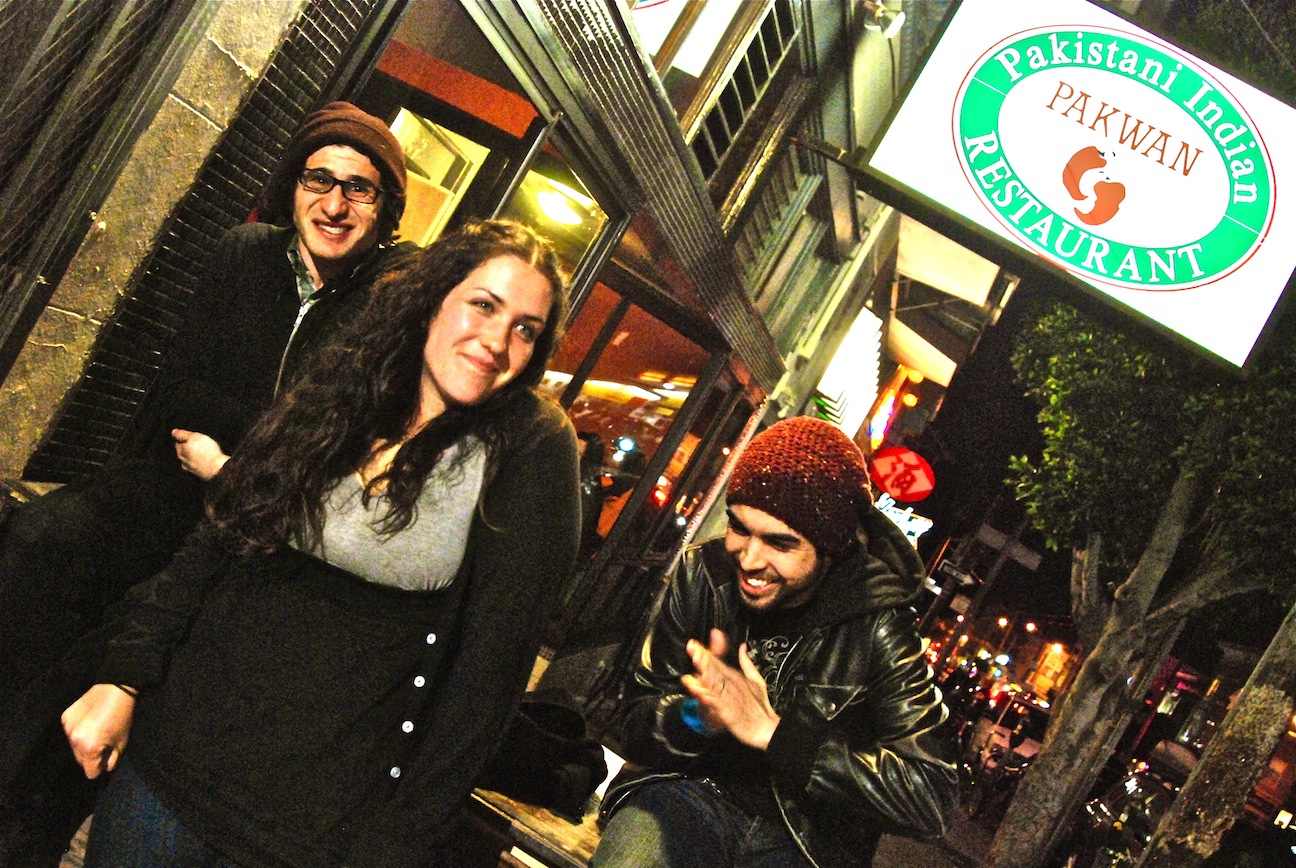
I showed up at the restaurant, Pakwan, a Pakistani Indian joint in the Mission, promptly at six-thirty, still a little sweaty from my bike ride there. Mama Lion members, Hannah Frances Healy, Victor Mitrani and Gabe Gipe, met me by the counter a few moments later and we all ordered our chosen items for the anticipated feast. I went for the spinach and lentil combo and Mama Lion picked out an assortment of steamy mushy items that looked strange and smelled amazing. 


During the hour that followed, conversation flowed without effort, the nan was devoured, we laughed, I cried (only a little on the inside as I fought off the spiciness of my meal) and when the bowls were left in a stain of reds and browns, not only was my stomach satisfied, but the four of us had really managed to have a successful first date. Even without the goodbye kiss or a promise to call, Mama Lion and I covered all first date bases.


The Past

The members of Mama Lion all grew up in the same San Diego school district and Mitrani and Frances Healy started a band together in high school. The three of them went to different colleges, but when they all relocated to San Francisco, the band was born. 


Careers

Frances Healy (vocals, guitar) is a dog walker, or as I see it, a canine chauffer/soccer mom combo. She drives around the city, picking up dogs in a van and takes them to Golden Gate Park. Mitrani (guitar) went to school for accounting but is totally not down for a nine-to-five in the profession, so he’s been doing maintenance work. Gipe (drums) is still a student, dreaming about one day becoming a history teacher, currently feeding the bank account with PT jobs at Apple and Starbucks. 


Personality

Mama Lion thinks it’s pretentious to say their sound is ‘unclassifiable’, but they’re also not comfortable with pinpointing a specific genre. Somewhere under the indie-blanket, the band takes direction from their old school influences: strong guitar attitude from Sonic Youth and the Pixies and more mellow tones from Cat Stevens and Simon and Garfunkel. 


Childhood

When Mama Lion was young, the band took on whatever gig they could find, meaning they ended up in some odd, very quiet spaces. A performance at the former Green Earth Café turned out to be the opening act for a group of belly dancers, shocking the crowd of little old ladies drinking tea. 


Confessions

Mitrani is a “Riot Grrrl at heart—a riot boi?” While writing his guitar parts, Mitrani imagine he’s pissed off, hanging out in a parking lot with a bunch of feisty ladies. Frances Healy was an anthropology major and likes to analyze people and situations in her lyrics. Gipe gets angry before putting together his drum part and puts himself in the mood to hurt something, like overly picky Starbucks customers. 


Looking for a new musical love interest yourself? Mama Lion plays two intimate shows this week.


Mama Lion

Mon/22, 7pm, $8

El Rio
3158 Mission, SF

www.elriosf.com


Tues/23, 8pm

Retox Lounge

628 20th St, SF

www.retoxsf.com


Bless up, Sebastopol!

0

The Hopmonk Tavern’s dance floor is packed in front of the DJ tables onstage. Reggae beats, dub tracks — the guy scratching gleefully up there even throws in a funk/soul number for good measure. Irie people groove, and couples grind to the sounds, which mingle with the smoke in the air. At the other end of the venue, the Hopmonk’s home brewed ales are poured and there’s an entrance to an expansive patio, where greenery of all stripes sets the scene. This is Monday Night Edutainment with DJ Jacques and DJ Guacamole. And this is Sebastopol?

Maybe I’m the only to be surprised by this- that a town with a population just under eight thousand that’s better known for its apple orchards and vineyards, has been having its Monday nights taken over by a reggae party for nine years straight. But Jacques and Guac’s brainchild, Monday Night Edutainment, is not just a small town scene. The party pulls in its share of guest stars like Sister Carol, Norris Man, Mega Banton- even Pam the Funkstress has been known to pass through the joint on occasion. Jacques and Guac recently threw a get-down for International Women’s Day featuring an all female lineup, and have an upcoming 4/20 eve blowout featuring British artists Mad Professor, Chukki Starr and Gappy Ranks (April 19).

But when the two DJs, who operate as the WBLK Dancehall Massive, first started scratching on Mondays, the music’s ascendency in town wasn’t quite as evident. “Reggae shows would sometimes come through the Mystic Theatre in Petaluma, or the Last Day Saloon in Santa Rosa, but there was never really a reggae presence in Sebastopol,” says DJ Jacques, whose gigs have taken him as far as High Times’ Cannabis Cup in Amsterdam.

That began to change when the duo met each other, initially as jam band percussionists, at local drum circles and shows. Jacques was a transplant from Boston, Guacamole a native Californian- but their musical tastes were complimentary enough that the two started looking into collaborative efforts. “We have different lists of favorites. There’s definitely crossover between us- but that makes it more fun,” explains Jacques.

Eventually, they started a weekly reggae/dancehall night, originally at Irish pub Jasper O’Farrell’s, that would feature a type of performance they dubbed a ‘DJ set,’ where guest artists would sing over the ‘version,’ beats selected by the DJ. When unaccompanied by a vocalist, Guac and Jacques would play sets, occasionally trying to one-up each other to see who could throw down the nicest flow. “That makes for a dope session where we’re constantly trying new things,” says Jacques.

The sets garnered a reputation that started attracting heads from beyond Sebastopol’s farm fields and sleepily upscale boho downtown. “We have folks that come through every week from all over the Bay area,” says Jacques. “Many of our crowd are musicians or people who work in the service industry that have Monday nights off. The night of the party often attracts artists in the area for big name weekend shows. They drop into the Hopmonk, Jacques says, “to hang out and enjoy the vibes” as well as perform. Nowadays, Sebastopol reggae parties are increasing in popularity, perhaps an inevitable progression for an area heavy in ganja culture.

Even as they helped to expand the area’s musical horizons, for the WBLK Dancehall Massive duo the mission continues- not only to play reggae’s best new jams, but to bring freshness to the Sebastopol music scene. “As the person who introduces music to the masses, we have a responsibility to seek new songs, artist and styles,” philosophizes Jacques. “In the immortal words of George Clinton, ‘free your mind and your ass will follow.’” All the way up to Sonoma County? As the prime minister of funk commands, so shall it be.


Monday Night Edutainment w/ Jacques & Guac

9 p.m. every Monday, $5

Hopmonk Tavern

230 Petaluma, Sebastopol

(707) 829-7300

www.hopmonk.com