SFBG Blogs

Who’s afraid of taxes?

1

Well, the candidates for governor are, but apparently the people of California are not. The latest Public Policy Institute poll makes it pretty clear:


Of the four main spending categories of the state budget, Californians are the most willing to consider a tax increase to spare K–12 education from budget cuts (69%), while just over half would pay higher taxes to maintain current funding levels for higher education (54%) or for health and human services (54%). A large majority (79%) opposes paying higher taxes to spare prisons and corrections from budget cuts.


Californians would consider some other ways to raise revenues: 67 percent favor raising the top rate of the state income tax paid by the wealthiest Californians and 58 percent would favor raising state taxes paid by California corporations. Residents are much less likely to support extending the state sales tax to services that are not currently taxed (35%) or increasing the vehicle license fee (28%).


More than two-thirds of the voters want to raise the top tax rate for the rich. Almost 60 percent want to raise corporate taxes. Why is this not part of anyone’s platform?


Don’t touch Dan Noyes!

3

Beth Spotswood has a very funny piece on SF Appeal about Channel 7 news reporter Dan Noyes and a very odd press flak at Laguna Honda who keeps trying to feel up Noyes’s shoulder. Over and over again, until Noyes finally slaps his hand away. Then the guy tries to do it again.


There’s an actual story here, about how the Laguna Honda patients’ fund is spent, but the video of the touchy-feely session has already overwhelmed the actual news. You gotta watch:

SFBG Radio: Johnny and Tim on the craziest Senate campaign in years

0

In today’s installment, Johnny and Tim talk about Meg Whitman’s precipitous poll collapse — and the Senate race in Kentucky, which could turn out to be one of the wildest in years. Will mainstream Republicans actually get behind a guy who doesn’t support the Civil Rights Act?

SFBGRadio5/20/2010 by SFBG

A close-up view of Boot & Shoe

0

The pies that fly out of the oven at Oakland’s Boot and Shoe Service make other dough-marinara-cheese combinations look flat and lame. Crispy, brick oven-fired crust, organic toppings and loads of flavor are partly responsible for the prized pizza goodness, but it’s also the layers of love baked into every bite.

As I wrote in this week’s article on the restaurant, Hot Slice: Oakland’s Boot and Shoe Service Wants to Love the Shit Out of You”, owner Charlie Hallowell is all about filling people’ stomachs with good stuff while simultaneously allowing them to relax, be served and drink accordingly.

I peeked around the joint shortly before they opened for dinner last week and snapped some photos. Sweet local art adorned all walls, baskets of fresh ingredients sat patiently, waiting to fulfill their duty and the staff buzzed with preparations.

Feeling in the mood? Get there early to avoid the wait, order it all and get a little love for yourself.


BOOT AND SHOE SERVICE

3308 Grand Ave., Oakl.

(510) 763 2668


Beards! Championship-bound, Bay Area beards!

0

Facial hair isn’t something that Xavier Marvel grows for the glory. This is his life. “I didn’t decide to go to the championships and then grow my musketeer,” says the dashing Marvel, who will represent the Bay Area at the upcoming 2010 National Beard and Mustache Championships in Bend, Oregon (June 5). I spoke to him recently on the phone, painfully divorced from seeing his follical glory in person. “I already had it. The competition is not the reason for my facial hair, it’s just sort of a bonus.”

Marvel sports a musketeer, a goatee-mustache combination popularized by the Dumas swashbucklers. Does the musketeer spirit, er, grow on him? “Sure, I try to practice chivalry as much as possible. Being a gentleman, that’s kind of my way. Plus, I’m half French, so I do feel that it’s in my blood to some degree. Do I go out challenging people to duels? Not really.”

The beard makes the man. Marvel’s been sporting facial hair since letting his peach fuzz fly at the tender age of 16, and he’s already competed in last year’s World Championships in Anchorage (in the “Partial Beard” category, subcategory Musketeer). He didn’t place in the top three, losing to long time veterans of the competitive bearding world. But, he says, “I’m not the most serious competitor — I shaved three months ago. I’m not anywhere near Jack Passion’s level of devotion. Are you familiar with Jack Passion?”

This is Jack Passion. Photo by Alessandro Sicco

Well shoots Xavier, I wasn’t. But I fixed that real quick, and I’m glad I did – Jack Passion is the man. A 26 year old from Walnut Creek, Passion has won the World Championships two years in a row in the big daddy of beard categories, Full Beard Natural (or “Natty,” as Passion has nicknamed it). “I’m the Muhhamad Ali of beards,” he told me — with no lack of follicular braggadacio — over the phone today. Passion’s now got his own (sick) line of faux beard tees, and penned The Facial Hair Handbook, which he respectfully suggests for all those interested in getting their beards up to speed for the upcoming national championships.

“Big Red,” as his luscious belly length locks have been dubbed, is so spectacular in fact, Jack’s sitting Bend out this year as a competitor. After seven years of growing his beard and five years of professionally slaying all competition with it, he cites a desire to pace his beard career as reason for the break. Which is all good — he’ll still be in Bend as an MC and judge. But don’t expect the relief for his competitors to last past the Oregon showdown. “This competition may incite a fire in my soul. If that’s the case, I’m to have to crush all these guys and their hopes for bearded glory,” Passion revealed.

Fellow Bay area representative Marvel is stoked for the chance to have another swat at hairy ascension. “I have a good laugh with it, now I can go bond with my bearded brothers, travel a bit, see a new place — and then I get a chance to claim a title for my beard.” God speed, Javier. At the risk of journalistic objectivity, we here at SFBG are pulling for you and the musketeer.


Stay tuned! Turn to sfbg.com for Jack Passion’s post National Championship rundown!  The costumes, the carnage! The Muhammad Ali of beards tells us how it all went down!


2010 National Beard and Mustache Championships

June 4-6, $10

Les Schwab Amphitheater

344 Shevlin Hixon, Bend, OR

www.beardteam.org

Street Threads: Look of the Day

0

Today’s Look: Brandon and Joseph, SF State

Tell us about your look:

Brandon: “This is all Club Monaco, because I work there.”

Justin: “American Apparel and a Club Monaco oxford.”

Most Californians want legal weed

1

By Brady Welch

Puff, puff, pass on the good news. A new poll finds that a majority of California voters—51 percent—support the fall ballot measure to legalize, tax, and regulate marijuana for even strictly recreational uses (40 percent opposed it). And support rises a point when respondents are asked about its various benefits.

According to the poll by Oakland-based firm EMC, 69 percent agree that the initiative “will raise needed tax revenue,” arguably its largest selling point. Supporting this notion of turning green into more green, the state’s tax regulator, the Board of Equalization, issued a study last summer noting that taxing pot could bring in an estimated $1.4 billion to state and local governments’ starved coffers.

“We only need fifty plus one,” Dale Sky Clare, Executive Chancellor of Oaksterdam University, told us referring to the percentage needed to pass the initiative. “We’re excited. Even with conservative questions, the poll numbers still show support.”

Six in 10 voters believe the initiative “will save the state money.” This is in line with the nonpartisan Legislative Analyst’s office estimation of “savings of several tens of millions of dollars annually… on the costs of incarcerating and supervising certain marijuana offenders,” according to a report on its website. Even a number of state law enforcement figures have come out in support of the initiative, including Oakland City Attorney John Russo.

“Folks are becoming frustrated with the politics of pure symbols,” Russo told us, referring to the failed War on Drugs. “Marijuana is widespread among otherwise law-abiding people, and it’s viewed by people morally as no different from alcohol. We should stop pretending.”

Other polls have been floating around recently, some slightly higher in one direction or the other, but overall, the numbers suggest the political winds are moving in the right direction. More than three in four voters (77 percent) have heard of the initiative, according to EMC, and awareness is particularly high among newer voters, young folks, and independents—exactly the kind of people who voted for change in 2008, and exactly the kind of voters that will move California, and the country, into a greener (in more ways than one) and brighter future.

Realtors send deceptive mailer to SF renters

0

The San Francisco Association of Realtors, which has a long history of actively opposing the protection of tenants and rental housing, now wants tenants to believe it is on their side. The Realtors even recently formed and funded the Committee to Preserve Rental Housing to alert tenants about a ballot measure that they say favors dreaded rich people.

The only problem: It’s complete bullshit.

“Wealthy tenants will benefit most if Proposition F passes,” warns a mailer that landed this week in the mailboxes of San Francisco apartment dwellers, referring a local ballot measure that would allow renters to delay rent increases if they lose their job or their salaries dip by 20 percent or more.

But the mailer warns that the measure would somehow favor rich renters, citing this example: “Take a tenant whose annual income has dropped, for any reason, from $250,000 to $200,000. Under Proposition F, that tenant would be able to apply for financial hardship status and, at the discretion of a public official, qualify for financial relief.”

Yet the measure doesn’t really allow that scenario. Ted Gullicksen, director of the San Francisco Tenants Union, which helped draft the measure, points out that it only applies to renters who pay 33 percent or more of their incomes in rent, which in the Realtors’ example, would be a $5,500 per month home.

“Which, even in San Francisco, is pretty high,” he said. Plus, the Rent Board (that “public official” the mailer darkly warns of) could still tell that poor rich guy, sorry, you’re denied, perhaps it’s time to find a slightly cheaper place to live. But Gullicksen said he’s not surprised at such a deceptive attack from the Realtors (which formed the group on April 30 using campaign attorney Jim Sutton, downtown’s usual dirty trickster, according to an Ethics Commission filing).

“The Realtors over the years have increasingly taken the lead in fighting rent control measures, so they are now even more active than groups like San Francisco Apartment Association,” Gullicksen said, noting the Realtors have also pushed hard on ending condo conversion limits and other efforts to protect rental housing. “The individual Realtors are also landlords and speculators to a great degree.”

I called the Association of Realtors for comment and am waiting for a return call, but I’ll add their response as a comment if and when I hear back.

Gullicksen was confident renters would see through the mailer, particularly because it was required by law to include the line “major funding by San Francisco Association of Realtors.” He’s more worried about voter turnout, which could be low for the June 8 election. And even though two-thirds of San Franciscans are renters, they aren’t the most reliable voters and could constitute as low as 40 percent of voters in this election.

So if you rent, don’t be fooled and don’t forget to vote.

The feminization of Mexican agriculture

0

SANTA CRUZ TANACO (May 20th) – When I first settled into this tiny Purepecha Indian village high in the Meseta Tarasca of west-central Michoacan state 50 years ago, few women tilled the land. Tending the “milpa” (corn patch) was strictly a man’s work. The men ploughed the fields and planted in the spring and the wives and daughters would help to weed (“barbechar”) and glean in the harvest — but it was the men who strapped on the “tchundi” basket as they moved up and down the rows, snapping off the big ears of maiz to be sold in the markets of neighboring cities.

While the men lorded it over the corn patch, women had dominion over the home and the children. They cared for the kids and the chickens and prepared the meals. At mid-day, they wrapped up fresh, warm tortillas in colorful “servietas” and carried them out to the fields to feed their husbands.    

Only two women in Tanaco actually worked their own “parcelas” (plots.)  Dona Teresa Garcia had a handful of fields scattered up and down the valley she had inherited from her murdered husband and many sons to work them, and although she was known to get her hands dirty, she was more an overseer and administrator.


Slight and sprightly, Tere delighted in a full storehouse and was proudest of her purple and red and blue pinto corn she grew from her cache of grandfather seeds.  

Nana Eloisa, on the other hand, was a mountain of a woman who ploughed the rocky valley soil at the foot of volcanic mountains and lush pine forests — when she didn’t have an ox or the wherewithal to rent one, Eloisa was known to harness up the plough and pull it herself. Nana Eloisa had no husband although men sometimes hid in her long serge skirts. Unlike Dona Teresa, who preferred to negotiate off stage with the men who ruled the community, Eloisa, who was equipped with a stentorian voice, often spoke up at assemblies of the “comuneros” (indigenous landholders.) The neighbors talked about her in awed whispers.

Times have changed up in the Meseta — and changed again. In the 1980s, as the first of five neo-liberal regimes took hold far away in Mexico City, the Purepechas — who never strayed far from the Meseta, unlike their mestizo neighbors in Tangancicuaro and Gomez Farias who first began trekking north a hundred years ago — plunged into the immigration stream with a vengeance. Fathers and sons went off to find their fortunes in El Norte and many never came back.

The women were left in charge of the house and the milpa both, a double workday (“doble jornada.”) Their husbands would send home the “remisas” (money orders) with instructions on where and how much corn to plant. Any cash left over was destined to pay off loans for the “coyotes” who charged thousands of pesos to get the men across the border.  

Often the women would hire “peones” and “jornaleros” to do the fieldwork, but others worked the milpas on their own. Gradually the women began to make their own decisions about their husbands’ land.  Many stepped out of the traditional long Purepecha skirts and literally and figuratively put on the “pantalones.”

There are more women than men in Mexico 53,000,000 to 50,000,000, according to the 2005 half census. Although many are still tied to the home, women now comprise 40% of the workforce.


In the rural sector where 28% of the population continues to subsist, the stats are even more skewed. One estimate is that 18 million women are now the primary workers on the land — but only 4.5 million actually have title to it. Title allows them membership and voice and vote in the ejido (villages that are designated rural production units) and community, access to agricultural credits, and full agrarian rights. But women landholders are often relegated to servant stature in the ejido assemblies where only 2.5% serve as officials of the 28,000 communal farms so designated by the Secretary of Agriculture.

Although many women farmers or “campesinas” join mixed gender farmers organizations like the PRI party-run National Confederation of Campesinos (CNC) or the more left UNORCA and El Barzan, the dismaying disparity in their recognition as producers have motivated the women to form their own groupings such as the Ecological Campesinas of the Sierra of Petatlan Guerrero and the CONOC (National Council of Women Farmers’ Organizations.)  

But whether within the male-dominated farmers centrals or those of their own making, equal recognition has been slow in coming for the campesinas. Although agricultural budgets put together by the Secretary of Agriculture (SAGARPA) and the Secretary of Social Development (SEDESO) appear to allocate 42% of their resources to women, the numbers are deceiving – most of the money designated for women farmers is assistencial aid drawn down from the “Oportunidades” poverty program.  

Other monies are assigned to crafts collectives such as the ceramicists of Ocumicho just over the mountain from Tanaco, where the women throw the much-in-demand pots and the men bring the wood to keep the ovens fired up. Funds for micro-projects such as keeping chickens are available to women farmers but as Blanca Rubio writes in the left daily La Jornada, the campesinas would rather be recognized as producers of maiz than for their ancillary talents.          

In addition to the gender of farming, the gender of out-migration from feeder states like Michoacan, Jalisco, Guanajuato, Zacatecas, and more indigenous Chiapas and Oaxaca, has changed radically. Once upon a time only men headed for El Norte and the potentially mortal consequences of this dangerous migration but womens’ numbers in the flow north have tripled in the last decade as neo-liberal agrarian policies imposed from Mexico City have devastated the “campo” and the bottom has fallen out of Mexican agriculture.

Under presidents Carlos Salinas and Ernesto Zedillo (1988-2000), the Constitution was mutilated to allow the privatization of communally-held land, grain distribution was handed over to transnationals like the Cargill Corporation, guaranteed prices were scrapped, and credit for poor farmers dried up. Vicente Fox and Felipe Calderon (2000-2010), presidents chosen from the right-wing PAN party, have hastened the demise of the agricultural sector.

The coffin nail was the 1994 North American Free Trade Agreement.  Every year since, millions of tons of cheap U.S. and Canadian corn swamp Mexico forcing small-hold campesinos and campesinas out of business. A Carnegie Endowment investigation into the impacts of NAFTA on poor Mexican farmers published on the tenth anniversary of the trade treaty calculated that 1.8 million farmers had abandoned their milpas in NAFTA’s first decade – since each farm family represents five Mexicans, the real number of expulsees comes in close to 10,000,000, at least half of them women.

One consequence is that women now swim in the migration stream in dramatically increased numbers. Sisters follow their brothers north and wives their husbands, leaving the children at home with the grandmothers. A third of the households in Tanaco and just down the valley in Cucucho have no mother or father at home.  

For those women who stay behind, lifestyles have changed.  Families have abandoned or sold off their milpas and the remisas from El Norte (which decreased 20% in recession-ridden 2009) are now invested in building up the house, laying cement floors and hooking up electricity lines. Women open “changaros,” storefronts where they sell knicknacks and snacks to their neighbors.

Women farmers who still till their parcelas now have to work a triple workday (“triple Jornada”) just to make ends meet, finding jobs outside of the community as domestics or factory workers, taking care of the house and the kids and the chickens, and tending to the milpa. When the husbands do come home, the once rigidly defined roles of men and women in the Mexican countryside have been irreversibly altered. Men are not the sole breadwinners now and decisions must be taken together. Left to their own devices to survive, the campesinas have become empowered.  They have feminized agriculture.

The feminization of the Mexican campo is a bright light in a dismal prospectus, thinks the much-respected agrarian analyst Armando Bartra. Gender articulates how farmers approach the land, Bartra writes. Men wrest the crops from the soil. They plant to achieve bigger and better harvests and resort to chemical fertilizers and pesticides and genetically modified seed to speed up the bounty. They pin their hopes on the market, Bartra underscores, “and the market has no future” for small farmers.

By way of contrast, women are more in sync with the land. They don’t till the soil for profit as much as to keep their families well nourished. They are commited to auto-sufficiency first and do not poison the land upon which they grow their family’s food with chemicals. The feminization of farming, Bartra concludes, is “the only salvation for Mexican agriculture.”

John Ross has returned to El Monstruo (Mexico City), the title of his most recent volume “El Monstruo – Dread & Redemption in Mexico City” and the most contaminated, crime-ridden, corrupt, and conflictive megalopolis in the Americas.      


I want to throw up

18

I’ve gotten a pretty strong stomach after 25 years of political reporting, but when I read stuff like this, I reall want to throw up. It’s not just pandering or corruption or sleaze — that shit’s common enough, and I can deal. It’s this utter, blatant, mind-boggling lack of reality that makes me start to lose my lunch.


(Pretty good lunch, too — I made myself a nice turkey sandwich with havarti cheese and mayo, on a crispy roll, bag o’ chips, bottle of sparkling Calistoga — hate to see it come back up again.)


But please, folks: Cannot anyone running for governor of California be remotely honest about the budget problem? These people are not fools; Meg Whitman and Steve Poizner have run businesses. Jerry Brown has been governor before, and has been a mayor. They know how budgets work. And they know this:


You cannot — cannot — solve a $19 billion budget deficit by reducing waste and fraud. Even Schwarzenegger admits that:


Shortly after taking office, Schwarzenegger also promised to find billions in fraud through a top-to-bottom review of state government. But after the 2006 review, Schwarzenegger admitted his advisers “did not find the kind of abuse that I thought there is.”


 There’s not $19 billion worth of bureaucratic waste, either. It’s just not there.


There are only two options to make this state fiscally sound again: Fundamentally restructure what the state of California does (that means, for example, eliminating most of the social safety net, giving up on public education and releasing about half the prison population), or raise taxes.


Only two options. Anyone with any sense knows that; as my friend and colleague Johnny Angel Wendell likes to say, it’s just simple math.


And yet nobody’s talking about it. Nobody’s even coming close. And the press isn’t pushing all that hard, either.


I was pleased to see that my old pal Jerry Brown saying that “those with the biggest belts” should tighten them. At least that has a tiny nod to the notion that some people are better off than others and the rich ought to pay more than the poor. But what the hell does it mean?


I called Jerry’s campaign office this afternoon and asked Sterling Clifford, his press person, to help me out a little. Is Brown saying that he thinks the wealthy should pay more taxes?


Actually, no: “I think he has been very clear that there will be no new taxes unless the people vote on them,” Clifford told me.


Okay, so does that mean he’s going to cut the budget of the biggest departments — say, the prison system? Well, no: “He intends to enter the budget negotiations with the Legislature with all options on the table.”


Shit. How about restoring the Vehicle License Fee to what it was before Schwarzenegger rolled it back? That a good Jerry Brown issue, environmentally sound. How about it? “I don’t know,” Clifford said. “I’ve never asked him about it.”


Well, you should, Sterling, and so should every reporter who sees him at every press event and every activist who sees him at every rally. And the same goes for Meg and Steve. These people are acting delusional — and we just have to call them on it.

The coffee shop-dollar store king of Divco

1

One questions the need for another coffeehouse on Divisadero – seems like every time I turn around there’s another corner store churning out lattes and biscotti. But clearly I lack the vision of Haile Taddesse, owner of the 99¢ Divis Variety Discount at Divisadero and McAllister. “I am a coffee addicted person,” the Eritrean business owner tells me. “I grew up in a coffee country.” And no offense to the other establishments on his street, but he thought their coffee was mediocre. So, sick of trekking “ten blocks, or a mile even,” to find Philz or Blue Bottle, he decided to expand his business empire with a cafe next door to his dollar store.

Which makes for an interesting blend of customers. The DivCo (Division Corridor) neighborhood demographics are changing rapidly these days. Older restaurants and barbershops are ceding their storefronts to trendy new restaurants and coffee shops. Hell, some people (we won’t go into who those people are, we don’t particularly jibe with them) have even made up a name, NoPa, for the stretch, eschewing the working class implications of Western Addition.

So it’s nice to see a long time business owner successfully adapting to the winds of change. This morning when I visited, business was rolling at the five year old 99¢ Divis. A group of immigrant men chatted with Taddesse about politics (“I like Reagan and Clinton. Reagan was respected abroad. Americans, they don’t care about that.”). On the other side of the door that leads to Oasis Cafe, a cheerful barista made sandwiches and coffee for young people, and a few individuals working on their laptops.

And true to his word, Tadesse’s got some damn good coffee. Ten different kinds of beans sit behind the counter, and drinks are made on a cup by cup basis. “Most coffees around here are deceptive,” he told me. “You don’t see them make it. I am trying to make everything fresh for the neighborhood.” I tried the Divisadero blend, which I was told was the darkest of the blends that day. It gave me a rich jolt that I must admit is hard to come by at other spots down DivCo.

Seating is ample and comfortable; banquettes and deep, overstuffed leather armchairs. There’s a large mural of an oasis on the back wall, painted free of charge by a fellow cafe owner who just wanted to contribute something to Tadesse, who turns in 16 plus hours a day at his mini commercial empire. Already, an extensive menu of milkshakes, fresh juices, omelettes, and sandwiches are available — but the owner sees all this as merely the beginning for the cafe. He has plans for an Ethiopian food menu, soups, outside seating for his customers.

Business at the cafe, located on less frequented stretch of Divisadero blocks from both the Mt. Zion Hospital lunch crowds and the hot Lower Haight blocks, has already exceeded Tadesse’s expectations. Which flies in the face of the advice from the friends who wieghed in when he first concieved of Oasis.

“They said not to waste my money, that it was a bad location,” he tells me as another customer unloads an armful of cheap toiletries at the dollar store counter. “But it’s not up to the competition. It’s up to you, and your product. I said ‘don’t worry, I’ll show you.’ ”


99¢ Divis Variety Discount & Oasis Cafe All in One

901 Divisadero, SF

(415) 474-4900

May the tastiest critter-friendly cupcake win

0

Your chops sink into the rich, sweet fluff and your lips are left with a coat of luscious frosting; cupcakes are the things dreams are made of and especially the dozens that will be up for tasting this weekend at the Rock Paper Scissors Collective‘s 2nd Annual Vegan Cupcake Bake-off. No butter, no eggs people– all that delicious and they’re animal friendly…pretty sure that will be my excuse for chomping well over five cups.

This bake-off isn’t meant for observation– four bucks gets you a napkin, fork, plate, and a chance to nimble and snack on a the tantalizing entries of frosted vegan treats. Try them all and then vote for your poison. Will it be chocolate drizzle or peachy keen? Oh, the choices we must make.

vegan cupcakes

Last year’s winner, Laurie Ellen, dazzled taste buds with her vegan strawberry-lemonade cupcakes and earned not the typical loads of ridiculous fame and fortune, but a sweet sense of local pride and a good, sugary feeling on her insides. Yum! The taste testing, the baking and more taste testing– I’m guessing the labor of a baker is quite hard to bear and if only I were best friends with one of these candied cooks, I could surely help out.

This baker’s triumph needed to be further explained and luckily Ellen was up for hinting at a couple of her yummy secrets. 


SFBG: Tell me about the crafting of your Strawberry-Lemonade recipe? 

Laurie: The recipe last year came out of a last minute dinner at a friends house. I decided to make some cupcakes using lemons from the meyer lemon tree in my backyard that had been fruiting gloriously and some strawberries a coworker brought into work which I had recently made into preserves. It was a union between making something seasonally relevant and making something with items in my pantry.

SFBG: How many cupcakes did you eat in preparation?

Laurie: Well, I usually eat one from every batch and I made about 6 batches leading up to and including the competition, so 6, at least.

SFBG: Who else ate them?

Laurie: Friends, coworkers, strangers, anyone who wanted one, I was itching for feedback.

SFBG: What was the best part about your winning cupcake last year?

Laurie: The people that came up to me after the competition telling me it was the first vegan baked good they had eaten and that it really surprised and challenged the notion of what they thought a cupcake was or could be.

SFBG: What drink would pair best with the strawberry lemonade cakes? Vodka? Milk? 

Laurie: An icy cold Arnold Palmer.

SFBG: Do you always bake vegan?

Laurie: About half the time. Although I am not vegan I have friends and family in my life who have a variety of dietary differences and if I am making something, especially dessert, I want everyone to be able to enjoy it. I think it has come in pretty handy and people are surprised and excited when they realize that they can enjoy dessert too.

SFBG: Any hints as to what you’ve whipped up for this year’s contest?

Laurie: You’ll have to come out to RPSC to check it out, it is a refreshing summer cupcake, I hope people will enjoy it.


Besides the bake-sale itself, Paper Rock Scissors will have a bunch of crazy-cupcaked themed events, good for distracting sugar teeth from the pans of goodies. A cookbook of all the vegan treat recipes will be for sale, meaning you can attempt to replicate your favorites. Bring-Your-Own-Tee shirt/totebag or whatever and get it branded with a lovely screen printed cupcake or grin with your mouth full in the cupcake photo-booth. 


2nd Annual Vegan Cupcake Bake-off!

Sat/22, 2-5pm, $4

Rock Paper Scissors Collective

2278 Telegraph, Oakland

www.rpscollective.com


Street Threads: Look of the Day

0

Today’s Look: Kimberly, SF State

Tell us about your look: “Mostly thrift. I love thrift. It’s the only thing I love in my heart.”

The Daily Blurgh: Straight talk and space calcium

0

Curiosities, quirks, oddites, and items from around the Bay and beyond

Local, totally awesome new media experiment 48 H — a print magazine produced, as its title suggests, in just two days using online social networking and publishing resources — was sent a cease and desist letter by old media dinosaur CBS, which owns the television news magazine 48 Hours. Come on folks. We’re all journalists here. Can’t we all just get along?

*****
The only dating formula you need.

*****
It’s hard out there for small to medium-sized museums (especially local ones).

*****

“[…] Let me start by telling you what it is that sounds ‘straight.’ Straight  actually turns out to be the perfect word to describe what straight guys do. It’s very straight—it has no curlicues, it has no frills or any kind of melodic turns. So they say, ‘Hi. How are you?’ It’s simple, and the lines are very straight, instead of ‘Hi, how are yOOuu?’ You know, women are much more melodic—their voices go up and they go down, and they even move their mouths more. There’s a lot more animation. A straight guy just goes, ‘Hey—this is as much energy and animation as I’m putting out for this thing.'”

*****

Supernovae: They do a body good?

*****
Awkward! (Especially considering that tonight was the State Dinner honoring Mexico.)

*****

Congratulations! Two giant gay metallic penises are your new Olympic mascots, Great Britain.

Progressives, labor, grassroots win in May 18 primaries

4

Forget all the talk of anti-incumbent (and by implication, anti-Democrat and anti-Obama) sentiment in the electorate. The primaries May 18, which I talk about here, actually sent a much more interesting message.


Yes, there was the election of Rand Paul, who is about as looney as they come , but Republicans have nominated looneys before. What’s interesting is that in most contested Democratic races, the more progressive candidate won. Randy Shaw points out that CNN had it all wrong, and refuses to acknowledge what actually happened. The Chron actually notes (in one of the few intelligent MSM post-election pieces) that labor, particularly the AFL-CIO, won big in Pennsylvania and Arkansas. In the only open house seat, the Democrats won.


In the Democratic primary in Kentucky, the more progressive candidate won. In Pennsylvania, the more progressive Democrat won. In Arkansas, a Democrat in name only is facing a runoff she might lose.


So the progressives and the grassroots organizers can get people to the polls — if there’s a candidate to vote for. What Nancy Pelosi needs right now is a good national issue to run on. Electoral reform, for example.

The Governor and the condemned man

0

Dick Meister, a San Francisco-based columnist, covered the Caryl Chessman case as a reporter for The Associated Press, correspondent for The Nation
magazine, and commentator for Pacifica Radio, which won a Peabody Award for its coverage. Contact him through his website, www.dickmeister.com.

It’s February 19, 1960. Caryl Chessman, tall, broad-shouldered, hawk nosed, sits on the edge of a hard, narrow bed. Clenching his fists and biting his lips, he stares at the bare walls of Cell 2455, Death Row, then out through a small, barred window and across the dark waters of San Francisco Bay – from San Quentin Prison to the lights of the city.

One-hundred miles north, Edmund G. (Pat) Brown, the pudgy, owlish 32nd governor of California, also sits alone, perched on the edge of an overstuffed arm chair. Puffing incessantly on a cigar, he studies the ornate design in the pale green wallpaper that covers the walls of the Victorian parlor of the governor’s mansion in Sacramento, as he agonizes over whether to spare Caryl Chessman from execution the next morning.  Outside, I and a half-dozen other reporters, chilling in the harsh night air, anxiously await his decision.

It’s been fifty years. Yet the events of that cold February evening and those immediately preceding and following them, remain vivid in my memory, and surely in the memories of many others, as among the most dramatic in modern California history.  Californians weren’t alone in their concern over whether Chessman should be executed, for the Chessman case had become a major issue internationally, with millions urging Gov. Brown to spare Chessman.

Pat Brown was one of California’s finest governors. He was, as he once said of John Kennedy, a chief executive who carried out a strong belief  “in people and the political process for solving human problems.” Brown’s contributions were many, and among the most important were those stemming from that agonizing night. The evening was as significant for Chessman, whose courage and determination inspired people throughout the world to actively oppose capital punishment. His actions, as those of Brown, had a profound and lasting impact.

Brown was convinced that Chessman had been unjustly condemned. “They got him on technicalities,” the governor noted – not on charges of killing anyone, but under a law, since repealed, that made kidnapping for the purpose of robbery, with bodily harm a capital offense. Two cases were involved. In both, Chessman was charged with sexually attacking women, taking money from them and “kidnapping” them by, in one case, forcibly moving the woman from one room in a house to another and, in the other case, driving the alleged victim a few miles in a car.

Chessman insisted, at any rate, that he was not guilty, and for almost a dozen years up until that night 50 years ago, he had fended off execution. Six other times he had been scheduled for death but each time he had won reprieves from the courts, largely on the basis of his own carefully researched arguments against errors in the trial proceedings that had led to his death sentence. Finally, as he faced his seventh appointment in San Quentin’s gas chamber, Chessman appealed to the governor for executive clemency that would free him at last from the threat of execution.

Pat Brown was an avowed foe of the death penalty. But he insisted that as long as capital punishment was on California’s statute books, he had no choice but to “uphold and faithfully execute” the law, even including its unjust technicalities.

That’s what Brown had done earlier in his political career as district attorney for San Francisco and later as state attorney general, calling for the death penalty in legally appropriate cases. True, Brown had granted clemency to 22 of the 62 people who were scheduled for execution during his two terms as governor, but none of them attracted the public attention that Chessman drew.

None of the other condemned men had so loudly, so arrogantly and so eloquently proclaimed their innocence and disdain for the law that threatened them with death. Only Caryl Chessman had managed to stave off a death sentence for so long, damning and exposing in court and in the books he wrote from his prison cell, the serious failings of a legal system that relied on the gas chamber. Only Caryl Chessman rallied millions of people to support him and to oppose the law and those pledged to “uphold and faithfully execute” it.

Chessman, Brown complained at the time, sought “only vindication.” That the governor would not grant. Nor would he grant clemency to Chessman – because, said Brown,”the evidence of his guilt is overwhelming.” Many who were familiar with the case, including prominent lawyers and law enforcement, disagreed strongly with that assessment. But like the complaint that Chessman’s death sentence was based on “technicalities,” that was almost beside the point.

Much more important were the political considerations involved. Politically, Brown’s course was by far the wisest he could have taken. Virtually every newspaper in the state, virtually every politician and a clear majority of the general public were clamoring for the death of a man who so boldly had defied their system of justice, a man who had in effect dared them to “kill me if you can.”

“The mob may applaud treating me arbitrarily and arrogantly, history won’t,” Chessman wrote the governor. “But, then, history can’t vote.”

Chessman obviously had little reason for hope, as he sat on the edge of his hard prison bed on that February night a half-century ago, awaiting the morning and death.

But Gov. Brown was having second thoughts as he sat staring at the parlor wall in Sacramento. Brown flipped through a tall stack letters and telegrams from all over the world urging clemency for Chessman, some from close political allies such as Eleanor Roosevelt.
There also were petitions, including one from Brazil with more than two million signatures. Among the hundreds of telegrams was one from an assistant secretary of state warning there might be anti-American rioting throughout South America if Chessman went to the gas chamber. There was a telephone call from Brown’s 22-year-old son Jerry – who would one day be governor, too – arguing that Chessman be spared.

Most of all, there was Brown’s very troubled conscience. He began ‘”doubting the righteousness” of his position, he later told some reporters privately, now that he was “the one man on God’s green earth between another man and death.” Brown knew very well, however, that sparing Chessman would subject him to severe criticism that could do great harm to his extremely promising political career.

Finally, after two hours of hard, painful thought, Brown reached a decision.

The governor could not commute Chessman’s death sentence to life imprisonment or to any other lesser penalty. Under California law that would have required approval by the State Supreme Court, since Chessman had been convicted of more than one felony. And the court had previously voted 4-3 against commutation.  But the governor was able to grant Chessman a 60-day reprieve, in the meantime calling the State Legislature into special session to consider Brown’s proposal for abolition of the death penalty in California.

The furor was immediate and fierce. Letters poured into Brown’s office at the rate of 1,000 a day, attacking the governor and Chessman in foul, violent language. Newspaper editorialists were as outraged over Brown’s reprieve of a man they called a “depraved fiend . . . filthy monster . . . psychopath,” an example of “the scum among us which should be pushing up the daisies.”

Abortive movements for Brown’s impeachment or recall were begun, and legislators from both parties complained bitterly because the governor had in effect tossed the Chessman case to the Legislature, where 100 of the 120 seats were to be contested in the fall elections later that year.

Brown’s political influence dwindled rapidly, and he backed off on his promise to “do everything in my power” for the abolition proposal. He merely submitted it for the Legislature’s consideration.

 The abolition bill didn’t make it out of committee, even after Chessman urged that, if necessary, it be amended “in such a way as to exclude me.”  He told legislators, “I am willing to die if that will bring about this desperately needed social reform.”

Caryl Chessman was executed 50 years ago this month, on May 2, 1960.

Dick Meister covered the Caryl Chessman case as an Associated Press reporter.

SFBG.COM Radio: Tim and Johnny on yesterday’s primaries

2

Today we talk about last night’s primaries, what they meant — and what they didn’t mean. In fact, the conventional wisdom in the MSM is all wrong about what happened. Listen after the jump

SFBGRadio5/19/2010 by SFBG

Immigration 101: Out of the mouth of babes

3

The Internet is abuzz with the news that a second-grader asked Michelle Obama about immigration during a visit to a Washington-area school–and in the process revealed that her mother is here without paperwork.

“My mom said, I think that she says that, Barack Obama is going to take away everybody that doesn’t have papers,” Margarita Zavala said.

“Yeah well that’s something that we have to work on, right?” the first lady replied. “To make sure that people can be here with the right kind of papers, right? That’s exactly right.”

“But, my mom doesn’t have any,” Zavala replied.

So, what will happen now that everybody in the world knows that Margarita’s mom is here without legal paperwork?

A) The feds descend on the Zavala household and slap an electronic monitoring bracelet on Margarita’s mother’s ankle, until they determine if she is deportable?

B) The Arizona-inspired alien-bashers cite Margarita’s mother as one more example of what is wrong with Obama’s administration, if the feds don’t haul her off pronto?

C) Margarita puts a human face on the people (and their kids) who are being terrorized by Arizona-style policies and helps the Obama administration move ahead with overdue immigration reform?

I don’t know what will happen. But I do know that it’s easy to rant about “illegal aliens” when they’re not your mother, the woman who tucks you into bed each night and helps you get to school on time, so you can open your mouth and speak truth to power.

Hot sexy events May 19-25

0

Original Plumbing is the new thing on the ‘zine scene — a local publication dedicated to exploring the panorama of beauty in the transexual male, which we first covered back in March (the magazine, not the beauty, we’ve been liking that for awhile now). They highlight all kinds of models; whatever your weight, hair placement, surgery status, it’s all gravy to Rocco Kayiatos and Amos Mac, the editors of OP. In addition, they’re tackling the political issues of the day, and their first issue included info on “how to be a man for free.“ Affordable, always sexy! Join up with Original Plumbing in the showers and spas of Eros this week at the release party for the the third issue of its glossy pages.


Original Plumbing Party

Celebrate the SF’s magazine’s health and safer sex issue at this sexy soirée — at the workplace of Niko, one of the models featured. Door prizes, wine, and the brains behind the mag will be in attendance.

Wed/19 7-9 p.m., free

Eros 

2051 Market, SF

(415) 255-4921

www.erossf.com

——————————————-

Non Monogamy for the Novice

M. Makael Newby discusses breaking down the societal ties that bind us to form a more perfect, three person or more, loving relationship. Figure out the difference between non-monogamy and just being a dirt bag to your partner, plus examine what’s up with physical versus emotional multi-partnering.

Wed/19 8-10 p.m., $25-30

Good Vibrations

603 Valencia, SF

(415) 522-5460

www.goodvibes.com

——————————————-

Fight Back!: Resistance Play and Kinky Wrestling

Stefano (of Stefano and Chey, hosts of Bent and long time sex educators) brings his experience getting bite marks out of leather to the topic of “illusion of force,” that popular, yet difficult to achieve fantasy of BDSM. In this class, he’ll teach about the physical techniques of a partner who feigns non-compliance, as well as the psychological processes at work.

Thurs/20 8-10 p.m., $15-20

SF Citadel

1277 Mission, SF

(415) 626-1746

www.sfcitadel.org

——————————————-

Light Heart, Heavy Hands: Sadistic Humor in Sex Play

Tee hee. Giggle giggle. Ha! How can you transform your sex play through the power of laughter? This class teaches ways to integrate a good guffaw into your kink for increased connection with your top, bottom, baby sitter, cell mate, schoolgirl… The list goes on. Just remember though, the women’s BDSM group Exiles’ monthly classes (of which this one is a part) are open only to those who do not identify as male.

Fri/21 8-10 p.m., $8 for members, $10 non members

Women’s Building

4543 18th St., SF

www.theexiles.org

——————————————-

Wet

Kinky Salon has put out a list of acceptable outfits for the undersea theme party they’re sponsoring this week at Mission Control. Here’s a truncated version. Ahem: scuba divers, clam jousters, Captain Nemo, manatees, sea lions, mermaids, kelp, krill, plankton, sea nymphs, and of course, the giant squid. With all that and more to choose from, you can’t help but dive into the sex-positive exploration at hand. Plus, the Lusty Ladies will be there!

Sat/22 10 p.m., $25-30

Mission Control

2519 Mission, SF

www.kinkysalon.com

——————————————-

Ride

You know you were born, born, born to be wild! Prove it to yourself at this big, hairy romp, where if you bring in your helmet, American Motorcycle Association card, or your club colors you can go ahead and get ready to get adored. It’s the leathermen affinity night at Eros. Rubber down and rubber on!

Mon/24 4-12 p.m., $7-17

Eros 

2051 Market, SF

(415) 255-4921

www.erossf.com

——————————————-

Wake Up Your Pelvic Floor

Physical therapist and Feldenkrais practitioner Deborah Bowes moves beyond Kegels to show women what more they can do to improve their sex lives through exercise. So relax that pelvic floor, strengthen that pelvic floor, learn to enjoy health… in a whole different way. It’s a great time to firm it up — next week’s the annual Masturbate-a-thon, hurrah!

Tues/25 8-10 p.m., $25-30

Good Vibrations 

1620 Polk, SF

(415) 345-0400

www.goodvibes.com 


May 20: Take Back the Mic

Tomorrow evening’s kickoff event to Take Back the Mic marks the start of a nationwide community media campaign with music, storytelling, and interactive new media at the Ashkenaz in Berkeley.

Musician and radio host Derrick Ashong, who is organizing the project with author and musician Aaron Abelman, describes Take Back The Mic as “a new youth and young adult centered cultural movement. Via innovative uses of technology coupled with the power of local networks of youth, community organizations, educational institutions and businesses, TBTM will help to develop a new generation of young people armed with the tools to tell their own stories using digital and social media.”

The idea, Ashong told the Guardian, is to bring environmental justice issues to the fore by joining with impacted communities and harnessing new media, music, and the Internet to “share the world through their eyes.” In the Bay Area, the effort has grown out of a partnership between CommuniTree, the Local Clean Energy Alliance, Bay Localize, the Greenlining Institute, the Ella Baker Center, and a number of local environmental and community organizations.

The nationwide campaign will partner with community groups in Los Angeles, Chicago, Boston, and North, NJ to launch similar efforts, says Ashong, a Harvard-educated musician who is originally from West Africa.

The Ashkenaz event will feature Ashong’s band, Soulfège, as well as Audiopharmacy, Seasunz & Ambessa FiyaPowa, the Aaron Ableman Ensemble, Sunru and DJ Divinity, as well as storytelling by representatives from Bay Area social and environmental justice movements. People are encouraged to bring their own recording devices, like Flip camcorders and iPhones, to shoot clips and upload them online for everyone to view. Doors open at 7:30 p.m. and the show starts at 8. It’s $8 before 8 p.m., and $10 to $15 on a sliding scale after that.

The narrative of communities impacted by environmental justice problems “is a very complex and nuanced narrative,” noted Tara Marchant, Manager of the Green Assets Program for the Greenlining Institute, which advocates for green jobs and improved air quality in low-income communities such as East Oakland. “We’re really looking at how the excitement around this movement invites communities who don’t necessarily feel like they’re part of the conversation” to share their narrative with the world, she said.

DTS voters must re-register to cast DCCC ballots

10

Like nearly 30 percent of San Franciscans, I’m not registered with a political party, but when I got a letter from the Department of Elections a few weeks ago letting me know that I had the option of choosing either a Democratic or Republican ballot, I thought that I was all set to be able to vote for my favorite Democrats in the June 8 primarily election.

So last night, I sat down with my “(NP) Democratic Party” absentee ballot to vote, I made strong and clear “No” votes on state Propositions 16 and 17, I voted for Jerry Brown and other Democrats for statewide office, and I flipped the ballot over and over to find the Democratic County Central Committee race – but it wasn’t there.

It turns out, only registered Democrats are allowed to vote for the DCCC, the body that controls San Francisco’s Democratic Party operations and will be hugely influential in the fall elections for the Board of Supervisors. Even some DCCC candidates weren’t aware of the restrictions and are now scrambling to let their supporters know to re-register as Democrats.

May 24 is the deadline to register – or to re-register – for the June 8 primarily election. And Elections officials say that if you’ve already received your absentee ballot, it’s best if you bring it with you down to the Department of Elections in the basement of City Hall and turn it in as a spoiled ballot as you re-register.

And once you do, click here to vote for the Guardian’s slate of progressive DCCC candidates.

Nneka hits the concrete jungle

0

It’s a long journey from Nigeria to Nas and Damian Marley’s side onstage at the Fox Theater (Tues/25). But 28 year old singer Nneka makes the road seem eminently walkable. Born to a father from the Nigerian Igbo tribe, and a German mother, her Erykah Badu like vocalizations didn’t really take off until she moved to Hamburg at 18. Since then, she’s risen to European fame on the verve of lyrics that reposition Africa as it’s own narrator, and are set to driving R&B and hip hop beats. And now the States are taking note of her song. Nneka is opening for Lenny Kravitz, Badu, and Mos Def, garnering comparisons with The Miseducation of Lauryn Hill for her recent US release, Concrete Jungle (an amalgamation of songs previously released on her European albums), and generally heralding a new era of socially driven, worldwide hip hop.

Plus, she showed up to her Manhattan CD release party in pig tails and a hoody. When asked to describe her sound in a single word, she comes up with “bush.” It’s clear that this woman has bigger things on her mind than album sales and accolades. We Skyped her just before she hit the stage for a show in France to ask; what’s good, Nneka?

San Francisco Bay Guardian: I’ve seen you at a lot of your appearances wearing an “Africa is the Future” sweatshirt. What does that phrase mean to you?
Nneka: Just a T-shirt (laughs) of course the saying is something we’ve been saying. Africa is the futre, it is the present the past and the future, this is part of the trinity that I believe in but its not just what I believe in, it’s a fact.

SFBG: You play the guitar in addition to singing. When did you learn how to play?
N: I picked up the guitar three years ago. But I’m still not doing it as you should.

SFBG: Why the guitar when you are already such a great singer?
N: As somebody who has been traveling around for awhile, I noticed that a musician is not just somebody who sings. Other people had the opportunity to grow up playing an instrument. [I didn’t bu I]I decided to use the guitar because it is a process to my heart. It fits best to my style.

SFBG: You just recently started performing in the United States. Were you surprised about Americans’ perception of our country’s place in the world?
N: I wouldn’t be able to make any solid statement about American people, since I have not lived in America enough for me to conclude on that. I had a certain way of seeing Americans — I had heard they were very plastic, artificial, not natural. But I came to see for myself, and I found you meet some people, and you can never generalize them. I’ve met people in the States who are way deeper than I imagined. When it comes to my audience, I noticed the Americans listen deeply compared to a lot of people out here in Europe. When I’m talking about political or religious issues, sometimes [European] people can’t understand. Compared to that, the Americans are like, ‘I understand where she’s at.’ It’s a good thing to have people that understand, that trigger you to understand more.

SFBG: You’ve toured with some of the most incredible performers in hip hop and R&B today. Who, of the people you’ve opened for, has taught you the most?
N: Lenny Kravitz, big time. I was on tour with him, and I was thinking, this man has been working in music for a long time. After doing this, I feel you might go on stage haphazardly, push aside your passion, you just function more or less. To my surprise, I saw that Lenny Kravitz is still passionate about his music. He lives his music. In addition, he’s a very humble personality. That is something I look up to, people who are still human despite fame.

SFBG: As a female performer, have you ever felt pressure from the industry to conform to a certain image?
N: If you know where you’re coming from, if you have your identity before you go to your record company than it’s much easier. Most of the acts in the States, they don’t have their own identity, they have their identity imposed on them. It has a lot to do with whether you are courageous about your artistry and creativity. It’s just like writing a book. If you’re sure about your subject, committed to yourself, than it will be much easier to see.

SFBG: What kind of role does music and the musician play in social change?
N: It’s the easiest way to me to express myself and make change possible. In order for me for me to evoke change, the only way I’m able to do that is through my music. This is something that I know won’t hurt anybody. I believe that music can make change when you believe what you say, and you’re part of what you preach. That change manifests eventually in the physical.

SFBG: Do you think the amount of traveling and touring you’ve done has given you a fuller perspective on the global community?
N: There’s a stage you reach when you’re like everything is everything. Whether in Europe, China, the USA, people are people. Everything is everything. And then you’re like, where do I go from here, when everything has been said before. We can’t lose hope now. Somebody has to say something.

Distant Relatives tour:

Nas and Damian Marley feat. Nneka

Tues/25 8 p.m., $39.50

Fox Theater

1807 Telegraph, Oakland

(510) 302-2277

www.foxoakland.com

Street Threads: Look of the Day

3

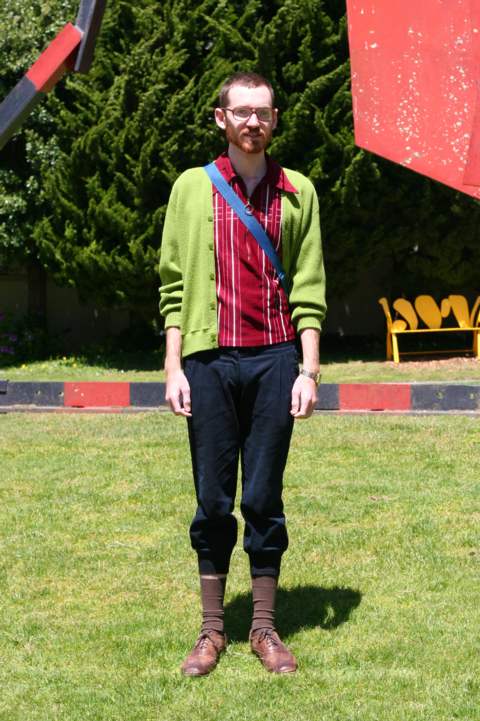
Today’s Look: Wes, SF State

Tell us about your look: “Everything here is from my dad or a thrift store.”