SFBG Blogs

Life and death in Sunnydale

7

Photographs by Sarah Phelan

On the first Friday afternoon in September, as most folks were trying to get an early start on their Labor Day weekend, C.L.A.E.R. director Sharen Hewitt and her advisory board member Carrie Manuel welcomed friends, family, neighbors—and a handful of D10 candidates—to a basketball hoop dedication ceremony outside C.L.A.E.R.’s office on Brookdale Ave at the heart of the  violence-racked Sunnydale housing project in Visitacion Valley.

By afternoon”s end, Hewitt had managed to get D 10 candidates Malia Cohen, Kristine Enea, Chris Jackson, Tony Kelly and Marlene Tran shooting hoops with a dozen African American youngsters who live in Sunnydale, the city’s largest public housing project, and talking about what they have learned about life and death in this deceptively pleasant-looking sun-and-fog bathed spot that overlooks the Bay, backs onto McLaren Park and the neighboring Gleneagles Golf course–little knowing that within two hours, yet another young black man would be fatally shot one block away from C.L.A.E.R.’s office.

Sunnydale’s appealing geographical location has made it the target of redevelopment plans that seek to rebuild 785 low income unit and add 925 market rate units into the mix—plans that have Hewitt concerned that Sunnydale’s current residents could end up being displaced through a combination of factors, including the San Francisco Housing Authority’s  announcement that many of these residents owe thousands in back rent, and City Attorney Dennis Herrera’s announcement that he is seeking a gang injunction against 41 alleged members of the Down Below Gangsters and the Towerside Gang, who have been engaged in a violent turf war in the Suinnydale for the past three years.

Many of these alleged gang members don’t actually live in Sunnydale, but their friends, families and their own children still do. Currently, seventy-five percent of lease holders in Sunnydale are single female heads of household. And while African Americansaccount for only six percent of San Francisco’s population citywide, black males represent 60 percent of the county jail’s population and feature in disproportionately high numbers in the city’s homicide statistics.

An unfortunate case in point occurred just hours after C.L.A.E.R.’s basketball hoop dedication, when 38 year old Asa Roberts was fatally shot on the first block of Brookdale Avenue, which is a stone’s throw from Hewitt’s office. Found after police responded to a report of gunshots at 8:20 p.m. at the Sunnydale projects, Roberts was pronounced dead at San Francisco General Hospital on what was his 38th birthday, making him the city’s 35th homicide this year.

And at the C.L.A.E.R. ceremony, held at 5:30 p.m. that day, the majority of kids in attendance raised their hands when asked if they knew someone who had been murdered—a shocking illustration of the traumatic stress that these children live with, even as they reside in one of the richest cities in the world

“This is more than just a basketball dedication ceremony and this is hardly just any basketball hoop, this hoop represents a small step toward safety and security for the residents of Sunnydale public housing,” Hewitt told the crowd, just hours before she would find herself rushing around the projects, trying to determine if families and kids in Sunnydale were safe, in the wake of Roberts’ shooting.

“In remembrance of Labor Day, one mother’s labor of love will unite a community under siege,” Hewitt said at C.L.A.E.R.’s 5:30 p.m. hoop dedication, recalling how she had seen Carrie Manuel’s four boys playing basketball against the wall of a public housing unit that was home to an old gas line with pipes that were in dire need of repair. Shocked, Hewitt called upon city partners and C.L.A.E.R. donors in an effort to get these boys a real hoop and thus minimize safety concerns.

“Because the little things change a community, “ Hewitt said.

Hewitt recalled how Sup. Bevan Dufty put her in touch with the Department of Recreation and Parks and the San Francisco Parks Trust, when he heard about the basketball hoop situation, and that these departments helped heed her call to action.

Hewitt also tipped her hat to the five D 10 candidates who attended the hoop dedication: Kristine Enea for being the first to respond to this particular crisis, Malia Cohen for her ongoing support of CLAER’s Brookdale Center, Tony Kelly for his general support of the community, Chris Jackson for connecting Sunnydale residents, including four named in Herrera’s gang injunction, to the Gateway to College program, and Marlene Tran for her work on public safety.

After the dedication, Hewitt paired each D10 candidate with one of the bright-eyed small boys that were eagerly waiting to play ball, as Manuel looked on.

“She’s a woman under siege,” Hewitt said of Manuel, recalling how this woman and her kids witnessed a homicide outside their window, and how Manuel’s 16-year-old son was murdered before his child—her first grandson—was born. “This family has been besieged by no less than three murders, but they don’t even have space to run up and down,” Hewitt observed.

“Look at what we do with nothing,” Hewitt said, pointing to the basketball hoop outside C.L.A.E.R.’s office. “We are not a service provider in a box.”

“Look at this beautiful property,” Hewitt said, pointing to the Bay that sparkled in the distance below and the fingers of  fog that tumbled across the sun-baked hills behind Viz Valley. “But this has not been such a beautiful place. This has been a forgotten district, a forgotten neighborhood, but not in our name.”

“This mother,” Hewitt continued, pointing to Manuel, “must be embraced by all of you. And we must give these boys more options than a cage or a coffin.”

Hewitt was referring to the disproportionately high number of young black males that end up jailed or dead in San Francisco, with many of those arrests and fatalities occurring in and around Sunnydale. But while the City Attorney’s office has responded to this pattern of crime and violence by issuing gang injunctions, Hewitt believes this strategy is a waste of money and resources, given that local non-profits which seek to provide education and restorative justice, have just had their budgets decimated.

Last month, City Attorney Dennis Herrera filed an injunction naming 41 alleged members of the Down Below Gangsters and the Towerside Gang, claiming that the two groups were engaged in turf wars that had terrorized the residents of the Sunnydale housing projects for the last three years. And on Thursday, September 30, Herrera will go to court to try to get a judge to support his injunction request.

But Hewitt fears that Herrera’s injunction will further stress an already fragile community.

“Gang injunctions are plaguing this neighborhood and their families, but we don’t have gangs, we have families,” Hewitt said, as local residents Larry C. Jones of TURF and the Marsha Kyer Foundation, and Robert Cowan, watched the kids and candidates play ball.

After the basket ball game, Hewitt asked the five D10 candidates what they had learned from the C.L.A.E.R-sponsored event

“I’m struck by how strong the entrepreneurial spirit is,” Marlene Tran said, surveying a greeting card business that Sunnydale youth Tyree Vaughan started, under the auspices of C.L.A.E.R. “For 35 years, I was with kids every day,” Tran continued, referring to her career as a teacher. “And when I was 9 years old in Hong Kong, I helped my mother with work, and at 16, I had my own import/export business. So, we should recognize youth, all the positive things they do.”


Kristine Enea also praised the entrepreneurial spirit that was evident on the ground in Sunnydale.”Entrepreneurship is a powerful drug,” Enea observed. “Every child should know the joy of holding in your hands a product that started as an idea in your head,”


“This neighborhood is getting ready to be demolished,” Hewitt interjected. “What do we have to do with Project Hope?”

Tony Kelly admitted that he had never been to C.L.A.E.R.’s office before.
“But I’ve been involved with Hope SF on Potrero Hill,” Kelly said. “With Hope SF, there’s this weird thing of competition between public housing sites, this, ‘Oh, we can only get one project taken care of,’ and ‘Oh, we can’t get services’  attitude. But this is the largest public housing project in the city. We need complete neighborhoods where we live.”

Chris Jackson complimented C.L.A.E.R. on doing so much with so little.
“When I look at how many millions we spend on community services, but not something as simple as a basketball hoop, which gives a dozen black youth access to exercise, team work and figuring out how to work together, I see that you are doing with $300 what Goodwill and JHS failed to do with millions,” Jackson said.” You have brought the community together.”

Hewitt, who likes to call herself Mini Mouse and isn’t afraid to challenge her biggest supporters, responded by urging the candidates to get more hands on.

“The rhetoric doesn’t bode well for the community,” Hewitt said. “You can’t only come here every six months.”

Malia Cohen, who is on C.L.A.E.R.’s board, expressed her belief that the community needs to do more in terms of giving back.
“This is a partnership, I brought resources here, but people who live here ought to respect the resources, and say, this is our home and we are going to sweep up,” Cohen said, pointing to untended pathways and a couple of wilted potted plants that had died for lack of watering outside C.L.A.E.R.’s office.

“You did this because you are a board member,” Hewitt retorted, giving Cohen, who she supports politically, a predictably hard time.“But where are we collectively in terms of challenging ourselves to respond?”

 “I see great opportunities here, but because of budget cuts, you haven’t had resources,” Cohen continued. “The Department of Children, Youth and Families has been funneling funds to mega-organizations, and not the grassroots.”

“One opportunity is with City College,” Jackson, who counts Hewitt as a mentor, interjected. “And we can give deeper. I believe 20 percent of our participants are from Viz Valley, and we can do a better job of reaching out to the 41 young men listed on gang injunction. It’s something the City Attorney should have talked about before he put in for the gang injunction. A week later, he declares he’s running for mayor, while those of us on the ground are left to clean up.”

“785 units will come back as low-income and there is a zero vacancy rate here, so the one-to-one replacement of the units is not so much the issue as the replacement of the people,” Hewitt told me, as she locked up her office and the rest of the city prepared to enjoy a Labor Day weekend in a world that is not scarred by memories of fblack and brown brothers dying in a hail of bullets in the street.

And as I drove away, towards the bonfire of vanities that is downtown San Francisco, I couldn’t shake the twin images of those young black boys raising their hands when asked if they knew someone who has been murdered, and of Hewitt, fearlessly grilling the D10 candidates, even as she tries to hold together this fragile community of color on a prayer and an increasingly frayed shoelace budget.

Needed: a public health master plan

1

California Pacific Medical Center’s plan to build a massive new regional hospital on Van Ness shouldn’t be under the jurisdiction of the Planning Commission

EDITORIAL More than 100 people showed up at the Planning Commission Sept. 23 to oppose California Pacific Medical Center’s plan to build a massive new regional hospital on Van Ness Avenue. Most were neighborhood residents who raised an excellent point: what, exactly, would the shiny new $2.5 billion hospital offer for low-income people in the Tenderloin?

And that’s just the starting point for discussion. The new project is a piece of a much larger plan: CPMC wants to shut down part of its Laurel Heights campus, reduce the number of beds and the scope of service at St. Luke’s, turn Ralph K. Davis into a specialty facility, and reshape the way health care is provided in San Francisco.

That’s a huge deal — but right now, the city is looking at the projects piecemeal. That’s poor public health policy and poor land-use planning. In fact, there’s no real way to evaluate the Van Ness hospital in its proper context — the Planning Commission, which will rule on the development issues, is hardly the best venue in which to discuss the future of health care in San Francisco.

So new legislation by Sup. David Campos is critical to injecting some sanity into this, and the larger, health facilities debate. The Campos legislation would mandate a citywide Health Care Services Master Plan and would require that all new hospital development, public or private, be consistent with that plan. It’s a pretty basic concept, and it’s hard to imagine that nobody’s suggested this before.

San Francisco has a large, complex network of facilities providing health care — a big public hospital, a university hospital system (University of California San Francisco), a series of public and nonprofit community clinics, half a dozen private hospitals run by two competing chains (CPMC and Catholic Healthcare West), and one health maintenance organization (Kaiser). Some provide unique services, some provide competitive services — and there are some critical services that are hard to find anywhere.

It’s hard to say whether the city needs what CPMC is proposing — a gigantic medical center that some have described as the Mayo Clinic of the West, designed to attract patients from all over the region — without any sort of overall plan. How would the new facility and the CPMC restructuring affect services at St. Luke’s, a critical part of the health care infrastructure in the Mission? Where would patients who rely on Davies for emergency and clinical care in the Castro district wind up? How about all the medical office buildings and doctors’ offices situated near hospitals that are about to change?

How will CPMC’s moves affect low-income-patient care? How does the project fit in with the new Obama health care policies and the city’s own Healthy San Francisco program? Will a new hospital on Van Ness increase access to primary and emergency care for residents of the Tenderloin — or will they be shuttled somewhere else while the high-end facility caters to better-off patients seeking expensive specialty procedures?

Those aren’t land-use decisions — and while some Cathedral Hill residents argue that the new hospital will cause traffic problems, the biggest issues go beyond the scope and expertise of the city Planning Department.

Under the Campos bill, the Public Health Department would develop a master plan (which public health director Mitch Katz says can be done with existing resources), the Health Commission would review that plan, hold public hearings, and sign off on it — and city planners and health officials would have to make sure that new health-related development met existing and future public needs.

The supervisors should pass the bill and get the process going as quickly as possible. And they should refuse to sign off on any final version of the hospital plan until there’s a city framework in place — or at the very least, until CPMC can demonstrate that its citywide infrastructure plans are designed to meet public health needs. *


False witness: Yael Hersonski on “A Film Unfinished”

0

Documentaries that “tell” the Holocaust tend to employ archival footage generically as a kind of historical flavoring. It’s rare that we are asked to contemplate either the provenance of the images or the individual lives depicted. Yael Hersonski’s A Film Unfinished simultaneously confronts both of these gaps with a taut historiography of several reels of Nazi propaganda footage. Even in the German film’s inchoate form, we easily apprehend the propagandistic moves to further manipulate an already constructed reality (the Warsaw Ghetto) for objective “proof” of the necessity of Hitler’s Final Solution. And yet here before us, flowing at the speed of life, are the faces and places that would be destroyed within months of the filming.

Hersonski attempts to extricate the documentary value of this footage using frame-speed manipulations and edits which call attention to telling movements. She also films elderly survivors watching the footage alone in a darkened theater. In their capacity for recognition and incredulousness, they unravel the German point-of-view. By weaving these live responses with diary entries of those consigned to the ghetto along with the deposition of a German cameraman, Hersonski draws a fragmentary, highly specific account of the Holocaust’s crisis of representation. We discussed the film in a recent email exchange.

San Francisco Bay Guardian: The question of how to use archival footage responsibly is one that haunts the great Holocaust-themed films — Night and Fog (1955), Shoah (1985), and the films of Péter Forgács all find very different solutions. Can you describe the way your own attitudes regarding the appropriation of this archive developed during the time you worked on A Film Unfinished?

Yael Hersonski: During the last decade I became more and more preoccupied with the thought of the near future, when no Holocaust survivors will be left to remember — the time when the archives will be the only source of witness. I’ve tried to examine the possibilities of exploring the image like an archaeologist analyses a palimpsest, and to excavate, by cinematic means, new layers of reality from beneath the known imagery. I admit that [at one] time I felt that Night and Fog and Shoah were all that a filmmaker could express facing such an inconceivable, unprecedented event. For [Shoah director Claude] Lanzmann, the Holocaust lies firmly outside the archive as the ultimately Other, a black hole which threatens to swallow every visual witness, and thus resists the film archive and its raptures.
Forgács faces the impossibility of bearing witness exactly by confronting the contemporary viewer (who knows how it all ended) with private documentation which was abruptly stopped when the photographer himself was no longer capable of documenting, nor his dear ones of being documented. Forgács’ films introduce me again and again to the immense capacity of footage to reveal, in the form of a private history, the traces of an inconceivable past.

My aim in showing the Warsaw Ghetto footage (for the first time in its entire length) and confronting the images with many points of view about the filmmaking itself was not to tell “the true story” of the Warsaw Ghetto, nor to expose the evil of Nazi propaganda (which was obvious even to the German filmmaker who discovered the reels in 1954), but to make the viewers question the way they see these images and through them perceive the past.

SFBG: Did you set out to interrogate the decontextualization of these images in more conventional visual histories of the Holocaust and Warsaw Ghetto? The logic of many Holocaust documentaries, wittingly or not, is that the content of these images can be separated from the context in which they were made — that what we see speaks for itself. Your film challenges this assumption in many ways.

YH: I’ve always felt that the images from the Holocaust were mainly used the same way: as illustrations for many different stories, as visual background between interviews. We see the same images over and over again, [both] because the quantity of footage is finite (only 10 percent from what the Nazis documented on film survived the war), [but also] because of sheer laziness of filmmakers who find it more comfortable to use what’s [familiar]. The superficial use of an image enables it to show almost nothing — or merely repeats the humiliation of the victims that were captured on film as an anonymous helpless crowd. I emphasize a moment [by slowing it down] in which a woman is protesting against the humiliation caused by filming merely by means of her gaze and her body language. When I know this woman was probably murdered a short time after her image was taken, and when I hear at the same time the cameraman who was filming her speaking about how he could not even imagine what was going on, I feel closer to the reality of that image than I did before.

SFBG: How did you come to the idea of having the survivors respond to the archival footage in place of a more traditional question-and-answer interview? As viewers separated from these events, we’re able to treat these archival images as content — whereas I imagine for the person who was there, it’s inescapable that the footage literally represents how they were seen by the Germans. Were you concerned that you might be putting your subjects through a kind of secondary trauma by having them view the footage in such a way that they didn’t have their hands on the controls?

YH: I was looking not only for survivors from the Warsaw Ghetto, but for those who could actually recall the event of the filming in May 1942. I was quite amazed to locate more than the five survivors I interviewed for the film, because obviously the filming was a negligible event compared with the unimaginable horrors that went on there. When speaking with the survivors, I explained to them in detail how the filming would be done — that they would watch the whole film, alone, on the big screen, that it contained atrocious scenes (I described these), and that obviously it would be a difficult experience. Some of the survivors indeed refused to watch it, and some hesitated. Only those who felt it was their personal obligation to [speak to] the silent images, those who told me that the worst horrors exist not in any footage but in their own memories, [those who thought] it important to add their own point of view to the Nazi perspective — only these people were invited to be filmed. Still, I stopped the screening every time a reel was over and asked if they wished to continue. All of them asked to watch to the very end and felt a great relief after doing so.

The decision to film [the survivors] inside a cinema hall and to show the footage in 35mm stemmed from three [priorities]. First of all, I wanted to intensify the experience of the screening as much as I could, for I knew I would not — not in any case — film these survivors again. After they had given me their approval, I knew I had only one chance. I was also aware that the time of interview would be short, since all of them are physically too fragile to sit for more than two hours in such an intense emotional state. If there was a chance someone could recognize a person in the film or add any other important historical information about the footage, the only way to help them remember was to isolate them from their domestic surroundings and show them the film on the big screen.

The second reason relates to the character of the survivors as witnesses. Roughly [speaking], we can say that there are those survivors who won’t talk about the past, who remain silent merely to be able to live…and there are those who ceaselessly tell their stories, who give lectures and interviews, write books, and so on. They find witnessing [to be] their very vocation and destiny. The survivors who were filmed belong to the group who speaks. They have told their stories many times, and because they can’t tell it all any one time, their memory [often narrows] to [a] single narrative. Other details have remained in a less accessible memory. By changing the traditional scenery of the interview and creating a new interactive space [in which] the survivors were not just storytellers but also viewers and witnesses who comment, I hoped to help them to release some of the memories which [remained unspoken] by them.

The third reason was aesthetic: it was important for me to maintain [every aspect] of the film in relation to the archival documents and documentation itself. My initial idea, even before watching the footage for the first time, was to think of these archives as if they were a brain, with memories and even a subconscious. The labyrinth of the archive, with its knowns and unknowns, the desire to restore and remember, which is simultaneously the impulse to destroy and forget, can be used as a metaphor for our own memories and forgetfulness.

SFBG: Given your film’s deliberate consideration of the way the Nazi footage represents a constructed, stage-managed view of the Jews in the ghetto, I think many viewers might be curious why you choose to visually recreate the interview with Willy Wist. Why is this transcript recreated visually, while the various diary entries are only read?

YH: First of all, the diaries were written, [whereas] the preliminary interrogation with the cameraman was recorded on audio reels (the audio reels were recycled for the next interrogation, and therefore only the paper protocols survived). I insisted on emphasizing the various manners of documentation. Until we found the interrogation’s protocol, the only fact we knew about the cameraman was his name. When I first read the protocols, I was amazed to [discover] what a rare witness I was faced with. These images that we were educated to see in bits and pieces, as if they were some kind of an “objective” anonymous documentation of past events — suddenly there was a specific gaze of a cameraman, with his own impressions, speculations, inner monologues and so on, and he describes himself shooting scenes we can actually see in the footage. [It] enabled me to see the footage not merely as a sequence of images but as a real trace of reality, and as the atrociously painful (for the viewer) medium between the perpetrators and their victims. I knew I’d have to create the cameraman’s witness with different tools to distinguish it from other kinds of testimony, to emphasize the presence of a single gaze behind a single camera.

There is another crucial reason for delivering the texts from the protocols visually. After watching the footage for the first time, I felt there was no way to show it all without having any visual breaks between the different reels. At a certain point, our psychological mechanism of self-defense [prevents us from] absorbing more images, and we find ourselves looking yet not seeing. My goal here was quite the opposite: I was trying to figure out a way to enable the viewer to keep his gaze constantly fresh and involved. My solution was to produce visual breaks which would allow the viewer to dive into these dark waters again and again. Delivering the cameraman’s protocols in a visual way was something that helped me do this. But I was very strict in not changing even a single word from the protocols, not dramatizing it in any way, not working with the actors to establish an imaginary character of a cameraman, not interpreting his words, and most of all, not judging him in any way.

http://www.youtube.com/watch?v=Khut0kKn-c8

A Film Unfinished opens Fri/1 in Bay Area theaters.

Endorsement interviews: James Keys

10

James Keys, a former legislative intern in Sup. Chris Daly’s office now running for supervisor in D6, is making economic and social justice the centerpiece of his campaign. He talks, for example, about using city resources to make sure that SRO residents have a chance to move on to more traditional apartments. “We have a lot of housing in the pipeline,” he told us. “But I’m not sure if people are really moving in.”

Keys wants to see the city figure out some want to take over empty apartment buildings to use for housing for SRO residents. “Entities ought to be moving people through SROs and out,” he noted.

He’s a fan of community policing (“there are no cops on the beat in the neighborhood”) and wants to put unemployed people to work doing graffiti removal and cleaning the streets.

He also taked about offering free Muni service (although he had a little trouble explaining how the city would pay for that) and wants to combine the Sheriff’s Office and the Police Department.

You can listen to our interview here:

keyes by endorsements2010

A hardly strictly kind of guy

0

It is not everyday that a San Francisco Bay Guardian culture writer finds herself going for an interview in the Financial District. Something about the fumes of avarice making poor atmosphere for the creative process. But high above the Starbucks and town cars is the banjo-packed office of a rich man who puts on the best free bluegrass festival of the year. And so, for Warren Hellman and his Hardly Strictly Bluegrass (Fri/1-Sun/3), I braved the world of name tags and extravagant corner offices.

Much has been written on the avuncular nature of Hellman. He is an ex-president of Lehmann Brothers, and as chairman of Hellman and Friedman and founding partner of his own venture capital firm, falls just shy of Forbes’ 400 Richest Americans list. He’s a born and bred adherent to a downtown-centric vision of the city, but counts among his buddies union activists and some of the city’s well-known liberal muckrakers. 

But I guess Hellman just likes what he likes. And after I’ve breached the security check-in that takes place in his megalithic office building’s lobby, traveled up to Hellman and Friedman’s well-appointed offices, chit-chatted with his amiable receptionist, and been installed in his office to wait for the man’s arrival from a meeting next door, I realize that central to this category is bluegrass music. His corner office is comfortably packed with stacks of banjos and guitars, a signed CD from Emmylou Harris that wishes him a happy birthday, a metal sculpture that wears aviator sunglasses and a white cowboy hat, thank you plaques from the Berkeley music venue Freight and Salvage, where Hellman is a keystone donor and acted as chairman for the club’s fundraising campaign in years past. It’s impossible to avoid the music in the room, indeed the music is the room

Hellman arrives shortly, limping slightly, but enthused at the prospect of our interview. I tell him it’s great to meet you, Mr. Hellman, an honorific he doesn’t cotton to – Warren it is. He’s wearing a long sleeve denim button down – a look he favors, judging from photos of him taken at different shows and events.

It comes as a shock to the system in this day and age, to meet a billionaire with progressive friends (or, in my case, a billionaire at all), an older man with tattoos who likes to talk glowingly of his trips to Burning Man ensconced in his skyscraper office above the downtown grid. “There’s no fights there!” he tells me of the desert art festival. “Sure, there’s lots of pot, but there’s no violence.” Warren perhaps falls into the eccentric rich guy archetype, but the philosophy inherent in his personal pastimes at times seep here and thre into his politics, at least sporadically. He’s the kind of guy that will endorse the installation of a massive underground parking lot in Golden Gate Park, yet still support closing down the streets that access said lot so that Sundays amongst the trees and museums can be car-free affairs.

So first for the obvious question: why bluegrass, Warren? “People like to ask these ethereal questions,” the man muses in response. I realize quickly that Hellman pulls few punches, answering questions quickly before detouring into favorite stories that more or less illustrate his point. He’s a good talker. “Why do you like bluegrass – why do you like smoked salmon?” 

Fair enough, but why choose to spend your birthday putting on three days of music for the riff-raff (besides the obvious PR bonanza it affords the businessman)? With this query, the billionaire’s eyes alight with a thoroughly unmonetized joy. “It’s the single most fulfilling thing – this is as close to heaven as I’m gonna get,” Hellman says. “To be able to give something that’s really fun to a lot a people that seem to have the same love it as I do… it’s just really fulfilling. And if I could hang out with anyone in my life, it would not be the president of Lehmann Brothers and Goldman Sachs.” 

Hardly Strictly seems to be at its a place that allows Hellman to mingle with people outside the financial business. He’s endowed the festival to continue at least 15 years after he dies. “I’d like it to go on more or less forever,” he says. His desire for meetings of minds across ideological, professional, and personal differences is evident even in the way he conducts our interview — which he treats as though he is meeting a friend for the first time. 

Hellman’s typical routine for this weekend? “You could say what are the peaks of ecstasy,” he chuckles. He worries all week leading up to the event about the weather – this weekend’s sweaty days have perhaps precluded this part — attends the Friday morning MC Hammer (yes, Hammer’s a regular performer at the event) concert for middle schoolers, and then zips around from stage to stage in his golf cart throughout Saturday and Sunday, reaping praise by the untold hundreds of thousands that come to the park to check out the six stages of tunes provided by Hellman each year. 

Oh, and there’s the matter of his band’s performance as well. Hellman plays banjo and sings for the Wronglers, who will be taking the stage at Hardly Strictly at 11 a.m. on Sun/3. They debuted at the festival, and now play gigs all over the country. His travels with the band bring him to bluegrass events year round – when he’s not racing horses, another hobby – and into contact with some great potential acts for Hardly Strictly.

One such group, Hardly Strictly newcomers the Ebony Hillbillies, an all African-American outfit from Jamaica Queens, are Hellman’s personal don’t-miss pick for this weekend. He’s also looking forward to perennial favorites Jimmie Dale Gilmore and Emmylou Harris.

Our time is up, and Hellman’s assistant enters the room to tell him that his next appointment is waiting in the lobby, which doesn’t seem to enthuse him in quite the same fashion that our interview did. Or maybe he’s just good at pretending.

“Oh crap. Well, that was the most fun I’m going to have all day,” he says. Hellman exhorts me to set up another appointment with assistant to talk (“I barely got to find out anything about you!”) and insists on playing me a song about Hardly Strictly that was sent to him by a woman impelled to compose it by her therapist but finally it is time for me to vamoose. We sit convivially, tapping our feet to the beat, Warren every so often blurting out “You have to listen to this part!” Soon, he escorts me to my journey back away from the skyscrapers of the Financial District and returns to his tightly regimented meeting schedule. Moments after our parting, I catch a flat on my bike and am forced to hail a cab to bring me to a neighborhood endowed with such pedestrian things as a bike store. It’s less infuriating than it would have been sans Hellman meet up — I’m still satisfied by our morning time brush between two worlds. 


Hardly Strictly Bluegrass

Fri/1 10:30 a.m.-12 p.m., 2 p.m.-7 p.m.; Sat/2 and Sun/3 11 a.m.- 7 p.m.

Speedway Meadows

Golden Gate Park, SF

www.strictlybluegrass.com


SFBG Radio: The GOP and fear of the “other”

15

Today Johnny and Tim talk about the bill that the Democrats are using to fight back against Republican nonsense — and why the GOP is all about scaring white people. You can listen after the break.


sfbgradio9272010 by endorsements2010

Newsom campaign also plugging Sparks

9

UPDATED WITH RESPONSE FROM SPARKS.

Gavin Newsom’s campaign for lieutenant governor might have a tough time beating moderate Latino Republican Abel Maldonado – indeed, even many of his local allies privately tell us they fear he’s going to lose – but it is still using some of its significant resources and energy to promote the candidacy of Theresa Sparks, whom Newsom endorsed to replace Chris Daly on the Board of Supervisors.

“I’m hoping we can count on your vote for Gavin Newsom for lieutenant governor and Theresa Sparks for District 6 supervisor,” a volunteer with the Newsom campaign said during a call that I received today, the first I’ve gotten from the Newsom campaign.

As of Sept. 23, the Sparks campaign reported having $29,361 in the bank, about half of what her main District 6 rival Debra Walker had on hand on that date ($57,895), even though Sparks has out-fundraised Walker $124,000 to $110,000, according to the most recent campaign finance reports.

Yet even these strong local fundraising totals pale in comparison to what a statewide candidate like Newsom can pull down. As of the last full campaign report that extended through June 30, Newsom’s campaign had $494,000 in the bank after raising $1.4 million, and his recent late contribution reports show hundreds of thousands of dollars more rolling in since then.

Among the recent Newsom contributors are downtown political players such as the San Francisco Apartment Association ($3,500 on 9/16), Shorenstein Realty Services ($6,500 on 9/16), Recology (the company bidding on SF’s big garbage contract, $2,500 on 9/16), San Francisco Building Owners and Managers Association ($5,000 on 9/1), and Sen. Dianne Feinstein ($5,000 on 9/4) – all of which far exceeds the $500 local limit on campaign contributions

It’s unusual for a local and statewide candidate to share a phone-banking operation, and clearly a sign that Newsom would really like to deal with a more ideologically friendly (that is, less progressive) Board of Supervisors if he doesn’t move to Sacramento in January. And from a campaign finance perspective, both campaigns will probably need to document where the resources came from for this shared campaigning when the next pre-election statements are due on Oct. 5.

“Generally speaking, if they share resources they should be apportioning those costs,” Mabel Ng, deputy director of the San Francisco Ethics Commission, told the Guardian. Yet she also noted that California Gov. Code Section 84310 makes a distinction between automatic robo-calls and the kind of live “volunteer” that the caller identified himself as. “If it’s a live person, some of these rules don’t apply,” Ng said. If that’s the case, Sparks might be in for lots of no-cost campaigning during the final pre-election push.

The Newsom campaign has not responded to a Guardian inquiry about the issue, but Sparks returned our call after this article was initially posted. Although she took issue with the implication that there was anything wrong with her benefitting from calls by the Newsom campaign, comparing it to the support Walker has received from the Democratic County Central Committee, she admits to the coordination on the matter between her campaign and Newsom’s.

“Newsom had a volunteer phone bank and he asked if he shoudl add my name to it and I said yes,” Sparks told the Guardian, adding that she’s been pleased with the response to this effort and her own campaign’s phonebanking efforts.

Meanwhile, while Sparks just got a boost from above today, so did Newsom, who was the subject of an e-mail blast from former President Bill Clinton, who wrote, “We have a tremendous opportunity in Jerry Brown and Gavin Newsom, two leaders who realize the promise of their state and will get it back on track. Please join me in helping these candidates win in November.”

Street Threads: Look of the Day

0

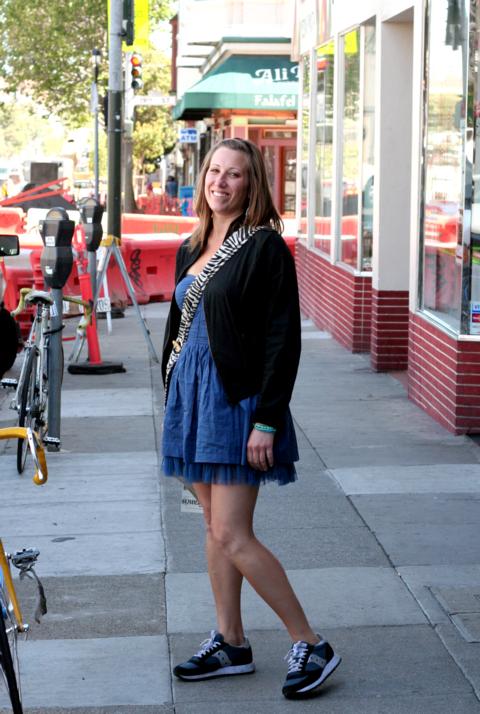
Today’s Look: Jessica, 19th Street and Valencia

Tell us about your look: “This dress is from a store on Haight Street.”

How lame is the San Francisco Chronicle?

5

Pretty goddam lame.

Bruce Brugmann always says that the way to tell where a big-city daily newspaper stands is to look at its endorsements for mayor and United States Senate. And on Sept, 26, the Chronicle endorsed for United States Senate and said:

Man, we suck. In a race with a crystal-clear choice, we can’t make up our minds. So we won’t endorse either of them.

The Guardian’s done a few “no endorements” too — but only in races where an incumbent who’s really bad is unopposed, or where the outcome is pretty much pre-determined and we want to make a statement. In a race like this, ducking the question is completely irresponsible. One of these two women is going to get elected to the United States Senate — and the outcome of the vote will have major national significance. Make a choice, folks. The voters have to.

Stay tuned for our local and statewide endorsements issue, coming out October 6. Listen to our interviews with the candidates here.

Matt Reeves on vampires, remakes, and “Let Me In”

3

When Let Me In — the film which dares an Americanized do-over of 2008 Swedish import Let the Right One In — was first announced, fans of the original film let rip synchronized screeches of “Whyyyyy?”, shortly followed by angry, ten-point arguments as to why Hollywood is really sucking balls lately. Consensus was that Let the Right One In, which picked up armloads of festival and critical awards (including the San Francisco Film Critics’ Circle’s Best Foreign Language Film honors), was not a film that deserved to be put through the remake machine. Sure, it only made a couple of million bucks stateside, but maybe it wasn’t the kind of film (unlike 2008’s similarly vampire-themed Twilight) that the masses were supposed to gobble up. After all, it had subtitles. Such a drag.

Matt Reeves, he of Cloverfield (2008) and Felicity fame, is aware of the fanboy-hater contingent that awaits his latest release. His Let Me In is a largely faithful retread, with some recognizable kid actors — Kodi Smit-McPhee (stronger here than he was in last year’s The Road) and tween It Girl Chloë Grace Moretz (Kick Ass) — and the lure of legendary British horror house Hammer (back in the producing biz after decades) helping him attract audiences. I suspect many people who’ll go see Let Me In may not have seen Let the Right One In — either because the original’s release wasn’t wide or lengthy enough, or because of that whole foreign-film bias. (Also, diehard fans of the first film may boycott the new version, just on principle. Hey, I did it with the recent A Nightmare on Elm Street, which in my mind NEVER HAPPENED).

Gotta say, though, Let Me In could have been worse than “faithful,” which is way better than “redundant” or “totally offensive.” Reeves, who penned the script from John Ajvide Lingqvist’s novel (Lindqvist himself wrote the script for the 2008 film) stays true to the material, shifting the action to the snowy New Mexico mountains and injecting some Cold War and new wave flair into the 80s setting. I spoke with him recently, just after the film’s screening at Austin, TX’s Fantastic Fest — coincidentally the very festival where Let the Right One In won the Jury Prize for Best Horror Feature in 2008. He kindly put up with my many remake-themed queries.

San Francisco Bay Guardian: How was Fantastic Fest?

Matt Reeves: It was great. It’s been fantastic (laughs). It’s really cool that they chose Let Me In to open the festival, because this is one of the places that Let the Right One In was incredibly well-received. I knew that there’d be a passionate audience for Lindqvist’s story here, and that also we’d have to past the test of being watched by people who really have a passionate love for Tomas Alfredson’s [2008] film. I thought, if we’re embraced here, and if we pass that test, then that will be a really big hurdle, and the screening went really, really well. It was very exciting.

SFBG: I didn’t realize until I was watching the movie that it was a Hammer Films production. How’d you get hooked up with them?

MR: Well, they got the rights to the film. I think that the Swedish producers met with lots of different places, and I think maybe they were drawn to the idea of being the first Hammer vampire film in over 30 years. But they were the ones who got the rights, is the answer. It’s interesting because I think a lot of people, in terms of their concern about this movie being a remake — there’s a lot of question about it being, “Oh, well, Hollywood comes in with a lot of money and ups the effects, and does all this stuff,” but Hammer is an independent company. And we didn’t have a lot of resources. It was a pretty small film, actually. It was definitely a labor of love, and one that we made in this kind of passionate way.

I think it’s pretty cool to be part of the relaunching of Hammer, especially since as a kid these are the kind of movies that terrified me (laughs). All of the Christopher Lee vampire films, I watched. But I was so afraid of them that my biggest memory of Hammer is actually watching them from behind a chair, late at night on local television. They’d show these Hammer films, and I’d come across them, and there’d be some kind of garish blood or lurid scene. I found them very disturbing! And there’s something ironic about the idea that, after they invaded my nightmares, now I’m somehow part of the relaunching. It’s cool but also kind of ironic.

SFBG: Why do you think vampires are such a consistently popular film subject, especially today?

MR: In the best genre films, you’re able to smuggle in something under the surface that you exploit through the metaphor. In this case, I think Lindqvist was really telling a story about the pain of adolescence and coming of age. But I think it really says something about the vampire myth that all of these vampire stories are so different: True Blood is different from Twilight, which is different from Let Me In. And it really does say something about what an incredibly durable myth that is, that you can translate it into so many different contexts. It can be about so many different things, even though on the surface they seem like they’re about the same subject. I don’t think those three versions of the story could be any more different, and that is very interesting, I think.

It’s always about what you use that metaphor for, and I think what attracted me to this one was that it was such a different way of presenting actually a very realistic story. It seems kind of contradictory to say, but it isn’t. He’s using this horror story, this vampire story, to describe how growing up, being bullied and having that difficulty, essentially feels like a horror story. It’s talking specifically about that kind of trauma, of growing up in that way and it feeling like a nightmare.

SFBG: You mentioned that the audience in Austin embraced the movie, but I feel like there’s been a lot of people, especially on the internet, who’ve been horrified by the idea of remaking Let the Right One In. What’s your response to that reaction?

MR: When I first got involved, it was almost a year before the movie was even released, and nobody had ever heard of it. When they showed it to me — I was trying to get a passion project of mine made, and they felt that it didn’t have an overt genre to it. It was more of kind of an independent character piece. And they said, “You know, right now it’s a challenging time to make this. We really love the writing, but we’re not going to make this. But we’d love to work with you, and we want to remake this film. We’re trying to get the rights to it.” After I watched it, I literally called them up the next day and said, “I don’t know if you should remake this movie. It’s great.” And they said, “Yeah, but we think there’s a way to bring it to an audience that won’t necessarily see a subtitled film, and we love this story. Think about it.”

The thing about it is, I so connected to that coming-of-age story, and then I found out it was based on a book. So I read Lindqvist’s book, and he had actually written the screenplay for Alfredson’s film. He did a very faithful adaptation of his book. And I kind of fell in love with the story even more. I ended up writing to Lindqvist, because I kind of saw this opportunity to take that story and translate it into an American context. He grew up in the 80s, I’m about his age, and he’s talking about this coming-of-age in Sweden. And I started thinking about that kind of story in the 80s America that I remember, the Reagan era. I thought that might be very interesting, and would be a film that essentially would be another interpretation of this story, as opposed to being anything that is trying to step on the toes of this beautiful film.

I entered it with that in mind: I wanted to find a way to do something that was personal and yet still faithful to this story. The level at which I was daunted at that point was just that I felt a responsibility that it had to be done in this way that was very personal, because I didn’t want in any way to seem to be, I don’t know, dissing that movie. I thought it was remarkable. And then when the movie came out, it earned such acclaim. I wasn’t surprised, because I thought, “Well, the movie’s a masterpiece. So of course it’s gonna get that kind of reaction.” But then I was sort of like, “Uh-oh. What did I do?” Because by that point I’d already written the screenplay and I was deeply committed to it. I thought, “Wow, I wonder if people will even give this film a chance.”

On the outside, I totally get it, because most remakes are horrendous, and they’re usually one of two approaches: there’s the soulless retread, where somebody goes through the motions but none of the passions or emotions come through, or the kind of run-roughshod bastardization version of the story, where you kind of use some piece of the story, but you kill all original intentions. I think those are both very dispiriting approaches, and they’re what people are used to from a lot of Hollywood remakes. When people were having that response, I couldn’t even say that I was like, “What’s the matter with them?” I put myself in their shoes and thought, “You know, I would think the same thing.” But I knew I was making it really as a labor of love, and it was a story I cared about. And I thought, well, we’ll see what happens. I know that I’m a fan. So if I’m a fan I feel, not the responsibility to the fans, I feel the responsibility as a fan. And so I was just trying to do as personal and committed version of the film as I could, and I knew the rest would have to take care of itself.

SFBG: Why do you think horror is the genre that’s been remade the most?

MR: That’s a good point. I think because the stories are incredibly visual, and people see a chance to take that kind of story —

SFBG: And make it 3D.

MR: I don’t know about making it 3D. It’ll be interesting to see if there’s more of that. Although now, I see that there is this feeling that adding 3D to something as a magic formula does not necessarily work either. I think [remakes happen] because horror movies are very cinematic, visual storytelling that works at a universal level, but there’s still this sense that, to reach a wider, English-speaking audience, that they could be [remade] in English. [Like the Japanese Ring movies, for example.] I think that people who see those movies, producers and studios, they see how that translation might work, because they see a visual medium, and they see those stories being told, and they think, “Oh, well we know that story works, and it’s not just about language.” I’m gonna guess that’s why, but to be honest with you, I have no idea.

SFBG: Do you think all of the horror ideas are used up? Why can’t people come up with original scripts?

MR: Oh, people can come up with original scripts. We should throw in the towel now if somebody can’t come up with an original script that isn’t a remake.

SFBG: Are there more remakes than there used to be?

MR: There have been remakes always in the history of Hollywood. But I will say, at the same time that there are probably just as many remakes, there are also fewer movies that were ever made than there were in the past. I think, percentage-wise, the amount of remakes is much higher. And it is dispiriting because you do want to see original ideas coming through. Part of me thinks and hopes that it’s cyclical. I know there will always be remakes, but I think that there are some great ones: I love John Carpenter’s The Thing. There are lots of remakes that I think are tremendous.

It comes down to, you understand why a studio or a producer is interested in remaking. You hope that they fall in love with the story first, but they certainly see an opportunity to sell a story to another audience. But it comes down to the intention of the filmmakers and their personal commitment, and if they are connected in a way that you can see their passion, and that there’s something expressed there that’s worthwhile, then that’s totally valid. I think that movies like that are great. And obviously that’s what I tried to do. But I’m totally with you: it’d be horrible if the only thing that happened was that we only saw things that were being remade. The thing is, though, if you’re not seeing a remake, you’re still oftentimes seeing movies are the same movie [as one that came before], with a different title, but the same story, the same plot. It is dispiriting. You want to see some vitality and risk-taking.

As ironic as it sounds, that was what I loved about this story: yes, it’s a remake, but it’s a very risky story. It’s a story on the shoulders of two 12-year olds. It’s an adult story with mixtures of tones. It’s got tremendously dark, adult things with really, really tender childlike stuff. That juxtaposition is quite powerful, and it’s certainly not an easy sell by any means. Who knows how we’ll even do. But I loved Lindqvist’s story, and I connected to it on a personal level. My druthers in life is not to go out and [do remakes]. In fact, I resisted even this one when it was first presented to me. But it was an opportunity to do something, ironically, that felt personal to me.

Let Me In opens Fri/1 in Bay Area theaters.

Endorsement interviews: Janet Reilly

3

District 2 supervisorial candidate Janet Reilly is running to represent San Francisco’s most conservative political district, and even though she has the support of many progressive groups and the local Democratic Party, she’s running on a platform of mostly conservative positions. She opposes all the revenue measures on the November ballot and argues that closing the big budget deficits the city faces in coming years should involve “more fiscal discipline” and making cuts to wasteful city programs and the city money going to nonprofit groups.

But when asked how she’d be an improvement on incumbent Sup. Michela Alioto-Pier, an uncompromising conservative who consistently votes against the board’s progressive majority, Reilly says that she has good relationships with local leaders off all political stripes and will therefore be able to play a key role in facilitating good policy discussions and compromises.

Reilly, who ran for the California Assembly on a platform of health care reform a couple years ago, also touted her recent efforts working with the Volunteers in Medicine Institute to open a free health clinic in the Excelsior District, which will open soon and offer no-cost health services to residents of that district and Daly City, two local region’s with the greatest need.

“It activates a potentially powerful group of volunteers in the city,” she said of the program’s volunteer doctors and nurses, many of whom have retired.

Reilly also emphasized the need to stimulate the local economy with business tax breaks and other mechanisms. You can listen to our full interview here:


WS reilly by endorsements2010

Lynette Sweet’s finances: Curiouser and curiouser

4

By this time it’s old news that Lynette Sweet, current BART Board Budget Committee chair and District 10 supervisorial candidate, has some issues with the Internal Revenue Service. She owed the IRS taxes going back to the year 2000, and the consequent lien on her property exceeded $20,000 in 2007.

Sweet says she never knew about the lien and thought she’d paid the taxes.

We’re still trying to figure out exactly how this happened — and the trail gets more and more convoluted.

We first called Sweet early in September, after we read about her tax troubles in the Chronicle. When we asked Sweet how she could have been unaware that the IRS was after her, Sweet told us that she’d been working with the tax firm JK Harris. She and Harris reached a deal to pay the IRS $14,500. She told us she bought a cashier’s check at Wells Fargo and mailed it in. But for some reason, she made the check out to herself, not the U.S. Treasury — so the IRS couldn’t cash it.

Normally, when you owe the IRS money, they let you know. But in this case, Sweet says she heard nothing from the feds.

When the Guardian pressed her, Sweet blamed JK Harris for not having forwarded her any of the mail in question. “I gave them power of attorney,” she said. “They had all the communications from the IRS.”

But we reached the the tax firm recently, and the folks there beg to differ. Gina Anton, Director of Corporate Communications at JK Harris, told the Guardian that any mail the IRS sent, it sent to Sweet. JK Harris’s role in Sweet’s tax kerfuffle appears modest — she hired the firm to merely act as intermediary between herself and the IRS.

Said Anton: “Our role was to obtain documents from both her and the IRS to determine what amount she could afford and what the IRS would consider an acceptable amount.”

JK Harris did not cut any checks, or inspect any checks after Sweet had cut them, Anton told us. Just the opposite: whatever documents the firm had prepared for Sweet, they sent to her for approval before forwarding them to the IRS.

Furthermore, said Anton, JK Harris was trying to reach Sweet for two years, after Sweet sent the IRS the dubious cashier’s check that she had hoped would diffuse her tax problem. Sweet finally returned JK Harris’s calls when she found out the IRS could not cash the check.

It’s all pretty odd for someone who’s worked in the banking industy for 22 years.

Questions surrounding Sweet’s finances reach beyond troubles with the taxman. She told us recently that she has worked at two companies that she never listed on her economic interest statements.

In her discloure forms, viewable at the BART Board website, she lists no sources of income after 2004, when she reported that she was employed by BayCAT (Bayview Hunters Point Center for Arts and Technology). However, in a very short and heated interview Sept. 10, Sweet told the Guardian that after she had worked at BayCAT, she had also worked at the African American Interest Free Loan Association and Trans Bay Cable.

In fact, she said she had worked at Trans Bay Cable, which is building an electricity line from Pittsburg to San Francisco,  until May of this year, when she left the company to run for office.

Which raises the question: If she was working all those years, why do her economic interest statements show no sources of income at all from 2004-2009?

The Guardian has attempted many times over the past week to contact Sweet to follow up on that question, but she’s stopped returning our calls or responding to our emails. (She’s also refused to come talk to us for an endorsement interview.)

Here are the questions her campaign has decided not to answer:

1.) What were Sweet’s periods of employment with the African American Interest Free Loan Association and Trans Bay Cable? Did she receive any income for this work? Whether yes or no, would she like to comment on the nature of that work?

2) What was the source of the tax that Sweet owed the IRS? Was this a tax on income? If so, then for income from work with which companies?

3) Why did Sweet elect to pay what she owed the IRS by means of a cashier’s check? (Why not a personal check?)

We’re also wondering why she didn’t list any income on her disclosure forms or why she made the check out to herself.

If she gets back to us, we’ll let you know.


Allen town: Toronto International Film Festival 2010

0

Every time a new Woody Allen film arrives (a near-annual event since 1969) the same old, lazy complaints (“It’s not one of his best”) arrive faster than you can say “pontificate.”  Yet 10 or 20 years later it seems that somehow many of those uncelebrated films seem to become “one of his best.” See Broadway Danny Rose (1984), Husbands and Wives (1992), or Sweet and Lowdown (1999).

With his latest entry, You Will Meet a Tall Dark Stranger (opening locally Fri/1), Allen delivers another pitch-perfect mini-guide to the hilarious horrors of growing old … something Allen (according to the director himself, speaking at his Toronto International Film Festival press conference) wouldn’t wish on anyone. What looks and feels like a whimsical rom-com about aging is, in fact, a sobering and even paralyzing blueprint of what exists in most relationships or marriages. Don’t let the fun and breezy vibe of quirky narration deter you. Not only is there more of a bittersweet edge to Allen’s familiar archetypes, but the UK-produced film works as a perfect counterpart to Mike Leigh’s latest monument Another Year (2010). I wouldn’t be surprised if Stranger‘s Gemma Jones earns an Oscar nomination for her performance in what will surely be one of the year’s most truthful films.

After talking to a handful of critics at the TIFF this year about their unimpressed or indifferent reactions to Woody Allen’s latest, I feel it’s important to take a moment to revisit exactly what Allen has made over this past decade of films. Wrapping up his fourth full decade of prolific filmmaking, he has somehow stayed surprisingly strong in such a bipolar industry.

Here’s a quick guide to the brilliance of Woody Allen during the Y2Ks.

1. Vicky Cristina Barcelona (2008) While it’s wonderful to see directors like Noah Baumbach, David O. Russell, and Wes Anderson making cinema inspired by Allen, he can still beat all of them at his own game. Showcasing defining roles for Rebecca Hall and Scarlet Johansson as well as juicy parts for Javier Bardem and Penélope Cruz, the film also features gorgeous cinematography by Javier Aguirresarobe (of Pedro Almodóvar fame) that punctuates this realistic-romance to transcendental heights. Woody + Almodóvar = blissful chronic dissatisfaction.

2. Match Point (2005) and Cassandra’s Dream (2007) Who would have ever guessed that making films in the UK would reawaken Allen’s serious side? Of course, there were hints; see also: Interiors (1978) and Another Woman (1988). While Match Point was perhaps overly hyped and Cassandra’s Dream utterly dismissed, both of these morality tales contain profound character studies, hauntingly performed by Jonathan Rhys Meyer, Colin Farrell, and Ewan McGregor. Both are well worth revisiting. Who says people aren’t making movies about the new Depression?

3. Melinda and Melinda (2004) While this masterful deconstruction may have left audiences cold the first time around, what shines so brightly about this gem is how deftly the same story being told both from a comedic and tragic perspective slowly starts to blend into one. Radha Mitchell was robbed of an Oscar nod here and Will Ferrell delivers one of the all time best Woody impersonations.

4. Small Time Crooks (2000) When Woody Allen’s character in the 1980 masterpiece Stardust Memories, Sandy Bates, is approached by his fans, they often make the comment “I love your work … especially the earlier, funny ones.” Well, if you wanna talk about one of Allen’s funniest films, it’s right here. Not only do Tracey Ullman, Jon Lovitz, and Michael Rapaport deliver laugh-out-loud performances, nothing will prepare you for Allen’s girlfriend in the film — she’s played by Elaine May, director of The Heartbreak Kid (1972) and Ishtar (1986). The two of them together light up the screen.

5. Anything Else (2003) Rounding out the top five is this overlooked treasure championing both Christina Ricci as a neurotic 20-something and Stockard Channing as her newly reenergized single mother. While it could be said that Jason Biggs is a bit too awkward, both Danny DeVito and Allen shine in what even Quentin Tarantino ranked as one of the best films of the decade.

Throw in the hilarious little rainy day ditties such as the match made in heaven Whatever Works (2009) with Larry David and the ScarJo-starring, surprisingly sweet if not a bit silly Scoop (2006) and you’ve got one helluva great decade. I understand that sometimes it’s easier to move on from your favorite artists of the past to find the hot new Hollywood or Sundance sensation. But to paraphrase Preston Sturges’ Sullivan’s Travels (1941): don’t forget about the clowns and buffoons who attempt to lighten our burden a little with laughs while putting a mirror up to the society around us. All that … plus a little sex too, of course.  
 
Jesse Hawthorne Ficks is the Film History Coordinator at the Academy of Art University and programs Midnites for Maniacs, a monthly series at the Castro Movie Theatre that celebrates dismissed, underrated, and overlooked cinema. 

SFBG Radio: In praise of sluts

8

Today, Johnny and Tim talk about all the fuss that the Guardian’s cover on hot sluts has stirred up — and Johnny goes off in praise of sluts, sex, and nice asses. You can listen after the jump.

sfbgradio9/24/2010 by endorsements2010

Endorsement interviews: Chris Jackson

0

In 2008, San Francisco voters elected Chris Jackson to the Community College Board, where he serves as Budget Chair. And from 2007 until spring 2010, Jackson worked as a policy analyst for the San Francisco Labor Council.
Those experiences helped convince Jackson, whose grandfather came from Mississippi to work at Hunters Point Shipyard, of the pressing need for the next D10 supervisor to promote progressive policies that help working class families remain in San Francisco.

“People in D. 10 aren’t asking for market rate housing, they are looking for job opportunities,” Jackson said, clarifying that he wants to see the creation of good-paying, entry-level jobs with health and retirement benefits and the shoring up of local hiring policies, so workers can support their families and stay in the local community.

Jackson plans to create a stable funding source for truly affordable housing. He wants to help Section 8 recipients to rent in San Francisco. He thinks the city needs a different vision of redevelopment—one in which the Redevelopment Commission is brought within the control of the Board. He thinks gang injunctions serve to accelerate gentrification in low-income communities of color. And he thinks the city needs to reduce the number of high-level management positions before it fires and rehires thousands of public health workers at lower wages.

“I believe that the role of the supervisor is to empower local residents and community groups to be voices for real transformative chang,” Jackson said.
You can listen to the full interview here:


Cjackson by endorsements2010

New website features worst landlords ever

1

Tenants Together, a statewide nonprofit advocating for tenants’ rights, has launched a new website that allows tenants to nominate their landlords as the worst ever in California.

The Landlord Hall of Shame features a listing of landlords who’ve been suggested, officially nominated, or installed by vote into the Hall of Shame. The aim is to spotlight landlords who disrespect tenants’ rights, try to force tenants out for their own economic gain, or act in some other egregious way that makes life miserable for a renter. While none of them will be dubbed Hall of Shamers until December, a couple of official nominees already sound like tough contenders.

One of them is David Taran of Page Mill Properties, who has been embroiled in an ongoing battle with Tenants Together after imposing exorbitant rent hikes in an effort to force tenants out of a rent-controlled housing complex in East Palo Alto.

The purpose of the website is two-fold, according to Dean Preston, executive director of Tenants Together. It can be a deterrent to landlord misconduct, but it can also help the tenant advocacy group gather information about problem landlords.

“There are a lot of bad landlords out there that get away with doing the same thing over and over again,” Preston said, “Because no one knows that they did it before. A lot of landlords operate in multiple communities, so people in one city may not necessarily know what they’ve done in another city.”

Preston said that Tenants Together expects to nominate a couple landlords every month. Official nominees are those that the group has researched and found that “their conduct has risen to the level where we should call them out publicly,” he added.

On the list of suggested nominees is Laramar SF, a property management company that has taken over management in many San Francisco properties formerly controlled by Skyline Realty or CitiApartments. The Hall of Shame website is sure to note that if some one has been suggested as a nominee, it’s “not an indication that they have done anything wrong or are bad landlords.” But if tenants visiting the site wish to share comments about their experience with a nominated landlord or add a new one to the roster, they can simply fill out an online form.

“We think this really has the potential to make some landlords think twice about abusing their tenants,” Preston said. “It will make bad landlords realize that there is a spotlight on them.”

Party Radar: Frikstailers, Eoto and Mimosa, Chaser, Cockblock

0

OK there are like a million parties going one this week — and I’m just getting started. (Hurray first hangover of Folsom Street Fair weekend! That means I’m over the hump now, right?) Here are a few more good ones I couldn’t squeeze in to this week’s issue ….Whip it up!

EOTO AND MIMOSA

Decompression isn’t for a little while yet, but Fridays at 103 Harriet have been easing people back down from Burning Man in a proper wonky-dubstep style. 22-year-old beatsmaker MiMOSA, who just released intriguing “space age psychedelic bass” EP Silver Lining, joins live band Eoto, whose style I think of as electronic fusion, using jazz techniques (and live drummer) to bring laptop generated jams to life.

http://www.youtube.com/watch?v=oW-rCbix41g

Fri/24, 10 p.m.-4 a.m., $20. 103 Harriet, SF. www.1015.com


CHASER

She didn’t make the cut of our Hot Sluts, but my favorite drag queen whore Monistat (“hate to love her, love to hate her”) is having a grand birthday party on Saturday evening at the EndUp, with a slew of local drag luminaries — Ambrosia Salad, Faux King Awesome, Downey — performing songs by her favorite band Goldfrapp. With DJ duo Stereogamous in from Australia.

Sat/25, 5 p.m.-10 p.m., $5. The EndUp, 401 Sixth St., SF. www.theendup.com


COCKBLOCK FOLSOM PARTY

The fashion-forward queer girl (and friends!) club that brought us the actual, hilarious Lesbians Who Look Like Justin Bieber party hits you oh so good with some progressive pop and fun mashup dancing. Guardina Bestof the Bay “Best DJ” Nuxx and awesomely talented DJ Party Ben do it up. Spanin’ photobooth! Dress kinky!

Sat/25, 10 p.m., $7. Rickshaw Stop, 155 fell, SF. www.cockblocksf.com


FRIKSTAILERS

Longtime readers of my column — and people who just plain see me freaking on the streets — know I’ve been bananas for the cumbia nueva movement, most prominently represented by Buenos Aires club Zizek and its label, ZZK. One of the best acts on that label, nutty duo Frikstailers, is gonna be at the Red Devil Lounge on Monday, and it’s gonna be an air-horn blast — the club will be turned into a West Coast version of Zizek, so expect some serious Buenos.

http://www.youtube.com/watch?v=OJyTModwEQQ

Mon/27, 8 p.m., $10. Red Devil Lounge, 1695 Polk, SF. www.reddevillounge.com

Live Shots: Kele, Mezzanine, 09/18/2010

0

Kele (formerly Kele Okereke) played an invigorating, dance-oriented, and quite tipsy set at Mezzanine, mixing songs from new album The Boxer with hits from his other act, Bloc Party. Best of all, he stripped down quite early in the set, leaving the mixed crowd panting for more.

The Performant: Site (-specificity) for sore hearts

0

Under the benevolent neon rainbow of Twin Peaks Tavern, a bearded man with a battered trunk strolls up and addresses a group of people seated at café tables in the little plaza tucked beside the F-Market turnaround at Castro and 17’th. It’s the sort of thing that happens a lot in San Francisco, the difference in this case being that the figure is none other than Walt Whitman (robustly channeled by No Nude Men’s Ryan Hayes), and the assembled crowd a diverse group of Fringe Festival patrons,

Castro habitués, and curious bystanders sucked in by the moment. Average of build yet bold of purpose, this is not the “Old Father Graybeard” of Allen Ginsberg’s “A Supermarket in California”—but rather a younger, lustier Whitman, who perambulates easily about the crowd and speaks desire to the bustle of passerby and impatient streetcars.

This site-specific piece entitled “Boys Together Clinging: the Gay Poetry of Walt Whitman” brings to vibrant life the “Calamus” poem-cluster, contained within Whitman’s definitive tome Leaves of Grass. Written 150 years ago, the “Calamus” poems speak frankly of “manly attachment,” “athletic love,” and a multitude of “comrades”.

Walt speaks! Ryan Hayes channels in the Castro

Insinuating himself into his audience, the present-day incarnation of the poet grasped hands, caressed shoulders, chased after a hottie in a hoodie, a “passing stranger,” calling out after him: “I slept with you”. He is gentle, candid, sweetly-frustrated, threatening to drop allegiance to his poetry for his unnamed love. “I am indifferent to my own songs,” he confesses, but “determined to unbare this broad breast of mine, I have long enough stifled and choked.” His confession come to an end, he hoists his trunk once more, his burden, and prepares to follow the F-Market, and his desires, to the end of the line.

On the opposite side of town, another site-specific piece was also airing out some secrets. Genny Lim’s “Paper Angels” might have been written in 1980, and set in 1915, but the politics of the still-controversial 14th Amendment regarding birthright citizenship which permeate it are uncomfortably close to the present moment.

Set on Angel Island, (though performed more accessibly at Portsmouth Square, on the edge of Chinatown) “Paper Angels” follows the detention of seven Chinese immigrants, awaiting their release, or deportation. Because of the Chinese Exclusion act of 1882, many Chinese immigrants could expect to be turned back before ever setting foot past the Immigration Station, but thanks to a curious loophole—the fact that all of San Francisco’s birth and immigration records had been destroyed in the fires of 1906—a wave of “paper sons” were able to claim birthright citizenship by changing their identities to match those of families who had already been granted citizenship.

It’s a complex and painful history, told by NYC’s Direct Arts through a kaleidoscopic series of short vignettes against a backdrop of projections of the over-crowded barracks and anguished poetry carved into the walls by the incarcerated detainees. Though much more robust in terms of production values than “Boys Together,” both pieces shared a deliberate resonance with their chosen sites, the heartache of secrecy, the resolute power of poetry, and the transcendence of release.

Redevelopment throws Arc Ecology under the bus

3

No one was really surprised when the Redevelopment Commission voted 4-0 not to renew Arc Ecology’s contract to provide environmental information services regarding remediation plans at Hunters Point Shipyard and award it to Circle Point.

Sad and disgusted, yes. But surprised, no. That’s because everyone expected that Commissioners Leroy King, Darshan Singh, Rick Swig and Francee Covington, who are all appointees of Mayor Gavin Newsom, would throw Arc under the bus as payback for Arc’s decision to comment on the EIR for Lennar’s Candlestick Point/shipyard redevelopment plan and oppose the giving away of state parklands so Lennar could build luxury condos.

“The message was that we shouldn’t have commented ” Arc’s executive director Saul Bloom told the Guardian after the Commission vote went down. “But this you’re-either-on-our-side-or-out-of-a- contract attitude is completely bogus. It’s tactics that Republicans use against Democrats.”

And with the exception of Al Norman (who had the bad manners to burst out laughing when Arc got voted out) and Circle Point staffers, who obviously wanted the contract, those who attended the Commission’s September 21 meeting agreed that the outcome symbolized everything that’s wrong with Redevelopment’s current model of governance, in which political appointees, not elected officials, make decisions that majorly impact the city’s land use.

Thor Kaslofsky, Redevelopment’s shipyard project manager, kicked off the Commission’s contract discussions by explaining why Redevelopment Agency staff were recommending that the Commission award the contract to Arc Ecology.
As Kaslofsky explained, Circle Point received 0.2 points more than Arc from the Agency’s scoring panel, “making it difficult for the panel to determine who is the most qualified.”

Kaslofsky noted that there had been “concerns about Arc Ecology’s multiple roles in the community.”
This was a reference to the fact that, besides, providing independent assessments on the Navy’s clean-up plans, Arc produced “Alternatives For Study,” a report that studied alternatives to a plan that Lennar and the city refused to change–a public-private stubbornness that most recently resulted in a lawsuit from the Sierra Club and the Golden Gate Audubon Society.

“But the panel voted for Arc as the most qualified firm,” Kaslofsky concluded, noting that there were “concerns about Circle Point’s ability to ramp up”—a reference to the fact that though Circle Point has offices in Sacramento and downtown San Francisco, it doesn’t have a presence in the Bayview and little-to-no experience of the military base clean-up process.

Bloom then talked about how Arc has been active in the Bayview for decades.

“We’ve been in the Bayview for 25 years,” Bloom told the Commission. “We’ve read every environmental document that’s been produced. And our office is on Third Street,”
Bloom noted that after Arc scored the highest for Redevelopment’s environmental services contract in 2009, the Agency withdrew its request for proposals (RFP) leaving the community without Arc’s services—and without the services of the Navy’s community-based Restoration Advisory Board—at a time when the Navy was pushing clean-up plans that favor capping the shipyard’s heavily polluted Parcel E-2, rather than digging and hauling out the contamination.

As Bloom noted, the Agency’s contract RFP switcheroo, “caused significant costs to the community because we were unable to provide services at the same time the Navy’s RAB was closed down.”

After Bloom spoke, a stream of Bayview advocates testified in support of Arc.

“Arc is more knowledgeable about clean-up issues than most government regulators,” said Scott Madison, a member of the shipyard’s citizen advisory committee.
“The community asked for—and you granted—an independent contractor, a watch dog, not a lap dog,” Madison continued. “Circle Point may be technically qualified, but they are strangers to the Bayview. The Commission should have the courage to hire a watchdog, even at the risk of a nip at the heels.”

Michael Lynes, conservation director with the Golden Gate Audubon Society, which recently joined the Sierra Club in suing to block the city’s EIR on Lennar’s Candlestick/ shipyard plans, told the Commission that he found “the value provided by Arc to be absolutely essential.”

D10 candidate Eric Smith, a member of the Navy’s now defunct RAB, praised Arc for, “being fantastic in sharing the information.”
“There is no other organization that has their history, has done the work they’ve done, and has the relationship with the community,” Smith said, “With the loss of the RAB, Arc was the only place to go.”

Jackie Phillips of ACCE (Alliance of Californians for Community Empowerment) noted that how a lot of organizations come to the Bayview, but unlike Arc, few stay the course.
“I’ve gone to their workshops,” Phillips said. “They sat us down, they’ve taken us on tours, they’ve taken us to the toxic sites, they have shown us what these changes will mean.”

Phillips also expounded on the difficulty of winning the trust of the Bayview community.
“In the Bayview, we don’t know who to trust, because there have been a lot of broken promises,” Phillips said. “Arc did not try to hide things from us. They have a relationship with the community.”

Next up was Claude Eberhart, who said ordinarily he’d be happy to see Circle Point get the contract, because he likes their staff.
“But by rights, I can’t recommend that,” Eberhart said. “The issue is trust.”
Noting that he has worked with Arc since 1987 when he and Bloom fought plans to homeport the USS Missouri at the shipyard, Eberhart said that in terms of getting “clear, concise and correct information,” Arc is “one environmental organization we can rely on.”

Eberhart also noted that last year, when there was pressure to take a large chunk out of the Candlestick Point State Recreation Area so that the city/Lennar could build luxury condos on state parklands, “Arc stepped forward and provided the information we needed to achieve a community consensus and have the Sierra Club come up with the final deal that allowed for an exchange [of state parklands].”

John Eller, an organizer with ACCE, which co-signed the community benefits agreement that the Labor Council negotiated with Lennar to secure living wages and higher levels of affordable housing, noted that Commission President Rick Swig had spoken earlier in the meeting about how Cohen, Newsom’s former economic advisor, was a consensus builder.

“And that’s exactly what Arc has done over the years,” Eller said.

Kate Kelley, director of the Sierra Club’s San Francisco Bay Chapter, praised Arc’s integrity.
“The information it provided was balanced, responsive and certainly technically competent,” she said.

“This is not a baseball game,” Kelley continued, referring to Circle Point’s understandable claim that it rightfully won the contract based on the Agency’s scoring process. “This is about relationships and trust—and I trust Arc Ecology to do the right thing.”

Al Norman, who heads the Bayview Merchants Association, was the sole dissenter among Bayview residents who spoke at the meeting.
Norman claimed that Arc’s critique of the city’s EIR was somehow “a conflict of interest.”

But instead of providing evidence to support his claims, Norman launched into a personal attack.
“[Bloom] went against this agency and the community, concerning his alternative plan, when we already had a plan in place,” Norman said. “I think Circle Point deserves a chance.”

The son of the late Jesse Mason, who worked for Arc until he died this summer, spoke in support of Arc and Bloom.
“My father believed in Arc, he trusted Arc,” Mason said.

And Christine Johnson, secretary of the shipyard’s Citizen Advisory Committee, spoke of the pressing need in the Bayview for independent review of technical environmental documents.
“We feel it’s imperative to get immediate advice and expert opinion and to properly assimilate information,” Johnson said, referring to the Navy’s shipyard clean-up plans.
‘We’ve been without that advice for nearly a year.”

Terry Ander, whose organization is a member of the Southeast Jobs Coalition, which includes Brightline, Inner City Youth, Visitacion Valley Community Development Coalition and Young Community Developers, spoke highly of Arc.
“Arc Ecology deserves this contract,” Anders said, noting that the Bayview community has been part of “enough neglect and B.S. to last for ten life times.”

And D10 candidate Kristine Enea, a former member of the Navy’s RaB, urged the Commission to “support Arc and focus on the community’s need for information.”

Bayview community advocate Espanola Jackson stressed the need for accurate information from a trusted source, as opposed to politically comfortable lip service.
“We need the correct information and not the lies and the politics that have been played upon my community,” Jackson said.

After 17 folks spoke in favor of Arc, many of them registering surprise that there was talk of taking the contract away from a small Bayview-based non-profit, Bloom sought to correct any misinformation that had been spread about his organization.
Noting that Arc’s Alternative for Studies “was an attempt to do some problem solving,” Bloom observed how, “Instead, we got painted as an opponent to a bridge. We are a strong supporter of the development and we have put 300 people to work in the Bayview.”

But all this support and clarification was not enough to save Arc from being thrown under the bus.

Commissioners Leroy King, Francee Covington and Darshan Singh joined Commission President Rick Swig in calling for Arc’s ouster. And along the way, they variously accused Bloom of disloyalty, dishonesty and expectations of winning the contract. (The latter accusation was a tad ironic given that there are currently no term limits for Redevelopment commissioners, as evidenced by King who has sat on the commission for decades and has just been renominated by Mayor Gavin Newsom to serve yet another term.)

“I’m opposed to giving the contract to Arc,” Commissioner King said. “Each time, [Bloom] spoke opposed to Redevelopment,” King continued, without proffering any details to support his claims, but giving a disturbing insight into how he thinks organizations that contract with Redevelopment for $282,000 a year (the amount Circle Point will be paid for four years for the environmental services contract) should position themselves on all Agency-related issues.

“[Lennar’s] Kofi Bonner called me and said. ‘Will you chance your vote? We need him’” King said, acknowledging that he didn’t want to award the contract to Arc, when it first applied, four years ago.  “But every time [Bloom] was opposed to basic things to fill that shipyard. He talks against Lennar.”

Commissioner Covington confused the audience by pulling out a copy of the city’s response to comments on its EIR for Lennar’s redevelopment plans, even though the Redevelopment contract in question concerns assessing the environmental issues related to the Navy’s shipyard clean-up plans.

Covington then pointed to, but did not identify, letters that she claimed were from individuals who alleged their names were falsely included in a letter supporting Arc’s EIR comments.

Covington then told the audience that the Agency’s 50 percent small business enterprise standard in contract awards “ is a goal but does not apply to non-profits”.

And Commission President Swig, a hotel and tourism industry consultant, sought to frame Arc, which is respected as an independent non-profit, as an ungrateful consultant.
“As a consultant myself, I don’t agree with all my customers, but I don’t bite the hand that feeds me,” Swig said.

And then the Commission voted 4-0 to reject Arc—and award the contract to Circle Point.

Outside the meeting, a black mood reigned.
“It was political payback,” Scott Madison said. “I think the Commission made a bad choice.”

Mike McGowan. Arc’s senior scientist, noted that public support was 17-3 in favor of Arc.
“But I guess only four votes counted,” he observed. “It seemed that Redevelopment’s staff was in favor of Arc, as was the community except for a few voices, but the Commission kept harping on incidental issues. The truth is that there are no holes in our qualifications.”

McGowan noted that the environmental services contract relates primarily to Navy clean-up.
“Arc never got in the way of the development,” McGowan said. “What it did was participate more fully in the EIR process, and, as I understand, Lennar incorporated some of Arc’s suggestions into their design. But by Arc not having its contract for the last 18 months, a lot of misinformation floated to the top.”

McGowan noted that the spirit of the Agency’s policy on small business enterprises is to foster the development of small firms that are disadvantaged and local.
“And Arc definitely is smaller, less advantaged and based in the Bayview, but it seemed like a lot of personal animosity came up,” he said.

Bloom acknowledged that the loss of this contract is a serious economic blow for Arc.
“They screwed a local small non-profit in the face of a multi-million dollar organization that swathed itself in a couple of small Bayview businesses,” Bloom continued, referring to Circle Point’s inclusion of three local SBEs as sub-contractors in its contract proposal.

Others, speaking off the record for fear of political reprisal, told the Guardian that the Commission’s treatment of Arc—and its refusal to listen to community members and community-based organizations that represent many thousands of local residents—calls into question the need for Redevelopment to exist in its present configuration, if the Commission believes its priority is to fire contractors that disagree with its plans in other arenas.

“The Board can eliminate the Redevelopment Agency and/or change its governance,” a Bayview resident said. “The Bayview is the last frontier of the eastern side of San Francisco. It’s a historically neglected neighborhood that many folks in City Hall now see as the next potential gold mine.”

District 2 race divides Alioto clan

6

The Janet Reilly for District 2 Supervisor campaign today announced its endorsement by Angela Alioto, the former supervisor, mayoral candidate, and aunt of the current incumbent, Michela Alioto-Pier, who endorsed Reilly rival Mark Farrell in the race. Hmm, I wonder how this will go over at the next family gathering.

“As a former supervisor and a District 2 resident, I am backing Janet Reilly 100 percent,” Alioto said, according to the Reilly campaign press release. “At such a crucial moment in this city we need leaders like Janet who combine strong business credentials with a proven track record of public service.”

Contrast that with her niece’s recent praise of Farrell as “someone with common sense values who will stand up to the special interests and lead with honor and integrity.”

What’s the back story on this? Well, neither Alioto returned my calls yet, but it’s well-known that Michela is bitter about how the courts and City Attorney’s Office wouldn’t let her run for a third term and with the fact that Reilly didn’t defer to her desires to do so, instead securing an early endorsement from Mayor Gavin Newsom, who appointed Michela to succeed him in the D2 seat.

But this thicket of family conflicts is even more tangled than that. Michela’s husband, Tom Pier, used to work for Janet’s husband, Clint Reilly. And when Clint sued the San Francisco Chronicle, twice, over the company’s improper and anticompetitive collusion first with the Examiner and then with MediaNews, his attorney was Joe Alioto Jr., son of former Mayor Joe Alioto, sister of Angela, and father of Michela. Perhaps politics is thicker than blood.

Yet for the Guardian, it’s really simpler than all that: We thought Angela was a far better supervisor than Michela, who has been little more than a Newsom proxy and call-up vote for the Chamber of Commerce, so this is one more vote in Janet Reilly’s favor as we consider who to endorse for the seat.

Still no peace treaty in SF’s War on Fun

1

Boiling outrage over the city’s boundary-pushing crackdown on San Francisco nightlife may have slowed to a simmer since the spring, when overzealous enforcement efforts (harassing club owners, confiscating computers from DJs, dumping booze down the drain like Prohibition Era agents, etc.) prompted back-and-back cover stories in the Bay Guardian and SF Weekly. But the fallout is still unfolding in ways that could eventually cause real problems for the city.

A trial date has been set for a year from now in what could be an expensive and ground-breaking racketeering lawsuit brought on behalf of several victims of the plain-clothed, party-crashing duo of San Francisco Police Officer Larry Bertrand and California Department of Alcoholic Beverage Control Officer Michelle Ott.

Since their aggressive and seemingly moralistic crusade against clubs and parties was publicized, both have had their wings clipped by their supervisors, but the damage was done and the check still hasn’t been paid. Attorney Mark Webb, who brought the lawsuit, has deposed both Bertrand and Ott and he says they gave testimony that was damaging to themselves and the city’s legal position. And Webb says he’s just getting warmed up.

“I still want to take [Mayor Gavin] Newsom’s deposition,” Webb told us. “He’s a named defendant and I want to know what he knew about this.”

The SFPD didn’t seem chastened by the bout of bad publicity, at least if their recent cancellation of the Lovevolution parade was any indicator. And Board of Supervisors President David Chiu this week introduced legislation that would require party promoters to register with the city and require that clubs work only with registered promoters, an apparent reaction to the shooting of a German tourist near Union Square and other episodes of nighttime violence.

“The lack of oversight of fly-by-night party promoters has led to avoidable tragedies,” Chiu said in a press release announcing the legislation.

Meanwhile, the organization that formed to counter the crackdown and scapegoating of nightlife purveyors, the California Music and Culture Association, has continued to advocate for a more reasoned response to problems that Chiu and other politicians have sought to blame on nightclubs.

Tomorrow (Fri/24), CMAC will host its latest event, a Meet the Press Luncheon at which I and other journalists will be appearing to discuss nightlife issues and how they are covered in the media, with some supervisorial candidates also expected to attend. The event is at noon at Mezzanine, 444 Jessie Street, SF.