Lovevolution’s daytime portion may be cancelled this weekend, but that’s no reason to sit this one out — as I wrote this week in Super Ego, there’s tons of great Love Weekend events, plus a bunch more happenings. Funz! Read about all the official Lovevolution parties still going on here, and check out the below for even more.
But first, I promised a look at the Silent Disco movement, which is finally hosting an official, non-underground event this weekend — so I can write about it without getting it busted, heh. Silent Frisco is taking place on Saturday afternoon at the brand new Jones bar, which has been pumping the fact that it’s a mainly outdoor venue in the heart of the city. (Sat/2, noon–10 p.m., $15, Jones, 620 Jones, SF. www.sunsetpromotions.com). You get special wireless headphones that pick up a signal broadcast from the DJ booth (with two DJ channels to choose from for maximum hubbub.) Although the idea’s been around a while, the actual movement originated at the Bonnaroo festival in 2007 and has toured the world since. SF’s DJ Motion Potion has been there from the beginning and he told me it’s quite bonkers. Wildly diverse-styled DJs for this installment are Jeffrey Paradise, Disco Shawn, Centipede, MoPo himself, and a special secret guest. Get into it.
WE & THE MUSIC: FELABRATION
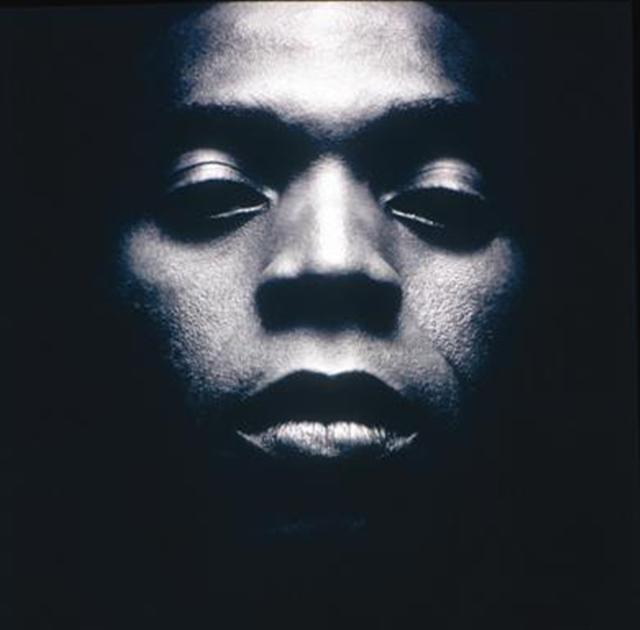
Afrobeat and soulful house luminary DJ Said of Fatsouls Records is back with his awesomely deep monthly We & the Music party, this time featuring local decks master David Harness for a celebration of Nigerian legend Fela Kuti, as Nigeria celebrates its 50th anniversary. It looks so young! 222 Hyde is gonna have a major dance attack on its hands …
Surely this means that the neverending monthly retroland of New Wave City is the longest-operating club in the city? Join DJs Skip, Shindog, Low Life, Melting Girl, and more to sing along to all your favorites from the ’80s at a club that started looking back right when that decade ended.
Soooo too cool for school, but not so cool it freezes you out. This great indie club is back at a new location, bringing with it “the best in classic Britpop, Madchester, 90s Indie, Mod, dancey shoegaze, power pop, and 60s soul on the first Saturday of every month!” It’s an Oasis, everybody, with free champagne until they run out. DJs Aaron Axelson and Omar preside.
Hot fun — or at least tacky tchotchke shoppingand muscle man cruising — at this huge affair that streatches all up and down Castro from Market to your future trick’s house. Also music and dancing, with several stages (the line-dancing stage behind Castro Theater is my personal fave) and performances by Pepperspray, Adonisaurus, DJ Jim Hopkins, and many more. PLUS: You could win an Atlantis cruise from GayCities.com. O.M.G.!
Another long runner! This funky house and chill techno joint has moved around a bunch, but never lost its good-footin’. Celebrate a dozen with DJs Justin V. of !!!, UK’s Simbad, and residents Solar, Nikola Baytala, Conor, and Kwai LeCheif.
Jerry Brown or Meg Whitman? Barbara Boxer or Carly Fiorina? For labor voters, the choice should be obvious.
All too often, we’re faced with choosing between the lesser of two political evils, but not this time. Democrat Jerry Brown has proven throughout his long political career to be one of the best friends labor has ever had, and shows no sign that he’d be anything else if returned to the governorship in November.
I particularly recall the great political skill Brown demonstrated in convincing the State Legislature to enact what is still the only law outside Hawaii guaranteeing farm workers the collective bargaining rights granted most non-agricultural workers in the 1930s.
It’s impossible to imagine Brown’s Republican challenger having the will or the skill to do something like that. Whitman’s position on labor is precisely the opposite of Brown. She has made union bashing, and especially the bashing of public employee unions, a major theme of her campaign.
On the national level, Democratic Senator Boxer has long been a solid labor supporter and surely merits re-election in November. Like Brown, she’s in a contest against a mediocre Republican candidate, but one with many, many bucks to spend on her campaign.
Some of the nine initiatives on the state ballot would be good for labor, some not so good. Prop. 25 is easily the best of the bunch for labor and just about everybody else. It would require a simple majority vote of the Legislature to adopt the annual state budget rather than the current requirement of a two-thirds majority. The great difficulty of lining up two-thirds support has often resulted in legislative stalemates that have forced some state operations to be cut back or even temporarily shut down for days, sometimes weeks. No money, as they say, no service.
Prop. 23 is bad news. The measure, backed by Big Oil and other major polluters, would suspend the state air pollution laws that limit omission of greenhouse gases known to cause global warming until statewide unemployment drops to 5.5 percent or lower for one year, which – surprise! – is not about to happen. Not for a long time, anyway.
Corporate greedheads could lose big, however, with passage of Prop. 24. It would repeal $1.7 billion in tax breaks granted big corporations during last year’s budget negotiations, or “backroom budget deals,” in the impolite but quite accurate words of the California Federation of Teachers (CFT).
The CFT, an AFL-CIO affiliate, and the rival California Teachers Association (CTA), an affiliate of the National Education Association, are both campaigning for the excellent Democratic candidate for State Superintendent of Public Instruction, Assemblyman and former State Sen. Tom Torlakson of Antioch.
They stress Torlakson’s experience as a longtime high school science teacher and part-time community college teacher and his commitment to increasing badly needed funding for the state’s schools, as shown by the bills he authored that have provided more than $3 billion in school aid.
At a Sept. 30 Planning Commission meeting, several commissioners and community members raised concerns that project approval for Parkmerced, a development that will add thousands of new housing units to an existing residential complex, had been scheduled before anyone was really prepared to discuss it. It’s since been pushed back, but the attempt to rush it through drew fire nonetheless.
Land use attorney Sue Hestor said she’d discovered the day before the Planning Commission meeting that a final project EIR would be made available Oct. 7, with an approval hearing scheduled just two weeks later, on Oct. 21. That came as a surprise even to Hestor, who closely monitors development projects. “You cannot just drop a complex legal document on people two weeks before the hearing and say that is sufficient,” Hestor said. “Two weeks for a staff report for this project is insulting.” Prior to this notice, the hearing on Parkmerced was widely expected later in the year.
Christina Olague, vice-president of the Planning Commission, said during the meeting that the accelerated timeline was highly unusual. “I was hearing that we were going to be attempting to initiate this project on the 7th of October with an approval calendared for the following week,” she said. “And I was concerned that it felt, at that point, that it was a little bit out of the hands of the planning commission. When it comes to projects of this size, I just felt like that was too much of a rush to get it through, especially given that we are in the middle of CPMC with comments due the 19th of October.”
Olague said the process made her uncomfortable. “I felt a lot of our say was being removed from our realm and there were outside forces … other departments in the city that were kind of influencing it in a way that didn’t feel comfortable to me,” she said. “Also, historically … we have never done it that way. Usually we calendar an item for one week and then there’s a 20-day noticing period that allows members of the public to digest the information and review the information.” She added, “I just didn’t want the public to get the impression that we were favoring one project over other projects.”
Calvin Welch, an affordable housing activist, noted that Parkmerced developers have a laudable goal of preserving onsite rent-controlled units at the housing complex — but he had yet to see a draft of a development agreement outlining the details of that plan. The planning commissioners hadn’t seen that document, either. Welch suggested more time was needed to review the terms of the agreement.
If the Planning Commission had approved Parkmerced on this accelerated schedule, it might have gone to the Board of Supervisors for approval before the end of the year, so the votes would’ve easier to count than if the project went before a new class of Supes in 2011.
The Guardian reported earlier this month that Mayor Gavin Newsom received a $1,000 campaign contribution for his bid for lieutenant governor from Craig Hartman, a design partner for Parkmerced, plus $2,000 from two executives associated with the project. AECOM, which is completing technical studies for the project, gave him campaign donations totaling $13,000.
Speaking to a crowd of real-estate professionals and representives from the business community a couple weeks ago, Newsom urged them to get involved in district elections in order to avoid “a dramatic shift” that would occur if the wrong people get elected to local office in November.
Did the mayor’s office lean on the planning department to rush the approval of Parkmerced in order to ensure a more predictable outcome? We emailed Newsom’s press secretary, Tony Winnicker, with questions, and we’ll be sure to post a response if we receive one.
With five supervisorial seats open and only one incumbent running, the Labor Council has had a tough time picking the right pro-labor candidates. The easy choices were incumbent Carmen Chu in District 4, with no opposition, and Raphael Mandelman, an exceptionally promising newcomer in District 8. But Janet Reilly in District 2 opposes the Labor Council’s revenue measures. In District 6, where long-time activist Deborah Walker has been endorsed, and in District 8, where Malia Cohen and Chris Jackson are #1 and #2, there are a multitude of candidates, many of them labor friendly. It’s not an easy year.
Prop. B on San Francisco’s November election ballot confronts the city’s working people and their unions with an unprecedented challenge. The measure, sponsored by Public Defender Jeff Adachi, would severely weaken public employee unions and undoubtedly lead to other serious attacks on workers and unions in private as well as public employment nationwide.
The proposition is by no means the only dangerously anti-labor measure on the ballot, but it ‘s the worst from labor’s point of view, as it very well should be. It’s a prime example of the public-employee bashing that’s become a favorite theme in election campaigns everywhere and, if passed, would set a clear national precedent.
Actually, Prop. B might better be described as a pummeling rather than bashing – and one coming, furthermore, just a few months after city employees took a voluntary $250 million pay cut. Prop. B would steeply raise the employees’ contributions to their pensions unilaterally and prohibit bargaining on the issue in the future as well.
It would arbitrarily lower city contributions to the employees’ health plans, especially dependent care. What employees pay for health care coverage for children and other dependents would be as much as doubled.
The steep rise in the employees’ share of their health care coverage could quite possibly force families to drop city coverage and try to get cheaper coverage on their own. That, of course, is a primary goal of the corporate anti-labor forces and others who seek to balance the budgets of public entities on the backs of their employees.
So what if workers can’t afford to take the kids to the doctor. Cutting taxes and balancing budgets is a lot more important. Besides, there’s always the emergency room and charity.
But wait! There are yet more major Prop. B flaws. For example: If city health care coverage is changed by increasing the premiums paid by employees, as the proposition requires, the city Health Service system (HSS) would have to forfeit new $23 million-a-year federal grants intended to reduce premiums for employees and retirees covered by the HSS. The system includes, not just city employees, but also school and community college district and SF court system employees and retirees.
There’s even more, much more than enough to energize labor’s troops. They are angry. Very angry. Unions citywide have at least temporarily set aside their sometimes considerable differences and feuding over tactics, jurisdictions and other matters. They’ve come together tightly along with a substantial number of labor’s Democratic Party allies to oppose Prop. B.
And watch out for Prop. G. It’s another favorite of the anti-union, anti-public employee crowd, led in this case by Sean Elsbernd, a very politically ambitious member of the SF Board of Supervisors.
Elsbernd and friends claim their intent is to “fix the Muni,” one of the nation’s most complex transit systems. The Municipal Railway, overseen by the Metropolitan Transit Authority (MTA), is indeed badly in need of fixing. But the principal blame for that does not rest with Muni’s bus and streetcar operators – most of them people of color – as proponents of Prop. G claim. Most of the blame rests with Muni’s overpaid managers, headed by $336,000-a-year executive director and CEO Nathaniel Ford.
As President Irwin Lum of the Muni operator’s union said in a Guardian interview, “Muni needs to be changed from the top to the bottom.” He sees Muni’s problem as mainly a lack of resources and the political will to pursue them. Muni officials might also avoid lots of problems if they’d deign to consult regularly with community groups and their leaders on their transit needs.
The public rightly complains of buses not arriving on time, of being passed up while waiting at bus stops, of grumpy drivers and of other certainly legitimate matters. Naturally, they blame the drivers. But drivers do not make schedules. Under pressure to keep to the schedules made by others, they sometimes speed by waiting passengers. Sometimes they’re slowed by heavy traffic, sometimes by problems with faulty, broken-down down buses or slowed by having to deal with violent passengers. Sometimes, managers making out the schedules don’t properly anticipate such probable delays.
Oh, yes, those grumpy drivers.
Wouldn’t you be grumpy if you had to work a full shift without going to the bathroom? If you had to listen to loud complaints from unruly passengers who sometimes got rough with you and each other? If you had to weave through heavy traffic for hours at a time? If you had to time your work to unrealistic schedules you had nothing to do with making?
It’s not the drivers who are in charge of replacing badly worn buses and streetcar tracks and equipment, not the drivers who are in charge of negotiating with Muni suppliers for a reduction in ever-escalating fuel prices and other costs. In short, it’s not the drivers who run Muni – though Muni, of course, could not run without them.
So, what do Elsbernd and his anti-labor cohorts want to do to the Muni’s invaluable workers? Here’s the deal:
The City Charter now requires that Muni operators be paid at least as much as the average salary of operators at the two highest paying similar transit systems in the country. And if benefits granted Muni operators are worth less than those of operators at similar transit systems, the difference is paid to the operators from a trust fund established for that purpose.
Under Prop. G, operators’ pay and benefits would be set by bargaining between union and MTA representatives. If they couldn’t agree, the dispute would be submitted to an arbitrator, whose decision would be binding.
The arbitrator would be required to consider the possible impact of disputed proposals on Muni fares and services. But though all other city unions are also subject to arbitration, there’s no requirement that the arbitrator consider how their proposals would affect the services provided by the union’s members – an unusual requirement that’s virtually unheard of elsewhere.
Prop. G backers presumably see the proposition as a step toward their goal of being able to set, change or eliminate Muni work rules without bothering to consult workers or their unions. They are, you might say, “unilateralists.”
Taking on Muni operators is only part of Supervisor Elsbernd’s anti-labor romp. He’s also sponsoring Prop. F, a deceptively simple charter amendment that would seriously impact the 105,000 members of the Health Service System. It’s a stealth proposition, difficult to understand and explain, and thus often brushed aside as a minor ballot measure of no particular consequence.
But Prop. F is capable of doing major long-term damage to HSS members by weakening their position in negotiating with powerful health insurers such as Blue Shield on the size of the premiums HSS members have to pay for coverage and the benefits they receive.
All politicians stretch the truth. It’s part of their game. You needn’t look further than Elsbernd for evidence of that. He actually claims he put Prop. F on the ballot strictly to save the Health Service System money by eliminating two of the four elections in which HSS members vote for representatives on the HSS Board. This seemingly small change would eliminate the overlapping terms that provide the continuity essential to successful negotiations with health insurers.
The savings would average a mere $30,000 a year, and would not even be available until 2016. Nor is there a guarantee that any of the money would go to the HSS. $30,000? What’s the real motive here?
As for the rest of San Francisco’s ballot measures and candidates, union supporters could hardly do better than to follow the recommendations of the AFL-CIO’s local Labor Council, which almost invariably backs the propositions most likely to be labor-friendly and opposes those that are not. This time, the Labor Council is saying “no” to those decidedly unfriendly Propositions B, G and F.
And don’t forget Props. J, K and N. Hotel workers and others are supporting Prop. J, which is meant to stop the travel industry practice of using online hotel booking to avoid paying SF’s hotel tax. Prop. J also would increase the city’s hotel tax for the first time in 14 years in order to raise some most welcome revenue for the city’s general fund.
However, Prop. K – introduced by Mayor Newsom – could stand in the way. Since Prop. K makes no change in the hotel tax rate, apparently it’s intended to confuse and distract the voters so they won’t approve Prop. J.
The other major revenue measure strongly supported by labor – Proposition N – would increase the city’s transfer tax rate on the sale of property worth more than $5 million from 1.5 percent now to a range of 2 to 2 ½ percent for a property worth $10 million or more. This would also generate millions for the city’s general fund.
Rarely has so much been at stake for San Francisco’s working people and their unions.
Dick Meister, former Labor Editor of the SF Chronicle and KQED-TV, has covered labor and politics for a half-century, Contact him through his website, www.dickmeister.com, which includes more than 250 of his columns.
Another wonderful local cultural event, Día de los Muertos, is falling prey to the city’s War on Fun — watch the video, and donate here to help reach the $6k goal. (via SFist, Mission Local)
I had a blind date with Dixie De La Tour, but I wasn’t nervous. If all else failed, at least she would bring stories to tell. And how – De La Tour is the founder and emcee of Bawdy Storytelling, a randy live series with two events next week (Wed/6 and Sat/9) that will bring writers, comedians, and normal folk-like to the stage to share corset-busting sexcapades with an audience of vicarious pervs.
“I don’t know how this got to be my life,” says Dixie, now installed across the restaurant table from me behind a glass of sweet tea, wearing a dashing fedora and magnetic waves of dyed red hair. Her blue eyes have the intent gaze in them that you can see on people that know how to hold the attention of the room. “I don’t have a degree in it like every other pervert in this town.”
It is true that De La Tour seems to have lucked out on the manner in which she makes her money. By day, she scouts scammers at Fling.com, a national dating site for casual hookups. Perhaps she’s a natural fraud-finder – the woman’s spent a life facilitating honest, fun sexual encounters. She’s also a contributor at She Loves Sex, a collection of blogs about all things sexual related to women, told in a knowledgeable women’s voice. For the site, De La Tour recently interviewed Rebecca, a soccer mom from Florida who has started a successful chain of swinger’s parties in between PTA meetings and classes towards her master’s in public relations.
Bawdy Storytelling, started four years ago, runs through a different theme each month. Adderall Diaries writer Stephen Elliott and that webmaster savior of the perpetually broke gadabout, Johnny Funcheap will be spinning yarns at next week’s Litquake edition of Bawdy (Wed/6), which actually is not themed at all, but rather a collection of the all-star lineup’s “best true stories.”
Maybe she’s got no degree, but Dixie does have a history in the psychology of human sexual relations. Over her rum cake — and to the passing interest of our server — De La Tour tells me that she got the party started at the first Kinky Salon XXX edition. Well c’mon Dixie, story time. She obliges.
Dixie De La Tour fires up the Bawdy crowd
Having transplanted from the Blue Ridge Mountains of Virginia and an unsatisfying heterosexual monogamous relationship with a bookie, De La Tour was in her element in late ’90s San Francisco. “You know that girl whose always down for the sex party? People would call me up and I’d be like, I’m there!” She became the doorperson for the original Kinky Salon parties at Mission Control, back in the days when the get-togethers were more “salon” and less “kinky” – there hadn’t been sex, at least as acknowledged by the party planners, for the first few Kinkys.
But one month, founders Polly and Scott decided to change the nature of their get-together. De La Tour recalls a woman arriving at the party who told her “I’m from New Hampshire and this is my first San Francisco sex party!” Well, by the time De La Tour had gotten off her shift and into the mix at Kinky, there was talking, there was certainly drinking, but at least explictly, no sex.
“There was a bullhorn by the stage,” she remembers, fully in the swing of her tale.
It is at this time that I should explain that Dixie has explained that she is herself, “not that big of an exhibitionist.” De La Tour is a facilitator, the person at the swinger’s party who loves nothing more to make introductions and get the fucking going… for others. That’s what she likes.
So back to the bullhorn. Having made the most of her time off door duty, she is a bit inebriated at this point. She takes the bullhorn and, having installed herself on stage in front of the party, booms to New Hampshire woman “Connecticut! Go have sex with that guy!” — or some such thing (having told me she is “much more interesting after two beers,” I am obliging her and my notes are a bit sparse from this point in the evening). She remembers them immediately going to have sex, although others from the night remember it differently. Good storytelling is all about the broad strokes.
But regardless, the rest is undisputed. Dixie soldiers on with the bullhorn, roaming about the club until she actually does encounter a couple copulating in the Pink Room and begins to shout very, very dirty things into the bullhorn at them. “Say my name, say you like my big dick” she shouts (“really, things that were not making very much sense,” she tells me, looking through that deadly scope of hindsight). Suddenly, couples rush into the Pink Room, and Dixie has officially started the orgy. Er, party.
Later, she runs into the original fuckers in another room utilizing a fucking machine. She is stripped of her bullhorn, installed on said machine, and is chagrined (remember, not a big exhibitionist) when the tables are turned and the woman from this couple begins to yell her name into the bullhorn. “Yeah, you like my big dick, Dixie?” Partygoers rush into the room to see the performance, and aid in her enjoyment of machine. She is eventually brought to climax when a woman Eskimo kisses her.
This is told with a smile, and by the end of it, we notice our server is frozen in her rounds of filling water glasses. “What on earth are you two talking about?” she says, giggling. But this is San Francisco, and as she is clearly intrigued, Dixie hands her a card that has all the Bawdy Storytelling events inscribed on its back.
After our (professionally inclined) date, I feel as though I have met someone very special, someone who has the cojones to nurture a community that often stays behind closed doors. De La Tour tells me you can learn a lot from hearing a person talk for ten minutes, perhaps more than you can learn having a good time with them at a swinger’s party.
And the connection is contagious. De La Tour started Bawdy Storytelling as a “coffee klatch for pervs,” where people would gather about the table and talk about how last night’s Kinky Salon went for them. Soon others wanted to sit in on the talks around the table, which led to Bawdy’s current public incarnation. And then everyone wanted to share a story, which led to Bawdy’s set program of four to six speakers a night, “so that people could see there was a set lineup and they weren’t on it,” De La Tour tells me. “Somebody’s always walking up to me and saying hey I got one for you!” This last line enunciated with a pointed finger and an intensification of that blue-eyed stare.
How nice to get sexuality out into the open. How nice to find meaning and simpatico in our sex. How nice to be Dixie De La Tour.
“This is the gayest thing I’ve ever done in my life!” laughed my friend Ricky Strawberry as he twirled around and around, unfurling lengths of tie-dyed cloth to Hi-NRG dance tracks from a live DJ in the sunshine. If you know Ricky Strawberry, that’s pretty damn sparkly pink unicorn in a rainbow thong bathing under a Splenda waterfall gay. In fact, it was the gayest thing anyone in my pinko posse had ever done, as well, and we had a ball. It was gay, it was amazing, it was gaymazing, and you should do it too.
It? Flagging in the Park, the summertime monthly gathering of fluttering human butterflies in the AIDS Memorial Grove in Golden Gate Park. I wrote about it in this week’s Super Ego nightlife column — and it happens for the final time this year on Sat/2, 1 p.m.- 4p.m.
Flagging — or flag dancing, wherein the dancer whirls around waving psychedelic-patterned, weighted pieces of fabric — has been around for several decades. I remember the first time I saw it was in the ’80s at a giant outdoor picnic in Detroit organized by Metra magazine, but it really took hold inside gay clubs during the ’90s, when circuit parties were on the rise. (Flag dancing of a non-gay-specific kind, using actual flags with poles, is an ancient art still practiced especially in Italy and New Orleans — and in Midwestern marching bands.) The exact gay origins are fuzzy — men dancing with giant fans at disco clubs were a common sight, and you will see lots of flaggers at the disco-celebrating Remember the Party event next weekend, for instance, which acts as a reunion for patrons of the classic Trocadero Transfer venue in the ’70s and ’80s.
Like many alternaqueers of my generation, flagging was a turnoff in the ’90s — it was too associated with annoyingly relentless circuit music, mainstream gym culture, and bad drugs in my mind. But that was a long time ago, and like a lot of things from that time, a rediscovery after old conflicts have died out puts things into a totally different perspective. (You don’t see much flagging in mainstream gay clubs these days, and the music at Flagging in the Park is a bit more fun and interesting than I thought it would be. For the October installment, the DJ is Steve Sherwood.) I was able to appreciate the art in a different context, and without prejudice. Flagging in the Park is a beautiful event, full of rich historical meaning. It welcomes everyone — there are also large contingents of hula-hoopers, poi-twirlers, and other talents — and has taken on a more spiritual aspect.
http://www.youtube.com/watch?v=Me3rZ99ArbU
When I went in August (I had heard about it for months, and was encouraged to finally attend by my friend Steven Satyricon’s lovely writeup over at The Juice Box site) I was lucky enough to see the organizer, Xavier Caylor, be sainted by the Sisters of Perpetual Indulgence for his community work. And Flagging in the Park (FITP) really does bring in a bunch of donations for community organizations, as well as provide community healing. “Without grief, you can’t have joy,” said Xavier, referencing the spirits around us in the AIDS Grove. Xavier took over FITP 10 years ago, and he teaches a flagging class at Gold’s Gym in the Castro every Wednesday, 6 p.m.-8 p.m. He’s also several thousand degrees of hotness, yowza. I wanted to know more about how he got involved, and some of the spiritual aspects of the art. His story is below — and you should drift on by this Saturday afternoon to see for yourself. Xavier provides plenty of free flags to borrow, and flagging really is a bit of good exercise, I discovered.
XAVIER CAYLOR: “I picked up my first set of flags from a friend of a friend at a party on Will Rogers Beach in 1997. I was hooked and we proceeded to flag everywhere we could: at home, in clubs and circuit parties. I heard about FITP from a fellow that I met at a circuit party in Palm Springs; he told me of a community of good friends that met during the summer months at a park in SF. I managed to contact someone and planned a weekend getaway from So. Cal. to attend in July of 1998.
“In 1998 the recently dedicated National AIDS Memorial Grove was young, the flaggers met in the then newly planted fern grove and gravel circle on the far West side. Twenty people gathered on what was a truly magical day for me; I was amazed with the variety of people, flags, and energy there – like a kid in a candy store. I not only left my heart in San Francisco but gave it freely to a tie-dye artist that became the catalyst for me moving here in just three short months. For the next few years he and I co-produced the event, popularity soon crowded us out of the circle and into the meadow. I have been producing the event since 2001 less two years that a friend took it and moved it to Dolores Park. Originally the events were planned a few days in advance around a sunny weather forecast. In 2002 this changed, acquiring permits and making these outreach events for charity brought a whole new dimension to our gatherings.
“What does the event mean to me? It was and is a magical space where love was born and flourishes, where flaggers can come out of the clubs and into nature. Held in a place that was built out of grief, mourning, and reflection by something that devastated our community and for a few hours we pour color, love, celebration, and heritage carefully back while raising consciousness by giving back. It is the place that our tribes come together to socialize, bond, and strengthen community. It is also a place that people walking through the park can happen upon a surreal event, take it in for a minute, and leave having had the opportunity to try something new or just stop and take in the music and visuals before moving along to where ever it is they are going. I usually plan 3 or 4 FITPs per year between May and October — the last one was supposed to be the final one this year, but we had such a great crowd and great vibe that we decided to have one more.
http://www.youtube.com/watch?v=fd3pX-Ys1wI
“If you’ve picked up flags you’ve most likely been asked by someone to show them how to do “it.” I’ve been showing friends since day one, taught at workshops in SF, NY, SD, and Dallas. I’ve been involved with group and solo performances, led people in tie-dye, and given away hundreds of flags while traveling to parties in Brazil, Australia, Thailand, Spain and the UK ,not to mention many cities around the US.
“About my class at Gold’s Gym: When I moved to San Francisco Club Universe, 177 Townsend, on Sundays was known as Pleasuredome and was a venue with a huge stage that flaggers flocked to weekly to play and share their art. It was a beacon to flag dancers on the West coast and beyond, introducing a steady stream of club goers weekly to the glowing fabric twirling in the U.V. flooded stage. It’s close in 2002 was a blow to the dance and flag communities. In 2007 I approached the management at Gold’s and asked if I could hold a weekly space for flaggers to come and practice – I was envisioning a free space that I would hold for a year with the purpose of re-energizing my tribe and reviving that weekly space. Troy at Gold’s Gym enthusiastically offered me a position and added the class to their Group X fitness program – I’ve been teaching Wednesday nights since. It is a place that people that have never flagged can come and learn – I have flags for use and set up black lights to make them come to life. The community comes to practice, play and socialize. I support new and old flaggers at the gym and outside of the gym by leading tie-dye classes/open studios so people can make their own flags. Weekly pre class discussions are opportunities to share history, personal stories and current events. Other flow toys (like poi and fans) show up from time to time and I support them if and when I can.
http://www.youtube.com/watch?v=GC4qFjeSTvg
“The group of guys that started FITP in 1996 shared a common experience, they had all gone to a week long experience in consciousness building in San Diego called the Miracle of Love which used active meditation techniques developed by Osho Rajneesh. Those flaggers came together in 1998 to bring those techniques to the gay community through a weekend seminar that is still going strong called the ‘Men’s Inner Journey.’ It was through delving deep into the techniques of active meditation that I realized what a spiritual event flagging is. Though people don’t usually make the connection between flagging and meditation, there is a point when the body and mind are so engaged that in the exuberance of the dance the mind is set free to a place of stillness. I believe that meditation something lacking in our lives and something we need to recharge our spirit and connect with our soul.
“Flagging is a visually appealing dance that has lived primarily in the gay community for the past 40 years. It touches on spirituality by being an alternative form of meditation palatable for people on the go. I am proud to be one of the many that keeps this art form flourishing by holding the space to pass it to the next generation of artists. www.flaggercentral.com is a great resource for our community.”
At last week’s California Music and Culture Association forum on San Francisco’s war on fun, I was on a media panel with San Francisco Chronicle columnist CW Nevius that answered questions posed by the audience, and Nevius steadfastly denied that he has any kind of agenda in writing so regularly about the need to crackdown on nightlife and streetlife. But his column today is yet another example proactively pushing that very agenda.
Nevius (who didn’t respond to my inquiry on the issue this morning or a follow-up this afternoon) was a Chronicle sportswriter for 20 years before being given a Metro news column that consistently has a reactionary, politically unsophisticated take on San Francisco life, following in the mold of predecessor Ken Garcia. His recent crusades include calling for crackdowns on the homeless in Golden Gate Park, on young people on the streets of the Haight and downtown, and on nightclubs whose patrons have engaged in violence, trumpeting “public safety” as the political priority that trumps everything else.
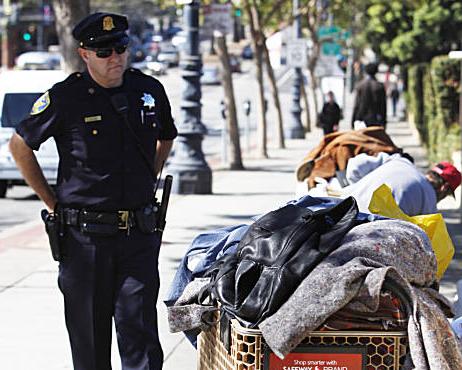
On Sept. 19, Nevius published yet another column promoting the sit-lie ordinance that he has championed since even before its official inception, which Mayor Gavin Newsom placed on the November ballot as Measure L. In that column, “City citations show need for sit-lie,” Nevius detailed how those cited for quality-of-life infractions such a blocking sidewalks or public drinking or urination – mostly poor vagrants on the margins of society – rarely get significantly punished by the courts. Using painfully tortured logic that I still don’t understand, he used that situation as an argument for creating a new quality-of-life infraction – sitting or lying on sidewalks – that would probably be similarly ignored by both its targets and the courts.
“Only the most stubborn sidewalk sitter stays in place, daring the officer to write a citation. Sit/lie, by encouraging that kind of common sense compliance, should actually cut down on the number of cases coming through the court system, a system that is demonstrably ineffective,” Nevius wrote, making the argument that a new category of crimes will somehow lower the number of people headed into the court system. Again, I don’t understand the logic either, and Nevius hasn’t responded to my inquiries.
But today, Nevius follows up that column with the “news” that some city officials are now considering developing a pilot program for socking it to the top 40 “sidewalk scofflaws,” as Nevius labels them. Both columns feature the same cop, Officer Gary Buckner, who writes a lot of these quality-of-life tickets, and the same officials who share Nevius’ public safety priorities and love to score political points with conservatives and moderates by scapegoating the poor and homeless.
During the CMAC forum, I copped to the Guardian’s perspective and the fact that we do promote an agenda that seeks to make San Francisco a more progressive and tolerant place, acknowledging and sometimes celebrating urban realities, even when they are sometimes loud, stinky, and perhaps a little scary. Hey, that’s life the big city.
But Nevius and the Chronicle pretend that they aren’t pushing back with an agenda of their own, one that seeks to impose on this great city the conservative values of Walnut Creek, where Nevius lived until earlier this year, where everything is well-scrubbed and the poor are effectively policed into the shadows or edges of town. Nevius says that he’s just an objective journalist covering the news, something that most San Franciscans see as laughably dishonest.
Of course they’re pushing an agenda in collaboration with the cops, Mayor Gavin Newsom and reactionary politicians of his ilk, and the downtown interests who value tourist dollars more than the lives and rights of the poorest San Franciscans. And if they were more honest about that intention, and willing to publicly debate our respective positions in good faith, I’m confident that most San Franciscans would share the Guardian’s agenda for the city.
The County Board in Arlington, Virginia and the Santa Clara Board of Supervisors both voted unanimously September 28 to opt out of S-Comm, a controversial Immigration and Customs Enforcement (ICE) data-sharing program also known as Secure Communities.
This means San Francisco is no longer the only municipality requesting to opt out of ICE’s S-Comm program. (Washington, D.C’s metropolitan Police Department is the only jurisdiction to date to successfully terminate its S-Comm Memorandum of Agreement with ICE.) The program automatically shares fingerprints with ICE that are taken by local law enforcement immediately after individuals are arrested, even if criminal charges are eventually dismissed or were the result of an unlawful arrest.
The opt-out resolutions in Santa Clara and Arlington came a day before 578 national and local organizations delivered a letter to President Barack Obama condemning the merger of criminal justice and immigration systems and demanding an end to practices that harm diverse communities throughout the country.
S-Comm has already met with opposition from civil rights organizations, law enforcement, and city officials from Washington, D.C. to San Francisco, over concerns it is being forced on hundreds of counties without oversight or accountability.
As a result of this opposition, ICE issued a statement in August that confirmed that local jurisdictions have a right to opt out by sending a written request.
And recently, Homeland Security Secretary Janet Napolitano and U.S. Attorney General Eric Holder also confirmed in writing that local jurisdictions can opt of S-Comm by requesting to do so in writing.
San Francisco Sheriff Mike Hennessey has already submitted this request in writing on at least two occasions, most recently on August 31st. And on May 18, San Francisco’s Board of Supervisors passed a resolution to opt out of S-Comm.
And Angela Chan, staff attorney at the Asian Law Caucus in San Francisco, repeated her request that ICE comply with its own opt-out procedure for all requesting counties.
“SF has done everything required of us to opt out,” Chan said in a press release. “Sheriff Hennessey and our Board of Supervisors have voiced our request to opt out of S-Comm loud and clear. It’s now ICE’s turn to follow through on their word and allow counties to do what has been within our right all along. Only then will we be able to focus our local resources back on local law enforcement. S-Comm has no place in our counties because it makes immigrant victims and witnesses afraid to come forward and cooperate with local law enforcement.”
In response to Santa Clara’s opt-out request, ICE’s Assistant Director David Venturella sent a letter to Santa Clara’s legal counsel Miguel Marquez in which he sought to clarify how S-Comm works:
“Secure Communities is ICE’s comprehensive strategy to improve and modernize the identification and removal of criminal aliens from the United States,” Venturella wrote. “As part of this strategy, ICE uses a federal biometric information sharing capability to more quickly and accurately identify aliens when they are booked into local law enforcement custody.”
“ICE uses a risk-based approach that prioritizes immigration enforcement actions against criminal aliens based on the severity of their crimes, focusing first on criminal aliens convicted of serious crimes like murder, rape, drug trafficking, national security crimes, and other “aggravated felonies,” Venturella continued.
But critics of S-Comm have noted that the majority of folks identified by this program are not criminal aliens at all. These critics argue that the program is undermining community policing efforts, since a person who has not committed a serious crime can now be referred to ICE simply because they were arrested (perhaps falsely) of a crime—and ICE can initiative deportation proceedings before that person can prove that they aren’t a felon.
And as Venturella acknowledges in his letter to Santa Clara, “Under this strategy, ICE maintains the authority to enforce immigration law.”
But Venturella confirmed that local municipalities have the right to request that their jurisdictions S-Comm program not be activated. And he clarified that ICE won’t be requiring local jurisdictions to sign statements of intent, or any other document to participate in S-Comm.
He also explained that ICE defers to the California State Attorney General on how state, county and local law enforcement agencies within California will share biometric data.
Venturella clarified that the purpose of local law enforcement receiving a fingerprint “match message” is to provide any additional identity information about the subject, including aliases, from the Department of Homeland Security’s biometric database. This database stores over 100 million records that, according to Venturella’s letter, “may not have been available based only on a criminal history check.”
But he noted that “receiving a ‘match message’ does not authorize or require any action by local law enforcement.”
“ICE views an immigration detainer as a request that a local law enforcement agency maintain custody of an alien, who may otherwise be released, for up to 48 hours (excluding Saturdays, Sundays and holidays),” Venturella explained. “This provides ICE time to assume custody of the alien.”
Venturella noted that ICE is not responsible for the incarceration costs of such individuals and does not reimburse localities for detaining any individual until ICE assumes custody.
But he points out that there is no statutory requirement that localities notify ICE if a subject is to be released 30 days in advance of any release or transfer. ‘The notification of ICE of inmate transfer or release within 30 days is pursuant to ICE’s request for such information,” Venturella stated.
Venturella clarifies that there is a legal basis for requiring ICE officers to conduct inmate interviews “to determine alienage and any possibilities for relief or protection from removal.”
But he also points out that local officials are not required to assist the feds in acquiring information about detainees. “Assisting ICE in acquiring detainee information is not a legal requirement,” Venturella states.
Local Arts: “Bodies in Space(s)” and Project Bandaloop float beneath and soar above
Because words so often fail in the realm of the everyday, it’s not surprising that some performers prefer to eschew them altogether, crafting their manifestoes with the indelible inks of pure action. Of course just as the written or spoken word can be misinterpreted, the language of the body can also be misunderstood.
How, for example, to interpret the Mad Maxian figure duct-taped to the pillar in front of Madrone Art Bar with his eyes wrapped shut with cord and a tiny television under his arm (Daniel Blomquist)? Or the spectacle of watching another get wrapped up in strips of calligraphied bandages and papier-mâché (Justin Hoover)? Sure, you could read a florid artist’s statement about the impetus behind such actions, but those often only underscore the inadequacy of words to convey the immediate. Allowing oneself to be simply drawn in should be a surrender more frequently employed when confronted with the emphatically unfamiliar.
At “Bodies in Space(s)” at Madrone, a circle of onlookers watched in silence as Terrance Graven, a pale, drawn figure in a strikingly white suit and tie, opened a series of gold-capped bottles covered with waxy lumps of what looked like melting flesh, drinking from each in turn and dribbling the colorful contents (various medicinal syrups and milk of magnesia) down his shirtfront. The patter of the drops hitting the butcher paper beneath Graven’s feet sounded of rain, and perhaps to chase away the storm he lit a fire in the covered incense burner on the ground.
One by one, labeled containers of urine, perched on a pair of side tables, were poured into a shotglass and downed―the last one heated first in the dancing flames. Now there’re a hundred ways I could interpret that sequence of events, and there are just as many ways for Graven to explain it, but what it made me think of was experimenting with watercolors, missing the gentle inevitability of summer rain (the kind we don’t generally get here in Ess Eff), and how both urine and fire can be used to treat wounds in survivalist-style emergencies. Can I say for certain that these contextual free associations were among Graven’s intended message? Of course not, but allowing myself the freedom to go along with the moment instead of deconstructing it to death did create a very personalized resonance out of the potentially alienating material.
Some performing bodies transcend even the language of free association. Take Project Bandaloop for example. Extreme arielists, the Bandaloops soar literally from mountaintops, skyscrapers, and iconic structures such as the Space Needle, with all the gravity-defying graces of a flock of elegant cranes. Helping to inaugurate the brand-new 24 Days of Central Market Arts festival, a tight-knit trio dangled and swooped over the Mint Plaza to the jaunty gypsy-strains of Caravan Palace. Dancing sideways, parallel to the ground, their feet against the smooth 10-story walls of 4 Mint Plaza or scraping the blue sky as they leapt, seemingly fearless, into thin air. There are no words to adequately describe the rush of vicarious adrenaline such a performance provides. But the body understands the language of it very well.
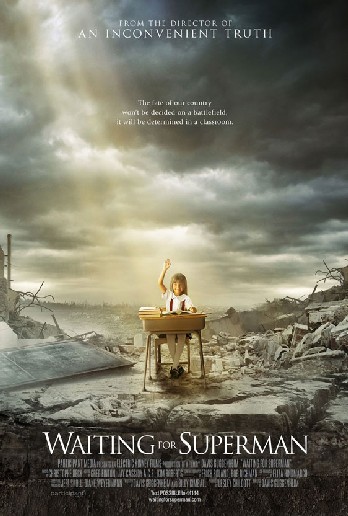
Director Davis Guggenheim won an Academy Award for 2006’s An Inconvenient Truth. His latest film, Waiting for “Superman”, takes on the United States’ failing public education system. In some ways, the documentary represents a return to Guggenheim’s first subject. “The very first documentary I made followed first-year teachers, because I believed that teachers were the answer to our schools,” he says. “And I still believe that. Now I wanted to talk about the kids and their families, and what’s at stake for them.”
The kids and families in question are the subjects of Waiting for “Superman”, which follows five young people in search of a better education. While the scope of the film is large — covering the history and bureaucracy that has created this national epidemic — Guggenheim is careful never to stray far from the victims of the crisis.
“The really hard part about it is how complicated this issue is, and it’s hard to simplify it,” he explains. “And I wanted it to be understandable to everybody. Whenever I got lost, I would always bring it back to the kids. It’s a very simple story: five kids, all they want is to go to a great school.”
In the film, Guggenheim looks at the complex situation from several different angles. Some of his targets are predictable — budget cuts and lack of accountability. But he also focuses on areas that might be less familiar to audiences, such as the detrimental effect teacher’s unions can have on schools. While Guggenheim asserts that he is a pro-union liberal, he suggests that teacher’s unions create contracts that make it difficult to deal with many of the problems public schools face today.
“I’m a member of the Directors Guild of America,” he says. “They make sure I get paid properly. They make sure my rights are taken care of. But they don’t tell Hollywood how to make movies, and they don’t protect bad directors.” Guggenheim’s analogy is apt. These unions push for tenure, which most teachers receive automatically after two years. Once they have tenure, it’s very hard for them to be let go — even if they are performing poorly at their jobs.
“I think teachers should get even stronger and demand more pay,” Guggenheim continues. “But they should not have these contracts that keep reform from happening.” Some of the fixes Guggenheim proposes seem like no-brainers. As he points out, the drive behind Waiting for “Superman” is one most people can relate to, whether they’re parents of students directly affected by the situation, or simply compassionate people.
“What’s amazing about public education is that everyone wants great schools,” Guggenheim notes. “It’s not like you’re going to argue that. With global warming, maybe you could argue about whether it’s real or not. But in America, everyone believes in great schools.” On the other hand, we’ve become cynical. We see president after president enter the White House with the promise of education reform. And yet, as Waiting for “Superman” documents, for the most part we’re no better off than we were before. In some areas, we’re worse.
“The problem is, people over time, they give up, because they feel like it’s too complicated, or it’s impossible to fix,” Guggenheim reflects. “And I tried to make a movie to get people to start to care again, and to believe that it’s possible, and to fight so that every kid can get a great education.” Guggenheim sincerely believes in his cause — he sees the documentary as just a jumping-off point for a larger movement. And while it’s easy to feel daunted by the magnitude of the problems our nation faces, he’s confident that things can get better, provided we have the motivation.
“Change can happen really fast,” Guggenheim says. “Before World War II, we could only make a couple planes a year. When we all got excited and committed, we made a thousand planes a year.” He hopes that Waiting for “Superman” will inspire that desire for change. Guggenheim believes that it’s something we all feel, and that education may simply be something we’ve ignored for too long.
“We’ve been not wanting to deal with our schools,” he says, “and I think we could jump right in. The solutions are there.” But he’s also clear about what it takes: “We’re not gonna fix our schools unless everyone is outraged, and everyone demands that all of our schools work.”
In today’s episode, Johnny and Tim deconstruct the Whitman-Brown debate — and talk about how the gap between the rich and the poor is so unsustainable that it’s taking the nation down a very dangerous road. Check it out after the jump.
Whoever said a cable car couldn’t be operated on woman power alone clearly had never met the steam engine on this grandmother. Fannie Mae Barnes of Oakland, California was the first woman ever to operate a cable car grip – not because it was a higher paying position, or an easier gig, but because she was told that women didn’t have the strength to do the job right.
Barnes started pumping iron, passed the 25-day grip operator training program notorious for its 80 percent drop out rate, and became a source of civic pride. She even drove the Olympic torch up the Hyde Street hill en route to the 2002 Winter Olympics. A documentary about her achievement, “Getting a Grip,” will be shown tonight at Lunafest, a traveling film festival that screens movies made by and about women to benefit the Breast Cancer Fund. We caught up with Barnes for a phone interview about knocking down one of the city’s diehard gender divisions of labor.
San Francisco Bay Guardian: What made you want to be a cable car operator?
Fannie Mae Barnes: It wasn’t about being a conductor, it was the grip up front, which is totally different from the conductor. In ’98 I went up front and became the first female ever to be certified as a grip.
SFBG:What’s the difference?
FMB: The difference is this: on the cable car it takes two people to operate, you have the person in the rear that does the back break at any given time it’s needed and collect the fares. Up front you have the gripman that controls the cable car. There’s a huge device that weighs about 375 pounds and it’s called the grip and it grips the cable that’s underneath the ground that’s moving at nine and a half miles per cable speed. It’s a ITAL job. It’s very different from conducting.
SFBG: So you’re lifting a 375 pound weight to operate the cable car?
FMB: As far as pulling back, yeah. The cable car itself weighs eight tons, empty. It’s a miniature train. A lot of guys will try to muscle the grip, but it’s really more a finesse thing – you have to leverage it with your body weight.
SFBG:How did you become the first woman to operate the grip?
FMB: Well they had said that they always need gripmen because it’s a difficult job. They had mentioned that it was a job that woman could not do because we lacked the upper body strength. So I said hey, come on now, you know, there’s absolutely nothing a woman can’t do. I mean if you can take care of a family, I mean, come on. This was in ’97 that this article came out. So in ’97 I decided I had to step up to the plate and be that woman, so I did it. I worked out extensively for six months to a year. I couldn’t let the year 2000 come into existence without a woman up front. So I did it, February 14th, 1997.
SFBG:What were you doing before you started working at the cable cars?
FMB: I was driving buses. I drove buses for 11 years. Some of my friends who had drove buses had left and were over in the cable cars division, so that’s what I did. And once I started working there I loved it. It’s a totally different scene, you know, you have a lot of tourists and they just want to ride and have fun.
SFBG:What kind of reaction did you get from the other cable car grips?
FMB: Well a lot of the guys were betting money against me that I would not make it. But then I had positive input too from some guys, so I went with the positive side. I knew that I was going to make it because I was training hard for it and it was something that I felt that I could do, and anytime you really apply yourself and it’s something that you want to do, you can do it.
SFBG: What gave you that conviction to know you could be that first woman? Is that something your family taught you?
FMB: Yeah, more or less. My mom always taught me growing up that whatever you want to do hon, you can do it, you just have to set your mind to it and go for it.
SFBG:So what are you doing with your golden years of retirement?
FMB: I work with an organization, Ghana Women and Children of North America. We’ve only been existence for a year, we do non-profit work with organizations in Africa. We put electricity in a primary and secondary school, we bought them two computers, a printer, and we opened up the Internet for them.
Lunafest
Featuring films Getting a Grip, Top Spin, and Tightly Knit
During last night’s gubernatorial debate, Republican nominee Meg Whitman bashed “illegal” immigrants and singled out San Francisco as the state’s worst coddler of those without proper immigration papers. But today, it was revealed that Whitman employed an undocumented Mexican immigrant as her housekeeper and nanny from 2000 until last year. Ah, karma, the great leveler.
After being asked what California should do about immigration issues, Democratic nominee Jerry Brown gave a reasonable answer that should have appeal to people of all political stripes, calling for halting illegal immigration by securing the border with fences and modern technology that electronically verifies the status of visitors, but bringing the state’s 2 million undocumented immigrants out of the shadows by creating a way for them to achieve legal residency status.
“We can’t just round them up and deport them like they did in Eastern Europe,” Brown said, an incendiary analogy that was nonetheless true, reminding voters of the police state implications of the right-wing approach to the immigration issue.
Yet Whitman then essentially called for doing just that with increased enforcement, albeit with a slightly more polished approach than most angry nativists, saying the presence of “illegal immigrants” was a serious threat to California. “We have got to eliminate sanctuary cities,” Whitman said, naming San Francisco as the worst culprit, and saying, “We have to hold employers accountable for hiring undocumented workers.”
So should Whitman be held accountable for employing Nicandra Diaz-Santillan for almost a decade? Maybe not to legal authorities, but certainly to voters who will now question her integrity and whether she has been hypocritically grandstanding on such a politically divisive issue.
Whitman’s excuse is that she didn’t know her housekeeper was undocumented because she was provided false paperwork, an excuse that most California employers could also offer, showing just how ridiculous Whitman is for pretending that being “tough” can solve this “problem.”
That was one of many Whitman forays into fantasyland, such as equating with “independence” a campaign funded almost entirely with her Wall Street windfalls, one she is using to advocate for aggressively cutting taxes on big business and the rich. And then pretending that’s somehow a plan to close the state’s massive budget deficit. Pure nonsense.
By contrast, Brown seemed firmly grounded in reality, leveling with viewers that the state faces difficult problems that will require hard work and experience fighting with the “sharks in Sacramento” and calling for “the powerful to sacrifice first.” On the whole, the debate made clear the stark differences between these two candidates, which is perhaps the best we can hope for during a dismal political year.
Purposely constructed anonymity as a reaction to this supposed Internet Age of Information is by now pretty passe in music circles (cf. Silver Columns, jj, Burial). So some may have rolled their eyes when future dubber Clubroot went that route with his first releases, even though the music was intellectually sensuous and the first full-length release received raves from Dubstepforum to Pitchfork.
Indeed, it seemed that Clubroot was following a little too closely in Burial’s footstep — no photos, no live sets, no given name — yet the music was tweeked slightly from that brainy dubstep god’s blueprint and showed a unique promise. But by now we’re all trained for the big, and in most cases anticlimactic, reveal. Since Clubroot’s been promoting a second album on Portland’s LoDubs label, he’s come out as 25-year-old Dan Richmond of St. Alban’s, UK, and is hitting the road for some live shows — ditching the reclusiveness (even though only obscured pics of him exist, and I wonder if he’ll be disguised for his upcoming show at Triple Crown). All signs, however, point not to anticlimax but to dance floor swoon.
II MMX is a 2 CD set that contains much of first album Clubroot, but the newer stuff advances beyond earlier hyper-cerebral and sometimes too-gloomy intentions for a trip into the deep forest. Yes, tracks like “Orbiting,” “Waterways,” “Dust Storm,” and the unfortunately titled “Cherubs Cry” channel some good ol’ pan flute sounds, tablas, and disembodied choruses that may call to mind New Age label Wyndham Hill or groups like Deep Forest, Enigma, even Enya. This is not a kiss of death — there’s a Balearic-derived trend blowing through right now that’s excavating those once-tacky sounds and making something fresh with them. It’s a neat trick, quite pleasant, and Clubroot is pulling it off. Call it dubstep’s version of chillwave.
While he can still show some spooked-out dubstep teeth on tracks like “Whistles & Horns” and “Physically” (and in his live mixes, like the one above for the inimitable Mary Anne Hobbs), Clubroot’s forging ahead in the pursuit of the thing every critic is calling post-dubstep, but which none can properly define. Good for him. Pack up that warped urban sitar loop and lead us into the trees, Clubroot — whoever you may be.
(Reports from Seattle’s Decibel festival last week indicate that the live show’s a keeper, a LoDubs showcase that really stokes the diverse crowd. It’s not all ethereal — check out LoDubs head Jon AD’s killer lazer house-y set from the fest here. )
CLUBROOT With DJG, Djunya, and Jon A.D. Thurs/30, 10 p.m., $10. Triple Crown, 1760 Market, SF. www.triplecrownsf.com.
Update:According to LGBTpov.com, Gov. Schwarzenegger yesterday “signed the Mental Health Services for At-Risk Youth Act (SB 543), which will expand access to essential mental health services for youth ages 12-17. The bill, authored by openly gay State Sen. Mark Leno and sponsored by Equality California, allows teens to obtain counseling without parental consent.” Unfortunately, “Friday morning, Charles Robbins, Executive Director of The Trevor Project reported a fifth suicide — Raymond Chase, 19, a sophomore at Johnson and Wales University in Rhode Island took his own life on Wednesday.” Hopefully kids in California will at least have expanded access to mental health counseling services. Original post is below.
For the fourth time this month, a kid who was harassed by anti-gay bullies has taken his own life. Seth Walsh, an out gay 13-year-old in Tehachapi, in central California, had been transferred from middle school to an independent study program, reportedly because he had been teased relentlessly about his orientation. Ten days ago he was found unconscious at the base of a tree in his backyard, apparently after he had attempted to hang himself. His parents took him off life support yesterday in Bakersfield.
Even though other kids admitted to harassing Seth — police reported that some of them “broke down in tears” because “they had never seen this outcome,” and wished they hadn’t participated in the bullying — no charges will be pressed against them: their actions do not constitute a crime.
“On September 9, 15-year-old Billy Lucas of Greensburg, IN, hanged himself at his grandmother’s home. Friends of Lucas said that he had been tormented for years based on his perceived sexual orientation.
On September 23, 13-year old Asher Brown, a gay teen in Houston, TX, came home from school while his parents were at work. He shot himself in the head after enduring what his mother and stepfather say was constant harassment and bullying.“
(Also, teen freshman Tyler Clementi at Rutgers University leaped off the George Washington bridge last Wednesday, after his roommate used a web cam to secretly and maliciously stream him “sharing a gay embrace.”)
This month, as well, saw the acclaimed launch of queer advice columnist and activist Dan Savage’s “It Gets Better” campaign (in direct response to Billy Lucas’ death, as a commenter below points out). It invites LGBTQ people to record videos addressed to queer young ‘uns that tell their stories of surviving school bullies and leading full lives after they graduated. I’m not sure I agree that people need to just wait to get out of school in order to survive — many don’t exactly find gay adult life a catered picnic, either, and why can’t we elders make an effort to help change the world for children in school now? — but I definitely agree that reaching out to isolated young people and letting them know there’s an entire community on their side is absolutely essential.
It’s infuriatingly sad that these instances seem to be on the rise, right when the country is making progress on most gay activists’ bigtime agendas: repealing DADT and legalizing same-sex marriage. Who cares about those things when our young people are in so much pain that they’re taking their own lives? Yes, ending all discrimination will help people envision a brighter future — let’s just not put all our eggs in one or two baskets, and forget entire segments of our community.
And while making an “It Gets Better” video is great, there are many fantastic community organizations in San Francisco serving the immediate counseling and housing needs of queer kids, many of whom have run away to avoid anti-gay bullying. Ignoring them only perpetuates the suffering. In a time of reduced aid, these organizations could really use your donations or time. Here are a few standouts:
And if you know a queer or questioning young person who is dealing with depression, or seeks counseling, direct them (and donate!) to the great Trevor Project suicide prevention hotline: 1-866-488-7386
California is one of a handful of states that specifically protects kids against anti-gay harassment, but cases are still hard to prove — if you see someone being harassed or know of someone who is being bullied, encourage them to report it to their parents, school counselor, or other professional so that it will be documented.
*ANOTHER DEATH: Commenter Aaron Baldwin below points to the recent suicide of 15-year-old Justin Aaberg in Minnesota, who was apparently a victim of anti-gay bullying, although I haven’t been able to find out much more than what’s in this Queerty story.
**ANOTHER RESOURCE: Commenter Liz below reminds me about SMAAC, serving queer and questioning youth in Oakland and the East Bay. Her comment raises several great points as well about helping youth now.
I watched the Brown-Whitman debate on TV, and I had an eerie Nixon-Kennedy experience. On the tube, Whitman looked …. creepy. That fake, plastic smile and the strictly scripted talking points made her appear almost robotic. I kept thinking about the employee she allegedly abused and I wonder if she had that same scary expression on her face when she pushed around and fired people.
Calitics thinks Brown won the debate handily and that Whitman acted as if she were running for governor ot Texas. I thought Jerry went a little over the top when he ranted about how the state’s pension funds would be in fine shape if everyone worked until his age (which just reminded the voters how old he is), but overall, he at least seemed real, interesting, and an actual human being. He also talked, at least somewhat, about fiscal reality. Whitman was channeling Schwarzenegger, who decided he could cut $5 billion out of the budget by eliminating the car tax and never worry about replacing the revenue. Her proposal for eliminating capital gains taxes makes even less sense; at least middle-class people got a break when the car tax was cut. All she would do is hlep the very rich.
Overall, I thought it was reality v. the robot. Reality generally wins that round.
With Folsom’s fumes still coming out of your pores thanks to this week’s weather’s surprise cameo by Death Valley, you are perhaps wondering the best spot to get hot and sweaty with your newfound best trick. We got you covered — as we do each week here in the schvitzy dungeon of the SFBG stables. Read on for porn parodies, artistic foreplay, and techno-free touching.
Naked Men’s Sketch
Eros’ website says that the NMS that takes over the community room in the sex club each Wednesday is all about fostering artistic development. But it’s not too many life drawing classes that require that all involved take a turn up on the nudie dais. Could it be that art here is not defined by the charcoal sketch on the pad in front of you? If you invite your favorite David to partake in the creative carnality on option in the rest of the club, you will probably be forgiven.
Sex in space. Space in sex. Sex in coffins, fucking machines, digital sex toys – Arse Elektronika is a three day festival of what it means to be human in this digital age. And if they want you to dress like a 1950s B-movie sci-fi character in which to do it all, so be it. The weekend kicks off with a parties, one featuring said coffin (in which couples can be “buried” and do what they like in front of the coffin’s installed night vision cam), and continues with lectures all day on topics from Creating Spaces for Sex, taught by Carol Queen, and Blowing Your Load: The Office Shooting Spree as Sexual Metaphor. Something for everyone!
An adult social club with nary a trace of techno is a rare event at Mission Control, where Burners often flock for some radical free love in the playa off-season. But not so at Kiss, where pre-screened women and couples get their play started on the dancefloor before they progress to one of the MC’s be-pillowed, bedazzled romper rooms.
Sat/2 10 p.m., RSVP required, see website for prices
Cue the over-exaggerated moans and overdone dialogue – this month’s BDSM young people play party, Bent, is taking on the parody. The theme for the party this weekend plays into the penchant for pornos to spoof – adding a little ribbing at Twilight or The Office‘s expense in with the sensual sexy play. To this end, hosts Stefanos and Chey will be holding a “Bent’s Got Talent!” face-off, where competitors are encourage to show off their deep-throating, to ribbon-dancing to zither-playing skills.
Since 1987 when Shadow Morton took home the prize for best dyke in skins, the Ms. Leather SF Competition has been turning heads and cracking whips — in fact, three of those years, Ms. SF has gone on to win the International Ms. Leather sash (2009’s winner Mollena Williams among them). Who will be the lucky womyn this time around? The three contestants are all upstanding members of the SF sex community, so judges might have a tough time figuring out who comes out on top.
Tallulah Samis, somatic sexologist comes to tell you just how to achieve that Herbal Essence commercial look. Of course, it’s not just about great hair. She’s talking “exquisite Yoni (vagina) massage techniques,” for you and/or a friend!
Throughout the course of writing my feature story about the Tenderloin this week, which looks at the role art is playing in the gradually changing neighborhood, a couple of questions kept cycling back into the forefront of my mind. What should be the role of art in community-building? What kinds of art benefit the residents of a neighborhood? It’s tough to categorically define the answers, but Rick Darnell and the North of Market Community Benefit District‘s plans for a TL art lending library come damn close to a perfect score.
The Tenderloin Art Lending Library (TALL)’s planned role in the community is double-fold: one, it will provide a boost to “outsider” artists in the Tenderloin, people who have never had their art displayed in a studio and may lack the career know how to make that happen, and two, their pieces wind up in the homes of people who otherwise would have few touches of beauty there — at least not original works by creative minds. “A lot of artists never get discovered,” Darnell tells me, sitting in the basement room that the NOM-CBD has allocated to housing the library. Donated paintings lean against the walls around us, and a table is stacked with interesting metal sculptures behind my chair.
His goal is to get this art into the homes of the Tenderloin’s recently housed residents. The neighborhood is well known as a drop-off spot for released convicts, Darnell tells me, and has a high percentae of residents on parole and probation. Between the recently incarcerated and the participants of the City’s “Care Not Cash” transitional housing program, you have a lot of people who need help making their new rooms homey.
Paintings for and by the community line the walls at the Tenderloin Art Lending Library
Every three months TALL participants will be allowed to take a different piece of art for their space. Not everyone’s used to having nice things though. Darnell anticipates the challenges that this will entail, and tells me that those hurdles are kind of the point.
“It’s based on trust and sharing and a celebration of those two things,” he says. He’s got a system worked out for participants that mess up their given canvass or sculpture: six months probation from the library if they sold it or destroyed it, but leniency if the damage was due to carelessness or misfortune. “If it’s something like the dog eats it, we’ll work with them to find another place in their house that would be better for the painting,” he says, adding that program volunteers will be prepared to make house visits to make this happen, or to involve less mobile residents. “We want to make this a good experience for them.”
Some of the pieces around us, Darnell tells me, were done by artists afraid to leave their own house, elderly artists, recovering addicts, current addicts. Many artists have volunteered their art – he shows me one small canvass covered in dynamic swooshes of primary colors that came from an artist in Colombia that saw his call for admissions online – but he gives priority to Tenderloin artists, who seem to be the ones that are most connected to the mission anyway. “The people who have the least to give, I’ve found, are the most generous,” he says.
Rick P. Lion’s fantastical creations will soon be sitting in the living room of a recently housed, newly initiated art connoisseur
Darnell knows what helps people get better: in addition to his years spent working with society’s forgotten communities, he’s been a part of them himself. “I’ve dealt with addiction, I’ve dealt with being homeless,” he tells me straight-forwardly.
He’s got no issue with recounting his story. An MFA recipient in dance and design from the integrative learning-based Bennington College, he traveled the country after graduation dancing with a troupe that performed in non-traditional venues and focused on social issues in their productions.
But he fell into drug use, and in1989 tested positive for HIV. He moved directly into the Tenderloin when he got to San Francisco and hasn’t left since, finding the expansive gay community “astounding.” He’s been clean for years, and seems inordinately enthused for a guy that’s been through a lot. “I’m just really happy to be here and doing this.”
Perhaps it was a no-brainer that someday Darnell connect his love of helping others in a tight spot with his love of art, given the role that it plays in his own mental clarity. “I draw something everyday,” he says. “I’ve drawn thousands of bullets, thousands of popper bottles. The shapes are really calming to me.”
Until recently a long time employee of the Hospitality House, a resource center for homeless individuals around the corner from the NOM CBD that includes a drop-in arts studio, employment help, and a men’s shelter, Darnell was hired at the Community Benefit District initially as a janitor. But the organization invested $15,000 in seed money so that he could flesh out his vision of a community enhancing arts program. Now he’s in charge of outreach and general operations of the project.
“It seems frivolous, like maybe I should be doing a food drive – but these are all sides of a well rounded person,” he reflects. Darnell initially considered starting a tool lending library, but changed his mind when he considered that the art exchange would give TL artists a chance to work on their craft, as well as gain some valuable artistic experience – pieces will be displayed in the gallery that gracefully inhabits the current lobby and front hallway of the NOM CBD.
Community through art: Rick Darnell in front of the frame that will constitute an altar he and some veteran friends are completing for SomARTS Cultural Center’s Dia de los Muertos exhibit
He envisions the library as a place where people can come and connect using the language of art. “You might come to have a salon community,” he suggests regarding residents’ use of the future space. It’ll be open Fridays and Saturdays from 12-3 p.m., starting with a kick-off party on Oct. 30.
We chat briefly about some of the other recent arts development in the neighborhood. I first met Darnell at a fairly informal meeting of TL art types convened by the Tenderloin Economic Development Project’s Elvin Padilla. In addition to the Darnell’s presentation of his library, a representative of a well known theater discussed plans for expansion, possibly in the Tenderloin. Another performing arts organization announced they were looking for a TL address, and various art galleries discussed openings and future collaborations with each other.
“A lot of people put endeavors in the Tenderloin because rent is cheap, and it’s slowly changing the area,” Darnell tells me of people he refers to as “carpet baggers.” We talk about a comment he overheard from a gallery owner in the area after Rick announced his plans for the lending library to the group. The individual had muttered “I’d never lend anything to anyone in the Tenderloin.” “For good reason,” Rick continues “people are wary of homeless folk.”
But Darnell doesn’t seem to be wary of the recently homeless folk he’s passing out TALL fliers to and still collecting donations of art for. In fact, he seems stoked on his continuing role in their lives, and stoked for the day the library’s circulation begins at the end of next month, when they’ll eat light snacks and start making connections through art.
“If there’s anyplace that’s open to this stuff,” he tell me “it’s the Tenderloin.”
San Francisco is waiting for its Boogie Nights. Unbeknownst to Hollywood, our fair berg was the infant creche of hardcore pornography, spawning a subculture of porn theaters that thrived despite police harassment and political pressure.
We were number one! Luckily, a few brave men are resurrecting our porn golden age money shot – read on for a first look at documentary The Smut Capital of America and an interview with the director himself, Michael Stabile.
Smut Capital is by no means Stabile’s first porn rodeo. The co-editor of Gay Porn Blog, he and Smut Capital editor-cinematographer Ben Leon are both mainstays in the SF gay porn scene. The two were researching their upcoming doc on the life of gay smut powerhouse Falcon Studios founder Chuck Holmes when Stabile came across a New York Times article that inspired the title of their new project, which is a work in progress for which the team is fundraising in order to release the finished film in 2011.
“Until then I’d always thought of it as an industry that emerged from LA, but San Francisco was actually the city that birthed the porno theater. It was the beginning of the sexual revolution, and in a lot of ways these directors were documenting this newly found freedoms.” Stabile attributes the renaissance to hippie women “with really no hangups,” a progressive zeitgeist that had seized the city in the late sixties and early seventies, and film processing studios that were willing to develop sexually explicit material. By the era’s zenith in 1972, there were porno film theaters in neighborhoods across the city.
Not that everyone was down to get all that action on screen. Dianne Feinstein, first in her post as the city’s first female president of the Board of Supervisors and then as SF’s first female mayor, led a crusade focused on cleaning up the Tenderloin, which incidentally included sweeping the neighborhood free of its supply of adult movie houses. What ensued was an orchestrated harassment policy that different porn theaters dealt with in different ways.
Established theaters, Stabile says, actually benefited from the police and media persecution. “They’d come in with cameras, it’d be on the five o clock news and it would be great for them,” he says. “Advertising was very limited at the Chronicle. Feinstein would come in with her troops and would detail everything that was going on. Suddenly there was a way to talk about it, so people would flood into the theaters.” The Mitchell Brothers grew so adept at playing the cat and mouse game, he says, that they would post Feinstein’s office number on their marquee under the words “call for a good time.”
But not everyone prospered. Smaller theaters that depended on a few workers to operate, like Alex DeRenzy’s Screening Room, suffered when police would take key staffers on pointeless joyrides around town before booking them on charges of vice crime. Eventually factors like these, and more importantly the advent of video porn in the 1980s pulled the adult film business down to Los Angeles.
The move shifted the purpose of sex films away from their original role in the Sexual Revolution. Says Stabile “People were doing it here because they enjoyed it, because they wanted their own sexualities represented. It’s not like that in LA for the most part, where even a lot of the gay studios are owned by straight men looking to turn a profit.”
But don’t worry, the party’s not over. One of Stabile’s main goals with the film is not just to highlight good sex gone by, but that which cums and goes even today. When asked whether SF is still a presence in the world of porn, he had no equivocation. “Its one of the great untold stories in the local media – San Francisco has a huge porn presence. Raging Stallion, Falcon, Hot House – seven of the top ten gay porn studios are located up here, there’s Kink.com, porn writers like Violet Blue,” he says.
It appears that the tech savvy and sexual freedom that led to our capital crowning are still alive and well on these city streets. Phew! Now you may now go back to your regularly scheduled local porn browsing.
Based on the founding of Facebook and Ben Mezrich’s book The Accidental Billionaires, The Social Network has already received rave reviews from critics. I offer no dissent: the film is unquestionably one of the year’s best. I recently spoke to three of its lead actors — Jesse Eisenberg, Andrew Garfield, and Armie Hammer — and screenwriter Aaron Sorkin.
We’re all Facebook friends now. (Lie.)
Being Mark Zuckerberg
Mark Zuckerberg may not be the villain he’s often made out to be.
“I don’t think he necessarily neglects social interaction,” Jesse Eisenberg, who plays Zuckerberg, explained. “I just think he feels alienated by it … He feels kind of uncomfortable interacting in the way he sees everyone else interacting.” But then, that’s not Zuckerberg the person: it’s Zuckerberg the character in The Social Network. In order to play the world’s youngest billionaire, Eisenberg put himself into the mindset of Sorkin’s creation. But he also did his fair share of research on the real Zuckerberg — not to imitate him, but to get a better handle on who he is.
“I read everything I could find about Mark,” Eisenberg said. “I took fencing lessons, because he’s a fencer. I had every video of him converted to mp3, so I could have him on my iPod. This was all to help me focus.”
It also helped that Eisenberg could relate to Zuckerberg, a notoriously awkward public speaker: there’s video of the Facebook founder stammering, sweating bullets, generally not making a great case for himself. For Eisenberg, a character’s neuroses are what make him worth playing.
“I assume that everybody is neurotic in some way, or everybody interesting is neurotic,” he reflected. “It seems to me, why would you want to play anyone else? What other layers would there be besides neuroses?”
In writing his version of the real-life person, Sorkin grew to care about Zuckerberg. The end result is a character who isn’t always pleasant or charming, but who does inspire sympathy. In a way, that’s how Sorkin feels about his non-fictional counterpart.
“[Zuckerberg] is awkward in public,” Sorkin said. “He knows it, because he’s been told it so many times. He doesn’t care that much about money, so I don’t think that his billions of dollars are making things that much easier for him. So I actually feel affection and respect and empathy for him.”
The Mark-Eduardo bromance The Social Network may be about the founding of Facebook, but at its heart, it’s also the story of a friendship betrayed. As in real life, Mark Zuckerberg turns his back on his best friend and co-founder Eduardo Saverin (Andrew Garfield).
“Obviously, there’s a massive betrayal, and within that betrayal [Eduardo] loses his innocence and realizes that you never know someone,” Garfield said. “You never fully know someone. The only person you’ll ever know is yourself and even then, you won’t really know yourself.”
There’s no hint that Zuckerberg and Saverin were ever more than friends — though that would make for an interesting movie, too. At the same time, Garfield likened the betrayal his character experiences to a break-up. During the interview, he reflected on a time he’d been dumped out of the blue — and the pain that followed. “You know that confusion you have when you’re broken up with, and you have no idea why?” he asked. “You haven’t been told clearly why, because that person’s protecting you.”
Garfield was reluctant to identify his character as “too trusting,” because he views trust as a positive quality. But Eduardo does have an honor system and moral code that make Mark’s betrayal all the more hurtful. “To me, it wasn’t about the money,” Garfield said, referring to Saverin’s $600 million lawsuit against Zuckerberg. “It was about teaching Mark a lesson.”
In fact, the desired outcome Garfield imagines his character wanted is a bromantic ideal. If Mark were to realize the error of ways, perhaps he’d apologize to Eduardo, and they could repair their friendship. It might not make for a gripping ending to the film, but it would be a happier conclusion for Saverin. “I think with Mark, up until the end, [Eduardo]’s hoping at some point Mark’s going to go, ‘Look, I’m really, really sorry, man. I really messed up. I love you so much, and I just was jealous of you for this. And I acted out like this. Can we be friends again? I’ll give you back as much money as you want. Let’s move in together and we’ll play basketball every day, and we’ll cuddle at night and watch reality TV.’ Part of Eduardo in those depositions is just waiting for that moment.”
Isn’t it bromantic?
Taking sides It was important for Sorkin that his script not take a side. Instead, it presents the story of Facebook’s founding from three different perspectives: those of Zuckerberg, Saverin, and the also-involved-at-square-one Winklevoss twins. Meanwhile, director David Fincher made sure that all the actors believed their characters: they all tell what they believe to be the truth. “Every time we did a scene, even if it was part of Eduardo’s telling of the story, David Fincher would come up to me between each take and say, ‘You know you’re right in this scene. You’re the right one,’” Eisenberg reflected. “And then he’d go up to Andrew Garfield, and say, ‘You’re right in this scene.’ So we all thought we were right.”
Playing twins Cameron and Tyler Winklevoss (with help from body double Josh Pence), Armie Hammer had to maintain sympathy for both and project that to the audience. “With these twins, when you look at them on paper, they’re tall, athletic, good-looking guys who go to Harvard,” he noted. “They have a lot of things going for them that would make a lot of people in the audience go, ‘I don’t like these guys. They suck.’”
But Hammer planted himself firmly in their mindset. As is the case with Saverin, the Winklevosses aren’t necessarily interested in the money they’d receive from their lawsuit against Zuckerberg — it’s really about principle. These are characters of honor, and they were wronged. No matter how wealthy or dashing they are, Hammer insisted to himself that they deserved justice. “When we shot this, I had to side completely with them, just to bring truth to it,” he explained. “I had to say, yes, these guys did invent Facebook, and yes, Mark Zuckerberg stole it from them.”
Sorkin’s script is purposely ambiguous. While he was researching the story behind Facebook’s founding — along with The Accidental Billionaires author Mezrich — he discovered conflicting versions of the truth. His solution? Show it all, and let the audience decide for themselves.
“What we came away with was three very different versions of a story,” Sorkin said. “So instead of picking one and deciding, ‘Well, I think that’s the truth. That’s the story I’ll tell.’ Or picking one and deciding, ‘I think that’s the juiciest. That’s the story I’ll tell.’ What I liked was that there were three different versions of the story.”
In Hammer’s mind, the authorial choice to leave it up in the air creates more of a challenge for the audience. “You are responsible for siding with the people that you recognize the most, or recognize yourself in the most,” he said.
Sorkinspeak Those familiar with Sorkin’s work (The West Wing, Sports Night) know that his dialogue has a distinct sound. He considers himself a playwright, which might explain the fast-paced back-and-forth that dominates his scripts. The Social Network had a Sorkin sound that Eisenberg immediately clung to.
“When I had the audition for the movie, I made a little tape to send to them in Los Angeles,” he recalled. “They said, ‘This scene is ten pages but please try to do it in five.’ ‘Cause I guess what they were getting were these kind of indulgent moments that people are used to doing in movies, whereas it was immediately evident to me how it should be read.”
All the actors I interviewed gushed over Sorkin’s novel-length script. For Garfield, it was essential to treat the script as the Bible — though that’s not the case for every film. He worked hard to get into character as Eduardo, adopting characteristics that were foreign to him. That it was a matter of letting the script work its magic. “The rhythm of Sorkinian language — you just don’t get in the way of it,” he noted. “An actor wants to put his own mark on something, but that’s your ego and you don’t need that. So you just try to not get in the way of these beautiful sequences of thoughts that have been expressed so deftly and seeped with subtext.”
Sorkin wasn’t quite so effusive about his own work, but he was willing to talk about his process. As he said, creating a fictional version of Mark Zuckerberg helped Sorkin find affection for the real person. But even before that, he knew it was important not to make him too black-and-white.
“When you’re writing an antihero, what I try to do with a character like that, is write it as if they are making their case to God why they should be allowed into heaven,” Sorkin said. He made the comparison to Jack Nicholson’s iconic “you can’t handle the truth!” speech from the Sorkin-penned A Few Good Men (1992).
“You can’t have them twirl their mustache,” he continued. “You can’t think they’re a bad guy — you just have to put obstacles in front of them.”
As for the rhythm of the dialogue — “Sorkinian language,” as Garfield calls it, or “Sorkinspeak” — the writer admits a heavy theatrical influence. He said it began at a young age when his parents took him to plays that were above his age level, like Who’s Afraid of Virginia Woolf? “I wouldn’t understand the story that was going on, but I loved the sound of the dialogue,” Sorkin remembered. “It sounded like music to me, and I really wanted to imitate that sound — just words crashing into each other, and speeches. It follows the same patterns as the movements of a symphony.”
In replicating that sound, Sorkin’s script carried the actors where they needed to go. “It’s all there in the script,” Garfield said. “All you have to do is be truthful in that situation and allow the thoughts to turn into words, and the words to turn into an action.”
The Facebook The Social Network has been widely referred to as “the Facebook movie,” but its cast and crew insist that such a designation is misleading. “Sports Night wasn’t about sports,” Sorkin said. “[The Social Network]isn’t about people friending and poking people and falling in love on the internet. Maybe I just give things the wrong title.”
We did speak about Facebook extensively during our interviews. How could we not? With 500 million users, the site has become a part of daily life. It’s hard to know how we functioned before it. Even Eisenberg, who is not on Facebook himself, understands the sentiment. “In the movie, [Mark] kind of sees this void online,” he noted. “We look at Facebook now in retrospect, like, ‘How could this not have existed?’ That’s how Mark viewed it.”
Sorkin isn’t on Facebook either, though he and Eisenberg both set up accounts while they were filming. While he acknowledged that part of his hesitation comes from a generational divide, Sorkin was upfront about his negative perception of the site. And no, it has nothing to do with Zuckerberg himself. “For a device that’s supposed to make us better connected and bring us closer together, I feel like it’s doing the opposite,” Sorkin opined. “I feel like social networking is to socializing what reality TV is to reality. In a way we’re performing for each other.”
Hammer shared a similar point of view. He mentioned negative experiences on Facebook in the past, though he was smart enough not to elaborate. “The dark side of Facebook is it turns these people into voyeurs,” he said. “And if not voyeurs, then even worse, it turns them into narcissists, where they think that they’ve put themselves on the cover of their own Rolling Stone.”