SFBG Blogs

OFA opens SF office, hosts debate watch party

12


President Obama’s political operation, Organizing For America, is opening its first San Francisco office today (Tues/12), just in time to hold a watch party for this evening’s final California gubernatorial debate between Jerry Brown and Meg Whitman. So stop by 1406 Valencia at 6:30 for the debate, or stop by at 4 pm to watch Obama greet the crowd via video hookup.

Emily Dulcan, OFA’s California communications director, said the office will be focused on get-out-the-vote efforts for the Nov. 2 election, including phone banking and precinct walking for races that include Brown for Governor, U.S. Sen. Barbara Boxer’s reelection effort, Congressional races, and even some local measures.

“A lot of our volunteers hover between local races and the big races,” said Dulcan, who said she was starting to feel good about the chances of Democrats doing well at the polls. “People are really starting to see what’s at stake in this election. We can go back to the failed policies of the Republicans and President George W. Bush, or we can move forward under President Obama.”

While history and many pundits predict the Democrats will lose seats in Congress this fall – mostly because of the stubbornly bad economy and the fact that the party in power usually loses ground in the midterm elections – recent computer modeling by the New York Times showed there’s an almost unprecedented amount of uncertainty in forecasting how this election will really go. And that it could largely depend on which party can get out the vote in a fairly lackluster election season.

I hope Greg Mankiw stops working

6

The eminent and distinguished N. Gregory Mankiw, a professor of economics at Harvard and former White House aide (under GW Bush) presented one of the most convoluted and misleading antitax arguments in the history of the dismal science Oct. 10. His New York Times piece argues that the effective tax rate on his marginal income is 90 percent, and because of that, if the Bush tax cuts on the rich expire, he isn’t likely to write any more articles.


That’s yet another wonderful reason to raise his taxes. The less of this crap the world has to deal with the better.


Kevin Drum has a nice takedown in Mojo, but the biggest problem with Mankiw isn’t that he compounds his tax liability over 30 years to make things look worse. It’s that he starts his article with the assumption that he should pay zero taxes — and so should corporations — and there should be no estate tax (which it’s highly unlikely Mankiw will have to pay anyway).


Yes: The difference between paying zero taxes and paying 39.5 percent is significant. The money the profressor would earn 30 years from now on a $1,000 investment if there were no corporate taxes would indeed be higher. But there would also be no streets for him to drive on, no police and fire departments to protect his house, no unemployment benefits to keep the people who aren’t as fortunate as him from breaking down his door to get food for their kids, no social security, no medical care for indigent sick people, no federal funding for the scientific research he and his colleagues do at Harvard … in other words, not much of a country. I don’t think even Mankiw wants to live there.


So what’s the difference in his life if his taxes go up — as proposed — from 35 percent to 39.6 percent? Well, on the $1,000 article, he’d pay an extra $46 in taxes. Big fucking whoop. He probably spends more than that on lunch at the Harvard Club. Even if he invested that $46 for 30 years — AND there were no corporate taxes, AND he got 8 percent a year in the stock market (which remained stable despite the massive social upheaval caused by a society with inadequate tax revenue to provide basic public services), we’re talking $462.88. That’s less than he’d get by putting $4 a year — yes, four dollars a year — into the same account.


In other words, he’d have to be pretty fucking stupid to decide not to write a $1,000 article entirely on the basis of a modest increase in taxes on someone with his level of income.


On the other hand, he clearly is pretty fucking stupid. Or else he’s smart and he’s intentionally skewing the facts to protect his own economic interest. Either way, the world will be a better place if he doesn’t write any more articles.  So let’s raise his taxes.

Street Threads: Look of the Day

0

Today’s Look: Tara, O’Farrell and Fillmore

Tell us about your look: “Do what you want to do.”

Janet Reilly wants a centrist mayor. Ick.

8

Janet Reilly’s the overwhelming frontrunner in District 2, and has the support of just about everyone in the Democratic Party establishment, including U.S. Senator Dianne Feinstein and Mayor Gavin Newsom. But she seems to be nervous that someone might suggest she would support a progressive (like, Gasp! Aaron Peskin) for mayor if Newsom leaves the city for Sacramento and the Lt. Guv’s office.


So she sent out an email to her supporters today, announcing that she wouldn’t support any current member of the board — or any former member of the board who has served with any current member of the board. You following? Here’s the message:


I would strongly support a true interim Mayor who pledges not to seek
re-election to a 4-year term. The interim Mayor’s sole ambition should
be to successfully steward the city until the people choose the next
Mayor. I believe this person should be a senior statesperson or a
non-partisan city official with unquestioned expertise and integrity.
There may be others who have never been elected who would be suitable
for the position.

In recent years, I have disagreed with the divisive politics of the
Board. Therefore, if given the chance, I will not cast my vote for
interim Mayor for any currently sitting or former Supervisor who has
served with any member of the current Board. We need a caretaker Mayor
who will guide San Francisco until voters choose long-term leadership in
the November 2011 election. This should be a thoughtful decision.

The next mayoral election will give the city an important opportunity to
chart its future. I think we need to let this debate take place without
any one candidate enjoying the advantage of incumbency.

If I am elected and called upon to vote on this matter, I will vote “no”
on any current member of the Board of Supervisors for interim Mayor, and
I will also vote “no” on any past Supervisor who has served with any
member of the current Board.

I would look for a moderate, custodian Mayor who will govern from the
center for all San Franciscans.


Gawd — governing from the center. What a joke. There is no center in San Francisco politics today, not for the mayor who has to decide whether to raise taxes or cut services, whether to deal with police and fire or stick public health, the schools, human services and rec-park with all the cuts. There are tough decisions coming up, and they’ll require a mayor to take a stand.


And if all Janet Reilly really wants is someone who can duck like a champion, it won’t be in the interest of any San Franciscans.


(I’ve tried to call Reilly for comment on this, but she hasn’t gotten back to me. She’s probably watching the Giants game, which is what I should be doing instead of blogging on this fine Monday afternoon. But I’ve got it on the radio. Go Giants.

Scott Wiener’s TIC letter

15

EDITORS NOTE: Includes corrections, noted at the bottom of the post.


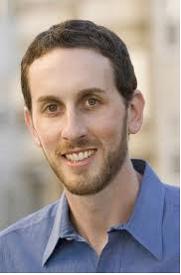
Scott Wiener, candidate for district 8 supervisor, is sending out a letter to people who own tenancy-in-common buildings, telling them he supports the rights of TIC owners to convert their properties to condos and seeking their support.


And he’s very nervous about discussing it.


Wiener’s support for TICs — which amount to a backdoor way to avoid the conversion lottery — is no secret. But raising money by promising to encourage condo conversions defines him pretty clearly as a candidate of the landlords and property owners and against tenant rights.


A bit of background: TICs are a way for several people to buy a multi-unit building, share ownership and each occupy one of the apartments. The strategy allows people who can’t afford single-family houses to become homeowners — and in theory, isn’t all bad (except that every TIC removes a rental housing unit from the city and indirectly drives up rents).


In practice, TICs have become eviction machines.


That because landlords have found that they can make a fortune by evicting all of their tenants under the state Ellis Act and then selling the place as TICs. And if the TIC owners can convert to condos, they can make money, too.


The big losers — and there are thousands of them — are tenants who can’t afford to buy a TIC, so wind up losing their homes to someone a little better off.


But again: It’s no secret where Wiener stands on the issue. What’s odd is that when I first called him about the letter, which I heard rumors about last week, he told me flat out that there was no such thing. “I hear there’s some i.e. [independent expenditure group] doing something like that, but it’s not us,” Wiener said.


A few days later, I got a (low-quality) copy of the letter, which is on Scott Wiener for Supervisor letterhead and signed by Wiener. So I called him again, and asked about it, and he again said his campaign had mailed no such letter. When I pressed, and said I had what looked like a letter from him that started of “Dear TIC owner,” he said that there might be something coming in the future, but he couldn’t talk about it.


Then he called me back half an hour later to tell me that yes, his campaign was indeed sending a letter to TIC owners seeking support.


Wiener’s always been straightforward with me; we don’t always agree on issues, but he always tells me where he is. So this one’s a little baffling — unless, of course, Wiener is hoping that the tenants who live in D8, and there are a lot of them, don’t know what Scott Wiener is saying to landlords and speculators. Maybe he doesn’t want them to think he’s being funded by TIC money.


But in the end, these things always come out anyway.


UPDATE: My original report called this a fundraising letter. But I admit my copy was hard to read, and Wiener just called me to say that the letter isn’t a fundraising letter, it’s only a letter seeking votes, and went out only to D8. He told me the reason he said he had no such letter when I first called is that it wasn’t finalized and hadn’t been sent out (although there was apparently an i.e. letter to TIC owners, which neither of us has seen). He told me he couldn’t discuss the letter until after it was sent out because “no candidate should discuss his future mail strategy with the press.” Fair enough.


Still: I’ve spoken to Wiener many times, and he’s never been this nervous about talking about what he or his campaign is doing. I think the TIC stuff is sensitive in D8.

Whiskeyfest whispers

0

What words could be more beautiful to hear upon entrance into the skyscraper-y, shiny den of downtown’s Marriot Marquis? From the mouth of a woman in a blazer and matching knee-length skirt: “It smells like a frat house on a Saturday morning!” Ah, last Friday’s Whiskeyfest, you came to conquer my liver, but you left after conquering my heart.

To the tune of 250 whiskies, no less! Once ensconced in the hotel’s basement ballroom and properly attired with our souvenir tote and tasting glass, naught could be seen but opportunities to drink myself into an unproductive Saturday of cowering from the Blue Angels. Row upon row of the finest whiskies – the even finer ones available only for the special VIP tasting hour, whose $150 price tag may have seemed a little step were one not aware of the general admission’s $110 bar tab.


And who, pray tell, is buying these steeply priced passes into madness? Well, from the looks of Whiskeyfest SF, mainly older white men. Shocking. But more interestingly, also a secret cabal of rumor-mongers and shit-stirrers! Indeed. SFBG received this mind-blowing scoop (along with a pair of hefty pours of the 23-year aged malt) from Old Rip Van Winkle‘s crown prince of marketing management, J. Preston Van Winkle. 

See, Old Rip’s got little to prove in this big old world of bourbon. Our SFBG resident spirits expert, Virginia Miller (who will know doubt be sniffing and sipping through a slightly more sophisticated, taste and mouth feel-oriented version of this coverage later this week) pointed me towards their table right off the bat, so we knew it would be good and smooth beyond measure. 

Their brand has been starting fights and making horses kick since the days before Prohibition, and its Pappy Van Winkle’s Family Reserve is the highest rated bourbon whiskey in the world. In. The. World. Thank you, Kentucky. Preston tells me that at this stage, there’s not too much marketing to be done. “It’s more like relationship management now,” he tells me, standing next to dad Julian the Third at their pouring table. 

So why the devil would one pay the reported price of $1,200 to have a Whiskeyfest booth and suffer the badgering of alternative newspaper reporters? Preston says there’s more at stake here than mere sales figures. And now we’re talking honor – or at least the Internet’s perception of it. “There’s a whole subculture of whiskey people,” he begins, not sounding too much like he cottons to this particular set of website forum-frequenting deviants. “There’s an active rumor mill. As soon as we don’t show up, there’s ‘a hostile takeover,’ we’re ‘shutting the doors.’ ”

“Yep, we’re still here pops. Get used to it.” Preston Van Winkle (left, navy polo) deflects the haters at Whiskeyfest 2010. Photo by Paula Connelly

The message board freaks seem to have won this round. “It’s easier just to come to [Whiskeyfest] and suffer the consequences and generate buzz that we don’t need. That and John Hansell has been good to us,” he smiles, a twinkle appearing at the mention of the kingpin behind the Fest-editor of sponsoring rag Malt Advocate, a twinkle which hopefully eclipsed the pain he must endure by unhelpfully-generated buzz. 

So rapt was I held by these revelations from the junior Van Winkle, I began to venture further into his whiskey wonderland. It gets weirder. Turns out, his family didn’t start their eponymous whiskey brand. Pappy Van Winkle actually brought the brand from another bloke after Prohibition. What is truly nutty is that Pappy had been making whiskey all along, just not with his last name as the brand (he sold his original three brand names in favor of reinvigorating the Van Winkle label). Preston and I surmise that the original owners were playing on the fairytale story of the man who sleeps for twenty years after escaping his nagging woman and drinking some booze belonging to ghosts partial to lawn bowling. Good whiskey being that which knocks you out so long you miss your harpy wife’s death.

Preston, when did you start drinking whiskey yourself? Answer: one year old. “My parents didn’t believe in store bought cough syrup,” he tells me in a slight Louisville drawl. 

The Van Winkle wares having been thoroughly sampled, our cadre moved on, threading amidst the refrigerator-shaped men in blazers and kilts through the tables of un-aged Koval white whiskey, of Japanese whiskey, of ryes, bourbons, scotchs, and a host of non-whiskey related items like Crop’s Bloody Mary-ready organic tomato vodka and Quelque Chose, a beer from the Unibroue brewery of Quebec that is meant to be boiled in its own bottle, then served hot at the temperature at which its foam emerges. Like mulled wine it was, a perfect antidote to the October pre-anxiety over Christmas commercials and family visits.

We emerged at the other side predictably weary, having missed all 12 of the expert seminars (who were we, really, to attend?), but done our darnedest to sample what we could of the high rolling whiskey lifestyle – as well as having reinforced the notion that the high rolling whiskey lifestyle is an elixir best meant to be sipped, and preferably not at a level of motion characterized by the lurch to the next nearest table of sampling whiskies. Also, even men in suits get fresh after too many fancy scotches. Whiskeyfest, til we meet again. 


Lacy’s face disfigured on Dem/Labor doorhanger

31

With only three weeks to go until the election. the dirty campaign tricks get stickier.

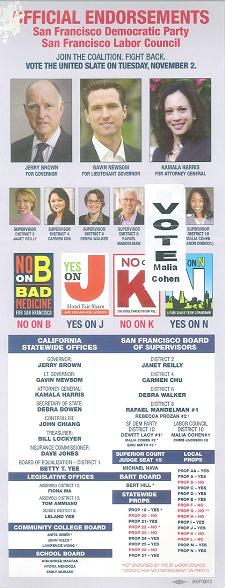
Top of the list of dirty tricks this week is the person(s) who pasted “Vote Malia Cohen” stickers atop the image of D10 candidate Dewitt Lacy on door hangers that the SF Democratic Party and the SF Labor Council produced  jointly for the November 2010 election. According to Lacy supporters, the offending stickers cropped up primarily on door hangers distributed on Potrero Hill, where Lacy lives, works and has a strong following.

The door hanger features a photo of Jerry Brown for Governor on one side—and thumbnails of the Dem/Council’s local picks on the other. These local picks include Newsom for Lt. Governor, Kamala Harris for Attorney General, Janet Reilly for D2 Supervisor, Carmen Chu for D4 supervisor, Debra Walker for D6 supervisor, Rafael Mandelman for D8 Supervisor and Dewitt Lacy and Malia Cohen for D10–except you can’t see Lacy’s face on the doorhangers that have been disfigured by Cohen stickers.

Historically, the SF Democratic Party only includes the picture of its top ranked candidate on door hangers, and this fall, the DCCC (the endorsing body of the local Dem Party) endorsed Lacy as its first-ranked candidate, Cohen as its second ranked candidate and Eric Smith as its third ranked candidate.

“But we included both Dewitt and Malia on this door hanger because we are doing it with the Labor Council and we have two different first-ranked candidates,” former Board President and current DCCC chair Aaron Peskin told the Guardian, noting that the Labor Council endorsed Cohen as top-ranked and Chris Jackson as its second-ranked candidate.

Cohen’s campaign manager Megan Hamilton told the Guardian that the Cohen campaign was “aware” of the stickers.
“But we did not put the stickers there,” Hamilton said.

Lacy, who dropped by the Guardian with dozens of defaced door hangers in hand, said a stream of supporters have complained about this latest dirty trick.

‘It’s misleading,” Lacy said. ‘If folks haven’t been paying attention, they won’t understand that I have been endorsed as the Democratic Party’s top choice.”

Lacy said the door hangers were distributed a couple of weeks ago at the DCCC’s election season kick-off event to people who were going to walk precincts.
”Of course, at that time, the door hangers weren’t terribly disfigured by someone sticking a ‘vote for Malia Cohen’ sticker over my smiling face,” Lacy added. “But it shows that these folks are nervous about the inroads my campaign has been making in this race. After each forum we have had folks come up to us and say they are excited by our campaign because they are looking for hope and leadership that really represents them.”

So what does Lacy, the top choice of the Democratic Party, look like when he doesn’t have a sticker over his face?

All smiles, after he completed his interview with the Guardian, which gave him its second-ranked endorsement in the D10 race, with Tony Kelly in top place and Chris Jackson in third.

SFBG Radio: Explaining the state props

0

Today we talk through all the state propositions — the good, the bad and the truly evil. Listen to the conversation, and pick up some advice on how you might want to vote, after the jump.


sfbgradio10/11/2010 by endorsements2010

Labor’s promise

0

Dick Meister, former labor editor of the SF Chronicle and KQED-TV Newsroom, has covered labor and politics for a half-century. Contact him through his website, www.dickmeister.com, which includes more than 250 of his columns.



The AFL-CIO and its affiliated unions know what they must do to grow and strengthen the labor movement for the benefit of all Americans. They must recruit and train millions of young workers, particularly young women and minority workers.  It is they who will join with others to shape our future.

Union organizers are already focusing clearly on reaching out to young would-be members who are often skeptical of union promises to help them win, not only better pay and working conditions, but also a meaningful voice in community affairs.
Participants in one of several recent AFL-CIO meetings on the subject noted that a key issue among young workers, as among so any others in these perilous economic times, is their inability to find a job or to pay for higher education. While unionization, of course, does not guarantee workers jobs or money to pay for higher education, it certainly gives them to at least a good chance of finding work or earning a college degree.

AFL-CIO Secretary Treasurer Liz Shuler told another gathering that outreach to young people is a top labor priority. But she said that, even though young workers need unions, they generally don’ t know much about them. That’s in part because they are less likely than young people in earlier generations to have a family member or neighbor to talk to them about unionization and its rewards.

Unions, of course, usually win agreements from employers for, among other fringe benefits, health insurance.  But recent surveys show that about one-third of young workers have no health insurance.  The surveys show in general “a massive decline” in the economic situation of the young. One-third of those surveyed say they often can’t pay their bills, for instance. Only about half have paid sick days and must work so even if ill.

A survey done recently by the federal Bureau of Labor Statistics cautions that  “unions must become more diverse and open up more opportunities for young workers and women in leadership or they will move on to other social justice organizations.”

The AFL-CIO’s James Parks noted that “while acknowledging the significant gains for women in the workplace made possible by unions and their growing diversity in the union movement, the federal report urges unions to do even more to become more open.”

The national AFL-CIO has moved further in that direction by requiring state and local AFL-CIO bodies to establish concrete goals for diversifying the leadership of their member unions.

There’s also been efforts to movement to meet the complaints of young members and would-be members that union leaders  are often able to stay in office far too long, blocking younger candidates for union office from assuming leadership posts. .  That would be eased by an AFL-CIO proposal for unions to set term limits for elective leadership positions.

At any rate, this much is very, very clear: Unions need the young if they are to prosper and grow, and the young need unions if they are to realize their full potential as citizens. Together, unions and the young can bring important new strength to the country.

Dick Meister, former labor editor of the SF Chronicle and KQED-TV Newsroom, has covered labor and politics for a half-century. Contact him through his website, www.dickmeister.com, which includes more than 250 of his columns.

SFBG Radio: The market’s up, but jobs are down

2

So if the unemployment rate keeps going up, and the recession is in full swing, why is the stock market doing so well — and what does that say about American politics? Check out out after the jump.

sfbgradio1082010 by endorsements2010

A trio of great Hispanic leaders

0

Dick Meister, former labor editor of the SF Chronicle and KQED-TV Newsroom, has covered labor and politics for a half-century. Contact him through his website, www.dickmeister.com, which includes more than 250 of his columns.
It’s Hispanic Heritage Month, an excellent time to remember three of the most important Hispanic labor leaders in U.S. history. All three were engaged in the much needed and very tough job of organizing and improving the generally poor conditions of the nation’s largely Latino farm labor force.

Cesar Chavez, of course, is one of the farm worker leaders we should particularly honor. Another is Dolores Huerta, who joined Chavez in founding the United Farm Workers union – and who, in fact, is still organizing and otherwise helping Latino workers, particularly women.

The third leader who’s especially deserving of honor is the lesser known but no less important t pioneer farm labor organizer, Ernesto Galarza. Despite his important work, Galarza has been largely forgotten – though certainly not by me.  He’s been dead now for a quarter-century, but I recall him well from my days as a reporter covering farm labor:

His shining, black hair and fierce, penetrating gaze. His angry, intense words and slashing speeches against those who resisted demands for reform. His scholarly writing and novels and poetry – and his teaching.

Galarza was one of the loudest and most unusual of the voices that have been raised for the farm worker. He had a Ph. D., wrote a half-dozen books and numerous pamphlets and articles , and taught at all levels, from elementary school to university.

Yet Galarza was also an active union organizer – a key leader in laying the groundwork for the farm labor movement led by Cesar Chavez.

Galarza came to California’s fields in 1948, as an officer of the American Federation of Labor’s now long gone National Farm Labor Union. He had grown up in California, and had worked on farms as a teenager.

But Galarza had left that behind to head off to college on a scholarship and, eventually, to Columbia University for a doctorate in Latin American affairs.

After that, Galarza worked for the Pan American Union in Washington – until, characteristically, he became enraged over what he felt was the organization’s overlooking the exploitation of Latin American workers by US business interests. He resigned to take the job with the National Farm Labor Union.

Galarza led several strikes, but he was completely thwarted by the federal Bracero program that allowed growers to import penniless, undemanding Mexican workers to replace US workers who dared to strike or otherwise seek better treatment. So Galarza shifted his efforts into trying to abolish the Bracero program.

For more than a dozen years he fought a frustrating and often lonely battle. He spoke out endlessly before legislative committees and elsewhere, He issued hundreds of reports documenting the abuses of U.S. and Mexican workers under the Bracero program,. But the program remained untouched, and by 1960, Galarza’s union was gone. Near exhaustion, he turned mainly to writing and teaching.

But finally, in 1964, the public pressure that Galarza had a key role in generating led Congress to kill the Bracero program. It’s no coincidence that year, 1964, was the same year in which Cesar Chavez began his organizing drive. For Galarza was correct: The existence of the Bracero program had made farm labor organizing impossible.

By the time of Galarza’s death at 78 in 1984, the Chavez-led United Farm Workers had become an effective, nationally supported union.

The farm labor system still relies heavily on desperately poor immigrant workers, But thanks to the farm workers union that Ernesto Galarza helped bring about, many workers have had the chance to seek – and many have won – the right to the decent lives that Ernesto Galarza spent so much of his life seeking for them.

I was fortunate enough to also get to know Cesar Chavez.  I first met him when I was covering labor for the San Francisco Chronicle. It was on a hot summer night 45 years ago in the little farm town of Delano in southern California.

“Si se puede . . . It can be done . . . Si se puede.” He said it repeatedly as we talked deep into the early morning hours.

Si se puede . . . But I would not be persuaded. Too many others, over too many years, had tried and had failed to win for farm workers the union rights they had to have if they were to escape their severe economic and social deprivation. The Industrial Workers of the World who stormed across western fields early in the 20th century, had first tried organizing farm workers – and failed. Failing, too, were Communist organizers, socialists, and AFL and CIO organizers.

I was certain Chavez’ effort would be no different from theirs. Boy, was I wrong.  I had not accounted for the tactical brilliance, creativity, courage and just plain stubbornness of Cesar Chavez.

He understood that farm workers had to organize themselves, not depend on outsiders to do it. Chavez led the workers in creating a union of their own, which then sought out – and won – widespread support  from influential outsiders through boycotts and other tactics of non-violence patterned after those of Mohandas Gandhi and Martin Luther King Jr.

Chavez proved beyond doubt that the poor and oppressed can prevail against even the most powerful of opponents – if they can effectively organize themselves and adopt non-violence as their principal tactics. As Chavez explained, “We have our bodies and spirits and the justice of our cause as our weapons.”

The results of the Chavez-led organizing drives were impressive – the first farm union contracts in U.S. history, and the California law, also a first, that requires growers to bargain collectively with workers who vote for unionization.

Chavez worked closely with Dolores Huerta in creating and leading the United Farm Workers union. Huerta was, for instance, one of the principal leaders of the worldwide grape boycott that forced growers to agree to those first farm labor contracts  – which Huerta negotiated despite her lack of experience in contract bargaining.

Huerta’s work with the UFW was just a part of her lifelong and extraordinarily successful and courageous fight for economic and social justice that she waged while also raising 11 children.

Huerta’s traveled the country, speaking out and joining demonstrations for a wide variety of causes and successfully lobbying legislators for important gains for Hispanic immigrants and others.

Huerta started out as an elementary school teacher in northern California in 1955, but soon tired of seeing the children of farm workers regularly come to school hungry. That, and her anger over the injustices suffered by the local farm workers, led Huerta to quit teaching and join the Community Services Organization – the CSO – an organization founded by community organizer Saul Alinsky, with Chavez eventually serving as its General Director.

The CSO helped local Chicanos wage voter registration drives and take other actions to win a strong political and economic voice. But when the CSO’s other directors refused to agree to a union organizing drive among local farm workers, Chavez and Huerta quit to organize on their own. Like so many others, the CSO directors said it couldn’t be done. Thankfully, they were wrong and Cesar Chavez and Dolores Huerta were right.

But being right is just the first step, essential as it is. Hundreds of thousands, if not millions of poorly treated farm workers badly need to be organized, badly need the decent treatment that unionization can bring them, as it did to many others that the extraordinary efforts of Cesar Chavez, Dolores Huerta, and Ernesto Galarza helped bring to many others.

Dick Meister, former labor editor of the SF Chronicle and KQED-TV Newsroom, has covered labor and politics for a half-century. Contact him through his website, www.dickmeister.com, which includes more than 250 of his columns.
Civil Sidewalks, Lewis Lapham, and the struggle for the soul of cities

114

Cities often get vilified as the cauldrons of all that’s wrong in the world – greed, vice, pollution, and all manner of social ills – but they are also the incubators of ideas that are humankind’s last best shot at solving the social and environmental problems that threaten our long-term stability and prosperity. So ruminating on the indispensable role of cities, as Lapham’s Quarterly does with its fall issue, is more than just an academic exercise or interesting read.

“The Census Bureau counts 232,581,397 Americans, 82.6 percent of the population, living in the nation’s cities, but if our moralists and intelligence services are to be believed, they do so at no small risk to the safety of their persons and the security of their souls,” editor Lewis Lapham, who ran the venerable Harper’s Magazine before stepping down to start LQ, writes in the opening essay of an issue entitled simply “The City.”

Lapham goes on to note the contradiction of how rural areas and suburbs get celebrated as somehow housing the more noble values of the common folk, raising the questions, “If the city is the sewer of vice and a slough of despond, why do so many people choose to live there? On what toxic landfill does the city stand as the embodiment of its ennobling cognate, civilization?”

In an interview with the Bay Guardian, Lapham puts the increasingly important role of cities even more succinctly: “The future is urban.” As the population grows and natural resources become more scarce – and as sea levels rise – the population of cities will swell and the imperative of solving our long neglected problems will grow. And where else but the cities will new ideas find their laboratories?

But in San Francisco and other big cities, many still struggle with what it means to be a city, with all the tolerance for messy urban realities that entails. Witness Prop. L on SF’s fall ballot, which actually seeks to outlaw the simple act of sitting on a sidewalk, or as its proponents call it (in an ironic testament to their desire for order above all things), the Civil Sidewalks Law.

Lapham told me this fear of the great unwashed masses (“The rich are afraid of the poor”), an emotion that has fueled the growth of the suburbs and the massive waste of resources that entailed, has hindered the ability and willingness of city leaders to advocate for common values and define the lead role that cities should be playing in this troubled country.

“We don’t have an idea of the city as a great, good place, and we have to start with that,” Lapham told us. “We have to decide what is a city, what work does it do, what is the value, and how do we promote that value.”

This issue of Lapham’s Quarterly is a good place to start that debate. As always, the journal includes the writings of great thinkers throughout time, from Thucydides writing about Athens in 430 BC to Frederick Kaufman writing about New York City in 2008. Celebrated urbanist Jane Jacobs does a great job of capturing the allure of cities – that special something that seems to escape the fearful promoters of Civil Sidewalks – in an essay she wrote about NYC in 1961.

“Reformers have long observed city people loitering on busy corners, hanging around in candy stores and bars and drinking soda pop on stoops, and having passed a judgment, the gist of which is, ‘This is deplorable! If these people had decent homes and a more private or bosky outdoor place, they wouldn’t be on the street!’ This judgment represents a profound misunderstanding of cities. It makes no more sense than to drop in at a testimonial banquet in a hotel and conclude that if these people had wives who could cook, they would give their parties at home,” she writes. “The point of both the testimonial banquet and the social life of city sidewalks is precisely that they are public. They bring people together who do not know each other in an intimate, private social fashion – and in most cases do not care to know each other in that fashion. Nobody can keep an open house in a great city. Nobody wants to. And yet if interesting, useful, and significant contacts among people are confined to acquaintances suitable for private life, the city becomes stultified.”

Indeed, that was the observation that journalist H.L Mencken wrote about many East Coast as he penned an essay in 1920 celebrating San Francisco as “an American city that somehow managed to hold itself above pollution by the national philistinism and craze for standardization, the appalling progress of 100 percent Americanism, the sordid and pathetic dream of unimaginative, timorous, and inferior men.”

Mencken says he can’t quite put a finger on what makes San Francisco so special, touching on our international influences and the fortitude developed by braving fog, steep hills, and messy urban realities, which he says have given us a unique appreciation for life. “The San Franciscans have learned how to bear it. They are stupendously alive while they are in motion, but they knock off betimes. The town is rich in loafing places: restaurants, theaters, parks. No one seems to work very hard. The desperate, consuming industry of the East is quite unknown. One could not imagine a sweatshop in the town. Puffs of Oriental air come with the fog. There is nothing European about the way life is lived; the color is all Asiatic.”

A decidedly different portrait of San Francisco comes in the journal’s only other entry on this city, written in 1849 by Gen. William Tecumseh Sherman, who helped establish an important military base in a city that had only recently changed its name from Yerba Buena and which was about the explode with the discovery of gold in the Sierras.

“All the town lay along Montgomery Street, from Sacramento to Jackson, and about the plaza. Gambling was the chief occupation of the people. While they were waiting for the cessation of the rainy season, and the beginning of spring, all sorts of house were being put up, but of the most flimsy kind, and all were stores, restaurants, or gambling saloons,” wrote the military man, who didn’t much care for the city.

Yet for those who appreciate the role of cities as generators of culture and incubators of ideas, there’s no question that our future is urban, although even Lapham has his doubts that the great solutions will come from the cities, preferring to see the Internet and its virtual communities as usurping from cities the role of intellectual hubs.

“The intellectual engine of the Bay Area is centered in the Silicon Valley world rather than on Montgomery Street in San Francisco,” he told us, noting how little the financial firms that dominate downtown San Francisco or Wall Street in his home city of New York have to do with addressing the real problems the world faces.

He’s right, of course, but that’s also why the struggles for the soul of cities are so important and consequential, and why the the Bay Guardian has spilled so much ink fighting downtown over our 44-year history. Because to give in to the bankers and Civil Sidewalks crowd is to give up on the city.

It’s not a new struggle, as Friedrich Engels wrote about London in 1844: “Everywhere one finds on the one hand the most barbarous indifference and selfish egotism and on the other the most distressing scenes of misery and poverty. Signs of social conflict are to be found everywhere. Everyone turns his house into a fortress to defend himself – under the protection of the law – form the depredations of his neighbors. Class warfare is so open and shameless that is has to be seen to be believed. The observer of such as appalling state of affairs must shudder at the consequences of such feverish activity and can only marvel that so crazy a social and economic structure should survive at all.”

Four years later, Engels wrote “The Communist Manifesto” with Karl Marx, diagnosing the problems of capitalism and laying out solutions that came awfully close to taking root around the world before they were defeated by Western military and economic powers. Yet the problems persist to this day, manifested most visibly in cities around the world.

Lapham does admit that cities will be the laboratories and incubators of the ideas that are developed. Given the political dysfunction on the state and federal levels, he also agrees with the contention of Guardian Executive Editor Tim Redmond that the age of he Nation-State as the preeminent political authority is passing, and that its likely replacement is the City-State.

“To make democracy work, it needs to be relatively small,” Lapham said, agreeing that localism is the model that is being widely discussed as the answer to many of our political, environmental, and economic problems. And that all comes back to the cities, provided we can seize the opportunity to define ourselves, or as Lapham said, “One of the things we’re missing is the idea of a glorious future of some kind.”

Legalization proponents appeal to Reason

0

The Bay Area’s medical marijuana community may be divided over the legalization measure Prop. 19, but Reason’s Brian Doherty has penned an excellent analysis of the current campaign, why it will probably succeed, and how that will likely lead to a nationwide normalization of pot use rather than the federal crackdown and general sky falling that many critics of the measure predict.

Open Studios spotlight: Calixto Robles

1

Because Open Studios is about more than just the free wine and occasional sushi board score. Really! The annual organized voyeurism of creative space in the city will showcase artists’ studios in different neighborhoods each weekend this month. In gleeful anticipation, we visited screen-printer and long time Mission visual artist Calixto Robles, who is helping to throw open the doors to his Life Art Studios (151 Potrero, SF) this weekend.


“Meeting new people, that’s the best thing.” Robles is sitting in his studio of six years, surrounded by shelf upon shelf of his lucid dream style paintings, screen printed posters, and a new project that will be on sale at this weekend’s Open Studios: T-shirts covered in iconic prints from the world’s religions, their overlapping designs forming a riotous invocation of peace.

Get inside Calixto’s mind… or at least his print shop

The T-shirts designs are echoes of similar schemas on canvasses that sit on the ground near Robles’ desk area. The Virgin of Guadalupe (herself a figure with one foot in Catholic lore and another in indigenous Mexican faith), Buddha, and Hindu gods, the word “peace” thrown in at intervals for good measure. The brightly colored collages are a favorite of Carlos Santana, who is a good friend of Robles. In fact, the canvasses by Robles’ feet represent different options for Santana to peruse for his family Christmas card this year. 

The beauty of Open Studios is the ability to sample divergent snippets of San Francisco artistic life. In addition to Life Art’s neighborhood in the corner of the Mission that abuts SoMa and Potrero Hill, this weekend’s event will feature open doors in Bernal Heights, Castro, Duboce, Eureka Valley, Glen Park, Mission, Noe Valley, and Portola. Art Span, the organization of artists that coordinates the event, does so to connect artists with budding art aficionados in the hopes of connection at the point of inspiration.

Robles, a longtime Mission resident from Oaxaca who was part of the art movement that erupted in opposition to the dot com evictions of the late ’90s, has participated in for “fix or six years” in Open Studios. He’s exhibited his art for visitors in both group studios and in his home on Guerrero Street, relishing the opportunity to let passers-by into his private creating space. 

Lotus hearts, community art at Open Studios 2010

He’s famous for his screen prints. Wife and fellow artist Alexandra Blum and he bought an ancient printing press from UC Berkeley years ago. It now sits in the center of his studio, an aluminum print  on top of it featuring a “Justicia” banner that a friend drew for Calixto to print. One wall of the lobby gallery of Life Art is still covered in handmade Mexican propaganda posters that Robles and friends displayed in a recent exhibition of political art. 

The beauty of Open Studios, Robles says, is not always the financial bottom line. Rather, it’s the chance to share art with those around us, people with whom you’d never otherwise find yourself discussing artistic vision. 

This weekend will be the first time that Life Art hosts a group show — exciting for that particular artist community, whose artist produce disparate works from Calixto’s peace prints to massive canvasses covered with a mixture of adhesive and table salt. The artists hope to benefit from the foot traffic of people strolling between SOMAarts Cultural Center and Art Explosion, the massive warren of studios that both sit a block from Life Art and will also be participating in this weekend’s Open Studios. 

Some people, Robles tells me, pass through quickly after scanning the works on the wall – but other art fans will go for the more interactive experience. Chill with the guy who makes Carlos Santana’s Christmas cards? It’s a good reason to hit the studio circuit. 


Open Studios: Bernal Heights, Castro, Duboce, Eureka Valley, Glen Park, Mission, Noe Valley, Portola

Sat/9 and Sun/10 11 a.m.-6 p.m., free

151 Potrero, SF

www.artspan.org


City bid to bring vendors into Dolores Parks causes an uproar

12

Officials with the SF Recreation and Parks Department are attempting to quell the mounting frustrations of some Mission District merchants and residents who feel that the city shouldn’t allow private companies to operate in a public park, as the department is seeking to do. Even those who don’t necessarily have a problem with inviting more commerce into Dolores Park say the process should have been more open and transparent.

“I like pushcarts,” said Rachel Herbert, owner of Dolores Park Café. “I think they add flavor to San Francisco.” But Herbert is also allowing opponents of the department’s request for proposals (RFP) to set up shop in her store and gather signatures for a petition to “stop the commercialization of Dolores Park.” Herbert, who lives in the neighborhood, said she is helping the effort because “It’s about the process and Rec and Park not really thinking things through and doing whatever they want.”

Mike McConnell, the man behind the petition, holds a similar viewpoint. “I don’t feel that it was adequate outreach before this.” They’re not alone. McConnell currently has petitions in three stores – including his own store, Fayes Video – each with around 100 signatures, along with 700 online petition signatures.

While the controversy is recent, the RFP for the permits was issued in September last year. The proposal stated: “Before entering into permit agreement for the operation of a pushcart in any neighborhood park, the Department will conduct a community outreach process to determine the appropriateness of such a use in the park.”

It’s unclear how much outreach there was beyond a request for applicants posted in the July 31 issue of the San Francisco Chronicle. However, according to Mission Local, department spokesman Elton Pon sent them an email stating that the department mailed out “an announcement of the opportunity to more than 1,000 potential applicants.”

Regina Dick-Endrizzi, director of the SF Office of Small Business, said much of the demand for the permits has come from small time vendors. “Part of this has been an organic growing up of the vendors themselves,” Dick-Endrizzi said. “The mobile food folks have been coming and working and urging us to open up more space.”

Dick-Endrizzi helped vet the applicants in the panel that included members of department and the Mayor’s Office of Economic Development. “I can attest as being part of the committee that they were very careful in making their decision,” she said.

However one recipient of the permits, Oakland-based Blue Bottle Coffee, has received criticisms that it isn’t local enough – city policies encourage contracting with San Francisco small businesses. Blue Bottle is also backed by venture capital firm Kohlberg Ventures.

Its founder recently issued a public letter explaining his position: “I had assumed that since there were published articles in The Chronicle, the Examiner, and the SF Weekly in November of 2009, and January 2010, that the community around Dolores Park was well informed. So it pained me to hear that many of our (hopefully) future neighbors were upset that more outreach had not been done.”

This isn’t the first time a vendor has been allowed to operate in city parks. Nor are they the first merchant with questionable local status. Last August RPD commission voted 6-1 to replace long-time Stow Lake vendor with an out of state suitor. The Chronicle reported “the corporation, which has owned and operated the 1940s-era boathouse for 67 years, couldn’t compete with New Mexico-based Ortega Family Enterprises, which pledged to complete $233,000 worth of improvements to the well-worn building and buy a brand-new fleet of boats.”

Dolores has become a haven for unlicensed vendors selling items such as beer, hot dogs, ice cream, and even pot-laced brownies and truffles. What will become of them? “You pay thousands and thousands for your trailer and for permits and this guy comes around with his little cart and is selling coffee for 50 cents less, what are you going to do? You’re going to call the fucking cops and say get this scumbag out of here,” said local impresario Chicken John.

Dolores Park has traditionally been regarded with a kind of laissez faire attitude by many San Francisco residents. On a warm day it’s not uncommon to see hundreds of chic to cheap layabouts basking on its hills, beer and bowl in hand, without worry in mind. And many-a-cop has seen them too, but rarely do they intervene – and all was well. Maybe that’s another reason why there has been such uproar over the proposed introduction of pushcarts into the park.

Since the uproar, both Blue Bottle Coffee and the other potential vendor nonprofit Cocina have been put in limbo. La Cocina’s executive director, Caleb Zigas, told Mission Local that “he had expected to roll into the park this week and is disappointed by the delay. In the past four months he’s poured $28,000 in grant money into La Cocina’s food trailer, which is now sitting in storage.”

But how long will the pushcarts (they’re actually trailers powered by generators) gather dust in a garage? “For most types of appeals there is a 15-day window after the permit was issued,” said Cynthia Goldstein, executive director of the SF Board of Appeals. However it isn’t a concrete rule. “On rare instances the board will extend the window when there is evidence that the city did something wrong.” In addition, according to Goldstein, there is usually a 15-20 day window between when an appeal is filled and when it is reviewed by the Board. In short, the dilemma may not be quashed by the meeting this evening that the department is holding on the controversy.

The extension would bode well for any NIMBYs since Cocina’s and Blue Bottle’s permits were granted on April 15, 2010 and Sept 2, 2010, respectively.

RecPark was expecting a 12 percent cut on the pushcart profits and hoped to net around $70,000 annually. The pushcarts are just one of the many revenue generating ideas that are currently floating around. RecPark – under its new department head, Phil Ginsburg, who was previously chief of staff to Mayor Gavin Newsom – recently created a partnerships and revenue generating division with the purpose of capitalizing on many of the cities assets.

At the Jan 21, 2010 Recreation and Parks Commission meeting, pushcarts were discussed as a way to ostensibly keep city employees from getting laid off. Other ideas that were tossed out included hosting a production of Peter Pan, renting out parking places for car shares, and an adopt-a-park program; an adopt-a-gardener program was even suggested. The city was broke and was searching for a way to close huge General Fund deficits.

The idea of pushcarts was discussed again at the Feb 18 meeting. Nick Kinsey from the property division of RecPark, told the commission, “We received 18 responses to the RFP and we actually brought six of them in for interviews. As part of the interviews we met with the respondents, we evaluated their qualifications, evaluated their operation plans – in terms of where they wanted to be in each of the parks, in each of the proposed parks, how that would interact with residents and other park users use of the park space and if there would be any conflict there.”

Kinsey continued, “We’re also accepting application on a rolling basis right now. So if anyone is watching and interested in submitting an application for pushcarts, we are accepting pushcarts. Some of our location are maxed out we wouldn’t accept anyone else. But we have plenty of other park spaces where we think this is an appropriate use.”

The meeting of the issue is today (Thurs/7) at 4 p.m. in City Hall Room 416


A tax break for the billionaire Fisher family

1

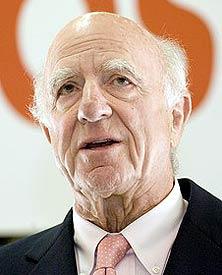
The L.A. Times reported Oct. 6 that the Fisher family — the heirs to right-wing power-broker Don Fisher’s GAP fortune — is set to get a $20 million tax break in the new state budget. It’s astonishing, and an example of how the backroom budget process is utterly corrupt.


From what I hear in Sacramento, the proposal came from the Republicans, although so far, nobody outside the small circle of budget dealmakers knows exactly which legislator or lobbyist pushed the issue. And it now appears, I’m told, that the tax break won’t be in the main budget; it will be addressed later in the week, as part of another bill.


But it’s not going to be easy to defeat — there are plenty of Democrats who support the deal, in part because the Fisher family is saving some old-growth redwoods.


But please: This is one of the richest families in America. These folks don’t need a $20 million handout from the state of California. 

How Team Whitman blew the housekeeper story

5

The folks at Calbuzz are asking the same questions that have been bothering me for a while now: How could Team Whitman, with its legions of high-paid political consultants, have bungled the Nicky Diaz story so badly?


If her campaign team knew about the problem a year ago (and she swears she told her consultants), why didn’t they go public themselves, control the damage and eliminate the story as an October Surprise?


Calbuzz:


According to Political Consulting 101, this is standard operating procedure: control the bad news, put it out yourself, do it early to inoculate against a late hit. It borders on campaign consultant malpractice to have handled it as it was handled.


Of course, campaign consultants can’t be sued for malpractice; there’s no regulatory body, no disciplinary association. But it’s astounding that so many professionals who are earning so much money did such a bad job here.


More important, it borders on criminal arrogance (alas, that’s not a crime) that Whitman didn’t give Diaz some sort of decent severance:


Why not spend $20,000 or so (or more, if need be) to hire her the best immigration attorney she could find to help her see what could be done to stay in the country or ease her return or whatever?


Why not offer her a year’s severance (about $18,000) or help her with re-settlement costs in Mexico? She was, in eMeg’s words, “a member of our extended family” (or as Meg said in one press conference, Freud never sleeping, “an extended member of our family”).


Okay, so Whitman and Harsh had to fire Diaz once they knew she was here illegally, if you buy their story. But they didn’t have to kick her to the curb.


I was pretty sure Whitman was on track to lose even before this happened, but I think the Diaz fiasco has sealed the deal. And it’s not so much the fact that she hired an undocumented worker (LOTS of Californians do that every day) but the fact that she was such an asshole to her employee.


And the $120 million campaign to create a carefully crafted image couldn’t deal with that basic problem.

Hot sexy events Oct 6-12

0

It’s about that time, cats and kittens. Time to start fantasizing — Halloween is just around the corner. And though everyone and their mother is going to be Stephen Colbert’s Muslim vampire this year, many will seize the autumnal juncture as an opportunity to whore it up and out – in a good way! 

After all, who doesn’t love the sexy nurses, kitties, police officers, and Snookies that stalk the city bars each year on the 31st? Look, the point is that on this day of days society indulges those that follow their dreams. May as well make it a wet dream, no? Sexy Muslim vampire it is! Oh, and here are some sexy events that’ll wet your whistle this week, with an emphasis on finding that alluring inner equilibrium.

Bawdy Storytelling

Two events this week to get you hooked into what’s happening in Dixie De La Tour’s recurring sexcapade storytelling series: one, a best-of edition featuring writers and comedians from around town (Wed/6) and two, a back alley Lit Crawl edition of Bawdy that’ll have Clarion Alley echoing with the retelling of disastrous dates and tales of unconventional canoodling.  

Bawdy Storytelling: Graphic Confessions

Wed/6 8 p.m., $10

The Blue Macaw

2565 Mission, SF

www.bawdystorytelling.com


Bawdy in the Alley

Sat/9 8:30-9:30 p.m., free

Clarion Alley between 17th and 18th St., SF

www.bawdystorytelling.com


Declaring Our Erotic

Jen Cross knows that erotic writing isn’t just a pleasure to read – for some, the act of writing down passions can be a cathartic, even therapeutic event. That’s why she’s offering this eight-week class for survivors of LGBT sexual trauma. The syllabus promises a safe space to reconnect with your body’s desires and memories. And of course, a chance to write some hot, dirty smut. 

First class Thu/7 6:30-9 p.m., $225-250

email jennifer@writingourselveswhole.com for details


Urge

Put the Citadel’s 5,400 square feet of devious dungeon to use to use for the whipping, slapping, burning, and loving of young loins – hot young male whippersnappers will be the only ones invited to this get together of BDSM blowout. 

Fri/8 9 p.m.- 1:30 a.m., $25

SF Citadel

1277 Mission, SF

(415) 626-1746

www.sfcitadel.org


Steven Saylor

Love, sex, and intrigue in the palace! But this ain’t no corset-buster. No, Steven Saylor’s new book Empire is a males-only play space – the plotline follows Emperor Nero’s eunuch lover Sporus, who becomes the hottest piece of tranny ass on the Forum. Let Saylor woo you into a new love of history at this talk about his latest historical tome of carnal knowledge.

Mon/11 7:30 p.m., free

A Different Light Bookstore

489 Castro, SF

(415) 431 0891 

www.adl-books.blogspot.com


Grizzly’s Bullwhips by the Bay

Don’t worry baby, they got loaner whips. Put your lusted one’s mind at ease by polishing up your whipping skills at this bimonthly peer skill share class by the sea. It’s about safety, kids! After all, when the singletails start flying, you can’t always guarantee that Grizzly, the organizer of the get-togethers, will be there with spare protective goggles to guard those bedroom eyes.

Sun/10 11:30 a.m.- 1 p.m., free

Southeast of the Golden Gate Park Polo Fields, SF

www.laughingbear.org


Body Love for Better Sex

How would you spread your legs if you weren’t worried about chunky inner thighs? Body anxiety can be the nemesis of good sex –  but Virgie Tovar, fat positive sex educator, is here to help you titter about Miss Body Anxiety until she drops out of school due to social anxiety. Which is to say, help you feel as pretty as you are. Aww. No more naked nervousness, bam.

Mon/11 6-8 p.m., $20-25

Good Vibrations

1620 Polk, SF

(415) 345-0500

www.goodvibes.com


Whitman’s global warming positions leave her stand unclear

2

Gubernatorial candidate Meg Whitman is playing both sides of the fence on the issue of global warming, belatedly opposing Prop. 23 – the measure that would suspend AB 32, California’s long-term plan for reducing greenhouse gas emissions and promoting clean technology – but promising to delay implementation of AB 32 for a year anyway.

Yet the California Air Resources Board, the department tasked with drafting the regulations for the bill, isn’t even scheduled to finish drafting all the rules for the measure until Jan 1, 2011, and those rules wouldn’t go into effect for another year anyway. So it appears that Whitman’s stand is simply pandering to those who don’t see global warming as a pressing problem, in the process leaving uncertainty about how she would handle the issue if elected.

Still, her stance worries a swath of businesses that were hoping to cash in on a renewable-friendly economy. “There are already 500,000 Clifornian’s working in the clean energy sector and around 160,000 of them are in construction and manufacturing,” Donnie Fowler, senior advisor at the Clean Economy Network, told us.

Fowler is part of a campaign to promote the growth of the renewable economy. However, their pressing task is raising awareness of the potentially damaging effects if Prop 23 is passed. The measure would suspend the regulations within AB32 indefinitely and require, potentially, a citizen’s initiative to overturn it. The other option would be to wait until the unemployment rate drops below 5.5 percent for four consecutive quarters – a rare occurrence – at which point the suspension would automatically be lifted.

The LA Times released a poll last week that has Prop 23 winning by a slight margin, with 40 percent in favor of the initiative and 38 percent opposed. The proposition’s current success is largely a result of large donations from Texas based oil companies Tesoro Corp and Valero Energy Corp. and multibillionaire libertarian brothers David and Charles Koch.

Much of the opposition to AB32, however, has arisen from the anti-tax fervor sweeping the country – which Whitman has played on. Before she started making her rhetorical sojourn to the middle, coming out against Prop. 23 just last month, she told the San Jose Mercury that I probably would today, I need to think about that,” when asked whether she would veto AB32. Well, she thought about it and has since maintained that she would only suspend the bill long enough to assess what impact it would have on California jobs. Yet, the phrase job killer remains on her website.

Derek Walker, Director of the California Climate Initiative, thinks she is probably smart enough to understand what kind of impact suspending AB32 would have on renewable energy businesses currently operating in California.

But, if she is elected, will she have the political will to renege on her promised moratorium? And what would her position be if Prop 23 is passed?  Would renewable energy companies be left high and dry? Would she come to their aid?

“It would be very uncertain in the absence of AB32. However, the overwhelming support would almost require a plan to keep California’s clean energy economy growing,” Walker said.

SFBG Radio: A modest (boycott) proposal

3

In today’s episode, Johnny puts forth a modest proposal. Plenty of big American companies are sitting on piles of cash right now, money they’ve made in part because they aren’t hiring anyone. Of course, businesses don’t exist to create jobs, they exist to make money — but consumers ought to have a say, too. So Johnny suggests that we all boycott big companies that have lots of money on hand, but refuse to spend it in a productive way — that is, by hiring people. You can listen to his proposal after the jump.

sfbgradio10/6/2010 by endorsements2010

Who’s Endorsing Whom

6

Political endorsements matter in SF. (You can find ours here.) We regularly run this Who’s Endorsing Whom table (PDF) summarizing endorsements by various groups and officials, including some we don’t agree with — but we encourage honest, open debate and informed political participation. Feel free to add other endorsements in the comments sections and we’ll periodically update the chart. 


El Guincho deconstructs the male gaze (NSFW)

0

Surreal ’70s porno homage meets gender-theory gymnastics in the latest vid from Spanish “space-age exotica” techno-tropicalist El Guincho. He’ll be live at this week’s Tormenta Tropical party (Sat/9, 10 p.m., $15. Elbo Room, 657 Valencia, SF. www.elbo.com).