SFBG Blogs

Register to vote before midnight

1

Did you know that you have until midnight today to register to vote? That you have until next Tuesday (Oct. 26) to request a vote-by-mail ballot?
And that you have until election night, which falls on November 2, Day of the Dead, to actually vote?

If you are not sure if you are eligible to vote, check the rules here. And then download a voter registration form here.

Or pick one up at the Department of Elections, the Department of Motor Vehicles, or at post offices and public libraries throughout San Francisco.

To register to vote, you’ll need a California driver’s license, a California identification number, or the last four digits of your Social Security number.

But what about if you are not sure if you are already registered to vote? Check the city’s online  records here.

Or not sure where your polling station is? Then click here, where you can also find a sample ballot to figure out who and what to vote for.

Either way, vote early, and vote often–and may the best candidates and measures win.

Street Threads: Look of the Day

0

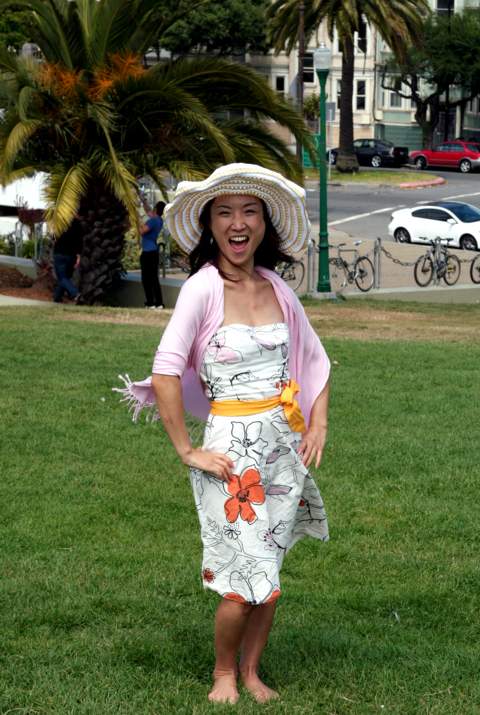
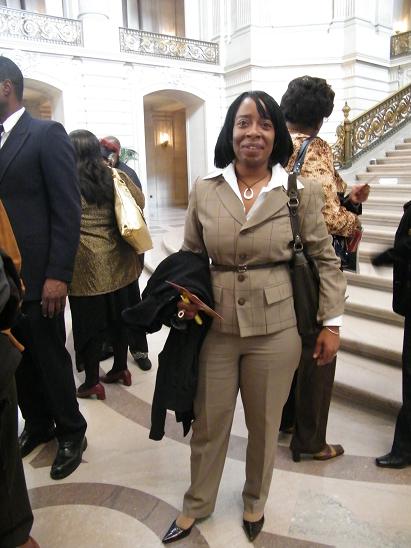
Today’s look: Elle, Dolores Park


Tell us about your look: “I made my dress. I like something feminine. I like something that fits me and is actually my size.”


Live Shots: Gogol Bordello, Fox Theater, 10/14/10

0

Eff Arizona’s SB 1070! Maybe what this country needs is a little more immigrant punk to infuse some surly into the debate over who can hang with us in the land of the free and home of the brave. Gogol Bordello would be a good option: the gypsy rockers mainly hail from Eastern Europe, but their carnival of sound doesn’t break for badges. SFBG shutterbug Charles Russo was on hand last week to capture their nomadic fanfare.


SFBG Radio: a WPA for musicians

5

Today we talk about jobs, the economy — and why Obama should create a WPA for musicians. Listen after the break.

sfbgradio10152010 by endorsements2010

Get angry and make ’em do it!

9

After crashing the country’s economy and turning the world against us, Republicans are clawing their way back into power by stoking voter anger at political and economic systems that are stacked against the common citizen, a tactic that progressives need to adopt if we ever hope to move our agenda forward.

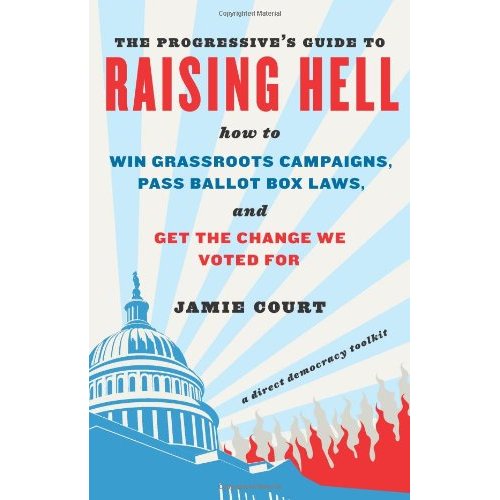
“Anger, not hope, is the fuel of political and economic change,” Jamie Court, head of Consumer Watchdog, writes in his new book, The Progressive’s Guide to Raising Hell: How to win grassroots campaigns, pass ballot box laws, and get the change we voted for (Chelsea Green Publishing, 2010).

Court writes that progressives are rightfully disappointed and disillusioned that after helping to elect President Barack Obama, he and Congressional Democrats turned around and gave Wall Street, the military-industrial complex, and the health insurance companies everything they wanted, with Obama even caving in on requiring all Americans to purchase health insurance, something he opposed as a candidate.


Yet Court said politicians never do the right thing and push progressive political change unless they’re forced to do so. He opened the book with a scene in which President Franklin Delano Roosevelt met with progressive political leaders, listened to their proposals, and then told them, “I agree. I am all for your plan. Now make me do it.”

It’s a concept that the conservative Tea Party movement understands well, and even though they may be crazy and wrongheaded in their utterly unsustainable and destabilizing policy agenda, they have effectively used anger as a political tool, and as a result, the NY Times reports they are poised to wield a disproportionate amount of political power after this election.

It’s the same story on the local level, where the only real anger in this election cycle is coming from those mad at public employee unions and their pension deals, and vagrants who sit uncivilly on sidewalks. These people will keep pushing for what they expect, but many progressives act as if it’s enough to prevent truly heinous Republicans like Meg Whitman from taking power, rather than trying to push Jerry Brown or Board of Supervisors’ progressives from day one to start empowering people over corporations.

“After the vote, power vacuums fill with familiar values, if not faces. Promises give way to fiscal realities, hope succumbs to pragmatism, and ambition concedes to inertia. The old tricks of interest group – confuse, diffuse, scare – prevail over the better angels of American nature,” Court writes, relaying a familiar electoral pattern.

Yet in this election, when the best outcome seems to be simply dodging a bullet, is there any hope for progressive political change? Isn’t the system just too broken? I asked Court these questions when he stopped by the Guardian office for a chat recently, and he retains a belief that with the right kind of tactics and agenda, progressives can still seize the political initiative and power.

http://www.youtube.com/watch?v=J3RD0YObHok

“I wrote it to reengage progressives because they are so despondent,” Court told me. “It’s about how to use anger and focus anger…Politicians don’t answer polite mobs, they only answer angry mobs and the Tea Party is the only angry mob in the room.”

Progressive have understandable doubts about the responsiveness of the current political system, but Court said, “I know if we don’t try to make it work, we’re never going to get there.”

And his book lays out the path to get there, step by step, based on some of the legislative and political successes that Consumer Watchdog and other progressives have had in recent years, such as rejecting the well-funded corporate con jobs in Propositions 16 and 17 earlier this year. Yet it involves an approach based on principle and not parties, and with being relentless in pursuing the kind of world we need.

“If you want to fight corporate power, you have to fight Democrats and Republicans,” Court said.

Specifically, Court is calling for progressives to push a California ballot measure that would establish a public health care option here, the very thing that Obama and the Democrats failed to include in their health reform package, and which will dash any hopes of it working if the people are forced to rely on unregulated insurance company products.

“The biggest thing is mandatory health insurance, which is a ticking time bomb,” Court said, one set to go off in 2014 when that aspect of Obama’s health care reform kicks in.

Corporate and political power working together seem to be a force too strong to overcome, but as Court writes, “Public opinion is the most powerful force in the world. While it can be muted, distracted, and co-opted, it cannot be controlled, except by the public.”

Markus James’ West African happiness surplus

0

In an age of endless crossover between most conceivable forms of music, it’s but small surprise that a Caucasian man from Virginia is making blues with West African witch doctors. What rarely gets discussed in these cross-ocean collaborations is the social aspect of the fusion. What did the artists eat for lunch the day they recorded that track? In what language was the “and-a-one” that started off the first take? 

We had the opportunity to chat over the phone with Bay Area artist Markus James, who has parlayed his time with Malian string musicians into elemental blues tracks. You can hear them on both his new album, Snakeskin Violin, and at his live show (at the Ashkenaz, Fri/22) with The Wassonrai, who are West African musicians that rep for jam band track longevity – strains of which James says is indigenous everywhere from Mali to Jackson, Mississippi — into their already formidable blend of blues past and present. James said (and we’re paraphrasing here) that the secret to fusion collaborations all lies in your location-resonation, but that’s just his perspective.


San Francisco Bay Guardian: When did you first hear African music? Did you know right at the start the depths you would dive into it?

Markus James: I don’t know if anyone really knows what is going to take them. The lights really went on for me when I heard Ali Farka Toure. He played traditional West African music on the electric guitar and it came out sounding like John Lee Hooker. That was where I really felt the powerful connection between all the music I grew up loving: rock, and soul music, and of course blues music, and the connection between that and its ancient roots in West Africa.


SFBG: What did African music pick up in the United States to become blues?

MJ: The roots of blues music go way back, specifically to pentatonic [five note as opposed to our eight note system] music traditions there. Pentatonic music really resonates with what we think of as blues music. There is a direct correlation between what I call country blues, or old school blues music, and some of these music traditions that I’m talking about in West Africa. Not just the notes and the musical scale, but the groove, the rhythm. For example, in West Africa women are often pounding the millet for that evening’s food. The have this six-foot tall piece of wood – it’s like a mortar and pestle. Another woman, or a girl, is scooping it back underneath so that the wood hits the grain. They get these rhythms going that are like goom-chack-goom-chack. Then people start playing on calabashes with this rhythm, and the rhythm is virtually identical to what we call the shuffle rhythm that you hear in a lot of old blues music, Chicago blues music, and rock music. If you go over to West Africa and you start playing what we call country blues, people will just start playing along with it and they’ll say oh, that’s our music.


SFBG: On “I Won’t Let It” you perform spoken word over the music. Is there a legacy in African music of that spoken word tradition?

MJ: Absolutely. There’s a whole caste of artists called griots. Their specialty is preserving history through story-songs, but also singing praise songs to whoever’s in power at the time. They will break into long passages of rhythmically chanted tone-poem language. That’s all there. 


SFBG: You do a lot of cross-culture collaboration. Does the dynamic get tricky when you come from one of the wealthiest nations in the world?

MJ: Not really. I’ll give you an example. I was introduced to a 75-year old man who is the spiritual leader of the Holehoire religion in Timbuktu, Mali. He is what we would call a healer, or in older parlance, a witch doctor. He is like a medium, and his whole role in the community is to communicate with the jinn, their spirits. His instrument is a gourd with the skin of a river snake stretched across it, the string is horse hair. He has a whole repertoire of melodies and rhythms that he plays, the purpose of which are to call certain spirits for certain purposes, to ask for rain, or to ask for good luck, a million things.

He came over to our adobe-walled house where I had my little set-up going and we started playing music together. I was playing guitar and he was shifting back and forth between his two instruments, and he would sing a little line and I would sing something. I told him, I’m making a recording in blues, which is an African-American tradition, if this thing turns out pretty good I might put it on a CD – and I’m paying him, which he’s happy about. And I said before I do anything I want to bring it back to you because I know this is really – I don’t know how I said it to him but I’d say it to you, this is really deep waters. This is considered the pre-voodoo religion. He said sure, fine, great, I hope somebody enjoys it.

The next year I came back and I played him what I had made out of it, it’s this song on Snakeskin Violin, it’s called “Sundown Pearl” I played it for him and he started beaming and smiling and saying this is very good, this is going to be very successful. When I see him I give him something which anticipates the day when I might get some royalties from it. My friends that I’ve made there, it’s hard for them to understand that I’m not really selling a lot of CDs here but they’re very happy that there’s a revenue stream.


SFBG: You’re a vegetarian. I’m curious — I’m a vegetarian too – how is it to travel in Africa without eating meat?

MJ: They assumed at first that I must be deranged. It was absolutely inconceivable that someone could live without eating meat. Even the West African artists I perform with here in the US, it’s taken them awhile to accept it, even though they know other people here. I’m trying to think what it would be like to tell someone here. It’d be like saying I went down to the Bay and I just skipped across it to Berkeley. 


SFBG: You can’t even do it with food — our society has such an individualized view of eating. 

MJ: You know, I’m eating rice down there without the meat sauce, but I’m still in this communal meal zone. My friends will explain, he’s a vegetarian, and that means he doesn’t believe in eating meat, and he appears to be healthy. Something that I could not have foreseen was that I’d become a emissary for vegetarianism in West Africa.

People say, you come from a rich country, and they come from a poor country, so what is politically correct? I think when some people go to West Africa they resonate with it, they connect with it. You come to realize that what we think of as wealth and poverty is very relative to our perspective. Here you might say that we’re wealthy because we have a car, or a house, or roads that allow you to go 60 miles per hour. What we have may not necessarily translate into what they would consider to be joy, happiness, abundance, peacefulness. They’re certainly not stuck in traffic jams and trying to make mortgage payments. We might be looking at a little of a joy deficit and over there they have a happiness surplus. I know that’s simplistic, but that’s my perception. 


Markus James and the Wassonrai

Fri/22 9:30pm, $10-12

Ashkenaz

1317 San Pablo, Berk.

(510) 525-5054

www.ashkenaz.com


The 20th annual Potero Hill Festival

0

It’s the little festival with a big view. Potrero Hill, the home of the Guardian, is hosting the 20th annual festival with of a “New Orleans” Style Brunch created by the California Culinary Academy and an exciting street fair on 20th Street between Missouri & Wisconson Streets. Enjoy music, food, crafts and activities for the young and old alike.

Potrero Hill Festival
Date: October 16, 2010, 11am-4pm
Location: 20th Street Between Missouri & Wisconson Streets

New Orleans Jazz Brunch
Location: Potrero Hill Neighborhood House, 953 De Haro Street
Date: October 16, 2010, 9:00am-1:00pm

Before the Festival, join the Festival Committee and the Potrero Hill Neighborhood House for an annual tradition – a lavish and delicious brunch catered by the California Culinary Academy featuring Dixieland music and superb bay views.

Festival Performances & Activities

  • Main and Side Stage including performances by some of the area’s most exciting performers.
  • Kids Area including bouncy house, petting zoo, pony rides, performer stage and more
  • Snack the Hill: A variety of food from Potrero Hill restaurateurs and more
  • Over 40 Potrero Hill and local artists, merchants & nonprofit organizations

Marketing

  • Collectible Posters will be posted on Potrero Hill and beyond
  • Advertising in Potrero View & the San Francisco Bay Guardian
  • Online campaign including a website, social marketing and email campaign

Attendance

  • Festival has an expected attendance of over 7,500 Potrero Hill & San Francisco Residents
  • New Orleans Jazz Brunch will be attended by as many as 500 Potrero Hill and San Francisco Residents

Benefits the Potrero Hill Neighborhood House

The Potrero Hill Festival will support the programs of the Potrero Hill Neighborhood House (NABE). The NABE is an invaluable community resource that provides important programs for the community, including youth and senior nutrition, employment and supplemental education programs and programs for developmentally disabled adults.

Street Threads: Look of the Day

0

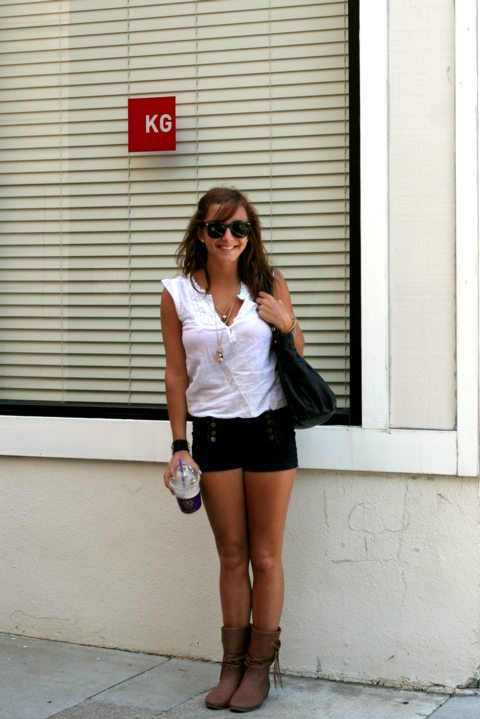
Today’s Look: Ashley, Fillmore and Sacramento

Tell us about your look: “Mix and match and see what works.”

Hot Chip’s Joe Goddard talks emotional lyrics, covers, and 80s pop

0

Hot Chip’s Joe Goddard has had one helluva year. He and his bandmates released their highly-anticipated LP One Life Stand in February and took a massive risk by going for a more streamlined, cohesive sound.The gamble payed off: the disc has received generally positive reviews and the group has spent the latter part of 2010 criss-crossing the globe, including a Sun/17 stop at the Warfield. Just a few months removed from a triumphant American headlining tour that was supported by critical darlings the XX, the Londoners are back opening up for their longtime friends LCD Soundsystem and playing some of the American biggest gigs of their career. Throw in the birth of his first child and a hectic DJ schedule, the Guardian was lucky to grab a quick word with the Hot Chip main man at his home in London.

San Francisco Bay Guardian: Considering how high expectations for One Life Stand were, how are you feeling about it now that it’s been out for a while?

Joe Goddard: It feels good. It was a stressful process, but it seems to have gone down quite well. Honestly, when I get done making an album, I always get a little bit tired of it and want to move on to the next one, so I really haven’t listened to it much myself. That said, the shows have been going well, and people seem to really enjoy the new tracks in the live setting. I don’t exactly know what people’s opinions are, but I guess people have been enjoying it, which makes me happy [laughs].

SFBG: As it should! As far as the album goes, it definitely seems like the new record is different stylistically to the older material. The tracks seem a little more accessible and light than some of older tracks. Was that a conscious decision, or did it come about naturally?

Goddard: I think all of us wanted to make the tracks on this record a little more streamlined and coherent, you know, a little bit more polished. On some of the previous things we’ve done, there have been layers-upon-layers of synthesizers and really intricate rhythms and percussion, and those sorts of elements. I kind of wanted to do something that didn’t rely on hundreds of layers and strip back the songs so they sound more focused and simple. We also really focused on making the songwriting as strong as possible and for the production to stand up to the songwriting. That was really our aim. I guess I just felt like doing something that sounded more direct, a bit more easy to understand, just something a little bit more straightforward.

In my mind, we were kind of refrencing the great kind of pop stances that you would get in the 80s where you’d get these big kind of epic, emotional songs — like Womack and Womack or Fleetwood Mac — these big polished pop songs that are making a big emotional statements. I feel like those songs are coming back round again, and I guess we were just hoping that people wouldn’t get too pissed off for doing something like that [laughs]. Having done that, I’d really like to do something completely different and more unrestrained for our next project.

http://www.youtube.com/watch?v=MaCZN2N6Q_I

SFBG: As far as the songwriting goes, how do you and [co-vocalist] Alexis Taylor break it up? Do you write the tracks together or by yourselves?

Goddard: There isn’t really a formula to it. Basically, either myself or Alexis will come up with something and just send it to the other one. From there, we’ll work on it together. Sometimes its almost a complete song, but sometimes it’s just a fragment of a song. It used to be that we would just sit in each other’s houses, but now its mostly just over email. As far as the lyrics go, generally whoever is singing a particular part tends to have written it. Sometimes I’ll write all the lyrics for a track, sometimes [Alexis] will write all the lyrics for the track, and sometimes we’ll collaborate. We never sit down and have a lyric writing session together where we come up with couplets or anything like that. Actually, I don’t think I’ve ever even asked Alexis what the lyrics to a track of his mean. I can make informed guesses about it, but they’re very personal and sometimes actually quite secret.

SFBG: Speaking of lyrics, it seems much more emotionally direct than your previous work. Did that go along with your musical direction?

Goddard: Yeah. I think that most of the record is more emotionally direct. That is partly due to the fact that we were trying to do something that was direct, and we really tried to follow that through in terms of lyrical content as well. We just wanted to let the songs say what they wanted to say, instead of being obtuse or hiding the meaning. Also, it was how we were feeling as people at the time we were making the record. We very kind of focused on our relationships, our home lives, and families, so there’s a lot of love on this record.

SFBG: How are those new, more direct, emotional tracks going over live?

Goddard: Well, I’ve got to preface this by saying that I’ve had six weeks off from playing live, because I recently had my first child. When I come back to play this October, it’ll be my first gigs in two months. From the touring I did before, I really enjoyed playing things like “Brothers” and “Alley Cats” — not only because I wrote most of those tracks — but they’re more emotionally open than most of the stuff I’ve done in the past. Although I guess you could go back to a few of the tracks from the older records and say that, but these are the ones that are fairly explicitly about my relationships and personal life.

For example, “Brothers” is clearly about my relationship and love for my brother, but I also wanted that song to also mean the brotherhood of being in the band and the brotherhood of a group of friends. The song “Alley Cats” is incredibly personal, it mentions the death of my mother. It feels great to be expressing myself with the guys that I’ve been friends with for over 20 years, and I often get quite emotional performing those songs. Of course, it is fun to do the bigger tracks like “One Life Stand” and “I Feel Better”, but I’ve really been enjoying the gentler moments in the set.

SFBG: Obviously, yourselves and LCD Soundsystem have a long history with [Hot Chip multi-instrumentalist] Al [Doyle] touring with them. Are you looking forward to getting back out on the road with them?

Goddard: It feels fantastic. It’s just a really great way to end the year. They are really just great, old friends of ours, and it’ll be great to have a drink with them, you know, and it’ll just be really comfortable. Most of us are about the same age — well, I guess James [Murphy] and Pat [Mahoney] are a just a bit older. We toured with them in the UK about five or six years ago and really learned a lot about touring with as a live, electronic rock band. They taught us a lot on that tour. I’m very much looking forward to doing it again.

I feel like both bands are established enough now that we can both just have fun and do our thing. Whereas a couple of years ago, I was trying more to get people into the music, now I’m really quite happy with what we’re doing and where we are. This tour is going to be a celebration of what we’ve achieved. They should be fun shows where people are just going to want to dance and have a good time.

http://www.youtube.com/watch?v=wif8DAyXkVc

SFBG: A couple of years ago, you guys closed out some California shows with a cover of the classic “Nothing Compares 2 U”. Can we expect a new cover to sneak its way into your set?

Goddard: Actually, we have been talking about it and trying to figure out something to do. We haven’t quite figured it out yet, but I think they’ll definitely be a little surprise. Alexis has made a few suggestions and we’re trying to work something out at the moment.

SFBG: Real quick, can you just give us some background of your recently-released remix EP, We Have Remixes? How did you end up choosing the four tracks that you did?

Goddard: We really just tried to choose remixes that we’re really excited about by people that are either personally friends of ours in terms of Hot City, Osborne, and Caribou or people that we really admire. I think Todd Edwards is just a fantastic producer, who creates really musical, intelligent, danceable tracks and we love what he did. There’s obviously been some great other remixes, but this was just a collection of four that have come about over ht last few months that were so good it just made sense to put them out on vinyl.

http://www.youtube.com/watch?v=Ylldl_jsMMI

SFBG: Speaking of vinyl, you also spend lots of your time DJing. What’s better an awesome gig or a great club night?

Goddard: Hmmm, it’s hard to pick one, because I really love doing both. I think an incredible live gig kind of beats anything, but the nice thing about DJing is, since its just you, if you have a good night and the crowd has a good time you feel like its a real personal achievement. I mean, it’s hard to pick between the two. I just love doing both of them.

SFBG: No worries. Lastly, since you are a DJ, what have you been listening to and spinning recently? Got any recommendations?

Goddard: The most recent things I’ve been listening to are just lots of new 12-inches. Really, just a lot of new UK dance music, like a lot of garage that’s been influenced by techno. There’s this new UK producer called DJ Naughty, who has a wonky garage record called “Goosebumps” that’s really funky and fun. Another DJ called Red Rack’em just released this 12 inch called “How I Program” which is really good. I’ve also been listening to a ton of Hot City. I’ve been DJing quite a lot, and that’s really what I’ve been focusing on.

SFBG: Great! I really appreciate your time, and we’ll look forward to seeing you at the Warfield.

Goddard: Not a problem. Thanks a lot!


HOT CHIP

with Sleigh Bells

Sun/17, 9 p.m., $32.25

Warfield

982 Market, SF

www.thewarfieldtheatre.com

Beating chest for APE

0

I used to live in a town where the alternative-alternative (holler!) weekly had a comics page. Paging to the back of said volume each seven days I’d look for Tony Millionaire’s joint, Maakies. Millionaire’s rounding out a phalanx of guest speakers at this weekend’s APE (Sat/16 and Sun/17), so I’m thinking back to the days when his preciously drawn little derelicts marked my Wednesdays.

The motivation behind my penchant remains slightly cloudy – for why did I seek out these troublemakers? The Maakies are a band of animals and multilated pirate-types (maybe they’re all animals, come to think of it, just horribly alcoholic, crass animals who enjoy tweezing their own belly button hair). A perennial reader favorite, Drinky Crow does little more than you’d think he would – a standard DC portrayal captures a moment in time when some unidentified bottle of hooch hangs suspended in the air, supported only by the gullet into which it is pouring. His eyes are mainly x’s. He does not wear a hat, but his monkey (?) friend Gabby does. They do foul things involving body functions and emotional pathology.

The Maakies occupy a world known by most faves of alternative comics — a dark world, yes, one that is stacked against the protagonists, but none the less a world in which fun can be had. Not the least of which is that fun that is perpetuated by the comic characters against those around them. Can’t deal? Drink yourself into a stupor! End frame. See you next week.

APE artists self-portraiture (clockwise from top left): Lynda Barry, Daniel Clowes, Megan Kelso, Tony Millionaire, Tommy Kovac, and Rich Koslowski 

This is the sort of comic made possible by the alterna-crowd, the alterna-paper, the alterna-comic – all of which will be celebrated and feted as is their due at this year’s Alternative Press Expo. It is part of the juggernaut that is Wonder Con-Comic Con, although attendees at APE assume much less widely known personas in their Lycra and face paint.

This year features the usual reams of special guests. Lynda Barry lends her star power, a maker of ‘zine style comics about horribly awkward, dastardly endearing adolescent girls. Also present will be Ghost World penner Daniel Clowes, Megan Kelso, and Renée French. Most of these writer-illustrators have a solid decade or more under their belt of paneling for society’s disenfranchised.

And new to the APE stage is an innovative new style of meet and greet, always an informal function at these mega-events. Writers and artists will get a chance to speed date at the Comics Collaboration Connection, shopping for creative partners in a dance of I-like-you-do-you-like-me furtiveness. Drop your card in the designated envelope if you want to make a graphic novel! Of course, there will be aisles upon aisles of purveyors of already-collaborated-on comics to inspire you, as well.

Anyways, Tony Millionaire will be there, which is exciting. Sources tell me he’ll be the gentleman wearing a tux in the artist spotlight from 5-6 p.m. on Saturday. Get ready for some inquiries into zero gravity bottle support, Mr. Millionaire – I’ll have what Drinky’s having. 

Alternative Press Expo (APE) 2010

Sat/16 and Sun/17 11 a.m.-6 p.m., $10-$20

Concourse Exhibition Center

635 Eighth St., SF

www.comic-con.org


Street Threads: Look of the Day

0

Today’s Look: Lele, Pierce and Ellis

Tell us about your look: “Rock what looks good on you/”

Willie Brown and accusations of machine politics in D6

70

A political mailer promoting progressive supervisorial candidate Jane Kim was funded primarily by former Mayor Willie Brown through a campaign committee that Kim consultant Enrique Pearce helped start and which was located in his office, the latest strange development in a race that is dividing the progressive movement at a crucial moment and prompting a nasty public debate over political “machines.”

It’s illegal for campaigns to coordinate activities with independent expenditure committees such as New Day for SF, which put out the glossy mailer proclaiming “Another renter supports Jane Kim for District 6 Supervisor” and calling her “The people’s candidate.” The most recent campaign finance statements, filed Oct. 4, listed the group’s treasurer as USF student Brent Robinson and the contact number being that of Pearce’s Left Coast Communications, where Robinson worked.

Pearce told the Guardian that he was involved in starting New Day for SF, but that he severed ties with the group and Robinson “about a month ago” when it seemed they might support Kim. “When it started to go down that path, we said that we can’t do that,” Pearce said, adding that he didn’t know why the forms still listed his phone number or why the receptionist in his office took a message for Robinson from the Guardian, although Pearce said they share a receptionist with other organizations. On Oct. 5, a day after the intial filing, the group filed a form to amend Robinson’s phone number.

The campaign finance form shows the group raised $9,200, including $5,000 from Brown on Sept. 30 and $2,500 from Twenty-Two Holdings LLC, which last year applied for a liquor license for the Wunder Brewing Co. Robinson did not return our calls for comment.

The Bay Guardian and other progressive voices used to decry the corrosive influence on San Francisco politics of the Democratic Party political machine established by Brown and former California Senate President (and current state party chair) John Burton. Although that machine is dormant now, the concept of machine politics has been revived in this election cycle by Kim and her allies, adding an ironic note to her support by Brown.

“I’m not a part of anyone’s machine and I’m certainly not a part of anyone’s master plan,” Kim declared during her June 24 campaign kickoff party, where Brown and former Mayor Art Agnos made an appearance. When I highlighted the remark in my coverage of the event, and its inference that Kim’s progressive rival Debra Walker was supported by a budding progressive political machine, it triggered a raging political debate about the concept that continues this day.

The nastiest salvos in that debate have recently been fired at the Bay Guardian and the San Francisco Democratic Party Central Committee – accusing us of being part of a political machine supporting Walker and excluding Kim (who got the Guardian’s #2 endorsement) – by Randy Shaw on his Beyond Chron blog. Shaw is one of two staff writers on the blog, along with Paul Hogarth, a Democratic Party activist and Kim campaign volunteer.

Shaw founded and runs the nonprofit Tenderloin Housing Clinic, which has millions of dollars in city contracts to administer SRO leases through Mayor Gavin Newsom’s Care Not Cash and other programs. He started BeyondChron a few years ago with seed money from Joe O’Donoghue, who was then president of the Residential Builders Association, a developer group that has sometimes clashed with Walker in her capacity as a member of the city’s Building Inspection Commission.

On Oct. 5 and then again on Oct. 12, Shaw wrote and prominently posted long stories promoting Kim’s candidacy and attacking us and the DCCC for not supporting her more strongly. In the first one, “In District 6, Jane Kim takes on the machine,” Shaw defended Burton but shared the Guardian’s criticism of how Brown behaved as mayor.

“Brown’s power was strictly personal, as became clear when his chosen Supervisor candidates were defeated in the 2000 elections,” Shaw wrote, criticizing political machines and writing that the progressive political movement is not “served when those seeking to run for office feel they must choose between ‘playing ball’ with political insiders and giving up their dreams.”

But is it possible that Shaw’s strident campaigning against Walker – indeed, his protege Hogarth planned to challenge Walker before Kim decided to get into the race – was prompted by Walker’s unwillingness to “play ball” with Shaw and his RBA backers? Should we be concerned that it’s actually Shaw who’s trying to build his own little political machine?

I’ve tried to discuss these issues with Shaw and Hogarth, including sending them a detailed list of questions (as has Guardian Executive Editor Tim Redmond), but they’ve been unwilling to respond, just as they were unwilling to contact us before writing two divisive hit pieces that were riddled with inaccuracies that they’ve refused to correct.

I’ve also left messages with Kim and others in her campaign to discuss machine politics and its implications – as well as Sup. Chris Daly, asking about the sometimes close relations that some progressive supervisors have had with Shaw and RBA developers over the years [UPDATE BELOW] – and we’re waiting to hear back.

But Pearce said voters shouldn’t read too much into a relatively small political contribution from Willie Brown, or from the “colorful writing” of Randy Shaw, emphasizing Kim’s independence and saying that was always what she intended to stress when she raised the specter of machine politics tainting the race.

“Randy Shaw is not a part of this campaign, and Willie Brown is certainly not a part of this campaign,” Pearce told us. In fact, Pearce even noted that his office is not a part of the Kim campaign, that they’re merely consultants to it. And he offered his hopes and belief that in 19 days when this campaign is over, progressives would overcome their differences and find a common agenda again. Let’s hope so.

UPDATE: Daly and I just connected and he had an interesting take on all this. He noted that when Brown was mayor, the base that he brought together included the RBA, Rose Pak and the Chinatown power brokers (who also seem to be backing Kim, who used to work as an activist/organizer in that community), and, improbably, both Labor and Downtown.

“But that’s not Gavin’s alignment, his alignment is just downtown. The RBA guys hate Gavin, mostly just because of who is is, a silver spoon guy who never worked a day in his life,” Daly said. So Matt Gonzalez, the board president who ran against Newsom in 2003, formed an alliance with the RBA and O’Donoghue, who already had a long relationship with Shaw, both personal and financial.

Daly also said that he thinks it’s a personality clash more than anything else that is driving Shaw’s opposition to Walker: “He just doesn’t like Debra.” In turn, that sort of personality-based politics — more than any differences in ideology, vision, or qualifications — is souring people in the two political camps on one another as this close election enters the home stretch. But will those resentments linger after this election? Probably, Daly said, although he plans to actively try to mediate the divide once the dust clears on this race.

“Luckily, we have a lot of young people entering the progressive movement,” Daly said. “There’s always a rejuvenation going on and one day the new leaders will be like, ‘Why do that guy and that guy hate each other?’ ‘I don’t know, I think it had something to do with the 2010 election.”

More on the “whore” gaffe

By now, you’ve probably heard about the campaign gaffe in which an unidentified female associate of Jerry Brown (possibly Brown’s wife) called his opponent Meg Whitman a “whore” during a conversation that neither realized was being recorded over voice mail.

The comment was made in reference to Whitman’s offer to cut a deal over the pensions of a police officer’s union in exchange for an endorsement. Soon after the tape went public, Whitman’s campaign seized the opportunity to issue a press release slamming the remark as “an appalling and unforgivable smear,” and a slur. Sparks flew over the comment at Tuesday’s gubernatorial debate.

Yet a number of reactions from feminist organizations and bloggers suggest that despite Whitman’s ire, women haven’t started hating on Brown as a result of the dumb mistake. And in the meantime, the controversy has generated some pretty interesting discussions out there in the blogosphere.

Shortly after the remark went live, Brown secured the endorsement of the California chapter of the National Organization of Women (NOW), which in turn prompted conservative bloggers everywhere to start foaming at the mouth, madly accusing NOW of being partisan and anti-woman.

“We definitely felt that putting the announcement out today was important to refocus on the real issue in the campaign,” such as “what are the two candidates going to do for women and their families,” the chapter’s president, Patty Bellasalma, told the Sacramento Bee. “The use of the word ‘whore’ is offensive,” she added. “There’s no mincing words about that.”

Chloe, a blogger at Feministing.com, had this to say:

“When candidates and their aides use highly gendered derogatory terms to refer to the opponent, and when that opponent responds by appealing to women’s personal-is-political feminism, we are having a national discussion about gender. … But it doesn’t feel like a particularly productive one — it’s more a case of one camp screwing up by revealing underlying sexism and the other capitalizing on that mistake to score a few points. It’s not an honest discussion of structural and cultural sexism in America and how it affects people of all genders. I want to make it clear that I think what Jerry Brown’s aide said was unacceptable, as was Brown’s seemingly tacit endorsement of the word. It’s not acceptable, obviously, to call anyone a whore. But I’m trying hard to remember what Jay Smooth taught us: condemn the action, not the person, or the campaign.”

Hanna Rosin, a blogger writing for Slate.com and the DoubleX factor, had this take on it:

“Now it’s unclear exactly what the aide meant, but it’s perfectly clear he or she did not mean that Whitman was a hussy who had slept with half the legislators west of the Mississippi. Since this was an endorsement call, he or she meant that Whitman was whoring herself for the endorsement. In one way, we could see this as progress, that the word ‘whore’ is so far removed from its original sex-shaming role that it gets thrown around in the context of political power trading.”

But if the phrase weren’t so wrapped up in sexism, would we even find ourselves in the midst of this controversy? Technically, “whore” can be used to refer to a man or a woman, and it can also mean “a venal or unscrupulous person” or some one who is “considered as having compromised principles for personal gain.” But do alternate definitions remove the sting of an offensive word?

A few questions. Should the gender of the person using the word (in this case, a woman) change our analysis of how it was used? When the remark has everything to do with politics and nothing to do with sex, should it be taken as a sign that we’re making progress on gender equality? Or would real progress be when the term “whore” goes the way of an archaic insult you’d find in a Shakespearean play?

There are signs, meanwhile, that the word “whore” isn’t universally regarded as a gendered insult. Just check out the roughly 200 definitions offered on Urban Dictionary. Like this one, posted by some one named Megan:

“Minor annoyance. You’re not really mad at them, but still kinda pissed.
‘Hey, who ate the last doughnut?’
‘I did.’
‘Whore.’”

Dance performance: “Keep Her Safe, Please!”

1

Many traditional dancers are no longer content with merely preserving a valuable heritage; they want to put their own stamp on it. So now there’s a new kind of dance, already conveniently labeled “ethno-contemporary.” Taiwanese-born, Indonesia-raised, and additionally US-trained Wan-Chao is at the forefront of this promising new genre. She dedicated Keep Her Safe, Please! Jakarta 1998 (Sat/16-Sun/17 at the Cowell Theater) to the victims of the anti-Chinese pogrom that included particularly vicious attacks against women.

The thoroughly contemporary work draws on both Chinese and Indonesian music and dance. Sharing the program will be Gadung Kasturi Balinese Music and Dance in three works. One of their dancers, Rotrease Regan Yates — ten years with Gamelan Sekar Jaya — has a whole encyclopedia of dance in her body: ballet, modern, Polish, Russian, Javanese, Cambodian, and of course, Balinese. 

Keep Her Safe, Please! Jakarta 1998

Sat/16, 8 p.m.; Sun/17, 1 p.m., $12-$20

Cowell Theater

Fort Mason Center

Marina at Laguna, SF

 (415) 345-7575

www.fortmason.org


Street Threads: Look of the Day

0

Today’s look: Allison and Jasmine, Fillmore and California

Tell us about your look: (Allison) “I like to wear anything that’s flattering and tailored pieces.”

Talking with Pelosi’s GOP opponent

28

I had a fascinating discussion this morning with John Dennis, the Repubican candidate running against Nancy Pelosi. He’s not going to win, of course, but he’s gotten some national press, including a nice piece by John Nichols, the veteran liberal editor at the Madison-based Capitol Times and a plug from the Huffington Post. Matt Gonzales has endorsed him.

Dennis is a libertarian Republican, but not a nut job or a conspiracy wacko. He’s intelligent, articulate and makes some very good points. He is, for example, totally against the wars in Iraq and Afghanistan, and calls for an immediate pullout of both quagmires. He supports same-sex marriage (it took me a while to get that out of him, but he does), supports Prop. 19, opposes DADT, and wants the feds to stop cracking down on undocumented immigrants in California. He’s against warrantless wiretaps and torture, and wants to repeal the worst parts of the PATRIOT Act. He thinks we should review all of our military bases abroad — just as we have with domestic bases — and close the ones we don’t really need anymore.

In other words, on Iraq, Afghanistan, the Pentagon budget, social issues, the drug war and civil liberties, he’s way out of synch with his party — and a lot better than Pelosi, the good liberal Democrat. And Arthur Bruzzone, my old pal and the former chair of the Republican Party, came down with Dennis and told me that the Guardian really ought to endorse him.

We’ve said some bad things about Pelosi; after all, she privatized the Presidio. She’s been weak on the wars, weak on same-sex marriage, weak on taxes and corporate welfare — and a lot more interested in raising money for Democrats than in representing her district. She won’t even debate Dennis, which is typical of her arrogance.

On the other hand: Dennis has a problem. He’s a member of a party that’s run by barbarians, and if he got elected, and was part of a GOP majority, some very bad people would be in charge. He knows that, and says he wants to change the GOP from within; good luck with that.

And since I spent much of my time these days talking about the gap between the rich and the poor and how utterly unsustainable a nation is when 5,000 families at the top control more wealth than 160 million at the bottom, I have a hard time with libertarians who don’t believe in income taxes.

And that’s Dennis. He told me that he thinks the income tax should be replaced with a consumption tax (that is, a sales tax), which is about the most regressive idea you can imaging. He said he thinks the Bush tax cuts should continue. He thinks government is too big and ought to be dramatically cut back.

I don’t think Pelosi much supports a radical redistribution of wealth in this country, but the Democrats at least are going to let the insane tax cuts for the rich expire. And that’s something.

So I understand Matt Gonzalez, and I had a wonderful talk with Dennis, and I hope you all listen to it (below). And I get the “beyond left and right” thing that the HuffPo talks about. But on the basic economic issues — like wealth redistribution through progressive taxation — the good libertarians and I will never agree. And that’s kind of a deal-breaker.


john dennis by endorsements2010

Hot sexy events October 13-19

0

Support your local sex workers! We are lucky to live in a city where those salacious somebodies that will take their kits off in the name of our pleasure and payment don’t have to lay down and take it when the man gets all censorious and grabby – lucky to live in a city where St. James’ Infirmary exists, that is. The Lusty Ladies agree, and on Sat/16 they’re holding their annual Playday for St. J’s – 16 hours of girl-on-girl-on-call for justice.

For there was a time where if you got picked up providing sex to paying customers, you got stuck. We’re talking hypodermic needles – part of a policy that used to go down in SF that forced sex workers to give up blood samples in jail for mandatory STD testing. As you can imagine, this was not always done in the most respectful of manners. Enter St. James’, founded by sex worker advocacy group COYOTE (Call Off Your Old Tired Ethics). The center holds a health clinic, trainings and support groups, hormone therapy programming, peer counseling, and oh so much more. Why on earth not head down to the Lusty to make sure our ladies – and gentlemen – of the night continue to be treated as such?

Original Plumbing Bathhouse Reception

Celebrate the notion that a photo-heavy magazine of transmen is one of the most hot publication debuts to hit the racks in 2010 – Original Plumbing’s fourth issue is out! And it features a hunky lineup of working stiffs, all of whom will be at the wine and cheese reception, open to all genders and levels of ab definition.

Thu/14 7 p.m., free

Eros

2051 Market, SF

(415) 255-4921

www.originalplumbing.com


Spanking and Paddling

Don’t worry, consoles the description of this Edu Kink offering: “there will be plenty of spanking time.” That’s because even though this is technically a class on spanking – its possible childhood associations, how to deal with them should they arise, on technique, and enjoying the spank on the receiving end – Edu Kink’s Paideia workshop series has a focus on lecture leading to experience. So prepare you that booty, naughty kids.

Fri/15 7:30-10:30 p.m., $15-$25 sliding scales

SF Citadel

1277 Mission, SF

(415) 626-1746

www.edukink.org


Pink Blues Dance

What better way to amp up for Mission Control’s pansexual play party than this week’s warmup: a chance to swing those hips to the down ‘n’ out blues on the dance floor. Costumes not required, but membership to the club (and a smile) is. 

Fri/15 9 p.m.-2:30 a.m., $20-$30 members only

Mission Control 

2519 Mission, SF

www.missioncontrolsf.org 


Naked Girls Reading

What’s that chill that just ran down your spine? Are you frozen in fear by a classic ghost story, channeling the pre-Halloween vibe – or are you just naked? It could easily be both at this storytelling series that pairs the city’s sexologists and stage presences with a favorite book, a mic, and little else. Watch for the SF Ghost Society’s Elissa Fricano’s tales of personal encounters with the world beyond.

Sat/16 8 p.m., $15-$20

Center for Sex and Culture

1519 Mission, SF

(415) 225-1155

www.sexandculture.org


Peter Acworth’s Birthday Deviance

Everyone needs a little extra attention on their birthday. And on the founder of Kink.com’s 40th, you can only imagine what form that personal touch will take. Our town’s foremost world-class fetish porn palace opens its virtual doors to members who want to join in on the fun online. Visit www.theupperfloor.com on Saturday evening and watch live as hot doms and slaves create sexy mayhem during a celebratory dinner in Peter’s honor.

Sat/16 6:30-11 p.m., free for Kink.com members, $.25 cents per minute for nonmembers

www.theupperfloor.com


Lusty Lady Playday RXXX

That’s right, get your dirty, dirty prescription for a Saturday in the hospital – or rather, nurse’s office. The Lusties will be pulling on the rubber gloves for a day of sexual healing. Girl-on-girl action all day long, with a portion of the proceeds going to everyone’s favorite hustler health care provider, St. James’ Infirmary.

Sat/16 11 a.m.-3 a.m., $5 before 10 p.m., $10 after

The Lusty Lady

1033 Kearny, SF

(415) 391-3126

www.lustyladysf.com


How To Be a Top Presenter

Have you been there, done that when it comes to the sex education classes at Good Vibes and the host of other venues around our pervy city that like to teach on the tactics of titillation? Take your love of lovin’ to the next level with this little one-off. Dr. Charlie Glickman is sharing the secrets of his sexpert trade: how to plan and orchestrate sex ed for adults.

Tues/19 6-8 p.m., $20-$25

Good Vibrations

1620 Polk, SF

(415) 345-0500

www.goodvibes.com


SFBG Radio: The Whitman-Brown debate

2

Today we look at last night’s debate, at Meg v. Jerry, at Gavin v. Abel, at why such a sorry crew are running for Lt. Gov — and why it’s so hard for independent candidates to run for statewide office. Listen after the jump.

sfbgradio10/13/2010 by endorsements2010

Maxwell disappoints by endorsing Sweet

10

To be honest, I wasn’t surprised that termed-out Sup. Sophie Maxwell endorsed D10 candidate Lynette Sweet yesterday. Just disappointed. And it’s not just because Sweet refused to come into the Guardian this fall for an endorsement interview (a stance that suggests that Sweet would be depressingly inaccessible to reporters that haven’t drunk her Kool-Aid—a stance that, unfortunately, reminds me of Mayor Gavin Newsom’s attitude towards the media).

I’d been hearing rumors that Maxwell was going to endorse Sweet since February, when Sweet, who’d already racked up Mayor Gavin Newsom’s D10 blessing at that point, showed up alongside Maxwell at the city’s kickoff event for Black history month.

Then there was the fact that during an interview in February for the Guardian’s kickoff article about the D10 race, Sweet spouted phrases that sounded eerily similar to Maxwell’s words.
“D10 is a pretty diverse district, but there is only one common thread: the need for economic development,” Sweet told me.

But a few days earlier when I interviewed Maxwell about a third, and ultimately unsuccessful, attempt to recall her , Maxwell talked of common threads:

 “I’m waiting for people to have a better understanding of what this community is, what the common thread running through it is, and how to use rank choice voting,” Maxwell said, by way of explaining why she wasn’t willing to endorse anyone that early in the race.

Now, it’s understandable that Maxwell would be looking for a candidate to carry on her legacy. But it she was looking for a moderate black female candidate  then why not endorse Malia Cohen, who isn’t hampered by all of Sweet’s dirty laundry—and has raised the most money in the race, so far?

Could it be that Cohen wouldn’t be down for the kind of dirty deal making that was par for the course back in the days when Willie Brown was still mayor and Sweet was the swing vote that crowned Lennar as master developer at the shipyard/Candlestick Point?

Rumor has it that Maxwell is upset at all the corporate money that’s flooding into this race in support of Steve Moss—and that she asked the other candidates to hold a press conference in which they decry this practice. Rumor also has it that Sweet signaled her willingness to join Tony Kelly, Dewitt Lacy, Chris Jackson and Eric Smith–to name a few–in making such a statement. But it hasn’t happened, yet. And the corporate money keeps rolling in for Moss.

Meanwhile, with three weeks until the election, D10 forums are beginning to sound like a parody of a “Lost” episode featuring a 22-member cast that all claim to represent the city’s polluted and economically depressed southeast sector:

“One of us is a BART director, one of us worked at City Hall, one of us is a community advocate, one of us is a City College Board member, one of us is a civil rights attorney, one of us is an affordable housing development director, one of us is a bio-diesel advocate, one of us is a public safety advocate, one of us was raised in the Bayview, one of us served on the Navy’s Restoration Advisory Board,” and so on.

I’m not saying this is wrong. Hell, I love all this diversity of choices. but I am concerned that, come election night, the progressive vote will get split into a million pieces, while deep-pocketed conservative forces like the Chamber of Commerce and Golden Gate Restaurant line up behind one candidate in an attempt to crush candidates that would stand up to their powerful influence at City Hall and truly represent the D10 community

Yes, there is ranked choice voting, and it’s unlikely that one candidate will win a majority of the vote in the first round. But it’s critical at this venture that progressives develop a winning strategy. D10 candidate Ed Donaldson told me recently that if a candidate who doesn’t represent the community’s concerns gets elected, then the community would respond just as they did around Maxwell—and organize a recall.

But wouldn’t it be better if the community can come together behind three truly progressive candidates and help them win the November election?

One of the key challenges in this race will be to win votes in Visitacion Valley, as well as in the Bayview and/or Potrero Hill.

In his latest column in the Chron, former mayor and Sweet supporter Willie Brown alluded to the importance of this in a city with ranked-choice voting:”It’s not getting much attention, but someone has finally figured out how to get the Asian vote out,” Brown observed.”You do it by mail. You get ballots and ballot books into every household, then have the whole family sit down together. The kids help with the translation, everyone talks things over and everyone votes.”

Meanwhile, D10 candidate Tony Kelly told me that Marlene Tran, who is tri-lingual (English, Cantonese, Vietnamese) and has a good handle on community issues in Viz Valley, has confirmed that Kelly is her second-ranked choice (presuming that she votes for herself in first place. of course).

Not a bad strategy–and one that other progressives need to consider, given ranked choice voting–and the brutal reality that they are going to be massively outspent in the next three weeks.


Don Perata — lazy, corrupt and armed

0

The East Bay Express, now in independent hands, is endorsing candidates — which is a very good thing in a community where the daily paper is marginal, at best — and the paper’s editors pretty much agreed with us in the Oakland mayor’s race. They endorsed both Rebecca Kaplan and Jean Quan (along with Joe Tuman), and made about the same arguments we did — Kaplan’s a visionary, Quan’s experienced, either would be fine — and Don Perata would be a disaster. In fact, my favorite part was their “anti-endorsement” — 25 reasons not to vote for Perata — which included some stuff I did know (“he’s lazy” and “he’s corrupt”) and some stuff I didn’t:


Perata has purposely fostered the image of a mobster. Friends and foes have called him “The Don,” he conspicuously carried a gun around with him, and he kept a life-size cutout of Tony Soprano in his senate office. He also posted a plaque in his office that read, “The Peratas,” written like the logo from The Sopranos with a handgun in the place of the “r.”


Don Perata, armed. That’s scary.

The Performant: The fortress of solitude and “Hamlet” on Alcatraz

0

I notice them first on the ferry, two young men in suspenders and ties deep in conversation. One wears a beanie and designer sunglasses. Nothing special. The view of the approaching island etched against the uncharacteristically clear sky is more enticing. But when they burst onto the main deck amidst the passengers, and speak loudly of their journey to Elsinore, it’s clear that the play’s the thing. To be precise, the We Players‘ experiential performance-thing of “Hamlet” now being staged on Alcatraz.

Hustled out onto the landing dock after the ferry ride, the oddience is soon surrounded by the unfolding action. There, running along the narrow walkways girding the abandoned barracks of Building 64, is Barnardo (Kevin Singer) with his unsettling news. Here, a group of black-clad musicians heralds the eerie appearance of not just one, but five apparitions of the deceased king, whose masked face materializes ominously from behind bushes and stairwells. The new king, Hamlet’s uncle Claudius (Scott D. Phillips), holds court before a tangle of brush and chainlink fencing, while Hamlet (Andrus Nichols) denounces his deeds in front of same.

Upon being moved upon, we surge forward in hot pursuit of Hamlet as he races in hot pursuit of the ghost, his father. Pursuit is a theme well-examined within Shakespeare’s “Hamlet”. Hamlet pursues revenge and Ophelia’s (Misti Boettiger) affections both, while Claudius’ pursuit of power, Rosencrantz and Guildenstern’s (Kevin Singer and Ross Travis) pursuit of reward, and Laertes’ (Benjamin Stowe) pursuit of ambition abroad drive them to purpose if not to sensibility. Isolation too plays a role: Hamlet gradually isolates himself from the good graces of everyone save his loyal Horatio (Nicholas Trengove) and then there’s Elsinore itself, surrounded by water and the stultified air of provincial familiarity, equally isolated from the rest of Denmark — indeed, Europe.

This melancholy undercurrent of isolation is what makes Alcatraz such an ideal location for the staging of this classic ghost story. A distinctive, craggy presence in a deceptively tame-looking bay, Alcatraz has guarded its shores and mostly unwilling inhabitants for centuries, with icy currents and unfriendly rock. Haunted (at least metaphorically) by the ghosts of incarcerated prisoners of war, assimilation-resisting American Indians, conscientious objectors, and bank robbers, its stony paths and gloomy corridors bear uncanny resemblance to the equally dismal wreckage of any old European fortress gone to seed.

Indeed, the setting is so central to this nimbly-executed, three-hour performance, you could almost list Alcatraz as a cast member rather than a staging ground. Whether supporting a wily troupe of traveling players in the line-crossed palm of what was once a parade ground, or cradling the disintegrating remains of Ophelia’s sanity within its crumbling walls, the fortress, like Hamlet, yields no quarter, though unlike Hamlet, it’s still left standing after the bloodbath of the final act. Gathered once more on the parade ground, ringed with fire, lanterns, and stars, we watch the treacherous killing of Hamlet, and the swift justice inadvertently meted out to his murderers, while the roving eye of the lighthouse above us glances not unsympathetically at such frail human antics. The rest is silence. 

Hamlet

Saturdays and Sundays, times vary, by donation

Alcatraz Island, SF

(415) 547-0189

we-alcatraz.blogspot.com


Downtown massively outspends progressives

17

With only three weeks until the election, downtown interests are massively outspending progressive groups.(Conservative estimates suggest a 5:1 ratio, based on an analysis of campaign finance disclosures at the Ethics Commission.) And these downtown interests have plenty in reserve, as cash is funneled into a bunch of improbably-named political action committees that hope to influence the outcome of district elections and local measures on the fall ballot.

The Alliance for Jobs and Sustainable Growth, which is backed by the Chamber of Commerce, the SF Police Officers Association, and United Health Care Workers, recently got an infusion of cash from the conservative-minded Building Owners and Managers Association and Golden Gate Restaurant Association. And the alliance is already spending gobs of money in support of Theresa Sparks in D6, Scott Wiener in D8 and Steve Moss in D10.

The Coalition for Sensible Government, which recently received a $100,000 injection of cash from the SF Association of Realtors, is spending in support of Sparks in D6, Wiener and Rebecca Prozan in D8, and Lynette Sweet and Moss in D10. The coalition is also spending in support of Proposition G (transit operator wages) and Prop. L (Newsom’s sit-lie legislation)  and in opposition to Prop. M (community policing/ foot patrols) and Prop N (property transfer tax).

And a PAC consisting of the Coalition for Responsible Growth, Plan C, San Franciscans for a Better Muni, SF Forward (sponsored by the SF Chamber of Commerce and SPUR) received $85,000 from the Committee on Jobs, $60,000 from the SF Association of Realtors, and $35,000 from SF Forward.

This PAC, which has already spent $466,000 this year, recently plunked down $1,000 to produce a voter guide for Plan C–a group that focuses on condo conversions and is endorsing Sparks in D6, Wiener in D8, and Sweet (as its first ranked choice) and Moss (as its second ranked choice) in D10.

It isn’t surprising that downtown PACs have deep pockets and almost identical slates. But it is a bit of a shocker that their slates are apparently almost identical to the Small Business Advocates, a group that has somewhat differing values and only a couple hundred members.

Reached by phone, SBA director Scott Hauge said the group has a couple hundred members–and claimed that SBA’s Board supports Sparks in D6, Moss in D10, and supports Measures G, K, L and opposes Measures J, M & N.

Hauge acknowledged that these positions are identical to those of downtown interests.
“We have been working with large companies,” Hauge said, claiming that small and big business’ interests are “the same” in this particular election cycle.

To date, neither the Chamber’s Steve Falk nor UHW’s Leon Chow have replied to the Guardian’s calls about the genesis of their so-called Alliance for Jobs and Sustainable Growth (Chow posted a comment on our politics blog and that is really not the same as a live conversation.)

But Tim Paulson, executive director of the San Francisco Labor Council wasn’t afraid to go on record in opposition to the Alliance and its 2010 slate.

“We’re really disappointed that there are labor organizations that feel they have to team up with Golden Gate Restaurant Association, which is against healthcare, and with CPMC [California Pacific Medical Center], which is working to keep nurses from joining a union,” Paulson said. “This alliance does not reflect what the San Francisco labor movement is about.”

A door hanger that the Labor Council distributed in conjunction with the SF Democratic Party confirms that both organizations support Debra Walker in D6 and Rafael Mandelman in D8. But while the Dem Party supports DeWitt Lacy, Malia Cohen and Eric Smith (in that order) in D10, the Labor Council only supports Cohen and Chris Jackson (in that order) in D10.

But despite their differing D10 candidate slate, both these progressive groups support Measures J, M and N, and oppose Measures B, K and L.

“When we see the Hotel Council stoop to attack Mike Casey, one of the greatest labor leaders in SF history, for fighting hotels who want to take away healthcare and diminish the retirement benefits for workers who make $25K to $30K a year, that’s really disturbing,” Paulson said, referring to a recent op-ed in the SF Examiner that was written by Patricia Breslin, executive director of the Hotel Council.

“And any union that makes an alignment with groups that don’t share the values of the San Francisco Labor Council, that’s really disturbing to me and the Labor Council,” Paulson said.

Noting that downtown is spending buckets of money on the election, Paulson observed that the Labor Council’s values are about “sharing the wealth.”

“So we don’t want Measure B [Jeff Adachi’s pension reform] or K (Newsom’s hotel tax) or L (Newsom’s sit-lie legislation),” Paulson concluded. “And we have three solid weeks to do this.”

DADT ruling gives Obama an opportunity to lead

2

Now that a federal judge has ruled the U.S. military’s “don’t ask don’t tell” policy unconstitutional, President Barack Obama and the Democrats have an opportunity to demonstrate their stated commitment to equal rights for gays and lesbians – and, more generally, their willingness to boldly lead the country. And all they have to do is…nothing.

Actually, if Obama really wants to show some courage on the issue, he would announce that he’s doing nothing – that is, choosing not to appeal the ruling and to simply let it stand – now, before the mid-term elections next month. Sure, that might involve some political risk in conservative districts, but it would also demonstrate to voters on the left that this administration is actually willing to take a stand on an issue that is important to progressives and other believers in social justice.

Part of the problem that Democrats are facing in this election is that the Republican base, all those crazy teabaggers and ill-informed believers that Obama is a dangerous socialist, are fired up, but those in the Democratic Party base – workers, liberals, anti-war activists, and representatives of marginalized communities – don’t have much to cling to these days.

They’ve watched Obama escalate the so-called “war on terror,” do little to challenge Wall Street’s casino capitalism, prop up health insurance companies and call it “reform,” and let conservatives set the agenda while the Democrats dither on issues ranging from raising taxes on the rich to rebuilding the country’s infrastructure and social safety net.

Obama opposes same-sex marriage, and when the Democrat’s made a showy legislative move last month to end DADT, they quickly caved in the face of a Republican filibuster, making the whole gesture seem like a meaningless election year gimmick rather than an honest effort to end a policy that has always been unconstitutional, as this judge has now ruled.

So now, it’s gut check time. Obama needs to show what kind of president he wants to be. Will he do the right thing and finally provide the bold progressive leadership this country needs right now, or will he follow Bill Clinton’s lead and cave in to his conservative critics, maintaining his popularity and winning a second term by triangulating between the left and right, but leaving the country dangerously adrift in treacherous waters.