SFBG Blogs

Republican who wants to overturn rent control pumps $200,000 into district elections

25

Thomas J, Coates, a big time investor in apartments and mobile homes, has dropped a total of $225,000 into five independent expenditure committees that are trying to push conservative-friendly candidates and measures over the victory line this fall.

Coates, a 56-year-old Republican (he donated $2,000 to George Bush in the 2004 presidential election) and yacht racing enthusiast, was the biggest single spender in the November 2008 election, when he contributed nearly $1 million to Prop. 98, a statewide measure that sought to repeal rent control in California and limit government’s right to seize private property by eminent domain.

And with only 11 days until the election, Coates has given local Republican war chests an enormous last-minute boost: He plunked $100,000 into Common Sense Voters, a committee in support of Mark Farrell in D2. He plunked $10,000 into the Alliance for Jobs and Sustainable Growth’s committee in support of Scott Wiener in D8. He plunked $45,000 into the Alliance’s committee in support of Theresa Sparks in D6. He dropped $45,000 into the Alliance’s committee in support of Steve Moss in D10. And he dropped another $25,000 into San Franciscans for a Better Muni, a committee in support of Measure G, which attempts to reform Muni by focusing on transit operator wages.

As the Guardian previously reported, this Alliance has received thousands from the SF Police Officer’s Association, the Building Operators and Managers Association, the Golden Gate Restaurant Association, and SEIU-United Healthcare Workers, which supports a mega-hospital on Cathedral Hill.

But Coates’ donation raises questions about his choices’ commitment to rent control. As Coates told the Chronicle in an interview in 2008, “There is a reason why 35 of 50 states expressly prohibit rent control by law – and the reason is it doesn’t work.”

Coates, who is a principal in Jackson Square Properties, which specializes in apartments and mobile homes, is also the founding partner of Arroya & Coates, a commercial real estate brokerage and investment firm whose clients include Walgreens, Circuit City, and J.P. Morgan Investment Management. And as campaign disclosures show, he’s dumped a large part of his money into the same conservative alliance that has already collectively spent almost $170,000 on Moss, Sparks and Wiener.

So far, labor has countered the Republican money by spending $70,000 in support of Debra Walker in D6 and $90,000 on Mandelman in D8, and the SF Tenants Union has spent a total of $20,000 on mailers opposing Moss, Sparks and Wiener. But collectively the downtown money, which is also being funnelled into several other independent expenditure committees, continues to massively outweigh the progressive bucks.

Coates’ phone line continues to register a “busy” signal, making it impossible to leave him a message, but I’d be happy to include his comments here, if and when I talk to him.

But Gullicksen said he was disturbed by Coates’ heavy spending on the supervisors’ races.

“Coates is the main funder of Prop. 98, his property is in Southern California, he’s pumping a lot of money into supervisors and he clearly has an agenda that we fear Moss, Sparks and Wiener share, which is to make the existence of rent control an issue the Board will take up, if those supervisors are elected.”

It will be interesting to see if Moss, Sparks and Wiener are prepared to pledge that they have no intention to attack rent control….so, stay tuned.

Meanwhile, labor is organizing a protest outside Coates office at 500 Washington Street at 5 p.m on Tuesday, Oct. 26.

“Be there or be evicted!” labor warned.
 

Creative forces unite against Prop. 23

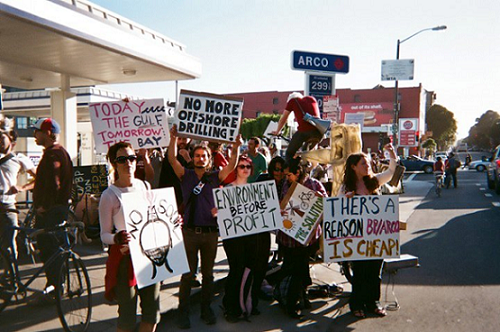
Proposition 23, bankrolled by out-of-state oil interests, threatens to reverse California’s environmental progress by suspending its landmark climate change legislation,  Assembly Bill 32. Titled the Global Warming Solutions Act, AB32 would place enforceable limits on major polluters and spur the creation of green businesses. But if voters approve Prop. 23, progress on transitioning to clean energy could be stalled for decades. The Guardian published in-depth coverage of Prop. 23 in the Oct. 13 issue.

A broad coalition of big green organizations, green-business associations, and others has formed to oppose Prop. 23 — but some of the most inspiring efforts have emerged from a coalition of environmental-justice advocates who are tapping their own creative genius to get the message out.

Hip hop artists Braelan B and Gammaray of the Los Angeles-based Beatrock Music label spearheaded the creation of a No on Prop 23 song, in collaboration with Otayo Dubb and T-Know (both of CounterParts with Braelan B and Gammaray), and artists Nomi of Power Struggle, Somos One of BRWN BFLO, and Damn Pete of Think Tank. Have a listen:

http://www.youtube.com/watch?v=QCR4QF7w7Aw

Braelan B told the Guardian that the artists were inspired by the efforts of Communities United Against Prop 23 — a coalition of environmental-justice organizations that is highlighting the impact the ballot measure would have on communities of color — as well as a voter-mobilization effort called the Clean Energy Tour, and the California Students Sustainability Coalition (CSSC), which is seeking online pledges for “no” votes against Prop. 23. Also known as Braelan Murray, he also serves as communications director at the Greenlining Institute, which is part of Communities United.

“We’re trying to use music as a catalyst,” he explained. “The youth vote and the of-color vote are really the swing votes.” To launch the music project, he said, “I just sort of got on the phone and said, California’s under attack, and I really want to send a strong message.” The idea caught on, and the YouTube video featuring the song already has more than 1,000 hits.

Meanwhile, Green for All has released a YouTube video about Prop. 23 set to the tune of the Beastie Boys’ “Sabotage,” featuring some rather hilarious oily cowboys smoking cigars and clutching fistfuls of money. Check it out:

http://www.youtube.com/watch?v=lCdTHrtU12Y

Erotic Exotic Ball putting its clothes back on

9

It’s a dark day for voyeurs of Dutch fetish models, mini Michael Jacksons, and lovers of spectacular: Exotic Erotic Ball and Expo 2010 has been canceled. The reason for the kibosh on this 31-year old SF tradition? Not as many people trying to get freaky this year. This from Exotic Erotic PR perv, Christopher Buttner:

The producers site a drop in ticket sales during the pivotal final days leading up to the event, plus unexpected cost overruns, [and] operational issues as the causes for cancellation. More details will be forthcoming shortly. 

The producers would like to extend their heartfelt thanks and gratitude to the contractors and entertainers who worked so hard to try and make this year’s Ball an extraordinary experience. In addition, they deeply regret causing any disappointment to those fans who have enjoyed attending the Ball as a source of entertainment and celebration of personal freedom for the past 30 years.

So maybe Ticketmaster wasn’t responsible for past years of the event’s disappointing ticket sales after all… But hey! Don’t let your whips and tassels droop, this is still the smut capital of America — we’ve got plenty more sexy events to get you through this wicked, wicked week. Wait — does this mean would-be EEB performer Ancilia Tilia needs a date this weekend? Get on that.


Ignoring Cheney’s real victims

0

Dick Meister. former labor editor of the SF Chronicle and KQED-TV Newsroom, has covered labor and politics for a half century. Contact him through his website, www.dickmeistersf.com, which includes more than 250 of his columns.


So, as the Washington Post ‘s Paul Farhi reported recently, hunter Harry Whittington is still suffering from the effects of  being shot accidentally by hunting partner Dick Cheney in Texas four years ago.

I’m sure we’re all sorry about that, about how Whittington still has the lead pellet that pierced his larynx when the then-vice president swung around abruptly and fired away at a flight of quail. We’re of course sorry, too, about the 30 or so other pieces of shot still inside Whittington out of some 200 that slammed him, and the scars he bears.

 “I was lucky,” Whittington told Farhi, “I just feel every day ‘s a gift. Sometimes I wonder why I got those extra years.”

But what of the real victims? What of the defenseless quail that Cheney, Washington and two friends were stalking with a clear and undisguised intent to kill?

At least one quail was saved when Dead Eye Dick hit Whittington while aiming for a bird, and there was a bit of poetic justice since Whittington was struck as he was returning from retrieving a quail he had killed.

But no one bothered reporting how many other birds had been killed. After all, they were inferior beings raised for the amusement of Cheney and others who get their kicks stalking and killing fellow creatures.

Cheney’s been at it a long time, targeting ducks, pheasants and other birds as well as quail, in company with such other conservative favorites as Supreme Court Justice Antonin Scalia and former President George W. Bush.

Although apparently not as skilled and frequent a hunter as Cheney, Bush has managed to bring down a few winged creatures himself, most notably during his New Year’s holiday in Texas a few years back., Bush, who modestly declared that “I’m not that good a shot,” managed to down five quail. He said that “was a lot of fun.”
 
Bush praised the owner of the area in which the hunt took place for maintaining the land as a good habitat, not because it benefited the birds, of course, but because  – like the Texas farm where Cheney was hunting – it provided easy targets for hunters who wished to kill birds.

There are more than 20 million “sportsmen” like Bush and Cheney who find it fun to prey on innocent birds and animals.

The number of “sportsmen” has declined in recent years, thanks to anti-gun sentiment, urbanization, the animal rights movement, availability of a broad range of other leisure activities, heightened environmental awareness and the increasing cost of hunting equipment,

But there are still far too many people searching the countryside for winged and four-legged victims. What’s more, manufacturers of guns and other hunting gear have greatly intensified efforts to increase their number. So have state fish and game departments, which rely on hunters’ license fees to cover much of their operational costs.

Hunters and their defenders argue that, although the hunters’ targets are too dumb to realize it, hunting actually benefits them by “thinning the herds” and thus keeping them from starvation. But though there’s no doubt that reducing or at least relocating some animal populations may be necessary for their survival, there are civilized ways to do it.

Once, long ago, we had to hunt and kill in order to survive. But this is the 21st century. It’s outrageous that leaders and citizens of the world’s most powerful and influential nation, one that presumes to be the role model for all others, find it amusing to engage in the barbarity of killing for sport.

Invariably, when I address this subject, people come back at me complaining that I just don’t understand that some people need to hunt animals to help feed their families.

I understand. But that’s another matter entirely. I’m writing about the vast majority of hunters who hunt and kill their fellow animals, not for food, but for the fun of it. To me, that seems a sick thing to do.

 Let me repeat: It’s killing for the sport of it that should disturb us all. It’s not just the bird and animal targets that need protecting. Think of the message that’s being delivered to the rest of us. It’s a message, as animal rights activist Jamie Kemsey noted, “that it is acceptable to commit an act of violence and take innocent life simply for the fun of it. In these violent times we cannot afford, under any circumstances, to condone such morally bankrupt actions.”

Dick Meister. former labor editor of the SF Chronicle and KQED-TV Newsroom, has covered labor and politics for a half century. Contact him through his website, www.dickmeistersf.com, which includes more than 250 of his columns.

Appetite: Del Maguey and the glories of mezcal

1

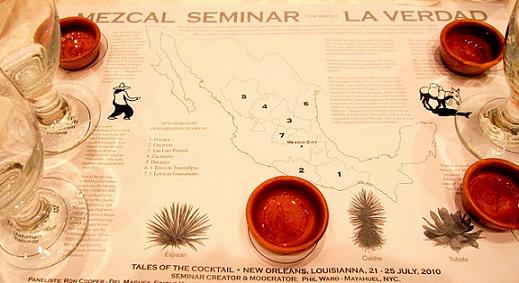
There’s mezcal and there’s Del Maguey. You may have heard me talk about Del Maguey mezcals and the line’s founder, Ron Cooper, in the past. A session with the gentle yet passionate Ron (like his mezcal seminar at 2010 Tales of the Cocktail) is an experience you’re not likely to soon forget. Even the way he describes fermentation stays with you: “wild creatures eating sugar, farting carbon dioxide, pissing alcohol!”

I’m leaving for Mexico next week, so sipping Del Maguey was getting me in the south of the border mood — even though I’m going to Tequila vs. Oaxaca, where most mezcal is produced. For the unfamiliar, mezcal is a spirit made from the heart (piña) of the maguey, an agave plant native to Mexico. Piñas are roasted underground, giving mezcal its distinctive smoky properties. Mezcal is the peaty scotch of tequila, which by definition is a mezcal made specifically from blue agave in Tequila, Mexico.

One thing I learned in Ron’s seminar is that traditionally, mezcal was rarely oak-aged for any length of time — more aged mezcals are being produced purely to gain in competing markets. Similar to tequila, mezcal styles include joven (literally “young,” and in this case referring to a silver liquor); blanco (white), which must be bottled within 2 months; reposado (rested), which ages 2-12 months in oak; anejo (mellow), aged a minimum of 1 year in oak; and the rare Pechuga (chicken breast), which can be triple-distilled with everything from fruits, nuts, white rice, to, yes, chicken.

Mezcal is usually drunk neat and you’ll find many in the Del Maguey line available by the shot at Nopalito. Places like Oakland’s Tamarindo Antojeria, with their new tequila bar, Miel, serve cocktails like the Mezcalito – ($12) with Del Maguey’s Creme de Mezcal, fresh orange and volcanic salt rim.

I’ve had the privilege of tasting most Del Maguey mezcals, each one a revelation. Here’s a few recommendations (available locally at Cask and K&L Wine Merchants):

Chichicapa, ($69.99) –  After multiple tastings, this may be my favorite for all-around balance. It marries the best elements of smooth smokiness with citrus. Despite a surprisingly light nose, there’s spice, chocolate, even mint on the finish. It reminds me of a fine coffee mole: succulent, spiced, earthy.

Crema de Mezcal ($39.99) – One of the more affordable in the line, this single village mezcal is made from unfermented agave syrup collected during roasting and exhibits a smoky, earthy sweetness with creamy texture. Works as a great introduction to mezcal for the uninitiated.

Mezcal Vida ($38.99) – Newer in the line, the Vida is another fine intro to mezcal: a pure, straightforward expression. Produced according to 400-year tradition with nothing but the agave heart and water, it’s bright with notes of fruit and sweet grass.

Tobala ($119.99) – Tobalá is a sophisticated level of mezcal, taking around eight Tobala piñas (hearts) to equal one piña from the most common maguey plants. Though fruity on the nose, the taste is elemental… smoke intermingles with tropical fruits and dusty cinnamon, with a long, smooth finish.

Minero ($69.99) – From the tiny village of Santa Catarina Minas, this mezcal is double-distilled, giving it greater smoothness with a floral essence tasting of warm honey and fig.

Santo Domingo Albarradas ($69.99) – Citrus and roasted pear combine with wood for a clean, dry mouth feel.

San Luis del Rio ($79.99) – Spice, fruit and ubiquitous smoke hit you on the nose, but there’s mineral citrus and volcanic earth inherent in this recent release produced two hours south of Oaxaca.

Pechuga ($200.00) – Pechuga starts with a double-distilled Minero base, to which 25 pounds of wild mountain apples, plums, red plantain bananas, pineapples, almonds and a few pounds of uncooked white rice are added to each 75 liters of mezcal for distillation round three. Though there is no taste of chicken, a whole chicken breast (minus the skin) has its excess oil removed while cleaned in water, then is hung over the still for a day while spirituous vapors condense into a clear liquid that drips from the bird into the mezcal. With intense citrus on the nose, this fruity spirit evokes earth but is a bright counterpart to the smoky, rocky soil of other mezcals. All that fruit imparts a robust fall glow by way of a gentle spring.

Subscribe to Virgina’s twice-monthly newsletter on SF’s hottest tastes and tipples, The Perfect Spot


Hold onto yer Wiggs, change comin’ to Western Addy

0

Morgan Fitzgibbons isn’t thinking small when it comes to goals for his Western Addition sustainability group, the Wigg Party. “We want to make our community a leader in the transformation in resilience,” he tells me during our coffee date to discuss the group’s upcoming anti-boycott “carrotmob” at Matching Half Cafe (Sat/23). 

It’s no coincidence that his language sounds a little new age-y. The basis for Fitzgibbons’ vision for the Wigglers seems grounded in the PhD of Philosopy, Cosmology, and Consciousness he received at California Institute for Integral Studies. “We’re these sacred beings,” he tells me earnestly of his San Francisco community. “This is a sacred movement – I want people to look back in a hundred years and see that.”

Woo-woo? Well yeah, but hold your jaded mutterings until you hear what the guy’s done with his convictions in “cosmological evolution,” as he puts it. Fitzgibbons has assembled a core group of Western Addition residents who operate in four different arenas of turning the area around SF’s “Wiggle” (the well-trafficked bike route through the Panhandle and between the hills in Lower Haight and Duboce Triangle) into a leader in scaled-back, neighborhood-focused living.

Bicycling barristers: Morgan Fitzgibbons and Wigger Dave Bryson on a city-wide urban farms bike tour. Photo by Jenny Sherman

Their areas of attack, you ask? There’s a sustainable business group, who works on incentives for local outfits that find ways of greening their ways. For example, this Saturday’s carrotmob (you can read more about the nationally recognized concept here) is a concentrated effort to storm Matching Half’s doors with business in support of their pledge to buy a bike trailer to transport farmer’s market-purchased goods, switch to organic milk, and chuck the plastic wrap for reusable food containers. 

There’s also a local food group who works with local markets to freecycle unpurchased produce at the neighborhood’s Hayes Valley Farm, a “rescaling” group focusing on ways to limit commercial consumption, and the Wiggle Transformers, who are collaborating with the SF Bike Coalition on the Wiggle portion of their Connecting the City Initiative, a comprehensive plan to improve bike passage throughout San Francisco.

Like I said, comprehensive. And most of the core group – which Fitzgibbons pegs at around 20 party members – are under 30 years old. Which is neat-o, and most likely made possible by the group’s party ethos when it comes to fighting for what they believe. I mean, I say fighting but I think I really mean loving, or something equally hippie. A bunch of them live in a place called the Sunshine Castle, for god’s sakes, where they throw “shenanigans” (according to Fitzgibbons) after-parties for their events, like the recent 10/10/10 day of action that saw the Wigglers conduct a 50-60 person bike tour of the city’s urban farms and a coordinated garden plant in collaboration with Kitchen Garden SF

In the works are plans for a Bernal Bucks-esque local currency, which the group hopes will inspire Western Addition residents to patronize more heavily the wealth of small businesses along the Divisadero Corridor and surrounding areas (holler, happy hour at Bean Bag). 

Fitzgibbons says the hyper-localism of the Wigg Party is perfectly suited for the history and relative youth of the Western Addition neighborhood.

The Wiggle itself provides a apt symbol for the group. The Wiggle Transformers’ work is making bike traffic better for everybody, but also a physical passage that Fitzgibbons hopes will say “you’re stepping into a different place now” to bikers entering the Western Addition.

“San Francisco has always been a seed of revolution,” he reflects. “Of the younger neighborhoods – the Mission and Western Addition – Western Addition is a lot less nihilistic. With University of San Francisco near the area, there’s always going to be a lot of young people living out here, and that’s who our message resonates with. It’s such a new community.”

This last comment raises a red flag in my mind. The parties, the bike tours, it all sounds grand, but given that all this is coming from a twenty-something guy with a complicated mullet and a hoody, how much does the Wigg Party truly represent the Western Addition, an area that’s been wracked by recurring waves of gentrification and is subject, like everywhere else in the city these days, to ever-increasing rent prices and displacement of long time residents? Despite the free food at Hayes Valley, are we being sustainable, or are we being hipster-sustainable? 

“To be a truly successful movement, we’ll have to organize everybody,” Fitzgibbons says, who himself has lived in the neighborhood for three years. Among those that regularly attend Wigg meetings, there is but one long-time resident, he tells me, who plays an active role advising on how to better integrate with the neighborhood’s ongoing goals and activities. Past that, “there’s tacit support among the long-term residents, and we get a lot of family participation in our Wiggle events,” Fitzgibbons tells me.

But I trust that he’s learning as he goes. After all, in explaining his philosophy on activism to me, Fitzgibbons appropriates that sustainability champion himself: Socrates. “The only thing I know is I don’t know everything,” he smiles. “We don’t have to have all the t’s crossed and i’s dotted, but we can whip up excitement and hopefully inspire people to do this in their communities. Create that showcase.” And if figuring it all out looks like a party in the streets, sayeth the Wigglers, so be it. 

Wigg Party Carrotmob

Matching Half Cafe

Sat/23 3-6 p.m., free

1799 McAllister, SF

www.wiggparty.org


Appetite: Three beef sandwiches that get it right

0

In today’s Appetite installation, Virginia Miller ranged near and far (in a fabulous pair of vintage pumps, as is her wont) in search of the meatiest hunk of sandwich available for hungry city souls. Sink your teeth into one while watching your — cross your fingers — new league champion baseball team. Go Gigantes! 

1. Deli Board’s Boca 

You’ll do a double take when arriving at the address given for SoMa’s Deli Board. The window is lined with butcher paper, giving the place an under-construction look. Per building owner’s rules, you can’t even step inside the entrance of the building but must wait on the sidewalk to get your sandwich, soup, or salad. But once you do, Deli Board’s friendly staff ensures that you get a sandwich hot off the grill, freshly made within the last few minutes. Their Boca sandwich ($9) is a triple beef threat with brisket, corned beef, pastrami, delicately sliced in a sweet French roll with Muenster cheese, pickles and brown mustard. Though I could have used more of their “board sauce”, the beef is perfection, melting warm in my mouth: feathery light, yet dense and meaty with a radiant, multi-color meat ranging from pink to brown.

1080 Howard Street, SF

(415) 552-7687

www.deliboardsf.com

Deli Board’s three-beef bomb, the Boca Source. Photo by Virginia Miller

2. Refuge’s roast brisket of beef

The famed pastrami sandwich at San Carlos Belgian beer bar and sandwich-burger joint, The Refuge, deserves the accolades. But equally worthy is their roast brisket of beef ($12). The beef is layered on warm bread in tangy sweet Carolina-style sauce with a lather of horseradish cream to give the already addictive beef even more lusciousness.

963 Laurel Street, San Carlos 

(650) 598-981

www.refugesc.com


3. Sycamore’s roast beef sandwich

Sycamore is a cozy little cafe on Mission Street, the kind of neighborhood joint where quality beers, wines, happy hour prices and sliders (I like the BLT slider) keep you coming back. But the real highlight is Sycamore’s famous roast beef sandwich ($8) on grocery store-reminiscent sesame buns with BBQ sauce and mayo, a sandwich that pays tribute to the roots of native Bostonian owners. The beef is pink, thinly sliced, soft but hearty, and dissolves in your mouth. Eating it makes me feel like a kid again.

2140 Mission, SF

(415) 252-7704

www.thesycamoresf.com


Inside Iran: journalist Houshang Asadi reads in Berkeley tonight

0

Iran’s authoritarian regime still gets away with locking up artists and intellectuals for their opinions. (The renowned Iranian filmmaker Jafar Panahi spent three months in prison this year for speaking his mind in public.) The contours of this system of political persecution come to the fore in the most personal and riveting of terms as longtime Iranian dissident, journalist, and author Houshang Asadi talks about (and reads from) his new memoir, Letters to My Torturer: Love, Revolution, and Imprisonment in Iran, in conversation with journalist and author Jonathan Curiel (Al’ America: Travels Through America’s Arab and Islamic Roots) at Berkeley Arts and Letters. The event is co-sponsored by the National Iranian American Council, Amnesty International, the Center for Middle Eastern Studies, and the Graduate School of Journalism at UC Berkeley.

Asadi, who as a committed journalist had faced arrest and repression under the Shah, was arrested in 1983 under the then-new Islamic Republic in a wave of repression against opposing political parties and speech. He spent a harrowing and deeply scarring six years in prison, two of those in solitary confinement. His eye-opening and moving memoir, detailing conditions inside Iran’s penal and justice systems for himself and other political prisoners, chronicles a crucial period in recent Iranian history with inescapable relevance for today. Told in epistolary form, the memoir highlights the perverse relationship with Asadi’s torturer while in prison, “Brother Hamid,” now an ambassador for Iran.

Asadi, who among much else was for a time the editor of leading Iranian film magazine Gozaresh-e-Film (Film Report), has lived in exile in France since 2003. You can find more information about the new book at his website.

Thurs/21

7:30 p.m., $6-15

Hillside Club

2286 Cedar, Berk

1-800-838-3006

http://berkeleyarts.org/

Street Threads: Look of the Day

2

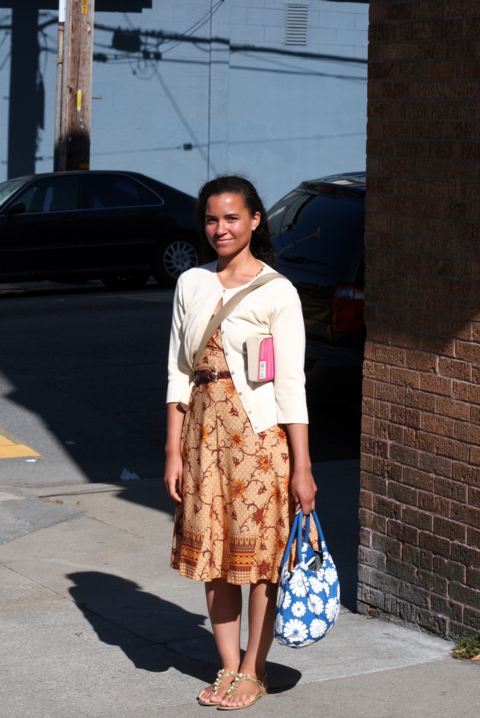
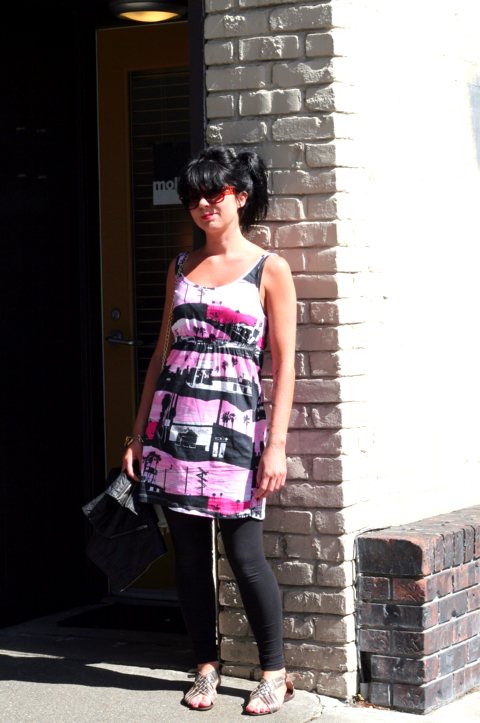
Today’s look: Sarah, Turk and Scott

Tell us about your look: “Buy used Goodwill and Thrift Town.”

SFBG Rado: Fuck the FCC

4

In today’s episode, we ask: What the fuck is up with the FCC — and who really cares these days what language you use on broadcast radio? Check it out after the jump.

sfbgradi10202010 by endorsements2010

Right back atcha, Big Brother

1

I’ve been dabbling in dystopia of late. A little Year of the Flood by Margaret Atwood, a little Brazil (1985) and bam! I’m up to my ears in fears of bureaucracy and government subterfuge and omnipresence – as if that’s a new thing. 

But on the real, it is a bit discomfiting, the similarities between our culture’s visions of the fall. This discomfort sharpens with “black sites” researcher Trevor Paglen‘s monograph Invisible: Covert Operations and Classified Landscapes (Aperture), an eerie book of photos and artifacts that acts like a show-and-tell of why we can’t trust The Man to level with us. Paglen will be presenting it at City Lights – those anarchos, of course! – Thurs/21.

“There are many kinds of invisibility. There is the invisibility of what is so taken for granted that few see it, the custom of the country, the water in which the fish swim. Thus to perceive that the U.S. is an empire on a permanent wartime basis is to be alien to, or become alienated from, the mainstream.”

So says writer Rebecca Solnit in her introduction to Invisible, which happens to be an excellent sourcebook for those wishing to be party to this alienation themselves. The book is a product of years of research on the part of Paglen, and is mainly comprised of photos he managed to take of things we are not supposed to see, like massive bunkers in the desert and streaking surveillance objects in the night sky. Though the photos – some taken from miles away, using high grade camera surveillance equipment – that Paglen has assembled of classified military compounds in the deserts of Southwestern United States are disturbing, what really got to me in his monograph were the badges. 

What in the god damn god damn? From left, military patches from an unknown mission, the Desert Prowler program, and the 1990s launch of an intelligent spacecraft. From Trevor Paglen’s Invisible: Covert Operations and Classified Landscapes

A freaky-weird Illuminati eye shooting lightning bolts. A dragon wrapping its scaly body around a globe. Inexplicable star patterns. These are the images created for the insignia patches worn by personnel of our government’s top secret missions. Sure, we know a little bit about them – a woman’s golden umbrella is explained by Paglen to be a symbol for the gold plate satellite systems that a particular mission helped to install – but for the main part they seem to use American English to speak a language that the rest of us aren’t aware of. 

A world supported by taxpayers, yet not seen by them. It’s for our safety, right? Again, Solnit: “If war is an act of violence to compel others to do our will, you can speculate on how the American people have been essentially subjugated by the war economy to keep paying for it.”

Seen in this way, the research that Paglen does seems to be a form of liberation. Hours spent in libraries (some with SFBG contributor A.C. Thompson at his side) have yielded passports that show people that are not people – CIA operatives, in fact, charged with the disappearance of terror suspects. 

There are long exposure photos of classified satellites tearing through the sky. Some of these are quite lovely, a craggy, water-surrounded peak in one under a phalanx of light diagonal streaks in the sky above. There’s nothing lovely though, about the fact that amateur astronomer network The Other Night Sky (of which Paglen is a part) has identified almost two hundred secretly-purposed objects in our atmosphere, placed there by our government for reasons that surely have to do with eminent safety matters. Right?

This was the dillemma presented by Invisible. Meaning: if these things are indeed so ubiquitous and codified – water and war, in Solnit’s example — are they normal? Should we be worried? Should we all take to the hills of Nevada with a backpack full of digital cameras and squint mightily past lines of no-entry?

Maybe we’ll depend on Paglen to do it for the moment. And, of course, look at his photo books. 

Trevor Paglen: Invisible: Covert Operations and Classified Landscapes

Thur/21 7 p.m., free

City Lights Bookstore

261 Columbus, SF

(415) 362-8193

www.citylights.com


Hot sexy events October 20-26

0

You thought the real Halloween parties started next weekend? Ha! Wrong on two counts.

For one, you’re in San Francisco, so you know this is gonna be a ghoul gala that leaks out into the preceding and following weeks, if not months. Two, the portal to the other world opens the 22nd, not the 31st! (silly) Luckily, you have your deranged BDSM maniacs at the SF Citadel to remind you of the fact with Chamber of Horrors. For those together enough to have assembled their monster ‘fit early, a swell party to play out this journey into another realm where “the gods of old reach out from their dark place,” according to the press release. After all, what better place to witness the chaos that will ensue than a good old-fashioned dungeon? Whips at the ready, there’s gonna be evil spirits to subdue.

Air Sex Championships

Will this be sexy? Will you learn anything from a passel of performers humping the air, licking the air, squeezing the air’s titties? This grand tradition was started by a Japanese chap bereft of solid human beings to sex up. Now people across the world pretend, solo, on-stage, to being sexing – with clothes on. But will it… turn you on? For now, let’s file under maybe, but the event warrants exploration.

Wed/20 8 p.m., $15

The Independent

628 Divisadero, SF

(415) 771-1421

www.theindependentsf.com


Anal Pleasure for Couples

Honey a little wary of rear entry? Best to leave some things to the experts. Reassure them that nothing but good will befall them at this class with Lolo Winters, sex educator, who’ll be teaching on toys, position, and pleasure. Open to all genders and orientations.

Wed/20 6-8 p.m., $20-$25

Good Vibrations

1620 Polk, SF

(415) 354-0500

www.goodvibes.com


Chamber of Horrors

Hobgoblins and naughty, naughty night horrors reign at this dungeon play party. Get the Halloween heebie-jeebies started early and get in touch with your evil side. 

Fri/22 8 p.m., $25

SF Citadel 

1277 Mission, SF

(415) 626-1746

www.sfcitadel.org


Steamworks Full Moon Party

Steamworks launches a new play party! How’s it going to be different from their standard showers ‘n’ sex-a-thon? DJs? A $5 off discount when you tell them about the ad on their website? Sexy full moon graphics on the flier? Does it really matter – you’re getting laid!

Fri/22-Sat/23 8 a.m., $17-55

Steamworks

2107 4th St., Berk.

(510) 845-8992

www.steamworksonline.com


Exotic Erotic Ball and Expo

Time for marabou, corsetry, and befeathered top hats! Exotic Erotic is back for its 31st year of SF-born and bred debauchery. This year the whole shebang is on the water at Craneway Pavilion and there will be porn star performers from across the globe (even a chance to make it with your favorite!), orgasmic bingo, the Family Stone on stage, and a slew of fine purveyors of lust capitalism at the accompanying EE Expo.

Expo: Fri/22 4 p.m.-midnight and Sat/23 noon-6 p.m., $20

Ball: Sat/23 8 p.m.-2 a.m., $79-169

Craneway Pavilion

1414 Harbour Way South, Richmond

www.exoticeroticball.com


Breast Workshop Fiesta

Because you know it’s breast cancer awareness month – why not make it breast awareness month? Talking of tricks with the titties, Femina Potens is holding a special night of boobies, starring busty starlets Maxine Holloway and Bella Rossi, whose proceeds go straight to Shanti’s Lifelines breast cancer program. Squeeze ’em, ladies. 

Mon/25 6 p.m., $7-$20 sliding scale

Femina Potens

2199 Market, SF

(415) 864-1558

www.feminapotens.org


Street Threads: Look of the Day

0

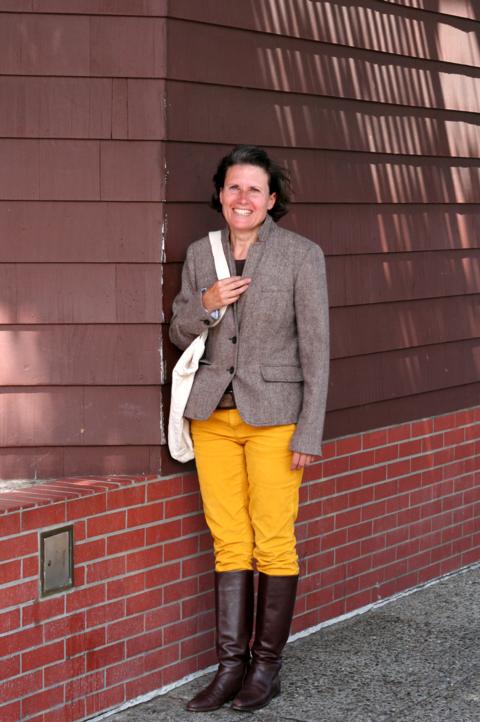
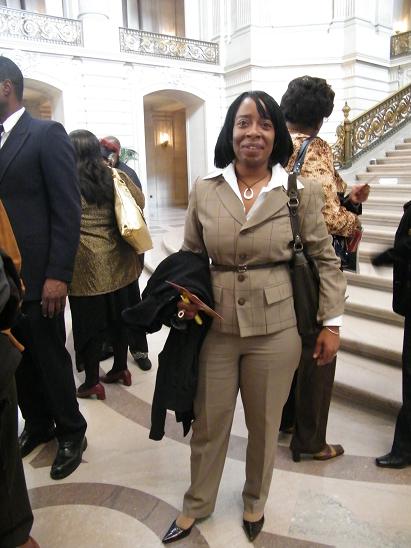
Today’s look: Wilma, 24th St. and Noe

Tell us about your look: “I’m European. The boots are Italian. These are cheap Gap pants.”

The Performant: The accidental tourist

0

Intrepid travelers always get a bit of a bee in their bonnet when you mistake them for tourists, but tourism doesn’t have to be a dirty word. All it really means is the act of traveling for recreational purposes and as such, can be applied to even the smallest of pleasurable jaunts. Saturday morning, I went on a tour—replete with guides, maps, wristbands, a short jaunt by MUNI train, and a chaos (as opposed to a gaggle or a horde) of dancers. Yes, it was the 7th annual San Francisco Trolley Dances, and this year’s chosen line was the N-Judah.

There’s nothing affected about the workaday N, the busiest line of the Metro system, and you wouldn’t normally find a whole embarrassment (as opposed to a herd or a murder) of art-loving tourists hanging out on it, but there we were. Chatty, consolidated, in motion: heading chummily from Duboce Park to Golden Gate.

At the Harvey Milk Recreational Arts Center, the pink and blue garments of the celestially-clad Sunset Recreation Center Chinese Folk Dance Group, the cotton-candyesque pouffs of pink afro wigs worn by the Joe Goode Performance Group, and the shiny red bullseye of a large round suitcase passed around by the performers of Christine Bonansea’s 2 x 3 project, all caught the eye, while the dexterity of the dancers further held the attention.

After hopping the N-Judah and trundling en masse to 9’th and Irving, our tour guide, Mike, promised us some wildlife—and there she was, behind the display window of Osso and Co, a lady (Phaedra Ana Jones) dressed like a leopard, dancing fluidly with an acrylic “crystal” ball.

Arriving at the Botanical Garden, we trooped through the gate to watch pieces choreographed by Sara Shelton Mann, and Japanese folk dance troupe, Ensohza Minyoshu. But the pièce de résistance was Epiphany Production’s contribution “Sonic Dance Theatre”, whose grand yet playful vision took over an entire meadow with Hank Williams songs and gospel lullabies, taffeta skirts, masked wildlife, a didgeridoo, a bride, a ballerina, and an make-believe picnic.

If you’re traveling for work but your work is a pleasure, does that make you a tourist? I wish I’d thought to ask Lynda Barry that when I chatted her up at APE after her spirited presentation of her brand-new Drawn and Quarterly book: Picture This, The Near-sighted Monkey Book. Comics scribes are often fairly introverted individuals (go figure) and their presentations can be rather stilted affairs, but Barry is a natural bon vivant, and her anecdote about trying to pick up cute guys at the Uffizi Gallery in Florence by weeping in front of Botticelli’s Birth of Venus had us in stitches.

The Near-Sighted Monkey Book (sub-subtitle: Learn How to Art) is a guide to creating visual art—a sequel of sorts to What It Is (Drawn and Quarterly, 2008) which was about writing. If all goes well, maybe in the future we can expect a third book on public speaking, because on that particular subject, Barry has plenty to teach.


Newsom could be headed for victory

11

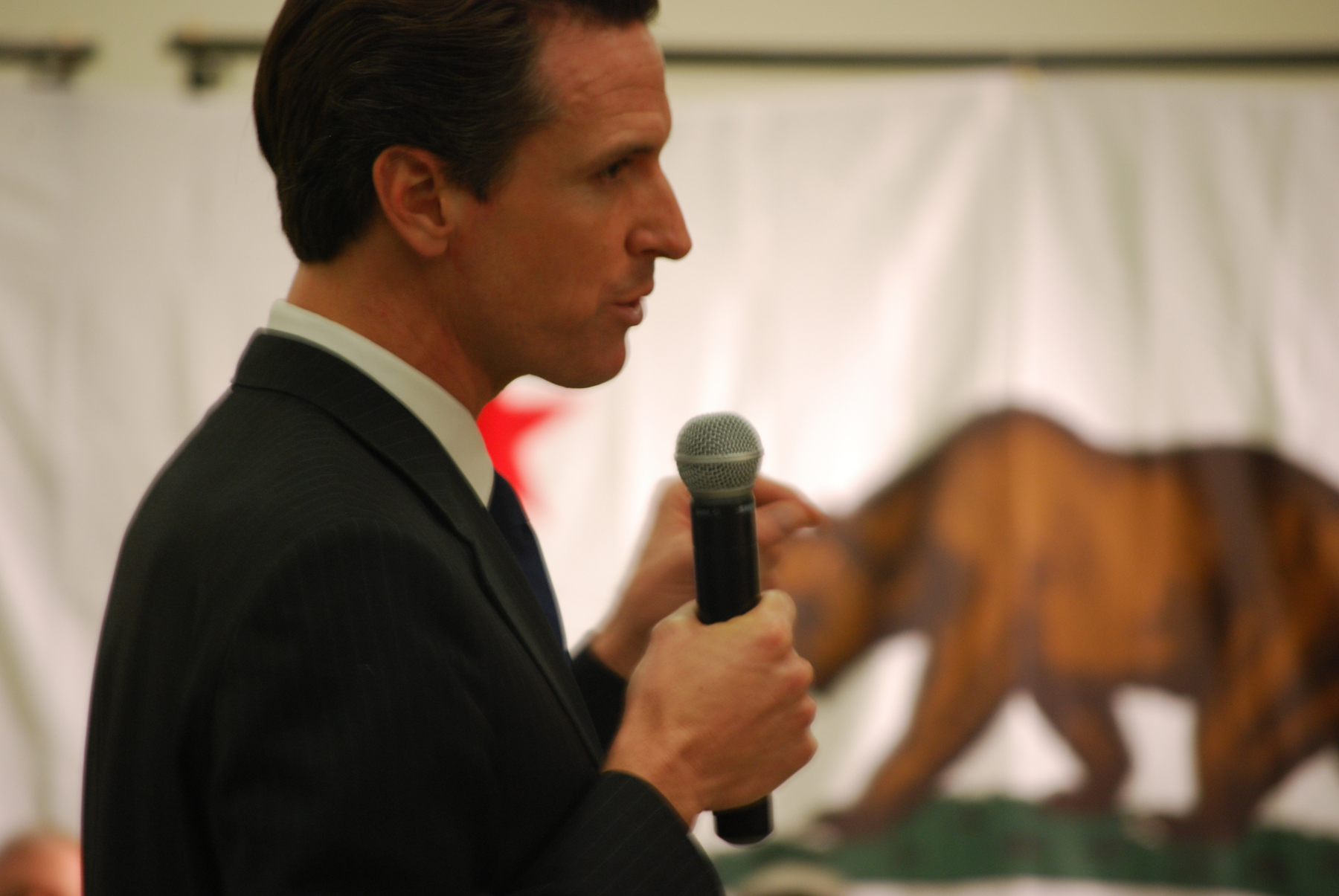
Gavin Newsom seems poised to win his race for lieutenant governor, at least as indicated by his opponent Abel Maldonado’s increasingly desperate campaign tactics and Newsom’s string of newspaper endorsements, including the Spanish language La Opinion, which chose to pass over a moderate Latino that it has endorsed in the past. The only question now is voter turnout, and whether Newsom’s negatives would be enough to drag him down if the Democratic base stays home in this lackluster election.

In its endorsement in Sunday’s paper, La Opinion wrote, “We are deeply disappointed that in this election [Maldonado] has opted for an opportunistic strategy of using images of undocumented criminals to earn political points. This is unacceptable and his charges against Newsom on this issue are inaccurate.” The reference was to Maldonado’s wild charges in an Oct. 15 debate that Newsom created San Francisco’s sanctuary city policies and was responsible for the fatal shootings of Bologna family members, allegedly by an undocumented immigrant who had once been in city custody. The reality was that Newsom inherited the sanctuary city policy and unilaterally weakened it after the Bologna shooting, even refusing to implement legislation approved by the Board of Supervisors (which Newsom vetoed but the board overrode) to require due process before those arrested are turned over to the feds for possible deportation.

While the paper didn’t seem to understand that Newsom has snubbed his nose at San Francisco progressives and petulantly fed a particularly divisive style of politics here, they do rightfully give him credit for running a complicated city, unlike the conservative city of Santa Maria where Maldonado was mayor and always did the bidding of the Chamber of Commerce, something I observed while working at the Santa Maria Times at the time. “The Democratic candidate has implemented solid, progressive management while leading a diverse city during a deep budget crisis. Newsom has proven to be creative, resourceful, and sensitive while forging alliances that improve the quality of life for his city’s residents,” La Opinion wrote. 

Then yesterday, as the Los Angeles Times reports on its blog, when Newsom held a campaign event trumpeting his support by Latino leaders such as Los Angeles Mayor Antonio Villaraigosa and labor leader Dolores Huerta, Maldonado showed up and sat in the back with his advisers during the event. Now that’s just strange.

A California Democratic Party e-mail blast this afternoon used a series of rhetorical questions to describe the campaign’s episodes: “So was Maldonado’s bizarre behavior an egotistical attempt to intimidate other Latinos who came to the event to support Newsom? Does he feel entitled to the appointed position now that he actually has to compete for voters in a real election? Is he desperate for media attention? Or does he just enjoy being a spectator, watching his opponent secure key Latino endorsements while his own campaign falls apart?”

But the real question is whether Democrats can mobilize enough voters to overcome Newsom’s negatives, from his arrogance to his personal foibles. When I did a search for Gavin Newsom’s name on Yahoo, which automatically guesses what you’re asking for based on past queries, the first three that listed were “Gavin Newsom girlfriend,” “Gavin Newsom divorce,” and “Gavin Newsom affair,” an apparent reference to his admitted affair with Ruby Rippey Tourk, who worked for him and was married to his reelection campaign manager.

So, if you support Newsom for this office — or even if you’re just anxious for him to leave San Francisco a year before his mayoral term expires — don’t forget to get out there and vote.

Labor’s outreach

0

Dick Meister, former labor editor of the SF Chronicle and KQED-TV Newsroom, has covered labor and politics for a half-century. Contact him through his website, www.dickmeister.com, which includes more than 250 of his columns.

Never have the nation’s younger workers been more in need of unionization. And never have the nation’s unions been more in need of the membership growth that recruiting younger workers can bring them.

Here’s how it looks, and it’s not a pretty picture for labor: Last year, unions lost 10 percent of their members in private employment –  the biggest drop in more than 25 years.  That cut union membership by 834,000 workers, down to 15.7 million workers.

Which means that overall, counting public as well as private employment, unions now represent only a little more than 12 percent of the country’s workers. Just 20 years ago, 20 percent of all workers were unionized.

So, how can organized labor add significantly to its numbers and thus add significantly to labor’s political and economic strength.

The answer should be obvious, and it certainly is to union leaders: Sign up the younger workers aged 18 to 29 who are especially hurting economically. They need unions as much as unions need them.

A recent survey commissioned by the AFL-CIO shows that fully half of the young workers surveyed said they had only enough savings to cover their living expenses for two months should they become unemployed, as of course many workers of all ages have in recent months.

Many of the young surveyed also were concerned that whatever the jobs they find, they’ll do worse than workers of other generations have done when they retired.

Unions hope to attract such workers to their ranks in part with recent academic studies showing that unionized workers invariably do better than non-union workers when they retire and in virtually all other ways.  For instance, studies show that the average wage of unionized younger workers is about $15 an hour – more than 12 percent or about $1.75 an hour more than non-union workers of the same age.

 Forty percent of the unionized younger workers had employer-financed health care, while only 20 percent of those outside unions had such a benefit.

Whatever the occupation, and however they were measured, unionized younger workers did better – unionized men better than non-union men, unionized women better than non-union women, unionized African Americans and Latinos better than non-union workers in those categories.

Yet despite the obvious advantages of union membership that has brought better pay and benefits to the younger workers who’ve joined, younger workers generally have had the lowest unionization rate of any age group. Only about 7 percent are in unions.

But that could very well change. Other new studies indicate that the economic situation for younger workers is worsening, and that well over half the workers now say they hope to avoid that by unionizing. Joining a union would not only help them improve their own status and help reverse what’s been a steady decline in union strength. It also would bring new strength to union efforts in behalf of important social, economic and political reforms.

The AFL-CIO has established a program aimed at recruiting the younger members that its affiliated unions badly need – as badly as the younger workers need unions. And as badly as we need the benefits that a strong labor movement can bring to all of us, whatever our age.

Dick Meister, former labor editor of the SF Chronicle and KQED-TV Newsroom, has covered labor and politics for a half-century. Contact him through his website, www.dickmeister.com, which includes more than 250 of his columns.

SFBG Radio: No New Deal

5

In today’s episode, we discuss why Abama is not FDR, why he’s refusing to do what has to be done to put Americans to work — and why that’s his real political liability. Listen after the jump.

sfbgradio10/18/2010 by endorsements2010

Beat patrols: A case study

14

If you want a case study that illustrates why San Francisco needs Proposition M, taken a look at Bernal Heights.

In 2008, two people were killed at the Alemany public housing project, topping off a disturbing increase in street crime. Neighborhood activists responded by working successfully with the captain of the Ingleside Station to a beat cop on Cortland Ave. Crime dropped.

But several weeks ago, Captain Louis Cassanego cut that foot patrol, citing the need to reallocate scarce SFPD manpower to more violent areas.

We couldn’t reach Cassanego, but at an Oct. 6th Police Commission meeting, Chief George Gascon said the beat patrol fell victim to budget problems. He explained that a beat cop on Cortland wasn’t needed anymore because the policy “was set there at a time when there was an increase in robberies… in this community that is no longer there today.”

But comminity activists say that’s precisely the point: “When we got the beat cops, crime went down,” Joseph Smooke, executive director of the Bernal Heights Neighborhood Center, told us. In fact, Smooke said, the foot patrol reduced overall crime in the surrounding neighborhoods as well.

And now, with the foot patrols gone, residents fear that crime will rise again.

Supervisor David Campos, a coauthor of Prop M, told us: “It doesn’t make sense: the community wants more policing, not less. They rightly feel that we’re moving backwards, that something they worked very hard for is being taken away.”

Prop M would hamper future foot patrol cuts by requiring the Chief of Police to prescribe a comprehensive “Foot Beat Patrol Program” for all SFPD stations.

Says community organizer Buck Bagot, who volunteers with the Bernal Height Neighborhood Center, “It’s hard not to think [Prop M] makes sense.”

Prop M could also address what Bagot and Smooke agree is the larger problem: community-police synergy. Besides mandating foot patrols, Prop M would require the Police Commission to “adopt a comprehensive written policy on community policing,” including “a plan for… open communication… among [SFPD] personnel and community members,” with a focus on “neighborhood-specific policing priorities and strategies.”

In recent years Bernal Heights community groups have fallen somewhat out of step with local police. Communication with Ingleside Station has at times been strained. The station’s former captain, David Lazar, started a program in August of 2009 that alloowed merchants and residents to call cell phones that beat cops carried on duty. Cassanego ended that program, too.

Cassanego cut the Cortland Ave beat, he compensated by extending two bike patrol beats into that area. Though Bagot is skeptical that this will be effective, losing personal access to the police irks him most. “At least if we could talk with [the cops], we could work with them…. But if they’re not going to patrol there anymore, and we can’t call them on the cell phones, then we’re kind of floating free.”

The myth of the overpaid public employee

31

Lots of press — as there should be  — on the new UC Berkeley study that debunks the myth of the overpaid public employee. The Chron had a decent story this morning, The Bay Citizen, which has been reporting pretty heavily on high wages and pensions in the public sector, acknowledged the study today. It’s a pretty big deal: Since much of the poltics of 2010 seems to be about bashing public employees and complaining about bloated pensions, some hard reality — backed up with a sophisticated regression analysis — was badly needed.

And the study is prettty clear: public employee salaries and pensions are not the cause of California’s (or San Francisco’s) budget problems:

The Great Recession continues to leave a great deal of economic pain and scarring in its wake. But, the
vilification of government workers is sorely misplaced and has left the real culprits of this devastating
downturn off the hook. Compensation received by public sector employees is neither the cause—nor can
it be the solution—to the state’s financial problems. Only an economic recovery can begin to plug the hole
in the state’s budget. Unfortunately, the current budget balancing efforts in California are anti-simulative
and further act to depress demand in an economy already operating way below capacity. Budget cuts have
helped to keep California’s unemployment rate well into the double-digits for over a year and a half—and
there is no end in sight. Thousands of California public employees have lost their jobs and many more
have forgone pay through forced furloughs and their families have experience considerable pain and disruption.
All the workers who have lost their jobs or took cuts in pay or benefits were made to do so not
because of their work performance, or because their services were no longer needed, nor because they were
overpaid. They were simply causalities among a list of millions of hard working innocent victims of a financial
system run amuck. Public sector workers help our communities to thrive and provide services that
make it worthwhile to live in them—it is wrong to blame them for the fallout from the greatest economic
downturn since the Great Depression. 

The study’s out in enough time to make a potential difference in the election — on both the state and the local level, attacks on public employees are driving major campaigns. Meg Whitman is all about tying Jerry Brown to those evil unions, and Prop.B, the measure to cut health care and pensions for city employees, is a wedge issue. A little logic shows that it’s not only misleading but factually wrong to blame the public-sector workers for the recession.

Avalos initiates LOCAL SF

5

Sups. John Avalos, Sophie Maxwell, David Campos and Board President David Chiu, plus community advocates, construction contractors, neighborhood leaders and union members rallied outside City Hall today to announce the launch of LOCAL SF, a campaign for local opportunities and hiring for San Francisco residents. 

And this afternoon, Avalos introduces the first measure of this campaign–legislation mandating local hiring on publicly funded construction projects.

Avalos’ local hiring legislation is a major departure from the city’s current First Source Program. In place for the past decade,First Source only requires contractors on publicly subsidized projects to show “good faith” efforts to meet a local hiring goal of 50 percent. 

By contrast, Avalos’ proposed legislation will require contractors to meet local hiring goals that will be phased in over the next few years.

“My legislation will ensure that San Franciscans have a guaranteed shot to work on the City’s public works projects and that the local dollars invested in public infrastructure be recycled back into San Francisco’s economy and local communities,” Avalos said in a press release,

Avalos’ introduction of this mandated local hiring legislation comes on the heels of a report from the the Mayor’s Office of Economic and Workforce Development that shows only a 20 percent local hire rate in 29 publicly-funded projects, despite the 50 percent local hiring goal and good faith efforts of the city’s First Source program.

Avalos says his local hiring legislation was developed over a series of stakeholders meetings with representatives from city agencies, the Mayor’s Office, labor and building trades, the environmental community, neighborhood advocates, contractors, local hiring advocates and unemployed workers, And he vows to keep this roundtable approach going, as his legislation moves forward.

“Over the next few weeks, I intend to keep a dialogue going with all of these stakeholders to strengthen the legislation as it moves through the legislative process,” Avalos said.
  
His legislation is scheduled to be heard in the Board’s Land Use and EconomicDevelopment Committee in November. And it comes not a moment too soon: with unemployment rates remaining high and major construction projects in the pipeline, it’s critical that city leaders ensure that any related work really benefits the local community.

Street Threads: Look of the Day

0

Today’s look: Jodi, Fillmore and Sacramento

Tell us about your look: “Whatever I feel good in, I wear.”

The Western is back! Final thoughts on TIFF ’10

0

When I interviewed director Kelly Reichardt at the 2008 Toronto Film Festival about her gut-wrenching masterpiece Wendy & Lucy (2008), she spoke of watching many old Westerns in preparation for her next project. She delivered the exquisite Meek’s Cutoff at the 2010 Toronto Film Festival. The film follows three families as they make their trek along the Oregon Trail circa 1845. As they follow their hired mountain man through the Cascade Mountains they start to question if their leader really knows where he is leading them. And when they come across a Cayuse American Indian, the emigrants are forced to question who to trust. While Wendy & Lucy seemed inspired by the Italian Neo-Realists Vittorio De Sica and Roberto Rossellini, Meek’s Cutoff draws upon cinema’s earliest documentaries, like Robert Flaherty’s Nanook of the North (1922).

Collaborator Jon Raymond, who also wrote Reichardt’s Old Joy (2006) and Wendy & Lucy, uncovered the infamous story of Meek’s Cutoff while doing local research in Oregon. The tale seems perfect for Reichardt’s distinctive visual storytelling by exploring humble characters who are confronting everyday troubles while taking a journey outside of their natural habitat. The striking style strips down her character’s actions and allows the viewer to feel the weight of each procedure. Since Reichardt emphasizes her camera over dialogue, the solitary result can culminate in a truly transcendental experience for a viewer, while for others (like at the press screening in Toronto) a long nap. Somehow the fact that a film can evoke such extreme yet internal reactions conjures up the cinema of Yasujiro Ozu and most recently, Claire Denis.
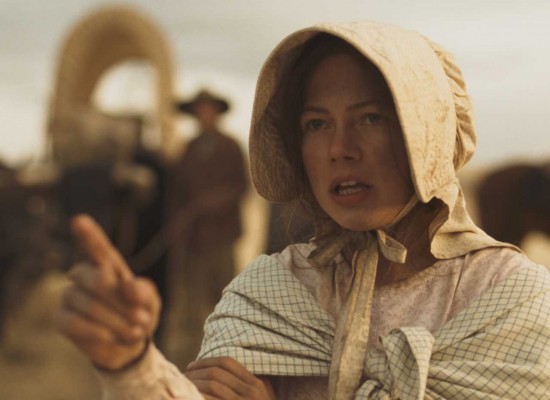
With the rare exception of William Wellman’s brutal epic Westward the Women (1951), based on a story by Frank Capra, Meek’s Cutoff offers one of few female points of view towards the migration of early pioneers. While researching for the film, Reichardt read many old diaries, which women mainly wrote during the time period. These diaries uncovered the immense loneliness that women felt, one of which found a wife writing she was keeping a diary in case her husband should ever want to know her. Michelle Williams (actress of the year with her combined profound performances in Derek Cianfrance’s Blue Valentine, Martin Scorsese’s Shutter Island, and now Meek’s Cutoff) leads the way even with very subtle and minimal interactions.

While Meek’s Cutoff contextualizes the misrepresentation of women in the Western, it also confronts how the American Indian has been misunderstood on the silver screen with a beautifully nuanced debut performance by Rod Rondeaux, whose prior credits are 35 films working as a stuntman in films like James Mangold’s 3:10 To Yuma (2007) and Chris Eyre’s Skins (2002). Yet, much like Wellman’s Westward the Women, the dynamics between characters feels very contrary to most other Westerns. Screenwriter Raymond explained at Toronto, “Instead of being clearly centered on the individual, the community is the main character, with all the tensions and contradictions inherent in any community.”  

The Western genre seems to have been overlooked this past couple of decades by younger audiences, in the mainstream as well as the art crowd. Yet with David Milch’s HBO series Deadwood (2004), John Hillcoat’s The Proposition (2005), Andrew Dominik’s The Assassination of Jesse James by the Coward Robert Ford (2007) and the Coen Brothers’ upcoming remake of True Grit (2010) hot on their heels of their Oscar-winning No Country For Old Men (2007), there seems to be something more complex in these revisionist films that attempt to revise any previous re-visioning. (Neo-Revisionism?) Are they allegories exposing our country’s 250 year confusion with “illegal” border crossings? Are they dissecting our current political transitions between administrations? Or are they just giving us a more realistic look at the individual pioneers who helped “settle” the Wild, Wild West? However you view it, Kelly Reichardt’s quiet, unassuming journey does so by being the best film of 2010. (The Pacific Film Archive is showcasing Kelly Reichardt with a retrospective November 11-13; Reichardt will appear in person.)

Top Eleven Films from The 2010 Toronto Film Festival

1. Meek’s Cutoff – Kelly Reichardt (USA)

2. Another Year – Mike Leigh (UK)

3. Hell Roaring Creek – Lucien Castaing-Taylor (USA)

4. A Useful Life – Federico Veiroj (Spain/Uruguay)

5. Boxing Gym – Frederick Wiseman (USA)

6. Leap Year – Michael Rowe (Mexico)

7. Kaboom! – Gregg Araki (USA)

8. The Illusionist – Sylvain Chomet (based on a Jacques Tati screenplay) (UK/France)

9. You Will Meet A Tall Dark Stranger – Woody Allen (UK)

10. Black Swan – Darren Aronofsky – (USA)

11. Essential Killing – Jerzy Skolimowski – (Poland)

Jesse Hawthorne Ficks is the Film History Coordinator at the Academy of Art University and programs MiDNiTES FOR MANiACS, a monthly series at the Castro Theatre that celebrates dismissed, underrated, and overlooked cinema.

District 10 endorsement madness

18

Both the Chronicle and Sophie Maxwell have now endorsed Lynette Sweet for supervisor, and I suppose I shouldn’t be surprised. But I am: I know the Chron and Maxwell don’t share my politics, but there are plenty of moderate, centrist candidates in D-10 who don’t have the real problems Lynette Sweet carries with her. The Chron’s a newspaper, sometimes a champion of open government; the folks there don’t care that Sweet seems to ignore the disclosure requirements that come with her current job on the BART Board?  Even when the Chron reported that she never disclosed the $120,000 she was paid by HMS Associates, a lobbying firm that represents many of the most powerful interests in the city? (Oh, and HMS Principal Marcia Smolens is one of Sweet’s top campaign donors.)


You’d think that would matter, particularly when there are alternatives. Apparently not.

Exotic Erotic’s 31st round

1

Perhaps you’ve seen them around town. The neon pink fliers announcing that SF’s most gloriously trashy tradition, the Exotic Erotic Ball and Expo, beckons saucily to you this weekend (Fri/22 and Sat/23). Were you curious about the providence of the posters’ graphic design, this just in from founder-behatted cartoon character Perry Mann: “we’re very aware that it’s breast cancer month.”

Well that would explain all the boob examiners! 2010 marks Mann’s 31st year of organized orgy, which nowadays draws in around 10,000 gawkers and pervs a year for onstage sex shows by world famous porn performers, elaborate fetish costuming, ribald entertainment (“we’ve got… orgasmic bingo? I don’t know what that is,” Mann admits to me on the phone), and surprisingly serious musical guests. Sort of. This year is the Family Stone, minus Sly. “We reached out to Sly,” Mann tells me. “If he can get off his crack pipe, he’ll show.”

Mann, who started the Ball famously as a fundraiser for buddy Louis Abolafia’s Nudist Party run at the presidency, has endured his fair share of setbacks in holding the event. A venue change under fractious circumstances (there’s been a few of them over the years associated with the ball, as the East Bay Express recently reported, including complaints that organizers withhold promised prizes from contest winners) has left the EEB with a venue that’s a touch more intimate than last year’s Cow Palace: the Craneway Pavilion, which has about 15 percent less capacity as the Cow. 

A consummate promoter, its difficult to get Mann off his press release script on the phone. We don’t chat about his assertions that disappointing ticket sales in years past were due to corrupted ticket-selling websites. We do, however, manage to cover event logistics. The Pavilion is basically a large glass box on the water, which is… less than ideal? ideal? for a show full of dedicated exhibitionists. The VIP section takes the aquatic escapade to another level: guests willing to pony up the $169 get to shiver their timbers on the San Francisco Belle, a riverboat whose very girth and heft seemed to impress Mann. 

This year’s VIP performance takes on occult themes – vampires being the sex gods of 2010 that they are. Those interested in taking the ticket price plunge can find a preview of events on the Belle at sex blogger (and performer that night), Fleur De Lis SF’s account of dress rehearsals.

And for the pervs off the A-list, don’t worry gang, Exotic Erotic is nothing if not democratically-inclined. In fact, big money’s on the random hallways and corners around Craneway to be where the real action’s at – but if you’re going for the canned stuff, the stages will play host to shows by Noname Jane, Dutch fetish model Ancilia Tilia, Eden Berlin, The Men of Exotica, and the Surreal SF Devil Girls.

Ready yet? Not til you’ve got your outfit, you’re not. The Ball has an anything-goes philosophy when it comes to, well, most things – and the motto definitely extends to sartorial affairs. Past attendees have rocked Bumblebee Transformer ‘fits, every possible form of lingerie — even, Mann tells me, a functioning bathtub that housed three friends for a night. 

“The whole event is about love, it’s really all about love,” says Mann, who himself will be rocking his customary top hat tricked out with “XXXI” in honor of the event’s 31st year spelled out in diamonds. Given his hopes that this year will correct a string of lackluster lust profiteering, his next comment should be a given. 

“Not real diamonds,” he clarifies. 


Exotic Erotic Ball and Expo

Expo: Fri/22 4 p.m.-midnight and Sat/23 noon-6 p.m., $20

Ball: Sat/23 8 p.m.-2 a.m., $79-169 

Craneway Pavilion

1414 Harbour Way South, Richmond

www.exoticeroticball.com