SFBG Blogs

Local metal review: Slough Feg’s “The Animal Spirits”

0

All good heavy metal strives to challenge the listener, pushing buttons and boundaries. Some of its most successful incarnations make people downright uncomfortable, achieving escalating extremes of tempo, tuning, and tone.

Slough Feg is one of San Francisco’s most unique underground bands, an honorific that stems directly from its unique approach to the challenge of challenging. Eschewing thrash’s BPM arms race, death metal’s knuckle-dragging celebration of “brutality,” and black metal’s dissonant, low-fi navel-gazing, the quartet (now two decades or, if you prefer, five drummers old) manages to discomfit with an unlikely tool: melody. New album The Animal Spirits was released Tues/26 on Profound Lore Records.

http://www.youtube.com/watch?v=1SJCdqguiyk

Bursting with major-scale chord changes, Celtic-folk influences, and vocal lines that make the tautological adjective “sing-song” suddenly useful, the band’s music is resolutely unlike anything you’ve ever heard before. Some of the heavy metal staples are present – the acrobatic drumming and soaring, dual-guitar harmonies, for example – but that’s where the easy descriptions end.

The Animal Spirits‘ song titles evince an ecclesiastical theme, which is made immediately apparent in the music – album-opener “Trick the Vicar” rampages through two minutes of triplet-driven NWOBHM wordplay, all of it pertaining to clergy. “Out of the frying pan/into the Friar” is but one of many examples.

Though the lyrics are a bewildering mix of the high- and lowbrow, a strand of gleeful silliness is apparent throughout, even when Slough Feg tackles weighty historical subjects like Martin Luther (“The 95 Theses”), alchemy (“Materia Prima”), or trans-pacific feats of seamanship (“Kon-Tiki”). The Alan Parsons Project cover (“The Tell-Tale Heart”), conversely, is defiantly straight-faced. Closer “Tactical Air War” features a guest appearance by Bob Wright, vocalist in cult local metal band Brocas Helm.

No matter how frenzied the music around him becomes, drummer Harry Cantwell never seems to tire, and his versatility is a crucial complement to the band’s idiosyncratic arrangements. Bassist Adrian Maestas excels at the genre’s distinctive low-end gallop, though his forays up the fretboard are also a valuable addition to the sound. Guitarist Angelo Tringali is laden with responsibility, forming one half of the harmonic partnership that lies at the heart of the band’s music.

The complementary half is provided by guitarist-singer Mike Scalzi, who founded the band in his native Pennsylvania. Scalzi’s vaudevillian vocal delivery and incomparable songwriting approach are the defining elements of Slough Feg, and it is his desire to alienate people through melody that makes the band sound the way it does. A charismatic iconoclast, Scalzi has lately begun contributing to metal blog Invisible Oranges, promulgating his strong opinions with the help of a prose style he honed at his day job: teaching community college philosophy courses.

Check back in this space soon for an extensive interview with Scalzi, one of the few people in the world who can discuss Saint Vitus B-sides and use the word “ontology” correctly in a sentence, though, it must be said, not simultaneously.

Your first world series is always the best

1

Dick Meister. former labor editor of the SF Chronicle and KQED-TV Newsroom, has covered labor and politics for a half century. Contact him through his website, www.dickmeistersf.com, which includes more than 250 of his columns.

Whoopie! Our valiant Giants are in the World Series again, for the fourth time since they moved to the city from New York in 1958. Pretty exciting, the first series for the Giants since the 2002 series that was won, alas, by the New York Yankees.

Pretty exciting stuff coming up in this year’s series too, Giants vs. Texas  Rangers. But it was more than excitement that swept San Francisco during that first SF Giants World Series and the regular season leading up to the series.  It was near-hysteria. As a young reporter for the SF Chronicle in those days, I felt it up close and very personal.
Merchants filled the newspapers with ads that offered goods “the Giants look up to,” promised “big league values,” and, of course, congratulated the Giants and their fans. for every victory leading to the series.

The hype was too much for some of us at the Chronicle, even me, a former ballplayer. I joined 10 others to sign an anti-baseball petition prompted by the airing at the paper — loudly and daily — of the radio broadcasts of Giants’ games.

 “It is not that we have any inherent objection to the Great American Pastime,” the petitioners explained. “Our protest is against the unilateral establishment of an electronic device which broadcasts to a captive city room the trivia associated with the sport. Exhortations like ‘Willie Mays,’ while they obviously provoke a pseudo-religious ecstasy among fans, leave a number of us writhing in embarrassment.”

We gained nothing by our petition. Worse, City Editor Abe Mellinkoff  added insult to injury by sending us out, transistor radios in hand, to capture the mood of the “man on the street” during the World Series’ broadcasts. I was the first to get the assignment. I was supposed to rush up to people in the street after particularly exciting plays, get their excited comments and weave them into one of the fluffy page one feature stories my editors favored – “wiggly rulers,” as they called them, after the wavy lines used to set them off.

But I stuffed the radio into a jacket pocket and wandered aimlessly around Chinatown, where there were few Giants fans in evidence, returning later to explain lamely that I just couldn’t find any men in the street who cared about the World Series.

The next day, the radio was turned over to another reporter, but he had no more interest in the assignment than I. City Editor Mellinkoff, hinting darkly that he might fire the lot of us for insubordination, got his story on the third try – even though the reporter he sent out that day spent the whole time in his favorite drinking establishment down the street.

The reporter returned to the office barely able to walk, much less type a story or give a coherent excuse for not doing so. We propped him up carefully behind a desk in the far reaches of the city room, safely hidden from the nearsighted city editor, then dictated a story to another reporter at the desk directly in front of his, using the names of friends for our men on the street and quotes we had turns making up to go along with the names.

As he completed a page, the reporter who was typing the story would turn and lay it on the desk of the reporter who supposedly was writing the story, one of us would shout, “Boy!,” and a copy boy would grab the page and rush it to the city editor’s desk at the front of the room.

It was a very lively story, quite possibly the best wiggly ruler the Chronicle had run in several months.

Dick Meister. former labor editor of the SF Chronicle and KQED-TV Newsroom, has covered labor and politics for a half century. Contact him through his website, www.dickmeistersf.com, which includes more than 250 of his columns.

Street Threads: Look of the Day

0

Today’s look: Elain and Joelen, Fillmore and Clay

Tell us about your look: Elain: “I like thrift shops.” Joelen: “I like necklaces.”

Appetite: Director Jean-Luc Naret dishes on SF Michelin Guide 2011

0

Hubbub‘s the word in the food world this week surrounding the release of the 2011 Michelin Guide San Francisco, the restaurant ranking organization’s fifth Bay Area edition. The venerable food institution is entering into its 111th year, having gained a strong following in New York and San Francisco and anticipating an upcoming launch in Chicago (next time, LA).

Hot topics around the champagne cooler? Chez Panisse losing its star and The Restaurant at Meadowood achieving the rare feat of gaining three stars (making it and French Laundry the only Bay Area ‘straunts to make the grade). Read on for Michelin Jean Luc Naret’s reflections and a list of the Bay’s Michelin-honored restaurants for 2011.

I chatted with Naret — a charming Frenchman based in Paris who generally spends three weeks out of every month traveling around the globe — over espresso at the Slanted Door yesterday. On an idyllic October day, the nostalgic glow on the Bay was befitting — Naret is departing Michelin in January after seven years with the company, though he’ll stay tied to its future in a consulting role.

Naret describes San Francisco as “one of the finest culinary regions in the world… I love this place. It’s a region where I spend a lot of time”. He hints that he’s considering getting a place in Marin, maybe Tiburon, laughingly adding, “So, if anyone is listening?” 

What does the arbiter of taste see as our unique contribution in the food realm? Naret names categories where the Bay Area excels: technique (“You don’t burn anything anymore” he jokes, I think) and produce. He claims the general culinary mindset changed here in large part due to the “willingness of chefs” to grow or source every kind of produce locally, not to mention the development of talent that was necessary “to make it perfect”. 

“Fifteen years ago in France we never heard the word ‘organic'”, Naret says. “That came from here. [The Bay Area] has a big influence — similar to Japan — where seasonality is also very important”. 

Successfully launching Michelin in America was one of Naret’s key accomplishment during his years as director, so what does he see as the US’ greatest culinary strength? In one word: “Diversity”. He mentions the myriad of cuisines available. “You can get anything in New York,” he says, adding that the breadth of food culture in our great cities enriches the dining world.  

Looking back on the last seven years, Naret shared that his biggest surprise came when he joined Michelin from the outside, one of only six directors to do so since 1900. He pushed boundaries in the company by asking questions like: “Why not go to the States? To Asia?” 

He’s delighted to see that seven years later — he planned on acting in the post for no longer than five — he’s managed to leave a legacy that feels complete. “Everything we said we’d do, we’ve done. We’ve reached new territories.” He says the future of Michelin includes the ranking system’s continued expansion to other cities — along with growth in technology output like the global spread of Michelin iPhone apps already common in Europe. 

All signs show that the world is ready. Heads of state and people from Michelin-less countries — Singapore among them — have contacted Naret him to ask when their cities will be getting their own guides. In Tokyo (which now stands as the city with the most three star restaurants in the world) the area’s first Michelin guide sold 150,000 copies in a shocking 24 hours. It would appear that the massive influence Michelin has long held in Europe has a firm grasp on epicures around the world. 

Naret keeps mum about the mysterious business venture he’ll launch promptly after leaving Michelin after a mere two weeks vacation. On this October day, he’s in reflection mode: “I’m very happy to leave a beautiful legacy”. 

The 2011 SF Michelin Guide officially releases today. Michelin Guide New York 2011 debuted Oct. 6 and the very first Chicago guide will be released November 17. Subscribe to Virgina’s twice monthly newsletter, The Perfect Spot.

*****

Bay Area restaurants awarded coveted Michelin stars in its 2011 edition

(N = new to this year’s guide)


THREE STARS: Exceptional cuisine, worth a special journey

The French Laundry

The Restaurant at Meadowood (N)


TWO STARS: Excellent cuisine, worth a detour

Coi

Cyrus

Manresa


ONE STAR: A very good restaurant in its category

Acquerello

Alexander’s Steakhouse (N)

Ame

Applewood (N)

Auberge de Soleil

Aziza

Baumé (N)

Bouchon

Boulevard

Campton Place (N)

Chez TJ

Commis

The Dining Room at the Ritz Carlton

Dio Deka (N)

étoile

Farmhouse Inn & Restaurant

Fleur de Lys

Frances (N)

Gary Danko

La Folie

La Toque

Luce

Madera (N)

Madrona Manor

Masa’s

Mirepoix (N)

Murray Circle

One Market

Plumed Horse

Quince

Redd

Saison (N)

Santé

Solbar

Spruce (N)

Terra

Ubuntu

The Village Pub

Wakuriya (N)


PayPal tweaked at its own conference for freezing funds

0

WePay, an upstart rival of PayPal, had a little pointed fun with the financial transaction behemoth today outside the Innovate 2010 software developer conference that PayPal hosted at Moscone Center. WePay employees created a large block of ice frozen around cash and the message “PayPal Freezes Your Accounts.”

It was a reference to the PayPal practice of unexpectedly freezing the accounts of grassroots groups with pending nonprofit status, a story that went viral in August after the Bay Guardian wrote about PayPal freezing the funds of the Flux Foundation just as the group was headed to Burning Man to build the Temple of Flux.

In the face of a strong public backlash, PayPal released the Flux Foundation’s funds a day after our story came out. But as we reported, other small groups that don’t have the same community ties and emotional resonance as the temple crew have had a hard time freeing their funds. Some even say they are preparing to sue PayPal, which started as a small Bay Area company but grew into a huge multinational corporation after being purchased in 2002 by eBay, the company where billionaire self-funded gubernatorial candidate Meg Whitman made her fortune.

After their bad experience with PayPal, the Flux Foundation and many other groups have turned to WePay, which focuses on grassroots groups and other small clients. WePay co-founder Rich Aberman told the Guardian that many software developers who use PayPal to fundraise have had similar problems with funds being frozen as the grassroots groups, which is why he pursued this publicity stunt.

“It was just to raise awareness and poke a little fun at them at their own conference,” Aberman told us.

A PayPal representative that we interviewed in August said he couldn’t discuss why the company freezes account or how much notice they give when they do so, citing privacy concerns, but said they were simply anti-fraud measures. Some PayPal critics note that the company makes money off investing those forzen funds and they say it is motivated by greed.

Aberman doesn’t think the PayPal has malicious motives, but he says that it has just gotten too big to effectively serve small clients, focusing instead on merchants and other larger customers that are more sophisticated than small groups.

“Normal people collecting money for normal things is such a small part of their business and PayPal just don’t know how to handle them. They just see these as high-risk accounts based on the anti-fraud systems they’ve created,” Aberman said. Where he does fault PayPal is by presenting itself as a good service for these groups: “They just need to be more forthright about the user they’re trying to serve.”

By contrast, Aberman said WePay was created as a way for individuals and small groups to raise money informally: “Since our customers are different, we handle them differently.”

The politics of the World Series

15

Well, on one level there’s no political significance at all: Two teams made up of high-paid mercenaries who go where the money is and have only fleeting and often temporary connection to their respective cities will play for the national championship. The “World Series,” of course, is not a “world” anything since only two nations have ever been eligible to field teams.


Still: The Giants, a teram from San Francisco with a distictly nontraditional fan base is playing the team that launched the political career of George W. Bush.


Remember: Bush was a failed business owner and failed politician when he put together the group that bought the Texas Rangers in 1989. His initial investment was about $600,000, which he covered in part through a dubious stock sale. After he conviced the good people of Texas to foot most of the bill for a new stadium, the team shot up in value and he cashed out at $15 million.


He also built the contacts and political base that would lead to his election as governor of Texas. Which led to his election as president, two wars and the ecomic meltdown we’re all trying to survive today.


Is that the fault of the players who wear the Rangers uniform? Of course not. And I don’t know how many of the Giants players support same-sex marriage. But if there’s any symolism in pro sports, an underdog SF team taking on Bush’s legacy counts for something.


And does anyone really think Arlington, Texas would have embraced Tim Lincecum?


Go Giants.


Controlling big money campaigns

0

Thanks to the U. S. Supreme Court, it’s almost impossible to regulate the so-called independent expenditure committees.

EDITORIAL Big money moved into the district supervisorial races this fall. Downtown forces, working with landlords and a labor union that wants a giant new hospital on Van Ness Avenue, are pouring hundreds of thousands of dollars into races in Districts 6, 8, and 10, trying to alter the direction of the board by electing more conservative candidates. And while district races allow grassroots candidates without huge war chests a decent shot at winning, all this cash is going to have an impact — and might prove to be decisive in some races.


A lot of the money hasn’t been raised directly by candidates, either — it’s in the form of so-called independent expenditure committees, outside operations that, in theory, have no direct connection to any candidate. These committees can raise money without limits, spend it however they like, and ignore the limits that candidates face. And thanks to the U. S. Supreme Court, it’s almost impossible to regulate the committees. So the IEs, as they’re known, can put out attack ads, make scurrilous accusations, even lie outright — and have no accountability.

But San Francisco, which led the nation in using ranked-choice voting and has an impressive system for public financing of elections and disclosure, ought to be working to control this flood of sleaze. There are two major steps the supervisors should be looking at.

1. Respond to the money. San Francisco currently gives matching public funds to candidates who raise enough on their own to meet a threshold. That gives underfunded candidates at least a fighting chance to stay competitive. But it doesn’t address what happens when an outside group comes in and drops, say, $50,000 to promote or attack a candidate.
Unfortunately, federal law and court decisions limit the city’s ability to cap or restrict that spending. But the current system of matching public funds offers a potential alternative.

Suppose, for example, the city offered matching funds not just on the basis of what a candidate has raised — but also on the basis of what his or her opponents (including IEs) are spending. For example, if an IE spends $50,000 attacking a candidate, the city could give that candidate $50,000 (or, better, $100,000) to fight back.

That sounds like a lot of taxpayer dollars — but if the system is designed right, much of it will never be spent. Because the independent expenditure committees are only effective if the money is one-sided. Once these operators realize that all they’ve be doing by spending money against a candidate is increasing that candidate’s own resources, they’re far less likely to mount these campaigns.

The disclosure laws can be tightened too. Campaign ads and mailers have to say where the money’s coming from — but only in tiny type or in rushed voiceovers that few people notice. The federal government’s mandate that cigarette packages and ads have big, prominent statements about the health risks of smoking has been very effective. Requiring campaigns, particularly independent expenditure groups, to identify their major donors in large, visible type in prominent places on printed material and in clear language on radio or TV ads would help the voters understand the players — and the motivations — behind the campaign material.

2. Deal with the legal violations — promptly. A lot of these big-money campaigns have a tendency to skirt — or sometimes flagrantly violate — the city’s campaign law. And by the time the ethics Commission gets around to investigating (if that even happens) the election is over and it’s too late.

The supervisors ought to mandate that all credible allegations of election-law violations be investigated — and resolved if at all possible before Election Day. And if that means Ethics needs more staff, that’s a small price to pay for honest elections

Chevron spends big to fool voters

4

Bay Area-based oil giant Chevron is spending millions of dollars to influence this election and protect its financial interests, most notably by being the top contributor to the Prop. 26 campaign, which would make it almost impossible for Californians to impose fees that would help pay for environmental and public health programs.

Chevron, which reported a $5.4 billion record profit in the second quarter of this year, has given $3.75 million to the Yes on 26 campaign, according to campaign spending watchdog Maplight.org, beating the California Chamber of Commerce’s $3.5 million. Other big contributors include the American Beverage Association ($2 million) and Phillip Morris tobacco company ($1.75 million). The Yes on 26 campaign has raised about $16 million compared to the opposition raising less than $5 million from groups representing teachers, environmentalists and social justice advocates.

Prop. 26 would require a two-thirds super majority for the enactment of fees by the California Legislature or by the voters in cities, counties, or special districts, which has proven almost impossible to attain in the face of aggressive corporate-funded opposition campaigns. Such a high electoral bar would cripple the state’s ability to make big polluters and global warmers like Chevron – or the makers on alcohol or tobacco products – pay for their societal impacts.

But that payout isn’t even Chevron’s most audacious move of this election season. As the Bay Citizen reports, Chevron is almost spending $1 million on independent expenditures in support of their favored City Council candidates in Richmond, a city where Chevron has a big polluting oil refinery, in the hopes of buying a more friendly political environment.

Richmond officials have in recent years tried to get Chevron to mitigate its environmental impacts to the cash-strapped city and to pay a bit more in taxes, but Chevron responded with a lawsuit seeking a $26 million rebate on the property taxes that it paid to the city in past years, including 2007, when the company posted record profits of $18.7 billion.

Danny Glover robo-calls for DeWitt Lacy

My office phone rang this afternoon and it was none other than actor Danny Glover — well, a recorded message from him anyway — asking me to support DeWitt Lacy for supervisor in District 10. (The Guardian office is located in the district.)

“I worked in southeast San Francisco before I went into acting,” Glover’s message says. “Lacy has earned my support because he will put people first.”

Lacy’s campaign has drawn some criticism in recent weeks for not being as visible as it could, but with Danny Glover’s message reaching D10 voters, it looks like Lacy is rallying for a strong final push. In any case, the D10 candidate clearly has some friends in high places. You can listen to Lacy’s Guardian endorsement interview here.


Not yo momma’s pole dance

4

… Or should I say, father’s? After all, your momma probably didn’t get a chance to check out the ladies of the pole in her day — unless, of course, the parentals met at The Lusty Lady. What I’m trying to say here is that sexy on a stick is now an official fitness sport. And its participants are often a lot more athletic than synthetic.

A fact which I learned all about from US Pole Dancing Federation co-founder Anna Gundstrom, who explained to us in a phone interview why you’ll wanna make the trek up to Redwood City for the thigh holds of the west coast regional championships November 6th. “I’m not going to say its not a sensual form of dance — that’d be silly to say since it did start in strip clubs,” Gundstrom tells me.

Competitive pole dancing — competitive for more than boners and ten spots, that is — then, is not a rejection of the art (sport? seduction?) form’s inherent sexiness, but rather a forum in which it can coexist without conflict with strength. Gundstrom started the federation with business partner Wendy Traskos, who she met at a pole dancing studio. Traskos came from a competitive fitness background, echoes of which can be find in many of the USPDF competitors’ hard bodies. Gundstrom and Traskos saw the work being done on poles as deserving of athletic medals as any figure-skating routine — a sport which eventually inspired the duo’s scoring system.

At the time of the league’s inception, most pole dance competitions were held in clubs, where Gundstrom says “they were decided by crowd cheering, which wasn’t really a fair show. Our goal was to host credible pole dance competitions where people could come and compete and be judged by a fair system.” That fair system is a two-round pony, the first dance being a compulsory routine of 60-90 seconds during which the pole dance contestants have to pop, drop, and lock their way into six to eight required poses. 

Amy Guion rides the pony at the 2010 USPDF Championships. Photo by Laura Ganzero

And what poses they are! Gundstrom elaborates on one, the inner thigh hold. “In this one, you have to have 75 percent of your body weight held by your inner thighs — what they call a super man pose is one example.” Fly baby, fly. Attire is also strictly monitored — no nudity for the USPDF ladies, no thongs, no tassels, but your heels in the compulsory round rise to titty club altitudes: five inches is the minimum.

Of course, the women aren’t spending too much time on their feet. Back-bending, serpentine twirls around the pole blend into iron woman holds on the pole in most routines, the most hard core finding ways to suspend themselves by a single inner knee, or by their two hands, body at an impressive parallel with the floor far below. Songs skirt along lines well-worn by the strip club set, just watch the swear words. “They can pick any music they want, except for vulgar music – we don’t want to offend the audience,” says Gundstrom — who adds that it’s mainly women who fill the seats at USPDF events. 

Perhaps no athlete embodies the USPDF ethos better than Alethea Austin, 2010’s US pole dance champion. Austin isn’t one to shy from sexuality — her pole dancing website displays downloadable desktop patterns for her fans that feature Austin in splits that would make a body builder blush, and she’s performed with one wrist handcuffed to the pole on occasion.  

But the intense strength building regimen Austin undergoes belies the notion that she’s just a pretty ass. Her routine from this year’s national championships, performed to Guns ‘N’ Rose “Paradise City” saw Austin’s stomach “Heartland” tattoo (Midwestern and proud, she is) flip upside-down for a handheld back bend that betrays also a childhood spent in gymnastic training facilities.

Her mirrored five inchers dangle, glittering, overhead. Damn girl, damn.

US Pole Dancing Federation West Coast Regionals

Nov. 6, 7 p.m., $45-$65

Fox Theatre

2223 Broadway, Redwood City

www.uspoledance.com


Street Threads: Look of the Day

0

Today’s look: Haley, 24th and Castro

Tell us about your look: “I like old things. I’ve had this skirt for a really long time.”

Don’t believe everything the government tells you

So this is weird. I was poking around on the National Pipeline Safety Mapping System website today, which is administered by the U.S. Department of Transportation’s Pipeline and Hazardous Materials Administration, looking for information relating to the San Bruno pipeline explosion. When I ran a search for gas pipeline operators in San Francisco, two different names cropped up: The first is a gas technician who works for Pacific Gas & Electric Co., and the second, also listed as a PG&E contact, is local environmental justice advocate Francisco Da Costa. Wait, what?

Da Costa is a well-known figure at city hall who frequently speaks up during public comment at Board of Supervisors meetings. He’s the director of a Bayview organization called Environmental Justice Advocacy, and he blogs about local political issues on his website. When he speaks of PG&E, he tends to use phrases like “diabolical.” Da Costa wears several hats, but PG&E gas pipeline operator certainly isn’t one of them. Not only is he incorrectly identified as such in this federal search engine, complete with his email address and phone number, his name is tagged with the phrase “San Bruno Natural Gas Line” — virtually the only subject a member of the public would be on that website to collect information about.

Da Costa told me this headache started when he submitted an information request under the Freedom of Information Act (FOIA) to the National Transportation Safety Board, the federal agency that is conducting an investigation to determine the cause of the San Bruno gas-pipeline rupture. Somehow, in the course of processing his public-records request, it appears that the government wound up incorrectly listing him as a gas operator with PG&E. He’s notified them of the error, but as of this afternoon, it hadn’t been corrected.

Ironically, Da Costa’s request for information on the San Bruno pipeline prompted other info-seekers to contact him. “Ever since I initiated a FOIA request, fire chiefs have emailed me saying to provide them with the maps of the pipelines and so on and so forth,” he said. “I’ve received about 15 or 20 emails from fire chiefs all over California. I had to tell them, I’m not a gas operator.”

When we phoned the National Pipeline Mapping System to ask how Da Costa wound up being a listed as a PG&E pipeline operator, a spokesperson said she would check into it and call us back.

Steve Moss: the big duck

68

WORKING DOGGEDLY TO PIN DOWN THE EDITOR OF THE POTRERO VIEW WHO IS ALSO A CANDIDATE FOR SUPERVISOR FROM DISTRICT 10

We’ve been trying to pin Steve Moss down on some key questions.  Over the weekend, I sent him some questions by email.  He responded, but ducked or ignored the real points and never gave us any straight answers.

Here’s our exchange, my questions and his answers — unedited,  followed by some comments from me as we doggedly try to make sense of where Steve Moss really stands on key issues in the district.


Dear Steve,

In your October, pre-election issue of the Potrero View, your signed column
compares the Guardian with Fox News and states that we are both  “advocacy groups disguised as news purveyors” who “whip mostly anonymous commentators on their websites to call political candidates ‘weasle, lying, doucebags’ and worse.” You also state that “these same outlets barely take the time to edit–much less fact check–their stories.”

As you know, our reporter Sarah Phelan has done factual reporting on you and your campaign (http://www.sfbg.com/2010/09/14/five-things-you-should-know-about-steve-moss) and she and I have both checked with you to respond to our points before publication.  We will continue our policy by submitting these email questions to you in advance of publication. Our deadline is 5 p.m. on Monday

l. What specific facts do you find inaccurate in our previous reporting on you and your campaign? (You mixed up a comment on a blog with Phelan’s actual story and reporting. Was this intentional?)

2. How much money have you and your various profit and nonprofit enterprises accepted from PG&E during this past year?

How much money have you accepted in total from PG&E during your many years of operating  your profit and nonprofit enterprises? Why did you change the pro-public power View of Ruth Passen to a PG&E-friendly View under your ownership?  (For example, Passen always supported public power but you as the new owner  refused to support the last public power initiative and said it was “too contentious.”)

3. Campaign finance records show that Thomas Coates, a Republican who spent $l million trying to overturn rent control in California in 2008, has just dumped
$45,000 into the so-called Alliance for Jobs and Sustainable Growth in support of your candidacy.  Public records also show that you served a cure or quit notice
to a tenant in your rent-controlled building in District 8. Would you comment on this? And would you state whether you support or oppose rent control?

4.  On the front page of the October View, your lead story reported on the troubles of the Neighborhood House under the headline, “NABE Reeling Under City Budget Cuts.” Your story noted that the Nabe had lost “nearly $400,000 in funding from the Department of Human Services (DHS) and the Department of Children, Youth and Their Families” and that individual donations had dropped by 75 per cent. The result, your story noted, was that the NABE “has been forced to eliminate teen-focused programming, reduce elementary school offerings by 25 per cent, lay-off staff and impose pay cuts.”

Each year, the NABE sponsors the Potrero Hill festival as a benefit to raise much-needed funds. This year the benefit was more critical than ever to reduce its  crippling deficit. Just as the View was going to press earlier this month,  I got a call at the Guardian from a representative of the festival with a startling bit of information. I was told that you, as the owner and editor-publisher of the View, and a candidate for supervisor from our district, were  refusing to run a full page ad for the festival, a key piece of the NABE’s promotion on the hill,if the ad contained the logo of the Guardian as a festival sponsor. 

The representative was concerned that, if you wouldn’t run the NABE ad, that the Guardian as a media sponsor wouldn’t run a NABE ad in the Guardian.
(I told him not to worry, do what he had to do to get the ad in the View, and that the Guardian would run the ad and double up on its promotion for the festival. The Guardian logo did not appear on the Nabe ad in the View but did appear on all other NABE promotions.)

Why did you make this threat to the NABE and its festival benefit? Were you serious?

5. You said in your endorsement interview at the Guardian that, if you were elected supervisor, you would give up the View. Do you still plan to do that, if elected? If so, how would you do that?

 
 Steve Moss responds:

1.  The entire way you’ve covered the District 10 election has been slanted towards the candidate you prefer, and against the candidates you dislike.  From this perspective the Guardian is not serving the role of a newspaper, but rather is acting as an independent expenditure committee on behalf of its chosen candidates and causes.  I’d be happy to select a panel of five independent journalists — you pick two, I’ll pick two, and the four can pick one — to render an opinion about how you’ve run the Guardian during this election cycle, and how I’ve run the View.

2.  In 2010 I believe SF Power has received less than $25,000 in payments related to the small business demand-response program it operates, as sanctioned by the California Public Utility Commission.  I’ve already provided you and your reporter with multiple responses to your requests about SF Power’s successfull advocacy related to CPUC orders requiring PG&E to fund programs focusing on working families and small businesses, all of which, as I’ve repeatedly pointed out, are a matter of public record.

The View has published several articles about community-based energy systems, and effective ways to achieve local control over the power grid, during my tenure as publisher. They are available on our website.

3.  I read about Coats’ contribution in Bay Citizen.  As you know, this donation was made to an independent expenditure committee over which I have no control and almost no knowledge.  I have stated throughout the campaign, and directly to the Tenants Union, that I believe current rent control policy should remain unmolested.

4.  I made no threat to the NABE.  In fact, the festival was featured on the front page of the November issue, with a story inside, and a full page ad.

5.  Yes.  A new editor will be found to run the View if I’m elected to office.


Okay, You aren’t responsive.   Let me try again, point by point:

l. I am not running for office. You are.  Please tell me where we are factually wrong in any of our reporting on you and your campaign.

As you know, we have contacted you in advance of publication for comment. And you have written us twice with generalities but no specifics on inaccurate reporting.

2. You defend your PG&E payments on the basis that it’s actually money from the California Public Utilities Commission that PG&E is required by law to put up for energy efficiency projects. However, Loretta Lynch, former president of the CPUC, told me that PG&E decides who gets the money and that fund recipients that “cross PG&E” are in danger of getting their funds cut off.

In other words, if  you  want to continue to fund your organization with upwards of more than $l million over three years, you must avoid angering the utility.  This may explain why the Potrero View under your ownership has switched from its historic position supporting public power under former owner Ruth Passen to going easy on PG&E and ducking a position on the most recent public power initiative (Proposition H).

The background: Your  non profit collected  $1,290,000 from the CPUC for energy efficiency projects over the past three years, according to SF Power’s annual revenues and estimated budgets from 2008 to 2010 as provided on its website.

The breakdown: $500,000 in 2008, $440,000 in 2009, $350,000 in 2010.

You  also got $150,000 from the San Francisco Public Utilities Commission in 2008 and $125,000 in 2009.  Your  non profit also got $50,000 chunks each year from the Richard and Rhoda Goldman fund, where his wife Debbie Findling works.   The Lisa and Douglas Goldman Fund kicked in $5,000 in 2008 and 2009.  The  Potrero View contributed $5,000 in 2008, $4,500 in 2009, and $5,000 in 2010.  A footnote stated that SF Power “is also informally negotiating with the California Air Resources Board, San Francisco’s Office of the Mayor, Mirant Corporation, and Pacific Gas and Electric Company, among others, for project funding support.”  Did you get any additional money from Mirant, PG&E,  the Mayor, or anybody else? Are you still negotiating? If not, when did you stop?

Lynch explained that “all energy efficiency programs in California are funded by ratepayer dollars that are collected by the utilities as part of each ratepayer’s utility bill.  Thus, California ratepayers, big and small, pay for all energy efficiency programs and each and every program is funded by ratepayers, not utilities.”

She said that the CPUC “sets broad parameters for each utility concerning the amount of overall energy efficiency savings to be achieved and in what customer classes (residential, small business, large business,etc.). But the utilities choose the program providers. The CPUC simply reviews the overall package provided by the utilities to check to see whether the energy efficiency savings targets are met.”

Thus, PG&E each year decides  the amount of money going to SF Community Power. Lynch noted that  some non profit people told her, when she was a commissioner, that “if you crossed PG&E, they would stop the funding.”
 
Lynch mentioned a meeting with you  that showed  PG&E’s influence on you, your non profit and the View. .
She said that, shortly after she was termed out as a CPUC  commissioner in 2009, you  asked her to meet with  him at Farleys coffee shop and asked her to serve on the board of his nonprofit. “I thanked him and said that he should consider my relationship with PG&E before making that offer if he was funded through PG&E, as PG&E and I have a very contentious relationship,  and that they would not be happy if I were on the board. He thanked me for telling him and agreed that I should not serve on the board.”  Lynch lives on Potrero Hill.

3. I followed up my rent control question:  “If state law were amended to allow it, would you support extending rent control to vacant apartments?”  No answer.

4. I got a call from Keith Goldstein, president of the Potrero Hill Association of Merchants and Businesses and co-chair of the festival. He had gotten an email from you  that read: “Please have the festival’s pr agent remove the Guardian’s logo from any complimentary ad the View is providing the festival in this month’s paper.” Why did you make  such an unprofessional move?   Would you have backed out of sponsoring this event if the Guardian logo had remained? Is that how you would behave as a supervisor?

5. If elected, do you plan to sell the View?  Will you continue to operate your non profit and take chunks of money from PG&E? If elected, would your income from PG&E disquality you from voting on PG&E and energy issues? At what point would you sever your relations, if at all,  with your non profit and PG&E?

6. If  you lose, will you (as your wife suggested in an email to friends) move back to your house on Liberty St in Distict 8?

We anxiously  await your response. B3

Rev. Billy exorcises the demon sit-lie measure

17

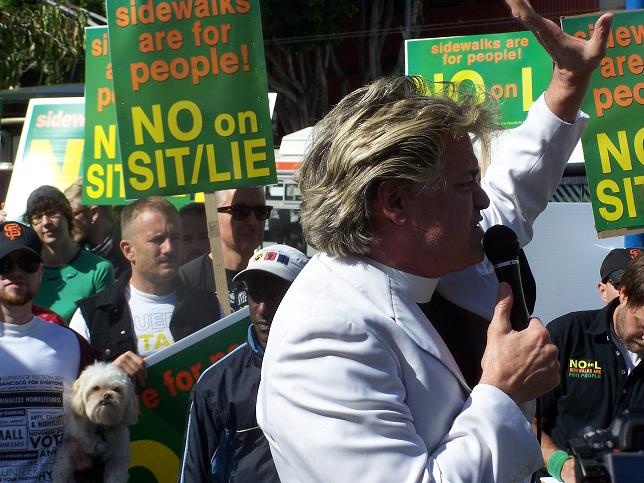
This afternoon in the Mission District, a crowd gathered to bear witness to an exorcism. Reverend Billy had come from New York City to banish the demon from SF. That demon was Prop L, an unholy measure to ban people from communing on San Francisco’s sidewalks.
“The only fundamentalism is the absence of fundamentalism!” bellowed the Rev. Bill, a former San Francisco performance artist turned pastor of NYC’s Church of Life After Shopping (which was in town to perform tonight (Mon/26) at the Victoria Theater for its Earth-a-llujah, Earth-a-llujah Revival Tour).

Rev. Billy cited constitutional dicta on behalf of civil rights: that we are all, even those without addresses, equal. The good reverend followed with a defense of the unadulterated and often unpredictable daily experience out there on the streets of San Francisco, apt to shape a human in good and thoughtful ways, that would find itself stifled if city regulations seep onto our sidewalks.

Rev. Billy’s choir ended his sidewalk sermon with a song that repeated, “Speaking freely sets us free,” and whose chorus built to:
“Standing up in public space…
Breaking in to public space…
Shouting out in public space!”

Sup. John Avalos spoke after Rev. Billy, and no sooner had he taken the mic than he accused Police Chief George Gascon of suffering a demon of his own: “hubris.” Avalos referred disapprovingly to Gascon’s previous attempts to tackle drugs and Critical Mass, the city’s monthly bicyclist phenomenon.

In reference to Prop L, Avalos shared that when he came to San Francisco, he knew “three people, had $1,000 in my pocket,” but would have been sleeping on the street if not for a friend’s couch and kindness. He called San Francisco a “sanctuary city,” where people can “find a pathway in life to something better, like I did.”

Gabriel Haaland, a Haight neighborhood resident and labor leader, took the mic and proclaimed that “I am, we are, you are, the riff raff! Because the rent is too damn high.” He questioned whether some have taken to the streets partially because of San Francisco’s high cost of living.

SF resident Selina Gomez Sutton said of Prop L: “a San Francisco without street performers and musicians? Crazy.”
But Prop L is also about something other than civil rights, street-side music, and “cleaning up” Haight Street. It’s also about tolerance.

Tellingly, just a few feet away from, and entirely throughout, Rev. Billy’s sermon, a man sat nearby barking and shouting gruffly at apparently nothing but for what (he must have thought) were good reasons indeed. I was there the entire time, and can say that not one attendee told him to stop. Perhaps they were simply jaded to such conduct — or perhaps it was because they respected his right to exist.

What if Meg just quit campaigning?

1

The more money Meg Whitman spends, the worse she does in the polls. More than $150 million, and she’s in worse shape than she was six months ago. At least, that’s what the LA times says. And while that’s clearly the most optimistic poll around, the signs aren’t looking good for Whitman.

In fact, the smartest thing she could do now is to quit campaigning. Seriously: The more money she spends, the less people like her. Disappear and hope for low turnout — that’s her only hope.

Calbuzz has an interesting take: Whitman’s initial support of Prop. 23 has really hurt her. I also really, really like the Calbuzz analysis of Meg and “class warfare,” which ought to be required reading for every political reporter in the state.

For the grace of Ralph Lemon

0

Ralph Lemon, the acclaimed choreographer/visual artist, recently presented How Can You Stay in the House All Day and Not Go Anywhere? (October 7-10) at the Yerba Buena Center for the Arts. After the Fri/8 show, Angela Mattox, the space’s Performing Arts Curator, led a question-and- answer session with Lemon and the performers. One audience member asked about a section where video images of animals walked across a screen. First came a dog, then Lemon clad in a rabbit suit, then a flamingo, continuing with an assortment of animals including a giraffe and a walrus. The question pertained to the motivation of the scene. Jim Findlay, the video designer, responded that Lemon’s only direction had been to create grace. At this point Mattox, the curator, began to cry, touched deeply that an artist would strive for grace. The event was moving to witness, but I left with a nagging question: what exactly is grace?
Grace carries a variety of connotations. Lithe ballet dancers are described as graceful. Many religious denominations seek God’s grace. A grace period is an extension of a due date. But grace also seems to be something less tangible, a mixture of elegance, good favor, moral stamina, and honor. I don’t know exactly what grace is. I don’t know what it means to create grace, especially in a dance context. I don’t know if Ralph Lemon’s show achieved grace.

How Can You Stay in the House All Day and Not Go Anywhere? featured both a film with live narration by Lemon and a performance with dancers. In the film, Lemon talked about his eight-year collaboration with centenarian Walter Carter and his wife Edna of Bentonia, MS. Mirroring Russian filmmaker Andrei Tarkovksy’s 1972 sci-fi romance Solaris, feeble and wobbly Walter and Edna reenacted some of the scenes in their mundane Mississippi home. In conjunction with Solaris’ romance between a cosmonaut and his dead wife and Walter and Edna’s enfeebled restaging, Lemon also spoke of the loss of his partner Asako Takami to cancer. The result was a meditation on love, loss, and reflections at the end of a lifetime.

The performance component consisted of four distinct sections. The first was a grueling tortuous dance that lasted 20 minutes. The dancers frenetically pushed themselves to exhaustion, endlessly throwing themselves through space with no seeming order. Succeeding that, performer Okwui Okpokwasili sobbed uncontrollably for eight minutes, her back convulsing as she faced away from the audience. This was followed by the above described animal video attempting grace. The show concluded with a contemplative sparse duet with Lemon and Okpokwasili. These four performance parts departed dramatically from the explicit film section, leaving the audience a performance section of perplexing bare minimalism.

http://www.youtube.com/watch?v=KS1PVIMpwLo

Did this all add up to grace? What struck me more than such aspirations was the sheer courage involved in presenting this material. It wasn’t created to be liked. It was created as a challenge, not to the audience, but to art itself. Can a twenty-minute dance with no form that pushes the limits of exhaustion be sustained? Is it watchable? People walked out of the performance. It takes great courage to present work that is not innately likeable.

The piece was also filled with humility. Particularly in the film section, it was as if Lemon had laid down on a table before strangers, sharing his intimate experience with loss, and Walter and Edna’s lifelong voyage together. Not only does it take guts to present that kind of subject matter and make oneself vulnerable, it also demands humility.

I suspect it is near impossible to create work embodying grace, love, courage, or any of those revered and venerated noble themes. But to paraphrase another point by Lemon in the question-and-answer session, it’s the struggle that’s important, more so than whether or not we succeed. 
 

SFBG Radio: Old ladies love prop 19

2

In today’s episode, Johnny talks about the conservative old ladies at the gym who hate the drug war and love Prop 19. Listen after the jump.

SFBG Radio 10.25.10 by endorsements2010

What not to wear

0

Predictably, I have no idea what I will be wearing for Halloween. The predicament of an anti-brand costume shopper is a dire one in today’s Halloweenie world — we are forced down one of two routes when celebrating everyone’s favorite not-for-kids-anymore holiday. You can (a) do the decent thing and spend hours rummaging through every Goodwill in the city for high five kudos at the house party this weekend or you can (b) drop a cool fifty on a prepackaged ‘stume everyone’s going to “get” immediately. All this is to say I flirted with Spirit, that perennial pop-up store. Enclosed, please find my safari shots.


Wikileaks, military families and the importance of voting rights

5

As Wikileaks’ Iraq war logs continue to reveal the disturbing reality of Bush’s illegal war, and its founder, Julian Assange, continues to be demonized for leaking this information, military families are left wondering if their loved ones were endangered by the actions of rogue military contractors, if Iraqis were tortured by other Iraqis because of the failure of the Bush administration to crack down on this abuse—and whether the same thing is happening in Afghanistan.

Either way, the situation illustrates the importance of voting for ethical leadership, and San Francisco School Board candidate Margaret Brodkin is encouraging all overseas voters and their families, including those in the military, to submit their ballots for the November 2, 2010.

“The Department of Elections has issued 6060 ballots to San Francisco voters overseas,” Brodkin noted in a recent press release. “This population, which includes many military families, has received little to no attention in this election cycle. School Board Candidate Margaret Brodkin cares about families here, and throughout the world. We encourage input from families and parents living and working overseas, and want to know what types of changes you would like to see on the San Francisco Board of Education.”

As Brodkin notes, overseas voters can get more information on their voting rights at the California Secretary of State’s military and overseas voter information website. So, check it out, and use that vote wisely.

Street Threads: Look of the Day

0

Today’s look: Mirissa, Fillmore and Sacramento

Tell us about your look: “Bargain hunting. Simple chic.”

sfbg radio: the jobs picture

3

Today Johnny talks to economist Johnny Venom about the jobs picture. Listen after the jump.

sfbgradio10/212010 by endorsements2010

D10 candidate Eric Smith on Local SF

22

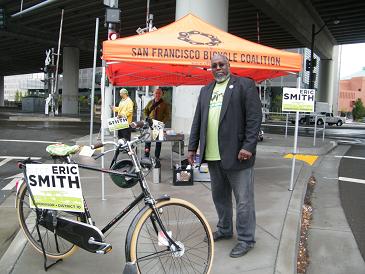
Coming into work this morning, I was greeted by the sight of D10 candidate Eric Smith standing under a San Francisco Bike Coalition tent near the railroad/freeway intersection at 16th and 7th Street in Potrero Hill.

Curious, I stopped by their tent where I was greeted by a hearty handshake from Smith, and plenty of input from the Bike Coalition’s Marc Caswell and League of Conservation Voters president Amandeep Jawa about why they support Smith.

“Eric is about integrity and sustainability,” Jawa said. “In a district like D10 that so desperately needs those things, Eric is the obvious choice.”

“D10 has a lot of really great street projects that are already approved by the MTA,” Caswell added. “So we are looking for strong leadership from Eric on the Board of Supervisors around biking, walking and transportation.”

Smith for his part chatted about Sup. John Avalos’ recently introduced Local SF legislation, which would require contractors to meet local hiring goals that will be phased in over the next few years.

Smith supports Avalos’ legislation—and thinks it needs to go even further.

“A lot of the folks who are clamoring for jobs don’t have the skills,” Smith said, noting that only John O’Connell High School of Technology has vocational training.

“Idle union workers could train folks for prime time, that’s the basic premise of the work that Raquel Pinderhughes did,” Smith said, referring to the efforts of Pinderhughes, an urban studies professor at San Francisco State, to secure truly green-collar local jobs.
“There has to be a mechanism to train folks who need skills, to get them truly trained and ready to take the union tests. That would be a sustainable approach and a huge part of the solution.”

Overcoming a foreclosure, Cohen promises to be a “fierce advocate”

16

D10 candidate Malia Cohen deserves kudos for publicly confronting rumors that she was facing a foreclosure–and for vowing to be a strong advocate, in future.

“I first addressed the rumors publicly a month ago,” said Cohen, who returned to the topic of her foreclosure earlier this week at a San Francisco Housing Coalition candidate night.

You can watch the entire proceedings of the Housing Coalition’s candidate night by clicking on the video clip at the end of this post.

But what Cohen personally told me today not only typifies many of the foreclosure horror stories that have been making national headlines. It also illustrates the abysmal lack of local leadership on this issue–and that’s something that Cohen says she’ll change.

“During the apex of the economic boom, I was the recipient of a predatory loan,” Cohen explained. “I bought a house in the Bayview in 2006 and started the process to modify my home loan. It took one year to get the banks to answer my questions, my paperwork has been lost, and I have a housing counselor I’m working with.”

“Months ago, I got word that my foreclosure has been rescinded and the property is back in my name, so I look forward to being a housing advocate, if elected,” Cohen continued.”Because what the housing crisis has done locally has been to decimate and destabilize our local neighborhoods.”

She notes that 1400 homes have already been lost in the Bayview, and another 1200 are currently teetering on the edge, but so far efforts to reform foreclosure laws have failed in the California legislature.

“Senator Mark Leno proposed SB 1275, which laid out a homeowner’s Bill of Rights, but the bank lobby was too strong,” Cohen said.

‘It’s such a helpless feeling, it’s been a nightmare, “ Cohen continued. “And once again there was no leadership locally to protect our interests, which is another reason why Malia Cohen is in this race. I am going to work hard to advocate on behalf of the community. It’s a crime the amount of money that was transferred out of the Latino and African American community during this crisis. Someone needs to be held accountable.”

The cheapest seats

0

Of course the Guardian staff didn’t have the dough for tickets to Game Five of the Giants and Phillies battale royale for the National League crown. But hey, the real party was outside the park — so Caitlin Donohue (by land) and Rebecca Bowe (by sea) staked out where the real fans were hangin’ — and caught a little animalistic behavior and political fracas in the bargain. What more could you ask of a ball game? Game Six is on Sat/23 at 4:57 p.m.