


Today, Johnny’s got the apolitical blues, so we talk about the next counterculture — and why it might not come from San Francisco. Check it out after the jump.
sfbgradio11/15/2010 by endorsements2010SFBG Blogs
Rebuilding the labor movement
Dick Meister, former labor editor of the SF Chronicle and KQED-TV Newsroom, has covered labor and politics for a half century. Contact him through his website, www.dickmeister.com, which includes more than 250 of his columns.
Unions, as you might certainly expect, have been having a rough time during the current recession. How rough? Well, overall union membership declined by a whopping 771,000 over the past year.
The number of workers in unions is still large, around 15 million. But that’s only a little more than 12 percent of the country’s workforce. There is one bright spot: More than one-third of public employees are in unions.
The figures for workers in private employment, however, show that only about 7 percent of them are in unions, That’s the lowest percentage of unionized workers in private employment since 1900. That’s right – the lowest percentage in 110 years.
Unions are fighting hard to reverse the downward trend, and though many outside the labor movement openly doubt – or at least wishfully think – that it can’t be done, I think they’re wrong. The doubters are forgetting that it’s been done before – and done in the face of obstacles that were at least as great as those confronted by union adherents today.
It began 75 years ago this month, in November of 1935, when eight affiliates of the American Federation of Labor – the AFL – put together what soon became the independent Congress of Industrial Organizations, or CIO. Their aim was to mobilize the racially and ethnically mixed mass of generally unskilled workers in steel, rubber, auto, meatpacking and other basic industries.
The AFL had largely ignored the industrial workers in favor of skilled and semi-skilled white craftsmen who were organized into separate unions according to their trade – plumbing, printing, carpentry and so forth – rather than by industry.
That kept most workers isolated from each other and enabled the industrial corporations that dominated the economy to unilaterally set pay and working conditions at the lowest possible levels.
The CIO leaders believed that workers could not make a decent living and that the labor movement could not grow and possibly not even survive unless workers were brought together in tight solidarity through industrial as opposed to the craft unionism. of the AFL.
The issues today are different. But the basic need for solidarity remains, as does the need to organize workers whatever their occupation.
That won’t be easy, with only about 12 percent of today’s workforce in unions. But when the CIO began in 1935, less than 10 percent of the country’s workers were in unions, and they faced a Great Depression that was much worse than today’s Great Recession.
The labor movement hit rock bottom during the Depression of the 1930s. But finally unemployment became so widespread and pay and working conditions so bad that large numbers of workers rebelled – most under the banners of the CIO.
President Franklin Roosevelt, fearing revolution, quickly pushed through Congress bills that in effect put the government behind the workers attempts to organize. They were granted the legal right to organize and to strike – and to choose by majority votes unions to represent them in collective bargaining with their employers.
Millions of workers flocked to unions, CIO and AFL unions alike. Millions engaged in strikes and other militant actions to press their bargaining demands. Pay rose substantially. Workers won unheard of fringe benefits. Working hours were reduced without reductions in pay. Grievance procedures were instituted. Job security was greatly enhanced.
Most important, the living standards of ordinary Americans were raised. And the United States at last had a true middle class.
As the CIO grew, so did the AFL. By the time the competing organizations merged in 1955 to form the AFL-CIO, one of every three U.S. workers belonged to a union.
The vital, demanding and essential task of today’s labor leaders is nothing less than to do what was done by their predecessors when they formed the CIO three-quarters of a century ago . . . nothing less than to bring new life to the American labor movement.
Dick Meister, former labor editor of the SF Chronicle and KQED-TV Newsroom, has covered labor and politics for a half century. Contact him through his website, www.dickmeister.com, which includes more than 250 of his columns.
SFBG Radio: The next step for weekly newspapers

Today we talk about the future of weekly newspapers — what’s the role of a weekly in an era of 24-hour news cycles? And how will weeklies make money in the digital era? Listen after the jump.
Do you love a Giants fan?
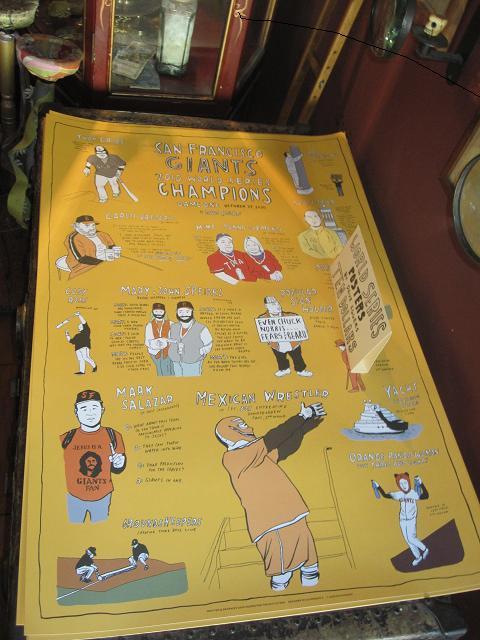
Aficionado de los Gigantes in your life? You’ll want to get them this: a limited edition Dave Eggers SF Giants World Series Championship… poster. Ten dollars.
The print shows all the characters you’ll never want to forget from the days that SF went ballistic over balls. The orange panda lady with three beers? The Mexican wrestler in section 305? All there. The woman at the cashier told me that the stack of which I took the photo is 826 Valencia‘s only supply, so slide into home. Go! Go!
PG&E’s priorities and the San Bruno pipeline

A few weeks ago, the Guardian reported that Pacific Gas & Electric Company was granted $5 million to upgrade a portion of its San Bruno gas pipeline, but never got around to doing it. A rupture along that section of pipe caused the deadly Sept. 9 explosion that took the lives of eight people, destroyed 37 homes, and left an entire San Bruno neighborhood traumatized.
What did PG&E spend the money on instead? Presumably, the $5 million went toward other repairs that were deemed to be higher priorities. But in the meantime, the company also managed to bankroll an eight-figure CEO salary, a state ballot initiative, and a controversial SmartMeter program, just to name a few. Just for comparison, here are a few examples of how $5 million breaks down for PG&E.
· It’s less than half the boss’ pay. According to Forbes.com, PG&E CEO Peter Darbee earned $10,559,428 in 2009 in total compensation. $5 million represents 47 percent of the top exec’s pay.
· It’s 10.8 percent of what PG&E spent on Proposition 16. The utility spent $46 million on Prop. 16, a failed June ballot initiative that would have effectively snuffed out PG&E’s competition from community choice aggregation programs. Had it poured just $41 million down the toilet instead, there might have been some left over for things like aging infrastructure.
· It’s .22 percent of PG&E’s SmartMeter program budget. Recent news reports about the former SmartMeter director, better known as a sock puppet, note that he presided over a $2.2 billion program before submitting his resignation. $5 million represents a mere fraction of one percent of the budget for the controversial SmartMeter program.
Pin Up Clinic strike a pose for the Pap
A while ago, I wrote about Briggite Berman’s Hugh Hefner documentary, about how it highlighted a debate between Hef’s lecherous man-fans and his well-cinched feminist critics. I suggested that there was a third view Berman missed: that of women who understood the pin-up mentality and how it could work to female power and strength.
Well hang on to your hats, because here comes Pin Up Clinic, whose pin-up calendar release party is at Homespun Bikes Sat/13.
The group has put together a calendar with 12 months worth of alternative lovelies from around the Bay Area, with all proceeds going straight to Women’s Community Clinic. Amanda Kennedy, the mastermind behind the project, had inspiration strike her when she was asked if she’s like to examine a part of a woman’s body that not even Miss August shows off in the calendar.
“The doctor asked me if I wanted to see what my cervix looked like… handed me a mirror and a flash light and had me sit up and take a look at my self. It is a pretty profound experience to see inside your own body like that. The female body is amazing and we don’t get to appreciate ourselves enough,” Kennedy told us of an appointment at Women’s Choice Clinic in Oakland in an email to SFBG.

Miss August gets back to school you on what feminism can look like. Photo by Tiffany Black of Blackbird Photo
Later, Kennedy and friends decided that they wanted to give back to the professionals that had done so much to take away the mystery and shame women can feel about their bodies. And what better way to do that then by showing off, in all it’s glory, the female form? “The pin up calendar was a way for us each to appreciate ourselves and share it with others,” Kennedy recalls.
So there you have it. Only problem was that the Women’s Choice Clinic had closed in the interim, but that didn’t stop Kennedy and gang. They elected Women’s Community as their back up beneficee because it shared the same empowering philosophy as the first clinic — as Kennedy puts it “women treating women, which helps to create a safe space for so many people who have had negative experiences with heath care.”
What to say to those that find the concept of pin-up posters demeaning, anti-women productions? “Redefining beauty is important. By controlling our images we get to share our ideas of beauty,” Kennedy tells us. Included in her project are luscious images of kink educator Tina Horn and Lubricated Zine “jack of all trades” Vanessa Jean.
In teaser shots assembled on Pin Up Clinic’s website, Vanessa Jean sits and lies in a pile of her self-published creations wearing a torn Ramones tee. The images show her as an actively imagining individual, but there’s no denying those flannel-printed boy shorts hug some curves that’d make Hef proud.
“There are so many schools of feminism, some think we should never be sexualized and I understand that,” Kennedy says. “It’s so frustratingly common for people to criticize how a woman looks before they comment on what she is doing. I’m glad that both groups are around, because an important part of feminism is that women should be free to do whatever they want, express themselves to the fullest and stand up for what they believe in.
And who doesn’t believe in unembarrassed, convivial reproductive health care? Pin Up Clinic has printed up 1,000 calendars to be snapped up at $15 a pop on their website or at Saturday’s party, which will feature live music, a photo booth, and fortune telling.
I predict you’ll want to buy one of these for someone on your holiday shopping list, but maybe that’s just me hinting that I want one.
Pin Up Clinic’s 2011 Calendar Release Party
Sat/13 7 p.m., free with purchase of $15 calendar
Homespun Bikes
494 Wesley, Oakl.
KPFA’s Morning Show purged

KPFA has always been part radical-left radio station and part radical-left soap opera. It’s a collection of talented shit disturbers supervised at times by wildly incompetent managers who report to a highly political elected board that is so packed with agendas it’s hard to imagine how anything ever gets done.
Every time KPFA and its parent Pacifica Foundation have money problems — and like most progressive organizations, money problems are a fact of life — there are layoff talks and discussions of cutbacks that lead to protests, counterprotests, and full-blown rehtorical wars.
And yet, every morning, I tune my radio to the Morning Show, and somehow, what comes over the airwaves is solid progressive journalism. Hosts Brian Edwards-Tiekert and Aimee Allison, with the support of news director Aileen Alfandary, always put on a good show (full dislosure: I’ve been a guest on it a few times).
So I was startled Nov. 10th to hear a show piped in from Los Angeles — and to learn that the entire Morning Show crew, including both Edwards-Tiekert and Allison, had been summarily fired.
The way Pacifica Executive Director Arlene Englehardt has described it, the move was made entirely for budgetary reasons. No question: KPFA’s budget is in the red, and that station had to borrow money to make payroll recently. And since the KPFA staff is unionized, layoffs are supposed to be made by seniority, which Englehardt also said tied her hands.
But actually, Edwards-Tiekert has more seniority than other people who weren’t alid off — and I have to say, this looks a lot more like a programming decision than a simple layoff.
It’s also a kind of crazy move: KPFA lives on listener support, and the Morning Show is the most lucrative program on the station when it comes to pledge drives. KPFA listeners want local content; in fact, since the Morning Show staff was laid off, listenership has plummetted. Figures I’ve obtained on web listenership (which is easy to track, and at KPFA ultimately tends to be similar to the overall listenership tends) show that the peak audience dropped more than 60 percent after the station started piping in outside content.
I can’t get Englehardt on the phone (possibly because of the Veterans Day holiday) but she made her case on KQED’s Forum Nov. 10th. You have to listen to this show; it’s only half an hour. Elglehardt is on with Larry Bensky, a former KPFA staffer, Polk Award winner, and one of the most respected progressive media voices in the country. And frankly, Bensky tears her arguments apart (in his brilliant, logical way) pointing out the insanity and inconsistency of what she’s done here.
I guess they’re going to try to do a new Morning Show, but I don’t know who is going to host it; according to Edwards-Tiekert, the unionized staff have agreed not to take each other’s jobs. And it’s hard to find people with the kind of experience and skill it takes to do something as complicated as hosting the Morning Show on KPFA.
I’ve tried in the past year to stay out of the drama at KPFA — I’m a KPFA member, a longtime supporter and a fan of what the station does, and I don’t think contant media scrutiny and leftist harping about every single cut and personnel decision in tough financial times does any good for the progressive cause. But this one seems to be a big mistake, and I don’t see how Englehardt is going to fix it.
You can listen to the last Morning Show talking about all of this and read the staff’s comments, and the details of how this went down, at the KPFA staff blog here.
Downtown’s one-two punch on RCV

Examiner columnist Ken Garcia and Chronicle columnist C.W. Nevius – the Tweedledum and Tweedledee of pro-downtown propagandists – today put out a pair of hit pieces on San Francisco’s ranked-choice voting system, with Garcia stridently calling for its repeal. But if there was ever a good argument for ranked-choice voting, it’s the fact that these two bozos don’t like it.
They use this election’s results to make a case that this system is confusing, slow, and undemocratic, even though the reality is closer to the opposite. They moan that some supervisorial races don’t have clear outcomes yet and that doing RCV tabulations requires more work now by election’s officials, conveniently leaving out the fact that all four contested supervisorial election would be headed for costly and divisive runoff elections a month from now under the old system.
As for being undemocratic, it’s anything but. Would it be more democratic if the D10 race was decided by a runoff between Marlene Tran and Tony Kelly because the African-American vote was divided among too many candidates, rather than going to Malia Cohen, who most D10 voters voted for as one of their top three choices? Doesn’t it count for anything that a majority of D2 voters apparently didn’t want Janet Reilly to represent them? Similarly, in Oakland, it seems clear that a majority of voters did not want Don Perata to be their mayor, and so they listed Jean Quan in their top three votes. And did anyone really want to see progressive Jane Kim and Debra Walker slug it out in a D6 runoff election?
No, what this coordinated attack on RCV is really about is how democratic it really is, letting the people rank their choices from a plethora of options, rather than having our leaders chosen in a low-turnout election when downtown and the rich have a far better opportunity to determine the winner. It’s just too bad that these two columnists aren’t honest enough to admit who they’re shilling for.
As for my more detailed reporting on RCV and its renewed chances for promoting real political coalition-building – the essence of democracy – check out next week’s Guardian.
Steve Li to be deported to Peru on Monday
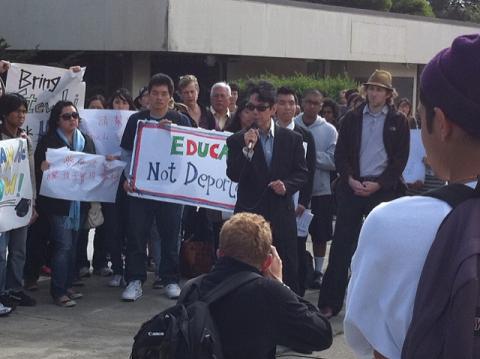
Immigrant advocates report that the deportation of Steve Li, an honors student who was studying at City College until ICE (immigration and Customs Enforcement) picked him up in September, has been scheduled for Monday, November 15.
Advocates have argued that Li, who has lived here since he was 12 and apparently knows no one in Peru, where ICE plans to deport him, is eligible for the DREAM Act. So, they were especially upset when news of Li’s scheduled deportation hit the same day that Nancy Pelosi announced that she wants to move the DREAM Act during the lame duck session
In response, Li’s supporters are planning an all-day action at Sen. Barbara Boxer’s office at 1700 Montgomery Street on Friday November 12.
“People will be dressing in caps and gowns or nursing scrubs (Steve is a nursing student)” states a press release from Li’s supporters, who promise to phonebank ICE/Boxer/Feinstein and deliver letters to Boxer’s office tomorrow.
“Time is of the essence, we need Boxer or Feinstein to sponsor a private bill, or for John Morton at ICE to grant the deferred action before Steve is scheduled to aboard the plane on Monday,” the statement, which lists the phone numbers of Feinstein, Boxer and ICE’s John Morton, concludes.
Portrait of a San Francisco construction worker
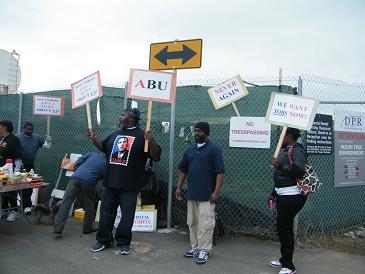
One of the many fascinating pieces of data to emerge in the discussion about Sup. John Avalos’ proposal to mandate local hiring is a recently published analysis of the characteristics of construction workers whose primary workplace is San Francisco.
In October, L. Luster & Associates published a labor market analysis, using data from EDD payrolls and the U.S. Census American Community Survey, that shows there were 14,629 construction workers employed in San Francisco in June 2010. And that five trades currently dominate this workforce and constitute more than 75 percent of the total numbers of construction workers employed in the city.
Carpenters are the biggest group (4,623 workers) followed by construction laborers (2,796 workers) painters (1,459 workers), electricians (1,119 workers) and plumbers, pipe fitters and steamfitters (1,023 workers).
But while this population shows racial diversity (whites and Latinos each make up about 40 percent of the workforce, followed by Asians and Pacific Islanders at 17 percent) African Americans and women each account for only 3 percent of this market. In other words, only 440 African Americans and 405 women were construction workers in June 2010, compared to 5,830 Latinos, 5673 whites, 2,528 Asians and Pacific Islanders.
So, how do these ethnic percentages compare with San Francisco’s overall distribution?
“Latinos make up a considerably larger portion of workforce than they do the overall population (40 percent of construction workforce v. 13 percent of city’s population),” the Luster report states. “ All other major racial categories constitute a smaller portion of the construction workforce than they do of the total population: Whites (39 percent of construction workforce compared to 49 percent of city population overall) followed by Asian and Pacific Islanders (17 percent compared to 28 percent overall) and African Americans (3 percent compared to 6 percent overall.)
(That last statistic should be a shocker: What?! Only six percent of San Francisco’s current residents are African American?! But the city produced a report two years that detailed the “black out migration” –but provided little money or authority to help follow through on the report’s various recommendations).
Meanwhile, Luster’s report concludes that, “the main imbalance between the employed construction workforce and the San Francisco population lies with the gender distribution. Women comprise only 3 percent of the 14,629 construction workers in San Francisco, whereas they account for nearly half of the overall population.”
Next up in the Luster report was the question of residency. And according to its findings, only 39 percent of workers employed in San Francisco’s construction industry call the city and county of San Francisco their home.
San Mateo County is home to 18 percent of this workforce, Alameda County accounts for another 17 percent, Contra Costa County is home to 13 percent, Sonoma and Marin each are home to 8 percent, and Napa and Solano County each account for a further 5 percent.
These numbers are significant in a number of ways. For instance, 2, 636 workers commute in from San Mateo, 2,418 from Alameda, 1,929 from Contra Costa, 1,197 from Sonoma and Marin, and 773 workers from Napa and Solano, all of which adds up to wear and tear on roads, impacts on air quality, and increased levels of greenhouse gas generation (depending on whether these workers take public transit, car pool or drive the freeways solo, of course).
It also means that when communities oppose aspects of a local construction project—be it a proposed bridge over Yosemite Slough, or a proposed mega-hospital on Cathedral Hill—they are likely to encounter opposition from a workforce that increasingly lives outside San Francisco, faces a 40 percent unemployment rate, and can be mobilized to show support for these projects, either through showing up physically at meetings or through union dues that can be used to wage political wars with far-reaching percussions for the ability of local residents to influence local land use and economic development decisions.
So, why do so many construction workers live outside San Francisco? The obvious reasons are their relatively low income levels and their related inability to afford housing in the city.
According to Luster’s report, “nearly 33 percent of these workers report earnings of less than $30,000 per year” (based on data that incorporates union and non-union workers, and part-time workers).
Another way of looking at this is to study Luster’s analysis of construction workers who currently live in San Francisco.
“From EDD payroll data and from historic employment relationships between San Francisco, San Mateo, and Marin counties, we estimate there were 7,855 construction workers residing in San Francisco and who were employed as of June 2010—roughly 1 percent of total residents in the city,” Luster reports.
The Luster report also notes that the same five trades make up an even higher proportion of the resident employed construction workforce than they did the total employed construction workforce in the city (86 percent v 75 percent). But now the top two places are reversed: Construction Laborers is the largest trade with 2,442 workers, followed by Carpenters (1,914 workers), Painters (1,122 workers), Electricians (814 workers) and Plumbers (484 workers).
The ethnic distribution of these resident workers is also diverse. Whites (34 percent,) Latinos (31 percent), Asians and Pacific Islanders (30 percent, which is considerably higher than for the overall workforce employed in San Francisco) and African Americans (5 percent).
But women, once again, make up only 3 percent of residents in construction employment.
The Luster report takes the analysis one step further by looking at age distribution. This criterion reveals that the white resident construction workforce is aging, as is the Asian resident construction workforce, though to a lesser extent.
“By contract, the Latino workforce is concentrated among the younger age groups, particularly among the 25-34 age group,” Luster notes. “Of note, 47 percent of the resident San Francisco construction workforce is over the age of 45. Moreover, 23 percent is already 55 years and older. Currently, the number of workers aged 55-64 is 1,544 and declines to 264 for workers aged 65 and older, dropping from 20 percent of the workforce to 3 percent. If construction workers continue to leave the sector in the same proportions by the time they reach 64, a sizeable number of new openings will be created.”
The report, which goes into detailed breakdowns of apprentices (each of the four largest ethnic groups have almost equal shares, and women have 10 percent), the construction trades (which has a greater participation of white workers) and journey people, also gets into workforce projections (the bulk of the jobs generated by the city’s Capital Plan will be generated within the first five years) local hire programs and policy issues. As such, it’s a must-read for those following Avalos’ proposed local hire legislation, and you can view the full report by clicking here.
SFBG Radio: The great political disconnect

In today’s episode, we ask: If the polls show that some 75 percent of the American people think Congress ought to raise taxes on the rich and cut defense spending, why doesn’t either party talk about it seriously? Listen after the jump.
D10 nail biting continues, but Cohen remains in lead
When the city’s Department of Elections ran its second preliminary round of ranked choice voting scores Nov. 9, neither of the leading D10 contenders was in attendance. Malia Cohen, who was sick last week, was still under the weather, according to her campaign manager Megan Hamilton. And Tony Kelly was at home “reading the Bible and eating chocolate,” as he jokingly told the Guardian earlier that afternoon. All of which was hardly surprising since the stress of the unrevolved races in D10 (and D2) is beginning to fray the nerves of even the most hardened elections veterans.
But Marlene Tran, who ended up in third place after yesterday’s RCV count, was waiting outside the Elections office, which is located in the basement of City Hall. And she openly talked about the stress of waiting for the ranked choice results, the failure of English-speaking media to cover issues that concern non-English speaking residents, the unexpected attacks she endured on Chinese radio, and her hope that all the D10 candidates will work together to make the district and its various communities and neighborhoods a better place to live, regardless of who wins.
“I’ve been trying to take care of all my mail and petting my cat, who is extremely demanding,” Tran told the Guardian, when asked how she was dealing with a waiting game that has had campaign managers and members of the media descending daily on the Elections Department at 4 p.m. to get updated results.
Finally, Elections Department director John Arntz emerged and sat on a table outside the Department of Elections office as he gave his daily update.
“We did a big push over the weekend to get 95 percent of the cards processed,” Arntz said, noting that 10,000-11,000 vote-by-mails remain to be counted citywide. He also noted that of the 1,275 provisional ballots from D10, 1,044 have been accepted, and another 231 have been challenged.
“We’ll have a tally sheet tomorrow with reasons why the provisionals were challenged,” Arntz added, observing that one reason provisionals get challenged is when it turns out that folks who voted provisionally aren’t actually registered to vote in San Francisco.
“I think it will be next week until we get to all the provisional ballots,” Arntz continued.“But it’s not like I am trying to prolong anything. I’m guesstimating that all the vote-by-mail ballots will be counted by Friday. So, we may do another ranked choice count on Friday.”
Arntz clarified that the 75 ballots that were found floating in the Palace of Fine Arts pond in the Marina district originated from a polling station in D11—and therefore will not impact the as yet unresolved supervisoral races in D10 and D2, where Janet Reilly leads Mark Farrell in raw first choice votes, but has been slipping into second place when the ranked choice votes are calculated.
“The bag is sealed, but the ballots are damp,” Arntz said of the missing D11 ballots.
After Arntz was done with his daily dose of explaining, the ever outspoken Sharen Hewitt, executive director of the C.L.A.E.R. project, warned of the importance of counting every provisional vote.
‘If anyone touches my granddaughter vote, they’ll be a tsunami,” Hewitt warned, referring to the fact that her 18-year-old granddaughter Tiara voted provisionally this year. “And it seems that a disproportionate numbers of challenged provisionals seem to be coming from Bayview Hunters Point.”
Afterwards, as the running dogs of the media rushed off to file stories, Tran lingered long enough to tell the Guardian how she was attacked on afternoon programs on Chinese radio after she announced that Tony Kelly was her second choice in the race (with her first choice being herself, natch.)
“I was called a traitor, I was told I was too old to run, that I can hardly walk around, that I didn’t do anything for the community in 20 years,” Tran recalled. “It was very humiliating.”
But she believes the attacks may have backfired.
“The radio programs in the evening addressed the question of whether Tran deserved to be a traitor—and everyone was very supportive of me,” Tran said. “And everybody who heard about these attacks was very angry, so maybe they worked harder to support me.”
Tran says she didn’t hire a political consultant to manage her campaign, but still found herself ahead of most of the other 21 candidates in this hotly contested race.
“I did a lot of stuff with volunteers, and for the first few months I did everything myself, including the design and layout of my fliers,” Tran confided, showing me a tri-lingual flier which includes translations from Chinese media outlets Sing Tao, which called her the “Guardian Angel of Immigrants.”
Tran, who was born in Hong Kong, and came to the United States when she was 19, says she is grateful that she got to live and work in such a beautiful city, and that many first-time voters got invigorated and decided to participate in the election because she was running.
“Whoever gets elected, I’ll support that person, because this is about D10 and San Francisco,” Tran said. ‘but many voters are now wondering if ranked choice is the best thing, because of the endless wait.”
She also ruminated on what she describes as the “chasm of a communication problem between the ethnic and Western press” and how that worked for and against her in past elections.
“When I ran for DCCC in 1998, I felt like a grain of sand in the Sahara,” Tran said, recalling how folks were surprised when she won that race. “And this time, my results are pretty healthy in the D10 race, and people are also surprised.”
Many of the absentee ballots that have been counted in recent days originated in Viz Valley, giving Tran a boost that takes her to second-place once ranked choices get reassigned, and helps Cohen vault over Lynette Sweet and into first place. But as they say, it ain’t over ’til the fat lady sings, so stay tuned…
Pot competition survives SFPD crackdown
Prop. 19 may have been defeated last week, but marijuana is still the state’s top cash crop, and one where agricultural artisanship continues to flourish within the medical marijuana movement. The best of Northern California’s pot crop will be on display this weekend, Nov. 14, for the Fourth Annual Medical Marijuana Competition. The event features judging and awards in a variety of categories, from best bud to the best concentrates and edibles. The event, which will also feature information booths and entertainment, will be held at Terra Galley, 511 Harrison Street, SF. Tickets are $18.
But this was one party that almost wasn’t. Event organizers had to scramble for a new location after the San Francisco Police Department denied them a permit to hold event in the previous year’s location in Cafe Cocomo. According to David Goldman, a competition organizer and member of the Americans for Safe Access (ASA), the California department of Alcoholic Beverages Control even threatened to revoke Cafe Cocomo’s liquor license should they house the event. Café Cocomo has had recent problems, includng a shooting out front on Oct. 9, but club operators declined to comment on those incidents or the cops blocking their pot party.
Organizers say the ensuing scramble for a new location cost the event, which is a fundraiser for ASA, over $10,000. “It’s been a nightmare to throw this party,” Kevin Reed, co-chair of the event and president of the Green Cross, told us. But even with the cost of the move, Reed is hopeful about the new venue and the turnout. “Last year we had about 600 or 700 people and this year we anticipate 1,200 to 1,500.”
All of the proceeds of the upcoming competition will go to support ASA, a nonprofit group that holds weekly meetings at Bowzer’s Pizza that aim to educate patients on medical marijuana issues. “It’s amazing how pizza keeps it all together,” Reed said of the community that has formed up around these ASA meetings.
Yee launches mayoral bid as supervisors consider their options

Amid the jockeying for position on who will be San Francisco’s next mayor, Sen. Leland Yee this morning filed paperwork at the SF Elections Department to form a mayoral exploratory committee before a throng of journalists who were invited yesterday for a big “announcement.”
Yee diligently hit his talking points and did little to divert from a script emphasizing his deep local roots, his belief in being a humble public servant, and how this action was “beginning a conversation with San Franciscans” about “what they want of their city government and their next mayor.” Yee used the word “conversation” so many times that an AP reporter asked him to explain his issues and reasons for running without using the word “conversation,” a word Yee still slipped into his answer.
Meanwhile, members of the Board of Supervisors yesterday introduced competing motions for naming an interim mayor to replace Gavin Newsom while he leaves in January to become lieutenant governor. Sups. John Avalos, David Campos, and Chris Daly are seeking to have the board vote on a replacement mayor as soon as next week, while Board President David Chiu asked the board clerk’s office to develop a framework and process for choosing a new mayor. Asked whether he has the six votes needed to take up the matter next week, Avalos told the Guardian, “That’s my hope, but we’ll see.”
While Yee seems focused on winning the mayoral election next fall, rather than winning six votes on the board now, he told reporters, “I have the highest regard for members of the Board of Supervisors…They have a tremendous challenge in front of them and I wish them well.”
In his prepared statement that listed his contact person as Jim Stearns, a political consultant who usually works for progressive candidates and ballot measures, Yee sought to differentiate himself from Newsom, who has had hostile relations with the board throughout his seven-year tenure. “I want to see the Mayor work with, and not against the Board of Supervisors,” Yee said in that statement.
Asked by the Guardian to elaborate on what appears to be a critique of Newsom, Yee demurred. “I’m not going to judge this mayor. History will do that,” he said.
Playing it safe for now could be a sound strategy for Yee, who would be the city’s first Chinese-American mayor and who has a history of endorsing progressive candidates and positions, but who also just raised and spent more than $1.2 million (much of it in big corporate donations that far exceed limits on local donations that his committee will now allow him to begin collecting) on his uncontested Senate reelection, including giving six-figures to Stearns and spending almost as much on polling.
Stearns tells the Guardian that, consistent with his message today, Yee will run a very positive campaign. “We’re going to run a different kind of campaign, a very collaborative campaign,” he said. “This city deserves a different kind of campaign where people are just firing their guns at each other.”
Street Threads: Look of the Day
Traveling SFBG photog Ariel Soto recently hit the streets of Taiwan to find out what the kids were wearing overseas. Due to the language barrier, she and her subjects weren’t able to talk style philosophy — but hey, looks like these speak for themselves.
Today’s look: Shao Le, Taipei, Taiwan
The Performant: Cheers for fears
Scoping out “After Dark” at the Exploratorium and a Mark Growden singalong
“The oldest and strongest emotion of mankind is fear.” –H.P. Lovecraft
Bolshephobia is the fear of Bolsheviks. Sesquipedalophobia is the fear of long words, which does rather beg the question, how do people with that particular fear express it without using the eight-syllable word that defines it? At this month’s After Dark event at the Exploratorium, fear was the theme explored, and confronting one’s fears directly, in the spirit of scientific inquiry, strongly encouraged.
We’ve learned to accept fear as an instinct of self-preservation, yet on the surface, so many fears seem downright petty, even ridiculous. Take, for example, the “phobia trading cards” we were urged to grab on our way in. Mine: fear of vomiting (emetophobia). Theresa’s: fear of men (androphobia). Once inside, we made a beeline for the joint San Francisco Bay Area Tarantula Society/East Bay Vivarium,. What is it about creepy-crawlies that make the skin crawl? All around us, giant cockroaches, scorpions, and spiders were adorning outstretched palms, and snakes were slithering up forearms and around the necks of museum patrons.
I opted to handle a relatively user-friendly duo, a Chilean Rose Tarantula and a sleepy Pacific Gopher Snake. Theresa would not hold a snake, but she got to watch me flinch soon enough at the Pendulum of Truth. Placed behind safety shields, facing each other, we were urged to swing a bowling ball on a chain at each other’s faces. Being bashed by a flying bowling ball is not something I expect to happen to me regularly, but when confronted with one, I can attest, yes, it’s a very real fear. Less frightening was being locked in the Utica Crib, a reproduction of a nineteenth-century restraining device used primarily at the New York State Lunatic Asylum, though I suspect I’d weary of it soon enough after a few hours—or days.
There were people practicing tightrope-walking, watching dentistry demonstrations, and confronting the pitch black interior of the Tactile Dome as we headed over to the McBean Theatre for a presentation on Nightmares by dream expert Dr. Alan Siegel. Ever had that one dream where all your teeth crumble and fall out at once? Dr. Siegel can tell you why.
One fear shared by entirely too many people is the fear of singing in public. At least that’s a fear that has a cure—practice practice practice. Happily, it didn’t seem like fear was the driving force behind people’s decisions to attend the Mark Growden Sing-along at a.Muse Gallery Saturday night.
Part grade-school music class, part hootenanny, we warmed up our vocal chords with some scales and some tongue-twisting folk tunes before tackling the Mark Growden repertoire, mostly songs from Saint Judas (Porto Franco Records, 2009). Unlike the forced make-or-break centerstage experience of a karaoke bar, a sing-along’s success lies in its collaborative nature, from each according to their abilities. The informal, free-for-all atmosphere of the evening brought the old adage “if you can talk, you can sing,” to convivial life, and whatever fear was up to that evening, it most certainly wasn’t hanging out with us.
Hot sexy events: November 10-16
You wouldn’t think that P-raw: Whore of the Underworld would have problems with being cockblocked, but there you have it. P-raw will be one of the charismatic over-sharers at this week’s installation of Bawdy Storytelling (Wed/10), the naughty, gleefully live version of the embarrassing stories section they used to have in Sassy Magazine. Man, we miss that rag. Anyway, if past editions are indicator, tonight’s Bawdy (whose stories will pay homage to times when sex got squashed by a bystander) will be a silly, sexy romp. Chicken John, Phuong Mai, Airial Clark, and Suzanne Forbes take the stage and need your commiseration.
Bawdy Storytelling: Cockblocked
Tales of love lost – to that jerk in the fedora, no less – reign at this pervy live storytelling series.
Wed/10 8 p.m., $10
The Blue Macaw
2565 Mission, SF
Pin Up Clinic Calendar Release Party
Dropping trow and covering one’s boobies in whipped cream may not immediately seem like it will be beneficial to women’s health in the Bay Area, but that’s probably because you’re not thinking big enough. One group of women did just that and the fruits of their labor are now a twelve month 2011 calendar featuring women from around the Bay gettin’ pin-up with it. Proceeds from the calendar will go straight to Women’s Community Clinic in San Francisco. Tonight’s party will feature live music, a photo booth for muggin’, and more.
Sat/13 7 p.m., free with purchase of $15 calendar
Homespun Bikes
494 Wesley, Oakl.
Leather Beer Bust and benefit
SF Leather Daddy boys and the SF Girls of Leather are hosting a beer bust to benefit Sunburst Projects, a charity that supports families with HIV/AIDS. You already know altruism is sexy, so saddle up that leather vest and cap, and snag your favorite toy to bring on the road – a latex (or otherwise stimulating) lovely will score 20 tickets for the raffle featuring prizes by Kink.com and Off Ramp Leathers.
Sun/14 3-6 p.m., $10
Eagle Tavern
398 12th St., SF
(415) 626-0880
Spanking Workshop
Tops and bottoms and lovers of some good ass are welcome to this primer by porn star-pro switch Tina Horn. Flogging, role play, and caning are all included on the day’s docket, and really, the hands-on demonstration alone should be worth the price of entry.
Sun/14 4 p.m., $20
Femina Potens
2199 Market, SF
(415) 864-1558
Mindful Self-Pleasure
Shall we not gloss over the glory of a good wank? Eros won’t, and it doesn’t want you to, either. Gay men are invited to bring their lube of choice and refocus on self. The class will be a walk-through of tantric masturbation, the art of concscious cumming — expect light eye contact and encouragment of primal sound.
Mon/15 6-9 p.m., $20
Eros
2051 Market, SF
(415) 864-3767
Mommy’s Playdate
Who loves you, momma? Yeah, yeah, the rugrat, but also your friends at Good Vibes. And unlike Baby, GV can mix you free drinks, set up free one-on-ones with staff sexologist Dr. Carol Queen, and introduce you to mommy writers like Billie Sharp, D.I.Y. Expert. Because even you need a play date.
Tue/16 6-8 p.m., free
Good Vibrations
1620 Polk, SF
(415) 345-0500
PG&E exec fails as a spy

You’d think California’s largest utility company would know a thing or two about spying. From toxic groundwater plumes to deadly pipeline explosions, Pacific Gas & Electric Company has given plenty of Californians reason to mobilize against their practices, and countless campaigns have been launched against the monopolistic energy giant. Yet former SmartMeter program director William Devereaux revealed himself to be an amateur when he tried using an anonymous email address to infiltrate his activist opponents — with an account that displays his real name.
The Chronicle is reporting that Devereaux resigned from his post as director of the $2.2 billion SmartMeter program once the news broke that he’d been outed by the very anti-SmartMeter activists he later admitted to keeping tabs on.
It wasn’t too difficult to figure it out. Devereaux attempted to join an activist listserv for the EMF Safety Coalition, an organization that opposes SmartMeter installations. Apparently assuming that his name would be hidden, he signed his e-mail to Sandi Maurer, the group moderator, as “Ralph.” Here’s the message:
On Nov 4, 2010, at 3:23 PM, William Devereaux <manasota99@gmail.com> wrote:
Hi Sandi,
Sorry for the delay in getting back to you, I’ve been travelling a lot. I live in Oakland where Smart meters have been sweeping across town and wanted to learn more about them and join the conversation to see what I can do to help out here.
Thanks,
Ralph
Just a regular old SmartMeter-hating guy called Ralph. Except that until the news story broke, a Google search of the name beside his email address yielded countless PG&E press releases in which the utility executive publicly extolls the virtues of the electricity-usage meters, which activists fear will expose people to unhealthy levels of radiation. Now that he’s been outed, said Google search speaks to Devereaux’s rather deficient skills as an infiltrator instead.
“We think he’s been lurking on one of our lists for a couple of months,” activist Joshua Hart with Stop Smart Meters told the Guardian. Hart said SmartMeter protesters got a surprise when they showed up at a Sonoma County location a couple weeks ago to stage a demonstration against the PG&E contractor hired to install SmartMeters. By the time they got there, all of the contractor’s trucks and signs had vanished. It was like they’d known what to expect. “His judgment has been called into question,” Hart said, “and his honesty has been called into question.” Apparently, his career has now been called into question too.
Greenpeace and the Zuck

Greenpeace asked me to Facebook message Mark Zuckerberg today. Given the hullabaloo surrounding social networking and activism these days (and more specifically, Malcolm Gladwell’s controversial New Yorker piece on the subject), I should have been in some sense prepared for the Rainbow Warriors to request I open to my Facebook home page. The two entities they represent have become, if on some levels superficially, intertwined.
Perhaps my slight sense of shock was due to the fact that while viewing the campaign’s web page, which of course I stumbled across when an acquaintance hit it’s “Like” button last night, it struck me that this was just the sort that could make a difference. Zuckerberg is probably a guy that bases quite a bit of his decisions on messages that come through that inbox.
Greenpeace has a lot of these sorts of efforts: their current site lists a series of “online actions you can take now” that include:
– Stop nuclear investments!
– Call for an end to whaling in the Southern Ocean
– Call for a GE-free future
– Ask Princes Tuna to stop canning ocean destruction
Which, really, are all things I enjoy. I want to click them all, enter my email address a hundred times, feel better about my inability to personally stop the disastrous victory of the sit-lie measure in last week’s election.
But will it change Princes Tuna’s actions? I suppose there’s really two tiers we should talk about when we talk about activism, though they’re not mutually exclusive. One is the people that hit that “like” button (often willy nilly, judging from my more Internet-passionate friends), and two is the physical manifesters of activism. Let’s call them Internet and meat activists.
In his New Yorker article, Gladwell makes the point that these kinds of social networking campaigns’ strength is the astronomical number of people that can be mobilized to do one relatively simple thing. “But if you’re taking on a powerful and organized establishment you have to be a hierarchy,” he says, rightly filing the networks into another sort of organizational model. But Gladwell glosses over the fact that there even if social networks themselves don’t have actual heads, campaigns that use the Internet heavily often do. After all, I’ll wager that whosoever designed that Greenpeace effort (okay, a person that conferred heavily with the designers of that website) has ties to the clean energy movement that go beyond Internet messaging.
And there is other crossover between the two. From sit-lie to sweatshop protests, many rally participants these days are called to action from a social network announcement.
I went to a talk at the Commonwealth Club the other day by Twitter founders Biz Stone and Evan Williams in the week after the Gladwell article came out. Stone, in his customary jeans and black jacket, was adamant that Twitter — whose role in the Haiti disaster and the Iranian election was perhaps overstated — should remain a tool to aide social change, not be it’s agent.
Back to Greenpeace’s campaign thingy. This is how their campaign to get Zuckerberg to drop the coal fuel – with which he might be powering 1,963 billion kilowatt hours of electricity for the site by 2020 in his proposed Oregon data center, by the way – is described in its explanatory video (which is quite cute but makes me nervous about the accuracy of The Social Network because it seems to be influencing this really intimate perception of a CEO’s life that we’ve really only seen before in movies about Southern guitarists and tempermental heads of state):
[Childrens cartoon image of Mark Zuckerberg stripped naked atop a tall stack of money, between an ominous “coal” shirt marked “Unfriend” and a “wind energy” shirt marked “Friend”] But Mark Zuckerberg can still change his mind. And I know which one I would choose… And so do all his friends. [a big mouse hovers over the two buttons] If you let yourself down, you let your friends down. And with 500 million friends, it’s a long way down. [money stack vanishes, Zuckerberg falls down from a long, naked height]
Or just watch the video itself. Greenpeace vs. Facebook on coal
The campaign’s suggestions for how you can get involved? Read about the issue on their site and add your email address to their newsletter subscriber list are the only tangible “action ideas” readily visable, but I do both of those things and in a few minutes I have an email that says I should forward itself to my friends, and an email from “Eoin and the Cool IT team” that says I should send Mark Zuckerberg a Facebook message.
[sample email given] Hey Zuck! I love Facebook and use it all the time, but what’s up with this coal business? Haven’t you heard of climate change? A BIG company like Facebook can really benefit by going green. I hope you can make the right energy choices to save the planet and your millions of friendships. PEACE
Leaving aside the fact that Eoin probably isn’t on a nickname basis with the guy (maybe that’s a retro complaint), and perhaps need not sign off with such an aggressive usage of the word “peace,” I’m weirded out. Mostly because I just realized I’m not Mark Zuckerberg’s friend on Facebook – not by that site’s internal definition at least. Will my words mean the same, not coming from a Facebook friend? I could request his friendship, but isn’t it odd to become someone’s friend just to lecture them on their company’s sustainability practices?
And if I was his friend before, would my email matter any more? Much less send him tumbling, naked, down after a stack of dematerialized dollar bills? Maybe if I canceled my account altogether this will happen.
I was brought up a believer in the power of one’s vote. A lot of people get their info on voting from the Internet. I know the website you’re reading this on regularly crashes on election day because a bunch of people are checking out the SFBG endorsements. A lot of us get our political news from the Internet and there are way more news sites out there than before that say all kinds of kooky stuff but also the truth sometimes.
But is Mark Zuckerberg gonna switch to wind energy? Will Greenpeace send me word of an action that turns me into a meat activist on the issue? Maybe it’s on me – maybe I should take this info, as the Greensboro college students that instigated the lunch counter sit-ins that Gladwell praises in his piece took the guidance of the NAACP chapter of which they were members, and with it do something more bold.
Time’s gonna tell us on those questions, but the Zuck vs. Rainbow incident did leave me with an inkling of my feelings on the matter. Which are as follows: at least I signed up to receive the newsletters. If Greenpeace needs people for a boat ride up to Oregon, I have a shot of being on it. Social networks aren’t a end, but maybe they can be part of the means to social justice.
Google to take uppercut to the face
Not that we’re saying the sentiment is to be encouraged, but chances are there’s a lot of San Franciscans who’d like to see a tech industry bloggerati-programmer-computer whiz punched in the face. And lest you start downloading the Silicon Valley version of Bum Fights, harken now to online TV show White Collar Brawler‘s incoming detonation of class warfare: The Tech Beat Up (Thu/11).
Representing IBM in the Beat Up is a one Tenia Green, whose record in the ring heretofore is 0-0-0. According to her fighter’s profile on the White Collar Brawler website – which reveals Green to be a smiling young woman given to wearing large hoop earrings and fetching, color-coordinated ruffly blouses and cardigans – her “lack of experience” in prizefighting “will be made up after watching hours of Kimbo Slice videos on YouTube during her training.”
Her fellow competitors hail from Zynga, Apple, Google, Yelp, and a variety of other point and click palaces and appear to have similar levels of preparedness for what will surely be a night of broken noses, cauliflower ears, and sprained Twitter fingers. Who, you may ask, came up with this prize pig of a premise?
“I honestly can’t think of a single skill from the cubicle that’s helped me in the ring and most have set me back.” King of the roundhousing, carpal tunnel-weakened wrists is Nate Houghteling, a one-time would-be startup star. Accounts vary whether he or White Collar Brawler co-founder Kai Hasson drove their online entertainment company into the ground.
But what is important about Houghteling, as far as our story today is concerned, is that in a move that suggests a sort of Crunch Gym-style couples counseling but actually has more to do with a need for a break from the fluorescent light existence, he and Hasson vowed to box each other in the ring come December and have been documenting their training progress – they’re spending the equivalent hours of a part time job in the ring these days — through an online television show. The Tech Beat Up will be the subject of one of the program’s episodes and will no doubt raise its profile among their desk-bound brethren at the companies involved.
Of course, Green and company have not been working the bags like Houghteling and Hasson. Perhaps to prevent injury from a poorly (or well) placed white collar punch, Thursday night’s competitors will be flailing about in inflatable gloves. Houghteling, in a recent email exchange with SFBG, seemed non-plussed by this alteration of boxing protocol. “From what I hear it’s a whole different ballgame. Quickness is out, strategy is out, awkward lunging is in. That said, I could probably take everyone in this tournament.”
Which is to say he predicts noodle-limp jabs from all concerned — but that hasn’t stopped him from picking out his early favorites amongst the newbies. On the men’s side, he’s plumping for Anthony Ha, who Houghteling describes as “a waifish-looking blogger from VentureBeat.” Ha is up against Rick Johanson, a beefcake from Zynga who wears his Mafia Wars baseball hat backwards. Houghteling’s not worried. “I’m gonna try to make [Ha] eat a couple sandwiches before Thursday, but he has that unflinching stare you need to be a champion.”
For the women, it’s Ms. Green all the way – if only because he likes her packaging. “Her nickname is T-Pain and I think she’ll deliver on that promise,” says Houghteling.
Another bout to keep your eye on: that between Apple software engineer Zach Morris (whaaaat?!?) and Google product manager Robert Spiro, if only because, judging from White Collar Brawler episode 14 which profiles the fighters, their apartments look identical, which is curious. Also, someone is going to die. “I’m a murderer and I’ll murder my opponent and you’re going to die,” Spiro is captured saying, thereby incriminating himself (duly documented here).
Can’t stand to see all this violence against the people who brought you Farmville without joining the fray? Lucky for you, White Collar Brawler has set aside space for an audience challenger. Says Houghteling, who intends to capitalize on fallout from our economy’s miasma, “no doubt there are going to be a lot of laid off folks looking for some payback… the downtrodden will have a champion, too. He’ll be like Prius-driving Rocky.”
Oh, and Ashkon, the guy who sings the Giants remix of “Don’t Stop Believing” will host, for added zing-zang.
The Tech Beat Up
Thu/11 7:30 p.m., $10-15
Rockit Room
406 Clement, SF
Ranked-choice voting tally in SF doesn’t change
Another preliminary run of ranked-choice ballots in the San Francisco supervisorial races this afternoon shows the same winners as Friday’s run: Malia Cohen, Scott Wiener, Jane Kim, and Mark Farrell.
Although it still won’t be final until the Elections Department finishes counting ballots over the next few days, in each case the winner widened his or her winning margin over the second place finisher as compared with Friday’s run, which could indicate these results will stick (barring legal challenge).
One change from Friday’s results was in District 10, where Lynette Sweet was eliminated before Marlene Tran in this run. And even though Tran’s votes broke 277-178 in Kelly’s favor, the previous round was so lopsided in Cohen’s favor that it put her within close reach of the 51.5 percent of the vote she ended up with. Of Sweet’s votes, 531 went to Cohen, 175 to Kelly, and 89 to Tran.
Cohen seemed to be a popular second-choice with many D10 votes, moving from fourth place (and just four votes from fifth place) up into the lead.
The “Democratic Machine” myth
Okay, I read the gloating from Randy Shaw about Jane Kim defeating the “Democratic Party Machine,” which, as far as I can tell, seems to consist of the Democratic County Central Committee and the Bay Guardian. (As I’ve said before, if I were that powerful, things would change around this city ….)
It annoys me because machine politics were once a harsh reality in this town. But not these days.
Let’s look seriously at the supposed immense clout of the DCCC. Everyone from Shaw to The Chron’s C.W. Nevius has been freaking out over the ability of the local Democratic Party to control who gets elected to the Board of Supervisors. And while I think it’s a good idea to have prgoressives control the local party (this is, after all, San Francisco), even a cursory look at election results suggests that this vaunted machine isn’t really running much of anything.
In every contested race for supervisor — every single one — the candidate endorsed first by the DCCC appears headed for defeat. It’s not just D6; The DCCC endorsed DeWitt Lacy in D10, and he finished well out of the picture. The person leading that race today, Tony Kelly, wasn’t even in the DCCC’s top three. The panel backed Rafael Mandelman in D8; Scott Wiener won. The party gave its nod to Janet Reilly in D2, and if early RCV results hold, she’s in serious trouble.
Here’s the facts: With district elections, and a weak mayor, power is far too diffuse in San Francisco today for anyone to operate a political machine. District races this time around weren’t about the DCCC; they were about local campaigns organizing around local issues.
The DCCC helped Debra Walker somewhat in D6 , but it also hurt: In the end, Kim won with a campaign that painted Walker as an old-school machine party politician — and, interestingly enough, according to Paul Hogarth, she won by reaching out to the more conservative voters:
We focused on pitching her biography as a Stanford and Berkeley graduate, who is a civil rights attorney. And Jane Kim was the kind of young professional these voters could relate to.
If Randy Shaw was right, and a powerful Democratic party machine ran city politics, we wouldn’t all be scratching our heads and wondering who the hell the next mayor will be. I can tell you right now: Aaron Peskin, the titular head of this mighty machine, is pretty far out of the running. Sup. David Chiu, who has pretty much cut ties with Peskin and worked to elect Kim, is one of the top mayoral contenders. It’s also entirely possible that Mark Leno — who is by no means part of any Peskin operation — will wind up in Room 200.
Labor — supposedly part of this machine, too — can’t even agree half the time on its own endorsements — witness the United Healthcare Workers local splitting dramatically with its Local 1021 brothers and sisters in SEIU. UHW backed Wiener, Theresa Sparks and Steve Moss — all candidates opposed by Local 1021.
It’s an unsettled time in local politics, and I hope that the progressives who care about issues, not personalities and silly labels, can come together and choose a mayor who will support a progressive agenda. But that will be a close call, and no doubt will involve a temporary coalition that will fall apart as soon as the deal is done.
Because right now, nobody’s calling the shots in local politics. Just look at the facts on the ground.