SFBG Blogs

WonderCon: Saturday’s sociology

0

All photos by Luis Allen

“You gotta get down here,” my roommate texted me bright and early (11 a.m.) on WonderCon Saturday. “Oh my goodness, the costumes!” The costumes indeed! As you can see from photographer Luis Allen’s snaps from the day, Saturday was all about the clothes — the comic convention’s annual WonderCon Masquerade was slated as the day’s grand finale, so all the superfans were out in their homemade Wolverine-Boba Fett concotions and the like. Groups of manga characters lounged in the Moscone Center’s hallways, and Alien swung his crowd-defying tail about the artist alley as though he (she? It?) owned the place. Wide load, folks.

There are various trails one can follow through an event of the size, complexity, and passion of WonderCon. To choose your own adventure, you must introspect to find out in what field one’s nerdery lies. Are you a sci-fi series nerd? A DIY ambitious nerd looking to sharpen your animation/armor construction/intellectual property rights knowledge, perhaps network your way into the world of indie sci-fi? You may be a superhero nerd, or a comic gossip nerd. For each brand of enthusiasm there was a corresponding weekend’s worth of expert panels, celebrity sightings, movies, and artist booths to plan out.

Quickly, I pegged myself a sociology nerd, which meant that after getting my foodie fix from Chris Cosentino’s entry into the Marvel universe, I dove into the convention’s thick programming booklet, circling away on events entitled “Comics for Social Justice,” “Alt Weekly Political Cartooning” (note to organizers of this panel: although we enjoy Bad Reporter, the Chronicle does not qualify as an alt weekly. Clearly, the heyday of alt weekly cartoon budgets is long past, but please, rename or reconsider your premise), “Writing Queer,”  and “Geek Slant: Pop Culture from an Asian American Perspective.”

Dammit if they weren’t all fantastic – minus aforementioned reference to the Chronicle as an alt weekly – but they did set me to thinking outside of the DC/Marvel brand of bicep-bulgers. Because as utterly exciting and vein-poppingly entertaining as the headlining comics at WonderCon are, there are few forms of media today that are more stuck in the Stone Age than the missives we receive from the superhero universe. Pertinent exceptions notwithstanding, superheroes are hard-bodied, white, heterosexual men, and (how could we forget) women who surely must number among their superpowers the ability to stay agile despite extraordinarily uneven bust-to-waist ratios. 

I found this somewhat limited state of affairs incongruous particularly considering the diversity of the WonderCon attendees, who represented all ends and middles of the age, race, gender, and body type spectrums. Underneath the posters proclaiming frat boy-extraordinaire Ryan Reynolds’ upcoming cinematic turn as the Green Lantern, thousands of these enthusiastic, knowlegable souls strode mindfully (or wandered aimlessly) down their particular superfan track, unconcerned with what others thought of their baby’s Batman mask, or whether three straight hours spent in the anime movie room was overdoing it. 

Haykel S. Aria, an Indonesian eight year old wearing an island print shirt and becoming pony tail, quietly sketched away at his booth in the small press section of the convention floor. Even when a crowd gathers to check out his drawings, priced at a reasonable $5 for a color sketch of a comic god, he barely looked up from his pencil and paper even when being grilled by a local alternative journalist.

“Since pre-school,” he’s been drawing comic art. “Yes,” he wants to do this for a living when he grows up. When asked what it is about comics he finds inspiring, no visible response is forthcoming. That’s right kid, make ’em work for it!

That night, a darkened Esplanade Ballroom screened previews to upcoming summer blockbusters. A blonde Thor battled monsters to save a town (the townspeople featuring a becoming young lady who gazes appreciatively at the he-man’s juiced musculature), all the various tropes of who-will-save-us flashing across the double big screens on either side of the stage.

But then the costume show began, and I totally forget about gender stereotyping, monocultures, and hegemony (told you, sociology nerd). Men and women strut and kick and quip across the stage in their own creations – and though there are some storyboard-ready bodies present, by no means are all the contestants reflections of their surrealistically bulging print counterparts. Towards the end, a curvy woman in a tutu and heart-shaped sunglasses burst on stage, the announcer proclaiming that her super power is “to spread love.” She pauses her blissful jumping about and pulls her hands into a prayer position, still for a moment before bursting back into movement, to uproarious applause and only a smattering of heckler Haterade from the back of the room. 

I guess comics are like all other forms of mass media art: there’s a big difference between what goes on in the bright lights and the power that fans can take from it. WonderConventioneers, I salute you. 

Tomorrow: more of Luis Allen’s WonderCon photos and a run-down of dope local comics
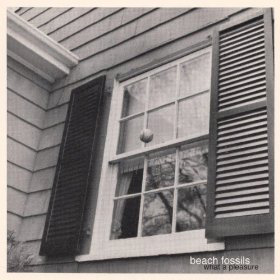
 

Snap Sounds: Beach Fossils

0

BEACH FOSSILS
What a Pleasure
(Captured Tracks)

Beach Fossils’ music possesses a brisk energy that — while sonically akin to great ’80s records on labels such as Postcard and Sarah — feels contemporary, or at least youthful. The group lost a guitarist after its debut album last year, yet its guitar sound remains its strong point: the jangly melodicism of this eight-song EP’s title track is early Johnny Marr-caliber, and the harmonic momentum of “Fall Right In” results in maybe the best Beach Fossils track to date, a declaration of affection that’s winning in its simplicity.

After “Out in the Way,” a plainly lovely rendering of abandonment that includes an instrumental contribution from Wild Nothing’s Jack Tatum, the latter half of What a Pleasure strays into darker terrain, exploring melancholy and, as the title of the last song puts it, adversity. The sighing, rolling pattern of the EP’s instrumental opener creeps into the conclusion of “Adversity,” bringing a suggestive a hint of nostalgia as well as hypnotic suggestion (is it time to start all over again from track one?) to the song’s languor. There’s an urge to look backward while moving forward through life, and it suits the band’s sound.

Beach Fossils, “Fall Right In”:

http://www.youtube.com/watch?v=Kb4WkuCVFSI

Beach Fossils, “Out in the Way”:

http://www.youtube.com/watch?v=001nD9NP2a4


Lookin’ forward to the weekend: Berkeley Art Museum faces a “Pigeon” invasion

0

The “L@te: Friday Nights at BAM/PFA” series has brought some great programs since its inception, and this Friday’s promises to be one of them. Programmed by Betty Nguyen, “Pigeon Dealers” includes a DJ set (by artist Dave Muller) as well as stand up comedy (by Chris Thayer) and Motorik sounds (by Bronze), but my chief reason for going is the rare chance to see some of David Enos’s movies projected large. In the years since his time with the 2005 Goldie-winning Edinburgh Castle Film Night crew, Enos has continued to create unique and at times alchemically uncanny short video works while also making paintings and music. He’s one of the best artists in the Bay Area today. Check out his spookily superb mystery Hidden Host after the jump.

David Enos, Hidden Host:
http://www.youtube.com/watch?v=CfJFtSVYPG8


L@TE: PIGEON DEALERS
Fri/8, 7:30 p.m.; $7 (free for students and members)
Berkeley Art Museum, Gallery B
2626 Bancroft Way, Berk
(510) 642-0808
www.bampfa.berkeley.edu

Editorial: Taxes — without the GOP

0

Gov. Jerry Brown did everything he promised to do. He negotiated in good faith with the Republicans. He listened to their ideas. He made it clear he was willing to accept concepts (pension reform, for example) that his biggest campaign supporters wouldn’t like. And he got absolutely nowhere.

The Republicans in Sacramento have demonstrated over the past two months that they have no interest in solving the state’s budget crisis and that they’re nothing more than obstructionists. It’s time for the Democratic Party leadership to give up on all this talk of bipartisanship and craft a budget solution that works — without the GOP.

There are several possible alternatives, but they all require Brown and the Democratic leadership in the Legislature to acknowledge that there’s no way to keep the state solvent and functional without at least extending existing taxes — and no way to get two-thirds support in the Assembly or Senate for any tax measure.

There’s some talk among progressives in Sacramento of using a creative legal strategy to put the extension of temporary sales and car taxes on the ballot with a simple majority vote. In essence, the Legislature can amend any existing law with a simple majority vote — and amending the current tax code to extend the temporary taxes for a year might work. Republicans will howl and sue, and it’s possible that the courts will side with them — but it’s worth a try. At the very least, the Democrats will be highlighting the difference between the two parties, giving the public a clear choice — and putting the GOP legislators on notice that if they won’t help find a solution, they’re going to be irrelevant.

The other option is to start gathering signatures immediately for a ballot initiative, or series of initiatives, that not only extends the temporary taxes but increases taxes on big corporations and the very rich. It’s too bad Brown didn’t start that process months ago; it would have given him immense bargaining clout with the Republicans. As it is, any initiative would have to wait until November; there’s nowhere near enough time to qualify a measure for a special June election.

Still, a lot of the projected state cuts could be delayed until after the voters have a chance to weigh in — and the politics are clearly on the side of progressive taxes. In fact, a poll commissioned by the California Federation of Teachers shows that 78 percent of Californians support a 1 percent increase in income taxes for Californians earning more than $500,000 a year. Even Republicans back the notion by a 60 percent majority.

With Brown leading the charge, raising the money for a signature-gathering effort and a strong campaign shouldn’t be a problem. And if California can start clearing up its red ink with taxes on the very wealthy, it will send a profound message nationwide.

Brown, to his credit, is finally starting to travel around the state and preach his message. He’s hitting Republican districts and trying to get voters to pressure their representatives to work with him. It’s a nice idea, two months too late — and it’s unlikely to turn any legislators around at this point.

On the other hand, the governor, whose popularity is high, would do wonders for the politics of the state and the nation by resuming the old populist stance he took in the early 1990s when he campaigned for president as a foe of corporate power and concentrated wealth. The folks at Calbuzz, the Santa Barbara political blog, put it nicely, suggesting that Brown start channeling the legendary former Wisconsin governor, Bob La Follette.

“As a political matter, it’s time for Jerry Brown to reach for his inner La Follette and start sounding some good, old-fashioned, Wisconsin-style populism. Instead of going after the railroads, as La Follette did, however, Brown should aim at the ultrawealthy, the oil companies, and other greedy corporate interests that have a) allowed the California Republican Party to gridlock the budget process and b) fought to keep special corporate loopholes, including outrageously low property tax rates from Prop. 13.”

That’s how you turn California around.


Snap Sounds: Peter Gordon

0

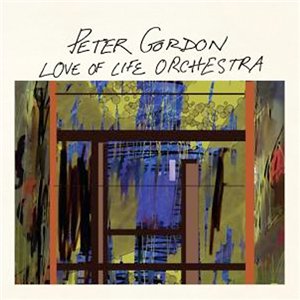
PETER GORDON
Love of Life Orchestra
(DFA)

With Arthur Russell duly sainted, the New York City avant-disco revival turns to this extensive, expansive studio project and its lush, sax-dominated epics. Blessed with the mastery of a conductor, Peter Gordon brought together a community of musicians — including Russell, David Byrne, David Johansen, Art Londsay, and vocalist Rebecca Armstrong — with distinctly lavish and madcap results. “Extended Niceties” and “Roses on the Dance Floor” are as terrific as their titles, and “Beautiful Dreamer” is exquisite. Two tracks after the jump.

Peter Gordon and Love of Life Orchestra, “Beautiful Dreamer”:
http://www.youtube.com/watch?v=GoYJFJRDkKQ

Peter Gordon and Love of Life Orchestra, “Extended Niceties”:
http://www.youtube.com/watch?v=cSBV2NLiQ2c
 

Fist Fam hits the Bay

3

In the music video for rap collective Fist Fam‘s song “Posted,” emcee Philo stands on a Columbus Avenue median, the Transamerica Pyramid pointing into the sky behind the North Carolinan, traffic whizzing by on either side of him. “I’m posted in the middle of the street/And we don’t even look right/But I got that million dollar mouthpiece/So we gon’ be allright,” he sings, at home in his new city. 

It’s an apt portrayal of the group of back-home friends from Asheville who seem set on taking the music they grew up with to the ears of the Bay. Fist Fam’s latest album release, also called Posted, is straight up, laid back, “psychedelic country rap tunes,” so dubbed by Philo and producer Al Lover, who are sitting with me outside Farley’s on a gorgeous Potrero Hill morning.

The boys grew up in the embrace of early ’90s hip-hop: Goodie Mob, UGK. Their tunes still have that Southern feel, but the layering of soul samples and front porch hooks (see: the sunshine feel of “Drinkin’,” a track the group just shot a video for on Philo’s family’s Appalachian farm) betray a citified knowledge of sound. 

The group’s trickle west was led by Philo, who established connections with the SF music community that made everyone else feel at home upon their arrival. But. “I didn’t have a safety net!” Philo says. “I had a backpack and $400. Back in the Gold Rush of ’05…” he trails off in an old man voice, his San Francisco debut having already achieved mythic status. He’s urged to share more of the legend. “My first move? I went to a bar in the Sunset, got a quesadilla at Gordo’s and tried to fandangle a place to sleep.”

Did the crew run into any funny business? Hey, a lot of people have funny perceptions about Southerners out here. “But we have funny perceptions about West Coasters – and they’re all true, by the way,” Lover teases. 

But with a ready-made, tightly-knit clan like theirs, there’s really no need for Fist Fam to sweat whatever still exists of regional stereotypes. This is how they record an album: they’ll set up shop in someone’s house (Philo has been building studio space since he was a teenager and says with the techonology available today, he can do it pretty much anywhere — and besides “we’re not going for a super clean sound”). Alcohol is usually involved. Budweiser is the group’s beer of choice – the two have stories about earning the king of beers for catching fireflies when they were little, a story that sounds adorably Southern to this West Coaster. 

Back to recording: there’s usually a fair amount of bickering. “A lot of us have known each other since high school,” Philo says. “We really are the Fist Fam — and I think that’s why we work. A lot of people are afraid to hurt each other’s feelings — ” Lover picks up the thread: “but we like it.”

“You gotta be chaotic to produce something,” Lover continues, conceding that for Posted, the group took a slightly more structured approach – he produced all of the beats and told people which songs they’d be on. Lover got some attention earlier this year for an electronic remix he did of the recently departed blues surrealist Captain Beefheart, but his favorite palettes to work from are old R&B songs. He’s also been doing work with contemporary beats, mixing Fist Fam over the music of Ty Segall and Thee Oh Sees. “Why use the old stuff when you have all these things going on now?” Added bonus: by using the tracks, Lover can cross-promote and strengthen connections with the psychedelic garage scene where the group sometimes find itself in the city.

Talking about the range of sound that Posted is built on takes me back to the image of Philo swinging his arms around, un-fuckwithable despite the North Beach traffic dashing around him. Sure, they’ve still got their twang, but you can’t quite see these boys doing what they do if they were still in Asheville. South comes to San Fran, welcome y’all. 

Fist Fam-Boac album release concert

feat. Trunk Drank

Fri/8 9 p.m., $10

Rasselas Jazz Club 

(415) 346-8696

www.thefistfam.com

Jane Kim’s credibility problem

96

(UPDATED AND CLARIFIED ON 4/7 BELOW) Two weeks ago, when Sup. Jane Kim voted to move the Twitter/mid-Market/Tenderloin tax exclusion zone forward before Twitter had agreed to a community benefits agreement (CBA), over the objections of Sup. Ross Mirkarimi and other opponents of the legislation who wanted a chance to review the CBA, she announced at the Budget & Finance Subcommittee meeting that she would delay the vote if the CBA wasn’t approved by the day before the hearing.

Today, the full board is scheduled to consider approving the legislation and Twitter has not yet agreed to a CBA, which is the only thing the city gets in return for giving the company a $57 million tax break. So, during a rally this morning at City Hall against the CPMC project, I asked Kim whether she would keep her word and delay the legislation.

No, she said, they will be voting today to approve it and then they’ll approve the CBA later as trailing legislation. When I pointed out that she was going back on her word and reminded her of the comments she made publicly two weeks ago, she said, “Well, the community understands and wants us to move this forward.”

What community, I asked, noting that much of the community opposes the legislation. She said, “SOMCAN is OK with this,” referring to the South of Market Community Action Network, whose members were perhaps the most vociferous opponents of the legislation at that March 23 committee hearing, their members uniformly asking that the legislation be delayed until after a CBA is approved by Twitter and subjected to community input.

After that conversation, a SOMCAN member who overheard the exchange confirmed that the organization continues to oppose the legislation, although City Hall sources tell us that Kim’s office has assured the group that it will get money out of the final CBA. It is illegal for supervisors to direct funding to specific groups in such agreements, which are negotiated by the Office of Economic and Workforce Development, as Deputy City Attorney Cheryl Adams testified at the March 23 hearing.

UPDATE AND CLARIFICATION: Kim legisiative aide Matias Mormino and SOMCAN organizational director Angelica Cabande strongly deny the organization was promised financial compensation from the Twitter CBA, saying the only assurance the organization was given was Kim’s pledge to create legislation designed to prevent the displacement that SOMCAN fears this legislation will create. Cabande also told us, ” The CBA will keep the corporation accountable to our neighborhood and residents’ concerns by specifically defining how Twitter’s presence will benefit the surrounding low-income communities.” 

Kim has made several statements about this legislation that weren’t true or were contradicted by the testimony of City Economist Ted Egan, as we’ve reported. Previously, she has also lied to others about statements I’ve made in conversations with her and about whether she’s ever met privately with Willie Brown, who supported her supervisorial campaign with an independent expenditure mailer that was illegally created in her campaign manager’s office.

Kim’s sponsorship of this tax break legislation comes despite the fact that she’s said she generally opposes such supply-side economic schemes. In his economic analysis of the legislation, Egan recommended doing a parcel tax on vacant commercial property as a better way to address vacant storefronts in mid-Market, the problem that Kim and others have claimed that this legislation is about.

I asked her about that recommendation during the March 16 committee hearing and she said that she strongly supports the proposal and that she has directed her staff to work on it. Is she going to keep her word and follow through on that pledge? I’ll believe it when I see it.

The Performant: Stupid is in the eye of the beholder

0

St. Stupid and Karen Finely ride again

For anyone who could count that high, Friday’s St. Stupid’s Day parade marked its 33rd anniversary — a year that was also auspicious, it should be noted, for that famous first martyr, Jesus Christ Superstar. Will St. Stupid, revered patron of the First Church of the Last Laugh, succumb to a similar fate as JC? 

Methinks not. The Romans have yet to suss out the threat St. Stupid’s low-maintenance doctrine poses to their empire building, and the Stupids are not about to let them in on that little secret. After all, on the surface it seems pretty benign, a bit of only-in-San-Francisco color for the die-hards to cherish and the tourists to gawk at. But beneath the greasepaint, dirty balloon animals, and silly sloganeering (“Dum is Sexy,” “I Can’t Afford an Actual Sign,” “Serfs Up!”), there’s still a feverish drop of pure dada shivering in the mix.

Of course, before you can have chaos you must first have a veneer of order. There’s a certain ritual solemnity to this carnival of fools and surprisingly strict adherence to the “stations of stupid,” a chain of locations stretched throughout the Financial District. 

These include the statue of the bare butt mechanics, the sunken plaza of slack, the banker’s heart, this last a huge chunk of polished black marble squatting malignantly outside the Bank of America HQ. The route provides ample opportunity to poke fun at the suits sticking their puzzled heads out of high-rise windows and demystify the sacred symbols of commerce, particularly the old Pacific Stock Exchange (now a fitness gym) with an annual “sock” exchange in which the crowd pelts each other with holey/holy footwear. 

Within the cast of carousing hundreds there are even set roles, in particular that of the Bishop Joey, a.k.a., parade founder Ed Holmes, who leads the parade with as much pomp and circumstance as a man in court-jester dishabille can. Like any good parade there are noisemakers, chants (“No more chanting, no more chanting”), and even a float bearing three iconic Doggy Diner heads — plus Wavy Gravy — but they are all mere means to justify an end, and in the best tradition of participatory anarchy, what you take away from the experience is very much equal to what you put in.

What has performance artist Karen Finley taken away from a lifetime of participatory anarchy? Finley’s a woman who has been derided as obscene by racists, who uses confrontational nudity to inflame not loins but synapses – an act of protest that can be likened to that of the infamous Nigerian “curse of nakedness.” 

Reading excerpts from her new book The Reality Shows, Finley kept her clothes on, but still provoked a few good reactions imagining a love match between George W. and Martha Stewart, embodying the persona of a cranky New Yorker (“no, USA Today is not a real paper, no, I do not want to just ‘hang out’”), and portraying a woman who loves to fuck amputee veterans of the first Gulf War. In fact, her quiet confidence and leopard print outfit made her seem exactly like the kind of person who could roll with the St. Stupid’s Day festivities for the right reasons, if only because there are no wrong ones.


SFBG Radio: Will Obama be re-elected?

4

Will Obama be re-elected in 2012? Will you want to work for him, or give him money, or vote for him? Johnny and Tim talk about the future of the president. Listen after the jump.


sfbgradio442011 by endorsements2010

How to move 200,000 people around America’s Cup

3

I’ve been wondering how the city plans to move the thousands of spectators expected to show up for a series of regattas in 2012 and 2013, leading up to and including the 34th America’s Cup Final.

And today I had a chance to start perusing the city’s draft People Plan which aims to move up to 200,000 residents and visitors daily to the city’s waterfront and is promising to be “the most transit, bicycle and pedestrian-friendly major sporting event in history.”

(Note to compulsive printers of online government documents: thanks to some nifty maps in this document, your printer may experience replication difficulties. For instance, I had to print everything but the maps on pages 13 and 14 of the document.)

Anyways, my preliminary review revealed that there is a special section in the draft dedicated to the “special transportation needs” of America’s Cup “participants” and that these participants include teams, event staff and, ta da!, accredited media.

“Special transportation needs for the ‘participant” group include but are not limited to staff access to race-related areas and other constricted waterfront areas,” states the plan. “These activities may require unique and frequent vehicle access to various sites.”

[Note to self: Remember to check out what is required to qualify as “accredited media” for a seat in one of the vehicles frequently accessing the area.]

Just kidding, and now, back to the needs of regular people who want to see the event.

“Part of the appeal that brought the Events to San Francisco Bay was the opportunity to create a new kind of viewing experience for the highest level of competitive sailing, with races held in close proximity to urban areas and accessible shoreline instead of open seas,” states the plan’s “Strategic Adaptability” section.

“The novelty of this concept creates excitement but it also creates uncertainty, in that there are few instructive examples of how spectators will choose to attend an America’s Cup Final-level sailing event in the middle of a weekend day, or how a large event in San Francisco Bay during a weekday will affect the ability of Bay Area residents to commute to work or their other daytime destinations,” the section notes.

{This sounds like the city is trying to figure out how many of us will choose to be anywhere but San Francisco on the weekends in question, how many of us who work in San Francisco are planning to play hookey to attend week day events, and how many will show up even if the Bay is swathed in fog.]

Un its draft plan,  the city promises  “to seed the strategies set forth in the People Plan with a measure of adaptability to allow for the strategic deployment of a finite amount of transportation resources across the spectrum of transportation demands associated with the Events in accordance with the expected demands of each day.”

Beyond that, the document is divided into three main parts. One itemizes likely destinations, the next describes transportation strategies to serve these key destinations, and the final section describes “additional considerations and strategies.”

To learn a) which race facilities, waterfront locations, and race viewing locations will be accessible to the public, b) which bus, rail, cable car, bike, automobile and ferry routes will be modified, and c) which parking and special locations will be added, be sure to check out the plan. And then eave your comments at the city’s feedback site here.

For, as the city’s website warns, “The early draft of the People Plan is the product of analysis by city and SFMTA staff, with early input from stakeholder groups. The draft People Plan announced today will also undergo significant and further revisions, following input from members of the public, advocates, city and agency staff, the environmental community and other stakeholders in the coming months. Final approval and consideration will occur following the completion of environmental review.”

In other words, review the documents now and speak your piece soon, otherwise your ideas won’t have any chance of making it into the final plan.

Or at Mayor Ed Lee put it in a press release, “We are moving rapidly to meet our commitments to host a spectacular 34th America’s Cup in 2013 and set a new standard for sustainable event-planning. The America’s Cup is a unique opportunity to leverage our region’s transportation resources and our enthusiasm to deliver the most transit, bicycle and pedestrian-friendly international major sporting event in history for residents and visitors alike.”

And here’s hoping that we will all be “moving rapidly” when the regatta finally rolls into town…

Remembering Peter L. Petrakis, the pioneering Guardian investigative reporter who exposed the biggest urban scandal in U.S. history

2

Peter L. “Pete” Petrakis was the Guardian investigative reporter who developed the stories in the mid-1970s that became known to Guardian readers as the PG&E/Raker Act scandal.

Pete died Feb. 28 in Everett, Washington.

In story after story, Pete laid out the scandal that the local media had buried for generations: how PG&E had in effect stolen San Francisco’s electrical power supply from the Hetch Hetchy dam in violation of the public power mandates of the federal Raker Act of 1913. The act allowed the city an unprecedented concession, to build a dam in a national park (Yosemite), on condition that the city have a public water and public power system. Pete detailed how PG&E used its corporate and political muscle to keep the cheap, green, hydro power from city residents and businesses and instead forced them to buy PG&E’s expensive private power, at a cost through the years of billions of dollars.

Pete learned of the scandal in the mid-1960s as a student of Prof. J. B. Neilands, a biochemistry professor and citizen activist at the University of California-Berkeley.

Joe Neilands had in the late 1950s started the campaign in his living room in the Berkeley Hills that ended up stopping PG&E from building a nuclear power plant upwind of San Francisco at Bodega Bay.

This was a truly historic victory of citizens fighting the local private utility, as recent events have demonstrated with the nuclear disaster in Japan.

In the process of researching the Bodega Bay story, Joe came upon an even bigger scandal: the PG&E/Raker Act scandal. After winning at Bodega Bay, Joe did the research into the scandal and then brought it to me shortly after the Guardian began publication in 1966.

This was a huge story and I remember saying, “Joe, why are you bringing a big story like this to me?” He replied, “Nobody else will print it, because of PG&E. You’re my only hope. If you don’t print the story, nobody will.”

I was happy to publish Joe’s story and it appeared in our March 27, 1969 edition, pretty much as Joe wrote it. The story was solid, and created ripples, but it was only a start because PG&E had successfully managed to bury the scandal over the years, and had used its political muscle to keep San Francisco’s City Hall  as a virtual PG&E subsidiary. The story needed much more research and development on several levels.

A few weeks after Joe’s story appeared, Pete came to me at the Guardian with the big new angle. He had figured out that the city’s charter revision committee was about to gut quietly the provision in the 1932 charter that updated the Raker Act and mandated the city to “gradually acquire” and “ultimately own” its own power system.  Pete swung into action with a three page story on Sept. 30, 1969,  that detailed the capitulation to PG@E  under the headline: “The Charter Board–afraid to enforce the Raker Act and bring cheap public power to San Francisco.”

He added a timeline: “How to Hetch Hetchy the city charter.” And he explained that “to Hetch Hetchy” meant to “confuse and confound the public by adroit acts and deceptive words in order to turn to private corporate profit a trust set up for the people” This was a quote used by U.S. Interior Secretary Harold Ickes in a speech to the Commonwealth Club in 1941 in support of a bond issue to buy out PG&E. PG&E Hetch Hetchyed the bond campaign to death and it lost.

In short, Pete dug into the scandal  with gusto and research skill and wicked wit. He  produced several major stories over a five year period  with shocking new information on how  PG&E was systematically screwing the city by stealing its Hetch Hetchy power. Each year, we would turn Pete’s  stories over to the civil grand jury, with his documentation, and formally ask  the grand jury to investigate the Hetch Hetchy scandal and make a report and recommendation.

Finally, in 1974, the grand jury to our great surprise came out with a report that corroborated Pete’s reporting. As our editorial put it in our Jan. 17, 1974 edition, “In short, the grand jury has corroborated almost everything the Guardian has been saying about the Hetch Hetchy scandal for the past five years…
What the grand jury did was to independently review the history of the Raker Act and the performance of the city in fulfilling its conditions. The jury retraced our steps, read documentation we have read and some we haven’t, never once quoted us or cited us and still came to the same conclusion–that San Francisco is forbidden to transfer Hetch Hetchy power to private utilities.but is nonetheless doing so, and that PG&E must be replaced in San Francisco by a municipal power and light department.”

As it had for years, City Hall and the local media promptly buried the story. And PG&E quietly put its surrogates into succeeding grand juries to bury the report and see that it would never again see the light of day.

As Pete noted wryly, “Are San Franciscans too dumb to run their own electricity system? As the grand jury pointed out in the relevant point of comparison, our water bills are lower today than they were 40 years ago before the city acquired the Spring Valley Water Company. How high are our utility bills after seven PG&E rate increases just this last year?”

Pete was an editor’s dream, using his science training to be thorough, accurate, fair, and on point.  Not once did a story “bounce” and never did anyone catch him in a factual mistake. He put legs and muscle on the the PG&E/Raker Act story that helped inspire three public power campaigns and a  strong public power movement in the city with a passion to enforce the Raker Act, kick PG&E out of City Hall, and bring our own Hetch Hetchy power to our citizens and businesses in San Francisco.

Pete was born on July 9, 1928, in Sioux Falls, South Dakota, the second son of first generation Greek immigrants. Pete served in the U.S. Air Force during the Korean War at the military hospital in Rantoul, Illinois. He received a Bachelor of Science degree in Zoology from the University of South Dakota, a Master of Science in Biochemistry from the University of Oklahoma, a PHD in Biochemistry from the University of California, San Francisco Medical Center, and an MPH from the UC Berkeley School of Public Health. He taught biochemistry at San Francisco State University.

Pete married Lorraine (Mardie) Tecklenberg in 1953. They moved to San Francisco in l959 where they raised two daughters.

Pete left the Guardian in the mid-1970s and went to Washington, D.C. to use his new journalistic skills to start a new career as a technical writer and editor.

He worked first as the editor of AMINCO (American Instrument Company) News and later as a writer-editor for many U.S. government agencies. He was an award-winning science writer for the National Institutes of Health. Pete met and married his second wife, Julia, in 1982, and the couple lived in Annapolis, Maryland, before relocating to Camano, Island, Washington where they lived for 20 years. Using online technology, Pete continued the editorial work of his one-man company, Life Sciences Editorial Services. Earlier, Pete had purchased one of the first home computers a VectoGraphic, taught himself programming and in the 1990s wrote and distributed commercially a DOS software program, TimeSet.

Pete was something of a renaissance man. His formal education was in the sciences, but he was an enthusiastic self-learner and student of American culture, politics, and history. Most recently, he was researching climate change. He enjoyed taking his family traveling and camping throughout the U.S., working to ensure his daughters had outdoor survival skills and and an appreciation of national parks. He loved jazz and bluegrass music. With no formal musical training, he taught himself to play banjo, guitar, fiddle and mandolin, and he designed and hand-crafted 5-string banjos.

He was also an avid astronomer and built several reflecting telescopes and enjoyed participating in neighborhood “star” parties. In 1973, he took his family to Africa to witness and record on film one of the longest total solar eclipses of modern times.

Pete is survived by his wife Julia of Camano Island; daughters Sonya Lee Petrakis and her husband Bruce Couch of Lake Oswego, Oregon; Tina Petrakis and her son, Lorenzo of Pacifica; brother Nicholas and his wife Patricia of San Francisco; step-daughter, Elizabeth Stam, her husband, Randy Kinnunen, and their two daughters, Julia and Caitlin, all of Camano Island; step-son, Allan Stam, his wife Eileen, and their three sons of Saline, Michigan.

At Pete’s request, a Celebration of Life service was held privately at the family home on March 13. Pete requested memorial contributions be made to the American Red Cross. Condolences can be sent to Julia Petrakis at petrakisjw@yahoo.com.

So long, Pete, you left the Guardian and San Francisco with one helluva story. B3


Early Peter Petrakis articles, from 1969 to 1973

The Charter Board–afraid to enforce the Raker Act and bring cheap public power to San Francisco

Sept. 30, 1969

SF power — in the great tradition of Abe Ruef and Candlestick

Feb. 28, 1970

PG&E keeps public power out of UC-Berkeley

April 17, 1970

PG&E, staunch defender of private enterprise, is the biggest welfare recipient

Oct. 26, 1970

The great 1965 James K. Carr public power disaster

Dec. 23, 1970

PG&E steals $40 million a year from San Francisco

June 7, 1971

If they ration our gas and our heat, why not ration PG&E and Standar Oil Profits?

Nov. 28, 1973


Live Shots: Nrityagram Dance Ensemble at the Palace of Fine Arts, 3/31/11

1

You could hear the dancers before you could actually see them. The stage was dark, but there was a jingling of a hundred bells that encased the dancer’s ankles and jangled with each of their movements. When the lights went up, the audience came face to face with an array of brilliant colors as the dancers moved across the stage in dazzling Indian saris.

These performers have traveled all around the world to share dances that go back to dates that end in B.C. We’re talking ancient movements, ones that have been passed down for tens of generations. But what makes Nrityagram Dance Ensemble so unique is not the dances they perform, but the way in which they learn them.

The dancers live communally in India, in the Nrityagram dance village located on a rural farm. The dancers not only practice their performance pieces, but also yoga, meditation, and martial arts — to name just a few of their ongoing areas of study. The goal is not only to become great dancers but to become well-balanced human beings. Dance as a form of life. Ingenious, right?

The whole performance was strikingly beautiful, especially with the help of four live musicians, whose beats and rhythms could put anyone into a hypnotic trance. There were many movements that I’d seen in yoga class, from elegant hand mudras to precarious one-legged balancing acts. It was ancient and yet so modern — back in the B.C.’s, these kind of dance moves never would have made their mark on soil of San Francisco.


Dick Meister: More Than a Game

1

Baseball season again. That smell again. It overwhelms me — the incredibly fresh smell of newly cut grass and stale earthy odor of freshly watered basepaths, the very essence of baseball.

I’m up on the edge of some infield, somewhere, crouching. I’m up on my toes, leaning forward anxiously and peering intently at a batter, my stubby-fingered fielder’s glove skimming the dirt. Bits of damp grass cling to the paper-thin kangaroo leather of my black spiked shoes and those of my teammates. Our uniforms hang on us in folds, like baggy woolen sacks.

Is it 1942? 1945? 1950?

Is it a ballpark in San Francisco? We look like human billboards with that splashy lettering all over the front of our uniform shirts. What’s that it says? Leslie Salt, Bucher Asbestos, Ghiselli Meats, Farallon Cleaners? Molkenbuhr Jewelers? Johnnies Billiards?

It could be any one of the two dozen or so neighborhood parks in SF that I so clearly recall, parks that swarmed year-round with players – young kids, teenagers, twenty-year-olds, middle aged men. Baseball was the ladder the younger players hoped to climb to fame and fortune, the chief form of recreation for all.

Sunday was the big day. Three games on each of the parks’ diamonds, at ten in the morning, at noon and two o’clock, between the city’s hundreds of merchant-sponsored teams, well sprinkled with professionals during the winter.

But the field I recall could be in Boonville, California. Or in Coquille, Oregon. 
Or Medicine Hat, Alberta. Or in any of the other towns where I also once played – in tumble-down parks, you’d probably call them, though we hardly noticed.

Mingled with the moist smell of the grass and the dirt and the sourness of sweat-soaked flannel uniforms is the sweet and sour of freshly cut lumber. It wafts from the mills where summertime semi-professional ballplayers from the city earned their keep when not racing across lumpy, sun-blistered fields while entire towns watched, cheered and jeered.

I mean places like Boonville, a town of 700 people 120 miles north of San Francisco, where I played a half-century ago, a 17-year-old shortstop not yet out of high school in San Francisco certain he was making the first stop on the road to major league stardom.

The Boonville fans – farmers, sheepherders, lumbermen and their families – barreled into town at noontime on Saturdays and Sundays, straight down the highway that doubled as Main Street, climbed out of dented and dusty pickups and long fish-tailed sedans and hurried into the Boonville Lodge. They jostled good-naturedly as they yelled out their orders: Beer and chicken-fried steak, beer and hamburger steak, beer and fried chicken or, for those feeling flush, beer and the house special, T-bone steak.

Soon the laughing, noisy crowd, grasping bottles of beer and washtubs filled with ice and more beer, crossed the highway and jounced down a dirt road on the other side to a field a few hundred yards away. The heat rose in waves; you could see it through the thick clouds of dust kicked up by the infielders, warming up as the crowd clambered up into the bleachers, rattling the seats formed from sagging wooden planks, old, dry and smelling of resin.

The crowd of two, three-hundred people yelled out advice and encouragement full blast through the afternoon, and fans came down under the bleachers between innings to offer icy, dripping bottles of beer that we downed in quick, gasping gulps.

It didn’t end with the games. We walked, players and fans, the sweat-soaked lot of us, across the highway afterward, replaying the games as we made our way to the lodge, there to continue our talk, inside and in boisterous groups that spilled out onto the sidewalk. More beer, and the raucous, endlessly blasting jukebox sound of country boys singing country songs.

That was Boonville on just about any weekend in the summer of 1950. That could have been just about any small town anywhere.

But sometimes when I remember baseball, I’m not playing at all. I’m in Seals Stadium in San Francisco, and younger. It’s a Saturday afternoon in the summer of 1941.

We hear the haunting echo of bat against ball that fills the virtually empty stadium during pre-game practice, the shuffle of feet as the crowd begins filing in. We hear the thump of balls in gloves as the players warm up, performing one of the most effortlessly graceful of human activities, a simple game of catch between skilled ballplayers. We hear the sing-song chatter of the players.

Suddenly, the umpire-in-chief bellows, “Play ball!” The crowd cheers, and the San Francisco Seals stream out of the home team dugout just behind the square white pillow of third base, figures in loosely-fitting uniforms of white daubed with black and orange. They move with arrogant grace onto the emerald green of the outfield and rich deep brown of the infield. We leap up to join in a fresh round of cheers.

Half-stumbling with excitement, we bound down flights of concrete steps 
between rows of dark green wooden seats set apart by ornate arms of cast-iron. We reach over the low railing in left field and into the San Francisco Seals’ bullpen to pluck at the pinstriped sleeve of a hero’s garment.

It’s Pard Ballou, the great relief pitcher. He’s the best, we’re sure, in the whole Pacific Coast League – a friendly, fat-faced man who’s always there, and always, the grownups tell us, just a little “under the influence.” Well, his breath does smell kind of bad sometimes – but, boy, can Old Pard pitch.

“Hi ya, kids,” says Pard, squinting up through the bright sunlight as he turns sideways on the bullpen bench. “How ya today?” He winks, and grins in a funny, lopsided way. “Think we can beat the bums?”

Seals Stadium was a very special place, but so was the little ballpark in Boonville and the neighborhood parks of San Francisco. So are the parks and stadiums of today, whatever their size and wherever they are. Jim Lefebvre, who played long and well for the Los Angeles Dodgers, likens them to temples.

Temples? Well, it may be only a game, but think about it.

A baseball park is a place of myth, isn’t it, of tradition, and veneration and ritual and order, of wisdom being passed from generation to generation, from elder to younger.

A temple also is a place in which to pay reverence to beauty, and what’s more beautiful than the graceful motion and timing of baseball, its unique rhythm, the exquisite ebb and flow of action and anticipation, action and thought. That’s right, exquisite, and you know it, unless you’ve been watching exclusively on TV, with its commercials, instant replays and non-stop announcers.

A ballpark is a place, too, where you demonstrate faith. Everyone who enters a ballpark believes it’s always possible to “beat the bums,” that it isn’t over until the very last out of the very last inning, that the innings, the game can go on for as long as the players perform well.

The commandments in the rule book promise that. There are no clocks measuring off quarters and halves, no point during a game when there is not 
enough time left to win, no rule saying how long it should take to make three outs and complete an inning, or how long it should take to win or lose a game.

Yes, life outside the temple may not always offer quite so much hope. But if it did, who’d need religion? Who’d need baseball?

Dick Meister is a longtime San Francisco journalist. Contact him through his website www.dickmeister.com

WonderCon diaries: Chris Cosentino is… Wolverine’s new buddy!

0

I had seen chef Chris Cosentino (of Bay Area offal ground zero Incanto, also a The Next Iron Chef contestant and host of the Food Network’s Chef Vs. City) in person for the first time a few weeks ago – he’d just made an incredible multi-course meal for a bunch of beer journalists at Anchor Brewery and was racing around, saying hi to people and describing his thought process on the various beer-food pairings. My tablemates, friends of Cosentino, told me he had a comic coming out at WonderCon, or something. So I gave him a shout – hey, dope local angle on the convention, since I knew I was going anyway.

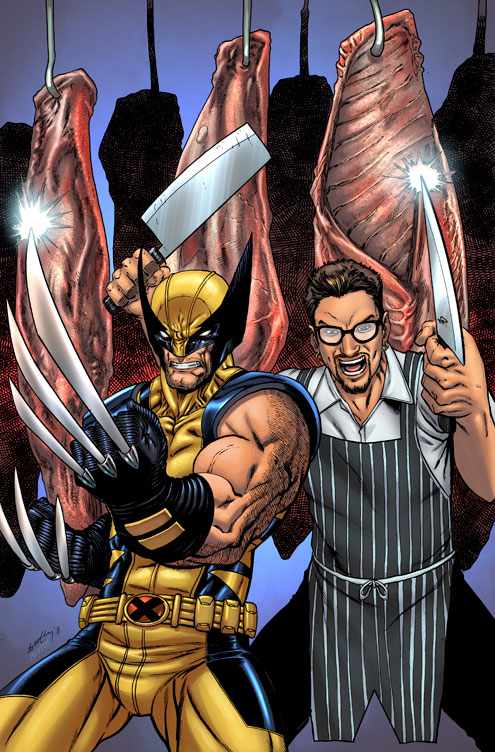
Maybe I should have known when I saw the massive poster of Cosentino in the Ferry Building at the stand of his other business, Boccolone Tasty Salted Pig Parts (signed by the man himself, “pork is the new vegetable,”), a few days later that this was going to be no mere small press comic release.  

Perhaps a nice interview about his project for some pre-event coverage? — I inquired of the king of offal. “You have to speak with Marvel first before anything can be written sorry it’s their protocol,” he replied. Marvel! At which point I embarked on the epic voyage that is reporting on Marvel Comics, much of which involves intriguing email exchanges with C.B. Cebulski, senior V.P. of “creator and content development.” Marvel, like most of the major comic labels, luxuriates in a cycle of suspense and sneak peeks. So are Cebulski’s emails: vague, then bombshell! Damn, they’re good at what they do. 

Which is to say, the convention approached and I still had no idea what the hell Chris Cosentino had to do with WonderCon, or Marvel at all for that matter. I dug out of C.B. that he was indeed, going to be the special guest at Marvel’s “Welcome to the X-Men” panel, so that at least I would be present for when the bomb was detonated. Still, Chris — are you going to be an X-Man? “No I’m not an X-Man,” is all his email in return said. So what the hell — ? Suspense!

On Friday Cebulski sent me the artwork of the upcoming Cosentino Marvel appearance, which was probably a big deal that I should have tweeted about immediately: Wolverine and the chef in a meat locker poised for battle, Wolverine with his metal alloy adamantium claws, Cosentino brandishing a pair of shiny butcher knives. Best friends! 

I was hooked. Thusly, I ferreted out said Marvel presentation on Saturday, the first WonderCon event I attended and the only time I would attend a major label event this weekend, I think. I saw Cebulski and Cosentino enter, was briefly and glancingly greeted by the two, watched Cebulski assume a spot at the panel table, Cosentino grab a seat towards the back of the conference room with a friend, and then the panel began discussing upcoming X-Men releases to a rapt audience, who cheered when individual series (there are many within the X-Men universe, of course): suspense, sneak peek!

“I can’t say a lot about what’s involved — but there are lots of giant robots involved,” said a much-loved Marvel artist on the panel. And on: “something drastic will be happening in the X-Men universe — I don’t think I can say much more about it.” Suspense, sneak peek! 

And then, the artwork I’d been sent earlier flashed on screen, with Cosentino’s figure replaced with a black shape with a question mark in the middle. And then, Cosentino! I think it’ll be bigger news on Chowhound, judging from the lukewarm  WonderCon entusiasm levels expressed upon his introduction. He arose from his seat towards the back of the room and assumed a spot at the panel table.  

“It’ll be very food centric, very San Francisco-located,” Cosentino announces of his impending dance with the X-Men universe. “We’re gonna have fun with this one.”

“I grew up being infatuated with Wolverine. As a little kid, I used to sit there and stare at my hands,” he says, the best line of the panel: the audience chuckles, remembering their own metal alloy adamantium dreams. Cebulski, panel moderating, asks what Wolverine’s favorite restaurant is. 

“He has so many food loves,” Cosentino replies, unwilling to pigeonhole his childhood hero. “Japan, Germany.” Which is to say: read the comic book! You can, it comes out in June exclusively in digital form. I for one, will be stoked to see where Cosentino takes Wolverine on whatever shredding and stabbing mayhem ensues – North Beach for cioppino? Nobu’s late night meaty buffet? 

Anyway, the audience members that surfaced for the post-panel Q&A was less intrigued with these culinary concerns. The closest ask came from a young man from the South Bay. When, he wondered, will the X-Men be spending some time on the peninsula? He sees them in San Francisco, Oakland, and Marin all the time, so he’d like to know. “I want to see X-Men on my street!”

“You want to see X-Men destroy your house and your street,” a panelist says, by way of very inconclusive response, albeit one that incites much enthusiasm from the questioner and the rest of the audience. Seeing one’s house destroyed by ones heroes being the ultimate honorific here in this crowd of Marvel enthusiasts, save becoming a character oneself. 

Anyways, now our chefs are cartoon characters. What’s next, the anime version of the Tamale Lady? Alice Waters vs. Godzilla? 

More WonderCon tidings are on their way, later this week. Ziggy Marley will be involved. How’s that for a tease, Marvel?

St. Stupid’s Day Parade mocks economic and religious institutions

0

The 33rd Annual St. Stupid’s Day Parade careened through the Financial District this afternoon, with hundreds of colorful self-styled idiots offering spirited and incisive send-ups of corporate and religious power and clearly having a great time in the process.

The always lively April 1 countercultural ritual was infused by fabulous weather and a nearby gathering of Burning Man regional representatives from around the world, a conference at the Bently Reserve where head honcho Larry Harvey will be giving a heavily touted speech this evening in which he’s expected to announce the formation of a nonprofit group that will eventually take over Burning Man from Black Rock City LLC.

But it’s tough to upstage the First Church of the Last Laugh on its holiest of days, and the crew led the parade of costumed followers through some of its regular rituals, including the tightening of the lug nuts that connect old San Francisco to the new landfill at Battery and Bush streets and throwing socks at the old Pacific Stock Exchange Building.

Along the way, they stopped to make noise and jokes directed at the Federal Reserve, Well Fargo, Bank of America, and other titans of capitalism and corruption, offering chants that included “Go back to work” and “No more chanting.” Lobbies were raided and icons mocked, but with such a good nature and self-deprecating style that even the initially nervous-looking suits and security guards ended up smiling.

Happy St. Stupid’s Day, everyone, now go have some fun.


Redmond traded for Nevius in mid-season shocker

4

Bay Guardian Executive Editor Tim Redmond has been traded to the San Francisco Chronicle for columnist C.W. Nevius and a right-wing associate editor to be named later, it was announced today.

As part of the deal, the Chronicle will pick up the remainder of Redmond’s $25.3 million contract. In addition to a future editor, the Chron will pay the Guardian an undisclosed amount of money “just to get Nevius the fuck out of here,” Chronicle Editor Ward Bushee said.

“We respect all that Chuck has done for us, but when we realized he couldn’t even get a hippie recycling center evicted by the deadline, we knew it was time to make a change. This is the big leagues, boyo.”

Former Sup. Michela Alioto-Pier, one of the many die-hard Nevius fans who has become disillusioned of late, was more harsh. “Nobody pays any attention to his shit anymore,” she said.

Nevius, a former sportswriter, has been struggling lately with the transition to a political position. His Column Effectiveness Percentage has dropped to .212 and his embarrassing play on the Haight Asbury Neighborhood Council Recycling Center and the Park Merced development have spurred calls for his removal.

Redmond has been struggling, too, and is widely considered to be grossly overpaid. His CEP fell below .300 for the first time this year, a problem he has blamed on age and brain damage. He recently cut his hair in an effort to clear some of the heat from his leftist political rhetoric, but his last four pieces on tax policy have been complete failures – not one politician has held a hearing, made a statement or done anything but quietly murmur that Redmond “has gone off the deep end.” He has refused repeated calls to open up his stance.

Redmond insists that none of his problems are his own fault, and suggested that his lack of effectiveness is due to some sort of shadowy “juice” at City Hall. “David Chiu and Jane Kim can’t possibly be throwing curve balls like that on their own,” he said.

Under the terms of the deal, Nevius will immediately take over Redmond’s job and Redmond will become the Chron’s Conservative Suburban Twit.

Redmond announced that he will be selling his house in Bernal Heights and moving to a gated community in the East Bay. “If I’m going to trash San Francisco every day, I need to be living in a place where there’s no music and the cops shoot homeless people on sight,” he said. “If I’m going to become a conservative, it’s important to eliminate any actual connection to the people I’m writing about.”

April Fool’s.

Wicked Grounds suspended in limbo

9

Coffee pots and spankings may soon cease to coexist at Wicked Grounds, San Francisco’s only kink café that announced plans to close last week due to crippling debt. Fans of the sexy space have since pleaded for a chance to help and offered up donations, but instead of accepting the cash with a hungry growl, owners have asked people to hold off and “think about it.”

No this isn’t a clever scheme to rake in even more moola with a big, slutty, pitty party — owners and husband and wife duo Ryan Galiotto and Rose White want their customers to contemplate other causes that need a boost. This from the Wicked Grounds website:

Please consider what is going on in our community, our country, our world: Bay Area’s Lyon Martin, who provide much needed health services to the queer community, is on the brink of closure; STI and HIV/Aids testing, prevention, and research is woefully underfunded; our community has yet to be awarded equal civil rights in so many areas; a series of natural disasters have made those that survived homeless and fighting for even the basics. Wicked Grounds might be an important part of our community, but so much money is needed in other places for even bare necessities.

Wicked Grounds isn’t quite refusing the money — by no means do they want to lock the doors. “We just want people’s emotions to calm down so they can think about it,” Galiotto says, noting how much they appreciate the community’s show of love. “We’re just trying to be responsible.”

wickedgrounds1

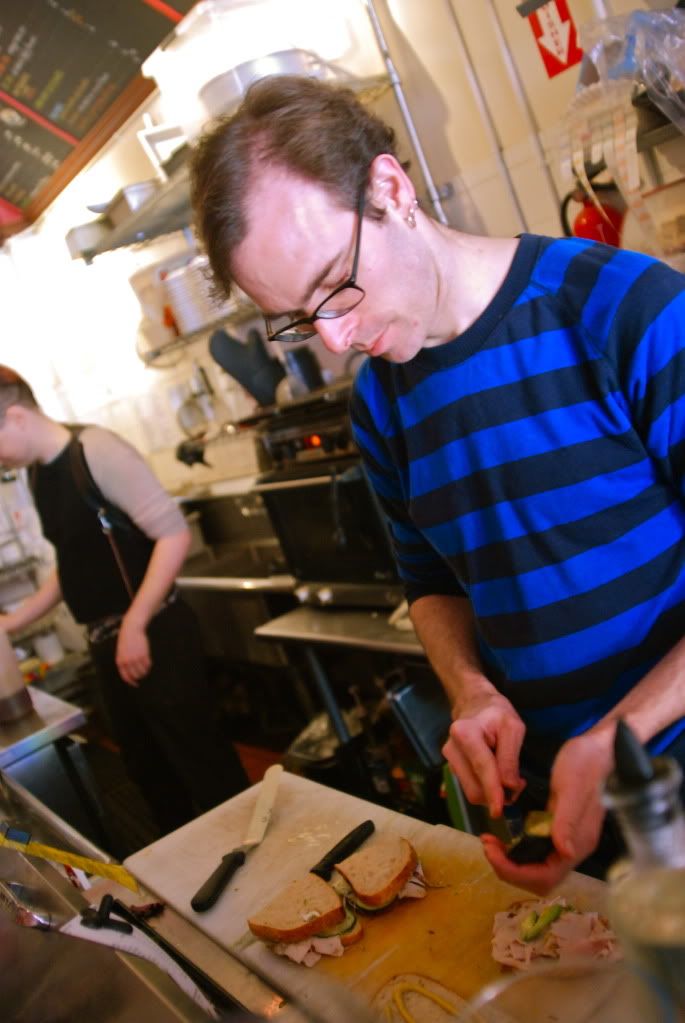
Galiotto getting his hands dirty

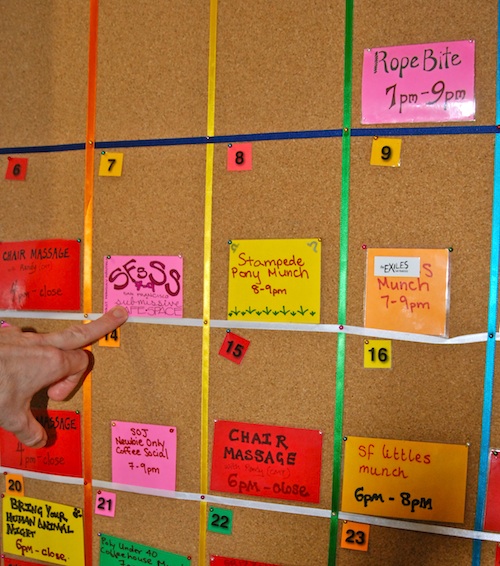
The shop has only been open since September 2009 but its honesty and openness has harnessed a whole lot of friends and connected a community of kinks that otherwise may not have mingled, teased and whipped. Over half the evenings in each month are reserved for special munches, themed play parties, and gatherings that welcome both veterans and newbies.

“At first I thought we would just be popular with the leather family,” Galiotto remembers. But their Folsom Street neighbors weren’t the only people who started showing up. Now customers bring in “littles” color pictures to post on the back refrigerator, a submissive group meets to chat and trade secrets; “ponies” stampede around the tables. All kinds of other fetish fans and even your average vanilla folks come in for sober conversation and the beverage of choice — coffee.

“When you come in here, you don’t have to worry about your neighboring table becoming upset over your topic of conversation. We’re not open for the ‘general’ public — just the public.”

And the patrons aren’t the only people having a good time. Steam milk, pull shot, get spanked — as witnessed on a Monday morning, baristas behind the counter at Wicked Grounds have lots of options for work-related benefits. Galiotto is even supportive of employee hook-ups. “Just sanitize as appropriate,” he laughs. “As long as everything is food safe. Like I always say, we’re all about team building.”

wickedgrounds2

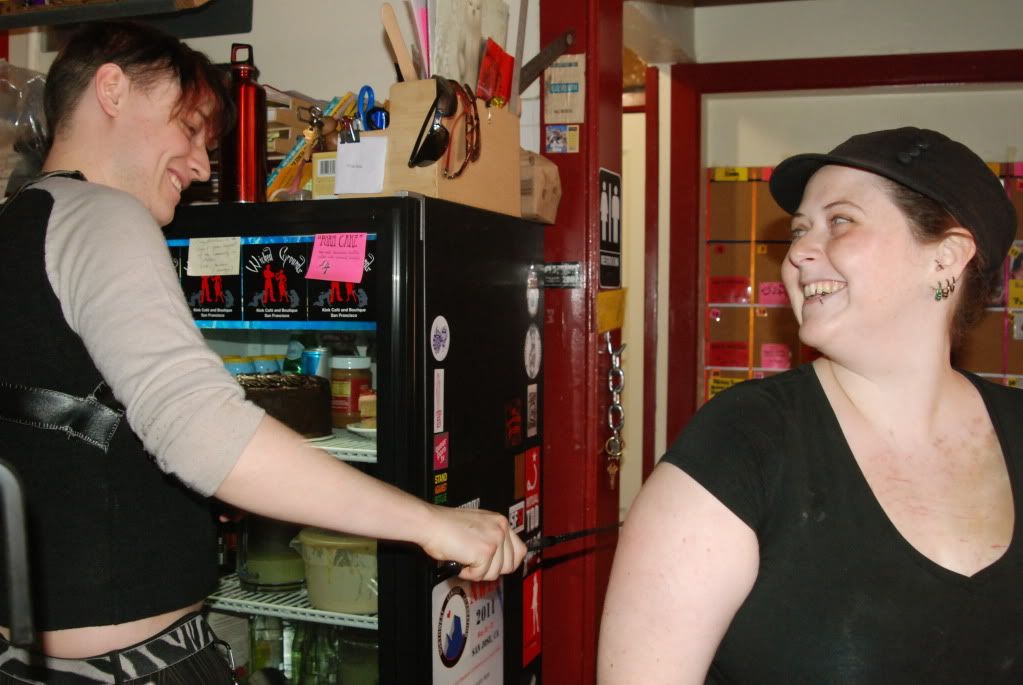
Employees Xin Farrish and Zev Hoffman play at work

Manager Xin Farrish is broken-hearted about the possibility of closure and the elimination of a friendly third space for people to explore new ideas. Wicked Grounds has consistently been a space for education. Last week while Farrish was baking a batch of brownies she watched a visiting Norwegian couple get suspension bondage lessons. She casually comments that “it was cool.”

Farrish hopes to pull together a bake sale and is still brainstorming with the other employees and Grounds lovers for fundraising ideas. 

“It’s more of a safe space than a business. We’re not a dungeon, not a shop and not just coffee. And without this space, there will be a big hole in San Francisco.”

Galiotto is now battling a stress-induced cold and coming up with the $100k to save the place seems impossible — but so does the thought of saying goodbye. The money the couple put into the café could have bought a home and the means with which to start a family, but for him and Rose, a kink café seemed more important.  

wickedgrounds4

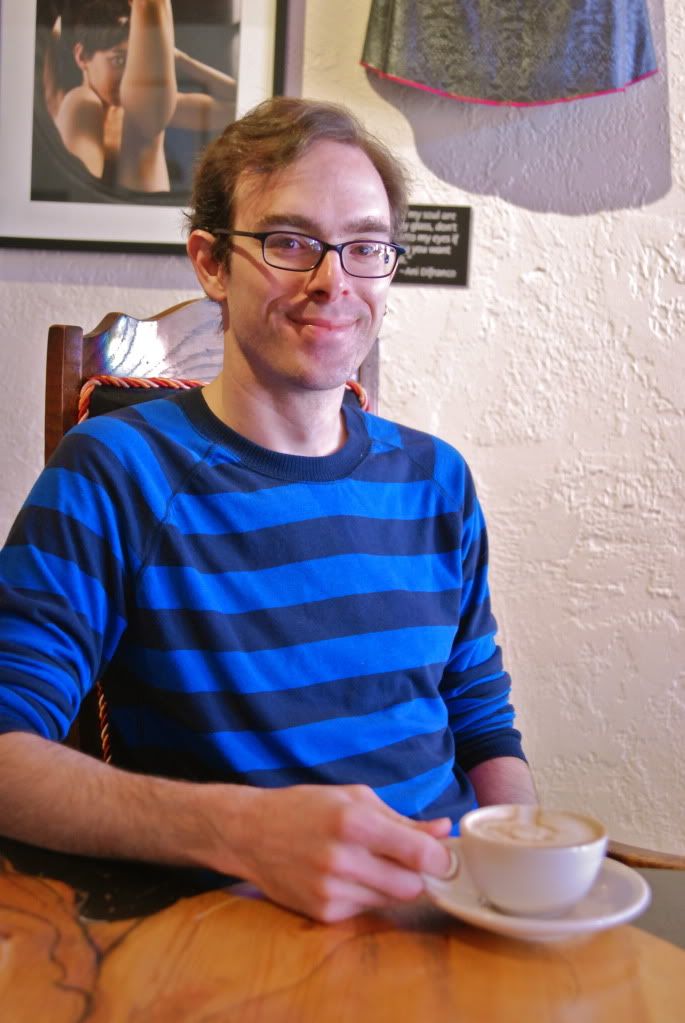
Galiotto taking a deserved break

“It would have been selfish for us to just build a cushy home. Yes, [Rose and I] could have made decisions that would have made our life easier,” he says with watery eyes. “But we built a home for a lot of other people.”

Galiotto and White will be making a decision on the future of their kinky love child by the end of the week.