SFBG Blogs

Snap Sounds: Richie Cunning

2

Listening to local SF rapper Richie Cunning’s new song Pure Imagination has proven to be terribly infectious, as I haven’t been able to get it out of my head.

A quote from A Bronx Tale about talent sets the stage as Richie takes you on a journey of his dreams and doubts in the rap game. I never thought a sample from 1971’s Willy Wonka & the Chocolate Factory could be made into a rap song, but with a breakbeat layered on top it has a nice relaxing vibe. This is definitely a track to chill out to while thinking about one’s dreams.

Download the free song here


Beating a fourth horse

0

Beat poet and Buddhist Allen Ginsberg inspires “The Worst Horse,” a Fri/27 program of multidisciplinary work at the San Francisco Zen Center curated by acclaimed SF author and RADAR founder Michelle Tea.

If Ginsberg’s definition of poetry as “making the private world public” is one starting point, the other is the Buddhist parable of the fourth horse, related by Zen Center founder Shunryu Suzuki Roshi in his famous Zen Mind, Beginner’s Mind. In the story, the mere shadow of the whip causes the first horse to run swiftly away, while it’s the first touch of the whip that induces the flight of the second, and the whip’s tearing of the flesh that provokes the third horse’s flight. But the fourth horse does not run until it’s repeatedly lashed.


 “If you think the aim of Zen practice is to train you to become one of the best horses,” writes Suzuki, “you will have a big problem. This is not the right understanding.” Considering the merciful nature of the Buddha, however, it becomes clear: “He will have more sympathy for the worst one than for the best one.”

The parable acts as the specific point of departure for the featured group of artists, some of whom are well-versed in Buddhism while others fall under the “beginner’s mind” rubric. The bill includes Philip Huang (writer, performer, agent provocateur and founder of the Home Theater Festival), acclaimed actress and Cultural Odyssey co–artistic director Rhodessa Jones, writer and artist Ali Liebegott, and poet-comedian and “reluctant self-help guru” Bucky Sinister. The evening also includes a screening of the 1960 award-winning short film Dream of the Wild Horses, a gorgeous and haunting cinematic rumination on the wild horses of France’s Camargue District, presented by Oddball Films.
 
“The Worst Horse”

Fri/27, 7:30 p.m., $10-$12 suggested donation

San Francisco Zen Center

300 Page, SF

http://news.sfzc.org/content/view/961/46/

David Chiu helps Leland Yee

118

It’s nice, sometimes, to be in Sacramento. You can run for local office without having to vote on local issues. Witness State Sen. Leland Yee, who didn’t have to take a formal position on the Park Merced project — and now can bask in the wonder of seeing David Chiu hand him thousands of tenant votes.


Here’s the deal: Chiu and Yee are both fighting for progressive voters in the mayor’s race. Most progressive groups will endorse John Avalos, but Yee and Chiu want those second-place votes, badly. Yee’s already got his West-side base, and getting a number two nod from, say, the Milk Club or SEIU 1021 won’t hurt him a bit with those voters. But he’s not strong with Chinatown leaders (Rose Pak despises him) and he’s in a race with three (so far) Asian candidates. He’s also contending with a bunch of other center-moderate types (Dennis Herrera, Bevan Dufty) in a very crowded race.


His strategy — and it’s smart — is to court the left, get those second- and third-place nods on the East side of town and emerge from the pack when all the votes are counted. Problem is, that’s Chiu’s natural constituency (or should be) — he talks about “our shared progressive values,” was elected as a progressive and, frankly, can’t win this race just by sticking to the center. It’s just too crowded there with too many people who have won citywide races.


And Chiu just gave up a huge chunk of the city’s left by alienating every tenant group in town.


As Dean Preston of Tenants Together put it in BeyondChron (which is generally quite friendly to Chiu):


 Chiu reached a backroom deal with the developer and provided the crucial sixth vote to approve the largest demolition of rent-controlled housing in San Francisco since the redevelopment of the Fillmore. Despite a good record on tenant rights issues before his work on Parkmerced, Chiu has now earned the distrust of tenants across the city.


The tenants aren’t always a solid bloc. Mitchell Omerberg of the Affordable Housing Alliance and Ted Gullicksen at the Tenants Union don’t always agree on candidates or issues. But there was no division or dissent on this one. Omerberg, who has been known to slide to the center, was adamant that Chiu’s vote — the swing vote to move the project forward — was “deeply disappointing.” He told us: “In general it’s an unwise, immoral plan to demolish a neighborhood. When you demolish people’s homes, you always regret it later.”


So now Yee can go to progressives and say — as he did at the Democratic County Central Committee — that he has all kinds of concerns about Park Merced and make it sound as if he opposes it, and use that leverage to peel some endorsements and votes away from Chiu. It’s ironic: When he was on the Board of Supervisors, Yee was hardly known as a pro-tenant vote. His record on tenant issues, while ancient history in political terms, was going to haunt him with some progressives (and still may). But now he’s gotten a boost — if only because he and Chiu are the ones most agressively working to get endorsements from progressive groups, and Chiu just shot himself in both feet.


Activists speak out at Chevron’s shareholder meeting

2

Police and security guards were out in full force in San Ramon yesterday, (Wed/25) where activists and shareholders of Chevron’s valuable stock converged at the company’s annual shareholders meeting at its headquarters.

Inside, the meeting, Chevron Board Chairman John Watson touted the oil corporation’s “community engagement” and market growth. Outside, around 140 activists from all over the world held signs to the speedy traffic on Bollinger Canyon Way, beseeching the general public to understand the costs of Chevron’s high profits. Some even made it inside.

“Our people have been dying,” said Tom Evans of the Sugpiat People of the Alutitiq Tribe in the native village of Nanwalek, Alaska, choking back tears during the 45-minute Q&A session with Watson.

“You are all a bunch of liars and thieves,” said Rev. Kenneth Davis, a Richmond resident who was arrested last year at Chevron’s shareholders meeting in Houston, Texas. He claimed he could see Chevron’s refinery from a window in his home. “People are dying, you steal from all over the world and process it in Richmond,” he said.

“When will Chevron embody in its operations environmental and social justice?” Elias Isaac of Open Society Initiative for Southern Africa asked the chairman.

After giving one of his canned responses of “we are a force for good everywhere we operate,” Watson conceded, “Perhaps it’s not enough, and we could always do more.”

Chevron just came out of a record-breaking year with $20 billion in profits, making it the largest corporation in California and the 11th in the world, with expectations of more growth in the years to come. It has nine new exploration projects it hopes to start in the next decade that will make Poland, Romania, Western Australia, China and other countries a part of the at-risk catalog of nations where Chevron chooses to do business.

It has claimed over 14 million acres of land for “exploration activities.” It’s also planning the world’s largest carbon sequestration project in Australia on a nature reserve and turtle habitat. If all this information isn’t scary enough, Chevron also makes huge messes and ducks out of cleaning them up.

Recently, the corporation appealed a guilty verdict from an Ecuadorian court for $8.6 billion in damages because of massive environmental degradation. The 18-year lawsuit stems from the destruction and mismanagement of the diseased Amazonian land that Chevron acquired when it bought Texaco in 2001. Ecuadorian Servio Curipoma lost his mother due to Chevron’s toxic sludge and was present at the meeting with other indigenous community members pleading with Watson and Chevron’s shareholders to change its policies in Ecuador.

“Take it up with your government,” Watson said to the speakers. “Petroecuador has not been a good partner,” he added, passing the blame onto Ecuador’s state-owned oil company. Chevron execs decided that was a good time to roll a video about the lawsuit and smeared the plaintiff’s lawyer, Steven Donziger, showing outtakes of the documentary “Crude,” emails and other private meetings, displaying Donziger to be haughty about the case. As the film rolled, most of the stockholders applauded Chevron’s PR efforts.

Seven items on the meeting’s agenda pertained to stockholders’ proposals on various subjects, including hiring a third party director with environmental expertise, creating a human rights committee, and disclosing the guidelines for Chevron’s country selection. None of the stockholders proposals passed, including one on the controversial process of “fracking,” which extracts natural gas from rock, that obtained 41 percent of the preliminary votes.

Once the meeting ended, the activists in attendance were met with a hero’s welcome out on the streets. Gitz Crazyboy of the First Nation Dene/Pikini in Alberta, Canada told the crowd he didn’t buy Chevron’s excuses that they were just following government mandates.

“If that were true we wouldn’t be here right now,” he said.

Antonia Juhasz of Global Exchange and the co-editor of the recently released The True Cost of Chevron: An Alternative Annual Report, said that although Chevron wasn’t as responsive as they hoped it was a victory nonetheless for the protesters.

“What was spit back at us was spin,” she said to the crowd. “We didn’t hear a truly substantive response to the damning human rights abuses that Chevron has caused.”

Sit-lie isn’t working. Imagine that.

14

Guess what? The much-hyped sit-lie law ins’t working. That’s what the Bay Citizen reports today in a story that should surprise nobody who has any sense.


When the measure was headed for the ballot, I had this discussion with then-Chief Gascon, with then-Mayor Gavin Newsom’s staff, with other supporters of sit-lie and anyone else who would listen. My point: Even beyond the civil liberties issues (which are huge), this was going to be a waste of time. Why? Because if there are people sitting on the sidewalk, and they’re told they can’t, they’ll …. stand up. No more violation. Still people on the street.


And guess what Lt. Belinda Kerr from Park Station has to report?


There has been “a prolific amount of arrests, citations and warnings … but I haven’t seen that it’s done a whole lot,” Kerr said.


She said the transients will often get up when they see officers drive by in their patrol cars, but “unfortunately are getting up and going around the block and then sitting down again.”


See? Tell people they can’t sit down and they’ll stand up. Then sit down again.


You want to deal with street crime? Deal with crime. Don’t make sitting on the street a crime.


When Gascon and I talked about this, I told him that two uniformed beat cops walking up and down Haight Street from 10 a.m. to 10 p.m. every day would solve any street crime problem without a new law. He agreed. Then he said it would be too expensive. I wonder what all these pointless citations — and the legal work of prosecuting and defending them — is going to cost. I suspect foot patrols would be cheaper.


American Idol: Whoa, Scotty!

0

Before we finish off this season of surprises, I would like everyone to give it up for my stunning record of predictions — I was wrong nearly every single week. And very wrong about the finale. I was sure poor Scotty was toast; not enough bubble-gum pop in his voice, not enough dancing, way too country. But whadya know — Americans decided they’d pick the one with the actual talent.


And I must admit, I was surprised by the show. Two hours to handle a 30-second announcement (that didn’t even happen until five minutes after 10, delaying the 10 O’Clock News — but hey, what’s more important?) and I figured it would be a deadly rancid soup of old photos and emotional messaging.


But no: It was, I have to say, one of the best episodes of American Idol ever. They brought back the top 11 and mixed them up with some surprising stars, and the results were too much to believe.


Out comes James to sing with Judas Priest. Rob Halford is showing some hard years, but still: A metal god. And James sang him under the fucking table. A final chance for us all to see who the real star of this year’s show was.


Casey gets to sing  “Fat Bottom Girls” with the always-amazing Jack Black. Haley does a crooner piece with … Tony Bennett. Yeah, he’s still around. Yeah, he can barely sing anymore. But still: Tony Bennett. Didn’t expect THAT on American Idol.


Scotty got to sing with Tim McGraw — and I have to say, held his own with a country legend. A bunch of the guys sing a Tom Jones medley, then out comes …. Tom Jones. It’s not unusual (but yes it is) and the guy still has the pipes.


Lady Gago does a death-defying leap off an artificial cliff. Spiderman swings above the audience while Bono and The Edge sing the Spiderman broadway theme song. Mark Anthony does a rockin’ spanish number and J-Lo joins him and dances. Can anything top all that?


Actually, Yes. At the very end, My Man Steven Tyler gets up on stage, sits down at the piano and plays and sings “Deam On.” Complete with the high notes at the end. I didn’t think he could do that anymore. I’m not sure he did, either.


Scotty’s first single (“I love you this big”) sucks, but it hardly matters. The kid who worked in a grocery story is now a certified star, and will have a long career in country music. Lauren Alaina is young; she’ll be fine. James will have a recording contract by next week, if he doesn’t already. Casey’s such a character that something good will happen to him. Jacob may even make some money on the gospel circuit. Too bad about Pia. Too bay about Haley. Life goes on.


And so does the show. We’ll see you next year.

Dick Meister: A Memorial Day Massacre

1


It’s a dramatic, shocking and violent film. Some 200 uniformed policemen armed with billy clubs, revolvers and tear gas angrily charge an unarmed crowd of several hundred striking steelworkers and their wives and children who are desperately running away. The police club those they can reach, shoving them to the ground and ignoring their pleas as they batter them with further blows. They stand above the fallen to fire at the backs of those who’ve outraced them.

Police drag the injured along the ground and into patrol wagons, where they are jammed in with dozens of others who were also arrested. Four are already dead from police bullets, six others are to die shortly. Eighty are wounded, two-dozen others so badly beaten that they, too, must be hospitalized.

The close-ups are particularly brutal. As one newspaper reviewer noted, “In several instances from two to four policemen are seen beating one man. One strikes him horizontally across the face, using his club as he would a baseball bat. Another crashes it down on top of his head and still another is whipping him across the back.”

The film ends with a sweaty, fatigued policeman looking into the camera, grinning, and motioning as if dusting off his hands.

The film was made in 1937. It was not, however, one of those popular cops and robbers features of the thirties. It was not fictional. It was an on-the-scene report of what historians call “The Memorial Day Massacre,” a newsreel segment filmed by Paramount Pictures as it was happening on the south side of Chicago on May 30, 1937.

We’re accustomed these days to the use of videotaped evidence to show wrongdoing by abusive law enforcement officers. Video technology was unknown in 1937, of course, and though film was available, it had rarely – if ever – been used for that purpose. The 1937 film, in fact, was initially kept from the general public by Paramount’s executives. Fearful of “inciting riots,” they refused to include it in any of their newsreels that were shown regularly in movie theaters nationwide.

But the film was shown to a closed session of a Senate investigating committee chaired by Robert LaFollette Jr. of Wisconsin. The committee, concerned primarily with civil liberties, was outraged – particularly since the Chicago police had acted in violation of the two-year-old federal law that guaranteed workers the right to strike and engage in other peaceful union activities.

The committee found that strikers and their families, while noisily demanding collective bargaining rights as they massed in front of the South Chicago plant operated by Republic Steel, had indeed been generally peaceful.

But that was beside the point to the police in Chicago and other cities with plants operated by Republic and two other members of the “Little Steel” alliance that also were struck.  For, as the committee concluded, the police had been “loosed … to shoot down citizens on the streets and highways” at the companies’ behest. The companies even supplied them with weapons and ammunition from their own stockpiles.

The committee said the companies had spent more than $40,000 on machine guns, rifles, shotguns, revolvers, tear gas canisters and launchers and 10,000 rounds of ammunition to use against strikers. Republic alone had more supplies than any law enforcement agency in the entire country.

The companies were prepared to go to any extreme to remain non-union. Two closed their plants temporarily, anticipating that most of the 85,000 strikers would soon be forced to return to work because they had little – if any – savings. But though Republic Steel closed most of its plants, it continued to operate the Chicago plant and a few others.

Republic fired union members at the plants that remained open and, with police help, cleared out union sympathizers and brought in strikebreakers to replace them. The strikebreakers, guarded by police day and night, ate and slept in the plants to avoid confronting the pickets outside.

Municipal police, company police and National Guardsmen harassed and often arrested pickets for doing little more than lawfully picketing. Six strikers were killed outside Republic’s Ohio plants in Cleveland, Youngstown, Canton and Massillon.

The killings and other violence, the steadily increasing financial pressures on strikers, unceasing anti-union propaganda – all that and more combined to end the strike in mid-July, two months after it had begun.

But the steelworkers didn’t give up.  Determined to not have made such great sacrifices in vain, they turned to the labor-friendly administration of President Franklin D. Roosevelt for help. They got it in 1941, when heavy pressures from the administration finally forced the steel companies to recognize their employees’ legal right to unionization and the many benefits, financial and otherwise, that it brought them and the many other industrial union members who followed their lead.

Dick Meister, former labor editor of the SF Chronicle and KQED-TV Newsroom, has covered labor and politics for more than a half-century. Contact him through his website, dickmeister.com, which includes more than 300 of his columns.


American Idol: Mom, God and Lauren

3

I think it’s all over. Scotty did the best he could with three weak, uninteresting songs, proving that he’ll have a fine career as a country singer once he’s out from under the iron grip of the Idol contracts. But Lauren Alaina is poised to become the least talented singer ever to win American Idol, largely because she’s got the votes of all those people who have nothing better to do than sit around for four hours after the show ends and send thousands of text votes on their phones.


Oh: and because of Mom.


Lauren’s final song — the one that will be released as a single if she wins — was all about Mom. Oh, and God. She prays like her mom does, la, la, la. In the middle of singing she went and hugged her mom in the audience.


Look: Scotty’s got a mom, too. And he loves Jesus as much as any country crooner. But his final song didn’t make anyone in the audience weep, and this the the Year of the Weep, so I think he’s done.


Too bad. He was never my first choice, but he’s at least good at what he does.  


Just one more night and I can go back to watching baseball. Go Giants.

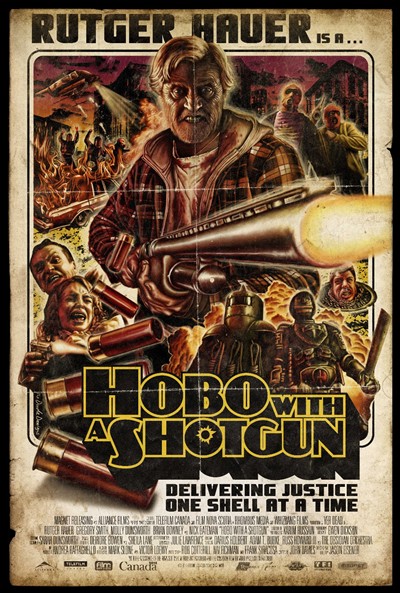
Last train to Fuck Town: Rutger Hauer rides again in “Hobo With a Shotgun”

0

The course of an acting career can vividly illustrate the randomness of fate. Rutger Hauer spent some years in Dutch experimental theater of the 1960s — after pulling off that best way to terminate one’s military service, faking mental illness — then became a local heartthrob as a medieval knight in a hit TV series at that decade’s end.

He spent the 1970s primarily starring in Dutch movies, notably the striking early films of Paul Verhoeven — well before Showgirls (1995), Starship Troopers (1997), or even 1987’s RoboCop (the director wanted Hauer for the lead, but was overruled by the studio). In the 1980s, Hauer played the memorable villains of Blade Runner (1982), The Hitcher (1986), and 1981’s Nighthawks (inducing tough investigative cop Sylvester Stallone to don drag at the end to catch him), between runs at being an action hero and theoretically loftier assignments around the globe.

Then he settled into a multilingual journeyman’s potluck of low-budget genre features, TV projects, small parts in mainstream films (2005’s Sin City and Batman Begins), Guinness commercials, and a Kylie Minogue video. Apparently 67-year-old Dutch actors in Los Angeles can’t be choosy.

Then again, sometimes better opportunities might choose them. At Sundance this January, Hauer played lead roles in two diametrically opposed movies. One was as the 16th-century Flemish artist Pieter Bruegel the Elder in Polish director Lech Majewski’s extraordinary The Mill and the Cross (recently at the San Francisco International Film Festival), which brings one of that painter’s most epic canvases to cinematic life and will hopefully open on U.S. art house screens later this year. The other was Hobo With a Shotgun. Guess which one is opening theatrically here already.

Hobo began as a $150 faux-trailer short that got considerable exposure online and off. The resulting long-form debut for director Jason Eisener and scenarist John Davies is doubtless the zenith in Halifax, Nova Scotia-shot retro ’ploitation splatter comedies to date. Which tells you nothing, of course. But it is pretty good — not great — insofar as spoofy gross-out nods to yesteryear’s exploitation cinema go. Better than Machete (2010), a whole lot better than the likes of Zombie Strippers! (2008) or 95 percent of what Troma puts out.

Grizzled Hauer stars as the titular character who rides rails into an equally nameless berg nicknamed “Fuck Town” because it’s so plagued by drugs ’n’ thugz. The hoodlums are led by crime kingpin “The Drake” (Brian Downey) and goon sons (Gregory Smith, Nick Bateman) whose violent perversities are Caligula-licious. With corrupt police force in pocket, they’re free to terrorize the populace via acts of degradation and violence pushed over the bad-taste top and then some.
When Hauer’s hobo rescues a prostitute (Molly Dunsworth) from this clan’s clutches, he trips his own mental wire from peaceably detached transient to pawnshop-armed streetsweeper of scum, à la 1980s vintage vigilante cheese like 1982’s Class of 1984 (Perry King vs. evil high school “punks”), 1985’s Death Wish 3 (Charles Bronson vs. evil gang “punks”), and 1984’s Savage Streets (Linda Blair versus … figure it out).

Hobo With a Shotgun faithfully apes exploitation conventions, from its lurid widescreen Technicolor hues to a score combining overproduced 1970s funky soundtrack kitsch with ’80s direct-to-video synth pulsing. (Complete with a closing-credits rock song that channels Pat Benatar.) Its ludicrously over-the-top violence is kinda funny, but also nastier than need be. Throughout, Hauer maintains a straight face. Maybe a tad more so than necessary — this movie could have used the wilder streak crazy-coot comedic streak shown by Jeff Bridges in last year’s True Grit or Kurt Russell in 2007’s Grindhouse.

Game Hauer retains his blue-eyed charisma and clearly relishes playing the gentle (when not lethal) giant in this artificially baroque scenario. He’s also an actor long on the world stage still seeking a role in a worthy film (or play) that may define him for posterity. He’s obviously got the talent — but at this point, would he take it? Would it even be offered? Did he take Hobo With a Shotgun because it seemed funny, or because it was the best he could get?

HOBO WITH A SHOTGUN opens Fri/27 in Bay Area theaters.


Appetite: Island bites, part five

0

Kauai: dreamy island respite, painfully beautiful, truly relaxing (other than east side traffic!) Last time, I covered restaurants and cheap eats, and killer cocktails on the island. This time, the final post in the series, I’ll focus on the best places to stay, and more on libations from coffee to rum.


HOTELS

Grand Hyatt Kauai, Poipu Beach:

Do yourself a favor and stay at Grand Hyatt Kauai. A resort in the full sense of the word, it is its own world unto itself. From lava rock waterways and multiple levels of pools (including a salt water-sand pool), to its world class spa, Anara, and open air couples cabanas, you leave here feeling as if you’ve truly had a vacation.

Dinner at Tidepools, features pina coladas sipped poolside, taking in the sunset from the deck of your room with a bottle of wine, conversing with the parrots in the massive open air atrium, live bands, and a scotch in Stevenson’s Library. It’s all unforgettable. Yes, it will cost you, but service is impeccable and the experience ranks up there with (or above) the best I’ve had, anywhere – and that includes the Ritz Carlton and the Four Seasons. The unreal setting, balmy by day, lit by tiki torches at night, is unbeatable.


Outrigger Waipoli Beach Resort, Kapaa:

My initial take on Outrigger Waipouli wasn’t strong. On a busy, strip mall-lined stretch of East Kauai in the town of Kapaa, its appears fairly generic from the outside, while kids swarm the lovely pool area (modeled loosely after Grand Hyatt’s incredible pools and waterways). At the time, the one spa for adults was overtaken by eight children.

But from a non-descript hallway, the door to our room opened onto what felt like our own private beach house. Two bedrooms, three bathrooms, a spacious living room and kitchen; each room had sliding doors opening onto the lawn than ran right down to the beach. Breezes flowed through the space, which felt private and removed from any of the hotel’s structure. Dishware, wine glasses, coffeemaker, everything we needed was in the kitchen, making it feel like a home away from home. It was the one part of the trip where we could cook and watch movies (Blue Hawaii, thank you very much) on flat screens in each room.

Though the location is not near as idyllic or removed as Grand Hyatt on Poipu Beach (it’s certainly more affordable), inside our room we felt secluded, rested and as if we could settle in for weeks.


DRINKS

Kauai Coffee Plantation, Eleele: 

The coast from the caffeinated climes of Kauai Coffee

Originally McBryde Sugar Plantation back in the 1880s, Kauai Coffee is Kauai’s one and only coffee plantation, encompassing over 3,000 acres set right on the ocean. A more striking setting I could hardly envision. A half day personal tour with its amazing sales manager, Marty Amaro, was a highlight in Kauai. We off-roaded in his truck over red dirt roads, through coffee fields, and next to ocean rocks where we watched sea turtles lolling.


Coffee plant at Kauai Coffee

They do everything locally themselves. I toured the factory, climbed atop a coffee harvesting tractor, witnessed bean roasting and bagging on a vertical form-fill-and-seal machine, and of course, sipped Kauai coffee. Amaro makes a mean iced mocha, let me tell you. I was envisioning a sweet, chocolate-y drink but it’s a bracing, coffee lover’s delight, refreshing and cool on a hot island day.

Kauai Coffee grows farm varietals of Arabic coffee: yellow catuai, red catuai (both with high levels of acidity for medium-bodied coffee), typica (medium acidity for medium-bodied coffee), Kauai Blue Mountain (medium acidity and full-bodied), and Mundo Novo (low acidity but full-bodied).

Coffee beans roasting

They run the largest drip-irrigated coffee estate in the world, sourcing waters from a nearby dam in the foothills, roasting over 600,000 pounds of coffee a year: an amazing feat when you see the size of the room it all happens in. Similar to wine, harvesting happens annually, around September through November, when staff double in size to get it all processed.

You can join the coffee club for a reasonable $15.25 to receive one 10 oz. bag, or $29 for two. Besides some of the elegant estate coffees, I find the newer Big Braddah a real representation of Kauai spirit: casual, familial, playful. I’m definitely not a flavored coffee type, but I am pleasantly embarrassed to admit I was taken with the Hawaiian coconut caramel crunch coffee. Each batch is painstakingly hand-flavored and the result is not so much sweet as integrated and nutty.

Kauai Coffee should be a stop on any visit to Kauai.


Koloa Rum, Lihue: 

I found Koloa Rum to be a bit of a mixed bag. The setting is memorably Hawaiian: a traditional sugar plantation-style tasting room on the grounds of the delightful Kilohana Plantation (a former sugar plantation preserved since its 1930s heyday). The distillery’s elegant packaging makes for a strong first impression.

Staff are gracious and aim to please. But complex Hawaii liquor laws are such that tastes remain exceptionally tiny, cannot be shared, and though they have created a mai tai mix, it’s illegal for them to mix alcohol – you won’t find cocktails of any kind here.

Using a 1,210 gallon copper pot still originally used for Kentucky bourbons post World War II, white, gold, and dark rums work best as entry points to the pleasures of rum. I know some who find them flat or not as nuanced as other rums, yet each one has won bronze or silver medals at esteemed rum tasting competitions like the Miami Rum Renaissance Festival.

I expected to find the gold ($30.95) and dark ($32.95) rums too sweet, given their somewhat unnatural coloring, which comes from crystallized sugar and molasses. But they were more balanced than I expected. But I’d be most inclined to drink the white ($29.95): clean and light, appropriate for cocktails. Another recent launch is the spiced rum.

If you’re in the area, it is a worthy stop: a local venture using the last of the little sugarcane left from the island, and pure mountain rainwater of nearby Mt. Wai’ale’ale.


Java Kai, Kapaa: 

The best coffee I had in Kauai, the bracing coffee at Java Kai is a local favorite for a strong cappuccino or espresso. It doesn’t have the friendliest staff (which is unusual in Hawaii), but that’s no matter when coffee is being prepared right. It was my regular morning stop on this side of the island (P.s. – it’s ideal iced, next door at Mermaids Cafe.


Kalaheo Cafe, Kalaheo: 

On the south shore of Kauai, this casual cafe would be at home in any hip, small town. Kalaheo Cafe has a healthy, locals vibe and is packed for breakfast. Eat-in or take-out, stand-outs include straight-from-the-oven baked goods (apple coffee cake is one). Using local coffees like Kauai Coffee, they serve robust espressos and cappuccinos. There may be no third wave, artful foam atop that capp, but rest assured it will wake you up. For one picky about coffee and how it is prepared, I didn’t feel like I had to suffer for good coffee on the sleepy island of Kauai.


— Subscribe to Virgina’s twice monthly newsletter, The Perfect Spot


SFBG Radio: The hopeless GOP hopefuls

0

Is there anyone in the Republican presidential field who can actually win both the primaries and the general election? Could we be facing another Texas governor trying for the White House? Check out the discussion after the jump.

NoHopeGOP by endorsements2010

SEIU 1021 withholds support for newly unveiled pension proposal

San Francisco’s largest labor union, Service Employees International Union 1021, is not on board with a proposed charter amendment that would reform the city’s pension system for public employees.

The pension reform proposal was unveiled by a coalition of city officials, labor representatives, and business leaders at a press conference in the mayor’s office in City Hall this morning, May 24. The plan would yield an estimated savings of $800 million to $1 billion in savings over the course of a decade, the bulk of it coming from increased employee contributions to retirement funds of up to six percent for future and current employees. The proposal would raise the retirement ages from 62 to 65, or 55 to 58 for public-safety workers, and impose caps on pensionable salaries for new employees. Mayor Ed Lee described the plan as “a serious, comprehensive plan and one that reflects the consensus.” The proposed charter amendment must go through the Board of Supervisors’ Rules Committee and win the approval of the full board before it can be placed on the ballot in November.

Lee emphasized that the pension plan had been crafted with a consensus-building approach over the course of several months, which brought business, labor, and city officials together. Billionaire Warren Hellman delivered comments about the historic nature of the proposal, and Rebecca Rhine from the Municipal Executives Association and Steve Falk from the San Francisco Chamber of Commerce each voiced support for the plan.  Sups. Sean Elsbernd and Board President David Chiu spoke of the collaborative and democratic process that had brought everyone in the city family under one tent.

Well, almost everyone.

“We’re stuck on one issue,” noted SEIU 1021 Vice President Larry Bradshaw. Under the plan, a pay cut would go into effect for three groups of lower-paid workers on the same date that they would be responsible for making new pension contributions, July 1, 2012, he explained. The affected workers include nursing assistants, security guards, and clerical workers, he said. While the mayor’s proposal requiring new pension contributions builds in an exemption for city workers making less than $50,000 per year, many of these SEIU employees would fall just above that cutoff mark, Bradshaw said.

“We’ve got workers that are just about at the $50,000 threshold … so they’re going to be paying about $2,000 a year out of their pocket,” toward new pension contributions, he said. “So the mayor’s plan has these workers, who are our lowest-paid workers, taking this huge pay cut, and then they want us to agree to this increase in contributions. And the scale of these pay cuts are just enormous. For someone who’s making $50,000 a year, to ask them to take $2,000 or $3,000 on top of $12,000 in a pay cut, is impossible.”

The pay cut is a leftover from the administration of former Mayor Gavin Newsom. For certified nursing assistants, the shift would amount to a roughly $12,000 annual pay cut, Bradshaw said. Security guards would face an estimated $5,000 per year cut, and clerical workers could face anywhere from $1,000 to $11,000 per year. Bradshaw estimated that a total of about 570 city employees would be affected. The workers faced getting fired and re-hired at lower-paid classifications in a prior budget year to make up for a revenue shortfall, but the union reached an agreement to stave off the worst pay cuts for those “de-skilled” employees by imposing a one percent across-the-board cut for all members in order to restore the salary cuts.

“This was such a sore point with our membership, the membership would not allow us to turn our backs on these workers, and we couldn’t get the city to restore the pay cuts,” Bradshaw said. “So we voluntarily took a one percent pay cut for every member to make up the loss in pay that these workers suffered.”

This arrangement would no longer be possible under the pension reform proposal, he said, because most union members would be asked to contribute 3.5 to 5 percent toward their pensions. “We’re already paying one percent more, so we’re not going to have that option of asking our members to keep funding these workers who have taken this 20 percent pay cut,” he said. “So the same day this goes into effect, these people take this horrible hit in their pay. And these are primarily women and people of color. Our problem is, we can’t leave these workers behind.”

Until that issue is resolved, the union cannot get on board with the plan, he said. “We’ve been waiting three weeks to meet with the mayor, and we can’t fix the problem if we can’t sit down with the mayor and talk about it,” he said, noting that  union representatives had been able to sit down with mayoral chief of staff Steve Kawa. Restoring the pay cut would have an estimated financial impact of $5 to $6 million.

Bradshaw said SEIU 1021 had hoped to fix the problem in order to be able to get on board and voice their support during the announcement this morning. “We were at the table until 11:30 last night,” he said. “We called the mayor, we had Tim Paulson at the [San Francisco Labor Council] text the mayor, we asked the city team to ask the mayor to come in. The mayor was a no show.” The Guardian has placed calls to the mayor’s office seeking comment, but hasn’t yet heard back.

Asked what he thought the outcome might be, Bradshaw said, “We think this situation cries out for justice. We think there are lots of ways to solve this problem, and we keep putting ideas on the table that are rejected by the mayor’s office. We’re hopeful. But, until we sit down with the mayor, it’s kind of a big question mark.”

SEIU 1021 represents around 17,000 city workers, making it the largest and one of the most politically powerful labor unions in the city.

Pattie Tamura attended the press conference on behalf of SEIU 1021, but stopped short of voicing support for the proposal when reporters questioned whether the union was on board with the plan, saying only that negotiations were ongoing. Bradshaw said they sent a representative as a sign of respect for the collaborative process that had been spearheaded by coalition leaders, particularly Warren Hellman.

Chevron’s critics gather before annual shareholder meeting

2

Chevron destroys everything, except profits. And by everything, we mean everything. The Amazon rainforest and its indigenous communities? Check. The Boreal Forest in northern Canada and its indigenous communities? Check. The Niger Delta? Check. Indonesia, Texas, and Iraq? Check, check and check. And even San Francisco’s own neighbor, Richmond, the home of one of Chevron’s largest oil refineries in the world? A big, whopping check.

Not that oil companies taking the lives, resources, and spaces of millions of people is something to take lightly. In fact, the opposition to Chevron is strong and growing, with many people across a network of international communities planning to stand up at Chevron’s shareholder meeting tomorrow (Wed/25) in San Ramon to give faces and names to the enormous destruction the company caused, which coincides with the release of the 3rd annual report on the company’s many misdeeds, The True Cost of Chevron.

At a press conference this morning (Tues/24) at a Chevron station in San Francisco, activists and representatives from places adversely affected by Chevron’s drilling, dumping, land grabbing, and environmental degradation told stories about losing mothers to cancer, women having miscarriages due to contaminated water, clear-cutting forests used by their ancestors for hunting and farming, and losing one’s sense of home.

“I have personally witnessed this devastation,” Servio Curipoma of the Amazon Defense Coalition in Ecuador said of Chevron’s operations within his country. “And I will fight to the bitter end and never give up,” he said after showing a photo of his mother who died of cancer. After an 18-year lawsuit by the people in Educator against the oil corporation, Chevron was found guilty of massive environmental crimes. But Chevron has yet to take note of its transgressions, and aggressively pursues communities at risk of complete disintegration.

Elias Isaac with the Open Society Initiative for Southern Africa spoke about entire fishing communities in Angola going days without catches as they rely on the waters that Chevron polluted through its operations in the country. “The pollution is effecting livelihoods,” said Isaac. “And it’s getting worse.”

Communities for a Better Environment also understands the nefarious ways in which Chevron puts its stock above its virtue. For example, the company doesn’t pay taxes to extract oil from California. “They had the audacity to ask for an exemption from the law,” said Jessica Tovar of the Oakland based advocacy group. Recently Chevron’s Richmond refinery was denied the possibility to process dirtier, heavier crude oil only after opponents went to court to stop the proposal.

The bitter truth, said Antonia Juhasz of Global Exchange and the co-editor of alternative report, is that no matter where Chevron decides to set up shop, the stories are the same: corporate side-stepping of responsibilities to the community, polluted water, love ones lost, environmental disaster that cannot be undone.

Just like the exploitation Chevron is responsible for through its operations across the globe, its profits are also ever increasing. Last year the company made $20 billion in profits, bolstering its standing as the 11th largest corporation in the world, and the largest in California.

In order to make a dent in its exploitative practices, members of different organizations will be voicing their opposition in Chevron’s shareholders meeting tomorrow, some through legal proxies of current shareholders.

There is a resolution activists hope will be discussed that will appoint a third party with expertise who will oversee operations to further prevent environmental disasters, said Mitchell Anderson, the Corporate Campaigns Director of Amazon Watch, which is based in San Francisco.

“We came to tell them that we disagree with their ads. It’s not a rosy image. It’s a lie,” said Juhasz. “Chevron knows how to do better but chooses to do worse.”


Arizona to kill prisoner with illegal drugs

14

The state of Arizona is preparing to execute a prisoner with drugs that were obtained illegally, records obtained by the Bay Guardian and the ACLU of Northern California show.


Donald Edward Beaty is set to die by lethal injection early in the morning May 25. However, DEA records show that the sodium thiopental that will be used in the execution was not imported legally — and may not meet U.S. standards for drug quality.


“Arizona is about to execute someone with an illegal substance, and the federal government is ignoring its responsibility to enforce the law,” said Natasha Minsker, Death Penalty Policy Director for the ACLU of Northern California.


Documents obtained recently show that the Drug Enforcement Administration is investigating the illegal importation of the death drugs, and has seized thoipental stocks in several states. But Arizona’s prison system still has custody of the sodium thiopental that it imported.


And documents released May 24 show that Arizona — along with Nebraska, South Dakota and Arkansas — imported the drugs from either the U.K. or India without filing the proper DEA import declarations. That means the prison systems violated federal law.


“The DEA records demonstrate that Arizona and other states broke the law,” Minsker said. “We cannot understand why the DEA has failed to act but has allowed the states to keep these illegal and dangerous drugs. When state officials break the law in order to carry out an execution, it makes a mockery of our justice system and puts us all at risk. State and federal officials must follow and enforce the law—that’s their duty and what the public expects and deserves.”


Editorial: Lee needs to make a decision

8


 The moment Ed Lee accepted the job as interim mayor — with the strong support of former Mayor Willie Brown and Chinatown powerbroker Rose Pak — we knew that the word “interim” would soon be in play.

Lee promised he wouldn’t run in November, and for some supervisors (particularly Sean Elsbernd, who nominated Lee) that was a deal breaker: Elsbernd told us he wouldn’t vote for anyone who wanted to seek a full term. But immediately some of Lee’s supporters began pushing him — quietly and not-so-quietly — to go back on his word and announce his candidacy.

Last week, a fake “draft Ed Lee” campaign emerged and got front-page treatment in the San Francisco Chronicle, despite the fact that it was orchestrated entirely by two political consultants. And word around City Hall is that Lee faces immense pressure to get in the race — and hasn’t entirely ruled it out.

That’s a problem. Lee is heading into a crucial budget season and will be negotiating with, and making deals with, a wide range of constituency groups. Everyone in town needs to know, now, what sort of mayor is running the show — a caretaker trying to get San Francisco through a rough time until a duly elected replacement can take office, or an ambitious politician looking at how to leverage this appointment into a four-year gig.

Lee has every right to run for mayor, and the filing deadline isn’t until August. By law, and political tradition, he can wait until the last minute to tell the city how he plans to spend the fall. And the fact that he promised not to run shouldn’t be an absolute bar: we never endorsed the idea of a caretaker mayor in the first place. What if Lee does a great job? What if the voters overwhelmingly want him to stick around? Why should that be off the table?

Still, this waiting game and this ongoing round of rumors and back-room discussions isn’t good for the city. If Lee wants to run, he needs to announce it now. If he’s not going to run, he needs to tell everyone — starting with Brown, Pak, and his other top backers — that he’s simply not going to do it, that he’s not changing his mind, and that they have to stop pushing him and making noise about it.

There are other candidates in the race, some directly involved in making city policy. When Sup. David Chiu talks about his budget priorities, we know exactly whom we’re dealing with — a board president who wants to be mayor. When City Attorney Dennis Herrera takes on the tricky job of running for mayor while serving as an impartial city legal officer, we know what the conflicts are. It’s not fair to them, or to anyone else, to be dealing with a mayor who may have secretly promised his supporters (who are also players and lobbyists at City Hall) that he’s getting into the race.

Lee may be personally undecided — but he can’t manage the city this way. He has to give San Franciscans a straight, and final, answer: is he running or not? Otherwise all these behind-the-scenes whispers, involving some very shady political operators, will fatally undermine his credibility.


The Performant 45: Oh Rapture, up yours!

1

Gearing up for the end times with Hoodslam

Well another Armageddon scare has come and gone and we’re all still here, as is my dirty laundry which I was letting pile up on the off chance that I wouldn’t need it again. Not that clean clothes were necessary to attend the Judgment Day edition of Oakland-based, amateur-wrestling-and-sideshow-freak extravaganza, Hoodslam

Housed in the strategically ramshackle Victory Warehouse, a couple of scenic blocks from the Oakland Greyhound station, the Hoodslam ring loomed large in the confines of what could be euphemistically referred to as the foyer. Cheerfully inebriated fans crowded in on three sides, a colorful wall of graffiti framed the fourth, a makeshift door led to the “dressing room,” and a chainlink barrier shielded the house band, Einstye, in classic “Blues Brothers at Bob’s Country Bunker” style. “You can cut the tension in this room with a knife,” wry match commentator Kevin Gill remarked. You could have cut the great cloud of cigarette-booze-and-blunt fumes with same.

In the best tradition of punk rock wrestling shows like the sorely-missed Incredibly Strange Wrestling, Hoodslam mixes costumed characters, fabricated grudge matches, aggro posturing, loud music, and theatrical bodyslamming with a healthy dose of humor and a pinch of what-the-fuck. But where the flamboyant weirdness of ISW was definitely a product of San Francisco’s love of themed masquerade parties and the slickly produced Lucha Va Voom is 100 percent LA, the scrappy phenomenon that is Hoodslam retains a thoroughly Oakland vibe. 

The sensation of being a first-time Hoodslam attendee is something akin to having a crack pipe in one hand and a spliff in the other, with a Steel Reserve going five rounds with a half bottle of NyQuil in the fight cage of your alimentary canal. It’s disorienting. It’s vaguely unsettling. And it’s a hell of a crazy ride.

On Friday, in preparation for the end of the world, a good two dozen Hoodslam “legends” showed up to settle some scores and create new ones (just in case we’d all live to fight another day). Contestants included a bi-polar clown, a French mime, an invisible man, a stampeding rhinoceros, a Winnie-the-Pooh lookalike armed with a garbage can, an unusually tall leprechaun, an Al Bundy clone, ISW remnant Otis the Gimp, the demonic Reverend Hellfyre and his passle of Zombie slaves, and a fanged Mexican werewolf—the dreaded chupacabra! 

There were even some wrestlers who could really fight: the acrobatic, bare-chested Juiced Lee for one, and native son, the masked El Lucha Magnifico, “the most evenly-matched men in Hoodslam.” 

The unbridled feistiness of the combatants was matched only by the rowdiness of the fans (“fuck the fans,” cheerfully reminded ring announcer Ike Emelio Burner on several occasions), whose profane chanting, frenzied pounding on the mat, and blow-by-blow heckling gave the event a post-apocalyptic edge, though the apocalypse wasn’t scheduled to arrive until the next day.

“Wrestling is a form of theatre designed to generate mass hysteria,” former ISW wrestler and book author Count Dante remarked in his Wired magazine interview. At the smackdown between the mass hysteria of Hoodslam vs. the mass hysteria of the pending Rapture, the former definitely took the win.

Stop the AT&T boxes!

15

By the League of Pissed Off Voters


More than 60 people showed up on the steps of City Hall May 21 to demand that AT&T engage in the same old basic planning process that even small-scale businesses have to go through.  (Read: even little people without expensive corporate lobbyists.)


Neighborhood organizations, disabled and senior representatives and environmentalists all pushed the supervisors to make the sensible vote at tomorrow’s full board meeting: support a full Environmental Impact Review of the consequences of 726 giant metal lockboxes cluttering up our public sidewalks.  As Julian Davis, a longtime community activist put it: “Why would you plunk down 726 giant Buicks all over the city when you have a perfectly good underground high speed rail?”


True that.  San Francisco currently has miles of fiber optic cable pulsing beneath our city streets, and even that is already becoming outdated.  So now AT&T’s brilliant idea is to litter our sidewalks with what amounts to giant crusty supercomputers? And what happens when they’re obsolete?  Basically, taxpayers just got stuck with a bunch of metal junk on our sidewalks, while AT&T expanded its profit margins.


Why do small cafes have to pay hundreds of dollars in permit fees to put two piddly tables outside their shops, while AT&T gets a blanket “categorical exemption” for almost no money to nail down ugly boxes that will block the sidewalk and attract graffiti?  (Hmm, we can probably think of some choice graffiti actually…)


The last time we heard from the folks at AT&T, they were helping the NSA wiretap our private calls from a secret room in their headquarters, so excuse us if we’re a little hesitant about giving the company a free pass to put creepy lock boxes in front of our homes. 


According to the Department of Public Works at the last public hearing on this issue, DPW staffers are relying on AT&T’s “expert analysis” to guide them on whether or not AT&T should receive a categorical exemption – in other words, DPW is relying on AT&T to do its job, and the community just got cut out of the process.  An independent EIR is necessary to address these blatant conflicts of interest. 


Speaking of conflicted interests: The latest scuttlebutt inside City Hall has some progressive supervisors desperately looking to cut a deal to save face in the midst of election season.  And what would that deal look like?  Cutting the number of boxes and giving neighborhoods an opportunity to decide whether they want 4’x4’x7′ lock boxs on their blocks. 


So, basically, if your block doesn’t have a home owner association advocating on your behalf, guess what you’re going to be walking around everyday?  As Juan Monsanto of San Francisco Beautiful pointed out, most of these boxes will be installed in less affluent communities without strong representation at City Hall.   AT&T’s sweetheart deal gives the supervisors cover to punt their responsibility to administer public space safely and equitably. 


So, to recap: we are now officially a city that will arrest human beings for sitting or lying in the middle of the sidewalk, but the board is working overtime to try and figure out how to exempt AT&T from city oversight process so it can stick giant immovable metal boxes in our right of way?


Oh, it’s okay because they’re going in the Bayview. Or in a neighborhood that already has a bunch of blight, so what’s a little more?  Lame.  Call your supervisor today and tell him or her to get a backbone.  It’s tough being the swing vote, you know?  Help ’em out, let ’em know you’re watching – and voting.


The San Francisco League of Pissed-Off Voters is the local chapter of the League of Young Voters, a national organization that engages young people in the political process, organizes around progressive issues and takes it beyond just “get out the vote.” 


Environmentalists rappel off Richmond Bridge to protest Chevron

This morning, May 23, activists from Amazon Watch and the Rainforest Action Network rappelled off the Richmond Bridge and unfurled a 50 foot banner which read: “Chevron Guilty: Clean Up Amazon.”

Anchored to the bridge deck, three brave souls dangled airborne above the bay alongside the banner, within view of an oil tanker. The banner drop was carried out to draw attention to Chevron’s environmental contamination in the Amazon Rainforest in Ecuador.

http://www.youtube.com/watch?v=HfCtDl1Jf2A

In an historic court victory in Ecuador on Feb. 14, Chevron was found guilty of causing $18 billion worth of environmental damage to a Rhode Island-sized swath of the Amazon. The widespread soil and water contamination, caused by decades of toxic dumping by Texaco and Chevron, has been linked to high rates of cancer and birth defects. Amazon Watch has been campaigning to get Chevron to clean up the oil pollution for 18 years.

“Chevron has said they are going to appeal the decision,” noted Paul Paz y Miño, managing director of Amazon Watch. “They’ve said they’ll fight it till hell freezes over.” So activists are keeping the pressure on.

Chevron will hold its annual shareholder meeting on May 25 in San Ramon, and a coalition of environmental organizations are using the occasion to draw attention to environmental problems the company has caused worldwide.

Three community leaders from the impacted Ecuadorian region traveled to California to share their stories and join in protests outside the shareholders meeting.

Their personal stories are moving. Humberto Piaguaje is a leader of the indigenous Secoya people of Ecuador’s northern Amazon rainforest, whose numbers in that region have dwindled from thousands to just several hundred since Texaco arrived in the area nearly 50 years ago.

Carmen Zambrano moved to the Amazonian region affected by Chevron in 1984, and according to her bio, tells stories “of how the company told people that the crude was good for their health, and that the contaminated water was safe to bathe and wash in, to drink from. … Her own children are terminally ill and developmentally disabled. Her sister-in-law suffers from cancer; her brother-in-law has serious heart problems. Her neighbors have died and almost everyone she knows has skin ailments.”

Serbio Curipoma, a cacao farmer from the Orellana province of Ecuador, lost his parents and sister to cancer. According to his bio, “He realized six years ago that the house his family has lived in for 20 years had been built directly atop an unremediated covered oil pit; digging just a few meters into the earth reveals thick crude.”

The trio from Ecuador will be joined by leaders from Chevron-affected communities in Nigeria, Indonesia, Canada, Angola, and Alaska at a teach-in at Berkeley’s David Brower Center May 23 from 7 to 9 p.m. on “The True Cost of Chevron.”

Paz y Miño noted that Amazon Watch is hoping to amass 30,000 signatures for the 30,000 plaintiffs in the Chevron case in a petition the group plans to deliver to company shareholders and executives during the meeting. They are also hoping to raise funds to cover the cost of the delegation.

Big launch for Avalos, emphasizing unity and integrity

69

John Avalos launched his mayoral campaign yesterday with a spirited event in a sunny SoMa park that drew several hundred enthusiastic supporters, ranging from elected officials such as Assemblymember Tom Ammiano and Sups. Ross Mirkarimi and Eric Mar to representatives of a wide variety of progressive and community organizations.

There was also an unlikely supporter: Sen. Leland Yee, who is also running for mayor but spoke to reporters wearing an Avalos sticker and said he was pleased that Avalos is in the race. The two men were each endorsed by the SF Bay chapter of the Sierra Club over weekend, and Yee’s campaign appears to be trying to court the second place votes from supporters of Avalos, the only solid progressive in the race.

But political sideshows aside, this was a day for Avalos and his supporters to shine, and they demonstrated a larger and more energetic event than other mayoral candidates have managed to pull together so far. And the crowd took the opportunity to emphasize Avalos’ progressive values of integrity and collaboration, in the process taking subtle swipes at the ambitions and egocentrism of other mayoral candidates.

“We are for John Avalos because John Avalos is for all of us,” was the repeated refrain in a strong speech by “progressive Christian pastor” and blogger Bruce Reyes-Chow.

Ammiano noted that it was the birthday of Harvey Milk and said that Avalos is the heir to Milk’s legacy of promoting progressive change through community organizing. “Harvey Milk knew the secret and the secret was grassroots…Without that tethering together, we never move forward,” said Ammiano, whose endorsement of Avalos could be a significant factor in the race, particularly as Bay Area Reporter writers and other LGBT entities support other candidates.

Ammiano offered a few reasons for his endorsement, joking that, “He has the best hair of all the candidates.” But even more important was the issue of integrity and trustworthiness, where Ammiano said Avalos really shines. “Trust is a significant attribute and you don’t see a lot of that [in public life]. And John is honorable,” Ammiano said.

Other speakers from labor and progressive organizations emphasized how Avalos has been fighting for progressive causes his entire adult life. “John cares about the issues we care about and he listens,” said Andrea Buffa of Global Exchange, who also worked with Avalos on campaigns against corporate dominance when she worked for Media Alliance.

“I’m here to fight for John because John fights for all of us,” was the conclusion of the fifth-grade student from San Francisco Community School, who introduced Avalos.

During his speech, Avalos said he was touched by the huge turnout and display of enthusiasm. “It’s such a joy to see you here. My heart is swollen,” he said, before introducing his family and telling a story of his father’s lifetime of union activism on behalf of Los Angeles dock workers. “I learned from him the value of hard work and devotion to something much greater than yourself,” Avalos said.

And the main cause that Avalos has devoted himself to in San Francisco has been the progressive movement, with its commitment to workers rights and social and economic justice. “We see that wealth is accumulating into fewer and fewer hands,” Avalos said, one of several core problems that he said his candidacy is committed to addressing, later adding, “I’m running for mayor to even the playing field.”

While he advocated for creating safe streets for pedestrians and cyclists, stimulating job growth, and adopting a housing policy designed to promote diversity by creating more homes for low- and middle-income San Franciscans, he devoted much of his address to addressing the core problem of wealthy special interests getting their way at City Hall.

“We cannot have the same business as usual that greases the wheels with lobbyists,” Avalos said. “I’ll put the interests of the collective above the interests of the few, day in and day out.”

Avalos cast this year’s mayoral election as pivotal to San Francisco’s future. “As a city, we are at the crossroads and only we can turn the tide,” Avalos told a crowd from which almost 400 people signed up to volunteer on his campaign, closing with a line that echoed Milk’s refrain from almost 40 years ago: “I want to recruit you to this movement.”

Why the right keeps winning

6

Robert Cruikshank, who is one of the best political bloggers around, has a fascinating piece today on Calitics about Cornel West’s attack on Obama, the politics of coalitions, and the fate of the Democratic Party. His thesis: The Republicans know how to make a coalition work, and the Democrats don’t.


Conservative communication discipline is enabled only by the fact that everyone in the coalition knows they will get something for their participation. A right-winger will repeat the same talking points even on an issue he or she doesn’t care about or even agree with because he or she knows that their turn will come soon, when the rest of the movement will do the same thing for them.


Progressives do not operate this way. We spend way too much time selling each other out, and way too little time having each other’s back. This is especially true within the Democratic Party, where progressives share a political party with another group of people – the corporate neoliberals – who we disagree with on almost every single issue of substance. But within our own movement, there is nothing stopping us from exhibiting the same kind of effective messaging – if we understood the value of coalitions.


More:


 If one part of the coalition gets everything and the other parts get nothing, then the coalition will break down as those who got nothing will get unhappy, restive, and will eventually leave. Good coalitions understand that everyone has to get their issue taken care of, their goals met – in one way or another – for the thing to hold together.


He points out, correctly, that the Democratic Party these days is actually two parties, and the only thing that holds them together is social issues. The neoliberals generally support same-sex marriage and abortion rights and can’t join the religious nuts who have taken over the GOP. But on economic issues, they might as well be two entirely distinct parties with very different messages.


It’s worth thinking about in the context of San Francisco politics, where a lot of people — including Board President David Chiu — talk about being part of a progressive coalition. And on a lot of issues, six of seven members of the board — and most people who call themselves progressives — agree. There ought to be a progressive coalition tha controls the political agenda in San Francisco, and there’s no reason that can’t happen.


But those of us who are part of what we can only call the economic left — the people who believe that the rich don’t pay enough taxes and the poor don’t get enough services and the public sector (yes, Government) is part of the solution — aren’t getting much of anything out of the coalition right now. Our issues (new revenue that matches or exceeds any cuts and a vigorous campaign by our elected leaders to make that happen) always disappear when the final deals are cut.


We’re always there on the non-economic issues — there was some grumbling, but in the end the progressives on the board all voted for Chiu’s yellow pages ban — but when it comes to budget time, we get thrown under the bus. And in the long term, that’s not going to hold a progressive coalition together.

Appetite: Napa’s affordable eats and surprising treats

10

After countless weekends in Napa over the years, I’m flush with recommendations for worthy restaurants and hotels. It’s not always the most affordable area, but my recent visits north have revealed a number of delightfully reasonable options within the bounds of Napa and Yountville, both new and established. 

They’ve also uncovered a few unexpected dishes – and in the case of one restaurant with a new chef, a whole range of them.

Napa Valley Marriott: Sleep… and a superior burger 

Breakfast, lunch, or dinner — don’t check your watch, just order the Knife and Fork burger at the Marriott

For those familiar with the hotel before its two years of multi-million dollar renovations, Napa Valley Marriott is a whole new ballgame. It now sports a warm, modern look with a soothing spa, an ultra-cool poolside patio with couches and firepits, and a new restaurant-bar. Though you may not be able to tell from the street outside, it’s really a dramatic revamp.

In the high season summer months, make a weekend of it with rooms in the low $200-300 range (or mid $200 range on weeknights). Rooms have also been completely redecorated with gentle colors and artwork, plasma screens, and comfy beds. The ones facing the courtyard are particularly tranquil. The only thing lacking? Free wi-fi. It’ll run you $4.95 a day.

Chef Brian Whitmer’s garden restaurant is a revelation. I’ve seen Napa restaurants with their own gardens, but nothing as lush as his. Spring peas are crispy and sweet right off the vine, and leafy greens make for abundant salads. Whether you stay in the hotel or not, it’s worth a detour to check out.

Cozy up in a chic booth, or a grab a stool at the curved bar and order the spicy Knife and Fork burger ($12) for breakfast, lunch, or dinner. It doesn’t matter when, just order it. This burger is made of Caggiano chorizo, which is savory and spicy, yet also delicate, melt-in-your-mouth, on a Model Bakery brioche. Layered with aged cheddar, watercress, the restaurant’s secret sauce, and a fried egg, it’s one of the better things I’ve eaten in Napa in awhile — an utterly unique burger. You won’t regret making a stop for this one.

3425 Solano, Napa. (707) 253-7433, www.napavalleymariott.com


Ubuntu: Vegetarian perfection

Chef Jeremy Fox brought nationwide fame to this eatery, often named among the best vegetarian restaurants in the country by publications like the New York Times. I’ve always enjoyed my previous visits.

But I’ll tell you now, with young chef Aaron London at the helm, it’s better than ever. The food has moved from winning vegetarian cuisine to work-of-art vegetarian cuisine. It’s gone from high quality to superb. As a non-vegetarian, I would say it has become possibly the best vegetarian restaurant I’ve been to anywhere and one of the best dining experiences in Napa.

What’s interesting about chef London is that he’s been at Ubuntu since the beginning, working as Fox’s sous chef. I hear he influenced a number of dishes in those lauded early days, though we did not hear much about him. Nominated for Rising Star Chef at this year’s James Beard Awards, we should be hearing a lot more about him.

He’s revamped the menu in such a way that each $10-19 dish is far more than the sum of its parts. You read of roasted and raw asparagus ($16) with burratta cheese coated in potato chip crumbs, but you really have no idea what you’re in for. A garden-fresh dish comes out, smeared with earthy potato skin puree, lavished with pine nut and currant soffrito, dotted with frisee, greens, and edible flowers. It’s an art piece that not only stuns visually but tantalizes the tongue with its range of flavors.

The two key words I’d use to describe London’s cooking outside of artistic? Texture and contrast. Every single dish of the six I recently had the pleasure of dining on were a study in layers and texture. Sweet complimented savory. Earthy and bright co-mingled. Crunchy partnered with creamy. Surprises came in every dish. Not a one was lackluster.

I could wax eloquent about the merits of each — some served on stone labs that kept them warm – but the menu changes frequently and this article would grow tedious. So I will simply say: go, and be prepared to be blown away.

1140 Main, Napa. (707) 251-5656, www.ubuntunapa.com


Bistro Sabor: Funky, fun Latin

Bistro Sabor‘s menu initially appears Mexican, but it’s really a mix of Latino cuisines in the new downtown Napa. The space is hip with brightly-painted, graffiti-bedecked walls, and the staff couldn’t be more helpful, particularly considering its order-at-the-counter casualness. 

On a Saturday night, tables were cleared for 10 p.m. salsa dancing, a hit with the local Latino community. Beer and wine keep it festive (wish they had a hard liquor license to serve tequila). The food? Fresh, satisfying, and all under $15. A two taco special of grilled sea bass ($11) is impeccably flaky, topped with scallion-cilantro slaw and a pineapple habanero salsa. Even accompanying rice and black beans are a notch above the rest. A rock crab quesadilla ($10) is less creative but still warm and cheesy, while pupusas, pozole, blood orange avocado salad, and lomo saltado exhibit a range from El Salvador to Peru. It’s playful Latin street food with quality ingredients. A win for Napa and cheap eats.

1126 First St., Napa. (707) 252-0555, www.bistrosabor.com


Dim Sum Charlie’s: Dim sum with a side of magic

I’ll tell you right now: you can get better, cheaper dim sum at dozens of places in SF. In fact, for the nearly $7 Dim Sum Charlie’s charges for a mere four dumplings, I can get at least twelve, and buns, at my favorite city spots. Why go? First off, there’s not much dim sum in Napa and Charlie’s is decent, though far from memorable. Warning: some have commented on menu listings that could be perceived as racist (“ten dolla make you holla”?).

But the setting is still a reason to go. Dim sum and noodles are served out of a classic Airstream trailer. Sure I’ve seen it before, but lover of all things retro that I am, I still find it charming. And what’s different about this trailer setting is its canopy of lights and dirt lot strewn with picnic tables and a campfire. Rollicking tunes make it feel like a backyard party — a bit like camping in retro-kitsch style. With dim sum.

It doesn’t really matter what you order. Bring friends. Pull up to a picnic table or fireside with hot sauce and chopsticks, and sing along to the Beastie Boys as you slurp noodles and fill up on pork buns.

728 First St., Napa. (707) 815-2355, www.dimsumcharlies.com (look for the Airstream trailer)


Yountville Coffee Caboose: Coffee lovers

You’ll not go wrong with coffee and pastries at the original Bouchon Bakery across the street. But when that line is unbearable (or even if it isn’t), I’m delighted to hit up a locals coffee go-to: Yountville Coffee Caboose. Yes, it’s actually in a train caboose off Washington Street. It often features Bay Area coffees like Ritual, brewed strong, robust and with proper crema.

6523 Washington, Yountville


Grace’s Table: Local’s breakfast 

Grace’s Table has its minor missteps: its raved about skillet cornbread with lavender butter ($6) was dry and rather flavorless. And $10-18 entrees for breakfast pushes a little high for a casual neighborhood restaurant. But as an open air, corner space with sweet waitstaff and soothing decor, it’s a welcome brunch stop.

Quiche of the day ($12 with salad or soup – can also be had a la carte) was the stand-out, fluffy and light. The crust almost reminded me of Tartine in its buttery flakiness. Mini bagels with house-cured salmon and cream cheese ($10) are playful approach to morning food, though the bagels are not exceptional (but isn’t that ever the case outside of New York?) Grace’s is a pleasant place to start your day with coffee and a newspaper. 

1400 Second St., Napa. (707) 226-6200, www.gracestable.net


C Casa Taqueria: Breakfast to go 

C Casa, a worthy newer addition to Oxbow Public Market, works for a cheap breakfast. With grass-fed beef, free range chicken, sustainable fish, and local produce, it’s a forward-thinking taqueria, yet it maintains authenticity of flavor. A breakfast taco brimming with over-medium egg and chorizo ($4.50), is meaty and satisfying first thing in the morning. Also stuffed in there? Black beans, avocado, pico de gallo, garlic aioli, and cilantro.

Located within Oxbow Public Market, 610 First St., Napa. (707) 226-7700, www.myccasa.com


Ad Hoc: Ok, one splurge

Ad Hoc’s Liberty Farm duck breast: more than a mouthful

At $52 per person without anything to drink (its another $39 for wine pairings), Ad Hoc is quite expensive, even if it is the one and only Thomas Keller’s “casual” venture. Watch where you sit: I’d be annoyed eating inside where too many kids (at this price?) and a noisy din make make for a less than appealing ambiance. The few tables outside on the tiny patio, however, are idyllic. 

As is the food in the four-course dinner. One appetizer, a main, a cheese course, and dessert, all served family-style and impeccably prepared with ingredients from their cheery garden behind the restaurant. No substitutes — you eat whatever is on the daily menu. 

And that’s alright when you get a salad as a beautiful as a recent mix of lettuces, pickled haricots verts (green beans), toasted pine nuts, red radishes, and shaved asparagus. Dotted with green garlic buttermilk dressing and king trumpet mushrooms, it was far more gratifying than those ingredients may sound on paper. Ditto the added course of ivory salmon ($15 supplement) baked in phyllo pastry, drizzled with porcini cream, and accented with fresh, white corn. Liberty Farm duck breast was actually a little too much for two people, but deftly prepared and served with a bowl of chickpea stew gentle with curry. We finished with strawberry shortcake on biscuits, slathered in lemon curd.

At roughly $34 per person, the Sunday brunch is the way to do Ad Hoc from a slightly more affordable, angle.

6476 Washington, Yountville. (707) 944-2487, www.adhocrestaurant.com


— Subscribe to Virgina’s twice monthly newsletter, The Perfect Spot

 

Yelle at the Regency Ballroom, 5/19/11

0

Major props to any super-hot French pop star who starts her set wearing a full body mop. That’s just what Yelle‘s lead-singer, Julie Budet, did last night at the Regency Ballroom — but it was to be expected since the group is consistently donning edgy threads in their eccentric music videos.

Budet has true star energy which fires her fans into hours-long dance fests at her concerts, despite the fact that probably the majority of them have no idea what her French lyrics are on about. 

But little matter — it’s not just about the music.

It’s also about the spunky ’80s dance moves and her too-cute white Keds. And I love the fact that even though Yelle has a very electro pop sound, the group is actually two band mates tinkering on the keyboard and drumming away on a kit, which infinitely surpasses hitting play on a Mac Book. The beats last night were infectious and gave off that essential French coolness that everyone was trying to absorb just a little bit of, even if they couldn’t quite sing along.


SFBG Radio: Do you get a Rapture Mulligan?

9

Gee, what happens if the Rapture doesn’t come about? Does the crackpot behind all of this hype (who runs a $73 million operation) get another crack at it? Johnny and Tim discuss the end of the world after the jump.

sfbgradio5202011 by endorsements2010