


No president since FDR has been reelected with unemployment at the levels the United States is seeing today. So that mean Obama is in trouble? Is the recession ever going to end? Johnny Angel talks to economist Johnny Venom. Check it out after the jump.
EconInEightMinutes by endorsements2010SFBG Blogs
The Performant: Bar Crawl
Burroughs and Shakespeare served neat, no chaser.
Stop me if you’ve heard this one before. A man walks into a bar. Ouch! Just kidding. A man walked into a bar. He idly scoped out a handsome youth leaning against the wall (Jorge Rodolfo De Hoyos Jr.) and began to sing: “I could use that, if the family jewels weren’t pawned to uncle junk…” Music swelled from the five-piece chamber orchestra in the corner of the stage: pizzicato on the violin, a bowed double bass, high-pitched urgent keys. An angular, haunting, sometimes dissonant music; just what you might expect the score for an operetta based on the semi-autobiographical William S. Burroughs II novel Queer to be.
The man onstage inhabited a familiar silhouette — rumpled suit jacket, a wide, silk tie, soft fedora — but rather than the reptilian demeanor of Burroughs’ legend, this representation of his protagonist Lee (Joe Wicht a.k.a. Trauma Flintstone) was both lusty and manic. He pursued the object of his desires, the diffident American Allerton (James Graham) with a single-minded frenzy, over-shadowed only by trembling bouts of junk-sickness and a burgeoning obsession with the psychotropic yage, or ayahuasca plant of South America.
Premiered in 2001, the Erling Wold operatic adaptation stuck to the text of the original pretty faithfully, the addition of Cid Pearlman’s silent balletic choreography lending the entire production the quality of an extended dream sequence. The show ended as it begins — in an expat bar somewhere in Mexico city—the slumped character of Lee as alone as in the opening sequence, older but not wiser, his longing for Allerton unabated, them usic underscoring his solitude in mournful adagio.
Meanwhile, at the Café Royale, briefly transformed into The Boar’s Head Tavern of Shakespeare’s Henry IV and V by the ever-ambitious San Francisco Theatre Pub, an adaptation of both (called The Boar’s Head, natch) played to a full house on Monday night. Concentrating mainly on the scenes set in the infamous pub, The Boar’s Head tracked the coming-of-age of the king-to-be, Prince Hal (Bennett Fisher), and his relationships to the two men who shaped him most—his austere father, the king (Ted Barker), and the jocular, petty criminal, Falstaff (Paul Jennings).
With no clearly defined stage space, the actors roamed around the whole room as well as on the Mezzanine, giving their pub-set play an air of authenticity better than any spray-painted flat and borrowed barstools could ever hope to. Their inventive use of space included using the pool table as an erstwhile deathbed, and the end of the bar for, well, the end of the bar, where Falstaff called repeatedly for his cup of sack and the French princess Katherine (Larissa Archer) learned halting English, body part by body part.
At the play’s end, the newly coroneted Hal banished the lusty Falstaff from his presence for a distance of 10 miles. Despite the somewhat gloomy resonance with Lee’s downfall from the night before, it’s actually encouraging to note that the libertine spirit has been under attack for literally hundreds of years and has yet to succumb entirely to the guardians of dour morality. At the very least, we should toast its tenacity with a cup of sack.
A rather odd endorsement

I got a press release today from the Dennis Herrera for Mayor campaign proudly announcing the endorsement of … Frank Jordan.
Jordan was mayor of San Francisco once. Back in the 1990s. His term ran from 1992 to 1996, and was, to be polite, mediocre. Nice guy; awful mayor. He was one of the more conservative mayors in memory, left office pretty unpopular, and a lot of people don’t even remember him. Those who do, particularly progressives, don’t remember him fondly at all.
Ah, but Herrera does.
“I’m deeply honored by Mayor Jordan’s praise for my leadership, and grateful for his endorsement for my mayoral candidacy,” said Herrera. “Few can claim to have done as much to serve our City with such integrity, skill and courage as Frank Jordan.”
While Leland Yee is out trying to get support on the left, which might actually help him win, Herrera seems to be moving, if anything, to the right (which is what Jordan’s endorsement represents). Very odd. Very odd indeed.
I couldn’t reach Herrera today to ask him about it, but I’m sure he’ll call me and I’ll update this post. Meanwhile: WTF?
UPDATE: I heard from Herrera late in the day. He told me that “there are only six people alive who have ever held the office of mayor of San Francisco and know what it’s really like to manage this city, and I would be proud to have the endorsement of any of them.” I asked: Including Willie Brown? Herrera: “He’s a columnist now so he doesn’t do endorsements.”
Herrera also pointed out, correctly, that he has the endorsement of Mike Hennessey, the progressive sheriff. And he’ll wind up with some more leftish endorsements, too. Still: Frank Jordan?
A different Mayor’s Office

A group of Guardian reporters and editors met with Mayor Ed Lee June 2, and while the mayor and I don’t agree on everything, I have to say: It was refreshing.
Refreshing because the mayor has a sense of humor and doesn’t act like an infallible monarch. Refreshing because his office looks like, well, a working office. Refreshing because he smiled, was polite and never said “I dispute the premise of your question.”
What a difference.
Under Willie Brown, the mayor’s office was an imperial sanctum. If His Royal Williness deigned to favor one of his servants or subjects with the boon of a royal visit, you were expected to crawl on your hands and knees and kiss the floor.
When Gavin Newsom was the occupant, the place was a cross between a museum and an Architectural Digest showplace — not a scrap of paper on the desk, every hair perfectly in place, the Robert Kennedy pictures and books lined up perfectly for the visitor to admire.
Both mayors treated the press with hostility. Both expected to be treated as potentates. The mayor was better than you and I — and you needed to understand that right away, or risk disdain and dimissal.
Ed Lee isn’t doing what I want with the budget. He’s not talking about raising taxes on the rich. He’s probably going to go along with ParkMerced and maybe even Treasure Island. He signed the Twitter tax break. I worry (a lot) about his ties to past corrupt regimes.
But he’s happy to have reporters in his office. He’s got stacks of reports on his desk and a notepad that suggests he’s actually reading them. He showed us his private “man cave” in the back, and offered us walnuts. He’s not always right on policy, and I don’t think he should run in the fall … but he’s not a jerk. And given the recent history of San Francisco mayors, that’s pretty radical.
Roccopura is back and wild as ever

I’ve been covering San Francisco’s indie circus scene for years, first for a Guardian cover story and then for my book The Tribes of Burning Man, and I’ve always loved the colorful chaos it injects into the city’s nightlife scene. And if you really want to see these creative and talented characters at their very best, in a show that brings all its myriad parts and beautiful pieces together into a big messy money shot, check out Roccopura tonight (Thu/2) or later this month at DNA Lounge.
Written by Gooferman frontman Boenobo the Klown, the creative force behind Bohemian Carnival and Burning Man’s Rednose District, Roccopura is a circus-inspired rock opera that spills from a stage packed with various indie circus troupes right out into the audience, which it jostles, gooses, and brings into the entire performance.
When I caught the show’s premiere on April 1, it was controlled chaos at its finest, a wild ride that had me alternatively laughing, dancing, mesmerized, and cheering throughout the show. And afterward, I felt like I’d been traveling right along with protagonist Sancho Panza during his bullfight, brawls, ocean voyage, mushroom trip, romance, and his other misadventures.
“We’ve spent the past few weeks honing stuff and doing fixes from the last show. It’s much improved now,” Boenobo told me by phone as he worked on final preparations, but I’m not sure that I believed him. Surely, it was a chaotic experience, but I’m not sure how they could improve it, although I’ll take this veteran showman’s word for it and happily pay them another visit.
In addition to a live soundtrack and other performances by Gooferman, the show features the Vau de Vire Society, Sisters of Honk, and the Burley Sisters, all of them bringing sex appeal, acrobatic talents, and a wild sartorial style to the show. Check it out.
Through the lens of hip-hop

Photographer/filmmaker Brian Cross charts a musical map of the African diaspora in the Americas — and opens new Summit Peek Gallery show tonight (6/2), “If It Fits in the Backpack: 10 Years on the Road with Mochilla”
Last year, Los Angeles-based production group Mochilla released Timeless,a trilogy film series documenting three concerts performed in L.A., early 2009. For these concerts, the photographer/filmmaker/DJ duo behind Mochilla, Brian Cross and Eric Coleman, shined light on three composers who have helped influence and shape hip-hop in different ways: the originator of Ethio-jazz, Mulatu Astatke; leftfield Brazilian arranger, Arthur Verocai; and a gutsy rendition of J Dilla’s beats crafted by Miguel Atwood-Ferguson with 60-piece orchestra. The films paint intimate portraits of musical exchange and live performance while paying tribute to some of the overlooked giants of the sprawling African musical diaspora.
In many ways Timeless is a culmination of themes explored in Mochilla’s films from the past decade. Their first project, Keepintime: Talking Drums and Whispering Vinyl (2001), and the follow-up live recording and DVD release in 2004, captured improvisational collaboration between L.A. hiphop producers and DJs, such as Madlib and J.Rocc, among others, with some of the powerhouse session drummers who inspired their sample-based work. Brasilintime: Batucada Com Discos (2007) also navigated the dynamic tension between an older generation of drummers, this time including legendary Brazilian percussionists, and the new school of analog producer/turntablists.
But not only did Mochilla depict creative partnership between these two forms of percussionists, they also translated the cut-up aesthetic of the DJ and rhythmic momentum of the drummer to the inner workings of the films themselves. A pastiche of words, music, and imagery composed of still shots and footage drive forward the fragmented stories, and striking moments of reconciliation, which unfold on screen.
More recently, Cross (known more familiarly as B+) set off to Columbia to document the Petronio Alvarez music festival as well as collaborative work between Will Holland (a.k.a. Quantic) and Ernesto “Fruko” Estrada, who could be credited with forging the rootsy, Afro-Columbian take on salsa. Mochilla also shot a good deal of the footage for Banksy’s street art disaster film from last year, Exit Through the Gift Shop, caught wayward rapper Jay Electronica at the Pyramids in Egypt and recording in South Africa, and documented Nas and Damian Marley on tour. To put it short, the dudes put in work.
“I look more for the off-handed moments that can be sustained as photos in themselves,” Cross tells me over the phone, while working in the dark room basement of his home in Los Angeles. He says that he’s excited to see how the large hand-printed photos will look in the upcoming Mochilla showcase at the new Peek Gallery in the Mission, this Thursday. “I’m trying to be iconic, but at the same time I don’t want to make publicity photos for record companies,” Cross says. “The videos, in a way, can be much more interesting because the fluidity allows for a certain kind of candidness.”
Cross, 44, has quite a history with such candidness in his work. Born in Limerick, Ireland, Cross moved to San Francisco’s Mission district in 1990 before attending CalArts in Southern California to study photography. While still completing his degree, Cross started writing what would become a landmark book on the emergence and socio-political implications of hiphop in L.A., It’s Not About a Salary: Rap, Race, and Resistance in Los Angeles (Verso Books, 1993). He is responsible for a number of iconic album covers of underground hiphop acts, from Freestyle Fellowship to Ras Kass and Mos Def. And Cross also made headway with more than a few magazine photo spreads and music videos throughout the past couple decades, notably including an arresting multi-textured piece for DJ Shadow’s “Midnight in a Perfect World” off Entroducing….. (Mo’ Wax Records, 1996).
Looking over Cross’ ever-growing body of work, some primary themes consistently arise: Through the lens of hiphop, Cross orients a number of conversations, multi-generational interchanges, rhythmic confluences, and resistant divergences that weave through the diaspora of African musical traditions in the Americas. “There’s an anthropological side as well as an ethnomusicologist side to it—an attempt to make a map of the diaspora in terms of the music set by the present,” Cross explains. “The goal is ultimately to document in a way that is not strictly historical, but to let the past speak to now rather than the other way round.”
SFBG I find an interesting dynamic in your film work and the documented live performances. On the one hand, you’ll take hiphop producers and DJs and pair them with percussionists, so as to put the contemporary in tension with the recent past that informed those contemporaries. On the other hand, there’s another element of featuring the music of those composers themselves. In what way do you think the past speaks to the present, as you put it, in both those approaches?
Brian Cross The idea is that somehow you don’t want to frame it off. In other words, for Keepintime, we didn’t want to get Paul Humphrey or Earl Palmer involved in something and frame off the dialogue in terms of, ‘Ok Paul, we want you to play the classic break on “One Man Band (Plays all Alone),” and now we’re going to layer something on top of it and develop a routine.’ But that’s not what’s interesting about Paul Humphrey. Yeah, it’s amazing he did that, and that’s why we’re choosing to work with him. But Paul Humphrey is somebody living and breathing; he’s our past, but he’s also our present. We want to open up a space of dialogue that is open to this series of works but isn’t limited to it.
For the Brasilintime project, we could have gone to Brazil and found obscure musicians who made amazing recordings and complete the narrative in the way that normal Eurocentric or Western versions of the story go: We bring them to Carnegie Hall, we do a concert, venerate them, and show them that Carnegie Hall is in fact the best venue in the world and is the most important place to see music. Whoa whoa whoa, back it up, we’re not going to do that. We’re going to go to there and engage, and try to actually build a bridge to the music. Let’s not have this as a one-sided sentence that leads in a single direction. Generally, what we try to do is to de-center, to find ways in which we can open up, because, invariably, when you do these things, that’s when you make discoveries. Oh, Mamao and Wilson das Neves played on the Jose Mauro record, he died before the record came out, and then Dilla sampled it … that’s when you make these discoveries.
You know I don’t mind the Buena Vista Social Club [1997] record. Ry Cooder is a great producer and a great musician, but the film is fucking awful. It’s so fucking wrongheaded. And that director, Wim Wenders, is smarter than that, man. We’re people of the left, he knows better than that. Of course, everybody got involved and was super happy that these guys were finally discovered, and we can fully appreciate how beautiful their music is and the contributions they’ve made. But then Carnegie Hall is put into the equation; we don’t need to reaffirm the same set of cultural values. We don’t need that. Maybe that’s kind of a trite example, but I’m interested in trying to forge ways to talk about music, or to explore possibilities of music, that don’t fall into the same set of traps that most writing and television and documentaries about music fall into.
SFBG Yeah, there are standard methods for placing outsider music, or the marginal narratives of musical traditions and musicianship, into the mainstream narrative, one of validation internal to our own frameworks of understanding. As a photography and filmmaker, how do you approach a sense of the outsider, or the musician who is resistant, or peripheral to the grand narratives? What techniques do you take up in order to engage these musicians and traditions and make them visible for a broader audience?
BC Well, when it comes to Brazilian music, I’m pretty serious about my shit. I do my research thoroughly. I try to put my best foot into it. But other than that, it’s pure human relationships, man. For me, here’s my pet peeve: Too much of the stuff happening right now is done without real social engagement. It’s through the Internet, whether it’s digital digging, or people paying 800 dollars for an obscure record from Ethiopia or Angola, when you could buy a ticket to go there for the same amount. You should be going. That’s the responsibility. The responsibility is to go there, actually experience it, and see what works on the ground.
To go back to Ry Cooder, when he went to Cuba to make Buena Vista, that wasn’t the music people were listening to in Cuba. People were listening to Timba, and Timba is a completely different thing. I just think there’s a lot more to be gained from actually going to say, Baranquilla, and spending time there in the town—meeting people, buying records, meeting musicians—than there is from surfing the Internet and finding the latest hot cumbia re-groove from Argentina or whatever. If you’re serious about your shit you have to go there, engage on the ground, and see what makes sense. You like Wu-Tang? Go to Staten Island. Go for a walk around the projects. Go visit P.L.O. Liquors where all those songs came from. That’s the kind of compliment you need to be paying people. And there’s ways to do this that aren’t touristic. You can go and feel the vibe there. It might seem obvious, but it gets lost in these discussions.
SFBG Do you see that as your primary motivational force? That your projects are prefaced on this desire to travel, meet these musicians that inspire you where they live and make music; find out what they’re doing, why they’re doing it, and be a part of it?
BC Well, the two things are kind of contingent. It’s cyclical somehow. I’m there, experiencing, helping to build bridges as best as I can, and I’m also thinking about photographs because that’s what I do.
SFBG How do you think this approach fits back into your earlier photo work in Los Angeles and your book, ‘It’s Not about a Salary?’
BC It’s an extension of it, really. You know the book is a very primitive thing, if you actually sit there and read it from cover to cover, which I did for a project a couple years ago, and I was highly embarrassed (laughs). But there was no model. It’s not like Can’t Stop Won’t Stop [Picador, 2005] existed, and someone had put that work down. I was 26, I had been into hiphop since I was 17, and I gave it a stab. And, of course, I put myself into a cultural debate that I didn’t know much about, for my own peril.
Ostensibly, the work isn’t much different. In that book, yeah, it’s about hiphop in Los Angeles, but I also managed to talk to Roy Porter, The Watts Prophets, Kamau Daaoood, Horace Tapscott, and a whole slew of other people who didn’t straightforwardly have anything to do with hiphop in Los Angeles. But in another way, they had everything to do with it. What has always been interesting for me with hiphop is that it has this historical reach. That’s what I tried to bring into the book. There’s definitely things which I don’t agree with now, and suppositions that I made or thought what would happen which didn’t. But it was a critical moment, right before The Chronic [Death Row, 1992], which I think was really a world changer.
The amazing thing about the golden era of hiphop, as they call it now, that era up to ‘95 or ’96, is that it was incredibly inclusive music. There was Japanese Koto, all sorts of rhythms from the Caribbean, rock, jazz, funk, you name it. That sourced people into record stores in different ways. The categories didn’t make sense as they did previously. That’s the magnetic lure of it. Somehow, hiphop allowed this extraordinary ability to look at previously recorded things and make them work in the present. For me, that was a critical modernist moment, or as the prevailing discourse has it a post-modernist moment—the collage and montage.
SFBG That brings up another interesting point in your work in the idea that when listening to hiphop not only is the origin of the break or the sample concealed, but also the artist’s background is concealed. The identity of the artist is mystified. Would you say that your projects aim towards making visible the musician as a person rooted in an environment or social setting?
BC The two-sided sword of the invention of youth culture is that it posits a kind of energy and dynamism to what we call youth. The problem is that the way it’s commodified is made contingent on the exclusion of anything outside youthful values or youthful thinking. I don’t agree with that. And if you look at the music of the diaspora, it’s not there. These kind of generational fishers don’t exist in other traditions of music: not in Latin, not in African-oriented music, and in my understanding of European folk traditions, they’re not there either.
While I find aspects of youth admirable, it shouldn’t ever be considered an exclusive category. For instance, David Axelrod is in his late 70s, and he has as much to contribute, and as many interesting things to say now as he did when he was 30. The thing is we’ve consigned him off to a category as if he doesn’t exist. And that seems ridiculous to me. I mean James Gadson still has fire now as a drummer just as he did when he played with Bill Withers. Why would we decide that he no longer has importance? It’s not like people have stopped listening to Bill Withers. But that’s how our music culture works. We fetishize the appearance of youth, but we’re not entirely clear on the implications of that. So, I like the idea of putting the person in the room if I can. For inclusivity, it has to be that.
And we have to get past the old ways of thinking, too. When I was first doing this, it was all super secretive. No one was supposed to know what your samples were or where your drums came from, because that was your tool kit, and if everyone had the same tool kit, it wouldn’t be interesting anymore. But I don’t buy that. In the end, there’s a deluge of information out there, it’s what you do with it that’s important. Your understanding and ability to manipulate the history is what’s important.
SFBG Even when you put out ‘Keepintime,’ I imagine that people worried that you would unveil the alchemic creative process, otherwise covered up, behind a hiphop record.
BC It goes back even before that. Take the video I did for DJ Shadow’s “Midnight In A Perfect World.” It plots out a series of concerns that I’m still interested in. You know, Earl Palmer is in there, and the sample is from a David Axelrod record. And they didn’t clear the sample. Shadow was terrified that Earl was going to recognize the song. But Earl didn’t even remember David Axelrod the person, let alone the record (laughs). They weren’t hits! Earl wasn’t sitting around listening to Axelrod records. But if you’re going to be too scared to talk to him, we’ll never learn anything from the guy. And then he shows up, and we’re transported to a whole different world: New Orleans before World War II.
You could say rock n’ roll came from the soles of Earl Palmer’s shoes. He was a child vaudeville performer, a tap dancer, and he battled against Sammy Davis Junior, and a lot of cats from that era. But he was never the best dude, and he was always interested in drums, so he taught himself how to play drums. So, that shuffle beat, that swamp beat as they call it, which became the foundation of rock n’ roll drumming, came from a guy who’s a tap dancer in black vaudeville as a child, who figured out a way to transform his tap dancing onto a drum kit. Think of the multi-billion dollar industry that rock n’ roll has become, and we still don’t know these things. We have to sit down and talk to these guys to find out these stories.
If It Fits in the Backpack: 10 Years on the Road with Mochilla
Opening photo exhibition w/ film screenings and Q&A
With Brian Cross and Eric Coleman
Thurs./02, 7p.m.-11p.m., free (thru 06/30)
Peek Gallery (Summit SF)
780 Valencia Ave. @19th St., SF
(415) 861-5330
www.thesummit-sf.com/peekgallery.html
Gov. Cuomo suspends S-Comm in New York State

More bad news for Immigration and Customs Enforcement (ICE)’s troubled Secure Communities program, which continues to draw fire for deporting thousands of folks with no criminal records since it was started under former President George W. Bush in 2008. Last month, Illinois said it was quitting the program, and today Gov. Andrew Cuomo issued a letter suspending S-Comm in NY state.
In a June 1 letter to the Department of Homeland Security, Cuomo’s counsel Mylan Denerstein noted that since the commencement of Cuomo’s administration in January, “we have received numerous complaints and questions about the purpose and implementation of the Secure Communities Program to which the prior administration committed New York State.”
“The heart of concern is that the program, conceived of as a method of targeting those who pose the greatest threat to our communities, is in fact having the opposite effect and compromising public safety by deterring witnesses to crime and others from working with law enforcement,” Denerstein continued.
“Compounding these concerns, the Department of Homeland Security (DHS) Inspector General recently announced that he will investigate whether the program is meeting its stated goals, whether it is being applied equitably and whether prior representations to states, including New York, regarding the program’s purpose, intent and impact are accurate,” Denerstein wrote.
“Accordingly, until the numerous questions and controversies regarding the program can be resolved, we have determined that New York is best served by relying on existing tools to ensure the safety of its residents, especially given our overriding concerns that the current mechanism is actually undermining law enforcement,” Denerstein concluded. “As a result, we are suspending New York’s participation in the program.”
Last year, S-Comm was activated in 35 New York communities, but with Cuomo’s announcement all counties will be barred from sharing fingerprint data.
Ad agencies proclaim inequality

It’s always fun to hear what the corporate elite talk about when they talk to each other — and there’s a great example in the latest study produced by Ad Age, the journal of the advertising industry. The study confirms that the rich have everything, that the middle class is vanishing, that “mass affluence is over,” and that
Simply put, a small plutocracy of wealthy elites drives a larger and larger share of total consumer spending and has outsize purchasing influence.
From Too Much:
America as a whole, the new Ad Age study pauses to note, hasn’t quite caught up with the reality of this steep inequality. Americans still “like to believe in an egalitarian ideal of affluence” where “everyone has an equal shot” at “amassing a great fortune through dint of hard work and ingenuity.”
In actual life, the new Ad Age study points out, “the odds of someone’s worth amounting to $1 million dollars” have shrunk to “1 in 22.”
There you have it: The marketers have spoken.
HANC gets a new eviction notice
The City and County of San Francisco voluntarily dismissed an eviction notice it had issued to the Haight Ashbury Neighborhood Council Recycling Center, but then the Recreation & Parks Department promptly sent a new one with a deadline of June 30.
The HANC recycling center and native plant nursery has continued operating in Golden Gate Park’s Kezar Triangle despite an effort initiated last year under former Mayor Gavin Newsom to evict the facility. The recycling center, which also offers compost for urban gardeners and a place to drop off used veggie oil, has been in Golden Gate Park for decades and has formed partnerships with community gardening projects throughout the city.
Rec & Park started making plans to replace it with a community garden last year amid concerns about “quality of life” issues. Some neighbors were bothered by recyclers filling up shopping carts with containers plucked from their sidewalk recycling bins, to trade in for small amounts of cash. Members of HANC, meanwhile, saw the eviction as political payback from Newsom, who encountered stiff opposition from the progressive neighborhood group when he led the charge to place San Francisco’s sit / lie ordinance on the ballot.
The request for dismissal, filed May 26 in San Francisco Superior Court and signed by Attorney David Ammons in the office of City Attorney Dennis Herrera, doesn’t provide a clear reason for the move. But Robert De Vries, HANC’s attorney, said the tactic was likely meant to avert legal entanglement by dissolving the first, and more legally problematic, attempt at eviction and replacing it with a new one that may be harder to challenge in court. In a letter to Rec & Park commissioners dated Dec. 2, 2010, De Vries wrote that the first eviction notice was illegal under the structure of the lease that HANC had signed with the city, and asserted that HANC could legally possess the property until June 30, 2011.
Because the dismissal of the first eviction was done “without prejudice,” there was nothing preventing Rec & Park from issuing a new eviction notice, which it did the same day. Rec & Park did not respond to an email seeking comment.
“Your attorney has argued in court that the notice was not effective to terminate the lease,” notes a May 26 letter from Rec & Park General Manager Phil Ginsburg. “While we continue to believe that we gave you more than adequate notice of the Lease termination and to disagree with the assertion that the Lease has continued on a year-to-year basis, to avoid that dispute, we are superseding the earlier notice with this one.”
HANC’s Jim Rhoads told the Guardian that he wasn’t very surprised by Rec & Park’s latest move. “We knew this would happen,” he said. “We’re going to meet with our lawyers, and decide on the legal front what we do next.”
De Vries said he could not discuss all the possible legal angles that HANC could use to try and fight the eviction, but he hinted that the eviction could be considered retaliatory. “This … termination was initiated under Newsom as payback for my client [for opposing] sit / lie,” he said.
Sacramento deadline: Some key bills

A bunch of key bills come up in the state Legislature this week — and some of them are going to be very close. Assemblymember Tom Ammiano is pushing hard to get AB 1017, which would eliminate mandatory felony charges for pot cultivation, throught the Assembly floor (in fact, when I called his press secretary, Quintin Mecke, today (June 1) at about 11 a.m., Ammiano was on the floor making his 1017 pitch.) Ammiano also has a key tenant bill, AB 265, which would allow tenants who are a few days late with the rent to avoid eviction.
Dean Preston, executive director of Tenants Together, has a great rundown on the major tenant bills here. Sen. Mark Leno’s bill, SB 184, which is critical to protecting the rights of cities to demand affordable housing as part of a development deal, is going to be very close. So is Assemblymember Mike Feuer’s AB 934 — a nobrainer that simply clarifies tenant protections that have been threatened by recent court cases. (Preston told me that San Francisco Assemblymember Fiona Ma is not among the bill’s supporters at this point; you can call her office at 557-2312 and let her know you want her to vote for it.)
Sen. Leland Yee has gotten two bills through, one that would allow pharmacies to sell sterile syringes without a prescription and one that mandates more sunshine in the courts. His bill forcing the University of California to open up its foundation records will almost certainly clear the Senate now that UC had dropped its opposition. Tougher going, I expect, for SB 9, which would end life without parole sentences for juveniles.
Leno’s bill legalizing infusion drinks at bars cleared the Senate. He’s also pushing a Community Choice Aggregation bill, SB 790, and the long-awaited, much-fought-over cell phone, SB 932, which would require modest disclosure of cell-phone radiation.
The difference between this session and the last one is that a lot of these bills might actually get the governor’s signature.
Dick Meister: The minimum wage is a poverty wage
Imagine trying to live on pay of $7.25 an hour. Even if you managed to work full eight-hour days, you’d be making only about $58 a day, $290 a week, or a measly $15,000 a year. And out of that would come taxes and other deductions.
According to the standards of the federal government, you’d be living in poverty. Yet $7.25 an hour is the federal minimum wage set by Congress. State legislatures can and do set state minimums higher than the federal rate, but never lower, much as some would like to.
Far too many workers have no choice but to take minimum wage jobs, no choice that is, but to live in poverty. New research out of Columbia University’s law school lays out the sorry details of the minimum wage workers’ very serious situation, one that should never be tolerated in a country with such riches as ours.
In many states, the minimum wage laws are but barely enforced, in part because there’s little or no money budgeted for enforcement. But it’s also because the government agencies charged with enforcing the laws are clearly not much interested in carrying out their mandate.
Equally at fault are the governors and state legislators who’ve done virtually nothing to try to help their state’s neediest workers earn a decent living. They have to be aware that no one can make a decent living at the current minimum wage rates.
The government officials who have been ignoring the problems could at least try to make sure that employers pay workers the legal minimum, however inadequate it might be. And the government officials could apply effective pressure to raise the minimum. They could, but given their record in such matters, that’s most doubtful.
Congress could raise the federal minimum, but having just recently raised it, that’s extremely unlikely, even though it should be obvious to everyone that a higher rate is needed to effectively help the many working people who badly need help.
It may be hard to believe, but despite the great need of workers and despite the widespread violations of the minimum wage laws, five states – Alabama, Florida, Georgia, Louisiana and Mississippi – have no agency assigned to enforce the minimum wage laws and other laws designed to protect workers rights.
The researchers also found that a majority of states do not fine or penalize employers who violate the minimum wage laws and other wage and hour laws. Which means that employers “have little or no incentive to obey wage and hour laws if the only repercussion for violating them is to have to pay wages owed in the first place.”
The report warns that “without meaningful enforcement by state regulators, some employers will simply disregard their legal obligation if doing so allows them to save time, money or effort, putting the majority who wish t abide by the law at a significant competitive disadvantage, This creates a regulatory race to the bottom by states as they seek to compete to attract businesses.”
Most important, it denies workers the basic rights and protections the law promises them but often fails to deliver.
Dick Meister, former labor editor of the SF Chronicle and KQED-TV Newsroom, has covered labor and politics for more than half-century. Contact him through his website, dickmeister.com, which includes more than 300 of his columns.
SFBG Radio: The drug war and kids

It’s fine to belive that drugs ought to be legal — but how do you talk to your kids about it? Johnny and Tim have a lively discussion after the break.
KidsNDrugs by endorsements2010Muni strike averted as a tenative contract deal is reached

After months of contentious negotiations and a vote by Muni workers to authorize a strike if necessary, San Francisco Municipal Transportation Agency and the Transport Workers of America Local 250A have reached a tentative contract deal. But union members still need to review and ratify the deal, which is far from certain for a union whose members have been some of the most militant city workers.
“These contract talks were intense but both sides acted professionally. Ultimately, we arrived at a contract compromise that will produce significant cost savings and will change how Muni is managed over the long term,” MTA negotiator Debra Johnson said in a public statement distributed by the agency about an hour ago.
Local 250A Secretary-Treasurer Walter Scott cautioned that members still haven’t reviewed the deal, which they will vote on in 10-12 days. But he told the Guardian, “I’m glad that we came to a tentative agreement and we don’t have to go to arbitration.”
Among the terms proposed for this three-year contract are a wage freeze, a redefinition of overtime and other structural changes, provisions for hiring part-time workers, and other changes that MTA officials say will save the agency at least $21.3 million over the contract term. This was the first contract negotiation since voters approved Prop. G in November, ending the union’s guarantees of some of the nation’s highest driver salaries, thus giving the city more leverage in the collective bargaining process.
But Muni workers have been frustrated with the pace of negotiations and what they felt was a demonization of Muni workers by officials and media outlets in the city, leading union members to authorize a strike despite the prohibition on such work stoppages in their contract and in the city charter. Union officials had argued that a strike might have been legally permissible after the current contract expires on July 1, but the City Attorney’s Office disagreed.
At a time when public employee pension reform and the city budget are some of the biggest topics at City Hall, most political observers say a shutdown of the Muni system would have been a nightmare for both commuters and the union. Now, we’re all left to wait and see whether members accept the proposed deal or whether they want to keep fighting.
UPDATE (3:17 pm): Local 250A has issued a public statement announcing the deal and expressing irritation with the MTA and its public relations consultant for announcing the terms of the deal. Union President Rafael Cabrera said, “Part of our agreement with SFMTA was not to discuss the terms and conditions with the public until our members have had a chance to review the TA. It’s very disappointing that SFMTA’s outside media consultant Charles Goodyear has already violated the terms of our agreement with a detailed and inaccurate press release earlier today.” The union also said a vote on the deal will take place on June 8.
The funny side of sit/lie

Nato Green, a local comedian, has a funny rant on sit-lie. His basic point: Nearly 100 percent of all crime is caused by people who are not lying down. In fact, getting people to lie down is a good way to prevent crime. And if you don’t want to look at freaky people on the streets, there’s a train to Walnut Creek every 20 minutes. Check out the video after the jump.
Editorial: Don’t undo ballot measures
The California initiative process is broken. The state’s too big, and it costs too much to gather signatures and mount a media campaign for or against a ballot measure.
But in San Francisco, the initiative process has traditionally been, and for the most part continues to be, a check on corrupt or ineffective political leaders and a chance for progressive reforms that can’t make it through City Hall. That’s why Sup. Scott Wiener’s proposal to allow the supervisors to amend (or, in theory, abolish) laws passed by the voters is a bad idea.
Since 1968, the San Francisco voters have approved 96 ordinances; that’s an average of about two a year. Obviously the pace has picked up since the 1970s. In 2008, there were eight measures approved; in 2010 there were four. The length and complexity of the ballot makes it appear that the supervisors aren’t doing their work, Wiener says. He notes that when he was campaigning, one of the most common complaints was that the voters were being asked to decide too many things that should have been handled at City Hall.
Some of that is the result of an unwieldy City Charter. Benefits for police and firefighters, for example, are specified in the charter, and any change needs voter approval. Wiener’s measure, aimed only at initiatives and not charter amendments, wouldn’t change that situation.
But some of it relates to the political alignments in San Francisco. For much of the past decade, the supervisors and the mayor were at odds over major issues. The mayor couldn’t get his (bad) proposals, like a ban on sitting on the sidewalks, through the board, and the progressives couldn’t get their proposals past a mayoral veto. So both sides went directly to the voters.
That’s a lot better than the paralysis we’re seeing in Sacramento. At least the issues are getting decided.
And over the years, some of the most important legislation in San Francisco — growth controls, tenant protections, protections for children’s programs, the city’s landmark open-government law — has come through ballot initiatives. The only way public power advocates have been able to get the issue on the agenda has been through ballot initiatives.
Those were issues that generations of supervisors and mayors wouldn’t take on — the developers and landlords and secrecy lobbyists and Pacific Gas and Electric Co. had too much power at City Hall. And those protections for the public, the environment, and the most vulnerable residents only survive today because they’re set in law and can’t easily be changed.
If Wiener’s measure has been in effect a decade ago, for example, Proposition M — the 1986 law that set neighborhood planning priorities and limits on office development, would have been summarily scrapped by Mayor Willie Brown and a pro-developer board. Key rent-control laws would have been repealed or amended to death. The ban on buildings that cast shadows on parks would be gone. Killing the Sunshine Ordinance would have been Brown’s first act.
Today’s district-elected board is far more accountable to the voters — but there’s hardly a reliable progressive majority. And the point of ballot initiatives is that you can’t predict who will control City Hall next year, or in 10 years.
We don’t think the initiative process in San Francisco is out of control. Sure, big money wins the day too often — but on balance, it’s a check that the Board of Supervisors should leave alone.
SFBG Radio: Is college worthless?

Is college worthless? Too expensive? One of the founders of PayPal thinks so, and he’s paying kids to drop out. Johnny thinks — well, maybe. Tim thinks that’s completely ridiculous. Plus: a rant on American Idol. Check it out after the jump.
James Durbin, California Idol

Okay, here’s a really important political issue for the long weekend.
Now that American Idol is over, and the wrong people made it to the final, and our own James Durbin, the Santa Cruz kid who was by far the most talented performer on the show, was kicked off way to early in favor of a pair of southern god-fearing country types, maybe it’s time for California to make a statement.
After all, Durbin’s a hard rock guy from a crazy Left Coast town, has become an inspiration for people with disabilities, and is all aobut the California spirit. So we ought to show him some love. How about the state Legislature declares Durbin the “California Idol 2011?” Invite him up to perform outside the Capitol. Have a party. Rock out. Tell the southerners that, with all due respect, we stand by our man.
At least it would take everyone’s mind off the budget for a few hours.
Who wants to introduce the resolution?
Memorial Day in Rock Rapids, Iowa, circa 1940s-50s
When I was growing up in my hometown of Rock Rapids, Iowa, a farming community of 2,800 in the northwest corner of the state, Memorial Day was the official start of summer.
We headed off to YMCA camp at Camp Foster on West Okiboji Lake and Boy Scout camp at Lake Shetek in southwestern Minnesota. The less fortunate were trundled off to Bible School at the Methodist Church.
As I remember it, Memorial Day always seemed to be a glorious sunny day and full of action for Rock Rapids. The high school band in black and white uniform would march down Main Street under the baton of the local high school band teacher (in my day, Jim White.) A parade would feature floats carrying our town’s veterans of the First and Second World wars, young men I knew who suddenly were wearing their old uniforms. And there was for many years a veteran of the Spanish American War named Jess Callahan prominently displayed in a convertible. Lots of flags would be flying and the Rex Strait American Legion Post and Veterans of Foreign Wars would be out in force. We never really knew who Rex Strait was, except that he was said to be the first Rock Rapids boy to die in World War I and the post was named after him.
After the parade, we would make our way to our picture post card cemetery, atop a knoll just south of town overlooking the lush green of the trees and the fields along the lazy Rock River.
A local dignitary would give a blazing patriotic speech. A color guard of veterans would move the flags into position and then at the command fire their rifles off toward the river. I remember this was the first time I ever saw a color guard in action, with a sergeant who moved his men with rifles into position with strange “hut, hut, hut” commands.
After the ceremony, everyone would go to the graves of their family and friends and people they knew and look at the flowers that would be sitting in bouquets and little pots by the headstones. The cemetery was and is a beautiful spot and many of us who are natives have parents, friends, and relatives buried here. It is one of the wonderful things that connects us to the town, no matter where we end up.
And so this year I got my annual telephone call from the Flower Village florist in Rock Rapids, reminding me two weeks ahead of Memorial Day about the flowers I always place on the graves of my relatives in the Brugmann plot. I always get a kick out of doing business with Flower Village, because it once was in the Brugmann Drugstore building on Main Street that had housed our family store since l902. It later moved across the street to the building that once housed the Bernstein Department store.
I always ask for the most colorful flowers of the moment and the Flower Village people always put them out on the headstones in the Brugmann plot a couple of days ahead of Memorial Day. This year, I called Pauline Knobloch to pick up the flowers and put them in her garden. Pauline and I go back to 1947, when she was a young clerk, just in from Lester, in the store. I started clerking at age 12 that year, selling stamps and peanuts in the front of the store. Pauline worked for many years in our store and is still going strong, as they say in Rock Rapids.
Ours is an unusual plot, because it holds the graves of my four grandparents, my parents, my aunt and uncle and someday my wife and I. My grandfather C. C.Brugmann and my father C.B.Brugmann spent their entire working lives in Brugmann’s drugstore, which my grandfather started in l902. My father (and my mother Bonnie) came into the store shortly after the depression.
My grandfather A. R. Rice (and his wife Allie) was an eloquent Congregational minister who had parishes throughout Iowa in Waverly, Eldora, Parkersburg, and Rowan. He retired in Clarion. My aunt Mary was my father’s sister and her husband was her Rock Rapids high school classmate, Clarence Schmidt. He was a veterinarian and a reserve army officer who was called up immediately after Pearl Harbor and ordered to report to Camp Dodge in Des Moines within 48 hours. He did and served in Calcutta, India, as an inspector of meat that was flown over the hump to supply the Chinese forces under Generalissimo Chiang Kai-Shek.
Through the years, Elmer “Shinny” Sheneberger, the police chief when I was in school, would say to me, “Well, Bruce, you and I have to get along. We’ll be spending lots of time together someday.” I never knew what he meant until one day, visiting the Brugmann plot, I noticed that the Sheneberger family plot was next to ours. Every Memorial Day, Shinny took pictures in color of the flowers on the Brugmann and Sheneberger family graves and would send them to me. I would them on to my sister Brenda in Phoenix and the families of the three Schmidt boys John in Cedar Falls, Iowa, and Conrad and Robert in Worthington, Minnesota. Well, Shinny died last year and so I won’t be getting his annual batch of pictures. But he was right. We will be together for a long, long time.
Every year the rep from our American Legion Post puts a small American flag on the grave of every person buried in the cemetery who served in the Armed Forces. Chip Berg, who was three years ahead of me in school, performs this chore every year. My uncle gets one. And, Chip assures me, I will get one someday. I earned it, I am happy to report, as a cold war veteran in 1958-60, an advanced infantryman at Ft. Carson, Colorado, a survivor of two weeks of winter bivouac in the foothills of the Rockies, and bureau chief in the Korea Bureau of Stars and Stripes, dateline Yongdongpo. I am proud of the flag already. B3, who never forgets how lucky he is to come from the best small town in the country.
P.S. As the years went by, I became more curious about how my uncle Schmitty, as he was known, could leave his three young boys and his veterinary practice in nearby Worthington, Minnesota, and get to Camp Dodge so fast and serve throughout the entire war. I asked him lots of questions. How, for example, did he handle his veterinary practice? Simple, he said, “my partner just said let’s split our salaries. You give me half of what you make in the Army and I’ll give you half of what I make in veterinary practice.” And that’s what they did and that’s how the veterinary practice kept going throughout the war. Schmitty returned to a healthy practice, retired in the 1960s, and turned it over to his second son Conrad.
P.S. 1: Confession: I was not drafted. I enlisted in the federal reserve in the summer of 1958, which amounted to the same thing. Two years of active duty, two years of active reserve, and two years of inactive reserve. I did this maneuver so that I could formally say that I beat Elmer Wohlers. Elmer was the local draft board chief who had spent a little time in World War I, “the big one,” as he would say. The word around town was that he never got out of Camp Dodge in Des Moines. He had a bit of black humor about his job and we had a running skirmish for years.
Whenever he would see me on the street in Rock Rapids, he would say, ” Bruce, I’m going to get you, I’m going to get you.” And I would reply, “No, no, Elmer, you’ll never get me.” I think he was particularly annoyed when I escaped his grasp and went off for a year to graduate school at the Columbia University Graduate School of Journalism in New York City. I would send him cards through the years, from an ATO fraternity party at the University of Nebraska, or from my hangout bar in New York City (the West End Bar, across from the Columbia Journalism building.) I would write in effect, but with elegant variations, “Elmer, having a wonderful time. Keep up the good work. Wish you were here.” And so I joined the federal reserve and ended up with the initials FR instead of US on my dog tags that hung around my neck for two years. I was officially FR17507818 and rose from recruit in the 60th infantry at Ft Carson to E-5 in the Stars and Stripes bureau in Yongdongpo. But my big accomplishment was that Elmer didn’t get me. I still feel good about beating Elmer at his own game.
P.S. 2: Here’s how things work in Rock Rapids. I mentioned my annual Memorial Day drill in an email note to Rock Rapids alumni of my era. I recounted the Shinny anecdote and placed the Brugmann and Sheneberger plots in the southeastern corner of the cemetery. I promptly got an email note back from Joanne Schubert Vogel (class of ’49). She wrote that she had sent my note to her brother Dale Schubert in Rock Rapids (class of ’55, who was a halfback when I was a quarterback on the celebrated Rock Rapids Lions football team.) Dale called her and said that I had made an error and that the Brugmann and Sheneberger plots were in the southwestern corner of the cemetery, not in the southeast corner. Amazing. He was right and I was wrong. Joanne softened the blow by saying she was sure that this was the first error I had ever made.
Bliss Dance grooves on Treasure Island

Dancing against the San Francisco skyline, perhaps looking even more vibrant and beautiful that she did at Burning Man last year, Bliss Dance – a 40-foot steel sculpture by Marco Cochrane and company of a nude woman feeling her musical bliss – was feted by city leaders and residents during a reception at its temporary new home on Treasure Island last night.
Mayor Ed Lee thanked the Black Rock Arts Foundation, a nonprofit offshoot of Burning Man that helps place art in San Francisco and other cities, for its work on this and other local projects. “You’re really helping us revitalize so many areas,” Lee said, adding, “I know there will be many more sculptures on this island.”
Lee pledged to extend the six-month temporary placement, telling the crowd of hundreds, “It will go beyond October out here,” And he even expressed an interest in visiting Black Rock City when he said, “Perhaps I will join you one day at Burning Man.”
Cochrane and his crew built Bliss Dance for Burning Man right there in a Treasure Island warehouse, where an increasing number of projects for the event have been built in recent years. His latest piece, Truth and Beauty, is now under construction on the island, as is artist Peter Hudson’s latest work, Charon, and many others.
After being introduced by Lee, Cochrane said he appreciated being raised in California by hippie parents who encouraged his “puppy-like optimism…And I was fortunate enough to be able to keep it.” They encouraged him to “follow your bliss to the fullest” and “to believe that you have an inherent nature and to believe that it’s good.”
Cochrane was drawn to express his artistic vision by conveying the mysterious beauty and fire of women because “their energy is difficult to quantify in this world.” It is also difficult to explain the impact this sculpture has on those who see it, particularly during an event like last night’s when it spectacular lighting effects were on full display, a vivid and inspiring image when set against our scenic city.
“Follow your bliss and it will open doors where you didn’t know doors existed,” Cochrane told the crowd before restarting the dance party with a musical performance by Deja Solis, the model for both Bliss Dance and Cochrane’s latest work, Truth and Beauty, in which the nude woman will be stretching her arms to the sky, 55-feet into the air.
Great news! More BART Police tasers!

I cannot contain my joy and excitement: BART is buying 130 new Tasers so every cop can have one! Imagine — more ways for the not-ready-for-prime-time police force to hurt people!
I’m dubious about BART police carrying guns — the seem to shoot the wrong people pretty often. And this new policy won’t replace lethal weapons with “less lethal” ones — the idea is to give the BART cops TWO ways to shoot people.
As we all know, “less lethal” is like “a little bit pregnant.” Either a weapon kills you or it doesn’t. Tasers are known to kill people.
But the larger point is that cops with Tasers are going to use them — and use them in circumstances where other alternatives tha don’t involve shooting anyone with anything were also possible. Tasers are a shortcut, an easy way to subdue a suspect. And I don’t care how much training the BART cops get; there are going to be mistakes, possibly deadly mistakes.
Why is the BART Board allowing this to happen?
Guardian poll: Top issues in the mayor’s race

What’s the most important issue in the mayor’s race? I mean, there are so many, and it’s hard to rank them or to choose one, but just for fun (and some insight into how Guardian readers see the city’s political priorities) I thought we’d do a poll on the top issues. Sadly, you can only vote for one (my polling software isn’t that sophisticated). But give it a shot after the jump.
| Free polls from Go2poll.com |
Masturbation inspiration at The Magazine
Your wrist is tired, the lube is running low and you’ve exhausted all your favorite porn; it’s been a wonderfully fulfilling four weeks but the last weekend of Masturbation Month has come (pun intended) and it’s time to refresh your stash of erotic stimuli. Whether you’re lusting for vintage pin-ups or need pure smut to finish off, The Magazine‘s overflowing shelves are sure to satisfy.
Taking over an entire house at 920 Larkin Street, The Magazine’s ridiculously abundant collection of printed publications neatly encapsulates all spaces from the basement to a stunning third floor. This gigantic library of periodicals includes items both dirty and ‘clean’, some dating back as far as the 1860s and others fresh off the press. Trent Dunphy and Bob Mainardi opened up the literary collector’s wet dream in 1973 with the primary intention to be a porn trading post; bring in old porn and swap it for something fresh. The shop has inhabited their current Tenderloin location for 17 years and the owners also recently celebrated their 40th anniversary as a couple.
A curious gander at The Magazine always ends well– it’s legitimate to say that this place can fancy a wide variety of tastes. From leg fetishes and bondage photo collections, to old school Playboys and ’50s gay romance novels, this place is serious about stocking variety. In the beginning Mainardi and Dunphy would troll garage sales and fleas for naughty gems, but at this point they’ve got such a large back stash that they can solely rely on people that bring in items to trade or sell.

The rise in web-based porn has stolen a lot of the shop’s business but thankfully their DVD section has constantly been a hit. Even though the printed word may be struggling in our society, Mainardi doesn’t seem worried about the shop’s future.
“As long as we’re around, there will be people who want to buy old fashioned, printed smut,” he says, sitting alongside towers of boxes, each filled with printed gems. As suspected, Mainardi gets a lot of super-fun, special requests. Just a couple he rambled off: hairy girls, girls with guns, fat girls, various ethnicities, and body modification. Only rarely can their vast collection not accommodate.
“When we first opened, there was a man looking for photographs of women who changed their hair color. He wanted to see a woman go from blonde to brunette, or something. I couldn’t help him. I didn’t know where to start. And that really set the tone from there on out. The requests just keep coming,” he smiles.
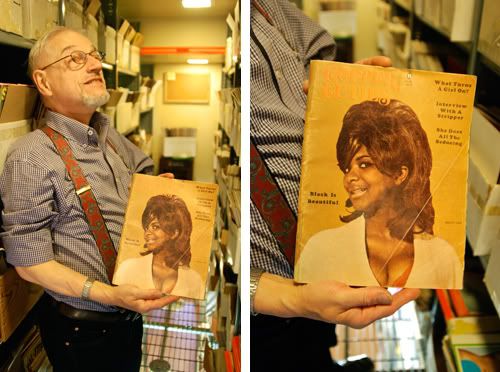
Mainardi sees lots of trends come, go and come again. In the beginning he says it was pretty “vanilla”, followed by an Asian fad, an explosion of fetish and gear seekers. Right now transgender materials are the hot item and there’s a slow growing marketing for British skinheads. The rise of burlesque has brought back an interest in “cheesecake” magazines, artsy ’50s porn, splashed with partially-nude ladies lounging provocatively.
“They’re so dated,” he says holding up, “Copper Cuties”, a super PG tease that would look like a text book alongside a current Cosmo cover. “There’s a charm there that straight, hardcore porn of today just doesn’t have.”
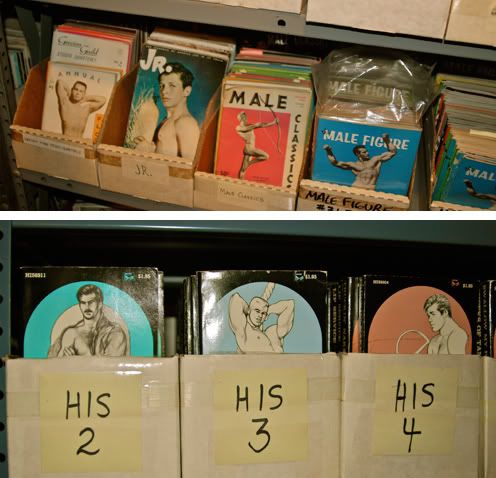
While younger generations may not be collectors, Mainardi has been quite pleased to see an influx in younger customers. A lot of art students come by to scope out the 35 cent specials, browse the bargain bin and look for inspiration. Technology has wiped out an entire generation’s exposure to porn in paper form and watching the enthusiasm of young people “discovering” for the first time has been satisfying for Mainardi and Dunphy.
“We both just really love what we do. We’ve always collected hopelessly,” he says in between the full tour, from the basement stacked with back issues to the top floors full of photographs and a large paperback collection. Rooms are dominated by gigantic bookcases. The stairs cluttered with additional boxes. Walls filled with posters, paintings, drawings and advertisements. There is no space left uncovered. “We’re image junkies.”
Ammiano’s TRUST Act passes the Assembly

Tom Ammiano’s TRUST Act (AB 1081) passed the California Assembly in a 47-26 vote. It now heads to the Senate for approval. Ammiano says his bill “seeks to repair the damaging impacts of the Immigration Customs Enforcement (ICE) Agency’s “Secure” Communities program.” The feds’ Secure-Communities program, in which fingerprints taken in local jails are automatically shared with immigration enforcement officials, has increasingly been accused of undermining public safety without transparency or local oversight. Today’s vote came a year after San Francisco Sheriff Mike Hennessey blew the whistle on ICE’s plan to silently activate S-Comm in San Francisco. And it followed on the heels of a series of damaging revelations about how S-Comm has mostly resulted in the deportation of non-violent immigrants, and has led to complaints that local municipalities received confusing information about their participation options.
Following a request from Congressmember Zoe Lofgren and Sen. Robert Menendez, the Department of Homeland Security (DHS) Office of the Inspector General recently announced it will investigate questions about S-Comm’s success in meeting its stated criminal targets, and look into charges that misinformation was provided to states and localities about their ability to opt out. Earlier this month, llinois Gov. Pat Quinn tried to cancel his state’s participation in the program and the Congressional Hispanic Committee asked Obama to put a moratorium on the program.
“S-Comm is a farce,” Assemblymember Ammiano charged. “ICE misled local jurisdictions from the beginning and blurred the lines between law enforcement and immigration, striking unnecessary fear into innocent people’s lives. The TRUST Act is a practical solution that will re-build trust with our immigrant communities and by doing so will restore some balance to this dysfunctional and unjust program.”