


Now that the Big Man, Clarence Clemons, has died at 69, is it time for Bruce Springsteen to declare and end to the E Street Band? Johnny, who is a musician, says its a matter of basic decency. Tim, who can’t play or sing a note, thinks the other musicians still ought to have a chance to make a living. And what about the fans? Listen after the jump.
ByeBigMan by endorsements2010SFBG Blogs
Cost of the death penalty: $4 billion
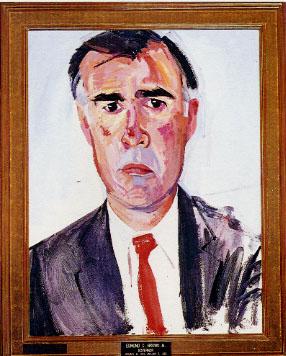
Since 1978, California has spent more than $4 billion to execute a grand total of 13 people. The cost per killing: $308 million.
That’s the results of a new study reported in the L.A. Times. Among the findings:
The state’s 714 death row prisoners cost $184 million more per year than those sentenced to life in prison without the possibility of parole.
A death penalty prosecution costs up to 20 times as much as a life-without-parole case.
The least expensive death penalty trial costs $1.1 million more than the most expensive life-without-parole case.
Jury selection in a capital case runs three to four weeks longer and costs $200,000 more than in life-without-parole cases.
The state pays up to $300,000 for attorneys to represent each capital inmate on appeal.
The heightened security practices mandated for death row inmates added $100,663 to the cost of incarcerating each capital prisoner last year, for a total of $72 million.
Wow, is this ever a great way to spend public money.
I wonder when the state’s official cheapskate, Gov. Jerry Brown, will come to his senses and announce a moratorium on executions and commute all the existing sentences to life without parole.
Suhr: SFPD Tasers not a priority

Asked on June 17 for an update on a San Francisco Police Department bid to research and implement the use of Tasers, Police Chief Greg Suhr indicated that it was on the back burner for now.
“I know that the Tasers and all were a huge discussion in prior administrations,” Suhr said. “I think right now with everything else that we have going, and especially with budgetary constraints right now, that in all honesty we really haven’t gotten to that yet.”
Among community concerns surrounding Tasers earlier this year were fears that adopting the so-called nonlethal weapons would overshadow a parallel effort to improve police responses to calls involving the mentally ill.
Asked about progress on the implementation of Crisis Intervention Training (CIT), a program advocated by Police Commissioner Angela Chan to train officers to better respond to calls involving the mentally ill, Suhr noted that he backed CIT and had taken preliminary steps to improve the department’s response in those situations.
“Within the first week that I was here, we put in a new policy and a procedure where every single mentally ill call is to be treated as a mini-critical incident, so a sergeant responds, takes charge of the scene, a little perimeter is set up, and unless that person is a danger to someone other than themselves, we wait. It’s basically a slowdown,” Suhr explained.
Community advocates championed CIT as an important step forward in the wake of the Jan. 4 shooting of Randal Dunklin, a wheelchair-bound, mentally ill man who was brandishing a knife outside the city’s Department of Public Health building. Dunklin allegedly stabbed an officer and suffered a nonfatal gunshot wound to the groin after he had tossed the knife.
Easy steps to open government

I missed the mayoral candidates forum on open government and technology, but sfist had a lively and fun report on it. I like David Chiu’s idea of lighting up all the city’s fiber optic cable — but why not go further, and lay cable everywhere that we’re tearing up the streets for sewer replacement? The biggest cost of laying cable is trenching and filling — and we’re already doing that. Mayor Lee wants a big street-repair bond for the fall, but a bond act to run public fiber under all the city streets would be far more valuable in the long term.
Here’s an even easier one: Make the basic city finance and property records available on a searchable database.
Our reporter Rebecca Bowe has been trying for a week to get the SFPD or the controller’s office to give her salary and overtime information for a couple of cops. Everyone’s too busy. It’s too much of a hassle. They can’t get to the records. We hear that all the time.
So why do city employees have to bother with this sort of request? Why isn’t there a public database of all the salaries of all city employees? The Chronicle did its own in 2009. How hard would it be for the city to post that data?
Same goes for Assessor’s Office records. I can pay a private company like LexisNexis a monthly fee, and get instant, searchable access to public records of property ownership and transfers, but why should I have to? Why isn’t all that data on line, too?
The Health Department has a nifty database to search for restaurant inspection records. There’s a fun GIS system that lets you look an a parcel of land and find out who owns it and track all the building permits. But there’s no place to simply type in a name and get a list of all the property that person owns, or track ownership transfers or any of that other stuff that can be done easily with a paid service.
Some sunshine advocates, including Kimo Crossman, have gone even further, suggesting that every document that a city employee creates (with the exception of certain personnel, law-enforcement and other exempt records) be automatically stored in a publicly accessible database.
There’s some expense, obviously, in setting this all up and maintaining it — but considering how overworked and harried the staff at SFPD and the Controller’s Office seem to be, the savings in the long run in worker time would be well worth it.
Does Newsom lose his seat on the DCCC?
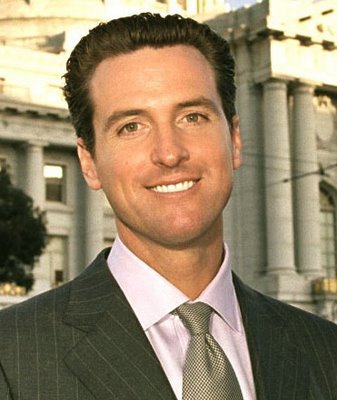
Does Gavin Newsom live in San Francisco anymore? No, according to the Chron — and if that’s true, than he’s no longer a member of the San Francisco Democratic County Central Committee. Any constitutional officer who is a member of the Democratic Party is automatically a member of the county commitee in the county where he or she resides; Newsom, of course, never shows up for the meetings, but he gets to send a proxy. (He has two alternatives, John Shanley and Warren Hinckle.) In a letter to Newsom dated June 16, DCCC Chair Aaron Peskin asks Newsom to clarify his residence: “if you are in fact a Marin County resident, you would no longer be a member of the SFDCC and would instead be a member of the Marin Democratic County Central Committee.”
Peskin told me he hasn’t heard back from the Lt. Guv. I haven’t heard back from him or his standard press flak, Peter Ragone, either.
Guardian Forum June 21: Budget, healthcare and social services

We’re doing the second in a series of Guardian forums on issues in the mayor’s race June 21. This one will focus on the budget, healthcare and social services. We’re looking for ideas — progressive approaches to the policy and process of setting the city budget, priorities in healthcare and social services, how to balance reveue and cuts, where new revenue should come from etc. The panelists will make some suggestions and outline some issues, but this is a community process and we want to hear from you. So come by, listen — and participate.
It’s at the Unite Here Local 2 hall, 209 Golden Gate. 6 pm. June 21.
panelists:
Gabriel Haaland, SEIU 1021
Brenda Barros, health care worker, SF General
Debbi Lerman, Human Services Network
Jenny Friedenbach, Budget Justice Coalition
The Local 2 hall is easy to get to, right near Civic Center. Join us.
Civil rights advocates say S-Comm reforms are spin, part of bigger FBI biometric tracking plan

In face of mounting criticism nationwide, the U.S. Department of Homeland Security announced today changes to its Secure Communities (S-Comm) deportation program. These changes include protections for domestic violence victims, and immigrants who are pursuing legitimate civil liberties protections. They give more discretion to ICE prosecutors, create a new detainer form that stipulates in multiple languages that arrestees cannot be detained under an ICE hold for more than 48 hours, except on holiday weekends. The form also requires local law enforcement to provide arrestees with a copy, which has a number to call if they believe their civil rights have been violated. The agency also said it will provide civil rights training related to its S-Comm program at the state and local level.
Immigrant and civil rights advocates said the announcement shows that the administration acknowledges that there are serious problems with S-Comm’s design and implementation. But they charged that the announced reforms fall far short of the S-Comm moratorium that an increasing number of advocates and lawmakers, including California Assemblymember Tom Ammiano, have demanded.
And some advocates expressed concern that the feds’ insistence on expanding S-Comm, in which fingerprints taken by local law enforcement agencies are automatically shared with federal and international databases, is proof that the program is the first step towards rolling out a much larger program called the Next Generation Identification (NGI) initiative.
Under the NGI, the FBI plans to phase-in the deployment of a host of new biometric interoperability capabilities to state and local law enforcement agencies within the next five years. And NGI likely won’t be limited to non-citizens and undocumented immigrants, suggesting that US citizens charged with a crime will also find that once their fingerprints are taken, law enforcement agencies will immediately compile a huge and internationally interconnected dossier on them, regardless of whether they are innocent of the charges.
Civil rights advocates also worry that local enforcement agencies’ participation in S-Comm will become inevitable because S-Comm is simply the first of a number of biometric interoperability systems being brought online by the NGI.
In other words, S-Comm is just the first of many additional information systems that are being made available to local law enforcement agencies to fully and accurately identify suspects in their custody.
And, according to the FBI/CJIS’s own documents, the feds have adopted a three-part strategy to deal with jurisdictions that do not wish to participate:
1. Deploy S-Comm to as many places as possible in the surrounding locale, creating a “ring of interoperability” around the resistant site.
2. Deploy S-Comm selectively to state correctional system facilities, permitting identification of Level 1 offenders who may have been arrested and sentenced in the non-participating jurisdiction,
3. Ensure that the jurisdiction understands that non-participation does not equate to non-deployment.
In other words, though a local law enforcement agency is technically free to shut off, or ignore, the receipt of records related to the fed’s fingerprint-matching capabilities, the feds are already warning local law enforcement agencies that local officers may find themselves “deprived of substantive information relating to an arrested subject’s true identity, place of origin, and other pertinent data of significant law enforcement value.”
Ammiano, who is the author of California’s TRUST Act, which would allow local governments to opt out of S-Comm, said: “Today’s announcement by ICE is simply window dressing. How many more innocent people have to be swept up by the ironically named Secure Communities program before the Obama administration will change course? Talking about the need for comprehensive immigration reform is not an excuse for continuing with a flawed, unjust program that is having tragic consequences for communities across the country. It is time for a moratorium on S-Comm pending a real review of the program not just PR spin from ICE.”
Professor Bill Ong Hing, immigration law expert at the University of San Francisco, stated, “The fact is, under our Constitution, immigration is a federal responsibility. Neither a state like Arizona, nor the federal government itself, can force local governments to act as immigration agents. Such measures compound the injustices of our deeply broken immigration system – and public safety and local resources are among the first casualties.”
And the Asian Law Caucus, the ACLU of California, the Coalition for Humane Immigrant Rights of Los Angeles, the California Immigrant Policy Center, and the National Day Laborer Organizing Network released the following joint statement: “We are deeply disappointed by the inadequacy of the Administration’s response to the mounting body of evidence that the ‘Secure’ Communities program is damaging public safety and ensnaring community members. The painful stories of domestic violence victims and other innocent community members facing deportation thanks to S-Comm underscore that the program has simply gone off the rails. While today’s announcement acknowledges that problems exist with the program, the measures outlined by the Administration are a far cry from workable solutions these problems. To announce “reform” before review is an exercise in politics, not policy. The administration should suspend the program and wait for the Inspector General report in order to develop fair and transparent policies.”
“Before vital relationships between local law enforcement and immigrant communities are furthered damaged, before more domestic violence victims, street vendors, family members, and workers who are merely striving for the American dream are swept up for deportation, S-Comm must be reigned in,” the coalition continued. “For the sake of public safety and transparency, we need real solutions. We strongly support California’s TRUST Act, which sets safeguards the federal government has failed to implement and allows local governments out of S-Comm, and we continue to call for a national moratorium on this fundamentally flawed program.”
In recent weeks, Illinois, New York, and Massachusetts, have either pulled out or refused participation in the program while numerous local governments have sought a way out of a deportation dragnet that harms public safety and has operated with no transparency or local oversight. And Ammiano’s TRUST Act, which also sets basic standards for those jurisdictions that do want to participate in S-Comm passed the state Assembly in May and the Senate Public Safety Committee this week.
During today’s press conference, ICE Director John Morton told reporters that “it makes sense to prioritize resources. We don’t have enough resources to remove everyone who is here unlawfully.”
But when the Guardian asked if the reforms address the community criticisms that S-Comm was rolled out as a way to catch serious criminals, but has been largely used to deport non-felons, Morton maintained the S-Comm has always focused on serious criminal offenders, but was never limited to that.
“We remove felony offenders at a higher rate than are convicted in the general population,” he stated. ‘But federal law does not provide that you can come here unlawfully and then commit crimes other than violent crimes.”
True, but local law enforcement agencies have repeatedly observed that you break vital trust with immigrant communities if they believe that contact with police, including being arrested for crimes they did not actually commit, or arrests for very low-level misdemeanors, will lead to deportation.
“This feels like a non-announcement, and it’s far from reform,” said B, Loewe of the National Day Laborers Organizing Network. “You don’t put a collar around a snake and call it a pet.”
And SF Police Commissioner Angela Chan, a staff attorney at the Asian Law Caucus, said the reason ICE and the FBI, “are so crazy for S-Comm is because it’s the first step in a much bigger loop that will include citizens and non-citizens alike.”
NDLON and the Asian Law Caucus are part of the coalition that is calling on the Obama administration to publicly oppose and terminate all programs that create partnerships between state and local law enforcement and the Department of Homeland Security; halt the development of the vast data gathering infrastructure that houses S-Comm, and inform the public of the current scope and purpose of its data collection and dissemination activities; and allow state and local jurisdictions to opt-out of S-Comm.
After today’s press conference, ICE issued a press release stating that through April 30, 2011, more than 77,000 immigrants convicted of crimes, including more than 28,000 convicted of aggravated felony (Level 1) offenses like murder, rape and the sexual abuse of children were removed from the U.S. after identification through S-Comm.
“These removals significantly contributed to a 71 percent increase in the overall percentage of convicted criminals removed by ICE, with 81,000 more criminal removals in FY 2010 than in FY 2008,” ICE stated. “As a result of the increased focus on criminals, this period also included a 23% reduction or 57,000 fewer non-criminal removals.
ICE also observed that the agency currently receives an annual congressional appropriation that is only sufficient to remove a limited number of the more than 10 million individuals estimated to be in the U.S. unlawfully. “As S-Comm is continuing to grow each year, and is currently on track to be implemented nationwide by 2013, refining the program will enable ICE to focus its limited resources on the most serious criminals across the country,” ICE stated.
ICE further noted that it is creating a new advisory committee that will advise ICE on ways to improve S-Comm, including recommending on how to best focus on individuals who pose a true public safety or national security threat. This panel will be composed of chiefs of police, sheriffs, state and local prosecutors, court officials, ICE agents from the field and community and immigration advocates. The first report of this advisory committee will be delivered to the Director of ICE within 45 days.
ICE Director Morton also issued a new memo that directs the exercise of prosecutorial discretion to ensure that victims of and witnesses to crimes are properly protected. The memo clarifies that the exercise of discretion is inappropriate in cases involving threats to public safety, national security and other agency priorities.
And ICE and the DHS Office for Civil Rights and Civil Liberties (CRCL) have created an ongoing quarterly statistical review of the program to examine data for each jurisdiction where S-Comm is activated to identify effectiveness and any indications of potentially improper use of the program. “Statistical outliers in local jurisdictions will be subject to an in-depth analysis and DHS and ICE will take appropriate steps to resolve any issues,” ICE stated.
.
BYO Flair: A guide to this weekend’s festival explosion

If there is one thing I know about festivals it is this: the gear you pack can leave you hydrated, hip and happy — or break you down to a sunburned, schlubby hunk of bad vibes. (It’s true – shoddy preparation for Reggae on the River 2006 left me stranded in the psych tent with disoriented girlfriend during the Ziggy and Damian Marley concert. Clearly, a hipper fedora would have solved everything.)
This weekend plays host to a freakishly large share of summer festivals, so consider this your guide to happy cavorting in the sun. Cups, caps, frocks, and foods: here, friends, are our picks for best festie flair.
Sierra Nevada World Music Festival
The perfect weekend campout for those that can’t handle the crushing crowds of the more commercial festivals this summer. Even the little things (children) will appreciate the open-minded approach to beautiful noise here.

Bring: Consider SNWMF a three-day immersion program in getting loose. Translation: you need costumes. If you’re heading up from San Francisco, we’ve got the perfect sartorial layover for you. Sebastopol’s Funk & Flash vintage store is far enough removed from the big city that its stock hasn’t been picked to all hell by the club kid set, so festie-bound you can benefit from its racks of flowery skirts, and tons of sparkle. Go, do you!
Fri/17-Sun/19, $60-150
Boonville Fairgrounds
CA-128, Boonville
Juneteenth Festival and Parade
The website proclaims this celebration of African American heritage to be the largest gathering of blacks in Northern California, but it remains to be seen whether you’ll fixate on the cultural signifcance while attending the event itself: with an impressive classic car show and three-on-three basketball tournament, all the historical reflection might have to wait until after the festival.

Bring: No brainer accessory: a hat from Hats of the Fillmore, an independent business that’s been holding it down on Fillmore’s main drag for years. High quality at surprisingly low prices, you can don one of these lids to fit in perfectly with the jazzy milieu of SF’s traditionally black neighborhood.
Sat/18 11 a.m.-7 p.m., free
Fillmore and Geary, SF
Alameda Sailing Festival
Hey Muffy, take a break from hating on the impending America’s Cup to catch a day of boating buoyancy. The Encinal Sailing Foundation will be providing turns on the high seas for a “nominal” fee, and there will be seminars on “pilates for sailors,” boating to Mexico, and how to get your captain’s license. Afterwards, we know some great places to get drunk in Alameda!

Bring: This really goes for every fest on the list, but possibly the most important piece of flair is a fun, functional backpack to hold your water (flask), sunscreen, cell phone, and snacks. We love the Brooklyn Circus’ BKc satchels – but for the moment you’ve gotta special order them from New York. That’s fine, this ain’t the last weekend of the summer! The store’s preppy style (without the snooty WASP-y supply chain behind it) would be divine if you’re looking to drop some dough on a nice sailing fest outfit.
Sat/18 10 a.m.-8 p.m., free
Encinal Yacht Club
1251 Pacific Marina, Alameda
Bicycle Music Festival
You read our profile on Fossil Fool, so you know all about the current trend towards bike-fueled culture fun. According to all the volunteers that have been standing near Mona Caron’s bike mural behind the Church Street Safeway for the past few days, this fest will be the perfect spot to enjoy the zeitgeist. Saddle up for awesome tunes, and community-building bike rides between concert sites.

Bring: Hedgehog mug from Gravel and Gold so you can (chicly, adorably) reap the benefits of the fest’s pedal-powered smoothie maker. It also comes in rabbit, fyi. The calories you consume in said smoothies work doubletime — once you’re done drinking, take your turn powering the generator for the drinks or one of the music stages yourself.
Sat/18 noon-11:25 p.m., free
Various locations, SF
Berry Festival
You know this sun isn’t going to last past 4th of July, so now is the perfect time to up your antioxidant intake and arm the old immune system against “summer” colds. CUESA and the Ferry Building farmers market is holding this day of loving for berry season – sample the treats available in the market stalls and let chef Daniel Clayton of Nibblers Eatery and Wine Bar show you how to whip up some healthy, hearty grub with the juicy little devils.

Bring: a nice navy sweatshirt from Mollusk for the Bay breezes and inevitable tayberry stains.
Sat/18 11 a.m.-1 p.m., free
Ferry Building, SF
California Big Time Indian Gathering
The Ohlones are hosting their first gathering of Native peoples in their ancestral lands in two centuries. Come to learn more about real SF locals through dance, rituals, and craft exhibitions.
Bring: Mocs that slip off easy – you’re not gonna want a layer of separations between the well-manicured lawns of Yerba Buena and your soles.
Sat/18 noon-11 p.m., free
Yerba Buena Gardens
Howard between Second and Third St., SF
North Beach Festival
Sure, the neighborhood street fests all start to look the same after awhile. But there are good parts of that same: family-friendly musical acts, artery-busting festie food, and an excuse to run amok in the streets. The North Beach incarnation has been going for 56 years, and manages to sneak a couple unique facets into the standard cruise-shop-eat formula SF has perfected.

Bring: your kitty cat companion for the yearly St. Francis of Assisi animal blessings. Also, a flirty, locally made frock from NooWorks is totally Maria from West Side Story – perfectly for the neo-Catholic-in-the-summertime vibe you’ll be channeling.
Sat/18-Sun/19 10 a.m.-6 p.m., free
Washington Square Park
Union and Columbus, SF
Northern California Pirate Festival
Never underestimate the amount of people willing to drop serious time and dime on dressing up in period costumes. You’ve seen the Renaissance fairs and the Dickens Christmas Fair – now it’s time to peep the pirates. Two very full days of pirate entertainers and replica boats (not to mention squadrons of pirate clothing vendor booths) await you if you be brave enough to cross the seas to Vallejo.

Bring: Your 826 Valencia designer spyglass, for scurvy-watching of course.
Sat/18-Sun/19 10 a.m.-6 p.m., free
Vallejo Waterfront
Mare Island Way (near the ferry terminal), Vallejo
Picklewater Free Circus Festival
As we mentioned in last year’s profile of our favorite free circus troupe, Circus Bella, nothing quite highlights the magic (and eccentricity) of this city quite like catching a high-flying aerial act smack dab in the heart of downtown. Picklewater is taking over Union Square for the third year in a row this weekend, and we suggest you head down — if only to catch the amazed gaze of the throngs of tourists that’ll be on hand to remind you that yes, your city is freakin’ amazing.
Bring: Your medical marijuana card, and attending accoutrements.
Sun/19 2-4 p.m., free
Union Square
Post and Powell, SF
Sharon Jones and the Dap Kings at the Stern Grove Festival
The 74th season of this green glade’s free concert series kicks off with a killer show from the queen of throwback soul.
Bring: The Stern Grove scene struts more with its picnic spread than by any accessory or fly outfit. A retro basket (check Goodwill, people are always ditching picnic baskets) will be a useful score, and in terms of snack to make (they must be homemade!), peep our favorite new vegan cooking blog, The Vegan Stoner. It’s perfect, even if you had to self-medicate your hangover before you started prepping for the journey out to the Sunset.
Feat. Ben L’Oncle Soul
Sun/19 2 p.m., free
Stern Grove
19th Ave. and Sloat, SF
Mission Street mural unveiling
But why spend all your time at the big events? Artist Aaron Lawrence is holding an al fresco event of his own – pulling the dropcloth off the work he and muralist Rocky Villanueva did on a new apartment building on Mission. He’s making a party of it, so get there early if you want to get down on the free burritos provided.

Bring: Tapatio, tall can Tecate. Bring two cans, share them.
Sun/19 2-5:30 p.m., free
Mission between 18th and 19th St., SF
Facebook: Sunday Mural Reveal Party
Nat Ford’s contract isn’t the only problem

I’m glad Leland Yee and John Avalos are criticizing the $384,000 severance package for Muni chief Nat Ford. Yee’s even collecting signatures on a petition. None of which will matter, though — the MTA is going to approve this and Ford (who, in essence, appears to have been fired for doing a bad job) will walk away with the cash.
That’s because the MTA didn’t have a lot of choice. The guy had a contract. And it included, I’m sure, mandatory severance if he was dismissed for any reason before the end of the term.
Why do (some) department heads have employment contractsthat include severance payments? I don’t know. The police chief doesn’t have one. The director of public health doesn’t have one. In fact, most senior city employees don’t get guaranteed golden parachutes.
But the head of Muni does. The head of the Transbay Terminal project does. The last head of the SF Public Utilities Commission did; I don’t know if the current person has one, too, but it’s likely.
This is a problem.
Why should some selected department heads get special contracts, while your average department head gets nothing? Why should city employees at the top get severance when your average working city employee gets none?
There’s no clear definition of which department heads get special deals and which ones don’t. It’s up to the commissions. That’s what Yee and Avalos ought to be working on — changing the rules to get rid of these severance contracts in the first place.
Appetite: Splendorini’s cocktail creations

I’ve got to concur with the Chronicle’s five choices for its 2011 Bar Stars. Between this column and my Perfect Spot newsletter, you’ve heard me talk about drinks made by all five bartenders chosen (like Kevin Diedrich and Alex Smith). Today, I’ll share the hottest concoctions by awardee Carlo Splendorini.
Splendorini made some beautiful drinks during his tenure at Gitane, so it’s no surprise that he’s continuing his tradition of excellence as lead bartender at Michael Mina’s flagship restaurant. Giving each creation Italian charm (and channeling Old Blighty thanks to his time at Nobu London), he’s ably backed by a strong bartending crew that includes Kate Bolton.
My latest visit with Splendorini took place before his Bar Stars honor – and after sampling seven of his cocktails, I was throughly impressed with the range, restraint, and beauty he showed in his selections – always lessons in refinement. He’s inventive, yet manages to leave one with the lingering sensation of balance. His drinks are as impressive, but never gimmicky as the latest cocktail trend.
Using Zucca, a bittersweet Italian amaro-aperitif, as the base of his Fraggle Cup ($11) was genius. It was particularly refreshing on the rocks with fresh tangerine wedges and a mini-forest of ginger stalks standing tall in the large glass in which it was served. I recommend this drink to anyone: especially for the exposure it provides to the range possible in amaro-based drinks.

A self-serve sazerac ($10) is as fun as it sounds: deconstructed, and waiting for you to ingest any way you find desirable – either which the ingredients mixed together or taken separately. A shot of Rittenhouse 100 rye was paired with an absinthe marshmallow, lemon zest, and a truly inspired Peychaud’s bitters jelly. Balanced layers were achieved in Splendorini’s gorgeous Schiedam Blossom (photo on right, $12 – part of the Nolet Gin cocktail competition open through July 15). Nolet Gin and sake melded with a fennel-ginger cordial, silky with egg white.
I could go on, but instead, I urge you to sit down at the bar with a few orders of Mina’s impeccable food, and let Splendorini and crew work their magic on you.
— Subscribe to Virgina’s twice monthly newsletter, The Perfect Spot
The naughty list: Sex on screen at the SF International LGBT Film Fest
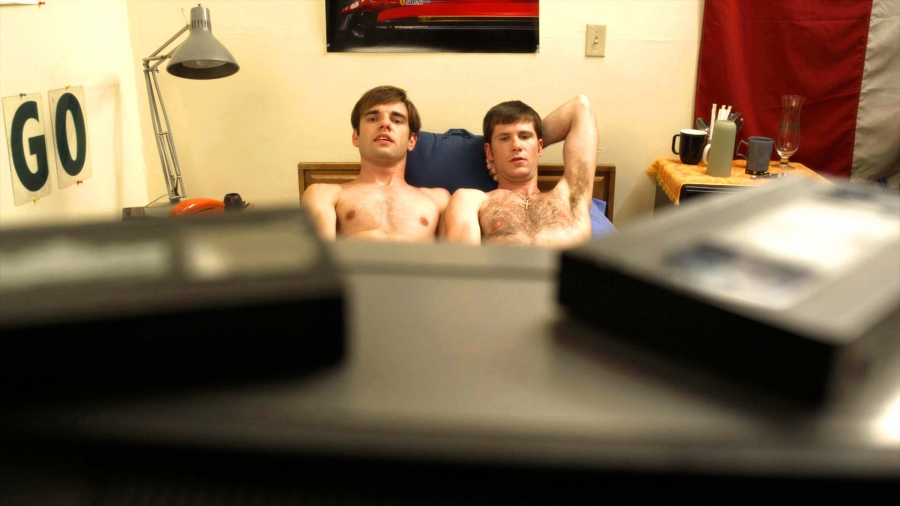
Relationships, emotions and identities? Yada yada yada. The San Francisco International LGBT Film Festival may explore all the complicated bits of queerness but lest we forget that this festival is dedicated to a community centered around sexual preference. Who wants to see some hot, artsy gay sex on the big screen? If your hand is waving high in anticipation (among other body parts) you won’t be disappointed when you see what this year’s festival has hot on the reel.
Romantic and handholding gay characters will be a dime a dozen throughout the 10 days of films, which is awesome and wonderful in itself, but eventually all those homo chick-flicks might start to make your mouth water for something a bit more juicy. Gay porn is always a couple blocks or clicks away, but the independent, inspiring, adventurous, and beautiful varieties are much harder to get your lubed hands on. The unique visions of filmmakers from around the globe will be represented during the festival’s 35th year anniversary and if you time it right, you could probably find yourself pleased in public for a consecutive week and a half. Some are provocative, some sexually explicit, and others just have a lot of enjoyable visuals. Here are some steamy recommendations to provoke that scandalous theater hard-on and maybe even a Pride-ful romp with a fellow film-fester.
Longhorns

It’s Texas in 1982 when frat-boy Kevin and openly gay student Cesar become schoolmates. Kevin needs a little “help” and Cesar comes through with a helping hand. These study-buddies always end their homework and a well-deserved round of handjobs– lots of them.
Community Action Center

No dialogue. Just sex. Metallic bodies, gender-queer, paint splashing, fruit bashing, blood-red wooden dildos, witches, and dungeons will flash before your eyes in a series of shocking shorts. The performers were encouraged to go “hog wild” in this cinematic orgy and the results look dirty.
I Want Your Love

Recreational sex always sounds like a good idea when booze does the convincing. Besties Jesse and Brenden decide to give it an arousing go, but predictably end up with sticky emotions.
LA Zombie

One word: wound fucking with prosthetic alien cocks. This sexy horror flick will get your adrenaline pumping all night.
May I Please Have Another

This series of six kinky shorts runs the gamete with a guitar-slaying transexual dominatrix, a queer leather family who sends off their bratty brother with a proper beating, the scenes behind International Mr. Leather, arousing poems, and surprising sexual encounters.
Weekend

This extended one-night stand gets complicated as Russell and Glen get high, have loads of awesome sex, and chat for hours. Passionate and honest, it may be a love story but it’s also got enough skin to keep you perky.
Three

From the director of Run Lola Run, Germany’s Tom Tykwer explores bisexuality and human motivation through three test subjects: Simon, Hanna, and Adam. The erotic chaos is a complete mind-fuck that will send you to bed with dripping dreams.
SF INTERNATIONAL LGBT FILM FEST
Thurs/15 – Sun/26
Times, locations and ticket prices vary
Check the schedule and get tickets in advance at www.Frameline.org
Two bike photo projects show love for the movement

We’re in a moment of bike love. Bikes are hot: in SF the weather’s hot, the Bicycle Music Festival‘s coming up, an extended network of bike paths is on their way – and around the world, there’s a lot of energy surrounding the rise of two-wheeled transport. It’s an important time for bicycles, so let look at how it’s being documented.
One way: Matthew Finkle and Brittain Sullivan are the authors of a book called – yes – I Love My Bike (Chronicle Books, $16.95, 160 pages) that recently landed in our Guardian mailbox. Finkle and Sullivan, the book’s intro tells me, met on a bike ride on a summer night in Boston and subsquently pedaled across the country with each other, snapping flicks of their bikey buddies along the way.
Theirs is a photo book of bikes and their riders, smattered with terse little quotes from all the pretty things (“when I get pissed off I build gold bikes!” the handlebar-mustachioed, booze-toting Erik Noren of Minneapolis’ Peacock Groove Cycles enigmatically proclaims). America’s lookin’ real good on our bikes, according to I Love My Bike — everyone’s got a bicycle fit to induce heavy breathing among the so-inclined.
I have to admit, I started getting a little hot and bothered over some of the (bike!) specimens – there’s a yellow banana seat cruiser on page 109 for which I die, and I know that according to the bike snob gods I’m not supposed to like those five spoked plastic fixie rims anymore, but Daniel Mueller of Boston’s pink and powder blue creation… I don’t care, want.

I Love My Bike: Wall to wall wheel walls
When I shut I Love My Bike, I did so with the impression that the US is a solid mass of trendy, creative (mainly) young people — on bikes. I like those kinds of people – some might say that I am one myself. The book, presented as an aspirational showcase of hipster and high performance bike fashion, works just fine.
But Finkle and Sullivan need to holler at whoever’s writing their back cover blurb. “Throughout their travels they met cyclists of all kinds…,” it rather hyperbolically shouts. Or maybe they met cyclists of all kinds, but they didn’t publish any photos of them – I’m didn’t see any families in there, and certainly no one with a junker bike that isn’t a hard-to-find, check-my-steez brand of junker. This is a book of bikers that are just a few freeways from having a big ass social ride to a BBQ of local, organic edibles in a park somewhere.
I think that people who bike are more complex than that — in a good way. For a different take on a bike photography project, head south. And east. Really far in both of those directions.
There you will find South Africa’s Bicycle Portraits, a photo series that was started by Nic Grobler and Stan Engelbrecht to highlight the brave, self-propelled souls on roads where cars aren’t always the friendliest neighbors for meat puppets (to borrow a favorite term from David Byrne’s Bicycle Diaries). You’re not getting the idea that everyone depicted in Bicycle Portraits is a brother from a different mother — but you are getting the feeling that the biking movement is moving away from the “ain’t it cool?” model of awareness-building to the “ain’t it necessary?” school of thought.
You can’t scroll through Grobler and Engelbrecht’s website without realizing that biking in South Africa may well be a lifestyle, but it’s not a single lifestyle — people aren’t just riding bikes because it’s fun, hip, or social, but because it’s the mode of transportation that makes the most sense for them. Bicycle Portraits purposefully paints a country of bikers as a diverse, important group of citizenry.
Rich people, poor people, old people, kiddos. Ashton May’s black township cruiser, Loza Philani’s well-ridden Raleigh (“my bike is like oxygen to me – it keeps me alive,” he says), and Brandon Searle’s high tech Durban Cannondale. The two also collected in-depth interviews with each subject to help explain how bikes figured in each of the lives they documented.
After two successful Kickstarter campaigns, the Bicycle Portraits team is now accepting pre-orders for what is sure to be a phenomenal book. (Swoop.)
In a land such as our own when bike riding all too often is stereotyped as the domain of flippant and sullen (does that work?) trendoids who refuse to “mature” into taking crowded public transportation and gas-guzzling automobiles, projects like Bicycle Portraits seem incredibly important. If we have proof in front of our eyes that bikes are helping people lead lives that help the planet, city governments are way more likely to invest in bike systems, parents are more likely to encourage their wee ones to take to two wheels, and people who don’t fit the hipster stereotype are more likely to pedal off into the sunset. Fashion is fun, but fashion alone can’t influence urban planning.
We do the movement a disservice if we paint ourselves as the sole face of biking in today’s cities – but of course, the diehard dandies among us are always going to Love our bikes. Damn Carolyn Ngo of San Diego, where’d you get that metallic blue handlebar tape?
Candidates land punches in first D.A. debate
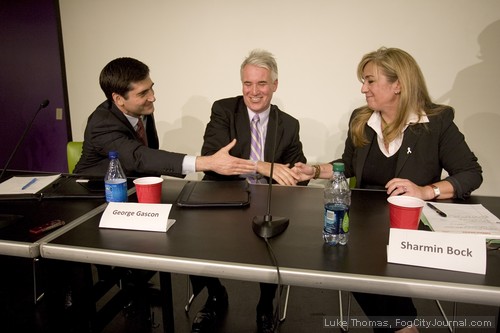
District Attorney and former SFPD Chief George Gascón, Alameda County Deputy District Attorney Sharmin Bock, and former San Francisco Police Commissioner David Onek all landed solid punches during a three-way District Attorney debate that was co-hosted by the San Francisco Young Democrats and the Alice B. Toklas LGBT Democratic Club, and moderated by Recorder editor Scott Graham. The primary sponsor of the debate was the City Democratic Club, according to CDC President Jim Reilly. So, thanks CDC for helping to pull off a great event.
The debate was framed as a choice between Bock, a veteran prosecutor with leadership experience, Gascón, a career cop with managerial experience, and Onek, a former San Francisco Police Commissioner and criminal justice reform expert. And above all it proved that if you lock three attorneys in the same room and pit them in a three-way fight, you’ll be rewarded with a blood sport spectacle.
Bock kicked off by noting that there are many similarities between the three candidates—except when it comes to independence and experience “Experience matters,” Bock said, throwing a one-two punch at Gascón and Onek. “The job of the District Attorney is not a management job, a police job or a job for someone with just a law degree. It needs a veteran prosecutor,” she said—remarks that resonated well with the crowd, judging from the applause.
But after a few niceties, Gascón shot right back at Bock and Onek. “I am the only one who has led large organizations and pushed public policy forward in an effective manner,” he said.
And Gascón struck a home run when he revealed that when he took the job of Chief of Police in Mesa, Arizona, he was “facing one of the most toxic environments” in terms of hatred towards people of color and the LGBT community–and that he did something about it, by standing up to anti-immigrant Sheriff Joe Arpaio of Maricopa County, and protecting the local LGBT community’s right to protest.
When it was his turn to speak, Onek fired off his own rounds at Bock and Gascón, noting that the state’s criminal justice system is broken—and claiming that it will take an outsider to fix it.
“This is a once-in-a-lifetime opportunity to reform the criminal justice system,” Onek said, laying out his reform-minded track record.
And then he stuck it to both Bock and Gascón by stating that the death penalty does not work. “I will never seek it in San Francisco under any circumstances,” Onek said, earning excited applause, as he noted that he’ll look at all policy question through the prism of three questions: ‘Does it make us safer, is it cost effective and is it fair and equitable?”
Onek also noted that neither the Supreme Court’s ruling that California must reduce its prison population by 30,000, nor Gov. Jerry Brown’s call for prisoner realignment, come with any money.
‘That’s a disaster,” observed Onek, as he stressed the need to demand resources to help deal with the upcoming load of prisoners that about to return to San Francisco.
Gascón fielded questions about whether they are enough people of color and LGBT background in management in the D.A.’s Office. “Well, I think there’s definitely always room for improvement in any organization,” he said, noting that he has a history in the Los Angeles Police Department, the Mesa, Arizona Police Department and the SFPD, “of pushing very aggressively to have diversity within the office.”
But he started a bit of a buzz when he said it was “really a surprise to me that I promoted the first male, black, police captain to the San Francisco Police Department.”
“You would think that there have been, you know, male African-Americans in that department for many years. It was hard for me to believe that actually in 2009 we had not had one,” Gascón continued, a remark that got some debate observers asking afterwards, if this meant that Gascón really did not know that former SFPD Chief Earl Sanders was a black male.
Meanwhile, Bock was happily trampling all over the sit-lie legislation that then SFPD Chief Gascón and Mayor Newsom backed last fall, as she noted that more foot patrols and community policy are what’s actually needed. “Political hot-button measures don’t work,” Bock said. “Both sides agree it hasn’t worked. It’s the wrong response to the real problem.
Asked if he had a conflict of interest, when it comes to investigating allegations of police misconduct, Gascón claimed the problem is limited to a small number of officers, adding, “if the allegations are true.”
“In reality the majority of the SFPD are hard-working people doing the right thing,” he said. “And there has been only one challenge—and our office has prevailed,” Gascón said. “However, there have been a finite number of cases where I personally adjudicated the bad conduct—and those will be handled by the Attorney General’s office.”
Bock stressed that she was not in favor of sending drug offenders to prison and would focus on restorative justice, instead. Asked if she would have a panel on her staff review potential death penalty cases, Bock confirmed that she is committed to having a Special Circumstances Committee, as D.A. Kamala Harris did, to get input around the facts and from lawyers involved in such cases.“The ultimate decision is mine, and I oppose the death penalty,” Bock said, noting that she does not believe that 12 jurors will return a unanimous death penalty verdict. “But I do think as prosecutor you need to go case by case.”
Asked if he would have sought the death penalty in a case like the L.A. Night Stalker, who murdered 13 people, many of them elderly, Gascón said, “Probably not. All of us agree that the death penalty is not a good tool. But it is part of our system, and I continue to have the system Kamala Harris had in place. At the end of the day, it’s my decision, and I’m the only one in the room, who can say I’ve already turned down the death penalty.”
Agreeing with Bock that a jury is unlikely to go for the death penalty, Gascón maintained that the death penalty is “an illusory issue,” and that the real question is, “How do we rewrite the State Constitution [so the death penalty is not on the books]?”
Asked how he felt about marijuana, Gascón said he doesn’t believe folks should be incarcerated for use—and that folks are already being diverted to community courts in those instances.
But when Onek tried to wrap up by positioning himself as a the reformist-minded outsider, Gascón pounced, reminding folks that Onek was a Police Commissioner, when the Police Commission recommended Gascón to Mayor Newsom as the next SFPD Chief. “While David is someone I respect—and one of those who hired me, David has painted himself as an outsider, when the Police Commission is the policy-making body for the SFPD. There are no outsiders here. The question is, what have you done? There’s a difference between calling yourself a reformer and having other people call you a reformer.”
Bock for her part used her closing remarks to remind folks that there has been a crime lab scandal, alleged police misconduct, a DNA backlog, and about 100 cases dismissed as a result of these scandals, and a bunch of prisoners are about to be sent back to the community because of realignment. “We’re in challenging times, at a critical crossroads, with stormy weather ahead,” she said. “I’m not going to be trying things out at your expense. As a veteran progressive prosecutor, I’m fully prepared.”
SFBG Radio: Free speech, regulation and the Internet
A special episode today, featuring Perry Michael Simon of allaccess.com talking about what happens with media, including TV and talk radio, migrates to the web — and the ability of the FCC to regulate everything from obscenity to fairness and public accountability vanishes? Listen to the discussion after the break.
EndOfCensorship by endorsements2010Tribes author burrows into the Big Apple
Thanks to the help of burners from at least five different tribes that I’ve covered or camped with at Burning Man, my New York City book tour was a successful adventure in art and community, from the Figment festival on scenic Governors Island to exotic eating and drinking in the East Village and Queens to a great underground party at an old Catholic school in Brooklyn to getting canonized by Rev. Billy and his 25-person choir into the Church of Earthalujah along with SF-based performance artist Guillermo Gómez-Peña.
The June 7-13 trip was in support of The Tribes of Burning Man: How an Experimental City in the Desert is Shaping the New American Counterculture, my book chronicling how an event born in San Francisco has spawned a vast, well-developed culture and ethos that is affecting life in cities around the world, even seemingly impervious megalopolises like the Big Apple.
I arrived on the red eye Wednesday morning just as a heat wave was peaking in New York, showing up mid-morning at the Upper East Side apartment of Jax, a recent transplant from SF who I worked with on last year’s Temple of Flux project. Her air conditioner hadn’t arrived yet, so I sweated through a needed nap before surrendering myself to exploring the city.
That night was my Tribes launch party in a great spot called Casa Mezcal on Orchard Street on the Lower East Side. Fellow Shadyvil campmate Wylie Stecklow had not only arranged the venue, which is owned by one of his law clients, but he moved the weekly Big Apple Burners happy hour and the final planning meeting for Figment (an event he co-founded four years ago) to the venue, giving me a built-in audience of interested burners who seemed to really appreciate my reading and discussion.
Also joining the party were two NYC figures who appear in my book: Not That Dave, Burning Man’s NYC regional contact and a Figment director, and Billy Talen, the former San Francisco performance artist who transformed himself into NYC’s Reverend Billy, pastor of the Church of Stop Shopping, which evolved into the Church of Life After Shopping before becoming the Church of Earthalujah to reflect a mission that expanded from economic justice and anti-consumerism to environmentalism and a holistic way of looking at the perils of our economic system.
As I’ve been doing at some of my Bay Area book events, I read chapters that introduced them and then let them speak, and they each had lively, weird, heart-warming things to say. Several other New Yorkers who I know through Burning Man showed up at the event to join the discussion, wish me well, and buy books. The most surprising guest was Mike Farrah, former Mayor Gavin Newsom’s old right-hand man who did more to facilitate the temporary placement of burner artworks in SF than anyone in City Hall. He now lives in NYC and showed up late, so after talking SF politics and BRC art over beers, we wandered past some of the oldest tenement buildings in the city together as we headed toward the subway.
The city was sweltering the next day (although Jax’s air conditioner had blessedly arrived), so I spent over three hours in the Metropolitan Museum of Art, which makes SF’s museums seem like mere gallery spaces. I walked through Central Park between the reservoir and the Great Lawn, which was being set up for that evening’s Black Eyed Peas concert, all the way to the Upper East Side and my reading at the Columbia University Bookstore (which nobody showed up for, a combination of school being out, the heat, and a freak thunderstorm that was just rolling in as my event began – my first flop after more than a dozen bookstore events).
But New York is a city for nightowls, as I was just beginning to appreciate, particularly after I made my way down to the East Village that night to meet a Garage Mahal campmate who I’ve known for years simply as Manhattan. He’s been living in his apartment for 15 years and the city for 25, developing a detailed knowledge of the best places to eat, drink, and otherwise indulge.
Manhattan won’t go to the Upper East Side, preferring to remain in “civilization,” as he calls the East Village, which earned its storied reputation as the center of the nightlife universe. We ate Japanese curry at Curry Ya, drank hard-to-find German Kolsch beer at Wechsler’s Currywurst, danced with saucy Armenian women on Avenue C, drank cold sake underground at Decibel, indulged in the most decadent fried pork sandwiches at Porchetta, mingled with beautiful young people in the Penny Farthing, and then drank cocktails on his stoop until dawn, the streets never going to sleep in this lively neighborhood.
On Friday in the early afternoon, I met Wylie at The Cube, a public art piece near the 8th Street subway stop, and we hopped a train down to the southern tip of Manhattan to catch the free ferry to Governors Island for the opening day of Figment, an art festival started there by burners in 2007 that has since expanded to Detroit, Boston, and Jackson.
Mayor Michael Bloomberg and other city officials have embraced and facilitated the popular three-day event, which now includes art projects such as a treehouse built of old doors, massive steel sculptures, and an elaborate miniature golf course that will remain on the island through the summer. Most of the projects featured the interactivity that is the hallmark of burner art, such as a sound project in an enclosed courtyard in which passerby had to figure out how they were controlling the sounds they heard.
Wylie and I pedaled on borrowed rental bikes to cover all the projects on a large island that is a decommissioned military base with gorgeous views of the Manhattan and New Jersey skylines. Out on the Picnic Point lawn, with the Statue of Liberty looking on from the bay, the venerable NYC-based Burning Man sound camp Disorient hosted a rocking set of DJs under a massive wooden sculpture that they built for Figment and the playa this year.
Unfortunately, Figment is permitted only as a daytime event that ends at 6 pm, because the energy of the 100-plus organizers and volunteers could have driven this party well into the wee hours. Instead, they all gathered after the event at the 340-year-old White Horse Tavern to discuss the day, celebrate, and share endless ideas for new art projects and ways of measuring and directing all the creative energy that flows through their event and city.
After partying until dawn again, Manhattan and I climbed into his car (yes, a car, in Manhattan, the better to cover more ground, he says) Saturday mid-afternoon, picked up a friend near Wall Street, and crossed the Brooklyn Bridge headed toward Astoria, Queens. There, we drank pitchers of rich Czech beer at the 100-year-old Bohemian Hall and Beer Garden, run by the nonprofit Bohemian Citizens’ Benevolent Society, a fraternal order open only to those with Czech blood. With an outdoor capacity of almost 1,000 people, this place was like my beloved Zeitgeist on steroids.
On the way back to the East Village that night, Manhattan did a sudden U-turn and parked in a bus zone in front of a crowded outdoor eatery called Tavern Kyclades, muttering something about needing octopus and telling us he’d just be a minute. The wait for tables at this amazing Greek seafood spot was 90 minutes, but after less than 10 he was back with a to-go container with three long octopus legs, grilled, tender, and just insanely good.
That night, the plan was to hit an underground party in Brooklyn, thrown in a former Catholic school by Rubulad, a venerable party crew. It was after 1 am when we finally left Manhattan’s apartment for the party, catching the subway at Union Square and arriving to find the party in full swing, with more than a dozen rooms with different offerings: DJ dance parties, avante garde films, a piano bar, live music from a trio that had the beautiful crowd dancing hard and smiling. As the party wound down, I headed to Queens with a new friend and we watched a new day dawn on the Empire State building standing tall in the distance.
Sunday might be a day of rest for some, but not for me, not with the kind of roll I was on. So I caught the last ferry to Governors Island at 3 pm and spent the afternoon at Figment with some other burner friends, Shanthi and Patty, who came back to the East Village with me afterward for my third and final Tribes event: being canonized by Reverend Billy during the Church of Earthalujah’s regular Sunday evening performance at Theatre 80 on St. Marks Place.
I’ve been covering Billy and his crew for years, from their performances in San Francisco’s Castro Theater and other local venues to their film “What Would Jesus Buy?” to their work at Burning Man, including their touching sendoff of burner work crews to the Gulf Coast in 2005 to do cleanup and rebuilding work after Hurricane Katrina, an effort that became Burners Without Borders.
As I write in my book, Billy and his choir of several dozen were transformed by Burning Man, and they have returned that embrace of a culture that magnifies and perpetuates their values. And after being called from the audience and walking toward the stage during a rousing rendition of the “When the Saints Go Marching In,” I was warmly embraced by the entire 25-member chorus – actually, it was probably closer to a group grope – and I became Saint Scribe.
And after that, it’s all a bit of a blur, and a vibrant, decadent, Big Apple blur. Thanks, everyone, for a truly memorable trip.
Women and circumcision: Leave me out of it

Here’s the thing about the circumcision debate: Like everything else between men and their foreskins, women want nothing to do with it.
A while back, I was at a blues club when a tall, slim, blond fellow asked me for a dance. I’d seen him out on the floor and he seemed like a smooth mover (blues dancers, unlike your average oonst-oonsters, tend to trade partners), so I said yes.
Turns out, I was right. He was a good lead: firm but gentle, playful yet clear. The only problem was, about a minute into the song, he started urgently not-quite-whispering about circumcision. Like, did I know it was mutilation? Had I ever slept with a natural guy? Wasn’t it better?
When I told him I wasn’t accustomed to discussing my sex life on the dance floor, he assumed I didn’t and I hadn’t so I couldn’t possibly say – and, in a show of great evangelical fervor, handed me a card directing me to a website of one, Ms. Kristen O’Hara, who’d authored a book called “Sex as Nature Intended It.”
I dismissed him for the sheer absurdity of his timing as much as anything else. But that was before his cause was set to appear on November’s ballot, thanks to the efforts of Lloyd Schofield and the intactivists (band name, anyone?) who’ve collected more than 7,000 signatures from preservation-friendly petitioners.
As an indisputably happy transplant to the land where cheeseburgers come toy-less and cats have their claws, I was perplexed to find myself perplexed by the proposal.
Was it a latent shred of Judaism somehow stirred up? A knee-jerk reaction to state intervention into this most private of matters? The inevitable result of growing up in a society that gets giggly over the merest suggestion of sexuality – Weiner’s wiener being only the latest example?
Or was it because we’re just so culturally inured to the custom that we treat those who oppose it as freaks? (Anyone else remember Alan Tudyk’s caricature of a gay German drug addict lamenting his lost foreskin in 28 Days?)
I wasn’t – and still am not – prepared to say. It’s complex issue, muddled by the phenomenon in which inhibition and hilarity combine to derail honest conversation. Add religion, equal protection, and a loaded term like “nanny state,” and it’s no surprise the matter has billowed into overwrought emotion on all sides.
But let’s forget – for a moment – vicious Monster Mohels who thirst over infant blood, fathers protecting their sons’ locker-room status, and doctors citing STI-prevention studies that were neither conducted in, nor aimed at, populations in this country. Let’s focus on one group that definitely doesn’t belong in the debate: women.
If my erstwhile blues partner was seriously trying to recruit supporters to his way of thinking, he should have known that an unsuspecting woman on the dance floor would not an ideal target make.
Nonetheless, I admit that a mix of consternation and bemused curiosity got the better of me. I ran reconnaissance on the website – a dreadful 90’s flashback minus only the midi – and was horrified to find that, as an unsuspecting women, I was precisely this Mr. Blues’ target. Indeed, I was the crucial component of his argument.
“The surgically altered circumcised penis makes it difficult – in some cases impossible – for most American women to achieve orgasm from intercourse,” the website proclaimed boldly.
Amid jerky, continuous-loop videos that looked like low-def pornos, and first-person testimonials that sounded like amateur online erotica, nary a word could be found about the person behind (or not, as the case may be) the prepuce. The entire site purported to tell me what I, as a woman, would want from my lover. And all signs pointed to extra skin.
Among O’Hara’s various assertions are that cut members miss out on the retracted foreskin bunching up to seal in vaginal moisture; that decreased sensitivity forces circumcised men have rough “adrenalized” sex; that circumcised men must take longer strokes which deny women ideal clitoral contact; and that the coronal “hook” of a circumcised penis rides along the rippled skin of the vagina, creating uncomfortable friction (the accompanying illustrations put me in mind of the Ruffles have R-R-R-Ridges commercials. Of course, Trojans have r-r-r-ridges, too – on the “Her Pleasure” condoms designed for the very purpose of creating friction.)
The website claims that the head of an uncircumcised penis is “soft, like velvet,” but that circumcised sex is like “being poked with a hard broomstick.” All of this to the following conclusion: men who are bad lovers, who pound like jackhammers, who leave their partners sore, simply can’t help it.
I’m sorry. I’m not denying that there may be physical differences, but my book, the unpracticed and unskilled just don’t get off that easy – pun totally intended.
Now, as it turns out – Mom and Dad, if you’re reading this, I sincerely apologize – I’ve had it both ways. And I’m going to go out on a limb here and assume that I speak for a large number of women when I say that I don’t find there to be categorical difference between men who are intact, and those who aren’t.
I’m sure O’Hara and her passionate band of male followers would tell me I’m either vastly lucky, vastly unlucky, or too tuned-out to tell the difference. But I have another analysis: sex is a highly variable, highly personal act.
Take the following unattributed account from O’Hara’s book: a woman describes sex – her first time – with a cut boy on the beach who “literally jumped [her] bones,” pummeled her, and left her feeling “almost dead.” A year later, she had her first natural sex with a boy she’d spent an idyllic summer skinny-dipping and milking cows alongside. Unlike the beach bum, he began the event by kissing her.
Well, no shit she felt differently.
If O’Hara were really a maven of sexuality – or if she paid any attention to the decades of medical literature that precede her – she’d know that sex has as much to do with a person’s head as his or her loins. And if she really had a drum to beat for female satisfaction, she’d be saying anything but “I’m sorry folks, it’s all out of your control. You’re at the mercy of what a masked doctor did 20 or 30 or 40 years ago.”
Women who are in bed with men – indeed, people who are in bed with people –should be encouraged to discuss their needs, say what they want, and help their partners become the best lovers possible. To suggest that a certain kind of sex is the inevitable result of circumcision is not only disempowering, but downright demeaning – for all parties involved.
While O’Hara’s website is clearly over the top, speculation as to women’s preferences pepper online information sharing forums, anti-circumcision websites, and even the literature listed in the resource section of MGMbill.org, which sponsored the San Francisco ballot measure.
To be certain, intact penises have some nifty tricks up their sleeves – thank you, I’m here all night – that circumcised penises just can’t pull off. Or course, if you’re wearing a condom, a lot of them won’t matter. And the – erm – polls can be twisted either way: many say women prefer circumcised penises. Since we’ve put the size debate (for the most part) to rest, it seems fair to reiterate that what you’ve got is less important than how you use it.
I am not trying to say that men shouldn’t get a say in their own anatomy. Even if you call circumcision a personal choice, no matter how you slice it – ok, ok, enough – it’s never really been down to the person who actually matters.
This is about a man’s relationship to his own body, which is why “what women want” shouldn’t play a role.
After all, we’re universally appalled when men’s preferences drive women to seek labiaplasty. (An analogy carefully chosen: it seems greatly unfair to draw a comparison to the vastly more invasive, vastly more dangerous practice of female genital cutting – which, unlike circumcision, has nearly always served to make sex difficult to completely impossible for women .)
There’s a more sinister side to the tendency to make male circumcision into a female issue. It overrides the question of bodily autonomy, and implies that men can only experience their body by acting out their sexual identity through women.
The issue becomes a man’s ability to please women – the equally problematic flip side, of course, being that if a man does a fine job of pleasing his partner, no harm has been done.
Framing the debate in this way cements women’s role as a passive fixture in the relationship, while also diffusing the man’s power (and responsibility) by focusing attention on an external, uncontrollable element.
Making that uncontrollable element controllable sounds great. The problem is, your infant son didn’t choose to be circumcised, but he also didn’t choose not to be. While a neonatal circumcision is irreversible, it’s not like waiting “until he can decide” is wholly without consequences, either.
“I’m glad I’m circumcised,” a friend told me recently, “and I’m sure glad I don’t remember it.”
It’s impossible to say how my friend would have felt about his circumcision had he grown up in a different cultural atmosphere, and mores may well be changing to the point where he would be just as happy whole.
According to the MGM bill’s own website, 90% of male babies already leave Bay Area hospitals intact. It would be foolish to pass a ban based on the assumption that masses of infants are senselessly whisked away to be docked while their mothers, drugged-up and dopey, lay unawares.
And, regardless of your views on the matter, it is likewise foolish to assume that damage between men and women can be introduced or repaired by a foreskin.
Take, for example, Mr. Blues. Now I didn’t ask, but both his fervor on the subject and statistics – as intactivists are fond of pointing out – would indicate that he was altered. side from his attempt bordering-on-low-grade-sexual-harassment to brainwash me, he seemed like a nice guy. And, despite all, we had chemistry. At least on the dance floor.
He was sensitive, attentive, spontaneous – and though I’d never want to be in bed with him, I daresay someone would. Because in the end, all those things matter – at least to women – a lot more than a few inches of skin, nerve-rich though they be.
The guv’s veto — WTF Jerry?
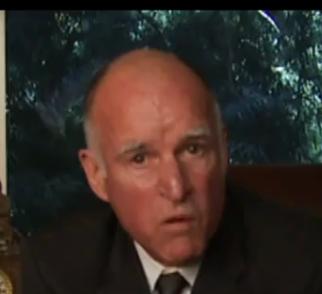
Nobody — least of of the Democrats in the state Legislature — quite knows why Gov. Jerry Brown vetoed the state budget. In fact, he didn’t even tell Legislative leaders what he was about to do. “There was no heads up, and that’s the most annoying part of it,” Assemblymember Tom Ammiano told me.
Brown knew exactly what the Democrats were doing. He also knew (or ought to know) that getting any Republicans ever to vote for his tax extensions was, and is, a pipe dream. If he didn’t like the Dems proposal, he could have asked for changes. But no: Jerry is Jerry, and he did his own thing. (Just like Arnold, he complained about the “can being kicked down the road.”) His veto message talks about how “strong medicine must be taken” to solve the deep fiscal crisis; without taxes (which the GOP won’t allow) I guess he’s talking about more cuts. I guess he’s talking about Californians really feeling the deep pain of another $10 billion cuts to services, so maybe they’ll wake up and demand more revenue and oust the Republicans.
But in the meantime, the governor won’t miss any meals.
Brian at Calitics looks at the bright side — at least that sale/leaseback idea is gone. And yes, the budget that the Democrats put forward was ugly and far from perfect. But I don’t see where we go from here. The Democrats in the Legislature aren’t going to vote for another $10 billion in cuts; no way. And the Republicans aren’t going to vote for tax extensions. And the existing taxes expire at the end of the month.
If there’s a good alternative out there, I don’t see it.
Altered signs and Daly’s “Let Ed Be” campaign

So, last night I was having a drink at the Buck Tavern, aka Daly’s Dive because former Sup. Chris Daly runs the place, when I spotted this sign (see photo) behind the bar. Basically, it’s a competition ( with a $100 cash prize) to see who can best alter the Ed Lee sign that’s being used in the RunEdRun Facebook campaign, and thus co-opt it into Daly’s “Let Ed Be” Facebook page campaign.
The idea, I guess, is to give folks who are sick of the push to persuade Mayor Ed Lee to break his promise and run for mayor, after all, a creative release for their frustration.
It’s hard to read the writing on the sign in this photo, but it encourages folks to send their altered Ed Lee signs to letedbe@gmail.com
So, if you fancy yourself as a bit of an artistic genius, and you’d like the folk behind the RunEdRun campaign (can you say Rose Pak and Willie Brown?) to lay off with all the pressure, here’s your golden opportunity to make political artistic history.
And while you’re at it (this one’s for Walter Paulson, the bard who shows up and sings his public comments at Board meetings), why not have a stab at changing the Beatles’ Let it Be lyrics to reflect your message to all the Ed Lee pushers?
I’ll help you with the chorus, which goes like this:
“Let Ed be, let Ed be, let Ed be, let Ed be, Whisper words of wisdom, let Ed be!”
Ford says goodbye at Golden Wheel Awards
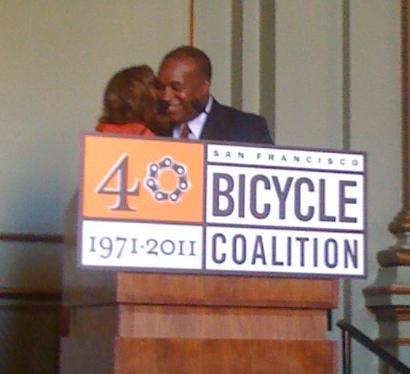
Just hours after being asked to leave the San Francisco Municipal Transportation Agency, director Nat Ford was at the San Francisco Bicycle Coalition’s annual Golden Wheels Awards accepting an award for the MTA’s Livable Streets Team. But that potentially awkward moment was eased by the universal political support for making the streets of San Francisco safer and more inviting for pedestrians and bicyclists.
Coming from car-centric Atlanta in 2006, Ford admitted he was an unlikely champion of turning San Francisco into one of the country’s best cities for biking. But he said the SFBC was “very persistent and worked with us.” While the bike injunction hurt progress, Ford said the support of SFBC and city officials allowed the agency to beef up the program from just a couple of staffers to “a dozen of the best bike planning and engineering folks in this country.”
“It was great working with all of you to get the MTA where it is today in terms of biking,” Ford told the capacity crowd in the War Memorial Building’s second floor event space, where the balcony overlooked City Hall and a sea of hundreds of bikes parked on the sidewalk out front.
Mayor Ed Lee spoke next, pledging to continue the progress and telling the crowd, “I want to give my very special thanks to Nat Ford for his five years of very dedicated service.”
Both Ford and MTA members told the Guardian that the split was a “mutual decision.” Ford told us, “Now’s a good time to go,” and that he’s still figuring out his next move. MTA board chair Tom Nolan told us, “It’s something we arrived at together. It’s good for his family and him.”
Indeed, it seems very good for Ford. The board approved a $385,000 severance package to go with its request that he resign before his contract expires, a payout that is drawing some criticism. “I am deeply disappointed that MTA would approve a nearly $400,000 golden parachute for an outgoing city executive. At a time when our budget is cutting critical social services for our kids and the most vulnerable in our city, we can ill-afford to be paying excessive payouts to administrators who are no longer working for the public. I have fought these exorbitant sweetheart deals at UC and CSU, and as mayor I will reform these practices,” Sen. Leland Yee, a candidate for mayor, said in a prepared statement.
Nolan says it’s time to restore the agency. “I’ve talked about wanting to restart what we do,” he told us. While Ford’s reported job hunting was one reason for the split, Nolan also alluded to mismanagement of the agency and the mistrust of its administration by Transport Workers Union Local 250A and other employees.
“We clearly have a problem when the drivers turn down a contract two-to-one,” Nolan said of the union’s rejection of its latest contract, which has since been approved by an outside arbitrator. “We can do a lot better.”
But the Ford saga was just a sideshow during an evening devoted to celebrating the improvements to the city’s bicycle network and selling the SFBC’s vision of what’s next, which it calls “Connecting the City.” The plan calls for three, green, separated bikeways (like those now on a stretch of Market Street) bisecting the city by 2015 (with the first Bay To Beach route done by next year) and a fully connected network of 100 miles of bikeways by 2020.
“Safe, comfortable, crosstown bikeways for everyone,” was how MTA Commissioner Cheryl Brinkman put it in slick video that the SFBC premiered at the event to promote the plan.
SFBC Director Leah Shahum told the crowd the idea is to connect and promote the city’s various neighborhoods and encourage “regular San Franciscans” to take more frequent trips by bike. “Seven in 10 of us, that’s how many people are already riding a bike,” she said, citing a survey of how many city residents own or have access to bikes. “We’re developing a vision where people are connected by safe, family-friendly bikeways.”
Shahum praised how engaged Mayor Lee has been with the plan and the need to improve the city’s cycling infrastructure. “Let me tell you how impressed I am with the level of involvement from Room 200,” she said.
Lee pledged to make cycling safer on dangerous sections of Oak and Fell streets that connect the Panhandle with the Lower Haight – sections Shahum took Lee on during Bike to Work Day this year – and to complete a new green bike lane on JFK Drive this year.
“We can get a lot of the goals of the Bicycle Coalition done together. We need your help in November,” Lee told the crowd, calling for them to support a street improvement bond measure on the fall ballot. He said the bicycling community has made the streets more fun and inviting, telling the crowd that at this weekend’s Conference of Mayors, he is “going to brag about our bike lanes and our way of living.”
The Performant: The fast and the furious
FURY Factory turns four
Summertime is festival time in the city, and the streets will stay lively from now to Halloween, barring acts of god/s or unforeseen War on Fun skirmishes. But considering the typical bluster of an average summer day in San Francisco, it’s a relief that a few of our festivals can be enjoyed indoors.
One example: FURY Factory, a three-week celebration of ensemble theatre hosted by San Francisco’s own foolsFURY Theater that provides the perfect excuse to avoid the elements, located in the comparable warmth of Project Artaud’s four theatre spaces. An eclectic lineup of 31 ensemble companies from around the country, FURY Factory includes talkbacks, workshops, and a forum for discussing excellence in theatre.
But for most oddiences, the play’s the thing, and there is indeed a plethora of performances to choose from, some of which are even being streamed live on “New Play TV.”
On Saturday afternoon a cluster of kids and young-at-hearts gathered in The Jewish Theatre to watch a light-hearted collaborative effort between two San Francisco-based ensembles — Sweet Can Productions and Coventry and Kaluza – called “Chef Mulchini’s Kitchen”. A buoyant public service announcement regarding the four “R’s” (reduce, reuse, recycle, and rot) as presented by a quartet of capable clowns, “Kitchen” is a visually appealing romp which includes an appearance by a rapping green trash bin, puppet produce, and acrobatics.
A nerd (Ross Travis, who also plays a brash pentathlete), a robot (Natasha Kaluza), a flirtatious neighbor (Kerri Kresinski), and that mustachioed punster, Chef Mulchini himself (Jamie Coventry), approach the topic of waste reduction with the wide-eyed earnestness of a Sesame Street sketch. You’re more likely to catch the next Mulchini performance at a public grade school than in a private theatre, but the performers themselves can be found in grown-up shows throughout the year, and are well worth watching on any stage.
One of the most buzzed-about events in the festival by far has been the West Coast premiere of Pig Iron’s Obie-winning “Chekov Lizardbrain,” which played for a single sold-out weekend at Z Space. An uncomfortably wry prologue narrated by an ostensibly imaginary occupant of protagonist Dmitri’s mind (both played by James Sugg) opens the show.
The narrator “Chekov Lizardbrain” wears an ostentatious top hat and tailcoat, but his reptilian gestures and labored mumble undermine the graciousness such attire is meant to convey. His host body, Dmitri, is not much better off. An Aspergian botanist, he is socially awkward to the point of painful, and his interactions with three brothers whose house he is buying take a surreal turn as he recasts their conversations in the context of a Chekovian melodrama.
The brothers, played by Dito van Reigersberg, Geoff Sobelle, and Quinn Bauriedel, first appear onstage in formal top hats, suit vests, and turn-of-the-century long underwear, underscoring their fantasy-based roles. Peeks behind the stylish red curtain provide glimpses of the murky swamp of Dmitri’s brain, where an initially light-hearted game of “lost and alone” leaves him stranded, inside and out. Though the “rules” of Chekov presented earlier in the show specify that tragedy should happen “offstage,” the melancholy finale in which Dmitri succumbs entirely to his “lizard brain” is not a particularly uplifting one. But the neocortex can sense the humanity in it.
FURY Factory 2011
Through June 26
Project Artuad
499 Alabama, SF
(415) 685-3665
Ears of the Beholder outdoor show at El Rio
An afternoon show under fruit trees and bright sunshine is always nice, but a line-up of super chill local music is extra conducive to ideal weekend mentality. As long as the weather keeps up its good behavior, Saturday’s Ears of the Beholder four-band showcase will be a total hit and a great introduction to some homegrown electro-pop.
Ears of the Beholder is a pretty rad indie-music blog, started by an San Francisco guy named Peter in 2008. The site promotes a lot of great shows around the city, handpicked with the best intentions. Start with beer, dab your beak with sunscreen and don’t forget the layers; the show may start early at the lovely El Rio, but it won’t wrap until after sunset. The ticket price also includes food, which means you won’t have to run-off mid-set for dinner and instead, you’re encouraged to plop down for a full evening. Take a listen to the line-up:
This SF band keeps things feather-light with pretty, super mellow guitars. They’re minimalist post-rock that’s super easy on the ears and their new synth addition is sure to add in a sweet surge of electro-pop.
The mystical chimes, mermaid voices, and super glassy synth melodies of San Francisoc’s Blackbird Blackbird wash over your senses in slow-motion. They’re a perfect soundtrack for underwater swimming.
These Santa Cruz guys keep things psychedelic, but add in a heavier, more danceable punch. Their random bag of tricks switches up quick and the super diverse samples insures things stay uber fresh from track to track.
The honest, fragile vocals from this Oakland native are compelling enough, but then he adds in pianos and totally weird racing beats. There’s something twisted about the combinations he throws and the unpredictability of it all keeps you along for the bright ride.
EARS OF THE BEHOLDER OUTDOOR SHOW
Sat./18, 3 p.m., $8
El Rio
3158 Mission Street, SF
Hot sexy events: June 15-21

And we’re back! After a brief jaunt around the world, I’ve returned to hunker sexily down amidst a mountain of press releases for SF’s sluttiest happenings (yes, they make press releases). Seems like y’all have been busy since I’ve been gone – this week alone there’s a big-ass conference for nerdy – is there any other kind? – pervs and a class with Madison Young on making your own adult videos.
Idea: go to Young’s Good Vibes class tonight, complete your star turn post-learnin’, and learn how to market and code the darn thing (or meet someone who can) this weekend! Then give link to all the new friends you meet at Pride. Planning ahead: it pays!
“DIY Porn”
Because it’s not just about figuring out how to many books to prop the Flip atop. No no, recording your sexy precious moments requires a lot more skills – starting off with the skill of knowing what dirty tricks you’d most like to capture for posterity. Femina Potens’ head mistress Madison Young (it’s safe to say) is a master at figuring these kinds of things out, so entrust to her your future on the silver – or laptop – screen. She’ll be touching on scripts, casting, and financing, so dream big.
Wed/15 6-8 p.m., $20-26
1620 Polk, SF
(415) 345-0500
Ecosexual Queer Porn Night
Ecosexuality, the sensual relationship with the world around us. Not surprisingly, Nature (that sexy beast) plays a big roles in many pornos. Beaches, vineyards, parks – all this and more you will see for your own dirty little eyes if you attend a mini-fest incongruously located in the Tall Tree Tambo center, which last I checked was a spa and woo-woo health club-skillshare type arrangement in the back of Lower Haight’s favorite hippie hangout, Pkok. Enjoy! (Psst, if things get really natural, ask to take the party to the sauna out back in the garden).
Thurs/16 8-11 p.m., $10
Tall Tree Tambo Wellness Center
776 Haight, SF (behind Pkok)
Ynot Summit
Formerly the Cybernet Expo, this three day conference for the online sex industry promises to hook you up… with networking opportunities, at least. Attend speed mix-and-mingle sessions with your point-and-click-to-perversion peers, learn about legal issues surrounding online porn and escort services, and of course, the Saturday night show. Last year the nerds hit up the Kink.com palace, but this year they won’t even have to truck out the Mission: Kimo’s is hosting a show by the Asian Diva Girls and Smash Up Derby, which is curiously dubbed “one of San Francisco’s favorite bands” by conference organizers. Well hell, if they say so!
Thurs/23-Sat/25
Holiday Inn Golden Gateway
1500 Van Ness, SF
Kinky Salon: SanFranSexual
Be entertained by Chadd Behavior of SF Boylesque and the triumphant return to Mission Control by X-rated storytelling doyenne Dixie De La Tour – or just fool around with everyone in the building. This week’s Kinky Salon swinger’s party is themed SanFranSexual for a reason, you’re allowed to do whatever the hell you want, in style.
Sat/18 10 p.m.-late, $25-30 members only
Mission Control
Bawdy Storytelling: Tales of Non-Monogamy
Bawdy’s back – could this be the most popular monthly storytelling series in the Bay, pervy or not? – in its East Bay incarnation. Dixie’s overseeing a night of swingtastic synopses, from fundamentalist Christians at key clubs (I’d love to hear the scripture on that), and other godly pursuits.
Tues/21 8 p.m., $10
The Uptown
1928 Telegraph, Oakl.
The Duke abides: Gamer takes on “Duke Nukem Forever”
Duke Nukem Forever
Xbox 360, PS3, PC
(3D Realms / Triptych Games / Gearbox Software / 2K Games)
Duke Nukem Forever is an exploration of myth and ego, a commentary on celebrity-obsessed culture…
Oh, who are we kidding? Duke Nukem is a steroid-popping meathead who loves beer, blow jobs and blasting aliens. DNF is a direct sequel to Duke Nukem 3D, a PC game that debuted in 1996 – in those dying days of action movie excess, nu-metal and witty one-liners – and the sequel does not stray far from its roots.
That it took 15 years to release a sequel makes DNF the oldest video game joke in the industry. Following numerous delays, funding issues and company closures, its imminent release is a moment being watched by many gamers with cautious anticipation: Will the game enjoy the same success it might have had in the 90s? Or has the world changed too much, lending this joke a pitiful punchline?
Somehow, both of these things have happened. DNF successfully channels the crass humor of the original game, which was full of strip clubs and naughty curses, and it benefits from employing the same voice actor, Jon St. John. But the world has changed: it is still capable of containing a character as radical as Duke but the celebrated Duke gameplay is a tad past its sell-by date.
Following the events of Duke Nukem 3D, Duke is enjoying the good life in Las Vegas, where seemingly everything is Duke-branded, from burger joints (Duke Burger) to strip cubs (Duke Nukem’s Titty City.) As Duke is on his way to a late night talk show appearance, aliens attack once again and steal all of Earth’s women. It’s hard to tell whether, at some point in the game’s development, there was ever more to the story. Here it acts as a thin framework to drive the action across Vegas towards the Hoover Dam.
I was only half-joking by describing DNF as an exploration of myth and ego. Certainly, the game makes no great statements on matters of fame and narcissism, but the developers have fumbled the character’s celebrity into a game mechanic where your health is called “Ego” and performing tasks like signing autographs and admiring yourself in the mirror increase your Ego bar permanently. Yes, the first thing you do in the game is press the right trigger to “Piss” in a urinal.
While this jibes with the humor of the original game, it is also suspiciously pandering. There’s a strong disconnect between newly conceived gameplay and whatever was conceptualized over the course of 15 years. Fifteen years is a long time and Duke Nukem 3D wins no awards for its mechanics in today’s modern playground, but DNF more or less sticks to its guns. If you missed circle-strafing enemies, you’re going to have a blast with this.
Likewise, the platforming sections that interrupted the original game’s carnage can’t hold a candle to the type of sure-fingered control we enjoy today. Its inclusion here brought a smile of recognition and a frown of frustration when I couldn’t make jumps that I should have. Let’s not even bring up the fact that it takes over a minute to load a level after you die. How is that possible in 2011?
It’s hard to say what it would have taken to please everyone waiting for Duke Nukem Forever. In adhering to outdated mechanics you frustrate new players, and by updating everything you wind up with a relic of the ’90s in a world where Duke doesn’t belong. DNF straddles the line. It’s funny in a 12-year-old potty humor kind of way, and the Duke character survives his awakening into the 21st century. But 15 years of anticipation overshadows anything less than a home run and DNF is not a home run. If you are a card-carrying member of the cult of Duke, DNF often brings back the ridiculous feeling of playing that game, warts and all. I found myself excusing its failures whenever possible.
The car-radio wars

It’s not enough to try to get four kids (two of mine, two of the neighbors) out the door and into the car for the half-hour trip to various summer camps across town. No: They have to fight — bitterly — over which radio station we listen to. It sometimes literally comes to blows.
My son, the metal-head, insists on on Live 105, with the bass turned up and the volume cranked. My daughter, who accepts only female vocalists of the Taylor Swift/Rhianna/Katy Perry genre, insists on Movin’ 99.7, and she sings along louder than the radio. The other day, it was absolute chaos as they battled for control of the front seat (and thus the radio knobs), punching and grabbing and pushing like some sort of Winfield St. WWF Smackdown at 8 a.m.
You been there? Here’s the solution.
I shut them both up and tune into …. the New Oldies (I hate that word; I feel so …. Old) on KKSF, 103.7 And make the kids listen to to … REO Speedwagon!
Remember those guys? Maybe it’s a generational thing, but here’s what I remember: “Roll With the Changes” at full tilt, blasting out the holes in my bedroom door, and my mother holding her head in her hands and begging me to “turn off that horrible noise.”
It was horrible, too. It still is. I love it — and I love it even more that my two kids — nine and 12 years old — are sitting in the car holding their heads in their hands and begging their dad to “turn off that horrible noise.”
Next I’m sending the Speedwagon to make peace in the Middle East.