SFBG Blogs

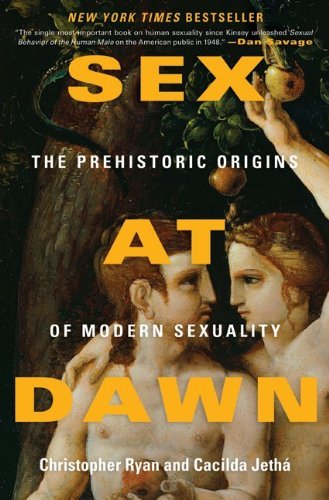
Author Christopher Ryan and the socio-evolutionary reasons for non-monogamy

0

Love your partner and love to fool around with other people? Author Christopher Ryan says that’s perfectly natural. A psychologist and historian who insists that human beings are not cut out for sexual monogamy, Ryan’s hitting SF next week (Wed/9-Thu/10) to talk about the evolutionary reasons for why that’s so.

Sure the freaks will be out in force for his events, but Ryan says that his book’s message is not just for people who already embrace alternative sexuality identities. 

Sex At Dawn shows that they’re not freaks because they find so-called traditional, strict monogamy to be stilted and unnatural for them. There’s a good reason for that, it is unnatural for them, and for the rest of us.” Ryan told the Guardian in a recent interview.  

But Sex at Dawn is not about modern non-monogamous types. It’s an ancient history that traces human evolution and focuses on pre-agricultural societies. Ryan explains, “Our ancestors evolved for 95 percent or more of our existence as a species of nomadic hunter-gatherers. In nomadic hunter-gatherer society, the central organizing principle is sharing. Sharing of childcare, sharing of food, defense, shelter, access to the sprit world, medical shamanic principles.”

His book argues that sexual pleasure was a no less communal practice for these early humans. 

“You look at our bodies, you look at anthropology, you look at all these different sources of information and you see, no, they weren’t possessive about sexuality in a way that they weren’t about anything else.”

But he has little idea on how to apply these historical tendencies to a modern society hooked on the one-plus-one-equals-two arrangement.

That’s partly why Andrew Sullivan, the organizer of next weeks’ events, wanted to present Ryan’s theories with the work of San Francisco’s esteemed sex activists. The expert panel backing up the author at Club Exotica will include relationship coach Marcia Baczynski, the founder of Kinky Salon Polly Pandemonium, and sex-positive icon and founder of the Center for Sex and Culture Carol Queen.

Says Sullivan: “Ryan talks about this pre-agricultural state, but he doesn’t really talk about — well, what do you do. He doesn’t deal with that. And that’s why I wanted to have him do this presentation, provide the science, provide the motivation for the work.”

He thinks these events will attract Bay Area residents from all walks of life.

“The cross-sections of life that are intersecting around this book are extremely diverse. You’ve got Republicans on the other side of the tunnel who are coming to an event like this because it hits them. They’re like, that’s part of my life, but its something they hide from out there, and they’re afraid of. All of a sudden they’re at the same event with somebody whose got a whip and rope and somebody else who is in a completely different socio-political mindset than they are, but they’re all going ‘we share something in common here.’”

The party that follows the Nov. 9 panel is sure to bring people together on whole other level. Sullivan says the event will “transition into an actual environment, this essential erotic environment that actually facilitates these kinds of connections. That’s why I call it the full spectrum event. It’s all right here. It’s like Woodstock for alternative relationships.”

On Nov. 10, economists and alternative currency advocates will gather to discuss sex and scarcity. Ryan says the talk will compare pre-agricultural society to our current system. “Our ancestors’ societies were based on sharing resources, which means they’re based on a notion of plenty — there will always be enough. Whereas post-agricultural societies, like our own, shifted 130 degrees to an orientation of scarcity. There’s never enough.” 

Ryan applies this scarcity theory to modern-day relationships. 

“You say well, I have to have my sex partner, I have to have my lover because she’s the one who gives me sexual pleasure, the stuff that I need, companionship, intimacy, security. If I lose her, I’m screwed, I’m alone. Because we live in that sort of fractured world. But our ancestors didn’t live in that sort of world, they lived in a world where hey, it doesn’t matter. I’m with her, I’m with her, she’s with her, she’s with him. You know we’ve all got multiple lovers, so if one relationship isn’t working, it’s not the end of the world.  It allows the social groups to function much more smoothly without all this conflict.”

He’s even found a way to connect this scarcity-plenty conundrum with the zeitgeist of our times.

Says Ryan, “I think that the message from the Occupy Wall Street movement, and Occupy different cities all around the country, is that no society can last if we lose sight of the fact that we’re in this together. That we are a species that evolved sharing resources and taking care of one another. And the more we lose sight of that, the more miserable we become. I don’t care how rich you are. I’ve known a lot of very wealthy people in my life, and they are not the happiest people I’ve known. The happiest people I’ve known are the ones who are living in communities where they’re taking care of each other and there’s a sense of unity and fairness that people respect. So I think that’s their message. That we have to get back to this understanding of what sort of animal we are and what sort of social system works best for us.”


Club Exotica presents Sex at Dawn

Wed/9 8 p.m.-2 a.m., $10-$35

Supperclub

657 Harrison, SF

www.clubexoticapresents.com


“Sex at Dawn: Modeling a New Culture of Sharing”

Thurs/10 free for members, guests $20 

Mission Control 

www.missioncontrolsf.org


We love the sound: Wild Flag will play the Great American Music Hall

0

Back in 2010, when the members of Wild Flag initially started playing music with one another, whether a band would be forged or not wasn’t altogether clear. Carrie Brownstein, Rebecca Cole, and Janet Weiss (all from Portland, Ore.) had been writing the score for art documentary !Women Art Revolution when they tapped Mary Timony, who lived in Washington D.C., to record vocals. One project naturally led to the other.

Given the bands they had played in before, you would think there’d be no question as to whether or not they’d make a good group: Brownstein and Weiss had Sleater-Kinney until it disbanded in the 2006, Timony led Helium in the 90s, while Cole had backed the Minders. However, the four weren’t certain. In theory, sure, but: “Everyone knows, whether, you’re a fan or a musician, that theories do not make good music,” Carrie Brownstein said in a phone interview on Thursday. Wild Flag is now north in San Francisco for a two-night stint at the Great American Music Hall starting Friday, Nov. 4. “We spent a lot of time working to figure out if the band was necessary.”

Necessary — it’s something Brownstein stresses about the band. And it seems that it not only determined the fate of Wild Flag, but also determines her involvement in just about any project, which likely explains the reason why everything she does, she does extremely well — she needs it, and it undoubtedly needs her. Her co-created IFC sketch comedy with Fred Armisen, Portlandia (whose second season begins in January), is spot on and hilarious. Her blog at NPR Music, Monitor Mix, was intelligent and delightful. And Sleater-Kinney was one of the most talented feminist-punk bands of the late 90s and early 2000s.

Now, Brownstein and the others have found Wild Flag necessary — the songs were telling them so. “The songs felt like they were being played by a band,” Brownstein explained, “not individual people with separate ideas that weren’t congealing into something interesting.”

After they announced that Wild Flag was official late last year, the band set out on tour, without an album or recorded songs, to play fairly small clubs (including Bottom of the Hill) and to give fans a pure, unadulterated listen to the band. Over the course of that tour, the band earned a reputation for its passionate live performances. Then, in April of this year, Wild Flag went into Sacramento’s the Hangar studio to record its self-titled debut, releasing it five months later on Merge.

The record is tough but catchy, original but accessible, and recalls just about every sub-genre between post-hardcore and classic hard rock. It also speaks to just how important music is to Wild Flag. “We love the sound, the sound is what found us/Sound is the blood between me and you,” they harmonize on the dynamic single, “Romance.” Most of the music besides the vocals on the album was recorded live as well, making it a raw and undisguised release.

“For our first album, we wanted an unadorned, mirror document of who we were — our capabilities, our presence, and our sound,” Brownstein said. “It was exciting to have a blank slate; to not be comparing or measuring ourselves to any previous body of work.”

Although the four musicians have been playing in bands for decades and they feel familiar, Wild Flag is itself still a very new project. Even for someone like Brownstein, who is in familiar territory. “I feel like this band is very recent and still in its infancy,” she says, “there are still a lot of places to go with it, and there are a lot of things I still don’t know about it.”

Clearly, this is just the beginning for Wild Flag. The members are anxious to move on from this point and explore the band and it’s ultimate potential. “We’re trying to just be present in the band and be in the middle of it. But at the same time, we’re impatient. I really want to have new songs, those are what I love playing live.”

“But,” she adds, “that’s not going to happen between now and San Francisco.”

Wild Flag
With Drew Grow & the Pastors Wives
Fri/4 and Sat/5, 9 p.m., $19
Great American Music Hall
859 O’Farrell, SF
www.gamh.com

The awesome video for “Romance”
http://www.youtube.com/watch?v=8J8n9R8rnB8&ob=av2e

Correction: Prop. E isn’t retroactive

10

In the hustle-bustle of getting our last pre-election issue out the door, we made a significant error in describing Prop. E in the “Buying power” section of this story. The measure does not apply retroactively, but would allow the Board of Supervisors to change measures that voters approve after January 2012. Sorry for the mistake.

Dick Meister: Searching for Joe

2


By Dick Meister

Dick Meister, former labor editor of the SF Chronicle and KQED-TV Newsroom, has covered labor and politics for more than a half-century. Contact him through his website, www.dickmeister,com, which includes more than 300 of his columns.

San Francisco’s unions have been looking for another Joe Alioto ever since he left the mayor’s office in 1976 after eight years of being one of the best political friends organized labor ever had – anywhere.

Unions certainly have no chance of finding such a staunch supporter among the candidates for mayor in Tuesday’s election – not even in former Supervisor Michela Alioto-Pier, Alioto’s granddaughter. She reflects the conservative views of her former supervisorial district, which encompasses the upscale Pacific Heights and Marina neighborhoods.

Some of the other candidates claim to be labor-friendly, and some actually are. But none have gained anything approaching the all-out, almost unprecedented support that unions gave Alioto. Not surprisingly, unions have in turn been promised only relatively little post-election support by Tuesday’s candidates.

Alioto’s rewards to labor were based in part on the fact that, as he declared, “the controlling and decisive factor in my election was the support of organized labor.”

His administrations, he said, were “first of all sympathetic to labor.”

Alioto appointed union representatives to all of the city’s boards and commissions, some of which previously had little or no union representation, and helped unions in major strikes against recalcitrant employers, often stepping in to convince the employers to settle.

Probably the greatest benefits to union members came from the downtown building boom that Alioto launched, creating thousands of construction jobs.

So, with no Alioto-like union supporter in this year’s mayoral race, who are unions supporting? And how is labor likely to influence the outcome as well as the votes for ballot propositions, particularly Props C and D that involve the pensions and health care of public employees that have come to preoccupy municipal and state governments everywhere?

It seems clear that labor’s influence on the election outcome will turn out to be relatively slight, certainly considerably less than in Alioto’s time – less, in fact than in just about any other city election since the 1930s, when San Francisco was celebrated as one of the country’s premier “union towns.”

But no more. It’s sometimes hard to believe that San Francisco was ever a union town in the same league as New York, Chicago and Detroit.

The general public hardly hears from the city’s once vibrant and highly influential Labor Council and its leaders these days. Individual unions such as the Service Employees, Longshore and Warehouse Union, Nurses Association and Unite-Here, the hotel workers union, still have considerable clout, as do a few others. But that’s about it.

It’s partly the fault of the news media, but their scant coverage of organized labor reflects the failure of unions to take the leading position in politics as in economics that they once had, and must have if they are to prosper.

Unions are staging something of a comeback with the growth of public employee unions, which now dominate organized labor in numbers and influence – though locally unions probably do not yet have enough influence to play the role that once put them in a position to help elect politicians who considered them indispensable.

Public Defender and mayoral candidate Jeff Adachi and his conservative backers are trying hard to seriously weaken the growing strength of San Francisco’s public employee unions and their members, mainly through Proposition D. The apparent frontrunner in the mayor’s race, acting Mayor Ed Lee, is no particular friend of labor, either. Neither was Lee’s predecessor, Gavin Newsom.

Labor wasn’t helped by last year’s elections that gave the Board of Supervisors a strong minority of members on the political right who are at best indifferent to unions. Only five of the 11 supervisors can be legitimately considered pro-labor progressives.

It would help labor greatly to have a strong pro-union mayor, but none of the major candidates would play that role. The Labor Council endorsed Dennis Herrera and Leland Yee. The Building and Construction Trades Council went with Alioto-Pier and Yee.

But what about me? Glad you asked. I say it should be Herrera, who’s an excellent city attorney, has a broad base of supporters and, as a Hispanic, would give that underrepresented minority an important voice in City Hall. All the major candidates for sheriff and district attorney have solid credentials, and I’m sure any of them would do a good job.

Can’t see any reason not to vote for Prop A, a much needed school bond measure, and Prop B that would authorize bonds to pay for needed road and street repair. A big no on the foolish Prop E that would allow the Board of Supervisors to undo measures previously approved by voters.

No on F, another foolish and unnecessary measure. But Prop. G’s a good one. It raises the sales tax by half a percent to finance public safety programs and services to children and seniors.

Prop H is bad news. It would take away parental choice of schools and force students to attend only their neighborhood schools. Since many neighborhoods are still segregated by race or along socio-economic lines, it also would re-segregate schools citywide.

The main event includes, of course, Props C and D, and we should reject both measures. Don’t be confused by those who say, “I can’t vote no on C, because if D gets more votes, Adachi will win.” That ain’t necessarily so, for if neither measure gets at least 50 percent+one of the votes, then both would be defeated.

Make no mistake: Both propositions would be extremely harmful, because both would needlessly increase the financial burden of city employees by limiting the pensions of many new employees, while at the same time requiring them to make higher contributions to city pension funds. Both measures would also require some current employees to contribute more, although Prop D’s rates are somewhat higher, especially for higher income employees. Both C and D would also limit cost-of-living raises for current retirees.

Ever since voters in 2004 approved a badly needed reform of the City Health Service System that oversees the health care of employees and retirees, their elected representatives have had a genuine voice, with four members on the service’s seven-member governing board. The other three have been City Hall appointees.

Prop C would reverse the numbers, substituting another City Hall appointee for one of the elected members and otherwise limiting the voice of the elected members. Sponsors of Prop C would have you believe that the proposition is a “consensus” measure agreed to by all parties. But don’t you believe it.

Retirees, who make up a large part of those in the Health Service System, were not allowed to be part of the consensus negotiations, presided over by acting Mayor Lee.

It’s certain Joe Alioto would never have allowed that to happen.

Dick Meister, former labor editor of the SF Chronicle and KQED-TV Newsroom, has covered labor and politics for more than a half-century. Contact him through his website, www.dickmeister,com, which includes more than 300 of his columns.

Miyamoto and jail abuse

107

A new video produced by lawyer Ben Rosefeld includes disturbing footage of deputy sheriffs under the supervision of Paul Miyamoto using excessive force on peaceful protesters. It reflects charges in a 2007 lawsuit against the city — and evidence collected in that case shows that Miyamoto, now a captain in the department and a candidate for sheriff, was an active participant in the alleged misconduct.

The lawsuit is a result of a protest that took place in June, 2004, when activists were demonstrating against a biotech conference in the city. Protesters dressed as mutant animals marched through the streets, and 17 were arrested and taken to the county jail.

The protesters declined to give their names — and at some point, sheriff’s deputies were directed to remove them from a holding cell.
As the video — taken by the Sheriff’s Department and released as part of the lawsuit — shows, the deputies used physical force to pull the protesters out of the cell. The protesters were holding on to each other — and in some cases, the level of force used certainly appears excessive.

Remember: These were nonviolent activists who never threatened the deputies or gave any sign that they were dangerous.

Miyamoto, then a sergeant, both supervised and participated in the removal. In a legal document responding to questions from Rosenfeld, who represented the protesters, Miyamoto said that he, along with another sergeant, had developed the extraction plan and “became physically involved in the cell extractions on more than one occasion.”

I called Miyamoto and sent him a copy of the video. He told me that he was, indeed, involved and said the video was “a fair representation” of what happened.

“I stand by out decision that night,” he told me, saying he didn’t see anything in the video that bothered him or that was inappropriate.

“Our job was to get them out individually, and we took great pains not to harm anybody,” he said.

The lawsuit charged that some of the protesters were seriously injured during the extraction. It was settled when the city agreed to pay $25,000.

Sup. Ross Mirkarimi, who is running for sheriff, told me that the video was, indeed, disturbing. “I think it speaks for itself,” he said, adding that he didn’t think the tactics were appropriate.

“This is why we need an independent sheriff who isn’t connected to the Deputy Sheriff’s Association,” he said.

Powerful, mostly peaceful Oakland action ends badly

19

After a long day of mostly peaceful demonstrations by thousands of protesters who joined OccupyOakland’s General Strike and Day of Action yesterday, it’s still unclear why the Oakland Police – which had stood down the entire day, leaving the movement to self-police – massed in riot gear around midnight and used tear gas and other projectiles to clear the streets and make a reported 80 arrests.

Spokespersons for the Oakland Police Department and Mayor Jean Quan haven’t returned Guardian phone calls, and reports in the Oakland Tribune and other media outlets don’t indicate exactly what prompted police to change tactics and aggressively confront the demonstration. Protesters had taken over a vacant building and erected barricades in the streets shortly before riot police showed up, and it appears from a Tribune video that a dumpster was set on fire after the police showed up.

Before the standoff between city officials and demonstrators in Oakland again took a violent turn, the day was notable for its lack of police presence around the occupied Oscar Grant Plaza and nearby 14th and Broadway epicenter. And despite a small number of masked agitators who broke bank windows and sprayed graffiti – much to the chagrin of most protesters who actively opposed such tactics – the movement was remarkably nonviolent and self-policing, particularly given a crowd of what seemed to be around 10,000 people at its peak. Protesters even handled traffic control, using a megaphone to help motorists through intersections congested with passing demonstrators.

“This is an extraordinarily peaceful collection of diverse people,” Sen. Loni Hancock (D-Oakland) told the Guardian just after 5 pm as a massive march left the encampment to shut down the Port of Oakland. “I feel like they’re doing what no elected person can do: they’re putting economic equity issues in front of the American people.”

“This is beautiful and powerful. This I love,” agreed Oakland City Council member Libby Schaaf, beaming as the peaceful march took off, although she told us that she was disappointed to see Oakland businesses vandalized, including her beloved Noah’s Bagels. “Fight greed, not bagels.”

Most of the crowd condemned the violence, and many openly worried that it would undercut the positive demonstration of people power and the airing of frustration with economic injustices in the country. But even Hancock said a few bad apples shouldn’t spoil people’s understanding of what an important day it was.

“I’m very grateful to them for calling attention to economic inequality. It is in the interests of cities that this issue take center stage,” Hancock told us. “There are so many things that have been talked about that are now on the stage and it’s a very important conversation to have.”

But many in the movement were disappointed nonetheless, despite the myriad successes in shutting down business nonviolently. Around 3 pm, a crowd of thousands marched past a Chase Bank at 20th and Berkeley streets where the front window had been shattered, as was the case with at least six other businesses. Taped to the windows were signs reading “We are better than this” and “This is not the 99%. Sorry, the 99%”.

As the huge crowd repeatedly chanted “peaceful protest,” Ryan, a 31-year-old Oakland resident, expressed his frustration over vandalism he blamed on out-of-town instigators. “People from Oakland would not damage their city like that,” he told me. “Last week was beautiful, we were dancing and singing in the streets,” he said, referring to the largely nonviolent response to police violence, “but this is bullshit.”

Large protests almost always have members who want to escalate the conflict and who see breaking windows as a legitimate tactic, and yesterday there were sometimes tense conflicts between protesters who disagreed on the issue. Another complex issue is how to now view Oakland Mayor Jean Quan, whose support for last week’s violent police crackdown prompted calls for her recall or resignation, although her subsequent apology, the re-encampment of Frank Ogawa Plaza, and yesterday’s police stand down caused some to rethink whether to actively oppose her.

“My goal for today is to spur the international movement forward and to show what we’re capable of,” said 23-year-old Iris Brilliant, who got more actively involved in OccupyOakland after the crackdown and said she was happy to see the police kept at bay. “It’s important to push this forward.”

But Tania Kappner, a 41-year-old teacher from Oakland, still hadn’t forgiven Quan or the police for the violent excesses in last week’s raid. She was camped out in Oscar Grant Plaza in a tent with the sign “Mayor Quan Must Go!”

“It’s good she’s not sending them in on us today, but she never should have done it in the first place,” Kappner told us. “We’re calling for her to go and the police who did it to be jailed.”

With the decision to again unleash the riot police and tear gas and arrest big numbers of people – which was the very thing that prompted such huge numbers of people to turn out yesterday, giving OccupyOakland the numbers and power to easily shut down the port and dozens of businesses – Oakland and the larger Occupy movement might again find itself back at square one.

The National Lawyer’s Guild, which had observers on hand to witness the late-night police crackdown, issued a statement today condemning the city’s actions and saying they violate a crowd control police the NLG helped the city write to settle lawsuits stemming from the OPD’s use of rubber bullets to clear anti-war protesters from the Port of Oakland back in 2003.

“Like we saw last Tuesday, the OPD actions in the late night hours violated numerous provisions of the Crowd Control Policy and the Constitutional rights of activists,” explained NLG’s San Francisco Bay Area chapter president Michael Flynn. “Our legal observers did not disobey any police orders and neither did many of the other arrestees.”
“The Crowd Control Policy clearly prohibits shooting munitions into a crowd,” added NLG attorney Rachel Lederman. “While the police are allowed to use tear gas, they are supposed to use a minimum amount and only where other crowd control tactics have failed.  It is not at all clear that less violent and less provocative measures would not have sufficed to achieve any legitimate law enforcement objectives last night.”

Meanwhile, in San Francisco, Mayor Ed Lee has reportedly assured OccupySF that he won’t follow through on threats to raid the camp if tents aren’t removed, at least not anytime soon (many observers speculate that he’ll at least wait until after next week’s mayoral election). But Lee has been unwilling to make a clear public statement that raids are now off the table.

When we sought to clarify Lee’s position and get his reaction to a Board of Supervisors resolution calling for the city to allow a 24/7 encampment, his Press Secretary Christine Falvey wrote: “The mayor has not focused on the resolution, but has been focusing on meeting with clergy, labor, occupysf demonstrators and his department heads to make sure that the site is kept clean, safe and accessible for everyone. He remains concerned about overnight camping and the public health and safety issues that brings. That said, he has seen some good progress over the last few days because of his open communication with the group. DPW cleaned up the site over the weekend and the demonstrators helped facilitate the cleanup. Tents were moved off the Bocce Ball Court as well. The group is working with Fire and Public Health officials to make some improvements. The dialogue is ongoing.”

Photos by Steven T. Jones

A journey through “Gay in America” with photographer Scott Pasfield

0

Incredibly, considering what a visual people my lavender tribe are, there has been no major photographic survey of gay men in America until now. (Well, at least in book form. I’m not counting Manhunt, here.) Author-photographer Scott Pasfield journeyed around the country for three years, taking some wonderfully enlightening shots of gay men, couples, and more who had responded to his online ads for photographic subjects who were willing to tell their stories. The tally for his “Gay in America” book: 224 pages, 140 men, 50 states.

Scott will be narrating a slideshow presentation of the book (“Not boring like a travel slideshow!” he says) on Sat/5 at 7 p.m. at Magnet in the Castro. I chatted with him over the phone about the project, the men, and the concept of gay “normalization.”  

SFBG What drove you take on a project of this magnitude?

SCOTT PASFIELD It was a combination of a lot of things. I work as a professional photographer in New York, but as with most things in this economic climate, that work was drying up. My fourteen-year-old dog passed away, and I found myself mourning more than I thought. And I really just needed to get back in touch with my craft, to reignite my passion for what I do, to push myself to do something big. I have an incredibly supportive partner now — but I was raised in a difficult household, my father had been very conservative and uncomfortable, to say the least, with my sexuality. So in the big scheme of things, I wanted to connect with other gay men around the country and get them to talk about their experiences, to see where we all were at this very interesting period in the gay American journey — and hopefully learn a bit about myself as well.

I had no idea what I’d find, but the response was pretty overwhelming when I started placing the ads for subjects. People welcomed the opportunity to talk about their lives, where they’d come from and what they were doing. As gay men, we often see each other through these restrictive lenses. I wanted to open that up.

<<<<<<<<<<<<<<<<<<<<<<<<<<<<<<<<<<<<<<<<<<<<<

SFBG A lot of your subjects live in places like Oklahoma, Arkansas, or Kentucky that aren’t exactly known for gay cheerleading. Did you run up agaiinst any major barriers in getting them to pose for you? Or have attitudes changed in this age of the Internet and niche gay communities?

SP You know, it was the strangest thing. I had no problem finding guys in some of those more “remote” places. Of course, homophobia is still a major thing, but I felt that people in some of the out-of-the -way places really wanted to connect and tell their stories, maybe because they had to be strong to be who they are where they are, maybe just because no one had asked.Maybe there just aren’t as many social outlets.

It was in the big cities like San Francisco, Los Angeles, and New York that I had the darnedest time finding subjects. I don’t know if it’s because people are more jaded, or maybe they thought I was going to take advantage of them — that this was a hoax or porn. [Laughs.] I was blanketing chat rooms and social media for people to open up, and I did eventually find some great guys, but it was work.

SFBG What are some of the things you’ve taken away from doing this project? Did anyone in particular inspire you?

SP This has been a very emotional journey and I hope I’ve done justice to all the people who appear in the book. You know, five of the guys have died and I hope Gay in America is a fitting tribute to their lives. 

Beyond that, everyone’s story was really affecting. I think the one that most sticks with me is Ken from Maryland, who calls himself “a true redneck.” He and his best friend Kevin had fallen in love, gone to school together, celebrated their anniversary, but had never come out. Until the night they got in a car accident and Kevin was killed. Ken couldn’t see him after they had taken him to the hosital, so he started yelling that he was Kevin’s boyfriend until they let him through. That was how he came out to the world. It’s such an emotional story.

SFBG In the trailer for the Gay in America, you say, “Feeling normal about yourself — which we all are — and that’s the whole point of this.” With all the advances that gay America has made in recent years, from the repeal of DADT to the continued gradual acceptance of same-sex marriage, many people feel the assimilation and normalization are pushing queer diversity and radicalism under the rug. The people in your book are incredibly diverse, although all men. Now that you’ve taken this wide view of gay men, do you have any opinions about the push toward mainstream assimilation?

SP I think there is a very valuable contingent, loud if nonetheless small, of people within our community who are raising important points about the cost of assimilation, and I appreciate that they’re around. The reason I used the word “normal” was more in a personal sense. I was raised to think that homosexuality wasn’t normal, and it took me a long time to accept that I was just as valuable as anyone else. That’s what I mean about feeling normal, feeling OK.

With Gay in America I wanted people to see that the people telling their stories may have been through some crazy stuff, but inn the inside the weren’t so different after all. And I wanted to upend some stereotypes — that gay men do and look like all kinds of things, we’re not all drag queens and mean twinkie-types like you see on TV. Although there are some drag queens out of drag in the book!  

SFBG Now that you’ve been all over the country, what was your favorite place? Would you relocate if you had the chance?

SP Well , Hawaii’s awfully nice [laughs]. So is Alaska, so beautiful. And, surprising to me, I really like Maine. But if I and my partner didn’t have our work in Manhattan, I think I’d move to Portland. I love the liberal vibe, how it’s so close to nature, and how the city itself is laid out. I’m an architect before a photographer, and the urban planning and regional architecture of portland was fascinating to me. Oh, and of course, I’m looking forward to sending some time in San Francisco — my partner’s flying in and we’ll be staying with friends.

GAY IN AMERICA PRESENTATION WITH SCOTT PASFIELD
Sat/5, 7p.m., free
Magnet Center
4122 18th St, San Francisco
(415) 581-1600
www.magnetsf.org

Followed by a book signing, drinks, and hors-d’ouvres at
Under One Roof
518A Castro Street
San Francisco,
(415) 503-2300
www.underoneroof.org


Live Shots: Anamanaguchi at Slim’s

0

The self-proclaimed “nerds” behind me in the will-call line at Slim’s Sunday night were lamenting the theft of their culture. “I hate it when hipsters try to act like us,” one said, with threatening hostility. “Because you’re not one of us, you don’t know what it’s like, and it’s not fucking cool.” Oh crap, I thought, looking straight ahead. Are they talking about me? Do they think I’m a poser, coming to this show because it’s hip? That I wear chunky orthopedics and thick rimmed glasses for the purpose of ironic style? I got my ticket and went inside as fast as I could, away from the geek toughs.

Luckily the show itself wasn’t as militantly nerdcore as the line. Anamanaguchi borrows the speed and intensity of punk rock, but also has other notable influences. The band that’s known for making songs inspired by 8bit video game soundtracks, started out with “Space Wax America,” a new song that not only nods to Weezer’s “Surf Wax America” but has a bouncy background beat that could fit in with happy Euro techno. (Or maybe that certain rave quality was just the armfuls of glowsticks the band threw out to the audience. Or the visuals: colorful anime references including dogs, cats, and a never quite resolving cthuhlu Pokemon.) It’s like Anamanaguchi takes all the fun parts from genres and ditches the rest. And the band looks to be having a blast, particularly guitarist/member-who-handles-most-mic-breaks, Peter Berkman, who performed in a clearly homemade and adorable Adventure Time costume.

The band created the soundtrack to the video game version of the Scott Pilgrim Versus The World graphic novels, so combined with Halloween eve, I wasn’t surprised to see some evil ex-boyfriends amongst the crowd. I was, however, caught off guard by what appeared to be a combination of Ramona Flowers and the The Dark Knight’s Joker, giant red lips and short green hair with long tufts hanging down in front of each ear. Afterward, I asked her if I was identifying it right and she said, “Well, Ramona Flowers is my everyday look, and I wanted to be the Joker, so I guess you could say yes.” I checked my wallet and looked around for the guys from the line. If they still had it in for me, I could always give the girl a twenty to tell them “He’s with me.”

Opener: During a song about Jesus and fucking asses up like a car crash, opener Knife City took a brief swig of his beer and proceeded to spit it over the crowd in the front. The reaction from the rest of the crowd, looks of disgust and puzzlement, quickly revealed who was punk or not.

The X Factor: It’s all Paula

0

After an embarassing selection episode,  the Simon Cowell Show (excuse me, the X Factor) is actually allowing the contestants to sing. And while Simon is strutting around trying to steal the limelight and show how incredibly cool and smart he is (at one point telling one of the contestants to kiss him because he knew what kind of music was best for her) the real star was … Paula Abdul.

Not because she’s appears perfectly sober (amazing) and looks great in purple — but because she’s taken the people with by far the least talent and turned them into winners.

See, each judge gets to mentor one category. Simon, of course, has the girls (more on that later). L.A. Reid has the boys. Nichole Sherzinger has the over-30s … and Paula has the groups.

Frankly, the groups were the weakest entries. In the early rounds, some of them were train wrecks and none of them were terribly good. But somehow, Paula has turned three of them into real contenstants; she’s picked good music, helped with good dance moves, given them confidence … even Simon admits she’s done well. Not that any of her folks are going to win (first prize — you get to make a Pepsi ad!); they aren’t that good. But while the other judges, particularly Simon the Great, have made some awful mistakes, the spaced-out daffy Paula has kept it together.

So onto the show.

What’s up with the interplanetary opener? Like the folks on Saturn are really zipping through the Solar System at warp nine just to see the X Factor? If this is the random picture of life on Earth that reaches the Vulcans, they’re going to continue to believe that the third rock from the sun is still far too primitive for First Contact.

The host, Steve Jones (no, not THAT Steve Jones) is as dull as dishwater, and needs a personality implant.

Stereo Hogzz open the show; I wasn’t impressed last time, and the red vests gotta go — but man, Paula worked a miracle with these guys. They’re actually ready for prime time. Chris Rene tries to do a hip-hop version of Karen Carpenter, complete with flames shooting out of what looks like a giant barbecue. Ack. Leroy Bell is 59, does a decent job with a bad song.

Rachel Crow is Viv’s favorite, of course, since she’s 14. She does a tolerable “Walking on Sunshine,” except that Simon has changed the lyrics to “You are my Sunshine” and the rythm is all wrong. Oh, and the bad psychedelic graphics in the background made the whole thing hard to follow.

Lakoda Rayne. Paula’s girls. They’re all dressed up like colored crayons, and they all look exactly the same. They have very little talent among them. But they managed to make a Fleetwood Mac song sound okay. A little less sexy than Stevie Nicks, but what are you going to do.

I hope Joch Krajcik wins, if only because he looks so much like Jack Black in School of Rock, complete with a girlfriend who clearly has been supporting him all these years while he makes an occasional burrito and sings in unsuccessful bands. I like the girlfriend; she better get half the money. And the guy can sing, he really can.

Melanie Amaro does “Desperado.” Jean hates the Eagles and always has, but not me, and that’s a great song for the right singer, and Melanie is the right singer. Something Simon did right. She’s got as much vocal talent as anyone in the show.

Astro — man, you have to love Astro. He’s 14, he writes his own raps, and even when he’s a little shaky, he’s awesome. He just is.

Marcus Canty is L.A. Reid’s guy, and Reid has him sing a song by … L.A. Reid. But it’s good, and he’s good, and L.A. gets a good one on Sir Simon, to wit:

Simon: It’s a little bit narcissistic to have your artist sing one of your own songs, but …

L.A.: Well, Simon, we were going to do one of yours, but …

Stacy Francis. Girl has pipes. Not my kind of singer. Amazing voice, though.

InTENsity. Some shit about America. Drew: Cute but predictable.

Tonight someone goes home. I predict weeping.


The Performant: Hell of a ‘ween

0

Getting scared with The Residents — and other Hallowed traditions

Used to be that on Halloween you could be assured of catching either The Residents or The Cramps storming the stages of San Francisco; bands practically designed to blend in with the emissaries of the afterlife creeping through the thin membrane demarcating the spiritual plane. But with the sad passing of The Cramps iconic frontman Lux Interior in 2009, and the always-sporadic scheduling of The Residents, it seems like those days may be gone forever. But perhaps not coincidentally, in a unique twist on the Halloween season tradition, The Residents lead singer Randy Rose has been workshopping a disturbing cabaret all his own at the Marsh in Berkeley.

Entitled “Sam’s Enchanted Evening,” the production in its current permutation is a stripped-down acoustic medley of altered cover tunes and rambling monologues, blustery dispatches from the tortured depths of a character named Sam—an old high school chum, according to Randy. A broken-down shell of a former Casanova and Vietnam War veteran, a stooped and decrepit figure tottered onstage, walker and bourbon in tow, dragging the oddience down the claustrophobic rabbit hole of his pessimistic world view. Accompanied by occasional Resident’s collaborator and Marsh stalwart Joshua Raoul Brody on the keys, Sam warbled through an All-American pop-culture soundtrack from “Sixteen Tons,” to “Living the Vida Loca,” with desperate intensity. A haunting portrait of a twisted, tragic life, and possibly the scariest thing you could have seen during the long Halloween weekend.

As party-packed as the weekend was, for Halloween traditionalists, Monday night was still the real deal. And what better way to celebrate the scariest night of the year than at a bona-fide, old-fashioned, haunted house? For years, tiny corner grocery store Appel and Dietrich Market at 6001 California has been hosting haunted house mayhem in its basement, conceptualized and staffed by a stalwart crew of Richmond district denizens. An eye-catching guillotine and witch-burning stake out on the sidewalk entertained the passerby, while in the “dungeons” below the street, mouthy chopped off heads in baskets, strobe-lit tortures chambers, a mad scientist’s laboratory, and a sacrificial ritual lay in wait for the thrill-seeking horrorphiliacs who ventured down.

Later that evening, the third annual Halloween edition of FlashDance, one of the city’s most low-key yet exuberant howl-day traditions, occupied an anonymous pier on the Embarcadero, affording a great view of the Bay bridge, lit up in the background like a strand of party lights. While the mild evening pulsed with the soundtrack of the evening (heavy on the Michael Jackson, a favorite of FlashDance founder Amandeep Jawa), a costumed frenzy of flashdancers put their hands in the air like they just didn’t care. If there were any spirits walking that evening, they blended right in with the spunky aerobics instructors, zombies, and deep sea creatures otherwise disguised as party revelers, which is exactly the point of such revels, both for the living and the dead. It makes one suspect that whatever the afterlife has going for it, dance parties are not among them, so we’d best enjoy them now while we can.

Sam’s Enchanted Evening
Through November 26
The Marsh Berkeley
2120 Allston Way, Berkeley
$15-$50
(415) 826-5750
www.themarsh.org

Dancing with the dead at Día de los Muertos

0

Candles were lit, marigolds were trimmed, and white face paint was spread carefully over cheeks.

A large crowd gathered by sunset, meandering their way through Garfield Park to look at all the exquisitely decorated altars that honored friends and family who have passed on. The annual Día de los Muertos procession and display is always such a vibrant and colorful event, embracing the reality that eventually we’ll all disappear, to who knows where, but buoyed by the thought that we’ll never be forgotten. There is sadness, but that’s part of life — so why not have an amazing night party in the park to make things just a little happier!

¡Felíz Día de los Muertos mis amigos!

The problem with the Lee investigations

55

Six major mayoral candidates, including John Avalos, Dennis Herrera and Leland Yee, have once again called on the Fair Political Practices Commission to investigate the Ed Lee voter-fraud charges. That’s what needs to happen, of course. And the district attorney should do a thorough investigation and file criminal charges if warranted.

But there’s a basic problem here, and it goes to the heart of what’s wrong with the Lee campaign and with his whole approach to running for office. See, even if the FPPC finds a problem, what’s going to happen? The campaign will have to pay a fine (which, given all of the rich supporters of Lee, will be easy to pay).  If the D.A. finds that laws have been broken, some low-level folks or people who solicited contributions improperly will face prosecution — and most likely cut a deal and pay a fine and get probation.

By then, of course, if all goes as predicted, Lee will have won the election. So as far as he and his key allies are concerned, none of this really matters.

Once he’s elected mayor, he figures (probably correctly) that this will all blow over. The FPPC investigation won’t be concluded for months. The D.A. clearly isn’t going to file charges against anyone before Election Day. Besides, according to the Department of Elections, 44,000 people had already voted by the time the latest stories broke Nov. 2. Many of them are Lee votes.

No matter how flawed the election, how much sleazy, inappropriate or criminal activity was involved, there’s no way the results will be thrown out. There’s no way the election of Ed Lee will be voided. If all of the tactics of Lee supporters work and he comes out on top, there will be no consequences for him. When it comes to San Francisco elections, cheating works — Willie Brown learned that long ago.

That’s why Ed Lee scares me: He’s allowing his supporters to use a corrupt playbook that assumes that the rules don’t matter, that winning at all costs is the only issue, that ethics and clean government can be dismissed as side issues. Once you start down that road, there’s no going back. Once you set that tone at City Hall, every half-assed crook and con artist will be convinced it’s open season. And I just don’t see Lee as strong enough to stop it.

UPDATE: Avalos just called and told me he wasn’t aware that the other candidates were calling on the FPPC to investigate and wasn’t at the press conference where that announcement was made. Sorry ’bout that, a miscommunication.


Atari Teenage Riot releases second “Black Flags” edit with footage from Boots Riley and Steve Aoki

0

Notorious German electro-hardcore group Atari Teenage Riot teamed up with Anonymous to release this second video edit for its song, “Black Flags” late last month, with footage culled from Boots Riley, Steve Aoki, and other Occupy Wall Street supporters. It’s an ongoing video project; submit your statement here.

Youth Lagoon kicks off his first national tour at Bottom of the Hill

0

My infatuation with Youth Lagoon is easy to explain. Youth Lagoon brainchild Trevor Powers and I have a lot in common. Like Powers, I’m an anxious kid who grew up in the scenic, laid back city of Boise, Id. The piano pop prodigy and I have our differences, though. For instance, I didn’t make one of 2011’s most surprising and heartfelt albums, The Year Of Hibernation (Fat Possum).


It was an evening of firsts at the Bottom of the Hill on Tuesday. The sold-out show marked the kick off of Youth Lagoon’s first national headlining tour. It was also Powers’ first time performing in San Francisco. With the way fans eagerly rushed the stage long before Powers appeared, you’d think he was a hometown hero. 

A hush fell over the audience as the shaggy-haired boy wonder laid out the tender leading notes of “Cannons.” Then the thunderclap of the drum machine kicked in, setting the crowd in motion and giving rise to appreciative hoots and hollers.

This became the pattern of Powers’ set; transfixing us with fragile, emotional delivery then compelling us to dance with his effervescent bedroom beats.

The highly personal nature of Powers’ music was intensified by his remarkably candid song introductions. I got a little verklempt when he revealed that “Bobby” was about his older brother easing his struggles with anxiety.


The Year Of Hibernation’s haunting guitar loops were skillfully re-created by Powers’ friend Logan Hyde. The duo’s entrancing rendition of “Daydream” was another first, as it had never before been performed for an audience. Seconds after closing with “July” and stepping offstage, the sheepish Powers returned for what seemed like an unplanned solo encore of his album’s bonus track, “Ghost To Me.”

Opener: Also making its San Francisco debut was Australian trio Young Magic. The group pulled off an occult vibe by placing lit candles on stage, layering lots of spooky, howling vocals, and rattling the venue with so much bass that my vision blurred. Though the spanking new group performed a super short set, it was enough catch my interest. I’m hereby pronouncing Young Magic a band to watch.

When Occupy Oakland shut down the port (VIDEO)

The grand finale of a day of rallies and marches scheduled for Oakland’s Nov. 2 General Strike was a shutdown of the Port of Oakland, in which hordes of protesters accessed the property from different entry points, standing atop train cars and trucks while whooping and chanting. Clusters of groups blocking each gate of the sprawling property featured something different: Brass bands, small assemblies using the “human mic” style of communicating as a crowd, dance parties, and impromptu reunions.

Hours later, things had taken a far more serious turn, as police were amassed near 14th and Broadway and dispersing teargas and reportedly firing rubber bullets in yet another nighttime clash in the streets.

But in the hour or so just before sunset, the march was happily advancing toward the protesters’ intended target, causing delays to the 7 p.m. longshoremen shift. Here’s a video of scenes from the port shut down, including an interview with a truck driver, Andres, who had several people standing atop his truck and flying signs while we interviewed him.

Video by Rebecca Bowe

Hot sexy events: November 2-8

0

It’s easy to see how photographer Michael Rosen gets people to take their clothes off. He listens, he’s mild-mannered, and he makes great art of the occasion – what more could you want in a voyeur? Rosen has been taking erotic photos since 1977, images of all genders, all sexualities, all the slutty, falling-apart-at-the seams of human sexuality. His new show opens on Fri/4.

This new exhibition, “Contact Sheet,” focuses on the fairer sex. Rosen has assembled comprehensive looks at individual womens’ sexuality – the series start with them fully clothed, then progress to strip shots, close-ups of genitals, and erotic images. 

“They’re strong, in control, and display what of themselves they choose,” comments Rosen. Lucky ladies to have a shutterbag there to pick up what they’re putting down. 


“100 Ways to Play: A Catalog of Kink”

Like a smorgasbord of BDSM snacks, this party gives attendees the opportunity to sample many of the ways of play that they might be called upon to perform at a dungeon party. Get the introductory skills you need to at least know what you don’t know about electric, fetish, medical, sensation, impact play, and much more. 

Thu/3 7:30-10:30 p.m., $15-$25

SF Citadel

1277 Mission, SF

www.sfcitadel.org


Michael Rosen photography exhibit: “Contact Sheet”

36 women, caught and preserved on 35mm film contact sheets – this is Rosen’s meditation on feminine sexuality. Seeing as he’s been capturing sexy things for over 30 years, his thoughts bear listening to. 

Fri/4 6-9 p.m., free

Center for Sex and Culture

1349 Mission, SF

(415) 902-2071

www.sexandculture.org


Hard French

If you can’t get laid at 2011’s final installment of this cruise-y queer soulfest, you’re just not trying. Or you need to work on your outfit. The monthly retro bump-and-grind returns to El Rio for one last time before it gets too cold for vintage swimsuits and white denim booty shorts.

Sat/5 2-9 p.m., $7

El Rio

3158 Mission, SF

(415) 282-3325

www.elriosf.com


“Intersextions of Fat Positivity & Sex Positivity”

Sex educator Virgie Tovar will bring her fat-friendly knowledge of all things carnal to this workshop on bridging the gap between chubby and sexual positivity. Come to learn more about integrating both into your community. 

Sun/6 3-4 p.m., free

Good Vibrations

1620 Polk, SF

(415) 345-0400

www.goodvibes.com


Eagle in Exile

Ever since leather bar legend the Eagle was ousted from SoMa, there’s been a severe lack of all-you-can-drink beer events for bears and big boys. Well, except for Eagle in Exile, which brings those boys to the El Rio yard with bottomless Rolling Rocks. Pair with a side of Sisters of Perpetual Indulgence and performances by the Patsy Cline belt-outs of the Patsychords and Carletta Sue Kay and you have yourself a party. 

Sun/6 3-8 p.m., $10

El Rio

3158 Mission, SF

(415) 282-3325

www.elriosf.com

The Damned celebrates 35 years of punk at Slim’s

0

The Damned first turned heads back in 1976. On Saturday night, the UK punk band took to the stage at Slim’s as part of its 35th Anniversary Tour and proved it’s only grown better with time.

Led by founding members Dave Vanian and Captain Sensible, the current lineup of the group ripped through a set of two complete albums from start to finish; its debut LP, Damned Damned Damned, and its fourth release, The Black Album.

When he first walked out on stage and strapped on his guitar, Captain Sensible greeted the audience and thanked them for coming to the special anniversary show, saying with a smirk, “We’re going to play a couple of records that some people consider classics — I guess I can’t really comment on that.”

The band then launched into the first salvo of the opening bass notes of “Neat Neat Neat,” on to “New Rose,” “Drinking About My Baby,” “Hit Or Miss” and more, charging through the material, with the sold-out crowd singing along with Vanian’s goth punk-meets-rockabilly crooner vocals, and pulsing to the jackhammer rhythm section of drummer Pinch and bassist Stu Miller. Keyboardist Monty Oxy Moron presided over the proceedings like some sort of mad conductor or possessed version of Beethoven, his hands flailing wildly about when not pounding the keys.

After completing the two albums in their entirety, the group came back out for a short encore of other fan favorites, including “Jet Boy, Jet Girl,” (with Vanian encouraging the crowd to help him with the tune’s signature “woo-ooh-ooh-ooh!” chorus) and ending with the appropriately titled “Smash It Up.” Once again, the Damned cemented its reputation as one of the best bands to come out of the first wave of punk.

Sharmin Bock’s family IE

2

Plenty of (rich) candidates fund their own campaigns. And (sadly) plenty of candidates in San Francisco are getting help from outside independent expenditure committees that can raise unlimited funds.

But here’s a new one: District attorney candidate Sharmin Bock is supported by an IE that is funded almost entirely by her family.

Ethics Commission records show that the Committee for a Safer San Francisco has raised $89,000 from Farideh Mehran, Bock’s mother, who lives in Atherton. Another $30,000 came from Reza Merhan, a relative who is a surgeon in Texas. A few people who don’t appear to be related tossed in a few thousand more, but for the most part, this is a Bock family committee.

The commitee is based in Sacramento, and the treasurer is Charles H. Bell, Jr., a lawyer who specializes in campaign work and is general counsel to the California Republican Party. Audrey Martin, also a lawyer in Bell’s office and the assistant treasurer, told me the firm had been hired to handle the campaign financial reporting, but she couldn’t tell me anything else about it.

The person who formed the commitee, according to campaign filings, is Natalie LeBlanc, a communications professional in the East Bay who is on the board of Emerge California. I’ve tried to contact her through the phone number on the campaign filings and by email, but she hasn’t responded.

I’m wonder: Was this set up entirely (or primarily) as a vehicle for family money, a way for Bock’s wealthy relatives to legally pour unlimited funds into helping her win? It raises an interesting question: By law, an IE has to operate completely independent of the official campaign. Bock told me she talks to her mother regularly (“I mean, she IS my mother”) but insisted they never discussed campaign strategy or the IE.

John St. Croix, director of the Ethics Commission, told me this all appears to be perfectly legal — if unusual. He said he’s never seen anything like it before.

Personally, I’d rather see Bock use her family money than get money from big corporations that might have an interest in how the next district attorney operates in San Francisco. And there are all kinds of corrupt IEs out there; this one is at least pretty straightforward. Still, it strikes me as a little curious.

I

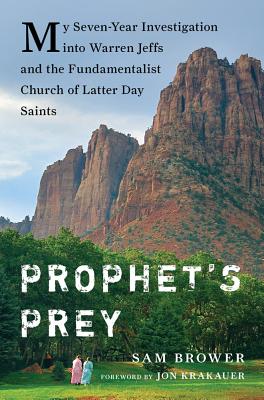
Far from heaven: Sam Brower takes aim at the FLDS church in “Prophet’s Prey”

2

If you read Jon Krakauer’s 2003 book Under the Banner of Heaven, and followed the trial of Warren Jeffs — notorious leader of the Fundamentalist Church of Christ of Latter-Day Saints, now in jail for life for sexual assault (after a stint on the FBI’s 10 Most Wanted List) — you’ll dig Sam Brower’s Prophet’s Prey (Bloomsbury, 336 pgs., $27).

Brower’s book, subtitled My Seven-Year Investigation into Warren Jeffs and the Fundamentalist Church of Latter-Day Saints, is the thrilling and disturbing tale of the private investigator’s relentless crusade for justice — not just in the Jeffs case, but against high-ranking FLDS members across Texas, Utah, Arizona, and beyond. The sect, which is completely removed from mainstream Mormonism, is best-known for its polygamist beliefs, often pairing underage brides with elderly church leaders (Jeffs is estimated to have over 50 wives, including the two, ages 12 and 15, that he was convicted of assaulting). They’re extremely well-funded, with leaders who live in mansions even as the rank-and-file go hungry. They also don’t care much for outsiders.

In Brower’s estimation, the FLDS church is “an organized crime syndicate that specializes in child abuse” — after reading his book (with a preface by Krakauer), you’ll tend to agree. He’ll be reading in Berkeley Tues/15; I caught up with him by phone at his home in snowy Cedar City, Utah, just over an hour’s drive from FLDS stronghold Short Creek, an isolated community straddling the Utah-Arizona border.

San Francisco Bay Guardian: I was just watching the recent clip of you on Dr. Phil, opposite former FLDS spokesperson Willie Jessop [an antagonistic figure in Prophet’s Prey]. That must have been an interesting experience.

Sam Brower: It was. It was weird, first of all, being there with Willie, who’s been on the opposite side of things throughout this whole ordeal. And then, Willie showed his true colors — he can’t answer a question and lies at the drop of a hat.

SFBG: He was in the news a couple of weeks ago, when the story broke about one of Warren Jeffs’ wives escaping from the church compound. I think you were quoted in the article, actually.

SB: Yeah, could be. One of Warren Jeffs’ wives took off, which is a very rare occurrence. This is the second one — the first one, I wrote about in the book; her name was Janetta — so it’s kind of a weird thing that they would actually let one of his wives get out of their grip, you know. And then just recently I heard that she has gone back to him. She’s with her family now, and so she’s back in the FLDS from what I understand. I was just waiting for that to happen. I know that they can’t afford to have one of Warrens wives out and talking, and that they’ll stop at nothing to try and get her back.

SFBG: You talk about this in the book a bit, but why is it so hard for them to escape?

SB: Number one, it’s not like they’re brainwashed. A lot of people use the term brainwashed, but it’s much, much deeper than that. They’re indoctrinated. It’s a cultural thing, and they really have no understanding of any other parts of the world. Their entire existence revolves around their life with the prophet. Many of them don’t have birth certificates. They don’t have drivers’ licenses. They’re with “caretakers,” they’re called — so there’ll be a group of wives and children that are being watched over by their caretakers.

In fact, it would be hard to trace wives, because they have no credit. They’re like non-entities. So it’s easier to trace their caretakers, the guys that are watching them. So they’re being watched constantly. They’re being shuttled around from place of refuge to place of refuge, and so, you know, they just don’t have a life or a world outside the relationship with Warren Jeffs and the church. So for [the wife who recently escaped] to get away is highly unusual, and my understanding was that she was in her stocking feet. She literally ran away.

SFBG: Do you think she had her own children that she left behind?

SB: I don’t know if she does or not. Some of his wives have not had children, mostly because there’s just so many wives. By the same token, some very young wives do have children, too. And I know that part of their existence is a very deviant existence, it’s a very deviant life — some of the things that came out in Warren’s trial regarding, basically, ritualistic orgies with his wives, in which he would say, “We all have to participate.” It was something that, before they became involved with Warren, was completely foreign to them. And it has to rock them a little bit to go from absolutely no sex education, no idea what it’s even about, to such a bizarre world.

SFBG: Warren Jeffs is serving a life sentence. Is he still in charge of the church?

SB: He’s running the show from prison as much as he can. While he was in jail, he had more access, because he was spending tens of thousands of dollars a month on calls from the jail. Now that he’s in prison he’s more restricted, but he still gets a 15-minute phone call every day, and he has two hours’ worth of visits on Saturday and on Sunday. And there are people who are called to visit him for those two hours on each day, and take down his revelations and notes and orders to the people.

So he’s still running the show, not as freely as had been in the past, but he still is, and he has his brother, Lyle Jeffs, who is now the prophet’s mouthpiece — the man who’s running the show on the ground, who is just as bad as Warren. Some people say he’s worse. And he also has his places of refuge all around the country in Colorado, South Dakota, and Texas, and different compounds. He has little kind of clones of himself there who also run those operations as well.

It’s a little bit of both: he’s still overseeing everything. He still has his input in everything. But he’s gotten rid of anybody within his crime syndicate that has any kind of moral compass, and instilled people who are blindly obedient and will do whatever he tells them to do.

SFBG: In the book, the first case that draws you into the FLDS world illustrates that obedience: a family nearly loses their home after the father is kicked out of the church, seemingly on a whim, and nobody outside of his immediate family questions the decision. How come nobody rebels?

SB: That’s the hardest thing for us, people on the outside, to wrap our minds around. And I think that’s what really grabbed me when I first started working on it, when I saw [the recently excommunicated man] Ross Chatwin holding up a copy of [history book] The Rise and Fall of the Third Reich [in a newspaper photo]. I read that book when I was a kid, and in my mind I was thinking, “Good grief, when I was a kid and read that book, I couldn’t understand what would make this whole country do whatever this madman told them to do!” And that’s what Ross Chatwin was saying.

And sure enough, I go down to [Short Creek], and good grief, there’s 10, 15 thousand people that’ll do anything that this guy tells ’em. He tells them to leave their home, their family, kids, and go repent from a distance, and they do it, and the wives go to another man. It’s nuts, crazy. It took me a long time to kind of get a feel for it. I still struggle with it. It goes back again to this deep-seated cultural thing, where blind obedience gets you stature within the culture. The more you can demonstrate this obedience, the more you demonstrate your faith, and the higher up on the pedestal you are.

It’s to the point where, this is an example, a mother who’s a nurse has a daughter who is hemorrhaging. The daughter was married off at 14 to some old lecher, and she’s hemorrhaging and about ready to die, and the mother won’t take her daughter to the hospital because Warren Jeffs told her not to, because they might be able to trace her to the “priesthood,” quote-unquote, and it may result in charges. It may lead them to the prophet. And she doesn’t do it. She’s willing to let her daughter die to prove her obedience and her faith. It illustrates how there are no boundaries there.

I’ve thought many times that, had not there been a handful of people that went after Warren Jeffs and tried to expose these things, how would it have ended? In fact I still worry about that. Would it have been another Waco, or another Jonestown? Right now there are edicts coming down that are out in Short Creek that there can be no more sex, period. Not even for procreation. They can’t watch TV, listen to the radio, read books, magazines, newspapers. Get on the internet. Nothing. They have no hope in their lives, no joy. It makes me wonder, how’s this all going to end? Is going to be, just a vision, some kind of huge manifestation of their faith that ends in some other tragedy? What’s going to happen?

SFBG: If their leader is in jail and they’re all behaving the same way, is there any hope for the future?

SB: I wish I knew. The way it appears now is that it’s just getting worse. Lyle Jeffs is a real mental case himself, and he’s the one who’s running the show now. I have a client, actually a half brother of Lyle and Warren, who wants to have his children. They’re his children. He has legal custody of them. But Lyle has taken them and is hiding the children from him. So we’re having to go to court, and jump through all these hoops to try and get this guy’s children back. And for some reason Lyle just doesn’t want him to have these children. Because he’s received some revelation saying that he shouldn’t have his own children.
I see it just continuing to get worse and worse. It’s anybody’s guess, really.

SFBG: You mentioned earlier that the church is like a “crime syndicate” — is that sort of the go-to argument to convince people who wonder about freedom of religion in this case?

SB: The freedom of religion thing is the FLDS’s wild card. You know, they try and go around and say that people are going after them because they’re an unpopular religion, and they practice polygamy, or whatever. But the fact is, they have turned into a crime syndicate that specialized in child abuse. And everything they do is in support of their illegal activities. They marry little girls off as young as 12 years old. They groom them from the ages of eight, nine, even younger, to become “heavenly comfort wives.”

You know, you can can believe whatever you want, as part of your religious doctrine or theology. If you want to believe that it’s OK to sacrifice virgins and throw them in a volcano, that’s fine. But when you start acting on those beliefs — when you start breaking the law — then it’s not OK anymore. And that’s what they’ve done. They’ve regressed to the point where, anything they do, anything that’s in violation of the law is, to them, within their rights to do that. That’s part of their free exercise of religion. And that’s not true. That’s not what the constitution says. It’s not OK to break the law just because you think it’s part of your religion. You can believe it if you want, but you can’t act on it.

SFBG: In the book, you discuss your own faith as a member of the mainstream Mormon church. I know the two aren’t connected, but is the FLDS church a topic of interest for mainstream Mormons? What’s been their reaction to the book?

SB: I think mainstream Mormons have been very interested in it. It’s one of the few times they’re able to read about it and find out what’s going on without being blamed for it. In fact, I just did a signing in Salt Lake City that was attended by a lot of mainstream church members.

SFBG: It sounds like you’re still very involved in FLDS cases, even now that Warren Jeffs is in prison. What are you up to now, and — as seen in the book — are you still a target for the church?

SB: Yeah, I’m still not on their Christmas list. I still have clients that are FLDS or former FLDS, and am still involved in it, and I guess I will be for as long as they’re still abusing children. It’s been a roller coaster ride and of course they do everything they can to try and get me out of the way, but it hasn’t worked in eight years. I feel sometimes like [the third] Godfather movie, where Michael Corleone says, “Just when I think I’m out, they pull me back in.” I have those moments every once in awhile, but I think I’m probably going to be in it for awhile.

When Warren’s trial happened, it was a good feeling in Texas. Life plus 20. But it was kind of bittersweet at the same time. Because then I leave, and I’ve got another client who’s still struggling to get his kids back. Lyle Jeffs is still doing the same things out in Short Creek. And part of me is going, “Yeah, we’ve come a long way. Things are happening.” But also, it’s still going on, too.

Sam Brower

Tues/15, 7 p.m., free

Books Inc.

1760 Fourth St., Berk.

(510) 525-7777

www.booksinc.net/Berkeley