SFBG Blogs

Reflecting on violence at the SF Commune

15

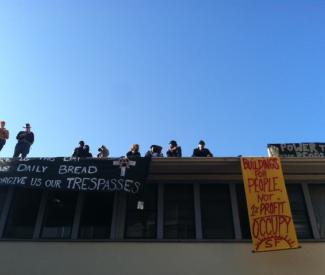
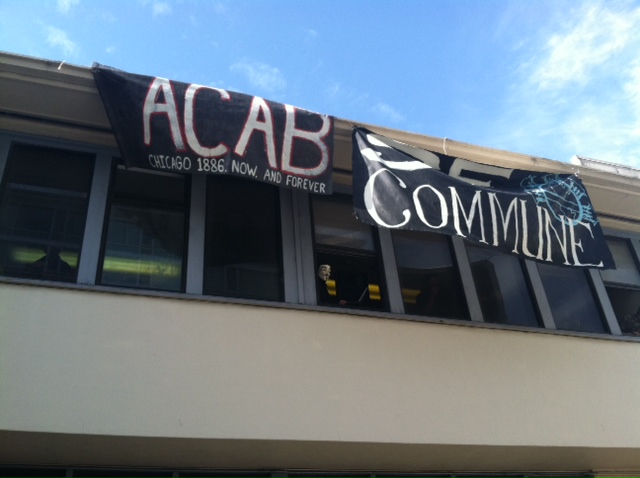
Occupy San Francisco protesters entered Catholic Church-owned properties at 888 Turk last night. This is the same building that a similar group occupied April 1, in a peaceful action that lasted about 24 hours. 

The successful reentry was a testament to the spread of skills and cultures surrounding building takeovers by groups like Homes Not Jails. The resulting “rebirth of the SF Commune” was a mellow and pleasant event at first, as protesters on a march from the celebratory Peoples Street Festival joined in the commune. Some held back in the street while others entered the building in hopes of building a “community center”—most remained outside the building, enjoying a free meal cooked and served by some of the same Occupy SF kitchen volunteers that once fed hundreds of people daily at Justin Herman Plaza.


The building occupation was meant to affirm a strong belief in the rights of people to gather and organize, or at the very least have a warm place to sleep at night. It was also an assertion from Occupy: we’re still here, your warnings to property owners to board up their vacant buildings and the chain-link fence you put up in front of 888 Turk (which protesters casually removed upon arrival) won’t stop us.

“The Catholic church owns it. They’re supposed to be doing charity, but they’re leaving it vacant until they can get high rent out of it,” said Jazzie Collins that afternoon, an organizer with Senior Action Network who was there to support the May Day actions.

“There’s too many vacant buildings in this city, while people sleep on the streets.”

Collins spoke only for herself, but her take on the situation matched the sentiments of many who questioned the importance of property rights in the light of unused building and homelessness throughout the city. That’s the same reason that the SF Commune had sprung up in the same building, exactly one month earlier.

Police spokesperson Sergeant Michael Andraychak seemed to believe that this repeat occupation would turn out the same way. “We’re putting up some barricades attempting to restrict access to the building,” said Andraychak around 5pm. “We’re opening traffic back up.”

But not half an hour later, when the police put up the final barricades sealing off access to the building, the dozen or so people who got caught inside pushed back at the barricade. Police responded with intimidating and striking a few with batons. Then, a man appeared on the roof.

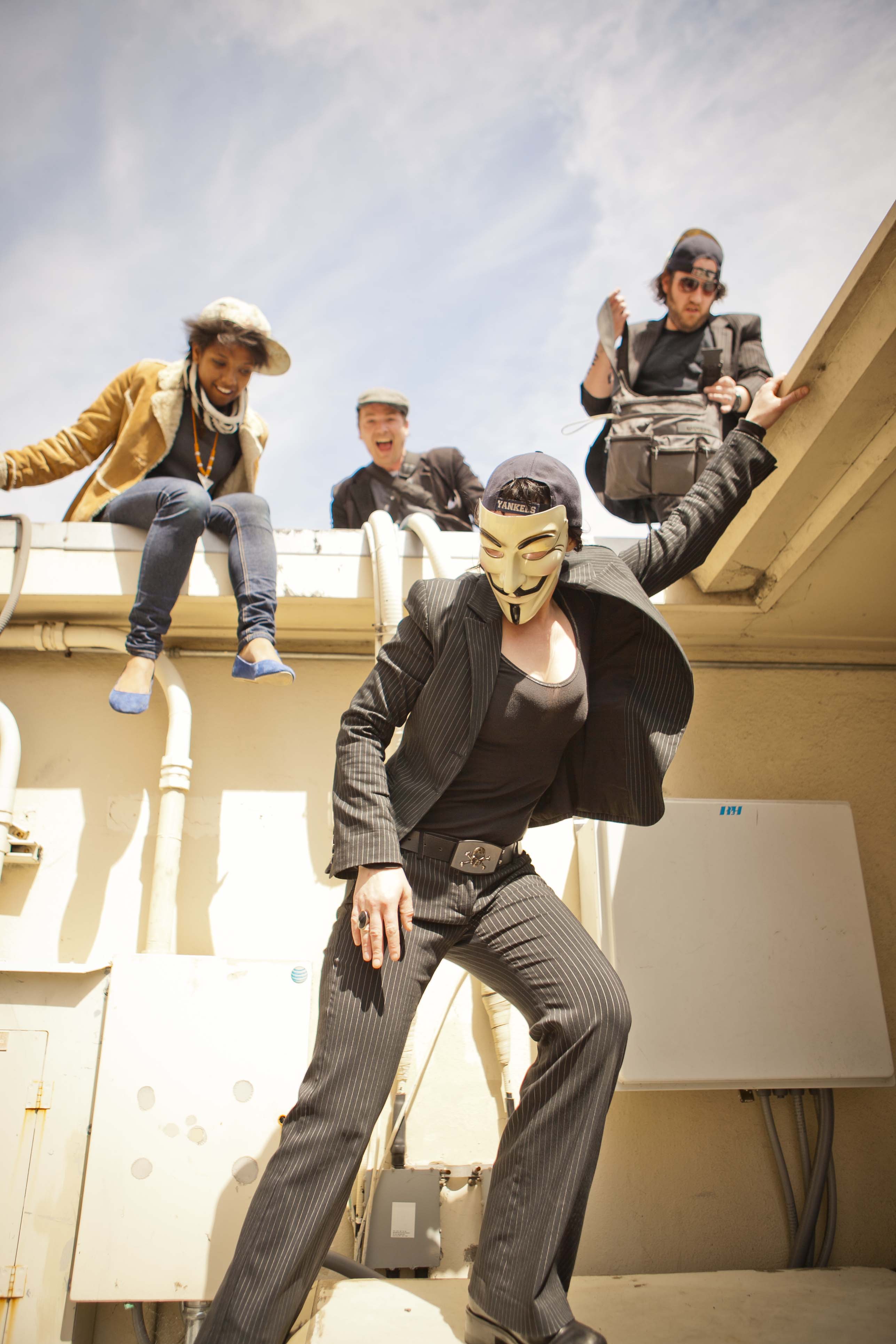
His face was covered in a black bandanna. He raised his arms, and in each hand, he held a brick. Onlookers began shouting, “don’t throw those!” He did though. He hit one man in the face, a fellow protester who, according to one source, has supported the Occupy SF effort since the camp.  

The mood of the crowd chilled. The brick-thrower held up more bricks, menacingly. 

Police closed the street off to traffic. Soon most protesters, supporters, and interested bystanders were on the other side of Gough or in the park, watching the events. A few spoke to and yelled at police lined up on the corners. Hundreds more police stood ground on Turk in front of the building. A few dozen remained inside, including one who had appeared on the roof, taken the bricks from the assailant, and tossed them off, out of reach.

Police arrested a suspect for the brick throwing as he exited the building out the back. Jesse Nesbitt, 34, is in custody in San Francisco County jail on $150,000 bail. According to sheriff’s department spokesperson Susan Fahey, he has been charged with three penal code violations: felony assault with force likely to cause great bodily injury (245a), assault on a peace officer with force likely to cause great bodily injury (245c), and felony vandalism of more than $400, 594b1.
 
A dozen or so remained in the building during the stand-off. Some poked their faces out an open window, hung down peace sign painted on a piece of cardboard, and talked into a megaphone. “We are not armed, we are completely peaceful,” one man assured. Meanwhile, police told press that they estimated 200 were inside and were “stockpiling pipes, bricks.”

The stand-off continued for a few hours until, at 7:30pm, police cleared out of the area. Most activists had left- thousands were massing in Oakland. But 40 or so people remained and re-entered the building. Many stayed until police came around 5am, arresting 26. Seven remain in custody, and all have been charged with trespassing. (Indicating that the weapon stockpiling concern turned out to be false. Which, as far as I could tell inside the building, it certainly was).

At that point, I entered the building as well to speak with those that remained. How did they feel about the violence? Did they think it was connected to the previous night’s events, when mysterious protesters destroyed numerous Valencia St businesses and cars in what some Occupy SF protesters suspect was an act of provocateurs?

For a response to come from Occupy SF, it must be consented on at a general assembly, a long process. So all the respondents represent only themselves- though most chose to remain anonymous. This structure can lead to a troubling lack of accountability: if something harmful happens at an action, who can be expected to explain it and help to prevent it in the future if everyone is responsible for only themselves? At the same time, each personal answer is less riddled in spin than a form answer would be, since people speak honestly, and for only themselves.

The Valencia St destruction “was enough that I didn’t come out and do anything today, whether it was Occupy or not,” one woman who had been “pretty involved in camp, back when it was at JHP” told me. “They were there to piggy back off an Occupy event, to use the organization of Occupy to organize themselves,”

The brick incident, however, did not caution her against showing up, as she did later that night. “Incidents like this happen often with mentally ill or violent people, but they get more publicity when they’re at an Occupy event.”

D, a longtime Occupy SF organizer, said wearily that “we were all surprised” at the incident.
“We weren’t expecting any bricks to be thrown,” he said, “and we didn’t want anyone to get hurt.”

But in terms of preventing similar actions in the future, D said, “We can only do so much. Everybody’s an autonomous individual and we can’t control what they do.”

“We can try to clean up everything that could be thrown, we did that last time. This time we focused more on stopping graffiti in the building. There wasn’t any.”

“That’s my friend. When I saw the brick flying at his face, I was hurt. Half our crew is in the hospital with him right now,” said another organizer. “But the real violence is the system putting people on the street, and the cops enforcing that. I’ve seen [Nesbitt] beat up by police.”

“What should we do, just turn our backs on people with mental illnesses?” another piped up.

“This whole occupy thing at this point is so spread out and separated,” said a self-described Occupy SF supporter. “There are parts that are revolutionary and parts that are more reform, and they’re trying to bridge that. I don’t know what it is at this point anymore. But I know I support a movement to articulate the rage at what’s happening in our country right now.”


City case speculates about Mirkarimi’s interference with investigation

111

The City Attorney’s Office laid out much of its case against suspended Sheriff Ross Mirkarimi yesterday when it released a list of witnesses and their expected testimony, as requested by the Ethics Commission, and it offers little support for the city’s accusation that Mirkarimi dissuaded witnesses or sought to destroy evidence of a crime, which are among the most serious allegations in the official misconduct case against him.

The longest and most significant section in the brief was the testimony of Ivory Madison, the neighbor who initiated the police investigation into whether Mirkarimi physically abused his wife, Eliana Lopez, during a Dec. 31 incident that she subsequent reported to Madison, who made a video of her story and a bruise on her arm.

It was the most detailed account yet of what happened from the perspective of Madison, who has refused media interviews, and it differs in some key areas from accounts that Mirkarimi gave to the Guardian and other media outlets.

For example, Mirkarimi said he grabbed his wife’s arm in the car during a heated argument and that tempers had cooled by the time they went inside. But Madison is expected to testify that, “Inside the house, Sheriff Mirkarimi pushed, pulled and grabbed Ms. Lopez, who was crying and screaming, as was their son. Ms. Lopez asked Sheriff Mirkarimi to stop, and said look what you’re doing to our son. Ms. Lopez then ran out of the house. While both inside and outside the house, Lopez was yelling, do you want me to call the police. When Ms. Lopez yelled about calling the police while outside, Sheriff Mirkarimi said no, come inside. Ms Lopez went back inside.”

It is unclear from the memo whether Madison was a direct witness to those events or whether they were relayed to her by Lopez, but it sounds like the latter given that the story is in a paragraph that began with the phrase “According to Ms. Lopez.” Since the incident, Lopez has consistently denied that Mirkarimi abused her and downplayed the conflict. The only other neighbor on the witness list, Callie Williams, wasn’t at home during the conflict, but she’s expected to testify that Lopez told her about that and an earlier instance of abuse and that “Sheriff Mirkarimi was scared that she was going to tell people what happened.”

While Madison’s expected testimony confirms Lopez’s account that the video was made to be used in the event of a child custody battle if the couple divorced, Madison’s account paints Lopez as actively worried about her safety: “Ms. Madison suggested calling the police. Ms. Lopez was afraid that the police would not believe her and would not protect her from Sheriff Mirkarimi, and was concerned about what the police could do to protect her.”

It also confirms what journalist Phil Bronstein, a friend Madison called for advice, told the Guardian about Madison’s initial call to police being a simple inquiry and that she didn’t intend to initiate a police investigation just yet. And it indicates that “Ms. Lopez was unhappy about the investigation. Ms. Lopez called Linnette Peralta Haynes (Sheriff Mirkarimi’s campaign manager in the November 2011 election) on her mobile phone. After speaking with Ms. Haynes, Ms. Lopez handed her phone to Ms. Madison. Ms. Haynes attempted to dissuade Ms. Madison from cooperating with the police and attempted to persuade Ms. Madison to lie to the police.”

Yet there is nothing in Madison’s expected testimony to indicate Mirkarimi was behind any of these efforts, and he denies it and says that he wasn’t even aware that Lopez had talked to Madison or made a video or that police had been called at that point. Peralta Haynes, who sources say is in the late stage of a difficult pregnancy, hasn’t cooperated with the investigation so it’s obviously speculative on the city’s part to indicate that she was acting as Mirkarimi’s “agent” in thwarting the investigation, as the city is claiming.

The only “evidence” that the city seems to offer in support of its accusation that Mirkarimi tried to thwart the criminal investigation comes from Madison’s husband, Abraham Mertens, who is expected to repeat the claim he first made in a controversial March 20 op-ed in the San Francisco Chronicle that, “During the time that SFPD inspectors were interviewing Ms. Madison on January 4, Mr. Mertens received a telephone call from Eliana Lopez urging him to make Ms. Madison stop talking to the police. Mr. Mertens heard Sheriff Mirkarimi’s voice in the background,” a more resolute version than Mertens had previously given when he wrote in the op-ed: “I recognized what I thought was Ross’ voice in the background.” Mertens also has not answered Guardian calls.

Mirkarimi categorically denies that he was present during that phone call and says that he was in meetings at City Hall and that he wasn’t aware that any of this was happening at the time. And he has denied urging Peralta Hayes to get involved, but her testimony could evolve into evidence if the city can show they talked before she spoke to Madison, but that’s still speculative. The city is seeking live testimony from Peralta Haynes about her communications with Mirkarimi on Jan. 4 and before.

During the recent Ethics Commission hearing on setting up procedures for the hearing, Mirkarimi attorney Shepherd Kopp noted that the city hadn’t done key interviews or collected physical evidence (such as phone records or the Lopez video) to support its charges against Mirkarimi before making its allegation, something that Deputy City Attorney Peter Keith didn’t dispute, noting that the the city had not yet received much of the evidence that it intends to present, such as the video.

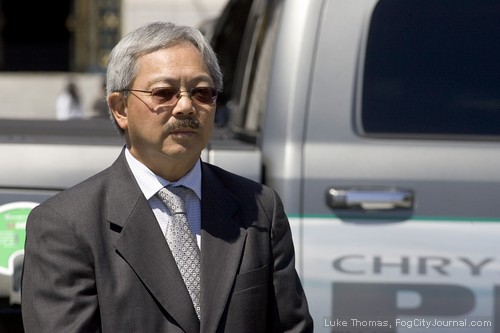
The city appears to be banking on compelling incriminating testimony from Lopez and Mirkarimi, who they plan to treat as hostile witnesses. The other interesting name on the city’s witness list was Mayor Ed Lee, who the city is recommending give live testimony and who could also likely be subjected to a vigorous cross-examination that could have interesting political ramifications.

IAPA: A message for World Press Freedom Day (May 3)

0

Editor’s note: Remarks by Milton Coleman, president of the Inter American Press Association, in  commemoration of  World Press Freedom Day on May 3 Thursday. Coleman is the senior editor of the Washington Post. IAPA is the organization defending and promoting freedom of  the press and expression in the Americas. The Bay Guardian and I have been members of IAPA for years and I currently serve as co-chair of the North American membership committee. B3

Miami (May 2, 2012)—As we near the 70th anniversary of the founding of the Inter American Press Association this month, I’d also like to take this especial date, May 3, World Press Freedom Day, as an opportunity to pay homage to the 24 journalists from Brazil, Colombia, Dominican Republic, Guatemala, Haiti, Honduras, Mexico and Peru that were killed over the last 12 months. Our thoughts are with their families and colleagues, especially because in the majority of these cases, justice has not yet been done.

We also extend our sympathy to all those traditional journalists, citizen journalists, bloggers and owners of media houses that have been attacked, threatened, or have had to seek refuge and exile in other countries after being harassed and hounded because of their work.

We are concerned at the direct and subtle – and in the case of Ecuador not so subtle – economic, legal, and judicial means used against the news media in a number of countries in the region that result in prior restraint and self-censorship, harming not only the news media itself, but most importantly, weakening the public’s right to receive information.

At our recent meeting in Cádiz, Spain, where we celebrated the bicentennial of the first Spanish Constitution, we devoted much time to the defense of the work of the inter-American human rights system that a number of governments in the region have put under attack. From Cádiz, we urged all Organization of American States member governments to defend the system and in particular, the autonomy and work of the Office of the Special Rapporteur for Freedom of Expression, a body which since its creation in 1998 has contributed to guarding and strengthening citizens’ right to freedom of expression in each nation of the Americas.

Also from Cádiz we voiced the hope that the changes pursued by the government of Cuba, the longest standing dictatorship surviving in our hemisphere, would include respect for its citizens’ right to free speech; the cessation of persecution of independent journalists, bloggers, and dissidents; and an unlimited access to the Internet.

We maintain our deep concern that politicized practices by governments be combated with laws that establish technical and equitable criteria for the placement of official advertising, particularly in those nations where there is greater discrimination, such as in Argentina, Bolivia, Ecuador, El Salvador, Nicaragua and Venezuela.

On the legislative front, we applaud the efforts of certain governments, such as those of El Salvador and Mexico that have made defamation and libel no longer criminal offenses. At the same time, we protest the efforts of governments like those of the United States and Guatemala that seek to impose greater restrictions on classified information.

We regret that all countries have not yet enacted access to public information laws and the fact that where these laws do exist, they are not used effectively. We do acknowledge the government of the Dominican Republic for promoting an educational campaign that would include 700 training workshops to teach people how to use access to public information laws to foster a culture of transparency and accountability.

We regret the efforts of governments, to enact press laws to limit privately-owned news media’s ability to function and obstruct the denunciations resulting from investigative reporting, a tactic that would curtail one of the greatest counterbalances existing within democratic systems.

We revile governments’ expropriation, creation, or purchasing of news-media outlets and news press to be used as partisan organs of propaganda instead of as public service media.

On a final note, I would hope that on this 3rd of May we reflect on three important issues throughout the hemisphere – Canada, United States, Mexico, the Caribbean with all its languages, Central America and South America: The social consequences that result from the lack of respect for press freedom and free speech; the responsibility that journalists and the media have to defend and promote these freedoms; and the need for governments to extend access to the Internet and broadband to the most vulnerable sectors of society in their countries, as per commitments expressed during the recent Summit of the Americas.

*World Press Freedom Day is celebrated on May 3.  It was established in commemoration of the Declaration of Windhoek, a document that contains principles on the defense of freedom of the press, drawn up in 1991 during a meeting of African journalists organized by the United Nations Educational, Scientific and Cultural Organization (UNESCO).

The IAPA is a not-for-profit organization dedicated to the defense and promotion of freedom of the press and of expression in the Americas. It is made up of more than 1,300 print publications from throughout the Western Hemisphere and is based in Miami, Florida. For more information,  please go to www.sipiapa.org

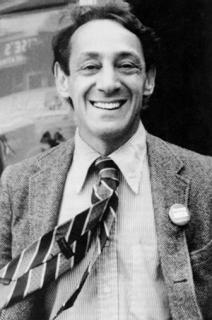
Should the Navy name a ship after Harvey Milk?

23

A Democratic Congressional rep. from San Diego thinks so.Rep. Bob Filner has asked the Secretary of the Navy, who has final say over such things, to name a warship the “U.S.S. Harvey Milk.” Milk served in the Navy during the Korean War. And Sup. Scott Wiener has introduced a resolution in support of the concept.

His press release:

Supervisor Wiener, who represents Milk’s old district on the Board of Supervisors, expressed excitement at the prospect of the christening:  “Harvey Milk was a visionary in our community and redefined what it means to be LGBT in public life.  Given Supervisor Milk’s extraordinary public service and military service to our country, I can think of no more fitting tribute than to name a naval vessel after him.” Retired Navy Commander Zoe Dunning, a leader in the repeal of Don’t Ask, Don’t Tell, agreed:  “Harvey Milk was proud of his Navy service. Similar to the USS Cesar Chavez, there should be a USS Harvey Milk to honor Milk’s leadership in the LGBT civil rights movement.” Anne Kronenberg, who served as one of Supervisor Milk’s legislative aides and who now serves as San Francisco’s Director of Emergency Management, noted that Milk would be smiling to hear about the effort to christen a ship in his name: “Harvey understood the importance of symbolism in the advancement of civil rights.  He also lived in an era when being out in the military was simply impossible. He’d be quite pleased that we are now in an era when not only can LGBT people be out in the military, but they can even have warships named after them. Times truly have changed.”

My friend and colleague Sandy Lange, who is the Guardian’s controller, agrees. Sandy was an officer in the Navy, and loved it, and got kicked out after the Naval Investigative Service followed her to a lesbian bar, long before even Don’t Ask, Don’t Tell. “This would be a great statement, to finally kick homophobia off the waves,” she told me.

Tommi Avicolli Mecca, who is also my friend, isn’t so sure. In a piece on Open Salon, he argues that Milk would be opposed to today’s military adventurism and that a warship isn’t a fitting memorial:

It’s one thing that gays can serve openly in the military. It’s another to attach the name of a queer progressive who opposed war to a military ship. It’s just not appropriate. It’s like naming a Christian church after him (Milk was a Jew and an atheist). Or a bomber plane after Gandhi.
 
What’s next? Recruitment ads in the gay newspapers featuring the Village People and/or hunky half-naked men? A pink heart medal for killing with a gay flair? A lavender box with a rainbow flag for our gay and lesbian corpses?  

Marke B., our managing editor, just wants to be sure that he’s involved in the interior design of the new ship, and that its sailors “open their legs for fleet week.”

Seriously — Avicolli Mecca thinks a better honor would be to make Milk’s birthday, May 22, a national holiday. Of course, Chavez (also a man of peace) has both a ship and a holiday.

I never met Harvey Milk — I arrived in San Francisco in 1981 — but I have to wonder what he’d think about a ship of war carrying his name.


Progressives party — together

6

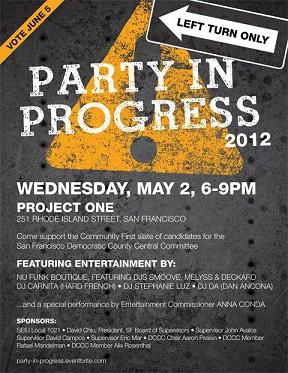
There are plenty of political fundraisers during campaign seasons, but this one will be especially interesting: The progressive slate for the Democratic County Central Committee is coming together for an event May 2 at 6 pm at Project One. The host committee includes outgoing chair Aaron Peskin and Sup. David Chiu, who have not always been on the best of terms — and Committee incumbent Alix Rosenthal, the main organizer of the event, who is also the organizer of what some see as a competing slate.

And that slate is having its own problems — involving clashes between some of the progressive women (Hene Kelley, who will no doubt be at the May 2 event) and some of the more moderate women (Hydra Mendoza, who won’t be there.) The party invite has a street sign saying “left turn only” — which is not at all what some of the people on Rosenthal’s other slate are thinking.

Rosenthal told us: “I personally think it’s remarkable that Aaron, Rafi [Mandelman], David Chiu, David Campos, Eric Mar, John Avalos and I are all on the host committee, given the rifts in the progressive movement of late.”

Yep. Everyone’s getting along. For one night, anyway.

Sex Talk with Princess Donna: Sugar daddies and the perils of bromance

1

One might imagine that there is hardly a personal entanglement that Princess Donna, director and star of Kink.com‘s Public Disgrace, Bound Gang Bangs, and Ultimate Surrender sites, can’t handle with a strong wrist and flogger. While that may be true, the BDSM power player is also a master of the kind of communication involving words. And unlike your standard sex advisor, she’s that frank kind of sex-positive feminist that can help with whatever you want to do in bed (/dungeon) that is safe and consensual. And be real sexy through the processing, to patent leather boot. We had to give her her very own Guardian sex advice column.

Dear Princess,

How do you get a sugar daddy or mommy? And once you get one, how do you keep them happy?

Signed, Broke’s Not Cute Anymore

Dear Broke,

I’ve never personally had a sugar mommy or daddy, but I do know that there are websites out there were you can find them! As far as keeping them happy goes, I’d tell you the same thing that I’d tell you for any relationship, communicate! Talk about what your expectations for one another are, set boundaries, etc.

My other advise for you would be to think about exactly what kind of relationship you want before seeking out your sugar parent. Are you looking for love and someone to take care of you financially, or are you looking to exchange sex for money in a more straight-up way?

As the name implies, these kind of relationships can have a built in power dynamic as one person financially supports the other. Be sure that you have thought about what that implies and that that is truly what you are looking for!

xo, Donna

Dear Princess,

My brother and I have a lot of the same, amazing, sex-positive friends. The chances that we may find ourselves at the same sex party are high — what can we do to avoid weirdness (and incest) between the two of us?

Sincerely, Family Fun

Dear Family Fun,

Avoiding incest should be pretty easy, just don’t get it on with each other.

As far as avoiding weirdness, the first step is to establish what you think is weird. Is it weird for you guys to bang in the same room? Is it weird for you guys to share the same sex partners? Is it weird just to be at the same sex party? Once you have established exactly what makes you uncomfortable you can set boundaries. I know, I’m boring. I’m all boundaries and communication over here…

The only thing is that, in my experience sex parties can often occur spontaneously, so you are going to want to establish the ground rules before you find yourself in a potentially awkward situation. You don’t want to happen upon an awesome sex party and spend the night fighting with your twin when you could be getting laid!!

xo, Donna

>>IF YOU HAVE A QUESTION for Princess Donna on sex, love, or a combination of the two, email her at sextalkwithprincessdonna@gmail.com


Pix of May Day in Oakland

0

Photos by Tim Daw

Police leave, Occupiers remain

0

The man who was throwing bricks has been arrested — and in an unexpected move, the cops have packed up their barricades and left. Only one barricade was left in front of the door, and the protesters moved it and now remain in the 888 Turk Street building.

UPDATE: About 30 remained in the building as night fell, planning next steps. One anonymous supporter donated pizzas. 26 were arrested in an early-morning raid .

Bizarre development: Lone guy in black mask throws bricks at Occupy crowd

9

Yael Chanoff reports from the scene of the Occupy building takeover with a really strange development:.

Police had put up barricades in front of 888 Turk, and many of the protesters were out of the building, but some were still inside. Then, after the front door was completely sealed, a lone man, his face covered by a black bandana, appeared on the roof. He held a brick in each hand, and after a dramatic pause, hurled one of the bricks into the crowd below. It struck a protester in the face, causing a bloody injury. Paramedics are on the scene.

The brick-thrower kept up the barrage, hitting another protester in the leg, then moved to an adjacent building and began throwing pipes, hitting a police car.

Hundreds of police arrived on the scene; The brick thrower apparently vanished.


Occupy retakes Catholic Church building

11

The Occupy SF Commune is back.

More than 100 activists went from a march on Market Street to the building at 888 Turk, owned by the Catholic Church, that was occupied not long ago.

“This is our home,” said one OSF person. “A lot of folks love this spot.”

He added: “Any vacant building, people have the right to use it, just like with any vacant land. These are resouces of the commuinity and tney’re not being utilized.

“We’re offering medical care and serving food right now. Everyone is welcome here, and open space for the people, just like the camp at Justin Herman Plaza.”

Oakland protest: Tear gas, one arrest

0

Tuesday morning brought an eruption of protests though out downtown Oakland as Occupy activists marched and rallied in support of a national general strike day to mark May Day.

Though the action lacked the numbers of last fall’s Port of Oakland strike, three early morning marches of several hundred protesters made there way through Oakland drawing attention to issues of gentrification, patriarchy and what protesters characterized as the injustices of capitalism.

In a city still waiting for an economic recovery, the protests were a reminder that simmering tensions over economic disparities continue to cause major disruptions of business as usual in Oakland.

Activists focused attention on Child Protective Services and the family court system. The agency was criticizing the for dividing families and sharpening the financial strain on poor families.

“This is where lawyers get rich, where judges get rich, and everyone else suffers,” stated an Occupy Oakland activist on the steps of the courthouse on 13th and Oak.

By noon various marches and protests converged on Oscar Grant Plaza, as roughly 1,000 protesters blocking traffic at 14th and Broadway. Protester danced to a portable sound system carted around in wheel chair, and danced around a maypole erected in the intersection.

OPD’s new crowd-control tactics were in display as riot police entered the crowd to make an arrest as bystanders were moved away with tear gas, concussion grenades and batons.

One woman was arrested and a 19-year-old Oakland woman, was struck in the head with a police baton. Bleeding heavily from the blow, she was rushed to the hospital after Occupy medics determined her wound was beyond their capacity to treat.

It was unclear what provoked the arrest.

Further protests are planned for this afternoon.

UPDATE: Sergeant Jeff Thomason, OPD public affairs, told us there have been four arrests, related to an incident in which paint was allegedly thrown at a police officer. Oakland has summoned mutual aid from the California Highway Patrol, the Alameda County Sheriff’s Office and the Pleasanton and Hayward PDs.

Lively crowd takes over Financial District

7

Click here for more breaking May Day action coverage

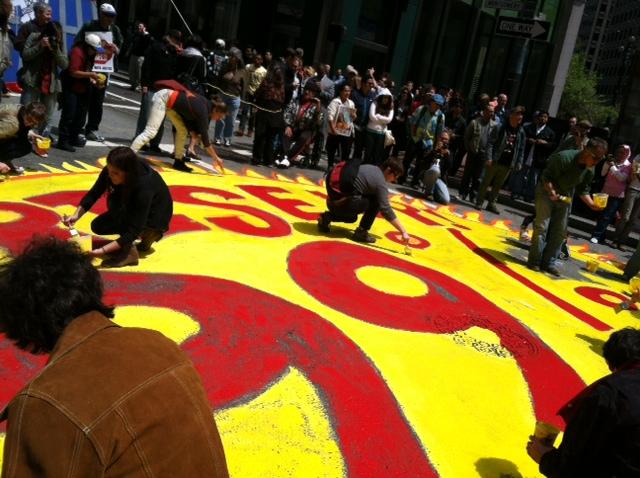
About 1,000 people gathered in the Financial District for a May Day convergence, blocking traffic at the intersection of Market and Montgomery and painting a huge yellow sun on the street with the caption “Rise up 99% Levántese!”

The lively crowd listened to music and speeches and participated in street theater.

Police were on hand in a line in front(415) 517-5910 of the Wells Fargo bank but as of the time of this post, there were no arrests.

In sharp contrast to the violence in the Mission, the actions have been peaceful.

The first march left 24th and Mission at around 10:15. Focused on immigrant rights — long a central tenet of May Day in the US — the event was planned by a large coalition including Mujeres Unides de Activas, HAVOC, SF Pride at Work, Young Workers United, and others.

The upbeat crowd of several hundred made its way to 16th and Mission, where police stood by as protesters took over the intersection for street theater.
A giant puppet representing the Earth held center stage. One player represented a banker; another tried to buy a house, but wound up homeless. When the victim of financial-sector greed sat down on the street, a “police officer” arrived to make a sit-lie arrest.

Tiffany Altamirano, with Young Workers United, told us, “My husband is undocumented. People are here whose brothers sisters and parents have been deported.”

The crowd took the intersection for about 40 minutes.

By mid-day the action had moved downtown, to the Westfield Mall, where a banner was dropped inside and pickets stood outside, showing solidarity with the SEIU Local 87 janitors who are in a dispute with building management.

Soon nearly 1000 converged on Market and Montgomery. Activists with The International Forum on Globalization giving away hundreds of books and pamphlets with critiques on global capitalism. A massive cutout of Goldman Sachs CEO Lloyd Blankfein stood in the middle of Montgomery, looking evil, with a message decrying corporate power.

Almost two dozen SFPD cops stood guard, with six police vans waiting nearby to haul away protesters. But the authorities seemed to be just letting the party happen with no orders to disperse.

Steven T. Jones contributed to this report.

Sam McPheeters is not the angriest man in the world

0

Sam McPheeters has a way with words, and that has translated from lyrics to journalism to his first official solo novel, The Loom of Ruin (Mugger Books, 2012).

The former frontperson to a trilogy of exciting punk and experimental acts (Born Against, Men’s Recovery Project, Wrangler Brutes) has long written columns for the likes of VICE Magazine and more, along with his own fanzines. But his first published output came at age 12, Travelers’ Tales – a patched-together local legends book assembled with a neighborhood teen.

Now he comes full circle, back to book publishing, though this time it’s a bit different. He’s rather grown, married, and writing exquisitely detailed, dark and humorous Los Angeles fiction about the angriest man in the world. Far from grumpy himself, the amusing gent was once known to recite Patrick Henry’s famous “Give me liberty, or give me death” speech during shows.

Last week, on the eve of McPheeter’s book tour to SF, I spoke with the candid author from his home in Pomona about The Loom of Ruin, life beyond the bands, his love for Microsoft Excel, and a brand new literary rag:

SFBG You’ve been writing for so long in different formats, why finally put out your first solo novel now?

Sam McPheeters I’ve been writing fiction for a long time, so I have a large stockpile of unpublished fiction. There came a point about six years ago where I realized I needed to really reconfigure what I was doing.

Part of that was that I was writing fiction on my terms [and] the fiction I was writing was very serious – I really put my heart and soul into it – and it read like that, it was a little labored and probably hard to read. I realized there was a disconnect. A lot of the art that I like – music, fine art, movies – is all on the audiences’ terms. I don’t like really high brow stuff in my media.

I like music that is written for the enjoyment of the listener, that is not for the artist, the musician, to work out whatever demons he or she is trying to work out. I realized I had not been doing that with my fiction. I’d been doing it with some of my journalism – for example I did a long piece for VICE that I was really proud of about Doc Dart, the singer for the Crucifucks and I took pains to provide context for everything, so that you can read it not knowing anything about punk music and still get the gist of the article.

I wanted to start writing fiction in that style and this book came out of that. I wouldn’t say it was easy, it was very arduous, but it was much easier, labor aside, to really get out what I wanted to do and have it flow quickly.

SFBG I’ve just read the first three chapters on VICE.com so I can’t speak with total authority, but to me if feels like a humorous take on modern noir. Was that intentional, to be a modern Los Angeles noir story?

SM I’m way, way, way too close to it. That wasn’t my intention but it sort of developed that way. As a reader I’m really far behind the curve, I feel like I’m playing catch-up. I only started reading my first Raymond Chandler book this year and I’m really enjoying it but I don’t feel equipped at all to be able to hold my own in a conversation about the literature of Los Angeles, especially noir literature, not just Los Angeles – [all of] California. But I think it definitely unconsciously developed that way, which is great. I’m pleased, but that wasn’t the original intention.

SFBG So where did you come up with the idea for this main character [Trang]?

SM You know, I’m not sure. It’s odd to me, a lot of people who talk to me about the book have said the character really resonated with them, which surprises me. I liked the idea of writing a character who was self-consciously one-dimensional. From page one you’re told this character only has one emotional setting – I think that’s a really neat comedic device that hasn’t really been done the way I did it. You can do a lot of funny things with a character who is only angry. I’ve had those experiences in my life with a couple different employers that verged into this realm so some of this is just really crazy caricatures of past bosses I’ve had.

SFBG What were some of the jobs you had, where you had these bosses?

SM I’ve worked a lot of retail, I’ve worked in a bunch of health food stores, I’ve worked in a couple different industrial painting companies, a lot of restaurant jobs. I am kind of scraping out a living now being a freelance writer but it’s very tricky so I’m always looking to supplement it with whatever else I can get.

My job stories are profoundly uninteresting, the only interesting job I had was for six weeks, for a company that designed “things” – I signed a contract explicitly stating that I would never discuss my actual work….I remember thinking, as I was signing the contract, “god dammit, this would make a really good article.”

SFBG Where did you come up with the ideas for your VICE column, they were so varied.

SM Part of that is the same process as fiction. I use spreadsheets for everything, I have for a long time. A job I had six years ago…I got my employer to pay for me to go to a seminar on Microsoft Excel. Honest to god it was like a – I don’t want to say religious – but it was like a serious heavy-duty religious conversion or something where I realized how much of the philosophy of Microsoft Excel I could apply to my life.

So I keep these vast spreadsheets for everything, and part of it is just lists of ideas. I do triage, maybe that’s a good non-fiction idea, but that’s a good idea for fiction….I’m a really good hoarder of ideas. Anyone can come up with stuff on the spot but I don’t need to, I have this tool.

I’m very careful whenever anyone comes over, if the spreadsheets are on my computer, I minimize it, because it looks like I’m a crazy person. The spreadsheet I had for Loom of Ruin was this massive color-coded thing. One friend saw it once, and they said ‘I don’t think that’s how a book is made.’ I said, ‘that’s very much how a book is made. You need these little road maps.’

SFBG Are you also still making music?

SM No, the last band I was in ended at the end of 2004 and I realized that was a good way to just, gracefully bow out. I had some talent as for dramatics on stage, I think when I wanted to be I was a good performer. But there’s not much range in what I can do. I can yell and I can do some funny voices and that’s it. At a certain point it really felt like I was repeating myself. Also I just am not excited about music right now anymore. The bands I listen to – with a few exceptions – it’s all the same music I listened to in high school and I stopped trying to fight that.

http://www.youtube.com/watch?v=ySGLH6XKCgY&feature=endscreen

SFBG So you don’t miss the performing aspect of it?

SM No, no, oh my god no. I would get headaches as I got older. I was in a band in my mid-30s and I’d get really intense headaches, headaches that felt wrong, like I was doing some kind of damage to some part of my brain.

I realized at one point – in the middle of a show that people aren’t designed to scream. I mean, we can scream for certain things but to scream every night for 40 minutes straight is not something we’re built for physically and it does really weird things to you. So I think even if I wanted to I might be prevented anyway.

SFBG As someone who wrote zines when you were younger and has always had a DIY approach to creativity, how has the rise of blogs and the Web in general affected your work?

SM I really enjoy my blog, the way it fulfills my life is absolutely the spot that fanzines used to inhabit. In 1999 and 2000 for awhile I was all set to do a weekly fanzine – I mean, it’s a blog! It just didn’t occur to me that I could do this online.

I was really excited about [the weekly fanzine], but when I sat down and did the math…I got really discouraged, it didn’t make sense. And even this book actually, was supposed to be originally a series of 10 fanzines and the skeleton of that design is still kind of there. So it took awhile for me to shift, to realize that doing a blog filled that spot in my life perfectly.

The big disadvantage obviously, is that it’s harder and harder to find an audience, just ’cause your slice of the pie is getting smaller and smaller every year, there’s just more and more competition. The people who read my stuff now, and also the people who are paying attention to my book, are almost entirely my pre-existing audience, it’s been really hard for me to find new people to notice my stuff.

I think a big part of that is just too much competition. It’s nice to have a physical book, it turned out the design looks really nice and it’s a solid object you can hold. There had been some talk for awhile about doing only e-publishing and I’m completely receptive to e-publishing and all its formats, but it feels like it takes the very high hurdle of having something physical to get people to take notice.

SFBG Are you currently working on anything else?

SM Of course, yeah, I’m starting a new magazine with Jesse Pearson, former editor of VICE. It’s called Exploded View, it’s a literary quarterly that will attempt to fill the gap between very saccharine twee lit magazines and super-serious chore lit magazines that one wants to read to be a good person but that are just simply not fun. We want to find a middle ground between [those].

Good long-form journalism, a lot of fiction, a lot of photography, a strong emphasis on humor. It’s just been a huge amount of work, and clearly this is the wrong time in my life to take it on, while I’m doing a 40-city book tour, but this is what I’ve been shooting for for a long time. It’s an odd coincidence that all these things converged on 2012 for me, but I got what I asked for and I absolutely cannot complain.

The first issue will be out in September. My god, which is only what, four months away? That’s a little scary.

The Loom of Ruin reading
Wed/2, 5-7pm, free
Needles+Pens
3253 16th St., SF
(415) 255-1534
www.needlesandpens.com

Sam McPheeters spoken word
Wed/2, 7pm, $5 donation
FB: The Secret Alley
(415) 553-8944

www.thesecretalley.com

The Loom of Ruin reading
Thu/3, 7:30pm, free
1234Go Records
420 40 St., Oakl.
(510) 985-0325
www.1234gorecords.com

Those rich city workers

10

The Chron’s Matier and Ross celebrated May Day early by running a piece on all of those overpaid city workers who are hauling in hundreds of thousands of dollars. And indeed, it sounds shocking: Nathaniel Ford, who was ousted from his job as the head of Muni, walked away  with $567,000. That’s worse than Arlene Ackerman, who screwed up the public schools and got a $375,000 golden parachute. (Actually, the bulk of Ford’s payout was approved last summer, so it’s not really new information.)

Still: The $500K Club and all of the $200K-and-up people makes it appear that the city is just pouring the taxpayers’ hard-earned cash down the maw of those greedy public-sector workers (some of whom just happen to be in contract talks).

Imagine:

The average pay for all city workers was $93,229, plus benefits. According to the city controller, the average wage earner in the city’s private sector, on the other hand, made about $78,228.

Enough to make the average private-sector person, who lacks retirement benefits, angry at the apparent largesse.

But let’s put this in perspective.

The vast majority of the highly-paid city employees are either people with advanced degrees and skills (doctors and lawyers) who would make even more in the private sector, or people in the management ranks, or — most notably — people in the public-safety sector.

Cops and firefighters in the city make a lot of money. More than their counterparts in much of the rest of the nation. Yes, those are tough jobs, and yes, they deserve to be well paid, but should every retired chief and command-staff-level cop walk away with a pension and benefits of close to $200,000 a year, for life? That’s a fair question.

Take out the cops, firefighters, doctors, lawyers and top-dollar department heads, who get special employment contracts that nobody else gets, and you have a very different picture.

The average member of SEIU 1021 who works for the City and County of San Francisco earns $50,400 a year. That’s average — and since SEIU represents some high-skilled workers who make considerably more than that, quite a few of the city workers make less. It’s decent pay compared to a lot of nonprofit and some private-sector jobs, but for a unionized staff in an expensive city — a staff that’s taken pay cuts and furloughs for the past few years — it hardly seems excessive.

I realize how sexy these “bloated city worker salary” stories are — the Chron loves to put this stuff on the front page — but it would be nice if Matier and Ross gave a more accurate picture.


A street art festival in Baltimore?

2

Ever since I visited the Wynwood neighborhood of Miami during the shock and awe of Art Basel 2011, the concept of street art as an agent of neighborhood change has been loitering around my brain space. What does it mean that an art that was once deemed outsider is now on the radar of bankers and real estate brokers alike as a means of increasing property value?

Perhaps no one has looked more into the matter than Gaia, sociological wheatpaste artist and 23-year old organizer of Baltimore’s first large-scale public arts festival Open Walls. Since March, Gaia has coordinated walls by over 23 artists in his neighborhood of half-vacant blocks of row houses and factory buildings, Greenmount West (and the adjacent, less economically-depressed Charles North.) The area has been pegged as an arts district by Baltimore’s cultural organizations – and perhaps more importantly, the bank sponsors of Open Walls. The festival culminates in a Final Friday celebration on May 25.

Gaia thinks a lot about where his murals are placed. For a wheatpaste series he called his Legacy Project, he installed the faces of developers throughout history — Robert Moses, Le Corbusier — often alongside their most damning quotes, on the very urban areas they irrevocably altered with slum clearance. 

I sat down with him to talk in his studio and festival mission control, a ramshackle converted factory space where the bulk of Open Walls’ artists bunk on air mattresses and sometimes – I can personally attest – in the building’s freight elevator. We talked about what the murals would mean to Baltimore, and geeked out on social contradiction.

SFBG: Tell me about Open Walls.

G: It’s not very community involved. It is more of a street art, public art situation where a lot of material for the work is being generated from the neighborhood. But a lot of it is not specific, it’s just about mural-making. I’ve been trying to find a balance as a curator of site-determined work and work that’s not generated by the context of Baltimore.

SFBG: Why is site-specific street art important for a festival like this?

G: One, it provides more access to the artwork for the initial introduction of the piece to the neighborhood. Advertising and street art, we utilize the same signifiers and tools. The difference being, the artwork attempts to communicate beyond the place of sale. The less specific your work is, the closer to guerrilla branding it is, rather than street art or genuine public art. So by working with the history of a place in a manner that’s determined by the space you’re working in, you circumvent the problem of promoting yourself. You’re not just plastering a single image all over the city – that’s a graffiti mentality that is more like straight advertisement.

SFBG: Why do you like living in Baltimore?

G: I like how tough this city is. It feels almost human in scale. You can be on a first name basis with the neighbors. Plus, I can make a living and not have to work two jobs or be a barista rather than focusing on my art. And it has all these secrets that take a million years to find. All the cutty neighborhoods, all the cutty streets…

SFBG: Do you think that there’s any way current residents will be able to keep their space here in Greenmount West, what with all the arts and revitalization movement?

G: Most of the vacant buildings are owned by the government. It all depends on the government. A significant portion of the neighborhood is subsidized housing. When the government decides to flip this neighborhood, that’ll change everything. Most everything you see that is vacant is vacant for a reason – it’s not this mysterious, mystical, organic situation. A lot of them are being held by speculators, Many public, private organizations are responsible for holding onto them so that something could be done to them. For the most part, it’s decades of the waiting game.

SFBG: Did you talk to neighborhood groups before painting started?

G: We talked to the New Greenmount West Community Association. There was a plan that was presented to them, there was an idea of these are the artists and this is where we want to paint. We worked on lining up landlords with an artist that they dig. Balancing that local aesthetic and the more spectacular aesthetic. We’ve definitely had a little negative feedback and a lot of positive feedback. I think people are wary of it because its the most visible aspect of this process of gentrification. People never walk up to a contractor and say ‘Hey you cant build this building,’ but people walk up to murals all the time. It becomes a lightning rod. There’s a latent fear of this being one aspect of a shifting neighborhood.

SFBG: What does Open Walls mean for Baltimore?

G: We’re coming at this project from a lot of different angles. We want to put Baltimore on the map, at least give it some shine. We want to fuel more interest in the local art scene and make visible what happens invisibly inside. Putting it out on the streets, so you know exactly where you’re at. Really it’s just about pushing the envelope in Baltimore. You know, we have so many vacant properties. But this is also about cooperation between stakeholders in this neighborhood.

A year and a half ago my block was two rows of vacant buildings, the abandoned coat factory, and an abandoned green space in front of my house. Now there’s City Arts, which is subsidized living for artists. There’s a lot going on in the neighborhood, a lot of reinvestment.

There’s so many abandoned buildings in Baltimore. I mean it’s suburbanization fueled by the flow of capital and racism. The city went from one million people to a city of 640,000 so there’s a lot of empty space and not much to do with it. The flow of capital comes back around. We have this aesthetic conjuncture of people moving back to the city. We’ve been experiencing divestment for sixty, seventy years now, so its about time.

SFBG: Is that the goal of the festival, to reverse suburbanization?

G: The goal is to make good art work. The goal is to find a balance between interesting, really inspiring, and also intriguing art on the walls – but also to find a balance between that and something that speaks to the neighborhood. I’ve been [placing] the more spectacular, flashy murals on Charles Street. The theater is there, that’s where all the nightlife is. I’ve been keeping it more local on the west side. It’s all about trying to understand the sliding scale of subjectivity. I try to shy away from artwork “by consensus” if you will. 

Watch this space for Caitlin Donohue’s continued coverage of Open Walls including — duh — shots of the actual murals

Localized Appreesh: A B & the Sea

0

Localized Appreesh is our weekly thank-you column to the musicians that make the Bay. To be considered, contact emilysavage@sfbg.com.

You already know A B & the Sea, right? The creamy surf pop act last year released the perfect summer pop song and matching video – “In the Sunshine” – all hand-holding, first kisses, and  beach frolicking.  And earlier that year, the band played Noise Pop again, amid a sea of punks before Ted Leo.

Well now, it’s basically summer 2012 (we have to make up seasons ’round these parts) and the band has just released its newest contribution to our cultural zeitgeist, the full-length Constant Vacation.  Produced by Wallpaper and Jim Fairchild, and full of bouncy, beachy harmonies, it’s got that infectious aforementioned “Sunshine” single plus more contenders for song of the summer (“California Feeling”). There’s got to be a frozen cherry Popsicle we can split around here somewhere.

And you know what happens next right? The requisite, much ballyhooed album release party.  Check ’em out in post-release bliss headlining the Great American Music Hall this week.  You know you want to.

http://www.youtube.com/watch?v=s7mVeiYCy5c

Year and location of origin: 2008 Oshkosh, WI.

Band name origin: the cleverly brothers.

Band motto: constant vacation

Description of sound in 10 words or less: cruisin’ the pacific banger highway; no rearview, no destination.

Instrumentation: vocal harmonies and sunshine.

Most recent release: new record Constant Vacation record release show May 3rd at Great American Music Hall. No…not Six Flags Great America…maybe next time.

Best part about life as a Bay Area band: the babes.

Worst part about life as a Bay Area band: nonsense.

First album purchased: Coolio, Gangstas Paradise cassette.

Most recent album purchased/downloaded: Miniature Tigers, Mia Pharaoh.

Favorite local eatery and dish: Mission Cheese ched or die sammy. So scrummy…

A B & the Sea
With Tommy and the High Pilots, Yellow Red Sparks
Thu/3, 8pm, $15
Great American Music Hall
859 O’Farrell, SF
(415) 885-0750
www.slimspresents.com

May Day protests begin with ferry workers strike

1

[Editor’s Note: We’ll be covering May Day events in San Francisco and Oakland throughout the day, so check back for regular updates.]

May Day activities have begun with a strike by ferry workers and Golden Gate Transit workers, halting parts of the morning commute.

About 100 ferry workers picketed at the Ferry Building in San Francisco, as well as the Larkspur Ferry Terminal. In anticipation of the strike, the Golden Gate Bridge District announced that they would cancel morning ferry service yesterday. Service should resume at 2:15.

Workers from the Golden Gate Bridge Coalition say that they have offered concessions of more than $2 million and are still locked in labor disputes, prompting the strike for the traditional International Workers Day. 

“The last thing that bridge, bus, and ferry workers want to do is to inconvenience passengers, but what other option has management left us?” said Alex Tonisson, co-chair of the Golden Gate Bridge Labor Coalition, in a press release.

The strikes come after a rough start to May Day demonstrations in San Francisco. A plan for workers on the Golden Gate Bridge to strike and shut down traffic on the bridge was called off two days before the planned demonstration. Last night, protesters vandalized store windows, cars, and the Mission Police station in a march along Valencia St. Organizers with Occupy SF and Occupy Oakland were quick to distance themselves and condemn the destruction, both physically at the protest and in subsequent statements. 

We will continue to update as events unfold.

SEIU makes noise in City Hall

13

SEIU Local 1021 workers say ‘’our message was heard” after about 300 marched into City Hall April 30. The city workers marched around the rotunda and then visited the offices of Sups Mar, Campos and Kim and Mayor Ed Lee, demanding that health care costs do not increase in ongoing contract negotiations with the city.

The city has already taken pay cuts that the union had been loudly protesting off the table. 

“We’re making progress, but not enough progress,” said Local 1021 field organizer Frank Martin del Campo.

He added that “this is the first time to my knowledge a union has militarized during the arbitration process since the process was established in San Francisco.”

The union had stated that they planned to demonstrate until 7:30pm, and then attempt to stay the night in a “Wisconsin-style takeover.” But by 6:30pm, the workers had exited City Hall.

“Our goal was to come and reclaim City Hall,” said Local 1021 vice president Larry Bradshaw. “If they wouldn’t let us in we’d occupy City Hall. They let us in.”

He added that “our members aren’t afraid to get arrested,” referencing an April 18 protest that resulted in 23 arrests.

He said that SEIU will not be on strike for May Day, but many members will be calling in sick and supporting janitors with SEIU Local 87 in their picket at Westfield Mall, scheduled for 11am.

Bradshaw, however, a paramedic. won’t be calling in sick. “I’ll be in arbitration,” he said.

On eve of May Day, Valencia, Mission Police Station vandalized

37

A group of protesters left a trail of broken glass and paint tonight as they made their way from Dolores Park to Duboce on Valencia. Windows were broken, garbage cans overturned, paint bombs thrown, and messages saying “yuppies go home” as well as anarchist symbols were spray-painted on several restaurants, art galleries and cafes.

The façade of the police station on Mission and 17th was vandalized and broken.

A gathering at Dolores Park was advertised as a “a ruckus street party to counter gentrification, capitalism, and the policing of our communities.” About 200 attended, and chatted about their plans for the following day’s May Day activities while music played.

Shortly after 9pm, the group left the park and began to march on Dolores. Some overturned recycling bins and vandalized the windows at Farina restaurant minutes after turning the corner on 18th St, while others held back.

Dozens flocked to the sidewalk and began yelling, “this is not an Occupy SF action!”  while passers-by looked on, concerned.

The group turned on Valencia, continuing to shrink in size and break windows. Within half an hour there were less than 50 people in the march.

About 40 of police on foot followed the march along Valencia, trailing behind as vandalism continued. SFPD representatives were not immediately available for comment, but based on witness accounts there were no arrests.

Neighborhood residents were angered and confused by the destruction. One man who did not wish to be named said, “They kept doing it while other people in the march were trying to get them to stop. It was childish.”

Occupy Oakland protester Jesse Smith told CBS he was “more than a little shaken” by the events. 

“I know Occupiers,” Smith told CBS. “None of us have any idea who they were.”

A message on the Occupy SF website reads, “The march in the Mission Monday night was not an OccupySF event. OccupySF does not endorse this kind of destruction of the 99%’s property. The individuals involved in this destruction are not known to OccupySF, and we believe they are outside provocateurs sent in to tarnish the image of Occupy prior to the May Day actions.”

World championship robotics competition: A bittersweet day for the D’Penguineers

0


And so the celebrated D’Penguineers from Dos Pueblos High School in Goleta won the creativity award but lost its last two matches in the World Championship Robotics Competition last weekend in St. Louis, Missouri.The two heart-breaking  losses wrecked the team’s chances for a championship. Here’s the excellent summing up by the NoozHawk online newspaper produced by students from the Dos Pueblos Engineering Academy public relations and events team. Nicholas Perez, an ace driver for the D’Penguineers, is shown partially with his coach Amir Abo-Shaeer in the second photo in the link below. 
http://www.noozhawk.com/article/dpenguineers_get_creativity_award_but_fall_in_robotics_world_championships

Perez commented,  “Even though we lost in the semi-finals due to field issues that were uncontrollable and unforeseen, we are still considered one of the most elite teams with one of the strongest robots in the world.  Our robot was the highest scoring robot out of 402 competing robots.  Basketball legend and the NBA’s highest scoring player, Kareem Abdul Jabbar, came and watched our team compete and dominate on the field.  He said he was really impressed with our shooting.”

Suggestion: go to the bottom of the link to get more information on the D’Penguineers and the  Dos Pueblos Engineering Academy.  It’s widely known as one of the best high school engineering programs in the country. 
 

Above, D’Penguineer’s 1717 drive team (from left to right):  Lane Fuller, Nick De Heras, Jamil Abo-Shaeer, Coach Amir Abo-Shaeer, Nicholas Perez, and on the bottom Kareem Abdul Jabbar.  b3