SFBG Blogs

Hollie Stevens lived a big life that was tragically cut short

3

When a slowly unfolding tragedy strikes the young and energetic, fate seems especially cruel, a notion I haven’t been able to shake since learning that my friend Hollie Stevens, a 30-year-old porn star, died this week after a year-long bout with cancer that had spread from her breasts to her brain.

Hollie moved here from the Midwest in her early 20s for a career in porn that included more than 170 films, and she had an infectious zest for life and a strong and expansive sense of her community. She was proudly living her dream, parlaying her film career into an entertaining column on porn life in Girls and Corpses magazine, art projects, and speaking gigs.

I met Hollie in 2008 when working on “Cue the clowns,” a Guardian cover story on the burgeoning local indie circus scene, a memorable meeting that I even included in the article. Dressed as a clown at a Bohemian Carnival event, I asked this statuesque blond if she liked clowns, and she responded that she was a clown and had starred in a film called Clown Porn, a cult classic in this admittedly narrow porn genre.

Hollie combined a fun-loving free spirit with a down-to-earth confidence that made her easy to befriend, as other friends of mine at the time also found. While doing often-extreme BDSM porn shoots at the Armory for Kink.com and live shows at Lusty Lady, she also became a regular in the tight crew that gathers on the north side of Baker Beach and a volunteer with How Weird Street Faire and other community events.

We’d lost touch when I heard last year that she was diagnosed with stage three metastatic breast cancer, which first claimed those beautiful breasts and then her luscious life. But our mutual friends said she was a fighter who maintained her spirit and sense of humor throughout, an inspiration to friends and admirers who held a series of fundraisers around San Francisco to help pay her medical expenses. Just last month, she married her love, artist and comedian Eric Cash, while in the hospital.

Hollie was one of those classic San Francisco transplants, who made a real home and family of her adopted city and lived an unconventional life to its fullest potential. She will be greatly missed by many admirers and kindred spirits.


The Performant: When in Roma

0

Wild brass and shaking floors at the Kafana Balkan party.

Hi-ho, the gypsy life. While the reality of living as a member of a marginalized, nomadic population is really not quite the Technicolor dream romance conjured by 19th century poets and Hollywood producers, the music created by the roaming “Romani” is as lushly romantic as it gets. Combining exuberance with melancholy, abandonment with abandon, musical traditions as far-flung as Spanish Flamenco, Romanian Manele, Gypsy jazz, and even the youthful strains of modern-day Gypsy punk, have a way of getting under the skin right on down to the toes—which will almost assuredly be tapping. Label it folk music if you must, but don’t expect a lot of polite purists holding forth while holding back. Gypsy music is party music, and Zeljko Petkovic aka DJ Zeljko’s (in)famous Kafana Balkan evenings are always one of the consistently best parties in town.

Last Saturday night at the Kafana Balkan party, after a DJ set of Balkan standards which buzzed boisterously through the hushed Baroque atmosphere of the Great American Music Hall, the Fishtank Ensemble climbed out of its fishbowl and onto the stage, strings at the ready. Currently a solid quartet, this LA-based group (formerly of the Bay Area) marries the fiery violins of Fabrice Martinez with the multi-instrumental talents and soaring “Queen of the Night” vocals of Ursula Knudson, the intricate flamenco guitar-picking of Douglas “Douje” Smolens, and the rockabilly slap bass wielded by Djordje Stijepovic. Combining a hodge-podge of disparate styles and influences, Fishtank’s quixotic musical mélange criss-crosses the European continent, from Serbia to Seville, while their street-preacher intensity electrifies.

Martinez in particular, whose life-long commitment to “gypsy music” found him traveling around Europe for years in a mule-drawn cart, exudes an otherworldly musical charisma that makes it difficult to tear your eyes and ears away. Thankfully the visual distractions provided by the luscious belly-dancing of Chantal Schoenherz, special musical guest Peter Jaques, and the rock-and-roll antics of Stijepovic did provide a balanced levity to the set, which included Fishtank originals such as “Gitanos Californeros” and “Woman in Sin” as well as nods to Django Reinhardt, Serbian drinking songs, and Spanish-language longing.

If plenty of personal space is your “thing,” then an evening spent with follow-up act the ferociously talented Brass Menažeri will perhaps not appeal. But for the rest of us, the combination of brass band dynamics infused with an imitable Balkan spirit (no, not rakia), can’t fail to inspire. An oddience that can stand still during the aural onslaught of seven horns, a snare drum, and the mellifluous vocals of Briget Boyle is not an oddience that typically shows up to Kafana Balkan, the respectable camouflage of button-down shirts and nice shoes notwithstanding. At one point during a raucous, elongated version of Šaban Bajramović’s “Opa Cupa” my companion J. pointed out that the floor was actually shaking beneath the bouncing weight of so many dancing feet. Though itself highly orchestrated under the musical direction of clarinetist Peter Jaques, the Menažeri inspired the celebratory spontaneity and cathartic release of a pagan solstice.

So much so that afterwards, tumbling back onto the street, sweaty and euphoric, even the heavy drizzling fog felt like a gift.

Bernal Heights pumps up the volume

2

Climb Bernal Hill as a sweaty pedestrian and you just might descend by flying down on a futuristic — newly charged! — electric bicycle. Or at least, with a fully-juiced iPhone. Starting this month through the end of the summer, a collaboration between Sol Design Lab and The New Wheel has brought the city’s newest solar energy recharging station to Bernal Heights. Plug in your speedy e-bike, or hell, electric toothbrush.

The New Wheel’s extensive selection of pedal-activated electric bikes and urban transportation goods and bike shop services — we recently profiled its owners for being the e-bike pioneers they are — are enhanced by Sol Design’s latest Solar Pump design, which is able to utilize solar energy to charge anything with a standard electric plug. With a single solar panel, Sol Design Lab and The New Wheel pedal-assisted electric bicycle users can get 65 miles for as little as three cents.

“The Solar Pump is mainly a way to start the discussion around sustainable energy practices,” says co-owner Brett Thurber. Although an electric bicycle doesn’t face the same difficulties in acquiring energy as does the electric car, the Solar Pump has helped to foster a sense of community that Thurber claims is important in The New Wheel’s sustainable endeavor, particularly through its ability to charge computers and phones. 

“People are hanging out outside and doing work. I think it’s all a part of goodwill,” he explains. “It’s public power and it’s free. That got a lot of people’s attention.”

The Solar Pump is an ironic re-invention of the1950s gas pump, retrofitting that product of the mid-20th century economic boom with solar panels to encourage and reinforce a vision of carbon-free cities. Originally on tour at music festivals like Coachella and set to make an appearance at this summer’s Outside Lands, Solar Pump™ technology provides free solar energy outlets to the public and to charge the store’s vast array of bikes.

With the help of the Solar Pump™ , The New Wheel creates a communal space of free-of-charge solar outlets and extensive electric bicycle products and maintenance.  Paired with San Francisco’s chaotic city layout of grid street-planning planted atop a naturally hilly landscape, the convenience of the electric bike might be a good answer for wayward progressives who like the idea of clean energy more than the reality of harrumphing their aching muscles and rickety street bikes up Jones Street, and who desperately need a solar outlet to charge their various electronic devices of communication. 

The New Wheel

420 Cortland, SF

(415) 524-7362

www.thenewwheel.net


Beasts of the NorCal movie theaters: new flicks!

0

It’s finally here! And nope, I don’t mean The Amazing Spider-Meh Man, though you can check my unenthused review below the jump. (Seriously, it’s not a bad movie if you can get past the obligatory product placement, but it ain’t amazing, either. New countdown: two weeks ’til The Dark Knight Rises!) Nay, the hotly-anticipated title I’m referring to is Sundance hit with mainstream (and Oscars?) potential, Beasts of the Southern Wild; read Dennis Harvey’s admiring review here.

Another one for indie fans: Sarah Polley’s Take this Waltz, Michelle Williams’ latest why-did-I-get-married-again? weeper. This one has Seth Rogen instead of Ryan Gosling, so proceed accordingly.

Tonight, it’s your civic duty to pack all seats at the Roxie’s kung fu double feature. Seriously, you will have a killer time (what with all the high kicks, insane weaponry, spraying gore, krayzee wigs, and horrific dubbing), and the Roxie will be all, “Hey, kung fu is what the kids want!” and dedicate one of their screens to nightly screenings in Shawscope. DO IT. (But if kung fu isn’t your thing, Midnites for Maniacs is screening a triple-feature of 1995’s Clueless, 2004’s Mean Girls, and my personal favorite, 1994’s Heavenly Creatures, at the Castro. Not a bad alternate.)

http://www.youtube.com/watch?v=50P2mxW0-Tc

And the rest of the n00bs: Spidey (out since Tuesday), two docs about artists, a French neo-noir sleeper with Twin Peaks-esque quirks, and Oliver Stone’s new weed caper.

The Amazing Spider-Man A mere five years after Sam Raimi and Tobey Maguire’s Spider-Man 3 — forgettable on its own, sure, but 2002’s Spider-Man and especially 2004’s Spider-Man 2 still hold up — Marvel’s angsty web-slinger returns to the big screen, hoping to make its box-office mark before The Dark Knight Rises opens in a few weeks. Director Marc Webb (2009’s 500 Days of Summer) and likable stars Andrew Garfield (as the skateboard-toting hero) and Emma Stone (as his high-school squeeze) offer a competent reboot, but there’s no shaking the feeling that we’ve seen this movie before, with its familiar origin story and with-great-power themes. A little creativity, and I don’t mean in the special effects department, might’ve gone a long way to make moviegoers forget this Spidey do-over is, essentially, little more than a soulless cash grab. Not helping matters: the villain (Rhys Ifans as the Lizard) is a snooze. (2:18) (Cheryl Eddy)

Marina Abramović: The Artist is Present Matthew Akers’ sleek and telling doc explores the career and motivations of the legendary Serbian-born, New York-based performance artist on the occasion of 2010’s major retrospective and new work at the New York Museum of Modern Art. Abramović, self-styled the “grandmother of performance art” at an eye-catching 63, steels herself with rare energy — and a determination to gain equal status for performance in the world of fine art — for an incredibly demanding new piece, The Artist Is Present, a quasi-mystical encounter between herself and individual museum patrons that takes the form of a three-month marathon of silent one-on-one gazing. Meanwhile, 30 young artists re-perform pieces from her influential career. Akers gains intimate access throughout, including Abramović’s touching reunion with longtime love and artistic collaborator Ulay, while providing a steady pulse of suspense as the half-grueling, half-ecstatic performance gets underway. A natural charmer, Abramović’s charismatic presence at MoMA is no act but rather a focused state in which audiences are drawn into — and in turn shape — powerful rhythms of consciousness and desire. (1:45) SF Film Society Cinema. (Robert Avila)

Neil Young Journeys Interested in going back further with Neil Young, back beyond 1969’s Everybody Knows This Is Nowhere? With Neil Young: Heart of Gold (2006) and Neil Young Trunk Show (2009) under his belt, Jonathan Demme has clearly earned the trust of the singer-songwriter, who occasionally likes to flex his multi-hyphenate creative muscles as a director himself, working under the name Bernard Shakey. The music-loving filmmaker tails Young as he drives through his hometown of Omemee, Ontario, shares glimpses of his school, named after his newspaper-man father, his small-town streets, and his home, and then takes it back to the stage and performs at Toronto’s Massey Hall. The stories and sights will interest mostly Young fans — you definitely get a feel for Young’s roots, but the place and its tales won’t jump out dramatically; they merely visualize factoids one can cull from sources like James McDonough’s bio Shakey — but performance dominates this concert film. Playing solo on guitar, harmonica, and in at least one memorable instance, pipe organ (for a hammered-home “After the Gold Rush”), the songs range from the still-moving, sprawling “Ohio” to “Love and War” off 2010’s Le Noise. It’s all love here for the Young diehard, though for an insightful, passionate tour doc, one might look to Shakey’s own CSNY/Déjà Vu (2008) or, for the performer’s finest cinematic performances, to Rust Never Sleeps (1979) and The Last Waltz (1978). (1:27) (Kimberly Chun)

http://www.youtube.com/watch?v=h74N3cXZH3s

Nobody Else But You The Marilyn Monroe pop-culture resurgence continues with director and co-writer Gérald Hustache-Mathieu’s appealingly low-key mystery, which pays homage to the iconic blonde while borrowing liberally from a pair of noir Lauras: Vera Caspary’s back-from-the-dead heroine, and Twin Peaks‘ unfortunate Ms. Palmer. Fortunately, Nobody Else But You is original enough to remain both suspenseful and highly entertaining. David (Jean-Paul Rouve), a detective novelist with writer’s block, travels from Paris to a small village where a Monroe-esque local beauty named Candice (Sophie Quinton) has just been found dead in a snowdrift. The official word is suicide, but David suspects something more sinister. With the help of a local cop (Guillaume Gouix), the newly inspired author investigates, urged onward by Candice’s evocative diary entries. Though it tries a little hard at times (drinking game: keep track of how many times the number five appears onscreen), Nobody Else But You is well worth seeking out; it layers European flair (translation: lots of casual nudity) over a plot that wouldn’t be out of place in an American indie — but relocated, memorably, to “the coldest town in France.” (1:42) (Cheryl Eddy)

Savages If it’s true, as some say, that Oliver Stone had lost his way after 9/11 — when seemingly many of his worst fears (and conspiracy theories) came to pass — then perhaps this toothy noir marks his return: it definitely reads as his most emotionally present exercise in years. Not quite as nihilistic as 1994’s Natural Born Killers, yet much juicier than 2010’s Wall Street: Money Never Sleeps, this pulpy effort turns on a cultural clash between pleasure-seeking, honky Cali hedonists, who appear to believe in whatever feels good, and double-dealing Mexican mafia muscle, whose apparently ironclad moral code is also shifting like drifting SoCal sands. All are draped in the Stone’s favored vernacular of manly war games with a light veneer of Buddhistic higher-mindedness and, natch, at least one notable wig. Happy pot-growing nouveau-hippies Ben (Aaron Johnson), Chon (Taylor Kitsch), and O (Blake Lively) are living the good life beachside, cultivating plants coaxed from seeds hand-imported by seething Afghanistan war vet Chon and refined by botanist and business major Ben. Pretty, privileged sex toy O sleeps with both — she’s the key prize targeted by Baja drug mogul Elena (Salma Hayek) and her minions, the scary Lado (Benicio Del Toro) and the more well-heeled Alex (Demian Bichir), who want to get a piece of Ben and Chon’s high-THC product. Folks lose their heads — in classic Mexican drug cartel style — and even zen-goon do-gooder Ben becomes complicit when Chon brings the war home to a decidedly lawless Southland. The twists and turnarounds obviously tickle Stone, though don’t look much deeper than Savages‘ saturated, sun-swathed façade — the script based on Don Winslow’s novel shares the take-no-prisoners hardboiled bent of Jim Thompson while sidestepping the brainy, postmodernish light-hearted detachment of Quentin Tarantino’s “extreme” ‘90s shenanigans. Our only glimpse at weird, wild depths lie in the fathomless eyes of Hayek’s soulful, castrating matriarch and the quotable interludes (“Gimme my money, gimme my money!”) bounding from Del Toro’s psycho-mulleted, striving maniac. (1:57) (Kimberly Chun)

Cosmic hip-hop group Copperwire in the studio

0

Porto Franco Records caught cosmic local hip-hop group Copperwire in the studio in this video that shot just before the release of the band’s debut record, Earthbound.

Back in May, singer-songwriter Meklit Hadero discussed her new project and album with the Guardian explaining, “Earthbound uses metaphors of intergalactic distances to talk about diaspora and cultural connection and disconnection.” The group is now working on a follow-up with “interactive remixes,” which sounds awesome if a bit confusing.

Dick Meister: “We want bread and roses, too”

0

By Dick Meister

Dick Meister, former labor editor of the SF Chronicle and KQED-TV Newsroom, has covered labor and politics for more than a half-century. Contact him through his website, www.dickmeister.com, which includes more than 350 of his columns.

 “Our lives shall not be sweated from birth until life closes;

Hearts starve as well as bodies, give us bread, but give us roses!”

–From a poem by James Oppenheim

Bread and roses. It was the battle cry of the thousands of striking women and their supporters who marched through the streets of Lawrence, Massachusetts, in 1912, in the heart of the textile industry. Although it’s been 100 years since they marched, their militancy and bravery remain among the brightest highlights in the long history of the American labor movement.

The three-months long strike in Lawrence, led by the Industrial Workers of the World (IWW) pitted the 25,000 workers – half of them women under 20, many as young as 14 – against the violently anti-labor textile mill owners, who were strongly backed by the press, politicians , school officials, and clergy.

Striking was difficult for the workers, who had only their poverty-level wages to live on. They had barely enough to pay the rent for the run-down, disease-ridden shacks and tenement flats where most of them lived. Many were constantly in debt, having to borrow money to meet their bare necessities. Health care and other fringe benefits were virtually unheard of, and more than one-third of the workers died in their mid-twenties.

Working conditions were brutal. They commonly worked 12 hours a day in the hot, dusty and dangerous textile mills for but $6 to $8 a week. The workers had neither the leisure time nor the means to improve the quality of their lives, no time or money to enjoy the good things of life – the roses.

They desperately needed the help that unionization could provide them, but that could come only through a strike that would impose even more hardships on the already extremely hard-hit workers.  They hesitated about actually walking off the job, but finally were convinced that striking would bring long-term benefits to them, their families and their communities.

The mill workers moved into action after employers unilaterally cut their already rock-bottom pay even more.  They marched to the mills and throughout Lawrence to the tune of militant labor songs by IWW bard Joe Hill and others, holding high  placards that declared ,”We Want Bread and Roses too,” a demand that soon would be taken up by labor and feminist groups nationwide.

It wasn’t easy, bringing the workers together. They belonged to two-dozen different national groups, speaking 72 languages. They had been purposely kept apart by employers, who kept them in ghettoes by setting up separate housing areas for different nationalities, lest they forget their ethnic differences and join together to challenge their miserable pay and unhealthy conditions.

Employers got their friends in City Hall to enact an ordinance preventing strikers from picketing individual mills, but strikers responded by the extraordinary act of forming a picket line around the perimeters of the entire textile mill district. Thousands of pickets were on the line 24 hours a day throughout the 10-week-long strike.

Some spent part of their evenings hoping to disturb the sleep of strikebreakers who employers had hired to replace them, loudly serenading them with IWW songs.

Thousands paraded through the streets of Lawrence regularly, until the city enacted an ordinance forbidding parades and mass meetings. They switched to sidewalk parades of up to four-dozen strikers and supporters, who locked arms, blocking shoppers and others from entering downtown businesses.

Eventually, martial law was declared, enforced by violent police and militiamen, who charged in to try to break up the marches and other demonstrations. They even tried to block strikers from putting their children on trains that would take them to safety with sympathizers in other cities.  The city called in the Army to block the trains from moving, which led to the killing of a woman striker and the beating of many others, including several children and two pregnant women who had miscarriages.

Then the authorities arrested two of the IWW’s principal leaders for murder, on grounds that their illegal acts had provoked police into the action that led them to kill a striker.

The widespread publicity about the strike finally helped pressure employers to settle. The terms were modest, primarily granting the workers union recognition, a 15 percent pay increase and a 54-hour workweek with overtime pay at double the regular rate.  But the mere recognition of the workers’ right to make and be granted any demands was crucial.  It inspired many other workers, especially women, to also assert their basic rights and brought strong support nationally for many workers who sought decent treatment.

What’s more, many textile mill owners, fearing they also might be struck, granted pay raises totaling almost $15 million to an estimated 438,000 workers throughout New England and elsewhere.

A much longer and lasting result was that the strike put the needs of working women on labor’s agenda for the first time and showed that women could very well provide decisive leadership and indeed win bread – and roses.

Dick Meister, former labor editor of the SF Chronicle and KQED-TV Newsroom, has covered labor and politics for more than a half-century. Contact him through his website, www.dickmeister.com, which includes more than 350 of his columns.


Perjury allegations against Lee gain more support

126

San Francisco Democratic Party Chair Aaron Peskin has confirmed his role in extending a city job offer from Mayor Ed Lee to Sheriff Ross Mirkarimi if Mirkarimi had been willing to resign in March, bolstering allegations that Lee may have committed perjury when testifying under oath before the Ethics Commission on Friday.

But even as more media outlets report the possible perjury (a story we broke first here), which is further complicating the already complicated official misconduct proceedings that Lee brought against Mirkarimi, the Mayor’s Office and key Lee allies have refused to comment on the perjury allegations or the strange circumstances surrounding the alleged bomb threat that temporarily got Lee off the hot seat.

As we reported in this week’s Guardian, Building Inspection Commissioner Debra Walker said Lee was lying when he said that he hadn’t spoken with any members of the Board of Supervisors before charging Mirkarimi with official misconduct. Walker said Sup. Christina Olague told her she had spoken with Lee about the matter, which Olague now denies.

Lee also responded “absolutely not” when asked by Mirkarimi attorney Shephard Kopp whether he authorized Peskin or development consultant Walter Wong, a close Lee ally, “to convey to Sheriff Mirkarimi if he would stop down, you’d get him another job.”

At press time for this week’s article, Peskin was backpacking in the Sierras and couldn’t be reached, but he has now confirmed to the Guardian that he met with Wong at 11:30am on March 19 – just hours before Lee met with Mirkarimi to say he would be removed from office unless he resigned – at Cafe Trieste.

In that meeting, Peskin said Wong asked him to convey to Mirkarimi an offer from the mayor of a job with the San Francisco Public Utilities Commission or the Airport Commission if Mirkarimi would voluntarily resign. Asked whether Wong indicated that he had discussed the offer with the mayor, Peskin told us, “He certainly left me with that impression.”

Mirkarimi refused to accept the offer, insisting on fighting to keep his job, which was one factor in Peskin’s subsequent public statement calling for Mirkarimi to resign. “There were a lot of things that factored into that,” Peskin said of his call for Mirkarimi to step down, although he wouldn’t discuss other factors on the record.

Efforts by both the Guardian and the Examiner to reach Wong have been unsuccessful, and messages to the Mayor’s Press Office on this and related issues also haven’t been answered. But just as Walker has offered to do, Peskin said he’s willing to testify under oath if asked.

“I am prepared, if subpoenaed, to tell the truth, the whole truth, and nothing but the truth,” Peskin told us.

Lee hasn’t had any public events or made any public comments on the matter since the scandal broke on Friday. The other unanswered mystery is why Lee was whisked from the hearing room just 15 minutes into his testimony, shortly after making the statements that Walker alleges amounted to perjury.

As we reported, neither the SFPD nor the Sheriff’s Department ordered the room evacuated, meaning that decision must have been made by someone within the Mayor’s Office. Press Secretary Christine Falvey’s last statement to the Guardian, on July 2, said, “Again, the mayor’s office did not recess the meeting. I still have to refer you to the Police Department which maintains Mayor Lee’s security or the Ethics Commission about the decision to recess the meeting for (I believe) about 90 minutes.”

Yet neither body seems to know who made the call, and follow-up questions asking the Mayor’s Office to disclose any information they have about that decision have gone unanswered. District Attorney George Gascon — whose office would need to pursue the perjury allegations considering the city’s official misconduct rules don’t apply to the mayor — also didn’t return our call asking generally how allegations of this fashion should be handled.

The official misconduct proceeding continue in front of the Ethics Commission on July 18 and 19 when Mirkarimi’s wife, Eliana Lopez, is scheduled to testify. But that has also been complicated by the Mayor’s Office’s refusal to authorize payment for a plane ticket for Lopez to return from her native Venezuela to testify. Mirkarimi and his legal team say they can’t afford to pay for that plane ticket after Lee suspended Mirkarimi without pay.

RCV repeal effort gets tricky with three alternatives

38

The Board of Supervisors is scheduled to vote on July 10 whether to place a controversial charter amendment on November’s ballot that would largely repeal San Francisco’s ranked-choice voting (RCV) system, but the outcome of that effort has become murky with the introduction of two competing alternatives.

The original charter amendment, sponsored by Sup. Mark Farrell, would eliminate RCV for all citywide elected officials, instead holding a primary in September and runoff in November. The board rejected an earlier effort by Farrell to repeal RCV, but Farrell came back with a modified measure that was co-sponsored by Sup. Christina Olague, much to the dismay of her progressive supporters, particularly Steven Hill, the father of RCV in San Francisco.

Hill said runoff elections in September, a month notorious for having low-voter turnout, will invariably favor the conservatives who always vote in high numbers. He said that RCV is a fairer representation of what voters want and a November election allows for more voters to be heard.

After widespread criticism from her progressive constituents, Olague publicly turned away from the measure, telling Hill and board members she would remove her name from it. Yet instead of removing her name, in a surprise move she proposed her own amendment to the charter, which only angered progressives more.

“Progressives are pretty furious with Christina right now because she is working with conservatives and went back on her word,” Hill said.

Olague’s proposal would eliminate RCV for only mayoral elections, with the primary still in September, even though she previously told the Guardian that she opposes having an election in September. Olague didn’t respond to email inquiries from the Guardian, but she has maintained in previous interviews that she is only trying to create a compromise between opposing parties on the board.

It’s unclear whether Farrell and the other center-right sponsors of his measure might back Olague’s alternative, but her colleagues who support RCV have put forward an alternative of their own. Board President David Chiu introduced another proposal amending Farrell’s measure that keeps RCV intact—more or less.

Although Chiu told the Guardian he thought the current RCV method has worked well for the city so far and that most people seem to understand how to use the system, he offered the amendment to address certain issues which have arisen because of Farrell’s measure and Olague’s amendment.

“My amendment addresses the concerns that have been raised in an appropriately tailored way,” Chiu told us.

Chiu’s proposal incorporates run-off elections for the top mayor candidates, but only after rank choice voting has narrowed the field to two candidates. It supports elections in November with the mayoral runoff in December.

However, this still allows for a second election, which RCV advocates think is a costly and unnecessary alternative that RCV was designed to eliminate – an imperative they see as more important than ever given court rulings that now allow unlimited spending by wealthy individuals and corporations to influence elections.

Although Hill isn’t happy with any repeal of the current voting methods, he said he reluctantly supports Chiu’s amendment.

“These are poorly made proposals,” Hill said. “It’s like being at the factory and watching sausage getting made.”

Hill fears that if Olague’s co-sponsorship of Farrell’s charter amendment or her own proposed amendment are approved by the board and allowed on the ballot in November that conservative money and power would most likely influence the election enough to pass the RCV repeal.

Localized Appreesh: Billy and Dolly

2

Localized Appreesh is our weekly thank-you column to the musicians that make the Bay. To be considered, contact emilysavage@sfbg.com.

At its core, good pop music simply pleases the senses. Billy & Dolly should be pleased as punch right about now: the SF act’s charming sophomore LP, Dally Bon Idyll, is finally here. The power-pop duo of Bill Rousseau and Dahlia Gallin grew from another well-regarded local band, mid-Aughts act the Monolith, and released their debut as Billy & Dolly three years back (2009’s In the Beginning), so this record is a long time in the making.

Dally Bon Idyll sees the act moving further into creamy pop with perky melodies, poppy riffs, and perfectly timed shared vocal responsibilities. It’s gained the band favorable comparisons to Teenage Fanclub and Donovan, the latter of which is said to have inspired Billy & Dolly’s sound, along with Simon & Garfunkel and Dolly Parton (natch). 

The band fêtes the birth of Dally Bon Idyll with an album release show next week at the Rickshaw Stop, which should please the whistling masses. But first, Billy & Dolly take the Localized Appreesh challenge:

http://www.youtube.com/watch?v=3JtVtfi7nDU

Year and location of origin:
2009, San Francisco.

Band name origin
: No comment.

Band motto: Shitty in the City.

Description of sound in 10 words or less: Why is this so hard for musicians to answer?

Instrumentation:
Vocals X 2, Piano/Organ, Guitar, Bass and Drums.

Most recent release: Dally Bon Idyll.

Best part about life as a Bay Area band: This is the best place to live on the face of the planet.

Worst part about life as a Bay Area band: This is the most expensive place to live on the face of the planet.

First album ever purchased: Billy: Pat Benatar – Get Nervous. Dolly: Brian Eno – Here Come the Warm Jets

Most recent album purchased/downloaded:
Billy: Father John Misty – Fear Fun. Dolly: Jim Ford – Harlan County.

Favorite local eatery and dish: Billy — Range, Baked Chicken. Dolly — Shanghai Dumpling King, fried sugar egg puffs.

Billy & Dolly
With the 21th Century, Morgan Manifacier
Wed/11, 8pm, $10
Rickshaw Stop
155 Fell, SF
(415) 861-2011
www.rickshawstop.com

Guardian Voices: Stop and Frisk didn’t work last time

5

Mayor Lee’s musings before the Chronicle editorial board, in which he revealed his thoughts about instituting a “stop and frisk” policy in San Francisco, set off a very quick negative responses from two of his high-profile supporters in the African American community, Willie Brown and Supervisor Malia Cohen. But that’s only part of the surprise the mayor will face if he pursues this policy.

It wasn’t a real good week for Mayor Lee, who seemed to repeatedly trip himself up:

— In  the chat about stop and frisk;
— In the admission at a Board of  Supervisors hearing by Sutter/CPMC that the economic modeling of the hospital chain’s proposed  project so undermined key elements of the deal that Mayor Lee demanded that it be redone;
— And in his testimony before the Ethics Commission on the Mirkarimi case that brought specific charges of  perjury he has yet to answer.

But the stop and frisk was the most sobering of the three, for it shows a fundamental misunderstanding of the very nature of the city that he seeks to govern and an astounding insensitivity to its not-too-distant past.

The last time stop and frisk was implemented by the San Francisco Police Department was in 1974, at the height of the “Zebra” murders during which, over a six-month period from the end of 1973 to the beginning of 1974, 16 whites were murdered and another six wounded (one of whopm was a young Art Agnos) in shootings using a similar caliber hand gun. What made sensational headlines was the fact that the six survivors all agreed that the shooters were  black. 

Mayor Joe Alioto, facing a steep decline in tourist visits to the city and a drumbeat of headlines, surprised eferyone by announcing a stop and frisk policy aimed at young Black males. Within the first week some 500 stops were made. Not a single Zebra suspect was found.

The San Francisco NAACP and ACLU quickly filed suit in Federal Court where the policy was banned as being un-Constitutional racial profiling. The Zebra case was broken using the time tested technique of offering a reward for information. An informant stepped up, and in the summer of 1974, four men were arrested based upon his information. In 1976 the four men were convicted –and the stop and frisk policy had nothing to do with either their arrest or conviction.  Nothing remained of the failed policy for 38 years.

What did remain was a deep and bitter memory of stop and frisk in the San Francisco African-American community — a memory neither Willie Brown nor Malia Cohen forgot.

If the mayor really believes that stop and frisk will work in the face of deep seated community resentment, based on actual local historic experience – for his remarks were all about “getting the guns” off the street in African American neighborhoods — then he has a profound misunderstanding of the nature of San Francisco.

San Francisco is perhaps one of the two or three most humanly diverse cities in North America. There is a bewildering mix of humans in our city, which confronts any policy based upon appearances — such as stop and frisk — with complexities that often render its actual use on the street ineffective. Simply stated, people are not as they seem in San Francisco, and many San Franciscans prefer to live no other way. Good cops understand this and work hard to learn who is who on the street. That’s called community policing and it often works in San Francisco.  

But many times it doesn’t. Let me tell you a personal story.

During the school year, I try to pick up my two grandsons, Jalius and Jacob, every Tuesday. We spend some time together walking from their school, George Peabody, in the Inner Richmond, to the 33 Stanyan bus stop at Clement and Arguello for a bus ride back to the Haight-Ashbury. We walk and talk and then wait for the bus and talk some more.

A few months ago, we were waiting for the bus, the boys sitting on the bench, me standing and talking. I noticed a cop across the street doing a foot patrol, talking to merchants and customers. He kept looking at us. He was Chinese and my grandsons are half Chinese.  Finally, he walked over to us and with a polite smile asked me why was I talking to these children.

I had an idea that was why he came over so I was expecting the question. I smiled back to him and said, proudly, “these are my grandsons, Jalius and Jacob”.  He looked at me and then turned to the boys and said “is he?” They said “yes” and he looked back at me and said “just doing my job,”  and turned and walked away.

And what a tough job it is as people are often other than they look in San Francisco. Old white men are not always what they seem, and young black men are not always what they seem, no matter how low they ware their pants. Policies based upon things being exactly as they appear will be overwhelmed by the human reality of the City of St. Francis.

There is a connection between people in this physically compact city of ours that forms a foundation for a common political outlook when it comes to personal and group rights and freedoms. San Francisco is a center-left city on matters of civil and human rights. Local elections have shown time after time that on civil and human rights the usual political divisions between the various parts of San Francisco don’t obtain. Trying to push a center-right stop and frisk policy on San Francisco will politically isolate Ed Lee, making all other parts of his agenda that much more difficult to accomplish. And as a city we need to get some big things done, quickly. Let’s move on, together, and get them done.

Bachata morning, courtesy of Joan Soriano

1

Surely when Joan Soriano left his Dominican fishing town for the bright lights of bachata central Villa Mella — at 13! — he couldn’t have anticipated that a San Francisco culture writer’s fireworks hangover would be alleviated by his NPR concert. There you have it, however. Let Soriano take away that Fifth of July (red, white, and) blues on the coattails of his jingling, mellow notes. For more Soriano, check out his gigs at Cafe Cocomo on Fri/6 and Impala for “Hot Bachata Nights” on Sun/8.  

Guardian Voices: A place for rage

23

Just a few weeks ago, my partner came home from work in South San Francisco to tell me some horrifying news. A cop had killed a boy she knew, a Black eighth grader named Derrick Gaines. We looked at each other in the way we do when there is too much to say, our eyes wet, our hearts racing, our rage too big for words. We held our son extra tight that night.

Ayoka went to the funeral last Thursday, and was finally able to shed a few of what felt like a mountain of tears inside of her. She supported family and friends who were overwhelmed with grief, and listened to people’s efforts to make sense of this madness. But for anyone who can see the humanity of this young Black man, there is no way for his murder to make any damn sense at all.

I don’t know and I don’t care if Derrick was what the news calls “a good kid” or a “troubled kid,” a “gangbanger” or a straight-A student. What I do know, what matters to my heavy heart, and what is at the source of my rage, is that Derrick was a human being, that he was a kid, that a cop killed him needlessly and that he will most likely get away with it. There will be no apologies, no accountability, no recognition that the cop had many other options than to shoot and kill. And the absence of all this will be another silent attack on our psyche, an unstated affirmation of Black inferiority, of the lesser value of Black lives.

Derrick’s tragic murder has captured less attention than that of Trayvon Martin, but they both have weighed especially heavily on my heart. Both young, Black and male, they were supposedly “looking suspicious” in a non-Black neighborhood. Both Derrick and Trayvon were teenagers minding their business. Neither was in the midst of committing a crime – which would not in any case justify their murder but does draw attention to the degree to which their Blackness itself was apparently the crime being committed.

Both Derrick and Trayvon are dead, no one is safer, and Derrick’s four-year-old brother is left to struggle with the reality that his big brother will never be coming home again. I’ve been to more than my fair share of police accountability protests. But today, on this 4th of July, something is rising up in me that is new. It has to do with the place for rage.

Anybody Black in America has a strategy, conscious or not, for dealing with rage. Some of us are lucky and stumble upon socially productive paths – we serve, we organize for change, we become leaders in our church. Others are less lucky and make choices that lead to violence and self-destruction. Some of us stay permanently in a place of rage, and become one kind of crazy or another.

I confess to having been, for all these years, a fairly reasonable sister, reticent to fully voice my heartbreak, pain and rage about the state of my people. But I’m reconsidering this path.

The moment clearly calls for a new way. We may have a Black president, but these are dark times. It’s Trayvon and Derrick. It’s the Supreme Court’s racist ruling on SB1070, allowing the blatant racial profiling of the “papers please” provision to move forward. All the talk about government agents stopping black and brown people in the street takes me back to slave times, when we needed papers to leave the plantation, when white men were paid to hunt for fugitive slaves, and why my great great great grandfather took his family to Canada after the passage of the Fugitive Slave Act of 1850. It was time to protect his family and leave the madness of the United States of America.

The Black Community faces Depression-level unemployment, a resurgence racist Right and a level of state violence in our everyday lives that is largely invisible to most non-Black people. We have the greatest number of Black people incarcerated of any time in American history; there are more Black men under the control of the criminal justice system today than there were in slavery in 1850. In supposedly progressive San Francisco, Mayor Lee is openly considering New York’s notoriously racist “stop and frisk” policing policy. And even without such a draconian measure, the data already tell us that the majority of Black boys in San Francisco have been stopped, harassed, or arrested by the local cops by the time they become adults.

In the face of what can only be considered extreme conditions, extreme violence and extreme disenfranchisement amongst my people, I confess that I have failed to take the extraordinary measures that are plainly necessary.

See, the thing is, I had good home training and was socialized to be a nice Black girl. I can code-switch and communicate with nearly anyone with a passion that generally gains respect. Even when in the midst of political battle I don’t scream and holler, and have allowed any number of white people to do and say racist things and get away unharmed. Like so many of us, I try to be a Black person with dignity, without losing my shit. As Michael Jackson would say, I’m a lover not a fighter. This strategy has helped me gain social status, an elite education, and some middle class comforts of American life.

So what to do with this rage? What’s the path beyond reasonableness that does not lead to self-destruction? On this 4th of July, I’m remembering our freedom fighters Frederick Douglass and Harriet Tubman, and asking them for wisdom. In my own way and in these times, I want to walk with faith and fearlessness as they did, and not be afraid to put my body on the line for freedom. What sacrifices will we all need to make? What creature comforts or career plans will we need to put aside? What will it take to build a movement that lifts up the value of Black life and our place in a better, more just society?

In Michelle Alexander’s stunning book The New Jim Crow, she makes a clear case that since we won the formal battle against Jim Crow in the 1960s, “We have not ended racial caste in America; we have merely redesigned it.” This contemporary, supposedly colorblind, system of mass incarceration and social control of Black people makes our work more complicated, our moral outrage less understandable and our courage ever more necessary.

Let’s build a movement for racial justice, honor our rage, and find a way to be the Frederick Douglass’ and Harriet Tubmans of the 21st century that these times require.

To support Derrick Gaines’ family, donations can be made at any Wells Fargo to the ‘Derrick Gaines Memorial Fund’ account #: 1636477653.

You can check out Michelle Alexander’s work on the New Jim Crow here. And stay tuned for community organizing against attempts to bring “Stop and Frisk” to SF.

Davis launches D5 campaign with fortuitous timing

14

When progressive activist Julian Davis formally launched his District 5 supervisorial campaign late last week with a well-attended kickoff party at the Peacock Lounge in Lower Haight, timing and circumstances seemed to be on his side.

Days earlier, Quintin Mecke – a rival for the progressive vote in this staunchly leftist district – announced to supporters that he needed to care for his ailing mother and wouldn’t be running after all. At the same time, appointed incumbent Christina Olague seemed to be rapidly falling from favor with many progressives.

First came the viral video of Olague gushing over all the support she’s received from Chinatown power broker Rose Pak during a fundraiser where she raised nearly $50,000, then her squirrely role in helping the moderates repeal ranked-choice voting, and finally the bizarre episode of clashing with a close progressive ally and friend to defend Mayor Ed Lee from perjury allegations.

Davis has sought to capitalize on the rapidly unfolding developments, today sending out a press release blasting Olague for having “joined the conservatives on the Board of Supervisors to repeal ranked choice voting for mayoral elections,” and telling the Guardian that Mecke’s exit will help clarify the choice D5 voters face.

“The fact that he’s out allows us to consolidate the progressive base,” Davis said, not mentioning that candidates John Rizzo and Thea Shelby will also be vying for the progressive vote.

At his kickoff party, Davis also demonstrated that he has substantial support from another significant D5 voting block – African Americans – for which he’ll be competing with political moderate London Breed, director of the African American Arts & Cultural Complex.

Davis said that with Olague’s support by Mayor Ed Lee and the city’s economic and political establishment, he’ll need to run a strong grassroots campaign based on “people power and shoe leather,” an approach that he’s also displaying with regular street corner campaigning.

“We’re at an economic, social, and political crossroads in San Francisco,” he said at his launch party. “Rogue developers are corrupting City Hall with a vision of luxury condos, corporate tax breaks, chain stores, and parking garages. It’s a vision of San Francisco that doesn’t include us. Everyday, progressive reforms are being dismantled and progressive values are being abandoned.”

Davis is hoping that Olague’s ties to Lee will drag her down in a district that voted almost 2-1 in favor of progressive John Avalos (whose campaign Davis actively worked on) over Lee in last year’s mayor’s race.

“Look what’s happening on the waterfront where Olague voted to approve the 8 Washington development. These are condos for the Kardashians, vacation homes for the ultra rich and the 1 percent. That’s not keeping it real for San Francisco,” he said at the kickoff. “So we’ve got to ask ourselves: how do they get away with it? The only way they can. By choosing your leaders for you. Over the past two years in San Francisco, we’ve had an appointed mayor, an appointed district attorney, an appointed sheriff, and an appointed District 5 supervisor. Does that sound like participatory democracy to you? Does that sound like your vote counts?”

And as Avalos also tried to do in his mayoral campaign, Davis says he wants to use his campaign to help restart the city’s progressive movement, which has been in tatters since being divided and nearly conquered by the politicians and political operatives who helped elevate Lee into Room 200 18 months ago.

As he told supporters, “We can re-launch the progressive movement in San Francisco from this district. We can take back City Hall. We will win this election with people power, street by street, block by block, neighbor to neighbor, shop by shop.”

Brown, Pak, and Olague

38

Christina Olague was a great planning commissioner. I’ve always liked her, and when she was appointed we pointed out how strongly she was rooted in the progressive community.

Olague has strong progressive activist credentials, from working with the Mission Anti-Displacement Coalition to protect low-income renters during the last dot-com boom to her more recent community organizing for the Senior Action Network. She co-chaired the 2003 campaign that established the city’s minimum wage and has been actively involved in such progressive organizations as the Milk Club, Transit Riders Union, and the short-lived San Francisco People’s Organization.

She also served two terms on the Planning Commission — appointed by Board of Supervisors then-President Matt Gonzalez in 2004 and reappointed by then-President Aaron Peskin in 2008 — where she was known for doing her homework on complicated land use issues and usually landing on the progressive side of divided votes.

We’ve had some disagreements since she took office — particularly around 8 Washington. (I also disagreed with the Labor Council on that one, and only three of the supervisors agreed with me.) And it’s not the first time an elected official I supported turned around and infuriated me on a development vote.

I want Olague to succeed; I want her to come to us in the fall with a record that makes us want to endorse her for a full four-year term. She’s been talking seriously about violence in the district and about young people, predominantly African Americans, getting killed. I feel like she wants to do the right thing.

But her reelection effort is starting to feature some bad actors.

At a recent fundraiser in Chinatown, former Mayor Willie Brown, who ranks as one of the most corrupt public officials in modern San Francisco history and whose administration was a disaster for poor and working-class people (he once even said that poor people ought to just get out of town because this city is too expensive for them), stood up and made a speech, warmly endorsed Olague and said he would be with her “all the way.” Olague then thanked Rose Pak, the Chinatown power broker, for “all of her support over the last few months.”

This makes me nervous. And it hasn’t helped my nerves that I’ve been trying to talk to Olague about these issues for the last week, and she keeps avoiding the conversation by not returning calls or cutting conversations short when I do reach her.

Willie Brown, with his Chron column, has taken on this funny, warm, man-about-town persona, but when he was running City Hall, everything was about money. He cut deals right and left that destroyed communities and neighborhoods. He oversaw, aided and encouraged what we called the “Economic Cleansing of San Francisco.” Tens of thousands of working-class people, artist, writers, young people … were driven out of the city by a steamroller of gentrification — all with the mayor’s blessing.

Now he’s working as a private attorney, and last time we checked was getting $200,000 a year to represent PG&E. We have no idea what other big corporate clients he has or what he does for them — but it’s clearly not writing legal briefs and handling litigation. He gets paid for being a political fixer. For the bad guys.

And he’s going to be with Olague “all the way.”

Damn.

A quick glimpse into the SF Mime Troupe’s history

1

The amazing SF Mime Troupe has been part of San Francisco so long, it basically is San Francisco. In honor of 53 years of guerilla theater (and new show “The Last Election”), the troupe put together this little vid full of nifty clips of past presentations. Catch ’em in Dolores Park and beyond.

How they do it in New York: ‘Brooklyn Boheme’ premieres, SFNY goes out with a bang

0

Do people within a “scene” ever recognize it at the time? Does that self-awareness kill the vibe, or is it essential in forming a group identity? Perhaps the answers can be gleaned at the Thu/12 Bay Area premiere of hip-hop writer Nelson George’s latest flick Brooklyn Boheme — a documentary filled with glimpses of baby Rosie Perez, Erykah Badu, and Talib Kweli in the thick of their Fort Greene, Brooklyn heyday. The show’s being thrown down by SFNY,  the three-year event series concluding this week that has connected SF and NYC with promises of slick DJs in fancy hotels and bicoastal culture swap. 

Hip-hop historian Jeff Chang interviewed George about the period he explores in Boheme. In that exchange, George’s top five moments from Fort Greene circa mid-’80s to ’90s make it sound like a dream: 

“1. I had a book party for The Death of Rhythm & Blues at my place at 19 Willoughby Avenue in 1988 that attracted a very eclectic group of folks, from Russell Simmons to Melba Moore to supermodels. It was a very fun, memorable party.

2. Chris Rock coming over to that same apartment to pitch me the film that eventually became CB4.

3. Sneaking around one night to the apartments of two women who lived around the corner from each other for booty calls. A very risky, but exciting night.”

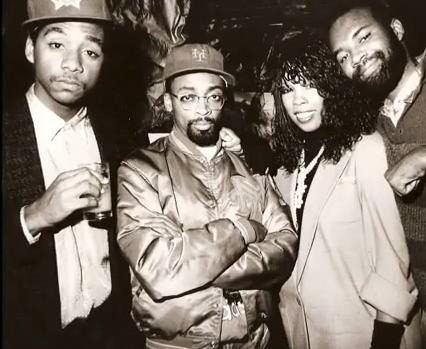
Judging from the trailer, Brooklyn Boheme is an insider’s look at the kids everyone wanted to be like in the ’90s. Yeah, that’s Michael Jordan hanging with Spike Lee, what? Mos Def — sorry, Yasiin Bey — pre-Hitchhiker’s Guide to the Galaxy, visual artist Lorna Simpson reminiscing on the productivity that came from hanging out around densely-packed, extravagantly brilliant people (Lorna, I’m down for tips on how to do this if you’re offering.) The snapshot of the temporary community is made even more poignant with the knowledge of what came about in the neighborhood later on. The trailer acknowledges that Fort Greene has become synonymous with gentrification. Blame it on the artists… 

After the flick, head to the Clift Hotel for sets by KM/FM (King Most, FA, and Marky), Wonway Posibul (Latin Soul Brothers-Thinkbeat Radio), Haylow (Roy Ayers Project-70/30), and Jerry Nice (Groove Merchant Records). 

Brooklyn Boheme premiere

Thu/12 8pm; $5 movie only, $15-$45 movie and afterparty

Clay Theater 

2261 Fillmore, SF


SFNY wrap party-Brooklyn Boheme afterparty

Thu/12 10pm-2am

Clift Hotel 

495 Geary, SF

sfny6.eventbrite.com

Sit-in at Lakeview elementary raided, free classes continue, rally at 5pm

1

This post has been updated

A sit-in at Oakland’s Lakeview Elementary School ended early this morning as police from the Oakland School Police force entered the school building, making two arrests.

The dispersal was calm by all accounts, although protesters say that officers threatened to use chemical weapons to disperse the crowd, which included young children.


Officers from the Oakland School Police force, the Oakland Housing Authority Police force, Oakland Police Department, and California Highway Patrol were deployed to end the protest, according to a statement from OUSD Superintendent Tony Smith.

“There were children there, parents and teachers and a few occupiers,” said Lola, an organizer with Occupy Oakland who was supporting the sit-in on 4am security duty when police arrived.

There were 20-25 sit-in participants present when police arrived, according to Lola and another Occupy Oakland participant who was on the scene, Alyssa Eisenberg. “There were at least 15 police cars when I drove up,” Eisenberg said.

“The officers were saying, we’ve given you notices now we’re going to give you 15 minutes to leave. Then they gave an official dispersal order and they said, ‘If you do not disperse we’ll use chemical agents against you,’” Lola recounts.

Oakland parents, teachers, elementary school-aged children and supporters had been demonstrating at the school for 17 days. The school is one of five marked for closure by the Oakland School Board, a move that parents and teachers opposed.

The demonstration consisted of a free day camp for children called the People’s School for Public Education, a community garden, and a 24-hour sit-in involving half a dozen tents on the school property.

As protesters left the school, “it was very calm,” Lola said. “All the people that were there left willingly except two,” a parent organizer and an alum of the school who sat in a classroom rather than leave when police arrived. The two were cited for trespassing and released.

Police then erected a new fence outside the public school, and demonstrators went to a park across the street with the goal of continuing to teach free classes to children.

“Officers wouldn’t let [National Lawyers Guild] legal observers or journalists into the building,” said Lola, describing these observers standing on concrete structures outside the gates of the school in order to see what happened.

Organizers have planned a rally in protest of the raid and the ongoing school closures. They plan to meet today at 5pm outside of Lakeview Elementary.

“People who were occupying said this isn’t the end, they have more direct action civil disobedience plans,” Lola said.

The good old days in Rock Rapids, Iowa, the Fourth of July, 1940-1953

1

(Note: In July of 1972, when the Guardian was short a Fourth of July story, I sat down and cranked out this one for the front page on my trusty Royal Typewriter. I now reprint it each year on the Bruce blog, with some San Francisco updates and postscripts.)

Back where I come from, a small town beneath a tall standpipe in northwestern Iowa, the Fourth of July was the best day of a long, hot summer.

The Fourth came after YMCA camp and Scout camp and church camp, but before the older boys had to worry about getting into shape for football. It was welcome relief from the scalding, 100-degree heat in a town without a swimming pool and whose swimming holes at Scout Island were usually dried up by early July. But best of all, it had the kind of excitement that began building weeks in advance.

The calm of the summer dawn and the cooing of the mourning doves on the telephone wires would be broken early on July Fourth: The Creglow boys would be up by 7 a.m. and out on the lawn shooting off their arsenal of firecrackers. They were older and had somehow sent their agents by car across the state line and into South Dakota where, not far above the highway curves of Larchwood, you could legally buy fireworks at roadside stands.

Ted Fisch, Jim Ramsey, Wiener Winters, the Cook boys, Hermie Casjens, Jerry Prahl, Elmer Menage, and the rest of the neighborhood gang would race out of  their houses to catch the action. Some had cajoled firecrackers from their parents or bartered from the older boys in the neighborhood: some torpedoes (the kind you smashed against the sidewalk); lots of 2 and 3-inchers, occasionally the granddaddy of them all, the cherry bomb (the really explosive firecracker, stubby, cherry red, with a wick sticking up menacingly from its middle; the kind of firecracker you’d gladly trade away your best set of Submariner comics for).

Ah, the cherry bomb. It was a microcosm of excitement and mischief and good fun. Bob Creglow, the most resourceful of the Creglow boys, would take a cherry bomb, set it beneath a tin can on a porch, light the fuse, then head for the lilac bushes behind the barn.

“The trick,” he would say, imparting wisdom of the highest order, “is to place the can on a wood porch with a wood roof. Then it will hit the top of the porch, bang, then the bottom of the porch, bang. That’s how you get the biggest clatter.”

So I trudged off to the Linkenheil house, the nearest front porch suitable for cherry bombing, to try my hand at small-town demolition. Bang went the firecracker. Bang went the can on the roof. Bang went the can on the floor. Bang went the screen door as Karl Linkenheil roared out in a sweat, and I lit out for the lilacs behind the barn with my dog, Oscar.

It was glorious stuff – not to be outdone for years, I found out later, until the Halloween eve in high school when Dave Dietz, Ted Fisch, Ken Roach, Bob Babl, and rest of the Hermie Casjens gang and I made the big time and twice pushed a boxcar loaded with lumber across Main Street and blocked it for hours. But that’s another story for my coming Halloween blog.

Shooting off fireworks was, of course, illegal in Rock Rapids, but Chief of Police Del Woodburn and later Elmer “Shinny” Sheneberger used to lay low on the Fourth. I don’t recall ever seeing them about in our neighborhood and I don’t think they ever arrested anybody, although each year the Rock Rapids Reporter would carry vague warnings about everybody cooperating to have “a safe and sane Fourth of July.”

Perhaps it was just too dangerous for them to start making firecracker arrests on the Fourth – on the same principle, I guess, that it was dangerous to do too much about the swashbuckling on Halloween or start running down dogs without leashes (Mayor Earl Fisher used to run on the platform that, as long as he was in office, no dog in town would have to be leashed. The neighborhood consensus was that Fisher’s dog, a big, boisterous boxer, was one of the few that ought to be leashed).

We handled the cherry bombs and other fireworks in our possession with extreme care and cultivation; I can’t remember a single mishap. Yet, even then, the handwriting was on the wall. There was talk of cutting off the fireworks supply in South Dakota because it was dangerous for young boys. Pretty soon, they did cut off the cherry bomb traffic and about all that was left, when I came back from college and the Roger boys had replaced the Creglow boys next door, was little stuff appropriately called ladyfingers.

Fireworks are dangerous, our parents would say, and each year they would dust off the old chestnut about the drugstore in Spencer that had a big stock of fireworks and they caught fire one night and much of the downtown went up in a spectacular shower of roman candles and sparkling fountains.

The story was hard to pin down, and seemed to get more gruesome every year – but, we were told, this was why Iowa banned fireworks years before, why they were so dangerous and why little boys shouldn’t be setting them off. The story, of course, never made quite the intended impression; we just wished we’d been on the scene My grandfather was the town druggist (Brugmann’s Drugstore, “Where drugs and gold are fairly sold, since 1902″) and he said he knew the Spencer druggist personally. Fireworks put him out of business and into the poorhouse, he’d say, and walk away shaking his head.

In any event, firecrackers weren’t much of an issue past noon – the Fourth celebration at the fairgrounds was getting underway and there was too much else to do. Appropriately, the celebration was sponsored by the Rex Strait post of the American Legion (Strait, so the story went, was the first boy from Rock Rapids to die on foreign soil during World War I); the legionnaires were a bunch of good guys from the cleaners and the feed store and the bank who sponsored the American Legion baseball team each summer.

There was always a big carnival, with a ferris wheel somewhere in the center for the kids, a bingo stand for the elders, a booth where the ladies from the Methodist Church sold homemade baked goods, sometimes a hootchy dancer or two, and a couple of dank watering holes beneath the grandstand where the VFW and the Legion sold Grainbelt and Hamms at 30¢ a bottle to anybody who looked of age.

Later on, when the farmboys came in from George and Alvord, there was lots of pushing and shoving, and a fist fight or two.

In front of the grandstand, out in the dust and the sun, would come a succession of shows that made the summer rounds of the little towns. One year it would be Joey Chitwood and his daredevil drivers. (The announcer always fascinated me: “Here he comes, folks, rounding the far turn…he is doing a great job out there tonight…let’s give him a big, big hand as he pulls up in front on the grandstand…”)

Another year it would be harness racing and Mr. Hardy, our local trainer from Doon, would be in his moment of glory. Another year it was tag team wrestling and a couple of barrel-chested goons from Omaha, playing the mean heavies and rabbit-punching their opponents from the back, would provoke roars of disgust from the grandstand. ( The biggest barrel-chest would lean back on the ropes, looking menacingly at the crowd and yell, “ Aw, you dumb farmers. What the hell do you know anyway? I can beat the hell out of any of you.”   And the crowd  would roar back in glee.)

One year, Cedric Adams, the Herb Caen of Minneapolis and the Star-Tribune, would tour the provinces as the emcee of a variety show. “It’s great to be in Rock Rapids,” he would say expansively, “because it’s always been known as the ‘Gateway to Magnolia.” (Magnolia, he didn’t need to say, was a little town just over the state line in Minnesota which was known throughout the territory for its liquor-by-the-drink roadhouses. It was also Cedric Adams’ hometown: his “Sackamenna.”) Adams kissed each girl (soundly) who came on the platform to perform and, at the end, hushed the crowd for his radio broadcast to the big city “direct from the stage of the Lyon County Fairgrounds in Rock Rapids, Iowa.”

For a couple of years, when Rock Rapids had a “town team,” and a couple of imported left-handed pitchers named Peewee Wenger and Karl Kletschke, we would have some rousing baseball games with the best semi-pro team around, Larchwood and its gang of Snyder brothers: Barney the eldest at shortstop, Jimmy the youngest at third base, John in center field, Paul in left field, another Snyder behind the plate and a couple on the bench. They were as tough as they came in Iowa baseball.

I can remember it as if it were yesterday at Candlestick, the 1948 game with the Snyders of Larchwood. Peewee Wenger, a gawky, 17-year-old kid right off a high school team, was pitching for Rock Rapids and holding down the Snyder artillery in splendid fashion. Inning after inning he went on, nursing a small lead, mastering one tough Larchwood batter after another, with a blistering fastball and a curve that sliced wickedly into the bat handles of the right-handed Larchwood line-up.

Then the cagey Barney Snyder laid a slow bunt down the third base line. Wenger stumbled, lurched, almost fell getting to the ball, then toppled off balance again, stood helplessly holding the ball. He couldn’t make the throw to first. Barney was safe, cocky and firing insults like machine gun bullets at Peewee from first base.

Peewee, visibly shaken, went back to the mound. He pitched, the next Larchwood batter bunted, this time down the first base line. Peewee lurched for the ball, but couldn’t come up with it. A couple more bunts, a shot through the pitcher’s mound, more bunts and Peewee was out. He could pitch, but, alas, he was too clumsy to field. In came Bill Jammer, now in his late 30’s, but in his day the man who beat the University of Iowa while pitching at a small college called Simpson.

Now he was pitching on guts and beer, a combination good enough for many teams and on good days even to take on the Snyders. Jammer did well for a couple of innings, then he let two men on base, then came a close call at the plate. Jammer got mad. Both teams were off the bench and onto the field and, as Fred Roach wrote in the Rock Rapids Reporter, “fisticuffs erupted at home plate.” When the dust cleared, Jammer has a broken jaw, and for the next two weeks had to drink his soup through a straw at the Joy Lunch. John Snyder, it was said later, came all the way in from center field to throw the punch, but nobody knew for sure and he stayed in the game. I can’t remember the score or who won the game, but I remember it as the best Fourth ever.

At dusk, the people moved out on their porches or put up folding chairs on the lawn. Those who didn’t have a good view drove out to the New Addition or parked out near Mark Curtis’ place or along the river roads that snaked out to the five-mile bridge and Virgil Hasche’s place.

A hush came over the town. Fireflies started flickering in the river bottom and, along about 8:30, the first puff of smoke rose above the fairgrounds and an aerial bomb whistled into the heavens. BOOM! And the town shook as if hit by a clap of thunder.

Then the three-tiered sky bombs – pink, yellow, white, puff, puff, puff. The Niagara Falls and a gush of white sparks.

Then, in sudden fury, a dazzling display of sizzling comets and aerial bombs and star clusters that arched high, hung for a full breath and descended in a cascade of sparks that floated harmlessly over the meadows and cornfields. At the end, the flag – red, white and blue – would burst forth on the ground as the All-American finale in the darkest of the dark summer nights. On cue, the cheers rolled out from the grandstand and the cars honked from the high ground and the people trundled up their lawn chairs and everybody headed for home.

Well, I live in San Francisco now, and I drive to Daly City with my son, Danny, to buy some anemic stuff in gaudy yellow and blue wrapping and I try unsuccessfully each year to get through the fog or the traffic to see the fireworks at Candlestick. But I feel better knowing that, back where I come from, everybody in town will be on their porches and on the backroads on the evening of the Fourth to watch the fireworks and that, somewhere in town, a little boy will put a big firecracker under a tin can on a wood porch, then light out for the lilacs behind the barn.

P.S. Our family moved in l965 from Daly City to a house in the West Portal area of San Francisco. There are, I assure you, few visible fireworks in that neighborhood. However, down at the bottom of Potrero Hill, the professional and amateur action is spectacular.

 From any Potrero Hill height, you can see the fireworks in several directions: the waterfront fireworks in the city, fireworks on the Marin side of the Golden Gate bridge, fireworks at several points in the East Bay, fireworks along the Peninsula coast line.

And for the amateur action, parents with kids, kids of all ages, spectators in cars and on foot, congregate after dusk along Terry Francois Boulevard in San Francisco along the shoreline between the Giants ballpark and Kellys Mission Rock restaurant.

The action is informal but fiery, fast,  and furious: cherry bombs, clusters, spinning wheels, high flying arcs, whizzers of all shapes and sizes. The cops are quite civilized and patrol the perimeter but don’t bother anybody. I go every year. I think it’s the best show in town. B3.


Leaked documents add to CPMC’s credibility problems

10

Three key members of the Board of Supervisors today presented what they say are documents leaked by a whistleblower within California Pacific Medical Center showing it will likely shut down St. Luke’s Hospital by invoking an escape clause in the development agreement that the Mayor’s Office negotiated and the board is now considering.

The CPMC internal financial documents sent to the supervisors Sunday from an anonymous whistleblower predict a financial scenario in which the operating revenue will fall below a 1 percent margin by 2018.  The predicted loss would allow CPMC to exit its 20-year commitment to St. Luke’s and close the hospital in 2020, just five years after its scheduled reopening.  Sups. David Chiu, Malia Cohen, and Christina Olague say they worry the financial shortfall would also limit CPMC’s charitable donations while its Sutter Health parent company cuts hundreds of hospital jobs to save a projected $70 million per year.

 CPMC has promised to seismically retrofit St. Luke’s and run it for 20 years. In return, the medical group gets to build a massive hospital on Cathedral Hill. Inserted into the deal is what Chiu calls the fine print, which states if CPMC operating margin falls below 1 percent for two years it may close the hospital. Chiu said CPMC presented the escape clause as a very unlikely event, occurring only in a catastrophic scenario.

Instead, the leaked documents present a negative operating margin as an incredibly probably situation that CPMC has known about for months and misrepresented to city officials. “CPMC knew it was possible and likely they would default on their commitment,” Cohen said, adding that her greatest grievance is CPMC’s refusal to do anything about the situation.

Cohen said the financial revelations aren’t surprising considering Sutter Health has a reputation for shady practices. She said we should all wonder how a supposedly not-for-profit corporation is able to make so much profit.

CPMC spokesman Sam Singer said the documents are fraudulent, flawed financial reports that CPMC threw away a long time ago. He suggested someone must have dug them out of the garbage in a conspiracy like fashion. Singer said the mayor had learned about the document a few weeks ago.

Chui said that may help explain why  the Mayor’s Office recently acknowledged it reentered negotiations with the CPMC after becoming concerned about the viability of St. Luke’s, telling supervisors it was based on CPMC’s revised revenue estimates, sparking a controversy during last week’s hearing.

Whatever the reason, the three supervisors want more time to investigate the matter.

“Let’s be clear,” said Cohen said, “these contract negotiations should be informed by actual financial information and not just by the word of CPMC leadership, which we’ve unfortunately found to be untrustworthy.”


Live Shots: Quintron and Miss Pussycat at New Parish

0

Peer pressure is the key to any good party. “Don’t leave, don’t leave,” Miss Pussycat called out from the stage Friday night at New Parish, not so much begging or pleading, but in a tone that suggested the couple heading towards the door with their coats were crazy.

The pair turned, torn, and together mouthed something inaudible about the time, or BART, or something. “Maybe Sean could give you a ride,” Miss Pussycat said, seemingly picking a name at random and pointed out into the audience, adding with a deceptively innocent smile, “…wherever you’re going, and then you’ll become best friends.”

Whether convinced or just shamed, the two walked back into the crowd, Miss Pussycat gave a cheer, and the Leslie speaker connected to Qunitron’s organ began to spin up as he launched into the frenzied warble “Banana Beat.”

Essentially in their own genre of swamp boogie, the New Orleans-based Quintron and Miss Pussycat puts on what is basically more like a dance party than a conventional show. Sure, there’s a fair amount of spectacle. It opens with Miss Pussycat’s puppet show, a sort of DIY La Voyage dans la lune that’s enjoyable if you like the aesthetic of Pee-wee’s Playhouse and watching Adult Swim cartoons in a smoked-out stupor.

When it comes to playing music, Quintron always has something going on, using a number or inventions (like his light-operated drum machine) that no one else really does (or understands).

The closest comparison might by the B-52s. Partly because of the campy silliness, partly because of the style, and partly because the combined over-the-top male and female vocals. But mainly it’s the video for “Love Shack” that used to play on VH1 every other commercial break in the early ’90s. The one where everybody is strange, fun, and getting down. The one where they are drinking everything in sight, including the bath tub water. Yeah, it’s a similar kind of atmosphere at the Quintron and Miss Pussycat show.

In addition to crowd control and vocal duties, Miss Pussycat focuses her energy on stage by playing a pair of carefully accessorized maracas. Shaking them mostly, but occasionally tossing one into the air and catching it.

As the show went on, I was concerned by the increasing number of times she dropped them onto the floor. Until I factored in that, considering how many shots she had taken with members of the audience (including one whose shirt read “fuck you YOU fuckin’ fuck – Bourbon St., New Orleans”), she was doing just fine.

Opener
Compared to Quintron and Miss Pussycat, Dent May gave a mild performance, pulling almost entirely from his latest, Do Things and the “Eastover Wives” single. (As someone that never caught him live before, I’d hoped to hear a bit from his last album, although he did play “Meet Me in the Garden.”) The live show doesn’t quite have the understated suave playfulness of May’s records, although there’s a sense that a muted energy is still emerging.

At his best, the slow R&B ballad “Do Things” gave off an Enchantment Under the Sea feel, giving a couple in the audience a chance to slow dance. Moves like jumping off the kick drum at the very end of the set, however, were a bit too calculated.

Heads Up: 8 must-see concerts this week

0

You’ve got a midweek day off? You’re stoked. Go see some live music with that hard-earned free time. Oh, and happy independence, America. That’s what we’re celebrating, correct?

Eat a barbecued tofu dog slathered in relish and drink some park beers in celebration of such things as country pride and days without responsibility. Then fill those Bay Area music venues, checking in on America’s favorite proto-punk troubadour, Mali’s favorite virtuoso progeny, the Big Time Freedom Fest, woozy dream poppers, a punk rock museum benefit, and more.

Here are your must-see Bay Area concerts this week/end:

Jonathan Richman
Last time the Modern Lover cult hero Jonathan Richman did a slew of shows at the Make-Out Room, he brought drummer Tommy Larkins to the outings, performed for hours on end, sang in multiple languages, chatted awkwardly, mixed up his pacing and flipped his set list so time floated by without a lull. He also danced samba-like solo – twisting his thin frame as a contortionist. Who’s to say this round should be any different? We know Larkins is back at least.
Mon/2-Tue/3, 7:30pm, $15
Make-Out Room
3225 22nd St., SF
(415) 647-2888
www.themakeoutroom.com
http://www.youtube.com/watch?v=XjFU98mEem4

Vieux Farka Toure
The son of Ali Farka Toure, Malian singer-guitarist is legend in his own right. Oft referenced as a “guitar virtuoso” or more specifically  “The Hendrix of the Sahara,” Vieux’s graceful, quick-fingered guitar skills rival those of the rock’n’roller regime, yet he blends in traditional West African influences. Fresh off the Touré-Raichel Collective (his collaborative album and tour with Israeli musician Idan Raichel), Vieux this time swings into town solo, his strumming again center stage.
Mon/2, 8pm, $22
Yoshi’s SF
1330 Fillmore, SF
(415) 655-5600
www.yoshis.com
http://www.youtube.com/watch?v=IecSMEH9ZVg

“Big Time Freedom Fest”
What’s more deliciously new America than the string-lit back patio at El Rio? That’s where dreams are made and shattered. People fall in momentary beat-fueled lust, cheap beers with lime wedges are sipped en masse, and fried food is gobbled up without a second thought. It’s tradition, years in the making. This seventh annual Big Time Freedom Fest features some awesome local heavy-hitters: Religious Girls, Tartufi, Finn Riggins, Battlehooch, and Night Call, all for $8, in the outdoor heavy-hung fog.
Wed/4, 3:30pm, $8
El Rio
3158 Mission, SF
(415) 282-3325
www.elriosf.com
http://www.youtube.com/watch?v=7mMUsyZY4kA

Giraffage, James & Evander
“Glitchy” seems to be the key word for San Francisco’s electronically-constructed solo project, Giraffage. I’m on board. Those little glitchy effects break up otherwise endless ambient affairs, spinning the act from dream-pop to hip-hop in a cotton candy pillow. Tonight’s a co-headlining set with fellow Bay Area suspected Ambien-poppers, James & Evander. That “synth/stoner pop” Oakland act released magical debut LP Bummer Pop last month. How many more pops can we squeeze in this show description? Pop.
With Astronautica, Young Pharaohs
Thu/5, 9pm, $6
Milk Bar
1840 Haight, SF
(415) 387-6455
www.milksf.com
http://www.youtube.com/watch?v=MrrL0sYLgA0

Liars
“This year’s WIXIW (say wish-you) finds Liars reinventing the wheel again, to produce their most synthified affair yet; picture the rocktronic fusion of Kid A-era Radiohead, approached with the finely calibrated ambience of Bjork’s Vespertine, Trent Reznor’s swagger, and Tom Waits’ lumbering dynamics.” – Taylor Kaplan 
With Cadence Weapon
Thu/5, 8pm, $22.50
Great American Music Hall
859 O’Farrell, SF
(415) 885-0750
www.slimspresents.com
http://www.youtube.com/watch?v=ggR6RuBh8I0

Shana Falana
Formerly of San Francisco, the now New York-based psychedelic dream popper Shana Falana returns to her beloved Bay in support of new In the Light EP, bringing along a new multimedia show. Falana’s lilting church choir-like vocals matched to looping guitar and percussion gives the impression of a surreal religious experience deep in the X-Files woods. I want to believe.
With Kelley Stoltz, the She’s, B and Not B
Fri/6, 9pm, $15
Cafe Du Nord
2170 Market, SF
(415) 861-5016
www.cafedunord.com
http://www.youtube.com/watch?v=MUqgXal-knk

Punk Rock Museum Benefit
Given punk’s lasting impact on so many musical branches, and influence on the raw sounds of countless beloved acts, a Punk Rock Museum seems absolutely necessary. Why didn’t we think of this? The new museum – spearheaded by Taquila Mockingbird and based in LA – has been established to “further preserve the punk rock genre.” For this show, parts of the museum travel to San Francisco. There will be a mix pieces (photographs, old fliers, art by the likes of Winston Smith, etc.) from the permanent museum collection, and of course, live music to carry on the legend: Debora Iyall (of Romeo Void), Metal Circus (A tribute to Husker Du), and Meri St. Mary and the Housecoats. Also, DJ Big Nate will be spinning classic punk cuts.
Sat/7, 9pm, $15
Thee Parkside
1600 17th St., SF
(415) 252-1330
www.theeparkside.com
http://www.youtube.com/watch?v=ePIImGMjn_8

Cool Ghouls
Local psych-rockers Cool Ghouls seem to be everywhere lately, opening up Noise Pop retrospective shows, making appearances at lots of local venues, playing Save KUSF benefits; a.k.a traveling around town with beer-fueled, good-time rock’n’roll in tow. They’ve got a bright and free EP currently up for grabs on their Tumblr, an upcoming slot at the Independent before Sonny and the Sunsets, and a full-length LP coming in the fall; this Hemlock show is a good chance to check out the five-piece in smallish setting.
With LA Witch, the Sister Ruby Band
Sun/8, 9pm
Hemlock Tavern
1131 Polk Street, SF
(415) 923-0923
www.hemlocktavern.com

Generations confer over La Peña’s second skin

3

I’m sitting in on a meeting between two generations of muralists. In name, our encounter was designed as an interview about La Peña Cultural Center’s plans to redo its decades-old facade, a historic piece that right now is a 3-D tableau named “Song of Unity” and meant to represent the people of North and South America coming together in art.

But it has become clear to me the interviewer that’s it’s way more momentous to let these groups talk largely unimpeded by my questions. Two people who created the mural in 1978 are speaking with two people who will design its rebirth in 2012 about changes in the world of street art over the last 34 years. It’s the first time the four have met together. Assasinated Chilean artist-activist Victor Jara‘s detached hands strum a guitar in silent soundtrack over us as we sit on folding chairs in front of the mural in question. 

In contrast to his “Song of Unity’s” figurative style, “graffiti is an abstract art,” says Osha Neumann.

Neumann was able to pay his original mural crew largely with funds from government-sponsored community arts program meant to train and employ creative types. La Peña’s wasn’t the only piece the group worked on — they also masterminded the piece on Berkeley’s Amoeba Music and a large wall at People’s Park. Their work was inspired, he says, by the school of Mexican muralists that included Diego Rivera, José Orozco — the masters that gave birth to the last mural renaissance in the United States. 

Osha Neumann, Cece Carpio, and O’Brien Thiele — two generations of La Peña artists. All Guardian photos by Caitlin Donohue

“Song of Unity” was meant to illustrate the coming-together of two continents through activist culture, at a time with US interventionism in Latin America was reaching a fevered pitch of corruption and when Bay Areans and Latin American refugees were coming together to form La Peña. It was a heavy moment. Jara’s hands, by way of illustration, are portrayed severed from his body for a reason. After the 1973 Chilean coup, they were said to have been cut from his body by military junta.

“Graffiti has no connection at all to the work of the Mexican muralists,” Neumann continues in response to my question about how street art has changed since his time.

“Graffiti artists don’t usually work collectively,” adds O’Brien Thiele, Neumann’s co-artist.

But here, Robert Trujillo must step in. Trujillo is a member of the Trust Your Struggle collective, the team of California-bred young people that have been elected to take up this historic mantle.

“But there are graffiti crews that are really well-established,” he interjects gently. “CPS from Los Angeles. TKO and MSK have crews worldwide. These are the groups that pioneered graffiti art on the West Coast.”

Trujillo should know — in a time in which street art has come into vogue and become a big-money game, TYS is a sterling example of what is still great about the genre. TYS travels the world connecting with communities in parts of the developing world like Latin America and the Phillipines. It uses graffiti-inspired murals to illustrate social problems, solutions. The center already bears the group’s mark — its superlative Cafe Valparaiso, which serves Chilean food at lunch and dinner, is adorned with a striking mural done by TYS members.


“When you’re in school, writing on the walls — that’s the thing they tell you not to do,” Trujillo tells us, by way of explaining the power of graffiti. “You don’t have a voice. With graffiti, suddenly you have a voice. People have to realize that it exists because of society.” He pauses, then hits upon an eloquent sum-up. “Graffiti is the perfect answer to society.”

“This is a really huge project for us,” says TYS member Cece Carpio. Carpio is La Peña’s program manager, one of many ties the local group has to the center. “This is a place of gathering. [With the new mural] we want to honor the history of Latin American activism here, but also the diversity that the place has now.”

This comes to the heart of why La Peña wants a new mural. Certainly, “Song of Unity” is in bad shape. It is crumbling at the junctures of its panels. Water is seeping in through the cracks, a death sentence for its three-dimensional figures. 

“Song of Unity” today

But perhaps even more importantly, the re-envisioning of the center’s facade will represent something rather extraordinary — that a radical institution that has been relevant in this community for decades has found itself in the hands of a new, dedicated generation.

La Peña’s programming has continued to diversify. Upcoming events include July 13’s Asian Rock Fest and this year has seen the fifth year of Queendom, DJ Zita’s all-female celebration of the five elements of hip-hop — not to mention the Immigrant Voices Festival that brought openly undocumented journalist Jose Antonio Vargas to the center last week. The Immigrant Voices Festival is a project explicitly sponsored by this “second generation” group — referred to as LP2G by the center. 

“I was sorry when they said they wanted to take [“Song of Unity”] down,” Neumann admits to the group that is assembled that sunny Sunday afternoon. “But they said they wanted new blood. What could I say to that?”

What indeed? Because if there is one good reason to donate to La Peña’s campaign to step, facade-first, into the new generation of activism — and you can! The last day to contribute to its Indie Gogo campaign is today, Mon/2 — it is to celebrate that a radical institution started in the fire of the ’70s has successfully found relevance today among the Internet generation. 

So what is TYS going to paint on this wall? Will it be three-dimensional, like Jara’s memorialized fingers and guitar? The final design won’t be determined until the collective’s done more meetings like this with the community members of La Peña. But you can rest easy on one point. Says Trujillo: “We all know it’s going to be fresh though.”

Undocumented youth hold ‘graduation’ at Civic Center

7

“I’m undocumented and unafraid, queer and unashamed!” Javier Hernandez declared as he took the stage in front of City Hall June 30.

He was one of hundreds of undocumented students from across the western United States who showed up in Civic Center Plaza to celebrate undocumented immigrant youth and students.

During the ceremony, students, dressed  in caps and gowns, told their stories. Many involved a struggle to get through school while unable to work, and uncertainty and fear about their own fate and that of their families. 

Angela Davis spoke in support of the students.

Later, Pomp and Circumstance played as the students marched down the aisles, each taking a turn on stage to say speak their names and their undocumented status, followed with a bold “and I’m unafraid!”

“Our core message today was to celebrate how far the undocumented movement has come,” said Blanca Vazquez, a senior at San Francisco State studying child and adolescent development. “It’s been 10 years since the DREAM Act was first proposed.”

Many protesters were made more hopeful by President Obama’s recent “deferred action” Department of Homeland Security policy directive, calling on officers to defer the depaortaton of many undocumented youth.

“This is a huge win for our communities,” Hernandez said to a cheering crowd, “and you made it happen!”

For Vazquez, the directive is an important step, but there is still much to be done. She participated in a sit-in at Obama campaign offices last week. On day two of the sit-ins, Vasquez said, Obama issued his policy directive.

Vazquez said the group wanted an Executive Order, not a policy directive. They stayed to continue the sit-in, but after the policy directive passed security guards at campaign office stopped allowing them to eat or go to the bathroom. After enduring those conditions for a day, the students stopped the occupation.

Vazquez promised they would be back, however, if “Obama doesn’t implement the policies he promised.”

A video made by immigrant youth in support of the “(und)occupation” of the campaign offices points out that although the policy directive allows DREAMers to apply for deferment and work permits, it does not guarantee either and denied applications can lead to the start of the deportation process. 

One speaker said the was grateful for the directive and hoped to get a work permit, especially after living in fear of deportation her last year of high school. But as an 18-year, she said she was still worried at the prospect of being left alone if her parents are deported to Indonesia. 

“Deportation is not just a Latino issue!” the young woman, a member of Asian Students Promoting Immigrant Rights through Education, reminded the crowd. 

Hernandez was among dozens who emphasized the intersections between undocumented and queer movements. 

“We want to find a way to bridge communities affected by homophobia and xenophobia,” Hernandez said. “It’s the same struggle.”