SFBG Blogs

Live Shots: Neil Diamond at the HP Pavilion

0

At some point during the massive “Sweet Caroline” sing-a-long deep into Neil Diamond’s concert at HP Pavilion, a rowdy female fan vaulted into my aisle, loudly proclaimed her love to Neil, skulked away from some security guards, and then just all-out bolted for the stage.

She made it as far as the fourth row before a scrum of ushers in royal blue jackets intercepted her in mid-sprint. At that point, Neil was really whipping the place into a tidy frenzy. In fact, by the time he hit his stride on “Cracklin’ Rosie” a couple songs later (“Play it now/Play it now my baby”), it seemed like the audience of dolled-up cougars and enthralled seniors might just erupt into a full-on mosh pit.

This was a relief really. I had been rooting for Neil the second I got in the building, though secretly, I still had my doubts. It wasn’t so much pessimism that Neil Diamond couldn’t still deliver, but a sort of “golden age thinking” that has come to infect my mind before seeing any older musician or band these days; essentially (as Woody Allen asserted via Midnight in Paris) “that a different time period is better than the one we’re living in.” When it comes to aging musical acts post-heyday, I just can’t shake the idea that we’re most likely being railroaded towards indulgent nostalgia….at futuristic ticket prices.

Neil took the stage to a packed arena on Tuesday, and thankfully, he not only dismissed my theory, but inverted it: instead of dealing in nostalgia, he made a case for what it means to be a performer. Working through two-dozen songs from a career that has spanned half a century, Diamond took to the setlist and commanded the stage as if he was intent on driving home the difference between a dinosaur and a veteran. Two hours later, there was little doubt he belongs in the latter category.

And Neil’s certainly got a wide range of material to showcase in the process, spanning his many facets: from pop gems (“Cherry, Cherry”) to poignant Paul Simon-style songwriting (“Solitary Man”) to outright Sinatra crooning (“Love on the Rocks”). During the Tom Jones vibe of “Girl, You’ll Be A Woman Soon,” Diamond flaunted his sense for stage theatrics by singing directly to a lone female in the front row as if she were the only person in the arena, and subsequently driving her into hysterics.

Of course, it’s the songs that don’t really have comparison, the ones that are just quintessentially his own that proved the nights biggest hits – “Forever in Blue Jeans,” “I Am, I Said,” and of course, “Sweet Caroline.”

He ended, appropriately enough, with “I’ve Been This Way Before,” with its lyric, “I’m sure to sing my song again.” Five decades in and still kicking, that remains a safe bet.
 

Calvin Trillin: Mitt Romney’s tax returns

0

Mitt Romney’s tax returns

Demands come from left and right.

Mitt Romney, though, says he’ll sit tight.

We’ve given you people enough,

Says Ann, sounding suddenly tough.

Conspiracy theories abound.

Mitt’s critics relentlessly pound.

Why go through this sort of ordeal?

What doesn’t Mitt want to reveal?


Some shelters far off from our shore?

Well, sure, but there has to be more.

And, really, we already know

His tax rate is terribly low.

Could some corporate losses have meant

That one year he paid not a cent?

What’s in there to make voters squeal?

What doesn’t Mitt want to reveal?


What deed was so sleazy that he’ll

So desperately try to conceal

Exposure with such stubborn zeal?

What fiddling did Romney feel

Should even a wealthy big wheel

Who feels some gray area’s appeal

Is slippery, just like an eel?

What doesn’t Mitt want to reveal?

 Calvin Trillin: Deadline Poet: The Nation 8/13/2012

Inspired pairing: Woods and Peaking Lights at Great American Music Hall

2

“Man, their songs just went on forever,” a fellow in a Velvet Underground shirt exclaimed with mild frustration, as electronic-dub outfit Peaking Lights closed their hour-long set. Similarly to Steve Reich, Neu!, or (ironically, in this case) the VU, the Madison, Wis. duo is quite polarizing in its fixation on extreme repetition. Some find it tedious; others are hypnotized and transported. However, there’s no denying that Peaking Lights’ appeal stems from their disregard for compromise.

Warming up the Great American Music Hall stage for Brooklyn lo-fi folk-rock ensemble Woods, Peaking Lights rounded out the first half of an unusually diverse and compelling double-bill. Whereas a one-two punch of rock bands can impart a distracting sense of competition and redundancy, the decision to pair an acoustic-electric band with an electronic duo was a shrewd one, giving the audience a duality of musical methods to chew on.

Given the current oversupply of disengaged laptop sets, in which musician/producer/DJs plug away mysteriously at their boxes of switches and lights like the Mayor of Oz, Peaking Lights made an impression with their refreshingly old-school approach to electronics. Aaron Coyes’ presence was especially captivating, as he engaged himself in an observable process: loading and unloading tape decks with source material, and manipulating the outgoing sound manually, with the use of knobs and sliders.

During heavily dubby tracks, like “Lo Hi” from their third full-length, Lucifer, released this past June, Coyes channeled the radical techniques of King Tubby and Lee “Scratch” Perry, laying a groundwork of seemingly bottomless bass tones, and cutting through the rumble with sharp, percussive attacks, densely affected by an arsenal of phasers and echoes. His Jamaican-soundsystem-circa-1970 strategy was fascinating to watch, particularly for those with an appreciation for dub reggae and its technological context.

Indra Dunis, the other half of Peaking Lights, imparted a welcome contrast to Coyes’ experimental tendencies, supplying mantric vocals, tapping out infectious keyboard melodies, and taking breaks to shake maracas and dance along to Coyes’ layered grooves.

Whether they qualify as a pop outfit with an experimental bent, or a niche act with populist impulses, this fusion between the familiar and the esoteric is ultimately the source of Peaking Lights’ success. Coyes’ restless experimentation and Dunis’ pop approachability complemented each other beautifully, so it makes perfect sense that they are, in fact, a married couple.

Considering the heady ruthlessness of Peaking Lights’ set, Woods were given a tough act to follow. Often pigeonholed as a pastoral folk act, the four-piece seemed intent on debunking the Pitchforks of the world who dare synopsize their act with single-sentence quips. Resembling Neil Young in their ability to transition seamlessly between low-key, backwoods, campfire anthems and extended, psychedelic jams, Woods showcased their versatility with great conviction, adapting their tunes to the stage with impressive muscle.

Previewing material from the forthcoming album Bend Beyond, Woods were most captivating during their marathon electric-guitar freakouts. At their most energetic, these jams recalled the Flaming Lips’ Embryonic (2009) in their fuzzy, pummeling badassery, eliciting a primitive, visceral response.

The quieter, low-key material, however, suffered from an unshakable sense of been-here-before-ness. Although perfectly serviceable, Woods’ slower numbers were rendered inconsequential by the immediacy of their extended epics, and the high standard set by Peaking Lights’ performance. Given the sheer amount of middling pop music clogging the market right now, it takes a really good song to penetrate our information-age attention spans; some of Woods’ material simply failed to pass that test.

Bandleader Jeremy Earl’s voice also left something to be desired, at times hovering frustratingly between a modal register and a falsetto, without really qualifying as either. Vocals aside, though, Woods’ interplay was smooth and purposeful, with their standard lineup of bass, drums, and guitars accentuated by G. Lucas Crane’s electronic treatments and Jarvis Taveniere’s mandolin strumming.

While Peaking Lights’ novelty and innovation gave them a slight edge over Woods’ more conventional approach, the pairing was inspired, and mutually beneficial for both acts. Woods provided an ideally poppy antidote to Peaking Lights’ experimentation, while Peaking Lights’ avant-garde impulses were emboldened by Woods’ straightforwardness. The music world could use more double-billings as smartly put together as this one.

City College students, in their own words

6

City College of San Francisco (CCSF) students and freelance journalists Joe Fitzgerald and Sara Bloomberg this week continued giving Guardian readers some of the most insightful coverage of that institution’s struggles available, supplementing it with profiles on students effected by CCSF’s current woes.

And this enterprising pair of reporters didn’t stop there. You can now hear directly from a couple of students they interviewed in these videos they made as part of the project:

To hear the perspectives of other CCSF students, in their own words, check out these two Tumblr blogs, where they post their thoughts.

Worship long-haired handsome at cult-museum on first Thursdays

3

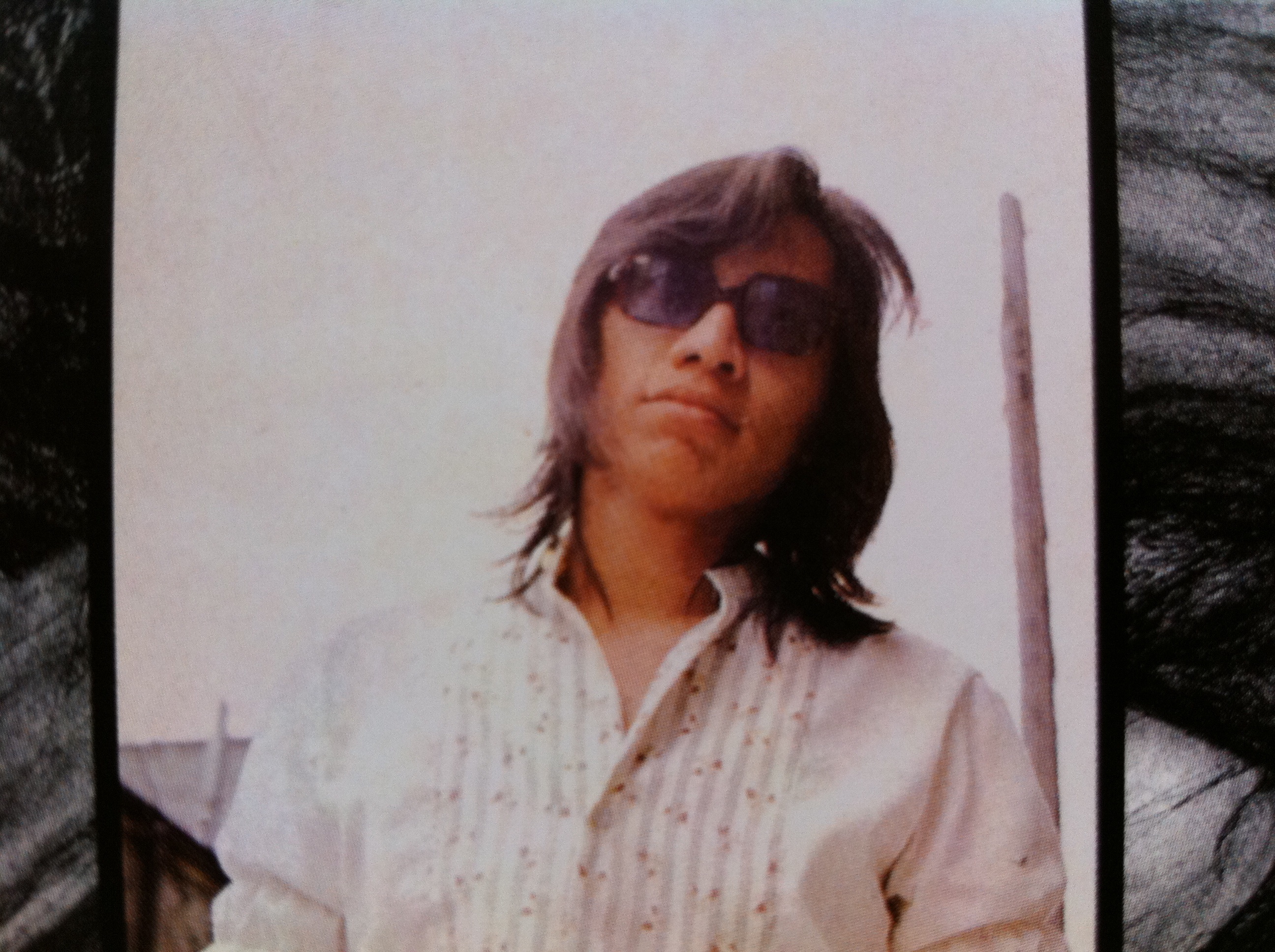
I am used to vegetarian restaurants and churches being cults, but this is something new. I’m loathe to spoil the surprise for you, nonetheless: the International Art Museum of America on Sixth Street and Market? 90 percent full of works by the stunning gentleman-living Buddha pictured. Also, it is free on first Thursdays!

Perhaps you have walked by the place before. Surely, you would have noticed the superlative tree-house-in-moat out front. 

Upon entering the museum, one is escorted through a Rainforest Cafe-like entry room, only to double-back past two large wooden Chinese dragons flanking the entrance to a room that holds only a glass case with a large piece of coral. It is called “Sea Palace Monarch,” says the corresponding metal plaque. You will soon find that these plaques are a highlight of the International Art Museum.

Says plaque:

Presumably, your first feeling was that of surprise. Does such large coral exist in the world? If it is not a genuine coral, then why do its luster, texture, and appearance look so real and natural? From the bottom of your heart, you would happily accept it as genuine coral because it is so truly beautiful, so aesthetically pleasing. How beautiful your living room would be if it contained this sculpture.

It is not real coral. But this truly beautiful, aesthetically pleasing piece of ceramic was created by our man Dorje Chang Buddha the III, who it turns out made roughly 90 percent of all the art you are about to see. Dorje does coral ceramics, massive wax drippings, traditional-looking Japanese drawings of lion prides and pandas, Van Gogh-like sunflowers, psychedelic spacescapes, and even builds his own gingko bilboa-esque frames that often as not house large holograms of cave interiors. He also creates jade-inspired tiling, which is available for purchase in the gift shop. 

Hell yeah that frame is holding a hologram.

Dorje’s yellow period.

It’s not all Dorje — there are occasional works by Flemish masters and oil paintings of sailboats. This is because Dorje is humble. Says the IAMA website, the museum’s board of directors initially only wanted the living Buddha’s works but:

His Holiness the Buddha adamantly disagreed, expressing His opinion that the International Art Museum of America is a site for masters of art worldwide to showcase their artistic accomplishments and should embrace diversity in orde to provide the public with broader aesthetic enjoyment. the Board of Directors yielded to this suggestion of His Holiness the Buddha.  

That’s so Dorje, who has done a million amazing things and totally deserves his own museum if only he wasn’t so humble. He’s the recipient of the ambiguously awesome World Peace Prize and check out the guy’s resume (via this spectacular website):

Examples of such holy phenomena include the following. Both humans and non-humans have prostrated to H.H. Dorje Chang Buddha III and have listened to His Holiness’s discourses on the dharma. Sentient beings, non-sentient things, birds, aquatic animals, land animals, flowers, grass, trees, tiles, and stones have all expressed respect for His Holiness’s dharma discourses either verbally or through physical actions. His Holiness taught a disciple how to transmit dharma on His behalf. When the person who was transmitted dharma by that disciple passed away, that person’s body emitted light. Thunder rumbled in the sky in reaction to the voice of His Holiness. 

Researching Dorje is likely to through you into a k-hole of reincarnation debate and superlative 1990s web design. Tell me this isn’t the best website ever. Wish-fulfilling jewel mirrors, a digital prayer wheel that “sends out this peaceful prayer of compassion to all directions and to all beings, purifying the area.” That’s worth a perma-tab on your Google Chrome. Now compare to the museum’s site. What happened there, Board of Directors?

Still, new favorite museum. It has a treehouse, holograms, and I wasn’t abducted despite the fact that there was maybe one other visitor there on the first Thursday I was waved in from the sidewalk. The other visitor was a guy who talked loudly on his cell phone about how he was “just checking out some museum man, they like said it was free so I was like cool.”

International Art Museum of America

Open Tuesdays-Sundays 10am-7pm, $10

Open until 7pm and free on first Thursdays

1025 Market, SF

www.iamasf.org

Olague faces her challengers during first D5 debate

58

Tonight’s inaugural District 5 supervisorial debate will be a key test for Sup. Christina Olague – who has fallen from favor with many progressives after a series of bad votes and prickly or evasive interactions with one-time allies – and a test for the rival candidates who are seeking to become the main progressive champion in one of the city’s most leftist districts.

The elected incumbents on the Board of Supervisors have ended up with surprisingly easy paths to reelection [8/9 UPDATE: with the exception of Eric Mar in D1], leaving D5 – as well as conservative District 7, where FX Crowley, Norman Yee, and Michael Garcia are part of a competitive field seeking to replace termed out Sup. Sean Elsbernd – as the race to watch this year.

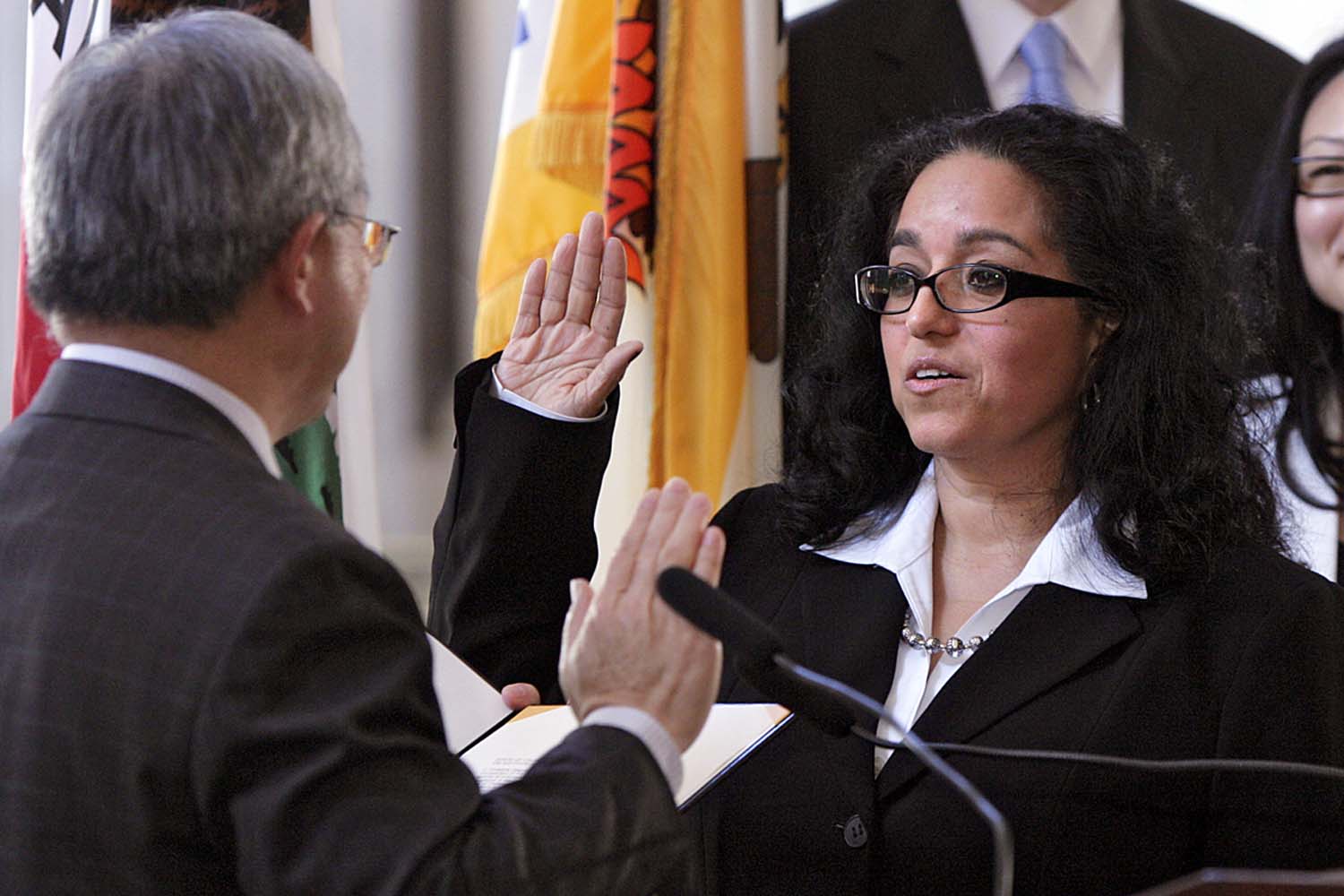
Olague has been trying to execute a tough balancing act between the progressive community that she’s long identified with and the moderates she began courting last year with her early support for Mayor Ed Lee, who returned the favor and appointed her to serve the final year of Ross Mirkarimi’s D5 term. But by most accounts, she hasn’t executed the feat well, usually siding with Lee on key votes, but doing so in a waffling way that has frustrated both sides.

Progressive candidates such as Julian Davis and John Rizzo will have plenty of fodder with which to attack Olague as a turncoat, including her votes on the 8 Washington project and Michael Antonini, her strange antics on repealing ranked-choice voting, and her close ties to power brokers such as Rose Pak, who hosted a fundraiser that provided more than half of the $81,333 Olague has raised this year, much of it from developers and other interests outside of D5.

Matt Gonzalez – the former D5 supervisor, board president (from where he appointed Olague to the Planning Commission), and mayoral candidate – was so frustrated with Olague that he withdrew his endorsement of her last month, a decision that her other progressive endorsers are also said to be mulling.

With Mirkarimi tarnished by his ongoing official misconduct probe, the endorsement of Gonzalez could be the most significant in this race, and he told us that he plans to make a decision by Friday, the deadline for submission of ballot statements and a point at which we may hear about other changed or dual endorsements from prominent progressives. Other key nods in the race so far have been Aaron Peskin endorsing Davis and Tom Ammiano endorsing Rizzo, two candidates each vying to become the favorite of the left, with Thea Selby, Hope Johnson, and Andrew Resignato also courting support from the left.

Yet so far, the strongest challenge of Olague seems to be coming from her right, with moderate London Breed leading the fundraising battle with $85,461 as of late June 30, including the maximum $500 donation from venture capitalist Ron Conway – the main fundraiser behind Lee’s election last year – which may be a sign that Olague’s support among moderates is also soft.

Olague may be trying to get back in good with the progressives, last week introducing pro-tenant legislation sought by the San Francisco Tenants Union. But impressions have formed and the pressure is now on, and so far Olague – who didn’t answer our calls seeking comment, another troubling trend – hasn’t performed well in public appearances, mangling organizations’ names and generally not winning over her audiences.

Will Olague step up now that the campaign in entering its public phase? Will another candidate catch fire with progressives? Find out tonight from 6-7:30pm at the Park Branch Library, 1833 Page Street. It’s sponsored by the District 5 Democratic Club, the D5 Neighborhood Action Committee and the Wigg Party.

Or if you miss it, catch the next one on Tuesday, sponsored by the Harvey Milk Democratic Club, starting at 7pm in the Eric Quezada Center, 518 Valencia Street.

Forum tonight cancelled after Mayor’s ‘no stop and frisk’ announcement

30

A community forum to discuss stop and frisk tonight has been cancelled, in the wake of Mayor Lee’s announcement yesterday that he would not be implementing the controversial policy.

“We will not be implementing the stop and frisk program, or variations of that, in San Francisco,” Lee said at a press conference yesterday that was well-attended by neighbors, faith leaders and other interested parties.

Before the announcement, a forum was planned tonight for a panel discussion about stop and frisk at the CCSF Southeast campus. It was organized by filmmaker Kevin Epps, known for Straight Outta Hunter’s Point and Straight Outta Hunter’s Point 2, and the Osiris Coalition.

“There’s still a problem,” Epps said. “But as far as what they had planned on doing, the mayor actually backed off of implementing any part of that.”

Instead of stop and frisk, Lee said, the police will use “interrupt, prevent and organize” (IPO). The program involves keeping tighter tabs and the city’s 200 parolees as well as formerly incarcerated people in general, using computer data to track and send police to high crime areas, and working with community groups to “liaison” between police and residents.

Many hope that the conversation continues, however. “Ed Lee needs to meet with some of the younger people in this community about how to stop this violence,” said Jameel Patterson, organizer with the Bayview-based Black Star Liner Coalition. 

On 67th anniversary of bombs in Japan, nuclear energy challenged

4

An hour before the Chevron refinery in Richmond started to burn, Bay Area residents were demonstrating against a different type of energy that posed different environmental and health risks. It was August 6, the 67th anniversary of the day Hiroshima was devastated by a nuclear bomb. August 9 will be the anniversary of the bomb in Nagasaki.

To mark the day, about 50 met in front of the Japanese consulate in San Francisco. They then marched a few blocks to PG&E, bells chiming in beat with chants of “Radiation has no border,” “No nukes, shut the plants down” and “Hiroshima, Nagasaki, Fukushima. Never again, never again, never again.” 

The protest also commemorated the nuclear disaster at Fukushima on March 11, 2011, On Monday, the Japanese government released videos from the day of the disaster.

Speakers emphasized the ill-health effects still felt in the regions where the bombs were dropped.  Between 150,000 and 240,000 people were killed by the bombs, and survivors often suffer cancer and other radiationrelated problems due to their exposure. 

“People are still suffering. Children still have deformities. This is not over,” said Steve Zeltzer, KPFA radio host and member of No Nukes Action Committee 

Long-term reprecussions of military use of nuclear technology are felt strongly Hunter’s Point as well. That was where the US navy docked 79 ships that had been exposed to radiation following a bomb test in Bikini Attol. They docked in San Francisco to be decontaminated and, in the process, released radioactive material. Stationed in Hunter’s Point, and tasked with testing the material on the ships along with other research, was the Naval Radiological Defense Laboratory, which continued testing involving radioactive material in the area for decades. 

“We’re struggling very hard to force them to clean up the nuclear waste that’s buried in BVHP,” said Marie Harrison of Greenaction for Health and Environment. 

“As a mother, grandmother, and great grandmother who happens to live in Bayview-Hunters Point,” said Harrison, “this madness needs to stop. And if we don’t say it, no one else will.”

At the demonstration, protesters passed around a petition calling on the Japanese government. The petition calls for an end to nuclear power in Japan and government funds to evacuate people who remain in Fukushima because they can’t afford to leave.

Protesters also expressed concern about the San Onofre nuclear power plant, which was taken offline in January following a radioactive gas leak. The plant is of concern to San Diego Gas & Electric as well, who say that meeting energy needs for the area will be difficult this summer following the leak.

Impertinent question for Sup. Malia Cohen

14

As attentive readers know, I get most annoyed when a “neighborhood” supervisor, who ran as a “neighborhood” candidate, gets to City Hall and then votes the Chamber of Commerce/big development line without gulping.  And so I pop off Impertinent Questions now and then to pin the “neighborhood” supervisor on key votes  to illuminate the issue.  My latest Impertinent Question went by email last Friday  to Sup. Malia Cohen of District l0 (Potrero Hill, Bay View, Hunters Point) on her swing vote to keep the developers’ quarterback on the Planning Commission. City Editor Steve Jones  makes the point neatly  about Michael Antonini in his blog.  http://www.sfbg.com/politics/2012/08/01/antonini-quarterback-development-interests-wins-game

Cohen has earned an 80 per cent vote in the recent Chamber of Commerce’s mid-year “Paychecks & Pink Slips” voting scorecard for supervisors. And she is likely to do even better on the next score card with her votes for astroturf at Golden Gate Park and to shut down the Sunshine Task Force.                                                                                    

“Dear Sup. Cohen,

“Why did you as a neighborhood supervisor from District l0,  a neighborhood anxious about massive development from Potrero Hill to Hunters Point,  provide the swing vote for Antonini who operates as a quarterback for big development interests on the planning commission?  I would appreciate an answer for my Bruce blog at sfbg.com.”  I gave the supervisor a Monday deadline but I still had not heard from her by Tuesday evening.. I’ll keep trying to reach her for comment and keep you posted. B3


Community questions Chevron in wake of refinery fire

46

This post has been updated to correct information concerning the Ecuadorian lawsuit against Chevron.

In the wake of last night’s fire at Chevron’s oil refinery in Richmond, community members are asking questions about exactly what happened, what health risks the public was exposed to, and whether the facility is safe.

Tonight [Tue/7], they’ll get a chance to ask those and other questions of Chevron representatives as the company hosts a townhall meeting at 6pm, preceded by a rally called by Asian Pacific Environmental Network at 5:30, both at Richmond Memorial Auditorium, 403 Civic Center Plaza, Richmond.

The fire ignited just before 6:30pm and burned for more than three hours before it was contained. As the fire burned, thousands of residents were warned to stay indoors, seal off all doors and windows, and, preferably hiding in rooms with no windows or doors within their homes.

This morning, Chevron spokesperson Heather Kulp reported that a preliminary investigation showed that the fire was a result of a hydrocarbon vapor leak that ignited. She denied that any explosion occurred, despite witness reports that they heard loud booms.

“There was an ignition. That may be what people are talking about hearing,” she told ABC.

On KQED’s Forum program this morning, she implied that an expansion of the plant that was stalled by the courts after being challenged by environmentalists — which she termed an “upgrade” — might have prevented the fire. But that notion by dismissed by Communities for a Better Environment, which said in a prepared statement, “This crude unit was not part of what it was going to replace.”

They and others were also skeptical of company assurances that the fire never presented a danger to the community. “We do have in place comprehensive plans and procedures to respond to situations like the ones we are facing this evening, and we are taking appropriate measures necessary to provide for the safety and security of our facilities, our employees and our surrounding community,” said the refinery’s general manger Nigel Hearne last night.

But APEN reports that a multi-lingual warning system that includes boxes installed in residents homes may have failed. “To compound Chevron’s lack of safety accountability in last night’s refinery fire/explosion, the multi-lingual warning systems that APEN and our allies fought for and won, failed. Many residents reported not being properly notified and are now experiences dizziness, headaches and other symptoms of exposure to toxins,” the statement reads.

More than 300 people flooded emergency rooms in the hours after the fire ignited complaining of respiratory problems. This is not the first time that Richmond residents have been affected by toxic fumes from the Chevron oil refinery. A similar fire happened in 2007 and burned for 10 hours.

Sierra Club put out a cautionary statement on the incident: “No one should have to live downwind of a dangerous oil refinery. Our thoughts are with the families living near the Chevron facility who must now contend with the aftermath and long-term health consequences of breathing in smoke filled with dangerous particulate matter, soot and cancer-causing toxins like sulfur compounds.”

Yeterday was already a bad day for Chevron — midnight was their deadline to pay a $19 billion settlement, to be paid into a fund managed by the Ecuadorian government, following a decades-long lawsuit. The company was found guilty of widespread land contanimation there, including releasing toxic water into rivers and streams, dumping waste in unlined pits, and frequent oil spills and gas flares.

The company did not pay by the midnight deadline.

“The plaintiffs will continue to seek enforcement of that ruling in other countries where Chevron has assets,” said Paul Paz y Mino, spokesperson for Amazon Watch.

Chevron claims that the ruling in Ecuador was invalid and based on fraud, and has refused to pay the settlement money. “The Ecuador judgment is a product of bribery, fraud, and it is illegitimate. Chevron does not believe that the Ecuador judgment is enforceable in any court that observes the rule of law,” reads a statement from the company.

“I don’t know if the two are connected in any way,” said Karen Hinton, spokesperson for the Amazon Defense Council. “But certainly the fire is in keeping with what we see in other countries, which is a disregard for the rule of law and an attitude of, if we can skirt safety regulations, we will.”

Instrumental duo Silian Rail includes ‘every/one’

0

Do artists need vocals and lyrics to demand audience attention in a place like the Bay Area, where there are new musicians popping up left and right? Eric Kuhn and Robin Landy, better known as instrumental duo Silian Rail, have found the answer to that question to be a resounding “no.”

With a handful of locally well-received releases under its belt and an upcoming headlining show at Bottom of the Hill, Silian Rail has clearly made it work thus far without words. The band’s songs run on a driving rhythm paired with carefully crafted guitar work. The complexity of its sound has continued to kept critics and fans coming back for more – a happy discovery for many, that expansive instrumental music can hold their attention.

For a recent companion piece, however, the band added something somewhat foreign to its repertoire, through collaborations with other artists: vocals. “We do have a couple singers on this album,” Kuhn says.

“Our choice to be an instrumental band is not something we ever really talked about. The way we play together emerged quite naturally – [Landy] plays guitar, I play drums…We thought it would be a fun excuse to collaborate with friends and see what they would contribute.”

Silian Rail’s collaborative recent EP every/one (released in May of this year as a companion to the each/other album) will benefit United Roots Oakland, with all of the proceeds going towards its community engagement programs in the arts and media. That EP includes Lewis Patzner (Judgement Day, the Devotionals), Thao Nguyen, Andrew Maguire (Thao and Mirah, DRMS, the Devotionals), Colleen Johnson (Upside Drown), and Winston Goertz-Giffen (Saything).

“The Bay Area music scene is great – not just to blow smoke up the collective ass of the Bay Area,”  Landy says with a laugh. “It’s non-competitive and very supportive. It seems different than LA or New York in that way… I’m just guessing.”

Kuhn says the title of the album, every/one, is a reflection on the tension and paradox of the strength of a collective or a collaboration versus the importance of individual freedom.

“The songs are more or less all from a similar thematic world, which are various texts, films, experiences relating to non-normative psychological functioning – an attempt at sensitively referring to what is classically termed ‘mental illness’,” Kuhn explains.  

“[We] have a lot of empathy for these perspectives, and relate to them in many ways, and respect the non-normative psychological individual as being someone often possessing of an ability to see beyond the arbitrary limits placed on our experience of the world by the various social codes and ideologies that are part of the status quo. There is a wildness and also a directness and a poetic nonsense clarity that we find inspiring and that generally tickles our fancy.”

The band discovered United Roots Oakland at an Occupy Oakland event, where there were young kids free-styling. “It’s an awesome thing to have a creative outlet for kids, [and] to have competent adults there to coach them,” Landy says.

And since the EP was a collaboration, it seemed strange for the band to personally collect a profit from it, Kuhn says, which is they decided to donate.

Silian Rail has a long history of creative endeavors with other musicians. It first gained attention through its connection with other East Bay acts such as Tartufi, Birds & Batteries, and Low Red Land as the group Thread Productions. Although Thread is no longer active, a lot of what the group used to do still happens informally – the bands frequent each others’ shows, try to spread the word on upcoming concerts, and often perform live together.

“It was a hugely helpful idea at the time,” Landy says. “Lynne Angel from Tartufi still plays with us. Our new record is super lush, so we needed extra instrumentation, and she was kind enough to lend her talents. Tartufi still does a lot of broader community organizing around music. I have no idea how they find the time and energy to do it!”

Yet Silian Rail seems to pack in a lot projects in too. Its working towards scoring more film projects – its music has already turned up in various indie films, short clips, and videos, such as an ad for “Farm Fresh Cocktails” (which both Landy and Kuhn found quite odd). Essentially, the Silian Rail sound seems ideal for soundtracks.

But the band’s own music, of course, always comes first. They’ve both long been drawn to creating music. They were friends who grew up together in North Carolina, and parted ways at 13, only to find one another in California many years later.

“Having a guitar with me through adolescence was a lifesaver, having that emotional outlet.” Landy says, reflecting on the importance of music.
Another charitable activity on the band’s plate: it just finished a session at Bay Area Girls Rock Camp – a nonprofit organization that “empowers girls through music” –  in Oakland before our interview. At the camp, musicians teach workshops, host group activities, and perform live.

“Kids are so honest that we were more nervous to play in front of a group of five to 12-years-olds then we are playing a packed venue in San Francisco,” Landy says, “They asked us why we don’t have a singer.”

“With these arts programs, it’s not like if kids have something to do, their problems will go away, it is clearly more complicated; but music can serve as an outlet.”
Kuhn adds: “Music is a means of expression and communication that transcends a lot of barriers – things like technology – more than just language and culture. It holds a fundamental power to enable communication with people.”

For such a technically impressive band, I was impressed to find out that Landy had no formal training on guitar “I don’t really know what I’m doing at all, which has mostly helped my style evolve. I am free to experiment and do things in a different way. It’s all abut making happy mistakes; of course there are benefits to knowing what you’re doing, but it is also a benefit for me to not know. The way I learn things, it probably would have been a waste of time anyway.”

“I did play flute in band during middle school,” she says. “But guitar is basically the opposite of those instruments.”

While Eric had a moderate amount of formal training (he took guitar lessons in high school and “tried to be a music major in college”), he now learns to write for different instruments for new songs without proper lessons. “I needed to write violin and cello parts for songs I’m doing on the new album, so I sat down with a music book and did that.”

“I’m inspired by painters,” he muses. “The idea of fearlessly exploring new territory and always pushing ourselves to new places.”

Silian Rail
With Shuteye Unison, B. Hamilton
Thu/9, $10, 9pm
Bottom of the Hill
1233 17th, SF
(415) 626-4455
www.bottomofthehill.com

Activists win legal victory just as the circus comes to town

52

Animal welfare advocates and other critics of Ringling Bros. and Barnum & Bailey Circus just won an important free speech court victory against the city of Oakland just as they prepare to protest the circus starting its annual run there tomorrow.

The grassroots group Humanity Through Education announced that it has reached a $500,000 settlement with Oakland to a lawsuit that plaintiffs Pat Cuviello and Deniz Bolbol filed following their 2004 and 2005 arrests while trying to document abuses of elephants by circus employees.

The settlement includes an injunction allowing the activists to freely videotape the circus operations and to distribute literature critical of circus practices, which they will exercise starting tomorrow (Wed/8) at 6:30pm outside Oakland Arena, where Ringling Bros. begins a five-day run.

“Pictures of Ringling Bros. Circus training of baby elephants will be on display and behind-the-scenes video of Ringling elephant handlers beating the animals will be shown on a large screen. The Ringling elephant handlers videotaped beating the elephants are the same handlers working the elephants in Oakland this week,” the group said in a press statement.

To read more about how Ringling Bros. treats its elephants and its critics, read our 8/12/08 cover story “Dirty Secrets Under the Big Top.”

Molded in his image: James Deen sex toys released

6

Perhaps you caught our cover story this week on crossover porn star James Deen. In it, I talk about how Deen has managed to bridge all kinds of genres in adult entertainment: BDSM furry porn to mainstream smut couplings to Brett Easton Ellis movies. Everything for everyone, non? Well not exactly — until mid-September, when Doc Johnson releases a new line of Deen-themed sex toys, including a nine-inch dildo molded directly from his member. We chatted with the company’s chief operating officer about what exactly that entailed. 

The full line-up of Deenware

It all seems pretty straightforward — realistic dick vibrator, an “anal trainer” kit featuring two sizes of butt plugs and lube, cock rings, and a suction-mountable dildo. But the James Deen Signature Pump? After seeing his movies, I doubt the actor has a signature penis pump. Just saying. We spoke to Doc Johnson’s COO to find out how they choose whose dicks get molded, and what the reach of a celebrity dildo is, anyway. Find the gear in your local adult store this fall.

San Francisco Bay Guardian: Why James Deen’s penis? Who makes the decision about which celebrity gets immortalized? 

Chad Braverman: We strive to partner with the best and James Deen is just that. He is everything we look for in a partnership: extremely popular, loves what he does, loves what we do, and wants to create great product. We make that decision internally based on factors like fan base, and the performer’s reputation, as well as their interest.

SFBG: How does the fitting/molding process take place for the lifelike dildos? 

CB: James deen put his cock in a tube, we filled that tube with our proprietary casting formula. After it hardened, we pulled it out and then once it is confirmed a good molding, we use a harder casting material to fill the cavity left behind and that is our “cast master.” From there, it is a lot of hard work and a very detail oriented approach that makes the product as amazing and realistic as it is. 

Time for dick molding. 

We decided to manufacture and release James Deen’s nine-inch cock in two materials, each with their own unique benefits: our premium grade platinum silicone, which is the best silicone on the market and is completely hypoallergenic, nonporous, and body-safe — this silicone cock is firm and includes a three-speed powerful yet removable mega bullet that is waterproof and delivers intense vibrations throughout the cock. The other version is made of our fifth generation Realistic(R) which is the most lifelike material you can get, it truly captures every detail and feels truly like a real cock — this PVC material is also body-safe, as well as non-phthalate and features antibacterial Sil-A-Gel formula. 

SFBG: What has been your most successful celebrity model to date? How many copies did that sell? 

CB: This is hard to answer – we’ve had a beyond-successful partnership with Vivid for 25-plus years that basically created this market. No one was doing realistic casting before us. Jenna Jameson, Sasha Grey, and Belladonna have all been mind-blowing successes. It’s a great indicator of the success of these lines and the longevity of these stars that we still sell their products today — the demand is there and the products satisfy the customers. Exact numbers, I cannot say. However, we are very fortunate that we only want to work with the best, and it seems that the best only want to work with us.

Deen and Braverman: a job well done.

Heads Up: 7 must-see concerts this week

1

Outside Lands is nearly here, and you’ll read plenty about that in the paper. But the festival is now sold out, plus I do realize there are many people simply not interested in attending festivals period. For you, those averse to the outside and massive crowds, there are other sonic highs in the Bay Area this week – including Foxygen, Shonen Knife, Redd Kross, new club night Y3K, and, wait for it, Neil Diamond.

My first real memories of music – and vinyl records – are of Diamond, mouth agape, in a denim suit with frizzy hair dipped down towards his navel on the iconic cover of Hot August Night (1972). In my childhood home, Neil Diamond came first. And my starry-eyed mom was there at the Greek in Los Angeles during the live album recording. “It was a lovely still night…Diamond admirers were everywhere” she says, adding, “The acoustics were excellent and his voice was pitch perfect.”

Okay, so maybe you weren’t born-and-bred in the Diamond cult; but you get that feeling right? It’s like how cat-burglerish actress Anne Hathaway recently described another, very different concert in Vanity Fair. “I was there and it was beautiful…we all knew we were there seeing something special.” (LCD Soundsystem’s last show.)

My point? Go see something special. Here are your must-see Bay Area concerts this week/end:

Foxygen
If you need oxygen to breathe, you need Foxygen to pant. The vaguely French inflected, 1970s-referencing bi-coastal duo oozes sexy glam rock excess. And vocalist Sam France has the reassuring swagger of Lou Reed with a little burst of Bowie.
Tue/7, 9pm, free
Brick and Mortar Music Hall
1710 Mission, SF
(415) 371-1631
www.brickandmortarmusic.com
https://www.youtube.com/watch?v=VwK32IuseGM

Neil Diamond
For those in awe of furry-chested croonership; the entertainer, the Jewish Elvis, the sweaty LA icon. Neil Diamond’s Hot August Night boasts the moody ballad “Solitary Man,” bouncy pop classic “Cherry Cherry,” the original, non-reggae “Red Red Wine” and frat boy standard, “Sweet Caroline.” Now, on the 40th anniversary of that multi-platinum double album, Diamond is touring again, playing the hits.
Tue/7, 8pm, $52-$117
HP Pavillion
525 W. Santa Clara, San Jose
pavilionsanjose.com
http://www.youtube.com/watch?v=liw6vVhVP7I

Redd Kross
“When brothers Jeff and Steve McDonald first formed the band that would become Redd Kross in the late 1970s, they were just 11 and 15 years old — and famously played their first gig opening for Black Flag. Returning with their first new album in 15 years, the excellent Researching The Blues, which dropped this week, the group continues to twist infectious melodies and pop sensibilities into short, stunning bursts of rock’n’roll.” — Sean McCourt
With the Mantles, Warm Soda
Wed/8pm, $20
Great American Music Hall
859 O’Farrell, SF
(415) 885-0750
www.slimspresents.com
https://www.youtube.com/watch?v=oGPMa6k4mFk

Parallels
The Toronto synth-pop trio (formed by ex-Crystal Castles drummer Cameron Findlay) might as well be made up of snowy elves, stabbing sharp crystals through other dimensions, or glitter-covered black dancing dresses, forever spinning around Princess Lili. It’s so very ’80s fantasy movie. And singer Holly Dodson’s Grimes-ish high lilt is the ideal match to the eerie electronic atmospheres.
Thu/9, 9:30pm, $14
Rickshaw Stop
155 Fell, SF
(415) 861-2011
www.rickshawstop.com
http://www.youtube.com/watch?v=ezWfz4uCMYg

Y3K
“Here’s the dark, dreamy, bass-crazy lineup of mega-wicked promoter Marco de la Vega’s first monthly youthful assay: Gatekeeper, Teengirl Fantasy, Nguzunguzu, 5kinandbone5 with secret spec1al guest, and the Tenderlions. Good thing I turned 18 last month, see you there.” — Marke B.
Fri/10, 10pm, $18
DNA Lounge
375 11th St., SF
415-626-1409
www.dnalounge.com
https://www.youtube.com/watch?v=YxzvFcUJdHQ

Shonen Knife
Last time the legendary Japanese pop-punk act Shonen Knife came to town, it played an entire encore set of Ramones covers. Not to say that it will happen again, but just fair warning that the trio is capable of such magic.
With the Mallard, Chuckleberries
Fri/10, 9pm, $14
Bottom of the Hill
1233 17th St., SF
(415) 621-4455
www.bottomofthehill.com
https://www.youtube.com/watch?v=ADo6wawOUFo

Al Jarreau, George Duke Trio
“One of the most versatile, expressive vocalists of the last 50 years, Al Jarreau jumps restlessly between soul, jazz, pop, and samba traditions, refusing to let any genre tags define him. George Duke is an undisputed keyboard champion, whose ’70s jazz-fusion recordings have permeated modern hip-hop and neo-soul to an astonishing degree.” — Taylor Kaplan
With Mara Hruby
Sun/12, 2pm, free
Stern Grove
19th Avenue at Sloat, SF
(415) 252-6252
www.sterngrove.org
https://www.youtube.com/watch?v=4gZr5sqJmV0

Live Shots: Aerosmith and Cheap Trick at the Oracle Arena

7

Photographer Allen David was front and center for Aerosmith and Cheap Trick’s joint concert at the Oracle Arena. Check out his photos and read his thoughts on all the good time rock’n’roll — and action in the pit — in the story below.

Last week I was asked to shoot some photos of Aerosmith and Cheap Trick at the Oracle Arena. I was quite excited at the prospect of hanging out back stage with some of the great rock stars of my youth. When I was 13, I had the privilege of experiencing Cheap Trick in their prime at Six Flags Magic Mountain. And I remember as a kid watching Aerosmith’s cameo in one of my favorite films; Sgt. Peppers Lonely Hearts Club Band (1978). They played rock’n’roll villains, who nearly destroyed the the Bee Gees and Peter Frampton, with their rendition of Come Together.

After shooting some photos elsewhere, I jumped in my VW Bus and hit the pedal to the metal. I was running a little late, and worried that I wouldn’t get into the show. Thankfully, I arrived just in time, and was escorted backstage, where I exchanged glances with Robin Zander.

Next, I was put directly in front of the stage, in The Pit. Which was a great place to view the action, as the rock stars were perfuming their jests within arms reach. Without earplugs, I snapped away, as Rick Nielsen, Tom Petersson, and Robin Zander rocked out right in front of me. Sadly Bun E. Carlos escaped my camera, by hiding behind his drum kit. It was amazing to watch these guys live, 30 years after my last experience with them. They still played the same music, and rocked equally as hard. I would have loved to talk with them about what it’s like to spend so many years reliving their classic tunes.

After the first three songs I had to leave the pit, to give the front row peeps a better view. So for the rest of the Cheap Trick show, I ventured around the tunnels of the Oracle ’till I found the snack booth, and made it into the audience.

Just before Aerosmith came on stage, I was allowed back into The Pit to click photos for their first three songs.  Steve Tyler and Joe Perry are super great for shooting photos. They dress, and move like true rock stars, making my job as a photographer super easy. Steven Tyler’s presence on the edge of the stage seemed to mesmerize every person that he came close to.

He had complete control of the audience. I got to click away as they played three of their classics: “Draw the Line,” “Love in an Elevator,” and “Same Old Song and Dance.” I couldn’t help but nod my head like a parrot, as the rock’n’roll rhythms moved though my body. Sadly after three songs, I was ushered out of The Pit, to give the audience a better view of what they paid to witness. I walked out of the back door, and found my VW Bus still there at the edge of the parking lot, and drove home, while reminiscing about the good old days of rock’n’roll.

Is the War on Fun over, or do we still need to fight for our right to party?

6

On Monday, the Entertainment Commission brings together a slew of City folk and party people at its fourth annual Nightlife Industry Summit. The three-hour affair includes speeches from Police Chief Greg Suhr, Sup. Scott Weiner, and perhaps Mayor Ed Lee, as well as a panel of speakers, and break-out sessions where club owners, security officers, and outdoor event planners can respectively brainstorm, said commission director Jocelyn Kane.

Past summits have resulted in legislation and policy changes, Kane said, pointing to loitering laws and Sup. David Chiu’s parking lot security legislation last year. This year, Kane thinks there aren’t any pressing problems to address or big controversies that have roiled the commission in past years.

“There’s very little violence and our security staff is much more professionalized than they’ve ever been,” she said. “For me, it’s a year when we can raise the bar in terms of programming inside venues and diversifying the patron experience.”

Club owners and event producers will have some free time to swap tips when the structured portion of the day ends. Kane thinks all neighborhoods should attempt to mimic the Mission, where the wide variety of venues allows a partyer to buy a “big fat martini at Blondies, roll down and eat a burritto, and catch some music at the Elbo Room” as opposed to those who spend the evening on Broadway, where “everyone’s offering the same thing.”

Though Kane couldn’t identify any negative issues on the Summit’s agenda, Opel event producer Syd Gris has plenty of grievances he plans to address on Monday. Gris, who will be speaking on the panel for the first time, said what the Guardian coined as the “War on Fun” in 2006 wages on in 2012.

Gris plans to bring up June’s Opulent Temple Massive on Treasure Island, which was designed to be for visitor aged 18 and over, but the San Francisco Police Department captain that oversaw the event insisted it only allow in those of drinking age, “despite ample precedence of events in the city being 18 and over.”

“For them to deny us the ability to do something that happens all the time in the city just because one captain didn’t like it was unfair and had a huge economic impact,” Gris said. “It’s a great example of what’s wrong with how certain things work in the city. Arbitrary decisions that are inconsistent, unfair, and have a deleterious impact on an event producer can be made by small groups of people.”

His was not a stand alone experience, but part of a broader, Gris said. The mellow Fillmore Jazz Festival had to have beer gardens for the first time this year, Power to the Peaceful was cancelled last September, as was LovEvolution this year after the SFPD places onerous restrictions on it.

“I am certainly glad that the conversation is happening with people that need to be hearing about it,” Gris said of the Summit. “Will a real change come out of it? I’m not optimistic but I certainly hope so.”

The event — held in the Main Library’s Koret Auditorium — is free and open to the public, so come fight for your right to party 1-4pm. 

Supervisors prepare to receive Mirkarimi case from Ethics

37

The Board of Supervisors this week adopted a plan for considering ousting their former colleague, suspended Sheriff Ross Mirkarimi, on the official misconduct charges brought by Mayor Ed Lee in connection with Mirkarimi grabbing his wife’s arm on Dec. 31. The Ethics Commission is scheduled to make its final recommendation on Aug. 16, after which it will cull together the mountain of documents and evidence developed over the last four months.

Ethics Commission Executive Director John St. Croix tells the Guardian that it will take at least three weeks after the commission votes to compile an official record that already includes documents that now fill three five-inch-thick binders, which will grow with the “findings of fact” and recommendations that the commission will adopt on Aug. 16.

So the board won’t formally get the case until Sept. 6 at the earliest, at which point it will have a City Charter-mandated 30 days to make a decision, which requires at least nine votes from the 11-member board to remove Mirkarimi from office. Board sources say they want to give supervisors some time to review the voluminous record before the hearing, but still allow for a continuance if necessary, making the likely hearing date Sept. 18 if all goes according to schedule.

“Everything we have so far is available online, so if they wanted to get a head start, they’re welcome to,” St. Croix said of the supervisors.

Despite the fact that the commission spent lots of painstaking hours ruling on the admissibility of evidence – including cutting out most of the 22-page declaration of Lee’s star witness, Mirkarimi neighbor Ivory Madison, with commissioners ruling it was a prejudicial attempt to “poison the well” – St. Croix said the entire record will be passed on to supervisors, with strike-throughs or similar indicators for evidence ruled irrelevant or prejudicial.

“It’s got to be easy to understand because once the board gets it, the 30-day clock is ticking, so it needs to be clear,” said St. Croix, who says he is still weighing how much of the evidence can be transmitted electronically versus in paper form.

The Ethics Commission opted not to explore accusations that Mayor Lee committed perjury on two separate issues during his live testimony, but the issue of whether he consulted with any supervisors is likely to come up again as it goes to the board. Supervisors, who essentially act as jurors in these proceedings, have been legally barred from discussing the case, particularly with Lee.

Building Inspection Commissioner Debra Walker said her friend Sup. Christina Olague told he that Lee once asked her about filing charges against Mirkarimi. Olague denied it, but then told reporters that she may recuse herself from the case. One other supervisor is also rumored to have discussed the case with Lee (who denied it under oath).

When Mirkarimi attorney David Waggoner addressed the board on Tuesday, he asked them to affirmatively declare they have not discussed the case with anyone before deliberating. Any supervisors who recuse themselves would become de facto votes to keep Mirkarimi in office because doing do still takes nine votes, no matter now many supervisors actually vote.

Waggoner also objected to the short schedule – which includes a 10-minute presentation by a representative from Ethics, 20 minutes by the Mayor’s Office, 20 by Mirkarimi’s side, a five-minute mayoral rebuttal, and unlimited questions from supervisors and public comment – saying that it belies the serious and unprecedented decision to override voters and remove an elected official.

“This proceeding is extraordinary in its nature,” he said, objecting to the board adopting essentially the same procedures it uses for appealing routine Planning Commission project approvals.

But St. Croix said he welcomed the board’s shortening of his agency’s presentation, saying its recommendation and the record it compiled should speak for itself. “I don’t even know what the commission would present,” he said. “To try to sell it is not seemly.”

Donorsexual: One man explains why he spreads his sperm around

0

At this point, I am not one for making babies. Perhaps this has to do with the unpleasantness of cervix dialation, or maybe it’s the salary of an alternative journalist. At any rate, this week I had an email correspondence with a Fremont man that is very much one for making babies. 15 of them, in fact. But he is not one for having sex. He’s a virgin, with a strong and understandably conflicted relationship with Jesus. He loves to help gay couples have kiddos (check out his website!) On Sun/5, this Trent Arsenault will be profiled on TLC’s new TV show look at unique sexualities, Strange Sexalong with a woman who is able to orgasm sans physical stimulation, which sounds amazing. Trent, what’s up with you?

San Francisco Bay Guardian: So why be a sperm donor? 

Trent Arsenault: I’m donorsexual. I knew this was my identity as young as 10 years old. It’s kind of like asking someone why they were born straight or gay, I don’t really know why.

SFBG: How’d you get started? At what point did you decide that this is what you want to dedicate yourself to? 

TA: Growing up in a religious family, it was instilled in me to be a servant to others. I started out doing the normal volunteer things (soup kitchens, missionary trips, building playgrounds). The church that I grew up in didn’t believe that infertile couples should have children (other than adoption). I thought it was wrong to discriminate. So as a teenager I parted with the church’s ideas and hung up the hat on religion, but held onto the basic teachings. I knew there was something about my sexuality that was different, and when I moved to the Bay Area I had been searching for a way to use it to help others when I found out there were childless couples searching for sperm donors. I vowed to begin helping the very group that my church descrimated against, which was gays and lesbians. So the first 10 babies that I was the donor for were lesbian couples in the Bay Area. After my family back in Missouri found out, they haven’t  talked to me to this day because they say I am a servant to sinners. The Bay Area couples who I donate to have become my new family.

SFBG: What is involved in maintaining your top sperm donor conditioning? 

TA: Above all, sticking to your beliefs and making sacrifices for others.  For example, when Strange Sex was filming with me in Fremont, I received a call from Meg Whitman’s office. After almost 15 years working at Hewlett Packard’s HQ in Palo Alto, the corporate officers wanted to investigate my activity as a sperm donor, and asked me to out the families at HP who I had donated to as part of their investigation.   Knowing that Ms. Whitman was against gay marriage and gays having children, I felt it was worth me to sacrifice my job versus letting the HP board bully the families who I donated to (some who had newborns at the time). So my response to Meg Whitman was, I didn’t cave to the US government (the FDA) when they demanded I stop donating, so I’m certainly not going to cave to a corrupt politician such as yourself. Needless to say, I was fired by HP for not cooperating in their investigation of my activity as a sperm donor. My first thought was to sue HP, but the biblical scripture from Jesus “if anyone wants to sue you and take your shirt, hand over your coat as well” changed my mind. I’m remaining a sperm donor without my six-digit salary from HP. But I’m committed to hanging in there. And HP’s stock is hitting a multi-year low, so I have the last laugh.

SFBG: Have you ever thought about having a kid through sex with a woman or having a kid of your own? 

TA: I don’t see non-donor sex in my future. I’m probably the only virgin with over a dozen biological children, but this passage from Matthew 19:11-12 sums it up. Jesus said, “Some people were born differently to be celibate, so accept the fact and use it to further God’s kingdom.” I doubt anyone who ever read that scripture would have ever guessed how being a virgin can make you the person with the most biological children in California.  

It is wonderful to hear the stories from parents I have helped telling me how the children have brought joy into their lives and make them laugh every day. I guess hearing this feedback from the parents makes up for whatever else might be lacking in my life by not having my own children.

SFBG: Have you met any of your children? What was that like? 

TA: I just received a birthday invitation in the mail from the parents of a two-year old girl who lives in Sacramento. Never thought that day would happen! I think it’s going to be a little awkard for me to show up to the party, being the donor — meeting the grandparents, and sitting around having birthday cake, and chatting. I replied to the RSVP and said I would make it, so I’ll let you know how it goes!

Catch Arsenault on TLC’s Strange Sex on Sun/5 at 10pm


Live Shots: Buraka Som Sistema at the Independent

2

How much space does a person need to dance? If you’ve been to a packed, over-sold massive EDM show lately, the answer could be zero, as being rooted in place and fist-pumpin’ seems to be all the rage. Really, though, if you’re at least going to move your feet then a little more room* is required.

Which is why I was relieved to find that the Independent, while crowded, wasn’t packed to the walls last night. Because Portugal’s Buraka Som Sistema likes to get down in a very specific way. In that way that Tribe liked to get down – devoted to the art of moving butts.


“If there’s one thing we like to do,” Kalaf Ângelo said during a brief pause, “we like to make people concentrate on the booty.” “No, not the booty,” fellow MC Andro Carvalho corrected, “the ass.” Accepting this distinction, Kalaf paraphrased Parliament: “Free your fucking mind and your ass will follow.”

The techno/kuduro sounds of Buraka Som Sistema may not have been instantly familiar – aside from momentary Lil’ Wayne samples – but following along was easy, as the trio at the front of the stage brought a level of hype (they were clearly having a good time) that was hard to resist.

Copping the dance moves, though, particularly attempting to duplicate the intense MC Karla Rodrigues – who at one point had sort of an extended ass shaking solo – was probably best left to the more experienced dancers with a generous amount of space.**

*A plot of floor with a diameter of 1.6 times the length of your shoulders is the minimum, if you want to be all specific about it.
** Seriously. You don’t want to kick someone in the face just because you really like the beat.

You, too, can win a gold medal in popcorn eating: new movies!

0

This weekend, it’s all about the Women’s Marathon at the London Olympics! If my calculations are correct, I will have to basically stay up all night Saturday to catch the race (11am London time is uggghhhh our time), or descend into a spoiler-free cave where no NBC-borne spoilers can find me before the highlight reel.

Anyone needing a break from gorging on Olympic track and field coverage, however, has an array of options at the movie theater, including two standout docs about mystery men (The Imposter and Searching for Sugar Man) and William Friedkin’s rip-roaring (and NC-17) latest, Killer Joe. Plus, Lovecraft!

Hollywood’s big money is on the Total Recall remake, which stars an agreeable Colin Farrell and is directed with reasonable amounts of style by Len Wiseman (of Underworld series fame; naturally, wife Kate Beckinsale has a juicy part). But if you really want to see Total Recall, stick with the 1990 Verhoeven-Schwarzenegger version. The do-over adds nothing and contains zero quotable lines on par with “Get your AHH-SS to Mars!”

Short takes on other notable releases this week (including a Bresson revival, ooh la la) after the jump.

Bill W. Even longtime AA members are unlikely to know half the organizational history revealed in this straightforward, chronological, fast-moving portrait of its late founder. Bill Wilson was a bright, personable aspiring businessman whose career was nonetheless perpetually upset by addiction to the alcohol that eased his social awkwardness but brought its own worse troubles. During one mid-1930s sanitarium visit, attempting to dry out, he experienced a spiritual awakening. From that moment slowly grew the idea of Alcoholics Anonymous, which he shaped with the help of several other recovering drunks, and saw become a national movement after a 1941 Saturday Evening Post article introduced it to the general public. Wilson had always hoped the “leaderless” organization would soon find its own feet and leave him to build a separate, sober new career. But gaining that distance was difficult; attempts to find other “cures” for his recurrent depression (including LSD therapy) laid him open to internal AA criticism; and he was never comfortable on the pedestal that grateful members insisted he stay on as the organization’s founder. Admittedly, he appointed himself its primary public spokesman, which rendered his own hopes for privacy somewhat self-canceling — though fortunately it also provides this documentary with plenty of extant lecture and interview material. He was a complicated man whose complicated life often butted against the role of savior, despite his endless dedication and generosity toward others in need. That thread of conflict makes for a movie that’s compelling beyond the light it sheds on an institution as impactful on individual lives and society as any other to emerge from 20th-century America. (1:43) Elmwood, Roxie. (Dennis Harvey)

Crazy and Thief Former S.F. resident Cory McAbee of the Billy Nayer Show, as well as cult film faves The American Astronaut (2001) and Stingray Sam (2009), returns for one night only in this multimedia event under the umbrella of his new enterprise “Captain Ahab’s Motorcycle Club.” The Vogue Theatre event will offer music and conversation after a screening of McAbee’s latest. Crazy and Thief stars his children, two-year-old Johnny and slightly senior Willa, in a 52-minute adventure that has them following a “star map” all by themselves around Brooklyn, then journeying out to the country via train. En route they improvise nonsense songs, cross paths with strange adults suspicious and helpful, ride a Mickey Mouse hobby horse, and so forth. A color effort that’s sort of an elaborate home movie compared to the director’s fancifully comic, black and white prior films, it nonetheless gets pretty far on the cuteness of toddlers and a soundtrack of original songs that find McAbee rocking like a five-year-old might — something that’s also pretty cute. (:52) Vogue. (Dennis Harvey)

http://www.youtube.com/watch?v=GPgA79KSpfU&feature=plcp

The Devil, Probably This seldom-revived 1977 feature from late French master Robert Bresson was his penultimate as well as most explicitly political work. Newspaper clips at the start betray where these 95 minutes will be heading: they introduce Parisian Charles (Antoine Monnier) as a casualty, a suicide at age 20. The reasons for that act are probed in the succeeding flashback, as we observe his last days drifting between friends and lovers, quitting student activist groups, and generally expressing his disillusionment with everything from politics to religion to human interaction. Then 70, Bresson expresses his own disenchantment in solidarity with the youthful characters by including documentary shots of pollution, clubbed baby seals, A-bomb explosions, and other dire signs of “an Earth that is ever more populated and ever less habitable.” That essential message makes The Devil, Probably more relevant than ever, but unfortunately it’s also one of the filmmaker’s driest, most didactic exercises. There are a few odd, almost farcical moments (as when the constant pondering of man’s fate extends to a spontaneous philosophical debate between passengers on a public bus), but the characters are too obviously mouthpieces with no inner lives of their own. In particular, Charles remains an unengaging blank in Monnier’s performance, which is all too faithful to the director’s usual call for “automatic,” uninflected line readings from his nonprofessional cast. Nothing Bresson did is without interest, but here his detached technique drains nearly all emotional impact from a film ostensibly about profound despair. (1:35) SF Film Society Cinema. (Dennis Harvey)

Girlfriend Boyfriend The onscreen title of this Taiwanese import is Gf*Bf, but don’t let the text-speak fool you: the bulk of the film is set in the 1980s and 90s, long before smart phones were around to complicate relationships. And the trio at the heart of Girlfriend Boyfriend is complicated enough as it is: sassy Mabel (Gwei Lun-Mei) openly pines for brooding Liam (Joseph Chang), who secretly pines for rebellious Aaron (Rhydian Vaughan), who chases Mabel until she gives in; as things often go in stories like this, nobody gets the happy ending they desire. Set against the backdrop of Taiwan’s student movement, this vibrant drama believably tracks its leads as they mature from impulsive youths to bitter adults who never let go of their deep bond — despite all the misery it causes, and a last-act turn into melodrama that’s hinted at by the film’s frame story featuring an older Liam and a pair of, um, sassy and rebellious twin girls he’s been raising as his own. (1:45) Metreon. (Cheryl Eddy)

Klown A spinoff from a long-running Danish TV show, with the same director (Mikkel Nørgaard) and co-writer/stars, this bad-taste comedy might duly prove hard to beat as “the funniest movie of the year” (a claim its advertising already boasts). Socially hapless Frank (Frank Hvam) discovers his live-in girlfriend Mia (Mia Lyhne) is pregnant, but she quite reasonably worries “you don’t have enough potential as a father.” To prove otherwise, he basically kidnaps 12-year-old nephew Bo (Marcuz Jess Petersen) and drags him along on a canoe trip with best friend Casper (Casper Christensen). Trouble is, Casper has already proclaimed this trip will be a “Tour de Pussy,” in which they — or at least he — will seize any and every opportunity to cheat on their unknowing spouses. Ergo, there’s an almost immediate clash between awkward attempts at quasi-parental bonding and activities most unsuited for juvenile eyes. Accusations of rape and pedophilia, some bad advice involving “pearl necklaces,” an upscale one-night-only bordello, reckless child endangerment, encouragement of teenage drinking, the consequences of tactical “man flirting,” and much more ensue. Make no mistake, Klown one-ups the Judd Apatow school of raunch (at least for the moment), but it’s good-natured enough to avoid any aura of crass Adam Sandler-type bottom-feeding. It’s also frequently, blissfully, very, very funny. (1:28) Roxie. (Dennis Harvey)

The Performant: Arctic mysteria

0

Cold trippin’, direct from Berlin

Thirty seconds after we walk into Bindlestiff Studio, S. is sold on kInDeRdEuTsCh pRoJeKtS’ production of “Arctic Hysteria.” He instantly recognizes their preshow music as being a Neue Deutsche Welle song he’s currently enamored with, “Eisbaer” by Grauzone, in which the author expresses a deep desire to be a polar bear. “Alles waer so klar!”

“This is the song I was just talking about,” he exclaims with satisfaction (it’s true) as we settle into our seats to gaze at the Community Thrift meets Matthew Barney set (designed by Sue Rees): corrugated white pressboard walls, an easy chair and matching ottoman covered in leopard print, an uncomfortable-looking brocade couch, a static-filled television set in the corner, a silver decanter and goblets on a roller tray. An innocuous enough setting for a play named for a contested form of madness particular to the arctic, supposedly characterized by uncontrolled outbursts, mimicry, echolalia, and coprophagia; keywords which might also be used to describe a typical Saturday night out in San Francisco.


A musical introduction performed by Stefanie Fiedler, aka Cuddles, sets the tone, “we disappear into madness,” she croons, outfitted in a fantstical snowflake-white majorette outfit with a matching knitted polar bear cap. “I feel nothing…and I haven’t for a long time.” After she exits, her siblings Goneregan (Thorsten Bihegue) whose amalgamated name is one of several vague King Lear markers scattered throughout the piece, and Fool (another Lear reference, played by Molly Shaiken), enter the room, discussing their coerced reunion. A cantankerous voiceover begins to querulously direct them and finally to inhabit their bodies, repeating a promise to each that “this will all be yours someday,” deftly setting up an atmosphere of suspicion and sibling rivalry.

Veering away from Shakespearean cliché, their rivalry takes on animalistic overtones as Fool and Cuddles spar with and attempt to devour each other while rolling around the floor, growling and gnawing. A sequence of denunciation sessions in which each comes up with intensely creative insults for the others (“you little shit, I saw you picking lice and eating it!”) morphs into a long-winded soliloquy from Goneregan on ruling the sea, during which a staggering number of stuffed toys make their first appearance, quizzically peeking over the back of the sofa, floating through the air, propelled by the silent hands of Cuddles and Fool.

Lost yet? Us too, honestly, and we’ve only reached the halfway point. Still to come is a riotous game of musical chairs, colorful costume changes, a tender interlude with a polar bear, an incestuous cuddle puddle leading to the “happiest death ever recorded—death inside the anus of a walrus,” intense flirtations with a televised image of an Arctic hunter, German-language interludes, penguin dances, prospective eye-gouging, and a revelation of filicide. For a play set in a sterile white world, it’s a murky and fantastical carnival for the senses, punctuated with bursts of childish enthusiasm, nonsensical verbiage, and giddy violence, pushing the audience into the disorienting depths of the apocryphal Inughuit malady for which it is named. Indeed, it might be the only play running that makes the comparative excesses of life on Sixth Street seem relatively tame.

Through August 4
Bindlestiff Studio
185 Sixth St., SF
$15-$25
www.bindlestiffstudio.org
www.kinderdeutsch.org

Taser debate takes off once again at Police Commission

11

At a police commission meeting last night, commissioners delayed the vote on a controversial agenda item: adding tasers to the SFPD toolbelt. Specifically, Chief Greg Suhr proposed discussing a pilot program that would allow tasers for the 74 officers who have been trained through the department’s Crisis Intervention Team (CIT) program, created last year.

This is not the first time a police chief has introduced the possibility of tasers. In February of both 2010 and 2011, the police commission discussed adding the less-than-lethal weapon to the SFPD arsenal.  But community opposition, ACLU opinions, and commissioners concerned about the risks of tasers thwarted the effort.

Suhr says he brought up the issue in light of the July 18 killing of Pralith Pralourng. Suhr said he believes that if the officer involved had been equipped with a taser, Pralourng, who wielded only a boxcutter, may be alive today.

Several members of Proalong’s family attended the commission meeting last night. His sister, Savee Pralourng, read a statement asking that her brother’s death not be politicized for police department purposes.

“The SFPD wants to use his death to justify getting tasers,” said Pralourng.

She added other concerns about the police deparment’s handling of the death.“We have not been given any information about his last moments or how he died,” she said. “They need to know how to deal with mental illness, police need to address them differently.”

“This is an issue of the department having options available to them to mitigate the need for lethal force,” Commander Mikail Ali said at last night’s meeting.

But opponennents say that issuing tasers will lead to officers using them in questionable scenarios.

Tasers are called less-than-lethal, but can result in death. The risk of death is increased if the tased individual is child, elderly, pregrant, very thin, has acidoss, or on cocaine or methamphetamine. Police are trained to aim their guns for center mass, but with tasers the risk of death is increased if the subject is hit in the chest– the electric shock’s proxmimity to the heart can cause ventricular fibrillation.

“You have pepper spray, you have billy clubs, you have rubber bullets. What more do you need?” activist Debray “Fly Benzo” Carpenter admonished the police chief.

As a result of last year’s iteration of the year’s-long debate, the police department was tasked with preparing a report on the  potential use of tasers and what other less-lethal options were available.

The report was never completed.

This concerned several commissioners, as well as ACLU attorney Micaela Davis, who presented at the meeting. The ACLU sent a 12-page letter to Mayor Ed Lee outlinging their issues with tasers, and has reported in the past that police use of tasers in Northern California is dangerously unregulated and leads to death at a surprising rate.

Of the top 20 largest police departments in the coutry, San Francisco officers are the only ones without tasers. Even Memphis, the city with a police traning program for interacting with mentally ill people in crisis that has become a national model, recently voted to allow tasers. San Francisco’s CIT program is based on the Memphis model.

The conversation may have been happening for years but, commissioners decided, this new attempt was too hasty. Many were surprised to see the item on this week’s meeting agenda. Many members of the public were angered as well that no public comment period was sheduled for the item, and expressed their opposition to tasers during comment periods meant for other topics.

“The virtue of good government is patience and consideration,” said Commissioner Julius Turma. “I don’t feel fully informed on this issue.” Turman, along with Commissioner Angela Chan, called for a delay on the vote.

Commissioner Petra DeJesus said that if more notice had been given on the vote she would have “asked the city attorney’s office for an opinion on wheather we can tase just a certain population.” The proposed pilot program would put tasers in the hands of only officers who have been through CIT program, a training for interacting with mentally ill people.

Suhr said that was a false characterization. The police department would not be “singling out a demographic of people they might be used on,” he said. Instead, CIT officers simply “have done more training to deal with the mentally ill.”

The CIT program is meant to train officers who will be dispatched to respond to calls involving mentally ill people in crisis. However, these officers do not work exclusively in these situations.

The CIT training, whose formation marked a rare consensus between the police department, commission, community mental health organizations and advocacy groups, have begun but are running behind schedule. Davis argued that to distribute tasers to the officers in the training before they complete it would be premature– and that, if they know that at the end of the training they will get tasers, they may be less inclined to practice crisis intervention using other, less dangerous tools.

Carpenter, who was thrown out of the meeting after he and other activists shouted “he’s lying!” when Suhr reported the number of officer-involved shootings over the past year as well as other interuptions, said the prospect of tasers worries him. “I’ve been pepper sprayed for no reason before,” said Carpenter. “If they had tasers, would they have tased me?”

The comission will continue to research and discuss the issue, and, with more notice, public input into the issue promises to mount. The next police commission meeting will take place August 15. The controversial topic, which has produced what Police Commission Vice President Joe Marshall called “robust conversations” several times before, is likely to produce another in the next few weeks, both in and outside police comission meetings.

“The violence in the southeast sector over the past four days has been devastating to our City– we know we can do much better.  Let’s work together to and create San Francisco solutions to San Francisco problems. The Black Young Democratic Club is open to help facilitate this conversation,” reads a statement the club released yesterday in response to the taser proposal.

“I can guarantee you, you look at the communities of color, those are going to be the folks that are dealing with the police and the tasers,” said Theo Ellington, president of the San Francisco Black Young Democratic Club.

Survivor recounts life of rape and abuse by Your Black Muslim Bakery leader

8

Editor’s Note: This story is part of the Chauncey Bailey Project, a collaboration of Bay Area media outlets (including the Guardian) to investigate Bailey’s murder by members of Your Black Muslim Bakery.

By Louise Rafkin, Center for Investigative Reporting

 In 2002, five years before journalist Chauncey Bailey was murdered by members of Your Black Muslim Bakery, a woman identified only as Jane Doe 1 stepped forward to report decades of sexual abuse, welfare fraud and violence by the bakery’s leader, Yusuf Bey Sr.

She was prepared to hand over to Oakland police DNA from three of her children evidence that Bey had impregnated her, the first time when she was 12 years old.

Given the history of violence by members of Your Black Muslim Bakery, this was a risky move. But the woman was fueled by a mother’s anger. Her daughter, then 18, alerted her that Bey was trying to abuse her – his own daughter.

Now a devout Christian, Jane Doe 1 has decided she no longer wants to be the nameless whistle-blower. Her name is Kowana Banks and, in her first public interview, she said she made the decision to come forward to help other children trapped in similar situations. She hopes to publish a book about her experiences.

“Abused people go one of two ways: Either they are going to self-destruct or they’re going to make a difference,” said Banks, 44. “I’m going to make a difference.”

The violent saga of Your Black Muslim Bakery is fading into Oakland history, but wounds remain among Bey’s victims and family members today marks the fifth anniversary of the murder of Bailey, the Oakland Post editor who had been investigating the bakery’s finances.

The facts behind Banks’ story have been outlined in court proceedings and depositions, but her decision to come forward allows her to detail her unique insider’s perspective as a victim and survivor.

Today, Banks is an optimistic, composed woman who has moved on as best she can. One of her three children by Bey, Yusuf V, 25, is in San Quentin State Prison for his part in the 2007 kidnapping of two Oakland women, one who was tortured, a crime related to the bakery’s demise. The other two are doing well.

Banks considers the three to be the “blessing out of what happened to me.”

Married for 18 years to a man she met after leaving the bakery, Banks says the bitterness and anger that grew from her childhood abuse dissolved when she fell in love. The couple have two children together.

“But it’s difficult to look back and know I was just a child then and that no one cared,” she said.

Throughout her childhood at the bakery, Banks said she felt abandoned by the social welfare system, invisible even to those at local hospitals where she – and many other underage girls at the bakery compound – gave birth to multiple children while still children themselves.

She delivered the first of three children by Bey at Alta Bates Hospital in Berkeley at 13. A social worker questioned Banks about the paternity of her son, she said, but under the watchful eye of one of Bey’s “wives,” Banks kept silent. Later, she said she told a child protection worker that she was working long hours and not going to school.

“She told me she would check into it, and I never saw her again,” Banks said.

Bey, a self-appointed minister who gave himself the title of “Dr.,” was formerly a hairdresser. He opened Your Black Muslim Bakery in the late 1970s, espousing black self-reliance and his own interpretation of Islam, which included racist attacks on whites. Nevertheless, in his more than 30 years in North Oakland, Bey gained the support of local business leaders, clergy and politicians eager to align with the underclass.

In 2003, Bey died before facing trial, setting off the struggle for power and control that escalated into mayhem and multiple murders. Banks said she saw the violence coming.

“You cut off the head,” Banks said, “and the body will go crazy.”

Molestations began at age 8

Banks, who was born in the East Bay, said her father was a drug addict who met Bey’s followers while doing jail time for drug-related crimes. Banks can’t remember her mother, who she said abandoned her as a toddler, along with a younger brother and older sister.

In 1976, Banks’ father brought the children to live at the bakery compound, where he’d gotten a job. A hive of single-family homes, retail storefronts and apartments clustered on the corner of San Pablo Avenue and 59th Street in North Oakland, the compound housed bakery workers and Bey’s sprawling family of children and women he called his wives.

One Sunday night in 1976, Bey invited Banks to spend the night in his apartment, telling her she could play with his baby daughter. Banks was nervous and thought it strange to spend time with Bey, then 41. But her older sister had spent the night there and returned toting candy and new clothes. She said that night marked the first time Bey molested her. She was 8.

Bey told her to tell no one, she said. If she did, she would be killed.

“But he didn’t stop with me,” she said. “He told me he’d murder my whole family, everyone.”

Banks believes her father did not know about the incident, but the family moved away soon after that first molestation. They lived in Hayward for a while, and later, Banks’ father left her and her siblings with a grandmother near Monterey.

In 1978, after another arrest, her father brought them back to the bakery and left them with Bey.

Not long after, Banks said, Bey came into her bedroom above the bakery while she was sleeping, and raped her. She was 10 and remembers wearing one-piece pink zip-up pajamas. After the assault, she sought help from Nora Bey, then 23, one of the minister’s many “wives.” Banks’ father had surrendered his paternal rights so Yusuf Bey could receive welfare for their care; the court appointed Nora Bey, later known as Esperanza Johnson, as their legal guardian.

“ ‘I need you to help me because he’s trying to do things to me,’ ” Banks recalls telling Nora Bey. “And her comment was, ‘Oh, girl, he’s not going to do anything to you that he hasn’t done to anyone else.’ ”

Living in various bakery-owned homes, Banks was kept out of public school. She was smart, though, and soon became an integral part of the bakery, which sold pies and sandwiches from its San Pablo Avenue storefront. She learned bookkeeping and taught basic math and reading at the bakery’s school. Her life was regimented; she baked from 4 to 8 a.m., taught in the bakery’s combined school and day care until 6 p.m., and then wrapped bakery products until 10 p.m.

It was not until several years later that Banks even received a wage, just $25 per week.

At the time, Banks remembers not understanding why those living in the compound all were so isolated from outsiders, why they were punished for sneaking out once to see a movie, “The Wiz.”

“But as an adult, I understand now,” she said, “because he had secrets, and he didn’t want those secrets to get out.”

Learning Bey’s doctrine

In the bakery’s school, Yusuf Bey’s doctrine was drilled into the children. Girls were taught to cover their heads; everyone was addressed as “brother” or “sister.” Bey preached the superiority of men over women and of blacks over whites. Whites, he said, were “the devil” and responsible for all the world’s problems.

“The men were the ceiling, and women were the floor,” Banks said, quoting Bey.

She, however, was hardly subservient, growing into a feisty and hardheaded young woman, often chastised for speaking out against unfair treatment.

“I was known for saying whatever was on my brain,” Banks said.

Once when Banks complained about the long hours of work, she said she was forced to get up even earlier. When one of the other women found Bey with Banks in his bedroom late at night, the woman’s questions were silenced with a beating. Banks was then given a beating herself.

Banks said Bey tried to turn others against her and, because her mother was white, called her “nobody but the devil.”

But he continued to rape her repeatedly. At 13, she gave birth to the first of the three children she would have with Bey.

All the while, Banks said, Bey received – and kept for himself – welfare payments and food stamps intended for Banks, her siblings, others and eventually the children born as a result of the rapes. Bey was said to have more than 40 children and called up to 100 women his wives.

The atmosphere of fear was total, Banks said. In 1986, a young man, Peter Kaufman, who’d spoken out about having seen Bey rape a boy in the bakery’s bathroom, turned up dead on a nearby side street, shot in the head. Beatings – for both women and men in the bakery community – were commonplace.

Bey, Banks said, was a persuasive man who used intimidation, violence and a flashy lifestyle to control his mostly down-and-out followers, many of whom were parolees. There were cameras in the bakery and microphones in every room to monitor conversations. Among the women, the abuse was ubiquitous and unspoken. It was some time before Banks realized that Bey was molesting her sister, too.

Banks said she was instructed by Nora Bey not to identify him as the father of her children on their birth certificates. And Banks wasn’t allowed to choose names for her kids. Particularly painful to Banks was that her second son was named Yusuf by Nora Bey.

Banks said she had nowhere to turn. She blames racism, fear and a hands-off attitude for the lack of oversight by welfare officials and police.

“They were fed Brother Bey’s line that he was doing a lot for the black community,” she said. “No one wanted to intervene.”

Escape from bakery life

For years, Banks dreamed of leaving. But under the constant threat of violence, she waited. She planned to leave at 18, but was again pregnant. In 1988, then 20, she became romantically interested in a man her own age she met at the bakery. Bey caught wind of this and held a meeting at which he directed his other women to teach Banks a lesson by beating her.

Warned of her impending punishment, Banks made her escape that night, Aug. 28, 1988. A cousin on her father’s side agreed to pick her up. As she was collecting her children, Bey confronted her and threw her belongings at her.

“I picked up as much as I could that he threw at me and packed it into the car,” said Banks, laughing at the memory. “I don’t think he realized he was helping me.”

At first, she “felt so free” in a world outside the bakery, but soon she began to live in fear that Bey would send someone to harm her.

“My fear was a stranger that I didn’t even know would walk up to me and do something, because of course they had pictures of me,” she said.

Moving forward with her life was difficult, and keeping hold of the children she had with Bey ultimately proved too much of a challenge. Banks found work at restaurants as a server, but money was always tight. Bey wouldn’t pay child support, and the welfare she received never seemed to be enough.

“I was just a child when my kids were born,” she said. “It would be different if today I was having children, or even 20 years ago.”

Soon, Bey, exerting his power, sent for the kids, and they returned to the bakery. The boys spent most of their childhood there. Banks said her daughter, despite spending some time at the bakery and with foster families, mainly grew up with her.

At the bakery, Bey tried to turn her kids against her, Banks said, telling them she wanted them only for their welfare checks. While still a child, her oldest asked why she didn’t live with them at the bakery, like the parents of the other kids. Banks explained to him that “it wasn’t a good place” for her.

“I felt it was a better environment for men than it was for women,” she said, noting that at the time, she assumed Bey would not molest his own children.

In 1989, she met her husband through an acquaintance. The couple had their two children in the ’90s.

More than a decade passed. Banks took community college classes, found work in restaurants, earned her GED diploma and occasionally visited her boys at the bakery. There was constant intimidation; she feared retribution for leaving and was always looking over her shoulder.

Concern for daughter prompts action

Banks never told her kids about her abuse. It was hard to watch her boys be lured in by Bey’s flashy lifestyle – a Mercedes or Cadillac was always parked curbside – but Banks held out hope that she had been right, that it really was a better place for boys than it was for girls.

In June 2002, her 18-year-old daughter, who was working at the bakery but living elsewhere, told Banks a story that suggested Bey had tried to molest her. Banks was devastated, unable to even ask her daughter for details.

“I prayed, asking God who was going to stop him,” said Banks, then 34. “And then, suddenly, I knew it was me.”

With DNA testing available, she could prove Bey’s paternity. It offered the proof she had always hoped to find. In an angry phone conversation with Bey, she told him her plan.

“You, sir, are a rapist and a child molester, and let me tell you what I’m going to do to you,” she recalls saying. “First, I’m going to go to the police, and I’m going to press charges against you, and then, when I’m done, I’m going to sue you and I’m going to take all your money. And then I won’t have to ask you to help your children, my children, with anything else, because I’m going to have all your money.”

Bey, she said, told her she’d soon be “floating in a river.”

To show Bey her determination, she called him again from a phone at the Oakland Police Department. “He knew from that day forth that it was over for him,” she said.

Three months later, Bey was taken into police custody. With DNA test results in hand, Banks pressed felony criminal charges of rape and assault. Bey posted bail, but died in the hospital a year later before facing the criminal trial.

Banks was disappointed that Bey never faced a trial but took pleasure in knowing that he had at least faced the charges.

“He lived a long life of getting away with it,” she said. “By the grace of Jesus, I know he’s boiling in hell.”

Another Jane Doe revealed

Along with two other women, Banks also filed a civil suit, alleging that Alameda County did nothing to protect them. The county eventually settled with Banks and the two other Jane Does, admitting no liability.

Another of the Jane Does in the suits, a former foster child who worked at the bakery between 1994 and 1996 and was raped by Bey, also has decided to publicly identify herself for the first time.

Malikha Hardy said she reported her abuse on three occasions to a county social worker, to a guidance counselor at juvenile hall and, in 1996, to the Oakland police. No one followed up until seven years later, she said, when an Oakland detective working on Banks’ case turned up at her door.

“The people feared Bey,” Hardy, now 32, said in a recent phone interview. “He had people who would do anything for him.”

To protect the two women, California Watch is not providing information about their current whereabouts or employment. During multiple interviews for this story, a family therapist was present to provide support.

Having wrestled with low self-worth, nightmares, and other aftereffects of childhood trauma, Banks is writing a book about her life with the therapist’s help. She credits her conversion to Christianity with making it possible for her to smile again.

“I’m resilient, and I’m positive,” Banks said. “I say, ‘If people are preying on you, God has chosen you.’ ”

Banks remains in contact with her son Yusuf V, who is imprisoned at San Quentin and serving a 10-year sentence as part of a plea agreement in the kidnapping incident.

“I’m trying to reform my son’s way of thinking,” Banks said. “Him sitting in one spot is the best time for me to do it, because his mind is open.”

During a recent visit to the former bakery compound, Banks said she thinks the reign of terror is now over. Many of the buildings have been sold or renovated; little is left to indicate what went on, outside or inside. The old bakery is a beauty supply store. The former school is a martial arts studio.

As Banks walked through memorable rooms and haunted hallways, she recounted stories both benign and horrific.

“I’ve seen stuff here,” she said, “that will scare me for the rest of my life.

This story was edited by Robert Salladay and Amy Pyle and copy edited by Nikki Frick and Christine Lee.


This story was produced by the independent, nonprofit Center for Investigative Reporting in collaboration with the Chauncey Bailey Project. For more, visit www.cironline.org and www.chaunceybaileyproject.org. Rafkin can be contacted at Louise.Rafkin@gmail.com.


 

Calvin Trillin: Deadline Poet: Ohio

0

Ohio

(A 2012 version of the Wonderful Town classic)

With the rest of the states either solidly red or solidly blue,

the election will be decided by nine or ten swing states.

                                                        –News reports

Why oh why oh why oh?

Why did I ever leave Ohio?

Why did I locate where, since it’s no swing state,

Pollsters don’t trouble to track?

Zero is my vote’s weight.

Reason to vote? That’s what I lack.

Oh why oh why oh did I leave Ohio?

Maybe I better go O-H-I-O,

Where I could have my vote back.

Calvin Trillin: Deadine Poet: (the Nation)