Print sections as they appeared in the early 2010s

To find articles by keyword or author, you may want to use our Search function.

Print Sections

Deportation hotel

1

By David Bacon

news@sfbg.com

MEXICALI, Mexico — Last year, almost 400,000 people were deported from the United States. That’s the largest wave of deportations in U.S. history, even larger than the notorious Operation Wetback of the 1950s, or the mass deportations during the Great Depression.

Often the Border Patrol empties buses of deportees at the border gates of cities like Mexicali in the middle of the night, pushing people through at a time when nothing is open and no services are available to provide them with food or shelter. Most deportees are young people. They had no money in their pockets coming to the United States, and have nothing when they return to Mexico.

These are invisible people. In the wave of anti-immigrant hysteria gripping the United States, no one asks what happens to the deportees once they’re sent back to Mexico.

In Mexicali, a group of deportees and migrant rights activists have taken over an old abandoned hotel, formerly the Hotel Centenario (or Hundred Year Hotel). They’ve renamed it the Hotel Migrante, or the Migrant Hotel. Just a block from the border crossing, it gives people deported from the United States a place to sleep and food to eat for a few days before they go home or try to cross the border again. The government gives it nothing. Border Angels, the U.S.-based immigrant rights group, provides what little support the hotel gets. A cooperative of deportees cooks the food and works on fixing the building.

During the winter, about 50 or 60 people live in the hotel at any given time, while five or six more knock on its doors every night. Last summer, at the peak of the season when people try to cross the border looking for work, the number of deportees seeking shelter at the hotel rose to more than 300. “A lot of people get hurt trying to walk through the mountains around Mexicali,” says Benjamin Campista, a cooperative member. “It’s very cold there now, and when they get caught and deported, many are just wearing a T-shirt and tennis shoes. Some get sick — those we take to the hospital. The rest stay here a few days until their family can send them money to get home, or until they decide to try to cross again.”

Border Angels and the hotel collective agreed to pay the landlord 11,000 pesos a month in rent (about $900), but they’re already six months behind. Every day hotel residents go out to the long lines of people waiting to cross through the garita (the legal border crossing). They ask for money to support the hotel, and each resident gets to keep half of what he or she is given. The other half goes mostly for food for the evening meal. Deportees have plenty of time to explain their situation to people standing in line, since on a recent afternoon the wait to get through the garita was two hours.

Every day Campista hears deportees tell their stories. “Three brothers stayed here last summer, before they tried to cross. A month later, one came back. I saw him on the roof, crying as he looked at the mountains where the other two had died from the heat. A woman came here with her two-month-old baby. Her husband had died in the desert too.”

“We’re human beings!” Campista exclaims. “We’re just going north to try to work. Why should we die for this? Our governments should end these violations of human rights. Then our hotel wouldn’t even be necessary.”

David Bacon is the author of Illegal People — How Globalization Creates Migration and Criminalizes Immigrants (Beacon Press, 2008) and Communities Without Borders (Cornell University/ILR Press, 2006)


Editor’s Notes

0

tredmond@sfbg.com

Art Agnos spent six terms in the California Assembly and four years as mayor; he doesn’t need my political advice. But I gave it to him anyway the last time I saw him, when he expressed an interest in serving out the remainder of Gavin Newsom’s term.

Agnos and I were not close when he was running San Francisco; the Guardian supported him strongly for the job, but we were quickly disillusioned, not just by his nearly instant sellout to Pacific Gas and Electric Co., but by his apparent disdain for public process. But now he’s retired, and living on Potrero Hill near the Guardian office, and I see him on the streets when I’m going to buy lunch at Hazel’s and he’s walking his dog, and we have pleasant chats about politics. He’s mellowed. At 72, he seems to have a bit more perspective on what he did right — and wrong.

At any rate, when he told me that he’d be willing to serve as a caretaker mayor — and I got a sense that he’d actually like to do it — I told him this: you can’t just talk to me and a few supervisors. You want to be mayor of San Francisco, even for 11 months, you have to go out and talk to the people who spend their lives trying to make this a better place. The same goes for Ed Harrington, Mike Hennessey, and anyone else who wants the job.

Here’s the odd thing about the next mayor: For better or for worse, the person who takes over whenever Newsom finally decides to go to Sacramento will be directly accountable only six supervisors (or seven or eight, in the unlikely event that anyone gets that kind of majority). If the interim mayor is really a caretaker and never seeks reelection, it’s possible that the voters and the activist groups that define San Francisco won’t be part of the next administration’s political calculus.

And that would be a mistake.

The progressive movement in San Francisco is much stronger and more organized than it was when Agnos first ran for mayor in 1987. And if the progressive majority on the board chooses a mayor, there will be high expectations — not just for policy, but for openness and inclusiveness. After being shut out for seven years, a whole lot of people are going to want to be able to walk into the Mayor’s Office and feel welcome.

And that process starts now.

There are all kinds of arcane state laws that limit the ability of the current or incoming supervisors to campaign for the mayor’s job. But we already know who they are — they’ve been campaigning and meeting with groups and constituents regularly over the past couple of years. Not so with the outside candidates.

What mix of new revenue and cuts would Harrington seek to balance the budget? How would Hennessey address pension reform? Where’s Agnos on implementing community choice aggregation? I’m not the only one who wants to know.

There’s this ethos among these guys that it’s unseemly to be trying too hard to get the job, that it’s better to sit back and be asked — and part of that is the reality that it’s going to suck trying to balance the city’s books, and it won’t be a fun 11 months, and some of them would just as soon not bother. But there’s no shame in wanting to be mayor, or interim mayor. If you want it, say so — and tell us all what you’d do.

I’m moderating a Harvey Milk Club panel discussion Jan. 3 and all the prospective candidates are invited. The least any potential mayor can do is show up and answer questions.

Get out of the way, Mr. Mayor

4

EDITORIAL Let us begin with the obvious: Mayor Gavin Newsom has absolutely no business deciding who should replace him. His petulant statements suggesting that he will delay taking office as lieutenant governor until the supervisors pick a candidate he likes are an embarrassment to the city. If he actually refuses to take the oath of office Jan. 3, when his term in Sacramento begins, it will damage his reputation and political career.

Newsom knew when he decided to seek higher office that he’d be leaving the city early if he won. He knew that under the City Charter, the Board of Supervisors would choose a new mayor. He knew that a progressive majority on the board was likely to elect someone whose political views differ from his. If he didn’t want that to happen, he should have stayed in town and finished his term.

Instead, his ambition and ego drove him to Sacramento, and he needs to accept that he is now out of the process. He should publicly agree to follow the state Constitution and join Governor-elect Jerry Brown for a timely swearing-in ceremony. Meanwhile, the supervisors need to make it very clear that they won’t accept this sort of political blackmail and will choose the next mayor on their own terms.

There’s only one more regularly scheduled meeting of the current board, on Tuesday, Jan. 4, the day after Newsom’s term as lieutenant governor begins. It’s unfortunate that the progressive majority on the board hasn’t been able to find a consensus candidate, and it’s appearing more and more likely that the next mayor will be a short-termer, a caretaker who agrees to fill out Newsom’s term. We’ve consistently argued that Newsom’s successor ought to be someone who can run for a full term in November, but there’s certainly a case to be made for the right person to take on the job for just 11 months. A progressive caretaker could fire all the failed managers left over (at high salaries) from Newsom’s tenure and make cuts to sacred cows like the police and fire departments without worrying about reelection. We’d still rather see a candidate with the courage and skill to make the tough choices and run in November on that record. But if that’s not possible, it’s important that an interim mayor be chosen carefully.

It’s also important that the progressive supervisors consider the long-term implications of their choice: If the next mayor only serves out Newsom’s remaining time, who’s going to run in November — and what will the interim mayor do to promote the prospects of a progressive candidate?

A number of names are floating around as possible caretakers, and several would do at least an adequate and perhaps an exceptional job. Former Board President Aaron Peskin has brilliant political instincts and knows how to run the city; he’s let us down on a few votes, but would work well with the progressive board majority. Sheriff Mike Hennessey is popular with the voters and has good progressive credentials (other than the move to privatize jail health services, which makes him somewhat unpalatable to labor), but he’s never faced anything resembling the political nightmare of the city’s current fiscal crisis. Sup. Ross Mirkarimi has a great legislative record and has hinted that he’d consider the job, but he still has two years to go as supervisor and would have to give up his seat and put his political career on hold. Former Mayor Art Agnos is the only one on the list who’s actually run the city at a time of crisis and would certainly be willing to make the tough decisions. If he could run an open office and listen to a diverse constituency, he might make up for the mistakes he made his first time in the job.

None of these candidates could do the job alone — and if they want to serve a short term as mayor, they need to start talking openly about it, explaining what their plans would be and give San Franciscans (and not just six supervisors) a reason to support them.

Year in Film: 2010

0

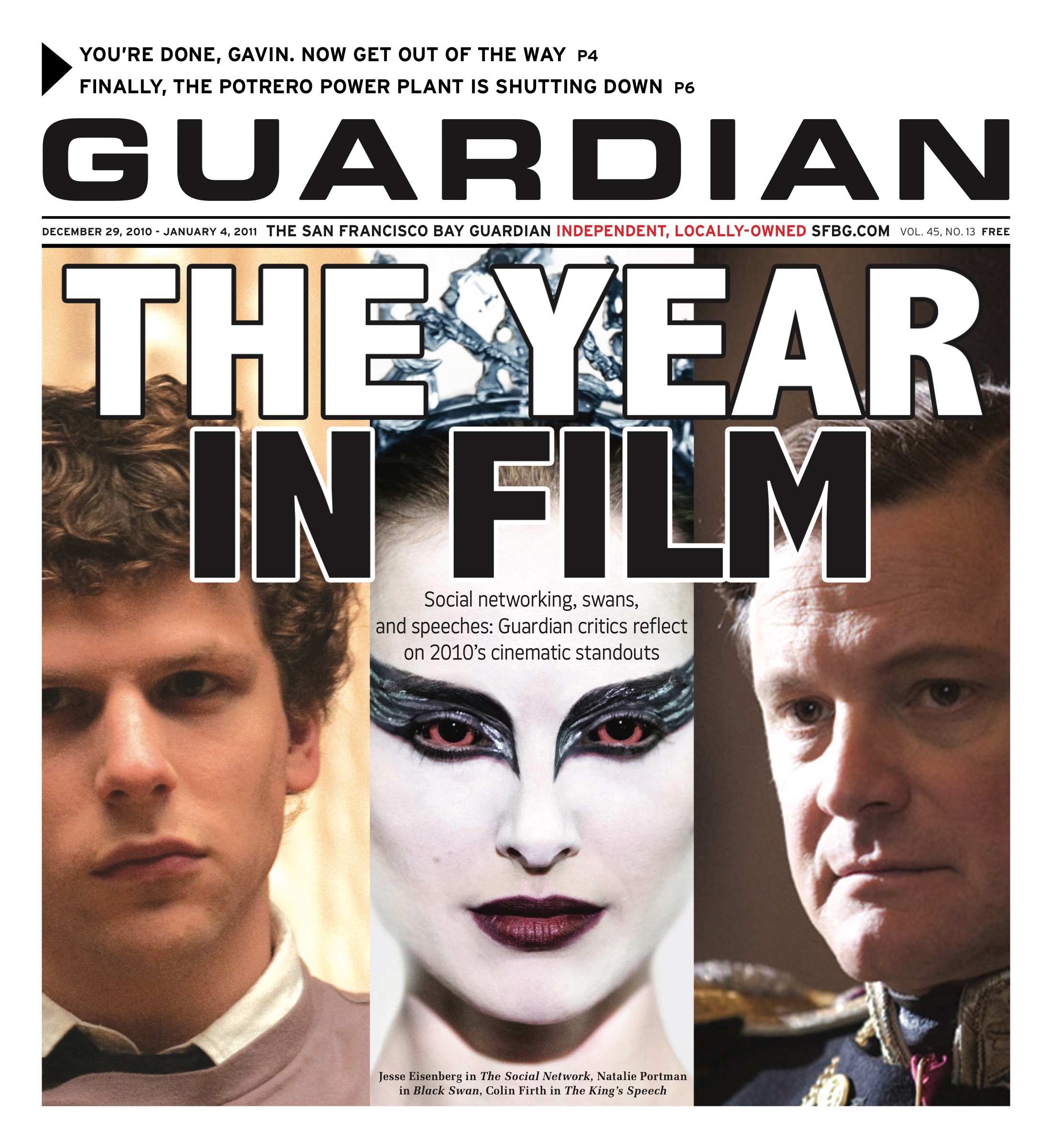
YEAR IN FILM To recap: 2010 was the year Oscar started dipping his golden fingers into the previous year’s pot of (mostly forgettable) big releases and fishing out 10 Best Picture nominees. Blue Pandora people were defeated at the podium, though they did leave a cultural stain behind — it’s safe to say, for example, that nobody’s been styling weddings after The Hurt Locker.

Predicting the next Academy Awards class requires looking past 2010’s top earners (Toy Story 3 and Inception aside) and focusing on films that pleased both critics and audiences (The Social Network, Winter’s Bone, Black Swan) — though if you’re in a betting mood, the carefully calibrated The King’s Speech seems exactly like the kind of movie the Academy will reward over anything achingly contemporary, staunchly gritty, or knowingly out-there. But as any true film fan knows, it’s usually not the movies that make the most money, or even win the most awards, that resonate and beg revisiting in the months and years that follow.

The Guardian’s annual Year in Film issue takes a look at some of 2010’s more notable trends, starring films you liked (The Kids Are All Right) and hated (I’m Still Here) — and films you wanted to see but forgot about and are now rushing to put on your Netflix queue (Splice). (Note: the “you” in the previous sentence is, uh, me.) And since I’m talking in the first person now, let me steer you toward my favorite documentary of the year (and 2010 boasted some great ones, including my second-favorite, The Tillman Story), made-for-ESPN tale The Two Escobars. I was lured in by heavy advertising during the World Cup — apologies to the Giants, but Landon Donovan’s ridiculous game-winner in USA versus Algeria is my pick for sports highlight of the year — and was unexpectedly mesmerized by its tragic story; only later did I learn of the film’s San Francisco connection. Read on, and pass the popcorn.

>>Babes in bondage

Or, 2010’s perfection-pursuing fatal femmes

>>Get “real”

The Social Network, Catfish, and I’m Still Here push the boundaries of truth and fiction

>>Past imperfect

Digging through the year in archival footage

>>Rate irate

Confidential to the Motion Picture Association of America: F-U

>>Baby daddy drama

Parsing 2010’s bumper crop of sperm donor comedies

>>Goal difference

Top 2010 doc The Two Escobars examines two sides of Colombian narco-soccer

>>Guardian critics pick their best movies of the year


Appetite: 2010, the year in absinthe

0

Read up, absinthe seekers… whether you’re intrigued by the (false) claims of hallucinogenic effects or an aficionado taken in by the culture surrounding the green fairy, a little reading will take you deeper. This year has produced three new absinthe books furthering knowledge of an artful drink best enjoyed with leisure and attention.

Absinthe Cocktails
by Kate Simon
This pretty little tome is an elegant black and grey with hints of green. Kate Simon is editor-at-large for the ultimate drink magazine, Imbibe. Her drink knowledge is used to educate on what absinthe is and isn’t in Absinthe Cocktails‘ brief primer section. A handy buying guide recommends fine absinthes made in the US (Viuex Carre, Leopold Bros.) and Switzerland (the incredible Duplais), France (Vieux Pontarlier) and Spain (Obsello). The majority of the book is cocktail recipes, from classics like the absinthe frappe (which I crave on a hot day in New Orleans), to “The New Guard”, a section on modern classics from a number of the world’s best bartenders (including some of our own like The Alembic’s Daniel Hyatt and Brian MacGregor formerly of Jardiniere). Photos are lush, the romantic look making it an ideal coffee table book.

A Taste for Absinthe by R. Winston Guthrie with James F. Thompson

I wrote about this book upon its October release, my top pick of the three and another coffee table looker. With lovely photography by Liza Gershman, it offers a wide range of cocktail recipes, more in-depth history, lore and cultural references. A Taste for Absinthe is also a welcome primer on the green fairy but goes deeper with details on the culture that grew around it: poster art, spoons, glasses, fountains, even film references. The book is broken down into five recipe sections: classics, fruit and citrus, whiskey and gin, liqueurs and bitters, and modern classics compiled from some of our country’s best bartenders, again including many SF locals. This one is a necessary addition to the library of any absinthe geek.

The Little Green Book of Absinthe by Paul Owens and Paul Nathan
Minus photos, The Little Green Book of Absinthe is a simpler, straightforward recipe reference book. In its initial pages lie interesting details on absinthe’s history, including early formulas, louching tips, and background on key brands. But for me the lack comes in the recipes which make up a majority of the book. Their chosen mixologist, Dave Herlong, is from a Vegas hotspot, apparent in the common inclusion of nasty ingredients like Red Bull, Blue Curacao, sweet and sour mix, or Apple Schnapps. These ingredients appeal to the masses and general American sweet tooth, but a drink aficionado or basically anyone who has developed a taste for authentic flavors versus unnaturally processed, will find less to appeal here. A handful of intriguing recipes are present, including bubbly cocktails under “Decadent Concoctions.” There’s worthwhile material in the factual sections of this book but I could not recommend as a recipe reference.

–Subscribe to Virgina’s twice monthly newsletter, The Perfect Spot

Appetite: In Tequila with Fortaleza

1

Fortaleza is truly a special tequila. On my recent visit to Tequila, Mexico, this distillery enchanted with its agave covered hillsides and haunting caves. Fortaleza means fortitude, though in Mexico, you’ll find their bottles labeled Los Abuelos in memory of the grandfathers of Guillermo E. Sauza, the fifth generation producer who passionately runs Fortaleza by old world methods. He comes from tequila royalty as a Sauza… yes, that  Sauza (his family sold Sauza back in the ’70’s so don’t attribute the current quality level to them). Despite offers to be bought out by major tequila companies, Guillermo refuses, running his little distillery with a primary focus on quality and historical production. Here are just a few highlights of my visit over Day of the Dead in November.

DIA DE LOS MUERTOS at the distillery
The workers of Fortaleza and their children threw us one unforgettable Day of the Dead party. They exhibited impressive effort in a play performed under the stars of the distillery grounds. Tacos were filled with fresh-grilled chorizo and beef. A woman squeezed dough into a giant vat of bubbling oil, making the best churros I’ve ever tasted. Young men serenaded us with guitars while impromptu dancing erupted. Palomas (tequila and grapefruit soda), Mexican beers, and of course, tequila flowed. The caves glowed with candles, friendly skeletons and the occasional bat. We caroused, celebrated, sang by a campfire, and reveled in the magic of a night that could not have been recreated elsewhere.

VISITING the SAUZA FAMILY GRAVE in GUADALAJARA
In a surreal moment, I took in sunset at the Panteon de Mezquitan cemetery in Guadalajara with Guillermo Sauza. We stood at the grave of his great great grandfather Don Cenobio, the first to export tequila to the US in 1860’s, of his great grandfather, Don Eladio, and grandather, Don Javier, who carried on the tradition. Crumbling graves huddled in a maze of statues and crypts recall European cemeteries. But unlike those hushed sanctuaries, this graveyard swarmed with local families, music streaming from loud speakers, food for sale. We stood over the Sauza grave ablaze with orange flowers and streamers. Guillermo poured us shots of Fortaleza blanco while making a toast to his lineage. Over their graves we respectfully but joyfully partook of the fruit of their talented labor. From a place of death, I walked away having breathed in life, the riches of shared gifts and family.

TEQUILA PRODUCTION at the distillery
Think old world tequila production practices: small copper pot stills, mature agave plants steam-cooked in a brick oven to release natural sweetness, then crushed by a volcanic stone wheel pulled by a man-driven tractor in a circular pit. Mules used to pull that two-ton wheel but now a small tractor takes care of the heavy crushing. Two men still follow behind, sifting through the fibrous mash to achieve the right texture. The pot stills are labor-intensive being the smallest I’ve seen at a distillery of Fortaleza’s output. They double distill, then age in American oak in reused whiskey barrels.

GLASS-BLOWING (of Fortaleza bottles) in TONALA
In Guadalajara’s Tonala district, Fortaleza’s beautiful, hand-blown bottles with agave top are created. Hipolito Gutierrez, a third generation glass-blower, holds the Guinness World record for largest hand-blown bottle and runs this Tonala shop. Watching Fortaleza’s bottles being made is a mesmerizing dance of deft and delicate maneuvers. One misstep would lead to a serious burn as artisans flit between fire and searing hot molds with ease. I attempted to blow a glass myself, finding the greatest amount of breath I could muster was far from sufficient to fill even half a bottle with space. The skill required to blow continuously and fully is akin to the control Satchmo himself needed to play his trumpet.

EXPLORING TEQUILA
For those wanting to explore the riches of Tequila themselves, I met Clayton Szczech of Experience Tequila (www.experiencetequila.com) while in Mexico. Clayton regularly leads tours in the area, filling a rare niche for knowledgeable, passionate expertise on the region without rigid schedules and touristy stops one normally associates with a tour group. He purposely keeps it small, tailoring it towards the needs of each individual group. Clayton has good relationships with the distilleries (certainly with Fortaleza), maintaining a relaxed stance, as if traveling with friends, which, in fact, you just may become.

–Subscribe to Virgina’s twice monthly newsletter, The Perfect Spot.

Appetite: Revisit Studio 54 at Burritt Room’s NYE party

0

There are many, many party options for New Year’s Eve this year, but one of my favorite cocktail spots is hosting an event that seems particularly appealing to those with adventurous taste (and tastebuds) …

It’s Dec 31, 1977. Enter the iconic Studio 54 decked out in your most stylish pantsuit, hair flowing and free. Sip cocktails by a life-sized unicorn sculpture made of ice before heading to the dance floor to strut your best disco moves. Four tons of glitter drop from the ceiling creating a shimmering moment Studio 54 owner Ian Shrager later called “standing on stardust.” Movie set or imaginary party? Not this New Year’s Eve. Hosted by the fabulous Bon Vivants, S.O.S. 2011 takes place in the seductive Burritt Room with the magic re-created, sans four tons of glitter (the unicorn will be there, however).

If you’ve ever been to a Bon Vivants party, you know they are classy, exuberant, unforgettable events (recall my recap of the Cocktail Carnival Gala they hosted at this year’s SF Cocktail Week). Wear your best disco-chic and come for a respite from overcrowded, obnoxious NYE parties elsewhere (a value I truly appreciate at Vivants events).

Dance the new year in 1970’s-style to the disco sounds of DJ Bus Station John (trust us, it wont be the same tunes you’ve heard a million times), savor four of Josh Harris and Scott Baird’s signature cocktails, all-night bites from Trick Dog chef Chester Watson, and a midnight champagne toast (all included in ticket price). The event will sell out soon so jump on tickets now. See you there under the disco ball.

December 31, 9pm-2am

$85/ticket, includes 4 signature cocktails, champagne, food
The Burritt Room at the Crescent Hotel
417 Stockton Street
*Discount packages offered for ticket & hotel room combinations: $250 – 2 tickets + standard hotel room; $300 – 2 tickets + hotel suite

Tickets available at www.brownpapertickets.com/event/139468

–Subscribe to Virgina’s twice monthly newsletter, The Perfect Spot

Music Listings

0

Music listings are compiled by Cheryl Eddy. Since club life is unpredictable, it’s a good idea to call ahead to confirm bookings and hours. Prices are listed when provided to us. Submit items for the listings at listings@sfbg.com. For further information on how to submit items for the listings, see Picks.

WEDNESDAY 22

ROCK/BLUES/HIP-HOP

Agalloch, Allerseelen, Dispirit Great American Music Hall. 8pm, $19.

Michael Chase and Lorenzo Rite Spot, 2099 Folsom, SF; www.ritespotcafe.net. 9pm, free.

Murkins, Attack Plan, Station and the Monster Bottom of the Hill. 9pm, $8.

Jason King Band Biscuits and Blues. 8 and 10pm, $15.

“Polk Street Lounge Comedy and Burlesque Show” Hemlock Tavern. 9pm, $6. With Mary Van Note, Nato Green, Sean Keane, and Miss Mae Western.

JAZZ/NEW MUSIC

“Christmas in San Francisco with Russ Lorenson and Friends” Rrazz Room. 8pm, $40.

Gaucho, Michael Abraham Amnesia. 7pm, free.

Horace-scope Coda. 10pm, $7.

Spaceheater Revolution Café, 3248 22nd St, SF; (415) 642-0474. 8:45pm, free.

FOLK/WORLD/COUNTRY

Dan Hicks and the Hot Licks Yoshi’s San Francisco. 8 and 10pm, $18-26.

DANCE CLUBS

Booty Call Q-Bar, 456 Castro, SF; www.bootycallwednesdays.com. 9pm. Juanita Moore hosts this dance party, featuring DJ Robot Hustle.

Cannonball Beauty Bar. 10pm, free. Rock, indie, and nu-disco with DJ White Mike.

Ceremony Presents Factory Records Night Knockout. 9pm, $5. Dark pop and new wave with DJs Deadbeat and Yule Be Sorry.

Club Shutter Elbo Room. 10pm, $5. Goth with Nako, Omar, and Justin.

Hands Down! Bar on Church. 9pm, free. With DJs Claksaarb, Mykill, and guests spinning indie, electro, house, and bangers.

Jam Fresh Wednesdays Vessel, 85 Campton, SF; (415) 433-8585. 9:30pm, free. With DJs Slick D, Chris Clouse, Rich Era, Don Lynch, and more spinning top40, mashups, hip hop, and remixes. Mary-Go-Round Lookout, 3600 16th St, SF; (415) 431-0306. 10pm, $5. A weekly drag show with hosts Cookie Dough, Pollo Del Mar, and Suppositori Spelling.

Red Wine Social Triple Crown. 5:30-9:30pm, free. DJ TophOne and guests spin outernational funk and get drunk.

Respect Wednesdays End Up. 10pm, $5. Rotating DJs Daddy Rolo, Young Fyah, Irie Dole, I-Vier, Sake One, Serg, and more spinning reggae, dancehall, roots, lovers rock, and mash ups.

Synchronize Il Pirata, 2007 16th St, SF; (415) 626-2626. 10pm, free. Psychedelic dance music with DJs Helios, Gatto Matto, Psy Lotus, Intergalactoid, and guests.

THURSDAY 23

ROCK/BLUES/HIP-HOP

Bell Biv DeVoe Yoshi’s San Francisco. 8 and 10pm, $25-35.

“Big Cat Blue Holiday Concert” Biscuits and Blues. 8 and 10pm, $15.

Blind Willies, Flash Gilmore, Funbeatles Stud. 8pm.

“Gospel Christmas with Kim Nalley and Tammy Hall” Rrazz Room. 8pm, $35.

Vienna Teng, Alex Wong and friends, Paul Joey Ryan, Amber Rubarth Great American Music Hall. 8pm, $26.

Michael Zapruder, We Is Shore Dedicated Hemlock Tavern. 9pm, $5.

JAZZ/NEW MUSIC

Def Poets Revolution Café, 3248 22nd St, SF; (415) 642-0474. 8:45pm, free.

FOLK/WORLD/COUNTRY

Bluegrass and old-time jam Atlas Café. 8pm, free.

Horse Thief Jack Rite Spot, 2099 Folsom, SF; www.ritespotcafe.net. 9pm, free.

DANCE CLUBS

Afrolicious Elbo Room. 9:30pm, $10. DJs Pleasuremaker and Señor Oz spin Afrobeat, tropicália, electro, samba, and funk.

Caribbean Connection Little Baobab, 3388 19th St, SF; (415) 643-3558. 10pm, $3. DJ Stevie B and guests spin reggae, soca, zouk, reggaetón, and more.

Drop the Pressure Underground SF. 6-10pm, free. Electro, house, and datafunk highlight this weekly happy hour.

Gigantic Beauty Bar. 9pm, free. With DJs Eli Glad, Greg J, and White Mike spinning indie, rock, disco, and soul.

Good Foot Som., 2925 16th St, SF; (415) 558-8521. 10pm, free. With DJs spinning R&B, Hip hop, classics, and soul.

Guilty Pleasures Gestalt, 3159 16th St, SF; (415) 560-0137. 9:30pm, free. DJ TophZilla, Rob Metal, DJ Stef, and Disco-D spin punk, metal, electro-funk, and 80s.

Jivin’ Dirty Disco Butter, 354 11th St., SF; (415) 863-5964. 8pm, free. With DJs spinning disco, funk, and classics.

Koko Puffs Koko Cocktails, 1060 Geary, SF; (415) 885-4788. 10pm, free. Dubby roots reggae and Jamaican funk from rotating DJs.

Peaches Skylark, 10pm, free. With an all female DJ line up featuring Deeandroid, Lady Fingaz, That Girl, and Umami spinning hip hop.

FRIDAY 24

ROCK/BLUES/HIP-HOP

Alvon Biscuits and Blues. 8 and 10pm, $20.

Oakland Interfaith Gospel Ensemble Slim’s. 7 and 9:30pm, $15.

FOLK/WORLD/COUNTRY

Baxtalo Drom Amnesia. 9pm, $7-10.

SATURDAY 25

ROCK/BLUES/HIP-HOP

“Bud E. Luv Christmas Show” Rrazz Room. 8pm, $30.

“13th Annual Black X-Mass” Elbo Room. 9pm. With Graves Bros Deluxe, Los Murderachis Dimesland, and more.

Earl Thomas and the Blues Ambassadors Biscuits and Blues. 8 and 10pm, $22.

FOLK/WORLD/COUNTRY

Craig Ventresco and Meredith Axelrod Atlas Café. 4pm, free.

DANCE CLUBS

Death Guild X-Mess Night DNA Lounge. 9:30pm, $5. Gothic, industrial, and synthpop with Decay, Joe Radio, and Melting Girl.

DJ Floydaclaus Hemlock Tavern. 9pm, free.

45Club Knockout. 10pm, free. Funky soul with dX the Funky Gran Paw, Dirty Dishes, and English Steve.

Go Bang! Presents: Ho Ho Bang! Deco Lounge, 510 Larkin, SF; www.gobangsf.com. 9pm, $5. Disco with Steve Fabus, Tres Lingerie, and Sergio.

SUNDAY 26

ROCK/BLUES/HIP-HOP

“Gorilla Holiday Takeover” DNA Lounge. 5:30pm, $12. With To Memory and Me, Twisted Blues, One for the Masses, and more.

Lucky Peterson Biscuits and Blues. 8 and 10pm, $20.

JAZZ/NEW MUSIC

Kim Nalley Rrazz Room. 7pm, $32.50.

DANCE CLUBS

Dub Mission Elbo Room. 9pm, $6. Dub, roots, and classic dancehall with DJs Sep, Maneesh the Twister, and guests Roy Two Thousand and DJ Quest.

Gloss Sundays Trigger, 2344 Market, SF; (415) 551-CLUB. 7pm. With DJ Hawthorne spinning house, funk, soul, retro, and disco.

Honey Soundsystem Paradise Lounge. 8pm-2am. “Dance floor for dancers – sound system for lovers.” Got that?

Kick It Bar on Church. 9pm. Hip-hop with DJ Zax.

Religion Bar on Church. 3pm. With DJ Nikita.

Swing Out Sundays Rock-It Room. 7pm, free (dance lessons $15). DJ BeBop Burnie spins 20s through 50s swing, jive, and more.

MONDAY 27

ROCK/BLUES/HIP-HOP

Allstar Weekend, Dylan Fox and the Waves, Greenlight District, Vegas is North Slim’s. 5:45pm, $16.

Cracker, Camper Van Beethoven Independent. 8pm, $25.

Morris Day and the Time Yoshi’s San Francisco. 8 and 10pm, $30-45.

Lucky Peterson Biscuits and Blues. 8 and 10pm, $20.

Richard Rite Spot, 2099 Folsom, SF; www.ritespotcafe.net. 9pm, free.

DANCE CLUBS

Death Guild DNA Lounge. 9:30pm, $3-5. Gothic, industrial, and synthpop with Joe Radio, Decay, and Melting Girl.

Krazy Mondays Beauty Bar. 10pm, free. With DJs Ant-1, $ir-Tipp, Ruby Red I, Lo, and Gelo spinning hip hop.

M.O.M. Madrone Art Bar. 6pm, free. With DJ Gordo Cabeza and guests playing all Motown every Monday.

Manic Mondays Bar on Church. 9pm. Drink 80-cent cosmos with Djs Mark Andrus and Dangerous Dan.

Musik for Your Teeth Revolution Café, 3248 22nd St., SF; (415) 642-0474. 5pm, free. Soul cookin’ happy hour tunes with DJ Antonino Musco.

Network Mondays Azul Lounge, One Tillman Pl, SF; www.inhousetalent.com. 9pm, $5. Hip-hop, R&B, and spoken word open mic, plus featured performers.

Skylarking Skylark. 10pm, free. With resident DJs I & I Vibration, Beatnok, and Mr. Lucky and weekly guest DJs.

TUESDAY 28

ROCK/BLUES/HIP-HOP

Morris Day and the Time Yoshi’s San Francisco. 8 and 10pm, $30-45.

Hollow Earth, Iron Witch, Vanishing Breed Hemlock Tavern. 9pm, $5.

Kitten on the Keys Rite Spot, 2099 Folsom, SF; www.ritespotcafe.net. 9pm, free.

Spirits in the Basement, Filthy Mudbloods, Laughing Prophets of Doom Bottom of the Hill. 9pm, $8.

*X, Ray Manzarek Slim’s. 8pm, $31.

DANCE CLUBS

Alcoholocaust Presents Argus Lounge. 9pm, free. With DJ Lightnin’ Jeff G. and DJ Filthy Phil.

Eclectic Company Skylark, 9pm, free. DJs Tones and Jaybee spin old school hip hop, bass, dub, glitch, and electro.

Share the Love Trigger, 2344 Market, SF; (415) 551-CLUB. 5pm, free. With DJ Pam Hubbuck spinning house.

Womanizer Bar on Church. 9pm. With DJ Nuxx.

Stage Listings

0

Stage listings are compiled by Guardian staff. Performance times may change; call venues to confirm. Reviewers are Robert Avila, Rita Felciano, and Nicole Gluckstern. Submit items for the listings at listings@sfbg.com. For further information on how to submit items for the listings, see Picks. For complete listings, see www.sfbg.com.

THEATER

ONGOING

*Candid Dance Mission Theater, 3316 24th St; 273-4633, www.sweetcanproductions.com. $15-60. Call for dates and times. Through Jan 9. Sweet Can Productions presents an acrobatic holiday circus extravaganza.

Dirty Little Showtunes! A Parody Musical Revue New Conservatory Theatre Center, 25 Van Ness; 861-8972, www.nctcsf.org. $24-40. Wed-Sat, 8pm; Sun, 2pm. Through Jan 16. Tom Orr’s adults-only holiday show returns, with direction by F. Allen Sawyer and musical direction by Scrumbly Koldewyn.

Golden Girls: The Christmas Episodes CounterPULSE, 1310 Mission; www.ticketfly.com. $25. Thurs, 7 and 9pm. Through Thurs/23. Heklina, Cookie Dough, Matthew Martin, and Pollo Del Mar return with their stage tribute to the sitcom.

Joyful Noise: A Gospel Celebration of Christmas Southside Theater, Fort Mason Center; 345-7575, www.LHTSF.org. $25-50. Call for dates and times. Through Dec 31. Lorraine Hansberry Theatre presents a rechristened version of their Black Nativity production.

The Lion in Winter Actors Theatre, 855 Bush; 345-1287, www.ticketweb.com. $26-38. Wed-Sat, 8pm. Through Jan 15. Actors Theatre of SF presents James Goldman’s play of palace intrigue.

Mr. YooWho’s Holiday NOHspace, 2840 Mariposa; (800) 838-3006, www.brownpapertickets.com. $10-18. Fri-Sat, 8pm; Sun, 2pm. Through Jan 2. European clown Moshe Cohen returns to SF for a third run at NOHspace.

Party of 2 – The New Mating Musical Shelton Theater, 533 Sutter; (800) 838-3006, www.partyof2themusical.com. $27-29. Sun, 3pm. Open-ended. A musical about relationships by Shopping! The Musical author Morris Bobrow.

*Pearls Over Shanghai Thrillpeddlers’ Hypnodrome, 575 Tenth St; 1-800-838-3006, www.brownpapertickets.com. $30-69. Sat, 8pm. Through April 9. Thrillpeddlers’ acclaimed production of the Cockettes musical continues its successful run.

Santaland Diaries Eureka Theatre, 215 Jackson; (800) 838-3006, www.brownpapertickets.com. $20-30. Nightly, 8pm (also Thurs/23, 5pm). Through Dec 30. David Sinaiko returns as Crumpet in Combined Artform’s ninth annual production of the David Sedaris play.

Shrek The Musical Orpheum Theatre, 1192 Market; (888) SHN-1799, www.shnsf.com. $30-99. Tues, 8pm, Wed, 2 and 8pm; Thurs-Fri, 8pm; Sat, 2 and 8pm; Sun, 2pm (no performances Fri/24, Sat/25, and Dec 31). Through Jan 2. Eric Petersen stars in the stage version of the animated blockbuster.

Siddhartha, the Bright Path The Marsh Studio Theater, 1074 Valencia; (800) 838-3006, www.themarsh.org. $15-35. Call for dates and times. Through Jan 9. Marsh Youth Theater presents a holiday celebration, directed by Lisa Quoresimo.

A Tale of Two Genres SF Playhouse, Stage Two, 533 Sutter; www.un-scripted.com. $10-20. Wed-Thurs, 8pm. Through Thurs/23. Un-Scripted Theater Company performs an improvised musical in the style of Charles Dickens.

BAY AREA

Arabian Nights Berkeley Repertory Theatre, Thrust Stage, 2025 Addison, Berk; (510) 647-2549, www.berkeleyrep.org. $34-73. Call for dates and times. Through Dec 30. Tony-winning Mary Zimmerman’s production makes a return to Berkeley Rep.

Becoming Julia Morgan Berkeley City Club, 2315 Durant, Berk; (510) 984-3864, www.brownpapertickets.com. $24-30. Fri-Sat, 8pm; Sun, 5pm. Through Jan 9. Janis Stevens stars in Belinda Taylor’s play about the trailblazing architect.

A Christmas Memory TheatreWorks at Lucie Stern Theatre, 1305 Middlefield, Palo Alto; (650) 463-1960, www.theatreworks.org. $19-67. Tues-Wed, 7:30pm; Thurs-Fri, 8pm; Sat, 2 and 8pm; Sun, 2 and 7pm (also Dec 23, 2pm; Dec 24, 7pm). Through Sun/26. TheatreWorks presents the seasonal tale by Truman Capote.

East 14th – True Tales of a Reluctant Player The Marsh Berkeley, 2120 Allston Way, Berk; (800) 838-3006, www.themarsh.org. $20-50. Call for times. Through Feb 13. Don Reed’s one-man show continues its extended run.

Lemony Snicket’s The Composer is Dead Berkeley Repertory Theatre, Roda Theatre, 2015 Addison, Berk; (510) 647-2949, www.berkeleyrep.org. Call for dates and times. Through Jan 15. Berkeley Rep premieres the new musical, written by Lemony Snicket, with music by Nathaniel Stookey.

Naughty and Nice: A Meg and Billy Christmas Aurora Theatre Company, 2081 Addison, Berk; (510) 843-4822, www.auroratheatre.org. $23-25. Call for dates and times. Through Dec 30. Bay Area husband and wife cabaret duo Meg Mackay and Billy Philadelphia return with a holiday show.

Of the Earth – The Salt Plays: Part 2 Ashby Stage, 1901 Ashby; (510) 841-6500, www.shotgunplayers.org. $17-30. Thurs-Sat, 8pm; Sun, 5pm. Through Jan 30. Shotgun Players present the second half of writer and director Jon Tracy’s Odyssey-inspired tale, with music by Brendan West.

The World’s Funniest Bubble Show The Marsh Berkeley, 2120 Allston, Berk; (800) 838-3006, www.themarsh.org. $8-50. Sun, 11am (also Wed/22-Thurs/23 and Sun/26-Tues/28, 11am and 2pm; and Dec 29-30, 11am). Through Dec 30. The Amazing Bubble Man’s show presents flying saucer bubbles and other wonders.

PERFORMANCE/DANCE

American Pop Parable The Make-Out Room, 3225 22nd St; 647-2888, www.makeoutroom.com. Mon/27, 8pm. $5. The Cat’s Pajamas presents an evening of storytelling and song, with MamaCoAl, DeCoy Gallerina, Alan Kaufman, Jelal Hyler, Julie Indelicato, and Cameron Ochs Band.

Flow (The Winged Crocodile)/Trains ODC Theater, 3153 17th; 863-9834, www.odcdance.org. Wed/22, 8pm. $18. The Relationship presents a piece with text by Leslie Scalapino and music by Jean Jeanrenaud.

Forking II: A Merry Forking! Christmas Off-Market Theatres, 965 Mission; (800) 838-3006, www.pianofight.com. Call for dates and times (through Dec 30). PianoFight presents a holiday-themed choose-your-own-adventure play.

Kung Pao Kosher Comedy New Asia Restaurant, 772 Pacific; 522-3737, www.koshercomedy.com. Thurs/23, 5 and 8:30pm; Fri/24-Sat/25, 6 and 9:30pm; Sun/26, 5 and 8:30pm. $42-62. The 18th annual celebration of Jewish comedy in a Chinese restaurant.

Texas Chainsaw Yuletide Eureka Theatre, 215 Jackson; (800) 838-3006, www.brownpapertickets.com. Wed/22-Thurs/23, 9:30pm). $15. Combined Artform presents a one-man show by comedian Will Franken.

BAY AREA

The Coverlettes Cover Christmas 2020 Addison, Berk; (510) 644-2020. Wed/22-Thurs/23, 8pm. $18.50-19.50. The fictitious girl group presents a Christmas cabaret concert.

Striking 12 TheatreWorks at Lucie Stern Theatre, 1305 Middlefield, Palo Alto; (650) 463-1960, www.theatreworks.org. Tues/28, 7:30pm (through Dec 31). $56-75. Indie pop group GrooveLily ushers in the new year a rewired version of Hans Christian Andersen’s The Little Match Girl.

Psychic Dream Astrology

0

Dec. 22-28

Final week of Mercury retrograde!

ARIES

March 21-April 19

Take inspiration from the folks you most respect, Aries. Your relationships are poised for major growth, and if you are not growing then your connections are inherently limited. Be your best self this week.

TAURUS

April 20-May 20

Projecting into the future is a big, stressful waste of time. Deal with what you know in the present, because it’s the best way to protect what has yet to come. Promote freedom by creating what you want, not by avoiding your fears.

GEMINI

May 21-June 21

Things can change in really profound ways in an instant, Gem. Be present for the good in your world without taking advantage of it or getting too attached. Gently protect the things you love this week.

CANCER

June 22-July 22

Authentic intimacy requires consistent adjustments and compromise. Perfect compatibility is a poor goal this week. Instead, set your sights on relationships that challenge you right where you need it, Moonchild.

LEO

July 23-Aug. 22

Make friends with your anxieties by treating them with the same consideration you’d show an old friend. Your vulnerabilities have something to show you about what you need — if only you listen. Treat yourself kindly.

VIRGO

Aug. 23-Sept. 22

Do what’s right for you in spite of whatever terrible distractions to loving self-care you come up against. You’re being challenged to uphold your own needs and rights, even if it costs you something of value. Eyes on the prize, Virgo!

LIBRA

Sept. 23-Oct. 22

The worst thing you could do in this, the last week of Mercury retrograde and 2010, is to get in over your head. Don’t pile anything new on your plate or get distracted, Libra. Think in terms of closure and completion.

SCORPIO

Oct. 23-Nov. 21

Keep your heart open and your boundaries firm. Be fearless enough to go for what you most want and be wise enough to know your limits before they give you a smack down.

SAGITTARIUS

Nov. 22-Dec. 21

Watch your tone and watch your motives this week. No matter how frustrating things get, you are not entitled to act like a jerk, Sag. If you can’t be grounded enough to keep things mellow, at least play gentle.

CAPRICORN

Dec. 22-Jan. 19

No matter how open and motivated you are, Capricorns need their down time. And if you don’t get that down time, you may hit the sads something awful. Make sure you are cultivating awesomeness at a clip you can keep up with.

AQUARIUS

Jan. 20-Feb. 18

Weeks like this were invented for heart-to-hearts with your BFF or quality time with your Dear Diary. Investigate your truest truths without judgment or strategy. Look deep inside and see what you’ve got, Aquarius.

PISCES

Feb. 19-March 20

There’s a big difference between being selfish and doing what you’ve gotta do, even if it upsets others. It’s all about how upfront and honest you are, Pisces. Include your people in your process so they know what’s up. 

Jessica Lanyadoo has been a Psychic Dreamer for 16 years. Check out her website at www.lovelanyadoo.com or contact her for an astrology or intuitive reading at (415) 336-8354 or dreamyastrology@gmail.com.

Alerts

0

news@sfbg.com

WEDNESDAY, DEC. 22

Floyd Westerman Retrospective

You may remember him for his role in “Dances with Wolves” as Chief Ten Bears and as a country western singer/songwriter. But Floyd Westerman, a.k.a. Red Crow, was also an outspoken activist for Native Americans and the environment. A new documentary by Steve Jacobson explores his later life and activism. Along with the film, there will also be a social hour at 6:30 and a discussion following the film.

7:30–9:30 p.m., $5 suggested donation

Humanist Hall

390 27th St., Oakl.

510-681-8699

Real Mercantile Holiday Bazaar

If you still have some holiday shopping to do and just can’t summon the will to hit the stores or feed the machine, you can get some great stuff while supporting the local arts community and underground economy at the Real Mercantile Holiday Bazaar. held at arts impresario Chicken John spacious home and performance space. Homemade gifts and food are all available in a festive and very San Francisco atmosphere.

5–9 p.m., free

Chez Poulet

3359 Cesar Chavez, SF

www.therealmerchantile.com

THURSDAY, DEC. 23

Festivus 2010

San Francisco’s legendary Sisters of Perpetual Indulgence and pot activist Ed Rosenthal’s Green Aid unite to present a night of fundraising for the Medical Marijuana Legal Defense and Education Fund. The bash features an airing of grievances, feats of strength, the annual meeting of Dessert First Club, and live music and entertainment including The Phat Fly Girls and burlesque. Creative dress and cross-dressing encouraged.

7:30–11:30 p.m., $50 presale, $60 at door

SomArts

925 Brannan, SF

415-515-7483

SUNDAY, DEC 26

Get Your Spawn On

Join Brent Plater on a stroll through Muir Woods National Monument to learn more about coho and steelhead salmon and how to help them survive. The walk also features a search for endangered salmon in Redwood Creek. Make sure to wear something warm and bring your hiking boots.

10–12 p.m., free with RSVP

Meet at the Dipsea Trail trailhead

Muir Woods National Monument, Mill Valley

www.wildequity.org/events/3166

TUESDAY, DEC 28

Castro Queer-in

Join concerned local resident ins protesting the recently passed sit/lie ordinance more formally known as Proposition L. Bring out any and all musical instruments, games, food to share, face-painting kits, and any items to barter. Everyone will gather outside of Harvey Milk’s former camera store.

Noon–2 p.m., Free

575 Castro

Mail items for Alerts to the Guardian Building, 135 Mississippi St., SF, CA 94107; fax to (415) 437-3658; or e-mail alert@sfbg.com. Please include a contact telephone number. Items must be received at least one week prior to the publication date.

Game over(load)

0

GAMER 2010, TAKE TWO For the first time in my life, in 2010, I feel the weight of games yet unplayed. Soon, 2011 will begin, and the ghosts of my gaming fecklessness will lurk, dormant, on my hard drive, pregnant with the possibility of fun.

Maybe it’s just that I finally got a life; I am now too busy to head out to GameStop on a Tuesday morning, come home with a new game, and only take a break — for lunch — around 7:30. Maybe games have gotten harder, or I’ve gotten worse — are all those mistimed jumps and bungled headshots adding up? Maybe there’s a simpler answer: games have gotten better, and there are many, many more of them.

With each passing month, it grows harder to prioritize, to write off vast swathes of the medium in the hopes of maintaining a schedule that actually allows for gainful employment. Indie games are becoming more ambitious, jabbing the mega-budgeted mainstream in the ribs with the elbow of unfettered creativity. Minecraft, coded by Swedish programmer Markus Persson in his spare time, has attained nearly 2 million registered users, despite debuting in mid-May alongside the putative game of the year, Rockstar’s cowboy epic Red Dead Redemption.

You also start with a backlog of old games: last year’s modern classics and overlooked gems (one day, I will finish Psychonauts), not to mention the really old games that are increasingly available for a Monopoly-money pittance on networks like Xbox LIVE, Playstation Network, Wii Network, and Valve’s potent PC-gaming service Steam — an insidious piece of software that is the gaming equivalent of having a drug dealer literally living in your house.

As if the congestion wasn’t already bad enough, you can never really finish a game anymore. Downloadable content (DLC) has extended the shelf-life of marquee titles almost indefinitely, allowing developers to graft on missions, characters, and crucial plot developments long after the game has been boxed and shipped, thanks to the aforementioned download services. In general, these add-ons don’t provide much in the way of bang-for-buck, though that may change with time. Nevertheless, in some cases, pertaining particularly to popular multiplayer first-person shooters, purchasing DLC is a prerequisite for participation.

Even if you manage to scale your towering “to play” list, the release schedule simply refuses to cooperate. Sid Meier’s Civilization is the game that made me the addict I am today, and when Civilization V was slated for a Sept. 21 release, I was ecstatic. But a round of Civilization takes about 10 hours, and Dead Rising 2 lurked, hungry for brains, on the horizon, ready to hit store shelves the following week. Next to it, juggling a ball with a confident smirk, was FIFA 11, sharing the same release date. I didn’t stand a chance. In the end, the strategy classic got shamefully short shrift.

Whatever guilt I felt at betraying my childhood obsession was assuaged by countless six-minute soccer showdowns and the corpses of exactly 2,129 zombies. Then, just at the time I was ready to consider diving back into Civ, (or at least to compose Mr. Meier an apologetic letter), Fallout: New Vegas ushered in Armageddon.

To date, I have invested nearly 50 hours of gleeful postnuclear role-playing. Despite this effort, there is much of the game I will probably never see. At a certain point, I had to move on, lest I get hopelessly behind. Thanks to the month of December — the annual industry doldrums — some catch up has been played, but not nearly enough. Two weeks from now, we’ll have a new year. Five weeks from now, we’ll have Dead Space 2, and the backlog will begin again.

Classic ‘Rock’

0

arts@sfbg,com

THEATER Only the barbarity of these dark dumb days could make someone nostalgic for the Reagan era. A simpler time? Not for most — hairstylists maybe least of all. But in The Man of Rock, New Jersey in 1986 appears mercifully devoid of economic mayhem, quasi-fascist politics, or the doom-shrouded future they portend, which is probably why this lively new music-blasted comedy can rock so well. Heavy metal, yes; heavy going, no.

At the same time, Bay Area playwright Daniel Heath (of Forking fame) shrewdly draws here on George Etherege’s 1676 Restoration comedy, The Man of Mode, or, Sir Fopling Flutter, for a sweet and saucy adaptation that ensures there are brains, too, under all the big hair. One could almost call The Man of Rock (featuring spot-on original music by Ken Flagg) the thinking person’s Rock of Ages.

In Heath and director Jessica Heidt’s sure, evocative transplantation, Etherege’s witty aristocratic rake, Dorimant, becomes a one-hit rocker and multihit lady-killer operating a live-music bar on the trashy tourist boardwalks of the Jersey Shore. Perennially short of rent, Dorimant (played by a smooth Adam Yazbeck) gets a tip from his weary landlady (Arwen Anderson, in the first of several deft turns) about the arrival of a rich, eligible young Connecticut princess, Antoinette (Anderson again), also known as Toni, summering at the shore under the watchful eye of her cheerfully high-strung, busybody mother (a sharp and funny Danielle Levin, in one of several distinct roles).

Never mind that Dorimant already has a girlfriend, singer Suzie Love (a winningly earthy Michelle Maxson), or that he’s working on throwing her over for her best friend, the smart but smitten Missy (a somber, soulful Levin): Dorimant loves only Dorimant.

Until he meets Toni, of course. Then sparks fly in all directions. The brainy, initially icy Toni, for her part, is slower to savor the comical suave of her rock-star suitor. Yazbeck delivers cocksure rogue Dorimant with laid-back cool and a convincing glam-rock literary pretentiousness that is the play’s single overt nod to the lilting language of the original text, while nimbly aligning it with an utterly distinct era. “Your ship of conjecture has left the feeble harbor of your facts,” he tells a suspicious Suzie at one point. It’s a ridiculous phrase, yet Dorimant can get away with it, even amid the more off-the-rack working-class accents and preppy inflections of those around him. At the same time, a good part of the fun between Dorimant and Toni is the latter’s ruthless ability to mock this verbal frippery.

Meanwhile, Suzie smells a rat, Missy wallows in lovelorn guilt, and Dorimant’s fellow musicians — assembled under the choice name Silverwolf (bassist Chadd Ciccarelli, guitarist Joshua Hertel, and keyboardist Dane Johnson, backed on drums by an able and charismatic Lance Gardner in another of the production’s outstanding multirole performances) — cast disapproving glances in his direction.

A couple more significant subplots unfurl as well, the first having to do with the fact that Toni is not as well off as she appears, and her mother is therefore desperate to see her married to eligible childhood chum Harry Bellair (a smart, effortlessly charming Patrick Alparone), son of a wealthy businessman (a hilariously loud, cigar-chomping Gardner), but also secretly gay. Then there’s the arrival of a new band on the scene, Hämmer (conjured by the same backing musicians in different wigs), complete with umlauts and a lead singer named J.J. Rock — a balls-out, over-the-top fop played with sock-puppet falsetto but real panache by Alparone. The cast as a whole convincingly sells the rock numbers scattered throughout the play with a combination of respectable, even exceptional musical ability and pitch-perfect histrionics.

Naturally, everything resolves on the tonic, which is to say on a happy note. And if that’s not reality, it’s not noise pollution either. *

THE MAN OF ROCK

Through Dec. 23

Wed.–Thurs., 8 p.m.; $15-35

470 Florida, SF

(800) 838-3006

www.climatetheater.org

Homelessness: Newsom’s real legacy

4

OPINION His voice tinged with modest pride, Gavin Newsom recently announced that he has housed 12,000 people since becoming mayor. This is an absurdly high number, four times larger then any street count of homeless people since he has been in office, but it’s been accepted by the media and public.

Homelessness has been a key issue for Newsom. He first got elected in large part by taking it on, and has been celebrated in some quarters as a champion for homeless people.

But digging behind the veneer, removing bus tickets out of town, permanent housing his predecessor, Willie Brown, created, and temporary stays and duplication, there are 1,395 permanently affordable housing units that Newsom can truly take credit for. More frequently his administration has housed people (fewer then 2,000) by leasing residential hotel rooms from slumlords and charging homeless people unaffordable rents to live there.

Only 14 percent of the units have been for families, although they make up 40 percent of the homeless population.

Newsom put three different initiatives on the ballot that have spurred hatred against homeless people. His signature operation was mixing kindness with punishment. This way, he wooed conservatives who saw through the camouflage, and liberals who did not.

Care Not Cash was the first measure. That campaign focused on accusing homeless welfare recipients of spending all their money on booze and drugs. The proponents claimed they would take public assistance away, in return for housing and treatment. The treatment part never came to fruition, and of course proponents never mentioned they were counting shelter as housing.

Care Not Cash catapulted Newsom into the limelight. His self-deprecating charm conveyed the message: “The status quo simply isn’t working.” In the end, benefits were slashed and perpetual shelter vacancies were created while shelter-seekers were turned away. Food lines exploded.

Newsom could have used his power to raise the money to house people — without stealing it from other destitute people. He chose not to.

The next year Newsom ran for mayor and simultaneously put an anti aggressive panhandling initiative on the ballot. In classic Newsom strategy, the proposition loosely defined the term “aggressive” and bizarrely required, but did not fund, substance abuse treatment for perpetrators.

It was the meanest campaign in three decades. Several violent acts were wrongly attributed to homeless people. The Golden Gate Restaurant Association put out billboards claiming homeless people spread venereal disease. Once implemented, the initiative made no visible impact on the number of panhandlers in San Francisco.

Most recently, Newsom introduced Proposition L, an ordinance that could put people in jail for 30 days on a second offense just for sitting or lying on the sidewalk. It passed, and set the parameters for very nasty dialogue about poor people once again in San Francisco.

All three of these votes took place very strictly along class lines — affluent people supported them and poor people did not.

Homelessness is not a lifestyle choice; it’s a symptom of poverty. Yet Newsom’s legacy of hatred against homeless people has made it difficult to amass the public support needed to create true solutions. Overstating his accomplishments and spreading myths about homeless people sets us back. It gives San Franciscans the impression homeless people have the help they need but simply choose to remain out on the cold hard pavement.

In a city filled with thousands of destitute people, it is now illegal to sleep unsheltered. After Newsom’s plaster media façade crumbles, this will be his lasting legacy. *

Jennifer Freedenbach is executive director of the Coalition on Homelessness.


Page street

0

Rebecca Solnit’s Infinite City: A San Francisco Atlas (University of California Press, 158 pages, $24.95) is one of the best ideas a writer has come up with in a long time. By combining private and public support, Solnit was able to give away portions of the atlas in full-color, full-spread map handouts. (My favorite tracked both famous/infamous queer public spaces and the migration of butterflies throughout the city.). In the process, she also gave lectures in public spaces, providing a public service in the name of history and inclusion before dropping this tome on the book-buying masses. Gent Sturgeon’s version of a city-fied Rorschach alone is worth the price of the ticket. From insect habitats to serial killers, Zen Buddhist centers to the culture wars of the Fillmore and South of Market that some call redevelopment; Solnit and her cadre of artists, writers, cartographers, and researchers — Chris Carlsson, Guillermo Gómez-Peña, and Mona Caron among them — give us the infinite depths and limitless potential that can be found in 49 square miles. (D. Scot Miller)

A lot of good and even great books came from the Bay Area this year, but one stands out: a book of poetry, Cedar Sigo’s Stranger in Town (City Lights, 100 pages, $13.95). He is a young writer who improves dramatically each time I hear him read, and his poetry and critical writing are among the wonders of our age. And of the age before, since through him speak the dead poets David Rattray, John Wieners, Robert Creeley, Denton Welch, Philip Whalen, Salvador Dali, Jean Cocteau, Eartha Kitt, Raymond Roussel, Lorine Niedecker, and Cole Porter. When new writers come to San Francisco, they ask me if I’ve met Cedar Sigo. If they don’t know Sigo’s work, then I hand them a copy of the new collection. Don’t have to say much, I just step back a little to avoid the stars and diamonds and apples popping out of their eyes like toast from a toaster, because this crazy work is that crazy good. (Kevin Killian)

Compared with the prosaic grind of the inner city, the Sunset can seem like a — albeit foggy — vacation. Wide streets, surf breaks, dunes fit to get lost in: the neighborhood is just right for an offbeat bohemian getaway. But maybe those are just the reverberations of the past, which western neighborhood historian Woody LaBounty has dug up in Carville-by-the-Sea (Outside Lands Media, 144 pages, $35). This coffee table book illustrates the lives of the Sunset’s first modern-day inhabitants, who constructed a seaside village of retired street cars to inhabit back in the days before the N-Judah. Colorized at times for an Oz-like effect, the photos LaBounty digs up to illustrate “Cartown” reveal a community of artists, families, and enthusiasts — even a women’s cycling club — amid an untamed, oscillating sandscape. Those converted SoMa warehouse apartments suddenly don’t seem quite so rugged, do they now? (Caitlin Donohue)

In a city that boasts literally hundreds of theatrical world premieres per year, it’s astounding how few make it to the printed page. Bravo, then, to EXIT Press, new publishing arm of the venerable EXIT Theatre, for helping to ensure that at least some of our local play-writing talents will be preserved for posterity. And who better to inaugurate the series than Mark Jackson, whose professional development has been closely tied to the EXIT, and to the San Francisco Fringe Festival, which it produces? Far from being merely a collection of “Fringe-y” experimentation, Ten Plays (EXIT Press, 492 pages, $19.95) is a testament to the tenacity of vision. From reimagined Shakespearean classics (R&J, I Am Hamlet) to Jackson’s breakout hit The Death of Meyerhold, the bleakly comedic American $uicide, and the stirring Kurosawa-esque epic The Forest War, what these plays have in common is an audacious commitment to the illimitable possibilities of live theater. Of which, giving these works an opportunity to reach a wider audience is but one. (Nicole Gluckstern)

By any good political standard, John Lescroart’s Damage (Dutton, 416 pages, $26.95) is awful. It’s all about how a criminal uses the technicalities of law to get released (damn liberal judges) and how his family — newspaper publishers with ties to the (damn liberal) political establishment — protects him even as he continues to rape young women. Reminds me of that atrocious movie Pacific Heights, which is supposed to convince you that eviction protection and tenants rights are unfair to the poor landlords. But Lescroart writes about San Francisco, and does a pretty good job describing the city, and his characters are so real and well-crafted that I’m able to set aside the politics. In this case, Ro Curtlee, the rapist, is such an evil, evil bad guy — but a plausible, privileged evil bad guy — that he comes to life in a way that makes you want to kill him yourself. And makes you understand why a cop might feel the same way. And in the world of crime fiction, making you feel pain is half the game. It’ll be out in paper this spring. (Tim Redmond)

What Carl Rakosi was to Objectivism — a significant poet who dropped out of sight only to reemerge an old master — Richard O. Moore is to the SF Renaissance. The 90-year-old Moore was active in Kenneth Rexroth’s libertarian-anarchist circle in the 1940s, but abandoned poetry publishing for the more efficacious mass media of radio and TV, cofounding both KPFA and KQED in the process (and shooting the only footage of Frank O’Hara to boot). But Moore never stopped writing, and his debut volume Writing the Silences (University of California Press, $19.95) offers a brief but tantalizing introduction to more than 60 years of poetic activity. Moore’s diction is spare but memorable; a hawk’s wings, for example, “balance on the blind/ push of air.” Yet his low-key tones are wedded to an experimental sensibility; witness 1960’s “Ten Philosophical Asides,” which might be the first poem in English riffing on Wittgenstein, more than a decade before language poetry. Writing the Silences is thus belated yet ahead of its time. (Garrett Caples)

I commissioned three of the works in Veronica De Jesus’s Here Now From Everywhere (Allone Co. Editions, 130 pages, $26). Her portraits of Michael Jackson and Jay Reatard ran in the Guardian, while I paid out of pocket for her to render a tribute to the poet John Wieners for my boyfriend. Along with just-announced SECA Award winner Colter Jacobsen, who published this book, De Jesus is my favorite creator of drawings in the Bay Area. Like Jacobsen, she delves into memory — her memorial portraits can be seen for free on the windows of Dog Eared Books, where this book is for sale. The charm and value of Here Now From Everywhere is immediate, but the book reveals more of its multfaceted personality with each return visit. De Jesus’ illustrated dictionary of inspirational icons ranges from superstars to half-forgotten pop heroes, from cultural figures to obscure female athletes. It’s a gift. (Johnny Ray Huston)

“I told Micah last night that my new book would be a haunted house.” Berkeley-based poet Julian Poirier’s El Golpe Chileño (Ugly Duckling Presse, 128 pages, $15) is filled with the ghosts of past and present. Essentially a bildungsroman, it tracks Poirier’s protagonist’s growth from youthful journeyman into adulthood though a kind of mixed-genre Theatre of the Absurd. Vaudeville, comics, memoir, film pitch, epistolary, failed novel, poetry, the carnival, and travelogue are all wielded brilliantly in the hands of Poirier, making for a phantasmagoric reading experience where the whole emerges defiantly greater than the sum of its parts. Poirier writes, “I turned my whole brain into a city and wrote down everything I saw happening there.” And indeed it certainly feels that way — the book is ripe with the names of places, of friends living and dead; with lists of dates and years; and with drawings and photographs, making up what Poirier somewhat obliquely labels “The Stolen Universe.” El Golpe Chileño is truly a success of form and content, of the high and low, of pop and elegy. (John Sakkis)

Look forward in anger

0

arts@sfbg.com

HAIRY EYEBALL/YEAR IN ART The year in art is ending on a note both sour and defiant. On Nov. 30, Smithsonian Secretary G. Wayne Clough, caving to criticism voiced by conservative politicians and religious groups, ordered the removal of David Wojnarowicz’s 1987 video A Fire in My Belly from the National Portrait Gallery’s exhibition “Hide/Seek: Difference and Desire in American Portraiture.” It was a cowardly decision; one that ultimately has undermined the credibility of Clough and his institution.

It’s unfortunate that it took an act of censorship to get art — specifically, art by an openly gay artist responding to the darkest hours of the AIDS crisis — back into the national conversation, but the chorus of condemnation coming variously from journalists and critics, art museum associations, and even The New York Times editorial page, has helped to do just that.

Additionally, Wojnarowicz’s piece, which was uploaded to Vimeo by his estate and New York’s PPOW Gallery soon after it had been taken down in Washington, D.C., has undoubtedly been seen by more viewers in the past month than it had at the Smithsonian, or perhaps even in past installations (as of writing this column, the uploaded version has received more than 18,000 views).

This will probably continue to be the case as more galleries and museums across the country, in an impressive show of institutional solidarity, screen and/or install A Fire In My Belly. Locally, SF Camerawork and Yerba Buena Center for the Arts held screenings earlier this month. Southern Exposure will continue to show the piece through mid-February, and SFMOMA is scheduled to screen the full-length version of the video in early January.

While I agree with Modern Art Notes’ Tyler Green that SFMOMA’s commitment to screen A Fire in My Belly is “a turning point” in this whole debacle (New York’s four biggest art museums have remained silent on the matter), I find his characterization of SFMOMA as “America’s most conservative, play-it-safe modern-and-contemporary art museum” a bit harsh. Certainly, this year’s recently revealed SECA winners — three of whom, it must be noted, have been past Goldie recipients, including 2010 winner Ruth Laskey — attest to the fact that, for every groaner of an exhibit (“How Wine Became Modern,” anyone?), SFMOMA is also committed to supporting artists whose work cannot be dismissed as “play-it-safe.” For starters, the memory drawings of Colter Jacobson, one of this year’s SECA winners, certainly fall along the continuum of queer portraiture displayed in “Hide/Seek.”

This is not to encourage wishful thinking. While it’s hard to imagine a San Francisco art institution doing something along the lines of the Smithsonian, I don’t think anyone expected a reignition of decades-old culture wars, let alone in the very city where the Corcoran Gallery infamously canceled a Robert Mapplethorpe exhibit in 1989. The shorter our cultural memory, it seems, the greater is our propensity to repeat the lowest moments of our history.

So, over the past few weeks, I’ve been going over the works, exhibits, and events that I was thrilled did happen here, all glorious reclamations of our Convention and Visitors Bureau’s tagline, “Only in San Francisco.” Here is an in no way complete rundown of some of the art I didn’t cover in this column for a variety of reasons (scheduling conflicts, in-the-moment preference, critical laxity), save for the works themselves.


L@TE, BERKELEY ART MUSEUM, MOST FRIDAY NIGHTS

Turning staid-by-day museums into hip nightspots for hip young folks has been the hip thing for institutions to do for some time now. Thankfully, the Berkeley Art Museum knows how to do it right. Skip the catered canapés and light show, and focus on programming that is truly varied and more often than not, locally-minded — from Terry Riley celebrating his 75th to Xiu Xiu frontman Jamie Stewart improvising film soundtracks, from performance artist Kalup Linzy singing dirty love songs to outré Mexican B cinema— all for next to nothing.


CARINA BAUMANN, UNTITLED (2) (2008-09), 2ND FLOOR PROJECTS, JAN.–FEB.

At first I couldn’t see the woman’s face in Carina Baumann’s Untitled (2). I stared into the slate-like surface (actually, translucent white film developed on aluminum), incrementally adjusting my height, until the blackness stared back. The effect was not one of shock, as with the mirrors at the end of Disney’s Haunted Mansion ride, in which the holographic undead crowd in with your reflection. Baumann’s art asks for patience and slow adjustment, and in return, regifts your sense of sight.


“SUGGESTIONS OF A LIFE BEING LIVED,” SF CAMERAWORK, SEPT.–OCT.

Perhaps most germane to the issues about queerness, identity politics, and representation now being raised (again) by Wojnarowicz-gate and the “Hide/Seek” exhibit, this group show put together by Chicago-based curator Danny Orendorff and SF native Adrienne Skye Roberts took “queerness” out into the desert, helped it cast off the much-tattered coat of identity politics, and asked a group of artists, activists, and filmmakers to record its unfettered visions of things to come (many of which, as the resulting work testified to, are being lived out right now).


MATT LIPPS, “HOME,” SILVERMAN GALLERY, APRIL-JUNE; R.H. QUAYTMAN, “NEW WORK,” SFMOMA, THROUGH JAN. 16, 2011

Although Matt Lipps is a photographer and R.H. Quaytman is a painter, they tweak their respective mediums in these unrelated shows to arrive at a similar kind of flat sculpture, which flickers between abstract prettiness and representational heavy-lifting. Lipps’ densely layered photographs of assemblages — in which variously colored photographs of domestic interiors, cut into facets and taped back together to form the original image, become backdrops for cut-out reproductions of Ansel Adams landscapes — collapse foreground and background, personal space and photographic history. Quaytman, working in dialogue with the poetry of Jack Spicer and SFMOMA’s photo archive, silk-screens images from the museum’s holdings onto beveled, wooden panels of various sizes, augmenting them with flashes of Easter eggs-like color and glittering crushed glass.


ERIK SCOLLON, “THE URGE,” ROMER YOUNG (FORMERLY PING PONG), JULY–AUG.

Although nothing will top his porcelain casts of assholes that littered Ping Pong Gallery like so many discarded sand dollars for the 2009 group show “Live and Direct,” Eric Scollon’s more recent solo exhibit at the gallery, “The Urge,” continued to queer form and function. The 50 or so small porcelain works, painted in the blue and white style of Dutch Delftware and arranged in pun-laden groupings, smartly played off ceramics’ dual cultural status as both a “fine art” and kitsch object, while throwing shade at modern art’s conflicted relationship to ornament. Speaking of which, if only I had a Scollon for my tree.


ANDY DIAZ HOPE, “INFINITE MORTAL,” CATHARINE CLARK GALLERY, THROUGH JAN. 1, 2011

Diaz Hope’s dazzling sculptures owe as much to his engineering background as to, as he puts it in an e-mail, a “revisiting of childhood thoughts about mortality and infinity.” Their mirrored, crystalline exteriors yell “Gaga!” but once immersed in their kaleidoscopic guts, they are, much like Yayoi Kusama’s infinity boxes, meditation chambers built from carnival ride components. Simply beautiful stuff.

In a lonely place

0

cheryl@sfbg.com

FILM A lonely Ferrari zooms around a deserted track, over and over and over again. The opening scene of Sofia Coppola’s latest, Somewhere, is such an obvious metaphor that at first I thought the director was joking. Actually, she’s not: Somewhere is indeed a repetitious movie about a very boring, very ennui-laden individual, who happens to be a movie star with the marquee-ready name of Johnny Marco (Stephen Dorff).

Now that you’ve been smacked over the head with metaphor, feel free to play spot the subtext: Johnny lives at Sunset Boulevard haunt the Chateau Marmont, legendary for its often-behaving-badly celebrity clientele. His life is an endless progression of blah (wake up, smoke, pop a Propecia, eyefuck and fuck random female admirers), broken up by job obligations — the tedium of a press conference here, the drudgery of a visit to the special-effects makeup studio there. Sigh.

Sorta like Bill Murray’s actor character in Coppola’s 2003 Lost in Translation, Johnny’s fame is approximately equal to Dorff’s. He’s had a steady career for the past 20-something years, with occasional high points (1998’s Blade, 2000’s Cecil B. DeMented) and interesting parts in smaller films (1996’s I Shot Andy Warhol), but nothing that elevated him to the A list. Mostly he’s known for appearing in throwaway titles and dating the likes of Pamela Anderson. One might be forgiven for assuming his home life quite resembles the bad boy he plays in Britney Spears’ “Everytime” video.

One might now suspect his home life resembles Somewhere. Can’t you imagine onetime hottie Dorff, well past scruffy and nearing haggard, hiring twin pole dancers to writhe along with Foo Fighters songs as he gazes on, barely registering amusement or a pulse? Coppola’s casting of Dorff is either totally inspired or totally lazy. We don’t know enough about the real guy, who is playing an actor much like himself, to know if he’s acting or not. Frankly, he’s such a blank, shallow canvas it’s hard to spend too much time wondering or caring.

Here’s another instance of subtext: would any director not as privileged as Coppola dare to focus on a character whose massive wealth can’t at all assuage his existential crisis? Money may not buy happiness, but it’s kind of hard to feel sorry for a guy whose depression plays out as he floats the day away at a luxury hotel. The pissy, anonymous text messages Johnny receives throughout the film (“Why are you such a fucking asshole?”) are either sent directly from his subconscious, or are a knowing nod to the feelings of the unwashed masses who spent all of Translation wishing evil on poor little rich girl Scarlett Johansson.

Fortunately, there is a bright spot in all this. Obviously Somewhere is Coppola’s “I have kids now and therefore will preach about the magical joys of parenting” film. Ergo, mostly-absentee dad Johnny has a kid, Cleo, a tween sprite played by the charming Elle Fanning. Cleo’s pretty blasé about the whole movie-star thing, but she is allowed a delighted squeal when she gets a peek at the swank-tastic hotel suite the pair is given during a promotional trip to Milan. She is the only meaningful thing in Johnny’s life, and the only interesting thing that happens in this glacially-paced, bellybutton-obsessed movie.

But, you say, Somewhere won the Venice Film Festival’s Golden Lion (due to the film’s Italy scenes and Coppola’s Coppola-ness, perhaps?). Surely it must have some merit beyond Fanning and the middling, voyeuristic pleasures of seeing exactly what a movie star does on his free time? Divergent tones and motives aside, Somewhere isn’t that far from Joaquin Phoenix’s agonizing faux-doc I’m Still Here. Neither place is any place I’d like to visit again.

SOMEWHERE opens Wed/22 in San Francisco.


Fight club

0

arts@sfbg.com

FILM Late in Boxing Gym, a pungent documentary even for Frederick Wiseman, an old-timer says something wise to his friend while lacing up. The friend doesn’t see the point of analogies. Our man admits that some only work on an intellectual level, but insists that others make intuitive sense of abstraction — the right metaphor can make all the difference in getting a particular movement. It’s hard to imagine that Wiseman would still be making his films if he didn’t think the same held true for a motion picture sequence.

Good thing, since boxing has been made to shoulder an awful lot of Hollywood hooey. Not much has changed since Manny Farber, writing in 1949, decried fight pictures for being “tightly humorless and supersaturated with worn-out morality … pure fantasy in so far as capturing the pulse of the beak-busting trade.” Wiseman isn’t interested in the trade so much as the discipline — though the big time’s spectacular images are plastered around the old-school Texas club. And yet even if Boxing Gym shrugs at the competitive elements of the sport, Wiseman’s squat compositions tune in the unglamorous business of keeping your dukes up when tired — the kind of matter-of-fact physical truth professional actors howl for.

By releasing Boxing Gym immediately after La Danse (2009), Wiseman ensures his own comparisons. The choreographer-dancer and trainer-boxer tandems are aligned not only in fancy footwork (Wiseman’s too), but also in their mirror-stretched studios. There are differences, of course — one can’t help but think of the Paris Ballet’s fundraising efforts when Richard Lord, the dexterous trainer-manager of the gym, explains membership dues. Perhaps because Wiseman is not beholden to an institutional cycle of rehearsals and performances in Boxing Gym, it’s the purer distillation of a kinetic education.

Watch Wiseman’s films together, and you’ll realize that different spaces register silence differently. The filmmaker’s musical ear is richly apparent in Boxing Gym‘s gloved rhythms and concrete echoes, to say nothing of the entrancing pendulum swings of side-by-side workouts. As in La Danse, Wiseman emulates the concentration of his subjects, but here he also picks up on their loose camaraderie in conversations about joblessness, the joy of getting hit and, closest to the bone, the Virginia Tech killings. The gym is still a masculine space, but one in which women (and children) are a significant presence. For more on the evolution of gender and “training,” one might well consult the filmmaker’s own catalog: Basic Training (1971), Manoeuvre (1979), and Missile (1987). Wiseman’s gym is finally a gathering place, one with atmosphere and history (and hardly any headphones) — all the more reason to see it in a movie theater.

BOXING GYM opens Wed/22 at the Roxie.


Campannina

3

paulr@sfbg.com

DINE It does fall to me occasionally to check up on our town’s tonier heterosexuals, who can be found cavorting in their infamous and restaurant-dotted playland beyond the magic mountains of Pacific Heights. (As for the homos: I have a pretty clear picture of that splendid circus.) Now that the rich, aided by their loyal apparatchiks in Congress, have secured another round of tax relief for themselves the question naturally arises regarding how they will spend their fresh loot, which we the taxpayers are so wisely borrowing from our BFFs, the Chinese.

Judging by the evidence on display at Capannina, a wonderful Italian restaurant on Union Street, they’re spending it prudently — even wisely! — although the sample size is small. It’s small because the restaurant itself is on the small side: a mid-block storefront beautifully done up with pistachio-colored walls, banquettes upholstered in a timelessly elegant fabric of gold and claret stripes, a tall bar of burnished wood at the rear of the dining room, and, hanging over that bar, a contrivance of wrought iron that resembles a bit of belle epoque signage from a Paris Métro station, or the undercarriage of a bistro table that somehow found itself hanging upside down from the ceiling, like a bat.

Capannina’s look reminds us that restaurant design, like clothing fashion, is a little like calculating a reëntry angle for a space capsule: too steep an angle and the craft burns up, too shallow and it bounces off into space for eternity. The window, the sweet spot, is actually rather tight and involves some clever blend of old and new, unexpected and familiar, soothing and stimulating. Capannina has worked these tensions into a nice balance; the design does enough to attract your attention briefly without making intrusive demands. It is handsome without becoming narcissistic — no small feat in a culture like ours — and in this important respect it looks and feels just as a restaurant should. When it fills up, though, it does get loud to the point of making conversation difficult.

Several of Capannina’s blood relations, including Café Tiramisu and Brindisi are to be found on Belden Lane, whose European atmospherics and restaurant population density keep the standards pretty sharp. Capannina is an outlier or outpost, but it seems to enjoy an indirect benefit from its siblings’ competitions; the kitchen’s Italian cooking is, like the design of the restaurant itself, a tight weave of tradition and controlled innovation.

One little flourish I particularly like in Italian cooking is a nuzzle of chili heat. The gamberi picante con polenta ($14), or spicy prawns, did indeed leave a naughty tingle on our lips, soothed by the balm of basil aioli. Even better was the polenta, which appeared as a small, crisp, well-formed cake, hardly larger than the shrimp themselves, instead of the more usual engulfing blob.

Nothing says early winter around here quite like crab, and Capannina’s kitchen turns out estimable crab cakes, or polpettina di granchio ($14). These were served in threes, with tomato-basil aioli, and were quite small (“mini,” in menu-speak). The downsizing might have contributed to their sublime, almost fritter-like crispness. I love big, fat crab cakes, at least when I start eating them, but crab is rich, and what is wonderful for the first few bites isn’t necessarily as wonderful by the last one.

We found the carpaccio di manzo ($13) to be a corrective, with its purifying, slightly astringent presences of fresh arugula leaves and mustard dill sauce, along with a generous sprinkling of cracked black peppercorns on the tissue of beef. Parmesan cheese, well-represented here in leaf-like shavings, can go either way, like the fabled independent voter, or many a man in this zero-gravity city. In this dish it flexed both of its biceps, one rich, the other pungent.

To my mind there is no better chicken preparation in the world than al mattone, or under a brick, and Capannina’s version ($19 for a half-bird) couldn’t be improved on: crisp, golden skin all over, juicy flesh cooked through to the bone, and not much bone. The leaking juice helped animate the chard and crisp potato dice arranged along the side of the plate.

And about the cannoli ($8): exceptional, in a word. These were finger-sized pastry flutes, boldly fried, oozing mascarpone laced with candied fruit — a kind of creamed panettone — and served with an espresso sauce for dipping. Caution, though; they were rich beyond any tax-cutter’s wildest fantasies.

CAPANNINA

Dinner: Sun.–Thurs., 5–10 p.m.;

Fri.–Sat., 5–10:30 p.m.

1809 Union, SF

(415) 409-8001

www.capanninasf.com

Beer and wine

AE/DC/DS/MC/V

Noisy

Wheelchair accessible


How can you stay in the house?

0

arts@sfbg.com

YEAR IN DANCE Watching dance in the Bay Area is a privilege. With the constant influx of eager young talents, people who stick around and develop, and established artists who still manage to surprise year after year, the experience can be a ball. This celebration is boosted by the “travelers” from other cities and countries who come in for a day or two and keep local dance from becoming overly self-satisfied. There is a lot wrong with capitalism, but competition — in terms of ideas — can be a real quality booster.

Watching dance in the Bay Area can also be a chore. Performances bunch up on each other, making it difficult to schedule which shows to attend. No one seems to perform on Easter or Memorial Day, but everyone goes crazy on the adjacent weekends. What is this — do we all go to church on Easter or to the beach on Memorial Day? Kudos to the West Wave Dance Festival, which this year moved its schedule to Monday nights.

One consequence of the plethora of dance available all year round is my editor’s annual request for a retrospective of the past 12 months. It’s a useful exercise, I suppose, though I have yet to decide whether it’s a privilege or a chore. Here are a dozen highlights that rose to the surface.

1. I call them surprisers, because you think you know what to expect from them and then find out that you don’t. One example is long-term dancer Kara Davis. She’s unafraid to use large ensembles in increasingly complex choreography. Another is Katie Faulkner, who possesses wit in addition to a fine eye for form. Jazz choreographer Reginald Ray Savage took Stravinsky’s Agon and used it to choreograph for his tiny group. I still don’t know whether the result works, but it was great to see him daring to take on a ballet icon. Rajendra Serber and Stephany Auberville’s Dance for the Flies was an hour-long improvisation that thrilled, thanks to the dancers’ intensity and the contributions of equally good musicians Matt Davignon and Cheryl Leonard.

2. San Francisco Ballet. Helgi Tomasson is committed to stretching our notions about ballet. So he programmed John Neumeier’s visually stunning though choreographically problematic The Mermaid. Was the risk worth taking? Perhaps. SFB artists who still dance in my head: Sarah Van Patten as Juliet; Maria Kochetkova in Yuri Possokov’s Classical Symphony; Damian Smith in everything he touched; and Pascal Molat as Petrouchka.

3. Erika Chong Shuch Performance Project’s Love Everywhere in the City Hall rotunda on Valentine’s Day. Professional and community performers, plus a chamber ensemble, celebrated people’s commitment to each other in a work that was funny, humorous, and ever so gentle. It humanized the seat of power.

4. Lines Ballet. By now we may know choreographer Alonzo King’s choreographic language, yet he finds wondrous new ways to use it. For the gorgeous Wheel in the Middle of the Field, he interpreted European classical songs, putting the singers on stage with the dancers. With Zakir Hussein, he rethought both the music and the tale of Scheherazade.

5. In its reprise this year, Joe Goode Performance Group’s mesmerizing Traveling Light proved to be one of Goode’s most worthwhile journey in every way. Inspired by the Old Mint’s history and architecture, his company of seven and 15 additional dancers evoked 19th century ordinary folks, all of them recognizable.

6. Kuchipudi is one of the lesser-known classical Indian dance forms. It’s even more of a pity that Shantala Shivalingappa, a dancer of rare refinement and virtuosity, showed her Gamaka for one night only. Part of this evening’s appeal came from the ease and joy that she and her musicians brought to the performance.

7. In October, Zaccho Dance Theatre’s noble Sailing Away commemorated the exodus from San Francisco in 1858 of a whole segment of the African American community. When it was performed on Market Street, the contrast between the everyday crowd and the dignity and steely focus of the traveling performers (Anna Tabor-Smith and Antoine Hunter) created a high drama of its own.

8. If anybody still needed to be convinced, Socrates confirmed that the Mark Morris Dance Group is the finest modern dance company in the country. Based on Eric Satie’s astounding score, Morris luminously quiet meditation on death wove a spell that has yet to evaporate.

9. Ralph Lemon’s How Can You Stay in the House All Day and Not Go Anywhere? drew me in because of the many balls — formal questions about tonal nuances; juxtapositions of material; deeply-felt thematic concerns — that he had to keep afloat. He did so brilliantly. It was lovely to see — a major accomplishment by a gifted artist-thinker.

10. Carole Zertuche, artistic director of Theatre Flamenco of San Francisco, has reoriented flamenco to where it belongs: the soloist. For “Una Noche Flamenco,” the company’s 44th season, she invited dancers Manuel Gutierrez, Juan Siddi, and Cristina Hall, whose takes on flamenco could not be more different. They joined Zertuche and a group of equally strong, individualized singers and instrumentalists for an exceptionally well-balanced evening of powerfully performed dance.

11. This year also brought the inaugural — and much-needed — San Francisco Dance Film Festival. Greta Schoenberg assembled an impressive program of locally-made and imported works. The sheer number of perspectives that these dance/film artists brought to their work was inspiring. Good news: the festival returns March 25-27, 2011.

12. The collaboration between AXIS Dance Company and inkboat resulted in Odd — a work that was anything but odd. It was exquisite, fragile, and wispy. Taking his cue from Norwegian painter Odd Nordrum, choreographer Shinichi Iova-Koga worked with two groups of nontraditionally trained dancers. The result was a stunner. May it have a long and healthy life.

Scrooge you can use

0

caitlin@sfbg.com

CULTURE/ALT-XMAS At some point this December, my holiday spirit failed to launch. It’s strange in a way — I love gluttony, formal wear, time with loved ones, and the Latino church procession I saw going down South Van Ness Avenue the other day gave me a little shiver of happiness (not to mention the purple lights bedecking kink.com’s Armory). But I just don’t want to do the tree, the presents, the pressure. Really, this list of Xmas week alternative activities is for me as much as anyone, which I hope means I still get to do the mistletoe thing.


OPTION ONE: HEAD FOR THE HILLS

You ain’t got shit to do, so why not take your melancholy and foist it on nature? The recent spate of rain may make for a wet winter wonderland, but that should suit misanthropes just fine. Wear your best raincoat and mittens and you’ll be snug as the baby JC in his manger.

Where to go? The No. 76 Muni bus can get you to the Marin Headlands Recreational Area (remember, the buses run on the holiday-Sunday schedule on the 25th , check www.511.org for times) where foul weather makes for thrilling, wind-whipping hikes about the hills to the north of Golden Gate Bridge. Or you can take advantage of the greenery within city limits. Glen Canyon Park’s many trails are an excellent place to wait out the tinsel and treacle, as are the startlingly beautiful red rocks jutting out over the city in Corona Heights Park and the idiosyncratic bison paddock in Golden Gate Park.

Bonus round: get your conservation on the day after Christmas in Muir Woods with a free hike called “Get Your Spawn On: Searching for Endangered Salmon.” The hike will take you on a hunt for salmonids and reveals how we can help the fishies swim their way back into species security. (Meets at Muir Woods Dipsea Trail Trailhead, Mill Valley. (415) 349-5787, www.wildequity.org. 10 a.m.–noon, free with $5 park entrance fee)


OPTION TWO: GET A LITTLE CULTCHA IN YA

Sure, many of our venerable cultural institutions stay away from organizing events over the holiday weekend. But with only a small amount of searching, you can dig up the brave souls who see no reason to halt their arty trot on account of jingle bells. These include Yerba Buena Center for the Arts, which will be celebrating Dec. 24 with part one of its two-part exhibition “Audience as Subject,” a multimedia exploration of crowd behavior. Filmmaker Stefan Constantinescu will screen Troleibuzul 92 (2009), an examination of reactions to a planted actor on a crowded bus making abusive phone calls to his “girlfriend,” and visual and video artists investigate variations on the theme. (Yerba Buena Center for the Arts, 701 Mission, SF; (415) 978-2700, www.ybca.org. Noon, $7.)

If self scrutiny’s not your jam, head to the Contemporary Jewish Museum on Christmas Day, where free admission all day means that you can save your bones for New Year Eve’s and still check out the work of H.A. Rey and Margret Rey, the husband and wife who created Curious George. The couple just barely managed to smuggle the early sketches of George (and themselves) in their escape from the Nazi invasion of Paris, which they accomplished by bicycle. The drama might explain George’s penchant for close calls and saving the day. Kind of makes that cycling slog through this week’s foul weather seem less onerous, no? (Contemporary Jewish Museum, 736 Mission, SF; (415) 655-7800, www.thecjm.org. Open 11 a.m.-5 p.m.)


OPTION THREE: GET IT ON FILM

Going to the movies on Christmas has long been the treasured territory of awkward family gatherings, and with the mega-release of Tron: Legacy (playing at various Bay Area theaters) you can take it to the third dimension! Why talk about each others’ lives when you can plop down in the Castro Theatre with a tub of popcorn, affix 3-D glasses to your face and zone … out … for two hours and seven minutes? Hell, you can even skip the fam-fam and bring your girl Mary Jane, because this is one flick that promises to look real cool with a side of herb — soundtrack, acting, and plot notwithstanding.

And there’s no need to be a lonely anime geek by the Christmas tree. Bebop Nights, the recurring get-together of cult classic TV show Cowboy Bebop fans is holding its sixth installment Dec. 25, a day stereotypically characterized by animated features with way, way less cooler characters. Sure, Rudolph and Frosty are bulbous and ebullient, but Spike, Vicious, and Julie are deep space bounty hunters with a penchant for dope background music. Which cast better characterizes your lump of coal attitude this yuletide? (Bridge Theatre, 3010 Geary, SF; (415) 668-6384, www.landmarktheaters.com. Midnight–3 a.m., suggested donation $4)

Other promising showings include Natalie Portman’s psycho-ballet thriller, Black Swan, camp of the year Burlesque, the Coen brothers’ remake of the western True Grit, and Naomi Watts as CIA agent Valerie Plame in Fair Game.


OPTION FOUR: DRINK

And when all else fails, raise a glass to (and of, see how that works?) booze. Many of your watering hole favorites will be open Christmas Eve and day, but why not try on a new barstool and pack of regulars for size? My pick for caroling into the bottom of your glass is Trad’r Sam (6150 Geary, SF; (415) 221-0733. Open noon–late), a kick-ass Outer Richmond tiki bar where I am cautioned that a solo scorpion bowl mission will result in the ability to see reindeers, unless that’s what you’re going for. To make your Christmas denial complete, keep one eye on the jukebox, and your clobbering stick handy for any poor schlub who opts for Mariah Carey’s “All I Want For Christmas.”

Grids and gridiron

0

le.chicken.farmer@gmail.com

CHEAP EATS Coach and me went to Benders many nights in a row. "Benders," she likes to say. "It’s what’s for dinner." But I don’t know. I love their burgers and tots. And their pulled pork, come to think of it, rebounded me nicely from that dollop of whatever-the-crap-that-was at Bonnie’s last week. But my sense of adventure begins to feel compromised after more than one night in a row at the same place.

Nevertheless, neither one of us has a TV. And we thought we should watch us some football. I swear our intention was to go to poetry readings, too. But we tended not to want to leave the bar.

It’s weird, liking football again, this time from a softer, less angular angle. For me, the football part of my friendship with Coach is the perfect blend of strategy (possible color-combinations, baggy vs. tight uniforms), surreality (keep reading), and camaraderie. It reminds me of watching the Niners with Wayway back in the day, only Coach and I seldom look at the TV and the plays we draw up on our napkins look a lot more like fruit trees in the end.

Moreover, I’m pretty sure Wayway never said (although he may well have been thinking it) during Monday Night Football: "This would be a lot more interesting if they were lesbians."

"They will be, Coach," I reminded her. "For now, just imagine."

The Ravens were playing the Texans.

We talked about relationships. We talked about depression. We talked about the holidays, and who I will meet and where we will be and who will like me. And always eventually it came back to the little TV at the other end of the bar.

"I like when the little guys dart around," she said. "They’re like shortstops, and second base."

"That’s the spirit," I said. "Now we’re talking."

Coach has a little notebook that she writes her football information in. There is a column of names. Most of our friends already know that they are playing football come spring. One or two even know how. I do! That’s why I get to be Coach’s coaching staff, confidant, and — if I don’t blow it — on-field captain. We already know who our quarterback will be and have a pretty good idea of the blockers. Less certain is who will play weasel, and the ever-important position Coach calls the "far runners." Myself, I am proud to be penciled in, according to her little notebook, at shortstop.

Which looks to me a little like the position formerly known as tight end. But when I mentioned this to Coach she got the giggles. "Tight end!" she said. "That’s perfect!"

I should stop writing about us. We are going to take this league by storm. And it might be better if no one sees us gathering on the horizon, like dark, sexy, undertalented and overburgered but height-weight proportionate clouds.

I’m just too excited to leave it alone!

OK, focus. My secret agent lady Sal and me didn’t want to sit in her rental car at the beach and watch surfer boys change clothes in her rear view mirror on an empty stomach, so we stopped off first for Korean.

Every Saturday a group of three or four food trucks circle the wagons down at McCoppin and Valencia around lunch time, and then some. I tried to go there once before with Mr. Wong when we were on our kimchi burrito kick, but Seoul on Wheels musta had a flat tire that week.

This time it was there! That’s the good news. The bad news is that its Korean burritos, which it calls korritos, are premade and have sour cream, which is a big mistake. An even bigger mistake: way too much rice and way not enough meat, or kimchi, or therefore flavor.

Weak. Weak. Weak.

On the other hand, I had a bulgogi taco and it had no rice at all. Small small small. But … delicious!

There’s also a Filipino truck there, which is pretty good, and I forget which taco truck — taco tacos, I mean. Next time I’ll try those.

SEOUL ON WHEELS @ OFF THE GRID

Sat. 11:30 a.m.–3 p.m.

McCoppin and Valencia, SF

(415) 336-0387

Cash only

No alcohol