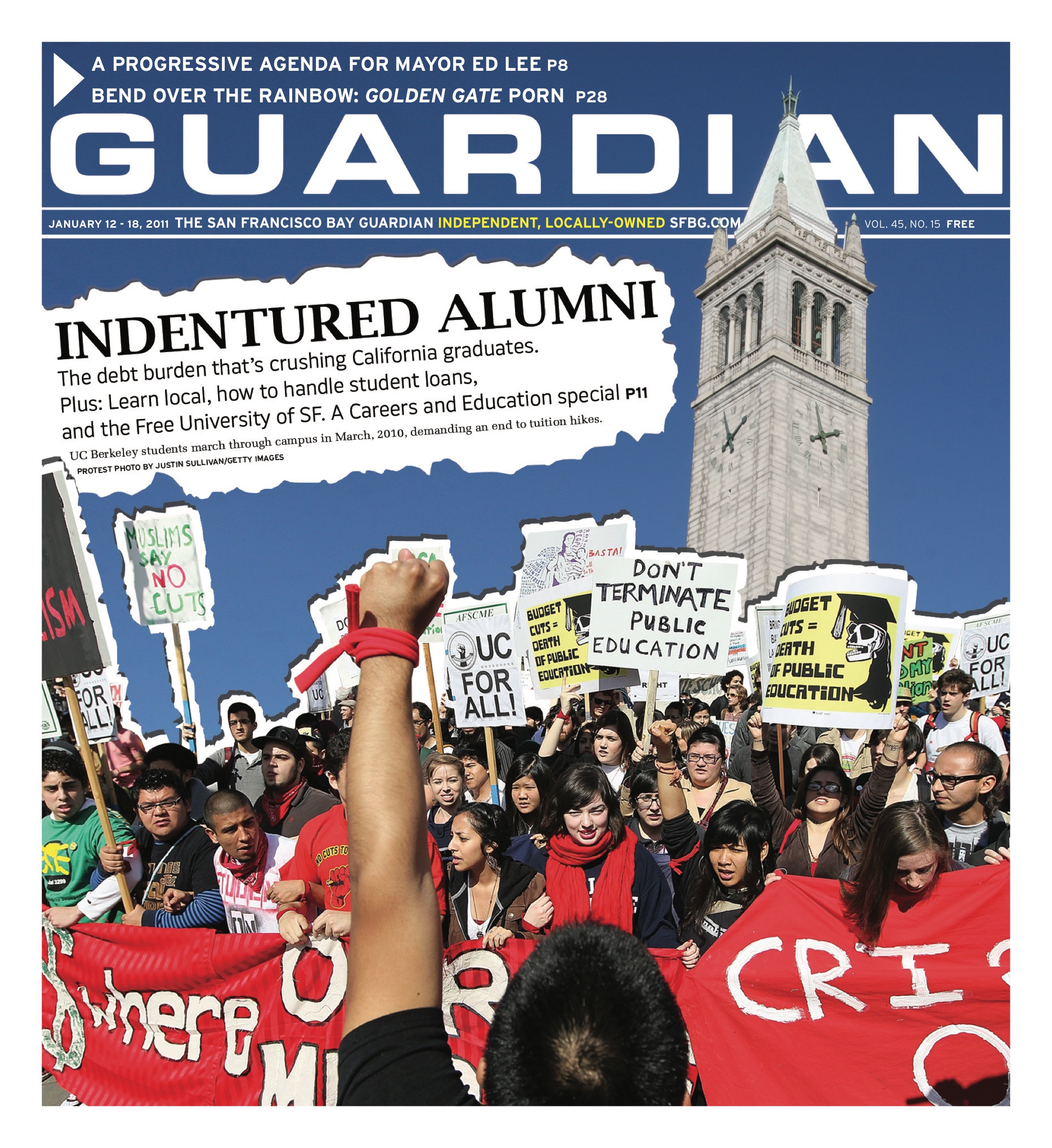
Print sections as they appeared in the early 2010s

To find articles by keyword or author, you may want to use our Search function.

Print Sections

The cruelest cuts

0

By Hannah Deveraux

OPINION Sitting alone in my apartment off Turk and Mason streets in San Francisco’s Tenderloin district, I try not to let myself slip back into depression or anxiety over my finances. My apartment is small, an adjective that makes it sound bigger than it really is. Still, it’s mine. I am able to pay rent through my Supplemental Security Income (SSI) check, and when my disability claim was first approved, I was relieved.

It had been a nearly two-year uphill battle with the Social Security Administration, and even after my benefits were approved, I still spent an additional three months living out of various shelters while I waited on several housing lists. But then the call came from my social worker at the shelter that I had been placed in a hotel in the Tenderloin, and I was excited to be out of shelters once and for all.

I am not someone who is easily given over to making hyperbolic statements, so I cannot say that I was ever happy to have to be living off SSI. Nevertheless, I was happy to have a roof over my head rather than a rain-soaked cardboard box, and I was thankful to have Medi-Cal. After all, San Francisco is just about the only place where transgender woman like myself can get affordable or free healthcare and be treated with dignity from our providers.

Little did I realize that being treated with dignity by our government was no longer in the cards.

It began when many of my friends, also on SSI or Social Security Disability Insurance (SSDI), started complaining about reductions to their checks. Our benefits were cut — but the Social Security Administration wasn’t telling us what had happened. Some checks were cut by as little as $20, some $60, and others as much as $150.

My check was unaffected for a few months, and then the cuts started to hit me as well. I have now seen six separate reductions to my monthly check, which was $964, and is now only $845. Because of the cuts, I no longer have enough to meet all of my basic needs each month. Many days, dinner is a loaf of warmed up garlic bread because it’s all I can afford.

But things got much worse. The government did the most inhumane thing imaginable: it took away vision and dental benefits from our Medi-Cal. Suddenly, three epiphanies about politics dawned on me: the first that the poor are sound bites for politicians; it always looks good for politicians to get their picture in the local newspaper with their arm around a smiling 60-something homeless guy. Second, the poor will always be the first minority group to have their funding for social service programs, essential food services, and low-cost or free medical care targeted in a bad economy.

The last thing I realized is that politicians don’t care if the poor die — as long as they die silently and the politicians don’t get blamed for it.

These days I wonder if I’ll even be able to keep my housing, and I often have anxiety attacks where my heart races and I cry to myself, just out of sheer stress and worry.

The fact is, I shouldn’t have to live this way. I have to wonder how amounts so small in proportion to California’s $25 billion deficit are even going to come close to making a difference.

It’s unconscionable that the first thought of our government would be to steal from those who are already disabled and poor and barely getting by, those who really don’t know how to advocate for themselves, and who have few allies to begin with. *

Hannah Deveraux has a roof over her head — for now.

alt.sex.column: Resolved

1

Dear Readers:

I’m pretty sure last year’s New Year’s resolution was to get a New Year’s resolution column in on time. So that one’s out, but there is still time for me, and, more important, you, to do a sex-and-love-life audit and figure out what’s wanting and what you could do about it in the coming year. Here are some ideas.

1) No faking it. Have you been faking it? Quit that. If it’s going on and on and you know it’s heading nowhere, say that. Conversely, if it’s a nice relationship and generally good sex but just not going to go that way for you this particular time, just offer to get partner off and it’s your turn next time. No harm done, and no faking.

2) Try something new. Obvious, I know, but honestly, do this. I’m not going to tell you what the “this” ought to be. But just because you haven’t noticed the rut, doesn’t mean you’re not in one. Maybe it’s just so deep you can’t see the way out. Or maybe things could be even better.

3) Read up on other stuff. You don’t have to try the new stuff, just find out about it. But maybe if you investigate X thing, you’ll be inspired to try it. Maybe knowing some new weird stuff will just make you fun to talk to at parties.

4) Buy something new. Sex toy stores like Good Vibrations, Blowfish, and Babeland make it easy and not even embarrassing. If you’ve been there, done that and yawn, maybe you could go to Etsy or one of the other handicrafts marketplaces and find something a little different, like the tentacle dildos. Or if you’re already over one-of-a-kind handmade blah blah, make your own!

5) Rummage. Find something that makes you feel irresistible and/or invincible. The usual suggestion is fancy lingerie but if you’re not the girly type (none of this requires you to be an actual girl) maybe it’s boots or a corset. Actually, those are mine, find your own.

6) Do something nice to (not just in) your bedroom. Clean it, declutter it, maybe paint it. Buy it new sheets. Cracker crumbs and a dirty ashtray do not a sensual oasis make,

7)Stop waiting for people to notice you and ask someone. You can do it. Hide behind technology if you like, but do it.

8) (Big One) Figure out what you want. Read around, look at porn, read the nice catalogs, pay attention to what crosses your mind just before you decide you’re in the mood, or while you’re doing it. Reflect on episodes that really worked for you. Don’t just do what you’ve been doing or what you think you ought to be doing, put some serious work into figuring out what you want to be doing.

9) Tell your partner. And this brings us back to 1), don’t fake it.

Happy New Year.

Love,

Andrea

Gor a question? Email Andrea at andrea@mail.altsexcolumn.com

Come to my room

1

le.chicken.farmer@gmail.com

CHEAP EATS After his thing he went right up to her and whispered in her ear. Here’s what he said: “Are you doing anything tonight?” Here’s what else he said: “Do you want to come to my hotel room?”

“Really?” I said. “You said that?”

“Can you believe it?”

“No,” I said. We were sitting at a picnic table in Dolores Park, in the sun in the cold, eating samwiches (his word for it, although … I would agree). The samwiches were from Bi-Rite Market, and therefore very good. “And did she come to your hotel room?” I said.

“Yes.”

There were also chips involved, and apples — a regular midwinter picnic. I knew my friend was telling the truth, but still couldn’t believe it.

“So, that really happens?” I said.

“Come on,” he said. “All your years in bands, on tour, you never … ?”

“No,” I said. “Never.”

It was so cold. Colder than it’s supposed to be, in my opinion, in San Francisco. He was sitting on the bench, and I was sitting on the table, face to the sun. It helped to be that much closer to it.

“Book tours? Readings?” he said.

I shook my head. My samwich was crunchy with carrots and cilantro, and therefore delightful. Vietnamese pork. I’m not proud of the fact, but it is, in fact, a fact: I never got laid on tour. Not on any kind of tour, ever. Not as a man, not as a woman, Sam-I-Am. Of course, I offered in my defense, the last couple tours were of senior centers and nursing homes, so …

Then I remembered that, during the first couple tours, I was in love with one of my bandmates, so …

Technically, I guess, I was not only getting laid after the show, like a rock star, I was also bagging the lead singer, and in this respect I was a groupie of my own band. Take that, Mr. Walks Right Up To Her.

We finished our samwiches and chips and apples just as the sun dropped behind some trees and that was the end of it, give or take Elton John. He wanted to know if I liked Elton John.

I thought this was a strange thing to want to know, after a samwich. Luckily, I knew the answer right away: “Yes.”

“What’s your favorite album?”

Goodbye Yellow Brick Road.”

His was Captain Fantastic and the Brown Dirt Cowboy. Did I know it?

“No.”

So of course he invites me to his house to burn me a copy. Who wouldn’t? Mind you: the invitation was not whispered in my ear, so what I took home from this whole samwichy experience was exactly that: Captain Fantastic and the Brown Dirt Cowboy.

Which I’m listening to as I write this.

Come to think of it, I was — until becoming beautiful and confident — almost always in love. Hey, maybe I’m bad at getting laid because I’m good at being in love. I don’t know. It’s a thought.

If it happens to also be true, I damn well better get over it, because, good-at-it or no, love ain’t happenin’.

So.

This Saturday Ed’s Redeeming Qualities is playing a reunion show in Boston. I’m 15 to 20 years older, not to mention a whole different person than I was in that band. And I’m about as single as a piece of cheese. Tell you what I’m going to do, I’m going to step off the stage at the end of this show, and Walk Right Up To … someone.

I wonder who it’s going to be. I know what I’m going to say, I’m going to say, “You’re a butterfly, and butterflies are free to fly.” Like Sweet Freedom, like my friend, I will whisper these words. “Fly away.” Then we will see.

BI-RITE MARKET

Daily 9 a.m.–9 p.m.

3639 18th St., SF

(415) 241-9760

AE/D/MC/V

All kinds of alcohol

Gorgeously Gorey

2

caitlin@sfbg.com

NIGHTLIFE Actually, the Edwardian Ball — now in its 11th year of gothic, ghoulish, glorious celebration — isn’t strictly a gathering of period costume nerds. In fact, those who focus on historical accuracy, says event cofounder Justin Katz, are kind of missing the point. “Much to their frustration, the founders of the ball don’t care if your collar is Edwardian or not,” he chuckles.

That’s because, as any good SF costume freak will tell you, the original Edward of this shindig is Gorey, not Windsor. In its first years, it was actually named the Edward Gorey Ball, a theatrical homage to the work of the macabre writer and illustrator of such classics as the A-to-Z book of child demise, The Gashlycrumb Tinies. This tome was read at the ball’s first incarnation, which was hosted by Rosin Coven, the pagan lounge ensemble that has graced the stage each subsequent year.

Why Gorey? “Once we began to explore his work, we really enjoyed his ‘untelling’ of stories,” Katz continues. “Almost nothing happens in his books!” Which isn’t exactly true, of course, but his slight and spindly, grave-studded plot lines seem slightly unsuited for nightlife action, especially the bedazzled, bedazzling theatrical productions that Mike Gaines’ Vau de Vire Society circus-dance troupe so spectacularly gives birth to on stage at the ball.

“It isn’t the easiest thing to base a dramatic stage show on,” Gaines admits. “But Gorey left [his stories] up for interpretation. He was a real theatrical cat.” Gorey was a noted ballet fan, and his illustrated landscapes could easily double as sets. And if he did indeed mean for his creepy-cute stories to be blown into phantasmagoric carnivals someday, then he is smiling down on the Edwardian Ball.

But as far as the event goes these days, Gorey stories are but one of its attractions. In addition to all the offstage attractions at the ball (which has burgeoned into a weekend-long affair that includes an expo of steampunk wonder-toys, entire floors of the Regency Ballroom given over to vendors of satin and skeletal finery, even a Friday night-only Ferris Wheel to be erected inside the ballroom itself), the event has become a group therapy session for SF’s costume-addicted party people. Well, a therapy session in which the addicted bust out their most flagrant behavior and congratulate each other on having done so.

Top among Gaines’ favorite get-ups from years past was an homage to Gashlycrumb‘s Winnie, the poor tot who met her maker after becoming “embedded in ice.” The intrepid Edwardian in question encased herself in frosted Plexiglass for the evening’s festivities. Others choose more technically Edwardian-accurate ensembles, and others still will use the event as an excuse to wear whatever the hell gets their creative juices flowing: goth-steampunk-geisha, anyone?

This inclusivity most likely explains the success of the ball. Katz mentions that one is likely to see one of the aforementioned period fundamentalists having a cuppa with a giant grasshopper, one table over from a couple who “look like they just crawled out of a nightclub,” all in a steam-powered tea garden. And then they’ll all join in a round of ballroom dancing that takes place near the main stage on Saturday. One mustn’t forget about the ballroom dancing. *

EDWARDIAN BALL AND WORLD’S FAIR

Fri/21 “World’s Fair”: 8 p.m.– 2 a.m., $28–$75

Sat/22 bazaar: noon– 6 p.m., free; ball 8 p.m.– 2 a.m., $38–$85

Regency Ballroom

1300 Van Ness, SF

www.edwardianball.com


Ms. Behavior

0

arts@sfbg.com

DANCE Fat chance Aura Fischbeck could have escaped becoming a dancer. Her mother was one of the last students of legendary German Expressionist dancer Mary Wigman; her father is an actor/musician who pioneered multimedia dance theater in the 1960s. Additionally, she had an older sister, also a dancer. “[She] was always a step or two ahead of me,” Fischbeck remembers. “I grew up surrounded by dance, but I didn’t like some of the politics that go with the profession.”

So what’s a gal to do? Fischbeck was drawn to poetry and history, but the pull of “embodying ideas,” as she puts it, was too strong. If you can’t fight ’em, join ’em; Fischbeck became a dancer.

The Philadelphia-born, Naropa University-trained dancer recently met me for an interview at CounterPulse during a break from rehearsing the upcoming world premiere of Bodies That Won’t Behave, to be presented this weekend in a double bill with The Riley Project. Although her company, Aura Fischbeck Dance, is only two years old, she has been dancing, rehearsing, choreographing, studying (with Kathleen Hermesdorf), and producing in SF ever since she hit town seven years ago. She immediately hooked up with Joe Landini when he opened The Garage in 2007. Since then, she has participated in just about all of the various programs that home-for-dancers offers.

As a choreographer, Fischbeck’s work — such as Relay and her solo Compass — has resembled a dialogue between a kind of abandon that looks spontaneous or improvised but isn’t, and a fascination with control and formalized structures. She has managed to put a personal, fresh twist on this common tension between two modes of being. It’s a pull she readily admits to in her own life. “I want to let loose and let go, and then I have to reign myself in.” In Fischbeck’s choreography you can also see a strong conceptual basis, much as you do in the work of people she admires: Miguel Gutierrez, Ralph Lemon, John Jasperse, and Jess Curtis.

In the trio for Bodies, which Gretchen Garnett, Julie Potter and Travis Rowland are rehearsing when I arrive at CounterPULSE, Fischbeck is working with “proper” and “improper” behavior. (An accompanying video by Chris Wise shows the dancers “misbehaving” in Golden Gate Park.) Fischbeck doesn’t make moral judgments about comportment. She wants to explore the body as a vessel for conflicting values.

In an e-mail later the same day, Fischbeck is at pains to articulate the motivating force behind Bodies: “The idea of misbehavior is unpacked in this work as a way of expressing love and acceptance for our imperfections,” she writes, “and for allowing the parts of ourselves that are awkward or unkempt or simply uncontrollable to be witnessed and celebrated.”

What you are likely to see on stage this weekend is comédie humaine: three dancers, with Potter as the smallest one in the middle, on adjacent folding chairs trying to negotiate individual and common spaces. During the rehearsal, this attempt to balance conflicting interests very quickly began to look like a fierce competition. Attempts to navigate and hoard resulted in moments that are frustrating, painful, hilarious, tender, and just plain awkward. When the trio finally broke into spaciously flowing unisons even those soon began to hiccup and disintegrate.

Bodies will be seen in conjunction with two premieres by Leigh Riley, All You Need and DuBeUs. All You Need grew out of Riley’s interest in Aristotle’s concepts of love: philia, eros, storge, and agape. “I grew up in a Christian tradition where we always heard about those four different kinds of love,” Riley explains. “But I really wanted to make four very different duets.” DuBeUs is a collaborative quintet for Caroline Alexander, Jennifer Bennett, Leah Curran, Stacy Swann, and Katharine Vigmostad. It examines the demands on an individual’s identity when belonging to and assimilating into a group, such as happened, for instance, throughout “Don’t ask, don’t tell.” *

AURA FISCHBECK DANCE AND RILEY PROJECT

Fri./21-Sat./22, 8 p.m. Sun./23, 2 p.m.; $12–$20

CounterPULSE

1310 Mission, SF

(415) 626-2060

www.brownpaperickets.com

Beast and the Hare

2

paulr@sfbg.com

DINE If one reason to go out to eat is to partake of dishes you can’t easily make yourself, another is to find ideas for dishes you can make yourself. I place myself more in the latter category, and, as an ersatz Frenchman and perhaps unacknowledged admirer of French industrial espionage, I find myself peeking at dishes as they emerge from restaurant kitchens, wondering whether I could manage some version of this or that in my own kitchen or appropriate a few clever twists or wrinkles as enhancements to some quotidian staple of the repertoire. As urban voyeurism goes, this subspecies seems fairly mild and nontoxic.

Food fits a sensibility, ultimately, the same way clothes do. Some people are born to wear tuxedos and nibble foie gras from dainty toast rounds — Pierce Brosnan springs to mind here — while others (the young, mostly) look most aglow in t-shirts, cargo pants, and espadrilles, eating foil-wrapped burritos while sitting on the curb.

Extremes tend to attract the most attention, in part because they’re easy to identify, but between them lies a wide country full of distinctive treasures. In San Francisco these treasures are — I speak now of food, not clothes — the neighborhood restaurants, the places that, for the better part of 20 years, have found and held a balance between flair and rusticity. They make the kind of food you’d make at home, if you spelled home with a capital H and Architectural Digest was coming to shoot a photo spread; they make food that’s recognizable and unintimidating yet subtly sublime, at a reasonable price.

There was a bloom of these places in the early to mid 1990s, and according to this timeline Beast and the Hare, which opened at 22nd and Guerrero streets in November (in the old La Provence/Mangiafuoco space at the corner) is a latecomer, or maybe a throwback. The restaurant is good-looking — simple, royal-blue walls and generous spacing among the tables — but it’s not stunning. It reminded me of someone wearing a nice pair of Levi’s with a white button-down shirt and black loafers. Such a person would want honest but sophisticated food, and that’s what chef Ian Marks’ kitchen would give him.

Marks’ résumé includes a stint at Liberty Cafe, a neighborhood light from the early 1990s, as well as Fatted Calf and Hog Island Oyster, and so his to-the-point menu includes, not surprisingly, oysters and house-made charcuterie. You can get a satisfying arrangement of charcuterie, including lardo draped on thin slices of pink-lady apples, rabbit rillettes, and slices of smoked duck breast, along with toast rounds and a small pile of pickled vegetables, for $14.

The pickles helped cut the sense of fattiness, we found, as did the lacinato kale ($5), which had a light crispiness, almost like that of pappadum, I associate with flash-frying. My ersatz-Frenchman self noted that the idea of handling kale (which can display an obstinacy like that of cheap steak) in this way had never before occurred to him.

Osso buco ($18) is typically served with risotto, which, for creaminess is hard to beat. But risotto is unforgiving and tricky to time, and — in a slight inversion of the usual rule — restaurant versions often aren’t quite as good as the homemade kind, at least if the home chef is reasonably attentive. Beast and the Hare’s solution was to substitute white beans for the risotto, and if they weren’t quite as creamy, they did give a nice textural counterpoint to the rich, gelatinous marrow sauce oozing from the core of the gigantic veal shank.

A pressed duck leg ($18) reminded me of chicken under a brick, with crispy skin, a restrained juiciness to the meat, and a convincingly steam-rollered look. If, like me, you have been overexposed to confit and sometimes find duck too rich and fatty, you would probably warm to this method. Further cutting the richness were a pair of nicely browned potato disks and a bed of still-crunchy chicory.

The dessert menu does contain at least one extraordinary item, and that is the beer ice cream, which appeared as a small sphere accompanying the German chocolate cake ($8). Beer ice cream sounds gimmicky, but it did really, and pleasantly, taste of beer — as if someone had mixed suds with some heavy cream and a touch of sugar, then frozen it. A little more conventional were the beignets ($6), like a bunch of little fried basketballs in a rack after gym class, with, on the side, a thick and bewitching orange caramel sauce. If they’d only served you the sauce, you probably wouldn’t have complained. The ersatz Frenchman had to be restrained from licking the dish clean. What a beast he is.

BEAST AND THE HARE

Dinner: Wed.–Mon., 6–10 p.m.

1001 Guerrero, SF

(415) 821-1001

www.beastandthehare.com

Beer and wine

MC/V

Moderately noisy

Wheelchair accessible


Knock knock

0

superego@sfbg.com

SUPER EGO I think we’ve all agreed to finally bury overused buzzwords like “legendary” and “icon” and “classic” and “mitxirrika” in the cold, cold buzzground. Hype gives me the sneezes. Nevertheless, there are some accomplished parties and DJs making return visits (and, in one case, celebrating a semi-centennial) this week, which and who deserve some fresh superlatives.


DOC MARTIN

Dear me, Doc’s been such a part of the West Coast dance music landscape for the past 25 years that he can throw down any type of set he wants and walk away a winner. In the past two years alone, I’ve seen him pump early house, cutting-edge post-minimal, and full-on balls-out techno. He’s got the mastery to match his moods, the mark of true artistry.

Fri/21, 10 p.m., $15. Temple, 540 Howard, SF. www.templesf.com


FAG FRIDAY

At the previous lovely instance of this omnisexual soulful house party’s reunion, in October, I looked over the masses losing their minds when DJ David Harness dropped Danny Krivit’s rework of Derrick May’s “Strings of Life” and teared up a little with the gorgeous wonder of it all. You’ll laugh, you’ll cry, you’ll strip off someone’s shirt and twirl around with it. Mr. Harness returns, with Juanita More, Rolo, and Miss “I Get Lifted” herself, diva Barbara Tucker live. One of my favorite things.

Fri/21, 10 p.m.–4 a.m., $10. Public Works, 161 Erie, SF. www.publicsf.com


JAZZY JEFF

Those 1990s revivalists will forever pin him to the Fresh Prince — but man, they just don’t understand. Jazz’s output, especially his recent mixes, has shown a level of crate sophistication and broadmindedness that transcends retro hip-hop shtick. Don’t worry, you’ll still get some joyous old-timey hands-in-the-air, but Jazz’ll drop some smart new hip-shake as well. With Apollo, Sake One, and the Whooligan.

Fri/21, 10 p.m.–late, $20. Mighty, 119 Utah, SF. www.mighty119.com


KAFANA BALKAN

Are you being Serbed? Well, get Kosovar here! This raucous, incredibly fun party returns after a long hiatus for its fourth anniversary, its trademark Gypsy-influenced tunes in tow. There’s a dedicated crowd of oom pah pah-lovers, who live for live performances by talented ensemble Brass Menazeri and those almost-hallucinogenic moments when DJ Zeljko hits ’em with a vintage old-country slice in goddess-knows-what time signature. It’s a little bit Burner, a little bit Beatbox, and all Balkan, baby.

Sat/22, 9 p.m., $10. Rickshaw Stop, 155 Fell, SF. www.rickshawstop.com


JACKHAMMER DISCO

Juan Maclean’s DJ Kicks mix on K7! was one of the best label-released mixes of last year, showing an astute ear that managed to bend disparate elements into a pleasant happy house revival (which cannily matched the single “Happy House,” released by his band, The Juan Maclean). Drop your coat on the floor and prance around it when he headlines this winky-ravey party.

Sat/22, 10 p.m.–late, $15. Public Works, 161 Erie, SF. www.publicsf.com


DJ BUS STATION JOHN’S 50TH BIRTHDAY

“Looking back, I really believe it was fated that this music I have such a passion for — thousands of songs somehow magically encoded in these spiral grooves of black plastic 30 years ago or more — was meant to survive, to be with us another day,” says DJ Bus Station John. As was he. Now with us for half a century (that’s a lot of polish on the ol’ glory hole! Somebody drop her off at Sotheby’s for appraisal!), the old school disco-teer is still going strong, and bringing generations together. “I love the great rapport I have with the young’uns on and off the dance floor. But it’s important that guys my age and older know they are heartily welcomed at my clubs as well. After all, we lived it the first time ’round. And like my records, we are survivors, here to tell the tale. So boys, I want to see more of your wrinkly faces shining under the disco lights!” For his 50th, he’ll guest star at the weekly Honey Sundays party, playing a “special 12-inch edition” of that party, based on his much-missed marathon tea-dance, Double Dutch Disco.

Sun/23, 7 p.m.–2 a.m., $3. Holy Cow, 1535 Folsom, SF. www.honeysoundsystem.com

Bye bye blackbird

0

arts@sfbg.com

FILM During the course of writing this review, I will at some point be ensnared by a sentence, reworking its syntax and flow across many notebook pages. For some of us, this is what writing is. When we praise commanding literary performances as great writing, we’re actually talking about reading. It’s not surprising that film portraits of artists usually only give us a mime of their craft; biography and circumscribed performance are shields from the crooked time of the creative process.

Pedro Costa made a rare “painters painting” movie of the French filmmakers Jean-Marie Straub and Danièle Huillet, and now he has done another with Jeanne Balibar. The two films trail distinct voices: Where Does Your Hidden Smile Lie? (2001) had the voluble Straub, whereas in Ne change rien Balibar speaks an obscure language of process (“Bring out the silences.” “This is fragile.”) that is outside the paltry domain of the conventional music documentary.

Costa forgoes exposition, and his stationary long takes require patience. Early on in Ne change rien, we watch Balibar work through a compact melodic phrase for more than 10 minutes. Stretched out of shape in this way, singing comes to seem distinctly of the body — equal parts athletic and spiritual exercise. Warhol’s unstinting camera is an obvious reference point for Costa’s staring-down-the-void, but while it’s true the Portuguese director doesn’t fear boredom, neither does he court it. He forgets the audience but gives us a greater taste of being for it. His tendency to black out vast portions of the frame makes a special kind of sense in Balibar’s recording studio; herein, both sound and vision register as isolated degrees of a larger frame.

Balibar’s appearance seems to change from one song to the next, and Costa’s signature shadows accentuate this disappearing act — we might call it seduction. Though the film shows us Balibar live onstage and training for opera — a different person almost — the heart of Ne change rien is in the studio, where we get to know a handful of songs as we would people (i.e., not all at once). A recording studio is not conducive to spectators; indeed, it can be difficult to remain engaged even as a participant. It is where musicians break their songs apart for the discrete elements can be recombined as a dynamic illusion of a single performance. Similarly to the Straub-Huillet portrait, Costa situates Ne change rien in an enclosed chamber of creative production while withholding the composite product assembled there.

We are left clinging to fragments, and yet the offhanded threads between shots (a repeated quip about movie sets, a cat) underscore the more resonant elucidations of the songs in construction. As Balibar circles a melody, so the tunes coil the sequences — no wonder they’ve been haunting my sleep. Late in the game of “Cinéma,” Costa cuts between guitarist Rodolphe Burger and the recording engineer listening to the full playback of the song and Balibar in a different room recording its vocal track (she hears what they do on headphones, but we hear her voice alone). This is the only time we see a piece of the outside world, and you will have to take my word that the window and her voice are one. At the end of Ne change rien, Costa cuts to the musicians in a backstage room flooded with artificial light. Graphically, the shot is the opposite of all that’s come before. The group runs through a lovely song we haven’t yet heard (“Rose”). The effortlessly unfolding time-frame of rehearsal is something new too. It looks a lot like grace. 

NE CHANGE RIEN

Thurs/20, 7:30 p.m.; Sun/23, 2 p.m., $6–$8

Yerba Buena Center for the Arts

701 Mission, SF

(415) 978-2787

www.ybca.org

Crack-ups

0

arts@sfbg.com

FILM Who wants to die for art? That question, immortally screamed by Divine at the climax of John Waters’ Female Trouble (1974), has most recently been taken up by Darren Aronofsky’s campy psychological thriller Black Swan (2010), in which Natalie Portman’s fragile ballerina discovers that giving her all as the good and evil leads in an edgy production of Swan Lake requires giving up her sanity, and eventually, her life.

The somewhat romantic notion that an overinvestment in one’s art can lead to a psychotic break with reality also underlies Ronald Colman’s far more gripping, Oscar-winning performance in George Cukor’s 1947 backstage noir A Double Life, a film Black Swan perhaps owes as much a debt to as it does to its other cinematic antecedents such as The Red Shoes (1948) or All About Eve (1950) (2007’s I Know Who Killed Me also deserves a lesser place on that list).

In the film — which screens at the Castro Theatre in a new archival print as part of Noir City 9 — Colman stars as Anthony John, a celebrated stage actor with a nasty temper who winds up playing the title role in a production of Othello opposite his ex-wife Brita (Signe Hasso), who has been cast as Desdemona. As John gets deeper into his character, his own lingering frustrations over his failed marriage become cross-wired with Othello’s jealous rage resulting in a fatal instance of life imitating art. "What seems a fairly safe profession, acting," wrote New York Times film critic Bosley Crowther in his review of the film, "is as dangerous as they come."

Cowritten by husband-and-wife team Ruth Gordon and Garson Kanin (who themselves were no strangers to the stage) and photographed with Expressionistic verve by Milton R. Krasner, A Double Life is — true to its title — filled with mirror imagery, split frames, and opposites locked in conflict. It also sets the stage, if you will, for the other titles in this year’s Noir City program, many of which turn on a character struggling to keep from splitting in two.

So often in film noir, the burden of proof is so great as to drive our hero or heroine mad as they try to convince those around them that they’re innocent, in danger, or more often than not, both. Such is the case with Pat O’Brien’s museum curator in Crack-Up (1947), who survives a horrible accident only to be told it never happened, or Barbara Stanwyck’s imperiled, bed-ridden rich girl in 1948’s Sorry, Wrong Number (Stanwyck, it should be noted, is all over this year’s festival, including a blistering starring turn as the titular addict in 1949’s The Lady Gambles).

In some cases, as with two of this year’s many not-on-DVD rarities, the protagonists actually do have evil twins. Olivia de Havilland beat Hayley Mills to the punch playing both sisters in Robert Siodmak’s The Dark Mirror (1946), in which the evil de Havilland uses her physical resemblance to frame her sweet sister (also de Havilland) for murder. Meanwhile, in Among the Living (1941), Albert Dekker goes up against himself as a brain-damaged psychopath who terrorizes a small town and the fraternal twin who must take him out.

This year’s nuttiest film by far is Fritz Lang’s Freudian roller-coaster ride The Secret Beyond the Door (1948). Faster than you can say Rebecca (1940), Joan Bennett’s naïve newlywed has been whisked off to her new husband’s big, dark house full of repressed secrets and a spinsterish head housekeeper. As gorgeous to look at is its plot is difficult to follow, The Secret Beyond the Door is a film you’d have to be nuts not to see.

NOIR CITY 9

Jan. 21–30, $10

Castro Theatre

429 Castro, SF

(415) 621-6120

www.noircity.com

La Frontera

0

arts@sfbg.com

HAIRY EYEBALL Walking through Tracey Snelling’s 10-year survey at Rena Bransten brings to mind the famous opening tracking shot of Orson Welles’ 1958 noir Touch of Evil. For over three tension-ratcheting minutes Welles’ camera — all swooping omniscience — takes in the garish sights and sounds of a tourist outpost along the U.S.-Mexico border as it tails an American car that, unbeknownst to the couple behind the wheel, has been planted with a bomb that’s about to go off.

Much like the back lot border-town surveyed by Welles, the Oakland-based Snelling pays repeated visits to liminal spaces: empty strip malls, dusty souvenir shops, seedy motels, and bygone roadside attractions. From her intricate miniature models of these buildings — many outfitted with ambient noise soundtracks, realistic interior lighting, looped video clips of “occupants,” and distressed paint jobs — to the mock-ups of the sort of neon signage once seen along Route 66 that greet you as soon as you walk into the gallery, Snelling’s art drops us somewhere south of some border, just on the edge of town, and definitely on the wrong side of the tracks.

The locations Snelling chooses are for the most part generic and yet deeply familiar. This is in no small part due to their recurrence as archetypical backdrops in pop culture and Hollywood films, something her art self consciously plays with. Take Big El Mirador, a large sculpture of an adobe hotel, for which Snelling has set up six DVD players behind the piece (coordinated with a sync box) to play a different film clip through each of the building’s six window to give the illusion of action happening in the rooms. Other models feature clips swiped from movies that feature similar structures, or are, as with the sculpture of Norma Desmond’s mansion from Sunset Boulevard, miniature versions of buildings from films.

At the same time, Snelling’s obsessive eye for detail — whether getting the fluorescent glare right inside a convenience store or building a perfectly weathered Tecate billboard — make each environment feel more “true-to-life,” inviting the viewer, much as a child does with a doll house, to construct narratives for the often-unseen occupants of these ghost town dioramas.

In other pieces Snelling situates the viewer as the occupant. In the space of a few steps one goes from looking at the exterior of model of the Motel El Diablo to standing in what could presumably be one of its rooms, complete with a cramped single bed, dresser, bad art on the wall, and more suggestively, a pair of black high heels casually tossed on the floor. Another life-size installation is a walk-through gift shop filled with to the brim with motion-activated tchotchkes, fake kachina dolls, Chinatown good luck dragons, and Hindu religious posters.

This scalar slip ‘n’ slide between life-sized and downsized only further adds to the fun house atmosphere generated by Snelling’s lovingly crafted and decidedly lonely monuments to displacement.


MARKING TIME

Max Cole’s acrylic-on-linen paintings feature alternating arrangements of two horizontal elements — ramrod straight lines of varying widths and small vertical hatch-marks — executed in varying shades of gray, black, brown, and white.

Like the painter Agnes Martin, Cole is an abstract precisionist whose canvases function as time cards, that with each tick, document to an almost zero-degree the entire span of their own creation.

And like Martin, Cole’s paintings are also rooted in the natural world, despite their superficial resemblance to, say, ruled writing paper. Titles such as Briscone Pine welcome one to see the grooves and ruts of tree bark, or in the case of the show’s name, “Terra Firma,” geologic strata, in these painting’s large bands and delicate vertical marks. *

TRACEY SNELLING: 10-YEAR RETROSPECTIVE

Through Jan. 29, free

Rena Bransten

77 Geary, SF

(415) 982-3292

www.renabranstengallery

MAX COLE: TERRA FIRMA

Through Feb. 12, free

Haines Gallery

49 Geary, SF

(415) 397-8114

www.hainesgallery.com

Life within sound

0

arts@sfbg.com

MUSIC Peer carefully at the expansive gatefold cover art of Barn Owl’s Ancestral Star (Thrill Jockey), and what at first glance looks like two interstellar vessels cruising through the night sky coalesces into something much more grounded, tethered to the spectral shadow of the image’s photographer, Barn Owl guitarist-vocalist Jon Porras, holding his hands over the light source in the foreground.

Porras took the three-minute exposure of the moon over a campfire at SF’s Ocean Beach on a cold, clear April night. “If you look closely, you can see the waves crashing,” he says. “All the light becomes saturated on film — that’s why it’s so luminescent. I actually had to go up to the fire to warm my hands, and you can see a ghostly image of me warming my hands over the fire.

“It’s become a funny joke between my friends.”

It’s also an unlikely, mysterious footnote perfectly in sync with the majestic sounds pouring from Ancestral Star, one of 2010’s best albums, and one that continues to surface new pleasures — from “Sundown”‘s opening overture of distorted guitars to the title track’s incremental, tonal tectonic shifts to “Cavern Hymn”‘s glimmering, deeply echoed fingerpicking. The enigmatic, unexpectedly earthbound image parallels the long tone and drone listening experience as well. “It requires a certain patience,” Porras, 25, muses. “I think long tone music can open up aspects of reality you may not have otherwise have seen.”

Meditative drone, black metal, Tibetan throat-singing, gliding meditations on bowed guitar, and celestial compositions sprinkled with synth, gongs, bells, and singing bowls seamlessly ebb and flow, seemingly of one mesmerizing piece, in a work that feels like the lost, alternative soundtrack to Paris, Texas, or the score to a lost Alejandro Jodorowsky western — a sound that was part of the thinking when Porras and fellow guitarist-vocalist Evan Caminiti went into the studio with friend the Norma Conquest in 2009. It was their first opportunity to record over the course of several months, refining their sound and bringing in musicians such as violinist Marielle Jakobsons (Darwinsbitch) in a professional studio setting.

“We were going for a metaphysical cinematic western,” Porras explains. “We like to have these Americana-influenced guitar passages in combination with more experimental elements to create this overall narrative. I guess the desert at night is an image we like to invoke — fog-shrouded hillsides, the awestruck feelings you get from a landscape.” The sweeping, wonder-inducing American spaces of Cormac McCarthy and Porras’ favorite, Zane Gray, were an inspiration for the two musicians, who first met each other in an American Indian science class at San Francisco State University in 2005.

Metal, as well as the long-tone compositions of Lamont Young and the American primitive fingerpicking of John Fahey, also provided common ground. “We had similar ideas,” Caminiti recalls. “I just remember wanting to combine things that hadn’t necessarily been combined before — heavy music and blues with more folk-influenced music — so we’d work on a piece that had heavy drones and do blues-influenced fingerpicking over it. There was a lot of exploration that had to be done, and we just distilled the sound over the years.”

Those sonic journeys have manifested recently in a collaboration with Headlands Center for the Arts resident Ellen Fullman — who installed her room-sized long-string instrument in her old army building of a studio — out on the Important imprint. And Caminiti and Porras, who also hold down the musical projects Higuma and Elm respectively, are currently working on a new Barn Owl album with Trans Am’s Phil Manley at Lucky Cat Studio, on music sparked by Popul Vuh’s “interlocking chiming guitar passages,” according to Porras.

Now, with performances in the group’s past at such disparate spots as Grace Cathedral (“Great in particular because there’s six seconds of natural reverb, which is perfect for resonant sound,” Porras says), sometime label Root Strata’s On Land gathering, the Museum of Anthropology at the University of British Columbia in Vancouver, and the Supersonic Festival in the United Kingdom, the Barn Owl experience might be characterized as more metaphysical than visceral.

“We aim to create an enveloping atmosphere where everyone is sucked away into an alternate dimension for 30 minutes,” Caminiti observes. “Everything around you is just put on pause, and you’re just living within the sound in the moment. You become engulfed in the sound. The sound becomes a living organism, which is also why there’s a lot of room for improvisation in our set. For us, it leaves us centered and at peace — it’s a meditative device in a way.” 

BARN OWL

With Phil Manley Life Coach and Diego Andres Gonzalez

Tues/25, 9 p.m., $6

Hemlock Tavern

1131 Polk, SF

(415) 923-0923

www.hemlocktavern.com

Playlist

0

>>Read part one here.

NOBUNNY

Raw Romance

(Burger Records)

Nobunny, the bunny-masked alter ego of Oakland rocker Justin Champlin, has been performing since 2001. He had his first full-length release in 2008 with Love Visions on Bubbledumb Records, and last fall he released his follow-up, First Blood, on Goner. Between that, in 2009, there was Raw Romance, a cassette-only release composed of new songs, covers, and acoustic alternates to favorites from Love Visions. With only 500 hand-numbered copies of Raw Romance in circulation, it garnered a cult following. Now Burger Records is releasing it remastered on vinyl, and the first 300 copies on pink vinyl.

Raw Romance starts out with a Buffalo 66 sample, and then plunges into “Your Mouth.” It’s a simple, sweet song with risque PG-13 lyrics, ornamented with tambourine, handclaps, and whistling. A nod to Nobunny’s own appearance, “Mask’s On” is an ode to mask-wearers and lovers. The recess-worthy “Apple Tree” is both sexy and scary, like a vampire crush. On “Tonight You Belong to Me,” Nobunny offers a raw acoustic version of the song famously sung by Steve Martin and Bernadette Peters in The Jerk. “The Gutter” is a mix of Elvis-rockabilly and country twang — a harrowing tale that ends in … the gutter. Although it’s a hodgepodge, Raw Romance makes a boisterous addition to any Nobunny fan’s collection. (Michelle Broder Van Dyke)


NOBUNNY

With Battlehooch, Exray’s, The Downer Party

Feb. 25, 9 p.m.; $12

Bottom of the Hill

1233 17th St., SF

(415) 621-4455

www.bottomofthehill.com


EXRAY’S

Exray’s

(Howells Transmitter)

From making “musical fiction” with Ray’s Vast Basement to playing in the SF band Black Fiction, a project with Tim Cohen from The Fresh and Onlys, Jon Bernson is a force in the Bay Area music scene. He’s contributed music to a dozen plays and at least four short films. And if you’ve seen the $200 million-grossing movie The Social Network, then music from his latest project Exray’s has no doubt crept into your ears.

As Exray’s, Bernson and Michael Falsetto-Mapp released a cassette, Ammunition Teeth, last year on San Francisco label Howells Trasmitter. The band is now set to release its self-titled full-length Feb. 1. It boasts an impressive guest list: Nate Query (the Decemberists), Warren Huegel (Citay, Jonas Reinhardt), and Cohen. Opening with “You Forget,” the album flows forth with uptempo beats and a florid blend of guitars, synths, and samples. This release evokes various moods, akin to the settings that Ray’s Vast Basement created for its “musical fiction,” making it clear why those behind The Social Network soundtrack found the Exray’s track “Hesitation” appropriate. Underneath the steady pulses and the pop melodies, there is an anxious undercurrent. “Stolen Postcard Sun” is a slowed-down number that hints at the mysterious. An album highlight comes at the end with “When I Was You,” which paints a somber postromantic picture. This electronic-pop duo crafts songs that hint at the unknown while steadily pacing ahead. (Broder Van Dyke)

EXRAY’S

With Magick Trick, Fiveng, DJ Cyclist

Feb. 4, 9:00 p.m.; $12

Cafe Du Nord

2170 Market, SF (415) 861-5016

www.cafedunord.com


TY SEGALL

Live in Aisle Five

(Southpaw)

Bay Area-favorite Ty Segall has been churning out recordings under his own name since 2008 with the cassette Horn The Unicorn on Wizard Mountain, and there are no signs he’s slowing down. To start 2011, Segall is releasing Live in Aisle Five, recorded by local noise-maker Eric Bauer last summer at an Amnesia show for Southpaw Records’ first-year anniversary party.

The album starts with a triumphant “How you guys doing?” from Segall, and then the smashing new song “Come to California.” There’s the usual rumble of reverb, so it’s hard to discern all the lyrics, but it sounds like a ragged advertisement for our home state. It’s got an astounding guitar solo that flushes the song out and moves into the pounding drums of “Imaginary Person,” off of 2010’s Melted, on Goner. Segall’s signature wolf-worthy howls are heard throughout the album. On his cover of GG Allin’s “Don’t Talk to Me,” the onomatopoeia of “chitter, chatter” and “yak tak” is screamed like it was meant to sound. More than his recordings, Segall wins fans live. And if you yearn for that visceral experience that is more human in its imperfections — one that makes you want to move — this is your record. (Broder Van Dyke)

TY SEGALL

With Nodzzz

Jan. 28, 8:30 p.m.; $12

Rickshaw Stop

155 Fell, SF

(415) 861-2011

www.rickshawstop.com

Grind fidelity

0

arts@sfbg.com

MUSIC For years, critics have written about heavy metal using the vocabulary of biology — the increasingly byzantine music was framed as an evolutionary process, a family tree of genre and subgenre. Given the nature of the predominant acts at heavy metal’s initial apex, this move made perfect sense. Metal has always been a supremely visceral music, acutely concerned with human bodies, from the imperious god-beings of Judas Priest lyrics (are you standing by for Exciter?) to the figures’ inverse: the cadavers depicted by the gleeful medical dictionary versification of Carcass.

Human bodies will always be tethered to metal. But for not entirely arbitrary reasons, I’ve been finding it interesting these days to map out the unfolding universe of metal spatially — as doom continues to position itself as the vanguard of the music (and with good reason), creating sprawling, planar worlds of tone, this approach seems like a productive step toward thinking about the specifically musical elements that link so many disparate styles within the coordinates of the blanket term “metal.” It also seems conducive to starting arguments with your friends about bands and shit, which is a constructive goal in its own right.

If funeral doom represents this (sonic) world-creating move, then grindcore represents its spatial inverse, an implosion of familiar dynamics into dense, indecipherable fragments that are over too quickly to unfold in time. There’s always been something hilarious and perverse about this anti-musical gesture, which is perhaps best explained by the genre’s bifurcated history — as much as it was an antecedent to later metal styles, grindcore was also fundamentally the next logical extreme of punk rock, and thus, rock ‘n’ roll reduced to its most unpleasant and confrontational.

Fundamentally, grindcore has always had a healthy sense of humor about itself: former Napalm Death guitarist Justin Broadrick, as quoted in Albert Mudrian’s book Choosing Death, recalls doubling over with laughter during early rehearsals as he and his fellow bandmates pushed then-drummer Mick Harris to blast away on his kit at increasingly nonsensical speeds. This pervasive sense of fun underlying even some of the most aggressive bands is perhaps one reason why a genre that tends to allow itself an extremely narrow musical space in which its ideas can stretch out has lasted for so damn long.

Napalm Death’s Scum (Earache), the first grindcore record (hypothetical metal-nerd/Siege/Extreme Noise Terror fan: stop yelling at the newspaper; you’re making a scene …) was released in 1987, 24 years ago. Since then, grindcore is still going strong, while countless styles, seemingly more complex, have exhausted themselves and bored their former fanbases in the interim. (Even crabcore, a genre that combined the dynamism of Casio keyboard demos with the showmanship of inexplicably squatting while playing guitar, has fallen by the wayside.)

Speaking of improbable, heroic survivors, what better venue to host the 10th anniversary of Short, Fast, and Loud, a massive showcase of all things grind, than Berkeley’s 924 Gilman, which, like grindcore, has been sticking it to the mainstream’s delicate sensibilities for more than 20 years by simply existing?

This year’s installment is a two-day affair, featuring an impressive collection of scene favorites (including several alumni of the legendary Slap A Ham Records) mostly spanning the West Coast, with one extremely notable exception being New York City’s legendary Brutal Truth. Undeniably one of the genre’s greats, Brutal Truth affects the kind of balance between righteous, politically-conscious anger and the unbalanced energy of the maelstrom of noise and blastbeats and buzzsaw-on-sheet-metal riffs that characterizes its medium. Come watch bodies collide in the space of one of the Bay Area’s most culturally significant venues at what promises to be one of the most thrillingly merciless shows of the year. BLAST! *

SHORT, FAST, AND LOUD

Jan. 21

Brutal Truth, Lack of Interest, Plutocracy, Voëtsek, Iron Lung, D.H.C.

Jan. 22

Flagitious Idiosyncrasy in Dilapidation, Capitalist Casualties, Bastard Noise, Despise You, P.L.F.

Population Reduction

7 p.m. both nights, $12 each

924 Gilman, Berk.

(510) 525-9926

924gilman.org

www.924gilman.org

‘Too Much’ — and more

0

arts@sfbg.com

THEATER/DANCE/PERFORMANCE Too much of a good thing can be a good thing. That became clear to artist/curators Julie Phelps and Keith Hennessy last year with the unexpected success of “Too Much!,” a no-holds-barred marathon of contemporary queer performance originally conceived as a cheeky 20th anniversary celebration of Hennessy’s lauded yet uncompromising career as performer, choreographer, and activist.

The idea of a “queer 20th anniversary” only got the conversation started, says Hennessy, whose company Zero Performance produced last year’s event. “I’m in a really different space than I was 20 years ago. I’m now 50. I made [my breakthrough] piece when I was in my late 20s. Who are those people now? And where is queer performance at? That sort of launched our thinking about putting on a festival, and [the idea] that the thing in itself should be excessive or ‘too much.’ So we crammed everything into 10 hours.”

This spirit of polymorphous plenitude launched a one-off “queer marathon” so momentous it turns into a second annual this Sunday, over the course of another 10 hours. Between 2 p.m. and midnight, three rooms at Dance Mission Theater are given over to the work of more than 50 artists — a mix of performance, installation, video, public discussion, workshops (in street art and queer games), and dinner. It promises to complicate all the usual expectations around identity-based art and politics. The only thing not overflowing is the price: 10 bucks.

This year’s “Too Much!” is more than a reprise, though. Co-curator Phelps — a young artist who recently cofounded queer performance incubator TheOffCenter, which comes on board as coproducer — explains that she and Hennessy have broadened the program. “Last year we only had performance, live installations, or full-length shows,” she says. “This year we were interested in adding this symposium element to it. While we’re all together, we might as well talk to each other, you know? So we’ve added a few workshops. Irina Contreras, for instance, is doing a stenciling workshop aimed at reminding people of the fully accessible tools they can use to express themselves as political beings, people of action.”

The symposia quotient includes a discussion of the controversial use of blackface as a subversive performance tool, a subject both Hennessy and Phelps see as particularly contentious in local identity-based art and academic discourse.

Among some notable returns from last year are Jesse Hewit, Laura Arrington, and Mica Sigourney, who as drag persona VyvvyAnne ForeverMore returns with another installment of her “Work MORE” series. Phelps describes the series, now in its third iteration, as “decentralizing drag out of nightlife bar culture and putting it into a contemporary art scene where it can be questioned and be challenged.” In this edition, Sigourney pairs drag queens with contemporary performance artists and challenges them to come up with a collaborative piece.

Of course, San Francisco has more than the average share of venues and platforms for queer art, so why is “Too Much!” not (despite the suggestion in the name) overkill?

“The Bay Area, obviously, is one of the gayest places on earth,” acknowledges Hennessy. “There are a number of different contexts for LGBT performers to work in. We looked at those and we tried to think of what doesn’t happen there? What if we did something, in a sense, more DIY? We don’t give a fuck what happens — we’re not going to pay anyone anyway. We’re just going to do this one day, organize it all ourselves, and if you want something different you can go somewhere else.”

Hennessy says they got a small grant this year that allows artists a modest remuneration. But the lack of institutional support or control, not to mention profit motive, combines neatly with a desire to include work that slips through the usual categories. “If we’re not beholden to anything, how much could we queer even the idea of an event?” he asks. “I think we’ve pulled [“Too Much!”] even further in the direction of messing with a simple theatrical structure. That means introducing people doing time-based work, or work that doesn’t fit into theatrical contexts for a variety of reasons.”

TOO MUCH!

Sun./23, 2 p.m.–midnight; $10

Dance Mission Theater

3316 24th St., SF

(800) 838-3006

www.brownpapertickets.com

Here, kitty kitty

0

VINTAGE SEXY CINEMA “Ooh-la-la!” For decades this nonsense phrase personified “Continental” knowingness of a nature heavily suggestive to Yanks and yoinks raised under the buzz-kill shadow of a nation founded by Puritans. Just what did it mean? Oral knowledge unbeknownst to Oral Roberts? Sneaky-Pete glimpses of furry minx? Houses of ill repute and burgundy upholstery? Whatever: for long decades, Americans figured Old Europe knew sensual pleasures we were too nouveau to grasp, let alone grapple with.

Hollywood evinced salacious interest in exotic European sirens from early days — seminal silent vamp Theda Bara was credited with all kinds of exotic origin, though her actual city of birth was not-so-decadent Cincinnati. Soulful exported sensuality spanned subsequent decades from Garbo and Dietrich to “heady” Hedy Lamarr and driven-snow Scandinavian (till she got pregnant and left her husband for Rossellini) Ingrid Bergman.

These celluloid goddesses were afforded regal glamour and mystique, as if the Atlantic crossing kept foreign emotions remote. But after World War II, something happened. For one thing, Silvana Mangano exposed substantial melons in the florid post-neorealist melodrama of 1949’s agricultural potboiler Bitter Rice. She ignited a craze for voluptuous Euro-babes that lasted at least two decades, until censorship’s downfall rendered merely-hinted nudity as chaste as Mary Poppins.

Those glory days of international starlet innuendo are commemorated in “Love Kittens,” a new First Run Features DVD box comprising four vintage features of maximum retro spiciness. Two-star Agnès Laurent, which the sage L.A. Times then proclaimed had “a better figure than Mademoiselle Bardot!” Form-fitting duds notwithstanding, she now seems as merely cute as squeaky-clean contemporary Sandra Dee. Her first exported sensation was 1957’s The Nude Set, a.k.a. Mademoiselle Striptease, in which she’s a provincial student pressed to impress her fiancé by practicing the ecdysiast art form in a Parisian basement jazz club. Fear not: this delicious dunce is soon ushered safe back to bourgeois complacency by her stalwart if questionably faithful betrothed.

That same year, she guest-starred in Les Collegiennes, released in the U.S. as The Twilight Girls. The real star is Chanel model and Life magazine cover girl Marie-Hélène Arnaud, playing a newly arrived teacher at a girls academy. One of her charges is Catherine Deneuve — a barely recognizable 13-year-old making her screen debut in scenes restored from their originally cut U.S. release. Laurent is the high-born adolescent whose arrival at the school triggers scandalous entanglements.

Defined by another girl’s line “Please stop crying … whatever it is you’re thinking of now!” this melodramatic curio is like 1969’s The Prime of Miss Jean Brodie meets 1931’s Mädchen in Uniform meets you-name-it. (Lesbian sentiments are signaled by theremin noodling. Why? Because they’re weird!) Yet it’s largely a smart, sophisticated, just-sporadically-lurid tale that might’ve been better appreciated had it not been billed as “sexy, secretive, seductive” exploitation. It probably didn’t help that scenes crudely inserted after principal photography added two dormitory dwellers much inclined to shed bras and bounce a lot.

Laurent’s vogue was brief — she retired from the screen a half-century ago, dying just last year at age 74 — in contrast to “Teutonic temptress” Elke Sommer, who still occasionally acts in one of her purported seven language fluencies. She had planned, in fact, on becoming a diplomatic translator when modeling called instead. Winning a pageant on vacation in Italy, she got discovered by neorealist pioneer Vittorio De Sica and was soon hopping around the continent as the latest blonde bombshell dropped in Bardot’s wake. By 1963 she’d hit Hollywood, prettying up increasingly dismal mainstream dreck like Boy, Did I Get a Wrong Number! (1966) and Deadlier Than the Male (1967).

But first she impersonated a Frenchwoman in her two “Love Kittens” opuses, both directed by semi-forgotten Gallic sexploitation expert Max Pecas. She was just 21 — though already very worldly, not to mention curvy — in 1961’s Daniella by Night, playing a model whose work travel sinks her in a Roman potboiler of espionage, blackmail, and murder. (This intrigue’s gist is summed up by one character’s great line: “Apparently, everyone’s jealous of everyone else.”) Our heroine’s virtue is mortally endangered in several circumstances that threaten to separate her from clothing. It would take too long here to explain the pretzel logic by which Danielle must strip before a nightclub audience, then exit with horny American sailors, in order to escape assassination.

In Pecas’ 1963 Sommer vehicle Sweet Ecstasy — one should note certain territories saw it as Sweet Violence — she’s a crass seductress willing to play free-trade merchandise amid a yachtload of quasi-beatnik spoiled rich kids. Eventually she’s redeemed by caring enough to discourage a boy from participating in the craziest variation ever on a chicken contest, involving blindfolded leaps from construction-site cranes.

The difference between these European “sex” flicks and those coming just a few years later is remarkable. There’s so much plot, so many name actors (at least ones familiar to arthouse audiences at the time), and so much production gloss floating the tame exploitation elements, with their ludicrous excuses for toplessness. When heavily painted Sommer was steaming up screens as still import-only Eurobabe (“Nudest Elke Sommer is filmdom’s friskiest frisk!” Playboy exhaled), her movies weren’t exactly classy, but they weren’t Z-grade trash, either.

Her Pecas films remain treasure troves for Francopop enthusiasts: the first was co-scored by Charles Anzavour, the second featured songs by Johnny Halladay. By 1968 — still well before hardcore’s advent — collapsing censorship standards meant racy stuff could predominate, with only a slender g-string of narrative coverage required. Sommer might have been cheesecake — but she was too famous to give it up that freely.

SF’s new political era

31

news@sfbg.com

You can argue about what the word “progressive” means, and you can argue about the process and the politics that put Ed Lee in the Mayor’s Office. And you can talk forever about which group or faction has how much of a majority on the San Francisco Board of Supervisors, but you have to admit: this city has just undergone a significant political realignment.

Some of that was inevitable. The last members of the class of 2000, the supervisors who were elected in a rebellion against the sleaze, corruption, and runaway development policies of the Willie Brown administration, have left office. Gavin Newsom, the mayor who was often at war with the board and who encouraged a spirit of rancor and partisanship, is finally off to Sacramento. For the first time since 1978, the supervisors will be working with a mayor they chose themselves.

For much of the past 15 years, progressive politics was as much about stopping bad things — preventing Brown and then Newsom from wrecking the city — as it was about promoting good things. But the “politics of anti,” as San Francisco State political scientist Rich DeLeon describes is, wasn’t a central theme in the November elections, and this generation of supervisors comes into office with a different agenda.

Besides, one of the clear divisions on the board the past seven years was the Newsom allies against the progressives — something that dissipated instantly when Lee took over.

But the realignment goes deeper.

Until recently, the progressives on the board had a working majority — a caucus, so to speak — and they tended to vote together much of the time. The lines on the board were drawn almost entirely by what Newsom disparagingly calls ideology but could more accurately be described as a shared set of political values, a shared urban agenda.

There are still six supervisors who call themselves progressives, but the idea that they’ll stick together was shattered in the battle over a new mayor — and the notion that there’s anything like a progressive caucus died with Board President David Chiu’s election (his majority came in part from the conservative side, with three progressives opposing him) and with Chiu’s new committee assignments, which for the first time in a decade put control of key assignments in the hands of the fiscal conservatives.


A PROGRESSIVE MAJORITY?

The progressive bloc on the board was never monolithic. There were always disagreements and fractures. And, thanks to the Brown Act, the progressives don’t actually meet outside of the formal board sessions. But it was fair and accurate to say that, most of the time, the six members of the board majority functioned almost as a political party, working together on issues and counting on each other for key votes. There was, for example, a dispute two years ago over the board presidency — but in the end, Chiu was elected with exactly six votes, all from the progressive majority that came together in the end.

That all started to fall apart the minute the board was faced with the prospect of choosing a new mayor. For one thing, the progressives couldn’t agree on a strategy — should they look for someone who would seek reelection in November, or try to find an acceptable interim mayor? The rules that barred supervisors from voting for themselves made it more tricky; six votes were not enough to elect any of the existing members. And, not surprisingly, some of the progressives had mayoral ambitions themselves.

When state Assemblymember Tom Ammiano — who would have had six votes easily — took himself out of the running, there was no other obvious progressive candidate. And with no other obvious candidate, and little opportunity for open discussion, the progressives couldn’t come to an agreement.

But by the Jan. 4 board meeting, five of the six had coalesced around Sheriff Mike Hennessey. Chiu, however, was supporting Ed Lee, someone he had known and worked with in the Asian community and whom he considered a progressive candidate. And once it became clear that Lee was headed toward victory, Sup. Eric Mar announced that he, too, would be in Lee’s camp.

A few days later, when the new board convened to choose a president, the progressive solidarity was gone. Sups. David Campos, John Avalos, and Ross Mirkarimi, now the solid left wing of the board, voted for Avalos. Chiu won with the support of Mar, Sup. Jane Kim, and the moderate-to-conservative flank.

Now the Budget Committee — long controlled by a progressive chair and a progressive majority — will be led by Carmen Chu, who is among the most fiscally conservative board members. The Land Use and Development Committee will be chaired by Mar, but two of the three members are from the moderate side. Same goes for Rules, where Sup. Sean Elsbernd, for years the most conservative board member, will work with ideological ally Sup. Mark Farrell on confirming mayoral appointments, redrawing supervisorial districts, and promoting or blocking charter amendments as Kim, the chair, does her best to contain the damage.

You can argue that having independent-minded supervisors who don’t vote as a caucus is a good thing. You can also argue that a fractured left will never win against a united downtown. And both arguments have merit.

But you can’t argue any more that the board has the same sort of progressive majority it’s had for the past 10 years. That’s over. It’s a new — and different — political era.

What happens now? Will the progressives hold enough votes to have an influence on the city budget (and ensure that the deficit solutions include new revenue and not just cuts)? What legislative priorities will the supervisors be pushing in the next year? How will the votes shake out on difficult new proposals (and ongoing issues like community choice aggregation)?

Mayor Lee has pledged to work with the board and will show up for monthly questions. How will he respond to the sorts of progressive legislation — like tenant protections, transit-first policies, immigrant rights measures, and stronger affordable housing standards — that Newsom routinely vetoed?

How will this all play out in a year when the city will also be electing a new mayor?


IDENTITY POLITICS?

When Sups. Chiu, Mar, and Kim broke with their three progressive colleagues to support Chiu for board president — just as Chiu and Mar helped clear the path for Ed Lee to become mayor days earlier — it seemed to many political observers that identity had trumped ideology on the board. There’s some truth to that observation, but it’s too simple an explanation. There’s also the fact that Chiu strongly supported Kim, who is a personal friend and former roommate, in her election, so it’s no surprise she went with him for board president.

And the phrase itself is so laden with baggage and problems that it’s hard to talk about. It has come to signify a wide range of political activity and theorizing founded in the shared experiences of injustice of members of certain social groups. “Rather than organizing solely around belief systems, programmatic manifestoes, or party affiliation, identity political formations typically aim to secure the political freedom of a specific constituency marginalized within its larger context,” says the Stanford Encyclopedia of Philosophy, an ongoing research project by the students and faculty at Stanford University.

Although the notion of identity politics took hold during the social movements of the 1960s and ’70s — when liberation and organizing movements among women and various ethic and other identity groups fed a larger liberal democratic surge that targeted war, economic inequity, social injustice, and other issues — it’s also a political approach that has divided the populace.

“One of the central charges against identity politics by liberals, among others, has been its alleged reliance on notions of sameness to justify political mobilization,” says the Stanford Encyclopedia. “Looking for people who are like you rather than who share your political values as allies runs the risk of sidelining critical political analysis of complex social locations and ghettoizing members of social groups as the only persons capable of making or understanding claims to justice.”

Mar explains that the reality of identity politics and whether it’s a factor in the current politics at City Hall is far more complex.

“With me, David Chiu, and Jane Kim as a block of three progressive Asians — and I still define David Chiu as a progressive though I think some are questioning that — we all come out of what I would call a pro-housing justice, transit-first, and environmental sustainability [mindset],” Mar told us. “But I think because of our ethnic background and experiences, we may have different perspectives at times than other progressives.”

For example, Mar said, many working class families of color need to drive a car so they’ll differ from progressives who want to limit parking spaces to discourage driving. He also has reservations about the proposed congestion pricing fee and how it might affect low-income drivers.\

“I think often when progressive people of color come into office — Jane Kim might be one of the best examples — that sometimes there’s an assumption that her issues are going to be the same as a white progressive or a Latino progressive,” he said. “But I think kind of the different identities that we all have mean that we’re more complex.”

Campos, a Latino immigrant who is openly gay, noted that “as a progressive person of color, I have at times felt that the progressive movement didn’t recognize the importance of identity politics and what it means for me to have another person of color in power.”

But, he added, “I don’t think identity politics alone should guide what happens. A progressive agenda isn’t just about race but class, sexual orientation, and other things. It’s not enough to say that identity politics justifies everything.”

University of San Francisco political science professor Corey Cook told the Guardian that identity has always been a strong factor in San Francisco politics, even if it was overshadowed by the political realignment around progressive ideology that occurred in 2000, mostly as a reaction to an economic agenda based on rapid development and political cronyism.

“I’m not sure that identity wasn’t relevant, but it was swamped by ideology,” Cook told the Guardian. Now, he said, another political realignment seems to be occurring, one that downplays ideology compared to the position it has held for the last 10 years. “I’m not sure that ideology is dead. But the dynamics have definitely changed.”

Cook sees what may be a more important change reflected in Chiu’s decision to put the political moderates in control of key board committees. But he said that shift was probably inevitable given the difficulties of unifying the diverse progressive constituencies.

“It’s hard to hold a progressive coalition together, and it’s amazing that it has lasted this long,” he said.

There’s another kind of identity politics at play as well — that of native San Franciscans, who often express resentment at progressive newcomers talking about what kind of city this is, versus those who see San Francisco as a city of immigrants and ideas, a place being shaped by a wider constituency than the old-timers like to acknowledge.

“I’m honored to join Sups. Elsbernd and Cohen in representing the neighborhoods they grew up in,” Sup. Mark Farrell said during his opening remarks after being sworn in Jan. 8., sobbing when he thanked his parents for their support.

As he continued, he fed the criticism of the notion of ideology-based politics that has been a popular trope with Gavin Newsom and other fiscal conservatives in recent years, telling the crowd he wanted “to turn City Hall into a place based on issues and ideas, not ideology.”

Cohen also placed more importance on her birthright than on her political philosophy, telling stories about entering board chambers through the back door at age 16 when she was part of a youth program created by then-Mayor Frank Jordan, and with former Mayor Dianne Feinstein coming to speak at Cohen’s third-grade class. “I am a San Francisco native, and that is a responsibility I take seriously,” said Cohen, who graduated from the Emerge Program, which grooms women for political office,

“We will have another woman as president of the Board of Supervisors, and we will have a woman as mayor of San Francisco,” she added. And as the sole African American on the board, she also pledged, “I will be working to add more members of the African American community to the elected family of San Francisco.”

But what issues she plans to focus on and what values she’ll represent were unclear in her comments — as they were throughout her campaign, despite the efforts of journalists and activists to discern her political philosophy. In her public comments, her only stated goal was to build bridges between the community and City Hall and let decisions be guided by the people “not political ideologies.”

Oftentimes in recent San Francisco history, identity and ideology have worked in concert, as they did with former Sup. Harvey Milk, who broke barriers as the first openly gay elected official, but who also championed a broad progressive agenda that included tenants rights, protecting civil liberties, and creating more parks and public spaces.

Sup. Scott Wiener, shortly after being sworn into office, acknowledged the legacy of his district, which was once represented by Milk and fellow gay progressive leader Harry Britt, telling the crowd: “I’m keenly aware of the leadership that has come through this district and I have huge shoes to fill.”

Yet Wiener, a moderate, comes from a different ideological camp than Milk and Britt and he echoed the board’s new mantra of collaboration and compromise. “I will always try to find common ground. There is always common ground,” he said.


GETTING THINGS DONE?

Chiu is making a clear effort to break with the past, and has been critical of some progressive leaders. “I think it’s important that we do not have a small group of progressive leaders who are dictating to the rest of the progressive community what is progressive,” he said.

While he didn’t single out former Sup. Chris Daly by name, he does seem to be trying to repudiate Daly’s leadership style. “I think that while the progressive left and the progressive community leaders have had very significant accomplishments over the past 10 years, I do think that there are many times when our oppositional tactics have set us back.”

When Chiu was reelected board president, he told the crowd that “none of us were voted into office to take positions. We were voted into office to get things done.”

Some progressives were not at all happy with that comment. “I thought that was a terrible thing to say,” Avalos told the Guardian, arguing the positions that elected officials take shape the legislation that follows. As an example, he cited the positions that progressive members of Congress took in favor of the public option during the health care reform debate.

Talking about getting things done is “a sanctimonious talking point that fits well with what the Chronicle and big papers want to hear,” Avalos said. He said the Chronicle and other downtown interests are more interested in preserving the status quo and blocking progressive reforms. “It’s what they want to see not get done.”

Campos even challenged the comment publicly during the Jan. 11 board meeting when he said, “It’s important to get things done, but I don’t think getting things done is enough. We have to ask ourselves: what is it that we’re getting done? How is it that we’re getting things done? And for whom is it that we’re doing what we’re doing? Is it for the people, or the downtown corporate interests? I hope it’s not getting things done behind closed doors.”

Chiu said that, for him, getting things done is about expanding the progressive movement and consolidating its recent gains. “I think we all share a political goal. As progressives, we all share a political goal of getting things done and growing mainstream support for our shared progressive principles so that they really become the values of our entire city.”

To do that, he said, progressives are going to need to be more conciliatory and cooperative than they’ve been in the past. “I think it’s easy to slip into a more oppositional way of discussing progressive values, but I’m really pushing to move beyond that.”

The biggest single issue this spring will be the budget — and it’s hard to know exactly where the board president will draw his lines. “I have spoken to Mayor Lee about the need for open, transparent, and community-based budget processes and he’s open to that,” Chiu told us — and that alone would be a huge change. But the key progressive priority for the spring will be finding ways to avoid brutal budget cuts — and that means looking for new revenue.

When asked whether new general revenue will be a part of the budget solution, instead of Newsom’s Republican-style cuts-only approaches, Chiu was cautious. “I am open to considering revenues as part of the overall set of solutions to close the budget deficit,” he said. “I am willing to be one elected here that will try to make that argument.” But with his political clout and connections right now, he can do a lot more than be one person making an argument.

Chiu has always been open to new revenue solutions and even led the way in challenging the cuts-only approach to both the city budget and MTA budget two years in a row, only to back down in the end and cut a deal with Newsom. When asked whether things will be better this year given his closer relationship to Lee, Chiu replied, “I think things are going to be different in the coming months.”

During the board’s Jan. 7 deliberation on Lee, Sup. Eric Mar also said that based on his communications with Lee, Mar believed that the Mayor’s Office is open to supporting new revenue measures. He echoed the point later to us.

In addition to supporting the open, inclusive budget process, Mar called for “a humane budget that protects the safety net and services to the most vulnerable people in San Francisco is kind of the critical, top priority.

“I think it’s going to be difficult working with the different forces in the budget process,” he added. “That’s why I wish it could have been a progressive who was chairing the budget process.”

Mar said progressive activism on the budget process is needed now more than ever. “The Budget Justice Coalition from last year I think has to be reenergized so that so many groups are not competing for their own piece of the pie, but that it’s more of a for-all, share-the-pain budget with as many people communicating from outside as possible, putting the pressure on the mayor and the board to make sure that the critical safety net’s protected.”


CUTS WILL BE CENTER STAGE

But major cuts — and the issue of city employees pay and benefits — will also be center stage.

At the board’s Jan. 11 meeting, before the supervisors voted unanimously to nominate Lee as interim mayor, Sup. Elsbernd signaled that city workers’ retirement and health benefits will once again be at the center of the fight to balance the budget.

Elsbernd noted that in past years he was accused of exaggerating the negative impacts that city employees’ benefits have on the city’s budget. “But rather than being inflated, they were deflated,” Elsbernd said, noting that benefits will soon consume 18.14 percent of payroll and will account for 26 percent in three years.

“Does the budget deficit include this amount?” he asked.

And at the after-party that followed Lee’s swearing-in, Public Defender Jeff Adachi, who caused a furor last fall when he launched the ill-considered Measure B, which sought to reform workers’ benefits packages, told us he is not one to give up lightly.

“We learned a lot from that,” Adachi said. “This is still the huge elephant in City Hall. The city’s pension liability just went up another 1 percent, which is another $30 million”

Chu agreed that worker benefits would be a central part of the budget-balancing debate. “Any conversation about the long-term future of San Francisco’s budget has to look at the reality of where the bulk of our spending is,” she said.

Avalos noted that he plans to talk to labor and community based organizations about ways to increase city revenue. “I’m going to work behind the scene on the budget to make sure the communities are well-spoken for,” Avalos said, later adding, “But it’s hard, given that we need a two-thirds majority to pass stuff on the ballot.”

Last year, Avalos helped put two measures on the ballot to increase revenue: Prop. J, which sought to close loopholes in the city’s current hotel tax and asked visitors to pay a slightly higher hotel tax (about $3 a night) for three years, and Prop. N, the real property transfer tax that slightly increased the tax charged by the city on the sale of property worth more than $5 million.

Prop. N should raise $45 million, Avalos said. “I’ve always had my sights set on raising revenue, but making cuts is inevitable.”


THE IDEOLOGY ARGUMENT

Newsom and his allies loved to use “ideology” as a term of disparagement, a way to paint progressives as crazies driven by some sort of Commie-plot secret agenda. But there’s nothing wrong with ideology; Newsom’s fiscal conservative stance and his vow not to raise taxes were ideologies, too. The moderate positions some of the more centrist board members take stem from a basic ideology. Wiener, for example, told us that he thinks that in tough economic times, local government should do less but do it better. That’s a clear, consistent ideology.

For much of the past decade, the defining characteristic of the progressives on the board has been a loosely shared urban ideology supported by tenants, immigrant-rights groups, queer and labor activists, environmentalists, preservationists, supporters of public power and sunshine and foes of big corporate consolidation and economic power. Diversity and inclusiveness was part of that ideology, but it went beyond any one political interest or identity group.

It was often about fighting — against corruption and big-business hegemony and for economic and social equality. The progressive agenda started from the position that city government under Brown and Newsom had been going in the wrong direction and that substantive change was necessary. And sometimes, up against powerful mayors and their well-heeled backers, being polite and accommodating and seeking common ground didn’t work.

As outgoing Sup. Daly put it at his final meeting: “I’ve seen go-along to get along. If you want to do more than that, if you think there’s a fundamental problem with the way things are in this world, then go-along to get along doesn’t do it.” When Chiu announced that the new progressive politics is one of pragmatism, he was making a break from that ideology. He was signaling a different kind of politics. He has urged us to be optimistic about the new year — but we still don’t know what the new agenda will look like, how it will be defined, or at what point Chiu and his allies will say they’ve compromised and reached out enough and are ready to take a strong, even oppositional, stand. We do know the outcome will affect the lives of a lot of San Franciscans. And when the budget decisions start rolling down the pike, the political lines will be drawn fairly clearly. Because reaching across the aisle and working together sounds great in theory — but in practice, there is nothing even resembling a consensus on the board about how the city’s most serious problems should be resolved. And there are some ugly battles ahead.

Appetite: 3 new coffee havens

1

CAFFE PASCUCCI, SoMa – I feel like I’m back in Italy at brand new Caffe Pascucci, the first outpost of a popular Italian chain. The crisp, white space is chic and soothing, even as the place buzzes with the Italian families and individuals already frequenting the place within merely days of opening. It’s not just because the menu is loaded with dozens of types of espresso, cappuccinos and iced coffees topped with banana or doused with amaretto. It’s because the majority Italian staff and clientele exude convivial Italian spirit, throwing out “ciaos” and “pregos” liberally. I like the robust Gold Espresso, though dark hot chocolate was a little too pudding-like in consistency, even if thankfully dark (my favorites in Italy or France are syrupy rich, but not stiff). Chad Newton, formerly of Fish & Farm, executes a simple but pleasing menu of salads and sandwiches – even an ultra-basic Tri-Color Salad is three types of greens (including bits of endive), gentle shavings of Parmesan, and a perky lemon dressing. 170 King, SF.

CONTRABAND COFFEE, Nob Hill – Yet another in the endless flow of Third Wave coffee houses,  brand new Contraband Coffee Bar occupies a less coffee-driven corner of Nob Hill (the Mission and SoMa don’t need any more… spread the wealth!) The space is clean, white, with modern art, and baristas I’ve seen working at other coffee havens around town. It sports a shiny Synesso Hydra espresso machine and also offer V60 pour-over and Chemex preparations for its own roasted beans. Additional kudos for getting the snacks right: Dynamo Donuts and Peasant Pies. 1415 Larkin, SF.

BAR AGRICOLE, SoMa – The simplicity is appealing. Bar Agricole, previously open for dinner and bar only, shares its soothing garden patio and forward-thinking, urban interior for a Four Barrel coffee and one food item: a pretzel bun, aka Laugenbrötchen, from Mountain View’s German baker par excellence, Esther’s Bakery (http://www.esthersbakery.com). Order the pretzel roll with a side of apple butter, jam or cream cheese. Oh, they also have free WiFi and are open all day (from 8am on) until the dinner switchover at 5pm. There are fewer cooler spaces you could linger in. 355 11th Street, SF.

–Subscribe to Virgina’s twice monthly newsletter, The Perfect Spot

2011 Cannabis Club Guide

0

Welcome to our 2011 Cannabis Club Guide. We’ve added four new clubs to our updated guide, a continuation of last year’s.

As I created my list of the clubs I planned to review, I found abundant online resources such as San Francisco Cannabis Clubs and Weed Tracker. But an even better indicator of how mainstream this industry has become were the extensive listings and reviews on Yelp.com.

I combined that information with recommendations from a variety of sources I interviewed to develop my list, which is incomplete and entirely subjective, but nonetheless a good overview of the local industry and the differences among the clubs.

Also, like our restaurant reviewers, I didn’t identify myself as a journalist on my visits, preferring to see how the average customer is treated — and frankly, I was amazed at the high level of friendly, knowledgeable customer service at just about every club. To comply with city law, all the clubs are fully accessible by those with disabilities.

So, with that business out of the way, please join me on my tour of local cannabis clubs, in the (random) order that I visited them. 

2011 REVIEWS

SPARC

The San Francisco Patient and Resource Center, or SPARC (1256 Mission, SF) immediately set a new standard for dispensaries when it opened last August, combining a stunningly beautiful facility with deep connections to the medical marijuana community and a strong commitment to taking care of patients and moving the movement forward.

Even the casual observer can see what a unique place this is. A selection of almost three dozen bud varietals is presented in the style of a Chinese apothecary, each strain laboratory-tested for strength and purity and labeled with THC and CBD levels. The facility was lovingly designed from scratch with state-of-the-art humidors and security systems, creating an environment that is warm, friendly, and secure, with more employees per customer than other clubs.

Below the surface, SPARC is also setting a standard. Founder Erich Pearson and others involved with the club have been movement leaders for many years and they have deep connections with growers, patient groups, and the progressive political community. So they offer everything from free acupuncture and other services to generous compassionate giving programs to strong support for all aspects of the vertically-integrated collective.

But it is the experience of visiting that is most striking. Get expert advice on choosing from a huge range on indoor and outdoor strains and then settle into one of the tables, load a bowl into the high-end Volcano vaporizer, and taste the fruits of SPARC’s expertise.

There are always lots of great deals to choose from, from one-pound bags for baking for $300 to eighths of the finest outdoor weed for as low as $28.

SPARC is truly an industry leader, setting a high bar for what dispensaries can be.

Prepackaged buds

Opened in 2010

Price: Wide range

Selection: Huge!

Ambiance: Warm, comfortable, hip

Smoke on site: Vaporizing only

Thug factor: Low

Access/security: Tight but welcoming

———–

IGZACTLY HEALTH CENTER

Opening in late 2010, Igzactly (527 Howard, SF) is the new kid of the block — but it’s already establishing itself as one of the best cannabis clubs around. With a rotating supply of almost 40 varieties of buds to choose from at a full range of prices, it has the biggest selection in town. I asked the bud tender how the club is able to offer such a wide array of high-quality buds, and he said it’s because they’re using a different model than most clubs. Rather than buying the buds from growers, Igzactly uses a consignment system, splitting the proceeds with the growers.

Complementing the huge stock of dried buds, Igzactly also has a large selection of cannabis-infused edibles, concentrates, tinctures, ointments, and just about anything you can get weed into. On top of that, Igzactly has a comfortable lounge and is one of just a handful of clubs that allows vaporizing on site, giving clients a choice of using the top-end Volcano or the Zephyr (my personal favorite) vaporizer models. They even offer complimentary teas and coffee.

The staff there is friendly and customer-oriented. For example, when the club opened, it offered prepackaged buds like most clubs, but it heeded customer input and quickly switched to displaying all their buds in huge jars and weighing them out on purchase, which many patients prefer. And he said the club plans to expand the lounge soon and to add on-site laboratory services by year’s end.

If Igzactly is a sign of where the industry’s headed, the future looks bright and verdant.

Buds weighed on purchase

Opened in 2010

Price: From cheap to average

Selection: Huge!

Ambiance: Green, friendly, inviting

Smoke on site: Vaporizing only

Thug factor: Low

Access/security: Secure but easy access

———–

SHAMBHALA

I visited Shambhala (2441 Mission, SF) on its second day open, when the smell of paint was stronger than that of weed, so it’s hard to judge it fairly. Check-in for new patients was maddening slow to an almost comical degree, they weren’t yet taking credit cards and had no ATM on site, and they offered a bigger selection of rolling papers than bud varieties.

But I still liked this place, the only one in that stretch of Mission Street. The staff is very friendly and they seem to really know their products. Unlike many clubs that offer a few good deals, the only cheap weed here was Afgoo for $25 per eighth, less than half the price of most of the 13 varieties they offered. When I asked why it was so much cheaper, the bud tender explained that the buds weren’t as tight or well-trimmed as the dispensary expects, although it still proved to be plenty strong and tasty.

Beyond the buds, Shambhala is also part head shop, selling lots of nice glass bongs, a display case filled with pipes, and rolling papers of all shapes and flavors. And while its selection of edibles is small, they do feature all of Auntie Dolores’ yummy cookies and savory snacks, even displaying the pretzels, chili-lime peanuts, and caramel corn in large glass jars on the counter.

Once Shambhala finds its groove, it will be a solid addition to the city’s dispensary network.

Prepackaged buds

Open since 2011

Price: Moderate

Selection: Limited buds, lots of paraphernalia

Ambiance: Clean, open, friendly

Smoke on site: No

Thug factor: Low

Access/security: Tight

———-

MARKET STREET COOPERATIVE

It’s easy to overlook this place (1884 Market, SF), as I did last year when I first began to compile this guide. Nestled into the back of a wide sidewalk courtyard where Market meets Laguna just up the street from the LGBT Center, Market Street Cooperative has low-key signage and doesn’t seem to do much advertising or outreach, particularly compared to marketing-savvy clubs such as the Vapor Room, Medithrive, and SPARC.

But the operators clearly know what they’re doing, offering a wide product selection in a quiet, clean, no-nonsense environment. They offer a choice of buds for every taste and use, from the best high-end buds at a good price down to eighths for a dirt-cheap $18 and three different grades of shake, which many vaporizer users prefer over the tight buds that they need to grind themselves.

Access is limited to members, and the club insists on being able to verify the recommendation of users in a phone call to their doctors, a stricter standard that most clubs use and one that can get users turned away if their visit is after normal business hours (as they unapologetically did to my friend, the first time a club had denied him entry).

But once you’re in, you’re in, and this long-running club will take good care of you. 

Prepackaged buds

Opened in 1999

Price: Moderate with lots of good deals

Selection: High

Ambiance: Low-key and business-like

Smoke on site: No

Thug factor: Very low

Access/security: Tight 


RE-LEAF HERBAL CENTER

I wasn’t terribly impressed by ReLeaf (1284 Mission, SF) when I first reviewed the club in 2010, so at their owner’s request I returned recently to give them another look. They have definitely improved in both the feel of the club and its customer service, but it still suffers from some of the same shortcomings I noticed last year.

While they allow smoking on site, which is great, they don’t have any vaporizers or bongs on hand for patients to use, making it seem a little sketchy. The selection of buds is also fairly limited, with about a dozen varieties divided into two pricing tiers (although only a couple selections on each tier really looked and smelled great), and the clones they had on sale during my visit looked scraggly and sickly.

But the employees there are very nice and helpful, and the atmosphere in the club has become more inviting. There carry a large stock of edibles not available in other clubs, including smoothies and other refrigerated snacks that require a special permit from the city to sell. And the customer appreciation barbecue events they offer are a nice touch.

For a small storefront operation, Releaf does a fine job and it’s worth a visit. But with the way in which the bar has been raised for dispensaries in this city, I wouldn’t put Releaf in the top tier. Sorry guys, maybe next year.


Buds weighed on purchase

Open since 2007 ( with three years at previous SF location)

Price: Moderate

Selection: Limited

Ambiance: A loud head shop that also has some weed

Smoke On Site: Yes

Thug factor: Low

Access/Security: Moderate

—————

2010 REVIEWS

DIVINITY TREE

While the reviews on Yelp rave about Divinity Tree (958 Geary St.), giving it five stars, I found it a little intimidating and transactional (although it was the first club I visited, so that might be a factor). But if you’re looking to just do your business in a no-frills environment and get out, this could be your place.

The staff and most of the clientele were young men, some a bit thuggish. One worker wore a “Stop Snitching” T-shirt and another had “Free the SF8.” But they behaved professionally and were knowledgeable and easy to talk to. When I asked for a strain that would ease my anxiety but still allow me enough focus to write, my guy (patients wait along a bench until called to the counter) seemed to thoughtfully ponder the question for a moment, then said I wanted a “sativa-dominant hybrid” and recommended Neville’s Haze.

I bought 1/16 for $25 and when I asked for a receipt, it seemed as though they don’t get that question very often. But without missing a beat he said, “Sure, I’ll give you a receipt,” and gave me a hand-written one for “Meds.”

Buds weighed on purchase

Open for: four years

Price: Fairly low

Selection: Moderate

Ambiance: A transactional hole in the wall

Smoke On Site: No

Thug factor: Moderate

Access/Security: Easy. Membership available but not required

————-

GRASS ROOTS

Located at 1077 Post St. right next to Fire Station #3, Grass Roots has the feel of a busy saloon. Indeed, as a worker named Justin told me, many of the employees are former bartenders who know and value customer service. With music, great lighting, and nice décor, this place feels comfortable and totally legit. Whereas most clubs are cash-only, Grass Roots allows credit card transactions and has an ATM on site.

The steady stream of customers are asked to wait along the back wall, perusing the menus (one for buds and another with pictures for a huge selection of edibles) until called to the bar. When asked, my guy gave me a knowledgeable breakdown of the difference between sativa and indica, but then Justin came over to relieve him for a lunch break with the BBQ they had ordered in and ate in the back.

Justin answered my writing-while-high inquiry by recommending Blue Dream ($17 for a 1.2-gram), and when I asked about edibles, he said he really likes the indica instant hot chocolate ($6), advising me to use milk rather than water because it bonds better with the cannabinoids to improve the high. Then he gave me a free pot brownie because I was a new customer. I was tempted to tip him, but we just said a warm goodbye instead.

Buds weighed on purchase

Open for: six years

Price: Moderate

Selection: High

Ambiance: A warm and welcoming weed bar

Smoke On Site: No

Thug factor: Low

Access/Security: Easy

————–

HOPENET

Hopenet (223 Ninth St.) is one of the few places in the city where you can smoke on site, in a comfortable, homey style, as if you’re visiting a friend’s apartment. In addition to the loveseat, two chairs, and large bong, there is a small patio area for smoking cigarettes or playing a guitar, as someone was doing during my visit.

Although the small staff is definitely knowledgeable, they all seemed stoned. And when I asked about the right weed for my writing problem, a gruff older woman impatiently dismissed any indica vs. sativa distinctions and walked away. But I learned a lot about how they made the wide variety of concentrates from the young, slow-talking guy who remained.

He weighed out a heavy gram of White Grapes for $15, the same price for Blue Dream, and $2 cheaper than I had just paid at Grass Roots. That was in the back room, the big middle area was for hanging out, and the front area was check-in and retail, with a case for pipes and wide variety of stoner T-shirts on the walls.

Buds weighed on purchase

Open for: eight years

Price: Low

Selection: Moderate

Ambiance: Like a converted home with retail up front

Smoke On Site: Yes!

Thug factor: Low

Access/Security: Easy

————

VAPOR ROOM

Vapor Room (607A Haight, www.vaporroom.com) is San Francisco’s best pot club, at least in terms of feeling like an actual club and having strong connections to its community of patients. It’s a large room where customers can smoke on site, giving this collective a warm, communal vibe that facilitates social interaction and fosters a real sense of inclusiveness.

Each of the four large tables has a high-end Volcano vaporizer on it, there’s a big-screen TV, elegant décor, and large aquarium. There’s a nice mix of young heads and older patients, the latter seeming to know each other well. But, lest members feel a little too at home, a sign on the wall indicates a two-hour time limit for hanging out.

Its early days in the spot next door were a bit grungier, but the new place is bright and elegant. It has a low-key façade and professional feel, and it strongly caters to patients’ needs. Low-income patients are regularly offered free medicine, such as bags full of vapor prepared by staff. Mirkarimi said the Vapor Room is very involved in the Lower Haight community and called it a “model club.”

But they’re still all about the weed, and they have a huge selection that you can easily examine (with a handy magnifying glass) and smell, knowledgeable staff, lots of edibles and concentrates, a tea bar (medicated and regular), and fairly low standardized pot prices: $15 per gram, $25 per 1/16th, $50 per eighth. And once you got your stuff, grab a bong off the shelf and settle into a table — but don’t forget to give them your card at the front desk to check out a bowl for your bong. As the guy told me, “It’s like a library.”

Buds weighed on purchase

Open for: seven years

Price: Moderate

Selection: High

Ambiance: Warm, communal hangout

Smoke On Site: Yes!

Thug factor: Low

Access/Security: Easy, but membership required

————-

MEDITHRIVE

The newest cannabis club in town, MediThrive (1933 Mission, www.medithrive.com) has a bright, fresh, artsy feel to it, with elegantly frosted windows and a welcoming reception area as you enter. This nonprofit coop takes your photo and requires free membership, and already had almost 3,000 members when I signed up a couple weeks ago. Tiana, the good-looking young receptionist, said the club recently won a reader’s choice Cannabis Cup award and noted that all the art on the walls was a rotating collection by local patients: “We’re all about supporting local art.”

The decorators seemed to have fun with the cannabis concept, with a frosted window with a pot leaf photo separating the reception area from the main room, while the walls alternated wood planks with bright green fake moss that looked like the whole place was bursting with marijuana. There’s a flat-screen TV on the wall, at low volume.

The large staff is very friendly and seemed fairly knowledgeable, and the huge selection of pot strains were arranged on a spectrum with the heaviest indica varieties on the left to the pure sativas on the right. Lots of edibles and drinkables, too. The cheapest bud was a cool steel tin with a gram of Mission Kush for $14 (new members get a free sample), while the high rollers could buy some super-concentrated OG Kush Gold Dust ($50) or Ear Wax ($45) to sprinkle over their bowls.

Prepackaged buds

Open for: one year

Price: Moderate

Selection: High

Ambiance: Professional, like an artsy doctor’s office

Smoke On Site: No

Thug factor: Very low

Access/Security: Easy, but membership required

————

KETAMA COLLECTIVE

At 14 Valencia St., Ketama is a testament to how silly it is that clubs within 1,000 feet of schools aren’t permitted to allow smoking on site. This former café has a large, comfortable seating area and full kitchen, both of which have had little use since a school opened way down the street last year, causing city officials to ban smoking at Ketama.

Pity, because it seems like a great place to just hang out. Yet now it just seemed underutilized and slow. The staff is small (one door guy and a woman hired last summer doing sales), and we were the only customers during the 20 minutes I was there (except for the weird old guy drinking beer from a can in a bag who kept popping in and out).

But it still had jars of good green bud, several flavors of weed-laced drinks and edibles, and a pretty good selection of hash and kief at different prices, and the woman spoke knowledgeably about the different processes by which they were created. To counteract the slow business, Ketama has a neon sign out front that explicitly announces its business — another indication the industry has gone legit.

Buds weighed on purchase

Open for: six years

Price: Low

Selection: Limited

Ambiance: Hippie hangout, but with nobody there

Smoke On Site: No

Thug factor: Low

Access/Security: Easy, but free membership required

————

MR. NICE GUY

Belying its name, Mr. Nice Guy (174 Valencia St.) thrilled and scared me, but not necessarily in a bad way. Located across the street from Zeitgeist, the thug factor here was high and so was the security, allowing no human interaction that wasn’t mediated by thick Plexiglass, presumably bulletproof.

After initially being told by a disembodied voice to come back in five minutes, I submitted my doctor’s recommendation and ID into the slot of a teller’s window, darkened to hide whoever I was dealing with. Quickly approved, I was buzzed into a small, strange room with three doors.

I paused, confused, until the disembodied voice again told me, “Keep going,” and I was buzzed through another door into a hallway that led to a large room, its walls completely covered in brilliant murals, expertly painted in hip-hop style. Along the front walls, a lighted menu broke down the prices of about 20 cannabis varieties.

Then finally, I saw people: two impossibly hot, young female employees, lounging nonchalantly in their weed box, like strippers waiting to start their routines. The only other customer, a young B-boy, chatted them up though the glass, seemingly more interested in these striking women than their products.

I finally decided to go with the special, an ounce of Fever, normally $17, for just $10. I opened a small door in the glass, set down my cash, and watched the tall, milk chocolate-skinned beauty trade my money for Fever, leaving me feeling flushed. It was the best dime-bag I ever bought.

Prepackaged buds

Price: Moderate, with cheap specials

Selection: High

Ambiance: Hip hop strip club

Smoke On Site: No

Thug factor: High

Access/Security: High security but low scrutiny

————-

BERNAL HEIGHTS COLLECTIVE

Bernal Collective (33 29th St. at Mission) seemed both more casual and more strict than any of the other clubs in town — and it also turned out to be one of my favorites.

After refusing to buy pot for a guy out front who had just been turned away, I entered the club and faced more scrutiny than I had at any other club. It was the only club to ask for my doctor’s license number and my referral number, and when I tried to check an incoming text message, I was told cell phone use wasn’t allowed for “security reasons.” On the wall, they had a blown-up copy of their 2007 legal notice announcing their opening.

But beyond this by-the-book façade, this club proved warm and welcoming, like a comfortable clubhouse. People can smoke on site, and there’s even a daily happy hour from 4:20–5:20 p.m., with $1 off joints and edibles, both in abundant supply. Normal-sized prerolled joints are $5, but they also offer a massive bomber joint with a full eighth of weed for $50.

The staff of a half-dozen young men were knowledgeable about the 20 varieties they had on hand and offered excellent customer service, even washing down the bong with an alcohol-wipe before letting a customer take a rip from the XXX, a strong, sticky bud that was just $15 for a gram.

Buds weighed at purchase

Open for: six years

Price: Fairly low

Selection: High

Ambiance: A clubhouse for young stoners

Smoke On Site: Yes

Thug factor: Low

Access/Security: Fairly tight

————-

LOVE SHACK

This longtime club (502 14th St.) has had its ups and downs, the downs coming mostly because of its location on a fairly residential block. After taking complaints from neighbors, the city required Love Shack to cap its membership, although that seems to be changing because the club let me in, albeit with a warning that next time I would need to have a state ID card. It was the only club I visited to have such a requirement.

Once inside this tiny club, I could see why people might have been backed up onto the street at times. But the staff was friendly and seemed to have a great rapport with the regulars, who seemed be everyone except me. The knowledgeable manager walked me through their 20-plus varieties, most costing the standard street price of $50 per eighth, or more for stronger stuff like Romulan.

On the more affordable end of the spectrum was the $10 special for Jack Herrer Hash, named for the longtime legalization advocate who wrote The Emperor Wears No Clothes, a classic book on the history of the movement.

Buds weighed at purchase

Open for: nine years

Price: Moderate

Selection: High

Ambiance: Small, like a converted apartment

Smoke On Site: No

Thug factor: Moderate

Access/Security: Tight

————-

COFFEE SHOP BLUE SKY

Blue Sky (377 17th St., Oakland)is based on the Amsterdam model of combining marijuana dispensaries with coffee shops, although it suffers a bit from Oakland’s ban on smoking. Still, it’s a cool concept and one that Richard Lee sees as the future of marijuana-related businesses because of the synergy between smoking and grabbing a bite or some coffee.

Most of Blue Sky is a small coffee shop and smoothie bar, but there’s a little room in back for buying weed. “We’ve got the best prices around,” said the guy who checked my ID, and indeed, $44 eighths and $10 “puppy bags” were pretty cheap. Customers can also sign up to do volunteer political advocacy work for free weed.

The only downside is the limited selection, only four varieties when I was there, although the woman at the counter said the varieties rotate over the course of the day based on the club’s purchases from growers.

Prepackaged buds

Open for: 15 years

Price: Low

Selection: Very limited

Ambiance: A fragrant little room behind a coffee shop

Smoke On Site: No

Thug factor: Low

Access/Security: Easy

————–

HARBORSIDE HEALTH CENTER

I have seen the future of legitimized medical marijuana businesses, and it’s Harborside (1840 Embarcadero, Oakland). With its motto of “Out of the shadows, into the light,” this place is like the Costco of pot — a huge, airy facility with a dizzying number of selections and even a “rewards card” program.

All new members are given a tour, starting with sign-up sheets for daily free services that include yoga, chiropractic, acupuncture, reiki, consultations with herbalists, and classes on growing. Then we moved to a section with the clones of dozens of pot plant varieties available for purchase (limit of 72 plants per visit), along with a potted marijuana plant the size of a tree.

Harborside is also blazing the trail on laboratory services, testing all of its pot for contaminants and THC content, labeling it on the packaging just like the alcohol industry does. Some of the smaller clubs don’t like how over-the-top Harborside is, and they complain that its prices are high. But those profits seem to be poured back into the services at this unique facility.

Prepackaged buds

Open for: four years

Price: High

Selection: Huge

Ambiance: A big, open shopping emporium

Smoke On Site: No

Thug factor: Low

Access/Security: Tight

————-

SANCTUARY

The people who run Sanctuary (669 O’Farrell St.), the first club to fully comply with the new city regulations and get its permanent license, have been active in the political push for normalizing medical marijuana, as a wall full of awards and letters from politicians attests. Owner Michael Welch was commended for his work by the Harvey Milk LGBT Democratic Club, where Sanctuary employee Tim Durning has been an active longtime member and former elected officer.

Sanctuary has a generous compassionate giving program and caters to lots of poor residents of the Tenderloin neighborhood. While the club is prohibited from allowing smoking, they fudge the restriction with a Volcano vaporizer. “A lot of patients are on fixed income and live in the SROs, where they can’t smoke, so we let them vaporize here whether they buy from us or not,” Durning told us.

Those who do buy from them find a huge selection — including 20 different kinds of hash and 17 varieties of buds — at a wide price range. Staffers know their products well and take their business seriously, giving a regular spiel to new members about responsible use, which includes maintaining neighborhood relations by not smoking near the business.

Buds weighed on purchase

Open for: six years

Price: Low to moderate

Selection: High

Ambiance: Campaign headquarters for the marijuana movement

Smoke On Site: No, but vaporizing OK

Thug factor: Low

Access/Security: Easy

————–

GREEN DOOR

If low prices or a huge selection of edibles are what you seek, Green Door (843 Howard St., www.greendoorsf.com) could be the club for you.

Eighths of good green buds start at a ridiculously low $25 and go up to just $50 (the cheapest price for eighths at many clubs and also the standard black market price). If that’s not low enough, super-broke users can buy a quarter-ounce bag of high-grade shake for $40.

If you didn’t already have the munchies going in, you’ll get them perusing the huge menu of edibles: from weed-laced knockoffs of Snickers bars and Reese’s Peanut Butter Cups for just $5 to cupcakes, ice cream, or Chex party mix. They have lots of hash and other concentrates as well.

Somehow, the club also manages to have a strong compassionate giving program and contibutes to local civic organizations that include the Black Rock Arts Foundation, Maitri AIDS Hospice, and Friends of the Urban Forest.

The club itself is a little sterile and transactional, with an institutional feel and employees stuck behind teller windows. But even though that and the steady flow of tough-looking young male customers raise its thug factor a bit, the employees all seemed friendly and helpful, giving free edibles to first-time customers.

Prepackage buds

Open for: nine years (five here, four in Oakland)

Price: Cheap

Selection: High for edibles, moderate for weed

Ambiance: Like a community bank of cheap weed

Smoke On Site: No

Thug factor: Moderate

Access/Security: Easy access, high security

————–


Otherworldly energy

0

Over the course of nine full-length albums, Neurosis has proven its metal mettle, at least on record. To truly appreciate what the band is capable of, however, you’d have to witness one of its legendary live performances, which despite their decreasing frequency are becoming more and more transcendent. Next week, Bay Area headbangers will have two opportunities to do so, both at the Great American Music Hall, where the band plays its first hometown shows since New Year’s Eve 2008.

Reached by phone from his Idaho abode, Neurosis guitarist Steve Von Till underscores the primacy of the live experience. “There’s no way the emotion and intensity of what we do live can be captured,” he says. “It has to do not only with the look and the sound but also the energy in the room and the way the bass hits you in the chest.”

The band’s music is nothing if not hard-hitting. Though its members coalesced in 1985 as a rampaging hardcore outfit, Neurosis eventually evolved into a musical force defined by its deliberate, inexorable pacing, sprawling arrangements, and thunderous crescendos. Slabs of detuned, distorted guitars blend with throat-ravaging vocals courtesy of Scott Kelly, second guitarist Von Till, and bassist Dave Edwardson. Though this combination is orthodox, the band’s frequent use of samples, inventive instrumentation, and stately acoustic interludes is anything but.

The “look” of Neurosis is handled by journeyman musician and artist Josh Graham, now a permanent member of the band, who crafts visceral, tectonic visuals during performances in real time, displaying them on a giant screen behind the band. “Certain themes are permanently tied to certain songs,” Van Till explains, “but he performs them. It’s always fluid and always changing, though he’s always trying to keep it clearer and keep it evolving with the music.” So lost are the band’s other members in their own instruments that they have next to no idea what’s going on onscreen. Thankfully, they don’t care: “We have absolute trust in what he’s doing.”

Neurosis is currently preparing to reissue its seminal 1992 album Souls at Zero, which marked an important milestone in the evolution of the band’s sound. “We were crawling out of our hardcore roots and struggling with our instruments,” Van Till explains. “Through touring those songs, we really began to understand that we could totally surrender to the power of this music. It was way bigger than us, and way bigger than any preconceived notions we had about what the music should be. It was like a spiritual, driven force that demanded [things] of us.” While crafting their follow-up the next year, the band members continued to subsume themselves to this otherworldly energy: “Over the course of Enemy of the Sun, we tried to facilitate that [demand] in the songwriting process as well, trying to find the ultimate non-interruption of flow. We’re not very angular. We don’t have lots of crazy time-signature changes or cerebral shifts — we really try to have it go from one place to the next.”

Despite 25 years together as a band, the inescapable drive to create Neurosis music continues unabated: “We’ve been in this band our entire adult lives, and it influences everything we do,” Van Till confides. “Everything in our lives affects how Neurosis music is going to evolve. Everything we hear, everything we see, everything we feel. Life’s trials and tribulations. All of it speaks to what’s happening in the music.”

Something is happening, and Neurosis’ many devoted fans will be overjoyed to hear that the band has been playing “two new songs that are pretty close” during their recent run of shows. “We basically have some skeletons that will really evolve into the next record,” says Van Till. This is momentous news, but the guitarist urges patience: “When that happens, we don’t force it. In some ways, we don’t feel all that responsible for creating [the music], and in a lot of ways — sure, somebody comes up with a riff or somebody comes up with an idea — but it’s an unspoken spirit when we’re all together in a room — it’s just magic and it just clicks.” Van Till insists that nothing can or should be accomplished in a hurry: “We trust the process, and the process is one of starting with some ideas, jamming them out, destroying them, and then having the come back together as a whole that’s greater than anything we could have thought of ourselves.”

Listening to the guitarist talk about his band’s next record, one gets the sense that its arrival will be characterized by the same deliberate, gradual escalation that typifies the band’s heavily-amplified climaxes. No matter which angle you approach Neurosis from, an emphasis on trust — and on the attendant forfeiture of control — is paramount. Speaking of the band’s live performances, Van Till echoes this theme: “We just want to be lost in the trance of the situation, and we hope that the people present also want to just surrender and become a part of it.” Those who attend the show would do well to heed his words. *

NEUROSIS

with U.S. Christmas, Yob (Sat/15), Saviours (Sun/16)

Sat/15–Sun/16, 9 p.m., $21

Great American Music Hall

859 O’Farrell, SF

(415) 885-0750 www.gamh.com

Psychic Dream Astrology

0

Jan. 12-18

ARIES

March 21-April 19

Being receptive and open is a strength that can easily feel like a liability. This week, nurture your connection to your heart by validating its perceptions and feeding it on a steady diet of TLC.

TAURUS

April 20-May 20

If you are maxed out, don’t add more to your plate or you’ll find yourself messing things up big time. Don’t look for solutions when you’re overwhelmed or you’ll just create more troubles.

GEMINI

May 21-June 21

You have every piece of the puzzle all laid out in front of you, but the question is, will you have the patience and the confidence to put it all together? Trust in what’s playing itself out in your life this week.

CANCER

June 22-July 22

It’s on you to make things happen. This week make your key word be mobilize, which means you’ll have to put you’re old stand by, criticize, to rest. Create what you want through the power of your own velocity.

LEO

July 23-Aug. 22

Your independence is a crucial part of your happiness, Leo. If you’re not a friend to your own damn self, problems will be inevitable. This week invest some QT in an effort to reignite a love affair with yourself.

VIRGO

Aug. 23-Sept. 22

Adding to confusion is easy to do because once you start feeling off, all the things you choose come from your crazy place. Take a firm step back and don’t add anything new until you can deal with what’s in front of you.

LIBRA

Sept. 23-Oct. 22

What you feel is super important — but what do you do when what you need is different from what you want? This week compromise in favor of your needs, as hard as that may be. Think in terms of long-term gain.

SCORPIO

Oct. 23-Nov. 21

You are in an excellent place to change your fate, but it won’t happen without effort. Instead of lamenting what isn’t working, focus all of your energies and attention on creating the path you most desire.

SAGITTARIUS

Nov. 22-Dec. 21

Avoidance is natural when you feel crappy, but this week it will only prolong the worst of your problems. Insecurity and wretched self-doubt are like rust in the muscle car of your life; don’t let it eat at you.

CAPRICORN

Dec. 22-Jan. 19

Uncertainty is no friend to you, Capricorn, but it doesn’t have to be an enemy either. Trust in your own ability to turn lemons into tasty lemonade if need be. Make friends with maybe this week.

AQUARIUS

Jan. 20-Feb. 18

Exert great effort toward the art of being present. You may have the impulse to predict your future or fix parts of your past, but don’t do it. Instead, focus your energy on the here and now, no matter what it looks like.

PISCES

Feb. 19-March 20

The past can be such a great teacher, and this week you should strive to heed its lessons. You are poised for great happiness — not just pleasure, which can be fleeting, but real joy. Be bold enough to make new mistakes.

Jessica Lanyadoo has been a Psychic Dreamer for 16 years. Check out her website at www.lovelanyadoo.com or contact her for an astrology or intuitive reading at (415) 336-8354 or dreamyastrology@gmail.com.

Faces of debt

0

caitlin@sfbg.com

CAREERS AND ED In this weeks’ issue, Rebecca Bowe examines rising tuition and its effect on this generation of Californian students. Here, we profile three scholars that are dealing with very real repercussions from their student debt load.


BEN GLEASON, 31

Mills College, teaching credential

Oberlin College, American literature major

Total debt: $25,000

Ben Gleason remembers the day that he applied for his $10,000 student loan from Citibank to finance his teaching credential tuition. “I got it done online within a half hour. I didn’t have to talk to anybody or write an essay — easy money with severe consequences.” The consequences of such a serious financial decision — sans the aid of any counseling from either his school or bank? Gleason’s eventual decision to leave classroom teaching.

It’s not an uncommon story for this generation of teaching school graduates, in a state where teaching salaries are hardly keeping pace with rising tuition. Gleason started working as an ESL teacher in Richmond’s underfunded West Contra Costa Unified School District right after graduating from Mills College. His student loans were overwhelming — a problem that was exacerbated when he took a trip to Guatemala to work and improve his ability to communicate with his Spanish-speaking pupils. To remain afloat financially, Gleason applied for a forbearance on his loans and was surprised to return home after two years to a loan that had gone up by 25 percent due to interest. “I was really, really screwed,” he recalls.

Gleason didn’t feel like there was any way he could go back to his teaching salary, so to support his new wife (the two met in Guatemala) and daughter, he decided to start his own business with the help of an old boss — a private firm that helps reeducate state government workers on sustainability issues.

That means one less qualified teacher for low-income Californian children. And Gleason still has 15 to 20 years left of debt payments. “I wish that there was a more systemic way to solve this problem,” says the former public educator.


ANNE MOSTAD-JENSEN, 28

Santa Clara University, law degree

College of St. Catherine St. Paul, library sciences

Concordia University St. Paul, international studies and history major

Total debt (estimated at graduation): $120,000

Anne Mostad-Jensen and her twin sister grew up in a small Minnesota town. They attended the same college, Concordia St. Paul, where they both majored in history and international studies. After that, they went on to College of St. Catherine (also in St. Paul) to get their master’s degrees in library science. But then their paths diverged. Her sister traveled to Denmark in pursuit of her Danish citizenship — their father is Danish — and was able to complete her master’s in a country where the government pays for most of its citizens’ educations. Mostad-Jensen remained in Minnesota, to continue on in the American university system.

What kind of difference has the move made in these women’s lives? Try $65,000 of student debt. That’s because Mostad-Jensen’s sister, even after completing her master’s and attending one of the Icelandic languages programs she’s currently applying for, will only owe roughly $55,000 worth of loans — all from her time at American schools. Mostad-Jensen, who is now attending law school at Santa Clara University, will owe $120,000 by the time she graduates. “I’ve never had any consumer debt, but I’ve always told myself not to pass up educational opportunities just because I didn’t have the cash on hand,” she says.

Mostad-Jensen wants to work at the intersection of international copyright and technology law, possibly in a law library, a specialty career that benefits from degrees in multiple areas of study. She counts herself lucky that homeownership and a family aren’t her immediate goals. “Having a family — I just don’t understand how people do it with debt these days.” Her Midwestern community values come to the fore when she talks about the U.S. government’s inability to provide Americans with affordable education. “Isn’t the government an extension of the community? Europeans, the lack of stress they have by not having to pay out of pocket for health care and education — I mean they can actually live their lives.”


RAMON QUINTERO, 32

UC Berkeley, geography major

Total debt: $25,000

Ramon Quintero is a UC Berkeley student activist, but he wasn’t always radicalized around debt issues. “I didn’t come to Berkeley because of its activist reputation. I became an activist because of my situation,” he says. Quintero could no longer pay for his student housing and wound up living in his 1979 Toyota truck with camper shell on the streets of Berkeley, sending his baby daughter home to live with her grandmother.

Quintero came to Berkeley via Southern California, where his family landed after immigrating from Sinaloa, Mexico, when he was 11. He attended community college to get his core credits before coming to Berkeley, where rapidly rising tuition fees are putting a strain on the student community. Although he is a legal resident, Quintero was especially concerned about the effect that the rising cost of education was having on undocumented students.

And, of course, on his leaky camper shell roof. He sprang into action, driving a truck that he calls Santa Rita, to all nine UC campuses, encouraging fellow students to paint art on it that spoke to their concerns for the future of public education. Quintero was arrested twice for his roles in campus protests and he and Santa Rita were profiled in The New York Times and several California newspapers. Suddenly, the university found space for him in student housing.

“I saw the hypocrisy in the system,” says Quintero, who has fulfilled all his UC coursework for graduation but has convinced a professor to hold credit for one of his courses for another semester so he could go on a research fellowship to Madrid. The fellowship, he says, is crucial for his application to grad schools — another step toward fulfilling life goals he doesn’t think would be possible if he has to begin assuming the burden of his student debt. 


Music Listings

0

Music listings are compiled by Cheryl Eddy. Since club life is unpredictable, it’s a good idea to call ahead to confirm bookings and hours. Prices are listed when provided to us. Submit items for the listings at listings@sfbg.com. For further information on how to submit items for the listings, see Picks.

WEDNESDAY 12

ROCK/BLUES/HIP-HOP

Anthony B Independent. 9pm, $25.

Buxter Hoot’n, Mark Matos and Os Beaches, Magic Leaves Bottom of the Hill. 9pm, $8.

Family Stone Yoshi’s San Francisco. 8pm, $26.

Foolproof Four Grant and Green. 8pm, free.

Gypsy Moonlight, Horror-X Hemlock Tavern. 9pm, $5.

Makepeace Brothers, Essence, Love Isabel Café Du Nord. 8:30pm, $10.

Otis Taylor Band Biscuits and Blues. 8 and 10pm, $20.

Sprains, Hail the Sun, Daikon El Rio. 8pm, $5.

JAZZ/NEW MUSIC

Gaucho, Michael Abraham Amnesia. 7pm, free.

Little Vamp Tomato and friends Revolution Café, 3248 22nd St, SF; (415) 642-0474. 8:30pm, free.

Ben Marcato and the Mondo Combo Top of the Mark. 7:30pm, $10.

Vanessa Tomlinson zBug Meridian Gallery, 535 Powell, SF; www.meridiangallery.com. 7:30pm, $10.

FOLK/WORLD/COUNTRY

*Willie Nelson Fillmore. 8pm, $55.

New World Ape, Osseynou Kouyate Yoshi’s San Francisco Lounge. 9pm, $7.

DANCE CLUBS

Booty Call Q-Bar, 456 Castro, SF; www.bootycallwednesdays.com. 9pm. Juanita Moore hosts this dance party, featuring DJ Robot Hustle.

Cannonball Beauty Bar. 10pm, free. Rock, indie, and nu-disco with DJ White Mike.

Hands Down! Bar on Church. 9pm, free. With DJs Claksaarb, Mykill, and guests spinning indie, electro, house, and bangers.

Jam Fresh Wednesdays Vessel, 85 Campton, SF; (415) 433-8585. 9:30pm, free. With DJs Slick D, Chris Clouse, Rich Era, Don Lynch, and more spinning top40, mashups, hip hop, and remixes. Mary-Go-Round Lookout, 3600 16th St, SF; (415) 431-0306. 10pm, $5. A weekly drag show with hosts Cookie Dough, Pollo Del Mar, and Suppositori Spelling.

Obey the Kitty Vessel, 85 Campton, SF; www.vesselsf.com. 9pm, free. All genres of music from DJ Cobra with a fashion element provided by Betsey Johnson.

Respect Wednesdays End Up. 10pm, $5. Rotating DJs Daddy Rolo, Young Fyah, Irie Dole, I-Vier, Sake One, Serg, and more spinning reggae, dancehall, roots, lovers rock, and mash ups.

“Subcon and Beyond Fest” Elbo Room. 8:30pm, $20. With Cevin Key, Tokyo Decadence, Dead Voices on Air, and more.

Synchronize Il Pirata, 2007 16th St, SF; (415) 626-2626. 10pm, free. Psychedelic dance music with DJs Helios, Gatto Matto, Psy Lotus, Intergalactoid, and guests.

THURSDAY 13

ROCK/BLUES/HIP-HOP

Chris Kid Anderson Biscuits and Blues. 8 and 10pm, $15.

Family Stone Yoshi’s San Francisco. 8 and 10pm, $20-26.

Floozy, Influence, Trillick Kimo’s. 9pm.

Love Dimension Revolution Café, 3248 22nd St, SF; (415) 642-0474. 8:30pm, free.

Michael Musicka, Obo Martin, F Pod B Pod Hemlock Tavern. 9pm, $6.

Reverse Gravity, Mavalour, Whiskey Pils Fiasco Bottom of the Hill. 9pm, $8.

Trainwreck Riders, Jesse Morris and the Man Cougars, Cutter, Slow Poisoner Eagle Tavern. 9:30pm, $7.

JAZZ/NEW MUSIC

“SF Jazz Hotplate Series” Amnesia. 9pm.

Stompy Jones Top of the Mark. 7:30pm, $10.

FOLK/WORLD/COUNTRY

Beauty Operators Bluegrass Band 50 Mason Social House, 50 Mason, SF; (415) 433-5050. 9pm, free.

Jarrod Dickenson, Dave Hanley Club Waziema, 543 Divisadero, SF; (415) 346-6641. 8pm.

Huun Huur Tu Great American Music Hall. 8pm, $26.

Kentucky Twisters Atlas Café. 8pm, free.

Possum and Lester, Earl Brothers, Hang Jones, Walking in Sunlight Café Du Nord. 8pm, $10-20.

Ziva Red Poppy Art House. 7pm, $10-15.

DANCE CLUBS

Afrolicious Elbo Room. 9:30pm, $10. DJs Pleasuremaker and Señor Oz spin Afrobeat, tropicália, electro, samba, and funk.

CakeMIX SF Wish, 1539 Folsom, SF; www.wishsf.com. 10pm, free. DJ Carey Kopp spinning funk, soul, and hip hop.

Caribbean Connection Little Baobab, 3388 19th St, SF; (415) 643-3558. 10pm, $3. DJ Stevie B and guests spin reggae, soca, zouk, reggaetón, and more.

Drop the Pressure Underground SF. 6-10pm, free. Electro, house, and datafunk highlight this weekly happy hour.

Good Foot Som., 2925 16th St, SF; (415) 558-8521. 10pm, free. With resident DJs Haylow, A-Ron, Prince Aries, Boogie Brown, Ammbush, plus food carts and community creativity.

Guilty Pleasures Gestalt, 3159 16th St, SF; (415) 560-0137. 9:30pm, free. DJ TophZilla, Rob Metal, DJ Stef, and Disco-D spin punk, metal, electro-funk, and 80s.

Jivin’ Dirty Disco Butter, 354 11th St., SF; (415) 863-5964. 8pm, free. With DJs spinning disco, funk, and classics.

Kissing Booth Make-Out Room. 9pm, free. DJs Jory, Commodore 69, and more spinning indie dance, disco, 80’s, and electro.

Koko Puffs Koko Cocktails, 1060 Geary, SF; (415) 885-4788. 10pm, free. Dubby roots reggae and Jamaican funk from rotating DJs.

Motion Sickness Vertigo, 1160 Polk, SF; (415) 674-1278. 10pm, free. Genre-bending dance party with DJs Sneaky P, Public Frenemy, and D_Ro Cyclist.

Peaches Skylark, 10pm, free. With an all female DJ line up featuring Deeandroid, Lady Fingaz, That Girl, and Umami spinning hip hop.

Popscene Rickshaw Stop. 9pm, $15. With Wombats and Magician plus DJs Aaron and Omar.

FRIDAY 14

ROCK/BLUES/HIP-HOP

Seth Augustus Revolution Café, 3248 22nd St, SF; (415) 642-0474. 9pm, free.

Colin L. Orchestra, Common Eider King Eider, CSC Funkband Hemlock Tavern. 9:30pm, $7.

DRI Slim’s. 8pm, $17.

English Beat, Impalers AKA Bimbo’s 365 Club. 9pm, $30.

Infamous Stringdusters, Arann Harris and the Farm Band Independent. 9pm, $14.

Dennis Jones Biscuits and Blues. 8 and 10pm, $20.

Chaka Khan, Chrisette Michele Warfield. 8pm.

Maus Haus, Sleeptalks, DJ Neil Martinson Knockout. 9pm, $7.

La Plebe Bottom of the Hill. 9pm, $12.

*Public Enemy Yoshi’s San Francisco. 8 and 10pm, $40.

Martha Reeves Rrazz Room. 8pm, $40-45.

Still Flyin’, Social Studies, La Corde Rickshaw Stop. 8:30pm, $10.

Sweet Apple, Dead Meadow, Carlton Melton Café Du Nord. 9:30pm, $15.

Tortured Genies, Lambs, Coconut El Rio. 9pm, $5.

Tribal Seeds, Fortunate Youth, Thrive Great American Music Hall. 9pm, $16.

JAZZ/NEW MUSIC

Black Market Jazz Orchestra Top of the Mark. 9pm, $10.

FOLK/WORLD/COUNTRY

California Honeydrops Red Poppy Art House. 8pm, $15.

DANCE CLUBS

Club Dope’s Dope Ass Winter Ball II Club Six. 9pm, $10. Hip-hop with Planet Asia, Dub Esquire, and more.

Exhale, Fridays Project One Gallery, 251 Rhode Island, SF; (415) 465-2129. 5pm, $5. Happy hour with art, fine food, and music with Vin Sol, King Most, DJ Centipede, and Shane King.

Fat Stack Fridays Koko Cocktails, 1060 Geary, SF; (415) 885-4788. 10pm, free. With rotating DJs B-Cause, Vinnie Esparza, Mr. Robinson, Toph One, and Slopoke.

Fubar Fridays Butter, 354 11th St., SF; (415) 863-5964. 6pm, $5. With DJs spinning retro mashup remixes.

Good Life Fridays Apartment 24, 440 Broadway, SF; (415) 989-3434. 10pm, $10. With DJ Brian spinning hip hop, mashups, and top 40.

Heartical Roots Bollywood Café. 9pm, $5. Recession friendly reggae.

Hot Chocolate Milk. 9pm, $5. With DJs Big Fat Frog, Chardmo, DuseRock, and more spinning old and new school funk.

Hubba Hubba Revue: Soviet Union DNA Lounge. 9pm, $10-15. Bolshevik burlesque and communist comedy.

Indy Slash Amnesia. 10pm. With DJ Danny White.

Rockabilly Fridays Jay N Bee Club, 2736 20th St, SF; (415) 824-4190. 9pm, free. With DJs Rockin’ Raul, Oakie Oran, Sergio Iglesias, and Tanoa “Samoa Boy” spinning 50s and 60s Doo Wop, Rockabilly, Bop, Jive, and more.

Some Thing Stud. 10pm, $7. VivvyAnne Forevermore, Glamamore, and DJ Down-E give you fierce drag shows and afterhours dancing.

Treat ‘Em Right Elbo Room. 10pm, $5. DJs Vinnie Esparza and B. Cause spin hip-hop, funk, and reggae.

Vintage Orson, 508 Fourth St, SF; (415) 777-1508. 5:30-11pm, free. DJ TophOne and guest spin jazzy beats for cocktalians.

SATURDAY 15

ROCK/BLUES/HIP-HOP

Nicki Bluhm, Blank Tapes, Dave Mulligan, DJ Charles Gonzalez Café Du Nord. 9:30pm, $12.

Budos Band Independent. 9pm, $20.

Company Car, Seeking Empire, Please Do Not Fight Bottom of the Hill. 10pm, $10.

Crocodiles, Fresh and Onlys, Magic Bullets Slim’s. 9pm, $15.

Dashboard Confessional, Chris Conley, Lady Danville Regency Ballroom. 8pm, $28.

Fawnmower, Butch Berry, Symbolic Jews Brainwash, 1122 Folsom, SF; (415) 861-3663. 9pm, free.

Gestapo Khazi, Airfix Kits, Better Maker, Culture Corpse Hemlock Tavern. 9pm, $7.

K-9, Earwigs Thee Parkside. 3pm, free.

*Neurosis, YOB, U.S. Christmas Great American Music Hall. 9pm, $21.

Public Enemy Yoshi’s San Francisco. 8 and 10pm, $40.

Reducers SF, Meat Sluts, Complaints, Paper Bags Thee Parkside. 9pm, $7.

Martha Reeves Rrazz Room. 8pm, $40-45.

Lavay Smith Biscuits and Blues. 8 and 10pm, $20.

Wee the Band, Aaron Blyth El Rio. 6pm, free.

JAZZ/NEW MUSIC

Blue Belles Revolution Café, 3248 22nd St, SF; (415) 642-0474. 9pm, free.

Los Angeles Guitar Quartet Herbst Theatre, 401 Van Ness, SF; www.sfperformances.org. 8pm, $30-45.

zBug Meridian Gallery, 535 Powell, SF; www.meridiangallery.com. 8pm, $10.

FOLK/WORLD/COUNTRY

Charming Hostess Red Poppy Art House. 8pm, $12-20.

One Soul Music Collective Plough and Stars. 9pm, $6.

Craig Ventresco and Meredith Axelrod Atlas Café. 4pm, free.

DANCE CLUBS

Bar on Church 9pm. Rotating DJs Foxxee, Joseph Lee, Zhaldee, Mark Andrus, and Nuxx.

Bootie: The Donner Party DNA Lounge. 9pm, $6-12. Mash-ups with a stage-show-meets-DJ-set paying tribute to cannibal pioneers by John!John!

Fire Corner Koko Cocktails, 1060 Geary, SF; (415) 885-4788. 9:30pm, free. Rare and outrageous ska, rocksteady, and reggae vinyl with Revival Sound System and guests.

Fringe Madrone Art Bar. 9pm, $5. Indie music video dance party with DJ Blondie K and subOctave.

Full House Gravity, 3505 Scott, SF; (415) 776-1928. 9pm, $10. With DJs Roost Uno and Pony P spinning dirty hip hop.

HYP Club Eight, 1151 Folsom, SF; www.eightsf.com. 10pm, free. Gay and lesbian hip-hop party, featuring DJs spinning the newest in the top 40s hip hop and hyphy.

Non Stop Bhangra Rickshaw Stop. 9pm, $15. Bhangra beats with live drumming and dancing.

Rock City Butter, 354 11th St., SF; (415) 863-5964. 6pm, $5 after 10pm. With DJs spinning party rock.

Saturday Night Soul Party Elbo Room. 10pm, $5-10. Sixties soul with DJs Lucky, Phengren Oswald, and Paul Paul.

Spirit Fingers Sessions 330 Ritch. 9pm, free. With DJ Morse Code and live guest performances.

Strobe Deco Lounge, 510 Larkin, SF; www.decosf.com. 9pm. Disco with DJ Tweaka Turner, BeBe Sweetbriar, and Duplicity Dilemma.

SUNDAY 16

ROCK/BLUES/HIP-HOP

Bad Books, Right Away Great Captain!, Gobotron Biscuits and Blues. 7:30pm, $17.

“Battle of the Bands” DNA Lounge. 5:30pm, $12. With Swain Turay, Mahgeetah, Genius of Jack, and more.

Budos Band Independent. 9pm, $20.

Cowboy Mouth, Dash Rip Rock Slim’s. 8pm, $22.

Gregory Douglass, Acoustic Minds Café Du Nord. 8pm, $10-25.

Jerry Lawson and Talk of the Town Yoshi’s San Francisco. 7pm, $30.

*Neurosis, Saviours, U.S. Christmas Great American Music Hall. 9pm, $21.

Rantouls, Wrong Words, Tropical Sleep Hemlock Tavern. 9pm, $6.

Martha Reeves Rrazz Room. 7pm, $40-45.

Twice as Good Biscuits and Blues. 8 and 10pm, $15.

JAZZ/NEW MUSIC

Michael Zisman, Larry Vuckovich, Nat Johnson Bliss Bar, 4026 24th St, SF; www.blissbarsf.com. 4:30pm, $10.

FOLK/WORLD/COUNTRY

Everlovin’, Coburns Thee Parkside. 4pm, free.

Woody Pines Revolution Café, 3248 22nd St, SF; (415) 642-0474. 9pm, free.

DANCE CLUBS

DiscoFunk Mashups Cat Club. 10pm, free. House and 70’s music.

Dub Mission Elbo Room. 9pm, $15. Dub, roots, and classic dancehall with DJs Sep and guest Zion Train featuring Neil Perch and Rocker T.

Gloss Sundays Trigger, 2344 Market, SF; (415) 551-CLUB. 7pm. With DJ Hawthorne spinning house, funk, soul, retro, and disco.

Honey Soundsystem Paradise Lounge. 8pm-2am. “Dance floor for dancers – sound system for lovers.” Got that?

Kick It Bar on Church. 9pm. Hip-hop with DJ Zax.

Religion Bar on Church. 3pm. With DJ Nikita.

Swing Out Sundays Rock-It Room. 7pm, free (dance lessons $15). DJ BeBop Burnie spins 20s through 50s swing, jive, and more.

MONDAY 17

ROCK/BLUES/HIP-HOP

Songs for Snakes, Time Traveling Assassins, Bite El Rio. 7pm, $5.

Velvetwinos, Brian Ravizza Café Du Nord. 8pm, $10.

JAZZ/NEW MUSIC

Amiri Baraka and Roscoe Mitchell Yoshi’s San Francisco. 8 and 10pm, $12-18.

Lavay Smith Swinget with Jules Broussard Enrico’s, 504 Broadway, SF; (415) 982-6223. 7pm, free.

DANCE CLUBS

Black Gold Koko Cocktails, 1060 Geary, SF; (415) 885-4788. 10pm-2am, free. Senator Soul spins Detroit soul, Motown, New Orleans R&B, and more — all on 45!

Death Guild DNA Lounge. 9:30pm, $3-5. Gothic, industrial, and synthpop with Joe Radio, Decay, and Melting Girl.

Krazy Mondays Beauty Bar. 10pm, free. With DJs Ant-1, $ir-Tipp, Ruby Red I, Lo, and Gelo spinning hip hop.

M.O.M. Madrone Art Bar. 6pm, free. With DJ Gordo Cabeza and guests playing all Motown every Monday.

Manic Mondays Bar on Church. 9pm. Drink 80-cent cosmos with Djs Mark Andrus and Dangerous Dan.

Network Mondays Azul Lounge, One Tillman Pl, SF; www.inhousetalent.com. 9pm, $5. Hip-hop, R&B, and spoken word open mic, plus featured performers.

Skylarking Skylark. 10pm, free. With resident DJs I & I Vibration, Beatnok, and Mr. Lucky and weekly guest DJs.

TUESDAY 18

ROCK/BLUES/HIP-HOP

Defiance Ohio, Kimya Dawson, Songs for Moms Thee Parkside. 8pm, $8.

Entrance, 3 Leafs, Nectarine Pie, Moccretro Slim’s. 8pm, $5.

Era Escape, Tokyo Raid, DownDownDown Bottom of the Hill. 9pm, $8.

Moondoggies, Quiet Life Independent. 8pm, $12.

Ryp, Carmichael and the Frijalitas El Rio. 7pm, free.

Shants, Son Cats, Cave Country Hemlock Tavern. 9pm, $6.

Snoop Dogg Fillmore. 8pm, $37.50. FOLK/WORLD/COUNTRY Aurelio Martinez Group Yoshi’s San Francisco. 8pm, $20. Bhi Bhiman Revolution Café, 3248 22nd St, SF; (415) 642-0474. 8:30pm, free. JAZZ/NEW MUSIC Ricardo Scales Top of the Mark. 6:30pm, $5. Paula West and the George Mesterhazy Quartet Rrazz Room. 8pm, $35. DANCE CLUBS Alcoholocaust Presents Argus Lounge. 9pm, free. With DJ Big Dwayne and DJ Eye-Man. Brazilian Wax Elbo Room. 9pm, $7. With Grupo Das Sete featuring Eric Dos Santos, featuring DJs Carioca and P-Shot. Eclectic Company Skylark, 9pm, free. DJs Tones and Jaybee spin old school hip hop, bass, dub, glitch, and electro. Extra Classic DJ Night Little Baobab, 3388 19th St, SF; www.bissapbaobab.com. 10pm. Dub, roots, rockers, and reggae from the 60s, 70s, and 80s. Salem, Disco Shawn Rickshaw Stop. 8pm, $10. Share the Love Trigger, 2344 Market, SF; (415) 551-CLUB. 5pm, free. With DJ Pam Hubbuck spinning house. Womanizer Bar on Church. 9pm. With DJ Nuxx.