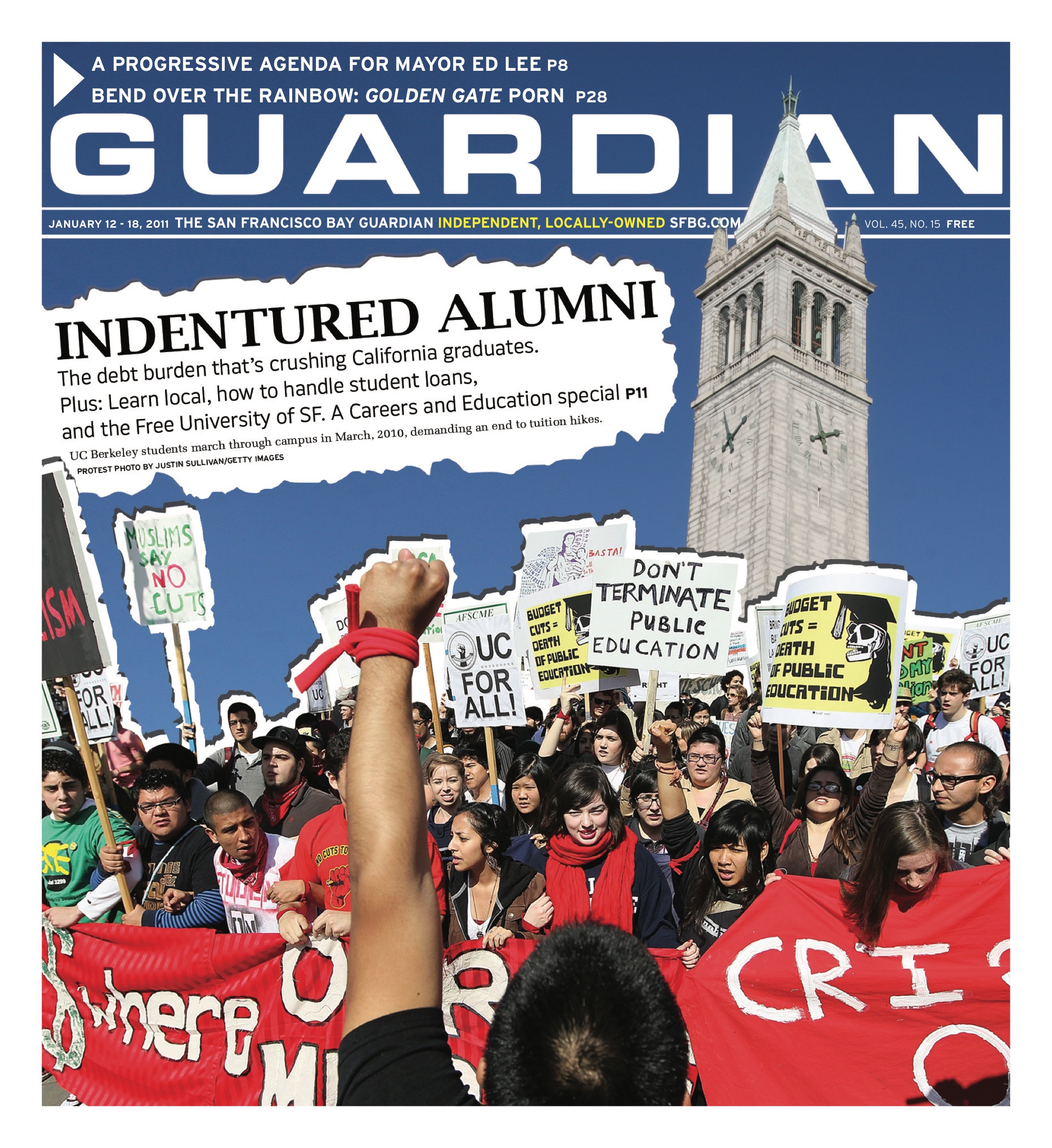
Print sections as they appeared in the early 2010s

To find articles by keyword or author, you may want to use our Search function.

Print Sections

Stage Listings

0

Stage listings are compiled by Johnny Ray Huston. Performance times may change; call venues to confirm. Reviewers are Robert Avila, Rita Felciano, and Nicole Gluckstern. Submit items for the listings at listings@sfbg.com. For further information on how to submit items for the listings, see Picks. For complete listings, see www.sfbg.com.

THEATER

OPENING

Bone to Pick and Diadem Exit on Taylor, 277 Taylor; (800) 838-3006, www.cuttingball.com. $15-50. Previews Fri/14-Sat/15, 8pm; Sun/16, 5pm. Opens Jan 20, 8pm. Runs Thurs-Sat, 8pm; Sun, 5pm. Cutting Ball Theatre presents a pair of plays by Eugenie Chan.

The Companion Piece Z Space at Theatre Artaud, 450 Florida; (800) 838-3006, www.themarsh.org. Call for price. Previews Tues/18, 7pm; Jan 19 and 20, 7pm; Jan 21, 8pm. Opens Sat/22, 8pm. Runs Thurs 7pm; Fri-Sat, 8pm; Sun, 5pm. Through Feb 13. Z Space presents the world premiere of a new play by Mark Jackson, with Beth Wilmurt and Christopher Kuckenbaker.

Out of Sight The Marsh, 1062 Valencia; (800) 838-3006, www.themarsh.org. $15-35. Previews Thurs/13 (through Jan 21). Opens Jan 22, 8pm. Runs Thurs and Sat, 8pm; Sun, 3pm (except Sun/16 at 7pm). The Marsh presents a new solo show by Sara Felder.

BAY AREA

The Last Cargo Cult Berkeley Repertory Theatre, Thrust Stage, 2025 Addison, Berk; (510) 647-2949, www.berkeleyrep.org. $14.50-73. Opens Wed/12, 8pm. Call for dates and times. Through Feb 20. Mike Daisey stars in a one-man show about obsession with commerce.

ONGOING

Clue Boxcar Playhouse, 505 Natoma; 776-1747, www.boxcartheatre.org. $15-35. Wed-Fri, 8pm; Sat, 7 and 10pm. Through Feb 19. Boxcar Theatre presents a play based on a movie based on a board game.

Dirty Little Showtunes! A Parody Musical Revue New Conservatory Theatre Center, 25 Van Ness; 861-8972, www.nctcsf.org. $24-40. Wed-Sat, 8pm; Sun, 2pm. Through Sun/16. Tom Orr’s adults-only holiday show returns, with direction by F. Allen Sawyer and musical direction by Scrumbly Koldewyn.

*Forever Tango Marines’ Memorial Theatre, 609 Sutter; 771-6900; www.marinesmemorialtheatre.com. $45-100. Call for dates and times. Through Wed/12. Luis Bravo’s atmospheric showcase is a slick, showy mélange of music and dancing whose fluid precision and assemblage of talent make it hard to resist. Cheryl Burke heads up an amazing 13-member ensemble of very stylishly draped dancers (exquisite costuming by Argemira Affonso) who singularly, all together, and of course in dramatic couplings, blend supreme control and dramatic restraint with unabashed sexual allure and volcanic energy. The orchestra, meanwhile, under direction of Eduardo Miceli, creates the intoxicating ether that sets everything in motion. (Avila)

The Lion in Winter Actors Theatre, 855 Bush; 345-1287, www.ticketweb.com. $26-38. Wed-Sat, 8pm. Through Sat/15. Actors Theatre of SF presents James Goldman’s play of palace intrigue.

Lost in Yonkers Kanbar Hall, Jewish Community Center SF, 3200 California; 292-1233, www.jccsf.org/arts. $20-39. Thurs-Sat, 8pm; Sun, 2 and 7pm. Through Jan 16. There’s a lot to like about Grandma Kurnitz (Naomi Newman), though she’d do her best to discourage you from thinking it. Her grown children are as neurotic a collection of misfits as you would expect at a Woody Allen family reunion, her grandchildren are afraid of her, and she hasn’t had a single friend in the 30+ years she’s lived in Yonkers. Set during World War 2, Neil Simon’s Lost in Yonkers portrays a family coming to terms with the times, and more importantly with itself over the course of ten months, as teenaged Jay (Zachary Frier-Harrison) and Arty (Noah Silverman St. John) are left in their Grandmother’s grudging care while their father Eddie (Greg Alexander) trawls the South for scrap metal to pay off an impatient loan shark. Meanwhile, their flighty yet sincere aunt Bella (Deb Fink), a grown woman with the mental attributes of a preteen Pollyanna, actually does the work of holding together the family that Grandma just can’t help but to try to scare off at the slightest provocation. A deliberately-paced production, some of the more emotional content flags a little in the translation, but a tightly-wound face-off between the boys and their Uncle Louie (Søren Oliver) — a small-time mobster with an Alexei Sayle air — and a surprising revelation from Bella are superbly played. (Gluckstern)

Party of 2 – The New Mating Musical Shelton Theater, 533 Sutter; (800) 838-3006, www.partyof2themusical.com. $27-29. Sun, 3pm. Open-ended. A musical about relationships by Shopping! The Musical author Morris Bobrow.

*Pearls Over Shanghai Thrillpeddlers’ Hypnodrome, 575 Tenth St; 1-800-838-3006, www.brownpapertickets.com. $30-69. Sat, 8pm. Through April 9. Thrillpeddlers’ acclaimed production of the Cockettes musical continues its successful run.

BAY AREA

East 14th – True Tales of a Reluctant Player The Marsh Berkeley, 2120 Allston Way, Berk; (800) 838-3006, www.themarsh.org. $20-50. Call for times. Through Feb 13. Don Reed’s one-man show continues its extended run.

Lemony Snicket’s The Composer is Dead Berkeley Repertory Theatre, Roda Theatre, 2015 Addison, Berk; (510) 647-2949, www.berkeleyrep.org. Call for dates and times. Through Sat/15. Berkeley Rep premieres the new musical, written by Lemony Snicket, with music by Nathaniel Stookey.

*Of the Earth – The Salt Plays Ashby Stage, 1901 Ashby; (510) 841-6500, www.shotgunplayers.org. $17-30. Thurs-Sat, 8pm; Sun, 5pm. Through Jan 30. If those whom the gods favor die young, it’s probably just as well for Odysseus (Dan Bruno) that Zeus (Rami Margron) happens to be irked at him. That Zeus occasionally manifests as a scary nurse with a penchant for ballroom dance is one of but many mysterious angles Jon Tracy teases out of the standard Odysseus myth. Another involves the instant-messaging potential of paper planes; a third, a blunt addiction metaphor for warmongering. In what must surely be a happy coincidence, the design elements and staging of Of the Earth are curiously similar to those of the recent Cutting Ball production of The Tempest. Characters leaping about from floor-to-ceiling ladders to physically embody shipwrecks and monsters, a handful of actors playing multiple roles, watery video installations, even the allusion to mental illness and modern psychiatry are threads that tie the two productions, however unsuspectingly, together. Happily for The Shotgun Players, their version floats above the comparison with a host of extra tension-drivers—the sinuously menacing fighting-style of Posiedon (Anna Ishida), the heart-throb pounding of Taiko drums, the sensual machinations of Circe (Charisse Loriaux), the clever usage of Penelope’s (Lexie Papedo) “tapestry” to weave together the action. And though at times the thread is broken mid-scene, we are finally given to understand that this epic tale of war’s fallout is first and finally a story of love. (Gluckstern)

Strange Travel Suggestions The Marsh Berkeley, Cabaret, 2120 Allston Way, Berk; (800) 838-3006, www.themarsh.org. $15-35. Thurs-Fri, 8pm; Sat, 5pm. Jeff Greenwald stars in a one-man show about the vagaries of wanderlust.


PERFORMANCE/DANCE

Gush Brava Theater, 2783 24th St; 6470-2822, www.brava.org. Thurs/13 through Jan 29. $15-35. Brava presents a dance series curated by Joe Goode.

Women of the Way Festival Shotwell Studios, 3252-A Shotwell; and The Garage, 975 Howard; (800) 838-3006, www.ftloose.org. Call for dates and times; Thurs/13 through Jan 30. $15-20. The dance festival celebrates it 11th anniversary with 23 new shows.

BAY AREA

SF Ethnic Dance Festival Auditions Zellerbach Hall, UC Berkeley campus, Berk; 474-3914, www.worldartswest.org. Sat/8, 10am-6pm; Sun/9, 10am-7pm. $10. The second of two weekends of auditions for this year’s festival, open to the public.

On the Cheap

0

On the Cheap listings are compiled by Jackie Andrews. Submit items for the listings at listings@sfbg.com. For further information on how to submit items for the listings, see Picks.

WEDNESDAY 12
How to Build Guitars Bazaar Cafe, 5927 California, SF; (415) 831-5620, www.julianagallin.com/howto. 7pm, free (food and drink purchase encouraged). Rickenbacker 12-string electric guitar lover, Mario DeSio, who began making his own damn guitars — by consulting the internet, no less — when his guitar-buying budget was slashed, will share his humble beginnings, experiences, tools, and finished (as well as unfinished) products. Afterwards, you may not be able to add “luthier” to your resume, but maybe you’ll become inspired by this DIY night.

THURSDAY 13
“The Journey That Saved Curious George” Contemporary Jewish Museum, 736 Mission, SF; (415) 655-7800, www.thecjm.org. 7pm, free with regular museum admission or $5 after 5pm. Experience the stranger-than-fiction journey of Margaret and H.A. Rey, the creators of Curious George, as they escape Paris from the Nazis on homemade bicycles, take a train ride across Europe, and finally a boat to America. Louise Borden, who wrote the book Curious George Saves the Day: The Art of Margaret and H.A. Rey, tells the story with an illustrated discussion and a book signing to follow — after which you will surely want to cuddle up with a sweetheart and read Curious George by the fire, er, space heater.

FRIDAY 14
Bitches Brew Park Life, 220 Clement, SF; (415) 386-7275, www.parklifestore.com. 7pm, free. A good art opening is always a great alternative to spending wads of cash on a Friday night. The possibilities of free or cheap booze and cool stuff always aim to please, and when there’s a rad band thrown in to the mix, you can’t go wrong. This Friday, check out new works from Kelly Tunstall, Marci Washington, Aiyana Udesen, Hellen Jo, and Rebecca Ebeling with special musical performance by Oakland’s Wax Idols

SATURDAY 15
Queer Porn TV Launch Party Lexington Club, 3464 19th St., SF; (415) 863-2052, www.lexingtonclub.com. 9pm, free plus with drink purchase. Celebrate the launch of QueerPorn.TV, a new queer porn site, with drinks, dancing, and general all-around debauchery. Hosted by queer porn icon Courtney Trouble and porn star Tina Horn. DJs Booty Klap (Party Hole) and Jean Jamz (Party Hole, Ships In The Night) will getcha rumps shakin’, and a special performance from porn star Maggie Mayhem should no doubt be the icing on the proverbial cake.

SUNDAY 16
Scott Alexander solo performance RockIt Room, 406 Clement, SF, (415) 387-6343, www.rock-it-room.com. 8pm, free. Brooklyn expatriate Scott Alexander, a.k.a. “Cookie Man,” is that guy you may have seen recently around town hanging out on an inflatable couch while passing out free cookies. Well, he’s a Californian now and wants to make friends – and to do that he will be singing songs, passing out more cookies and, oh yes, bacon. All bases are covered here guys, regardless of whether your thing is off-beat, comedic pop music, cruelty-free baked goods, or fried pig ass.

MONDAY 17
MLK Day of Service Contemporary Jewish Museum, 736 Mission, SF; (415) 752-2483,  www.thecjm.org, www.norcalmlk.org/2011. 11am – 5pm (art poem activity from 1-3pm), free. Yerba Buena Center for the Arts and Yerba Buena Gardens’ sponsor a day of egalitarian activities: a march starting from the park’s MLK memorial, a fair offering free family health services, a children’s reading festival, and the Contemporary Jewish Museum will be open free to the public. Whew! See website for events schedule.

MoAD MLK Day Celebration Museum of the African Diaspora, 685 Mission, SF; (415) 358-7200, www.moadsf.org, www.norcalmlk.org/2011. 11am-6pm, free. MoAD invites the public to enjoy a day at the museum free of charge – and to celebrate MLK’s dream, they’ve got a full slate of community-empowering activities planned. There’s a college fair of historically African-American schools from around the country, live Afro-Cuban music, chalk drawing outside the museum, MLK film screenings, and even a live jewelry-making demonstration and sale. See website for events schedule.

Alerts

0

alert@sfbg.com

WEDNESDAY, JAN. 12


Bradley Manning rally

Take the streets to protest the Berkeley City Council for backing down on plans to demand the freedom of Bradley Manning, the U.S. Army soldier imprisoned for exposing U.S. war crimes in Iraq by allegedly leaking documents to WikiLeaks. Legendary whistleblower Daniel Ellsberg speaks.

11:30 a.m.–1:30 p.m., free

Berkeley Old City Hall

2134 MLK Jr. Way, Berk.

THURSDAY, JAN. 13


Free the Hikers benefit

Lia Rose, a former classmate of one of the hikers still held hostage in Iran, chose to make her album release show a benefit to help free Josh Fattal and Shane Bauer. Joining her on stage will be Tim Marcus and Andrew Macguire, among others.

9:30 p.m., $12 (proceeds benefit Free the Hikers)

Roxie

3117 16th St., SF

www.roxie.com


Fiery Feminists of Color

Join Radical Women and the editors of Shout out! Women of Color Respond to Violence, as they discuss and analyze the violence against Native American, South Asian, and Afghan women. A winter buffet with a vegetarian option will be served.

6:15 p.m., $7.50 suggested donation

New Valencia Hall

625 Larkin, Suite. 202, SF

www.radicalwomen.org


Protesters fundraiser

Help JR Valrey and Holly Works, the last two of the Oakland 100 (those arrested during the protests following the murder of Oscar Grant last year) raise legal defense funds for their upcoming trials.

7 p.m., $10–$1,000 suggested donation

Black Dot Café

1195 Pine, Oakl.

SUNDAY, JAN. 16


Arrested protestors hearing

Show support for the dozens of protesters arrested at the recent rallies demanding justice for Oscar Grant as they attend their hearings.

9 a.m, free

Wiley M. Manuel Courthouse, Dept. 112

661 Washington, Oakl.


Capitalism doc

Richard Wolff explains in his documentary, Capitalism Hits the Fan: The Global Economic Meltdown and What to Do About It, how deep economic structures contributed to the global financial crisis and several depressions and recessions over the last 75 years.

7:30 p.m., $12 advance ($15 at the door)

Berkeley Hillside Club

2286 Cedar St, Berk.

www.hillsideclub.org

MONDAY, JAN. 17


Protest SFPD actions

Protest the San Francisco Police Department’s treatment of the disabled and people with mental health issues. Meet outside the SF Behavioral Health Center — where SFPD recently shot and killed a mentally disabled man in a wheelchair — and march to City Hall where a rally with speakers will be held by the Polk Street entrance.

12–3 p.m., free

Meet at 10th and Howard streets, SF

djasik87.9@gmail.com

TUESDAY, JAN. 18


Reigniting the Climate Justice Movement

Join environmentally focused nonprofits from around the Bay Area as they discuss climate change and what to expect in terms of U.S. legislation after the recent international climate negotiations in Cancun.

7 p.m., free

David Brower Center, Tamalpais Room

2150 Allston Way, Berk.

(510) 486-0286 

Mail items for Alerts to the Guardian Building, 135 Mississippi St., SF, CA 94107; fax to (415) 437-3658; or e-mail alert@sfbg.com. Please include a contact telephone number. Items must be received at least one week prior to the publication date.

Local bounty

0

caitlin@sfbg.com

CAREERS AND ED “People are very confused about what’s safe to eat as far as mollusks go.” Champion monkeyface eel angler Kirk Lombard offhandedly throws the remark out at his “find your own marine sustenance” primer offered by DIY food cabal ForageSF. For a moment I panic. My mercury levels! But then I remember: I’m on his San Francisco fishing tour because I have never, not once, even thought to harvest the bay’s bounty on my own.

Isn’t life in the city just like that? You never get out to Alcatraz, you never hit up Muir Woods — they sit there trying to catch your eye and you shuffle past, going about your routine. It’s easy to duck the pressure of actually making the most of what the Bay Area has to offer.

But it’s 2011 (only one year left till the end of the world!) and you need to get out there. Back to Kirk Lombard, who is gesturing to the rocky edge of the Marina Green, where on a good day you can find limpets and turban snails adhering to, and rockfish darting amid, the boulders. “You have to pound the shit out of them to make them tender enough to eat,” he counsels. This referring to chitons, shellfish resembling centipedes that are plentiful in the Bay Area and can be popped off rocks to be enjoyed.

Lombard’s class is an example of the utility of local expertise. At the tail end of many years with the Department of Fish and Game surveying the catch of Bay Area fishermen, he is also the creator of a blog (monkeyfacenews.typepad.com) that makes me wish I fished, which I must say has never happened before.

Other things that can be caught and eaten around these parts include the tiny, perfect-as-salad-topping limpet, the hideously ugly but reportedly nutritious cabazon fish, monkeyface eels (thrilling to hear Lombard discuss his record-holding pursuit of them) and California and blue mussels. Of these last two you are only allowed to harvest 10 pounds per day, an astonishing rule that seems well beyond my capabilities past, present, or future.

Lombard’s walks take participants out on the windy, disconcertingly cold spit of land near the wave organ on the Marina Green. Our group of 12 meanders after him as he enthusiastically answers questions about feeding oneself on the seaweed and fishies of the bay. Lombard himself hasn’t bought fish in years and tends to focus on smaller, quicker to mature species that are difficult to overfish. “I’ve found myself really embracing the smelt family,” he reflects.

Having graduated from his one-time course, do I now stuff my rod in my Chrome bag every day before I leave the house? Are we munching monkeyface all the live-long day? Well no. But the beauty of Lombard’s tours, and the following SF classes, isn’t that they will revamp your life in one fell curricular swoop. It’s that they just might open your eyes to a little more atmosphere, from mussels to mushrooms, architecture to enlightenment.

WILD SEAFOOD: SAN FRANCISCO FISHING TOUR

Next walk: Sun/16 2–4 p.m., $30

Register at www.foragesf.com


MUSHROOM FORAYS

All hail the Mycological Society of San Francisco! Now more than 60 years old, the mushroom lovers club focuses on expanding the community’s knowledge of our fungal friends — from the tastes and nutrition they provide to their scientific and aesthetic qualities. You can drop in on one of its potluck gatherings or beyond-informative Fungus Fairs, but why not start from the beginning? The society regularly conducts forays into nature to teach wannabe mycologists how and what to look for when they’re tracking toadstools in the moist corners of the Bay Area — which, due to its temperate climate, happens to be a superlative spot to find them.

Next foray: Sat/15 10 a.m.–3 p.m., $25. Register at www.mssf.org for start location


“SEASONAL EATING, HEALTHY LIVING, DIGESTIVE BLISS”

What is even more soothing than taking a class amid the community-building rows of plants at Hayes Valley Farm? Try taking a class on how to use those very fruits and veggies (or seasonal varietals like them) toward more robust bodily health. It’s part of a four-class series, but you can attend individual sessions — this upcoming one focuses on lower intestinal health, where 70 percent of your immune system lives.

Sat/19 10–11:30 a.m., $25–$50. Hayes Valley Farm, 450 Laguna, SF. www.hayesvalleyfarm.com


INTRODUCTION TO BUDDHISM AND ZEN

Of course, all this seeking and searching — it’s the new year and all, but don’tcha know that desire is the root of all ignorant, pig-headed maleficence? You’d know that if you were Zen, see. But grasp no further. The SF Zen Center has been in the practice of expanding minds — often for cheap or free — for years. Take one of their friendly entry-level courses in meditation and all that new ksanti (patience) is sure to lead to some prajna (wisdom). Guest student courses offer amazing rates for meditation, lodging, and meals.

Jan. 29– March 19, 9–10 a.m., $96-$120. San Francisco Zen Center, 300 Page, SF. (415) 863-3136, www.sfzc.org


SAN FRANCISCO INTERIORS

You gotta suppose that after drawing your city in intimate detail, you’d see a little more of it. A gable, a funky load-bearing pole. Maybe we just don’t hang and stare at walls enough. Or maybe not, but anyway this no-credit City College class taught by artist Jacqueline Ruben explores some of SF’s more artistically fertile nooks and crannies, teaching you drawing style to boot.

Feb. 26–March 19 9 a.m.–noon, $100–$110. Fort Mason, SF. (415) 561-1860.

www.ccsf.edu 


Revolution 101

1

caitlin@sfbg.com

CAREERS AND ED Of course, you could just stop paying for school all together. Instead of putting their hopes for the future of education behind state reinvestment in university systems, a group of SF radical intellectuals are seeking to revamp the definition of learning by introducing the Free University of San Francisco. The nascent institution holds its first teach-in Feb. 5-6.

“Education is revolution,” says the incubator of the Free University, writer and poet Alan Kaufman. This ain’t Kaufman’s first rodeo. In 2004, while an instructor at SF’s Academy of Art University, he organized a student walk-out to protest the school’s violations of free speech rights. Employed through a temporary contract with the academy, Kaufman was not hired back the next term.

For him, it was a wake-up call that the current university system was teaching for the wrong reasons, not the least of which was the hefty price tag for classes that left his pupils in poverty. One student, he said in a recent phone interview with SFBG, had been “starving before my eyes, surviving on Ramen Noodle Cups” — all she could afford on top of tuition fees. He gave her $60 for food. But it wasn’t enough. Something had to be done.

When asked what he thinks the point of education is, Kaufman barely hesitates. “Liberation, freedom.” The current trends of privatization in public colleges, coupled with soaring school fees that far outpace students’ budgets, is symptomatic of a system that, as he prettily puts it, “funnels hearts and minds into narrowing corridors of survival. Creating profits for the university — that is the end game.”

He’s not the only person who thinks so. Kaufman and other Free University supporters have organized a teach-in next month that will feature college-level lectures from leading Bay Area artists and intellectuals, including Beat poet and SF poet laureate Diane Did Prima, former president of the Board of Supervisors Matt Gonzalez, and Pirate Cat Radio’s Diamond Dave Whitaker. The courses are no-credit, but the event is a symbol that the current educational system isn’t fulfilling some basic student needs. Instructors will teach on subjects that range from 19th-century poetry to natural geography.

Eventually Kaufman he envisions an “actual mobile university” capable of bringing the possibility of a college education to places where such a thing might be considered unattainable. And it wouldn’t just be beneficial to students. Guest faculty could experience “a kind of cleansing,” a temporary return to their original ideal of academia.

Of course, there are a few — ahem — challenges involved in starting a school that has no tuition, teacher salaries, or even monetary donors (Kaufman says the Free University will accept gifts in the form of books or other resources, but no cash). University supporters have decided to eschew accreditation for now, and true to Kaufman’s nomadic vision of the school, no location for classes has been set. First the teach-in, Kaufman says, and based on feedback, the consensus-based, hierarchy-free project will take it from there. The idea of the Free University, it would seem, is the thing for now.

It’s been done before. In the wake of the French Revolution, France established its Grandes Écoles system, a 250-school system that remains for the large part, tuition-free. The East Bay Free Skool is one outlet in the Bay that offers skill training, gratis. So for all the pie-in-the-sky idealism involved, perhaps the true test of the Free University of San Francisco won’t be its creation at all — crazy things have happened, haven’t they? Instead, it may be the extent that humanist students can steel a harsh economic climate that tends to reward monetarily-driven educations.

So why would a student chuck their pursuit of an accredited degree to participate in an uncertain radicalization of education? “Would it have practical application in a corporatized universe? Good question!” Kaufman chuckles. He launches into a torrid Marxist prediction: that our patently unfair education system cannot stand. “The system must be changed. When the pain is bad enough, people start to change.” *

FREE UNIVERSITY TEACH-IN

Feb. 5–6, 9 a.m.–5 p.m., free

Viracocha

998 Valencia, SF

(415) 374-7048

fusf.wordpress.com

In the red

5

rebeccab@sfbg.com

CAREERS AND ED When the University of California Board of Regents met Nov. 17, 2010 to approve an 8 percent tuition hike, roughly 300 UC students who were furious about the decision converged outside the University of California, San Francisco (UCSF) campus at Mission Bay to rally in opposition, some traveling from as far away as Los Angeles.

“We had been organizing with all the campuses to get students to come up because we really wanted to be there to let them know that it’s not what we want, and it’s something they can’t just get away with doing year after year,” said UC Student Association President Claudia Magana. The protests were raucous, and police cracked down by discharging pepper spray and making 13 arrests.

Despite the palpable fury outside and impassioned student opposition delivered to the Regents inside, the 8 percent fee increase was approved. It came on the heels of a 32 percent tuition increase imposed the year before, and the price was ratcheted up by 9 percent and 7 percent in the years prior to that.

The tuition hikes were steep, but hardly new. Indeed, the cost of attending UC schools has been rising steadily for quite a while. According to a study by economist Peter Donohue, student tuition and fees increased 277 percent from 1990-91 to 2008-09, and that was prior to the 40 percent increase that followed. That trend is repeated in rising costs at the California State University and California Community College systems (See “Access Denied,” April 6, 2010).

Student protesters have sought to make it clear that their outrage isn’t rooted in selfish unwillingness to shell out more money, but instead is linked to a broader concern about privatization and the increasingly limited accessibility of public education.

Magana expressed concern that the climbing cost of instruction at UC, though still a relative bargain compared with private institutions, would ultimately start to affect who could and couldn’t attain higher education through the public university system. The question isn’t limited to UC — tuition is increasing at public and private colleges across the board, and as income inequality sharpens, more students seek higher education.

“Students will always pay to be here,” she noted. “The issue is going to be, which students are here? That’s really the big problem — the huge class issue that’s going to come up. Although there are some forms of support for low-income students, it’s not easy.”


DEEPER IN DEBT

Rising costs at UC mirror the upward trend at private nonprofit and for-profit postsecondary institutions nationwide, and those higher prices have triggered a dramatic increase in student borrowing. While students from low- or medium-income families can access higher education at any institution they’re admitted to as long as they’re willing to take out significant sums in student loans, many find themselves at a serious disadvantage once they have to start repaying their debt.

A study conducted by the Public Interest Research Group (PIRG) noted that hefty debt burdens often dissuade graduates from pursuing careers in teaching, social work, the nonprofit sector, or other low-paying occupations that foster social justice. PIRG found that 23 percent of public four-year college grads and 38 percent of private four-year college grads were saddled with too much debt to manage paying back student loans on a starting teacher’s salary.

For students pursuing careers as social workers, the economic bind looked even worse: 37 percent of public school grads and 55 percent of private school grads with student loans wouldn’t be able to manage repayment with starting salaries in that field, the study concluded.

“Because students with lower incomes are more dependent on student loans than higher income students, students who already face significant challenges to attending college will more strongly feel the effect of loan debt on career choice,” the report points out.

“It’s a serious problem for so many young people to be starting out their working life so deep in debt,” said Edie Irons, spokesperson for The Institute on College Access and Success (TICAS), an Oakland-based research organization. “It really does limit people’s ability to take advantage of the opportunities education is supposed to provide. In concrete terms, it can make it really hard to buy a house, or start a business, or start a family, or go back to grad school, or to save for retirement or your own children’s education. And that’s all assuming you can keep up with the payments.”

Student loan debt has intensified over the past two decades. In 1993, just one third of all four-year college students graduated with debt, owing on average slightly more than $9,000, according to PIRG.

Today, the majority of college students take out loans to finance their education. Around 62 percent of public university students graduate with student loans, as do 72 percent of students attending private nonprofit institutions, and 96 percent of students attending for-profit institutions such as the University of Phoenix or the Academy of Art University, according to TICAS. Nationally, students graduate owing an average of $24,000, not counting debt associated with advanced degrees.

While young people must invest more than ever before to obtain higher education, the return on investment isn’t showing signs of improvement. The expected median income for UC graduates has stayed the same over the last decade, even as the cost of tuition has ballooned.

What’s more, says Bob Meister, president of the Council of UC Faculty Associations and professor of Political and Social Thought at UC Santa Cruz, is that an estimated 40 percent of public university students entering the workforce will either be unable to find a job, or will land in a lower-paying job that doesn’t require a college degree.

“For college graduates under 25, the unemployment rate is nearly as high as the national unemployment rate,” around 10 percent, Meister notes. “Over the past decade, what’s happened is that the median hasn’t risen. The top has risen very fast, and the bottom has fallen.”


IN A DIFFERENT CLASS

There’s no doubt that diminished state funding is affecting California’s public universities.

“A lot of departments are being eliminated, and a lot of professors who are really amazing are leaving to other universities,” Magana says. “And the waiting lists for classes are just ridiculous.” Academic goals are being compromised — for example, students had to abandon their push for an ethnic studies program at UCSC, she added, because the American studies department that would have partially supported it was slashed.

While diminished public funding has been used to explain the need to raise tuition, Meister has published numerous essays suggesting that the root cause of rising tuition costs at UC goes deeper than that, and he has gone so far as to publicly encourage students not to accept higher tuition without first demanding financial information.

Meister previously served on the UC budget committee and has observed the institution’s evolving financial policies for years. He doesn’t seem surprised that tuition is going up, regardless of what condition the economy is in or what amount of public funding is available because, as he puts it, “the universities will cost as much as they can.” UC had long sought to boost revenue by raising tuition, he noted, yet its leaders feared a rollback in state funding in response. But that changed under Gov. Arnold Schwarzenegger, who agreed to increase state support only on condition of that UC in turn require students to contribute more.

Around the same time that Schwarzenegger provided this new incentive to raise tuition, UC pooled its various revenue streams into a consolidated general revenue fund, Meister said, a departure from the old way of keeping separate accounts. This new fund, which included all non-state revenue and funding that wasn’t legally required to be used for certain purposes, could be pledged entirely as collateral for bonds for new construction projects, greatly increasing the institution’s borrowing power and boosting its revenue with the addition of new facilities.

To maintain its stellar bond rating, UC had to ensure an increase in revenues, according to Meister’s explanation, and to do that, UC ratcheted up the one source of revenue it had full control over: tuition. Meister laid bare this financial play in a 2009 open letter to students, titled “They Pledged Your Tuition.” Since it was published, a small corps of student activists has become deeply engaged in studying campus finance documents and airing criticism of financial policies.

Just before the Nov. 17 protests at UCSF Mission Bay, Meister published another open letter, this one addressed to UC President Mark Yudof. This one contemplated, “Why they think they can increase revenues regardless of how fast the economy grows … and regardless of whether the income of graduates is stagnant.”

His answer is somewhat surprising: “Their ability to raise tuition is a function of the growth of income inequality,” he told the Guardian. In the letter, Meister charges, “In the 21st century, when almost all income growth has been in the top 1 to 2 percent of California’s population, UC is still marketing income inequality to students as its most important product. It now expects all students to pay more for an ever-shrinking chance of reaping the ever-growing rewards that our economy makes available to the few. Your plan to increase revenue through tuition growth is feasible, of course, only because the federal government still allows students to borrow more for education despite the greater likelihood that they will not be able to repay — student loans may be the last form of subprime credit available in our economy.”

His theory highlights a paradox. “Being in the have-not category is increasingly worse,” he explains, “and so they are willing to take on more debt, which actually dampens their prospects for income growth.”

The question now is what will happen under Gov. Jerry Brown, who is likely to take a different stance toward rising tuition than Schwarzenegger but nonetheless is expected to unveil harsh cuts to education as a way to address a $26 billion budget deficit.

In a recent interview with the San Francisco Chronicle, UC Regent Richard Blum indicated that it probably would not be feasible to raise tuition again, so the message was that students should brace for more cuts to education.

When Brown unveiled his proposed budget on Jan. 10, he announced further cuts to higher education in California to balance the state budget. Brown’s revised 2010-11 budget decreases the state funding for UC, CSU, the community college system, and other higher education programs by $1.7 billion for the 2011-12 budget. The UC system would take a 13.3 percent hit in general fund support; the proposed cut to the CSU system is 12.5 percent; and the community college system would be cut by 6.9 percent.

Brown, who also wants to hold a special election to ask voters to maintain the current level of tax rates for income, sales, and vehicle license taxes for five years rather than let them expire later this year, expressed regret about making cuts to higher education. But he emphasized the need to make tough decisions in the face of a bleak financial outlook, saying, “We need to face the music.”

Gascon shocker

0

Gavin Newsom’s appointment of his police chief, George Gascón, as district attorney wasn’t just a slap in the face to the D.A.’s office, it reversed a long tradition in which the city’s top prosecutors have pledged their opposition to the death penalty. It broke an unwritten rule that the district attorney should have some independence from the Police Department. And it suggests that Newsom’s decision was about his own future and not about San Francisco’s.

Gascón, who has a law degree from Western State University in Fullerton, has been a member of the state bar since 1996 and has handled labor and bankruptcy cases for a year and a half. But he’s never prosecuted a criminal case.

He still believes he has the necessary organizational skills. “Running a D.A.’s office is not the same as prosecuting cases on the floor,” he said at his Jan.9 swearing-in.

He sees the D.A. post as a way to build closer relationships between various law enforcement agencies, including the police department and the public defender’s office. “We have to find a way to bring law enforcement together,” Gascón said.

But so far the response to his appointment in those circles has been less than favorable, even though City Attorney Dennis Herrera issued a press release praising Gascón’s help in moving ahead with gang injunctions in Visitacion Valley.

Attorney Elliot Beckelman, who worked in the D.A.’s office until a few months ago, said people in the office were stunned because no one thought Gascón was a good candidate. “It’s like taking a lawyer who has been working for 20 years, and has done a stint as the D.A., and graduated from the police academy, and appointing them as police chief when they never worked as a police officer, arrested anyone, or saw a dead body,” he said.

Beckelman said he wonders if Gascón’s Jan. 9 comment that he is not “philosophically opposed to the death penalty” indicates that Newsom picked him to boost his own popularity with law enforcement groups and improve his chances at getting elected to higher office.

“It’s very cynical to make your final political move one that disassociates you from San Francisco, but it’s a big move nationally in terms of where Newsom hopes to land five moves from now,” Beckelman said. “It’s a politician appointing another politician.”

Former District Attorney Terence Hallinan said Gascón’s appointment was stupid. “Maybe it’s Gavin’s comeback after gay marriage to appoint someone who will say, ‘Okay, let’s kill people.’ But this is not a well-thought-out move,” he said. “OK, Gascón’s a lawyer, but he has never practiced law. The D.A. and the police work together, yes, but you have to try a lot of cases before you work out which are worth prosecuting and which deputies to assign.

‘It’s the responsibility of the D.A.’s office to supervise the police,” he added.

Public Defender Jeff Adachi notes that the choice of Gascon’ has energized this fall’s D.A.’s race , when Gascón will have to stand for election to keep his new job. “What was a sleepy race looks like it will take center stage” Adachi said. “Other candidates are now outsiders and will have to distinguish themselves.”

One such opportunity could arise if Gascón seeks the death penalty in the coming year. Matt Gonzalez, who was the first candidate to oppose the death penalty when he ran against then-D.A. Terence Hallinan, said he thinks Gascón’s views on the death penalty should have eliminated him. “That alone should have made him ineligible. This is a step backward.”

Gonzalez thinks Gascón’s appointment trivializes what the D.A.’s office does. “This was a real opportunity to pick a professional prosecutor who was familiar with the office and knew San Francisco,” he said. “Instead, this is like me thinking I should be police chief because I’ve seen a lot of fingerprints.”

Adachi worries that little is known about Gascón’s legal abilities. “He does not have a track record in terms of felony and homicide experience,” he said. “That’s not to say he wouldn’t run the office well, but it leaves us without an important knowledge base. He does bring many years of experience as a police officer, but the responsibilities are very different.”

Adachi observes that while police bring cases to the D.A. based on probable cause, the D.A. reviews those cases and only brings cases that are deemed justified. “But will Gascón file more cases for the sake of wanting to justify arrests by the police?” Adachi mused.

The agenda for Mayor Lee

0

EDITORIAL San Francisco has its first Chinese American mayor, and that’s a major, historic milestone. Let’s remember: Chinese immigrants were among the most abused and marginalized communities in the early days of San Francisco. In 1870, the city passed a series of laws limiting the rights of Chinese people to work and live in large parts of the city. Chinese workers built much of the Transcontinental Railroad — at slave wages and in desperately unsafe conditions that led to a large number of deaths. The United States didn’t even repeal the Chinese Exclusion Act (an anti-immigration law) until 1943, and for years, Chinatown was one of the poorest and most neglected city neighborhoods.

So there’s good reason for Asians to celebrate that the last door in San Francisco political power is now open. And Mayor Ed Lee comes from a civil rights background; he got his start in politics working as a poverty lawyer and tenant organizer.

Unfortunately, his path to Room 200 was badly marred by some ugly backroom dealing involving Willie Brown, the most corrupt mayor in modern San Francisco history. Even Lee’s supporters agree the process was a mess and that it undermines Lee’s credibility. So it’s important for Mayor Lee to immediately establish that he’s independent of Brown and his cronies, that his administration will not just be a Gavin Newsom rerun, and that progressives can and should support him.

He has a tough job ahead. We urge him to make a clean break with the past and set the city in a new direction. Here are a few ways to get started.

Clear out the Newsom operatives and bring some new people with progressive credentials into the senior ranks. Newsom’s chief of staff, Steve Kawa, has been a shadow mayor for the past year while Newsom was on the campaign trail, and is the architect of much of what the outgoing administration has done to sow political division and cripple city government. Lee needs his own chief advisor.

Show up for question time and work with the district-elected supervisors. Newsom was openly dismissive of the board and refused to take the supervisors seriously as partners in city government. Lee should appear once a month to answer questions from the board in public, should meet regularly with all the supervisors and appoint a liaison that the board can work with and trust. He needs to make his administration as transparent and open as possible and ensure that everyone at City Hall follows the letter and spirit of the Sunshine Ordinance.

Make it clear that the next city budget includes substantial new revenue. Newsom offered nothing but Republican politics when it came to city finance; his only solutions to the massive structural deficit involved service cuts.

The deficit will be even worse than projected this year, since Gov. Jerry Brown wants to transfer much of the state’s responsibility for public safety and public health back to local government — and there won’t be enough state money attached to handle the new burden. Lee needs to publicly call on Brown and the Legislature to give cities more ability to raise taxes on the local levee. Then he should start planning for a June ballot package that will raise as much as $250 million in new revenue for the city.

A substantially higher vehicle license fee on expensive cars, a congestion management fee, a significant annual transit impact fee on downtown offices, a restructured business tax, and a progressive tax on income of more than $50,000 a year would more than eliminate the structural deficit.

There are plenty of other revenue ideas out there; not all can or would pass on a single ballot. But Lee needs to make it clear that revenue will be part of the solution — and that he will use all the political capital he can muster to convince the voters to go along.

<\!s> Get serious about community choice aggregation. Newsom loved to talk about his environmental agenda, but when it came to challenging the hegemony of Pacific Gas and Electric Co. and its dirty power portfolio, he ran for cover. His hand-picked Public Utilities Commission director, Ed Harrington, has been an obstacle to implementing the city’s CCA plan. Lee needs to get rid of Harrington or direct him to cooperate with the supervisors and get San Francisco on the path to clean public power.

<\!s> Establish a real affordable housing program. The city plans to build housing for as many as 60,000 new residents in the southeast neighborhoods — but only a fraction of them will be affordable. This city is already well on its way to becoming a high-end bedroom community for Silicon Valley; only a clear policy that limits new market-rate condos until there’s a plan for adequate affordable housing will turn things around.

<\!s> Support Sanctuary City and quit helping federal immigration authorities break up families. Newsom was just awful on this issue; Lee needs to work with Sup. David Campos to implement more humane laws.

<\!s> End the demonization of homeless people and public employees. Newsom came to power attacking the homeless (with Care Not Cash) and went out attacking the homeless (with the sit-lie law). Lee ought to tell the Police Department not to aggressively enforce the ordinance.

<\!s> Take on the sacred cows of the Police and Fire departments. The biggest salary and pension problems in the city are in the two public safety departments. The Fire Department budget has been bloated for years. If everyone else is taking cuts, so should the highest-paid cops and the overstaffed fire stations.

Some of Lee’s supporters insist he’s a solid progressive and that we shouldn’t hold the details of his selection — or the fact that he was chosen by people who are openly hostile to the progressive agenda — against him. We’re open to that — but the progressive community will judge him on his record. And he has to start right away.

Editor’s Notes

2

tredmond@sfbg.com

Former Mayor Willie Brown says that choosing a person of color for a leadership position should be a progressive value. Board of Supervisors President David Chiu says the new mayor, Ed Lee, is a progressive. Several supervisors and other political observers say the six-vote progressive majority on the board is gone.

And nobody really talks about what that word means.

Progressive is a term with a long political vintage, but it’s changed (as has the political context) since the 1920s. (Progressives these days aren’t into Prohibition.) So I’m going to take a few minutes to try to sort this out.

I used to tell John Burton, the former state senator, that a progressive was a liberal who didn’t like real estate developers. But that was in the 1980s, when the Democratic Party in town was funded by Walter Shorenstein and other developers who were happy to be part of the party of Dianne Feinstein, happy to be liberals on some social issues (Shorenstein insisted that the Chamber of Commerce hire and promote more women), and happy to promote liberal candidates like John and Phil Burton for state and national office — as long as they didn’t mess with the gargantuan money machine that was high-rise office development in San Francisco.

But these days it’s not all about real estate; it’s that the level of economic inequality in the United States has risen to levels unseen since the late 1920s. So I sat down on a Saturday night when the kids went to bed(yeah, this is my social life) and made a list of what I think represent the core values of a modern American progressive. It’s a short list, and I’m sure there’s stuff I’ve left off, but it seems like a place to start.

This isn’t a litmus test list (we’ve endorsed plenty of people who don’t agree with everything on it). It’s not a purity test, it’s not a dogma, it’s not the rules of entry into any political party … it’s just a definition. My personal definition.

Because words don’t mean anything if they don’t mean anything, and progressive has become so much of a part of the San Francisco political dialogue that it’s starting to mean nothing.

For the record: when I use the word "progressive," I’m talking about people who believe:
1. That civil rights and civil liberties need to be protected for everyone, even the most unpopular people in the world. We’re for same-sex marriage, of course, and for sanctuary city and protections for immigrants who may not have documentation. We’re also in favor of basic rights for prisoners, we’re against the death penalty, and we think that even suspected terrorists should have the right to due process of law.
2. That essential public services — water, electricity, health care, broadband — should be controlled by the public, not by private corporations. That means public power and single-payer government run health insurance.
3. That the most central problem facing the city, the state, and the nation today is the dramatic upward shift of wealth and income and the resulting economic inequality. We believe that government at every level — including local government right here in San Francisco — should do everything possible to reduce that inequality. That means taxing high incomes, redistributing wealth, and using that money for public services (education, for example) that tend to help people achieve a stable middle-class lifestyle. We believe that San Francisco is a rich city, with a lot of rich people, and that if the state and federal government won’t try to tax them to pay for local services, the city should.
4. That private money has no place in elections or public policy. We support a total ban on private campaign contributions, for politicians and ballot measures, and support public financing for all elections. Corruption — even the appearance of corruption — taints the entire public sector and helps the fans of privatization, and progressives especially need to understand that.
5. That the right to private property needs to be tempered by the needs of society. That means you can’t just put up a highrise building anywhere you want in San Francisco, of course, but it also means that the rights of tenants to have stable places for themselves and their families to live is more important than the rights of landlords to maximize return on their property. That’s why we support strict environmental protections, even when they hurt private interests, and why be believe in rent control, including rent control on vacant property, and eviction protections and restrictions on condo conversions. We think community matters more than wealth, and that poor people have a place in San Francisco too — and if the wealthier classes have to have less so the city can have socioeconomic diversity, that’s a small price to pay. We believe that public space belongs to the public and shouldn’t be handed over to private interests. We believe that everyone, including homeless people, has the right to use public space.
6. That there are almost no circumstances where the government should do anything in secret.
7. That progressive elected officials should use their resources and political capital to help elect other progressives — and should recognize that sometimes the movement is more important that personal ambitions.

I don’t know if Ed Lee fits my definition of a progressive. He hasn’t taken a public position on any major issues in 20 years. We won’t know until we see his budget plans and learn whether he thinks the city should follow Gavin Newsom’s approach of avoiding tax increases and simply cutting services again. We won’t know until he decides what to tell the new police chief about enforcing the sit-lie law. We won’t know until we see whether he keeps Newsom’s staff in place or brings in some senior people with progressive values.
I agree that having an Asian mayor in San Francisco is a very big deal, a historic moment — and as Lee takes over, I will be waiting, and hoping, to be surprised.

Power and pragmatism

5

steve@sfbg.com

After an epic week at City Hall, the political dynamics in San Francisco have undergone a seismic shift, with pragmatism replacing progressivism, longtime adversarial relationships morphing into close collaborations, and Chinese Americans as mayor and board president.

It was a week of surprises, starting Jan. 4 when City Administrator Ed Lee came out of nowhere to become the consensus choice for interim mayor, and ending Jan. 9 when Mayor Gavin Newsom appointed Police Chief George Gascón to be the new district attorney, Newsom’s last official act as mayor before belatedly taking his oath of office as lieutenant governor on Jan. 10.

In between, the outgoing Board of Supervisors held a special final meeting Jan. 7, at which progressive supervisors fell into line behind Lee, some of them reluctantly, and accepted the new political reality. The next day, the new Board of Supervisors took office and overwhelmingly reelected David Chiu as board president, with only the three most progressive supervisors in dissent.

After Chiu played kingmaker as the swing vote for making Lee the new mayor, the board and Mayor’s Office are likely to enjoy far closer and more cooperative relations than they’ve had in many years. And the sometimes prickly, blame-game relations between the Police Department and D.A.’s Office should also get better now that the top cop has switched sides. But what it all means for the average San Franciscan, particularly the progressive voters who created what they thought was a majority on the Board of Supervisors, is still an open question.

One thing that is clear is the ideological battles that have defined City Hall politics — what Chiu called the “oppositional politics of personality” during his closing remarks on Jan. 8 — have been moved to the back burner while the new leaders try a fresh approach.

Newsom — with his rigid fiscal conservatism and open disdain for the Board of Supervisors, particularly its progressive wing — is gone. Also leaving City Hall is Sup. Chris Daly, a passionate and calculating progressive leader whose over-the-top antics caused a popular backlash against the movement.

In a way, Newsom and Daly were perfect foils for one another, caustic adversaries who often reduced one another to two-dimensional caricatures of themselves. But they were each strongly driven by rival ideologies and political priorities, despite Newsom’s rhetorical efforts to turn “ideology” into a dirty word applied only to his opponents.

“This year represents a changing of the guard, a transition,” Chiu said, pledging to continue pushing for progressive reforms, only with a more conciliatory approach, a theme also sounded by Sups. Eric Mar and Jane Kim, who each broke with their progressive colleagues to support Chiu over rival presidential nominee Sup. John Avalos.

“I will always support policies that will make our city more equitable and just,” Kim said after being sworn in to replace Daly, although she also made a claim about the new board with which her predecessor probably wouldn’t agree: “I think we have a lot more in common than we don’t.”

With a focus on diversity and compromise, “respect and camaraderie,” Mar said, “I think this new board represents the evolution of the progressive movement in San Francisco.”

If indeed City Hall is enjoying a “Kumbaya” moment, the path to this point was marred by backroom deal-making and old-school power politics, much of it engineered by a pair of figures from the previous era who are by no means progressives: former Mayor Willie Brown and Rose Pak, head of the Chinatown Chamber of Commerce.

Pak was seated front and center — literally and figuratively — during the board’s Jan. 7 vote for Lee and its Jan. 8 vote for Chiu, following media reports that it was she and Brown who persuaded Lee to take the job and city leaders (particularly Newsom, Chiu, and outgoing Sups. Bevan Dufty and Sophie Maxwell) to give it to him.

It all seemed sneaky and unsettling to board progressives, who questioned what kind of secret deal had been cut, even as they voiced their respect for Lee’s progressive roots and long history of service to the city. The sense that something unseemly was happening was exacerbated on Jan. 4 when Dufty abandoned a pledge of support for Sheriff Michael Hennessey — who five progressive supervisors supported for interim mayor — and left the meeting to confer with the Mayor’s Office before returning to announce his support for Lee.

Sups. David Campos, Ross Mirkarimi, and Avalos pleaded with their colleagues for time to at least talk with Lee, who was traveling in China since he reportedly changed his mind about wanting the interim mayor job. Maxwell was the only Lee supporter in the 6-5 vote for delaying the interim mayor item by a few days so the supervisors could speak with Lee by phone.

Pak and other Chinatown leaders put together a strong show of force by the Chinese American community at that Jan. 7 meeting, where the board voted 10-1 for Lee, with only Daly in dissent. Afterward, some of Lee’s strongest supporters — including the Rev. Norman Fong and Gordon Chin with the Chinatown Community Development Center — admitted that the process of picking Lee was flawed.

“Part of the problem was Ed’s because he couldn’t make up his mind. The process was bad,” Fong told the Guardian after the vote. Although Fong said he knows Lee to be a strong and trustworthy progressive, he admitted that the way it went down raised questions: “Some people were concerned about who he’ll listen to.”

Specifically, the concern is that Lee will be unduly influenced Brown and Pak, who each represent corporate clients whose interests are often at odds with those of the general public. And both operate behind the scenes and play a kind of political hardball that runs contrary to progressive values on openness, inclusion, and accountability.

“If there is a phone call from Willie Brown to Rose Pak, Ed Lee is going to go along with it,” predicted a knowledgeable source who has worked closely with all three, recalling the way they did business during Brown’s mayoral administration. “There was no real discussion of issues. The fix was always in.”

But Pak insisted that there was nothing wrong with the process of selecting Lee, and that all concerns about the nomination were driven by anti-Asian racism. “You have a plantation mentality,” Pak told the Guardian as she held court in front of a crowded press box before the Jan. 8 meeting. “The Bay Guardian has never given people of color a fair shot.”

While Newsom, Chiu, and Pak-allied political consultant David Ho all insisted “there was no deal” to win support for Lee, Pak seemed to revel in the high-profile role she played, with Bay Citizen reporter Gerry Shih labeling her “boastful” in his Jan. 6 article “Behind-The-Scenes Power Politics: The Making of Ed Lee,” which ran the next day in The New York Times.

“This was finally our moment to make the first Chinese mayor of a major city,” Pak reportedly told Shih. “How could you let that slip by?”

Chiu downplayed Pak’s influence, telling the Guardian that Lee was his top choice since November, and telling his colleagues before the Jan. 7 vote, “Ed is someone who does represent our shared progressive values.” But he also made it clear that helping the city’s progressive movement wasn’t what drove his decision.

“This is a decision beyond who were are as progressives and who we are as moderates. It’s about who we are as San Franciscans,” Chiu said. “This is a historic moment for the Chinese-American community,” calling it “a community that has struggled, a community that has seen discrimination.”

The next day, shortly after being elected to a second term as board president, Chiu acknowledged the “very real differences” in ideology among the supervisors, “but leadership is about working through those differences.” Ultimately, he said, “none of us were voted into office to take positions. We were voted into office to get things done.”

Release me

1

arts@sfbg.com

MUSIC As 2011 begins, Bay Area rock is wasting no time staking its claim. This month brings noteworthy albums by at least a handful of local groups and artists. I’ll be covering them over the course of the next two weeks, beginning with a trio of new releases:


YOUNG PRISMS’ FRIENDS FOR NOW

Since the late-2009 release of Young Prisms’ self-titled EP on Mexican Summer, this Cali quintet has been hard at work. It put out three different split 7-inches: one with Weekend on Transparent; one with Small Black on Big Love; and one with Mathamagic on Atelier Ciseaux. In the wake of performances at last fall’s CMJ conference, the band is set to release its first full-length, Friends For Now (Kanine Records), Jan. 19.

Once you get past Friends for Now‘s NSFW cover art — it’s just a little nip, and only one at that — you’ll enter into the title track, which blissfully rattles forward with undecipherable vocals, like a sun-bleached step into euphoria. “If You Want To” floats over waves of distortion; the only discernible lyrics are the title lines, nonchalantly chanted like an existential mantra. The single “Sugar” picks up the pace with yowling guitars.

The band also makes sure to include a smoke-break track, just as it did with “Four Twenty Friendly” on the Mexican Summer EP. Titled “All Day Holiday,” this one is an under-a-minute wash of echoes and effects. The opening notes of “In Your Room” are dramatic, then radiant guitars emerge over rumbles of distorted bass. Friends For Now rounds out with tightened mixes of “Feel Fine” and “I Don’t Get Much,” which were both previously released, and closes with the hypnotic “Stay Awake.” Taken together, the collection of songs is cohesive, capturing a sunlit aesthetic while giving the illusion of chaos.


SONNY SMITH’S 100 RECORDS, VOLUME TWO: I MISS THE JAMS

Sonny Smith’s approach to recording and issuing music is unique, accentuating its connections to visual art. Using his imagination along with the help of a rotating band, he assembled “100 Records,” an art show that opened at San Francisco’s Gallery 16 and then traveled to other venues. In “100 Records,” Smith created releases by 100 different bands, coming up with names, bios, songs, and album art. Now Smith is releasing 10 of those songs as 100 Records, Volume Two: I Miss the Jams, a package of five, 7-inch singles or a single CD.

Listening to I Miss the Jams, you’ll never think “every song sounds the same,” since each fabricated band has its own rock ‘n’ roll aesthetic. The album opens with Zig Speck’s “One Times Doomsday Trip to Nowhere,” an unshackled surf-jam sung by Ty Segall. Starting off with a bang, “Teenage Thugs” is complete with gunshots and Spanish verses. The doo-wop track “I Wanna Do It” includes a surf-rock wipeout interlude and showcases Heidi Alexander’ (from the Sandwitches) wailing cries, which evoke a classic pin-up doll. Hank Champion’s country track is spoken, and more straightforward than a Doors song, with literal lyrics that tell the depressing tale of its title character, “Broke Artist at the Turn of the Century,” and how he got there.

Smith plays with rock star cliché, but never makes his characters seem two-dimensional. Providing us with a Bay-Area-rock-scene parallel universe, Smith makes us question what is real and what is not.


SIC ALPS’ NAPA ASYLUM

Sic Alps has been recording and releasing music since 2004. The band had a prolific 2008, putting out two full-lengths. In the fall of 2009, it released a 7-inch single on Slumberland, toured with Magik Markers, and made up one-half of a 12-inch split release on Yik Tak. The next year began with a handful of shows opening for Sonic Youth. And then Sic Alps went quiet for a bit … but the wait has been worth it. Now a trio, the group is set to release the new double-LP Napa Asylum (Drag City) on Jan. 25.

Napa Asylum displays Sic Alps’ flair for irresistible hooks and torrid experimentation. As usual, the new tracks were recorded with “a delay pedal, reverb tank, two microphones, $100 preamp, and Tascam 388.” There are 22 cuts in just under 48 minutes, with some delicious pop-rock morsels, including “Cement Surfboard,” “Ball of Flame,” and “Zeppo Epp.”

What’s new is how often this San Francisco no-fi band slows its tempo and explores the psychedelic side of its sound, like on the serene “Low Kid,” reverb-riddled “Ranger,” and the closer, “Nathan Livingston Maddox,” which is based on a dream Mike Donovan had about the late Gang Gang Dance member, who was killed by lightning. Napa Asylum‘s other bizarre lyrical ruminations on magic and schizophrenia prove Sic Alps, as ever, aren’t afraid to wander into new sonic and poetic terrain. *

YOUNG PRISMS

With Ganglians, Melted Toys, and Speculator

Jan. 19, 8:30 p.m., $10

Bottom of the Hill

1233 17th St., SF

(415) 621-4455

www.bottomofthehill.com

SONNY SMITH

With the Blow

Jan. 30, 8 p.m., $15

Great American Music Hall

859 O’Farrell, SF

(415) 885-0750

www.gamh.com

SIC ALPS

With Thee Oh Sees.

Feb. 9, 8 p.m., $13–$16 (benefit for the Coalition on Homelessness)

Great American Music Hall

859 O’Farrell, SF

(415) 885-0750

www.gamh.com

50 years in exile

0

arts@sfbg.com

VISUAL ART In 1988, Jeff Koons unveiled Michael Jackson and Bubbles, three ceramic sculptures of the pop icon and his pet chimpanzee. Koons’ sculptures, syncing his kitsch with Jackson’s gaudy tastes, were the conclusion of a series titled “Banality.”

In “Universal Remote,” Bay Area artist Jaime Cortez reintroduces Michael Jackson as an art subject. But Cortez is after something other than Koons’ surface banality. His exhibition’s variety of media — including a globular sculptural centerpiece that’s a counterpoint to Michael Jackson and Bubbles — form a mythic narrative. By turns revelatory and enigmatic, “Universal Remote”‘s look at history and human nature (to employ two Jackson keywords) is akin to Adam Curtis’ recent documentary It Felt Like a Kiss, which uses Phil Spector’s music to score the insidious maneuverings of the 1960s. If, as Cortez notes, the U.S. tends to sanitize the violence and viciousness of fairy tales, that clean-up work is trumped by a return-of-the-repressed within pop culture. I recently visited Cortez at Southern Exposure as he assembled the show, which includes a Jan. 29 program of readings and performances.

SFBG When did you decide to tell a Michael Jackson story?

JAIME CORTEZ It started a year ago. I was struck by how much Michael Jackson’s music was a part of my personal history. I’m at just the right age so that by the time I could be conscious of pop music, he was there. I realized that he did something that hardly anyone had done — he’d been a part of my life for decades. I started thinking about him more, and became fascinated with the aftermath of his death.

SFBG The degree of public scrutiny he received was akin to passing through the looking glass — you could say that he passed through the looking glass more often and intensely than anyone.

JC That’s a beautiful way of putting it. He was a creature of media. It was completely symbiotic — media tapped him, and he tapped media. My friend Ignacio [Valero] compares him to the frog put into boiling water that enjoys the heat until it’s too late.

He was consumed by this obsession with his own stardom. It’s almost as if he was making his face into a graphic brand. Everything was being flattened out: hot red lips, extremely pale face, shiny black eyebrows and hair.

SFBG His nose is central to your photo-collages. To me, it has fatal connotations. He marred or restricted a part of his body that is central to breathing and respiration.

JC I would look closely at photos of him and try to see him. There’s such a haze of media static and lies and mythologizing around him that it’s hard to get a bead on him. I feel that he was either in a deep state of constant denial, or a liar. He was constantly giving contradictory statements.

It actually made my eyes tear up when I took a good look at his face, his nose in particular — it was beyond repair. He had all the money in the world to change his face, but something went terribly wrong, and he was deformed.

SFBG Your show has many different forms: drawings, rotating scrolls, photo-collage, and sculpture. Why did you create more than one series of works?

JC There are theories about the five steps in the grieving process, and I was thinking about the different ways people deal with the passing of a person. The drawings of the animals represent a clean mourning. Michael Jackson was surrounded by so many parasitic people — those dependent on him for their financial well-being and sense of fabulousness — that his pets might have been the only place where he could get real love, besides maybe children. The pets are a stand-in for everyone’s grief.

The [show’s] lamps relate to the process of mythologizing from the record companies and the media — after a while, you couldn’t tell if the National Enquirer was more reliable than People or Newsweek. And then on top it all was his self-mythologizing. He alternated between extreme humility and grandiose egotism. The unadulterated rotating lamps that you buy for children’s rooms present a little story, one that illuminates a child’s space. I felt they were the proper form for exploring a very adult fairy tale about Faustian tradeoffs.

SFBG How did the text accompanying the lamps come about?

JC I was having dinner with Gary [Gregerson] and Jill Reiter, and Gary joked, “Michael Jackson was a castrato.” When he said that, I had this Tetris moment where all the blocks fell into place. When I began studying the castrati, it really got interesting. The most famous of them were basically rock stars. Women would faint or go gaga when they saw them. Women wanted to have sex with them. They looked different from other people because they developed differently from being castrated. And they had these gifts — the best of them had the lung power of a grown man coupled with a high, boyish or womanly voice.

SFBG How did you create the elaborate encasement that is the show’s centerpiece?

JC It’s built from a bunch of vases attached to each other with industrial adhesive. The statue is polymer modeling compound with wires for an Afro. The bubble on top is an acrylic globe I ordered from a street lamp company. On one hand, it makes him look like a specimen under a bell jar. Overall, it has a feeling of grandiosity and loneliness.

SFBG The mirror at the base adds another dimension.

JC Yes, it make the sense of space ambiguous. But most of all, I wanted to make something that looked precarious. For me, the piece is a visual analog for all the unbelievable machinery behind making a kid into a star. There’s an amazing amount of publicity and technology and image management, in addition to training and performing — this amazing apparatus, all of it built around a little 70-pound kid.

JAIME CORTEZ: UNIVERSAL REMOTE

Through Feb. 19, free

Southern Exposure

3030 20th St., SF

(415) 863-2141

www.soex.org

alt.sex.column: N-O

0

Dear Readers:

For weeks I’ve been trying to say something about Julian Assange and certain people’s eagerness to believe him yet somehow even eagerer eagerness to believe horrible things about his accusers, but I keep not having the heart. The whole story is just so discouraging — have we really come no further in our understanding of what constitutes nonconsensual sex? Is it really still necessary to vilify the accusers? Are we really still wondering if in fact no really does mean no? Apparently so. And are there really very many people smart enough to read a blog but stupid enough to believe that sex without a condom is prosecuted as rape in Sweden? Again, yes! No wonder everything about this story depresses me.

The main thing keeping me from commenting on the story, though, isn’t the fact that watching progressives happily dismiss serious allegations against one of their heroes as long as they come from women throws me into a funk. It’s the other, less convenient one that this is a rape case and ought to be treated as such (provided, of course, that he did it). I can’t say what I keep wanting to say: “It is perfectly obvious when something is rape and when it isn’t, so why are we even arguing about it?”

Let’s first be sure that we understand that Miss A’s allegation is that she said, “Stop, not without a condom,” and he held her down and did it anyway, without a condom and without her consent, IOW, rape.

This brings us to this utterly creepy other category that rarely gets discussed: quasi-nonconsensual or barely-consensual sex. I wish it didn’t exist. It muddies the waters and gives ammunition to the would-be dismissers of sex crimes and lionizers of sex-criminals. But sadly, not all of what we usually end up labeling “bad sex” and filing under “Did that, don’t do it again” is as simple as anorgasmia, raw spots, premature ejaculation, or cases of beer goggles in action.

Everyone had had an experience, sometimes many, where they consented to sex they had no question they didn’t want, often in hopes the pursuer would fall asleep so they could go home. Most did it because trying to convince somebody probably drunk and maybe a bit belligerent that sex wasn’t going to happen was going to take much longer and be more emotionally taxing than just getting it over with.

Did anyone consider these experiences to be rape? Nope. People who have been raped, however, have no trouble determining the difference. For themselves.

It’s when you try to apply your own standards or your own experiences or your own sense of how things should be to other people’s realities that you run into trouble. As most of us know, there is another category, that of consent given grudgingly to avoid a situation perceived at the moment as potentially even ickier than giving in to what you have no desire to give. But it’s because there are such gray areas, not despite them, that it’s a good idea to actually listen to someone who tells you s/he was raped.

Love,

Andrea

Got a question? Email andrea at andrea@mail.altsexcolumn.com

The scream

0

le.chicken.farmer@gmail.com

CHEAP EATS This isn’t a metaphor. There was an actual patty of dog barf on the off-white carpet at the foot of the bed in the master bedroom, Coach’s dad’s house, San Diego, California, U.S.A., Earth, my life. Coach and Cola were standing outside the room on the deck, looking down at the chicken coop. Our instructions were to kill the roosters, do what we want with the hens, and please leave the bunny rabbit and dog alone.

The bunny lived in the chicken coop.

Lucy, the dog, a cuddly, energetic Boston terrier with a sadomasochistic streak (her favorite thing in the world is to be blasted in the face with water, or a basketball), lived of course in the house.

“Coach?” I said. “Cola? Is this dog barf?”

“What? Where?” they said, coming back inside. I was looking down at it. Lucy was panting next to me, and the basketball was between us. Ever since we’d come into the house — ours for the week — and dumped our stuff, Lucy had been rolling this basketball after me. That’s because a couple days before when I had first made her acquaintance, I’d spent hours kicking it in the driveway with her. In a way we were a match made in heaven, both insatiable athletes with an aptitude for taking a beating. The difference: she loves it.

For one moment, the last peaceful one I have known, we four mammals and our basketball made a perfect circle of quiet contemplation around this centerpiece of barf. In all honesty, I began to think it might be a cookie, perhaps even oatmeal raisin, and broke the silence.

“Wait a minute,” I said.

And just as I bent down to get a better look, as lucklessness or canine cruelty would have it, Lucy nudged the ball with her short-bus nose.

Did you hear me scream?

I’m still screaming, in a way. And that orange-world bounce bounce will forever, in my mind, be rolling slow-motion toward, onto, and over this cookie of barf, or cookie.

It wasn’t a cookie. It was puke, now half-smashed into the carpet, and sort of decaled onto the overturned underside of the ball. Why this image affected me as deeply as it did, I can’t say. But I clapped my hands to my ears, wailing like a siren, and staggered backward into the bathroom, where I collapsed onto the edge of the Jacuzzi and just generally lost it.

Which overreaction my human companions found hilarious. Howling herself, but with laughter, Cola followed me into the bathroom. Anyway she had had to pee the whole way down from Oceanside. So she was laughing on the can, and I was crying on the tub, and Coach tossed the puke-tattooed basketball outside over the deck and into the great chickeny unknown, then joined us in there.

“What the hell?” she said.

I didn’t know. I didn’t know what the hell. You have these moments, you know, where something shifts a little inside, and you suddenly can’t imagine how in the world you got where you are, or how the hell you will get back out of it.

Almost always, a bath is a good idea, so I started the tub, had a soak, got dressed, and went out for the evening with every intention of dancing.

We did not dance.

We ate. But I will spare you those details, because they’re gross. Instead let me tell you about last night, back home here, with Papa and Pappy, our quarterback and center. They had just bought a lot of seeds and a big heavy bag of soil, and were taking turns lugging it the many many city blocks back to their place, inner Richmond.

So naturally we stopped for a rest (and a bowl of noodles) at the highly fluorescent New Hoa Ky right there on Geary Street. I liked my pho. Papa loved hers. But poor Pappy, she only eats us-killed meat, and — go figure — the vegetarian soup at New Hoa Ky starts with a beef broth. Therefore: new favorite restaurant!

NEW HOA KY

Daily 10 a.m.–9 p.m.

4012 Geary, SF

(415) 387-9600

MC/V

No alcohol

Bend over the rainbow

11

marke@sfbg.com

SEX/TV “We get to shoot all over San Francisco,” Jack Shamama of NakedSword.com tells me over the phone, a wicked lilt tiptoeing into his voice. “How great is that?”

Double entendres! He’s referring to Golden Gate, the spunky episodic porn Web series he wrote with Michael Stabile, which just wrapped up its first season and will begin a second season in February. The weekly series runs on the Naked Sword site, with a new episode debuting every week to a substantial viewership that values glossy production and polished presentation.

Although there’s no grand soap opera-like family tree of intersecting characters and storylines, each episode does feature quite a bit of plot, at least by wank-flick standards, and solid back stories for the various players. (Sample: “Robert is an unemployed writer who spends his days at cafes. He’s got a real interest in humanity, and is garrulous and friendly. He’s almost always dressed casually. Robert lives in the grittier Castro-adjacent neighborhood of the Lower Haight.” Robert gets crammed full of a two-foot-long cone-shaped black dildo. But I digress.)

GOLDEN GATE TRAILER (er, NSFW)

Pornisodic series have been done before — the sprawling Wet Palms comes to mind — but this is the first that really focuses on San Francisco. Shamama and Stabile being our perennial enfants terribles of porn, there’s some fun with San Francisco archetypes in each episode as well, bringing together, say, a high-powered downtown investor with a struggling Mission District artist who pimps himself out online for rent money. And while there are a few problems with verisimilitude (that struggling artist has waxed eyebrows and an all-over tan), there are plenty of spot-on in-jokes. In one episode, a couple of almost-hipster rockers get approached by a groupie for sex — but first they hand him a flyer for their band’s show at Bottom of the Hill.

After we dished a bit about the scheduling woes of porn stars in the Internet Age and the purported whereabouts of 1990s bear porn pioneer Steve “Titpig” Hurley, I asked Shamama a few questions about Golden Gate.

SFBG What pricked you into Golden Gate action?

Jack Shamama In the past, Naked Sword has teamed up with partners to produce hardcore content, behind-the-scenes specials, porn event coverage, and our regular talk show, “The Tim and Roma Show.” But for our first completely in-house production, we knew we had to come up with something big that wouldn’t run out of steam, since we wanted it to be a weekly series. The concept that kept coming up was the city itself.

Gay porn was pretty much invented in San Francisco and even today maybe as much as 75 percent of it is still filmed here, but you really wouldn’t know it since most of it’s filmed on sets. Those movies that do spotlight San Francisco generally end up giving people a dumbed-down CliffsNotes “gay Disneyland” version of SF, with an opening shot of the Golden Gate Bridge and credits rolling over a shot of the giant rainbow flag in the Castro.

We figured we owed San Francisco a bit more than that. Our tagline is “Enter the land of impulse and desire.” The city ends up being sort of like the main character. For each episode, we bring together two opposing types of San Francisco men to show the different sides of the city.

SFBG Everyone talks about how major porn studios are being killed by amateur websites. But you guys are going in the opposite direction, with glossy production values, old-fashioned plot-oriented scenes, big name stars, and timed release dates …  

JS Golden Gate is definitely an anomaly in the porn marketplace — but I think that at this point, its uniqueness is a plus. There’s still a huge audience out there that wants this type of meticulously produced, quality product, and I don’t think they should be ignored just because there are other types of porn being made.

Many people automatically equate “amateur” with “plotless” — but really it’s the same plot over and over again. “Straight guy sucks his first dick” could describe seven-eighths of amateur porn. That can be hot but yeah, we get it. We want to explore other kinds of fantasy. And, along with our executive producer Tim Valenti, we want to do it in a quality way. Even though our actors get down and dirty, we’re not ashamed of having a little class.

SFBG How difficult is it to produce a weekly porn series?  

JS It can get tough to write episodes at that pace and to keep everything straight — scouting locations, shooting stills, scheduling stars. One challenging aspect to production I didn’t anticipate was finding filming locations. Since each episode takes places in a different neighborhood, it’s taking us out of our comfort zone. There are lots of guys who live in the Castro who want to have a gay porn shot in their apartment, but some other neighborhoods can be tricky. We’ve lucked out and been able to shoot in some amazing apartments so far, though. I really didn’t expect it to become real estate porn, but I don’t think anyone’s complaining.

Another thing is making sure our script is malleable enough to adapt to the actors and direction. We shoot the sex part before the scripted part, so the actors won’t get too bored. And even though in our scripts Mike and I try to go beyond just clichéd “fuck me harders” during the sex parts, when it comes down to it, we want our actors to have hot sex, not worry about delivering their lines. And we want our director, Chris Ward, to be free to match his sexual vision to our scripted intentions. He’s one of the biggest names in porn — no one tells Chris Ward how to film a sex scene. He’s incredible.

SFBG Any hot scenarios you can share from the upcoming season?

JS A pair of Mormon missionaries don’t quite know what they’re getting into when they knock on the door of a certain fetishy Alamo Square leather daddy. That one ought to be fun.

Michael Mina

24

paulr@sfbg.com

DINE When Michael Mina closed his eponymous restaurant in Union Square last year, I did not mourn. I had visited the place early in its run, toward the end of the summer of 2004, and felt as if I’d been seated inside a giant pillowcase, with awkward ergonomics and over fussy food — good food, of course, but expensive and show-offy. The desire — I might say the lust — of human beings to leave their mark on the world, whether by making rivers run backward or carving radishes into rose blooms, is a constant, for better or worse, and one notes its manifestations with wary neutrality. But as a philosophical matter I subscribe to the Alice Waters school of letting foods speak in their own voices instead of turning them into chefly statements, and in this sense a certain sort of high-style cooking poses issues for me.

In October, Michael Mina reopened in the old Aqua space, and a circle was closed, since Mina had been Aqua’s chef for a decade, through the 1990s and into the new millennium. How, I wondered, did they actually move the restaurant? Did they pack it into moving vans and speed off in the middle of the night, the way the Baltimore Colts did in 1984? However the move was accomplished, it was well worth making. The new space, while vault-like, is softened by curvature of the spine; it’s also quiet enough for comfortable conversation even when full. The ergonomics are much improved.

And the food? Well, Mina still likes his flights, his arrays of one- or two-bite treats, but the general tone of things is more muscular — an amuse-bouche of beluga-lentil soup, say, served in a demitasse with a small square of grilled-cheese sandwich on the side — and at times even rustic, as with the baskets of grilled levain to be spread with ricotta cheese enhanced by honey and pepper.

The smaller courses are mostly wondrous. A platter of hors d’oeuvres ($16/person) was a blitzkrieg of sensory experience, including a sublime crab fritter nested in a lettuce cup, a small filet of cured ocean trout propped on a mini-blini, a sensuous round of blood-red steak tartare, and (tasting mainly of fat), a foie gras “pb&j” with a buckwheat cake and huckleberry preserves.

The spell did weaken some with the main courses; a “five seas” tasting of Japanese fish ($42) could have been an appetizer plate, as could a duo of crispy fish ($39). A frenched rack of Prather Ranch lamb ($39), on the other hand, offered real ooomph, although views were divided about the niçoise-style fregola pasta, mixed with shreds of lamb osso buco served in an elegant little pot on the side — too rustic and not part of the greater whole? Maybe, but I liked it anyway.


Although the eagle-eyed will note that Michael Mina’s prices are top-tier, I hesitate to describe the restaurant as a haven for the rich, if only because an experience there is actually available to people whose incomes don’t reach past the payroll-tax cap. I have no issue with the rich per se — they, like the poor, will be with us always — but I feel no special urge to worship them or their achievements. I leave that task to them, since they seem to be well-equipped for it.

It is a writer’s job to afflict the comfortable and complacent, and so a few weeks ago I noted the absurdity of Senate Republicans’ waging all-out legislative war to extend the so-called Bush tax cuts on adjusted incomes over $250,000 when doing so requires us to borrow yet more money from foreign creditors, chief among them China. This brief noting of the obvious occasioned a hail of furious, invective-laden email — “cheesy,” “socialist” — hurled by web trolls from as far afield as Cape Cod.

I recognize such outbursts of right-wing media thugs because I’ve seen them before. In October 2008, when I dared to mention other obvious absurdities — Sarah Palin, our antediluvian Cuba policy — abuse also poured in from afar and I was even denounced by noted high school graduate James Taranto in the politics blog he writes for The Wall Street Journal. The wing nuts of the right perceive, I guess, that tax cuts for the rich — following bail-outs for reckless Wall Streeters — are politically touchy in a time when the federal deficit has become an aneurysm. They believe that media intimidation, even of small fry like me, is always worth a try. And plainly they believe that the next presidential campaign is already on. There, I agree with them. *

MICHAEL MINA

Dinner: Sun.–Thurs., 5:30–10 p.m.; Fri.–Sat., 5:30–10:30 p.m.

Lunch: Mon.–Fri., 11:30 a.m.–2:30 p.m.

252 California, SF

(415) 397-9222

www.michaelmina.net

Full bar

AE/DS/MC/V

Comfortable noise level

Wheelchair accessible


Beyond Berlin and Beyond

0

arts@sfbg.com

FILM In 1996 Ingrid Eggers cofounded Berlin and Beyond, that annual Castro Theatre showcase for all things celluloid (or digital) and German-language. Fourteen years later she retired from the San Francisco Goethe-Institut after two decades of service. B and B soldiers on without her, but Eggers now has her own weekend-long independent festival at that same art-deco movie palace.

Why a second S.F. German language film festival? “Because I think that German films are not really well-represented in the various film festivals in the Bay Area, especially not in the [San Francisco] International [Film Festival],” she says. “There was always a focus on French films, particularly under [ex-SFIFF chief] Peter Scarlet. We had French and Italian film weeks, but nothing German. The other thing is that with Berlin and Beyond having a [current] director who is, I guess, going into a more international direction with lots of coproductions, I think there are enough films that come from Germany that deserve an audience here.”

German Gems part zwei is hella heavy on debuts — six out of 10 features — which Eggers says “wasn’t intentional, but came about because lots of the bigger productions are very expensive [to book] these days. It’s not unusual to pay 1,000 euros for a single screening.” Plus, Germany is admirably generous when it comes to funding not just film production, but film schools and graduation feature projects.

One such gem showing this weekend, Philipp J. Pamer’s two-hour-plus Mountain Blood, is the sort of thing even veteran commercial talents might have a hard time getting bankrolled. It’s a 19th-century epic shot high in the Tyrolean Alps, involving romantic and military intrigue between sophisticated Bavarians and rough-edged Tyrols during a period of attempted French occupation. Eggers allows that kind of budgetary challenge would be “unheard of here for a first feature, but in Germany you can pull it off.”

Opening the festival is a movie by one far-from-new director. A quarter-century ago Percy Adlon (another Bavarian) ruled the arthouse circuit with Zuckerbaby (1985) and Bagdad Café (1987). There followed a gradual slide into obscurity suggesting Adlon wasn’t a maturing talent so much as a permanently immature one who got lucky a couple times early on.

Yet his Gems-launching historical fantasia Mahler on the Couch is wise, antic, over-the-top, and controlled. It portrays last-great-musical-Romantic Gustav Mahler (Johannes Silberschneider) as a neurotic egomaniac driven to the upholstery of Sigmund Freud (Karl Markovics) by worry over the professed infidelity of spouse Alma Mahler (Barbara Romaner).

This Freud is sometimes harshly insightful, to Gustav’s frequent distress. Yet this very trickily structured, farcically winking, incongruously picturesque film is less concerned with either of them than horny, tempestuous Alma — “the most beautiful girl in Vienna, from a good family, and very rich.” How disappointing, then, that she spends most of her adult life as wedded servant to a cultural behemoth. She, too, wanted to make music. But even had she turned out something well short of a genius in that regard, Adlon (cowriting and codirecting with son Felix) sympathizes with the fact that she was never allowed to discover that for herself.

Other German Gems highlights include Ina Weisse’s black comedy The Architect, in which a jaded, dysfunctional nuclear unit travels to an ancestral hamlet for a matriarch’s funeral and promptly falls apart in all kinds of unpredictable ways. Another bad dad is the subject of Lara Juliette Sanders’ documentary Celebration of Flight, about a 78-year-old ex-pilot and amateur airplane builder living on a Caribbean isle — though the film is too shy about probing the estranged family he’s basically exiled from. David Sieveking’s non-aerial nonfiction David Wants to Fly finds the incessantly onscreen director seeking an artistic father-mentor in David Lynch, though this patriarchal worship is soon torpedoed by the director’s skepticism toward his idol’s favorite cause, Transcendental Meditation.

Elsewhere, Thomas Stiller’s She Deserved It offers lurid teenage-bullying moral instruction à la Larry Clark, without the graphic sex. Andreas Pieper’s Disenchantments interweaves four stories about variously unhappy Berliners coping with “the dialectics of enlightenment.” (Now that is German.) For some welcome absurdism, there’s Björn Richie Lob’s Keep Surfing, which is Cali fragi-licious: its real-life subjects ride stationary river waves in the middle of Munich, which is like “water skiing in a wind tunnel.” Cowabunga, freunde!

GERMAN GEMS

Jan. 14–16, $11–$20

429 Castro, SF (415) 695-0864 www.germangems.com

Sawako’s choice

0

arts@sfbg.com

FILM Sawako Decides, the most recent feature by the talented 27 year-old Japanese director Yuya Ishii, might not be the best film of 2010 that you never saw, but it certainly ranks as one of last year’s funniest — and perhaps more debatably, most feminist.

Yerba Buena Center for the Arts’ Ishii double feature “Lost in Japan,” which pairs Sawako with Ishii’s previous film To Walk With You (2009), is an all- too-brief introduction to a director whose modestly budgeted films about losers, misfits, and the socially marginalized in a Japan as depressed as they are have been garnering critical praise and catching the attention of festival programmers since his 2006 debut Rebel, Giro’s Love. Sawako Decides leaves no doubt that Ishii is one to watch (and to watch repeatedly).

Five years after winding up in Tokyo after a failed post-high school elopement, 20-something Sawako (a wonderful Hikari Mitsushima) has landed herself a thankless pink collar job serving tea at the offices of a toy manufacturer and an equally lame coworker boyfriend, whose young daughter from a previous marriage seems just as indifferent to Sawako as her father is. A human doormat in the extreme, Sawako is the first to agree the chorus of detractors that surround her that she’s, “not really much … a lower-middling type, really.” This routine existence is upended when her boyfriend arranges for Sawako to take over her estranged and terminally ill father’s freshwater clam packing business, and Sawako must face down the rural community — most notably, the pack of sniping older female employees she now oversees — who view her as a selfish deserter.

Although Sawako is a far cry from Emma Stone’s sass-spouting Olive in Easy A (2010), Ishii still wants his underdog to come out on top, and eventually the fates smile kindly, albeit crookedly, on her. By the time the film reaches the climactic scene in which a newly-emboldened Sawako leads her shocked employees in a rousing anti-government anthem, there is no denying that she has — to borrow the title phrase of another recent coming-of-age film anchored by a strong female character — true grit, and that Ishii is not only a wildly inventive filmmaker, but one who possesses a true heart.

Ishii — who also frequently edits and writes his films — combines humor and pathos in a way that mimics his bumbling antiheroes’ oft-failed attempts to integrate themselves within the world around them: jokes are frequently followed up a beat too late so as to go practically unnoticed or are delivered in a deadpan that verges on D.O.A. He also has a penchant for peppering his narratives with absurdist detours, out-of-the-blue dance numbers, and enough idiosyncratic supporting characters to make Miranda July proud.

Unlike July’s work, however, Ishii’s films leave no aftertaste of preciousness. Ishii’s characters are often as laughably insufferable as their peers make them out to be, but Ishii takes their funny-sad struggles to exist quite seriously, putting his work more in line with that of, say, Woody Allen or even Todd Solondz, than of anything Michael Cera has mumbled his way through. Ishii’s films are “existential” — a descriptor they’re frequently tagged with — to the extent that his characters, through much hilarious trial and error, transform their failure to achieve what society expects of them into a new ethics for living.

Thus, Sawako Decides‘ most radical proposition is that “nothing special” is not simply a demoted way of being, but grounds for collectivization. Japanese culture’s drive toward upper-middle class exceptionalism is exposed as a myth that should have died with the Bubble Economy (in To Walk With You, the protagonist discovers everybody’s mother wants them to be a lawyer largely for lack of imagination). Like Melville’s scrivener Bartleby, Sawako turns staying within one’s station into an act of defiance. To be the best at being a “lower-middling person” is not defeatist. Rather, it is to embrace one’s stunted potential as a generative constraint. If everyone’s a loser, than no one is. *


LOST IN JAPAN: THE EXISTENTIAL COMEDIES OF YUYA ISHII

Jan. 13–15, $6-$8

Yerba Buena Center for the Arts

701 Mission, SF (415) 978-2787 www.ybca.org

The music library

1

arts@sfbg.com

MUSIC “They wanna give you it all at the library.”

Dade Elderon’s come up with a perfect promotional catchphrase for the SF Public Library’s Main Branch. We’re IMing about the library, where he sets up his gear and writes and records songs on a 9-to-5 schedule. “One part of the library is a very high-tech, clean learning environment. It’s a temple. Then you go down to the [first-floor] bathroom and it’s like a dirty, filthy circus. There is a lot going on in that bathroom. Every stall is a different challenge.”

A few days later, I meet Elderon on the library’s fourth floor. As is his practice, he’s reserved one of the private rooms and has set up his equipment, most notably a Korg Electribe EMX-1 and ESX-1. “This is what I bring to the library — I have a [Roland] TR-606 and other gear at home and at a friend’s house,” he says, handing me a spare pair of headphones. “I use this [the ESX-1] strictly as a drum machine, and load up different sounds depending on what kind of song I want to make. I program the melodies on the EMX-1 because if you run too many parts at once on the ESX-1, it will make the sound muddy.”

For the next half-hour, Elderon — long bangs spilling out from the right side of his SF Giants cap — gives me a brief tutorial, explaining polycyclic wave forms, saw waves, and different hi-hats while running through a variety of sounds, from hip-hop to trance to freestyle. Sitting with him, I can see how the room, with its soundproof clear glass and stylish card-catalog wallpaper, is an ideal readymade recording studio. “I really like the tables and the glass setup,” Elderon says. “It’s peaceful. Sometimes people will stand outside with a ‘What are you doing?’ look on their faces, but I just ignore it. I don’t know what people might think these things [the Electribes] are — some people are suspicious of them, maybe.”

Contrary to a paranoiac’s sense of appearance, Elderon isn’t working with explosives, though he is hoping some of his projects will blow up. Party Effects, the Oakland techno bass crew he helped figurehead, has disbanded, and these days he’s working with a number of different recording artists. “This is a track I’m making with Dz MC’s, a Brazilian freestyle singer,” he says, as a percolating, skittering melody dances around a haunted-sounding female vocal.

Along with Dz MC’s, who has a following in Brazil, Elderon has been making tracks with aspiring Stateside singers such as Gloria Hernandez, a local vocalist whose voice possesses freestyle-ready sass and snap, and Nikki Marx, whose sexy photos and real-life story have intrigued Elderon and his roommate and former Party Effects partner, Alexis Penney. “She’s German, lives in New York City, and works on Wall Street as a day trader,” Elderon explains, as we look at some of Marx’s provocative photos. “Alexis is obsessed with her, and we can’t figure her out.”

At the moment, Elderon is also in the early stages of some remix projects for 679 Artists, a Warner Music Group label based in London that represents Little Boots, Marina and the Diamonds, and Streets. Along with his other roommate, Myles Cooper, he’s also contributing a track to an upcoming album by H.U.N.X., the “gayest music ever” electropop side project of Hunx and His Punx’s Seth Bogart. “I guess Myles’s idea is to make the most annoying song anyone has ever made, and I think he’s doing it,” Elderon says appreciatively. “Seth and I are making a gay freestyle song. He wants it to be over the top. I sampled him making a bunch of sex noises, and I’m going to sprinkle them throughout the track.”

Elderon’s adept way with genre suits one of his recording monikers, Adeptus. He chose the name because — along with invoking “to attain” in Latin, a quest he likens to Afrika Bambaataa’s search for the perfect beat — he likes its “Gothic, occult, and dark-sounding” qualities. On the one hand, he’s a fan of Ace of Base’s 1990s Euro dance pop — in fact, he’s competing against eight other remixers in an Ace of Base-sponsored contest in which the person who comes up with the best mix of “The Sign” wins a car. But on his own tracks, he’s drawn to seductive somber sounds. As he puts it, “I’m attracted to minor scales.”

The public library as a recording studio and potential pop gold mine — it’s all in a day’s music-making for Elderon, who cut his teeth recording with the eccentric, literally offbeat Tarythyas in Party Effects. “His bedroom is the craziest room I’ve ever been in,” Elderon says, when asked to describe Tarythyas’s home dwelling. “There’s no less than 20 to 30 fish tanks in the room, all lit up. There are crazy toys and lights everywhere, and six different computer workstations.”

The strange is familiar to Elderon, whose past includes a military stint and studies in cellular microbiology, and whose current day job involves flying to Turkey once a month to rescue street animals for a fledgling animal-rights crusader in Beverly Hills. He shows me some passports of pets he’s recently flown back to the U.S., including a cat that possesses a mack’s satisfied smile. “The animals freak out on the plane, so they give me a ketamine spray,” he says.

For now, Elderon is the one traveling, but he’s hoping his music will be going international soon as well. At one point he describes Turkey as a “nexus of weird cultures,” and the same description could be applied to his music, which has pop immediacy, but allows room for wild personality. He’s out to attain something special, and it’s just beginning to materialize.

New thing

0

arts@sfbg.com

MUSIC In his 1963 essay “Jazz and the White Critic,” Amiri Baraka (then Leroi Jones) writes, “The New Thing, as recent jazz is called, is a reaction to the hard bop-funk-groove-soul camp, which itself came into being in protest against the squelching of most of the blues elements in cool and progressive jazz. Funk (groove, soul) has become as formal and clichéd as cool or swing, and opportunities for imaginative expression have dwindled almost to nothing.”

In today’s “almost to nothing” post-everything musical wasteland, there is a persistent dwindling yet again. So much musical freedom has given way to downloaded snippets and the time restrictions of YouTube videos. Even our old popular rebel friends, hip-hop and punk rock, have lost their teeth to corporate bling or easy-bake obscurity. Improvisation, experimentation, and innovation are still so hard to come by that I can’t help but wonder — don’t we need a new thing?

The “New Thing” that Baraka defends in his essay is now the mainstay of a modern, and still thriving, jazz movement that included the likes of Coltrane and Eric Dolphy. Today you can find it in the sounds of musicians such as Ornette Coleman and Roscoe Mitchell.

In 1965, Mitchell helped found the Association for the Advancement of Creative Musicians (AACM). His 1966 album Sound (Delmark) is heralded by many as a milestone that helped usher in “The New Thing.” Along with Henry Threadgill, Anthony Braxton, Wadada Leo Smith, and others, Mitchell became a founding member of The Art Ensemble of Chicago in the late 1960s. He’s since continued to explore the fringes of avant-garde jazz, noise, classical, folk, and world music to create hybrid compositions that mesmerize and provoke.

This week, on Martin Luther King Jr.’s birthday, Yoshi’s is inviting Mitchell to join Baraka, the author of more than 40 books, poet icon, revolutionary activist, and father of Afrosurreal Expressionism.

Baraka is renowned as the founder of the Black Arts Movement in Harlem in the 1960s, just as Mitchell is revered as the founder of the AACM in Chicago around the same time. Both men have a reputation for the type of work regimens and standards of excellence that produce results. Baraka is a master performer and reader. Mitchell is a master musician who, along with saxophone, plays clarinet, flute, piccolo, oboe, and many handmade “little instruments” that create ethereal, and eerily familiar, sounds. In short, having these two men on stage doing their thing is like having more than 100 years of the radical avant-garde blowing fire and ice in your face. You’ll like it. Trust me.

The idea that American music never fully explored “The New Thing” when it emerged nearly 50 years ago is slowly coming to light, thanks to Soul Jazz’s 2004 compilation New Thing! and a recent resurgence of interest in — and reissuing of — works by Sun Ra, Thelonious Monk, and George Lewis. It leaves me to wonder: is the old “New Thing” just the new “New Thing” we’ve been waiting for?

AMIRI BARAKA AND ROSCOE MITCHELL

Mon./17, 8 and 10 p.m., $12–$18

Yoshi’s San Francisco

1330 Fillmore, SF

(415) 655-5600

www.yoshis.com

Dark end of the street

0

DOCUMENTARY CLASSIC This column space is usually devoted to pop culture detritus. But this week we’ll bend the Trash definition to encompass human detritus, as in such timeless phrases as “Those people are nothing but trash.” The occasion is the Roxie’s restored re-release showcase of On the Bowery, a 1956 piece of early U.S. independent cinema that won major prizes. But it also struck many observers at the time as akin to literal trash: they wanted it dragged into some dark alley under cover of darkness, then quietly removed, lest polite society sift through the unflattering mess.

The 65-minute feature echoed Italian neorealism’s influence, as it mixed documentary footage with dramatic elements using amateur actors basically playing themselves. It provided a filmmaking “school” for debuting director Lionel Rogosin, a son of well-off New York City Jewish textile manufacturers who, like many of his peers, felt the need to make work addressing social equity rather than just “enjoy life” after the Holocaust. He hit on film as his chosen medium, South Africa’s apartheid system as desired subject — but as he knew nothing about filmmaking, taking on some smaller project first seemed apt.

Interviewed just before his turn-of-millennium death for 2009’s The Perfect Team: The Making of On the Bowery, which the Roxie is also showing, Rogosin recalls approaching this endeavor (initially planned as a short) with characteristic immersive fervency.

Having decided to focus on New York’s Skid Row district — the onetime flourishing heart of Manhattan whose slow degeneration began when an overground rail built in the 1870s bypassed stopping there — he spent a full six months befriending and bar-crawling with “Bowery bums,” occasionally slinking back to his Village apartment. (To neighbors’ consternation, sometimes these new pals would come uptown to pound on his door at 4 a.m., shaking the rich guy down for gin money.)

In the saloons and flops he found his cast, even his crew: cinematographer Richard Bagley, who shot 1948’s Oscar-nominated The Quiet One (another neorealist semidocumentary, about a Harlem juvenile delinquent), was found carousing thereabouts. (He died of cirrhosis in 1961 at 41. That was six years later and four years younger than Pulitzer Prize-winning scribe James Agee, who’d written The Quiet One and drank himself to death before he could write Bowery.)

Bagley understood what Rogosin meant in wanting the film to look like Rembrandt’s portraits of 17th-century Amsterdam’s poor and diseased — black and white On the Bowery has stunning passages of nothing but faces ruined by hooch and hardship, soulful in their grotesquerie. (Probably many were beyond registering being filmed.) The slim story, dialogue improvised within a barely scripted structure, centers on itinerant railroad worker Ray. Drifting into town between jobs, this uncomplicated rural Southerner has the ill fortune to get buddied up by the older Gorman, a.k.a. Doc (he claims to have blown a legit surgeon’s career), who spies a soft touch. Umpteen glasses later, Ray is left unconscious at the curb, his battered suitcase stolen by Doc to buy a few hours’ privacy in one flophouse’s chicken wire “room.”

Ray awakens the next day sobered but not sore, determined to stay dry long enough to clean up, get some work, and get outta here. Knowing his weakness for the sauce, he recognizes Bowery life as a pit he might easily vanish in. But after an abortive night at a depressing church mission, he answers the siren call of Doc’s mooching hospitality and gets in worse straits than ever. There’s both surprising redemption and a stone-cold reality check at the end of this woozy-view slice of gutter life.

On the Bowery won great acclaim in Europe and an eventual Oscar nomination as Best Documentary. (It was also inducted into the National Film Registry in 2008.) Yet it was scarcely distributed here, and outright condemned in some quarters. Eisenhower America preferred the less seemly aspects of its domestic life be kept hidden from view. Bagley’s shocking vistas of bruised, broken, passed-out “forgotten men” littering already decrepit city sidewalks at dawn — like extras in a Cold War sci-fi scare film about the Bomb — seemed not just an ugly truth but an unallowable one.

The New York Times and other commentators assailed the filmmakers for wallowing in gratuitous filth. At an otherwise triumphant Venice Festival premiere, socialite ambassador Clare Boothe Luce and publishing tycoon husband Henry snubbed Rogosin, the first Yank to win its Documentary Grand Prize. She reportedly encouraged the U.S. State Department to suppress Bowery‘s further exposure abroad — and was no doubt appalled when it became a runaway hit in certain Eastern Bloc nations.

Rogosin did make that South Africa film (1958’s Come Back, Africa, another Venice sensation) as well as several other little-seen social-justice documentaries, before continual funding shortages forced his mid-1970s retirement from the medium.

On the Bowery‘s “stars” imitated the art that had replicated their lives. Having been told by a real physician that he wouldn’t survive even one more binge, Gorman “Doc” Hendricks honored the crew’s pleas and stayed sober as long as the film was being shot. Once it wrapped, he promptly relapsed and died, never seeing a frame of the end product.

Handsome, affable 42-year-old Ray Salyer helped Rogosin promote the movie, dignified and frank about his own alcoholism in a Today interview excerpted in The Perfect Team. That publicity attracted Hollywood acting offers, including a purported $40,000 contract Salyer refused. When the attention got to be too much, he simply “hopped on a freight train and nobody ever saw him again.” Legend has it he later returned to the Bowery, dying there. A surviving nephew recalled his father (Ray’s twin among a brutal Kentucky Methodist minister’s 12 children) saying this wayward brother “returned permanently screwed up” from World War II military service. He was “still the charming, witty, engaging guy he had been, but with a deep sadness in his eyes. And he couldn’t drink enough to make it go away.”

ON THE BOWERY

Jan 14–20, $5–$9.75

Roxie Theater

3117 16th St., SF

(415) 431-3611

www.roxie.com


Appetite: Mixology times two

0

BERETTA MIXOLOGY CLASSES — Class is equal parts learning and pleasure at Beretta during their monthly Monday educational cocktail classes led by Bar Manager Ryan Fitzgerald. Ryan is one of our city’s great bartenders and he shares his ability to showcase the essence of a drink with you. Set up with your own station of bar utensils and ingredients, you’ll experience an interactive two hours with a small group in Beretta’s basement. Shake and stir — learning when it’s appropriate to do each — as you sample your creations. Whether you study whiskey on January 24, tequila (Ryan’s particular passion) on February 21, or gin on March 21, you’ll come away with recipes both classic and modern, artisan but not so complicated that you can’t recreate them easily at home. And it’s all in the name of education.

$85 per person for class, cocktails, and nibbles of food (includes tax and gratuity)

$55 + tax for tools used during the class (optional)
*Class does NOT include tools, they must be purchased separately.

Beretta, 1199 Valencia Street
415-695-1199
Whiskey – January 24, 7-9pm
Tequila – February 21, 7-9pm
Gin – March 21, 7-9pm

Doug Williams makes liquid nitrogen cocktails at last year’s Science of Cocktails. Photo by Virginia Miller.

SCIENCE OF COCKTAILS — Science of Cocktails returns for its second year at the Exploratorium. The inaugural year impressed me despite the dozens of cocktail events I attend in any given year. Scientific displays turn drink-making into scientific art exhibit (for example, watch a shell-less egg being ‘cooked’ with alcohol). Sip your way through one interactive display after another. You may witness a liquid nitrogen cocktail being prepared or learn Japanese hard-shake techniques while sampling cocktails like last year’s layered SF Pousse Cafe from The Alembic or 83 Proof’s use of ingredients from jalapeno skin and toasted peppercorn to Darjeeling simple syrup. Price of admission includes unlimited hors d’oeuvres, demos, a number of cocktails, live entertainment and full reign over the Exploratorium. Bartenders (from 15 Romolo to Rye) and spirit sponsors (from Campo de Encanto Pisco to St. George Spirits/Hangar One) are top notch. Science exhibits were never quite this fun when you were a kid.
$120
January 26, 7:30-11pm
Exploratorium, 3601 Lyon Street
415-561-0360
visit.exploratorium.edu/events/science-of-cocktails

–Subscribe to Virgina’s twice monthly newsletter, The Perfect Spot: www.theperfectspotsf.com

Appetite: Best Restaurant Openings of 2010, Bay Area

0

Earlier in the week, I listed the top 10 new restaurant openings of the year in San Francisco. Now I list an additional four best new Bay Area openings: one in the South Bay, two in the East Bay, one in Wine Country. In the midst of Oakland’s continued proliferation as a dining hotspot and the new downtown Napa reign of celebrity chefs from Tyler Florence to Morimoto, here are a few that rose above, in alphabetical order.

BAUME, Palo Alto
In the realm of all-senses-engaged gastronomy temples like Chicago’s Alinea or the whimsical decadence of Jose Andres’ The Bazaar in LA, San Francisco is shockingly lacking. We have the talent and creativity here of the best food cities in the world. But it seems at times there can be a fear of getting too experimental. Thankfully, in 2010 Chef Bruno Chemel (formerly of Chez TJ) opened Baume in a non-descript, ’70’s-looking Palo Alto building. Yes, it’s crazy expensive (tasting menus), special occasion dining, but it stands out with well-orchestrated service and a simple but striking dining room of elegant orange and warm browns. You are teased with ingredients, like liquid nitrogen, curry, leek, seaweed, endive, then await the presentation like a gift. The best part is that Baume is not merely molecular showmanship… dishes are rich with flavor and heart. Don’t miss Chef Bruno’s 62-degree sous-vide egg. I had it with wild mushroom and Noilly Prat dry vermouth foam paired with shots of fresh celery and lime juice punctuated by roasted rosemary stalks. Currently, he’s serving the egg with lichee, lilikoi, espresso, chocolate. I’m intrigued.
  
GATHER, Berkeley
A December 2009 opening, Gather is the best thing to come along in Berkeley in ages. It reads typical Bay Area at first glance: local, sustainable, organic everything, from meats and veggies to spirits, wine and beer. The rounded corner room, with bustling, open space in full view of the kitchen is holistically casual and urban. And, yes, everything you have heard about the raved-about vegan “charcuterie” is true. Decidedly non-vegetarian, I marvel at this artwork array of vegetables on a wood slab, five delicately-prepared (and delicious) combinations for $16. You might have roasted baby beets with shaved fennel, dill, blood orange, horseradish almond puree and pistachio as one item, then King Trumpet mushroom crudo with parsnip-pine nut sea palm risotto as another. Exec Chef Sean Baker and team do meat right, too. Whether sausage pizza with pork belly and chiles, or house-cured ham topped with crescenza cheeze and cardoon-walnut salsa, carnivores will leave happy. Gather displays an ethos and presentation one can only dream of being a standard everywhere.

PLUM, Oakland
Easily the best new opening in Oakland in 2010, Daniel Patterson’s long-anticipated Plum delivers his impeccable technique in heartwarming food. Despite communal seating on uncomfortable wood stools, one is warmed by skillfully prepared food under $20. Chef Charlie Parker recently took the reigns, serving impeccably nuanced soups like ham hock and brussels sprouts or turnip apple soup with miso. Deviled eggs benefit from caperberry tarragon relish, while a rich beef cheek and oxtail burger welcomes the contrast of accompanying Autumn pickles. Patterson’s power continues to be used for gourmet good, and this time Oakland is the recipient.

FARMSTEAD, St. Helena
Farmstead may not be the most exciting restaurant to open in Wine Country in 2010 but I find it among the most satisfying. Part of Long Meadow Ranch, a welcome package of winery, poultry farm, herb garden, grass-fed beef ranch, and olive press, it’s in a modern, converted barn with fireplace, tractors and chairs on the outdoor patio. Inside it’s funky light fixtures, cavernous ceilings and leather booths. Their grass-fed beef is, in a word, exemplary. It makes for a decent steak, but my money goes towards the meltingly-good cheeseburger. On a house potato bun, it’s lathered with addictive mustard (they don’t skimp on the horseradish), cheddar and arugula. Order “potted” pig: tender, shredded pig packed in a mason jar with a layer of lard on top, served with toasts and that fabulous mustard. Another humane, locally-sourced restaurant, Farmstead brings a casual playfulness I don’t see often enough in Wine Country.

–Subscribe to Virgina’s twice monthly newsletter, The Perfect Spot