• No categories

Politics Blog

Ross for boss (of the sheriff’s department)

3

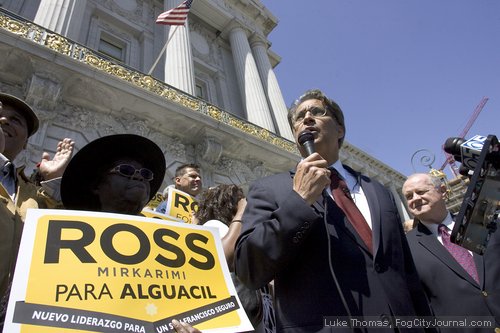
City Hall’s steps were awash in multi-lingual black and yellow “Ross Mirkarimi for Sherrif” signs at noon today, as Mirkarimi supporters watched Sheriff Mike Hennessey, who is stepping down after 31 years of service and eight elections, endorse Sup. Mirkarimi as the next sheriff.  “New Leadership for a Safe San Francisco” was printed on the English version of the signs that Mirkarimi’s supporters carried. They included former Mayor Art Agnos, Sups. David Campos and Eric Mar, Tim Paulson of the Labor Council, Debra Walker, Linda Richardson, Sharen Hewitt, Terry Anders, and Mirkarimi’s partner Eliana Lopez and their almost two-year old son Theo. And everyone had plenty of great things to say about outgoing sheriff Hennessey and sheriff candidate Mirkarimi. And Hennessey even pinned a shiny toy sheriff’s badge onto the T-shirt of Mirkarimi’s son Theo, making him the happiest kid in town. At least for the day.

Campos kicked off the event by honoring Hennessey as the “most progressive and most effective sheriff in the country.”
“Mike Hennessey is also my neighbor in District 9. I see him taking out the trash so I know he’s a good neighbor,” Campos joked, as he listed the many achievements in Hennessey’s long career as an elected official in San Francisco. These achievements included Hennessey’s pioneering innovations in criminal justice and culminated in his decision to blow the whistle in 2010 on the federal government’s plan to activate its controversial Secure Communities program in San Francisco—without telling the public.
“He’s not afraid to stand up for what’s right,” Campos said.

‘This is the time for me to move on,” Hennessey announced, as he laid out his reasons for endorsing Mirkarimi as Sheriff, over other candidates in the field.
Hennessey described the Sheriff’s Department as a “large enterprise” that has over 1,000 employees, a $150 million budget and whose jail houses an average population of 2,000 folks in custody, on a daily basis.
“It’s not something that can be handled lightly,” Hennessey said. “That’s why I’m here to endorse Ross Mirkarimi as the next sheriff.”

Hennessey listed the many endeavors that he and Mirkarimi have worked closely on, including a number of criminal justice issues, and he cited Mirkarimi’s extensive law enforcement background, his significant legislative accomplishments in the areas of criminal justice and public safety, and his ability to find innovative solutions and overcome obstacles to progress, as reasons to support Mirkarimi.

Hennessey observed that criminal justice is “one of the thornier issues” that members of the Board of Supervisors are often asked to get involved in, but often duck.”But Ross has not shied away from working on them,” Hennessey said, citing Mirkarimi’s involvement in shaping the “No Violence Alliance Project” and his leadership in creating the Safe Communities Re-entry Council.

Hennessey also noted that in face of AB 109, the Governor’s plan to transfer state inmates to county jails, “it’s vitally important to have person in charge of sheriff’s office that understands these alliances and can make them work more effectively.”

Hennessey concluded by observing that the Sherrif’s Department has to deal with a lot of bureaucracy, so it’s important to understand how the Board, the budget process and other city departments, including the District Attorney’s office and the police, work.
‘And that’s why I’m endorsing Ross as Sheriff,” Hennessey said

Then it was the turn of Mirkarimi, who graduated from the San Francisco Police Academy, did Naval Reserve training and worked for more than 8 years as an investigator for the District Attorney’s office, to speak.

“I have never been at a loss for words,” Mirkarimi acknowledged, as he launched into a speech that began by thanking everyone for showing up at short notice “for one of the most important occasions of my political career.”

Mirkarimi did a great job of giving Hennessey the praise he deserves.
“He is a living legend,” Mirkarimi said. “It’s completely impossible to fill his shoes.”
Citing Hennessey’s integrity and his ability to innovate, Mirkarimi warned that, “Maybe it’s come to the point where we have taken him for granted. He’s the longest serving elected official in the history of San Francisco, and he’s probably the most understated.”

“And the most important endorsement in this race is that of Mike Hennessey,” Mirkarimi added, as he gave Hennessey his commitment “to build upon your legacy as effectively as possible.”

Mirkarimi cited some of the most immediate and serious challenges that face the next sheriff. These include AB 109, which Gov. Jerry Brown just signed, which. Mirkarimi said, threatens to increase the reentry prisoner level by 30 percent in California. “It will take creative ingenuity and resources to make sure we are effective in taking care of this population,” he said.

Mirkarimi also touched on the rising number of veterans that are ending up in the prison system, talked more about the No Violence Alliance Project, and suggested that certified deputy sheriffs could help serve warrants, transfer prisoners, and patrol Muni, “when the police department finds itself understaffed” so as to ensure that San Francisco is safe.

“For every four people arrested and jailed in San Francisco, three out of four are repeat offenders in a three-year period,” Mirkarimi warned, by way of explaining why he wants to advance a more collaborative spirit between SPPD and the Sheriff’s department.

Mirkarimi also noted that one out of every 15 African American males are in jail, at any time in the year, compared to I out of 300 males who are not black or brown. “So, we must step up our game in dealing with poverty,” he said, as he recommended increased access to job training and good jobs, “so work doesn’t become a seasonal hope but a permanent job.” He also made the connections between a lack of good housing, childcare, and schools and a rise in poverty, crime and recidivism.

Mirkarimi concluded by crediting Hennessey for “walking that fine pirouette” between upholding the principles of public safety and understanding the power of redemption at the same time.

I asked Sheriff Mike Hennessey what he considers to be the biggest challenges of running for sheriff/
“Letting people know what you are going to do, and what your issues are,” Hennessey said, noting that San Francisco has an intelligent, issues-driven electorate.

And Mirkarimi’s supporters weren’t shy about letting folks know the issues that the current D5 Supervisor has helped them with, over the years.

“Ross, as a supervisor and me, as someone who comes from a community of color, we know the habits that ex-offenders can bring with them, if there are no safety nets,” said Terry Anders who sits with Mirkarimi on the Safe Communities Reentry Council. “And I believe in what Ross stands for and the integrity of his person. He’s one of the first people to show up when there are crimes and victims, and he attends basketball games and boxing matches.”

Paulette Brown, whose son Aubrey Abraska Jr, was murdered in August 2006, but whose killers have still not been brought to justice.
“We shouldn’t have to run and leave our families, we should be protected,” Brown said. “Ross is my district supervisor and if he can get in, and do something about crime and solve unsolved homicides, then I’m for him. Maybe if he gets in, he’ll have more pull to do something about these unresolved cases.”

And then it was back to work, which for Mirkarimi now includes the somewhat daunting task of trying to raise money in an election year that also includes a mayor’s race, but does not include the help of public financing, at least not for the sherrif’s race….

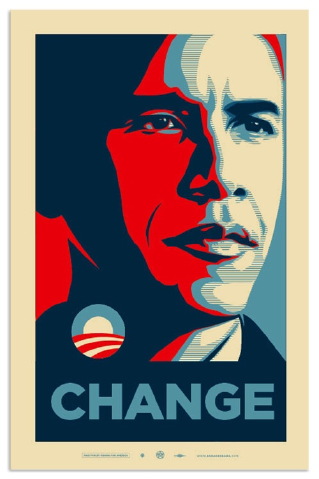
Truth and Reconciliation is the only chance for Hope and Change

2

Like most Americans, I’ve been fascinated by the news of Osama bin Laden’s death, although my reaction has been a strange mix of relief (at the fact that this monster is gone) and revulsion (that murdering our enemies has become so widely accepted). And after processing it for a couple days, I think that we as a country need to go back to the point where things went so horribly wrong and to try to figure out whether there’s a better path that we might take.

I realize that President Obama has demonstrated no appetite for such an undertaking, which could be done through a Truth and Reconciliation Commission like the ones used so effectively in South Africa, Chile, Argentina, Columbia, Peru, East Timor, and other countries looking to heal themselves after deep political strife that led to gross human rights abuses, and to engage with the world about the best way forward.

Particularly now that he’s riding so high as a decisive commander-in-chief, Obama isn’t likely to don Jimmy Carter’s old peacemaker garb. But he should, because we all know where this perilous path we’re on ends, right? With more terrorist attacks to avenge bin Laden’s death, followed by more U.S. commando and Predator drone strikes, while Afghanistan, Pakistan, Iraq, Libya, and Iran just get worse, and then pretty soon we get drawn into Yemen, Somalia, Syria, or some of other countries filled with Muslims who are filled with righteous hatred of the Great Satan. And on and on it goes, never stopping, as the Israel-Palestinian conflict demonstrates.

Meanwhile, domestically, the hawks and the doves get ever more divided and resentful of each other, and the tough-talking, corporate-sponsored politicians play them off against each other, with their angry clips endlessly churned by the media maw until the most sensitive souls each go postal or just tune out. “Victory,” whatever that means anymore, just isn’t possible in this context.

The Bay Area chapter of the anti-war group World Can’t Wait is sponsoring two upcoming protests against Bush Administration war criminals: outside a Condoleezza Rice speech in Room 290 of Stanford University Law School on May 6 at 3 pm and against John Yoo at the UC Berkley School of Law graduation ceremony at Boalt Hall on May 13 at 9 am.

As the protesters have said, the decisions by these two individuals and other top Bush Administration officials have caused more death and human rights violations than Al Qaeda, but I can no longer work up any more anger at these two than I could against bin Laden. They just seem like two sides of the same cruel coin, the twin jets that have propelled this country down a disastrous path.

And at this point, I’d sacrifice my sense of vengeance to change course as a country. As much as I’d like to see Rice, Yoo, Bush, Cheney, and Rumsfield hauled into the Haig and tried for what they’ve done – which would perhaps give me the same sense of satisfaction that many feel now over the death of bin Laden – I would rather give them all complete immunity from prosecution to let them testify truthfully about what’s happened in these last 10 years so that we can begin to atone for it and move on.

If Obama could bring that about, he’d go down in history as a truly great man. Instead, he’ll probably just choose to ride this current wave into a safe reelection campaign, nothing will change, and hope will die.

HOC farmers market bans live chicken sales

15

Feathers will cease to fly over alleged cruelty practices at the Heart of the City Farmers Market that we reported in February. The outdoor Civic Center market has announced it will no longer offer live poultry for sale as of May 27, a practice that had been grounds for a lawsuit and two years of fervent protesting from animal rights groups.

Raymond Young’s Poultry, a popular vendor, has been selling live chickens by the hundreds for nearly two decades at the HOC market every Wednesday and Sunday. In January, animal rights activist group LGBT Compassion filed a lawsuit alleging cruelty and civil rights violation against Young and the HOC after months of protesting and several attempts to get city agencies involved.

While the poultry stall remained popular with its largely Chinese clientele in spite of an ever-present throng of protesters, the practices caught the attention of Animal Care and Control and the Department of Public Health. Young had received hundreds of citations from ACC and warnings from the DPH, but they were essentially void due to an exemption in California law pertaining to poultry.

HOC market managers would not comment for this story, nor would Raymond Young. While the lawsuit is still pending, the announcement was perceived as a victory to the activist group.

“It sent a message to the city and to the public that animal cruelty and public health offenses is not acceptable and should not be endorsed or subsidized by the city,” said Andrew Zollman, founder of LGBT Compassion. “Having the market finally recognize that something like that should change is great.”

Zollman and fellow protestor Alex Felsinger filed the lawsuit with San Francisco attorney Matt Gonzalez. Zollman said that they had continued to protest in the months since filing the suit. Along with ACC, they said that Young had repeatedly violated animal cruelty laws and health codes even after the level of scrutiny on his stall had increased.

The ACC, which had cited Young hundreds of times for practices such as unsanitary conditions, lack of water, and improper handling of the chickens, viewed the decision by the market to ban sales as good news.

“Animals are food for a lot of people, but as Proposition 2 in California exhibited, people do care about the treatment of them,” said Rebecca Katz, director of the ACC, referring to the Prevention of Farm Cruelty Act of 2008. “If the vendors had been able to treat the animals appropriately, I don’t think it would have become this issue. This was profitable; he still could have made good money and done it properly.”

Bullfeathers Quail, the other live bird vendor at the market, had received significantly less attention from protesters and city agencies because it sold far fewer birds – about 350 per week – and had not been accused of nearly as many violations. Nonetheless, the vendor will also be banned.

Zollman said they will continue to protest the stall up until May 27, mainly because they fear the vendors will operate with a higher level of disregard since they have “nothing to lose.” Although they have received caustic criticism from groups who believe their protests are an attack on Chinese culture, they will plan to shift their attention north to Chinatown to live markets operating there.

“We are hoping that what we have learned and what city agencies have learned will pave the way,” said Zollman.

USF hosts mayoral forum focused on service

2

The University of San Francisco’s Leo T. McCarthy Center for Public Service will host the political season’s first major mayoral candidate forum – this one focused on public service and staged in partnership with the nonprofit group buildOn – on Thursday, May 5, at 6 pm.

Candidates Michela Alioto-Pier, John Avalos, David Chiu, Bevan Dufty, Tony Hall, Dennis Herrera, Joanna Rees, Phil Ting, and Leland Yee are expected to attend. Admission is free and the public is encouraged to attend this event held at USF’s McLaren Conference Center, 2130 Fulton Street.

“The intent of the forum is to help frame the mayoral campaign and also encourage candidates to talk about what drove them to service and how people can get involved in San Francisco, especially the youth,” Corey Cook, assistant professor in the USF Department of Politics, told us. Cook will moderate the event, which will include questions from high school students participating in buildOn and McCarthy Center service programs.

Carrie Pena, buildOn’s communications director, told us, “Students from public high school will ask questions based on bare thoughts on public service and what it means to be a good public servant.”

BuildOn provides programs for students to break the cycle of poverty and illiteracy. About 90 percent of buildOn students go to college. There are 19 schools in the Bay Area working with buildOn and in the previous year, the students contributed more than 24,000 hours to the Bay Area community.

At USF, service learning is a core class part of the graduation requirement where each student dedicates at least 20-25 hours of service per 15-week semester. “Co-hosting a mayoral forum is a fitting project for USF and buildOn because it will engage high school and college students, as well as the greater community, into the process of local politics,” Cook said on the USF website.

Catarina Schwab, buildOn’s vice president of development, said the partnership is a good match: “We aligned with USF because they focus a lot on service. Both were interested in a forum on service. We are even going to have a buildOn chapter at USF.”

Historic preservation debate raises a slew of questions

The Board of Supervisors Land Use Committee spent several hours yesterday hearing from city officials and members of the public on the hot-button issue of historic preservation. The informational hearing was called by Sup. Scott Wiener, who framed it as a discussion about “the impact of historic preservation policies on other major public policy goals and the need to adopt legislation to ensure that the policies are achieved” — a statement that raised alarm bells among historic preservationists and sent members of that community out in droves to defend preservationist efforts and to urge Wiener not to weaken any of the city’s existing policies.

Wiener raised concerns about the time and expense associated with environmental impact reviews (EIR) that could be triggered if a property falls within an historic district, saying, “there’s a sense that the cost is rather high, and the time it takes is rather high,” and added, “a lot of times we order an EIR, and that’s the end of the project.” He also raised questions about whether historic preservation efforts placed too many constraints on upgrading transit-oriented neighborhoods, parks, and libraries.

While Wiener had opened the debate in order to highlight problems associated with historic preservation policies, preservationists packed the room to defend their efforts. “I am dismayed that the importance of historic preservation is being challenged,” June Osterberg noted during public comment. She charged that San Francisco had gone from being “a paradise for residents to a developers’ paradise, to my despair. Please do not diminish the importance of what’s left in San Francisco.”

Arthur Levy noted, “If you go back to 1967 [when policies were first created] you will see that preservation has not thwarted or trumped development” in the decades since. “There’s nothing the matter systematically,” he added.

Wiener seemed surprised by some of the strong reactions. “They thought I was going to start knocking down the Golden Gate Bridge and the painted ladies,” he told the Guardian. He insisted that while he supported historic preservation, he wanted to have a conversation about balancing it with other policy goals, since “it’s an issue that has a lot of pent-up demand.”

The Historic Preservation Commission (HPC), created in 2008 with voter approval of Proposition J, has drawn criticism from members of the development community who’ve suggested that the panel would “shrink wrap” the city, stifling new building projects at a time when unemployment is particularly high in the construction sector. Yet Mike Buhler, executive director of San Francisco Architectural Heritage, noted that the city’s Historic Preservation Commission had given the green light to all but one project proposal that came before the it, suggesting that fears of the HPC freezing out potential development were unfounded.

Asked after the hearing how he reacted to those sending the message that everything was fine, Wiener noted, “In some respects, things are not fine,” citing the lengthy historic review process and lack of clarity on certain requirements.

Meanwhile, Sup. Malia Cohen took a different tack in her line of questioning on this issue. She wanted to know if teams of surveyors who conduct neighborhood assessments for designating historic districts reflected the ethnic diversity of the city, and whether historic context statements generated by those surveys took into account the myriad cultural and ethnic histories in a given neighborhood.

Planning officials assured Cohen that the surveyors were ethnically diverse, and community outreach was done in multiple languages. But one man who spoke during public comment charged that the planning department was “tone deaf” when it came to responding to concerns raised by the African American community, and that efforts to designate certain properties as historic, such as Sam Jordan’s Bar on Third Street in the Bayveiw, had “hit roadblocks.”

Speaking to the Guardian after the hearing, Cohen said she’d been hoping to highlight the omission of certain cultural perspectives when it came to decision-making about which properties are deemed historic. Cohen spoke about the contributions of Filipino, Chinese, Japanese, and African-American communities to the city’s historic landscape.

“And the Native Americans — they’re never included in the conversation,” she said, referencing a Shellmound on Bayview Hill leftover from an era when the Ohlone resided on the San Francisco peninsula. She said she was concerned that cultural contributions may not be reflected in the neighborhood surveys, or in which buildings are ultimately designated. “It’s systemic,” she noted.

SFBG Radio: Are we done with Afghanistan?

0

Today Johnny and Johnny talk about whether the death of Osama Bin Laden will lead to the end of the war in Afghanistan — and the regional implications. Listen after the jump.

BinLadenDead1 by endorsements2010

Japan’s “unconscionable” radiation levels for schools

3

Japan Times is reporting that Physicians for Social Responsibility, a U.S.-based nonprofit, is challenging Tokyo’s position that it is safe for school kids to use playgrounds in the nuclear-stricken Fukushima Prefecture as long as the dose they are exposed to does not exceed 20 millisieverts (20 millirems) a year.

PSR has condemned those safety standards as “unconscionable”, Japan Times reported.

“Any exposure, including exposure to naturally occurring background radiation, creates an increased risk of cancer,” PSR said in a statement. “Children are much more vulnerable than adults to the effects of radiation, and fetuses are even more vulnerable. “

PSR claimed that a twenty millisieverts standard for children exposes them to a 1 in 200 risk of getting cancer. “And if they are exposed to this dose for two years, the risk is 1 in 100,” PSR’s statement said. “There is no way that this level of exposure can be considered ‘safe’ for children.”

Here in San Francisco, the Bay Citizen has an interesting piece about the difficulties of evaluating the real dangers from Japan’s unfolding crisis.

Homeowner defense groups to target Wells Fargo shareholders

8

“Foreclosures are the new F-Word.” So said Regina Davis, executive director of the San Francisco Housing Development Corporation, at an April 29 seminar at SFHDC’s office on Third Street that explored ways to prevent more foreclosures in San Francisco, California and beyond.

Since the economic meltdown in 2008, there have been 2,000 foreclosures in San Francisco. And the majority have impacted low-income folks and communities of color, who were sold more predatory loans than other groups, Davis and a panel of foreclosure experts warned
And as the recession drags on, another 2,000 foreclosures could be in the works, further destabilizing communities and draining more resources from the city, in terms of lost property values and related tax revenues.

And while deep-pocketed lobbyists have been making it hard to pass laws that would offer at-risk homeowners more protections, homeowner defender groups have decided to target, and now protest against, the group they believe stand directly in the way of equitable reforms: the banks.
 “Wells-Fargo CEO John Stumpf took home $21 million in 2009 while his bank received $25 billion in TARP funds,” stated a flier that ACCE (formerly ACORN) and the Home Defenders League are distributing to urge folks to meet at Justin Herman Plaza at 11: 30 a.m., May 3 and march to the Wells Fargo shareholder meeting where protesters plan to personally deliver a list of their demands to WF CEO Stumpf.

“He and his cronies fought tooth and nail to kill consumer protection bills in California and around the country and are currently trying to gut a 50-state Attorneys General settlement with homeowners that have been defrauded,” the flier concluded.
It noted that ACCE and the Home Defenders League sponsored this event, in partnership with the California State Labor Federation, the California Nurses Association, Contra Costa Interfaith Supporting Community Organizing, Causa Justa: Just Cause, ENLACE, Jobs for Justice, National Education Association, Oakland Education Association PICO California, PICO National Network, SEIU United Service Workers West and Local 1021 and Tenants Together.

“We are also part of The New Bottom Line, a national campaign focused on creating an economy that works for the many, and not the few,” the flier stated.

Celebrating Bin Laden’s death

102

I fear I’m going way, way out on a limb here. So let me be clear: I understand why so many people are so happy that Osama Bin Laden’s dead. I’m never happy about anyone’s death, but I get the point. I oppose the death penalty, even for international terrorism, but I don’t see how the U.S., once the CIA knew where he was, could have done much else. Capturing him alive would have been nearly impossible; even if the Navy SEALS could have done that, taking him back and trying him (and them imprisoning him — where? Guantanamo?) would have been a nightmare, and probably caused far far more deaths. This was a direct military operation (way better than the drone missiles we fire all over Pakistan, killing civilians); I doubt anyone inside that compound could seriously claim to be a noncombatant. And while we’ll never know the truth, it’s entirely likely that Bin Laden fought back.


That said: Does anyone else think it was a little unseemly for all of those folks to be out in the streets celebrating someone’s death?


Remember: We’re not celebrating the end of a war (I wish we were; I’d be in the streets, too). The wars in Afghanistan and Iraq will continue for quite a while. There will be more terrorist attacks, perhaps in retaliation. What we’re really celebrating here is the death of a bad guy, at the hands of American armed forces. And even hard-core death-penalty fans don’t tend to go out and wave flags and shout in triumph when the state kills someone (no matter how awful the person was).


I’m not going to join the crazies who want to blame the U.S. for killing OBL; he wasn’t a head of state. He was a war criminal, an enemy combatant, and he was killed in a firefight. Even the human rights folks at the European Commission are good with this.


I have no doubt that the SEALs were instructed not to take him alive; I’m not even going to argue that point. Let’s just stipulate for a moment that this was entirely justifiable. (Even if Robert Fisk says OBL had long since become irrelevant.)


Still: Should we be running around with flags saying “go America, we killed a murderer?”


I don’t know. A little more quiet dignity might have made a better impression on the world.

Are you really middle class?

A fascinating article appeared in the New York Times a couple days ago about the bias people tend to have when it comes to beliefs about their own economic standing in relation to the rest of society. It seems a trio of researchers found that Argentinians tend to view their personal economic classifications in much the same way people in the United States do: Everyone believes they are middle class.

The bias works differently depending on one’s income bracket, apparently: “Poor people consistently overestimated their rank, and rich people consistently underestimated their rank.”

According to the article, “Respondents were eventually informed about whether their own rankings estimates were too high or too low. This news changed people’s policy attitudes. People who thought they were relatively richer than they actually were started to demand higher levels of income redistribution when told they were actually relatively poor. After all, learning that they were poorer than they had believed also meant they’d be more likely to benefit from redistributive policies than they originally believed.”

This got me wondering what income distribution actually looks like in the San Francisco Bay Area, and how people view themselves within that spectrum. I went to the U.S. Bureau of Labor Statistics (BLS) to find the most recently available data for earners in this designated metropolitan area, which includes San Francisco, Oakland, and Fremont.

The data was from May of 2009. Taking into account all occupations and nearly 2 million earners, the mean annual wage was $58,250. That’s the number in the exact middle, but most earners were in employment categories which made less than that on average.

To better understand how it breaks down, I scrolled through the various employment categories. The data showed that around 6.8 percent of all earners worked in management — the bosses of all stripes — making an average of $126,260 per year. People working in the computer and mathematical science sector, such as programmers or database administrators, made an average of $91,440 a year, representing about 4.3 percent of all earners. The accountants, budget analysts, and others in business and financial occupations accounted for about 6.8 percent, earning an average of $84,330 per year.

Meanwhile, around 59 percent worked in employment categories with average earnings of less than $58,250. That’s not to say every single one of those earners made less than that — police officers, for example, registered at an average of $79,080 annually, while their “protective services” employment category had an annual average of $52,260. But it does suggest that at the end of the day, quite a few people fell below that middle income line.

The greatest areas of employment by far were office and administrative support services (around 16 percent of all earners; bringing in an average of $41,670 annually), sales (nearly 10 percent; earning an average of $45,860 annually), and food service (around 8.4 percent; earning an average of $23,740 annually).

People working in education, a category that includes teachers and instructors as well as librarians and curators, had median incomes that very closely reflected the exact middle — $58,880. That category made up around 6 percent of all earners.

Of course, there are flaws in any data set, it can only really reveal so much, and even this one was titled “wage estimates.” A study of San Francisco by itself would likely portray a different picture, with a higher mean annual wage. There are outliers, like Pacific Gas & Electric Co. CEO Peter Darbee, who made more than $10 million in 2009. And all of this should be considered in the context of an official 9 percent unemployment rate for San Francisco (actual unemployment rates tend to be higher than official estimates).

On a broader scale, we also know that 1 percent of the nation’s population takes nearly a quarter of the wealth.

The research cited in the NYT article offered this theory about why people are tend to be biased about where they stand: “If you’re mostly exposed to people earning about as much as you, you’re likely to think your earnings are average.”

Puke and privatization in Dolores Park

44

Editors note: the vow by Chicken John Rinaldi to vomit in Dolores Park has gotten a lot of media attention — but there’s a real story behind it that the press has missed. Chicken sent us this opinion piece presenting his side of the story.

By Chicken John Rinaldi

It happened pretty quickly, when privatization came to Doritos Park. Sorry; Dolores Park. I keep forgetting they haven’t sold the name yet.

It didn’t come like a wraith with icy fingers or an immense monster with an army of lawyers. Privatization came to Dolores Park in the form of a nonprofit incubator for immigrant women entrepreneurs called La Coucina. For a progressive city like San Francisco, you can’t get much more cuddly than that.

I hear the Trojan horse was adorable, too. It had a cute mane and soft eyes and was made of really high quality lumber. You’d be a fool to criticize that kind of craftsmanship. But it was privatization of a park, even so. Selling space on public land without the public’s consent.

And there was resistance, of course. But the resistance was met with the oddest enemy. The resistance didn’t find itself fighting against people who believed that the park should be privatized. The resistance debated with people who did not know what privatization was. The resistance debated with people who did not know it was coming. The resistance debated with people who knew what it was, but refused to recognize it.

“Yummy tacos!” they chirped, as though that actually was an answer. Enron served tacos, too. Every Tuesday. The problem wasn’t the tacos: it was Enron.

“It’s just a food truck!” they said. “For immigrant ladies! No one who gives work to immigrant ladies could ever be involved in something bad!” This kind of thinking, that anything is okay as long as it also raises money for a good cause, is what will sink our own City of Art and Innovation: San Francisco.

The people who resisted asked questions: Why can’t they park the taco truck on the curb, where cars belong? Why drive a truck on the grass? Why not rent a parking space for the truck? Ummmmmm….. “Yummy tacos!!!” They said, looking around the room for approval.

The people who resisted pointed out that the public outreach that was supposed to be done before this kind of thing is authorized was never done. They told us at the first meeting that it was too late to stop. They did that thing where they create the illusion of inevitability.

Some things are almost impossible to undo once they’ve happened. Sacking the city of Troy, for instance. Or detonating a neutron bomb. Or kissing your best friend. Or doing all the cocaine in the cab before you get back to the party. Privatization is like that. Once a government starts getting easy revenue from a public trust, it doesn’t want to go back. Then it starts taking everything else with it: once one park has a food concession, every park that doesn’t have a food concession starts to look like a drain on the budget. Once one park gets a gift shop, every park needs a gift shop. Pretty soon you end up with a city full of park-themed malls. Well, in the rich neighborhoods anyway. The poor neighborhoods will have fences around the parks. Because they can’t carry their weight.

This is what a class war looks like. Straight up. RPD (mainly the general manager, Philip Ginsburg) has declared class war on San Francisco.

We’ve seen where this leads before: like in the news industry. Back in 1967, network news was almost … almost … a public trust. There was tight regulation. There was no consolidated corporate ownership. The people who owned the stations had zero influence on what was broadcast. Most importantly, no one expected network news to turn a profit. It was something the networks did, for the public good, as a condition of getting access to the public airwaves. It wasn’t perfect, but it tended to be solid news about factual issues that were relevant to the times.

That began to change in 1968, when CBS started a show called “60 Minutes,” and for the first time in network history a news show made a profit. Suddenly all news had to make a profit. And then it had to make a bigger profit, and then a bigger profit. It was a slippery slope. By the 2000 election we had FOX news.

As part of this trend, facts got replaced with opinions – because opinions are cheap and profitable. You want to make more money? Cut your foreign reporters, replace them with a pundit who once visited France. Need to make more money? Cut your congressional reporters and replace them with a couple of hacks arguing about congress.

As a result of the rush to make a profit, news coverage has become completely tabloidized … which is why some idiot with a cause needs to throw a “Puke-In” to get attention to a relevant issue like the privatization of parks. And it worked.

A cleverly worded publicity stunt that claimed I was going to “Fill Dolores park with vomit and watch the trailer of privatization float away on a river of puke” got attention. News organizations that never would have run a headline like “parks department fails to consult with residents” were tripping over themselves to be the first to run headlines like “Incensed man vows to puke on immigrants” and “park activist to puke on vendors.” All told, 57 stories appeared online and in the papers.

 Eventually, most of them mentioned that the park was going to get privatized. It was ugly, but it was a win – and with the media the way it is, everything’s ugly.

After it had been going on for two weeks, I had to explain to people that my cheap and obvious publicity stunt was a cheap and obvious publicity stunt. This lead to more headlines. But come on – “puke in?” That’s funny! But for the record, no, I’m not going to throw up on immigrants. I do have $750 worth of novelty vomit, but all I’m really doing is collecting signatures for my petition: Did anyone really think I could puke on another human being … someone who I didn’t know … just because we had different opinions on the location of a taco truck? After I ran for mayor for second place? After Porneokie? After a career in San Francisco spent producing benefits and rallies and meetings and art incubators and pot luck dinners and bus trips to amazing places?

Well, actually… yes. People thought I was going to go assault someone. Welcome to San Fransandiego. Whatever. The point is: the Recreation and Parks department is trying to rent out public parks to make money, and they’re not consulting the neighborhoods. And while they’ve found the nicest, sweetest, bestest cause they could find to rent the first plot of your land too, the next time it might be FOX news. It might be Exxon. It might be Goldman Sachs. They don’t care: they’re just in it for the money.

Privatization came to Doritos Park. Shit, I did it again. Sorry. Privatization came to Dolores Park. And the progressive left of the Mission showed up. We showed up and we showed that we have a gag reflex. We let Mr. Ginsburg know that privatization makes us nauseous. If they’ve got budget problems, close a few golf courses, they’re horrible for our ecology anyway. Endangered species; frogs and what have you. Lowering kids services 30% and then raising your payroll 670% is not gonna work. Duh. You can’t fire all the kids’ teachers that were making $35K a year, close the clubhouses and then hire thirteen $120K a year bureaucrats and not start a class war. There should be 50 neighborhood groups at your door with torches and pitchforks!

If the Recreation and Parks Department needs more money, they should show good faith and manage what they have better first, before selling our future with privatization. And if they need more money from the General Fund, then lets find it! Lets partner with them to seek solutions or restructure how the financial system works so they get the money they need without ruining our city.

As for us eating each other alive over this issue? I think it’s worth our time to talk this out, argue it out. Work it out. It’s definitely worth poking taco truck sized holes in this moral justification for selfishness. Which is what I think we have here. I think fighting that is worth signing a petition, and worth protesting. And it’s worth a cheap publicity stunt. I bet I can think of another one, too.

Chicken John is a San Francisco showman. Here is the petition:

Now just end the death penalty

2

Jerry Brown is going to save the state $356 million by scrapping plans to build a new Death Row. Go, Jerry. Now if he really wants to save money he can scrap the death penalty.


It’s actually one thing a governor can do on his own; he can just issue a blanket stay of execution to all condemned inmates. He can, without ever having to get a single Republican vote in the Legislature, call off executions in California. I know he’s not personally a fan of the death penalty. Wouldn’t it be wild if Jerry became the first governor in the country to get rid of it not because of morals or questions about innocence (both of which are excellent reasons to stop the state from killing people) but because it was a waste of money?


Most people on death row die of old age. Life without parole IS a death sentence; you’re going to die behind bars. Call it off on fiscal grounds, guv — and Let the Republicans defend this wasteful state spending.

The return of ROTC

10

The almost-certain end to the military’s discrimination against lesbians and gay men is causing all kinds of educational institutions to take another look at ROTC programs, the latest being Stanford, which scrapped the on-campus military training regime during the waning days of the Vietnam War.


I’m not going to get into an anti-military rant here (tho I could), but in a sense, the “don’t ask, don’t tell” bullshit has given us on the left an easy way out: As long as the military discriminates — and by definition it does — then it doesn’t belong in our schools. I’m okay with that, but I also think we need to go a bit deeper here, and ask:


At what age, and under what circumstances, is it okay for military recruiters and recruitment programs to go after young people?


It’s all the more imperative today, since college is becoming unaffordable for so many — and military programs like ROTC, with their ample scholarships, have to be tempting.


I’d start with a basic premise: No recruiters should have access to kids under 18, anywhere, any time. That means no JROTC programs in high schools. Kids that young are too easily swayed by uniforms and bravado; they need to learn to think before they decide they might want to die.


The law says you can enlist at 18, so I guess it’s arguable that college kids can enlist while they study. But it seems to contracy to what college ought to be about. In fact, if it were up to me, I’d say nobody could join the military until he or she reaches 21. Old enough to drink, old enough to fight. We have decided as a society that college-age kids aren’t mature enough to handle alcohol; it would seem like a no-brainer to conclude that they aren’t old enough to make a fateful life decision.


ROTC in college? It still bothers me. Even after don’t ask, don’t tell is gone.

ACLU, Guardian sue over secret death drugs

1

The ACLU and the Bay Guardian have filed a federal lawsuit demanding the release of secret documents related to the scramble in California and other states to secure lethal-injection drugs for executions. And we’ve asked the court to issue a preliminary injunction ordering the Drug Enforcement Administration to release the documents quickly.


Both Arizona and Nebraska have recently scheduled executions — and apparently they plan to use drugs that were not obtained in the United States, may have been imported illegally and may not meet American medical standards.


Here’s the ACLU’s statement:


“The DEA has already acknowledged that the public has an urgent need to view records regarding states’ efforts to import execution drugs and the role of federal officials in that process,” said Linda Lye, staff attorney with the ACLU-NC. “We are dismayed that for nearly four months DEA has not released a single document.  The public has a right to these records before imported drugs that may have been illegally acquired are used to execute another inmate.”


Here’s the background:


On January 4, 2011, the ACLU-NC and The Guardian submitted FOIA requests to three federal agencies seeking records related to the federal government’s role in assisting – or failing to oversee – efforts by states to acquire controlled substances from outside the United States to carry out executions. The requests, submitted to the DEA, the Food and Drug Administration (FDA), and US Customs and Border Patrol (CBP), sought documents that would reveal whether state officials violated any laws in the states’ scramble to acquire execution drugs and the role of federal agents in the process.


The ACLU-NC and The Guardian sought these records after public records disclosed by the California Department of Corrections and Rehabilitation (CDCR) revealed that California prison officials engaged in a worldwide “secret mission” to acquire sodium thiopental, a controlled substance used in California’s execution process that is no longer legally available in the U.S. The records from the CDCR and other state prisons eventually revealed that six states imported sodium thiopental from Dream Pharma, a drug distributor that operates out of the back of a driving school in the United Kingdom. Records also revealed that two other states imported a controlled substance purporting to be sodium thiopental from an Indian Company that states publicly it is not authorized to import drugs into the U.S.


The DEA granted the ACLU-NC and The Guardian expedited processing of the FOIA request submitted in January. In so doing, the DEA acknowledged that the records relate to an issue of significant public importance and that the public had an urgent need for the information contained in the records. Yet, for nearly four months, the DEA failed to produce any records and failed to even provide a timeline for when records would be produced.


In the interim, based on questions surrounding the drug’s legality, the DEA has taken possession of the sodium thiopental imported from Dream Pharma from five states. This includes Georgia, Tennessee, and South Carolina, which imported the controlled substance directly from the United Kingdom. DEA also took possession of drugs from and Kentucky and Alabama, which acquired the illegal drug from other states. Only Arizona, California, and Arkansas continue to maintain possession of drugs imported from Dream Pharma, while Nebraska and South Dakota continue to possess drugs imported from India.


I’ll keep you posted.

You, too, can run the Rec-Park department

1

At least, this Craigslist ad suggests you can. It doesn’t sound like Mayor Ed Lee wrote it himself:


For the past several years the Department of Recreation and Parks has been recognized as leader in the development of innovative programs to prevent the public from enjoying either recreation or parks. However, in a time of increasing budget shortfalls and political uncertainty, new directions must be found to preserve our civic treasures from our civic body.

Several recent initiatives, including privatization of parks, closing recreation centers, and placing advertising on every available public surface, have failed to keep people from going outdoors for free. We need bold ideas.

The qualified candidate will:

· Own a stun gun
· Possess strong ties to the business community
· Exhibit rudimentary math skills


And I can’t imagine who would have posted an ad like that. Certainly not some guy who threatened to barf in Dolores Park.


Blast rocks Marrakech tourist restaurant: live report

4

Chaos here on the giant, tourist-packed Djemaa El Fna square in Marrakech, Morocco as an explosion has just rocked the Argana terrace restaurant two stories above the square at around noon local time.

We’ve seen apparent evidence of casualities being pulled from the wreckage of the dining room. A Reuters photographer has found out from the police that the source was gas, specifically reserve cannisters stored along the staircase (also, everyone here smokes a lot). Al Jazeera is reporting this now — as well as 10 dead. If we learn more we will update this post.

A previous large explosion at a Moroccan tourist cafe occurred in Casablanca in 2003, part of a series of Islamist suicide bombings that left 45 people dead.

UPDATE 1:56 p.m. local time: AP is now reporting 14 dead and word is still going around that the cause was a gas canister explosion, although AP is also reporting that the explosion resulted from a “concentration of gas in the basement” and that the state news agency MAP quotes an Moroccan interior ministry statement calling the explosion a “criminal act.” This raises concern among some observants, because two weeks ago in response to public demonstrations, King Mohammed VI “pardoned or reduced the sentences of 190, mainly Salafi jihadist, prisoners — roughly one in 10 of the 2,000 or so people tried, sentenced and jailed after the Casablanca bombings” according to the New York Times.

Our own observation of the damage suggests that a basement explosion is questionable. Damage appears to be concentrated on the second level (and the third floor windows were blown out), yet hawkers’ stalls on the square near the first floor seemed undamaged, although we were unable to get too close to the building. Also, the building itself is still standing.

Whatever the cause, after the concussive blast the scene itself was incredibly grisly, with injured staff and patrons, some visibly dismembered, being removed on yellow tablecloths or curtains, bodies strewn over railings, and members of the public frantically gesturing from the blackened terrace for assistance. Beams and sections of roofing were dangling from above the terrace, and crowds below watched helplessly until a fleet of ambulances tore through the packed square. Locals attempted to assure foreigners who had made their way to Cyber Parc Arsat Moulay Abdeselam — the city’s public wi-fi hotspot and rare green space — of their nation’s safety for tourism and lack of terrorist violence. 

UPDATE 7:15 p.m. local time: A tense and eventful day here in Marrakesh, as much of the Djemaa el Fna — usually writhing with snake charmers, storytellers, Berber musicians, and juice vendors — has been cordoned off by police for the blast investigation. A largely Moroccan crowd gathered to watch in silence; the tourists (a group of Welsh charity hitchhikers at our hotel, for example) mostly seemed to hole up in their hotels and share stories of near-misses and might-have-beens.

The word on the “Arab street” — literally, as we ate shwarma on Rue Bab Agnaou — veered from gas canisters as a cause to a basement water heater to a bomb. The Moroccan government is now officially investigating it as a bomb attack, but is stopping short from calling it terrorism. The death toll is now at 15, and the square is lined with police anti-riot vehicles. Shops remain open in the souks but the mood is somber, and even the more aggressive street vendors have dialed back their hustle, offering supportive words and plentiful information.

Both Al Qaeda in the Islamic Maghreb and the Polisario Front, which seeks to drive Morocco out of Western Sahara, are on the list of initial suspects in the explosion. Should the blast prove to be a terrorist bombing, it would be “the largest in Morocco since 2003, when 12 suicide bombers attacked five targets in Casablanca, killing 33 people,” the New York Times says in an article on the explosion. The King has promised a full investigation, as well as to pay for burial of the dead, according to the official Moroccan MAP news agency.

UPDATE AND WRAP-UP, May 1, Madrid, SpainWith the bombing now being blamed on Al Qaeda in the Maghreb, and the victims of this heinous attack all identified, I wanted to answer some readers’ questions. David and I were about 200 meters from the Argana Cafe, at a locutorio (cyber cafe), when we heard the blast. We finished up quickly and walked out onto the square, where we saw the immediate aftermath. We had spent the previous nine days traveling all over Morocco (it’s huge and incredibly diverse) and talking to people. Although we sensed much frustration with the country’s economic situation, and even a little with its politics, we never felt threatened in any way. Even after the explosion, Moroccan life proved especially resilient — there’s just too many people, including tourists, and too much going on to stop everything in its tracks for long.  Below is my original report.

And the next chief is…yes, Suhr!

3

Mayor Ed Lee appointed a deeply emotional Captain Greg Suhr as Chief of the San Francisco Police Department during a swearing-in ceremony where the majority of folks were either elected officials, running for election, running each other’s electoral campaigns—or wearing SFPD uniforms.

And in the end it seemed that the choice may have been influenced by pressure from the powerful San Francisco Police Officers Association, judging from the comment Lee jokingly directed at SFPOA leader Gary Delagnes, saying, “Gary, it’s time to get quiet and go to work.”

Lee told a standing-room only crowd that when he returned from Hong Kong to San Francisco four months ago finding a new police chief was his top priority. And that initially it was suggested (Lee did not say by whom) that he leave the SFPD situation alone and allow an elected mayor to appoint the next Chief.

‘While I am an interim mayor, this is not an interim decision,” Lee told the crowd, signaling that while he may be out of office in January, Suhr may be here to stay as the city’s top cop.

“Today, I’ve chosen the best candidate,” Lee continued, thanking Acting Chief Jeff Godown for his work leading the SFPD since former Mayor Gavin Newsom made the shocking decision to appoint former Chief George Gascón as District Attorney.

But while Newsom’s move may have upset the apple cart in the D.A.’s race, it sure seems to be working out well for Suhr.

Describing Suhr as “a police and people’s Chief: and “a reformer from the inside out,” Lee ran through a long list of the new Chief’s contributions to the SFPD. These included Suhr’s 30 years of service, his climb through the ranks to become Captain of the Mission station, his gig as Captain of the San Francisco Public Utilities Commission in a Homeland Security capacity, and, since 2009, as Captain of the Bayview station.

Suhr began by saying he was “speechless.” Donning glasses to read a speech that he had prepared the night before, Suhr choked up when he talked of being “fourth-generation, born and raised in San Francisco.” Recovering his composure, Suhr smoothly changed gears, as he joked how his appointment therefore makes him “a local hire,”—an insider reference to Sup. John Avalos’ recently approved local hire legislation that Mayor Lee is helping enact citywide.

Suhr recalled how he started out as a rookie on the midnight shift in the Tenderloin in 1981. He thanked his family, his friends and his girlfriend Wendy. And then he asked for a moment of silence “ to honor the memory of all the brave officers who have given their lives in the line of duty.”

Lee reclaimed the podium long enough to jokingly ask Suhr  “to investigate the whereabouts of my birth certificate” as his first assignment as the new chief.

Then it was Board President David Chiu’s turn. Chiu described Suhr as someone, ”who knows our streets, walked the walk, and knows the beats, someone who we all feel confident will be able to bring the SFPD the reform that former Chief Godown, Chief Gascón and Chief Heather Fong initiated. “

San Francisco Superior Court Judge Katherine Feinstein, who is the daughter of Sen. Dianne Feinstein and the presiding judge of the Superior Court, recalled how she has known Suhr since the mid 1980s. “I have watched him as each of our careers have moved forward,” Feinstein said, noting how there were some “steps forward and some steps backward” and how, “there were those who thought this day would never come.” (Feinstein’s words were the only reference to some of the less sunny moments in Suhr’s long and distinguished career. These included his 2003 indictment as part of Fajitagate, an incident that involved off-duty officers, a bag of take-out food, a beer bottle and injuries sustained by two local residents. Suhr was cleared of wrongdoing the next year, but was reassigned by then Chief Heather Fong to the PUC position after an incident in 2005, in which a police officer was seriously injured at an anarchist protest, and videographer Josh Wolf was held in federal prison for 226 days after he refused to release unedited footage of the protest.)

Next up was D.A Gascón and his rooster-like shock of silver hair. Gascón noted that when he first came to San Francisco, in the summer of 2009, he had no allegiances to, and no prior knowledge of, people inside the SFPD.

“I looked at Greg Suhr and one of the things that impressed me is how he worked with and related to people,” Gascón said, explaining why he appointed Suhr as Bayview Captain “Not only has he exceeded all expectations he did an incredible job,” he said.

 Police Commission President Thomas Mazzucco said that in the 100 days since the Commission announced it was looking for a new chief, it became clear that Suhr has the support of SFPD’s rank-and-file.

Mazzuco noted that he met Suhr in high school. “I knew he could hold a ball,” Mazzuco added, noting that he subsequently became Suhr’s football coach, even though he is younger than Suhr. “What the Police Commission has brought to us is not only a native son but also a cop’s cop. It’s an honor to have him as his chief.”

And after the swearing-in, the sentiment among officers in blue appeared to be strongly in Suhr’s favor. Lt. Ken Lee of Central Station recalled how he and Suhr went through the police academy together about 30 years ago.

“We went to different assignments but we’ve maintained a friendship,” Lee said. “The moment I met him I liked him. He was a very stand-up person, and as a native San Franciscan like myself, you could tell he had strong ties to the city. He’s a hard worker, he’s very dedicated to what he does.”

Lt. Mario Delgadillo, also of Central Station, said Suhr hasn’t lost his connection to the street. “That also means a lot, when you have a boss who’s walking with you,” Delgadillo said.

Suhr takes over the SFPD as it’s grappling with the fallout from a recent spate of scandals, including videos that Public Defender Jeff Adachi released that appear to show police misconduct at residential hotels and that forced DA Gascón to hand over his investigation of this alleged police misconduct to the FBI. Asked during a media roundtable what his appointment means for Acting Chief Godown, Suhr said Godown has returned to being Assistant Chief of Operations, which was the post he held before Gascón, who recruited Godown from LAPD, was appointed DA.

In response to a question about his top priorities as police chief, Suhr noted, “When I sit down with the mayor this afternoon, the mayor’s going to tell me what his priorities are. My first priority will be blocking the door open on the 5th floor so that if you wanna come see me you can, like it used to be. Then I have to meet with the command staff and captains and get their take on where they think we are, where they think we’re moving forward best, and match that up against how I’ve seen from a position of Bayview, how that matches up. And then see if I can’t meet with different community groups, the different police employee groups and the command staff.”

He didn’t mince words when it came to indicating that SFPD officers are going to be asked to give back during upcoming budget negotiations
“I’m sure that there’s going to have to be adjustments and I look forward to working with a collaborative effort with the mayor and the board and the unions and the rank and file,” Suhr said. “When the economy’s been good we’ve benefited by it, and now that the economy has … gone the other way, to some extent I think that the officers are willing to give back to do whatever needs to be done to keep the city safe.”

So, how does Suhr think he differs from former Chief Gascón? 

”He has a gorgeous head of hair,” Suhr joked. “To put it in a sports analogy, he’s a quarterback shortstop guy, and I’m more of a catcher, lineman, linebacker kind of guy. But I admire him, I think he moved a lot of issues forward for the police department, and I look forward to continuing those initiatives and giving a few of them a shot in the arm that I think were beginning to wane a bit.”

Suhr also talked about how he has always wanted to become a police officer (a comment that suggests he’s not planning to use the Chief’s post as a stepping stone to the District Attorney’s Office).

”When I went into the police department. on Silver Avenue which is now Willie Brown Academy — that was the police academy back in 1991 when I came in — man, we looked at just the regular uniformed police officers with just stars in our eyes, because they were just the sharpest, classiest folks that we were aspiring to be,” Suhr said.

And he indicated that as Chief, he won’t tolerate dishonesty in the face of ongoing investigations into alleged police misconduct. ”The character of a police officer must be above reproach,” Suhr said. “And I think that the investigation will show what it ends up showing, but I don’t think that there’s a police officer in San Francisco that would want to have a dishonest cop and I’d be at the top of that list. So I want all my officers to be of character that is above reproach.

Asked if he welcome clarification around the duties of SFPD officers assigned to the FBI’s Joint Terrorism Taskforce, Suhr said he believed an examination of the wording of the FBI’s most recent memorandum of understanding (MOU) with the department was already under way.

“I believe that the MOU is being revisited,” Suhr said. “I have not been a part of that, but again I think we have a real good policy with regard to our intelligence gathering and that does supercede any ask of any other agency. The officers are bound by policies and procedures. And that policy was well thought out with tremendous community and group input years and years ago, from situations that have not since repeated themselves. I think a lot of people back then couldn’t believe they happened in the first place, but I think measures were well thought out and put in place to make sure we don’t have a problem again.”

And at the end of the day, Suhr expressed the hope that his tenure as Chief would endure long after the interim mayor is replaced by an elected mayor.

”I’m a native San Franciscan, and this is a dream come true,” he said. “It’s my first day. However this story ends, with a little bit of luck (raps on the wood tabletop) it’s not going to end today.”

SFBG Radio: Why are gas prices really so high?

2

What’s the real reason gas prices are so high? Our distinguished guests discuss after the jump.

HighGasPricesWhy by endorsements2010

Who’s your candidate for mayor? Vote today

188

If the mayor’s race were held today, who would be your top choice?


Free polls from Go2poll.com

Muni strike vote stems from “gigantic mistrust” of the MTA

7

At a time when public employee unions are being demonized, downsized, and degraded by conservatives and much of the general public, it was a bold gesture for Muni drivers to recently authorize their Transportation Workers Union Local 250A to defy city law and go on strike anyway. But following through on that threat and shutting down Muni may only turn the public even more strongly against that union.

Board of Supervisors President David Chiu said a Muni strike would be “a significant mistake” that he’s trying to avert, and City Attorney Dennis Herrera has issued a statement reminding the public and Muni workers that strikes are banned in the union contact and the City Charter and “we will take appropriate legal recourse.”

But the union’s Secretary-Treasurer Walter Scott told us the strike authorization vote was a result of the “gigantic mistrust” by Muni workers of their Municipal Transportation Agency bosses. “They wanted a strike authorization vote,” he said, which “shows that the membership is behind us” as union leaders negotiate a new contract in the wake of November’s Prop. G, which ended the union’s pay guarantees.

Among the recent factors that Scott said have led Muni workers to doubt that the agency is negotiating in good faith were the MTA’s unilateral decisions to withhold Health Care Trust Fund money that had gone to drivers in previous years and the new requirement that drivers bring in doctors’ notes if they call in sick, as well as the agency’s decision to hire public relations specialist Charlie Goodyear to publicize developments in the ongoing negotiations.

But Goodyear said those issues are diversions that haven’t been raised in the current negotiations, that the MTA was acting under authority it has under the charter, and that “we hope that the good work that’s been going on for five or six weeks continues” and the two sides reach an agreement on a new contract.

Scott also expressed hope that the two sides will reach a deal. “Nobody wants to strike, and we’re trying our damnedest to find a happy median in these negotiations,” he said.

As for the right of the drivers to strike, Scott agrees that the current contract prohibits it, but he noted that the contract expires on June 30 and that “on July 1, we have no contract. That’s went the legality [of a strike] comes into question.”

Herrera has noted that the City Charter also declares that “strikes by City employees are not in the public interest,” going on to note that “said employees shall be dismissed.” But Scott says Muni employees have already been so vilified by city officials and the local press that calling a strike wouldn’t hurt their standing with the public much more: “If I’m shot dead and someone stabs me, it doesn’t make that much of a difference.”

Earth Day in City Hall … on Wells Fargo’s dime

Who was lucky enough to get treated to Mayor Ed Lee’s Earth Day Breakfast in City Hall, with the city’s top politicos and a smattering of high-profile San Franciscans? After noticing that the Board of Supervisors had approved a grant of $12,000 from Wells Fargo a few weeks ago to sponsor the event, the Guardian contacted the Mayor’s Office to ask for the guest list. The response came from the city’s Department of the Environment, which accepted the donation and organized the affair.

The 472-person invite list (we don’t know how many actually attended) included prominent figures such as Sens. Barbara Boxer and Dianne Feinstein, Rep. Nancy Pelosi, billionaire investor Warren Hellman, and former San Francisco Mayor Willie Brown. All 11 members of the Board of Supervisors were invited, too, as were mayoral hopefuls City Attorney Dennis Herrera, Assessor-Recorder Phil Ting, and state Sen. Leland Yee.
 
Invitations were extended to some truly green organizations, too, such as Green for All, Save the Bay, Rainforest Action Network, the Ella Baker Center for Human Rights, the Sierra Club, the Apollo Alliance, Greenaction, and others.

And many seats were reserved for the corporate sector. A total of nine representatives of Pacific Gas & Electric Co. were on the list. There were seven from Cisco, several from consulting and design firm CH2MHill, and a couple representatives from Skidmore, Owings & Merrill — the firm that’s doing the Parkmerced overhaul and which was tapped to envision waterfront venues for the America’s Cup. 

Seven representatives — including the CEO — were invited from Recology, which is in the midst of a debate over its high-stakes, $275 million no-bid garbage contract with the city.

According to Mark Westlund of the Department of the Environment, only half of the Wells Fargo grant went toward the mayor’s Earth Day Breakfast, “the remainder to a series of community events held in the Department’s EcoCenter lobby.” The other sponsors included Blue Shield of California ($2,000); CH2MHill; Skidmore, Owings & Merrill; United Airlines; Environmental Science Associates ($4,000); Levi Strauss & Co.; Cisco ($6,000) and Starbucks — which provided BPA-free travel mugs (double green points!).

It’s nice that San Francisco taxpayers didn’t have to shell out the $18,000 for all these people to celebrate Earth Day together. But at an event such as this, with so many millions of dollars in city contracts and major development projects flying around (not to mention the half a dozen or so people in need of campaign contributions), you can bet they weren’t all talking to one another about saving the planet.

Deadlock over Ma’s trash bill

0

A State Assembly committee deadlocked Monday over Assemblymember Fiona Ma’s AB 1178, which opponents say would make it easier for Recology to send San Francisco trash by train to Yuba County.

The bill seeks to ban local governments from restricting or limiting importation of garbage from outside the area, apart from enacting special fees.
“I don’t believe this is a special-interest bill,” Ma reportedly said before the vote. “I have 11 different counties in front of me that export waste to other areas.”

Assemblyman Jared Huffman, D-San Rafael, who voted against the bill, indicated that he was open to changing his vote, even as he said he didn’t like the idea of not allowing local governments to ban garbage from elsewhere.
“I’m a ‘no’ vote who’s open to becoming a ‘yes’ vote if the language is better,” Huffman said.

Yuba County Supervisor Roger Abe said Ma’s bill fails to protect current processes surrounding the use and oversight of landfills.
“AB 1178 makes me unsure whether planning notions will stand up in future with court actions,” Abe said.

Richard Paskowitz, who leads YUGAG (Yuba Group Against Gargage) went further. “It defines environmental injustice,” Paskowitz said, as he argued that Ma’s bill would makes it easier for wealthier areas to send trash to poorer areas.

Challenging the “rogue cell” theory of cancer

0

The GuardianUK has an interesting piece about a new theory on cancer:
”Rather than cancers being rogue cells degenerating randomly into genetic chaos, they are better regarded as organized footsoldiers marching to the beat of an ancient drum, recapitulating a billion-year-old lifestyle,” writes Paul Davies, who runs the cancer research center at Arizona State University. “As cancer progresses in the body, so more and more of the ancestral core within the genetic toolkit is activated, replaying evolution’s story in reverse sequence. And each step confers a more malignant trait, making the oncologist’s job harder.”