• No categories

Politics Blog

Will SF follow Portland on FBI spy concerns?

1

The Human Rights Commission and the Police Commission will hold a May 18 joint hearing at City Hall to discuss a recently released memo between the SFPD and the FBI that suggests that SFPD officers assigned to the FBI’s Joint Terrorism Task Force are under the control & rules of the FBI. The concern is that the memo allows SFPD officers to circumvent local intelligence-gathering policies, departmental orders and California privacy laws that prevent spying on people without any evidence of a crime. And the hearing comes a few weeks after Portland’s City Council unanimously approved a resolution that Portland Mayor Sam Adams introduced to clarify that Portland and FBI have decided not to enter into a Memorandum of Understanding (MOU) for the JTTF, but that the City will be cooperating with the JTTF according to the terms of Adams’ resolution.

During Portland’s public hearing, the American Civil Liberties Union (ACLU) of Oregon testified in support of the resolution, while raising concerns about the current and past practices of the FBI and the need to ensure that City personnel comply with Oregon laws.

“The Mayor’s proposal represents a thoughtful framework that should meet the City’s and the FBI’s needs to keep our community safe while also ensuring that Portland police stay within the confines of the Oregon Constitution and Oregon Charge of such violations, and a public annual report on the work the Portland Police Bureau does with the FBI JTTF,” ACLU Legislative Director Andrea Meyer stated.

“It is not a question of if but when, our officers will be asked to engage in investigative activities in violation of Oregon law,” Meyer testified. “To guard against this, we expect that there will be appropriate training of PPB personnel not just on Oregon law but on the FBI guidelines and the minimal criteria necessary for them to be able to engage in assessments and preliminary inquiries so that our PPB officers will be equipped to ask the right questions and refuse to participate and report this to the Chief and, in turn, the Commissioner-in-Charge.”
 
During Portland’s hearing, Mayor Adams stressed that the FBI’s standard JTTF MOU (which is similar to the agreement SFPD officers have operated under since March 2007) —is neither clear nor adequate in terms of addressing local civil rights concerns. And that’s why he sought and won federal consent for a non-MOU arrangement with Portland participating on a limited basis, on its own terms, with local civilian oversight and involvement from the City Attorney.  

“The question pending in SF is whether local officials — from the Police Commission, to City Attorney, to Mayor, will eventually insist on a similarly protective arrangement here, “John Crew of the ACLU of Northern California told the Guardian. “Right now, Portland shows what’s possible, and what the federal government will accommodate. I don’t know why Bay Area cities would not insist on at least something this strong.”

San Francisco’s joint hearing takes place May 18, 5:30 p.m. – 8:30 p.m. in Room 250 at City Hall.

California: The old, the rich and the poor

4

California is getting older and poorer. That’s what the new census data shows. And everyone knows the combination is a troubling mix:


“We have a longevity revolution happening, and in San Francisco we’re calling it ‘the silver tsunami,’ ” said Valorie Villela, director of the 30th Street Senior Center. “It’s hitting hard, and once again our society is not prepared.”


She said her research shows that by 2025 in San Francisco, 1 in 5 people will be older than 65 and the number of people older than 85 will have doubled. That trend is coming at a time when the state has been running huge deficits year after year, forcing cuts to services such as adult day care and Medi-Cal.


It’s particularly intriguing since one out of every five billionaires in America lives in California. So we don’t have enough money to take care of our seniors, and things are just going to get worse — but there’s a vast amount of wealth in the state. You wonder.


If the state had four million people between the ages of 18 and 25 who had no money, no prospects, not enough to eat and no place to live while a handful of billionaires were living fat and happy and controlling an outsized portion of the state’s wealth, that would be a recipe for, well, fighting in the streets.


Seniors tend to vote more than kids, but they don’t, so far, tend to march and riot and break things and threaten the security of the wealthy (and the politicians who cater to them). But the next wave of seniors is different; the baby boomers know all about taking it to the streets. And they’re living longer and healthier. Your average 65 year old today can carry a torch and a pitchfork just fine. Some of them can even throw rocks and bottles and shout “Eat the Rich!” (Hey, they’ve been there and done that already. Still got the notes.)


So I think it’s safe to say that this current trend ain’t sustainable. And even the Republicans up in Sacramento ought to get that. Nothing is worse for plutocracy than a crowd of hungry, angry seniors who spent their college years in the SDS.

Draft Kucinich to run against Pelosi

20

Bay Area progressives are constantly searching for a solid candidate to run against Rep. Nancy Pelosi, an Establishment figure who has helped lead this country down a disastrously unsustainable path, but nobody has ever been able to mount a serious challenge to this powerful incumbent. So here’s an idea: how about recruiting Dennis Kucinich, the representative from Ohio whose principled politics have made him a hero to progressives.

As Kucinich himself confirmed today in an email blast to supporters, there’s an effort underway in Ohio right now to carve up his district through reapportionment and he is actively looking from a new base of operations should that come to pass. While he’s rumored to be considering a move to Washington state, which will get another seat in Congress, I can’t imagine a better ideological fit for Kucinich than San Francisco.

So what do you say, comrades, is it time to launch a campaign to lure Kucinich to the Bay Area?

His message — entitled “My next move?” — follows:

You may have heard some rumors over the past week, so I wanted to set the record straight with you: While I’m committed to representing the 10th District of Ohio, I will not rule out a run elsewhere should my district be eliminated or radically altered through redistricting.

From Afghanistan to workers rights, Libya to climate change, there’s simply too much at stake for our voice to be eliminated. We cannot let a group of downstate politicians silence me and our movement – they would like nothing more than to stop hearing our calls for peace over violence and the people’s interests over corporate handouts.

So, no, we’re not going to quietly fade away, and let the corporate interests and status quo have its way. Instead, we’re gearing up for a long and difficult campaign in 2012 – wherever that may be. I know it’s worth it, and I know we can prevail. But I’ll need your help. Can you donate $25, $50, or $100 dollars today?

http://kucinich.us/contribute

I’ve been approached by supporters across the country – from Washington to Maine – to explore options outside Ohio should redistricting force me out of my current district. It has been truly humbling to see the support that has been expressed for me to continue my work in Congress. Right now, my efforts and focus remain on representing my constituents in the 10th District and fighting for peace and justice, but as we plan for our movement’s future, I will consider all of these ideas to keep our voice in Congress.

And I say the same to you right now. Do you have a comment or idea I should consider? Is there a option you would like me to explore? If so, let me know by clicking here: options@kucinich.us

Thanks for being with me.

With respect,

Dennis Kucinich

How bad are Sacto Republicans?

5

Pretty darn bad. They’ve gone so far over the edge that they don’t even listen to the people who they claim they want to support — business leaders who are worried about keeping California competitive.


That’s right — the big business types are practically begging the GOP legislators to get off their asses and pass a budget that includes temporary tax extensions. They’re also in favor of pension reform and a bunch of other things that Democrats don’t love — but Jerry Brown and the Dems have already agreed to put all those things on the table. The sticking point is this no-tax pledge — and for once, the big business community thinks that’s ridiculous.


Does it even matter? Do the Republicans even listen to the Chamber of Commerce any more? Or do they only care about the Grover Norquist types and a couple of L.A. talk show hosts?


Is Steven Tyler a corporate sellout?

3

Steven Tyler’s gone from bad-boy rocker (of sorts) to hair band frontman … and now to American Idol judge. He’s got an autobiography. He’s on the cover of Rolling Stone and People. And his albums are selling again. Is he yet another example of a rock star selling out in his golden years? Is that inevitable? Johnny and Tim discuss after the jump.

sfbgradio5/11/2011 by endorsements2010

Ghosts of sit-lie past

5

Is sit-lie a case of not learning from our mistakes?

An interesting bit of history that for the most part failed to enter the debate over the ordinance is that San Francisco enacted a similar ban on sitting and lying  in public spaces in the late 1960’s (PDF).

Inspired 40 years later by the same neighborhood, the current sit-lie law is a legislative throwback. Back then, Haight Street was a center of controversy as hippies began to arrive in droves – hanging out, singing, dancing and generally occupying the sidewalks. Some business and property owners were apprehensive over the rapid changes to the neighborhood.

The Board of Supervisor enacted the ordinance, which made it a crime to “willfully sit, lie or sleep in or upon any street, sidewalk or other public place,” with a unanimous vote in 1968. Violation carried a fine of up to $500 and a maximum jail sentence of six months.

Then-Mayor Joseph L. Alioto, who signed the ban into law, told the San Francisco Chronicle the ordinance “will not be used to discriminate against any group or person.” His promise echoes the claims of contemporary proponents of sit-lie.

But police used the law to target not only hippies but also gay men in the Castro. The predictable reality of selective enforcement galvanized popular resistance.

Over the next decade, the ACLU sued and managed to overturn parts of the law. “[The original laws] were being used unjustly by the police against people who were considered undesirable,” said Alan Schlosser, legal director of the ACLU, who has been working for the organization since 1976. They were used against Hippies in the Haight, they were used in the Castro and the Tenderloin against the prostitutes.”

Political pressure from a wide coalition, which included Harvey Milk, convinced the board to rescind the ordinance in 1979. In fact, one of Milk’s signature campaign issues was stopping police harassment of gay people.

The current law does avoid some of the pitfalls of the old one. The ban only applies to sitting and lying down; the sixties-era law referred to the obstruction of public space. Police are now required to issue a warning, and the punishment for violation is significantly lower. Neither distinction, however, alters the fundamental problem of sit-lie.

The ordinance criminalizes an extremely common behavior, which is in itself harmless. The most vulnerable members of our society depend on public space and are inevitably the most susceptible to getting in trouble into the crosshairs sit-lie enforcement.

Queer activists are once again leading the effort against unfair and unwise regulation of public space. We reported April 11th that self-proclaimed “angry queers” installed handmade benches on city streets as a form of protest art. Likewise, this upcoming May 22nd, which is Milk’s birthday, Queers for Economic Equality Now (QUEEN) will be coordinating sidewalk events against sit-lie in San Francisco and Berkeley.

Tommi Avicolli Mecca who organizes with QUEEN, said “for me it is so thrilling to see two cities doing something against sit-lie and invoking Harvey’s name.”


Coal company gets punked by the Yes Men

The Yes Men, that prankster-activist group that has ruined many a corporate exective’s day, have struck again. This time their target is the notorious Peabody coal company, which operates environmentally devastating mountaintop removal mining sites in West Virginia and has strip mining operations in Arizona.

It may take a minute to realize that Coal Cares is a fake. Designed to look like a website for a Peabody-funded nonprofit, the faux charity offers free “Puff-Puff” designer inhalers for kids living within 200 miles of a coal plant. The site features a “Kidz Koal Korner” (an interesting spelling choice that could be meant as a subtle reminder of the environmental racism issues associated with coal-fired power plants), and a selection of inhalers with themes ranging from “Miley Cyrus” to “The Bieber” to “Punk / Emo.”

The humor is dark. For example, a kids’ game page features a maze with a drawing of the character “Jimmy” at the beginning and an inhaler at the end. It’s titled, “Help! Jimmy is having trouble breathing. Help him find his inhaler, quick!”

A section called “‘Clean’ Energy” features some over-the-top misinformation about wind power: “Wind technology is another ‘alternative’ wild card. Every single year, gargantuan wind turbines kill literally thousands of birds—especially when the turbines are located in the middle of migration paths. Exploding bats are also a growing problem, as vibrations from turbines causes the rodents’ lungs to burst apart in mid-flight.”

But a press release on the Yes Men’s website reveals that the issues that inspired this hoax are no laughing matter. Peabody was targeted for lobbying against new pollution standards for power plants that have been proposed by the Environmental Protection Agency — rules that the agency has calculated could prevent 120,000 cases of childhood asthma per year in the United States.

The press release noted that the action was dreamed up by a small environmental and public health group called Coal is Killing Kids (CKK), which aims to challenge coal industry lobbying against rules that would strengthen the Clean Air Act. “We don’t have their millions, but we do have a knack for incredibly tasteless jokes,” said Veronica Tomlinson, a pediatrician and member of CKK.

“Sure, it’s kind of tasteless to say that ‘Bieber’ inhalers are a solution to childhood asthma,” said Janet Bellamy, a spokesperson for CKK. “But it’s a great deal more tasteless to cause that asthma in the first place, as coal-fired power plants have been proven to do.” Added CKK spokseperson Justin V. Bond: “It’s even more tasteless to disproportionately kill poor people.”

Campos urges Lee to implement entire due process law

12

Text by Sarah Phelan. Photographs by Luke Thomas


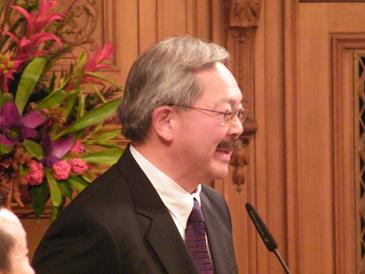
After the Guardian broke the news that Mayor Ed Lee was planning to only partially implement Sup. David Campos’ due process legislation, we headed to City Hall to witness Lee announce his partial shift during question time. And afterwards, Lee told reporters that he spent the months since he was appointed reviewing the policy and talking with leaders in the city’s juvenile justice departments.


“I looked at the difference between youth with family here and youth who did not,” Lee said, noting that his decision to let youth that have family here to have their day in court is in keeping with his policy of focusing on family reunification and getting families more involved.


Lee stressed that youth with family here will still need to be enrolled in school and not be repeat offenders in order to have their day in court.


“It will be decided upon on a case by case basis,” he said.


Lee said he has had conversations with the federal government and US Immigration and Customs Enforcement (ICE) about the policy shift. “We have discussed this,” Lee said. “And we did get a very strong feeling that the federal government is a bit confused.”


Asked how far he is willing to go to defend this latest policy shift, Lee said, “I’ll take that up as it comes. President Obama is struggling with immigration right now.”


Reminded that his predecessor Mayor Gavin Newsom refused to implement any aspect of Campos’ due process legislation, even though a super-majority of the Board passed the ordinance in 2009, Lee said, “I don’t compare myself with the former mayor.”


Asked what percentage of immigrant youth that end up getting booked are “unaccompanied,” Lee said he did not have those statistics. “Check with Siffermann,” he said, referring to the head of the city’s Juvenile Probation Department.”


Lee’s announcement was met with mixed reviews among immigrant advocates.


Civil rights groups applauded Lee’s decision to immediately begin implementation of Campos’ legislation, which was passed in November 2009, restores due process for immigrant youth in the city’s juvenile justice system and ensures that innocent youth are not torn from their families for deportation.  But they also expressed disappointment that Lee will only be implementing the policy for youth who have immediate family here, and not for unaccompanied youth.  And they all urge him to fully implement what they described as Campos’ “duly-enacting, common-sense law so that all innocent youth receive protections.”


They noted that implementation of Campos’ broadly-supported law, which has been endorsed by over 70 organizations, had been stalled until today due to former Mayor Newsom’s refusal to enact the law. 


Under Newsom’s direction, Juvenile Probation reported over 160 youth to ICE at the point of arrest, prior to the youth receiving due process, based only on a juvenile probation officer’s “reasonable suspicion” that a youth is undocumented. 


Civil rights advocates note that Newsom’s problematic policy was responsible for tearing innocent youth from their families and spreading fear among immigrant residents around coming forward to cooperate with police, either as witnesses or victims of crime.  


And they observe that the policy that Juvenile Probation Department has been enforcing since the summer of 2008, and which involved reporting youth for life-altering deportation at arrest, went well above and beyond any obligations under federal law. 


They noted that, as a cadre of legal scholars, including University of San Francisco Law Professor Bill Ong Hing, have repeatedly made clear, there is no requirement imposed on city officials under federal law to ask about immigration status or to report individuals suspected of being undocumented.”


Ana Perez, executive director of Central American Resource Center, agreed.“While we appreciate Mayor Lee taking action to finally begin implementation, we are concerned that he is only implementing the policy for accompanied youth and not for youth who may be unaccompanied because they are trafficked to this country, are orphans, or are escaping persecution.”


“I’m certain it’s not for all youth,” Pérez continued. “So, it’s a small win. But what about the kids who are victims of human trafficking? The fact is we spent so much time developing a policy that was approved by a majority of the Board. So, this is bitter sweet.”


Asked what became of the criminal grand jury investigation that then US Attorney Joe Russoniello initiated in 2008, when Mayor Gavin Newsom was running for governor, and news first broke that the city was accompanying youth who weren’t here with family back to their home country, Pérez suppressed a snort. “It seems that was a bunch of empty threats to try and get the city to move to a more conservative position,” she said. “It’s been a whole new day with Obama.”


Angela Chan, staff attorney at the Asian Law Caucus said that Juvenile Probation’s prior policy of reporting innocent youth exacerbated the impact of a broken federal immigration system on local immigrant families. “We appreciate that Mayor Lee has taken this long awaited step forward because he values family unity and due process for youth,” Chan said. “However, we ask that the Mayor not exclude unaccompanied youth from receiving due process protections.”


Patricia Lee, managing attorney in the Juvenile Unit at the Public Defender’s Office also supported the demand for complete implementation of Campos’ legislation. “If you want the immigrant community to feel safe enough to cooperate with police and probation, then those agencies should not be viewed as representatives of immigration,” she said. “My clients and their families are scared of probation, they are scared of police. Selective implementation of the due process policy for only accompanied youth and not to unaccompanied youth does not solve this problem.” 


And Charles Washington, the Muni bus driver and longtime San Francisco resident, whose wife and 14 year old son were almost separated from him as a result of the prior Juvenile Probation policy, expressed concern that the policy would only be implemented for some youth. “I’m glad to see Mayor Lee is doing the right thing by implementing the due process policy,” he said. “However, he should not leave any youth, especially those who are most vulnerable, behind.”


Sup. Campos applauded the Mayor for implementing the policy while expressing disappointment that it is only partial implementation. As Campos’ stated during the Board meeting, but after Lee had already left, “This body enacted that law and that law needs to be respected.  It is not up to the executive branch to second guess the legislative branch.” 


Sup. Eric Mar added that he supports full implementation for all youth.


 And Sup. Jane Kim, who asked the Mayor during the Board’s Question Time about his plans for implementation, stated, “My hope is that he will commit to full implementation of this policy.”


But in the end, the burden fell on Campos to explain why partial due process is unjust. “This is a good first step, but it doesn’t go far enough,” Campos explained. “As I understand it, the decision Mayor Lee has taken is, that if you are a minor, and are accused of a felony, you will be given due process if you have family here. But if you are charged with a felony, but don’t have family here, then you will not be given due process. Let me begin by thanking Mayor Lee for at least taking one step in the right direction. That said, we still will not have full compliance with a law that was duly enacted by this body. Full compliance means giving every child that interacts with the juvenile justice system due process. So, {Mayor Lee’s first step] is simply not sufficient.”


Campos noted that when mayors are sworn in, they agree to uphold laws that the Board enacts. “So, the law needs to be respected,” Campos said. “It’s not up to the executive branch to second guess the legislative body. That second guessing can only be done by the courts. Therefore, we, once again, ask the mayor of San Francisco to comply with full implementation.”


Noting that a bedrock of the U.S.’ justice system is the principle that we are innocent until proven guilty, Campos said that if the mayor does not fully implement the law, as approved by the Board, “There’s a very real possibility that children that we are reporting [to ICE for possible deportation] are not guilty of what they have been accused of. So, once again, I ask the mayor to reconsider his opinion.”


Campos also noted that there are already procedures in place, within the existing juvenile justice system, to ensure that “we do not have individuals released who should not be.”


After the meeting, Campos noted that the format for the Board’s question time with the mayor currently leaves something to be desired: an opportunity for the Board to reply.


“It would be better if it would allow for some exchange, though obviously, we don’t want it to be a ‘gotcha’ game. But at this moment, it’s too rigid.”


 Asked who drafted the current Question Time format, Campos replied, “Board President David Chiu.”

Mayor Lee to partially implement Campos’ due process ordinance

1

Today at question time, Sup. Jane Kim will ask Mayor Ed Lee what his plan is to implement a due process ordinance that Sup. David Campos authored and a super majority of the Board approved in 2009, prohibiting the Juvenile Probation Department from reporting undocumented youths at the time of arrest. And according to an anonymous source, Lee will say he has decided to implement the policy, if the youth in question are “accompanied,” which means they have family here.

Immigrant advocates say Mayor Lee should be commended for his leadership in implementing the due process policy to keep immigrant families together. But they believe that Lee needs to go the whole way. “Immigrant and civil rights groups are adamant that the policy must be implemented for all youth, accompanied and unaccompanied, and this has to be immediately,” our source said. “The due process policy does not discriminate between these two groups and the policy cannot be selectively enforced.”
 
As Kim planned to point out during the Board’s question time, voters approved San Francisco’s Sanctuary City Ordinance in 1989. That ordinance prohibits our Police Department and local government officials from assisting in the prosecution of immigration enforcement unless it is required under federal or state law.

In 2009, the Board, under Campos’ leadership, passed-by a supermajority-a clarification to that ordinance to prohibit local law enforcement from reporting undocumented youths unless they are convicted of a felony. To date, this ordinance has not been followed by the City.

But in a May 9 memo to the city’s Probation Department personnel, Juvenile Probation Department Chief Probation Officer William Siffermann and Assistant Chief Probation Officer Allen Nance wrote that since revising JPD’s policy 8.12 nearly three years ago [per Mayor Gavin Newsom’s instructions], they have closely monitored JPD’s implementation of its protocols.

And after considering all perspectives and after careful review, they have decided to “modify our existing policy in a manner that aligns our Departmental policies more closely with the values inherent within San Francisco’s Sanctuary City ordinance, without compromising our balanced commitment to public safety and the best interests of the minor.”

“Effective immediately, San Francisco Juvenile Probation Department notices to the federal authorities of minor/persons booked on felonies who are suspected of being undocumented AND are accompanied (lives with a verifiable parent, guardian or blood relative in the immediate Bay Area and is enrolled in school) will be made only upon a felony adjudication, upon apprehension on an outstanding warrant, or upon issuance of a new warrant following release from custody pending adjudication,” the JPD memo reads. “Minor/persons booked on felonies who are suspected as being undocumented, AND are verified adults or unaccompanied by any verifiable parent, guardian or blood relative residing in the Bay Area, whether or not enrolled in school, will continue to be reported to the federal authorities upon determination of this status.”

“Policy 8.12 will continue to ensure that all suspected undocumented minors booked and convicted of committing a felony will continue to be reported to the federal authorities,” the JPD memo continues. ‘While the Department will neither assist nor interfere with the federal authorities’ overwhelming duties and responsibilities related to the enforcement of immigration laws, we will continue to honor their lawful detainers regarding suspected illegal immigrants.”

“We are confident that your uniform compliance with this policy adjustment will continue to reflect the Department’s interest and your professional commitment to preserving families while we discharge all of our many duties that protect public safety,” the JPD memo concludes.

Legal scholars weigh in on Secure Communities

5

In face of statements by Secretary of Homeland Security Janet Napolitano, three legal scholars in California have offered their opinions on recent developments surrounding immigration enforcement in California and “Secure Communities” (S-Comm) a program run by U.S. Immigration and Customs Enforcement (ICE) that automatically shares fingerprints at the point of arrest by local law enforcement.

Napolitano recently asserted that states and localities have no power to decide whether to participate in S-Comm, raising serious concerns about overreaching by the federal government and intrusion into local police power. In response, Aarti Kohli Director of Immigration Policy at the Warren Institute on Law & Social Policy at UC Berkeley’s law school, and law professors Hiroshi Motomura and Bill Ong Hing have weighed in on the growing controversy to provide, “accurate and important analysis on the legal terrain surrounding S-Comm.”

Kohli said that the reason academics are weighing in now is to point out that just because the federal government is asserting that it has certain authority doesn’t mean that’s the case, and that there are people who are interpreting the law differently.
“It’s not a cut and dry situation,” Kohli said of the federal government’s current position. “Strong arguments can be made that the federal government is overreaching.”

Kohli notes that at least 60 percent of the people who are currently in the country unlawfully entered the United States before 2000. “So, they have been here for over 11 years,” she said, noting that the last legalization opportunity for folks who entered unlawfully occurred in 1986. “So, you are talking 26 years ago,” she said, noting that there used to be many more options for people to adjust their status. “So, now you have people who have lived in the country for two decades who have not been able to legalize their status.”

Kohli observed that given the economic crisis, cooperating with the feds’ controversial “Secure Communities” program also becomes a question of priorities. “It becomes a question of where do you want to put your enforcement dollars,” she said, noting that state and local governments facing restraints in terms of jail space and resources. “So, does it make us safer to lock up low-level offenders, people who we would otherwise never dream of locking up, particularly in face of the constraints at the state and local levels?”

Initial research conducted by UC Berkeley’s Warren Institute’s indicates that S-Comm does implicate the use of local resources. 
“Data indicates that the majority of non-citizens who are booked into ICE custody through Secure Communities have been accused of low-level offenses, including traffic-related misdemeanors,” Kohli said in a press statement. “ Under typical circumstances, localities would allow low-level arrestees to post bond soon after an arrest.  However, if ICE issues a request for the local jurisdiction to hold the person, then bond is often denied and the person must remain in the local jail until the case comes before a judge.  Because of ICE holds, local jurisdictions use their own limited resources to feed, detain, and manage low-level offenders who would ordinarily not remain in custody.  All of this occurs before the person is even taken into custody by ICE.  Secure communities has resulted in a dramatic rise in ICE holds issued to local jails, thereby overburdening local law enforcement with the detention of those arrested on minor offenses who would not normally be held for extended periods.

Hiroshi Motomura, a law professor at UCLA, asserted that S_Comm undermines trust between local law enforcement and immigrant communities, may overstep the constitutional authority of the federal government to tell local governments how to run their police departments—and has a more basic flaw that has  policy and constitutional dimensions. “It is that the program delegates to local police the discretion to decide who—through stops and arrests—will be put into the immigration enforcement system, and who will not,” Motomura said in a press statement. “Even if the federal government retains the theoretical power to decide not to deport some non-citizens, local police will become the gatekeepers. As a practical matter, their decisions to arrest some residents but not others, to get tough with some neighborhoods but not others, will drive and direct federal immigration policy.  The constitutional command that U.S. citizenship is national citizenship means that immigration enforcement decisions can’t be left to local preferences—and local prejudices.  The local government proponents of opt-out aren’t arguing that they should be allowed to make immigration decisions.  Instead, they are arguing that no local officials should be allowed to make what must ultimately be national policy.”

And Bill Ong Hing, a law professor at the University of San Francisco reacted to ICE’s stated position that states and local governments must participate in S-Comm: “In the immigration field, the concept of preemption is an appropriate check on over-zealous local enforcement efforts that directly affect immigration regulation, while the Tenth Amendment is a check on federal intrusion on a local jurisdiction’s attempt to be more protective of individual rights and when the locality has a legitimate non-immigration-related purpose such as public safety,” he said. “The central teaching of the Tenth Amendment cases is that ‘even where Congress has the authority under the Constitution to pass laws requiring or prohibiting certain acts, it lacks the power directly to compel the States to require or prohibit those acts.’ Congress may not, therefore, directly compel states or localities to enact or to administer policies or programs adopted by the federal government. It may not directly shift to the states enforcement and administrative responsibilities allocated to the federal government by the Constitution. Such a reallocation would not only diminish the political accountability of both state and federal officers, but it would also ‘compromise the structural framework of dual sovereignty,’ and separation of powers. Thus, Congress may not directly force states to assume enforcement or administrative responsibilities constitutionally vested in the federal government.”

Ong Hing also noted that S-Comm’s current Memorandum of Agreement (MOA) between ICE and the State of California provides that it may be ‘modified at any time by mutual written consent of both parties. “The implication of this provision is clear: the terms of the MOA are negotiable,” he said

The trio’s move comes as local authorities in California and across the nation are increasingly turning against S-Comm, arguing that it overburdens local law enforcement with civil immigration enforcement, and results in high budgetary and social costs. 
Community advocates and several elected officials have already asserted that S-Comm harms community policing strategies by eroding trust between victims and witnesses of crime and police who fear immigration consequences. They cite examples of domestic violence victims in San Francisco and Maryland who have been placed in deportation proceedings after they called local law enforcement agencies for help.

In San Francisco, Sheriff Michael Hennessey has already asked to opt out of S-Comm because it casts “too wide a net”. Under the current program, S-Comm calls for fingerprinting and federal immigration database checks of arrestees, including those jailed for minor offenses like a broken taillight. And community advocates warn that the program can result in deportation without conviction or a trial. But the federal government has stated that only states can opt out. Last week, shortly after Illinois announced that it was pulling out of S-Comm, and a bill that Assemblymember Tom Ammiano authored, requiring the Attorney General to allow California counties to opt out of the program passed out of a committee, Hennessey announced that he will start releasing from jail undocumented immigrants who have been arrested for low-level crimes, even if federal officials notified through S-Comm’s fingerprint identification program request that they be held for deportation hearings.

Hennessey’s new policy is set to begin June 1. It means that undocumented immigrants arrested for petty crimes such as disorderly conduct, drunk in public or shoplifting will not be held in jail until ICE come to collect them. And it will make San Francisco the first California county to implement such a policy.

Hennessey explained that local jails are not required to hold inmates if ICE has identified them as undocumented, so sheriff’s deputies won’t be violating the law. Currently, sheriff’s deputies hold undocumented immigrants who have been booked for low-level offenses until ICE picks them up. But under the new policy sheriff’s deputies will release them with a citation as they do in cases involving U.S. citizens.

Hennessey, who is retiring and has endorsed Sup.Ross Mirkarimi in the race to replace him this fall, says the shift is intended to uphold the city’s sanctuary ordinance, which prohibits local officials from assisting ICE unless a felony crime is involved.

ICE’s own statistics seem to support Hennessey’s concerns: From June 2010 until February, 111 people that S-Comm identified were deported without being convicted in criminal court. 85 people who committed the lowest two levels of crimes were deported, plus 45 who committed felonies, including rape and assault.

But ICE spokeswoman Virginia Kice decribed Hennessey’s decision as “unfortunate”.
“ICE detainers are an effective tool to ensure that individuals arrested on criminal charges, who are also in violation of U.S. immigration law, are not released back into the community to potentially commit more crimes,” Kice said in a statement.

Avalos and Chiu vie for bike vote at Sunday Streets

7

If yesterday’s jam-packed Sunday Streets event in the Mission was any indication, only two mayoral candidates are vying for the votes of bicyclists, skaters, and strolling families who appreciate carfree streets: John Avalos and David Chiu. They were the only two candidates who showed up, and both had lots of supporters with signs to help campaign for them, with Avalos supporters enjoying a slight edge in overall numbers.

It’s a testament to the lackluster field of mayoral candidates this year that Avalos and Chiu were the only ones campaigning at such a popular, cool, and high visibility event. It also foreshadows what is likely to be a tough fight between the two sitting supervisors for a constituency they each need to win.

With more than 13,000 dues-paying members, the San Francisco Bicycle Coalition is the city’s largest grassroots political organization, an active and high-profile group of voters that both candidates have sought to stake their claims with.

Chiu often touts the fact that he doesn’t own a car and bikes regularly, he took a fact-finding trip to Amsterdam with bike advocates last year, and he sponsored legislation setting the policy goal of 20 percent of SF vehicle trips being by bike by 2020. Avalos has the strongest progressive credentials in the race, he sometimes rides his bike from the far-flung Excelsior District, and he has close and deep relationships with many bike-riding political activists.

The choice could determine where bike-advocacy ends and progressivism begins, particularly at a time when Chiu has sought to marginalize Avalos and what was once a solid progressive majority on the board. Chiu has won over some SFBC leaders and snagged a few early endorsements from the bike community (such as SFMTA board member Cheryl Brinkman, who spoke at Chiu’s campaign kickoff), but the endorsements are made by a vote of SFBC membership that is likely to be hotly contested.

Well, hotly contested by the only two candidates who seem to care about the bike vote.

Guardian poll: Do we still need the yellow pages?

34

Sup. David Chiu is pushing legislation to restrict the delivery of yellow pages phone books in the city. His proposal: If you want the books, you should ask for them. Right now you get the stuff piled up on your door whether you like it or not — and that creates a fair amount of waste.


But some small business groups say that local independent businesses still use the yellow pages (and there are a lot of plumbers and locksmiths who clearly agree) — and consumer groups like The Utility Reform Network worry about seniors and people without internet access, many of whom might not understand that they have to opt in to keep getting the books.


Too much trash? Public service? You can vote after the jump.


Free polls from Go2poll.com

SFBG Radio: can anyone stop the oil companies?

2

Johnny thinks the oil industry is on its last legs, that everyone hates the oil companies right now, that Obama wants to get rid of their tax breaks — and that solar tech will soon render them little more than burned out hulks. Tim thinks the industry is still so powerful that nothing is going to change in Washington. Check out the Great Oil Debate after the break.

I HateOilCompanies by endorsements2010

SFBG Radio: The economy gets a C+

1

Today Johnny and Johnny talk about the new jobs figures — and why the economic growth really only merits a C+. Check it out after the jump.

AllMattersEconomic by endorsements2010

Guardian poll: The secret Bin Laden photos

5

There’s a huge debate in journalism and open goverment circles about the wisdom of releasing the photos of the dead Bin Laden with bullets in his head. A lot of people who normally push open-government issues say this one’s dangerous; if the photos get circulated, it could incite violence around the world. On the other hand, they were taken by U.S. troops using U.S. tax dollars; we paid for this stuff, grisly as it is, and the public ought to be able to look at it.


But it’s complicated. And the topic of today’s poll. Check it out after the jump. 


Free polls from Go2poll.com

SF’s top cops differ on local control

7

The announcement by Sheriff Michael Hennessey that he won’t honor federal deportation holds for undocumented prisoners accused of low-level crimes is a great illustration of local control – which is the reason why we elect our sheriff and district attorney – but it is a concept that District Attorney George Gascon doesn’t seem to understand.

As the Guardian recently reported in a cover story by Sarah Phelan, Gascon ignored local control, civilian police oversight, and even standing police general orders as police chief by taking a highly deferential stance with the FBI and its domestic spying operations. Then, in a Chronicle op-ed on the death penalty last weekend, Gascon went even further in declaring himself to be merely a minion of higher government authorities.

While stating his opposition to capital punishment, Gascon said he wouldn’t rule out seeking the death penalty because he doesn’t think his own view or that of the vast majority of San Franciscans should determine his office’s actions. “I don’t believe district attorneys should be allowed to supplant the views of the state with those of their own,” he wrote.

That is a rather astounding statement that only an inexperienced prosecutor and an individual who has spent almost his entire career in the rigid hierarchies of police departments – rather than actually working as an attorney – would make.

“That’s where rookies make mistakes because they don’t have the experience to use their prosecutorial discretion,” said Sharmin Bock, a career prosecutor who works in the the Alameda County District Attorney’s Office, and who is running against Gascon (who did not return our calls for comment). “The DA has discretion over charging decisions and when you pick a DA it is for their discretion.”

For example, Bock cited the Three Strikes You’re Out law, which allows prosecutors to seek a sentence of 25 years to life even for the most minor crimes when they are committed by two-time felons. If all prosecutors used that full authority in every case, California’s severely overcrowded prison system would be even worse, which is one reason why prosecutors in places like San Francisco, Alameda County, and Los Angeles use their discretion and only seek Three Strikes sentencing standards for violent felons.

Similarly, in San Francisco, former DA Kamala Harris upheld her campaign pledge to never seek the death penalty, just as her predecessor Terence Hallinan used his prosecutorial discretion in dealing with local medical marijuana dispensaries or refusing to throw the book at those who committed low-level drug crimes.

Otherwise, the DA is nothing more than an administrative position, and San Francisco is forced to endure the same prosecutorial standards and values that are promulgated by intolerant conservatives from rural counties who have loaded up the Penal Code with costly and unjust new crimes and sentencing enhancements.

Hennessey understands that San Franciscans don’t want the same harsh treatment of our immigrant neighbors that the intolerant residents of Fresno, Orange, or Placer counties might demand. That why San Francisco’s elected officials made this a sanctuary city, and it’s why Hennessey told the Examiner, “I’m just doing our best to enforce local law. That’s my job.” But if Gascon thinks it’s his job to simply be an agent of the state and federal governments, perhaps San Francisco voters should cast their ballots accordingly.

The myth of the poor landlord

112

Early in my career at the Guardian, Bruce Brugmann, the editor, warned me about certain kinds of stories. “You know,” he said, “you can always find a welfare cheat.” It’s true: if you look hard enough, you can always find someone, somewhere, who’s getting an extra welfare check or scamming the system for a few bucks — and if that’s what you write about, you start to give the impression that everyone’s cheating on welfare, and that maybe we ought to crack down on the thieving bastards.


But the problem with welfare isn’t the handful of cheats — it’s the fact that most deserving people can’t get enough money to live on. And there are far more, bigger cheaters in the executive suites.


I thought about that when I read Elizabeth Lesly Stevens’ story in the Bay Citizen about poor Wayne Koniuk.


Listen:


By trade, Koniuk fashions artificial limbs for amputees. By habit, he fits prostheses at no charge for people who cannot pay. This has left him a less-than-wealthy man.


But he does have one substantial asset: a Divisadero Street building that his father, Walter, an orthotist, bought in 1970 and gave to his only son in 2001 so Wayne could run his business on the ground floor and Wayne’s adult children would always have a place to live.


For eternity,” Koniuk recalls his father saying, “my grandkids will always have a place they can go. No matter whatever happens, that building should stay in the family.”


A small problem has come up: Koniuk wants to evict his longtime tenant so his 24-year-old son can have the apartment. And since the tenant is over 60 — and has done nothing wrong, paid his rent on time and been well behaved for roughly 30 years — it’s not easy to get rid of him.


Koniuk, who himself lives in suburban Belmont, gave a half-interest in the building to his older son in 2007 so he could evict a tenant and move in himself. But under San Francisco’s extraordinarily pro-tenant housing laws, landlords can do this only once per building. 


I like that: extraordinarily pro-tenant housing laws.


The sob story of the poor landlord even registered with Sup. Ross Mirkarimi, who has never once voted against single piece of pro-tenant legislation:


Vacancy rates are going up because owners have decided to take their units off the market,” said Ross Mirkarimi, a progressive member of the Board of Supervisors. He attributes that response to “peaking frustrations in dealing with the range of laws that protect tenants in San Francisco that make it difficult for small property owners to thrive.”


Well: Where do I start?


Maybe with the obvious: San Francisco is, overall, an extraordinarily tough place to be a tenant right now — and an extraordinarily excellent place to be a landlord. Between soaring rents and Prop. 13, virtually anyone who owns rental housing in this city is doing well. The pitiful tales of the poor broke landlord who can’t afford the upkeep are, frankly, mostly tales. I have heard hundreds of them over the years. In every single case, it turns out the landlord was a lot better off than he or she claimed.


There’s a good reason for that: San Francisco residential property is immensely valuable. The city’s only 49 square miles, most of it is built up, and almost nobody’s building new rental housing. Yeah, there are dips, but over the past 50 years, property values have gone in only one direction — and thanks to Prop. 13, if you bought the building more than a week ago, your taxes are less than what they ought to be.


There are, indeed, tenants who pay less than market rent, mostly people who have lived in their apartments for a long time and have been protected by rent control — and have somehow avoided the fate that awaits Koniak’s tenant, Robert Murphy, which is eviction.


Murphy pays “only” $525 a month, which seems like nothing compared to the $2,000 or more that Koniuk could probably get for the unit today. But keep in mind: That rent was set 30 years ago, when it was more than adequate to cover his share of the landlord’s mortgage, property taxes and maintenance. When Koniak’s dad bought the place, the building was worth a fraction of its current value. I’m pretty sure the mortgage payments didn’t go up (not as many variable-rate deals back then) — and the property taxes are essentially frozen under Prop. 13. Why should Murphy’s rent go up?


That’s the whole idea of rent control — not to deny landlords a reasonable rate of return on their investments, but to ensure that tenants aren’t punished if property values soar out of control.


And let’s remember: Koniuk didn’t pay a penny for the place — he inherited it from his dad. And he owns it free and clear; he confirmed to me when we talked that the original mortgage was paid off long ago. He complained about the cost of maintenance, but read the story carefully — he gave one of the units to his son, which was lovely but was also his choice. He could have been getting rent from that unit if he wanted more maintenance money. By moving your kids into a building, you become in essence a single-family homeowner. When I have to do maintenance on my house, it comes out of my pocket. That’s just how it is.


And Stevens’ line about Koniuk being a “less than wealthy man” seems a bit of a stretch. He owns a home in Belmont. He owns (free and clear) a building in the city worth well over $1 million. His mother owns another rental building just down the street, as well as a home in the Sunset. “Over the years,” he told me, “my dad bought up properties in the city, and fixed them up and sold them or gave them to his kids.”


And why does he need to evict Murphy? Because, he told me, his son, who is now 24, has moved out of the family home, and Koniuk is paying $1,200 a month to cover his son’s rent. If he could just get more money out of Murphy, he said, he wouldn’t evict him — “I could just use that money to pay my son’s rent someplace else.”


Well: Good for Mr. Koniuk, paying his 24-year-old son’s rent. Again, though, it’s a choice — my parents didn’t pay my rent when I was 24. Most parents don’t. I’m glad this not-wealthy landlord feels he can afford it — but that doesn’t mean a 30-year tenant, a retired union worker who is living on a fixed income, should lose his home.


There’s a fundamental misunderstanding in all of this about the relations between a tenant and landlord and how rental housing is, and should be, treated in San Francisco. I’ll give you my bias, first: I believe that in a city with a world-class housing crisis, and that’s San Francisco, housing should be regulated like a public utility. Landlords should be allowed a reasonable rate of return on their investment, but should not be allowed speculative profit — and should have no financial incentive to evict long-term tenants.


That’s impossible thanks to state law, which bars rent controls on vacant apartments and allows landlords to evict tenants whenever they want and sell the units as tenancies in common, or backdoor condos.


So the best we can do is use the regulatory powers that we have — and they ought to start with the notion (well established in law, and not just in San Francisco) that a tenant who pays rent on time and creates no nuisance has as much right to his unit as the landlord does. It ought to be okay for people to rent apartments and live in them for 30 or 40 years — and know, just as homeowners do, what the monthly nut will be when they retire.


I feel bad for Wayne Koniuk, who seems like a nice guy and a good human being. I feel much worse for his tenant, who is decidedly NOT rich and will have a huge burden paying market rent in this city right now. In fact, if he’s evicted, I don’t know where he’s ever going to find a place to live. He certainly won’t find a comparable place.


Now onto the claim that landlords are holding units vacant because they don’t like tenant-protection laws. First, if that’s true, in this city, and this market, right now, it ought to be a crime — it’s like a store withholding food and water from local residents after an earthquake because it might be more valuable later. The city has the right in a housing emergency to make laws strongly discouraging landlords from keeping housing vacant. The Rent Board ought to study this, and the supervisors ought to act. At the very least, the city ought to have a special tax on vacant residential units.


But I’m not entirely sure how much of that is really going on. Ted Gullicksen at the San Francisco Tenants Union told me it’s pretty rare: “That’s always been a big myth that the property owners put out.” he said. (I remember in the early days of rent control, when landlords insisted that nobody would ever build new rental housing in a city with rent control laws. So San Francisco exempted all new housing from rent control. Didn’t make a damn bit of difference; nobody builds rental housing anyway, because condos are more profitable.)


Stevens, who was very nice and polite when I called her and is a professional reporter who has done some excellent work, told me she didn’t want to talk to me for the record but would be glad to respond to comments on the Bay Citizen website. She pointed to a map of census data showing vacant buildings in San Francisco.


Gullicksen says his read of the data shows that most of the vacant units tend to be unsold condos; the highest concentration is in the Soma/South Beach area where the new condos have been built (and it’s no secret that a lot of them are vacant).


Check it out for yourself. The map function isn’t easy to use, but unless I’m reading the data wrong, the census tract with the most vacant housing is in the Mission Bay area, and the tracts that cover the Mission, the Haight and other tenant-heavy areas have a much smaller percentage of vacancies.


Now, there probably are landlords who keep units vacant; as I say, that ought to be a crime, but it isn’t. But it’s a bid odd for Ross Mirkarimi to talk about this situation the way Stevens quoted him, particularly his line about laws that “make it difficult for small property owners to thrive.”


Mirkarimi told me that he got involved in the case because Koniuk is “a constituent.” (So, by the way, is Murphy.) He reminded me that he’s been one of the best pro-tenant votes on the board (absolutely true). And he told me, for the record, very clearly, that he does NOT favor any relaxation of tenant laws or changes in the restrictions on owner-move-in evictions. “I would never want to change the protections for tenants against evictions,” he said.


I reminded him of the bottom line: Small property owners in San Francisco ARE thriving. The vast majority are doing far better financially than their tenants. This myth of the poor starving property owner with the rich greedy tenants is, frankly, so much horsepucky it’s hard to hear it without screaming.


In the comments section of the story, Stevens goes further on her interview with Mirkarimi:


Mr. Koniuk showed Mr. Mirkarimi the letter demanding $70,000. Mr. Koniuk had offered $45,000. (TBC also has a copy of the letter, and I spoke with the attorney who wrote it). When speaking with me, Mr. Mirkarimi said that “my jaw dropped” when he read the letter. “That letter is negotiated extortion, legitimized,” he said, by the tenant/landlord laws as they have evolved in SF. The Koniuk episode “revealed how greed or special interest can shift [power] to the other [tenant] side.”


Mirkarimi and I went back and forth on this for a while, and in the end, he told me that the statements in the Bay Citizen story “do not reflect my views or my record.” I think that’s true; I think he just got caught up in this one story of this one guy with a situation that isn’t at all the way it looks at first.


I mean, “extortion?” Seriously? What’s wrong with Murphy asking for $70,000 to move out? I don’t think that’s anywhere near enough. As another commenter noted:


You portray the tenant as “greedy” for asking for $70k but is it fair to do so without also stating the fair market value of the property? $70k on a building worth 2 million doesn’t sound so “greedy” specifically when the displaced tenant has to try to find a equivalent unit at market rate; just a guess but that cost per month I’d estimate at close to $3,000/month… do the math $70/3= 2 years at the higher rent. Doesn’t appear so “greedy”, to me.


Here’s what’s fair: Koniuk wants Murphy out so he can move in his son (who presumably won’t be paying rent at all). Fine: he should offer his tenant enough money to rent a comparable apartment in the city for the rest of his life. That’s what Murphy has now — the right to live in his apartment, at a controlled rent, until he dies. And he has a legal, moral and public-policy right to stay there.


The way I see it, Koniuk wants to buy from Murphy the right to occupy that apartment. He wants to buy the unit for his son. He ought to pay fair market value — enough to allow Murphy to buy or rent a similar place at a similar monthly payment.


The commenters who says that’s not fair because Koniuk “owns” the building


Don’t forget Murphy does not OWN the building, he pays for the privilege to live there; he has no right to it otherwise.


are missing a fundamental point. Ownership of residential property in San Francisco is not a single, simple right. It’s a bundle of rights and restrictions. I, for example, own a house in Bernal Heights. I do not own the right to demolish it and replace it with a gas station. (In fact, I don’t have the right to demolish it at all unless I can make a very good case for doing so.) I don’t have the right to drill for oil under the house. I don’t have the right to open a dog kennel in the house. I don’t have the right to add a second unit in the basement and rent it out.


If you buy, or inherit, a building with a longtime tenant in it, your rights as an owner are restricted. You don’t have the right to evict that person or raise the rent except under very limited circumstances. Murphy’s right to live in that house is every bit as solid as the rights of my neighbors not to see my house torn down and replaced with a Burger King.


That’s been a basic principle of real property law for a long time now. Some libertarians don’t like it, but most of society has come to accept it.


It doesn’t matter what Koniuk’s dad wanted; he left his son a building with a tenant in it, and thus he left a property with use restrictions. His dad could have gone to his grave dreaming that his son would turn the place into an amusement park, but that wasn’t going to happen either.


If all of this makes it tough on the poor landlords, I’m sorry: they knew, or should have know, the rules when they got into the landlord business. And virtually all of them can get out easily by selling the building — at a profit — to somebody else who realizes that residential property in San Francisco is, and has always been, an excellent financial investment.


PS: Randy Shaw at Beyond Chron really went after Mirkarimi for his comments, which I understand — Shaw’s been a tenant lawyer all his life and he has every right to criticize an elected official who makes what appear to be anti-tenant comments. What disturbed me is that Shaw never called Mirkarimi for comment; that’s just basic journalistic practice (and always a good idea). I asked him why he didn’t call; my email said:


I have no complaint with what you wrote; as a longtime tenant advocate you have every right (and responsibility) to be critical of a politician who makes statements that appear to run counter to the tenant agenda. I just think it’s fair to call people before you go after them; sometimes, as you well know, quotes that appear in news accounts are incomplete or inaccurate. That’s why I always try to check before I write.


His response:


I see the issue very differently and disagree with your premise.


Which is really, really weak. Pick up the phone, Randy. It’s really not that hard.

Tourk’s clients sully Herrera’s mayoral campaign

22

Does anyone really believe that lobbyist and campaign consultant Alex Tourk isn’t talking to City Attorney Dennis Herrera, whose mayoral campaign Tourk is running, about the biggest clients and issues that Tourk is representing? Honestly, do they believe the public is that stupid?


Apparently so, because that’s the story they were feeding to the Chronicle and its readers today, denying that the two men had ever talked about the Stow Lake Boathouse vendor contract or California Pacific Medical Center and its controversial plan to build a new hospital and housing project on Cathedral Hill.


I mean, c’mon, Tourk even filed documents with the Ethics Commission stating that they had talked about those issues and clients, only to now deny it after realizing that it’s actually illegal to lobby one of your campaign clients. Luckily, Herrera had the good judgment to refer the matter to the Oakland City Attorney’s Office to investigate, considering that this city’s hopelessly corrupt and ineffectual Ethics Commission has abdicated its watchdog responsibilities in favor of repeatedly rubber-stamping every ethics waiver that comes before it, making a mockery of itself and contributing mightily to culture of political corruption that has been on the rise in San Francisco.


This is a problem that runs far deeper that just the Recreation and Parks Department steering the Oretega family vendor to Tourk, who then used his insider connection to get them the contract, which is unseemly enough. No, that’s just the tip of the iceberg with a consultant who has deep connections to monied interests and who has been hired by a mayoral candidate who actually hopes to gain some progressive support.


Consider Tourk’s client list. CPMC is perhaps the most controversial project facing city approval this year, one in which a powerful corporation is making big demands that are being strenuously opposed by a wide swath of working class San Franciscans. Whether Herrera would support this project as mayor and what modifications he would make are important litmus tests to determine what kind of mayor he would be. Yet his campaign consultant is simultaneously advocating for CPMC.


How would Herrera be on police issues, ranging from officer accountability to pension reform to whether to retain new Police Chief Greg Suhr? And can we really have faith that whatever stands Herrera takes weren’t influenced by the fact that the San Francisco Police Officers Association is another Tourk client?


Other Tourk clients include Civil Sidewalks, which advocated for the sit-lie ordinance that police are now struggling with how to legally implement; CH2MHill, the Lennar subcontractor who exposed Hunters Point residents to carcinogenic construction dust; Medjool Restaurant, whose politically connected owner has pushed projects that clash with local planning codes; Prado Group, which has a number of development proposals in SF; Target Corp., which is doing a controversial remodel of the Metreon; and many others.


Is Tourk touting his inside access to man who may be the next mayor? Will Herrera’s campaign benefit from that cross-pollination? I’ve left messages with Tourk and Herrera to ask these questions and others, and I’ll update this post when the call back, but what do you think they’re going to say? And, based on their credibility-stretching comments to the Chron today, will anyone believe them?


UPDATE: Herrera called back, but he wouldn’t discuss these issues on-the-record, instead just giving me a quote similar to the one he gave the Chron: “I was surprised to read that Alex Tourk listed me on his lobbying disclosure forms because he never lobbied me on any of those clients and issues.”

Illinois pulls out of Secure Communities

16

As California considers reforming Secure Communities, Illinois announced today that it is terminating its involvement in the controversial federal immigration program. California and Illinois moves come in face of Washington D.C’s decision to opt out of S-Comm and Washington State’s refusal to participate. And they test ICE’s claims that the program is mandatory, as other states watch these developments.

(UPDATE: Yesterday, I erroneously reported that New York State had refused to participate in S-Comm.That is not the case. New York State does allow jurisdictions to participate, they have a MOA with ICE, and 8 more counties just joined. I confused NY with Washington State, which has refused to join.)

In a May 4 letter to Immigration and Customs Enforcement (ICE), Illinois Gov. Pat Quinn enclosed a notice from Illinois State Police (ISP) director Hiram Grau, notifying ICE that because of its indiscriminate use of the “Secure Communities” deportation program, Illinois is terminating the November 2009 S-Comm Memorandum of Agreement (MOA) between ISP and U.S. Department of Homeland Security’s ICE.”

“The stated purpose of the program, as set forth in the MOA, is to “identify, detain and remove from the United States aliens who have been convicted of ¬serious criminal offenses and are subject to removal (emphasis added), ICE’s statistics on the Secure Communities program, compiled through February 28, 2011, reveal that the implementation of the Secure Communities program in Illinois is contrary to the stated purpose of the MOA: more than 30 percent of those deported from the United States, under the program, have never been convicted of ¬any crime, much less a serious one. In fact, by ICE’s own measure, less than 20 percent of those who have been deported from Illinois under the program have ever been convicted of a serious crime.”

Quinn notes that on November 9, 2010, his office directed ISP to suspend S-Comm until a review of the program and its adherence to the MOA could be conducted. “Upon evaluation of data provided by ICE to the State of Illinois, conversations between ICE and members of my administration, and a new, proposed MOA from ICE, it’s clear that the conflict between the MOA as signed by ISP and ICE’s implementation of the program cannot be resolved to the State of Illinois’ satisfaction.”

“With this termination, no new counties in Illinois can be activated and those counties that were previously activated… must be deactivated and removed from the Secure Communities program,” Quinn concludes.

Illinois’ move comes as California Assemblymember Tom Ammiano’s Transparency and Responsibility Using State Tools (TRUST) Act passes out of the California Assembly’s Public Safety Committee, next stop appropriations. The TRUST Act would allow local governments to opt out of S-Comm or set standards for jurisdictions that chose to participate. Joining Ammiano as co-sponsors of the TRUST Act are Assemblymembers Gil Cedillo (D-LA) and Bill Monning (D- Carmel) and Sen. Leland Yee (D-SF). Endorsers include 80 organizations, local governments and elected officials, including the Santa Clara and Santa Cruz County Boards, San Francisco Sheriff Michael Hennessey, who blew the whistle on S-Comm in San Francisco a year ago, and has endorsed San Francisco Sup. Ross Mirkarimi in the sheriff’s race this fall, retired Sacramento Police Chief Arturo Venegas, and civil rights and faith groups, including the California Partnership to End Domestic Violence, the California Labor Federation, the San Bernardino Catholic Diocese and Equality California.

Advocates hope Ammiano’s TRUST Act will restore balance and accountability to the nation’s immigration system. They charge that S-Comm’s misleading focus, over-broad reach and lack of transparency have eroded trust between police and immigrant communities, making victims and witnesses to crimes reluctant to come forward.

The TRUST Act would make S-Comm an “opt-in” program so local governments can tailor their participation based on local needs.The bill would set safeguards for municipalities that do elect to participate in S-Comm to guard against racial profiling and would ensure that children and domestic violence survivors are not swept up by S-Comm. The TRUST act also upholds the right to a day in court by only reporting for deportation individuals convicted – not merely accused – of crimes.

These moves come fresh in the heels of Congressman Luis Gutierrez’s April 27 appearance in San Francisco, where he was joined by San Francisco Sups David Campos and John Avalos, and Board President David Chiu in asking President Obama for administrative relief from rapidly increasing deportations.
“We need to stop deporting parents and ripping apart all families, including same-sex partners, “ wrote Chiu, Campos and mayoral candidate Avalos. “We need to stop deporting students who would have been eligible for the DREAM ACT. Last year, the U.S. deported an estimated 400,000 immigrants, the highest number of deportations per year in the history of our nation. We must allow our counties to opt out of  “S-Comm” (Secure Communities), which is making our communities less secure, and we support Congressman Gutierrez in these courageous requests. Immigrants are part of the fabric of our communities, and we need to fix our immigration system so everyone who lives here can continue to live as a full member of society without constant fear of safety, security, and livelihood being jeopardized at any moment.”


Guardian poll: dogs and the next mayor

108

The battle over dogs at Fort Funston, Crissy Field and Ocean Beach is now big news at City Hall. The supervisors — or most of them — are worried that a ban on off-leash dog walking in some GGNRA parks would drive more dogs into city parks (likely). But the Sierra Club folks are determined not to let the dogs keep running free because they threaten the endangered plants and animals. (I usually keep my dog on a leash at Ocean Beach because I know how badly she wants to disturb the mating habits of the Snowy Plover, but not all dogs have that burning desire.)


What fascinates me is how big a deal this has become in the mayor’s race. The Sierra Club is a significant endorsement in San Francisco — and from what I’m hearing from my sources in the club, the decision who to back for mayor could well rest not on energy issues, not on the future of clean public power, not on park privatization  … but on dogs. Supervisor John Avalos has great environmental credentials. Sup. David Chiu can make a case for the Sierra Club nod. But both of them may be out of the running — because they voted in favor of asking GGNRA to back off a bit on the leash rules.


So here’s your chance: Dogs in the park or not?


Free polls from Go2poll.com


SFBG Radio: Bin Laden, Pakistan and the ongoing wars

1

In today’s episode, we continue the discussion of Bin Laden and Pakistan: Now that it’s clear that OBL wasn’t in Afghanistan or Iraq, can we please leave? Did Bush let OBL live to keep the threat alive and justify his military adventures? Check it out after the jump.

sfbgradio5/4/2011 by endorsements2010

Hundreds Protest Wells Fargo Shareholder Meeting in SF

6

The New Bottom Line, a national campaign to hold banks accountable for foreclosures, kicked off in San Francisco this week, as hundredsmarched through the Financial District to demand that Wells Fargo change corporate policies that bankrupt families, dismantle neighborhoods, and empty public coffers.
During the bank’s annual May 3 shareholder meeting, a group of homeowners and clergy addressed Wells Fargo CEO John Stumpf to demand a foreclosure moratorium.
According to protest organizers, which include Contra Costa Interfaith, ACCE (Alliance of Californians for Community Empowerment) and other members of the New Bottom Line Campaign, unlike other national banks, Wells Fargo has not changed its foreclosure procedures despite reports of “robo-signing” and other foreclosure irregulalities.
“Since 2005, I have been fighting Wells for wrongful foreclosure,” San Leandro resident Donna Vieira said in a press statement. “But through this process, I have learned that I am not alone. A quarter of foreclosures in this country happen right here in California and 700,000 families are in foreclosure right now. We need these banks to have a new bottom line that includes investing in our communities.”
The New Bottom Line Campaign notes that, according to the U.S. Departments of Treasury and Housing and Urban Development, 350,169 Wells Fargo homeowners were eligible for the Home Affordable Modification Program (HAMP) by the end of 2009. But as of Feb 2011, only 77,402 homeowners have received permanent modifications.
Protestors note this only amounts to a 22 percent modification rate, more than two years after the HAMP program began. They also charge that Wells Fargo has canceled 118,697 trial modifications and denied 175,336 homeowners from accessing HAMP.But during this same two-year period, Wells Fargo received nearly $43.7 billion in federal bailout funds, according to a study by the nonpartisan think tank, Nomi Prins of Demos.And in 2010, Wells Fargo reported to the Securities and Exchange Commission that it paid its CEO John Stumpf more than $17 million, including a $14 million bonus.
Protestors also claimed that, over the last ten years, Wells Fargo has paid the lowest worldwide tax rate of the top five biggest banks and did not pay federal taxes in 2009.
Protestors said the May 3 action was supported by a coalition of community organizations, congregations, labor unions, and individuals working to challenge established big bank interests on behalf of struggling and middle-class communities.
“Together, we work to restructure Wall Street to help American families build wealth, close the country’s growing income inequality gap and advance a vision for how our economy can better serve the many rather than the few,” campaign organizers stated.
The New Bottom Line campaign, whic includes National People’s Action, PICO National Network, Alliance for a Just Society, ACCE, and Industrial Areas Foundation of the Southeast (IAF-SE), is making five main demands of Wells Fargo.


1.KEEP FAMILIES IN THEIR HOMES:
“We are demanding that Wells Fargo establish a moratorium on all foreclosures until it negotiates with our coalition to establish comprehensive reforms to their loan modification practices, including offering principal reduction; affordable, fixed interest rates; and provide proof of ownership of the loan,” NBL said in a press release. “We are also calling on Wells Fargo to cease all illegal evictions of tenants in foreclosed properties and commit to working with real estate companies and servicers who follow local and state tenant protection laws.”


2. STOP PREDATORY LENDING:
“We are demanding that Wells Fargo stop financing predatory payday lending companies and stop providing predatory payday loans to their own customers,” NBL stated.


3. REBUILD OUR NEIGHBORHOODS:
“Cities and counties estimate that it costs approximately $34,000 per each foreclosed home that becomes vacant and a potential blight on our communities,” NBL continued. “We are demanding you maintain and PAY the fines on your blighted properties and help share in the cost to our cities and counties starting with Cities and Counties throughout California with Foreclosure Blight and Building Registration Ordinances.”


4. PAY YOUR FAIR SHARE:
“Wells Fargo needs to stop exploiting loop‐holes in property tax laws and federal tax shelters to avoid paying its fair share of local, state and federal taxes,” NBL stated.


5. RESPECT HUMAN RIGHTS:
“We are calling on Wells Fargo to stop investing in the GEO Group and other corporations that are profiting off of immigrant detention centers and private prisons that detain immigrants and separate families,” NBL concluded.


During the May 3 action, eight protestors were reportedly arrested for civil disobedience.

California isn’t losing jobs to Texas

11

Even Gavin Newsom, who the LA Times (with embarassing inaccuracy) calls “a poster boy for California liberalism” is buying, at least a little bit, the argument that California is losing jobs to Texas (and presumably other states) because of a “bad business climate.”

But a new study demonstrates, with excruciating accuracy, that the Texas argument is nothing more than bullpucky. California loses 25,000 jobs a year to other states, and gains 16,000 jobs a year from other states, and when you look at the 15 million jobs in the state, that’s just decimal dust.

Government – perhaps contrary to popular belief — cut 51,000 jobs last year. The construction industry, particularly hart-hit in California because of the housing bust, lost 26,000 jobs.

Remove those two sectors from the picture and California’s job growth was a respectable 1.5 percent in 2010. That’s a rate that compares favorably to the nation as a whole, which on the same measure grew by 1.3 percent. Professional services, health care, tourism and trade all posted job gains in California, as did the entertainment industry and Internet-related businesses.

In other words, public-sector layoffs (caused by low tax receipts) caused more economic pain than private-sector jobs moving to Texas for lower taxes — by far. More:

But even if a state’s tax code can lead to economic growth, other factors, including the state’s weather and its mix of industries, appear to be more influential than government policies, according to the PPIC study. So while California might do even better if it simplified its corporate tax code or restructured its welfare programs, the study found, those issues do not appear to be the reason for the recent doldrums.

That’s right — cutting taxes won’t create jobs in California.But cutting taxes so deeply that schools and police departments have to lay off employees will, indeed, cause job losses.