


Today Johnny talks about marching on Wall Street — to demand full employment or else. Check out the discussion after the jump.
- No categories
Politics Blog
BART seeks power to ban targeted individuals

Legislation currently before California Governor Jerry Brown would allow Bay Area Rapid Transit (BART) to ban passengers who have been convicted of a crime committed while on BART property. Written into a renewal of legislation for existing transit rules in the Sacramento area, the bill being considered by Governor Brown, AB 716, would make it an infraction to return to BART stations or use the regional transit system for up to one year.
“BART seeks whatever legal solutions we can to keep our passengers safe. There are dangerous people who are attracted to these public places. For example, we had a stabbing at the gates of Balboa station on the 8th of September,” BART spokesperson Luna Salaver told the Guardian. “This is something that BART can use as a tool.”
BART denied any connection between the wave of recent protests and the addition of BART to the bill renewal of AB 716. The BART Board of Directors began pursuing their inclusion into the legislation this spring, and addressed the issue at its June 9 board meeting — before frequent protests began over the July 3 shooting death of Charles Hill by BART police at Civic Center Station.
However, if passed, the resulting ordinance could be applied to protesters, some of whom have been arrested during civil disobedience that has caused rush hour service disruptions of BART’s operations, and others who have been arrested in official free speech areas while not directly contributing to a disruption in service.
With some 350,000 people passing through turnstiles each weekday, BART does not believe it can easily prevent everyone who is cited from re-entering BART, but says it will serve as an additional tool if a person is re-encountered by BART police. While a fine of $75 on the first offense may not be enough on its own to act as a deterrent, infractions to the law could be examined as probation or parole violations and subsequent infractions carry heavier fines.
“It would be preferable if these types of conditions were set by a judge as a condition of probation,” said Michael Rifher, staff attorney ACLU of Northern California. “These types of ordinances imposing ‘stay away’ orders without judicial oversight are an area that is very open to abuse.”
Specifics on how the new law would be enforced are not in place yet, and will be developed by BART if the bill receives Gov. Brown’s signature.
“If the bill passes the Governor’s desk, BART will still have to go through its own process to implement it as an ordinance,” said Salaver. “This is something BART can uses as a tool but it will not likely be invoked automatically.”
Rifher says the underlying legislation does go further to protect free speech and the rights of the disabled than many examples of “stay away” legislation. For example, according to the text of the legislation, someone banned from riding BART or entering the station would still be allowed to “engage in activities that are protected under the laws of the United States or of California, including, but not limited to, picketing, demonstrating, or distributing handbills.”
In discussing the process of implementing an ordinance, BART said it would invite people from the disabled community, who may have special concerns about the formation of BART’s policy, to participate.
Sources familiar with the bill say it is unclear whether Governor Brown plans to sign the legislation.
Dare to bare this weekend? We’ve got something for that ass

Supervisor Scott Wiener recently introduced legislation that would encourage all of SF’s legally protected nudists to put something under their rear ends before sitting down in public. And God knows we here at Guardian are all for running around naked in public (sorry, C.W. Nevius) — but we have nothing against a healthy sense of personal hygiene. That’s why we printed a full page Butt Guardian in this week’s paper, the perfect cheek-to-cheek companion. (Download and print your own paper version here.)
But we’re coming up on a big weekend for naked, so this afternoon we went all DIY. Look for us at the naked hot spots and we’ll hook you up with a hand-silkscreened cloth version of the Butt Guardian. Nudes, you can use!
Here’s where we’ll be handing out the Butt Guardians (and aren’t they gorgeous):

Castro Nude-In
Do your part — not enough people know that they’re legally allowed to strut around like so many jaybirds in SF. Maybe that’ll change after this convivial Folsom Street Fair warm-up.
Sat/24 noon, free
Castro and 17th sts., SF
Folsom Street Fair
Them streets get dirty after this Fair gets going — you know you’ll need a lil’ something to shield the junk in your trunk.
Sun/25 11 a.m.-6 p.m., $10 suggested donation
Folsom between 7th and 12th sts., SF
Defy the business community’s shameless ultimatum

On the same day that a Wall Street Journal investigation revealed that many San Francisco restaurants are scamming their customers by tacking an employee health care surcharge onto bills and them simply pocketing the money, the Examiner reports that San Francisco business leaders are threatening to withdraw support for pension reform and other measures if the Labor Council supports legislation that would regulate a similar scam.
So, because labor leaders and progressive Sup. David Campos think that employees should actually get health care benefits from the money that city law requires employers to set aside for that purpose — money that many restaurants are supplementing with surcharges on customers of up to 5 percent — the business community is pitching a fit.
We really shouldn’t be surprised that business leaders are acting in such a hostile manner to the city and their own employees. After all, the SF Chamber of Commerce and Golden Gate Restaurant Association bitterly fought the Healthy San Francisco plan created by Tom Ammiano, appealing it all the way to the Supreme Court and losing every step of way.
Then, rather than being gracious losers, they devised deceptive schemes to: 1) jack up people’s dinner bills and make it appear that the city was requiring such a surcharge; and 2) satisfy the letter of the law by creating difficult-to-access health savings accounts for employees, then pocketing what was left unclaimed at the end of the year, which amounted to $50 million last year.
And now, because labor supporters are trying to now, you know, support workers and their rights, the business community has turned on pension reform? Hilarious! I say, good, call their bluff, and let ‘em stop supporting Prop. C. Then next year, we can come around with a new pension reform plan that’s coupled with tax increases on big business, sharing the burden for reforming long-term city finances in a way that it should have been done in the first place.
C’mon, Labor Council, stay strong and show these greedy corporations what we all think of their attacks on their employees, customers, and the city.
Guardian forum: Everybody loves public power
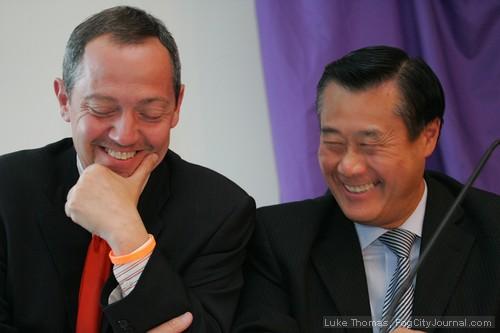
The Guardian candidates’ forum was a blast — standing room only at the LGBT Center, a great, lively crowd, and most of the candidates for mayor showed up. Not Ed Lee, though — we invited him, but he was a no-show. That’s typical — he’s skipped the vast majority of the mayoral debates and events, and when he does show up, he leaves early.
We set out to pin the candidates down on five key issues that came out of the Guardian’s summer issues forums. Shaw San Liu, our moderator, forced the mayoral contenders to give us yes-or-no answers, and our all-star celebrity panel of answer analyzers (Sue Hestor, Corey Cook and Fernando Marti) weighed in and raised signs to tell us whether the candidate had said Yes, No, or Waffled.
The questions:
1. Will you support the creation of a municipal bank to offer access to credit to small business instead of relying on tax breaks for economic development?
2. Will you support a freeze on condo conversions and the development of new market-rate condos until the city has a plan and the financing in place to meet the General Plan goal of 60 percent of all new units available at below market rate — and then index new market-rate housing to the creation of affordable units?
3. Do you have a viable plan to bring $250,000 a year in new revenue into the city to address the structural budget deficit?
4. Will you agree to opt out of the federal secure communities program and will you reverse Mayor Newsom’s policy and direct all local law-enforcement agencies not to cooperate with immigration authorities?
5. Will you support a proposal to either buy out PG&E’s San Francisco facilities or build a new city grid through a bond act so that San Francisco will control its own energy distibution system?
Only John Avalos answered Yes to all five. But it was remarkable how many of the candidates supported most or all of the progressive agenda we’ve developed. Every single candidate voiced support for a municipal bank. And every one of them said Yes to buying out PG&E’s distribution system so the city could run it’s own electric utility.
They had a lot more trouble with the notion of a freeze on new market-rate housing and condo conversions, and not all of them could explain how they would bring in $250,000 in new revenue. But I give them all credit for showing up and facing the tough questions and saying that, for the most part, they wanted to promote a progressive agenda.
Here are the scores:
John Avalos: Y, Y, Y, Y, Y
David Chiu: Y, W, Y, Y, Y
Bevan Dufty: Y, N, Y, Y,Y
Dennis Herrera: Y, W, Y, Y, Y
Phil Ting: NA. NA, Y, Y, Y (He came late and missed the first two)
Joanna Rees: Y, N, N, Y, Y
Leland Yee: Y, W, W, Y, Y
Jeff Adachi: Y, W, Y, Y, Y
Terry Baum: Y, Y, N, Y, Y
So five waffles on housing policy; nobody wants to stand up and say that we’re building too much housing for the rich and that it has to stop until we catch up with affordable housing. (At least Dufty was honest and told us he doesn’t want to cut off TIC and condo conversions).
I’m waiting for the video and I’ll post it when I get it.
SF restaurants cheat on health care

For years, I’ve wondered about those “health-care surcharges” that pop up on menus at local restaurants. The owners say they have to charge extra to pay for the city’s health-care ordinance, which always struck me as odd: You don’t see “avocado price hike surcharge” or “rent-went-up” surcharge or “PG&E rate hike” surcharge — restaurants, like other businesses, typically roll those factors into their normal prices.
This is political: A lot of restaurants opposed the law, which requires employers to pay for health insurance, and they’re sticking that little sign out there to make San Franciscans think the government is driving up the price of a meal.
Now: I would actually be willing to pay an extra 3 percent or even 5 percent for a nice dinner if I thought that money was going to make sure the cooks and waiters and bus staff could go to the doctor when they get sick. But it turns out, according to the Wall Street Journal, that we’re getting scammed — the surcharges often don’t go for health care at all. The restaurants just pocket the money.
In an investigation of 40 local restaurants — most of them high-end places where dinner for two can cost $100 or more — the Journal found that the vast majority of the money collected for health care never goes to the employees:
One Market, which says its annual revenue exceeds $5 million, is one of at least 40 San Francisco restaurants identified by The Wall Street Journal that tell customers they are charging extra in the name of health-care benefits, but which end up spending less than a third of what they allocate. The data come from forms that restaurants filed with the city, which the Journal obtained under California’s public records law. No restaurant mentioned in this article disputed the data.
Wayfare Tavern, the downtown restaurant owned by celebrity chef Tyler Florence, says on its menu that it adds 3.5% to every bill to cover health-care costs. Last year, it earmarked $63,724 for health care but only spent $6,013, the city data show. Café Flore, which adds 35 cents to every bill in the name of health care, spent nothing on health expenses for its employees last year. Trademark, which has a 3.5% surcharge, also spent nothing on employee health expenses last year, the data show.
Worse, this appears to be an intentional way to skirt the law:
In most cases, the plans are administered by a third party. Some of these companies tout how HRAs are a loophole around the San Francisco Heath Care Ordinance. “If the funds are not needed (And many are not!!!) the employer wins because the unused funds stay with them…not the City,” says a brochure from BeneFlex HR Resources Inc.
BeneFlex ensures restaurants inform workers about the HRA to “make sure it’s handled the way it’s supposed to,” says Mark Schmersahl, the firm’s vice president. Still, he says, “There are going to be times when the employer comes out ahead.”
I recognize that the city puts a lot of demands on small business, and a lot of them are expensive — and again, if a restaurant owner has to raise prices a few percentage points to pay for health insurance, I’ll pay — that’s the price of eating out in San Francisco.
But this isn’t how the health-care law was supposed to work — and it’s the reason Sup. David Campos is trying to change it. Campos has a bill that would stop employers from keeping money that was supposed to go for health care. “It’s also a consumer-protection law,” Campos told me. “People are being defrauded here.”
The death penalty: How close, how far
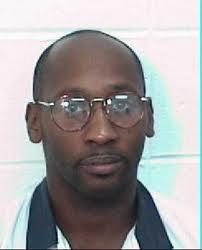
The Chronicle didn’t even put the news on the front page (although The New York Times did), but the execution of Troy Davis went forward more or less as scheduled Sept. 21, with news media around the world watching. It was a shameful miscarriage of justice; as the Times noted in an editorial:
Seven of nine witnesses against Mr. Davis recanted after trial. Six said the police threatened them if they did not identify Mr. Davis. The man who first told the police that Mr. Davis was the shooter later confessed to the crime. There are other reasons to doubt Mr. Davis’s guilt: There was no physical evidence linking him to the crime introduced at trial, and new ballistics evidence broke the link between him and a previous shooting that provided the motive for his conviction.
Yes the Georgia courts, and the federal courts, and the United States Supreme Court, let the state kill Davis — and now it’s too late to prove his innocence. That, of course, is the most horrible aspect of the death penalty. It’s also cruel, expensive and pointless.
But there’s a bit of good news, at least in California. I’m convinced that sentiment is changing. We’ve been interviewing candidates for San Francisco sheriff and district attorney over the past two weeks — and I can tell you, while San Francisco isn’t a good reflection of the state as a whole, attitudes among law-enforcement types in this town have changed pretty dramatically over the past ten years or so.
In 1999, Matt Gonzalez, Bill Fazion and Terence Hallinan all ran for district attorney, and Gonzales came in third. Fazio — a veteran prosecutor and tough-on-crime type, went to Gonzalez and sought his endorsment in the runoff. Gonzalez said he’d support him — if Fazio would agree never to seek the death penalty. It was a pretty easy call, since no San Francisco jury is ever going to vote for capital punishment anyway — but Fazio refused. He insisted that he was a death-penalty supporter to the end, and he lost the race.
Now, Fazio says the death penalty is a complete failure, and he would not only never seek it but he’s actively in favor of repealing it.
Just a few months ago, former police chief and current D.A. George Gascon was talking about how the death penatly ought to be one of a prosecutor’s tools — but now he utterly disavows is, says he would never seek it and is calling for repeal.
Chris Cunnie, a former president of the avowedly pro-death-penalty Police Officers Association, told us he opposes capital punishment.
And Kamala Harris, who never wavered in her refusal to seek the death penalty, even for the killing of a cop, managed to get elected attorney general of California.
So there’s hope.
Endorsement Interviews: David Chiu
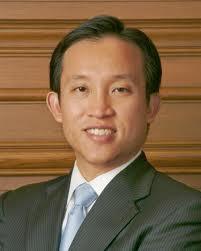
Board President and mayoral candidate David Chiu could well be the person most directly hurt by Mayor Ed Lee’s decision to run for a full term. It’s ironic, since Chiu supported Lee — on the basis that the former city administrator would not be a candidate in November. And he has the inside story on why Lee is in the race: According to Chiu, Lee told him that he didn’t really want to run, but “was having trouble saying no to Willie Brown and Rose Pak.”
Chiu has been in the center of the current board, moving away from progressives on some key issues — but he’s talking very much a progressive line in his campaign. He’s promising business tax reforms, transit justice, affordable housing and new revenue. Audio and video after the jump.
The mud flies
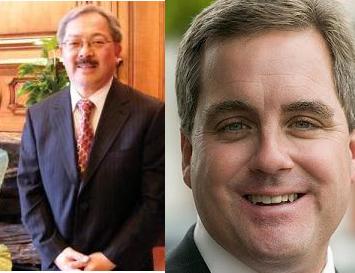
Dennis Herrera is out with an ad attacking Ed Lee — and it’s just the beginning of what we’re going to see as the top-tier candidates try to knock the front-runner down.
All the credible polls show Lee at least 10 points out in front. They also show that he has about 30 percent of the voters — which means 70 percent are either undecided or like another candidate. So he’s hardly invincible.
But with so many candidates in the race — most of them competing in the mashup in the middle, without strikingly different policy ideas — the strategists for Leland Yee, Jeff Adachi and Herrera have all decided that attack ads are in order. And the ads all seem to have the same basic theme: Lee is controlled by outside interests.
“Ed Lee says he gets things done,” the new Herrera ad says. “But what’s he doing — and who’s he doing it for?”
There’s a picture of Lee and Rose Pak. There’s a swipe at the Central Subway. There’s a pretty damning charge about Lee trying to raise garbage rates and then getting campaign help from Recology, the local garbage monopoly. And there’s an obvious shot at Lee for calling PG&E “a great corporation.”
The ad ends with some odd Republican lapel pins on the jackets of some unidentified dark-suited gentlemen as the voice-over says:
“Ed Lee’s getting it done — for his friends and his contributors, not for us.”
Hmmm. I didn’t see the Republican connection, but Matt Dorsey, Herrera’s press person, told me that one of the independent expenditure committees raising soft money for Lee is run by a big Republican player. Not sure how many people will get that — but on the other hand, there’s just so much in this ad. The Herrera camp has to figure some of it will stick.
Nothing new, really, nothing others haven’t brought up. But it’s just the start; expect a lot more trash talk over the next few weeks as Lee tries to stay above the fray and his opponents try to force him to fight.
SFBG Radio: Beyond the Wall Street protests

Today we talk about the protests on Wall Street — and Johnny offers a more effective approach. Hint: It has to do with blaring out-of-tune techno music at rich people. You’ll have to listen after the jump to get the rest.
Endorsement interviews: John Avalos
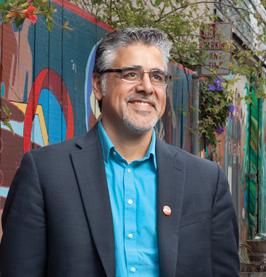
Sup. John Avalos is running a grassroots progressive campaign for mayor. He is, he says, the only candidate talking about working-class people, and he wans to “create an administration that puts neighborhoods and people first.” He wants to create a municipal bank to use money the city now dumps into Wells Fargo and Bank of America for loans to small businesses and economic development. He told us that by the end of his eight years in office, he’d like to see the city bringing in $500 million a year in new revenue — for education, child care, Muni, parks, public health and other services. Check out the interview (audio and video) after the jump.
Endorsement interviews: Bill Fazio
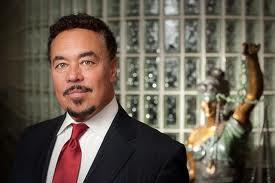
Bill Fazio has been both a prosecutor and a defense lawyer — most recently working on the defense side — and his views on criminal justice have changed a bit since he first ran for District Attorney’s office in 1999. Back then, he was a supporter of the death penalty; today, he says it’s an expensive failure. He’s not a big fan of “buy busts,” and said he supports restorative justice (but in a limited way). He vowed to us that he’d appoint a team of investigators and prosecutors to go after municipal corruption. You can listen to the interview and watch the video after the jump.
The Chron’s bizarre tax logic
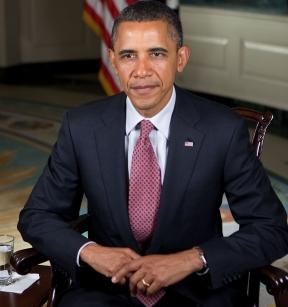
Chronicle Washington columnist Carolyn Lochhead doesn’t typically show her political beliefs in such a clear and direct way, but her attack on the Obama tax plan is just … bizarre. Check it out:
Rather than pursue long-run tax and entitlement reform, the new Obama plan, his sixth by some counts, litters up the tax code even more and does nothing significant on debt drivers Medicare and Medicaid.
Actually, the big “debt drivers” over the past two decades haven’t been Medicare and Medicaid, or even social security — the debt and deficit problem comes from (1) tax cuts on the rich and (2) wars. Remember, Bill Clinton left office with a budget surplus (even including entitlements, and even including projections for the baby boomers retiring and all the other panic buttons the GOP likes to push). Bush turned that into a staggering deficit by cutting taxes at the same time he went to war in Iraq and Afghanistan.
And “litter up the tax code?” That’s crazy talk. Obama wants to get rid of tax breaks that litter up the code.
More:
He re-iterated his call to end the Bush tax cuts on high earners, but keeps the rest of the Bush tax cuts which are a bushel of special tax breaks for the middle class.
What? The middle class has been slammed by the recession (and by 20 years of income moving almost entirely to the top 5% of the population). The only way out of this recession is to give the middle class more spending power.
I’m not defending everything Obama’s done (his willingness to extend the Bush tax cuts was part of the problem), but seriously: This is economics 101.
Guardian forum: The candidates on the issues
Don’t miss the final Guardian forum on the mayor’s race — featuring the candidates. It’s going to be fun — so far, eight candidates have confirmed, and we’re going to ask them to talk about the progressive agenda that we’ve developed over the summer. Among other things, we’re going to ask the candidates whether they support some of the key elements of the program — and an independent blue-ribbon all-star panel of experts (not including me) will judge whether the would-by mayors answered yes, answered no — or waffled.
We’ll see you there.
6 p.m., Wed. Sept. 21, at the LGBT Center, Market and Octavia.
Endorsement interviews: Dennis Herrera
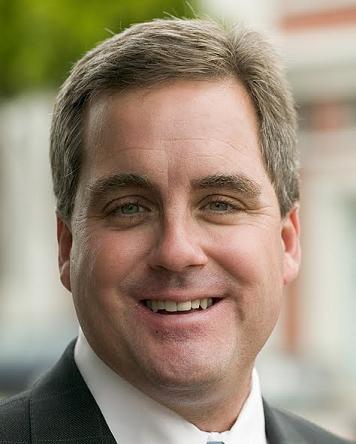
Dennis Herrera has an interesting challenge: as city attorney, he’s been barred by law, legal ethics and custom from taking stands on a lot of the legislative and political issues facing the city. He couldn’t, for example, say he opposes a law that he might later have to defend in court. But now that he’s running for mayor, he’s liberated himself, and he’s started to talk about specific challenges facing the city.
Herrera told us he thinks this is the most important mayor’s race in the past 20 years and said that local government is going to have to play more of a role taking care of things that the federal and state governments will no longer do. He talked about the “culture of an organization” and his experience running a large office. He said that the city can’t cut its way out of its budget problems and he supports “additional revenues,” including a higher real-estate transfer tax, a more progressive payroll tax and (possibly) a commercial rent tax.
He supports an affordable housing bond — but wouldn’t call for a moratorium on market-rate housing and condo conversions.
Video and complete audio are after the jump.
Endorsement interviews: David Onek
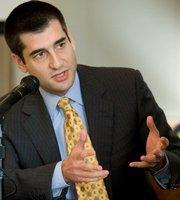
David Onek has been running for district attorney pretty much since former D.A. Kamala Harris announced she was seeking the office of attorney general. He’s clearly, repeatedly and strongly said he opposes capital punishment and will never seek the death penalty. He told us he’s running because “the criminal justice system is broken” — and vowed, among other things, to start a restorative justice system for juvenile offenders. And although he’s never been a prosecutor, he told us that “we’ve been arresting and prosecuting people just fine — now we need to reform the system.”
You can see a video of his opening statement and listen to the full interview after the jump.
Bike Coalition gives Avalos its top endorsement
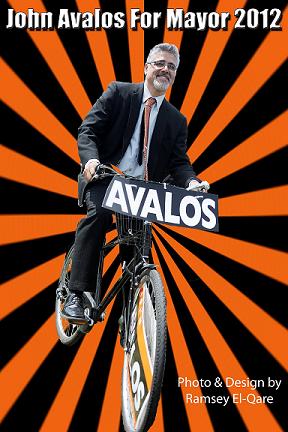
Back in May, I noted how mayoral candidates John Avalos and David Chiu seemed to be the only candidates courting the votes of San Francisco bicyclists, noting that the 13,000-plus-member San Francisco Bicycle Coalition was one of the city’s largest grassroots political organizations. Since then, Ed Lee jumped into the race and also made a point of supporting and seeking support from the city’s bicycling community.
After weeks of online voting, the SFBC today announced its endorsements, and they seem to reflect both the efforts of these three politicians and SFBC members’ recognition of who’s been working in City Hall on their behalf. They endorsed Avalos as number one, Chiu in the second slot, and Lee number three.
“By endorsing three candidates, in ranked-choice format, we are recognizing the leaders who are most actively supporting a better city through bicycling,” SFBC Executive Director Leah Shahum wrote in a message to members announcing the endorsements, also noting that there is an “unprecedented number of bicycling-friendly candidates” in this year’s mayoral field.
Avalos and Chiu are both regular cyclists who have actively supported expanding the city’s bicycle network and increasing ridership, while Lee has shepherded several key bike projects through this year and even called for improvements to dangerous conditions on Fell and Oak streets during this year’s Bike-to-Work Day.
SFBG Radio: Johnny wants a coup

Today, Johnny articulates his vision of the future: Obama gets re-elected, the right wing tries a coup — and finally, the west coast can secede. Has he gone off his rocker? Has he gone off his meds? Check it out after the jump.
Is Peskin plotting a comeback/payback?
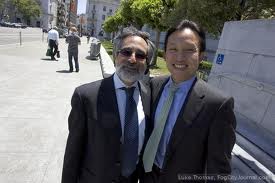
Many progressives have been disappointed in Board President David Chiu, particularly after his pivotal role in putting Ed Lee into the Mayor’s Office and stacking key board committees with moderates, as well as his controversial swing votes on Parkmerced and other projects. But nobody has been more disappointed than Chiu’s predecessor and one-time mentor, Aaron Peskin (as we detailed in a cover story earlier this year).
Now, knowledgable sources tell the Guardian that Peskin is seriously considering running against Chiu next year for his old District 3 seat on the Board of Supervisors — and that Peskin recently told Chiu that directly — although neither of them is commenting on the record.
So far, Chiu’s run for mayor doesn’t really appear to be catching fire, with Lee leading and only Dennis Herrera, Leland Yee, or Jeff Adachi exhibiting a credible chance of catching him. With many progressive activists actively searching for someone to run against Chiu next year (as Peskin said about another matter, “payback is a bitch”), Chiu is rumored to be eyeing a run for Tom Ammiano’s Assembly seat (which fellow Sup. David Campos is also said to be looking at, probably with Ammiano’s blessing if it happens), either next year or when Ammiano is termed out in 2014.
But Chiu campaign manager Nicole Derse dismisses such speculation, telling us, “The only thing David Chiu is running for is Mayor of San Francisco. He is not thinking about the 2012 re-election for Supervisor and he is certainly not thinking for a minute about the Assembly race. If Aaron Peskin decides to run in District 3 next year, it is a free country.”
BART’s failed press mainpulation
Another nice scoop by Zusha Elinson at the Bay Citizen: He’s got emails showing how BART tried to set up a fake counter-protest and press conference to skew media coverage toward how protests were inconveniencing riders.
The brainchild of Linton Johnson, BART’s PR chief (and the man who brought you the cell-phone shutoff), the plans included a pre-written script and a couple of private SUVs with drivers to take the BART loyalists to the press conference.
You can’t make this shit up.
BART’s attempts to avoid protests and manipulate the press appear to exceed its interest in reforming police practices. I wonder, sometimes, if the BART Board is even paying attention.
Mayor Lee likes Question Time just the way it is: scripted and boring
Mayor Ed Lee appeared before the Board of Supervisors today for his fifth monthly Question Time session, where he was asked by Sup. John Avalos – and subsequently by reporters – whether he would be willing to “change the format to make it a truly interactive, substantive, and dynamic exchange?”
But Lee disagreed with the widespread perception that the scripted nature of these exchanges – a condition that Lee’s office insisted on during negotiations with the board earlier this year, with questions submitted in writing a week before the meeting – is a contrived and dull departure from what San Francisco voters intended when they twice voted to establish Question Time.
“Supervisor Avalos, this is substance, and I think it’s exactly what the voters had in mind with Proposition C,” Lee said, reading from a prepared text. Later, he added, again reading from his script, “I think these are very substantial and dynamic exchanges.”
But apparently, that view isn’t widely shared, as the format has been criticized by a wide variety of media outlets in town, and it was the main topic that the pack of reporters who intercepted Lee in the hallway afterwards wanted to discuss. He was asked whether the session would still be as civil as they are if they were less scripted, and Lee responded that he thought they would still be civil.
“But I like a little more structure to it,” Lee said, adding that he likes to have prepared notes to address the questions that supervisors might ask. “If we don’t set boundaries, it could be a free-for-all.”
But a bit more of a free-for-all is certainly what former Sup. Chris Daly intended when he drafted the legislation, which voters approved as a binding measure last year after first approving it as an advisory measure two years early, only to have then-Mayor Gavin Newsom refuse to come.
For example, when Sup. Sean Elsbernd asked Lee for a status report on the Central Subway project, it’s possible that Lee’s recitation of the project’s benefits might have been followed up with questions asking him to address recent criticisms or the tripling of the project’s costs, which he didn’t mention.
Or perhaps Sup. Eric Mar might have asked a follow-up question when Lee answered the question “Are you willing to require that CPMC enter into a Community Benefits Agreement before their proposal is approved by the city?” by saying, “These community benefits will be incorporated into a Developer Agreement,” reminding the mayor of the premise of his question that many of the benefits that the community is seeking cannot legally be included in the Developer Agreement.
Similarly, Lee also avoided directly answering Sup. David Campos’ question about whether the mayor intends to support legislation by Campos and Sup. Mark Farrell that would require city departments to return to the board for approval of budget supplements when overtime costs are significantly exceeding those that the department budgeted for.
But there is some wiggle room in the exchanges for supervisors who want to freestyle, as long as they are within the narrow confines of civility being practiced at City Hall these days. Elsbernd embellished his approved Central Subway question, calling it an “opportunity to move beyond the clichés and one-liners of political campaigns.”
And when Lee closed his answer to Avalos by inviting him to take part in an upcoming benefit ping-pong match in Chinatown, Avalos asked the mayor, with a slight taunt in his voice, “How is your game?”
To which Lee – perhaps reaching new heights in conflict aversion – said his style of play is “diplomatic and friendship first.” To which Avalos responded, again with an air of challenge, “I used to work at the Boys and Girls Club and played everyday.”
And that, I suppose, is what passes for political conflict and debate at City Hall these days.
Deep-pocketed Lee supporter aims to take back S.F. from progressives
Power brokers Willie Brown and Rose Pak aren’t nearly the only influential backers working behind the scenes to help elect Mayor Ed Lee to a full term. Three different committees have been set up to support his candidacy and are fundraising independently from his official campaign, according to Ethics Commission filings.
The principal officer and treasurer of one of these independent expenditure committees are, respectively, a Republican Silicon Valley tech investor who’s spoken publicly about taking San Francisco back from progressives, and a political attorney who worked on Pacific Gas & Electric Co.’s failed yet stunningly expensive Proposition 16 campaign.
“San Franciscans for Jobs and Good Government, Supporting Ed Lee for Mayor 2011,” was created in late August with a San Rafael address, according to an Ethics filing. Its principal officer is Ron Conway, a Silicon Valley angel investor who made his fortune in the tech industry. Conway was quoted in a San Francisco Business Times article last year as saying “we must take our city back” from progressives, a rallying cry he delivered at a dinner hosted by the the Bay Area Council, a business association. A book written about Conway by Gary Rivlin dubs him “The Godfather of Silicon Valley.”
According to campaign finance records, Conway, a registered Republican, has donated more than $320,000 to Republican state and federal candidates since 1999. He also contributed $1,000 to a Draft Ed Lee for Mayor committee, a separate effort from Progress for All which was formed before Lee announced his candidacy to encourage him to run. Conway has made substantial contributions to Democratic hopefuls, too, but the majority of his campaign donations over the last decade have benefited GOP candidates.
The treasurer of “San Franciscans for Jobs and Good Government” is Elli Abdoli, a political attorney who works in the San Rafael office of Nielsen Merksamer Parrinello Mueller & Naylor, a heavyweight political firm based in Sacramento whose services were tapped last year by PG&E to advance the Proposition 16 ballot initiative that the company bankrolled. Prop 16 was designed to crush municipal power programs that threatened to compete with PG&E by requiring a supermajority approval of the voters before they could move forward. Despite sinking more than $45 million into that campaign, voters rejected Prop. 16.
Abdoli served as the assistant treasurer for the Yes on 16 committee, according to a form filed with the Fair Political Practices Commission. She was listed as a contact for the “San Franciscans for Jobs and Good Government” committee and had not returned calls by press time.
Ting wants instant public records
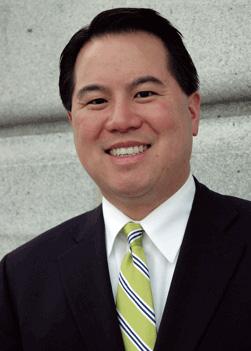
When Assessor and mayoral candidate Phil Ting came by for his endorsement interview, we talked about open government, and I mentioned an idea that sunshine advocate Kimo Crossman first proposed back in 2008: Why not make all city documents (with a few limited exceptions) public the moment they’re created?
Why not send a copy of every memo, every email, every contract, every check, everything anyone at City Hall produces, into a public server, where the rest of us can see what our elected officials and civil servants are doing? No more hassles with sunshine requests — the docs would already be there, in a searchable database.
Well, apparently Ting liked the idea — and it’s now part of his mayoral platform. In a release posted Sept. 13, Ting argues that “everything should be public.”
And I mean just about everything. I think that every email, every memo, every check, every contract, every phone message, every tweet, every cell phone call and every other single government document that is not part of an employee personnel decision, about an immediate public safety issue, protected by state law or part of a pending lawsuit should be made public at the time it is created. The reality is that technology has outstripped our city’s Sunshine laws. And it would be far less expensive – and far more productive – simply to have all digital public records (which is now nearly all public records) simply posted to a City Sunshine Site at the time they are created. This site should quickly include, and certainly be the basis of, an Application Programming Interface (API) that gives San Franciscans the tools and the data they need to help hold government accountable.
He explains:
So as mayor, if I send an email to my chief of staff on an issue – that should be made public when I send it. When I have a meeting at City Hall or anywhere else, that would be part of an online calendar, which should be made public. A direct message – a tweet from the mayoral account – just about anything that is created, said or discussed should be made public in real time.
Every document created by city government (with the noted exceptions) should be made available to the public at the time it is created. That should include every check written – and every dollar spent or promised. And every contract. And every subcontract. Everything.
There is simply no supportable reason for any work product created by a public employee to be hidden from the public – or perhaps even worse, to be put behind the barrier of a “sunshine” process that is now so complicated, time consuming and expensive that it promises public accountability without always being able to deliver it.
It makes perfect sense — the technology exists, and is relatively inexpensive (particularly compared to the time it takes city agencies to respond to public records requests). It would be easy to allow people creating confidential documents (legal strategy memos in the City Attorney’s Office, say, or personnel records) to add a tag to the file that would keep it out of the public database — and, of course, it would be easy for an agency (or the Sunshine Task Force) to search those tagged files later to see what should and shouldn’t have been kept secret.
I don’t think anyone else has ever done this; San Francisco could be the first city in the country to make sunshine a part of everyday life at city Hall. I hope this becomes part of the mayoral debates.