• No categories

Politics Blog

The Black Bloc is always with us

23

I learned about how a handful of people could screw up a major demonstration back in 1984, when the Democratic National Convention was in San Francisco and a fairly large number of peace activists had arranged a protest called the “War Chest Tour.” The idea was to draw attention to the fact that Democrats as well as Republicans got big campaign donations from defense contractors whose business was making war. Back then, a bunch of the biggest war profiteers had offices in San Francisco, and the demonstration — which attracted hundreds of people — wound through the financial district with signs and banners. It was, generally, a great success — except in the national press.

The thing is, the protest (like occupy Oakland) was prety anarchic, which a small “a” — peaceful, but leaderless. There was no organization with an office and a phone that the press could call for comment, no easy way to identify the coalition that had put it together.

Oh, but there was one very organized group present: The Revolutionary Communist Party had maybe a dozen members marching (which may have been the entire local membership of that particular group, which has been on the margins of the American left for many years). The RCP members had T-Shirts, newspapers, people designated to speak to the media, handouts with an office phone number — all the stuff that made lazy reporters’ lives easier. So when the story broke, both locally and nationally, the first paragraph read:

“Revolutionary Communists protestested yesterday in San Francisco ….” And the whole point of the War Chest Tour, which my friends had worked on for months, was lost.

Those of us who have been around awhile knew, and know, that the RCP is always with us. There may only be a handful of them still around, but they show up for everything — and don’t seem to care if they undermine the message that event organizers are trying to put out.

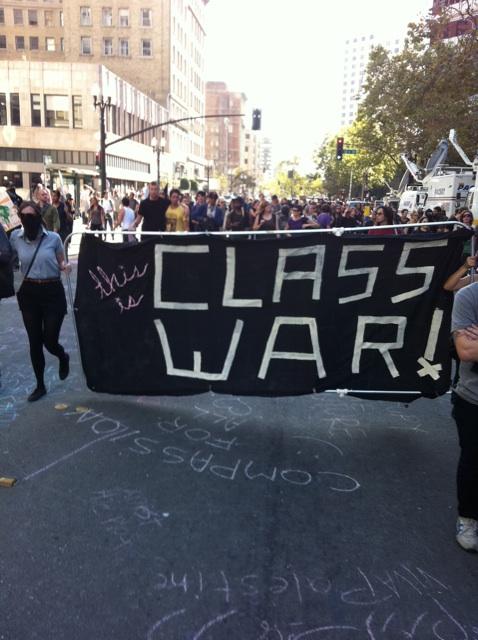
The Black Bloc — the “big A” Anarchists who broke windows in Oakland —  are becoming part of the same tradition. It’s a relatively small group, but it’s always around. The marches against the War in Iraq were huge, with tens of thousands of people, and entirely peaceful — except for a few Black Bloc-ers who broke windows and set fires.

Now: I’m not here to blast the Anarchists, or even the RCP. The Maoist/Bob Avakian types have become almost a parody of themselves in recent years, but if that’s what you’re into, go for it. I’m not even going to get into the argument over whether property damage counts as violence; been there, done that, got the circle-A T-shirt. Destroying stuff and causing mayhem can be a powerful political statement, and there have certainly been times when it was appropriate, effective and considered more than acceptable.

But it’s not always the right strategy, and in Oakland in 2011, I think it wasn’t. I recognize that this is an emergency situation, that the class warfare has already begun, and that extreme tactics are necessary to fight back. And hell, I don’t think smashing a bank window is so awful; smash enough of them and you put a lot of unemployed glaziers back to work. But in downtown Oakland, that tactic can too quickly backfire and lead to stuff like this. (Here’s an idea — how about a Shop Local day at Occupy Oakland, where everyone agrees to patronize small local businesses downtown? It fits right into the plan to withdraw your money from the big banks and put it in local credit unions.)

The problem with the Black Bloc (which isn’t really a bloc at all, it’s just a loose group of people who (a) think their tactics are appropriate and (b) love this shit) is that it’s acting in direct conflict with the many, many people who worked really, really hard to organize what was supposed to be a peaceful event. Like the RCP, they’re too quick to piss in the well.

You want to get violent? You want to break stuff? Show up for the general assembly, make your case, and see if you can convince the rest of the group that this is a good idea, right now, one that sends the right message and promotes the cause. Maybe you can do that; maybe everyone agrees. But if the majority of the group says no — that respect for property (much as we may hate private property, particularly bank property, and all that) is a better way to go right now, today, in this situation — then back off, dudes, and get with the program.
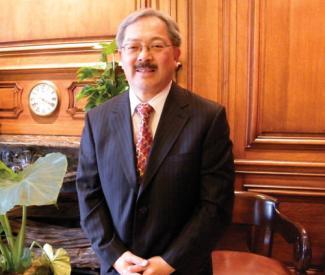
Correction: Prop. E isn’t retroactive

10

In the hustle-bustle of getting our last pre-election issue out the door, we made a significant error in describing Prop. E in the “Buying power” section of this story. The measure does not apply retroactively, but would allow the Board of Supervisors to change measures that voters approve after January 2012. Sorry for the mistake.

Miyamoto and jail abuse

107

A new video produced by lawyer Ben Rosefeld includes disturbing footage of deputy sheriffs under the supervision of Paul Miyamoto using excessive force on peaceful protesters. It reflects charges in a 2007 lawsuit against the city — and evidence collected in that case shows that Miyamoto, now a captain in the department and a candidate for sheriff, was an active participant in the alleged misconduct.

The lawsuit is a result of a protest that took place in June, 2004, when activists were demonstrating against a biotech conference in the city. Protesters dressed as mutant animals marched through the streets, and 17 were arrested and taken to the county jail.

The protesters declined to give their names — and at some point, sheriff’s deputies were directed to remove them from a holding cell.
As the video — taken by the Sheriff’s Department and released as part of the lawsuit — shows, the deputies used physical force to pull the protesters out of the cell. The protesters were holding on to each other — and in some cases, the level of force used certainly appears excessive.

Remember: These were nonviolent activists who never threatened the deputies or gave any sign that they were dangerous.

Miyamoto, then a sergeant, both supervised and participated in the removal. In a legal document responding to questions from Rosenfeld, who represented the protesters, Miyamoto said that he, along with another sergeant, had developed the extraction plan and “became physically involved in the cell extractions on more than one occasion.”

I called Miyamoto and sent him a copy of the video. He told me that he was, indeed, involved and said the video was “a fair representation” of what happened.

“I stand by out decision that night,” he told me, saying he didn’t see anything in the video that bothered him or that was inappropriate.

“Our job was to get them out individually, and we took great pains not to harm anybody,” he said.

The lawsuit charged that some of the protesters were seriously injured during the extraction. It was settled when the city agreed to pay $25,000.

Sup. Ross Mirkarimi, who is running for sheriff, told me that the video was, indeed, disturbing. “I think it speaks for itself,” he said, adding that he didn’t think the tactics were appropriate.

“This is why we need an independent sheriff who isn’t connected to the Deputy Sheriff’s Association,” he said.

Powerful, mostly peaceful Oakland action ends badly

19

After a long day of mostly peaceful demonstrations by thousands of protesters who joined OccupyOakland’s General Strike and Day of Action yesterday, it’s still unclear why the Oakland Police – which had stood down the entire day, leaving the movement to self-police – massed in riot gear around midnight and used tear gas and other projectiles to clear the streets and make a reported 80 arrests.

Spokespersons for the Oakland Police Department and Mayor Jean Quan haven’t returned Guardian phone calls, and reports in the Oakland Tribune and other media outlets don’t indicate exactly what prompted police to change tactics and aggressively confront the demonstration. Protesters had taken over a vacant building and erected barricades in the streets shortly before riot police showed up, and it appears from a Tribune video that a dumpster was set on fire after the police showed up.

Before the standoff between city officials and demonstrators in Oakland again took a violent turn, the day was notable for its lack of police presence around the occupied Oscar Grant Plaza and nearby 14th and Broadway epicenter. And despite a small number of masked agitators who broke bank windows and sprayed graffiti – much to the chagrin of most protesters who actively opposed such tactics – the movement was remarkably nonviolent and self-policing, particularly given a crowd of what seemed to be around 10,000 people at its peak. Protesters even handled traffic control, using a megaphone to help motorists through intersections congested with passing demonstrators.

“This is an extraordinarily peaceful collection of diverse people,” Sen. Loni Hancock (D-Oakland) told the Guardian just after 5 pm as a massive march left the encampment to shut down the Port of Oakland. “I feel like they’re doing what no elected person can do: they’re putting economic equity issues in front of the American people.”

“This is beautiful and powerful. This I love,” agreed Oakland City Council member Libby Schaaf, beaming as the peaceful march took off, although she told us that she was disappointed to see Oakland businesses vandalized, including her beloved Noah’s Bagels. “Fight greed, not bagels.”

Most of the crowd condemned the violence, and many openly worried that it would undercut the positive demonstration of people power and the airing of frustration with economic injustices in the country. But even Hancock said a few bad apples shouldn’t spoil people’s understanding of what an important day it was.

“I’m very grateful to them for calling attention to economic inequality. It is in the interests of cities that this issue take center stage,” Hancock told us. “There are so many things that have been talked about that are now on the stage and it’s a very important conversation to have.”

But many in the movement were disappointed nonetheless, despite the myriad successes in shutting down business nonviolently. Around 3 pm, a crowd of thousands marched past a Chase Bank at 20th and Berkeley streets where the front window had been shattered, as was the case with at least six other businesses. Taped to the windows were signs reading “We are better than this” and “This is not the 99%. Sorry, the 99%”.

As the huge crowd repeatedly chanted “peaceful protest,” Ryan, a 31-year-old Oakland resident, expressed his frustration over vandalism he blamed on out-of-town instigators. “People from Oakland would not damage their city like that,” he told me. “Last week was beautiful, we were dancing and singing in the streets,” he said, referring to the largely nonviolent response to police violence, “but this is bullshit.”

Large protests almost always have members who want to escalate the conflict and who see breaking windows as a legitimate tactic, and yesterday there were sometimes tense conflicts between protesters who disagreed on the issue. Another complex issue is how to now view Oakland Mayor Jean Quan, whose support for last week’s violent police crackdown prompted calls for her recall or resignation, although her subsequent apology, the re-encampment of Frank Ogawa Plaza, and yesterday’s police stand down caused some to rethink whether to actively oppose her.

“My goal for today is to spur the international movement forward and to show what we’re capable of,” said 23-year-old Iris Brilliant, who got more actively involved in OccupyOakland after the crackdown and said she was happy to see the police kept at bay. “It’s important to push this forward.”

But Tania Kappner, a 41-year-old teacher from Oakland, still hadn’t forgiven Quan or the police for the violent excesses in last week’s raid. She was camped out in Oscar Grant Plaza in a tent with the sign “Mayor Quan Must Go!”

“It’s good she’s not sending them in on us today, but she never should have done it in the first place,” Kappner told us. “We’re calling for her to go and the police who did it to be jailed.”

With the decision to again unleash the riot police and tear gas and arrest big numbers of people – which was the very thing that prompted such huge numbers of people to turn out yesterday, giving OccupyOakland the numbers and power to easily shut down the port and dozens of businesses – Oakland and the larger Occupy movement might again find itself back at square one.

The National Lawyer’s Guild, which had observers on hand to witness the late-night police crackdown, issued a statement today condemning the city’s actions and saying they violate a crowd control police the NLG helped the city write to settle lawsuits stemming from the OPD’s use of rubber bullets to clear anti-war protesters from the Port of Oakland back in 2003.

“Like we saw last Tuesday, the OPD actions in the late night hours violated numerous provisions of the Crowd Control Policy and the Constitutional rights of activists,” explained NLG’s San Francisco Bay Area chapter president Michael Flynn. “Our legal observers did not disobey any police orders and neither did many of the other arrestees.”
“The Crowd Control Policy clearly prohibits shooting munitions into a crowd,” added NLG attorney Rachel Lederman. “While the police are allowed to use tear gas, they are supposed to use a minimum amount and only where other crowd control tactics have failed.  It is not at all clear that less violent and less provocative measures would not have sufficed to achieve any legitimate law enforcement objectives last night.”

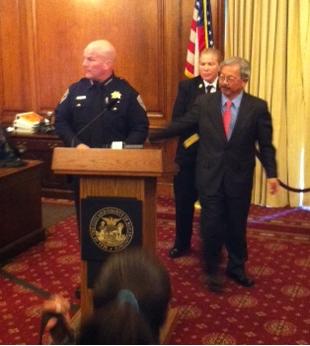
Meanwhile, in San Francisco, Mayor Ed Lee has reportedly assured OccupySF that he won’t follow through on threats to raid the camp if tents aren’t removed, at least not anytime soon (many observers speculate that he’ll at least wait until after next week’s mayoral election). But Lee has been unwilling to make a clear public statement that raids are now off the table.

When we sought to clarify Lee’s position and get his reaction to a Board of Supervisors resolution calling for the city to allow a 24/7 encampment, his Press Secretary Christine Falvey wrote: “The mayor has not focused on the resolution, but has been focusing on meeting with clergy, labor, occupysf demonstrators and his department heads to make sure that the site is kept clean, safe and accessible for everyone. He remains concerned about overnight camping and the public health and safety issues that brings. That said, he has seen some good progress over the last few days because of his open communication with the group. DPW cleaned up the site over the weekend and the demonstrators helped facilitate the cleanup. Tents were moved off the Bocce Ball Court as well. The group is working with Fire and Public Health officials to make some improvements. The dialogue is ongoing.”

Photos by Steven T. Jones

The problem with the Lee investigations

55

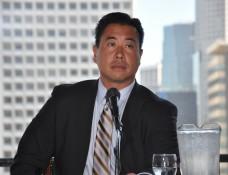
Six major mayoral candidates, including John Avalos, Dennis Herrera and Leland Yee, have once again called on the Fair Political Practices Commission to investigate the Ed Lee voter-fraud charges. That’s what needs to happen, of course. And the district attorney should do a thorough investigation and file criminal charges if warranted.

But there’s a basic problem here, and it goes to the heart of what’s wrong with the Lee campaign and with his whole approach to running for office. See, even if the FPPC finds a problem, what’s going to happen? The campaign will have to pay a fine (which, given all of the rich supporters of Lee, will be easy to pay).  If the D.A. finds that laws have been broken, some low-level folks or people who solicited contributions improperly will face prosecution — and most likely cut a deal and pay a fine and get probation.

By then, of course, if all goes as predicted, Lee will have won the election. So as far as he and his key allies are concerned, none of this really matters.

Once he’s elected mayor, he figures (probably correctly) that this will all blow over. The FPPC investigation won’t be concluded for months. The D.A. clearly isn’t going to file charges against anyone before Election Day. Besides, according to the Department of Elections, 44,000 people had already voted by the time the latest stories broke Nov. 2. Many of them are Lee votes.

No matter how flawed the election, how much sleazy, inappropriate or criminal activity was involved, there’s no way the results will be thrown out. There’s no way the election of Ed Lee will be voided. If all of the tactics of Lee supporters work and he comes out on top, there will be no consequences for him. When it comes to San Francisco elections, cheating works — Willie Brown learned that long ago.

That’s why Ed Lee scares me: He’s allowing his supporters to use a corrupt playbook that assumes that the rules don’t matter, that winning at all costs is the only issue, that ethics and clean government can be dismissed as side issues. Once you start down that road, there’s no going back. Once you set that tone at City Hall, every half-assed crook and con artist will be convinced it’s open season. And I just don’t see Lee as strong enough to stop it.

UPDATE: Avalos just called and told me he wasn’t aware that the other candidates were calling on the FPPC to investigate and wasn’t at the press conference where that announcement was made. Sorry ’bout that, a miscommunication.


When Occupy Oakland shut down the port (VIDEO)

The grand finale of a day of rallies and marches scheduled for Oakland’s Nov. 2 General Strike was a shutdown of the Port of Oakland, in which hordes of protesters accessed the property from different entry points, standing atop train cars and trucks while whooping and chanting. Clusters of groups blocking each gate of the sprawling property featured something different: Brass bands, small assemblies using the “human mic” style of communicating as a crowd, dance parties, and impromptu reunions.

Hours later, things had taken a far more serious turn, as police were amassed near 14th and Broadway and dispersing teargas and reportedly firing rubber bullets in yet another nighttime clash in the streets.

But in the hour or so just before sunset, the march was happily advancing toward the protesters’ intended target, causing delays to the 7 p.m. longshoremen shift. Here’s a video of scenes from the port shut down, including an interview with a truck driver, Andres, who had several people standing atop his truck and flying signs while we interviewed him.

Video by Rebecca Bowe

Sharmin Bock’s family IE

2

Plenty of (rich) candidates fund their own campaigns. And (sadly) plenty of candidates in San Francisco are getting help from outside independent expenditure committees that can raise unlimited funds.

But here’s a new one: District attorney candidate Sharmin Bock is supported by an IE that is funded almost entirely by her family.

Ethics Commission records show that the Committee for a Safer San Francisco has raised $89,000 from Farideh Mehran, Bock’s mother, who lives in Atherton. Another $30,000 came from Reza Merhan, a relative who is a surgeon in Texas. A few people who don’t appear to be related tossed in a few thousand more, but for the most part, this is a Bock family committee.

The commitee is based in Sacramento, and the treasurer is Charles H. Bell, Jr., a lawyer who specializes in campaign work and is general counsel to the California Republican Party. Audrey Martin, also a lawyer in Bell’s office and the assistant treasurer, told me the firm had been hired to handle the campaign financial reporting, but she couldn’t tell me anything else about it.

The person who formed the commitee, according to campaign filings, is Natalie LeBlanc, a communications professional in the East Bay who is on the board of Emerge California. I’ve tried to contact her through the phone number on the campaign filings and by email, but she hasn’t responded.

I’m wonder: Was this set up entirely (or primarily) as a vehicle for family money, a way for Bock’s wealthy relatives to legally pour unlimited funds into helping her win? It raises an interesting question: By law, an IE has to operate completely independent of the official campaign. Bock told me she talks to her mother regularly (“I mean, she IS my mother”) but insisted they never discussed campaign strategy or the IE.

John St. Croix, director of the Ethics Commission, told me this all appears to be perfectly legal — if unusual. He said he’s never seen anything like it before.

Personally, I’d rather see Bock use her family money than get money from big corporations that might have an interest in how the next district attorney operates in San Francisco. And there are all kinds of corrupt IEs out there; this one is at least pretty straightforward. Still, it strikes me as a little curious.

I

The latest Lee voter fraud charges

18

The Ed Lee campaign is, of course, distancing itself from the latest voter fraud allegations. Spokesperson Tony Winnicker says nobody on the Lee team knew anything about it, that the idea of eight low-level associates at a property firm each giving the maximum $500 didn’t ring any alarm bells:

“If this is true, then these people have perjured themselves,” Lee campaign spokesman Tony Winnicker said when The Chronicle informed him about the donations. “They looked directly into the eyes of our campaign staff and lied, and they should be held accountable.

And honestly, I don’t think anyone on Lee’s team directly solicited the illegal contributions. I could be wrong, but let’s give them the benefit of the doubt. But the notion that Winnicker is shocked — shocked — that this sort of behavior was going on doens’t quite pass the sniff test. The problem is that Lee refused to take public financing, got in the race late and decided to raise a buttload of money really fast — and when you do that, and you take cash from the likes of Andrew Hawkins, you’re almost guaranteed to run into trouble.

I think Dennis Herrera has it right; his press statement makes the point:

“Too many of Ed Lee’s supporters act as though they’re above the law — on money laundering, on ballot tampering, and more — and Ed Lee isn’t strong enough to stop it.  If this is how they behave before an election, just imagine how they’ll behave after the election, if Ed Lee wins.

This has always been the danger with Mayor Lee — he’s surrounded by some very bad actors, he can’t keep them under control — and if he wins, they’ll have the run of City Hall.

Is this enough — or the cumulative impacts of this enough — to allow someone else to win the election? I don’t know. Around 30,000 people have already voted. Some of Lee’s hard-core supporters will ignore the problems and vote for him anyway. But maybe, just maybe, the stench surrounding the campaign will convince a lot of the people who were considering putting Lee second or third to vote for someone else. That’s what would turn the tide in the Nov. 8 election.

UPDATE: Bill Barnes, who reviews the contributions for the Lee campaign, told me that since Hawkins had used a different name (Dr. Andrew Hawkins-Cohen) and since the eight donors all listed occupations that seemed plausible for a large donation and all signed the document saying it was their own money, nothing set off any alarms. “We’ve gotten about 4,000 checks,” he said.

But still: If Andrew Hawkins wants Lee to be mayor that badly, there’s plenty to worry about.

Lee benefits from vetoing health care reform

25

Downtown groups that pressured Mayor Ed Lee to veto legislation that would have prevented businesses from raiding their employees’ health savings accounts have been funneling big bucks into independent expenditure campaigns formed to keep Lee in the Mayor’s Office.

Meanwhile, the Board of Supervisors today strengthened a weak alternative to the vetoed legislation by Board President David Chiu, which it then continued for two weeks. The amendments by Sup. Malia Cohen were unanimously approved by the board, but her five allies in supporting the vetoed legislation – David Campos, John Avalos, Ross Mirkarimi, Jane Kim, and Eric Mar – preferred that the measure be returned to committee for more analysis, losing on a 6-5 vote.

“We need more time to understand the implications of the amendments. We’re not sure if it actually closes the loophole,” Campos, the vetoed measure’s sponsor, said of provisions in the Health Care Security Ordinance – the city’s landmark measure that required employers to provide some health coverage to employees – that allowed businesses last year to pocket more than $50 million from health savings accounts they created for their employees.

One Cohen amendment specifically addressed one of the more egregious violations – restaurants that charge customers at 3-5 percent surcharge for employee health care and than pocket that money at the end of the year – which Chiu had addressed only by calling for more scrutiny of the tactic by the Office of Labor Standards. She also would require businesses to keep two years worth of contributions in the account, rather than the one year sought by Chiu to address the so-called “January problem” of businesses draining the account at the end of every year and leaving nothing for employees who get sick or injured at the start of the year.

It was perhaps a sign of the heat that Lee took from labor and consumer groups for his veto that he quickly issued a press release today praising the supervisors for addressing the issue. “I applaud President Chiu, Supervisor Cohen, organized labor, small business owners, and the Department of Public Health for finding the solutions to this important public policy that can strengthen our City’s landmark Health Care Security Ordinance. By closing the loophole through these proposed amendments, we can increase access to health care, protect jobs in our small businesses and protect consumers while growing our economy at the same time,” it read.

But Lee appears to have already benefited from heeding the demands of downtown – particularly the San Francisco Chamber of Commerce and Golden Gate Restaurant Association (GGRA) – who made defeating the Campos legislation a top priority, casting it as a new “fee” that would drain $50 million from the local economy.

The San Francisco Alliance for Jobs and Sustainable Growth PAC, created by notorious downtown bagman Jim Sutton, is the best-funded on the four independent expenditure groups that are supporting Lee, taking in $390,000 this fall, including $27,000 from the GGRA and $25,000 from the Chamber’s SF Forward group. Both groups also support the Committee on Jobs, which kicked in $110,000 to the Alliance campaign. GGRA also gave another $10,000 to the pension reform campaign that Lee is pushing, support the Chamber had threatened to withhold if the Campos measure was approved.

GGRA Executive Director Rob Black denied this was pay-to-play politics, noting that the Alliance is also supporting DA George Gascon, Sheriff candidate Chris Cunnie and two ballot measures. “But absolutely, the mayor’s name is on there and the organization voted to endorse him,” Black said.

GGRA voted in August to endorse Lee, Chiu, and Michela Alioto-Pier for mayor. Black said the organization is “generally supportive of Sup. Chiu’s approach to reforming the Health Care Security Ordinance,” and Black specifically said it supports improving requirements that businesses notify employees about the health savings accounts and how to use them.

The GGRA led the original fight against the HCSO in 2006, which was sponsored by then-Sup. Tom Ammiano, who lined up a veto-proof majority on the progressive-dominated board and eventually persuaded then-Mayor Gavin Newsom to support it. The measure created the Healthy San Francisco program and required employers to spend a minimum amount per employee on health care, although federal ERISA law bars cities from prescribing how that money is spent.

GGRA challenged the employer mandate all the way to the U.S. Supreme Court on the grounds that it violated ERISA, losing the case. Many of its members restaurants then opted to use health savings accounts rather than paying into Healthy San Francisco or private health insurance, even though health experts say such accounts are the worst option.

Campos and his allies have maintained that money in these health savings accounts belongs to employees and that businesses that use and raid them gain an unfair competitive advantage at the expense of their employees, customers, and city taxpayers, who are often forced to foot the bill for the uninsured.

Campos and the coalition that supports him has said they may take this issue to voters if the Chiu/Lee legislative fix doesn’t address their concerns.

Adachi video attacks public financing

180

This is odd: An eight-minute video narrated by Matt Gonzalez in support of Jeff Adachi devotes a considerable amount of time to attacking public campaign financing — something Gonzalez always supported as a supervisor.

The video claims that the $4 million that “politicians” are taking to pay for their mayoral campaigns could have helped the city avoid cancelling summer school and cutting school bus routes.

Actually, the city doesn’t pay for summer school or for school buses; the school district does. But I suppose the city could have scrapped public financing and given the money to SFUSD. Unlikely, but possible. (The city actually does share some money with SFUDS, under a measure that Gonzalez opposed.)

The thing about public financing, of course, is that it allows candidates like John Avalos, who won’t get big business support, to run a competitive campaign. If it prevents special interests from buying elections, it saves the city far more than it costs. Public financing has always been a central part of the progressive agenda, nationally and locally.

The rest of the message is about what you’d expect — pension reform, Recology’s franchise fee, giveaways to the police and fire unions. All stuff that Adachi has made part of his campaign. It’s nicely (if inexpensively) produced, and, as always, Gonzalez is a great presenter.

But what’s up with the attack on public finance?

(UPDATE: Gonzalez emailed me to say that Adachi doesn’t oppose public financing but thinks this is a bad year to accept it. He also said when he chaired the Budget Commitee the city sent a lot of money to the schools. But he did oppose the measure that guarantees some city funding to SFUSD.)

SF supervisors support OccupySF’s 24/7 encampment

56

The San Francisco Board of Supervisors today approved a resolution supporting Occupy Wall Street and the right of OccupySF to maintain a 24/7 encampment in Justin Herman Plaza, although sponsors of the measure narrowly lost a fight over amending the measure to allow police to use force if “there is an objective threat to safety or health.”

The sponsors of the measure – Sups. John Avalos, David Campos, Eric Mar, and Jane Kim – noted that heath and safety concerns were used as a pretext for both police raids on OccupySF and for last week’s violent police crackdown on the Occupy Oakland encampment, something San Francisco officials uniformly say they want to avoid here. Those four sponsors were joined by Sup. Ross Mirkarimi in opposing the amendment by Sup. Scott Wiener, which passed on a 6-5 vote.

But the overall measure – which urges Mayor Ed Lee to drop his opposition to tents and other camping infrastructure and not order another police raid on the camp – was then approved on an 8-3 vote, with Sups. Mark Farrell, Carmen Chu, and Sean Elsbernd in dissent. Farrell and Chu both expressed support for the movement’s call for addressing severe economic inequities in the country, but they oppose the tactic of occupation.

Board President David Chiu, the swing vote on allowing the resolution to be watered down, said his vote was an effort to get as much support for the measure as possible. “For me, it was important to build consensus here at the board,” he said, praising the work that city officials and OccupySF participants have done to resolve their differences. “I have been very impressed with the behavior of individuals involved in this movement.”

Wiener had made a number of amendments to the resolution that Avalos accepted without objection, drawing the line only at the change that would specifically allow for police to use force to dislodge the protesters. While the nonbinding resolution doesn’t compel any action by Lee or the SFPD, Avalos praised the mayor for meeting privately with OccupySF members after he seemed to take a firm public stand again allowing camping.

“I do want to thank the mayor for coming to the table on how our public spaces can be used,” Avalos said. Kim echoed the point, noting that, “A ton of progress has been made.” The Mayor’s Office has not yet responded to Guardian requests for comment on the resolution or his current position on OccupySF, but we’ll update this post when we hear back.

Wiener and others also thanked Avalos for taking the lead role in addressing this issue. “I want to thank Sup. Avalos for being so open and collaborative,” Wiener said, noting that he’s been very impressed with how OccupySF has handled itself throughout the standoff. “I’m very supportive of OccupySF…It’s been incredibly peaceful and people have been friendly and passionate.”

David Chiu, the fashion mayor

22

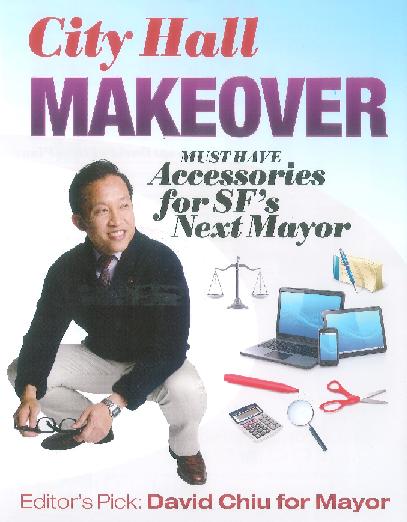
There’s a new fashion in the mayor’s race, and it’s … accessories! This new mailer says to vote for Sup. David Chiu because he knows how to accessorize — check out the cool glasses, and the sensible yet snazzy shoes and the high-tech wristwatch. Oh, and there’s a laptop/cell phone/ipad, a checkbook, a scissors, a red pen, a calculator and a set of scales, which I assume are to measure out justice and not medical marijuana. Although that’s fashionable, too. On the back of the mailer a nicely-dressed line of people stands out in front of City Hall in some sort of synchronized dance step; they all have their left hands pointed up. Cute.

The Real Ed Lee story

14

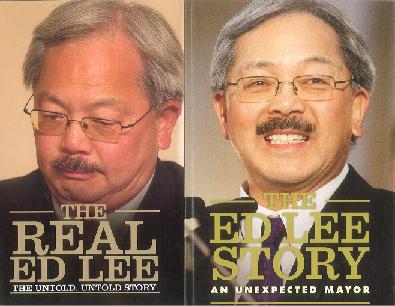
The Ed Lee Story has some much-needed competition. The boring, patronizing (to readers) and over-the-top hagiography of the interim mayor was just sitting there waiting for a parody, and now the Leland Yee campaign has obliged.

The Real Ed Lee, written by the Yee team, has a serious political point, but it’s actually funny, sometimes really funny, and it’s much easier to read than the plodding “Ed-Is-Greater-Than-God” prose of the original. A section titled “San Francisco’s Future, Ed Lee Style” notes that if the incumbent is elected to a full term

The Golden Gate Bridge will be now called the PG&E/Recology Golden Gateway to Corruptville. Make sure to show your employee badge at the the toll botth for your discounted rate (wink, wink).

HealthySF will be renamed the Endangered Restaurant Protection Act. You will be charged an additional 42 % on your bill. Please note — no health care will be provided.

Muni buses will now be operated by GO Lorries. Surprisingly, service will remain generally the same.

David Chiu is now District Attorney. Oh, wait ….

The book goes through the details of how Lee rose through the ranks at City Hall, along the way approving a couple of fraudulent vendors and getting caught up in Willie Brown’s sleaze. It discusses how his campaign is taking credit for other people’s work and ideas. It describes how he promised over an over not to run, then went ahead and did it anyway. It’s got a great picture of him steering a 139-foot yacht with the caption “I’m on a boat.”

I don’t know how well this will work, but it’s clear that Lee is falling in the polls and the cumulative impact of his mistakes and the attacks on him by the other campaigns is taking its toll. And for once, we have a campaign piece that made me laugh instead of crying.


Survey shows Lee aligned with tenant advocates only half the time

The results of a mayoral candidates’ survey created by the Council of Community Housing Organizations (CCHO) offered some surprises. Based on candidates’ responses, venture capitalist Joanna Rees, one of the more conservative contenders, came across as a stronger advocate for affordable housing and tenants’ rights than interim Mayor Ed Lee, who previously defended tenants as an attorney with the Asian Law Caucus.

The survey posed 25 yes-or-no questions to mayoral hopefuls, formulated by CCHO, the San Francisco Tenants Union, and the Housing Rights Committee. A “Yes” answer meant the candidate was aligned with the housing advocates’ standpoint, a “No” response was frowned upon as contrary to advocates’ housing agenda, and a “?” signified the response, “I’ll consider it.”

All told, Lee responded “No” to six questions, “I’ll consider it” to seven questions, and “Yes” to 12 questions, demonstrating consistency with the housing advocates’ agenda about half the time. Rees, on the other hand, responded “No” to three questions, and “Yes” to every other question.

Other respondents included Public Defender Jeff Adachi, Sup. John Avalos, green party candidate Terry Joan Baum, Board President David Chiu, former Sup. Bevan Dufty, City Attorney Dennis Herrera, and Sen. Leland Yee.

Candidates who answered in the affirmative to every survey question were Avalos, Baum, and Yee. Dufty responded “No” to eight questions, and “I’ll consider it” to one. Chiu responded “Yes” to most questions and “I’ll consider it” to four questions, though there was some confusion as his response wasn’t listed every time.

There you have a summary of the scorecards. So what were the questions?

Every single candidate answered “Yes” to this one: “To make up for the huge State and Federal cutbacks in affordable housing funding, will you commit to placing a dedicated affordable housing funding measure on the November 2012 ballot of at least $100 million?”

So no matter who’s elected, housing advocates will have an opportunity to advance this idea.

Among the more divisive issues was the question of reforming condo conversion laws to regulate tenancies-in-common conversions, in order to stem depletion of affordable housing stock. Lee, Rees, and Dufty responded that they would not seek such reforms; Yee, Avalos, Adachi, and Baum said they would. Herrera declined to answer.

Candidates were also divided on whether the San Francisco Rent Board, which mitigates disputes between tenants and landlords, ought to be reformed to “increase tenant representation and balance appointments between the Mayor and Board of Supervisors?” Yee, Lee, Dufty, and Adachi rejected that idea.

And Lee stood alone in answering “no” to this question: “Will you enforce a balance between market-rate housing and affordable housing that fulfills the City’s adopted housing goals, even if such a linkage slows down the overproduction of luxury condos until a minimum level of affordable and middle income housing catches up?”

All others said they would, except Chiu, who said, “I’ll consider it.”

View the full results of the survey here.

Superviors and labor leaders challenge Lee’s OccupySF stance

41

Mayor Ed Lee has put the city and its police force on a collision course with not only OccupySF, but also several members of the Board of Supervisors and top labor leaders who support the movement and want the city to allow its encampment to continue.

They spoke at a special hearing of the City Operations and Neighborhood Services Committee that was convened by Chair John Avalos this morning, supporting a resolution that Avalos created to allow OccupySF to have tents and other infrastructure that Lee opposes. The resolution – which is co-sponsored by Sups. Eric Mar, David Campos, and Jane Kim – was approved by the committee and is set to be considered by the full Board of Supervisors tomorrow (Tues/1).

“It is something I am wholeheartedly supporting because it is an expression of great frustration and concern about the economic system,” Avalos said. “We need to speak with a greater voice about changing our economic system so it works for the many and not just the few,” Avalos said, explaining why he is “wholeheartedly supporting” the OccupySF movement.

But Avalos said he’s been frustrated that Lee and the police have raided the camp twice and are threatening more, something that Avalos has been trying to mediate since the first raid on Oct. 5. He also said the city should learn from Oakland that using the police force to stop the movement only makes it stronger.

“If we were to try to stop it from happening, it would just encourage more people to take part in it,” he said, noting that more midnight raids are dangerous for both police and protesters. “We have to figure out as a city how we’re going to facilitate, encourage, and accommodate this movement.”

But instead, Avalos said Lee’s stand against allowing tents or an kind of encampment, while claiming to support the message OccupySF, has created a tense standoff. “I’ve seen very mixed messages come out of this administration,” Avalos said, adding that nobody believes police statements that the massing of SFPD cops in riot gear on Oct. 26 was only a training exercise.

Mar said OccupySF deserves tremendous credit for holding the space and being responsive to the health and safety concerns raised by city officials. “I’ve seen a transformation in the movement in the last three weeks that is truly impressive,” Mar said. “I’ve also seen, during the General Assemblies, an incredible exercise in democracy.”

He also disputed accusations that the camps are dirty and that the movement is unfocused. “Don’t believe the hype from the mainstream media but look at the messages coming out of this movement,” said Mar, who was wearing a “We are the 99 percent” sticker.

“We should allow OccupySF to do what they’re doing,” Campos said. “It’s good for San Francisco.”

Campos also called out Lee and Oakland Mayor Jean Quan for ordering violent raids on the peaceful encampment, disputing the idea that “somehow it’s okay for us to spend the limited resources we have on these kinds of police actions…I hope we don’t have Mayors Quan and Lee wasting resources that could be better spent elsewhere.”

During the public comment portion of the hearing, each of the more than two dozen speakers supported the resolution.

“What this resolution does is it calls on the other supervisors and the mayor to decide how they want to deal with OccupySF,” said Gus Feldman of SEIU Local 1021.

Representatives of several labor unions and the San Francisco Labor Council that have voted to endorse OccupySF spoke at the hearing, include Ken Tray with United Educators of San Francisco, who gave a rousing speech in support of the movement.

“The times have changed and the political landscape has shifted,” Tray said, ticking off a long list of reasons for supporting the movement, from San Francisco’s long tradition of advocating for progressive change to the fact that “the schoolchildren of San Francisco are being denied resources because the 1 percent refuse to pay their fair share.”

Frank Martin del Campo of the SF Labor Council displayed the bruises on his arm inflicted by police during the raid on the Occupy Oakland, saying “this was an attempt to criminalize dissent…It represents the politicization of the police.”

Labor Council Executive Director Tim Paulson said, “I just want to be clear that we are the 99 percent….We want Occupy San Francisco to be there 24/7.” He and others say the Occupy movement is highlighting deep economic inequities that the labor movement has long been raising as well. “OccupySF has called the question on really important issues we’ve been struggling with for years,” said Gabriel Haaland of SEIU Local 1021

“Here is a peaceful protest being answered with violence,” said Pilar Schiavo of California Nurses Association, which has been supporting the occupations. This is an important political struggle, she said, and “It’s time for the mayor to decide what side he’s on.”

Many speakers focused their criticism on Lee, such as Brad Newsham, who said, “Any official who would send in the riot police to deal with this camp does not deserve to be mayor of San Francisco.” He said the city should set an example for the country by formally allowing the encampment to continue, and he turned to the young protesters in the room and said, “Hold your ground and we’ll try to get your back.”

Sean Semans, an active member of OccupySF since the beginning, thanked Avalos and the other progressive supervisors for “saving us when nobody would,” and he expressed frustration with the Mayor’s Office.

“The mayor still doesn’t recognize us, he won’t come down and see the work we’re doing,” Semans said. “We can do all kinds of work when we’re not fighting to protect our First Amendment rights.”

He was part of an OccupySF delegation that met with Lee last week, and Semans said the mayor offered to help get the protesters rooms in SRO hotels or meals from local soup kitchens, showing that he has a fundamental misunderstanding about what this occupation is about.

As Semans said, “It shows what we’re dealing with here.”

CHP menaces the Halloween Critical Mass ride

14

The California Highway Patrol seems to be on high alert and itching to fight the people in the street, at least if a bizarre incident at last night’s Critical Mass is any indication. And that’s a scary prospect in the Bay Area, where the ongoing standoffs between police and the Occupy movements in San Francisco and Oakland are potential powder kegs that require cool heads on both sides.
Critical Mass was rolling through the warm streets of San Francisco, as it’s been doing on the last Friday of the month for 19 years, and it was a glorious night. The weather was nicer than it’s been in years for the Halloween ride and most of the large crowd wore costumes, many of them playing off Occupy Wall Street themes, from zombie bankers to the Glass Seagull (a reference to the gutted banking regulation Glass-Steagall Act).
Best of all, the San Francisco Police Department seemed to be standing down and allowing the ride to self-regulate, which it did with a minimum of conflicts with drivers. The mood was buoyant and many riders said it was the best Critical Mass they’d been on in a long time.
Then suddenly, as the ride headed up Market Street toward the Castro, crossing Octavia Boulevard, about a dozen CHP officers on motorcycle rapidly descended on the ride, aggressively cutting the dense ride in half to clear Octavia. Some used their motorcycles to push the cyclists back and tensions flared.
Angry words were exchanged back-and-forth between the cyclists and cops, some of whom seemed to be itching for a fight. One in particular pursued the cyclists up Market Street, playing the provocative tough guy or using his motorcycle to try to corral and menace the ride, long after the standoff had ended with enough green lights for the ride to get past Octavia and his fellow officers left.
This battle over public space and freedom of assembly isn’t going away anytime soon. There are resentments building and there will be bad apples on both sides of the barricades in the days and weeks to come. That’s one reason why Mayor Ed Lee is playing a dangerous game by threatening to raid OccupySF at any moment, and why the SFPD’s approach to this ride was far better than the CHP’s.
Just stand down and let the people police themselves.

LGBT leaders denounce attack on Herrera by the Chronicle

20

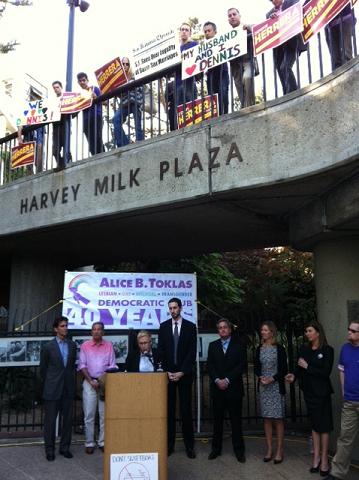
Leaders of the LGBT community from across the political spectrum yesterday denounced the San Francisco Chronicle and the anonymous sources it relied on to question City Attorney Dennis Herrera’s early support for legalizing same-sex marriage, calling the paper’s front page article a thinly veiled political hit piece designed to hurt Herrera’s mayoral campaign.

That strong showing of support in the LGBT community and the view offered by many that the attack came from supporters of Mayor Ed Lee – including top former Newsom Administration officials, some of whom now work for Lee – could not only mitigate damage from the article but further sully a Lee election effort that is already marred by allegations of vote tampering, money laundering, and deceptive campaign tactics.

“Those who are saying this now anonymously are as cowardly as Dennis and Gavin were courageous back then,” said Deputy City Attorney Theresa Stewart, the lead attorney who defended San Francisco’s decision in 2004 to unilaterally issue marriage licenses to same-sax couples, in defiance of state and federal law, which eventually led to the legalizing of such unions. “We can’t have our community turn on us for petty political gain.”

“WTF, Chronicle?” was how Assemblymember Tom Ammiano began his speech, going on to lay blame for the attack on surrogates for Lee. Ammiano also called out the mayor for campaign finance violations by his supporters, for undermining the Healthy San Francisco program that was created by Ammiano’s legislation, and for repeatedly ordering police raids on the OccupySF encampment.

“How about some fucking leadership?!” Ammiano said.

Cleve Jones, an early gay rights leader who marched with Harvey Milk, also denounced Lee and his supporters for cronyism, vote tampering, money laundering, and the “fake grassroots” efforts of the various well-funded independent expenditure campaigns, which he said have fooled the Chronicle.

“To the Chronicle and that reporters – really? – this is what you do two weeks before the election? You should be ashamed of yourself,” Jones said. “How stupid do you think we are?”

Yet Chronicle City Editor Audrey Cooper defended the article and disputed the political motivations of its sources. “Clearly, I disagree [with the criticisms],” she told the Guardian. “I personally vetted every one of the sources and I’m confident everything we printed is true.”

Beyond criticizing the obvious political motivations behind the attack, speakers at the rally called the article bad journalism and said it was simply untrue to suggest that Herrera didn’t strongly support the effort to legalize same-sex marriage from the beginning.

“I can tell you that Dennis never once shrank from this fight. I was there, I know,” Stewart said, calling Herrera “a straight ally who’s devoted his heart and soul to this community.”

Sen. Mark Leno, who introduced the first bill legalizing same-sex marriage to clear the Legislature, emphasized that he isn’t endorsing any candidates for mayor and that he didn’t want to comment on the details of the article’s allegations. But he noted that even within the LGBT community, there were differences of opinion over the right timing and tactics for pushing the issue, and that Herrera has been a leader of the fight for marriage equality since the beginning.

“I am here to speak in defense of the character and integrity of our city attorney, Dennis Herrera,” Leno said, later adding, “I do not appreciate when the battle for our civil rights is used as a political football in the waning days of an election.”

Ammiano also noted that even if Herrera raised doubts in early meetings, that was entirely appropriate given his role as city attorney. “Even if there are some questions, they’re about helping, not hurting,” he said, expressing disgust at the Newsom Administration officials for turning on someone who was instrumental to defending the decision: “In my day, you valued your friendships.”

Molly McKay, one of the original plaintiffs in the civil lawsuit that followed San Francisco’s actions, teared up as she described the ups and downs that the case took, working closely with Herrera throughout. “But this is one of the strangest twists I can imagine,” she said of the attack by the Chronicle and its anonymous sources. “It’s ridiculous and despicable.”

Representatives for both the progressive Harvey Milk LGBT Democratic Club and fiscally conservative Alice B. Toklas LGBT Democratic Club also took to the microphone together, both saying they often disagree on issues, but they were each denouncing the attack and have both endorsed Herrera, largely because of his strong advocacy for the LGBT community.

Sup. Scott Wiener called Herrera, “One of the greatest straight allies we’ve every had as a community.”

When Herrera finally took the microphone, he thanked mayoral opponents Joanne Rees and Jeff Adachi for showing up at the event to help denounce the attack and said, “This is bigger than the mayor’s race. It’s bigger than me.”

He criticized those who would trivialize this issue for petty political gain and said, “It was my pleasure and honor to have been a part of this battle from the beginning – from the beginning – and I’ll be there in the end.”