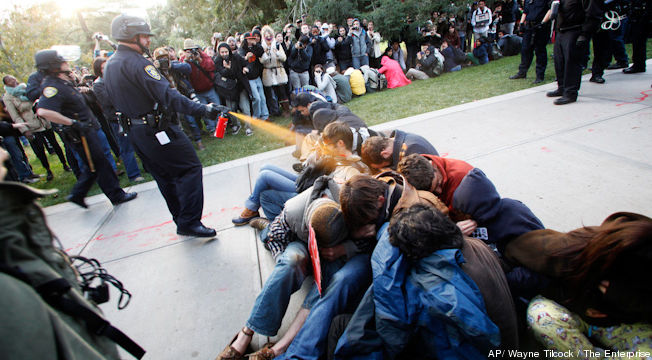
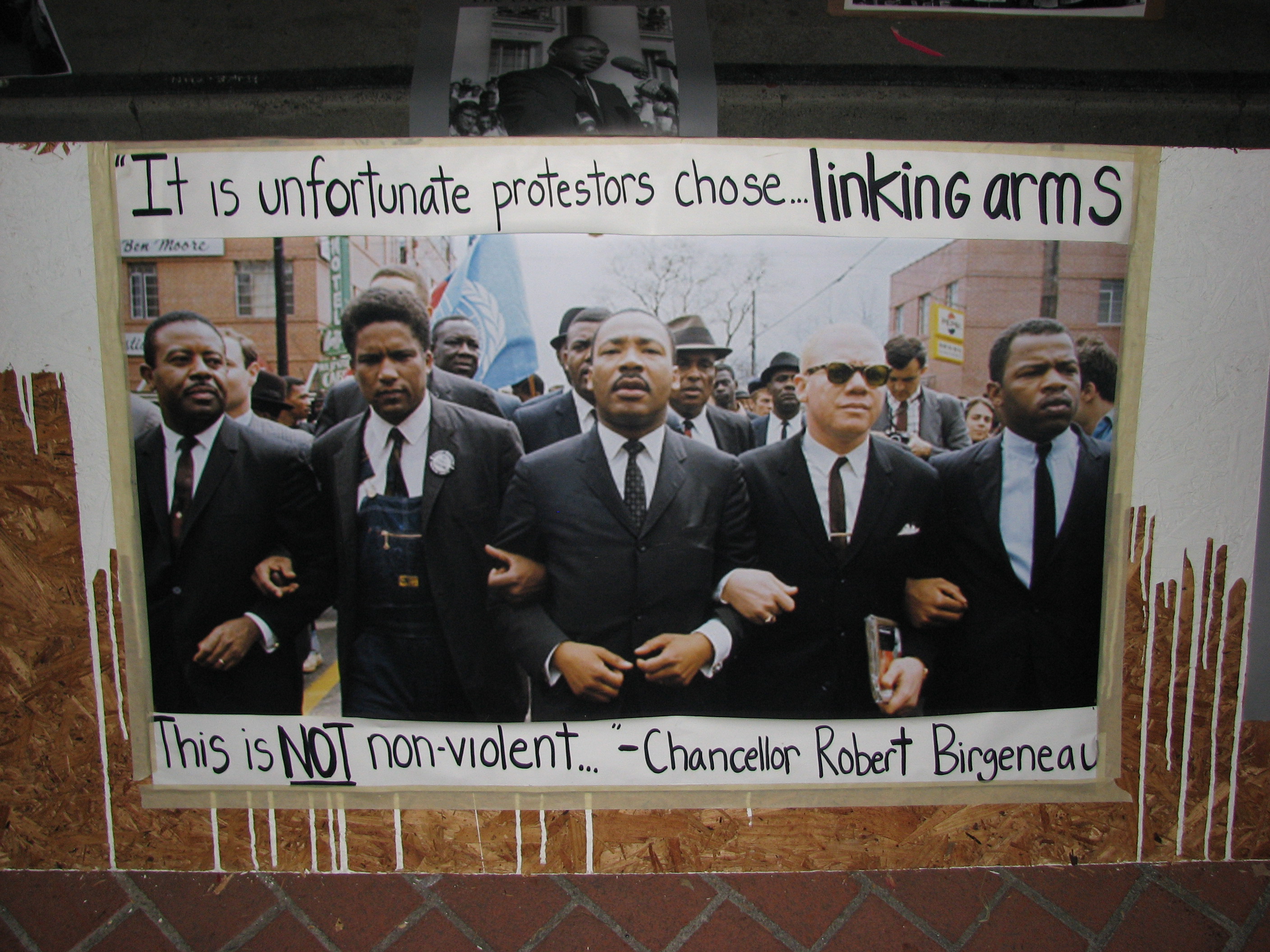
I have to wonder — as I often do, I’m afraid — just what exactly Gov. Jerry Brown is thinking. He was out of town — at an undisclosed location — when the UC Davis pepper spray incident happened, and he issued no statement. Now he’s back, presumably in his office, and he still hasn’t said anything.
The use of pepper spray and night sticks against peacefully protesting students at UC Davis represents exactly the wrong message our great universities should be sending to our young people.
Instead of supporting and encouraging students who have become productively and non-violently engaged in the important issues of the day, university authorities unleashed overwhelming military force against them.
It is not enough for University of California officials to call for a review of policies and procedures. Those responsible for this outrageous assault on human rights must be held fully accountable, Students and parents must be reassured that the University of California and all higher education institutions in this state respect and applaud young people who reject apathy and embrace personal involvement in what ails society.
I could go further: There’s video of a police officer breaking the law, and he should have been arrested and charged with assault. Not saying he should go to jail or anything, but when there’s clear evidence of a crime, typically the perp is arrested and the courts sort it out later.
But what is going through Jerry’s mind? Does he condone this shit? (I’ve known him a long time, and I can’t imagine he does.) Is he so far out in space that he doesn’t realize how bad it looks for him to stay silent?
Is he worried that the cops won’t like him if he says something critical? Because a lot of other people are mad that he’s said nothing at all.
This isn’t an isolated local incident that he can kick down to the city or county authorities. The University of California is a state agency, and its cops are state employees, who more or less indirectly work for the governor.
UPDATED BELOW — Protesters with ReFund California and other groups are gathering today (Mon/28) at UCSF-Mission Bay and three other UC campuses to protest a teleconference of the UC Board of Regents, which will discuss state funding levels and tuition increases, as well as recent incidents of police violence against nonviolent student protesters.
ReFund California, a coalition of student and labor groups, is angry with the UC’s decision to abruptly cancel the Nov. 16-17 Regents meeting at UCSF, citing public safety concerns surrounding a meeting that the group had been planning a convergence on for months – as well as a hastily called meeting on the day after Thanksgiving.
The group has created a pledge that it wants the Regents to agree to, which includes calling for higher taxes on the rich, a restoration of cuts to the public university systems, removal of commercial land from Prop. 13 property tax caps, and a fee on Wall Street financial transactions.
ReFund California is also dismissive of independent investigations the UC has initiated to look at aggressive police repression of students protests, including police at UC Berkeley using batons and mass arrests to dismantle an OccupyCal tent city and police at UC Davis dousing passive protesters with pepper spray. Video of both incidents went viral and have helped galvanize the overlapping Occupy and student movements.
“No amount of new ‘police protocols’ will prevent violence against students and workers, as long California’s corporate and financial elite along with their representatives among the Regents and administrators of the UC rely on police to address the concerns of students and workers,” the ReFund California Coalition wrote in the letter to the UC.
Today’s action at UCSF – centered around the meeting site at 1675 Owens Street, where a Guardian reporter is on the scene and will offer her report later today – joins similar protests at UC Davis, UCLA, and UC Merced, the four sites where the Regents will gather.
Meanwhile, ReFund and other groups are also angry that the CSU Board of Trustees went ahead with its Nov. 16 meeting behind closed doors, clearing out student protesters and the public before they approved a 9 percent tuition hike, an action that Lt. Gov. Gavin Newsom (a member of that body) denounced.
“While I understand the CSU leadership’s concerns regarding public safety, the spirit of open deliberations has been marred,” Newsom wrote in a Nov. 18 letter to Chancellor Charles Reed, calling for the matter to be re-voted at the Dec. 5 meeting to “allow the full board to hold an open debate, with full public comment and members of the media present.”
In related news, many students and faculty at UC Davis are on strike today to protest the pepper-spraying incident. And tomorrow (Tues/29) at noon, members of OccupyOakland say they plan to retake Frank Ogawa Plaza (which they renamed Oscar Grant Plaza) and set up another 24/7 encampment.
UPDATE NOON: Guardian reporter Christine Deakers says there is a heavy police presence at the UCSF meeting, where only 50 members of the public are allowed inside and most of those seats have been claimed by ReFund California members. When the Regents decided to limit the time for public testimony, the group held a General Assembly in the meeting, drowning out the Regents and causing the meeting to adjourn until 1:30 pm. You can follow her tweets here or here.
UPDATE 1:50 PM: The UC Board of Regents did not reconvene, instead cancelling the rest of the meeting without taking action. The San Francisco Chronicle quotes Newsom as saying he supports the demands of ReFund but that he’s not willing to sign its pledge.
Catch this. Mayor Ed Lee’s mayoral victory had nothing to do with millions of dollars in campaign contributions from private interests, a sophisticated get-out-the vote effort targeting Lee supporters, the advantage of incumbency, some funny business, or a calculated campaign strategy concentrating efforts on absentee ballots.
Instead, the fact that Lee triumphed over voters’ second pick, the significantly less well-funded progressive candidate Sup. John Avalos, is proof that the left in San Francisco has plummeted into a dark abyss. In fact, the progressive movement has descended so far into disarray and become so irrelevant that its condition warrants front page news.
That’s essentially the narrative that Benjamin Wachs and Joe Eskenazi of the San Francisco Weekly offer in their cover article, “Progressively Worse: The Tumultuous Rise and Acrimonious Fall of the City’s Left,” in which they refer to the Guardian as “the movement’s cajoling ward boss, kingmaker, and sounding board.” Gosh, I feel so goddamn important right now.
Once the blood pressure returned to normal, my initial reaction to this piece was that Wachs and Eskenazi seem to misunderstand who and what progressives actually are. They portray the city’s left as a caricature, a brash bunch of power mongers now on the losing end that can be easily summed up with pithy video game references, Happy Meal toy bans, and bikes.
Witness the contrast between the Weekly’s portrayal of progressives (helped along by former Newsomite Eric Jaye), and the portrait of the left the Guardian offers this week with an Op-Ed written by NTanya Lee — an actual progressive who volunteered for the Avalos for Mayor campaign.
Here’s the Weekly on the left:
“This is an eclectic group, one often bound not by mutual interests as much as mutual enmity — toward Brown, his successors, and the corporate interests of ‘downtown.’ As a result, progressive principles are often wildly inconsistent. Progressives favor more government control over people’s lives for their own good, as when they effectively banned McDonald’s Happy Meals. But sometimes progressives say the government needs to let people make their own choices … Progressives believe government should subsidize homeless people who choose to drink themselves to death, while forbidding parents from buying McNuggets because fast food is bad for us. … Without consistent principles, it’s easy to associate progressives with the craziest ideas to come out of City Hall, and the movement’s bad ideas are memorable. … Daly’s pledge to say ‘Fuck’ at every public meeting makes a killer Internet meme. Hey, let’s legalize prostitution and outlaw plastic bags!”
Here’s Lee on the left:
“The Avalos coalition was largely community forces: SF Rising’s base in working class Black, Latino, Filipino and Chinese communities; the Bike Coalition’s growing base of mostly white bike riders; affinity groups like Filipinos, Queers, Latinos and Arabs for Avalos; progressive Democrats; social networks of creative, young progressive activists affiliated with the League of Young Voters; and loyal families and neighborhood leaders from John’s own District 11. The campaign prioritized communicating to voters in four languages, and according to the Chinese press, John Avalos was the only non-Chinese candidate with a significant Chinese outreach program. There were stalwarts from progressive labor unions (most notably SEIU 1021 and USWW) who threw down — but overall, labor played it safe and invested resources in other guys. And then, in the great surprise development of the race, supporters of the new national occupy movement came to be a strong part of the Team Avalos base because the campaign was so well positioned to resonate with the call to take on the one percent.”
When it comes to takeaways from the November election, the Weekly’s conclusion is essentially opposite that of progressives. While many on the left see themselves as regaining momentum and building the power to rise even in the face of defeat by the established powers-that-be, the Weekly casts San Francisco’s left as deflated and out-of-touch.
Speaking of out-of-touch, the SF Weekly refers to San Francisco’s “increasingly imaginary working class.” But in reality, 61 percent of students attending public schools in S.F. Unified School District qualify for free or reduced lunch, and a majority of San Franciscans cannot afford market-rate housing.
However, the Weekly is correct in pointing out that shifting demographics have dealt a blow to the progressive base.
“Between 2000 and 2010, the city grew older (every age group over 50 increased), wealthier (there are now 58 percent more households earning $125,000 or more), and more heavily Asian (up from around 30 to nearly 35 percent of the city’s population): exactly the groups progressives don’t win with. These voters don’t respond well to campaigns against developments or for city services, because they’re often living in those developments and don’t need city services.”
I take issue with the Asian part of that statement as a sweeping generalization, however, having witnessed the solid organizing work of the Chinese Progressive Association, for example.
The Weekly also says progressives and the Guardian never called out former Mayor Gavin Newsom for ripping off their best ideas. Oh, they didn’t? That’s news to me.
The Weekly article implies that progressives got trounced by moderates because jobs are priority No. 1 for voters, and the left has no feasible economic plan — but at the same time, the article completely dismisses ideas that the Guardian has put forth, like creating a municipal bank, implementing Avalos’ Local Hire legislation, or taxing the rich.
Taxing the rich is precisely the kind of economic solution the international Occupy movement is clamoring for, and the concept has even attracted a few unlikely supporters, like billionaires Warren Buffet and Sean Parker, who is not some conservative a*hole by the way.
“The Guardian … stays on the progressive agenda because they put it there, along with taxing the rich, tapping downtown to subsidize Muni, and other measures … Proposing the same old solutions to every new problem turns policies into punch lines.”
Speaking of predictable, no profile authored by the Weekly mentioning the Guardian would be complete without some dig about public power. “The Guardian has been flogging public power since Tesla invented the alternating-current generator,” the S.F. Weekly squawks. Those clever reporters, turning policies into punch lines.
But wait, I thought the problem was that progressives couldn’t get it together on the job creation thing. Consider the CleanPower SF program, which has been strongly advocated for by progressive Sup. and Sheriff-elect Ross Mirkarimi (who it turns out is “not toxic,” according to the Weekly, since he was elected citywide and all). According to an analysis by the Local Clean Energy Alliance, CleanPowerSF will create 983 jobs — 4,357 jobs when indirect job creation is factored in — over the course of three years, assuming the 51 percent renewable energy target is met. Presented with this kind of information, the Weekly will only yawn and say, “Are we on that again?”
That being said, our friends’ article might actually have a pearl of wisdom or two buried somewhere in that nauseating sea of sarcasm. Everyone needs to engage in self-reflection. So right after you’re done throwing up, think about how to take advantage of the opportunity this article presents for a citywide dialogue about progressivism in San Francisco.
The hacker group Anonymous has targeted the Police Executive Research Forum (PERF), taking down the website and publicly releasing home phone numbers, addresses, emails, and other personal information of directors and staff.
PERF became an activist target after media outlets, including the Guardian, highlighted the nonprofit think tank’s role in coordinating conference calls with mayors of major metropolitan cities about how to deal with Occupy encampments. Weeks after the conference calls were convened, a series of police raids targeted encampments in major U.S. cities such as New York, Oakland, and Portland.
On Nov. 19, Anonymous Operations tweeted, “A private NGO called #PERF is helping to train & coordinate #Occupy raids nationally … PERF, Expect us!”
The attack occurred the next day, and PERF staff and directors’ personal information was posted online. A screen shot tweeted by Anonymous showed an error message which read: PoliceForum.org seems to be down. 🙁
Reddit posted a hacker conversation about the action. Apparently, not everyone was impressed.
The executive director of PERF is Sherwin B. Chuck Wexler, a member of the Advisory Council for the U.S. Department of Homeland Security. PERF board members include an assortment of police chiefs known for their track records of using heavy-handed tactics against protesters of the anti-globalization movement and mass demonstrations organized around Republican party national conventions. According to a bio for Wexler, “PERF’s research has a direct impact on policy and practice in policing around the world.”
PERF’s website is back up now. Before the attack occurred, the organization responded to the recent media attention with a public statement. “Over the last few days, the Police Executive Research Forum has been the subject of several false articles and blog postings alleging that we have been coordinating police crackdowns on Occupy protests,” the message reads. “This is not true. PERF conducted two conference calls for the sole purpose of allowing police chiefs to compare notes about their experiences with ‘Occupy’ protests.”
Anonymous is famous for releasing YouTube videos about its actions. Here’s the one C@b!nCr3w, the anonymous hackers taking credit for the attack, created about the PERF stunt. (“Don’t dox and drive” refers to “doxing,” hacker slang for releasing individuals’ personal data.)
Two housekeepers at the Hyatt Regency Santa Clara filed charges with the Equal Employment Opportunity Commission (EEOC) Nov. 18, alleging they were fired in retaliation after removing “sexually suggestive images” of themselves posted in a hotel work area.
The charges come just weeks after the San Francisco Hyatt at Fisherman’s Wharf was issued serious citations by the California Division of Occupational Safety and Health (CalOSHA), coupled with proposed fines totaling more than $20,000, for health and safety violations.
Martha and Lorena Reyes, who are sisters, were fired from the Hyatt Regency Santa Clara on Oct. 14, two weeks after Martha removed the images from a display board that had similar images of all the housekeeping staff members. “When I saw the images, I was embarrassed, ashamed, and humiliated,” Lorena Reyes’ EEOC complaint states. “My sister tore down the photo of me. When an employee told my sister to return the photos to the bulletin board, she refused.”
The images showed photographs of the Latina sisters’ faces tacked onto cartoon-like drawings of white women wearing bikinis. Hyatt Regency Santa Clara spokesperson Peter Hillan told us they were put up as part of an industrywide annual event, National Housekeeping Week, to celebrate housekeepers. The hotel selected a beach scene, he said, because “The theme was ‘riding the waves to success.’”
“We take it seriously any time that our associates indicate that they’ve been offended,” Hillan said, but stressed that “this morning was the first time we were made aware that there was offense taken.” Hillan could not say when management first became aware that Martha Reyes had removed the images, nor was he able to identify who was responsible for displaying them.
When the Reyes sisters were fired, they were told it was because they took lunch breaks that were longer than the allotted 30 minutes, Lorena Reyes explained. Yet she countered this by saying it’s common practice for housekeepers to rest for an additional 10 minutes during lunch breaks on days when heavy workloads make it infeasible to take one of the two 10-minute breaks they’re entitled to under state law.
“We haven’t come across anyone else who’s been fired for it,” said Adam Zapala, an attorney with the firm Davis, Cowell, and Bowe, who is representing the sisters. “So it raises the suspicion in our mind.”
Hillan, the Hyatt spokesperson, described the sisters’ assertions that they had been fired in retaliation as false. “To us, this is part of a larger issue with UNITE HERE,” the hotel workers’ union, “that we’ve seen a fairly consistent approach by UNITE HERE leadership to take out of context and make disingenuous claims on behalf of associates,” he said.
On Nov. 18, UNITE HERE Local 2 helped organize a picket against Hyatt Regency Santa Clara. The union has sought to unionize workers at that location.
Zapala noted that the pair of EEOC complaints were filed Nov. 18 to compel Hyatt to re-hire the sisters. However, the official complaints are also a first step toward a lawsuit in state or federal court.
Meanwhile, in San Francisco, CalOSHA issued two serious citations against the Hyatt Fisherman’s Wharf along with proposed fines of more than $20,000, alleging violations against health and safety codes protecting workers against repetitive motion injuries.
Pamela Vossenas, health and safety director for UNITE HERE, described housekeepers’ work as “a nonstop assembly line of repetitive motion. These citations allege that Hyatt failed to follow certain parts of that standard.”
Hyatt Fisherman’s Wharf hotel workers formally complained about repetitive motion injuries in Nov. 2010, and the citations are a result of a long-term investigation.
Workplace injuries resulting from repetitive motion can include back strain, shoulder strain, and carpal tunnel syndrome. “There are many ways the tasks could be done safer, but they’re not given the time, and they’re not given the tools,” Vossenas said.
Dania Duke, general manager at Hyatt Fisherman’s Whart, dismissed those concerns. “We strongly disagree with CalOSHA’s investigative process, and the end result which was handed down to us before their ergonomic study was completed,” she said. “We’re going to use every legal avenue available to appeal, and we feel that they’re driven by political motives, not facts.” She added that Hyatt provides long-handled dusters, surface-cleaning tools, and wet and dry swiffers for cleaning walls and floors, noting that their use is not mandatory. “Our associates have the tools the resources and the training they need to do the job,” she said. “We constantly strive to promote safety.”
According to a study published in the American Journal of Industrial Medicine examining a total of 50 hotel properties from five different hotel companies, Hyatt housekeepers had an injury rate that was higher than that of other housekeepers when compared by company.
Across the industry, one solution would be to give workers long-handled tools – like mops – for cleaning, Vossenas said. “The majority of hotels don’t give them mops — they give them rags to use,” she explained. “It’s 2011, and women housekeepers are still supposed to be on their hands and knees scrubbing the floor. Male custodians, janitors – who would ever think of giving them a rag to scrub the floor?” Yet Duke told the Guardian that this is not the case at Hyatt Fisherman’s Wharf.
There are four major Hyatts in the Bay Area. The Grand Hyatt, located at San Francisco’s Union Square, and the Hyatt Regency Embarcadero are both union hotels. The Hyatt Fisherman’s Wharf does not have a union, nor does the Hyatt Regency Santa Clara. All four are under boycott; at the unionized properties because workers have not had a contract since August of 2009, and at the non-unionized properties because attempts to unionize have been stymied, according to UNITE HERE.
Sarah Jane Holcombe, a graduate student in public health at UC Berkeley (and a neighbor of mine), was disturbed to see Alameda County deputy sheriffs using unnecessary force against peaceful student demonstrators. She’s not alone — a lot of people on campus have been upset about police conduct during the demonstrations. But Holcombe did more than grumble — she wrote to Alameda County Sheriff Gregory Ahern to complain. And she got back a remarkable message that says a lot about what the elected sheriff thinks about the protesters.
Here’s Holcombe’s letter:
Dear Mr Gregory Ahern,
I find myself just stunned and appalled at the behavior of your police in Sproul Plaza, and as a Berkeley student, have lost respect and confidence in the Alameda County Police Force.
Who are these Officers? Where were they trained?
Perhaps more to the point is, why are you authorizing such blatantly violent and anti-democratic behavior? This shows such bad judgement that I wonder why you are the head of the Alameda County Police Force.
Finally, what are you doing to address the gross problems and violations evident in Alameda County Police Officers’ behavior?
My confidence and trust in you and your force is now very low.
I look forward to your response.
Ahern’s letter back, sent within two hours:
I am shocked too. I am shocked educated individuals who violate laws do not expect to be arrested. I am shocked that people who speak of peace in our society attempt to do harm to law enforcement personnel. I am shocked that some protesters throw rocks, cement, bottles and paint at law enforcement. I am shocked that protesters throw urine and feces at police officers.
I am shocked at the vulgar language used at my staff.
I am shocked that people like you make judgements about law enforcement without knowing all the facts and without asking questions prior to making judgements and assigning guilt on those prior to any investigation.
When the protesters follow the laws of our society and our lawful commands we have no issues. Many of the protesters speak to us and provide us with their legal intentions to march and we assist them.
Let me tell you something…..my staff has done nothing wrong. They have assisted this community in allowing their free speech and right to assemble. We have provided protection to thousands of individuals and allowed them to practice their rights while some of those same individuals insult us. We have provided traffic blocks so people could march safely. We have protected buildings and provided escorts to frightened citizens in the area of the protest. We have escorted special need individuals and eldery from areas of the protest. We have assisted handicapped people to safety.
In each use of force that my staff has used has been in direct response to direct actions of individuals. We have not and do not and will not just use indiscriminate force. Each use of force is documented, reviewed and subject to further review of command staff. Indiscriminate force is not tolerated. Do not judge my people from news reports or YouTube videos.
I beg you to come to our training. I will provide you full access, I will answer any of your questions. I will prove we do our job correctly and according to national standards. Let me know when you can show up at our training.
It was signed Gregory Ahern. I called his press spokesman and he confirmed that this was Ahern’s message and represents his position.
Actually, Sheriff, I didn’t see many reports of protesters at Cal doing anything to harm police officers. And to simply say “my staff has done nothing wrong” without listing to an evaluating any complaints that might be filed seems, well, a rush to judgment.
And honestly, were there “frightened citizens” at Berkeley who needed to be escorted from buildings? Was beating up a poet appropriate use of force?
Not only has Lt. John Pike, the police officer who liberally doused nonviolent college students with pepper spray in an incendiary show of excessive police force Nov. 18, become a meme — he’s also generated a raging controversy that has top officials at the University of California Davis in the crosshairs. The incident, which has triggered widespread outrage since videos of it went viral on YouTube, occurred after police responded to student protesters attempting to create an Occupy Davis encampment.
Sen. Leland Yee issued a letter to UC president Mark Yudof Nov. 21, calling for an independent investigation into the pepper spray incident rather than a task force handpicked by UC Davis Chancellor Linda Katehi. The Davis chancellor, who has come under intense pressure since the incident as students call for her resignation, previously announced that she would create a committee to look into the matter and report back after 30 days.
“She gave 30 days to report back,” noted Adam Keigwin, Yee’s chief of staff. “It takes about 30 seconds to realize there’s been wrongdoing.”
In the letter, Yee expressed concern that “it is important that we do not leave the fox to guard the henhouse.” A press statement issued by his office was more direct, noting that Yee “called Katehi’s task force a sham.”
Yudof said Sunday that he would convene all 10 UC campus Chancellors to ensure proper law enforcement reactions in future protests.
Watch this clip to the end, and you’ll witness an incredible moment following the pepper spray incident, when UC Davis students banned together and chanted at police, “You can go!” After a few moments, the police appeared to listen to them, and retreated.
http://www.youtube.com/watch?v=WO4406KJQMc&feature=share Video by YouTube user waxpancake
Some 5,000 students gathered at the UC Davis quad this afternoon to protest the now-infamous show of police brutality. Katehi waited in line to speak and then apologized to the students.
According to Yee’s press release, “Katehi’s salary is $400,000, reflecting a 27 percent hike from her predecessor. Her compensation package also includes a house provided by UC, $9,000 per year in automobile allowance, relocation expenses now and upon exiting the position, a promised faculty position after leaving the Chancellor’s office, a low-interest home loan after serving as Chancellor, and a generous pension and health care package, among other benefits.”
Sen. Leland Yee is urging all UC and CSU students and employees who are retaliated against or face disciplinary action as a result of their peaceful protest to contact his offices in San Francisco (415-577-7857) or San Mateo (650-340-8840).
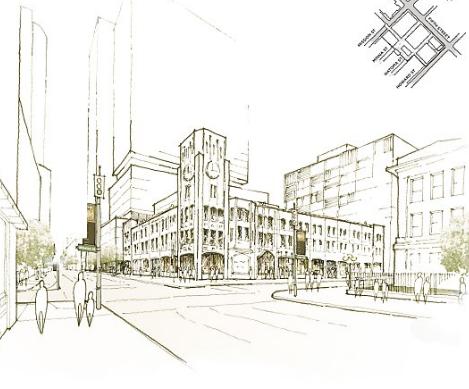
The project’s allure is what happens on the ground. Jackson Street would extend east as a 47-foot-wide pedestrian path; Pacific would conclude at the new triangular park. A narrow greenway north from Drumm would be widened to 37 feet.
The open spaces are the work of Peter Walker, who also designed nearby Sidney Walton Park, the green heart of otherwise drab Golden Gateway. What’s envisioned at 8 Washington extends the artful simplicity of that popular space. But it takes cues from the transitional location, offering pathways and nooks rather than trying to upstage the waterside drama.
So the landscape is going to look nice.
But there’s a lot more to a project than the way it looks. I’m not going to go all Form Follows Function here, but before you evaluate how much green space the development will have and what pedestrians will encounter, you have to ask another question: Why are we building this thing in the first place?
Police dismantled the OccupySF protest and campsite in front of the Federal Reserve building early Sunday morning.
Around 1 a.m., police massed on Market Street between Main and Spear. They drove up to the Federal Reserve protest site, which consisted of a kitchen, small library and information table, and about a dozen tents. The 30 or so tents that had been pitched there for weeks were gone, voluntarily taken down by protesters around 12:40 p.m. Saturday, when police threatened to arrest and confiscate the belongings of anyone who continued to camp on at the 101 Market Street location.
Apparently considering that afternoon’s actions and previous notices concerning vacating 101 Market Street fair warning, police did not warn campers this morning before beginning to arrest. Six people who were sleeping in tents report having been awoken and put under arrest within a matter of minutes. Several had no time to put on socks or shoes before being dragged out of their tents.
All six were cited and released in a matter of hours, and arrived back at camp by 2:50am.
One man who had a small radio had heard a warning that police were present from camp security patrol about one minute before the police arrived. He says he had time to “spring out of bed” and exit his tent before police arrived and “Told me, ‘You need to leave now or get arrested.’ By the time I started to shake my head no they had already started putting the ziptie on me.”
Department of Public Works employees put tents and materials in DPW trucks police barricaded and blocked all of Market Street, including sidewalks, between Steuart and Main Streets.
Shortly after 1:00, OccupySF put out calls for support. Many heeded the call and arrived around 1:40 to the site. By this time, only the sidewalk was barricaded, and protesters continued to chant and argue with the about 120 police in partial riot gear who lined the sidewalk. A few tried aggressively to shake or take down metal police barricades and were stopped by other protesters and met with chants of “non-violent protest!”
For the next few hours, protesters slowly left 101 Market and congregated back at Justin Herman Plaza, discussing strategy and trying to understand what had happened. The raid was over in a matter of minutes and very few protesters had witnessed it.
The 101 Market Street site had been used by the protest movement since September 29, when it was established as the main camp site. The encampment had since expanded, and as of yesterday 101 Market Street was serving as the group’s “protest central,” distinct from the main camp at Justin Herman Plaza.
As of 8:00 this morning, about 15 police officers were still stationed, warming themselves by heating lamps that have been placed behind the barricades in front of the Federal Reserve. Barricades surround empty space on the sidewalk on Market Street from Main to Steuart Street.
Police raided Occupy Oakland’s new encampment at Fox Square Park at 19th and Telegraph streets early Nov. 20. Some 30 tents had been set up at the park, which protesters entered Saturday evening after tearing down a chain-link fence surrounding the perimeter.
The camp was created following a Saturday afternoon march meant to highlight cuts to education which passed through the downtown Oakland banking district and stopped Lakeside Elementary School, one of five Oakland public schools that are slated for closure at the end of the school year due to budget cuts.
Occupy Oakland has called for general assembly at Frank Ogawa Plaza (renamed Oscar Grant Plaza by protesters) on Nov. 20 at 6 p.m. to talk about next steps.
Although Occupy Oakland’s home was short-lived, the Guardian was on hand to capture the moment when the fence came down and occupiers rushed in.
Earlier in the afternoon, an Oakland school teacher sounded off against the budget cuts.
Following a rally and march from downtown Oakland’s Frank Ogawa Plaza that may have been more than 2,000 strong, activists with Occupy Oakland tore down a fence that had been erected around Fox Square Park at 19th and Telegraph, the site organizers had announced would be the home of their new encampment, and began setting up tents.
The fence was in place when activists reached the park, and a line of police were positioned nearby. However, activists managed to tear down the fence, and police moved away from the park but were still standing by.
As of 5:45 p.m. Nov. 19, there were more than a dozen tents set up. Music was playing and occupiers were holding a dance party in the park. Shouts of “we need more tents!” could be heard.
The former site of the Occupy Oakland encampment — Frank Ogawa Plaza, which was renamed Oscar Grant Plaza by occupiers — has been muddied by sprinklers that are spraying water on the bare ground in frequent intervals. Police removed the encampment in a pre-dawn raid Nov. 14.
Speaking at a 2 p.m. rally, International Longshore and Warehouse Union (ILWU) Local 21 president Dan Coffman said, “The hedge fund managers and the bankers have been getting away with robbery. Where are the Justice Department indictments? The recession will only worsen unless we fight.”
According to the proposal that was passed unanimously by the Occupy Oakland general assembly last night, “The EGT is an international grain exporter led by Bunge LTD, a company constituted of 1% bankers whose practices have ruined the lives of the working class all over the world, from Argentina to the West Coast of the US. During the November 2nd General Strike, tens of thousands shutdown the Port Of Oakland as a warning shot to EGT to stop its attacks on Longview. Since the EGT has disregarded this message, and continues to attack the Longshoremen at Longview, we will now shut down ports along the entire West Coast.”
In terms of the still relatively young and action-packed life of the Occupy movement, Dec. 12 is ages from now. For today, Nov. 19, the question will be whether the activists can hold their ground at the new encampment.
Tim Paulson, director of the San Francisco Labor Council, just told me that he’s got as many as 500 union members on alert to stand with the OccupySF encampment if the city attempts to evict the protesters. The Labor Council has put together a communications system to let members who have volunteered to help know when a showdown with the police is coming, and the volunteers are ready to spend as much as 24 hours at Justin Herman Plaza, and if necessary, in jail.
“We mobilized for last night, but nothing happened,” he said. “We’re in a state of constant vigilance.”
Paulson noted that the San Francisco encampment “is the symbol of the Occupy Movement.”
The solidarity of San Francisco labor will make it considerably more difficult for Mayor Ed Lee to send in the police and break up the camp. The idea that he would be ordering the arrests not only of several hundred Occupy protesters but a large contingent of local labor leaders and union members has to be giving him second (and third, and fourth) thoughts.
And whatever the outcome, the connenctions between labor and Occupy are critical to building and sustaining a national movement to demand economic justice. It’s great to see the SF Labor Council in the heart of the fight.
Thirteen labor and community leaders wrote to Mayor Ed Lee Nov. 17 asking him not to evict the OccupySF protesters. The message of the hand-delivered letter: It’s worth the time and effort the city will have to make to allow the encampment to remain. It was signed by Conny Ford, OPEIU Local 3, Bob Offer-Westord, Coalition on Homelessness, Pilar Sciavo, California Nurses Association, Elizabeth Alexander, SEIU 1021, Rev. Carol Been, Clergy and Laity United for Economic Justice, Steve Williams, POWER, Gabriel Haaland, SEIU 1021, Tim Paulson, San Francisco Labor Council, Kate Huge, La Raza Centro Legal, Gordon Mar, Jobs with Justice, Forrest Schmidt, ANSWER, Shaw-San Liu, Chinese Progressive Association, and Mike Casey, UNITED-HERE Local 2.
Here’s the full letter:
Dear Mr. Mayor:
Occasionally a movement takes hold of the imagination of a people, resulting in major social and economic shifts in public policy. Thirty to forty years ago, such a movement driven by a coalition of the religious right and corporate America and spearheaded by the National Chamber of Commerce and the National Association of Manufacturers, changed the course of our nation for the worse.
With the election of Ronald Reagan and scores of corporate-backed politicians since then, our nation has seen a reversal of the progressive gains made in the decades immediately preceding 1980, from the New Deal to the War on Poverty.
In yesterday’s meeting, you and several city department heads questioned whether it is “worth the investment” to meet and work with the SF Occupy movement to address certain health and safety issues. We think it is.
The national Occupy Wall Street movement has brought dramatic focus to the disproportionate concentration of wealth and power held by the top 1% of America. They have drawn broad attention to the devastation wrought by Wall Street upon communities throughout the country: home foreclosures, record unemployment, attacks on immigrants, union busting, school closures, social service cutbacks, etc.
Over the years, in our own city, a number of legendary movements and causes have led to meaningful and lasting progressive change. The 1934 General Strike and the I-Hotel are but two examples. These and other struggles such as the Civil Rights movement are iconic not based on whether they resulted in victory or defeat, but because these struggles inspired and trained a new generation of organizers and activists committed to economic and social change.
Whether the Occupy movement is helping usher in yet another shift remains to be seen. But of this we are certain: the City of San Francisco working with Occupy SF to support their vision and work is “worth the investment.”
Provocative police actions in Oakland resulted in unnecessary injuries and threatened the very safety of the community they’ve sworn to protect.
We appeal that you not shut down the occupation of Justin Herman Plaza and continue to meet, daily if necessary, in order to work through the issues connected with Occupy SF.
What does Hearst Corporation own at the corner of Fifth and Mission that’s actually worth a lot of money?
No, it’s not the San Francisco Chronicle. The New York-based media congomerate bought the Chron in 1999, at the top of the newspaper market, for something in the neighborhood of a billion dollars, but it’s not even worth a small fraction of that today. Mid-sized dailies like the Chron have lost so much value over the past 12 years that Hearst would have trouble getting ten cents on the dollar if it put the paper on the market.
So here’s this unperforming asset on the Hearst balance sheet that can’t be unloaded without a huge write-down. What’s a corporate bean-counter to do?
Well, in this case (as in the case with urban dailies around the country) it turns out that the most valuable thing Hearst got when it bought the ol’ Chron was the real estate that came in the package. The Chronicle Building is worth a fortune as a development site, but it’s an historic structure that can’t be torn down. On the other hand, the old Examiner building, and the parking lots and the various odd lots on the edges, make up a nice site for high-end condos and office space — and now that the market is picking up, Hearst and its development partner, Forest City, are looking to make some cash off the Fifth and Mission dirt.
We’re talking two highrises, one residential and one commercial, and six smaller buildings. It will change the face of an area that’s outside the downtown core and that abuts a more low-rent district. Hearst and Forest City are talking about people working in the “creative economy” — particularly young tech firms. Between Twitter on one end and the Chron’s new project on the other, the Sixth Street corridor might start to get pinched.
I wonder what the supporters of the Twitter tax break are going to think about this. And I wonder whether the “young tech companies” that the city wants to attract to the area are going to be demanding tax breaks, too.
And I wonder what the Chron will have to say about all of that.
As cities across America evict encampments of the Occupy Wall Street movement, similarities of timing, talking points and tactics among major metropolitan mayors and police chiefs have led critics to wonder: Is some sort of national coordination going on?
The White House says there’s no federal oversight. Speaking November 15 aboard Air Force One, White House Press Secretary Jay Carney said “The president’s position is that obviously every municipality has to make its own decisions about how to handle these issues.”
But a little-known but influential private membership based organization has placed itself at the center of advising and coordinating the crackdown on the encampments. The Police Executive Research Forum, an international non-governmental organization with ties to law enforcement and the U.S. Department of Homeland Security, has been coordinating conference calls with major metropolitan mayors and police chiefs to advise them on policing matters and discuss response to the Occupy movement. The group has distributed a recently published guide on policing political events.
Speaking to Democracy Now! On November 17, PERF Executive Director Chuck Wexler acknowledged PERF’s coordination of a series of conference-call strategy sessions with big-city police chiefs. These calls were distinct from the widely reported national conference calls of major metropolitan mayors.
The coordination of political crackdowns on the Occupy movement has been conducted behind closed doors, with city officials and PERF refusing to say how many cities participated in the conference calls and the exact nature of the discussions. Reports of at least a dozen cities and some indication of as many as 40 accepting PERF advice and/or strategic documents include San Francisco, Seattle, New York, Portland, Oakland, Atlanta, and Washington DC.
The San Francisco Police Department and Mayor Ed Lee’s office did not returned the Guardian’s request for comment about the PERF calls by press time. However, Oakland interim Police Chief Howard Jordan was quoted by the Associated Press confirming Oakland and San Francisco police involvement in the strategy sessions.
PERF coordinated a November 10 conference call with city police chiefs across the country – and many of these cities undertook crackdowns shortly afterward.
“We know that there were influential conference calls of private groups that include police chiefs who played key roles in repressing the anti-globalization movement, in order to stage rolling attacks on occupations across the country,” said Baruca Peller, an organizer for Occupy Oakland. “In less than a week an unprecedented number of protesters have been brutalized and arrested, and in many cities such as Oakland these evictions were pushed for by the local one-percent.”
“Occupy Oakland is calling for a national day of re-occupation on Saturday, to let them know that if they can take a national offensive against us, we can take a national offensive in response and we will re-take these public spaces and what is already ours.”
According to PERF’s website, general membership in the group is exclusive to “the executive head of a municipal, county or state-funded agency that provides general police services. The agency must have at least 100 full-time employees, or serve a population of 50,000 or more people.”
PERF’s current and former directors read as a who’s who of police chiefs involved in crackdowns on anti-globalization and political convention protesters resulting in thousands of arrests, hundreds of injuries, and millions of dollars paid out in police brutality and wrongful arrest lawsuits.
These current and former U.S. police chiefs — along with top ranking police union officials and representatives from Canadian and British police — have been marketing to municipal police forces and politicians their joint experiences as specialists on policing mass demonstrations.
Chairing PERF’s board of directors is Philadelphia Police Commissioner and former Washington D.C. Metro Police Chief Charles Ramsey, who was responsible for coordinating the police response to protests against international banking institutions including the World Bank and International Monetary Fund. Those protests, and Ramsey’s response to massive anti-war demonstrations in Washington DC in the lead up the the Iraq War, often resulted in preemptive mass arrest of participants that were later deemed to be unconstitutional.
Ramsey’s predecessor as organization chair is former Philadelphia Police Commissioner and former Miami Police Chief John Timoney, who is responsible for the so called “Miami Model,” coined after the police crackdown on the 2003 Free Trade Agreement of the Americas protest. The police response to protesters in Miami lead to hundreds of injuries to protesters. The ACLU won multiple suits against the Miami P.D. over abuse to protesters and free speech concerns.
Prior to the 2003 protest, Timoney was quoted as saying that the FTAA was “the first big event for homeland security … the first real realistic run-through to see how it would work.”
Timoney arrived in Miami with plenty of baggage. At the 2000 Republican National Convention, Timoney coordinated a crackdown that resulted in more than 420 arrests with only 13 convictions, none of which resulted in jail time. As in Miami, there was well documented abuse of some of the people arrested.
Also among PERF’s directors is Minneapolis police chief Tim Dolan, who was responsible for the crackdown on protesters at the 2008 Republican National Convention. That event also resulted in lawsuits, protester injuries and an outcry from the national press about police brutality and the preemptive nature of the police action.
PERF is more than a mere policy group. Wexler has personally represented PERF at major political events, in face-to-face dialog with police tactical commanders and leadership. That was the case at the 2008 Republican National Convention, where Wexler and Minneapolis Police Chief Dolan coordinated what is widely regarded as one of the most aggressive political crackdowns in recent American history.
Wexler spent the afternoon of October 14 observing Occupy Philadelphia with Philadelphia police commissioner Ramsey. Speaking to the Philadelphia Tribune, Ramsey said: “They wanted to see what the Occupy protesters were doing here in Philadelphia. As we walked through their encampment, almost immediately they were texting other groups around the country – it was happening while we were there and that was very, very interesting. It’s instant communication, and it’s worldwide. We have to become more adept at using the technology. Our police department has its own active Facebook page as a way of reaching out to the community.”
“Had a great one-day conference in Philly about social media – very pertinent these days with the occupy protests …” Wexler stated from his twitter account.
As the occupation movement grew, PERF began circulating a publication titled Managing Major Events: Best Practices from the Field. The manual – a copy of which we downloaded — amounts to a how-to guide for policing political events, and gives special attention to policing “Anarchists” and “Eco Terrrorists” at political events.
The guide encourages the use of undercover officers and snatch squads to “grab the bad guys and remove them from the crowd.” It urges local law enforcement to use social media to map the Occupy movement.
An earlier PERF guide Police Management of Mass Demonstrations advocates the use of embedded media to control police messages, the use of undercover cops to infiltrate protest groups, the use and pitfalls of preemptive mass arrest, an examination of the use of less-than-lethal crowd control weapons, and general discussion weighing the use of force in crowd control.
The authorities keep cracking down on the Occupy encampments, but the movement isn’t going away — and by Spring, it could be even bigger. Tim and Johnny discuss after the jump.
Today marks the two-month anniversary of the beginning of the Occupy Wall Street movement, which started when protesters began setting up tents in New York City Sept. 17. And following a police raid of Zucotti Park, renamed Liberty Square by activists, occupiers in the Big Apple are marching through the streets of Manhattan en masse right now, following an afternoon of demonstrations intended to shut down Wall Street that resulted in 175 arrests and numerous instances of police brutality. You can watch the livestream here. It’s an exciting, chaotic, and historic scene.
Meanwhile, here in the Bay Area, expectations are high that a police raid of the Occupy San Francisco encampment is imminent. Two events have been planned for tonight, according to a text update: a 7 p.m. mass nonviolent action training for responding to a raid, and 10 p.m. rally and dance party at Justin Herman Plaza.
One of the early tests of the political impact of the Occupy movement will come in the next two months, as California prepares to make drastic further cuts in education and social services for the poor and the Democratic governor begins — cautiously and hesitantly — to talk about new revenues.
The numbers from the Legislative Analysts Office are fairly bleak — the state budget relied on $4 billion in revenue that hasn’t been collected. That’s because Gov. Brown and the Democrats in the Legislature assumed that the economy would pick up more than it has. We don’t know what the final shortfall will be — but because the budget deal included automatic trigger cuts, it’s clear that K-12 education, CSU and UC are going to get hit again, as will, for example, medical assistance for the disabled.
The cops may be poised to shut down OccupySF, but this is a movement that isn’t about to go away. And if the governor and the Democrats in the Legislature (who are going to be running from new districts next fall) start to feel the heat and realize that the Occupy movement is already influencing the political debate and will, directly or indirectly, be playing a major role in state and national politics, they’re going to have to respond.
How? Well, the Legislature can always decide to scrap the cuts and raise taxes now. Unlikely, since that would require a two-thrids vote and the Republicans still care more about their no-taxes pledge than they do about the tens of thousands of people (including in their own districts) who are taking to the streets to protest economic inequality.
More likely the talk will be about November, 2012, and what sort of revenue measures Jerry Brown wants to put on the ballot. And that’s where the politics of Occupy can have a significant impact.
There are so many ways to go with tax measures; the easiest, in some ways, is to talk about the state sales tax, which bothers the GOP hardliners (like any tax) but bothers the big-business world a lot less. Most of any sales tax hike would be paid by consumers and the poor would pay more than the rich; typically, big business groups are willing to accept a sales tax hike before they’ll go for anything more progressive.
Obviously, the best option is to do exactly what Occupy is talking about, and raise the income tax on the top brackets (and cut corporate loopholes, and pass an oil severance tax). And that’s what will drive the California Chamber of Commerce types absolutely mad.
But I think a there’s a way to make this a winner at the polls, and a winner for the legislators who push it — and maybe even a winner for a Dem or a moderate Republican in some of the potential swing districts. Just call it a One Percent Tax — that is, a tax on the One Percent. Could be a combination of income taxes and corporate taxes, as long as it’s a package carefully written to target largely the wealthiest in the state.
Hard for anyone these days to oppose something that is totally defined and promoted that way. Gives the Occupy movement something to vote for. Could save jobs, keep classrooms open, keep sick people alive … I see no downside at all.
Tuesday and Wednesday, Nov. 15 and 16, marked galvanizing student-led protests that shut down a Bank of America branch at Davis and California streets in San Francisco, prompted walk-outs and marches through the streets of Berkeley, and fed the momentum initiated by the Occupy Oakland and Occupy San Francisco encampments.
In San Francisco on Nov. 16, protesters from OccupySF joined with students from US campuses, city colleges, and California State University schools to launch a peaceful day of action that included a march from the OccupySF encampment to the California State building, with sit-in stops at downtown offices of corporations associated with several wealthy UC Regents.
The days’ actions were the result of a last-minute change of plans. Students had been organizing for months for a day centered on the scheduled UC Regents meeting at the UCSF Mission Bay campus. The meeting was cancelled on November 14, citing potential violent disruptions. Organizers from the group Occupy Education decided instead to march, rally, and occupy in San Francisco’s financial district.
“The 1% on the Board of Regents cancelled their meeting because we demanded they do the people’s business. So now we’re going to where they do Wall Street’s business,” an official statement from Occupy Education noted.
The march left from the encampment site, renamed Bradley Manning Plaza by some occupiers, around 1 p.m. About 500 students, OccupySF participants and supporters marched along the Embarcadero, chanting “Whose university? Our university!” and “No cuts, no fees, education must be free.”
Around 2:20, the march stopped at the Bank of America branch at California and Davis. There, about 200 entered the building. Protesters held doors open as employees pushed back. One woman speaking into a cell phone yelled “This is private property! Get away!”
The bank’s main room soon filled with protesters who stood on chairs, desks and other furniture, chanted slogans, and pounded on drums. Several gave speeches decrying UC Regents with large salaries and their involvement in fee hikes. Said organizer David Solnit, “If they occupy our education, we occupy their banks!”
The final arrests were made shortly before 7 p.m. Video by Rebecca Bowe
Organizers singled out Monica Lozano, UC Regent and member of the Bank of America board of directors, as one of the reasons for targeting the Bank of America. Fliers explaining the reason to target Lozano said, “We hear it every day. There’s no more money. No money to keep college affordable…make Wall Street corporations and the super-rich pay, including those who sit on our schools’ and universities’ boards.”
The protesters remained peaceful while inside the building. Some scrawled messages on file cabinets in white chalk.
Around 2:40, at the Davis Street bank entrance, protesters formed a circle in front of the door, in front of police who were guarding the door. OccupySF participant Amy O told the Guardian, “My arms were in peace signs and I had inserted myself in between a yelling police officer and an overly aggressive protester. Then more police came up from behind me. They pulled my hoodie and I was thrown to the ground…there was no warning and I fell hard on my elbow. My hands were up in the air.”
Craig Rouskey was involved in the same incident. He says he was shocked when, without warning, police “jumped into the crowd and started beating people over the head with batons.” Rouskey named “Officer Turvis” as the specific police officer involved in beating protesters with batons.
After this incident, which to stem from police efforts to clear the space in front of the door, about 100 protesters moved into the space and staged a sit-in outside the bank, while several hundred more looked on, blocking the street.
All other police-protester interaction was calm. Those inside the bank sat in, spoke out and played music for about an hour until police began to arrest. Then, as officers processed each arrestee individually, the process of removing them from the bank took over four hours. A total of 95 arrests were made.
The last relic of the sit-in to go was a tent protesters had pitched inside the bank. The tent is now being auctioned on Ebay, and the current bid is at $255.
Around 3 p.m., the march continued on Market to its final destination — the State Building on Golden Gate and Larkin streets – while several dozen remained at the Bank of America branch to support those sitting in. The march ended with a speak-out in front of the building, where students and other supporters talked about how University budget cuts have affected them and their families. Several students said they would not be able to afford continued schooling if proposed UC budget cuts, which include an 89 percent increase over the next four years, move forward.
Destiny Iwuoma, a first-year student at UC Berkeley with a double major in Legal Studies and African American Studies and a minor in Education who has also participated in Occupy Cal, was proud of the day’s participants. “I think the people inside the Bank of American are pretty brave,” he said.
Occupy protests around the Bay Area are working in tandem and relying on each other, Iwuoma said. “Buses from Occupy Cal left to support OccupySF. Occupy Oakland and SF came to support Occupy Cal. We’re supporting each other.”
A day earlier, the East Bay city of Berkeley was besieged with student protests. A day packed with rallies, marches, speakers, and a general assembly that drew thousands at the end of the day to UC Berkeley marked the Nov. 15 student strike and Day of Action called in response to a police crackdown less than a week earlier. Hundreds filled Sproul Plaza for a 2 p.m. rally. Honest Cheung, one of the 39 Berkeley students to be arrested after the first attempt to set up tents, condemned the campus police’s excessive use of force against student protesters. ”When they increase our debt, they increase their profit! And that is why they use violence,” Cheung said. “What kind of democracy do we live in when peaceful protestors are met with violence?”
Students moved to an intersection off campus to hear Robert Slaughter, a black student from St Mary’s College, describe how he beaten by police and arrested with 38 others, but was the only one charged with a felony and held on $15,000 bail.
A mass of students then marched down Bancroft Street, stopping traffic on Shattuck Avenue. They circled the streets around Berkeley High and made stops in front of Berkeley High and the Berkeley Civic Center, chanting, “Who’s university? Our university!” “Tell me what democracy looks like! This is what democracy looks like!” “Banks got bailed out, we got sold out.” At the high school, they chanted, “UC Berkeley, Berkeley High, hella hella Occupy,” and “Education is a right, Berkeley High is hella tight.”
By 4:30, the crowd had returned as a huge mass to Sproul Plaza. Protesters from Occupy Oakland arrived soon after, en masse, waving around a tent on a stick to announce their presence. After that, they had people sit down to form the General Assembly. After many mic checks and early announcements, they handed out agendas and announced the details of an afternoon shooting that occurred at Haas School of Business.
Someone stood and announced that a lawsuit would be filed against campus police for targeting protesters with excessive force Nov. 9. Occupy Cal plans to hold general assemblies at Sproul Plaza each night at 6 p.m. (Their Twitter feed is here)
The crowd continued to swell, and perhaps ten thousand people crammed into the plaza for the general assembly. They voted to re-establish the occupation of the plaza, and to demand an end to the wave of tuition hikes and funding cuts that have put higher education beyond the reach of many Californians.
“I believe words have the power to create change,” Said Jeanie Shoumacer, 47, an undergrad student who’d brought her 5-year-old son along for the civics lesson. “We must not let this end,” she urged the crowd, speaking from the steps of Sproul Hall. “We cannot give up.”
Berkeley’s Free Speech Movement began at Sproul Plaza. Signs of free speech activist Mario Savio had been set up with a sign reading, “This is Our History.” Speakers were flanked by banners that read, “Free education for all,” and “Defend public education.”
Morgan Crawford, a Berkeley student, had participated in the protests a week prior. “I was beaten last week,” he said. “I could hardly walk. I’m back here to speak in favor of re-establishing the encampment. Our voices will be heard, and when the police return to beat us into submission, stand strong, and stand together.”
Senior Andrea Barrera was one of the meeting facilitators. “We stand in solidarity with all the people in the world who are struggling with the system that we are working so hard to defeat,” she said.
The general assembly was run on a model of participatory democracy. Issues were presented, debated in small groups, and then voted on by everyone present. Friendly amendments were recorded, votes tallied, and proposals passed under a system that required an 80 percent super-majority to go forward. Though chaotic at times, Occupy activists were able to address and pass several resolutions in just over an hour – a display of efficiency.
“We don’t just organize,” Barrera said. “We communize. We work together.”
The OccupySF camp is filthy. There’s violence, drugs and disease. Half the protesters are just drunken thugs who are there to party and make a mess. It’s a public-health hazard. Jeez, it looks like the message is lost and the place has to go.
That’s what the Chron and the Ex are saying — and it’s a perfect setup, a ready-made public excuse for Mayor Ed Lee to send the cops in with riot gear and an eviction notice. It could happen tonight, or tomorrow night.
Frankly, Lee needs the bad (for Occupy) press. The movement’s goals are popular in this city, and when he came very close to evicting the campers, with cops running around the city in buses, his popularity dropped. He saw what happened to Jean Quan in Oakland; her tear-gas assault on Occupy Oakland may have been the end of her political career.
But hey, it’s different now: The daily papers are proclaiming that the encampment isn’t about economic inequality any more. It’s devolved into an unruly mob that can’t be tolerated. Who can blame Lee for cleaning it up?
That also happens to be an utterly unfair characterization of what’s going on. Sure, there are homeless people in the camp, and yes, some of them have mental health issues. But OccupySF is talking about the 99 percent, some of whom have suffered greatly in this economy — and it’s no surprise that some of them part of the occupation. Yes, it’s a challenge, but it something that OccupySF is taking on. Oh, and by the way — the homeless people and people with mental health issues (that sometimes lead to violence) will still be on the streets of San Francisco is they evict the Occupy encampment. But they’ll be worse off than they are today.
Yael Chanoff just filed her report on what’s really going on at OccupySF:
At last night’s General Assembly, OccupySF organizer Philip Oje debriefed on that days meeting with Mayor Ed Lee, and participants in the 150-person meeting debated the best next steps. Several different viewpoints were discussed. Many were indignant about reorganizing camp to appease the city, saying that “I didn’t come her to comply with city ordinances that change every day. I came here to do what I think is right.” Others believed believed that the camp should do everything possible to comply with the city in order to hopefully avoid a raid (and maintain credibility if one does occur.) It was generally acknowledged that the situation was a Catch-22: The camp could not comply with requirements such as maintaining four feet of space between tents without expanding past Justin Herman Plaza, but the city refused to allow any expansion to stand until their requirements were met. In general, those assembled agreed that regardless of the city’s difficult to follow guidelines, a clean-up would benefit the health and well-being of campers, and got to work.
This comes after a hard week of dealing with the frustrating realities of human interaction in a cramped space. The encampment has grown steadily since its start, and in recent weeks has been home to upwards of 300 people on a regular basis. Many campers would agree that in the past two weeks that tensions have built as high as they did. When Examiner Reporter Mike Aldax spent 24 hours at camp, it was during the peak of conflict.
Indeed, many at OccupySF are frustrated. There is a general feeling that there is not enough time in the day to maintain a safe and caring community that does not exclude anyone as well as progress with the political agenda that the movement stands for. However, there is also a basic agreement that those with addiction, mental illness, and other causes of suffering are affected directly by an unjust society in which a small percentage hoards vast majority of wealth while the masses struggle to afford food, shelter, health care and education; to attempt to exclude those who are in desperate situations, the most in need of emergency action to change our system and our lives, would be morally intolerable hypocrisy.
As famed radical environmentalist Derrick Jensen put it when he came to speak at the encampment November 12, “At the same time you’re building a resistance movement, you’re being put in the position of dealing with the needs of those who have been dispossessed and damaged by the system.”
It’s true: according to Connie Ford, a member of OPEIU Local 3 which represents many on the city’s Homeless Outreach Team, “The homeless come there because it’s safer than the shelters.”
This has caused difficulties in the past few weeks that the camp has been struggling to deal with. The solution is starting to come together. After physical fights began to become a major problem last week, the camp stepped up the process of enacting a culture of community policing. The night of November 15, when “Instigator Jimmy” was involved in an altercation during a general assembly, about 50 formed a mass between him and camp and slowly pushed him off the site, chanting “Whose park? Our park.” As one camper put it, “Jimmy’s individual will was extinguished by our collective will.” This is an experiment in radically non-violent coercion.
Since then, this tactic has been employed to greater and greater success. Last night, when one camper began to instigate conflict, it only took 10 or so others to cause him to leave in the same way, and hardly disrupted the peaceful mood at the site.
In addition, despite starting out completely unequipped to provide medical and mental health to the masses for free, OccupySF has set up a medical tent run by nurses from the National Nurses Association and several “emotional assistance” spaces, one of which has been facilitated by the Icarus Project and other groups with alternative approaches to mental health. According to an OccupySF press release today: “Forty clergy, including bishops, have recently formed as ‘San Francisco Interfaith Allies of Occupy’ because we share the concerns of the ninety-nine percent,” said Rev. Carol Been of CLUE California, “and they have asked us for help because they were not prepared to handle homelessness, mental illness, people attracted for unseemly reasons not associated with the occupation. Resources have recently begun to be put into place.”
It seems that all of this grappling with difficult issues and hard work on the part of OccupySF has begun to pay off. Last night after General Assembly, campers worked to clear off the Bacci Ball courts as per the city’s request, take down tarps, and space out tents to the extent that they could without expanding past Justin Herman Plaza (renamed by some Bradley Manning Plaza.) Camp was clean and vastly quieter than it had been in previous days.
Around midnight, there were about 30 people awake, talking and playing mellow drums on the outskirts of camp while hundreds more slept in the approximately 180 tents. One man who had been sleeping there three weeks said, “There’s a new energy. After we cleaned, a lot of the riff-raff left.” With a grin he added “It looks like there’s still some, but they’ve been over there having some kind of profound conversation all night,” gesturing to the camp east side.
I pitched my tent about 10 feet from the “profound conversation” and drifted off easily, though I admittedly prefer a nice buzz of humanity while I sleep. I was, however, woken up around 6:00, when others began waking up and excitedly discussing the fact that the camp had made it through the night without a police raid.
It remains to be seen if the same will be said for tonight.
Right now, all the signs say no — the economy isn’t improving, he’s pissing off his base, the GOP kicked his ass in the 2010 midterms, and a vast majority of Americans think the country is headed in the wrong direction. But then, at this time in 1991, all the signs said that George Bush I was unbeatable.
And then, of course, you have the Republican candidates.
That’s why the political consultant brain trust at CalBuzz predicts by a 2-1 margin that Obama will be relected. We’re talking Democrats and Republicans, from across the ideological spectrum (although mostly centrist; there aren’t many radical political consultants, since they have to make a living working with all sorts of candidates).
I always get these things wrong — a good way to win an election-day bet is to listen to my predictions then go the other way — and I’m not the Obama supporter I once was. But I think these folks have a point — is there a single Republican now in the field who won’t self-destruct by the end of next year, in the heat of battle? You can say all you want about his namby-pamby positions and the bimbo eruptions, but Bill Clinton was a hell of a campaigner — and it takes a hell of a campaigner to unseat an incumbent president, no matter how bad he looks in the polls.
Some of their comments:
As much as history points to no president being re-elected with unemployment numbers this high, there is no sign that the GOP can get its act together and nominate anyone capable of defeating Obama. As amazing as it may be the GOP is poised to grasp defeat from the jaws of victory — what a party!
Romney, the probable GOP nominee, combines most of the worst features of Walter Mondale, Michael Dukakis, Al Gore and John Kerry. That’s some feat — and it won’t get him to the White House.
Obama will win . . . more because the Republican field is pathetic. “Mittens” is the likely winner, but has flip-flopped more than a tuna on the deck of a boat.
The third major fight at the Occupy SF encampment was supposed to be the last of it Monday night after about 100 protesters banished “Jimmy the Instigator.”
Most protesters believed he was responsible for about half the brawls that broke out there in recent days. Once he was gone, tensions eased, and a heartwarming singalong forecast a peaceful night.
Then Nick took off his pants, the drugs and alcohol took their toll and the violence returned.
Examiner staff writer Mike Aldax spent 24 hours at the encampment undercover. He didn’t tell anyone he was a reporter or his real name, which I can tell you is A) arguably unethical as a journalist in a situation that doesn’t explicitly call for it and B) a great way to ensure that you don’t have any honest conversations with any of the people you’re reporting on.
It’s fine if you’re just there to find ways to belittle protesters though! Like this gem:
The east side now resembles a scene from “Pirates of the Caribbean.” Drunk people are fighting and yelling incessantly as someone sings a folk song in a low, bluesy voice.
I mean, that verbal imagery is hilarious but then, making fun of addicts is kind of like shooting fish in the bucket. Ahem, homeless fish that have run into all the injustices and inequities in life that the Occupy movement has sprung up in reaction to.
Aldax differentiates the troublemakers from “responsible protesters” and tells tales of people with mental illness, not to mention someone who asks him for money, hugs him, and asks him for more, and of course, an incident in which he is told to turn his camera off. Of course, he’s undercover so the person that asks him to do so calls him by his psuedonym, which is Mickey (which I consider a fake name with flair, btw, begrudging props).
I was also at the encampment the other day interviewing occupiers to get a deeper understanding of the society that’s sprung up in Justin Herman Plaza. Only I told the occupiers my real name. Even though I am a member of the media, I am of the belief that even if you are homeless you still merit the basic standards of human interaction.
A photographer and I were at the Occupy SF info table when Nate Paluga (by the way Examiner, the occupiers have last names), came up and pointed to a cardboard sign that read “equality and justice” amid the brochures and fliers. “I did that,” he told me. “I’m kind of the camp philosopher. This movement means something different to different people, but I haven’t found anyone that disagrees with those being some core values.”
It turned out he was a bike mechanic who left his apartment in Nob Hill to come live at the camp. He also was one of the camp peacekeepers, and knew a fair amount about the “addicts, opportunists, and people suffering from mental illness” profiled in the Examiner post.
Here’s the thing, Paluga told me – there’s a reason why people are like that.
“They’re coming from places where there wasn’t a lot of equality and justice and they’re bringing that with them. You gotta step in and tell them ‘you’re gonna be okay.’”
That’s the role he fills on camp, but he says that kind of intervention also serves to reinforce the camp’s core values.
At Occupy SF, there’s a 70-year-old woman who is nuts. She screams a lot, occupiers told me. But she’s also a barometer for them: when people freak out on her, the craziest one there, others know that that person needs to be spoken with, and reminded of why OccupySF is there in the first place. Because we’re all crazy in our own way. There’s homeless people with mental problems at Occupy because there are homeless people with mental problems everywhere — it’s just that at the Occupy encampments they’re not precluded from being heard because of it.
Paluga wasn’t denying that disruptions or evictions happen at Occupy – but also he was acknowledging that the movement has the responsibility to deal with trodden-upon people in a different way than the castigation techniques of our legal and social system. “You’ll see it,” Paluga told me. “People will step in.”
This line kills me in the Examiner article. In it, Aldax considers the failure of Occupy if the “good” and “bad” protesters are forced to co-exist:
As long as these two communities live side by side, it’s hard to see how the movement’s message will ever transcend the storyline being scripted by the troublemakers.
But what about the storyline being scripted by the mass media?
Students at the University of California at Berkeley voted overwhelmingly to reestablish an Occupy encampment at the university’s Sproul Plaza yesterday, Nov. 15, following a student strike and Day of Action packed with marches, rallies, and student protests called in response to a police crackdown on Occupy Cal’s first attempt to set up tents Nov. 9.
A general assembly drew thousands to Sproul Plaza, the historic site where Berkeley’s free speech movement began. The 15th annual ceremony honoring recipients of the Mario Savio Young Activist Award was held on the steps outside Sproul Hall following the general assembly, and Robert Reich, Chancellor’s Professor of Public Policy at the University of California at Berkeley and former secretary of labor under President Bill Clinton, delivered a speech on “Class Warfare in America.”
By 11:30 p.m., roughly 20 tents had been pitched, and more were cropping up. The atmosphere felt like a festival as hundreds of students assembled their mini tent city, threw a dance party on the steps, waved signs, and vowed to stay their ground. Police presence was minimal, with several officers surveying the scene from a balcony above the plaza and a handful of Alameda County Sheriff deputies in regular uniform clustered near Bancroft Street at the campus edge.
The Guardian will have a full report on the events of the day and night later on, but for now, here’s a video that captures the vote to re-occupy and the high-energy scene that followed.
The U.S. Conference of Mayors, a nonpartisan organization of cities with populations of 30,000 or more, is holding regular discussions about Occupy protests nationwide. In recent days, protests that sprung up as part of the Occupy Wall Street movement in New York, Oakland, Portland, Denver, and some others were targeted with police crackdowns. In a recent interview with BBC news, Oakland Mayor Jean Quan stated that she had been in discussion with other mayors in the days before police raided Occupy Oakland.
The following is a statement issued by the U.S. Conference of Mayors.
“As with many other issue areas, The U.S. Conference of Mayors has facilitated regular conference calls with interested mayors to discuss issues of concern and exchange ideas about the Occupy Wall Street Demonstrations.
“Two of those calls have been a round robin discussion and provided a forum for mayors and police executives to discuss the impact of the demonstrations on their cities and how they are responding to it.
“Included in the discussions have been efforts cities have made to accommodate the demonstrators and maintain public health and safety. Other topics discussed include the costs cities are incurring as a result of the events and the impact on other city service and activities.”
Unclear at this point is whether federal agencies have also been involved in discussions held prior to the recent series of crackdowns. During protests held in Oakland last year decrying the fatal shooting of BART passenger Oscar Grant, there were federal agents mixed among police who were stationed in the streets.