• No categories

Politics Blog

Religious leaders celebrate Supreme Court decision upholding marriage equality

Photos by Rebecca Bowe

While proponents of the now-unenforceable Proposition 8 might have pointed to scripture to justify opposition to same-sex marriage, a group of religious leaders from throughout the Bay Area came together this afternoon to celebrate an historic Supreme Court ruling upholding marriage equality.

Clergy from a variety of faiths including Christianity, Judaism, Islam, Buddhism and the Church of Latter Day Saints gathered on the steps of Grace Cathedral on San Francisco’s Nob Hill on June 26 for a buoyant press conference held in celebration of the Supreme Court’s decision to strike down Prop. 8 and the Defense of Marriage Act (DOMA).

“The lies of separate but equal have no place on this holy hill,” said the Rev. Marc Handley Andrus of Episcopal Bishop of California. “Gay marriage is marriage, gay parents are parents, and all people are people.”

“For 20 years I’ve been marrying gay and lesbian couples, because in the eyes of God, that love and commitment was real, even when it wasn’t in the eyes of the state,” said Rabbi Michael Lerner of the Beyt Tikkun Synagogue. “We as religious people have to apologize to the gay community,” he added, for religious texts that gave opponents of gay marriage ammunition to advance an agenda of discrimination.

He added that the take-home message of the long fight for marriage equality is, “don’t be ‘realistic.’ Thank God the gay community vigorously fought for the right to be married – because they were not ‘realistic,’ the reality changed. Do not limit your vision to what the politicians and the media tell you is possible.” Their message caught on, he said, because “The theme of love touched people who had stony hearts in other respects.”

Mitch Mayne’s presence was especially significant.“I am an openly gay, active Mormon,” he explained to the crowd. “I am an optimist. I think you have to be, to be a gay Mormon,” he added, eliciting some chuckling from the crowd. “As a gay man, and as a Mormon, I believe Prop. 8 was one of the most un-Christlike things we have ever done as a religion,” Mayne stated. But he said he’d witnessed an unexpected outcome as a result. “Out of this troubling time has come a mighty change in heart from inside the Mormon community, with greater tolerance than ever before,” he said, adding that many Mormons had marched in solidary with gay and lesbian couples.

Rev. Kamal Hassan, pastor of Sojourner Truth Presbyterian in Richmond, said, “I am glad that DOMA was struck down, because it did not defend marriage – it exclusivized it, and defended heterosexual privilege.” But Hassan, like many other clergy members who spoke, seized on the Supreme Court’s decision striking down part of the Voting Rights Act the day before its ruling on same-sex marriage as yet another civil rights cause that needed to be fought.

“The work is not finished – it continues until the rights of all people are protected and defended,” he said. Referencing the famous quote by Dr. Martin Luther King that the arc of history is long but bends toward justice, Hassan said, “We’ve got to be some arc drivers. We should not be as patient as we’ve been so far. We have to push in order for these things to move forward.”

Small Business Commissioners support Pet Food Express over local stores

34

San Francisco’s Small Business Commission has recently come under fire for its promotion of corporate interests and, most recently, advocating for an allegedly predatory pet store chain known as Pet Food Express.

In 2009, the Small Business Commission voted in favor of denying Pet Food Express’ application for a location on Lombard Street in the Marina District. Subsequently, the Planning Commission also denied the request, seemingly blocking Pet Food Express’ efforts to set up shop in the Marina. 

San Francisco’s formula retail legislation requires chain stores like Pet Food Express to apply for a conditional use permit in order to receive approval for opening new locations.

But now, Pet Food Express is back after recently filing another identical application with the SBC for the exact same spot on Lombard Street, and this time some members of the SBC are oddly supporting the chain.

As Pam Habel, owner of local Marina pet store Catnip & Bones, pointed out at the commission meeting on June 10, Pet Food Express already has a location on California Street just one mile away. At the same meeting, Susan Landry, owner of another Marina pet store, Animal Connection, added that nothing has changed in the past four years that would point toward the Marina community needing or wanting this Pet Food Express, since four pet-related stores exist within a mile of the proposed Lombard Street location.

“We were really surprised and disappointed that the commission no longer seemed to be an advocate of small business and even made comments indicating sympathy for the big chain pet store,” Habel and Landry, told the Bay Guardian jointly via email. “Commissioner Adams even said it seemed unfair to him to penalize a business that had started out small and now are being victimized for their success since they are one of the largest pet store chains in the U.S.”

So what has changed since 2009 that is now making the SBC consider supporting the proposed Pet Food Express? For one, Mayor Ed Lee’s corporate-friendly appointees to the SBC, including developer Luke O’Brien and President Stephen Adams, a manager for Sterling Bank & Trust.

Additionally, San Francisco Animal Care and Control Director Rebecca Katz lobbied for approval of the Pet Food Express while holding a blind Chihuahua adorned with a sweater at the June 10 meeting. Katz cited Pet Food Express’ many financial contributions to her agency as reasoning behind supporting the chain’s new location and expansion. According to Animal Care and Control spokeswoman Deb Campbell, Pet Food Express donates an estimated $50,000 to $70,000 in supplies annually to the city department.

“The more business Pet Food Express does, the more they grow and the more they give back to the community,” Katz told the Bay Guardian. “We take in about 10,000 animals a year on a budget of about $40 million.”

Kathleen Dooley, one of the SBC’s few existing members still in favor of promoting local business over big business, met Katz’s lobbying with criticism.

“She went up and lobbied for Pet Food Express and implied if it wasn’t for them no pets would be adopted and the animal world would be in chaos,” Dooley told the Bay Guardian. “They already have a number of stores in San Francisco, but they act as if this one on Lombard would change the tide.”

But Katz says that her public promotion of Pet Food Express is not lobbying. “I spoke to the Ethics Commission and they told me it is okay for me to talk about what Pet Food Express does for us,” said Katz.

Few of the arguments in favor of the Pet Food Express’s intrusion into the Marina actually acknowledge the store’s potential detrimental impact on the existing local businesses. Katz even publically said she thought it was ironic to protest another corporation coming into the Marina, where so many chain businesses already exist.

“The size of the Lombard location would allow for an adoption center which would have a huge impact,” said Katz. “Whereas residents have to drive to the California Street location, now they could walk.”

Unfortunately for local Marina businesses, the SBC, whose professed goal is to “work to support and enhance an environment where small businesses can succeed and flourish,” may be doing just the opposite by supporting a chain business that will undoubtedly endanger the many locally owned pet stores.

“As small businesses in San Francisco, we rely on the SBC as our voice at City Hall, not as a sympathetic voice for chain stores,” said Habel and Landry. “Because of their response last month, we no longer feel that we can look to the SBC to support small business in San Francisco.”

In her presentation before the commission, Landry drew an analogy to the previous opening of a Blockbuster on Lombard Street. Following the corporation’s entrance into the community, all four independent video stores in Cow Hollow closed within a year.

At the same meeting, Commissioner Mark Dwight acknowledged the predatory nature of Pet Food Express, who has sat on the same property for four years in order to continuously rally support in favor of the proposed location.

The pet supply stores in the Marina could face the same fate as the local video rental shops if Pet Food Express succeeds in opening on Lombard Street.

“When chain stores go in, commercial rents go up and the small mom and pop businesses are priced out of the neighborhood and replaced by even more chain stores as they are the only ones who, with their corporate structures, can easily afford high rents,” said Landry and Habel. “This is about more than one Pet Food Express application on Lombard, this is part of our battle to retain the heart and soul of our neighborhood commercial corridors.”

BART workers authorize strike

Note: This post has been updated from an earlier version.

Bay Area Rapid Transit workers, whose contract expires June 30, have authorized a strike if negotiations with the transit agency do not result in renewed contract terms that are acceptable to both sides.

“They just announced it. Both unions overwhelmingly supported a strike vote,” Leah Berlanga, chief negotiating officer for Service Employees International Union 1021, told the Guardian in a phone call this morning. Votes were cast yesterday, and the results have just come in.

SEIU represents about 1,400 BART inspectors and maintenance workers. The Amalgamated Transit Union Local 1555, which has also voted to authorize a strike, represents BART drivers.

For now, Berlanga said, SEIU and ATU remain at the negotiating table, and “we’re just focusing on reaching an agreement.” The contract is valid throughout June 30, so the earliest the transit workers could go out on strike would be Monday morning.

Contentious issues in the contract negotiations include workers’ request for raises, which haven’t been granted in years despite an uptick in ridership, and the agency’s insistence that employees pick up a share of their pension contributions.

Union representatives have emphasized that their primary concern is worker safety. Last week, SEIU filed an unfair practices labor lawsuit alleging that BART was not negotiating in good faith, pointing to worker safety as a central concern. “We’ve been talking about health and safety for the last four years. By law, health and safety is a mandatory subject of bargaining. Management has rejected every proposal we’ve put forward that addresses safety, and they are not bargaining in good faith,” Berlanga said. On June 25, unionized workers and supporters held a press conference outside the 24th Street BART station, nearby where an employee was struck and killed by a train in 2001. SEIU representatives have said this death was preventable, blaming it on poor lighting inside BART tunnels.

Antonette Bryant, president of ATU 1555, also emphasized safety issues. “We’ve had over 1,000 passengers assaulted and 99 workers assaulted,” she told the Guardian. “That’s something that we take very seriously. We want our work environment and riding environment on the BART to be safe.”

The agency is also trying to make changes to workers’ compensation programs, Bryant added, an issue that goes hand in hand with safety concerns. “They just give [compensation] to people that are hurt, they don’t make efforts to rehabilitate and bring these people back to work,” Bryant said. “We are trying to start a new program for this and they just don’t want to deal with it.”

Reached by phone, BART spokesperson Rick Rice told the Guardian, “We’re still confident there’s a deal to be had at the negotiating table. As far as I know, they are back at the table” after taking a break from negotiations yesterday, he said.

As of the morning of June 26, “We’ve gotten no notice from them” about when a strike could start, but “they’ve said publicly they’ll give 72 hours warning, and we would hope they would, for the sake of the riders.”

With regard to safety concerns, Rice said BART management meets weekly with union leaders on these issues and that the agency is planning to spend $4.5 million to replace lighting in train tunnels and had budgeted for “hundreds of new security cameras.” He said BART is asking employees to make higher contributions to their health care, and pay into their pension plans. He added that workers are requesting the equivalent of a 23.2 percent wage increase over the duration of the new contract. Rice did not have information about how this requested wage increase compares with the expected rise in the cost of living in the Bay Area, but said this was almost certainly a part of the conversation at the negotiating table.

Asked about the unfair labor practices suit, Rice declined to comment specifically on the allegations raised but stated, “We’re definitely at the table negotiating in good faith.”

Supreme Court same-sex marriage decisions: DOMA invalidated, Prop 8 case dismissed, SF reacts [UPDATED]

27

Watch this space throughout the day for breaking news on the decision and reactions. Tonight there will be a celebration of the Court’s decisions at Castro and Market Streets at 6:30pm. (Join  the Guardian beforehand, 6-9 at the Pilsner in the castro, at its annual pre-Pride event.) 

DOMA INVALIDATED

The Supreme Court released its ruling this morning that the Defense of Marriage Act, which denies federal recognition of same-sex marriage, “is unconstitutional as a deprivation of the equal liberty of persons that is protected by the Fifth Amendment.”

“DOMA singles out a class of persons deemed by a State entitled to recognition and protection to enhance their own liberty,” according to the majority opinion. “DOMA’s principal effect is to identify a subset of state sanctioned marriages and make them unequal.” The Court voted 5-4, with Justice Kennedy, who wrote the majority opinion, as the decisive vote along the usual liberal/conservative lines. You can read the full opinion here

This means that same-sex marriages performed in states that have legalized such marriages will be recognized by federal law.  

PROP 8 DISMISSED ON STANDING

As for Hollingsworth v. Perry, the Prop 8 case, it was dismissed on standing, due to the fact that the State of California refused to defend the case that would uphold Prop 8 (which denied same-sex marriage).That meant private citizens were left to defend a state statute, which was unprecedented, and the Court refused to rule on those grounds.

We have never before upheld the standing of a private party to defend the constitutionality of a state statute when state officials have chosen not to. We decline to do so for the first time here,” the majority Court statement (which broke along the typical 5-4 line) said. That means there is no specific decision from the Court regarding Prop 8, and the previous ruling, by Judge Vaughan Walker and upheld by the Ninth Circuit Court, that invalidated Prop 8 as discriminatory, stands.

This may mean that same-sex marriages in California can resume as early as July.

You can read the full Prop 8 ruling here.

Scene this morrning at SF City Hall, with Mayor Ed Lee and Lt. Gov. Newsom. Photo by Dan Bernal.

[UPDATE] REACTIONS AT CITY HALL

Steven T. Jones reports from SF City Hall:

City Hall was totally packed at 7am when the US Supreme Court convened — tons of journalists, lots of couples, many signs in the crowd. Two screens were set up, one with a live blog from court chamber, the other with the CNN live feed. Huge cheers erupted at 7:11 when the decision was announced striking down DOMA and forcing the federal government to recognize the rights of same-sex married couples.  Then at 7:38, when the Prop 8 statement came down, the room went nuts. 

A moment later, an array of current and former city officials appeared at the top of the City Hall main staircase. Mayor Ed Lee and Lt. Gov. Gavin Newsom escorted a fragile Phyllis Lyon down the stairs — she, along with the late Del Martin, were the first same-sex couple to get legally married in California in 2004 — flanked by the rest of the city family, all with big smiles.

“Welcome to the people’s house of San Francisco,” Mayor Lee said, thanking the crowd “for sharing in this historic moment.”

“It feels good to have love triumph over ignorance,” he said.

At 7:44, City Attorney Dennis Herrera and Chief Deputy City Attorney Terry Stewart, who had been on the City Hall steps addressed reporters’ question on the legal details of the ruling, joined the crew to sustained applause as Lee recognized them. He then introduced Newsom, who in 2004 as San Francisco mayor allowed same-sex marriages to be performed, as “one person who used the power of this office to make history and show his love for the city.”

“San Francisco is not a city of dreamers, but a city of doers,” Newsom said. “Here we don’t just tolerate diversity, we celebrate our diversity.” He thanked Herrera and everyone who contributed to this moment. “It’s people with a true commitment to equality that brought us here.”

Newsom introduced Kate Kendall with the National Center for Lesbian Rights, who has led the coalition of groups that have push for marriage equality. She looked around the crowd and said, “Fuck you, Prop 8!”

The crowd roared, and she said that she had scanned the room for children, and promised to “put a dollar in the swear jar” if necessary. But she said that, “We have lived for too many years under that stigmatizing piece of crap.”

Then Herrera took the podium, turned to Newsom, and said, Now you can say, ‘Whether you like it or not!'” — a joking reference to Newsom’s same-sex marriage rallying cry, which some blamed for boosting the anti-same-sex marriage cause.

“We wouldn’t be here today if it wasn’t for Gavin Newsom’s leadership,” Herrera continued. ““I remember in 2004 when people were saying it was too fast, too soon, too much.”

But today, that long effort has been vindicated, Now, he said, “It’s about changing the hearts and minds of people and educating them.” He also pledged to continue the fight that began here in City Hall more than nine years ago: “We will not rest until we have marriage equality throughout this country.”

Gavin Newsom being interviewed inside City Hall. Photo by Steve Jones

Finally Stewart, who has argued cases related to San Francisco’s stand before both the US and California Supreme Courts, praised both the Prop. 8 and DOMA rulings and the precedents they set. “In the DOMA case decision, the Supreme Court expressed a stong equal protection philosophy…that will help legalize same sex marriage in other states.”

Three members of the Board of Supervisors were also invited by Kendell to address the huge City Hall crowd: Board President David Chiu and Sups. David Campos and Scott Wiener, the only two current supervisors who are gay.

Chiu noted that the bust of slain Sup. Harvey Milk is prominently positioned outside the Board Chambers, a reminder of the long struggle for gay rights that San Franciscans have led. “That work lives on today,” he said.

He added the hope that the work done here will ripple out of across the country because, he said, “As goes San Francisco, so goes California, so goes the rest of the country.”

Campos, an attorney who has long been in a committed relationship, said, “It’s a very emotional moment for those of us who are part of the LGBT community.” He said this Supreme Court ruling is the first time it has really acknowledged “that we are people and we have dignity,” and that the rulings sends a clear message to Congress that legislation like DOMA is unconstitionally discriminatory.

Wiener praised the resilience of the LGBT community, from the early days of enduring the AIDS crisis and fighting for federal support through the current campaign for marriage equality. And he cheered the fact that, “Those marriages that we see under the rotunda [in City Hall] will get a little more diverse.”

11:30 AM UPDATE: Style and substance

While Newsom strutted around like a proud peacock in front of City Hall — clearly the leading man in this epic story with the happy ending, much in demand by the television crews — Herrera and Stewart briefed various reporters on the details of the case that they had just won.

Gavin Newsom outside City Hall. Photo by Steve Jones.

“I wanted a merits ruling, but a standing ruling is a victory too,” Herrera told us, making the distinction between the court ruling that banning same-sex marriage is unconstitutional on the grounds of equal protection under the law — which it did not do — and the 5-4 ruling it did issue: that those who appealed the Ninth Circuit Court ruling invalidating Prop. 8 lack proper legal standing to do so.

The standing ruling leaves same-sex marriage opponents more wiggle room to argue that the ruling might only apply to the couples named in the suit, or in just the counties that took part, which also included Alameda and Los Angeles, positions they were already signaling in press statements.

But Herrera said that he would vigorously contest that kind of challenge, which he considers to be without merit, telling us, “The injunction is not limited in its scope.”

UPDATE: SFPD isn’t worried

Police Chief Greg Suhr, who attended the City Hall event, said the timing on the ruling during Pride Week couldn’t be better. “It’s nice that it all lined up for us,” he told us. “This town is going to rock ‘til the wheels come off.”

Asked whether he has any heightened security concerns about the Pride Parade in the wake of a ruling that is controversial to some, Suhr said that he’s not worried. He said SFPD is now fully staffed and all available personnel working this weekend, although he will try allow many of his gay and lesbian officers to join the celebration if they want.

“We’re going to police what’s likely to be the biggest party this city has ever seen,” Suhr said, adding that his policing philosophy is, “We plan for the worst and hope for the best.”


Sadik-Khan and her groupies urge bold action on the streets of San Francisco

8

San Francisco and our timid Mayor Ed Lee could learn a few things from New York City, where Mayor Michael Bloomberg and his Transportation Commissioner Janette Sadik-Khan — who became a national hero to urban cycling advocates while being villified by some in NYC — have quickly created hundreds of miles of new bike lanes and the nation’s biggest bike sharing program.

That was the enthusiastic (if more diplomatically worded) message delivered on June 20 during the San Francisco Bicycle Coalition’s annual Golden Wheel Awards, where Sadik-Khan gave the keynote speech to a large, rapt crowd. She was introduced by SFBC Director Leah Shahum and Municipal Transportation Agency Director Ed Reiskin, who almost upstaged Sadik-Khan and one another in their calls for San Francisco to take more aggressive action.    

“Cities need to try new things on their streets and public spaces,” Shahum said, echoing the message Sadik-Khan regularly delivers. “We need to try new things and we need to do it now.”

It was a message that became a mantra, as she repeated it again and again, urging the city to do more experimentation on the streets and less long analysis. Part of that is slowing down cars to “actually prioritize the safety and health of our citizens on every street in the city.”

Shahum and Reiskin both admitted being star-struck by Sadik-Khan, with Reiskin saying his intro was “like my teenaged daughter introducing Brittany Spears.” Shahum said she’s often guided by the acronym WWJSKD: What Would Janette Sadik-Khan Do?

Reiskin, a regular cyclist, told the story of moving to New York City in 1991, selling the last car he owned (cue the applause by the large crowd of cyclists), but that he didn’t bring a bike because at that time, the common thinking was, “Who’d be crazy enough to ride a bike in Manhattan?”

But in just the last few years, Sadik-Khan has led the transformation of New York City into one of the most bike-friendly cities in the country. “If she can do that there, why can’t we do that here?” Reiskin asked, later adding, “It’s phenomenal what’s happened there.”

He called Sadik-Khan a cross between famed urbanist Jane Jacobs and Robert Moses, who was responsible for more public development projects than any New Yorker. “She’s got the Jane Jacobs sensibility, but getting shit done like Robert Moses,” Reiskin said.

When Sadik-Khan took the stage, humbled by an introduction that she said could only be followed by turning water into wine, she gave credit for her accomplishments to the leadership of Mayor Bloomberg and the “unbelievable political courage” it took to build 350 miles of bike lanes in six years despite sometimes strong opposition.

In the process, Bloomberg and Sadik-Khan started an alternative transportation arms races of sorts, prodding Chicago, Washington DC, San Francisco, and other cities to also beef up their bike infrastructure. “I think it’s great that there’s this national competition on who can be the greenest,” she said, later adding, “The future of cities is the key to our planet.”

She showed slides of various streetscape improvements that she led, often replacing lanes of parked cars with protected cycle tracks, including along tony Prospect Park, which she called, “the most controversial piece of land outside the Gaza Strip” for the backlash and lawsuits it sparked.

“When you push the status quo, the status quo often pushes back on you,” she said.

What has given Sadik-Khan such rock star status in the urban cycling world is her willingness to tough out the criticisms and let the results speak for themselves, noting that if some idea doesn’t work, it’s usually fairly easy to undo. Yet she arrived armed with stats showing her approach works, for both bicyclists and the business community.

She fought through arguments that cycle tracks along 8th and 9th avenues would hurt business, and she said those same businesses report a 50 percent increase in revenue since they went in three years ago. Same thing on 1st Avenue, where commercial vacancies dropped 47 percent. Citywide, 70 new bike shops opened during the recession to serve a burgeoning population of cyclists in the city.

She also talked about her latest and greatest innovation, the CitiBike sharing program that offers more than 6,000 bikes at locations densely spread along the bike network throughout the city, all with no public funds involved. “We think density is destiny in this instance,” she said. By contrast, San Francisco has taken years to launch its anemic bike-sharing program with just 350 bikes.  

Sadik-Khan called bike sharing “a gateway drug” that encourages more urban cycling in cities around the country, with all the environmental benefits that creates. Her studies have shown the new bike network and sharing program have added an average of 15,000 new cyclists to the city each day, and that it’s become a major tourist draw.   

Some of her slides also showed how elegant some of the improvements have been, from the cycle tracks to the bike racks that have sprouted up all over the city. “We brought good design into the public realm,” she said, encouraging San Francisco, with his reputation for innovation and good design, to do the same thing. “You have such design talent in San Francisco and I look forward to seeing what you come up with.”

But as Sadik-Khan and Shahum both repeatedly emphasized, it takes bold political leadership that is also pushed by civic groups like SFBC and the public in general, prodding on timid elected officials. As Sadik-Khan said, “People are way far ahead of public officials in understanding what works.”

Indeed, two days later on the streets of San Francisco, bike activists demonstrated that reality, staging an amazing Bicycle Music Festival that drew thousands of people to Golden Gate Park for a day of music from its pedal-powered stages.

Then, from 5-6pm, a colorful crowd of more than 1,000 people mounted their bikes and followed lounge singer Jason Brock on a bike-pulled stage that wound through the city to the next stop for the festival in the Mission District, a sort of musical, organized Critical Mass that produced big grins on everyone involved.

Led by key festival organizer Fossil Fool and his Rock the Bike comrades, and taking a cue from Sadik-Khan and fervent supporters that she’s developed here and across the country, perhaps it’s still possible to create a parade that our leaders can be persuaded to step in front of.

WWJSKD?

Examiner sues Chronicle, alleging predatory ad-pricing scheme

12

Today the San Francisco Newspaper Company, which owns the Bay Guardian, announced it was suing the Chronicle, accusing it of below-cost competition. You can read the story, by Joe Eskenazi, below. –Ed.

The parent company of the San Francisco Examiner sued the Hearst Corporation Tuesday, accusing its San Francisco Chronicle of illegally targeting Examiner advertisers with secret, below-cost rates in an attempt to bleed the smaller paper.

The San Francisco Newspaper Company, which owns the Examiner, SF Weekly, and the San Francisco Bay Guardian, alleges that the Chronicle offered ad space to advertisers for a fraction of its cost on the condition that the advertisers not buy ads in the Examiner

“Hearst has demanded and obtained agreements from key advertising customers, which preclude those customers from purchasing any advertising space from the Examiner for a period of a year or more,” the suit said. “In many cases, these discounts were specifically conditioned on the advertiser agreeing to purchase advertising services exclusively from Hearst and requiring it to stop doing business with the Examiner. The suit calls for an injunction prohibiting the Chronicle from selling below-cost ads. The suit also requests financial damages “in an amount to be proven at trial.” Per the law, that dollar figure could then be tripled.

The California Unfair Practices Act limits a business’ ability to sell goods or advertising below cost. It also prohibits secretly offering varying rates to different customers for the same services, or doling out “loss leaders. A loss leader is a giveaway or deep discount on additional services used as an incentive to sweeten a separate deal. In one such instance, the suit says the Chronicle threw in $200,000 worth of free ad space in a deal with one advertiser.

The Examiner claims that Hearst engaged in all three of these activities, which are proscribed by the state’s Unfair Practices Act.

This is the same state law that SF Weekly’s former owner, New Times, was found to have violated in selling ads below cost with a purported intent to sink the then-independent Bay Guardian. The Guardian ultimately was awarded $15.6 million — though later accepted a much smaller, undisclosed settlement. Ironically, both the Weekly and Guardian were subsequently obtained by the San Francisco Newspaper Company.

The allegations against the Chronicle are reminiscent of those made against New Times: The larger company is accused of using profits from its other cash-generating properties to subsidize below-cost competition against the Examiner, which lacks similar resources. Some of the players are even the same: The Examiner’s lead counsel Ralph Alldredge helmed the Guardian’s successful case.

Greg Gilchrist, another Examiner attorney, claims the paper can produce material evidence proving the Chronicle not only targeted Examiner advertisers with deep discounts — as low as $1,000 “or even less” for full-page ads listed at between $59,000 and $92,000 on the Chronicle’s advertising rate card — but, on occasion, demanded exclusivity in return for secret and preferential rates.

“We believe they are backing up their below-cost pricing with exclusivity obligations — and that makes it very hard to compete,” Gilchrist said. Who’s getting a deal and who’s paying retail isn’t coincidental, the suit alleges. “We believe when discriminating and charging secretly low prices, they were particularly apt to do that when they were identifying past, current, or prospective Examiner advertisers,” Gilchrist said.

When advertisers purportedly informed Examiner executives that they’d received Chronicle offers too good to refuse — and they could no longer work with the Examiner — management at the papers started talking. Examiner President Todd Vogt met with the Chronicle’s Frank Vega, Mark Adkins, and Jeff Bergin. The suit claims that the Chronicle executives professed ignorance of the alleged scheme.

In mid-May, Adkins, the Chronicle’s former president, was transferred to Hearst’s paper in Beaumont, Texas. This move was characterized as a “promotion” by Vega, the paper’s publisher — who abruptly retired one week later. Bergin remains the paper’s vice president of advertising. All three are named as co-defendants in the case.


Desperate for support, 8 Washington developers run ads proclaiming: “Stop the 1%”

With a July 8 deadline fast approaching, the developers behind the 8 Washington project are taking steps to ensure their measure to approve one of the priciest condo projects ever contemplated in San Francisco ends up on the November ballot.

David Beltran, a spokesman for 8 Washington’s campaign “Open Up the Waterfront,” says they are “on track” to collect the 9,000 signatures needed to place their measure – which would counter a measure opposing the project – on the ballot. But in a seemingly desperate move, the project proponents are paying a higher-than-average rate of $3 per signature. According to a voicemail left for petition gatherers, they’re trying to gather all the signatures by June 30, less than a week away.

“They have spent $220,000 on the campaign trying to qualify the counter measure for the ballot,” according to Jon Golinger, who ran the referendum campaign opposing the project.

Meanwhile, an online ad circulated by “Open Up the Waterfront” reads: “Stop the 1%. Don’t let the 1% prevent open access to the waterfront.” The ad makes no mention of the condos at the heart of the project. Apparently the deep-pocketed project proponents believe the best way to garner popular support is through vague messaging that sounds aligned against the superrich. “A corporate developer is posing as an Occupy activist and attacking the millionaires he is trying to build his luxury condos for,” Golinger says. “What’s next, Larry Ellison walking the picket line to protest the America’s Cup fiasco?”

Beltran, however, counters that “Open Up the Waterfront” is supporting the 99 Percent. “The 8 Washington plan will provide $11 million for the creation of new affordable housing, create 250 good paying construction jobs and 140 permanent jobs and generate over $100 million in benefits to the city,” he said. “Opponents of 8 Washington are selfishly asking San Franciscans to give all of this up, in order to protect the status quo: an asphalt parking lot and a private club that provides zero benefits to working families.”

In the end, Golinger says the developers will most likely obtain the signatures that are needed to land their measure on the ballot. “They have a harder road, but they have enough money and bodies on the street to get signatures,” he said.

Protesters to be awarded $1 million settlement in mass arrest lawsuit

A federal judge has granted preliminary approval for a settlement of more than $1 million to a group of 150 activists who were mass arrested in Oakland three years ago. The National Lawyers Guild filed the federal class action civil-rights suit on behalf of the protesters, who in some cases were held for more than 24 hours despite never facing formal charges.

The mass arrest took place on Nov. 5, 2010, when activists marched in opposition to the light sentence handed down to Johannes Mehserle, the former BART officer who was tried for murder after he shot and killed unarmed BART passenger Oscar Grant.

After winding through the streets in downtown Oakland, protesters took a turn toward Fruitvale Station, where Grant was fatally shot. But instead, police in riot gear forced them into a residential neighborhood where they were kettled in and mass-arrested for unlawful assembly.

There’s a process for making mass arrests that is clearly laid out in OPD’s crowd control policy, “to comply with California law and the U.S. constitution. That would involve giving a warning, and then allowing people to disperse,” Rachel Lederman of the NLG points out. “This was a perfectly legal demonstration,” and with the exception of one or two individuals who vandalized bus windows during the march, the vast majority of protesters did not engage in illegal activity.

Instead of being cited and released, or simply allowed to disperse once police declared the march to be “unlawful,” the 150 demonstrators who were penned in by police were sent through a long and uncomfortable booking process, Lederman said. They were left sitting on the street, then loaded onto buses and vans where they were made to wait, still handcuffed, for up to 6 hours in some cases. (Note: This reporter was kettled in along with protesters initially but then allowed to leave when police created an exit for members of the media. From there, all reporters were sent to an area cordoned off by police tape, where it was difficult to observe the arrests. So reporters were essentially given the choice between being sent to jail, which would have made it difficult to file a timely story, or being roped off in an area far from where police activity could be observed. But that’s a different story.)

The Alameda County Sheriff’s Department then sent demonstrators through a lengthy jail booking process, even though in similar circumstances, arrestees have typically been cited and released. They were placed in overcrowded, temporary holding cells with no beds and no chairs. “People needed medical attention that they didn’t get,” Lederman said. “No food was provided for more than twelve hours after our initial detention,” noted plaintiff Katie Loncke. “There was no room to lie down. I sat up against a wall for the entire night.”

Lederman said she expects protesters who were part of the class action suit to receive somewhere around $4,500 each in settlement payments. In addition to the monetary payment, the settlement agreement reaffirms and reincorporates OPD’s crowd control policy for up to seven years.

That policy dates back to 2004, when the NLG and the American Civil Liberties Union jointly drafted the regulations in the wake of an anti-war demonstration where police fired rubber bullets into the crowd, resulting in serious injuries and intense scrutiny on the police department’s practices.

While OPD complied with the crowd control policy in the first years after it was implemented, Lederman said, there were relatively few mass mobilizations in the streets of Oakland until those mounted in response to the Oscar Grant shooting. Those street demonstrations were followed by 2011 mass marches organized in conjunction with the Occupy movement.

“Our primary goal, and our clients’ primary goal, was to stop” unlawful police practices that violated OPD’s crowd control policy, Lederman said, “so that people can be freer to organize on the streets.”

Did the Hayes Valley Farm occupation help or hurt the cause of liberating urban space?

16

Did the recent activist occupation of a temporary urban farming plot help “liberate the land,” as they claimed, or might it actually make property owners less likely to allow community-based temporary uses on land awaiting development? And did the farmers of this once-fallow land inadvertently provide a new toehold to challenge a proposed housing project?

Promptly after Hayes Valley Farm ended its three-year stint to make way for long-planned housing that would be built on the lot, a group of activists (many from Occupy San Francisco) calling itself Liberate the Land took residency for nearly two weeks, renaming it Gezi Gardens in solidarity with protesters at Gezi Square in Turkey. At 2am on June 13, Gezi Gardens was raided by police and the activists ejected.

The rise and fall of Gezi Gardens has had some people within the San Francisco urban agriculture community questioning whether or not the occupation was helpful in promoting the cause for more green space in the city. For some involved in the urban agriculture community, the end of Hayes Valley Farm reflects a not-so-distant future for other green spaces in the community.

Pastor Megan Rohrer is executive director of Welcome: A Communal Response to Poverty and project coordinator for The Free Farm, a community garden on St. Paulus Lutheran Church’s land on Gough and Eddy Street. That plot, temporarily turned into green space with permission from the landlord, St. Paulus Lutheran Church, is scheduled to end its three-year stint in December to make way for housing construction, much like Hayes Valley Farm.

The Free Farm’s land will sprout a housing project with all low-income housing units, whereas the project being built on the Hayes Valley Farm site will have 40 low-income units out of 180 total condos. Regardless, the possibility of a similar situation to what happened with Hayes Valley Farm has Rhorer on edge.

“I have a nervous feeling that what happened with Hayes Valley Farm may happen with my garden. I just want everything to end smoothly and peacefully,” Rohrer said. “I respect what the Occupy folks are doing in bringing awareness, but feel that what they did was a little disingenuous. Since the start of Hayes Valley Farm, there was an understanding that condos would be built over it. It was going to happen eventually.”

Longtime San Francisco activist Diamond Dave Whitaker was one of the people that occupied Gezi Gardens. He’s not sure if the occupation will be prove helpful to the urban agriculture movement in San Francisco.

“I’m not sure. What I do know is that Gezi Gardens was one of the few wild spaces left here,” Whitaker said. “Not everything has to be done within the law. Time will tell if what happened there helped urban agriculture here.”

Katy Broker-Bullick, a site steward at the 18th and Rhode Island community garden, told us the occupation of Gezi Gardens served to spark a dialogue about green spaces in San Francisco.

“I appreciate what the Occupiers are doing at Hayes Valley Farm in so much as it draws attention to innovative, community-based green spaces in San Francisco, and serves to foster a balanced, open discussion of the function and importance of such sites for community connection and innovation in urban spaces,” Broker-Bullick said.

Assemblymember Phil Ting (D-SF) is also weighing in on the discussion of urban green spaces in the city. Although he does not have a stance on the occupation of Gezi Gardens, he has made strides in trying to make urban agriculture more accessible with San Francisco’s Urban Agriculture Incentive Zones Act, Assembly Bill 551. It calls for property owners to sign a contract that would zone their land strictly for agriculture for 10 years in exchange for decreased property taxes.

Ting doesn’t necessarily support those who occupied Gezi Gardens, but said this: “What I do believe is that we should be doing what we can to keep green spaces in San Francisco.”

Some groups in the city may respect what the Liberate the Lands attempts at occupying Gezi Gardens, but the politically active Hayes Valley Neighborhood Association wasn’t one of them.

On June 7, nearly a week before the raid of Gezi Gardens, HVNA President William Bulkley penned a letter to Mayor Ed Lee, pleading to end the occupation of that land: “The HVNA board of directors feels that the current situation on Parcels O and P places a health and safety risk to both the participants and our neighbors. We respectfully request that, as mayor, you direct your staff to take appropriate action in a swift and timely fashion.”

Yet Rohrer also said Occupy activists are a much-needed part of San Francisco’s urban agriculture community. “It’s because of the hard work from people who have been connected to Occupy that spaces, like the Free Farm, are running,”  Rohrer said. “We have a lot of Occupy folk who volunteer that put their hearts and souls into the soil.”

There are efforts to halt building on Gezi Gardens, though many of the people who had occupied the lot have “scattered to the wind,” Whitaker said.

Mona Lisa Wallace, an attorney working with Liberate the Land, is attempting to halt construction based on the grounds that an accurate environmental impact report was not done because the land was found to be exempt from a more current report. Wallace said the last report was done five years ago when Parcels O and P were classified as “disturbed land.” Since then, plants and wildlife have flourished on Hayes Valley Farm.

She said an appeal to the exemption from a current environmental impact report will be filed at the the Board of Supervisor’s office on Friday. “Over the years a habitat has been created for hummingbirds, bees, crows, and quail,” Wallace said. “The exemption from the environmental impact report does not free them from being in compliance with federal and state law.”


Netroots Nation: How to make a comeback

At Netroots Nation the central focus on the how, and not so much the why. Everyone here knows why austerity is devastating, why women need ready access to birth control, and why blank-industrial complex is morally reprehensible. But not everyone necessarily knows how marriage equality made a comeback in 2012, or how one goes about convincing your Nebraska Republican farmer father to believe in climate change. At Netroots, your network is your net worth. 

A noteworthy panel of the day was “Moving the Needle: How We Won the Gay Marriage Fight,” spotlighting an issue where the left has made considerable progress. Remember the days when Feinstein was trying to stop Newsom from issuing gay marriage licenses? That was less than a decade ago; today, even Republican senators from Alaska endorse gay marriage.

In 2009, the pro-gay marriage team lost at the ballot by 33,000 votes, three years later the good guys won by 38,000. Ian Grady, communications director for Equality Maine, explained “that their main message of ‘equal rights for all’” lacked the emotional resonance to persuade swing voters and “left the LGBT community vulnerable to the civil unions argument.” In 2012 when Equality Maine pivoted to showcasing a marine talking about his two moms and a grandfather’s emotional speech about wanting to see his granddaughter get married, their research overwhelmingly showed that the impact of emotional persuasion. PR pro tip for liberals and progressives: evaluate and reevaluate ideas that look like no-brainers to you and know that style (communication) is just about as important as substance (ideas).

Closing out the first day was the pep rally! Liberal stalwarts Howard Dean and Barney Frank, activist Sandra Fluke, Speaker of the California House John Perez, Senator Jeff Merkeley, and a video appearance from Obama all reiterated the message, and provided a much-needed respite from the dysfunctional state of our government by reminding us of the progress our issues have made and inspired us to keep on keeping on.

Netroots Nation Stats:

# of Google Glass Sightings: 2

# of White people flubbing “Si Se Puede!”: 3

# of Ignored interview requests sent from me to Congresswoman Pelosi’s office: 4

# of Times I heard “The president is not perfect” or some variation there of: 6

# of Times some crazy guy called the American people slaves to Congressman Mike Honda’s staff: I lost count after 6.

# of points Chris Bosh and Mike Miller scored in game 7 of the NBA Finals: 0

# of New media/tech-oriented panels on day one: 12

A hackivist’s call for a culture of engagement

By Shava Nerad

[Editor’s note: Last week, the Guardian reached out to a number of experts and technologists to gauge reactions on revelations of the massive National Security Agency spying program that recently came to light. Shava Nerad, who started her career as a software engineer and was previously involved with the Tor Project, which offers online anonymity in web browsing, has also been engaged in various forms of political activism. Nerad submitted comments via email in response to the Bay Guardian’s request for an interview. We’ve published an edited version of her thoughts here.]

My dad worked with MLK and the SCLC [Southern Christian Leadership Conference] every summer of the early/mid 60s — and the FBI knew who he had lunch with every day of those summers — this stuff isn’t really that new, it’s just automated. I got to go from “We Shall Overcome” to making sure that the Tor Project could get US nonprofit status, a good foundation of funding, a great reputation internationally, and become infrastructural for free press, free speech, and free expression on the net.

I come from a family of old style liberals from a time before the 60s, when intellectual liberals were in the military, in finance, in civil service and all parts of civic life. We moderated all parts of American society. After the 60s, to a large extent, it became uncool for liberals and intellectuals (even non-hippie types) to go into these Establishment pastimes, especially the volunteer or low paying scutwork that keeps this country running. So after half a century, what are we seeing? Largely unmoderated by liberal intellectual thought, with two generations of kids who don’t even know how to go to a public meeting or why or how politics actually works at most levels in this country, we are a goddamn mess.

I have a son in the military, and I have friends in the [Department of Homeland Security], law enforcement, a friend who’s a retired CIA analyst. But many of my friends consider me an outspoken lefty liberal (I don’t) because I am a Democratic Party activist, a strong civil libertarian, a union member … and a sort of hippie chick.

I love this wonderful flawed country. I want to tell every one of my folks here, get out of your ergonomic chairs … and get involved. Congress’ approval rating is up two percent since March to fifteen percent — and they won’t fix the USA PATRIOT Act because they aren’t a bit afraid of your disapproval!  In fact, if you say you disapprove, they will make googly eyes at you, and say “Oooooo TERRORISTS!!!” and expect you to back down and shut up — and unfortunately they are probably right.

If we are the engineers and the scientists, the innovators and the entrepreneurs — can’t we find the best way to fix our culture of engagement?  Make our culture a culture where the makers learn applied civics and share their successes on social networking?

Many of us who are “hactivists” are post-conventional thinkers, if you are familiar with that concept. Most of us do not believe that the system is irrevocably broken — we are not revolutionaries or traitors or terrorists. This is why we are making moves that are aimed toward waking up the public, not blowing them up.  If that isn’t clear enough, I can’t see what would be — we certainly have ample examples of violence in the world. We are sending signals that say, “Please, see that everything is not exactly as you have been told. You are citizens of a Republic. Take the reins and bring it back to rights. Your rights.”

Civil disobedients, whistleblowers, leakers, facilitators like Bradley Manning, Edward Snowden, William Binney, Nicholas Merrill, Jake Appelbaum and more — these people should be honored rather than vilified as people who were willing to risk everything they had in order to send up a distress signal to the nation to say, “All is not right.”

But if every person of good character left all the military, law enforcement, DHS, government — then we would be a mess. Not everyone can leave. Someone has to break ranks, betray unit cohesion, take these risks, and risk being branded as a traitor even (and all of those men have been by some people).  

The American public has to wake up and understand that all is not right BECAUSE IT IS NOT.  DHS cannot fix the USA PATRIOT Act. Congress won’t fix it so long as the people moan about it on blogs and don’t insist that action be taken.

I have spoken to people in DHS since 9/11 who have been waiting to exhale for over a decade. Do you understand the situation that many in the career diplomatic services believed that they were in during [George W. Bush’s]’s administration? That they were hanging on by their fingernails, as professional diplomats and civil servants? 

Well, oddly, when Obama came in, State gave a great many of these people an opportunity to exhale. But … oddly, the new boss, and the Congress just piled on more of the same. No reprieve.

So we have the State Department declaring Internet Freedom and distributing Tor overseas, and Prism turned inward at our own people?  What sense does this make?  Praising the Arab Spring, and chasing American citizens with drones?  

The nation is sleeping or ostriching, and I’m sorry, but the press is sleeping or at the least, distracted by survivability issues. We need to turn this into a great and heroic national adventure story, or it’s going to turn into a national tragedy.

Netrootin’: Dispatches from the progressive tech networking confab

4

George McIntire is reporting live from Netroots Nation ’13 in San Jose

Good morning all you liberals, progressives, socialists, leftists, environmentalists, civil libertarians, feminists, queer activists, radical freegan communists and everyone else! Today is the first day of the 8th annual running of the liberals more commonly know as the Netroots Nation Conference and your correspondent for the three-day liberalchella (I promise that’s the only time I’ll use that term) has just arrived in beautiful San Jose.


Everyone is buzzing about the issues du jour of gay marriage (SCOTUS ruling coming soon), immigration (the one issue Congress might actually work on), and civil liberties (all your phone calls are belong to NSA). Will there be a schism due to the Obama’s administration’s abhorrent record on civil liberties? Or perhaps a new era of progressivism will ignite? Maybe Pride will just kick in and everyone will throw on a wig and rainbow boa. Stay tuned to find out!

For the next 60 hours I will be reporting, blogging, and tweeting on the panels, talks, keynote speeches, attendees, and anything else I see fit to report (in addition to photographing the event). Unfortunately for me the paradox of choice will be in full effect and I do not have a way to clone myself. There are 14 events to choose from during the 3-4:15pm time slot and 16 events during the 4:30-5:45 slot, not to mention all the after parties. Here is the schedule.

So I call on you Guardian faithful to help me decide which events to cover. Should I check out “Moving the Needle: How We Won Gay Marriage in 2012” or “Smoke Signals: The Next Steps in Marijuana Reform” or “Beating Back Mansplaining & Sexism in Politics & Organizing”. Please let me know in the comments or you can tweet at me at @gorejusgeorge.

Go see Dirty Wars and meet film director

First, some sad news: Michael Hastings, the journalist whose Rolling Stone profile of General Stanley McChrystal resulted in the firing of the commander of U.S. forces in Afghanistan, is dead at 33.

In honor of journalists brave enough to shed light on the inner workings of overseas defense operations, it might be worth attending one of four upcoming screenings of Dirty Wars, a film that brings the grisly reality of U.S. military operations in Afghanistan, Yemen and Somalia to the big screen. Dirty Wars is also the name of the book by investigative reporter Jeremy Scahill, national security correspondent at The Nation, which the film is based on.

Film director Richard Rowley will lead post-screening discussions on Friday and Saturday, at Embarcadero Center Cinema in San Francisco, and Shattuck Cinemas in Berkeley.

“After he gets wind of a deadly nighttime raid on a home in rural Afghanistan, Scahill does his best to investigate what really happened,” SFBG Senior Editor of Arts and Entertainment Cheryl Eddy writes in her film review, “though what he hears from eyewitnesses doesn’t line up with the military explanation — and nobody from the official side of things cares to discuss it any further, thank you very much.” Dirty Wars snagged a cinematography award at Sundance earlier this year.

Last chance to save the Botanical Gardens

133

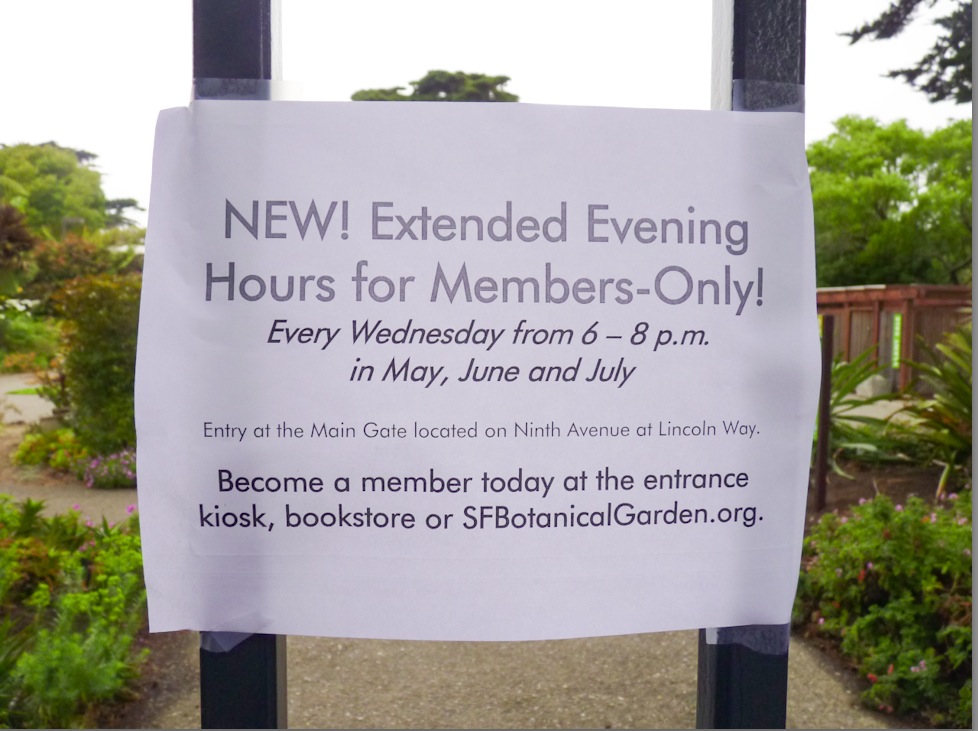
GUARDIAN OP-ED Riddle me this: When is a public space a private space? Answer: When it is controlled by a “nonprofit” in a “public-private partnership.”

For more than two decades, the San Francisco Botanical Garden Society attempted to obtain entry fees to Strybing Arboretum. It first changed its name from the Strybing Arboretum Society, then hired a lobbyist to push through changes to the name of the Arboretum itself, reasoning that the new name was more commercial.

When, in 2009, it found that it could not find support for fees for everyone, it chose to hire lobbyist Sam Lauter, at a cost of hundreds of thousands of dollars, to push through a $7 “nonresident” fee for a one-year “trial”. Gates were closed; entrance hours were extended; and people (many of them residents, yet undocumented) turned away in droves.

Despite this fact, and counter to the recommendations of Harvey Rose and Associates, the fees (which include steep rate rises for rentals at the Hall of Flowers) were extended for a year.

The ruse of “revenues” notwithstanding, the fees are really a tax on working people, one designed to keep people out. As any visitor on a sunny day can attest, it has acheived dramatic events: The gardens are empty! Members of the San Francisco Botanical Garden Society, however, enter for free and benefit from the tax dollars of Californians, many of whom must pay for entry. Mysteriously, the Society received a $725,000 grant in 2012 and one for $400,000 in 2011.

This July 20th, the Recreation and Park Department will present its budget with a Trojan Horse hidden in it — a contract which will effectively privatize these precious 55 acres for perpetuity, making all of us all second-class citizens in our own City.

Philip A. Ginsburg, manager of the Recreation and Park Department, negotiated this contract behind closed doors. We taxpayers wil be on the hook for paying electricity at their new building, a sprawling walled complex covering two football fields which will require a new road, fell some 50 trees and will endanger the habitat of Mark Twain’s frog. The fact that this building — to be used for parties, a store and offices — will be called a “Center For Sustainable Gardening” makes me feel that we have entered an era in which irony can no longer outdo reality.

Is a vision of a future filled with food trucks, ritzy private events and complete control over public space (by a small number of wealthy people with no accountability to the public), what Helene Strybing had in mind? Will a Supervisor not have the courage to step forward and demand that this set of legislation be considered on its own?

If we fail to act one thing is certain: In the coming years we will find an increasingly commercialized with an entrance charge in the double digits for all and sundry.

READ THE BOTANICAL GARDENS CONTRACT HERE (PDF, 25MB)

Panel sees Orwellian overtones in NSA spying scandal

1

It is now public knowledge that the NSA has been spying on us (unless you’ve been living under a rock and, lucky for you, exempt from digital surveillance) thanks to the information leaked by Edward Snowden last week.

In the wake of this scandal, people crowded into St. John’s Presbyterian Church in Berkeley on Tuesday, June 11, to participate in a panel discussion titled “Our Vanishing Civil Liberties,” centered around the intricacies of government intrusion and spying in the age of the War on Terror.

Among the panel members were Daniel Ellsberg, famed leaker of the Pentagon papers; Birgitta Jónsdóttir, member of the Icelandic Parliament; Normon Solomon, activist and author; and Nadia Kayyali, a legal fellow with the Bill of Rights Defense Committee.

As Kayyali noted, we now know about the NSA’s capability of obtaining the metadata for all domestic phone calls in the United States, which can include the call length, who you’re calling and in some cases the location of the phone calls.

So is Snowden a patriot or a traitor? For the panel members, the answer was obviously in support of the former. However, for California’s own US Sen. Dianne Feinstein, whose name the crowd constantly met with a crescendo of hissing, Snowden is a criminal, guilty of treason.

Solomon rallied against officials like Feinstein, who he believes should not be entrusted with the protection of our privacy. “What we discover is that the leaders in Congress, the leaders in the White House, the leaders in the courts unfortunately as well cannot be trusted with our lives and that includes our civil liberties,” he said.  

Ellsberg spoke of the comparisons between Snowden and Bradley Manning, an ex-U.S. soldier arrested in 2010 for leaking classified information to WikiLeaks, noting that Manning’s leaks dealt solely with issues “over there,” specifically in Iraq and Afghanistan, while Snowden’s case is inherently more domestic.

“The American people, like other humans, are unfortunately not that concerned about what is done to people over there,” said Ellsberg. “Especially when their leaders tell them that it is necessary to their safety. What strikes me about Snowden is that it affects us, you, everybody.”

However, the repercussions of Snowden’s leak are not solely rooted in America. Jónsdóttir informed the crowd that many European Union countries are concerned with the extended power of the NSA. 

“Our leaders in the many different countries in Europe are so worried about this probing into the privacy of citizens of the EU that they are thinking of building a fortress around Europe to protect us against the surveillance and the invasion of our privacy from the United States,” said Jónsdóttir.

Our challenge now, as Ellsberg stated, is escaping the abyss of unchecked government surveillance. But can we do it? For this question, Ellsberg didn’t have an answer.

The panel raised intertwining issues of government overreach and public apathy, painting the picture of a United States embodying the Orwellian dystopia of 1984 combined with Aldous Huxley’s portrait of apathetic hedonism in Brave New World.

However, Kayyali appeared optimistic for the future, calling upon education and public discussion as the only potential to escape from the intrusive acts of the NSA.

“Never stop educating yourself,” Kayyali told the crowd. “Take everything that you’ve learned here tonight and share it with those around you. The only way we are going to see any change is if we have an educated populace, something that we are severely lacking right now.”

Without action, Ellsberg warned of the potential for a country in which privacy is nonexistent, or what he colloquially refers to as, “The United Stasi of America.”

In her closing statement, Jónsdóttir offered this coda in the form of a poem: Now is the time to yield to the call of growth, to the call of action. You are the change makers. Sleepers of all ages, wake up now.”

Republicans are just plain daft, part 2

29

One of the most prosaic lines in film history is in 1974’s Godfather II. When Vito Corleone (Robert DeNiro) is asked by Peter Clemenza (Bruno Kirby) if he checked out the package of oily guns Clemenza had left him as the NYPD was hauling Clemenza away, Corleone replies coolly that “I’m not interested in things that don’t concern me”.

At that point, we realize that the future Don was not a Republican.

Today’s GOPster clown cultist is obsessed with things that do not concern them. Embryos and fetuses germinating in women they’ve never met. Same sex couples marrying thousands of miles from them. The well-being of the same plutocracy that do not pay them the same mind back in the least.

Conversely, when it is things that do concern them–Gulf oil spills, rising seas, warrantless searches of emails and phone calls, endless wars—oddly indifferent.

When someone prioritizes the irrelevant over the important, what else can one say?

They’re fucking daft.

Ultimate solution

10

What would happen if all Americans simply paid cash for everything?

Can’t afford it, don’t buy it. And always pay cash for all day to day items so that your purchases do not go into a database.

You say you have had it with a power structure that puts you in debt and tracks your every move? And you don’t wanna go through your life with a hook in your mouth and obligated to remain at a soul-starving day job you despise.

This would do it, wouldn’t it? Of course, if you’re happy being in hock, wage-slaving and a marketer’s dream, carry on, by all means.

Tale of two cities

25

Interesting piece in the LA Times a few days ago, Our new mayor, Eric Garcetti, wants to bring raves back to Los Angeles. After the death of a 15 year old that snuck into the Electric Daisy Carnival event at the Coliseum, the raves have gone to Vegas, where they’re pulling in 100K in attendance. The mayor sees dollar signs in those numbers, not to mention OT for city employees that have been hurting the last five years from budget cuts. A sensible idea.

It got me to thinking, as these things do, about a more general policy of bringing lucrative businesses and events to LA. After all, downtown business rents are cheaper than New York or Tokyo and there is far more space here as well. The city’s soon to be highest high rise will be a Korean owned hotel, so LA has already demonstrated a cooperation with Asian interests that cannot be matched. Not by New York or any other American city, even those on the West Coast. Like Seattle, Portland or erm, San Francisco.

If Garcetti and the city council decided to offer up better deals for high-tech than exist 390 miles to the Northwest, there is precious little Mayor Lee could do to match. LA has a lot more money and of greater importance, much more space. 49 square miles cannot compete with 480 square miles. And with the Internet making high tech jobs doable anywhere, why wouldn’t tech start ups decide to opt for LA?

Let’s face it, San Francisco has priced itself right off the grid. For all of Mayor Lee’s tax incentives, the city is incredibly expensive to rent or buy in. It is still possible to find a decent 1 BR in Silver Lake or Eagle Rock or Highland Park for under 1200 a month–where is that in SF, Bayview (if at all)? And no 82K parking spaces or multi million dollar Manhattan sized condos either–for 3 million bucks, you can buy a reasonable property in the West Side’s swankest hoods–what does that get you in Pacific Heights?

LA is a very expensive city to live in by dint of car ownership as necessity and driving distances. It’s also nowhere near as pretty as San Francisco is. But as SF approaches Tokyo-like exclusivity, it would take very little to pry high tech firms south–where it’s always warm, the beaches and ski resorts both near and best of all–the entertainment business and its attendant pleasures and power are nearby. 

Let’s face it, SF has screwed up–their biggest business for eons is tourism and that would never change were the city not so insistant on wrecking same with crack downs on clubs and “1984”-like scare tactics. Los Angeles–with its money and power can offer incentives that Mr. Lee and his cromies could only dream of–and with a forward thinker like Garcetti at the wheel, this may be inevitable.


Crapitalism

35

Happy Father’s Day! Be good to your dad (assuming he’s alive/you know who he is) and enjoy your kids (assuming you have any/know who they are).

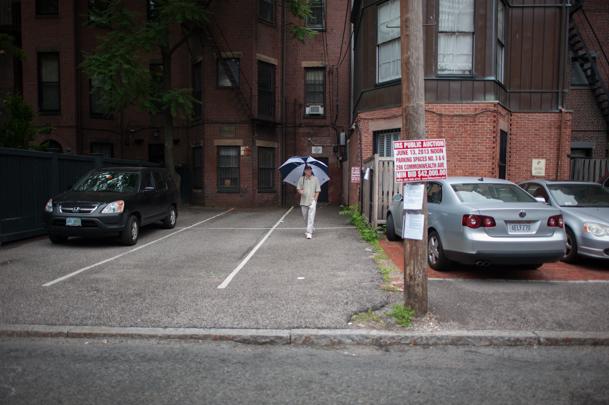
A remarkable story crossed my monitor this week. From back in the sacred Motherland of Massachusetts. Apparently, a pair of tandem parking spaces were auctioned off behind a toney Commonwealth Ave (Boston) condo for a whopping 560K–they’re shown in the photo. That’s over a half a million dollars in prime real estate yer gazing at.

Bid up from a sort of reasonable 42K and sold to a party that allegedly owns three spaces there already, this is the kind of story that makes one’s eyes glaze over in amazement. As primo as the location is, that tiny and stained bit of asphalt you’re looking at is not worth that price under any circumstances.

As that part of Boston is tightly zoned, it isn’t like it was bought to expand a brownstone. Nope, this is conspicuous consumption run completely amok or as a friend of mine back there put it, ”this could only have happened to people for whom money has no meaning”. (I suspect that the purchase was made as a “business expense” for a corporation, more to be revealed).

For 560 grand, you can still buy a modest home in Boston’s most desirable suburbs (all of which have better public schools than Boston and are cleaner and not plagued with unbearable traffic). And the property is but ten minutes on foot from downtown and the business district, cabs and car services are plentiful, therefore, why bother? As a possible long term investment? (Not a great idea as you will see).

This neighborhood, the Back Bay, was the first place I had my own digs. Adjusted for inflation, that apartment should go for about 420.00. It is now a million dollar and up condo and what was it? One gigantic room, likely the dining room of a three story home back in the 1800’s. And I still have friends in that neighborhood. Tellingly, all of them have been there at least 25 years and they could never afford it now.

By pricing all but the top of the top out of what once was an artist friendly neighborhood, the same neighborhood has the ripple effect of driving real estate values in adjacent neighborhoods past reason. Boston and San Francisco–joined at the hip by being the satellite cities to America’s twin powerhouses–are now unaffordable. 

A piece in the same paper that ran this story last year said it all. People aged 35-54 –which used to be an enormous demographic in Boston–no longer live there in large numbers. After university they just up and go because first jobs don’t pay enough to raise the scratch for a down payment. When a slab of concrete not even big enough to be a bedroom in a rooming house goes for 560K, it says that “what the market will bear” is not applicable.

This isn’t “free market capitalism”, it’s “crapitalism”. The laws of supply and demand have been so perverted by so few having so much, they almost don’t apply anymore. And my beautiful hometown–once a funky seaport with the best local music scene outside CB’s/Max’s–is now an overly exclusive playpen for folks that have brought back the Brahmin Age, only on ‘roids. Same as in SF—two small peninsulas whose essential character is being clobbered by venal plutocrats. Crapitalism couldn’t exist without tacit aid from the government–in SF, it’s in the form of tax breaks, in Boston, tax free academia is swallowing their city whole, reducing the amount of living units and artificially raising land value. That isn’t “supply and demand”.

The utlimate irony of this ridiculous transaction is that the Back Bay, like the Marina, is atop a landfill. The Charles River already overflows its banks and floods the basements of these expensive edifices more than it used to–so the parking spaces in question may be useless a fair amount of the time (of course, crapitalism being what it is, MA taxpayers will surely be stuck for the bill of seawalls and the like).

Bailouts, cronyism, loopholes–instead of an economic boom, we have Marie Antoinette style madness in our major cities. Pretty pitiful.