• No categories

Politics Blog

Who’s most likely to move out of San Francisco?

The results of San Francisco’s 2013 City Survey Report, released this past spring, contain some interesting data about who is most likely to leave San Francisco in the next three years, suggesting that the demographic shift currently underway will continue.

Parents with small children, younger residents, recent transplants, and people who are having a tough time covering their basic expenses are the most likely to move out of San Francisco in the next three years, according to the survey results.

Also, residents of District 6, which encompasses SoMa and the Tenderloin, seemed to be more in flux than residents living in other neighborhoods. “District 6 contains the highest percentage of residents who report being likely to move out of the city in the next three years (26 percent),” according to the survey results, “while District 10 contains the lowest (15 percent).”

According to the survey, “Parents, and particularly parents of young children, indicate that they are either very or somewhat likely to move out of the city in the next three years at a higher rate than non-parents. Those with children under age six – those likely to enroll in school shortly … report a much higher likelihood of moving in the next three years than parents of older children.”

The survey also noted that “more recent residents, younger residents and those facing challenges covering their basic expenses” also reported being more likely than others to leave the city in the next three years.

Here’s some insight as to who’s having a tough time making ends meet. In Districts 9, 10, and 11, according to the survey data, between 20 and 25 percent of respondents said it was challenging to cover basic expenses.

What’s this data say about the future of San Francisco? Apparently mature, financially secure professionals who have neither children nor financial worries are here to stay. For people whose lives are a bit more complicated, a more relevant question to ask might be what the future holds for the East Bay.

Willie’s shady role in Tim’s San Francisco

22

The Guardian’s longtime but recently ousted editor Tim Redmond continues to do excellent, important work through his Tim’s San Francisco blog, including stories today on the Chronicle’s blackout of yesterday’s big City College protest and the invasive tactics of online marketers.

But it was a story that he wrote yesterday that really should get wider play in the local media: a recent court case showed how Willie Brown received a whopping $750,000 to lobby for a local developer involved in the politically uber-juiced Transbay real estate deal. Tim builds off of the San Francisco Business Times article that broke the story and his own reporting for the Guardian questioning why Brown isn’t registered as a lobbyist.

“Nobody else is looking at the story, but it’s actually pretty big news. It sheds light on the huge amounts of money that get thrown around when someone’s trying to build a commercial office tower in San Francisco. It shows how much of a player Brown is and how much influence he’s seen to have under the Lee Administration,” Tim wrote.

Indeed, particularly given the huge and ethically question platform that the Chronicle hands Brown with his Sunday column, and the role that Brown played installing Lee into Room 200, where he’s carried water for Brown’s clients, this is a story that deserves far more attention and scrutiny.

Keep it up, Tim.

City College supporters protest state takeover and the agenda behind it

9

By Dalton Amador

Around 350 students, faculty members and other San Franciscans marched from City College’s downtown campus to the U.S. Department of Education Tuesday afternoon to protest the Accrediting Commission for Community and Junior College’s (ACCJC) decision to terminate City College’s accreditation effective July 31, 2014.

The Save CCSF Coalition sponsored the event. “We are not here to mourn, we are here to fight,” Shanell Williams, City College’s newly elected student trustee and one of the leaders of the coalition, told a cheering crowd. “ACCJC is a private, rogue group.”

The coalition sought to convince the Department of Education, which oversees the ACCJC, to immediately reverse the commission’s decision.

Behind Aztec dancers dressed in feathers and loincloths, protesters chanted “No more deception, no more lies, we don’t want to privatize” and held picket signs that read “Stop the corporate overthrow of public education at CCSF” as they marched down Market Street.

The coalition said that revoking City College’s accreditation is part of a systematic effort to undermine affordable education. Eric Blanc, one of the coalition’s leaders and a current City College student, said that the ACCJC’s decision to terminate City College’s accreditation was motivated in part by forcing would-be transfer students to take out student loans for private or for-profit universities.

“It’s clear that from the arbitrary norms the commission is using as its excuse to shut down City College that there is something much bigger going on,” he said. “(Students) are going to go to the University of Phoenix or prison.”

Williams agreed. “Where would I go?” she said, referring to a hypothetical City College student’s hope to transfer to a California State University or University of California campus without first going to a private university.  

City College Board of Trustees members Chris Jackson, Vice President Anita Grier and Rafael Mandelman addressed the crowd in front of the Department of Education.

Grier said that the “democratic process” that elected the Board of Trustees was “replaced by a feudal lord dictator,” referring to the ACCJC-appointed Special Trustee Robert Agrella, who now holds unilateral power over the board following the ACCJC’s decision. He had canceled a meeting scheduled for that day by President John Rizzo.

Supervisors Scott Wiener and David Campos also spoke, both saying that many of their constituents depend on City College. “Where is Ed Lee?” the crowd chanted spontaneously during different speakers’ addresses.

Lee did address the City College situation earlier in the day when he asked about it at the Board of Supervisors meeting, reiterating his previous statements supporting a state takeover. “It’s been a difficult decision and we had been hoping the decision of the accrediting commission would be different,” Lee said, going on to praise California Community College Chancellor Brice Harris, who Lee said, “has agreed to save City College through a state intervention.”

But on the streets, protesters rued the loss of local control and the agenda behind it.

Some independent organizations, not part of the Save CCSF Coalition, participated to show their support. Adam Wood, a firefighter of 18 years, held a sign that said, “San Francisco Firefighters support City College.”

“A lot of aspiring firefighters go through fire academy at City College,” he said. “It would be a real loss if it closed.”

City College will remain open for the following fall and spring semesters. It can ask for a review of the decision to the ACCJC. Should the ACCJC affirm its decisions, the college can appeal. The college would remain open during the appeal process.

Torture lawyer John Yoo drafted legal rationale for NSA spying, protesters targeting his talk in SF tonight

Former U.S. Department of Justice attorney John Yoo is no stranger to protests. He’s responsible for drafting controversial memos under the Bush Administration to provide legal justification for torture, and as a result, anti-war activists have been following him around for years.

Turns out, Yoo also drafted legal opinions justifying the NSA’s surveillance program. The attorney and law professor will be the San Francisco Republican Party’s guest of honor tonight, at an event in North Beach.

Yoo will speak on “the recent revelations of the NSA’s PRISM program, the status of Edward Snowden, outcomes of recent Supreme Court decisions, and any other interesting topics of the day,” according to the event announcement. Naturally, his talk will be a magnet for protesters, who plan to congregate outside Villa Taverna, the restaurant where he’ll be speaking.

Just how important a role did Yoo play in providing legal justification for the spying program? Here’s some insight from Pulitzer Prize-winning reporter Barton Gellman, who was interviewed for a recent report on PBS NewsHour:

“Well, the brief history of [the spying program] is that it was invented largely by Vice President Dick Cheney and his lawyer David Addington, with the help of Mike Hayden, who was running the NSA. The Justice Department had secret opinions written by John Yoo, who’s the same guy who wrote the torture opinions and some others that became quite controversial later.”

This bit of history hasn’t escaped the notice of Bay Area anti-war activists with World Can’t Wait, who’ve turned out in the past at UC Berkeley, where Yoo teaches Constitutional law, to target him for his involvement in the torture memos. Yoo recently wrote that the NSA spying program “will not prove as bad as it first seems” and opined that it presents “no clear constitutional violations.”

World Can’t Wait has also rallied behind NSA whistleblower Edward Snowden. “The people of the world want the U.S. to take its hands off Edward Snowden,” says World Can’t Wait spokesperson Linda Jacobs. “There is an enormous wellspring of public support for him.” Jacobs is rallying the troops to show up outside Yoo’s talk tonight.

As illustrated by this screen shot from their website, Snowden obviously hit all the right notes for World Can’t Wait.

Yoo has sparked the ire of Snowden supporters. In an editorial for the National Review Online last month, he wrote, Edward Snowden should go to jail, as quickly and for as long as possible.”

By the way, the hilarious response this provoked from Wonkette’s Alex Ruthrauff is totally worth a read:

“Remember all the fun we had debating whether torture was torture? Well, the good times don’t have to end, because everyone’s favorite unindicted war criminal John Yoo is back at National Review Online’s Treasury of Travesties “The Corner” to remind us all that John Yoo is a fucking disgrace. In this installment of ‘John Yoo’s John Yoo Is A Fucking Disgrace Internet Column,’ John Yoo informs us that we must “Prosecute Snowden.” A fascinating thesis that is arguably true! But will John Yoo make our heads explode by padding out his column with infuriating conflations and First Amendment hypocrisy? Ha, does the Pope wash lady feet?”

In tech-dominated Mid-Market, arts center beats the odds

Is there a place for community theaters and nonprofit arts and education programs in pricey San Francisco? The 950 Center for Art and Education, a project that will be housed on the corner of Market and Turk streets in San Francisco, has gained a foothold against the odds.

Two years in the making, the center will provide permanently affordable performance facilities for the Lorraine Hansberry and Magic theaters, and create affordable space for art education organizations including Youth Speaks, the American Conservatory Theater and All Stars Project. Other groups, such as Lines Ballet, the Tenderloin Boys and Girls Club and others previously unsure whether they could continue to rent in the Tenderloin/SoMa area will get the chance to expand their performance and programming capabilities at the center.

Because the neighborhood is in such high demand in the wake of recent tax breaks and incentives designed to bring tech businesses to SF, it took the Tenderloin Economic Development Project, a part of the North of Market Neighborhood Improvement Corporation, at least two years to secure the property for the arts and education complex. Until very recently, the project’s fate was hanging in the balance, with many groups uncertain whether they would be able to remain in the city.

Three-quarters of the project space that TEDP had long set its sites on is located at 970 Market, and was initially owned by Lone Star, a Texas-based hedge fund. The remaining project space, at 950 Market, was under the ownership of the Thatcher family, known for philanthropy.

Initially, TEDP “had a deal with the hedge fund,” says TEDP director Elvin Padilla, but after property values rose, “they basically walked away from the negotiating table. The crisis moment was, who’s going to control the land – and will they collaborate with us?”

Padilla credits Gladys Thatcher, founder of the San Francisco Education Fund, as “the reason we decided to make the attempt [to acquire these spaces for the 950 Center] in the first place.” 

When TEDP first pitched the idea to her several years ago, “she gave us her blessing we decided to make a go of it,” he explained.

Thatcher is trustee and former board member of the San Francisco Foundation, which worked alongside TEDP and the Rainin Foundation to secure the lion’s share of the land needed for the 950 Center, by facilitating a purchase of the 970 Market Parcel from Lone Star.

On June 7, the property was transferred from Lone Star to Group I, a San Francisco-based real estate development firm that Thatcher is friendly with. Now that the sale has gone through, the space will be devoted to the arts and education programming that TEDP had long envisioned. The San Francisco Foundation plans to facilitate development of the center through the creation of a new sponsoring organization that will be housed at Community Initiatives, a nonprofit. 

While he is grateful for the community support, Padilla likened their quest to gain 970 Market to a climb up Mt. Everest.

A 2011 payroll tax exclusion zone introduced by Mayor Ed Lee vastly increased the property value in the mid-Market area. Although Lee had a soft spot for the 950 Arts and Education Center and even organized events to support bringing that use to mid-Market, his new policy left the project facing an uncertain future in a suddenly pricey strip along Market Street. “He doesn’t have any real authority over private sector transactions,” Padilla says, so all the Mayor could do was stipulate the city’s interest in using this land for “arts and education.”

The city doesn’t offer public funding for projects like 950 Center for Arts and Education. To “subsidize on the front end,” as Padilla puts it, the center will have to rely on the backing of individual investors, philanthropic groups and new market tax credits to reduce and eliminate the debt entirely, so the organizations that will be housed at the center don’t have to carry a mortgage.

In the end, it was only through the efforts of wealthy and connected individuals that plans for the center were nailed down rather than extinguished. “Mid-Market is going through a very rapid transformation,” says Dr. Sandra R. Hernández, Chief Executive Officer of the San Francisco Foundation. “We’re just lucky that Group I, the developer, shares this vision with us for an arts center.”

Looking back on the years of effort it took to piece the plan together, Padilla noted, “When we started this, it was before the tech boom. Now, the pressure on the real estate is many times what it was when we conceptualized the 950 project.” 

That uncertainty finally came to an end for Padilla’s organization when Group I closed the deal with Lone Star on June 7. “That really [did] start the project officially,” Hernández says. “We’re now working with a number of the organizations that have expressed interest in having permanent space or accessible space for their programming or rehearsals for their theater production.”

Opponents of City College takeover to march through SF

15

Opponents of last week’s decision to revoke the accreditation of City College of San Francisco and place the district under state control until that death sentence becomes official in July 2014 plan to rally and march through San Francisco today [Tues/9] at 4pm.

The procession will begin at the CCSF’s downtown campus at 88 Fourth Street and end outside the U.S. Department of Education — whose policy of coercing colleges to focus on job training and university prep led to the crackdown on CCSF, as we report in tomorrow’s Guardian — at 50 Beale Street.

Among the local officials who will join the march are Assemblymember Tom Ammiano, San Francisco Central Labor Council Executive Director Tim Paulson, and Alisa Messer, president of the American Federation of Teachers Local 2121, who this morning issued statements condemning the decision by the Accrediting Commission for Community and Junior Colleges.

“This decision is nothing less than an attack on the people of San Francisco,” Ammiano said. “All of us benefit from having this great 78-year-old institution, whether we take courses or not. San Francisco voters recognized that at the polls just last fall when they passed Proposition A to support the college financially. In addition, the appointment of a state official to manage the school takes away the local voice of CCSF’s duly elected trustees.”

“The quality of education at City College is not in question,” said Messer, who is also an English teacher at the college. “For the last year this institution has turned itself upside down to address the recommendations of the Commission, with employees putting in thousands of hours of effort and making huge sacrifices. To be told at the end of this process that the effort has had no impact is simply outrageous.”

“City College is vital and has made major progress in turning around many of the shortcomings identified by the Commission,” said Paulson. “The actions of the ACCJC – an organization accountable to no one — have unnecessarily put at risk the livelihoods of the nearly 2,500 hard-working men and women at the college. What’s more, their move to deny CCSF accreditation has imperiled the future of San Francisco’s working people, who rely heavily on a CCSF education for workforce training, language learning, and a pathway to better futures for themselves and their communities.”

“The Accrediting Commission’s handiwork has not improved educational quality at CCSF,” said Messer. “We want a stronger, better college, but in many instances direction from the ACCJC has moved us in the wrong direction. The Accrediting Commission should be accountable for the impact of its actions.”

 “The accrediting agency has only worked half-heartedly to support City College, and instead seems bent on tearing it down,” Ammiano said. “The decision needs to be reversed so we can all go to work building on the successes and fixing the few problems, instead of spending our time starting over from scratch because the school was destroyed by naysayers.”

Is Larry Ellison cheating?

If you’re wondering why the hell there was only one boat was out there “racing” in the first match of the America’s Cup on Sunday, here’s the rundown on “Ruddergate,” yet another contentious chapter in the 162-year history of the America’s Cup.

At issue is the size and shape of the rudders on the twin hulls of the AC72s. Original design parameters were established back in 2010 when, in the interest of fairness, details of the boats were agreed upon by all teams — so exactly this kind of conflict wouldn’t occur. A “box rule” was applied, which means the boats won’t be identical, but they will be similar (Emirates Team New Zealand and Luna Rossa actually have near-identical boats as the Italians came late to the party and bought New Zealand’s design to save time.)

Then, after Andrew Simpson was killed when Artemis’s boat capsized on May 9, regatta director Iain Murray made 37 new safety recommendations, which the Coast Guard made into requirements when they permitted the race.

“Basically, for marine events, marine event sponsors are responsible for the safety of the events,” U.S. Coast Guard chief Mike Lutz explained, noting that the 37 rule changes originated with Murray and were approved by the Coast Guard as a package.

Some of those changes are straightforward and simple, like no guests aboard during races, more body armor, buoyancy and other personal safety gear, and no racing in winds over 23 knots (That one is actually a hindrance for ETNZ and Luna Rossa, who deliberately built for prevailing San Francisco Bay conditions, i.e. as much as 35 knots of wind.) 

But that’s not what the two teams are protesting. They don’t like new size and shape rules for the rudder elevators, which are designed to stabilize the boat when it’s foiling. Oracle has a pretty good description of how they work here.

The new rule lays out minimum and maximum area, depth, and span and says they should be symmetrical. None of the 36 other safety recommendations touch on design elements. The fishy part is that Oracle has been practicing with a bigger, symmetrical rudder elevator since they launched their second boat on April 24. Before Simpson died, before Murray’s new safety rules, Oracle was using what would be considered an illegal rudder. And now, voila, it’s legal.

The Kiwis immediately filed a protest to the rule, on June 28, and four days later Luna Rossa joined them.

“I’m not saying all the changes have been made for them, but it’s nothing related to safety. What really upsets me is that there is one boat sailing since they launched on April 24 who has been sailing out of the class rule,” Luna Rossa’s Max Sirena told the media on July 2. “Why design a boat that doesn’t comply with the class rule? And then one week before the Louis Vuitton Cup, you ask the other teams to change the position of the rudders and the elevators…”

In the meantime, rather than delay the first race or move up the date of the protest hearing, Murray said it was okay for the Kiwis and Italians to race without the “safer” rudder elevators, to which ETNZ’s Grant Dalton said, “The point is that under the recommendations you can run both. The question is why?  Because, if you can run both, then why do you need the ones that aren’t rule compliant?”

Dalton also thinks this design change could make the boats more dangerous because the rudder elevators would extend wider than the maximum beam of the boat and could slice a sailor in half if he slips over the side of the hull.

He hasn’t said something dirty’s going down. He told the media, “If the question is, has that rule been put in there deliberately to help Oracle, then no I don’t think it has – I don’t think for a second Iain Murray has done that. Is it helping them as a kind of byproduct of it, then yes it is.”

Luna Rossa’s Max Sirena has been more critical. “It is not safety related at all … It is the first time in the history of the America’s Cup that they can change the class rule just like that, just because they want to change it and with no reason. To change a class rule you need unanimity. Why when Oracle capsized last October did they not come up with this change then?”

Luna Rossa boycotted until the jury made a decision, stating that it would seem like silent affirmation if they raced. A last minute deal to get them on Sunday’s course fell through and for the time being, the Italians are sticking to their principles – they were out practicing yesterday, showing their boat is more than capable of performing with the smaller, asymmetrical, noncompliant rudders.

“The teams don’t believe it’s proper to change the class rule without a vote of the teams,” said America’s Cup spokesperson Sean McNeill. “They believe [Murray] didn’t have the authority to make such a change.”

If the jury rules in favor of Luna Rossa and ETNZ, Murray would have to go back to the Coast Guard with a new safety plan in order to obtain a new racing permit. “If there’s any change, they would have to submit an updated safety plan,” Lutz noted, saying he was confident that it could be reviewed in a short time and a second permit could be issued without too much of a delay.

The jury convened yesterday to hear the protests and a decision is due Wednesday, but this debacle raises a couple of questions. Why didn’t they hear the protests prior to the first race? That race day was established a long time ago, and hasn’t changed. The jury had at least five days to review the protests – ample time if the race organizers were really concerned with keeping the event from totally losing face.

Instead, two of the three boats were out of the race before it had even begun, creating animosity among the handful of sponsors still involved. Louis Vuitton’s Bruno Trouble – who initially anticipated 15 contenders, then 8, and certainly no less than 5 – is pissed that not even two could show up and the event has been very far from the big splash it was billed to be. Meanwhile, international media aren’t holding back the ridicule. Fairfax NZ’s Duncan Johnstone called it “a hugely embarrassing situation for regatta organisers, a major dent for the on-shore festivities and massive sponsorships that envelop this ridiculously expensive event.”

And, if the larger rudder elevators really are safer, why didn’t Oracle say something back in April before Simpson died? Or in October when their boat capsized? Instead, they’ve been very mum on the subject. Control is going to be as important as speed in this Cup and with the Kiwis and Italians burnt by the lowered wind limits, it looks like Ellison is hoping to top them in the control category. Larger rudders create more drag and less speed, but may get Oracle foiling for longer periods with enhanced stability – which they desperately need.

ETNZ and Luna Rossa have indicated it would be impossible for them to adapt their rudders now that racing has begun. Meanwhile, Oracle gets to hang back until the finals in September, practicing their moves while Ellison carries on with acting too rich too fail.

Rebecca Bowe contributed to this report.

Mime Troupe debuts its usual political satire in stripped down fashion

2

The San Francisco Mime Troupe overcame its recent financial troubles and debuted the SFMT’s latest season of free, socially-relevant theater in Dolores Park yesterday (Thu/4), a rollicking send-up on the political culture and Chevron’s greedy plunder of Ecuador, delivered by a smaller than usual cast.

“We all felt really great just to have the opportunity to do the show because of the financial issues,” Pat Moran, one of the SFMT’s head writers, told the Guardian.

“It came very close to not happening this year,” Moran said. “There was a period of about a month or a month and a half when the show wasn’t going to happen, but we had to keep writing as if there were going to be one.”

After a “successful grassroots fundraising effort,” according to the SFMT website, the Troupe knew for sure there would be a show, and was able to resume rehearsal in April. But it was a show marked by austerity measures that slashed the number of actors and musicians involved in the performance. There were just four actors who hurried through various costume changes to fill all the parts.

Moran helped write the SFMT’s two-part “Oil and Water” that debuted Thursday. The first part “Deal with the Devil” begins in the White House Oval Office, set in the future, where a secret service agent finds the President dead on the day of an important speech on environmental issues. The second part “Crude Intentions” focuses on Chevron, whose headquarters is now in San Ramon, CA, but was previously in San Francisco.

The performance “continues in a noir style with some slapstick comedy,” according to Moran. And as it has done since its beginning in 1959, the SFMT hits strongly on the political in “Oil and Water,” focusing on Chevron’s mounting counter-suits and millions of dollars spent in order to fend off the settlement requirements that an Ecuadorian judge awarded to its people for damages Chevron committed.

“We focus on Chevron as a specific and local entity, but also as a way to focus on the larger issue of how oil companies use tactics to control their image in public, from National Public Radio donations and advertisements,” Moran said.

These SFMT shows rely on foundational grants and on-the-spot cash donations from audiences. And earlier this year, the SFMT’s financial situation worsened due to the loss of foundation money, including its long-held National Endowment for the Arts grant and others. In addition, cash donations have gone down since, as Moran observed, “people carry less money around now” when they come to SFMT shows in the park.

“But at this point, we are optimistic. We have a show up, and that’s our focus,” Moran added. Although up and running now until its last show September 2nd, come the end of the season the SFMT may have to rethink doing its performances in public space for free, Moran said.
“In September we might have to re-imagine the show. We may not be able to make shows happen in park, or at least free with donations; it may not work out. We might have to figure out something new, rather than strip away the elements of the current show so we can afford it.”

Celebrating independence, embracing wage slavery

50

On the eve of Independence Day, too many San Franciscans seem eager to give up on the very idea of independence, instead willingly buying into the divide and conquer strategies of those who seek to control and exploit us. Just consider the big news of the day.

On Day Three of the BART strike, mainstream and social media are once again awash with angry anti-union diatribes by people who are resentful of the fact that some workers in this society still manage to earn the pensions and decent salaries that most of us wage slaves are being denied.

Pensions are the one thing that allows the working class some degree of independence during its twilight years. And the average BART salary of $72,000 annually shouldn’t be considered excessive in an expensive city that will chew up at least a third of that in housing costs.

But they are each more than most of us are getting, so it’s easy to turn many people against their fellow workers, even though the real targets of our ire should be the bosses and economic system that are denying us our independence and the means to pursue our happiness.

It’s a similar story with the breaking news of the day: City College of San Francisco losing its accreditation and being turned over to state control. While there are some reasons to criticize how this important institution has been managed over the years, it was still being managed by locally elected trustees who made the best decisions they could under bad circumstances.

They made decisions to maintain a broad-based curriculum that this community wanted and needed, and to avoid exploiting the faculty like so many other educational institutions are doing, in the process taking a gamble with lower reserves than may be needed. And the voters of San Francisco stepped up to support CCSF with a parcel tax that was helping to ease it away from the brink, acting as a proud and independent community does during troubled times.

But a commission of unelected bureaucrats on a ideological mission to transform educational institutions into something less than the broad-based community resources that CCSF has strived to be decided to make an example of San Francisco. And they did so with the full support of Mayor Ed Lee, who issued a statement today criticizing local officials for not embracing even harsher austerity measures than they did, and saying “I fully support” the state takeover.

Lee’s hand-picked panel recommending reforms of the Housing Authority is also proposing to sacrifice the independence of poor San Franciscans in favor of ever-more subsidies to real estate developers, according to a story in today’s San Francisco Chronicle.

Among the “reforms” is a proposal to divert federal money from the Section 8 program that offers rent-subsidies to the poor, as Chron reporter John Cote described like this: “A terribly run program that provides low-income residents with vouchers for private housing would be administered by the city, rather than the federally funded public housing agency. The vouchers would be prioritized for certain affordable housing projects, creating dedicated revenue to help secure loans to build them.”

So the vouchers that allow low-income people some independence — rather than living in squalid, chronically mismanaged public housing projects in San Francisco — will instead subsidize development projects. Yes, we do need to subsidize affordable housing development, which this city is underfunding, but we shouldn’t be taking the meager resources of society’s least fortunate families to do so.  

I have no doubts that Lee will jump at this suggestion (although its unlikely to be so eagerly embraced by federal regulators at HUD) given his penchant for shady real estate schemes that line the pockets of the powerful, like the one that the Center for Investigative Reporting uncovered this week.

CIR reported that the San Francisco Bay Area Regional Center — a for-profit company connected to Willie Brown that is arranging immigration visas for Chinese nationals who invest in Lennar’s Hunters Point housing development — is getting key help from Lee and members of his staff.

This project was already looking like a bait-and-switch scam, as we also reported this week, with Lennar being guaranteed profits without even putting up its own money, thanks to Lee’s willingness to use the power of his office to solicit funds on behalf of the country’s biggest residential developer.

If Lennar wasn’t going to build the affordable housing we need on the front end, or put up the money itself, why didn’t the city just administer this project and give the work to local contractors? What exactly is this Florida-based corporation doing in exchange for being handed some of the most valuable real estate in the city, except for helping its powerful local friends who pulled strings on its behalf?

What’s motivating Lee these days? Well, considering that Brown and other power brokers placed him in the Mayor’s Office after a career at City Hall doing their bidding — a role he seems to be still playing today in his powerful new role — I’d say it was a lack of independence.

It’s all pretty depressing, but at least we have a holiday tomorrow to celebrate our independence. Happy Fourth of July, comrades.  

8 Washington opponents try to torpedo counter-initiative

Opponents of 8 Washington, a hotly contested development project that would erect 134 new condos priced at $5 million apiece and up along the San Francisco waterfront, are seeking to thwart a counter-initiative developers have launched to solicit voter approval for the project on the November ballot.

In a July 1 letter from The Sutton Law Firm to Hanson Bridgett LLP, a firm representing the project proponents, political lawyer and fixer Jim Sutton highlights “fatal legal flaws” he claims would invalidate each and every signature collected in support of the 8 Washington initiative. It’s likely a precursor to a lawsuit. Apparently, Sutton got involved through his connection with former City Attorney Louise Renne, who opposes the 8 Washington plan.

Organized under No Wall on the Northeast Waterfront, opponents circulated petitions of their own earlier this year to challenge San Francisco Board of Supervisors’ approval of 8 Washington, asking voters to weigh in on the Board’s waiver of building height limit restrictions. Polling has indicated they’ll succeed (a win in their case is a majority of “no” votes), effectively sinking the project. That prompted 8 Washington proponents to generate their own counter-initiative.

Sutton’s letter demands that 8 Washington proponents not submit the initiative to the Department of Elections for signature verification, unless they first re-circulate the petitions. Of course, that would torpedo the whole endeavor, since there’s no way proponents could gather enough signatures in time for the imminent filing deadline.

The aforementioned “fatal legal flaws,” meanwhile, seem to illustrate why high-powered attorneys like Sutton rake in the big bucks. Apparently, the initiative proponents neglected to attach a few maps detailing the height limit increases, in violation of a requirement that proponents present the “full text” of a proposal to voters. And then there’s this:

Whether it’s a photocopying error or an attempt at obfuscation, the map on the left (circulated by the pro-development camp) makes it impossible to read the height limit increase. (The map on the right was circulated by opponents.) This seemingly minute detail matters, according to No Wall on the Northeast Waterfront spokesperson Jon Golinger, because “the whole point of this is the height increase.”

David Beltran, a spokesperson for the pro- 8 Washington folks, responded to a Guardian request for comment by saying, “Our opponents are offering up yet another baseless claim.” He called it a distraction “from having to justify why they are asking our City to give up new parks, jobs, and housing and millions of dollars in city benefits that includes $11 million for new affordable housing—to protect an asphalt parking lot and private club,” referencing a recreational center that’s served a predominantly middle class clientele for years that would be razed to make way for 8 Washington.

Beltran also attached a complaint Hanson Bridgett had filed with the San Francisco Ethics Commission, charging that No Wall on the Northeast Waterfront had failed to meet campaign filing deadlines, and urging city officials to “immediately investigate the delay” and impose fines of $5,000 per violation.

City College loses accreditation, throwing its future into doubt

79

City College of San Francisco will lose its accreditation, it was announced today, and the venerable local college may not survive. With its impending death, the future of thousands of San Franciscans seeking education and a better life are in limbo.

The loss of accreditation becomes effective in one year, and the decision is being appealed, during which time local control is being transferred to a state trustee. The California Community College Chancellor’s Office has not yet named the trustee that it will appoint, and officials say the trustee will be given full authority to make decisions in the place of the current Board of Trustees.

“I think state intervention is going to be necessary,” said Mayor Ed Lee told reporters this afternoon.

“It’s imperative City College stay open for business and education the 85,000 students it serves” Lee said in a conference call with reporters. “I’m concerned about the devastating impact City College’s termination would have on our great city.”

The long-awaited decision was expected sometime around this long holiday weekend, and officials knew losing the accreditation was a possibility, but most said privately that they didn’t think the Accrediting Commission of Community and Junior Colleges would actually pull the trigger. So right now, everyone is still reeling from the news.

“It’s too soon to say who that special trustee will be at that point,” State Community College Chancellor Brice Harris said. 

Locally elected Trustee Rafael Mandelman said that the locally elected board will continue operating until July of 2014, when the termination of the accreditation becomes effective, but it’s unclear what authority it will now have. 

“It’s disappointing, it’s outrageous, I don’t think it’s called for. I don’t think it’s the right outcome. I don’t think the state is going to do a better job running the school than a local board could,” he told us.

“We believe that the best way to bring the college from certain closure is to put the college under trusteeship of certain powers,” Harris said, adding that the search for a new chancellor for CCSF will now be accelerated. The current chancellor is an interim chancellor, the second one in a year after chancellor Don Griffin left the school due to an illness.

“We are disappointed in the Commission’s decision. We will be filing a request for review and will do everything in our power to have this decision reversed,” Chancellor Thelma Scott-Skillman said in a prepared statement. “What is of utmost importance at this time is that City College remains open, and instruction and services will continue. We want to assure our students and their families that we will serve them and continue to provide the high quality education that they expect from City College. We will continue to register new and returning students for the Fall semester and look forward to their arrival on campus in August.”

City College was put on sanction by the commission back in July of 2012 after allegedly failing to fix issues identified by the commission six years prior. Since then, the college has been in panic mode. 

The threat of closure brought drastic changes at whip lash speed over the past few months: two campuses shuttered, over 40 counselors and support staff were laid off, faculty took a 7 percent pay cut and student enrollment has plummeted.

Vice Chancellor of Administration and Finance Peter Goldstein put the college’s finances this way, “This has been a nightmare of a fiscal year.”

But there were positive improvements as well, said Alisa Messer, an English teacher and faculty union president of City College’s local AFT 2121. 

“Faculty have banded together and worked hard to address the requirements around student learning outcomes,” Messer said. SLOs, as they’re commonly known, measure student learning over the course of a class and in a student’s college career. 

“The accrediting commission felt it wasn’t integrated throughout the college, but they would be hard pressed to say it isn’t now,” she said.

Despite City College’s improvements the California Federation of Teachers is set on fighting the accreditation commission’s decision. They filed a massive 280-plus page complaint to the U.S. Department of Education alleging that the accreditation commission violated many of its own rules in evaluating CCSF.


The commission responded by locking out over 30 faculty and concerned citizens from its most recent public meeting, even barring a reporter from the SF Chronicle from entering.  

Now the commission has asked visiting accreditation teams, who evaluate colleges on site, to shred their documentation to make such complaints harder to research, which was originally reported on by the Chronicle of Higher Education.

“The work you do here is a position of trust, the documents you receive are given to you in that light.” said a faculty member who had served on prior accreditation teams, but did not wish to be named because they are not approved to speak on behalf of the accreditation commission. “When you’re done fulfilling your responsibility its good policy to dispose of them, and its the commission’s expectation.”

Some of the documents are proprietary information at for-profit colleges, such as Heald. It makes sense to protect that private information. The visiting team has “a look behind the curtain,” the faculty member said. 

But Messer isn’t buying it. “We’ve asked they be more transparent, they’ve done the opposite of that,” Messer said.

On the college’s Ocean campus, just outside the Chancellor’s office in a retro brown speckled hallway, Dennis Garcia walked by with his City College registration info in hand.

He’s ready for his next semester, and unlike the thousands of students that didn’t enroll in City College this year, he forged ahead.  

“I decided to come because I’m not scared or nervous about the school going down,” he said.

Garcia is an 18-year-old criminal justice major and SF native who dreams of transferring to San Francisco or San Jose State Universities. He wants to be a star soccer player while in school.

But why did he stay when so many others fled? 

“Why City College? It’s home,” he said. “People say, coming here is not successful, but I mean, sometimes you don’t have money and you’re not an A or B student, but you get your math and English done and you go from there. College is college.”

Now, whether City College remains a college this time next year is still an open question.


“Eviction Free Summer” activists show up outside a landlord’s office to protest an eviction

On July 2, activists from “Eviction Free Summer,” formed to defend tenants facing eviction, gathered outside landlord Rick Holman’s South Park office building in San Francisco to protest an eviction he’d initiated against a Mission-based activist collective.

Organizer Fred Sherburn-Zimmer said it was one of many peaceful protests the housing activists plan to stage against property owners this summer. “We’re taking it to the landlord’s homes and offices,” Sherburn-Zimmer said. “They can’t pretend they’re not ruining people’s lives by displacing them.”

This past April, collective members from In The Works, an organization that rents space in what is often called the “17 Reasons” building, at 17th and Mission streets, received an eviction notice from Holman alleging illegal subletting.

Holman is a managing partner at Asher Investment Group, and from the perspective of Sherburn-Zimmer and other protesters, his move to evict the collective is helping to propel a trend of gentrification in the Mission. “We need this space, and if the whole neighborhood is high-end realty, then it’s not really helping the community,” Sherburn-Zimmer said.

The In The Works Collective bills itself as an anti-authoritarian, anti-capitalist arts and events collective, which regularly hosts skill-sharing workshops and other activism-oriented events. A collective member who introduced herself as Madeline said Holman has not been the most hospitable landlord.

“When he first came to talk to us, he said we had bad posture and body language,” she recounted. “The day after we got the three-day notice, the locks were changed.” 

When the Guardian reached Holman this past May seeking comment for a longer article about widespread evictions, he declined to comment on the matter but emphasized that he planned to keep the building as commercial office space rather than convert it into high-end condos, and said his other tenants had expressed no complaints.

Like many folks facing eviction from San Francisco rental properties, In The Works may be forced to find another space. Currently, Madeline says the collective is paying 72 cents a square foot for the 5,200 square foot place — and it’s highly unlikely that they’ll find a place in the Mission for a similar price. That’s why they welcomed support from the activists at Eviction-Free Summer.

“I totally respect them helping us out,” Madeline said. “It’s important that we stick together. Our place has always been big on solidarity and community building.” 

Eviction Free Summer hasn’t revealed what other landlords they might target, yet they plan to continue staging protests outside landlords’ homes and offices in coming months. “This is just the beginning of this direct action group,” Sherburn-Zimmer said. “We will do anything to prevent people from losing their homes and spaces.”

City budget boosts homelessness spending, but not enough to meet demand

6

The city budget that is now awaiting approval by the Board of Supervisors includes new funding for individuals and families facing homelessness, but community advocates say it doesn’t devote enough of the city’s rebounding revenues to addressing this growing problem.

Last Thursday, the Board of Supervisor’s Budget and Finance Committee approved $2.4 million in “add-backs” to homeless services, on top of the $2.3 million that Mayor Ed Lee pledged to supplement the city’s initiatives to curb the burgeoning number of San Francisco’s individuals and families becoming homeless.

The committee’s proposed budget will go before the full Board of Supervisors’ for a vote this month, devoting at least $2 million for this fiscal year and $1 million the next in to continue the successful Homelessness Prevention and Rapid Re-housing (HPRP) program that provides eviction defense and rent and utility vouchers to residents at-risk of homelessness.

Other homelessness initiatives in the proposed budget include extending the Lower Haight First Friendship shelter for homeless families to a year-round schedule, permanent housing units at 5th and Harrison streets for transitional age youth, 33 Local Operating Subsidy Program (or LOSP) subsidies for low-income homeless individuals and families, and funding to construct 24 shelter beds for the City’s first LGBTQ-focused homeless shelter at Dolores Street Community Center.

But for many residents and families, these initiatives may not be enough to stay in their homes, or re-house themselves after becoming homeless. And as the rent prices continue to drastically rise in San Francisco as the city’s economy heats up, the search for affordable housing or shelter beds has become more and more desperate.

January’s point-in-time homeless count identified 6,436 homeless persons on the streets and in the shelters in the city, a majority of which became homeless as San Franciscans. The current number on the city’s wait list is 220 families with an expected wait of seven to eight months, according to the Human Services Agency, which runs the city’s homeless shelter system. This is slightly down from 268 families earlier this year, then the largest in city history.

As the Guardian reported recently, the number of eviction notices in San Francisco hit a 12-year high this year, indicating an increase in displacement that may compound the number of families on the emergency shelter waiting list.

Bevan Dufty, the mayor’s point person on homelessness, told the Guardian that “the city definitely is not seeking to expand the shelter system,” despite the near-record waiting list.

 “Yes, we have lost shelter beds in recent years, and the 24 we are adding at Dolores Street Community Services is a minimal number,” Dufty added. “But you have to have a toolbox to respond in different ways.” And Dufty claims that re-housing families through programs like HPRP services in the budget has been shown to be the best way to prevent homelessness.

In response, Jennifer Friedenbach of the Coalition on Homelessness told the Guardian that, although the $1 million of HPRP services did prevent 1,300 San Francisco households from becoming homeless last year, it only covered 15 percent of the city’s overall need based on the number of people seeking services through San Francisco’s Eviction Defense Collaborative.

When asked to respond to the Coalition’s estimate, Dufty replied that he could not comment on its accuracy, but he conceded that the HPRP funding is “certainly not going to satisfy all the need.”

Dufty stressed that the city has been able to reduce the number of homeless veterans and has responded to a noticeable outcry in the need for more transitional housing, especially from LGBTQ community activists. Although the version of the budget making it to the Board of Supervisor’s vote this month would not expand the homeless shelter system beyond the Dolores Street Community Services project, it would improve the city’s oft-criticized shelter reservation system for single adults.

Along with Dufty and the Mayor Lee’s support, Friedenbach advocated in the homeless community to change the current line-based system to a lotterized system run through the city’s 311 system.

“The current shelter waitlist system is really archaic,” Friedenbach told the Guardian. “People spend 17 hours a day trying to get a bed at night.” Mayor Lee proposed this change in his budget, especially so the indigent and elderly no longer have to stand for hours waiting in line for a bed.

Though Friedenbach acknowledges the positive in the budget initiatives, she pointed out that there is still only one shelter spot for every six homeless persons in San Francisco, and that she “doesn’t know what standard you can go by to say that is too much.”

The new revenue from November’s business tax reform measure, won through a ballot initiative pushed by on-the-ground community groups like the Coalition on Homelessness, should “go back to low-end communities who are hurt from years of reduced services in mental and public health,” Friedenbach said.

Last month, the Coalition on Homelessness and other advocates pushed the Budget and Finance Committee to double Mayor Lee’s proposed $1 million for HPRP for 2013-2014 and an additional 75 LOSP rental subsidies on top of the 25 the Mayor had already pledged. At its last meeting before the new fiscal year, the Budget and Finance Committee pledged an addition $1 million for HPRP, but only added eight new LOSP subsidies.

Friedenbach attributed the lower number to the city’s logistical problems of trying to find additional service providers for subsidies. The “add-backs” marked “a lot of progress for poor folks,” Friedenbach said, although the city will still have “a situation where a lot of money is coming in, but not trickling down.”

“San Francisco is at a critical juncture,” Friedenbach prefaced her public comment at a Budget and Finance hearing last month. “The influx of wealth is pushing the heart of the city—the working class and poor—out.”

The budget approved by the Budget and Finance Committee last Thursday will likely go to the full Board of Supervisors starting next week, July 9.

Community awaits benefits as Lennar finally breaks ground in Hunters Point

26

More than five years after San Francisco voters approved a massive redevelopment plan for the Hunters Point Shipyard and much the southeast part of the city — giving Lennar Corp., the country’s biggest home builder, the largest tracts of open land in the city — that project is now finally, slowly, getting underway.

But activists who have been following the project say the city is getting played by Lennar because of an agreement that lacks performance standards and has allowed the company to drag its feet to maximize its profits despite an affordable housing crisis in the city. And some community members say Lennar hasn’t lived up to promises of jobs and other benefits.

“The modus operandi of Lennar is bait and switch and delay,” Saul Bloom of Arc Ecology, who consulted on this development deal for the Redevelopment Agency before his contract was dropped in 2010 after publicly raising concerns, told us. Bloom and his firm have decades of experience analyzing complex development deals, and he has been tracking Lennar’s pattern of behavior around the country. 

Bloom said that when Lennar cut its initial deals with then-Mayor Willie Brown and other local officials in 1997, the company said it needed no external financing and that it would build housing affordable to Hunters Point residents, including rentals. Since then, the deal has gotten steadily better for the company and worse for San Francisco, and the groundbreaking date has been repeatedly pushed back.

“The city was not smart enough to build in liquidated damage and a performance schedule and that kind of thing,” Bloom said. “Lennar tells them what they want and the city tends to roll over, and there’s been no pushback.”

When Lennar ended up needing financing after all, the project stood by while a $1.7 billion deal with the China Development Bank Corp. was structured in 2012. Despite Mayor Lee personally participating in the quest for capital in China alongside the developer, the deal quickly collapsed. It is yet to be seen how Lennar will satisfy its commitments in the Bayview and at its separate Treasure Island site since the plug was pulled on the loan deal.

Lennar Urban Director of Community Affairs Cheryl Smith referred our questions to communications consultant David Satterfield of G.F. Bunting, who said that he passed them on to Lennar officials and, “They don’t have anything to say.” The Mayor’s Office also has not responded to our request for comment on the issues that Bloom is raising.

With a weak agreement and a lack of political will to push the company to expedite construction of affordable housing, Bloom said Lennar has simply waited for housing prices to increase and for other developers to lead the way in gentrifying Bayview Hunters Point before moving forward on the nearly 1,400 acres of land it controls in San Francisco — an area equivalent in size to the Presidio.

“Their incentive is to wait for the property values to rise…Lennar understands how much this land is worth,” Bloom said. “What Lennar has done is crafted a strategically smart box that the city is in.”

Yet after years of delays, the project did officially get underway last week (Wed/27), with a well-attended hilltop ceremony.  Mayor Ed Lee, former Mayor Willie Brown, District 10 Sup. Malia Cohen, and Cohen’s predecessor, Sophie Maxwell, joined Lennar Urban President Kofi Bonner to speak at the long-anticipated event.

Lennar’s local subsidiary, Lennar Urban, unveiled a master plan to convert the land to a brand new mixed-use community. At the ceremony, Brown remarked that “there is no other piece of soil that is as lucrative” as the Bayview Hunters Point peninsula and that it promises to be the “ideal place to live.”

The Hunters Point Shipyard, occupies roughly 500 acres of southeastern San Francisco and when taken together with neighboring Candlestick Point and parts of Bayview, it is the largest single tract of land in San Francisco designated for redevelopment. The other big redevelopment site in the city, Treasure Island, is also controlled by Lennar and its partners.

A former naval base, the shipyard was transferred to the city in 2004. Most naval operations there had ceased in 1974 and commercial uses declined in the 20 years that followed, steadily displacing black workers employed on the premises.

Affordable housing and job creation for neighborhood locals were two major stipulations in the ballot measure San Francisco voters approved in 2008. The “Bayview Jobs, Parks, and Housing Initiative,” however, entrusted that goal fulfillment almost wholly to Lennar and Bloom now questions whether that trust was well placed.

Phase 1 of the project will consist of construction of 1,400 new residential units in the shipyard, approximately 30 percent of which will one day be affordable housing. But Bloom said that Lennar has delayed construction of the affordable units until after much of the more lucrative market rate housing is done.

At the event, Bonner enthusiastically outlined the goal of having 800 of 1,100 market rate homes in this first phase constructed and occupied within 36 months time and Mayor Lee opened his remarks with the celebratory chant “Welcome to The Bayview! We need housing for everybody!”

But Bloom said that the city is rapidly gentrifying as Lennar waits to meet its affordable housing obligations, noting that the city was 11 percent African-American when Lennar cuts its first deal to develop Hunters Point in 1997, and that population is now 4 percent and falling.

Reconstruction of the Alice Griffith Public Housing Project will help Lennar to satisfy its affordable housing quota. Announcements of these plans garnered large applause from community activists in attendance, though they are slated for the project’s second phase, which likely won’t begin for years.

“They could build all of Alice Griffith on Parcel A, but they’re not going to do it,” Bloom said. “When is this community going to get what was promised to them?”

A group of picketers from Aboriginal Blackman United (ABU) was contained by SFPD at the bottom of the hill during the afternoon’s proceedings. As black town cars chauffeured officials to the event site, the protesters’ cries were drowned out by the music of Miles Davis playing from stage speakers.

ABU was protesting non-inclusive hiring practices at the shipyard site. Members, who were outnumbered by police 2-to-1, argued that they were being wrongfully barred access to the ceremony above and by the event’s conclusion, they had been relocated from the main intersection at Innes Avenue and Donahue Street to a side access road.

Job creation was trumpeted generally in the afternoon’s speeches, with Sup. Cohen applauding the public-private partnership between Lennar and Bayview organizations and Mayor Lee praising the project for “honoring labor and honoring local residents.” However, ABU’s founder and president, James Richards, said “we’re not getting the jobs or the contracts that the community people are supposed to get and that’s why we’re out here.”

Though ABU wants to see local residents of color placed in many of the new positions opening up, workers in the community have only been promised good faith consideration rather than actual job guarantees by the San Francisco Building and Construction Trades Council, which is in charge of staffing the project. Attempts to reach Michael Theriault, Secretary-General of the Council, were unsuccessful.

Bloom said Lennar has insulated itself from community criticism with an agreement that promises money to community groups that refrain from publicly criticizing Lennar or the project. He said Lennar has followed a similar pattern here as it has elsewhere, using its clout and political contacts to get lucrative redevelopment deals, then using delay and bait-and-switch tactics to make those projects more lucrative. He cited Lennar’s Mare Island project, which is now in bankruptcy, and its massive Newhall Ranch project north of Los Angeles.

In that latter deal, the California Public Employees’ Retirement System lost the $970 million it paid Lennar in 2007 for part of its stake in Newhall Land Development Co., which went bankrupt when the housing market crashed the next year. But Lennar built in an option to reclaim the shares, which a bankruptcy judge allowed Lennar to do in 2009 for just $138 million.

Bloom said that deal is typical behavior for a manipulative company that has a history of acting contrary to the public interest, but in which local political officials have given tremendous control over the city’s future.

“We remain skeptical about their commitment to getting it done,” Bloom said of the affordable housing that Lennar has promised. “What we’d like to see is some real action on the promises that were made to the public.”


BART on strike

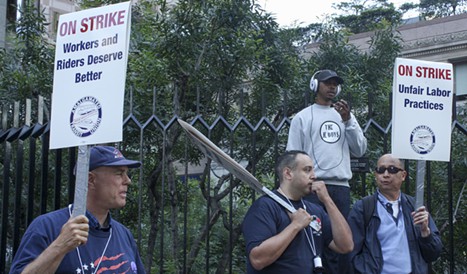
BART drivers and maintenance workers went on strike after a weekend of negotiations failed to result in a contract agreement, essentially bringing the transit system to a halt.

The unions who moved ahead with the strike just as their contracts expired at the end of June 30 are SEIU 1021, representing about 1,400 BART inspectors and maintenance workers, and the Amalgamated Transit Union Local 1555, representing BART drivers.

This morning I stopped by Civic Center plaza, where union reps were camped out with signs and distributing fliers about the strike. I spoke with Karen Joubert, vice president of representation for SEIU Local 1021. She told me the ten-hour “negotiating session” that transpired at BART’s Oakland headquarters this past weekend was not really much of a negotiation at all. Instead of considering new proposals or hashing out details, little exchange took place between the union representatives and the transit agency, Joubert said.

“It’s been, come back at 1, come back at 3, come back at 6,” to no avail, she said. Since no progress was made, the workers went ahead with the strike they had authorized days prior, which was mounted due to concerns around safety issues, workers’ requested wage increases, higher health care costs, and pension contributions. (More background here.)

“We’re meeting this morning and we’re trying to get them back to negotiate,” Joubert said.

Anti-gentrification activists “GET OUT” with Pride

A group of activists used the Pride Parade to make a political statement by marching with a faux Google bus, an action meant to call attention to gentrification in San Francisco. They rented a white coach and covered it with signs printed up in a similar font to Google’s coroporate logo, proclaiming: “Gentrification & Eviction Technologies (GET) OUT: Integrated Displacement and Cultural Erasure.”

Some trailed the faux Google bus with an 8-foot banner depicting a blown-up version of an Ellis Act evictions map.

Others donned red droplets stamped with “evicted” to signify Google map markers, while a few toted suitcases to represent tenants who’d been sent packing.

However, their ranks were thin in comparison with the parade contingents surrounding them, which included crowds of workers representing eBay, DropBox, and, of course, Google.

A member of the small anti-gentrification contingent gazes in the direction of the Google contingent, where a crowd of tech workers is bursting with energy and carrying balloons.

A member of the anti-gentrification part of the march gazes in the direction of the Google contingent, where a huge crowd of tech workers was bursting with energy.


Google workers clad in identical tees wore colorful sunglasses, carried balloons and held a banner.

Activist Leslie Dreyer was one of six activists who put together the faux Google bus contingent. She used crowd-funding to raise roughly $2,000 for parade registry, bus rental, and custom-made decals.

“All of us have either been affected, or are in a position where we wouldn’t be able to afford to stay in the Bay Area if something were to happen to our housing situations,” Dreyer said. “There’s really no security to stay here.”

They selected the Google bus as a symbol because “we think the tech boom is directly responsible for creating a population of people who can actually afford these market-rate rents,” while also fueling real-estate speculation and giving rise to a deep-pocketed political lobby. “It’s not targeting tech workers individually,” Dreyer added.

Zeph Fishlyn, a sculptor and activist who earns a living as a tattoo artist, also helped launch the Pride Parade action. “My communities that I’m a part of – not just the queer community, but also artists and activists – are being forced out,” said Fishlyn, who suffered through two separate evictions in 2012. “I know 34 people who got evicted last year.”

Housing advocates are gearing up for a campaign targeting landlords that are infamous for gobbling up rental properties and serially evicting long-term San Francisco renters. Dubbed Eviction Free Summer, the campaign could get underway in coming weeks.

Activists handed out fliers encouraging people to join them by visiting heart-of-the-city.org.

City College students a step closer to earning SF minimum wage

Student workers at City College may soon be paid San Francisco’s minimum wage of $10.55 an hour, thanks to a motion made by Student Trustee Shanell Williams at last night’s college board meeting.

It was Williams’ first night on the job, and she drew cheers from students and faculty when she voiced support for students’ fair pay. 

“The (federal) loans for students are set to double in days,” Trustee Chris Jackson told the board and more than 75 meeting attendees gathered at the college’s Ocean Campus. “It’s hard working nine dollars an hour and maintaining residency in San Francisco.”

Francisco employs student workers for a myriad of positions, from clerical workers to advertising agents on the school newspaper. Students are required to be enrolled in at least six credit units in order to enter the college’s work-study program, and must also file an application for federal aid. Notably, San Francisco’s minimum wage is the highest in the country – but according to a recent article in the San Francisco Public Press, it is not widely enforced.

As a state agency housed in state facilities, City College is exempt from the city’s minimum wage ordinance, according to the city’s Office of Standards and Labor Enforcement. The institution is only required to pay its employees the state minimum wage of $8 an hour, though it pays them $9 an hour. 

Williams’ motion came as the college’s Chief Financial Officer, Peter Goldstein, outlined the potential budget future of the school.

“This has been a nightmare of a fiscal year. We’re holding onto any balance that we could to end it on a positive side,” he said. 

Goldstein couldn’t provide an exact number on how much a minimum wage increase for student workers would cost the school, but told the Bay Guardian it could amount to hundreds of thousands of dollars out of City College’s nearly $200 million budget. At the meeting, Williams was asked where she would draw the money for the wage increase. 

“I would like to amend that our CFO Peter Goldstein analyze the budget, look at consulting, and move that funding to raise student wages,” she said. 

When she met resistance for suggesting that funding be diverted from consulting, and the motion was nearly killed.

Trustee Rafael Mandelman voiced opposition to pulling funding from college consultants, which include public relations and technology professionals. 

“I am relatively supportive of the idea of paying our student workers the city minimum wage,” he said. “But I am not going to vote for that amendment tonight because I want to know how much that will cost. I’m nervous about making a bunch of changes on the spot.”

Student Lalo Gonzalez then addressed the board in public comment, taking aim directly at Mandelman. “Back in November, I passed out signs saying, ‘vote for Mandelman, he’ll save City College,’ but you just said you wouldn’t vote on raising student minimum wages,” she said. “Who are you trying to save?”

Ultimately, Goldstein was directed to determine the total cost of raising the student minimum wage, and to identify potential places where funding could be diverted from the budget to fund the wage increase. The board will take up the matter again at its next meeting in July. 

The college’s newspaper, The Guardsman, reported on the school’s lack of adherence to the San Francisco minimum wage in 2012. In an article by student reporter Lance Kramer, 21-year-old student Kirk Ireland said he depended on his job as a docent for City College’s Diego Rivera Theater, which houses Diego’s historic painting “Pan-American Unity.” Ireland told Kramer: “I don’t have to go home and I don’t have to commute to a job later at night, so it actually helps a lot. It’s part of my success that I attribute to working on campus.”

‘Alternative to Pride Parade’ announced

57

In the wake of all the kerfuffles besetting Pride this year — from the Pride Board’s egregiously mismanaged reaction to the election of Bradley Manning as a community grand marshal (his supporters have plans of their own), to the recent announcement that military recruiters would be descending upon the celebration in earnest, and, well, just the continued corporatization of Pride in general — it comes as no surprise that a radical Pride-questioning movement has been reawakened.  Just like the ’90s are back, so is Gay Shame, at least in spirit.

And thus an alternative parade to the Pride one on Sunday has been announced — let us not be surprised that it is a bar crawl! In any case, it’s a nice start to getting us back to our gay, unlicensed roots while joining with other activists who are Over the Rainbow(TM). Here’s the statement from the organizers with more details.

Have you had enough with the poor political choices of some community leaders that claim to represent you? Are you over the over-corporatizing of SF PRIDE??? Or just tired of the same old events that don’t reflect who you are, and how you want to celebrate your queer pride?

Want to be part of something different, something fun, something that will challenge conventional thought within the SF LGBTQ community?

Then join us for an ALTERNATIVE TO PRIDE PARADE (AND BAR CRAWL).

We will be getting back to our gay roots, meeting at THE CINCH BAR at 1723 Polk Street at 12 NOON with the parade beginning at 1pm (we don’t think a 10:30am start time for a Pride Parade is appropriate), ending up at THE SF EAGLE.

We will make stops along the way, passing through SF PRIDE at Civic Center to express (peacefully) our displeasure with what passes for gay pride at this event, and then we will continue on to SOMA with stops at THE POWERHOUSE/HOLE IN THE WALL, and finally we will end up at The SF EAGLE.

We encourage you to DRESS UP, whatever you want: Drag, Leather, Freak, Nerd, Casual, Beach Wear, Furry, Punk, etc. We also encourage you to BRING PROTEST SIGNS, be creative (body paint?), be original! We will definitely want folks to know what we are up to and perhaps get people thinking about why we need BUDWEISER, VIRGIN AMERICA, VERIZON, WELLS FARGO, BANK OF AMERICA, and COMCAST to have a good time!

RSVP TODAY!!!

Wrongfully terminated Oakland Airport workers still fighting to get their jobs back

A year ago, Hakima Arhab, a former Subway employee at Oakland International Airport, spoke up about the restaurant breaking living wage laws that guarantee paid sick days for employees. For this, she believes she was fired.

Since then, a campaign has been launched to raise awareness about Subway and Jamba Juice workers at the Oakland airport who say they were terminated for speaking out. This afternoon, June 27, members of service workers’ union Unite Here will join with Arhab and other terminated employees in picketing outside the Port of Oakland’s Port Commission meeting, from 4 to 6 p.m. 

According to Arhab, “I left for a vacation for a month and a half, and I had told my employers four months before the fact. They were fine with it.” Nevertheless, “When I came back, they said they had no hours for me, and I was fired. I then knew they had fired me not because I took a vacation, but I had complained about them breaking living wage laws.” 

Arhab said Subway had not given paid sick days since 2009. The Port of Oakland’s living wage law requires employers to provide 12 paid sick days per year. 

Last year, the National Labor Relations Board charged the operators of the airport Subway and Jamba Juice with breaking labor laws by terminating workers who had made complaints to the Port of Oakland. According to a report in the East Bay Express, the port conducted its own investigation, and also concluded that the store operators were in violation.

Unite Here representatives filed an appeal earlier this year to demand that Arhab and Diamond Ford, a former Jamba Juice employee, be reinstated to their jobs. Following an appeals hearing, the port agreed and ordered the operators to reinstate the terminated employees. 

But that still hasn’t happened. Though Arhab has participated in the campaign to shed light on unfair labor practices at the Oakland Airport, she says she still feels powerless. 

“I feel mad and un-powerful that these companies were breaking laws, and they had the power to fire me just because I complained,” Arhab said. “I did the right thing. When will they?”

Picketers who plan to gather outside the Port Commission today aim to pressure the agency to compel the fast food restaurants to comply with orders to reinstate the terminated employees.

Sarah Norr, an Organizer for Unite Here, feels that Arhab and the other employees are being served an injustice. “The airport is on public land and is a public resource,” Norr said. “When workers don’t have sick days or job security, there’s something wrong with that.” 

Chatting up Daily Kos founder Markos Moulitsas

Chances are, you probably have the Daily Kos blog open on one of your browser tabs right now. The fiercely progressive blog and community hub showcasing an array of liberal activists and organizers has been at the forefront of a number 21st political battles. Markos Moulitsas, founder and publisher of Daily Kos, started Netroots (then known as YearlyKos) as a way to bring an online community together in a shared physical space. Eight years later, Moulitsas attends as a “private citizen.” When I caught sight of him at the conference, I approached him for a conversation on how the conference has changed over the years, the relationship between liberals and Obama, and his take on current voter demographics.

SFBG: What’s your been your experience at Netroots Nation 2013?

Moulitsas: What’s been different than previous ones is, it’s kind of lot younger. There seems to be a sort of a new generation of network activists. And so, we have this new generation of activists that’s emerging, which is to me is kind of cool. Because any movement cannot sustain itself without youth, that new blood and … the skills they’re bringing to the table — this intimate knowledge of social networks — are skills that I can definitely benefit from, and some of these young guys can actually benefit from some of the wisdom that old-timers have.

How has the conference progressed since the first one in 2006?

You know what was amazing about that conference, is that it was organized by the community. I didn’t organize it, it was the community that decided that they wanted to meet in person and then they made it happen. It was truly volunteer and amateur-driven, from day one, but it didn’t feel like an amateur conference. So they accomplished kind of the impossible just by sheer will and desire to make this happen, and so what I would say is … this is going to grow into something much further beyond the Daily Kos community.

What do you say to liberals who are disillusioned and cynical about Obama and other Democratic Party leaders?

You know, change is incremental. It always is in the political realm. A lot of that disappointment with him really stems from the fact that we have a shitty Congress. A lot of that had nothing to do with the shitty Congress. We’re not going to get everything we want and we could never get everything we want. We’ve got to keep creating that space, politically, for people to do so. Obama couldn’t be pro-gay marriage his first term, until the very, very, very end of his first term, when finally the political space has been created, where he could be a better progressive. So to me, that’s what it’s all about, is to continue to create that space and move the American public. I mean, the American public is already there. It’s getting them to realize they’re actually more liberal than they think they are.

It’s making sure that growth demographics that are very democratic are engaged politically, not taken granted but make sure that African Americans, Latino, Asians are engaged politically because there are going to be key components of our future majorities in the direction our nation takes. Conservatives really began their movement, building their movement in 1964, after the Barry Goldwater defeat. From the point, it took them 16 years to win the White house with Ronald Regan. It took him 30 years to win Congress in 1994 with the Newt Gingrich revolution.

But while the Democratic Party has moved left on issues like pot and gay marriage, a lot of people are saying the neoliberals have taken over the Democratic Party.

I actually think some of the most excitement coming from the Democratic Party are people like Elizabeth Warren, who are actually more progressive on economic issues than any democrat I’ve seen on the scene long time.

Do you think the emerging “Democratic Majority” has arrived?

Obama lost the white vote. The white votes were 75 percent of the electorate 2012. Mitt Romney won them 59-39 and Obama didn’t hit 40 percent with white voters. If the election were held in 2016, nothing else changes, same percentages, instead of winning by 5 votes, Obama would win by 9 points. So, not only is it here, but it’s growing at an incredible pace. Right now the only way Republicans can win elections is if our voters stay home. That’s a problem, because our core voters are also the least performing of voters – young people, African-Americans, Latinos, and single women have the worst turnout rates, particularly in midterm elections. 

Images from a big gay victory celebration

0

It was an amazing day of celebration in San Francisco yesterday, from the early morning crowd that gathered in City Hall to hear the ruling legalizing same-sex marriages in California to the evening celebration in the Castro. Here are some of the faces of that celebration by photographer Tim Daw (except the Newsom image, which was taken by Steven T. Jones)

From around the Internet: San Franciscans celebrate marriage equality

All around San Francisco yesterday, gay couples, city leaders, and street revelers celebrated the Supreme Court’s rulings striking down Proposition 8 and the Defense of Marriage Act. Here’s a glimpse of the how the city reacted to the news on June 26, as told by San Franciscans who uploaded videos to YouTube (video after the jump):

Our video mashup features (in order of appearance) Jay and Bryan Leffew with their two kids, Daniel and Selena; a crowd reacting with cheers as they attended an early-morning gathering at San Francisco City Hall (video uploaded by Will Kivinski); San Francisco City Attorney Dennis Herrera, Lt. Gov. Gavin Newsom, and District 9 Supervisor David Campos (all featured in a video of the press conference produced by the city); Cindy Sunshine and friends (uploaded by Prana Fitte); and scenes of a street-party celebration in the Castro uploaded by HiWorld798 and Elena Olzark.

Disillusionment, “Everyman,” and Netroots Nation

For nearly the entire Caltrain ride to down San Jose last Thursday morning, my thoughts were fully consumed by the subject of liberal disillusionment and cynicism. I pondered the question, “How much progress have the things that liberals care about made since the start of the new millennium?”

The issue of gay rights was the only glimmer of hope I could conjure up. Since 2000, income inequality has increased astronomically, the military-industrial complex grows unabated, the drug war continues to destroy millions of lives, women are having to protest the same idiotic conservatives policies their mothers protested, we are realizing the tangible repercussions of climate change, the Citizens United ruling and Republicans have become the John Birch Party and Democrats, by and large, have become identical to the Republicans of 30 years ago.

And while it may be true that progressives were responsible for electing the first black president, the Obama Administration has, for the most part, ignored, shunned, and at times insulted progressives. If Obama governed like a progressive, he would have jailed Wall Street executives for their roles in the financial crisis and HSBC bankers for laundering terrorist and drug cartel money, he would have rejected the Keystone pipeline in resounding fashion, he would have fought harder for a public option, he would have ended or at least decreased the surveillance state, and he wouldn’t be prosecuting medical pot dispensaries with extreme vigor.

Like a lot of the other media there, I came in search of demoralized liberals and to see if the Democratic Party leaders and other notable figures in attendance would feel the brunt of this dismay.

Unsurprisingly, the boogeyman of John Boehner, the Koch Brothers, and other rightwing caricatures were paraded out in order to stomp out any reservations you may have had about the president. One of the most notable lines of the conference was Howard Dean’s unfunny salvo of how the president isn’t perfect, “but it sure beats having Bain Capital, oops, I mean Mitt Romney in the White House!”

When our Rep. Nancy Pelosi was booed for saying that Edward Snowden should be prosecuted for his leaks, she tried shouting over the jeers by repeatedly saying that Obama’s second term was not Bush’s fourth. Then she tried to calm the crowd down (in a twist of irony, a man named Marc Peckel was kicked out for voicing objection to a police state), saying she welcomed the booing and debate about privacy. But would we be having this debate now, if it weren’t for Snowden’s leaks?

I attempted to ask Rep. Pelosi some follow-up questions as she exited the building (flanked by numerous aides and security) but oddly enough, my shouts of “I’m with the San Francisco Bay Guardian!” didn’t faze her one bit.

From the dozens of interviews I conducted with a wide range of attendees, the overall consensus seemed to be that Obama, his administration and other Democratic Party leaders are still on their side – though a good number of my interviewees expressed profound disappointment that the president hasn’t been liberal enough. One healthcare organizer from Chicago said he was immensely dissatisfied by Obamacare, but believes that it’s right the step toward implementing universal healthcare.

Obama’s most visible critic for the three days was a man who goes by the name Stan Everyman, who came on behalf of the San Jose Peace & Justice Center and carried a sign everywhere he went that read “OBAMA=CHENEY”. Everyman, who fervently believes that “Netroots is firmly under control of the Democratic party,” saw the conference as an opportunity to connect with other progressives who have gripes with Obama. The majority of reactions to his sign were positive, he said, but he did wind up engaging in some mild confrontations with what he calls “Democrat loyalists.” He was aghast when he encountered someone who came to Netroots on behalf of a liberal dating service, saying, “she didn’t mind if her emails and calls were tapped and didn’t care if there were helicopters hovering over her house as long as it caught the terrorists.” and when it did elicit a reaction, did nothing more than get a thumbs up or an eye-roll.

Meanwhile, some Democratic figures urged progressives to pressure elected leaders as much as possible. Keith Ellison, a Minnesota representative and co-chair of the progressive caucus, stated: “If people who came before us got discouraged because things were hard, we’d still have slavery, have no right to collective bargaining, the air quality would be horrible. The problem isn’t that you’re not involved and you didn’t get what you wanted, the problem is that you got to stay involved.”

When I countered that a big reason behind liberal disillusionment was that our own guy didn’t come through for us, Ellison’s responded, “Let me say this, never ever organize around a personality – even if it’s an awesome personality like Obama’s. Organize around the principles that guide you. Somewhere along the way we stopped saying ‘yes we can’ and started saying ‘yes he can,’ and when he didn’t do certain things we want, we got discouraged. What personality does the Tea Party coalesce around? None! They coalesce around, ‘we hate government, we love guns’ and ‘if you’re not quite like us, you’re not all right.’ So the progressive movement should coalesce around generosity, inclusion, fairness, sustainability, and leaders need to live up to that, and if they do, they’re good, and if they don’t, they’re not. But it shouldn’t be a personality-driven thing.”

If you want change, you have to keep on keeping on, no matter. Sure, town halls, letter campaigns, and protests are great ways to engage your politicians and in democracy, but when you got to go to work or tend to your family, six-figure lobbyists walk through the halls of Congress retracting whatever impact the people’s efforts made. Politicians want us to give them the political will to do what’s right even though we elected them to do what’s right. I don’t naively believe politicians are perfect and that they’re our friends and that we can sit back and relax after we pull the voting lever. However I do have a problem with “I’ll fight for you!” during the campaign season and “Fight for me!” during the legislative sessions. The latter due to this being a non-election year, was the unofficial theme of Netroots Nation 2013, which also possessed a palpable feeling that the reason why many of the big names showed up was to throw the progressive wing a bone and quell whatever qualms they have.

I do admit that Netroots, in the past, has resulted in a concrete impact (namely, helping to get Obama elected and being instrumental in manufacturing a 21st century online campaign apparatus). However, the chances that it will be able to pull Hillary Clinton—who’s just as hawkish as Dianne Feinstein— to the left beyond the duration of the conference are lower than the probability of Obama appointing Angela Davis as his Chief of Staff. A piece on Salon.com a couple days ago reported that progressives are open to a Clinton run, which should come as no surprise to given how good the left is at reconciling their beliefs with that of their leaders.

So between now and NN14 (which is in Detroit), when the Democratic Leadership will come begging for the left’s help to return the Speakership crown back to Pelosi, pretty much everything the left holds dear will wallow in purgatory or regress to hell. But cheer up: At least Bain Capital isn’t president!