• No categories

Politics Blog

Public employees feel blindsided by Newsom’s layoff scheme

39

Mayor Gavin Newsom’s proposal to lay off 10,000 city employees and rehire them at lower pay is being met with outrage by some public-sector workers. The plan, crafted as a way of saving money to balance the city budget, would amount to sweeping pay cuts across the board for a significant number of city workers.

Formal discussions about it are in the earliest stages, and Tony Winnicker, the mayor’s press secretary, described it as “just one alternative that we’re investigating.” Nonetheless, some members of Service Employees International Union Local 1021 are furious that the mayor unveiled this plan in the San Francisco Chronicle instead of at a meeting with the city’s labor leaders.

“As far as we can tell, an idea he has ended up on the front page of the Chronicle that’s had a devastating ripple affect among the people who work for the city and county,” SEIU Local 1021 President Damita Davis-Howard told the Guardian. “We feel like we got a sucker-punch. … We really wish he had talked to us before he governed by press conference.”


Davis-Howard said she’s been inundated with phone calls from angry union members who read the article. “This is the same proposal he floated last year,” Davis-Howard said. “Most of our members believed that they gave up their holiday pay in order to avoid this very thing.”

The proposal, which was briefly considered last year but never moved forward, serves to illustrate just how hard financial woes are hitting San Francisco. The city is staring down a $522 million deficit, and Newsom’s proposal would make up for a mere $50 million in savings.

Winnicker declined to comment on Davis-Howard’s concerns about being blindsided by news of the layoff plan, brushing it off by saying the mayor did discuss it with “some folks in labor.” Instead, he suggested that Newsom is getting serious about solving the budget crisis while the Guardian is just focusing on irrelevant gripes.

“It is an unprecedented budget shortfall, and it is real,” Winnicker said, stressing that the gaping budget gap will have to be bridged without the infusion of federal stimulus dollars that cushioned the blow last year. “The easy choices are behind us.” This layoff plan could prevent “hundreds, if not thousands, of layoffs,” but the mayor is open to other ideas that labor brings to the table, he said.

“That logic is just flawed,” Davis-Howard said when asked about the assertion that the plan could prevent layoffs. “That’s not the way you re-stimulate the economy, by taking more dollars out of the economy. We can’t continue to balance the budget on cuts, because pretty soon the actual fiber of the city and county of San Francisco will be reeling because of the number of cuts that we sustained.”

When asked how SEIU Local 1021 would respond, she said, “I do believe we need to be open-minded, imaginative, and creative in coming up with some revenue-generating measures here.”

No doubt the mayor will receive plenty of suggestions as negotiations continue in the coming weeks.

Why Newsom drives me nuts

2

This is the kind of thing that drive me nuts about the Newsom administration.


A few days ago, SF Appeal ran an item on a speech Newsom gave about condo conversions. The mayor wants to let more people turn rental units and tenancy-in-common units into condominiums; that, Newsom argues, will bring more revenue into the city treasury (those conversion permits are expensive).


But there’s a reason why the city limits to 200 the number of units that can be converted in any one year. Turning a rental unit into a condo reduces the number of rentals available, and turning a rent-controlled unit into a condo (or into a TIC and then a condo) cuts into the affordable housing stock.


And a majority of the supervisors, who recognize the impact the mayor’s plan would have on tenants (by making it easier to take rental units off the market), are dubious.


Okay, that’s a difference of opinion. You don’t have to make it personal. And yet, at his press conference, the mayor insisted that


“Half of the members of the board have been beneficiaries of condo conversions, and yet they deny it to other people.”


As the Appeal pointed out, that’s simply untrue.


A majority of Board members own their homes, according to a check of property records: mayoral allies Michela Alioto-Pier, Sean Elsbernd and Carmen Chu all enjoy the benefits of owning and equity, as do Sophie Maxwell and progressive Budget chairman John Avalos.


Eric Mar and David Chiu rent, according to a City Hall source. Chris Daly lives in a condo, but “my condo has always been a condo,” according to the supervisor (and according to the Assessor-Recorder’s Office, Daly at least bought his condo as a condo and not a tenancy-in-common or conversion).


By all accounts, progressive Ross Mirkarimi is on the condominium-conversion waitlist (an older news report says Ross owns a TIC and is on the conversion list; we’ll check in with him to confirm, he is at this moment still in committee). Mirkarimi and Bevan Dufty would be the two Board members conflicted-out of any votes on condo-conversions; Dufty went from a condo to a TIC after his daughter was born.


“And nobody was evicted,” the Bev told us today.


Okay, as I see it only one supervisor is even in a position to benefit from the condo conversion law. So I asked Tony Winnicker, the mayor’s press secretary, whether Newsom had been misquoted. Apparently not. So why did ne make an innacurate statement that insulted half the members of the board?


Winnicker:


His comments came in the context of the polarized politics of San Francisco which pit tenants vs homeowners to the benefit of no one. He was speaking that many Boardmembers enjoy the benefits of homeownership and that opposing the condo conversion proposal denies those benefits to others who are already living in TICs and displacing no one through condo conversion.


But there’s a big distinction between what Winnicker is talking about and what Newsom actually said. It’s entirely possible to be a homeowner in this city without evicting anyone and without taking a rental unit off the market. That’s what most of the homeowning board members have done.


As for TICs “displacing no one,” that’s wrong, too. The number one cause of no-fault evictions in this city is the use of the Ellis Act to clear the tenants out of a building to create a TIC. The only thing holding the TIC epidemic in check is the fact that the TIC ownership model is complex and a bit tricky. The minute you can convert those TICs into condos, you open the floodgates for a lot more of them — and that means a lot more evictions.


Newsom can make the case for condo conversions just fine without making factually inaccurate statements that insult the supervisors. Instead he pulls this shit. And then he complains about the supervisors not wanting to work with him


Drives me nuts.


Newsom’s perplexing attack on San Francisco’s economy

4

There’s a crazy disconnect in City Hall these days over how to help the local economy. Mayor Gavin Newsom has spent much of the last month focusing on “jobs” and “local economic stimulus,” proposing to give a few million dollars in tax breaks to local companies while refusing to discuss new tax measures to help close the city’s $522 million budget deficit.

As we explain in detail in tomorrow’s Guardian, economists just don’t think the tax cuts will help the economy much at all – particularly if the city is reducing its spending and payroll to do so — but even some progressive supervisors are playing along to appease the anxious business community. For example, Board of Supervisors President David Chiu supports an extension of the biotech tax, denying city coffers the benefit of efforts by the city and UCSF to become an important hub for the industry.

Then, in today’s Chronicle, Newsom floats the idea of unilaterally shortening the workweek for city employees in order to save $50 million in payroll costs, firing 10,000 workers and then rehiring most of them to do so. But let’s be clear about this: that means removing $50 million from San Francisco’s economy, or even more once you figure in the multiplier effect that would more than double that loss.

As much as Newsom and his Chamber of Commerce allies love to bash government, the city is one of San Francisco’s largest employers, a clean industry with good-paying jobs. And it just makes no sense why they prefer to inflict mass layoffs on that employer – not to mention the reduced city services that will hurt even private sector productivity — rather than increase taxes on large corporations that ship their profits out of the city and therefore offer minimal benefits to this city’s economy.   


Gavin for Lite Guv?

1

Willie Brown thinks it’s a good idea. And you can tell Newsom wants to consider it, since he knows there’s nothing else obvious for him to do once his term as mayor is up — and there are going to be a lot of options not too far down the road. Sen. Dianne Feinstein isn’t getting any younger, and at some point she’ll retire. If Jerry Brown doesn’t get elected governor, the Democrats will be looking for someone very different in four years. But once a politician like Newsom is out of office and out of the spotlight, he’ll have a hard time coming back.

So he could sit up there in the Lite Gov’s office, doing what John Garamendi did — taking on issues like cuts to the University of California (the Lt. Gov. sits on the Board of Regents) and making speeches about reform, and maybe he could get out in front of this constitutional convention stuff, and keep his name in the news, without having to make a single difficult or unpleasant decision that he can be blamed for later.

You know he wants to do it ….

But there’s this problem, and for Newsom, it’s very real.

As people close to the mayor have told me repeatedly, the money people who helped put the mayor in office — and who would have to be around to help him run for any other office — are not at all pleased with the prospect of Newsom leaving San Francisco a year early. See, that would give the district-elected supervisors the chance to fill the mayor’s job for the last year of Newsom’s term, and the person they appointed would be able to run as an incumbent.

And while it’s not clear who could get six votes (David Chiu? David Campos? Ross Mirkarimi? Aaron Peskin?) it’s pretty clear that the new mayor would not be an ally of Newsom’s pals.

Sure, when he was running for governor, it seemed fine — having their guy in charge of the state was worth the loss of the San Francisco mayor’s office. But for a relatively powerless job? I think they’d crucify him.

Progressives control City College board

0

By Anna Widdowson

The reelection of Milton Marks III as President of the City College of San Francisco’s Board of Trustees ruffled some feathers during last week’s board meeting, but it signals a real shift in the balance of power in the governance of this troubled district.

Dissent came primarily from longtime board member Natalie Berg, a fairly conservative and consistent (and crabby) supporter of former City College Chancellor Philip Day, who was indicted last July on eight felony charges for misappropriating public funds. Other longtime board members (and Day enablers) Lawrence Wong and Anita Grier also voted against Marks, who was a fairly isolated public interest advocate until two years ago, when he began to accumulate some allies.

One of those allies, progressive activist John Rizzo, last year replaced Berg as the board’s vice president, a post we was reelected to last week on the same 4-3 vote that Marks got. But while Berg opposes the pair on ideological grounds, she couched her criticism in the “long-standing tradition” of Board presidents’ declining to serve two terms in a row. She called Marks’s reelection “unprecedented” and a blow to the Board’s democracy.

Marks attributed the controversy over his reelection to a shift in the culture and ideology within the board. “(Berg) and other people used to have a real lock on the board and how it was run,” Marks told us. “Now there is a solid four votes on our side and I think they are feeling really unhappy that their time has come and gone.”

Marks noted that last year was the Board’s single most productive year in memory, which is probably a commentary on how abysmally this board has traditionally done its job as much as anything.

Berg has sat on the Board since 1996, and has served as president three times, though not in succession. Despite her quibbling, Berg didn’t offer to take the reigns herself, even after one concerned citizen audibly whispered from the audience, “If you’re so upset, why don’t you run?”

In fact, no one but Marks and Rizzo was nominated for either position. According to Marks, despite attempts to strong-arm the newest board members, Chris Jackson and Steve Ngo, the trio of dissenters knew they couldn’t win the election.

“They kind of scared Chris,” Marks said. “But he is such an honorable guy he never went back on his commitment to me or his ideology. And without his and Ngo’s vote, they knew they would lose the election and they didn’t want to be embarrassed.”

Jackson expressed distaste for the squabbling, and wondered aloud if perhaps students’ needs were a more pressing issue than elections. After all, if Berg keeps hogging air-time at meetings, the Board is likely to be largely stale-mated by petty internal power struggles.


Drinking the tea, ignoring the facts

3

Listening to members of the Tea Party movement on KQED’s Forum this morning, I and many callers to the show were struck by the basic inaccuracy of their core beliefs, these revanchist delusions about what’s in the U.S. Constitution and how this country really operates.

There’s a lot of justifiable anxiety out there over the state of the country, and the Tea Party movement has tapped into that with bumper sticker slogans that are just broad enough to capture alienated Americans from across the political spectrum. One recent poll shows that 41 percent of respondents are sympathize with the movement, stronger support than either major political party now enjoys.

But facts should matter, and they just don’t to many teabaggers or their high priestess, Sarah Palin, who is headlining the current national Tea Party convention in Nashville. For example, the two self-described “patriots” on this morning’s show railed against all the unconstitutional actions of the runaway federal government in ways that reveal an astonishing ignorance about the document they claim to prize so highly.

An East Bay woman from Bay Area Patriots, Heather Gaas, complained that the “government takeover” of the health care system is specifically prohibited by the constitution, seemingly unaware that there is no takeover, and even if there was, the federal government is specifically empowered to “regulate commerce” and see to the country’s “general welfare.”

North Bay teabagger Gary Hahn claimed that a free market system with minimal government is enshrined in the Constitution, another false claim. The words “capitalism” or “free market” aren’t in the Constitution, which doesn’t prescribe an economic system for the country and would even allow socialism to exist if we had to votes to approve it.

Luckily, while host Dave Iverson did little to correct the teabaggers’ inaccuracies on the first half of the show, a series of callers did that work on the second half. One caller, who was a self-described Tea Party member and Ron Paul supporter, criticized the hypocrisy of the guests’ for criticizing “big government” while supporting its wars and imperial overreach, sounding the anti-war position that is also an element of this broad and unfocused movement.

And that’s really why we shouldn’t read too much into this movement’s power and its implications (check out this interview for an insightful take on why conservatism no longer contributes anything useful to American politics). The Tea Party is best understood as a primal scream rather than a political movement. I’m a big government progressive, yet I share the teabaggers’ outrage over the Wall Street bailouts and the corruption and unresponsiveness of the two major political parties.

We may even share a few revanchist impulses, concerns that powerful forces have steered this country away from what it once was. But my concern is with Big Corporations that have eroded basic egalitarian principles expressed from the Declaration of Independence (the right to “life, liberty and the pursuit of happiness,” talk about radical!) to the New Deal, not with Big Government (except for its biggest and most wasteful element, the bloated military budget).

But the revanchist fantasies of most tea baggers long for a time that is no longer possible, when there was still a frontier on which rugged individualists could stake their claim, for that “shining city on the hill” that their god, Ronald Reagan, once conjured up in the national mind’s eye. They want to smite their liberal enemies and restore this country to a position of deserved greatness, an attitude that frankly scares the crap out of me, with its echoes of 20th Century fascism.

The realities of today are much more complex than the teabaggers’ simplistic beliefs. They want to deeply cut government spending, despite the damage that would do to the fragile economy. They want us to get tough with the terrorists, unaware that every bomb we drop has the potential to create new enemies. They want more power for the “real Americans,” however racist and divisive that judgment is made.

Yet their primal scream shouldn’t be ignored because it is the manifestation of frustration that cuts across a wide swath of the country that is fed up with politics as usual. But in the teabaggers’ ignorance of the Constitution and the basic social contract on which any country or government is based, we can see just how much work there is to do before we have an educated and engaged citizenry that is even capable of participating in a democracy. So this is still a party worthy of our attention.


The attack on district elections begins

2

I knew it was coming. After ten years of district-elected supervisors promoting progressive policies (minimum wage and sick day laws, universal health care, tenant protections, public power, development limits, affordable housing etc.) downtown has finally figured out how to launch a counter-attack. It was announced this morning in the pages of the Chronicle

I knew it was coming. After ten years of district-elected supervisors promoting progressive policies (minimum wage and sick day laws, universal health care, tenant protections, public power, development limits, affordable housing etc.) downtown has finally figured out how to launch a counter-attack. It was announced this morning in the pages of the Chronicle

The idea is to replace some of the district supes with at-large representatives – say, four of the 11. That Chamber of Commerce is doing a poll on the issue. Expect a November ballot initiative.

C.W. Nevius chimed in, too, arguing in favor of the “hybrid” (sounds so much like an eco-friendly car) system.

The line is going to be this: District supervisors don’t pay attention to citywide issues.

“People like the idea of being able to talk to a district supervisor about neighborhood problems, but also feel that they want someone they can go to with broader, citywide concerns,” said Steve Falk, president and CEO of the San Francisco Chamber of Commerce.

Or as Nevius puts it:

The truth is that San Francisco has more supervisors than any county in California. Is it too much to ask that a few of them have the entire city’s best interest in mind?

Let’s consider for a moment what this is really about.

For starters, get rid of the nonsense about a “citywide perspective.” Even Nevius didn’t try to push that too hard when I emailed him with the facts, to wit: Over the past ten years, district-elected supervisors have devoted themselves to a long string of exceptional citywide reform measures and have been guilty of very little district pandering.

Consider a few examples:

Healthy San Francisco
The Rainy-Day Fund
Reforming the makeup of the Planning Commission, Police Commission and Board of Appeals
Restricting the use of plastic bags
Minimum wage and sick day laws
A citywide infrastructure plan and bond program
Community choice aggregation and green energy
Campaign finance reform
Sanctuary city protecting for immigrants

The list goes on and on.

You may agree or disagree with what this board has done, but nobody can honestly say that the district supervisors have ignored citywide issues or that they don’t have a citywide persoective. No: This has nothing to do with citywide issues vs. district issues. It’s entirely about policy – about the fact that district supervisors are more progressive. About the fact that downtown can’t possibly get a majority under a district system – because with those small districts that Nevius complains about, big money can’t carry the day.

In a district system, grassroots organizing – the stuff that labor and nonprofits and progressive groups are good at – is more important than raising money. So district supes are accountable to a different constituency.

I watched an at-large board for almost 20 years, and it was, by and large, a collection of sold-out hacks who did exactly what the mayor and the downtown donors said. It was really pathetic.

The polls have consistently shown that people like have district supes, so now there’s this “hybrid” effort.

Here’s what it means:

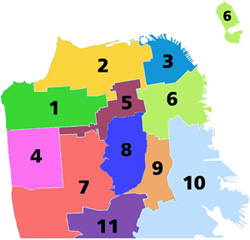
Right now, there are three districts that will generally elect a more conservative representative – D 2 (Michela Alioto-Pier) D- 4 (Carmen Chu) and D-7 (Sean Elsbernd). Districts 8, 10, 11 and 1 are swing districts, and the rest are going to go generally progressive.

So the odds are under this system that the left-leaning constituencies will have at least six votes, and in good times, as many as eight.

Now take four of those votes away, pretty much forever. Set it up so that four supervisors, elected citywide, will be guaranteed downtown call-up votes. Then add in one or two more from the more conservative districts, and you’ve got a majority.

That, my friends, is exactly what this is about, and any effort to frame it as anything else is just spin.

I asked Nevius what the hell he was doing buying the bogus argument that we need citywide perspective – since the district board has already demonstrated that, consistently. Here’s his response:

First, I’d envision the city-wide supes as made to order swing votes. When a district supervisor had a good idea, let’s say Healthy San Francisco, it might not be an issue of critical interest for a district supervisor. But it would be right in the wheelhouse for a city-wide official, who is looking for broad stroke issues to back. And, although you didn’t advance the idea, I’d reject the notion that whomever it was that was elected city-wide would be incredibly conservative and obstructionist. The most moderate politician we’ve elected in this city is Gavin Newsom. Although the Guardian doesn’t agree with him much of the time, he’s still advanced some very progressive ideas. Everyone jumps on the Chris Daly example as why district elections are a problem, but I think we can look beyond that. I think he’s been an aberration. District supes like David Campos and David Chiu have proved they can compromise and govern so I think that’s a good thing. I would never advocate that we get rid of representation in the neighborhoods. But c’mon, 11 little districts in a very small city? As Jim Stearns said, some of the districts are no more than a mile square. Combining some of them would still let residents have someone they could call to get the potholes fixed, but also spread out the areas.

Okay, I didn’t say citywide supes would be conservative. Sean Elsbernd is (relatively) conservative. He’s also independent of any big-money interest and does what he thinks is right. He doesn’t need half a million dollars to get elected in his district.

What I say is that citywide supes would be in hock to big money. I’ve seen it, lived with it. Suffered from it.

And guess what: Healthy San Francisco didn’t need any citywide supes; it passed just fine with the district board.

So what this is about is money and political control, and it’s about the political direction the city is going and who’s going to set that direction. Let’s get that straight and be honest about, and then we can have this discussion.

CPMC’s battle with its nurses continues

2

CNA labor rep Nato Green told the Guardian that CPMC is trying to low-ball its nurses to help pay for the two hospitals and a proposed expansion of its Davies Campus. “It’s to pay for all the construction they want to do…CPMC wants to stick us with a worse contract even than at other Sutter facilities,” Green said, accusing CPMC of trying to break the union. “CPMC believes this is their opportunity to get rid of 60 years of union representation.”

CPMC spokesperson Kevin McCormack said both its salary offers and the health plan it instituted have been as good or better than what CNA has accepted at other facilities, and the reason for the protracted impasse is CNA‘s insistence that workers at the upscale Cathedral Hill hospital be union members.

“The difference is we’re building a new hospital and it might open as a non-CNA facility,” McCormack said, calling the disputed health plan “the same plan that they’ve accepted at other facilities.”

But the NLRB complaint faults CPMC for unilaterally changing the terms of the contract that expired in 2007, first by changing the work hours and duties for pediatric and neonatal nurses last July, then by imposing a new health plan that steeply increases costs for using non-Sutter specialists, in both cases without bargaining in good faith for the changes.

“It was presented at fait accompli, and then they just imposed it. It’s on ongoing systemic problem with CPMC,” Green said. “It demonstrates what we’ve been saying all along, that they aren’t trustworthy.”


Maxwell recall petition fails

2

Text by Sarah Phelan

The San Francisco Elections Department is reporting that the petition to recall Sup. Sophie Maxwell has failed.

“The Department of Elections verified the validity of a randomly selected sample of 500 signatures from the 8,008 signatures submitted,” a Dept. of Elections press release stated. “This statistical sampling shows the petition to have a valid total of 3,026 signatures. This total is less than the 7,529 required for this petition to qualify for the election.”

The press release also noted that the statistical sampling showed that 40.91 percent of the signatures on the petition are valid.

That’s a fair bit of disgruntlement–a factor that should have everyone in the D. 10 race paying close attention.


Who wants to be a biotech tax idiot?

0

By Tim Redmond

So Sup. Michela Alioto-Pier wants credit for the really dumb idea of extending the payroll tax waiver for biotech companies.

I guess she’d rather look like an idiot than let Newsom grab that dubious spotlight. Because as I pointed out in a column this week, the biotech tax break won’t create a single private-sector job in San Francisco, not one — and because it will reduce the city’s revenue, it will lead to more service cuts, which means more public sector jobs lost.

So the net impact of this plan is fewer jobs in the city. You want to be the one whose name is on that, Michela? Go for it.

Recalling Sophie Maxwell

0

Written with Adrian Castañeda

maxwell.jpg
Does it make sense to try and recall termed-out D. 10 Sup. Sophie Maxwell?


A group of District 10 residents has turned in 8,008 signatures in an effort to recall Sup. Sophie Maxwell. Election department staff says that 7,529 signatures must be verified for the recall attempt to go forward.

‘We think it’s going to be a little tight,” said an election department worker, who preferred to remain anonymous.

Department of Elections staff have 30 days to count and verify the submitted signatures, but they predict the process could be completed as early as Thursday afternoon (Feb. 4) or Friday morning (Feb. 5).

Meanwhile, Maxwell is termed-out in January 2011–a mere 11 months away. And 15 candidates have already filed to enter the D. 10 race this fall, with a dozen others variously threatening to throw their hats in the ring.

But if the recall effort gets the green light and is placed on the June 8 ballot, and if Maxwell actually gets recalled as a result of that vote, Mayor Gavin Newsom would then get to appoint his choice of successor to her seat. And if that successor happens to be one of the candidates vying for Maxwell’s seat, wouldn’t that person have an enviable edge come the November election?

Bayview activist Daniel Landry insists the recall effort would be effective. 
“We’re sending a message to anyone who wants to be a supervisor of D-10, you must recognize the will of the voters,” Landry said.

D 10 candidate Ed Donaldson warns that any supervisor that does not understand the complexity of the city’s largest district can expect a similar backlash. He says the recall effort is evidence of District 10’s diversity.
“There is no one homogenous voice in the community,” Donaldson said.
He says that the current grass-roots organizing that brought about the recall effort is a result of changing political structure in the area, but is not yet on par with the other districts in town.
“We still allow our politics to be controlled from downtown,” Donaldson observed.

D 10 candidate Espanola Jackson warns that if Newsom appoints someone, that person had better listen to the wishes of the community, or else they will face a similar fate to Maxwell.

“What the mayor needs to understand is that if we can get the signatures in two weeks to recall Sophie, we can get them on whoever he appoints as well,” Jackson said.

But D 10 candidate Eric Smith worries that the recall effort will backfire. He cites a recent community meeting in the Bayview on the Department of Park and Recreation’s budget, as an example of why folks are turning to this seemingly desperate strategy.

“People were emotional, angry and desperate, because they feel no one listens to them,” Smith said. “That’s part of the problem here; they would rather have a supervisor go down swinging for them, rather than watch one seemingly side with Lennar, PG&E and the Mayor on issues contrary to their interests. At the DCCC [Democratic County Central Committee] last week, everyone except Chris Daly voted against the recall in support of Sophie.”

Smith added that Daly’s vote, “likely had more to do with his belief that this was a waste of time and had no chance of actually succeeding, but you’ll have to ask him.”

Daly, for his part, says he doesn’t believe the recall effort will qualify.

“Jake McGoldrick introduced an item in committee when he was a supervisor that the Board then passed that doubles the numbers of signatures required for a recall to qualify,” Daly said, noting that under the old recall rules the current effort would likely have succeeded in getting onto the ballot.

“And I don’t think the DCCC’s resolution against the recall effort was accurate,” Daly added. “It was long on the fact that Sophie isn’t guilty of malfeasance, but the truth is that a recall is a tool of democracy that is available and can be applied in cases where a representative is not being responsible to the needs of their district. So, while I’m not supportive of recalling Sophie, it would be patronizing for me to say that thousands of D. 10 residents don’t know what they are doing. The Democratic Party (with a capital D) is working against democracy (with a small d) in a patronizing way in a district that has a disproportionately high number of low-income folks and people of color. There is a significant level of disgruntlement, if that is a word, in District 10, and its residents have lodged a pretty real and significant complaint.”

Aaron Peskin, who chairs the DCCC’s executive board and is the former President of the San Francisco Board of Supervisors, also predicts that the effort to recall Maxwell is probably headed nowhere.

“There’s no way they got the numbers,” Peskin said. “You’re lucky if 50 percent of that shit runs.”

Peskin proffers three reasons why recalling Maxwell is against the community’s own interests.
“First, recalls are an instrument to be used when a representative has committed malfeasance, and not because you disagree with the political positions of a person who has been duly elected three times,” Peskin said. “Second, this elected official is in her last eleven months in office. So, it’s a huge waste of time and money. And third, for those not satisfied with their current supervisor, any representative that the mayor might nominate would be far, far worse.”

Smith also worries that the recall effort is akin to the community shooting itself in the foot.

“If Sophie gets recalled, (and that is a very big if), the Mayor will insert someone and we may be right back where we started from, or worse. That’s the terrible irony and one of the biggest problems in District 10. Folks are so mad, they’re willing to do whatever it takes to make them feel they have a voice in the outcome, even if it’s potentially worse. The same thing happened with the Navy and the Restoration Advisory Board. Some of the same folks who were frustrated by the process, tried to send a signal to the Navy that they weren’t being heard and for all their well- intentioned efforts, got the RAB dissolved. I truly feel for them, it’s absolutely heartbreaking, but at times, they can be their own worst enemy.”

To Smith’s mind, a recall has the potential for exacerbating the very problems the effort is purported to be about.

“This isn’t about malfeasance, or not showing up for work,” Smith observed. “It’s about being heard, respected and listened to. I don’t think any other Supervisor has ever had the challenges that Sophie has had to face here; the Bayview, the Hunters Point Shipyard’s toxic super-fund site, the homicide rate, unemployment, poor public transportation, dwindling services and community resources have made D10 one of the City’s largest melting pots of discontent. It’s just one of the reasons I’m running. The health, welfare, quality of life issues and the environment are the things I put above everything else out here, particularly above special interests and big money.”

“We will soon know how valid those signatures are; I can tell you that the many of the folks behind it feel very confident about it,” Smith continued. “But Sophie still has a lot friends in D10 who will not vote her out, so even if this makes the ballot, there is no guarantee it will carry. There are many, many folks who still love and support Sophie, so the folks who signed the recall petition will have to overcome the balance of the 37,000 D.10 voters who may not want to see her go and have a vested interest in seeing a fair electoral process in November, untainted by a Mayoral appointee, an appointee that would have implied advantage over any of the candidates in November.”

Smith has asked many folks why they are launching a recall when Maxwell only has 10 months left on the job.

“For them, it’s about making a statement; they want everyone to know that ‘They’re mad as hell and not going to take it anymore,’” Smith said. “They also want to send a signal to the D10 candidates that this is what you will face if you don’t listen to them. D10 is not for the squeamish, those easily intimidated or the faint of heart.”

On a side note, Smith observed that “we will need the world to come out to defeat Proposition 16″, the PG&E ballot measure in June. “And, depending on the turn out, many of the folks needed to come out for that, may also play a role as it relates to Sophie’s recall.”

Asked what she thought of the effort to recall her, Maxwell characterized it as “strange” and “destabilizing.”

‘It seems to me that this effort is destabilizing the community,” Maxwell said. “When you undercut the leadership, you destabilize a community in transition. At a time when these folks could have something to say about the future, they are looking at the past. It’s about backward thinking. It’s about not having the best interests of the community. It’s about egos. Because if this is for the community, then why not bring something to the table that’s about bringing some direction to the district?”

One of the last straws, in the minds of some recall signature gatherers, was Maxwell’s 2009 vote against a resolution that would have advised the Navy to restore its community-based Restoration Advisory Board. This board, which was established in 1994, had consistent access to the many technical and environmental documents surrounding the proposed clean-up of the heavily polluted Hunters Point Shipyard.

The RAB, whose primary fucntion was to share information on investigations and clean-ups at the shipyard, was also able to vote on the Navy’s proposed solutions and to request more information and/or speakers and experts so its members could educate themselves on related public health and safety issues. But early last year, the Navy announced that it was dissolving the RAB, citing dysfunctional behavior and off-topic discussions that were getting in the way of the RAB’s intended purpose.

The move to dissolve the RAB came just as the Navy was poised to take a series of important decisions on some of the most polluted and radiologically-impacted parcels on the shipyard. And many in the community saw the timing of the RAB’s dissolution as evidence that the Navy was going to ignore their wish to have these parcels dug out and hauled away, and not capped (a wish shared by the 87 percent of voters who supported Prop. P in 2000.)

But despite the outcry that followed the RAB’s 2009 dissolution, Maxwell voted to tell the Navy to either restore the RAB or find other ways to involve the community–thereby giving the Navy the choice, some felt, to ignore the community’s desire to reinstate the RAB.

And last night, the Navy, along with a flotilla of police and special agents, showed up at the Bayview YMCA to share its plan to reformulate the Navy’s original Community Involvement Plan—a plan that angered many meeting goers ( the majority of which were former RAB members,) since it didn’t appear to aim at reinstating the RAB. But to give the Navy credit, once it became clear that meeting attendees were underwhelmed by its plan, Navy officials scrapped their original agenda and allowed the community to speak instead about their wounds from the past and their hopes for the future. It remains to be seen where the Navy will go next, but those interested in tracking these developments can visit the Navy’s website for updates.

Maxwell for her part defended her vote–and pointed the finger at the Navy.

“The Navy has an obligation to get out its plans to the public,” Maxwell said. “People are getting information in many ways, these days, not just by coming to meetings. The Navy has just got another $92 million towards the shipyard clean up, but does anyone know what this means? It means that instead of taking years to clean up groundwater at the shipyard, we can spend that money on it, now. And if folks knew what capping really means, maybe they wouldn’t be against it. Mission Bay is capped. Schlage Lock will be. And all of them are brown fields.”

Maxwell worries that democracy is not currently being well served within her district, but not by her.
“There are folks who are trying to block real information from getting out, and if only your view can get out, that’s not democracy,” Maxwell said.

But so far, she’s not willing to publicly support anyone in the November D. 10 race.
“I’m waiting for people to have a better understanding of what this community is, what the common thread running through it is, and how to use rank choice voting,” she said.

And despite the current recall effort—and the insults regularly hurled her way with a voracity and meanness not generally seen in other supervisorial districts, Maxwell said she has truly enjoyed serving as D. 10 supervisor.

“When people say that it’s an honor to serve as an elected official, I really know what they mean, because I really feel that. Democracy is challenging, it’s messy and it’s invigorating. I think a lot of what’s going on in my district is about people using people. But what has changed for these folks? Their lives have gotten worse, not better. And they are going after me, because I am not part of their group. I have tried to stay focused on the issues.”


 

Community policing in the Haight

3

By Tim Redmond

There’s lots of commentary on my latest post on the proposed sit-lie law. In one of his numerous comments, Arthur Evans argues that

We, the residents, also believe that a sit-lie law would help make things uncomfortable for the thugs.

It’s always tricky to say that “we, the residents” of the Haight, or any other neighborhood, are in unanimous agreement about anything. In fact, the Haight Ashbury Neighborhood Council recently adopted a statement on policing in the neighborhood that doesn’t call for a sit-lie law at all. Here’s the relevant part:

HAIGHT STREET

What happens on Haight Street rarely stays on Haight Street, and oftentimes doesn’t even start on Haight Street.

The need is for constant, predictable, visible and persistent patrols on Haight Street, Page Street and Waller Street from Stanyan to Baker. Additionally, the Panhandle must be viewed as an integral part of the policing of Haight Street as the two are linked by both residents and visitors. Foot patrols should be maximized on Haight Street while regular bicycle patrols should be the primary means used in the Panhandle. Regular car patrols can be used to supplement foot patrols for Page and Waller streets.

Care should be taken by the SFPD to pay particular attention to the area around Park Station itself, especially the area around the intersection of Haight and Stanyan, as it is a heavily used pedestrian, transit and automobile corridor with major retailers – McDonald’s, Amoeba and the proposed Whole Foods – joining the Alvord Lake, Children Playground, and Golden Gate Park pedestrian entrance creating a complex mix of tourist, visitor, shopper and resident users. Community attempts to smooth out these complex interactions through more police presence and various traffic calming proposals should be supported by Park Station.

The entire statement is after the jump. HANC will be holding a community meeting on the issue Feb. 11.\\

Carly Fiorina’s red-eyed sheep

0

By Tim Redmond

This is one of the strangest things I’ve seen in politics in a while. Check out the ad, attacking Tom Campbell for not being anti-tax enough. You got sheep falling off a pedestal, sheep with weird glowing red eyes, sheep crawling around with a man’s legs …. who makes this stuff?

Is the California Constitutional Convention campaign getting blacklisted?

0

By Rebecca Bowe
repair california logo 2.jpg
Repair California, a nonprofit organization leading the charge for a California constitutional convention, is preparing a lawsuit against signature gathering firms that it claims are illegally boycotting the campaign. The nonprofit hasn’t divulged exactly which firms it is going after.

In a letter sent yesterday to a signature-gathering company whose name was redacted, an attorney with the firm Hanson Bridgett charges that the company is part of a statewide boycott against Repair California. The letter also states that there is evidence that people acting on behalf of the company engaged in “dirty tricks” like intimidation tactics and throwing away petitions containing valid signatures.

Repair California is circulating petitions to gather enough signatures to ask voters on the November 2010 ballot if the state’s constitution should be opened up for revision at a statewide convention, the first time in 130 years that such a meeting would be called.

The Bay Area Council, a business group, is the driver behind the push for a constitutional convention. The idea has been endorsed by organizations across the political spectrum united by their conviction that California’s government is broken. A top priority for the campaign is to change the two-thirds majority vote requirement that makes it exceedingly difficult for the California Legislature to raise taxes and pass a state budget.

A letter prepared by Attorney Steve D. Miller on behalf of Repair California explains that the campaign tried to tap several different signature-gathering firms to circulate petitions, but the firms refused. Repair California has “reason to believe” that the refusal stemmed from an organized boycott against the campaign, the letter states, which drove up the price for the nonprofit’s signature gathering efforts.

“Their motivation is uncertain, but they are closely and undeniably tied with interest groups in Sacramento,” Repair California communications director John Grubb wrote in a widely disseminated email. “They have also cited fears about reform of the initiative process itself.”

Here’s an excerpt from the letter, prepared by Attorney Steven D. Miller:

We write to warn you to immediately stop engaging in a pattern of conduct that is not only in violation of State and Federal Antitrust law, but that also violates our client’s Constitutional rights. A failure to immediately cease these unacceptable activities will result in our taking appropriate legal steps to protect our client’s rights. To qualify its ballot measures for the ballot, Repair California has attempted to engage the services of several petition gathering firms and the firms have refused. We have reason to believe your firm has agreed with other State-wide signature gathering firms to boycott Repair California’s business. … In addition, we believe that people actually or apparently acting on your behalf are engaged in behavior intended to threaten and intimidate persons who are circulating petitions for Repair California.

Is the U.S. covering up murders at Guantanamo?

0

By Steven T. Jones
harper suicides.jpg
Harper’s Magazine’s website has posted a disturbing expose that raises serious doubts about what the federal government claims were the simultaneous suicides of three Guantanamo Bay detainees in 2006, indicating that they may actually have been tortured to death at a secret interrogation facility known as Camp No.

Even worse, writer Scott Horton details how four prison guard whistle-blowers who had direct knowledge of flaws in the official story and the cover-up that followed went to the Justice Department last year, and that the Obama administration opted to continue the cover-up.

Slate’s Jack Shafer has attacked the story’s credibility and conclusions, but he does so mostly with a kind of sneering belittlement and disbelief that the military is capable of such a cover-up, while glossing over the evidence offered by multiple whistleblowers and the state of the three men’s bodies.

Harpers and Slate have engaged in an interesting back-and-forth on the issue, but based on what we know about the recent history of this country’s embrace of torture techniques, I have a hard time understanding Shafer’s dismissive tone about the doubts Horton raises. What do you think?

PG&E ballot initiative comes under scrutiny

0

By Rebecca Bowe

Pacific Gas & Electric Company’s statewide ballot initiative, which the utility calls The Taxpayer’s Right to Vote Act, has attracted criticism in a few editorials since the company sank millions into gathering enough signatures to qualify it for the ballot.

The proposed initiative would change the state constitution to require a two-thirds majority of voters to approve new spending or implementation of municipal power programs, such as San Francisco’s community choice aggregation program. The proposal drew fire from California Senate President Pro Tem Darrell Steinberg and Senator Mark Leno, who warned PG&E CEO Peter Darbee in a strongly worded letter that state law prohibits utility companies from interfering with the creation of such programs.

The LA Times, The Sacramento Bee, and members of the California Legislature aren’t the only ones criticizing PG&E’s initiative. A new blog started by former California Energy Commissioner John Geesman, called “PG&E Ballot Initiative Factsheet,” is fully dedicated to airing the dirt on PG&E’s power grab. Written by a California energy insider, it recently noted that the PG&E board has voted to spend $30 million on the initiative.

Geesman also points out that as it’s written, the initiative would actually require a two-thirds majority vote before municipal electricity providers could provide service to new customers:

A close reading of Proposition 16 reveals that its largest impact — whether intentionally or through sloppy drafting — may be in disrupting the ordinary, day-to-day operations of existing municipal utilities which presently provide 25 – 30 % of California’s electricity. …Bottom Line: if you’re a resident of Anaheim, or Burbank, or Glendale, or Pasadena, or Riverside — not exactly socialist towns, but all served by municipal utilities — or any of the other several dozen similarly impacted jurisdictions, your new neighbor isn’t going to be getting his electricity turned on until two-thirds of the voters say so.

Muni’s driving people off the bus

0

By Tim Redmond

If I owned a bicycle shop in San Francisco, I’d be putting a big poster in my window right now saying something like:

$840 a year to ride Muni? Save your cash — buy a bike!

Seriously — you can get a decent new bicycle for $350, a good used one for half of that. Which means if you switch from riding Muni to riding your bike, you pay for your new ride in about six months. And after that, you save $70 a month (the proposed new price for a fast pass that lets you ride express buses).

And If I owned a parking lot on the edge of downtown, I’d be sticking fliers on utility poles near Muni bus stops saying:


$70 a month for a Fast Pass? Why wait for the bus? We have monthly parking at that price!

Which pretty much sums up the problem with Muni’s plans to continue raising fares.

At a certain point — and if we’re not there yet, we’re getting damn close — the alternatives to Muni become more cost-effective, and people stop riding the bus. Fewer riders means less fare revenue, which means the deficit gets worse, and the downward death spiral of our public transit system continues.

You can’t keep raising the price of a product or service forever without losing customers — unless you have a near-total monopoly, like oil cartels and Microsoft. And while Muni is the only bus game in town, it’s not the only way to get around a 49-square mile city. Bicycling has costs — you have to buy a bike, you have to exert energy to ride it, you might get wet in the rain, and the hills are a bitch. Cars have costs, too — but if, like many San Franciscans, you already own a car, then the cost of driving it to work depends largely on the cost of parking. Even walking has a cost — particularly time, since walking is a slow way to get to work.

But when the service provided by Muni declines (the buses are dirtier and come less frequently) and the price goes up, then the relative cost of the alternatives declines, too.

I’m a big fan of Muni; I think our system is still way better than anything you’ll find in most California cities. But when you can park downtown for about the same as it costs to buy a fast pass, something’s very wrong.

If the Newsom Administration is serious about saving Muni, the mayor has to look at the competition. I’m all for people buying bicycles — it’s healthy, and so is walking, and the locally owned independent bike shops in the city need the business. But nobody wants more drivers downtown — and the obvious solution is to raise the price of parking. Not just meters; raise the tax on parking lots. Impose a surtax on monthly parking. Put that money in to Muni — and keep the fares down.

Newsom and O’Reilly celebrate conservatism

0

By Steven T. Jones

Anyone who still thinks that Mayor Gavin Newsom is a liberal who has been unfairly maligned by the Bay Guardian and other wild-eyed San Francisco lefties should watch his appearance on Bill O’Reilly’s Fox News show last night, in which Newsom praises O’Reilly (a right-wing reactionary if there ever was one) as a political moderate, correctly calls himself an economic conservative, and said he watches O’Reilly’s show every night and agrees with much of what he hears.

While Newsom meekly disagrees with O’Reilly’s ridiculous main premise that the situation in Sacramento and San Francisco proves that “liberal governance just don’t work,” he spends far more time agreeing with O’Reilly than challenging any of O’Reilly’s ludicrous and inaccurate assertions.

For example, O’Reilly blames California’s fiscal mess on liberals (actually, the main problem is our Republican governor and a two-thirds budget vote threshold that has let conservatives hold the state hostage) and casts San Francisco as increasingly overrun with homeless people and pot clubs (both of which have declined, leaving SF with just 22 licensed and well-regulated cannabis dispensaries).

Instead of defending traditional Democratic Party values (those that existed before Bill Clinton and others allowed them to be coopted by big corporations and anti-government crusaders) and his party’s current leaders, Newsom bends over backward to highlight his no-new-taxes stance and says, “We operate in a fiscally conservative manner.”

As the Chronicle reports today, San Francisco is facing a $522 million and growing budget deficit, which Newsom is only trying to increase with his proposed tax cuts and embrace of Reaganomics, while steadfastly refusing to work with others on finding new revenue sources. This is a recipe for disaster, but at least Newsom is sure to be invited back on his buddy Bill’s show, where he they can together celebrate the crash of civil society as we know it.

Haight real-estate does fine without sit-lie law

0

By Tim Redmond

The drumbeat for a law against sitting on the sidewalk continues. (And I still don’t get the point — if a cop comes up to a thuggish punk who’s sitting down, the perp is just going to stand up. Most aggressive panhandlers are standing, not sitting. The ones who will get hit by this are the old, the disabled and the homeless trying to get some sleep.)

Oh, and it’s supposed to be working really well in Berkeley. But I was on Telegraph Ave. this weekend and there were lots of people sitting on the sidewalk, pretty much everywhere, some of them panhandling, some just chilling out.

But somehow, despite all the horrible problems that are supposedly devastating the neighborhood, Haight Ashbury real estate is doing just fine, thanks.

GOP meltdown could help Jerry Brown

0

And lord knows, he needs it. Jerry’s campaign is nowhere, his message is muddled, he’s got no connection at all to young voters and unless he takes steps to define himself pretty darn soon, he’s going to be chopped up into yesterday’s hash by the Republican hit squads.

But here’s a glimmer of hope: The last two GOP candidates are at war. Really. Steve Poizner has even called in the FBI.

In a remarkable letter, Poizner argues that Meg Whitman’s campaign threatened to spend $40 million beating him up — and then promised to deliver a U.S. Senate nomination to him if he’d come to his senses and get out of the race.

Here’s an email that Poizner claims came from Mike Murphy, one of Whitman’s top campaign consultants:

212010whitman.jpg

Pretty harsh. You know this stuff goes on all the time — power politics is a lot like the world of the Mob, except more careers die than people. But only rarely is a consultant so stupid as to put it in an email.

Poizner wants the U.S. Attorney, the FBI and everyone else he can think of involved, but guess who gets first crack at what could be a violation of state election law? That’s right — Attorney General Jerry Brown. Who really can’t lose here — if he finds that Whitman’s campaign was guilty of threats and intimidation, he makes his likely primary opponent look awful. If he thinks she didn’t break any laws, he can claim a conflict of interest, make it sound like the feds really ought to prosecute, and walk away shaking his head.

A rare bit of good news. And a bit of insight into how Ms. Ebay would actually govern.


Prison report: People are getting out

0

By Just A Guy

Editors note: Just A Guy was recently released from a California prison, where he wrote regular reports for us. He continues to comment on prison and criminal-justice issues. You can read his most recent post here.

So it’s finally happening: The early releases are to begin very soon, and the furor of public officials trying to protect their collective asses by decrying the releases and stirring up fear is funny.

Shit, what do you do? The number — 6,500 — is a drop in the bucket. Really, why is everyone so worried about it? These inmates are all getting out anyway, and more time inside equates (according to the pundits anyway) to more time for these low-level offenders to become fodder for the prison gangs and become even worse than they are now. And because they’re getting so much rehabilitation on the inside they should be kept there.

I guarantee that the majority of these 6,500 people are people in for possession or possession for sale. I guarantee the majority got no real help while inside, and a good portion will be on the streets and using drugs again — because, well, not everyone has the capability of self-rehabilitation without being given the tools. Is it any wonder many get out worse than when they go in?

I have been on parole for just over two months now. I was in for possession. My supervision has already dropped from once a week to once a month. Bear in mind, I transferred to a different state, but parole isn’t that hard, not if a person is willing to take responsibility for his or her actions and life. But I’m fortunate — I have a great support network, job, car, house, etc…but I also have the desire to stay out and to stay clean.

I know to many of you this may be counterintuitive, but there are folks that have the desire to stay clean, but just don’t know how. They don’t have the tools or skills or know what to do. They grew up around drugs, they went to prison where there were more drugs, their role models were drug dealers and gangbangers. They go to prison and get no real help and now…they’re released into a world with little supervision to the same neighborhood and the same shit keeps happening AND they keep hearing about how they’re such horrible people. The cycle continues.

Leno seeks to affirm religious freedom

0

By Nima Maghame

As supporters and opponents of same-sex marriage await closing arguments and a verdict in the federal lawsuit challenging Prop. 8’s legality, California State Senator Mark Leno has introduced a new bill that protects clergy who don’t want to perform marriage ceremonies that conflict with their beliefs.

“We so often heard from members of clergy that if Prop. 8 doesn’t pass, they had concern that they would be forced to marry against their beliefs and scared they would lose their tax-exemption,” Leno told the Guardian. So he’s decided to promote a bill that would remove that argument from the anti-gay marriage arsenal.

SF Critical Mass under review

1

San Francisco Police Chief George Gascón said Friday that he has ordered a review of policies related to Critical Mass, offering veiled threats of an impending crackdown to the unpermitted monthly mass bike ride. As SFPD learned from a 1997 crackdown, that won’t work, and will more likely make the event even more popular and provocative.

But if he’s serious about improving police procedures surrounding Critical Mass, that would be a welcome change. Ever since the March 2007 ride, in which the local media fed hysteria over the ride after an altercation between a driver and cyclist, there’s been a big but confused and confusing police presence on the rides, the result of wanting to “do something” but having no discernible policy or strategy for what to do.

Meanwhile, within the community of longtime Critical Mass riders, there was already a discussion brewing about how to self-regulate and prevent conflicts with drivers. Some of that discussion has been occurring on a new website devoted to the event, and much of it centers on communicating to riders that the event is about celebrating bikes, not purposely pissing off drivers.

There are no official leaders, procedures, or route to the 18-year-old event, making overt negotiations and policies difficult. But if Gascón is serious about the value he said he places on community outreach, there have got to be ways to lower police costs, lessen community conflicts, and preserve what thousands of San Franciscans still see as an important San Francisco tradition.