• No categories

Politics Blog

California healthcare workers spar over medical facility rallies

4

By Rebecca Bowe

Service Employees International Union-United Healthcare Workers West (SEIU-UHW) is holding a series of rallies today at eight different Bay Area medical facilities to “mark the approval of their new contract and organize to enforce it; and throw out an outside organization that is trying to undermine their progress,” according to a press release.

The “outside organization” refers to the National Union of Healthcare Workers (NUHW), a young union formed early last year in the wake of a deep rift created when SEIU brought UHW workers under its representation through a trusteeship. NUHW later decried the move as a “hostile takeover.”

Workers at the hospitals, which include five medical centers in the Daughters of Charity Health System, are expected to vote soon on whether they would rather remain under the SEIU-UHW umbrella or break away to join NUHW. The eight medical centers employ roughly 3,500 SEIU-UHW members. SEIU-UHW also plans to deliver an open letter to NUHW tomorrow, Feb. 19, at NUHW’s offices in Emeryville.

In conversations with the Guardian about the events, representatives from SEIU-UHW and NUHW each charged that the other side was engaged in spreading lies.

Richard Gutierrez, a member of SEIU-UHW who has been working as a physical therapy aid at the Seton Coastside facility in Moss Beach for a little more than two years, said the rallies were meant to signal to management and NUHW “that we are a united front … united to work against management.”

Gutierrez said he’d been involved in contract negotiations for 18 months, but worried that the newly secured contract would be undermined by pending votes on union representation. “It’s not as strong, because management can drag their tail, and say that right now we’re not going to deal with it,” he said.

Kathleen Blocher, a union member who has worked in the radiology division at Seton Medical Facility in Daly City for more than 30 years, said she didn’t think much of SEIU-UHW’s rallies. “I don’t understand why we’re spending money on a picket when we already have a contract,” she said. “They’re picketing against NUHW, which is not the union of record — yet.” Blocher believes there is strong support for NUHW, in part because she said it is more member-driven than SEIU.

Blocher also took a dim view of the contract secured by SEIU-UHW, because she said certain provisions that were previously in place had been given up.

“To hear that is a slap in the face,” Gutierrez said when we shared this viewpoint. “97 percent of our membership voted to ratify the contract.” He said he believed the contract was strong, pointing to a provision that grants part-time workers eligibility for healthcare benefits, a rare perk in this economy and job market.

According to Gutierrez and Adriana Surfas, who handles communications for SEIU-UHW, NUHW has been trying to delay the vote on union representation because they fear a lack of support for transitioning to NUHW. “I hope it’s done soon,” Gutierrez said. “The sooner it is, the sooner it shows that we are actually SEIU-UHW.”

Blocher dismissed this charge as completely false. “That makes absolutely no freaking sense to me,” she said. “We should’ve had our vote more than a year ago. And SEIU has put up roadblocks the whole way.”

For more on local labor shakeups, read this week’s report.

Rambling Jerry Brown speech raises fear among Dems

22

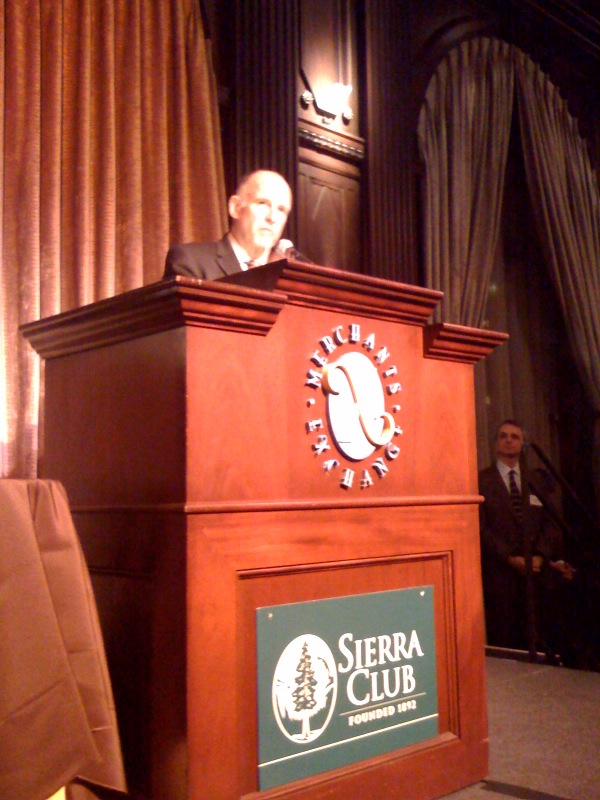
If Jerry Brown’s keynote speech last night to a gala environmentalist dinner is any indication, the Democratic Party faces an uphill battle to win this year’s governor’s race. The rambling, alternately vague and academic, and often pointless address did little to inspire or excite a large, sympathetic crowd that was loaded with top Democrats. In fact, some party luminaries were openly aghast at the poor performance, with one making this succinct (if off-the-record) assessment: “We’re fucked.”

Brown has never been a dynamic speaker, but the unscripted, half-hour speech – given at the Sierra Club San Francisco Bay Chapter’s David Brower Dinner in San Francisco, a $250 per head affair that drew top Bay Area Democrats – illustrates the danger of letting a primary be decided by legend and money rather than political persuasion.

Brown’s fundraising prowess and strong poll numbers chased Gavin Newsom and other potential rivals out of the Democratic Party gubernatorial primary, even though Brown hasn’t really outlined his political vision for California, given many extended speeches since being discussed as a candidate for governor, or even officially declared his candidacy (he and others have until March 12 to do so).

“This thing is really daunting,” Brown said of the governor’s race toward the end of the speech, seemingly unsure that he was ready to run, but saying he would make an announcement sometime in the next couple weeks.

Brown started his speech by telling the crowd that he didn’t know what he was going to talk about, so when he arrived (late) for the speech, he asked San Francisco Democratic Party chair Aaron Peskin what he should say, and Peskin told him to talk about how there were more salmon in the streams and better overall environmental health back when Brown was governor in the ‘70s.

But rather than taking that advice and giving a forceful call to strengthen environmental regulation or conjure up California’s better days, Brown meandered around and mused on that and other topics, feeding fears that the 71-year-old candidate might come off as a nostalgic, slightly senile former-Governor Moonbeam rather than an effective agent of needed change.

“During that period when I was governor, I’m not going to call it the golden age because some people think I’m in the golden age, so I don’t want to get people confused. That’s why I don’t want to talk about way back then, because there are a number of people I can see weren’t even born then, so it gets a little embarrassing and I like to pretend it was just yesterday. But in that period, California created almost twice as many jobs as the nation did. We created jobs at about 24 percent over eight years and the nation grew jobs at 13 percent, so almost twice as much. And then Deukmejian did pretty good, he had about the same, maybe half a percent more,” Brown rambled, ticking off statistics, hedging his point by noting how little governors can really do to create jobs, before working up to a decent line that was flatly delivered: “It was a time when the environment got its biggest boost, as far as public policy.”

Nobody applauded, so he continued. “I was thinking tonight, I was trying to figure out that if I did announce, what the hell would I say? And so I decided to go back and read my first announcement, January 24, 1974. I was 35 then, it was another time, I’m now a little older than that. But I talked about clean air, I talked about the energy crisis and getting new sources of energy. I talked about statewide land use planning” – that last item drawing some applause – “and I talked about jobs. And I was thinking, wow, we still got a jobs problem, we got an energy problem, we have a land use problem that feeds into the energy problem, and while the air is cleaner in many respects, it’s not clean enough, or it isn’t healthy enough.”

On substance, Brown had his moments. But even on the need for better statewide land use planning, he went off on a tangent, saying he didn’t even know what that meant when he filled out a Sierra Club questionnaire back in the ‘70s, and he’s not sure how to accomplish it now. 

“You have to make it easier to live closer to where you work,” Brown said in what of his few lines of the night that drew applause, although he didn’t begin to explain how he might achieve this goal. And on a controversial subject that is easily attacked by the right – big government wants more control over private property – Brown’s lackadaisical discussion of the issue was disconcerting.

He even rankled a few Sierra Club members by vaguely criticizing East Bay growth controls designed to reduce sprawl, which the Attorney General’s Office is seeking to overturn: “Pleasanton wants to create 50,000 jobs, but they have a housing cap – for all I know, Sierra Club probably supported that housing cap, so I want to just rub your nose in the housing cap for just a minute – the trouble with the housing cap is they want to create all these jobs.”

Brown tried to argue that allowing more housing in Pleasanton is a strategy for combating global warming because there are jobs there and it would reduce commutes, but he’s going to need to be more on his game than he is right now to win that argument. Instead, we get his fairly dismissive summary of this important issue: “Land use is a big deal, it’s difficult, lots to do on that.”

Against businesswoman Meg Whitman, the Republican gubernatorial primary frontrunner, there is real potential in Brown’s basic belief that markets need to be regulated and that running the government isn’t just like running a business. And somehow, Brown will need to find a way to better distill and deliver that message to counter the right’s pro-business sound bites. 

“There are people saying business knows best,” Brown said, meandering off about companies and widgets for a minute before continuing his point. “But when you look at what we really have to deal with, it’s not just about economics and the market. It’s also about ecology and morality, and morality is about customs, it’s about traditions, it’s about our deepest patterns of how we all relate to one another and that can’t just be assimilated into market incentives. The market assumes honesty, you meet your promises, and also assumes there’s a framework, because things can just run off the cliff and that’s exactly what’s happening. As you add more people, you have more cars, and when you have more cars, they burn fossil fuel and what’s happening in California is you have cars reproducing faster than people…That’s the real challenge here, that we’re trying to get the idea out that we’re trying to save the future.”

Loose in Obamalandia: Dead man walking through CA

1

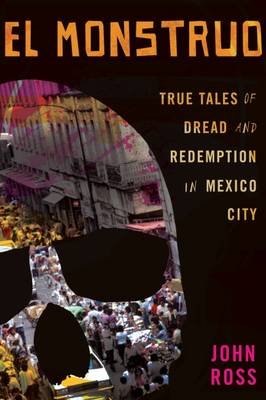
I am on a low-rent book tour with my new cult classic El Monstruo – Dread & Redemption In Mexico City.  For the next three months, I will stumble across this land from sea to stinking sea probing the underbelly of Obama’s America.  The findings will be posted on these pages.

1.
First stop was the near north woods, Humboldt County USA, to wheedle the medicos into granting me a clean bill of health before I hit the road.  A year ago this February, my doctor who has poked and probed my old broken cadaver for nearly 20 years, pronounced me dead. “Liver Cancer” he parsed gravely — but I am still alive and kicking. The class enemy be warned: I am not dead yet.

Humboldt had just been wracked by a 6.5 earthquake that cut a swath through Oldtown Eureka’s antique shops but was not quite Haiti.  Nonetheless, the shake-up worked its usual bad mojo and implanted the seeds of fear and loathing in every soul.  On January 22nd, three separate police agencies shut down the north end of Arcata and evacuated hundreds of residents after a scruffy hippie-type tried to fed ex a suspicious package to Berkeley that leaked, according to the clerk at Kinko’s, “a chemical odor.” The offending package was blown up in a back alley.

The next day, the local rag commonly known as the Times-Slander conceded in front-page headlines that the “bomb” was “Actually a brake light.” The paranoia was symptomatic.  A commercial jetliner to Kentucky was forced down by air force jet fighters after an orthodox Jewish kid pulled out his Tefillin to pray and, in a spasm of extreme religious irony, the panicked stewardess took him for some Muslim terrorist and confused the leather straps and little prayer boxes with bomb components that would blow the paying customers to kingdom come. 

Nine years ago, just weeks after 9/11, I got on the road to preach Zapatismo to the North Americanos. Flags flew from every home, a sort of Talisman against the terrorist devils.  It was not a healthy ambiance for spreading revolution and resistance in Amerikkka.  Prospects for the Monster Tour suddenly turned ominous.

2.  
San Francisco’s Mission District gets shabbier day by day as the “Great Recession” (read “Depression”) gallops towards economic Armageddon. The Miracle Mile is lined with empty storefronts and 98 Cent Stores (marked down from 99.)  The homeless sleep under their shopping carts – the Mission Local reports that 40 homeless families are living in 16th Street Single Room Occupancy hotels, twice the occupancy rate of a year ago.  In this Sanctuary City for the rich, the yuppie Mayor, who now aspires to be nothing more than a yuppie clerk in a yuppie wine store, is deporting undocumented teenagers convicted of no crime and the class divide seems more brutal than ever.

We posted up on Market Street in front of the Commonwealth Club, where torture enabler John Yoo was hawking his new book to the City’s elite. Financial District drones en route back to the ‘burbs asked Yoo Who?
I checked my watch.  It was time to hit the rails.

3.
The Central Valley was the first stop on the Monster Tour, the most deadly stretch of soil in North American California. The water plumes are all poisoned by agrochemicals and when one turns on the faucet on the west side of the valley, deformed babies pop out. 

This cesspool of chemical effluvia is populated by perhaps the most ethnically diverse crazyquilt in all of Obama’s America.  Anglo bigwigs and white Armenians rule the roost but down below Mixteco is spoken on the radio, communicating the bad news to the out-of-work Oaxacans who once toiled in the fields and packing sheds. The humongous Hmung community is up in arms over the FBI’s harassment of their spiritual leader, General Vang Pau who authorities accuse of conspiring to overthrow the doctrinaire Communist government of Laos.  Unemployed Palestinians and Pakistanis, Filipinos, white trash, and historic enclaves of Blacks, survive in this fulminating chemical stew by their wits. On every street corner, the down-at-the-heels don shabby green gowns and sagging Styrofoam Statue-of-Liberty crowns, holding up cardboard arrows pointing towards strip mall tax return scammers.

I stepped out into Catherine Campbell’s unplanted garden.  Police helicopters hovered overhead, searching out suspected gangbangers. Catherine is a veteran prison rights attorney who pays particular attention to what goes on behind bars at Corcoran and Chowchilla, two of the cruelest his & her lock-ups in the state. Recently, she put her know-how to work defending anarchists who had been beaten into the sidewalk by the Fresno pigs for handing out graphic leaflets depicting the torture of elephants during Ringling Brothers Barnum & Bailey’s annual visit to town, and she and a gaggle of advocates have been trying to keep the cops off a venerable homeless encampment. Now the City Council is seeking to felonize panhandling on Fresno’s median strips as a “safety hazard.” 

The Fresno gendarmes are particularly keen on persecuting young adults of color for alleged gang activities. An article in the Morning Bee reported on the so-called “Bulldog Gang” (the bulldog is the icon of the Fresno State football team so gang colors are readily available) whose members were accused of smashing windows and barking at the cops over on the decrepit west side.  Catherine says the bulldogs’ bark is more a growl.  Such are the sounds of hope in the second year of Obama’s lacerated reign.

Sam Stoker is a child of the Valley. One night last summer, I bought him a beer at the counter of my beloved Café La Blanca back home in the Centro Historico of Mexico City.  Sam, an acculturated Chicano, had journeyed to Mexico to connect with his family in Tamaulipas and bum around, sniffing out what was left of the 2006 rebellion in Oaxaca. When he went home to Winton near Merced, he spoke enough Spanish to delight his grandma. 

Sam is also an anarchist and a budding journalist who has been up to his neck in the struggle for justice for Oscar Grant in Oakland. Now he had come to the Valley to spread the virus of anarchism. Rebellion in the fields could bring California to its knees, he confided. I was only too happy to help out. 

Anarchism has a beachhead in Fresno at the Infoshop where 70 folks turned out to hear me preach revolution. Not all of the fellow workers were young punks. One gentleman in attendance told me he had been an organizer for Cuauhtemoc Cardenas’s foiled presidential campaign in 1988 in Sinaloa and fled Mexico when dozens of his companeros were gunned down by the mal gobierno.  He was still here, still waiting for the revolution. 

Over in Merced, I shouted out my poems in a long dark bar, The Partisan, on Superbowl Sunday.  A “digital remix” of Guy Debord’s “Society of The Spectacle ” preceded my incendiary words.  Maybe Sam Stoker’s pipedream is not as wacky as it sounds.

4.
So it was goodbye to Fresno and hello to Hollywood. I accessed the City of Fallen Angels over the Grapevine with a pit stop at Bob Hope airport and a bar in Santa Monica to watch the Lakers kick booty. My gigs were spread out all over this pedestrian unfriendly megalopolis and the signs of hard times were hard to avoid.  On the beach in Santa Monica, excruciatingly gaunt old men jogged against debilitating cancers and aging hippies scoured the sands with metal detectors for spare change.

Even out in ritzy Claremont, where I hobnobbed with a Palestinian restaurateur about the Nakba, Obama’s America seemed out of synch.  A student at Pomona College where I spieled had just been handcuffed and interrogated by transit security cops in Philadelphia for transporting 200 Arabic-English flashcards across state lines and some cad ripped off my cane down at the train station.  The Inland Empire, which abuts this restricted enclave, has the fifth highest mortgage foreclosure rates in the nation.

In Hollywood, where I spent a night on my favorite sofa, the glitz was tempered by the homeless with all their possessions piled high atop their shopping carts around the new Metro station. How many of them were out-of-work script doctors is not yet known.

Down in South Central, where anger is endemic, I spoke to a handful of Afro-Americans at Eso Won, an admirable black bookstore. The proprietor sported a prototypical pork pie hat and told me that when he sees the Mexicans coming over the border, he sees black people. We talked animatedly for a few hours about Afro-Mexicans who were a third of the population of Mexico at liberation from Spain in 1810 and whose history has been pointedly ignored south of the border.             

L.A. is gearing up for the trial of killer BART cop Johannes Mehserle, Oscar Grant’s assassin, that will be held in the same court house where O.J. won acquittal — if it’s not moved to Ensenada, taking a cue from outgoing Governor Terminator’s plan to build California prisons south of the border.

Students at Cal State L.A., the most Chicano university in Califas, honed in attentively when I expounded on the revolution that is brewing down south.  1810-1910-2010 – every hundred years on the tenth year of the century, Mexico explodes in violent social upheaval and even the Wall Street Journal is worried (see WSJ front pager January 15th.)

Looking at Obamalandia through the eyes of students is a useful handle for understanding what comes next.  Classes and services have been bludgeoned by budget cuts and the profs at Cal State furlough one day a week to make ends meet in this damaged economy that the President lies is booming again because only a half a million workers filed first time unemployment claims last month.  The light at the end of the tunnel is a bullet train pointed straight at the heart of the people.

All of this bad news is healthy for fightback.  The day I hit El Ley, Muslim students at U.C.-Irvine rose up against the Israeli consul ten times in a single speech until the university president sicced the campus cops on them. The next day a whole coast away, kids at Georgetown shouted down General Betrayus. Throw in the cutbacks and the furloughs and the hopelessness and it could be a long, hot spring semester and it won’t be just because of global warming.  I will do my best to fan the flames as I stumble front one campus to the next in the coming months.

On my last days in the late great golden state, I slept in a yoga house under a colorful banner of Ganesh, the elephant guy who gets fat eating others’ obstacles.  Lets hope he’s on my side. A year ago I was sentenced to death and although I’m still kicking, the future is laced with sharpened punji sticks, not the least of which incubates on my liver.

Talking truth to power is still the best medicine to beat back Nuestra Senora Santa Muerte.

John Ross and The Monstruo will be visiting the Narciso Martinez Cultural Center in the heart of the Rio Grande Valley Sat. Feb 20th. The Monster Tour plays El Paso, Las Cruces, and Albuquerque from Feb. 21st-28th.  Consult the Nation Books page for details or write johnross@igc.org

Taser trouble

6

You can say this for Police Chief George Gascon: He’s not shy. He’s pushing so many things, on so many fronts, that it’s hard to keep track, and some of them are real problems. One example: The Feb. 17th Police Commission meeting, where Gascon paraded a bunch of experts to talk about how great it would be if the SF cops had tasers.

I’m not against tasers per se; I’d rather the cops were shooting people with less-lethal weapons than with pistols. Quite a few people might be alive today if the more trigger-happy among Gascon’s force pulled a trigger that didn’t send a deadly bullet into a suspect’s body.

But you have to remember that a taser can be a lethal weapon, too; people die from taser blasts.

And when I talked to the folks in the SFPD public affairs office recently, they told me that the chief was drafting guidelines on the use of tasers, and that the taser would fall somewhere in between the use of a baton (non-lethal in all but the most exceptional cases) and a gun (lethal). That’s the wrong approach — and it’s what’s missing from Gascon’s argument.

A cop is only allowed to pull a gun in a situation where lethal force is justified; that is, when the officer’s life of the life of another person is in imminent danger. Same rules should go for the taser. That’s where the commission has to come in, because I don’t think Gascon is going to make that policy.

In fact, I’m getting the impression that the chief doesn’t like anyone else to make policy for him. That’s why he’s got an oped in the Chronicle today that goes after two proposals from Sup. Ross Mirkarimi. Gascon:

The San Francisco Board of Supervisors has proposed two pieces of legislation that would directly impact my ability as chief to provide effective and efficient public safety. One of these pieces, which would establish a community-based foot-beat patrol program, directs subordinates under my command to establish staffing levels absent my direction or control. The second, which seeks to require the police department to itemize the cost of dignitary protection, would jeopardize the safety of public officials who receive valid threats against themselves or their loved ones. These legislative proposals directly circumvent my ability to lead this department effectively. This ultimately makes the goal of making San Francisco the safest large city in America more difficult to achieve.

Translation: I don’t like the San Francisco supervisors setting law-enforcement policy. But actually, that’s the board’s job — to set the rules for how all city departments, including the SFPD, operate.

I can’t figure out why Gascon is fighting this foot-patrol legislation. He admits that foot patrols are a good idea and would solve a lot of crime problems. He just says he doesn’t have the budget. So take that to Mirkarimi and the other board members; tell them you’ll do foot patrols if they’ll fund it. Discuss the police budget in open session with the Budget and Finance Committe (which Mirkarimi sits on) and look for ways to make it work.
That’s how things get done in this city.

Bay Area faith leaders gather to call for immigration reform

2


By Rebecca Bowe

An event will be held this evening (2/18) at the Mission Dolores Basilica to urge Sens. Barbara Boxer and Diane Feinstein to push for nationwide immigration reform. The gathering of people from the immigrant community and faith-based organizations, which is being put together by the San Francisco Organizing Project, will be held in conjunction with the national Reform Immigration for America campaign.

Pat Bregant of SFOP told the Guardian that a turnout of around 1,000 is expected. Several families whose lives have been turned upside down by deportations will share their stories.

More than 35 clergy members from throughout the Bay Area will attend, including Bishop William Justice, Archdiocese of San Francisco. Others who are expected include Jim Molinari, state director for the office of Sen. Diane Feinstein, and San Francisco Supervisors David Chiu and David Campos.

Myrna Godinez, who came to the United States from war-torn El Salvador 26 years ago, said immigrants face steep challenges such as accessing health care and obtaining education. “They come here to work,” she said, “and to live in peace.” She said she faced many challenges trying to build a life here, but in her case, coming to the United States also meant being able “to go outside without being afraid of getting killed.”
The Mission Dolores Basilica is located at 3321 16th Street in San Francisco.

The event will be held from 7 to 8:30 p.m. and is free and open to the public.

Transamerica condos: the mystery continues

5


I’m not going to actually suggest that anyone watch all four hours-plus of the Planning Commission hearing last week on the highrise condo tower at 555 Washington. But if you’ve got the time, it’s a fascinating video.


And here’s what’s most interesting: A lot of the discussion revolved around what Commissioner Michael Antonini said was a need to continue the item to a later date. That’s because three of the commissioners — the ones appointed by the Board of Supervisors — were dubious about the project’s environmental impact report, so it would take all four of the mayoral appointees to let the project go forward. But Commissioner Gwyneth Borden couldn’t make the meeting. Antonini went ballistic at one point, and stormed out of the room, saying that it was disrespectful to Borden not to grant a continuance.
 
That struck Commission Vice-President Christina Olague as kind of odd. “I was taken aback by the accusations that we were somehow being insensitive,” she told me. “To my knowledge, Commissioner Borden never made any request for a continuance. There was nothing in writing and she never communicated it to me.”


But then the strangeness started to happen. Commissioner Hisashi Sugaya moved not to certify the environmental impact report on the project. That motion was defeated, 3-2, with Antonini off in a huff somewhere and Borden absent.


Now, normally, in these situations, the president looks for a substitute motion. In this case, a motion to approve the DEIR could have been made, and that, too, would have been defeated. Once the motion to approve went down, the DEIR would be scuttled and the developer would have to start again.


But instead, the commission secretary simply announced that the matter would be continued to March 18. And a week later, I’m still trying to figure out how that was possible.


After all, the commission had decided — openly, in public — NOT to accept a continuance. Then all of a sudden, without a vote of the body, Antonini got his way. The DEIR will be heard again, presumably with the mayor’s fourth vote present.


This is a major project, and I’m not going to argue that it’s fate should hang on an issue of procedure. But nobody has been able to explain to me how a matter gets continued without a vote to continue. The best I can figure is that without any motion on the floor, and no action pending, the secretary had no choice but to continue the matter.


“It all happened so fast,” Olague said. “I want to go back and review everything to see exactly what ocurred.”


Attorney Sue Hestor, who opposes the project, told me that after the lengthy list of serious flaws with the DEIR, which were presented in great detail at the hearing, it will be hard for the commissioners to certify the document. But the pressure from the Mayor’s Office is intense — Michael Yarne, the mayor’s Economic and Workforce Development advisor, was at the meeting, cornering commissioners outside. And four of the members serve at the mayor’s pleasure.


The “Newsom wins” merry-go-round: What fun

10

Gavin Newsom still hasn’t said for sure that he’s in the race for lt. governor, although just about everyone in town now thinks he’s going for it.

But the very prospect of the mayor leaving office before his term is up has the political classes speculating: Who gets that job? And how does it happen?

It’s actually pretty interesting.

Under the City Charter, the president of the Board of Supervisors becomes acting mayor in the event that the mayor leaves office before the end of his or her term. Then the supervisors, by a six-vote majority, can appoint someone else to the job.

Melissa Griffin lays out one piece of the scenario, which is that the board could appoint a new mayor in advance, without anyone serving as acting mayor.

But there’s much more to the story.

According to a fascinating city attorney’s opinion issued in 1978 (PDF), when George Moscone and Harvey Milk were killed and Dianne Feinstein was board president, no supervisor is allowed to vote on his or her own appointment. Which would mean that if, say, Board President David Chiu wanted the job, he’d need six votes not including his own.

Now the plot thickens. Suppose nobody can round up six votes — that is, a majority of the supervisors can’t agree on a new mayor? Well, Chiu, as board president, would be acting mayor — potentially for the entire duration of Newsom’s term, roughly a year. He’d also remain as board president. It’s the same as if the mayor goes out of the state and names an acting mayor in his place; that person is still a supervisor. So Chiu would have all the powers of both the mayor and the board president — and immense amout of clout for one person at City Hall.

But wait, there’s more: Chiu is board president only until the board elected in November of this year takes office, which would be about five days after Newsom would become lite guv. So unless the current board can choose a new mayor, with six votes (not including the vote of any supervisor being nominated), the new board would elect a new board president — who would instantly become acting mayor at the same time.

And since supervisors are allowed to vote for themselves for board president, any member would be allowed to vote for him- or herself for acting mayor.

Confused yet? Clearly, the folks who wrote the City Charter never actually envisioned this scenario (or didn’t think about it very much).

Of course, what that means that with the current board split the way it is, with exactly six solid progressive votes, someone who isn’t currently on the board (say, Aaron Peskin — or Tom Ammiano, or Mark Leno, or whoever) would have a better chance of getting a majority than a current member, who would need at least one of the moderate bloc votes.

And if Newsom runs, it will make the fall supervisorial elections even more important, because potentially those newly elected supes will be choosing not only a board president but a mayor.

Here’s another fun twist: If District Attorney Kamala Harris is elected attorney general, the mayor gets to appoint a new D.A. But suppose Newsom also wins and is sworn in a few minutes before Harris. Presumably acting mayor David Chiu (a former prosecutor who rumor has it might like to be D.A. himself someday) would choose the new D.A. — and suppose Chiu knows he doesn’t have six votes to be mayor. There’s no reason why he couldn’t appoint himself D.A., leaving a vacancy on the board and a vacancy for board president, which would be filled by anyone who could get six votes, who would then be acting mayor and could appoint a new supervisor to Chiu’s seat. Who could then be the deciding vote on who gets to be mayor.

Whoa. I can’t wait. Run, Gavin, Run.

Ammiano reviving Prop. 13 reform

13

Assemblymember Tom Ammiano is trying to put property-tax reform back on the California agenda. He’s introducing a measure that would call for taxing commercial and residential property at different rates — which would involve a significant change to Prop. 13. It’s been tried before, and big business interests have always managed to shoot it down, but as Ammiano puts it, these are different times:

“For over thirty years, Proposition 13 has allowed corporate landowners to benefit from tax loopholes while shifting the real tax burden to individual homeowners and reducing California’s tax base. “We cannot continue to cut funding from our schools, our parks and our vital human services without addressing the need for new revenue and an equitable tax system.  Reforming Proposition 13 will not solve all of the state’s budget problems but it’s a crucial step in the right direction.”

 It’s not exactly clear at this point what form the legislation will take; it might be a resolution followed by a Constitutional amendment. And I don’t think even Ammiano believes that both houses of the Legislature will happily vote to make big commercial property owners pay their fair share of the state’s tax burden. But it’s worth talking about, worth pushing, worth reminding people that one of the reasons the state is so broke is that the property tax system is frozen in time, a legacy of a very different era in California.For over thirty years, Proposition 13 has allowed corporate landowners to benefit from tax loopholes while shifting the real tax burden to individual homeowners and reducing California‘s tax base.  We cannot continue to cut funding from our schools, our parks and our vital human services without addressing the need for new revenue and an equitable tax system.  Reforming Proposition 13 will not solve all of the state’s budget problems but it’s a crucial step in the right direction.”


And a split roll is probably the only way to amend Prop. 13 at this point, since so many homeowners are so happy with it.


Honor Joe Lynn’s life and work

0

Friends and allies of Joe Lynn – perhaps the most diligent and public-spirited citizen ever associated with the San Francisco Ethics Commission, an agency he pushed hard to fulfill its campaign finance watchdog role – will celebrate his life Saturday, Feb. 20, during memorial services from 3-5:30 p.m. at the LGBT Center, 1800 Market Street.

Lynn died Dec. 9 after a long battle with leukemia and HIV-related ailments. As an Ethics Commission staffer and then an appointed commissioner, Lynn took seriously the mandate to root out and expose political corruption of all kinds, often defying powerful interests to do so. Much of his work was laid out in the pages of the Guardian, which regularly celebrated Lynn’s courage, insights, and hard work, as well of those of the protégés that he trained, Kevin De Liban and Oliver Luby (who is still with Ethics and carrying on Lynn’s work in the face of regular threats and sanctions from his bosses).

In fact, to mark what Lynn’s supporters see as the woefully lax and occasionally corrupt operations of the Ethics Commission under director John St. Croix and his chief deputy Mabel Ng (who, in 2004, ordered the destruction of documents implicated the Newsom for Mayor campaign in a money-laundering scheme), attendees will march on the Ethics Commission following the service.

For more on Lynn, see this obituary published in the Fog City Journal.

Gavin watch: The Lt. Gov. rumors

14

The rumors that Newsom is going to announce imminently that he’s running for Lt. Governor turned out to be a bit premature.

But I am still hearing from very solid sources that he’s seriously considering jumping into the race — and while the San Francisco left didn’t back his run for governor, this would be a very different campaign. The Lt. Gov. isn’t really in charge of anything, but has a certain amount of power, not just from the platform and the ability to issue press statements (one of Newsom’s favorite hobbies), but because that person gets a seat on the state Lands Commission (offshore oil drilling) and the U.C. Regents (education cuts). Newsom would most likely be fine on both issues.

And the truth is, we all know Newsom doesn’t really want to be a wine clerk.

And lieutenant governors are often well positioned to move on to higher offices it worked for John Kerry, for example (and for Gray Davis, if you call that working). I think Newsom would love to position himself to run for U.S. Senate when Dianne Feinstein, who will be 79 when her current term expires in 2012, decides to retire.

And, of course, from the perspective of progressives infuriated with what he’s done as mayor, it would get him out of town a year early, and let this district-elected board appoint a new chief executive.

That’s got all sorts of talk started, with the typical Chronicle-style “Oh My God Aaron Peskin could be mayor” stuff (and let’s be serious — Peskin would be a way better mayor than the current occupant of Room 200) to serious discussion about how this will affect the 2011 mayor’s race.

If any of the current contenders could round up six votes, it would be a major boost; that person could then run as an incumbent.

I don’t think this board would ever choose state Sen. Leland Yee, who is positioning himself for the run. City Attorney Dennis Herrera? Maybe — but given how pissed some of the progressives are about the Sanctuary Ordiance, it would be a stretch.

Sfist is running a poll, and right now it looks like the readers like Ross Mirkarimi but think Peskin or David Chiu is a more likely winner.

And trust me, even the thought of Gavin leading town has that scramble already heating up.


MTA works on deep Muni service cuts

0

By Nima Maghame

San Francisco Municipal Transportation Agency, which operates Muni, has pushed back a City Hall meeting (originally set for today) to make a decision on budget-related plans for cutting transit services by 10 percent across the city and raising prices on monthly passes, setting it for Friday 26th at 9 a.m. instead.

The proposal seeks “a savings of 313,000 annual service hours, which would result in $4.8 million in savings for the fiscal year 2010. The annual savings would be $28.5 million.”

At the Feb. 8 meeting, where the MTA formally announced its new plans, representatives from disability and senior citizen communities voiced their frustrations with the monthly pass price increase. Both groups not only rely on public transportation to get around the city, but many are members of organizations that subsidize passes for those in need. Many of these organizations can’t budget the new price hikes, which could mean that people who depend on these hand-outs may not get them.

“The people of San Francisco need transit. We were there to stop the MTA — 99 percent of the people at the meeting were there to say don’t cut services, don’t cut rates, there are other ways,” Forrest Schmidt, an organizer for the ANSWER Coalition, told us.

The 10 percent cut in service would hit the residents of Treasure Island hard because many rely on buses to get on and off the island. Several came to the meeting to voice their Muni needs and point out that the 108 bus is the only alternative to driving a car. They criticized MTA calculations that determine the appropriate amount of service that can be cut without causing too many problems for commuters.

“Alternative means don’t exist when you live on Treasure Island. They have to acknowledge that we have unique factors,” Treasure Island resident and art student Drew Williams said at the meeting.

The MTA board heard the plea, MTA spokesperson Judson True told us: “The board has decided to reevaluate their plans for the 108 line.” It was one of several factors that has caused the MTA board of delay its budget decisions.

Critics are infuriated at the MTA for not taking a proactive approach at dealing with its fiscal challenges. “It’s a damn shame it came to this. The severity was not predictable but the deficit was predictable,” said longtime transportation activist Dave Snyder, who recently formed a new transit riders union to advocate on behalf of Muni riders. “The revenue panel met a couple of years ago and the MTA declined all their recommendations.”


The Gavin and Leah Show

0

With rampant rumors that Mayor Gavin Newsom will announce his candidacy for lieutenant governor as soon as today – and with San Francisco Bicycle Coalition executive director Leah Shahum today announcing a leave of absence – it’s interesting to see the two paired up in Newsom’s latest You Tube video.

While Newsom has been a terrible mayor in many ways – from his frustrating fiscal conservatism to his petulant approach to politics and working with progressive supervisors – he’s actually not too bad on some of the greening initiatives he discusses in this video (which was the subject of our Nov. 18 cover story, “Seizing space”).

Bike Coalition chief takes a leave

1

Leah Shahum, longtime director of the San Francisco Bicycle Coalition, will be taking an eight-month leave of absence to live with her partner, Ted Strawser, in Amsterdam, which is widely considered one of the world’s most bike-friendly cities.

“As committed to bicycle advocacy as I am, the idea of living in Amsterdam is like a dream come true, so there’s no way I couldn’t do it,” Shahum said of the opportunity created when Strawser, an accountant for Dolby Laboratories, was transferred to Amsterdam for a year.

Under Shahum, the Bike Coalition has grown to become San Francisco’s largest grassroots advocacy organization, boasting more than 11,000 members. Shahum leaves in May and will be temporarily replaced by Renee Rivera, who served for several years on the SFBC board.

Shahum said the current strength of SFBC should allow for a fairly seamless transition: “We have such a strong organization that they can afford to have me gone.”   

Newsom’s gonna run? That’s what we’re hearing

2

Gavin Newsom’s going to announce his campaign for Lt. Governor in a few days.

That’s what inside sources are telling us, anyway. (And the rumor’s been circulating for a bit.) The mayor has been making a lot of phone calls in the past few days, checking in with supporters and lining up allies. And he’s ready to make the leap.

(Other sources say just the opposite, but such is San Francisco politics.)

The move makes a lot of sense from Newsom’s point of view; he’ll be termed out of office in two years, with nothing much to do on the horizion. And for a politician with heavy ambitions, that’s a bad place to be.

In the Lite Gov’s spot, he can keep a high profile, push education issues (the Lt. Gv. is a member of the UC Regents), make a bunch of speeches — and have no responsibility at all for actual follow through, which was never his strong suit.

And he’ll be positioned to run for an office like U.S. Senate should Dianne Feinstein decide to retire.

The issue has always been the local impact: If Newsom wins — and he would enter the race as the odds-on favorite — then he’d have to resign his job as mayor with a year left, and the supervisors would pick an new mayor, who could then run for re-election as an incumbent. Newsom’s money guys have never been happy with the prospect of leaving the city in the hands of a mayor appointed by a progressive majority on a district-elected board, but Newsom’s over that, our sources say. He’s thinking of his own future, and it looks like Sacramento.

So no confirmation, this is still at the rumor stage, but I’m betting he goes for it.

Day laborers protest U-haul and police crackdown

6

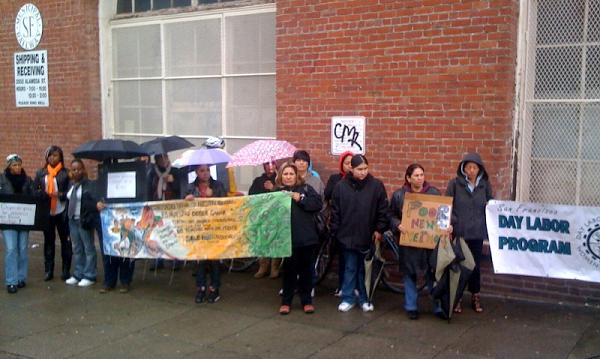
Every day, on my bike ride to work, I see the day laborers lined up along Alameda Street across from the U-haul office, hoping to get work. It’s a great little community, full of friendly people (mostly Latino men, but sometimes a couple young African-Americans as well), and they wave, smile, and try to get me to jingle my bell or honk my horn at them as I pass, which I always oblige.

But a couple months ago, the scene changed. Police officers now show up more often to hassle the day laborers, often demanding they clear the street. So they linger on adjacent streets, still trying to make themselves available for work, but clearly intimidated and wary of getting busted.

Well today, the workers pushed back, with the help of La Raza Centro Legal’s Day Laborer Program and nearly 100 supporters, who came to chant and protest a new U-Haul manager who they say constantly harasses them and calls the police three times a day. That manager, who was chatting with two cops at the scene, refused to identify himself or speak with me, referring me to their corporate flak (who hasn’t returned my call).

Anecdotally, we’ve heard that day laborers around the city have been rousted by police far more often in recent months, just one more of the SFPD crackdowns under new Police Chief George Gascon, which include raids on pot growers in the Sunset, mass arrests in the Tenderloin, regular raids of underground parties in SoMa, and lots more citations for drinking in Dolores Park and other parks.

L.A. Times writer takes on PG&E initiative

0

Los Angeles Times writer Michael Hiltzik weighs in again on the PG&E initiative, which is now on the ballot as Prop. 16.


He argues that the deck is stacked in PG&E’s favor here — the utility can spend all the money it wants — $30 million, $40 million, whatever — and the public agencies that will be hurt by the measure have no ability to fight back since they can’t spend taxpayer money that way PG&E can spend ratepayer money.


His conclusion:


Every candidate for governor should be required to state, for the record, whether he or she thinks it’s OK for PG&E to subvert the electoral process by spending $6.5 million (and counting) exclusively for its own corporate benefit. Thus far the GOP candidates, Meg Whitman and Steve Poizner, have been silent as far as I can tell, as has the putative Democratic nominee, Attorney General Jerry Brown.

And the rest of us should turn out to vote June 8, by the millions, to make a statement about who owns the state of California: the people, or PG&E?


Showdown over a downtown highrise

19

The battle over 555 Washington — the too-big highrise that will house 248 luxury condos that San Francisco doesn’t need — is going on right now, and you can watch it on sfgtv. 

Supporters and opponents have been testifying for more than two hours. Sue Hestor mae one of the key points toward the end of the testimony: Does “new urbanism” say that we have to fight suburban sprawl by putting 400-foot buildings everywhere in San Francisco?

She also pointed out that the building has so much parking that the lines to get in and out of the underground garage will impact the only downtown fire station, a block away.

Already, Planning Commissioner Hisashi Sugaya is arguing that the EIR on the project is completely bogus and invalid (although he carefully avoiding saying he will vote against the project).

This is one of the major development battles of the year, and will demonstrate whether the Planning Commission and Recreation and Park Commission have the independence and integrity to reject a project the mayor and the Chamber of Commerce support.


UPDATE: The hearing ended in the strangest way. After more than two hours of testimony — most of which showed the inadequacy of the EIR, which has to be certified as complete before a final vote on the project itself — Sugaya moved NOT to certify the document. That motion failed, 3-2. At that point, the commission secretary said that the matter would be put off until March 18th.

The strange thing is that if the motion had been in reverse – a motion TO certify — that also would have failed (either way, four yes votes were needed, and two commissioners weren’t there). And then the matter would be over; the EIR would not be certified, and the developer and city planning dept. would have to go back and redo it. In this case, since a motion to reject failed, and there was no motion to accept, it’s not clear where the EIR is.

Aaron Peskin, a foe of the project, told me just now that he doesn’t see how the commission can legally continue the hearing. “There’s nothing to continue,” he said. “There’s no certified EIR.” That, in the end, will be up to the city attorney. I’ll keep you posted. 

Newsom’s $72 million corporate giveaway

1

City economist Ted Egan yesterday released his analysis of the payroll tax exemption for new hires that Mayor Gavin Newsom has proposed, one of several business tax cut proposals that we discuss in this week’s Guardian. Egan estimates that the net revenue loss (which takes into account taxes paid by the new hires) to the city would be $72 million over the next two years.

“The proposed policy will have a strong positive effect on local hiring, albeit at a steep costs the City’s General Fund,” Egan wrote, later adding, “The policy would also make the City’s serious current budget deficit worse, and likely lead to significant employment reductions in the City’s workforce.”

While the tax breaks amount to only about 1 percent of businesses’ payroll costs, Egan’s models predict they would spur the creation of 4,330 jobs, or about 5 percent of the jobs lost since 2007. Yet he also notes that the unemployment rate in San Francisco has been dropping in recent months and the economy is predicted to add about 20,000 jobs in the next two years even without this subsidy by taxpayers.

Both Newsom and Egan have tried to cast these tax breaks as similar to the approach being taken by President Obama. Egan writes, “The policy is a targeted tax cut that mirrors the President’s New Jobs Tax Credit, which is supported by a wide range of economists.”

But the big difference is that the federal government can deficit-spend and doesn’t have to reduce its own spending, which would have a negative impact on economy, as Egan’s report acknowledged a few pages later: “Because the City cannot run a fiscal deficit from one year to the next, the lost revenue would necessitate reductions in City staffing and services, like any revenue shortfall.”

The report specifically doesn’t analyze the impact of that reduced government spending on the local economy, with Egan writing that, “is not considered, because the City could adjust to that impact in many ways.” New taxes, for example, which Newsom has avoided proposing as a partial solution to the city’s gargantuan $520 million projected budget deficit.

In an interview with the Guardian this morning, Egan also affirmed what he has told us before, that the consensus among economists is that direct government spending stimulates the economy more than tax cuts, even though these tax cuts tied to new hiring are better than general tax cuts.

For example, Egan said that another current Newsom tax cut proposal – a $2,000 tax break for businesses that provide health care to employees – “would have a negative effect on the economy” because it doesn’t encourage hiring.

While the report is generally favorable to the notion of these targeted tax cuts, it doesn’t make a recommendation. And it does take away a key argument that Newsom and other believers in trickle down economics generally make, that the tax cuts will ultimately be paid for by increased economic activity. Instead, the report shows the cuts will cost $85 million of two years and the new hires will generate $12 million in increased sales, hotel, and other taxes. Even stretching that analysis out over 10 years, assuming the new hires remain employed after the tax exemption ends, the reports says the policy will still cost the city $42 million.

Sup. John Avalos, the chair of the Board of Supervisors Budget and Finance Committee who has been skeptical of Newsom’s tax cut proposals, has set a Feb. 24 hearing on the proposal.

Basically, this is a policy decision rooted in ideological beliefs: Should the city subsidize private companies at great cost to the public treasury, payroll, and services? Does the public sector exist solely to serve private corporations? Economic conservatives who are hostile to government generally think so, but progressives think it’s crazy to make deep cuts to government spending and services just to subsidize private sector economic growth, most of which is going to occur naturally anyway.

Happy Nelson Mandela Freedom Day

0

Twenty years ago today he walked out of the gates after 27 years. This, from last Sunday, is essential and inspirational reading. 

“Whatever happened to my sanctuary city amendment?”

0

Yesterday, Sup. David Campos called for a status report on steps taken by San Francisco’s Juvenile Probation Department to implement an ordinance that the Board passed last fall to protect the confidentiality of juveniles’ immigration status.

And it already sounds like JPD has done nothing to implement it—and isn’t planning to, either, any time soon.

Campos announced that he met with Juvenile Probation Department (JPD) Chief William Siffermann today, and Siffermann told him that he had no intention of complying with the ordinance, which the Board passed Nov. 10, 2009.


JPD has had three months to figure out how best to implement the ordinance, which Campos helped author last year, and which seeks to give kids their day in court before handing them over tofederal immigration authorities for possible deportation.

Campos said he called the hearing so all the folks who worked to pass the legislation, and those it impacts, “have a public forum to hear about the decision not to implement it.”

Campos also requested a report on the impacts of JPD’s current policy towards suspected undocumented juvenile felons—a policy that Newsom ordered without public review and that JPD implemented on August 2008.

The report, Campos said, will include but is not limited to, the following:

1.    Determinations of cases of undocumented immigrant youth—original changes and final determination by the courts.

This will involve exploring not only what these youth were originally charged with at booking, but also what the local juvenile courts ultimately determined in their cases. So, expect to see a pattern in which the courts throw out or reduce the charges that resulted in these juveniles being reported to the feds at the moment of booking. Only, by the time the courts reach this determination, these kids have already been nabbed by the feds and transferred to detention facilities outside the city and/or state—a practice that has already resulted in the needless ripping apart of immigrant families.

2.    Policies, procedures and training provided to staff regarding inquiry into the immigration status of youth and compliance with the 1989 City of Refuge ordinance.

This exploration will likely lead to some eye-opening revelations as to how juvenile probation officers are expected, under the policy that Newsom ordered in 2008,  to question youth suspected of being undocumented, and how that contrasts/compares with the city’s original sanctuary ordinance which the Board implemented in 1989.
3.    The numbers of undocumented immigrant youth that have been reported to US Immigration and Customs Enforcement (ICE) since Newsom ordered his change in sanctuary policy direction in 2008.

Up until now, it’s been almost impossible to discover exactly how many kids the city has handed over to ICE under Newsom’s new policy. Yes, even though the city is now spending local tax payer dollars to hand local immigrants’ kids over to the feds, the city has not told the public how many kids have been handed over or their current whereabouts. This information, coupled with information about the final determinations that local courts made in these kids’ cases, will likely be another mind blower.

4.    Changes in caseload and staffing as a result of implementing Newsom’s new sanctuary policy direction in 2008.
Again, expect to see some interesting patterns emerge. Has the city saved money by referring kids to ICE at the moment of booking? How about time? And just how well trained are juvenile probation officers in the intricacies of immigration law, anyway?

5.    Information about department financial and human resources dedicated to collaboration with ICE.

This is where the proverbial shit may truly start hitting the fan. Are we needlessly alienating the immigrant community?  Are we doing so in counter productive ways?

As chair of the Rules Committee, Campos promised to schedule this hearing as soon as possible, so watch the Board’s committee calendar and expect to see sparks fly.

We go after the Weekly’s ad revenue

0


The Bay Guardian will be in court Thursday morning, Feb. 11, to ask a San Francisco judge to force SF Weekly to hand over half its advertising revenue as partial payment on a $21 million judgment.


The paper also filed a motion Feb. 9th asking Judge Marla Miller to add two of the corporations that make up SF Weekly’s parent company to the judgment.


The judgment came as the result of a Guardian lawsuit charging SF Weekly and the national chain that owns it with predatory pricing — that is, selling ads below cost in an effort to harm the locally owned, independent competitor. A San Francisco jury awarded the Guardian $6.3 million, which Judge Marla Miller increased to $15.6 million. With attorneys fees and interest, the judgment is now worth more than $21 million.


But Village Voice Media, the SF Weekly’s owner, has refused to pay — hiding in part behind a complex corporate structure (pdf).


The motion that will be heard Feb. 11 before Judge Paul Slavit marks the latest effort by the Guardian to collect some of the money. The paper has already seized two SF Weekly vehicles and the rent the company gets from subtenant.


The other motion, which will be heard March 12 in Judge Miller’s court, seeks to amend the May, 2008 judgment to include Village Voice Media LLC and Village Voice Media Holdings LLC.


VVM is arguing that that the Weekly has no unencumbered assets and that New Times Media LLC, which owned the weekly at the time we filed the suit, is just an empty holding company.


The Guardian’s lawyers argue that VVM and New Times are essentially the same company, with the same directors and same owners, and that VVM is a successor to New Times because of a 2006 merger.


There’s a good report on the issue in the Stranger.


The motion for assignment of ad revenue will be heard at 10:30 a.m. in San Francisco Superior Court, Dept. 610.


Let’s push Jerry Brown on PG&E initiative

3

When the state Legislature approved the law allowing cities to create local public power co-ops, the bill specifically barred private utilities from interfering. So it’s easy to argue that Pacific Gas and Electric Co.’s ballot initiative to squash public power is, in fact, direct interference.

After all, the measure would create an almost insurmountable obstacle to creating community choice aggregation.

And the attorney general of California ought to be making that precise argument in court and trying to get this ballot initiative thrown out.

Sen. Mark Leno, a strong foe of the measure, told us he’s been in touch with Attorney General Jerry Brown’s staff, and is urging them to take action. He said he’s been assured the office is looking into the issue.

It will be interesting to see what Brown does. As governor, he was a strong opponent of PG&E’s Diablo Canyon nuclear power plant, and spoke at anti-nuclear rallies, but since then, he’s been awful wishy washy (and has, for example, never been an open supporter of public power.)

Now, however, he’s running for governor — and PG&E is one of the most hated institutions in the state. The old Jerry took on corporate power and positioned himself as a populist; this latest incarnation of Jerry could pick up a lot of progressive support (which he badly needs) and force Meg Whiman into a corner (what, is she going to support PG&E?).

So how about it, Jerry?

(And by the way, the San Francisco supervisors ought to pass a resolution calling on Brown to sue to get this evil measure off the ballot.)


Black History Month in SF kicks off with dancing, future visions

0

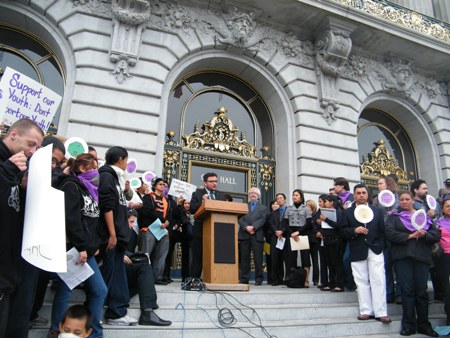
By the time I made it to the 2010 Black History Month kickoff ceremony at San Francisco City Hall, on Friday, Feb. 5, California Public Utilities Commissioner Tim Simon was talking about how the African American community can make sure it doesn’t get left on the sidelines in future.

Simon advised folks to know their resources, community and strategy to ensure that people of color are included in the burgeoning Green economy—a topic in keeping with the history-of-black-economic-empowerment theme.

“And I want to encourage all of us to celebrate the month of Black History and teach it to our children, because we could lose this generation,” Smith said, noting that just three blocks away from City Hall in the Western Addition/Filmore, “young men talk about and celebrate it when they reach 25 years old.”

California Public Utilities Commissioner Tim Simon advised folks how not to get left behind in the Green economy.

The community was encouraged to attend the Human Rights Commission’s Feb. 18 meeting in the Bayview and to get involved in the 2010 Census, which will provide temporary, part-time jobs with flexible hours.

Destined to Dance enlivens the corridors of power at San Francisco’s City Hall.

And then dancers with Destined to Dance wowed the audience by infusing the typically staid marble corridors of power with a “Swing low, sweet chariot” inspired blend of energy, grace and light-footed gaiety.

After the main program concluded, a who’s who of San Francisco’s black community lingered for a moment to chat.

Sup. Sophie Maxwell told me that she saw the failed attempt to recall her as “democracy at work.” She also repeated earlier statements that she is not yet ready to endorse any of the candidates vying to replace her when she is termed out in January 2011.

“It’s not just about Bayview Hunters Point,” Maxwell observed. “The common thread is the entire District 10 community.”


D. 10 candidates Eric Smith and Tony Kelly smile for the camera.

Kelly told me that to his mind the common thread is that residents of the district, which is home to the worst toxic hot spots in the city, can’t rely on corporations to solve their problems.

“District 10 can think for itself,” Kelly said. “They don’t have to look outside. But to my mind, up until now, the approach in city hall has been that there is no mess in D. 10 that can’t be fixed by a friendly corporation.”

Kelly observed that folks in the eastern neighborhoods came up with a better revitalization plan than what the city proposed, and that community activists managed to close the power plant, after the city said it was impossible.

“We have the worst schools, transportation and pollution,” Kelly said. “Candidates in the D. 10 race tend to fall into one of two groups: those that are responsive to Lennar and PG&E’s plans, and those who oppose them.”

D. 10 candidate Kristine Enea, who attended the Navy’s Feb. 2 “community involvement plan” meeting at the Bayview YMCA told me that at least the Navy showed some willingness to let the community speak at that meeting,

Chris Jackson San Francisco Community College Board Trustee chats with D. 10 candidates Tony Kelly and Kristine Enea.

“But they need to stop being so defensive,” Enea said, as she questioned why the Navy refuses to speak in public about why it dissolved the Shipyard Restoration Advisory Board.

D 10 candidate Lynette Sweet told me that she thought California PUC commissioner Tim Simon “hit it on the head with his comments,” at the Black History Month kickoff event.

D. 10 candidate Lynette Sweet poses for the camera.

“We’re not the sum of our parts, we’re not murderers and poverty pimps, there is some real leadership and quality people within our community,” Sweet observed.

The malevolence of Mercury Insurance

9

Yesterday’s San Francisco Chronicle reports on a long history of illegal practices by Mercury Insurance – including discrimination against soldiers, artists, bartenders, and other professions in auto insurance coverage and rates – and the long-overdue political and regulatory attention being paid to the company.

But that’s just the tip of the iceberg. The real story of Mercury’s dealings in California is even more insidious, and it has implications to the health care reform legislation being pushed by President Obama and congressional Democrats, which would require all Americans to buy health insurance, just as all California motorists are required to buy car insurance from Mercury and other companies.  

Documents from the California Department of Insurance (275 pages worth, which we also obtained and which you can download here) detail the Mercury’s deceptive practices, but it was hardly a secret how Mercury operated, brazenly and openly defying standards and regulations that voters created in 1988 by approving Prop. 103.

The author of that measure, respected activist Harvey Rosenfield of Consumer Watchdog, has been sounding the alarm about Prop. 17, a measure that Mercury has placed on the June ballot that would overturn key parts of Prop. 103, allowing insurance companies to jack up premiums for those who haven’t been loyal and continuous insurance customers that paid every bill on time.

Rosenfield recently stopped by the Guardian and offered a fascinating history of insurance regulation in California – and his battles with his number one nemesis, Mercury Insurance.

“Prior to the passage of Prop. 103, which the voters approved in 1988, insurance companies were not regulated in California. They could basically get away with anything and they did. In 1984, the state Legislature mandated that people buy auto insurance and guess what happened? After that, everyone in the marketplace is required to buy insurance and there’s no protection against how much insurance companies could charge you for it or even if they refused to sell it to you because of where you lived or the color of your skin, there were just no protections,” Rosenfield told us.

“One of the most pernicious practices after the Legislature said you have to buy insurance was that when you went to the insurance companies and said, ‘OK, I’m required by law to buy insurance, now sell it to me.’ They’d say, well you didn’t have it before, so we’re not going to sell it to you now. Or, you didn’t have it before so therefore we’re going to surcharge you and double the price of insurance. Talk about a Catch 22.”

So consumer groups sued and Rosenfield started writing Prop. 103. In 1987, the courts said this was a legislative issue, not a judicial one, so the groups turned to the California Legislature.

“Of course, the Legislature was too beholden to the insurance lobbyists to do any of the proposals that we were offering, so we went to the ballot box in 1988. Prop. 103 did many things: it called for a rollback, requires insurance companies to open up their books and justify premiums, it requires auto insurance companies to base your premium on your driving record, the number of miles you drive every year, and your driving experience. No longer would your ZIP code be the dominant determinant for how much you pay. And that battle, just to get that put it in place, we didn’t win that until 20 years after 103 began. We won in basically in 2006, 18 years later, after court challenges and going to the commissioner.”

While Prop. 103 allows the insurance commissioner to set additional reasonable factors in setting insurance premiums, Rosenfield said, “The one rating factor that Proposition 103 prohibits is the one that insurance companies used before. Prop. 103 says you cannot base insurance premiums or refusing to insure somebody on the absence of prior insurance.”

But as the new documents and other court findings showed, Mercury ignored that provision and used it as a factor anyway, setting a surcharge of about 45 percent of the premium price if you hadn’t had insurance before, for which they were again sued.

“Mercury realizes they’re going to lose the civil suit, goes to Sacramento, spreads a fortune in campaign contributions, and lo and behold, gets a bill passed overriding this provision of Prop. 103, legalizing its surcharges. [Gov. Gray] Davis vetoes it in 2002 on the grounds that it violates Prop. 103. Another year goes by, Mercury spreads even more money around, and this time Davis is up in a recall election and needs Mercury’s money. So he takes the money, it’s $100,000 or more, and Davis signs the bill. We have to go to court and challenge the bill as an unconstitutional amendment to Proposition 103, which we finally succeed in doing and it’s upheld by the Court of Appeals in 2005. All that time, Mercury is overcharging people. Ultimately, Mercury is told, the law you sponsored is invalid and you can’t do it anymore, so it stops in 2005 – 10 years of wanton, brazen violation of the law. And that brings us to the Mercury initiative.”

But because these surcharges are so lucrative – in some states, a Consumer Watchdog investigation found, doubling or tripling premiums – Mercury decided to spend millions of dollars to place Prop. 17 on the June ballot, and it will spend millions more to fool consumers into believing that its somehow good for them.  

“The Mercury initiative is even more pernicious than what it was doing before, and here’s why. Under Mercury’s initiative, if you’ve never had prior insurance, you can be surcharged for the first time. It overturns the Prop. 103 provision and legalizes these surcharges. Then they’ve thrown in some other tricks and traps, as you’d expect an insurance company to do on a ballot measure.”

What are those tricks and traps? How have they been able to get away with this for so long? Why did Attorney General Jerry Brown, a candidate for governor, give the measure such a favorable and misleading ballot title and summary? Why has the Democratic Party been so unwilling to challenge them? We’ll have much more on Mercury and its corrupting corporate influence in future issues of the Guardian.

Coby King, Mercury’s vice president and spokesperson, wouldn’t speak directly about the newly revealed documents or the concerns they’re causing among regulators and politicians, sending us the same prepared statement he send to Chronicle, which says consumer groups are trying to “mislead consumers and rehash old allegations.”

Yet I pressed him on why Mercury has for decades shown such contempt for the regulatory framework created by Prop. 103, which the company has now challenged through lawsuits, sponsored legislation, lavish political contributions, the new ballot measure, and even through blatant violations of the law. He tried to refer me to Kathy Fairbanks, who headed the Mercury-backed front group, Californians for Fair Auto Insurance Rates, which is pushing Prop. 17.

But when I noted that the group is supposedly independent of Mercury, and it is the company’s hostility to Prop. 103 that I was asking about, he finally said this: “Prop. 103 is the law of the land, but to the extent there are improvements that can be made that are pro-business and pro-consumer, Mercury has not been shy about acting in the public interest.”

Ah, so it’s the public interest that Mercury has been acting in. Got it.