• No categories

Politics Blog

The Chron just wants to cut transit

10

Interesting that the Sfgate.com poll running along with the Matier and Ross item on transit agency deficits only cites four possible solutions: Cut service, cut employee pay, raise fares or “get in the bailout line.” I realize that the Bay Area’s transit agencies don’t always work well together and duplicate some service, and that some managers are overpaid, and some money is wasted on consulting contracts. But I also know that in a recession, the price elasticity of demand for transit (warning — deadly report) is pretty high. That means when you raise prices, fewer people ride — and at a certain point, you wind up losing money by hiking fares.


And I also know that transit systems are one of those government services that, like schools, almost always get better when you throw more money at them.


We have been systematically underfunding public transit in this state and this country for decades — and now we’re surprised that the agencies are running out of money? Of course, the Sfgate readers all want to cut employee pay — that’s an easy scapegoat — but I wonder what would happen if the poll included “raise gas taxes and parking fees to fund fast, clean, efficient public transit.” I know what I’d vote for.


GOP debate sets up Brown for gov campaign

0

I don’t know how many people were watching a Sunday afternoon Republican gubernatorial debate, but it hardly matters: All that Steve Poizner and Meg Whitman did was help the Democrats.


This race is over — Poizner can’t win. He’s too far down, with too little money against a candidate who will spend every penny it takes, and has the pennies to do it. All he can do now — and he’s getting really good at it — is create soundbites for the Jerry Brown campaign (or more likely, for the well-funded independent expenditure effort that we all know is coming).


Whitman’s greatest vulnerability is her background as a rich businesswoman with ties to Goldman Sachs and a fortune built and expanded at a time when much of the state is badly hurting. Every time you say the words “Whitman” and “Goldman Sachs” in the same sentence, she loses votes.


And Poizner did that wonderfully during the debate:


“Meg Whitman has massive investments in Goldman Sachs, made huge amounts of money from the collapse of the housing market, and then, when it was time for Goldman Sachs to get bailed out by taxpayers, Meg Whitman actively campaigned for a taxpayer funded (bailout). The question is, did she let people know?”


And:


Wow, you really don’t get this Meg…You were the CEO of eBay receiving investment banking services from Goldman Sachs, then you joined the Goldman Sachs board and their compensation committee, then Goldman Sachs started to feed you these sweetheart deals, not one, not two but 100 of them, and you made a fortune, a separate fortune from your eBay fortune and then until you got caught you didn’t think anything was wrong. But the fact is, Congress investigated what you did, they called it corrupt, the SEC investigated what you did and immediately declared what you did illegal, and the eBay shareholders investigated what you did and they sued you. They sued you for a huge conflict of interest and the only reason why you paid back any of this money is because you had to settle the lawsuit.


None of that is going to elect Poizner (who essentially ceded the Latino vote by announcing he supports the Arizona immigration law), but it’s going to make great copy for the attack ads on Whitman this fall.


That’s the problem with primaries that become entirely negative — they come back to get you in the general election.


SFBG radio: Johnny Angel and Tim Redmond on Whitman and SF’s mayor

1

Johnny Angel Wendell and Tim Redmond talk about Meg Whitman’s oil-spill and immigration policy problems, why Jerry Brown isn’t getting on the stick and why San Franciscans have trouble electing a progressive mayor.

Johnny Angel SFBG Radio Show 4/30 by SFBG

Opinion: Immigration policy, in Arizona and at home

14

Editors note: This is an opinion piece the horrible immigration bill in Arizona — and its connections here in SF.


By Angela Chan


Mayor Gavin Newsom and City Attorney Dennis Herrera have publicly opposed the anti-immigrant bill, SB 1070 in Arizona.  A diverse coalition of civil rights organizations – including the Arab Resource & Organizing Center, Asian Law Caucus, Bernal Heights Neighborhood Center, Central American Resource Center, Community United Against Violence, Equal Justice Society, La Raza Centro Legal, National Lawyers Guild San Francisco Bay Area Chapter, POWER, and Pride at Work SF — applauds both city officials for taking a strong stand against the Arizona bill.  At the same time, we urge Newsom and Herrera to firmly and unequivocally support the implementation of a local policy that protects the due process rights of immigrant youth in San Francisco.


As with SB 1070 in Arizona, the mayor’s policy of requiring juvenile probation officers to report young people to federal Immigration and Customs Enforcement (ICE) before they receive due process has opened the door to racial profiling and torn many innocent youth from their families.


Since July 2008, pursuant to Newsom’s draconian reporting policy, more than 160 youth have been reported to ICE right after arrest, before they even have had a chance to be heard in juvenile court. That means that youth who are completely innocent of any crimes and youth who are overcharged have been reported to ICE.


Despite the veto-proof passage of a policy by the Board of Supervisors last fall that moves the point of reporting from the arrest stage to after a youth is found to have committed a felony, Newsom has insisted on ignoring the new city law.  Herrera, in turn, has yet to advise implementation of the new law.


Like the Arizona bill, Newsom’s policy requires reporting to ICE when local officials – in this case juvenile probation officers – merely have “reasonable suspicion” that an individual is undocumented. The factors that probation officers are required to use to determine reasonable suspicion have come under fire for codifying racial profiling into law.  Such factors as “length of time in the country” and “presence of undocumented persons in the same area where arrested or involved in the same illegal activity” have little to do with accurately determining an individual’s status, and much more to do with targeting the entire immigrant community and those who live in heavily immigrant communities.


In March, a year and a half after the mayor’s policy went into effect, Chief Probation Officer William Siffermann admitted before the Rules Committee of the Board of Supervisors that the latter factor could lead to racial profiling.  A few days later, Herrera stated that this factor had been removed from the policy.  However, if any changes have been made to the written policy, they have not been made available to the public.


Another similarity with the Arizona bill:  probation officers in San Francisco have not been properly trained and do not have the expertise in immigration law to accurately determine which youth are actually undocumented.  Rather, these officers rely on race, ethnicity, language ability, surnames, and accent as a basis for assuming immigration status.
Much like the Arizona bill, Mayor Newsom’s policy goes well beyond any obligations under federal law by requiring that probation officers report suspected undocumented youth to ICE.  As a cadre of legal scholars, including University of San Francisco Law Professor Bill Ong Hing, have repeatedly made clear, federal law does not require that city officials ask about immigration status or report individuals suspected of being undocumented to ICE.


Finally, as with the Arizona bill, the mayor’s draconian policy only compounds the harm to immigrant families caused by an already flawed federal immigration system, which is in drastic need of comprehensive reform. We need humane reform at the federal level, but in the meantime, Mayor Newsom and City Attorney Herrera need to take swift action to restore due process and protect family unity by ending San Francisco’s draconian policy. 


In standing up against racial profiling in Arizona, Mayor Newsom is back on the right track of defending immigrant rights — now is the time to give immigrant youth and families fairness and due process in San Francisco.


Angela Chan is staff attorney with the Juvenile Justice and Education Project at the Asian Law Caucus

The dubious high-speed rail report

1

The Chron’s blast at the state’s high-speed rail system is a big headline, but the report it’s based on is pretty dubious.


As the always-insightful Robert Cruikshank at Calitics points out, the state auditor is trying to blame the High Speed Rail Authority for the fact that federal funding for the project isn’t yet in place. But there’s no reason to believe that situation will remain forever; both Congress and the Obama administration have been friendly toward high-speed rail, and California is in line to get a significant amount of it.


And in the worst-case scenario, if there’s no federal funding at all, the money California voters have already approved won’t go to waste — it will go, for example, to improve the existing Caltrain lines.


Cruikshank:


For some HSR critics and skeptics, the uncertainty around federal funding is a reason to either not build the project, or to not build it in their backyard. The proper response, however, is not to be a passive actor, but to instead actively work to secure federal funding for HSR. You can go to the FourBillion.com site and told their Congressional representatives they want $4 billion in the FY 2011 budget, as a first step toward advocacy for the $50 billion in the transportation bill reauthorization.


MLBPA opposes Arizona immigration bill

2

The Major League Baseball Players Association Executive Director Michael Weiner sent out a letter this afternoon stating that the MLBPA opposes the immigration law recently passed by the state of Arizona.

In his letter, which was sent to City Attorney Dennis Herrera following Herrera’s call to find an alternative to Phoenix for the 2011 All-Star game, Weiner acknowledges that law’s passage “could have a negative impact on hundreds of Major League players who are citizens of countries other than the United States.”

“These international players are very much a part of our national pastime and are important members of our Association,” Weiner states.”Their contributions to our sport have been invaluable, and their exploits have been witnessed, enjoyed and applauded by millions of Americans. All of them, as well as the Clubs for whom they play, have gone to great lengths to ensure full compliance with federal immigration law.”

“The impact of the bill signed into law in Arizona last Friday is not limited to the players on one team,” Weiner continues.”The international players on the Diamondbacks work and, with their families, reside in Arizona from April through September or October. In addition, during the season, hundreds of international players on opposing Major League teams travel to Arizona to play the Diamondbacks. And, the spring training homes of half of the 30 Major League teams are now in Arizona. All of these players, as well as their families, could be adversely affected, even though their presence in the United States is legal. Each of
them must be ready to prove, at any time, his identity and the legality of his being in Arizona to any state or local official with suspicion of his immigration status. This law also may affect players who are U.S. citizens but are suspected by law enforcement of being of foreign descent.

“The Major League Baseball Players Association opposes this law as written,” Weiner concludes. “We hope that the law is repealed or modified promptly. If the current law goes into effect, the MLBPA will consider additional steps necessary to protect the rights and interests of our members. My statement reflects the institutional position of the Union. It was arrived at after consultation with our members and after consideration of their various views on this controversial subject.”

Fun with political ads

0

Wowee wow, the political ads are getting strange.


Steve Poizner, desperate to find some kind of traction in the final weeks of the GOP primary campaign, has released a new attack on Meg Whitman that continues in a long line of weird Republican animal flicks. It’s not quite as odd as Carly Fiorina’s demon sheep, but still: There are vultures flying around, vulture squawks in the background, and at one point, a vulture lands on the ground and starts chowing on some carrion.


But there’s a serious point here, too. The ad attacks Whitman for her ties to Goldman Sachs, and points out that she was making big money on dubious insider stock deals just as the rest of the nation’s economy was going to hell. ANd if Poizner thinks this will play with conservative voters, imagine what the Democrats will be able to do with it in the fall.


Then there’s Gavin Newsom’s ad, which starts out reminding us all that his state of the city speech was seven hours long (this is something we want to remember?) then lists all the great accomplishments he’s taking credit for, even though none of them were his initiatives. He talks about San Francisco having the best urban school district in California (although the mayor has no control at all over the schools, and the main reason the district’s finances aren’t worse is because of the Rainy Day Fund, a project of Tom Ammiano). He talks about paid sick leave (which came from the Board of Supervisors, not the mayor’s office) and universal health care (which was sponsored by Ammiano, not Newsom).


Then the ad winds up with Newsom walking back to his office and finding that Willie Brown is sitting in his chair. That, I guess, is a joke — but it only serves to remind viewers that (1) Newsom owes his political life to Brown, one of the most corrupt mayors in San Francisco history and (2) if Newsom wins, he’ll be leaving office early, allowing the supervisors to vote in a new mayor.


Did Gavin’s people even make this ad?

Local superhero vs. evil plastic bag

One unintended, positive side-effect of San Francisco’s plastic bag ban: Fewer opportunities for free-floating bags to lodge themselves into cylcists’ derailleurs, as happened to me this morning on my way to work. It’s still two weeks before the official Bike to Work Day, but I thought I’d share today’s bike-commute anecdote, which belongs in the Restoring Faith in Humanity department.

I was biking through the intersection at Third and Mariposa when it became nearly impossible to pedal, and a passing cyclist yelled out, “There’s something in your derailleur!” I pulled over to check it out, and sure enough, discovered a mangled mess. A black plastic bag had wedged itself so deeply into the gears with just a rotation or two of the pedals that I wondered if I was going to have to tear the whole thing into pieces to free it.

After a minute or so of wrestling with the demonic bag, my fingers were coated in grease and I was beginning to think angry thoughts about whomever let this non-biodegradable menace loose on the world. And then suddenly, from out of nowhere, this random dude on a bike swooped in and asked, “Do you need some help with that?” Er, yes.

This stranger was amazingly helpful, and I don’t know his name, but I feel I ought to thank him (for about the fifth time) here in print. After a couple seconds of wriggling the wedged plastic bag around, he instructed me to rotate the pedals forward some, and voila! It came free, and the curse was lifted. There are cool people in San Francisco. Gracias, mystery cyclist!

Take me out to the ball game (just not in Arizona)

1

City Attorney Dennis Herrera and Supervisor David Campos are asking Major League Baseball Commissioner Bud Selig to seek an alternative to Phoenix, Arizona to host the 2011 All-Star Game, unless that state’s controversial immigration law is repealed.
The move follows Herrera and the Board of Supervisors call to boycott Arizona, following Arizona’s accidental Gov. Jan Brewer’s infamous April 23 signing of SB 1070.

In their letter to the MLB’s Selig, Herrera and Campos call the new Arizona law, “an unambiguous and direct threat to the liberty of millions of Americans who are Latino or who may appear to be of foreign origin. And it comes as the debate over immigration ramps up nationwide, spilling over into city council chambers and federal court houses, as well as onto baseball fields, as rightwing electeds in Texas, Colorado and now Oklahoma boast of plans to introduce similar legislation to Arizona.

“Arizona’s new law goes far beyond merely pushing the envelope of a politically contentious issue,” Campos and Herrera state. “It is a direct and tangible threat to the fundamental rights of many Major League Baseball players and fans, and an affront to millions of Americans who are — or who may appear to be — of foreign heritage.”


Newsom’s puppet show

0

Mayor Gavin Newsom, who has been doing exactly what Pacific Gas and Electric Co. wants at City Hall, is complaining that some of the supervisors are Bay Guardian puppets.


Supes try applying pressure to urge CCA contract

At the April 27 Board of Supervisors meeting, Sup. David Campos made a motion to push back board approval for San Francisco Public Utilities Commission infrastructure improvement projects until a contract was in hand for the city’s Community Choice Aggregation program. If a contract isn’t signed by June 8, when voters will decide on Pacific Gas & Electric Co.’s Prop 16 in the June election, the city could be vulnerable to a legal strike against its green municipal power program from PG&E.

“Having watched the very slow process” of negotiating a contract, “I believe CCA should be the top priority,” Campos said.

Sup. Ross Mirkarimi, who chairs the Local Agency Formation Commission (LAFCo) and has been the primary driver behind CCA on the board, acknowledged that asking the board to withhold funding for city infrastructure projects was “an extraordinary act,” but warned that the imminent threat of Prop 16 called for drastic measures. “Given this external threat from a corporation that is doing everything in its power to subvert and deny San Francisco’s right to move forward, it alarms me, like I know some of you, that we do not have a contract in hand … knowing very well the kind of resources and fervor that have been demonstrated or exemplified in the past by the PUC or by the administration or by whatever other combinations of political forces who insist on something getting done by certain timelines and deadlines,” Mirkarimi said.

But while Campos and Mirkarimi won the support of Sups. Chris Daly and Eric Mar, they failed to bring the others around. The tactic of withholding approval on an ordinance in order to send a clear message to a city department about a separate issue “sets a real, real bad precedent for how we’re going to be doing our work here,” Avalos said, though he did voice his support for CCA.

Sup. Sean Elsbernd came out strongly against the move, and made a motion to table Campos’ initial motion to push the vote back for two weeks until a CCA contract was finalized. Then, in one of those dizzying contests the Supes sometimes get into, Daly made a motion to table Elsbernd’s motion to table Campos’ motion to table the vote.

To put it simply, six supervisors voted to move forward with the vote as scheduled, while four voted to hold back on approving funding for SFPUC projects until a finalized CCA contract was in hand. Sups. Mirkarimi, Chris Daly, and Eric Mar voted with Campos to hold off; Sups. Bevan Dufty, John Avalos, David Chiu, Michela Alioto-Pier, and Carmen Chu voted with Elsbernd to proceed. (Sup. Sophie Maxwell was absent.) After that skirmish went down, all ten voted to approve the funding for the SFPUC infrastructure projects.

When reached later by phone, Board President David Chiu said, “We are fully committed to seeing a CCA contract happen before the June election,” and noted that he brought up the urgency of the matter in a meeting with the mayor, who in turn voiced his own commitment.

PG&E pitches the Guardian for support

1

You know that Pacific Gas & Electric is carpet-bombing voters with its campaign to kill the CleanPowerSF program and pass Proposition 16 – which would prevent such renewable public power programs in the future – when one of their minions calls the Bay Guardian City Editor at his desk at work with their pitch.

That’s what happened this week when a representative of a PG&E front group, the Common Sense Coalition, called me to warn about San Francisco’s “dangerous energy scheme.” I listened for awhile, and then asked the guy a few of my own questions.

“What is the Common Sense Coalition?” I asked, a seemingly straightforward question that I already knew the answer to. I could hear him fumbling through his notes looking for the answer, and when he finally started to read me his deceptive script about “concerned citizens,” I asked another, “Where does the Common Sense Coalition get its funding?’

He didn’t seem to know, so I told him that PG&E Corp. has dedicated at least $35 million in ratepayer money – that is, profits from the high electricity rates paid by San Franciscans and PG&E’s other captive customers – to the campaign being waged by its front groups.

That campaign includes slick mailers and ads on websites (including the New York Times), television, and print publications, asking, “Do you think voters deserve the right to have the final say on how our money is spent?” Actually, the measure requires a two-thirds vote, which is nearly impossible to obtain when PG&E spends tens of millions of dollars to distort the truth in every election that its market share is threatened.

And the truth is that we do have a right to vote on the elected officials who pursue programs like CleanPowerSF, but we don’t have a right to vote on whether we get our power from PG&E or whether it uses our own money against us.

Whitman and Goldman should be rich fodder for Democrats

12

Democrats are now benefiting from the confluence of the public’s outrage over reckless self-dealing on Wall Street, debate over a Democratic bill to regulate such casino-style financial practices, and prosecution of Goldman Sachs for profiting from an economic collapse it helped cause. But the bigger question is whether top Democrats are willing to make the sustained case that it’s the rich who have screwed over the vast majority of Americans, and it’s time to recover that plundered wealth to deal with pressing problems like poverty, global warming, and infrastructure needs.

Central to that question is Meg Whitman, the Republican gubernatorial candidate who should be a poster child for a campaign against the predatory rich, whose increasing wealth has come at the expense of the working class and public institutions. As the Sacramento Bee reports today, Whitman is a former Goldman Sachs board member who profited from insider trading deals that are now illegal. And now she’s using her ridiculously over-inflated net worth to try to buy the governor’s office with unprecedented spending, something that should profoundly offend our basic democratic values.

Presumptive Democratic gubernatorial nominee Jerry Brown and some union officials have tried to highlight Whitman’s extensive Wall Street connections, but Brown has been way too tepid. Maybe that’s because he has his own Goldman Sachs ties, as the Los Angeles Times reported this week, although they pale in comparison to Whitman’s, which continue to this day and help pay for her takeover of California airways with her deceptive yet poll-tested propaganda.

As we wrote in our endorsement of Brown this week, it’s frustrating that Brown has been so unwilling to go after the rich, whether it be raising income taxes on millionaires (who have weathered the Great Recession far better than working stiffs) or letting commercial property be assessed at fair market value (since Prop. 13 passed, corporations that used to pay about two-thirds of the property taxes in California now pay about one-third, with individual property owners now paying two-thirds).

This is fertile ground for some long-overdue class warfare on behalf of the vast majority of people whose livelihoods have been threatened by the greedy, self-dealing rich. Anger at Wall Street for destroying the economy and then being bailed out by the federal government cuts across traditional ideological lines. It is felt by progressives, by conservative members of the Tea Party movement, and even by many political moderates.

At this point, few people trust the Democratic Party to lead the way toward a real accounting for the financial collapse, a recovery of the money from those who profited from the disaster, and an application of that money toward the most pressing public problems.

That’s a shame, but it’s also a real opportunity for a Democrat-led populist movement that unites disaffected factions on the left and right. After all, the problem only lies with about the richest 5 percent of Americans, those who have used elaborate financial ruses and tax shelters to hoard the wealth this country needs, even as the rest of us have lost financial ground. If there is any real democracy left in this country, it shouldn’t be that difficult for 95 percent of Americans to act in their own best interests.

After all, just this afternoon, even the most stubborn Republican leaders relented on allowing debate on the Democrats’ financial regulatory legislation, bowing to the very political pressures that I’m talking about. But if the Democrats want to try to regain their status as the party of the people, and begin to finally deal with this country’s long-neglected needs, they’ll need to see this as just the first small step down a path they should have taken decades ago.

Reading the tea leaves in the Arizona Governor race

6

A newly released survey of the AZ governor’s race at Public Policy Polling shows a tight race, with Attorney General Terry Goddard, a Democrat, leading all the GOP candidates, including current Arizona governor Jan Brewer, who just signed the state’s racist immigration bill, and Sheriff Joe Arpaio, who has been treating undocumented Mexicans like animals for years.


 “The remainder of the race could hinge on the popularity of the controversial new immigration law which Brewer signed, Goddard opposes, and Arpaio, naturally, has lauded,” said Dean Debnam, President of Public Policy Polling. “Brewer and Arpaio could both beat Goddard if they rally illegal immigration opponents.”

According to Public Policy Polling’s analysis, Brewer’s handling of the immigration bill gave her a much needed boost among Republicans in her quest to snatch the GOP gubernatorial nomination from Arpaio and other Republican candidates. But Democrats and Latinos are now flocking to Goddard in droves, as calls for a nationwide boycott of Arizona grow.

Daggle’s “avoid Arizona option” is awesome

3

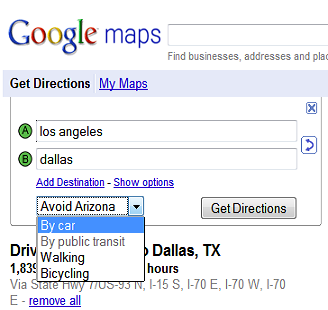
Daggle is sporting an “avoid Arizona option” in an awesome parody of Google Maps.


“Headed cross-country and worried about a new law that might get you stopped by the police in Arizona because you look like an illegal immigrant?” writes Daggle creator Danny Sullivan. “Not to fear! Google has now added an “Avoid Arizona” option for those generating directions.”


As Sullivan points out, this option isn’t real, but sadly Arizona SB 1070 is a real law.


Newsom’s opponent Hahn calls for LA boycott of Arizona

The Arizona legislation that has sparked fury nationwide and even prompted City Attorney Dennis Herrera to call for a boycott of all things Arizona has also served to highlight a difference in opinion between Mayor Gavin Newsom and his opponent in the Lieutenant Governor’s race, Los Angeles City Councilwoman Janice Hahn.

In a Chronicle story today, Newsom took a murky stance on the Arizona boycott idea:

“Newsom argued that a total boycott of Arizona businesses could bring the city a wide range of problems that haven’t even been considered. ‘The notion of boycotting a state and every business that does business in the state is an extraordinarily complicated matter,’ he warned.”

To Hahn, the matter isn’t so complicated. According to a press release we received from her campaign:

“In response to newly-enacted legislation in Arizona which will require immigrants to carry documents about their immigration status at all times, and will allow police officers to question residents about their immigration status, today, Councilwoman Janice Hahn will introduce a resolution calling on the City of Los Angeles to boycott the State of Arizona. The resolution will call for Los Angeles, and all of its departments, to end any and all contracts with Arizona-based companies and to stop doing business with the state.”

School Board fireworks

2

Look for some interesting heat and maybe some light at the school board meeting tonight (April 27). The teachers union is holding a march and members will be speaking out against the layoffs (PDF), since this is the last board meeting before pink slips to more than 800 teachers and 300 para-professionals. The district, of course, is broke, since most of the money comes from the state, and the state is broke for all the reasons we all know, and I don’t envy the job of the school board and the superintendent, who have to somehow balance the books. The teachers think there should be more cost-cutting at the central office and that the district should dip into reserve fund, which will be about $8 million to the good at the end of this year.


It’s complicated, but the state requires the district to keep 2 percent of its budget total in reserve; that’s a sound policy. Right now, according to information that SFUSD spokesperson Gentle Blythe sent me, the reserve is at $33.6 million, much more than is needed, but some of that is temporary federal stimulus money.


Here’s how the distict outlines the situation:


Our baseline projections (i.e., the fund balance that would result if no steps were taken to address the budget shortfalls) are that our Unrestricted General Fund (UGF) balance would be $24.2 million, negative $37.9 million, and negative $97.6 million at the end of the three respective years. At the end of FY 2009-10, we would have $8.4 million more in fund balance than the $15.8 million required. However, we would fall short of our required fund balance in the following two years by $53.7 million and $113.4 million, respectively. If the Superintendent’s Budget Deficit Action Plan were implemented, our UGF fund balance would be $33.6 million, $23.6 million, and $15.8 million at the end of the three respective years.  


That, of course, assumes that the economy will still be awful in the next two years, that the state won’t have or allocate any additional money to education and that this same horrible fiscal situation will continue. Which may be true — but it may also be true that things will get better with a Democrat in the Governor’s Office, and the projections might not be so dire.


Meanwhile, the board will also be taking up a truly awful bill called SB 955, which attacks teacher seniority. It’s an informational item only, but should generate some discussion, since board member Rachel Norton has already weighed in on it in her sfgate blog post:


Still, it’s clear that there is political traction for California to weigh in on the national conversation happening on teacher seniority and evaluation, and I’m told that an alternative bill is likely to be introduced by a Democratic sponsor. If that happens, it will be important for the Board to have a position on what provisions should be included or dropped.

At this point, there’s no Democratic alternative bill in Sacramento, but there are plenty of moderate Democrats who could come up with one. And it raises the whole touchy issue of how to handle staff reductions in a district where many of the senior teachers have managed to get themselves assigned to top-performing schools. “We just sent layoff notices to 60 percent of the staff at Alvarado,” Board President Jane Kim told me. “And some schools on the west side will have only 10 percent layoffs.”

I cna’t imagine a majority of this school board coming down on the side of reducing seniority for teachers. But the fact that Norton is talking about the board looking at other alternatives, and how a counter to SB 955 might be structured, suggests that this issue isn’t going away. 

Mexico warns citizens: use extreme caution in Arizona

7

It’s no surprise to anyone who has watched Newsom stubbornly refuse to take responsibility for the consequences of his flawed juvenile immigrant policy that the mayor is playing coy when it comes to the Board of Supervisors’ and the City Attorney’s attempts to institute a boycott of Arizona.


The real surprise in the fallout around Arizona SB 1070 is that the legislation doesn’t include a clause whereby all “aliens” must find a picture of the Arizona state flag, cut out the star in it, and wear it as a “badge,” much like the Nazis required of the Jews.


But Mexico does gets the threat this hateful legislation poses to its citizens. In a new twist on travel advisories, the Ministry of Foreign Affairs of Mexico has warned its citizens in Arizona to exercise extreme caution, whether they are demonstrating against Arizona SB 1070, going about their everyday affairs, attending classes or contemplating accepting work offered from a car on a highway.


“It is important to act with prudence and respect local laws,” the Mexican consulate states. It notes that the new law won’t take effect until 90 days after the end of the current session of the Arizona state legislature, but warns, “however, as was clear during the legislative process, there is a negative political environment for migrant communities and for all Mexican visitors.”


The consulate recommends that Mexican nationals carry available documentation, even before the new law takes place so as to “help avoid needless confrontations.”


“As long as no clear criteria defined for when, where and who the authorities will inspect, it must be assumed that every Mexican citizen may be harassed and questioned without further cause at any time,” the consulate states.


“The new law will also make it illegal to hire or be hired from a motor vehicle stopped on a roadway or highway, regardless of the immigration status of those involved. While these rules are also not yet in force, extreme caution should be used.”


The consulate concludes by reminding folks that “Mexican nationals who are in the United States, regardless of their immigration status, have inalienable human rights and can resort to protection mechanisms under international law, U.S. federal law, and Arizona state law. The functions of the five Mexican consulates in Arizona (Phoenix, Tuscon, Yuma, Nogales and Douglas) include providing legal advice to all Mexicans who consider that they have been subjected to any abuse by the authorities.”


It recommends that Mexicans requiring consular assitance in Arizona use the following toll-free number, available 24 hours a day, seven days a week:1.877.6326.6785 (1.877.63CONSUL).


The CCA “conundrum”

The negotiations for the city’s green municipal power program still haven’t resulted in a finalized contract, and time is running out.

In 42 days, voters will decide whether Prop 16, the ballot initiative dubbed the “Taxpayers Right to Vote Act,” ought to be enshrined into state law. If a simple majority votes yes, the state constitution will be changed to require a two-thirds supermajority vote at the ballot before any municipal electricity program can move forward, effectively making it impossible for local governments to offer alternatives to investor-owned utility companies. Pacific Gas & Electric Co., the 105-year-old utility that gained infamy with the movie Erin Brockovich after it was accused of causing groundwater pollution which led to a cancer cluster in Hinkley, Calif., is poised to spend $35 million to pass Prop 16.

Here in San Francisco, where the vision for a green municipal power program goes back at least half a decade (and PG&E’s monopolistic grip dates back much farther), the plan’s most dedicated proponents have come to view Prop 16 as “the grim reaper.” At a meeting in City Hall last Friday about CleanPower SF, the community choice aggregation (CCA) program that could provide San Franciscans with 51 percent renewable electricity, Sup. Ross Mirkarimi repeated a mantra he’s intoned since approximately last year at this time: “All hands on deck.” Mirkarimi’s face looked tense, and his anxiety about the closing window of opportunity was plain even as he tried to display optimism. If a CleanPower SF program contract is not signed before June 8, when Prop 16 is decided, years of hard work and effort could be lost. With $35 million worth of carefully crafted PR messaging that reveals nothing about the sole financier of the measure or its anti-competitive intentions, Prop 16 has a decent shot at voter approval.

The race against the clock has been intensified by the fact that the San Francisco Public Utilities Commission, the city agency tasked with implementing CCA, has been unable (or unwilling, some critics charge) to broker a deal with Power Choice Inc., the energy service provider selected for CCA. Negotiating sessions have been ongoing since February, with SFPUC staff members, SFPUC General Manager Ed Harrington, three city attorneys, and staff of the Local Agency Formation Commission devoting hours to negotiations. “We are continuing to work hard to secure a contract,” SFPUC Assistant General Manager of Power Barbara Hale told the Guardian.

Yet as the days pass, the absence of a signed contract in hand has program advocates increasingly worried, frustrated, and suspicious of the SFPUC. “My sense, and my fear quite frankly, has been that the level of commitment [from the SFPUC] isn’t there, and if it were there … then we would have a finalized contract,” Sup. David Campos noted at a joint meeting between LAFCo and the SFPUC on Friday.

John Rizzo of the Sierra Club told the Guardian that Harrington approached the environmental group last week requesting that it join the SFPUC in issuing a press release blaming PG&E’s Prop 16 for marring CCA’s prospects. Harrington was ready to announce that the CCA had reached a preliminary contract, but not really a contract at all, since key terms such as a rate structure would not be hammered down till after the June 8 election. The Sierra Club declined to go along with that idea. Such a move would have jeopardized the program’s shot at success. Campos highlighted this problem at the meeting, saying, “Even though there are risks associated with CCA, the risk of not doing this and not having as concrete a contract by the election is greater.”

Green power advocate Eric Brooks noted that he had received a call from Nancy Miller, the executive director of LAFCo, notifying him that the SFPUC felt that Prop 16 had created a climate that made it too difficult to negotiate, and that a press release would be issued explaining as much. In the end, the SFPUC agreed to stay the course at the negotiating table. At Friday’s meeting, there was no mention of pushing the contract back to a later date. Instead, everyone nodded in polite agreement that all hands were, indeed, on deck.

But during his presentation to commissioners, Harrington emphasized the difficulty in meeting the twin program goals: green power on one hand, and competitive pricing on the other. He displayed charts showing how much more expensive wind and solar were than “brown power,” the fossil fuel and nuclear variety currently offered by PG&E. When challenged on the SFPUC’s commitment, Harrington responded tersely, “Staff commitment does not change the economic reality of the world.”

Brooks, who has weighed in and watched the process unfold since the beginning, later charged that Harrington was presenting a wholly different picture from what was originally agreed to as a way of subverting the program. “He purposely showed the numbers so that they would look worse,” Brooks said. “His key trick was … allowing the contractor the option of a 3-to-5 year contract. No one thinks you can pay renewable energy off in three years, that’s ridiculous. … He knows that the plan was to pay this off over 15 years. There’s no way he didn’t know that the idea is to pay it off in 15 years.”

Harrington was not available for comment. But Hale, who did speak with the Guardian, told us, “We’re absolutely open to a longer-term contract.” The problem, she said, has been determining a rate that makes sense both to guarantee the long-term viability of the program while meeting the renewable-energy program goals and the financial commitment necessary to make it worthwhile for the service provider. It’s like a big control board with multiple dials, and the problem seems to lie in twisting the knobs to find the appropriate setting. So far, they haven’t hit the sweet spot.

Meanwhile, the political backdrop of this “conundrum,” as Harrington called it, is that Mayor Gavin Newsom, now a candidate for Lieutenant Governor, would be placed in an awkward position if a Board-approved contract for the CCA program landed on his desk before June 8. If he endorsed the contract with his signature, he would earn the ire of PG&E, a moneyed political ally that could help him reach the office he aspires to. But if he vetoed CCA, it would amount to a stunning display of hypocrisy, since he would be a green mayor rejecting the greenest municipal power program ever attempted. Newsom, who wants to name a street after former Mayor Willie Brown even as Brown is publicly arguing in favor of Prop 16, could avoid that dilemma altogether if the contract negotiations just imploded, or were at least delayed till after June 8.


What’s wrong with taxing car owners?

13

It’s almost as if we need a full-time blogger to monitor the backwards ideas coming from the Chron’s C.W. Nevius. Today’s case in point: Nevius thinks the idea of charging for Sunday parking is “the dumbest idea since the imitation crab meat cocktail.” 


His brilliant investigative observation:


For all the talk about the fees on Sunday turning over parking spaces, you never read very far into one of these parking enforcement stories before you get to the bottom line — an estimated $2.8 million a year in this case if the Sunday-charge system was implemented citywide.


That’s exactly right, Chuck: This is a way to bring in money for Muni. And I don’t get what’s wrong with that. People who drive cars (and I admit, I’m one of them) have an outsized impact on the city; they take up a huge amount of space (San Francisco devotes more urban land to streets than parks), they pollute the air, they increase the nation’s reliance on fossil fuels and they contribute to global warming. And they don’t pay anywhere near enough taxes and fees to mitigate the impacts of their behavior.


I’m all for higher gas taxes, for example; taxes should not just be a source of revenue but should, when possible, be targeted to discourage socially detrimental behavoir. And charging people a little money to drive their cars to Sunday brunch instead of walking or taking public transit isn’t a terribly radical, unusual or disturbing idea. (In fact, we ought to charge the churches for the right to turn the streets into private parking lots on Sunday mornings).


Nevius complains that car drivers aren’t bad:


But c’mon. These aren’t evil people. They aren’t trying to scam the city, pee on the street, or break car windows and steal backpacks. We could fine the aggressive panhandler and the petty break-in artists, but they don’t have any money.


And I agree: They aren’t bad. But the same way taxes on cigarettes both defray the social cost of tobacco use and discourage the dangerous and noxious habit, a modest little fee for parking your car helps pay for public transit and might just encourage a few people not to drive their cars. That’s something everyone in the city should support.

Herrera to San Francisco: boycott Arizona

25

I almost visited Arizona once.
I was in Nevada, visiting the Hoover Dam which crosses the border between Nevada and Arizona and took a photo next to the Arizona state sign.

But I didn’t cross the line. I already suspected that Arizona was groundzero for wingnuts, thanks to the decision of Arizona U.S. senator, Republican John McCain, to choose then Alaska governor Sarah Palin as his running mate in the 2008 presidential election.


At least, Democrat Janet Napolitano was still governor of Arizona at the time, and so was able to veto similar attempts to pass racist immigration laws in the state of


But now Republican Jan Brewer, a former Maricopa County supervisor, is governor of Arizona and has signed Arizona’s SB  1070, I think I’ll follow San Francisco city Attorney Dennis Herrera’s advice and implement a sweeping boycott of all things Arizona.


Citing San Francisco’s “moral leadership against such past injustices as South African apartheid, the exploitation of migrant farm workers, the economic oppression of Catholics in Northern Ireland, and discrimination against the LGBT community,” Herrera offered the services of his office’s contracts, government litigation and investigations teams to work closely with city departments and commissions to identify applicable contracts and to aggressively pursue termination wherever legally tenable.


“Arizona’s controversial new law makes it a state-level crime for someone to be in the country illegally, and even criminalizes the failure to carry immigration documents at all times by lawful foreign residents,” Herrera’s April 26 press release observed. “It additionally imposes a requirement for police officers to question those they suspect may be in the United States illegally. Civil libertarians have sharply criticized the law for being an open invitation for harassment and discrimination against all Latinos, regardless of their citizenship. It has also been rebuked by the nation’s law enforcement community, with the president of the Major Cities Chiefs Association, San Jose Police Chief Robert Davis, reiterating his organization’s 2006 policy statement that requiring local police to enforce immigration laws “would likely negatively effect and undermine the level of trust and cooperation between local police and immigrant communities.”


“Arizona has charted an ominous legal course that puts extremist politics before public safety, and betrays our most deeply-held American values,” said Herrera, who is the son of an immigrant from Latin America. “Just as it did two decades ago when it refused to observe Martin Luther King Jr. Day, Arizona has again chosen to isolate itself from the rest of the nation. Our most appropriate response is to assure that their isolation is tangible rather than merely symbolic. San Francisco should lead the way in adopting and aggressively pursuing a sweeping boycott of Arizona and Arizona-based businesses until this unjust law is repealed or invalidated. My office is fully committed to work with San Francisco city departments and commissions to identify all applicable contracts, and to pursue termination wherever possible.  And my office stands ready to assist in any legal challenges in whatever way it can.”


Meanwhile, Napolitano, who is serving as Obama’s Department of Homeland Security Secretary, joined Obama in calling Arizona’s new immigration law “misguided.”


Appearing on ABC News, Napolitano said of the bill: “That one is a misguided law. It’s not a good law enforcement law. It’s not a good law in any number of reasons.”
She also warned that Arizona’s law could get other states trying to pass similar legislation, which could create a patchwork of immigration rules, instead of an an overall federal immigration system.


“This affects everybody, and I actually view it now as a security issue,” Napolitano said. “We need to know who’s in the country. And we need to know, for those who are in the country illegally, there needs to be a period under which they are given the opportunity to register so we get their biometrics, we get their criminal history and we know who they are. They pay a fine. They learn English. They get right with the law.”


Here on the streets of San Francisco, immigrant advocates are asking folks to march on May Day in solidarity with the immigrant communities of Arizona.


“In 2006, the immigrant community took to the streets in huge numbers,” a press release from the May 1st coalition stated. “Millions of undocumented working people and their families sought a pathway to legalization and to a life without fear of work-place raids or middle-of-the night deportations that tear families apart. In 2010, conditions have only worsened as hate crimes have increased exponentially; intolerance has been legitimized by the rhetoric of the Tea Party; and governments (like Arizona) have instituted harsh policing and employment practices that terrorize our communities. The federal government has failed to solve the crisis of undocumented workers in this country. In San Francisco, thousands of workers face losing their jobs because of a flawed employment verification process. Our children are deported without due process and now we must fear the codification of racial bigotry in Arizona.  State and federal governments have ineffectively solved the budget crisis on the backs of the lowest paid workers.  We march in solidarity with Arizona’s immigrants; immigrants everywhere; and the hard-working people of San Francisco who’ve unfairly endured the burden of this economic crisis.


The May 1st Coalition invites the community to join them for an April 28 poster-making party at 10 a.m, City College Mission Campus at 1125 Valencia Street in preparation for a May Day march at which Olga Miranda, President of SEIU Local 87, Jane Kim, SFUSD school board president, and Pablo Rodriguez, city college faculty, will speak.


My favorite comment on this unfunny situation comes from Daily Kos contributing editor and Las Vegas resident Jed Lewison.


“What do you call a bunch of people who not only don’t see anything wrong with Arizona’s new hate law, but blame federal inaction on immigration reform for “forcing” Arizona to enact the law while simultaneously trying to block federal immigration reform legislation?” Lewison asks. “You call them conservatives.”


Nevius makes the case for a progressive DCCC

27

Chronicle columnist C.W. Nevius made an excellent argument for supporting the Guardian’s slate of progressive candidates for the Democratic County Central Committee in Saturday’s paper, even though he was trying to do just the opposite. But I suppose that perspective is everything.

Our perspective at the Guardian is one of great pride in San Francisco and its left-of-center values. Nevius looks at San Francisco from his home in Walnut Creek and sees a scary place where people question authority figures and don’t simply trust developers, big corporations, and the Chamber of Commerce to act in the public interest.

“The next two months will see a battle for the political soul of the city. It will pit the progressives against the moderates in a face-off that will have huge implications in the November elections and, perhaps, the election of the next mayor. The key is control of an obscure but incredibly influential organization called the Democratic County Central Committee,” Nevius writes, and he’s right about that.

But he’s wrong when he assumes most San Franciscans agree with him and others who want to make the city more like the sterile suburbs that they prefer. Nevius values “safe streets,” which is his code for giving police more power through the proposed sit-lie ordinance and other unpopular crackdowns, despite the fact that he sat in the back row and watched the DCCC voted overwhelmingly against sit-lie after nobody presented a credible case for it.

Nevius is so utterly blind to the fact that most San Franciscans want adequate mitigation and community benefits from development projects that he recently ranted and raved about the defeat of the 555 Washington project, even though it was unanimously rejected by the Board of Supervisors for inadequately addressing these requirements.

The “moderate values” that Nevius champions are actually quite extreme: give downtown and developers everything they want, never question the behavior of cops or the Fire Department’s budget, keep cutting taxes until city government becomes incapable of providing services or regulating the private sector, ignore the cultural value of nightclubs and artists, and deport all the undocumented immigrants.

This is the Democratic Party that Nevius and his allies like Sup. Michela Alioto-Pier and supervisorial candidate Scott Wiener (a conservative attorney who would be the best friend that the suburban cowboy cops could ever have on the board) want to promote, and it looks more like the Republican Party than a political party with San Francisco values.

But they aren’t honest about that intention, instead trying to fool people into believing that progressives are the extremists. “But when Mrs. Jones receives her Democratic voter guide in the mail…she’s thinking of the party of Barack Obama, not the party of Aaron Peskin and (Supervisor) Chris Daly,” Wiener said.

But in the Democratic presidential primary election, it was Daly and Peskin who were the strongest early supporters of Barack Obama, while Wiener backed John Edwards and Alioto-Pier, Mayor Gavin Newsom, and the rest of the “moderate” party stalwarts supported Hillary Clinton. That’s not a huge deal, but it’s a sign of how the so-called moderates are willing to distort political reality.

So Nevius is right. This is an important election and it is about the soul of the city. Do you support scared suburban twits who disingenuously try to hide behind the “moderate” label in order to seem more reasonable, or do you support progressive candidates who have integrity and won’t moderate their values in order to appease the cops or the capitalists?

If it’s the latter, support the Guardian’s slate (which is substantially similar to the slates approved by the Harvey Milk LGBT Democratic Club, the San Francisco Tenants Union, the Sierra Club’s SF Bay Chapter, and other progressive groups).

And if you want that slate to have some money to mail out a Guardian slate card, come to a fundraiser this Thursday evening at CELLspace, 2050 Bryant, featuring the candidates and some great exemplars of the culture they support, including amazing singer/songwriter Valerie Orth, the zany dance troupe Fou Fou Ha, and DJs Smoove and Kramer, who regularly rock the best clubs and community-based parties in town.

And by “town,” I mean San Francisco, not Walnut Creek.