• No categories

Politics Blog

In Mexico, turtles and oil privatization

0

MEXICO CITY (June 3rd) — The turtles of Caribbean Mexico are an ancient race. Their ancestors paddled with dinosaurs and prehistoric fish. Kemp’s Ridley turtles were burying their eggs in Gulf Coast sanctuaries countless millennia before the Olmecs, Mexico’s matrix civilization, installed their mysterious giant heads on the Veracruz plain. The presence of turtles in indigenous iconography is evidenced by artifacts displayed in anthropological museums in Mexico City and Jalapa Veracruz. The 20th Century naturalists recorded “arribos” (“arrivals”) of tens of thousands of Kemp’s Ridley females at Rancho Nuevo beach Tamaulipas; with few exceptions, Kemp’s Ridleys (named for an amateur turtle-ologist and the smallest and rarest of all sea turtles) nest only at Rancho Nuevo and Padre Island, Texas.


But for Gulf waters, turtles are like canaries in the coalmines. The 1979 blowout of Ixtoc 1, a Mexican National Petroleum Company (PEMEX) platform off the southern state of Tabasco, gushed uncontrollably for nine months. Some 3,000,000 barrels spewed into the Gulf of Mexico, fouling beaches and nesting grounds. The Rancho Nuevo arribos shrank below 4,000. Although Mexican Kemp’s Ridleys have staged a modest comeback (the population is now calculated at 8,000), the April 20th explosion of a British Petroleum deep-sea drilling rig on the Macondo Prospect (with apologies to Gabriel Garcia Marquez) 130 miles southeast of New Orleans could spell doomsday for these primordial creatures.


Across the Gulf, Mexican authorities are watching this travesty unfold with furrowed brows. The blow-out of the Deepwater Horizon platform that killed 11 and wounded 17 workers is now the largest oil spill in U.S. history, almost doubling the size of the Exxon Valdez fiasco in Alaskan waters (10,000,000 gallons) and threatening biblical devastation of Caribbean wildlife from Mexico to Cuba. Already, Gulf Coast fishing grounds have been shut down, shrimp and oyster beds contaminated, colonies of marine mammals such as dolphins and manatees are menaced, and bird life, particularly brown pelicans, is at extreme risk. In just the first 20 days of the catastrophe, 156 dead Kemp’s Ridley sea turtles were counted.


The good news — at least for Mexico — is that deep-water oil plumes have been caught up in loop currents that threaten environmental mayhem as far east as the Florida Keys and Communist Cuba, but will not touch home. The bad news is that, come August, when the hurricane season blows in (2010 is being touted as a record year for tropical hurricanes with 15 giant storms headed for the Caribbean and the Gulf of Mexico), those currents will shift dramatically south towards Mexico. Even now, deep water “cyclones” are sweeping gobs of oil towards Veracruz and Tamaulipas turtle breeding grounds, and Mexico’s environmental secretary, Rafael Elvira, is preparing to file suit against BP, whose $325 billion earnings in 2009 is larger than Mexico’s total annual budget.


BP efforts to plug the leak with everything from old tires to tons of mud, robot submarines and never-before-tested “domes” have met with serial failure. A slant drill to relieve pressure on the undersea gusher will not be in place until August, when the currents turn towards Mexico. Kemp’s Ridleys nest from April through August.


President Felipe Calderon’s brow is further corrugated by the prospect that the mammoth BP spill will torpedo his pledge to privatize (he calls it “modernize”) both Mexico’s oil industry and PEMEX, the national petroleum consortium. The explosion of the Deepwater Horizon, a joint venture between BP, Halliburton, and TransOcean (controlled by a Swiss holding company), has certainly slowed, if not slain, Calderon’s plans to contract similar transnationals for deep sea drilling in Mexico’s slice of the Gulf.


According to U.S. Department of Energy evaluations, Mexico has only nine years of proven reserves left before it becomes a net oil importer. Major offshore wells like Cantarell in the Sound of Campeche are played out, and no new land-based deposits have been located. Rummaging through the remains of the old Chicontepec field in Veracruz (Halliburton is an important subcontractor) has yielded meager results.


One joke making the rounds has Calderon delighted by the BP spill, because it will bring more oil to Mexican waters.


In the vision of Big Oil, Mexico’s only hope for economic survival lies in its “aguas profundas,” or deep waters, five miles down in the Gulf. Of course, only Big Oil has the technology to get at these riches. According to the transnationals, PEMEX must be reformed and partner up with them (“an association of capitals”) for a percentage of the take. So-called risk contracts are currently barred by the Mexican Constitution. 


Following orders from his backers (Halliburton, the number one PEMEX subcontractor, was a generous contributor to Calderon’s fraud-tarred 2006 election victory), the Mexican president submitted “energy reform” legislation to Congress in 2008 that laid out a “strategic alliance” with Big Oil and “flexibilization” of PEMEX opening the state company to private investment and risk contracts. The Calderon media machine cranked up an infomercial campaign depicting an azure Caribbean under which Mexico’s true wealth lay buried. “The Treasure of Mexico” was repeatedly shown at prime time on this distant neighbor nation’s two-headed television monopoly, Televisa and TV Azteca.


Mexico is fast running out of oil, the president warned to make his point. Deep sea drilling is the only option. “Energy reform” was put on congressional fast track.


By seeking to privatize Mexico’s petroleum industry, Felipe Calderon is swimming against global currents. World-class producers like Russia and Saudi Arabia are consolidating their state-run oil companies, Glasprom and Aramco, rather than selling them off to the private sector.


Petroleum is a volatile liquid in the Mexican mix. Oil and sovereignty have been joined at the hip ever since depression-era president Lazaro Cardenas expropriated and nationalized the industry in 1938 from Anglo and American owners — the so-called Seven Sisters — when they defied the Mexican Supreme Court during an oil workers’ strike. Those opposed to Calderon’s scheme went into hullabaloo mode to push back his privatization legislation.


Ex-left presidential candidate Andres Manuel Lopez Obrador, from whom many Mexicans believe Calderon stole the 2006 election, organized his social base and the “Adelitas,” women partisans dressed up as “soldaderas” or female fighters in the Mexican revolution, donned sombreros and long skirts, toy carbines and bandaleros of fake bullets crisscrossed across their breasts, and encircled the Mexican Senate. Inside both houses of congress, Lopez Obrador’s colleagues seized the podiums and paralyzed all legislative activity for ten days.


The stand-off resulted in a series of nationally televised debates over the next four months during which energy experts, academics, Big Oil reps, PEMEX honchos, lawyers, leftists, senators, deputies, impresarios, and even a poet or two argued about the privatization proposal. The debates were carried live on a big screen in the great Zocalo plaza, where hundreds of outraged citizens gathered every afternoon to cuss out the privatizers.


By autumn 2008, a compromise was struck between Calderon’s PAN party and the former ruling PRI, which still holds a majority in both houses. Anti-Lopez Obrador elements within the left-center PRD also signed off on the deal, which delineated hundreds of exploration tracts in Mexican deep sea waters, but put a hold on transnational participation and risk contracts. The compromise did not please the transnationals, but Calderon okayed it reluctantly and was preparing fresh legislation to assuage their concerns when the Deepwater Horizon blew out at the bottom of the Gulf, putting the kibosh on Big Oil’s pipedreams.


The struggle to stop the privatization of PEMEX is symbolic and illusory. Thirty one out of the company’s 41 divisions are, in effect, subcontracted out to the likes of BP and Halliburton;  most contracts are concentrated in the PEP or exploration and perforation sector. Ironically, players like BP, the biggest producer in the Gulf of Mexico today, and Shell are reincarnations of British interests that dominated petroleum production in Veracruz before expropriation — Royal Dutch Shell evolved from Lord Cowdry’s (Weetman Pierson) Aguila Oil. Moreover, Exxon is reported to be dickering for BP (which now incorporates Amoco and Atlantic-Richfield), a merger that would restore John D. Rockefeller’s Standard Oil taken down by trustbusters in 1911. Standard Oil’s James Doheny and Pierson ruled Mexican oilfields before 1938, and once threatened to secede and form their own “Republic of The Gulf of Mexico.” 


The U.S. and Mexico dispute a pair of potentially abundant fields in the deep waters of the Gulf. Designated “Donas,” the eastern polygon is triangulated between the Yucatan, New Orleans, and Cuba. The much-larger (16,000 square kilometers) western polygon sits between Tamaulipas and Texas. Mexico’s share of the western “Dona” (62%) purportedly holds up to 34,000,000,000 barrels, twice current reserves.


Preliminary delineation of the Donas was agreed upon by Washington and Mexico City in 2000, and deep-sea drilling is set to begin as early as next year. Chevron and Shell have reportedly already won contracts to work the U.S. sites. But Mexico does not have the technology to get at its “treasure” and Houston oil guru George Baker confirms that it will be another decade before PEMEX comes into possession of the tools to drill baby drill at such depths.


Advocates for continued state control of Mexico’s oil like Professor Fabio Barbosa of the National Autonomous University (UNAM) rebut the claim that PEMEX cannot drill deep, citing development of the Nab platform in mile-deep waters off Yucatan  (the Dona reserves are thought to be three to five miles down in the Gulf.)


In a recent El Universal op-ed, Barbosa recalled then-BP vice president Cris Sladen’s warning to a 2006 oil conference in Veracruz that Mexico would go belly-up if it didn’t dissolve PEMEX and let the latest version of the Seven Sisters handle the deep sea exploration and drilling.


Closer to the bottom of the food chain, the voices of the turtles are not heard in this debate between privatizers and nationalists. Deep sea drilling presages unprecedented carnage for their already exhausted species. BP itself has an unblemished record of species genocide — its Arctic projects threaten protected bowhead whales in the Beaufort Sea and a 900,000 gallon spill in Prudhoe Bay in 2000 plus its plans to trash the Alaska National Wildlife Refuge put dozens of species, from Polar bears and caribou to the Arctic tern, the longest-flying migratory bird on Planet Earth, on the brink of extinction.


In an exhibition of unbridled cynicism, BP greenwashes its tarnished image with full-page New York Times professions of its concern for the environment and by handing out conservation awards and grants. So far as is known, no Kemp’s Ridley sea turtle has ever won one.


The indigenous peoples of the Pacific Northwest liken the American continent to the back of a turtle — humans are allowed to live on it but must do so in harmony with the planet. “Turtle Island” is the translation of the name of the place where we live in several Indian languages, a designation that once lent its name to Gary Snyder’s Pulitzer Prize-winning poems imploring environmental respect and salvation.


But the poet’s metaphors do not carry much weight in the boardroom. BP and its cronies in corporate crime and capitalist greed have put Turtle Island at the top of their hit list.          


John Ross is back in “El Monstruo,” the title of his latest cult classic (“pulsating and gritty” the NY Post) and can be reached at johnross@igc.org

About Peskin’s “coup”

45

It’s interesting that the Examiner and Chron both seem to be pushing the same slate of 24 candidates for the Democratic County Central Committee — and most of the folks on the list are not incumbents. Electing the so-called “moderate” slates would, in fact, mark a dramatic change in the politics of the DCCC — and yet, the Ex’s Ken Garcia still talks about a “progressive coup.” As if somehow the left is trying to take over a committee that hasn’t really changed all that much in years.


Garcia:


A few years back, the local Democratic party organization was the object of a coup engineered by former Supervisor Aaron Peskin and the aforementioned Daly that rid the group of many of its moderate members and replaced them with like-minded ultra-liberals, several of which were elected to the Board of Supervisors in large part because of the support of the DCCC, which controls slate mailers, raises money and otherwise does everything in its power to increase its power.


In fact, in 2008 Peskin was elected to the DCCC and became chair. But it was hardly a dramatic change in the commitee’s politics. Let’s look at the numbers.


You can read the list of candidates who won slots on the committee in 2006, before the supposed “takeover,” here. And you can see the list of candidates who won in 2008, the “coup” year, here. Guess what? They’re remarkably similar. In the 12th Assembly District, only three of 12 seats changed hands. Susan Hall, a progressive, retired. Dan Dunnigan and Jason Wong, both part of the more moderate wing, lost. Jake McGoldrick, Eric Mar and Michael Bornstein, all progressives, were elected. Net political change: exactly two sets for the progressives.


In District 13, Sue Bierman, an incumbent in 2006, died and was replaced by David Chiu, who was re-elected in 2008. Gerry Crowley retired, and exactly two other incumbents — Holli Thier and Bill Barnes — were unseated, replaced by Peskin and Chris Daly.


“Many of the moderate members,” Ken? Try four. Out of 24 elected seats. That’s a turnover rate of about 16 percent. Some coup.


As it turns out, the balance of power in the committee shifted just enough for Peskin to get elected chair, in a very close vote. But most of the votes on the committee, on most of the key issues, are fairly lopsided; a motion to oppose the sit-lie law, for example, passed overwhelmingly.


So the real coup attempt here is a well-funded move by downtown to oust the current incumbents and move the Democratic Party to the right. That’s what this election is about. 

SFBG Radio: Johnny and Sarah talk about garbage

5

Today, Johnny talks to Sarah Phelan about the garbage that is threatening to bury us all — and that state’s new move to ban paper and plastic bags at grocery stores. You can listen after the jump.

SFBG.COM Radio 632010 by SFBG

Newsom and his commissioners just love Candlestick/Shipyard report

4

 Text by Sarah Phelan, photos by Luke Thomas

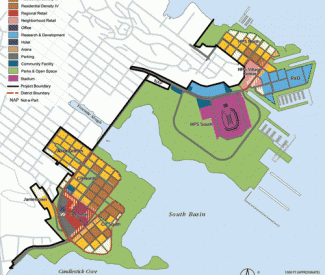
Today, I’m dedicating Michael Franti’s  “Say hey, (I love you)” to the entire Redevelopment Commission and the four Planning Commissioners who approved the City’s final Environmental Impact Report plan for Lennar’s Candlestick/ shipyard development. I’m doing so, not because I love these commissioners, who are  all mayoral appointees, but because they all seem to love everything about the final report, despite ongoing concerns about building a bridge over an environmentally sensitive slough, taking park land for luxury condos and unresolved questions about the Navy’s cleanup of the shipyard.(Yes, the EIR doesn’t address the toxic cleanup, but does it make sense to approve it before the Navy has completed its cleanup assessment plan?)

I’m also dedicating Franti’s bubbly soul-lifting song to Planning Commissioners Christina Olague. Kathrin Moore and Hisashi Sugaya for refusing to rubberstamp the final EIR or the related CEQA findings. Thanks guys for having some moral backbone!

Mayor Gavin Newsom, presumably tweeting while leaving town again on the Lt. Governor campaign trail, hailed yesterday’s rubberstamping process as a critical milestone.
“This is a major milestone for our efforts to transform the shipyard from an environmental blight to a showcase of jobs, affordable housing, parks and green-technology investment for the Bayview and our entire City,” Newsom said in a press release. “The approvals of the EIR and Redevelopment Plan reflect the years of hard work, rigorous study and extensive community involvement invested in revitalizing our City’s Southeastern Waterfront…our progress today is a testament to their leadership and commitment to thoroughly cleaning up the Shipyard so we can forge ahead towards a new vision for Hunters Point.”

One of the key points to emerge from last night’s hearing is the bifurcated nature of the process, which yesterday let the city push the EIR certification through, before the Navy completes a related EIS (environmental impact statement) about the cleanup on the shipyard—including areas of land where Lennar hopes to develop homes if the 49ers leave.

Fog City Journal’s Luke Thomas told me today that during public comment, the Nation of Islam’s Minister Christopher Muhammad called the commissioners “paid prostitutes” and “political whores” and said there would be a “political earthquake” if the commissioners go forward with EIR. 

“However, I don’t think he understood that the EIR and the EIS (which deals with the toxic cleanup) are two separate documents,” Thomas said, accurately noting that the joint commission was only voting on the EIR yesterday.

(According to Thomas, the Minister also promised that coalition of activists that would dog Newsom up and down the State during his campaign for Lt. Governor to expose Newsom’s record, so expect more fireworks along the campaign trial this summer.)

Another key fact to emerge from yesterday’s hearing was the lack of public comment on the part of almost all the candidates running to replace D. 10 Sup. Sophie Maxwell, whose district includes this massive development. Only Kristine Enea, Tony Kelly and Espanola Jackson spoke on the record—with Enea in favor of the plan with amendments, and Kelly and Jackson opposed as things currently stand.

Now, you’d think that everyone running in this race would be eager to show D. 10 constituents (and beyond) that they were at the meeting, not only silently tracking, but also publicly expressing their opinions. And while it’s true that Marlene Tran and DeWitt Lacy filled in speaker cards, Chris Jackson showed up during the proceedings, and Lynette Sweet got ushered into the press box by Sup. Bevan Dufty, none of these D. 10 candidates got their thoughts in the public record. Now, no doubt Cedric Akbar, Bill Barnes, Isaac Bowers, James Calloway, Malia Cohen, Ed Donaldson, Marie Franklin, Rodney Hampton Jr., La Vaughan Moore, Geoffrea Morris, Steve Moss, Jacqueline Norman, Nina Pickerrell, Dwayne Robinson, Diane Wesley Smith, Eric Smith, (and the many others rumored to be running) had their reasons for not being there, and I’d be happy to hear all about it from all of them between now and the November election.

But it doesn’t instill confidence in candidates when they won’t say in public what they are only too willing to say off the record. So, kudos to Enea, Kelly and Jackson for taking that leap and refusing to act like politicians before they have even been elected.

“So much of it was shocking but not surprising,” Tony Kelly told me today, after he recovered from last night’s meeting which lasted until 2 a.m. ‘Everyone knew there would be a snappy 4-3 decision by the Planning Commission on the stuff that mattered. And in a way, I can see why the mayoral appointees on the Commission would decide that they would leave it to the elected officials on the Board to stop this plan. But there was zero excuse for the lameness of the Redevelopment Commission [who are all mayoral appointees]. Still, it showed what the Planning Commission [which today consists of four mayoral appointees, and three Board appointees] must have been like  before it was reformed [and still consisted solely of mayoral appointees].”

“It was heartbreaking to see the endless parade of Bayview Hunters Point residents saying, ‘I need a job,’ or ‘ I need to live in a new house,’ as they argued in favor of certifying the project’s final EIR, despite all the flaws,” Kelly acknowledged.

Still, as Kelly points out, the city could have pushed to acquire foreclosed housing in D. 10 so residents in substandard public housing could be relocated into decent units now, instead of having to stay at least another five years, or longer, in rat, cockroach and sewage inundated units, under Lennar’s plan.

Kelly also notes that the city could have used the Redevelopment Agency’s “massive power” to do stuff up and down Third St, where unemployment is especially visible.

“Having done planning elsewhere, this plan [for Candlestick and the shipyard] is like planning on Mars,” Kelly said. ‘This is a bigger badder version of 555 Washington.”

Last but not least, Kelly voiced concern that a couple of peaker plants will be built within Lennar’s project area.
.“There are going to be two combustion turbines generating steam heat, but not electricity within the project boundaries,” Kelly clarified. “That means they don’t have to register as a power plant, but they will be generating greenhouse gases. The only difference is they won’t be generating electricity.”

So, now the charade of approvals heads to the Port Commission, which has got some folks asking whether Port Commissioner Stephanie Shakofsky, another Newsom appointee should recuse herself , given that her non-profit is clearly such a fan of the project.


Nevius family values

6

The Chron’s C.W. Nevius has made a big deal of moving back into town from the suburbs — and the offhand comment by Steve Jones in an email to Nevius has almost become a sticky nickname. In fact, his own newspaper’s website, sfgate, headlined his column “Suburban twit moves to city.”

But Chuck’s got some work to do before he starts to understand San Francisco values.

Take his latest column, about the Democratic County Central Commitee. Now, any Chron columnist (or anyone else) has the right to endorse and advocate for any candidates he or she wants. And Nevius is absolutely right to point out that the DCCC race is crucial, that control of the committee will have a significant impact on the fall supervisorial elections.

Here’s what made me want to scream:

“So, if you’re happy with the far-left agenda, check out the Bay Guardian. (Progs with name recognition like Peskin, David Campos, David Chiu, and John Avalos are probably shoo-ins. Daly is not running.) For those who’d like to see a swing to families, kids, and civility on the streets, here are some suggestions.”

 A swing to families and kids? You must be kidding.

The single greatest issue facing families and children in this city is the cost of housing. That’s why Coleman Advocates for Children and Youth, which almost everyone agrees is the premier family-advocate group in the city, has made affordable housing a huge priority.

Some of what a recent Coleman report says:

 “Two-thirds of all children in the city do not have a secure future in San Francisco

More families in San Francisco are low-income (43%) than middle-income (23%), and face economic hardship even when working full-time jobs.

Extreme racial disparities in family income and access to opportunity mean that the majority of children who do not have a secure future in SF are children  of color, and the majority of children who do have a secure future are white.”

Coleman’s recommendations: Build and preserve affordable housing for families — not market-rate condos, not condo conversions, but below-market-rate housing.

From the report:

“1. Prioritize the needs of 45,000 children growing up in 20,000 extremely-poor and low-wage working families.  trategies must combine investing in a stronger social safety-net for families now, and investing in anti-poverty strategies that will prepare today’s poor children to become economically secure San Franciscans of the future. The city’s housing and educational policies must focus on the children and families with the greatest need, and not get sidetracked by the demands of middle-income or upper-income families whose needs are legitimate but not as urgent.

 2. Invest in affordable homeownership programs for middle-income families, but focus the vast majority of limited housing resources on building permanently affordable family rental housing.”

That is exactly what the progressives — the “far left” folks that Nevius decries — have been talking about all these years. The candidates Nevius endorses are of the political camp that advocates more market-rate housing, more condo conversions, fewer tenant protections — more of the kind of things that drive lower-income families out of the city.

The next priority is education. Families that don’t have a lot of money have no option other than the public schools, and a lot of us who might be able to afford private schools still think public education is the way to go. What the schools need in San Francisco is pretty simple: They need more money. The “moderates: Nevius endorses — who actually count as fiscal conservatives, by San Francisco standards — are generally against raising taxes, as is our mayor. The San Francisco city government doesn’t oversee the schools, and most of the education money in California comes from the state — but San Francisco’s Rainy Day Fund, and the willingness of the supervisors to put money into the local schools, has saved hundreds of teacher layoffs and helped the quality of the local public schools.

 Where did that idea come from? Progressive leader Tom Ammiano.

I’m a San Francisco parent with two kids, and I have a lot of friends who are San Francisco families, and none of us see the Nevius agenda as family-friendly. That’s why we’re supporting the progressives.

Bicycists don’t deserve hate or violence

42

Today’s Chronicle story about an SUV driver purposely running down four bicyclists in San Francisco last night is disturbing enough, but the neanderthals who commented on that story to support this murderous rampage and blame bicyclists’ behaviors for encouraging the attack are truly outrageous and should be universally condemned. Has civil society broken down to the point where advocating violence against innocents is acceptable?

I’ve been the target of such rhetorical attacks for promoting bicycling, but when someone deliberately runs over a series of unrelated bicyclists, it’s time for all of us to reevaluate our use of hateful rhetoric and consider its impact on the mentally unbalanced, as this driver clearly was. Words don’t hurt, but when those words condone and promote violence, it’s time for all public-spirited individuals to apply the brakes.

Most people have long since abandoned any sympathy for the position that the rape victim was asking for it because she wore a short skirt, or that the gay beating victim shouldn’t have been so flagrantly making out in public, or that the lynching victim was getting a little uppity.

Similarly, even the most obnoxious, red-light-running, Critical Mass-riding, pedestrian-threatening bicyclist doesn’t deserve to be intentionally run over by an SUV. And when people blame a heinous attack like this on how bicyclists ride, even if just making a joke, they validate a hatred that we all should be condemning, no matter how you feel about bikes.

SFBG Radio: Tim and Johnny on nationalizing BP

11

Today, Tim and Johnny discuss BP’s utter failure in the Gulf of Mexico — and Robert Reich’s suggestion that Obama simply nationalize the oil company’s interests in the United States and take over the repair and cleanup. You can listen after the jump.

SFBGRadio6/3/2010 by SFBG

Leno cell-phone bill faces crucial test

7

By Brittany Baguio


The State Senate is set to vote as soon as June 3rd on legislation that could require cell phone companies to disclose the level of radiation their devices emit. The bill, by Sen. Mark Leno, is the latest effort to expand consumer awareness of a potential problem that become the center of a heated scientific debate.


Leno’s measure, SB 1212, would mandate that manufacturers and phone providers disclose radiation levels, or Specific Absorption Rate (SAR), on their Internet websites and online user manuals. The SAR would be placed next to the purchasing price. They would also be required to state the maximum SAR value, and what it means.


“The federal government has set a standard for this type of radiation and already requires reporting,” Leno told us, “At the very least, consumers should have the right to know about the relative risks of the products they’re buying.”
       
There’s a similar measure in the works in San Francisco. The Board of Supervisors City Operations and Neighborhood Services Committee May 24th passed Mayor Gavin Newsom’s plan to require retailers in the city to reveal the amount of radiation released by cell phones. That would make San Francisco the only city in the United States mandating that retailers acknowledge radiation information.


Leno’s bill is a response to studies suggesting that radiation levels emitted from cell phones have potential to cause brain tumors and other health problems.


The most recent and largest study focusing on cell phone radiation, the Interphone Study, was released this year. Conducted by 21 scientists, with Australia, Canada, Denmark, Finland, France, Germany, Israel, Italy, Japan, New Zealand, Norway, Sweden, and the United Kingdom all participating, the study looked at the long-term risks of certain brain cancers.


The results are mixed and a bit confusing. The study found some results of increased risks of tumors, although the authors could not agree on how to interpret the results


The researchers surveyed 5,000 brain-cancer patients, and found that people who were “heavy” cell-phone users (defined as using the phone 30 minutes or more a day) had a slightly higher risk of some kinds of cancer. And, as an Environmental Working Group analysis of the study noted, “most of the people involved …. used their cell phones much less than is common today.”


Cell phones emit radio waves through their antennas, which in newer models are often embedded in the phone itself. The closer the distance from the antenna to a person’s head, the more exposed he or she is to radiofrequency energy.


However, as the distance between the antenna and a person’s body increases, the amount of radiofrequency energy decreases rapidly. Consumers who keep their phones away from their body by doing activities such as texting are absorbing less radiofrequency energy.


The Federal Communications Commission has set a safety level for Standard Absorption Rate —  a measure of radiation energy — at 1.6 watts per kilogram of bady mass. All cell phone manufacturers must produce phones at or below this level.


The intensity of radiofrequency energy also depends on signal strength. When a person makes a call, the antenna sends a signal to its closest base station antenna and is then transferred to another person’s cell phone. The further the distance between the cell phone and the base station, the more power it takes to keep the call going.


A study done by Joachim Schuz in Germany in 2006 found a 120% increased risk for a brain tumor, glioma, among people who had used cell phones for at least 10 years. In addition, a study done in 2005 by MJ Schoemaker in Sweden suggested an 80% increased risk of acoustic neuroma, an intracranial tumor, on the side of the head of people who continually used cell phones for at least 10 years.


A study done by Siegal Sadetzki in Israel in 2008 suggested that there was a 49 to 58% increased risk of salivary gland tumors among frequent cell phone users on the same side of the head where the phone is used.


But there are some studies that suggest that cell phones pose no significant health effects to its users. According to California’s Environmental Working Group director, Renee Sharp, those studies produced such results because they focused on acute and medium term effects rather than long term effects. “We aren’t trying to say that cell phones are dangerous because we don’t have definite answers yet and we need more research done,” Sharp told the Guardian, “But when you look at studies with long term use of 10 years of longer, you see increases in certain kinds of brain tumors. We are trying to give people as much information as we can to make informed decisions because it may or may not impact their health.”


Part of the reason consumers are unaware of the radiation levels emitted from their cell phones is that cell phone manufacturers aren’t required to disclose that information directely to phone buyers. Instead they send the data to the FCC. Although the FCC makes this information available on its website, the information is not easily locatable and some links direct visitors to a manufacturer’s website that contains no SAR information. A list of cell phone model SAR information compiled by the Environmental Working Group can be found here.


Based on the Environmental Working Group’s cell phone list, some of the most popular cell phones emit the most SAR. For example, the Apple iPhone 3G can emit from 0.24 W/kg to 1.04 W/kg. The HTC Droid Eris emits 1.19 W/kg. The T-Mobile Sidekick emits 1.34 W/kg. But the award for the cell phone that emits the most radiation goes to the Blackberry 8820, which emits 1.28 to 1.58 W/kg — just below the federal safety limit. The more power a cell phone requires to load extra features and applications, the more radiation the cell phone emits.


According to Sharp, another part of the problem is the FCC’s standards are not protective enough. “The FCC set SAR standards 14 years ago and has not updated them since then,” Sharp told us. “This was before we found out that children have thinner skulls and are more susceptible to radiation effects and before phones developed and exploded into what they are now.”


Other countries echo Sharp’s concern for public safety. Although no country in the world has officially adopted a law requiring a disclosure of cell phone radiation information, some countries have already taken steps make consumers more aware of the potential danger radiation can cause. Consumer advocates in France a pushing a law that would ban advertisements promoting the sale of cell phones to children younger than 14. Countries such as the United Kingdom, Canada, Israel, and Finland have all created recommendations to prohibit children from using cell phones, only use cell phones if necessary, and to use hands free devices to talk on the phone.


The cell phone industry is strongly opposing Leno’s bill. Representatives from Tech America, which represents the industry, and AT&T, a major political player in Sacramento, could not be reached for comment.

Should Antonini recuse himself from Lennar vote?

1

As a Newsom appointee, Planning Commissioner Michael Antonini is expected to be a key vote today in favor of Lennar’s massive redevelopment plan at Candlestick Point-Hunters Point Shipyard.

And then there’s the fact that he wrote an op-ed for the San Francisco Business Times in December 18, 2009, suggesting that business, civic, labor and government leaders can keep the 49ers in town by “joining forces to assist in needed repairs and improvements to Candlestick Park and to expedite development of the Candlestick Point Hunters Point Shipyard, a project that features a “state-of-the art,” 69,000-seat football stadium.”
(The full text of Antonini’s op-ed is included at the end of this post to put his words into full context.)

But Antonini’s cheerleading has got some folks questioning his impartiality when it comes to the decisions that members of the Planning and Redevelopment Commissions will make today around certifying the project’s Final Environmental Impact Report (FEIR) and adopting related environmental findings.

In a June 2 letter to Planning Commission president Ron Miguel, Arthur Feinstein of the Sierra Club, Mike Lynes of the Golden Gate Audubon Society, Jennifer Clary of San Francisco Tomorrow and Jaron Browne of POWER (People Organized to Win Employment Rights) claim that “Commissioner Antonini has clearly prejudged the proposed project and become a strong advocate for locating a football stadium for the 49ers at the Hunters Point site as part of this project.”

“He has publicly urged others to support that stadium and cannot impartially review the record before him to determine whether the EIR is adequate, accurate and objective and whether adequate measures are required to protect the environment,” the foursome continue.

 Noting that he could have chosen to sign the December 2009 op-ed as a Member of the Republican County Central Committee, Feinstein, Lynes, Clary and Browne observe that Antonini “ instead identified himself in the capacity where the law requires him to act impartially – as a Planning Commissioner.”

With others arguing that Antonini’s right to express his opinion is protected by the First Amendment, and Antonini planning to read a rebuttal into the record at 1 p.m. today, it sounds like there’ll be plenty of drama at today’s hearing.

Antonini’s Op Ed in San Francisco Business Times

Friday, December 18, 2009
Business leaders can save the Niners
San Francisco Business Times – by Michael J. Antonini

“The 49ers are deeply and historically identified with San Francisco. San Franciscans Vic and Tony Morabito founded the team in 1946, many years before the Giants moved from New York and the Warriors from Philadelphia.

Hence business, civic, labor and government leaders are joining forces to assist in needed repairs and improvements to Candlestick Park and to expedite development of the Candlestick Point Hunters Point Shipyard, a project that features a “state-of-the art,” 69,000-seat football stadium. Leaders from the Committee on Jobs, the San Francisco Chamber of Commerce, Recreation and Park and others are asking businesses and individuals to help with funding of improvements at Candlestick in return for advertising. These improvements could translate into increased revenue for the contributor, the city and the team. Replacement of aging seats and a highly visible new luxury section are two concepts being studied.

Naming rights to Candlestick Park is an attractive opportunity for a company or an entity to gain nationwide exposure and local acclaim — and, perhaps, position itself to be a key contributor when a new stadium is built at Hunters Point. No new stadium can be built anywhere without significant private investment, in addition to $100 million assured from Lennar Corp. as a precondition of development rights and the amount which the 49ers ownership would invest.

On Thursday, Dec. 17, the San Francisco Planning Commission was to hear comment on the Draft Environmental Impact Report for the Candlestick Point Hunters Point Shipyard Plan. Because this plan features many diverse uses, particularly huge amounts of housing, funding is being rapidly obtained for greatly improved transit and traffic access.

San Francisco must avoid the errors of the past, when we failed to build an arena for indoor sporting, major conventions and entertainment events. Such a facility could have brought huge amounts of revenue to San Francisco businesses.

Leaders have twice stepped up to save the San Francisco Giants. One would expect no less from our leaders when dealing with our home grown, five- time Super Bowl champion San Francisco 49ers!

Michael J. Antonini is a planning commissioner for the City and County of San Francisco.”


Newsom doesn’t read the Guardian!

13


Gav was on KQED this morning, talking about his run for Lite Guv, and he started right off by saying how he doesn’t ever — ever — read the Bay Guardian


Michael Krasny started off by asking why Newsom refused to appear on the radio in a debate with Janice Hahn. “She agreed, you didn’t.” Krasny asked. “Why?”


Newsom’s comment: Gee, I didn’t have time for a debate. Too busy running the city, and trying to balance a budget– “the most complex budget in city history.” He insisted that he’d solved a $522 million deficit without laying off police or firefighters, while protecting the soc sev safety net and investing in homeless service and universal health care.


Krasny: “So the Guardian can’t beat you up any more?”


Gav: “Honestly, I haven’t read it in years, with all due respect to Tim Redmond and Brugmann and whatever the team is over there.”


Krasny, politely, tried to bring up the idea that a no-new-taxes budget means fewer jobs, but Newsom had none of it: “They seem to have a tax first policy,” he said (although he doesn’t read us, so he doesn’t know. He complained that San Franciscans are already paying 10 percent in sales tax — “a regressive tax,” and that “they (presumably the Guardian) consistently support it, I don’t.”


Read our paper, Mr. Mayor. The Guardian has consistently, for many years, argued that sales taxes are regressive, and we’ve consistently, for years, argued that there are far better options, ways the city can reclaim money from the wealthy. And we’ve argued that Newsom’s no-new-taxes policy is bad for the economy.


Oh, and by the way: You talked over and over about universal health care in San Francisco, and how proud you were of that policy. But if you were reading the Bay Guardian, you might recall that it wasn’t your policy. That initiative came from then-Sup. Tom Ammiano, and you opposed the key employer mandates that fund it. Hey, you could even pick that up by reading the Chron:


Why Comcast sucks

73

Ever wonder why Comcast routinely ranks among the worst companies in America for customer service? Let me tell you a story.


So my cable box stopped working, which meant I couldn’t get the Giants games and my daughter couldn’t watch Hannah Montana, which was something of a crisis in the Redmond household. So I called Comcast, and the nice woman on the phone tried a remote diagnosis, and told me the box was fried. “But don’t worry,” she said. “Just drop it by our office and we’ll give you a new one right away.”


Just drop it by our office. Here’s that that means: You arrive at the cramped, airless spot on Potrero and 16th and wait. And wait. And wait. When I got there, the line was 21 people long, and four customer service clerks were trying their best to sort out a wide range of problems — bill problems, service problems, people wanting more channels problems … by the time I got to the front, 41 minutes had passed, and the line stood at 28 people. There wasn’t any more room in the office; the 29th person was going to have to stand out on the street.


“It’s always like this,” an older woman in the line complained. And she’s right — at least, every time I’ve ever been there, the lines been long, the wait’s been long and every single person in the room was unhappy.


Here’s what’s going on: In the old days, when your cable service didn’t work, they sent a repair person to your house, and that person either fixed the problem or installed new equipment. Now it’s up to me to unscrew the box (easy enough for me, though maybe not for everyone), take my time to go wait in line for a new one, and reinstall it (again, easy for me, maybe not for everyone.) So I’m already saving Comcast the money it used to spend sending a trained technician to my house.  Now I’m paying, with my own time, to wait while an inadequate number of service people try to handle far too many problems.


Brian Roberts is the CEO of Comcast. I’ve sent him a note that says the following:


1. You need to hire more people for customer service. If you don’t want to pay to send techs out to my house, then properly staff your offices. Most people have jobs, and can’t afford to spend an hour or more (with travel time) to exchange a piece of your equipment every time it breaks.


2. Set up some orderly lines. One line for simple exchanges of gear, one for billing problems, one for people who want to spend 30 minutes deciding on a service upgrade. Even the DMV gets that; it shouldn’t be so hard.


3. But more reliable gear.


4. Or: Cut your prices. I’m paying way, way too much money to put up with this shit.

SFBG Radio: Tim and Johnny on the election

15

Today, Johnny and Tim talk about California Republican gubernatorial cadidates Meg Whitman and Steve Poizner and the upcoming voter initiative to legalize marijuana in the November election. You can listen after the jump.


SFBG.com Radio 6/1/10 by SFBG

Newsom’s budget includes a few ideas “Supervisors can’t stand”

City department heads, members of the San Francisco Board of Supervisors, representatives from major news outlets, and others crowded into the Luggage Store Art Gallery at 6th and Market streets on June 1 to hear Mayor Gavin Newsom discuss his proposed 2010-2011 budget.

Colorful artwork, such as a collage fashioned from cereal boxes, adorned the walls, and Newsom said he’d selected the venue to emphasize his commitment to improving the blighted mid-Market area.

Newsom’s $6.48 billion budget is being put forth in the face of a roughly $480 million deficit, which places the city in a similar financial situation to last year, when the mayor’s budget proposal sparked an outcry from progressive supervisors and a wide array of advocacy organizations for its deep blows to public health programs and critical services.

At first glance, the Department of Public Health seems to have fared better this time around, as a partial result of outside funding through federal programs. However, Newsom proposed slashing $22 million from DPH, compared with a total department budget of approximately $1.4 billion.

Newsom’s budget eliminates a total of 993 positions that are filled and unfilled, though the mayor said he anticipated 350 actual layoffs, bringing the total number of city employees to the lowest level in more than a decade. He thanked those he referred to as “enlightened city employees” for wage concessions that made fewer layoffs possible. There were no layoffs in the San Francisco Police Department or the San Francisco Fire Department, Newsom noted. The mayor also announced that an additional $5.9 million would be allocated to remedy the plagued crime lab.

The most contentious issue to emerge from the budget announcement was a proposal to generate $8 million through condo-conversion fees, under a system that would make it easier for people to turn rental units and tenancy-in-common units into condominiums.

Newsom accounted for funding from this proposal despite a lack of support from the Board of Supervisors. “I know the Board of Supervisors can’t stand this,” he said. “But I can’t stand the alternative. … This is a debate that I want to have, because I think this is principled and right.” He added that he thought supervisors’ resistance to accelerated condo conversions was “so darn ideological that it gets in the way of having a real discussion.”

Sup. John Avalos, who chairs the Budget & Finance Committee, said that he and other supervisors fear this could lead to more owner move-in evictions, a trend that would upend tenants’ lives and ultimately deplete the city’s affordable housing stock. “That’s been a concern of mine for months,” Avalos noted. Newsom’s decision to go forward with including it in the budget means that if the Supes reject it, they’ll have to find an additional $8 million to make up for the gap. “It’s kind of like putting a gun to our heads,” he said.

Newsom asserted that the budget was balanced “Without draconian cuts,” saying, “We were able to avoid the kind of cataclysmic devastation that some had argued … was inevitable in this budget.”

Yet Avalos described it as “pretty much an all-cuts budget,” because it contained no new revenue generating measures. “There are no new taxes in this budget,” Newsom said. “I know some folks prefer tax increases. I don’t.”

Avalos said he and other members of the board were working on a number of revenue-generating measures, including a nickel-per-drink tax on alcoholic beverages that would be aimed at the level of distributors, not small independent businesses.

Expect more on the mayor’s budget in coming weeks.

Let the ICE picket begin

7

Members of the San Francisco Immigrant Rights Defense Committee launched a picket outside US Immigration and Customs Enforcement (ICE)’s Detention and Removal Operations office at 630 Sansome Street today to decry the activation of Secure Communities, which they describe as a “dangerous police-ICE collaboration program that threatens public safety.”


“In the wake of massive protests this weekend against Arizona’s anti-immigrant law, a broad coalition of immigrant rights advocates will stage a protest Tuesday in San Francisco against the implementation of a new police-ICE collaboration initiative which will harm public safety, the so-called ‘Secure’ Communities or S-Comm program,” SFIRDC’s press release states.

Concerned community members plan to form a picket line holding placards of enlarged fingerprints and multi-lingual messages “to expose the danger the program poses to the community.”

 “If we oppose Arizona’s SB1070, then we cannot stand aside while a dangerous policy with disturbing similarities to SB1070 is forced on our own city,” Carolina Morales of Community United Against Violence stated. “S-Comm gives dangerous discretion to police officers to falsely arrest or overcharge immigrant residents, who would then be automatically reported for deportation.”

The picket comes as a veto-proof majority of eight SF Supervisors stands poised to vote next week (there is no Board meeting today) on a resolution calling on local law enforcement to opt-out of S-Comm, noting that the policy “puts at risk even those subject to arrest for a minor infraction and those who did not commit any crime at all but were falsely arrested. “

To date, the Mayor’s Office has not indicated that Newsom has any concerns with the program.
But San Francisco Sheriff Michael Hennessey, who requested to opt out of the program, has stated that S-Comm “will widen the net (of people reported to ICE) excessively” and that ICE has a “record of secrecy.”

Last year, the California Dept. of Justice signed a memorandum with ICE on the S-Comm program; the cover letter indicated that counties needed to agree to the program by signing a “statement of intent.” But last week, Attorney General Brown denied the Sheriff’s request to opt out, so community and legal advocates continue to explore their options.
 
 “The Attorney General is mistaken in believing that this program will only affect people who have already been apprehended and deported by ICE or charged with serious offenses,” said Francisco Ugarte, an immigrant rights attorney with Dolores Street Community Services.

.
 According to ICE’s own data, 5  percent of the people identified under the S-Comm program were U.S. citizens, and some 9 out of 10 of the total identified were charged with low level offenses, including property and traffic violations, not serious crimes.
And then there’s the fact that ICE’s data does not indicate whether those deported were actually found guilty of crimes, or were simply charged with crimes—a key distinction for anyone who professes to believe in human rights.

 “Our city’s families are living in fear that if they report a threat to their own safety, they or their family member may risk deportation, “ Nour Chammas with the Arab Resource and Organizing Center stated in SFIRDC’s press release. “This policy will tear at the very fabric of San Francisco’s rich and diverse culture.”

And Bobbi Lopez of La Voz Latina observed that folks are working on a federal level for immigration reform because they know real solutions to a broken immigration system.  “However, we cannot just sit idly by and wait while ICE’s police collaboration schemes threaten our families daily,” Lopez warned. “ We are proud that city officials are standing with community members to halt this attack on our San Francisco community.” 

Today’s picket was called for by the following members of SFIRDC:
African Advocacy Network, Arab Resource and Organizing Center, Asian Law Caucus,
CARECEN, Causa Justa: Just Cause, Chinese for Affirmative Action, Chinese Progressive Association, Communities United Against Violence, Dolores Street Community Services, East Bay Alliance for Sustainable Economy, Immigrant Legal Resource Center, Instituto Familiar de la Raza, La Raza Centro Legal / SF Day Labor Program, La Voz Parents Council, Mujeres Unidas y Activas, National Lawyers Guild SF Bay Area Chapter, People Organizing to Demand Environmental & Economic Rights, People Organized to Win Employment Rights, SF Pride at Work, and South of Market Community Action Network.

Finally, some talk of taxes in Sacramento

0

With the state careening toward another fiscal meltdown, and a new study showing (pdf) that the governor’s proposed budget cuts would cost California 330,000 jobs, increase the unemployment rate by 1.8 percent and deepen the recession, the Democrats in Sacramento are finally talking about serious new revenue sources.


The tax plans proposed by the Senate and Assembly leadership aren’t perfect, but they’re a very good start. The state Senate plan would raise $4.9 billion   by eliminating corporate tax breaks (which generally don’t produce jobs anyway), raising the Vehicle License Fee and keeping a modest income surtax. The Assembly plan, announced by Speaker John Perez, relies on repealing tax loopholes and imposing an oil-severance tax.


Wow! 29 Latinos for Meg Whitman

2

I wonder which is more remarkable — that there are only 29 members of the Latinos for Meg Whitman page — or that there are actually 29 Latinos for Meg Whitman. I mean, a candidate who over and over again insists that she really, really doesn’t want to do anything to allow people who have been living and working in this country for many years to get a chance at citizenship? I think it’s safe to say that won’t be her strongest base of support in November.

SFBG.COM Radio: Tim and Johnny on the real threat to business in California

5

Today, Johnny and Tim talk about the huge health insurance rates facing small businesses in California — and why that’s more of a threat to the viability of small business than tax increases. You can listen after the jump.

sfbg.comradio5/28/2010 by SFBG

Public employees step up; when will Newsom and downtown?

7

With news that Muni union leaders are backing salary givebacks to help close San Francisco’s $483 million budget deficit, all city employees are now making sacrifices to preserve city services that we all rely on. But as we eagerly await the release of the mayor’s budget on June 1 – in which some city departments have been asked to make cuts of up to 30 percent – the question is whether Mayor Gavin Newsom will find the courage to ask other San Francisco entities to help.

For example, will he support the 2 percent increase in the hotel tax that labor is pushing (and which polls show would probably pass muster with voters if Newsom backed it), a real estate transfer tax that would hit the comfortably rich, or a downtown transit assessment district that would make corporations finally help pay for the transit services their employees rely on?

So far, it’s doesn’t look like it (and his Communications Office won’t respond to the question). Instead, Newsom has cynically engaged in deceptive blame games that scapegoat public employees for a problem he created (for example, by approving bloated police and fire contracts to win political support and then blocking efforts to seek new revenue sources), while still pushing gimmicky new spending programs designed to burnish his political image as he runs for state office.

This could be Newsom’s last chance to finally show some leadership, and now is the time when it’s needed most. After offering cuts-only city budgets his entire tenure in office, most city departments are unable to go any further without sacrificing needed services.

The situation has become dire, as workers said Wednesday during a budget rally outside City Hall. Guardian news intern Kaitlyn Paris was there covering the action and offers this report:

Community groups from around San Francisco rallied in front of City Hall on Wednesday to protest the drastic reductions that health and human services face in the Governor’s proposed state budget and Mayor Newsom’s impending city budget.

A graveyard of tombstones representing each of the organizations stuck out of the sand next to the grassy square where participants gathered. Identifiable by their maroon sweatshirts, the largest faction present was the Community Housing Partnership. The proposed budget would cut over $100,000 from the agency and its programs that provide help with employment, substance abuse, and habitation development.

“Supervisors need to be constantly reminded of the merits of these services,” CHP employee Gabriel Haywood told us.

The partnership runs a jobs retention program that Haywood says has exceeded its city-mandated job retention rate by 25 percent, keeping 75 percent of the people it serves employed for longer than three months. Still, Cameron McHenry told the Guardian the city thinks the groups services are duplicative. [Editor’s Note: information in this paragraph has been corrected since his article was posted].

The city’s OneStop employment service is suited to workers displaced by the recession, not the multiple-burdened clients helped by CHP, said McHenry: “We can’t take a 30 percent cut and still do the work we do.”

After speakers from various groups addressed the crowd from a flatbed truck, District 5 Sup. Ross Mirkarimi took to the stage to demand alternative ways of generating revenue. The progressive revenue tactics championed mainly involved increased hotel tax to reduce the budget burden felt by community service groups. Mirkarimi and members of the crowd also criticized the city for its continued funding of Sharp golf course in Pacifica.

“We’re trying to force the Mayor to have a fair budget,” Coalition on Homelessness Director Jennifer Fredenbach told us. “We believe he can do it through alternative revenue like the hotel tax, a more progressive tax base, and a property transfer tax on high end real estate. It has real consequences for poor San Franciscans, not only in quality of life, but in the ability to live.”

Fees rise in SF, but some supervisors prefer taxes

5

By Brittany Baguio

 The Board of Supervisors this week voted to impose non-resident fees for admission into Botanical Gardens in an effort to help alleviate the city’s $483 million budget deficit, as requested by the Mayor’s Office. But even supervisors who supported it say they hope to end the fees if they can find some general revenue sources, a process that will begin next week after Mayor Gavin Newsom releases his budget on June 1.

Sup. John Avalos, who chairs the Budget Committee, began Tuesday’s discussion by stating that he believed that this non-resident fee would stop the layoffs of Botanical Gardens staff and help offset the 30 percent drop in their budget. Despite supporting the fees, Avalos expressed hope that they could be replaced by a 2 percent increase in the hotel tax, something labor and community groups are pushing that would raise $38 million to $45 million per year.

He even amended the item to include a provision that the non-resident fee will be eliminated within 90 days from the effective date of the new tax. Despite Avalos’s amendment, AIDS Grove founder and volunteer community gardener Nancy McNally said she was appalled that Avalos would support a non-resident fee. “He is not committed to preserving significant public park commons that San Franciscan generations before him have paid taxes to preserve,” McNally told the Guardian. “No one wants to brainstorm and come up with creative options to alleviate this crisis that is not really a crisis. Greed is the crisis.”

One thing McNally did appreciate was sober assessments made at the hearing by Sup. Eric Mar, who stated that Botanical Gardens serves as a haven for low-income and immigrant families who can only enjoy the facilities because admission is free. He declared that once fees are attached to Botanical Gardens, it will lose its appeal. He also added that passing this fee will be the first step in initiating fees for all.

San Francisco resident Daniele Erville shared Mar’s concerns. “A fee acts as a deterrent to a place that by its very nature is welcoming,” Erville told us. “The place makes us feel at home, it reminds us that we are a part of nature and reminds us of our common humanity. Spirituality means that you are in touch with what unites us all, and so differentiating on any level just clashes.”

The imposition of fees – $7 for non-resident adults, $5 for seniors, and $2 for children – was approved on a 8-3 vote, with Sups. Mar, Bevan Dufty, and Ross Mirkarimi in dissent.

Why is SFUSD signing on to Race to the Top?

4

The Obama administration, to its credit, is actually paying attention to, and putting money into, urban public education. But Arne Duncan, the education secretary, is using some of the money to push a broad agenda that, frankly, drives me nuts and undermines a lot of what public education ought to be about.


The New York Times Magazine did a good job laying out the agenda May 23. The self-styled reformers want to encourage charter schools, push standardized testing (and other easily quantifiable methods of evaluating classroom performance) and change the way teachers are hired and fired. In fact, in many ways, the Duncan agenda is all about blaming the teachers for the problems in public schools.


There are, absolutely, some bad teachers out there. There are people who are so burned out they should leave and find other work. There are people who never were terribly good at teaching anyway. There are people who can’t do the job, and somehow stick around year after year, dooming students to poor-quality classes. There are 300,000 public-school teachers in California; not all of them will be great. (There are also, by the way, terrible lawyers who never get disbarred and terrible doctors who kill and maim patients and manage to protect their medical licenses.)


But in California, certainly, the relatively modest number of poor teachers is not by any stretch the biggest problem with public education. And tests, particularly standardized tests, are not remotely a valid way of determining which teachers are good and which aren’t.


Teachers in California cities face widely divergent student populations. In some San Francisco classrooms, a majority of the students are English learners, or come from broken or troubled families, or lack proper nutrition, or are homeless … and those are just the surface issues. Telling a dedicated first-grade teacher that he or she is going to be fired because of test scores in a classroom where it takes heroic efforts every day to get 20 troubled kids to sit down and pay attention for even 15 minutes isn’t just unfair. It’s crazy.


The teachers unions have fought some of these efforts, and — thanks to world-class organizing efforts and a fair amount of campaign money — have managed to beat some of them back in Congress and state Legislatures. That’s where Race to the Top comes in.


Duncan and his merry band of “reformers” are dangling out federal money to districts that desperately, desperately need any pennies they can get — but the price is high. In essence, you have to sign on to at least part of the Duncan agenda, which promotes testing, charter schools, etc. 


The highest number of points — 138 of the 500-point scale that Duncan and his staff created for the Race — would be awarded based on a commitment to eliminate what teachers’ union leaders consider the most important protections enjoyed by their members: seniority-based compensation and permanent job security.


It’s almost a cruel bargain: You don’t have enough money to buy chalk for the chalkboard or pencils for the kids, and the feds are happy to help — as long as you stick it to the teachers unions and sign onto an agenda that a lot of progressive school boards despise.


And that’s where San Francisco is.


In a special meeting May 20, the San Francisco School Board signed on to a Memorandum of Understanding with the state of California that will be part of California’s application for Race to the Top funding. You can read the MOU here. It’s not as bad as some of what Duncan is pushing, but still: SFUSD is participating in this madness.


I asked Jane Kim, president of the School Board, about it, and she told me that the district’s proposal “doesn’t have anything about charter schools or merit pay. It’s really just a continuation of the work that we’re already doing.” And that’s true, although Dennis Kelly, the head of the local teachers union, United Educators of San Francisco, isn’t happy about it, though; he told me that “this is not something we could sign on to. It’s pretty much the standard state form.”


And the board passed it unanimously, and a lot of the local board members are good progressives who know more about education than I do. And as Kim pointed out, at a time like this, “I don’t think we should refuse to go for the extra funding.”


Frankly, the San Francisco Unified School District isn’t going to get any Race to the Top money anyway — not with districts all over the country selling their souls and going way, way further than we are to scrap for that cash. But I have to ask: Since Race to the Top is such a bad idea, why are we even playing the game?

Poll: PG&E is in trouble

20

Internal polls by Pacific Gas and Electric Company’s consultants show that Prop. 16 — the scandalous attack on public power and community choice — is still trailing, despite $45 million in advertising, a source familiar with the polling told me today.


The tracking polls show that PG&E is having a hard time getting above 40 percent support in some parts of the state, particularly in the Central Valley, where complaints about smart meters are soaring. “PG&E’s name is just shit out there,” the source told us.


The utility had planned to spend $35 million on the campaign, but has recently dumped in $10 million more — a sign that Prop. 16 is still lagging. And despite the fact that the No on 16 campaign lacks the money even to do a single major television buy, the public apparently isn’t buying PG&E’s line. It doesn’t hurt that nearly every major newspaper in the state has opposed the measure — and that PG&E is having a hard time finding allies.


So it’s possible that the private utility will wind up spending $45 million or more — and wind up losing, and in the process, alienating a wide range of political leaders and community groups. Peter Darbee, you’re doing a heck of a job.

FCC seeks input on new media ownership rules

0

By Kaitlyn Paris

The Federal Communications Commission filed a Notice of Inquiry on May 25 asking for public input on its changing media ownership rules. Citizens concerned about proposals to expand corporate control of local television, radio, and print should submit their views within 30 days via the FCC website. The list of 107 topics can be found here, along with Commissioner’s statements outlining the intent and scope of the rules and comments.

The request for public opinion is aimed at gaining information on almost every aspect of media for the purpose of shaping laws that encourage competition, localism, and diversity. In the last two reviews, however, the FCC decided to relax ownership rules across media platforms, giving corporations more leeway in acquiring multiple outlets and triggering an overwhelming backlash from the public.

“I have many times expressed my displeasure with the way this review was handled in its previous two incarnations,” wrote Commissioner Michael Copps in his inquiry statement. “Hopefully, the third time is the charm.”

The deregulation initiatives proposed in 2003 and 2007 were blocked by lawsuits, but with this Notice of Inquiry the process has officially begun anew even as the 2007 decisions are contested in court. “We want to finish this proceeding by the end of the year, but from my experience, it is a very hot button political issue,” FCC Media Bureau staffer Krista Witanowski told the Guardian. “It could take a year to two. The goal is to finish it within the year.”

After the time for comments has lapsed, the Commissioners will review them and issue a Notice of Proposed Rulemaking. “We’re trying to get more concrete information,” Witanowski said. “But that doesn’t mean that when this gets going people won’t make a push for all intensive meetings with Commissioners.”

In preparation for its mandatory four year review, the FCC hosted the last of three cross-country “workshops” at Stanford on May 21. Since 1975 the FCC has banned a single entity from owning both television, newspaper, or radio in one local market. The possibility of increased corporate conglomeration of various media outlets brought together concerned citizens and a mix of panelists for discussion and public comment.

The Internet, big business interests argued, provides sufficient alternative news to avoid monopolization of editorial views and broadcasting resources. Ruth Robertson, a member of the Raging Grannies who protested with signs and cookies outside the workshop, is concerned about the digital divide and its effects on already marginalized groups. “It’s easier for someone younger than me to say the Internet is a whole new world,” said Robertson, citing the ease with which her children learned to use computers and the high proportion of seniors who don’t use the web. “Big media tries to make the case that ‘oh well there’s the Internet so there’s this great variety.’ In actuality you can search a certain topic but you’ll see the same quote over and over again.”

Ravi Kapur, panel member and vice president of KAXT-CA Channel One, contends that current news practices ignore the needs and concerns of Bay Area communities. If deregulation occurs, Kapur is worried that smaller frequencies like his will be quieted. “We’ll be wiped out and the corporations will do the same stuff. You’re not going to get Vietnamese newscasts or newscasts in Tagalog and that’s what we’re doing. Other broadcasters could easily do it but they choose not to, that’s why they complain and say they need to streamline their costs. Why don’t they innovate? I don’t want to encourage competition, but they have more resources than us.”

No Commissioners were present at the conference, though it was moderated by staffers from the Media Bureau. Public opinion weighed heavily on the side of upholding regulations. Tracy Rosenberg, a member of Media Alliance (a group involved in the lawsuit blocking the previous FCC decisions) described the concerns she and other attendees voiced: “As members of the public I think mostly their concerns were previous media consolidations. People anecdotally have seen more wire coverage, more repetitive stories, less independent investigative reporting in their neighborhoods.”

If you didn’t hear about the workshop, you’re not alone. Only one network, KGO 7, turned up to cover it. In the weeks leading to the meeting little was done to draw attention and public participation. Tiffiniy Ying Cheng, panelist and co-founder of the Participatory Culture Foundation, thought the FCC could have reached out to the Palo Alto community. “There were very few students and very few people in general, especially for public comments,” she wrote.

With the Notice of Inquiry the public now has a short chance to submit their opinions online without taking the time to attend a workshop. Even without wading through the 35 page inquiry, most Bay Area community members have some input on the current state of local news, issues surrounding consolidation, big media mergers, or net neutrality. Now is the chance to give the FCC a piece of your mind.

Another new model for newspaper ownership

0

Well, maybe it’s not entirely, new, but I haven’t seen it around here. The Point Reyes Light, a legend in West Marin, was just sold to a community-based group that’s almost, sortof a nonprofit. It’s actually called a “low-profit limited liability company” (not a bad name for most newspapers these days), and it’s going to be operated as a community trust, of sorts. Mark Dowie, the well-known investigative reporter, is involved, so that’s good news. And apparently, things weren’t working out with the previous owner.


Among the donors: Warren Hellman, who’s also involved in the (entirely) nonprofit Bay Citizen.

Is Secure Communities opt-out still an option?

5

Immigrant rights attorney Francisco Ugarte, who works for SFILEN,  just talked to me about why it’s critical that folks raise their concerns about immigrant rights with their elected officials in the face of Secure Communities, a program ICE is planning to bring to San Francisco June 1, and to all U.S. jails by 2013, without the openness and transparency that we have come to expect under the Obama administration.

“There’s a rise in xenophobia and the economy is going down, so this is the time when people should be speaking up for immigrants,” Ugarte said. “ICE is among the least transparent governmental agency in the U.S. It’s hard enough for lawyers to get information about their clients, let alone a member of the public who is trying to get information about an ICE program like Secure Communities.”

Ugarte notes that ICE’s own MOA (Memorandum of Agreement) with individual states prohibits them from providing information about Secure Communities to the media, without first getting the consent of ICE.

“ICE needs to be asked, whose confidentiality are you protecting, your own, or that of the members of the public that are being detained under this program?” Ugarte said.

He believes ICE is being so secretive because it doesn’t want to tell the stories of deportations and trauma that have created in the local community.

I asked Ugarte if he’d support the idea of a national I.D. card, based on the premise that if ICE is going to fingerprint and I.D. everyone anyways, then why not parlay this into giving folks who aren’t found guilty of a felony some kind of I.D. Card as a first step towards amnesty? (Provided folks aren’t found guilty of a felon, in which case ICE would deport them.)

“I’m not sure if we can support a national I.D. card,” Ugarte said. ‘The point is that ICE is intent on removing folks who they deem ‘dangerous,’ but they are not offering any relief for the millions of people who work hard and pay taxes yet remain second-class citizens. We need some kind of commensurate relief.”

Ugarte worries that a national I.D. card program would allow the federal government to become an even bigger Big Brother.
“But it’s crystal clear that there has to be some relief provided for the millions who have worked hard and contributed to their communities,” Ugarte said.

He noted that ICE deported 400,000 folks last year alone.
‘That’s more folks than in any of the Bush administration’s years,” he said. “This is affecting us directly. We did not elect Obama to destroy our community.”

Ugarte said that he doesn’t believe that Obama is controlling ICE, but that he should start doing so now.
“Obama needs to assert more control. He has the power through executive order to stop the deportation of people who have U.S. citizens in their families. He has the power to reform the system to prevent the destruction of people who live here. Right now, we’re seeing enforcement only, and it’s creating a human rights crisis.”

And Ugarte has not given up on the notion that San Francisco can opt out of Secure Communities, no matter what AG (and gubernatorial candidate) Jerry Brown says.

“Right now, it appears that the Department of Justice is resisting the opt-out idea from San Francisco, but the Attorney General did not cite any legal authority in his letter,” Ugarte observed. “All he said was based on policy reasons, in contrast to San Francisco Sheriff Mike Hennessey’s concerns, which were based on the impact of the program on public safety.”

Summing up Jerry Brown’s missive as a “political letter,” Ugarte says folks need to double their efforts to ensure that folks in Sacramento understand the implications of local police-ICE collaborations and their similarities to Arizona’s immigration law.

“We need to ensure that our voices are heard. Three people in D. C. and three people in Sacramento should not be dictating policy for millions.”